WO1993002143A1 - Composition d'elastomere thermoplastique - Google Patents
Composition d'elastomere thermoplastique Download PDFInfo
- Publication number
- WO1993002143A1 WO1993002143A1 PCT/JP1992/000921 JP9200921W WO9302143A1 WO 1993002143 A1 WO1993002143 A1 WO 1993002143A1 JP 9200921 W JP9200921 W JP 9200921W WO 9302143 A1 WO9302143 A1 WO 9302143A1
- Authority
- WO
- WIPO (PCT)
- Prior art keywords
- acid
- elastomer
- meth
- acrylate
- copolymer rubber
- Prior art date
- Legal status (The legal status is an assumption and is not a legal conclusion. Google has not performed a legal analysis and makes no representation as to the accuracy of the status listed.)
- Ceased
Links
Classifications
-
- C—CHEMISTRY; METALLURGY
- C08—ORGANIC MACROMOLECULAR COMPOUNDS; THEIR PREPARATION OR CHEMICAL WORKING-UP; COMPOSITIONS BASED THEREON
- C08L—COMPOSITIONS OF MACROMOLECULAR COMPOUNDS
- C08L67/00—Compositions of polyesters obtained by reactions forming a carboxylic ester link in the main chain; Compositions of derivatives of such polymers
- C08L67/02—Polyesters derived from dicarboxylic acids and dihydroxy compounds
-
- C—CHEMISTRY; METALLURGY
- C08—ORGANIC MACROMOLECULAR COMPOUNDS; THEIR PREPARATION OR CHEMICAL WORKING-UP; COMPOSITIONS BASED THEREON
- C08L—COMPOSITIONS OF MACROMOLECULAR COMPOUNDS
- C08L63/00—Compositions of epoxy resins; Compositions of derivatives of epoxy resins
-
- C—CHEMISTRY; METALLURGY
- C08—ORGANIC MACROMOLECULAR COMPOUNDS; THEIR PREPARATION OR CHEMICAL WORKING-UP; COMPOSITIONS BASED THEREON
- C08L—COMPOSITIONS OF MACROMOLECULAR COMPOUNDS
- C08L67/00—Compositions of polyesters obtained by reactions forming a carboxylic ester link in the main chain; Compositions of derivatives of such polymers
- C08L67/02—Polyesters derived from dicarboxylic acids and dihydroxy compounds
- C08L67/025—Polyesters derived from dicarboxylic acids and dihydroxy compounds containing polyether sequences
-
- C—CHEMISTRY; METALLURGY
- C08—ORGANIC MACROMOLECULAR COMPOUNDS; THEIR PREPARATION OR CHEMICAL WORKING-UP; COMPOSITIONS BASED THEREON
- C08L—COMPOSITIONS OF MACROMOLECULAR COMPOUNDS
- C08L77/00—Compositions of polyamides obtained by reactions forming a carboxylic amide link in the main chain; Compositions of derivatives of such polymers
-
- C—CHEMISTRY; METALLURGY
- C08—ORGANIC MACROMOLECULAR COMPOUNDS; THEIR PREPARATION OR CHEMICAL WORKING-UP; COMPOSITIONS BASED THEREON
- C08L—COMPOSITIONS OF MACROMOLECULAR COMPOUNDS
- C08L33/00—Compositions of homopolymers or copolymers of compounds having one or more unsaturated aliphatic radicals, each having only one carbon-to-carbon double bond, and only one being terminated by only one carboxyl radical, or of salts, anhydrides, esters, amides, imides or nitriles thereof; Compositions of derivatives of such polymers
- C08L33/04—Homopolymers or copolymers of esters
- C08L33/06—Homopolymers or copolymers of esters of esters containing only carbon, hydrogen and oxygen, which oxygen atoms are present only as part of the carboxyl radical
-
- C—CHEMISTRY; METALLURGY
- C08—ORGANIC MACROMOLECULAR COMPOUNDS; THEIR PREPARATION OR CHEMICAL WORKING-UP; COMPOSITIONS BASED THEREON
- C08L—COMPOSITIONS OF MACROMOLECULAR COMPOUNDS
- C08L33/00—Compositions of homopolymers or copolymers of compounds having one or more unsaturated aliphatic radicals, each having only one carbon-to-carbon double bond, and only one being terminated by only one carboxyl radical, or of salts, anhydrides, esters, amides, imides or nitriles thereof; Compositions of derivatives of such polymers
- C08L33/04—Homopolymers or copolymers of esters
- C08L33/14—Homopolymers or copolymers of esters of esters containing halogen, nitrogen, sulfur, or oxygen atoms in addition to the carboxy oxygen
Definitions
- the present invention relates to a high-stress thermoplastic elastomer composition that provides flexibility and excellent heat resistance and compression set resistance.
- Copolyester elastomer is a multi-block copolymer composed mainly of polyester and polyether as repeating units
- copolyamide elastomer is composed of multi-block copolymer composed mainly of polyamide and polyether or polyester as a repeating unit. These are all elastomers having moderate flexibility.
- these copolyester elastomers and copolyamide elastomers have a high hardness as the elastomer and are inferior in flexibility and strain recovery for use in the rubbery region.
- the content of the soft segment in these copolyesters is increased, there is a disadvantage that the melting point is lowered and the high-temperature usable temperature range is lowered.
- a method of adding an emulsifier such as a plasticizer is known.
- this method has the disadvantage that the softener is extracted or volatilized during use and hardens again.
- Kaihei No. 1-266 615 is a composition comprising a copolyester elastomer mixed with 1-5% of reactive curable monomer polymerized acryl rubber, which is cross-linked with acryl rubber.
- Compositions and uncrosslinked compositions are disclosed.
- this uncrosslinked composition is inferior in compression set, and is typically a crosslinked system of acrylic rubber as exemplified in the crosslinked composition, such as a quaternary ammonium salt, a stone tertiary or quaternary.
- Japanese Patent Application Laid-Open No. Hei 13-36447 discloses a composition comprising a thermoplastic polyester resin such as polyethylene terephthalate or polybutylene terephthalate and a covalently crosslinked acrylic rubber.
- This covalently crosslinked acrylic rubber is an acrylic rubber in which polyacrylate having an acid group, a hydroxy group or an epoxy group as a crosslinking site is covalently crosslinked with boramine, polyisocyanate or polyepoxide. Since this composition contains a highly rigid polyester resin, a large amount of a rubber component must be blended in order to impart sufficient strain recovery as an elastomer, and as a result, the molding flow of the composition There is a disadvantage that mobility is impaired.
- This publication also discloses, as one embodiment, a composition in which a polyetherester elastomer and an ethylene acrylate copolymer rubber having a carboxyl group are crosslinked with an isocyanate compound.
- a crosslinking system for epoxy groups in a system comprising a (meth) acrylate copolymer rubber containing an epoxy group.
- a composition having improved flexibility and compression set resistance can be obtained by crosslinking and dispersing an acrylic rubber in a copolyester elastomer.
- copolyester elastomer is easily degraded by the usual crosslinking agent of acrylic rubber in the molten state.
- An object of the present invention is to provide an elastomer comprising a copolyester elastomer or a copolyamide elastomer and an epoxy group-containing (meth) acrylate copolymer rubber and a carboxyl group-containing (meth) acrylate copolymer rubber.
- An epoxy group-containing (meth) acrylate copolymer rubber and a carboxyl group-containing (meth) acrylate rubber which are cross-linked to each other without deteriorating the Koboli elastomer and the entire composition.
- An object of the present invention is to provide a high-stress thermoplastic elastomer composition having a flexible and excellent heat resistance and compression set resistance in which a polymer rubber is dispersed.
- the object of the present invention is to provide (A) a thermoplastic copolyester elastomer or a thermoplastic copolyamide elastomer, (B) a methacrylate or acrylate copolymer rubber containing an epoxy group, and (C) a carboxyl group.
- thermoplastic copolyester elastomer is at least one selected from the group consisting of kobolier-telester elastomer, polylactone-modified or lacton-modified kobolier-terester elastomer, and koboliethermidester elastomer. .
- thermoplastic copolyamide elastomer is at least one selected from copolyetheresteramide elastomers and copolyesteramide elastomers.
- the epoxy group-containing methacrylate or acrylate copolymer rubber is selected from at least one selected from the group consisting of dalicidyl meta-atalylate, glycidyl acrylate, and aryl glycidyl ether as the epoxy group. Contains units derived from a type of epoxy group-containing monomer.
- the methacrylate or acrylate copolymer rubber containing a carboxyl group contains, as the carboxyl group, a unit derived from methacrylic acid or acrylic acid.
- a methacrylate or acrylate copolymer rubber containing an epoxy group and a methacrylate or acrylate copolymer rubber containing a carboxyl group are a thermoplastic copolyester elastomer or a thermoplastic copolyamide elastomer. In addition, they are mutually crosslinked under melt mixing.
- the composition of the present invention comprises 30 to 90% by weight, preferably 40 to 80% by weight of a thermoplastic copolyester elastomer or a thermoplastic complexamide elastomer, and an epoxy group-containing (meth) acrylate. Both the copolymer rubber and the carboxyl group-containing (meth) acrylate copolymer rubber are combined.
- the epoxy group-containing (meth) acrylate copolymer rubber and the carboxyl group-containing (meth) acrylate have a total content of 70 to 10% by weight, preferably 60 to 20% by weight. It is characterized by the fact that birds are cross-linked and dispersed.
- thermoplastic copolyester elastomer used in the present invention may be composed of a repeating unit of polyester and polyester, a polyester, a repeating unit of (poly) lactone and polyether or a repeating unit of polyester and polyimidether. It is a multi-block copolymer, including copolyetherester elastomers, (poly) lactone-modified kobolietherester elastomers and copolyesterimide ester elastomers.
- thermoplastic copolyetherester elastomers and (poly) lactone-modified copolyetherester elastomers can be obtained by (i) at least one type of diol by the conventional esterification Z polycondensation method. (Ii) at least one dicarboxylic acid, (iii) at least one long-chain ether glycol and, where appropriate, (iv) at least one lactone or polylactone.
- the diol (i) used in the production of the copolyetherester elastomer and its (poly) lactone modified product is a saturated or unsaturated aliphatic or cycloaliphatic dihydroxy compound and an aromatic dihydroxy compound. Is included. These diols preferably have a low molecular weight, that is, a molecular weight of about 300 or less. Specific examples of aliphatic and alicyclic diols include ethylene glycol, brobandiol, and butanediol.
- Pentanediol 2-methylpropanediol, 2,2-dimethylpropanediol, hexanediol, decanediol, 2-octylpinedecanediol, 1,2—, 1,3—and 1,4 Dihydroxycyclohexane, 1,2-, 1,3- and 1,4-six-mouth hexanedimethanol, butynediol, hexenediol, etc.
- Diols having 2 to 15 carbon atoms are included. Particularly preferred diols are 1,4-butanediol and mixtures of 1,4-butanediol with hexanediol or butynediol. Specific examples of aromatic diols include resorcinol, hydroquinone, 1,5-dihydroxynaphthalene, 4,4'-dihydroxydiphenyl, bis (p-hydroxyphenyl) methane, and 2,2-bis (p —Hydroxyphenyl) Diols having 6 to 19 carbon atoms, such as propane.
- Particularly preferred diols are saturated aliphatic diols having 2 to 8 carbon atoms and mixtures of such saturated aliphatic diols, and mixtures of such saturated aliphatic diols and unsaturated diols.
- the same diol occupies at least about 50 mol%, especially at least 80 mol%, based on the total amount of diol.
- the most preferred diol mixtures are those in which the 1,4-butanediol is present in the majority.
- Suitable dicarboxylic acids (ii) for use in preparing the copolyetherester elastomers and their (poly) lactone modifications include aliphatic, cycloaliphatic and Z or aromatic dicarboxylic acids. These dicarboxylic acids preferably have a low molecular weight, that is, those having a molecular weight of about 350 or less, but higher molecular weight ones, especially dimer acid, can also be used.
- aliphatic and alicyclic dicarboxylic acids include sebacic acid, 1,2-cyclohexanedicarboxylic acid, 1,3-cyclohexanedicarboxylic acid, 1,4-cyclohexanedicarboxylic acid, adibic acid, Talic acid, succinic acid, oxalic acid, azelaic acid, getylmalonic acid, arylmalonic acid, 4-cyclohexene-1,2-dicarboxylic acid, 2-ethylsberic acid, tetramethylsuccinic acid, cyclopentanedicarboxylic acid, Decahi Draw 1,5-Naphthalenedicarboxylic acid, 4,4'-Bicyclohexyldicarboxylic acid, Decahi Draw 2,6-Naphthalenedicarboxylic acid, 4,4-Methylenebis (cyclohexane carboxylic acid), 3,4-Difuran carboxylic acid Acids, and
- aromatic dicarboxylic acids include terephthalic acid, phthalic acid, isophthalic acid, and beebenzoic acid, such as bis (p-carboxyphenyl) methane, oxybis (benzoic acid), ethylene-1,2-bis (p -Substituted dicarboxy compounds having two benzene nuclei, such as 1,5-benzophthalic acid, 1,5-naphthalenedicarboxylic acid, 2,6-naphthalenedicarboxylic acid, 2,7-naphthalenedicarboxylic acid, phenanthrene Included are carboxylic acid, anthracene dicarboxylic acid, 4,4′-monosulfonyl dibenzoic acid, and halo and alkyl, alkoxy, and aryl substituted derivatives thereof having 1 to 12 carbon atoms.
- another aromatic carboxylic acid for example, a hydroxy acid such as p- (hydroxye)
- the copolyetherester elastomer and its (poly) lac Among the dicarboxylic acids used in the production of the modified tonics, there are aromatic dicarboxylic acids and mixtures of two or more aromatic dicarboxylic acids, and mixtures of aromatic dicarboxylic acids with aliphatic and Z- or alicyclic dicarboxylic acids.
- the aromatic dicarboxylic acid alone is particularly preferred.
- aromatic dicarboxylic acids aromatic dicarboxylic acids having 8 to 16 carbon atoms, particularly benzenedicarboxylic acids such as phthalic acid, terephthalic acid and isophthalic acid, and dimethyl esters thereof are preferred. Dimethyl terephthalate is best.
- dicarboxylic acids or their esters it is preferred that at least about 60 mol%, especially at least about 80 mol%, based on the total amount of dicarboxylic acid, be the same dicarboxylic acid. In particular, it is best if dimethyl terephthalate accounts for at least about 60 mol% of the dicarboxylic acid mixture.
- the long-chain ether glycol (iii) used for the production of the thermoplastic copolyetherester elastomer and its (poly) ratatone modified product is preferably a polyether having a molecular weight of about 400 to about 12,000. (Oxyalkylene) glycol and copoly (oxyalkylene) glycol.
- Preferred poly (oxyalkylene) units have a molecular weight of from about 900 to about 4,000 and have a carbon to oxygen ratio of from about 1.8 to about 4.3 excluding side chains. It is derived from a chain ether glycol.
- suitable poly (oxyalkylene) glycols include poly (ethylene ether) glycol, poly (propylene ether) glycol, poly (tetramethylene ether) glycol, ethylene oxide end-capped poly (propylene ether) glycol and majority.
- Polyformal glycols produced by reacting formaldehyde with diols such as, for example, 1,4-butanediol and 1,5-pentanediol are also useful.
- Particularly preferred poly (oxyalkylene) glycols are poly (propylene ether) glycol, poly (tetramethylene ether) glycol and copoly (propylene ether-ethylene ether) glycol with a majority in polyethylene ether skeleton.
- lactones or polylactones (iv) can be added to these copolyetheresters.
- This type of (poly) lactone-modified koboli ether ester elastomer is disclosed in U.S. Pat. No. 4,569,973.
- e-cubic lactone is particularly preferred, but a lower alkyl such as methyl or ethyl at the ⁇ , ⁇ , r, 5 or ⁇ position.
- Substituted lactones substituted with groups can also be used.
- a homopolymer or a copolymer of the monomer and another copolymerizable monomer and a polylactone including a hydroxy-terminated polylactone may be used. it can.
- suitable copolyester ester elastomers and their (poly) lactone modifications are prepared by adding (iii) the amount or amount of (iii) the long-chain ether glycol component in the cholesterol ester or (poly) lactone modification. iii) Combination of long chain ether glycol component and (iv) lactone component
- the weighing is from about 5 to about 80% by weight. More preferred compositions are those wherein the amount of (ii i) the long chain ether glycol component or the total amount of the (iii) component and the ( ⁇ ) lactone component is from about 10 to about 50% by weight.
- the polyetherimide ester elastomer used in the present invention is produced from one or more diols, one or more dicarbonic acids, and one or more high molecular weight polyoxyalkylenedimidic acids. Can be. The preparation of such polyether imidoester elastomers is described in U.S. Pat. No. 4,556,705.
- polyether imide ester elastomer used in the present invention can be produced by a method commonly used for producing polyesters, for example, a method of producing a random or block copolymer by an esterification and condensation reaction. Can be.
- polyetherimide esters can generally be characterized as the reaction product of a diol and an acid.
- Preferred polyetherimide ester elastomers used in the present invention include (i) one or more aliphatic or cycloaliphatic diols having 2 to 15 carbon atoms, (ii) one or more aliphatic, It can be produced from an alicyclic or aromatic dicarboxylic acid or an ester derivative thereof, and (ii i) —a kind or two or more kinds of polyoxyalkylene diimidodiacids.
- the amount of polyoxyalkylenediimidodiic acid used will generally depend on the desired properties of the polyetherimide ester obtained.
- the weight ratio of polyoxyalkylenediimidodiic acid (iii) to dicarbonic acid (ii) will range from about 0.25 to about 2.0, preferably from about 0.4 to about 1.4.
- the diol (i) used in the production of the polyether imido ester includes saturated and unsaturated aliphatic and alicyclic dihydroxy compounds and aromatic dihydroxy compounds. Preferably, these diols have a low molecular weight, ie, a molecular weight of about 250 or less.
- Particularly preferred diols are saturated aliphatic diols, mixtures thereof, and mixtures of one or more saturated aliphatic diols with one or more unsaturated aliphatic diols (provided that each diol is from 2 to 8 diols). Having a carbon atom).
- Particularly preferred diols are those containing 1,4-butanediol as the main component, and the most preferred diol is 1,4-butanediol alone.
- the dicarboxylic acid (ii) used for the production of the above polyether imido ester is selected from aliphatic, alicyclic and aromatic dicarboxylic acids and their ester derivatives.
- Preferred dicarboxylic acids have a molecular weight of less than about 300, or have from 4 to 18 carbon atoms. However, higher molecular weight dicarboxylic acids, especially dimer acids, can also be used.
- aromatic dicarboxylic acids used in the production of polyether imide esters, mixtures of aromatic dicarboxylic acids and two or more aromatic dicarboxylic acids, and aromatic dicarboxylic acids and aliphatic dicarboxylic acids And a mixture with a di- or alicyclic dicarboxylic acid is preferred, and aromatic dicarboxylic acid alone is particularly preferred.
- aromatic dicarboxylic acids aromatic dicarboxylic acids having from 8 to 16 carbon atoms, in particular, benzenedicarboxylic acids such as phthalic acid, terephthalic acid and isophthalic acid, and dimethyl esters thereof are preferred. Dimethyl terephthalate Le is the best.
- the polyoxyalkylenedimidodiic acid (iii) used in the preparation of the polyetherimide ester is a high molecular weight diacid having an average molecular weight of greater than about 700, preferably greater than about 900. These diacids have two adjacent carboxylic groups or anhydride groups, and another carboxylic group (the other carboxyl group must be esterifiable and preferably Are imidizable), and are produced by imidizing one or more tricarboxylic acid compounds containing with a high molecular weight polyoxyalkylenediamine.
- polyoxyalkylenedimidic acids useful for producing polyether imido esters are represented by the following formula:
- each R is a trivalent organic group, preferably an aliphatic, alicyclic or aromatic trivalent organic group having 2 to 20 carbon atoms, and each R may be the same or different;
- R ' is hydrogen or a monovalent organic group, preferably a monovalent organic group selected from aliphatic and alicyclic groups having 1 to 8 carbon atoms and aromatic groups having 6 to 12 carbon atoms, for example, phenyl R ′ is hydrogen, each R ′ may be the same or different, and G is from about 600 to about 12,000, preferably from about 900 to about 4, Removal of hydroxy groups at both ends (or as close as possible) to long chain ether glycols with an average molecular weight of 000 and a carbon to oxygen ratio of about 1.8 to about 4.3. It is a group remaining after leaving. )
- the polyoxyalkylene diamine used for the production of the above-mentioned boroxyalkylenediimide diacid is produced from a long-chain ether glycol.
- Typical long-chain ether glycols are poly (ethylene ether) glycol, poly (propylene ether) daryl, poly (tetramethylene ether) glycol, random or block copolymers of polyethylene oxide and propylene oxide.
- propylene oxide-terminated poly (ethylene ether) glycol, and tetrahydrofuran (used in a molar ratio of carbon and oxygen in the glycol not exceeding about 4.3) and a small amount of a second such as methyltetrahydrofuran.
- Particularly preferred poly (alkylene ether) glycols are poly (propylene ether) glycol and poly (propylene ether) glycol or poly (ethylene ether) glycol end-capped with brovirenoxide.
- useful polyoxyalkylene diamines have an average molecular weight of from about 500 to about 12, 000, preferably from about 900 to about 4, 000.
- the tricarboxylic acid compound used in the production of the polyoxyalkylenediimidodiic acid can be replaced with almost any carboxylic acid anhydride or acid anhydride group containing an additional carboxyl group and two adjacent imido groups. It can be the corresponding acid containing a ropoxyl group. These acids may be used alone or in a mixture.
- the additional additional carboxyl groups must be capable of esterification, and preferably are substantially non-imidable.
- the tricarboxylic acid compound is represented by the following formula.
- each R is a trivalent organic group, preferably an aliphatic, alicyclic or aromatic trivalent organic group having 2 to 20 carbon atoms, and each R may be the same or different;
- Each is hydrogen or a monovalent organic group, preferably a monovalent organic group selected from aliphatic and alicyclic groups having 1 to 8 carbon atoms and aromatic groups having 6 to 12 carbon atoms, for example, phenyl R ′ is hydrogen, and each R ′ may be the same or different from each other
- the most preferred tricarboxylic acid compound is trimellitic anhydride.
- the proportion of each component used in the production of the polyetherimide ester is not particularly limited, but the diol (i) is preferably based on the total number of moles of the dicarboxylic acid (ii) and the polyoxyalkylenediimidodiic acid (iii). At least a molar equivalent, more preferably a molar excess, most preferably at least 150%. The best yield is obtained by using a molar excess of the diol relative to the acid component [(ii) + (iii) to compensate for the loss of diol that occurs during esterification Z condensation.
- the ratio between the dicarboxylic acid (ii) and the polyoxyalkylenediimidodiic acid (iii) is not particularly limited, but the weight ratio of (ii) / (iii) is preferably from about 0.25 to about 2, Preferably it is from about 0.4 to about 1.4.
- a particularly preferred ratio of the two is determined depending on the type of polyoxyalkylenediimide diacid used and the physical and chemical properties desired for the resulting polyetherimide ester. Generally, polyoxy The lower the weight ratio of the alkylenediimidodiic acid (iii) and the dicarboxylic acid (ii), the better the strength, crystallinity and heat deflection performance of the obtained polymer.
- Preferred polyether imido esters for use in the present invention are dimethyl terephthalate, optionally containing up to 40 mole% of other dicarboxylic acids, optionally up to 40 mole% of other saturated or unsaturated aliphatic or Is a 1,4-butanediol which may contain an alicyclic diol, and preferably has a molecular weight of about 600 to about 12,200, preferably about 900 to about 4,000.
- a reaction product of a polyoxyalkylene diimidodiic acid produced from a polyoxyalkylene diamine having trimester acid and trimellitic anhydride is obtained by using only 1,4-butanediol as a diol and only dimethyl terephthalate as a dicarboxylic acid in the reaction product obtained as described above.
- thermoplastic copolyamide elastomer used in the present invention comprises a copolyesteramide elastomer, which is a random or multiblock copolymer composed of a repeating unit of a polyester and a polyamide, and a repeating unit of a polyester and a polyamide.
- Copolyetherester amide elastomers which are random or multiblock copolymers.
- the copolyesteramide elastomer used in the present invention comprises (1)
- A aminocarboxylic acid having 6 to 12 carbon atoms; (mouth) lactam having 6 to 12 carbon atoms; and (c) dicarboxylic acid having 4 to 12 carbon atoms and diamine having 4 to 12 carbon atoms.
- aminocarboxylic acids having 6 to 12 carbon atoms examples include 6-aminocabronic acid, 7-aminocabrylic acid, 8-aminocaprulinic acid, ⁇ -aminoenanoic acid, ⁇ -aminopelargonic acid, and 11-aminoundecane
- examples thereof include acids, 12-aminododecanoic acid, and particularly preferred are 6-aminocabonic acid, 11-aminoundecanoic acid, and 12-aminododecanoic acid.
- lactam having 6 to 12 carbon atoms examples include cab-mouth ratatam, enanth lactam, cabril lactam, lauryl lactam and the like, and particularly preferred is cabrolactam and lauryl lactam.
- Nylon salts comprising a dicarboxylic acid having 4 to 12 carbon atoms and a diamine having 4 to 12 carbon atoms include hexamethylene diamine adipate, hexamethylene diamine sebacate, and isofphthalic acid. Hexamethylene diamine salt, trimethyl terephthalate hexamethylene diamine salt and the like can be mentioned.
- the polybractone polyol used together with the polyamide-forming compound and the dicarboxylic acid has an average molecular weight of 200 to 100,000.
- the polycabrolactone polyol is preferred. If the molecular weight of the polycaprolactone polyol is greater than 10,000, the drawbacks of the polycaprolactone polyol are revealed.
- One preferred polycabrolactone diol is polycarbolactone diol having an average molecular weight of 200 to 100,000, 70 to 99.9% by weight, and an average molecular weight of 200 to: L 0,000. And polycaprolactone polyols having three or more functional groups of 0.1 to 30% by weight.
- the above copolyesteramide elastomers are prepared by the reaction of an initiator, s-cubic lactone or 6-oxycabronic acid, a polyamide-forming compound and a dicarboxylic acid. The following methods can be cited as manufacturing methods.
- a polyol mixture may be used in place of the diol in the above production method.
- Examples of the initiator include a diol represented by the general formula ⁇ ⁇ ⁇ R ⁇ ⁇ ⁇ . I can do it.
- R is an aromatic hydrocarbon group having 1 to 2 aromatic rings, an alicyclic hydrocarbon group having 4 to 37 carbon atoms, and a saturated or unsaturated aliphatic group having 1 to 30 carbon atoms.
- the copolyetherester amide elastomer used in the present invention is synthesized by a condensation reaction between a polyether having a hydroxyl group at a chain end and a polyamide.
- the polyether having a hydroxyl group at a chain end include a chain or branched polyoxyalkylene glycol, for example, polyoxyethylene glycol, polyoxypropylene glycol, polyoxytetramethylene glycol or a mixture thereof, or a copolyether derived from these compounds. It is.
- the average molecular weight of the polyethers is generally between 200 and 6,000, preferably between 400 and 3,000.
- the proportion by weight of polyoxyalkylene glycol based on the weight of all components is usually 5 to 85%, preferably 10 to 50%.
- Copolymers used in the synthesis of polyetheresteramide elastomers include lactams or amino acids having 4 to 14 carbon atoms in the hydrocarbon chain, for example, caprolactam, enantholactam, dodecalactam, pendecanolactam.
- Dodecanolactam, 11-amino-aminodecanoic acid or 12-aminododecanoic acid as a starting material condensation products of dicarboxylic acid and diamin, such as hexamethylene diamine and adibic acid, azelaic acid, Nylon 6—6, 6-9, 6-10, 6—12, which is a condensation product of sebacic acid and 1,12-dodecane diacid and a condensation product of nonamethylenediamine and adibic acid 9-6.
- Diacids used as chain-limiting agents in the synthesis of polyamides are: Similarly, it enables the formation of a carboxylic acid-terminated polyimide.
- the diacid include dicarboxylic acids, preferably aliphatic dicarboxylic acids having 4 to 20 carbon atoms, such as succinic acid, adibic acid, and suberin. Acids, azelainic acid, sebacic acid, pendecanedioic acid and dodecanedioic acid. Cycloaliphatic or aromatic diacids can also be used. The amount of these diacids is in excess of that required to obtain a polymer having the desired average molecular weight according to known calculation methods currently used in the field of polycondensation reactions.
- the average molecular weight of the dicarboxylic acid polyamide is usually from 300 to 150,000, preferably from 800 to 50,000.
- the polycondensation reaction for producing the copolyetherester amide elastomer is carried out at a temperature higher than the melting point of the components used under a high vacuum of about 0.05 to 5 mmHg while stirring in the presence of a catalyst. Do.
- the temperature is selected so that the reactants are maintained in a fluid state. That is, generally 100 to 400. C, preferably 200-300. C.
- the reaction time depends on the polyoxyalkylene glycol, but generally
- the range is 10 minutes to 10 hours, preferably 1 to 7 hours.
- the reaction time must be long enough to provide the final viscosity necessary to obtain a product having the desired properties required for the moldable and Z or extrudable plastic materials.
- the carboxylic acid groups and hydroxyl groups must be substantially equimolar so that the polycondensation reaction takes place under optimal conditions.
- the epoxy group-containing (meth) acrylate copolymer rubber used in the present invention and the carboxyl group-containing (meth) acrylate copolymer rubber are preferably (meth) acrylate copolymer rubber.
- H 2 C CC-0-R
- Ri is an alkyl group having 1 to 18 carbon atoms
- R2 represents hydrogen or a methyl group.
- alkyl (meth) acrylates include methyl (meth) acrylate, ethyl (meth) acrylate, n-bromo (meth) acrylate, n-butyl (meth) acrylate, and isobutyl ( (Meth) acrylate, n-benzyl (meth) acrylate, isoamyl (meth) acrylate, n-hexyl (meth) acrylate, 2-methylpentyl (meth) acrylate, n— Octyl (meth) acrylate, 2-ethylhexyl (meth) acrylate, n-decyl (meth) acrylate, n-dodecyl (meth) acrylate, n-octadecyl (meth) acrylate, and the
- ethyl (meth) acrylate, n-propyl (meth) acrylate, and n-butyl (meth) ) Acrylate, n-benzyl (meth) acrylate, n-hexyl (meth) acrylate, 21-ethylhexyl (meth) acrylate, n-hexyl (meth) acrylate Rate is preferred.
- (meth) acrylic acid alkoxy-substituted alkyl esters (1) Is the following formula:
- R 3 represents hydrogen or a methyl group
- R 4 represents an alkylene group having 1 to 18 carbon atoms
- R 5 represents an alkyl group having 1 to 18 carbon atoms
- alkoxy-substituted alkyl ester of (meth) acrylic acid include 2-methoxyethyl (meth) acrylate, 2-ethoxyethyl (meth) acrylate, and 2- (n-bromooxy) ethyl (meta).
- Epoxy group-containing ethylenically unsaturated monomers used in the production of epoxy group-containing (meth) acrylate copolymer rubbers include arylglycidyl ether, glycidyl methacrylate, glycidyl acrylate, and the compounds shown below. (In each of the following formulas,
- R s represents hydrogen or a methyl group
- H 2 C C- 0-CH 2 -CH— CH 2
- H 2 C CC-0-CH 2 CH 2 -0-C-CH 2 CH 2 -C-0-CH 2 -CH- CH 2
- H 2 C CC-0-CH 2 CH 2 -0-C CO-CH2-CH— CH 2
- Examples of the carboxyl group-containing ethylenically unsaturated monomer used in the production of the carboxyl group-containing (meth) acrylate copolymer rubber used in the present invention include acrylic acid, methacrylic acid, crotonic acid, 2-benthic acid, and maleic acid. Acids, fumaric acid, itaconic acid and the like.
- Monomers to be polymerized include 2-cyanoethyl (meth) acrylate, 3-cyanobutyl bil (meth) acrylate, and 4-cyanobutyl (meth) acrylate, and other cyano-substituted alkyl (meth) acrylates.
- Amino-substituted alkyl (meth) acrylates such as triethylaminoethyl (meth) acrylate, 1,1,1,1-trifluoroethyl (meth) acrylate, and fluorine-containing (meth) acrylates
- Hydroxyl-substituted alkyl (meth) such as relate, hydroxyshethyl (meth) acrylate
- Acrylates alkyl vinyl ketones such as methyl vinyl ketone, vinyl or aryl ethers such as vinyl ethyl ether and aryl methyl ether, pinyl aromatic compounds such as styrene, ⁇ -methyl styrene, chlorostyrene and vinyl toluene;
- pinyl nitriles such as acrylonitrile and methacrylonitrile
- vinyl amides such as acrylamide, methacrylamide, and ⁇ -methylol acrylamide
- Alkyl (meth) acrylate or alkoxy (meth) acrylate Substituted alkyl esters (2) The proportions of the saturated monomer or the carboxyl group-containing ethylenically unsaturated monomer, and (3) the ratio of other ethylenically unsaturated monomers are not particularly limited, but (1) 35 to 99 % By weight, (2) 1 to 15% by weight, and (3) 0 to 50% by weight. More preferably, (1) 60 to 98.5% by weight, (2) 1.5 to: L 0% by weight, (3) 0 to 30% by weight.
- the amount of the alkyl (meth) acrylate or the alkyl (meth) acrylate substituted alkyl ester exceeds the above range, a sufficient crosslinking effect cannot be obtained, and conversely, the epoxy group-containing ethylenically unsaturated monomer Alternatively, if the amount of the carboxyl group-containing ethylenically unsaturated monomer exceeds the above range, rubber elasticity is considerably reduced.
- a particularly preferred epoxy group-containing (meth) acrylate copolymer rubber contains a unit derived from glycidyl (meth) acrylate as an epoxy group and contains the unit in an amount of 2% by weight or more.
- a particularly preferred carboxyl group-containing (meth) acrylate copolymer rubber contains a unit derived from (meth) acrylic acid as a carboxyl group and contains the unit in an amount of 2% by weight or more.
- the ratio between the epoxy group-containing (meth) acrylate copolymer rubber and the carboxyl group-containing (meth) acrylate copolymer rubber is such that the ratio of the number of epoxy groups to the number of carboxyl groups is 1 Zl0 to It is preferable to set the range of 5Z1, particularly the range of 15 to 3/1. Outside this range, the crosslinking density between the epoxy group-containing (meth) acrylate copolymer rubber and the carboxyl group-containing (meth) acrylate copolymer rubber is low, and the stress and shrinkage permanent strain are not improved.
- the epoxy group-containing (meth) acrylate copolymer rubber and the carboxyl group-containing (meth) acrylate copolymer rubber are mutually cross-linked and dispersed.
- This cross-linking usually involves epoxy groups. It is carried out by melt-kneading a (meth) acrylate copolymer rubber and a carboxyl group-containing (meth) acrylate copolymer rubber together with a thermoplastic copolymer ester elastomer.
- the thermoplastic elastomer composition of the present invention comprises a thermoplastic propylene ester elastomer or a thermoplastic copolymer elastomer, an epoxy group-containing (meth) acrylate copolymer rubber and a carboxyl group-containing (meth) acrylate. It is prepared by kneading the polymer rubber at or above the curing temperature or under melting.
- One of the features of the composition of the present invention is that an epoxy group-containing (meth) acrylate copolymer rubber and a carboxyl group-containing (meth) acrylate copolymer rubber are kneaded without using a crosslinking agent. It is to crosslink and disperse.
- the temperature is maintained at a temperature sufficient to cross-link the rubber while paying attention to premature cross-linking (scorch) causing poor dispersion.
- the kneading is generally at 100 to 280, preferably at 140 to 250. Perform at C for about 1-30 minutes.
- additives can be added to the composition of the present invention.
- additives include fillers, reinforcing agents, single fibers, pigments, plasticizers, antioxidants, processing aids, and the like.
- the additives may be pre-blended in a copolyester elastomer or a synamide elastomer, an epoxy group-containing (meth) acrylate copolymer rubber or a carboxyl group-containing (meth) acrylate copolymer rubber, It can be added while kneading the polymer or mixed with the composition after preparation.
- the kneading for preparing the composition of the present invention is preferably carried out under a sufficient shearing force.
- Suitable mixing devices include a single-screw extruder, a twin-screw extruder, a Buss type coneder, a Banbury. One type of mixer, a Farrell type continuous mixer, a KCK type mixer, and the like.
- the component polymers of the composition may be added to the kneading apparatus by blending both polymers in advance, or by separately weighing each polymer and simultaneously adding them, or one or both of them into the kneading apparatus. May be added in portions or sequentially.
- the embodiment to be added is not particularly limited, but the thermoplastic copolyester elastomer and the (meth) acrylate copolymer rubber are appropriately dispersed, and then mutual crosslinking is caused between the two rubbers.
- thermoplastic elastomer composition of the present invention is excellent in the following points.
- an elastomer composition in which an acrylic rubber is dispersed in a thermoplastic copolyester elastomer in an uncrosslinked state, or a thermoplastic copolyester elastomer easily degrades under melting.
- the thermoplastic elastomer composition of the present invention has a thermoplastic copolyester.
- thermoplastic elastomer composition of the present invention is flexible and has excellent heat resistance and high stress that provides compression set resistance due to both rubber components of the rubber copolymer rubber being cross-linked and dispersed. Becomes In particular, epoxy group-containing (meth) acrylate copolymer rubber is 2% by weight.
- the embodiment containing as a base exhibits excellent high stress, flexibility, heat resistance, and compression resistance. It becomes a thermoplastic elastomer composition having excellent permanent set.
- thermoplastic elastomer composition of the present invention will be specifically described with reference to Examples.
- the resin material and the cross-linking agent used are represented by abbreviations in each Example, and details of each are as follows.
- COPE 1 General Electric Lomod (Lomod) XB 0125
- ACMA 1 Copolymer rubber of ethyl acrylate (EA) and methacrylic acid (MA), MA content 1: 7 phr, manufactured by emulsion polymerization method.
- ACMA 2 ⁇ ⁇ ⁇ and ⁇ copolymer rubber, ⁇ content 3.5 p hr, manufactured by emulsion polymerization method.
- ACMA 3 Copolymer rubber of EA and MA, MA content 5.2 phr, manufactured by emulsion polymerization method.
- ACME 1 Copolymer rubber of ethyl acrylate (EA) and glycidyl methacrylate (GMA), GMA content 2.9 phr, manufactured by emulsion polymerization method.
- ACME 2 Co-merged rubber of EA and GMA, GMA content 5.7 Phr, manufactured by emulsion polymerization method.
- ACME 3 EA and GMA copolymer rubber, GMA content 8.6 P hf, manufactured by emulsion polymerization method.
- thermoplastic elastomer composition of the present invention was prepared as follows. In other words, using a lab blast mill (total content of about 60 Occ) manufactured by Toyo Seiki Co., Ltd., a thermoplastic copolyester elastomer or a thermoplastic copolyamide elastomer or epoxy is placed in a mixer heated to 220 in advance. Add the group-containing (meth) acrylate copolymer rubber, mix for about 3 minutes, then add the carboxyl group-containing (meth) acrylate copolymer rubber, mix for another 10 minutes, remove and add about 180 minutes. Sheets were made with rolls preheated to ° C. It was formed into an lmra thick sheet with a breath preheated to 210 ° C, and punched out with a JIS No. 1 dumbbell to obtain a test piece for evaluating physical properties.
- test pieces prepared as described above were evaluated unless otherwise specified.
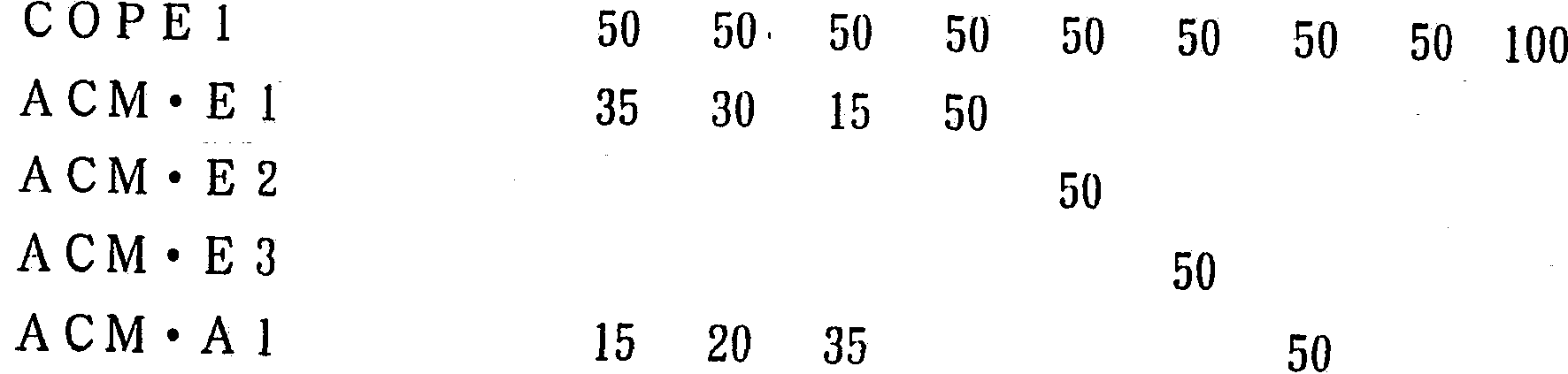
- Table 1 Thermoplastic copolyester elastomer COPE 1, carboxyl group-containing (meth) acrylate copolymer rubber ACM ⁇ A1 to A3 and ethoxy group-containing (meth) acrylate copolymer rubber ACM ⁇ E1 to
- Table 1 Thermoplastic copolyester elastomer COPE 1, carboxyl group-containing (meth) acryl
- Comparative Examples 1 to 6 A composition in which COPE 1 and ACM * A1 to A2 (Comparative Examples 4 and 5) and COPE1 and ACM * E1 to E3 (Comparative Examples 1 to 3) were mixed in the proportions shown in Table 1, respectively. In addition, only COPE 1 (Comparative Example 6) was evaluated. Table 1 shows the results.
- the composition of the present invention exhibits excellent high stress and high tensile strength, low tensile elongation, and good rubber elasticity as a whole.
- a composition having a higher carboxyl group content and epoxy group content in the composition is more pronounced.
- the composition obtained by adding ACME 1 to E 3 or ACMA 1 to A 2 alone to COPE 1 is as high as the composition of the present invention. It does not show stress and tensile strength and low tensile elongation, and their rubbery elasticity is clearly inferior.
- the epoxy group-containing (meth) a in the thermoplastic elastomer By adding both rubber components of the acrylate copolymer rubber and the carboxyl group-containing (meth) acrylate copolymer rubber, the rubber-like properties are clearly superior to the case where both rubber components are added alone. Elasticity appears.
- the torque was set when the epoxy group-containing (meth) acrylate copolymer rubber and the carboxyl group-containing (meth) acrylate copolymer rubber were mixed. Is observed, indicating that a crosslinking reaction has occurred between the two copolymer rubbers.
- the ratio of the epoxy group-containing (meth) acrylate copolymer rubber to the carboxyl group-containing (meth) acrylate copolymer rubber in the composition of the present invention was considerably large. It can be seen that high stress, high tensile strength, and low tensile elongation can be obtained even if it is changed to. Also, as shown in Examples 1 to 9, even when the content of the carboxyl group and the content of the epoxy group in the (meth) acrylate copolymer rubber are greatly changed, similarly excellent rubber-like elasticity can be obtained. You can see that.
- compositions were prepared and evaluated by changing the mixing ratios of COPE1, ACM * E2, and ACM * A2 as shown in Table 2.
- Table 2 shows the results.
- a composition of the present invention was prepared using COPE 2 and ACM, E2, ACM ⁇ A2 (Example 16), and for comparison, COP E2 and ACM ⁇ E2 or ACM ⁇ A2 were used. Compositions were prepared by mixing with any of A2 (Comparative Examples 8 to 10), and each was subjected to evaluation. Table 3 shows the results. 1
- Air heat aging resistance 150 ° C x 70
- Example 16 exhibits improved compression set and air heat aging resistance in addition to high stress, high tensile strength and good low tensile elongation, and also has excellent oil resistance. It is obvious.
- Comparative Examples 8 and 9 a composition in which ACM * E2 or ACM'A2 is singly mixed with COPE2 does not exhibit a remarkable improvement effect as in the present invention.
- the rubber-like product obtained from the thermoplastic elastomer composition of the present invention is flexible and has excellent heat resistance and high stress showing compression set resistance, it can be used for industrial parts, mining parts, construction parts, and automobile parts. Applicable to a wide range of uses such as electric, electronic parts and sports goods.
- automotive hoses such as fuel hoses, air hoses, oil hoses, power steering hoses, brake hoses, and water hoses.
- hoses and tubes such as hydraulic hoses, air hoses, water hoses, and chemical transfer hoses for various industrial machinery; O-rings, seals for various uses such as backing, gaskets, and oil seals; Belts such as flat belts, V-belts and toothed belts; Bellows-like boots such as dust cover boots and constant velocity joint boots; Coverings for various electric wires; bumpers, aerobarts, front wings and Useful for automotive interior and exterior parts such as mat guards; various rolls;
Landscapes
- Chemical & Material Sciences (AREA)
- Health & Medical Sciences (AREA)
- Chemical Kinetics & Catalysis (AREA)
- Medicinal Chemistry (AREA)
- Polymers & Plastics (AREA)
- Organic Chemistry (AREA)
- Compositions Of Macromolecular Compounds (AREA)
- Epoxy Resins (AREA)
Description




Claims
Priority Applications (3)
| Application Number | Priority Date | Filing Date | Title |
|---|---|---|---|
| DE69211136T DE69211136T2 (de) | 1991-07-18 | 1992-07-17 | Thermoplastische elastomerzusammensetzung |
| EP92915915A EP0594854B1 (en) | 1991-07-18 | 1992-07-17 | Thermoplastic elastomer composition |
| US08/543,470 US5541258A (en) | 1991-07-18 | 1995-10-16 | Thermoplastic elastomer composition |
Applications Claiming Priority (2)
| Application Number | Priority Date | Filing Date | Title |
|---|---|---|---|
| JP3/203890 | 1991-07-18 | ||
| JP03203890A JP3073800B2 (ja) | 1991-07-18 | 1991-07-18 | 熱可塑性エラストマー組成物 |
Publications (1)
| Publication Number | Publication Date |
|---|---|
| WO1993002143A1 true WO1993002143A1 (fr) | 1993-02-04 |
Family
ID=16481416
Family Applications (1)
| Application Number | Title | Priority Date | Filing Date |
|---|---|---|---|
| PCT/JP1992/000921 Ceased WO1993002143A1 (fr) | 1991-07-18 | 1992-07-17 | Composition d'elastomere thermoplastique |
Country Status (5)
| Country | Link |
|---|---|
| US (1) | US5541258A (ja) |
| EP (1) | EP0594854B1 (ja) |
| JP (1) | JP3073800B2 (ja) |
| DE (1) | DE69211136T2 (ja) |
| WO (1) | WO1993002143A1 (ja) |
Cited By (1)
| Publication number | Priority date | Publication date | Assignee | Title |
|---|---|---|---|---|
| EP0593769A4 (en) * | 1991-07-18 | 1995-01-11 | Nippon Zeon Co | THERMOPLASTIC ELASTOMER COMPOSITION. |
Families Citing this family (10)
| Publication number | Priority date | Publication date | Assignee | Title |
|---|---|---|---|---|
| KR960704977A (ko) * | 1994-07-18 | 1996-10-09 | 마에다 가쯔노스께 | 에폭시 수지 조성물, 프리프레그 및 섬유 강화 복합 재료(An Epoxy Resin Composition, a Prepreg and a Fiber Reinforced Composite Material) |
| JP3192557B2 (ja) * | 1994-08-26 | 2001-07-30 | シャープ株式会社 | 排水処理装置および排水処理方法 |
| EP1314749A3 (en) * | 1996-12-30 | 2006-03-15 | Daicel Chemical Industries, Ltd. | Polyester elastomers, processes for preparing the same, and compositions of the same |
| US6027818A (en) * | 1998-07-20 | 2000-02-22 | E. I. Du Pont De Nemours And Company | Thermoplastic copolyester compositions modified with epoxide compounds |
| JP3910397B2 (ja) * | 2001-10-12 | 2007-04-25 | 信越ポリマー株式会社 | 基板収納容器用ガスケット部材及びこれを用いた基板収納容器 |
| US7678858B2 (en) * | 2003-04-22 | 2010-03-16 | Daikin Industries, Ltd. | Fluorine-containing elastomer composition excellent in plasma-aging prevention effect and shaped article made thereof |
| JPWO2006057445A1 (ja) * | 2004-11-26 | 2008-06-05 | Jsr株式会社 | 熱可塑性エラストマー組成物及びその製造方法 |
| CN101087850A (zh) * | 2004-12-24 | 2007-12-12 | Nok株式会社 | 热塑性弹性体共混物 |
| US8518313B2 (en) | 2010-05-21 | 2013-08-27 | E I Du Pont De Nemours And Company | Process for enhancing compression set resistance of foamed copolyester compositions |
| EP2810986B1 (de) | 2013-06-05 | 2017-04-19 | Carl Freudenberg KG | Thermoplastische Elastomerzusammensetzung und deren Verwendung |
Citations (4)
| Publication number | Priority date | Publication date | Assignee | Title |
|---|---|---|---|---|
| JPS6381159A (ja) * | 1986-09-24 | 1988-04-12 | Japan Synthetic Rubber Co Ltd | 熱可塑性エラストマ−組成物 |
| JPS6381158A (ja) * | 1986-09-24 | 1988-04-12 | Japan Synthetic Rubber Co Ltd | 熱可塑性エラストマ−組成物 |
| JPS63142056A (ja) * | 1986-12-03 | 1988-06-14 | Japan Synthetic Rubber Co Ltd | 熱可塑性エラストマ−組成物 |
| JPH01266154A (ja) * | 1988-02-02 | 1989-10-24 | E I Du Pont De Nemours & Co | 熱可塑性エラストマーのブレンド |
Family Cites Families (3)
| Publication number | Priority date | Publication date | Assignee | Title |
|---|---|---|---|---|
| FR2625215B1 (fr) * | 1987-12-23 | 1990-04-27 | Charbonnages Ste Chimique | Compositions thermoplastiques a base de polyester sature et articles moules les contenant |
| US5300573A (en) * | 1988-04-11 | 1994-04-05 | Advanced Elastomer Systems, L.P. | High temperature stable, low solvent swelling thermoplastic elastomer compositions |
| AU610377B2 (en) * | 1988-04-11 | 1991-05-16 | Advanced Elastomer Systems, L.P. | High temperature stable, low solvent swelling thermoplastic elastomer compositions |
-
1991
- 1991-07-18 JP JP03203890A patent/JP3073800B2/ja not_active Expired - Fee Related
-
1992
- 1992-07-17 EP EP92915915A patent/EP0594854B1/en not_active Expired - Lifetime
- 1992-07-17 DE DE69211136T patent/DE69211136T2/de not_active Expired - Fee Related
- 1992-07-17 WO PCT/JP1992/000921 patent/WO1993002143A1/ja not_active Ceased
-
1995
- 1995-10-16 US US08/543,470 patent/US5541258A/en not_active Expired - Lifetime
Patent Citations (4)
| Publication number | Priority date | Publication date | Assignee | Title |
|---|---|---|---|---|
| JPS6381159A (ja) * | 1986-09-24 | 1988-04-12 | Japan Synthetic Rubber Co Ltd | 熱可塑性エラストマ−組成物 |
| JPS6381158A (ja) * | 1986-09-24 | 1988-04-12 | Japan Synthetic Rubber Co Ltd | 熱可塑性エラストマ−組成物 |
| JPS63142056A (ja) * | 1986-12-03 | 1988-06-14 | Japan Synthetic Rubber Co Ltd | 熱可塑性エラストマ−組成物 |
| JPH01266154A (ja) * | 1988-02-02 | 1989-10-24 | E I Du Pont De Nemours & Co | 熱可塑性エラストマーのブレンド |
Non-Patent Citations (1)
| Title |
|---|
| See also references of EP0594854A4 * |
Cited By (1)
| Publication number | Priority date | Publication date | Assignee | Title |
|---|---|---|---|---|
| EP0593769A4 (en) * | 1991-07-18 | 1995-01-11 | Nippon Zeon Co | THERMOPLASTIC ELASTOMER COMPOSITION. |
Also Published As
| Publication number | Publication date |
|---|---|
| DE69211136D1 (de) | 1996-07-04 |
| US5541258A (en) | 1996-07-30 |
| JP3073800B2 (ja) | 2000-08-07 |
| EP0594854A1 (en) | 1994-05-04 |
| EP0594854A4 (en) | 1995-03-22 |
| JPH0525376A (ja) | 1993-02-02 |
| DE69211136T2 (de) | 1997-01-23 |
| EP0594854B1 (en) | 1996-05-29 |
Similar Documents
| Publication | Publication Date | Title |
|---|---|---|
| JP3073800B2 (ja) | 熱可塑性エラストマー組成物 | |
| JP2006104363A (ja) | ポリブチレンテレフタレート樹脂組成物 | |
| EP0327010A2 (en) | Thermoplastic elastomer blends | |
| JPH10502703A (ja) | 熱可塑性樹脂で改質した加硫ゴム | |
| JPH0449579B2 (ja) | ||
| JP2850269B2 (ja) | 熱可塑性エラストマー組成物 | |
| US4843124A (en) | Thermoplastic elastomeric blends | |
| JPH0525374A (ja) | 熱可塑性エラストマー組成物 | |
| JP2771902B2 (ja) | ポリアリーレンサルファイド樹脂組成物及びその製造法 | |
| JPH08231770A (ja) | 熱可塑性エラストマー組成物 | |
| JPH06220291A (ja) | 熱可塑性エラストマー組成物 | |
| JPH0525375A (ja) | 熱可塑性エラストマー組成物 | |
| EP0593769B1 (en) | Thermoplastic elastomer composition | |
| JPH06210759A (ja) | 蛇腹形状部品 | |
| JP3008457B2 (ja) | ポリアミド樹脂組成物 | |
| JP4318126B2 (ja) | 同時硬化されたゴム−熱可塑性エラストマー組成物 | |
| JPH10182952A (ja) | 高圧柔軟ホース用熱可塑性エラストマー組成物 | |
| JPH0912844A (ja) | ポリエステル樹脂組成物 | |
| JP2000290483A (ja) | 熱可塑性エラストマー組成物及びそれを用いたホース | |
| JPS629618B2 (ja) | ||
| US5183852A (en) | Polyblends containing polyurethane, polymer and siloxane crosslinker | |
| JPH06240010A (ja) | ポリアミド樹脂組成物の調製方法 | |
| JPH057420B2 (ja) | ||
| JPH09272788A (ja) | 熱可塑性エラストマー組成物並びにその製造方法及びそれを用いたホース | |
| JPH01297466A (ja) | 熱可塑性樹脂組成物 |
Legal Events
| Date | Code | Title | Description |
|---|---|---|---|
| AK | Designated states |
Kind code of ref document: A1 Designated state(s): KR US |
|
| AL | Designated countries for regional patents |
Kind code of ref document: A1 Designated state(s): DE FR GB IT NL |
|
| DFPE | Request for preliminary examination filed prior to expiration of 19th month from priority date (pct application filed before 20040101) | ||
| WWE | Wipo information: entry into national phase |
Ref document number: 1992915915 Country of ref document: EP |
|
| WWP | Wipo information: published in national office |
Ref document number: 1992915915 Country of ref document: EP |
|
| ENP | Entry into the national phase |
Ref country code: US Ref document number: 1994 178336 Date of ref document: 19940606 Kind code of ref document: A Format of ref document f/p: F |
|
| WWG | Wipo information: grant in national office |
Ref document number: 1992915915 Country of ref document: EP |