WO1993006074A1 - Compose de 2-propanol et support d'enregistrement prepare a partir de celui-ci - Google Patents
Compose de 2-propanol et support d'enregistrement prepare a partir de celui-ci Download PDFInfo
- Publication number
- WO1993006074A1 WO1993006074A1 PCT/JP1992/001206 JP9201206W WO9306074A1 WO 1993006074 A1 WO1993006074 A1 WO 1993006074A1 JP 9201206 W JP9201206 W JP 9201206W WO 9306074 A1 WO9306074 A1 WO 9306074A1
- Authority
- WO
- WIPO (PCT)
- Prior art keywords
- group
- compound
- general formula
- propanol
- represented
- Prior art date
- Legal status (The legal status is an assumption and is not a legal conclusion. Google has not performed a legal analysis and makes no representation as to the accuracy of the status listed.)
- Ceased
Links
Classifications
-
- B—PERFORMING OPERATIONS; TRANSPORTING
- B41—PRINTING; LINING MACHINES; TYPEWRITERS; STAMPS
- B41M—PRINTING, DUPLICATING, MARKING, OR COPYING PROCESSES; COLOUR PRINTING
- B41M5/00—Duplicating or marking methods; Sheet materials for use therein
- B41M5/26—Thermography ; Marking by high energetic means, e.g. laser otherwise than by burning, and characterised by the material used
- B41M5/30—Thermography ; Marking by high energetic means, e.g. laser otherwise than by burning, and characterised by the material used using chemical colour formers
- B41M5/333—Colour developing components therefor, e.g. acidic compounds
- B41M5/3333—Non-macromolecular compounds
- B41M5/3335—Compounds containing phenolic or carboxylic acid groups or metal salts thereof
- B41M5/3336—Sulfur compounds, e.g. sulfones, sulfides, sulfonamides
-
- B—PERFORMING OPERATIONS; TRANSPORTING
- B41—PRINTING; LINING MACHINES; TYPEWRITERS; STAMPS
- B41M—PRINTING, DUPLICATING, MARKING, OR COPYING PROCESSES; COLOUR PRINTING
- B41M5/00—Duplicating or marking methods; Sheet materials for use therein
- B41M5/26—Thermography ; Marking by high energetic means, e.g. laser otherwise than by burning, and characterised by the material used
- B41M5/30—Thermography ; Marking by high energetic means, e.g. laser otherwise than by burning, and characterised by the material used using chemical colour formers
- B41M5/333—Colour developing components therefor, e.g. acidic compounds
- B41M5/3333—Non-macromolecular compounds
- B41M5/3335—Compounds containing phenolic or carboxylic acid groups or metal salts thereof
-
- C—CHEMISTRY; METALLURGY
- C07—ORGANIC CHEMISTRY
- C07C—ACYCLIC OR CARBOCYCLIC COMPOUNDS
- C07C205/00—Compounds containing nitro groups bound to a carbon skeleton
- C07C205/27—Compounds containing nitro groups bound to a carbon skeleton the carbon skeleton being further substituted by etherified hydroxy groups
- C07C205/35—Compounds containing nitro groups bound to a carbon skeleton the carbon skeleton being further substituted by etherified hydroxy groups having nitro groups and etherified hydroxy groups bound to carbon atoms of six-membered aromatic rings of the carbon skeleton
- C07C205/36—Compounds containing nitro groups bound to a carbon skeleton the carbon skeleton being further substituted by etherified hydroxy groups having nitro groups and etherified hydroxy groups bound to carbon atoms of six-membered aromatic rings of the carbon skeleton to carbon atoms of the same non-condensed six-membered aromatic ring or to carbon atoms of six-membered aromatic rings being part of the same condensed ring system
- C07C205/37—Compounds containing nitro groups bound to a carbon skeleton the carbon skeleton being further substituted by etherified hydroxy groups having nitro groups and etherified hydroxy groups bound to carbon atoms of six-membered aromatic rings of the carbon skeleton to carbon atoms of the same non-condensed six-membered aromatic ring or to carbon atoms of six-membered aromatic rings being part of the same condensed ring system the oxygen atom of at least one of the etherified hydroxy groups being further bound to an acyclic carbon atom
-
- C—CHEMISTRY; METALLURGY
- C07—ORGANIC CHEMISTRY
- C07C—ACYCLIC OR CARBOCYCLIC COMPOUNDS
- C07C317/00—Sulfones; Sulfoxides
- C07C317/16—Sulfones; Sulfoxides having sulfone or sulfoxide groups and singly-bound oxygen atoms bound to the same carbon skeleton
- C07C317/22—Sulfones; Sulfoxides having sulfone or sulfoxide groups and singly-bound oxygen atoms bound to the same carbon skeleton with sulfone or sulfoxide groups bound to carbon atoms of six-membered aromatic rings of the carbon skeleton
-
- C—CHEMISTRY; METALLURGY
- C07—ORGANIC CHEMISTRY
- C07C—ACYCLIC OR CARBOCYCLIC COMPOUNDS
- C07C323/00—Thiols, sulfides, hydropolysulfides or polysulfides substituted by halogen, oxygen or nitrogen atoms, or by sulfur atoms not being part of thio groups
- C07C323/10—Thiols, sulfides, hydropolysulfides or polysulfides substituted by halogen, oxygen or nitrogen atoms, or by sulfur atoms not being part of thio groups containing thio groups and singly-bound oxygen atoms bound to the same carbon skeleton
- C07C323/18—Thiols, sulfides, hydropolysulfides or polysulfides substituted by halogen, oxygen or nitrogen atoms, or by sulfur atoms not being part of thio groups containing thio groups and singly-bound oxygen atoms bound to the same carbon skeleton having the sulfur atom of at least one of the thio groups bound to a carbon atom of a six-membered aromatic ring of the carbon skeleton
- C07C323/20—Thiols, sulfides, hydropolysulfides or polysulfides substituted by halogen, oxygen or nitrogen atoms, or by sulfur atoms not being part of thio groups containing thio groups and singly-bound oxygen atoms bound to the same carbon skeleton having the sulfur atom of at least one of the thio groups bound to a carbon atom of a six-membered aromatic ring of the carbon skeleton with singly-bound oxygen atoms bound to carbon atoms of the same non-condensed six-membered aromatic ring
-
- C—CHEMISTRY; METALLURGY
- C07—ORGANIC CHEMISTRY
- C07C—ACYCLIC OR CARBOCYCLIC COMPOUNDS
- C07C43/00—Ethers; Compounds having groups, groups or groups
- C07C43/02—Ethers
- C07C43/20—Ethers having an ether-oxygen atom bound to a carbon atom of a six-membered aromatic ring
- C07C43/23—Ethers having an ether-oxygen atom bound to a carbon atom of a six-membered aromatic ring containing hydroxy or O-metal groups
-
- C—CHEMISTRY; METALLURGY
- C07—ORGANIC CHEMISTRY
- C07C—ACYCLIC OR CARBOCYCLIC COMPOUNDS
- C07C43/00—Ethers; Compounds having groups, groups or groups
- C07C43/02—Ethers
- C07C43/257—Ethers having an ether-oxygen atom bound to carbon atoms both belonging to six-membered aromatic rings
- C07C43/295—Ethers having an ether-oxygen atom bound to carbon atoms both belonging to six-membered aromatic rings containing hydroxy or O-metal groups
-
- C—CHEMISTRY; METALLURGY
- C07—ORGANIC CHEMISTRY
- C07C—ACYCLIC OR CARBOCYCLIC COMPOUNDS
- C07C49/00—Ketones; Ketenes; Dimeric ketenes; Ketonic chelates
- C07C49/76—Ketones containing a keto group bound to a six-membered aromatic ring
- C07C49/84—Ketones containing a keto group bound to a six-membered aromatic ring containing ether groups, groups, groups, or groups
Definitions
- the present invention relates to a novel 2-propanol compound having storage stability of a color image and a recording material containing the compound.
- a recording material utilizing color development by the reaction between a color-forming dye and a developer can be recorded in a relatively simple device in a short time without performing complicated processing such as development and fixing. It is widely used as thermal recording paper for output recording such as printer printing or pressure-sensitive copying paper for forms that simultaneously copy several sheets.
- a diphenylsulfone compound As a compound similar to the compound of the general formula (I) in the present invention, a diphenylsulfone compound is first mentioned. These are well known as developers for recording materials and the like. A diphenylsulfone compound in which one is an alkoxy group or an aralkyloxy group and the other is a hydroxy group is disclosed in JP-A-57-21008. No. 86, JP-A-58-20493, JP-A-58-82878, JP-A-58-1132593, JP-A-60 — 1 382, International Publication No. WO 84 / 02,882, etc.
- a developing agent having a p-hydroxy phenylthio group and an aryloxy group as substituents is disclosed in Japanese Patent Application Laid-Open Nos. — 1 677 797 and the like have proposed a 1,3-diaryloxy-substituted ′ ′ auxiliary in Japanese Patent Application Laid-Open No. 2-1455505.
- any of the above is sufficient in terms of the storage stability of the image described above.
- the present inventors have , 4-benzyloxy 4 '(2-methyldalicydyloxy) diphenylsulfon has been found to be effective as a storage stabilizer, but it is still difficult to say that the plasticizer resistance etc. are still sufficient.
- An object of the present invention is to provide a recording material which solves the above problems and has excellent storage stability of a color image.
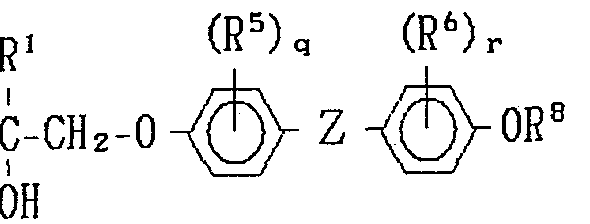
- the present invention is a novel 2-propanol compound represented by the general formula (I) and a recording material characterized by containing at least one or more of the compound.
- R ' represents a hydrogen atom or a lower alkyl group
- R 2 represents a halogen atom, a nitro group, a lower alkyl group, a lower alkoxy group, a lower alkyl group, a lower alkylsulfonyl group, an aryl group, an aryloxy group, an arylthio group and an arylsulfonyl group; These aryl groups may have a substituent,
- R 3 , R 1 , R 5 and R fi are each independently a halogen atom, a lower alkyl group, a lower alkoxy group, a lower alkenyl group and a lower alkenyloxy group,
- R 7 and!? 8 each independently represents a hydrogen atom, a lower alkyl group, a lower alkenyl group or a aralkyl group,
- Z is a divalent lower alkyl group, one S 0 2 —, one CO—, one S— and 10 —, ring A is a benzene ring or a naphthalene ring, n, m, p, Q and r each represent 0 or an integer of 4 or less.
- n, m, p, q and r are 2 or more, R 2 , R 3 , R 4 , R 5 and
- Each of the substituents represented by R 6 may be different.
- the lower alkyl group, lower alkoxy group, lower alkenyl group and lower alkenyloxy group have 1 to 5 carbon atoms which may have a side chain.
- the aralkyl group is a benzyl group or a phenyl group, and the benzene ring may have a substituent such as a halogen atom, a nitro group, a lower alkyl group and a lower alkoxy group.
- the aryl group of an aryl group, an aryloxy group, an arylthio group and an arylsulfonyl group may have a substituent.
- Table 1 shows specific examples of the 2-propanol compound in which Y in the general formula (I) has a group represented by the general formula (II), and also has a group represented by the general formula (II).
- Table 2 shows specific examples of the 2-propanol compound.
- a 2-propanol compound having a group represented by the general formula (II) in which Y is represented by the general formula (I) can be produced according to the following reaction formula.
- the compound of the present invention that can be produced in this manner has a different crystal form or an adduct with a solvent depending on the conditions under which crystals are precipitated, for example, the type of solvent and the precipitation conditions such as the precipitation temperature. Or to form. This can be clarified by point a of the crystal, infrared spectroscopy or X-ray diffraction analysis.
- a developer in addition to being used as an image storage stabilizer having plasticizer resistance to prevent discoloration by a plasticizer, a developer is also provided by the substituents of R 7 and R 8. Alternatively, it can be used as a sensitizer. Specifically, when the substituent of R 7 and R 8 is a nuclear-substituted hydroxyl group which is a hydrogen atom, it also has a color developing performance and can be used as a color developer having excellent plasticizer resistance. : This property is remarkable in a 2-propanol compound having a group represented by the general formula (II) in which Y is represented by the general formula (I).
- the substituent when it is not a hydrogen atom, it also has sensitizing performance and can be used as a sensitizer having excellent plasticizer resistance. That is, the method for producing a recording material containing a color-forming dye may be a commonly used method.
- the recording material when it is used as an image storage stabilizer, it is used together with a developer and various auxiliaries such as a sensitizer.
- various auxiliaries such as sensitizers
- it is used together with a developer. .
- the image storage stabilizer and a developer or a sensitizer for a color-forming dye By mutually reducing the relative usage of, recording materials can be manufactured at lower cost, which is extremely advantageous.
- the compound of the present invention can be used for any purpose as long as it is a recording material using a chromogenic dye.
- it can be used for ripened recording paper or pressure-sensitive copying paper.
- the compound of the present invention when used for thermosensitive recording paper, it may be performed in the same manner as in the use of a known image storage stabilizer, a developer or a photosensitive agent. It can be produced by applying a dispersion obtained by dispersing a chromogenic dye and an aqueous solution of a water-soluble binder to a support such as paper and drying. Of course, as described above, it may be contained in the color-forming layer. However, if it has a multilayer structure, it may be contained in any layer such as a protective layer. At this time, the ratio of the compound of the present invention to the color-forming dye may be 0.1 to 5 parts by weight, preferably 0.2 in 1 part by weight of the color-forming dye when used as an image storage stabilizer.
- Examples of the chromogenic dye used in the recording material of the present invention include fluoran-based, phthalide-based, lactam-based, trifluoromethyl-based, phenothiazine-based, and spiropyran-based leuco dyes.
- the present invention is not limited thereto, and any color-forming dye that can be colored by contact with a color developer, which is an acidic substance, can be used.
- fluoran-based dyes for example, fluoran-based dyes,
- the developer of the thermosensitive recording paper is optional.
- bisphenol A 4,4'-sec-butylidenebisphenol, 4,4'-cyclohexylidenebisphenol, 2,2'-dihydroxydiphenyl, pentamethylene-bis (4-hydroxybenzoate) Bisphenol compounds such as 1,7-di (4-hydroxyphenylthio) -1,3,5-dioxaheptane, etc., sulfur-containing bisphenol compounds, 4-benzylbenzyl benzoate, 4-ethylethyl benzoate, 4- Hydroxypropyl benzoate, 4-Hydroxybenzoic acid isopropyl, 4-Hydroxybenzoic acid butyl, 4-Hydroxybenzoic acid 4-Hydroxybenzoic acid esters such as soptyl, 4-hydroxybenzoic acid benzyl benzoate, 4-hydroxymethylbenzoic acid
- sensitizer When used in combination with other sensitizers, it is optional as a sensitizer for thermal recording paper.
- Typical examples of the sensitizer include higher fatty acid amides and benzene. Zuamide, anilide stearate, anilide acetate, thioacetoanilide, dibenzyl oxalate, dimethyl phthalate, dibenzyl terephthalate, dibenzyl isophthalate, bis (tert-butylphenol) s, 4, 4 ' 1,2-bis (4-methylphenoxy) ethane, 1,2-bis (4-methylphenoxy) ethane, 1,2-bis (3-methylphenoxy) ethane, 2-— Naphthol benzyl ether, diphenylamine, dirubazol, 2,3-di-m-tributane, 4-benzylbenzyl, 4,4'-dimethylbiphenyl, m-terphenyl, di / 3 —Naphthyl phen
- examples of the raw material include cres, talc, kaolin, satin white, titanium oxide, calcium carbonate, magnesium carbonate, barium sulfate, magnesium silicate, aluminum silicate and the like.
- examples of the dispersant include sulfosuccinates such as dioctyl sodium sulfosuccinate, sodium dodecylbenzenesulfonate, sodium salts of lauryl alcohol sulfate, and fatty acid salts.
- Metal salts of salicylic acid derivatives and oxinaphthoic acid derivatives (especially zinc salts) and other water-insoluble zinc compounds are used as stabilizers, and 2,2'-methylenebis (4-methyl) is used as an antioxidant.
- 1-6-tert-butylphenol, 2,2'-methylenebis (4-ethyl-6-tert-butylphenol), 4,4'-propylmethylenebis (3_methyl-16-tert-butylphenol), 4,4 '—Thiopis (2-tert-butyl-5-methylphenol) and the like are used as desensitizers such as aliphatic higher alcohols and polyethylene glycol.
- the compound of the present invention When the compound of the present invention is used for pressure-sensitive copying paper, it can be produced in the same manner as in the case of using a known image storage stabilizer, color developer, or sensitizer.
- a chromogenic dye microencapsulated by a known method is dispersed with an appropriate dispersant, and coated on paper to prepare a chromogenic sheet.
- a developer sheet is prepared by applying a developer dispersion to paper.
- the compound of the present invention when used as an image storage stabilizer, May be used by dispersing it in a dispersion of either a color former sheet or a developer sheet.
- a pressure-sensitive copying paper is produced by combining both sheets produced in this way.
- Example 2 The 4-benzyloxy 4′-glycidyloxydiphenyl sulfone produced in Example 2 was reacted with 4-benzyloxy-14′-hydroxydiphenyl sulfone according to Example 6 to give 1,3-bis ( 4 Benzyloxydiphenyl sulfone—
- Table 4 shows the structures of the compounds synthesized in Examples 6 to 9 just in case.
- Example 9 compound 2-57 In the compounds represented by the general formula (I) and Y. represented by the general formula (III), the compounds synthesized in the above Examples 6, 7, 7, 8 and 9 and the compounds synthesized according to their synthesis methods Are shown in Table 2 together with specific examples.
- the melting point in the table In the column, the description "oil” means that it was difficult to crystallize and was obtained in a state where the melting point could not be measured: Example 10 (Preparation of thermal recording paper)
- thermosensitive recording paper with a different mixing ratio is used.
- Two groups were produced, one group and the latter as thermal recording paper.
- Example 11 (Plasticizer resistance test of thermal recording paper)
- Example 10 The thermal recording paper prepared in Comparative Example 1 and Comparative Example 2-1 group and 1 group of thermal recording paper were used with a thermal paper coloring tester (manufactured by Okura Electric, TH-; PMD type). A checkered pattern was developed under the conditions of a printing voltage of 22 V and a pulse width of 1.8 ms, and a vinyl chloride wrap film was adhered to the colored surface. In that state, a plasticizer resistance test was performed under the following conditions.
- a thermal paper coloring tester manufactured by Okura Electric, TH-; PMD type
- Thermal recording paper-1 group is left for 18 hours and 24 hours in an atmosphere of about 40
- the two groups of thermal recording paper were placed in an atmosphere of about 40 ° C for 4 hours and 8 hours.
- the color density before and after the test was measured using a Macbeth reflection densitometer RD-51 (filter used; '# 106) .
- the results are shown in Table 5 for the compound in which Y is represented by the general formula (II), and in Table 6 for the compound in which Y is represented by the general formula (III).
- the measured values in the above table indicate that the larger the numerical value, the higher the color density. Also, the larger the value of the residual ratio, the less the fading. That is, it shows that the thermal recording paper using the compound of the present invention together with the color developer has excellent plasticizer resistance of the color image.
- the measured value of the image density after the test was divided by the measured value before the test to obtain the percentage.
- thermosensitive recording paper is an example of a case where a compound in which R 8 is a hydrogen atom among compounds of the general formula (I) and Y is the general formula (II) is used as a color developer. Comparative Example 3
- a dispersion was prepared using the analogous compound 1-phenoxy-13- (4-hydroxyphenylthio) -12-propanol in place of the compound of the present invention in the solution C in Example 10, and the dispersion was prepared as follows.
- Thermal recording paper was produced in the same manner as in Example 12.
- Example I3 [Test of heat-sensitive recording paper when the compounds listed in Table 1 were used as color developers]
- the heat-sensitive recording papers produced in Example 12 and Comparative Example 3 were treated in the same manner as in Example 11
- a plasticizer resistance test was performed by developing a checkerboard pattern.
- the results are shown in Table 7.
- Table 7 the results of the plasticizer resistance test of the thermosensitive recording paper of Comparative Example 1 performed in Example 11 are also shown, and the results are shown as comparative examples as similar compounds.
- a part of the ripened recording paper of Example 12 and Comparative Example 1 was saturated by heating at 150 ° C. using a dry heat tester (E-3 type manufactured by Kishino Kagaku). The color was developed, and the background and the colored area were subjected to a moisture resistance test (temperature 50, humidity 80% rh, 24 hours) and a light resistance test (carbon arc funidometer, 4 hours). The results are shown in Table 8.
- Example 14 Test of heat-sensitive recording paper when compounds listed in Table 1 were used as heat-sensitive agents.
- Thermal-sensitive recording paper containing compound 2-25 of the present invention prepared in Example 10 and Comparative Example 1 Using the heat-sensitive recording paper prepared in the above, each was divided into two and color development sensitivity tests were performed. One performs a dynamic color test in the same manner as in Test Example 1 and develops a color with a pulse width of 1.10 msec. The other uses a dry heat tester (Kishino Scientific, Model E-3) as a static color test. Was developed at a heating temperature of 105. These color development conditions are such that when the color density is measured with a Macbeth reflection densitometer RD-514 (same as above), the measured value is around 1.0. The results are shown below.
- Comparative Example 1 1.04 1.03 3- That is, the compound of the present invention shows little sensitization at static color sensitivity and dynamic color sensitivity. For the first time showed that it had sensitization.
- the compound of the present invention is a novel compound which improves the storage stability of a color image, particularly the plasticizer resistance, and a recording material using the same.
- a color image particularly the plasticizer resistance
- a recording material using the same.
- the compound when used for a label by thermal recording, it is an organic polymer material.
- An extremely stable color image can be retained even in an environment such as being in contact with the resulting packaging material.
- it also has a color developing ability comparable to that of general developers or a sensitizing effect of dynamic color sensitivity, and is useful as a developer or sensitizer with excellent storage stability. It is something.
Landscapes
- Chemical & Material Sciences (AREA)
- Organic Chemistry (AREA)
- Chemical Kinetics & Catalysis (AREA)
- General Chemical & Material Sciences (AREA)
- Physics & Mathematics (AREA)
- Optics & Photonics (AREA)
- Heat Sensitive Colour Forming Recording (AREA)
- Organic Low-Molecular-Weight Compounds And Preparation Thereof (AREA)
Description


Claims
Applications Claiming Priority (6)
| Application Number | Priority Date | Filing Date | Title |
|---|---|---|---|
| JP27054991 | 1991-09-24 | ||
| JP3/270549 | 1991-09-24 | ||
| JP3/281926 | 1991-10-03 | ||
| JP28192691 | 1991-10-03 | ||
| JP4/269791 | 1992-09-11 | ||
| JP26979192A JP3376610B2 (ja) | 1991-09-24 | 1992-09-11 | 2−プロパノール化合物及びそれを用いた記録材料 |
Publications (1)
| Publication Number | Publication Date |
|---|---|
| WO1993006074A1 true WO1993006074A1 (fr) | 1993-04-01 |
Family
ID=27335751
Family Applications (1)
| Application Number | Title | Priority Date | Filing Date |
|---|---|---|---|
| PCT/JP1992/001206 Ceased WO1993006074A1 (fr) | 1991-09-24 | 1992-09-22 | Compose de 2-propanol et support d'enregistrement prepare a partir de celui-ci |
Country Status (3)
| Country | Link |
|---|---|
| EP (1) | EP0563392A1 (ja) |
| JP (1) | JP3376610B2 (ja) |
| WO (1) | WO1993006074A1 (ja) |
Cited By (9)
| Publication number | Priority date | Publication date | Assignee | Title |
|---|---|---|---|---|
| US6037308A (en) * | 1995-10-31 | 2000-03-14 | Nippon Soda Co., Ltd. | Diphenyl sulfone crosslinking type compounds and recording materials using them |
| US6143060A (en) * | 1995-11-01 | 2000-11-07 | Nippon Soda Co., Ltd. | Triazine derivatives and recording materials prepared therefrom |
| US7081435B2 (en) | 2002-01-17 | 2006-07-25 | Nippon Paper Industries Co., Ltd. | Thermal recording medium |
| WO2011027752A1 (ja) | 2009-09-03 | 2011-03-10 | 日本製紙株式会社 | 感熱記録ラベル |
| US8129307B2 (en) | 2007-02-13 | 2012-03-06 | Nippon Paper Industries Co., Ltd. | Thermosensitive recording medium |
| US8247347B2 (en) | 2007-03-29 | 2012-08-21 | Nippon Paper Industries Co., Ltd. | Thermosensitive recording medium |
| US8871678B2 (en) | 2010-03-15 | 2014-10-28 | Nippon Paper Industries Co., Ltd. | Thermosensitive recording medium |
| WO2018003758A1 (en) | 2016-06-28 | 2018-01-04 | Ricoh Company, Ltd. | Thermosensitive recording medium and article |
| US10000083B2 (en) | 2014-06-16 | 2018-06-19 | Nippon Paper Industries Co., Ltd. | Thermosensitive recording medium |
Families Citing this family (4)
| Publication number | Priority date | Publication date | Assignee | Title |
|---|---|---|---|---|
| CN1070116C (zh) * | 1994-06-06 | 2001-08-29 | 日本曹达株式会社 | 二苯砜衍生物在制备记录材料中的应用 |
| US5705452A (en) * | 1994-10-14 | 1998-01-06 | Sanko Haihatsu Kagaku Kenkyusho | Sulfonyl compound and thermal-sensitive recording medium using the same |
| EP1967514B1 (en) * | 1999-10-04 | 2013-01-02 | Nippon Soda Co., Ltd. | Phenolic compounds and recording materials containing the same |
| JP5352106B2 (ja) * | 2007-03-29 | 2013-11-27 | 株式会社エーピーアイ コーポレーション | 新規ジフェニルスルホン誘導体及びその用途 |
Citations (1)
| Publication number | Priority date | Publication date | Assignee | Title |
|---|---|---|---|---|
| JPH02178083A (ja) * | 1988-12-29 | 1990-07-11 | Kanzaki Paper Mfg Co Ltd | 感熱記録体 |
Family Cites Families (1)
| Publication number | Priority date | Publication date | Assignee | Title |
|---|---|---|---|---|
| US4284574A (en) * | 1979-06-15 | 1981-08-18 | Ciba-Geigy Corporation | Diglycidyl ethers of di-secondary alcohols, their preparation, and curable compositions containing them |
-
1992
- 1992-09-11 JP JP26979192A patent/JP3376610B2/ja not_active Expired - Fee Related
- 1992-09-22 EP EP92920054A patent/EP0563392A1/en not_active Withdrawn
- 1992-09-22 WO PCT/JP1992/001206 patent/WO1993006074A1/ja not_active Ceased
Patent Citations (1)
| Publication number | Priority date | Publication date | Assignee | Title |
|---|---|---|---|---|
| JPH02178083A (ja) * | 1988-12-29 | 1990-07-11 | Kanzaki Paper Mfg Co Ltd | 感熱記録体 |
Non-Patent Citations (3)
| Title |
|---|
| CHEMICAL ABSTRACTS, Vol. 79, No. 3, July 23, 1973 (23. 07. 73), (Columbus. Ohio. USA), N. N. KHROMOVA, M. F. SOROKIN, "Synthesis of substituted Hydroxyalkyl ethers of dihydroxydiphenylpropane", refer to Abstract No. 18272f, Tr. Mosk. Khim.-Tekhnol. Inst., 1972 (70), p. 71-73. * |
| CHEMICAL ABSTRACTS, Vol. 83, No. 2, July 14, 1975 (14. 07. 75), (Columbus. Ohio. USA), N. N. KHROMOVA, M. F. SOROKIN, "Reaction of hydroxyalkyl ethers of dihydroxydiphenylpropane with epichlorohydrin", refer to Abstract No. 10916f, Tr. Mosk. khim.-Tekhnol. Inst.,1973 (74), p. 90-91. * |
| See also references of EP0563392A4 * |
Cited By (10)
| Publication number | Priority date | Publication date | Assignee | Title |
|---|---|---|---|---|
| US6037308A (en) * | 1995-10-31 | 2000-03-14 | Nippon Soda Co., Ltd. | Diphenyl sulfone crosslinking type compounds and recording materials using them |
| US6143060A (en) * | 1995-11-01 | 2000-11-07 | Nippon Soda Co., Ltd. | Triazine derivatives and recording materials prepared therefrom |
| US7081435B2 (en) | 2002-01-17 | 2006-07-25 | Nippon Paper Industries Co., Ltd. | Thermal recording medium |
| US8129307B2 (en) | 2007-02-13 | 2012-03-06 | Nippon Paper Industries Co., Ltd. | Thermosensitive recording medium |
| US8247347B2 (en) | 2007-03-29 | 2012-08-21 | Nippon Paper Industries Co., Ltd. | Thermosensitive recording medium |
| WO2011027752A1 (ja) | 2009-09-03 | 2011-03-10 | 日本製紙株式会社 | 感熱記録ラベル |
| US8722576B2 (en) | 2009-09-03 | 2014-05-13 | Nippon Paper Industries Co., Ltd. | Thermosensitive recording label |
| US8871678B2 (en) | 2010-03-15 | 2014-10-28 | Nippon Paper Industries Co., Ltd. | Thermosensitive recording medium |
| US10000083B2 (en) | 2014-06-16 | 2018-06-19 | Nippon Paper Industries Co., Ltd. | Thermosensitive recording medium |
| WO2018003758A1 (en) | 2016-06-28 | 2018-01-04 | Ricoh Company, Ltd. | Thermosensitive recording medium and article |
Also Published As
| Publication number | Publication date |
|---|---|
| EP0563392A1 (en) | 1993-10-06 |
| JPH05194368A (ja) | 1993-08-03 |
| EP0563392A4 (ja) | 1994-03-09 |
| JP3376610B2 (ja) | 2003-02-10 |
Similar Documents
| Publication | Publication Date | Title |
|---|---|---|
| JP3913820B2 (ja) | ジフェニルスルホン架橋型化合物及びそれを用いた記録材料 | |
| WO1997016420A1 (en) | Diphenyl sulfone crosslinking type compounds and recording materials using them | |
| JP3376610B2 (ja) | 2−プロパノール化合物及びそれを用いた記録材料 | |
| JP3451109B2 (ja) | フェネチルアルコール誘導体及びそれを用いた記録材料 | |
| JP3374382B2 (ja) | 新規なフルオラン化合物及びそれを用いた発色性記録材料 | |
| JPS6343374B2 (ja) | ||
| WO1996011986A1 (en) | Novel fluoran compound, intermediate, and chromogenic recording material | |
| JPH10330350A (ja) | 2−プロパノール誘導体及びそれを用いた記録材料 | |
| JP3634385B2 (ja) | ジフェニルスルホン誘導体及びそれを用いた記録材料 | |
| JP3385597B2 (ja) | 2−プロパノール誘導体及びそれを用いた記録材料 | |
| JP3582070B2 (ja) | フェニルエタン誘導体及びそれを用いた感熱記録材料 | |
| JP2003221380A (ja) | フェノール性化合物及びそれを用いた記録材料 | |
| KR0168667B1 (ko) | 감열성 기록물질 | |
| JPH09316061A (ja) | トリアジン誘導体及びそれを用いた記録材料 | |
| JP3627195B2 (ja) | フルオラン化合物及びこれを使用した発色性記録材料 | |
| EP0155796B1 (en) | 6-tetrahydrofurfurylaminofluoran compound useful as a color former | |
| JP2620092B2 (ja) | フルオラン化合物およびこれを用いた発色性記録材料 | |
| JP3627196B2 (ja) | フルオラン化合物及びこれを使用する発色性記録材料 | |
| JPH021365A (ja) | 感熱記録体 | |
| JP3733577B2 (ja) | 新規なフルオラン化合物、中間体及び発色性記録材料 | |
| JPH04179579A (ja) | 感熱記録材料 | |
| JP3286700B2 (ja) | スルホン基含有フタル酸系化合物の製造方法 | |
| JPH07330652A (ja) | 発色性記録材料 | |
| JPH04312588A (ja) | フルオラン化合物及び発色性記録材料 | |
| US4956332A (en) | Heat-sensitive recording material |
Legal Events
| Date | Code | Title | Description |
|---|---|---|---|
| AK | Designated states |
Kind code of ref document: A1 Designated state(s): US |
|
| AL | Designated countries for regional patents |
Kind code of ref document: A1 Designated state(s): AT BE CH DE DK ES FR GB GR IE IT LU MC NL SE |
|
| ENP | Entry into the national phase |
Ref country code: US Ref document number: 1993 39284 Date of ref document: 19930416 Kind code of ref document: A Format of ref document f/p: F |
|
| WWE | Wipo information: entry into national phase |
Ref document number: 1992920054 Country of ref document: EP |
|
| WWP | Wipo information: published in national office |
Ref document number: 1992920054 Country of ref document: EP |
|
| WWW | Wipo information: withdrawn in national office |
Ref document number: 1992920054 Country of ref document: EP |
|
| ENP | Entry into the national phase |
Ref country code: US Ref document number: 1995 552161 Date of ref document: 19951102 Kind code of ref document: A Format of ref document f/p: F |