WO1999000704A1 - Composition de reserve sensible au rayonnement et a haute tenue a la chaleur - Google Patents
Composition de reserve sensible au rayonnement et a haute tenue a la chaleur Download PDFInfo
- Publication number
- WO1999000704A1 WO1999000704A1 PCT/JP1998/002707 JP9802707W WO9900704A1 WO 1999000704 A1 WO1999000704 A1 WO 1999000704A1 JP 9802707 W JP9802707 W JP 9802707W WO 9900704 A1 WO9900704 A1 WO 9900704A1
- Authority
- WO
- WIPO (PCT)
- Prior art keywords
- resist
- radiation
- group
- polymer
- sensitive resist
- Prior art date
- Legal status (The legal status is an assumption and is not a legal conclusion. Google has not performed a legal analysis and makes no representation as to the accuracy of the status listed.)
- Ceased
Links
Classifications
-
- C—CHEMISTRY; METALLURGY
- C08—ORGANIC MACROMOLECULAR COMPOUNDS; THEIR PREPARATION OR CHEMICAL WORKING-UP; COMPOSITIONS BASED THEREON
- C08G—MACROMOLECULAR COMPOUNDS OBTAINED OTHERWISE THAN BY REACTIONS ONLY INVOLVING UNSATURATED CARBON-TO-CARBON BONDS
- C08G61/00—Macromolecular compounds obtained by reactions forming a carbon-to-carbon link in the main chain of the macromolecule
- C08G61/02—Macromolecular compounds containing only carbon atoms in the main chain of the macromolecule, e.g. polyxylylenes
-
- G—PHYSICS
- G03—PHOTOGRAPHY; CINEMATOGRAPHY; ANALOGOUS TECHNIQUES USING WAVES OTHER THAN OPTICAL WAVES; ELECTROGRAPHY; HOLOGRAPHY
- G03F—PHOTOMECHANICAL PRODUCTION OF TEXTURED OR PATTERNED SURFACES, e.g. FOR PRINTING, FOR PROCESSING OF SEMICONDUCTOR DEVICES; MATERIALS THEREFOR; ORIGINALS THEREFOR; APPARATUS SPECIALLY ADAPTED THEREFOR
- G03F7/00—Photomechanical, e.g. photolithographic, production of textured or patterned surfaces, e.g. printing surfaces; Materials therefor, e.g. comprising photoresists; Apparatus specially adapted therefor
- G03F7/004—Photosensitive materials
- G03F7/0045—Photosensitive materials with organic non-macromolecular light-sensitive compounds not otherwise provided for, e.g. dissolution inhibitors
-
- G—PHYSICS
- G03—PHOTOGRAPHY; CINEMATOGRAPHY; ANALOGOUS TECHNIQUES USING WAVES OTHER THAN OPTICAL WAVES; ELECTROGRAPHY; HOLOGRAPHY
- G03F—PHOTOMECHANICAL PRODUCTION OF TEXTURED OR PATTERNED SURFACES, e.g. FOR PRINTING, FOR PROCESSING OF SEMICONDUCTOR DEVICES; MATERIALS THEREFOR; ORIGINALS THEREFOR; APPARATUS SPECIALLY ADAPTED THEREFOR
- G03F7/00—Photomechanical, e.g. photolithographic, production of textured or patterned surfaces, e.g. printing surfaces; Materials therefor, e.g. comprising photoresists; Apparatus specially adapted therefor
- G03F7/004—Photosensitive materials
- G03F7/022—Quinonediazides
- G03F7/023—Macromolecular quinonediazides; Macromolecular additives, e.g. binders
- G03F7/0233—Macromolecular quinonediazides; Macromolecular additives, e.g. binders characterised by the polymeric binders or the macromolecular additives other than the macromolecular quinonediazides
-
- G—PHYSICS
- G03—PHOTOGRAPHY; CINEMATOGRAPHY; ANALOGOUS TECHNIQUES USING WAVES OTHER THAN OPTICAL WAVES; ELECTROGRAPHY; HOLOGRAPHY
- G03F—PHOTOMECHANICAL PRODUCTION OF TEXTURED OR PATTERNED SURFACES, e.g. FOR PRINTING, FOR PROCESSING OF SEMICONDUCTOR DEVICES; MATERIALS THEREFOR; ORIGINALS THEREFOR; APPARATUS SPECIALLY ADAPTED THEREFOR
- G03F7/00—Photomechanical, e.g. photolithographic, production of textured or patterned surfaces, e.g. printing surfaces; Materials therefor, e.g. comprising photoresists; Apparatus specially adapted therefor
- G03F7/004—Photosensitive materials
- G03F7/038—Macromolecular compounds which are rendered insoluble or differentially wettable
-
- G—PHYSICS
- G03—PHOTOGRAPHY; CINEMATOGRAPHY; ANALOGOUS TECHNIQUES USING WAVES OTHER THAN OPTICAL WAVES; ELECTROGRAPHY; HOLOGRAPHY
- G03F—PHOTOMECHANICAL PRODUCTION OF TEXTURED OR PATTERNED SURFACES, e.g. FOR PRINTING, FOR PROCESSING OF SEMICONDUCTOR DEVICES; MATERIALS THEREFOR; ORIGINALS THEREFOR; APPARATUS SPECIALLY ADAPTED THEREFOR
- G03F7/00—Photomechanical, e.g. photolithographic, production of textured or patterned surfaces, e.g. printing surfaces; Materials therefor, e.g. comprising photoresists; Apparatus specially adapted therefor
- G03F7/004—Photosensitive materials
- G03F7/039—Macromolecular compounds which are photodegradable, e.g. positive electron resists
Definitions
- the present invention relates to a resist composition which is sensitive to radiation such as ultraviolet rays, far ultraviolet rays, X-rays, and electron beams, and more specifically, a high-sensitivity, high-resolution resist composition capable of forming a resist pattern having excellent heat resistance.
- the present invention relates to an image-forming radiation-sensitive resist composition.
- a radiation-sensitive resist composition is formed on a substrate such as a silicon substrate using a well-known or known coating method such as a spin coating method or a roller coating method. After coating and pre-baking to form a radiation-sensitive resist film, the resist film is exposed to radiation such as ultraviolet rays, far ultraviolet rays, X-rays, and electron beams through a mask through a mask.
- a post bake is performed to improve developability, etching resistance, and the like, followed by development.
- the resist pattern thus formed is subjected to a desired post-process such as a dry etching and diffusion process.
- a desired post-process such as a dry etching and diffusion process.
- the positive type is composed of an alkali-soluble resin and a quinonediazide photosensitizer, and the chemically amplified resist is used.
- the negative type is composed of polyvinyl carboxylate, an aromatic azide compound, a cyclic rubber and a bisazide compound.
- a nopolak resin in which a low molecular weight region is cut off is preferably used as a soluble resin from the viewpoint of resolution.
- this resist has the disadvantage of low sensitivity. For this reason, it is common practice to add a sensitizer to improve the sensitivity.
- this sensitizer is generally a phenol compound having a small molecular weight, it does not contribute to the heat resistance of the resist.
- the pattern when exposed to a temperature of about 120 to 140 ° C in a high-temperature processing step such as a post-exposure bake (PEB) step or a dry etching step, the pattern is deformed or the pattern edge is deformed.
- PEB post-exposure bake
- the heat resistance is reduced, for example, the part is rounded and the pattern has a so-called camouflage shape.
- This phenomenon such as pattern deformation is particularly noticeable in a pattern portion having a large remaining area. The reason why the deformation of the pattern is observed in the portion having a large remaining area is generally described as follows.
- the resist pattern in the resist pattern, the solvent in the resist is removed by the heat during pre-baking, but since the drying starts from the resist surface, the inside of the resist tends to contain a larger amount of residual solvent than the resist surface. is there.
- the resist pattern is selectively solubilized in the developing solution by irradiation with radiation.
- the resist pattern in the small-area resist pattern, the resist pattern is heated in a high-temperature processing step, and the inside of the resist becomes fluid. Even if it is shown, deformation of the pattern dimension is relatively unlikely to occur because it is supported by the resist pattern surface.
- the loss of transmitted energy is minimized by the irradiation of deep ultraviolet rays, which are high energy, and the UV irradiation in vacuum to increase the heat resistance of the resist shape, the resist is made to have a high molecular weight, and high heat resistance is obtained. So-called UV curing has been performed, but with the conventional technology, the above problems have not yet been sufficiently resolved.
- an object of the present invention is to provide a radiation-sensitive resist composition having high sensitivity, high resolution and high heat resistance, which does not have these conventional disadvantages. Disclosure of the invention
- the object of the present invention is to provide a conventionally known or known radiation-sensitive resist composition containing a resist material and an organic solvent,
- R 1, and R 2 may be the same or different and represent a halogen atom, a hydroxyl group, or an alkoxy group having 1 to 4 carbon atoms.
- R 3 , R 4 , R 5 , R 6 , R 7 , and R 8 may be the same or different, and each represents an alkyl group, an alkoxy group, a nitro group, or a halogen atom.
- Each represents an integer of 0 or 1 to 3
- r and s each represent an integer of 0 or 1 to 4
- t and u each represent 0, 1 or 2.
- the polymer obtained by the above reaction includes a polymer having a repeating unit represented by the following general formula (IV) and / or general formula (V) in a molecule. It is thought that it is.
- Y represents a group
- R 3 , R 4 , R 5 , R 6 , R 7 , R 8 represent the same as above, m and n each represent an integer of 1 or more, p and q each represent 0 or An integer of 1 to 3, r and s each represent 0 or an integer of 1 to 4, and t and u each represent 0, 1 or 2.
- polymer having the repeating units (IV) and (V) in the same molecule for example, a polymer represented by the following general formula (VI) can be considered.
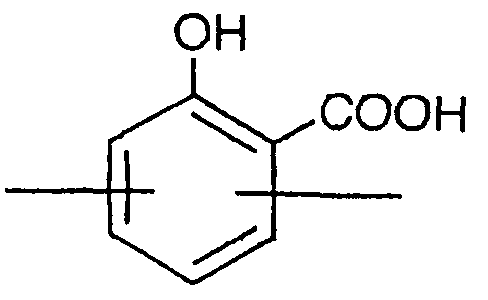
- the polymer used in the present invention is obtained by reacting the xylylene compound represented by the general formula (I), salicylic acid, and the dihydroxy compound represented by the general formulas (II) and / or (I II) as described above.
- the xylylene compound represented by the general formula (I) for example, a, a'-dichroic-p-xylene, a, a'-shib-mo-p —Yanlen,, 3-Si—p-xylene,, a '—Dihydroxy-1-p-xylene, a,' —Dimethoxy-p-xylene,, a , Azi n-Flopoxy-p-xylene, a, a '-diisopropoxy-: -xylene,, n-butoxy-p-dry silene,, sea sec- Butoxy-P-xylene,, 'diisobutoxy-p-xylene and the like.
- the alkyl group is, for example, one having 1 to carbon atoms.
- an alkoxy group is preferably an alkoxy group having 1 to 10 carbon atoms.
- p, Q, r, s, t, and u are preferably 0 or 1.
- Preferred examples of the compound represented by the general formula ( ⁇ ) include the following compounds.
- the above compounds are listed as examples of the compound represented by the general formula (I), (II) or (III), and include a xylylene compound and a dihydroxy compound.
- the compounds are not limited to those specifically exemplified. Further, the xylylene compound and the dihydroxy compound may be used alone or in combination of two or more.
- the reaction is preferably performed by adding salicylic acid and the dihydroxy compound represented by the general formula (II) and / or (III) in a total amount of 1 to 5 with respect to 1 mol of the xylylene compound represented by the general formula (I).
- Mol more preferably 1.1 to 3 mol, and 1 to 8 mol of salicylic acid to 1 mol of the dihydroxy compound, and the heating is carried out in the presence of an acid catalyst.
- the reaction temperature is 110 ° C. or higher, usually in the range of 120 to 250 ° C., and preferably in the range of 130 to 180 ° C. for terminating the reaction in a short time.
- the reaction time is about 1 to 30 hours.
- the acid catalyst examples include inorganic or organic acids, for example, mineral acids such as hydrochloric acid, sulfuric acid, and phosphoric acid; organic sulfonic acids such as methanesulfonic acid and p-toluenesulfonic acid; zinc chloride, aluminum chloride, and stannic chloride.
- mineral acids such as hydrochloric acid, sulfuric acid, and phosphoric acid
- organic sulfonic acids such as methanesulfonic acid and p-toluenesulfonic acid
- zinc chloride aluminum chloride, and stannic chloride.
- Use Friedel-Crafts catalysts such as ferric chloride, sulfates such as dimethyl sulfate and diethyl sulfate, and super-strong acids such as trifluoromethanesulfonic acid and boron trifluoride alone or in combination be able to.
- the amount of the catalyst used is about 0.0001 to 10% by weight, preferably about 0.001 to 1% by weight, based on the total weight of the raw materials.
- the method for producing the polymer of the present invention may be, in addition to the method described above, a method in which each compound is dissolved and a solvent inert to the reaction is used.
- an arbitrary method is selected, such as a method in which the raw materials are charged all at once and a reaction is performed, or a method in which a xylylene compound is added to a mixture of a dihydroxy compound or the like and a catalyst to cause a sequential reaction.
- the alcohol and the like generated as the reaction proceeds are trapped and removed out of the system.
- the volatile components are removed, and the mixture is discharged as it is and cooled, whereby a hard and brittle polymer is obtained.
- vacuum distillation or alkaline aqueous solution Unreacted dihydroxy compounds can also be removed by such means as extraction and washing with water.
- a polymer having a weight average molecular weight of 100 to 500 and a Tg of 100 to 150 ° C can be obtained.
- the weight-average molecular weight is less than 1000, the molecular weight is too low and does not contribute to improvement in heat resistance.
- Polymers of 50,000 or more are considered to be likely to cause steric hindrance due to the structure of the dihydroxy compound.However, the properties of the resist film such as a difficulty in the polymerization reaction or poor solubility in the resist. May be adversely affected.
- the Tg of the polymer having a weight-average molecular weight of 100 to 500 is 100 to 150 ° C as the molecular weight increases.
- the molar ratio of salicylic acid and dihydroxy compound in the polymer is preferably 60/40 to 982.
- These polymers are generally used in an amount of 0.1 to 40 parts by weight, preferably 0.5 to 30 parts by weight, based on 100 parts by weight of the solid component of the resist material.
- the polymer is preferably used in an amount of 1 to 30 parts by weight based on 100 parts by weight of the alkali-soluble resin. And more preferably 5 to 20 parts by weight.
- any of the conventionally known positive or negative resists can be used.
- a resist composed of a soluble resin and a quinonediazide photosensitizer, and a chemically amplified resist are preferable.
- Various types of positive type resists composed of a soluble resin and a quinonediazide photosensitizer have been known in the art, and any of them may be used in the present invention, and is not particularly limited.
- An example of a quinonediazide photosensitizer used in a positive resist composed of these alkali-soluble resins and a quinonediazide-based photosensitizer is as follows.
- 1,2-benzoquinonediazide-4-sulfonic acid 1,2-naphthoquinonediazido-4-sulfonic acid, 1,2-naphthoquinonediazide-5-sulfonic acid, esters or amides of these sulfonic acids And so on.
- the sulfonic acid ester or amide compound can be obtained by a condensation reaction of the corresponding quinone diazide sulfonic acid or quinone diazide sulfonyl chloride with a compound having a hydroxyl group or a compound having an amino group.
- Examples of the compound having a hydroxyl group include dihydroxybenzophenone, trihydroxybenzophenone, tetrahydroxybenzophenone, phenol, naphthol, p-methoxyphenol, bisphenol-8, pyrocatechol, pyrogallol, and pyrogallolmethylphenol.
- Examples include aniline, ⁇ -amino diphenylamine, etc.
- examples of the alkali-soluble resin include nopolak resin, polyvinyl phenol, polyvinyl alcohol, and a polymer of acrylic acid or methacrylic acid.
- Nopolak resins include, for example, phenol, ⁇ -cresol, m-cresol, p-cresol, xylenol, trimethylphenol, t_butylphenol, ethylphenol, 2-naphthol, 1, Examples include condensation polymerization products of one or more phenols such as 3-dihydroxynaphthalene and aldehydes such as formaldehyde and paraformaldehyde.
- These alkali-soluble resins such as nopolak resin may be used in combination of two or more as necessary.
- quinonediazidesulfonic acid ester an ester of a polycondensate of phenols and aldehydes or ketones with quinonediazidesulfonic acid can also be used.
- a novolak resin having a weight-average molecular weight of 2000 to 2000, more preferably 500 to 1500, in which a low molecular weight region is cut off, is preferable.
- the ratio of the quinonediazide-based photosensitizer to the alkali-soluble resin depends on the specific photosensitizer and the alkali-soluble resin used, and generally ranges from 1: 1 to 1:20 by weight. Although the range is preferable, the present invention is not limited to this.
- chemically amplified resists generate an acid in the irradiated area by irradiation of radiation, and form a pattern by changing the solubility of the irradiated part in a developing solution by a chemical change of the resist due to the catalytic action of the acid.
- an acid-generating compound that generates an acid upon irradiation with an acid-sensitive group-containing resin that decomposes in the presence of an acid to form an alkanol-soluble group such as a phenolic hydroxyl group or a hydroxyl group.
- Examples of the acid-generating compounds that generate an acid upon irradiation include bis (sulfonyl) diazomethanes such as bis (isopropylsulfonyl) diazomethane, bissulfonylmethanes such as methylsulfonyl p-toluenesulfonylmethane, and cyclohexyl.
- Sulfonylcarbonyldiazomethanes such as sulfonylcyclohexylcarbonyldiazomethane; sulfonylcarbonylalkanes, such as 2-methyl-2- (4-methylphenylsulfonyl) propionofenone; Trobenzyl p—Ditrobenzyl sulfonates such as toluenesulfonate, alkyl or arylsulfonates such as pyrogallate trismethanesulfonate, benzoin sulfonates such as benzoin tosylate, N N-sulfonyloximids, such as i- (trifluoromethylsulfonyloxy) phthalimid, and 4- (4-fluoro-benzenesulfonyloxy), such as 1,3,4,6-trimethyl-2-pyridone Pyrrolidones, 2,2,2-trifluoro-1- trifluor
- an acid-sensitive group-containing resin that decomposes in the presence of an acid to generate an alkali-soluble group such as a phenolic hydroxyl group or a carboxyl group has an acid-sensitive group and an alkali-soluble group that decompose in the presence of an acid. It consists of a soluble resin part.
- the acid-sensitive group include a 1-substituted ethyl group such as a 1-methoxyl group and a 1-benzyloxyethyl group, a 1-branched alkyl group such as a t-butyl group, a silyl group such as a trimethylsilyl group, and a trimethyl group.
- Cyclic acid degradation such as germyl group such as germyl group, alkoxycarbonyl group such as t-butoxycarbonyl group, etc. And the like.
- acid-decomposable groups preferred are t-butyl, benzyl, t-butoxycarbonyl, tetrahydrovinyl, tetrahydrofuranyl, tetrahydrothiopyranyl, tetrahydrothiofuranyl and the like.
- Examples of the alcohol-soluble resin having an alcohol-soluble group such as a phenolic hydroxyl group or a carboxyl group include, for example, hydroxystyrene, hydroxy- ⁇ -methylstyrene, hydroxymethylstyrene, vinylbenzoic acid, and carboxymethylstyrene. , Carboxymethoxystyrene, acrylic acid, methacrylic acid, crotonic acid, maleic acid, itaconic acid Polymers or polymers from vinyl monomers such as citraconic acid, mesaconic acid, and gay cinnamate, and polymers of at least one of these monomers and other monomers
- polycondensation resins such as nopolak resins.
- the chemically amplified resist in addition to the above-mentioned ones, they are decomposed in the presence of an alkali-soluble resin, an acid generator, and an acid to reduce the effect of controlling the solubility of the alkali-soluble resin or to reduce the solubility of the alkali-soluble resin.
- a compound containing a compound that promotes solubility is also known, and such a compound may be used.
- the polymer of the present invention includes, for example, those containing a polymer compound having a photosensitive group such as polyvinyl cinnamate, and those containing an azide compound such as an aromatic azide compound or a cyclized rubber and a bis azide compound. It can also be used for negative resists such as those containing a azo resin and a photopolymerizable composition containing an addition-polymerizable unsaturated compound.
- resist materials are dissolved in a known or well-known organic solvent for a resist to form a resist composition.
- the solvents can be used alone or in combination of two or more.
- Preferred examples of the solvent include propylene glycol monomethyl ether acetate, ethyl lactate, and methyl amyl ketone.
- the resist composition of the present invention may contain various conventionally known resist additives such as a surfactant and a sensitizer depending on the purpose of use.
- the formation of a resist pattern using the resist composition of the present invention is specifically performed, for example, as follows.
- the resist material is dissolved in the above-mentioned organic solvent together with the polymer, and if necessary, the insoluble matter is removed by filtration to form a radiation-sensitive resist composition, which is then spin-coated, roll-coated, reverse roll-coated, and dried.
- Spreading It is applied on a substrate of silicon, glass, or the like by a conventionally known coating method such as cloth or dough coat so that the film thickness after prebaking is, for example, 0.01 to 100 / m.
- the resist composition applied to the substrate is pre-baked, for example, on a hot plate to remove the solvent, thereby forming a resist film.
- the prebaking temperature varies depending on the type of solvent or resist used, and is usually at a temperature of about 30 to 200 ° C, preferably about 50 to 150 ° C.
- Exposure is performed after the resist film is formed. However, since the photosensitive area differs depending on the resist used, exposure is performed using an exposure light source corresponding to the photosensitive area of the resist. Exposure is necessary using irradiation equipment such as a high-pressure mercury lamp, metal halide lamp, ultra-high pressure mercury lamp, KrF excimer laser, ArF excimer laser, soft X-ray irradiator, and electron beam lithography equipment. Irradiation of a desired pattern is performed with ultraviolet rays, far ultraviolet rays, X-rays, electron beams, etc. through a mask according to the conditions.
- irradiation equipment such as a high-pressure mercury lamp, metal halide lamp, ultra-high pressure mercury lamp, KrF excimer laser, ArF excimer laser, soft X-ray irradiator, and electron beam lithography equipment. Irradiation of a desired pattern is performed with ultraviolet rays, far ultraviolet rays, X-rays, electron beams
- high-temperature treatment is performed at about 120 to 140 ° C. as necessary.
- the main purpose of this high temperature treatment is
- inorganic alkalis such as sodium hydroxide, potassium hydroxide, sodium carbonate and sodium silicate
- Amides such as formamide, quaternary ammonium salts such as tetramethylammonium hydroxide (TMAH), tetraethylammonium hydroxide, and choline
- cyclic amines such as pyrrole and piperazine
- An aqueous solution or an aqueous solution in which is dissolved is usually used, and an organic amine containing no metal ion, particularly an aqueous solution of TMAH-choline, is preferably used for pattern formation of ICs and LSIs.
- Salicylic acid 138 g (1 mol) and 3,3,3 ', 3'-tetramethyl 2,3,2', 3'-tetrahydro- (1,1,)-spirobiindene-6,6,- A diol (308 g, 1 mol) was charged and dissolved by heating.
- 1.0 g of methanesulfonic acid as an acid catalyst was added with stirring.
- the temperature was slowly increased, and the mixture was aged at an internal temperature of 160 ° C for 8 hours.
- the methanol generated at this time was removed out of the system. After aging, Aspire overnight The volatiles were removed under reduced pressure to purify the product.
- the yield of the obtained compound was 350 g.
- the obtained polymer had an angle of 13 ° at 13 ° and a weight average molecular weight (Mw) of 231 °. Furthermore, salicylic acid in the polymer and 3,3,3 ', 3'-tetramethyl_2,3,2', 3'-tetrahydro- (1,1,)-spirobiindene-6,6 ' The ratio of diol to was 85:15 in molar ratio based on analysis of NMR data. ' ⁇ -NMR (acetone-d 6 ), TMS standard (400 MHz) showed signals at 1.25 (b, 12 H) and 3.90 (T, 4 ⁇ ).
- Salicylic acid 16.5 g (1.2 mol) and 3,3,3,3,3,3, -tetramethyl-1,2,3,2,3'-tetrahydro-1 (1,1 ') spirobiindene-6,6' —Diol 24.6 g (0.8 mol) was charged and dissolved by heating.
- 1.0 g of methanesulfonic acid as an acid catalyst was added with stirring.
- the temperature was slowly increased, and aged at an internal temperature of 160 ° C for 8 hours.
- the methanol generated at this time was removed out of the system. After aging, volatiles were removed under reduced pressure of an aspirator, and the product was purified.
- the yield of the obtained compound was 300 g.
- the obtained polymer had a T g of 125 ° C. and a weight average molecular weight (Mw) of 117.
- salicylic acid in the polymer and 3,3,3,3,3'-tetramethyl-2,3,2,3,1-tetrahydro-1 (1,1 ')-spirobiindene-1-6,6'diol
- the molar ratio was 97: 3 based on the analysis of NMR data.
- ' ⁇ -NMR (acetone-d 6 ), TMS standard (400 MHz) showed signals at 1.23 (b, 12 H) and 3.86 (T, 4 ⁇ ).
- the obtained polymer had a temperature of 13 ° C. and a weight average molecular weight (Mw) of 328 ° C. Furthermore, the ratio of salicylic acid to 9,9'-bis- (4-hydroxyphenyl) -fluorene in the polymer was 70:30 in molar ratio by NMR analysis. ' ⁇ —NMR (acetone-d 6 ), TMS standard (400 MHz): 3.86 ( ⁇ , 4 H), 7.11 (b, 4 H and 14 H overlap) The signal is shown in Figure.
- Salicylic acid 165 g (1.2 mol) and 9,9'-bis- (4-hydroxyphenyl) -fluorene (280 g, 0.8 mol) were charged and dissolved by heating.
- 1.0 g of methanesulfonic acid as an acid catalyst was added with stirring.
- the temperature was slowly increased, and the mixture was aged at an internal temperature of 160 ° C for 8 hours.
- the methanol generated at this time was removed out of the system. After aging, volatiles were removed under reduced pressure of an aspirator, and the product was purified.
- the yield of the obtained compound was 320 g.
- the obtained polymer had a temperature of 125 ° C. and a mean molecular weight (Mw) of 120.
- the ratio of salicylic acid to 9,9′-bis- (4-hydroxyphenyl) -fluorene in the polymer was 80:20 in molar ratio by analysis of NMR data.
- the weight average molecular weight in each synthesis example is a value measured by gel permeation chromatography (GPC) using a Shodex column manufactured by Showa Denko under the following conditions.
- This resist composition was applied on a silicon wafer by spin coating so that the film thickness after prebaking (90 ° C., 60 seconds) was 1.07 im.
- the obtained pattern was heated on a direct hot plate at 100, 110, 120, 130, 140 and 150 ° C for 5 minutes, and the pattern shape after heating was measured with a scanning electron microscope. (S EM)
- S EM scanning electron microscope
- ⁇ The original shape is retained. ⁇ : The corner is beginning to be removed. X: The corner is rounded.
- Example 1 was repeated except that the polymer obtained in Synthesis Example 2 was used instead of that of Synthesis Example 1, and the results shown in the following table were obtained.
- Example 1 was repeated except that the polymer obtained in Synthesis Example 3 was used instead of that of Synthesis Example 1 to obtain the results shown in the following table.
- Example 1 was repeated except that the polymer obtained in Synthesis Example 4 was used instead of that of Synthesis Example 1 to obtain the results shown in the following table.
- Example 1 was repeated except that TPPA (trisphenol-based compound manufactured by Honshu Chemical Co.) was used in place of the polymer of Synthesis Example 1, and the results shown in the following table were obtained.
- TPPA trisphenol-based compound manufactured by Honshu Chemical Co.
- the film drop sensitivity was measured using the same coating and developing conditions as in Example 1.
- the exposure amount at which the resist film was completely dissolved and removed was calculated by the following equation based on the exposure amount of the comparative example.
- the resist composition containing the polymer of the present invention has increased heat resistance and increased sensitivity.
- the compound is obtained by the reaction of a xylylene compound represented by the general formula (I), salicylic acid, and a dihydroxy compound represented by the general formula (II) and / or the general formula (III).
- the polymer By incorporating the polymer into the radiation-sensitive resist composition, the heat resistance of the resist film is increased, and the pattern deformation of the resist film during high-temperature treatment such as the PEB process or dry etching process is improved. Therefore, dimensional control of the resist pattern, the etching pattern, and the like is improved.
- a resist composition using a quinonediazide photosensitizer and a nopolak resin the use of the polymer of the present invention improves sensitivity, and has the effect of increasing heat resistance and increasing sensitivity. Industrial applicability
- the radiation-sensitive resist composition of the present invention is used as a material for forming a resist film when manufacturing a semiconductor integrated circuit device or the like.
Landscapes
- Physics & Mathematics (AREA)
- Spectroscopy & Molecular Physics (AREA)
- General Physics & Mathematics (AREA)
- Chemical & Material Sciences (AREA)
- Health & Medical Sciences (AREA)
- Chemical Kinetics & Catalysis (AREA)
- Medicinal Chemistry (AREA)
- Polymers & Plastics (AREA)
- Organic Chemistry (AREA)
- Materials For Photolithography (AREA)
- Compositions Of Macromolecular Compounds (AREA)
Description


Claims




Priority Applications (2)
| Application Number | Priority Date | Filing Date | Title |
|---|---|---|---|
| US09/242,942 US6080522A (en) | 1997-06-30 | 1998-06-18 | Radiation-sensitive resist composition with high heat resistance |
| EP98928557A EP0922998A1 (en) | 1997-06-30 | 1998-06-18 | Radiation-sensitive resist composition with high heat resistance |
Applications Claiming Priority (2)
| Application Number | Priority Date | Filing Date | Title |
|---|---|---|---|
| JP9174578A JPH1124271A (ja) | 1997-06-30 | 1997-06-30 | 高耐熱性放射線感応性レジスト組成物 |
| JP9/174578 | 1998-06-30 |
Publications (1)
| Publication Number | Publication Date |
|---|---|
| WO1999000704A1 true WO1999000704A1 (fr) | 1999-01-07 |
Family
ID=15981014
Family Applications (1)
| Application Number | Title | Priority Date | Filing Date |
|---|---|---|---|
| PCT/JP1998/002707 Ceased WO1999000704A1 (fr) | 1997-06-30 | 1998-06-18 | Composition de reserve sensible au rayonnement et a haute tenue a la chaleur |
Country Status (6)
| Country | Link |
|---|---|
| US (1) | US6080522A (ja) |
| EP (1) | EP0922998A1 (ja) |
| JP (1) | JPH1124271A (ja) |
| KR (1) | KR20000068366A (ja) |
| CN (1) | CN1229480A (ja) |
| WO (1) | WO1999000704A1 (ja) |
Families Citing this family (19)
| Publication number | Priority date | Publication date | Assignee | Title |
|---|---|---|---|---|
| JP3974718B2 (ja) * | 1998-11-09 | 2007-09-12 | Azエレクトロニックマテリアルズ株式会社 | 感放射線性樹脂組成物 |
| DE10033111A1 (de) * | 2000-07-07 | 2002-01-24 | Siemens Ag | Copolymere halbleitende Materialien auf der Basis von Oligo-Phenylen |
| TW582069B (en) * | 2001-05-18 | 2004-04-01 | Nitto Denko Corp | Method for removing resist material |
| US7303855B2 (en) | 2003-10-03 | 2007-12-04 | Shin-Etsu Chemical Co., Ltd. | Photoresist undercoat-forming material and patterning process |
| US7358025B2 (en) * | 2005-03-11 | 2008-04-15 | Shin-Etsu Chemical Co., Ltd. | Photoresist undercoat-forming material and patterning process |
| KR100816735B1 (ko) * | 2006-12-20 | 2008-03-25 | 제일모직주식회사 | 반사방지 하드마스크 조성물, 이를 이용한 패턴화된 재료형상의 제조방법 및 반도체 집적회로 디바이스 |
| JP5118191B2 (ja) * | 2007-04-02 | 2013-01-16 | チェイル インダストリーズ インコーポレイテッド | 反射防止性を有するハードマスク組成物及びこれを利用した材料のパターン形成方法 |
| JP4586039B2 (ja) * | 2007-04-06 | 2010-11-24 | 大阪瓦斯株式会社 | フェノール樹脂およびその製造方法 |
| KR101399281B1 (ko) * | 2007-06-29 | 2014-05-26 | 주식회사 동진쎄미켐 | 유기박막 트랜지스터용 감광성 수지 조성물 |
| KR100913058B1 (ko) | 2008-08-25 | 2009-08-20 | 금호석유화학 주식회사 | 포지티브형 감광성 수지 조성물, 패턴 형성 방법 및 반도체소자 |
| WO2015026194A1 (ko) * | 2013-08-23 | 2015-02-26 | (주)디엔에프 | 신규한 중합체 및 이를 포함하는 조성물 |
| KR101582462B1 (ko) | 2013-08-23 | 2016-01-06 | (주)디엔에프 | 신규한 중합체 및 이를 포함하는 조성물 |
| JP6778989B2 (ja) * | 2015-03-31 | 2020-11-04 | 東京応化工業株式会社 | 化学増幅型ポジ型感光性樹脂組成物 |
| WO2018087990A1 (ja) * | 2016-11-10 | 2018-05-17 | 東レ株式会社 | ジアミン化合物、それを用いた耐熱性樹脂および樹脂組成物 |
| US11905356B2 (en) | 2021-03-16 | 2024-02-20 | Nippon Kayaku Kabushiki Kaisha | Bismaleimide compound, composition containing same, polybenzoxazole, and semiconductor device |
| US20250270372A1 (en) | 2022-04-25 | 2025-08-28 | Nippon Kayaku Kabushiki Kaisha | Bismaleimide compound, resin composition including same, cured object therefrom, semiconductor element and dry film resist |
| JPWO2024079926A1 (ja) | 2022-10-14 | 2024-04-18 | ||
| TW202415705A (zh) | 2022-10-14 | 2024-04-16 | 日商日本化藥股份有限公司 | 樹脂組成物、硬化物、半導體元件及乾膜抗蝕劑 |
| JPWO2024079925A1 (ja) | 2022-10-14 | 2024-04-18 |
Citations (4)
| Publication number | Priority date | Publication date | Assignee | Title |
|---|---|---|---|---|
| JPH05127374A (ja) * | 1991-11-01 | 1993-05-25 | Sumitomo Chem Co Ltd | ポジ型感放射線性レジスト組成物 |
| JPH08165335A (ja) * | 1994-08-25 | 1996-06-25 | Mitsui Toatsu Chem Inc | 芳香族ヒドロキシカルボン酸樹脂およびその用途 |
| JPH0990624A (ja) * | 1995-09-27 | 1997-04-04 | Nippon Zeon Co Ltd | ポジ型レジスト組成物 |
| JPH1045880A (ja) * | 1996-08-01 | 1998-02-17 | Mitsui Petrochem Ind Ltd | サリチル酸系アラルキル樹脂、その製造方法、およびそれを用いたフォトレジスト用樹脂組成物 |
Family Cites Families (5)
| Publication number | Priority date | Publication date | Assignee | Title |
|---|---|---|---|---|
| JP3192548B2 (ja) * | 1994-04-22 | 2001-07-30 | 東京応化工業株式会社 | ポジ型ホトレジスト組成物 |
| US5798422A (en) * | 1994-08-25 | 1998-08-25 | Mitsui Toatsu Chemicals, Inc. | Aromatic hydroxycarboxylic acid resins and their use |
| WO1996022563A1 (en) * | 1995-01-17 | 1996-07-25 | Nippon Zeon Co., Ltd. | Positive resist composition |
| KR0164962B1 (ko) * | 1995-10-14 | 1999-01-15 | 김흥기 | 포지티브형 포토레지스트 조성물 |
| JP3654714B2 (ja) * | 1996-07-03 | 2005-06-02 | 三井化学株式会社 | サリチル酸系アラルキル樹脂、その製造方法、およびそれを用いたフォトレジスト用樹脂組成物 |
-
1997
- 1997-06-30 JP JP9174578A patent/JPH1124271A/ja active Pending
-
1998
- 1998-06-18 KR KR1019997001590A patent/KR20000068366A/ko not_active Withdrawn
- 1998-06-18 CN CN98800823A patent/CN1229480A/zh active Pending
- 1998-06-18 EP EP98928557A patent/EP0922998A1/en not_active Withdrawn
- 1998-06-18 WO PCT/JP1998/002707 patent/WO1999000704A1/ja not_active Ceased
- 1998-06-18 US US09/242,942 patent/US6080522A/en not_active Expired - Lifetime
Patent Citations (4)
| Publication number | Priority date | Publication date | Assignee | Title |
|---|---|---|---|---|
| JPH05127374A (ja) * | 1991-11-01 | 1993-05-25 | Sumitomo Chem Co Ltd | ポジ型感放射線性レジスト組成物 |
| JPH08165335A (ja) * | 1994-08-25 | 1996-06-25 | Mitsui Toatsu Chem Inc | 芳香族ヒドロキシカルボン酸樹脂およびその用途 |
| JPH0990624A (ja) * | 1995-09-27 | 1997-04-04 | Nippon Zeon Co Ltd | ポジ型レジスト組成物 |
| JPH1045880A (ja) * | 1996-08-01 | 1998-02-17 | Mitsui Petrochem Ind Ltd | サリチル酸系アラルキル樹脂、その製造方法、およびそれを用いたフォトレジスト用樹脂組成物 |
Non-Patent Citations (1)
| Title |
|---|
| See also references of EP0922998A4 * |
Also Published As
| Publication number | Publication date |
|---|---|
| EP0922998A4 (ja) | 1999-07-14 |
| US6080522A (en) | 2000-06-27 |
| JPH1124271A (ja) | 1999-01-29 |
| EP0922998A1 (en) | 1999-06-16 |
| CN1229480A (zh) | 1999-09-22 |
| KR20000068366A (ko) | 2000-11-25 |
Similar Documents
| Publication | Publication Date | Title |
|---|---|---|
| EP0735424B1 (en) | Photoresist with photoactive compound mixtures | |
| US5494785A (en) | High ortho-ortho bonded novolak binder resins and their use in a process for forming positive resist patterns | |
| JP5988122B1 (ja) | ナフトール型カリックスアレーン化合物及びその製造方法、感光性組成物、レジスト材料、並びに塗膜 | |
| WO1999000704A1 (fr) | Composition de reserve sensible au rayonnement et a haute tenue a la chaleur | |
| EP0766139B1 (en) | Positive working photoresist composition | |
| JPH03294861A (ja) | ポジ型フォトレジスト組成物 | |
| JPH05323604A (ja) | ポジ型レジスト組成物 | |
| US5674657A (en) | Positive-working photoresist compositions comprising an alkali-soluble novolak resin made with four phenolic monomers | |
| KR20010041086A (ko) | 소정의 내열성 노볼락 및 포지티브 작용성 방사선 민감성조성물 | |
| WO2018101463A1 (ja) | 化合物、樹脂、組成物、パターン形成方法及び精製方法 | |
| JP2010085567A (ja) | フォトレジスト用樹脂組成物 | |
| JP2006098869A (ja) | フォトレジスト組成物 | |
| TW200307013A (en) | Novolak resin mixtures and photosensitive compositions comprising the same | |
| WO2019151400A1 (ja) | 化合物、樹脂、組成物、レジストパターン形成方法、回路パターン形成方法及び樹脂の精製方法 | |
| JP2629271B2 (ja) | ポジ型レジスト用組成物 | |
| JP3245207B2 (ja) | 感放射線性樹脂組成物 | |
| JPH04343359A (ja) | 感放射線性樹脂組成物 | |
| JP2014214256A (ja) | フォトレジスト用樹脂およびそれを用いたフォトレジスト組成物 | |
| JP2000131835A (ja) | ポジ型ホトレジスト組成物 | |
| JPH0768435B2 (ja) | 感放射線性樹脂組成物 | |
| JP2002268212A (ja) | 感放射線性樹脂組成物 | |
| JP4759895B2 (ja) | フォトレジスト用樹脂およびフォトレジスト組成物 | |
| JP2002244285A (ja) | 感放射線性樹脂組成物 | |
| JP3258384B2 (ja) | ポジ型感放射線性樹脂組成物 | |
| JP3349607B2 (ja) | ポジ型フォトレジスト組成物 |
Legal Events
| Date | Code | Title | Description |
|---|---|---|---|
| WWE | Wipo information: entry into national phase |
Ref document number: 98800823.8 Country of ref document: CN |
|
| AK | Designated states |
Kind code of ref document: A1 Designated state(s): CN KR SG US |
|
| AL | Designated countries for regional patents |
Kind code of ref document: A1 Designated state(s): DE FR GB IT |
|
| WWE | Wipo information: entry into national phase |
Ref document number: 1998928557 Country of ref document: EP |
|
| WWE | Wipo information: entry into national phase |
Ref document number: 09242942 Country of ref document: US Ref document number: 1019997001590 Country of ref document: KR |
|
| 121 | Ep: the epo has been informed by wipo that ep was designated in this application | ||
| WWP | Wipo information: published in national office |
Ref document number: 1998928557 Country of ref document: EP |
|
| WWW | Wipo information: withdrawn in national office |
Ref document number: 1998928557 Country of ref document: EP |
|
| WWP | Wipo information: published in national office |
Ref document number: 1019997001590 Country of ref document: KR |
|
| WWW | Wipo information: withdrawn in national office |
Ref document number: 1019997001590 Country of ref document: KR |