WO2000053384A1 - Method of recycling molded resin - Google Patents

Method of recycling molded resin Download PDF

Info

Publication number
WO2000053384A1
WO2000053384A1 PCT/JP2000/001426 JP0001426W WO0053384A1 WO 2000053384 A1 WO2000053384 A1 WO 2000053384A1 JP 0001426 W JP0001426 W JP 0001426W WO 0053384 A1 WO0053384 A1 WO 0053384A1
Authority
WO
WIPO (PCT)
Prior art keywords
resin
rubber
recycling
molded product
resin molded
Prior art date
Legal status (The legal status is an assumption and is not a legal conclusion. Google has not performed a legal analysis and makes no representation as to the accuracy of the status listed.)
Ceased
Application number
PCT/JP2000/001426
Other languages
English (en)
French (fr)
Inventor
Yasuhiro Suzuki
Current Assignee (The listed assignees may be inaccurate. Google has not performed a legal analysis and makes no representation or warranty as to the accuracy of the list.)
Suzuka Fuji Xerox Manufacturing Co Ltd
Original Assignee
Suzuka Fuji Xerox Manufacturing Co Ltd
Priority date (The priority date is an assumption and is not a legal conclusion. Google has not performed a legal analysis and makes no representation as to the accuracy of the date listed.)
Filing date
Publication date
Application filed by Suzuka Fuji Xerox Manufacturing Co Ltd filed Critical Suzuka Fuji Xerox Manufacturing Co Ltd
Priority to HK02104821.5A priority Critical patent/HK1043958A1/en
Priority to EP00907966A priority patent/EP1166985A4/en
Publication of WO2000053384A1 publication Critical patent/WO2000053384A1/ja
Priority to US09/950,388 priority patent/US6610758B2/en
Anticipated expiration legal-status Critical
Priority to US10/463,098 priority patent/US6794419B2/en
Ceased legal-status Critical Current

Links

Classifications

    • CCHEMISTRY; METALLURGY
    • C08ORGANIC MACROMOLECULAR COMPOUNDS; THEIR PREPARATION OR CHEMICAL WORKING-UP; COMPOSITIONS BASED THEREON
    • C08JWORKING-UP; GENERAL PROCESSES OF COMPOUNDING; AFTER-TREATMENT NOT COVERED BY SUBCLASSES C08B, C08C, C08F, C08G or C08H
    • C08J11/00Recovery or working-up of waste materials
    • C08J11/04Recovery or working-up of waste materials of polymers
    • C08J11/06Recovery or working-up of waste materials of polymers without chemical reactions
    • BPERFORMING OPERATIONS; TRANSPORTING
    • B29WORKING OF PLASTICS; WORKING OF SUBSTANCES IN A PLASTIC STATE IN GENERAL
    • B29BPREPARATION OR PRETREATMENT OF THE MATERIAL TO BE SHAPED; MAKING GRANULES OR PREFORMS; RECOVERY OF PLASTICS OR OTHER CONSTITUENTS OF WASTE MATERIAL CONTAINING PLASTICS
    • B29B17/00Recovery of plastics or other constituents of waste material containing plastics
    • B29B17/0026Recovery of plastics or other constituents of waste material containing plastics by agglomeration or compacting
    • BPERFORMING OPERATIONS; TRANSPORTING
    • B29WORKING OF PLASTICS; WORKING OF SUBSTANCES IN A PLASTIC STATE IN GENERAL
    • B29KINDEXING SCHEME ASSOCIATED WITH SUBCLASSES B29B, B29C OR B29D, RELATING TO MOULDING MATERIALS OR TO MATERIALS FOR MOULDS, REINFORCEMENTS, FILLERS OR PREFORMED PARTS, e.g. INSERTS
    • B29K2021/00Use of unspecified rubbers as moulding material
    • BPERFORMING OPERATIONS; TRANSPORTING
    • B29WORKING OF PLASTICS; WORKING OF SUBSTANCES IN A PLASTIC STATE IN GENERAL
    • B29KINDEXING SCHEME ASSOCIATED WITH SUBCLASSES B29B, B29C OR B29D, RELATING TO MOULDING MATERIALS OR TO MATERIALS FOR MOULDS, REINFORCEMENTS, FILLERS OR PREFORMED PARTS, e.g. INSERTS
    • B29K2105/00Condition, form or state of moulded material or of the material to be shaped
    • B29K2105/0005Condition, form or state of moulded material or of the material to be shaped containing compounding ingredients
    • B29K2105/0026Flame proofing or flame retarding agents
    • BPERFORMING OPERATIONS; TRANSPORTING
    • B29WORKING OF PLASTICS; WORKING OF SUBSTANCES IN A PLASTIC STATE IN GENERAL
    • B29KINDEXING SCHEME ASSOCIATED WITH SUBCLASSES B29B, B29C OR B29D, RELATING TO MOULDING MATERIALS OR TO MATERIALS FOR MOULDS, REINFORCEMENTS, FILLERS OR PREFORMED PARTS, e.g. INSERTS
    • B29K2105/00Condition, form or state of moulded material or of the material to be shaped
    • B29K2105/0088Blends of polymers
    • BPERFORMING OPERATIONS; TRANSPORTING
    • B29WORKING OF PLASTICS; WORKING OF SUBSTANCES IN A PLASTIC STATE IN GENERAL
    • B29KINDEXING SCHEME ASSOCIATED WITH SUBCLASSES B29B, B29C OR B29D, RELATING TO MOULDING MATERIALS OR TO MATERIALS FOR MOULDS, REINFORCEMENTS, FILLERS OR PREFORMED PARTS, e.g. INSERTS
    • B29K2105/00Condition, form or state of moulded material or of the material to be shaped
    • B29K2105/26Scrap or recycled material
    • BPERFORMING OPERATIONS; TRANSPORTING
    • B29WORKING OF PLASTICS; WORKING OF SUBSTANCES IN A PLASTIC STATE IN GENERAL
    • B29KINDEXING SCHEME ASSOCIATED WITH SUBCLASSES B29B, B29C OR B29D, RELATING TO MOULDING MATERIALS OR TO MATERIALS FOR MOULDS, REINFORCEMENTS, FILLERS OR PREFORMED PARTS, e.g. INSERTS
    • B29K2995/00Properties of moulding materials, reinforcements, fillers, preformed parts or moulds
    • B29K2995/0037Other properties
    • B29K2995/0089Impact strength or toughness
    • YGENERAL TAGGING OF NEW TECHNOLOGICAL DEVELOPMENTS; GENERAL TAGGING OF CROSS-SECTIONAL TECHNOLOGIES SPANNING OVER SEVERAL SECTIONS OF THE IPC; TECHNICAL SUBJECTS COVERED BY FORMER USPC CROSS-REFERENCE ART COLLECTIONS [XRACs] AND DIGESTS
    • Y02TECHNOLOGIES OR APPLICATIONS FOR MITIGATION OR ADAPTATION AGAINST CLIMATE CHANGE
    • Y02WCLIMATE CHANGE MITIGATION TECHNOLOGIES RELATED TO WASTEWATER TREATMENT OR WASTE MANAGEMENT
    • Y02W30/00Technologies for solid waste management
    • Y02W30/50Reuse, recycling or recovery technologies
    • Y02W30/62Plastics recycling; Rubber recycling

Definitions

  • the present invention relates to a method for recycling a resin molded product in which a resin molded (mold) product mainly composed of a thermoplastic resin is recycled. It can be molded by mixing with the thermoplastic resin, which is the main component, with compatibility (solubility) and recovers physical properties by adding a rubber-like material that has the property of improving impact strength. (For example, recovery of impact strength, imparting flame retardancy, etc.) and a method of recycling resin molded products that enable improvement.
  • Background technology Recycling of resin molded products containing thermoplastic resin as the main component involves the so-called “material recycle,” in which molded products are collected, washed, pulverized, pelletized, and remolded.
  • organic plastics are decomposed by heat.
  • the plastic in the case of the “material recycle”, the plastic is repeatedly heated, cooled and solidified, and again heated and cooled and solidified, as in the case of pelletizing and reforming.
  • a rubber-like component rubber component, rubber-like material, rubber-like elastic material, rubber
  • Resin rubber-like copolymer, rubber-containing (CO) -graphite copolymer ⁇ Rubber-like polymer (copolymer) ⁇ ]
  • resin such as ABS resin, HIPS resin, modified ⁇ ⁇ ⁇ Resin, etc., have their rubber components oxidatively degraded (gelled) and their impact strength is reduced.
  • Some flame retardants such as flame retardants, are decomposed or vaporized from liquefied or sublimated during the heating and melting stage during recycling, which reduces the flame retardancy of the resin.
  • many of the plastics that contain various additives (materials) do not show compatibility (solubility) with plastics.
  • pigments and dyes such as titanium oxide, carbon black, and iron oxide, added to color and color plastics, and glass fibers (hereinafter, referred to as rigidity) to increase rigidity
  • Inorganic substances inorganic fillers
  • GB glass beads
  • CF carbon fibers
  • talb carbonate
  • molded products collected from the market are sorted by material, further sorted by color, sufficiently washed, pulverized, complemented, re-toned, pelletized, and obtained. If a certain amount of virgin material of the same type and quality as the above-mentioned recycled material is added to the recycled material for the purpose of correcting foreign matter contamination or color shift, the plastic must be recycled. An extra pigment or dye is added to the recycled material or the virgin material at the stage of complementary color and re-coloring, and as a result, the blending ratio of the pigment contained in the blend material of the recycled material and the virgin material In some cases, resulting in a decrease in impact strength.
  • a molded product (mixed color) is obtained by pulverizing and pelletizing the mixed color without troublesome sorting for each color. Or molded articles of various colors), and apply a paint containing a thermoplastic resin that is compatible (soluble) with the thermoplastic resin, which is the main component of the molded article, to match the colors and recycle.
  • thermoplastic resin is the main component, it melts together with the thermoplastic resin, which is the main component of the molded product, and disperses in the thermoplastic resin, which is the main component of the molded product, to become compatible (dissolve).
  • additives such as pigments and dyes contained in the coating film migrate (migrate) into the thermoplastic resin, which is the main component of the molded product, and as a result, become the main component of the molded product.
  • the proportion (content) of pigments and dyes in a certain thermoplastic resin increases.
  • pigments and dyes often do not show compatibility (solubility) with the thermoplastic resin, which is the main component of the molded product, as described above, so the physical properties of recycled materials (particularly impact value, fluidity, etc.) causes a decrease in
  • the pigments and dyes contained in the colored molding material ⁇ virgin material (V material, virgin pellet) ⁇ are about 0 to 1.5 wt%, while the The pigments and dyes contained in the colored coating (not in one coating) are 30 to 70 wt% (in some cases, ). More than the virgin molding material.
  • the content of pigments and dyes in the dry film thickness on one side of a molded product with a plate thickness of 3 mm and a vertical and horizontal size of 500 mm is 60 wt%.
  • the weight of the molding material the amount of pigment and dye contained in the virgin material is assumed to be 0.3 wt%)
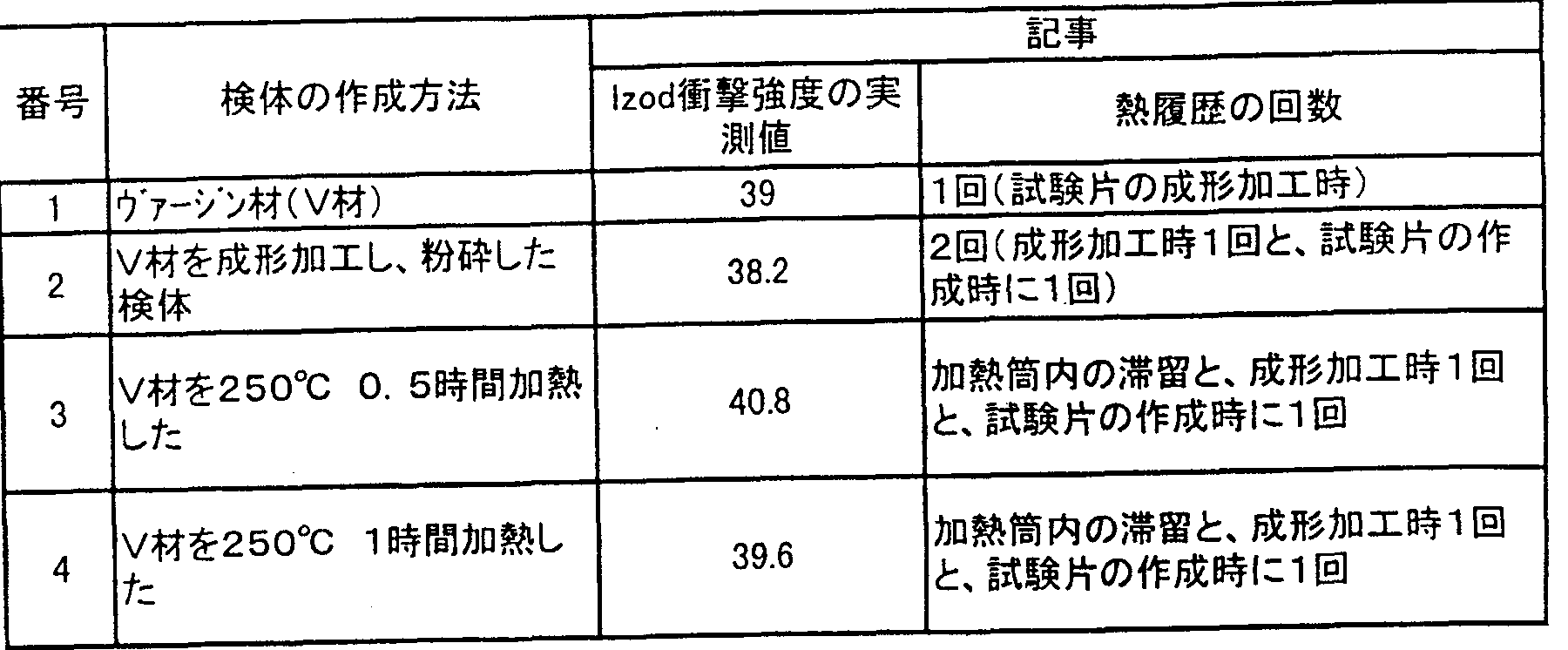
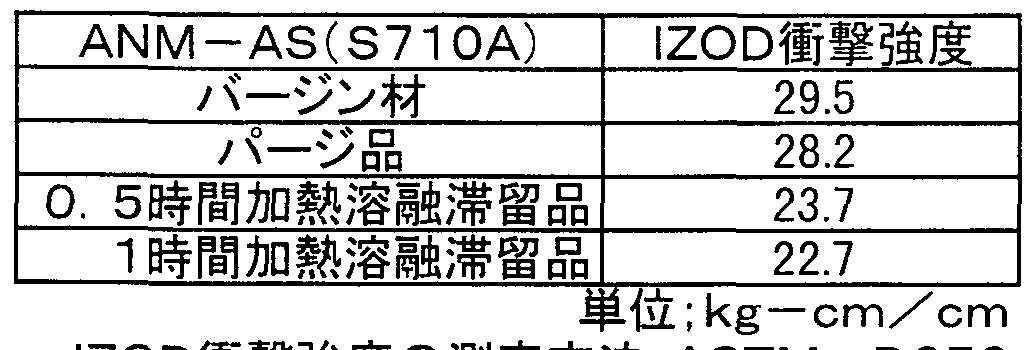
  • Table 1 shows the injection molded parts of ABS resin (ABS resin manufactured by Asahi Kasei Kogyo Co., Ltd., trade name, and grade; Stylac 191F).
  • ABS resin ABS resin manufactured by Asahi Kasei Kogyo Co., Ltd., trade name, and grade; Stylac 191F.
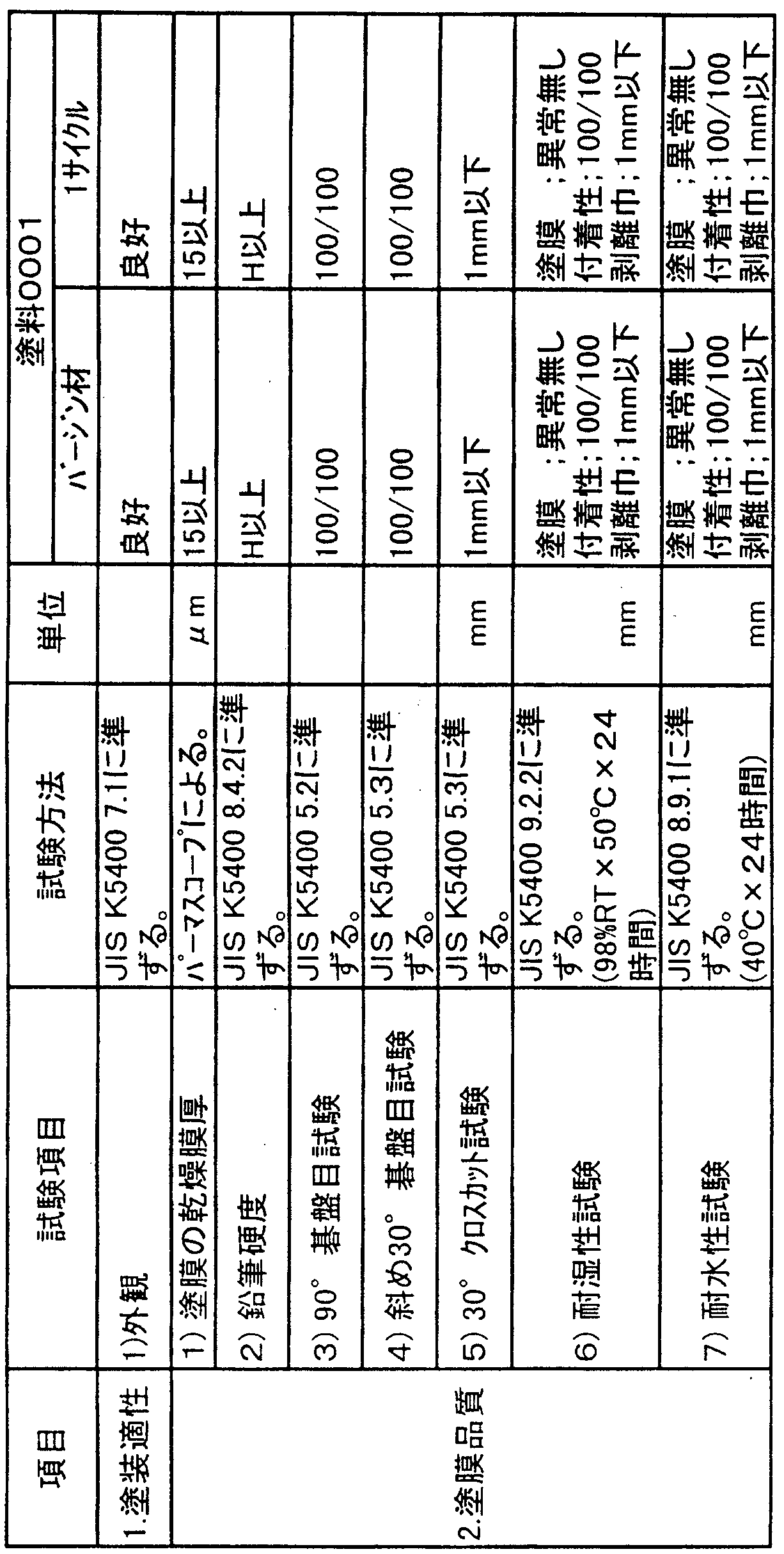
  • the paint was applied with a paint containing styrene-modified acrylic resin, which has compatibility (solubility) with a certain ABS resin, as the main component (the paint composition is shown in Table 3).
  • the values of the physical properties are shown in the case where the process of pulverizing with a coating film without separation and separation, pelletizing and reshaping (one evening, one cycle) is repeated three times.
  • repeated recycling without painting is
  • the physical properties (especially the impact strength) of the material are reduced, both with and without painting. This is because the rubber component added to the ABS resin (in the case of ABS resin, it is mainly An St-g-PBD) deteriorates due to repeated recycling and loses its properties as a rubber. It is judged as a result of having been damaged.
  • ABS resin in the case of ABS resin, it is mainly An St-g-PBD
  • the pigments and dyes in the coating film move into the thermoplastic resin, which is the main component of the molded product, during the heating and melting stage during recycling, and as a result,
  • the impact strength decreases due to an increase in pigments and dyes that do not show compatibility (solubility) with the thermoplastic resin, the main component of the product.
  • thermoplastic resin which is the main component of the molded product
  • the thermoplastic resin which is the main component of the molded product
  • the molecules can be reduced in molecular weight, especially maintaining impact strength. Therefore, the rubber-like component added is thermally degraded and oxidatively degraded, so that the impact strength is reduced.
  • a modifier composed of at least two or more polymer components having different properties but being compatible with each other is added to one or more waste plastics.
  • Japanese Unexamined Patent Application Publication No. 5-92432 discloses a method for grinding painted waste material of an automotive component made of an olefin resin, and crushing the crushed material with an olefin resin, an olefin elastomer, and a hydroxyl group at a terminal end.
  • a method for improving impact resistance by blending a diene polymer or its hydrogenating agent is a method for improving impact resistance by blending a diene polymer or its hydrogenating agent.
  • the adhesion of the coating film may be reduced when re-applied to a molded article molded using a recycled material.
  • Japanese Unexamined Patent Publication (Kokai) No. 6-2898991 describes the addition of a material obtained by copolymerizing or graft-polymerizing a rubber-like polymer with respect to the use of waste plastic.
  • the adhesion of the coating film may be reduced when re-painting a molded article molded using recycled materials. .
  • Japanese Patent Application Laid-Open No. 5-3109787 describes that a flame retardant is added to a recycled material in recycling an expandable styrene resin foam.
  • the added flame retardant is a bromine compound that is compatible with the expanded polystyrene resin.However, the bromine compound alone cannot increase the flame retardancy. It requires a combination of agents.
  • Japanese Unexamined Patent Publication (Kokai) No. 7-290504 describes that in the recycling of flame-retardant polystyrene resin, recovery of flame retardancy is achieved by the addition of halogen-containing phosphoric esters, bromine compounds, phosphoric ester flame retardants and antimony trioxide. There is no description about the strength ⁇ , ABS resin, modified PPE resin, PC / ABS resin, etc.
  • Japanese Patent Application Laid-Open No. Hei 8 — 24575756 describes a method for recovering impact strength by adding an epoxidized (partially hydrogenated) gen-based polymer to a recycled material.
  • compatibility solubility
  • thermoplastic resin which is the main component of the molded product
  • method of forming the molded product as a method for imparting compatibility (solubility) with the thermoplastic resin, which is the main component of the molded product, is not described.
  • graft copolymerization with a thermoplastic resin monomer as the main component or copolymerization.
  • Japanese Patent Application Laid-Open No. 7-22828 describes that the modified PPE resin and the polyamide resin alloy are coated with a paint that does not show compatibility (solubility) with the thermoplastic resin, which is the main component of the molded product.
  • the coated molded product is pulverized with the coating applied, and a hydrogenated styrene-butadiene block copolymer is added to recover the impact strength, which has been reduced due to the incorporation of a coating that is incompatible (soluble) with recycling. It is shown to measure.
  • the amount of the hydrogenated styrene butene-block copolymer is increased, the adhesion of the coating film may be reduced.
  • Virgin (virgin) material is added to recycled materials in JP-A-10-204,207, JP-A-10-166,357, JP-A-10-1683,43, etc. There is a statement about this, but in order to recover physical properties with virgin material, considerable amounts must be added, which is not economical. Also, high recycling material usage cannot be expected.
  • the present invention relates to a method for recycling a resin molded product in which a resin molded product containing a thermoplastic resin as a main component is recycled.
  • the method for reducing the impact strength and the flame retardancy, which are problems in the conventional recycling technology, is described. It is an object of the present invention to improve the impact strength and the flame retardancy by resolving the problem, or to prevent the adhesion of the coating film from being reduced even by the added recycling aid.
  • the present inventor provides a method for recycling a resin molded product comprising a thermoplastic resin as a main component, wherein the thermoplastic resin as a main component of the resin molded product is used as a recycling aid.
  • the method for recycling a resin molded article of the present invention is a method for recycling a resin molded article comprising a thermoplastic resin as a main component.
  • thermoplastic resin which is the main component of the resin molded product, with compatibility (solubility).
  • compatibility compatibility
  • the method for recycling a resin molded product according to the present invention includes the steps of:
  • the rubber-like material has a double bond in its molecular structure
  • the method for recycling a resin molded product according to the present invention (third invention according to claim 3) is characterized in that, in the first invention,
  • the rubber-like material has no double bond in its molecular structure
  • the method for recycling a resin molded product according to the present invention (the fourth invention according to claim 4) is characterized in that in the second invention,
  • the double bond is arranged in a linear chain of the molecular structure
  • the method for recycling a resin molded article according to the present invention is the method according to the third invention, wherein
  • the double bond is located on the side chain of the molecular structure
  • the method for recycling a resin molded product according to the present invention (the sixth invention according to claim 6) is characterized in that in the fourth invention,
  • the rubbery material is mainly composed of polybutadiene
  • the method for recycling a resin molded product according to the present invention is the method according to the fifth invention, wherein
  • the rubber-like material is mainly composed of ethylene-propylene terpolymer.
  • the method for recycling a resin molded product according to the present invention is the method according to the third invention, wherein
  • the rubber-like material is mainly composed of ethylene-propylene rubber or acrylic rubber.
  • the method for recycling a resin molded product according to the present invention (a ninth invention according to a ninth invention) is characterized in that, in the first invention,
  • the rubber-like material has the same (or common) or similar resin skeleton as the thermoplastic resin that is the main component of the resin molded product
  • the method of recycling a resin molded product of the present invention (the tenth invention of the tenth invention) is characterized in that in the ninth invention,
  • thermoplastic resin as a main component of the resin molded article is an AS resin, an ABS resin, or a polymer alloy or a polymer blend mainly containing these resins,
  • the resin skeletons added to the rubber-like material are acrylonitrile (abbreviation: An) and styrene (abbreviation: St).
  • the method for recycling a resin molded product according to the present invention is a method according to the ninth invention, wherein
  • the thermoplastic resin as a main component of the resin molded product is a PS resin, a HIPS resin, a PPE resin, or a polymer alloy or a polymer blend containing these resins as a main component,
  • the resin skeleton added to the rubber material is styrene (abbreviation: St).
  • the method for recycling a resin molded product according to the present invention is a method according to the 10th invention
  • the rubbery material is a terpolymer obtained by graft polymerization (graft copolymerization) of acrylonitrile (abbreviation: An) and styrene (abbreviation: St) [containing butadiene rubber.
  • the method for recycling a resin molded product according to the present invention (the thirteenth invention according to the thirteenth invention) is characterized in that, in the tenth invention,
  • the rubber-like material is a ternary graft obtained by graft polymerization (graft copolymerization) of acrylonitrile (abbreviation: An) and styrene (abbreviation: St) on ethylene-propylene polymer.
  • Copolymer ⁇ Ethylene-propylene copolymer-containing (acrylonitrile) (and) styrene (with) ternary graft copolymer (abbreviation: An St—g—E PDM ) ⁇
  • the method for recycling a resin molded product according to the present invention includes:
  • the rubbery material is a tertiary graft copolymer obtained by subjecting acrylonitrile (abbreviation: An) and styrene (abbreviation: St) to ethylene-propylene rubber by graft polymerization (graft copolymerization).
  • acrylonitrile abbreviation: An
  • St styrene
  • graft copolymerization graft polymerization
  • the method of recycling a resin molded product according to the present invention (a fifteenth invention according to a fifteenth invention) is characterized in that, in the tenth invention,
  • the rubber-like material is a terpolymer obtained by subjecting acrylonitrile (abbreviation: An) and styrene (abbreviation: St) to the graft polymerization of acrylic rubber.
  • acrylonitrile abbreviation: An
  • St styrene
  • the method for recycling a resin molded product according to the present invention (a sixteenth invention according to a sixteenth invention) is characterized in that, in the eleventh invention,
  • the rubber-like material is a copolymer obtained by graft polymerization of acrylic rubber and styrene (abbreviation: St) (graft copolymerization) ⁇ acrylic rubber-containing (co) styrene (co) graft copolymer (Abbreviation; St — g— ANM) ⁇
  • the method for recycling a resin molded product according to the present invention includes:
  • the rubbery material is a butadiene-based rubber-containing (co) styrene copolymer of butadiene and styrene (abbreviation: St), a graft copolymer ⁇ abbreviation; S t — g— PB, St — g _ PBR, or St — g _ PB (D, R) ⁇ ]
  • the method of recycling a resin molded product according to the present invention (the eighteenth invention according to claim 18) is characterized in that, in the eleventh invention,
  • the rubbery material is a copolymer of ethylene-propylene copolymer and styrene (abbreviation: St), which is obtained by graft polymerization (graft copolymerization) ⁇ containing ethylene propylene polymer. ) Styrene (with) graft copolymer ⁇ abbreviation; St — g '— EPDM) 1
  • the method for recycling a resin molded product according to the present invention (a nineteenth invention according to a nineteenth invention) is characterized in that, in the eleventh invention,
  • the rubber-like material is a copolymer (graft copolymer) of ethylene propylene rubber and styrene (abbreviation: St), which is a copolymer of ethylene propylene rubber and styrene.
  • Stg E PM Polymer ⁇ abbreviation: Stg E PM ⁇ Things.
  • the method of recycling a resin molded product according to the present invention includes the steps of:
  • the rubbery material is manufactured by emulsion polymerization, solution polymerization, slurry polymerization, or slurry polymerization.
  • the method of recycling a resin molded product according to the present invention (the twenty-first invention according to claim 21) is characterized in that, in the twenty-first invention,
  • the rubber-like material produced by the emulsion polymerization or solution polymerization has a rubber component content of 20% by weight or more.
  • the method for recycling a resin molded product according to the present invention includes the method according to the twenty-second invention, wherein
  • the graft ratio of the rubber-like material produced by the emulsion polymerization or the solution polymerization is 30% by weight or more.
  • the method for recycling a resin molded product according to the present invention (the twenty-third invention according to claim 23) is characterized in that, in the first invention,
  • the rubber-like material has a particle diameter of 0.05 / 111 to 50 m when heated and melted with a thermoplastic resin as a main component of the resin molded product and finely dispersed in the thermoplastic resin, and
  • the aspect ratio (ratio of height to width) is 0.1 or more
  • the method for recycling a resin molded product according to the present invention (the twenty-fourth invention according to the twenty-fourth invention) is characterized in that, in the first invention,
  • the rubber-like material has a glass transition point temperature (abbreviation; T g) of 200 or less measured using a scanning parallax thermal analyzer (instrument).
  • T g glass transition point temperature
  • the method for recycling a resin molded product of the present invention (the twenty-fifth invention of the twenty-fifth invention) is characterized in that, in the first invention, The rubber-like material has one or more different molecular structures having elasticity in its molecular structure.
  • the method for recycling a resin molded product according to the present invention is a method according to the first invention, wherein
  • the rubber-like material to be added is one kind of a single material or a mixture of two or more kinds.
  • the method for recycling a resin molded product according to the present invention (the twenty-seventh invention according to claim 27) is characterized in that, in the first invention,
  • the rubber-like material to be added is a mixture of materials having different particle sizes.
  • the method of recycling a resin molded product according to the first invention having the above-mentioned structure, as a recycling aid added to restore physical properties of the recycled material is compatible with the thermoplastic resin as a main component of the resin molded product. Since it is possible to mold with mixing (solubility) and to add a rubber-like material showing thermoplasticity, it has the effect of improving and recovering physical properties such as impact strength and elongation.
  • the molecular structure has a double tie. Since the rubber-like material has rubber elasticity, the addition of the rubber-like material has an effect of improving or recovering physical properties such as impact strength and elongation which are reduced by recycling.
  • the rubber-like material has no double bond in its molecular structure.
  • the rubber-like material having no double bond also has rubber elasticity like the rubber-like material having a double bond, so that the addition of the rubber-like material reduces physical properties such as impact strength and elongation, which are reduced by recycling. This has the effect of causing
  • the method of recycling a resin molded product according to the fourth invention having the above-described structure is the same as that of the second invention.
  • the rubber elasticity is large, so the amount of addition as a recycling aid can be reduced, and the rubber-like material as a recycling aid can be used. Has the effect that the amount of addition of can be reduced.
  • the method for recycling a resin molded product according to the fifth invention having the above-mentioned structure is the same as that of the third invention, wherein in the case of a rubber-like material having a double bond in a side chain, the recycling is repeatedly performed.
  • the effect is that the deterioration of the material is small, and the amount of the rubber-like material as a recycling aid added when the mixture is repeatedly recycled can be reduced.
  • the method for recycling a resin molded product according to the sixth aspect is the rubber-based material according to the fourth aspect, wherein the rubber-based material is mainly composed of polybutadiene.
  • the effect of this is that the amount of rubber-like material as a recycling aid can be reduced.
  • the rubber-like material is mainly composed of ethylene-propylene polymer.
  • the rubber-like material is less deteriorated, and the effect of reducing the amount of the rubber-like material as a recycling aid to be added when the mixture is repeatedly recycled is obtained.
  • the rubbery material is mainly composed of ethylene-propylene rubber or acrylic rubber, a double bond is provided. Since it has rubber elasticity similarly to the rubber-like material having the above-mentioned properties, it has an effect of recovering physical properties such as impact strength and elongation which are reduced by recycling due to the addition of the rubber-like material.
  • the rubber-like material may have a resin skeleton identical or similar to a thermoplastic resin as a main component of the resin molded product.
  • the recycling aid to be added has compatibility (solubility) with the molded article and / or the thermoplastic resin that is the main component of the coating film.
  • thermoplastic resin as a main component of the resin molded product is an AS resin, an ABS resin, or these resins. Since it is a polymer alloy or a polymer blend as a main component, and the resin skeleton added to the rubber-like material is acrylonitrile (abbreviation: An) and styrene (abbreviation: St), When painting is carried out, it has the effect of eliminating problems such as reduced adhesion of the coating film and recovering physical properties such as impact strength and elongation that are reduced by recycling.
  • thermoplastic resin which is a main component of the resin molded product
  • the thermoplastic resin which is a main component of the resin molded product
  • the thermoplastic resin is a PS resin, a HIPS resin, a PPE resin, or any of these resins.
  • a polymer alloy or a polymer blend containing styrene as the main component, and the resin skeleton added to the rubber-like material is styrene (abbreviation: St).
  • thermoplastic resin Since it has compatibility (solubility) with the thermoplastic resin that is the main component, it melts together with the thermoplastic resin at the stage of heating and melting at the time of recycling, and becomes compatible with the thermoplastic resin. It has a sea-island structure or other structures, and has the effect of restoring the impact strength reduced by recycling.
  • the rubbery material may be acrylonitrile (abbreviation: An) and styrene (abbreviation: S). t)) and a terpolymer obtained by graft polymerization (graft copolymerization) [tertiary graft copolymer with acrylonitrile (and) styrene (with butyl rubber) Coalescence ⁇ abbreviation; An St-g _ PB, An St-g-PBR, or An St-g-PB (D, R)!
  • the added recycling aid is compatible (soluble) with the molded article and / or the thermoplastic resin that is the main component of the coating film.
  • the added recycling aid is compatible (soluble) with the molded article and / or the thermoplastic resin that is the main component of the coating film.
  • coating it is possible to eliminate problems such as deterioration of physical properties and coating film adhesion, and to recover physical properties such as impact strength and elongation that are reduced by recycling. .
  • the recycling method of a resin molded product according to a thirteenth invention having the above-mentioned structure is characterized in that, in the tenth invention, the rubber-like material is characterized in that the ternary graft copolymer (AnSt-g-E
  • the rubber-like material shows thermoplasticity
  • the main component of the molded article It has compatibility (solubility) with the thermoplastic resin that is used, and when the molded article is pulverized and the rubber-like material is blended and recycled, or without pelleting, it is recycled.
  • thermoplastic resin which is the main component of the molded article, finely dispersed in the thermoplastic resin, and has a sea-island structure or other
  • the rubber-like material has a structure and is compatible with each other (melt), and the rubber-like material does not have a double bond, or has a double bond in the side chain of the molecular structure, and is heated and melted during recycling. It has the property of being resistant to oxidative deterioration even at the stage, and has the effect of recovering the impact strength reduced by recycling.
  • the rubber-like material has a property of being hardly oxidized and degraded, there is an effect that the recycle can be repeatedly performed.
  • the method for recycling a resin molded product according to the fourteenth invention is characterized in that, in the tenth invention, the rubber-like material is the ternary graft copolymer (A n St — g — EPM) Therefore, it has the property of being hardly oxidatively degraded even during the heating and melting stage during recycling, and has the effect of restoring the impact strength reduced by recycling.
  • the rubber-like material is the ternary graft copolymer (A n St — g — EPM) Therefore, it has the property of being hardly oxidatively degraded even during the heating and melting stage during recycling, and has the effect of restoring the impact strength reduced by recycling.
  • the rubber-like material according to the tenth invention wherein the ternary graft copolymer (A n St — g— ANM) ⁇ Therefore, since the rubber material has rubber elasticity similarly to the rubber material having a double bond, the effect of recovering physical properties such as impact strength and elongation which are reduced by recycling by adding the rubber material is exhibited.
  • the rubber-like material according to the first aspect is characterized in that the rubbery material is the graft copolymer (St-gANM)! Therefore, since it has rubber elasticity like a rubber-like material having a double bond, it has an effect of recovering physical properties such as impact strength and elongation which are reduced by recycling by the addition of the rubber-like material.
  • the rubbery material is the graft copolymer (St-gANM)! Therefore, since it has rubber elasticity like a rubber-like material having a double bond, it has an effect of recovering physical properties such as impact strength and elongation which are reduced by recycling by the addition of the rubber-like material.
  • the method for recycling a resin molded product according to a seventeenth aspect of the present invention is characterized in that, in the first invention, the rubber-like material is the graft copolymer iAnSt-g-PB, AnSt — G—PBR or A n St — g—PB (D, R)], so it shows thermoplasticity and is compatible (soluble) with the thermoplastic resin that is the main component of the resin molded product.
  • the step of heating and melting at the time of the recycling it is melted together with the thermoplastic resin and is compatible (dissolved) in the thermoplastic resin, and has a sea-island structure or another structure, It has the effect of recovering the impact strength that is reduced by recycling.
  • the rubber-like material is the graft copolymer (St-g-EPDM) in the first invention
  • the rubber-like material exhibits thermoplasticity, has compatibility (solubility) with the thermoplastic resin as a main component of the molded article, pulverizes the molded article, blends the rubber-like material, and
  • the rubber-like material is the graft copolymer (St-g-EPM) in the first invention, It has the property of being hardly oxidatively degraded even during the heating and melting stage during recycling, and has the effect of recovering the impact strength reduced by recycling.
  • the method for recycling a resin molded product according to the twenty aspect of the present invention having the above structure is the same as that of the first aspect, wherein the rubber-like material produced by emulsion polymerization or solution polymerization, or a slurry platform is used. Since the proportion of the rubber component in the material is large, the amount of the rubber-like material to be added can be reduced, which is economical and has the effect of enabling a uniform recovery of the impact strength reduced by recycling. Play.
  • the method of recycling a resin molded product according to the twenty-first invention having the above-mentioned structure is characterized in that
  • the content of the rubber component in the rubber-like material produced by the emulsion polymerization or the solution polymerization is 20% by weight or more. This has the effect of requiring only a small amount of material to be added, being economical, and enabling a reliable recovery of the impact strength reduced by recycling.
  • the method for recycling a resin molded product according to the twenty-second invention having the above-mentioned structure is characterized in that, in the twenty-second invention, the graft ratio of the rubber-like material produced by the emulsion polymerization or the solution polymerization is 30% by weight or more. Therefore, the compatibility (solubility) of the rubber-like material with the thermoplastic resin, which is the main component of the resin molded product, can be improved, and the impact strength, which is reduced by recycling, can be recovered uniformly and reliably.
  • the rubber-like material may be a glass transition point temperature (abbreviation) measured using a scanning parallax heat analyzer (apparatus). Tg) is equal to or lower than 200 ° C., so that the same fine dispersion as that of the rubber material can be obtained.
  • the rubber-like material according to the first aspect includes a molecular structure having one or more kinds of elasticity in its molecular structure.
  • a high impact strength is obtained by the combination effect, and an effect that a good gloss of the recycled resin molded article is obtained can be obtained.
  • the rubbery material to be added is one kind of a single article or a mixture of two or more kinds.
  • the combination effect High impact strength can be obtained, and good gloss of the recycled resin molded article can be obtained.
  • the rubber-like material to be added is a mixture of materials having different particle diameters.
  • a high impact strength can be obtained due to a combination effect of materials having different particle diameters, and an excellent gloss of the recycled resin molded article can be obtained.
  • FIG. 1 is a TEM photograph showing the state of pigments and dyes added to the thermoplastic resin which is the main component of the resin molded product in Reference Example 2.
  • Fig. 2 is a TEM photograph showing that the thermoplastic resin, which is the main component of the molded article in the second embodiment, and the thermoplastic elastomer added to restore the impact strength are in a compatible (dissolved) state. It is.
  • Fig. 3 is a TEM photograph showing that the thermoplastic resin, which is the main component of the molded article in the second example, and the thermoplastic elastomer added to restore the impact strength are in a compatible (dissolved) state. It is.
  • FIG. 4 is a photograph showing a state where a purged lump of flame-retardant ABS resin containing brominated epoxy causes an exothermic reaction and emits smoke.
  • the resins employed as the embodiments of the present invention include synthetic resins that exhibit thermoplasticity and natural resins that exhibit thermoplasticity.
  • Resin or simply“ resin (resin, polymer, plus Tick) "means both synthetic resins showing thermoplasticity and natural resins).
  • thermoplastic resin There are many types of the thermoplastic resin.
  • the resin used in this embodiment is w
  • thermoplastic resin 09 7/3 8 8 3 8 or any commercially available “thermoplastic resin” can be used.
  • the polymer alloy and the polymer blend of the above resin are collectively referred to as “blended polymer”.
  • the polymer alloy and the polymer blend are collectively referred to as “blended polymer”.
  • it is a blended polymer of PC resin and resin blended with other rubbery polymer (mainly, olefin rubbery polymer or acrylic rubbery polymer).
  • the resin In order to impart an effect, polymer Aroi the hydrophilic polymer one ⁇ e.g.
  • polyetherester ami de such ⁇ can also be produced. Alloying with these PC resins may require a compatibilizing agent (solubilizing agent), especially when producing polymer blends of PC and EPM-AS or EPDM-AS. In, the addition of a compatibilizer is not necessary.
  • resins having compatibility (solubility) with the above-mentioned resins include resins mainly composed of AS, PS, PPE and PC.
  • the resin used for molding is not only a mixture (blended) of the above resins, but also a “composite material” that aims to further improve the chemical and physical performance by compounding with inorganic and organic materials. There is also.
  • inorganic and organic substances called “fillers (agents)” added for the purpose of reducing costs or “reinforcing agents (agents) or reinforcing agents (agents)” added for the purpose of improving strength
  • Fillers (agents) added for the purpose of reducing costs
  • Thermal properties of materials and resins such as heat deformation temperature, brittle temperature, Vicat softening point temperature, melting point, etc.
  • mechanical properties such as tensile breaking strength (elongation), tensile yield strength “Reinforcing material (agent) or reinforcing material” is added to improve (elongation), bending strength, bending elastic modulus, impact strength, and the like.
  • flame retardants and flame retardant aids.
  • Representative examples of flame retardants are WO973888838 and other publications. The ones listed in are available.
  • plasticizers are used to add flexibility, elasticity, processability, etc. to the resin to suit the intended use, and there is a plasticizer, which is used for decorative coloring, coloring and coloring.
  • the material that is blended for the purpose is called "colorant". This is added to return the recycled material to its original color or to a different color, so the colorant can be used as a type of recycling aid.
  • Recycling aids refer to the resin, or the components in the resin, during recycling, which can be deteriorated by light, during molding, re-forming, pulverizing, and pelletizing processes. And thermal or other physical and chemical actions in the first stage, and the resin that is the main component of the molded product on the surface of the molded product, and the resin that constitutes the coating film.
  • a coated molded product that has been coated using a coating made of the same or different resin that has good properties is pulverized with the coating applied without separating and separating the coating.
  • the pigments and dyes in the coating film migrate into the molding resin and become incompatible (
  • the paint is applied using a paint composed of a foreign resin that does not show compatibility (solubility) with the resin that constitutes the coating film.
  • the resin is recycled with the coating applied without separation and peeling of the coating, and when the resin for coating is mixed in the recycled resin as a foreign substance, Physical properties such as mechanical properties (tensile strength, elongation, impact strength, etc.), thermal properties (heating deformation temperature, softening point temperature, fluidity, etc.), electrical properties (dielectric constant, etc.), flammability, color, etc. Decreases), recovers their physical properties, Alternatively, it is a general term for materials that are added to change other physical properties or to improve moldability during remolding, etc.
  • the above-mentioned resin additives can also be used for resin modification, so recycling in a broad sense Can be handled as an auxiliary.
  • thermoplastic or thermoplastic that has compatibility (solubility) with the thermoplastic resin that is the main component of molded articles
  • rubbers that show curability (elastics, rubbers) and thermoplastic elastomers (abbreviation: TPE).
  • such substances are collectively referred to as materials added to recover or improve physical properties such as impact strength and elongation, or to impart elasticity and impact strength to resin from the beginning (from virgin material).
  • the rubber-like components compounded for the purpose include rubber components, rubber-like materials, rubber-like elastics, rubber-like polymers, rubber-like copolymers, rubber-containing (co) graft copolymers, ⁇ rubber-like polymers ( Copolymers) ⁇ , and these are collectively referred to as “rubber-like materials”.
  • thermoplasticity A rubber-like elastic material showing thermoplasticity.
  • the heating and melting stage (the heating and melting stage is the case of heating and kneading with an extruder to produce virgin pellets, the stage of re-pelletization of recycling, the stage of reforming, etc.).
  • thermoplastic resin which is the main component of molded products (indicates thermoplasticity).
  • thermoplastic resin which is the main component of the molded product, or In the case of recycling, it is desirable that both of them show compatibility (solubility).
  • thermoplasticity Since it exhibits thermoplasticity as described above, it melts at the stage of heating and melting (at the stage of pelletization and heating and melting at the time of molding), and becomes fine in the thermoplastic resin, which is the main component of the molded product. Disperse.
  • the rubber content is high, and its physical properties can be restored by adding a small amount (e.g., it is economical because only a small amount is required).
  • thermoplastic ⁇ compatibility ⁇ thermoplastic ⁇ compatibility (solubility) ⁇
  • they are obtained by graft copolymerization of rubber with the monomer component constituting the thermoplastic resin, or There are rubbers (monomers composing rubber) and copolymers of each monomer in a structure such as want to cross (alternate), block or random.
  • a rubber-like elastic body is obtained by polymerizing a thermoplastic resin monomer, which is the main component of the molded product, into a polymer obtained by copolymerizing the resin in a structure such as alternating, block, or random.
  • two or more types of rubber are used instead of one type.
  • Rubber has elasticity because it has double bonds in its structure and its molecular structure is folded. When it has a double bond, it has a linear chain of molecular structure like polybutadiene (butadiene rubber); it has a side chain like ethylene-propylene-one polymer; Some materials do not wait for a double bond, such as propylene rubber and acrylic rubber. If the chain has a double bond, it tends to be oxidatively degraded, and if it is used as a recycling aid, it must be added every turn. On the other hand, rubber that has a double bond in the side chain, has no double bond, or has a molecular design that protects the oxygen attack, such as chloroprene rubber, is heated during recycling. Since it is hard to be deteriorated by oxygen at the melting stage, the amount of addition at each turn of the recycling is smaller than that of rubber such as the above-mentioned polystyrene. Can be
  • Such rubbery materials include EPDM, EPM, and ANM-based rubbery materials such as An St — g—EP DM, An St — g — E PM, An St — g — A NM ⁇ They have compatibility with ABS resin, AES resin, ASA resin, ACS resin, etc. which have AS resin as a main component because they have An and St in molecular structure.
  • ⁇ , Or St—g—E PDM, St—g—EPM, St—g— ANM ⁇ Since these have St in their molecular structure, these are HIPS resins containing PS resin as the main component. , Which show compatibility (solubility) with modified PPE resin.
  • Resins with rubber-like materials based on rubber with good thermal stability such as EPDM and ANM described above (eg, EPDM-AS, EPDM-PS, EPDM_PPE, ANM-AS, ANM_PS, ANM —
  • EPDM-AS, EPDM-PS, EPDM_PPE, ANM-AS, ANM_PS, ANM for materials such as PPE, the rubber-like material in the resin hardly loses the elasticity of the rubber-like material even after repeated recycling, so it is a material suitable for recycling (reducing the physical properties even after repeated recycling) Resin).
  • thermoplastic elastomers are roughly classified into those having a molecular structure that is easily oxidized and deteriorated and those having a molecular structure that is not easily oxidized. As described above, it is considered that a thermoplastic elastomer having a double bond in a side chain is less susceptible to oxidative degradation than a substance having a double bond in a straight chain.
  • thermoplastic elastomer having a molecular structure that is not easily oxidized and deteriorated similarly to the rubber-like material is used as a recycling aid, the amount of addition in each turn is reduced. be able to.
  • the rubber added to recover the impact strength does not show thermoplasticity but uses a thermosetting rubber-like elastic body, it should be heated and melted during recycling (in the pelletization stage). High (strong) Finely shear and disperse using a kneading twin-screw extruder or 21-drum. If the rubber-like elastic material thus dispersed does not show compatibility (solubility) with the thermoplastic resin which is the main component of the molded article, the compatibility (solubilizing) agent described later is added. Heat melting and kneading.
  • the recycling aid is incompatible (soluble) with the molding resin
  • the rubber-like material (rubbers) referred to in the present embodiment is a material having the following rubber in its molecular structure. Typical rubbers include natural rubber (NR), styrene-butadiene rubber (SBR), and the like.
  • ANM for example, butyl acrylate or a copolymer of butyl acrylate with butadiene and / or ⁇ '-olefin rubber
  • chlorinated polyethylene chlorohydrin rubber, Halogenated butyl rubber, butyl rubber (IIR), chlorosulfonated polyethylene (CSM), fluorine rubber ⁇ for example, vinylidene fluoride binary or ternary fluorine rubber (FKM ), Tetrafluoroethylene 'propylene-based fluororubber, tetrafluoroethylene' perfluoromethylvinylether-based fluororubber (F FKM), fluorosilicone-based fluorine-based rubber Rubber ⁇ , fluorinated vinylidene-hexafluoropropylene, vinylidene fluoride-tetrafluoropropylene, fluorinated phosphazene rubber, epidhydrin-based rubber (polyether (Terubber rubber), Chocol (polys
  • Urethane rubber for example, urethane rubber having an alkyl group or phenylnaphthyl group in the molecular structure
  • chlorinated polyethylene chlorohydrin rubber, hydrogenated tributyl rubber , Halogenated butyl rubber, ethylene vinegar bipolymer, polynorborinene, STR, CBR, IBR, IBBR, polyether rubber, chlorobutyl rubber hydrogenated triglyceride, fluorine rubber rubber products and ethylene vinyl acetate copolymer And soft acrylic resins.
  • ethylene-propylene polymer refers to ethylene-propylene as the third component, ethylidene 'nonbonene (abbreviation: ENB), dicyclopentenegen (abbreviation: DCP), 1,4-hexagen (abbreviation: 1) , 4-HD) is a copolymer of monomers.
  • ENB ethylidene 'nonbonene
  • DCP dicyclopentenegen
  • 1,4-hexagen abbreviation: 1
  • 4-HD 1,4-hexagen
  • ethylene-propylene polymer is also described as EPM (EPR), but for the sake of accuracy, in the present invention, the above-mentioned EPM and EPDM are deliberately distinguished and handled.
  • epichlorohydrin rubber generates ozone cracks under severe conditions, so it is resistant to ozone. It is desirable to further copolymerize glycidyl acrylate or methacrylate with epichlorohydrin (ECH) and ethylene oxide (E 0) in order to improve ozone properties.
  • the monomer unit of the resin to be blended is subjected to graft polymerization to have compatibility (solubility).
  • the resin to be compounded is a styrene-based resin, a rubber-like polymer obtained by graft polymerization of one or more of styrene-based monomers or a mixture of one or more of other monomers
  • rubbers are PB, acrylic rubber, EPM, EBM, E
  • Rubber-like polymers obtained by graft polymerization of An, Z or St on PDM, EBDM, etc. can be exemplified.
  • some rubbers have excellent ozone resistance, and when these are saturated hydrocarbons having no double bond in the main chain (for example, ethylene-propylene rubber, acryl-based rubber, etc.) ) And those that have been molecularly designed to protect the attack of ozone (for example, three-dimensional molecular design) (for example, epichlorohydrin-based rubber and chloroquine rubber).
  • ozone for example, three-dimensional molecular design
  • the inventor must heat and melt a molding resin containing a rubber-like material mainly composed of PB, EPDM, EPM, EBM, EBDM, acrylic rubber, and silicone rubber, and measure the impact after heating and melting. As a result, it was found that rubber-like materials mainly composed of EPDM, EPM, and acrylic rubber hardly deteriorate in rubber-like material elasticity.
  • Acrylic rubbers and ⁇ -refined rubbers which are rubbers having excellent thermal stability, are described below.
  • Acrylic rubbers and ⁇ -refined rubbers have no double bond in their molecular structure, or have a side chain instead of a straight chain of a molecule. Therefore, it is a rubber with excellent heat stability.
  • copolymerization of ethyl acrylate (EA) with 2-chloroethyl vinyl ether copolymerization of butyl acrylate (BA) with acrylonitrile (An), butyl acrylate and butadiene Copolymerization with EA, copolymerization with EA, EB, copolymerization with EA, BA and methoxethyl acrylate (MEA), copolymerization with MEA and BA, EA with ethoxyxyl acrylate (EEA), copolymerization of EA, BA, and MEA, copolymerization of BA, MEA, and An, copolymerization of ethylene and MA, and a polar group in the alkyl group of the acryl group alkyl ester Acrylic rubber containing alkoxy acrylate, acrylic rubber containing alkoxythioalkyl acrylate, BA / MEA and vinyl acetate acrylate copolymer, BA and E
  • Polyolefin rubbers are obtained by polymerizing one or more alpha olefins using a radical initiator, metal oxide catalyst, Ziegler-Natta catalyst, force Minsky catalyst, etc. It is a resin (rubber), and the resin (rubber) may be a mixture of two or more kinds.
  • the above-mentioned one-year-old fin is a straight-chain, branched or cyclic olefin having a polymerizable double bond at the ⁇ -position, and usually has a terminal prime of 2 to 8.
  • ethylene examples include ethylene, 3-methyl-1-butene, 3-methyl-1-pentene, butene-11, hexene-1, pentene1, octene1, 4-methyl-1-pentene, 3,3-dimethyl-1-butene, 4,4-dimethyl-1-pentene, 3-methyl-1-hexene, 4-methyl-1-hexene, 4,4-dimethyl-1-hexene, 5-methyl-1-hexene, tert-ylcyclo Examples include pentane, arylcyclohexane, 3-cyclohexyl-1-butene, vinylcyclopropane, and vinylcyclohexane.
  • Another monomer copolymerizable with the Hiyoshi Refin may be copolymerized.
  • Other monomers include acrylic acid, methacrylic acid, maleic acid, itaconic acid, and Monounsaturated organic acids such as methyl acrylate, ethyl acrylate, methyl methacrylate, maleic anhydride, aryl maleic acid imid, and alkyl maleic imid or derivatives thereof; Vinyl esters such as vinyl acetate and vinyl butyrate; aromatic vinyl compounds such as styrene and methyl styrene; vinyl silanes such as vinyl trimethyl methoxy silane and 7 -methacryloyloxy provyl tri methoxy silane; Non-conjugated, such as 1,4-hexadiene, 4-methyl-1,4-hexadiene, 5-4-methyl-1,4-hexadiene, dicyclopentadiene, ethylidene norbornene (4-ethylidene-2-nonbornene) Gen may be copolymerized in a small amount.
  • the rubbery polymer used as a recycling aid includes A ⁇ , ⁇ , A ⁇ , EP among the above-mentioned acryl-based rubber or ⁇ -age refined rubber.
  • DM ⁇ ⁇ ⁇ ⁇ A tertiary graft copolymer (A n St — g-), which is a graft polymer containing DM as a main component, wherein the rubbers are graft-polymerized with A ⁇ and / or St.
  • the ethylene- ⁇ -olefin-based copolymer used as a comonomer in Q′- ⁇ -olefin refers to ⁇ -olefin having 3 to 12 carbon atoms. It is a refining fin, specifically propylene, butene-1, 4-methylpentene-11, hexene-11, octene-11, and the like.
  • a polymer of one or more of the ⁇ -olefins, or a copolymer of one or more of other monomers copolymerizable with one or more of the ⁇ -olefins is a copolymer of ethylene or one or more other olefins, or a copolymer of another monomer copolymerizable therewith, especially a non-conjugated compound.
  • non-conjugated diene compound examples include dicyclopentadiene, tricyclopentene, tricyclopentene, 5—methyl-2,5—norbornadiene, 5—methylen-2-norbornene, and 5— Vinyl 2-norbornene, 5-ethylidene 2-norbornene, 5-isopropylidene 1 2-norbornene, 5 1-soprodenyl-2—norbornene, 5— (1 butenyl) 1-2—norbornene, 5— (2—propenyl) —2—norbornene, 5— (5—hexenyl) 1—1 norbornene, 4 , 7,8,9-Tetrahydrindene, and isopropylidenetetrahydrindene, cyclooctadiene, vinylcyclohexene, 1,5,9-cyclododecatoluene, 6-methyl-1,4,7,8,9 Tetrahydroindene, 2,2'
  • non-conjugated diene compounds particularly preferred is 5-ethylidene-2-norbornene (ENB), or Z and dicyclopentene (DCP). More preferred is dicyclopentene.
  • ENB 5-ethylidene-2-norbornene
  • DCP dicyclopentene
  • the appearance is better with a resin mixture of AS or PS with 5 -ethylidene_2-norbornene-based rubber-like polymer.
  • the proportion of the ethylene- ⁇ -methyl olefin and the non-conjugated gen compound used as necessary in the olefin-based rubbery polymer used in the present embodiment is preferably a mole fraction.
  • Ethylene / one-year-old refine / non-conjugated diene compound 0.2-0.8 / 0.2-0.8 / 0-0.1 /, more preferably, 0.2-0 7 / 0.25 ⁇ 0.75 / 0 ⁇ 0.05.
  • the viscosity of the ethylene-olefin copolymer (gum) used in the present embodiment is preferably (ML,, 100 ° C), preferably 5 to 150, More preferably, it is 10 to 70.
  • a typical example of the above-mentioned rubbers is ethylene / propylene co-base rubber (
  • EBM ethylene'butene copolymer rubber
  • EBDM ethylene'butene 'non-conjugated gen compound terpolymer rubber
  • EBDM ethylene / propylene.
  • Gene terpolymer is ethylene'.
  • Propylene is the third component (D) and ethylidene. —A mono-unit (third component) such as Nene (ENB), dicyclopentenegen (DCP or DCPD), 1,4-hexadiene (1,4-HD), etc.
  • ENB Nene
  • DCP or DCPD dicyclopentenegen
  • 1,4-hexadiene (1,4-HD 1,4-hexadiene
  • the content is about 5 wt% / or less.
  • EPM and EPDM the content of ethylene (E) is preferably 50 to 95%
  • propylene (P) is preferably 50 to 50%.
  • ethylene is 60 to 90%. % And propylene are preferably from 10 to 35%.
  • ethylene is 60 to 90%.
  • propylene are preferably from 10 to 35%.
  • ethylene is 60 to 90%.
  • propylene are preferably from 10 to 35%.
  • ethylene is 60 to 90%.
  • propylene are preferably from 10 to 35%.
  • ethylene is 60 to 90%.
  • propylene are preferably from 10 to 35%.
  • ETM butene-11
  • EBDM butene-ethylene-butene terpolymer copolymer using butene-11, etc.
  • the third component of EBDM is EBN, DCP, 1,4—HD, as with EPDM.
  • EBM and EBDM the content of ethylene (E) is preferably 50 to 95%, and the content of butene (B) is preferably 5 to 50%. More preferably, ethylene is 60 to 9%. 0, (3 ⁇ 4, butene is preferably
  • a rubber such as the ethylene- ⁇ -branched olefin copolymer, ⁇ , and ⁇ is graft copolymerized with the styrene resin in order to have compatibility (solubility) with the styrene resin.
  • ⁇ -alkyl monovinylidene aromatic monomers eg, ⁇ -methyl styrene, ⁇ -ethyl styrene, ⁇ -methyl vinyl toluene, ⁇ -methyl dialkyl styrene, etc.
  • ring-substituted alkyl styrenes For example, 0-m, p-vinyltoluene, 0-ethylstyrene, p-ethylstyrene, 2,4-dimethylstyrene, p-tertiary butylstyrene, etc., ring-substituted halostyrene (eg, 0-chlorostyrene, p-chlorostyrene) Styrene, 0-Promostyrene, 2,4-Dichlorostyrene, etc., monoalkyl ring, monosubstituted styrene ring (
  • alkyl substituents will have from 1 to 4 carbon atoms and include isopropyl and isobutyl groups. Of these, one or a mixture of monovinylidene aromatic monomers is preferred.
  • the acrylonitrile monomer include acrylonitrile, methacrylonitrile, ethacrylonitrile, fumaronitrile, and a mixture thereof.
  • the other monomer (other component) is not particularly limited as long as it is a monomer copolymerizable with styrene and acrylonitrile, but generally, methyl methacrylate, ethyl methyl acrylate, and the like.
  • graft copolymer which is an essential component in a monomer mixture that can be graft-polymerized in the presence of rubbers such as ANM and PB, or the above-mentioned graft copolymer, or aromatics in the copolymer
  • Vinyl (styrene-based monomer) refers to styrene, ⁇ -alkylmonovinylidene aromatic monomer ⁇ for example, ⁇ -methylstyrene, ethylstyrene, vinyltoluene (for example, ⁇ -methylvinyltoluene) ⁇ , ⁇ — Methyldialkylstyrene, etc.), ring-substituted alkylstyrene (eg, paramethylstyrene,
  • alkyl substituents will have from 1 to 4 carbon atoms and include isopropyl and isobutyl groups. Of these, one or a mixture of monovinylidene aromatic monomers is preferred.
  • Acrylonitrile monomers (vinyl cyanide monomers) include acrylonitrile, methacrylonitrile, ethacrylonitrile, and monohalogenated acrylonitrile. Examples include rilonitrile, fumaronitrile, and mixtures thereof. Acrylonitrile is particularly good.
  • methacrylate an alkyl ester having 1 to 4 carbon atoms, particularly methacrylate, is preferred.
  • aromatic monovinyl compound include styrene, halogenated styrene, vinyl toluene, ⁇ -methylstyrene, and vinylnaphthalene, and styrene is particularly preferred.
  • vinyl cyanide compound examples include acrylonitrile, methacrylonitrile, and ⁇ -acrylonitrile, and acrylonitrile is particularly preferable.
  • aromatic vinyl and a part of cyanide butyl are substituted with other vinyl compounds, for example, (meth) acrylic acid esters, butyl acetate, vinyl chloride, etc., especially (meth) acrylic acid esters. Are preferred.
  • one or more types of monomer components copolymerizable with the aromatic butyl monomer can be used as a component of the rubber-modified styrene resin.
  • the above-mentioned rubbers such as olefin-based rubber, ⁇ , ⁇ ⁇ are blended with the styrene-based resin, ⁇ ⁇ -based resin, and PC (PC / ABS, PC / AES, PC / ASA, PC / HIPS, PC / E PM-AS, PC / E PDM-AS, PC / E PM_PS, P CZE PDM—PS, etc.), and thermoplastic resins for molding such as polyolefin resin as a recycling aid.
  • PC PC / ABS, PC / AES, PC / ASA, PC / HIPS, PC / E PM-AS, PC / E PDM-AS, PC / E PM_PS, P CZE PDM—PS, etc.
  • thermoplastic resins for molding such as polyolefin resin as a recycling aid.
  • ANM, PB, etc. it is necessary to have compatibility (solubility) with the thermoplastic resin.
  • the olefin rubber has the same or similar monomer as the polyolefin resin or the same structural unit as the polyolefin resin, and therefore shows good compatibility (solubility) with the thermoplastic resin as it is.
  • a monomer that is the same as or similar to a monomer or a structural unit of the thermoplastic resin is subjected to graft polymerization.
  • the graft polymerization refers to the above-mentioned monomer in the presence of the above-mentioned rubber such as the above-mentioned rubber, ANM, PB, etc., by the above-described oil-soluble or water-soluble initiator or Z and high energy rays such as ultraviolet rays and electron beams.
  • the polymerization method refers to a polymerization method for polymerization.
  • general methods such as bulk polymerization, suspension polymerization, solution polymerization, emulsion polymerization, and slurry polymerization are applied.
  • the graft polymer obtained by the graft polymerization is based on a rubber such as an olefin rubber, ANM, or PB, and has a polymer chain of the above monomer.
  • the main component is a graft polymer in a narrow sense as a branch, and in some cases, the graft polymer in the narrow sense is a polymer such as a rubber such as an olefin rubber, ANM, PB or the like and / or a polymer comprising the above monomer. Is what is being done.
  • an olefin-based rubber obtained by graft polymerization of styrene or / and one or more other styrene-based monomers similar to styrene Polymer (a styrene-containing copolymer containing styrene or Z and styrene and a similar copolymer with a monomer similar to styrene, hereinafter referred to as a styrene-graft olefin-based rubber-like polymer), and an acrylic rubber-like polymer Coalesced (a graft copolymer of styrene containing acrylic rubber and / or a monomer similar to styrene; hereinafter referred to as styrene graft acrylic rubber-like polymer), and rubber-like rubber Polymers (butadiene rubber-containing styrene or a graft
  • the styrene-graft torefin-based rubbery polymer, styrene-graft-to-rubber-based rubbery polymer, and styrene-graft-butadiene-based rubbery polymer are styrene-based polymers having almost the same solubility as PS and a single parameter. It has good compatibility (solubility) with PS, since it has a branched polymer chain.
  • styrene or styrene and other styrenic monomers and acrylonitrile or Rubber-like polymer obtained by graft polymerization of one or more of two or more ditolyl monomers (styrene or Z and other styrenic monomers containing orefine rubber, A graft copolymer of acrylonitrile or Z and other nitrile monomers, hereinafter referred to as a styrene ditrigraph triolefin rubbery polymer), an acrylic rubbery polymer Combined (styrene-containing acryl-containing rubber and / or a similar copolymer of styrene, a copolymer of acrylonitrile or Z and other nitrile-based monomers.
  • styrene ditrigraph triolefin rubbery polymer an acrylic rubbery polymer Combined (styrene-containing acryl-containing rubber and / or a similar copolymer of st
  • styrene ditolyl graft butadiene rubbery polymer styrene ditolyl graft butadiene rubbery polymer
  • styrene di-trigraph triolefin rubbery polymer styrene di-trigraph tributyl rubber-based polymer, and styrene di-trigraph tributadiene-based rubbery polymer have almost the same solubility as AS (or ABS) '. Since it has a styrene ditriol copolymer chain having one parameter as a branch, it has good compatibility (solubility) with AS (or ABS).
  • the olefin rubber, the acryl-based rubber, and the butadiene-based rubber may be used alone or in combination of two or more. May be used, but the content of the olefin-based rubber, the acryl-based rubber, and the butadiene-based rubber is 5 to 80% by weight, preferably 10 to 50% by weight.
  • the total content of the used monomers (graphite ratio) is 95 to 20% by weight, preferably 90 to 25% by weight, and the styrene-triglyceride torefin rubber-like weight is used.
  • the above-mentioned torefin-based rubbery polymer and the like have compatibility (solubility) with the thermoplastic resin, an effect of improving the physical properties of the thermoplastic resin, and an effect of improving the recyclability, that is, the impact resistance during recycling. Balance with the effect of preventing the reduction of
  • the above-mentioned graft-to-refin rubber-based polymer, graft-acryl-based rubber-like polymer, and graft-to-butadiene-based rubber-like polymer have a core-shell structure in which the rubbery component is a core and the graft portion is a shell. Therefore, there is no problem such as a decrease in the adhesion of the coating film as long as the graft-to-refin rubber-like polymer having a high graft ratio is mixed with the thermoplastic resin for molding.
  • the particle diameters of the above-mentioned graph-to-refin rubber-based polymer, graph-to-rubber-based rubber-like polymer, and graph-to-butadiene-based rubber-like polymer are compatible at a complete molecular level, that is, from 0.0 which are compatible. If it has a sea-island structure (0.11 to 5 5m), or it may have other structures, the range of 18 am is desirable, and the range of 0.001 to 100 m is possible. In this particle size range, the effect of improving the recyclability of the graft-refining rubbery polymer and the like is particularly large.
  • the above graph torefin-based rubber-like polymer has a reduced viscosity sp Zc (0.5 g / d toluene solution, measured at 30 ° C) of 0.30 to less than the toluene-soluble component, which is a measure of the molecular weight. It is preferably in the range of 1.00 g / d 1, and more preferably in the range of 0.50 to 0.80 / d 1.
  • the graph-to-refin rubber-based polymer, the graph-to-acryl rubber-based polymer, and the graph-to-butadiene-based rubber-like polymer used as the recycling aid are produced by various methods as described above. But especially preferred method has higher rubber content
  • the control of sp / c can be performed by the polymerization temperature, the type and amount of the polymerization initiator, and the amounts of the solvent and the chain transfer agent.
  • the copolymer composition is controlled by the charged monomer composition. be able to.
  • the particle size of the olefin-, rubber-, and butadiene-based rubbery polymers is controlled by the number of rotations with stirring. By lowering the speed.
  • the above graph shows specific examples of the torefin-based rubbery polymer: St_g-EPM, St-g-EPDM, St-gEPM-E PDM, An St-g-EPM, An S t-g-E PDM, An St-g-E PM * E PDM, St-g-E BM, St-g _ EB DM, St-g- E BM-E BDMs A n S t-g-EBM, An St-g-E BDM, An St-g-EBM 'EB DM, etc.
  • Stg ANM graphacrylic rubbery polymer
  • S ⁇ -g-ANM S ⁇ -g-ANM
  • butadiene-based graft polymers include St-g-PB and An St-g-PB.
  • the graft acrylic rubbery polymer and the grafted butadiene rubbery polymer show good compatibility (solubility) with the styrene resin, and the grafted torefin based rubbery polymer and the graft acrylic. Rubber-based polymer and graft butadiene rubber-based polymer.
  • the graft-to-rein rubber, graft-acrylic rubber, and graft-butene-based rubber are finely dispersed in the styrene-based resin, and have a sea-island structure or other finely dispersed structure. Is formed, and is stably mixed without causing separation, recovers the physical properties of the styrenic resin, and improves recyclability.
  • a mixed resin of AS and An St — g-E PM is referred to as E PM -AS
  • a mixed resin of An St -g-EP DM is referred to as EP DM-AS and An St — G '— E PM and An S tg— EP PM mixed resin with E PM— E PDM— AS, AS and A n St — g _ANM mixed resin with ANM— AS, PS and S t — G — EPM mixed resin with EPM—PS
  • St—g—EPDM mixed resin with EPDM—PS, St — g—EPM and St—g—EPDM mixed resin EPM—E PDM—PS and PS and St—g—ANM are referred to as ANM—PS.
  • St—g—EPM As a graft polymer for PPE resin, St—g—EPM, St— in which the above St is graft copolymerized to have compatibility (solubility) with PPE resin g—EP
  • the graph-based rubber-based polymer, acryl-based rubber-based polymer, and butadiene-based rubber-based polymer have, as branches, a styrene polymer chain having a solventity parameter approximately equal to ppE.
  • the graft-to-refin rubber-like polymer is stably mixed without causing separation of the PPE resin, and a recycling aid for the PPE resin is used.
  • a mixed resin of PPE and a graph-to-refin type rubbery polymer St-g-EPM is used as a mixed resin of EPM-PPE and St-g-EPDM.
  • a mixed resin of EPDM-PPE, St-g-EPM and St-g-EPDM a mixed resin of EPM-EPDM-PPE, PS and EPM-PPE.
  • a mixed resin of PPE, PPE and St—g_ANM is called ANM—PPE, and a mixed resin of PS and ANM—PPE ANM—PS_PPE.
  • thermoplastic resin which is the main component of the molded article
  • many of them do not show thermoplasticity. Therefore, these rubbers are the main components of the molded article.
  • the same, common, and similar molecular skeleton as the thermoplastic resin is made thermoplastic by graft copolymerization, copolymerization, block copolymerization, random copolymerization, etc., and the main component of the molded product It has compatibility (solubility) with certain thermoplastic resins (these are a kind of "denaturation").
  • thermoplastic resin which is the main component of the molded product
  • thermoplastic resin which is the main component of the molded product
  • thermoplastic resin are made thermoplastic so that they can be mixed with recycled pulverized materials to form pellets or recycled.
  • the molding resin is melted and finely dispersed at the stage of heating and melting.
  • thermoplastic resin since the rubber-like material modified as described above becomes thermoplastic, Alternatively, pelletization can be performed using the same apparatus as that for the thermoplastic resin.
  • thermosetting rubber When thermosetting rubber is used as a recycling aid, it does not have compatibility (solubility) with the thermoplastic resin that is the main component of molded products and coating films (for example, it is not graphed)
  • compatibility for example, when rubber is used, a compatibilizing agent is added to make it compatible.
  • thermosetting rubber In the case of thermosetting rubber, it is difficult to finely disperse into the thermoplastic resin, which is the main component of the molded product, at the stage of melt-kneading, so a resin with high melt viscosity is added, and the shear force of the resin is reduced. Use and finely disperse.
  • An St—g—PB added (blended, blended) to improve impact strength in ABS resin is a graph of An and St in butadiene rubber. (A symbol: expressed in 1 g.) To give thermoplasticity and to have compatibility (solubility) with AS resin, which is the main component of ABS resin.
  • HIPS resin modified PPE resin, or PPE resin
  • St-g-PB which shows thermoplasticity and is compatible with the PPS resin, which is the main component of HIPS resin.
  • St—g—EPDM, St—g—ANM obtained by grafting St to EPM, EPDM, and ANM are HIPS resins and PS resins.
  • C-PS resin, etc. modified PPE resin and similar resins, polymer blends using those resins, and polymer alloys (eg, modified PPE resin / PA etc.) have the same resin skeleton. Shows solubility.
  • rubbery materials graphed with EPM, EPDM, and ANM as the main components exhibit thermoplasticity and good thermal stability, making them effective as optimal recycling aids for the resins. Can be used.
  • Such a rubber-like material is compatible (soluble) with the thermoplastic resin, which is the main component of the molded product, and exhibits thermoplasticity, so that it can be mixed with recycled pulverized materials to form pellets or recycled.
  • the molding resin is melted together at the stage of heating and melting. Differentially dispersed in the molding resin.
  • rubbery materials whose main components are rubber-based rubber (for example, EPM, EPDM), ANM, etc., undergo oxidation deterioration during the heating and melting stage. It is hard to receive.
  • Materials with rubber-like materials with good thermal stability are suitable for recyclability. It is not a material, but a material with high weather resistance (light).
  • the rubber-like polymer contained rubber in St-g-E PDM (EPDM, ethylene was about 75%, propylene was about 20%, and DCP was about 5% as the third component).
  • the amount of each rubbery polymer (St-g—EPDM) (RTM) is about 38%, the average particle size of rubber is 1.0, and the graft ratio of styrene is about 35% and about 55%.
  • Polymer (a styrene graft ratio of 35%) and a rubbery polymer (a styrene graft ratio of 55%) ⁇ were converted to PS resin ⁇ Mitsubishi Monsanto Kasei Co., Ltd.). ) Made?
  • High-impact polystyrene obtained by mixing 25 parts by weight of the rubbery polymer 002 and rubbery polymer 003 with 75 parts by weight of resin (?? 8) 75
  • IZ ⁇ D impact strength of the resin was measured, it was 3.5 kg_cm Z cm for a product with a graft rate of about 35%, whereas it was 3.5 kg_cm Z cm for a product with a graft rate of about 55%. 5.8 kg-cm / cm.
  • the chlorinated polyethylene in the ACS resin consisting of AS resin and chlorinated polyethylene is also a material that exhibits elasticity that is not easily oxidized and degraded.However, chlorinated polyethylene is heated and melted during pelletization during molding. There is a concern that chlorine gas and hydrogen chloride may be liberated and corrode molding machines and molds.
  • a resin composition obtained by adding a rubber-like material obtained by polymerizing a thermoplastic resin to a thermoplastic resin is known (Japanese Patent Application Laid-Open No. 57-139140, page 2 (PPE resin)). — Pp. 1904-41, page 2 (styrene resin), and JP-A-7-118185, p. 3 (PPE resin).
  • PPE resin Japanese Patent Application Laid-Open No. 57-139140, page 2 (PPE resin)
  • thermosetting properties by themselves, and are incompatible (soluble) with resins.
  • thermoplastic resins by copolymerizing monomers of thermoplastic resins by known methods, such as by graft copolymerization. It has compatibility (solubility) and shows thermoplasticity.
  • Thermoplastic elastomers are resins produced by methods such as copolymerization (random, block, etc.) of monomers that make up rubber and resin monomers. This thermoplastic elastomer also has the property of restoring or improving the impact strength of recycled materials.
  • thermoplastic elastomer a soft segment having elasticity and a hard segment having plasticity are present in the molecular structure, and any one of them (the soft segment, the soft segment, and the like) is present. Or part of the dosegment, or all
  • the molecular design is such that the (part) shows compatibility (solubility) with the thermoplastic resin that is the main component of the molded product.
  • thermoplastic elastomer include urethane-based, styrene-based, vinyl-based, amide-based, and ester-based thermoplastic elastomers, and specific examples thereof are shown in WO97388883 and literatures. I have.
  • thermoplastic elastomers are expected to increase further in the future depending on the combination of the hard segment and the soft segment.
  • the above-mentioned thermoplastic elastomer has the same, common, and similar molecular skeleton as the thermoplastic resin which is the main component of the molded product, and is compatible with the thermoplastic resin. Even if it shows its properties, it may reduce the adhesion of the coating film, so it is necessary to evaluate the coating film performance before using it as a recycling aid.
  • Other recycling aids added for the purpose of resin modification include low-temperature properties, cold-brittleness resistance, molding workability, secondary workability, bending resistance, improvement in bending whitening, improvement in impact resistance, and melting.
  • Prevents surging added to improve the fluidity of the resin reduces fish eyes, improves long-running properties, imparts gloss to molded products and counteracts glossy effects on molded products, slips on molded products
  • Polyphenylene ether (oxide) resin which is used to modify HIPS resin and modified PPE resin, PC resin, PA resin, PET resin, and PBT resin also improve the impact strength and oil resistance. It can be used as a recycling aid to be added. When the rubber-like material as described above is added to other materials such as recycled materials, the impact strength is improved, but if a decrease in rigidity is observed, a material having a high rigidity, for example, an ABS resin is used. Balance the physical properties by further adding a PS resin (eg, one with a high molecular weight) to the compatible (soluble) AS resin (eg, one with a high molecular weight) and a HIPS resin. .
  • a PS resin eg, one with a high molecular weight
  • compatible AS resin eg, one with a high molecular weight
  • a flame-retardant resin A flame-retardant resin.
  • the recycling aid added when the flame-retardant effect is lost due to decomposition, evaporation, sublimation, etc. of the flame-retardant after repeated recycling is the flame retardant or flame-retardant aid described in the specification. And the like are recycling aids for imparting flame retardancy.
  • pigments and dyes for coloring thermoplastic resin products are also included in the recycling aids because thermoplastic resin molded products are colored (colored and colored) in various colors.
  • the third As a component a compatibilizing agent and a resin modifier ⁇ hereinafter collectively referred to as a “compatibilizing agent” are added so as to have compatibility (solubility).
  • polybutadiene rubber (butadiene rubber abbreviation; PBR, PBD, PB) is an effective material for imparting impact to ABS resin and HIPS resin, but is compatible (soluble) with the resin. Because of its poor properties, PBR and a compatibilizing (solubilizing) agent are added, and the PBR is finely sheared with a biaxial high (strong) kneading extruder to finely disperse the resin in the molding resin. In some cases, a technique such as dissolution is used.
  • compatibilizing (solubilizing) agents are exemplified in WO9738388 and other documents.
  • the resin manufactured by the chemical brand of the material maker is added to the above-mentioned additives as necessary, and then pelletized and added to a commercially available material as a material for molding.
  • Many of the pigments and dyes do not show compatibility (solubility) with the thermoplastic resin, which is the main component of the molded article. Therefore, pigments and dyes are added to color (“coloring”, In some cases, physical properties, such as impact strength, are often reduced when coloration is applied.
  • ABS resin ABS resin brand name and grade; made by Asahi Kasei Kogyo Co., Ltd .
  • Grade A material that is colored in white (mainly titanium oxide) with natural color and natural without color
  • the IZ ⁇ D impact strength (measurement temperature; 23 ° C, measurement method; measured in accordance with ASTM-D256) with the color (natural color) is 14 for the former colored one. 9 kg-cmZcm, the latter obtained 17.6 kg-cm / cm.
  • the decrease in the impact strength of the colored molding material is a result of the fact that the pigment and dye added are not compatible (soluble) with the thermoplastic resin which is the main component of the molded product. .
  • St-g-ANM which is mainly composed of a saturated acrylic rubber having no double bond in the molecule, is a saturated rubber-like material having no double bond, and thus is further oxidized.
  • the thermal stability test of An Stg ANM was performed assuming that the thermal stability was high, and it was confirmed that the thermal stability was high (Example 11).
  • the effect of the addition of a rubber-like material compatible with the recycled material is effective in recovering the impact strength of recycled materials whose impact strength has been reduced by recycling. It is clear from If the styrene resin is limited, the particle size of the rubber-like material added at this time is not less than 0.001 m and not more than 100 m. In the case of 0.001 or less, the addition of the rubber-like material does not greatly reduce the sightseeing spot outside the molded article, but the recovery of the impact strength without increasing the addition amount cannot be expected.
  • the particle size of the rubber-like material is 100 m or more, the rubber-like material is unevenly distributed in the thermoplastic resin, which is the main component of the molded product, and the impact strength and the tensile strength of the molded product as a whole are viewed. High strength parts and low strength parts may occur. In addition, it also causes a decrease in the fluidity of the molten resin during molding.
  • the particle size of the rubber-like material added to the recycled material to improve or recover the impact strength and tensile strength should be between 0.001 m and 100 m, as described above.
  • the particle size of the rubber-like material is 0.1 m to 60 m.
  • the particle size of the rubber is preferably from 0.1 m to 18 m, and most preferably from 0.1 m to 5 m.
  • the particle size of this rubber-like material is equivalent to that added to the molding resin from the beginning.
  • thermoplastic resin which is a main component of a molded article described later
  • thermoplastic elastomer having compatibility compatibility
  • thermoplastic elastomer may be used alone.
  • thermoplastic elastomer there are cases where the thermoplastic elastomer is used alone and cases where a plurality of types are used in combination. So In some cases, a rubber-like material and a thermoplastic elastomer are used in combination.
  • the recycling aid has compatibility (solubility) with the recycled resin to be added, and a known method described in WO97388883 or the like is used to evaluate the compatibility (solubility).
  • the present inventor evaluated the compatibility (solubility) between the molding resin and the recycling aid by using the following methods: (1) a bending test (a flat plate or a cylindrical shape processed by a mold, etc.); (2) Goban test (each resin is mixed, heated and melted, and JISK 504 0 8 5.2.), And observation of the dispersing state of the sectioned film with a transmission electron microscope (TEM) and the respective resin interfaces and boundary areas to confirm compatibility (dissolution) and non-phase The volume (dissolution) was evaluated.
  • TEM transmission electron microscope
  • a virgin resin pellet of a thermoplastic resin, which is a main component of a molded article, and a recycling aid are used in a certain weight ratio (for example, a thermoplastic resin, a main component of a molded article, Z recycling aid 90/10).
  • the mixture is heated and melted using a single-screw extruder, then pelletized using a cooled and solidified pelletizer to form a thermoplastic resin, which is the main component of the molded product, and is recycled.
  • a molded article is molded using the obtained mixed resin pellet, and a cross-cut test is performed on the obtained molded article in accordance with JISK 540.5.2. If the number of eyes is 10 or less, evaluate the compatibility (solubility) more.
  • a thin section was prepared from the mixed resin pellet using a microtome, and a specimen stained with ruthenium oxide (R h0) or osmium oxide ( ⁇ s 0) was subjected to transmission electron microscopy. (Hereinafter referred to as “T EM”) to observe the structure and morphology of the resin (morphology), peeling and missing at the interface and boundary area, and describe it in the islands-in-the-sea structure or WO97 / 388838 There are other structures, or a mixture of multiple structures.
  • the dispersed form is spherical, and can be used even when the aspect ratio (aspect ratio) is 1 to 0.1, and when the shape is less than 0.1. Can be used depending on the parts used, but if the aspect ratio is less than 0.1 and they are aligned in a certain direction, It is not preferable because the directionality is seen in the strength. In such a case, it is necessary to devise a method of laminating the layers and canceling the orientation.
  • the size of the dispersion is desirably in the above-described range.
  • the pellets are crushed and pelletized, for example, they are melted by the heat of a single-screw extruder heating cylinder, and finely dispersed by physical force ( In the case of finer dispersion, it is desirable to use an extruder having high (strong) kneading properties, such as a two- or one-axis extruder, and combine as described above.
  • thermoplastic resin which is the main component of the molded article
  • recycling aid are mixed and melted (melted, melted) at the molecular level at the stage of heating and melting.
  • the molding method, the coating method, and the paint described in WO97Z38838 can be adopted.
  • the recycling aid (1) when blending (mixing) the pulverized material with the pulverized material, use (2) using an extruder to blend the mixture of the pulverized material and the recycling aid. In the case of heating and melting to make pellets, (3) Blend the crushed material obtained by crushing the molded product, heat and melt it using an extruder, and blend a recycling aid into the recycled pellets obtained by pelletizing. (4) In addition, (4) Recycle pellet and mixed resin pellet blended with recycling aid are extruded, heated and melted using an extruder, and used again after pelletization.
  • the mixture is heated, melted and kneaded, so that the recycling aid is uniformly mixed in the molding resin.
  • the method of (3) “using a pulverized material obtained by pulverizing a molded article, using an extruder to heat and melt the material, and blending a recycling aid with a recycled pellet obtained by pelletizing” is used.
  • the mixing ratio of the pellet and the recycling aid can be arbitrarily changed, and when both are pellets, they can be mixed uniformly. This method is effective when a small amount of recycled resin is produced, such as when several types of recycling aids are used.
  • the recycling aid is in the form of powder, bulk, etc., it may be pelletized in advance using an extruder. If there are several types of recycling aids, they are pelletized. For example, rubber-like materials (AnSt_g—PB, St_g—PB,
  • a master batch of recycling aid and pellets of the above-mentioned crushed material use a single-screw extruder, multi-screw extruder, or Busnida (Busconida), Banbury mixer, super mixer, roll, Brabender It is heated and melted by a plastograph, extruded, and pelletized using a pelletizer.
  • the pelletization of the pulverized material can be performed using a similar device.
  • the rubber-like material constituting the recycling aid is a polybutadiene (abbreviation: PB, PBR, PBD), butadiene-based material.
  • Rubber abbreviation: PBR
  • EPM ethylene-propylene rubber
  • EPDM ethylene-propylene-propylene polymer
  • It can be used alone or as a mixture of two or more (ie, at least one) rubber-based, acrylic-based, or other rubber-based materials.
  • the rubber constituting the recycling aid may be a polybutadiene, a bush-based rubber, an ethylene-propylene rubber, an ethylene-propylene rubber. It can be used as a single component containing olefin rubber, acryl rubber, or other propylene rubber as the main component, or as a mixture of two or more types. It has the effect of improving or recovering physical properties such as reduced impact strength and elongation.
  • the rubber-like material constituting the recycling aid may be a butadiene-based rubber-ethylene-propylene polymer. It has a double bond in its molecular structure.
  • the rubber-like material forming the recycling aid may be a butadiene-based rubber, ethylene-propylene-terpolymer, or the like.
  • the rubber-like material having a double bond in the molecular structure has rubber elasticity. This has the effect of improving or restoring physical properties such as impact strength and elongation that are reduced by recycling.
  • the method of recycling a resin molded product according to the third embodiment is characterized in that, in the first embodiment, the rubber-like material constituting the recycling aid is a rubber-based material such as an acrylic rubber or an ethylene-propylene rubber. It is composed of those having no double bond in the molecular structure.
  • the rubber-like material constituting the recycling aid is a rubber-based material such as an acrylic rubber or an ethylene-propylene rubber. It is composed of those having no double bond in the molecular structure.
  • the rubber-like material constituting the recycling aid according to the first embodiment does not have a double bond in its molecular structure.
  • the rubber-like material that has no double bond in the molecular structure also has rubber elasticity like the rubber-like material that has a double bond, so the impact that is reduced by recycling due to the addition of the rubber-like material This has the effect of restoring physical properties such as strength and elongation.
  • the double bond present in the molecular structure of the rubber according to the second embodiment is changed to a linear chain in a molecular structure such as butadiene rubber. It is what is arranged.
  • the method of recycling a resin molded product according to the fourth embodiment having the above-described structure is the same as that of the second embodiment, except that the rubber-like material having a linear double bond has a large rubber elasticity. Therefore, it is possible to reduce the amount of the rubber-like material as a recycling aid.
  • the double bond present in the molecular structure of the rubber-like material according to the second embodiment may have a molecular structure such as ethylene-propylene-polymer. It is arranged on the inner side chain.
  • the method of recycling a resin molded product according to the fifth embodiment having the above-described configuration is as follows: in the second embodiment, when the rubber-like material having a double bond in a side chain is repeatedly recycled, It has the effect of reducing the deterioration of the rubber-like material and reducing the amount of the rubber-like material added as a recycling aid to be added when the mixture is repeatedly recycled.
  • the thermoplastic resin as a main component of the resin molded product according to the third embodiment is an AS resin, an ABS resin, or a resin containing such a resin as a main component.
  • the rubber-like material is mixed with the thermoplastic resin as the main component of the resin molded product by a known polymerization method. It is composed of a rubber-like material with the same molecular skeleton.
  • the method of recycling a resin molded product according to the sixth embodiment having the above-described configuration is the same as that of the third embodiment, except that the resin is an AS resin, an ABS resin, or a polymer alloy or a polymer blend containing such a resin as a main component.
  • the addition of rubber that has compatibility (solubility) to similar resins has the effect of restoring the impact strength that is reduced by recycling, and the added recycling aids include molded articles and / or coatings. It has compatibility (solubility) with the thermoplastic resin that is the main component of the film.
  • the method for recycling a resin molded product according to the seventh embodiment is characterized in that, in the fourth embodiment, the rubber-like material constituting the recycling aid is an AS resin, an ABS resin, or a resin containing these resins as a main component.
  • An Stg—PB that is compatible (soluble) with polymer alloys, polymer blends, or similar resins.
  • the rubber rubber material constituting the recycling aid is An St-g PB. It exhibits plasticity and is compatible (soluble) with the thermoplastic resin which is the main component of the resin molded product, so that it melts together with the thermoplastic resin at the stage of heating and melting at the time of recycling. It is compatible (dissolved) in thermoplastic resins and has an islands-in-the-sea structure or other structure, and has the effect of restoring the impact strength reduced by recycling.
  • the rubber-like material constituting the recycling aid may be an AS resin, an ABS resin, or a resin containing such a resin as a main component.
  • the rubber rubber material constituting the recycling aid may be An St -g-EPM or An Since it is St—g—EPDM, the rubber-like material exhibits thermoplasticity, has compatibility (solubility) with the thermoplastic resin that is the main component of the molded product, and is obtained by pulverizing the molded product.
  • the rubber-like material is blended and re-pelleted or not pelletized, at the stage of heating and melting when blending into a recycled molded product and re-forming, Melted with thermoplastic resin as the main component, Finely dispersed in thermoplastic resin, exhibits sea-island structure or other structures, and is compatible with each other
  • the rubber-like material does not have a double bond, or has a double bond, but also has a side chain of its molecular structure, and is hardly oxidized and deteriorated even in the stage of heating and melting at the time of recycling. It has the property of recovering the impact strength reduced by recycling.
  • the rubber-like material has a property of being hardly oxidized and degraded, it has an effect that recycle can be repeatedly performed.
  • the method for recycling a resin molded article according to the ninth embodiment is the same as that of the second embodiment, except that the rubber-like material constituting the recycling aid is formed of an acrylic rubber.
  • Styrene (with) ternary graft copolymer (abbreviation: An St — g— ANM) that is composed of those that have no double bond in its molecular structure.
  • the rubber-like material forming the recycling aid may have a double bond in its molecular structure.
  • the rubber-like material that has no double bond in the molecular structure has the same rubber elasticity as the rubber-like material that has a double bond. It has the effect of restoring physical properties such as reduced impact strength and elongation.
  • the thermoplastic resin as a main component of the resin molded product may be a PS resin, a HIPS resin, or any of those resins.
  • the rubber-like material is mixed with the thermoplastic resin which is the main component of the resin molded product by a usual polymerization method. It is composed of a rubber-like material with the same molecular skeleton.
  • the method of recycling a resin molded product according to the tenth embodiment having the above-described structure is the same as that of the fifth embodiment except that a rubber exhibiting compatibility (solubility) is added to an AS resin, an ABS resin, or a similar resin. It has the effect of recovering the impact strength that is reduced by recycling, and the added recycling aid has compatibility (solubility) with the molded article and the thermoplastic resin that is the main component of the coating film.
  • a recycling aid eliminate physical problems such as a decrease in physical properties and in the case of painting, such as a decrease in coating adhesion, and recover physical properties such as impact strength and elongation that are reduced by recycling. This has the effect.
  • the method for recycling a resin molded product according to the eleventh embodiment is characterized in that, in the fourth embodiment, the rubber-like material constituting the recycling aid is a PS resin, a HIPS resin, or a resin containing these resins as a main component.
  • St-g-PB that is compatible (soluble) with polymer alloys, polymer blends, or similar resins.
  • the rubber-like material constituting the recycling aid is St-g-PB.
  • it since it has compatibility (solubility) with the thermoplastic resin which is a main component of the resin molded product, it melts together with the thermoplastic resin at the stage of heating and melting at the time of recycling. It is compatible (dissolved) in the thermoplastic resin and has an islands-in-the-sea structure or another structure, and has an effect of restoring the impact strength reduced by recycling.
  • the method of recycling a resin molded product according to the present 12th embodiment is the method according to the third or fifth embodiment, wherein the rubber-like material constituting the recycling aid is a PS resin, a HIPS resin, or a resin thereof.
  • St-g-EPM or St_g-EPDM which is compatible (soluble) with polymer alloys, polymer blends, or similar resins, whose main component is
  • the method for recycling a resin molded product according to the twelfth embodiment having the above-described configuration is the same as that of the third or fifth embodiment, except that the rubber-like material constituting the recycling auxiliary material has a high strength, St—g—EPM, Or St-g-EPDM, the rubber-like material exhibits thermoplasticity, has compatibility (solubility) with the thermoplastic resin which is the main component of the molded article, and crushes the molded article;
  • the rubber-like material is blended and re-pelleted, or when it is blended into a recycled molded product without being pelletized and re-molded, the main component of the molded product is heated and melted.
  • thermoplastic resin melts together with the thermoplastic resin as a component, finely disperses in the thermoplastic resin, exhibits a sea-island structure or another structure, and is mutually compatible (dissolved), and the rubber-like material has a double bond. No or double Even if with a case they have the side chain of its molecular structure, also has little aptitude to oxidation deterioration in the stage of pressurizing hot melt upon recycling, there is an effect that restores the impact strength reduced by recycling.
  • the rubber-like material has a property of being hardly oxidized and degraded, there is an effect that the recycle can be repeatedly performed.
  • the rubber-like material constituting the recycling aid may be an acrylic rubber (and) styrene (and) 2 It is composed of an original graft copolymer (abbreviation: St-g-ANM) that does not have a double bond in its molecular structure.
  • St-g-ANM original graft copolymer
  • the method for recycling a resin molded product according to the thirteenth embodiment having the above-described structure is the same as that of the third embodiment, wherein the rubber-like material constituting the recycling aid does not have a double bond in its molecular structure.
  • the rubber-like material having no double bond in the molecular structure also has rubber elasticity similarly to the rubber-like material having a double bond. It has the effect of restoring physical properties such as elongation.
  • thermoplastic resin as a main component of the resin molded product is a PPE resin or a resin mainly containing those resins.
  • the rubber-like material is formed by a known polymerization method (solution polymerization, slurry polymerization, emulsion polymerization, etc.). Accordingly, the resin molded article is made of a rubber-like material having the same molecular skeleton as the thermoplastic resin as a main component of the resin molded article.
  • a rubber-containing (co) graft copolymer rubber-like polymer (copolymer)
  • graft reaction a rubber-containing (co) graft copolymer (rubber-like polymer (copolymer)) that has been subjected to a graft reaction is further subjected to a graft reaction to obtain a high graft ratio rubber. It was possible to obtain a shaped material.
  • the compatibility (solubility) with the thermoplastic resin, etc., which is the main component of the molded product is good, and as a result, the form of dispersion becomes easy.
  • the rubber content and the rubber particle size were the same, and the impact strength was recovered by using a material with a high graft rate and a material with a low graft rate. The recovery was better.
  • the method for recycling a resin molded product according to the fourteenth embodiment having the above-described structure is the same as that of the fifth embodiment described above, except that a rubber showing compatibility (solubility) is added to the PPE resin or a similar resin. It has the effect of recovering the reduced impact strength, and the added recycling aid has compatibility (solubility) with the thermoplastic resin, which is the main component of molded products and coatings. In addition to the reduction of physical properties due to the addition of paint and the problem of reduced adhesion of the coating when painting, it has the effect of recovering the physical properties such as impact strength and elongation that are reduced by recycling. .
  • the method according to the fourth embodiment wherein the rubber-like material constituting the recycling aid is the PPE resin, which is a main component of the resin molded product, or
  • the PPE resin which is a main component of the resin molded product
  • styrene (abbreviation: St) is graft-polymerized.
  • Copolymer) Binary copolymer [butadiene rubber-containing (no) styrene (no) binary copolymer] ⁇ Abbreviation: St_g_PB, St—g—PBR, or St — G— PB (D, R) ⁇ ].
  • the method for recycling a resin molded product according to the fifteenth embodiment having the above-mentioned structure is the same as that of the fourth embodiment, wherein the rubber-like material constituting the recycling aid is a PPE which is a main component of the resin molded product.
  • Styrene abbreviation: St
  • St is graft-polymerized to make it compatible (soluble) with resins, polymer alloys containing these resins as main components, polymer blends, or similar resins.
  • Graft copolymerized) binarized copolymer [butadiene rubber-containing (NO) styrene (NO) binary graft copolymer ⁇ abbreviation: St_g—PB, St—g—PBR, Or St-g-PB (D, R) ⁇ ], so that it shows thermoplasticity and has compatibility (solubility) with the thermoplastic resin which is the main component of the resin molded product.
  • St_g—PB butadiene rubber-containing (NO) styrene (NO) binary graft copolymer ⁇ abbreviation: St_g—PB, St—g—PBR, Or St-g-PB (D, R) ⁇ ]
  • the thermoplastic resin which is the main component of the resin molded product.
  • the method for recycling a resin molded product according to the sixteenth embodiment is characterized in that, in the fourth embodiment, the rubber-like material constituting the recycling aid is a PPE resin or a polymer mainly composed of such a resin. It is a St—g—PB that has compatibility (solubility) with alloys, polymer blends, or similar resins.
  • the method of recycling a resin molded product of the 16th embodiment having the above structure is as follows.
  • the rubber-like material constituting the recycling aid is St-g-PB, the rubber-like material exhibits thermoplasticity, and is a thermoplastic resin which is a main component of the resin molded product.
  • thermoplastic resin Has the compatibility (solubility), and melts together with the thermoplastic resin at the stage of heating and melting at the time of the recycling, and is compatible (dissolves) in the thermoplastic resin to form a sea-island structure. Or Other structures have an effect to the impact strength reduced by recycling times is restored.
  • the method for recycling a resin molded product according to the seventeenth embodiment is characterized in that, in the fifth embodiment, the rubbery material constituting the recycling aid is a PPE resin or a polymer mainly composed of such a resin.
  • the rubbery material constituting the recycling aid is a PPE resin or a polymer mainly composed of such a resin.
  • St-g-EPM or St-g-EPDM that is compatible (soluble) with alloys, polymer blends, or similar resins.
  • the method for recycling a resin molded product according to the seventeenth embodiment having the above-described configuration is the same as that of the fifth embodiment, wherein the rubber-like material constituting the recycling aid is St-g.
  • the rubber-like material shows thermoplasticity, has compatibility (solubility) with the thermoplastic resin that is the main component of the molded product, and crushes the molded product. Then, when the rubber-like material is blended and repelleted, or when not blended, it is heated and melted when blended into a recycled molded product and remolded. In the melting stage, it melts together with the thermoplastic resin as the main component of the molded article, finely disperses in the thermoplastic resin, exhibits a sea-island structure or another structure, and is mutually compatible (soluble).
  • the rubber-like material has no double bond, or has a double bond, but also has a side chain of its molecular structure, and has a property that it is not easily oxidized and deteriorated even in the stage of heating and melting at the time of recycling. This has the effect of restoring the reduced impact strength.
  • the rubber-like material has a property of being hardly oxidized and degraded, it has an effect that recycle can be repeatedly performed.
  • the rubber-like material constituting the recycling aid may be an acrylic rubber (and) styrene (and) 2 It is composed of an original graft copolymer (abbreviation: St-g-ANM) that does not have a double bond in its molecular structure.
  • St-g-ANM original graft copolymer
  • the rubber-like material constituting the recycling aid according to the third embodiment has a double bond in its molecular structure.
  • a rubber-like material having no double bond in its molecular structure also has rubber elasticity like a rubber-like material having a double bond. This has the effect of restoring physical properties such as impact strength and elongation, which are reduced by this.
  • the method for recycling a resin molded article according to the nineteenth embodiment is based on a styrene-modified acrylic resin which can be molded by mixing with a thermoplastic resin, which is a main component of the resin molded article, with compatibility (solubility).
  • a resin molded product coated with resin or thermoplastic acrylic resin paint is pulverized.
  • it can be molded as a recycling aid by mixing with the thermoplastic resin, which is the main component of the resin molded product, with compatibility (solubility).
  • a rubber-like material that has the property of improving or restoring physical properties such as impact strength and elongation, and adding a flame-retardant material and a flame-retardant aid to impart flame retardancy .
  • the method for recycling a resin molded product according to the nineteenth embodiment having the above-described structure is a thermoplastic resin which can be molded by mixing with the thermoplastic resin as a main component of the resin molded product while having compatibility (solubility).
  • a resin molded product recycling method in which a resin piece with a coating film obtained by pulverizing a resin molded product coated with the paint is melt-kneaded and recycled, as a recycling aid, a main component of the resin molded product is used as a recycling aid.
  • a rubber-like material that has the property of improving the impact strength as well as being able to be molded with compatibility (solubility) with the thermoplastic resin as a component is added.
  • Reference Example 1 investigated the cause of the decrease in IZOD impact strength of a molded article with a coating film.
  • ABS resin ⁇ Asahi Kasei Kogyo Co., Ltd. ABS resin product name and grade; Stylac 191H (color: natural color) ⁇ (The rubbery polymer compounded is An St — g — Injection molding using PBD) (size; length; 4
  • the obtained test piece was similarly measured for IZOD impact strength according to ASTM D-468. Table 6 shows the obtained results.
  • the virgin material of the ABS resin and the IZOD impact strength when the molded product was pulverized using the same apparatus and method as described above without applying a coating to the molded product were used. The results are also listed.
  • thermoplastic resin constituting the coating film shows compatibility (solubility) with the thermoplastic resin which is the main component of the molded article, or pigments or dyes added to the paint (in the case of this embodiment, oxidation It was evaluated using TEM whether or not titanium (such as titanium) showed compatibility (solubility) with the thermoplastic resin that is the main component of the molded article or the thermoplastic resin that constitutes the coating film.
  • thermoplastics the main component of molded products
  • Thermoplastic resin Thermoplastic resin
  • Thermoplastic resin a styrene-modified polyphenylene ether resin ⁇ (abbreviation: modified PPE) product name and grade; XYRON manufactured by Asahi Kasei Kogyo Co., Ltd.
  • N 2 0 2 Z ⁇ The compounded rubbery polymer is AnSt—g—PBD) and the interface between the thermoplastic resin (styrene-modified acrylic resin) and the boundary area Since no peeling or missing was observed, they are compatible with each other.
  • thermoplastic resin ⁇ modified PPE ⁇ which is the main component of the molded product, and the pigments and dyes contained in the molding resin and paint. Is judged to have no compatibility (solubility).
  • the pigments and dyes in the paint film migrate into the thermoplastic resin, which is the main component of the molded article, and show compatibility (solubility).
  • compatibility solubility
  • an increase in the amount of pigments and dyes in the resin is considered to be the cause of the drop in impact strength.
  • Reference Example 3 investigates the causes of physical property changes when recycling is repeated.
  • Reference Example 3 is a result of investigating the cause of the drop in impact strength among the physical properties that change when recycling is repeated.
  • the thermoplastic resin which is the main component of the molded product, is heated and melted (at a molten resin temperature of 250 ° C) in the heating cylinder of the injection molding machine, heated and melted for a certain time, and heated for a certain time.
  • the molten resin is purged into a purged lump, which is submerged in water to prevent oxidative deterioration due to oxygen in the air after the purge, sufficiently cooled and solidified in water, taken out, dried, and pulverized.
  • the specimen was obtained by dehumidifying and drying the pulverized material which had been pulverized again using a machine.
  • Table 7 shows the ABS resin manufactured by Sumika Kogyo's Latex Co., Ltd. [Product name and grade; Clarastick MV F-1K1; Sumika Kobe's BS Latex Among the ABS resins marketed by Co., Ltd., a rubber-like material [rubber-like polymer 001 ⁇ A n St — g— PB; The polymerization method is emulsion polymerization, and the graft ratio is about 40% ( However, the ratio of An / St is about 25/75) The rubber content is about 50%, and the average rubber particle diameter is 0.4 / m ⁇ ]. The results were shown when using the same color.
  • Table 8 shows the results in the case of the AS resin, which is one component of the ABS resin.
  • the AS resin (material without rubber-like material) used in the evaluation is an AS resin manufactured by Sumika Koichi BS 'Latex Co., Ltd. [trade name and grade;
  • Table 9 shows that, as resin, rubber-like polymer 001 [A n St — g— PBD (rubber-like material in ABS resin) [Sumika Koichi BS Latex Co., Ltd. — G— PBD (brand name and grade; Clarastic S—3701 ⁇ internal control number of Sumika Koichi BS. Latex Co., Ltd.)].
  • ABS resin was used as the resin.
  • ABS resin manufactured by Sumika Chemical Industries, Ltd. BS Latex Co., Ltd. [Mother polymer of ABS resin [rubber-like polymer 001 (A n St — g- ABS resin blended with PB) and AS resin (K-115), and added with resin additives such as flame retardant, flame retardant aid, and lubricant to produce ABS resin.
  • the starting resin of such a resin is generically referred to as “maza-polymer”) (trade name and grade; clathastic K-250 0 4 This is the result of the use of the company's internal control number for Chemical Industries, Ltd. (Latex Co., Ltd.)]]].
  • Table 11 shows that the content of the rubbery polymer is 0.004 [[The content of ethylene (E) in the molecule is about 7
  • DM is a rubbery polymer obtained by graft polymerization of St (styrene) and An (acrylonitrile) by a well-known method (slurry polymerization) with a graft ratio of about 45 o. 'o ⁇ A n / St ratio is about 2575, rubber (EPDM) content is about 50%, average rubber particle size is about 1 rn ⁇ .
  • St styrene
  • EPDM rubber
  • An Stg-EPDM rubber-like polymer 004
  • An St-g_EPM An St-g-ANM Since it is an excellent rubbery polymer, the above An St-g-E PDM, An St—g—EPM, and An St—g—A NM added as a recycling aid are recycled. Repeat Since the rubber elasticity is not lost even if it is returned, it has been found that the amount of the recycling aid added can be reduced each time the recycling is repeated.
  • thermoplastic elastomer could be used as a recovering agent for improving the impact strength of a molding material.
  • ABS resin ABS resin brand name and grade: Psychrac ZFJ 5 (94 UL; HB) manufactured by Ube Sycon Co., Ltd.
  • ABS resin ABS resin brand name and grade: Psychrac ZFJ 5 (94 UL; HB) manufactured by Ube Sycon Co., Ltd.
  • various (compatible) with ABS resin The thermoplastic elastomer was used in different amounts.
  • the evaluation method is to measure the initial values of the physical properties of the ABS resin (initial values for the virgin material), add a thermoplastic elastomer (described later) to the virgin material, and measure the change in the physical properties. It was confirmed whether the impact strength can be improved by adding a plastic elastomer.
  • thermoplastic elastomers manufactured by Toyobo Co., Ltd., brand name and grade: Perprene S2002, Perprene P40H. , Perprene P750B, perprene P150B, and perprene P75M.
  • Tables 15 to 19 show the results of changes in physical properties when the above-mentioned thermoplastic elastomer was added to the ABS resin. As is clear from Tables 15 to 19, the impact strength can be improved by adding any of the thermoplastic elastomers. Recycling of resin molded products In the recycling of resin molded products, it was found that the addition of such materials as a recycling aid (agent) can recover and improve the impact strength that decreases in recycling. Has been reached
  • Shirakawa 191 F rubber-like polymer is An St — g— PBD
  • the rubbery polymer 0 0 0 1 CA n St — g— PBD The graft polymerization method of An and St is emulsion polymerization, and the graft ratio is about 40% ⁇ A n / St The ratio is about 25 Z75, the rubber (PBD) content is about 50%, and the average rubber particle size is 0.
  • the impact strength is improved, and the thermoplastic elastomer that does not significantly affect other physical properties (elongation, bending strength, etc.) ⁇ manufactured by Toyobo Co., Ltd.
  • Thermoplastic elastomer (trade name and grade; Perprene P70B) ⁇ was selected and ABS resin [ ⁇ Asahi Kasei Kogyo Co., Ltd. ABS resin (trade name and grade; Styrac 190)
  • a molded article injection-molded using a natural color) ⁇ is coated with a paint having compatibility (solubility) with ABS resin (compounding is shown in Table 3). Without separating or peeling off the paint film of the coated molded product, it was pulverized, pelletized and recycled as it was with the paint film, and a pellet of recycled material was obtained.
  • the recycled ABS resin (the resin constituting the coating film containing the thermoplastic resin mixed therein) is made of a recycled material (one turn), and the thermoplastic elastomer as a recycling aid is added to the recycled material. 8%, 10%; thermoplastic elastomer manufactured by Toyobo Co., Ltd. (trade name and grade; Perprene P70B) ⁇ was added and reduced by recycling. Recovery of impact strength and changes in other physical properties were measured (Table 20). For comparison, Table 20 shows the comparison between virgin material and recycled material (one turn). The results of measurement of physical properties using are also shown.
  • Table 20 shows that the addition of the thermoplastic elastomer hardly changed the thermal properties of the ABS resin, and the addition of the elastomer did not significantly lower the heat deformation temperature.
  • thermoplastic elastomer was used as a recycling aid to recover the impact strength reduced by recycling.
  • good results were obtained for the energy (strength X elongation; represented by the area of the SS curve).
  • the IZOD impact strength at 23 ° C is excellent since the results are higher than those of the virgin material.
  • thermoplastic elastomer when the thermoplastic elastomer is added to the ABS resin to restore the impact strength, the recovery of the changing strength is judged comprehensively and is compatible with the ABS resin. Addition of soluble (AS) resin seems to be effective.
  • HIPS resin or modified PPE resin if a thermoplastic elastomer or rubber-like material that is compatible (soluble) with HIPS resin or modified PPE resin whose impact strength has been reduced by recycling is added. The impact strength recovers, but when the physical properties such as bending strength are reduced, the PS resin or PPE resin ⁇ HIPS has compatibility with PPE as in the case of adding AS resin to ABS resin. Therefore, it is possible to use PPE for the HIPS resin, and it is also possible to use the PS resin for the modified PPE resin.
  • thermoplastic elastomer As described above, addition of a rubber-like material (AnSt-PB) compatible (soluble) with the ABS resin as described above, in addition to the thermoplastic elastomer, can improve the impact strength. In this case as well, a decrease in strength is observed as in the case of the thermoplastic elastomer, so that the combined use of the AS resin can restore the impact strength and the strength recovery such as tension and bending.
  • the addition of thermoplastic elastomer or rubbery polymer is inconsistent with the addition of AS resin, etc., so balance the amount of each addition according to the purpose of use. There is a need.
  • thermoplastic resin ABS resin in this case
  • thermoplastic elastomer used to recover the impact strength [Thermoplastic elastomer manufactured by Toyobo Co., Ltd. (trade name, and Grade: Perprene P70B) ⁇ and evaluated whether it shows compatibility (solubility) with the ABS resin using TEM.
  • the evaluation method is as follows.
  • the thermoplastic resin which is the main component of the molded article [part of the above-mentioned ABS resin ⁇ ABS resin (trade name and grade; Stylac 190 (Nazi Natural Color)) manufactured by Asahi Kasei Corporation) 90 parts by weight, and 10 parts by weight of the thermoplastic elastomer ⁇ Toyobo Co., Ltd. thermoplastic elastomer (trade name and grade; perprene ⁇ 70 ⁇ ) ⁇ by weight.
  • the resin was heated and melted using a single-screw extruder to obtain a mixed resin pellet of ABS resin and thermoplastic elastomer, and the obtained mixed resin pellet was thinned using a micromixer. Sections were prepared, and cracks and omissions were observed at each interface and boundary area.
  • the third embodiment shows a method of manufacturing a recycled material and evaluation of coating film performance.
  • An St-g PB To recover the physical properties.
  • the pulverized material a recycling aid (rubber-like polymer 001) 1
  • Table 23 shows the results of measuring the impact value of the recycled pellets.
  • the impact strength (IZOD impact strength) was reduced (IZOD impact strength of 18.8 kg in Table 12) as compared to the case where a recycling aid (rubber polymer 001) was blended into the crushed material. (16.7 g-cm / cm (cm / cm) is recognized because extra heat history is added by pelletizing, and the added recycling aid and A originally mixed with the ABS resin It is presumed that nSt-g_PB was oxidatively degraded.
  • an inert gas such as nitrogen gas is introduced into the extruder or the molding machine heating cylinder to lower the oxygen concentration, It is thought that the oxidative degradation of the material can be reduced.
  • the pressure in the heating cylinder of the forming machine is increased (e.g., with a forming machine equipped with a shut-off nozzle) using hydrocarbon gas such as CO, C0, and methane and hydrogen. Pressurizing and dissolving the gas in a supercritical state can improve the fluidity of the molten resin and improve the molding processability by increasing the back pressure in the machine heating cylinder.
  • injection molding was carried out using an ABS resin exhibiting flame retardancy ⁇ combustible flame retardant ABS resin product name and grade: Styrac VA 58 ⁇ manufactured by Asahi Kasei Corporation.
  • the coated molded product was pulverized as it was with the coating without separating and separating the coating, and pelletized to obtain a recycled pellet of flame-retardant ABS resin mixed with the coating (recycling 1). Turn Sample 2 in Table 24). In the same manner, a product that had been molded without coating, ground, and pelletized (specimen 3 in Table 24 for one turn of recycling) was also obtained.
  • thermoplastic elastomer a thermoplastic elastomer manufactured by Toyobo Co., Ltd.
  • perprene P70B perprene P70B
  • a brominated epoxy (tetrabromobisphenol A-te) having an epoxy equivalent of about 2000 Trabromobisphenol A ⁇ diglycidyl ether copolymer ⁇ Brominated epoxy resin manufactured by Sakamoto Pharmaceutical Co., Ltd. Trade name and grade; SR—T 2 000 0 (number average molecular weight is about 300,000, weight average molecular weight Was about 700,000 and the bromine content was 52 wt%) ⁇ ; a material obtained by pelletizing a brominated epoxy powder using the extruder of Reference Example 1 and a pelletizer.
  • Sample 1 in the table is a virgin material of the flame-retardant ABS resin
  • Sample 2 is a one-turn recycled material in which the virgin material is molded, painted, crushed, and pelletized.
  • sample 4 was added to the sample 2 to obtain the thermoplastic elastomer (perprene) for the purpose of restoring impact strength.
  • the mixed resin prepared by blending the pellet of P70B), Sample 5 is further added to Sample 4 above. It is a mixed resin pellet obtained by blending a pellet of brominated oxy (SR-T2000) as the flame retardant.
  • thermoplastic elastomer As shown in Table 24, when recycled, impact strength and flame retardancy decrease. Adding a thermoplastic elastomer to improve the impact strength further reduces the flame retardancy. In order to improve both flame retardancy and impact strength, it is effective to use a material with high impact strength, such as an elastic rubber-like material (rubber-like polymer, thermoplastic elastomer, etc.), in combination with a flame retardant.
  • an elastic rubber-like material rubber-like polymer, thermoplastic elastomer, etc.
  • Brominated epoxies halogenated epoxies added to impart flame retardancy are active hydrogen compounds, for example, acidic or alkaline substances, amine compounds, and styrene-modified acrylic resins, which are component resins of the coating film. If there is acrylic acid or the like that is decomposed and released, the end of the brominated epoxy has high reactivity, and the brominated epoxy causes an exothermic polymerization reaction, as shown in FIG. It emits smoke and is carbonized.
  • active hydrogen compounds for example, acidic or alkaline substances, amine compounds, and styrene-modified acrylic resins, which are component resins of the coating film. If there is acrylic acid or the like that is decomposed and released, the end of the brominated epoxy has high reactivity, and the brominated epoxy causes an exothermic polymerization reaction, as shown in FIG. It emits smoke and is carbonized.
  • the brominated oxy is used as a flame retardant is that the brominated oxy contains a halogen for imparting flame retardancy to the resin, and that it has more weather resistance (light) than other organic bromine compound flame retardants. Because of its high specificity, it is used in many of the styrene resins currently on the market.
  • a reactive brominated epoxy For example, when applying a paint such as paint 001 to a molded article, the weather resistance (light) is maintained by the paint film, so there is no need to use a reactive brominated epoxy. It is inexpensive as a flame retardant and has a high flame retardant effect (having a bromine content) It is sufficient to add flame retardancy by adding tetrabromobisphenol A (abbreviation: TBBA), decabromobenzene, etc. It is.
  • TBBA tetrabromobisphenol A
  • EPD which is the main component of the rubber-like polymer 00 (A n St-g-EPDM)
  • a rubbery polymer obtained by graft polymerization of styrene onto M by a known method [rubbery polymer 002 ⁇ St-g-EPDM (the third component is the same as AnSt-g-EPDM) DCP), the production method used slurry polymerization, the average rubber particle diameter was 1.0 m, the rubber content was about 38%, and the graft ratio of styrene was about 35%.
  • the rubber-like polymer (St—g—EPDM) of the rubber-like polymer (St—g—EPDM) of Reference Example 5 was further subjected to styrene grafting using the same method (slurry polymerization) as in Reference Example 5.
  • the third component was DCP.
  • a rubbery polymer was obtained with an average rubber particle diameter of 1.0 mm, a rubber content of about 38%, and a graft ratio of styrene of about 55.
  • the rubbery polymer 003 and PS resin (A & Mp01ystyrene HF77) were mixed in a weight ratio of PSZ rubbery polymer 003/75/25 to obtain the reference example 5
  • An EPDM-PS resin (Resin 003) was produced in the same manner as described above.
  • the resin 002 and the resin 003 are heated and melted in a heating tube of a molding machine in the same manner as in Reference Example 3, and are allowed to stay there, so that the rubber-like polymer 002 and the rubber-like polymer 0 An evaluation of the thermal stability of 03 was performed.
  • Rubber polymers 002 and 003 containing EPDM as a main component were excellent in thermal stability like the above-mentioned rubber polymer 004.
  • Rubbery polymer having excellent thermal stability is 0 0 0 3 S t - g- EP DM ( graph preparative rate of styrene 5 5 wt%, EP DM content 3 8 wt 0, the third component is DCP )
  • Pellets of 25 wt% and PS resin (A & Mpolystyrene HF77) pellets of 75 wt% were added to 50 wt% of mixed resin pellets.
  • PPE resin obtained by oxidative coupling polymerization of 2,6-xylenol in the presence of dibutylamine according to the method described in Japanese Patent Application No. 62-7757).
  • Reference Example 10 was prepared by applying paint 001 to each molded article of Reference Example 9 above.
  • Example 5 a rubbery polymer 004 and a rubbery polymer 003 were added for the purpose of recovering the impact strength of each resin bellet of each of the turns of the reference example 10, and AS IZOD impact strength was measured by molding a test piece with IZOD impact strength in accordance with TM-D4688 (Table 28-1, 28-2, 28-3).
  • each resin whose impact strength has been reduced by the incorporation of a coating film is a compatible (soluble) rubber-like polymer [rubber-like polymer] 003 (compatible with (soluble in) AS resin) ⁇ , rubber-like polymer 003 (compatible with (soluble in) PS resin and PPE resin) ⁇ there were.
  • Example 6 the resin of the reference example 10 was made of resin 005, and the impact strength was changed to a rubbery polymer 006 (for a recycling aid, a rubber having an increased rubber content by emulsion polymerization).
  • the graft ratio of the rubber-like polymer 003 and the rubber-like polymer (St—g—PBD; St produced by bulk polymerization is about 40%, and the rubber content is 8 to 1%. 0% '
  • the average rubber particle size is about 1 / m.
  • This rubbery polymer is a general rubber that has been used from the beginning to impart impact strength to HIPS resin, modified PPE resin virgin material, etc. Rubber-like polymer properties.
  • modified PPE resin have the same moldability as the same resin, for example, XYRON 220Z and resin 004, because the two types of rubbery polymers are mixed. No defect is recognized.
  • a brominated epoxy resin (tetrabromobis) was used as a flame retardant and a flame retardant auxiliary in a one-cycle recycled resin pellet of the resin 0.001 of the fifth embodiment.
  • Phenol A Tetrabromobisphenol A ⁇ diglycidyl ether copolymer (Brominated epoxy resin trade name, manufactured by Sakamoto Pharmaceutical Co., Ltd.) and grade; SR-T200 (number average molecular weight is approx. 30000, weight-average molecular weight of about 70000, bromine content of 52 wt%) ⁇ ] and antimony trioxide were added to make it flame-retardant.
  • the recycled resin pellets were mixed in a mixing ratio of 1 to 6 shown in Table 29 using a tumbler, melt-kneaded using an extruder, pelletized, and evaluated for flame retardancy using the pellets. Specimens to be processed were molded and evaluated for flame retardancy. At the same time, a test piece for evaluating the IZOD impact strength was also molded, and it was confirmed whether or not the addition of the flame retardant would reduce the impact strength.
  • EPDM-AS can be made flame-retardant with brominated epoxy and antimony trioxide, and even to the extent that the flame retardant and flame retardant auxiliary (antimony trioxide) described in Example 7 were added. It was confirmed that the impact strength did not decrease.
  • Example 7 a flame retardant (including a flame retardant auxiliary) was mixed with a resin to be made flame retardant, and the mixture was melt-kneaded to form a pellet.
  • the brominated epoxy Since SR-T20000 has been confirmed to exhibit thermoplastic properties, SR-T20000 is pelletized and separately SR-T20000 and antimony trioxide.
  • a mixing ratio of 70/30 by weight is made into a pellet to produce a flame retardant master batch, and the flame retardant master batch pellet (SR-T2000) Blend, and pellets of SR-T2000 mixed with antimony trioxide) and a resin pellet to be flame-retarded using a mixing device such as a tumbler. It is also possible to use a mixed resin pellet obtained by the above method.
  • AS resin is made of thermoplastic elastomer ⁇ Polyester elastomer manufactured by Toray DuPont Co., Ltd., trade name and grade; Hytre 1 405 7, 5 5 7 7, 7 2 47, and a brand name and grade of polyester elastomer manufactured by Toyobo Co., Ltd .; Peprene (Pe1prene) P70B, P75M, P150B, P40H, Table 30 shows the results of coating a thermoplastic elastomer-modified AS resin (abbreviation: TPE-AS) molded using S200 with the paint 001 shown in Table 4. The results are shown in Table 30-2.
  • TPE-AS thermoplastic elastomer-modified AS resin
  • Example 8 addition of a rubber-like polymer is effective in causing impact strength to be reduced by recycling and recovery thereof, and recovery of flame retardancy and addition of flame retardancy (modification of resin) ) was possible by the addition of flame retardants ⁇ eg halogen compounds (brominated epoxies) and antimony trioxide ⁇ .
  • flame retardants ⁇ eg halogen compounds (brominated epoxies) and antimony trioxide ⁇ .
  • Example 8 it was confirmed that the adhesion of the paint 001 to the molded article using the recycled material to which the respective recycling aids were added was sufficient (Table 31-1 and Table 31-2) ) The coating suitability and coating film performance were sufficient to withstand use without any problems.
  • Example 9 25 parts by weight of the rubber-like polymer 0.003 was mixed with 75 parts by weight of a recycled resin pellet of a foamed styrene foam, and A resin pellet was obtained. This mixed resin pellet is transferred to ASTM-D
  • a test piece having an IZOD impact strength was molded and processed in accordance with 468, and the IZOD impact strength was measured. The result was 5.3 kg-cm / cm.
  • the HIPS resin (resin 007) containing the rubber-like polymer 003 used was obtained.
  • the impact strength of the HIPS resin (resin 007) obtained in this manner was In the case of the beret, it was 5.5 kg-cmZ cm which was almost the same value.
  • Example 9 the case of styrofoam was exemplified.
  • a molded article of styrofoam or HIPS resin was also assembled with modified PPE resin for the purpose of heat insulation, soundproofing, etc.
  • the recycled material made by crushing the molded product) as it is without separating or separating each material, and reducing the impact strength of the pelletized recycled material.
  • a rubber-like polymer for example, rubber-like polymers 003, 4, 6, etc.
  • the styrofoam and the recycling method of the ASSY product are described in the ninth embodiment.
  • the ABS resin molded product is provided with a heat insulating material (the material is a foam molded product such as styrene foam of AS resin).
  • Bonded products ⁇ For example, refrigerator linings (Current refrigerator linings use urethane foam for the ABS vacuum-molded product, so they must be separated from polyurethane foam during recycling. However, if ABS and AS foams (foams) are used, the two resins are compatible (soluble) and will not be separated, so they can be recycled as they are. Since such rubbery polymers (for example, An St 1 g-PBD) are not blended, their physical properties such as impact strength are reduced when they are mixed and recycled.
  • a rubber-like polymer such as An St—g_EPDM or / and An St—g_PBD is added to the recycle material to modify the resin.
  • ABS (the resin used is Styler 19 1 F) Resin molded product 50 parts by weight and AS ⁇
  • the resin (the resin used is K-111) was mixed with 50 parts by weight of a foam molded product obtained by double-foaming with nitrogen gas, and pelletized using the same equipment as in Reference Example 1 above. Was.
  • the recycled velvet had an I ⁇ ⁇ 0D impact strength of 9.2 kg-cmZcm.
  • 5 parts by weight of a rubber-like polymer (the pellet was in a form) was added, and the physical properties were modified.
  • the I ZOD impact strength was 17.5 kg-cm / cm. .
  • Example 11 an acrylonitrile / styrene copolymer was copolymerized with an acryl rubber (a butyl acrylate copolymer) by An and St graft polymerization.
  • Blend polymer AM—B—A SZA S
  • a SZA S a copolymer of rubber-containing acrylonitrile and styrene
  • AS A resin, trade name, and grade; Diarack S710A (color: natural color) ⁇ was evaluated for thermal stability of the rubber-like polymer using the same method as in Reference Example 3, and The results are shown in Table 33.
  • the rubber component of the rubber-like polymer is a copolymer of butyl acrylate and butadiene, as a result of a heat-melting test, the PB portion is thermally degraded, loses rubber elasticity, and deteriorates in physical properties. However, the thermal stability was superior to that of An St-g-PBD. From the results of Example 11, it is presumed that the saturated acrylic rubber containing no butadiene is a rubber having excellent thermal stability.
  • Example 12 a rubber-like polymer (AnSt-g_EPM) obtained by graft copolymerizing An and St on ethylene-propylene rubber and a blend polymer of an AS resin was used.
  • the thermal stability of Techno Polymer Resin; Techno AES 160 (EPM-AS; resin 008) was evaluated in the same manner as in Example 11 above, and the evaluation results were shown in Table 34. It was shown to.
  • the An St — g—EPM was determined to be a rubbery polymer having good thermal stability as compared to the An St — g—ANM.
  • the resin is made by mixing the thermoplastic resin, which is a main component of the resin molded product, with compatibility (solubility) as a recycling aid.
  • Molding resin ABS resin manufactured by Asahi Kasei Kogyo Co., Ltd. (Product name and grade: Styrac 191F Color: Quo-white (CZA Spec. 99-0400)
  • Paint paint 0001 color; paint in white (CA Spec. 99-0400) Injection molding process ⁇ paint—crushing “Pelletize...” recycle 3 turns)
  • ABS resin manufactured by Asahi Kasei Kogyo Co., Ltd. (trade name and grade; Styrac 191F color color 'white' (CZA Spec. 99-0400)
  • Styrene-modified acrylic resin No. 1 is a resin for paints that is compatible (soluble) with styrene-based resins such as ABS, HiPS, and modified PPE resin.
  • the brand name of the modified acrylic resin is Acrydike II-157.
  • the acrylic resin is ABS, styrene-modified acrylic HiPS, modified PPE resin, etc.
  • Fat varnish is compatible with styrene resin
  • Styrene-modified acrylic resin No. 1 is a resin for paints that is compatible (soluble) with styrene-based resins such as ABS, HiPS, and modified PPE resin.Styrene manufactured by Dainippon Ink and Chemicals, Inc. Modified acrylic resin The name of the resin is Acrydike ⁇ — 1 5
  • Molding material ABS resin manufactured by Asahi Kasei Kogyo Co., Ltd. Product name and grade; Styrac 1 91 H
  • V material Virgin material
  • AS resin manufactured by Sumika Koichi BS 'Latex Co., Ltd.
  • V material Virgin material
  • ABS resin manufactured by Sumika Koichi BS 'Latex Co., Ltd.
  • Recycling aid is rubbery polymer 0 0 0 1
  • Thermoplastic elastomer Perprene P40H
  • Recycling aid is rubbery polymer 0 0 0 1
  • EPDM—PS (resin 0003) / painted (paint 0001 15 m) available
  • Evaluation item Measurement method Unit Hash * 1 turn 2 turn 3 turn
  • EPDM— AS (resin 0001) ZAnSt— g— EPDM (rubbery polymer UUUO; recycling aid (rubbery polymer virgin
  • EPDM—PS (resin 0002) St— g—EPDM (rubber polymer 0003) Recycling aid (rubber polymer virgin
  • Izod impact strength (unit: kg-cm / cm) 18.8 18.8 16.7 18: 3 17.2 17.8 17.8 17.8

Landscapes

  • Engineering & Computer Science (AREA)
  • Chemical & Material Sciences (AREA)
  • Life Sciences & Earth Sciences (AREA)
  • Mechanical Engineering (AREA)
  • Sustainable Development (AREA)
  • Health & Medical Sciences (AREA)
  • Environmental & Geological Engineering (AREA)
  • Chemical Kinetics & Catalysis (AREA)
  • Medicinal Chemistry (AREA)
  • Polymers & Plastics (AREA)
  • Organic Chemistry (AREA)
  • Separation, Recovery Or Treatment Of Waste Materials Containing Plastics (AREA)
  • Compositions Of Macromolecular Compounds (AREA)

Description

明 細 書
樹脂成形品のリサイクル方法 技術分野 本発明は、 熱可塑性樹脂が主成分である樹脂成形 (型) 品をリサイクルする樹 脂成形品のリサイクル方法において、 リサイクル助材と して、 前記樹脂成形品の 主成分である前記熱可塑性樹脂に対して相容 (溶) 性をもち混ぜ合わせて成形可 能であるとともに、 衝撃強度を向上させる性質を備えたゴム状材料を添加するこ とにより、 物性回復 (例えば衝撃強度の回復、 難燃性の付与など) および向上を 可能にする樹脂成形品のリサイクル方法に関する。 背景技術 熱可塑性樹脂を主成分とする樹脂成形品のリサイ クルは、 成形品を回収し、 洗 浄し、 粉碎し、 ペレツ ト化して再び再成形する、 いわゆる 「マテリ アル ' リサイ クル」 を実施する際に、 有機物であるプラスチックは熱によって分解をする。 特 に前記 「マテリ アル ' リ サイ クル」 の場合には、 ペレツ 卜化、 再成形加工と言つ た様に、 プラスチックは繰り返し加熱され、 冷却固化され、 また再び加熱され、 冷却固化される過程の中において、 樹脂の分子結合が切れて低分子化してしまつ たり、 衝撃値や伸びなどの物性を向上させるためにゴム状の成分 〔ゴム成分, ゴ ム状材料, ゴム状弾性体, ゴム状重合体, ゴム状共重合体, ゴム含有( の) グラ フ ト共重合 <ゴム状重合体( 共重合体) ί 〕 が添加されている様な樹脂、 例えば 、 A B S樹脂, H I P S樹脂, 変性 Ρ Ρ Ε樹脂などは、 ゴム成分が酸化劣化 (ゲ ル化) してしまって衝撃強度の低下が起こる。
難燃剤の様にリサイクル時の加熱溶融の段階で、 分解したり、 液化から気化、 あるいは昇華することにより、 樹脂の難燃性が低下してしまうものもある。 また、 プラスチッ クには後述する様に、 様々な添加剤 (材) が配合されている 力^ 中にはプラスチックとは相容 (溶) 性を示さないものも多く ある。 例えば、 プラスチッ クの着色、 彩色 (カラ一リ ング) するために添加される例えば、 酸化 チタン、 カーボンブラッ ク、 酸化鉄などの顔料や染料、 剛性をあげるために添加 される硝子繊維 (以下、 「G F」 と略す) 、 硝子ビーズ (以下、 「G B」 と略す ) 、 炭素繊維 (以下、 「 C F」 と略す) 、 タルブや炭酸カルシウムなどの無機物 (無機フィ ラー) は前記樹脂との相容 (溶) 性は乏しい。 リサイクルを繰り返す ことにより、 この様な物質が多く なると樹脂の物性値は低下する。
例えば、 市場から回収した成形品を、 材質ごとに仕分けして、 さらに色ごとに 仕分けして、 十分に洗浄して、 粉碎して、 補色, 再調色して、 ペレツ ト化して、 得られたリサイクル材にさらに、 異物ゃコンタ ミ、 あるいは色ぶれを補正するこ とを目的と して、 前記リサイクル材と同種類、 同質のバージン材を一定量加えプ ラスチッ クをリサイクルする場合には、 補色, 再調色の段階でリサイクル材、 あ るいはバージン材に余分に顔料, 染料が添加され、 結果、 前記のリサイクル材と バージン材とのプレン ド材料の中に含まれる前記顔料の配合割合が多く なり、 結 果衝撃強度の低下を招く ことがあった。
あるいは上述した前記マテリアル ' リサイ クルのシステム (W O 9 7 3 8 8 3 8 ) においては、 面倒な色ごとの仕分けはしないで混色のまま粉砕し、 ペレツ 卜 化して、 成形加工した成形品 (混色、 あるいは雑色の成形品) に、 成形品の主成 分である熱可塑性樹脂と相容 (溶) 性をもつ熱可塑性樹脂を主成分とする塗料で 塗装し色合わせをして、 リサイクルする手法の記載がある。
この場合、 何回も繰り返してリサイクルを実施するクローズドループでのリサ イ クルを行うには、 ペレツ ト化の段階、 再成形加工の段階で前記成形品の表面に 塗布された塗膜は、 熱可塑性樹脂が主成分であるためために、 成形品の主成分で ある熱可塑性樹脂と共に溶融して、 成形品の主成分である熱可塑性樹脂中に分散 して、 相容 (溶) する。
この段階において、 塗膜中に含まれていた、 顔料、 染料などの添加剤は、 成形 品の主成分である熱可塑性樹脂中に移行 (移動) し、 結果と して成形品の主成分 である熱可塑性樹脂中の顔料, 染料の割合 (コンテン ト) が増える。 前記塗膜中 の顔料、 および染料は、 上述した様に成形品の主成分である熱可塑性樹脂と相容 (溶) 性を示さない場合が多いので、 リサイクル材の物性値 (特に衝撃値, 流動 性など) の低下の原因となる。
着色された成形材料 {バージン材 (V材、 バージンペレツ ト) } に含まれてい る顔料、 および染料は、 0ないし 1. 5 w t %程度であるのに対して、 乾燥塗膜 中 (ク リャ一塗膜ではなく、 カラ一リ ングされた塗膜) に含まれている顔料、 お よび染料は、 3 0ないし 7 0 w t % (それ以外の場合もあるが · · · · ) であり 、 前記バージン成形材料と比べて多い。
今ケーススタディ と して、 板厚が 3 mm, 縦, 横の大きさが 5 0 0 mmの成形 品の片面に乾燥膜厚における顔料、 および染料のコンテン 卜が、 6 0 w t %であ ることを想定した時、 前記成形用材料 (バージン材に含まれる顔料、 および染料 の量は 0. 3 w t %と仮定する) の重量 X顔料、 および染料のコ ンテン トの積は 、 5 0 0 mm x 5 0 0 mm x 3 mm x l (比重) x 0 . 3 w t %= 2. 2 5 x 1 0 5 となる。
同様にして乾燥塗膜の場合には、 5 0 0 mm x 5 0 0 mm x 0. 0 1 5 mm ( 片面だけ塗装した場合) X 1 (比重) X 6 0 w t %= 2. 2 5 X 1 0 5である。 結果と して上述した様に塗装をもちいてリサイ クルを実施した場合、 1 回のリサ ィクルで成形材中の顔料、 および染料の量は、 約 2倍になってしまい、 リサイ ク ル樹脂中には成形品の主成分である熱可塑性樹脂中に顔料、 および染料の割合が 増える結果、 前記塗膜中の顔料、 および染料と、 樹脂とは相容 (溶) 性が乏しい ため、 成形材料の物性は低下してしまう (表 1 と表 2 との比較) 。
表 1 には、 A B S樹脂 (旭化成工業 (株) 製の A B S樹脂、 商品名、 およびグ レー ド ; スタイラッ ク 1 9 1 F } をもちいて射出成形加工した成形品に、 成形品 の主成分である A B S樹脂と相容 (溶) 性をもつスチレン変性ァク リル樹脂を主 成分と した塗料 0 0 0 1 (塗料の配合は表 3に記載) で塗装を施し、 塗装成形品 の塗膜は分離, 剝離させずに塗膜付きのままで粉碎し、 ペレツ 卜化して再成形加 ェをすること ( 1 夕一ン, 1サイクル) を、 3回繰り返した場合のそれぞれの物 性値を示し、 比較例と して塗装を施さずにリサイクルを繰り返した場合について
Lに くし 7こ c 表 1 、 および表 2から明らかな様に、 塗装を施した場合は、 塗装を施さなかつ た場合に比べて I Z O D ( I z 0 d ) 衝撃強度が低下しているのがわかる。 これ は塗膜中の顔料、 および染料の影響によるものであると判断される。
塗装を施す場合、 あるいは塗装を施さない場合のいずれ場合においても、 材料 の物性値 (特に衝撃強度) は低下する。 これは A B S樹脂中に添加されているゴ ム成分 { A B S樹脂の場合は主に A n S t— g— P B Dである) が、 リサイクル を繰り返すことによって劣化してゴムと しての性質が失われてしまつた結果と判 断される。
A B S樹脂と同様な種類のゴム状成分が配合された樹脂、 例えば H I P S、 変 性 P P E (◦) 樹脂などもリサイクルを繰り返した場合に、 樹脂が繰り返し加熱 溶融された結果、 樹脂中に添加されているゴム状材料が劣化する。 その結果と し て、 樹脂の衝撃強度は低下してしまう (参考例 3他参照) 。
上述した様に、 「マテリアル · リサイクル」 において、 リサイクルを繰り返し たとき、 樹脂の衝撃強度の低下は、 以下の様な理由による。
( 1 ) 塗装をもちいてリサイクルを行う場合は、 塗膜中の顔料、 および染料が 、 成形品の主成分である熱可塑性樹脂中にリサイクル時の加熱溶融の段階で移行 して、 その結果成形品の主成分である熱可塑性樹脂と相容 (溶) 性を示さない顔 料、 および染料の成分が増えてしまうことで衝撃強度は低下してしまう。
( 2 ) 塗装を施さない場合でも、 成形品の主成分である熱可塑性樹脂は有機物 であるので、 リサイ クルにより加熱溶融を繰り返すことと、 分子が低分子化する こと、 特に衝撃強度を維持するために添加されているゴム状成分が熱劣化、 およ び酸化劣化してしまうことで衝撃強度は低下してしまう。
リサイクルによって低下した物性を回復させる方法と して、 以下に示す様なも のが提案されている。
特開平 5— 4 2 2 8においては、 1種類以上の廃プラスチックに互いに性質の 異なるが相溶性をもつ少なく とも 2種類以上の重合体成分よりなる改質剤を加え
、 一方の重合体成分中に他方が分散して 0 . 0 0 0 1〜 1 0 mにて分散し、 そ れぞれの重合体は化学的な結合をし、 多相構造体をもたせ、 廃プラスチックの耐 衝撃性、 曲げ弾性、 外観などを回復させる記載がある。 特開平 5 — 9 2 4 3 0には、 塗装されたォレフィ ン系樹脂製自動車部品の廃材 を粉碎し、 該粉砕物にォレフィ ン系樹脂、 ォレフィ ン系エラス トマ一、 および末 端に水酸基があるジエンポリマー、 またはその水素添加剤をブレン ドして耐衝撃 性の改善をはかる方法の記載がある。 しかしこの場合、 添加する樹脂 (リサイク ル助剤) の種類によっては、 リサイクル材をもちいて成形加工した成形品に再塗 装する場合に、 塗膜の密着性が低下してしまうことがある。
特開平 6 - 2 9 8 9 9 1 には、 廃プラスチックの利用に関して、 ゴム状重合体 を共重合、 あるいはグラフ ト重合させた材料の添加の記載がある。 しかしこの場 合でも、 添加する樹脂 (リサイクル助剤) の種類によっては、 リサイクル材をも ちいて成形加工した成形品に再塗装する場合に、 塗膜の密着性が低下してしまう ことがある。
特開平 5 — 3 1 0 9 8 7には、 発泡性スチレン系樹脂発泡体のリサイクルにお いて、 リサイクル材に難燃付与剤を添加することが記されている。
添加する難燃付与剤には発泡ポリスチレン系樹脂と相溶する臭素化合物である ことが記載されているが、 臭素化合物だけでは難燃性を高めることができず、 三 酸化ァンチモンなどの難燃助剤の併用を必要とする。
また、 燐酸エステルをもちいての難燃化は可能である。
特開平 7 — 2 9 0 4 5 4には、 難燃性ポリスチレン樹脂のリサイクルにおいて 、 含ハロゲン系燐酸エステル、 臭素化合物、 燐酸エステルの難燃剤と三酸化アン チモンの添加によって難燃性の回復をはかる記載がある力 <、 A B S樹脂、 変性 P P E樹脂、 P C / A B S樹脂などに関しての記載はない。
特開平 8 — 2 4 5 7 5 6には、 リサイクル材にエポキシ化 (部分水添) ジェン 系重合体を添加して衝撃強度の回復をはかることに関しての記載があるが、 成形 品の主成分である熱可塑性樹脂との相容( 溶) 性に関しては記載はなく 、 また、 成形品の主成分である熱可塑性樹脂と相容( 溶) 性をもたせるための手法と して の成形品の主成分である熱可塑性樹脂モノマーとのグラフ ト共重合、 あるいは共 重合に関しての記載はない。
さらに、 リサイクルによって衝撃強度が低下することのデータも示されておら ず、 繰り返しリサイクルすることに関しての記載もない。 成形材料がリサイクルによって物性の低下する原因の提示もない。
衝撃強度を回復させるのにもちいるゴム状成分に関しての例示はされてはいる 力く、 発明の詳細な説明や実施例から、 ゴム状成分を添加し、 衝撃強度の回復をは かることのみが言及されているにすぎない。
特開平 7— 2 2 8 了 2 2には、 変性 P P E樹脂とポリァミ ド樹脂のァロィに成 形品の主成分である熱可塑性樹脂とは相容( 溶) 性を示さない塗料をもちいて塗 装した塗装成形品を塗膜付きのまま粉砕し、 水素添加スチレン—ブタジエンーブ ロッ ク共重合体を添加し、 リサイクルと相容( 溶) 性のない塗膜の混入によって 低下した衝撃強度の回復をはかることが示されている。 水素添加スチレンーブタ ジェン一プロック共重合体を添加量が多くなると塗膜の付着性の低下が想定され る。
また、 ゴム状成分についての詳細な記載はなく、 難燃剤, 難燃助剤を添加し難 燃性をもたせたり、 回復させることに関しての記載もない。
特開平 1 0— 2 0 4 2 0 7、 特開平 1 0— 1 6 8 3 5 7、 特開平 1 0 - 1 6 8 3 4 3などにはリサイクル材にバージン (ヴァ一ジン) 材を加えることに関して の記載があるが、 バージン材によって物性の回復をおこなうには、 相当量を添加 しなければならず決して経済的ではない。 また高いリサイ クル材の使用率は望め ない。
本発明は、 熱可塑性樹脂が主成分である樹脂成形品をリサイクルする樹脂成形 品のリサイ クル方法において、 上記従来のリサイクル技術における問題点である 衝撃強度、 および難燃性の低下の問題点を解消し、 衝撃強度、 および難燃性を回 復向上させること、 または添加するリサイクル助剤によっても塗膜の付着性を低 下させないことを課題とする。 発明の開示 そこで本発明者は、 熱可塑性樹脂が主成分である樹脂成形品をリサイクルする 樹脂成形品のリサイクル方法において、 リサイクル助材と して、 前記樹脂成形品 の主成分である前記熱可塑性樹脂に対して相容 (溶) 性をもち混ぜ合わせて成形 可能であるとともに、 衝撃強度を向上させる性質を備えたゴム状材料を添加する する、 また難燃性をもつ材料を添加するという本発明の技術的思想に着眼し、 さ らに研究開発を重ねた結果、 衝撃強度、 および難燃性を回復向上させ、 また塗膜 の付着性を充分に保つという目的を達成する本発明に到達した。
本発明 (請求項 1 に記載の第 1発明) の樹脂成形品のリサイクル方法は、 熱可塑性樹脂が主成分である樹脂成形品をリサイクルする樹脂成形品のリサイ クル方法において、
リサイクル材の物性を回復するために添加するリサイクル助材と して、 前記樹 脂成形品の主成分である前記熱可塑性樹脂に対して相容 (溶) 性をもち混ぜ合わ せて成形可能であるとともに、 熱可塑性を示すゴム状材料を添加する
ものである。
本発明 (請求項 2に記載の第 2発明) の樹脂成形品のリサイクル方法は、 前記第 1発明において、
前記ゴム状材料は、 その分子構造に 2重結合を有する
ものである。
本発明 (請求項 3に記載の第 3発明) の樹脂成形品のリサイクル方法は、 前記第 1発明において、
前記ゴム状材料は、 その分子構造に 2重結合を有しない
ものである。
本発明 (請求項 4に記載の第 4発明) の樹脂成形品のリサイクル方法は、 前記第 2発明において、
前記 2重結合が、 分子構造の直鎖に配されている
ものである。
本発明 (請求項 5に記載の第 5発明) の樹脂成形品のリサイクル方法は、 前記第 3発明において、
前記 2重結合が、 分子構造の側鎖に配されている
ものである。
本発明 (請求項 6に記載の第 6発明) の樹脂成形品のリサイクル方法は、 前記第 4発明において、 前記ゴム状材料は、 ポリ ブタジエンを主成分とする
ものである。
本発明 (請求項 7に記載の第 7発明) の樹脂成形品のリサイクル方法は、 前記第 5発明において、
前記ゴム状材料は、 エチレン—プロピレンターポリマ一を主成分とする ものである。
本発明 (請求項 8に記載の第 8発明) の樹脂成形品のリサイクル方法は、 前記第 3発明において、
前記ゴム状材料は、 エチレン一プロピレンゴム、 またはアク リルゴムを主成分 とする
ものである。
本発明 (請求項 9に記載の第 9発明) の樹脂成形品のリサイクル方法は、 前記第 1発明において、
前記ゴム状材料は、 前記樹脂成形品の主成分である熱可塑性樹脂と同一 (ある いは共通) または類似の樹脂骨格を有する
ものである。
本発明 (請求項 1 0に記載の第 1 0発明) の樹脂成形品のリサイクル方法は、 前記第 9発明において、
前記樹脂成形品の主成分である熱可塑性樹脂が、 A S樹脂、 A B S樹脂、 また はこれらの樹脂を主成分とするポリマ一ァロイ、 あるいはポリマープレン ドであ つて、
前記ゴム状材料に付加する樹脂骨格がァク リ ロ二 ト リル (略号 ; A n ) とスチ レン (略号 ; S t ) である
ものである。
本発明 (請求項 1 1 に記載の第 1 1 発明) の樹脂成形品のリサイ クル方法は、 前記第 9発明において、
前記樹脂成形品の主成分である熱可塑性樹脂が、 P S樹脂、 H I P S樹脂、 P P E樹脂、 またはこれらの樹脂を主成分とするポリマーァロイ、 あるいはポリマ ーブレン ドであって、 前記ゴム状材料に付加する樹脂骨格がスチレン (略号; S t ) である ものである。
本発明 (請求項 1 2に記載の第 1 2発明) の樹脂成形品のリサイクル方法は、 前記第 1 0発明において、
前記ゴム状材料は、 ァク リ ロ二 ト リノレ (略号 ; A n ) とスチレン (略号 ; S t ) とをグラフ 卜重合 (グラフ ト共重合) させた 3元共重合体 〔ブタジエン系ゴム 含有( の) ァク リ ロ二 ト リノレ (と) スチレン (との) 3元グラフ ト共重合体 {略 号 ; A n S t— g _ P B, An S t— g— P B R, あるいは An S t— g— P B (D, R) } 〕 である
ものである。
本発明 (請求項 1 3に記載の第 1 3発明) の樹脂成形品のリサイクル方法は、 前記第 1 0発明において、
前記ゴム状材料は、 エチレン—プロピレン夕一ポリマーにァク リ ロニ ト リル ( 略号 ; An) とスチレン (略号 ; S t ) とをグラフ ト重合 (グラフ 卜共重合) さ せた 3元グラフ 卜共重合体 {エチレン一プロピレン夕一ポリマ一含有 (の) ァク リ ロ二 卜 リ ル (と) スチレン (との) 3元グラフ 卜共重合体 (略号 ; A n S t— g— E PDM) } である
ものである。
本発明 (請求項 1 4に記載の第 1 4発明) の樹脂成形品のリサイクル方法は、 前記第 1 0発明において、
前記ゴム状材料は、 エチレン—プロ ピレンゴムにアク リ ロニ ト リル (略号 ; A n ) とスチレン (略号 ; S t ) とをグラフ ト重合 (グラフ ト共重合) させた 3元 グラフ ト共重合体 {ェチレン一プロピレンゴム含有 (の) ァク リ ロ二 ト リ ノレ (と ) スチレン (との) 3元グラフ ト共重合体 (略号 ; An S t — g— E PM) } で あるものである。
本発明 (請求項 1 5に記載の第 1 5発明) の樹脂成形品のリサイクル方法は、 前記第 1 0発明において、
前記ゴム状材料は、 アク リルゴムにァク リ ロ二 卜 リ ル (略号 ; A n ) とスチレ ン (略号 ; S t ) とをグラフ 卜重合 (グラフ ト共重合) させた 3元共重合体 {ァ ク リ ノレゴ厶含有 (の) ァク リ ロ二 ト リ ノレ (と) スチレン (との) 3元グラフ ト共 重合体 (略号 ; A n S t — g - ANM) } である
ものである。
本発明 (請求項 1 6に記載の第 1 6発明) の樹脂成形品のリサイクル方法は、 前記第 1 1発明において、
前記ゴム状材料は、 アク リルゴムにスチレン (略号 ; S t ) とをグラフ 卜重合 (グラフ 卜共重合) させた共重合体 {ァク リルゴム含有 (の) スチレン (との) グラフ ト共重合体 (略号 ; S t — g— ANM) } である
ものである。
本発明 (請求項 1 7に記載の第 1 7発明) の樹脂成形品のリサイクル方法は、 前記第 1 1発明において、
前記ゴム状材料は、 ブタ ジエンにスチレン (略号 ; S t ) とをグラフ ト重合 ( グラフ 卜共重合) させたブタジエン系ゴム含有 (の) スチレン (との) グラフ ト 共重合体 {略号 ; S t — g— P B、 S t — g _ P B R、 あるいは S t — g _ P B (D、 R) } 〕 である
ものである。
本発明 (請求項 1 8に記載の第 1 8発明) の樹脂成形品のリサイ クル方法は、 前記第 1 1発明において、
前記ゴム状材料は、 エチレン—プロ ピレン夕一ポリマーにスチ レン (略号 ; S t ) とをグラフ ト重台 (グラフ ト共重合) させた共重合体 {エチ レン プロピレ ンタ一ポリマ一含有 (の) スチレン (との) グラフ ト共重合体 {略号 ; S t — g' — E P D M ) 1 である
ものである。
本発明 (請求項 1 9に記載の第 1 9発明) の樹脂成形品のリサイ クル方法は、 前記第 1 1発明において、
前記ゴム状材料は、 エチレン プロピレンゴムにスチレン (略号 ; S t ) とを グラフ ト重合 (グラフ ト共重合) させた共重合体 (エチレン プロ ピレンゴム含 有 (の) スチレン (との) グラフ ト共重合体 {略号 ; S t g E PM) } であ る ものである。
本発明 (請求項 2 0に記載の第 2 0発明) の樹脂成形品のリサイクル方法は、 前記第 1発明において、
前記ゴム状材料は、 乳化重合または溶液重合あるいはスラ リ一重合あるいはス ラ リ一重合によって製造された
ものである。
本発明 (請求項 2 1 に記載の第 2 1発明) の樹脂成形品のリサイ クル方法は、 前記第 2 0発明において、
前記乳化重合または溶液重合によって製造された前記ゴム状材料のゴム成分の 含有量が、 2 0重量%以上である
ものである。
本発明 (請求項 2 2に記載の第 2 2発明) の樹脂成形品のリサイクル方法は、 前記第 2 0発明において、
前記乳化重合または溶液重合によって製造された前記ゴム状材料のグラフ ト率 は、 3 0重量%以上である
ものである。
本発明 (請求項 2 3に記載の第 2 3発明) の樹脂成形品のリサイ クル方法は、 前記第 1発明において、
前記ゴム状材料は、 前記樹脂成形品の主成分である熱可塑性樹脂と加熱溶融し 該熱可塑性樹脂中に微分散したときの粒径が 0 . 0 5 / 111〜 5 0 mで、 かつァ スぺク ト比 (縦と横の比) が 0 . 1以上である
ものである。
本発明 (請求項 2 4に記載の第 2 4発明) の樹脂成形品のリサイ クル方法は、 前記第 1発明において、
前記ゴム状材料は、 走査型視差熱分析機 (器) をもちいて測定したガラス転移 点温度 (略号 ; T g ) が 2 0 0で以下である
ものである。
本発明 (請求項 2 5に記載の第 2 5発明) の樹脂成形品のリサイクル方法は、 前記第 1発明において、 前記ゴム状材料はその分子構造に、 単独のあるいは 2種以上弾性を持つ異なる 分子構造を含んでいる
ものである。
本発明 (請求項 2 6に記載の第 2 6発明) の樹脂成形品のリサイクル方法は、 前記第 1発明において、
前記添加されるゴム状材料は、 1種類の単品または 2種類以上を混合したもの である
ものである。
本発明 (請求項 2 7に記載の第 2 7発明) の樹脂成形品のリサイクル方法は、 前記第 1発明において、
前記添加されるゴム状材料は、 粒径の異なる材料を混合したものである ものである。 上記構成より成る第 1発明の樹脂成形品のリサイクル方法は、 リサイクル材の 物性を回復するために添加する リサイクル助材として、 前記樹脂成形品の主成分 である前記熱可塑性樹脂に対して相容 (溶) 性をもち混ぜ合わせて成形可能であ るとと もに、 熱可塑性を示すゴム状材料を添加するので、 衝撃強度、 伸びなどの 物性を回復向上させるという効果を奏する。
上記構成より成る第 2発明の樹脂成形品のリサイクル方法は、 前記第 1発明に おいて、 前記ゴム状材料は、 その分子構造に 2重結合を有するので、 分子構造に 2重結台をもつゴム状材料はゴム弾性をもっているため、 前記ゴム状材料の添加 によってリサイクルによって低下する衝撃強度や伸びなどの物性を向上、 あるい は回復させるという効果を奏する。
上記構成より成る第 3発明の樹脂成形品のリサイクル方法は、 前記第 1発明に おいて、 前記ゴム状材料は、 その分子構造に 2重結合を有しないが、 分子構造に
2重結合をもたないゴム状材料も 2重結合をもったゴム状材料と同様にゴム弾性 をもっているので、 前記ゴム状材料の添加によってリサイ クルによって低下する 衝撃強度や伸びなどの物性を回復させるという効果を奏する。
上記構成より成る第 4発明の樹脂成形品のリサイクル方法は、 前記第 2発明に おいて、 直鎖に 2重結合をもったゴム状材料では、 ゴム弾性が大きいのでリサィ クル助剤と しての添加量を少なくすることができ、 リサイ クル助剤と してのゴム 状材料の添加量を少なくできるという効果を奏する。
上記構成より成る第 5発明の樹脂成形品のリサイクル方法は、 前記第 3発明に おいて、 側鎖に 2重結合をもつゴム状材料の場合には、 リサイクルを繰り返し実 施した場合、 ゴム状材料の劣化が少なく、 混ぜ合わせて繰り返しリサイクルする 時に添加する リサイクル助剤と してのゴム状材料の添加量を少なくできるという 効果を奏する。
上記構成より成る第 6発明の樹脂成形品のリサイクル方法は、 前記第 4発明に おいて、 前記ゴム状材料は、 ポリブタジエンを主成分とするので、 ゴム弾性が大 きいのでリサイクル助剤と しての添加量を少なくすることができ、 リサイクル助 剤と してのゴム状材料の添加量を少なくできるという効果を奏する。
上記構成より成る第 7発明の樹脂成形品のリサイクル方法は、 前記第 5発明に おいて、 前記ゴム状材料は、 エチレン—プロピレン夕一ポリマーを主成分とする ので、 リサイ クルを繰り返し実施した場合、 ゴム状材料の劣化が少なく、 混ぜ合 わせて繰り返しリサイクルする時に添加する リサイクル助剤と してのゴム状材料 の添加量を少なく できるという効果を奏する。
上記構成より成る第 8発明の樹脂成形品のリサイクル方法は、 前記第 3発明に おいて、 前記ゴム状材料は、 エチレン—プロピレンゴ厶、 またはアク リ ルゴムを 主成分とするので、 2重結合をもつたゴム状材料と同様にゴム弾性をもっている ので、 前記ゴム状材料の添加によつてリサイ クルによって低下する衝撃強度や伸 びなどの物性を回復させるという効果を奏する。
上記構成より成る第 9発明の樹脂成形品のリサイクル方法は、 前記第 1発明に おいて、 前記ゴム状材料は、 前記樹脂成形品の主成分である熱可塑性樹脂と同一 または類似の樹脂骨格を有するので、 添加する リサイクル助材には、 成形品、 お よび、 または塗膜の主成分である熱可塑性樹脂と相容 (溶) 性をもたせてあるの で、 リサイ クル助材の添加によって物性の低下や、 塗装を実施する場合には、 塗 膜の付着性の低下などの不具合いを解消するとともに、 リサイクルによって低下 する衝撃強度や伸びなどの物性を回復させるという効果を奏する。 上記構成より成る第 1 0発明の樹脂成形品のリサイクル方法は、 前記第 9発明 において、 前記樹脂成形品の主成分である熱可塑性樹脂が、 AS樹脂、 AB S樹 脂、 またはこれらの樹脂を主成分とするポリマ一ァロイ、 あるいはポリマーブレ ン ドであって、 前記ゴム状材料に付加する樹脂骨格がァク リ ロニ ト リル (略号 ; An) とスチレン (略号 ; S t ) であるので、 塗装を実施する場合には、 塗膜の 付着性の低下などの不具合いを解消するとともに、 リサイクルによって低下する 衝撃強度や伸びなどの物性を回復させるという効果を奏する。
上記構成より成る第 1 1発明の樹脂成形品のリサイクル方法は、 前記第 9発明 において、 前記樹脂成形品の主成分である熱可塑性樹脂が、 P S樹脂、 H I P S 樹脂、 P P E樹脂、 またはこれらの樹脂を主成分とするポリマーァロイ、 あるい はポリマ一ブレン ドであって、 前記ゴム状材料に付加する樹脂骨格がスチレン ( 略号 ; S t ) であるので、 熱可塑性を示し、 しかも前記樹脂成形品の主成分であ る熱可塑性樹脂とは相容 (溶) 性を備えているので、 前記リサイ クル時の加熱溶 融の段階で、 前記熱可塑性樹脂と共に融けて、 前記熱可塑性樹脂中に相容 (溶) し、 海島構造、 またはその他の構造をもち、 リサイ クルによって低下する衝撃強 度を回復させる効果を奏する。
上記構成より成る第 1 2発明の樹脂成形品のリサイクル方法は、 前記第 1 0発 明において、 前記ゴム状材料は、 ァク リ ロ二 ト リル (略号 : A n ) とスチレン ( 略号 ; S t ) とをグラフ 卜重合 (グラフ 卜共重合) させた 3元共重合体 〔ブ夕ジ ェン系ゴム含有( の) アク リ ロニト リル (と) スチレン (との) 3元グラフ ト共 重合体 {略号 ; An S t— g _ P B, An S t - g - P B R, あるいは An S t - g - P B ( D, R) ! 〕 であるので、 添加するリサイ クル助材には、 成形品、 および、 または塗膜の主成分である熱可塑性樹脂と相容 (溶) 性をもたせてある ので、 リサイ クル助材の添加によって物性の低下や、 塗装を実施する場合には、 塗膜の付着性の低下などの不具合いを解消するとと もに、 リサイクルによって低 下する衝撃強度や伸びなどの物性を回復させるという効果を奏する。
上記構成より成る第 1 3発明の樹脂成形品のリサイ クル方法は、 前記第 1 0発 明において、 前記ゴム状材料は、 前記 3元グラフ ト共重合体 (A n S t— g— E
PDM) であるので、 前記ゴム状材料は熱可塑性を示し、 前記成形品の主成分 である熱可塑性樹脂と相容 (溶) 性をもち、 前記成形品の粉砕し、 前記ゴム状材 料をブレン ドして、 再ぺレッ ト化する際、 あるいはペレッ ト化しないで、 リサイ クル成形品にプレン ドして再成形加工する時の加熱溶融の段階で、 前記成形品の 主成分である熱可塑性樹脂と共に融けて、 前記熱可塑性樹脂中に微分散し、 海島 構造、 またはその他の構造を呈し、 互いに相容 (溶) し、 しかも、 前記ゴム状材 料は 2重結合をもっていないか、 あるいは 2重結合をもっていてもその分子構造 の側鎖にもっていて、 リサイクル時の加熱溶融の段階でも酸化劣化されにく い性 質をもち、 リサイクルによって低下する衝撃強度を回復させるという効果を奏す る。
また、 前記ゴム状材料は酸化劣化されにく い性質をもつので、 繰り返しリサイ クルを実施できると言う効果を奏する。
さ らには、 再び加熱溶融しても酸化劣化されにく い性質をもつゴム状材料であ るので、 混ぜ合わせて繰り返しリサイクルを実施する場合でも添加量が少なくて 済み、 経済的な効果を奏する。
上記構成より成る第 1 4発明の樹脂成形品のリサイクル方法は、 前記第 1 0発 明において、 前記ゴム状材料は、 前記 3元グラフ 卜共重合体 (A n S t — g — E P M ) ί であるので、 リサイクル時の加熱溶融の段階でも酸化劣化されにく い性 質をもち、 リサイ クルによって低下する衝撃強度を回復させるという効果を奏す る。
上記構成より成る第 1 5発明の樹脂成形品のリサイクル方法は、 前記第 1 0発 明において、 前記ゴム状材料は、 前記 3元グラフ ト共重合体 (A n S t — g— A N M ) } であるので、 2重結合をもったゴム状材料と同様にゴム弾性をもってい るので、 前記ゴム状材料の添加によってリサイクルによって低下する衝撃強度や 伸びなどの物性を回復させるという効果を奏する。
上記構成より成る第 1 6発明の樹脂成形品のリサイクル方法は、 前記第 1 1発 明において、 前記ゴム状材料は、 前記グラフ ト共重合体 ( S t — g A N M ) ! であるので、 2重結合をもったゴム状材料と同様にゴム弾性をもっているので、 前記ゴム状材料の添加によってリサイクルによって低下する衝撃強度や伸びなど の物性を回復させるという効果を奏する。 上記構成より成る第 1 7発明の樹脂成形品のリサイクル方法は、 前記第 1 1発 明において、 前記ゴム状材料は、 前記グラフ ト共重合体 iA n S t — g— P B、 A n S t — g— P B R、 あるいは A n S t — g— P B (D、 R) 〕 であるので 、 熱可塑性を示し、 しかも前記樹脂成形品の主成分である熱可塑性樹脂とは相容 (溶) 性を備えているので、 前記リサイクル時の加熱溶融の段階で、 前記熱可塑 性樹脂と共に融けて、 前記熱可塑性樹脂中に相容 (溶) し、 海島構造、 またはそ の他の構造をもち、 リサイクルによって低下する衝撃強度を回復させる効果を奏 する。
上記構成より成る第 1 8発明の樹脂成形品のリサイクル方法は、 前記第 1 1発 明において、 前記ゴム状材料は、 前記グラフ ト共重合体 (S t — g— E P DM) であるので、 前記ゴム状材料は熱可塑性を示し、 前記成形品の主成分である熱可 塑性樹脂と相容 (溶) 性をもち、 前記成形品の粉砕し、 前記ゴム状材料をプレン ドして、 再ペレツ ト化する際、 あるいはペレツ ト化しないで、 リサイクル成形品 にプレン ドして再成形加工する時の加熱溶融の段階で、 前記成形品の主成分であ る熱可塑性樹脂と共に融けて、 前記熱可塑性樹脂中に微分散し、 海島構造、 また はその他の構造を呈し、 互いに相容 (溶) し、 しかも、 前記ゴム状材料は 2重結 合をもつていないか、 あるいは 2重結合をもつていてもその分子構造の側鎖にも つていて、 リサイクル時の加熱溶融の段階でも酸化劣化されにく い性質をもち、 リサイ クルによって低下する衝撃強度を回復させるという効果を奏する。
上記構成より成る第 1 9発明の樹脂成形品のリサイクル方法は、 前記第 1 1発 明において、 前記ゴム状材料は、 前記グラフ 卜共重合体 (S t — g— E PM) で あるので、 リサイクル時の加熱溶融の段階でも酸化劣化されにく い性質をもち、 リサイクルによって低下する衝撃強度を回復させるという効果を奏する。
上記構成より成る第 2 0発明の樹脂成形品のリサイクル方法は、 前記第 1発明 において、 乳化重合または溶液重合、 あるいはスラ リー重台によって製造された 前記ゴム状材料をもちいるので、 前記ゴム状材料のゴム成分の割合が多いため、 前記ゴム状材料の添加量が少なくてすみ、 経済的であるとと もに、 リサイクルに よって低下する衝撃強度の一様な回復を可能にするという効果を奏する。
上記構成より成る第 2 1発明の樹脂成形品のリサイ クル方法は、 前記第 2 0発 明において、 前記乳化重合または溶液重合によって製造された前記ゴム状材料の ゴム成分の含有量が、 2 0重量%以上であるので、 前記ゴム状材料のゴム成分の 割合が多いため、 前記ゴム状材料の添加量が少なくてすみ、 経済的であるととも に、 リサイクルによって低下する衝撃強度の確実な回復を可能にするという効果 を奏する。
上記構成より成る第 2 2発明の樹脂成形品のリサイクル方法は、 前記第 2 0発 明において、 前記乳化重合または溶液重合によって製造された前記ゴム状材料の グラフ 卜率は、 3 0重量%以上であるので、 前記ゴム状材料の前記樹脂成形品の 主成分である熱可塑性樹脂との相容 (溶) 性を高めるとともに、 リサイクルによ つて低下する衝撃強度の一様かつ確実な回復を可能にするという効果を奏する。 上記構成より成る第 2 3発明の樹脂成形品のリサイクル方法は、 前記第 1発明 において、 前記ゴム状材料は、 前記樹脂成形品の主成分である熱可塑性樹脂と加 熱溶融し該熱可塑性樹脂中に微分散したときの粒径が 0 . 0 5 m〜 5 0 で 、 かつァスぺク ト比 (縦と横の比) が 0 . 1以上であるので、 高い衝撃吸収性が 得られ、 リサイクルされた前記樹脂成形品の外観を良くするとと もに方向性が無 いという効果を奏する。
上記構成より成る第 2 4発明の樹脂成形品のリサイクル方法は、 前記第 1発明 において、 前記ゴム状材料は、 走査型視差熱分析機 (器) をもちいて測定したガ ラス転移点温度 (略号 ; T g ) が 2 0 0 °C以下であるので、 前記ゴム状材料の一 様な微分散が得られるという効果を奏する。
上記構成より成る第 2 5発明の樹脂成形品のリサイクル方法は、 前記第 1発明 において、 前記ゴム状材料はその分子構造に、 単独のあるいは 2種以上の弾性を 持つ分子構造を含んでいるので、 2種以上の弾性を持つ異なる分子構造を含んで いる場合はその組み合わせ効果により、 高い衝撃強度が得られ、 リサイクルされ た前記樹脂成形品の良好な光沢が得られるという効果を奏する。
上記構成より成る第 2 6発明の樹脂成形品のリサイクル方法は、 前記第 1発明 において、 前記添加されるゴム状材料は、 1種類の単品または 2種類以上を混合 したものであるので、 2種類以上を混合した場合は、 その組み合わせ効果により 、 高い衝撃強度が得られ、 リサイクルされた前記樹脂成形品の良好な光沢が得ら れるという効果を奏する。
上記構成より成る第 2 7発明の樹脂成形品のリサイクル方法は、 前記第 1発明 、 および第 2 6発明において、 前記添加されるゴム状材料は、 粒径の異なる材料 を混合したものであるので、 粒径の異なる材料の組み合わせ効果により、 高い衝 撃強度が得られ、 リサイクルされた前記樹脂成形品の良好な光沢が得られるとい う効果を奏する。 図面の簡単な説明 図 1 は、 参考例 2における樹脂成形品の主成分である熱可塑性樹脂中に添加さ せている、 顔料, 染料の状態を示す T E M写真である。
図 2 は、 第 2実施例における成形品の主成分である熱可塑性樹脂と、 衝撃強度 を回復させるのに添加した熱可塑性エラス トマ一とが相容 (溶) 状態であること を示す T E M写真である。
図 3 は、 第 2実施例における成形品の主成分である熱可塑性樹脂と、 衝撃強度 を回復させるのに添加した熱可塑性エラス トマ一とが相容 (溶) 状態であること を示す T E M写真である。
図 4 は、 臭素化エポキシを含む難燃 A B S樹脂のパージ塊が発熱反応を起こ し 、 発煙を発している状態を示す写真である。 発明を実施するための最良の形態 以下本発明の実施の形態につき、 詳細に説明する。
本実施形態は、 樹脂成形品のリサイクル方法に関するものである。 最初に本発明の実施形態と して採用される樹脂は熱可塑性を示す合成樹脂と、 熱可塑性を示す天然型の樹脂が対象となる (文中では特に記述、 あるいは言及し ない限り、 「熱可塑性樹脂」 、 あるいは単に 「樹脂 (レジン、 ポリマー、 プラス チック) 」 とは、 熱可塑性を示す合成樹脂と、 天然型樹脂の両方を示す) 。 前記熱可塑性樹脂には、 多くの種類がある。 本実施形態で使用する樹脂は、 w
09 7 / 3 8 8 3 8に記載されたものや市販の 「熱可塑性樹脂」 ならば利用可能 である。 市販樹脂以外に E PM— A S、 E PDM— A S、 E PM - E PDM—A S、 E PM - P S、 E PDM - P S、 E PM— E PDM - P S、 E PM - P P E 、 E PDM - P P Eと、 E PM - E P DM— P P E、 E PM - P S - P P E、 E PDM P S— P P E、 E PM - E PDM - P S - P P E、 ANM - A S、 AN M— P S、 ANM— P P E、 A N M— P S— P P Eなどが利用可能である。 さ らに上記樹脂のポリマ一ァロイ、 ポリマープレンン ド (以下、 ポリマ一ァロ ィ、 ポリマ一プレンン ドを総称して、 「ブレン ドポリマ一」 と言う) と して、 し はんのものが利用可能であるが、 さらにその他のゴム状重合体 (主にはォレフィ ン系ゴム状重合体、 またはアク リル系ゴム状重合体) が配合された樹脂と、 P C 樹脂とのブレン ドポリマ一である P C/E PM— AS、 P CZE PDM— AS、 P C/E PM-E PDM-ASs P C/E PM—P S、 P C/E PDM— P S、 P C/E PM— E P DM— P S、 P C/E PM-P P E, P C/E PDM-P P E、 P C/E PM- E PDM- P P E, P C / E P M— P S _ P P E、 P C/E P DM P S— P P E、 P C/E PM- E P DM- P S - P P E, P C/ANM -A S, P C/ANM— P S、 P C /ANM - P P E、 P C/ANM— P S— P P Eや、 P Cの代わりに PA、 P ET、 P B T、 P P S、 ポリエーテルイ ミ ドな どとのブレン ドポリマー、 また、 前記樹脂に制電効果をもたせる目的で、 親水性 ポリマ一 {例えばポリエーテルエステルアミ ド ( P E E A ) など } とのポリマー ァロイ も製造可能である。 これら P C樹脂とのァロイ化には相容( 溶) 化剤を必 要とする場合もある力く、 特に P Cと E PM— A Sもしく は E PDM— A Sとのポ リマーブレン ドを製造する場合においては相容( 溶) 化剤の添加はあえて必要と はしない。
それ以外のブレン ドポリマ一も多数現在生産され、 市販されており、 利用可能 な樹脂の組み合わせは数限りなく考えられることにより、 今後の研究開発によつ てさ らに増えていく と予想される。
ゴムに A nおよび Z又は S tがグラフ ト共重合、 あるいは共重合されたされた ゴム状材料の場合には、 上述した樹脂と相容( 溶) 性を示す樹脂は A S、 P S、 P P E、 P Cを主成分とする樹脂がある。 成形に用いる樹脂は、 上記樹脂の混合 (ブレン ド) ばかりではなく、 無機物、 有機質のものとの複合化によってさらに化学的、 物理的な性能の向上を狙った 「 複合材」 と称しているものもある。
例えばコス トを下げる目的で添加される 「充塡材 (剤) 」 、 あるいは強度を向 上させる目的で添加される 「補強材 (剤) 、 または強化材 (剤) 」 と称せられる 無機質、 有機質の物質、 樹脂の熱的な性質、 例えば、 熱変形温度、 脆化温度ビカ ッ 卜軟化点温度、 融点などや、 機械的な性質、 例えば、 引っ張り破断点強度 (伸 度) 、 引っ張り降伏点強度 (伸度) 、 曲げ強度、 曲げ弾性率、 衝撃強度などを改 善するために添加するものと して 「補強材 (剤) 、 または強化材」 がある。
それらの代表的なもののみを例示すると、 例えば、 硝子繊維、 炭素繊維や上述 したゴム状材料などがある。
樹脂に難燃性を付与する目的で添加される物質が 「難燃剤」 、 「難燃助剤」 で あり、 難燃剤の代表的なものは、 W O 9 7 3 8 8 3 8やその他刊行物に記載さ れているものが利用可能である。
また、 樹脂に配合して、 柔軟性、 弾性、 加工性などを付与し、 使用目的に適合 させるためにもちいられる添加剤に 「可塑剤」 があり、 装飾的な色付け、 彩色、 カラ一リ ングを目的で配合する材料を 「着色剤」 と言う。 これはリサイ クル材を 元の色に戻したり、 あるいは別の色にする目的で添加されるので着色剤はリサイ クル助剤の一種と して利用可能である。
「リサイクル助材 (剤) 」 とは、 リサイ クルにおいて、 樹脂、 もしく は樹脂の 中の成分は、 光のよる劣化や、 成形加工時、 再成形加工時、 粉砕時、 ペレツ 卜化 工程時の段階の熱的な作用や、 あるいはその他物理的、 化学的な作用、 また成形 品の表面に成形品の主成分である樹脂と、 塗膜を構成する樹脂と力《、 相容( 溶) 性を示す同質、 または異質な樹脂によって構成されている塗料をもちいて塗装を 施した塗装成形品をと塗膜の分離, 剝離をせずに塗膜付きのままで粉砕し、 ペレ ッ トイヒし、 あるいは粉砕のままでリサイ クルする場合において、 塗料中の溶剤な どの作用によって、 樹脂が劣化した場合、 塗膜中の顔料, 染料が成形用樹脂中に 移行し、 非相容( 溶) 性な顔料, 染料が増えた場合、 、 また、 塗膜を構成する樹 脂とが、 相容 (溶) 性を示さない異質な樹脂によって構成されている塗料をもち いて塗装を施し、 上述した様に塗膜の分離, 剥離をせずに塗膜付きのままでリサ ィ クルし、 塗料用の樹脂が異質な物質と して再生樹脂中の混入した場合などにお いて、 樹脂の機械的 (引っ張り強さ、 伸び、 衝撃強度など) 、 熱的 (加熱変形温 度、 軟化点温度、 流動性など) 、 電気的 (誘電率など) 、 燃焼性、 色などの物性 ( 「特性」 と も言う) は低下し、 それら物性を回復させたり、 あるいは他の物性 に変えたり、 再成形加工時の成形加工性を向上させたりなどするために添加する 材料を総称であり、 上述した樹脂添加剤も、 樹脂の改質にもちいられるので広義 のリサイクル助剤と して取り扱うことができる。
リサイクルによって低下した衝撃強度や、 引っ張り強度などを回復、 あるいは 向上させる リサイクル助剤と して、 成形品の主成分である熱可塑性樹脂と相容 ( 溶) 性をもつ熱可塑性、 もしく は熱硬化性を示すゴム {エラスチ (ティ ) ック、 ラバー } や熱可塑性エラス トマ一 (略号 ; T P E ) などがある。
この様な物質を総称して本発明では衝撃強度、 伸びなどの物性を回復、 あるい は向上させるのに添加する材料、 あるいは初めから (バージン材から) 樹脂に弾 性や衝撃強度を付与させる目的で配合されているゴム状の成分はゴム成分, ゴム 状材料, ゴム状弾性体, ゴム状重合体, ゴム状共重合体, ゴム含有( の) グラフ 卜共重合、 {ゴム状重合体( 共重合体) } などとも言い、 それらを総称して 「ゴ ム状材料」 と称する。
本実施形態におけるリサイクルによって低下した樹脂の衝撃強度を回復させる のに添加するゴム状材料に要求される特性 (性質) は、
( 1 ) 熱可塑性を示すゴム状弾性体であること。 即ち加熱溶融の段階 (加熱溶 融の段階とは、 バージンペレツ トを作成するために押し出し機で加熱溶融混練す る場合, リサイ クルの再ペレツ 卜化の段階, 再成形加工の段階など) で成形品の 主成分である熱可塑性樹脂と共に融ける (熱可塑性を示す) こと。
( 2 ) 成形品の主成分である熱可塑性樹脂と、 あるいは塗膜つきのままでリサ ィクルする場合は、 それらの何れ共に相容( 溶) 性を示すことが望ましい。 ( 3 ) 上述した様に熱可塑性を示すことから、 加熱溶融の段階 (ペレツ ト化, 成形加工時の加熱溶融の段階) で溶融して、 成形品の主成分である熱可塑性樹脂 中に微分散すること。
( 4 ) ゴム含有量が多く、 少量での添加で物性回復ができること (添加量が少 量ですむので経済的であるなど) 。
( 5 ) 加熱溶融の段階で、 酸化劣化されにく い熱安定性に優れたゴム状材料で あることは繰り返しリサイクルを実施した場合に添加量を少なくすることができ る。
などの性質を持つことが要求される。
それらは上述した様な特性 {熱可塑性ゃ相容 (溶) 性 } をもたせるために、 熱 可塑性樹脂を構成するモノ マー (単量体) 成分をゴムにグラフ ト共重合させたも の、 あるいはゴム (ゴムを構成する単量体) とそれぞれのモノマ一を交たい (交 互体) , ブロック, ランダムなどの構造で共重合させたものとがある。
また、 交互体, ブロック, ランダムなどの構造で共重合させたものにさらに成 形品の主成分である熱可塑性樹脂のモノマーをダラフ 卜重合させたゴム状弾性体 ねめる。
また、 ゴムも 1種類ではなく、 2種類以上をもちいる場合もある。
ゴムが弾性をもつのは、 その構造において 2重結合をもっていること、 分子構 造が折りたたみ構造になっていたりすることである。 2重結合をもつ場合にポリ ブタジエン (ブタジエン系ゴム) の様に分子構造の直鎖にもっているものと、 ェ チレン一プロピレン夕一ポリマ一の様に側鎖にもっているものと、 エチレン一プ ロピレ ンゴム、 アク リル系ゴムなどの様に 2重結合を待たないものとがある。 直 鎖に 2重結合をもっている場合は、 酸化劣化しやすい性質をもち、 リサイクル助 剤と してもちいる場合には各ターンごとに添加をしなければならない。 一方側鎖 に 2重結合をもっていたり、 2重結合をもっていなかったり、 あるいはクロロブ レンゴムの様に酸素のァタ ッ クをプロテク 卜するような分子設計がなされている ようなゴムはリサイ クル時加熱溶融の段階で酸素劣化されにく いので前記ポリ ブ 夕ジェンのようなゴムに比べてリサイ クルの各ターンごとでの添加量を少なくす ることができる。
この様なゴム状材料には E P DM、 E PM、 A NMを主成分と したゴム状材料 、 例えば、 An S t _ g— E P DM, An S t - g - E PM, An S t— g— A NM {これらは分子構造に A n, S tを有しているので A S樹脂を主成分とする AB S樹脂, AE S樹脂, ASA樹脂, A C S樹脂などとは相容( 溶) 性を示す } や、 S t— g— E PDM, S t— g— E PM, S t— g— ANM {これらは分 子構造に S tを有しているので P S樹脂を主成分とする H I P S樹脂, 変性 P P E樹脂などとは相容( 溶) 性を示す } などがある。
上記の E P DM, ANMなど熱安定性の良いゴムを主成分と したゴム状材料を 配した樹脂 (例えば E PDM— AS、 E PDM— P S、 E PDM_ P P E、 AN M—A S、 ANM_ P S、 ANM— P P Eなど) はリサイ クルを繰り返しても樹 脂中のゴム状材料はゴム状材料弾性を喪失することが少ないので、 リサイクルに 適した材料 (リサイ クルを繰り返しても物性低下は少ない性質を持つ樹脂) であ る。
熱可塑性エラス トマ一にも同様に酸化劣化されやすい分子構造をもったものと 酸化劣化されにく い分子構造をもったものとに大別させる。 上述したことと同様 に、 直鎖に 2重結合をもっている物より、 側鎖に 2重結合をもっている熱可塑性 エラス 卜マ一の方が酸化劣化されにく いと考えられる。
この場合も前記ゴム状材料と同様に酸化劣化されにく い分子構造をもった熱可 塑性エラス トマ一をリサイクル助剤と してもちいる場合には、 それぞれのターン での添加量を少なくすることができる。
衝撃強度を回復させるために添加するゴムが熱可塑性を示さずに熱硬化性のゴ ム状弾性体をもちいる場合には、 リサイ クル時加熱溶融の段階 (ペレツ 卜化の段 階) で、 高 (強) 混練の 2軸押し出し機や二一ダ一などをもちいて細かく剪断し 分散させる。 この様に分散させたゴム状弾性体が成形品の主成分である熱可塑性 樹脂とで相容( 溶) 性を示さない場合には後述する相容( 溶) 化剤を添加してか ら加熱溶融混練する。
上述した様にリサイ クル助剤が成形用樹脂と非相容( 溶) な場合には、 相容( 溶
) 化剤を添加して相容( 溶) 性をもたせるのが望ま しい。 初めに本実施形態で使用するゴム状材料を構成するゴム類について説明する。 本実施形態で言う ゴム状材料 (ゴム類) には、 以下に例示するゴムを分子構造中 に有する材料で、 代表的なゴムを例示すると、 天然ゴム (NR) 、 スチレンーブ タジェンゴム (S BR) 、 ブタジエン系ゴム {ブタジエンゴム, ポリ ブタジエン (P B, P B D , P B R ) } 、 アク リ ロニ ト リル一ブタジエンゴム ( N B R ) 、 水素化二 ト リ ルゴム、 シスポリ ブタジエンゴム (高シス—ブタジエンゴム、 低シ スーブタジエンゴム) 、 二 ト リルゴム、 シンジオタクチッ ク 1, 2—ポ リ ブタジ ェン、 イソプレンゴム ( I R ) 、 シスポリ イ ソプレンゴム、 クロロプレンゴム ( C R) 、 ォレフィ ン系ゴム 〔例えばェチレン一 α—ォレヒ ン系ゴム ; 具体的には 、 ェチレン一プロピレンゴム {ェチレン . プロピレン共重合体, ェチレン一プロ ピレン一メチレンゴム, (Ε ΡΜ) } 、 エチレン一プロピレン夕一ポリマー {ェ チレン · プロ ピレン ' ジェン三元 (次) 共重合体, エチレン—プロピレン一ジェ ンメチレンゴム ( E P DM) } 、 エチレン ' ブテン共重合体 (E B M) 、 ェチレ ン ' ブテンン ' ジェン三元 (次) 共重合体, ェチレンーブテン一ジェンメチレン ゴム, エチレン · ブテン夕一ポリマー (E B DM) など〕 、 プロピレンゴム、 プ ロ ピレンオキサイ ドゴム、 エチレン一アク リ ルゴム、 アク リル系ゴム ( A CM,
ANM、 例えばアク リ ル酸ブチルやアク リル酸ブチルとブタジエン、 および/ま たは α'—才レフィ ン系ゴムとの共重合体なども含む) 、 塩素化ポリエチ レン、 ク ロロ ヒ ドリ ンゴム、 ハロゲン化ブチルゴム、 ブチルゴム ( I I R) 、 ク ロロスル フォ ン化ポリエチレン (C SM) 、 フ ッ素系ゴム {例えば、 フッ化ビニリ デンの 二元系、 あるいは三元系のフ ッ素系ゴム (F KM) 、 テ トラフロロエチレン ' プ ロ ピレン系のフ ッ素系ゴム、 テ トラフロロエチレン ' パーフロロメチルビニルェ 一テル系のフ ッ素系ゴム (F FKM) 、 フロロシリ コーン系のフ ッ素系ゴム } 、 フ ツイヒビニリ デン一へキサフルォロプロピレン、 フ ッ化ビニリデン一テ トラフル ォロプロピレン、 フッ化ホスファゼンゴム、 ェピク ドヒ ドリ ン系ゴム (ポリエー テルゴムゴム) 、 チォコール (多硫化ゴム) 、 シリ コ ンゴム及びシ リ コ ン系ゴム
、 ウ レタ ンゴム (例えば分子構造にアルキル基やフヱニルナフチル基をもったゥ レタ ンゴム) 、 塩素化ポリエチレン、 ク ロロ ヒ ドリ ンゴム、 水素化二 卜 リルゴム 、 ハロゲン化プチルゴ厶、 エチレン酢ビポリマー、 ポリ ノルボリネン、 S TR、 C B R、 I B R、 I B B R、 ポリエーテルゴム、 クロロブチルゴム水素化二 ト リ ルゴ厶、 フッ素系ゴムのゴム製品やエチレン .酢酸ビニル共重合体、 ソフ トァク リル樹脂などがある。
こ こでェチレン一プロピレン夕一ポリマーとは、 ェチレン一プロピレンに第 3 成分であるェチリデン ' ノ ンボーネン (略号 ; E N B) 、 ジシクロペン夕ジェン (略号 ; D C P) 、 1 , 4 —へキサジェン (略号 ; 1 , 4 一 HD) などのモノマ —ュニッ トを共重合させたものである。 文献によってはエチレン—プロピレン夕 —ポリマーも E PM (E P R) と記載している場合があるが、 正確さを記するた め本発明では、 前記 E PMと、 E P DMとはあえて区別し取り扱う。
B Rのような主鎖に炭素一炭素二重結合を含むゴムは耐オゾン性に劣るので、 水素添加など、 あるいは他のゴムの単量体 (たとえばォレフィ ン系ゴム、 ァク リ ルゴムを構成する単量体など) との共重合によって二重結合濃度( 不飽和度) を 低くするような処理が施されることが望ましく、 またェピクロルヒ ドリ ンゴムは 苛酷条件下ではオゾン亀裂が発生するので、 耐オゾン性を改良するためにェピク 口ルヒ ドリ ン ( E C H ) とエチレンオキサイ ド ( E 0 ) にさ らにグリ シジルァク リ レー 卜あるいはメ タク リ レー トを共重合させることが望ま しい。
上記ゴム類は配合予定の樹脂とは非相容( 溶) な場合が多いので、 一般的には配 合予定の樹脂のモノマーュニッ トをグラフ ト重合させ相容( 溶) 性をもたせる。 例えば配合予定の樹脂がスチレン系樹脂の場合にはスチレン系単量体の一種また は二種以上あるいは他の単量体の一種または二種以上の混合物がグラフ 卜重合さ れたゴム状重合体、 例えばゴム類が P B、 アク リ ル系ゴム、 E PM、 E BM、 E
P DM、 E B DMなどに A n及び Zまたは S tをグラフ ト重合させたゴム状重合 体などを例示することができる。 特に E PM、 E BM、 E P DM、 E B DM、 A n S t — g— E PM、 A n S t - g— E P DM、 S t _ g E PM、 、 S t — g
― E P DMなどに代表される 一ォレフィ ン系ゴム及びひ一才レフィ ン系ゴム状 重合体、 アク リル系ゴム及びァク リル系ゴムに A n及び Zまたは S tをグラフ 卜 重合させたゴム状重合体は熱安定性が高く、 長時間高温 (例えば 2 5 0 °C、 1時 間程度) に曝されても、 リサイクルを繰り返してもゴム弾性を失わない (低下が 少ない) 優れたゴム、 あるいはゴム状重合体である。
これらのゴムと して、 耐オゾン性が低いもの、 耐オゾン性に優れたものが利用 可能である。
この様に、 ゴムには耐オゾン性の優れたものがあり、 これらは、 主鎖の 2重結 合がない飽和炭化水素である場合 (例えば、 エチレン一プロピレンゴムやァク リ ル系ゴムなど) と、 オゾンのアタ ックをプロテク 卜する様に分子設計 ( 1例と し ては、 立体的な分子設計) がなされているもの (例えば、 ェピクロヒ ドリ ン系ゴ ムゃクロロブイ ンゴムなど) とがあり、 リサイクル助剤と して好ま しいゴムは後 者の耐オゾン性が高いゴムである。'
この様なゴムをリサイクルによって低下したリサイクル材の衝撃強度を回復さ せるにもちいた場合、 リサイクルを繰り返しても加熱溶融の段階でゴムは酸化劣 化されることが少なく、 結果衝撃の低下は少ない。
発明者は P B , E P D M , E P M、 E B M , E B D M、 アク リ ル系ゴム, シ リ コンゴムを主成分とするゴム状材料を配した成形用樹脂を加熱溶融し、 加熱溶融 後の衝撃を測定することで E P D M、 E P M、 アク リル系ゴムを主成分とするゴ ム状材料はゴム状材料弾性が低下することが少ないことを見いだした。
また E P D Mにおいては、 上述した第 3成分の違い (相異) によって加熱溶融 (リサイクル) する時にゴム弾性の喪失率に差が生じることが推測される。 耐オゾン性のが劣るゴムも衝撃強度を高めるリサイ クル助剤と して利用可能で あるが、 リサイ クルを繰り返し行うと、 加熱溶融の段階で前記ゴムに一部は酸化 劣化されてゴム弾性を失い、 結果リサイクル材の衝撃強度が低下するので、 リサ ィ クルを繰り返す度に衝撃強度を回復させるためのリサイ クル助剤と してのゴム 成分を補給しなく てはならず、 経済的とは言えないが、 衝撃強度を回復させるの にはブ夕ジェンゴ厶などは有効な材料である。
以下に熱安定性に優れたゴム類であるアク リル系ゴム類、 α—才レフィ ン系ゴ 厶類について説明する。 アク リル系ゴム類、 及び α—才レフイ ン系ゴム類は、 そ の分子構造に 2重結合をもたないもの、 あるいは持っていても分子の直鎖にもた ず側鎖に持っているので、 熱安定性には優れたゴム類である。 アク リルゴム (ポリアク リ レー トゴム、 ァク リル系ゴム) とは、 ァク リル酸ァ ルキルエステル (C H 2 = C H C O〇R) を主成分とするゴムで、 ァク リル酸ァ ルキルエステルのホモポリマ一、 あるいは架橋点となる活性基をもつた第二成分 との共重合である。 例えばァク リル酸ェチル (E A) と 2 —クロロェチルビニル エーテルとの共重合、 アク リル酸ブチル ( B A) とアク リ ロニ ト リル ( A n ) と の共重合、 アク リル酸ブチルとブタジエンとの共重合、 E Aと E Bとの共重合、 E Aと B Aとメ トキシェチルァク リ レー 卜 (ME A) との共重合、 ME Aと B A との共重合、 E Aとエトキシェチルァク リ レー ト (E E A) との共重合、 E Aと B Aと ME Aとの共重合、 B Aと ME Aと A nとの共重合、 エチレンと MAとの 共重合、 アク リル基アルキルエステルのアルキル基に極性基を導入したもの、 ァ ルコキシァク リ レ一 トを含有するァク リルゴム、 アルコキシチォアルキルァク リ レー トを含有するァク リルゴム、 B Aと M E Aとビニルク口ルァセテ一 卜の夕一 ポリマー、 B Aと E Aと ME Aとビニルクロルアセテー トとの四元重合体等が例 示される。
ポリオレフィ ン系ゴム類とは、 α 才レフィ ンの一種または二種以上をラジカ ル開始剤、 金属酸化物系触媒、 チグラー · ナッタ触媒、 力 ミ ンスキー触媒などを 使用して重合することによって得られる樹脂 (ゴム) であり、 上記樹脂 (ゴム) は二種以上混合されてもよい。
上記ひ '一才レフィ ンは、 α位に重合性の二重結合を有する直鎖状 . 分岐状ある いは環状ォレフィ ンであって、 通常端素数 2〜 8のものが選ばれる。
上記 ォレフィ ンの具体例と してはエチレン、 3 —メチルー 1 —ブテン、 3 —メチル一 1 —ペンテン、 ブテン一 1 、 へキセン一 1 、 ペンテン 1、 ォクテン 1 、 4 —メ チル 1 —ペンテン、 3 , 3 ジメチル一 1 ブテン、 4 , 4 ージ メチル 1 ペンテン、 3 メチルー 1 一へキセン、 4 メチル 1 一へキセン 、 4 , 4 ジメチルー 1 一へキセン、 5 —メチルー 1 一へキセン、 丁リルシクロ ペンタ ン、 ァリルシクロへキサン、 3 シクロへキシルー 1 ーブテン、 ビニルシ クロプロパン、 ビニルシクロへキサンなどがある。
またひ一才レフィ ンと共重合可能な他の単量体が共重合されてもよい。
他の単量体と してはアク リル酸、 メ タク リル酸、 マレイ ン酸、 ィタコン酸、 ァ ク リル酸メチル、 ァク リル酸ェチル、 メ タク リル酸メチル、 無水マレイ ン酸、 ァ リ一ルマレイ ン酸ィ ミ ド、 アルキルマレイン酸ィ ミ ドなどのひ一 不飽和有機酸 またはその誘導体 ; 酢酸ビニル、 酪酸ビニルなどのビニルエステル ; スチレン、 メチルスチレンなどの芳香族ビニル化合物 ; ビニル ト リ メチルメ トキシシラ ン、 7 ー メ タク リ ロイルォキシプロ ビル ト リ メ トキシシラ ンなどのビニルシラ ンがあ り、 さ らに 1 , 4 一へキサジェン、 4 ーメチルー 1, 4 —へキサジェン、 5— 4 ーメ チルー 1 , 4 一へキサジェン、 ジシクロペンタ ジェン、 ェチリデンノルボル ネン ( 4 ーェチリデンー 2—ノ ンボルネン) などの非共役ジェンを少量共重合さ せてもよい。 本実施形態において、 リサイクル助剤と して使用されるゴム状重合体は、 前記 ァク リル系ゴム、 または α—才レフィ ン系ゴムの内で、 A ΝΜ、 Ε ΡΜ, Ε Β Μ 、 E P DM、 Ε Β DMを主成分とするグラフ ト重合体であり、 前記ゴム類に A η および/または S t とをグラフ ト重合させた三元グラフ ト共重合体 (A n S t — g - ANM、 A n S t — g— E PM、 A n S t - g - E BM, A n S t — g— E P DM、 A n S t - g - E B DMなど) であり、 またォレフィ ン系ゴム状重合体 の内でエチレ ン一 α—ォレフィ ン系共重合体において、 共重合単量体と して使用 される Q ' —才レフィ ンとは、 炭素数が 3〜 1 2の α—才レフィ ンであり、 具体的 にはプロピレン、 ブテン一 1、 4 メチルペンテン一 1 、 へキセン一 1 、 ォクテン 一 1 などがある。
前記 α—ォレフィ ンの一種または二種以上の重合体、 あるいは該 —ォレフィ ンの一種または二種以上と共重合可能な他の単量体の一種または二種以上との共 重合体であり、 特にェチレンと他のひ一才レフィ ンの一種または二種以上との共 重合体あるいはさ らにそれらと共重合可能な他の単量体、 特に非共役ジェン化合 物との共重合体である
前記該非共役ジェン化合物と しては、 例えばジシク ロペンタジェン、 卜 リ シク 口ペン夕ジェン、 卜 リ シクロペン夕キエン、 5 —メチルー 2 , 5 — ノルボルナジ ェン、 5 —メ チレン一 2 —ノルボルネン、 5 — ビニルー 2 — ノルボルネン、 5 — ェチ リデンー 2 — ノルボルネン、 5—イ ソプロピリデン一 2 —ノルボルネ ン、 5 一イ ソプロぺニルー 2 —ノルボルネン、 5 — ( 1 ーブテニル) 一 2 —ノルボルネ ン、 5 — ( 2 —プロぺニル) — 2 —ノルボルネン、 5 — ( 5 —へキセニル) 一 2 一ノルボルネ ン、 4, 7 , 8, 9 ーテ トラ ヒ ドローイ ンデン、 及びイ ソプロピリ デンテ トラ ヒ ドローイ ンデン、 シクロォクタ ジェン、 ビニルシクロへキセン、 1 , 5 , 9—シクロ ドデカ トルエン、 6 —メチル一 4 , 7 , 8 , 9 ーテ トラ ヒ ドロ イ ンデン、 2 , 2 ' —ジシクロペンテニル、 トランス一 1 , 2 —ジビニルシクロ ブタ ン、 1 , 4 一へキサジェン、 2 —メチルー 1 , 4へキサジェン、 1, 6 —ォ クタジェン、 1, 7 —ォクタジェン、 1, 8 —ノナジェン、 1, 9 —デカジエン 、 3 , 6 —ジメチルー 1 , 7 —才クタジェン、 4 , 5—ジメチル一 1 , 7 —ォク タジェン、 1 , 4 , 7 —ォクタ ト リェン、 5 —メチルー 1 , 8—ノナジェンなど 力くめる。
これら非共役ジェン化合物の中で、 特に 5 —ェチリ デン— 2 —ノルボルネン ( E N B ) 、 または Z及びジシクロペン夕ジェン (D C P) が好ま しい。 さ らに好 ま し く はジシクロペン夕ジェンである。 5 —ェチリデン _ 2—ノルボルネンをも ちいたォレフィ ン系ゴム状重合体と A S、 または P Sとの混合樹脂では外観が良 好になる。
本実施形態に使用されるォレフィ ン系ゴム状重合体のおけるェチレン— α—才 レフイ ン、 及び必要に応じて使用される非共役ジェン化合物の使用割合は、 モル 分率で好ま し く は、 エチレン/ひ '一才レフィ ン/非共役ジェン化合物 = 0. 2〜 0. 8 / 0. 2〜 0. 8 / 0〜 0. 1 /、 さ らに好ま し く は、 0. 2〜 0. 7 / 0. 2 5〜 0. 7 5 /0〜 0. 0 5である。
また本実施形態において使用されるェチレン一 ーォレフィ ン系共重合体 (ゴ 厶) の厶一二一粘度は、 (ML , 、 1 0 0 °C) は、 好ま し く は 5〜 1 5 0、 さ らに好ましく は、 1 0〜 7 0である。
上記ォレフ ィ ン系ゴムの代表的なものは、 エチレン . プロ ピレン共重台ゴム (
E PM) 、 エチレン ' プロピレン ' 非共役ジェン化合物三元共重合ゴム (E P D
M) 、 エチレン ' ブテン共重合ゴム (E BM) 、 エチレン ' ブテン ' 非共役ジェ ン化合物三元共重合ゴム ( E B DM) があり、 エチレン · プロピレン . ジェン三 元共重合体とは、 エチレン ' プロピレンに第 3成分 (D) にェチリ デン . ノ ンボ —ネン (E N B ) 、 ジシクロペン夕ジェン (D C P、 あるいは D C P D) 、 1 , 4 一へキサジェン ( 1, 4 — H D ) などのモノマ一ュニッ ト (第 3成分) を共重 合させたもので Dの含有量は 5 w t %程度/ あるいは以下である。 E PM, E P DMにおいて、 エチレン (E) の含有率は 5 0〜9 5 %、 プロピレン (P) の含 有率は 5 ~ 5 0 %好ま しく、 さらに好ましく は、 エチレンは 6 0〜 9 0 %、 プロ ピレンは 1 0〜 3 5 %が好ましい。 またェチレンと 一才レフィ ンのプロピレン とを共重合させる以外にはブテン一 1などをもちいたェチレン―ブテン共重合体 (E BM) 、 エチレンーブテン一ジェン三元共重合体 (E B DM) 共重合体もあ り、 E B DMの第 3成分は E P DMと同様に E B N、 D C P、 1 , 4 — HDであ る。 また E BM, E B DMにおいて、 エチレン (E) の含有率は 5 0〜9 5 %、 ブテン ( B ) の含有率は 5〜 5 0 %好ま しく、 さらに好ま しく は、 エチレンは 6 0〜 9 0 ,(¾、 ブテンは 1 0〜 3 5 %が好ましい。
ここにおいて前記ェチレン— α—才レフィ ン系共重合体、 ΑΝΜ、 Ρ Βなどの ゴム類をスチレン系樹脂と相容( 溶) 性をもたせるためにグラフ ト共重合させる スチレン系単量体ないし二 ト リル系単量体などとしてスチレン、 α—アルキルモ ノ ビニリデン芳香族単量体 (例えば α—メチルスチレン、 α—ェチルスチレン、 α—メ チルビニル トルエン、 α—メチルジアルキルスチレンなど) 、 環置換アル キルスチレン (例えば 0— m、 及び p—ビニルトルエン、 0—ェチルスチレン、 p—ェチルスチレン、 2 , 4 _ジメチルスチレン、 p—第 3級プチルスチレンな ど) 、 環置換ハロスチレン (例えば 0—クロロスチレン、 p—クロロスチレン、 0—プロモスチレン、 2, 4 —ジクロスチレンなど) 、 環一アルキル, 環ハ口一 置換スチレン (たとえば 2 —クロロー 4 —メチルスチレン、 2 , 6 —ジクロロス チレンなど) ビニルナフタ レン、 ビニルアン トラセンの一種、 または混合物がも ちいられる。
また一般にアルキル置換基は 1〜4個の炭素原子を有し、 そしてィソプロピル 及びイソブチル基を含む。 この内モノ ビ二リデン芳香族単量体の一種、 もしく は 混合物が好ま しい。 またァク リ ロ二 ト リル系単量体と しては、 ァク リ ロ二 卜 リル 、 メ タク リ ロニト リル、 エタク リ ロニ ト リル、 フマロニ ト リル及びこれらの混合 物があげられる。 他の単量体 (他の成分) とはスチレン、 アク リ ロニ ト リ ルと共重合可能な単量 体であれば特に限定しないが、 一般にはメチルメ タクルレ一 ト、 ェチルメ 夕クル レー トなどのァク リ レー ト類や、 N —フェニルマレイ ミ ド、 マレイ ミ ド、 N —メ チルマレイ ミ ド、 N —ェチルマレイ ミ ド、 ( p —プロモフェニル) マレイ ミ ドメ タク リ レー 卜、 メチルメ タク リ レー ト、 シクロへキシルマレイ ミ ドなどのマレイ ミ ド類、 無水マレイ ン酸、 メタク リ ロニ ト リルなどの不飽和二ト リル化合物類な どがあげられる。
A S樹脂、 もしく は P S樹脂、 P P E樹脂 (変性 P P E樹脂、 変性 P P E系樹 脂を含む) とに相容( 溶) 性をもたせるために、 上記ゴム状材料の E P M、 E P D M、 E B M、 E B D M、 A N M、 P Bなどのゴム類の存在下にグラフ ト重合可 能な単量体混合物中の必須成分である、 グラフ 卜共重合させた、 上記グラフ ト共 重合体、 または共重合体中の芳香族ビニル (スチレン系単量体) とは、 スチレン 、 α—アルキルモノ ビニリ デン芳香族単量体 {例えば α —メチルスチレン、 ひ 一 ェチルスチレン、 ビニル トルエン (例えば α —メチルビニル トルエンなど) } 、 α —メチルジアルキルスチレンなど } 、 環置換アルキルスチレン (例えばパラメ チルスチレン、 o — m、 及び p —ビニル トルエン、 0 —ェチルスチレン、 P —ェ チルスチレン、 2 , 4 —ジメチルスチレン、 p —第 3級プチルスチレンなど) 、 環置換ハロゲン化 (ハ口) スチレン (例えば 0 —クロロスチレン、 p—クロロス チレン、 p —プロモスチレン、 0 —プロモスチレン、 2 , 4 —ジク ロスチレン、 2 , 4 , 5 — ト リ プロモスチレンなど) 、 環一アルキル, 環ハ口 —置換スチレン (例えば 2 —クロ口 一 4 —メチルスチレン、 2 , 6 —ジク ロロスチレンなど) 、 ビニルナフタ レン、 ビニルアン トラセンの一種、 または混合物がもちいられる。 特にスチレンが好ま しいが、 スチレンを主体に上記他の芳香族ビニル単量体を含 有してもよい。
また一般にアルキル置換基は 1 〜 4個の炭素原子を有し、 そしてィソプロピル 及びイソブチル基を含む。 この内モノ ビ二リデン芳香族単量体の一種、 もしく は 混合物が好ま しい。 またアク リ ロニ ト リル系単量体 (シアン化ビニル系単量体) と してはアク リ ロニ ト リ ル、 メ タク リ ロニ ト リル、 エタ ク リ ロニ ト リル、 一ハ ロゲン化ァク リ ロニ 卜 リ ル、 フマロニ ト リル及びこれらの混合物があげられる。 特にァク リ ロ二ト リルがよい。
メ タク リル酸エステルとしては炭素数 1〜4のアルキルエステル、 特にメタク リ レ一 卜がよい。 芳香族モノ ビニル化合物と してはスチレン、 ハロゲン化スチレ ン、 ビュル トルエン、 α—メチルスチレン、 ビニルナフタ レンなどが例示され、 特にスチレンがよい。 シアン化ビニル化合物と してはアク リ ロニ ト リル、 メ タク リルニ 卜 リル、 α—ハロゲン化ァク リロニ卜 リルが例示され、 特にァク リ ロニ ト リルがよい。
尚、 芳香族ビニルや、 シアン化ビュルの一部を他のビニル化合物、 例えば (メ 夕) アク リル酸エステル類、 酢酸ビュル、 塩化ビニルなど、 特に (メタ) ァク リ ル酸エステル類で置換したものが好ましい。
また、 ゴム変性スチレン系樹脂の成分として必要に応じ、 芳香族ビュル単量体 と共重合可能な単量体成分を一種類以上導人することができる。
上記ォレフィ ン系ゴム、 ΑΝΜ、 Ρ Βなどは、 上記スチレン系樹脂、 Ρ Ρ Ε系 樹脂、 P Cとのブレン ドポリマ一 (P C/AB S、 P C/AE S、 P C/ASA 、 P C/H I P S、 P C/E PM - A S、 P C/E PDM - AS、 P C/E PM _ P S、 P CZE P DM— P Sなど) 、 ポリオレフイ ン系樹脂などの成形用熱可 塑性樹脂にリサイクル助剤と して添加されるが、 該ォレフィ ン系ゴム状重合体、 ANM、 P Bなどがリサイクル助剤と して使用され得るためには、 上記熱可塑性 樹脂と相容( 溶) 性を有することが必要である。
該ォレフィ ン系ゴムはポリオレフィ ン系樹脂とは単量体もしく は構成単位と同 一または類似の単量体をもっているのでそのままで該熱可塑性樹脂とは良好な相 容( 溶) 性を示すが、 その他の熱可塑性樹脂に対しては相容( 溶) 性を改良する ために、 該熱可塑性樹脂の単量体もしく は構成単位と同一または類似の単量体を グラフ ト重合させる。 ここにグラフ ト重合とは上記ォレフィ ン系ゴム、 ANM、 P Bなどのゴム存在下に上記単量体を前記した油溶性あるいは水溶性開始剤また は Z及び紫外線、 電子線などの高エネルギー線によって重合させる重合方式を指 し、 重合方式と しては塊状重合、 懸濁重合、 溶液重合、 乳化重合、 スラ リ ー重合 などの一般的方法が適用される。 グラフ 卜重合によって得られるグラフ ト重合体 は、 ォレフィ ン系ゴム、 ANM、 P Bなどのゴムを幹と し上記単量体の重合鎖を 枝とする狭義のグラフ 卜重合体を主成分とし、 場合によって該狭義のグラフ ト重 合体にォレフィ ン系ゴム、 A N M、 P Bなどのゴムまたは/及び上記単量体から なる重合体がミ クロプレン ドされているものである。
以下に各熱可塑性樹脂に適したォレフィ ン系ゴム、 A N M、 P Bのグラフ 卜重 合体について説明する。
P S (あるいは H I P S、 E P M— P S、 E P D M—P Sなど) に対しては、 スチレンまたは/及びスチレンと類似な他のスチレン系単量体の一種または二種 以上をグラフ 卜重合したォレフィ ン系ゴム状重合体 (ォレフィ ン系ゴム含有のス チレンまたは Z及びスチレンと類似な単量体とのダラフ ト共重合体で、 以下スチ レングラフ トォレフィ ン系ゴム状重合体という) 、 ァク リル系ゴム状重合体 (ァ ク リル系ゴム含有のスチレンまたは/及びスチレンと類似な単量体とのグラフ ト 共重合体で、 以下スチレングラフ 卜アク リル系ゴム状重合体という) 、 ブ夕ジェ ン系ゴム状重合体 (ブタジェン系ゴム含有のスチレンまたは Z及びスチレンと類 似な単量体とのグラフ 卜共重合体で、 以下スチレングラフ トブタジエン系ゴム状 重合体という) が使用される。
該スチレングラフ トォレフィ ン系ゴム状重合体、 スチレングラフ 卜ァク リル系 ゴム状重合体、 スチレングラフ トブタジエン系ゴム伏重合体は P Sと略同一なソ ルビリティ 一パラメ一夕一を有するスチレン系単量体の重合鎖を枝と しているの で、 P Sに対して良好な相容( 溶) 性を示す。
A S (あるいは A B S、 E P M— A S、 E P D M— A S、 A N M— A Sなど) に対しては、 スチレンまたはノ及び他のスチレン系単量体の一種または二種以上 と、 ァク リ ロ二 ト リルまたは 及び他の二 ト リル系単量体の一種または二種以上 をグラフ ト重合したォレフィ ン系ゴム状重合体 (ォレフィ ン系ゴム含有のスチレ ンまたは Z及び他のスチレン系単量体と、 ァク リ ロ二 ト リルまたは Z及び他の二 卜 リル系単量体とのグラフ ト共重合体で、 以下スチレン二 卜 リルグラフ 卜ォレフ ィ ン系ゴム状重合体という) 、 アク リル系ゴム状重合体 (アク リル系ゴム含有の スチレンまたは/及びスチレンと類似な単量体、 アク リ ロニ ト リルまたは Z及び 他の二 ト リル系単量体とのダラフ ト共重合体で、 以下スチレンニ ト リルグラフ 卜 アク リ ル系ゴム状重合体という) 、 ブタジエン系ゴム状重合体 (ブタジエン系ゴ ム含有のスチレンまたは Z及びスチレンと類似な単量体、 ァク リ ロ二 ト リルまた は Z及び他の二 ト リル系単量体とのグラフ ト共重合体で、 以下スチレン二 ト リル グラフ 卜ブタ ジエン系ゴム状重合体という) が使用される。
上記単量体以外にォレフィ ン系ゴム、 アク リル系ゴム、 ブタジエン系ゴムには 上記単量体と共重合可能な他の単量体がグラフ 卜共重合されてもよい。
上記スチレン二 ト リルグラフ トォレフィ ン系ゴム状重合体、 スチレン二 ト リル グラフ トァク リル系ゴム状重合体、 スチレン二 ト リルグラフ 卜ブタジェン系ゴム 状重合体は A S (あるいは A B S )' と略同一なソルビリティ一パラメ一ターを有 するスチレン二 ト リル共重合鎖を枝と しているので、 A S (あるいは A B S ) に 対して良好な相容( 溶) 性を示す。
上記グラフ トォレフィ ン系ゴム状重合体、 グラフ 卜アタ リル系ゴム状重合体、 グラフ 卜ブタジエン系ゴム状重合体においては、 ォレフィ ン系ゴム、 アク リル系 ゴム、 ブタジエン系ゴムは単独または二種以上の混合ゴムがもちいられてよいが 、 該ォレフイ ン系ゴム、 アク リル系ゴム、 ブタジエン系ゴムの含有量が 5〜 8 0 重量. ¾>、 望ま しく は 1 0〜 5 0重量%、 グラフ 卜されている単量体の含有量 (グ ラフ 卜率) が合計 9 5〜 2 0重量%、 望ま しく は 9 0〜 2 5重量%であり、 スチ レン二 ト リ ルグラフ トォレフィ ン系ゴム状重合体、 スチレン二 ト リ ルグラフ 卜ァ ク リル系ゴム状重合体、 スチレン二 ト リルグラフ トブ夕ジェン系ゴム状重合体の 場合にはスチレン系単量体が 5〜 9 5重量%、 二 ト リル系単量体が 9 5〜 5重量 %の範囲が望ま しい。 この範囲で上記グラフ トォレフィ ン系ゴム状重合体などは 熱可塑性樹脂に対する相容( 溶) 性と、 該熱可塑性樹脂に対する物性向上の効果 、 リサイクル性に向上効果即ちリサイ クルの際の耐衝撃性の低下防止効果とがバ ランスする。
前記グラフ トォレフィ ン系ゴム状重合体、 グラフ 卜ァク リル系ゴム状重合体、 グラフ トブタ ジエン系ゴム状重合体は、 ゴム状成分がコア、 グラフ 卜部分がシェ ルであるにコア · シヱル構造をもっているので、 グラフ ト率が高い該グラフ トォ レフィ ン系ゴム状重合体などを該成形用熱可塑性樹脂に混合して使用する限りに おいて塗膜の付着性の低下など問題は起こらない。 もと もとォレフィ ン系ゴムは 、 塗料の付着性は低く、 グラフ ト率が低い該グラフ トォレフィ ン系ゴム状重合体 を混合した場合は該熱可塑性樹脂成形品への塗膜、 及びィ ンク膜の付着性が低下 し好ま しく はない。 T P Eの場合には、 相容( 溶) 性があっても塗膜、 及びィ ン ク膜の付着性が乏しい物があった。
また上記グラフ トォレフィ ン系ゴム状重合体、 グラフ トァク リル系ゴム状重合 体、 グラフ トブタジエン系ゴム状重合体の粒子径は完全分子レベルで混ざり合う ことすなわち相溶する 0 . 0から相容して海島構造をもつ場合 ( 0 · 1〜 5 〃m ) 、 もしく はその他の構造をもつ 1 8 a mの範囲が望ましく、 さらに 0 . 0 0 1 〜 1 0 0 mの範囲が可能である。 この粒子径範囲において前記グラフ 卜ォレフ ィ ン系ゴム状重合体などのリサイクル性改良効果は特に大き くなる。 ゴム粒径が 異なるグラフ トォレフィ ン系ゴム状重合体を数種類使用すること、 あるいはグラ フ トアク リル系ゴム状重合体、 グラフ トブタジエン系ゴム状重合体とを併用する と、 さ らに物性を向上させるので、 前記グラフ トォレフィ ン系ゴム状重合体ない しグラフ トァク リル系ゴム状重合体、 グラフ 卜ブタジェン系ゴム状重合体の添加 量を少なくすることができる。
さらに上記グラフ トォレフィ ン系ゴム状重合体は、 分子量の尺度である トルェ ン可溶分の還元粘度 s p Z c ( 0 . 5 g / d トルエン溶液、 3 0 °C測定) が 0 . 3 0〜 1 . 0 0 g / d 1 の範囲にあることが望ま しく、 0 . 5 0〜 0 . 8 0 / d 1 の範囲にあることがさ らに望ま しい。
上記リサィクル助剤と して使用されるグラフ トォレフィ ン系ゴム状重合体、 グ ラフ トァク リル系ゴム状重合体、 グラフ トブタジエン系ゴム状重合体は、 前記し たように種々の方法で製造されるが、 特に望ま しい方法はゴム含有量が高く なる
、 乳化重合法、 溶液重合法、 スラ リー重合法で、 ォレフィ ン系ゴム、 またはァク リル系ゴム、 またはブタジエン系ゴムと、 単量体との混合物及び重合開始剤、 さ らに所望れば連鎖移動剤よりなる均一な重合原液を攪拌機付き連続多段式塊状重 合反応機に供給し、 連続的に重合、 脱気する重合法である。 上記塊状重合法によ るグラフ トォレフィ ン系ゴム状重合体などを製造する場合、 還元粘度?? s p / c の制御は、 重合温度、 重合開始剤の種類と量、 溶剤及び連鎖移動剤量によって行 うことができる。 また共重合組成の制御は、 仕込み単量体組成によっておこなう ことができる。 そしてォレフィ ン系ゴム状重合体、 アク リル系ゴム状重合体、 ブ タジェン系ゴム状重合体の粒子径の制御は、 攪拌回転数でおこない、 小粒子化は 回転数を上げ、 大粒子化は回転数を下げることによる。
上記グラフ トォレフィ ン系ゴム状重合体の具体例を示せば S t _ g— E PM、 S t— g— E P DM、 S t - g-E PM - E PDM, A n S t - g - E PM、 An S t - g - E PDM、 An S t - g - E PM * E PDM、 S t - g - E BM、 S t— g _ E B DM、 S t - g- E BM - E BDMs A n S t - g - E BM、 An S t - g - E BDM、 A n S t - g - E BM ' E B DMなどがあり、 グラフ トァ ク リル系ゴム状重合体の具体例を示せば S t g ANM、 A n S ΐ - g - A N Mがあり、 ブタジエン系グラフ ト重合体の具体例を示せば S t— g— P B、 An S t - g - P Bがあり、 これらグラフ トォレフィ ン系ゴム状重合体、 グラフ 卜ァ ク リル系ゴム状重合体、 グラフ トブタジエン系ゴム状重合体はスチレン系樹脂と 良好な相容( 溶) 性を示し、 該グラフ トォレフィ ン系ゴム状重合体、 グラフ トァ ク リル系ゴム状重合体、 グラフ 卜ブタジエン系ゴム状重合体を該スチレン系樹脂 に混合すれば、 該グラフ トォレフイ ン系ゴム、 グラフ 卜アク リル系ゴム、 グラフ 卜ブ夕ジェン系ゴムは該スチレン系樹脂に微分散し、 海島構造またはノ及びその 他の微分散構造を形成し、 分離を起こすことなく安定に混合され、 該スチレン系 樹脂の物性を回復し、 リサイクル性を改良する。
本発明の実施形態においては、 A Sと An S t — g - E PMの混合樹脂を E PM -A S, A n S t - g - E P DMとの混合樹脂を E P DM— A Sと、 An S t — g '— E PM及び A n S t g— E P DMとの混合樹脂を E PM— E PDM— A S と、 A Sと A n S t — g _ANMの混合樹脂を ANM— A Sと、 P Sと S t— g ― E PMの混合樹脂を E PM— P S、 S t— g— E P DMとの混合樹脂を E P D M— P Sと、 S t — g— E PM及び S t— g— E P DMとの混合樹脂を E PM— E PDM— P Sと、 P Sと S t— g— ANMの混合樹脂を ANM— P Sとを称す る。
P P E系樹脂用グラフ ト重合体と しては、 P P E系樹脂と相容( 溶) 性をもた せるために上記 S tがグラフ ト共重合させた S t— g— E PM, S t— g— E P
DM, S t - g - E PM · E P DM, S t - g _ E BM, S t - g - E B DM, S t — g— Ε ΒΜ · E BDMのようなスチレングラフ トォレフィ ン系ゴム状重合 体、 S t— g— A NMのようなスチレングラフ トアク リル系ゴム状重合体、 S t 一 g _ P Bのようなスチレングラフ トブタジェン系ゴム状重合体が選択されるこ とが望ま しい。 該グラフ トォレフイ ン系ゴム状重合体、 アク リル系ゴム状重合体 、 ブタジェン系ゴム状重合体は p p Eと近似したソルピリティパラメ一夕一を有 するスチレン重合鎖を枝として有し、 P P E系樹脂と良好な相容( 溶) 性を有す るので、 該グラフ トォレフィ ン系ゴム状重合体は P P E系樹脂に分離を起こすこ となく安定に混合され、 該 P P E系樹脂のリサイクル助剤と して使用可能である 本実施形態においては、 P P Eとグラフ トォレフィ ン系ゴム状重合体 S t一 g ― E PMの混合樹脂を E PM— P P E、 S t— g— E P DMとの混合樹脂を E P DM— P P Eと、 S t— g— E PM及び S t— g— E P DMとの混合樹脂を E P M— E PDM— P P E、 P Sと E PM— P P Eとの混合樹脂 E PM— P S— P P Eと、 E P DM— P P Eとの混合樹脂を E P DM— P S— P P Eと、 S t— g— E PM及び S t - g - E P DMとの混合樹脂を E PM— E PDM— P S— P P E と、 P P Eと S t— g _ ANMの混合樹脂を ANM— P P Eと、 P Sと ANM— P P Eとの混合樹脂 ANM— P S _ P P Eと称する。
上述したゴムは、 成形品の主成分である熱可塑性樹脂とは相容 (溶) 性が乏し く 、 熱可塑性を示さないものが多いので、 これらのゴムに、 前記成形品の主成分 である熱可塑性樹脂と同一の、 共通の、 類似の分子骨格をグラフ ト共重合、 共重 合、 ブロック共重合、 ラ ンダム共重合などをして熱可塑性をもたせることと、 成 形品の主成分である熱可塑性樹脂とは相容 (溶) 性とをもたせる (これらは一種 の 「変性」 である) 。
これらゴム状材料は成形品の主成分である熱可塑性樹脂と相容 (溶) 性をもた せ、 しかも、 熱可塑性をもたせることでリサイクル粉砕材と混ぜ合わせてペレツ ト化する時、 あるいはリサイクル成形品の粉砕材と混ぜ合わせペレツ 卜化はせず にそのままで再成形加工する場合、 加熱溶融の段階で前記成形用樹脂を共に融け て微分散する。
しかも、 上述した様に変性されたゴム状材料は、 熱可塑性を示す様になるので 、 熱可塑性樹脂と同様な装置をもちいてペレツ 卜化することもできる。
熱硬化性のゴムをリサイクル助剤と してもちいる場合には、 成形品、 及び塗膜 の主成分である熱可塑性樹脂と相容 (溶) 性をもたない場合 (例えばグラフ ト化 しないゴムをもちいる場合など) には、 相容 (溶) 化剤を添加し相容 (溶) 性を もたせる。
熱硬化性のゴムの場合には、 成形品の主成分である熱可塑性樹脂中に溶融混練 の段階で微分散しにく いので、 溶融粘度が高い樹脂を添加し、 その樹脂の剪断力 を利用して微分散させる。
その一部を例示すると、 A B S樹脂中の衝撃強度を向上させるために添加 (配 合、 ブレン ド) される A n S t— g— P Bは、 ブタジエン系ゴムに A n、 および S tをグラフ ト共重合 (記号 ; 一 g—で表現した) させて、 熱可塑性をもたせ、 しかも A B S樹脂の主成分である AS樹脂と相容 (溶) 性をもたせたものである
(同一の樹脂骨格をもたせてある) 。
H I P S樹脂や変性 P P E樹脂、 あるいは P P E樹脂などの場合には、 S t— g— P Bであり、 熱可塑性を示し、 H I P S樹脂の主成分である P S樹脂と相容
(溶) 性をもつ (同一の樹脂骨格をもたせてある) 。 ブタジエン系ゴムの代わり に、 α—ォレフィ ン系の Ε ΡΜ、 ないし E PDM、 あるいは ANMに An、 およ び S tをダラフ ト共重合させた A n S t _ g— E PM、 An S t - g- E PDM 、 A n S t — g— ANMなどは、 グラフ 卜化して、 変性することで熱可塑性をも ち、 しかもこれらは、 AB S樹脂や、 A S樹脂、 またはそれに類する樹脂 {例え ば、 A SA (AA S) 樹脂、 AE S樹脂、 AC S樹脂や、 AB Sなどを主成分と するポリマ一ァロイ 例えば、 P C/A B S樹脂など) などとは相容 (溶) 性を 示す。
同様にして、 前記 E PMや E PDM、 および ANMに S tをグラフ ト共重合さ せた S t — g— E P DM、 S t— g— ANMなどは、 H I P S樹脂や、 P S樹脂
、 またはそれに類する樹脂、 ポリマ一ァロイ (例えば、 P CZH I P S樹脂、 P
Cノ P S樹脂など) 、 変性 P P E樹脂やそれに類する樹脂やそれらの樹脂をもち いたポリマーブレン ド、 ポリマーァロイ (例えば、 変性 P P E樹脂/ P Aなど) とは同一の樹脂骨格をもたせてあるので相容 (溶) 性を示す。 特に E PM, E P DM、 A NMを主成分と してグラフ ト化させたゴム状材料は 熱可塑性を示し、 しかも熱安定性が良いことから前記樹脂の最適なリサイクル助 剤と して有効に活用できる。
この様なゴム状材料は成形品の主成分である熱可塑性樹脂と相容 (溶) 性があ り、 しかも、 熱可塑性を示すのでリサイクル粉砕材と混ぜ合わせてペレツ 卜化す る時、 あるいはリサイクル成形品の粉砕材と混ぜ合わせペレツ ト化はせずにその ままで再成形加工する場合、 またペレツ ト化したリサイクル材に混ぜ合わせ使用 する場合に加熱溶融の段階で前記成形用樹脂を共に融けて前記成形樹脂中に微分 散する。
上述したゴム状共重合体の内で、 ゴム成分に、 ォレフィ ン系ゴム (例えば E P M、 E P DM) 、 ANMなどを主成分と してもちいたゴム状材料は加熱溶融の段 階で酸化劣化を受けにく い。
結果この様な熱安定性の良いゴム状材料を主成分と して配した成形材料、 例え ば、 A S樹脂と、 An S t— g— E PM、 An S t— g— E PDM、 An S t— g— ANMとからなる成形用樹脂、 P S樹脂と P S樹脂と相容 (溶) 性のある、 S t— g— E PM、 S t— g— E PDM、 S t _ g— A N Mとからなる成形用樹 脂などはリサイクルを繰り返しても配合されているゴム状重合体は酸化劣化され にく いことから、 リサイクルを繰り返してもゴム状材料の酸化劣化による衝撃強 度の低下は少ない。 P P E樹脂の変性に上記熱安定性の良いゴム状重合体または 、 前記熱安定性の良いゴム状重合体を配合した樹脂をもちいることで、 リサイ ク ル性が高い変性 P P E系樹脂を製造することができる。
この様な熱安定性の良いゴム状材料を配した材料 (例えば E PM— P S、 E P D M— P S、 A N M— P S、 E P M— A S、 E P D M— A S、 A N M— A Sなど ) は、 リサイ クル性に向く材料と してではなく、 耐候 (光) 性の高い材料でもあ る。
発明者はゴム状重合体で S t— g— E PDM (E P DMにおいて、 エチレンは 約 7 5 ¾、 プロピレンは約 2 0%、 第三成分と して D C Pが約 5 %) において、 ゴム含有量が約 3 8 %、 ゴムの平均の粒径が 1. 0 , スチレンのグラフ 卜率 が約 3 5 %と約 5 5 %のそれぞれのゴム状重合体 ( S t - g— E P D M ) (ゴム 状重合体 0 0 0 2 (スチレンのグラフ 卜率が 3 5 % ) 、 およびゴム状重合体 0 0 0 3 (スチレンのグラフ ト率が 5 5 % ) } を P S樹脂 {三菱モンサン ト化成 (株 ) 製 ? 3樹脂 ( ? ? 8 ) 7 5重量部に対して前記ゴム状重合体 0 0 0 2、 お よびゴム状重合体 0 0 0 3を 2 5重量部それぞれ混ぜ合わせてペレツ ト化した高 衝撃ポリスチレン樹脂の I Z◦ D衝撃強度を測定したところ、 グラフ ト率が約 3 5 %の物では 3 . 5 k g _ c m Z c mであるのに対して、 グラフ 卜率が約 5 5 % の物では、 5 . 8 k g— c m / c mを示した。
これはグラフ ト率が高い方が P S樹脂どは相容( 溶) 性が良いことの結果であ ると推測される。
A S樹脂と塩素化ポリエチレンからなる A C S樹脂中の前記塩素化ポリェチレ ンも酸化劣化されに く い弾性を示す材料であるが、 塩素化ポリエチレンは成形加 ェ時、 ペレツ ト化の加熱溶融の段階で塩素ガス、 塩化水素を遊離して成形機、 金 型を腐食する事が懸念される。
又、 塩素化合物であることから焼却 (サ一マルリサイクル) する場合にダイォ キシンの発生について考慮する必要がある。
なお、 熱可塑性樹脂にグラフ ト重合させたゴム状材料を添加した樹脂組成物は 知られている (特開昭 5 7 — 1 3 9 1 4 0号公報第 2ページ (P P E樹脂) 特 開平 1 — 1 9 0 7 4 1 号公報第 2ページ (スチレン系樹脂) 、 特開平 7 — 1 1 8 5 1 8号公報第 3ページ (P P E樹脂) ) 。 しかし、 かかるゴム状材料を添加し てリサイ クルする方法については記載がない。
ゴムの多く は単独では熱硬化性を示し、 樹脂とは非相容 (溶) である力く、 上述 した様に熱可塑性樹脂のモノマーを公知の方法によってグラフ 卜共重合などをさ せることによって相容( 溶) 性をもち、 熱可塑性を示す様になる。 ゴムを構成す るモノ マーと、 樹脂モノマーとを共重合 (ランダム、 ブロックなど) などをさせ る方法などによって製造された樹脂に熱可塑性エラス トマ一がある。 この熱可塑 性エラス トマ一もリサイクル材の衝撃強度を回復させたり、 向上させたりする性 質をもつ。 熱可塑性エラス トマ一は、 弾性をもつソフ 卜セグメ ン 卜の部分と、 可 塑性を示すハー ドセグメ ン 卜の部分とが分子構造中に存在し、 それらのいずれか の部分 (ソフ トセグメ ン ト、 あるいは ドセグメ ン 卜の一部、 あるいは総ての 部分) が成形品の主成分である熱可塑性樹脂と相容 (溶) 性を示す様な分子設計 が成されている。 該熱可塑性エラス トマ一と しては、 ウレタン系、 スチレン系、 ビニル系、 アミ ド系、 エステル系などがあり、 これらの具体例は WO 9 7 3 8 8 3 8や文献などに示されている。
この様に熱可塑性エラス 卜マ一は、 ハ一ドセグメ ン トとソフ トセグメ ン トとの 組み合わせによっては今後さらに研究開発が進みその数や種類は増加すると予想 される。
前記熱可塑性エラス トマ一は前記グラフ トゴム状重合体とは異なり塗膜や、 成 形品の主成分である熱可塑性樹脂と同一の、 共通の、 類似の分子骨格をもたせて 相容 (溶) 性を示す場合でも、 塗膜の付着性を低下させる事があるので、 リサイ クル助剤と して使用するに当たり塗膜性能を評価しておく必用がある。
E P DM (あるいは E PM) と An、 S tを共重合させた An S t— b— E P DM、 An S t— b— E PM、 S t - b— E PDM、 S t— b— E PMも An S t (あるいは S t ) — g— E P DMなどのゴム状材料と同様に熱安定性に優れ、 熱可塑性をもち、 A S、 あるいは P S樹脂を主成分とする樹脂とは相容( 溶) 性 を示し、 リサイクル助剤と して使用できると推測される。
その他の樹脂改質を目的に添加するリサイクル助剤と しては、 低温特性、 耐寒脆 性、 成形加工性、 2次加工性、 耐折り曲げ性、 折り曲げ白化性の改良、 耐衝撃性 向上、 溶融樹脂の流動性の向上などを改良する目的と して添加するサージングの 防止、 フィ ッ シュアイの減少、 ロングラ ン性の向上、 成形品への光沢付与や反対 の艷消し効果、 成形品のスリ ップ性の付与、 ブロッキング性の減少、 さらに、 シ 一 卜真空成形、 シー ト圧空成形時の深絞り性の付与、 滑性をもち成形加工性の改 良、 押し出し成形、 カ レンダリ ング、 中空成形、 射出成形などの成形品の外観を 向上させるゲル化促進のための加工助剤、 シー ト真空成形、 シー ト圧空成形時の 伸びの改良を与えるための助剤、 金属からの剝離性の向上、 プレー トアウ トの防 止、 寸法安定性の向上、 外観を向上させゲル化促進と成形性のバラ ンス向上、 耐 候性向上、 樹脂の流動性、 引裂き強度、 タイス ト レスクラ ッ ク性の改良、 制振性
、 樹脂のガラス転移点温度、 軟化点温度を上昇させるなどの作用をもつものがあ る。
また、 H I P S樹脂や変性 P P E樹脂の改質にもちいるポリフヱニレンエーテ ル (ォキサイ ド) 樹脂や P C樹脂、 PA樹脂、 P ET樹脂、 P BT樹脂なども衝 撃強度や、 耐油性を改善するのに添加するリサイクル助剤と してあげられる。 上述した様なゴム状材料をリサイクル材などその他の材料に添加すると衝撃強 度が向上するが、 一方で剛性の低下が認められる場合には、 剛性の高い材料、 例 えば、 A B S樹脂に対して、 相容( 溶) 性のある AS樹脂 (例えば、 分子量の大 きなもの) 、 H I P S樹脂の対して、 P S樹脂 (例えば、 分子量の大きなもの) などをさらに添加して、 物性のバランスを取る。
難燃性の樹脂で、 リサイクルを繰り返すと難燃剤の分解や、 蒸発、 昇華などに よって難燃効果が喪失した時に添加するリサイクル助剤は、 明細書に記載された 難燃剤や難燃助剤などが難燃性を付与するためのリサイクル助剤である。 熱可塑 性樹脂成形品は様々な色に彩色 (着色, カラ一リ ング) されているので、 熱可塑 性樹脂製品を彩色する顔料, 染料などもリサイクル助材に含まれることは上述し た。
これらの物質 (添加するリサイクル助剤) が成形品の主成分である熱可塑性樹 脂、 あるいは塗膜を構成する熱可塑性樹脂とで相容 (溶) 性を示さない場合には 、 第 3の成分と して相容 (溶) 化剤や樹脂改質剤 {以下 「相容 (容) 化剤」 と総 称する を添加し相容 (溶) 性をもたせる様にする。
例えば、 ポリ ブタ ジエンゴム (ブタジエン系ゴム 略号 ; P BR, P B D, P B ) は、 AB S樹脂、 H I P S樹脂に衝撃性を付与するのに有効な材料であるが 、 前記樹脂とは相容 (溶) 性が乏しいので、 P BRと相容 (溶) 化剤を添加して 、 2軸の高 (強) 混練押し出し機で、 P B Rを細かく剪断して、 成形用樹脂中に 微分散させ相容 (溶) させるなどの手法を用いることもある。
相容 (溶) 化剤の代表的なものは WO 9 7 3 8 8 3 8やその他文献に例示され ている。
この様に、 リサイ クル材の衝撃強度の回復にはゴム状材料を添加することが有 効的ではあるが、 ゴム状材料を多く添加してしまうと、 衝撃強度は回復するが、 剛性や曲げ、 引っ張りの弾性率の低下を招いてしまう。 この様な場合には例えば 、 A B S樹脂には A S樹脂や、 ゴム状材料の少ない A B S樹脂を、 また、 H I P S樹脂や変性 P P E樹脂の場合には、 P S樹脂や、 ゴム状材料の少ない H I P S 樹脂、 ポリ フヱニレンェ一テル (ォキサイ ド) 樹脂 {略号 ; P P E (0) } など を添加して物性のバランスをはかる必要があることは上述した。
材料メ一カーの化学ブラン 卜によって製造された樹脂は必要に応じて上述した 様な添加剤を添加して、 ペレツ ト化して成形加工用の材料と して市販されている 材料中に添加された顔料, 染料は、 前記成形品の主成分である熱可塑性樹脂と は相容 (溶) 性を示さないものが多いので、 顔料, 染料などを添加して彩色 ( 「 カラ一リ ング」 、 「着色」 などとも言う) を施した場合は、 彩色しなかった場合 に比べて衝撃強度などの物性は低下することが多い。
実際に AB S樹脂 :旭化成工業 (株) 製 AB S樹脂 商品名、 およびグレー ド ; スタイラ ッ ク 1 9 1 } で材料に白色 (主に酸化チタン) で着色したものと着色 がしていないナチュラルカラ一 (自然色) との I Z〇 D衝撃強度 (測定温度 ; 2 3°C, 測定方法 ; A S TM— D 2 5 6に準拠して測定) は、 前者の着色されたも のは 1 4. 9 k g— cmZcm、 後者は 1 7. 6 k g— cm/cmの結果を得た。
この様に、 着色された成形材料の衝撃強度が低下するのは、 添加されている顔 料, 染料と成形品の主成分である熱可塑性樹脂とが相容 (溶) していない結果で ある。
八83樹脂ゃ^^ I P S樹脂、 変性 P P E樹脂、 ゴム成分を添加した P P樹脂 ( 主に自動車部品のバンパー材などに使用しているゴムで変性された P P樹脂) な どの樹脂材料を、 成形加工して、 塗装を施して、 あるいは塗装は施さずに、 粉砕 して、 ペレツ ト化して再成形加工を繰り返すリサイクルを繰り返していく と、 成 形樹脂中に配合されているゴム状材料は、 加熱溶融の段階で熱分解し、 あるいは 酸化劣化し、 ゴ厶と しての弾性を失っていく ことは上述した通りであり、 参考例 1などによつても確かめられた。
特に、 樹脂中に添加されたゴム状材料でその分子中の直鎖に 2重結合をもって いる様ゴム (例えば A n S t— g— P Bなど) の場合は顕著である。 一方 An S t— g— E PDM、 A n S t - g— A NMなどは 2重結台をもたないか、 あるい は側鎖に 2重結合をもったゴム状材料の場合には前記直鎖の 2重結合をもったゴ ム状材料よりは、 酸化劣化が少ないことが参考例 3によって確認された。
分子中に 2重結合をもたない飽和のァク リル系ゴムを主成分と した S t - g - A N Mなどは 2重結合をもっていない飽和のゴム状材料であるのでさらに酸化劣 ィ匕されにく いと推測して A n S t g A N Mの熱安定性試験を実施したところ 熱安定性の高いことが確認された (実施例 1 1 ) 。
リサイ クルによって衝撃強度が低下したリサイクル材の衝撃強度の回復には、 リサイ クル材と相容 溶) 性をもつゴム状材料の添加が有効であることは後述す る第 1実施例などの結果から明かである。 スチレン系樹脂の限定をすれば、 この 時に添加するゴム状材料の粒径は 0 . 0 0 1 m以上ないし 1 0 0 m以下のも のである。 0 . 0 0 1 以下の場合には、 ゴム状材料の添加による成形品の外 観光沢の低下は少ないが、 添加量を多く しない衝撃強度の回復は望めない。 ゴム 状材料の粒径が 1 0 0 m以上の場合では、 成形品の主成分である熱可塑性樹脂 中にゴム状材料が偏在してしまい成形品の全体を見た時に衝撃強度や引つ張り強 度が高い部分と低い部分とが発生してしまう ことが起こる。 また、 成形加工時の 溶融樹脂の流動性の低下原因にもなつてしまう。 リサイクル材に衝撃強度や引つ 張り強度を向上させたり回復させたりするために添加するゴム状材料の粒径は上 述した様に 0 . 0 0 1 m以上ないし 1 0 0 m以下のものであることが望ま し く 、 成形品の成形加工性や、 成形品の外観 (光沢ゃ艷斑、 ウエル ドの発生など) を考慮すると、 ゴム状材料の粒径は 0 . 1 mないし 6 0 m、 望ま しく は 0 . 1 mないし 1 8 / m、 最も望ま しいゴムの粒径は 0 . 1 / m以上ないし 5 m 以下である。 この粒径のゴム状材料をもちいる場合最小の添加量で最大の衝撃強 度や引っ張り強度の回復が望める。 このゴム状材料の粒径は、 初めから成形用樹 脂に添加されているものと同等である。
また、 数種類の粒径の異なるゴム状材料を添加したり、 あるいは、 数種類のゴ ムを添加して物性の回復をはかることもある。 また、 後述する成形品の主成分で ある熱可塑性樹脂と相容 (溶) 性をもつ熱可塑性エラス トマ一とを併用すること もあり、 熱可塑性エラス 卜マ一を単独で使用する場合もある。 また、 熱可塑性ェ ラ ス 卜マーの単用の場合と、 複数の種類を併用して使用する場合とがある。 さ ら に、 ゴム状材料と熱可塑性エラス トマ一とを併用する場合もある。 リサイクル助剤が添加予定のリサイクル樹脂と相容 (溶) 性をもつことが望ま しく、 相容( 溶) 性の評価には WO 9 7 3 8 8 3 8などに記載された公知の方法 がもちいられる。 本発明者は、 成形用樹脂と リサイクル助剤との相容 (溶) 性の 評価を、 上述した方法の内で、 ( 1 ) 折り曲げ試験 (金型によって加工された平 板や円筒形状などや押し出し機より得られたス トラン ドなどの破壊テス トなど) 、 ( 2 ) ゴバン目試験 (それぞれの樹脂混ぜ合わせ、 加熱溶融して、 射出成形加 ェした成形品に、 J I S K 5 4 0 0 8. 5. 2に準拠して実施する。 ) 、 および切片フィ ルムの透過型電子顕微鏡 (T EM) による分散状態とそれぞれの 樹脂界面, 境界領域の観察を実施し相容 (溶) 、 非相容 (溶) を評価した。 成形品の主成分である熱可塑性樹脂のバージン樹脂ペレツ 卜と、 リサイクル助 剤とを一定の重量割合 (例えば、 成形品の主成分である熱可塑性樹脂 Zリサイク ル助材二 9 0 / 1 0〜 1 0ノ 9 0 ) で混合し、 単軸押し出し機をもちいて加熱溶 融して、 冷却固化させたペレタイザ一をもちいてペレツ ト化して成形品の主成分 である熱可塑性樹脂と リサイクル助剤との混合樹脂べレツ トを得る。 得られた混 合樹脂ペレツ 卜をもちいて成形品を成形加工し、 得られた成形品に J I S K 5 4 0 0 8. 5. 2に準拠して碁盤目試験をおこない、 剝がれ落ちた碁盤目の数 が 1 0以下の場合は、 相容 (溶) 性をもっと評価する。
また、 前記混合樹脂ペレツ トをミ クロ トームをもちいて薄い切片を作成し、 酸 化ルテニウム ( R h 0 ) 、 あるいは酸化ォスミ ゥム (〇 s 0 ) によって染 色した検体を、 透過型電子顕微鏡 (以下、 「T EM」 と称する) によって樹脂の 構造や形態 (モルフォロジ一) や界面, 境界領域での剥がれや欠落を観察し、 海 島構造、 または WO 9 7 / 3 8 8 3 8に記載されたその他の構造や、 あるいは複 数の構造が入り交じったものがある。
それら分散したものの形態は、 球形の場合が最も望ま しく 、 縦横比 (ァスぺク 卜比) が 1 から 0. 1の場合でも使用は可能であり、 0. 1以下の形状の場合に おいても再成形加工し、 使用する部品によっては使用が可能であるが、 ァスぺク ト比が 0. 1以下でしかも、 一定の方向に整列してしまった場合には、 成形品の 強度に方向性が見られるので好ま しく はなく 、 その様な場合には、 互いに積層し 配向を相殺する様な工夫が必要となる。
また、 それらの分散の大きさは、 上述した範囲が望ま しく、 粉砕してペレツ 卜 化するとき、 例えば、 単軸の押し出し機加熱筒の熱によって溶融され、 物理的な 力によって、 細かく分散 (さらに細かく分散させる場合は、 二一ダ一や、 2軸の 押し出し機などの様に高 (強) 混練性をもつ押し出し機の使用が望ましい } され 、 上述した様に結合する。
後者の相溶性とは、 前記成形品の主成分である熱可塑性樹脂と、 リサイクル助 材とが加熱溶融の段階において分子レベルで混ざり合い、 溶 (解, 融) け合う場 合を定義する。
本実施形態においては、 W O 9 7 Z 3 8 8 3 8に記載された成型加工法および 塗装方法、 塗料が採用可能である。 リサイクル助剤の添加は、 ( 1 ) 成形品を粉砕した粉砕材にブレン ド (混合) して使用する場合、 ( 2 ) 粉砕材と リサイクル助剤をブレン ドした混合物を押し 出し機をもちいて加熱溶融して、 ペレツ 卜化して使用する場合、 ( 3 ) 成形品を 粉砕した粉碎材を押し出し機をもちいて加熱溶融して、 ペレツ 卜化して得られた リサイクルペレツ 卜にリサイクル助剤をブレン ドして使用する場合、 ( 4 ) さら にリサイクルぺレッ トと、 リサイクル助剤をブレン ドした混合樹脂べレッ 卜を押 し出し機をもちいて加熱溶融して、 再ペレツ 卜化して使用する場合、 ( 5 ) この 様にして得られたリサイクル助剤と加熱溶融してペレツ 卜化したペレツ トに、 前 記成形品の粉砕材ゃリサイクル助剤をブレン ドしたりするなどの方法がある。 上記の ( 1 ) の 「成形品を粉砕した粉砕材にブレン ドする」 場合は、 タ ンブラ
—などの混合機をもちいて容易に混合できるので経済的であるが、 粉砕材と リサ ィ クル助剤との大きさが異なる場合には、 均一に混ざり合わないことが懸念され るので粉砕材の大きさを十分に小さくする必要がある。 一般的には粉砕材の大き さは 1 5 m m角程度以下が望ま しい。 ( 2 ) の 「粉砕材と リサイクル助剤をブレ ン ドした混合物が押し出し機をもちいて加熱溶融され、 ペレツ ト化して使用する
」 場合は加熱溶融混練されるので成形樹脂中にリサイクル助剤が均一の混ざり合 つた品質の良いペレツ 卜をえることができる。 ( 3 ) の 「成形品を粉砕した粉砕 材を押し出し機をもちいて加熱溶融して、 ペレツ 卜化して得られたリサイクルべ レツ 卜にリサイクル助剤をブレン ドして使用する」 方法では、 リサイクルペレッ 卜と、 リサイクル助剤の混合比を任意に変えることができることと、 さ らに双方 がペレツ 卜である場合には、 均一に混合することができる。 この方法は、 数種類 のリサイクル助剤をもちいる場合など、 再生樹脂の生産量が少量を取り扱う場合 など際には効果的である。 ( 4 ) の 「リサイクルペレツ 卜と、 リサイクル助剤を プレン ドした混合樹脂ペレツ トを押し出し機をもちいて加熱溶融して、 再ペレツ 卜化して使用する」 場合は、 均一なペレッ トがえられる。 上述した様にブレン ド したペレツ トをもちいて成形加工した場合、 成形機加熱筒内で十分加熱溶融され ずに均一に分散されない材料や溶融温度の異なる材料、 例えば、 再生の A B S樹 脂べレッ トに衝撃強度を快復させるために P C樹脂べレツ 卜をもちいてモールド プレン ドする時には双方の溶融温度が異なるのでサージングをおこ して、 食い込 みが悪かったりする。 得られた成形品に溶融されなかった樹脂ペレツ 卜が現れた りする。 この様な場合には事前にペレツ ト化しておく必要がある。 ( 5 ) の 「混 合再生樹脂ペレツ 卜にさらにリサイクル助剤を添加するのは、 再生樹脂ペレツ ト をさらに改質する場合などにもちいる。 例えば、 再生樹脂ペレツ トに、 難燃剤を 加えて難燃化する場合などがそれに当たる。
リサイクル助剤が粉体、 バルクなどの形態をもつ場合には、 押し出し機などを もちいて事前にペレツ ト化しておく場合がある。 リサイクル助剤が数種類の場合 にはペレツ 卜化しておいてもちいる。 例えば、 A B S , H I P S樹脂の衝撃強度 を回復させるのにもちいるゴム状材料 (A n S t _ g— P B、 S t _ g— P B、
A n S t — g — E P D M、 S t— g— E P D Mなど) の製造工程での形態はバウ ダ一であるので押し出し機をもちいて樹脂と同様なペレッ 卜の形態と した方が取 り扱いが容易である。 難燃剤と して有機ハロゲン化物をもちいる場合、 難燃助剤 と して三酸化アンチモンの併用が必要となる。 前記三酸化アンチモンは、 元々の 性状は白色の粉末で、 しかも劇物であることから取り扱いには十分な注意が必要 となる。 そのために、 前記有機ハロゲン化物、 あるいは樹脂 (再生樹脂、 バージ ン樹脂、 その他樹脂やゴム状重合体など) とのペレツ ト化をはかりマスタ一バッ チを製造して使用する方が取り扱いは容易である。
リサイクル助剤のマスタ一バッチや、 前記粉砕材のペレツ トを製造するには、 単軸押し出し機、 多軸押し出し機、 あるいはブスニダ一 (ブスコニダ一) 、 バン バリーミ キサー、 スーパーミキサー、 ロール、 ブラベンダープラス トグラフなど によって加熱溶融し、 押し出し、 ペレタイザ一などをもちいてペレツ 卜化する。 粉砕材のぺレッ ト化も同様な装置をもちいて実施可能である。
(第 1実施形態)
本第 1実施形態の樹脂成形品のリサイクル方法は、 前記第 1発明において、 前 記リサイクル助材を構成する前記ゴム状材料は、 ポリ ブタ ジエン (略号 ; P B , P B R , P B D ) 、 ブタ ジエン系ゴム (略号 ; P B R ) 、 エチレン一プロピレン ゴム (略号 ; E P M, E P R ) 、 ェチレン一プロピレン夕一ポリ マー (ェチレン —プロピレン一ジェンゴム, エチレン一プロピレン一ジェンモノマ一、 略号 ; E P D M ) に代表されるォレフイ ン系ゴム、 アク リル系ゴム、 その他のいずれかを 主成分とする単品、 あるいは、 2種類以上のもの (すなわち少なく とも 1種類の もの) を混合して使用されるものである。
上記構成より成る第 1実施形態の樹脂成形品のリサイクル方法は、 前記第 1発 明において、 前記リサイクル助材を構成する前記ゴムが、 ポリブタジエン、 ブ夕 ジェン系ゴ厶、 エチレン一プロ ピレンゴム、 エチレン一プロピレン夕一ポ リマー に代表されるォレフイ ン系ゴム、 アク リ ル系ゴム、 その他のいずれかを主成分と する単品、 あるいは、 2種類以上のものを混合して使用されるので、 リサイクル によって低下する衝撃強度や伸びなどの物性を向上、 あるいは回復させるという 効果を奏する。
(第 2実施形態)
本第 2実施形態の樹脂成形品のリサイクル方法は、 前記第 1実施形態において 、 前記リサイ クル助材を構成する前記ゴム状材料が、 ブタ ジエン系ゴムゃェチレ ン—プロピレン夕一ポリマ一などの様にその分子構造に 2重結合を備えているも のよつて構成されているものである。 上記構成より成る第 2実施形態の樹脂成形品のリサイクル方法は、 前記第 1実 施形態において、 前記リサイクル助材を構成する前記ゴム状材料が、 ブタジエン 系ゴムゃェチレン一プロピレンターポリマ一などの様にその分子構造に 2重結合 を備えているいるものによって構成されているので、 分子構造に 2重結合をもつ ゴム状材料はゴム弾性をもつているので、 前記ゴム状材料の添加によつてリサイ クルによつて低下する衝撃強度や伸びなどの物性を向上、 あるいは回復させると いう効果を奏する。
(第 3実施形態)
本第 3実施形態の樹脂成形品のリサイクル方法は、 前記第 1実施形態において 、 前記リサイ クル助材を構成する前記ゴム状材料が、 アク リ ル系ゴムやエチレン 一プロ ピレンゴムなどの様にその分子構造に 2重結合を備えていないものによつ て構成されているものである。
上記構成より成る第 3実施形態の樹脂成形品のリサイクル方法は、 前記第 1実 施形態において、 前記リサイクル助材を構成する前記ゴム状材料が、 その分子構 造に 2重結合を備えていないものによって構成され、 分子構造に 2重結合をもた ないゴム状材料も 2重結合をもったゴム状材料と同様にゴム弾性をもっているの で、 前記ゴム状材料の添加によってリサイクルによって低下する衝撃強度や伸び などの物性を回復させるという効果を奏する。
(第 4実施形態)
本第 4実施形態の樹脂成形品のリサイクル方法は、 前記第 2実施形態において 、 前記ゴムの分子構造中に存在する 2重結合が、 ブタジエン系ゴムなどの様に分 子構造中の直鎖に配されているものである。
上記構成より成る第 4実施形態の樹脂成形品のリサイクル方法は、 前記第 2実 施形態において、 直鎖に 2重結合をもったゴム状材料では、 ゴム弾性が大きいの でリサイ クル助剤と しての添加量を少なくすることができ、 リサイクル助剤と し てのゴム状材料の添加量を少なくできるという効果を奏する。 (第 5実施形態)
本第 5実施形態の樹脂成形品のリサイクル方法は、 前記第 2実施形態において 、 前記ゴム状材料の分子構造中に存在する 2重結合が、 エチレン一プロピレンタ —ポリマ一などの様に分子構造中の側鎖に配されているものである。
上記構成より成る第 5実施形態の樹脂成形品のリサイクル方法は、 前記第 2実 施形態において、 側鎖に 2重結合をもつゴム状材料の場合には、 リサイクルを繰 り返し実施した場合、 ゴム状材料の劣化が少なく、 混ぜ合わせて繰り返しリサイ クルする時に添加するリサイクル助剤と してのゴム状材料の添加量を少なくでき ると言う効果を奏する。
(第 6実施形態)
本第 6実施形態の樹脂成形品のリサイクル方法は、 前記第 3実施形態において 、 前記樹脂成形品の主成分である前記熱可塑性樹脂が、 A S樹脂、 A B S樹脂、 あるいはそれらの樹脂を主成分とするポリマ一ァロイ、 あるいはポリマ一プレン ド、 あるいはそれらに類する樹脂であり、 前記リサイクル助材が、 前記樹脂成形 品の主成分である前記熱可塑性樹脂と相容 (溶) 性を示すゴム状材料によって構 成されている。
また、 前記樹脂成形品の主成分である熱可塑性樹脂と相容( 溶) 性をもたせる ために、 前記ゴム状材料は、 公知の重合方法によって前記樹脂成形品の主成分で ある熱可塑性樹脂と同一の分子骨格がもたせてあるゴム状材料によつて構成され ている ものである。
上記構成より成る第 6実施形態の樹脂成形品のリサイクル方法は、 前記第 3実 施形態において、 A S樹脂、 A B S樹脂、 あるいはそれらの樹脂を主成分とする ポリマ一ァロイ、 あるいはポリマーブレン ド、 あるいはそれらに類する樹脂に相 容 (溶) 性を示すゴムを添加することでリサイクルによって低下する衝撃強度を 回復させる作用を奏するとともに、 添加する リサイクル助材には、 成形品、 およ び、 または塗膜の主成分である熱可塑性樹脂と相容 (溶) 性をもたせてあるので
、 リサイクル助材の添加によって物性の低下や、 塗装を実施する場合には、 塗膜 の付着性の低下などの不具合いを解消するとと もに、 リサイ クルによって低下す る衝撃強度や伸びなどの物性を回復させるという効果を奏する。
(第 7実施形態)
本第 7実施形態の樹脂成形品のリサイクル方法は、 前記第 4実施形態において 、 前記リサイクル助材を構成する前記ゴム状材料が A S樹脂、 A B S樹脂、 ある いはそれらの樹脂を主成分とするポリマーァロイ、 あるいはポリマ一ブレン ド、 あるいはそれらに類する樹脂と相容( 溶) 性をもたせた A n S t g— P Bであ る。
上記構成より成る第 7実施形態の樹脂成形品のリサイクル方法は、 前記第 4実 施形態において、 前記リサイクル助材を構成する前記ゴム伏材料が、 A n S t - g P Bであるので、 熱可塑性を示し、 しかも前記樹脂成形品の主成分である熱 可塑性樹脂とは相容 (溶) 性を備えているので、 前記リサイクル時の加熱溶融の 段階で、 前記熱可塑性樹脂と共に融けて、 前記熱可塑性樹脂中に相容 (溶) し、 海島構造、 またはその他の構造をもち、 リサイクルによって低下する衝撃強度を 回復させる効果を奏する。
(第 8実施形態)
本第 8実施形態の樹脂成形品のリサイクル方法は、 前記第 6実施形態において 、 前記リサイクル助材を構成する前記ゴム状材料が A S樹脂、 A B S樹脂、 ある いはそれらの樹脂を主成分とするポリマ一ァロイ、 あるいはポリマ一ブレン ド、 あるいはそれらに類する樹脂と相容( 溶) 性をもたせた A n S t — g— E P M、 または A n S t— g— E P D Mである。
上記構成より成る第 8実施形態の樹脂成形品のリサイクル方法は、 前記第 6実 施形態において、 前記リサイクル助材を構成する前記ゴム伏材料が、 A n S t - g— E P M、 または A n S t— g— E P D Mであるので、 前記ゴム状材料は熱可 塑性を示し、 前記成形品の主成分である熱可塑性樹脂と相容 (溶) 性をもち、 前 記成形品の粉砕し、 前記ゴム状材料をブレン ドして、 再ペレツ 卜化する際、 ある いはペレツ ト化しないで、 リサイクル成形品にブレン ドして再成形加工する時の 加熱溶融の段階で、 前記成形品の主成分である熱可塑性樹脂と共に融けて、 前記 熱可塑性樹脂中に微分散し、 海島構造、 またはその他の構造を呈し、 互いに相容
(溶) し、 しかも、 前記ゴム状材料は 2重結合をもっていないか、 あるいは 2重 結合をもっていてもその分子構造の側鎖にもっていて、 リサイクル時の加熱溶融 の段階でも酸化劣化されにく い性質をもち、 リサイクルによって低下する衝撃強 度を回復させると言う効果を奏する。
また、 前記ゴム状材料は酸化劣化されにく い性質をもつので、 繰り返しリサイ クルを実施できるという効果を奏する。
さらには、 再び加熱溶融しても酸化劣化されにく い性質をもつゴム状材料であ るので、 混ぜ合わせて繰り返しリサイクルを実施する場合でも添加量が少なくて 済み、 経済的な効果を奏する。
(第 9実施形態)
本第 9実施形態の樹脂成形品のリサイクル方法は、 前記第 2実施形態において 、 前記リサィクル助材を構成する前記ゴム状材料が、 ァク リル系ゴムのァク リ 口 二 ト リル (と) スチレン (との) 3元グラフ ト共重合体 (略号 ; A n S t — g— A N M ) でその分子構造に 2重結合を備えていないものによって構成されている ものである。
上記構成より成る第 9実施形態の樹脂成形品のリサイ クル方法は、 前記第 2実 施形態において、 前記リサイクル助材を構成する前記ゴム状材料が、 その分子構 造に 2重結合を備えていないものによって構成され、 分子構造に 2重結合をもた ないゴム状材料も 2重結合をもつたゴム状材料と同様にゴム弾性をもっているの で、 前記ゴム状材料の添加によつてリサイクルによって低下する衝撃強度や伸び などの物性を回復させるという効果を奏する。
(第 1 0実施形態)
本第 1 0実施形態の樹脂成形品のリサイクル方法は、 前記第 5実施形態におい て、 前記樹脂成形品の主成分である前記熱可塑性樹脂が、 P S樹脂、 H I P S樹 脂、 あるいはそれらの樹脂を主成分とするポリマーァロイ、 あるいはポリマ一ブ レン ド、 あるいはそれらに類する樹脂であり、 前記リサイ クル助材が、 前記樹脂 成形品の主成分である前記熱可塑性樹脂と相容 (溶) 性を示すゴム状材料によつ て構成されている。
また、 前記樹脂成形品の主成分である熱可塑性樹脂と相容( 溶) 性をもたせる ために、 前記ゴム状材料は、 通常の重合方法によって前記樹脂成形品の主成分で ある熱可塑性樹脂と同一の分子骨格がもたせてあるゴム状材料によって構成され ているものである。
上記構成より成る第 1 0実施形態の樹脂成形品のリサイクル方法は、 前記第 5 実施形態において、 A S樹脂、 A B S樹脂、 あるいはそれに類する樹脂に相容 ( 溶) 性を示すゴムを添加することでリサイクルによって低下する衝撃強度を回復 させる作用を奏するとともに、 添加するリサイクル助材には、 成形品、 および塗 膜の主成分である熱可塑性樹脂との相容 (溶) 性をもたせてあるので、 リサイク ル助材の添加によって物性の低下や、 塗装を実施する場合には、 塗膜の付着性の 低下などの不具合いを解消するとともに、 リサイクルによって低下する衝撃強度 や伸びなどの物性を回復させるという効果を奏する。
(第 1 1実施形態)
本第 1 1実施形態の樹脂成形品のリサイクル方法は、 前記第 4実施形態におい て、 前記リサイクル助材を構成する前記ゴム状材料が P S樹脂、 H I P S樹脂、 あるいはそれらの樹脂を主成分とするポリマ一ァロイ、 あるいはポリマープレン ド、 あるいはそれらに類する樹脂と相容( 溶) 性をもたせた S t - g - P Bであ る。
上記構成より成る第 1 1実施形態の樹脂成形品のリサイクル方法は、 前記第 4 実施形態において、 前記リサイクル助材を構成する前記ゴム状材料が、 S t— g 一 P Bであるので、 熱可塑性を示し、 しかも前記樹脂成形品の主成分である熱可 塑性樹脂とは相容 (溶) 性を備えているので、 前記リサイクル時の加熱溶融の段 階で、 前記熱可塑性樹脂と共に融けて、 前記熱可塑性樹脂中に相容 (溶) し、 海 島構造、 またはその他の構造をもち、 リサイクルによって低下する衝撃強度を回 復させる効果を奏する。 (第 1 2実施形態)
本第 1 2実施形態の樹脂成形品のリサイクル方法は、 前記第 3、 または第 5実 施形態において、 前記リサイクル助材を構成する前記ゴム状材料が、 P S樹脂、 H I P S樹脂、 あるいはそれらの樹脂を主成分とするポリマ一ァロイ、 あるいは ポリマーブレン ド、 あるいはそれらに類する樹脂と相容( 溶) 性をもたせた S t — g— E P M、 または S t _ g— E P D Mである。
上記構成より成る第 1 2実施形態の樹脂成形品のリサイクル方法は、 前記第第 3、 または 5実施形態において、 前記リサイクル助材を構成する前記ゴム状材料 力く、 S t — g — E P M、 または S t— g— E P D Mであるので、 前記ゴム状材料 は熱可塑性を示し、 前記成形品の主成分である熱可塑性樹脂と相容 (溶) 性をも ち、 前記成形品の粉砕し、 前記ゴム状材料をブレン ドして、 再ペレツ ト化する際 、 あるいはペレツ ト化しないで、 リサイクル成形品にブレン ドして再成形加工す る時の加熱溶融の段階で、 前記成形品の主成分である熱可塑性樹脂と共に融けて 、 前記熱可塑性樹脂中に微分散し、 海島構造、 またはその他の構造を呈し、 互い に相容 (溶) し、 しかも、 前記ゴム状材料は 2重結合をもっていないか、 あるい は 2重結合をもつていてもその分子構造の側鎖にもっていて、 リサイクル時の加 熱溶融の段階でも酸化劣化されにくい性質をもち、 リサイクルによって低下する 衝撃強度を回復させるという効果を奏する。
また、 前記ゴム状材料は酸化劣化されにく い性質をもつので、 繰り返しリサイ クルを実施できると言う効果を奏する。
さらには、 再び加熱溶融しても酸化劣化されにく い性質をもつゴム状材料であ るので、 混ぜ合わせて繰り返しリサイクルを実施する場合でも添加量が少なくて 済み、 経済的な効果を奏する。
(第 1 3実施形態)
本第 1 3実施形態の樹脂成形品のリサイクル方法は、 前記第 3実施形態におい て、 前記リサイクル助材を構成する前記ゴム状材料が、 アク リル系ゴム (と) ス チレン (との) 2元グラフ ト共重合体 (略号 ; S t 一 g— A N M ) でその分子構 造に 2重結合を備えていないものによつて構成されているものである。 上記構成より成る第 1 3実施形態の樹脂成形品のリサイクル方法は、 前記第 3 実施形態において、 前記リサイクル助材を構成する前記ゴム状材料が、 その分子 構造に 2重結合を備えていないものによって構成され、 分子構造に 2重結合をも たないゴム状材料も 2重結合をもつたゴム状材料と同様にゴム弾性をもっている ので、 前記ゴム状材料の添加によってリサイクルによって低下する衝撃強度や伸 びなどの物性を回復させるという効果を奏する。
(第 1 4実施形態)
本第 1 4実施形態の樹脂成形品のリサイクル方法は、 前記第 5実施形態におい て、 前記樹脂成形品の主成分である前記熱可塑性樹脂が、 P P E樹脂、 あるいは それらの樹脂を主成分とするポリマ一ァロイ、 あるいはポリマ一ブレン ド、 ある いはそれらに類する樹脂であり、 前記リサイクル助材が、 前記樹脂成形品の主成 分である前記熱可塑性樹脂と相容 (溶) 性を示すゴム状材料によって構成されて いる。
また、 前記樹脂成形品の主成分である熱可塑性樹脂と相容 (溶) 性をもたせる ために、 前記ゴム状材料は、 公知の重合方法 (溶液重合, スラ リ ー重合, 乳化重 合など) によつて前記樹脂成形品の主成分である熱可塑性樹脂と同一の分子骨格 がもたせてあるゴム状材料によって構成されているものである。
グラフ ト率を高める場合には、 一度グラフ ト反応させたゴム含有( の) グラフ 卜共重合 {ゴム状重合体( 共重合体) } をさらにグラフ 卜反応をさせることで高 グラフ 卜率のゴム状材料を得ることが可能であった。
グラフ ト率を高めることで、 成形品の主成分である熱可塑性樹脂などとの相容 ( 溶) 性が良く、 結果分散の形態が容易になる。 ゴムの含有量とゴム粒径は同じ で、 グラフ 卜率の高い物と低い物とをもちいて衝撃強度を回復させた結果では、 同量の添加量でグラフ 卜率の高いゴム状材料をもちいた方が回復は良い結果を得 た。
リサイクルによつて低下した衝撃強度を回復させる目的で添加するゴム状材料 はゴムの含有量の多い物をもちいた方が添加量が少なくて経済的である。
ゴム含有量が多いゴム状重合体の合成は乳化重合, スラ リ一重合と言った手法 がもちいられる。
上記構成より成る第 1 4実施形態の樹脂成形品のリサイクル方法は、 前記第 5 実施形態において、 P P E樹脂、 あるいはそれに類する樹脂に相容 (溶) 性を示 すゴムを添加することでリサイクルによって低下する衝撃強度を回復させる作用 を奏するとともに、 添加するリサイクル助材には、 成形品、 および塗膜の主成分 である熱可塑性樹脂と相容 (溶) 性をもたせてあるので、 リサイクル助材の添加 によって物性の低下や、 塗装を実施する場合には、 塗膜の付着性の低下などの不 具合いを解消するとともに、 リサイクルによって低下する衝撃強度や伸びなどの 物性を回復させるという効果を奏する。
(第 1 5実施形態)
本第 1 5実施形態の樹脂成形品のリサイクル方法は、 前記第 4実施形態におい て、 前記リサイクル助材を構成する前記ゴム状材料が、 前記樹脂成形品の主成分 である前記 P P E樹脂、 あるいはそれらの樹脂を主成分とするポリマ一ァロイ、 あるいはポリマ一ブレン ド、 あるいはそれらに類する樹脂と相容 (溶) 性をもた せるために、 スチレン (略号 ; S t ) をグラフ ト重合 (グラフ ト共重合) させた 2元共重合体 〔ブタジェン系ゴム含有( の) スチレン (との) 2元ダラフ ト共重 合体 ΐ略号 ; S t _ g_ P B, S t— g— P B R, あるいは S t— g— P B (D , R) } 〕 であるものである。
上記構成より成る第 1 5実施形態の樹脂成形品のリサイ クル方法は、 前記第 4 実施形態において、 前記リサイクル助材を構成する前記ゴム状材料が、 前記樹脂 成形品の主成分である前記 P P E樹脂、 あるいはそれらの樹脂を主成分とするポ リマ一ァロイ、 あるいはポリマーブレン ド、 あるいはそれらに類する樹脂と相容 (溶) 性をもたせるために、 スチレン (略号 ; S t ) をグラフ ト重合 (グラフ 卜 共重合) させた 2元共重合体 〔ブタジエン系ゴム含有( の) スチレン (との) 2 元グラフ 卜共重合体 ί略号 ; S t _ g— P B, S t— g— P BR、 あるいは S t ~ g - P B (D, R) } 〕 であるので、 熱可塑性を示し、 しかも前記樹脂成形品 の主成分である熱可塑性樹脂とは相容 (溶) 性を備えているので、 前記リサイク ル時の加熱溶融の段階で、 前記熱可塑性樹脂と共に融けて、 前記熱可塑性樹脂中 に相容 (溶) し、 海島構造、 またはその他の構造をもち、 リサイクルによって低 下する衝撃強度を回復させる効果を奏する。
(第 1 6実施形態)
本第 1 6実施形態の樹脂成形品のリサイクル方法は、 前記第 4実施形態におい て、 前記リサイクル助材を構成する前記ゴム状材料が P P E樹脂、 あるいはそれ らの樹脂を主成分とするポリマ一ァロイ、 あるいはポリマーブレン ド、 あるいは それらに類する樹脂と相容 (溶) 性をもたせた S t— g — P Bであるものである 上記構成より成る第 1 6実施形態の樹脂成形品のリサイクル方法は、 前記第 4 実施形態において、 前記リサィクル助材を構成する前記ゴム状材料が、 S t— g 一 P Bであるので、 熱可塑性を示し、 しかも前記樹脂成形品の主成分である熱可 塑性樹脂とは相容 (溶) 性を備えているので、 前記リサイクル時の加熱溶融の段 階で、 前記熱可塑性樹脂と共に融けて、 前記熱可塑性樹脂中に相容 (溶) し、 海 島構造、 またはその他の構造をもち、 リサイクルによって低下する衝撃強度を回 復させる効果を奏する。
(第 1 7実施形態)
本第 1 7実施形態の樹脂成形品のリサイクル方法は、 前記第 5実施形態におい て、 前記リサイクル助材を構成する前記ゴム状材料が P P E樹脂、 あるいはそれ らの樹脂を主成分とするポリマ一ァロイ、 あるいはポリマーブレン ド、 あるいは それらに類する樹脂と相容 (溶) 性をもたせた S t— g— E P M、 または S t— g — E P D Mであるものである。
上記構成より成る第 1 7実施形態の樹脂成形品のリサイクル方法は、 前記第 5 実施形態において、 前記リサイクル助材を構成する前記ゴム状材料が、 S t— g
— E P M、 または S t— g— E P D Mであるので、 前記ゴム状材料は熱可塑性を 示し、 前記成形品の主成分である熱可塑性樹脂と相容 (溶) 性をもち、 前記成形 品の粉砕し、 前記ゴム状材料をブレン ドして、 再ペレツ ト化する際、 あるいはべ レツ ト化しないで、 リサイクル成形品にブレン ドして再成形加工する時の加熱溶 融の段階で、 前記成形品の主成分である熱可塑性樹脂と共に融けて、 前記熱可塑 性樹脂中に微分散し、 海島構造、 またはその他の構造を呈し、 互いに相容 (溶) し、 しかも、 前記ゴム状材料は 2重結合をもっていないか、 あるいは 2重結合を もっていてもその分子構造の側鎖にもっていて、 リサイクル時の加熱溶融の段階 でも酸化劣化されにく い性質をもち、 リサイクルによって低下する衝撃強度を回 復させるという効果を奏する。
また、 前記ゴム状材料は酸化劣化されにく い性質をもつので、 繰り返しリサイ クルを実施できるという効果を奏する。
さ らには、 再び加熱溶融しても酸化劣化されにく い性質をもつゴム状材料であ るので、 混ぜ合わせて繰り返しリサイクルを実施する場合でも添加量が少なくて 済み、 経済的な効果を奏する。
(第 1 8実施形態)
本第 1 8実施形態の樹脂成形品のリサイクル方法は、 前記第 3実施形態におい て、 前記リサイクル助材を構成する前記ゴム状材料が、 アク リル系ゴム (と) ス チレン (との) 2元グラフ 卜共重合体 (略号 ; S t— g— A N M ) でその分子構 造に 2重結合を備えていないものによって構成されているものである。
上記構成より成る第 1 8実施形態の樹脂成形品のリサイ クル方法は、 前記第 3 実施形態において、 前記リサイ クル助材を構成する前記ゴム状材料が、 その分子 構造に 2重結合を備えていないものによって構成され、 分子構造に 2重結合をも たないゴム状材料も 2重結合をもったゴム状材料と同様にゴム弾性をもつている ので、 前記ゴム状材料の添加によってりサイ クルによつて低下する衝撃強度や伸 びなどの物性を回復させるという効果を奏する。
(第 1 9実施形態)
本第 1 9実施形態の樹脂成形品のリサイクル方法は、 樹脂成形品の主成分であ る熱可塑性樹脂に対して相容 (溶) 性をもち混ぜ合わせて成形可能なスチレン変 性ァク リル樹脂、 あるいは熱可塑性ァク リル樹脂の塗料が塗装された樹脂成形品 を粉砕してえられる塗膜付き樹脂片を粉砕のままで、 あるいは溶融混練してペレ ッ ト化してリサイクルする樹脂成形品のリサイクル方法において、 リサイクル助 材と して、 前記樹脂成形品の主成分である前記熱可塑性樹脂に対して相容 (溶) 性をもち混ぜ合わせて成形可能であるとともに、 衝撃強度や伸びなどの物性を向 上、 あるいは回復させる性質を備えたゴム状材料を、 難燃性を付与させるのに難 燃材、 および難燃助剤を添加するものである。
上記構成より成る第 1 9実施形態の樹脂成形品のリサイクル方法は、 樹脂成形 品の主成分である熱可塑性樹脂に対して相容 (溶) 性をもち混ぜ合わせて成形可 能な熱可塑性樹脂の塗料が塗装された樹脂成形品を粉砕してえられる塗膜付き樹 脂片を溶融混練してリサイクルする樹脂成形品のリサイクル方法において、 リサ イクル助材と して、 前記樹脂成形品の主成分である前記熱可塑性樹脂に対して相 容 (溶) 性をもち混ぜ合わせて成形可能であるとともに、 衝撃強度を向上させる 性質を備えたゴム状材料を添加するので、 塗料が塗装された樹脂成形品を粉砕し た塗膜付き樹脂片を溶融混練するリサイクルによって低下する衝撃強度を回復さ せる衝撃強度を向上、 あるいは回復させるとともに、 難燃剤、 および難燃助剤を 添加することで難燃性を向上、 あるいは回復させるという効果を奏する。 実施例および参考例 以下本発明の実施例および参考例につき、 図面を用いて説明する。
(参考例 1 )
参考例 1 は、 塗膜付き成形品の I Z O D衝撃強度の低下原因を調査したもので ある。
A B S樹脂 {旭化成工業 (株) 製 A B S樹脂 商品名、 およびグレー ド ; ス タイラッ ク 1 9 1 H (色 ; ナチュラルカラ一) } (配合されているゴム状重合体 は A n S t — g — P B D ) をもちいて射出成形加工した成形品 (大きさ ; 縦 ; 4
5 0 m m , 横 ; 4 0 0 m m , 高さ 3 0 m m肉厚 3 m mの箱形形状) の表面 (片面
; 箱形状の外側のみ) に、 表 3 , 4 , 5記載の配合によって製造した塗料 0 0 0
1 (白色の塗料) , 塗料 0 0 0 2 (塗料 0 0 0 1から顔料, 染料を取る除いたク リヤー塗料) , 塗料 0 0 0 3 {塗料 0 0 0 2からワニス (樹脂成分) を取り除い た塗料 ; 実際には溶剤と添加剤だけの塗料 } をもちいて、 それぞれ塗装した塗装 成形品を、 塗膜の分離, 剝離をせずに塗膜付きのまま粉碎し、 単軸押し出し機 { ォ一ェヌ機械 (株) 製 型式 ; Η Ε Μ 7 5 } で押し出して、 ス トラン ドを引いて 、 冷却固化後、 ペレタイザ一 {ォ一ェヌ機械 (株) 製 型式 ; G T S 2 } をもち いてべレッ ト化した。 得られた再生樹脂べレツ トをもちいて、 A S Τ Μ— D 4 6 8に準拠して、 I Z O D衝撃強度の試験片を成形加工した。
得られた試験片を同じく A S T M— D 4 6 8に準拠して I Z 0 D衝撃強度の測 定を実施した。 得られた結果を表 6に示す。 尚、 比較例と して前記 A B S樹脂の バージン材と、 前記成形品に塗装を施さずに前記の場合と同様な装置、 方法をも ちいて粉砕し、 ペレツ 卜化した場合の I Z O D衝撃強度の結果も並記した。
表 6中からは、 塗装した成形品を塗膜の分離, 剝離をせずにリサイクルした場 合、 衝撃強度の低下の要因に塗膜の分離, 剝離をせずに中の顔料, 染料が影響し ていることがわかる。 塗料の配合に、 顔料, 染料などの物質を入れないク リヤー 塗料を用いた場合、 成形用樹脂中 (再生樹脂) に塗膜を構成する熱可塑性樹脂が 混入しても I Z 0 D衝撃強度の低下には大きく寄与しないことがわかる。
また、 溶剤の影響による衝撃強度の低下は少ない様子であった。
(参考例 2 )
参考例 2 は、 顔料, 染料が相容 (溶) 性を示すかどうか観察したものである。 本参考例 2 は、 変性 P P E樹脂 ( X Y R 0 N 2 2 0 Z ) に塗料 0 0 0 1をも ちいて塗装した塗装成形品を塗膜の分離, 剝離をせずに、 塗膜付きのままで粉砕 して、 ペレツ 卜化した。
前記塗膜を構成する熱可塑性樹脂が、 成形品の主成分である熱可塑性樹脂と相 容 (溶) 性を示すか、 塗料中に添加された顔料, 染料 (本実施例の場合は、 酸化 チタンなど) が成形品の主成分である熱可塑性樹脂、 あるいは塗膜を構成する熱 可塑性樹脂と相容 (溶) 性を示すか否かを T E Mをもちいて評価したものである 図 1 に示される T E M写真による観察結果から、 成形品の主成分である熱可塑 性樹脂 〔本参考例でもちいた成形品の主成分である熱可塑性樹脂は、 旭化成工業 (株) 製のスチレン変性ポリ フエニレンエーテル樹脂 { (略号 ; 変性 P P E) 商 品名、 およびグレー ド ; XYRON N 2 2 0 Z} (配合されているゴム状重合 体は A n S t — g— P B D) と、 塗膜を構成する熱可塑性樹脂 (スチレン変性ァ ク リ ル樹脂) との界面, 境界領域では剝がれや欠落は観察されていないので、 互 いに相容 (溶) 性をもっている。 一方成形品の主成分である熱可塑性樹脂 {変性 P P E} と、 成形用樹脂中、 および塗料中に配合されている顔料, 染料との界面 , 境界領域では剥がれや欠落が観察されるので、 それぞれは相容 (溶) 性がない と判断される。
上記参考例 1および参考例 2により塗膜付き成形品をリサイクルすると、 塗膜 中の顔料, 染料が成形品の主成分である熱可塑性樹脂中に移行して、 相容 (溶) 性は示さず、 樹脂中の顔料, 染料に量が増えることで、 衝撃強度の低下を招く原 因と判断される。
(参考例 3 )
参考例 3 は、 リサイクルを繰り返した時の物性変化の原因を調査したものであ る。
本参考例 3 は、 リサイクルを繰り返した時に変化する物性の内で、 衝撃強度低 下の原因が何であるのかを調査した結果である。
評価方法は、 成形品の主成分である熱可塑性樹脂を射出成形機加熱筒内で加熱 溶融 (溶融樹脂温度せ 2 5 0 °C) させ、 一定時間加熱溶融させ、 一定時間滞留さ せた加熱溶融樹脂を、 パージしてパージ塊と し、 前記パージ塊はパージ後の空気 中の酸素による酸化劣化を防止するために水中没し、 水中で十分に冷却固化後取 り出し、 乾燥させ、 粉砕機をもちいて粉砕し、 再度粉砕した粉砕材を脱湿乾燥し 検体を得た。
この様にして得られた検体を参考例 1 と同様の装置、 方法をもちいて I Z O D 衝撃強度を測定した結果を表了, 8, 9 , 1 0, 3 4 , 3 5に示した。
表 7には、 住化工一ビ一エス ' ラテッ クス (株) 製 A B S樹脂 [商品名、 およ びグレー ド ; クララスチッ ク MV F— 1 K 1 ; 住化工一ビーエス ' ラテッ ク ス (株) が市販している A B S樹脂の中でゴム状材料 〔ゴム状重合体 0 0 0 1 {A n S t — g— P B ; 重合方法は乳化重合、 グラフ ト率は約 4 0 % (ただし A n/ S tの比は約 2 5 / 7 5 ) ゴム含有量は約 5 0 %, 平均ゴム粒径は 0. 4 /m} 〕 の多い A B S樹脂 (ハイラバ一 A B S樹脂) ] のナチュラルカラ一をもちいた 場合に結果を示した。
表 8 は、 A B S樹脂を構成する 1成分である A S樹脂の場合の結果を示した。 評価にもちいた A S樹脂 (ゴム状材料が配されていない材料) は、 住化工一ビー エス ' ラテッ クス (株) 製 A S樹脂 [商品名、 およびグレー ド ; クララスチック
K一 1 1 5 8 (住化工一ビ一エス ' ラテッ クス (株) の社内管理番号 } ] であ る。
表 9 は、 樹脂と して、 ゴム状重合体 0 0 0 1 [A n S t — g— P B D (A B S 樹脂中のゴム状材料) 〔住化工一ビーエス . ラテッ クス (株) A n S t — g— P B D (商品名、 およびグレー ド ; クララスチッ ク S— 3 7 1 0 {住化工一ビー エス . ラテッ クス (株) の社内管理番号〕 ] を用いた場合の結果である。
表 1 0は、 樹脂と して A B S樹脂 [住化工一ビーエス · ラテッ クス (株) 製 A B S樹脂 〔 A B S樹脂のマザ一ポリマ一 [ゴム状重合体 0 0 0 1 ( A n S t — g - P B ) と A S樹脂 ( K— 1 1 5 8 ) とのブレン ドをした A B S樹脂で、 これに 難燃剤や難燃助剤、 滑剤などの樹脂添加剤を添加して A B S樹脂を製造する時の もちいる出発樹脂である (本発明の明細書ではこの様な樹脂の出発樹脂のことを 「マザ一ポリマー」 と総称する) (商品名、 およびグレー ド ; クララスチック K一 2 5 4 0 {住化工一ビ一エス ' ラテッ ク ス (株) の社内管理番号 } ] 〕 をも ちいた場合の結果である。
表 1 1 は、 ゴム状重合体 0 0 0 4 〔 {分子中のェチレン ( E ) の含有量が約 7
5 % プロピレン ( P ) の約 2 0 %、 第 3成分と して D C Pが約 5 %程度の E P
DMに、 に公知の方法 (スラ リ ー重合) によって S t (スチレン) と A n (ァク リ ロ二 トル) とグラフ ト重合させたゴム状重合体で、 グラフ ト率は約 4 5 o'o {A n/S t比は約 2 5 7 5程度, ゴム (E P DM) 含有率は約 5 0 %, 平均ゴム 粒径 1 rn 程度 ί を押し出し機を用いて形態はペレツ ト状にしたものと、 前記 A
S樹脂 (クララスチッ ク K一 1 1 5 8 ) ベレッ トとを重量比で A S/A n S t 一 g E PDM- 7 5/2 5で夕ンプラ一で混ぜ合わせ、 前記参考例 1 と同様な 押し出し機、 及びペレタイザ一を用いて、 A S樹脂にゴム状重合体の A n S t— g - E P DMが配合された樹脂 〔E P DM— A S (樹脂 0 0 0 4 ) 〕 を得た。 このようにして得た E P DM— A S樹脂 (樹脂 0 0 0 4 ) を前記と同一の条件、 および方法を用いて、 樹脂の熱安定性を評価した、 その結果を表 1 1に示す。 表 7, 8, 9, 1 0, 1 1から、 加熱溶融させた場合、 A B S樹脂や A B S樹 脂中の成分である A n S t g P B Dは加熱によって衝撃強度の低下が認めら れるが、 A B S樹脂中の一方の成分であると A S樹脂は、 加熱溶融されても衝撃 強度に低下は認められない。
上記表 1 1, 3 3, 3 5から明かなように、 側鎖に 2重結合をもった A n S t 一 g E P DM (第 3成分は D C P) 、 あるいは 2重結合をもたない、 A n S t — g— E PM、 A n S t— g— ANMを配した E PDM— A S樹脂 (樹脂 0 0 0 4 ) などの場合には熱による劣化は殆ど認められないので、 本発明者は、 熱可塑 性樹脂が主成分である樹脂成形品をリサイクルする樹脂成形品のリサイクルにお いて、 リサイクル助材 (剤) と してかかる材料を添加することにより、 リサイク ルにおいて低下する衝撃強度を回復向上させることができる、 また A n S t g - E P DM (ゴム状重合体 0 0 0 4 ) 、 An S t— g _ E PM、 An S t— g— ANMは、 熱安定性に優れているゴム状重合体なので、 リサイクル助剤と して添 加した前記 A n S t - g - E PDM, An S t — g— E PM、 A n S t — g— A NMはリサイ クルを繰り返してもゴム弾性は失わないので、 リサイ クルを繰り返 す度添加するリサイ クル助剤の添加量を低減可能であるとの知見に到達したもの でめる。
(参考例 4 )
参考例 4は、 熱可塑性エラス トマ一によつて、 成形材料の衝撃強度を向上させ る回復剤と して使用できるかどうか検証を実施したものである。
成形品の主成分である熱可塑性樹脂に A B S樹脂 (宇部サイコン (株) 製 AB S樹脂 商品名、 およびグレー ド ; サイコラッ ク Z F J 5 ( 9 4 U L ; H B) } バージン材の衝撃強度向上させるのに、 A B S樹脂と相容 (溶) 性をもつ、 各種 熱可塑性エラス 卜マ一を添加量を変えてもちいた。
評価方法は、 前記 A B S樹脂の物性の初期値 (バージン材での初期値) を測定 し、 バ一ジン材に後述する熱可塑性エラス'トマ一をそれぞれ添加して物性の変化 を測定し、 熱可塑性エラス トマ一の添加によって衝撃強度を向上させることが可 能であるかの確認をした。
評価にもちいたエラス トマ一は、 全部で 5種類、 それらは、 東洋紡績 (株) 製 熱可塑性エラス 卜マ一 商品名、 およびグレ一 ド ; ペルプレン S 2 0 0 2 , ペル プレン P 4 0 H, ペルプレン P 7 0 B, ペルプレン P 1 5 0 B, ペルプレン P 7 5 Mである。
これらをそれぞれ、 前記 A B S樹脂に 5 w t %ないし 3 0 w t %添加した。 表 1 5ないし表 1 9には、 前記 A B S樹脂に、 上述の熱可塑性エラス トマ一を 添加した場合の物性の変化の結果を示した。 表 1 5ないし表 1 9から明かな様に、 いずれの熱可塑性エラス トマ一を添加し ても衝撃強度を向上させることが可能であるので、 本発明者は、 熱可塑性樹脂が 主成分である樹脂成形品をリサイクルする樹脂成形品のリサイクルにおいて、 リ サイクル助材 (剤) と してかかる材料を添加することにより、 リサイ クルにおい て低下する衝撃強度を回復向上させることができるとの知見に到達したものであ る
(第 1実施例)
本第 1実施例は、 A B S樹脂 {旭化成工業 (株) 製 A B S樹脂、 商品名、 およ びグレー ド ; ス夕 ィラッ ク 1 9 1 F (ゴム状重合体は A n S t — g— P B D ) ί に前記第 1実施例の塗料 0 0 0 1で塗装して、 そのまま粉砕, ペレッ ト化した、 リサイクル 1 ターンの再生 (リサイクル) 樹脂に、 衝撃強度を回復させる目的で 、 リサイクル助材と して、 ゴム状重合体 0 0 0 1 CA n S t — g— P B D ; A n 、 及び S t のグラフ 卜重合方法は乳化重合で、 グラフ 卜率は約 4 0 % { A n / S t比は約 2 5 Z 7 5程度, ゴム ( P B D ) 含有率は約 5 0 %, 平均ゴム粒径 0.
4 um 程度 Ϊ (材料メ一力一のプラン トから供給された A n S t - g - P Bは粉 体であるので取り扱いを容易にするために、 前記参考例 1 と同様の押し出し機を もちいて溶融混練しペレツ ト化したもの) 〕 、 A B S樹脂のマザ一ポリマー [住 化工一ビーエス · ラテックス (株) 製 A B S樹脂 (A B S樹脂のマザ一ポリマ一 (商品名、 およびグレー ド ; クララスチッ ク K一 2 5 4 0 {住化工一ビーエス - ラテッ ク ス (株) の社内管理番号 } 、 前記ゴム状重合体 0 0 0 1 を含む] , 前 記樹脂 0 0 0 4 〔ゴム状重合体と A n S t — g _ E P D M (第 3成分は D C P )
〕 をそれぞれ添加し、 I Z 0 D衝撃強度を回復させた結果を、 表 1 2、 1 3、 1 4に示した。
それぞれのゴム状材料やゴム状材料の多い樹脂ペレツ トを添加した結果、 リサ ィクルによって低下した A B S樹脂の衝撃強度の回復ができることが確認できた
(第 2実施例)
本第 2実施例は、 前記参考例 4の結果から、 衝撃強度は向上し、 他の物性 (伸 び、 曲げ強度など) に余り影響を与えない熱可塑性エラス トマ一 {東洋紡績 (株 ) 製 熱可塑性エラス トマ一 (商品名、 およびグレー ド ; ペルプレン P 7 0 B ) } を選定し、 A B S樹脂 〔 {旭化成工業 (株) 製 A B S樹脂 (商品名、 および グレー ド ; スタイラック 1 9 0 (ナチュラルカラ一) } 〕 をもちいて射出成形加 ェした成形品に、 A B S樹脂と相容 (溶) 性をもつ塗料 0 0 0 1 (配合は表 3 に 記載) を用いて塗装を施し、 前記塗装成形品の塗膜の分離, 剥離をせずに塗膜付 きのままで、 粉砕し、 ペレツ 卜化してリサイクルして、 リサイ クル材のペレツ 卜 を得た。
前記リサィ クルした A B S樹脂 (塗膜を構成する樹脂は熱可塑性樹脂が混入し たもの) の リ サイ クル材 ( 1 ターンのもの) に、 リ サイ クル助材と しての前記熱 可塑性エラ ス トマ一 {東洋紡績 (株) 製 熱可塑性エラス 卜マ一 (商品名、 およ びグレー ド ; ペルプレン P 7 0 B ) } をそれぞれ 8 %、 1 0 ¾;添加し、 リサイ ク ルによって低下した衝撃強度の回復と、 他の物性値の変化を測定した (表 2 0 ) 表 2 0には、 比較のために、 バ一ジン材、 およびリサイクル材 ( 1 ターンのも の) をもちいて物性測定した結果も示した。
表 2 0から、 前記熱可塑性エラス トマ一の添加によって、 前記 A B S樹脂の熱 的特性に関しては殆ど変化がなく、 エラス トマ一の添加によって加熱変形温度が 著しく低下する様なことは無かった。
機械的特性でエラス トマ一の添加によって、 強度が若干低下することが確認さ れるが、 使用上に問題が無ければ、 そのままで成形材料と した使用可能である。 熱可塑性エラス 卜マ一の添加によって得られた結果をもう少し解析してみると 以下の様な解析結果が得られる。
リサイクルによって低下した衝撃強度を回復させるのに熱可塑性エラス 卜マ一 をリサイクル助剤と してもちいた場合、 衝撃強度と、 伸びは向上した。 その結果 エネルギー (強度 X伸び ; S— Sカーブの面積で表わされる) は良好な結果を得 た。 特に 2 3 °Cでの I Z 0 D衝撃強度はバージン材以上の結果が得られ良好であ る。
衝撃強度の向上 (回復) は、 熱可塑性エラス トマ一を添加することで解決され たが、 引っ張り, 曲げなどの強度低下が見られた。 これらの強度を回復させるに は第 3の成分 (他の成分例えば A S樹脂、 無機物等) の添加が必要となり、 その 検討結果を表 2 1 に示した。
表 2 0、 および表 2 1 から A B S樹脂に熱可塑性エラス トマ一を添加し、 衝撃 強度の回復させる場合に、 変化する強度の回復には、 総合的に判断して A B S樹 脂と相容 (溶) 性をもつ A S樹脂の添加が有効であると思われる。
H I P S樹脂や変性 P P E樹脂などの場合に、 リサイクルによって衝撃強度が 低下してしまった H I P S樹脂や変性 P P E樹脂とに相容( 溶) 性をもつ熱可塑 性エラス トマ一やゴム状材料を添加すると衝撃強度は回復するが、 曲げ強度など の物性が低下した時には、 前記 A B S樹脂に A S樹脂などを添加するのと同様に 、 P S樹脂や P P E樹脂 { H I P Sは P P Eと相容( 溶) 性をもっているので H I P S樹脂に P P Eをもちいることも、 また、 変性 P P E樹脂に P S樹脂をもち いることも可能である } を添加しバランスをとる必要もある。
この様に熱可塑性エラス トマ一だけでなく、 上述した様に A B S樹脂と相容 ( 溶) 性のあるゴム状材料 ( A n S t - - P B ) を添加して衝撃強度の回復をは かった場合にも、 前記熱可塑性エラス トマ一の場合と同様に強度低下が認められ るので、 A S樹脂の併用によって衝撃強度の回復と、 その他引っ張り, 曲げなど の強度回復がはかれる。 この様に併用する場合には、 熱可塑性エラス トマ一や、 ゴム状重合体の添加と、 A S樹脂などの添加とは相反するので、 使用の目的に合 わせてそれぞれの添加量のバランスを取る必要がある。
成形品の主成分である熱可塑性樹脂 (ここでは A B S樹脂) と、 衝撃強度の回 復にもちいた前記熱可塑性エラス トマ一 {東洋紡績 (株) 製 熱可塑性エラス 卜 マ一 (商品名、 およびグレー ド ; ペルプレン P 7 0 B ) } と力く、 A B S樹脂と相 容 (溶) 性を示すかの評価を T E Mをもちいて評価を実施した。
評価方法は、 成形品の主成分である熱可塑性樹脂 〔前記 A B S樹脂 {旭化成ェ 業 (株) 製 A B S樹脂 (商品名、 およびグレー ド ; スタイラック 1 9 0 (ナチ ユラルカラー) ί 〕 を重量部で 9 0部と、 前記熱可塑性エラス トマ一 ί東洋紡績 (株) 製 熱可塑性エラス トマ一 (商品名、 およびグレー ド ; ペルプレン Ρ 7 0 Β ) } を重量部で 1 0部混ぜ合わせた混合樹脂を 1軸の押し出し機をもちいて加 熱溶融し、 A B S樹脂ノ熱可塑性エラス トマ一の混合樹脂ペレツ トを得た。 得ら れた混合樹脂ペレッ トをミ クロ 卜一ムをもちいて薄い切片を作成し、 それぞれの 界面, 境界領域での剝がれや欠落を観察した。
T E Mの観察結果を示す図 2、 および図 3の観察の結果、 それぞれの樹脂の界 面, 境界領域では剥がれや欠落は観察されず、 十分に相容 (溶) 性をもっている と判断される。
(第 3実施例)
本第 3実施例は、 リサイクル材の製造方法、 塗膜性能評価を示したものである 前記第 1実施例では、 粉砕材に衝撃強度を回復させる目的で、 A n S t - g P Bをプレン ドして、 物性の回復をはかった。
本第 3実施例は、 前記粉砕材と、 リサイクル助剤 (ゴム状重合体 0 0 0 1 ) 1
5 w t %をブレン ドして、 前記押し出し機と、 ペレタイザ一を用いてリサイクル 材にリサイ クル助剤が微分散したリサイ クル助剤で物性を回復させたリサイクル 材 (リサイクルは 1 ターン) を得た。
この様にして得られたリサイクルぺレッ トをもちいて試験片を成形加工して、 前記塗料 0 0 0 1 を用いて塗装した。
表 2 2から明らかな様に塗装適性は問題なく、 塗膜性能は該樹脂のバージンぺ レッ 卜を用いて塗装を施した場合と差異は認められなかった。
前記リサイ クルペレツ 卜の衝撃値を測定した結果を表 2 3 に示した。 前記粉砕 材にリサイクル助剤 (ゴム状重合体 0 0 0 1 ) をプレン ドした場合に比べて、 衝 撃強度 ( I Z O D衝撃強度) の低下 (表 1 2の I Z O D衝撃強度 1 8 . 8 k g 一 cm/ cmが 1 6 . 7 g - cm/cm) が認められるのは、 ペレツ ト化することで余分 に熱履歴が加えられ、 添加したリサイクル助剤と、 当初 A B S樹脂に配合されて いた A n S t 一 g _ P Bとが酸化劣化したことと推測される。
酸化劣化を避けるためには、 押し出し機での加熱溶融の段階、 成形加工の段階 それぞれにおいて、 窒素ガスなどの不活性ガスを押し出し機、 成形機加熱筒内に 導入して酸素濃度を下げ、 ゴム状材料の酸化劣化を少なくすることができると思 われる。
また、 C O、 C 0 などや、 メ タン, ェ夕ンなどの炭化水素ガスを成形加工の 加熱溶融の段階で、 成形機加熱筒内の圧力を高めて (例えばシャ ツ トオフノズル 付き成形機で成形機加熱筒内の背圧を高めて) 前記ガスを超臨界状態で加圧溶解 させることによって溶融樹脂の流動性を高め、 成形加工性を向上させることがで きる。
この様な場合には前記溶融樹脂 (ガスが加圧溶解された) を金型内に射出成形 すると成形品表面にスワールマーク (表面発泡) が発生するのでガスカウン夕一 ブレシャ一 (圧気) 等の方法が必要である。
(第 4実施例)
第 4実施例は難燃性を示す A B S樹脂 {旭化成工業 (株) 製 難燃 A B S樹脂 商品名、 およびグレー ド ; スタイラッ ク V A 5 8 } をもちいて射出成形加工した
。 前記成形品に成形品の主成分である熱可塑性樹脂と相容( 溶) 性をもつスチレ ン変性ァク リル樹脂を主成分と した塗料 0 0 0 1 をもちいて塗装した塗装成形品 を得た。 その塗装成形品を塗膜の分離, 剝離剝離をせずに塗膜付きのままで粉砕 して、 ペレツ 卜化して塗膜が混入した難燃 A B S樹脂の再生ペレツ トを得た (リ サイクル 1 ターン 表 2 4中の検体 2 ) 。 同様にして、 塗装を施さないで成形し て、 粉碎、 ペレツ ト化したもの (リサイクル 1 ターン 表 2 4中の検体 3 ) も得 た。
この様にして得られたそれぞれのリサイクル材の物性 (燃焼性、 および機械的 な性質) を評価して、 バージン材 (表 2 4中の検体 1 ) との比較をおこなった。 表 2 4から明らかな様にリサイクルを行うと、 塗装を施したもの (表 2 4中の 検体 2 ) 、 施さなかったもの (表 2 4中の検体 3 ) 共にバージン材 (表 2 4中の 検体 1 ) と比較して燃焼性と、 衝撃強度強度の低下が認められた。
リサイクル材 1 ターンのもの (表 2 4中の検体 2 ) は衝撃強度の低下が認められ るので、 衝撃強度強度の回復剤として熱可塑性エラス トマ一 {東洋紡績 (株) 製 熱可塑性エラス トマ一 (商品名、 およびグレード ; ペルプレン P 7 0 B ) } を 前記リサイクル材 1 0 0重量部に対して、 1 0重量部を加え衝撃強度の回復をは かった。 熱可塑性エラス トマ一を添加することで、 衝撃強度の回復は見られたが 、 反面、 熱可塑性エラス トマ一を添加することで燃焼性が低下した。 前記の衝撃 強度を回復した材料 (表 2 4中の検体 4 ) に、 燃焼性を付与するために、 ェポキ シ当量が 2 0 0 0 0程度の臭素化エポキシ {テ トラブロモビスフエノール A—テ トラブロモビスフエノール A · ジグリ シジルエーテルコポリマー {阪本薬品工業 ㈱製 臭素化エポキシ樹脂 商品名、 及びグレード ; S R— T 2 0 0 0 0 (数平 均分子量は約 3 0 0 0 0、 重量平均分子量は約 7 0 0 0 0、 臭素含有量は 5 2 w t % ) } ; 臭素化エポキシのパウダーを前記参考例 1の押し出し機と、 ペレタイ ザ一をもちいてペレツ ト化した材料) を添加した。
それぞれの評価結果を表 2 4に示した。 表中の検体 1 は、 前記難燃 A B S樹脂 樹脂のバージン材、 検体 2は、 前記バージン材を成形加工し、 塗装して、 粉砕、 ペレツ ト化した塗膜が混入のリサイクル 1 ターンの材料、 検体 3は塗装をせずに
、 粉砕し、 ペレツ ト化したリサイクル 1 タ一ンの材料、 検体 4は前記検体 2のべ レツ 卜に、 衝撃強度を回復させる目的で前記熱可塑性エラス トマ一 (ペルプレン
P 7 0 B ) のペレッ トをプレン ドした混合樹脂、 検体 5は前記検体 4 にさらに 前記難燃剤の臭素化工ポキシ ( S R— T 2 0 0 0 0 ) のペレツ トをブレン ドした 混合樹脂べレツ トである。
表 2 4中から、 リサイクルをすると、 衝撃強度と難燃性が低下する。 熱可塑性 エラス トマ一を加え衝撃強度の向上をはかるととさらに難燃性が低下する。 難燃性と衝撃強度を共に向上させるには、 弾性をもつゴム状材料 (ゴム状重合 体、 熱可塑性エラス トマ一など) など衝撃強度の高い材料と難燃剤との併用が有 効である。
表 2 4中では、 難燃性を回復させるのに臭素化エポキシだけをもちいたが、 さ らに三酸化ァンチモンを併用すれば、 なお難燃性は向上する。
難燃性を付与するために添加する臭素化エポキシ (ハロゲン化エポキシ) は、 活性水素化合物、 例えば、 酸性、 アルカリ性の物質、 アミ ン化合物、 前記塗膜の 成分樹脂であるスチレン変性ァク リル樹脂が分解して遊離して来るァク リル酸な どがあると、 前記臭素化エポキシの末端部は反応性が高いので、 前記の臭素化工 ポキシは発熱重合反応をおこし、 図 4に示されるように発煙を発し、 炭化するこ とになる。
この問題を解決するためには、 前記臭素化エポキシの末端を、 不活性なラジカ ル (基) によって封止する様な方法が講じられている。
臭素化工ポキシを難燃剤と してもちいる理由は、 前記臭素化工ポキシは樹脂に 難燃性を付与するためのハロゲンを含むことと、 他の有機臭素化合物の難燃剤よ り耐候 (光) 性が比絞的高いことによって現在市販されているスチレン系の樹脂 の多く に使用されている。
例えば塗料 0 0 0 1のような塗料を用いて成形品に塗装を施す場合には、 耐候 (光) 性は塗膜によって維持されるので、 あえて反応性に富む臭素化エポキシの 使用は必要なく、 難燃剤と して安価で、 難燃効果の高い (臭素含有量が) テ トラ ブロムビスフヱノール A (略号 ; T B B A ) 、 デカブロモベンゼンなどを添加し て難燃性を付与すれば十分である。
(参考例 5 )
前記ゴム状重合体 0 0 0 4 ( A n S t - g - E P D M ) の主成分である E P D Mに公知の方法によってスチレンをグラフ ト重合させたゴム状重合体 〔ゴム状重 合体 0 0 0 2 {S t - g - E P DM (第 3成分は A n S t — g— E P DMと同様 に D C P ) , 製造方法はスラ リ ー重合をもちいた, 平均ゴム粒径は 1 · 0 m, ゴム含有率は約 3 8 %, スチレンのグラフ 卜率が約 3 5 ¾Π 〕 と、 P S樹脂 {ェ ― . アン ドエムポリ スチレン (株) 製 P S樹脂 商品名、 及びグレー ド ; Α&Μ o l y s t y r e n e H F 7 7 } を重量比で P S/ゴム状重合体 0 0 0 2 = 7 5 / 2 5混ぜあわせ、 前記参考例 i と同様の装置をもちいてペレツ ト化して、 E P DM— P S樹脂 (樹脂 0 0 0 2 ) を得た。
(参考例 6 )
参考例 5のゴム状重合体 0 0 0 2をさらに、 参考例 5 と同様な方法 (スラ リ ー 重合) をもちいてスチレンをグラフ ト してゴム状重合体 (S t — g— E P DM ( 第 3成分は D C P) ゴム状重合体 0 0 0 3 平均ゴム粒径は 1. 0 m m, ゴム 含有率は約 3 8 %, スチレンのグラフ ト率が約 5 5 を得た。
前記ゴム状重合体 0 0 0 3 と P S樹脂 (A&Mp 0 1 y s t y r e n e H F 7 7 ) とを重量比 P SZゴム状重合体 0 0 0 3 = 7 5 / 2 5を混ぜ合わせ、 前記参 考例 5 と同様に E P D M— P S樹脂 (樹脂 0 0 0 3 ) を製造した。
(参考例 7 )
前記樹脂 0 0 0 2、 及び樹脂 0 0 0 3を前記参考例 3 と同様に、 成形機加熱筒 内で加熱溶融させ、 滞留させてゴム状重合体 0 0 0 2、 及びゴム状重合体 0 0 0 3の熱安定性の評価を実施した。
評価結果を表 2 5 — 1 , 2 5 — 2に示した。
E P DMを主成分と したゴム状重合体 0 0 0 2、 及び 0 0 0 3は前記ゴム状重 合体 0 0 0 4 と同様に、 熱安定性に優れていた。
(参考例 8 )
熱安定性に優れたゴム状重合体 0 0 0 3である S t — g— E P DM (スチレン のグラフ ト率は 5 5 w t %、 E P DM含有率は 3 8 w t 0、 第 3成分は D C P ) ペレッ トを 2 5 w t %と、 P S樹脂 (A&Mp o l y s t y r e n e H F 7 7 ) ペレッ ト 7 5 w t %の混合樹脂ペレツ ト 5 0 w t %に、 米国特許 4, 7 8 8 , 2 2 7号明細書 (特願昭 6 2 - 7 7 5 7 0号) に記載されている方法にしたがつ て、 ジブチルァミ ンの存在下に 2, 6キシレノールを酸化カップリ ング重合して 製造して得られた P P E樹脂を 5 0 w t %とをタンブラ一を用いて混ぜ合わせ、 前記参考例 3 と同様な装置でペレツ ト化し、 S t — g— E P DM、 及び P S樹脂 によって変性された変性 P P E {E P DM— P S— P P E (樹脂 0 0 0 5 ) } ぺ レッ トを得た。
(参考例 9 )
前記樹脂 0 0 0 4、 樹脂 0 0 0 3、 樹脂 0 0 0 5を用いて前記参考例 1 と同様 の方法、 及び装置 (金型、 成形機、 押し出し機、 ペレタイザ一など) によって、 3 夕一ンのリサイクルを繰り返した結果を表 2 6— 1 , 2 6 - 2 , 2 6 _ 3に示 した。
本参考例 9から熱安定性のよい E P DMを主成分と したゴム状重合体が配合さ れた成形用樹脂では、 リサィクルを繰り返しても衝撃強度の低下が認められない 。 樹脂 0 0 0 3ではリサイクルを繰り返すと衝撃強度に向上が認められたが、 こ れは製造時ゴム状重合体 0 0 0 3の相転換 〔合成 (スラ リー重合) したゴム状重 合体 S ΐ - g - E P DMは、 内部は S tで外側が E P DMとなっている。 この様 な材料は、 相転換 温度と圧力を掛けること内 (S t ) と外 (E P DM) を逆に して、 相容( 溶) 性をもたせることを相転換と言う } して使用する〕 が十分では なく押し出し機をもちいて温度と圧力を掛けリサイクルを繰り返すことで、 さら に相転換が進行し、 内と外とが入れ替わり、 さらに相容( 溶) 性が向上したゴム 状重合体 (S t — g— E P DM) となつた結果である (A n S t — g— E P DM 、 A n S t - g - P B D, S t - g - P B Dの場合も同様である) c
(参考例 1 0 )
参考例 1 0は、 前記参考例 9それぞれの成形品に、 塗料 0 0 0 1 を用いて各夕
—ンごと 1 5 ^ m塗装し、 塗膜付きのまま粉砕ペレツ ト化を 3 ターン繰り返した 場合の I Z〇 D衝撃強度の測定結果を示した。 (表 2 7 — 1, 2 7 - 2 , 2 7 -
3 )
前記表 2 6 _ 1 , 2 6 — 2, 2 6— 3の I Z 0 D衝撃強度の値 (塗装無しのケ —ス) と比較すると衝撃強度において低下が認められた。 これは上述したように 塗膜中の顔料, 染料がリサイクル時加熱溶融の段階で樹脂中に移行し、 樹脂中に 非相容 (溶) な顔料, 染料が増えた結果である。
(実施例 5 )
本実施例 5 は、 前記参考例 1 0の各ターンごとそれぞれの樹脂べレッ トの衝撃 強度の回復を目的のゴム状重合体 0 0 0 4、 ゴム伏重合体 0 0 0 3を加え、 A S TM— D 4 6 8に準拠して、 I Z OD衝撃強度の試験片を成形加工した、 I Z O D衝撃強度を測定した (表 2 8 — 1 , 2 8 - 2 , 2 8 - 3 ) 。
表 2 8 — 1 , 2 8 - 2 , 2 8 — 3から、 塗膜の混入によって衝撃強度が低下し たそれぞれの樹脂は、 相容( 溶) 性のあるゴム状重合体 〔ゴム状重合体 0 0 0 4 {A S樹脂と相容( 溶) 性) } , ゴム状重合体 0 0 0 3 {P S樹脂、 および P P E系樹脂と相容( 溶) 性) } を添加することで回復可能であった。 削除
(実施例 6 )
本実施例 6 は、 前記参考例 1 0 うちで樹脂 0 0 0 5のものを、 衝撃強度をゴム状 重合体 0 0 0 6 (リサイクル助剤用に、 乳化重合によってゴム含有率を高めたゴ ム状重合体で、 P B Dに S tをグラフ 卜共重合させたゴム状重合体で、 S tのグ ラフ ト率は約 6 0 %、 ゴム含有率は約 5 0 %、 平均ゴム粒径は 0. 4 mのゴム 状重体) をもちいて回復させた例である。
前記ゴム状重合体 0 0 0 1 と同様 P B Dを主成分とする 8 1 — 8—? 80を用 いても衝撃強度を回復できた (表 2 8 - 4 ) 。
また、 前記ゴム状重合体 0 0 0 3と、 ゴム状重合体 ( S t — g— P B D ; 塊状 重合によって製造された S tのグラフ 卜率は約 4 0 %, ゴム含有率は 8〜 1 0 %'
、 平均ゴム粒径 1 / m程度、 このゴム状重合体は、 H I P S樹脂、 変性 P P E樹 脂バージン材などに衝撃強度を付与させるのに初めから用いられている一般のゴ ム状重合体性状である。 ) とが混ざり合った変性 P P E樹脂の成形加工性は、 同 様な樹脂、 例えば X Y R O N 2 2 0 Zや樹脂 0 0 0 4 と同じで、 2種類のゴム 状重合体が混ざり合った事での不具合いは認められない。
(実施例 7 )
本実施例 7 においては、 前記実施例 5の樹脂 0 0 0 1 のリサイ クル 1 ターンの リサイ クル樹脂ペレツ 卜に難燃剤、 及び難燃助剤と して、 臭素化エポキシ樹脂 〔 テ トラブロモビスフヱノール A —テ トラブロモビスフエノール A · ジグリ シジル エーテルコポリマ一 {阪本薬品工業 .製 臭素化エポキシ樹脂 商品名、 及びグ レ— ド ; S R - T 2 0 0 0 0 (数平均分子量は約 3 0 0 0 0、 重量平均分子量は 約 7 0 0 0 0、 臭素含有量は 5 2 w t % ) } 〕 と、 三酸化アンチモンをと添加し 難燃化した。
前記リサイクル樹脂ペレツ 卜に表 2 9に示す 1〜 6の配合割合でタンブラ一を 用いて混ぜ合わせ、 押し出し機を用いて溶融混練し、 ペレツ ト化し、 前記ペレツ 卜を用いて難燃性を評価する試験片を成形加工し、 難燃性を評価した。 合わせて I Z O D衝撃強度を評価する試験片も成形加工し、 難燃剤を添加する事による衝 撃強度の低下を招くかどうかを確認した。
表 2 9から E P D M— A Sは臭素化エポキシと、 三酸化アンチモンにより難燃 化が可能で有り、 然も本実施例 7記載の難燃剤, 難燃助剤 (三酸化アンチモン) の添加によってもそれ程は衝撃強度が低下しない事が確認された。
本実施例 7 は、 難燃剤 (難燃助剤含む) を難燃化予定の樹脂と混ぜ合わせ、 溶 融混練してペレツ 卜化したが、 他の実施例と して、 前記臭素化エポキシ (S R— T 2 0 0 0 0 ) は熱可塑性を示す事が確認されているので、 S R— T 2 0 0 0 0 をペレツ 卜化し、 また別に S R— T 2 0 0 0 0 と三酸化アンチモンとを混ぜ合わ せた物 (例えば混合比は重量比で 7 0 / 3 0など) とをペレツ 卜化し、 難燃剤マ スターバッチを作り、 前記難燃剤マスタ一バッチペレツ ト ( S R— T 2 0 0 0 0 のべレツ 卜、 及び S R— T 2 0 0 0 0 と三酸化アンチモンとを混ぜ合わせたぺレ ッ ト) と難燃化予定の樹脂ペレツ 卜とをタンブラ一などの混合装置を用いて混ぜ 合わせて得られた混合樹脂ペレツ 卜を用いる事も可能である。 (参考例 1 1 )
A S樹脂を熱可塑性エラス トマ一 {東レ ' デュポン (株) 製ポ リエステル系ェ ラス トマ一 商品名、 及びグレー ド ; ハイ ト レル ( H y t r e 1 ) 4 0 5 7 , 5 5 5 7 , 7 2 4 7、 及び東洋紡績 (株) 製ポリエステル系エラス トマ一商品名、 及びグレー ド ; ペルプレン ( P e 1 p r e n e ) P 7 0 B, P 7 5 M , P 1 5 0 B , P 4 0 H , S 2 0 0 2をもちいて変性した熱可塑性エラス トマ一変性 A S樹 脂 (略号 T P E - A S ) 成形品に表 4に示す塗料 0 0 0 1 を用いて塗装した結果 を表 3 0 — 1 , 表 3 0 — 2 に示した。 使用した熱可塑性エラス トマ一はリサイク ルによって低下した衝撃強度の回復は可能であるが、 いずれも塗膜の付着性を低 下させてしまう問題点があった。
(実施例 8 )
本実施例 8においては、 リサイクルによって衝撃強度が低下する原因、 並びに その回復にはゴム状重合体の添加が有効であり、 また難燃性の回復や、 難燃性の 付与 (樹脂の改質) には難燃剤 {例えばハロゲン化合物 (臭素化エポキシ) 、 及 び三酸化ァンチモン } の添加によって可能であつた。
実施例 8 はそれぞれのリサイクル助剤が添加された、 リサイクル材使用の成形 品への塗料 0 0 0 1 の付着性は十分であることを確認した (表 3 1 — 1 , 表 3 1 - 2 ) 塗装適性、 及び塗膜性能は問題無く十分に使用に耐えるだけの性能を有 していた。
(実施例 9 )
本実施例 9においては、 発泡スチロールを減容化し、 ペレツ ト化した発泡スチ ロールの再生樹脂べレッ ト 7 5重量部に、 前記ゴム状重合体 0 0 0 3を 2 5重量 部を混ぜ合わせ混合樹脂ペレツ 卜を得た。 この混合樹脂ペレツ トを A S T M— D
4 6 8に準拠して、 I Z 0 D衝撃強度の試験片を成形加工し、 I Z O D衝撃強度 を測定したところ、 5 . 3 k g— c m / c mの結果であった。
前記発泡スチロールの再生樹脂とゴム状重合体 0 0 0 3 (混合比は発泡スチロ —ルの再生樹脂/ゴム状重合体 0 0 0 = 7 5 Z 2 5 ) の混合樹脂ペレツ トを前記 参考例 1 と同様な装置、 方法をもちいて、 ペレツ トイ匕し、 発泡スチロールを主原 料にもちいたゴム状重合体 0 0 0 3含有の H I P S (樹脂 0 0 0 7 ) 樹脂をえた この様にして得られた H I P S樹脂 (樹脂 0 0 0 7 ) の I Z 0 D衝撃強度は、 前記混合べレッ トの場合ほぼ同じ値の 5. 5 k g - c mZ c mであつた。
本実施例 9において、 発泡スチロールの場合を例示したが、 その他変性 P P E 樹脂に断熱材、 防音材などを目的に発泡スチロール、 若しく は H I P S樹脂のブ 口一成形品が A S S Yされた (例えば、 張り合わされた成形品) を材質ごとの分 離, 剝離をせずにそのまま粉砕し、 ペレッ ト化したリサイクル材は衝撃強度が低 下する。 このように低下したリサイクル材に、 ゴム状重合体 (例えばゴム状重合 体 0 0 0 3 , 4 , 6など) を添加することで、 リサイクル材の改質が可能である
(実施例 1 0 )
本実施例 1 0は、 前記実施例 9においては発泡スチロールや、 A S S Y品のリ サイクル方法について記したが、 A B S樹脂成形品に、 断熱材 (材質は A S樹脂 の発泡スチロールのような発泡成形品) が張り合わされた製品 {例えば、 冷蔵庫 の内張り (現在の冷蔵庫の内張りは、 A B Sの真空成形品に断熱材がウレタンフ ォ一厶を使用しているので、 リサイクル時にゥレタンフォームとは分離しなくて はならないが、 A B Sと A Sのフォーム (発泡体) にすれば、 互いの樹脂は相容 ( 溶) 性があるので、 分離しないため、 そのままでリサイクルが可能である。 但し、 A S樹脂には A B Sの様なゴム状重合体 (例えば A n S t 一 g— P B D ) が配合されていないので、 混ぜ合わせリサイクルすると、 衝撃強度などの物性 が低下する。
このような場合には、 前記リサィクル材に、 ゴム状重合体 (A n S t — g _ E P DM、 あるいは/及び A n S t — g _ P B Dなど) を添加し、 樹脂改質をはか る。
A B S (使用樹脂はスタイラッ ク 1 9 1 F) 樹脂成形品 5 0重量部と、 A S榭 脂 (使用樹脂は K一 1 1 5 8) を窒素ガスを用いて 2倍に発泡させた発泡成形品 5 0重量部とを混ぜ合わせ、 前記参考例 1 と同様の装置をもちいてペレツ ト化し た。
前記再生べレッ トの I Ζ 0 D衝撃強度は 9. 2 k g - c mZ c mであつた。 この 再生ペレツ 卜に、 ゴム状重合体 0 0 0 5 (形態はペレツ 卜) を 5重量部加え、 物 性改質した結果、 I ZOD衝撃強度は 1 7. 5 k g— cm/ cmであった。
(実施例 1 1 )
本実施例 1 1は、 アク リ ロニ ト リル · スチレン共重合体に、 ァク リル系ゴム ( ァク リル酸プチループ夕ジェン共重合体) に Anと S tをグラフ ト重合したァク リル系ゴム含有のァク リ ロ二 ト リルとスチレンとの共重合体 (An S t— g— A M- B P) とのブレン ドポリマ一 (ANM— B— A SZA S) {三菱レイヨン (株) 製 AS A樹脂、 商品名、 及びグレー ド ; ダイヤラック S 7 1 0 A (色 ; ナチュラルカラー) } を前記参考例 3と同様な方法を用いて前記ゴム状重合体 の熱安定性を評価し、 結果を表 3 3に示した。
前記ゴム状重合体のゴム成分が、 アク リル酸ブチルと、 ブタジエンとの共重合 体であるので、 加熱溶融試験の結果、 P B部分が熱劣化し、 ゴム弾性を喪失し、 物性低下が認められたが、 An S t— g— P B Dのものと比べては熱安定性に優 れていた。 実施例 1 1の結果から、 ブタジエンを含有しない飽和のアク リルゴム は、 熱安定性に優れたゴムであると推測される。
(実施例 1 2 )
本実施例 1 2は、 エチレン一プロ ピレンゴムに A n、 及び S tをグラフ ト共重 合させたゴム状重合体 (An S t— g _ E PM) と、 A S樹脂とのプレン ドボリ マー { (株) テク ノポリマーの樹脂 ; テクノ A E S 1 6 0 ( E P M - A S ; 樹 脂 0 0 0 8 ) } を上記実施例 1 1 と同様の方法で熱安定性を評価し、 評価結果を 表 3 4に示した。 前記 A n S t — g— E PMは、 前記 A n S t _ g— ANMと熱 安定性がよいゴム状重合体であると判断された。 上述の実施形態および実施例は、 説明のために例示したもので、 本発明と して はそれらに限定されるものではなく、 特許請求の範囲、 発明の詳細な説明、 およ び図面の記載から当業者が認識することができる本発明の技術的思想に反しない 限り、 変更、 および付加が可能である。
産業上の利用可能性
樹脂成形品のリサイクル方法において、 リサイクル助材と して、 前記樹脂成形 品の主成分である前記熱可塑性樹脂に対して相容 (溶) 性をもち混ぜ合わせて成
7
形可能であるとともに、 衝撃強度を向上 8させる性質を備えたゴム状材料、 あるい は難燃剤を添加することにより、 物性回復 (例えば衝撃強度の回復、 難燃性の付 与など) および向上を可能にする
表 1
リサイクルによる物性の変化を示した表(塗装成形品)
Figure imgf000081_0001
成形用樹脂:旭化成工業 (株)製 ABS樹脂 (商品名、及びグレード:スタイラック 1 91 F 色 :クオ一ッ-ホワイト(CZA Spec. 99-0400 )
塗料 ;塗料 0001 色;クオ一ッ'ホワイト(C A Spec. 99— 0400)で塗装 工程は、射出成形加工→塗装—粉砕'ペレタイズ…'で 3ターンをリサイクル) )
表 2 リサイクルによる物性の変化を示した表(成形品;塗装無し)
Figure imgf000082_0001
記事)
成形用樹脂 ;旭化成工業 (株)製 ABS樹脂 (商品名、及びグレード;スタイラック 1 91 F 色 クオ一ッ 'ホワイト(CZA Spec. 99-0400 )
塗料 ;塗装無し (射出成形加工—粉砕'ペレタイズ—成形加工…'で 3タ一ンをリサイクル)
表 3 塗料 #0001の配合表
記事)
番号 1のスチレン変性ァ クリル樹脂は ABS、 HiPS、変性 PPE樹脂等 のスチレン系榭脂と相容 (溶)性を示す塗料用の 樹脂で、大日本インキ化 学工業 (株)製のスチレ ン変性アクリル 脂商品 名はァクリデイク Α— 1 5 7である。
Figure imgf000083_0001
表 4 塗料 #0002の配合表
番号 1のスチレン変性ァ 原材料 配合量 (wt%) クリル樹脂は ABS、 スチレン変性アクリル樹 HiPS、変性 PPE樹脂等
1 40
脂ワニス のスチレン系樹脂と相容
2 酸化チタン 0 (溶)性を示す塗料用の
樹脂で、大日本インキ化
3 体質顔料 0
学工業 (株)製のスチレ
4 トルエン 20.5 ン变性アクリル樹脂商品
5 キシレン 18 名はァクリデイク A— 1 5
6 イソプロピルアルコール 8 7である。
7 イソブタノール 13.3
8 添加剤 0.2 表 5 塗料 #0003の配合表
記事)
番号 1のスチレン変性ァ クリル樹脂は ABS、 HiPS、変性 PPE樹脂等 のスチレン系榭脂と相容 (溶)性を示す塗料用の 樹脂で、大日本インキ化 学工業 (株)製のスチレ ン変性アクリル ¾ί脂商品 名はァクリデイク Α— 1 5
7である。
Figure imgf000084_0001
表 6 塗膜の影響を 査した
Figure imgf000084_0002
1 )成形材料;旭化成工業 (株)製 ABS樹脂 商品名及びグレード;スタイラック 1 91 H
2) Izod衝撃強度の単位; kg— cmん m
3)乾燥塗膜厚 = 1 5 u m (但し、この膜厚は塗料 0001 ,表中番号 3の場合で、塗料 0002, 3,表中番号 4, 5, に関しては塗装条件 (塗料粘度、塗装時間等)は塗料 0001 , 表中 番号 3の場合と同じにした。) 記事 畨 検体の作成方法 Izod衝撃強度の
熱履歴の回数 実測値
1 ゲア-シ'ン材 (V材) 20.3 1回(試験片の成形加工時)
V材を成形加工し、粉砕 2回(成形加工時 1回と、試験
2 1 1.8
した検体 片の作成時に 1回) 加熱筒内の滞留と、成形加工
V材を 2500C 0. 5時間
3 1 1.4 時 1回と、試験片の作成時に 1 加熱した
加熱筒内の滞留と、成形加工
V材を 250°C 1時間加
4 9.2 時 1回と、試験片の作成時に 1 熱した 回
i己 、
1 )ヴァ一ジン材 (V材);住化工一ビ一エス 'ラテックス (株)製 ABS樹脂
商品名、及びグレード; クララスチック M V F— I K I
2) Izod衝撃強度の単位; kg— cmん m
Figure imgf000085_0001
1 )ヴァ一ジン材 (V材);住化工一ビーエス'ラテックス (株)製 AS樹脂
商品名、及びグレード; K一 1 1 58
2) Izod衝撃強度の単位; kg— cm/cm
3)ノッチ無し 9
Figure imgf000086_0001
1 )ヴァ一ジン材(V材);住化工一ビーエス.ラテックス (株)製 ABS樹脂に添 加されているゴム(AS— g— PBR) 商品名、及びグレード;
クララスチック S371 0 (ゴム状重合体 0 0 0 Ί )
2) lzod衝撃強度の単位; kg— cmん m
表 1 0
Figure imgf000086_0002
記事)
1 )ヴァ一ジン材 (V材);住化工一ビーエス'ラテックス (株)製 ABS樹脂の
マザ一ポリマー 商品名、及びグレード K— 2540
2) Izod衝撃強度の単位: kg— cmん m 表 1 1
Figure imgf000087_0001
8
記事) 5
1 )ヴァージン材 (V材);樹脂 0 0 0 4
2) Izod衝撃強度の単位; kg— cm/cm
表 1 2
Figure imgf000087_0002
記事)
1 )リサイクル助剤はゴム状重合体 0 0 0 1
2) lzod衝撃強度の単位; kg-cm/cm 1 3 添加量 =ABS樹脂 ZABS樹脂(マザ一ポリマー) Izod衝撃強度
100 0(添加無し) 11.3
95/5 12.7
90/10 13.8
85X15 14.4
80/20 15 記事)
1)リサイクル助剤はゴム状重合体 000 1 を含む
{住化工一ビーエス'ラテックス (株)
( K-2540)
2) lzod衝撃強度の単位; kg- cmん m
1 4
Figure imgf000088_0001
記事)
1)リサイクル助剤は.樹脂 0004
2) lzod衝撃強度の単位; kg- cmん m 表 1 5
熱可塑性エラストマ一 ペルプレン S2002
Figure imgf000089_0001
表 1 6
熱可塑性エラストマ一:ペルプレン P40H
評価項目 測定法 単位 ハ'ーシ'ン材 5wt% 1 Owt% 20wt%
1 .熱的な 1 )荷重たわみ温度 ASTM-D648 。C 80 80 80 80 80 性質 ( 18.6kg荷重)
2)破断点伸度 ASTM-D638 % 2.9 3.2 3.7 6.9 21.1
•3)引っ張り破断点強度 ASTM-D638 kgZcm 356 334 319 247 222
4)引っ張り降伏点強度 ASTM-D638 kgZcm 398 374 374 306 239
2.機械的 5)引っ張り弾性率 ASTM-D638 kgZ cm 21 00 20300 19100 16000 12000 な性質 6)曲げ降伏点強度 ASTM-D790 kgZcm 643 593 578 520 431
7)曲げ弾性率 ASTM - D790 kg/ cm 22500 20500 19900 17600 14400
8) lzod衝擎強度(23°C) AST -D256 kg— cm/ cm 27 38.8 41.4 44.6 35.8
9) lzQd衝擎強度(0°C) ASTM-D256 kg— cm/" cm 32.1 29 30.9 35.2 33.9
〇 oヽ 表 1 7
エ ス マ一 ペ P70B
Figure imgf000090_0001
表 1 8
熱可塑性エラストマ一;ペルプレン P I 50B
評価項目 測定法 単位 ハ'ーシ'ン材 5wt% 1 Owt% 20wt% 30wt%
1 .熱的な 1 )荷重たわみ温度 ASTM-D648 。C 80 83 82 82 82 性質 ( 18.6kg荷重)
2)破断点伸度 ASTM-D638 % 2.9 4.5 3.4 3.8 5
3)引っ張り破断点強度 ASTM-D638 kgZ cm 356 268 182 173 162
4)引っ張り降伏点強度 AST -D638 kg/cm 398 268 198 198 185
2.機械的 5)引っ張り弾性率 ASTM-D638 kgZ cm 21400 16100 10800 9900 9000 な性質 6)曲げ降伏点強度 ASTM-D790 kg/cm2 643 623 610 584 543
7 )曲げ弾性率 ASTM-D790 kgZcm2 22500 21700 19900 18900 17300
8 ) lzod衝搫強度(23°C) ASTM-D256 kg— cmZ cm 27 35.8 29J 1 9.8 15.6
9) lzod衝撃強度(0°C) ASTM-D256 kg— cm cm 32.1 20.2 1 7.1 1 6.5 15.8
表 1 9
Figure imgf000091_0001
表 2 0
リサイクル材(1 ペルプレン P70 ペルプレン P70 評価項目 測定法 単位 バ"ーシ"ンキ才
ターン) B 8%添加 B 1 0%添加
1 .熱的な 1 )荷重たわみ温度 82 84 82 83 性質 ( 18.6kg荷重) ASTM-D648 °C
2)破断点伸度 ASTM-D638 % 4.5 5.9 5.6 5.4
3)引っ張り破断点強度 ASTM-D638 kg/ cm 193 190 179 173
4)引っ張り降伏点強度 ASTM-D638 kg/ cm 201 188 172 169
2.機械的 5)引っ張り弾性率 ASTM-D638 kg/ cm 22400 23100 20800 19900 な性質 6)曲げ降伏点強度 ASTM-D790 kgZ cm 721 745 731 650
7 )曲げ弾性率 ASTM-D790 kg/cm2 24600 25700 22800 21900
8) lzod衝擎強度(23°C) ASTM-D256 kg— cm/" cm 14.5 10.6 18.3 20.3
9) lZod衝 »強度(0°C) AST -D256 kg— cm/ cm 10.2 7.9 9.2 10.3
2 1
Figure imgf000092_0001
表 2 3
Figure imgf000092_0002
記事)
1 )リサイクル助剤はゴム状重合体 0 0 0 1
2) lzod衝撃強度の単位; kg-cmん m
表 2 2
Figure imgf000093_0001
表 2 4
Figure imgf000094_0001
記事)
1.試験片の作成方法
1)樹脂乾燥時間; 80°C 3時間
2)成5 ¾時の樹脂 ' 2Z °
3)試験片の状態調節;温度 23°C,湿度 50%雰囲気中で 24時間放匿。 ゥ S:tl^方法
1 )燃焼試験;燃焼性規格 UL— 94に従う。
2)引っ張り試験; JIS K 7113に準拠する。
3)曲げ強度; JIS K 7203に準拠する
4)衝撃試験: JIS K 7110に準拠する
表 25—1
樹脂 0002の場合
Figure imgf000095_0001
単 ίϋ ; kg— cm/cm Izod衝撃強度の測定方法; ASTM— D256
表 26— 1
EPDM— AS (樹脂 0004)/塗装無し
二;
§平 ffi項巨 測疋法 単 ハーンノ材 1ターン 2ターン 3タ一ン
1)荷重たわみ温度
1. 熱的な性質 AST -D468 °c 86. 1 86.2 86. 7 87.7
(18. 6kg荷重)
1)破断点強度 ASTM-D638 kgZ cm 489.6 492.2 493. 5 469.4
2)引っ張り破断点伸]1 ASTM-D638 % 16.6 15. 3 15.4 14.8
2.機械的な性質 3)曲げ降伏点強度 ASTM-D790 kgZcm 760.6 767.7 765. 3 765.2
4)曲げ弾性率 ASTM-D790 kgZ cm 27600 27600 27500 27800
5)lzod衝撃強度 ASTM-D256 kg— cm/cm 18.8 18. 8 18.7 18.9
3.その他 1)耐候 (光)性 FOM120時間照射 色差(ΔΕ) 0. 3 0. 3 0.4 0. 3 表 26— 2
EPDM— PS (樹脂 0003) 塗装無し
評 ffi項目 測定法 単位 バ一ジン材 1ターン 2ターン 3ターン
1)荷重たわみ温度
1. 熱的な性質 ASTM-D468 °C 85.0 85.6 85.9 85. 5
(18.6kg荷重)
1)破断点強度 ASTM-D638 kg/cm 222.5 229.2 239.0 242.9
2)引っ張り破断点伸 J ASTM-D638 % フ2. 1 39.6 47.2 47. 3
2.機械的な性質 3)曲げ降伏点強度 ASTM-D790 kg/cm2 340. 5 339.5 338.6 342. 2
4)曲げ弾性率 ASTM-D790 kgZ cm2 20399 20760 20861 20907
5)lzod衝撃強度 ASTM-D256 kg— cm/ cm 6.20 6.40 6.45 6.90
3.その他 1)耐候 (光)性 FOM120時間照射 色差(ΔΕ) 0.4 0.3 0.3 0. 3 表 26— 3
EPDM— PS— PPE (樹脂 0005)Z塗装無し
評 j面項目 測定法 単位 バージン材 1タ一ン 2ターン 3ターン
1)荷重たわみ温度
1. 熱的な性質 ASTM-D468 。C 87.7 89. 6 90.4 89. 7
(18. 6kg荷重)
1)破断点強度 ASTM-D638 kg/cm2 35.0 34.4 41. 2 36.フ
2)引っ張り破断点伸) ASTM-D638 % 468 473 479 508
2.機械的な性質 3)曲げ降伏点強度 ASTM-D790 kgZcm2 755 778 フ 88 787
4)曲げ弾性率 ASTM-D790 kgZcm2 22200 22600 22900 22600
5)lzod衝撃強度 AST -D256 kg— cm/cm 11. 1 11. 1 10.8 10.9
表 27— 1
評価項目 測定法 単位 ハーシン 1ターン 2ターン 3ターン
2.機械的
5)lzod衝撃強度(23°C) ASTM-D256 g— cm/ cm 18.8 17.4 16.0 15.1 な性質
表 27— 2
EPDM— PS (樹脂 0003)/塗装(塗料 0001 15 m)有り
評価項目 測定法 単位 ハ *-シ'ン材 1ターン 2ターン 3タ一ン
2.機械的
5)lzod衝撃強度(23°C) ASTM-D256 <g— cm/ cm 6.5 6.3 6.1 5.8 な性質
表 2フ一 3
EPDM— PS— PPE (樹脂 0005)/塗装(塗料 0001 15 )有り
評価項目 測定法 単位 ハ—シ *ン材 1タ一ン 2タ一ン 3ターン
2.機械的
5)lzod衝撃強度(23°C) ASTM-D256 kg— cm/ cm 13.3 12J 12.0 11.9 な性質
表 28— 1
EPDM— AS (樹脂 0001 )ZAnSt— g— EPDM (ゴム状重合 UUUO; リサイクル助剤 (ゴム状重合体 バージン
1ターン 2ターン 3ターン 0001)添加量(wt%) 材
添加無し 18. 8 17. 4 16. 0 15. 1 wt% 18. 4 17. 0 15. 5
3wt% 20. 3 19. 0 17. 7
5wt% 21. 6 20. 9 18. 7
7wt% 未実施 21. 5 19. 8
9wt% 未実施 未実施 20. 8 表 28— 2
EPDM— PS (樹脂 0002) St— g— EPDM (ゴム状重合体 0003) リサイクル助剤 (ゴム状重合体 バージン
1ターン 2ターン 3ターン 0002)添加量(wt%) 材
添加無し 6. 5 6. 3 6. 1 5. 8
1 wt% 6. 9 6. 2 6. 3
3wt% 7. 3 7. 2 7. 1
5wt% 7. 7 7. 5 7. 7
7wt% 8. 2 未実施 7. 9
9wt% 8. 9 未実施 8. 7 表 28— 3
EPDM— PS— PPE (樹脂 0004) St— g— EPDM (ゴム状重合体 0003) リサイクル助剤 (ゴム状重合体 バ一ジン
1ターン 2ターン 3ターン 0002)添加量(wt%) 材
添加無し 13. 3 12. フ 12. 0 11. 9
1 wt% 12. 9 12. 5 12. 2
3wt% 14. 5 1 . 3 12. 4
5wt% 16. 8 15. 7 14. 2
7wt% 17. 6 18. 0 16. 5
9wt% 20. 1 19. 7 17. 7 表 28— 4
EPDM— PS— PPE (樹脂 0004)ノ St— g—PBD (ゴム状重合体 0006) リサイクル助剤 (ゴム状重合体
1ターン 2ターン 3ターン 0006)添加量 (wt%) 材
添加無し 13. 3 12. フ 12. 0 11. 9
1 wt% 15. 7 未実施 1 . 2
3wt% 24. フ 23. 9 19. 9
5wt% 未実施 未実施 26. 7
7wt% 未実施 未実施 31. 4
9wt% 未実施 未実施 31. 3 表 29
項目 ハ―ンノ不ォ ノフノク Sen I 酉己 5 酉己 6
EPDM— AS I υυ , uU , UU 1 UU 1 OU I 00 100 配合割合(wt%) 臭素化エポキシ樹脂 0 U 2o o 30 o 3b
三酸化アンチモン u u O "7
Ό / Q Q Q 臭素含有量(wt%) 0 0 8. 4 10. 0 10. 9 11. 4 12. 3 13. 0
1回目残炎時間(秒) 30 58 18-33 3-30 3~18 ぐ 1 ≤1
2回目残炎時間(秒) 0 10 0 13 1 9 " 3 ≤1 1 3 残炎時間合計 (秒) 223 140 117 73 ≤5 10 燃焼時間
(1/16") 残じん時間(秒) 7~20 14〜フフ 22 49 0 41 0 12 0~17 滴下率 5/5 0/5 0/5 0/5 0/5 0/5 綿の発火率 5/5 0/5 0/5 0/5 0/5 0/5 総合評価 可燃 可燃 HB HB(=V-1) V-1 V-1 v-o v-o
1回目残炎時間(秒) 18-46 >1~55 1 26 1 9 ≤1 ≤1
2回目残炎時間(秒) >0 53 2~23 2 19 1 2 1 2 残炎時間合計 (秒) >248 >187 124 64 10 11 燃焼時間
残じん時間(秒) t>18~2£ 3 34 14-25 7 29 6 29 7~30 (1/32")
滴下率 5/5 3/5 2/5 0/5 0/5 0/5 綿の発火率 5/5 2/5 1/5 0/5 0Z5 0/5 総合評価 可燃 可燃 HB HB V-2 V-1 V-0 v-o
Izod衝撃強度(単位; kg— cm/cm) 18. 8 18. 8 16. 7 18: 3 17. 2 17. 8 17. 8 17. 8
表 30—1
Figure imgf000100_0001
記 )クロスカット試験の 価 準; 5 =異 無し 4 =わ かに剥 , 3 = し , 2 =かなり剥離, 1 =全面剥離
Figure imgf000101_0001
表 32
Figure imgf000102_0002
IZOD衝撃強度の測 方法; ASTM— D256 表 33
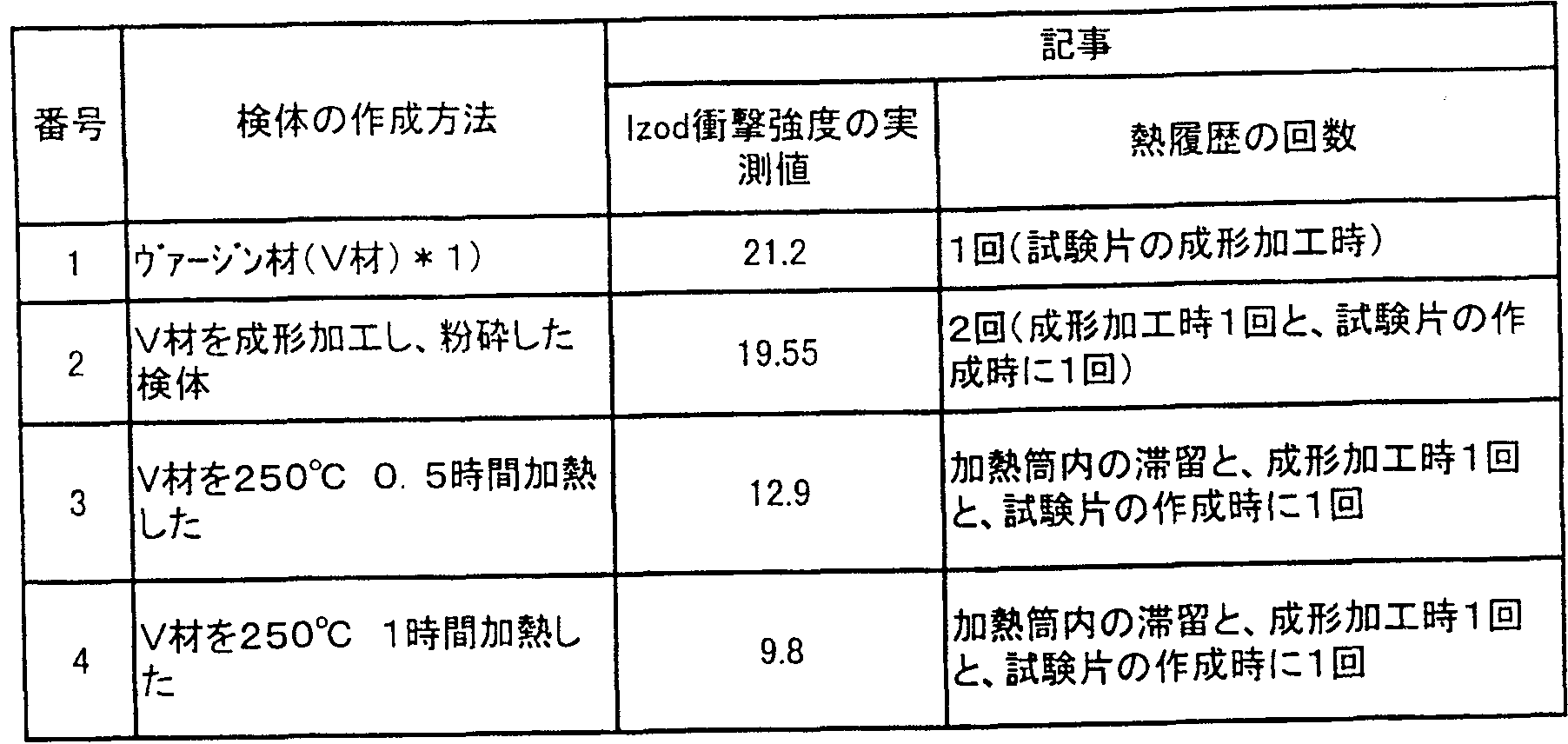
Figure imgf000102_0001

Claims

請求の範囲
1 . 熱可塑性樹脂が主成分である樹脂成形品をリサイクルする樹脂成形品の リサイ クル方法において、
リサイクル材の物性を回復するために添加するリサイクル助材と して、 前記樹 脂成形品の主成分である前記熱可塑性樹脂に対して相容 (溶) 性をもち混ぜ合わ せて成形可能であるとともに、 熱可塑性を示すゴム状材料を添加する
ことを特徴とする樹脂成形品のリサイクル方法。
2 . 前記ゴム状材料は、 その分子構造に 2重結合を有する
ことを特徴とする請求項 1記載の樹脂成形品のリサイクル方法。
3 . 前記ゴム状材料は、 その分子構造に 2重結合を有しない
ことを特徴とする請求項 1記載の樹脂成形品のリサイクル方法。
4 . 前記 2重結合が、 分子構造の直鎖に配されている
ことを特徴とする請求項 2記載の樹脂成形品のリサイクル方法。
5 . 前記 2重結合が、 分子構造の側鎖に配されている
ことを特徴とする請求項 3記載の樹脂成形品のリサイクル方法。
6 . 前記ゴム状材料は、 ポリ タジェンを主成分とする
ことを特徴とする請求項 4記載の樹脂成形品のリサイクル方法。
7 . 前記ゴム状材料は、 エチレン一プロピレンタ一ポリマーを主成分とする ことを特徴とする請求項 5記載の樹脂成形品のリサイ クル方法。
8 . 前記ゴム状材料は、 エチレン—プロピレンゴム、 またはアク リルゴムを 主成分とする
ことを特徴とする請求項 3記載の樹脂成形品のリサイクル方法。
9 . 前記ゴム状材料は、 前記樹脂成形品の主成分である熱可塑性樹脂と同一 または類似の樹脂骨格を有する
ことを特徴とする請求項 1記載の樹脂成形品のリサイクル方法。
1 0 . 前記樹脂成形品の主成分である熱可塑性樹脂が、 A S樹脂、 A B S樹 脂、 またはこれらの樹脂を主成分とするポリマーァロイ、 あるいはポリマ一ブレ ン ドであって、
前記ゴム状材料に付加する樹脂骨格がァク リ ロニ 卜 リル (略号 ; An, ) とス チレン (略号 ; S t ) である
ことを特徴とする請求項 9記載の樹脂成形品のリサイクル方法。
1 1. 前記樹脂成形品の主成分である熱可塑性樹脂が、 P S樹脂、 H I P S 樹脂、 P P E樹脂、 またはこれらの樹脂を主成分とするポリマ一ァロイ、 あるい はポリ マ一プレン ドであつて、
前記ゴム状材料に付加する樹脂骨格がスチレン (略号 ; S t ) である ことを特徴とする請求項 9記載の樹脂成形品のリサィクル方法。
1 2. 前記ゴム状材料は、 ァク リ ロ二 ト リル (略号; A n) とスチレン (略 号; S t ) とをグラフ ト重合 (グラフ ト共重合) させた 3元共重合体 〔ブタジェ ンゴ厶含有( の) アク リ ロニ ト リル (と) スチレン (との) 3元グラフ ト共重合 体 {略号 ; A n S t— g— P B, An S t - g - P BR, あるいは An S t— g 一 P B (D, R) } 〕 である
ことを特徴とする請求項 1 0記載の樹脂成形品のリサィクル方法。
1 3. 前記ゴム状材料は、 エチレン—プロピレンタ一ポリマーにァク リ ロニ 卜 リル (略号 ; A n ) とスチレン (略号 ; S t ) とをグラフ ト重合 (グラフ ト共 重合) させた 3元グラフ 卜共重合体 (エチレン一プロピレンターポリマ一含有 ( の) アク リ ロニ ト リ ル (と) スチレン (との) 3元グラフ ト共重合体 (略号 ; A n S t - g - E P DM) } である
ことを特徴とする請求項 1 0記載の樹脂成形品のリサイクル方法。
1 4. 前記ゴム状材料は、 エチレン—プロピレンゴムにァク リ ロニ ト リル ( 略号 ; A n ) とスチレン (略号 ; S t ) とをグラフ 卜重合 (グラフ 卜共重合) さ せた 3元グラフ ト共重合体 {ェチレン一プロピレンゴム含有 (の) ァク リ ロニ ト リル (と) スチレン (との) 3元グラフ 卜共重合体 (略号 ; An S t — g _ E P M) ) であることを特徴とする請求項 1 0記載の樹脂成形品のリサイクル方法。
1 5. 前記ゴム状材料は、 アク リルゴムにアク リ ロニ ト リル (略号 ; A n ) とスチ レン (略号 ; S t ) とをグラフ ト重合 (グラフ ト共重合) させた 3元共重 合体 {アク リ ルゴム含有 (の) アク リ ロニ ト リル (と) スチレン (との) 3元グ ラフ ト共重合体 (略号 ; An S t— g— ANM) } である
ことを特徴とする請求項 1 0記載の樹脂成形品のリサイクル方法。
1 6. 前記ゴム状材料は、 アク リルゴムにスチレン (略号 ; S t ) とをグラ フ ト重合 (グラフ ト共重合) させた共重合体 {ァク リルゴム含有 (の) スチレン (との) グラフ ト共重合体 (略号 ; S t— g—ΑΝΜ) } である
ことを特徴とする請求項 1 1記載の樹脂成形品のリサイクル方法。
1 7. 前記ゴム状材料は、 ブタジエンにスチレン (略号 ; S t ) とをグラフ ト重合 (グラフ ト共重合) させたポリブタジエン含有 (の) スチレン (との) グ ラフ ト共重合体 {略号; S t— g— P B、 S t— g— P BR、 あるいは S t— g — P B (D、 R) } 〕 である
ことを特徴とする請求項 1 1記載の樹脂成形品のリサイクル方法。
1 8. 前記ゴム状材料は、 エチレン—プロピレン夕一ポリマーにスチレン ( 略号 ; S t ) とをグラフ ト重合 (グラフ ト共重合) させた共重合体 {エチレン一 プロピレンターポリマー含有 (の) スチレン (との) グラフ 卜共重合体 {略号 ; S t— g— E PDM) } である
ことを特徴とする請求項 1 1記載の樹脂成形品のリサイクル方法。
1 9. 前記ゴム状材料は、 エチレン一プロピレンゴムにスチレン (略号 ; S t ) とをグラフ ト重合 (グラフ 卜共重合) させた共重合体 {ェチレン一プロピレ ンゴム含有 (の) スチレン (との) グラフ ト共重合体 {略号 ; s t — g _ E PM
) } である
ことを特徴とする請求項 1 1記載の樹脂成形品のリサイクル方法。
2 0. 前記ゴム状材料は、 乳化重合または溶液重合、 あるいはスラ リ ー重合 によって製造された
ことを特徴とする請求項 1記載の樹脂成形品のリサイクル方法。
2 1. 前記乳化重合または溶液重合によって製造された前記ゴム状材料のゴ ム成分の含有量が、 2 0重量%以上である
ことを特徴とする請求項 2 0記載の樹脂成形品のリサィクル方法。
2 2. 前記乳化重合または溶液重合によって製造された前記ゴム状材料のグ ラフ ト率は、 3 0重量%以上である ことを特徴とする請求項 2 0記載の樹脂成形品のリサイクル方法。
2 3 . 前記ゴム伏材料は、 前記樹脂成形品の主成分である熱可塑性樹脂と加 熱溶融し該熱可塑性樹脂中に微分散したときの粒径が 0 . 0 5 m〜 5 0 /i mで
、 かつァスぺク ト比 (縦と横の比) が 0 . 1以上である
ことを特徴とする請求項 1記載の樹脂成形品のリサイクル方法。
2 4 . 前記ゴム状材料は、 走査型視差熱分析機 (器) をもちいて測定したガ ラス転移点温度 (略号; T g ) が 2 0 0 °C以下である
ことを特徴とする請求項 1記載の樹脂成形品のリサイクル方法。
2 5 . 前記ゴム状材料はその分子構造に、 単独のあるいは 2種以上の弾性を 持つ分子構造を含んでいる
ことを特徴とする請求項 1記載の樹脂成形品のリサイクル方法。
2 6 . 前記添加されるゴム状材料は、 1種類の単品または 2種類以上を混合 したものである
ことを特徴とする請求項 1記載の樹脂成形品のリサイクル方法。
2 7 . 前記添加されるゴム状材料は、 粒径の異なる材料を混合したものであ る
ことを特徴とする請求項 1 および 2 6記載の樹脂成形品のリサイクル方法。
PCT/JP2000/001426 1999-03-10 2000-03-09 Method of recycling molded resin Ceased WO2000053384A1 (en)

Priority Applications (4)

Application Number Priority Date Filing Date Title
HK02104821.5A HK1043958A1 (en) 1999-03-10 2000-03-09 Method of recycling molded resin
EP00907966A EP1166985A4 (en) 1999-03-10 2000-03-09 PROCESS FOR RECYCLING A MOLDED RESIN
US09/950,388 US6610758B2 (en) 1999-03-10 2001-09-10 Method for recycling the resin mold
US10/463,098 US6794419B2 (en) 1999-03-10 2003-06-17 Method for recycling the resin mold

Applications Claiming Priority (4)

Application Number Priority Date Filing Date Title
JP6413399 1999-03-10
JP11/64133 1999-03-10
JP11/228135 1999-08-12
JP22813599 1999-08-12

Related Child Applications (1)

Application Number Title Priority Date Filing Date
US09/950,388 Continuation US6610758B2 (en) 1999-03-10 2001-09-10 Method for recycling the resin mold

Publications (1)

Publication Number Publication Date
WO2000053384A1 true WO2000053384A1 (en) 2000-09-14

Family

ID=26405267

Family Applications (1)

Application Number Title Priority Date Filing Date
PCT/JP2000/001426 Ceased WO2000053384A1 (en) 1999-03-10 2000-03-09 Method of recycling molded resin

Country Status (4)

Country Link
US (2) US6610758B2 (ja)
EP (1) EP1166985A4 (ja)
HK (1) HK1043958A1 (ja)
WO (1) WO2000053384A1 (ja)

Cited By (7)

* Cited by examiner, † Cited by third party
Publication number Priority date Publication date Assignee Title
JP2002292628A (ja) * 2001-03-28 2002-10-09 Sony Corp 使用済み樹脂の再利用方法
EP1219675A3 (en) * 2000-11-22 2003-08-20 Suzuka Fuji Xerox Co., Ltd. A moulding thermoplastic resin material and a method for equal quality recycle of thermoplastic resin mould
JP2005314672A (ja) * 2004-03-30 2005-11-10 Toray Ind Inc ガラス繊維強化再生熱可塑性樹脂組成物の製造方法および再生エアコンファン部品
JP2006193600A (ja) * 2005-01-13 2006-07-27 Nitto Denko Corp 粘着製品
JP2006193599A (ja) * 2005-01-13 2006-07-27 Nitto Denko Corp 粘着製品および粘着製品用基材
JP2006256339A (ja) * 2002-01-23 2006-09-28 Suzuka Fuji Xerox Co Ltd 再生熱可塑性樹脂成形品の製造方法
WO2017110068A1 (ja) * 2015-12-25 2017-06-29 パナソニックIpマネジメント株式会社 熱可塑性樹脂からなる再生材料

Families Citing this family (19)

* Cited by examiner, † Cited by third party
Publication number Priority date Publication date Assignee Title
EP1391281A1 (en) * 1996-04-14 2004-02-25 Suzuka Fuji Xerox Co., Ltd. Method for recycling coated moldings
WO2000053384A1 (en) * 1999-03-10 2000-09-14 Suzuka Fuji Xerox Co., Ltd. Method of recycling molded resin
EP1466723A1 (en) * 2001-12-17 2004-10-13 Suzuka Fuji Xerox Co., Ltd. Composite resin molding and process for producing the same
EP1479502A4 (en) * 2002-01-23 2007-03-21 Fuji Xerox Suzuka PROCESS FOR PRODUCING MOLDED ARTICLES BASED ON REGENERATED THERMOPLASTIC RESIN
JP2003305651A (ja) * 2002-02-12 2003-10-28 Sony Corp 投射材およびブラスト方法
US6913831B2 (en) * 2002-12-26 2005-07-05 Suzuka Fuji Xerox, Co., Ltd. Coating material for recycling and a thermoplastic resin mold
US7856449B1 (en) * 2004-05-12 2010-12-21 Cisco Technology, Inc. Methods and apparatus for determining social relevance in near constant time
US7688246B2 (en) * 2005-05-10 2010-03-30 Fuji Xerox Co., Ltd. Radio wave absorber, electromagnetic field measurement system and radiated immunity system
US20080111263A1 (en) * 2006-11-15 2008-05-15 Wang Ming-Hui Method for reusing foamed material
US20080303006A1 (en) * 2007-06-08 2008-12-11 Frank Huijs Flame retardant thermoplastic resinous compostion
WO2013147876A1 (en) 2012-03-30 2013-10-03 Empire Technology Development Llc Degradable polymers
JP5881164B2 (ja) * 2012-04-23 2016-03-09 株式会社ジェイエスピー 表皮被覆発泡成形体の製造方法
JP5697291B2 (ja) * 2012-05-31 2015-04-08 株式会社カネカ ポリエステル系人工毛髪用繊維及びそれを含む頭飾製品
US9096698B2 (en) 2012-08-09 2015-08-04 Americas Styrenics, LLC Styrenic resin incorporating recycled polystyrene
US9115228B2 (en) 2012-08-09 2015-08-25 Americas Styrenics, LLC Styrenic resin having improved extensional viscosity
US8609778B1 (en) 2012-08-09 2013-12-17 Americas Styrenics, LLC Styrenic resin incorporating recycled polystyrene
DE102019000975A1 (de) * 2019-02-11 2020-08-13 Giesecke+Devrient Mobile Security Gmbh Folie aus recyceltem Kunststoffmaterial für tragbare Datenträger, Verfahren zur Herstellung der Recyclingfolie und die Recyclingfolie enthaltender Datenträger
NO347427B1 (en) 2021-07-13 2023-10-30 Ctm Lyng As Light Installation comprising recycled plastic and method for its manufacture
FR3141861A1 (fr) * 2022-11-14 2024-05-17 Crepim Procédé de dégradation photolytique des retardateurs de flamme bromés contenus dans une matière plastique – Installation associée

Citations (16)

* Cited by examiner, † Cited by third party
Publication number Priority date Publication date Assignee Title
GB1334719A (en) 1970-09-14 1973-10-24 Union Carbide Corp Moldable rubber composition
JPH0517677A (ja) * 1991-07-11 1993-01-26 Teijin Ltd 熱可塑性樹脂組成物
JPH05320273A (ja) * 1992-05-26 1993-12-03 Monsant Kasei Kk グラフト共重合樹脂組成物
JPH0649145A (ja) * 1992-07-28 1994-02-22 Monsant Kasei Kk グラフト共重合体の製造法およびその組成物
JPH0693153A (ja) * 1992-09-10 1994-04-05 Idemitsu Kosan Co Ltd ポリスチレン系樹脂組成物
JPH06192570A (ja) * 1992-07-20 1994-07-12 Bayer Ag ポリアミドとポリアミド/ポリエチレン積層フイルム廃物との耐衝撃性の、必要に応じて充填剤入りの混合物
EP0668312A1 (en) 1994-02-17 1995-08-23 General Electric Company Recycling methods of resin compositions
JPH08245756A (ja) * 1995-03-10 1996-09-24 Daicel Chem Ind Ltd リサイクル用樹脂組成物の製造方法
EP0761763A1 (en) 1995-03-10 1997-03-12 Daicel Chemical Industries, Ltd. Reclaimed thermoplastic resin compositions and process for the production thereof
JPH10168357A (ja) 1996-12-09 1998-06-23 Isuzu Motors Ltd 樹脂用塗料を塗布した樹脂成形品及びその再生方法
JPH10168343A (ja) 1996-12-09 1998-06-23 Isuzu Motors Ltd 樹脂用塗料を塗布した樹脂成形品及びその再生方法
JPH10204207A (ja) 1997-01-28 1998-08-04 Isuzu Motors Ltd 熱硬化性樹脂塗装熱可塑性樹脂成形品及びその再生方法
JPH10298375A (ja) * 1997-04-28 1998-11-10 Qimei Ind Co Ltd ゴム変性耐熱性スチレン系樹脂組成物
JPH10338794A (ja) * 1997-06-06 1998-12-22 Denki Kagaku Kogyo Kk 熱可塑性樹脂組成物および成形体
JPH1129618A (ja) * 1997-07-11 1999-02-02 Techno Polymer Kk ゴム強化ビニル系重合体のベースゴム用大粒径ゴム状重合体組成物
JPH1135760A (ja) * 1997-07-18 1999-02-09 Denki Kagaku Kogyo Kk 熱可塑性樹脂組成物、成形体、及びその製造方法

Family Cites Families (5)

* Cited by examiner, † Cited by third party
Publication number Priority date Publication date Assignee Title
US5177146A (en) * 1991-05-02 1993-01-05 General Electric Company Commingled household plastic scrap processing and modification
JP2000230089A (ja) * 1998-10-16 2000-08-22 Mitsubishi Chemicals Corp オレフィン系熱可塑性エラストマー組成物及びその製造方法
WO2000053384A1 (en) * 1999-03-10 2000-09-14 Suzuka Fuji Xerox Co., Ltd. Method of recycling molded resin
DE19923758C2 (de) * 1999-05-25 2001-07-19 Hannes Michael Verfahren zur Herstellung einer den Thermoplastischen Elastomeren ähnlichen Elastomerlegierung unter Verwendung von Alt- oder Abfallgummi
ATE470547T1 (de) * 2000-08-25 2010-06-15 Techno Polymer Co Ltd Verfahren und einrichtung zur reinigung von thermoplastischen produkten

Patent Citations (17)

* Cited by examiner, † Cited by third party
Publication number Priority date Publication date Assignee Title
GB1334719A (en) 1970-09-14 1973-10-24 Union Carbide Corp Moldable rubber composition
JPH0517677A (ja) * 1991-07-11 1993-01-26 Teijin Ltd 熱可塑性樹脂組成物
JPH05320273A (ja) * 1992-05-26 1993-12-03 Monsant Kasei Kk グラフト共重合樹脂組成物
JPH06192570A (ja) * 1992-07-20 1994-07-12 Bayer Ag ポリアミドとポリアミド/ポリエチレン積層フイルム廃物との耐衝撃性の、必要に応じて充填剤入りの混合物
JPH0649145A (ja) * 1992-07-28 1994-02-22 Monsant Kasei Kk グラフト共重合体の製造法およびその組成物
JPH0693153A (ja) * 1992-09-10 1994-04-05 Idemitsu Kosan Co Ltd ポリスチレン系樹脂組成物
EP0668312A1 (en) 1994-02-17 1995-08-23 General Electric Company Recycling methods of resin compositions
JPH07228722A (ja) 1994-02-17 1995-08-29 Nippon G Ii Plast Kk 再生樹脂組成物を得る方法
JPH08245756A (ja) * 1995-03-10 1996-09-24 Daicel Chem Ind Ltd リサイクル用樹脂組成物の製造方法
EP0761763A1 (en) 1995-03-10 1997-03-12 Daicel Chemical Industries, Ltd. Reclaimed thermoplastic resin compositions and process for the production thereof
JPH10168357A (ja) 1996-12-09 1998-06-23 Isuzu Motors Ltd 樹脂用塗料を塗布した樹脂成形品及びその再生方法
JPH10168343A (ja) 1996-12-09 1998-06-23 Isuzu Motors Ltd 樹脂用塗料を塗布した樹脂成形品及びその再生方法
JPH10204207A (ja) 1997-01-28 1998-08-04 Isuzu Motors Ltd 熱硬化性樹脂塗装熱可塑性樹脂成形品及びその再生方法
JPH10298375A (ja) * 1997-04-28 1998-11-10 Qimei Ind Co Ltd ゴム変性耐熱性スチレン系樹脂組成物
JPH10338794A (ja) * 1997-06-06 1998-12-22 Denki Kagaku Kogyo Kk 熱可塑性樹脂組成物および成形体
JPH1129618A (ja) * 1997-07-11 1999-02-02 Techno Polymer Kk ゴム強化ビニル系重合体のベースゴム用大粒径ゴム状重合体組成物
JPH1135760A (ja) * 1997-07-18 1999-02-09 Denki Kagaku Kogyo Kk 熱可塑性樹脂組成物、成形体、及びその製造方法

Non-Patent Citations (1)

* Cited by examiner, † Cited by third party
Title
See also references of EP1166985A4

Cited By (9)

* Cited by examiner, † Cited by third party
Publication number Priority date Publication date Assignee Title
EP1219675A3 (en) * 2000-11-22 2003-08-20 Suzuka Fuji Xerox Co., Ltd. A moulding thermoplastic resin material and a method for equal quality recycle of thermoplastic resin mould
JP2002292628A (ja) * 2001-03-28 2002-10-09 Sony Corp 使用済み樹脂の再利用方法
WO2002079303A1 (en) * 2001-03-28 2002-10-10 Sony Corporation Method of reclaiming resin
US7037951B2 (en) 2001-03-28 2006-05-02 Sony Corporation Process for regenerating resins
JP2006256339A (ja) * 2002-01-23 2006-09-28 Suzuka Fuji Xerox Co Ltd 再生熱可塑性樹脂成形品の製造方法
JP2005314672A (ja) * 2004-03-30 2005-11-10 Toray Ind Inc ガラス繊維強化再生熱可塑性樹脂組成物の製造方法および再生エアコンファン部品
JP2006193600A (ja) * 2005-01-13 2006-07-27 Nitto Denko Corp 粘着製品
JP2006193599A (ja) * 2005-01-13 2006-07-27 Nitto Denko Corp 粘着製品および粘着製品用基材
WO2017110068A1 (ja) * 2015-12-25 2017-06-29 パナソニックIpマネジメント株式会社 熱可塑性樹脂からなる再生材料

Also Published As

Publication number Publication date
HK1043958A1 (en) 2002-10-04
EP1166985A1 (en) 2002-01-02
US20040014827A1 (en) 2004-01-22
US6610758B2 (en) 2003-08-26
EP1166985A4 (en) 2005-03-30
US6794419B2 (en) 2004-09-21
US20020103267A1 (en) 2002-08-01

Similar Documents

Publication Publication Date Title
WO2000053384A1 (en) Method of recycling molded resin
US5071911A (en) Thermoplastic resin composition and process for producing the same
JPH02133462A (ja) 熱可塑性樹脂組成物
JPH02185553A (ja) 熱可塑性樹脂組成物
US6703445B2 (en) Molding thermoplastic resin material and a method for equal quality recycle of thermoplastic resin mold
JPH0374461A (ja) 熱可塑性樹脂組成物およびその製造方法
KR20220113734A (ko) 초고 품질 열가소성 화합물 함유 재생 물질
Adams et al. Acrylonitrile-butadiene-styrene polymers
US6913831B2 (en) Coating material for recycling and a thermoplastic resin mold
Utracki Polymer blends
EP0696618B1 (en) Thermoplastic resin compositions having improved performance
JP4775877B2 (ja) 廃棄プラスチックを利用した射出成形用材料、その製造方法、及びこの射出成形用材料を利用した成形品の製造方法
JP3891706B2 (ja) 木目調樹脂成形物
JP3616565B2 (ja) 等価成形品成形用熱可塑性樹脂および等価再生方法
KR102552574B1 (ko) 폐플라스틱을 활용한 복합 재활용 플라스틱 조성물 및 이를 포함하는 합성목재
KR100616723B1 (ko) 재생 폴리아미드 나노복합체 조성물
JP2007162028A (ja) 樹脂成形品のリサイクル方法
MXPA02002112A (es) Mezclas de polimeros de carbonato con flujo mejorado.
JP4244776B2 (ja) 塗膜付き樹脂成形品からの熱可塑性樹脂の回収方法、熱可塑性樹脂組成物及び熱可塑性樹脂成形品
JP5828711B2 (ja) 熱可塑性樹脂組成物及び成形品
JPWO2000053384A1 (ja) 樹脂成形品のリサイクル方法
JP2005263960A (ja) 相溶化剤および熱可塑性樹脂組成物
CN112795159B (zh) 一种pc/abs合金组合物及其制备方法和应用
JP2000026694A (ja) 熱可塑性樹脂組成物
JPH11100447A (ja) 架橋ポリマ−を含む複合体粉末

Legal Events

Date Code Title Description
AK Designated states

Kind code of ref document: A1

Designated state(s): JP US

AL Designated countries for regional patents

Kind code of ref document: A1

Designated state(s): AT BE CH CY DE DK ES FI FR GB GR IE IT LU MC NL PT SE

DFPE Request for preliminary examination filed prior to expiration of 19th month from priority date (pct application filed before 20040101)
121 Ep: the epo has been informed by wipo that ep was designated in this application
WWE Wipo information: entry into national phase

Ref document number: 09950388

Country of ref document: US

WWE Wipo information: entry into national phase

Ref document number: 2000907966

Country of ref document: EP

WWP Wipo information: published in national office

Ref document number: 2000907966

Country of ref document: EP