WO2000066545A1 - Derives de 6-[[(aryl et heteroaryl) oxy]methyl] n aphtalene-2- carboximidamide, leur preparation et leur application en therapeutique - Google Patents
Derives de 6-[[(aryl et heteroaryl) oxy]methyl] n aphtalene-2- carboximidamide, leur preparation et leur application en therapeutique Download PDFInfo
- Publication number
- WO2000066545A1 WO2000066545A1 PCT/FR2000/001087 FR0001087W WO0066545A1 WO 2000066545 A1 WO2000066545 A1 WO 2000066545A1 FR 0001087 W FR0001087 W FR 0001087W WO 0066545 A1 WO0066545 A1 WO 0066545A1
- Authority
- WO
- WIPO (PCT)
- Prior art keywords
- group
- formula
- compound
- mmol
- methyl
- Prior art date
- Legal status (The legal status is an assumption and is not a legal conclusion. Google has not performed a legal analysis and makes no representation as to the accuracy of the status listed.)
- Ceased
Links
Classifications
-
- C—CHEMISTRY; METALLURGY
- C07—ORGANIC CHEMISTRY
- C07D—HETEROCYCLIC COMPOUNDS
- C07D213/00—Heterocyclic compounds containing six-membered rings, not condensed with other rings, with one nitrogen atom as the only ring hetero atom and three or more double bonds between ring members or between ring members and non-ring members
- C07D213/02—Heterocyclic compounds containing six-membered rings, not condensed with other rings, with one nitrogen atom as the only ring hetero atom and three or more double bonds between ring members or between ring members and non-ring members having three double bonds between ring members or between ring members and non-ring members
- C07D213/04—Heterocyclic compounds containing six-membered rings, not condensed with other rings, with one nitrogen atom as the only ring hetero atom and three or more double bonds between ring members or between ring members and non-ring members having three double bonds between ring members or between ring members and non-ring members having no bond between the ring nitrogen atom and a non-ring member or having only hydrogen or carbon atoms directly attached to the ring nitrogen atom
- C07D213/24—Heterocyclic compounds containing six-membered rings, not condensed with other rings, with one nitrogen atom as the only ring hetero atom and three or more double bonds between ring members or between ring members and non-ring members having three double bonds between ring members or between ring members and non-ring members having no bond between the ring nitrogen atom and a non-ring member or having only hydrogen or carbon atoms directly attached to the ring nitrogen atom with substituted hydrocarbon radicals attached to ring carbon atoms
- C07D213/36—Radicals substituted by singly-bound nitrogen atoms
- C07D213/40—Acylated substituent nitrogen atom
-
- C—CHEMISTRY; METALLURGY
- C07—ORGANIC CHEMISTRY
- C07C—ACYCLIC OR CARBOCYCLIC COMPOUNDS
- C07C257/00—Compounds containing carboxyl groups, the doubly-bound oxygen atom of a carboxyl group being replaced by a doubly-bound nitrogen atom, this nitrogen atom not being further bound to an oxygen atom, e.g. imino-ethers, amidines
- C07C257/10—Compounds containing carboxyl groups, the doubly-bound oxygen atom of a carboxyl group being replaced by a doubly-bound nitrogen atom, this nitrogen atom not being further bound to an oxygen atom, e.g. imino-ethers, amidines with replacement of the other oxygen atom of the carboxyl group by nitrogen atoms, e.g. amidines
- C07C257/18—Compounds containing carboxyl groups, the doubly-bound oxygen atom of a carboxyl group being replaced by a doubly-bound nitrogen atom, this nitrogen atom not being further bound to an oxygen atom, e.g. imino-ethers, amidines with replacement of the other oxygen atom of the carboxyl group by nitrogen atoms, e.g. amidines having carbon atoms of amidino groups bound to carbon atoms of six-membered aromatic rings
-
- A—HUMAN NECESSITIES
- A61—MEDICAL OR VETERINARY SCIENCE; HYGIENE
- A61P—SPECIFIC THERAPEUTIC ACTIVITY OF CHEMICAL COMPOUNDS OR MEDICINAL PREPARATIONS
- A61P31/00—Antiinfectives, i.e. antibiotics, antiseptics, chemotherapeutics
- A61P31/04—Antibacterial agents
-
- A—HUMAN NECESSITIES
- A61—MEDICAL OR VETERINARY SCIENCE; HYGIENE
- A61P—SPECIFIC THERAPEUTIC ACTIVITY OF CHEMICAL COMPOUNDS OR MEDICINAL PREPARATIONS
- A61P7/00—Drugs for disorders of the blood or the extracellular fluid
-
- A—HUMAN NECESSITIES
- A61—MEDICAL OR VETERINARY SCIENCE; HYGIENE
- A61P—SPECIFIC THERAPEUTIC ACTIVITY OF CHEMICAL COMPOUNDS OR MEDICINAL PREPARATIONS
- A61P7/00—Drugs for disorders of the blood or the extracellular fluid
- A61P7/02—Antithrombotic agents; Anticoagulants; Platelet aggregation inhibitors
-
- A—HUMAN NECESSITIES
- A61—MEDICAL OR VETERINARY SCIENCE; HYGIENE
- A61P—SPECIFIC THERAPEUTIC ACTIVITY OF CHEMICAL COMPOUNDS OR MEDICINAL PREPARATIONS
- A61P7/00—Drugs for disorders of the blood or the extracellular fluid
- A61P7/10—Antioedematous agents; Diuretics
-
- A—HUMAN NECESSITIES
- A61—MEDICAL OR VETERINARY SCIENCE; HYGIENE
- A61P—SPECIFIC THERAPEUTIC ACTIVITY OF CHEMICAL COMPOUNDS OR MEDICINAL PREPARATIONS
- A61P9/00—Drugs for disorders of the cardiovascular system
-
- A—HUMAN NECESSITIES
- A61—MEDICAL OR VETERINARY SCIENCE; HYGIENE
- A61P—SPECIFIC THERAPEUTIC ACTIVITY OF CHEMICAL COMPOUNDS OR MEDICINAL PREPARATIONS
- A61P9/00—Drugs for disorders of the cardiovascular system
- A61P9/10—Drugs for disorders of the cardiovascular system for treating ischaemic or atherosclerotic diseases, e.g. antianginal drugs, coronary vasodilators, drugs for myocardial infarction, retinopathy, cerebrovascula insufficiency, renal arteriosclerosis
-
- C—CHEMISTRY; METALLURGY
- C07—ORGANIC CHEMISTRY
- C07C—ACYCLIC OR CARBOCYCLIC COMPOUNDS
- C07C311/00—Amides of sulfonic acids, i.e. compounds having singly-bound oxygen atoms of sulfo groups replaced by nitrogen atoms, not being part of nitro or nitroso groups
- C07C311/01—Sulfonamides having sulfur atoms of sulfonamide groups bound to acyclic carbon atoms
- C07C311/02—Sulfonamides having sulfur atoms of sulfonamide groups bound to acyclic carbon atoms of an acyclic saturated carbon skeleton
- C07C311/07—Sulfonamides having sulfur atoms of sulfonamide groups bound to acyclic carbon atoms of an acyclic saturated carbon skeleton having the nitrogen atom of at least one of the sulfonamide groups bound to a carbon atom of a ring other than a six-membered aromatic ring
-
- C—CHEMISTRY; METALLURGY
- C07—ORGANIC CHEMISTRY
- C07C—ACYCLIC OR CARBOCYCLIC COMPOUNDS
- C07C311/00—Amides of sulfonic acids, i.e. compounds having singly-bound oxygen atoms of sulfo groups replaced by nitrogen atoms, not being part of nitro or nitroso groups
- C07C311/01—Sulfonamides having sulfur atoms of sulfonamide groups bound to acyclic carbon atoms
- C07C311/02—Sulfonamides having sulfur atoms of sulfonamide groups bound to acyclic carbon atoms of an acyclic saturated carbon skeleton
- C07C311/09—Sulfonamides having sulfur atoms of sulfonamide groups bound to acyclic carbon atoms of an acyclic saturated carbon skeleton the carbon skeleton being further substituted by at least two halogen atoms
-
- C—CHEMISTRY; METALLURGY
- C07—ORGANIC CHEMISTRY
- C07C—ACYCLIC OR CARBOCYCLIC COMPOUNDS
- C07C311/00—Amides of sulfonic acids, i.e. compounds having singly-bound oxygen atoms of sulfo groups replaced by nitrogen atoms, not being part of nitro or nitroso groups
- C07C311/01—Sulfonamides having sulfur atoms of sulfonamide groups bound to acyclic carbon atoms
- C07C311/12—Sulfonamides having sulfur atoms of sulfonamide groups bound to acyclic carbon atoms of an unsaturated carbon skeleton containing rings
- C07C311/13—Sulfonamides having sulfur atoms of sulfonamide groups bound to acyclic carbon atoms of an unsaturated carbon skeleton containing rings the carbon skeleton containing six-membered aromatic rings
-
- C—CHEMISTRY; METALLURGY
- C07—ORGANIC CHEMISTRY
- C07C—ACYCLIC OR CARBOCYCLIC COMPOUNDS
- C07C311/00—Amides of sulfonic acids, i.e. compounds having singly-bound oxygen atoms of sulfo groups replaced by nitrogen atoms, not being part of nitro or nitroso groups
- C07C311/22—Sulfonamides, the carbon skeleton of the acid part being further substituted by singly-bound oxygen atoms
- C07C311/23—Sulfonamides, the carbon skeleton of the acid part being further substituted by singly-bound oxygen atoms having the sulfur atoms of the sulfonamide groups bound to acyclic carbon atoms
- C07C311/27—Sulfonamides, the carbon skeleton of the acid part being further substituted by singly-bound oxygen atoms having the sulfur atoms of the sulfonamide groups bound to acyclic carbon atoms of an unsaturated carbon skeleton containing rings
-
- C—CHEMISTRY; METALLURGY
- C07—ORGANIC CHEMISTRY
- C07C—ACYCLIC OR CARBOCYCLIC COMPOUNDS
- C07C311/00—Amides of sulfonic acids, i.e. compounds having singly-bound oxygen atoms of sulfo groups replaced by nitrogen atoms, not being part of nitro or nitroso groups
- C07C311/30—Sulfonamides, the carbon skeleton of the acid part being further substituted by singly-bound nitrogen atoms, not being part of nitro or nitroso groups
- C07C311/31—Sulfonamides, the carbon skeleton of the acid part being further substituted by singly-bound nitrogen atoms, not being part of nitro or nitroso groups having the sulfur atoms of the sulfonamide groups bound to acyclic carbon atoms
- C07C311/35—Sulfonamides, the carbon skeleton of the acid part being further substituted by singly-bound nitrogen atoms, not being part of nitro or nitroso groups having the sulfur atoms of the sulfonamide groups bound to acyclic carbon atoms of an unsaturated carbon skeleton containing rings
-
- C—CHEMISTRY; METALLURGY
- C07—ORGANIC CHEMISTRY
- C07C—ACYCLIC OR CARBOCYCLIC COMPOUNDS
- C07C317/00—Sulfones; Sulfoxides
- C07C317/26—Sulfones; Sulfoxides having sulfone or sulfoxide groups and nitrogen atoms, not being part of nitro or nitroso groups, bound to the same carbon skeleton
- C07C317/28—Sulfones; Sulfoxides having sulfone or sulfoxide groups and nitrogen atoms, not being part of nitro or nitroso groups, bound to the same carbon skeleton with sulfone or sulfoxide groups bound to acyclic carbon atoms of the carbon skeleton
-
- C—CHEMISTRY; METALLURGY
- C07—ORGANIC CHEMISTRY
- C07C—ACYCLIC OR CARBOCYCLIC COMPOUNDS
- C07C323/00—Thiols, sulfides, hydropolysulfides or polysulfides substituted by halogen, oxygen or nitrogen atoms, or by sulfur atoms not being part of thio groups
- C07C323/23—Thiols, sulfides, hydropolysulfides or polysulfides substituted by halogen, oxygen or nitrogen atoms, or by sulfur atoms not being part of thio groups containing thio groups and nitrogen atoms, not being part of nitro or nitroso groups, bound to the same carbon skeleton
- C07C323/39—Thiols, sulfides, hydropolysulfides or polysulfides substituted by halogen, oxygen or nitrogen atoms, or by sulfur atoms not being part of thio groups containing thio groups and nitrogen atoms, not being part of nitro or nitroso groups, bound to the same carbon skeleton at least one of the nitrogen atoms being part of any of the groups, X being a hetero atom, Y being any atom
- C07C323/43—Y being a hetero atom
- C07C323/44—X or Y being nitrogen atoms
-
- C—CHEMISTRY; METALLURGY
- C07—ORGANIC CHEMISTRY
- C07D—HETEROCYCLIC COMPOUNDS
- C07D213/00—Heterocyclic compounds containing six-membered rings, not condensed with other rings, with one nitrogen atom as the only ring hetero atom and three or more double bonds between ring members or between ring members and non-ring members
- C07D213/02—Heterocyclic compounds containing six-membered rings, not condensed with other rings, with one nitrogen atom as the only ring hetero atom and three or more double bonds between ring members or between ring members and non-ring members having three double bonds between ring members or between ring members and non-ring members
- C07D213/04—Heterocyclic compounds containing six-membered rings, not condensed with other rings, with one nitrogen atom as the only ring hetero atom and three or more double bonds between ring members or between ring members and non-ring members having three double bonds between ring members or between ring members and non-ring members having no bond between the ring nitrogen atom and a non-ring member or having only hydrogen or carbon atoms directly attached to the ring nitrogen atom
- C07D213/24—Heterocyclic compounds containing six-membered rings, not condensed with other rings, with one nitrogen atom as the only ring hetero atom and three or more double bonds between ring members or between ring members and non-ring members having three double bonds between ring members or between ring members and non-ring members having no bond between the ring nitrogen atom and a non-ring member or having only hydrogen or carbon atoms directly attached to the ring nitrogen atom with substituted hydrocarbon radicals attached to ring carbon atoms
- C07D213/28—Radicals substituted by singly-bound oxygen or sulphur atoms
- C07D213/32—Sulfur atoms
- C07D213/34—Sulfur atoms to which a second hetero atom is attached
-
- C—CHEMISTRY; METALLURGY
- C07—ORGANIC CHEMISTRY
- C07D—HETEROCYCLIC COMPOUNDS
- C07D213/00—Heterocyclic compounds containing six-membered rings, not condensed with other rings, with one nitrogen atom as the only ring hetero atom and three or more double bonds between ring members or between ring members and non-ring members
- C07D213/02—Heterocyclic compounds containing six-membered rings, not condensed with other rings, with one nitrogen atom as the only ring hetero atom and three or more double bonds between ring members or between ring members and non-ring members having three double bonds between ring members or between ring members and non-ring members
- C07D213/04—Heterocyclic compounds containing six-membered rings, not condensed with other rings, with one nitrogen atom as the only ring hetero atom and three or more double bonds between ring members or between ring members and non-ring members having three double bonds between ring members or between ring members and non-ring members having no bond between the ring nitrogen atom and a non-ring member or having only hydrogen or carbon atoms directly attached to the ring nitrogen atom
- C07D213/60—Heterocyclic compounds containing six-membered rings, not condensed with other rings, with one nitrogen atom as the only ring hetero atom and three or more double bonds between ring members or between ring members and non-ring members having three double bonds between ring members or between ring members and non-ring members having no bond between the ring nitrogen atom and a non-ring member or having only hydrogen or carbon atoms directly attached to the ring nitrogen atom with hetero atoms or with carbon atoms having three bonds to hetero atoms with at the most one bond to halogen, e.g. ester or nitrile radicals, directly attached to ring carbon atoms
- C07D213/78—Carbon atoms having three bonds to hetero atoms, with at the most one bond to halogen, e.g. ester or nitrile radicals
- C07D213/79—Acids; Esters
-
- C—CHEMISTRY; METALLURGY
- C07—ORGANIC CHEMISTRY
- C07D—HETEROCYCLIC COMPOUNDS
- C07D215/00—Heterocyclic compounds containing quinoline or hydrogenated quinoline ring systems
- C07D215/02—Heterocyclic compounds containing quinoline or hydrogenated quinoline ring systems having no bond between the ring nitrogen atom and a non-ring member or having only hydrogen atoms or carbon atoms directly attached to the ring nitrogen atom
- C07D215/04—Heterocyclic compounds containing quinoline or hydrogenated quinoline ring systems having no bond between the ring nitrogen atom and a non-ring member or having only hydrogen atoms or carbon atoms directly attached to the ring nitrogen atom with only hydrogen atoms or radicals containing only hydrogen and carbon atoms, directly attached to the ring carbon atoms
- C07D215/08—Heterocyclic compounds containing quinoline or hydrogenated quinoline ring systems having no bond between the ring nitrogen atom and a non-ring member or having only hydrogen atoms or carbon atoms directly attached to the ring nitrogen atom with only hydrogen atoms or radicals containing only hydrogen and carbon atoms, directly attached to the ring carbon atoms with acylated ring nitrogen atom
-
- C—CHEMISTRY; METALLURGY
- C07—ORGANIC CHEMISTRY
- C07D—HETEROCYCLIC COMPOUNDS
- C07D215/00—Heterocyclic compounds containing quinoline or hydrogenated quinoline ring systems
- C07D215/02—Heterocyclic compounds containing quinoline or hydrogenated quinoline ring systems having no bond between the ring nitrogen atom and a non-ring member or having only hydrogen atoms or carbon atoms directly attached to the ring nitrogen atom
- C07D215/16—Heterocyclic compounds containing quinoline or hydrogenated quinoline ring systems having no bond between the ring nitrogen atom and a non-ring member or having only hydrogen atoms or carbon atoms directly attached to the ring nitrogen atom with hetero atoms or with carbon atoms having three bonds to hetero atoms with at the most one bond to halogen, e.g. ester or nitrile radicals, directly attached to ring carbon atoms
- C07D215/20—Oxygen atoms
- C07D215/22—Oxygen atoms attached in position 2 or 4
- C07D215/227—Oxygen atoms attached in position 2 or 4 only one oxygen atom which is attached in position 2
-
- C—CHEMISTRY; METALLURGY
- C07—ORGANIC CHEMISTRY
- C07D—HETEROCYCLIC COMPOUNDS
- C07D277/00—Heterocyclic compounds containing 1,3-thiazole or hydrogenated 1,3-thiazole rings
- C07D277/02—Heterocyclic compounds containing 1,3-thiazole or hydrogenated 1,3-thiazole rings not condensed with other rings
- C07D277/20—Heterocyclic compounds containing 1,3-thiazole or hydrogenated 1,3-thiazole rings not condensed with other rings having two or three double bonds between ring members or between ring members and non-ring members
- C07D277/22—Heterocyclic compounds containing 1,3-thiazole or hydrogenated 1,3-thiazole rings not condensed with other rings having two or three double bonds between ring members or between ring members and non-ring members with only hydrogen atoms, hydrocarbon or substituted hydrocarbon radicals, directly attached to ring carbon atoms
- C07D277/24—Radicals substituted by oxygen atoms
-
- C—CHEMISTRY; METALLURGY
- C07—ORGANIC CHEMISTRY
- C07D—HETEROCYCLIC COMPOUNDS
- C07D277/00—Heterocyclic compounds containing 1,3-thiazole or hydrogenated 1,3-thiazole rings
- C07D277/02—Heterocyclic compounds containing 1,3-thiazole or hydrogenated 1,3-thiazole rings not condensed with other rings
- C07D277/20—Heterocyclic compounds containing 1,3-thiazole or hydrogenated 1,3-thiazole rings not condensed with other rings having two or three double bonds between ring members or between ring members and non-ring members
- C07D277/22—Heterocyclic compounds containing 1,3-thiazole or hydrogenated 1,3-thiazole rings not condensed with other rings having two or three double bonds between ring members or between ring members and non-ring members with only hydrogen atoms, hydrocarbon or substituted hydrocarbon radicals, directly attached to ring carbon atoms
- C07D277/26—Radicals substituted by sulfur atoms
-
- C—CHEMISTRY; METALLURGY
- C07—ORGANIC CHEMISTRY
- C07D—HETEROCYCLIC COMPOUNDS
- C07D277/00—Heterocyclic compounds containing 1,3-thiazole or hydrogenated 1,3-thiazole rings
- C07D277/02—Heterocyclic compounds containing 1,3-thiazole or hydrogenated 1,3-thiazole rings not condensed with other rings
- C07D277/20—Heterocyclic compounds containing 1,3-thiazole or hydrogenated 1,3-thiazole rings not condensed with other rings having two or three double bonds between ring members or between ring members and non-ring members
- C07D277/22—Heterocyclic compounds containing 1,3-thiazole or hydrogenated 1,3-thiazole rings not condensed with other rings having two or three double bonds between ring members or between ring members and non-ring members with only hydrogen atoms, hydrocarbon or substituted hydrocarbon radicals, directly attached to ring carbon atoms
- C07D277/28—Radicals substituted by nitrogen atoms
-
- C—CHEMISTRY; METALLURGY
- C07—ORGANIC CHEMISTRY
- C07D—HETEROCYCLIC COMPOUNDS
- C07D295/00—Heterocyclic compounds containing polymethylene-imine rings with at least five ring members, 3-azabicyclo [3.2.2] nonane, piperazine, morpholine or thiomorpholine rings, having only hydrogen atoms directly attached to the ring carbon atoms
- C07D295/22—Heterocyclic compounds containing polymethylene-imine rings with at least five ring members, 3-azabicyclo [3.2.2] nonane, piperazine, morpholine or thiomorpholine rings, having only hydrogen atoms directly attached to the ring carbon atoms with hetero atoms directly attached to ring nitrogen atoms
- C07D295/26—Sulfur atoms
Definitions
- the subject of the present invention is derivatives of 6- (aryl or heteroaryl) oxymethylnaphthalene-2-carboximidamide, their preparation and their therapeutic application.
- R- represents either a hydrogen atom or an amino group, or a (C 1 -C) al yl group, or a (C j _-C 6 ) alkoxycarbonyl group, or a group -OH,
- Group H can exist in its form
- R 2 represents either a (C ⁇ -Cg) alkyl group which may be substituted by
- 1 to 3 fluorine atoms either a cyclohexylmethyl group or a 2,3-dihydro-1,4-benzodiox-7-ylmethyl group or a benzo-1,3-dioxolan- ⁇ -ylmethyl group or a phenyl group , benzyl or phenylethyl which may be substituted on the phenyl group by one to three groups chosen independently from a group -N (CH 2 , a t ⁇ fluoromethoxy group, a methylthio group, a (C 1 -C 4 ) alkoxy group, a trifluoromethyl group, an amino group, a nitro group, a (C 1 -C 4 group) ) alkyl, a trifluoromethoxy group, a halogen atom, a group -S0 2 CH 3 , a hydroxyl group or a group -COOR 8 or -OCH 2 C0 2 Rg, or R 8
- R 3 and R 5 represent, independently of each other, either a hydrogen or fluorine atom, or a (C 1 -C 4 ) alkyl group, or a -COOH group, or a hydroxyl group, or a group -N (CH 3 ) 2 , or a group -Y-CH 2 C0 2 H, where Y represents an oxygen or nitrogen atom,
- R 4 represents either a hydrogen atom, or a (C 1 -C 4 ) alkyl group, or a group - (CH 2 ) p -COOR 8 , where p is equal to 0, 1 or 2 and R 8 represents a hydrogen atom or a (C ⁇ -C ⁇ ) alkyl group,
- X represents so t a group - ⁇ CH 2 ) resort, -, or m is equal to 0, 1 or 2, either a group -CR 6 R-7-CH 2 - or a group -CH 2 -CR 6 R 7 -, where R 6 and R 7 independently of one another represent a hydrogen atom or a (C j _-C) alkyl group, either a group -NH-CO- or -CO-NH-, or a group -NH-CH 2 -, -CH 2 -NH-, - (CH 3 ) -CH 2 -, -CH 2 -N (CH 3 ) -, -N (CH 2 CH 3 ) -CH 2 - or -CH 2 - (CH 2 CH 3 ),
- W II is a group —N ( - C —CH 3 ) —CH 2 -, where W represents an oxygen atom or an NH group,
- Z represents either a -CH- group or a nitrogen atom
- -ABC- represents either a group -NH-CO-NH-, or a group -NH-C (NH) -NH-, or a group - (CH 2 ) n -CO-NH-, where n is equal to 0 or 1, either a group - (CH 2 ) q -NR 8 -S0 2 -, where q is equal to 0, 1 or 2, and R 8 represents, as before, a hydrogen atom or a group (C 1 -C 4 ) alkyl, or a group - (CH 2 ) q -NH-CO-, where q is 0 or 1, or a group -CH 2 -NH-CO-NH-.
- an alkyl group is a saturated, linear or branched hydrocarbon chain
- a heterocyclic group is a hydrocarbon chain comprising a 5 or 6-membered ring, comprising 1 or two heteroatoms of oxygen, sulfur or nitrogen, this cycle being aromatic or not, chosen from the pyridyl, pyrimidine, thiazolyl group, imidazolyl, pyrrolyl, oxazolyl, thienyl, furyl or pyrazine or their isomers.
- the halogen atoms are preferably chlorine and fluorine.
- the compounds of the invention may contain one or more asymmetric carbons. They can therefore exist in the form of enantiomers or diastereoisomers. These enantiomers, diastereoisomers and their mixtures, including racemic mixtures are part of the invention.
- the compounds of the invention may be in the form of free bases or of addition salts with pharmaceutically acceptable acids, which also form part of the invention.
- the preferred compounds in the context of the present invention are those for which
- R j _ represents either a hydrogen atom, or a (C 1 -C 6 ) alkoxycarbonyl group, or a group -OH,
- R 2 represents either a (C 1 -C 6 ) alkyl group which may be substituted by a trifluoromethyl group, or a cyclohexylmethyl group, or a 2,3-dihydro-1,4-benzodiox-7-ylmethyl group, or a benzo group -1, 3-dioxolan- ⁇ -ylmethyl, or a phenyl, benzyl or phenylethyl group which may be substituted on the phenyl group by one to three groups chosen independently from a group -N (CH 3 ) 2 , a trifluoromethoxy group, a group methylthio, a (C 1 -C) alkoxy group, a trifluoromethyl group, an amino group, a nitro group, a (C ] _-C) alkyl group, a trifluoromethoxy group, a halogen atom, a group -S0 2 CH 3 , a hydroxyl
- R 3 and R 5 represent, independently of each other, either a hydrogen atom, or a group -COOH, or a group -CH 3 ,
- R represents either a hydrogen atom, either a group -COOH
- X represents either a group - (CH 2 ) m -, or m is equal to 0 or 2, or a group -CR 6 R 7 -CH 2 -, where R 6 and R 7 represent independently of one another a hydrogen atom or a ⁇ C - ⁇ - ⁇ ) alkyl group, or a group -NH-CO- or -NH-CH ? - either a group -NH-CH 2 - or -CH 2 -N (CH 2 CH 3 ),
- Z represents a group -CH-
- -ABC- represents either a group -NH-CO-NH-, or a group - (CH 2 ) n -CO-NH-, where n is equal to 0 or 1, or a group - (CH 2 ) q - NR 8 -S0 2 -, where q is 0, 1 or 2, and R 8 represents, a hydrogen atom, i.e. a group - (CH 2 ) q -NH-C0-, where q is 0 or 1, either a -CH 2 -NH-CO-NH- group, or a -CH 2 -CO-NH group.
- the compounds of formula (I) can be synthesized according to scheme 1.
- a compound of formula (II) is reacted, in which R 3 and R 4 are as defined above (if R is a -COOH group, it is in fact in the form of an ester until the compound of formula (VI)) and D represents a leaving group such as a halogen or a sulfonic ester with a compound of formula (III), in which R 5 , X, Z, A and B are as defined above (In fact, when B in the end is a group -CO-, it is a group -C0 2 - during the synthesis) and GP represents a protective group of amine or carboxylic acid, such as a group (C ⁇ -C 4 ) alkoxy or benzyloxy, in the presence of a base such as potassium carbonate in an aprotic solvent, preferably acetonitrile or dimethylformamide at a temperature between 20 and 80 ° C to provide a compound of formula ( IV).
- R 3 and R 4 are as defined above (if R is
- this compound of formula (IV) can be prepared by a reaction ⁇ e Mitsunobu by condensing a compound of formula (II /, in which D represents a hydroxyl group with a compound of formula (III) in the presence of diethylazodicarboxylate or of 1, 1 '- (azodicarbonyl) dipiperidine and of a triakyl- or triaryl phosphine such as tri-n-butylphosphine or triphenylphosphine in an aprotic solvent such as 1,4-dioxane, tetrahydrofuran or toluene, at a temperature between 0 and 60 ° C.
- aprotic solvent such as 1,4-dioxane, tetrahydrofuran or toluene
- A represents a group - (CH 2 ) q -, where q can be equal to 0, 1 or 2 and B represents a group -NR 8 -, where R 8 represents an atom d hydrogen or an (C 1 -C 4 ) alkyl group, and GP represents an amine protecting group such as a tertbutyloxycarbonyl, trifluoroacyl, trimethylsilylethyloxycarbonyl group or any other suitable amine protecting group such as those described in T. Greene , "Protective Groups in Organic Synthesis", 2nd edition, iley, NY, (1991), are unprotected under conditions known to those skilled in the art to provide a compound of formula (V).
- GP represents a protective group of carboxylic acid such as a methyl, ethyl, tert-butyl or other group, also known to those skilled in the art and described in T. Greene, "Protective Groups in Organic Synthesis", 2nd edition, Wiley, NY, (1991).
- ester compounds of formula (IV) are transformed into free carboxylic acids of formula (V), where A is a group - (CH 2 ) n -, where n can be equal to 0 or 1 and BH represents a function -C0 2 H by conventional methods such as saponification with hydroxide ions, hydrolysis with a mineral or organic acid, or reaction with fluoride ions for silylated protective groups such as trimethylsilylethyloxycarbonyl.
- the compounds of formula (I) can then be obtained from these compounds of formula (VI) by functional arrangement of the nitrile group into the same group, for example according to the two methods A and B described below.
- Method A the compound of formula (VI) dissolved in a mixture saturated with triethylamine / pyridme hydrogen sulfide (1: 9) is treated for 20 - 36 hours at ordinary temperature.
- the thioamide thus formed is alkylated by an excess of methyl iodide at reflux in the acetone and the intermediate obtained is heated under reflux in an alcohol such as methanol in the presence of a nitrogen source such as ammonium acetate or a primary amine of formula R ⁇ -NH 2 for providing a compound of formula (I).
- Method B The compound of formula (VI) is treated with hydroxylamine hydrochloride in the presence of an organic base such as triethylamine in an alcohol, preferably ethanol, at a temperature between 40 and 70 ° C.
- a compound of formula (I) or R x is a (C- ⁇ Cg) alkoxycarbonyl group
- the compounds of formula (II) can be synthesized according to methodologies known to those skilled in the art. As examples, some methods for synthesizing compounds of formula (II) are given in schemes 2 and 3. Diagram 2
- a bromo-ester compound of formula (VII) is treated with a cyanide source such as copper cyanide in dimethylformamide at a temperature between 50 and 140 ° C, or trimethylsilylcyanide in the presence of a palladium (O) catalyst such as tetrakis (triphenylphosphine) palladium (O) in a solvent such as triethylamine or tributylamine at a temperature between 80 and 160 ° C, or with zinc cyanide in dimethylfornamide at 80 ° C in the presence of palladium (O) such as tetrakis (triphenylphosphine) palladium (O) to obtain a nitrile of formula (VIII).
- a cyanide source such as copper cyanide in dimethylformamide at a temperature between 50 and 140 ° C, or trimethylsilylcyanide
- a palladium (O) catalyst such as tetrakis (triphenylphosphin
- the ester function can be reduced by one of the many methods known in the art, such as reaction with lithium borohydride in an aprotic solvent such as tetrahydrofuran at a temperature between 0 and 80 ° C.
- the compound of formula (IX) thus obtained is then treated with a reagent such as phosphorus tribromide or thionyl chloride in a solvent such as dichloromethane or chloroform at a temperature between 0 and 60 ° C to obtain the compound of formula (II), where R 4 represents a hydrogen atom and D represents a halogen.
- the compound of formula (IX) can also be transformed into a sulfonic ester such as methanesulfonate according to methods known to those skilled in the art.
- an ester derivative of formula (VII) is first reduced to the alcohol derivative of formula (X) with, for example, lithium aluminum hydride in tetrahydrofuran, at a temperature between - 20 and -10 ° C.
- the hydroxy function of the compound of formula (X) is transformed into a bromine or chlorine (Hal) halogen atom by reactions conventional in the art such as with phosphorus tribromide or sulfonyl chloride under the conditions described. before.
- a compound of formula (XI) is obtained, the halogen atom of which is displaced by a source of cyanide, preferably tetraethylammonium cyanide in dichloromethane at a temperature between 0 and 25 ° C.
- the nitrile function of the compound of formula (XII) thus obtained is transformed into an ester by treating for example with 95% sulfuric acid in an alcohol of formula R 8 -OH, where R 8 represents a group (C 2 -C 4 ) alkyl, at reflux.
- a compound of formula (XIII) is obtained, which is reacted with, preferably, zinc cyanide, in ⁇ imethylfornamide in the presence of tetrakis (triphenylphosphine) palladium (O).
- ketones of formula (XVII) are either commercially available or are prepared according to methodologies 1D described in the literature or by modifications of known procedures.
- substituted tetralones of formula (XVII), where Z represents a group -CH- are described in US3980699 and in European patent application 0540051.
- the compounds of formula (XVII), where Z represents an atom nitrogen are prepared according to EP313295 and the compounds of formula (XVII), where Z represents a group -CH- and X represents a group -NH-CH 2 - are prepared according to a modification of the methodology described in J. Amer. Chem. Soc. 11, p. 1901 (1949).
- the compounds of formula (XVIII), where Z represents a group -CH- and X represents a group -NH-CO or -CONH- can be prepared according to the methodology described in Bull. Soc.
- the compounds of formula (XVII), where Z represents a group -CH 2 - and X represents a group -CH 2 -NH- or -CH 2 -N (alkyl) - can be prepared by the variation of Pictet-Gram described in Chem. Ber. 42, p 2943 (1909) and in Org. React. , 6_, p 151 (1951).
- the compounds of formula (XXII), where Z represents a nitrogen atom and X represents a group -NH-CO- can be prepared by a modification of the methodology described in J. Chem Soc. Perkin Trans 1, p 353 (1991).
- a compound of formula (III) is thus obtained, in which A represents a group - (CH 2 ) q -, where q is equal to 0, B represents a group -NH- and GP represents the protective group.
- the compound of formula (XXI) is then transformed into the amine of formula (XXII) under the conditions described for the preparation of the compounds of formula (XVIII).
- the compounds of formula (XXII) are then demethylated, preferably with boron tribromide at low temperature in a solvent such as dichloromethane and the amine function of the compound of formula (XXIII) obtained is protected as described above for the compounds of formula (XIX) to give a compound of formula (III), where A represents a group - (CH 2 ) q -, where q is equal to 1, B represents a group -NH- and GP is an amine protecting group as described before.
- the compounds of formula (XXII) can also be prepared by reacting a compound of formula (XVII) with trimethylsiiyl cyanide in the presence of titanium tetrachloride in dichloromethane followed by hydrogenation of the nitrile intermediate obtained, at a pressure of 10 to 50 psi in a solvent such as methanol in the presence of platinum or palladium oxide on carbon.
- the aldehydes of formula (XXI) can also be oxidized to carboxylic acid derivatives of formula (XXIV) by reaction with an appropriate oxidizing agent known to those skilled in the art, such as sodium chlorite.
- the compounds of formula (XXIV) thus obtained are then demethylated by boron tribromide at low temperature, then the carboxylic acid function of the compounds of formula (XXV) is esterified by one of the usual methods such as heating in methanol saturated with acid hydrochloric gas.
- a compound of formula (III) is thus obtained, in which A represents a group - (CH 2> n " where n is equal to 0, B represents a group -C0 2 and
- GP represents methyl.
- the ketone of formula (XVII) can be reacted with the anion of methyl dimethylphosphonoacetate (obtained by deprotonation using lithium bis-methylsilylamide in tetrahydrofuran at a temperature between -50 and 20 ° C) to obtain the ⁇ , ⁇ -msature ester of formula (XXVI).
- the compound of formula (XXVI) is then reduced by catalytic hydrogenation to the compound of formula (XXVII), which is then demethylated by boron tribromide in dichloromethane at -70 ° C.
- a compound of formula (III) is obtained, in which A represents a group - (CH 2 ) n -, where n is equal to 1, B represents a group -C0 2 - and GP represents a methyl.
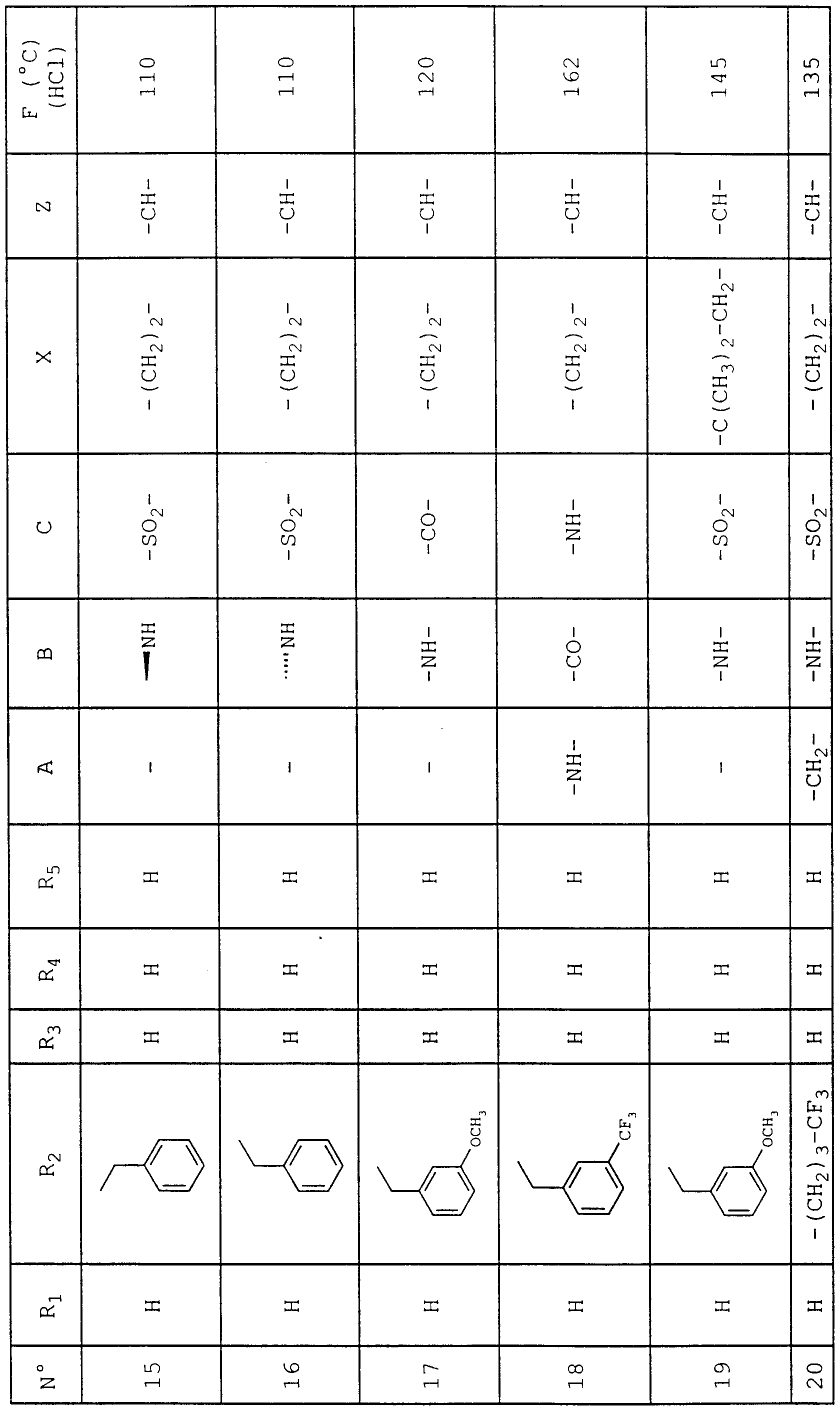
- Example 1 (compound No. 32) 6- [[[[8- [[[(th ⁇ azol-4-yl] methyl) sulfonyl] amino] methyl) hydrochloride] -5,6,7,8-tetrahydronaphthalen-2-yl ] oxy] methyl] naphthalene-2-carbox ⁇ m ⁇ dam ⁇ de.
- the organic phase is decanted and the aqueous phase is extracted with ethyl acetate.
- the organic phases are combined, washed with water, dried over sodium sulfate, filtered and evaporated to dryness.
- the residue obtained is triturated several times in cyclohexane and the precipitate is removed by filtration.
- the filtrate is evaporated to dryness and then the crude product is purified by chromatoflash on silica gel, eluting with a mixture of ethyl acetate / cyclohexane (5:95). 25.94 g of syrup are obtained which is used as it is in the next step.
- a solution of 25.50 g (125 mmol) of 7-methoxy-1- (methoxymethylene) -1, 2, 3, 4-tetrahydronaphthalene and of 7.50 g (39.43 mmol) is brought to reflux for 2 hours.
- the reaction medium is then evaporated under reduced pressure and the residue is taken up in 250 m ⁇ ⁇ 'ethyl acetate.
- the solution is washed twice with water and the organic phase is dried over sodium sulfate, filtered and then evaporated to dryness.
- the salts are rinsed with dichloromethane and the filtrates are evaporated to dryness.
- the residue is taken up in ethyl acetate and the solution is washed successively with a saturated aqueous solution of ammonium chloride, a saturated aqueous solution of sodium bicaroonate and finally with a saturated aqueous solution of sodium chloride.
- the organic phase is dried over magnesium sulfate, filtered and evaporated to dryness.
- the reaction medium is then diluted in 100 ml of dichloromethane and the solution is washed with a saturated aqueous solution of sodium chloride.
- the organic phase is dried over magnesium sulfate, filtered and then evaporated.
- the crude product is then purified by chromatoflash on silica gel, eluting with a mixture of methanol / dichloromethane (2:98) containing traces of concentrated ammonia.
- the reaction medium is then filtered and the filtrate is evaporated to dryness.
- the crude product is purified by cnromatoflash on reverse phase C18, eluting with a methanol gradient of 10 to 50% in aqueous hydrochloric acid N / 1000.
- Example 2 (compound No. 17) N- [7- [[6- (ammoimmomethyl) naphthalen-2-yl] methoxy] -1,2,3,4-tetrahydronaphthalen-1-yl] -3- methoxybenzene acetamide hydrochloride .
- a stream of gaseous hydrochloric acid is bubbled for 5 minutes in a solution cooled to 5 ° C.
- N '- (3-d ⁇ methylammopropyl) -A / -ethylcarbod ⁇ m ⁇ de The temperature is allowed to rise to room temperature and the mixture is stirred for 14 hours.
- the reaction medium is then diluted in 150 ml of ethyl acetate and the solution is washed with an aqueous solution of IN citric acid (3 ⁇ 50 ml), with water (50 ml), with an aqueous solution. saturated with sodium bicarbonate (3 x 50 ml) and finally with a saturated solution of sodium chloride (50 ml).
- the organic phase is dried over sodium sulfate, filtered and then evaporated to dryness.
- the reaction mixture is stirred for 15 hours at 20 ° C. and then 75 ml of water are added and the mixture is extracted with dichloromethane (3 x 100 ml). The organic phases are combined, washed with a saturated aqueous solution of sodium chloride, dried over Na 2 S0 4 , filtered and evaporated to dryness.
- the crude product is purified by chromatoflash on silica gel, eluting with a mixture of methanol / dichloromethane (5:95).
- hydrochloride is dissolved in 50 ml of methanol / acetic acid (9: 1) and the solution is loaded into a Parr apparatus with 0.80 g of activated Raney nickel and hydrogen at a pressure of 40 psi for 13 hours at 20 ° C.
- the reaction mixture is filtered and the filtrate evaporated.
- the product is purified by chromatoflash on reverse phase C18, eluting with an acetonitrile gradient of 20 to 100% in 0.001N aqueous hydrochloric acid.
- reaction mixture is then cooled to room temperature, filtered and the filtrate is evaporated to dryness.
- residue obtained is purified by chromatoflash on silica gel, eluting with a mixture of ethyl acetate / toluene (1: 9).
- the hydrochloride is taken up in a mixture of 20 ml of methanol and 2 ml of acetic acid and the solution in a Parr apparatus at a pressure of 45 psi for 14 hours at 20 ° C. in the presence of 0.40 g of active Raney nickel.
- the reaction medium is then filtered and the filtrate is evaporated to dryness.
- the product is purified by HPLC on reverse phase C18, eluting with an acetonitrile gradient from 0 to 100% in 180 minutes in N / 1000 hydrochloric acid.
- the reaction medium is diluted in 100 ml of dichloromethane then washed with an aqueous solution of citric acid IM then with a saturated aqueous solution of sodium chloride.
- the organic phase is dried over sulphate sodium, filtered and evaporated to dryness.
- the residue is purified by chromatoflash on silica gel, eluting with a mixture of methanol / dichloromethane (2:98).
- the product is obtained in the form of an off-white foam. Yield: 79%.
- a stream of hydrogen sulfide is bubbled for 30 minutes into a solution of 0.967 g (1.62 mmol) of 6-cyano- ⁇ - [[8- [[[[[[((3-methoxyphenyl) methyl] sulfonyl] amino) ] methyl] -5,6,7,8-tetrahydronaphthalen-2-yl] oxy] naphthalene-2-ethyl acetate in 10 ml of pyridine and 0.5 ml of triethylamine. The flask is then capped and the solution is stirred at room temperature for 36 hours. The reaction medium is then evaporated to dryness and the residue is taken up with 100 ml of ethyl acetate.
- the solution is washed with aqueous citric acid at 1M, then a saturated aqueous solution of sodium chloride.
- the oragnic phase is dried over sodium sulfate, filtered and evaporated to dryness.
- the residue is taken up in 10 ml of acetone, 0.5 ml (8.03 mmol) of methyl iodide is added and the mixture is heated under reflux for 5 hours.
- the medium is evaporated to dryness and the residue is taken up in 10 ml of methanol and the mixture is refluxed for 13 hours in the presence of 0.50 g (6.49 mmol) of ammonium acetate.
- reaction medium is then evaporated to dryness and the product is purified by chromatoflash on reverse phase C18, eluting with a mixture of acetonitrile / 0.01N hydrochloric acid (2: 3). 0.20 g of product are obtained in the form of a white solid. Melting point: 180 ° C Yield: 70%.
- the product is obtained in the form of white foam. Yield: 100%.
- Acid hydrochloride 3- [[[[[[[[[7- [[6- ammoimmomethyl) cyanonaphthalen-2-yl) methoxy] - 1,2,3, -tetrahydronaphthalen-1-yl] methyl] amino] sulfonyl] methyl] benzoic.
- the hydrochloride is hydrogenated for 14 hours at a pressure of 40 psi at 20 ° C in 20 ml of a methanol / acetic acid mixture (9: 1) in the presence of 0.30 g of Raney nickel.
- the reaction medium is filtered and the filtrate is evaporated to dryness.
- the product is purified by HPLC on reverse phase 018, eluting with an acetonitrile gradient from 0 to 100% in 180 minutes in N / 1000 hydrochloric acid. 0.167 g of product is obtained in the form of a white solid. Melting point: 165 ° C (decomposition) Yield: 32%.
- Example 8 (compound No. 14) 6- [[[[8- [[imino [[(3-methoxyphenyl) methyl] amino] methyl] amino] hydrochloride) -5,6,7,8- tetrahydronaphthalen-2-yl ] oxy] methyl] naphthalene-2-carboximidamide.
- a stream of hydrogen sulfide is bubbled for 30 minutes in a solution of 0.654 g (1.29 mmol) of N- [7- (6-cyanonaphthalen-2-yl) methoxy] -1,2,3,4 - tetrahydronaphtalen-1-yl] -N '- [(3-methoxyphenyl) methyl] thiouree in 10 ml of pyridme and 1 ml of triethylamme at 20 ° C.
- the reaction medium is stirred, with a stoppered flask, for 24 hours at this temperature.
- the reaction medium is then evaporated to dryness and the residue is taken up in 100 ml of ethyl acetate.
- the solution is washed with aqueous citric acid at IM and then with a saturated aqueous solution of sodium chloride.
- the organic phase is dried over sodium sulfate, filtered and evaporated to dryness.
- the thioamide is taken up in 50 ml of acetone, mixed with 10 ml (160.63 mmol) of methyl iodide and heated under reflux for 4 hours.
- the reaction medium is then evaporated to dryness and 0.871 g of a yellow powder is obtained.
- the product is taken up in 50 ml of methanol, 3.0 g (38.92 mmol) of ammonium acetate are added and the mixture is brought to reflux for 3 hours.
- reaction medium is then evaporated to dryness and the product is purified by chromatoflash on reverse phase C18, eluting with a mixture of acetonitrile / 0.01N hydrochloric acid (2: 3). 0.10 g of product is obtained. Melting point: 220 ° C Yield: 14%.
- Example 9 (compound No. 24) 6- [[[[8- [[[(phenylmethyl) sulfonyl] amino]] methyl] bicyclo [4.2.0] octa-1, 3, 5-tr ⁇ en-3-yl] hydrochloride oxy] methyl] naphthalene-2-carbox ⁇ m ⁇ dam ⁇ de.
- a stream of H 2 S is bubbled for 5 minutes in a solution of 0.20 g (0.42 mmol) of N- [[4 - [(6-cyanonaphthalen-2-yl) methoxy] bicyclo [4.2.0 ] octa-1,3,5-trien-7-yl] methyl] benzenemethanesulfonamide in 8 ml of a mixture of triethylamine / pyridine (1: 9) at room temperature. The container is then capped and the solution is stirred at 20 ° C for 48 hours.
- reaction mixture is evaporated to dryness, the residue is dissolved in 5 ml of acetone and heated under reflux for 1 hour in the presence of 0.656 g (4.62 mmol) of methyl iodide. Evaporated to dryness and the crude thioamide is taken up in 5 ml of methanol and heated under reflux for 2 hours in the presence of 0.065 g (0.84 mmol) of anhydrous ammonium acetate.
- reaction medium is evaporated to dryness and the residue taken up in 10 ml of 0.1N hydrochloric isopropanol and then evaporated to
- product is purified by HPLC on reverse phase 018, eluting with an acetonitrile gradient from 0 to 100% in 180 minutes in N / 1000 aqueous hydrochloric acid. 0.86 g of product is obtained in the form of white solid Melting point: 125 ° C Yield: 39%.
- tBu represents the tert-butyl group or 1, 1-dimethylethyl
- nBu represents the linear butyl group
- the compounds of the invention have been the subject of pharmacological studies which have demonstrated their interest as substances with therapeutic activity.
- the compounds of the invention were subjected in particular to a coagulation factor VII / VIIa inhibition test.
- the purpose of this test is to measure the amidolytic activity of the Factor VIIa / Tissue Factor complex on a chromogenic substrate in the presence of variable concentrations of the inhibitor tested.
- a compound is said to be a competitive inhibitor if it increases the Km of Factor VIla for its substrate, that is to say that it decreases the affinity of Factor Vlla for its substrate.
- This amidolytic activity of factor Vlla, tested at a concentration is measured kinetically (speed calculation) by determining the cleavage of the substrate (two concentrations tested) over time using a microplate reader which determines the release of para-nitroaniline by measuring the absorbance at 405 nm. The compound is tested at 7 concentrations.
- the determination of the Ki is made according to the Dixon method in which 1 / speed is plotted as a function of the concentration of the compound and for each concentration of substrate (SI and S2). The point of intersection of the linear regression lines projected on the x-axis determines the inhibitor concentration corresponding to - Ki.
- Factor Vlla used is recombinant human (produced in CHO cells)
- Tissue Factor is recombinant human
- the FVIIa / Tissue Factor complexes are 68 previously formed by incubating Factor VIIa and Tissue Factor in a molar concentration ratio of 1/5 in the presence of calcium chloride at 5 mM and used at the final concentration of 3.75 nM of FVIIa in the presence of 18.75 nM of FT.
- TBSA buffer Tris 50 mM pH7.5, sodium chloride
- the reagents are deposited in the following order (without incubation; final concentrations)
- the Ki of the compounds of the invention are preferably less than 1 ⁇ M.
- the compounds of the invention have also been the subject of a study of their antithrombotic activity.
- TF-dependent thrombus in rats or guinea pigs is obtained by the placement of an arteriovemous shunt in which is inserted a cotton thread impregnated with thromooplastin (Tissue Factor: TF)
- a femoral vein (Rat) or the right jugular vein (Guinea pig) is cannulated for meta-vemous injections while the left jugular vein and the right carotid artery are cannulated using a catheter filled with physiological solution at 0 , 9% for the constitution of the shunt.
- the shunt is assembled by connecting the two catheters using a flexible plastic tube of 3 mm of internal diameter and 6 cm long containing a cotton thread impregnated with thromboplasm.
- the blood circulation is restored for 5 mm (Rat) or 10 mm (Guinea pig).
- the shunt is then removed and the cotton thread associated with the thombus is removed and immediately weighed.
- the DA 50 of the compounds of the invention are preferably less than 10 mg / kg.
- they can be used in the treatment and prevention of various forms of pathology involving factor VlI / VIIa and the coagulation cascade. They can therefore be used in the treatment of venous, arterial or coronary thrombosis, disseminated mtravascular coagulation, restenosis after angioplasty, prevention of aggravated reocclusion following a thrombosis, atrial fib ⁇ llation, pulmonary embolism, edema , septic shock, oncological hypercoagulability, post-cardiac bypass treatment, inflammation, pulmonary fibrosis or prophylaxis for unstable angina.
- these compounds can be presented in any form suitable for oral, parenteral or intravenous administration, such as tablets, capsules, dragees, capsules, suspension, oral solutions or injectable solutions, in association with suitable and metered excipients. to allow administration of 0.1 mg to 1 g per day, in one or more doses.
Landscapes
- Chemical & Material Sciences (AREA)
- Organic Chemistry (AREA)
- Health & Medical Sciences (AREA)
- Veterinary Medicine (AREA)
- Bioinformatics & Cheminformatics (AREA)
- Chemical Kinetics & Catalysis (AREA)
- General Chemical & Material Sciences (AREA)
- Medicinal Chemistry (AREA)
- Nuclear Medicine, Radiotherapy & Molecular Imaging (AREA)
- Pharmacology & Pharmacy (AREA)
- Life Sciences & Earth Sciences (AREA)
- Animal Behavior & Ethology (AREA)
- General Health & Medical Sciences (AREA)
- Public Health (AREA)
- Engineering & Computer Science (AREA)
- Diabetes (AREA)
- Hematology (AREA)
- Cardiology (AREA)
- Heart & Thoracic Surgery (AREA)
- Communicable Diseases (AREA)
- Oncology (AREA)
- Urology & Nephrology (AREA)
- Vascular Medicine (AREA)
- Pharmaceuticals Containing Other Organic And Inorganic Compounds (AREA)
- Acyclic And Carbocyclic Compounds In Medicinal Compositions (AREA)
- Organic Low-Molecular-Weight Compounds And Preparation Thereof (AREA)
- Pyridine Compounds (AREA)
- Heterocyclic Compounds That Contain Two Or More Ring Oxygen Atoms (AREA)
- Heterocyclic Compounds Containing Sulfur Atoms (AREA)
- Quinoline Compounds (AREA)
- Thiazole And Isothizaole Compounds (AREA)
Abstract
Description






Claims


Priority Applications (15)
| Application Number | Priority Date | Filing Date | Title |
|---|---|---|---|
| KR1020017014068A KR20020010634A (ko) | 1999-05-04 | 2000-04-25 | 6-[[(아릴 및헤테로아릴)옥시]메틸]나프탈렌-2-카복스이미드아미드유도체, 그의 제조 방법 및 치료 용도 |
| CA002371284A CA2371284A1 (fr) | 1999-05-04 | 2000-04-25 | Derives de 6-¬¬(aryl et heteroaryl) oxy|methyl| n aphtalene-2- carboximidamide, leur preparation et leur application en therapeutique |
| HK02103641.5A HK1042288A1 (zh) | 1999-05-04 | 2000-04-25 | 6-[[(芳基和雜芳基)氧]甲基]-萘基-2-甲亞胺酸酰胺衍生物,其製備方法及其在治療方面的應用 |
| MXPA01011180A MXPA01011180A (es) | 1999-05-04 | 2000-04-25 | Derivados de 6- ( ( aril y heteroaril) oxi) metil) naftalen-2 -carboximidamida, su preparacion y su aplicacion terapeutica. |
| AU43037/00A AU4303700A (en) | 1999-05-04 | 2000-04-25 | 6-(((aryl and heteroaryl)oxy) methyl)naphthalene -2-carboximidamide derivatives,preparation and therapeutic application thereof |
| EEP200100579A EE200100579A (et) | 1999-05-04 | 2000-04-25 | 6-[(arüül- ja heteroarüül)oksü]metüül]naftaleen-2-karboksimiidamiidi derivaadid, nende valmistamineja nende terapeutiline kasutamine |
| IL14610700A IL146107A0 (en) | 1999-05-04 | 2000-04-25 | 6-[[(aryl and heteroaryl) oxy] methyl] naphthalene-2-carboximidamide derivatives, their preparation and their therapeutic application |
| EP00922738A EP1177169A1 (fr) | 1999-05-04 | 2000-04-25 | Derives de 6- [(aryl et heteroaryl) oxy]methyl] n aphtalene-2- carboximidamide, leur preparation et leur application en therapeutique |
| BR0010230-0A BR0010230A (pt) | 1999-05-04 | 2000-04-25 | Derivados de 6-[[[aril e heteroaril]oxi]metil]naftaleno-2-carboximidamida, seu preparo e sua aplicação em terapêutica |
| JP2000615376A JP2002543176A (ja) | 1999-05-04 | 2000-04-25 | 6−[[(アリールおよびヘテロアリール)オキシ]メチル]ナフタレン−2−カルボキシイミドアミド誘導体、それらの製造法およびそれらの治療的適用 |
| PL00356122A PL356122A1 (en) | 1999-05-04 | 2000-04-25 | 6-[[(aryl and heteroaryl)oxy] methyl]naphthalene -2-carboximidamide derivatives, preparation and therapeutic application thereof |
| SK1593-2001A SK15932001A3 (sk) | 1999-05-04 | 2000-04-25 | 6-[[(Aryl a heteroaryl)oxy]metyl]naftalén-2-karboximidamidové deriváty, spôsob ich prípravy a terapeutické použitie |
| IS6121A IS6121A (is) | 1999-05-04 | 2001-10-23 | 6-[[ (arýl og heteróarýl) oxý] metýl] naftalín-2-karbóximíðamíð afleiður, framleiðsla þeirra og notkun þeirra í lækningarmeðferð |
| BG106048A BG106048A (en) | 1999-05-04 | 2001-10-24 | 6-[[(aryl and heteroaryl)oxy]methyl]naphthalene-2-carboximidamide derivatives, preparation and therapeutic application thereof |
| NO20015387A NO20015387L (no) | 1999-05-04 | 2001-11-02 | 6-[[(aryl og heteroaryl)oksy]metyl]naftalen-2-karboksimidamid derivater, fremstilling og terapeutisk anvendelse derav |
Applications Claiming Priority (2)
| Application Number | Priority Date | Filing Date | Title |
|---|---|---|---|
| FR9905632A FR2793247B1 (fr) | 1999-05-04 | 1999-05-04 | Derives de 6-[[(aryl et heteroaryl)oxy]methyl]naphtalene-2- carboximidamide, leur preparation et leur application en therapeutique |
| FR99/05632 | 1999-05-04 |
Publications (1)
| Publication Number | Publication Date |
|---|---|
| WO2000066545A1 true WO2000066545A1 (fr) | 2000-11-09 |
Family
ID=9545179
Family Applications (1)
| Application Number | Title | Priority Date | Filing Date |
|---|---|---|---|
| PCT/FR2000/001087 Ceased WO2000066545A1 (fr) | 1999-05-04 | 2000-04-25 | Derives de 6-[[(aryl et heteroaryl) oxy]methyl] n aphtalene-2- carboximidamide, leur preparation et leur application en therapeutique |
Country Status (23)
| Country | Link |
|---|---|
| EP (1) | EP1177169A1 (fr) |
| JP (1) | JP2002543176A (fr) |
| KR (1) | KR20020010634A (fr) |
| CN (1) | CN1359373A (fr) |
| AU (1) | AU4303700A (fr) |
| BG (1) | BG106048A (fr) |
| BR (1) | BR0010230A (fr) |
| CA (1) | CA2371284A1 (fr) |
| CZ (1) | CZ20013959A3 (fr) |
| EE (1) | EE200100579A (fr) |
| FR (1) | FR2793247B1 (fr) |
| HK (1) | HK1042288A1 (fr) |
| HU (1) | HUP0200893A3 (fr) |
| IL (1) | IL146107A0 (fr) |
| IS (1) | IS6121A (fr) |
| MX (1) | MXPA01011180A (fr) |
| NO (1) | NO20015387L (fr) |
| PL (1) | PL356122A1 (fr) |
| SK (1) | SK15932001A3 (fr) |
| TR (1) | TR200103215T2 (fr) |
| WO (1) | WO2000066545A1 (fr) |
| YU (1) | YU78001A (fr) |
| ZA (1) | ZA200108758B (fr) |
Cited By (5)
| Publication number | Priority date | Publication date | Assignee | Title |
|---|---|---|---|---|
| US6916837B2 (en) | 2001-11-15 | 2005-07-12 | Eisai Co., Ltd. | Amidino derivatives and anticoagulants and thrombosis therapeutic agents containing them |
| US7217794B2 (en) | 2003-04-02 | 2007-05-15 | Daiamed, Inc. | Compounds and methods for treatment of thrombosis |
| WO2007111212A1 (fr) | 2006-03-24 | 2007-10-04 | Eisai R & D Management Co., Ltd. | Dérivé de triazolone |
| US7807690B2 (en) | 2007-09-21 | 2010-10-05 | Eisai R&D Management Co., Ltd. | 2,3-dihydro-iminoisoindole derivatives |
| WO2011145747A1 (fr) | 2010-05-20 | 2011-11-24 | Eisai R&D Management Co., Ltd. | Promédicament de composé de triazolone |
Families Citing this family (1)
| Publication number | Priority date | Publication date | Assignee | Title |
|---|---|---|---|---|
| CN109438272A (zh) * | 2018-11-16 | 2019-03-08 | 常州大学 | C5a受体拮抗剂W-54011的合成方法 |
Citations (3)
| Publication number | Priority date | Publication date | Assignee | Title |
|---|---|---|---|---|
| EP0540051A1 (fr) * | 1991-10-31 | 1993-05-05 | Daiichi Pharmaceutical Co., Ltd. | Dérivés aromatiques à fonction amidines et leurs sels |
| JPH06327488A (ja) * | 1993-05-20 | 1994-11-29 | Dai Ichi Seiyaku Co Ltd | 光学活性7−アミジノナフタレン誘導体の製造法 |
| EP0798295A1 (fr) * | 1994-12-02 | 1997-10-01 | Yamanouchi Pharmaceutical Co. Ltd. | Nouveau derive d'amidinonaphtyle ou sel de celui-ci |
-
1999
- 1999-05-04 FR FR9905632A patent/FR2793247B1/fr not_active Expired - Fee Related
-
2000
- 2000-04-25 YU YU78001A patent/YU78001A/sh unknown
- 2000-04-25 AU AU43037/00A patent/AU4303700A/en not_active Abandoned
- 2000-04-25 IL IL14610700A patent/IL146107A0/xx unknown
- 2000-04-25 MX MXPA01011180A patent/MXPA01011180A/es unknown
- 2000-04-25 EP EP00922738A patent/EP1177169A1/fr not_active Withdrawn
- 2000-04-25 HU HU0200893A patent/HUP0200893A3/hu unknown
- 2000-04-25 PL PL00356122A patent/PL356122A1/xx not_active Application Discontinuation
- 2000-04-25 WO PCT/FR2000/001087 patent/WO2000066545A1/fr not_active Ceased
- 2000-04-25 CZ CZ20013959A patent/CZ20013959A3/cs unknown
- 2000-04-25 JP JP2000615376A patent/JP2002543176A/ja not_active Withdrawn
- 2000-04-25 CN CN00809874A patent/CN1359373A/zh active Pending
- 2000-04-25 HK HK02103641.5A patent/HK1042288A1/zh unknown
- 2000-04-25 KR KR1020017014068A patent/KR20020010634A/ko not_active Withdrawn
- 2000-04-25 TR TR2001/03215T patent/TR200103215T2/xx unknown
- 2000-04-25 CA CA002371284A patent/CA2371284A1/fr not_active Abandoned
- 2000-04-25 BR BR0010230-0A patent/BR0010230A/pt not_active Application Discontinuation
- 2000-04-25 EE EEP200100579A patent/EE200100579A/xx unknown
- 2000-04-25 SK SK1593-2001A patent/SK15932001A3/sk unknown
-
2001
- 2001-10-23 IS IS6121A patent/IS6121A/is unknown
- 2001-10-24 BG BG106048A patent/BG106048A/xx unknown
- 2001-10-24 ZA ZA200108758A patent/ZA200108758B/en unknown
- 2001-11-02 NO NO20015387A patent/NO20015387L/no not_active Application Discontinuation
Patent Citations (3)
| Publication number | Priority date | Publication date | Assignee | Title |
|---|---|---|---|---|
| EP0540051A1 (fr) * | 1991-10-31 | 1993-05-05 | Daiichi Pharmaceutical Co., Ltd. | Dérivés aromatiques à fonction amidines et leurs sels |
| JPH06327488A (ja) * | 1993-05-20 | 1994-11-29 | Dai Ichi Seiyaku Co Ltd | 光学活性7−アミジノナフタレン誘導体の製造法 |
| EP0798295A1 (fr) * | 1994-12-02 | 1997-10-01 | Yamanouchi Pharmaceutical Co. Ltd. | Nouveau derive d'amidinonaphtyle ou sel de celui-ci |
Non-Patent Citations (1)
| Title |
|---|
| PATENT ABSTRACTS OF JAPAN vol. 1995, no. 02 31 March 1995 (1995-03-31) * |
Cited By (9)
| Publication number | Priority date | Publication date | Assignee | Title |
|---|---|---|---|---|
| US6916837B2 (en) | 2001-11-15 | 2005-07-12 | Eisai Co., Ltd. | Amidino derivatives and anticoagulants and thrombosis therapeutic agents containing them |
| US7217794B2 (en) | 2003-04-02 | 2007-05-15 | Daiamed, Inc. | Compounds and methods for treatment of thrombosis |
| WO2007111212A1 (fr) | 2006-03-24 | 2007-10-04 | Eisai R & D Management Co., Ltd. | Dérivé de triazolone |
| US7816522B2 (en) | 2006-03-24 | 2010-10-19 | Eisai Co., Ltd. | Triazolone derivatives |
| US7928228B2 (en) | 2006-03-24 | 2011-04-19 | Eisai Co., Ltd. | Triazolone derivatives |
| US8163787B2 (en) | 2006-03-24 | 2012-04-24 | Eisai R&D Management Co., Ltd. | Triazolone derivatives |
| US7807690B2 (en) | 2007-09-21 | 2010-10-05 | Eisai R&D Management Co., Ltd. | 2,3-dihydro-iminoisoindole derivatives |
| WO2011145747A1 (fr) | 2010-05-20 | 2011-11-24 | Eisai R&D Management Co., Ltd. | Promédicament de composé de triazolone |
| US8436009B2 (en) | 2010-05-20 | 2013-05-07 | Eisai R&D Management Co., Ltd. | Prodrug of triazolone compound |
Also Published As
| Publication number | Publication date |
|---|---|
| AU4303700A (en) | 2000-11-17 |
| BR0010230A (pt) | 2002-02-13 |
| CA2371284A1 (fr) | 2000-11-09 |
| KR20020010634A (ko) | 2002-02-04 |
| MXPA01011180A (es) | 2002-04-24 |
| FR2793247A1 (fr) | 2000-11-10 |
| JP2002543176A (ja) | 2002-12-17 |
| HUP0200893A3 (en) | 2002-11-28 |
| TR200103215T2 (tr) | 2002-07-22 |
| BG106048A (en) | 2002-05-31 |
| HK1042288A1 (zh) | 2002-08-09 |
| IS6121A (is) | 2001-10-23 |
| EP1177169A1 (fr) | 2002-02-06 |
| PL356122A1 (en) | 2004-06-14 |
| FR2793247B1 (fr) | 2001-06-22 |
| IL146107A0 (en) | 2002-07-25 |
| YU78001A (sh) | 2004-07-15 |
| CN1359373A (zh) | 2002-07-17 |
| ZA200108758B (en) | 2002-10-24 |
| NO20015387D0 (no) | 2001-11-02 |
| HUP0200893A2 (hu) | 2002-07-29 |
| EE200100579A (et) | 2003-02-17 |
| SK15932001A3 (sk) | 2002-04-04 |
| NO20015387L (no) | 2002-01-07 |
| CZ20013959A3 (cs) | 2002-02-13 |
Similar Documents
| Publication | Publication Date | Title |
|---|---|---|
| FR2707637A1 (fr) | Nouveaux dérivés d'acétamide, leur procédé de préparation et leur utilisation en thérapeutique. | |
| EP0487408A1 (fr) | Dérivés d'oxazolopyridines leurs procédés de préparation et les compositions pharmaceutiques qui les contiennent | |
| CA1132543A (fr) | Procede de preparation de nouveaux derives du 3-(aminoethyl) phenol et de leurs sels | |
| FR2502153A1 (fr) | Acides (2-oxo-3-tetrahydrothienylcarbamoyl)-alkylthio) acetiques, leurs sels et leurs esters, leur procede de preparation et les compositions pharmaceutiques en contenant | |
| EP0773932B1 (fr) | Derives de benzenesulfonamide comme antagonistes de la bradykinine | |
| FR2751650A1 (fr) | Nouveaux composes de n-benzenesulfonyl-l-proline, procede de preparation et utilisation en therapeutique | |
| CH620679A5 (fr) | ||
| EP0360685A1 (fr) | "[(diarylméthoxy) alcoyl] - 1 pyrrolidines et piperidines, procédés de préparation et médicaments les contenant" | |
| EP1177169A1 (fr) | Derives de 6- [(aryl et heteroaryl) oxy]methyl] n aphtalene-2- carboximidamide, leur preparation et leur application en therapeutique | |
| EP0842148B1 (fr) | Derives de benzenesulfonamide, leur preparation et leurs applications en therapeutique | |
| CH619935A5 (fr) | ||
| CH630606A5 (en) | Phenylamidine derivatives useful especially in therapeutics | |
| CA1037038A (fr) | Procede d'obtention de nouvelles urees tricycliques | |
| EP0463970A1 (fr) | Nouveaux dérivés d'oxazolo pyridines, leur procédé de préparation et les compositions pharmaceutiques qui les contiennent | |
| EP0119107A1 (fr) | Nouveaux dérivés du bicyclo(4.2.0)octatriène-1,3,5, leur préparation et leur application en thérapeutique | |
| LU81430A1 (fr) | Nouvelles cystamines | |
| FR2756562A1 (fr) | Nouveaux composes de n-benzenesulfonyl-l-proline, procede de preparation et utilisation en therapeutique | |
| CA1093582A (fr) | Procede d'obtention de nouvelles propylenediamines | |
| EP0106860B1 (fr) | Nouvelles carboxamidoguanidines, leur procede d'obtention et les compositions pharmaceutiques en renfermant | |
| FR2477544A1 (fr) | Nouveaux derives de la chloro-3 quinoleine, procedes pour leur preparation, et leur utilisation comme medicaments | |
| FR2765580A1 (fr) | Derives de (1h-imidazol-4-yl)piperidine, leur preparation et leur application en therapeutique | |
| EP0991639A1 (fr) | DERIVES DE 4- (1$i(H)-IMIDAZOL-4-YL)PIPERIDIN-1-YL]ANILIDE, LEUR PREPARATION ET LEUR APPLICATION EN THERAPEUTIQUE | |
| EP0103500A2 (fr) | Dérivés de phénéthyl-1alpha-phényl-pipéridine-3-propanenitrile, leur préparation et leur application en thérapeutique | |
| FR2588258A1 (fr) | Nouveaux derives d'amino-5 valeronitrile, leurs procedes de preparation et les compositions pharmaceutiques les renfermant | |
| EP0971916A1 (fr) | Derives de n-(arginyl)benzenesulfonamide et leur utilisation comme agents antithrombotiques |
Legal Events
| Date | Code | Title | Description |
|---|---|---|---|
| WWE | Wipo information: entry into national phase |
Ref document number: P-780/01 Country of ref document: YU Ref document number: 00809874.3 Country of ref document: CN |
|
| AK | Designated states |
Kind code of ref document: A1 Designated state(s): AE AG AL AM AT AU AZ BA BB BG BR BY CA CH CN CR CU CZ DE DK DM DZ EE ES FI GB GD GE GH GM HR HU ID IL IN IS JP KE KG KP KR KZ LC LK LR LS LT LU LV MA MD MG MK MN MW MX NO NZ PL PT RO RU SD SE SG SI SK SL TJ TM TR TT TZ UA UG US UZ VN YU ZA ZW |
|
| AL | Designated countries for regional patents |
Kind code of ref document: A1 Designated state(s): GH GM KE LS MW SD SL SZ TZ UG ZW AM AZ BY KG KZ MD RU TJ TM AT BE CH CY DE DK ES FI FR GB GR IE IT LU MC NL PT SE BF BJ CF CG CI CM GA GN GW ML MR NE SN TD TG |
|
| 121 | Ep: the epo has been informed by wipo that ep was designated in this application | ||
| DFPE | Request for preliminary examination filed prior to expiration of 19th month from priority date (pct application filed before 20040101) | ||
| WWR | Wipo information: refused in national office |
Ref document number: PV2001-3959 Country of ref document: CZ |
|
| WWE | Wipo information: entry into national phase |
Ref document number: 514912 Country of ref document: NZ Ref document number: IN/PCT/2001/01302/MU Country of ref document: IN |
|
| ENP | Entry into the national phase |
Ref document number: 2371284 Country of ref document: CA Ref document number: 2371284 Country of ref document: CA Kind code of ref document: A |
|
| ENP | Entry into the national phase |
Ref document number: 2000 106048 Country of ref document: BG Kind code of ref document: A |
|
| WWE | Wipo information: entry into national phase |
Ref document number: 2001/08758 Country of ref document: ZA Ref document number: 200108758 Country of ref document: ZA |
|
| WWE | Wipo information: entry into national phase |
Ref document number: PA/a/2001/011180 Country of ref document: MX Ref document number: 2001/03215 Country of ref document: TR |
|
| ENP | Entry into the national phase |
Ref document number: 2000 615376 Country of ref document: JP Kind code of ref document: A |
|
| WWE | Wipo information: entry into national phase |
Ref document number: P20010810A Country of ref document: HR Ref document number: 15932001 Country of ref document: SK Ref document number: PV2001-3959 Country of ref document: CZ |
|
| WWE | Wipo information: entry into national phase |
Ref document number: 1020017014068 Country of ref document: KR |
|
| WWE | Wipo information: entry into national phase |
Ref document number: 2000922738 Country of ref document: EP |
|
| WWE | Wipo information: entry into national phase |
Ref document number: 1200101106 Country of ref document: VN |
|
| WWP | Wipo information: published in national office |
Ref document number: 1020017014068 Country of ref document: KR |
|
| WWP | Wipo information: published in national office |
Ref document number: 2000922738 Country of ref document: EP |
|
| WWP | Wipo information: published in national office |
Ref document number: PV2001-3959 Country of ref document: CZ |
|
| REG | Reference to national code |
Ref country code: DE Ref legal event code: 8642 |
|
| WWE | Wipo information: entry into national phase |
Ref document number: 10018514 Country of ref document: US |
|
| WWW | Wipo information: withdrawn in national office |
Ref document number: 2000922738 Country of ref document: EP |
|
| WWW | Wipo information: withdrawn in national office |
Ref document number: 1020017014068 Country of ref document: KR |