WO2003073171A1 - Toner binders - Google Patents

Toner binders Download PDF

Info

Publication number
WO2003073171A1
WO2003073171A1 PCT/JP2003/002393 JP0302393W WO03073171A1 WO 2003073171 A1 WO2003073171 A1 WO 2003073171A1 JP 0302393 W JP0302393 W JP 0302393W WO 03073171 A1 WO03073171 A1 WO 03073171A1
Authority
WO
WIPO (PCT)
Prior art keywords
polyester resin
titanium
toner
parts
toner binder
Prior art date
Legal status (The legal status is an assumption and is not a legal conclusion. Google has not performed a legal analysis and makes no representation as to the accuracy of the status listed.)
Ceased
Application number
PCT/JP2003/002393
Other languages
English (en)
French (fr)
Inventor
Hiroshi Kishiki
Tomohisa Kato
Naoki Takase
Syuji Yamada
Yoko Sakurai
Current Assignee (The listed assignees may be inaccurate. Google has not performed a legal analysis and makes no representation or warranty as to the accuracy of the list.)
Sanyo Chemical Industries Ltd
Original Assignee
Sanyo Chemical Industries Ltd
Priority date (The priority date is an assumption and is not a legal conclusion. Google has not performed a legal analysis and makes no representation as to the accuracy of the date listed.)
Filing date
Publication date
Application filed by Sanyo Chemical Industries Ltd filed Critical Sanyo Chemical Industries Ltd
Priority to US10/475,716 priority Critical patent/US7049041B2/en
Priority to DE60329468T priority patent/DE60329468D1/de
Priority to JP2003571800A priority patent/JP3750816B2/ja
Priority to EP03743077A priority patent/EP1480089B1/en
Publication of WO2003073171A1 publication Critical patent/WO2003073171A1/ja
Anticipated expiration legal-status Critical
Ceased legal-status Critical Current

Links

Classifications

    • CCHEMISTRY; METALLURGY
    • C08ORGANIC MACROMOLECULAR COMPOUNDS; THEIR PREPARATION OR CHEMICAL WORKING-UP; COMPOSITIONS BASED THEREON
    • C08GMACROMOLECULAR COMPOUNDS OBTAINED OTHERWISE THAN BY REACTIONS ONLY INVOLVING UNSATURATED CARBON-TO-CARBON BONDS
    • C08G63/00Macromolecular compounds obtained by reactions forming a carboxylic ester link in the main chain of the macromolecule
    • C08G63/91Polymers modified by chemical after-treatment
    • C08G63/914Polymers modified by chemical after-treatment derived from polycarboxylic acids and polyhydroxy compounds
    • CCHEMISTRY; METALLURGY
    • C08ORGANIC MACROMOLECULAR COMPOUNDS; THEIR PREPARATION OR CHEMICAL WORKING-UP; COMPOSITIONS BASED THEREON
    • C08GMACROMOLECULAR COMPOUNDS OBTAINED OTHERWISE THAN BY REACTIONS ONLY INVOLVING UNSATURATED CARBON-TO-CARBON BONDS
    • C08G63/00Macromolecular compounds obtained by reactions forming a carboxylic ester link in the main chain of the macromolecule
    • C08G63/78Preparation processes
    • C08G63/82Preparation processes characterised by the catalyst used
    • C08G63/85Germanium, tin, lead, arsenic, antimony, bismuth, titanium, zirconium, hafnium, vanadium, niobium, tantalum, or compounds thereof
    • CCHEMISTRY; METALLURGY
    • C08ORGANIC MACROMOLECULAR COMPOUNDS; THEIR PREPARATION OR CHEMICAL WORKING-UP; COMPOSITIONS BASED THEREON
    • C08GMACROMOLECULAR COMPOUNDS OBTAINED OTHERWISE THAN BY REACTIONS ONLY INVOLVING UNSATURATED CARBON-TO-CARBON BONDS
    • C08G63/00Macromolecular compounds obtained by reactions forming a carboxylic ester link in the main chain of the macromolecule
    • C08G63/91Polymers modified by chemical after-treatment
    • GPHYSICS
    • G03PHOTOGRAPHY; CINEMATOGRAPHY; ANALOGOUS TECHNIQUES USING WAVES OTHER THAN OPTICAL WAVES; ELECTROGRAPHY; HOLOGRAPHY
    • G03GELECTROGRAPHY; ELECTROPHOTOGRAPHY; MAGNETOGRAPHY
    • G03G9/00Developers
    • G03G9/08Developers with toner particles
    • G03G9/087Binders for toner particles
    • G03G9/08742Binders for toner particles comprising macromolecular compounds obtained otherwise than by reactions only involving carbon-to-carbon unsaturated bonds
    • G03G9/08755Polyesters

Definitions

  • the present invention relates to a toner binder for a dry toner used in electrophotography, electrostatic recording, electrostatic printing, and the like.
  • the polyester toner binder used for dry toner is a toner
  • the toner can be fixed even when the temperature of the hot roll is low (low-temperature fixability), and the toner does not fuse to the hot roll even at a high hot roll temperature ( (Hot-offset resistance), and the amount used tends to increase due to its excellent low-temperature fixability.
  • the present inventors have intensively studied to obtain a toner binder which does not cause deterioration in image quality even under conditions of low temperature and low humidity while maintaining excellent low-temperature fixing property and hot offset resistance of a polyester-based toner binder. As a result, they have found that they can be obtained by using a polyester resin formed in the presence of a specific catalyst, and have reached the present invention.
  • the present invention relates to a toner binder for electrostatic image development comprising a polycondensed polyester resin, wherein the polyester resin comprises titanium halide (A 1), titanium diketone enolate (A 2), titanium carboxylate (A 3), power norebonate titanole
  • a toner binder for developing an electrostatic image characterized by being formed in the presence of one kind of titanium-containing catalyst (A); and a toner binder for developing an electrostatic image, comprising a polycondensed polyester resin.
  • the polyester resin is at least one tin-containing catalyst (B) selected from the group consisting of dioctyl tin oxide (B 1), monobutyl tin oxide (B 2), and dibutyl tin oxide (B 3).
  • B3 tin-containing catalyst
  • a polycondensation polyester resin formed in the presence of the titanium-containing catalyst (A) and / or the tin-containing catalyst (B) is used.
  • (A) and (B) may be used in combination of two or more.
  • the titanium halide (A1) is not particularly limited, but examples include dichlorotiter, trichlorotitanium, tetraclotitanium, trifluorotitanium, tetrafluorotitanium, tetrabromotitanium and the like.
  • the titanium diketone enolate (A2) is not particularly restricted but includes, for example, titanacetylacetonate, titanium diisopropoxide bisacetylacetonate, titanylacetylacetonate and the like. Of these (A2), titanium acetinoleacetonate is preferred.
  • the titanium carboxylate (A3) is not particularly limited, but includes, for example, aliphatic titanium carboxylate having 1 to 32 carbon atoms (A3-1), and titanium oxide carboxylate having 7 to 38 carbon atoms (A3-2). Is mentioned.
  • the number of carboxyl groups coordinated to titanium may be one or more, and a free carboxyl group may be present without coordinating to titanium.
  • (A3-1) is not particularly limited, for example, aliphatic titanium monocarboxylate (A3-la),) titanium dicarboxylate (A3-lb), aliphatic tricarboxylic acid titanium (A3-lb) — Lc) and tetra- to octa-valent or higher aliphatic titanium polycarboxylates (A3-Id).
  • (A3-1a) is not particularly limited, and examples thereof include titanium formate, titanium acetate, titanium propionate, and titanium octanoate.
  • (A3-lb) is not particularly limited, examples thereof include titanium oxalate, titanium succinate, titanium maleate, titanium adipate, and titanium sebacate.
  • (A3-1c) is not particularly limited, but examples include titanium hexanetricarboxylate and titanium isooctanetricarboxylate.
  • (A3-Id) is not particularly limited, and examples thereof include titanium octane-tetracarboxylate and titanium decanetetracarboxylate.
  • (A3-2) is not particularly limited, for example, aromatic monocarboxylic acid titanium (A3-2a), aromatic dicarboxylic acid titanium (A3-2b), aromatic tricarboxylic acid titanium ( A3-2c) and tetravalent or higher valent or higher aromatic titanium polycarboxylates (A3-2d).
  • (A3 -2a) is not particularly limited, and examples thereof include titanium benzoate.
  • (A3-2b) is not particularly limited, for example, titanium phthalate, titanium terephthalenoleate, titanium isophthalenoleate, 1,3-naphthalene diene titanate borate, 4,4-biphenylinoresistency / titanium repionate, Titanium 2,5-tonoleenedicanolebonate, titanium anthracenedicarboxylate, and the like.
  • (A3-2c) is not particularly limited, and examples thereof include titanium trimellitate and titanium 2,4,61-naphthalenetricarboxylate.
  • (A3-2d) is not particularly limited, examples thereof include titanium pyromellitic acid and titanium 2,3,4,6-naphthalenetetracarboxylate.
  • (A3) (A3-2) is preferable, and (A3-2b) is more preferable.
  • the titanyl carboxylate (A4) is not particularly limited.
  • the number of carboxyl groups coordinated to titanium may be one or more, and a free hydroxyl group may be present without coordinating with titanium.
  • Examples of (A4-1) include, but are not limited to, titanyl aliphatic monocarboxylate (A4-1a), titanyl aliphatic dicarboxylate (A4-1b), and titanyl aliphatic tricarboxylate (A4-lc). ) And 4- to 8-valent or higher aliphatic polycarboxylic acid titanyl rubnate (A4-ld).
  • (A4-1a) is not particularly limited, but examples include titanyl formate, titanyl acetate, titanyl propionate, titanyl octanoate and the like.
  • Examples of (A41-lb) include, but are not particularly limited to, titael oxalate, titanyl succinate, titanole maleate, titanole adipate, titanate sebacate, and the like.
  • (A4-lc) is not particularly limited, and examples thereof include titanyl hexanetricarboxylate and titanyl isooctanetricarboxylate.
  • (A4-1d) is not particularly limited, and examples thereof include titanyl octanetetracarboxylate and titanyl decanetetracarboxylate.
  • Examples of (A4-2) include, but are not limited to, titanyl aromatic monocarboxylic acid titanyl (A4-2a), titanyl aromatic dicarboxylate (A4-2b), titanyl aromatic tricarboxylate (A4 — 2 c) and 4- to 8-valent or higher aromatic polycarboxylic acids, titanyl rubonate (A4-2d) and the like.
  • (A4-2a) is not particularly limited, but examples thereof include titanyl benzoate and the like.
  • (A4-2b) is not particularly limited, for example, titanyl phthalate, titanyl terephthalate, titanyl isophthalate, titanyl 1,3-naphthalenedicarboxylate, titanyl 4,4-biphenyldicarboxylate, 2,5- Titanuel trendicarbonate, titanyl anthracenedicarboxylate and the like can be mentioned.
  • (A4-2c) is not particularly limited, examples thereof include titanyl trimellitate and titanyl 2,4,6-naphthalenetricarboxylate.
  • (A4-2d) is not particularly limited, and examples thereof include titanyl pyromellitic acid and titanyl 2,3,4,6-naphthalenetetracarboxylate.
  • the carboxylic acid titanyl salt (A5) is not particularly limited.
  • (A4 (lb), (A4-lc), (A4-Id), (A4-2b)., (A4-2c). or (A4_2'd) the alkali metal ( Salts such as lithium, sodium and potassium) or alkaline earth metals (magnesium, calcium, barium, etc.) salts! : (A5-1b), (A5-lc), (A5-ld), (A5-2b), (A5-2c), and (A5-2d)].
  • titurate maleate and titanyl oxalate are preferred.
  • the amount of (A) used is not particularly limited, the lower limit is preferably 0.01%, more preferably 0.02%, based on the total weight of the polyol and polycarboxylic acid used to obtain the polyester resin. 0.03% is particularly preferred, and 0.05% is most preferred.
  • the upper limit is preferably 5%, more preferably 2%, particularly preferably 1.5%, and most preferably 0.8%.
  • the content is 0.01% or more, sufficient action as a polycondensation catalyst is obtained, and when the content is 5% or less, a high catalytic action is obtained according to the amount of the catalyst.
  • the amount of the catalyst is within the above range, the required various characteristics of the toner using the obtained toner binder made of the polyester resin, particularly, the image quality of the photoconductor under low-temperature and low-humidity conditions are improved.
  • dibutyltin oxide (B3) having a triptyltin compound (hereinafter abbreviated as TBT) content of 250 ppm or less is, for example, tin tetrachloride starting from butyl chloride.
  • TBT triptyltin compound
  • the obtained dibutyl tin oxide is dispersed in an organic solvent, and TBT is removed by filtration as a solvent-soluble matter (dispersion washing).
  • the TBT can be obtained by extraction and removal of TBT with an organic solvent using a soxhlet or the like (circulation washing).
  • Dibutyl sulphoxide can be obtained as a commercial product, but usually contains 400 to 600 ppm of TBT and is unsuitable for use in the present invention.
  • p pm indicates p pm on a weight basis.
  • TBT is not particularly limited, but typical ones include triptyltin oxide (triptyltin oxide) and triptyltin chloride (triptytin). Homologues such as ruthenium chloride) and triptyltin acetate.
  • the organic solvent used for the dispersion washing is not particularly limited. Examples thereof include alcohols (eg, methanol, ethanol and isopropyl alcohol), ketones (eg, acetone, getyl ketone, and methyl methyl ketone), and ethers (eg, getyl ether and tetrahydrofuran). ), Other polar solvents (such as dimethyl sulfoxide and dimethylformamide), aliphatic hydrocarbons (such as hexane and pentane), aromatic hydrocarbons (such as toluene and xylene), and organic solvents such as these. Combination and the like can be mentioned.
  • alcohols eg, methanol, ethanol and isopropyl alcohol
  • ketones eg, acetone, getyl ketone, and methyl methyl ketone
  • ethers eg, getyl ether and tetrahydrofuran
  • Other polar solvents such as dimethyl sulfoxide and
  • a combination of alcohols and aliphatic hydrocarbons preferred are a combination of alcohols and aromatic hydrocarbons, more preferably a combination of methanol and hexane, and a combination of methanol and toluene.
  • the amount of the organic solvent used in the dispersion washing is not particularly limited, but is usually 0.1 to 500 parts, preferably 1 to 200 parts, and more preferably 5 to 100 parts with respect to 1 part of dibutyltin oxide. . Above and below, parts mean parts by weight.
  • the method of dispersion is not particularly limited. For example, stirring using a stirring blade, shaking in a vessel, wet dispersion using a ball mill, and the like are used. After the dispersion, the solvent can be removed by a method such as filtration or centrifugal separation.
  • the organic solvent used for circulation cleaning is not particularly limited, and examples thereof include the above-mentioned alcohols, ketones, ethers, aliphatic hydrocarbons, aromatic hydrocarbons, and combinations of these organic solvents.
  • the TBT content of (B3) is usually less than 250 ppm.
  • the upper limit is preferably 150 ppm, more preferably 75 ppm, particularly preferably 25 ppm, most preferably lpm.
  • the lower limit is preferably 0.5 ppm. If the TBT content exceeds 250 ppm, the image quality of the photoreceptor under low-temperature and low-humidity conditions deteriorates.
  • the amount of (B) used is not particularly limited, but the lower limit is preferably 0.01%, more preferably 0.02%, based on the total weight of the polyol and polycarboxylic acid used to obtain the polyester resin. 0.03% is particularly preferred, and 0.05% is most preferred.
  • the upper limit is preferably 5%, more preferably 2%, particularly preferably 1.5%, and most preferably 0.8%. If it is 0.01% or more, it will not work as a polycondensation catalyst. When the amount is less than 5%, a high catalytic action can be obtained according to the amount of the catalyst.
  • the amount of the catalyst is in the above range, the necessary characteristics of the toner using the obtained toner binder made of the polyester resin, particularly, the image quality of the photoreceptor under low-temperature and low-humidity conditions are improved.
  • the amount of the catalyst is also preferably within the above range.
  • the amount of use when (B 2) and Z or (B 3) is used as (B) is not particularly limited, but the image quality of the photoreceptor under low temperature and low humidity conditions is further improved.
  • the amount is preferably such that the TBT content in the obtained polyester resin is 0.6 ppm or less.
  • the TBT content is more preferably 0.3 ppm or less, particularly preferably 0.1 ppm or less, and most preferably 0.05 ppm or less.
  • titanium diketone enolate (A2) titanium carboxylate (A3), titanyl carboxylate (A5) and a combination thereof, more preferably , (A2), aromatic carboxylic acid titanium salt (A3-2), aliphatic carboxylic acid tital salt (A5-1), aromatic carboxylic acid titanyl salt (A5-2) and a combination thereof.
  • A2 titanium diketone enolate
  • TiC3 titanium carboxylate
  • titanyl carboxylate (A5) and a combination thereof more preferably , (A2), aromatic carboxylic acid titanium salt (A3-2), aliphatic carboxylic acid tital salt (A5-1), aromatic carboxylic acid titanyl salt (A5-2) and a combination thereof.
  • Preferred are titanium acetylacetonate, an alkali metal salt of (A3-2b) and (A5-1b), an alkali metal salt of (A5-2b), and a combination thereof.
  • the polycondensed polyester resin constituting the toner binder of the present invention is not particularly limited, and examples thereof include a polycondensate of a polyol and a polycarboxylic acid, such as polyester resins (X) and (X), and a polyepoxide (C). And modified poly and ester resins ( ⁇ ) obtained by the reaction of (X) and ( ⁇ ) may be used alone or as a mixture of two or more.
  • the polyol is not particularly limited, and includes, for example, diol (G) and tri- or higher valent polyol (II).
  • the polycarboxylic acid is not particularly restricted but includes, for example, dicarboxylic acid (I) and tri- or higher polycarboxylic acid (J).
  • the polyester resin constituting the toner binder of the present invention is not particularly limited, but specific examples include the following, and these can be used in combination.
  • the diol (G) is not particularly limited.
  • diols having a hydroxyl value of 180 to 190 OmgKOHZg specifically, alkylene glycols having 2 to 12 carbon atoms (ethylene glycol, 1,2-propylene glycol, 3-pyrene glycolone, 1,4-butyleneglycol / 1,6-hexanediol, etc .; anolexylene ether glycols (diethylene glycol, triethylene glycol / le, dipropylene glycol, polyethylene glycol, polypropylene glycol) Alicyclic diols (1,4-cyclohexanedimethanol and hydrogenated bisphenol A, etc.); bisphenols (bisphenol A, bisphenol F, bisphenol S, etc.); of Kiabura cyclic diol ⁇ Al of prime numbers 2 to 4 Lenoxide (ethylene oxide (hereinafter abbreviated as EO), propylene oxide (hereinafter abbreviated as PO), butylene oxide (EO
  • alkylene glycols having 2 to 12 carbon atoms preferred are alkylene glycols having 2 to 12 carbon atoms, alkylene oxide adducts of bisphenols, and combinations thereof. Particularly preferred are alkylene oxide adducts of bisphenols, and This is used in combination with an alkylene glycol having 2 to 12 carbon atoms.
  • the hydroxyl value and the acid value are measured by the method specified in JIS K0070.
  • the trivalent or higher polyol (H) is not particularly limited.
  • polyols having a hydroxyl value of 150 to 190 OmgKOH / g specifically, trivalent to octavalent or octavalent polyols Aliphatic polyhydric alcohols (glycerin, triethylolethane, trimethylolpropane, pentaerythritol and sorbitol, etc.); alkylene oxides having 2 to 4 carbon atoms (EO, PO and BQ, etc.) Adducts; Trisphenols (Trisphenol PA, etc.); Nopolak resins (Phenol / Lenopolak, Cresol Nopolak, etc.); Alkylene oxides having 2 to 4 carbon atoms of the above trisphenols (EO, PO and Adducts; C2-4 alkylene oxides (EO, PO, BO, etc.) adducts of the above nopolak resin.
  • EO, PO and Adducts EO
  • aliphatic polyhydric alcohols having 3 to 8 or more valences and an alkylene oxide adduct of a nopolak resin, and particularly preferred are alkylene oxide adducts of a nopolak resin.
  • the dicarboxylic acid (I) is not particularly limited.
  • dicarboxylic acids having an acid value of 180 to 125 O mg KO H / g specifically, alkylene dicarboxylic acids having 4 to 36 carbon atoms (succinic acid) Acid, adipic acid, sebacic acid and dodecenylsuccinic acid); alkenylene dicarboxylic acid having 4 to 36 carbon atoms (maleic acid, fumaric acid, etc.); aromatic dicarboxylic acid having 8 to 36 carbon atoms (phthalic acid, Isophthalic acid, terephthalic acid and naphthalenedicarboxylic acid).
  • alkenylenedicarboxylic acids having 4 to 20 carbon atoms and aromatic dicarponic acids having 8 to 20 carbon atoms. There is no problem even if two or more of these are used in combination.
  • acid anhydrides or lower (1 to 4 carbon atoms) alkyl esters methyl ester, ethyl ester, isopropyl ester, etc.
  • the trivalent or higher polycarboxylic acid (J) is not particularly limited.
  • a polycarboxylic acid having an acid value of 150 to 125 O mg KOH / g specifically, a polycarboxylic acid having 9 to 20 carbon atoms
  • Aromatic polycarboxylic acids (trimellitic acid, pyromellitic acid, etc.); Unsaturation power Vinyl polymers of rubonic acid (styrene / z maleic acid copolymer, styrene / acrylic acid copolymer, ct-olefin nomalic acid copolymer) Coalescence, styrene / fumaric acid copolymer, etc.).
  • aromatic polycarboxylic acids having 9 to 20 carbon atoms and particularly preferred are trimellitic acid and pyromellitic.
  • Is an acid As the trivalent or higher polycarboxylic acid (J), the above-mentioned acid anhydrides or lower (1 to 4 carbon atoms) alkyl esters (eg, methyl ester, ethyl ester, isopropyl ester) may be used. .
  • (G), (H), (I) and (J) can be copolymerized with hydroxycarboxylic acid (K).
  • the hydroxycarboxylic acid (K) is not particularly restricted but includes, for example, hydroxystearic acid, hydrogenated castor oil fatty acid and the like.
  • polyepoxide (C) examples include, but are not particularly limited to, polyglycidyl ether (ethylene glycol / regisglycidyl / leethere, tetramethylene glycol diglycidinole ether, bisphenol A diglycidyl ether, bisphenol-1 / leF diglycidyl / chezeol, Glycerin triglycidyl ether, pentaerythritol tetradaricidyl ether, phenol nopolak (average degree of polymerization 3 to 60) glycidyl terelate, etc .; genoxide (pentagendioxide, hexagendioxide, etc.) Is mentioned.
  • polyglycidyl ether is preferable, and ethylene glycol diglycidyl ether and bisphenol A diglycidyl ether are more preferable.
  • the number of epoxy groups per molecule of (C) is preferably 2 to 8, more preferably 2 to 6, and particularly preferably 2 to 4.
  • the epoxy equivalent of (C) is not particularly limited, but is preferably from 50 to 500.
  • the lower limit is more preferably 70, particularly preferably 80, and the upper limit is more preferably 300, particularly preferably 200.
  • the above ranges of the number of epoxy groups per molecule and the epoxy equivalent are satisfied at the same time.
  • the ratio of polyol to polycarboxylic acid is preferably 2/1 to 1/2, more preferably 1.5, as the equivalent ratio [OH] / [COOH] of hydroxyl group [OH] and carboxyl group [COOH].
  • the type of polyol and polycarboxylic acid used should be such that the finally adjusted polyester toner binder has a glass transition point of 40 to 90 ° C. The selection is preferably made in consideration of molecular weight adjustment.
  • (X2) are not particularly limited, and include, for example, the following (4) to (10).
  • (10) Bisphenol A ⁇ EO 2 mol adduct / Bisphenol A ⁇ PO 2 mol adduct PO 5 mol adduct of Z phenol nopolak nonephthalic acid nofumaric acid / trimellitic anhydride polycondensate.
  • Specific examples of (Yl) are not particularly limited, and include, for example, the following (11) to (20).
  • Toner binders are required to have different physical properties for full color and monochrome, and the design of polyester resin is also different.
  • the ratio of (H) and / or (J) constituting these polyester resins is such that the sum of the number of moles of (H) and (J) is (G) to (G). relative to the total mole number of (J), preferably 0 to 20 mole 0/0, more preferably 0 to 15 mol%, in particular 0-10 Monore%.
  • the resin has high elasticity, it is particularly preferable to use both (H) and (J) as the polyester resin.
  • the ratio of (H) and (J) is preferably such that the sum of the number of moles of (H) and (J) is from 0.1 to 40 mole%, more preferably 0.5 to 25 mol 0/0, especially 1 to 20 mol 0/0.
  • the temperature (TE) at which the complex viscosity becomes 100 Pa ⁇ S is preferably 90 to 170. C, more preferably 100 to 165 ° C, especially 105 to 150 ° C. Sufficient gloss can be obtained in the following 170, heat-resistant storage stability becomes satisfactory over more than a 90 D C.
  • TE uses, for example, a Lapoplast mill to melt and knead the resin at 130 ° C and 70 rpm for 30 minutes.Then, using a commercially available dynamic viscosity measurement device, the complex viscosity is changed while changing the resin temperature. It is determined by measuring (77 *).
  • the THF-insoluble content of the full-color polyester resin is preferably 10% or less, more preferably 5% or less from the viewpoint of glossiness.
  • the THF-insoluble portion and the THF-soluble portion can be obtained by the following method.
  • THF-insoluble content (%) is calculated from the weight ratio of the sample after drying the resin component on the glass filter under reduced pressure at 80 ° C for 3 hours.
  • the temperature (TG) at which the storage elastic modulus (G ') of the polyester resin becomes 60 OOPa is preferably 130 to 230 ° C, more preferably. 140-230, especially 150-230 ° C.
  • TG is obtained by using a Labo Plastomill to melt and knead the resin at 130 ° C and 70 rpm for 30 minutes.Then, using a commercially available dynamic viscoelasticity measuring device, the storage modulus is changed while changing the resin temperature. It is determined by measuring (G ').
  • the temperature (TE) at which the complex viscosity (7 *) of the polyester resin for monochrome becomes 100 OP a.s is preferably 80 to 140 ° C. Preferably it is 90-135, especially 105-130 ° C.
  • the monochrome polyester resin preferably contains 5 to 70% of a tetrahydrofuran (THF) insoluble matter, more preferably 10 to 60%, and particularly preferably 15 to 50 ° / 0 . When the THF-insoluble content is 5% or more, the hot offset resistance becomes good, and when it is 70% or less, good low-temperature fixability is obtained.
  • THF tetrahydrofuran
  • the peak top molecular weight of the polyester resin is preferably from 1,000 to 30,000, more preferably from 1500 to 2,500, particularly from 1800 to 20,000, in both cases for the mouth opening and the full color.
  • peak top molecular weight is 1000 or more, heat-resistant storage stability and powder fluidity become good, and when it is 30,000 or less, toner grindability is improved and productivity becomes good.
  • the peak top molecular weight and the number average molecular weight of the polyester resin are measured for THF soluble components using GPC under the following conditions.
  • peak top molecular weight The molecular weight showing the maximum peak height on the obtained chromatogram is called peak top molecular weight.
  • the Tg of the polyester resin is preferably 40 to 90 ° C., more preferably 50 to 80 ° C., and especially 55 to 75 ° C. for both monochrome and full color.
  • the Tg is in the range of 4 °: to 90, the heat-resistant storage stability and the low-temperature fixability become better.
  • the Tg of the polyester resin is measured by the method (DSC method) specified in ASTM D3418-82 using DSC20 and SSC / 580 manufactured by Seiko Electronic Industry Co., Ltd.
  • the method for producing the linear polyester resin (XI) is not particularly limited.
  • the diol (G), the dicarboxylic acid (I), and the polycondensation catalyst are heated to 180 to 260 ° C, and are subjected to normal pressure and / or reduced pressure.
  • the method for producing the non-linear polyester resin (X2) is not particularly limited.
  • the polycondensation catalyst is heated to 180 ° C to 260 ° C and dehydrated and condensed at normal pressure and Z or reduced pressure, and then reacted with a polycarboxylic acid (J) having a valence of 3 or more to react with the polyester resin (X2 ) Is obtained.
  • the polycarboxylic acid (J) having a valency of 3 or more can be reacted simultaneously with the polyol (G), the dicarboxylic acid (I) and the polyol (H) having a valency of 3 or more.
  • the method for producing the modified polyester resin (Yi) is not particularly limited.
  • a polyepoxide (C) is added to a non-linear polyester resin (X2), and the molecular elongation reaction of the polyester is performed at 180 ° C to 260 ° C. To obtain the modified polyester resin (Y1).
  • polyester resin In the toner binder of the present invention, two or more types of polyester resin may be used in combination.
  • the toner binder of the present invention may include at least one selected from the group consisting of carnapa wax (D1), Fischer-Tropsch wax (D2), paraffin wax (D3) and polyolefin wax (D4).
  • carnapa wax D1
  • Fischer-Tropsch wax D2
  • paraffin wax D3
  • polyolefin wax D4
  • (D1) is not particularly limited, and examples thereof include natural carnauba wax, decarboxylated fatty acid-type carnauba wax and the like.
  • Examples of (D2) include, but are not limited to, petroleum-based Fischer-Tropsch wax (such as Paraflint HI, Paraflint H1N4 and Paraflint C 105, manufactured by Syuman Sazonore), and natural gas-based Fischer-Tropsch®. (Such as FT100 manufactured by Shell MDS) and those obtained by purifying these Fischer-Tropx by a method such as fractional crystallization [Nippon Seisaku Co., Ltd .: 0303-70000,] ⁇ 0? —7010 etc.].
  • Fischer-Tropsch wax such as Paraflint HI, Paraflint H1N4 and Paraflint C 105, manufactured by Syuman Sazonore
  • natural gas-based Fischer-Tropsch® such as FT100 manufactured by Shell MDS
  • Examples of (D3) include, but are not particularly limited to, petroleum wax-based paraffin wax [paraffin wax HNP-5, HNP-9, HNP-11, etc., manufactured by Nippon Seimitsu Co., Ltd.].
  • Examples of (D4) include, but are not particularly limited to, polyethylene wax [Sunwax 171 P, Sunwax LE L 400 P, etc., manufactured by Sanyo Kasei Kogyo Co., Ltd.], polypropylene wax [Viscol 550 P, manufactured by Sanyo Kasei Kogyo Co., Ltd., Pisco 660 P etc.].
  • waxes preferred are canola naenoxa wax and Fischer-Tropsch wax, and more preferred are carnapa wax and petroleum-based Fischer-Tropsch wax.
  • the content of (D) is preferably 0.01 to 20%, based on the total weight of the polyester resin and (D). More preferably, it is 0.1% to 15%, especially 0.5 to 10%.
  • the content of the release agent is in the range of 0.01% to 20%, the hot offset resistance in the case of a toner becomes better.
  • the toner binder of the present invention can contain a charge control agent (E) if necessary.
  • Examples of (E) include, but are not limited to, nig mouth dye, quaternary ammonium salt compound, quaternary ammonium base-containing polymer, metal-containing azo dye, salicylate metal salt, and sulfonic acid group-containing. Polymers, fluorine-containing polymers, and halogen-substituted aromatic ring-containing polymers.
  • the content of (E) is not particularly limited, but is preferably 0.01 based on the total weight of the polyester resin and (E). -5%, more preferably 0.02-4%. Further, the polyester resin of the present invention may contain other resins if necessary.
  • Examples of other resins include, but are not limited to, styrene resins [copolymers of styrene and alkyl (meth) acrylate, copolymers of styrene and gen monomers, etc.], epoxy resins (bisphenol A and epichlorophyll). Addition condensates of drin) and urethane resins (polyadducts of diol and diisocyanate).
  • the weight average molecular weight of the other resin is usually from 1,000 to 200,000.
  • the content of the other resin in the toner binder is not particularly limited, but is preferably 0 to 40%, more preferably 0 to 40% based on the total weight of the polyester resin and the release agent. It is preferably 0 to 30%, particularly preferably 0 to 20%.
  • polyester resins of the present invention When two or more polyester resins of the present invention are used in combination, and when at least one polyester resin is mixed with a release agent and / or another resin, powder mixing or melt mixing may be performed in advance, or toner may be mixed. You may mix at the time of unification.
  • the temperature for the melt mixing is not particularly limited, but is usually from 80 to 180 ° C, preferably from 100 to 170 ° C, more preferably from 120 to 160 ° C. If the mixing temperature is too low, mixing cannot be performed sufficiently, resulting in non-uniformity. When two or more polyester resins are mixed, if the mixing temperature is too high, averaging occurs due to transesterification, and the resin properties required as a toner binder cannot be maintained.
  • the mixing time for melt mixing is not particularly limited, but is preferably from 10 seconds to 30 minutes, more preferably from 20 seconds to 10 minutes, and particularly preferably from 30 seconds to 5 minutes.
  • the mixing time is too long, averaging occurs due to an ester exchange reaction, and the resin properties required as a toner binder cannot be maintained.
  • the mixing device for the melt mixing is not particularly limited, and examples thereof include a batch mixing device such as a reaction tank and a continuous mixing device. In order to mix uniformly at an appropriate temperature in a short time, a continuous mixing apparatus is preferable.
  • the continuous mixing apparatus is not particularly limited, and examples thereof include an extruder, a continuous sneaker, and a three-roll mill. Of these, an extruder and a continuous kneader are preferred.
  • mixing can be performed under ordinary mixing conditions and a mixing device.
  • the mixing conditions for powder mixing are not particularly limited, but the mixing temperature is preferably 0 to 80 ° C, more preferably 10 to 60 ° C.
  • the mixing time is not particularly limited, but is preferably 3 minutes or more, and more preferably 5 to 60 minutes.
  • the mixing device is not particularly limited, and examples thereof include a Henschel mixer, a Nauta mixer, and a Panbury mixer. Preferably, it is a Henschel mixer.
  • toner Is composed of the toner binder of the present invention and a colorant, and various additives such as a release agent, a charge control agent, and a fluidizing agent can be mixed as needed.
  • the content of the toner binder in the toner is not particularly limited.When a dye or a pigment is used as a colorant, the content is preferably 70 to 98%, more preferably 74 to 96%, and when a magnetic powder is used. Is preferably 20-85%, more preferably 35-65%.
  • the colorant is not particularly limited, and for example, dyes, pigments, magnetic powders, and the like can be used. More specifically, carbon black, suede racks SM, fire toy Ero G, benzine yellow, pigment yellow, indian first orange, irgasin red, para-toyurin red, toluidine red, carmine, pig FB ment orange R, lake red 2G, rhodamine FB, mouth-damine B lake, meth / rebiolet B lake, phthalocyanine phenol, pigment blue, brilliant green, phthalocyanine green, oil yellow GG, casset YG, orazonore brown B, oil pink OP , Magnetite and iron black.
  • carbon black suede racks SM, fire toy Ero G, benzine yellow, pigment yellow, indian first orange, irgasin red, para-toyurin red, toluidine red, carmine, pig FB ment orange R, lake red 2G, rhod
  • the amount of the colorant in the toner is not particularly limited.For example, when a dye or a pigment is used, it is preferably 2 to 15%, and when a magnetic powder is used, it is preferably 15 to 70%. More preferably, it is 30 to 60%.
  • the release agent (D) is not particularly limited, but includes, for example, those described above. In use, the release agent (D) may be the same as or different from the aforementioned release agent.
  • the amount of the release agent in the toner is not particularly limited, but is preferably from 0 to 10%, and more preferably from 1 to 7%.
  • the charge control agent (E) is not particularly limited, and includes, for example, those described above.
  • the content of (E) in the toner is not particularly limited, but is preferably 0 to 5%, and more preferably 0.01 to 4%.
  • the fluidizing agent is not particularly limited, and examples thereof include colloidal silica, alumina powder, titanium oxide powder, and calcium carbonate powder.
  • the content of the fluidizing agent in the toner is preferably 0 to 5%.
  • the method for producing the toner is not particularly limited, and examples thereof include a kneading and pulverizing method. After the above-mentioned toner components are dry-blended, they are melt-kneaded, then finely pulverized using a jet mill or the like, and further subjected to air classification to obtain particles having a particle size D50 of usually 2 to 20. .
  • the particle size D50 is measured using a Coulter counter [for example, trade name: Multitizer-1 III (manufactured by Coulter)]. '
  • the toner using the toner binder of the present invention may be, if necessary, magnetic powder (iron powder, nickel powder, ferrite, magnetite, etc.), glass beads, and Z or resin.
  • carrier particles such as ferrite whose surface is coated and used as a developer for an electric latent image. Further, instead of the carrier particles, they can also rub against a member such as a charging blade to form an electric latent image.
  • the recording material is fixed on a support (paper, polyester film, etc.) by a known heat roll fixing method or the like.
  • the softening point and TBT content in Examples and Comparative Examples are measured by the following methods.
  • the temperature is raised at a constant speed under the following conditions, and the temperature at which the amount of outflow reaches 1 Z 2 is defined as the softening point.
  • Measurement temperature 100. C to 210 ° C (5 ° C / min), 210 ° C to 3 O 0 (1
  • Ion source temperature 230 ° C
  • (X 1 - 1) contained no THF-insoluble matter, and had an acid value of 8, a hydroxyl value of 1 2, Ding ⁇ is 59, the number-average molecular weight 68 90, peak top molecular weight was 1 9 800 there were.
  • (X 2-.1) contains no THF-insoluble matter, has an acid value of 36, and a hydroxyl value of
  • Tg was 69 ° C
  • the number average molecular weight was 38,10
  • the peak top molecular weight was 1,400.
  • Example 1 except that the polycondensation catalyst was replaced with 2 parts of titanium terephthalate.
  • reaction is carried out in the same manner as in 1).
  • (XI-2) contains no THF-insoluble matter, and has an acid value of 7 and a hydroxyl value of 1
  • Tg was 59, number average molecular weight was 7010, and peak top molecular weight was 20,100.
  • (2-2) does not contain a THF-insoluble component, its acid value is 33, hydroxyl value is 15, Tg is 69 ° C, number average molecular weight is 4130, and peak top molecular weight is 118.30. Was.
  • (X 1-3) has a TBT content of less than 0.01 ppm (below the GC-MS-SIM detection limit), 0% THF insolubles, an acid value of 7, an hydroxyl value of 12, and a Tg of At 59 ° C, the number average molecular weight was 6,700, and the peak top molecular weight was 18,500.
  • a non-linear polyester resin (X2-3) was obtained in the same manner as in (X2-1) of Example 1 except that the polycondensation catalyst was replaced by 2 parts of dibutyl sulphoxide (M).
  • the acid value after reacting under reduced pressure of 5 to 2.0 mmHg for 3 hours was 1.5.
  • (X2-3) has a TBT content of less than 0.1 lp pm, a THF-insoluble content of 0%, an acid value of 39, a hydroxyl value of 18, a Tg of 68 ° C, a number average molecular weight of 3900 and a peak top
  • the molecular weight was 12,400.
  • a linear polyester resin (XI-4) was obtained by reacting in the same manner as in (XI-1) of Example 1 except that the polycondensation catalyst was replaced by 2 parts of octyl sulphoxide.
  • (X 1-4) has a TBT content of less than 0.1 ppm, THF insoluble content of 0%, acid value of 7, hydroxyl value of 11, Tg of 58 ° (number average molecular weight of 7050, peak top The molecular weight was 19,500.
  • a non-linear polyester resin (X2-4) was obtained in the same manner as in (X2-1) of Example 1 except that the polycondensation catalyst was changed to 2 parts of monobutyl sulphoxide.
  • (X2-4) has a TBT content of less than 0.1 lp pm, a THF insoluble content of 0%, an acid value of 36, a hydroxyl value of 18 Tg at 69 ° C, a number average molecular weight of 3830, and a peak top molecular weight was 1 2200.
  • Example 1 The reaction was carried out in the same manner as in Example 1 (X1-1) except that the polycondensation catalyst was replaced by 2 parts of titanium tetrabutoxide. During the reaction, 1.5 parts of titanium tetrabutoxide were added 5 times, but the reaction was stopped until the acid value reached 5. The desired polycondensate was not obtained. The reaction product was strongly colored purple-brown. Comparative Example 1-2
  • the reaction was carried out in the same manner as (X1-1) of Example 1 except that the polycondensation catalyst was changed to 2 parts of titanium tetradaricoxide. Since the reaction rate was slow, the reaction was carried out at normal pressure for 16 hours and under reduced pressure for 8 hours to obtain a linear polyester resin for comparison (C X1-1).
  • CXI-1 is a purple-brown resin that does not contain THF-insoluble matter, has an acid value of 5, a hydroxyl value of 11, a Tg of 58 ° C, a number average molecular weight of 6,500, and a peak The ctop molecular weight was 20,200.
  • (CX2-1) is a purple-brown resin that does not contain THF-insoluble components, has an acid value of 33, a hydroxyl value of 16, a Tg of 68, a number average molecular weight of 3680, and a The top molecular weight was 11,800.
  • a linear polyester resin for comparison (CX1-2) was obtained in the same manner as in (XI-1) of Example 1 except that the polycondensation catalyst was replaced with 0.2 part of dibutyltin oxide (L).
  • the acid value after reaction at 220 ° C for 10 hours was 25.
  • (CX 1-2) has a TBT content of 0.08 ppm, a THF-insoluble content of 0.0 / o , an acid value of 15, a hydroxyl value of 27, a Tg of 57 ° C, a number average molecular weight of 4300 and a peak toe. Molecular weight was 11500.
  • (CX2-2) has a TBT content of 0.09 ppm, a THF-insoluble content of 0%, an acid value of 45, a hydroxyl value of 27, a Tg of 63, a number average molecular weight of 3500 and a peak top molecular weight of 8200. there were.
  • a comparative toner binder (CTB 2) was obtained in the same manner as in Example 3, except that (XI-3) was replaced with (CX1-2) and (X2-3) was replaced with (CX2-2). Comparative Example 3
  • Example 1 except that the polycondensation catalyst was replaced by 2 parts of dibutyltin oxide (L).
  • (CX 1-3) has a TBT content of 0.89 ppm, a THF-insoluble content of 0%, an acid value of 6, a hydroxyl value of 12, a hydroxyl value of 60 ° ⁇ , a number average molecular weight of 6940, and a peak top molecular weight.
  • TBT content 0.89 ppm
  • THF-insoluble content 0%
  • an acid value of 6 a hydroxyl value of 12
  • a hydroxyl value of 60 ° ⁇ a number average molecular weight of 6940
  • a peak top molecular weight was 19100.
  • Example 1 except that the polycondensation catalyst was replaced by 2 parts of dibutyltin oxide (P).
  • (CX 2-3) has a TBT content of 0.97 ppm, a THF-insoluble content of 0%, an acid value of 40, a hydroxyl value of 19, a Tg of 68, a number average molecular weight of 3760, and a peak top molecular weight of It was 1 1950.
  • a comparative toner binder (CTB 3) was obtained in the same manner as in Example 3, except that (XI-3) was replaced with (CX1-3) and (X2-3) was replaced with (CX2-3). Evaluation Examples 1-4 and Comparative Evaluation Examples 1-3
  • toner binders (TB I) to (TB4) and the comparative toner binders (CTB 1) to (CTB 3) of the present invention 100 parts of toner binder, 5 parts of carnauba wax and 5 parts of yellow pigment [Clariant Co., Ltd.] 4 parts of toneryello HG VP 2155 manufactured by Mitsui Miike Kakoki Co., Ltd. were premixed using a Henschel mixer [FM10B manufactured by Mitsui Miike Koki Co., Ltd.], and then kneaded with a twin-screw kneader [PCM-30 manufactured by Ikegai Co., Ltd.].
  • Table 1 shows the results evaluated by the following evaluation methods.
  • the fixing was evaluated in the same manner as in G.LOSS, and the presence or absence of hot offset to the fixed image was visually evaluated.
  • the temperature at which hot offset occurred was defined as the temperature at which hot offset occurred.
  • the image was fixed on an OHP film at a fixing roll temperature of 170 ° C, and the fixed image was transmitted through an overhead projector, and the color tone was visually determined.
  • the quietness density of the toner was measured with a Hosokawa Micron powder tester, and the toner flowability was determined according to the following criteria. ⁇ or more is the practical range.
  • the developer prepared in (1) above was conditioned for 8 hours or more in a low-temperature and low-humidity environment at 10 ° C and 40% RH. Under the same environment, the degree of photoreceptor contamination and the image quality of the transferred image were observed when 3000 copies were made on a copier (AR5030: manufactured by Sharp) using the developer.
  • Table 1 shows that the toner using the toner binder of the present invention can be used at low temperature and low humidity. However, it can be seen that the toner has a stable image quality and is superior in color tone to the toner composed of the conventional toner binder. In addition, it can be seen that the polycondensation catalyst used in the present invention is superior in catalytic activity to known titanium-based catalysts (titanium tetraglycoxide, titanium tetrabutoxide). Evaluation with Ku Monoku Toner 1>
  • (Y 1-1) has a softening point of 150 ° C, an acid value of 53, a hydroxyl value of 17 and a Tg of 74. C, the number average molecular weight was 1800, the peak top molecular weight was 6700, and the THF-insoluble content was 33%. This was used as a toner binder (TB5).
  • T5 toner binder
  • Example 7 The reaction was carried out in the same manner as in (Y1-1) of Example 5, except that the polycondensation catalyst was replaced with 2 parts of titanium potassium maleate, taken out at a softening point of 150 ° C, cooled to room temperature, and ground to obtain a modified polyester resin ( Y1-2) was obtained.
  • (Y 1 -2) has a softening point of 1501, acid value of 51, hydroxyl value of 16, Tg of 74 ° C, number average molecular weight of 1940, peak top molecular weight of 6630, and THF insoluble matter of 35%. Yes, this was used as a toner binder (TB 6).
  • Example 7 Example 7
  • Nonlinear polyester resin (X2-5) has a softening point of 142 ° C, acid value of 3Q, hydroxyl value of 17, Tg of 57 ° C, number average molecular weight of 1380, and peak top molecular weight of 4
  • the insoluble content of 150 and THF was 26% ', which was used as a toner binder (TB 7).
  • Example 8
  • (X2-6) did not contain a THF-insoluble matter, and had an acid value of 18, a hydroxyl value of 35, a Tg of 61, a number average molecular weight of 1990 and a peak top molecular weight of 5310.
  • (Y1-3) has a softening point of 155 ° C, an acid value of 10, a hydroxyl value of 29, a Tg of 58 ° C, a number average molecular weight of 3120, a peak top molecular weight of 6130, and a THF insoluble matter of 36%. Met.
  • Example 8 except that the polycondensation catalyst was replaced with 2 parts of titanium terephthalate. The reaction was carried out in the same manner as in 6), and the mixture was cooled to room temperature and pulverized to obtain a non-linear polyester resin (X2-7).
  • (X2-7) contained no THF-insoluble matter, and had an acid value of 17, a hydroxyl value of 35, a Tg of 61 ° C, a number average molecular weight of 2110 and a peak top molecular weight of 5450. .
  • Example 8 except that the polycondensation catalyst was replaced by 1.5 parts of titanium terephthalate.
  • (Y 1 -4) has a softening point of 155 ° C, an acid value of 9, a hydroxyl value of 28, and a Tg of 59 ° (number average molecular weight is 3050, peak top molecular weight is 6010, and THF insoluble is 38% Met.
  • Example 5 The same reaction as in (Y1-1) of Example 5 was carried out except that the polycondensation catalyst was changed to 2 parts of dibutyltin oxide (N), and the mixture was taken out at a softening point of 145 ° C, cooled to room temperature, and then ground to denature. A polyester resin (Y 1-5) was obtained.
  • (X2-8) has a TBT content of less than 0.1 O lp pm, does not contain THF-insoluble components, has an acid value of 18, a hydroxyl value of 33, a Tg of 62 ° C, and a number average molecular weight of 21,000. The peak top molecular weight was 5,400.
  • (Y 1-6) has a TBT content of 0.13 ppm, a softening point of 153 ° C, an acid value of 9, a hydroxyl value of 31, a Tg of 58 ° C, a number average molecular weight of 3100 and a peak top molecular weight Was 6100, and the THF insoluble content was 33%.
  • a modified polyester resin (.CY-1) for comparison was obtained in the same manner as in Example 5 (Y11-1) except that the polycondensation catalyst was replaced by 2 parts of dibutyltin oxide (P).
  • (CY-1) has a TBT content of 0.91 ppm, a softening point of 150 ⁇ , an acid value of 54, a hydroxyl value of 16, Tg of 74 ⁇ , a number average molecular weight of 1820, and a peak top molecular weight of 6,600.
  • the THF insoluble content was 34%, which was used as a toner binder (CT # 4).
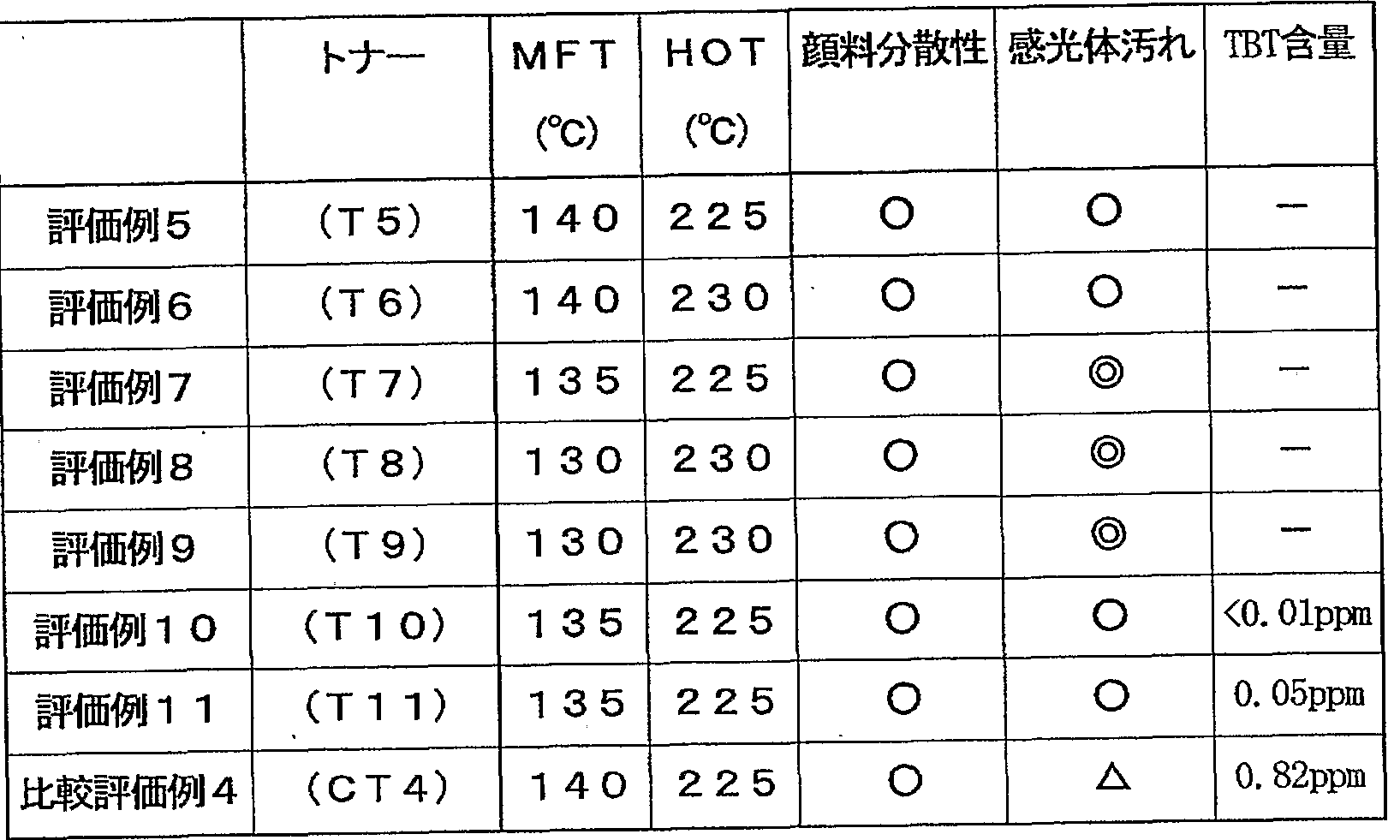
  • Table 2 shows the results evaluated by the following evaluation methods.
  • the fixing was evaluated in the same manner as in the above MFT, and the presence or absence of hot offset to the fixed image was visually evaluated.
  • the temperature of the fixing roll at which hot offset occurred was defined as the hot offset occurrence temperature.
  • the dielectric loss tangent (t a ⁇ ⁇ ) of the toner was measured and used as an index of pigment dispersibility. Judgment criteria ⁇ : t a ⁇ ⁇ : 10 or less
  • the developer prepared in (1) above was conditioned for 8 hours or more in a low-temperature and low-humidity environment at 10 ° C and 40% RH. Under the same environment, when the developer was used and a 3000-copy copier (AR5030: manufactured by Sharp) made 3000 copies, the degree of photoreceptor contamination and the image quality of the transferred image were observed.
  • a 3000-copy copier AR5030: manufactured by Sharp
  • the toner using the toner binder of the present invention has a stable image quality even at low temperature and low humidity, and has excellent fixing characteristics and pigment dispersibility, compared to the toner consisting of the conventional toner binder. It can be seen that these have the same or better performance.
  • (Y 1-7) has an acid value of 54, a hydroxyl value of 17 Tg at 74 ° C, a number average molecular weight of 1850, a peak top molecular weight of 6750 and a THF-insoluble matter of 33% TBT content of less than 0.1 lp pm This was used as a toner binder (TB I 2).
  • Example 13 Synthesis of non-linear polyester resin
  • a non-linear polyester resin (X2-9) was obtained in the same manner as in Example 7 (X2-5) except that the polycondensation catalyst was changed to 2 parts of octyl sulphoxide.
  • Non-linear polyester resin (X2-9) has a softening point of 145 ° C, acid value of 28, hydroxyl value of 16, Tg of 58 ° C, number average molecular weight of about 1480, and THF insoluble matter of 26%
  • the TBT content was less than 0.1 ppm, which was used as a toner binder (TB13).
  • a non-linear polyester resin (X2-10) was obtained in the same manner as in (X2-16) of Example 8, except that the polycondensation catalyst was changed to 2 parts of monobutyl sulphoxide.
  • X 2-10) contains no THF-insoluble matter, its acid value is 18, its hydroxyl value is 34, its Tg is 61 ° C, its number average molecular weight is 2010, its peak molecular weight is 5450, and it contains TBT. The amount was less than 0.01%.
  • a modified polyester resin (YI-8) was obtained by reacting in the same manner as in (Y1-3) of Example 8, except that the polycondensation catalyst was changed to 2.5 parts of octyl sulphoxide.
  • (Y 1-8) has an acid value of 11, a hydroxyl value of 29, a Tg of 58 ° C, a number average molecular weight of 3150, a peak top molecular weight of 6050, a THF insoluble content of 3,4%, and a TBT content of 0 It was less than 01%.
  • the reaction was carried out in the same manner as in (X2-5) of Example 7, except that the polycondensation catalyst was replaced by 2 parts of titanium tetradalioxide. Due to the slow reaction, the reaction was carried out under normal pressure for 16 hours and under reduced pressure for 18 hours, but the acid value was 6. The mixture was cooled to 180, 65 parts of trimellitic anhydride was added, and the mixture was allowed to react under normal pressure for 2 hours, taken out, cooled to room temperature, and pulverized to obtain a non-linear polyester resin for comparison (CX2-4).
  • CX2-4 has a softening point of 13'1 ° C, an acid value of 33, a hydroxyl value of 22, and a Tg of 51.
  • C the number average molecular weight was 1250, the peak top molecular weight was 3570, and the THF insoluble content was 17%. This was used as a comparative toner binder (CTB5). Evaluation Examples 12, 13 and Comparative Evaluation Example 5
  • toner binders (TB12) and (TBI3) and the comparative toner binder (CTB5) of the present invention 100 parts of toner binder, carbon black MA-100, [manufactured by Mitsubishi Chemical Corporation] 8 parts After premixing 5 parts of Fischer-Tropsch wax (Paraflint HI) and 1 part of charge control agent T-77 (manufactured by Hodogaya Chemical) using a Henshi Elmixer [FM10B manufactured by Mitsui Miike Kakoki Co., Ltd.] The mixture was kneaded with a shaft kneader [PCM-30 manufactured by Ikegai Co., Ltd.].
  • a toner (T14) was obtained in the same manner as in Evaluation Example 12, except that the Fischer-Tropx was not used, using the toner binder (TBI4) of the present invention.
  • Table 3 shows the results of evaluating (T12) to (T14) and (CT5) using the evaluation method described above.
  • Table 3 shows that the toner using the toner guider of the present invention can obtain stable image quality even under low temperature and low humidity, and has excellent hot offset resistance and pigment dispersibility. Industrial applicability
  • the toner binder according to the present invention has the following effects.
  • Stable image quality can be obtained even under low temperature and low humidity.

Landscapes

  • Chemical & Material Sciences (AREA)
  • Chemical Kinetics & Catalysis (AREA)
  • Organic Chemistry (AREA)
  • Health & Medical Sciences (AREA)
  • Medicinal Chemistry (AREA)
  • Polymers & Plastics (AREA)
  • General Chemical & Material Sciences (AREA)
  • Physics & Mathematics (AREA)
  • Spectroscopy & Molecular Physics (AREA)
  • General Physics & Mathematics (AREA)
  • Developing Agents For Electrophotography (AREA)
  • Polyesters Or Polycarbonates (AREA)
  • Compositions Of Macromolecular Compounds (AREA)

Description

明細書
トナ— /くィンダ— 技術分野
本発明は電子写真、 静電記録、 静電印刷などに用いられる乾式トナー用のトナ 一バインダ一に関する。 背景技術
乾式トナーに用いられるポリエステル系トナーバインダーはトナーとした場 合に、 熱ロール温度が低くてもトナーが定着できること (低温定着性) と、 高い 熱ロール温度でもトナーが熱ロールに融着しないこと (耐ホットオフセット性) を両立し易く、 特に低温定着性に優れることから使用量が増加傾向にある。
近年、 電子写真、,静電記録、 静電印刷等が、 広範囲に用いられ、 従来よりも多 様な環境条件下で使用されるようになり、 従来のトナーを用いると、 低温低湿度 の環境で使用された場合には、 長時間の使用時に感光体の画質低下が生じやすく なる場合があった。 従来技術のトナーバインダー (例えば、 特開 2 0 0 2— 1 4 8 8 6 7号公報) では、 トナーの諸特性を維持し、 かつ画質低下を防止するのは 困難であった。 発明の要約
本発明者らは、 ポリエステル系トナーバインダーの優れた低温定着性と、 耐ホ ットオフセット性を維持しつつ、 低温低湿度条件下でも画質低下を生じないトナ 一バインダーを得ることを目的に鋭意検討した結果、 特定の触媒の存在下に形成 されたポリエステル樹脂を用いることで得られることを見出し、 本発明に到達し た。
すなわち本発明は、 重縮合ポリエステル樹脂からなる静電荷像現像用トナーバ インダ一であって、 該ポリエステル樹脂が、 ハロゲン化チタン (A 1 ) 、 チタン ジケトンエノレート (A 2 ) 、 カルボン酸チタン (A 3 ) 、 力ノレボン酸チタ二ノレ
(A 4 ) 、 及びカルボン酸チタュル塩 (A 5 ) からなる群より選ばれる少なくと も 1種のチタン含有触媒 (A) の存在下に形成されてなるものであることを特徴 とする静電荷像現像用トナーバインダー;並びに、 重縮合ポリエステル樹脂から なる静電荷像現像用トナーバインダーであって、 該ポリエステル樹脂がジォクチ ルスズォキシド (B 1) 、 モノプチルスズォキシド (B 2) 、 及ぴジブチルスズ ォキシド (B 3) 力 らなる群より選ばれる少なくとも 1種のスズ含有触媒 (B) の存在下に形成されてなるものであり、 (B 3) 中のトリブチルスズィヒ合物の含 有量が 250 p pm以下であることを特徴とする静電荷像現像用トナーバインダ 一;である。 発明の'詳細な開示
以下、 本発明について詳細に説明する。
本発明においては、 上記チタン含有触媒 (A) 、 及び/又は、 上記スズ含有 触媒 (B) の存在下に形成されてなる重縮合ポリエステル樹脂を用いる。 (A) と (B) は 2種以上を併用してもよい。
(A) と (B) 以外の重合触媒、 例えば酢酸亜鉛、 テトラブトキシチタネート、 トリブチルスズ化合物の含有量が 250 p p mを越えるジブチルスズォキシ は、 本願発明のような効果は得られない。
(A) のうち、 ハロゲン化チタン (A1) としては特に限定されないが、 例え ば、 ジクロロチタシ、 トリクロ口チタン、 テトラクロ口チタン、 トリフルォロチ タン、 テトラフルォロチタン、 テトラブロモチタンなどが挙げられる。
チタンジケトンエノレート (A2) としては特に限定されないが、 例えば、 チ タンァセチルァセトナート、 チタンジィソプロポキシドビスァセチルァセトナー ト、 チタニルァセチルァセトナートなどが挙げられる。 これら (A2) の中では チタンァセチノレアセトナートが好ましい。
カルボン酸チタン (A3) としては特に限定されないが、 例えば、 炭素数 1〜 32の脂肪族カルボン酸チタン (A3— 1) 、 炭素数 7〜 38の芳参族カルボン 酸チタン (A3— 2) などが挙げられる。 2価以上のポリカルボン酸チタンの場 合、 チタンに配位するカルボキシル基は、 1個でも 2個以上でもよく、 チタンに 配位せず遊離のカルボキシル基が存在していてもよい。 (A3— 1) としては特に限定されないが、 例えば、 脂肪族モノカルボン酸チ タン (A3— l a) 、 )5旨肪族ジカルボン酸チタン (A3— l b) 、 脂肪族トリ力 ルポン酸チタン (A3— l c) 及び 4〜8価又はそれ以上の脂肪族ポリカルボン 酸チタン (A3— I d) などが挙げられる。
(A3 - 1 a) としては特に限定されないが、 例えば、 ぎ酸チタン、 酢酸チタ ン、 プロピオン酸チタン、 オクタン酸チタンなどが挙げられる。 (A3— l b) としては特に限定されないが、 例えば、 シユウ酸チタン、 コハク酸チタン、 マレ イン酸チタン、 アジピン酸チタン、 セバシン酸チタンなどが挙げられる。 (A3 — 1 c ) としては特に限定されないが、 例えば、 へキサントリカルボン酸チタン、 イソオクタントリカルボン酸チタンなどが挙げられる。 (A3— I d) としては 特に限定されないが、 例えば、 オクタンテドラカルボン酸チタン、 デカンテトラ カルボン酸チタンなどが挙げられる。
(A3— 2) としては特に限定されないが、 例えば、 芳香族モノカルボン酸チ タン (A 3— 2 a ) 、 芳香族ジカルボン酸チタン (A 3— 2 b ) 、 芳香族トリ力 ルボン酸チタン (A3— 2 c) 及び 4〜 8価又はそれ以上の芳香族ポリカルボン 酸チタン (A3— 2 d) などが挙げられる。
(A3 -2 a) としては特に限定されないが、 例えば、 安息香酸チタンなどが 挙げられる。 (A3— 2 b) としては特に限定されないが、 例えば、 フタル酸チ タン、 テレフタノレ酸チタン、 イソフタノレ酸チタン、 1, 3—ナフタレンジ力 ボ ン酸チタン、 4, 4ービフエニノレジ力/レポン酸チタン、 2, 5—トノレエンジカノレ ボン酸チタン、 アントラセンジカルボン酸チタンなどが挙げられる。 (A3— 2 c) としては特に限定されないが、 例えば、 トリメリット酸チタン、 2, 4, 6 一ナフタレントリカルボン酸チタンなどが挙げられる。 (A3— 2d) と,しては 特に限定されないが、 例えば、 ピロメリット酸チタン、 2, 3, 4, 6—ナフタ レンテトラカルボン酸チタンなどが挙げられる。
これら (A3) の中では (A3— 2) が好ましく、 (A3— 2 b) がさらに好 ましい。
カルボン酸チタニル (A4) としては特に限定されないが、 例えば、 炭素数 1 〜32の脂肪族カルボン酸チタ-ル (A4— 1) 、 炭素数 7〜 38の芳香族カル ボン酸チタニル (A4— 2) などが挙げられる。 2価以上のポリカルボン酸チタ エルの場合、 チタンに配位するカルボキシル基は、 1個でも 2個以上でもよく、 , チタンに配位せず遊離の力ルポキシル基が存在していてもよい。
(A4 - 1) としては特に限定されないが、 例えば、 脂肪族モノカルボン酸チ タニル (A4— 1 a) 、 脂肪族ジカルボン酸チタニル (A4— 1 b) 、 脂肪族ト リカルボン酸チタニル (A4— l c) 及ぴ 4〜 8価又はそれ以上の脂肪族ポリ力 ルボン酸チタニル (A4— l d) などが挙げられる。
(A4- 1 a) としては特に限定されないが、 例えば、 ぎ酸チタ ル、 酢酸チ タニル、 プロピオン酸チタニル、 オクタン酸チタニルなどが挙げられる。 (A4 一 l b) としては特に限定されないが、 例えば、 シユウ酸チタエル、 コハク酸チ タニル、 マレイン酸チタ二ノレ、 アジピン酸チタ二ノレ、 セバシン酸チタ二/レなどが 挙げられる。 (A4— l c) としては特に限定されないが、 例えば、 へキサント リカルボン酸チタュル、 ィソオクタントリカルボン酸チタニルなどが挙げられる。 (A4- 1 d) としては特に限定されないが、 例えば、 オクタンテトラカルボン 酸チタニル、 デカンテトラカルボン酸チタニルなどが挙げられる。
( A 4 - 2 ) としては特に限定されないが、 例えば、 芳香族モノ力ルポン酸チ タニル (A4— 2 a) 、 芳香族ジカルボン酸チタニル (A4— 2 b) 、 芳香族ト リカルボン酸チタニル (A4— 2 c) 及ぴ 4〜 8価又はそれ以上の芳香族ポリ力 , ルボン酸チタニル (A 4— 2 d ) などが挙げられる。
(A4- 2 a) としては特に限定されないが、 伊 llえば、 安息香酸チタニルなど が挙げられる。 (A4— 2 b) としては特に限定されないが、 例えば、 フタル酸 チタニル、 テレフタル酸チタニル、 イソフタル酸チタニル、 1, 3—ナフタレン ジカルボン酸チタニル、 4, 4ービフエニルジカルボン酸チタニル、 2, 5—ト ルェンジカルポン酸チタエル、 アントラセンジカルボン酸チタニルなどが挙げら れる。 (A4— 2 c) としては特に限定されないが、 例えば、 トリメリット酸チ タニル、 2, 4, 6—ナフタレントリカルボン酸チタニルなどが挙げられる。 (A4— 2 d) としては特に限定されないが、 例えば、 ピロメリット酸チタ二ノレ、 2, 3, 4, 6—ナフタレンテトラカルボン酸チタニルなどが挙げられる。
カルボン酸チタニル塩 (A5) と.しては特に限定されないが、 例えば、 (A4 -l b) , (A4— l c) 、 (A 4— I d) 、 (A4— 2 b). 、 (A4- 2 c) . または (A4_2'd) に挙げたカルボン酸チタニルの、 アルカリ金属 (リチウム、 ナトリウム、 カリウムなど) 塩もしくはアルカリ土類金属 (マグネシウム、 カル シゥム、 バリウムなど) 塩 !: (A5— 1 b) 、 (A5— l c) 、 (A5— l d) 、 (A 5— 2 b) 、 (A5— 2 c) 、 及び (A5— 2 d) 〕 などが挙げられる。 こ れら (A5) の中では、 マレイン酸チタュル塩及ぴシユウ酸チタニル塩が好まし い。
(A) の使用量としては特に限定されないが、 ポリエステル樹脂を得るのに用 いるポリオールとポリカルボン酸の合計重量も基準として、 下限は 0. 01%が 好ましく、 0. 02%が更に好ましく、 0. 03%が特に好ましく、 0. 05% が最も好ましい。 上限は 5%が好ましく、 2%が更に好ましく、 1. 5%が特に 好ましく、 0. 8%が最も好ましい。 0. 01%以上では重縮合触媒としての作 用が十分得られ、 5%以下であると、 触媒量に応じて高い触媒作用が得られる。 また上記触媒量の範囲内であれば、 得られるポリエステル樹脂からなるトナーバ インダーを用いたトナーの、 必要な諸特性、 特に低温低湿度条件下での感光体の 画質がより良好となる。
上記及ぴ以下において、 %は特に規定しない限り重量%を示す。
スズ含有触媒 (B) のうち、 トリプチルスズ化合物 (以下、 TBTと略記す る) の含有量が 250 p pm以下のジブチルスズォキシド (B 3) は、 例えば、 プチルク口ライドを出発原料に四塩化スズとした後グリ二ヤール反応を行うなど の通常の方法でジブチルスズォキシドを合成したのち、 得られたジブチルスズォ キシドを有機溶剤中に分散させ TBTを溶剤可溶分として濾別除去する (分散洗 浄) 方法及ぴソックスレ一等を用い有機溶剤で TBTを抽出除去する (循環洗 浄) 方法などで得ることができる。 ジプチルスズォキシドは市販品としても得る ことができるが、 通常 400〜600 p pmの TBTを含有しており、 本発明に 用いるのは不適当である。
上記及ぴ以下において、 p pmは、 重量基準での p pmを示す。
上記 TBTとしては特に限定されないが、 代表的なものとしては、 b i s—酸 化トリプチルスズ (トリプチルスズォキシド) や塩化トリプチルスズ (トリブチ ルスズクロリ ド) 、 酢酸トリプチルスズ等の同族体な が挙げられる。
分散洗浄に用いる有機溶剤としては特に限定されないが、 例えば、 アルコール 類 (メタノーノレ、 エタノール及びイソプロピルアルコールなど) 、 ケトン類 (ァ セトン、 ジェチルケトン及ぴメチルェチルケトンなど) 、 エーテル類 (ジェチル エーテル及びテトラヒドロフランなど) 、 その他の極性溶剤 (ジメチルスルホキ シド及ぴジメチルホルムアミ ドなど) 、 脂肪族炭化水素 (へキサン及びペンタン など) 、 芳香族炭化水素 (トルエン及ぴキシレンなど) 及びこれらの有機溶剤の 併用などが挙げられる。
これらの中で、 好ましくはアルコール類と脂肪族炭化水素の併用、 及ぴアルコ ール類と芳香族炭化水素の併用、 更に好ましくはメタノールとへキサンの併用、 及ぴメタノールとトルエンの併用である。
分散洗浄の際の有機溶剤の使用量としては特に限定されないが、 ジブチルスズ ォキシド 1部に対して通常 0. 1〜500部、 好ましくは 1〜200部、 更に好 ましくは 5〜 100部である。 上記及び以下において部は重量部を示す。
分散の方法としては特に限定されないが、 例えば、 攪拌翼を用いた攪拌、 容器 中での振とう、 ボールミルによる湿式分散などが用いられる。 分散後、 濾別、 遠 心分離などの方法で溶剤を除去することができる。
循環洗浄に用いる有機溶剤としては特に限定されないが、 例えば、 上記アルコ ール類、 ケトン類、 エーテル類、 脂肪族炭化水素、 芳香族炭化水素、 及びこれら の有機溶剤の併用などが挙げられる。
(B 3) の TBT含有量は通常 250 p pm以下である。 上限は、 好ましくは 150 p pm、 更に好ましくは 75 p pm、 特に好ましくは 25 p p m、 最も好 ましくは l p pmである。 下限は好ましくは 0. 5 p pmである。 T B T含有量 が 250 p p mを越えると、 低温低湿度条件下での感光体の画質が低下する。
(B) の使用量としては特に限定されないが、 ポリエステル樹脂を得るのに用 いるポリオールとポリカルボン酸の合計重量を基準として、 下限は 0. 01%が 好ましく、 0. 02 %が更に好ましく、 0. 03 %が特に好ましく、 0. 05 % が最も好ましい。 上限は 5%が好ましく、 2%が更に好ましく、 1. 5%が特に 好ましく、 0. 8%が最も好ましい。 0. 01%以上では重縮合触媒としての作 用が十分得られ、 5%以下であると、 触媒量に応じて高い触媒作用が得られる。 また上記触媒量の範囲內であれば、 得られるポリエステル樹脂からなるトナーバ インダーを用いたトナーの、 必要な諸特性、 特に低温低湿度条件下での感光体の 画質がより良好となる。 なお、 (A) と (B) を併用する場合の触媒量も、 上記 範囲内が好ましい。
また、 (B) として (B 2) 及ぴ Z又は (B 3) を用いた場合の使用量として は特に限定されないが、 低温低湿度条件下での感光体の画質がより向上すること から、 得られるポリエステル樹脂中の TBT含有量が 0. 6 p pm以下となる量 が好ましい。 TBT含有量は、 更に好ましくは 0. 3 p pm以下、 特に好ましく は 0. 1 p pm以下、 最も好ましくは 0. 05 p pm以下である。
これらの触媒 (A) および (B) のうちで好ましいものほ、 チタンジケトンェ ノレート (A2) 、 カルボン酸チタン (A3) 、 カルボン酸チタニル塩 (A5) 及ぴこれらの併用であり、 より好ましくは、 (A2) 、 芳香族カルボン酸チタン (A3 - 2) 、 脂肪族カルボン酸チタ-ル塩 (A5— 1) 、 芳香族カルボン酸チ タニル塩 (A5-2) 及びこれらの併用であり、 更に好ましくは、 チタンァセチ ルァセトナート、 (A3— 2 b) 、 (A5— 1 b) のうちアルカリ金属塩、 (A 5— 2 b) のうちァ カリ金属塩、 及ぴこれらの併用であり、 特に好ましくはテ レフタノレ酸チタン、 イソフタル酸チタン、 オルトフタル酸チタン、 シユウ酸チタ ニル塩、 マレイン酸チタニル塩及びこれらの併用であり、 最も好ましくはテレフ タル酸チタン、 シユウ酸チタニルカリウム及びこれらの併用である。
本発明のトナーバインダーを構成する重縮合ポリエステル樹脂としては特に 限定されないが、 例えば、 ポリオールとポリカルボン酸との重縮合物であるポリ エステル樹脂 (X) 、 (X) にさらにポリエポキシド (C) などを反応させて得 られる変性ポリ,エステル樹脂 (Υ) などが挙げられる。 (X) 、 (Υ) などは単 独で使用してもよいし、 2種以上を組み合わせて混合物として使用してもよい。 ポリオールとしては特に限定されないが、 例えば、 ジオール (G) 及び 3価以 上のポリオール (Η) などが挙げられる。 ポリカルボン酸としては特に限定され ないが、 例えば、 ジカルボン酸 (I) 及ぴ 3価以上のポリカルポン酸 (J) など が挙げられる。 本発明のトナーバインダーを構成するポリエステル樹脂としては特に限定され ないが、 例えば、 具体的には以下のものなどが挙げられ、 これらのものを併用す ることもできる。
( I) : (G) 及ぴ (I) を用いた線状のポリエステル樹脂
(X2) : (G) 及び (I) とともに (H) 及び/又は (J) を用いた非線状の ポリエステル樹脂
(Y 1) : (X2) に (C) を反応させた変性ポリエステル樹脂
ジオール (G) としては特に限定されないが、 例えば、 水酸基価 180〜1 90 OmgKOHZgのジオール類、 具体的には、 炭素数 2〜12のアルキレン グリコー (エチレングリコール、 1, 2—プロピレングリコール、 1, 3—プ 口ピレングリコーノレ、 1, 4 -プチレングリコ一/レ及び 1 , 6—へキサンジォー ルなど) ; ァノレキレンエーテルグリコール (ジエチレングリコール、 トリエチレ ングリコー /レ、 ジプロピレングリコール、 ポリエチレングリコール、 ポリプロピ レングリコール及びポリブチレングリコールなど) ;脂環式ジオール ( 1, 4一 シクロへキサンジメタノール及び水素添加ビスフエノール Aなど) ; ビスフエノ ール類 (ビスフエノール A、 ビスフエノール F及びビスフエノール Sなど) ;上 記脂環式ジオールの ^素数2〜 4のアルキレンォキシド 〔エチレンォキシド (以 下 EOと略記する) 、 プロピレンォキシド (以下 POと略記する) 及びブチレン ォキシド (以下 BOと略記する) など〕 付加物;上記ビスフエノール類の炭素数 2〜4のアルキレンォキシド (EO、 PO及ぴ BOなど) 付加物などが挙げられ る。
これらのうち好ましいものは、 炭素数 2〜12のアルキレングリコール、 ビス フエノール類のアルキレンォキシド付加物及びこれらの併用であり、 特に好まし いものはビスフエノール類のアルキレンォキシド付加物、 及ぴ、 これと炭素数 2 〜12のアルキレングリコールとの併用である。
尚、 上記及び以下において水酸基価及ぴ酸価は、 J I S K 0070に規 定の方法で測定される。
3価以上のポリオール (H) としては特に限定されないが、 例えば、 水酸基価 150〜1 90 OmgKOH/gのポリオール類、 具体的には、 3〜 8価又はそ れ以上の脂肪族多価アルコール (グリセリン、 トリェチロールェタン、 トリメチ ロールプロパン、 ペンタエリスリ トール及ぴソルビトールなど) ;上記脂肪族多 価アルコールの炭素数 2〜4のアルキレンォキシド (E O、 P O及ぴ B Qなど) 付加物; トリスフエノ一ル類 (トリスフエノール P Aなど) ; ノポラック樹脂 (フエノー/レノポラック及びクレゾールノポラックなど) ;上記トリスフエノー ル類の炭素数 2〜4のアルキレンォキシド (E O、 P O及ぴ B Oなど) 付加物; 上記ノポラック樹脂の炭素数 2〜4のアルキレンォキシド (E O、 P O、 B Oな ど) 付加物などが挙げられる。 '
これらのうち好ましいものは、 3〜 8価又はそれ以上の脂肪族多価アルコール 及びノポラック樹脂のアルキレンォキシド付加物であり、 特に好ましいものはノ ポラック樹脂のアルキレンォキシド付加物である。
ジカルボン酸 ( I ) としては特に限定されないが、 例えば、 酸価 1 8 0〜1 2 5 O m g KO H/ gのジカルボン酸、 具体的には、 炭素数 4〜3 6のアルキレン ジカルボン酸 (コハク酸、 アジピン酸、 セバシン酸及ぴドデセニルコハク酸な ど) ;炭素数 4〜3 6のアルケニレンジカルボン酸 (マレイン酸、 フマル酸な ど) ;炭素数 8〜3 6の芳香族ジカルボン酸 (フタル酸、 イソフタル酸、 テレフ タル酸及びナフタレンジカルボン酸など) などが挙げられる。 これらのうち好ま しいものは、 炭素数 4〜2 0のァルケ二レンジカルボン酸及び炭素数 8〜 2 0の 芳香族ジカルポン酸である。 またこれらは 2種以上を併用しても何ら問題ない。 なお、 (I ) としては上述のものの酸無水物又は低級 (炭素数 1〜4 ) アルキル エステル (メチルエステル、 ェチルエステル、 イソプロピルエステルなど) を用 いてもよレヽ。
3価以上のポリカルボン酸 (J ) としては特に限定されないが、 例えば、 酸価 1 5 0〜1 2 5 O m g K O H/ gのポリカルボン酸、 具体的には、 炭素数 9〜 2 0の芳香族ポリカルボン酸 (トリメリツト酸、 ピロメリット酸など) ;不飽和力 ルボン酸のビニル重合体 (スチレン Zマレイン酸共重合体、 スチレン/ァクリル 酸共重合体、 ctーォレフィンノマレイン酸共重合体、 スチレン/フマル酸共重合 体など) などが挙げられる。 これらのうち好ましいものは、 炭素数 9〜 2 0の芳 香族ポリカルボン酸であり、 特に好ましいものはトリメリット酸、 ピロメリット TJP03/02393
10
酸である。 なお、 3価以上のポリカルボン酸 (J) としては、 上述のものの酸無 水物.又は低級 (炭素数 1〜4) アルキルエステル (メチルエステル、 ェチルエス テル、 イソプロピルエステルなど) を用いてもよい。
また、 (G) 、 (H) 、 ( I ) 及び (J) とともにヒ ドロキシカルボン酸 (K) を共重合することもできる。
ヒドロキシカルボン酸 (K) としては特に限定されないが、 例えば、 ヒドロキ システアリン酸、 硬化ヒマシ油脂肪酸などが挙げられる。
ポリエポキシド (C) としては特に限定されないが、 例えば、 ポリグリシジル エーテノレ 〔エチレングリコ一/レジグリシジ/レエーテレ、 テトラメチレングリコー ルジグリシジノレエーテル、 ビスフエノール Aジグリシジルエーテル、 ビスフエノ 一/レ Fジグリシジ /レエーテノレ、 グリセリントリグリシジルエーテノレ、 ペンタエリ スリ トールテトラダリシジルエーテル、 フエノールノポラック (平均重合度 3〜 60) グリシジルテ一テル化物など〕 ;ジェンオキサイド (ペンタジェンジォキ サイド、 へキサジェンジオキサイドなど) などが挙げられる。 これらの中で好ま しくは、 ポリグリシジルエーテルであり、 更に好ましくは、 エチレングリコール ジグリシジルエーテル及ぴビスフエノール Aジグリシジルエーテルである。
(C) の 1分子当たりのエポキシ基数は、 好ましくは 2〜8、 更に好ましくは 2〜6、 特に好ましくは 2〜4である。
(C) のエポキシ当量としては特に限定されないが、 好ましくは 50〜500 である。 下限は、 更に好ましくは 70、 特に好ましくは 80であり、 上限は、 更 に好ましくは 300、 特に好ましくは 200である。 エポキシ基数及び Z又はェ ポキシ当量が上記範囲内であると、 現像性と定着性が共により良好になる。 上述 の 1分子当たりのエポキシ基数及ぴエポキシ当量の範囲を同時に満たせば更に好 ましい。
' ポリオールとポリカルボン酸の比率は、 水酸基 [OH] とカルボキシル基 [C OOH] の当量比 [OH] / [COOH] として、 好ましくは 2/1〜1/2、 さらに好ましくは.1. 5ノ 1〜: LZ1. 3、 特に好ましくは 1. 3Z1〜: LZ1. 2である。 また使用するポリオールとポリカルボン酸の種類は、 最終的に調整さ れるポリエステル系トナーバインダーのガラス転移点が 40〜 90°Cとなるよう 分子量調整も考慮して選択されるのが好ましい。
(X I) の具体的な例としては特に限定されないが、 例えば、 以下の (1) 〜 (3) などが挙げられる。
( 1 ) ビスフヱノール A · P O 2モル付加物ノテレフタル酸重縮合物。
(2) ビスフエノール A · E O 4モル付加物ノビスフエノ "ル A · PO 2モル付 加物 Zテレフタル酸重縮合物。
(3) ビスフエノール A · PO 2モノレ付加物ノビスフエノール A · P O 3モノレ付 加物 Zテレフタル酸 Zィソフタル酸 Z無水マレイン酸重縮合物。
(X2) の具体的な例としては特に限定されないが、 例えば、 以下の (4) 〜 (10) などが挙げられる。
(4) ビスフエノール A · E O 2モル付加物 ビスフエノール A - PO 3モル付 加物 Zテレフタル酸 無水フタル 無水トリメリット酸重縮合物。
(5) ビスフエノール A · PO 2モル付加物 Zビスフエノール A · P O 3モル付 加物 ビスフエノール A . E O 2モル付加物/フェ'ノールノポラックの P O 5モ ル付加物,テレフタル酸/無水マレイン酸/ジメチルテレフタル酸エステル Z無 水トリメリット酸重縮合物。
(6) ビスフエノール A · EO 2モル付加物 Zビスフエノール A - PO 2モル付 加物ノテレフタル酸 Z無水トリメリット酸重縮合物。
(7) ビスフエノール A · E O 2モル付加物 ビスフエノール A · P O 2モル付 加物/テレフタル酸ズ無水マレイン酸 Z無水トリメリット酸重縮合物。
(8) ビスフエノール A · PO 2モル付加物/ビスフエノール A * PO 3モル付 加物 Zテレフタル酸/イソフタル酸 Z無水マレイン酸 無水トリメリット酸重縮 合物。
(9) ビスフエノール A · PO 2モル付加物/ビスフエノール A · PO 3モル付 加物 //フエノールノポラックの EO付加物 Zイソフタル酸 Z無水トリメリット酸 重縮合物。
(10) ビスフエノール A · EO 2モル付加物/ビスフエノール A · PO 2モル 付加物 Zフェノールノポラックの P O 5モル付加物ノテレフタル酸ノフマル酸/ 無水トリメリット酸重縮合物。 (Yl) の具体的な例としては特に限定されないが、 例えば、 以下の (11) 〜 (20) などが挙げられる。
(1 1) ビスフエノール A · PO 2モル付加物 Zビスフエノール A · EO 2モル 付加物ノフェノールノポラックの P O 5モル付加物 テレフタル酸 Z無水ドデセ エルコハク酸重縮合物にテトラメチレンダリコールジグリシジルエーテルを反応 させて得られる変性ポリエステル。
(12) ビスフエノール A · P O 2モル付加物 ビスフエノール A · P O 3モル 付加物 /ビスフエノール A · E O 2モル付加物/フェノールノボラックの P05 モル付加物 テレフタル酸/無水ドデセニルコハク酸重縮合物にエチレングリコ 一ルジグリシジルエーテルを反応させて得られる変性ポリエステル。
(13) ビスフエノール A♦ P O 2モル付加物/ビスフエノール A · P O 3モル 付加物 Zフェノールノボラックの E O付加物/ィソフタル酸 Z無水マレイン酸 Z 無水トリメリット酸重縮合物にビスフエノール Aジグリシジルエーテルを反応さ せて得られる変性ポリエステル。
( 14) ビスフエノール A · P O 2モル付加物/"ビスフエノール A · PO 3モル 付加物/ビスフエノール A · E O 2モル付加物/フヱノールノポラックの E O付 加物 テレフタル酸 Zイソフタル酸/無水トリメリット酸重縮合物にビスフエノ ール Aジグリシジルエーテルを反応させて得られる変性ポリエステル。
(15) ビスフエノール A · P O 2モル付加物 Zビスフエノール A · PO 3モル 付加物 /ビスフエノール A - EO 2モル付加物 Zフェノールノポラックの P O 5 モル付加物/テレフタル酸 /ィソフタル酸/無水マレイン酸 無水トリメリット 酸重縮合物にビスフエノール Aジグリシジルエーテルを反応させて得られる変性 ポリエステル。
(16) ビスフエノール A · P O 3モル付加物/フェノールノボラックの P O 5 モノレ付加物 テレフタル酸/フマル酸 Z無水トリメリット酸重縮合物にエチレン グリコールジグリシジルエーテルを反応させて得られる変性ポリエステル。
(1 7) ビスフエノール A · P O 2モル付加物 Zフェノールノポラックの P O 5 モル付加物 Zテレフタル酸/無水ドデセ-ルコハク酸/無水トリメリット酸重縮 合物にテトラメチレンダリコールジグリシジルエーテルを反応させて得られる変 3
13
性ポリエステル。
(18) ビスフエノール A · P O 2モル付加物 /ビスフエノール A · E O 2モル 付加物/フェノールノボラックの E O付加物ノテレフタル酸 Z無水トリメリット 酸重縮合物にエチレングリコールジグリシジルエーテルを反応させて得られる変 性ポリエステル。 '
(19) ビスフエノール A · PO 2モル付加物ノビスフエノール A · P O 3モル 付加物/フエノールノポラックの P O 5モル付加物ノテレフタル酸 Z無水トリメ リッ卜酸重縮合物にビスフエノール Aジグリシジルエーテルを反応させて得られ る変性ポリエステル。
(20) ビスフエノール A · PO 2モル付加物/ビスフエノール A · EO 2モル 付加物 テレフタル酸 Z無水トリメリット酸重縮合物にフエノールノボラックグ リ.シジルエーテルィ匕物を反応させて得られる変性ポリエステル。
トナーバインダーはフルカラー用、 モノクロ用で各々異なる物性が求められて おり、 ポリエステル樹脂の設計も異なる。
即ち、 フルカラー用には高光沢画像が求められるため、 低粘性のバインダーと する必要があるが、 モノクロ用は光沢は特に必要なくホットオフセット性が重視 されるため高弾性のバインダーとする必要がある。
フルカラー複写機等に有用である高光沢画像を得る場合は、 (X I) 、 (X 2) 、 (Y1) 及ぴこれらの混合物が好ましい。 この場合、 低粘性であることが 好ましいことから、 これらのポリエステル樹脂を構成する (H) 及び/又は ( J) の比率は、 (H) と (J) のモル数の和が (G) 〜 (J) のモル数の合計 に対して、 好ましくは 0〜20モル0 /0、 さらに好ましくは 0〜15モル%、 特に 0~ 10モノレ%である。
モノクロ複写機等に有用である高い耐ホットオフセット性を得る場合は、' (X 2) 、 (Y 1) 及びこれらの混合物が好ましい。 この揚合、 高弾性であることが 好ましいことから、 これのポリエステル樹脂としては、 (H) と (J) を両方用 いたものが特に好ましい。 (H) 及び (J) の比率は、 (H) と (J) のモル数 の和が (G) 〜 (J) めモル数の合計に対して、 好ましくは 0. 1〜40モル%、 さらに好ましくは 0. 5~25モル0 /0、 特に 1〜 20モル0 /0である。 フルカラー用ポリエステル樹脂の場合、 複素粘性率が 100 P a · Sとなる温 度 (TE) は、 好ましくは 90〜170。C、 さらに好ましくは 100〜 165°C、 特に 105〜 150°Cである。 170で以下で十分な光沢が得られ、 90DCを以 上で耐熱保存安定性が良好となる。
TEは、 例えば樹脂をラポプラストミルを用いて 130°C、 70 r pmで 30 分間溶融混練後のブロックを、 市販の動的粘弹性測定装置を用いて、 樹脂温度を 変化させながら複素粘性率 (77 *) を測定することで求められる。
また、 フルカラー用ポリエステル樹脂の THF不溶分は、 光沢度の観点から、 好ましくは 10%以下、 さらに好ましくは 5%以下である。
尚、 THF不溶分及ぴ THF可溶分は以下の方法で得られる。
200m 1の共栓付きマイヤーフラスコに、 試料約 0. 5 gを精秤し、 THF 5 Omlを加え、 3時間撹拌還流させて冷却後、 グラスフィルタ一にて不溶分を ろ別する。 THF不溶分の値 (%) は、 グラスフィルタ一上の樹脂分を 80°Cで 3時間減圧乾燥した後の重量と試料の重量比から算出する。
尚、 後述する分子量の測定には、 このろ液を THF可溶分として使用する。 モノクロ用ポリエステル樹脂の場合、 耐ホットオフセット性の観点から、 ポリ エステル樹脂の貯蔵弾性率 (G' ) が 60 OOP aとなる温度 (TG) は、 好ま しくは 130〜230°C、 さらに好ましくは 140〜230で、 特に 150〜2 30°Cである。
TGは、 例えば樹脂をラボプラストミルを用いて 130°C、 70 r pmで 30 分間溶融混練後のブロックを、 市販の動的粘弾性測定装置を用いて、 樹脂温度を 変化させながら貯蔵弾性率 (G' ) を測定することで求められる。
低温定着性及ぴ耐熱保存安定性の観点から、 モノクロ用ポリエステル樹脂の複 素粘性率 (7? *) が 100 OP a . sとなる温度 (TE) は、 好ましくは 80〜 140°C、 きらに好ましくは 90〜135 、 特に 105〜 130°Cである。 モノクロ用ポリエステル樹脂は、 テトラヒドロフラン (THF) 不溶分を 5〜 70%含有していることが好ましく、 更に好ましくは 10〜60%、 特に 15〜 50 °/0である。 THF不溶分が 5 %以上で耐ホットオフセット性が良好になり、 70%以下で良好な低温定着性が得られる。 ポリエステノレ樹脂のピークトップ分子量はモノク口用、 フルカラー用いずれの 場合も、 好ましくは 1000〜 30000、 更に好ましくは 1500〜 2500 0、 特に 1800〜 20000である。 ピークトップ分子量が 1000以上で、 耐熱保存安定性及ぴ粉体流動性が良好となり、 30000以下でトナ一の粉砕性 が向上し、 生産性が良好となる。
上記及ぴ下記においてポリエステル樹脂のピークトップ分子量及ぴ数平均分子 量は、 THF可溶分について GPCを用いて以下の条件で測定される。
装置 : 東ソー製 HLC— 8120
カラム : TSKg e l GMHXL (2本)
T SKg e 1 Mu 1 t i p o r e HXL-M ( 1本) 測定温度 4 O
試料溶液 0. 25%の THF溶液
溶液注入量 100 ^ 1
屈折率検出器
ポリスチレン
得られたクロマトグラム上最大のピーク高さを示す分子量をピークトップ分子 量と称する。
ポリエステル樹脂の Tgはモノクロ用、 フルカラー用いずれの場合も、 好まし くは 40〜90°C、 更に好ましくは 50〜80で、'特に 55〜75°Cである。 T gが 4 Οΐ:〜 90 の範囲では耐熱保存安定性と低温定着性がより良好になる。 尚、 上記及び以下においてポリエステル樹脂の T gは、 セイコー電子工業 (株) 製 D S C 20, S S C/580を用いて A S TM D3418— 82に規 定の方法 (DSC法) で測定される。
線状ポリエステル樹脂 (X I) の製造方法としては特に限定されないが、 例え ば、 ジオール (G) 、 ジカルボン酸 (I) 及び重縮合触媒を 180 〜 260°C に加熱し、 常圧及び/又は減圧条件で脱水縮合させてポリエステル樹脂 (XI) を得る方法などが挙げられる。
非線状ポリエステル樹脂 (X2) の製造方法としては特に限定されないが、 例 えば、 ジオール (G) 、 ジカルボン酸 (I) 、 3価以上のポリオール (H) 及ぴ 重縮合触媒を 1 80°C〜260°Cに加熱し常圧及び Z又は減圧条件で脱水縮合さ せた後、 さらに 3.価以上のポリカルボン酸 (J) を反応させてポリエステル樹脂 (X2) を得る方法などが挙げられる。 3価以上のポリカルボン酸 (J) をジォ ール (G) 、 ジカルボン酸 (I) 及ぴ 3価以上のポリオール (H) と同時に反応 させることもできる。
変性ポリエステル樹脂 (Yi) の製造方法としては特に限定されないが、 例え ば、 非線状ポリエステル榭脂 (X 2) にポリエポキシド (C) を加え、 180°C 〜 260 °Cでポリエステルの分子伸長反応を行うことで変性ポリエステル樹脂 (Y 1) を得る方法などが挙げられる。
本発明のトナーバインダ一においては、 ポリエステノレ樹脂を 2種以上併用して 用いることもできる。
本発明のトナーバインダーには、 必要により、 カルナゥパワックス (D 1) 、 フィッシャートロプシュワックス (D 2) 、 パラフィンワックス (D3) 及びポ リオレフインワックス (D4) からなる群より選ばれる少なくとも 1種の離型剤 (D) を含有させることができる。
(D 1) としては特に限定されないが、 例えば、 天然カルナゥバワックス、 脱 遊離脂肪酸型カルナゥバワックスなどが挙げられる。
(D 2) としては特に限定されなレ、が、 例えば、 石油系フィッシャートロプシ ュワックス (シユーマン ·サゾーノレ社製パラフリント HI、 パラフリント H1N 4及びパラフリント C 105など) 、 天然ガス系フィッシャートロプシュヮック ス (シェル MD S社製 FT 100など) 及ぴこれらフィッシャートロプシュヮッ クスを分別結晶化などの方法で精製したもの [日本精蠟 (株) 製:^03卩ー700 0、 ]^0?—7010など] などが挙げられる。
(D 3) としては特に限定されないが、 例えば、 石油ワックス系のパラフィン ワックス [日本精蝌 (株) 製パラフィンワックス HNP— 5、 HNP- 9, HN P— 1 1など] などが挙げられる。
(D4) としては特に限定されないが、 例えば、 ポリエチレンワックス [三洋 化成工業 (株) 製サンワックス 171 P、 サンワックス LE L 400 Pなど] 、 ポリプロピレンワックス [三洋化成工業 (株) 製ビスコール 550 P、 ピスコ一 ル 6 6 0 Pなど] などが挙げられる。
これらのワックスの内、 カノレナウノくワックス、 フィッシャートロプシュヮック スが好ましく、 カルナゥパワックス、 石油系フィッシャートロプシュワックスが 更に好ましい。 これらのワックスを離型剤として使用することでトナーとした場 合の低温定着性がより優れることになる。
本発明のトナーパインダ一に離型剤 (D) ,を含有させる場合の (D) の含有量 は、 ポリエステル樹脂と (D) の合計重量を基準として、 好ましくは 0 . 0 1〜 2 0 %、 更に好ましくは 0 . 1 %〜 1 5 %、 特に 0 . 5〜 1 0 %である。 離型剤 の含有量が 0 . 0 1〜2 0 %の範囲ではトナーとした場合の耐ホットオフセット 性がより良好となる。
本発明のトナーバインダーには、 必要により、 荷電制御剤 (E) を含有させ ることができる。
(E) としては特に限定されないが、 例えば、 ニグ口シン染料、 4級アンモニ ゥム塩ィヒ合物、 4級アンモニゥム塩基含有ポリマー、 含金属ァゾ染料、 サリチル 酸金属塩、 スルホン酸基含有ポリマー、 含フッソ系ポリマー及ぴハロゲン置換芳 香環含有ポリマー等が挙げられる。
本発明のトナーバインダーに荷電制御剤 (E) を含有させる場合の (E) の含 有量としては特に限定されないが、 ポリエステル樹脂と (E) の合計重量を基準 として、 好ましくは 0 . 0 1〜5 %、 更に好ましくは 0 . 0 2〜4 %である。 また、 本発明のポリエステル樹脂に、 必要により他の樹脂などを含有させるこ ともできる。
他の樹脂としては特に限定されないが、 例えば、 スチレン系樹脂 [スチレンと アルキル (メタ) アタリレートの共重合体、 スチレンとジェン系モノマーとの共 重合体等] 、 エポキシ樹脂 (ビスフエノール Aとェピクロルヒ ドリンの付加縮合 物等) 、 ウレタン樹脂 (ジオールとジイソシァネートの重付加物等) などが挙げ られる。
他の樹脂の重量平均分子量は、 通常 1 0 0 0〜 2 0 0万である。
トナーバインダーにおける他の樹脂の含有量としては特に限定されないが、 ポ リエステノレ樹脂と離型剤の合計重量を基準として、 好ましくは 0〜4 0 %、 さら に好ましくは 0〜 3 0 %、 特に好ましくは 0〜 2 0 %である。
本発明のポリエステル樹脂を 2種以上併用する場合、 並びに少なくとも 1種の ポリェステル樹脂と離型剤及び/又は他の樹脂を混合する場合、 予め粉体混合又 は溶融混合してもよいし、 トナ一化時に混合してもよい。
溶融混合する場合の温度としては特に限定されないが、 通常 8 0〜1 8 0で、 好ましくは 1 0 0〜1 7 0 °C, さらに好ましくは 1 2 0〜1 6 0 °Cである。 混合温度が低すぎると充分に混合できず、 不均一となり好ましくない。 2種以 上のポリエステル樹脂を混合する場合、 混合温度が高すぎると、 エステル交換反 応による平均化などが起こるためトナーバインダーとして必要な樹脂物性が維持 できなくなる。
溶融混合する場合の混合時間としては特に限定されないが、 好ましくは 1 0秒 〜3 0分、 さらに好ましくは 2 0秒〜 1 0分、 特に好ましくは 3 0秒〜 5分であ る。 2種以上のポリエステル樹脂を混合する場合、 混合時間が長すぎると、 エス テル交換反応による平均化などが起こるためトナーバインダ一として必要な樹脂 物性が維持できなくなる。
溶融混合する場合の混合装置としては特に限定されないが、 例えば、 反応槽な どのバッチ式混合装置、 及び、 連続式混合装置などが挙げられる。 適正な温度で 短時間で均一に混合するためには、 連続式混合装置が好ましい。 連続式混合装置 としては特に限定されないが、 例えば、 ェクストルーダー、 コンティニァスニー 'ダ一、 3本ロールなどが挙げられる。 これらのうちェクストルーダー及びコンテ ィニァスニーダ一が好ましい。
粉体混合する場合は、 通常の混合条件及び混合装置で混合することができる。 粉体混合する場合の混合条件としては特に限定されないが、 混合温度は、 好ま しくは 0〜8 0 °C、 更に好ましくは 1 0〜6 0 °Cである。 混合時間としては特に 限定されないが、 好ましくは 3分以上、 さらに好ましくは 5〜6 0分である。 混 合装置としては特に限定されないが、 例えば、 ヘンシェルミキサー、 ナウターミ キサ一、及ぴパンバリーミキサー等が挙げられる。 好ましくはヘンシェルミキサ 一である。
本発明のトナーバインダーを用いた電子写真用トナーの製造例を示す。 トナー は本発明のトナーバインダーと着色剤から構成され、 必要に応じて離型剤、 荷電 制御剤及び流動化剤等種々の添加剤を混合することができる。
トナー中のトナーバインダーの含有量は特に限定されないが、 着色剤として染 料又は顔料を使用する場合は、 好ましくは 70〜 98 %、 さらに好ましくは 74 〜96%であり、 磁性粉を使用する場合は、 好ましくは 20〜85%、 さらに好 ましくは 35〜65%である。
着色剤としては特に限定されないが、 例えば、 染料、 顔料及び磁性粉などを用 いることができる。 具体的には、 カーボンブラック、 スーダンプラック SM、 フ アーストイエロ一 G、 ベンジジンイェロー、 ピグメントイエロー、 インドファー ストオレンジ、 ィルガシンレツド、 パラ二トァユリンレツド、 トルイジンレツ ド、 カーミン、 ピグ FBメントオレンジ R、 レーキレッ ド 2G、 ローダミン FB、 口 ーダミン Bレーキ、 メチ/レバイオレッ ト Bレーキ、 フタロシアニンブノレー、 ピグ メントブルー、 ブリ リアントグリーン、 フタロシアニングリーン、 オイルイエロ 一 GG、 カャセット YG、 ォラゾーノレブラウン B、 オイルピンク OP、 マグネタ ィト及ぴ鉄黒等が挙げられる。
トナー中の着色剤の 有量として特に限定されないが、 例えば、 染料又は顔料 を使用する場合は、 好ましくは 2〜15%であり、 磁性粉を使用する場合は、 好 ましくは 15〜70%、 さらに好ましくは 30〜60%である。
離型剤 (D) としてほ特に限定されないが、 例えば、 前述のものが挙げられ、 使用に際しては、 前述の離型剤と同じでも異なっていてもよい。
トナー中の離型剤の量としては特に限定されないが、 好ましくは 0〜10%で あり、 さらに好ましくは 1〜7%である。
荷電制御剤 (E) としては特に限定されないが、 例えば、 前述のものが挙げら れる。
トナー中の (E) の含有量としては特に限定されないが、 好ましくは 0〜5%、 さらに好ましくは 0. 01〜4%である。
流動化剤としては特に限定されないが、 例えば、 コロイダ シリカ、 アルミナ 粉末、 酸化チタン粉末及び炭酸カルシウム粉末等が挙げられる。
トナー中の流動化剤の含有量は好ましくは 0〜 5 %である。 トナーの製造法としては特に限定されないが、 例えば、 混練粉碎法等が挙げら れる。 上記トナー構成成分を乾式ブレンドした後、 溶融混練し、 その後、 ジエツ トミル等を用いて微粉碎し、 更に風力分級し、 粒径 D 5 0が通常 2〜2 0 の 粒子として得られる。 .
尚、 粒径 D 5 0は、 コールターカウンター [例えば、 商品名:マルチタイザ一 III (コールター社製) ] を用い測定される。 '
本発明のトナーバインダーを用いたトナーは、 必要に応じて磁性粉 (鉄粉、 ニッケル粉、 フェライト、 マグネタイト等) 、 ガラスビーズ、 及ぴ Z又は、 樹脂
(アクリル樹脂、 シリコーン樹脂等) により表面をコーティングしたフェライト 等のキャリアー粒子と混合されて、 電気的潜像の現像剤として用いられる。 また、 キヤリァー粒子のかわりに帯電ブレード等の部材と摩擦し、 電気的潜像を形成す ることもできる。
次いで、 公知の熱ロール定着方法等により支持体 (紙、 ポリエステルフィル ム等) に定着して記録材料とされる。 発明を実施するための最良の形態
以下実施例により本発明を更に説明する力 本発明はこれに限定されるもので はない。 以下、 部は重量部を示す。
尚、 実施例及ぴ比較例における軟化点及び T B T含有量は以下の方法で測定さ れる。
1 . 軟化点の測定方法
フローテスターを用いて、 下記条件で等速昇温し、 その流出量が 1 Z 2になる 温度をもって軟化点とする。
:島津 (株) 製 フローテスター C F T— 5 0 0 D
2 0 k g f / c m
ダイ : 1 πιιη Φ― 1 mm
昇温速度: 6 °C/m i n
試料量 : 1 · 0 g
2 . T B T含有量の測定方法 3
21
①測定装置: GC— MS 本電子製 JMS GC ma t e l l型)
② GC条件
カラム: CP— S I L— 5CB (膜厚 0. 25マイクロメートル、 内径 0. 2 5 mm、 : g: 60 mゾ
測定温度: 1 00。C〜 210 °C (5 °C/m i n) 、 2 1 0 °C〜 3 O 0 (1
Figure imgf000022_0001
③ MS条件
検出: S IM (選択的イオンモニタリング)
加速電圧': 2. 5 k V
イオン源温度: 230°C
測定質量数: 27.7
④操作
試料 2. 5 gをクロ口ホルムに溶解し、 塩酸ーァセトニトリル溶液に加え、 加 熱し塩素化する。 上澄みを濃縮し、 へキサンにて抽出し、 脱水後濃縮する。 臭化 プロピルマグネシウム溶液にてプロピル化後、 希硫酸処理し、 へキサン抽出する。 ImLに濃縮したものを試料とした。 製造例 1
[ジブチルスズォキシドの精製 1 ]
TBT含有量 453 p pmのジブチルスズォキシド (L) 5. 0部をマイヤー フラスコにはかり取り、 これにメタノール 50部及びへキサン 50部を加えてマ グネテイツクスターラーで室温で 1時間攪拌ののち濾別して溶剤を除去する操作 を 10回繰り返し、 T B T含有量 5. 12 p p mのジブチルスズォキシド (M) 3. 5部を得た。
精製の操作を 20回繰り返す以外は上記と同様にして、 TBT含有量 0. 92 p pmのジブチルスズォキシド (N) 3. 2部を得た。
[ジブチルスズォキシドの精製 2〕
TBT含有量 505 p pmのジブチルスズォキシド (P) 5. 0部^テトラヒ ドロフランを用いて 10時間ソックスレー抽出し、 TBT含有量 71. 2 p pm のジブチルスズォキシド (Q) 2. 5部を得た。
<カラートナーでの評価 >
実施例 1
[線状ポリエステル樹脂の合成]
冷却管、 撹拌機及び窒素導入管の付いた反応槽中に、 ビスフエノール Α · ΡΟ 2モル付加物 430部、 ビスフエノール A · ΡΟ 3モル付加物 300部、 テレフ タル酸 25 7部、 イソフタル酸 6 5部、 無水マレイン酸 1 0部及び重縮合触媒と してシユウ酸チタニルカリゥム 2部を入れ、 220^で窒素気流下に生成する水 を留去しながら 10時間反応させた。 次いで 5〜2 OmmHgの減圧下に反応さ せ、 酸価が 5になった時点で取り出し、 室温まで冷却後粉砕して線状ポリエステ ル樹脂 (X 1— 1) を得た。
(X 1 - 1) は THF不溶分を含有しておらず、 その酸価は 8、 水酸基価は 1 2、 丁 §は59で、 数平均分子量は 68 90、 ピークトップ分子量は 1 9 800 であった。
[非線状ポリエステル樹脂の合成]
冷却管、 撹拌機及び窒素導入管の付いた反応槽中に、 ビスフエノール Α · ΕΟ 2モル付加物 3 50部、 ビスフエノール A * PO 3モル付加物 326部、 テレフ タル酸 278部、 無水フタル酸 40部及び重縮合触媒としてシユウ酸チタ二ルカ リウム 1. 5部を入れ、 230°Cで窒素気流下に生成する水を留去しながら 1 0 時間反応させた。 次いで 5〜2 OmmHgの減圧下に反応させ、 酸価が 2以下に なった時点で 1 80°Cに冷却し、 無水トリメリット酸 62部を加え、 常圧密閉下 2時間反応後取り出し、 室温まで冷却後、 粉砕して非線状ポリエステル樹脂 (X 2- 1) を得た。
(X 2-.1) は THF不溶分を含有しておらず、 その酸価は 3 6、 水酸基価は
1 7、 Tgは 6 9°C, 数平均分子量は 38 1 0、 ピークトップ分子量は 1 140 0であった。
[トナーパインダ一の合成]
(X I— 1) 4ひ 0部と (X2— 1) 600部をコンティニァスユーダ一にて、 ジャケット温度 150°C、 滞留時間 3分で溶融混合した。 溶融樹脂をスチールべ ルト冷却機を使用して、 4分間で 30" まで冷却後粉砕して本発明のトナーバイ ンダー (TB I) を得た。 実施例 2
[線状ポリエステ/レ樹脂の合成]
重縮合触媒をテレフタル酸チタン 2部に代える以外は実施例 1の (X 1—
1) と同様に反応させ、 室温まで冷却後粉枠して線状ポリエステル樹脂 (XI—
2) を得た。
(XI— 2) は THF不溶分を含有しておらず、 その酸価は 7、 水酸基価は 1
1、 T gは 59 、 数平均分子量は 7010、 ピークトップ分子量は 20100 であった。
[非線状ポリエステル樹脂の合成]
重縮合角媒をテレフタル酸チタン 1. 5部に代える以外は実施例 1の (X2— 1) と同様に反応させ、 室温まで冷却後粉砕して線状ポリエステル樹脂 (X2— 2) を得た。
( 2-2) は THF不溶分を含有しておらず、 その酸価は 33、 水酸基価は 15、 T gは 69°C、 数平均 子量は 4130、 ピークトップ分子量は 1 183 0であった。
[トナーバインダーの合成]
ポリエステル (X I— 2) 500部とポリエステル (X 2— 2) 500部をへ ンシェルミキサーにて 5分間粉体混合して本発明のトナーバインダー用樹脂 (T B 2) を得た。 実施例 3
[線状ポリエステル樹脂の合成]
重縮合触媒をジブチルスズォキシド (M) 2部に代える以外は実施例 1の (X 1-1) と同様に反応させて、 線状ポリエステル樹脂 (XI 3) を得た。 尚、 220。Cで 10時間反応後の酸価は 15であった。 P T/JP03/02393
24
(X 1 - 3) の TBT含有量は 0. 01 p pm未満 (GC—MS— S I Mの検 出限界以下) 、 T H F不溶分は 0 %、 酸価は 7、 水酸基価は 12、 T gは 59 °C、 数平均分子量は 6 700、 ピークトップ分子量は 18500であった。
[非線状ポリエステル樹脂の合成]
重縮合触媒をジプチルスズォキシド (M) 2部に代える以外は実施例 1の (X 2- 1) と同様に反応させて、 非線状ポリエステル樹脂 (X2— 3) を得た。 尚、 5〜 2,0 mmHgの減圧下で 3時間反応させた後の酸価は 1. 5であった。
(X2- 3) の TBT含有量は 0. O l p pm未満、 THF不溶分は 0%、 酸 価は 39、 水酸基価は 18、 T gは 68 °C、 数平均分子量は 3900、 ピークト ップ分子量は 12400であった。
[トナーパインダ一の合成]
(X 1 - 3) 400部と (X2— 3) 600部をコンティニァスニーダ一にて、 ジャケット温度 150°C、 滞留時間 3分で溶融混合した。 溶融樹脂をスチールべ ルト冷却機を使用して、 2分間で 30。Cまで冷却後粉碎して本発明のトナ^"バイ ンダー用樹脂 (TB 3) を得た。 実施例 4
[線状ポリエステル樹脂の合成]
重縮合触媒をジォクチルスズォキシド 2部に代える以外は実施例 1の (XI— 1) と同様に反応させて、 線状ポリエステル樹脂 (XI— 4) を得た。
(X 1-4) の TBT含有量は 0. O l p pm未満、 THF不溶分は 0%、 酸 価は 7、 水酸基価は 11、 T gは 58 ° (、 数平均分子量は 7050、 ピークトツ プ分子量は 19500であった。
[非線状ポリエステル樹脂の合成]
重縮合触媒をモノプチルスズォキシド 2部に代える以外は実施例 1の (X2— 1) と同様に反応させて、 非線状ポリエステル樹脂 (X2— 4) を得た。
(X2-4) の TBT含有量は 0. O l p pm未満、 THF不溶分は 0%、 酸 価は 36、 水酸基価は 18 T gは 69°C、 数平均分子量は 3830、 ピークト ップ分子量は 1 2200であった。 [トナーバインダーの合成]
(XI— 4) 400部と (X2— 4) 600部をコンティニァスニーダ一にて、 ジャケット温度 150 、 滞留時間 3分で溶融混合した。 溶融樹脂をスチールべ ルト冷却機を使用して、 4分間で 30°Cまで冷却後粉碎して本発明のトナーバイ ンダー (TB4) を得た。 比較例 1一 1
[比較用線状ポリエステル樹脂の合成]
重縮合触媒をチタンテト ブトキシド 2部に代える以外は実施例 1の (X 1— 1) と同様に反応させた。 触媒失活のために反応が途中で停止してしまい、 生成 水が留出しなくなる問題が生じたため、 反応途中でチタンテトラブ'トキシド 1. 5部を 5回追加したが、 酸価 5まで反応させることができず、 目的の重縮合物は 得られなかった。 また、 反応物は紫褐色に強く着色していた。 比較例 1—2
[比較用線状ポリエステル樹脂の合成]
重縮合触媒をチタンテトラダリコキシド 2部に代える以外は実施例 1の (X 1 — 1) と同様に反応させた。 反応速度が遅かったため、 常圧下で 16時間、 減圧 下で 8時間反応させて比較用線状ポリエステル樹脂 (C X 1— 1 ) を得た。
(CXI— 1) は紫褐色をした樹脂であり、 THF不溶分を含有しておらず、 その酸価は 5、 水酸基価は 1 1、 T gは 58 °C、 数平均分子量は 6500、 ピー クトップ分子量は 20200であった。
[比較用非線状ポリエステル樹脂の合成]
重縮合触媒をチタンテトラグリコキシド 2部に代える以外は実施例 1の (X2 一 1) と同様に反応させた。 触媒失活のために反応が途中で停止してしまい、 生 成水が留出しなくなる問題が生じたため、 反応途中でチタンテトラグリコキシド 1. 5部を 4回追加し、 比較用非線状ポリエステル樹脂 (CX2—1) を得た。
(CX2- 1) は紫褐色をした樹脂であり、 THF不溶分を含有しておらず、 その酸価は 33、 水酸基価は 16、 T gは 68 、 数平均分子量は 3680、 ピ ークトップ分子量は 1 1800であった。
[比較トナーバインダ一の合成]
(CX 1 - 1) 400部-と (CX2—1) 600部をコンティニァスニーダー にて、 ジャケット温度 150°C、 滞留時間 3分で溶融混合した。 溶融樹脂をスチ 一ルベルト冷却機を使用して、 4分間で 30°Cまで冷却後粉砕して比較トナーバ インダー (CTB 1) を得た。 (CTB 1) は強い紫褐色をした樹脂であった。 比較例 2
[比較用線状ポリエステル樹脂の合成]
重縮合触媒をジブチルスズォキシド (L) 0. 2部に代える以外は実施例 1の (X I— 1) と同様に反応させて、 比較用線状ポリエステル樹脂 (CX1— 2) を得た。 尚、 220°Cで 10時間反応後の酸価は 25であった。
(CX 1 - 2) の TBT含有量は 0. 08 p pm、 THF不溶分は00/o、 酸価 は 15、 水酸基価は 27、 T gは 57°C、 数平均分子量は 4300、 ピークトッ プ分子量は 11500であった。
[比較用非線状ポリエステル樹脂の合成]
重縮合触媒をジブチルスズォキシド (P) 0. 2部に代える以外は実施例 1の (X 2 - 1) と同様に反応.させて、 比較用非線状ポリエステル樹脂 (CX2— 2) を得た。 尚、 5〜2 OmmHgの減圧下で 3時間反応させた後の酸価は 25 であった。
(CX2-2) の TBT含有量は 0. 09 p pm、 THF不溶分は 0%、 酸価 は 45、 水酸基価は 27、 T gは 63 、 数平均分子量は 3500、 ピークトッ プ分子量は 8200であった。
[比較トナーバインダ一の合成]
(XI— 3) を (CX1— 2) に、 (X2— 3) を (CX2— 2) に代える以 外は実施例 3と同様にして、 比較用トナーバインダー (CTB 2) を得た。 比較例 3
[比較用線状ポリエステル樹脂の合成] 93
27
重縮合触媒をジブチルスズォキシド (L) 2部に代える以外は実施例 1の (X
1- 1) と同様に反応させて、 比較用線状ポリエステル樹脂 (CX1— 3) を得 た。 尚、 220°Cで 10時間反応後の酸価は 14であった。
(CX 1 -3) の TBT含有量は 0. 89 p pm、 THF不溶分は 0%、 酸価 は 6、 水酸基価は 12、 丁8は60°〇、 数平均分子量は 6940、 ピークトップ 分子量は 19100であった。
[比較用非線状ポリエステル樹脂の合成]
重縮合触媒をジブチルスズォキシド (P) 2部に代える以外は実施例 1の (X
2- 1) と同様に反応させて、 比較用非線状ポリエステル樹脂 (CX2— 3) を 得た。 尚、 5〜2 OmmHgの減圧下で 3時間反応させた後の酸価は 1. 6であ つた。 '
(CX 2 - 3) の TBT含有量は 0. 97 p pm、 THF不溶分は 0%、 酸価 は 40、 水酸基価は 1 9、 T gは 68 、 数平均分子量は 3760、 ピークトッ プ分子量は 1 1 950であった。
[比較トナーパインダ一の合成]
(XI— 3) を (CX1— 3) に、 (X2— 3) を (CX2— 3) に代える以 外は実施例 3と同様にして、 比較用トナーバインダー (CTB 3) を得た。 評価例 1〜 4及び比較評価例 1〜 3
本発明のトナーバインダー (TB I) 〜 (TB4) 及ぴ比較トナーバインダー (CTB 1) 〜 (CTB 3) のそれぞれについて、 トナーバインダー 100部、 カルナゥバワックス 5部及びイェロー顔料 [クラリアント (株) 製 t o n e r y e l l o HG V P 2155 ] 4部をヘンシェルミキサ [三井三池化工機 (株) 製 FM10B] を用いて予備混合した後、 二軸混練機 [ (株) 池貝製 P CM— 30] で混練した。 ついで超音速ジエツト粉碎機ラボジエツト [日本ニュ 一マチック工業 (株) 製] を用いて微粉砕した後、 気流分級機 [日本ニューマチ ック工業 (株) 製 MD S— I ] で分級し粒径 D 50が 8 μ mのトナー粒子を得 た。 ついで、 トナー粒子 100部にコロイダルシリカ [ァエロジル R 972 : 日' 本ァエロジル (株) 製] 0. 5部をサンプルミルにて混合して、 トナー (T1) 〜 (T4) 及び比較トナー (CT 1) 〜 (CT3) を得た。
以下の評価方法により評価した結果を表 1に示す。
[評価方法]
①光沢発現温度 (GLOSS)
トナー 30部とフェライトキャリア (F— 150 ;パウダーテック社製) 80 0部を均一混合し、 評価用の二成分現像剤とした。 該現像剤を用い市販複写機 (AR 5030 ;シャープ製) で現像した未定着画像を、 市販プリンター (LB P 21 60 ;キヤノン製) の定着ュニットを改造し熱ローラー温度を可変にした 定着機でプロセススピード 1 20mmZs e cで定着した。 巿販光沢計 (MUR AKAM I COLOR RESEARCH LABORATORY製 gmx —202— 60型) を用い、 定着画像の 60° 光沢が 10%以上となる定着ロー ル温度をもつて光沢宪現温度とした。
②ホットオフセット発生温度 (HOT)
上記 G.LOS Sと同様に定着評価し、 定着画像へのホットオフセットの有無を 目視評価した。 ホットオフセットが発生した定着ロール温度をもってホットオフ セット発生温度とした。
③色調
上記 GLOS Sと同様にして、 定着ロール温度 170°Cで OHPフィルム上に 定着し、 オーバーヘッドプロジェグターにて定着画像を透写し、 その色調を目視 判定した。
判定基準 〇:鮮やかな黄色
△:'わずかにくすんだ黄色
X: くすんでいる
④トナー流動性
ホソカワミクロン製パウダーテスターでトナーの静かさ密度を測定し、 トナ 一流動性を下記基準で判定した。 △以上が実用範囲である。
静かさ密度 36 g/l 00ml以上 トナー流動性 〇
33〜36 〇厶
30〜33 △ 27〜30 : ΔΧ
27未満 : X
⑤感光体汚れ
上記①で作成した現像剤を、 10°C ' 40%R. H. の低温低湿環境下で、 8 時間以上調湿した。 同環境下において該現像剤を用い巿販複写機 (AR503 0 :シャープ製) で 3000枚コピーした時の感光体汚れ具合と、 転写された画 像の画質を観察した。
判定基準
◎ :感光体のトナー汚れはなく、 画質も良好
〇:感光体に微量のトナーの付着があるものの、
画質低下 (白地汚れ) はほとんど無し
△:感光体に微量のトナーの付着があり、
画質低下 (白地汚れ) も観察された
X :感光体へのトナーの付着が多く、
白地汚れに加え、 画像に白スジが入るなど画質低下が顕著 表 1
Figure imgf000030_0001
表 1から本発明のトナーバインダーを使用したトナーは、 低温低湿度下にお いても安定した画質を有しており、 かつ従来のトナーバインダーからなるトナー より色調に優れていることが分かる。 また、 本発明で使用する重縮合触媒は、 公 知のチタン系触媒 (チタンテトラグリコキシド、 チタンテトラブトキシド) より 触媒活性に優れることが分かる。 くモノク口トナーでの評価 1 >
実施例 5
[変性ポリエステル樹脂の'合成]
冷却管、 撹拌機及び窒素導入管の付いた反応槽中に、 ビスフエノール A♦ PO 2モル付カ卩物 549部、 ビスフエノール A · PO 3モル付加物 20部、 ビスフェ ノール Aエチレンオキサイド 2モル付加物 133部、 フエノールノボラック (平 均重合度約 5) の EO 5モル付加物 10部、 テレフタル酸 252部、 イソフタル 酸 19部、 無水トリメリット酸 10部及ぴ重縮合触媒としてチタンァセチルァセ トナート 2部を入れ、 230°Cで窒奉気流下に生成する水を留去しながら 10時 間反応させた。 次いで 5〜2 OmmHgの減圧下に反応させ、 酸価が 2以下にな るまで反応させた。 次!/、で無水トリメリット酸 50部を加え、 常圧下で 1時間反 応させた後、 20〜4 OmmHgの減圧下で反応させ軟化点が 105°Cになった 時点で、 ビスフエノール Aジグリシジルエーテル 20部を加え、 軟化点 150°C で取り出し、 室温まで冷却後、 粉枠して変性ポリエステル樹脂 (Y1— 1) を得 た。
( Y 1— 1 ) の軟化点は 1 50 °C、 酸価は 53、 水酸基価は 1 7、 T gは 7 4。C、 数平均分子量は 1800、 ピークトップ分子量は 6700、 THF不溶分 は 33%であり、 これをトナーバインダー (TB 5) として使用した。 実施例 6
[変性ポリエステル樹脂の合成]
重縮合触媒をマレイン酸チタ二ルカリゥム 2部に代える以外は実施例 5の (Y1-1) と同様に反応させ、 軟化点 150°Cで取り出し、 室温まで冷却後粉 砕して変性ポリエステル樹脂 (Y1— 2) を得た。 (Y 1 - 2) の軟化点は 1501、 酸価は 5 1、 水酸基価は 16、 T gは 7 4°C、 数平均分子量は 1940、 ピークトップ分子量は 6630、 THF不溶分 は 35%であり、 これをトナーバインダー (TB 6) として使用した。 実施例 7
[非線状ポリエステル樹脂の合成]
冷却管、 撹拌機及ぴ窒素導入管の付いた反応槽中に、 ビスフエノール Α · ΡΟ 2モル付加物 132部、 ビスフエノール A · P O 3モル付加物 371部、 ビスフ ェノール A · E O 2モル付加物 20部、 フエノールノボラック (平均重合度約 5) の PO 5モレ付加物 125部、 テレフタル酸 201部、 無水マレイン酸 25 部、 ジメチルテレフタル酸エステル 35部及び重縮合触媒としてシユウ酸チタ二 ルカリウム 1. 5部を入れ、 230°Cで窒素気流下に生成する水を留去しながら 10時間反応させた。 次いで 5〜2 OmmHgの減圧下に反応させ、 酸価が 2以 下になつた時点で 180°Cに冷却し、 無水トリメリット酸 65部を加え、 常圧密 閉下 2時間反応後取り出し、 室温まで冷却後、 粉砕し非線状ポリエステル樹脂 (X 2- 5) を得た。
非線状ポリエステル樹脂 (X 2— 5 ) の軟化点は 142 °C、 酸価は 3 Q、 水酸 基価は 17、 T gは 57°C、 数平均分子量は 1380、 ピークトップ分子量は 4 150、 THF不溶分は 26%であり'、 これをトナーバインダー (TB 7) とし て使用した。 実施例 8
[非線状ポリエステル樹脂の合成]
冷却管、 撹拌機及ぴ窒素導入管の付いた反応槽中に、 ビスフヱノール Α · ΡΟ 2モル付加物 410部、 ビスフエノール A · P O 3モル付加物 270部、 テレフ タノレ酸 1 10部、 イソフタル酸 125部、 無水マレイン酸 15部及ぴ重縮合触媒 としてシユウ酸チタ二ルカリゥム 2部を入れ、 220°Cで窒素気流下に生成する 水を留去しながら 10時間反応させた。 次いで 5〜2 OmmHgの減圧下に反応 させ、 酸価が 2以下になった時点で 180°Cに冷却し、 無水トリメリット酸 25 部を加え、 常圧密閉下 2時間反応後取り出し、 室温まで冷却後粉砕し非線状ポリ エステル樹脂 (X2-6) を得た。
(X2-6) は、 THF不溶分を含有しておらず、 その酸価は 18、 水酸基価 は 35、 T gは 6 1 、 数平均分子量は 1990、 ピークトップ分子量は 531 0であった。
[変性ポリエステル樹脂の合成]
冷却管、 撹拌機及び窒素導入管の付いた反 槽中に、 ビスフ ノール Α · ΕΟ 2モル付加物 317部、 ビスフエノール A · PO 2モル付加物 57部、 ビスフエ ノール A · P O 3モル付加物 298部、 フユノールノボラック (平均重合度約 5 ) の P O 5モ,ル付加物 75部、 イソフタル酸 30部、 テレフタル酸 157部、 無水マレイン酸 27部及ぴ重縮合触媒としてシユウ酸チタ二ルカリウム 1. 5部 を入れ、 230°Cで窒素気流下に生成する水を留去しながら 10時間反応させた。 次いで 5〜2 OmmHgの減圧下に反応させ、 酸価が 2以下になった時点で 18 0°Cに冷却し、 次いで無水トリメリット酸 68部を加え、 常圧下で 1時間反応さ せた後、 20〜4 OmmH gの減圧下で反応させ軟化点が 1 20でになった時点 で、 ビスフエノール Aジグリシジルエーテル 25部を加え、 軟化点 155。Cで取 り出し、 室温まで冷却後、 粉砕し変性ポリエステル樹脂 (Y1— 3) を得た。
(Y 1— 3 ) の軟化点は 155 °C、 酸価は 10、 水酸基価は 29、 T gは 5 8°C、 数平均分子量は 3120、 ピークトップ分子量は 6130、 THF不溶分 は 36%であった。
[トナーバインダーの合成]
(X 2— 6) 500部と (Y1— 3) 500部をコンティユアスニーダ一にて、 ジャケット温度 150°C、 滞留時間 3分で溶融混合した。 溶融樹脂をスチールべ ルト冷却機を使用して、 4分間で 30^まで冷却後粉碎して本発明のトナーバイ ンダー (TB 8) を得た。 実施例 9
[非線状ポリエステル樹脂の合成]
重縮合触媒をテレフタル酸チタン 2部に代える以外は実施例 8の (X 2— 6) と同様に反応させ、 室温まで冷却後粉碎して非線状ポリエステル樹脂 (X2 -7) を得た。
(X2-7) は、 THF不溶分を含有しておらず、 その酸価は 17、 水酸基価 は 35、 T gは 61 °C、 数平均分子量は 2110、 ピークトップ分子量は 545 0であった。
[変性ポリエステル樹脂の合成]
重縮合触媒をテレフタル酸チタン 1. 5部に代える以外は実施例 8の (Y1—
3) と同様に反応させ、 室温まで冷却後粉砕して変性ポリエステル樹脂 (Y1—
4) を得た。 .
(Y 1 -4) の軟化点は 155 °C、 酸価は 9、 水酸基価は 28、 T gは 59 ° (、 数平均分子量は 3050、 ピークトップ分子量は 6010、 THF不溶分は 3 8%であった。
[トナーバインダーの合成]
ポリエステル (X 2— 7) 500部とポリエステル (Y 1— 4) 500部をへ ンシェルミキサーにて 5分間粉体混合して本発明のトナーバインダー用樹脂 (T B 9 ) を得た。 実施例 10
[変性ポリエステル樹脂の合成]
重縮合触媒をジブチルスズォキシド (N) 2部に代える以外は実施例 5の (Y1 -1) と同様に反応させ、 軟ィ匕点 145°Cで取り出し、 室温まで冷却後粉 砕して変性ポリエステル樹脂 (Y 1-5) を得た。
(Y 1 - 5) の TBT含有量は 0. 01 p pm未満、 軟化点は 15 It、 酸価 は 54、 水酸基価は 17、 T gは 73°C、 数平均分子量は 2100、 ピークトッ プ分子量は 6500、 THF不溶分は 34%であり、 これをトナーバインダー (TB 10) として使用した。 実施例 1 1
[非線状ポリエステル樹脂の合成] 重縮合触媒をジプチルスズォキシド (N) 2部に代える以外は実施例 8の (X2-6) と同様に反応させ、 室温まで冷却後粉碎して非線状ポリエステル樹 脂 (X2— 8) を得た。
(X2-8) の TBT含有量は 0. O l p pm未満、 THF不溶分を含有して おらず、 その酸価は 18、 水酸基価は 33、 Tgは 62°C、 数平均分子量は 21 00、 ピークトツプ分子量は 5400であつた。
[変性ポリエステル樹脂の合成]
重縮合触媒をジプチルスズォキシド (Q) 2部に代える以外は実施例 8の (Y 1-3) と同様に反応させ、 軟化点 148°Cで取り出し、 室温まで冷却後粉砕し て変性ポリエステル樹脂 (Y1— 6) を得た。
(Y 1 - 6) の TBT含有量は 0. 13 p pm、 軟化点は 153°C、 酸価は 9、 水酸基価は 31、 T gは 58 °C、 数平均分子量は 3100、 ピークトップ分子量 は 6100、 THF不溶分は 33%であった。
[トナーバインダーの合成]
(X 2 - 8) 500部と (Y1— 6) 500部をコンティユアスニーダ一にて、 ジャケット温度 150°C、 滞留時間 3分で獰融混合した。 溶融樹脂をスチールべ ルト冷却機を使用して、 4分間で 30°Cまで冷却後粉碎して本発明のトナーパイ ンダー (TB 1 1) を得た。 比較例 4
[比較用変性ポリエステル樹脂の合成]
重縮合触媒をジブチルスズォキシド (P) 2部に代える以外は実施例 5 (Y 1 一 1) と同様に反応させて比較用変性ポリエステル樹脂 (.CY— 1) を得た。
(CY- 1) の TBT含有量は 0. 91 p pm、 軟化点は 150Τλ 酸価は 5 4、 水酸基価は 16、 T gは 74Ό、 数平均分子量は 1820、 ピークトップ分 子量は 6600、 THF不溶分は 34%であり、 これをトナーバインダー (CT Β4) として使用した。 評価例 5〜 1 1及ぴ比較評価例 4 本努明のトナーバインダー (TB 5) 〜 (TB 11) 及ぴ比較トナーバインダ 一 (CTB 4) のそれぞれについて、 トナーバインダー 100部、 カーボンブラ ック MA— 100 [三菱化学 (株) 製] 8部、 カルナゥパワックス 5部、 荷電制 御剤 T—77 (保土谷化学製) 1部をヘンシェルミキサ [三井三池化工機 (株) 製 FM10B] を用いて予備混合した後、 二軸混練機 [ (株) 池貝製 PCM— 30] で混練した。 ついで超音速ジェット粉砕機ラボジェット [日本ニューマチ ック工業 (株) 製] を用いて微粉砕した後、 気流分級機 [日本ニューマチックェ 業 (株) 製 MD S— I ] で分級し粒径 D 50が 9 μ mのトナー粒子を得た。 つ いで、 トナー粒子 100部にコロイダルシリカ [ァエロジル R 972 : 日本ァェ ロジル (株) 製] 0. 3部をサンプルミルにて混合して、 トナー (T5) 〜 (T 1 1) 及び比較トナー (CT4) を得た。
以下の評価方法により評価した結果を表 2に示す。
[評価方法]
①最低定着温度 (MFT)
トナー 30部とフェライトキャリア (F—150 ;パウダーテック社製) 80 0部を均一混合し、 評価用の二成分現像剤とした。 該現像剤を用い市販複写機 (AR 5030 ; シャープ製) で現像した未定着画像を、 巿販複写機 (SF84 00 A;シャープ製) の定着ュニットを改造し熱ローラー温度を可変にした定着 機でプロセススピード 145mmZs e cで定着した。 定着画像をパットで擦つ た後の画像濃度の残存率が 70%以上となる定着ロール温度をもって最低定着温 度とした。
②ホットオフセット発生温度 (HOT)
上記 MFTと同様に定着評価し、 定着画像へのホットオフセットの有無を目視 評価した。 ホットオフセットが発生した定着ロール温度をもってホットオフセッ ト発生温度とした。
③顏料分散性
トナーの誘電正接 (t a η δ) を測定し、 これを顔料分散性の指標とした。 判定基準 〇: t a η δ : 10以下
Δ: t a η δ : 10〜30 X : t a n S : 30以上
誘電正接測定条件
装置 :安藤電気 (株) 製 TR— 1 100型誘電体損測定装置 電極 :安藤電気 (株) 製 3£—43型 粉体電極
測定周波数 : 1 kHz
④感光体汚れ
上記①で作成した現像剤を、 10°C ' 40%R. H. の低温低湿環境下で、 8 時間以上調湿した。 同環境下において該現像剤を用い巿販複写機 (AR503 0 :シャープ製) で 3000枚コピーした時の.感光体汚れ具合と、 転写された画 像の画質を観察した。
判定基準
◎:感光体のトナー汚れはなく、 画質も良好
〇:感光体に微量のトナーの付着があるものの、
画質低下 (白地汚れ) はほとんど無し
△:感光体に微量のトナーの付着があり、
画質低下 (白地汚れ) も観察された
X :感光体へのトナーの付着が多く、
白地汚れに加え、 画像に白スジが入るなど画質低下が顕著
表 2
Figure imgf000038_0001
表 2から本発明のトナーパインダーを使用したトナーは、 従来のトナーパイ ンダ一からなるトナーに比べ、 低温低湿度下においても安定した画質を有してお り、 かつ定着特性、 顔料分散性においても、 同等若しくはそれ以上の性能を有す ることが分かる。
<モノクロトナーでの評価 2〉
実施例 12
[変性ポリエステル樹脂の合成]
重縮合触媒をモノプチルスズォキシド 2部に代える以外は実施例 5 (Y 1 - 1) と同様に反応させて、 変性ポリエステル樹脂 (Y1— 7) を得た。
( Y 1— 7 ) の酸価は 54、 水酸基価は 17 T gは 74 °C、 数平均分子量は 1850、 ピークトップ分子量は 6750 THF不溶分は 33% T B T含有 量は 0. O l p pm未満であり、 これをトナーバインダー (TB I 2) として使 用した。 実施例 13 [非線状ポリエステル樹脂の合成]
重縮合触媒をジォクチルスズォキシド 2部に代える以外は実施例 7 (X 2— 5) と同様に反応させて、 非線状ポリエステル樹脂 (X2— 9) を得た。
非線状ポリエステル樹脂 (X2— 9) の軟化点は 145°C、 酸価は 28、 水酸 基価は 16、 T gは 58 °C、 数平均分子量ほ 1480、 TH F不溶分は 26 %、 TBT含有量は 0. O l p pm未満であり、 これをトナーバインダー (T B 1 3) として使用した。 ' 実施例 14
[非線状ポリエステル樹脂の合成]
重縮合触媒をモノプチルスズォキシド 2部に代える以外は実施例 8の (X 2 一 6) と同様に反応させて、 非線状ポリエステル樹脂 (X2— 10) を得た。
(X 2- 10) は、 THF不溶分を含有しておらず、 その酸価は 18、 水酸基 価は 34、 T gは 61 °C、 数平均分子量は 2010、 ピーク分子量は 5450、 TB T含有量は 0. 01 %未満であつた。
[変性ポリエステル樹脂の合成]
重縮合触媒をジォクチルスズォキシド 2. 5部に代える以外は実施例 8の (Y1— 3) と同様に反応させて、 変性ポリエステル樹脂 (Y I— 8) を得た。
(Y 1— 8 ) の酸価は 11、 水酸基価は 29、 T gは 58 °C、 数平均分子量は 3150、 ピークトップ分子量は 6050、 THF不溶分は 3,4%、 TBT含有 量は 0. 01 %未満であつた。
[トナーバインダーの合成]
(X 2- 10) 500部、 (Y1— 8) 500部及びフィッシャートロプシュ ワックス (パラフリント HI) 50部をコンティニァスエーダーにて、 ジャケッ ト温度 150 、 滞留時間 3分で溶融混合した。 溶融樹脂をスチールベルト冷却 機を使用して、 4分間で 30^まで冷却後粉砕して本発明のトナーバインダー (TB 14) を得た。 比較例 5 [比較用非線状ポリエステル樹脂の合成]
重縮合触媒をチタンテトラダリコキシド 2部に代える以外は実施例 7の (X2 —5) と同様に反応させた。 反応が遅かったため常圧下で 16時間、 減圧下で 1 8時間させたが酸価は 6であった。 180 に冷却し、 無水トリメリット酸 65 部を加え、 常圧密閉下 2時間反応後取り出し、 室温まで冷却後、 粉砕し比較用非 線状ポリエステル樹脂 (CX2— 4) を得た。
(CX2-4) の軟化点は 13 '1°C、 酸価は 33、 水酸基価は 22、 Tgは 5 1。C、 数平均分子量は 1250、 ピークトップ分子量は 3570、 THF不溶分 は 1 7%であり、 これを比較トナーバインダー (CTB 5) と.して使用した。 評価例 12、 1 3及び比較評価例 5
本発明のトナーバインダー (TB 12) 、 (TB I 3) 及ぴ比較トナーバイン ダー (CTB5) それぞれについて、 トナーバインダー 100部、 カーボンブラ ック MA— 100, [三菱化学 (株) 製] 8部、 フィッシャートロプシュワックス (パラフリント HI) 5部、 荷電制御剤 T一 77 (保土谷化学製) 1部をへンシ エルミキサ [三井三池化工機 (株) 製 FM10B] を用いて予備混合した後、 二 軸混練機 [ (株) 池貝製 P CM— 30] で混練した。 ついで超音速ジェット粉 碎機ラボジェット [日本ニューマチック工業 (株) 製] を用いて微粉枠した後、 気流分級機 [日本ニューマチック工業 (株) 製 MDS— I] で分級し粒径 D5 0が 9 μΐηのトナー粒子を得た。 ついで、 トナー粒子 100部にコロイダルシリ 力 [ァエロジル R972 : 日本ァエロジル (株) 製] 0. 3部をサンプゾレミルに て混合して、 トナー (T 12) 、 (Τ 13) 及ぴ比較トナー (CT5) を得た。 評価例 14
本発明のトナーバインダー (TB I 4) を用いて、 フィッシャートロプシュヮ ックスを加えない以外は評価例 12と同様にして、 トナー (T14) を得た。 前述の評価方法により (T12) 〜 (T 14) 及び (CT5) を評価した結果 を表 3に示す。 表 3
Figure imgf000041_0001
表 3から本発明のトナーパイ ダーを使用したトナーは、 低温低湿度下にお いても安定した画質が得られ、 かつ優れた耐ホットオフセット性及び顔料分散性 を有することが分かる。 産業上の利用の可能性
本突明のトナーバインダ一は以下の効果を奏する。
1 . 低温低湿下でも安定した画質が得られる。
2. 低温定着性と耐ホットオフセット性のいずれにも優れる。
3 . 着色が少なく、 カラートナーにした場合の色調に優れる。
4 . 流動性、 顔料分散性に優れ、 帯電特性に優れる。
, 5 . 内分泌攪乱作用が疑われるトリプチルスズ化合物を全く含有しない力、 < 少量含有する触媒を用いるため、 環境への影響が小さい。

Claims

『求の範囲
1. 重縮合ポリエステル樹脂からなる静電荷像現像用トナーバインダーであつ て、 該ポリエステル樹脂が、 ハロゲン化チタン (ΑΊ) 、 チタンジケトンエノレ ート (A2) 、 カルボン酸チタン (A3) 、 カルポン酸チタニル (A4) 、 及び カルボン酸チタニル塩 (A5) からなる群より選ばれる少なくとも 1種のチタン 含有触媒 (A) の存在下に形成されてなるものであることを特徴とする静電荷像 現像用トナーバインダー。
2. チタンジケトンエノレート (A2) がチタンァセチルァセトナートである 請求項 1記載の静電荷像現像用トナーパインダ一。
3. カルボン酸チタン (A3) が芳香族カルボン酸チタンである請求項 1記載 の静電荷像現像用トナーバインダ一。
4. カルボン酸チタニル塩 (A5) がマレイン酸チタ二ノレ塩又はシユウ酸チタ ニル塩である請求項 1記載の静電荷像現像用トナーバインダ一。
5. 重縮合ポリエステル樹脂からなる静電荷像現像用トナーバインダーであつ て、 該ポリエステル樹脂が、 ジォクチルスズォキシド (B 1) 、 モノプチルスズ ォキシド (B 2) 、 及ぴジプチルスズォキシド (B 3) からなる群より選ばれる 少なくとも 1種のスズ含有触媒 (B) の存在下に形成されてなるものであり、 ジ プチルスズォキシド (B 3 ) 中のトリプチルスズ化合物の含有量が 250 p p m 以下であることを特徴とする静電荷像現像用トナーバインダ一。
6. スズ含有触媒 (B) がモノプチルスズォキシド (B 2) 又はジブチ スズ ォキシド (Β 3) であり、 該ポリエステル樹脂中のトリプチルスズ化合物の含有 量が 0. 6 p p m以下 ある請求項 5記載の静電荷像現像用トナーバインダ一。
7 . 該ポリエステノレ樹脂の少なくとも一部がポリエポキシド (C) で変性され てなるものである請求項 1又は 5記載の静電荷像現像用トナーバインダ一。
8 . さらに、 力/レナゥバワックス、 フィッシャートロプシュワックス、 パラフ インワックス及ぴポリオレフインワックスからなる群より選ばれる少なくとも 1 種の離型剤を含有する請求項 1又は 5記載の静電荷像現像用トナーノ
9 . さらに、 荷電制御剤を含有する請求項 1又は 5記載の静電荷像現像用トナ 一バインダ一。
PCT/JP2003/002393 2002-02-28 2003-02-28 Toner binders Ceased WO2003073171A1 (en)

Priority Applications (4)

Application Number Priority Date Filing Date Title
US10/475,716 US7049041B2 (en) 2002-02-28 2003-02-28 Resin for toner binder and toner composition
DE60329468T DE60329468D1 (de) 2002-02-28 2003-02-28 Tonerbindemittel
JP2003571800A JP3750816B2 (ja) 2002-02-28 2003-02-28 トナーバインダー
EP03743077A EP1480089B1 (en) 2002-02-28 2003-02-28 Toner binders

Applications Claiming Priority (6)

Application Number Priority Date Filing Date Title
JP2002-52978 2002-02-28
JP2002052978 2002-02-28
JP2002-58511 2002-03-05
JP2002058511 2002-03-05
JP2002-66409 2002-03-12
JP2002066409 2002-03-12

Publications (1)

Publication Number Publication Date
WO2003073171A1 true WO2003073171A1 (en) 2003-09-04

Family

ID=27767757

Family Applications (1)

Application Number Title Priority Date Filing Date
PCT/JP2003/002393 Ceased WO2003073171A1 (en) 2002-02-28 2003-02-28 Toner binders

Country Status (6)

Country Link
US (1) US7049041B2 (ja)
EP (1) EP1480089B1 (ja)
JP (1) JP3750816B2 (ja)
CN (1) CN100492187C (ja)
DE (1) DE60329468D1 (ja)
WO (1) WO2003073171A1 (ja)

Cited By (16)

* Cited by examiner, † Cited by third party
Publication number Priority date Publication date Assignee Title
WO2006129681A1 (ja) * 2005-05-31 2006-12-07 Sanyo Chemical Industries, Ltd. トナーおよびトナーバインダー
JP2007058132A (ja) * 2005-08-26 2007-03-08 Kao Corp トナー用ポリエステル
JP2007187923A (ja) * 2006-01-13 2007-07-26 Kao Corp 電子写真用トナー
JP2007206323A (ja) * 2006-02-01 2007-08-16 Kao Corp 電子写真用トナー
JP2007249166A (ja) * 2006-02-17 2007-09-27 Ricoh Co Ltd トナー及び現像剤
WO2007108052A1 (ja) * 2006-03-16 2007-09-27 Sanyo Chemical Industries, Ltd. トナーバインダー及びトナー
JP2007264623A (ja) * 2006-02-28 2007-10-11 Sanyo Chem Ind Ltd 電子写真用トナーバインダーおよびトナー組成物
WO2007144984A1 (ja) * 2006-06-14 2007-12-21 Sanyo Chemical Industries, Ltd. 樹脂分散体の製造方法及び樹脂粒子
EP1640811A3 (en) * 2004-09-22 2008-01-23 Canon Kabushiki Kaisha Toner
JP2008040168A (ja) * 2006-08-07 2008-02-21 Kao Corp 電子写真用トナーの製造方法
JP2008056915A (ja) * 2006-07-31 2008-03-13 Sanyo Chem Ind Ltd 樹脂粒子及び樹脂分散体
US7422832B2 (en) * 2003-07-30 2008-09-09 Canon Kabushiki Kaisha Magnetic toner
JP2010237399A (ja) * 2009-03-31 2010-10-21 Sanyo Chem Ind Ltd トナー用ポリエステル樹脂の製造方法
JP2011068898A (ja) * 2004-03-31 2011-04-07 Sanyo Chem Ind Ltd ポリエステル樹脂及びトナー組成物
KR101155074B1 (ko) * 2005-07-25 2012-06-11 에스케이케미칼주식회사 토너용 폴리에스테르 수지, 및 이를 사용하여 제조되는 토너
JP2019048911A (ja) * 2017-09-07 2019-03-28 富士ゼロックス株式会社 粒子分散液、水性インク、インクカートリッジ、記録装置、及び記録方法

Families Citing this family (9)

* Cited by examiner, † Cited by third party
Publication number Priority date Publication date Assignee Title
US7183029B2 (en) * 2003-09-18 2007-02-27 Ricoh Company, Limited. Dry toner, toner kit, and image forming apparatus and process cartridge using the dry toner
WO2005106598A1 (ja) * 2004-04-28 2005-11-10 Canon Kabushiki Kaisha トナー
US20060046176A1 (en) * 2004-09-02 2006-03-02 Kao Corporation Toner for electrostatic image development
DE602005018115D1 (de) * 2005-04-22 2010-01-14 Canon Kk Magnetischer toner
JP2007004033A (ja) * 2005-06-27 2007-01-11 Fuji Xerox Co Ltd 静電荷現像用トナー及びその製造方法、並びに静電荷現像剤、画像形成方法
JP4928851B2 (ja) * 2006-03-14 2012-05-09 株式会社リコー 静電荷像現像用トナーおよび該静電荷像現像用トナーを用いた画像形成装置
WO2008149740A1 (ja) * 2007-05-31 2008-12-11 Sanyo Chemical Industries, Ltd. トナー用樹脂およびトナー組成物
JP6815753B2 (ja) * 2016-05-26 2021-01-20 キヤノン株式会社 トナー
US11059837B2 (en) 2016-07-05 2021-07-13 Nitto Kasei Co., Ltd. Catalyst for polyester polymerization and method for producing polyester resin

Citations (16)

* Cited by examiner, † Cited by third party
Publication number Priority date Publication date Assignee Title
JPS56118418A (en) * 1980-02-25 1981-09-17 Mitsubishi Chem Ind Ltd Production of polyester
JPH05230201A (ja) * 1992-02-24 1993-09-07 Dainippon Ink & Chem Inc ポリエステルの製造方法
JPH05323664A (ja) * 1992-05-21 1993-12-07 Bando Chem Ind Ltd 静電潜像現像用トナー
JPH06248062A (ja) * 1993-02-26 1994-09-06 Teijin Ltd 低反撥性ポリエステル
JPH0782355A (ja) * 1993-09-14 1995-03-28 Toray Ind Inc ポリブチレンテレフタレート系重合体の製造法
JPH07114204A (ja) * 1993-10-18 1995-05-02 Kyocera Corp 静電潜像現像用トナー
US5587265A (en) 1994-06-03 1996-12-24 Tomoegawa Paper Co., Ltd. Toner for developing static charge images and process for preparing the same
JPH10307419A (ja) * 1997-05-06 1998-11-17 Ricoh Co Ltd 電子写真用トナーおよびその製造方法
JPH10316749A (ja) * 1997-05-16 1998-12-02 Polyplastics Co ポリエステル樹脂の製造方法
JPH1160703A (ja) * 1997-08-07 1999-03-05 Mitsubishi Rayon Co Ltd トナー用ポリエステル樹脂、その製造方法およびそれを用いたトナー
JP2000191758A (ja) * 1998-12-25 2000-07-11 Mitsubishi Chemicals Corp 熱可塑性ポリエステルエラストマ―の製造方法
JP2000284538A (ja) 1999-01-25 2000-10-13 Sanyo Chem Ind Ltd トナーバインダーおよびその製造方法
JP2001114887A (ja) * 1999-08-10 2001-04-24 Mitsubishi Chemicals Corp ポリエステル樹脂
JP2001117268A (ja) * 1999-10-21 2001-04-27 Fuji Xerox Co Ltd 電子写真用トナー及びその製造方法
JP2001172373A (ja) * 1999-12-17 2001-06-26 Toyobo Co Ltd ポリエステル樹脂、それからなる中空成形体、シ−ト状物及び延伸フイルム
JP2002148867A (ja) 2000-08-30 2002-05-22 Sanyo Chem Ind Ltd トナーバインダー

Family Cites Families (20)

* Cited by examiner, † Cited by third party
Publication number Priority date Publication date Assignee Title
US3067178A (en) 1957-04-17 1962-12-04 Nat Distillers Chem Corp Polyesterification process
GB1073501A (en) 1965-03-11 1967-06-28 Agfa Gevaert Nv Manufacture of polymers
US3644291A (en) 1968-11-20 1972-02-22 Fmc Corp Titanium compounds as polycondensation catalysts in preparation of linear polyesters
AT313584B (de) 1969-05-02 1974-02-25 Goodyear Tire & Rubber Verfahren zur Herstellung linearer Polyester
JPS5516025A (en) 1978-07-21 1980-02-04 Teijin Ltd Preparation of polyester
JPS62146949A (ja) 1985-12-23 1987-06-30 Toray Ind Inc 成形用ポリエチレンテレフタレ−ト系組成物
JPS63280729A (ja) 1987-05-13 1988-11-17 Mitsubishi Rayon Co Ltd トナ−用ポリエステル樹脂の製造方法
US5015724A (en) 1988-11-18 1991-05-14 Kao Corporation Process of producing polyester, and developer composition for electrophotography
WO1990010893A1 (fr) 1989-03-10 1990-09-20 Arakawa Kagaku Kogyo Kabushiki Kaisha Composition d'un toner electrophotographique
JP2936643B2 (ja) 1990-05-02 1999-08-23 大日本インキ化学工業株式会社 静電荷像現像用トナー
JPH087461B2 (ja) 1991-07-18 1996-01-29 三洋化成工業株式会社 トナーバインダー用ポリエステル樹脂、バインダー、トナーの製法
US5358818A (en) 1993-08-31 1994-10-25 Eastman Kodak Company Ortho-benzoic sulfimide as charge-controlling agent
EP0658819B1 (en) * 1993-11-30 2010-06-23 Canon Kabushiki Kaisha Toner and developer for developing electrostatic image, process for production thereof and image forming method
US5486444A (en) * 1994-08-29 1996-01-23 Xerox Corporation Polyester processes for the preparation of toner
EP0744667B1 (en) 1995-05-22 2001-08-22 Canon Kabushiki Kaisha Toner for developing electrostatic image
EP0840171B1 (en) * 1995-06-27 2005-02-02 Mitsubishi Rayon Co., Ltd. Polyester resin for full color toner
US6376642B1 (en) 1998-07-07 2002-04-23 Atofina Chemicals, Inc. Polyester polycondensation with lithium titanyl oxalate catalyst
JP2000039739A (ja) 1998-07-21 2000-02-08 Mita Ind Co Ltd 非晶質シリコン感光体用トナー
JP3910338B2 (ja) * 2000-04-20 2007-04-25 富士ゼロックス株式会社 電子写真用トナーおよびその製造方法、並びに、電子写真用現像剤、画像形成方法
US7585921B2 (en) 2001-12-14 2009-09-08 Sanyo Chemical Industries, Ltd. Resin for toner binder and toner composition

Patent Citations (16)

* Cited by examiner, † Cited by third party
Publication number Priority date Publication date Assignee Title
JPS56118418A (en) * 1980-02-25 1981-09-17 Mitsubishi Chem Ind Ltd Production of polyester
JPH05230201A (ja) * 1992-02-24 1993-09-07 Dainippon Ink & Chem Inc ポリエステルの製造方法
JPH05323664A (ja) * 1992-05-21 1993-12-07 Bando Chem Ind Ltd 静電潜像現像用トナー
JPH06248062A (ja) * 1993-02-26 1994-09-06 Teijin Ltd 低反撥性ポリエステル
JPH0782355A (ja) * 1993-09-14 1995-03-28 Toray Ind Inc ポリブチレンテレフタレート系重合体の製造法
JPH07114204A (ja) * 1993-10-18 1995-05-02 Kyocera Corp 静電潜像現像用トナー
US5587265A (en) 1994-06-03 1996-12-24 Tomoegawa Paper Co., Ltd. Toner for developing static charge images and process for preparing the same
JPH10307419A (ja) * 1997-05-06 1998-11-17 Ricoh Co Ltd 電子写真用トナーおよびその製造方法
JPH10316749A (ja) * 1997-05-16 1998-12-02 Polyplastics Co ポリエステル樹脂の製造方法
JPH1160703A (ja) * 1997-08-07 1999-03-05 Mitsubishi Rayon Co Ltd トナー用ポリエステル樹脂、その製造方法およびそれを用いたトナー
JP2000191758A (ja) * 1998-12-25 2000-07-11 Mitsubishi Chemicals Corp 熱可塑性ポリエステルエラストマ―の製造方法
JP2000284538A (ja) 1999-01-25 2000-10-13 Sanyo Chem Ind Ltd トナーバインダーおよびその製造方法
JP2001114887A (ja) * 1999-08-10 2001-04-24 Mitsubishi Chemicals Corp ポリエステル樹脂
JP2001117268A (ja) * 1999-10-21 2001-04-27 Fuji Xerox Co Ltd 電子写真用トナー及びその製造方法
JP2001172373A (ja) * 1999-12-17 2001-06-26 Toyobo Co Ltd ポリエステル樹脂、それからなる中空成形体、シ−ト状物及び延伸フイルム
JP2002148867A (ja) 2000-08-30 2002-05-22 Sanyo Chem Ind Ltd トナーバインダー

Non-Patent Citations (1)

* Cited by examiner, † Cited by third party
Title
See also references of EP1480089A4 *

Cited By (23)

* Cited by examiner, † Cited by third party
Publication number Priority date Publication date Assignee Title
US7422832B2 (en) * 2003-07-30 2008-09-09 Canon Kabushiki Kaisha Magnetic toner
JP2011068898A (ja) * 2004-03-31 2011-04-07 Sanyo Chem Ind Ltd ポリエステル樹脂及びトナー組成物
EP1640811A3 (en) * 2004-09-22 2008-01-23 Canon Kabushiki Kaisha Toner
CN100507727C (zh) * 2004-09-22 2009-07-01 佳能株式会社 调色剂
US7537875B2 (en) 2004-09-22 2009-05-26 Canon Kabushiki Kaisha Toner
WO2006129681A1 (ja) * 2005-05-31 2006-12-07 Sanyo Chemical Industries, Ltd. トナーおよびトナーバインダー
KR101155074B1 (ko) * 2005-07-25 2012-06-11 에스케이케미칼주식회사 토너용 폴리에스테르 수지, 및 이를 사용하여 제조되는 토너
JP2007058132A (ja) * 2005-08-26 2007-03-08 Kao Corp トナー用ポリエステル
JP2007187923A (ja) * 2006-01-13 2007-07-26 Kao Corp 電子写真用トナー
JP2007206323A (ja) * 2006-02-01 2007-08-16 Kao Corp 電子写真用トナー
JP2007249166A (ja) * 2006-02-17 2007-09-27 Ricoh Co Ltd トナー及び現像剤
JP2007264623A (ja) * 2006-02-28 2007-10-11 Sanyo Chem Ind Ltd 電子写真用トナーバインダーおよびトナー組成物
WO2007108052A1 (ja) * 2006-03-16 2007-09-27 Sanyo Chemical Industries, Ltd. トナーバインダー及びトナー
US7862972B2 (en) 2006-03-16 2011-01-04 Sanyo Chemical Industries, Ltd. Toner binder and toner
GB2451395A (en) * 2006-06-14 2009-01-28 Sanyo Chemical Ind Ltd Method for producing resin dispersion and resin particle
JP2008163290A (ja) * 2006-06-14 2008-07-17 Sanyo Chem Ind Ltd 樹脂分散体の製造方法及び樹脂粒子
GB2451395B (en) * 2006-06-14 2011-06-29 Sanyo Chemical Ind Ltd Method for producing resin dispersions and resin particles
WO2007144984A1 (ja) * 2006-06-14 2007-12-21 Sanyo Chemical Industries, Ltd. 樹脂分散体の製造方法及び樹脂粒子
US8563650B2 (en) 2006-06-14 2013-10-22 Sanyo Chemical Industries, Ltd. Method for producing resin dispersions and resin particles
JP2008056915A (ja) * 2006-07-31 2008-03-13 Sanyo Chem Ind Ltd 樹脂粒子及び樹脂分散体
JP2008040168A (ja) * 2006-08-07 2008-02-21 Kao Corp 電子写真用トナーの製造方法
JP2010237399A (ja) * 2009-03-31 2010-10-21 Sanyo Chem Ind Ltd トナー用ポリエステル樹脂の製造方法
JP2019048911A (ja) * 2017-09-07 2019-03-28 富士ゼロックス株式会社 粒子分散液、水性インク、インクカートリッジ、記録装置、及び記録方法

Also Published As

Publication number Publication date
EP1480089A1 (en) 2004-11-24
US7049041B2 (en) 2006-05-23
EP1480089B1 (en) 2009-09-30
DE60329468D1 (de) 2009-11-12
CN1585915A (zh) 2005-02-23
JP3750816B2 (ja) 2006-03-01
EP1480089A4 (en) 2005-09-14
US20040241565A1 (en) 2004-12-02
CN100492187C (zh) 2009-05-27
JPWO2003073171A1 (ja) 2005-06-23

Similar Documents

Publication Publication Date Title
WO2003073171A1 (en) Toner binders
JP4436339B2 (ja) トナーおよびトナーバインダー
JP2013178504A (ja) 粉砕トナー用ポリエステル樹脂及びトナー組成物
JP4878357B2 (ja) トナー用結着樹脂およびトナー組成物
JP5524719B2 (ja) トナーバインダーおよびトナー組成物
JP5290552B2 (ja) 電子写真トナー用結着樹脂
JP4113544B2 (ja) トナーバインダー
JP2005091883A (ja) 静電荷像現像用磁性トナー及び該トナーが充填されたトナーカートリッジ
JP4699065B2 (ja) ポリエステル樹脂の製法、ポリエステル樹脂、及びトナー組成物
JP7141429B2 (ja) トナー用ポリエステル樹脂及びトナーの製造方法
EP2846190A1 (en) Toner
JP6435208B2 (ja) トナーバインダー及びトナー組成物
JP5148840B2 (ja) 電子写真用トナー
JP2011123298A (ja) 正帯電トナー用トナーバインダー
JP2011008191A (ja) トナー用樹脂組成物およびトナー組成物
JP4331498B2 (ja) 電子写真用トナーバインダー及び電子写真用トナー
JP6316863B2 (ja) トナーバインダーの製造方法
JP7816423B2 (ja) 画像形成材料の製造方法
JP6227571B2 (ja) トナーバインダーおよびトナー組成物
CN100578373C (zh) 电子照相用色粉粘合剂及电子照相用色粉
JP4691466B2 (ja) 電子写真用トナーバインダーおよびトナー
JPH11153885A (ja) 電子写真用トナーバインダー
JP5260086B2 (ja) 顔料分散マスターバッチ用樹脂
JP2025163689A (ja) 画像形成材料用バインダーの製造方法
JP4488944B2 (ja) トナーバインダーおよびトナー

Legal Events

Date Code Title Description
AK Designated states

Kind code of ref document: A1

Designated state(s): CN JP KR US

AL Designated countries for regional patents

Kind code of ref document: A1

Designated state(s): AT BE BG CH CY CZ DE DK EE ES FI FR GB GR HU IE IT LU MC NL PT SE SI SK TR

121 Ep: the epo has been informed by wipo that ep was designated in this application
WWE Wipo information: entry into national phase

Ref document number: 2003743077

Country of ref document: EP

WWE Wipo information: entry into national phase

Ref document number: 2003571800

Country of ref document: JP

WWE Wipo information: entry into national phase

Ref document number: 20038014726

Country of ref document: CN

WWE Wipo information: entry into national phase

Ref document number: 10475716

Country of ref document: US

WWP Wipo information: published in national office

Ref document number: 2003743077

Country of ref document: EP