WO2010146635A1 - Dispositif de découpe utilisable pour la fabrication de nouilles - Google Patents
Dispositif de découpe utilisable pour la fabrication de nouilles Download PDFInfo
- Publication number
- WO2010146635A1 WO2010146635A1 PCT/JP2009/005731 JP2009005731W WO2010146635A1 WO 2010146635 A1 WO2010146635 A1 WO 2010146635A1 JP 2009005731 W JP2009005731 W JP 2009005731W WO 2010146635 A1 WO2010146635 A1 WO 2010146635A1
- Authority
- WO
- WIPO (PCT)
- Prior art keywords
- scraper
- cutting blade
- teeth
- scraped
- blade roll
- Prior art date
- Legal status (The legal status is an assumption and is not a legal conclusion. Google has not performed a legal analysis and makes no representation as to the accuracy of the status listed.)
- Ceased
Links
Images









Classifications
-
- A—HUMAN NECESSITIES
- A21—BAKING; EDIBLE DOUGHS
- A21C—MACHINES OR EQUIPMENT FOR MAKING OR PROCESSING DOUGHS; HANDLING BAKED ARTICLES MADE FROM DOUGH
- A21C11/00—Other machines for forming the dough into its final shape before cooking or baking
- A21C11/24—Apparatus for cutting out noodles from a sheet or ribbon of dough by an engaging pair of grooved rollers
-
- A—HUMAN NECESSITIES
- A21—BAKING; EDIBLE DOUGHS
- A21C—MACHINES OR EQUIPMENT FOR MAKING OR PROCESSING DOUGHS; HANDLING BAKED ARTICLES MADE FROM DOUGH
- A21C11/00—Other machines for forming the dough into its final shape before cooking or baking
- A21C11/22—Apparatus with rollers and cutting discs or blades for shaping noodles
-
- B—PERFORMING OPERATIONS; TRANSPORTING
- B26—HAND CUTTING TOOLS; CUTTING; SEVERING
- B26D—CUTTING; DETAILS COMMON TO MACHINES FOR PERFORATING, PUNCHING, CUTTING-OUT, STAMPING-OUT OR SEVERING
- B26D1/00—Cutting through work characterised by the nature or movement of the cutting member or particular materials not otherwise provided for; Apparatus or machines therefor; Cutting members therefor
- B26D1/01—Cutting through work characterised by the nature or movement of the cutting member or particular materials not otherwise provided for; Apparatus or machines therefor; Cutting members therefor involving a cutting member which does not travel with the work
- B26D1/12—Cutting through work characterised by the nature or movement of the cutting member or particular materials not otherwise provided for; Apparatus or machines therefor; Cutting members therefor involving a cutting member which does not travel with the work having a cutting member moving about an axis
- B26D1/14—Cutting through work characterised by the nature or movement of the cutting member or particular materials not otherwise provided for; Apparatus or machines therefor; Cutting members therefor involving a cutting member which does not travel with the work having a cutting member moving about an axis with a circular cutting member, e.g. disc cutter
- B26D1/24—Cutting through work characterised by the nature or movement of the cutting member or particular materials not otherwise provided for; Apparatus or machines therefor; Cutting members therefor involving a cutting member which does not travel with the work having a cutting member moving about an axis with a circular cutting member, e.g. disc cutter coacting with another disc cutter
- B26D1/245—Cutting through work characterised by the nature or movement of the cutting member or particular materials not otherwise provided for; Apparatus or machines therefor; Cutting members therefor involving a cutting member which does not travel with the work having a cutting member moving about an axis with a circular cutting member, e.g. disc cutter coacting with another disc cutter for thin material, e.g. for sheets, strips or the like
-
- B—PERFORMING OPERATIONS; TRANSPORTING
- B26—HAND CUTTING TOOLS; CUTTING; SEVERING
- B26D—CUTTING; DETAILS COMMON TO MACHINES FOR PERFORATING, PUNCHING, CUTTING-OUT, STAMPING-OUT OR SEVERING
- B26D7/00—Details of apparatus for cutting, cutting-out, stamping-out, punching, perforating, or severing by means other than cutting
- B26D7/18—Means for removing cut-out material or waste
- B26D7/1818—Means for removing cut-out material or waste by pushing out
-
- Y—GENERAL TAGGING OF NEW TECHNOLOGICAL DEVELOPMENTS; GENERAL TAGGING OF CROSS-SECTIONAL TECHNOLOGIES SPANNING OVER SEVERAL SECTIONS OF THE IPC; TECHNICAL SUBJECTS COVERED BY FORMER USPC CROSS-REFERENCE ART COLLECTIONS [XRACs] AND DIGESTS
- Y10—TECHNICAL SUBJECTS COVERED BY FORMER USPC
- Y10S—TECHNICAL SUBJECTS COVERED BY FORMER USPC CROSS-REFERENCE ART COLLECTIONS [XRACs] AND DIGESTS
- Y10S83/00—Cutting
- Y10S83/929—Particular nature of work or product
- Y10S83/932—Edible
-
- Y—GENERAL TAGGING OF NEW TECHNOLOGICAL DEVELOPMENTS; GENERAL TAGGING OF CROSS-SECTIONAL TECHNOLOGIES SPANNING OVER SEVERAL SECTIONS OF THE IPC; TECHNICAL SUBJECTS COVERED BY FORMER USPC CROSS-REFERENCE ART COLLECTIONS [XRACs] AND DIGESTS
- Y10—TECHNICAL SUBJECTS COVERED BY FORMER USPC
- Y10T—TECHNICAL SUBJECTS COVERED BY FORMER US CLASSIFICATION
- Y10T83/00—Cutting
- Y10T83/202—With product handling means
- Y10T83/2092—Means to move, guide, or permit free fall or flight of product
- Y10T83/2096—Means to move product out of contact with tool
- Y10T83/21—Out of contact with a rotary tool
-
- Y—GENERAL TAGGING OF NEW TECHNOLOGICAL DEVELOPMENTS; GENERAL TAGGING OF CROSS-SECTIONAL TECHNOLOGIES SPANNING OVER SEVERAL SECTIONS OF THE IPC; TECHNICAL SUBJECTS COVERED BY FORMER USPC CROSS-REFERENCE ART COLLECTIONS [XRACs] AND DIGESTS
- Y10—TECHNICAL SUBJECTS COVERED BY FORMER USPC
- Y10T—TECHNICAL SUBJECTS COVERED BY FORMER US CLASSIFICATION
- Y10T83/00—Cutting
- Y10T83/202—With product handling means
- Y10T83/2092—Means to move, guide, or permit free fall or flight of product
- Y10T83/2096—Means to move product out of contact with tool
- Y10T83/21—Out of contact with a rotary tool
- Y10T83/2118—Stationary mover
- Y10T83/212—And plural rotating tools
-
- Y—GENERAL TAGGING OF NEW TECHNOLOGICAL DEVELOPMENTS; GENERAL TAGGING OF CROSS-SECTIONAL TECHNOLOGIES SPANNING OVER SEVERAL SECTIONS OF THE IPC; TECHNICAL SUBJECTS COVERED BY FORMER USPC CROSS-REFERENCE ART COLLECTIONS [XRACs] AND DIGESTS
- Y10—TECHNICAL SUBJECTS COVERED BY FORMER USPC
- Y10T—TECHNICAL SUBJECTS COVERED BY FORMER US CLASSIFICATION
- Y10T83/00—Cutting
- Y10T83/768—Rotatable disc tool pair or tool and carrier
- Y10T83/7809—Tool pair comprises rotatable tools
- Y10T83/783—Tool pair comprises contacting overlapped discs
Definitions
- the present invention relates to a cutting device for cutting noodle strips into noodle strings with a cutting blade roll in the production of noodles.
- the main method of cutting out noodle strings by a machine is to cut a noodle strip from a thin strip by rolling a noodle dough between a pair of opposing cutting blade rolls.
- Each of the pair of cutting blade rolls has a plurality of blades formed in the circumferential direction and a plurality of grooves formed between the blades.
- a convex pressing portion also referred to as a mountain
- a concave insertion portion also referred to as a groove
- the other cutting blade roll has a pressing portion formed on one cutting blade roll (in the case of round teeth, a portion having a narrow groove (shallow groove)) and the other side.
- the noodle strip is cut by bringing the tip of the fitting portion (the portion having a thick groove (deep groove in the case of round teeth)) formed on the cutting blade roll into contact.
- the noodle strings obtained by cutting are formed from a plurality of space portions formed by meshing the opposing cutting blade rolls, that is, a pushing portion and a groove (insertion portion). It is pushed into the groove side in the space.
- noodle strings pushed into the groove are in close contact with the side surface of the groove, they rotate and move with the rotation of the cutting blade roll.
- the noodle strings that are in close contact with the side surface of the groove are scraped out of the groove by a scraper having comb-like teeth (sometimes referred to as “scraper”).
- the noodle strings that are rotationally moved by the rotation of the cutting blade roll are scraped out from the groove by inserting and arranging the tooth tips of the plurality of teeth (scraped teeth) formed in the scrape into the groove.
- the noodle strings thus cut out are cut to a certain length in a subsequent process.
- noodle strings As a problem in noodle making, there is binding between noodle strings. If the noodle strings are bound together, the noodles will not be unraveled during cooking or eating, and will be dumped, or the noodle strings will be cut short to forcibly unravel the noodles.
- Patent Documents 1 and 2 shift the tooth tip positions of adjacent comb teeth by making the lengths of the scraped teeth in one scrape different from each other.
- Patent Document 3 uses two scraps for one cutting blade roll, and shifts the setting positions of the respective scrapes back and forth in the circumferential direction of the cutting blade roll, thereby adjacent comb teeth. The tooth tip position is shifted.
- Patent Documents 1 and 2 and the technique described in Patent Document 3 have the following problems, although the binding between noodle strings can be suppressed to some extent. Specifically, in the techniques described in Patent Documents 1 and 2, since the lengths of comb teeth (scratched teeth) in one scrape are different from each other, in particular, the longer scraped tooth However, there is a problem that the scraped teeth are broken or bent due to metal fatigue or the like.
- Patent Document 3 also has the following problems. Specifically, scraps installed at positions close to the meshing position (meshing position) between the cutting blade rolls are various obstacles. For example, a noodle string that is scraped and dropped from a cutting blade roll by a scrape is caught by a scrape close to the meshing position or its fixing position (the part where the scrape is fixed to the casing), and a belt that transports the cut noodle strings It may not fall on the conveyor.
- An object of the present invention is to provide a cutting device for noodle making that can suppress binding between noodle strings, and can prevent damage to scraped teeth of a scrape or catching of a noodle string at a fixed position of the scrape. .
- the present invention can rotate between a housing and a plurality of first pushing portions that are rotatable in a first rotation direction about a first rotation axis and are formed in a circumferential direction.
- a first cutting blade roll having a plurality of first insertion portions respectively formed on the first rotation portion and a second rotation axis parallel to the first rotation axis and rotating in a second rotation direction opposite to the first rotation direction.
- the first cutting blade includes a plurality of second pressing portions formed in a circumferential direction and a plurality of second insertion portions formed between the plurality of second pressing portions, respectively.
- a second cutting blade roll disposed to mesh with the roll at a meshing position; and a plurality of first scraping teeth inserted and disposed in the plurality of first insertion portions, and fixed to the housing at a first fixed position. And the remaining first fitting in which the plurality of first scraping teeth are not inserted and arranged.
- a plurality of second scraped teeth that are inserted and arranged in the respective portions, and each of the second tooth tips of the plurality of second scraped teeth is the first rotation than each of the first tooth tips of the plurality of first scraped teeth.
- a second scraper that is disposed at a downstream position in the first rotation direction from the meshing position around the shaft, and is inserted into the plurality of second insertion portions and fixed to the housing at a second fixing position.
- a plurality of third scrapers that have a plurality of third scraping teeth and are fixed to the housing at a third fixing position, and a plurality of third scraping teeth that are inserted and disposed in the remaining second insertion portions that are not inserted and disposed. And the fourth tooth tips of the plurality of fourth tooth teeth from the meshing position about the second rotation axis than the third tooth tips of the plurality of third tooth teeth, respectively.
- Second rotation A fourth scraper disposed at a downstream position in the direction and fixed to the housing at a fourth fixed position, wherein the first scraper includes the plurality of second scraping teeth of the second scraper.
- the first fixed position is located on the outer side in the horizontal direction than the position of the second tooth tip of the second scraped tooth
- the first 3 fixed position is the 4th scraping
- the present invention relates to a noodle making cutting device located on the outer side in the horizontal direction with respect to the position of the fourth tooth tip of the tooth.
- the second scraper extends from the opposite side of the first scraper to the first cutting blade roll side through the first passage hole from the side opposite to the first cutting blade roll, and the fourth scraper. Preferably extends from the opposite side of the third scraper to the second cutting blade roll side through the second passage hole.
- the second fixed position is located on the outer side in the horizontal direction than the first fixed position
- the fourth fixed position is located on the outer side in the horizontal direction than the third fixed position
- a plurality of the second scrapers are arranged along the first rotation axis, and a plurality of the first passage holes are provided along the first rotation shaft corresponding to the plurality of second scrapers,
- the first passage holes adjacent to each other along the first rotation axis are discontinuous, and a plurality of the fourth scrapers are arranged along the second rotation axis. It is preferable that the second passage holes adjacent to each other along the second rotation axis are discontinuous so as to correspond to the plurality of fourth scrapes along the second rotation axis.
- the second scraper is positioned on the first cutting blade roll side with respect to the first scraper
- the fourth scraper is positioned on the second cutting blade roll side with respect to the third scraper. Preferably it is.
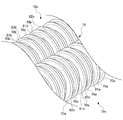
- FIG. 1 It is sectional drawing explaining the structure of the cutting device 1 for noodle making of 1st Embodiment. It is the perspective view which looked at the cutting device 1 for noodle making shown in FIG. 1 from the downward direction. It is a top view explaining the 1st cutting blade roll 10a and the 2nd cutting blade roll 10b. It is the elements on larger scale of the 1st cutting blade roll 10a and the 2nd cutting blade roll 10b. It is a figure explaining the meshing state of the 1st cutting blade roll 10a and the 2nd cutting blade roll 10b. It is a perspective view explaining arrangement of the 1st scrape 30a and the 2nd scrape 40a.
- FIG. 8A It is a figure explaining arrangement of the 1st tooth group 36a in the 1st scrape 30a. It is a figure explaining arrangement of the 2nd tooth group 37a in the 1st scrape 30a. It is a figure explaining arrangement
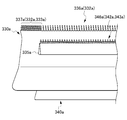
- 3 is a perspective view showing a partition member 100. FIG. It is the perspective view which looked at the state where partition member 100 was equipped from the bottom.
- FIG. 13A It is a bottom view which shows the 1st scrape 330a and the 2nd scrape 340a in 3rd Embodiment. It is the elements on larger scale of FIG. 14A. It is sectional drawing explaining the structure of the cutting device 401 for noodle making of 4th Embodiment.
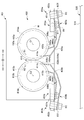
- FIG. 1 is a cross-sectional view illustrating the structure of a noodle cutting device 1 according to the first embodiment.
- FIG. 2 is a perspective view of the noodle making cutting device 1 shown in FIG. 1 viewed from below.
- FIG. 3 is a plan view illustrating the first cutting blade roll 10a and the second cutting blade roll 10b.
- FIG. 4 is a partially enlarged view of the first cutting blade roll 10a and the second cutting blade roll 10b.
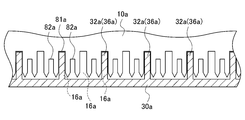
- FIG. 5 is a diagram for explaining the meshing state of the first cutting blade roll 10a and the second cutting blade roll 10b.
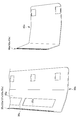
- FIG. 6 is a perspective view for explaining the arrangement of the first scraper 30a and the second scraper 40a.
- FIG. 7 is a perspective view showing a state in which the first scraper 30a and the second scraper 40a are separated.
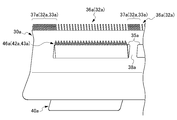
- FIG. 8A is a diagram illustrating the arrangement of teeth in the first scraper 30a and the second scraper 40a.
- FIG. 8B is a partially enlarged view of FIG. 8A.
- FIG. 9A is a diagram illustrating the arrangement of the first tooth group 36a in the first scraper 30a.
- FIG. 9B is a diagram illustrating the arrangement of the second tooth group 37a in the first scraper 30a.
- FIG. 9C is a diagram illustrating the arrangement of teeth in the second scraper 40a.
- FIG. 10 is a perspective view showing the partition member 100.
- FIG. 11 is a perspective view of the state in which the partition member 100 is mounted as viewed from below.
- FIG. 12 is a diagram illustrating a state in which a plurality of raw noodle strings 3 are cut out in the noodle making cutting device 1 according to the first embodiment.
- the noodle making cutting device 1 according to the first embodiment is a device that cuts the noodle band 2 to form a plurality of raw noodle strings 3.
- the cutting device 1 for noodle making according to the first embodiment is an example of a round blade type device having a round blade cutting blade roll (a cutting blade roll having a substantially circular cross section of the cut noodle strings).
- the noodle making cutting device 1 includes a housing 50, a first cutting blade roll 10a, a second cutting blade roll 10b, and a first scraper 30a.
- the second scraper 40a, the third scraper 30b, and the fourth scraper 40b are provided.
- the housing 50 includes a first rectangular frame 56 (see FIG. 3), a second rectangular frame 57 (see FIG. 3), a first horizontal member 51a, a second horizontal member 52a, and a third horizontal member. 51b and a fourth horizontal member 52b.
- the casing 50 is a rod-like or plate-like (block-like) member extending in the axial direction of the first rotation axis C1 of the first cutting blade roll 10a and the second rotation axis C2 of the second cutting blade roll 10b, A rod-like or plate-like (block-like) member (not shown) that extends in a direction orthogonal to the axial direction of the rotation axis C1 and the second rotation axis C2 is provided.
- the first rectangular frame 56 and the second rectangular frame 57 include two pairs of through holes (not shown) through which the shaft members of the first cutting blade roll 10a and the second cutting blade roll 10b are inserted.
- the first cutting blade roll 10a and the second cutting blade roll 10b are rotatably supported by the two pairs of through holes.
- the 1st horizontal member 51a, the 2nd horizontal member 52a, the 3rd horizontal member 51b, and the 4th horizontal member 52b are the rod shape or plate shape extended in the axial direction of the 1st rotating shaft C1 and the 2nd rotating shaft C2 ( It consists of a block-like member.
- the first scraper 30a, the second scraper 40a, the third scraper 30b, and the fourth scraper 40b are respectively connected to the first horizontal member 51a, the second horizontal member 52a, the third horizontal member 51b, and the fourth horizontal member 52b. It is attached.
- a transport conveyor 500 is disposed below the housing 50.
- the first cutting blade roll 10a is configured to be rotatable in the first rotation direction R1 around the first rotation axis C1.
- the first cutting edge roll 10a includes a plurality of first pushing portions (a portion having a narrow groove (shallow groove) in the case of round teeth) 15a formed in the circumferential direction and a plurality of first pushing portions 15a. And a plurality of first insertion portions (a portion having a thick groove (deep groove) in the case of a round tooth) 16a formed between each other.
- the plurality of first pushing portions 15a and the plurality of first insertion portions 16a are formed so as to be alternately arranged in the axial direction of the first rotation axis C1.
- the first cutting blade roll 10a is formed with a plurality of blade portions 70a formed in the circumferential direction, a plurality of thick grooves 81a, and a plurality of fine grooves 82a.
- the thick groove 81a is formed between the predetermined blade part 70a and the blade part 70a adjacent on one side.
- the narrow groove 82a is formed between the predetermined blade part 70a and the adjacent blade part 70a on the other side.
- the blade portion 70a is formed on the inclined portion 71a formed on one side (left side in FIG. 5) of the tip side and on the other side (right side in FIG. 5) of the blade portion 70a.
- the plurality of thick grooves 81a and the plurality of narrow grooves 82a are formed so as to be alternately arranged in the axial direction of the first rotation axis C1.
- the 1st pushing part 15a is comprised by the narrow groove
- the 1st insertion part 16a is comprised by the thick groove
- the plurality of first pushing portions 15a are formed at predetermined intervals in the axial direction of the first rotation axis C1.
- Each of the plurality of first pushing portions 15a is formed between the plurality of first insertion portions 16a. That is, the 1st pushing part 15a and the 1st insertion part 16a are alternately formed continuously in the axial direction of the 1st rotating shaft C1.
- the second cutting blade roll 10b rotates about a second rotation axis C2 parallel to the first rotation axis C1 in a second rotation direction R2 opposite to the first rotation direction R1.
- the second cutting blade roll 10b has a plurality of second pressing portions 15b formed in the circumferential direction, and a plurality of second insertion portions 16b formed between the plurality of second pressing portions 15b, respectively.
- the plurality of second pushing portions 15b and the plurality of second fitting portions 16b are formed so as to be alternately arranged in the axial direction of the second rotation axis C2.
- the second cutting blade roll 10b is formed with a plurality of blade portions 70b formed in the circumferential direction, a plurality of thick grooves 81b, and a plurality of narrow grooves 82b.
- the thick groove 81b is formed between the predetermined blade part 70b and the blade part 70b adjacent on one side.
- the narrow groove 82b is formed between the predetermined blade part 70b and the adjacent blade part 70b on the other side.
- the blade portion 70 b is formed on the inclined portion 71 b formed on one side (right side in FIG. 5) on the tip side and on the other side (left side in FIG. 5) of the blade portion 70 b. And an inclined portion 72b.
- the plurality of thick grooves 81b and the plurality of narrow grooves 82b are formed so as to be alternately arranged in the axial direction of the second rotation axis C2.
- the 2nd pushing part 15b is comprised by the narrow groove
- the 2nd insertion part 16b is comprised by the thick groove
- the plurality of second pushing portions 15b are formed at predetermined intervals in the axial direction of the second rotation axis C2.
- Each of the plurality of second push-in portions 15b is formed between the plurality of second insertion portions 16b. That is, the 2nd pushing part 15b and the 2nd insertion part 16b are alternately formed continuously in the axial direction of the 2nd rotating shaft C2.
- the second cutting blade roll 10 b is disposed so as to mesh with the first cutting blade roll 10 a at a predetermined meshing position 10.
- the meshing position 10 is formed on a plane H including the first rotation axis C1 and the second rotation axis C2.
- each of the plurality of first pushing portions 15a in the first cutting blade roll 10a and each of the plurality of second insertion portions 16b in the second cutting blade roll 10b are as follows: It is in a meshed state. Moreover, in the meshing position 10, each of the plurality of second pressing portions 15b in the second cutting blade roll 10b and each of the plurality of first insertion portions 16a in the first cutting blade roll 10a are in a meshed state.
- the inclined portions of the plurality of blade portions 70a in the first cutting blade roll 10a and the inclined portions of the plurality of blade portions 70b in the second cutting blade roll 10b are close to or in contact with each other. It will be in the state.
- the blade part 70a and the blade part 70b are meshed with each other.
- the narrow groove in the second cutting blade roll 10b with respect to the inclined part inside the blade parts 70a, 70a on both sides constituting the thick groove 81a in the first cutting blade roll 10a The inclined portions on the outer sides of the blade portions 70b on both sides constituting the 82b are in contact with each other.
- the inclined portions on the outer side of the blade portions 70a on both sides constituting the narrow groove 82a are in contact with each other.
- the noodle band 2 (see FIG. 12) is sheared (sheared) into the plurality of raw noodle strings 3 as shown in FIG. Specifically, the noodle band 2 is sheared and formed into a plurality of raw noodle strings 3. The formed raw noodle strings 3 are pushed into the second insertion portion 16b of the second cutting blade roll 10b by the first pushing portion 15a of the first cutting blade roll 10a. The formed raw noodle strings 3 are pushed into the first insertion portion 16a of the first cutting blade roll 10a by the second pushing portion 15b of the second cutting blade roll 10b.
- the raw noodle strings 3 pushed into the respective insertion portions 16b, 16a are formed in a circular shape or a shape close to a circular shape. And the raw noodle strings 3 pushed into each insertion part are scraped out by each scrape mentioned later.
- the one-side inclined portions 71a and 71b formed at the tips of the blade portions 70a and 70b and the other-side inclined portions 72a and 72b are described as having the same angle.
- the present invention is not limited to this.
- the two inclined portions may be configured to have different angles. For example, it is also possible to increase the angle of the inclined parts constituting the pushing parts 15a and 15b (relax the inclination) and reduce the angle of the inclined parts forming the fitting parts 16a and 16b (make the inclination sharp). In this case, since the angle of the two inclined parts constituting the pushing parts 15a and 15b is increased, the raw noodle strings 3 (formed by cutting the noodle band 2) can be suitably pushed into the fitting parts 16b and 16a. it can.
- the first scraper 30a and the second scraper 40a are provided corresponding to the first cutting blade roll 10a.
- the third scraper 30b and the fourth scraper 40b are provided corresponding to the second cutting blade roll 10b.
- Each scrap is attached to the housing 50 so that the angle (contact angle) formed between the tangent to the cutting blade roll into which the tooth tip is inserted and the tooth tip is in the range of about 10 ° to 60 °. Further, in this range, it is preferable that the position of the scrape is appropriately set at a position where the noodle strings are easily scraped and the tooth tip of the scrape is not worn down as much as possible.
- the arrangement and shape of the third scraper 30b and the fourth scraper 40b corresponding to the second cutting blade roll 10b are the arrangement and shape of the first scraper 30a and the second scraper 40a corresponding to the first cutting blade roll 10a, respectively.
- the description regarding the first scraper 30a and the description regarding the second scraper 40a are obtained by replacing “a” at the end of the code with “b” (for example, replacing “32a” with “32b”), respectively. This is used to describe the scraper 30b and the fourth scraper 40b.
- each scraper 30a, 40a, 30b, 40b is formed of a plate-like member having a substantially rectangular shape, and one or a plurality (in this embodiment, 2). A substantially arcuate shape that is bent at a bending line.
- the first scraper 30a includes a first tooth group 36a and a second tooth group 37a at one end thereof.
- the first tooth group 36a includes a plurality of first scraped teeth 32a.
- the plurality of first scraping teeth 32a are inserted and arranged in every other first insertion portion 16a in the axial direction of the first rotation axis C1.
- the second tooth group 37a is formed by alternately arranging a plurality of first scraping teeth 32a and first cleaning teeth 33a.
- the first scraping teeth 32a are inserted and arranged in the first insertion portions 16a in the axial direction of the first rotation axis C1.
- the 1st cleaning tooth 33a is inserted in the narrow groove 82a which comprises the 1st pushing part 15a.
- the first tooth group 36a is disposed at a position corresponding to the first passage hole 35a (second scraper 40a).
- the second tooth group 37a is arranged at a position (including the beam-shaped piece 38a) that does not correspond to the first passage hole 35a. That is, the first tooth group 36a and the second tooth group 37a are alternately arranged in the axial direction of the first rotation axis C1.
- each of the plurality of first scraping teeth 32a and the second scraping teeth 42a described later is “intruded into each of the plurality of first insertion portions 16a (thick grooves 81a) and in close contact with the inner surface of the first insertion portion 16a.
- the 1st cleaning tooth 33a and the 2nd cleaning tooth 43a mentioned below are teeth for taking out the cutting waste which entered into the narrow slot which constitutes a pushing part, and are not the teeth for scraping out noodle strings.
- the first scraper 30a has a plurality of (three in the present embodiment) first passage holes 35a.
- the first passage hole 35a passes the raw noodle strings 3 scraped and dropped from each of the plurality of first insertion portions 16a by the plurality of second scraping teeth 42a of the second scraper 40a to the lower side of the first scraper 30a. It is a hole provided in order to make it.
- the first passage hole 35a is a hole through which the second scraper 40a is inserted.
- the second scraper 40a includes a third tooth group 46a at one end thereof.
- the third tooth group 46 a is formed by arranging a plurality of second scraping teeth 42 a and second cleaning teeth 43 a in a state where the first scraper 30 a and the second scraper 40 a are attached to the housing 50.
- the second scraping teeth 42a are inserted and arranged in the remaining first insertion portions 16a in which the plurality of first scraping teeth 32a in the first scraper 30a are not inserted and arranged.
- the 2nd cleaning tooth 43a is inserted in the narrow groove 82a which comprises the 1st pushing part 15a.
- the first scraped teeth 32a and the second scraped teeth 42a are arranged so that the first scraped teeth 32a of the first scraper 30a and the second scraped teeth 42a of the second scraper 40a are inserted and arranged in the same first insertion portion 16a. May be provided.
- the first insertion portion 16a has either one of the first scraping teeth 32a or the second scraping teeth 42a. It does not scrape the noodle strings, but functions as cleaning teeth (cleaning teeth) for cutting waste remaining in the thick grooves.
- the arrangement of the scraped teeth and the cleaning teeth is not particularly limited as long as the noodle strings can be scraped and the scraped scraps can be cleaned.
- the first scraper 30a is fixed at a first fixing position 53a in the housing 50.
- the 1st fixed position 53a in this embodiment is the 1st horizontal member 51a.
- the second scraper 40 a is fixed at a second fixing position 54 a in the housing 50.
- the second fixed position 54a in the present embodiment is the second horizontal member 52a.
- the second horizontal member 52 a is disposed on the outer side HX in the horizontal direction than the meshing position 10.
- the “outside in the horizontal direction” refers to a direction away from the meshing position 10 in the horizontal direction H orthogonal to the first rotation axis C1 and the second rotation axis C2.
- the first scraper 30a is fixed to the first horizontal member 51a by a fixing bolt B1.
- a washer member B11 is interposed between the first horizontal member 51a and the fixing bolt B1.
- the second scraper 40a is fixed to the second horizontal member 52a with a fixing bolt B2.
- a washer member B21 is interposed between the second horizontal member 52a and the fixing bolt B2.
- the first fixed position 53a is located on the outer side HX in the horizontal direction from the position of the second tooth tip 44a of the second scraping tooth 42a. In the horizontal direction H, the distance from the position of the second tooth tip 44a of the second scraping tooth 42a to the first fixed position 53a was scraped from the first cutting blade roll 10a by the second scraping tooth 42a of the second scraper 40a. It is set as appropriate based on the trajectory of the noodle strings moving.
- the first fixed position 53a is located below the first cutting blade roll 10a.
- a plurality (three in this embodiment) of second scrapers 40a are arranged along the first rotation axis C1.
- the first passage holes 35a correspond to the plurality of (three in the present embodiment) second scrapers 40a, and a plurality (three in the present embodiment) along the first rotation axis C1.
- a beam-shaped piece 38a is provided between the first passage holes 35a and 35a adjacent to each other along the first rotation axis C1.
- the second fixed position 54a is located on the outer side HX in the horizontal direction than the first fixed position 53a.
- the second scraper 40a is farther from the first cutting blade roll 10a than the first scraper 30a at the second fixed position 54a.
- the second scraping tooth 42a side of the second scraper 40a extends from the opposite side of the first scraper 30a to the first cutting blade roll 10a side through the first passage hole 35a. It extends. That is, the second scraper 40a intersects the first scraper 30a via the first passage hole 35. Further, the second scraper 40a passes through a position in the vicinity of the edge of the horizontal outside HX in the first passage hole 35a. Thereby, the opening area of the 1st passage hole 35a can be ensured to the maximum.
- each of the plurality of first tooth tips 34a which is the tooth tip of each of the plurality of first scraped teeth 32a, starts from the meshing position 10 around the first rotation axis C1. It is arranged at a position (11a) of 5 ° to 90 °, preferably 30 ° to 60 ° in one rotation direction R1.
- each of the plurality of second tooth tips 44a which are the tooth tips of each of the plurality of second scraping teeth 42a, is moved from the meshing position 10 to the first rotation direction R1 about the first rotation axis C1. It is arranged at a position (12a) of 30 ° to 90 °, preferably 45 ° to 60 °.
- the second scraper 40a is disposed such that the position 12a of the second tooth tip 44a is separated from the position 11a of the first tooth tip 34a by 30 ° or more in the first rotation direction R1 around the first rotation axis C1.
- the tooth tip position is a position facing the tooth tip on the bottom surface of each insertion portion.
- the description regarding the first scraper 30a and the second scraper 40a is incorporated in the description of the third scraper 30b and the fourth scraper 40b, respectively, but the main configuration of the third scraper 30b and the fourth scraper 40b. This will be described below.
- the third scraper 30b and the fourth scraper 40b are arranged with respect to the second cutting blade roll 10b in the same positional relationship as the first scraper 30a and the second scraper 40a.
- the rotation axis is the second rotation axis C2
- the rotation direction is the second rotation direction R2.
- the third scraper 30b has a second passage hole 35b.
- the second passage hole 35b passes the raw noodle strings 3 scraped and dropped from each of the plurality of second insertion portions 16b by the plurality of fourth scraping teeth 42b of the fourth scraper 40b to the lower side of the third scraper 30b. It is a hole provided in order to make it.
- a plurality of (three) fourth scrapers 40b are arranged along the second rotation axis C2.
- a plurality (three) of second passage holes 35b are provided along the second rotation axis C2 corresponding to the plurality of fourth scrapers 40b.
- the second passage holes 35b, 35b adjacent to each other along the second rotation axis C2 are discontinuous.
- the third fixed position 53b is located on the outer side HX in the horizontal direction with respect to the position of the fourth tooth tip 44b of the fourth scraping tooth 42b.
- the fourth fixed position 54b is located below the second cutting blade roll 10b.
- the fourth fixed position 54b is located on the outer side HX in the horizontal direction than the third fixed position 53b.
- the fourth scraper 40b is farther from the second cutting blade roll 10b than the third scraper 30b at the fourth fixed position 54b.
- the fourth scraping tooth 42b side of the fourth scraper 40b extends from the opposite side of the third scraper 30b from the second cutting blade roll 10b to the second cutting blade roll 10b side via the second passage hole 35b. Yes.
- the fourth scraper 40b passes through a position in the vicinity of the edge of the horizontal outside HX in the second passage hole 35b.
- the partition member 100 is used to partition the noodle strings 3 cut by the two cutting blade rolls 10a and 10b and scraped by the scrapers 30a, 40a, 30b, and 40b into a predetermined width (amount). More specifically, as shown in FIG. 10, the partition member 100 fixes a plurality of partition plates 110 arranged in parallel, a connection member 120 that connects the plurality of partition plates 110, and the connection member 120 to the housing 50. A partition fixing member 130.
- the plurality of partition plates 110 are arranged so as to be orthogonal to both the rotation axes C1 and C2.
- a plurality of partition plates 110 divide the space below the casing 50, particularly the spaces below the scrapers 30a, 40a, 30b, and 40b, into a plurality of spaces 150 that are arranged along both rotation axes C1 and C2. be able to.
- the noodle strings 3 scraped by the scrapes can be partitioned into a predetermined width (amount).
- the operation of the noodle making cutting device 1 will be described with reference to FIG. As shown in FIG. 12, the noodle band 2 put into the meshing position 10 of the first cutting blade roll 10 a and the second cutting blade roll 10 b in the noodle making cutting device 1 is sheared (cut) at the meshing position 10. As a result, a plurality of raw noodle strings 3 are formed.
- the plurality of raw noodle strings 3 formed by shearing (cutting) are inserted into the plurality of first insertion portions 16a in the first cutting blade roll 10a and the plurality of second insertion portions 16b in the second cutting blade roll 10b. Is done.
- the first cutting blade roll 10a in which the plurality of raw noodle strings 3 are inserted into the first insertion portion 16a is rotated in the first rotation direction R1 about the first rotation axis C1.
- a portion of the raw noodle strings 3 that has been rotationally moved along with the rotation of the first cutting blade roll 10a is first scraped out by the first scraper 30a.
- the raw noodle strings 3 scraped out by the first scraper 30a hang down substantially vertically downward and fall onto the transport conveyor 500 via the space between the first scraper 30a and the third scraper 30b.
- the remaining raw noodle strings 3 that have been rotationally moved with the further rotation of the first cutting blade roll 10a are scraped out by the second scraper 40a.
- the raw noodle strings 3 scraped out by the second scraper 40a hang down substantially vertically downward, pass through the first passage hole 35a of the first scraper 30a, and drop onto the conveyor 500.
- the second cutting blade roll 10b in which the plurality of raw noodle strings 3 are inserted into the second insertion portion 16b is rotated in the second rotation direction R2 around the second rotation axis C2.
- a portion of the raw noodle strings 3 that has been rotationally moved along with the rotation of the second cutting blade roll 10b is first scraped out by the third scraper 30b.
- the raw noodle strings 3 scraped out by the third scraper 30b hang down substantially vertically downward and fall onto the transport conveyor 500 through the space between the first scraper 30a and the third scraper 30b.
- the remaining raw noodle strings 3 that have been rotationally moved with the further rotation of the second cutting blade roll 10b are scraped out by the fourth scraper 40b.
- the raw noodle strings 3 scraped by the fourth scraper 40b hang down substantially vertically downward, pass through the second passage hole 35b of the third scraper 30b, and drop onto the conveyor 500.
- a plurality of raw noodle strings 3 formed by the noodle making cutting device 1 are cut out on a belt 510 (to be described later) in the conveyor 500.
- the raw noodle strings 3 scraped by the first scraper 30a, the second scraper 40a, the third scraper 30b, and the fourth scraper 40b are layered downward in the order of scraping. It is placed on the belt 510 and is transported in a state where it generally overlaps four layers. The plurality of raw noodle strings 3 cut out are transported to a subsequent process as the belt 510 moves.
- the noodle strip formation process which rolls noodle dough and forms a noodle strip is mentioned, for example.
- the post-process include a steaming process for raw noodle strings, a process for cooling steamed noodle strings, a process for stretching noodle strings, a process for cutting noodle strings in the length direction, a process for drying noodles, and a process for packaging noodles. It is done.
- the first fixing position 53a of the first scraper 30a is located on the outer side HX in the horizontal direction with respect to the position of the second tooth tip 44a of the second scraping tooth 42a.
- the third fixed position 53b of the third scraper 30b is located on the outer side HX in the horizontal direction with respect to the position of the fourth tooth tip 44b of the fourth scraping tooth 42b.
- the first scraper 30a has the first passage hole 35a.
- the third scraper 30b has a second passage hole 35b. Therefore, the raw noodle strings 3 scraped and dropped from each of the plurality of first insertion portions 16a by the plurality of second scraping teeth 42a of the second scraper 40a can be passed to the lower side of the first scraper 30a. Moreover, the raw noodle strings 3 scraped and dropped from each of the plurality of second insertion portions 16b by the plurality of fourth scraping teeth 42b of the fourth scraper 40b can be passed to the lower side of the third scraper.
- the second scraper 40a intersects the first scraper 30a via the first passage hole 35a, and the fourth scraper 40b It intersects with the third scraper 30b via the two passage holes 35b.
- the wear of the tooth tip is large due to the influence of the angle (contact angle) formed between the tangent to the cutting blade roll into which the tooth tip of the scrap is inserted and the tooth tip.
- 40b can be replaced without removing the first scraper 30a and the third scraper 30b, which are less frequently replaced. For this reason, it is possible to improve the efficiency of maintenance work related to replacement of scraps.
- first scraper 30a in the first embodiment is referred to as “first scraper 230a” in the second embodiment.
- the description about the first embodiment is appropriately applied to points that are not particularly described in other embodiments. Also in other embodiments, the same effects as in the first embodiment can be obtained.
- FIG. 13A is a bottom view showing the first scraper 230a and the second scraper 240a in the second embodiment.
- FIG. 13B is a partially enlarged view of FIG. 13A.
- the noodle making cutting device of the second embodiment is mainly composed of one first passage hole 235a, as compared with the noodle making cutting device 1 of the first embodiment.
- the number of the second scrapes 240a arranged in is different.
- one first passage hole 235a is provided in one first scraper 230a. Accordingly, the first scraper 230a does not include the beam-like piece 38a in the first embodiment. Further, the first scraper 230a does not include the second tooth group 37a provided corresponding to the beam-like piece 38a.
- the length of the 1st passage hole 235a in a 2nd embodiment is about 3 times the length of the 1st passage hole 35a in a 1st embodiment, for example.
- three second scrapers 240a are arranged with respect to the first passage hole 235a of one first scraper 230a.
- the three second scrapers 40a are arranged with substantially no gap in the axial direction of the first rotation axis C1.
- the first scraping is performed as in the first embodiment. It is not necessary to provide the second tooth group 37a in which the teeth 32a and the first cleaning teeth 33a are alternately arranged at a position corresponding to the beam-shaped piece 38a. Therefore, the occurrence of binding of noodle strings can be suppressed as compared with the first embodiment in which binding of noodle strings is likely to occur in the second tooth group 37a.
- the three second scrapers 240a are arranged with respect to the first passage holes 235a of the one first scraper 230a, for example, when one second scraper 240a is damaged, one damaged one It is sufficient to replace only the second scraper 240a, and the second scraper 240a can be replaced efficiently.
- FIG. 14A is a bottom view showing the first scraper 330a and the second scraper 340a in the third embodiment.
- 14B is a partially enlarged view of FIG. 14A.
- the noodle making cutting device of the third embodiment is mainly 1 in one first scraper 330 a as compared with the noodle making cutting device of the second embodiment.
- a difference is that one first passage hole 335a is provided, and one second scraper 340a is arranged in one first passage hole 335a.
- one first passage hole 335a is provided in one first scraper 330a, as in the second embodiment.
- the length of the 1st passage hole 335a in 3rd Embodiment is about 3 times the length of the 1st passage hole 35a in 1st Embodiment, for example.
- one second scraper 340a is inserted into the first passage hole 335a of one first scraper 330a.
- the length of the second scraper 340a in the third embodiment is, for example, about three times the length of the second scraper 40a in the first embodiment. According to the third embodiment, the number of scrapes can be suppressed.
- FIG. 15 is a cross-sectional view illustrating the structure of the noodle making cutting device 401 according to the fourth embodiment.
- FIG. 16 is a diagram illustrating a state where a plurality of raw noodle strings 3 are cut out in the noodle making cutting device 401 according to the fourth embodiment.
- the noodle making cutting device 401 of the fourth embodiment is mainly configured so that the second scraper 440 a is different from the first scraper 430 a in comparison with the noodle making cutting device 1 of the first embodiment. The difference is that the first passage hole 435a is not inserted and the fourth scraper 440b is not inserted through the second passage hole 435b of the third scraper 430b.
- the second fixed position 454a is located on the outer side HX in the horizontal direction than the first fixed position 453a.
- the second scraper 440a is closer to the first cutting blade roll 410a than the first scraper 430a at the second fixed position 454a. Therefore, the second scraper 440a is positioned closer to the first cutting blade roll 410a than the first scraper 430a without inserting the first passage hole 435a of the first scraper 430a.
- the fourth fixed position 454b is located on the outer side HX in the horizontal direction than the third fixed position 453b.
- the fourth scraper 440b is closer to the second cutting blade roll 410b than the third scraper 430b at the fourth fixed position 454b. Therefore, the fourth scraper 440b is positioned closer to the second cutting blade roll 410b than the third scraper 430b without inserting the second passage hole 435b of the third scraper 430b.
- the first passage hole 435a of the first scraper 430a is scraped and dropped from each of the plurality of first insertion portions 416a by the plurality of second scraping teeth 442a of the second scraper 440a. It is provided only for passing the raw noodle string 3 to the lower side of the first scraper 430a.
- the second passage hole 435b of the third scraper 430b passes the raw noodle strings 3 that are scraped and dropped from each of the plurality of second insertion portions 416b by the plurality of second scraping teeth 442b of the fourth scraper 440b. It is provided only for passing through the lower side of the three scrapers 430b.
- the noodle making cutting device 401 mainly includes the arrangement relationship between the first scraper 430a and the second scraper 440a and the third scraper 430b and the fourth scraper. Except for the point that the arrangement relationship with 440b is different, it operates in the same manner as the noodle making cutting device 1 of the first embodiment.
- the noodle making cutting device of each of the above-described embodiments is a round blade type device in which the cut surface of the noodle strings is substantially circular, but is not limited thereto.
- the noodle making cutting device of the present invention can be applied to, for example, a square blade type, a knife blade type, and other types of devices having a square cross section.
- FIG. 17A is a diagram illustrating the arrangement of the first scraping teeth 632a in the first scraper 630a in the cutting blade roll of a square blade.
- FIG. 17B is a diagram illustrating the arrangement of the second scraping teeth 642a in the second scraper 640a in the cutting blade roll of a square blade.
- the square-tooth type cutting blade roll 610a has convex portions (ridges) and concave portions (grooves) having a rectangular cross section alternately in the direction of the rotation axis (not shown). Formed.
- the portion corresponding to the pushing portion 15a (the portion including the narrow groove) of the noodle making cutting device 1 (round blade type) of the first embodiment described above is a convex portion 615a.
- a portion corresponding to the fitting portion (a portion including the thick groove) 16a is a concave portion 616a.
- the push-in part does not have a narrow groove in the round blade type. For this reason, each scrape does not have the cleaning teeth of the narrow groove portion, and has only the scraped teeth 632a and 642a.
- the cross section of the cutting blade roll 610a in the direction perpendicular to the rotation axis is substantially the same as the cross section shown in FIG. 1 relating to the round blade type noodle making cutting device 1.
- the square tooth type noodle making cutting device is configured such that the first cutting blade roll and the second cutting blade roll mesh with each other at the meshing position, and the pushing portion (convex portion). 615a) pushes a thin noodle band into the mating part (recess 616a) of the counterpart roll and shears it into a line to form a noodle string.
- the noodle band (noodle string) pushed into the fitting portion (recess 616a) is disposed with respect to the first scraper 630a and the second scraper 640a disposed with respect to the first cutting blade roll 610a, and the second cutting blade roll.
- the scraped teeth of the third and fourth scraped pieces are scraped and cut out.
- the scraping teeth 632a of the first scraper 630a are inserted and arranged every other in the direction of the first rotating shaft (not shown) in the fitting portion (recess 616a) of the first cutting blade roll 610a. Further, the scraping teeth 642a of the second scraper 640a are inserted and disposed in the insertion portion (recessed portion 616a) where the scraping teeth 632a are not inserted.
- the noodle strings are scraped in the order of the first scraper 630a and the second scraper 640a in accordance with the rotation of the first cutting blade roll 610a. It is scraped by 632a and 642a, and cut out separately. Also in the second cutting blade roll, the noodle strings are similarly divided and cut out by the third and fourth scrapers. And after that, it is the same as that of the case of the above-mentioned round blade.
- the structure As for the scraping teeth 642a of the second scraper 640a (fourth scraper), as in the case of the round blade, the structure (indicated by the broken line portion in FIG. 17B) is inserted and disposed in all the fitting portions (recesses 616a). It is good also as a structure which has the tooth
- the cutting device for noodle making according to the present invention is most effectively used for steamed noodles that are easily bound and firmly bound, and instant noodles obtained by drying steamed noodles. It can be preferably used. For example, even in the case of raw noodles, it binds if it is not dusted enough, and even in the case of boiled noodles, when boiled while being transported as a continuous noodle string, adjacent noodle strings are bound together In such a case, the noodle cutting device of the present invention is effective.
- the 1st cutting blade roll 10a is arrange
- the 2nd cutting blade roll 10b is arrange
- the 1st cutting blade roll 10a may be arrange
- the 2nd cutting blade roll 10b may be arrange
- the 1st cutting blade roll 10a and the 2nd cutting blade roll 10b are arranged horizontally in the above-mentioned 1st Embodiment, it is not restricted to this, For example, the plane which connects the rotating shaft of both rolls You may arrange in H in the state which inclined about 45 degrees or less with respect to the horizontal direction.
- the positions of the scrapes are arranged symmetrically with respect to the first cutting blade roll 10a and the second cutting blade roll 10b in a plane perpendicular to the rotation axis of the both cutting blade rolls.
- it does not have to be arranged symmetrically.
- the tooth tips of the first scraper 30a and the tooth tips of the third scraper 30b may be arranged at different angles from the meshing position 10, respectively.
- the tooth tips of the second scraper 40a and the tooth tips of the fourth scraper 40b may be arranged at different angles from the meshing position 10, respectively.
Landscapes
- Life Sciences & Earth Sciences (AREA)
- Engineering & Computer Science (AREA)
- Forests & Forestry (AREA)
- Mechanical Engineering (AREA)
- Food Science & Technology (AREA)
- Manufacturing And Processing Devices For Dough (AREA)
- Noodles (AREA)
- Crushing And Pulverization Processes (AREA)
Abstract
Priority Applications (7)
| Application Number | Priority Date | Filing Date | Title |
|---|---|---|---|
| HK11106944.1A HK1152842B (zh) | 2009-06-16 | 2009-10-29 | 切面装置 |
| KR1020117003392A KR101247096B1 (ko) | 2009-06-16 | 2009-10-29 | 제면용 절출장치 |
| EP09846128.8A EP2314168B1 (fr) | 2009-06-16 | 2009-10-29 | Dispositif de découpe utilisable pour la fabrication de nouilles |
| CN200980000571.2A CN102083318B (zh) | 2009-06-16 | 2009-10-29 | 切面装置 |
| BRPI0912442-0A BRPI0912442B1 (pt) | 2009-06-16 | 2009-10-29 | aparelhagem para corte de noodle |
| MX2011001776A MX2011001776A (es) | 2009-06-16 | 2009-10-29 | Aparato para cortar tallarines. |
| US13/058,089 US9867380B2 (en) | 2009-06-16 | 2009-10-29 | Apparatus for cutting out noodle |
Applications Claiming Priority (2)
| Application Number | Priority Date | Filing Date | Title |
|---|---|---|---|
| JP2009143020A JP4438018B1 (ja) | 2009-06-16 | 2009-06-16 | 製麺用切出装置 |
| JP2009-143020 | 2009-06-16 |
Publications (1)
| Publication Number | Publication Date |
|---|---|
| WO2010146635A1 true WO2010146635A1 (fr) | 2010-12-23 |
Family
ID=42193850
Family Applications (1)
| Application Number | Title | Priority Date | Filing Date |
|---|---|---|---|
| PCT/JP2009/005731 Ceased WO2010146635A1 (fr) | 2009-06-16 | 2009-10-29 | Dispositif de découpe utilisable pour la fabrication de nouilles |
Country Status (11)
| Country | Link |
|---|---|
| US (1) | US9867380B2 (fr) |
| EP (1) | EP2314168B1 (fr) |
| JP (1) | JP4438018B1 (fr) |
| KR (1) | KR101247096B1 (fr) |
| CN (1) | CN102083318B (fr) |
| BR (1) | BRPI0912442B1 (fr) |
| HU (1) | HUE028197T2 (fr) |
| MX (1) | MX2011001776A (fr) |
| RU (1) | RU2459412C1 (fr) |
| TW (1) | TWI414240B (fr) |
| WO (1) | WO2010146635A1 (fr) |
Cited By (2)
| Publication number | Priority date | Publication date | Assignee | Title |
|---|---|---|---|---|
| US20130202765A1 (en) * | 2012-02-07 | 2013-08-08 | Sanyo Foods Co., Ltd. | Noodles and apparatus for processing the same |
| WO2015068402A1 (fr) * | 2013-11-08 | 2015-05-14 | 日清食品ホールディングス株式会社 | Machine de coupe de nouilles et nouilles crues |
Families Citing this family (17)
| Publication number | Priority date | Publication date | Assignee | Title |
|---|---|---|---|---|
| CN103210968A (zh) * | 2012-01-20 | 2013-07-24 | 顶益(开曼岛)控股有限公司 | 面梳及包括该面梳的切丝装置 |
| CN103843848A (zh) * | 2012-11-29 | 2014-06-11 | 顶益(开曼岛)控股有限公司 | 面梳及包括该面梳的切丝装置 |
| AT514351B1 (de) * | 2013-05-17 | 2015-02-15 | Haas Food Equipment Gmbh | Walzenanordnung umfassend einen Abstreifer |
| CN103598276A (zh) * | 2013-10-21 | 2014-02-26 | 尚宝泰机械科技(昆山)有限公司 | 一种面条错齿切丝刀具 |
| KR101462833B1 (ko) * | 2014-05-07 | 2014-11-21 | 오종찬 | 입체 면발 커터기 |
| DE102014016920A1 (de) * | 2014-11-17 | 2016-05-19 | Giesecke & Devrient Gmbh | Vorrichtung zum Schreddern von Wertdokumenten |
| CN105325485B (zh) * | 2015-09-21 | 2016-10-26 | 珠海市润星泰电器有限公司 | 一种数控全自动面条机 |
| JP6479128B2 (ja) * | 2017-10-10 | 2019-03-06 | 日清食品株式会社 | 麺線切出し装置および生麺 |
| CN110301463A (zh) * | 2018-03-27 | 2019-10-08 | 新乡县中博机械有限公司 | 一种油条切条机构 |
| CN108651567A (zh) * | 2018-05-03 | 2018-10-16 | 邵振兴 | 一种面坯切条装置 |
| CN108935563A (zh) * | 2018-07-30 | 2018-12-07 | 珠海市洪富食品机械制造有限公司 | 一种手指饼制面机 |
| JP7236238B2 (ja) * | 2018-10-05 | 2023-03-09 | 日清食品株式会社 | 麺線切出装置 |
| CA3165445C (fr) * | 2019-12-23 | 2024-04-02 | Sanyo Foods Co., Ltd. | Dispositif de coupe de fil de nouilles, dispositif de fabrication de nouilles et procede de fabrication de nouilles instantanees |
| EP4082346B1 (fr) * | 2019-12-23 | 2025-08-13 | Sanyo Foods Co., Ltd. | Dispositif de coupe de nouilles, dispositif de production de nouilles, nouilles et procédé de production de nouilles instantanées |
| CN111685139A (zh) * | 2020-07-13 | 2020-09-22 | 上海特英进出口有限公司 | 一种面条机用面梳组件 |
| CN113695015A (zh) * | 2021-08-09 | 2021-11-26 | 景津环保股份有限公司 | 滤饼切条对辊的可调式刮料梳及干燥机滤饼搅碎切条机构 |
| USD1120782S1 (en) * | 2023-08-30 | 2026-03-31 | LaCrosse Technology, Ltd | Wind sensor |
Citations (5)
| Publication number | Priority date | Publication date | Assignee | Title |
|---|---|---|---|---|
| JPS57203787U (fr) | 1981-06-19 | 1982-12-25 | ||
| JPS6328379U (fr) * | 1986-08-08 | 1988-02-24 | ||
| JPS6345903Y2 (fr) * | 1982-11-01 | 1988-11-29 | ||
| JPH0884554A (ja) | 1994-09-16 | 1996-04-02 | Eesukotsuku Kk | 麺線切出し装置 |
| JPH10210924A (ja) | 1997-01-28 | 1998-08-11 | Nisshin Flour Milling Co Ltd | 麺切断ロール用スクレーパ |
Family Cites Families (12)
| Publication number | Priority date | Publication date | Assignee | Title |
|---|---|---|---|---|
| JPS5839554U (ja) * | 1981-09-08 | 1983-03-15 | 株式会社コベルコ科研 | スラグ中の遊離石灰の自動定量装置 |
| US4534251A (en) * | 1982-09-29 | 1985-08-13 | Wilson Michael S | Stripping assembly for noodle cutting machinery |
| JPH0213069Y2 (fr) * | 1985-12-19 | 1990-04-11 | ||
| US4889291A (en) * | 1988-03-04 | 1989-12-26 | Feinwerktechnik Schleicher & Co. | Strip-off device for shedding machines with sheet material grid engaging between shredding disks |
| JPH06178643A (ja) * | 1992-12-11 | 1994-06-28 | Eguchi Menki Seisakusho:Yugen | 切刃ロール装置 |
| RU2061379C1 (ru) * | 1993-05-06 | 1996-06-10 | Государственное предприятие "Ижевский механический завод" | Устройство для формования тестовых заготовок |
| JP3012023U (ja) * | 1994-12-05 | 1995-06-06 | 菅野シマダヤ株式会社 | 製麺用加工装置 |
| RU2147278C1 (ru) * | 1998-11-03 | 2000-04-10 | Общество с ограниченной ответственностью "Реконд" | Инструментальный блок для разрезания тестового листа |
| JP2002127083A (ja) * | 2000-10-24 | 2002-05-08 | Ohland Foods Kk | 麺類製造用回転式切り歯及び麺類の製造方法 |
| JP2006255832A (ja) * | 2005-03-17 | 2006-09-28 | Fujio Shimizu | 製麺機の切断刃ユニット |
| CN2850297Y (zh) * | 2005-12-01 | 2006-12-27 | 常州市墅乐厨具有限公司 | 制面机压面与切面的离合机构 |
| JP5318556B2 (ja) | 2008-12-22 | 2013-10-16 | 株式会社ニッセーデリカ | 麺線切出機 |
-
2009
- 2009-06-16 JP JP2009143020A patent/JP4438018B1/ja active Active
- 2009-10-29 KR KR1020117003392A patent/KR101247096B1/ko active Active
- 2009-10-29 MX MX2011001776A patent/MX2011001776A/es active IP Right Grant
- 2009-10-29 EP EP09846128.8A patent/EP2314168B1/fr active Active
- 2009-10-29 HU HUE09846128A patent/HUE028197T2/en unknown
- 2009-10-29 RU RU2011105424/13A patent/RU2459412C1/ru active
- 2009-10-29 US US13/058,089 patent/US9867380B2/en active Active
- 2009-10-29 BR BRPI0912442-0A patent/BRPI0912442B1/pt active IP Right Grant
- 2009-10-29 WO PCT/JP2009/005731 patent/WO2010146635A1/fr not_active Ceased
- 2009-10-29 CN CN200980000571.2A patent/CN102083318B/zh active Active
-
2010
- 2010-01-15 TW TW99101142A patent/TWI414240B/zh active
Patent Citations (5)
| Publication number | Priority date | Publication date | Assignee | Title |
|---|---|---|---|---|
| JPS57203787U (fr) | 1981-06-19 | 1982-12-25 | ||
| JPS6345903Y2 (fr) * | 1982-11-01 | 1988-11-29 | ||
| JPS6328379U (fr) * | 1986-08-08 | 1988-02-24 | ||
| JPH0884554A (ja) | 1994-09-16 | 1996-04-02 | Eesukotsuku Kk | 麺線切出し装置 |
| JPH10210924A (ja) | 1997-01-28 | 1998-08-11 | Nisshin Flour Milling Co Ltd | 麺切断ロール用スクレーパ |
Non-Patent Citations (1)
| Title |
|---|
| See also references of EP2314168A4 * |
Cited By (4)
| Publication number | Priority date | Publication date | Assignee | Title |
|---|---|---|---|---|
| US20130202765A1 (en) * | 2012-02-07 | 2013-08-08 | Sanyo Foods Co., Ltd. | Noodles and apparatus for processing the same |
| US9004899B2 (en) * | 2012-02-07 | 2015-04-14 | Sanyo Foods Co., Ltd. | Noodles and apparatus for processing the same |
| WO2015068402A1 (fr) * | 2013-11-08 | 2015-05-14 | 日清食品ホールディングス株式会社 | Machine de coupe de nouilles et nouilles crues |
| JP2015092837A (ja) * | 2013-11-08 | 2015-05-18 | 日清食品株式会社 | 麺線切出し装置および生麺 |
Also Published As
| Publication number | Publication date |
|---|---|
| BRPI0912442B1 (pt) | 2019-11-05 |
| JP4438018B1 (ja) | 2010-03-24 |
| HK1152842A1 (zh) | 2012-03-16 |
| CN102083318A (zh) | 2011-06-01 |
| MX2011001776A (es) | 2011-03-25 |
| RU2459412C1 (ru) | 2012-08-27 |
| EP2314168B1 (fr) | 2015-09-02 |
| KR20110031495A (ko) | 2011-03-28 |
| EP2314168A4 (fr) | 2014-05-07 |
| US20110138979A1 (en) | 2011-06-16 |
| US9867380B2 (en) | 2018-01-16 |
| TWI414240B (zh) | 2013-11-11 |
| JP2011000001A (ja) | 2011-01-06 |
| CN102083318B (zh) | 2014-05-14 |
| EP2314168A1 (fr) | 2011-04-27 |
| BRPI0912442A2 (pt) | 2019-01-02 |
| TW201100016A (en) | 2011-01-01 |
| KR101247096B1 (ko) | 2013-03-25 |
| HUE028197T2 (en) | 2016-12-28 |
Similar Documents
| Publication | Publication Date | Title |
|---|---|---|
| JP4438018B1 (ja) | 製麺用切出装置 | |
| JP6242165B2 (ja) | 麺線切出し装置 | |
| JP3746087B2 (ja) | 麺線切出し装置 | |
| JPH10210924A (ja) | 麺切断ロール用スクレーパ | |
| HUE034837T2 (en) | Industrial slicer | |
| JP2016093145A (ja) | 麺線切出装置 | |
| HK1152842B (zh) | 切面装置 | |
| JP6479128B2 (ja) | 麺線切出し装置および生麺 | |
| JP7236238B2 (ja) | 麺線切出装置 | |
| JP2010142199A (ja) | 麺線切出機 | |
| KR102810269B1 (ko) | 면선 절단 장치, 면류의 제조 장치, 및 면류 및 즉석면의 제조 방법 | |
| JP3762626B2 (ja) | 巻寿司切断機 | |
| JP7023503B2 (ja) | 昆布の細切り装置 | |
| DK179656B1 (en) | Device for pressing a food mass to a specified shape | |
| JP5573501B2 (ja) | コンベアベルトクリーナー | |
| RU2259905C2 (ru) | Способ управления скоростным режимом установки барабанных летучих ножниц с электрической связью транспортирующего и режущего устройств при мерной резке полосового проката | |
| JPS6031498Y2 (ja) | 製麺機 | |
| JP3097740U (ja) | 麺類用の回転式裁断装置 | |
| JPH07163289A (ja) | 麺線を波形にする装置 | |
| IT8309463A1 (it) | Perfezionamenti ad una macchina per la produzione di filetti di pesce | |
| KR20170046303A (ko) | 양파 줄기 절단 장치 |
Legal Events
| Date | Code | Title | Description |
|---|---|---|---|
| WWE | Wipo information: entry into national phase |
Ref document number: 200980000571.2 Country of ref document: CN |
|
| WWE | Wipo information: entry into national phase |
Ref document number: 316/KOLNP/2011 Country of ref document: IN |
|
| WWE | Wipo information: entry into national phase |
Ref document number: 2009846128 Country of ref document: EP |
|
| WWE | Wipo information: entry into national phase |
Ref document number: 12011500237 Country of ref document: PH |
|
| WWE | Wipo information: entry into national phase |
Ref document number: 13058089 Country of ref document: US |
|
| 121 | Ep: the epo has been informed by wipo that ep was designated in this application |
Ref document number: 09846128 Country of ref document: EP Kind code of ref document: A1 |
|
| ENP | Entry into the national phase |
Ref document number: 20117003392 Country of ref document: KR Kind code of ref document: A |
|
| WWE | Wipo information: entry into national phase |
Ref document number: 2011105424 Country of ref document: RU |
|
| WWE | Wipo information: entry into national phase |
Ref document number: MX/A/2011/001776 Country of ref document: MX |
|
| NENP | Non-entry into the national phase |
Ref country code: DE |
|
| REG | Reference to national code |
Ref country code: BR Ref legal event code: B01E Ref document number: PI0912442 Country of ref document: BR Free format text: IDENTIFIQUE O SIGNATARIO DA PETICAO INICIAL. |
|
| ENP | Entry into the national phase |
Ref document number: PI0912442 Country of ref document: BR Kind code of ref document: A2 Effective date: 20110214 |