WO2013084819A1 - 樹脂組成物、プリプレグ及び積層板 - Google Patents
樹脂組成物、プリプレグ及び積層板 Download PDFInfo
- Publication number
- WO2013084819A1 WO2013084819A1 PCT/JP2012/081100 JP2012081100W WO2013084819A1 WO 2013084819 A1 WO2013084819 A1 WO 2013084819A1 JP 2012081100 W JP2012081100 W JP 2012081100W WO 2013084819 A1 WO2013084819 A1 WO 2013084819A1
- Authority
- WO
- WIPO (PCT)
- Prior art keywords
- group
- resin composition
- prepreg
- resin
- general formula
- Prior art date
- Legal status (The legal status is an assumption and is not a legal conclusion. Google has not performed a legal analysis and makes no representation as to the accuracy of the status listed.)
- Ceased
Links
- XSRJGDTUAPJMQP-UHFFFAOYSA-N C(C1OC1)OC1=CC=CCC1 Chemical compound C(C1OC1)OC1=CC=CCC1 XSRJGDTUAPJMQP-UHFFFAOYSA-N 0.000 description 2
- KNRROOQYWLWASM-UHFFFAOYSA-N Cc1c(Cc(cc2)ccc2N=C=O)cc(Cc2c(C)cc(C)c(Cc(cc3)ccc3N=C=O)c2)c(C)c1 Chemical compound Cc1c(Cc(cc2)ccc2N=C=O)cc(Cc2c(C)cc(C)c(Cc(cc3)ccc3N=C=O)c2)c(C)c1 KNRROOQYWLWASM-UHFFFAOYSA-N 0.000 description 1
- QIVGYUZYXMEYFY-UHFFFAOYSA-N Cc1cc(C)c(Cc(cc2)ccc2N=C=O)cc1 Chemical compound Cc1cc(C)c(Cc(cc2)ccc2N=C=O)cc1 QIVGYUZYXMEYFY-UHFFFAOYSA-N 0.000 description 1
- ODHZMECSDPWOJL-UHFFFAOYSA-N Cc1cc(C)c(Cc(cc2)ccc2N=C=O)cc1Cc(cc1)ccc1N=C=O Chemical compound Cc1cc(C)c(Cc(cc2)ccc2N=C=O)cc1Cc(cc1)ccc1N=C=O ODHZMECSDPWOJL-UHFFFAOYSA-N 0.000 description 1
Classifications
-
- H—ELECTRICITY
- H05—ELECTRIC TECHNIQUES NOT OTHERWISE PROVIDED FOR
- H05K—PRINTED CIRCUITS; CASINGS OR CONSTRUCTIONAL DETAILS OF ELECTRIC APPARATUS; MANUFACTURE OF ASSEMBLAGES OF ELECTRICAL COMPONENTS
- H05K1/00—Printed circuits
- H05K1/02—Details
- H05K1/03—Use of materials for the substrate
- H05K1/0313—Organic insulating material
- H05K1/0353—Organic insulating material consisting of two or more materials, e.g. two or more polymers, polymer + filler, + reinforcement
- H05K1/0373—Organic insulating material consisting of two or more materials, e.g. two or more polymers, polymer + filler, + reinforcement containing additives, e.g. fillers
-
- B—PERFORMING OPERATIONS; TRANSPORTING
- B32—LAYERED PRODUCTS
- B32B—LAYERED PRODUCTS, i.e. PRODUCTS BUILT-UP OF STRATA OF FLAT OR NON-FLAT, e.g. CELLULAR OR HONEYCOMB, FORM
- B32B15/00—Layered products comprising a layer of metal
- B32B15/04—Layered products comprising a layer of metal comprising metal as the main or only constituent of a layer, which is next to another layer of the same or of a different material
- B32B15/08—Layered products comprising a layer of metal comprising metal as the main or only constituent of a layer, which is next to another layer of the same or of a different material of synthetic resin
-
- B—PERFORMING OPERATIONS; TRANSPORTING
- B32—LAYERED PRODUCTS
- B32B—LAYERED PRODUCTS, i.e. PRODUCTS BUILT-UP OF STRATA OF FLAT OR NON-FLAT, e.g. CELLULAR OR HONEYCOMB, FORM
- B32B15/00—Layered products comprising a layer of metal
- B32B15/14—Layered products comprising a layer of metal next to a fibrous or filamentary layer
-
- C—CHEMISTRY; METALLURGY
- C08—ORGANIC MACROMOLECULAR COMPOUNDS; THEIR PREPARATION OR CHEMICAL WORKING-UP; COMPOSITIONS BASED THEREON
- C08G—MACROMOLECULAR COMPOUNDS OBTAINED OTHERWISE THAN BY REACTIONS ONLY INVOLVING UNSATURATED CARBON-TO-CARBON BONDS
- C08G59/00—Polycondensates containing more than one epoxy group per molecule; Macromolecules obtained by polymerising compounds containing more than one epoxy group per molecule using curing agents or catalysts which react with the epoxy groups
- C08G59/18—Macromolecules obtained by polymerising compounds containing more than one epoxy group per molecule using curing agents or catalysts which react with the epoxy groups ; e.g. general methods of curing
- C08G59/40—Macromolecules obtained by polymerising compounds containing more than one epoxy group per molecule using curing agents or catalysts which react with the epoxy groups ; e.g. general methods of curing characterised by the curing agents used
- C08G59/4007—Curing agents not provided for by the groups C08G59/42 - C08G59/66
-
- C—CHEMISTRY; METALLURGY
- C08—ORGANIC MACROMOLECULAR COMPOUNDS; THEIR PREPARATION OR CHEMICAL WORKING-UP; COMPOSITIONS BASED THEREON
- C08J—WORKING-UP; GENERAL PROCESSES OF COMPOUNDING; AFTER-TREATMENT NOT COVERED BY SUBCLASSES C08B, C08C, C08F, C08G or C08H
- C08J5/00—Manufacture of articles or shaped materials containing macromolecular substances
- C08J5/24—Impregnating materials with prepolymers which can be polymerised in situ, e.g. manufacture of prepregs
- C08J5/241—Impregnating materials with prepolymers which can be polymerised in situ, e.g. manufacture of prepregs using inorganic fibres
- C08J5/244—Impregnating materials with prepolymers which can be polymerised in situ, e.g. manufacture of prepregs using inorganic fibres using glass fibres
-
- C—CHEMISTRY; METALLURGY
- C08—ORGANIC MACROMOLECULAR COMPOUNDS; THEIR PREPARATION OR CHEMICAL WORKING-UP; COMPOSITIONS BASED THEREON
- C08J—WORKING-UP; GENERAL PROCESSES OF COMPOUNDING; AFTER-TREATMENT NOT COVERED BY SUBCLASSES C08B, C08C, C08F, C08G or C08H
- C08J5/00—Manufacture of articles or shaped materials containing macromolecular substances
- C08J5/24—Impregnating materials with prepolymers which can be polymerised in situ, e.g. manufacture of prepregs
- C08J5/249—Impregnating materials with prepolymers which can be polymerised in situ, e.g. manufacture of prepregs characterised by the additives used in the prepolymer mixture
-
- C—CHEMISTRY; METALLURGY
- C08—ORGANIC MACROMOLECULAR COMPOUNDS; THEIR PREPARATION OR CHEMICAL WORKING-UP; COMPOSITIONS BASED THEREON
- C08K—Use of inorganic or non-macromolecular organic substances as compounding ingredients
- C08K3/00—Use of inorganic substances as compounding ingredients
- C08K3/34—Silicon-containing compounds
- C08K3/36—Silica
-
- C—CHEMISTRY; METALLURGY
- C08—ORGANIC MACROMOLECULAR COMPOUNDS; THEIR PREPARATION OR CHEMICAL WORKING-UP; COMPOSITIONS BASED THEREON
- C08L—COMPOSITIONS OF MACROMOLECULAR COMPOUNDS
- C08L63/00—Compositions of epoxy resins; Compositions of derivatives of epoxy resins
-
- H—ELECTRICITY
- H05—ELECTRIC TECHNIQUES NOT OTHERWISE PROVIDED FOR
- H05K—PRINTED CIRCUITS; CASINGS OR CONSTRUCTIONAL DETAILS OF ELECTRIC APPARATUS; MANUFACTURE OF ASSEMBLAGES OF ELECTRICAL COMPONENTS
- H05K1/00—Printed circuits
- H05K1/02—Details
- H05K1/03—Use of materials for the substrate
- H05K1/05—Insulated conductive substrates, e.g. insulated metal substrate
- H05K1/056—Insulated conductive substrates, e.g. insulated metal substrate the metal substrate being covered by an organic insulating layer
-
- B—PERFORMING OPERATIONS; TRANSPORTING
- B32—LAYERED PRODUCTS
- B32B—LAYERED PRODUCTS, i.e. PRODUCTS BUILT-UP OF STRATA OF FLAT OR NON-FLAT, e.g. CELLULAR OR HONEYCOMB, FORM
- B32B2260/00—Layered product comprising an impregnated, embedded, or bonded layer wherein the layer comprises an impregnation, embedding, or binder material
- B32B2260/02—Composition of the impregnated, bonded or embedded layer
- B32B2260/021—Fibrous or filamentary layer
- B32B2260/023—Two or more layers
-
- B—PERFORMING OPERATIONS; TRANSPORTING
- B32—LAYERED PRODUCTS
- B32B—LAYERED PRODUCTS, i.e. PRODUCTS BUILT-UP OF STRATA OF FLAT OR NON-FLAT, e.g. CELLULAR OR HONEYCOMB, FORM
- B32B2260/00—Layered product comprising an impregnated, embedded, or bonded layer wherein the layer comprises an impregnation, embedding, or binder material
- B32B2260/04—Impregnation, embedding, or binder material
- B32B2260/046—Synthetic resin
-
- B—PERFORMING OPERATIONS; TRANSPORTING
- B32—LAYERED PRODUCTS
- B32B—LAYERED PRODUCTS, i.e. PRODUCTS BUILT-UP OF STRATA OF FLAT OR NON-FLAT, e.g. CELLULAR OR HONEYCOMB, FORM
- B32B2305/00—Condition, form or state of the layers or laminate
- B32B2305/07—Parts immersed or impregnated in a matrix
- B32B2305/076—Prepregs
-
- B—PERFORMING OPERATIONS; TRANSPORTING
- B32—LAYERED PRODUCTS
- B32B—LAYERED PRODUCTS, i.e. PRODUCTS BUILT-UP OF STRATA OF FLAT OR NON-FLAT, e.g. CELLULAR OR HONEYCOMB, FORM
- B32B2457/00—Electrical equipment
- B32B2457/08—PCBs, i.e. printed circuit boards
-
- C—CHEMISTRY; METALLURGY
- C08—ORGANIC MACROMOLECULAR COMPOUNDS; THEIR PREPARATION OR CHEMICAL WORKING-UP; COMPOSITIONS BASED THEREON
- C08J—WORKING-UP; GENERAL PROCESSES OF COMPOUNDING; AFTER-TREATMENT NOT COVERED BY SUBCLASSES C08B, C08C, C08F, C08G or C08H
- C08J2363/00—Characterised by the use of epoxy resins; Derivatives of epoxy resins
-
- H—ELECTRICITY
- H05—ELECTRIC TECHNIQUES NOT OTHERWISE PROVIDED FOR
- H05K—PRINTED CIRCUITS; CASINGS OR CONSTRUCTIONAL DETAILS OF ELECTRIC APPARATUS; MANUFACTURE OF ASSEMBLAGES OF ELECTRICAL COMPONENTS
- H05K2201/00—Indexing scheme relating to printed circuits covered by H05K1/00
- H05K2201/01—Dielectrics
- H05K2201/0104—Properties and characteristics in general
- H05K2201/012—Flame-retardant; Preventing of inflammation
-
- H—ELECTRICITY
- H05—ELECTRIC TECHNIQUES NOT OTHERWISE PROVIDED FOR
- H05K—PRINTED CIRCUITS; CASINGS OR CONSTRUCTIONAL DETAILS OF ELECTRIC APPARATUS; MANUFACTURE OF ASSEMBLAGES OF ELECTRICAL COMPONENTS
- H05K2201/00—Indexing scheme relating to printed circuits covered by H05K1/00
- H05K2201/02—Fillers; Particles; Fibers; Reinforcement materials
- H05K2201/0203—Fillers and particles
- H05K2201/0206—Materials
- H05K2201/0209—Inorganic, non-metallic particles
-
- Y—GENERAL TAGGING OF NEW TECHNOLOGICAL DEVELOPMENTS; GENERAL TAGGING OF CROSS-SECTIONAL TECHNOLOGIES SPANNING OVER SEVERAL SECTIONS OF THE IPC; TECHNICAL SUBJECTS COVERED BY FORMER USPC CROSS-REFERENCE ART COLLECTIONS [XRACs] AND DIGESTS
- Y10—TECHNICAL SUBJECTS COVERED BY FORMER USPC
- Y10T—TECHNICAL SUBJECTS COVERED BY FORMER US CLASSIFICATION
- Y10T428/00—Stock material or miscellaneous articles
- Y10T428/24—Structurally defined web or sheet [e.g., overall dimension, etc.]
- Y10T428/24802—Discontinuous or differential coating, impregnation or bond [e.g., artwork, printing, retouched photograph, etc.]
-
- Y—GENERAL TAGGING OF NEW TECHNOLOGICAL DEVELOPMENTS; GENERAL TAGGING OF CROSS-SECTIONAL TECHNOLOGIES SPANNING OVER SEVERAL SECTIONS OF THE IPC; TECHNICAL SUBJECTS COVERED BY FORMER USPC CROSS-REFERENCE ART COLLECTIONS [XRACs] AND DIGESTS
- Y10—TECHNICAL SUBJECTS COVERED BY FORMER USPC
- Y10T—TECHNICAL SUBJECTS COVERED BY FORMER US CLASSIFICATION
- Y10T428/00—Stock material or miscellaneous articles
- Y10T428/24—Structurally defined web or sheet [e.g., overall dimension, etc.]
- Y10T428/24802—Discontinuous or differential coating, impregnation or bond [e.g., artwork, printing, retouched photograph, etc.]
- Y10T428/24917—Discontinuous or differential coating, impregnation or bond [e.g., artwork, printing, retouched photograph, etc.] including metal layer
-
- Y—GENERAL TAGGING OF NEW TECHNOLOGICAL DEVELOPMENTS; GENERAL TAGGING OF CROSS-SECTIONAL TECHNOLOGIES SPANNING OVER SEVERAL SECTIONS OF THE IPC; TECHNICAL SUBJECTS COVERED BY FORMER USPC CROSS-REFERENCE ART COLLECTIONS [XRACs] AND DIGESTS
- Y10—TECHNICAL SUBJECTS COVERED BY FORMER USPC
- Y10T—TECHNICAL SUBJECTS COVERED BY FORMER US CLASSIFICATION
- Y10T428/00—Stock material or miscellaneous articles
- Y10T428/31504—Composite [nonstructural laminate]
- Y10T428/31511—Of epoxy ether
- Y10T428/31515—As intermediate layer
-
- Y—GENERAL TAGGING OF NEW TECHNOLOGICAL DEVELOPMENTS; GENERAL TAGGING OF CROSS-SECTIONAL TECHNOLOGIES SPANNING OVER SEVERAL SECTIONS OF THE IPC; TECHNICAL SUBJECTS COVERED BY FORMER USPC CROSS-REFERENCE ART COLLECTIONS [XRACs] AND DIGESTS
- Y10—TECHNICAL SUBJECTS COVERED BY FORMER USPC
- Y10T—TECHNICAL SUBJECTS COVERED BY FORMER US CLASSIFICATION
- Y10T428/00—Stock material or miscellaneous articles
- Y10T428/31504—Composite [nonstructural laminate]
- Y10T428/31511—Of epoxy ether
- Y10T428/31515—As intermediate layer
- Y10T428/31522—Next to metal
Definitions
- the present invention relates to a resin composition used for a prepreg for a printed wiring board, and a prepreg and a laminate using the resin composition.
- metal foil-clad laminates used for printed wiring boards are required to have excellent properties such as heat resistance, low water absorption, moisture absorption heat resistance, dielectric properties, and peel strength.
- thermosetting resin composition containing a cyanate ester compound has long been known as raw materials for thermosetting resins having excellent moisture absorption heat resistance and dielectric properties. And since the thermosetting resin composition containing a cyanate ester compound is relatively easy to obtain a cured product having excellent characteristics such as electrical characteristics, mechanical characteristics, chemical resistance, and adhesiveness. It is widely used as a high-performance printed wiring board material for semiconductor plastic packages.
- thermosetting resin composition containing a bisphenol A type cyanate ester compound is well known.
- the cured product may be insufficient under severe conditions in terms of low water absorption and flame resistance.
- thermosetting resin compositions using cyanate ester compounds having other structures have been studied with the aim of further improving the characteristics.
- thermosetting resin compositions containing phenol novolac cyanate esters having a number average molecular weight of 260 to 450 examples include thermosetting resin compositions containing phenol novolac cyanate esters having a number average molecular weight of 260 to 450 (see Patent Document 1), and bisphenol A type cyanate.
- a thermosetting resin composition containing a copolymer of an ester and a novolac-type cyanate ester is known.
- thermosetting resin composition containing a phenol-modified cyanate ester oligomer obtained by reacting a cyanate compound and a phenol compound (see Patent Document 3), or a thermosetting resin containing a biphenylaralkyl type cyanate ester compound A composition (see Patent Document 4) and the like are known.
- the present invention has been made in view of the above-mentioned problems, and its purpose is to easily and reproducibly produce a cured product having good solubility in a solvent and excellent in flame resistance and low water absorption.
- An object of the present invention is to provide a resin composition for prepreg.
- Another object of the present invention is to provide a prepreg, a laminated board, a printed wiring board, and the like that are excellent in flame resistance, have a low water absorption rate, and are excellent in handleability and productivity.
- the present inventors have found that a resin composition containing a cyanate ester compound obtained by cyanating a phenol-modified xylene formaldehyde resin, an epoxy resin, and an inorganic filler is used as a solvent.
- the present inventors have found that the cured product has excellent flame resistance and low water absorption, and has completed the present invention.
- ⁇ 1> containing at least a cyanate ester compound (A) obtained by cyanating a phenol-modified xylene formaldehyde resin, an epoxy resin (B), and an inorganic filler (C).
- Resin composition for prepreg. ⁇ 2> The cyanate ester compound (A) has a structure represented by the following general formula (I). (In the formula, each R 1 independently represents a methylene group, a methyleneoxy group, a methyleneoxymethylene group or an oxymethylene group, and R 2 to R 4 each independently represents a hydrogen atom and a carbon number of 1).
- T 1 represents a hydrogen atom, a hydroxyl group or a hydroxymethylene group
- x represents each independently an integer of 0 to 4
- y and z are Each independently represents an integer of 0 to 3
- w represents an integer of 0 or 1
- m represents an integer of 0 or more
- n 1 and n 2 each independently represents an integer of 1 or more Represents.
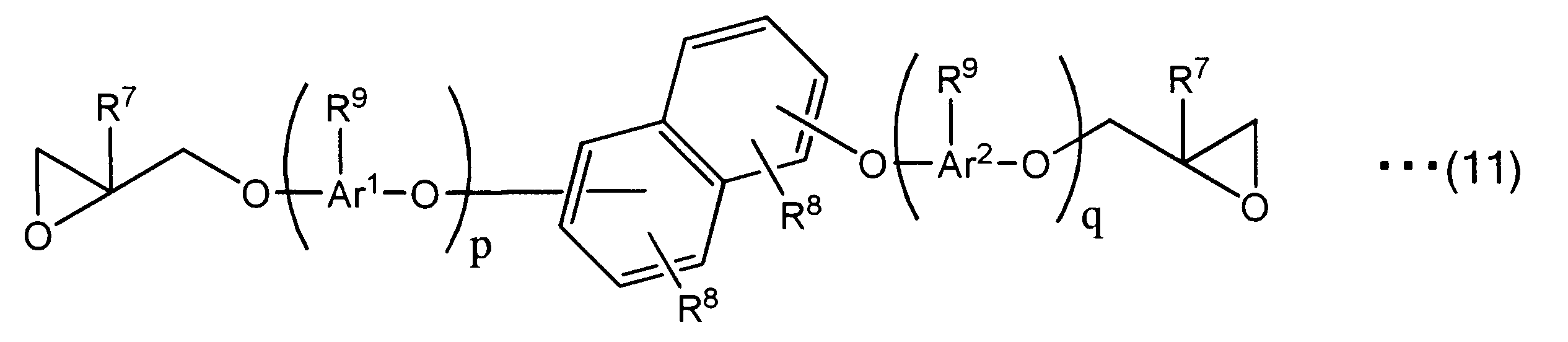
- the epoxy resin (B) is a biphenyl aralkyl type epoxy resin represented by the following general formula (10) and / or an epoxy resin having a naphthalene skeleton represented by the following general formula (11).
- each R 6 independently represents a hydrogen atom or a methyl group, and o represents an integer of 1 to 50.
- R 7 independently represents a hydrogen atom or a methyl group
- Ar 1 and Ar 2 each independently represents a naphthylene group or a phenylene group, and both groups each have 1 to 4 carbon atoms.
- R 8 each independently represents a hydrogen atom, an alkyl group having 1 to 4 carbon atoms, or an aralkyl group represented by the following general formula (12).
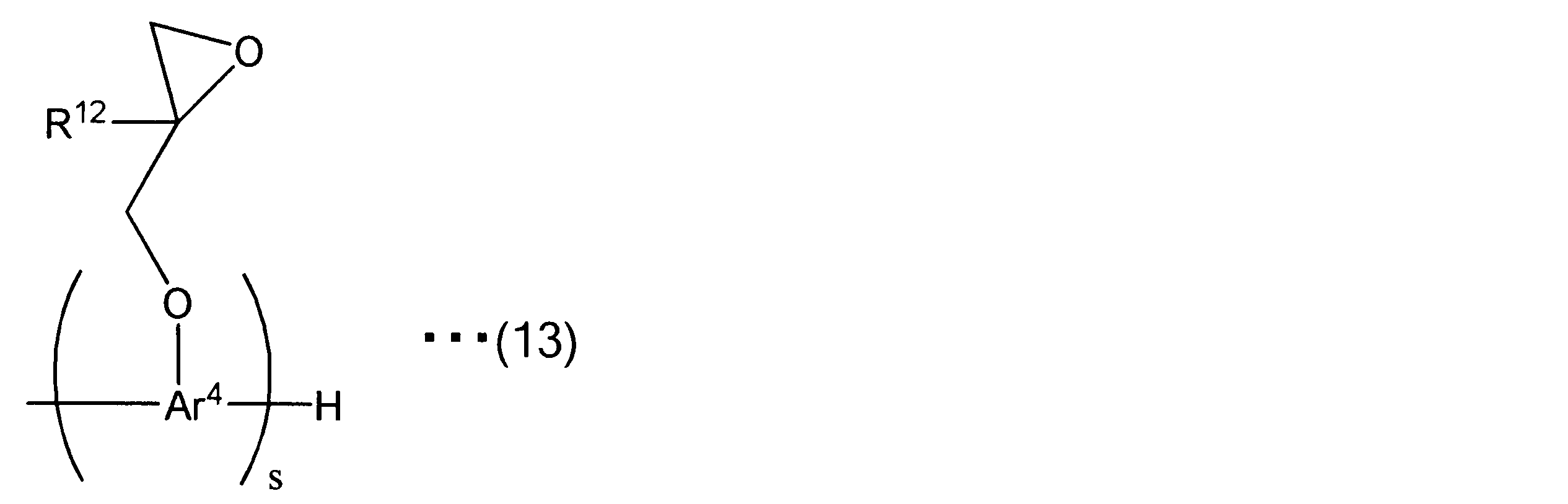
- P and q are each independently an integer of 0 to 4, provided that either p or q is 1 or more, and R 9 is independently a hydrogen atom, the following general formula An aralkyl group represented by (12) or an epoxy group-containing aromatic hydrocarbon group represented by the following general formula (13), wherein the bonding position to the naphthalene structure site in the general formula (11) is the naphthalene 2 constituting the structural part It may be any of the benzene ring.) (Wherein R 10 and R 11 each independently represents a hydrogen atom or a methyl group, Ar 3 is a phenylene group, and a hydrogen atom having 1 to 3 atoms is nucleus-substituted with an alkyl group having 1 to 4 carbon atoms.
- R 12 represents a hydrogen atom or a methyl group
- Ar 4 represents a naphthylene group or a naphthylene group having a C 1-4 alkyl group, aralkyl group or phenylene group as a substituent, s is an integer of 1 or 2.
- the inorganic filler (C) is silica.
- the cyanate ester compound (A) is included in an amount of 30 to 70 parts by mass with respect to a total of 100 parts by mass of the component (A) and the component (B).
- the epoxy resin (B) is included in an amount of 30 to 70 parts by mass with respect to a total of 100 parts by mass of the component (A) and the component (B).
- the inorganic filler (C) is included in an amount of 10 to 300 parts by mass with respect to a total of 100 parts by mass of the component (A) and the component (B).
- ⁇ 8> A prepreg obtained by impregnating or coating a base material with the resin composition for prepreg according to any one of the above items ⁇ 1> to ⁇ 7>.
- ⁇ 9> A laminate in which a plurality of the prepregs according to ⁇ 8> are laminated.
- ⁇ 10> A metal foil-clad laminate having the prepreg according to ⁇ 8> above and a metal foil laminated on the prepreg.
- ⁇ 11> A printed wiring board having the laminate according to ⁇ 10>.
- a printed wiring board including an insulating layer and a conductor layer formed on a surface of the insulating layer, wherein the insulating layer is the prepreg according to any one of the above items ⁇ 1> to ⁇ 7>.
- a resin composition for prepreg has been realized that has good solubility in a solvent, has excellent flame resistance, and can easily produce a cured product or laminated board having low water absorption with good reproducibility. Is done. And, the prepreg, laminate and printed wiring board obtained using such a resin composition for prepreg are suitable as a printed wiring board for high density because they have high flame resistance and low water absorption. The industrial practicality is extremely high because of excellent handling and productivity.
- the resin composition of this embodiment contains at least a cyanate ester compound (A) obtained by cyanating a phenol-modified xylene formaldehyde resin, an epoxy resin (B), and an inorganic filler (C).
- A cyanate ester compound obtained by cyanating a phenol-modified xylene formaldehyde resin, an epoxy resin (B), and an inorganic filler (C).
- the cyanate ester compound (A) used in the resin composition of the present embodiment is obtained by cyanating the hydroxyl group of the phenol-modified xylene formaldehyde resin.
- a novel cyanate ester compound (A) having good solubility in a solvent can be obtained.
- the curability of the resin composition can be enhanced and a cured product having excellent flame resistance can be obtained.
- the phenol-modified xylene formaldehyde resin used as the raw material of the above-mentioned cyanate ester compound (A) is a product obtained by phenol-modifying xylene formaldehyde resin.
- the xylene formaldehyde resin is an aromatic hydrocarbon formaldehyde resin obtained by reacting (meth) xylene with formaldehyde under an acidic catalyst.
- phenol modification means what modified
- the phenol modification of xylene formaldehyde resin can be performed according to a method known in the art, and the method is not particularly limited.
- a phenol-modified xylene formaldehyde resin can be obtained by reacting a xylene formaldehyde resin and phenols in the presence of an acidic catalyst.
- the acidic catalyst examples include inorganic acids such as sulfuric acid, hydrochloric acid and phosphoric acid, oxalic acid, malonic acid, succinic acid, adipic acid, sebacic acid, citric acid, fumaric acid, maleic acid, formic acid, paratoluenesulfonic acid, methane Organic acids such as sulfonic acid, trifluoroacetic acid, dichloroacetic acid, trichloroacetic acid, trifluoromethanesulfonic acid, benzenesulfonic acid, naphthalenesulfonic acid, naphthalenedisulfonic acid, Lewis such as zinc chloride, aluminum chloride, iron chloride, boron trifluoride An acid or a solid acid such as silicotungstic acid, phosphotungstic acid, silicomolybdic acid or phosphomolybdic acid can be preferably used.
- inorganic acids such as sulfuric acid, hydrochloric acid and phosphoric acid
- the reaction temperature is generally preferably 50 ° C. to 200 ° C.
- the target product is recovered by neutralizing the acidic catalyst, diluting with an organic solvent such as methyl ethyl ketone or metaxylene, washing with water, extracting, distilling, distilling off unreacted phenols, etc. be able to.
- the phenols used for the above phenol modification are not particularly limited as long as they are compounds having a phenolic hydroxyl group (generally, a hydroxyl group bonded to an aromatic ring such as a benzene ring).
- phenols represented by the following general formula (1) are preferably used.
- Ar represents an aromatic ring
- R represents all the hydrogen atoms or monovalent substituents on the aromatic ring
- the monovalent substituent is an alkyl group or an aryl group
- R may be the same or different, provided that at least one of R is a hydrogen atom.
- examples of the aromatic ring include a benzene ring, a naphthalene ring, and an anthracene ring, but are not particularly limited thereto.
- the alkyl group for R is a linear or branched alkyl group having 1 to 8 carbon atoms, more preferably a linear or branched alkyl group having 1 to 4 carbon atoms, such as a methyl group. , Ethyl group, propyl group, isopropyl group, butyl group, sec-butyl group, tert-butyl group and the like, but not limited thereto.
- examples of the aryl group for R include a phenyl group, a p-tolyl group, a naphthyl group, and an anthryl group, but are not particularly limited thereto.
- Ar is a benzene ring and R is 0 to 3 alkyl groups
- Ar is a benzene ring
- R is Those having 0 to 2 aryl groups are preferred.
- phenol represented by the general formula (1) include, for example, phenol, 2,6-xylenol, naphthol, biphenol and the like. Among these, phenol and 2,6-xylenol are preferable from the viewpoint of handling.
- formaldehyde becomes a methylene group during the reaction, and xylene and an aromatic ring (for example, a benzene ring) of phenols are bonded to each other through the methylene group.
- the phenol-modified xylene formaldehyde resin obtained after the reaction is obtained as a mixture of many compounds because the position where formaldehyde is bonded to the aromatic ring of xylene and phenols, the position where phenols are bonded, the number of polymerizations, etc. do not match. .
- a phenol-modified xylene formaldehyde resin obtained by refluxing xylene, formalin aqueous solution, 2,6-xylenol and concentrated sulfuric acid in a nitrogen stream, refluxing the aqueous solvent for 7 hours, neutralizing the acid, and extracting with an organic solvent, A mixture having compounds represented by the following formulas (2) to (5) as representative compositions is obtained.
- an aromatic hydrocarbon compound having no hydroxyl group in the structure as in the above formula (5) cannot be cyanated, and thus is preferably removed by distillation separation in advance.
- phenol-modified xylene formaldehyde resin is JISK1557-1.
- the OH value determined based on this is preferably 150 to 400 mgKOH / g, more preferably 200 to 350 mgKOH / g.
- a commercially available product can be used as the phenol-modified xylene formaldehyde resin.
- a commercially available product for example, Nikanol GL16 or Nikanol G manufactured by Fudo Co., Ltd. is preferably used.
- the cyanate ester compound (A) can be used singly or in appropriate combination of two or more depending on the purpose.
- the cyanate ester compound (A) of this embodiment can be obtained by cyanating the hydroxyl group of the phenol-modified xylene formaldehyde resin.
- the synthesis method is not particularly limited, and a known method can be applied.
- a cyanate ester compound (A) can be obtained by cyanating a hydroxyl group of a phenol-modified xylene formaldehyde resin by a method described in IAN HAMTERTON, “Chemistry and Technology of Cyanate Esters Resins”, BLACKIE ACADEMIC & PROFESSIONAL.
- a reaction in which a cyanogen halide is always present in excess in excess of the base in the presence of a base in a solvent US Pat.
- phenol-modified xylene Halogenation of formaldehyde resins with tertiary amines in the presence of water and a solvent that can be separated Anne is added and reacted at the same time, followed by washing with water, separation and purification from the resulting solution using a secondary or tertiary alcohol or a hydrocarbon poor hydrocarbon (Patent No. 299954), and Known is a method of reacting a phenol-modified xylene formaldehyde resin, cyanogen halide, and a tertiary amine in a two-phase solvent of water and an organic solvent under acidic conditions (Japanese Patent Laid-Open No. 2007-277102).
- the above-mentioned cyanate ester compound (A) can be obtained by suitably using these known methods.
- the obtained cyanate ester compound (A) can be identified by a known method such as NMR.
- the cyanate ester compound (A) is preferably represented by the following general formula (I).
- each R 1 independently represents a methylene group, a methyleneoxy group, a methyleneoxymethylene group or an oxymethylene group
- R 2 to R 4 each independently represents a hydrogen atom and a carbon number of 1).
- T 1 represents a hydrogen atom, a hydroxyl group or a hydroxymethylene group
- x is each independently an integer of 0 to 4 (preferably Represents an integer of 0 to 2
- y and z each independently represent an integer of 0 to 3 (preferably an integer of 0 to 2)
- w represents an integer of 0 or 1
- m represents Represents an integer of 0 or more
- n 1 and n 2 each independently represents an integer of 1 or more.
- m, n 1 and n 2 represent the ratio of each structural unit, and the arrangement of each repeating unit is arbitrary. That is, the compound of the general formula (I) may be a random copolymer or a block copolymer (in this specification, the ratios of the respective structural units are all the same). Moreover, the compound of the said general formula (I) may be bridge
- the upper limit value of m is usually 50 or less, preferably 20 or less, and the upper limit values of n 1 and n 2 are usually 20 or less.
- the weight average molecular weight Mw of the above-mentioned cyanate ester compound (A) is not particularly limited, but is preferably 250 to 10,000, and more preferably 300 to 5,000.
- the content of the cyanate ester compound (A) in the resin composition of the present embodiment can be appropriately set according to the intended use and performance, and is not particularly limited. From the viewpoints of solvent solubility and heat resistance of the resin composition, the content of the cyanate ester compound (A) is 10 with respect to 100 parts by mass in total of the cyanate ester compound (A) and the epoxy resin (B). The amount is preferably -90 parts by mass, more preferably 30-70 parts by mass.
- the resin composition of the present embodiment may contain a cyanate ester compound other than the above-described cyanate ester compound (A) (hereinafter also referred to as “other cyanate ester compound”).
- cyanate ester compound other than the above-described cyanate ester compound (A)
- other cyanate ester compound known compounds can be appropriately used as long as they are compounds represented by the general formula R—O—CN (wherein R is an organic group).
- R—O—CN wherein R is an organic group.
- Specific examples thereof include, for example, bisphenol A type cyanate ester compound, bisphenol F type cyanate ester compound, bisphenol M type cyanate ester compound, bisphenol P type cyanate ester compound, bisphenol E type cyanate ester compound, and phenol novolak.
- Type cyanate ester compound cresol novolac type cyanate ester compound, dicyclopentadiene novolak type cyanate ester compound, tetramethylbisphenol F type cyanate ester compound, biphenol type cyanate ester compound, phenol aralkyl type cyanate ester compound, xylenol
- aralkyl cyanate compounds naphthol aralkyl cyanate compounds, and prepolymers thereof. It is not particularly limited. These can be used singly or in appropriate combination of two or more according to the purpose.
- epoxy resin (B) used in the resin composition of the present embodiment any known one can be used as long as it has two or more epoxy groups in one molecule. It is not limited. Non-halogen-based epoxy resins are preferred because of recent interest in environmental issues. Specific examples thereof include, for example, bisphenol A type epoxy resin, bisphenol E type epoxy resin, bisphenol F type epoxy resin, bisphenol S type epoxy resin, phenol novolac type epoxy resin, cresol novolac type epoxy resin, biphenyl type epoxy resin, bisphenol.
- a novolac type epoxy resin trifunctional phenol type epoxy resin, tetrafunctional phenol type epoxy resin, glycidyl ester type epoxy resin, naphthalene type epoxy resin, anthracene type epoxy resin, biphenyl type epoxy resin, phenol aralkyl type epoxy resin, aralkyl novolak type Epoxy resin, cycloaliphatic epoxy resin, biphenyl aralkyl type epoxy resin, naphthol aralkyl type epoxy resin, dicyclopentadiene type epoxy resin Examples thereof include, but are not particularly limited to, resins obtained by reaction of a double bond such as a resin, a polyol type epoxy resin, glycidylamine, glycidyl ester, and butadiene, and a reaction between a hydroxyl group-containing silicone resin and epichlorohydrin.
- bisphenol A type epoxy resin bisphenol F type epoxy resin, phenol novolac type epoxy resin, cresol novolac type epoxy resin, from the viewpoint of excellent heat resistance and excellent properties such as water absorption and moisture absorption heat resistance
- Bisphenol A novolac type epoxy resin brominated bisphenol A type epoxy resin, brominated phenol novolac type epoxy resin, biphenyl type epoxy resin, phenol aralkyl type epoxy resin, biphenyl aralkyl type epoxy resin, naphthol aralkyl type epoxy resin are more preferable.
- Bisphenol aralkyl type epoxy resins bisphenyl aralkyl type epoxy resins, and naphthol aralkyl type epoxy resins.
- these epoxy resins (B) can be used individually by 1 type or in combination of 2 or more types according to the objective.
- an aralkyl novolac type epoxy resin is preferable as the epoxy resin (B).
- a biphenyl aralkyl type epoxy resin represented by the following general formula (10) is particularly preferable.
- Examples of epoxy resin products represented by the following general formula (10) include NC-3000-FH manufactured by Nippon Kayaku Co., Ltd.
- each R 6 independently represents a hydrogen atom or a methyl group, and o represents an integer of 1 to 50.
- an epoxy resin having a naphthalene skeleton represented by the following general formula (11) is preferable.
- Examples of epoxy resin products having a naphthalene skeleton represented by the following general formula (11) include, for example, HP-6000 manufactured by DIC Corporation, EXA-7310 manufactured by DIC Corporation, EXA-7311 manufactured by DIC Corporation, and DIC shares. Exa-7311-L manufactured by company, EXA-7311-G3 manufactured by DIC Corporation, EXA-7311-G4 manufactured by DIC Corporation, and the like.
- R 7 independently represents a hydrogen atom or a methyl group
- Ar 1 and Ar 2 each independently represents a naphthylene group or a phenylene group, and both groups each have 1 to 4 carbon atoms
- R 8 each independently represents a hydrogen atom, an alkyl group having 1 to 4 carbon atoms, or an aralkyl group represented by the following general formula (12).
- P and q are each independently an integer of 0 to 4, provided that either p or q is 1 or more, and R 9 is independently a hydrogen atom, the following general formula An aralkyl group represented by (12) or an epoxy group-containing aromatic hydrocarbon group represented by the following general formula (13), wherein the bonding position to the naphthalene structure site in the general formula (11) is the naphthalene 2 constituting the structural part It may be any of the benzene ring.) (Wherein R 10 and R 11 each independently represents a hydrogen atom or a methyl group, Ar 3 is a phenylene group, and a hydrogen atom having 1 to 3 atoms is nucleus-substituted with an alkyl group having 1 to 4 carbon atoms.
- R 12 represents a hydrogen atom or a methyl group
- Ar 4 represents a naphthylene group or a naphthylene group having a C 1-4 alkyl group, aralkyl group or phenylene group as a substituent, s is an integer of 1 or 2.
- the content of the epoxy resin (B) in the resin composition of the present embodiment can be appropriately set according to the intended use and performance, and is not particularly limited. From the viewpoint of solvent solubility and heat resistance of the resin composition, the content of the epoxy resin (B) is 10 to 90 with respect to 100 parts by mass in total of the cyanate ester compound (A) and the epoxy resin (B). The amount is preferably part by mass, more preferably 30 to 70 parts by mass.
- the inorganic filler (C) used in the resin composition of the present embodiment a known material can be appropriately used, and the type thereof is not particularly limited. Generally, what is used for the resin composition for printed wiring boards or electrical wiring boards can be used suitably. Specific examples include, for example, natural silica, fused silica, synthetic silica, amorphous silica, hollow silica and other silicas, white carbon, titanium white, aerosil, silicone composite powder, silicone resin powder, zinc oxide, magnesium oxide, oxidation Zirconium, boron nitride, agglomerated boron nitride, silicon nitride, aluminum nitride, barium sulfate, aluminum hydroxide, aluminum hydroxide heat-treated product (aluminum hydroxide is heat-treated to reduce part of crystal water), boehmite, Metal hydrates such as magnesium hydroxide, molybdenum compounds such as molybdenum oxide and zinc molybdate, zinc borate, zinc
- the content of the inorganic filler (C) in the resin composition of the present embodiment can be appropriately set according to the intended use and performance, and is not particularly limited. From the viewpoint of the coefficient of thermal expansion and moldability, the content of the inorganic filler (C) is preferably 10 to 300 parts by mass, more preferably 30 to 250 parts by mass with respect to 100 parts by mass of the total resin solid component. is there.
- the resin composition of the present embodiment may contain a curing accelerator for adjusting the curing rate as needed.
- a hardening accelerator what is generally used as a hardening accelerator of a cyanate ester compound or an epoxy resin can be used suitably, and the kind is not specifically limited. Specific examples thereof include, but are not particularly limited to, organic metal salts such as copper, zinc, cobalt, and nickel, imidazoles and derivatives thereof, and tertiary amines.
- a hardening accelerator can be used individually by 1 type or in combination of 2 or more types as appropriate.
- the resin composition of the present embodiment may contain components other than those described above as long as the desired properties are not impaired.
- examples of such arbitrary blends include various high-temperature resins such as the above-described cyanate ester compounds (A) and epoxy resins (B), other thermosetting resins, thermoplastic resins and oligomers thereof, and elastomers.
- a molecular compound, a flame retardant compound, various additives, etc. are mentioned. These are not particularly limited as long as they are generally used.
- flame retardant compounds include bromine compounds such as 4,4′-dibromobiphenyl, phosphorus compounds such as phosphate esters, melamine phosphate, and phosphorus-containing epoxy resins, nitrogen-containing compounds such as melamine and benzoguanamine, and oxazine rings Compounds, silicone compounds, and the like.
- Various additives include curing catalysts, silane coupling agents, UV absorbers, antioxidants, photopolymerization initiators, fluorescent brighteners, photosensitizers, dyes, pigments, thickeners, flow regulators.
- Lubricants Lubricants, antifoaming agents, dispersants, wetting and dispersing agents, leveling agents, brighteners, polymerization inhibitors and the like, but are not particularly limited thereto.
- Lubricants antifoaming agents, dispersants, wetting and dispersing agents, leveling agents, brighteners, polymerization inhibitors and the like, but are not particularly limited thereto.
- These arbitrary formulations can be used singly or in combination of two or more.
- the resin composition of this embodiment may contain the organic solvent as needed. That is, the resin composition of this embodiment is used as an aspect (varnish) in which at least a part, preferably all, of the cyanate ester compound (A) and the epoxy resin (B) described above are dissolved or compatible with an organic solvent. Can do. Any known organic solvent can be used as long as it can dissolve or be compatible with at least part, preferably all of the cyanate ester compound (A) and the epoxy resin (B). Is not particularly limited.
- ketones such as acetone, methyl ethyl ketone, methyl isobutyl ketone, and cyclohexanone
- aromatic hydrocarbons such as benzene, toluene, and xylene
- amides such as dimethylformamide and dimethylacetamide, and the like. It is not specifically limited to these.
- An organic solvent can be used individually by 1 type or in combination of 2 or more types as appropriate.
- the resin composition of the present embodiment can be prepared according to a conventional method, and the preparation method is not particularly limited.
- the resin composition of this embodiment can be easily prepared by stirring and mixing the above-described cyanate ester compound (A), epoxy resin (B), inorganic filler (C), and the like.
- the inorganic resin (C) is mix
- known processes for uniformly mixing the components can be performed.
- the above stirring, mixing, and kneading treatment can be appropriately performed using, for example, a known device such as a ball mill, a bead mill, or the like, or a revolving / spinning type mixing device, or a dispersing device. .
- the prepreg of the present embodiment is a combination of the resin composition of the present embodiment and a base material, specifically, a base material impregnated or coated with the resin composition described above.
- This prepreg can be produced according to a conventional method, and the production method is not particularly limited.
- a varnish obtained by adding an organic solvent to the resin composition is impregnated or coated on a base material, and then semi-cured (B-stage) by heating in a dryer at 100 to 200 ° C. for 1 to 60 minutes. Thereby, the prepreg of this embodiment can be produced.
- the amount of the resin composition attached to the substrate that is, the amount of the resin composition (including the inorganic filler (C)) with respect to the total amount of the prepreg after semi-curing is preferably in the range of 20 to 95% by mass. .
- the base material used in the prepreg of the present embodiment is not particularly limited, and is appropriately selected from, for example, known materials used for various printed wiring board materials depending on the intended use and performance. can do. Specific examples thereof include glass fibers such as E glass, T glass, L glass, D glass, S glass, NE glass, Q glass, UN glass and spherical glass, inorganic fibers other than glass such as quartz, polyimide, Examples thereof include organic fibers such as polyamide and polyester, and woven fabrics such as liquid crystal polyester, but are not particularly limited thereto.
- a base material can be used individually by 1 type or in combination of 2 or more types as appropriate.
- woven fabric, non-woven fabric, roving, chopped strand mat, surfacing mat and the like are known, and as the weaving method of the woven fabric, plain weave, Nanako weave, twill weave, etc. are known. However, either one is acceptable.
- the thickness of the substrate is not particularly limited, but is usually about 0.01 to 0.3 mm. For example, in the case of a laminate, a range of 0.01 to 0.2 mm is preferable.
- what surface-treated with the silane coupling agent etc., and what carried out the fiber opening process physically in the woven fabric can use it suitably from the surface of moisture absorption heat resistance.
- a film made of polyimide, polyamide, polyester, or the like can also be used as a substrate.
- the thickness of these films is not particularly limited, but is preferably about 0.002 to 0.05 mm. Furthermore, a film surface-treated by plasma treatment or a film surface-treated with a silane coupling agent can be suitably used. Among these base materials, it is particularly preferable to use glass fibers of E glass in view of the balance between the expansion coefficient in the plane direction and the workability in the use of laminates.
- the laminated board of this embodiment is formed by lamination using the above-described prepreg.
- the metal foil-clad laminate of this embodiment is formed by lamination using the above-described prepreg and metal foil.
- the metal foil-clad laminate of the present embodiment is formed by laminating one or more of the above prepregs, and optionally placing a metal foil such as copper or aluminum on one or both sides. It can be produced by molding.
- the metal foil used here will not be specifically limited if it is used for printed wiring board material, Copper foil, such as a rolled copper foil and an electrolytic copper foil, is preferable. Considering the conductor loss in the high frequency region, an electrolytic copper foil having a small mat surface roughness is more suitable.
- the thickness of the metal foil is not particularly limited, but is preferably 2 to 70 ⁇ m, more preferably 2 to 35 ⁇ m.
- a molding condition a general laminated board for printed wiring board and multilayer board can be applied.
- temperature is 100 to 300 ° C.
- pressure is surface pressure 2 to 100 kgf / cm 2
- heating time is 0.05 to 5 hours. It is common to carry out in the range of.
- copper foil is disposed on both surfaces of the above prepreg, and after laminating and forming under the above conditions, an inner layer circuit is formed, and blackening treatment is performed on this circuit to form an inner layer circuit board.
- the inner circuit board and the prepreg are alternately arranged one by one, and the copper foil is further arranged on the outermost layer, and multilayer molding is preferably performed under the above conditions, preferably under vacuum.
- a plate can be made.
- the metal foil-clad laminate according to the present embodiment can be suitably used as a printed wiring board by forming a predetermined wiring pattern.
- the metal foil-clad laminate of this embodiment is excellent in flame resistance, has a low water absorption rate, and is excellent in productivity. Therefore, it can be used particularly effectively as a printed wiring board for semiconductor packages that require such performance. it can.
- the above printed wiring board can be manufactured, for example, by the following method. First, a metal foil-clad laminate such as the copper clad laminate described above is prepared. Next, an etching process is performed on the surface of the metal foil-clad laminate to form an inner layer circuit, thereby producing an inner layer substrate. The inner layer circuit surface of the inner layer substrate is subjected to a surface treatment to increase the adhesive strength as necessary, then the required number of the prepregs are stacked on the inner layer circuit surface, and a metal foil for the outer layer circuit is stacked on the outer surface. Then, it is integrally molded by heating and pressing.
- a metal foil-clad laminate such as the copper clad laminate described above is prepared.
- an etching process is performed on the surface of the metal foil-clad laminate to form an inner layer circuit, thereby producing an inner layer substrate.
- the inner layer circuit surface of the inner layer substrate is subjected to a surface treatment to increase the adhesive strength as necessary, then the required number of the prepregs are stacked
- a multilayer laminate is produced in which an insulating layer made of a cured material of the base material and the thermosetting resin composition is formed between the inner layer circuit and the metal foil for the outer layer circuit.
- a plated metal film is formed on the wall surface of the hole to connect the inner layer circuit and the metal foil for the outer layer circuit. Etching is performed on the metal foil for forming an outer layer circuit, and a printed wiring board is manufactured.
- the insulating layer can include the above-described resin composition of the present embodiment.
- the prepreg of the present embodiment described above the base material and the resin composition of the present embodiment impregnated or applied thereto
- the layer of the resin composition of the metal foil-clad laminate of the embodiment is composed of an insulating layer containing the resin composition of this embodiment.
- part means “part by mass” unless otherwise specified.
- the compound could be dissolved in methyl ethyl ethyl ketone at 30% by mass or more at 25 ° C. Further, when the viscosity was measured using a rheometer AR2000EX manufactured by TA Instruments, the viscosity of the compound was 0.4 Pa ⁇ s at 100 ° C. When measured by GPC, the weight average molecular weight (Mw) of the compound was 1050.
- the compound could be dissolved in methyl ethyl ethyl ketone at 30% by mass or more at 25 ° C. Further, when the viscosity was measured using a rheometer AR2000EX manufactured by TA Instruments, the viscosity of the compound was 0.3 Pa ⁇ s at 100 ° C. When measured by GPC, the weight average molecular weight (Mw) of the compound was 650.
- the resulting triethylamine hydrochloride was filtered off from the reaction solution, and the obtained filtrate was washed with 500 mL of 0.1N hydrochloric acid, and further washed with 500 mL of water four times. This was dried over sodium sulfate and concentrated to obtain crystals. The obtained crystals were washed with 1000 mL of n-hexane and then dried under reduced pressure to obtain biphenylaralkyl type cyanate ester.
- the biphenylaralkyl-type cyanate ester compound thus obtained disappeared from the absorption spectrum of 3200 to 3600 cm ⁇ 1 due to the phenolic OH group, and was attributed to the nitrile cyanate ester. It was confirmed to have an absorption spectrum around 2264 cm ⁇ 1 .
- Example 1 After dissolving 50 parts by mass of GLPC obtained in Synthesis Example 1 with methyl ethyl ketone, 50 parts by mass of phenol biphenyl aralkyl type epoxy resin (NC3000-H, manufactured by Nippon Kayaku Co., Ltd.) dissolved in methyl ethyl ketone was mixed to obtain a resin composition. A product was prepared. The resin composition containing only this resin was visually transparent, and it was confirmed that the resin was dissolved in a solvent. Next, 150 parts of spherical synthetic silica (SC-2050MR, manufactured by Admatechs Co., Ltd.) is mixed with this resin composition, and 0.04 parts by mass of zinc octylate is further mixed to obtain a resin composition (varnish).
- SC-2050MR spherical synthetic silica
- the varnish thus obtained was diluted with methyl ethyl ketone, impregnated on a 0.1 mm thick E glass cloth, and dried by heating at 165 ° C. for 10.5 minutes. % Prepreg.
- four prepregs are overlaid, and an electrolytic copper foil with a thickness of 18 ⁇ m is placed on both sides of the obtained laminate, and the laminate is formed by vacuum pressing at a pressure of 30 kgf / cm 2 and a temperature of 220 ° C. for 120 minutes.
- a metal foil-clad laminate double-sided copper-clad laminate having an insulating layer thickness of 0.4 mm was produced.
- Table 1 shows the physical property measurement results of the obtained double-sided copper-clad laminate.
- Example 2 The same procedure as in Example 1 was performed except that 50 parts by mass of NXDC obtained in Synthesis Example 2 was used instead of 50 parts by mass of GLPC.
- the resin-only varnish was visually transparent, and it was confirmed that the resin was dissolved in a solvent.
- Table 1 shows the physical property measurement results of the obtained double-sided copper-clad laminate.
- Example 1 The same procedure as in Example 1 was carried out except that 50 parts by mass of 2,2-bis (4-cyanatephenyl) propane prepolymer (CA210, manufactured by Mitsubishi Gas Chemical Co., Ltd.) was used instead of 50 parts by mass of GLPC. .
- the resin-only varnish was visually transparent, and it was confirmed that the resin was dissolved in a solvent.
- Table 1 shows the physical property measurement results of the obtained double-sided copper-clad laminate.
- Example 2 The same procedure as in Example 1 was carried out except that 50 parts by mass of phenol novolac-type cyanate ester compound (PrimasetPT-30, Lonza) was used instead of 50 parts by mass of GLPC.
- the resin-only varnish was visually transparent, and it was confirmed that the resin was dissolved in a solvent.
- Table 1 shows the physical property measurement results of the obtained double-sided copper-clad laminate.
- Example 3 It replaced with 50 mass parts of GLPC, and carried out similarly to Example 1 except using 50 mass parts of biphenyl aralkyl type cyanate ester compounds obtained by the comparative synthesis example 1.
- FIG. The biphenylaralkyl cyanate ester obtained in Comparative Synthesis Example 1 was not dissolved in methyl ethyl ketone, and the resin-only varnish was suspended by insoluble matter after stirring with a mixer. Silica and the like were added to prepare a varnish, and impregnation coating onto a glass cloth was performed in the same manner.
- Table 1 shows the physical property measurement results of the obtained double-sided copper-clad laminate.
- the present invention can be widely and effectively used in laminated materials, build-up laminated board materials, etc., and is particularly suitable for applications requiring low water absorption and high flame resistance, such as high density. It can be used particularly effectively in printed wiring boards.
Landscapes
- Chemical & Material Sciences (AREA)
- Engineering & Computer Science (AREA)
- Organic Chemistry (AREA)
- Health & Medical Sciences (AREA)
- Chemical Kinetics & Catalysis (AREA)
- Medicinal Chemistry (AREA)
- Polymers & Plastics (AREA)
- Materials Engineering (AREA)
- Manufacturing & Machinery (AREA)
- Microelectronics & Electronic Packaging (AREA)
- Inorganic Chemistry (AREA)
- Reinforced Plastic Materials (AREA)
- Compositions Of Macromolecular Compounds (AREA)
- Phenolic Resins Or Amino Resins (AREA)
- Epoxy Resins (AREA)
- Laminated Bodies (AREA)
Abstract
Description
<1> フェノール変性キシレンホルムアルデヒド樹脂をシアネート化したシアン酸エステル化合物(A)、エポキシ樹脂(B)及び無機充填材(C)を少なくとも含有する、
プリプレグ用樹脂組成物。
<2> 前記シアン酸エステル化合物(A)が、下記一般式(I)で表される構造を有する、

上記<1>に記載のプリプレグ用樹脂組成物。
<3> 前記エポキシ樹脂(B)が、下記一般式(10)で表されるビフェニルアラルキル型エポキシ樹脂及び/又は下記一般式(11)で表されるナフタレン骨格を有するエポキシ樹脂である、



上記<1>又は<2>に記載のプリプレグ用樹脂組成物。
上記<1>~<3>のいずれか一項に記載のプリプレグ用樹脂組成物。
<5> 前記シアン酸エステル化合物(A)が、前記(A)成分と前記(B)成分の合計100質量部に対して、30~70質量部含まれる、
上記<1>~<4>のいずれか一項に記載のプリプレグ用樹脂組成物。
<6> 前記エポキシ樹脂(B)が、前記(A)成分と前記(B)成分の合計100質量部に対して、30~70質量部含まれる、
上記<1>~<5>のいずれか一項に記載のプリプレグ用樹脂組成物。
<7> 前記無機充填材(C)が、前記(A)成分と前記(B)成分の合計100質量部に対して、10~300質量部含まれる、
上記<1>~<6>のいずれか一項に記載のプリプレグ用樹脂組成物。
<8> 上記<1>~<7>のいずれか一項に記載のプリプレグ用樹脂組成物を基材に含浸又は塗布してなるプリプレグ。
<9> 上記<8>に記載のプリプレグが複数積層した積層板。
<10> 上記<8>に記載のプリプレグと、前記プリプレグ上に積層された金属箔とを有する金属箔張り積層板。
<11> 上記<10>に記載の積層板を有するプリント配線板。
<12> 絶縁層と、前記絶縁層の表面に形成された導体層とを含むプリント配線板であって、前記絶縁層が、上記<1>~<7>のいずれか一項に記載のプリプレグ用樹脂組成物を含むプリント配線板。









フェノール変性キシレンホルムアルデヒド樹脂(ニカノールGLP)をシアネート化したシアン酸エステル化合物(下記一般式(Ia)のシアン酸エステル(代表組成として下記式(14)を有する):以下、GLPCと略す)の合成


フェノール800g(8.5mol)及び触媒のPTSA(パラトルエンスルホン酸)0.43gを仕込み撹拌昇温し、液温130℃にてキシレンホルムアルデヒド樹脂(ニカノールG、フドー(株)製)670gを1時間かけて滴下した。滴下中、還流温度は150℃から105℃に低下する。滴下後1時間で反応を完結させた。反応後、脱フェノールするため水蒸気蒸留を170℃で2.5時間実施した。その後冷却しながら徐々にメチルイソブチルケトン1700gを添加し希釈した。次いで、希釈した反応液を、70~80℃の温水850gで3回繰り返し洗浄した。

上記方法で得られた一般式(Ia’)で表されるフェノール変性キシレンホルムアルデヒド樹脂(ニカノールGLP)20g(OH基として0.112mol)及びトリエチルアミン17.13g(0.168mol)を塩化メチレン120gに溶解させた(溶液1)。0.249molの塩化シアンの塩化メチレン溶液48.1gと36%塩酸23.76g(0.235mol)と水147.3gを撹拌混合した溶液へ、-5~+5℃で溶液1を10分かけて滴下した。30分撹拌した後、トリエチルアミン11.42g(0.112mol)と塩化メチレン11.4gの混合溶液を滴下し、さらに30分撹拌して反応を完結させた。反応液を分液し、有機相を分取した。得られた有機相を水100gで4回洗浄した後、蒸留により塩化メチレンを留去し、目的とする上記式(Ia)で表されるフェノール変性キシレンホルムアルデヒド樹脂のシアン酸エステル(GLPC)23.1gを黄赤色粘性物として得た。
2,6-キシレノール変性キシレンホルムアルデヒド樹脂をシアネート化したシアン酸エステル化合物(下記一般式(Ib)のシアン酸エステル(代表組成として下記式(15)を有する:以下、NXDCと略す))の合成

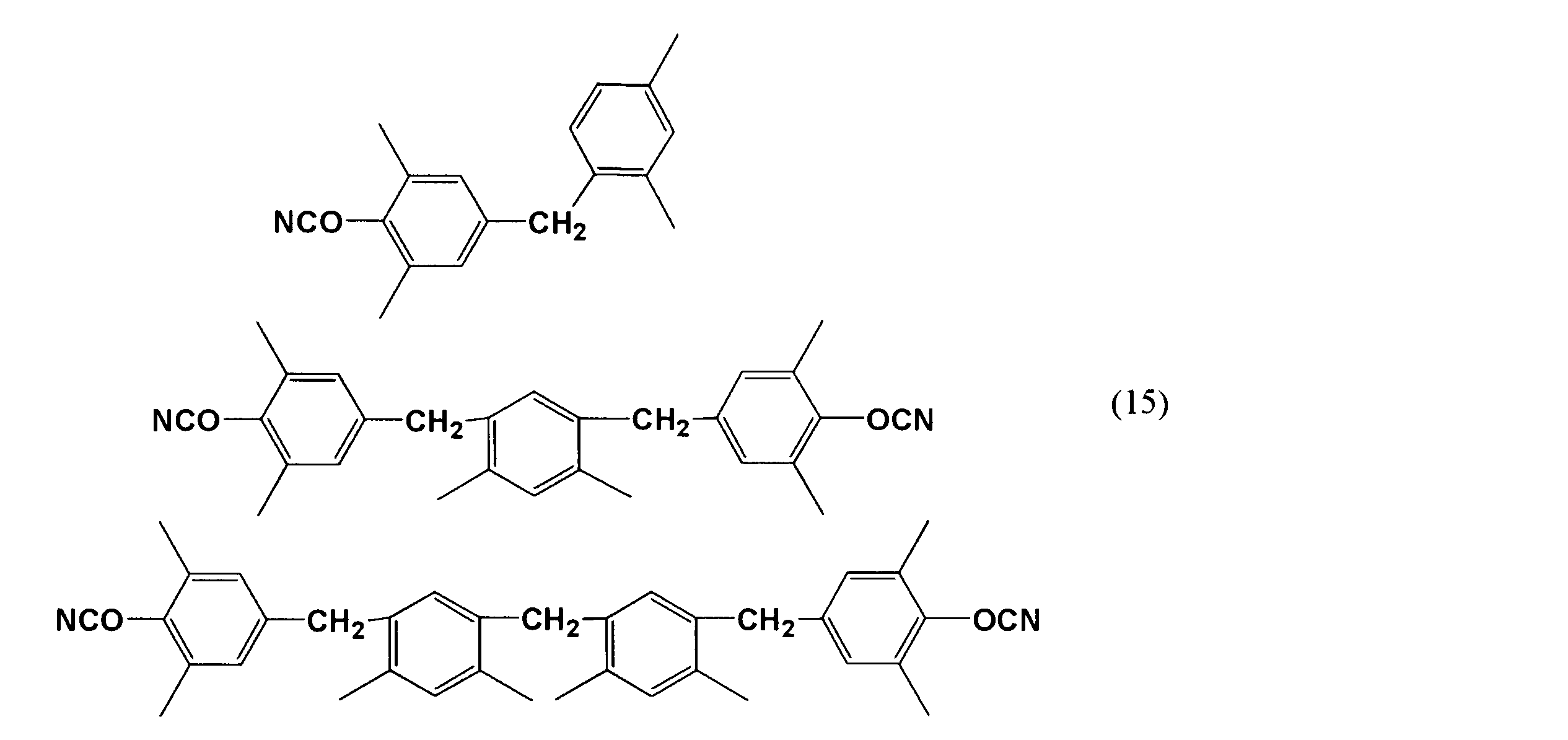
2,6-キシレノール486.8g(3.99mol)及び触媒のPTSA(パラトルエンスルホン酸)6.3gを仕込み攪拌昇温し、液温125℃になった時点でキシレンホルムアルデヒド樹脂(ニカノールGL16、フドー(株)製)144gを1時間かけて滴下した。滴下中、昇温を続け、150℃、3時間で反応を完結させた。反応後120℃以下に冷却し、反応液にメタキシレン160gを添加し、次にメチルイソブチルケトン240gを添加し反応液を希釈した。次いで、希釈した反応液を、70~80℃の温水400gで3回繰り返し洗浄した。

上記方法で得られた一般式(Ib’)で表される2,6-キシレノール変性キシレンホルムアルデヒド樹脂の精製品256g(OH基として1.45mol)及び1.6molトリエチルアミンを3-メチルテトラヒドロフラン600mLに溶解させた(溶液2)。その後、2.8molの塩化シアンの塩化メチレン溶液500gに-10℃で溶液2を1.5時間かけて滴下した。30分撹拌した後、0.8molのトリエチルアミンと塩化メチレン115gの混合溶液を滴下し、さらに30分撹拌して反応を完結させた。そして、反応液からトリエチルアミンの塩酸塩を濾別し、得られたろ液を0.1N塩酸1000mLにより洗浄した後、さらにNaCl水溶液1000mLで3回洗浄し、最後に水1000mLによる洗浄を行った。得られた塩化メチレン溶液を硫酸ナトリウムにより乾燥し、蒸留操作により塩化メチレンを留去することにより、目的とする上記式(Ib)で表される2,6-キシレノール変性キシレンホルムアルデヒド樹脂のシアン酸エステル(NXDC)240gを黄赤色粘性物として得た。
ビフェニルアラルキル型シアン酸エステル化合物の合成
ビフェニルアラルキル型フェノール樹脂(KAYAHARD GPH65、日本化薬(株)製)0.50モルをクロロホルム500mlに溶解後、0.75molのトリエチルアミンを添加混合し、これに1.0モルの塩化シアンを溶解したクロロホルム溶液300gを-10℃で1.5時間かけて滴下した。30分撹拌した後、0.1モルのトリエチルアミンとクロロホルム30gの混合溶液を滴下し、さらに30分撹拌して反応を完結させた。そして、生成するトリエチルアミンの塩酸塩を反応液から濾別し、得られたろ液を0.1N塩酸500mLにより洗浄した後、さらに水500mLによる洗浄を4回繰り返した。これを硫酸ナトリウムによって乾燥した後、濃縮することで、結晶を得た。得られた結晶をn-ヘキサン1000mLにて洗浄した後、減圧乾燥することにより、ビフェニルアラルキル型のシアン酸エステルを得た。このようにして得られたビフェニルアラルキル型シアン酸エステル化合物は、赤外吸収スペクトル測定の結果、フェノール性OH基に起因する3200~3600cm-1の吸収スペクトルが消失し、シアン酸エステルのニトリルに起因する2264cm-1付近の吸収スペクトルを有することが確認された。
合成例1で得たGLPC50質量部をメチルエチルケトンで溶解した後、同じくメチルエチルケトンで溶解させたフェノールビフェニルアラルキル型エポキシ樹脂(NC3000-H、日本化薬(株)製)50質量部を混合して樹脂組成物を調製した。この樹脂のみの樹脂組成物は、目視で透明であり、樹脂が溶媒に溶解した状態であることが確認された。次に、この樹脂組成物に球状合成シリカ(SC-2050MR、(株)アドマテックス製)を150部混合し、さらにオクチル酸亜鉛0.04質量部を混合することにより、樹脂組成物(ワニス)を調製した。
このようにして得られたワニスをメチルエチルケトンで希釈し、これを厚さ0.1mmのEガラスクロスに含浸塗工し、165℃で10.5分間加熱乾燥することにより、樹脂含有量が37質量%のプリプレグを作製し。次に、プリプレグを4枚重ね合わせ、得られた積層体の両面に厚さ18μmの電解銅箔を配置し、圧力30kgf/cm2、温度220℃、120分間の真空プレスを行い積層形成することで、絶縁層厚さ0.4mmの金属箔張り積層板(両面銅張積層板)を作製した。得られた両面銅張積層板の物性測定結果を表1に示す。
GLPC50質量部に代えて、合成例2で得たNXDC50質量部を用いること以外は、実施例1と同様に行った。樹脂のみのワニスは、目視で透明であり、樹脂が溶媒に溶解した状態であることが確認された。得られた両面銅張積層板の物性測定結果を表1に示す。
GLPC50質量部に代えて、2,2-ビス(4-シアネートフェニル)プロパンのプレポリマー(CA210、三菱ガス化学(株)製)50質量部を用いること以外は、実施例1と同様に行った。樹脂のみのワニスは、目視で透明であり、樹脂が溶媒に溶解した状態であることが確認された。得られた両面銅張積層板の物性測定結果を表1に示す。
GLPC50質量部に代えて、フェノールノボラック型シアン酸エステル化合物(PrimasetPT-30、ロンザ社製)50質量部を用いること以外は、実施例1と同様に行った。樹脂のみのワニスは、目視で透明であり、樹脂が溶媒に溶解した状態であることが確認された。得られた両面銅張積層板の物性測定結果を表1に示す。
GLPC50質量部に代えて、比較合成例1で得たビフェニルアラルキル型シアン酸エステル化合物50質量部を用いること以外は、実施例1と同様に行った。なお、この比較合成例1で得たビフェニルアラルキル型シアン酸エステルは、メチルエチルケトンに溶解せず、樹脂のみのワニスはミキサーにて撹拌後も不溶物によって懸濁した状態であったが、そのまま球状合成シリカ等を加えてワニスを調製し、ガラスクロスへの含浸塗工を同様に行った。得られた両面銅張積層板の物性測定結果を表1に示す。

銅張積層板の銅箔をエッチングによって除去した後、吸水性と耐燃性の評価をおこなった。
1)吸水率:得られた両面銅張積層板をダイシングソーで50mm×50mm×0.4mmのサイズに切断し、両面の銅箔をエッチングによりすべて除去して得たサンプルを用い、JIS-C6481に準拠して行った。具体的には、まず、50℃で24時間乾燥後の重量を測定し(W0)、次に、プレッシャークッカー試験機(平山製作所製、PC3型)を用いて121℃、2気圧で3時間吸水させた後の重量を測定し(W1)、吸水率を下記式に基づいて算出した。
吸水率(wt%)=100×(W1-W0)/W0
2)耐燃性:得られた両面銅張積層板をダイシングソーで13mm×130mm×0.4mmのサイズに切断し、両面の銅箔をエッチングによりすべて除去して得たサンプルを用い、UL94垂直燃焼試験法に準拠して耐燃性試験を実施した。
Claims (12)
- フェノール変性キシレンホルムアルデヒド樹脂をシアネート化したシアン酸エステル化合物(A)、エポキシ樹脂(B)及び無機充填材(C)を少なくとも含有する、
プリプレグ用樹脂組成物。 - 前記シアン酸エステル化合物(A)が、下記一般式(I)で表される構造を有する、

請求項1に記載のプリプレグ用樹脂組成物。 - 前記エポキシ樹脂(B)が、下記一般式(10)で表されるビフェニルアラルキル型エポキシ樹脂及び/又は下記一般式(11)で表されるナフタレン骨格を有するエポキシ樹脂である、


請求項1又は2に記載のプリプレグ用樹脂組成物。 - 前記無機充填材(C)が、シリカである、
請求項1~3のいずれか一項に記載のプリプレグ用樹脂組成物。 - 前記シアン酸エステル化合物(A)が、前記(A)成分と前記(B)成分の合計100質量部に対して、30~70質量部含まれる、
請求項1~4のいずれか一項に記載のプリプレグ用樹脂組成物。 - 前記エポキシ樹脂(B)が、前記(A)成分と前記(B)成分の合計100質量部に対して、30~70質量部含まれる、
請求項1~5のいずれか一項に記載のプリプレグ用樹脂組成物。 - 前記無機充填材(C)が、前記(A)成分と前記(B)成分の合計100質量部に対して、10~300質量部含まれる、
請求項1~6のいずれか一項に記載のプリプレグ用樹脂組成物。 - 請求項1~7のいずれか一項に記載のプリプレグ用樹脂組成物を基材に含浸又は塗布してなる
プリプレグ。 - 請求項8に記載のプリプレグが複数積層した
積層板。 - 請求項8に記載のプリプレグと、前記プリプレグ上に積層された金属箔とを有する
金属箔張り積層板。 - [規則91に基づく訂正 27.12.2012]
請求項10に記載の積層板を有する
プリント配線板。 - 絶縁層と、前記絶縁層の表面に形成された導体層とを含むプリント配線板であって、
前記絶縁層が、請求項1~7のいずれか一項に記載のプリプレグ用樹脂組成物を含む
プリント配線板。
Priority Applications (5)
| Application Number | Priority Date | Filing Date | Title |
|---|---|---|---|
| KR1020147015242A KR101969191B1 (ko) | 2011-12-07 | 2012-11-30 | 수지 조성물, 프리프레그 및 적층판 |
| US14/362,200 US9706651B2 (en) | 2011-12-07 | 2012-11-30 | Resin composition, prepreg, and laminate |
| CN201280060750.7A CN103987753B (zh) | 2011-12-07 | 2012-11-30 | 树脂组合物、预浸料和层叠板 |
| SG11201402889YA SG11201402889YA (en) | 2011-12-07 | 2012-11-30 | Resin composition, prepreg, and laminate |
| EP12855539.8A EP2789637A4 (en) | 2011-12-07 | 2012-11-30 | RESIN COMPOSITION, PREPREG AND LAMINATE |
Applications Claiming Priority (2)
| Application Number | Priority Date | Filing Date | Title |
|---|---|---|---|
| JP2011267935 | 2011-12-07 | ||
| JP2011-267935 | 2011-12-07 |
Publications (1)
| Publication Number | Publication Date |
|---|---|
| WO2013084819A1 true WO2013084819A1 (ja) | 2013-06-13 |
Family
ID=48574186
Family Applications (1)
| Application Number | Title | Priority Date | Filing Date |
|---|---|---|---|
| PCT/JP2012/081100 Ceased WO2013084819A1 (ja) | 2011-12-07 | 2012-11-30 | 樹脂組成物、プリプレグ及び積層板 |
Country Status (8)
| Country | Link |
|---|---|
| US (1) | US9706651B2 (ja) |
| EP (1) | EP2789637A4 (ja) |
| JP (2) | JPWO2013084819A1 (ja) |
| KR (1) | KR101969191B1 (ja) |
| CN (1) | CN103987753B (ja) |
| SG (1) | SG11201402889YA (ja) |
| TW (1) | TWI555766B (ja) |
| WO (1) | WO2013084819A1 (ja) |
Cited By (5)
| Publication number | Priority date | Publication date | Assignee | Title |
|---|---|---|---|---|
| WO2014203865A1 (ja) * | 2013-06-18 | 2014-12-24 | 三菱瓦斯化学株式会社 | シアン酸エステル化合物、該化合物を含む硬化性樹脂組成物及びその硬化物 |
| WO2014203866A1 (ja) * | 2013-06-18 | 2014-12-24 | 三菱瓦斯化学株式会社 | 樹脂組成物、プリプレグ、樹脂シート及び金属箔張り積層板 |
| WO2016121957A1 (ja) * | 2015-01-30 | 2016-08-04 | 三菱瓦斯化学株式会社 | プリント配線板用樹脂組成物、プリプレグ、金属箔張積層板、樹脂シート、及びプリント配線板 |
| WO2016163457A1 (ja) * | 2015-04-07 | 2016-10-13 | 三菱瓦斯化学株式会社 | リソグラフィー用下層膜形成用材料、リソグラフィー用下層膜形成用組成物、リソグラフィー用下層膜及びパターン形成方法 |
| JP2017048399A (ja) * | 2011-12-07 | 2017-03-09 | 三菱瓦斯化学株式会社 | 樹脂組成物、プリプレグ及び積層板 |
Families Citing this family (2)
| Publication number | Priority date | Publication date | Assignee | Title |
|---|---|---|---|---|
| KR101892784B1 (ko) | 2011-08-09 | 2018-08-28 | 미츠비시 가스 가가쿠 가부시키가이샤 | 신규한 시안산에스테르 화합물 및 그 제조 방법, 그리고 그 화합물을 함유하는 경화성 수지 조성물 및 그 경화물 |
| KR102494799B1 (ko) * | 2017-05-26 | 2023-02-01 | 미츠비시 가스 가가쿠 가부시키가이샤 | 수지 조성물, 프리프레그, 레진 시트, 금속박 피복 적층판 및 프린트 배선판, 그리고 수지 조성물의 제조 방법 |
Citations (14)
| Publication number | Priority date | Publication date | Assignee | Title |
|---|---|---|---|---|
| US3553244A (en) | 1963-02-16 | 1971-01-05 | Bayer Ag | Esters of cyanic acid |
| JPH05222148A (ja) * | 1992-02-13 | 1993-08-31 | Mitsubishi Gas Chem Co Inc | 耐熱性レジンダスト |
| JPH0753497A (ja) | 1993-08-20 | 1995-02-28 | Sumitomo Chem Co Ltd | シアネート化合物の製造方法 |
| JPH0952941A (ja) * | 1995-08-14 | 1997-02-25 | Shin Etsu Chem Co Ltd | エポキシ樹脂組成物及び半導体装置 |
| JPH11124433A (ja) | 1997-10-22 | 1999-05-11 | Mitsubishi Gas Chem Co Inc | フェノールノボラック型シアン酸エステルプレポリマー |
| JP2991054B2 (ja) | 1994-09-20 | 1999-12-20 | 住友化学工業株式会社 | シアネート化合物の製造方法 |
| JP2000501138A (ja) | 1995-11-27 | 2000-02-02 | アライドシグナル・インコーポレーテッド | 独特の組成を有するシアネートエステル樹脂の改良された製造方法 |
| JP2000191776A (ja) | 1998-12-24 | 2000-07-11 | Mitsubishi Gas Chem Co Inc | シアン酸エステル・コ−プレポリマー |
| JP2001504835A (ja) | 1996-11-29 | 2001-04-10 | ロンザ アーゲー | アリールシアネートの製造方法 |
| JP2001339130A (ja) | 2000-03-21 | 2001-12-07 | Hitachi Chem Co Ltd | 誘電特性に優れる樹脂組成物並びにこれを用いて作製されるワニス、ワニスの製造方法、プリプレグ及び金属張積層板 |
| WO2004029127A1 (ja) * | 2002-09-30 | 2004-04-08 | Hitachi Chemical Co., Ltd. | 印刷配線板用樹脂組成物並びにこれを用いたワニス、プリプレグ及び金属張積層板 |
| JP2004175925A (ja) * | 2002-11-27 | 2004-06-24 | Mitsubishi Gas Chem Co Inc | プリプレグ及び積層板 |
| JP2007277102A (ja) | 2006-04-03 | 2007-10-25 | Mitsubishi Gas Chem Co Inc | 高純度シアン酸エステルの製造方法 |
| JP2010174242A (ja) | 2009-12-28 | 2010-08-12 | Sumitomo Bakelite Co Ltd | ビフェニルアラルキル型シアン酸エステル樹脂、並びにビフェニルアラルキル型シアン酸エステル樹脂を含む樹脂組成物、及び、当該樹脂組成物を用いてなるプリプレグ、積層板、樹脂シート、多層プリント配線板、並びに半導体装置 |
Family Cites Families (38)
| Publication number | Priority date | Publication date | Assignee | Title |
|---|---|---|---|---|
| DE1720663C3 (de) | 1967-06-01 | 1975-09-18 | Bayer Ag, 5090 Leverkusen | Verfahren zur Herstellung von Kunststoffen |
| JPS52154857A (en) * | 1976-06-18 | 1977-12-22 | Mitsubishi Gas Chem Co Inc | Composition containing cyanic ester resin |
| DE3413547A1 (de) * | 1984-04-11 | 1985-10-24 | Bayer Ag, 5090 Leverkusen | Waermehaertbares cyanatharz und seine verwendung zur herstellung von verbundwerkstoffen |
| US4978727A (en) | 1986-01-23 | 1990-12-18 | Allied-Signal | Cyanato group containing phenolic resins, phenolic triazines derived therefrom |
| US4831086A (en) | 1987-10-05 | 1989-05-16 | Allied-Signal Inc. | Cyanato group containing phenolic resins, phenolic triazines derived therefrom |
| US4745215A (en) | 1987-04-03 | 1988-05-17 | International Business Machines Corporation | Fluorine containing dicyanate resins |
| DE3852839T2 (de) | 1987-04-27 | 1995-06-22 | Mitsubishi Gas Chemical Co | Hitzehärtbare Harzzusammensetzung. |
| US5194331A (en) | 1987-12-21 | 1993-03-16 | Allied-Signal Inc. | Fibers made from cyanato group containing phenolic resins and phenolic triazines resins |
| EP0324908A3 (en) | 1987-12-28 | 1990-11-07 | AlliedSignal Inc. | Improved friction resistant composition |
| US4988780A (en) | 1988-08-15 | 1991-01-29 | Allied-Signal | Flame resistant article made of phenolic triazine and related method using a pure cyanato novolac |
| JPH02214763A (ja) | 1989-02-16 | 1990-08-27 | Mitsubishi Gas Chem Co Inc | 熱硬化性成形材料 |
| JPH02286723A (ja) | 1989-04-28 | 1990-11-26 | Matsushita Electric Works Ltd | 積層板用樹脂組成物及び積層板 |
| JPH0424370A (ja) | 1990-05-18 | 1992-01-28 | Chubu Rekisei:Kk | プレハブ浴室の内付け施工法 |
| JP3435496B2 (ja) | 1992-07-29 | 2003-08-11 | 鐘淵化学工業株式会社 | 硬化性難燃樹脂組成物、これより製造したプリプレグ及び難燃電気用積層板 |
| JPH0649238A (ja) | 1992-07-29 | 1994-02-22 | Kanegafuchi Chem Ind Co Ltd | プリプレグ及び電気用積層板 |
| EP0581268B1 (en) | 1992-07-29 | 1997-12-29 | Kanegafuchi Kagaku Kogyo Kabushiki Kaisha | Flame-retarded thermosetting resin composition, prepregs and electrical laminates made therefrom |
| JPH06228308A (ja) | 1992-12-29 | 1994-08-16 | Internatl Business Mach Corp <Ibm> | トリアジン重合体およびその使用 |
| JPH07207022A (ja) | 1994-01-24 | 1995-08-08 | Sumitomo Bakelite Co Ltd | 低誘電率熱硬化性樹脂組成物 |
| JP2000095938A (ja) | 1998-09-24 | 2000-04-04 | Hitachi Chem Co Ltd | 印刷配線板用難燃性樹脂組成物の製造方法及びそれにより得られた印刷配線板用難燃性樹脂組成物 |
| US6931050B1 (en) | 1998-12-03 | 2005-08-16 | Ericsson Inc. | Digital receivers and receiving methods that scale for relative strengths of traffic and pilot channels during soft handoff |
| CN100506917C (zh) | 2000-03-21 | 2009-07-01 | 日立化成工业株式会社 | 介电特性优良的树脂组合物和该树脂组合物的制备方法及用其生产的树脂清漆和树脂清漆的制备方法及用它们生产的层压材料和金属贴合的层压板 |
| JP4997664B2 (ja) | 2001-01-10 | 2012-08-08 | 住友ベークライト株式会社 | 難燃性樹脂組成物、これを用いたプリプレグ及び積層板 |
| JP2003128784A (ja) | 2001-10-19 | 2003-05-08 | Hitachi Chem Co Ltd | 難燃性熱硬化性樹脂組成物、プリプレグ、絶縁フィルム、積層板、樹脂付き金属箔及び多層配線板とその製造方法 |
| JP2003128753A (ja) | 2001-10-19 | 2003-05-08 | Hitachi Chem Co Ltd | 難燃性熱硬化樹脂組成物、プリプレグ、積層板、絶縁フィルム、樹脂付き金属箔及び多層配線板とその製造方法 |
| JP2003128928A (ja) | 2001-10-19 | 2003-05-08 | Hitachi Chem Co Ltd | 難燃性熱硬化樹脂組成物、プリプレグ、積層板、絶縁フィルム、樹脂付き金属箔及び多層配線板とその製造方法 |
| JP2004182850A (ja) * | 2002-12-03 | 2004-07-02 | Mitsubishi Gas Chem Co Inc | 特性バランスに優れるプリプレグ及び積層板 |
| JP4407823B2 (ja) | 2004-02-18 | 2010-02-03 | 三菱瓦斯化学株式会社 | 新規なシアネートエステル化合物、難燃性樹脂組成物、およびその硬化物 |
| US20050182203A1 (en) | 2004-02-18 | 2005-08-18 | Yuuichi Sugano | Novel cyanate ester compound, flame-retardant resin composition, and cured product thereof |
| SG160334A1 (en) * | 2005-02-25 | 2010-04-29 | Nippon Kayaku Kk | Epoxy resin, hardenable resin composition containing the same and use thereof |
| CN101050261B (zh) | 2006-04-07 | 2012-11-28 | 三菱瓦斯化学株式会社 | 低粘度酚类改性芳香烃甲醛树脂的制备方法 |
| JP5024205B2 (ja) | 2007-07-12 | 2012-09-12 | 三菱瓦斯化学株式会社 | プリプレグ及び積層板 |
| JP5239743B2 (ja) | 2007-10-29 | 2013-07-17 | 三菱瓦斯化学株式会社 | 樹脂組成物並びにこれを用いたプリプレグ及び積層板 |
| CN101735108A (zh) * | 2009-12-02 | 2010-06-16 | 华东理工大学 | 一种新型邻甲基二元氰酸酯树脂及其制备方法 |
| TW201204548A (en) | 2010-02-05 | 2012-02-01 | Sumitomo Bakelite Co | Prepreg, laminate, printed wiring board, and semiconductor device |
| CN101948408A (zh) * | 2010-09-09 | 2011-01-19 | 华东理工大学 | 一种新型对二甲苯基二元氰酸酯树脂的制备方法 |
| CN103180366B (zh) | 2010-10-29 | 2015-09-09 | 三菱瓦斯化学株式会社 | 氰酸酯化合物、含有氰酸酯化合物的固化性树脂组合物及其固化物 |
| KR101892784B1 (ko) * | 2011-08-09 | 2018-08-28 | 미츠비시 가스 가가쿠 가부시키가이샤 | 신규한 시안산에스테르 화합물 및 그 제조 방법, 그리고 그 화합물을 함유하는 경화성 수지 조성물 및 그 경화물 |
| JPWO2013084819A1 (ja) * | 2011-12-07 | 2015-04-27 | 三菱瓦斯化学株式会社 | 樹脂組成物、プリプレグ及び積層板 |
-
2012
- 2012-11-30 JP JP2013548212A patent/JPWO2013084819A1/ja active Pending
- 2012-11-30 US US14/362,200 patent/US9706651B2/en active Active
- 2012-11-30 KR KR1020147015242A patent/KR101969191B1/ko active Active
- 2012-11-30 EP EP12855539.8A patent/EP2789637A4/en not_active Withdrawn
- 2012-11-30 SG SG11201402889YA patent/SG11201402889YA/en unknown
- 2012-11-30 CN CN201280060750.7A patent/CN103987753B/zh active Active
- 2012-11-30 WO PCT/JP2012/081100 patent/WO2013084819A1/ja not_active Ceased
- 2012-12-04 TW TW101145471A patent/TWI555766B/zh active
-
2016
- 2016-11-29 JP JP2016231008A patent/JP6278218B2/ja active Active
Patent Citations (14)
| Publication number | Priority date | Publication date | Assignee | Title |
|---|---|---|---|---|
| US3553244A (en) | 1963-02-16 | 1971-01-05 | Bayer Ag | Esters of cyanic acid |
| JPH05222148A (ja) * | 1992-02-13 | 1993-08-31 | Mitsubishi Gas Chem Co Inc | 耐熱性レジンダスト |
| JPH0753497A (ja) | 1993-08-20 | 1995-02-28 | Sumitomo Chem Co Ltd | シアネート化合物の製造方法 |
| JP2991054B2 (ja) | 1994-09-20 | 1999-12-20 | 住友化学工業株式会社 | シアネート化合物の製造方法 |
| JPH0952941A (ja) * | 1995-08-14 | 1997-02-25 | Shin Etsu Chem Co Ltd | エポキシ樹脂組成物及び半導体装置 |
| JP2000501138A (ja) | 1995-11-27 | 2000-02-02 | アライドシグナル・インコーポレーテッド | 独特の組成を有するシアネートエステル樹脂の改良された製造方法 |
| JP2001504835A (ja) | 1996-11-29 | 2001-04-10 | ロンザ アーゲー | アリールシアネートの製造方法 |
| JPH11124433A (ja) | 1997-10-22 | 1999-05-11 | Mitsubishi Gas Chem Co Inc | フェノールノボラック型シアン酸エステルプレポリマー |
| JP2000191776A (ja) | 1998-12-24 | 2000-07-11 | Mitsubishi Gas Chem Co Inc | シアン酸エステル・コ−プレポリマー |
| JP2001339130A (ja) | 2000-03-21 | 2001-12-07 | Hitachi Chem Co Ltd | 誘電特性に優れる樹脂組成物並びにこれを用いて作製されるワニス、ワニスの製造方法、プリプレグ及び金属張積層板 |
| WO2004029127A1 (ja) * | 2002-09-30 | 2004-04-08 | Hitachi Chemical Co., Ltd. | 印刷配線板用樹脂組成物並びにこれを用いたワニス、プリプレグ及び金属張積層板 |
| JP2004175925A (ja) * | 2002-11-27 | 2004-06-24 | Mitsubishi Gas Chem Co Inc | プリプレグ及び積層板 |
| JP2007277102A (ja) | 2006-04-03 | 2007-10-25 | Mitsubishi Gas Chem Co Inc | 高純度シアン酸エステルの製造方法 |
| JP2010174242A (ja) | 2009-12-28 | 2010-08-12 | Sumitomo Bakelite Co Ltd | ビフェニルアラルキル型シアン酸エステル樹脂、並びにビフェニルアラルキル型シアン酸エステル樹脂を含む樹脂組成物、及び、当該樹脂組成物を用いてなるプリプレグ、積層板、樹脂シート、多層プリント配線板、並びに半導体装置 |
Non-Patent Citations (2)
| Title |
|---|
| IAN HAMERTON: "Chemistry and Technology of Cyanate Ester Resins", BLACKIE ACADEMIC & PROFESSIONAL |
| See also references of EP2789637A4 |
Cited By (12)
| Publication number | Priority date | Publication date | Assignee | Title |
|---|---|---|---|---|
| JP2017048399A (ja) * | 2011-12-07 | 2017-03-09 | 三菱瓦斯化学株式会社 | 樹脂組成物、プリプレグ及び積層板 |
| WO2014203865A1 (ja) * | 2013-06-18 | 2014-12-24 | 三菱瓦斯化学株式会社 | シアン酸エステル化合物、該化合物を含む硬化性樹脂組成物及びその硬化物 |
| WO2014203866A1 (ja) * | 2013-06-18 | 2014-12-24 | 三菱瓦斯化学株式会社 | 樹脂組成物、プリプレグ、樹脂シート及び金属箔張り積層板 |
| JPWO2014203866A1 (ja) * | 2013-06-18 | 2017-02-23 | 三菱瓦斯化学株式会社 | 樹脂組成物、プリプレグ、樹脂シート及び金属箔張り積層板 |
| JPWO2014203865A1 (ja) * | 2013-06-18 | 2017-02-23 | 三菱瓦斯化学株式会社 | シアン酸エステル化合物、該化合物を含む硬化性樹脂組成物及びその硬化物 |
| US10160824B2 (en) | 2013-06-18 | 2018-12-25 | Mitsubishi Gas Chemical Company, Inc. | Cyanate ester compound, curable resin composition containing said compound, and cured product of said composition |
| WO2016121957A1 (ja) * | 2015-01-30 | 2016-08-04 | 三菱瓦斯化学株式会社 | プリント配線板用樹脂組成物、プリプレグ、金属箔張積層板、樹脂シート、及びプリント配線板 |
| JP6025090B1 (ja) * | 2015-01-30 | 2016-11-16 | 三菱瓦斯化学株式会社 | プリント配線板用樹脂組成物、プリプレグ、金属箔張積層板、樹脂シート、及びプリント配線板 |
| US9999126B2 (en) | 2015-01-30 | 2018-06-12 | Mitsubishi Gas Chemical Company, Inc. | Resin composition for printed wiring board, prepreg, metal foil-clad laminate, resin sheet, and printed wiring board |
| WO2016163457A1 (ja) * | 2015-04-07 | 2016-10-13 | 三菱瓦斯化学株式会社 | リソグラフィー用下層膜形成用材料、リソグラフィー用下層膜形成用組成物、リソグラフィー用下層膜及びパターン形成方法 |
| JP6052652B1 (ja) * | 2015-04-07 | 2016-12-27 | 三菱瓦斯化学株式会社 | リソグラフィー用下層膜形成用材料、リソグラフィー用下層膜形成用組成物、リソグラフィー用下層膜及びパターン形成方法 |
| CN107533297A (zh) * | 2015-04-07 | 2018-01-02 | 三菱瓦斯化学株式会社 | 光刻用下层膜形成用材料、光刻用下层膜形成用组合物、光刻用下层膜及图案形成方法 |
Also Published As
| Publication number | Publication date |
|---|---|
| EP2789637A1 (en) | 2014-10-15 |
| US20140329066A1 (en) | 2014-11-06 |
| JP6278218B2 (ja) | 2018-02-14 |
| US9706651B2 (en) | 2017-07-11 |
| KR20140109376A (ko) | 2014-09-15 |
| EP2789637A4 (en) | 2015-07-22 |
| CN103987753B (zh) | 2016-06-08 |
| SG11201402889YA (en) | 2014-11-27 |
| TWI555766B (zh) | 2016-11-01 |
| JP2017048399A (ja) | 2017-03-09 |
| TW201329120A (zh) | 2013-07-16 |
| CN103987753A (zh) | 2014-08-13 |
| JPWO2013084819A1 (ja) | 2015-04-27 |
| KR101969191B1 (ko) | 2019-04-15 |
Similar Documents
| Publication | Publication Date | Title |
|---|---|---|
| JP6278218B2 (ja) | 樹脂組成物、プリプレグ及び積層板 | |
| CN102844350B (zh) | 树脂组合物、预浸料及层压板 | |
| CN107254144B (zh) | 树脂组合物和使用其的预浸料以及层压板 | |
| JP5950127B2 (ja) | 新規なシアン酸エステル化合物及びその製造方法、並びに該化合物を含む硬化性樹脂組成物及びその硬化物 | |
| US9006312B2 (en) | Composite compositions | |
| KR20140047581A (ko) | 수지 조성물 그리고 이것을 사용한 프리프레그 및 적층판 | |
| CN103917571B (zh) | 树脂组合物、预浸料和层压板 | |
| KR102099545B1 (ko) | 수지 조성물, 프리프레그, 금속박 피복 적층판, 수지 시트 및 프린트 배선판 | |
| KR102338962B1 (ko) | 시안산에스테르 화합물, 그 제조 방법, 수지 조성물, 경화물, 프리프레그, 봉지용 재료, 섬유 강화 복합 재료, 접착제, 금속박 피복 적층판, 수지 시트 및 프린트 배선판 | |
| KR101981440B1 (ko) | 수지 조성물, 프리프레그, 금속박 피복 적층판, 수지 시트 및 프린트 배선판 | |
| CN107075090A (zh) | 氰酸酯化合物及其制造方法、树脂组合物以及固化物 | |
| JP7198419B2 (ja) | 硬化性樹脂組成物 | |
| JP7052797B2 (ja) | 樹脂組成物、硬化物、単層樹脂シート、積層樹脂シート、プリプレグ、金属箔張積層板、プリント配線板、封止用材料、繊維強化複合材料及び接着剤 | |
| TW201943691A (zh) | 氰酸酯化合物、樹脂組成物、硬化物、單層樹脂片、疊層樹脂片、預浸體、覆金屬箔疊層板、印刷配線板、密封用材料、纖維強化複合材料、以及黏接劑 |
Legal Events
| Date | Code | Title | Description |
|---|---|---|---|
| 121 | Ep: the epo has been informed by wipo that ep was designated in this application |
Ref document number: 12855539 Country of ref document: EP Kind code of ref document: A1 |
|
| ENP | Entry into the national phase |
Ref document number: 2013548212 Country of ref document: JP Kind code of ref document: A |
|
| WWE | Wipo information: entry into national phase |
Ref document number: 14362200 Country of ref document: US |
|
| ENP | Entry into the national phase |
Ref document number: 20147015242 Country of ref document: KR Kind code of ref document: A |
|
| NENP | Non-entry into the national phase |
Ref country code: DE |
|
| WWE | Wipo information: entry into national phase |
Ref document number: 2012855539 Country of ref document: EP |