WO2016093112A1 - 二液型硬化性組成物 - Google Patents
二液型硬化性組成物 Download PDFInfo
- Publication number
- WO2016093112A1 WO2016093112A1 PCT/JP2015/083732 JP2015083732W WO2016093112A1 WO 2016093112 A1 WO2016093112 A1 WO 2016093112A1 JP 2015083732 W JP2015083732 W JP 2015083732W WO 2016093112 A1 WO2016093112 A1 WO 2016093112A1
- Authority
- WO
- WIPO (PCT)
- Prior art keywords
- group
- anion
- vinyl
- substituted
- acid
- Prior art date
- Legal status (The legal status is an assumption and is not a legal conclusion. Google has not performed a legal analysis and makes no representation as to the accuracy of the status listed.)
- Ceased
Links
Classifications
-
- C—CHEMISTRY; METALLURGY
- C08—ORGANIC MACROMOLECULAR COMPOUNDS; THEIR PREPARATION OR CHEMICAL WORKING-UP; COMPOSITIONS BASED THEREON
- C08F—MACROMOLECULAR COMPOUNDS OBTAINED BY REACTIONS ONLY INVOLVING CARBON-TO-CARBON UNSATURATED BONDS
- C08F222/00—Copolymers of compounds having one or more unsaturated aliphatic radicals, each having only one carbon-to-carbon double bond, and at least one being terminated by a carboxyl radical and containing at least one other carboxyl radical in the molecule; Salts, anhydrides, esters, amides, imides, or nitriles thereof
- C08F222/30—Nitriles
- C08F222/32—Alpha-cyano-acrylic acid; Esters thereof
- C08F222/322—Alpha-cyano-acrylic acid ethyl ester, e.g. ethyl-2-cyanoacrylate
-
- C—CHEMISTRY; METALLURGY
- C08—ORGANIC MACROMOLECULAR COMPOUNDS; THEIR PREPARATION OR CHEMICAL WORKING-UP; COMPOSITIONS BASED THEREON
- C08F—MACROMOLECULAR COMPOUNDS OBTAINED BY REACTIONS ONLY INVOLVING CARBON-TO-CARBON UNSATURATED BONDS
- C08F2/00—Processes of polymerisation
- C08F2/44—Polymerisation in the presence of compounding ingredients, e.g. plasticisers, dyestuffs, fillers
-
- C—CHEMISTRY; METALLURGY
- C08—ORGANIC MACROMOLECULAR COMPOUNDS; THEIR PREPARATION OR CHEMICAL WORKING-UP; COMPOSITIONS BASED THEREON
- C08K—Use of inorganic or non-macromolecular organic substances as compounding ingredients
- C08K5/00—Use of organic ingredients
- C08K5/04—Oxygen-containing compounds
- C08K5/05—Alcohols; Metal alcoholates
- C08K5/057—Metal alcoholates
-
- C—CHEMISTRY; METALLURGY
- C08—ORGANIC MACROMOLECULAR COMPOUNDS; THEIR PREPARATION OR CHEMICAL WORKING-UP; COMPOSITIONS BASED THEREON
- C08K—Use of inorganic or non-macromolecular organic substances as compounding ingredients
- C08K5/00—Use of organic ingredients
- C08K5/16—Nitrogen-containing compounds
- C08K5/315—Compounds containing carbon-to-nitrogen triple bonds
-
- C—CHEMISTRY; METALLURGY
- C08—ORGANIC MACROMOLECULAR COMPOUNDS; THEIR PREPARATION OR CHEMICAL WORKING-UP; COMPOSITIONS BASED THEREON
- C08K—Use of inorganic or non-macromolecular organic substances as compounding ingredients
- C08K5/00—Use of organic ingredients
- C08K5/36—Sulfur-, selenium-, or tellurium-containing compounds
- C08K5/41—Compounds containing sulfur bound to oxygen
- C08K5/42—Sulfonic acids; Derivatives thereof
-
- C—CHEMISTRY; METALLURGY
- C08—ORGANIC MACROMOLECULAR COMPOUNDS; THEIR PREPARATION OR CHEMICAL WORKING-UP; COMPOSITIONS BASED THEREON
- C08K—Use of inorganic or non-macromolecular organic substances as compounding ingredients
- C08K5/00—Use of organic ingredients
- C08K5/54—Silicon-containing compounds
- C08K5/541—Silicon-containing compounds containing oxygen
- C08K5/5425—Silicon-containing compounds containing oxygen containing at least one C=C bond
-
- C—CHEMISTRY; METALLURGY
- C08—ORGANIC MACROMOLECULAR COMPOUNDS; THEIR PREPARATION OR CHEMICAL WORKING-UP; COMPOSITIONS BASED THEREON
- C08L—COMPOSITIONS OF MACROMOLECULAR COMPOUNDS
- C08L101/00—Compositions of unspecified macromolecular compounds
- C08L101/02—Compositions of unspecified macromolecular compounds characterised by the presence of specified groups, e.g. terminal or pendant functional groups
- C08L101/10—Compositions of unspecified macromolecular compounds characterised by the presence of specified groups, e.g. terminal or pendant functional groups containing hydrolysable silane groups
-
- C—CHEMISTRY; METALLURGY
- C08—ORGANIC MACROMOLECULAR COMPOUNDS; THEIR PREPARATION OR CHEMICAL WORKING-UP; COMPOSITIONS BASED THEREON
- C08L—COMPOSITIONS OF MACROMOLECULAR COMPOUNDS
- C08L101/00—Compositions of unspecified macromolecular compounds
- C08L101/12—Compositions of unspecified macromolecular compounds characterised by physical features, e.g. anisotropy, viscosity or electrical conductivity
-
- C—CHEMISTRY; METALLURGY
- C09—DYES; PAINTS; POLISHES; NATURAL RESINS; ADHESIVES; COMPOSITIONS NOT OTHERWISE PROVIDED FOR; APPLICATIONS OF MATERIALS NOT OTHERWISE PROVIDED FOR
- C09J—ADHESIVES; NON-MECHANICAL ASPECTS OF ADHESIVE PROCESSES IN GENERAL; ADHESIVE PROCESSES NOT PROVIDED FOR ELSEWHERE; USE OF MATERIALS AS ADHESIVES
- C09J201/00—Adhesives based on unspecified macromolecular compounds
-
- C—CHEMISTRY; METALLURGY
- C09—DYES; PAINTS; POLISHES; NATURAL RESINS; ADHESIVES; COMPOSITIONS NOT OTHERWISE PROVIDED FOR; APPLICATIONS OF MATERIALS NOT OTHERWISE PROVIDED FOR
- C09J—ADHESIVES; NON-MECHANICAL ASPECTS OF ADHESIVE PROCESSES IN GENERAL; ADHESIVE PROCESSES NOT PROVIDED FOR ELSEWHERE; USE OF MATERIALS AS ADHESIVES
- C09J4/00—Adhesives based on organic non-macromolecular compounds having at least one polymerisable carbon-to-carbon unsaturated bond ; adhesives, based on monomers of macromolecular compounds of groups C09J183/00 - C09J183/16
- C09J4/06—Organic non-macromolecular compounds having at least one polymerisable carbon-to-carbon unsaturated bond in combination with a macromolecular compound other than an unsaturated polymer of groups C09J159/00 - C09J187/00
-
- C—CHEMISTRY; METALLURGY
- C08—ORGANIC MACROMOLECULAR COMPOUNDS; THEIR PREPARATION OR CHEMICAL WORKING-UP; COMPOSITIONS BASED THEREON
- C08F—MACROMOLECULAR COMPOUNDS OBTAINED BY REACTIONS ONLY INVOLVING CARBON-TO-CARBON UNSATURATED BONDS
- C08F222/00—Copolymers of compounds having one or more unsaturated aliphatic radicals, each having only one carbon-to-carbon double bond, and at least one being terminated by a carboxyl radical and containing at least one other carboxyl radical in the molecule; Salts, anhydrides, esters, amides, imides, or nitriles thereof
- C08F222/30—Nitriles
- C08F222/32—Alpha-cyano-acrylic acid; Esters thereof
- C08F222/328—Alpha-cyano-acrylic acid with more than one oxygen in the ester moiety
Definitions
- the present invention relates to a two-component curable composition. More specifically, the present invention relates to a two-component curable composition comprising a first agent containing at least a 2-cyanoacrylic acid ester and a second agent containing at least a polymer having a hydrolyzable silyl group.
- the curable composition containing 2-cyanoacrylate ester has a unique anion polymerization property of 2-cyanoacrylate ester, which is the main component, and is caused by weak anions such as slight moisture adhering to the adherend surface. Polymerization is started and various materials can be firmly bonded in a short time. Therefore, it is used as a so-called instantaneous adhesive in a wide range of fields such as industrial use, medical use, and home use. However, since the cured product is generally inflexible and hard and brittle, there is a problem that when the flexible adherend is bonded, the flexibility of the adherend is impaired.
- the curable composition has excellent shear bond strength, but has low peel adhesion strength and impact bond strength, and in particular has a problem of poor thermal cycle resistance between different types of adherends.
- reforming methods in which various plasticizers, elastomers, hardly soluble rubber fine particles and the like are blended (for example, Patent Documents 1, 2 and 3).
- the adhesion method for improving adhesiveness and the two-component curable composition are also proposed.
- Patent Document 4 discloses (A) 2-cyanoacrylate ester and (B) a room temperature moisture-curable adhesive mainly composed of a polyisocyanate compound or an organosilicon compound having a hydrolyzable silyl group.
- Patent Document 5 discloses a two-component curable composition comprising a first agent containing 2-cyanoacrylic acid ester and a cationic polymerization catalyst and a second agent containing a cationic curable component.
- Patent Document 6 discloses a two-component curable composition comprising a first agent containing 2-cyanoacrylic acid ester and a peroxide, and a second agent containing a radical curable monomer and a transition metal. Yes.
- Patent Document 7 in order to improve the water resistance of the curable composition, it is known to add a monosilane compound or a bissilane compound to 2-cyanoacrylic acid ester (for example, Patent Document 7).
- the two-component curable composition disclosed in Patent Documents 5 and 6 has improved tensile bond strength and shear bond strength, it cannot improve the peel bond strength, and the cured product still remains. hard.
- the adhesive composition disclosed in Patent Document 7 contains a silane compound, but since the silane compound is a low molecular weight substance, the flexibility of the cured product cannot be obtained.
- the present invention has been made in view of the above-described conventional situation, and an object thereof is to provide a two-component curable composition having excellent curability and exhibiting flexibility and adhesion durability.
- the present inventors comprise a first agent containing at least 2-cyanoacrylate and a second agent containing at least a polymer having a hydrolyzable silyl group.
- the two-component curable composition contains an elastomer and a curing catalyst for the polymer in a specific amount in at least one of the first agent and the second agent, it has both curability, flexibility, and adhesion durability.
- the headline and the present invention have been completed.
- a two-component curable composition comprising a first agent containing at least the following component (a) and a second agent containing at least the following component (c), wherein the following component (b) and the following component (d) ) Are included in at least one of the first agent and the second agent, and the content of the following component (b) included in the first agent and the second agent is included in the first agent.
- the component (b) is 5 to 50 parts by mass with respect to 100 parts by mass of the following component (a) and the component (b) contained in the second agent is 100 parts by mass of the following component (c).
- the total amount of the following component (d) contained in the first agent and the second agent is 0.0005 to 10 parts by mass with respect to 100 parts by mass of the following component (c).
- a mold curable composition is provided.
- the elastomer is a copolymer that uses a monomer that can be hardly soluble in 2-cyanoacrylate and a monomer that can be soluble in 2-cyanoacrylate. It is.
- the elastomer is a monomer that can be a polymer hardly soluble in 2-cyanoacrylate, a monomer that can be a polymer soluble in 2-cyanoacrylate, And a carboxy group-containing monomer.
- the monomer that can be a hardly soluble polymer in 2-cyanoacrylate is ethylene, propylene, isoprene, butadiene, chloroprene, 1-hexene, and cyclopentene.
- the monomer capable of forming a polymer soluble in 2-cyanoacrylate is at least one of acrylic acid ester, methacrylic acid ester, vinyl chloride, vinyl acetate, vinyl ether, styrene, and acrylonitrile.
- the main chain skeleton of the polymer having a hydrolyzable silyl group is an oxyalkylene polymer, a vinyl polymer, a polyester polymer, a polyurethane polymer, and It is at least one selected from the group consisting of polycarbonate polymers.
- the polymer having the component hydrolyzable silyl group has a number average molecular weight of 500 to 50,000.
- the curing catalyst is a compound having a metal element and an organic group bonded to the metal element through oxygen, or an acid having a pKa at 25 ° C. of 4 or less. is there.
- the metal element of the curing catalyst is at least one selected from the group consisting of titanium, zirconium, hafnium, tin, aluminum, and zinc.
- the organic group of the curing catalyst is at least one selected from the group consisting of an alkoxy group, acetylacetone, acetoacetate ester, carboxy group, and phenoxy group.
- the acid is at least one selected from the group consisting of sulfonic acid, phosphoric acid, phosphoric monoester, phosphoric diester, phosphorous acid, and phosphorous ester. It is.
- the two-component curable composition further contains a curing accelerator for 2-cyanoacrylate in at least one of the first agent and the second agent.
- the curing accelerator is an onium salt represented by the following general formula (1). C + A - (1) [Wherein C + is an onium cation. A ⁇ is one kind of anion selected from the following anion group.
- R 1 SO 3 — Hydrogen sulfate anion, hydrogen sulfite anion, sulfonate anion represented by R 1 SO 3 —
- R 1 is selected from the group consisting of alkyl group, cycloalkyl group, vinyl group, aryl group, alkenyl group, alkynyl group and aralkyl group Or a halogen atom, and the above group may be substituted with a substituent
- a sulfate ester anion represented by R 2 OSO 3 — R 2 is a group selected from the group consisting of an alkyl group, a cycloalkyl group, a vinyl group, an aryl group, an alkenyl group, an alkynyl group and an aralkyl group; May be substituted with a substituent
- R 3 SO 2) R 4 SO 2) N - bis (substituted sulfonyl) imide anion (R 3 and R 4 represented by an alkyl group,
- R 5 CO (R 6 CO) N - imide anion
- R 5 and R 6 are alkyl groups represented, cycloalkyl group, vinyl group, an aryl group, an alkenyl group, from the group consisting of alkynyl group and aralkyl group A selected group or a halogen atom, and the above group may be substituted with a substituent, and R 5 and R 6 may be the same or different).
- R 7 SO 2 (R 8 CO) N - sulfonyl imide anions represented by (R 7 and R 8 consisting of an alkyl group, a cycloalkyl group, a vinyl group, an aryl group, an alkenyl group, an alkynyl group and an aralkyl group A group selected from the group, or a halogen atom, and the above group may be substituted with a substituent, and R 7 and R 8 may be the same or different).
- R 10 Phosphonate anion and phosphonate anion represented by R 10 (R 11 O) b PO 3-b (2-b)-
- R 10 is hydrogen or alkyl group, cycloalkyl group, vinyl group, aryl group, alkenyl
- R 11 is a group selected from the group consisting of a group, an alkynyl group and an aralkyl group, and the above group may be substituted with a substituent
- R 11 is an alkyl group, a cycloalkyl group, a vinyl group, an aryl group, an alkenyl group, A group selected from the group consisting of an alkynyl group and an aralkyl group, wherein the group may be substituted with a substituent (b is 0 or 1);
- Phosphinic acid anion represented by R 12 2 PO 2 — R 12 is a group selected from the group consisting of hydrogen or an alkyl group, a cycloalkyl group, a vinyl group, an
- R 12 may be the same or different).
- R 13 is an alkyl group, a cycloalkyl group, a vinyl group, an aryl group, an alkenyl group, an alkynyl group
- You may)
- R 14 (R 15 O) d PO 2-d (2-d) -phosphonite anion and phosphonite ester anion (R 14 is hydrogen or alkyl group, cycloalkyl group
- a phosphite anion represented by R 16 2 PO ⁇ (R 16 is a group selected from the group consisting of hydrogen or an alkyl group, a cycloalkyl group, a vinyl group, an aryl group, an alkenyl group, an alkynyl group and an aralkyl group. The above groups may be substituted with a substituent, and R 16 may be the same or different).
- R 17 CO 2 — A carboxylate anion represented by R 17 CO 2 —
- R 17 is a group selected from the group consisting of hydrogen or an alkyl group, a cycloalkyl group, a vinyl group, an aryl group, an alkenyl group, an alkynyl group and an aralkyl group; The above group may be substituted with a substituent
- R 18 is an alkyl group, cycloalkyl group, vinyl group, aryl group, alkenyl group, alkynyl group and A group selected from the group consisting of aralkyl groups, the above group may be substituted with a substituent
- f is an integer of 0 to 2
- when there are a plurality of R 18 they may be the same or different.
- R 19 is hydrogen or alkyl group, cycloalkyl group, vinyl group, aryl group, alkenyl group
- R 20 is a group selected from the group consisting of an alkynyl group and an aralkyl group, and the above group may be substituted with a substituent
- R 20 is an alkyl group, a cycloalkyl group, a vinyl group, an aryl group, an alkenyl group, an alkynyl group.
- R 22 O h SiO 4-h (4-h) -represented by silicic acid and silicate anion
- R 22 is hydrogen or alkyl group, cycloalkyl group, vinyl group, aryl group, alkenyl group, alkynyl A group selected from the group consisting of a group and an aralkyl group, the above group may be substituted with a substituent
- h is an integer of 0 to 3
- R 23 and R 24 are hydrogen or an alkyl group, a cycloalkyl group, a vinyl group, A group selected from the group consisting of an aryl group, an alkenyl group, an alkynyl group, and an aralkyl group, wherein the group may be substituted with a substituent
- R 23 is hydrogen or alkyl group, cycloalkyl group, vinyl group, aryl group, an alkenyl group, an alkynyl group, and an aralkyl group, wherein the group may be substituted with
- the anion A ⁇ of the onium salt is a hydrogen sulfate anion, a hydrogen sulfite anion, a sulfonate anion represented by R 1 SO 3 —
- R 1 is an alkyl group, perfluoro alkyl group, a cycloalkyl group, a vinyl group, an aryl group, perfluoroaryl group, an aralkyl group or a halogen,
- R 3 and R 4 are each an optionally substituted alkyl group, cycloalkyl group, vinyl group, aryl group, aralkyl group, or halogen, and R 3 and R 4 may be the same or different.
- the two-component curable composition of the present invention is acceptable because the first agent containing 2-cyanoacrylate and the second agent containing a polymer having a hydrolyzable silyl group are stably compatible. Long working time and good workability. Further, the curability of the composition is good, and the obtained cured product has flexibility. When used as an adhesive, this curable composition is excellent in adhesion durability such as cold cycle resistance and hot water resistance. When at least one of the first agent and the second agent further contains a curing accelerator for 2-cyanoacrylate, further excellent curability is exhibited.
- the two-component curable composition of the present invention comprises a first agent containing at least a 2-cyanoacrylate ester and a second agent containing at least a polymer having a hydrolyzable silyl group, and an elastomer and the polymer.
- Each of the curing catalysts is contained in at least one of the first agent and the second agent.
- the first agent of the two-component curable composition contains at least “2-cyanoacrylic acid ester” as component (a).
- 2-cyanoacrylate ester As the 2-cyanoacrylate ester, 2-cyanoacrylate ester generally used in 2-cyanoacrylate-based compositions can be used without any particular limitation.
- 2-cyanoacrylic acid ester examples include methyl, ethyl, chloroethyl, n-propyl, i-propyl, allyl, propargyl, n-butyl, i-butyl, n-pentyl, n-hexyl of 2-cyanoacrylic acid, Cyclohexyl, phenyl, tetrahydrofurfuryl, heptyl, 2-ethylhexyl, n-octyl, 2-octyl, n-nonyl, oxononyl, n-decyl, n-dodecyl, methoxyethyl, methoxypropyl, methoxyisopropyl, methoxybutyl, ethoxyethyl , Ethoxypropyl, ethoxyisopropyl, propoxymethyl, propoxyethyl, isopropoxyethyl,
- a 2-cyanoacrylic acid ester having an alkyl group having 1 to 4 carbon atoms particularly a 2-cyanoacrylic acid having an alkyl group having 1 to 4 carbon atoms.
- Acid alkyl esters are preferred. These 2-cyanoacrylic acid esters may be used alone or in combination of two or more.
- the two-component curable composition of the present invention contains “elastomer” as component (b) in at least one of the first agent and the second agent.
- the elastomer in the present invention has rubber-like elasticity at around normal temperature (20 ° C. ⁇ 15 ° C.), and includes “2-cyanoacrylate” contained in the first agent and “hydrolysis” contained in the second agent.
- the polymer is not particularly limited as long as it is soluble in both of the “polymer having a functional silyl group”.
- the polymer having 2-cyanoacrylic acid ester and hydrolyzable silyl group is not compatible or compatible, but can be stably compatible due to the presence of the elastomer.
- Examples of the elastomer include an acrylate copolymer, an acrylonitrile-styrene copolymer, an acrylonitrile-butadiene copolymer, an acrylonitrile-butadiene-styrene copolymer, a styrene-butadiene copolymer, and a styrene-isoprene.
- Copolymer ethylene-acrylic acid ester copolymer, ethylene-propylene copolymer, ethylene-vinyl acetate copolymer, polyurethane copolymer, polyester copolymer, fluorine copolymer, Examples include polyisoprene copolymers and chloroprene copolymers. These may be used alone or in combination of two or more.
- a monomer that can be hardly soluble in 2-cyanoacrylate and a monomer that can be soluble in 2-cyanoacrylate are preferred.
- This copolymer comprises a poorly soluble segment formed by polymerizing a monomer that can be hardly soluble in 2-cyanoacrylate, and a monomer that can be soluble in 2-cyanoacrylate. And a soluble segment formed by polymerization.
- the monomer that can be a polymer hardly soluble in 2-cyanoacrylate is not particularly limited, and examples thereof include ethylene, propylene, isoprene, butadiene, chloroprene, 1-hexene, and cyclopentene. These monomers may be used alone or in combination of two or more.
- ethylene, propylene, isoprene, butadiene, and chloroprene are often used, and at least one of ethylene, propylene, isoprene, and butadiene is preferable.
- the monomer that can be a polymer soluble in 2-cyanoacrylate is not particularly limited, and examples thereof include acrylic ester, methacrylic ester, vinyl chloride, vinyl acetate, vinyl ether, styrene, and acrylonitrile. It is preferable that it is at least 1 sort (s) among acid ester and methacrylic acid ester.
- the acrylate ester include methyl acrylate, ethyl acrylate, n-propyl acrylate, i-propyl acrylate, n-butyl acrylate, i-butyl acrylate, n-hexyl acrylate, and n-acrylate.
- Examples include heptyl, n-octyl acrylate, 2-ethylhexyl acrylate, methoxyethyl acrylate, methoxypropyl acrylate, ethoxyethyl acrylate, and ethoxypropyl acrylate. These monomers may be used alone or in combination of two or more.
- examples of the methacrylic acid ester include methyl methacrylate, ethyl methacrylate, n-propyl methacrylate, i-propyl methacrylate, n-butyl methacrylate, i-butyl methacrylate, n-hexyl methacrylate, and methacrylic acid.
- examples thereof include n-heptyl, n-octyl methacrylate, 2-ethylhexyl methacrylate, methoxyethyl methacrylate, methoxypropyl methacrylate, ethoxyethyl methacrylate, and ethoxypropyl methacrylate.
- These monomers may be used alone or in combination of two or more. Moreover, you may use together acrylic ester and methacrylic ester.
- the ratio of the poorly soluble segment obtained by polymerizing monomers that can be a hardly soluble polymer and the soluble segment obtained by polymerizing monomers that can be a soluble polymer is not particularly limited, and the total of these segments Is 100-mol%, the poorly soluble segment may be 5-90 mol%, preferably 10-80 mol%, and the soluble segment may be 10-95 mol%, preferably 20-90 mol%.
- This ratio is 30 to 80 mol% for the poorly soluble segment, 20 to 70 mol% for the soluble segment, particularly 40 to 80 mol% for the hardly soluble segment, 20 to 60 mol% for the soluble segment, and 50 to 50 mol% for the hardly soluble segment.
- the polymer can be appropriately dissolved in 2-cyanoacrylic acid ester, and a curable composition having both high shear adhesive strength and excellent cold-heat cycle resistance can be obtained.
- the proportion of each segment can be calculated from the integral value of protons measured by proton nuclear magnetic resonance spectroscopy (hereinafter referred to as “ 1 H-NMR”).
- a monomer that can be hardly soluble in 2-cyanoacrylate a monomer that can be soluble in 2-cyanoacrylate, and a carboxy group A copolymer formed using the containing monomer is also included.
- this copolymer may contain a small amount of the carboxy group-containing monomer.
- the carboxy group-containing monomer is not particularly limited, and examples thereof include acrylic acid, methacrylic acid, maleic acid, fumaric acid, itaconic acid, crotonic acid, and cinnamic acid. These monomers may be used alone or in combination of two or more.
- carboxy group-containing monomer acrylic acid and methacrylic acid are often used, and either one of these may be used, or they may be used in combination.
- the carboxy group-containing segment obtained by polymerizing the carboxy group-containing monomer becomes a segment that is soluble in the highly hydrophilic 2-cyanoacrylate.
- the elastomer is a copolymer having a carboxy group, a curable composition that exhibits better adhesion durability can be obtained.
- the proportion of the carboxy group-containing segment is not particularly limited, but is 0.1 to 5 mol%, particularly 0.3 to 4 mol, when the total of the hardly soluble segment, the soluble segment, and the carboxy group-containing segment is 100 mol%. %, And more preferably 0.4 to 3 mol%. Further, this content is more preferably 0.5 to 2.5 mol%, particularly 0.5 to 2.3 mol%.
- the carboxy group-containing segment is 0.1 to 5 mol%, particularly 0.5 to 2.5 mol%, it is cured rapidly after being applied to the adherend, and has excellent cold and heat cycle resistance and hot water resistance. It can be set as the curable composition which has property.
- the proportion of the carboxy group-containing segment can be measured by potentiometric titration method or indicator titration method according to JIS K0070.
- the copolymer for example, ethylene / methyl acrylate copolymer, ethylene / methyl acrylate / butyl acrylate copolymer, ethylene / methyl methacrylate copolymer, ethylene / vinyl acetate copolymer, A butadiene / methyl acrylate copolymer, a butadiene / acrylonitrile copolymer, a butadiene / acrylonitrile / acrylic acid ester copolymer, a butadiene / styrene / acrylonitrile / methyl acrylate copolymer, and the like can be used.
- an ethylene / methyl acrylate copolymer and an ethylene / methyl acrylate / butyl acrylate copolymer are particularly preferable.
- the copolymer formed by polymerizing the monomer used for each said copolymer and carboxy-group containing monomers, such as acrylic acid and / or methacrylic acid can also be used. These copolymers may be used alone or in combination of two or more, a copolymer that does not use a carboxy group-containing monomer, and a copolymer that uses a carboxy group-containing monomer And may be used in combination.
- the average molecular weight of the elastomer is not particularly limited, but the number average molecular weight (Mn) is preferably 5,000 to 500,000, particularly 15,000 to 150,000, and more preferably 20,000 to 100,000. When the number average molecular weight is 5,000 to 500,000, the elastomer can be easily dissolved in 2-cyanoacrylic acid ester, and a curable composition having a particularly high adhesion strength after a cold-heat cycle test can be obtained.
- the weight average molecular weight (Mw) of the elastomer is preferably 5000 to 1000000, particularly preferably 10,000 to 1000000, and Mw / Mn is 1.0 to 10.0, particularly 1.0 to 8.0. preferable.
- the elastomer is contained in at least one of the first agent and the second agent of the two-part curable composition, but is preferably contained in the first agent from the viewpoint of solubility. Further, the elastomer content is 5 to 50 parts by mass, preferably 7 to 45 parts by mass, more preferably 10 to 100 parts by mass of the 2-cyanoacrylate ester when contained in the first agent. ⁇ 40 parts by mass. When the elastomer is contained in the second agent, it is 5 to 50 parts by mass with respect to 100 parts by mass of the polymer having a hydrolyzable silyl group, and the preferred content is the same as described above.
- the total amount is preferably 5 to 50 parts by mass with respect to 100 parts by mass of the 2-cyanoacrylic acid ester contained in the first agent.
- the content is the same as described above.
- the elastomer content is less than 5 parts by mass, the 2-cyanoacrylic acid ester and the polymer having a hydrolyzable silyl group are not sufficiently compatible with each other, and as a result, excellent adhesiveness cannot be obtained.
- the content of the elastomer exceeds 50 parts by mass, the adhesion rate may decrease.
- a stabilizer for 2-cyanoacrylic acid ester can be blended with the first agent as long as the curability of the composition is not impaired.
- Stabilizers include [1] aliphatic sulfonic acids such as sulfur dioxide and methanesulfonic acid, aromatic sulfonic acids such as p-toluenesulfonic acid, trifluoride such as boron trifluoride methanol and boron trifluoride diethyl ether.
- Anionic polymerization inhibitors such as boron complexes, HBF 4 , and trialkyl borates, and radical polymerization inhibitors such as [2] hydroquinone, hydroquinone monomethyl ether, t-butylcatechol, catechol, pyrogallol, and hindered phenols. These stabilizers may be used alone or in combination of two or more.
- the second agent of the two-component curable composition contains at least a “polymer having a hydrolyzable silyl group” as component (c).
- component (c) By containing the component (c), flexibility can be imparted to the cured product.
- adhesion durability such as cold-heat cycle resistance and hot water resistance, can be improved.
- the hydrolyzable silyl group contained in the component (c) has silicon and a hydroxy group and / or a hydrolyzable functional group bonded to the silicon, forms a siloxane bond by hydrolysis, and crosslinks.
- a group that can form a structure Although it does not specifically limit as a hydrolysable silyl group, Group represented by following General formula (2) is preferable.
- each R 25 independently represents a hydrocarbon group
- each X independently represents a halogen atom, a hydrogen atom, a hydroxy group, an alkoxy group, an acyloxy group, a ketoximate group, an amide group, or an acid amide group.
- R 25 is preferably an alkyl group having 1 to 20 carbon atoms, an aryl group having 6 to 20 carbon atoms, or an aralkyl group having 7 to 20 carbon atoms.
- X in the general formula (2) is preferably an alkoxy group.
- the hydrolyzable silyl group when X in the general formula (2) is an alkoxy group is an alkoxysilyl group, such as a trimethoxysilyl group, a methyldimethoxysilyl group, a dimethylmethoxysilyl group, a triethoxysilyl group, Examples thereof include a methyldiethoxysilyl group and a methylbis (2-methoxyethoxy) silyl group.
- a trimethoxysilyl group and a methyldimethoxysilyl group are particularly preferable from the viewpoint of the balance between curing speed and flexibility.
- the average number of hydrolyzable silyl groups contained in one molecule of component (c) is preferably 1 to 4, more preferably 1.5 to 3.
- the number of hydrolyzable silyl groups is in the range of 1 to 4, the composition is rapidly cured, and the cured product is excellent in flexibility and adhesiveness.
- the position of the hydrolyzable silyl group contained in the component (c) is not particularly limited, and can be a side chain and / or a terminal of the polymer.
- the main chain skeleton of the component (c) is at least one polymer selected from the group consisting of oxyalkylene polymers, vinyl polymers, polyester polymers, polyurethane polymers, and polycarbonate polymers. It is preferable that Among these, oxyalkylene polymers and vinyl polymers are more preferable from the viewpoint of flexibility of the cured product and mixing stability with 2-cyanoacrylate. Further, this polymer may be either a linear polymer or a branched polymer. Moreover, you may use combining these.
- the oxyalkylene polymer is not particularly limited as long as it includes a repeating unit represented by the following general formula (3). -O-R 26 - (3) [Wherein R 26 represents a divalent hydrocarbon group. ]
- R 26 is —CH (CH 3 ) —CH 2 —, —CH (C 2 H 5 ) —CH 2 —, —C (CH 3 ) 2 —CH 2 —, —CH 2 CH 2 CH 2 CH 2 — and the like. Of these, —CH (CH 3 ) —CH 2 — is preferred.
- the said oxyalkylene type polymer may contain the said repeating unit individually by 1 type, and may contain it in combination of 2 or more types.
- the production method of the oxyalkylene-based polymer is not particularly limited, but a production method using an alkali catalyst such as KOH, a production method using a transition metal compound-porphyrin complex catalyst, or a production using a double metal cyanide complex catalyst. And a production method using phosphazene.
- the production method using a double metal cyanide complex catalyst is suitable for obtaining a polymer having a high molecular weight and a narrow molecular weight distribution. When this polymer is used, the viscosity and the curable composition are reduced. It is preferable because the balance of elongation at break of the cured product is excellent.
- the vinyl polymer is not particularly limited as long as it is a polymer of a vinyl monomer having radical polymerizability.
- vinyl monomers include (meth) acrylic acid, methyl (meth) acrylate, ethyl (meth) acrylate, n-propyl (meth) acrylate, isopropyl (meth) acrylate, and (meth) acrylic.
- N-butyl acid isobutyl (meth) acrylate, tert-butyl (meth) acrylate, n-pentyl (meth) acrylate, n-hexyl (meth) acrylate, cyclohexyl (meth) acrylate, (meth) acrylic N-heptyl acid, n-octyl (meth) acrylate, 2-ethylhexyl (meth) acrylate, nonyl (meth) acrylate, decyl (meth) acrylate, dodecyl (meth) acrylate, phenyl (meth) acrylate , Toluyl (meth) acrylate, benzyl (meth) acrylate, 2-methoxyethyl (meth) acrylate, (Meth) acrylic acid 3-methoxypropyl, (meth) acrylic acid 2-hydroxyethyl, (meth) acrylic acid 2-hydroxypropyl,
- a method for producing a vinyl polymer having a hydrolyzable silyl group a known method can be used.
- JP 59-122541 A, JP 60-31556 A, and JP 63-112642 A a known method can be used.
- JP 63-112642 A Japanese Laid-Open Patent Publication No. 6-172631.
- a graft copolymer having an alkoxysilyl group can be used as the polymer having a hydrolyzable silyl group.
- a copolymer is disclosed, for example, in International Publication No. 2007/023669.
- the polymer having a hydrolyzable silyl group used in the present invention may contain a polar element portion in the molecule.
- the polar element portion refers to a urethane bond, a thiourethane bond, a urea bond, a thiourea bond, a substituted urea bond, a substituted thiourea bond, an amide bond, a sulfide bond, and the like.
- a method for producing such a curable resin containing a polar element part in the molecule is disclosed in JP-A No. 2000-169544.
- the number average molecular weight of the component (c) is preferably 500 to 50000, more preferably 1000 to 40000, and still more preferably 3000 to 35000. When the number average molecular weight is 500 to 50,000, the cured product has good flexibility and can exhibit a curable composition exhibiting excellent cold-heat cycle resistance and hot water resistance.
- the mass ratio of component (a) to component (c) (component (a): component (c)) is preferably 100: 10 to 100, more preferably 100: 10 to 70, and 100: More preferably, it is 20-50. When the mass ratio is 100: 10 to 100, the first agent and the second agent are compatible with each other, and the obtained cured product has flexibility.
- the average molecular weight in the present invention is a value measured by gel permeation chromatography (hereinafter abbreviated as “GPC”).
- GPC gel permeation chromatography
- the two-component curable composition of the present invention contains “polymer curing catalyst having hydrolyzable silyl group” as component (d) in at least one of the first agent and the second agent.
- a conventionally known silanol condensation catalyst or acid catalyst can be used as the curing catalyst.
- an acid catalyst is used as the curing catalyst, it can be added to at least one of the first agent and the second agent.
- silanol condensation catalyst is used, from the viewpoint of the stability of the first agent, It is necessary to mix in two agents.
- metal catalysts are preferable because of their catalytic activity and little influence on the 2-cyanoacrylate contained in the first agent.
- a metal catalyst having a metal element and an organic group bonded to the metal element via oxygen is more preferable.
- the metal element may be either a typical metal element or a transition metal element, preferably titanium, zirconium, hafnium, tin, aluminum, and zinc. Among these, titanium, zirconium, hafnium, tin, and aluminum are more preferable.
- the organic group include an alkoxy group, acetylacetone, acetoacetate ester, carboxy group, and phenoxy group. Among these, an alkoxy group, acetylacetone, acetoacetate ester, and carboxy group are preferable.
- the metal catalyst contained in the second agent is not particularly limited as long as it is a metal catalyst having the above metal element and an organic group bonded to the metal element through oxygen.
- the total content of the metal catalyst is preferably 0.01 to 10 parts by mass, more preferably 0.02 to 5 parts by mass with respect to 100 parts by mass of the polymer having a hydrolyzable silyl group. Even more preferably, 0.03 to 3 parts by mass.
- the content of the metal catalyst is 0.01 to 10 parts by mass, the curability of the composition is sufficiently maintained, and the storage stability of the composition is sufficiently maintained.
- An acid catalyst can also be used as a curing catalyst for a polymer having a hydrolyzable silyl group.
- the acid catalyst is preferably an acid having a pKa at 25 ° C. of 4 or less.
- the pKa is more preferably 3.0 or less.
- the two-component curable composition is cured at a speed suitable for practical use.
- Specific examples of the acid catalyst include sulfonic acid, phosphoric acid, phosphoric acid monoester, phosphoric diester, phosphorous acid, and phosphorous ester. Among these, sulfonic acid, phosphoric acid, phosphoric acid monoester, and phosphoric acid diester are preferable from the viewpoint of curability.
- the total content of the acid catalyst is preferably 0.0005 to 0.5 parts by mass, and 0.015 to 0.3 parts by mass with respect to 100 parts by mass of the polymer having a hydrolyzable silyl group. Is more preferable.
- the content of the acid catalyst is 0.0005 to 0.5 parts by mass, the curability of the composition is sufficiently maintained, and the storage stability of the composition is sufficiently maintained. Decrease in curability can also be prevented.
- the two-component curable composition of the present invention preferably contains “a curing accelerator for 2-cyanoacrylate” in at least one of the first agent and the second agent.
- a curing accelerator for 2-cyanoacrylate By including the curing accelerator, the curability of the two-component curable composition can be improved.
- a hardening accelerator is contained in a 2nd agent from a storage-stable viewpoint.
- curing accelerator compounds conventionally known as curing accelerators for 2-cyanoacrylate compositions can be used.
- specific examples include onium salts, polyalkylene oxides, crown ethers, silacrown ethers, calixarenes, cyclodextrins, and pyrogallol cyclic compounds.
- onium salts, crown ethers, and calixarenes are preferable, and onium salts are particularly preferable.
- the onium salt is an onium salt represented by the following general formula (1).
- C + is an onium cation.
- a ⁇ is one kind of anion selected from the following anion group.
- Hydrogen sulfate anion, hydrogen sulfite anion, sulfonate anion represented by R 1 SO 3 — R 1 is selected from the group consisting of alkyl group, cycloalkyl group, vinyl group, aryl group, alkenyl group, alkynyl group and aralkyl group Or a halogen atom, and the above group may be substituted with a substituent
- R 2 OSO 3 — R 2 is a group selected from the group consisting of an alkyl group, a cycloalkyl group, a vinyl group, an aryl group, an alkenyl group, an alkynyl group and an aralkyl group; May be substituted with a substituent),
- R 5 CO (R 6 CO) N - imide anion
- R 5 and R 6 are alkyl groups represented, cycloalkyl group, vinyl group, an aryl group, an alkenyl group, from the group consisting of alkynyl group and aralkyl group A selected group or a halogen atom, and the above group may be substituted with a substituent, and R 5 and R 6 may be the same or different).
- R 7 SO 2 (R 8 CO) N - sulfonyl imide anions represented by (R 7 and R 8 consisting of an alkyl group, a cycloalkyl group, a vinyl group, an aryl group, an alkenyl group, an alkynyl group and an aralkyl group A group selected from the group, or a halogen atom, and the above group may be substituted with a substituent, and R 7 and R 8 may be the same or different).
- R 10 Phosphonate anion and phosphonate anion represented by R 10 (R 11 O) b PO 3-b (2-b)-
- R 10 is hydrogen or alkyl group, cycloalkyl group, vinyl group, aryl group, alkenyl
- R 11 is a group selected from the group consisting of a group, an alkynyl group and an aralkyl group, and the above group may be substituted with a substituent
- R 11 is an alkyl group, a cycloalkyl group, a vinyl group, an aryl group, an alkenyl group, A group selected from the group consisting of an alkynyl group and an aralkyl group, wherein the group may be substituted with a substituent (b is 0 or 1);
- Phosphinic acid anion represented by R 12 2 PO 2 — R 12 is a group selected from the group consisting of hydrogen or an alkyl group, a cycloalkyl group, a vinyl group, an
- R 12 may be the same or different).
- R 13 is an alkyl group, a cycloalkyl group, a vinyl group, an aryl group, an alkenyl group, an alkynyl group
- You may)
- R 14 (R 15 O) d PO 2-d (2-d) -phosphonite anion and phosphonite ester anion (R 14 is hydrogen or alkyl group, cycloalkyl group
- a phosphite anion represented by R 16 2 PO ⁇ (R 16 is a group selected from the group consisting of hydrogen or an alkyl group, a cycloalkyl group, a vinyl group, an aryl group, an alkenyl group, an alkynyl group and an aralkyl group. The above groups may be substituted with a substituent, and R 16 may be the same or different).
- R 17 CO 2 — A carboxylate anion represented by R 17 CO 2 —
- R 17 is a group selected from the group consisting of hydrogen or an alkyl group, a cycloalkyl group, a vinyl group, an aryl group, an alkenyl group, an alkynyl group and an aralkyl group; The above group may be substituted with a substituent
- R 18 is an alkyl group, cycloalkyl group, vinyl group, aryl group, alkenyl group, alkynyl group and A group selected from the group consisting of aralkyl groups, the above group may be substituted with a substituent
- f is an integer of 0 to 2
- when there are a plurality of R 18 they may be the same or different.
- R 19 is hydrogen or alkyl group, cycloalkyl group, vinyl group, aryl group, alkenyl group
- R 20 is a group selected from the group consisting of an alkynyl group and an aralkyl group, and the above group may be substituted with a substituent
- R 20 is an alkyl group, a cycloalkyl group, a vinyl group, an aryl group, an alkenyl group, an alkynyl group.
- R 22 O h SiO 4-h (4-h) -represented by silicic acid and silicate anion
- R 22 is hydrogen or alkyl group, cycloalkyl group, vinyl group, aryl group, alkenyl group, alkynyl A group selected from the group consisting of a group and an aralkyl group, the above group may be substituted with a substituent
- h is an integer of 0 to 3
- R 23 and R 24 are hydrogen or an alkyl group, a cycloalkyl group, a vinyl group, A group selected from the group consisting of an aryl group, an alkenyl group, an alkynyl group, and an aralkyl group, wherein the group may be substituted with a substituent
- R 23 is hydrogen or alkyl group, cycloalkyl group, vinyl group, aryl group, an alkenyl group, an alkynyl group, and an aralkyl group, wherein the group may be substituted with
- Examples of the cation of the onium salt include an onium cation represented by the following general formula (4), an imidazolium cation, a pyridinium cation, and an onium cation represented by the general formula (5).
- R 27 to R 30 are each independently a group selected from the group consisting of an alkyl group having 1 to 20 carbon atoms, a cycloalkyl group, an aryl group, an aralkyl group, an alkenyl group, and an alkynyl group.
- the above group may be substituted with a substituent; or alternatively, a part or all of R 27 to R 30 together with the element represented by A may be substituted with an unsubstituted or substituted 3- to 10-membered ring ( Wherein the ring may contain heteroatoms such as O and S), and R 27 to R 30 not involved in the formation of the ring are as defined above; and A Represents nitrogen or phosphorus.
- substituted alkyl group examples include an alkoxy group and an alkanoyl group.
- R 27 to R 30 forms a ring, usually two or three of R 27 to R 30 form a ring.
- Specific examples of the compound of the formula (4) in which two of R 27 to R 30 form a ring include piperidinium cation, morpholinium cation, pyrrolidinium cation and the like.
- R 31 to R 33 are each independently a group selected from the group consisting of an alkyl group having 1 to 20 carbon atoms, a cycloalkyl group, an aryl group, an aralkyl group, an alkenyl group, and an alkynyl group.
- the above groups may be substituted with substituents; alternatively, some or all of R 31 to R 33 may be combined with sulfur to form an unsubstituted or substituted 3- to 10-membered ring (wherein The ring may contain a heteroatom such as O and S, and R 31 to R 33 not involved in the formation of the ring are as defined above.
- Specific examples of the substituted alkyl group include an alkoxy group and an alkanoyl group.
- Typical examples of the onium cation represented by the general formula (4) include a quaternary ammonium cation and a quaternary phosphonium cation.
- quaternary ammonium cation examples include tetramethylammonium, ethyltrimethylammonium, diethyldimethylammonium, triethylmethylammonium, tetraethylammonium, tetra-n-butylammonium, trimethyl-n-propylammonium, trimethylisopropylammonium, n- Butyltrimethylammonium, isobutyltrimethylammonium, t-butyltrimethylammonium, n-hexyltrimethylammonium, dimethyldi-n-propylammonium, dimethyldiisopropylammonium, dimethyl-n-propylisopropylammonium, methyltri-n-propylammonium, methyltriisopropylammonium Methyldi-n-propylisopropylan Ni, methyl-n-propyldiisopropyl
- quaternary phosphonium cation examples include cations such as tetramethylphosphonium, triethylmethylphosphonium, and tetraethylphosphonium.
- imidazolium cation examples include 1,3-dimethylimidazolium, 1,2,3-trimethylimidazolium, 1-ethyl-3-methylimidazolium, 1-ethyl-2,3-dimethylimidazolium, 1 -Methyl-3-n-octylimidazolium, 1-hexyl-3-methylimidazolium, 1,3-diethylimidazolium, 1,2-diethyl-3-methylimidazolium, 1,3-diethyl-2-methyl Imidazolium, 1,2-dimethyl-3-n-propylimidazolium, 1-n-butyl-3-methylimidazolium, 1-n-butyl-2,3-methylimidazolium, 1,2,4-trimethyl -3-n-propylimidazolium, 1,2,3,4-tetramethylimidazolium, 1,2,3,4,5-pentamethy Imidazolium, 2-ethyl
- pyridinium cation examples include cations such as 1-methylpyridinium, 1-ethylpyridinium, 1-n-propylpyridinium, 1-isopropylpyridinium, 1-n-butylpyridinium, 1-n-butyl-3-methylpyridinium, and the like.
- tertiary sulfonium cation represented by the general formula (5) include cations such as trimethylsulfonium, triethylsulfonium, tripropylsulfonium, and triphenylsulfonium.
- quaternary ammonium cations, imidazolium cations, and pyridinium cations are excellent in terms of solubility in 2-cyanoacrylate and the balance between curing accelerating ability and storage stability of the curable composition.
- a tertiary sulfonium cation is preferable, and a quaternary ammonium cation, an imidazolium cation, or a pyridinium cation is more preferable.
- R 1 is an alkyl group, a perfluoroalkyl group, a cycloalkyl group, A vinyl group, an aryl group, a perfluoroaryl group, an alkenyl group, an alkynyl group, an aralkyl group, or a halogen
- R 3 and R 4 are alkyl group, perfluoroalkyl group, cycloalkyl group, vinyl group, aryl group, perfluoroaryl group, alkenyl group, alkynyl group, aralkyl group, or halogen
- R 3 and R 4 are alkyl group, perfluoroalkyl group, cycloalkyl group, vinyl group, aryl group, perfluoroaryl group, alkenyl group, alkynyl group, aralkyl group, or halogen
- sulfonate anion represented by R 1 SO 3 — include methanesulfonic acid, ethanesulfonic acid, propanesulfonic acid, hexanesulfonic acid, heptanesulfonic acid, octanesulfonic acid, dodecanesulfonic acid, and vinylsulfonic acid.
- anions such as benzenesulfonic acid, p-toluenesulfonic acid, dodecylbenzenesulfonic acid, 10-camphorsulfonic acid, pentafluorobenzenesulfonic acid, fluorinated sulfonic acid, chlorosulfonic acid, and brominated sulfonic acid.
- the perfluoroalkyl sulfonate anion include a trifluoromethane sulfonate anion and a perfluorooctane sulfonate anion.
- the number of carbon atoms of the perfluoroalkyl group is 1 to 10 and preferably 1 to 8 from the viewpoint of the solubility of the corresponding onium salt in 2-cyanoacrylate.
- bis (substituted sulfonyl) imide anion represented by the above (R 3 SO 2 ) (R 4 SO 2 ) N ⁇ include bis (methanesulfonyl) imide anion, bis (ethanesulfonyl) imide anion, Bis (alkanesulfonyl) imide anion such as bis (propanesulfonyl) imide anion, bis (trifluoromethanesulfonyl) imide anion, bis (pentafluoroethanesulfonyl) imide anion, bis (heptafluoropropanesulfonyl) imide anion, bis (nonafluoro) Examples thereof include bis (perfluoroalkanesulfonyl) imide anion such as butanesulfonyl) imide anion, and bis (fluorosulfonyl) imide anion.
- a hydrogen sulfate anion, a hydrogen sulfite anion, and a sulfonate anion represented by R 1 SO 3 — R 1 is an alkyl group, a cycloalkyl group, an aryl group, or an aralkyl group. Is). ] Is preferable. This is because the cured product does not become cloudy and exhibits an excellent adhesion rate.
- the onium salt used in the present invention is not particularly limited as long as it is a combination of the above cation and anion.
- Specific examples of onium salts include tetraethylammonium hydrogensulfate, tetra-n-butylammonium hydrogensulfate, methyltri-n-octylammonium hydrogensulfate, amyltriethylammonium hydrogensulfate, cyclohexyltrimethylammonium hydrogensulfate, 1- Ethyl-3-methylimidazolium hydrogensulfate, 1-ethyl-2,3-dimethylimidazolium hydrogensulfate, 1-butyl-3-methylimidazolium hydrogensulfate, 1-butyl-2,3-dimethylimidazolium Hydrogen sulfate, 1-methyl-3-n-octylimidazolium hydrogen sulfate, 1-hexyl-3-methylimidazolium hydrogen
- the onium salt can be produced by a known method. For example, Hiroyuki Ohno et al. Am. Chem. SOc. 2005, 27, 2398-2399, or Peter Waserscheid et al., Green Chemistry, 2002, 4, 134-138.
- polyalkylene oxides are polyalkylene oxides and derivatives thereof.
- polyalkylene oxides such as diethylene glycol, triethylene glycol, polyethylene glycol and polypropylene glycol
- polyethylene glycol monoalkyl ester such as diethylene glycol, triethylene glycol, polyethylene glycol and polypropylene glycol
- polyethylene glycol dialkyl ester such as polyethylene glycol dialkyl ester
- polypropylene glycol dialkyl ester diethylene glycol monoalkyl ether
- polyalkylene oxide derivatives such as dialkyl ether, dipropylene glycol monoalkyl ether, and dipropylene glycol dialkyl ether.
- crown ethers include those disclosed in Japanese Patent Publication No. 55-2236, Japanese Patent Laid-Open No. 3-167279, and the like.
- silacrown ethers include those disclosed in JP-A-60-168775. Specific examples include dimethylsila-11-crown-4, dimethylsila-14-crown-5, dimethylsila-17-crown-6, and the like.
- calixarenes include those disclosed in JP-A-60-179482, JP-A-62-235379, JP-A-63-88152, and the like.
- cyclodextrins examples include those disclosed in Japanese Patent Publication No. 5-505835. Specific examples include ⁇ -, ⁇ -, and ⁇ -cyclodextrin.
- pyrogallol cyclic compounds examples include compounds disclosed in JP 2000-191600 A. Specifically, 3, 4, 5, 10, 11, 12, 17, 18, 19, 24, 25, 26-dodecaethoxycarbomethoxy-C-1, C-8, C-15, C-22 And tetramethyl [14] -metacyclophane. These curing accelerators may be used alone or in combination of two or more.
- the content of the curing accelerator in the curable composition is preferably 0.001 to 15 parts by mass, and 0.005 to 10 parts by mass when the 2-cyanoacrylic acid ester is 100 parts by mass. More preferred is 0.01 to 5 parts by mass.
- the content is 0.001 to 15 parts by mass, it functions as a curing accelerator and does not adversely affect the storage stability of the curable composition.
- other components can be blended with the first agent and the second agent constituting the two-component curable composition as long as the curability and adhesiveness are not impaired.
- other components include plasticizers, thickeners, fumed silica, particles, fillers, colorants, fragrances, solvents, strength improvers, and the like.
- the plasticizer can be contained as long as the effect of the present invention is not impaired.
- the elastomer component is a copolymer using a large amount of monomers that can be a hardly soluble polymer, that is, a hardly soluble segment.
- the solubility can be improved by adding an appropriate amount.
- plasticizer for example, acetyl triethyl citrate, tributyl acetyl citrate, dimethyl adipate, diethyl adipate, dimethyl sebacate, dimethyl phthalate, diethyl phthalate, dibutyl phthalate, diisodecyl phthalate, dihexyl phthalate, Diheptyl phthalate, dioctyl phthalate, bis (2-ethylhexyl) phthalate, diisononyl phthalate, diisotridecyl phthalate, dipentadecyl phthalate, dioctyl terephthalate, diisononyl isophthalate, decyl toluate, bis (2-ethylhexyl) camphorate, 2-ethylhexylcyclohexyl carboxylate, diisobutyl fumarate, diisobutyl maleate, triglycer
- tributyl acetyl citrate, dimethyl adipate, dimethyl phthalate, 2-ethylhexyl benzoate, and dipropylene glycol have good compatibility with 2-cyanoacrylate and high plasticization efficiency.
- Dibenzoate is preferred.
- These plasticizers may be used alone or in combination of two or more. Further, the content of the plasticizer is not particularly limited. However, when the total of the polymer having 2-cyanoacrylic acid ester and hydrolyzable silyl group is 100 parts by mass, it is 3 to 50 parts by mass, particularly 10 to 45 parts by mass. The amount is preferably 20 parts by mass, and more preferably 20 to 40 parts by mass.
- the first agent and / or the second agent may contain a sufficient amount of plasticizer to satisfy this amount during use.
- the content of the plasticizer is 3 to 50 parts by mass, the copolymer can be easily dissolved in 2-cyanoacrylic acid ester, particularly when it is a copolymer having a large number of poorly soluble segments. The retention rate of the adhesive strength after the test can be improved.
- a thickener polymethyl methacrylate, a copolymer of methyl methacrylate and an acrylate ester, a copolymer of methyl methacrylate and other methacrylic acid ester, acrylic rubber, polyvinyl chloride, polystyrene, Examples thereof include cellulose esters, polyalkyl-2-cyanoacrylic acid esters, and ethylene-vinyl acetate copolymers. These thickeners may be used alone or in combination of two or more.
- the content of the thickener is not particularly limited, but is preferably 2 to 50 parts by mass when the total of the polymer having 2-cyanoacrylate and hydrolyzable silyl group is 100 parts by mass, More preferably, the amount is 3 to 30 parts by mass, and the first agent and / or the second agent may contain a sufficient amount of plasticizer to satisfy this amount during use.
- the curable composition can also contain fumed silica.
- This fumed silica is an ultrafine powder (primary particle diameter of 500 nm or less, particularly 1 to 200 nm) of anhydrous silica.
- This anhydrous silica is made of, for example, silicon tetrachloride as a raw material in a gas phase in a high-temperature flame.
- Anhydrous silica of ultrafine powder (primary particle diameter of 500 nm or less, particularly 1 to 200 nm) produced by oxidation of, which includes hydrophilic silica having high hydrophilicity and hydrophobic silica having high hydrophobicity.
- any of these fumed silicas can be used, but hydrophobic silica is preferred because of its good dispersibility in 2-cyanoacrylate.
- a copolymer containing a large amount of monomers that can be soluble in 2-cyanoacrylate as an elastomer component that is, a copolymer having many soluble segments (including carboxy group-containing segments).
- hydrophilic silica and in the case of using a copolymer comprising a large number of monomers capable of becoming a hardly soluble polymer, that is, when using a copolymer having many poorly soluble segments, hydrophobic silica is used.
- hydrophobic silica is used.
- the fumed silica content is not particularly limited, but is preferably 1 to 30 parts by mass when the total of the polymer having 2-cyanoacrylic acid ester and hydrolyzable silyl group is 100 parts by mass, More preferably, the amount is 2 to 20 parts by mass, and it is sufficient that a plasticizer in an amount sufficient to satisfy this amount at the time of use is previously contained in the first agent and / or the second agent.
- 1st agent and 2nd agent can each be manufactured by a well-known method using each said component.
- the obtained first agent and second agent are preferably mixed immediately before use.
- a container capable of applying the first agent and the second agent contained in separate cartridges while mixing can also be used.
- the mixing ratio of the first agent to the second agent can be in the range of 99: 1 to 1:99 by mass ratio, such as curability and physical properties of the cured product. Can be tailored to your requirements.
- the mixing ratio is preferably 90:10 to 30:70, and more preferably 85:15 to 50:50.
- the mixing ratio is in the range of 90:10 to 30:70, flexibility can be imparted to the cured product, and a curable composition having excellent adhesiveness can be obtained.
- the two-component curable composition of this invention is equipped with the 1st agent and 2nd agent of quantity sufficient to mix by the said mixing ratio.
- the mass ratio of the first agent to the second agent is preferably 90:10 to 30:70, and 85:15 to 50:50. Is more preferable.
- Evaluation method (1) Molecular weight Apparatus: Alliance 2695 (manufactured by Waters) Column: Two TSKgel SuperMultipore HZ-H and two TSKgel SuperHZ-2500 linked (manufactured by Tosoh Corporation) Column temperature: 40 ° C Eluent: Tetrahydrofuran 0.35ml / min Detector: RI The molecular weight measured by GPC was converted based on the molecular weight of polystyrene.
- Peeling adhesive strength 0.1 mm thick aluminum foil (material defined in JIS 1N30) was used as a test piece and adhered using the two-component curable compositions of Examples 1 to 13 and Comparative Example 3. After standing for 7 days at a temperature of 23 ° C. and a humidity of 60% RH, the T-peeling adhesive strength was measured according to JIS K 6854-3.
- Synthesis Example 4 (benzyltributylammonium bis (fluorosulfonylimide)) A colorless liquid 3.151 g (onium salt C) was obtained in the same manner as in Synthesis Example 3 except that 4-methyl-1-octylpyridinium bromide was replaced with 3.564 g of benzyltributylammonium bromide (reagent).
- the curing catalyst (trade name) of the polymer having a hydrolyzable silyl group shown in Table 1 means the following compound.
- Organics TA 10 Tetraisopropyl titanate
- Example 2 A two-component curable composition was produced in the same manner as in Example 1 except that the type of elastomer and the type of curing catalyst for the polymer having hydrolyzable silyl groups were changed as shown in Table 1.
- Table 3 shows the copolymer composition and average molecular weight of the elastomer used.
- E represents ethylene
- MA represents methyl acrylate
- AA represents acrylic acid
- BA represents butyl acrylate.
- Table 4 shows details of the polymers having hydrolyzable silyl groups used.
- Example 3 20 parts of sulfur dioxide, 1000 ppm of hydroquinone, and 1000 ppm of pyrogallol were blended with 100 parts by weight of ethyl 2-cyanoacrylate.
- Synthesis Example 1 Company name, “Sylyl SAT200”), t-amyl titanate (manufactured by Matsumoto Fine Chemical Co., “Orgatechs TA-60”) as a curing catalyst for the polymer, and curing acceleration of 2-cyanoacrylate
- the onium salt A obtained in Synthesis Example 1 as an agent was blended so as to have the contents shown in Table 1 to produce a second agent.
- the first agent and the second agent were mixed at a ratio of 70:30, and stirred at room temperature for 1 minute to obtain a mixed solution.
- Example 4 Example 3 except that the 2-cyanoacrylic acid ester, the polymer having a hydrolyzable silyl group, the curing catalyst for the polymer, and the curing accelerator for 2-cyanoacrylic acid ester were changed as shown in Table 1. Similarly, a two-component curable composition was produced.
- Example 14 20 parts of sulfur dioxide, 1000 ppm of hydroquinone, and 1000 ppm of pyrogallol were blended with 100 parts by weight of ethyl 2-cyanoacrylate. To this liquid, 20 parts by mass of an elastomer (ethylene / methyl acrylate copolymer, manufactured by DuPont, trade name “Vacac G”) and methanesulfonic acid (Kishida Chemical Co., Ltd.) as a curing catalyst for a polymer having a hydrolyzable silyl group were added. The first agent was manufactured by dissolving 0.02 parts by mass of a reagent manufactured by the company.
- an elastomer ethylene / methyl acrylate copolymer, manufactured by DuPont, trade name “Vacac G”
- methanesulfonic acid Karl-Open Chemical Co., Ltd.
- Comparative Example 1 Production was carried out in the same manner as in Example 1 except that the elastomer was not blended as shown in Table 5, except that 2-cyanoacrylic acid ester contained in the first agent and hydrolysis contained in the second agent The polymer having a functional silyl group could not be mixed and remained separated into two phases. Moreover, since it exothermed and gelatinized after several minutes, it was not able to evaluate.
- Comparative Example 2 Production was performed in the same manner as in Example 1 except that the polymer having a hydrolyzable silyl group was not blended as shown in Table 5, but when the second agent was added to the first agent, The area around the two drugs gelled immediately and could not be evaluated.
- Comparative Example 3 A two-component curable composition was produced and evaluated in the same manner as in Example 1 except that a polymer curing catalyst having a hydrolyzable silyl group was not blended as shown in Table 5. The results are shown in Table 2.
- the two-component curable composition of the present invention has good curability, and the obtained cured product has flexibility. Moreover, since it is excellent in adhesion durability such as cold heat cycle resistance and hot water resistance, it can be used in a wide range of fields such as general household use and industrial use.
Landscapes
- Chemical & Material Sciences (AREA)
- Organic Chemistry (AREA)
- Health & Medical Sciences (AREA)
- Chemical Kinetics & Catalysis (AREA)
- Medicinal Chemistry (AREA)
- Polymers & Plastics (AREA)
- Adhesives Or Adhesive Processes (AREA)
- Compositions Of Macromolecular Compounds (AREA)
- Addition Polymer Or Copolymer, Post-Treatments, Or Chemical Modifications (AREA)
- Polymerisation Methods In General (AREA)
Abstract
Description
従来、このような問題点を改良するため、種々の可塑剤、エラストマー及び難溶性のゴム微粒子等を配合する改質方法が提案されている(例えば、特許文献1、2及び3)。
また、接着性を改善するための接着方法や、二液型硬化性組成物も提案されている。例えば、特許文献4には、(A)2-シアノアクリル酸エステルと、(B)ポリイソシアネート化合物又は加水分解性シリル基を有する有機シリコン化合物を主成分とする常温湿気硬化型接着剤との2種類の接着剤を使用し、2-シアノアクリル酸エステルによる短時間での仮止め機能に加え、一定時間後の充分なはく離接着強さ及び衝撃接着強さを発揮するようにした接着方法が開示されている。更に、特許文献5には、2-シアノアクリル酸エステルとカチオン重合触媒を含む第一剤と、カチオン硬化性成分を含む第二剤からなる二液型硬化性組成物が開示されている。特許文献6には、2-シアノアクリル酸エステルと過酸化物を含有する第一剤と、ラジカル硬化性モノマーと遷移金属を含有する第二剤からなる二液型硬化性組成物が開示されている。
一方、硬化性組成物の耐水性を改善するため、2-シアノアクリル酸エステルにモノシラン化合物やビスシラン化合物を配合することが知られている(例えば、特許文献7)。
下記成分(a)を少なくとも含む第一剤と、下記成分(c)を少なくとも含む第二剤とを備えてなる二液型硬化性組成物であって、下記成分(b)及び下記成分(d)のそれぞれは、前記第一剤及び前記第二剤の少なくとも一方に含まれており、前記第一剤及び前記第二剤に含まれる下記成分(b)の含有量は、第一剤に含まれる成分(b)については下記成分(a)100質量部に対し、及び、第二剤に含まれる成分(b)については下記成分(c)100質量部に対し、5~50質量部であり、前記第一剤及び前記第二剤に含まれる下記成分(d)の合計量は、下記成分(c)100質量部に対し、0.0005~10質量部であることを特徴とする二液型硬化性組成物を提供する。
成分(a):2-シアノアクリル酸エステル
成分(b):エラストマー
成分(c):加水分解性シリル基を有する重合体
成分(d):前記重合体(c)の硬化触媒
本発明の好ましい態様によれば、上記エラストマーは、2-シアノアクリル酸エステルに難溶性の重合体となり得る単量体、及び2-シアノアクリル酸エステルに可溶性の重合体となり得る単量体を用いてなる共重合体である。
本発明の別の好ましい態様によれば、上記エラストマーは、2-シアノアクリル酸エステルに難溶性の重合体となり得る単量体、2-シアノアクリル酸エステルに可溶性の重合体となり得る単量体、及びカルボキシ基含有単量体とを用いてなる共重合体である。
本発明の更に別の好ましい態様によれば、上記2-シアノアクリル酸エステルに難溶性の重合体となり得る単量体は、エチレン、プロピレン、イソプレン、ブタジエン、クロロプレン、1-ヘキセン、及びシクロペンテンのうちの少なくとも1種であり、上記2-シアノアクリル酸エステルに可溶性の重合体となり得る単量体は、アクリル酸エステル、メタクリル酸エステル、塩化ビニル、酢酸ビニル、ビニルエーテル、スチレン、及びアクリロニトリルのうちの少なくとも1種である。
本発明の更に別の好ましい態様によれば、上記加水分解性シリル基を有する重合体の主鎖骨格は、オキシアルキレン系重合体、ビニル系重合体、ポリエステル系重合体、ポリウレタン系重合体、及びポリカーボネート系重合体からなる群より選択される少なくとも1種である。
本発明の更に別の好ましい態様によれば、上記成分加水分解性シリル基を有する重合体の数平均分子量は、500~50000である。
本発明の更に別の好ましい態様によれば、上記硬化触媒は、金属元素と、該金属元素に酸素を介して結合する有機基とを有する化合物、又は、25℃におけるpKaが4以下の酸である。
本発明の更に別の好ましい態様によれば、上記硬化触媒の金属元素は、チタン、ジルコニウム、ハフニウム、スズ、アルミニウム、及び亜鉛からなる群より選択される少なくとも1種である。
本発明の更に別の好ましい態様によれば、上記硬化触媒の有機基は、アルコキシ基、アセチルアセトン、アセト酢酸エステル、カルボキシ基、及びフェノキシ基からなる群より選択される少なくとも1種である。
本発明の更に別の好ましい態様によれば、上記酸は、スルホン酸、リン酸、リン酸モノエステル、リン酸ジエステル、亜リン酸、及び亜リン酸エステルからなる群より選択される少なくとも1種である。
本発明の更に別の好ましい態様によれば、上記二液型硬化性組成物は、上記第一剤及び第二剤の少なくとも一方に、2-シアノアクリル酸エステルの硬化促進剤を更に含有する。
本発明の更に別の好ましい態様によれば、上記硬化促進剤は、下記一般式(1)で表されるオニウム塩である。
C+A- (1)
[式中、C+はオニウムカチオンである。A-は下記アニオン群から選ばれる1種のアニオンである。
硫酸水素アニオン、亜硫酸水素アニオン、R1SO3 -で表されるスルホン酸アニオン(R1はアルキル基、シクロアルキル基、ビニル基、アリール基、アルケニル基、アルキニル基及びアラルキル基からなる群より選ばれた基、又はハロゲン原子であり、上記基は置換基で置換されていてもよい)、
R2OSO3 -で表される硫酸エステルアニオン(R2はアルキル基、シクロアルキル基、ビニル基、アリール基、アルケニル基、アルキニル基及びアラルキル基からなる群より選ばれた基であり、上記基は置換基で置換されていてもよい)、
(R3SO2)(R4SO2)N-で表されるビス(置換スルホニル)イミドアニオン(R3及びR4はアルキル基、シクロアルキル基、ビニル基、アリール基、アルケニル基、アルキニル基及びアラルキル基からなる群より選ばれた基、又はハロゲン原子であり、上記基は置換基で置換されていてもよく、R3及びR4は同一でも異なっていても良い)、
(R5CO)(R6CO)N-で表されるイミドアニオン(R5及びR6はアルキル基、シクロアルキル基、ビニル基、アリール基、アルケニル基、アルキニル基及びアラルキル基からなる群より選ばれた基、又はハロゲン原子であり、上記基は置換基で置換されていてもよく、R5及びR6は同一でも異なっていてもよい)、
(R7SO2)(R8CO)N-で表されるスルホニルイミドアニオン(R7及びR8はアルキル基、シクロアルキル基、ビニル基、アリール基、アルケニル基、アルキニル基及びアラルキル基からなる群より選ばれた基、又はハロゲン原子であり、上記基は置換基で置換されていてもよく、R7及びR8は同一でも異なっていてもよい)、
過ハロゲン化ルイス酸アニオン、
テトラフルオロホウ素アニオン、ヘキサフルオロリン酸アニオン、ハロゲンアニオン、硝酸アニオン、
CN-、SCN-、OCN-、N(CN)2 -、
(R9O)aPO4-a (3-a)-で表されるリン酸アニオン及びリン酸エステルアニオン(R9はアルキル基、シクロアルキル基、ビニル基、アリール基、アルケニル基、アルキニル基及びアラルキル基からなる群より選ばれた基であり、上記基は置換基で置換されていてもよく、aは0~2の整数であり、R9が複数の場合、それらは同一でも異なっていてもよい)、
R10(R11O)bPO3-b (2-b)-で表されるホスホン酸アニオン及びホスホン酸エステルアニオン(R10は水素又はアルキル基、シクロアルキル基、ビニル基、アリール基、アルケニル基、アルキニル基及びアラルキル基からなる群より選ばれた基であり、上記基は置換基で置換されていてもよい。R11はアルキル基、シクロアルキル基、ビニル基、アリール基、アルケニル基、アルキニル基及びアラルキル基からなる群より選ばれた基であり、上記基は置換基で置換されていてもよい。bは0又は1である)、
R12 2PO2 -で表されるホスフィン酸アニオン(R12は水素又はアルキル基、シクロアルキル基、ビニル基、アリール基、アルケニル基、アルキニル基及びアラルキル基からなる群より選ばれた基であり、上記基は置換基で置換されていてもよく、R12は同一でも異なっていてもよい)、
(R13O)cPO3-c (3-c)-で表される亜リン酸及び亜リン酸エステルアニオン(R13はアルキル基、シクロアルキル基、ビニル基、アリール基、アルケニル基、アルキニル基及びアラルキル基からなる群より選ばれた基であり、上記基は置換基で置換されていてもよく、cは0~2の整数であり、R13が複数の場合、それらは同一でも異なっていてもよい)、
R14(R15O)dPO2-d (2-d)-で表される亜ホスホン酸アニオン及び亜ホスホン酸エステルアニオン(R14は水素又はアルキル基、シクロアルキル基、ビニル基、アリール基、アルケニル基、アルキニル基及びアラルキル基からなる群より選ばれた基であり、上記基は置換基で置換されていてもよい。R15はアルキル基、シクロアルキル基、ビニル基、アリール基、アルケニル基、アルキニル基及びアラルキル基からなる群より選ばれた基であり、上記基は置換基で置換されていてもよい。dは0又は1である)、
R16 2PO-で表される亜ホスフィン酸アニオン(R16は水素又はアルキル基、シクロアルキル基、ビニル基、アリール基、アルケニル基、アルキニル基及びアラルキル基からなる群より選ばれた基であり、上記基は置換基で置換されていてもよく、R16は同一でも異なっていてもよい)、
R17CO2 -で表されるカルボン酸アニオン(R17は水素又はアルキル基、シクロアルキル基、ビニル基、アリール基、アルケニル基、アルキニル基及びアラルキル基からなる群より選ばれた基であり、上記基は置換基で置換されていてもよい)、
CO3 2-で表される炭酸アニオン、
(R18O)fBO3-f (3-f)-で表されるホウ酸及びホウ酸エステルアニオン(R18はアルキル基、シクロアルキル基、ビニル基、アリール基、アルケニル基、アルキニル基及びアラルキル基からなる群より選ばれた基であり、上記基は置換基で置換されていてもよく、fは0から2の整数であり、R18が複数の場合、それらは同一でも異なっていてもよい)、
R19(R20O)gBO2-g (2-g)-で表されるボロン酸及びボロン酸エステルアニオン(R19は水素又はアルキル基、シクロアルキル基、ビニル基、アリール基、アルケニル基、アルキニル基及びアラルキル基からなる群より選ばれた基であり、上記基は置換基で置換されていてもよい。R20はアルキル基、シクロアルキル基、ビニル基、アリール基、アルケニル基、アルキニル基及びアラルキル基からなる群より選ばれた基であり、上記基は置換基で置換されていてもよい。gは0又は1である)、
R21 2BO-で表されるボリン酸アニオン(R21は水素又はアルキル基、シクロアルキル基、ビニル基、アリール基、アルケニル基、アルキニル基及びアラルキル基からなる群より選ばれた基であり、上記基は置換基で置換されていてもよく、R21は同一でも異なっていてもよい)、
(R22O)hSiO4-h (4-h)-で表されるケイ酸及びケイ酸エステルアニオン(R22は水素又はアルキル基、シクロアルキル基、ビニル基、アリール基、アルケニル基、アルキニル基及びアラルキル基からなる群より選ばれた基であり、上記基は置換基で置換されていてもよく、hは0から3の整数であり、R22が複数の場合、それらは同一でも異なっていてもよい)、
R23 i(R24O)jSiO4-i-j (4-i-j)-で表されるケイ酸及び有機ケイ素化合物のアニオン(R23及びR24は水素又はアルキル基、シクロアルキル基、ビニル基、アリール基、アルケニル基、アルキニル基及びアラルキル基からなる群より選ばれた基であり、上記基は置換基で置換されていてもよい。R23及びR24は同一であっても異なっていてもよい。iは1から3の整数であり、jは0から2の整数であり、i+jは1から3の整数であり、R23及びR24が複数の場合、それらは同一でも異なっていてもよい。)]
本発明の更に別の好ましい態様によれば、上記オニウム塩のアニオンA-は、硫酸水素アニオン、亜硫酸水素アニオン、R1SO3 -で表されるスルホン酸アニオン(R1はアルキル基、パーフルオロアルキル基、シクロアルキル基、ビニル基、アリール基、パーフルオロアリール基、アラルキル基 、もしくはハロゲンである)、(R3SO2)(R4SO2)N-で表されるビス(置換スルホニル)イミドアニオン(R3、R4はそれぞれ置換基を有しても良いアルキル基、シクロアルキル基、ビニル基、アリール基、アラルキル基、もしくはハロゲンであり、R3、R4は同一でも異なっていてもよい)、及びハロゲンアニオンからなる群より選択される少なくとも1種である。
前記第一剤及び第二剤の少なくとも一方に、2-シアノアクリル酸エステルの硬化促進剤を更に含有する場合には、一層優れた硬化性を発現する。
二液型硬化性組成物の第一剤には、成分(a)である「2-シアノアクリル酸エステル」が少なくとも含まれる。2-シアノアクリル酸エステルとしては、2-シアノアクリレート系組成物に一般に使用される2-シアノアクリル酸エステルを特に限定されることなく用いることができる。この2-シアノアクリル酸エステルとしては、2-シアノアクリル酸のメチル、エチル、クロロエチル、n-プロピル、i-プロピル、アリル、プロパギル、n-ブチル、i-ブチル、n-ペンチル、n-ヘキシル、シクロヘキシル、フェニル、テトラヒドロフルフリル、ヘプチル、2-エチルヘキシル、n-オクチル、2-オクチル、n-ノニル、オキソノニル、n-デシル、n-ドデシル、メトキシエチル、メトキシプロピル、メトキシイソプロピル、メトキシブチル、エトキシエチル、エトキシプロピル、エトキシイソプロピル、プロポキシメチル、プロポキシエチル、イソプロポキシエチル、プロポキシプロピル、ブトキシメチル、ブトキシエチル、ブトキシプロピル、ブトキシイソプロピル、ブトキシブチル、2,2,2-トリフルオロエチル及びヘキサフルオロイソプロピル等のエステルが挙げられる。これらの中でも、硬化性に優れる硬化性組成物が得られることから、炭素数1~4のアルキル基を有する2-シアノアクリル酸エステル、特に炭素数1~4のアルキル基を有する2-シアノアクリル酸アルキルエステルが好ましい。これらの2-シアノアクリル酸エステルは1種のみ用いてもよく、2種以上を併用してもよい。
各々のセグメントの割合は、プロトン核磁気共鳴分光法(以下「1H-NMR」と表記する)測定によるプロトンの積分値により算出することができる。
カルボキシ基含有セグメントの割合は、JIS K0070に準じ、電位差滴定法又は指示薬滴定法により測定することができる。
二液型硬化性組成物の第二剤には、成分(c)である「加水分解性シリル基を有する重合体」が少なくとも含まれる。成分(c)を含有することにより、硬化物に柔軟性を付与することができる。また、耐冷熱サイクル性及び耐温水性等の接着耐久性を向上させることができる。

-O-R26- (3)
[式中、R26は、2価の炭化水素基である。]
成分(a)の成分(c)に対する質量比(成分(a):成分(c))は、100:10~100であることが好ましく、100:10~70であることがより好ましく、100:20~50であることが更に好ましい。当該質量比が100:10~100であれば、第一剤と第二剤とが安定に相容し、得られた硬化物は柔軟性を有する。
なお、本発明における平均分子量は、ゲルパーミエーションクロマトグラフィー(以下「GPC」と略す)で測定した値である。GPC測定の際には、テトラヒドロフランを移動相として、ポリスチレンゲルカラムを使用し、分子量の値はポリスチレン換算値で求めた。
C+A- (1)
[式中、C+はオニウムカチオンである。A-は下記アニオン群から選ばれる1種のアニオンである。
硫酸水素アニオン、亜硫酸水素アニオン、R1SO3 -で表されるスルホン酸アニオン(R1はアルキル基、シクロアルキル基、ビニル基、アリール基、アルケニル基、アルキニル基及びアラルキル基からなる群より選ばれた基、又はハロゲン原子であり、上記基は置換基で置換されていてもよい)、
R2OSO3 -で表される硫酸エステルアニオン(R2はアルキル基、シクロアルキル基、ビニル基、アリール基、アルケニル基、アルキニル基及びアラルキル基からなる群より選ばれた基であり、上記基は置換基で置換されていてもよい)、
(R3SO2)(R4SO2)N-で表されるビス(置換スルホニル)イミドアニオン(R3及びR4はアルキル基、シクロアルキル基、ビニル基、アリール基、アルケニル基、アルキニル基及びアラルキル基からなる群より選ばれた基、又はハロゲン原子であり、上記基は置換基で置換されていてもよく、R3及びR4は同一でも異なっていても良い)、
(R5CO)(R6CO)N-で表されるイミドアニオン(R5及びR6はアルキル基、シクロアルキル基、ビニル基、アリール基、アルケニル基、アルキニル基及びアラルキル基からなる群より選ばれた基、又はハロゲン原子であり、上記基は置換基で置換されていてもよく、R5及びR6は同一でも異なっていてもよい)、
(R7SO2)(R8CO)N-で表されるスルホニルイミドアニオン(R7及びR8はアルキル基、シクロアルキル基、ビニル基、アリール基、アルケニル基、アルキニル基及びアラルキル基からなる群より選ばれた基、又はハロゲン原子であり、上記基は置換基で置換されていてもよく、R7及びR8は同一でも異なっていてもよい)、
過ハロゲン化ルイス酸アニオン、
テトラフルオロホウ素アニオン、ヘキサフルオロリン酸アニオン、ハロゲンアニオン、硝酸アニオン、
CN-、SCN-、OCN-、N(CN)2 -、
(R9O)aPO4-a (3-a)-で表されるリン酸アニオン及びリン酸エステルアニオン(R9はアルキル基、シクロアルキル基、ビニル基、アリール基、アルケニル基、アルキニル基及びアラルキル基からなる群より選ばれた基であり、上記基は置換基で置換されていてもよく、aは0~2の整数であり、R9が複数の場合、それらは同一でも異なっていてもよい)、
R10(R11O)bPO3-b (2-b)-で表されるホスホン酸アニオン及びホスホン酸エステルアニオン(R10は水素又はアルキル基、シクロアルキル基、ビニル基、アリール基、アルケニル基、アルキニル基及びアラルキル基からなる群より選ばれた基であり、上記基は置換基で置換されていてもよい。R11はアルキル基、シクロアルキル基、ビニル基、アリール基、アルケニル基、アルキニル基及びアラルキル基からなる群より選ばれた基であり、上記基は置換基で置換されていてもよい。bは0又は1である)、
R12 2PO2 -で表されるホスフィン酸アニオン(R12は水素又はアルキル基、シクロアルキル基、ビニル基、アリール基、アルケニル基、アルキニル基及びアラルキル基からなる群より選ばれた基であり、上記基は置換基で置換されていてもよく、R12は同一でも異なっていてもよい)、
(R13O)cPO3-c (3-c)-で表される亜リン酸及び亜リン酸エステルアニオン(R13はアルキル基、シクロアルキル基、ビニル基、アリール基、アルケニル基、アルキニル基及びアラルキル基からなる群より選ばれた基であり、上記基は置換基で置換されていてもよく、cは0~2の整数であり、R13が複数の場合、それらは同一でも異なっていてもよい)、
R14(R15O)dPO2-d (2-d)-で表される亜ホスホン酸アニオン及び亜ホスホン酸エステルアニオン(R14は水素又はアルキル基、シクロアルキル基、ビニル基、アリール基、アルケニル基、アルキニル基及びアラルキル基からなる群より選ばれた基であり、上記基は置換基で置換されていてもよい。R15はアルキル基、シクロアルキル基、ビニル基、アリール基、アルケニル基、アルキニル基及びアラルキル基からなる群より選ばれた基であり、上記基は置換基で置換されていてもよい。dは0又は1である)、
R16 2PO-で表される亜ホスフィン酸アニオン(R16は水素又はアルキル基、シクロアルキル基、ビニル基、アリール基、アルケニル基、アルキニル基及びアラルキル基からなる群より選ばれた基であり、上記基は置換基で置換されていてもよく、R16は同一でも異なっていてもよい)、
R17CO2 -で表されるカルボン酸アニオン(R17は水素又はアルキル基、シクロアルキル基、ビニル基、アリール基、アルケニル基、アルキニル基及びアラルキル基からなる群より選ばれた基であり、上記基は置換基で置換されていてもよい)、
CO3 2-で表される炭酸アニオン、
(R18O)fBO3-f (3-f)-で表されるホウ酸及びホウ酸エステルアニオン(R18はアルキル基、シクロアルキル基、ビニル基、アリール基、アルケニル基、アルキニル基及びアラルキル基からなる群より選ばれた基であり、上記基は置換基で置換されていてもよく、fは0から2の整数であり、R18が複数の場合、それらは同一でも異なっていてもよい)、
R19(R20O)gBO2-g (2-g)-で表されるボロン酸及びボロン酸エステルアニオン(R19は水素又はアルキル基、シクロアルキル基、ビニル基、アリール基、アルケニル基、アルキニル基及びアラルキル基からなる群より選ばれた基であり、上記基は置換基で置換されていてもよい。R20はアルキル基、シクロアルキル基、ビニル基、アリール基、アルケニル基、アルキニル基及びアラルキル基からなる群より選ばれた基であり、上記基は置換基で置換されていてもよい。gは0又は1である。)、
R21 2BO-で表されるボリン酸アニオン(R21は水素又はアルキル基、シクロアルキル基、ビニル基、アリール基、アルケニル基、アルキニル基及びアラルキル基からなる群より選ばれた基であり、上記基は置換基で置換されていてもよく、R21は同一でも異なっていてもよい)、
(R22O)hSiO4-h (4-h)-で表されるケイ酸及びケイ酸エステルアニオン(R22は水素又はアルキル基、シクロアルキル基、ビニル基、アリール基、アルケニル基、アルキニル基及びアラルキル基からなる群より選ばれた基であり、上記基は置換基で置換されていてもよく、hは0から3の整数であり、R22が複数の場合、それらは同一でも異なっていてもよい)、
R23 i(R24O)jSiO4-i-j (4-i-j)-で表されるケイ酸及び有機ケイ素化合物のアニオン(R23及びR24は水素又はアルキル基、シクロアルキル基、ビニル基、アリール基、アルケニル基、アルキニル基及びアラルキル基からなる群より選ばれた基であり、上記基は置換基で置換されていてもよい。R23及びR24は同一であっても異なっていてもよい。iは1から3の整数であり、jは0から2の整数であり、i+jは1から3の整数であり、R23及びR24が複数の場合、それらは同一でも異なっていてもよい。)]
なお、R1~R24のアルキル基の炭素数は、1~15であることが好ましい。


また、硬化物の外観が問題となる場合は、硫酸水素アニオン、亜硫酸水素アニオン、及びR1SO3 -で表されるスルホン酸アニオン(R1はアルキル基、シクロアルキル基、アリール基又はアラルキル基である)。]が好ましい。硬化物の白濁が起こらず、かつ、優れた接着速度を発現するからである。
ムブロミド、テトラ-n-ブチルアンモニウムブロミド、メチルトリ-n-オクチルアンモニウムブロミド、1-エチル-3-メチルイミダゾリウムブロミド、1-エチル-2,3-ジメチルイミダゾリウムブロミド、1-ブチル-3-メチルイミダゾリウムブロミド、1-ブチル-2,3-ジメチルイミダゾリウムブロミド、1-エチル-1-メチルピペリジニウムブロミド、1-ブチル-1-メチルピペリジニウムブロミド、1-エチル-1-メチルピロリジニウムブロミド、1-ブチル-1-メチルピロリジニウムブロミド、1-メチル-1-プロピルピロリジニウムブロミド、1-エチルピリジニウムブロミド、1-エチル-3-メチルピリジニウムブロミド、1-ブチル-3-メチルピリジニウムブロミド、トリエチルスルホニウムブロミド、テトラブチルアンモニウムテトラフルオロボレート、1-エチル-3-メチルイミダゾリウムテトラフルオロボレート、テトラブチルアンモニウムヘキサフルオロリン酸、1-ブチル-3-メチルイミダゾリウムヘキサフルオロリン酸等が挙げられる。
(1)分子量
装置:アライアンス2695(ウォーターズ社製)
カラム:TSKgel SuperMultiporeHZ-H 2本、TSKgel SuperHZ-2500 2本連結(東ソー社製)
カラム温度: 40℃
溶離液: テトラヒドロフラン 0.35ml/min
検出器: RI
GPCにより測定した分子量をポリスチレンの分子量を基準にして換算した。
JIS K 6861「α-シアノアクリレート系接着剤の試験方法」に準じて、23℃、60%RH環境下で接着速度を測定した。使用した試験片は次のとおりである。
試験片:宇部サイコン社製ABS樹脂、商品名「GSE」
アルミニウム板(JIS A6061Pに規定された材質)とABS樹脂製(ABS樹脂として新神戸電機社製、商品名「ABS-N-WN」を用いた)の試験片とを、実施例1~13及び比較例3の二液型硬化性組成物を用いて接着させ、温度23℃、湿度60%RHで7日間静置して養生させた後、JIS K 6861に準じて引張せん断接着強さを測定した(これを初期強度とする)。次いで、冷熱衝撃試験機を用いて、-40℃で1時間保持し、その後、80℃で1時間保持する冷熱サイクルを1サイクルとして10サイクル後の引張せん断接着強さを上記と同様にして測定し(これを試験後強度とする)、下記のようにして保持率を算出した。
保持率(%)=(試験後強度/初期強度)×100
アルミニウム板(JIS A6061Pに規定された材質)とABS樹脂製(ABS樹脂として新神戸電機社製、商品名「ABS-N-WN」を用いた)の試験片とを、実施例1~13及び比較例3の二液型硬化性組成物を用いて接着させ、温度23℃、湿度60%RHで7日間静置して養生させた後、JIS K 6861に準じて引張せん断接着強さを測定した(これを初期強度とする)。次いで、60℃での温水に1週間浸漬後の引張りせん断接着強さを上記と同様にして測定し(これを試験後強度とする)、下記のようにして保持率を算出した。
保持率(%)=(試験後強度/初期強度)×100
0.1mm厚のアルミニウム箔(JIS 1N30に規定された材質)を試験片とし、実施例1~13及び比較例3の二液型硬化性組成物を用いて接着させ、温度23℃、湿度60%RHで7日間静置して養生させた後、JIS K 6854-3に準じてT形はく離接着強さを測定した。
1mm厚の硬化物を作製し、圧子押込超微小硬度計(フィッシャー インストロメンツ社製 商品名「H100CXYp」)により、押し込み荷重200mN、保持時間10秒の条件下で、ユニバーサル硬さを測定した。
温度23℃、湿度60%RHにおいて、第一剤と第二剤を1分間混合し、その後混合物がゲル化して使用不能になるまでの時間を計測した。
合成例1(メチルトリ-n-オクチルアンモニウムトリフルオロメタンスルホナート)
50mlナス型フラスコにメチルトリ-n-オクチルアンモニウムクロリド(試薬)4.041g(10.00mmol)、陰イオン交換樹脂(オルガノ社製、商品名「アンバーライトIRA900A OH AG」、強塩基型)13.2g(20mg当量)、トルエン25mlを仕込み、室温下で48時間撹拌した。イオン交換樹脂をろ別後、氷冷下でトリフルオロメタンスルホン酸1.501g(10.00mmol)を滴下した。氷浴を外し、室温下で更に12時間撹拌を続けた。これをイオン交換水25mlで3回洗浄し、更に無水硫酸ナトリウム上で乾燥後、減圧下で濃縮した。得られた残渣をメタノール25mlに溶解し、不溶物をろ別した。減圧下で溶媒を留去し、淡黄色半固体5.022g(オニウム塩A)を得た。
30mlナス型フラスコに4-メチルピリジン(試薬)9.313g(0.100mol)、オクチルブロミド(試薬)19.312g(0.100mol)、アセトニトリル10mlを仕込み、80℃で24時間攪拌した。減圧下で溶媒を留去、乾燥し、4-メチル-1-オクチルピリジニウムブロミド26.311gを無色液体として得た。
20mlナス型フラスコに合成例2で得た4-メチル-1-オクチルピリジニウムブロミド2.863g(10.00mmol)、イオン交換水5mlを仕込んだ。ここにビス(フルオロスルホニルイミド)カリウム(三菱マテリアル社製)5.313g(10.00mmol)をイオン交換水10mlに溶解した水溶液を加え、室温下で24時間攪拌した。下層を分液し、5mlのイオン交換水で5回洗浄後、減圧下60℃で乾燥し、無色液体2.744g(オニウム塩B)を得た。
4-メチル-1-オクチルピリジニウムブロミドをベンジルトリブチルアンモニウムブロミド(試薬)3.564gに代えた以外は合成例3と同様に操作し、無色液体3.151g(オニウム塩C)を得た。
実施例1
2-シアノアクリル酸エチル100質量部に、二酸化硫黄20ppm、ハイドロキノン1000ppm、及びピロガロール1000ppmを配合した。この液に、表1に記載のエラストマー(エチレン/アクリル酸メチル共重合体、デュポン社製、商品名「Vamac G」)20質量部を溶解させて、第一剤を製造した。また、予めビニルトリメトキシシラン(モメンティブ・パフォーマンス・マテリアルズ・ジャパン社製、商品名「A-171」)1.5部を配合した、加水分解性シリル基を有する重合体50質量部(カネカ株式会社製、商品名「サイリルSAT200」)に、該重合体の硬化触媒としてテトラ-n-ブチルチタネート(マツモトファインケミカル社製、商品名「オルガチックスTA-21」)0.25部を配合し、第二剤を製造した。
使用直前に前記第一剤と第二剤を70:30の割合で混合し、室温下で1分間撹拌した。この混合液を用いて、各種評価を行った。結果を表2に示す。
オルガチックスTA-21:テトラ-n-ブチルチタネート
オルガチックスTC-750:チタンエチルアセトアセテート
オルガチックスTA-60:ジ-t-アミルジイソプロピルチタネート
オルガチックスZC-150:ジルコニウムテトラアセチルアセトネート
オルガチックスTA-10:テトライソプロピルチタネート
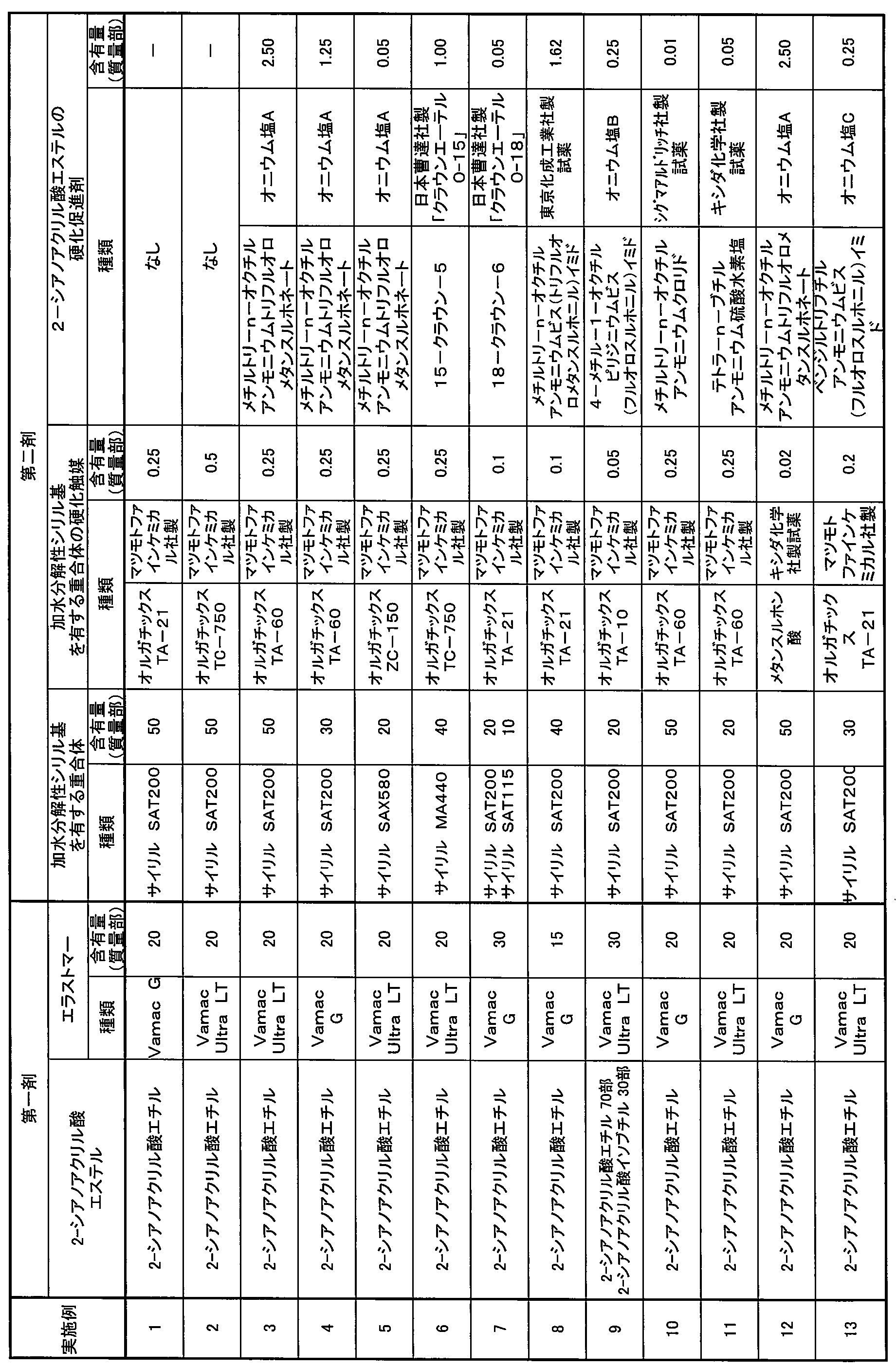
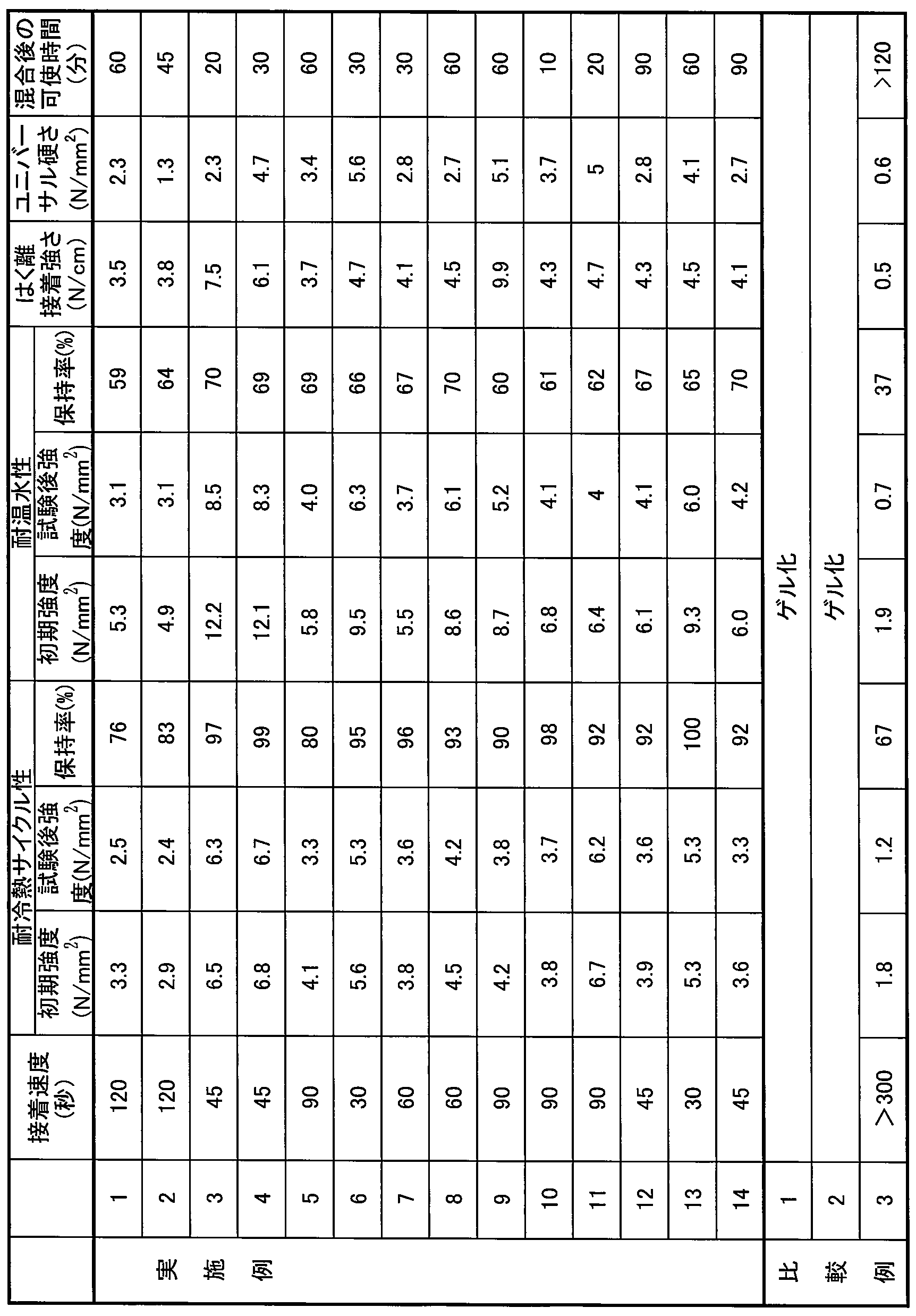
エラストマーの種類、及び加水分解性シリル基を有する重合体の硬化触媒の種類を表1のように代えた以外は実施例1と同様にして二液型硬化性組成物を製造した。
表3には、使用したエラストマーの共重合組成及び平均分子量を記載した。表3において、「E」はエチレン、「MA」はアクリル酸メチル、「AA」はアクリル酸、「BA」はアクリル酸ブチルを表す。また、表4には、使用した加水分解性シリル基を有する重合体の詳細を記載した。
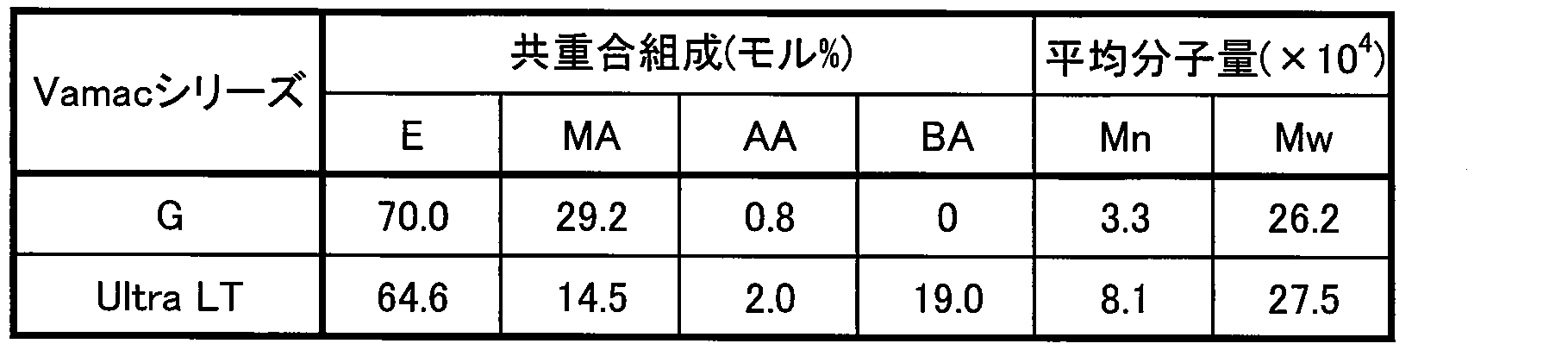
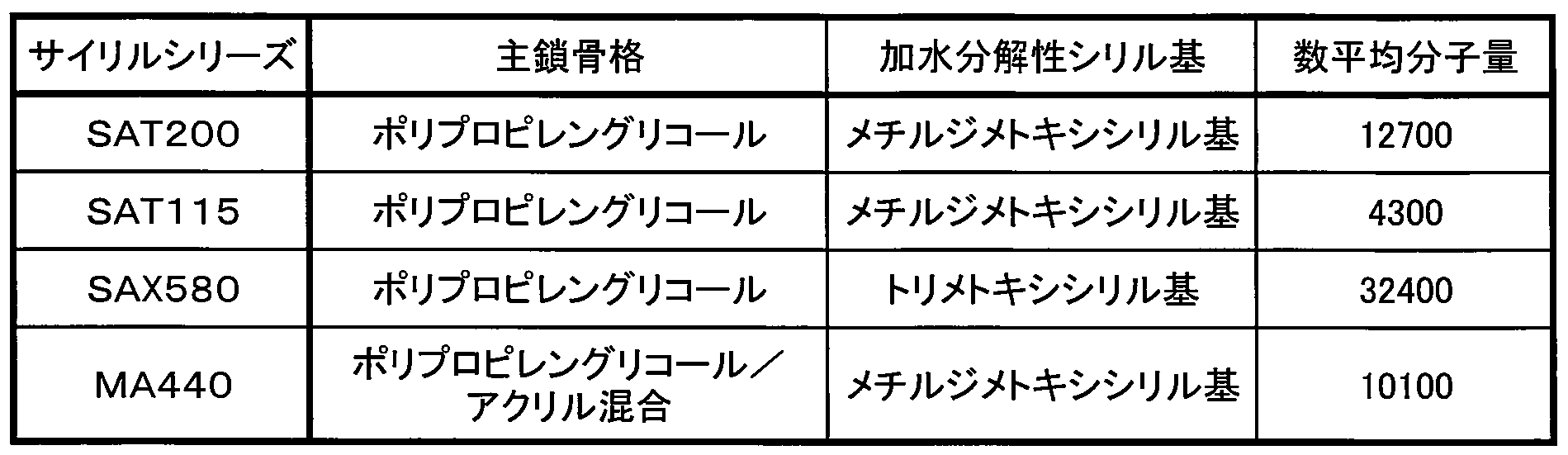
2-シアノアクリル酸エチル100質量部に、二酸化硫黄20ppm、ハイドロキノン1000ppm、及びピロガロール1000ppmを配合した。この液に、表1に記載のエラストマー(エチレン/アクリル酸メチル共重合体、デュポン社製、商品名「Vamac Ultra LT」)20質量部を溶解させて、第一剤を製造した。また、予めビニルトリメトキシシラン(モメンティブ・パフォーマンス・マテリアルズ・ジャパン社製、商品名「A-171」)1.5部を配合した、加水分解性シリル基を有する重合体50質量部(カネカ株式会社製、商品名「サイリルSAT200」)に、該重合体の硬化触媒としてt-アミルチタネート(マツモトファインケミカル社製、商品名「オルガチックスTA-60」)、及び2-シアノアクリル酸エステルの硬化促進剤として合成例1で得られたオニウム塩Aを、表1に記載の含有量となるように配合して、第二剤を製造した。
使用直前に第一剤と第二剤を70:30の割合で混合し、室温下で1分間撹拌して混合液を得た。
2-シアノアクリル酸エステル、加水分解性シリル基を有する重合体、該重合体の硬化触媒、及び2-シアノアクリル酸エステルの硬化促進剤を、表1のように代えた以外は実施例3と同様にして二液型硬化性組成物を製造した。
2-シアノアクリル酸エチル100質量部に、二酸化硫黄20ppm、ハイドロキノン1000ppm、及びピロガロール1000ppmを配合した。この液に、エラストマー(エチレン/アクリル酸メチル共重合体、デュポン社製、商品名「Vamac G」)20質量部、及び加水分解性シリル基を有する重合体の硬化触媒としてメタンスルホン酸(キシダ化学社製試薬)0.02質量部を溶解させて、第一剤を製造した。また、予めビニルトリメトキシシラン(モメンティブ・パフォーマンス・マテリアルズ・ジャパン社製、商品名「A-171」)1.5部を配合した、加水分解性シリル基を有する重合体30質量部(カネカ株式会社製、商品名「サイリルSAT200」)に、2-シアノアクリル酸エステルの硬化触媒としてオニウム塩Aを2.50質量部配合して、第二剤を製造した。
使用直前に前記第一剤と第二剤を70:30の割合で混合し、室温下で1分間撹拌した。得られた混合液を用いて、各種評価を行った。
表5に示される組成のとおりエラストマーを配合しなかった以外は実施例1と同様に製造を行ったが、第一剤に含まれる2-シアノアクリル酸エステルと、第二剤に含まれる加水分解性シリル基を有する重合体を混合することができず、二相に分離したままであった。また、数分後には発熱して、ゲル化したため、評価することができなかった。
表5に示される組成のとおり加水分解性シリル基を有する重合体を配合しなかった以外は実施例1と同様に製造を行ったが、第一剤に第二剤を添加すると、添加した第二剤周辺が直ちにゲル化し、評価することができなかった。
表5に示される組成のとおり加水分解性シリル基を有する重合体の硬化触媒を配合しなかった以外は実施例1と同様にして二液型硬化性組成物を製造し、評価した。結果を表2に示す。
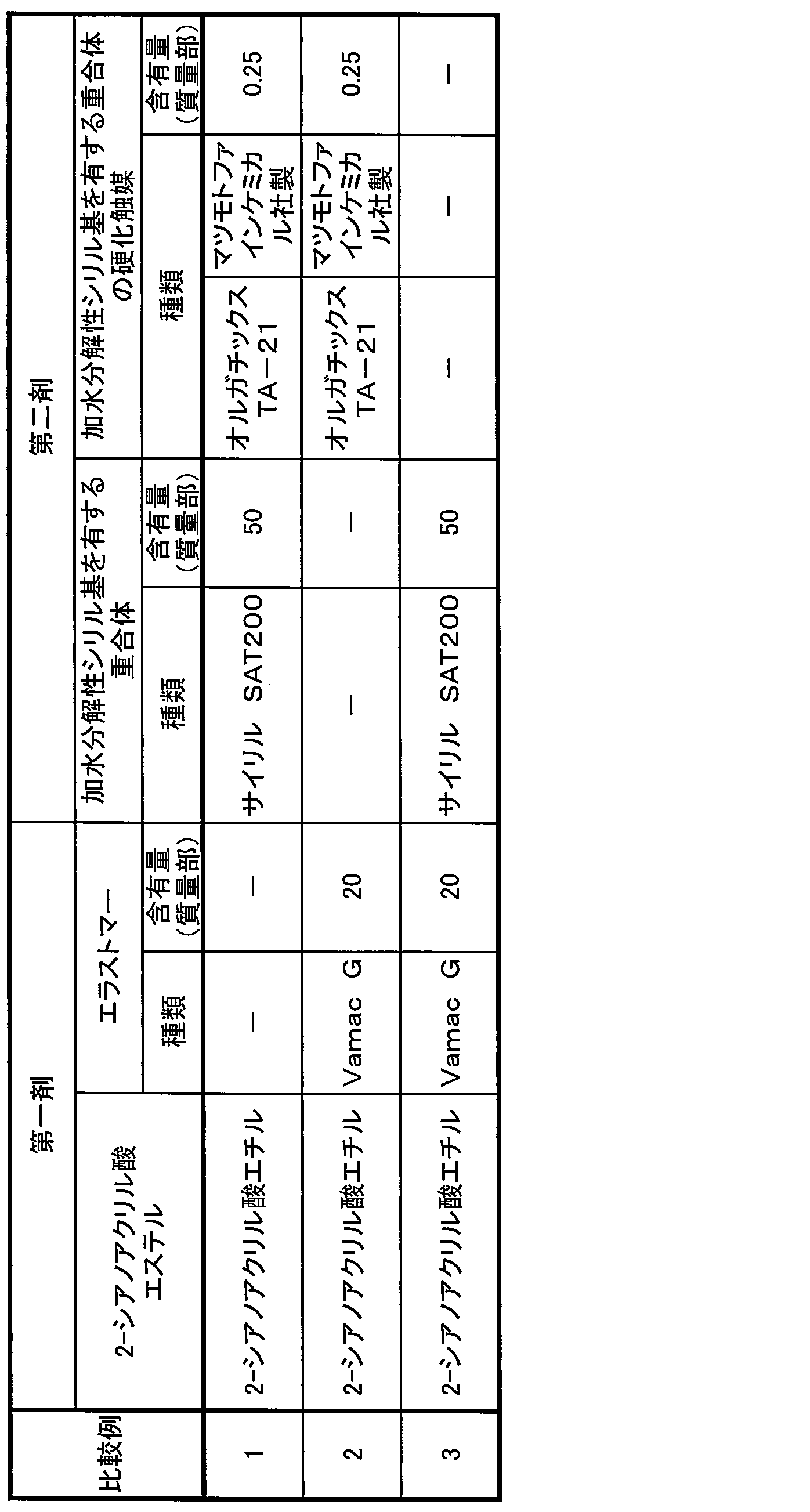
Claims (14)
- 下記成分(a)を少なくとも含む第一剤と、下記成分(c)を少なくとも含む第二剤とを備えてなる二液型硬化性組成物であって、
下記成分(b)及び下記成分(d)のそれぞれは、前記第一剤及び前記第二剤の少なくとも一方に含まれており、
前記第一剤及び前記第二剤に含まれる下記成分(b)の含有量は、第一剤に含まれる成分(b)については下記成分(a)100質量部に対し、及び、第二剤に含まれる成分(b)については下記成分(c)100質量部に対し、5~50質量部であり、
前記第一剤及び前記第二剤に含まれる下記成分(d)の合計量は、下記成分(c)100質量部に対し、0.0005~10質量部であることを特徴とする二液型硬化性組成物。
成分(a):2-シアノアクリル酸エステル
成分(b):エラストマー
成分(c):加水分解性シリル基を有する重合体
成分(d):前記重合体(c)の硬化触媒 - 上記エラストマーが、2-シアノアクリル酸エステルに難溶性の重合体となり得る単量体、及び2-シアノアクリル酸エステルに可溶性の重合体となり得る単量体を用いてなる共重合体である請求項1に記載の二液型硬化性組成物。
- 上記エラストマーが、2-シアノアクリル酸エステルに難溶性の重合体となり得る単量体、2-シアノアクリル酸エステルに可溶性の重合体となり得る単量体、及びカルボキシ基含有単量体とを用いてなる共重合体である請求項1に記載の二液型硬化性組成物。
- 上記2-シアノアクリル酸エステルに難溶性の重合体となり得る単量体が、エチレン、プロピレン、イソプレン、ブタジエン、クロロプレン、1-ヘキセン、及びシクロペンテンのうちの少なくとも1種であり、上記2-シアノアクリル酸エステルに可溶性の重合体となり得る単量体が、アクリル酸エステル、メタクリル酸エステル、塩化ビニル、酢酸ビニル、ビニルエーテル、スチレン、及びアクリロニトリルのうちの少なくとも1種である請求項2又は3に記載の二液型硬化性組成物。
- 上記加水分解性シリル基を有する重合体の主鎖骨格が、オキシアルキレン系重合体、ビニル系重合体、ポリエステル系重合体、ポリウレタン系重合体、及びポリカーボネート系重合体からなる群より選択される少なくとも1種である請求項1~4のいずれか1項に記載の二液型硬化性組成物。
- 上記成分加水分解性シリル基を有する重合体の数平均分子量が、500~50000である請求項1~5のいずれか1項に記載の二液型硬化性組成物。
- 上記硬化触媒が、金属元素と、該金属元素に酸素を介して結合する有機基とを有する化合物である請求項1~6のいずれか1項に記載の二液型硬化性組成物。
- 上記硬化触媒の金属元素が、チタン、ジルコニウム、ハフニウム、スズ、アルミニウム、及び亜鉛からなる群より選択される少なくとも1種である請求項7に記載の二液型硬化性組成物。
- 上記硬化触媒の有機基が、アルコキシ基、アセチルアセトン、アセト酢酸エステル、カルボキシ基、及びフェノキシ基からなる群より選択される少なくとも1種である請求項7に記載の二液型硬化性組成物。
- 上記硬化触媒が、25℃におけるpKaが4以下の酸である請求項1~6のいずれか1項に記載の二液型硬化性組成物。
- 上記酸が、スルホン酸、リン酸、リン酸モノエステル、リン酸ジエステル、亜リン酸、及び亜リン酸エステルからなる群より選択される少なくとも1種である請求項10に記載の二液型硬化性組成物。
- 上記第一剤及び第二剤の少なくとも一方に、上記成分(a)である2-シアノアクリル酸エステルの硬化促進剤を更に含有する請求項1~11のいずれか1項に記載の二液型硬化性組成物。
- 上記硬化促進剤が、下記一般式(1)で表されるオニウム塩である請求項12に記載の二液型硬化性組成物。
C+A- (1)
[式中、C+はオニウムカチオンである。A-は下記アニオン群から選ばれる1種のアニオンである。
硫酸水素アニオン、亜硫酸水素アニオン、R1SO3 -で表されるスルホン酸アニオン(R1はアルキル基、シクロアルキル基、ビニル基、アリール基、アルケニル基、アルキニル基及びアラルキル基からなる群より選ばれた基、又はハロゲン原子であり、上記基は置換基で置換されていてもよい)、
R2OSO3 -で表される硫酸エステルアニオン(R2はアルキル基、シクロアルキル基、ビニル基、アリール基、アルケニル基、アルキニル基及びアラルキル基からなる群より選ばれた基であり、上記基は置換基で置換されていてもよい)、
(R3SO2)(R4SO2)N-で表されるビス(置換スルホニル)イミドアニオン(R3及びR4はアルキル基、シクロアルキル基、ビニル基、アリール基、アルケニル基、アルキニル基及びアラルキル基からなる群より選ばれた基、又はハロゲン原子であり、上記基は置換基で置換されていてもよく、R3及びR4は同一でも異なっていても良い)、
(R5CO)(R6CO)N-で表されるイミドアニオン(R5及びR6はアルキル基、シクロアルキル基、ビニル基、アリール基、アルケニル基、アルキニル基及びアラルキル基からなる群より選ばれた基、又はハロゲン原子であり、上記基は置換基で置換されていてもよく、R5及びR6は同一でも異なっていてもよい)、
(R7SO2)(R8CO)N-で表されるスルホニルイミドアニオン(R7及びR8はアルキル基、シクロアルキル基、ビニル基、アリール基、アルケニル基、アルキニル基及びアラルキル基からなる群より選ばれた基、又はハロゲン原子であり、上記基は置換基で置換されていてもよく、R7及びR8は同一でも異なっていてもよい)、
過ハロゲン化ルイス酸アニオン、
テトラフルオロホウ素アニオン、ヘキサフルオロリン酸アニオン、ハロゲンアニオン、硝酸アニオン、
CN-、SCN-、OCN-、N(CN)2 -、
(R9O)aPO4-a (3-a)-で表されるリン酸アニオン及びリン酸エステルアニオン(R9はアルキル基、シクロアルキル基、ビニル基、アリール基、アルケニル基、アルキニル基及びアラルキル基からなる群より選ばれた基であり、上記基は置換基で置換されていてもよく、aは0~2の整数であり、R9が複数の場合、それらは同一でも異なっていてもよい)、
R10(R11O)bPO3-b (2-b)-で表されるホスホン酸アニオン及びホスホン酸エステルアニオン(R10は水素又はアルキル基、シクロアルキル基、ビニル基、アリール基、アルケニル基、アルキニル基及びアラルキル基からなる群より選ばれた基であり、上記基は置換基で置換されていてもよい。R11はアルキル基、シクロアルキル基、ビニル基、アリール基、アルケニル基、アルキニル基及びアラルキル基からなる群より選ばれた基であり、上記基は置換基で置換されていてもよい。bは0又は1である)、
R12 2PO2 -で表されるホスフィン酸アニオン(R12は水素又はアルキル基、シクロアルキル基、ビニル基、アリール基、アルケニル基、アルキニル基及びアラルキル基からなる群より選ばれた基であり、上記基は置換基で置換されていてもよく、R12は同一でも異なっていてもよい)、
(R13O)cPO3-c (3-c)-で表される亜リン酸及び亜リン酸エステルアニオン(R13はアルキル基、シクロアルキル基、ビニル基、アリール基、アルケニル基、アルキニル基及びアラルキル基からなる群より選ばれた基であり、上記基は置換基で置換されていてもよく、cは0~2の整数であり、R13が複数の場合、それらは同一でも異なっていてもよい)、
R14(R15O)dPO2-d (2-d)-で表される亜ホスホン酸アニオン及び亜ホスホン酸エステルアニオン(R14は水素又はアルキル基、シクロアルキル基、ビニル基、アリール基、アルケニル基、アルキニル基及びアラルキル基からなる群より選ばれた基であり、上記基は置換基で置換されていてもよい。R15はアルキル基、シクロアルキル基、ビニル基、アリール基、アルケニル基、アルキニル基及びアラルキル基からなる群より選ばれた基であり、上記基は置換基で置換されていてもよい。dは0又は1である)、
R16 2PO-で表される亜ホスフィン酸アニオン(R16は水素又はアルキル基、シクロアルキル基、ビニル基、アリール基、アルケニル基、アルキニル基及びアラルキル基からなる群より選ばれた基であり、上記基は置換基で置換されていてもよく、R16は同一でも異なっていてもよい)、
R17CO2 -で表されるカルボン酸アニオン(R17は水素又はアルキル基、シクロアルキル基、ビニル基、アリール基、アルケニル基、アルキニル基及びアラルキル基からなる群より選ばれた基であり、上記基は置換基で置換されていてもよい)、
CO3 2-で表される炭酸アニオン、
(R18O)fBO3-f (3-f)-で表されるホウ酸及びホウ酸エステルアニオン(R18はアルキル基、シクロアルキル基、ビニル基、アリール基、アルケニル基、アルキニル基及びアラルキル基からなる群より選ばれた基であり、上記基は置換基で置換されていてもよく、fは0から2の整数であり、R18が複数の場合、それらは同一でも異なっていてもよい)、
R19(R20O)gBO2-g (2-g)-で表されるボロン酸及びボロン酸エステルアニオン(R19は水素又はアルキル基、シクロアルキル基、ビニル基、アリール基、アルケニル基、アルキニル基及びアラルキル基からなる群より選ばれた基であり、上記基は置換基で置換されていてもよい。R20はアルキル基、シクロアルキル基、ビニル基、アリール基、アルケニル基、アルキニル基及びアラルキル基からなる群より選ばれた基であり、上記基は置換基で置換されていてもよい。gは0又は1である)、
R21 2BO-で表されるボリン酸アニオン(R21は水素又はアルキル基、シクロアルキル基、ビニル基、アリール基、アルケニル基、アルキニル基及びアラルキル基からなる群より選ばれた基であり、上記基は置換基で置換されていてもよく、R21は同一でも異なっていてもよい)、
(R22O)hSiO4-h (4-h)-で表されるケイ酸及びケイ酸エステルアニオン(R22は水素又はアルキル基、シクロアルキル基、ビニル基、アリール基、アルケニル基、アルキニル基及びアラルキル基からなる群より選ばれた基であり、上記基は置換基で置換されていてもよく、hは0から3の整数であり、R22が複数の場合、それらは同一でも異なっていてもよい)、
R23 i(R24O)jSiO4-i-j (4-i-j)-で表されるケイ酸及び有機ケイ素化合物のアニオン(R23及びR24は水素又はアルキル基、シクロアルキル基、ビニル基、アリール基、アルケニル基、アルキニル基及びアラルキル基からなる群より選ばれた基であり、上記基は置換基で置換されていてもよい。R23及びR24は同一であっても異なっていてもよい。iは1から3の整数であり、jは0から2の整数であり、i+jは1から3の整数であり、R23及びR24が複数の場合、それらは同一でも異なっていてもよい。)] - 上記オニウム塩のアニオンA-が、硫酸水素アニオン、亜硫酸水素アニオン、R1SO3 -で表されるスルホン酸アニオン(R1はアルキル基、パーフルオロアルキル基、シクロアルキル基、ビニル基、アリール基、パーフルオロアリール基、アルケニル基、アルキニル基、アラルキル基、またはハロゲンである)、(R3SO2)(R4SO2)N-で表されるビス(置換スルホニル)イミドアニオン(R3及びR4はアルキル基、パーフルオロアルキル基、シクロアルキル基、ビニル基、アリール基、パーフルオロアリール基、アルケニル基、アルキニル基、アラルキル基、またはハロゲンである)、テトラフルオロホウ素アニオン、ヘキサフルオロリン酸アニオン、ハロゲンアニオン、及び硝酸アニオンでからなる群より選択される少なくとも1種である請求項13に記載の二液型硬化性組成物。
Priority Applications (5)
| Application Number | Priority Date | Filing Date | Title |
|---|---|---|---|
| CN201580073010.0A CN107108771B (zh) | 2014-12-12 | 2015-12-01 | 二液型固化性组合物 |
| EP15867204.8A EP3231818B1 (en) | 2014-12-12 | 2015-12-01 | Two-part curable composition |
| US15/533,942 US9994662B2 (en) | 2014-12-12 | 2015-12-01 | Two-part curable composition |
| KR1020177016164A KR102340530B1 (ko) | 2014-12-12 | 2015-12-01 | 2액형 경화성 조성물 |
| JP2016563630A JP6460120B2 (ja) | 2014-12-12 | 2015-12-01 | 二液型硬化性組成物 |
Applications Claiming Priority (2)
| Application Number | Priority Date | Filing Date | Title |
|---|---|---|---|
| JP2014252172 | 2014-12-12 | ||
| JP2014-252172 | 2014-12-12 |
Publications (1)
| Publication Number | Publication Date |
|---|---|
| WO2016093112A1 true WO2016093112A1 (ja) | 2016-06-16 |
Family
ID=56107301
Family Applications (1)
| Application Number | Title | Priority Date | Filing Date |
|---|---|---|---|
| PCT/JP2015/083732 Ceased WO2016093112A1 (ja) | 2014-12-12 | 2015-12-01 | 二液型硬化性組成物 |
Country Status (7)
| Country | Link |
|---|---|
| US (1) | US9994662B2 (ja) |
| EP (1) | EP3231818B1 (ja) |
| JP (1) | JP6460120B2 (ja) |
| KR (1) | KR102340530B1 (ja) |
| CN (1) | CN107108771B (ja) |
| TW (1) | TWI664224B (ja) |
| WO (1) | WO2016093112A1 (ja) |
Cited By (5)
| Publication number | Priority date | Publication date | Assignee | Title |
|---|---|---|---|---|
| WO2020071553A1 (ja) * | 2018-10-05 | 2020-04-09 | 東亞合成株式会社 | スピーカー組立用接着剤組成物、スピーカー組立方法及びスピーカー |
| JP2021507023A (ja) * | 2017-12-14 | 2021-02-22 | ボスティク エス.アー. | 接着性多成分組成物およびその使用 |
| JP2022020522A (ja) * | 2020-07-20 | 2022-02-01 | 東亞合成株式会社 | 硬化性組成物 |
| JP2023535921A (ja) * | 2020-07-22 | 2023-08-22 | ボスティク エス アー | 硬化性2液型接着剤組成物 |
| JP2024519605A (ja) * | 2021-05-07 | 2024-05-20 | ボスティク エス アー | 2液型硬化性組成物 |
Families Citing this family (2)
| Publication number | Priority date | Publication date | Assignee | Title |
|---|---|---|---|---|
| CN109265897A (zh) * | 2018-09-26 | 2019-01-25 | 德清舒华泡沫座椅有限公司 | 一种有机硅改性聚苯乙烯及其制备方法 |
| CN114729090B (zh) | 2019-11-18 | 2025-01-28 | 汉高股份有限及两合公司 | 双组分(2k)可固化组合物 |
Citations (9)
| Publication number | Priority date | Publication date | Assignee | Title |
|---|---|---|---|---|
| JPS60168775A (ja) * | 1983-11-10 | 1985-09-02 | ロツクタイト コ−ポレイシヨン | 接着剤及び接着方法 |
| JPH03265676A (ja) * | 1990-03-15 | 1991-11-26 | Taoka Chem Co Ltd | α―シアノアクリレート接着剤用プライマー及びそれを用いる接着方法 |
| JPH06240209A (ja) * | 1993-02-12 | 1994-08-30 | Three Bond Co Ltd | 接着剤組成物およびその製造方法 |
| JPH08505383A (ja) * | 1993-01-11 | 1996-06-11 | ユーロタツクス・リミテツド | 2−シアノアクリル酸エステルの製造方法及び該方法により製造されたエステルの接着剤としての使用 |
| JP2001505235A (ja) * | 1996-08-16 | 2001-04-17 | ロックタイト(アイルランド)リミテッド | ガラス接着のためのシアノアクリレート接着剤組成物 |
| JP2005350514A (ja) * | 2004-06-08 | 2005-12-22 | Sekisui Chem Co Ltd | 湿気硬化型組成物とその用途 |
| JP2011057733A (ja) * | 2009-09-07 | 2011-03-24 | Toagosei Co Ltd | 接着剤組成物 |
| JP2014515775A (ja) * | 2011-04-12 | 2014-07-03 | ヘンケル アイルランド リミテッド | 改善された耐水性を有するシアノアクリレート接着剤 |
| WO2015033738A1 (ja) * | 2013-09-03 | 2015-03-12 | 東亞合成株式会社 | 接着剤組成物 |
Family Cites Families (27)
| Publication number | Priority date | Publication date | Assignee | Title |
|---|---|---|---|---|
| JPS53115751A (en) | 1977-03-18 | 1978-10-09 | Kyoritsu Kagaku Sangyo | Adhesive composition |
| JPS6037836B2 (ja) | 1977-08-05 | 1985-08-28 | 東亞合成株式会社 | 接着剤組成物 |
| AT365623B (de) | 1980-03-10 | 1982-02-10 | Teroson Gmbh | Cyanoacrylat-klebstoffzusammensetzung |
| JPS588771A (ja) | 1981-07-08 | 1983-01-18 | Taoka Chem Co Ltd | 接着剤組成物 |
| US4440910A (en) * | 1982-01-18 | 1984-04-03 | Loctite Corporation | Toughened cyanoacrylates containing elastomeric rubbers |
| JPS6031556A (ja) | 1983-07-29 | 1985-02-18 | Kanegafuchi Chem Ind Co Ltd | 硬化性組成物 |
| JPS59122541A (ja) | 1982-12-28 | 1984-07-16 | Kanegafuchi Chem Ind Co Ltd | 硬化性組成物 |
| JPS60179482A (ja) | 1984-01-27 | 1985-09-13 | ロクタイト.(アイルランド).リミテッド | 瞬間接着剤組成物 |
| US4695615A (en) | 1984-11-21 | 1987-09-22 | Loctite (Ireland) Limited | Instant adhesive composition utilizing mixed functionality calixarenes as accelerators |
| JPH078976B2 (ja) | 1986-07-02 | 1995-02-01 | セメダイン株式会社 | 接着方法 |
| EP0259016B1 (en) | 1986-08-29 | 1990-07-04 | LOCTITE (IRELAND) Ltd. | Calixarene derivatives and use of such compounds as accelerators in instant adhesive compositions |
| JPH0742376B2 (ja) | 1986-10-29 | 1995-05-10 | 鐘淵化学工業株式会社 | 硬化性組成物 |
| JPS63128088A (ja) | 1986-11-17 | 1988-05-31 | Koatsu Gas Kogyo Kk | α−シアノアクリレ−ト接着剤組成物 |
| JP2569742B2 (ja) | 1988-07-22 | 1997-01-08 | 東亞合成株式会社 | 接着剤組成物 |
| JP2671528B2 (ja) | 1989-11-27 | 1997-10-29 | 東亞合成株式会社 | 瞬間接着剤組成物 |
| DE4009621A1 (de) | 1990-03-26 | 1991-10-02 | Henkel Kgaa | (alpha) -cyanacrylatklebstoffzusammensetzungen |
| JPH0657214A (ja) | 1992-08-10 | 1994-03-01 | Taoka Chem Co Ltd | エラストマー含有接着剤組成物 |
| JP3341168B2 (ja) * | 1992-10-09 | 2002-11-05 | 大原パラヂウム化学株式会社 | 接着剤組成物 |
| JPH06172631A (ja) | 1992-12-04 | 1994-06-21 | Kanegafuchi Chem Ind Co Ltd | 硬化性組成物 |
| PL310072A1 (en) | 1993-01-11 | 1995-11-27 | Abacol Ltd | Small-diameter microcapsules, method of making them and their applications |
| JP3030020B1 (ja) | 1998-12-10 | 2000-04-10 | コニシ株式会社 | ウレタン系樹脂及びその製造方法 |
| JP2000191600A (ja) | 1998-12-28 | 2000-07-11 | Toagosei Co Ltd | 環状化合物、該環状化合物からなる2―シアノアクリレ―ト用硬化促進剤、並びに2―シアノアクリレ―ト系組成物 |
| JP5082851B2 (ja) | 2005-08-25 | 2012-11-28 | 東亞合成株式会社 | 硬化性樹脂組成物 |
| PL2616520T3 (pl) * | 2010-09-15 | 2018-08-31 | Henkel IP & Holding GmbH | Dwuczęściowe, cyjanoakrylanowe/kationowo utwardzalne układy klejowe |
| WO2013111036A1 (en) | 2012-01-23 | 2013-08-01 | Henkel Ireland Limited | Two-part, cyanoacrylate/free radically curable adhesive systems |
| TWI608069B (zh) * | 2012-09-11 | 2017-12-11 | 東亞合成股份有限公司 | 2-cyanoacrylate (salt) adhesive composition |
| KR102140940B1 (ko) * | 2012-12-14 | 2020-08-04 | 도아고세이가부시키가이샤 | 접착제 조성물 |
-
2015
- 2015-11-25 TW TW104139255A patent/TWI664224B/zh active
- 2015-12-01 KR KR1020177016164A patent/KR102340530B1/ko active Active
- 2015-12-01 CN CN201580073010.0A patent/CN107108771B/zh active Active
- 2015-12-01 EP EP15867204.8A patent/EP3231818B1/en active Active
- 2015-12-01 WO PCT/JP2015/083732 patent/WO2016093112A1/ja not_active Ceased
- 2015-12-01 US US15/533,942 patent/US9994662B2/en active Active
- 2015-12-01 JP JP2016563630A patent/JP6460120B2/ja active Active
Patent Citations (9)
| Publication number | Priority date | Publication date | Assignee | Title |
|---|---|---|---|---|
| JPS60168775A (ja) * | 1983-11-10 | 1985-09-02 | ロツクタイト コ−ポレイシヨン | 接着剤及び接着方法 |
| JPH03265676A (ja) * | 1990-03-15 | 1991-11-26 | Taoka Chem Co Ltd | α―シアノアクリレート接着剤用プライマー及びそれを用いる接着方法 |
| JPH08505383A (ja) * | 1993-01-11 | 1996-06-11 | ユーロタツクス・リミテツド | 2−シアノアクリル酸エステルの製造方法及び該方法により製造されたエステルの接着剤としての使用 |
| JPH06240209A (ja) * | 1993-02-12 | 1994-08-30 | Three Bond Co Ltd | 接着剤組成物およびその製造方法 |
| JP2001505235A (ja) * | 1996-08-16 | 2001-04-17 | ロックタイト(アイルランド)リミテッド | ガラス接着のためのシアノアクリレート接着剤組成物 |
| JP2005350514A (ja) * | 2004-06-08 | 2005-12-22 | Sekisui Chem Co Ltd | 湿気硬化型組成物とその用途 |
| JP2011057733A (ja) * | 2009-09-07 | 2011-03-24 | Toagosei Co Ltd | 接着剤組成物 |
| JP2014515775A (ja) * | 2011-04-12 | 2014-07-03 | ヘンケル アイルランド リミテッド | 改善された耐水性を有するシアノアクリレート接着剤 |
| WO2015033738A1 (ja) * | 2013-09-03 | 2015-03-12 | 東亞合成株式会社 | 接着剤組成物 |
Cited By (7)
| Publication number | Priority date | Publication date | Assignee | Title |
|---|---|---|---|---|
| JP2021507023A (ja) * | 2017-12-14 | 2021-02-22 | ボスティク エス.アー. | 接着性多成分組成物およびその使用 |
| JP7418329B2 (ja) | 2017-12-14 | 2024-01-19 | ボスティク エス アー | 接着性多成分組成物およびその使用 |
| WO2020071553A1 (ja) * | 2018-10-05 | 2020-04-09 | 東亞合成株式会社 | スピーカー組立用接着剤組成物、スピーカー組立方法及びスピーカー |
| JPWO2020071553A1 (ja) * | 2018-10-05 | 2021-09-09 | 東亞合成株式会社 | スピーカー組立用接着剤組成物、スピーカー組立方法及びスピーカー |
| JP2022020522A (ja) * | 2020-07-20 | 2022-02-01 | 東亞合成株式会社 | 硬化性組成物 |
| JP2023535921A (ja) * | 2020-07-22 | 2023-08-22 | ボスティク エス アー | 硬化性2液型接着剤組成物 |
| JP2024519605A (ja) * | 2021-05-07 | 2024-05-20 | ボスティク エス アー | 2液型硬化性組成物 |
Also Published As
| Publication number | Publication date |
|---|---|
| KR20170094217A (ko) | 2017-08-17 |
| US20170327616A1 (en) | 2017-11-16 |
| CN107108771A (zh) | 2017-08-29 |
| TWI664224B (zh) | 2019-07-01 |
| TW201620980A (zh) | 2016-06-16 |
| KR102340530B1 (ko) | 2021-12-20 |
| CN107108771B (zh) | 2019-08-16 |
| JP6460120B2 (ja) | 2019-01-30 |
| EP3231818A1 (en) | 2017-10-18 |
| US9994662B2 (en) | 2018-06-12 |
| JPWO2016093112A1 (ja) | 2017-11-09 |
| EP3231818A4 (en) | 2018-07-04 |
| EP3231818B1 (en) | 2019-08-14 |
Similar Documents
| Publication | Publication Date | Title |
|---|---|---|
| JP6273536B2 (ja) | 接着剤組成物 | |
| JP6460120B2 (ja) | 二液型硬化性組成物 | |
| US9458361B2 (en) | Adhesive composition | |
| JP6708982B2 (ja) | 接着剤組成物 | |
| EP2896668B1 (en) | 2-cyanoacrylate-based adhesive composition | |
| WO2020071553A1 (ja) | スピーカー組立用接着剤組成物、スピーカー組立方法及びスピーカー | |
| JP6176123B2 (ja) | 2−シアノアクリレート系接着剤組成物 | |
| WO2018003682A1 (ja) | 2-シアノアクリレート系接着剤組成物 |
Legal Events
| Date | Code | Title | Description |
|---|---|---|---|
| 121 | Ep: the epo has been informed by wipo that ep was designated in this application |
Ref document number: 15867204 Country of ref document: EP Kind code of ref document: A1 |
|
| ENP | Entry into the national phase |
Ref document number: 2016563630 Country of ref document: JP Kind code of ref document: A |
|
| WWE | Wipo information: entry into national phase |
Ref document number: 15533942 Country of ref document: US |
|
| NENP | Non-entry into the national phase |
Ref country code: DE |
|
| ENP | Entry into the national phase |
Ref document number: 20177016164 Country of ref document: KR Kind code of ref document: A |
|
| REEP | Request for entry into the european phase |
Ref document number: 2015867204 Country of ref document: EP |