WO2018117247A1 - PROCÉDÉ DE PRODUCTION D'UN CORPS MOULÉ POREUX, PROCÉDÉ DE PRODUCTION D'UN CATALYSEUR DE DIMÉRISATION α-OLÉFINE, PROCÉDÉ DE PRODUCTION DE DIMÈRE α-OLÉFINE, CORPS MOULÉ POREUX, ET CATALYSEUR DE DIMÉRISATION α-OLÉFINE - Google Patents
PROCÉDÉ DE PRODUCTION D'UN CORPS MOULÉ POREUX, PROCÉDÉ DE PRODUCTION D'UN CATALYSEUR DE DIMÉRISATION α-OLÉFINE, PROCÉDÉ DE PRODUCTION DE DIMÈRE α-OLÉFINE, CORPS MOULÉ POREUX, ET CATALYSEUR DE DIMÉRISATION α-OLÉFINE Download PDFInfo
- Publication number
- WO2018117247A1 WO2018117247A1 PCT/JP2017/046048 JP2017046048W WO2018117247A1 WO 2018117247 A1 WO2018117247 A1 WO 2018117247A1 JP 2017046048 W JP2017046048 W JP 2017046048W WO 2018117247 A1 WO2018117247 A1 WO 2018117247A1
- Authority
- WO
- WIPO (PCT)
- Prior art keywords
- molded body
- porous molded
- mass
- producing
- compound
- Prior art date
- Legal status (The legal status is an assumption and is not a legal conclusion. Google has not performed a legal analysis and makes no representation as to the accuracy of the status listed.)
- Ceased
Links
Images
Classifications
-
- B—PERFORMING OPERATIONS; TRANSPORTING
- B01—PHYSICAL OR CHEMICAL PROCESSES OR APPARATUS IN GENERAL
- B01J—CHEMICAL OR PHYSICAL PROCESSES, e.g. CATALYSIS OR COLLOID CHEMISTRY; THEIR RELEVANT APPARATUS
- B01J23/00—Catalysts comprising metals or metal oxides or hydroxides, not provided for in group B01J21/00
- B01J23/02—Catalysts comprising metals or metal oxides or hydroxides, not provided for in group B01J21/00 of the alkali- or alkaline earth metals or beryllium
- B01J23/04—Alkali metals
-
- B—PERFORMING OPERATIONS; TRANSPORTING
- B01—PHYSICAL OR CHEMICAL PROCESSES OR APPARATUS IN GENERAL
- B01J—CHEMICAL OR PHYSICAL PROCESSES, e.g. CATALYSIS OR COLLOID CHEMISTRY; THEIR RELEVANT APPARATUS
- B01J37/00—Processes, in general, for preparing catalysts; Processes, in general, for activation of catalysts
- B01J37/08—Heat treatment
- B01J37/10—Heat treatment in the presence of water, e.g. steam
-
- B—PERFORMING OPERATIONS; TRANSPORTING
- B01—PHYSICAL OR CHEMICAL PROCESSES OR APPARATUS IN GENERAL
- B01J—CHEMICAL OR PHYSICAL PROCESSES, e.g. CATALYSIS OR COLLOID CHEMISTRY; THEIR RELEVANT APPARATUS
- B01J21/00—Catalysts comprising the elements, oxides, or hydroxides of magnesium, boron, aluminium, carbon, silicon, titanium, zirconium, or hafnium
- B01J21/18—Carbon
-
- B—PERFORMING OPERATIONS; TRANSPORTING
- B01—PHYSICAL OR CHEMICAL PROCESSES OR APPARATUS IN GENERAL
- B01J—CHEMICAL OR PHYSICAL PROCESSES, e.g. CATALYSIS OR COLLOID CHEMISTRY; THEIR RELEVANT APPARATUS
- B01J27/00—Catalysts comprising the elements or compounds of halogens, sulfur, selenium, tellurium, phosphorus or nitrogen; Catalysts comprising carbon compounds
- B01J27/20—Carbon compounds
- B01J27/232—Carbonates
-
- B—PERFORMING OPERATIONS; TRANSPORTING
- B01—PHYSICAL OR CHEMICAL PROCESSES OR APPARATUS IN GENERAL
- B01J—CHEMICAL OR PHYSICAL PROCESSES, e.g. CATALYSIS OR COLLOID CHEMISTRY; THEIR RELEVANT APPARATUS
- B01J35/00—Catalysts, in general, characterised by their form or physical properties
- B01J35/30—Catalysts, in general, characterised by their form or physical properties characterised by their physical properties
- B01J35/34—Mechanical properties
- B01J35/37—Crush or impact strength
-
- B—PERFORMING OPERATIONS; TRANSPORTING
- B01—PHYSICAL OR CHEMICAL PROCESSES OR APPARATUS IN GENERAL
- B01J—CHEMICAL OR PHYSICAL PROCESSES, e.g. CATALYSIS OR COLLOID CHEMISTRY; THEIR RELEVANT APPARATUS
- B01J35/00—Catalysts, in general, characterised by their form or physical properties
- B01J35/60—Catalysts, in general, characterised by their form or physical properties characterised by their surface properties or porosity
-
- B—PERFORMING OPERATIONS; TRANSPORTING
- B01—PHYSICAL OR CHEMICAL PROCESSES OR APPARATUS IN GENERAL
- B01J—CHEMICAL OR PHYSICAL PROCESSES, e.g. CATALYSIS OR COLLOID CHEMISTRY; THEIR RELEVANT APPARATUS
- B01J35/00—Catalysts, in general, characterised by their form or physical properties
- B01J35/60—Catalysts, in general, characterised by their form or physical properties characterised by their surface properties or porosity
- B01J35/61—Surface area
- B01J35/615—100-500 m2/g
-
- B—PERFORMING OPERATIONS; TRANSPORTING
- B01—PHYSICAL OR CHEMICAL PROCESSES OR APPARATUS IN GENERAL
- B01J—CHEMICAL OR PHYSICAL PROCESSES, e.g. CATALYSIS OR COLLOID CHEMISTRY; THEIR RELEVANT APPARATUS
- B01J35/00—Catalysts, in general, characterised by their form or physical properties
- B01J35/60—Catalysts, in general, characterised by their form or physical properties characterised by their surface properties or porosity
- B01J35/63—Pore volume
- B01J35/633—Pore volume less than 0.5 ml/g
-
- B—PERFORMING OPERATIONS; TRANSPORTING
- B01—PHYSICAL OR CHEMICAL PROCESSES OR APPARATUS IN GENERAL
- B01J—CHEMICAL OR PHYSICAL PROCESSES, e.g. CATALYSIS OR COLLOID CHEMISTRY; THEIR RELEVANT APPARATUS
- B01J37/00—Processes, in general, for preparing catalysts; Processes, in general, for activation of catalysts
-
- B—PERFORMING OPERATIONS; TRANSPORTING
- B01—PHYSICAL OR CHEMICAL PROCESSES OR APPARATUS IN GENERAL
- B01J—CHEMICAL OR PHYSICAL PROCESSES, e.g. CATALYSIS OR COLLOID CHEMISTRY; THEIR RELEVANT APPARATUS
- B01J37/00—Processes, in general, for preparing catalysts; Processes, in general, for activation of catalysts
- B01J37/0009—Use of binding agents; Moulding; Pressing; Powdering; Granulating; Addition of materials ameliorating the mechanical properties of the product catalyst
- B01J37/0018—Addition of a binding agent or of material, later completely removed among others as result of heat treatment, leaching or washing,(e.g. forming of pores; protective layer, desintegrating by heat)
-
- B—PERFORMING OPERATIONS; TRANSPORTING
- B01—PHYSICAL OR CHEMICAL PROCESSES OR APPARATUS IN GENERAL
- B01J—CHEMICAL OR PHYSICAL PROCESSES, e.g. CATALYSIS OR COLLOID CHEMISTRY; THEIR RELEVANT APPARATUS
- B01J37/00—Processes, in general, for preparing catalysts; Processes, in general, for activation of catalysts
- B01J37/0009—Use of binding agents; Moulding; Pressing; Powdering; Granulating; Addition of materials ameliorating the mechanical properties of the product catalyst
- B01J37/0063—Granulating
-
- B—PERFORMING OPERATIONS; TRANSPORTING
- B01—PHYSICAL OR CHEMICAL PROCESSES OR APPARATUS IN GENERAL
- B01J—CHEMICAL OR PHYSICAL PROCESSES, e.g. CATALYSIS OR COLLOID CHEMISTRY; THEIR RELEVANT APPARATUS
- B01J37/00—Processes, in general, for preparing catalysts; Processes, in general, for activation of catalysts
- B01J37/02—Impregnation, coating or precipitation
- B01J37/0201—Impregnation
-
- B—PERFORMING OPERATIONS; TRANSPORTING
- B01—PHYSICAL OR CHEMICAL PROCESSES OR APPARATUS IN GENERAL
- B01J—CHEMICAL OR PHYSICAL PROCESSES, e.g. CATALYSIS OR COLLOID CHEMISTRY; THEIR RELEVANT APPARATUS
- B01J37/00—Processes, in general, for preparing catalysts; Processes, in general, for activation of catalysts
- B01J37/08—Heat treatment
- B01J37/082—Decomposition and pyrolysis
-
- B—PERFORMING OPERATIONS; TRANSPORTING
- B01—PHYSICAL OR CHEMICAL PROCESSES OR APPARATUS IN GENERAL
- B01J—CHEMICAL OR PHYSICAL PROCESSES, e.g. CATALYSIS OR COLLOID CHEMISTRY; THEIR RELEVANT APPARATUS
- B01J37/00—Processes, in general, for preparing catalysts; Processes, in general, for activation of catalysts
- B01J37/08—Heat treatment
- B01J37/082—Decomposition and pyrolysis
- B01J37/088—Decomposition of a metal salt
-
- C—CHEMISTRY; METALLURGY
- C01—INORGANIC CHEMISTRY
- C01D—COMPOUNDS OF ALKALI METALS, i.e. LITHIUM, SODIUM, POTASSIUM, RUBIDIUM, CAESIUM, OR FRANCIUM
- C01D7/00—Carbonates of sodium, potassium or alkali metals in general
- C01D7/12—Preparation of carbonates from bicarbonates or bicarbonate-containing product
-
- C—CHEMISTRY; METALLURGY
- C01—INORGANIC CHEMISTRY
- C01D—COMPOUNDS OF ALKALI METALS, i.e. LITHIUM, SODIUM, POTASSIUM, RUBIDIUM, CAESIUM, OR FRANCIUM
- C01D7/00—Carbonates of sodium, potassium or alkali metals in general
- C01D7/38—Preparation in the form of granules, pieces or other shaped products
-
- C—CHEMISTRY; METALLURGY
- C07—ORGANIC CHEMISTRY
- C07C—ACYCLIC OR CARBOCYCLIC COMPOUNDS
- C07C11/00—Aliphatic unsaturated hydrocarbons
- C07C11/02—Alkenes
- C07C11/107—Alkenes with six carbon atoms
- C07C11/113—Methylpentenes
-
- C—CHEMISTRY; METALLURGY
- C07—ORGANIC CHEMISTRY
- C07C—ACYCLIC OR CARBOCYCLIC COMPOUNDS
- C07C2/00—Preparation of hydrocarbons from hydrocarbons containing a smaller number of carbon atoms
- C07C2/02—Preparation of hydrocarbons from hydrocarbons containing a smaller number of carbon atoms by addition between unsaturated hydrocarbons
- C07C2/04—Preparation of hydrocarbons from hydrocarbons containing a smaller number of carbon atoms by addition between unsaturated hydrocarbons by oligomerisation of well-defined unsaturated hydrocarbons without ring formation
- C07C2/06—Preparation of hydrocarbons from hydrocarbons containing a smaller number of carbon atoms by addition between unsaturated hydrocarbons by oligomerisation of well-defined unsaturated hydrocarbons without ring formation of alkenes, i.e. acyclic hydrocarbons having only one carbon-to-carbon double bond
- C07C2/08—Catalytic processes
-
- C—CHEMISTRY; METALLURGY
- C07—ORGANIC CHEMISTRY
- C07C—ACYCLIC OR CARBOCYCLIC COMPOUNDS
- C07C2/00—Preparation of hydrocarbons from hydrocarbons containing a smaller number of carbon atoms
- C07C2/02—Preparation of hydrocarbons from hydrocarbons containing a smaller number of carbon atoms by addition between unsaturated hydrocarbons
- C07C2/04—Preparation of hydrocarbons from hydrocarbons containing a smaller number of carbon atoms by addition between unsaturated hydrocarbons by oligomerisation of well-defined unsaturated hydrocarbons without ring formation
- C07C2/06—Preparation of hydrocarbons from hydrocarbons containing a smaller number of carbon atoms by addition between unsaturated hydrocarbons by oligomerisation of well-defined unsaturated hydrocarbons without ring formation of alkenes, i.e. acyclic hydrocarbons having only one carbon-to-carbon double bond
- C07C2/08—Catalytic processes
- C07C2/24—Catalytic processes with metals
-
- B—PERFORMING OPERATIONS; TRANSPORTING
- B01—PHYSICAL OR CHEMICAL PROCESSES OR APPARATUS IN GENERAL
- B01J—CHEMICAL OR PHYSICAL PROCESSES, e.g. CATALYSIS OR COLLOID CHEMISTRY; THEIR RELEVANT APPARATUS
- B01J35/00—Catalysts, in general, characterised by their form or physical properties
- B01J35/50—Catalysts, in general, characterised by their form or physical properties characterised by their shape or configuration
- B01J35/55—Cylinders or rings
-
- C—CHEMISTRY; METALLURGY
- C07—ORGANIC CHEMISTRY
- C07B—GENERAL METHODS OF ORGANIC CHEMISTRY; APPARATUS THEREFOR
- C07B61/00—Other general methods
-
- C—CHEMISTRY; METALLURGY
- C07—ORGANIC CHEMISTRY
- C07C—ACYCLIC OR CARBOCYCLIC COMPOUNDS
- C07C2521/00—Catalysts comprising the elements, oxides or hydroxides of magnesium, boron, aluminium, carbon, silicon, titanium, zirconium or hafnium
- C07C2521/18—Carbon
-
- C—CHEMISTRY; METALLURGY
- C07—ORGANIC CHEMISTRY
- C07C—ACYCLIC OR CARBOCYCLIC COMPOUNDS
- C07C2523/00—Catalysts comprising metals or metal oxides or hydroxides, not provided for in group C07C2521/00
- C07C2523/02—Catalysts comprising metals or metal oxides or hydroxides, not provided for in group C07C2521/00 of the alkali- or alkaline earth metals or beryllium
- C07C2523/04—Alkali metals
-
- Y—GENERAL TAGGING OF NEW TECHNOLOGICAL DEVELOPMENTS; GENERAL TAGGING OF CROSS-SECTIONAL TECHNOLOGIES SPANNING OVER SEVERAL SECTIONS OF THE IPC; TECHNICAL SUBJECTS COVERED BY FORMER USPC CROSS-REFERENCE ART COLLECTIONS [XRACs] AND DIGESTS
- Y02—TECHNOLOGIES OR APPLICATIONS FOR MITIGATION OR ADAPTATION AGAINST CLIMATE CHANGE
- Y02P—CLIMATE CHANGE MITIGATION TECHNOLOGIES IN THE PRODUCTION OR PROCESSING OF GOODS
- Y02P20/00—Technologies relating to chemical industry
- Y02P20/50—Improvements relating to the production of bulk chemicals
- Y02P20/52—Improvements relating to the production of bulk chemicals using catalysts, e.g. selective catalysts
Definitions
- the present invention relates to a method for producing a porous molded body, a method for producing an ⁇ -olefin dimerization catalyst, a method for producing an ⁇ -olefin dimer, a porous molded body, and an ⁇ -olefin dimerization catalyst.
- An ⁇ -olefin dimer represented by 4-methyl-1-pentene (including a codimer, the same applies hereinafter) is used as a monomer for polyolefin production.
- Many basic catalysts have been conventionally proposed as a catalyst for producing a corresponding dimer by ⁇ -olefin dimerization reaction (including co-dimerization reaction, the same applies hereinafter).
- a catalyst obtained by supporting an alkali metal on a carrier containing an anhydrous potassium compound as a main component is often used.
- the present inventors conducted various studies on the catalyst represented by the above-mentioned patent document. As a result, it is disclosed in, for example, Japanese Patent Application Laid-Open Nos. 58-114737, 3-42043, 7-222927, 2006-326418, and 2008-149275. It has been clarified that the catalyst tends to be difficult to continue the operation because the catalyst carrier collapses in a long-term reaction, although a certain degree of improvement effect is seen with respect to improvement in activity and selectivity. Further, for example, the catalyst using a carrier containing potassium hydrogen carbonate disclosed in US Pat. No. 5,810,944 is not suitable for industrial production because it is powdery. In addition, for example, US Pat. No.
- 5,810,941 discloses that the carrier may be formed into pellets or the like, but because potassium is used for molding, It was estimated that the filling could not be performed smoothly, and the physical properties of the molded article were not uniform.
- a porous molded body having a pore volume adjusted to a specific range as a molded body used for a carrier of an ⁇ -olefin dimerization catalyst is disclosed. Further, it is disclosed that when the molded body is used as a carrier for an ⁇ -olefin dimerization catalyst, the reaction selectivity is higher than that of a known catalyst.
- WO2015 / 093378 it is more desirable to be able to adjust the size of the pores. More specifically, for example, in WO2015 / 093378 It may be required to produce a porous shaped body having a larger pore size than the porous shaped body obtained by the described method.
- the problem to be solved by the present invention is to provide a porous molding used as a carrier for an ⁇ -olefin dimerization catalyst, which has excellent reaction selectivity in the ⁇ -olefin dimerization reaction and has a larger pore diameter. It is to provide a body and a method for producing the same. Furthermore, the problem to be solved by the present invention is to provide an ⁇ -olefin dimerization catalyst using the porous molded body, a method for producing the same, and a method for producing an ⁇ -olefin dimer using the catalyst. That is.
- the present disclosure includes the following embodiments. ⁇ 1> 1 to 100 parts by mass of a hydrogen carbonate compound (A) represented by AHCO 3 (A in the formula is Na or K) and B n X (B in the formula is Na or K; X is CO 3 , SO 4 , SiO 3 , F, Cl, or Br, and n is an integer of 1 or 2 determined by the valence of X) (B) 0 parts by mass to A step of obtaining a molded body by molding a raw material containing 99 parts by mass (however, the sum of (A) and (B) is 100 parts by mass); The shaped body, by the temperature 100 ° C. ⁇ 500 ° C.
- A hydrogen carbonate compound represented by AHCO 3
- B n X B in the formula is Na or K
- X is CO 3 , SO 4 , SiO 3 , F, Cl, or Br
- n is an integer of 1 or 2 determined by the valence of X
- the heat treatment is carried out in an atmosphere of water vapor containing 10.0g / m 3 ⁇ 750000g / m 3, ⁇ 1> ⁇ ⁇ 3> any one method for producing a porous molded article according to the.
- ⁇ 5> The method for producing a porous molded body according to any one of ⁇ 1> to ⁇ 4>, wherein 97% by mass or more of the hydrogen carbonate compound (A) is thermally decomposed by the heat treatment.
- ⁇ 6> In the raw material, when the total amount of the hydrogen carbonate compound (A) and the compound (B) is 100 parts by mass, the hydrogen carbonate compound (A) is 10 parts by mass to 100 parts by mass, The method for producing a porous molded body according to any one of ⁇ 1> to ⁇ 5>, wherein (B) is 0 to 90 parts by mass. ⁇ 7> The method for producing a porous molded body according to any one of ⁇ 1> to ⁇ 6>, wherein the raw material is molded by tableting. ⁇ 8> When the raw material contains the compound (B), the median diameter (d50) in the volume statistic of the mixture of the hydrogen carbonate compound (A) and the compound (B) is 5 ⁇ m to 600 ⁇ m.
- the median diameter (d50) in the volume statistic of the hydrogen carbonate compound (A) is 5 ⁇ m to 600 ⁇ m
- any one of ⁇ 1> to ⁇ 7> The manufacturing method of the porous molded object as described in any one.
- ⁇ 9> The method for producing a porous molded body according to any one of ⁇ 1> to ⁇ 8>, wherein the content of particles having a particle diameter of 40 ⁇ m or less in the raw material is 3% by mass to 30% by mass.
- the hydrogen carbonate compound (A) is potassium hydrogen carbonate (KHCO 3 ).
- ⁇ 13> a step of producing a porous molded body by the method for producing a porous molded body according to any one of ⁇ 1> to ⁇ 12>; Obtaining an ⁇ -olefin dimerization catalyst by supporting an alkali metal (D) on the porous molded body;
- ⁇ 15> including a carbonate compound (A1) that is at least one of sodium carbonate (Na 2 CO 3 ) and potassium carbonate (K 2 CO 3 ),
- A1 that is at least one of sodium carbonate (Na 2 CO 3 ) and potassium carbonate (K 2 CO 3 )
- the median pore diameter of pores having a pore diameter in the range of 0.05 ⁇ m to 10 ⁇ m is more than 0.36 ⁇ m and not more than 0.90 ⁇ m
- the pore volume having a pore diameter in the range of 0.05 ⁇ m to 10 ⁇ m is A porous molded body having a crushing strength of 1.8 kgf to 8.5 kgf in a range of 0.10 mL / g to 0.30 mL / g.
- ⁇ 16> The porous molded body according to ⁇ 15>, wherein the content of the carbonic acid compound (A1) is 70% by mass or more based on the total amount of the porous molded body.
- Na n Y or K n Y (wherein Y is SO 4 , SiO 3 , F, Cl or Br, and n is an integer of 1 or 2 determined by the valence of Y)
- ⁇ 19> Any one of ⁇ 15> to ⁇ 18>, wherein the pore volume is 0.20 mL / g to 0.30 mL / g, and the crushing strength is 2.2 kgf to 7.0 kgf.
- ⁇ 20> The porous molded body according to any one of ⁇ 15> to ⁇ 19>, wherein the carbonic acid compound (A1) is K 2 CO 3 .
- A1 is K 2 CO 3 .
- ⁇ 21> The porous molded body according to any one of ⁇ 15> to ⁇ 20>, further comprising graphite (C).
- An ⁇ -olefin dimerization catalyst comprising an alkali metal (D) supported on the porous molded body according to any one of ⁇ 15> to ⁇ 21>.
- a method for producing a porous molded body that is excellent in reaction selectivity in an ⁇ -olefin dimerization reaction and that is adjusted to have a larger pore diameter and that is used as a carrier for an ⁇ -olefin dimerization catalyst. Is done.
- the present disclosure also provides a method for producing an ⁇ -olefin dimerization catalyst using the porous molded body, and a method for producing an ⁇ -olefin dimer using the catalyst.
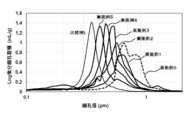
- FIG. 1 is a diagram showing the relationship between the pore diameter and the Log differential pore volume of the porous molded body in each Example and Comparative Example.
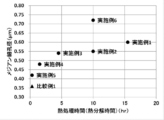
- FIG. 2 is a graph showing the relationship between the heat treatment time (KHCO 3 thermal decomposition time) and the median pore diameter of the porous molded body in each Example and Comparative Example.
- a numerical range expressed using “to” means a range including numerical values described before and after “to” as a lower limit value and an upper limit value.
- the upper limit value or the lower limit value described in a numerical range may be replaced with the upper limit value or the lower limit value of another numerical range described.
- the upper limit value or the lower limit value described in a certain numerical range may be replaced with the values shown in the examples.
- the term “process” is not limited to an independent process, and is included in this term if the intended purpose of the process is achieved even when it cannot be clearly distinguished from other processes. It is.
- the method for producing a porous molded body of the present disclosure (hereinafter also referred to as “production method of the present disclosure”) is a hydrogen carbonate compound (A) represented by AHCO 3 (wherein A is Na or K).
- the obtained molded body is heat-treated in an atmosphere containing a specific temperature range and a specific amount of water vapor. It was found that the porous molded body obtained by pyrolyzing 90% by mass or more of the hydrogen carbonate compound (A) not only has pores but also the pore diameter is adjusted to be larger. Then, it has been found that the reaction selectivity of the ⁇ -olefin dimerization reaction is improved when this porous molded body is applied to the carrier of the ⁇ -olefin dimerization catalyst.
- the production method of the present disclosure it is possible to obtain a porous molded body that is excellent in reaction selectivity in the ⁇ -olefin dimerization reaction and is used as a carrier for an ⁇ -olefin dimerization catalyst.
- the reason why the effect of the present disclosure is obtained is estimated as follows, but the manufacturing method of the present disclosure is not limitedly interpreted for the following reason.
- ⁇ -olefin dimerization reaction ⁇ -olefin multimers may be generated by side reactions, and the pores of the catalyst may be blocked by the multimers. It is surmised that the clogging of the pores is a factor that reduces the reaction selectivity of the ⁇ -olefin dimerization reaction.
- the structure of the porous molded body having a larger pore diameter adjusted contributes to the suppression of the generation of ⁇ -olefin multimers in the ⁇ -olefin dimerization reaction.
- clogging of the catalyst pores due to the multimer ie, side reaction product
- the reaction selectivity of the ⁇ -olefin dimerization reaction is estimated to be improved.
- the amount of water vapor in an atmosphere containing water vapor when heat-treating a molded body is 1.0 g / m 3 to 750000 g / m 3 , and 10.0 g / m 3 to 750000 g / m 3. It is preferable that When the water vapor amount is 1.0 g / m 3 or more, it is easier to obtain a porous molded body in which the pore diameter is adjusted to be larger. Further, when the water vapor amount is 1.0 g / m 3 or more, the pore volume of the porous molded body is easily adjusted to be large. When the water vapor amount is 750000 g / m 3 or less, the production suitability is excellent.
- the lower limit of the amount of water vapor is preferably 5.0 g / m 3 , more preferably 10.0 g / m 3 , and still more preferably 12.0 g / m 3 .
- Upper limit of the amount of water vapor is preferably 100000 g / m 3, more preferably 10000 g / m 3, more preferably 1000 g / m 3, particularly preferably from 500 g / m 3.
- the hydrogen carbonate compound (A) indicates a compound that is thermally decomposed when the molded body is heat-treated to generate a gas such as water vapor. That is, in the production method of the present disclosure, the atmosphere containing water vapor means an atmosphere containing a gas such as water vapor generated by thermal decomposition of the hydrogen carbonate compound (A).
- the temperature when the molded body is heat-treated is 100 ° C. to 500 ° C.
- the heat treatment temperature is 100 ° C. or higher, thermal decomposition of the hydrogen carbonate compound (A) is promoted, and a porous molded body having a larger pore diameter is easily obtained.
- the heat treatment temperature is 100 ° C. or higher, the pore volume of the porous molded body is easily adjusted to be large.
- the heat treatment temperature is 500 ° C. or lower, the production suitability is excellent.
- the heat treatment temperature is preferably 100 ° C. to 400 ° C., more preferably 100 ° C. to 300 ° C., further preferably 150 ° C. to 300 ° C., and particularly preferably 150 ° C. to 250 ° C.
- the time for heat-treating the molded body (that is, the heat treatment time) is preferably 0.3 hours or more.
- the heat treatment time refers to the time required for the hydrogen carbonate compound (A) to be thermally decomposed.
- the heat treatment may be continued even after the thermal decomposition of the hydrogen carbonate compound (A) is completed.
- the heat treatment time is usually longer than the thermal decomposition time of the hydrogen carbonate compound (A).
- the method for calculating the thermal decomposition time of the hydrogen carbonate compound (A) is described in the Examples section. When the heat treatment time is 0.3 hours or longer, the thermal decomposition of the hydrogen carbonate compound (A) is promoted, and a porous molded body having a larger pore diameter is easily obtained.
- the pore volume of the porous molded body is easily adjusted to be large. It is more preferable that the heat treatment time is 2 hours or more in terms of easy control of heat treatment conditions. Although there is no restriction
- the heat treatment time is preferably 0.3 hours or more and 24 hours or less, and more preferably 2 hours or more and 24 hours or less. The longer the heat treatment time, the larger the pore diameter tends to be. That is, the pore diameter can be controlled by adjusting the heat treatment conditions. Details of the heat treatment process will be described later.
- the step of obtaining a molded body is a step of obtaining a molded body by molding a raw material.
- a raw material means the raw material of a molded object.
- the raw materials are 1 to 100 parts by mass of a hydrogen carbonate compound (A) represented by AHCO 3 (A in the formula is Na or K) and B n X (B in the formula is Na or K, X is CO 3 , SO 4 , SiO 3 , F, Cl, or Br, and n is an integer of 1 or 2 determined by the valence of X) (B) 0 parts by mass to 99 parts by mass (provided that the total of (A) and (B) is 100 parts by mass).
- A hydrogen carbonate compound represented by AHCO 3
- B n X B in the formula is Na or K
- X is CO 3 , SO 4 , SiO 3 , F, Cl, or Br
- n is an integer of 1 or 2 determined by the valence of X
- the reason for this is that when the hydrogen carbonate compound (A) is thermally decomposed during the heat treatment of the molded body and a gas such as water vapor is generated, pores are formed in the portion where the gas is generated, and the pore diameter is adjusted to be larger. This is because a porous molded body can be obtained.
- the hydrogen carbonate compound (A) is represented by the formula of AHCO 3 .
- a in the formula represented by AHCO 3 is Na or K.
- the hydrogen carbonate compound (A) represented by the formula AHCO 3 is at least one compound of sodium hydrogen carbonate (NaHCO 3 ) and potassium hydrogen carbonate (KHCO 3 ).
- the mixing ratio is not particularly limited.
- the amount of the hydrogen carbonate compound (A) contained in the raw material is 1 to 100 parts by mass, preferably 10 parts by mass with respect to 100 parts by mass in total of the hydrogen carbonate compound (A) and the compound (B).
- To 100 parts by mass more preferably 30 to 100 parts by mass, further preferably 40 to 100 parts by mass, particularly preferably 40 to 90 parts by mass, and most preferably 50 to 90 parts by mass. Part by mass.
- the hydrogen carbonate compound (A) is preferably potassium hydrogen carbonate (KHCO 3 ) in which A in the formula is K from the viewpoint of obtaining a porous molded body having a larger pore diameter.
- B n X The compound (B) is represented by B n X.
- B in the formula represented by B n X is Na or K, X is CO 3 , SO 4 , SiO 3 , F, Cl, or Br, and n is determined by the valence of X 1 Or it is an integer of 2. That is, the compound (B) represented by the formula B n X is a carbonate or sulfate, silicate, fluoride, chloride or bromide of sodium or potassium.
- the compound (B) may be any one of the compounds represented by B n X, may be two or more. When there are two or more, the mixing ratio is not particularly limited.
- the amount of the compound (B) contained in the raw material is 0 to 99 parts by mass, preferably 0 to 90 parts by mass with respect to 100 parts by mass in total of the hydrogen carbonate compound (A) and the compound (B). Parts by mass, more preferably 0 parts by mass to 70 parts by mass, still more preferably 0 parts by mass to 60 parts by mass, particularly preferably 10 parts by mass to 60 parts by mass, and most preferably 10 parts by mass to 50 parts by mass. It is.
- the amount of the compound (B) contained in the raw material is determined by the amount of the hydrogen carbonate compound (A) and the compound Preferably it is 30 mass parts or less with respect to a total of 100 mass parts with (B), More preferably, it is 20 mass parts or less, More preferably, it is 10 mass parts or less.
- the compound (B) is preferably potassium carbonate (K 2 CO 3 ) in which B is K, X is CO 3 , and n is 2.
- the raw material may further contain graphite (C).
- the raw material may further contain graphite (C).
- C graphite
- the properties of graphite (C) are not particularly limited, and any graphite may be used as long as it is generally used as a lubricant during molding.
- Graphite (C) has a median diameter (d50) in a volume statistic of 5 ⁇ m to 500 ⁇ m and a specific surface area measured by the BET method of 0.1 m 2 / g to 300 m 2 / g. A range is mentioned.
- Graphite (C) may be natural graphite or artificial graphite.
- the amount of graphite (C) added to the raw material can be arbitrarily set as long as it can be molded.
- the amount of graphite (C) added to the raw material is 0.3 parts by mass with respect to a total of 100 parts by mass of the hydrogen carbonate compound (A) and the compound (B) when the raw material contains the compound (B). It is preferably ⁇ 10 parts by mass, more preferably 0.5 to 5 parts by mass.
- the amount of graphite (C) added to the raw material is 0.3 to 10 parts by mass with respect to 100 parts by mass of the hydrogen carbonate compound (A) when the raw material does not contain the compound (B).
- the amount is 0.5 to 5 parts by mass.
- strength of a molded object there exists a tendency for the intensity
- the amount of graphite (C) added is 0.3 parts by mass or more, for example, when the raw material is molded by tableting, it is possible to suppress the friction between the mortar and the scissors from becoming excessively large. Thereby, it becomes easy to operate
- the raw material of the molded body may contain other compounds other than the hydrogen carbonate compound (A), the compound (B), and the graphite (C) as necessary, as long as the effects of the present disclosure are not impaired.
- examples of such other compounds include ammonium bicarbonate.
- the raw material contains ammonium hydrogen carbonate, the pore volume of the porous molded body can be increased.
- the median diameter (d50) in the volume statistic value of the mixture of the hydrogen carbonate compound (A) and the compound (B) is preferably 5 ⁇ m to 600 ⁇ m, preferably 20 ⁇ m to The thickness is more preferably 500 ⁇ m, further preferably 50 ⁇ m to 450 ⁇ m, and particularly preferably 50 ⁇ m to 300 ⁇ m.
- the median diameter (d50) in the volume statistic value of the hydrogen carbonate compound (A) is preferably 5 ⁇ m to 600 ⁇ m, and more preferably 20 ⁇ m to 500 ⁇ m.
- 50 ⁇ m to 450 ⁇ m is more preferable, and 50 ⁇ m to 300 ⁇ m is particularly preferable. Since the powder having a median diameter in the range of 5 ⁇ m to 600 ⁇ m has good fluidity, it is possible to produce a molded body stably.
- the content of particles having a particle size of 40 ⁇ m or less in the raw material is preferably 3% by mass to 30% by mass. In general, it is known that particles having a small particle size are desirably excluded because of poor particle movement during tableting, but the content of particles having a particle size of 40 ⁇ m or less is within the above range. It is preferable. When the content ratio of particles having a particle diameter of 40 ⁇ m or less is within the above range, the fluidity of the raw material is ensured, and when forming the raw material, blocking is unlikely to occur, and uniform filling is easy.
- the mixture of the hydrogen carbonate compound (A) and the compound (B) has a particle diameter of 40 ⁇ m or less. It is sufficient that the content of the particles is in the range of 3% by mass to 30% by mass.
- the raw material molding method is not particularly limited, and methods such as extrusion molding, compression molding, and granulation molding are employed. Since the hydrogen carbonate compound (A) is dissolved in water, it is preferable not to add water to the raw material (that is, the raw material does not contain water).
- the raw material is preferably molded by compression molding, and more preferably by tableting molding.
- the raw material is usually filled in a die serving as a mold and compressed with a scissors.
- the raw material is molded by tableting, if the raw material is used, the raw material is uniformly filled in the mortar, so that there is a tendency to obtain a molded body with small variation in density.
- the raw material When the raw material is molded by extrusion molding, a molding raw material having a viscosity that can maintain the shape by adding a liquid to the raw material is molded through a mold. Since the hydrogen carbonate compound (A) is dissolved in water, it is preferable to use an organic solvent or the like in which the hydrogen carbonate compound (A) does not dissolve when forming the raw material by extrusion molding.
- the tableting density is preferably 1.6 g / mL to 2.3 g / mL, more preferably 1.8 g / mL to 2.2 g / mL. is there. The tableting density can be adjusted by controlling the compressive strength.
- the shape of the molded body can be selected depending on conditions such as a molding apparatus, and can take any of a noodle shape, a columnar shape, a convex shape, a ring shape, and a spherical shape.
- the shape of the molded body is preferably a cylindrical shape, a convex shape, and a ring shape, and more preferably a cylindrical shape from the viewpoint of ease of molding and strength. preferable.
- a commercially available tableting machine can be used, and it may be a rotary type or a press type, and an apparatus with an optimal scale can be appropriately selected according to the production amount.
- the molded body When the raw material is formed into a columnar shape with a tableting machine, the molded body is usually molded to a diameter of 2 mm to 5 mm and a height of 2 mm to 6 mm.
- the molded body When the size of the molded body is within the above range, the molded body is suppressed from becoming excessively small, and thus an increase in the number of tableting can be suppressed. Thereby, productivity becomes favorable and cost can be reduced.
- the size of the molded body is within the above range, after the molded body is heat-treated, for example, when it is applied as a carrier for an ⁇ -olefin dimerization catalyst, the diffusion of raw materials and products in the reaction system is good. The reaction activity and reaction selectivity of the ⁇ -olefin dimerization reaction are likely to be improved.
- the molded body has an atmosphere containing a temperature in the range of 100 ° C. to 500 ° C. and water vapor of 1.0 g / m 3 to 750000 g / m 3 (preferably 10.0 g / m 3 to 750000 g / m 3 ).
- 90% by mass or more of the hydrogen carbonate compound (A) is thermally decomposed to obtain a porous molded body.
- a preferable range of the heat treatment temperature is as described above.
- the step of obtaining the porous molded body it is preferable to thermally decompose 97% by mass or more of the hydrogen carbonate compound (A) by heat-treating the molded body in an atmosphere containing the above temperature range and water vapor in the above range. More preferably, 98% by mass or more is pyrolyzed, and 99% by mass or more is more preferably pyrolyzed.
- the thermal decomposition rate of the hydrogen carbonate compound (A) when the molded body is heat-treated is adjusted by the amount of water vapor, the heat treatment temperature and the heat treatment time in an atmosphere containing water vapor. When the heat treatment temperature is relatively low, the thermal decomposition rate can be obtained by lengthening the heat treatment time.
- the thermal decomposition rate of the hydrogen carbonate compound (A) is in the above range, a porous molded body in which the pore diameter is adjusted to be larger is easily obtained. Moreover, the pore volume of the porous molded body is easily adjusted to be large. Thus, when the porous molded body is applied as a carrier for an ⁇ -olefin dimerization catalyst, the reaction selectivity of the ⁇ -olefin dimerization reaction is improved.
- the water vapor as a method 1.0g / m 3 ⁇ 750000g / m 3 to heat treatment in an atmosphere (preferably 10.0g / m 3 ⁇ 750000g / m 3) comprising, for example, heat treatment apparatus A method of heat treatment while introducing water vapor into the heat treatment method; a method of heat treatment while introducing air (outside air) into the heat treatment device; a method of heat treatment with the heat treatment device being in a sealed structure; And a method of performing heat treatment by installing in a heat treatment apparatus;
- the heat treatment of the molded body is preferably performed in an atmosphere containing a gas such as water vapor generated by the thermal decomposition of the hydrogen carbonate compound (A) contained in the molded body and while the generated gas such as water vapor is retained.
- a gas such as water vapor generated by the thermal decomposition of the hydrogen carbonate compound (A) contained in the molded body
- the generated gas such as water vapor is retained.
- the porous molded body of the present disclosure is obtained through a step of obtaining a molded body and a step of obtaining a porous molded body.
- the porous molded body of the present disclosure includes a carbonate compound (A1) that is at least one of sodium carbonate (Na 2 CO 3 ) and potassium carbonate (K 2 CO 3 ),
- the median pore diameter of pores having a pore diameter in the range of 0.05 ⁇ m to 10 ⁇ m is more than 0.36 ⁇ m and not more than 0.90 ⁇ m
- the pore volume having a pore diameter in the range of 0.05 ⁇ m to 10 ⁇ m is It is in the range of 0.10 mL / g to 0.30 mL / g, and the crushing strength is 1.8 kgf to 8.5 kgf.
- the porous molded body contains a carbonate compound (A1) that is at least one of sodium carbonate (Na 2 CO 3 ) and potassium carbonate (K 2 CO 3 ).
- the carbonic acid compound (A1) is produced in the porous molded body when the hydrogen carbonate compound (A) is thermally decomposed to generate a gas such as water vapor when the molded body is heat-treated.
- the carbonic acid compound (A1) is a mixture of sodium carbonate (Na 2 CO 3 ) and potassium carbonate (K 2 CO 3 )
- the mixing ratio is not particularly limited.
- the carbonate compound (A1) is preferably potassium carbonate (K 2 CO 3 ).
- the content of the carbonic acid compound (A1) is preferably 70% by mass or more, more preferably 80% by mass or more, and further preferably 90% by mass or more with respect to the total amount of the porous molded body. preferable.
- the porous molded body is Na n Y or K n Y (Y in the formula is SO 4 , SiO 3 , F, Cl, or Br, n Is an integer of 1 or 2 determined by the valence of Y.) It may further contain at least one compound (B1) represented by the formula: That is, the compound (B1) is sodium or potassium sulfate, silicate, fluoride, chloride or bromide. As the compound (B1), it may be any one of the compounds represented by the formula Na n Y or K n Y, may be a mixture of two or more thereof.
- the mixing ratio of the mixture is not particularly limited.
- the content of the compound (B1) is preferably more than 0% by mass and 30% by mass or less, more than 0% by mass and 20% by mass or less. More preferably, it is more than 0 mass% and 10 mass% or less.
- the porous molded body may further contain graphite (C).
- the graphite (C) added to the raw material may be oxidized depending on the temperature and atmosphere when the molded body is heat-treated, but any amount of graphite (C) added to the raw material is a porous molded body. It may remain inside.
- the content is preferably more than 0% by mass and 10% by mass or less, more preferably more than 0% by mass and 5% by mass or less. preferable.
- the median pore diameter of the porous molded body is preferably more than 0.36 ⁇ m, more preferably 0 from the viewpoint of improving reaction selectivity when the porous molded body is applied to the carrier of the ⁇ -olefin dimerization catalyst. .40 ⁇ m or more.
- the upper limit of the median pore diameter is preferably 0.90 ⁇ m from the viewpoint of manufacturing suitability.
- the median pore diameter is a value calculated from the measured pore diameter when the pore diameter (that is, pore diameter) is in the range of 0.05 ⁇ m to 10 ⁇ m. The method for measuring the median pore diameter is described in the Examples section.
- the pore volume of the porous molded body is preferably from 0.10 mL / g to 0.30 mL / from the viewpoint of improving reaction selectivity when the porous molded body is applied to the carrier of the ⁇ -olefin dimerization catalyst. g, more preferably 0.25 mL / g to 0.30 mL / g, still more preferably 0.20 mL / g to 0.30 mL / g.
- the pore volume can be adjusted, for example, by adjusting the density of the tableting product.
- the pore volume is a pore volume having a pore diameter (that is, pore diameter) in the range of 0.05 ⁇ m to 10 ⁇ m. The method for measuring the pore volume is described in the Examples section.
- the crushing strength of the porous molded body is preferably 1.8 kgf or more, more preferably 2.2 kgf or more, and further preferably 3.0 kgf or more.
- the upper limit value of the crushing strength is 8.5 kgf or 7.0 kgf from the viewpoint of manufacturing suitability.
- the crushing strength indicates the strength in the radial direction of the porous molded body. Any of the aforementioned noodle shape, columnar shape, convex shape, ring shape, and spherical shape has a direction corresponding to the radial direction. In the case of a porous molded body having a shape that does not have a direction corresponding to the radial direction, the strength in the direction having the weakest strength is defined as the crushing strength.
- the crushing strength is generally known as a physical property representing the pressure-resistant strength of the granulated product, and usually presses one molded body such as a pellet or a tablet in the body direction, and measures the force when crushing.
- Is. JIS Z8841 (1993) “Granulated material—Strength test method” defines the test method.
- the obtained molded body is heat-treated in an atmosphere containing a specific amount of water vapor within the above temperature range, thereby 90% by mass or more of the hydrogen compound (A) is pyrolyzed.
- the porous molded object with which the pore diameter was adjusted more largely is obtained.
- the molded body was heat-treated while forcibly discharging gas such as water vapor generated by thermal decomposition of the hydrogen carbonate compound (A) so as not to stay.
- the molded body is heat-treated in an atmosphere containing a specific amount of water vapor (that is, while gas such as water vapor generated by thermal decomposition of the hydrogen carbonate compound (A) is retained).
- a specific amount of water vapor that is, while gas such as water vapor generated by thermal decomposition of the hydrogen carbonate compound (A) is retained.
- the pore diameter is adjusted to be larger.
- the pore volume of the porous molded body is easily adjusted to be large.
- the strength (for example, the crushing strength in the radial direction) of the porous molded body is also ensured.
- the porous molded body obtained by the production method of the present disclosure is preferably used as a carrier for the ⁇ -olefin dimerization catalyst, but may be used as a catalyst carrier other than the carrier for the ⁇ -olefin dimerization catalyst. .
- the method for producing an ⁇ -olefin dimerization catalyst according to the present disclosure includes a step of producing a porous molded body by the method for producing a porous molded body, and an alkali metal (D) supported on the porous molded body. Obtaining an olefin dimerization catalyst. That is, according to the above production method, an ⁇ -olefin dimerization catalyst having excellent reaction selectivity in the ⁇ -olefin dimerization reaction can be obtained.
- the alkali metal (D) sodium, potassium, or a mixture of sodium and potassium is preferable.
- the alkali metal (D) is a zero-valent metal that is not ionized.
- the alkali metal (D) may contain components other than the alkali metal. Examples of components other than alkali metals include Group 1 elements of the periodic table such as lithium and potassium, various oxides or hydroxides, and metal elements other than Group 1 elements of the periodic table.
- the temperature during the supporting treatment is usually in the range of 150 ° C to 400 ° C. From the viewpoint of obtaining a catalyst having excellent catalytic activity, catalyst life, and selectivity to an ⁇ -olefin dimerization product, the temperature during the supporting treatment is preferably in the range of 200 ° C to 350 ° C, preferably 200 ° C to 300 ° C. A range is more preferred.
- the atmosphere during the supporting treatment may be a reducing atmosphere or an inert atmosphere as long as it is not moisture and an oxidizing atmosphere. In consideration of safety and economy, it is preferable to carry the support in a nitrogen atmosphere.
- the support made of the porous molded body is preferably vibrated, rotated, or stirred. It is known that the supported alkali metal (D) undergoes an exchange reaction with the alkali metal in the carrier by contacting the carrier with heating.
- the content (support rate) of the alkali metal (D) in the ⁇ -olefin dimerization catalyst is usually 0.5% by mass to 100% by mass when the total amount of the alkali metal (D) and the carrier is 100% by mass. It is in the range of 10% by mass, preferably in the range of 1% by mass to 6% by mass.
- a porous molded body having a larger pore diameter is obtained. Since there is a correlation between the supporting rate of the alkali metal (D) and the catalytic activity, the porous molded body whose pore diameter is adjusted to be larger can support more alkali metal (D). That is, according to the above production method, a highly active ⁇ -olefin dimerization catalyst can be obtained. Furthermore, when the ⁇ -olefin dimerization reaction is carried out using this catalyst, the reaction selectivity of the ⁇ -olefin dimerization reaction is improved. In general, the higher the activity, the greater the load on the carrier, and the more likely the catalyst carrier (porous molded body) is to collapse. However, the porous molded body has a strength (for example, in the radial direction). Therefore, it is considered that the ⁇ -olefin dimerization catalyst is unlikely to collapse.
- the method for producing an ⁇ -olefin dimer according to the present disclosure includes a step of producing an ⁇ -olefin dimerization catalyst by the above-described method for producing an ⁇ -olefin dimerization, and in the presence of the ⁇ -olefin dimerization catalyst. and a step of obtaining a dimer of ⁇ -olefin by performing a dimerization reaction of ⁇ -olefin.
- the ⁇ -olefin dimerization reaction is carried out in the presence of an ⁇ -olefin dimerization catalyst having excellent reaction selectivity, so that an ⁇ -olefin dimer can be obtained in a high yield. Can do.
- ⁇ -olefins include lower ⁇ -olefins such as ethylene, propylene, 1-butene, isobutylene and 1-pentene.
- the present disclosure includes the production of 4-methyl-1-pentene by dimerization of propylene and the production of 3-methyl-1-pentene by co-dimerization of 1-butene and ethylene. It is preferable to use an ⁇ -olefin dimerization catalyst obtained by the above production method.
- the reaction temperature in the dimerization reaction of ⁇ -olefin using the ⁇ -olefin dimerization catalyst obtained by the production method of the present disclosure is usually 0 ° C. to 300 ° C., preferably 50 ° C. to 200 ° C.
- the reaction pressure is usually normal pressure or 19.6 MPa (200 kg / cm 2 -G), preferably 1.96 MPa to 14.7 MPa (20 kg / cm 2 -G to 150 kg / cm 2 -G). It is a range.
- the state of the ⁇ -olefin in the dimerization reaction of the ⁇ -olefin varies depending on the dimerization reaction conditions and the type of the ⁇ -olefin, but can generally be a liquid phase state, a gas phase state or a supercritical state. Among these, it is preferable to carry out the dimerization reaction in the gas phase or supercritical state of the ⁇ -olefin.
- the ⁇ -olefin dimerization reaction can be carried out by a fixed bed system or a fluidized bed system, and among them, it is preferably carried out by a fixed bed system.
- the liquid hourly space velocity of the ⁇ - olefin is usually 0.1 hr -1 ⁇ 10 hr -1, preferably in the range of 0.5 hr -1 ⁇ 5 hr -1 is there. Unreacted ⁇ -olefin and product are separated from the mixture after completion of the dimerization reaction according to a conventional method, and the unreacted ⁇ -olefin is recycled in the reaction.
- Example 1 [Production of porous molded body] 60 parts by mass of potassium hydrogen carbonate (KHCO 3 ) (purity 99%, catalog number 43300-1201) as the hydrogen carbonate compound (A) and K 2 CO 3 (purity 99%, BET method as the compound (B)) And 40 parts by mass of a specific surface area of 1.3 m 2 / g and a bulk density of 0.46 g / mL measured in step 1) to obtain 100 parts by mass of a mixed powder.
- Table 1 shows the median diameter (d50) of the mixture powder and the content of particles having a particle diameter of 40 ⁇ m or less.
- the median diameter (d50) of the mixture powder and the content of particles having a particle diameter of 40 ⁇ m or less are values calculated by the above method.
- outside air was introduced into the hot air circulation furnace at 60 m 3 / h. Since the outside air was 25 ° C. and the relative humidity was 60%, the water vapor content of the outside air (that is, the amount of water vapor) is calculated to be about 13.9 g / m 3 .
- the tableting molded body 116 kg contains about 69.0 kg of KHCO 3 , and the water generated by thermal decomposition is calculated to be about 6.2 kg. Although the total heating time was 21 hours, the heat treatment time (that is, the thermal decomposition time of KHCO 3 ) was estimated to be 15.5 hours from the compact temperature.
- the mean value of the water vapor content in the heat treatment is calculated to be 13.9g / m 3 + (6.2 ⁇ 1000g / (60m 3 /h ⁇ 15.5hr) ⁇ 20.6g/m 3.
- the thermal decomposition time of KHCO 3 was determined in detail as follows. The transition of the molded body temperature was measured, and when the molded body temperature reached 100 ° C., which is the decomposition temperature of KHCO 3 , it was determined that the thermal decomposition was started, and the rise in the molded body temperature followed the temperature rise of the dryer. The start time was judged as the end of thermal decomposition of KHCO 3 .
- Example 2 The mixing ratio of the hydrogen carbonate compound (A) and the compound (B) was changed as shown in Table 1, and the amount of the tableting molded product placed in the tray was 11 kg, and from room temperature (for example, 25 ° C.) Example except that the temperature was raised to 100 ° C. at 75 ° C./h, raised to 200 ° C. at 10 ° C./h, then raised to 300 ° C. at 16.6 ° C./h, and held at 300 ° C. for 1 hour.
- the heat-treated molded body that is, the porous molded body (2)
- Example 2 The results are shown in Table 1.
- 11 kg of the tableting compact contains about 8.7 kg of KHCO 3 and the water generated by thermal decomposition is calculated to be about 0.78 kg.
- the KHCO 3 decomposition time or heat treatment time during the total heating time of 18 hours was estimated to be 10.0 hours. From this, the mean value of the water vapor content in the heat treatment is calculated to be 13.9g / m 3 + (0.78 ⁇ 1000g / (60m 3 /h ⁇ 10.0hr) ⁇ 15.2g/m 3.
- Example 3 5 g of the tableting product obtained in the same manner as in Example 2 was put in a crucible having a volume of 14 cm 3 , covered, and placed in an electric furnace. After raising the temperature from room temperature (for example, 25 ° C.) to 300 ° C. at 27 ° C./h, the temperature was maintained at 300 ° C. for 2 hours to obtain a heat-treated molded body (ie, porous molded body (3)).
- Table 1 shows the pore volume, median pore diameter, and radial crushing strength of the obtained porous molded body (3).
- the pore volume, the median pore diameter, and the radial crushing strength of the obtained porous molded body (3) are values calculated by the above method.
- Example 4 Heat treatment was performed at a temperature of 60 ° C./h from room temperature (ie, 25 ° C.) to 300 ° C. and then held at 300 ° C. for 2 hours. Body (4)) was obtained and the same operation as in Example 3 was performed. The results are shown in Table 1.
- Example 5 Heat treatment was performed at a temperature of 550 ° C./h from room temperature (ie, 25 ° C.) to 300 ° C., and then held at 300 ° C. for 2 hours. Body (5)) was obtained and the same operation as in Example 3 was performed. The results are shown in Table 1.
- Example 6 Heat treatment was performed at a temperature of 10 ° C./h from room temperature (ie, 25 ° C.) to 300 ° C. and then held at 300 ° C. for 2 hours. Body (6)) was obtained and the same operation as in Example 3 was performed. The results are shown in Table 1.
- Example 1 A heat-treated molded product (ie, porous molded product (1C)) was prepared in the same manner as in Example 5 except that the crucible was not covered and dry air having a water vapor content of 0.27 g / m 3 was introduced. The same operation as in Example 5 was performed. In addition, the average value of the water vapor content during the heat treatment is estimated to be equivalent to the water vapor content in the dry air, that is, 0.27 g / m 3 . Furthermore, in Comparative Example 1, an ⁇ -olefin dimerization catalyst was prepared in the same manner as in Example 1, and propylene dimerization reaction was performed using this ⁇ -olefin dimerization catalyst. The results are shown in Table 1.
- FIG. 1 the relationship between the pore diameter of the porous molded object and Log differential pore volume in each Example and a comparative example is shown.
- Table 1 and Figure 1 hydrogen carbonate compound (A) and the compound shaped body comprising a (B), the resulting water vapor by heat treatment in an atmosphere containing 1.0g / m 3 ⁇ 750000g / m 3
- the porous molded bodies of Examples 1 to 6 were compared with the porous molded bodies of Comparative Example 1 obtained by heat-treating the molded bodies in dry air (that is, in an atmosphere containing 0.27 g / m 3 of water vapor).
- the pore diameter that is, the median pore diameter
- the porous molded bodies of Examples 1 to 6 tend to be adjusted not only with the pore diameter but also the pore volume. Further, in the dimerization reaction of ⁇ -olefin using the catalyst produced from the porous molded body of Example 1 and Example 2, compared to the case of using the catalyst produced from the porous molded body of Comparative Example 1. The selectivity of 4-methyl-1-pentene (ie, 4MP-1) was improved. From this result, the reaction selectivity in the ⁇ -olefin dimerization reaction was obtained by using the porous molded bodies of Example 1 and Example 2 with the pore diameter adjusted to be larger as the carrier of the ⁇ -olefin dimerization catalyst. Can be seen to improve. FIG.
- FIG. 2 shows the relationship between the heat treatment time (that is, the thermal decomposition time of KHCO 3 ) and the median pore diameter of the porous molded body in each example and comparative example. As shown in FIG. 2, it can be confirmed that the median pore diameter can be adjusted larger as the heat treatment time is longer. Moreover, when there is much water vapor content during heat processing, the tendency for a median pore diameter to become large can be confirmed.
Landscapes
- Chemical & Material Sciences (AREA)
- Organic Chemistry (AREA)
- Chemical Kinetics & Catalysis (AREA)
- Engineering & Computer Science (AREA)
- Materials Engineering (AREA)
- Physics & Mathematics (AREA)
- Thermal Sciences (AREA)
- Inorganic Chemistry (AREA)
- Catalysts (AREA)
- Organic Low-Molecular-Weight Compounds And Preparation Thereof (AREA)
- Low-Molecular Organic Synthesis Reactions Using Catalysts (AREA)
Abstract
Priority Applications (7)
| Application Number | Priority Date | Filing Date | Title |
|---|---|---|---|
| KR1020197018261A KR102277757B1 (ko) | 2016-12-22 | 2017-12-21 | 다공질 성형체의 제조 방법, α-올레핀 이량화용 촉매의 제조 방법, α-올레핀 이량체의 제조 방법, 다공질 성형체, 및 α-올레핀 이량화용 촉매 |
| CN201780079669.6A CN110114143B (zh) | 2016-12-22 | 2017-12-21 | 多孔质成型体及α-烯烃二聚化用催化剂 |
| EP17885428.7A EP3552702B1 (fr) | 2016-12-22 | 2017-12-21 | Procédé de production d'un corps moulé poreux, procédé de production d'un catalyseur de dimérisation alpha-oléfine, procédé de production de dimère alpha-oléfine, corps moulé poreux, et catalyseur de dimérisation alpha-oléfine |
| JP2018558084A JP6873159B2 (ja) | 2016-12-22 | 2017-12-21 | 多孔質成形体の製造方法、α−オレフィン二量化用触媒の製造方法、α−オレフィン二量体の製造方法、多孔質成形体、及びα−オレフィン二量化用触媒 |
| US16/471,420 US11247194B2 (en) | 2016-12-22 | 2017-12-21 | Method for producing porous molded body, method for producing catalyst for α-olefin dimerization, method for producing α-olefin dimer, porous molded body, and catalyst for α-olefin dimerization |
| ZA2019/04079A ZA201904079B (en) | 2016-12-22 | 2019-06-24 | METHOD FOR PRODUCING POROUS MOLDED BODY, METHOD FOR PRODUCING CATALYST FOR α-OLEFIN DIMERIZATION, METHOD FOR PRODUCING α-OLEFIN DIMER, POROUS MOLDED BODY, AND CATALYST FOR α-OLEFIN DIMERIZATION |
| US17/565,071 US11772072B2 (en) | 2016-12-22 | 2021-12-29 | Method for producing porous molded body, method for producing catalyst for α-olefin dimerization, method for producing α-olefin dimer, porous molded body, and catalyst for α-olefin dimerization |
Applications Claiming Priority (2)
| Application Number | Priority Date | Filing Date | Title |
|---|---|---|---|
| JP2016249237 | 2016-12-22 | ||
| JP2016-249237 | 2016-12-22 |
Related Child Applications (2)
| Application Number | Title | Priority Date | Filing Date |
|---|---|---|---|
| US16/471,420 A-371-Of-International US11247194B2 (en) | 2016-12-22 | 2017-12-21 | Method for producing porous molded body, method for producing catalyst for α-olefin dimerization, method for producing α-olefin dimer, porous molded body, and catalyst for α-olefin dimerization |
| US17/565,071 Division US11772072B2 (en) | 2016-12-22 | 2021-12-29 | Method for producing porous molded body, method for producing catalyst for α-olefin dimerization, method for producing α-olefin dimer, porous molded body, and catalyst for α-olefin dimerization |
Publications (1)
| Publication Number | Publication Date |
|---|---|
| WO2018117247A1 true WO2018117247A1 (fr) | 2018-06-28 |
Family
ID=62626701
Family Applications (1)
| Application Number | Title | Priority Date | Filing Date |
|---|---|---|---|
| PCT/JP2017/046048 Ceased WO2018117247A1 (fr) | 2016-12-22 | 2017-12-21 | PROCÉDÉ DE PRODUCTION D'UN CORPS MOULÉ POREUX, PROCÉDÉ DE PRODUCTION D'UN CATALYSEUR DE DIMÉRISATION α-OLÉFINE, PROCÉDÉ DE PRODUCTION DE DIMÈRE α-OLÉFINE, CORPS MOULÉ POREUX, ET CATALYSEUR DE DIMÉRISATION α-OLÉFINE |
Country Status (8)
| Country | Link |
|---|---|
| US (2) | US11247194B2 (fr) |
| EP (1) | EP3552702B1 (fr) |
| JP (2) | JP6873159B2 (fr) |
| KR (1) | KR102277757B1 (fr) |
| CN (1) | CN110114143B (fr) |
| TW (1) | TWI784994B (fr) |
| WO (1) | WO2018117247A1 (fr) |
| ZA (1) | ZA201904079B (fr) |
Cited By (1)
| Publication number | Priority date | Publication date | Assignee | Title |
|---|---|---|---|---|
| WO2019189636A1 (fr) * | 2018-03-29 | 2019-10-03 | 三井化学株式会社 | ARTICLE MOULÉ POREUX ET PROCÉDÉ DE PRODUCTION ASSOCIÉ, CATALYSEUR POUR L'UTILISATION DE DIMÉRIZATION D'α-OLÉFINE ET PROCÉDÉ DE PRODUCTION ASSOCIÉ, ET PROCÉDÉ DE PRODUCTION D'UN DIMÈRE D'α-OLÉFINE |
Families Citing this family (1)
| Publication number | Priority date | Publication date | Assignee | Title |
|---|---|---|---|---|
| EP4129477A4 (fr) * | 2020-04-01 | 2023-12-13 | Sumitomo Chemical Company, Limited | Catalyseur de moulage et procédé de production d'halogène |
Citations (12)
| Publication number | Priority date | Publication date | Assignee | Title |
|---|---|---|---|---|
| JPS58114737A (ja) | 1981-12-28 | 1983-07-08 | Mitsui Petrochem Ind Ltd | α−オレフイン二量化用触媒 |
| JPS6042231A (ja) * | 1983-08-19 | 1985-03-06 | Toyo Soda Mfg Co Ltd | 炭酸ナトリウムの製造法 |
| JPH0342043A (ja) | 1989-07-07 | 1991-02-22 | Mitsui Petrochem Ind Ltd | α―オレフインの二量化触媒 |
| US5081094A (en) | 1990-08-10 | 1992-01-14 | Phillips Petroleum Company | Alkali metal bicarbonate/alkali metal carbonate support, catalyst system, and olefin dimerization processes therewith |
| JPH04256443A (ja) * | 1990-08-27 | 1992-09-11 | Phillips Petroleum Co | アルカリ金属触媒組成物 |
| JPH07222927A (ja) | 1993-11-19 | 1995-08-22 | Ube Ind Ltd | 低級α−オレフィンの二量化触媒 |
| JPH08504739A (ja) * | 1992-02-26 | 1996-05-21 | ニロ・ホールディング・アー/エス | 炭酸水素ナトリウムを乾燥し焼成するためのプロセス及び装置 |
| JPH11104439A (ja) * | 1997-10-01 | 1999-04-20 | Asahi Glass Co Ltd | 気体中の酸性成分除去剤および酸性成分除去方法 |
| JP2000218128A (ja) * | 1998-11-26 | 2000-08-08 | Asahi Glass Co Ltd | 酸性成分除去剤、その製造方法及び酸性成分除去方法 |
| JP2006326418A (ja) | 2005-05-24 | 2006-12-07 | Mitsui Chemicals Inc | α−オレフィン二量化用触媒およびα−オレフィン二量体の製造方法。 |
| JP2008149275A (ja) | 2006-12-19 | 2008-07-03 | Mitsui Chemicals Inc | α−オレフィン二量化用触媒およびα−オレフィン二量体の製造方法。 |
| WO2015093378A1 (fr) | 2013-12-17 | 2015-06-25 | 三井化学株式会社 | CORPS MOULÉ, PROCÉDÉ DE PRODUCTION ASSOCIÉ, CATALYSEUR DE DIMÉRISATION D'α-OLÉFINE, ET PROCÉDÉ DE PRODUCTION DE DIMÈRE D'α-OLÉFINE |
Family Cites Families (9)
| Publication number | Priority date | Publication date | Assignee | Title |
|---|---|---|---|---|
| CN1162377C (zh) * | 2001-09-19 | 2004-08-18 | 中国石油化工股份有限公司 | 用于丙烯二聚制4-甲基-1-戊烯的催化剂及其制备方法 |
| US7514060B2 (en) * | 2003-06-24 | 2009-04-07 | Asahi Glass Company, Limited | Porous potassium carbonate having special pore structure and method for its production |
| WO2007075469A2 (fr) * | 2005-12-21 | 2007-07-05 | Fmc Corporation | Production de sesquicarbonate de sodium et carbonate de sodium monohydrate |
| US8835347B2 (en) * | 2009-06-05 | 2014-09-16 | Basf Corporation | Alkane dehydrogenation catalysts |
| CN103025660A (zh) * | 2010-05-04 | 2013-04-03 | 索尔维化学有限公司 | 从生产苏打灰、碳酸氢钠和/或其他衍生物的废料固体中去除杂质 |
| CN105521779A (zh) * | 2014-10-22 | 2016-04-27 | 中国石油化工股份有限公司 | 一种低碳烷烃脱氢催化剂的制备方法 |
| CN109952151B (zh) * | 2016-11-17 | 2022-06-03 | 利安德巴塞尔乙酰有限责任公司 | 用于用来产生乙酸乙烯酯单体的增强的催化剂的氧化铝载体的压碎强度和孔隙率 |
| US20180161761A1 (en) * | 2016-12-09 | 2018-06-14 | Shell Oil Company | Ethylene epoxidation catalysts, associated methods of manufacture, and associated methods for the production of ethylene oxide |
| CN107185572A (zh) * | 2017-05-09 | 2017-09-22 | 中科合成油技术有限公司 | 包含氮化物载体的费托合成催化剂及其制备方法和应用 |
-
2017
- 2017-12-21 KR KR1020197018261A patent/KR102277757B1/ko active Active
- 2017-12-21 WO PCT/JP2017/046048 patent/WO2018117247A1/fr not_active Ceased
- 2017-12-21 US US16/471,420 patent/US11247194B2/en active Active
- 2017-12-21 JP JP2018558084A patent/JP6873159B2/ja active Active
- 2017-12-21 CN CN201780079669.6A patent/CN110114143B/zh active Active
- 2017-12-21 EP EP17885428.7A patent/EP3552702B1/fr active Active
- 2017-12-22 TW TW106145359A patent/TWI784994B/zh active
-
2019
- 2019-06-24 ZA ZA2019/04079A patent/ZA201904079B/en unknown
-
2021
- 2021-02-26 JP JP2021031251A patent/JP2021090969A/ja not_active Withdrawn
- 2021-12-29 US US17/565,071 patent/US11772072B2/en active Active
Patent Citations (12)
| Publication number | Priority date | Publication date | Assignee | Title |
|---|---|---|---|---|
| JPS58114737A (ja) | 1981-12-28 | 1983-07-08 | Mitsui Petrochem Ind Ltd | α−オレフイン二量化用触媒 |
| JPS6042231A (ja) * | 1983-08-19 | 1985-03-06 | Toyo Soda Mfg Co Ltd | 炭酸ナトリウムの製造法 |
| JPH0342043A (ja) | 1989-07-07 | 1991-02-22 | Mitsui Petrochem Ind Ltd | α―オレフインの二量化触媒 |
| US5081094A (en) | 1990-08-10 | 1992-01-14 | Phillips Petroleum Company | Alkali metal bicarbonate/alkali metal carbonate support, catalyst system, and olefin dimerization processes therewith |
| JPH04256443A (ja) * | 1990-08-27 | 1992-09-11 | Phillips Petroleum Co | アルカリ金属触媒組成物 |
| JPH08504739A (ja) * | 1992-02-26 | 1996-05-21 | ニロ・ホールディング・アー/エス | 炭酸水素ナトリウムを乾燥し焼成するためのプロセス及び装置 |
| JPH07222927A (ja) | 1993-11-19 | 1995-08-22 | Ube Ind Ltd | 低級α−オレフィンの二量化触媒 |
| JPH11104439A (ja) * | 1997-10-01 | 1999-04-20 | Asahi Glass Co Ltd | 気体中の酸性成分除去剤および酸性成分除去方法 |
| JP2000218128A (ja) * | 1998-11-26 | 2000-08-08 | Asahi Glass Co Ltd | 酸性成分除去剤、その製造方法及び酸性成分除去方法 |
| JP2006326418A (ja) | 2005-05-24 | 2006-12-07 | Mitsui Chemicals Inc | α−オレフィン二量化用触媒およびα−オレフィン二量体の製造方法。 |
| JP2008149275A (ja) | 2006-12-19 | 2008-07-03 | Mitsui Chemicals Inc | α−オレフィン二量化用触媒およびα−オレフィン二量体の製造方法。 |
| WO2015093378A1 (fr) | 2013-12-17 | 2015-06-25 | 三井化学株式会社 | CORPS MOULÉ, PROCÉDÉ DE PRODUCTION ASSOCIÉ, CATALYSEUR DE DIMÉRISATION D'α-OLÉFINE, ET PROCÉDÉ DE PRODUCTION DE DIMÈRE D'α-OLÉFINE |
Non-Patent Citations (2)
| Title |
|---|
| HARTMAN, M. ET AL.: "Thermal Decomposition of Sodium Hydrogen Carbonate and Textural Features of Its Calcines", INDUSTRIAL & ENGINEERING CHEMISTRY RESEARCH, vol. 52, no. 31, 3 July 2013 (2013-07-03), pages 10619 - 10626, XP055517350 * |
| HU , W. ET AL.: "Kinetics of sodium bicarbonate decomposition", AI CH E JOURNAL, vol. 32, no. 9, September 1986 (1986-09-01), pages 1483 - 1490, XP055517348 * |
Cited By (3)
| Publication number | Priority date | Publication date | Assignee | Title |
|---|---|---|---|---|
| WO2019189636A1 (fr) * | 2018-03-29 | 2019-10-03 | 三井化学株式会社 | ARTICLE MOULÉ POREUX ET PROCÉDÉ DE PRODUCTION ASSOCIÉ, CATALYSEUR POUR L'UTILISATION DE DIMÉRIZATION D'α-OLÉFINE ET PROCÉDÉ DE PRODUCTION ASSOCIÉ, ET PROCÉDÉ DE PRODUCTION D'UN DIMÈRE D'α-OLÉFINE |
| JPWO2019189636A1 (ja) * | 2018-03-29 | 2020-12-03 | 三井化学株式会社 | 多孔質成形体及びその製造方法、α−オレフィン二量化用触媒及びその製造方法、並びに、α−オレフィン二量体の製造方法 |
| JP6999799B2 (ja) | 2018-03-29 | 2022-02-04 | 三井化学株式会社 | 多孔質成形体及びその製造方法、α-オレフィン二量化用触媒及びその製造方法、並びに、α-オレフィン二量体の製造方法 |
Also Published As
| Publication number | Publication date |
|---|---|
| US20210113991A1 (en) | 2021-04-22 |
| CN110114143B (zh) | 2023-02-17 |
| US11247194B2 (en) | 2022-02-15 |
| EP3552702B1 (fr) | 2025-02-12 |
| JP2021090969A (ja) | 2021-06-17 |
| KR20190085546A (ko) | 2019-07-18 |
| JP6873159B2 (ja) | 2021-05-19 |
| TWI784994B (zh) | 2022-12-01 |
| ZA201904079B (en) | 2026-03-25 |
| US20220118426A1 (en) | 2022-04-21 |
| US11772072B2 (en) | 2023-10-03 |
| EP3552702A4 (fr) | 2020-11-18 |
| JPWO2018117247A1 (ja) | 2019-10-31 |
| EP3552702A1 (fr) | 2019-10-16 |
| TW201834749A (zh) | 2018-10-01 |
| CN110114143A (zh) | 2019-08-09 |
| KR102277757B1 (ko) | 2021-07-14 |
Similar Documents
| Publication | Publication Date | Title |
|---|---|---|
| CN1075039C (zh) | 由氯化氢制备氯气的方法 | |
| US11772072B2 (en) | Method for producing porous molded body, method for producing catalyst for α-olefin dimerization, method for producing α-olefin dimer, porous molded body, and catalyst for α-olefin dimerization | |
| JP6014277B2 (ja) | 成形体及びその製造方法、α−オレフィン二量化用触媒、並びにα−オレフィン二量体の製造方法 | |
| JP6999799B2 (ja) | 多孔質成形体及びその製造方法、α-オレフィン二量化用触媒及びその製造方法、並びに、α-オレフィン二量体の製造方法 | |
| JP4498213B2 (ja) | α−オレフィン二量化用触媒およびα−オレフィン二量体の製造方法。 | |
| RU2687091C2 (ru) | Катализатор и способ оксихлорирования этилена до дихлорэтана | |
| KR101511449B1 (ko) | 메타아크롤레인 또는 메타아크릴산 제조용 촉매 제조방법 및 이를 이용하여 제조된 촉매 | |
| EP4506326A1 (fr) | Procédé de production d'un dimère d'oléfine et catalyseur de dimérisation d'oléfine | |
| CN118105963A (zh) | 一种负载型碱金属催化剂及其制备与应用 | |
| CN118973986A (zh) | 烯烃二聚物的制造方法、烯烃二聚化催化剂 | |
| JP2019136641A (ja) | 成形体の製造方法、α−オレフィン二量化用触媒、及びα−オレフィン二量体の製造方法 |
Legal Events
| Date | Code | Title | Description |
|---|---|---|---|
| 121 | Ep: the epo has been informed by wipo that ep was designated in this application |
Ref document number: 17885428 Country of ref document: EP Kind code of ref document: A1 |
|
| ENP | Entry into the national phase |
Ref document number: 2018558084 Country of ref document: JP Kind code of ref document: A |
|
| ENP | Entry into the national phase |
Ref document number: 20197018261 Country of ref document: KR Kind code of ref document: A |
|
| NENP | Non-entry into the national phase |
Ref country code: DE |
|
| ENP | Entry into the national phase |
Ref document number: 2017885428 Country of ref document: EP Effective date: 20190722 |
|
| ENP | Entry into the national phase |
Ref document number: 2017885428 Country of ref document: EP Effective date: 20190722 |