WO2019188702A1 - ポリカーボネート樹脂及びそれを含む光学部材 - Google Patents
ポリカーボネート樹脂及びそれを含む光学部材 Download PDFInfo
- Publication number
- WO2019188702A1 WO2019188702A1 PCT/JP2019/011826 JP2019011826W WO2019188702A1 WO 2019188702 A1 WO2019188702 A1 WO 2019188702A1 JP 2019011826 W JP2019011826 W JP 2019011826W WO 2019188702 A1 WO2019188702 A1 WO 2019188702A1
- Authority
- WO
- WIPO (PCT)
- Prior art keywords
- mol
- polycarbonate resin
- less
- formula
- repeating unit
- Prior art date
- Legal status (The legal status is an assumption and is not a legal conclusion. Google has not performed a legal analysis and makes no representation as to the accuracy of the status listed.)
- Ceased
Links
- PRMIZPGXAYKAPJ-UHFFFAOYSA-N CC(CCC1)CC1(C1C=CC(O)=CC1)c(cc1)ccc1O Chemical compound CC(CCC1)CC1(C1C=CC(O)=CC1)c(cc1)ccc1O PRMIZPGXAYKAPJ-UHFFFAOYSA-N 0.000 description 1
Classifications
-
- C—CHEMISTRY; METALLURGY
- C08—ORGANIC MACROMOLECULAR COMPOUNDS; THEIR PREPARATION OR CHEMICAL WORKING-UP; COMPOSITIONS BASED THEREON
- C08G—MACROMOLECULAR COMPOUNDS OBTAINED OTHERWISE THAN BY REACTIONS ONLY INVOLVING UNSATURATED CARBON-TO-CARBON BONDS
- C08G64/00—Macromolecular compounds obtained by reactions forming a carbonic ester link in the main chain of the macromolecule
- C08G64/20—General preparatory processes
- C08G64/30—General preparatory processes using carbonates
- C08G64/305—General preparatory processes using carbonates and alcohols
-
- C—CHEMISTRY; METALLURGY
- C08—ORGANIC MACROMOLECULAR COMPOUNDS; THEIR PREPARATION OR CHEMICAL WORKING-UP; COMPOSITIONS BASED THEREON
- C08G—MACROMOLECULAR COMPOUNDS OBTAINED OTHERWISE THAN BY REACTIONS ONLY INVOLVING UNSATURATED CARBON-TO-CARBON BONDS
- C08G64/00—Macromolecular compounds obtained by reactions forming a carbonic ester link in the main chain of the macromolecule
- C08G64/16—Aliphatic-aromatic or araliphatic polycarbonates
- C08G64/1608—Aliphatic-aromatic or araliphatic polycarbonates saturated
-
- C—CHEMISTRY; METALLURGY
- C08—ORGANIC MACROMOLECULAR COMPOUNDS; THEIR PREPARATION OR CHEMICAL WORKING-UP; COMPOSITIONS BASED THEREON
- C08G—MACROMOLECULAR COMPOUNDS OBTAINED OTHERWISE THAN BY REACTIONS ONLY INVOLVING UNSATURATED CARBON-TO-CARBON BONDS
- C08G64/00—Macromolecular compounds obtained by reactions forming a carbonic ester link in the main chain of the macromolecule
- C08G64/16—Aliphatic-aromatic or araliphatic polycarbonates
-
- C—CHEMISTRY; METALLURGY
- C08—ORGANIC MACROMOLECULAR COMPOUNDS; THEIR PREPARATION OR CHEMICAL WORKING-UP; COMPOSITIONS BASED THEREON
- C08L—COMPOSITIONS OF MACROMOLECULAR COMPOUNDS
- C08L69/00—Compositions of polycarbonates; Compositions of derivatives of polycarbonates
-
- G—PHYSICS
- G02—OPTICS
- G02B—OPTICAL ELEMENTS, SYSTEMS OR APPARATUS
- G02B1/00—Optical elements characterised by the material of which they are made; Optical coatings for optical elements
- G02B1/04—Optical elements characterised by the material of which they are made; Optical coatings for optical elements made of organic materials, e.g. plastics
- G02B1/041—Lenses
-
- G—PHYSICS
- G02—OPTICS
- G02B—OPTICAL ELEMENTS, SYSTEMS OR APPARATUS
- G02B5/00—Optical elements other than lenses
- G02B5/30—Polarising elements
- G02B5/3083—Birefringent or phase retarding elements
-
- G—PHYSICS
- G02—OPTICS
- G02C—SPECTACLES; SUNGLASSES OR GOGGLES INSOFAR AS THEY HAVE THE SAME FEATURES AS SPECTACLES; CONTACT LENSES
- G02C7/00—Optical parts
- G02C7/02—Lenses; Lens systems ; Methods of designing lenses
Definitions
- the present invention relates to a polycarbonate and an optical member including the polycarbonate, particularly to an imaging lens.
- Plastic imaging lenses used in devices such as smartphones are strongly required to have low birefringence and improved aberration correction capability.
- aberration correction is performed by a combination of a plurality of lenses having different optical characteristics (refractive index, Abbe number) and a combination of lens shapes.
- a polycarbonate resin made from bisphenol A has a weak point that it has a large birefringence, so it cannot be used for a recent high-resolution camera.
- Patent Document 1 discloses an imaging lens made of polycarbonate resin that does not use bisphenol A as a raw material and has low birefringence.
- an object of the present invention is to provide a polycarbonate resin which does not use bisphenol A as a raw material and has high high temperature and humidity resistance, and an optical member including the polycarbonate resin.
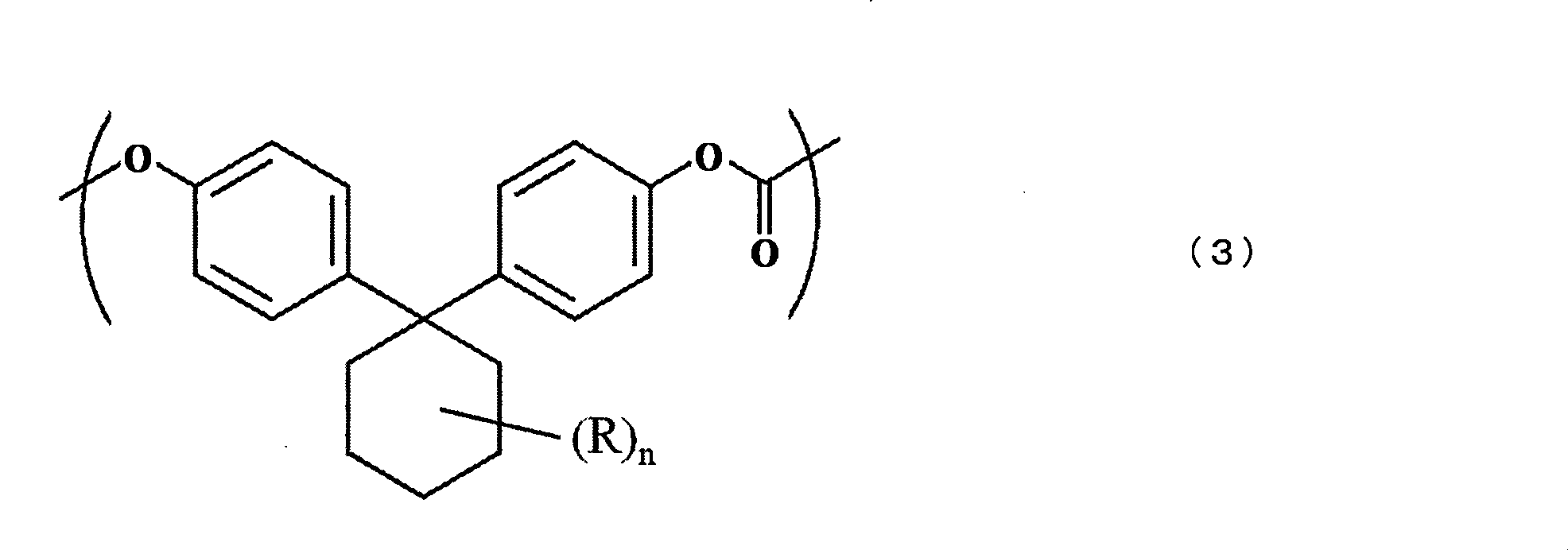
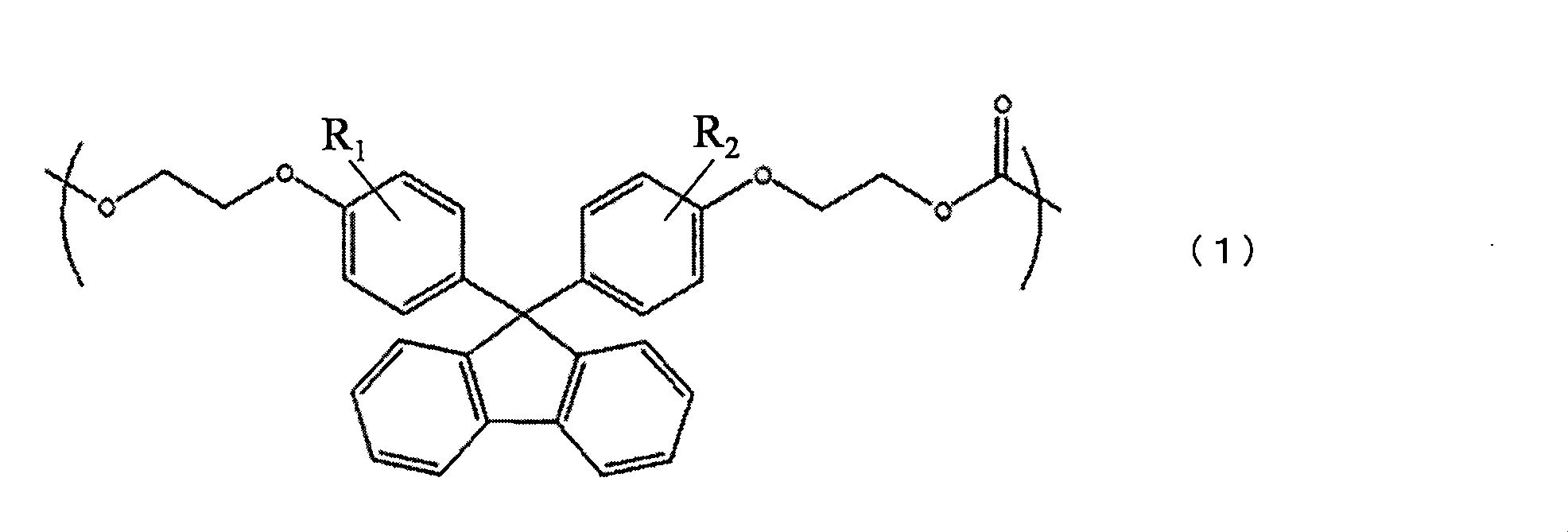
- ⁇ Aspect 1 Including repeating units of the formula (1), formula (2) and formula (3), the repeating unit of the following formula (3) is not less than 5 mol% and not more than 50 mol%, and the refractive index is 1.570 to 1.600.
- polycarbonate resin ⁇ In Formula (1), R 1 and R 2 each represent a hydrogen atom or a hydrocarbon group having 1 to 10 carbon atoms ⁇ ⁇ In Formula (3), n is in the range of 0 to 8, and R is selected from alkyl groups having 1 to 3 carbon atoms, respectively ⁇ .
- ⁇ Aspect 2 The polycarbonate resin according to aspect 1, wherein the repeating unit of the above formula (3) is 10 mol% or more and 40 mol% or less.
- ⁇ Aspect 3 The polycarbonate resin according to aspect 1 or 2, wherein the repeating unit of the above formula (1) is 20 mol% or more and 70 mol% or less.
- ⁇ Aspect 4 The polycarbonate resin according to any one of aspects 1 to 3, wherein the repeating unit of the formula (2) is 10 mol% or more and 60 mol% or less.
- ⁇ Aspect 5 R 1 and R 2 are both hydrogen, The repeating unit of the above formula (1) is 40 mol% or more and 65 mol% or less, and the repeating unit of the above formula (2) is 10 mol% or more and 35 mol% or less, The polycarbonate resin according to aspect 1 or 2.
- ⁇ Aspect 6 R 1 and R 2 are both phenyl groups, The repeating unit of the above formula (1) is 25 mol% or more and 50 mol% or less, and the repeating unit of the above formula (2) is 15 mol% or more and 60 mol% or less, The polycarbonate resin according to aspect 1 or 2.
- ⁇ Aspect 7 The polycarbonate resin according to any one of embodiments 1 to 6, wherein the ratio of terminal phenolic hydroxyl groups to all polymer terminals is 15% or less.
- ⁇ Aspect 8 The polycarbonate resin according to any one of aspects 1 to 7, wherein the repeating unit of the above formula (3) is introduced from bisphenol TMC.
- ⁇ Aspect 9 The polycarbonate resin according to any one of aspects 1 to 8, wherein the Abbe number is 26.0 to 31.0.
- ⁇ Aspect 10 The polycarbonate resin according to any one of embodiments 1 to 9, wherein the orientation birefringence is 5 ⁇ 10 ⁇ 3 or less.
- ⁇ Aspect 11 An optical member comprising the polycarbonate resin according to any one of embodiments 1 to 10.
- ⁇ Aspect 12 The optical member according to aspect 11, which is a lens.
- ⁇ Aspect 13 The optical member according to aspect 11, which is a retardation film.
- ⁇ Aspect 14 The optical member according to aspect 12, which is an imaging lens for use in any of a mobile phone, a smartphone, a tablet terminal, a personal computer, a digital camera, a video camera, an in-vehicle camera, or a surveillance camera.
- the polycarbonate resin of the present invention comprises a fluorene unit of the above formula (1), an oxaspiroundecane unit of the above formula (2), and a cyclohexylidene bisphenol unit of the above formula (3). 3)
- the repeating unit is 5 mol% or more and 50 mol% or less.
- the resin of the present invention has a refractive index of 1.570 to 1.600.
- Patent Document 1 The imaging lens described in Patent Document 1 is very useful because of its small birefringence and water absorption, and has a certain heat resistance. It has been found that whitening occurs when exposed to moisture for a long time.
- Patent Document 1 the inventors of the resin described in Patent Document 1 can substantially prevent whitening of the imaging lens described in Patent Document 1 by introducing the repeating unit of the above formula (3) to a certain degree. I found it.
- the reason why the above result was obtained by the introduction of the repeating unit of the above formula (3) is that there are two benzene rings in the repeating unit of the above formula (3) and a cyclohexylene located between them. Presence of a den group. In this cyclohexylidene group, the carbon bonded to the two benzene rings is a quaternary carbon atom, so that the three cyclic structures do not exist in the same plane. Thereby, it is considered that the polycarbonate resin of the present invention has low birefringence and high heat resistance by restraining the movement of the polymer main chain. In particular, the presence of the substituent R in the cyclohexylidene group in the repeating unit of the above formula (3) is preferable because the movement of the main chain of the polymer is further restricted.
- the polycarbonate resin of the present invention contains a repeating unit of the above formula (1).
- R 1 and R 2 in the above formula (1) each represent a hydrogen atom or a hydrocarbon group having 1 to 10 carbon atoms, and examples of the hydrocarbon group include an alkyl group, a cycloalkyl group, and an aryl group. In particular, a phenyl group can be mentioned.
- R 1 and R 2 are each a hydrogen atom or a phenyl group.
- the repeating unit of the above formula (1) is 20 mol% or more, 25 mol% or more, 30 mol% or more, 40 mol% or more, 45 mol% or more, 50 mol% or more, 55 mol% or more, or 60 mol% or more. 70 mol% or less, 65 mol% or less, 60 mol% or less, 55 mol% or less, 50 mol% or less, 45 mol% or less, 40 mol% or less, or 35 mol% or less may be included.
- the resin of the present invention can contain the repeating unit of the above formula (1) in an amount of 20 mol% to 70 mol%, or 40 mol% to 60 mol%.
- the polycarbonate resin of the present invention contains 40 to 65 mol% or 45 to 55 mol% of the repeating unit of the above formula (1). Including. When R 1 and R 2 are both relatively large groups (for example, a phenyl group), preferably, the polycarbonate resin of the present invention contains 25 to 50 mol% or 30 to 40 mol% of the repeating unit of the above formula (1). Including.
- the repeating unit of the above formula (2) is 10 mol% or more, 15 mol% or more, 20 mol% or more, 25 mol% or more, 30 mol% or more, 35 mol% or more, 40 mol% or more, or 45 mol% or more. It may be contained, and it may be contained at 60 mol% or less, 55 mol% or less, 50 mol% or less, 45 mol% or less, 40 mol% or less, 35 mol% or less, 30 mol% or less, 25 mol% or less, or 20 mol% or less.
- the resin of the present invention can contain the repeating unit of the above formula (2) in an amount of 10 mol% to 60 mol%, or 10 mol% to 35 mol%.
- the polycarbonate resin of the present invention contains 10 repeating units of the above formula (2). -35 mol%, or 20-30 mol%.
- the polycarbonate resin of the present invention contains the repeating unit of the above formula (2). 15 to 60 mol%, 20 to 50 mol%, or 30 to 45 mol%.
- the polycarbonate resin of the present invention may contain a repeating unit of the above formula (3) in an amount of 5 mol% or more, 10 mol% or more, 15 mol% or more, 20 mol% or more, 25 mol% or more, or 30 mol% or more, and 60 mol%.
- a repeating unit of the above formula (3) in an amount of 5 mol% or more, 10 mol% or more, 15 mol% or more, 20 mol% or more, 25 mol% or more, or 30 mol% or more, and 60 mol%.
- 55 mol% or less, 50 mol% or less, 40 mol% or less, 35 mol% or less, 30 mol% or less, 25 mol% or less, 20 mol% or less, or 15 mol% or less may be included.
- the polycarbonate resin of the present invention contains 10 to 40 mol%, or 15 to 25 mol% of the repeating unit of the above formula (3).
- the polycarbonate resin of the present invention preferably has 5 repeating units of the above formula (3). -50 mol% or 15-35 mol%.
- the polycarbonate resin of the present invention contains the repeating unit of the above formula (3). 15 to 55 mol%, 20 to 50 mol%, or 25 to 40 mol%.
- n is in the range of 0 to 8, preferably 0 to 5 or 1 to 3, particularly 3.
- Each R is selected from an alkyl group having 1 to 3 carbon atoms, and is preferably a methyl group or an ethyl group, particularly a methyl group.
- the repeating unit of the above formula (3) is 4,4 ′-(3,3,5-trimethylcyclohexylidene) bisphenol (so-called bisphenol TMC), 4,4′-cyclohexylidenebisphenol (so-called Bisphenol Z) and 4,4 ′-(3-methylcyclohexylidene) bisphenol (so-called bisphenol 3MZ) are preferable, and bisphenol TMC is more preferable.
- the polycarbonate resin of the present invention may contain a repeating unit other than the repeating units of the above formula (1), the above formula (2) and the above formula (3) within the range where the advantageous effects of the present invention are obtained.
- Dihydroxy compounds that provide such repeating units include ethylene glycol, propanediol, butanediol, pentanediol, hexanediol, heptanediol, octanediol, nonanediol, tricyclo [5.2.1.0 2,6 ] de Candimethanol, cyclohexane-1,4-dimethanol, decalin-2,6-dimethanol, norbornane dimethanol, pentacyclopentadecanedimethanol, cyclopentane-1,3-dimethanol, isosorbide, isomannide, isoidide, hydroquinone, resorcinol 2,2-bis (4-hydroxyphenyl) propane, 2,2-bis (3-methyl-4-
- the polycarbonate resin of the present invention preferably has no phenolic hydroxyl group at the polymer end. That is, when a monomer that provides the repeating unit of the above formula (3) is polymerized and bonded to the terminal of the polymer, the terminal group becomes a phenolic hydroxyl group. Therefore, for example, it is preferable to reduce the amount of terminal phenolic hydroxyl groups of the polymer by using a carbonic acid diester in the polymerization in an amount more than the dihydroxy compound as a raw material and making the terminal a phenyl group.
- Terminal phenolic hydroxyl group ratio (terminal phenolic hydroxyl group amount / total polymer terminal amount) ⁇ 100 Can be obtained as In addition, all the polymer terminals consist of terminal phenolic hydroxyl groups, terminal alcoholic hydroxyl groups, and terminal phenyl groups.
- the terminal phenolic hydroxyl group ratio can be determined by the following technique.
- (1) The terminal phenolic hydroxyl group is observed by 1 H NMR measurement of the polymer, and the integration of the corresponding peak is taken as 1.
- the integrated intensity (A) for one proton is obtained from the integrated intensity of the peaks at positions 4 and 5 of the fluorene structure derived from the above formula (1).
- the terminal phenolic hydroxyl group ratio is 0 when the peak of the terminal phenolic hydroxyl group is not observed.
- the average degree of polymerization of the polymer is determined from the number average molecular weight obtained by GPC measurement of the polymer, the molecular weight of each repeating unit, and the molar ratio.
- the integrated intensity (B) in the 1 H NMR spectrum is determined by the following formula.
- (B) (A) ⁇ 100 ⁇ 2 / ([mol% of the above formula (1)] ⁇ average degree of polymerization) (3)
- the terminal phenolic hydroxyl group ratio is obtained as 1 / (B) ⁇ 100.
- the ratio of terminal phenolic hydroxyl groups to the total polymer ends of the polycarbonate resin of the present invention is preferably 30% or less, 20% or less, 15% or less, 10% or less, 5% or less, 3% or less, 1% or less, or 0.5% or less.
- Examples of the carbonic acid diester for sealing the terminal phenolic hydroxyl group include carbon diesters such as aryl groups and aralkyl groups having 6 to 12 carbon atoms which may be substituted. Specific examples include diphenyl carbonate, ditolyl carbonate, bis (chlorophenyl) carbonate, and bis (m-cresyl) carbonate. Of these, diphenyl carbonate is particularly preferable.
- the amount of carbonic acid diester used is preferably 0.95 to 1.10 mol, more preferably 0.001 to the total of 1 mol of dihydroxy compounds for providing the repeating units of the above formulas (1) to (3). 98 to 1.04 mol.
- the polycarbonate resin of the present invention may have the same properties as those of the polycarbonate resin described in Patent Document 1 except for the physical properties related to high temperature and humidity resistance.
- the refractive index of the polycarbonate resin of the present invention needs to be 1.570 or more when measured at a temperature of 25 ° C. and a wavelength of 589 nm, and is 1.575 or more, 1.580, 1.585. It may be greater than or equal to or greater than 1.590, needs to be equal to or less than 1.600, and may be equal to or less than 1.595 or less than or equal to 1.590.
- the Abbe number of the polycarbonate resin of the present invention may be 26.0 or more, 26.5 or more, 27.0 or more, 27.5 or more, or 28.0 or more, and 30.0 or less, 29.0 or less. 28.5 or less, 28.0 or less, or 27.5 or less.
- the specific viscosity of the polycarbonate resin of the present invention is preferably in the range of 0.12 to 0.32, and more preferably in the range of 0.18 to 0.30. When the specific viscosity is 0.12 to 0.32, the balance between moldability and strength is excellent.
- the specific viscosity is measured by measuring the specific viscosity ( ⁇ SP ) at 20 ° C. of a solution obtained by dissolving 0.7 g of polycarbonate resin in 100 ml of methylene chloride using an Ostwald viscometer, and calculating from the following equation.
- Specific viscosity ( ⁇ SP ) (t ⁇ t 0 ) / t 0 [T 0 is the number of seconds that methylene chloride is dropped, and t is the number of seconds that the sample solution is dropped]
- the absolute value of the orientation birefringence ( ⁇ n) of the polycarbonate resin of the present invention is preferably 5.0 ⁇ 10 ⁇ 3 or less, 4.0 ⁇ 10 ⁇ 3 or less, and 2.0 ⁇ 10 ⁇ 3 or less.
- the orientation birefringence ( ⁇ n) is measured at a wavelength of 589 nm after a cast film having a thickness of 100 ⁇ m obtained from the polycarbonate resin is stretched twice at Tg + 10 ° C.
- the polycarbonate resin of the present invention has a total light transmittance of 1 mm thickness, preferably 80% or more, more preferably 85% or more, and still more preferably 88% or more.
- the polycarbonate resin of the present invention preferably has a water absorption rate of 0.20% or less after being immersed at 23 ° C. for 24 hours, more preferably 0.18% or less.
- the glass transition temperature of the polycarbonate resin of the present invention may be 120 ° C or higher, 125 ° C or higher, 130 ° C or higher, 135 ° C or higher, 140 ° C or higher, 145 ° C or higher, or 150 ° C or higher, 160 ° C or lower, 155 It may be below 150 ° C, below 150 ° C, below 145 ° C, below 140 ° C, or below 135 ° C.
- the polycarbonate resin of the present invention has a wet heat of 2000 h ⁇ b, preferably 10 or less, more preferably 5 or less, and even more preferably 3 or less.
- the ⁇ b value before and after the PCT treatment is preferably 3 or less, more preferably 2 or less, and still more preferably 1 or less.
- the polycarbonate resin of the present invention is produced by a reaction means known per se for producing an ordinary polycarbonate resin, for example, a method of reacting a dihydroxy compound with a carbonate precursor such as a carbonic acid diester.
- a reaction means known per se for producing an ordinary polycarbonate resin for example, a method of reacting a dihydroxy compound with a carbonate precursor such as a carbonic acid diester.
- Patent Document 1 can be referred to, except that a monomer for providing the repeating unit of the above formula (3) is used.
- the optical member of the present invention contains the above polycarbonate resin.
- Such an optical member is not particularly limited as long as the above polycarbonate resin is useful, but is not limited to an optical disk, a transparent conductive substrate, an optical card, a sheet, a film, an optical fiber, a lens, a prism, an optical film, Examples include a substrate, an optical filter, and a hard coat film.
- the optical member of the present invention may be composed of a resin composition containing the above polycarbonate resin, and the resin composition includes a heat stabilizer, a plasticizer, a light stabilizer, and a polymerization as necessary.
- Additives such as metal deactivators, flame retardants, lubricants, antistatic agents, surfactants, antibacterial agents, ultraviolet absorbers, mold release agents and the like can be blended.
- Imaging lens examples include an imaging lens.
- imaging lens examples include an imaging lens for a mobile phone, a smartphone, a tablet terminal, a personal computer, a digital camera, a video camera, an in-vehicle camera, a surveillance camera, and the like.
- Patent Document 1 can be referred to as a method for molding such an imaging lens.
- BPEF 9,9-bis [4- (2-hydroxyethoxy) phenyl] fluorene
- R 1 and R 2 are both hydrogen atoms (1 )
- SPG 3,9-bis (2-hydroxy-1,1-dimethylethyl) -2,4,8,10-tetraoxaspiro (5.5)
- SPG Undecane
- BisTMC 4,4 ′-(3,3,5-trimethylcyclohexylidene) bisphenol
- BPEF is used to introduce the repeating unit of the above formula (1) in which R 1 and R 2 are both hydrogen atoms
- SPG is used to introduce the repeating unit of the above formula (2). It is used.
- BisTMC also has the following chemical structure:
- Example 2 to 6 A polycarbonate resin was produced in the same manner as in Example 1 except that BPEF, SPG, BisTMC, and diphenyl carbonate were changed to the amounts shown in Table 1.
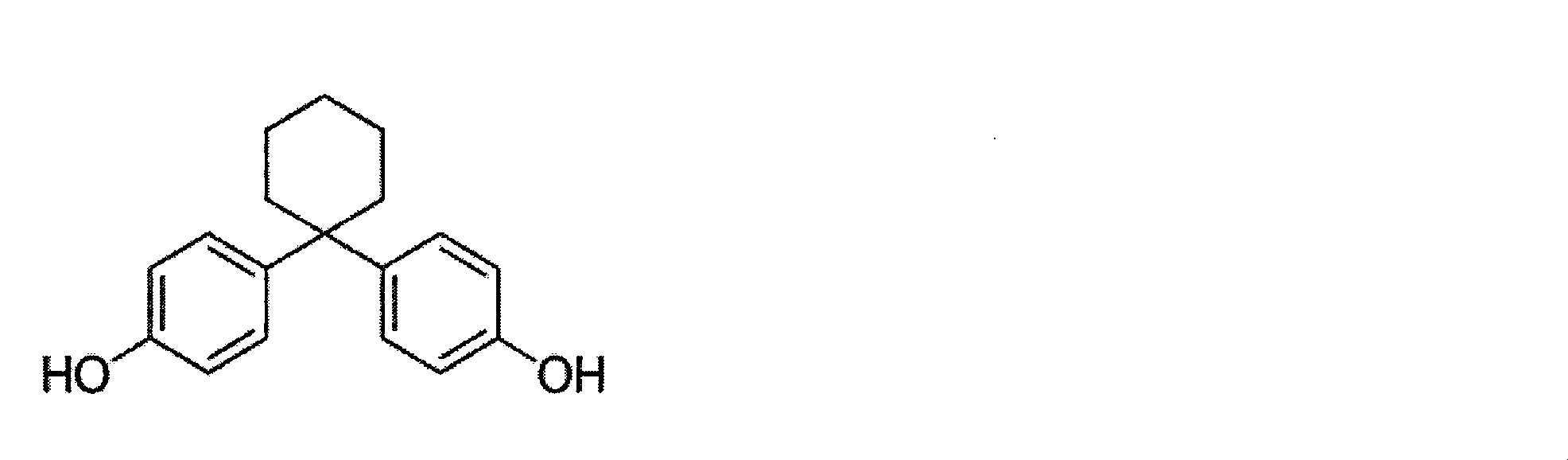
- Example 7 Similar to Example 1 except that 4,4′-cyclohexylidenebisphenol (hereinafter referred to as “BisZ”) was used instead of BisTMC, and the amount of each monomer was changed to the amount shown in Table 1. Thus, a polycarbonate resin was produced.
- BisZ 4,4′-cyclohexylidenebisphenol
- BisZ has the following chemical structure:
- Example 8 Except that 4,4 ′-(3-methylcyclohexylidene) bisphenol (hereinafter referred to as “Bis3MZ”) was used instead of BisTMC, and that the amount of each monomer was changed to the amount shown in Table 1.
- Bis3MZ 4,4 ′-(3-methylcyclohexylidene) bisphenol
- Bis3MZ has the following chemical structure:
- Example 9 to 15 In place of BPEF, 9,9-bis (4- (2-hydroxyethoxy) -3-phenylphenyl) fluorene or less, hereinafter referred to as “OPBPEF”), and the amount of each monomer are listed in Table 1.
- OPBPEF 9,9-bis (4- (2-hydroxyethoxy) -3-phenylphenyl) fluorene or less
- ⁇ Comparative example 2> A polycarbonate resin was produced in the same manner as in Example 1 except that bisphenol A (BPA) was used instead of BisTMC, and the amount of each monomer was changed to the amount shown in Table 1.
- BPA bisphenol A
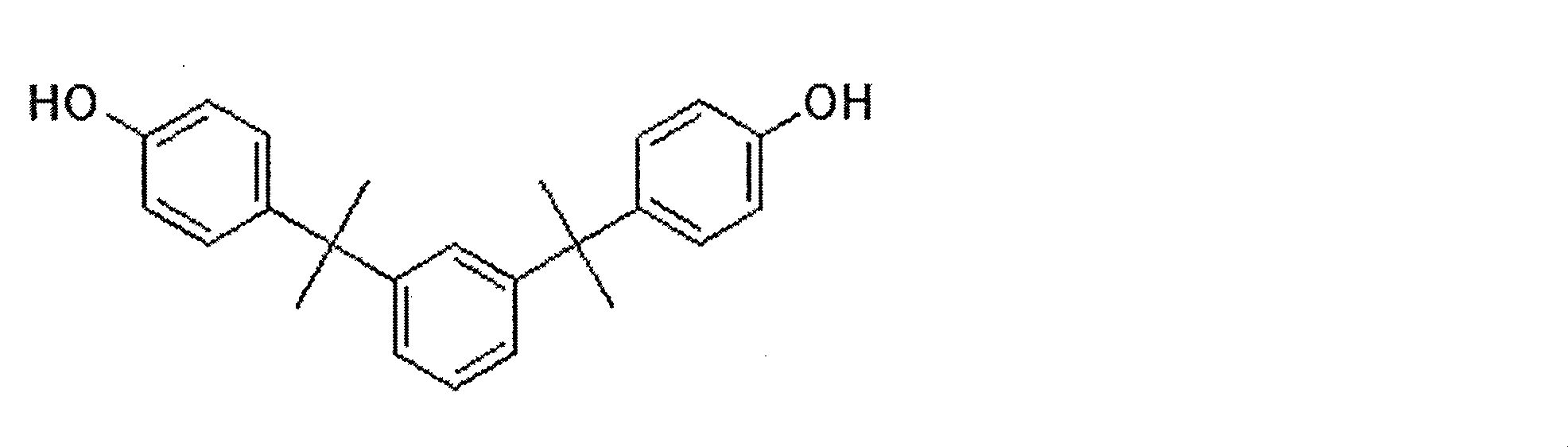
- BisM has the following chemical structure:
- the terminal phenolic hydroxyl group ratio can be calculated as (terminal phenolic hydroxyl group amount / total polymer terminal amount) ⁇ 100, and specifically, the following procedure was performed. (1) The terminal phenolic hydroxyl group was directly observed by 1 H NMR measurement of the polymer, and the integration of the corresponding peak was taken as 1. At the same time, the integrated intensity (A) for one proton was determined from the integrated intensity of the peaks at the 4th and 5th positions of the fluorene structure derived from the above formula (1). When no peak of the terminal phenolic hydroxyl group was observed, the terminal phenolic hydroxyl group ratio was 0.
- ⁇ Glass-transition temperature> Using a thermal analysis system DSC-60A manufactured by Shimadzu Corporation, a glass of each polymer under a nitrogen atmosphere (nitrogen flow rate: 40 mL / min) and a temperature increase rate of 20 ° C./min in accordance with JIS K7121 The transition temperature (Tg) was measured.
- the Abbe number measurement wavelength was calculated from the refractive indexes of 486.13 nm, 587.56 nm, and 656.27 nm using the following formula.
- ⁇ d (nd ⁇ 1) / (nF ⁇ nC)
- nd refractive index at a wavelength of 587.56 nm
- nF refractive index at a wavelength of 486.13 nm
- nC Refractive index at a wavelength of 656.27 nm.
- ⁇ Wet heat 2000h ⁇ b> A 2 mm-thick molded plate of each polymer was prepared, and using a heat treatment machine of ESPEC Corporation's small environmental tester SH-241, under conditions of a temperature of 85 ° C., a relative humidity of 85%, and a treatment time of 2000 hours. Wet heat treatment was performed. Then, 1 g of the sample is dissolved in 5 mL of dichloromethane, and the change in the L * a * b * value of the hue is measured with a Hitachi U-3310 type spectrophotometer to obtain ⁇ b of the sample solution before and after the test. It was.
- PCT> ( ⁇ b value before and after PCT processing)
- a 2 mm-thick molded plate of each polymer was prepared and steam-treated for 11 hours at 120 ° C. under 2 atm using a Yamato Scientific steam sterilizer SN-510 (so-called pressure cooker test). (Pressure Cooker Test): hereinafter referred to as “PCT”).
- Samples before and after PCT treatment were prepared by dissolving the polymer before and after PCT treatment in dichloromethane at a concentration of 1 g / 5 mL and measuring the change in L * a * b * value of the hue with a U-3310 spectrophotometer manufactured by Hitachi. ⁇ b of the solution was obtained.
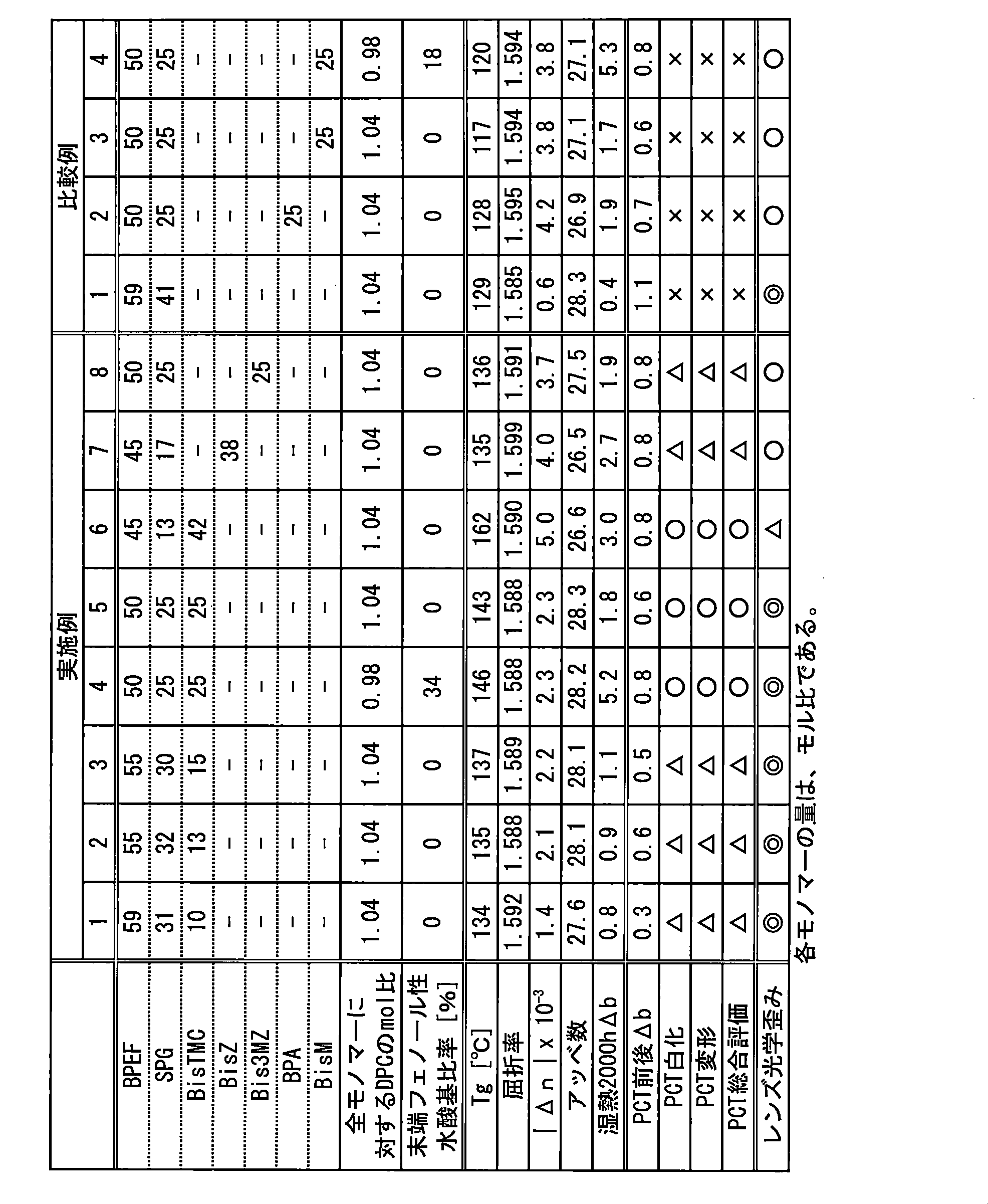
- Examples 1 to 8 have the same refractive index and Abbe number as Comparative Example 1 corresponding to the prior art (Patent Document 1). It becomes good.
- a useful polycarbonate resin can be obtained even when not only BPEF but also OPBPEF is used as the repeating unit of the above formula (1). From this result, it can be inferred that useful polycarbonate resin can be obtained not only by BPEF and OPBPEF but also by other repeating units of the above formula (1).
Landscapes
- Physics & Mathematics (AREA)
- Chemical & Material Sciences (AREA)
- Health & Medical Sciences (AREA)
- General Physics & Mathematics (AREA)
- Optics & Photonics (AREA)
- Chemical Kinetics & Catalysis (AREA)
- Medicinal Chemistry (AREA)
- Polymers & Plastics (AREA)
- Organic Chemistry (AREA)
- Ophthalmology & Optometry (AREA)
- General Health & Medical Sciences (AREA)
- Polyesters Or Polycarbonates (AREA)
Abstract
Description
《態様1》
式(1)、式(2)及び式(3)の繰返し単位を含み、下記(3)式の繰返し単位が5mol%以上50mol%以下であり、かつ屈折率が1.570~1.600である、ポリカーボネート樹脂:


《態様2》
上記式(3)の繰返し単位が、10mol%以上40mol%以下である、態様1に記載のポリカーボネート樹脂。
《態様3》
上記式(1)の繰返し単位が、20mol%以上70mol%以下である、態様1又は2に記載のポリカーボネート樹脂。
《態様4》
上記式(2)の繰返し単位が、10mol%以上60mol%以下である、態様1~3のいずれか一項に記載のポリカーボネート樹脂。
《態様5》
R1及びR2が共に水素であり、
上記式(1)の繰返し単位が、40mol%以上65mol%以下であり、かつ
上記式(2)の繰返し単位が、10mol%以上35mol%以下であり、
態様1又は2に記載のポリカーボネート樹脂。
《態様6》
R1及びR2が共にフェニル基であり、
上記式(1)の繰返し単位が、25mol%以上50mol%以下であり、かつ
上記式(2)の繰返し単位が、15mol%以上60mol%以下であり、
態様1又は2に記載のポリカーボネート樹脂。
《態様7》
全ポリマー末端に対する末端フェノール性水酸基比率が、15%以下である、態様1~6のいずれか一項に記載のポリカーボネート樹脂。
《態様8》
上記式(3)の繰返し単位が、ビスフェノールTMCから導入されている、態様1~7のいずれか一項に記載のポリカーボネート樹脂。
《態様9》
アッベ数が26.0~31.0である、態様1~8のいずれか一項に記載のポリカーボネート樹脂。
《態様10》
配向複屈折が、5×10⁻³以下である、態様1~9のいずれか一項に記載のポリカーボネート樹脂。
《態様11》
態様1~10のいずれか一項に記載のポリカーボネート樹脂を含む、光学部材。
《態様12》
レンズである、態様11に記載の光学部材。
《態様13》
位相差フィルムである、態様11に記載の光学部材。
《態様14》
携帯電話、スマートフォン、タブレット端末、パソコン、デジタルカメラ、ビデオカメラ、車載カメラ、又は監視カメラのいずれかに用いるための撮像レンズである、態様12に記載の光学部材。
本発明のポリカーボネート樹脂は、上記の式(1)のフルオレン系単位、上記の式(2)のオキサスピロウンデカン系単位、及び上記式(3)のシクロヘキシリデンビスフェノール系単位を含み、上記式(3)の繰返し単位が、5mol%以上50mol%以下である。また、本発明の樹脂は、屈折率が1.570~1.600である。
本発明のポリカーボネート樹脂は、上記式(1)の繰返し単位を含む。上記式(1)中のR1及びR2は、それぞれ水素原子又は炭素原子数1~10の炭化水素基を表し、炭化水素基としては、アルキル基、シクロアルキル基、及びアリール基を挙げることができ、特にフェニル基を挙げることができる。好ましくは、R1及びR2は、それぞれ水素原子又はフェニル基である。
末端フェノール性水酸基比率=(末端フェノール性水酸基量/全ポリマー末端量)×100
として求めることができる。なお、全ポリマー末端は、末端フェノール性水酸基、末端アルコール性水酸基および末端フェニル基からなる。
(1)末端フェノール性水酸基を、ポリマーの1H NMR測定で観測し、該当ピークの積分を取りこれを1とする。この時、同時に上記式(1)に由来するフルオレン構造の4、5位のピークの積分強度から1プロトン分の積分強度(A)を求める。
当然ながら、末端フェノール性水酸基のピークが観測されないときは末端フェノール性水酸基比率は0である。
(2)ポリマーのGPC測定で得られる数平均分子量と各繰返し単位の分子量とmol比からポリマーの平均重合度を求め、上記式(1)のmol%と積分強度(A)から、ポリマー末端の1H NMRスペクトルでの積分強度(B)を下記式で求める。
(B)=(A)×100×2/([上記式(1)のmol%]×平均重合度)
(3)末端フェノール性水酸基比率は、1/(B)×100として求まる。
本発明のポリカーボネート樹脂は、高温耐湿性に関連する物性以外については、特許文献1に記載のポリカーボネート樹脂の物性と同程度であってよい。
νd=(nd-1)/(nF-nC)
nd:波長587.56nmでの屈折率、
nF:波長486.13nmでの屈折率、
nC:波長656.27nmでの屈折率を意味する。
比粘度(ηSP)=(t-t0)/t0
[t0は、塩化メチレンの落下秒数、tは、試料溶液の落下秒数]
本発明のポリカーボネート樹脂は、通常のポリカーボネート樹脂を製造するそれ自体公知の反応手段、例えばジヒドロキシ化合物に炭酸ジエステルなどのカーボネート前駆物質を反応させる方法により製造される。この製造方法については、上記式(3)の繰返し単位をもたらすためのモノマーを使用すること以外は、特許文献1を参照することができる。
本発明の光学部材は、上記のポリカーボネート樹脂を含む。そのような光学部材としては、上記のポリカーボネート樹脂が有用となる光学用途であれば、特に限定されないが、光ディスク、透明導電性基板、光カード、シート、フィルム、光ファイバー、レンズ、プリズム、光学膜、基盤、光学フィルター、ハードコート膜等を挙げることができる。
本発明の光学部材として、特に撮像レンズを挙げることができる。このような撮像レンズとしては、携帯電話、スマートフォン、タブレット端末、パソコン、デジタルカメラ、ビデオカメラ、車載カメラ、監視カメラ等のための撮像レンズを挙げることができる。そのような撮像レンズの成形方法としては、特許文献1を参照することができる。
〈実施例1〉
103.49g(0.24mol)の9,9-ビス[4-(2-ヒドロキシエトキシ)フェニル]フルオレン(以下、「BPEF」とする:R1及びR2が共に水素原子である上記式(1)の繰返し単位を導入するためのモノマー)、37.80g(0.12mol)の3,9-ビス(2-ヒドロキシ-1,1-ジメチルエチル)-2,4,8,10-テトラオキサスピロ(5.5)ウンデカン(以下「SPG」とする)、12.42g(0.04mol)の4,4’-(3,3,5-トリメチルシクロヘキシリデン)ビスフェノール(以下「BisTMC」とする)、89.11g(0.42mol)のジフェニルカーボネート、及び触媒として濃度60mmol/Lの炭酸水素ナトリウム水溶液0.033mL(炭酸水素ナトリウム 2.0μmol)を、窒素雰囲気下180℃に加熱し溶融させた。その後、10分間かけて減圧度を20kPaに調整した。60℃/hrの速度で250℃まで昇温を行い、フェノールの流出量が70%になった後で1時間かけて反応器内圧を133Pa以下とした。合計3.5時間撹拌して反応を行い、反応終了後フラスコから樹脂を取り出した。得られたポリカーボネート樹脂の組成比を、NMRによって測定した。末端フェノール性水酸基比率は得られたポリカーボネート樹脂の数平均分子量とNMR測定結果から算出した。

BPEF、SPG、BisTMC、及びジフェニルカーボネートを表1に記載の量に変更したこと以外は実施例1と同様にして、ポリカーボネート樹脂を製造した。
BisTMCの代わりに4,4’-シクロヘキシリデンビスフェノール(以下、「BisZ」とする)を使用したこと、及び各モノマーの量を表1に記載の量に変更したこと以外は実施例1と同様にして、ポリカーボネート樹脂を製造した。
BisTMCの代わりに4,4’-(3-メチルシクロヘキシリデン)ビスフェノール(以下、「Bis3MZ」とする)を使用したこと、及び各モノマーの量を表1に記載の量に変更したこと以外は実施例1と同様にして、ポリカーボネート樹脂を製造した。

BPEFの代わりに、9,9-ビス(4-(2-ヒドロキシエトキシ)-3-フェニルフェニル)フルオレン以下、「OPBPEF」とする)を使用したこと、及び各モノマーの量を表1に記載の量に変更したこと以外は実施例1と同様にして、ポリカーボネート樹脂を製造した。なお、OPBPEFは、R1及びR2が共にフェニル基である上記式(1)の繰返し単位を導入するために用いられている。
BisTMCを使用しなかったこと、及び各モノマーの量を表1に記載の量に変更したこと以外は実施例1と同様にして、ポリカーボネート樹脂を製造した。なお、比較例1は、特許文献1に開示されている樹脂の態様に対応している。
BisTMCの代わりにビスフェノールA(BPA)を使用したこと、及び各モノマーの量を表1に記載の量に変更したこと以外は実施例1と同様にして、ポリカーボネート樹脂を製造した。
BisTMCの代わりに4,4’-(α-メチルベンジリデン)ビスフェノール(以下、「BisM」とする)を使用したこと、及び各モノマーの量を表1に記載の量に変更したこと以外は実施例1と同様にして、ポリカーボネート樹脂を製造した。
〈ポリマー組成および末端フェノール性水酸基比率〉
JEOL製JNM-ECZ400Sにて1H NMRを測定することによって、各ポリマーの組成比を算出した。また、GPC測定で得られる数平均分子量とこのスペクトルデータを使用して、各ポリマーの末端フェノール性水酸基比率(%)を定量化した。
(1)末端フェノール性水酸基を、ポリマーの1H NMR測定で直接観測し、該当ピークの積分を取りこれを1とした。この時、同時に上記式(1)に由来するフルオレン構造の4、5位のピークの積分強度から1プロトン分の積分強度(A)を求めた。
末端フェノール性水酸基のピークが観測されないときは末端フェノール性水酸基比率は0とした。
(2)ポリマーのGPC測定で得られた数平均分子量と各繰返し単位の分子量とmol比からポリマーの平均重合度を求め、上記式(1)のmol%と積分強度(A)から、ポリマー末端の1H NMRスペクトルでの積分強度(B)を下記式で求めた。
(B)=(A)×100×2/([上記式(1)のmol%]×平均重合度)
(3)末端フェノール性水酸基比率を1/(B)×100として求めた。
島津製作所製の熱分析システムDSC-60Aを使用して、JIS K7121に準拠して窒素雰囲気下(窒素流量:40mL/min)、昇温速度:20℃/minの条件下で、各ポリマーのガラス転移温度(Tg)を測定した。
(屈折率)
各ポリマーの3mm厚試験片を作製し研磨した後、島津製作所製のカルニュー精密屈折計KPR-2000を使用して、屈折率nd(587.56nm)を測定した。
また、同様にして、アッベ数を算出した。
アッベ数の測定波長は、486.13nm、587.56nm、656.27nmの屈折率から下記の式を用いて算出した。
νd=(nd-1)/(nF-nC)
nd:波長587.56nmでの屈折率、
nF:波長486.13nmでの屈折率、
nC:波長656.27nmでの屈折率を意味する。
ポリカーボネート樹脂を塩化メチレンに溶解した後、ガラスシャーレ上にキャストし、十分乾燥することで厚さ100μmのキャストフィルムを作製した。該フィルムをTg+10℃で2倍延伸し、日本分光(株)製エリプソメーターM-220を用いて589nmにおける位相差(Re)を測定し、下記式より配向複屈折の絶対値(|Δn|)を求めた。
|Δn|=|Re/d|
Δn:配向複屈折
Re:位相差(nm)
d:厚さ(nm)
各ポリマーの2mmの厚さの成形板を作製しエスペック株式会社の小型環境試験器SH-241の湿熱処理機を使用して、温度85℃、相対湿度85%、処理時間2000時間の条件下で湿熱処理を行った。そして、サンプル1gを5mLのジクロロメタンに溶解し、その色相のL*a*b*値の変化を日立製U-3310形分光光度計で測定することで、試験前後のサンプルの溶液のΔbを得た。
(PCT処理前後のΔb値)
各ポリマーの2mmの厚さの成形板を作製し、ヤマト科学製蒸気滅菌器SN-510を使用して、120℃、2気圧の条件下で11時間蒸気処理を行った(いわゆる、プレッシャークッカー試験(Pressure Cooker Test):以下、「PCT」とする)。
PCT処理前後のポリマーを1g/5mLの濃度でジクロロメタンに溶解させ、その色相のL*a*b*値の変化を日立製U-3310形分光光度計で測定することで、PCT処理前後のサンプルの溶液のΔbを得た。
(PCT処理後の成形片の白化)
○:不透明な部分が全くなく透明である。
△:若干不透明な部分が見られる。
×:全体が不透明である。
(PCT処理後の成形片の変形)
○:全く変形なし。
△:ほぼ元の形を保っているがやや変形が見られる。
×:元の形を保持していない。
シリンダー温度280℃、金型温度120℃で、住友重機(株)製SE30DU射出成形機を用いて厚さ0.2mm、凸面曲率半径5mm、凹面曲率半径4mm、Φ5mmの非球面レンズを射出成形した。非球面レンズを二枚の偏光板の間に挟み直交ニコル法で光漏れを目視することにより光学歪みを評価した。評価は以下の基準で行った。
◎:殆ど光漏れがない。
〇:僅かに光漏れが認められる。
△:光漏れがある。
×:光漏れが顕著である。
各実施例及び比較例の構成並びにその評価結果を、以下の表1及び表2にまとめた。

Claims (14)
- 式(1)、式(2)及び式(3)の繰返し単位を含み、下記(3)式の繰返し単位が5mol%以上50mol%以下であり、かつ屈折率が1.570~1.600である、ポリカーボネート樹脂:


- 上記式(3)の繰返し単位が、10mol%以上40mol%以下である、請求項1に記載のポリカーボネート樹脂。
- 上記式(1)の繰返し単位が、20mol%以上70mol%以下である、請求項1又は2に記載のポリカーボネート樹脂。
- 上記式(2)の繰返し単位が、10mol%以上60mol%以下である、請求項1~3のいずれか一項に記載のポリカーボネート樹脂。
- R1及びR2が共に水素であり、
上記式(1)の繰返し単位が、40mol%以上65mol%以下であり、かつ
上記式(2)の繰返し単位が、10mol%以上35mol%以下であり、
請求項1又は2に記載のポリカーボネート樹脂。 - R1及びR2が共にフェニル基であり、
上記式(1)の繰返し単位が、25mol%以上50mol%以下であり、かつ
上記式(2)の繰返し単位が、15mol%以上60mol%以下であり、
請求項1又は2に記載のポリカーボネート樹脂。 - 全ポリマー末端に対する末端フェノール性水酸基比率が、15%以下である、請求項1~6のいずれか一項に記載のポリカーボネート樹脂。
- 上記式(3)の繰返し単位が、ビスフェノールTMCから導入されている、請求項1~7のいずれか一項に記載のポリカーボネート樹脂。
- アッベ数が26.0~31.0である、請求項1~8のいずれか一項に記載のポリカーボネート樹脂。
- 配向複屈折が、5×10⁻³以下である、請求項1~9のいずれか一項に記載のポリカーボネート樹脂。
- 請求項1~10のいずれか一項に記載のポリカーボネート樹脂を含む、光学部材。
- レンズである、請求項11に記載の光学部材。
- 位相差フィルムである、請求項11に記載の光学部材。
- 携帯電話、スマートフォン、タブレット端末、パソコン、デジタルカメラ、ビデオカメラ、車載カメラ、又は監視カメラのいずれかに用いるための撮像レンズである、請求項12に記載の光学部材。
Priority Applications (5)
| Application Number | Priority Date | Filing Date | Title |
|---|---|---|---|
| US17/043,118 US11578168B2 (en) | 2018-03-30 | 2019-03-20 | Polycarbonate resin and optical member containing same |
| JP2020510801A JP7072637B2 (ja) | 2018-03-30 | 2019-03-20 | ポリカーボネート樹脂及びそれを含む光学部材 |
| KR1020207013677A KR102415801B1 (ko) | 2018-03-30 | 2019-03-20 | 폴리카보네이트 수지 및 그것을 포함하는 광학 부재 |
| CN201980006198.5A CN111511799B (zh) | 2018-03-30 | 2019-03-20 | 聚碳酸酯树脂和含有其的光学构件 |
| EP19775823.8A EP3778699B1 (en) | 2018-03-30 | 2019-03-20 | Polycarbonate resin and optical member containing same |
Applications Claiming Priority (4)
| Application Number | Priority Date | Filing Date | Title |
|---|---|---|---|
| JP2018-069389 | 2018-03-30 | ||
| JP2018069389 | 2018-03-30 | ||
| JP2018-194193 | 2018-10-15 | ||
| JP2018194193 | 2018-10-15 |
Publications (1)
| Publication Number | Publication Date |
|---|---|
| WO2019188702A1 true WO2019188702A1 (ja) | 2019-10-03 |
Family
ID=68058157
Family Applications (1)
| Application Number | Title | Priority Date | Filing Date |
|---|---|---|---|
| PCT/JP2019/011826 Ceased WO2019188702A1 (ja) | 2018-03-30 | 2019-03-20 | ポリカーボネート樹脂及びそれを含む光学部材 |
Country Status (7)
| Country | Link |
|---|---|
| US (1) | US11578168B2 (ja) |
| EP (1) | EP3778699B1 (ja) |
| JP (1) | JP7072637B2 (ja) |
| KR (1) | KR102415801B1 (ja) |
| CN (1) | CN111511799B (ja) |
| TW (1) | TWI851561B (ja) |
| WO (1) | WO2019188702A1 (ja) |
Cited By (9)
| Publication number | Priority date | Publication date | Assignee | Title |
|---|---|---|---|---|
| WO2020162533A1 (ja) * | 2019-02-08 | 2020-08-13 | 三菱瓦斯化学株式会社 | ポリカーボネート樹脂組成物及びそれを用いた光学レンズ |
| JPWO2021182217A1 (ja) * | 2020-03-13 | 2021-09-16 | ||
| WO2022004239A1 (ja) * | 2020-06-30 | 2022-01-06 | 帝人株式会社 | 熱可塑性樹脂及びそれを含む光学部材 |
| JP2022011687A (ja) * | 2020-06-30 | 2022-01-17 | 帝人株式会社 | 熱可塑性樹脂および光学部材 |
| WO2023181695A1 (ja) * | 2022-03-25 | 2023-09-28 | 帝人株式会社 | 熱可塑性樹脂及びそれを含む光学部材 |
| JP2023172689A (ja) * | 2022-05-24 | 2023-12-06 | 三菱ケミカル株式会社 | 熱可塑性樹脂、熱可塑性樹脂組成物、及び成形体 |
| WO2024225099A1 (ja) * | 2023-04-25 | 2024-10-31 | 帝人株式会社 | ポリカーボネート樹脂および該樹脂を用いた光学部材 |
| WO2025164207A1 (ja) * | 2024-02-01 | 2025-08-07 | 帝人株式会社 | ポリカーボネート樹脂および該樹脂を用いた光学部材 |
| TWI924672B (zh) | 2020-06-30 | 2026-05-11 | 日商帝人股份有限公司 | 熱塑性樹脂及含該熱塑性樹脂之光學構件 |
Families Citing this family (1)
| Publication number | Priority date | Publication date | Assignee | Title |
|---|---|---|---|---|
| CN114085367A (zh) * | 2021-11-16 | 2022-02-25 | 万华化学集团股份有限公司 | 一种光学聚碳酸酯树脂、制备方法及其应用 |
Citations (7)
| Publication number | Priority date | Publication date | Assignee | Title |
|---|---|---|---|---|
| JPH10120777A (ja) * | 1996-10-18 | 1998-05-12 | Mitsubishi Gas Chem Co Inc | 新規なポリカーボネート樹脂 |
| JP2009080424A (ja) * | 2007-09-27 | 2009-04-16 | Teijin Chem Ltd | 光学部材 |
| JP2012155193A (ja) * | 2011-01-27 | 2012-08-16 | Mitsubishi Gas Chemical Co Inc | ポリカーボネート樹脂組成物 |
| JP2013076982A (ja) * | 2011-09-14 | 2013-04-25 | Mitsubishi Chemicals Corp | 位相差フィルム、並びにこれを用いた円偏光板及び画像表示装置 |
| WO2017010318A1 (ja) | 2015-07-13 | 2017-01-19 | 帝人株式会社 | 撮像レンズ |
| JP2017207759A (ja) * | 2013-02-20 | 2017-11-24 | 帝人株式会社 | ポリカーボネート共重合体樹脂組成物からなる光学レンズ |
| WO2018016516A1 (ja) * | 2016-07-21 | 2018-01-25 | 三菱瓦斯化学株式会社 | ポリカーボネート樹脂、その製造方法及び光学レンズ |
Family Cites Families (69)
| Publication number | Priority date | Publication date | Assignee | Title |
|---|---|---|---|---|
| US4584335A (en) | 1984-12-28 | 1986-04-22 | Chevron Research Company | 5-keto-bis(hydroxyphenyl)anthracene polyarylate copolymers and alloys |
| CA2139325A1 (en) | 1992-07-16 | 1994-02-03 | Stephen E. Bales | Thiodiphenol copolycarbonates and their use as components of multilayered polymeric reflective bodies |
| JPH06145317A (ja) | 1992-11-05 | 1994-05-24 | Teijin Chem Ltd | 新規芳香族ポリエステルカーボネート樹脂 |
| JP2774229B2 (ja) | 1993-04-27 | 1998-07-09 | 帝人化成株式会社 | 光学用成形品 |
| US5532331A (en) | 1993-06-24 | 1996-07-02 | The Dow Chemical Company | Thiodiphenol copolycarbonates and their use as components of multilayered polymeric reflective bodies |
| JPH07198901A (ja) | 1993-12-27 | 1995-08-01 | Kanebo Ltd | プラスチックレンズ用ポリエステル樹脂 |
| JPH0854615A (ja) | 1994-08-09 | 1996-02-27 | Teijin Ltd | 液晶表示パネル用フィルム基板 |
| US5605979A (en) | 1995-05-22 | 1997-02-25 | Bayer Corporation | Method for modifying the backbone of polymeric resins |
| EP0787756B1 (en) | 1996-01-30 | 2000-04-26 | Teijin Limited | Polycarbonate copolymer containing oxaspiroundecane group and production process therefor |
| JP3160209B2 (ja) | 1996-01-30 | 2001-04-25 | 帝人株式会社 | オキサスピロウンデカン基を含有するポリカーボネート共重合体およびその製造法 |
| JP3603921B2 (ja) | 1996-06-21 | 2004-12-22 | 三菱瓦斯化学株式会社 | コポリカーボネート重合体およびその製造方法 |
| JPH1087800A (ja) | 1996-09-10 | 1998-04-07 | Teijin Chem Ltd | ポリエステルカーボネート樹脂 |
| JPH10101786A (ja) | 1996-09-30 | 1998-04-21 | Teijin Ltd | ポリカーボネート共重合体およびその製造方法 |
| AU729121B2 (en) | 1996-10-18 | 2001-01-25 | Mitsubishi Gas Chemical Company, Inc. | Novel copolycarbonate resin and resin composition comprising the same |
| JPH11269259A (ja) | 1998-03-24 | 1999-10-05 | Mitsubishi Gas Chem Co Inc | 光記録媒体用成形材料 |
| JP2000204150A (ja) | 1999-01-14 | 2000-07-25 | Mitsubishi Gas Chem Co Inc | コポリカ―ボネ―ト重合体 |
| JP2000212271A (ja) | 1999-01-27 | 2000-08-02 | Teijin Ltd | 成形性、安定性、及び透明性が良好な芳香族ポリカ―ボネ―ト樹脂 |
| JP2000219736A (ja) | 1999-02-02 | 2000-08-08 | Mitsubishi Gas Chem Co Inc | ポリカーボネート重合体およびその製造方法 |
| US7314591B2 (en) * | 2001-05-11 | 2008-01-01 | Stratasys, Inc. | Method for three-dimensional modeling |
| JP2000302857A (ja) | 1999-04-21 | 2000-10-31 | Mitsubishi Gas Chem Co Inc | 光記録媒体用成形材料 |
| JP2001072872A (ja) | 1999-07-02 | 2001-03-21 | Konica Corp | 樹脂組成物および光学用レンズ |
| JP3856115B2 (ja) | 2001-01-16 | 2006-12-13 | 三菱瓦斯化学株式会社 | ポリカーボネート樹脂 |
| JP4739571B2 (ja) | 2001-04-18 | 2011-08-03 | 帝人化成株式会社 | 延伸フィルム |
| JP2002332345A (ja) | 2001-05-08 | 2002-11-22 | Konica Corp | 樹脂組成物及び光学用レンズ |
| JP4196326B2 (ja) | 2002-06-12 | 2008-12-17 | 三菱瓦斯化学株式会社 | ポリカーボネート共重合体 |
| US6689863B1 (en) * | 2002-10-08 | 2004-02-10 | General Electric Company | Polycarbonate copolymers and methods for producing the polycarbonate copolymers |
| CN1315907C (zh) | 2002-11-14 | 2007-05-16 | 帝人化成株式会社 | 聚碳酸酯共聚物、树脂组合物及成型品 |
| DE60333218D1 (de) | 2002-11-14 | 2010-08-12 | Teijin Chemicals Ltd | Polycarbonatcopolymer, harzzusammensetzung und formkörper |
| JP4369741B2 (ja) | 2003-12-25 | 2009-11-25 | 大阪瓦斯株式会社 | フルオレン系樹脂組成物およびその成形体 |
| JP2005232252A (ja) | 2004-02-18 | 2005-09-02 | Teijin Chem Ltd | 改質ポリカーボネート樹脂 |
| JP4780919B2 (ja) | 2004-02-26 | 2011-09-28 | 三菱瓦斯化学株式会社 | 光学レンズ |
| CN101018824B (zh) | 2004-07-15 | 2011-05-04 | 大阪瓦斯株式会社 | 树脂组合物及其成型体 |
| JP2007246629A (ja) | 2006-03-14 | 2007-09-27 | Jsr Corp | 光学フィルムおよびその製造方法 |
| CN103257376B (zh) | 2006-06-05 | 2015-12-09 | 三菱瓦斯化学株式会社 | 光学透镜 |
| KR20140121894A (ko) * | 2007-06-19 | 2014-10-16 | 테이진 카세이 가부시키가이샤 | 광학 필름 |
| WO2009058396A1 (en) | 2007-11-02 | 2009-05-07 | Akron Polymer Systems Inc. | Negative birefringent optical films with flat or reversed birefringence wavelength dispersions for liquid crystal displays |
| JP2009249307A (ja) | 2008-04-03 | 2009-10-29 | Kri Inc | ビス(ヒドロキシフェニル)アントラセン化合物及びその製造方法 |
| EP2378320A4 (en) * | 2008-12-16 | 2017-07-19 | Teijin Chemicals, Ltd. | Optical film |
| JP2010189562A (ja) | 2009-02-19 | 2010-09-02 | Fujifilm Corp | 有機無機複合材料、成形体、光学部品およびレンズ |
| JP5558741B2 (ja) | 2009-05-28 | 2014-07-23 | 帝人株式会社 | 高屈折率かつ耐熱性に優れたポリカーボネート共重合体 |
| CN102471467B (zh) | 2009-07-24 | 2013-07-17 | 帝人化成株式会社 | 光学透镜用聚酯碳酸酯共聚物及光学透镜 |
| CN105348503A (zh) * | 2009-11-17 | 2016-02-24 | 三菱化学株式会社 | 聚碳酸酯树脂及由该聚碳酸酯树脂形成的透明膜 |
| JP5668077B2 (ja) | 2010-11-12 | 2015-02-12 | 帝人株式会社 | コポリカーボネート |
| JP5741026B2 (ja) | 2011-02-03 | 2015-07-01 | 三菱瓦斯化学株式会社 | アセナフテノン構造を有するグリコールおよびそれからなるポリエステル樹脂 |
| CN102352039B (zh) | 2011-07-22 | 2013-07-24 | 中山大学 | 基于芴结构的可溶性功能聚酰亚胺及其制备方法和应用 |
| JP5914261B2 (ja) | 2011-08-29 | 2016-05-11 | 大阪ガスケミカル株式会社 | フルオレン骨格を有するポリエステル樹脂 |
| JP2014038772A (ja) | 2012-08-16 | 2014-02-27 | Fujitsu Component Ltd | ケーブルコネクタ |
| CN108329464B (zh) | 2012-11-07 | 2021-05-11 | 三菱瓦斯化学株式会社 | 聚碳酸酯树脂、其制造方法及光学成形体 |
| JP6398242B2 (ja) | 2013-03-21 | 2018-10-03 | 三菱ケミカル株式会社 | 樹脂組成物及びそれを用いたフィルム |
| JP6336261B2 (ja) | 2013-10-29 | 2018-06-06 | 帝人株式会社 | 熱可塑性樹脂およびそれらからなる光学部材 |
| EP3112392B1 (en) | 2014-02-28 | 2017-11-15 | Teijin Limited | Polycarbonate and optical member including same |
| CN106103543B (zh) * | 2014-03-20 | 2018-01-19 | 帝人株式会社 | 聚碳酸酯树脂和光学膜 |
| US10689486B2 (en) | 2014-05-07 | 2020-06-23 | Mitsubishi Gas Chemical Company, Inc. | Resin produced by polycondensation, and resin composition |
| CN104263287B (zh) | 2014-09-19 | 2016-08-24 | 华烁科技股份有限公司 | 一种刚挠结合印制电路板用高耐热低流动度胶粘剂、胶膜及其制备方法 |
| JP6225150B2 (ja) | 2014-09-30 | 2017-11-01 | 大阪ガスケミカル株式会社 | フルオレン骨格を有するポリエステル樹脂とその成形体 |
| KR101532334B1 (ko) | 2014-10-21 | 2015-06-29 | (주)코앤코 | 고굴절율을 갖는 광경화성 수지 조성물 |
| JP6523915B2 (ja) * | 2015-10-23 | 2019-06-05 | 帝人株式会社 | ポリカーボネート樹脂及び光学部材 |
| JP2019066501A (ja) | 2016-02-23 | 2019-04-25 | 三井化学株式会社 | 光学材料用熱可塑性樹脂組成物およびその用途 |
| JP6764353B2 (ja) | 2016-03-16 | 2020-09-30 | 大阪ガスケミカル株式会社 | 高屈折率樹脂及び成形体 |
| JP6831650B2 (ja) | 2016-03-28 | 2021-02-17 | 大阪ガスケミカル株式会社 | 高屈折率ポリカーボネート系樹脂及び成形体 |
| JP6739255B2 (ja) | 2016-07-04 | 2020-08-12 | 帝人株式会社 | 熱可塑性樹脂 |
| JP6689146B2 (ja) | 2016-07-04 | 2020-04-28 | 帝人株式会社 | 熱可塑性樹脂 |
| KR102245600B1 (ko) | 2016-07-04 | 2021-04-27 | 데이진 가부시키가이샤 | 열가소성 수지 |
| JP6968642B2 (ja) | 2016-10-06 | 2021-11-17 | 大阪ガスケミカル株式会社 | フルオレン骨格を有するポリエステル樹脂 |
| JP6916026B2 (ja) | 2017-04-06 | 2021-08-11 | 帝人株式会社 | 熱可塑性樹脂 |
| CN114716658B (zh) | 2017-08-30 | 2024-12-31 | 三菱瓦斯化学株式会社 | 聚碳酸酯树脂、其制造方法和光学透镜 |
| CN110741030B (zh) | 2017-08-30 | 2022-06-17 | 帝人株式会社 | 热塑性树脂和光学部件 |
| JP6956807B2 (ja) | 2017-12-28 | 2021-11-02 | 帝人株式会社 | ポリ(エステル)カーボネート、及びポリ(エステル)カーボネートの製造方法 |
| KR102683885B1 (ko) | 2018-01-31 | 2024-07-10 | 데이진 가부시키가이샤 | 플루오렌 골격을 갖는 화합물 및 그 제조 방법 |
-
2019
- 2019-03-20 CN CN201980006198.5A patent/CN111511799B/zh active Active
- 2019-03-20 WO PCT/JP2019/011826 patent/WO2019188702A1/ja not_active Ceased
- 2019-03-20 JP JP2020510801A patent/JP7072637B2/ja active Active
- 2019-03-20 EP EP19775823.8A patent/EP3778699B1/en active Active
- 2019-03-20 US US17/043,118 patent/US11578168B2/en active Active
- 2019-03-20 KR KR1020207013677A patent/KR102415801B1/ko active Active
- 2019-03-21 TW TW108109721A patent/TWI851561B/zh active
Patent Citations (7)
| Publication number | Priority date | Publication date | Assignee | Title |
|---|---|---|---|---|
| JPH10120777A (ja) * | 1996-10-18 | 1998-05-12 | Mitsubishi Gas Chem Co Inc | 新規なポリカーボネート樹脂 |
| JP2009080424A (ja) * | 2007-09-27 | 2009-04-16 | Teijin Chem Ltd | 光学部材 |
| JP2012155193A (ja) * | 2011-01-27 | 2012-08-16 | Mitsubishi Gas Chemical Co Inc | ポリカーボネート樹脂組成物 |
| JP2013076982A (ja) * | 2011-09-14 | 2013-04-25 | Mitsubishi Chemicals Corp | 位相差フィルム、並びにこれを用いた円偏光板及び画像表示装置 |
| JP2017207759A (ja) * | 2013-02-20 | 2017-11-24 | 帝人株式会社 | ポリカーボネート共重合体樹脂組成物からなる光学レンズ |
| WO2017010318A1 (ja) | 2015-07-13 | 2017-01-19 | 帝人株式会社 | 撮像レンズ |
| WO2018016516A1 (ja) * | 2016-07-21 | 2018-01-25 | 三菱瓦斯化学株式会社 | ポリカーボネート樹脂、その製造方法及び光学レンズ |
Non-Patent Citations (1)
| Title |
|---|
| See also references of EP3778699A4 |
Cited By (23)
| Publication number | Priority date | Publication date | Assignee | Title |
|---|---|---|---|---|
| KR20210124193A (ko) * | 2019-02-08 | 2021-10-14 | 미츠비시 가스 가가쿠 가부시키가이샤 | 폴리카보네이트 수지 조성물 및 그것을 사용한 광학 렌즈 |
| JPWO2020162533A1 (ja) * | 2019-02-08 | 2021-12-23 | 三菱瓦斯化学株式会社 | ポリカーボネート樹脂組成物及びそれを用いた光学レンズ |
| WO2020162533A1 (ja) * | 2019-02-08 | 2020-08-13 | 三菱瓦斯化学株式会社 | ポリカーボネート樹脂組成物及びそれを用いた光学レンズ |
| KR102896267B1 (ko) | 2019-02-08 | 2025-12-04 | 미츠비시 가스 가가쿠 가부시키가이샤 | 폴리카보네이트 수지 조성물 및 그것을 사용한 광학 렌즈 |
| JP7585790B2 (ja) | 2019-02-08 | 2024-11-19 | 三菱瓦斯化学株式会社 | ポリカーボネート樹脂組成物及びそれを用いた光学レンズ |
| JP7332786B2 (ja) | 2020-03-13 | 2023-08-23 | 帝人株式会社 | 樹脂組成物および未延伸光学フィルム |
| JPWO2021182217A1 (ja) * | 2020-03-13 | 2021-09-16 | ||
| WO2021182217A1 (ja) * | 2020-03-13 | 2021-09-16 | 帝人株式会社 | 樹脂組成物および未延伸光学フィルム |
| WO2022004239A1 (ja) * | 2020-06-30 | 2022-01-06 | 帝人株式会社 | 熱可塑性樹脂及びそれを含む光学部材 |
| JP2022011687A (ja) * | 2020-06-30 | 2022-01-17 | 帝人株式会社 | 熱可塑性樹脂および光学部材 |
| KR20230008109A (ko) * | 2020-06-30 | 2023-01-13 | 데이진 가부시키가이샤 | 열가소성 수지 및 그것을 포함하는 광학 부재 |
| TWI924672B (zh) | 2020-06-30 | 2026-05-11 | 日商帝人股份有限公司 | 熱塑性樹脂及含該熱塑性樹脂之光學構件 |
| CN115916869A (zh) * | 2020-06-30 | 2023-04-04 | 帝人株式会社 | 热塑性树脂和包含该热塑性树脂的光学部件 |
| JPWO2022004239A1 (ja) * | 2020-06-30 | 2022-01-06 | ||
| JP7395748B2 (ja) | 2020-06-30 | 2023-12-11 | 帝人株式会社 | 熱可塑性樹脂及びそれを含む光学部材 |
| KR102842318B1 (ko) * | 2020-06-30 | 2025-08-04 | 데이진 가부시키가이샤 | 열가소성 수지 및 그것을 포함하는 광학 부재 |
| JPWO2023181695A1 (ja) * | 2022-03-25 | 2023-09-28 | ||
| JP7646071B2 (ja) | 2022-03-25 | 2025-03-14 | 帝人株式会社 | 熱可塑性樹脂及びそれを含む光学部材 |
| WO2023181695A1 (ja) * | 2022-03-25 | 2023-09-28 | 帝人株式会社 | 熱可塑性樹脂及びそれを含む光学部材 |
| JP2023172689A (ja) * | 2022-05-24 | 2023-12-06 | 三菱ケミカル株式会社 | 熱可塑性樹脂、熱可塑性樹脂組成物、及び成形体 |
| JP7841350B2 (ja) | 2022-05-24 | 2026-04-07 | 三菱ケミカル株式会社 | 熱可塑性樹脂、熱可塑性樹脂組成物、及び成形体 |
| WO2024225099A1 (ja) * | 2023-04-25 | 2024-10-31 | 帝人株式会社 | ポリカーボネート樹脂および該樹脂を用いた光学部材 |
| WO2025164207A1 (ja) * | 2024-02-01 | 2025-08-07 | 帝人株式会社 | ポリカーボネート樹脂および該樹脂を用いた光学部材 |
Also Published As
| Publication number | Publication date |
|---|---|
| US20210040263A1 (en) | 2021-02-11 |
| JP7072637B2 (ja) | 2022-05-20 |
| TWI851561B (zh) | 2024-08-11 |
| TW201942187A (zh) | 2019-11-01 |
| EP3778699B1 (en) | 2023-04-12 |
| EP3778699A4 (en) | 2021-02-17 |
| KR102415801B1 (ko) | 2022-06-30 |
| CN111511799B (zh) | 2022-08-16 |
| KR20200062330A (ko) | 2020-06-03 |
| CN111511799A (zh) | 2020-08-07 |
| EP3778699A1 (en) | 2021-02-17 |
| JPWO2019188702A1 (ja) | 2020-10-22 |
| US11578168B2 (en) | 2023-02-14 |
Similar Documents
| Publication | Publication Date | Title |
|---|---|---|
| JP7072637B2 (ja) | ポリカーボネート樹脂及びそれを含む光学部材 | |
| JP7465956B2 (ja) | 熱可塑性樹脂および光学部材 | |
| TWI737621B (zh) | 攝像透鏡 | |
| JP2017082038A (ja) | ポリカーボネート樹脂及び光学部材 | |
| JP2026035732A (ja) | 熱可塑性樹脂及びそれを含む光学部材 | |
| JP6860806B2 (ja) | 光学用ポリカーボネート樹脂 | |
| KR20150082427A (ko) | 폴리포르말 수지 공중합체 및 제조 방법 | |
| JP7382137B2 (ja) | 光学用ポリカーボネート樹脂組成物及びその製造方法並びにそれを含むメガネレンズ及びカメラレンズ | |
| JP2020193301A (ja) | ポリカーボネート樹脂及びそれを含む光学部材 | |
| JP2022011687A (ja) | 熱可塑性樹脂および光学部材 | |
| JP2025121009A (ja) | 熱可塑性樹脂及びそれを含む光学部材 | |
| JP2025145597A (ja) | ポリカーボネート樹脂および光学部材 | |
| WO2025164207A1 (ja) | ポリカーボネート樹脂および該樹脂を用いた光学部材 | |
| JP2025119167A (ja) | ポリカーボネート樹脂および該樹脂を用いた光学部材 | |
| JP2025119165A (ja) | ポリカーボネート樹脂および該樹脂を用いた光学部材 | |
| US20110077372A1 (en) | Ether-containing cyclic structure-containing polymer, polymer composition for optical material, and molded article thereof, optical component and lens | |
| JP2024055310A (ja) | 熱可塑性樹脂組成物及びそれを含む光学部材 | |
| JP2003012785A (ja) | 含硫ジアセテート化合物および該化合物を用いたジヒドロキシ化合物の製造方法 |
Legal Events
| Date | Code | Title | Description |
|---|---|---|---|
| 121 | Ep: the epo has been informed by wipo that ep was designated in this application |
Ref document number: 19775823 Country of ref document: EP Kind code of ref document: A1 |
|
| ENP | Entry into the national phase |
Ref document number: 2020510801 Country of ref document: JP Kind code of ref document: A |
|
| ENP | Entry into the national phase |
Ref document number: 20207013677 Country of ref document: KR Kind code of ref document: A |
|
| WWE | Wipo information: entry into national phase |
Ref document number: 2019775823 Country of ref document: EP |