WO2019198749A1 - 導電性組成物、導電膜及び積層体 - Google Patents
導電性組成物、導電膜及び積層体 Download PDFInfo
- Publication number
- WO2019198749A1 WO2019198749A1 PCT/JP2019/015602 JP2019015602W WO2019198749A1 WO 2019198749 A1 WO2019198749 A1 WO 2019198749A1 JP 2019015602 W JP2019015602 W JP 2019015602W WO 2019198749 A1 WO2019198749 A1 WO 2019198749A1
- Authority
- WO
- WIPO (PCT)
- Prior art keywords
- conductive
- group
- compound
- resist layer
- water
- Prior art date
- Legal status (The legal status is an assumption and is not a legal conclusion. Google has not performed a legal analysis and makes no representation as to the accuracy of the status listed.)
- Ceased
Links
- 0 CC(C)C(*1)C(*)C(*)=C1C(C)C Chemical compound CC(C)C(*1)C(*)C(*)=C1C(C)C 0.000 description 2
Classifications
-
- C—CHEMISTRY; METALLURGY
- C08—ORGANIC MACROMOLECULAR COMPOUNDS; THEIR PREPARATION OR CHEMICAL WORKING-UP; COMPOSITIONS BASED THEREON
- C08K—Use of inorganic or non-macromolecular organic substances as compounding ingredients
- C08K5/00—Use of organic ingredients
- C08K5/16—Nitrogen-containing compounds
- C08K5/34—Heterocyclic compounds having nitrogen in the ring
- C08K5/3412—Heterocyclic compounds having nitrogen in the ring having one nitrogen atom in the ring
- C08K5/3415—Five-membered rings
-
- C—CHEMISTRY; METALLURGY
- C08—ORGANIC MACROMOLECULAR COMPOUNDS; THEIR PREPARATION OR CHEMICAL WORKING-UP; COMPOSITIONS BASED THEREON
- C08G—MACROMOLECULAR COMPOUNDS OBTAINED OTHERWISE THAN BY REACTIONS ONLY INVOLVING UNSATURATED CARBON-TO-CARBON BONDS
- C08G73/00—Macromolecular compounds obtained by reactions forming a linkage containing nitrogen with or without oxygen or carbon in the main chain of the macromolecule, not provided for in groups C08G12/00 - C08G71/00
- C08G73/02—Polyamines
- C08G73/026—Wholly aromatic polyamines
- C08G73/0266—Polyanilines or derivatives thereof
-
- C—CHEMISTRY; METALLURGY
- C08—ORGANIC MACROMOLECULAR COMPOUNDS; THEIR PREPARATION OR CHEMICAL WORKING-UP; COMPOSITIONS BASED THEREON
- C08G—MACROMOLECULAR COMPOUNDS OBTAINED OTHERWISE THAN BY REACTIONS ONLY INVOLVING UNSATURATED CARBON-TO-CARBON BONDS
- C08G73/00—Macromolecular compounds obtained by reactions forming a linkage containing nitrogen with or without oxygen or carbon in the main chain of the macromolecule, not provided for in groups C08G12/00 - C08G71/00
- C08G73/02—Polyamines
- C08G73/0273—Polyamines containing heterocyclic moieties in the main chain
-
- C—CHEMISTRY; METALLURGY
- C08—ORGANIC MACROMOLECULAR COMPOUNDS; THEIR PREPARATION OR CHEMICAL WORKING-UP; COMPOSITIONS BASED THEREON
- C08K—Use of inorganic or non-macromolecular organic substances as compounding ingredients
- C08K5/00—Use of organic ingredients
- C08K5/16—Nitrogen-containing compounds
- C08K5/34—Heterocyclic compounds having nitrogen in the ring
- C08K5/3442—Heterocyclic compounds having nitrogen in the ring having two nitrogen atoms in the ring
- C08K5/3462—Six-membered rings
- C08K5/3465—Six-membered rings condensed with carbocyclic rings
-
- C—CHEMISTRY; METALLURGY
- C08—ORGANIC MACROMOLECULAR COMPOUNDS; THEIR PREPARATION OR CHEMICAL WORKING-UP; COMPOSITIONS BASED THEREON
- C08L—COMPOSITIONS OF MACROMOLECULAR COMPOUNDS
- C08L101/00—Compositions of unspecified macromolecular compounds
- C08L101/12—Compositions of unspecified macromolecular compounds characterised by physical features, e.g. anisotropy, viscosity or electrical conductivity
-
- C—CHEMISTRY; METALLURGY
- C08—ORGANIC MACROMOLECULAR COMPOUNDS; THEIR PREPARATION OR CHEMICAL WORKING-UP; COMPOSITIONS BASED THEREON
- C08L—COMPOSITIONS OF MACROMOLECULAR COMPOUNDS
- C08L39/00—Compositions of homopolymers or copolymers of compounds having one or more unsaturated aliphatic radicals, each having only one carbon-to-carbon double bond, and at least one being terminated by a single or double bond to nitrogen or by a heterocyclic ring containing nitrogen; Compositions of derivatives of such polymers
- C08L39/04—Homopolymers or copolymers of monomers containing heterocyclic rings having nitrogen as ring member
- C08L39/06—Homopolymers or copolymers of N-vinyl-pyrrolidones
-
- C—CHEMISTRY; METALLURGY
- C08—ORGANIC MACROMOLECULAR COMPOUNDS; THEIR PREPARATION OR CHEMICAL WORKING-UP; COMPOSITIONS BASED THEREON
- C08L—COMPOSITIONS OF MACROMOLECULAR COMPOUNDS
- C08L79/00—Compositions of macromolecular compounds obtained by reactions forming in the main chain of the macromolecule a linkage containing nitrogen with or without oxygen or carbon only, not provided for in groups C08L61/00 - C08L77/00
- C08L79/02—Polyamines
-
- C—CHEMISTRY; METALLURGY
- C09—DYES; PAINTS; POLISHES; NATURAL RESINS; ADHESIVES; COMPOSITIONS NOT OTHERWISE PROVIDED FOR; APPLICATIONS OF MATERIALS NOT OTHERWISE PROVIDED FOR
- C09D—COATING COMPOSITIONS, e.g. PAINTS, VARNISHES OR LACQUERS; FILLING PASTES; CHEMICAL PAINT OR INK REMOVERS; INKS; CORRECTING FLUIDS; WOODSTAINS; PASTES OR SOLIDS FOR COLOURING OR PRINTING; USE OF MATERIALS THEREFOR
- C09D179/00—Coating compositions based on macromolecular compounds obtained by reactions forming in the main chain of the macromolecule a linkage containing nitrogen, with or without oxygen, or carbon only, not provided for in groups C09D161/00 - C09D177/00
- C09D179/02—Polyamines
-
- C—CHEMISTRY; METALLURGY
- C09—DYES; PAINTS; POLISHES; NATURAL RESINS; ADHESIVES; COMPOSITIONS NOT OTHERWISE PROVIDED FOR; APPLICATIONS OF MATERIALS NOT OTHERWISE PROVIDED FOR
- C09D—COATING COMPOSITIONS, e.g. PAINTS, VARNISHES OR LACQUERS; FILLING PASTES; CHEMICAL PAINT OR INK REMOVERS; INKS; CORRECTING FLUIDS; WOODSTAINS; PASTES OR SOLIDS FOR COLOURING OR PRINTING; USE OF MATERIALS THEREFOR
- C09D5/00—Coating compositions, e.g. paints, varnishes or lacquers, characterised by their physical nature or the effects produced; Filling pastes
- C09D5/24—Electrically-conducting paints
-
- C—CHEMISTRY; METALLURGY
- C09—DYES; PAINTS; POLISHES; NATURAL RESINS; ADHESIVES; COMPOSITIONS NOT OTHERWISE PROVIDED FOR; APPLICATIONS OF MATERIALS NOT OTHERWISE PROVIDED FOR
- C09D—COATING COMPOSITIONS, e.g. PAINTS, VARNISHES OR LACQUERS; FILLING PASTES; CHEMICAL PAINT OR INK REMOVERS; INKS; CORRECTING FLUIDS; WOODSTAINS; PASTES OR SOLIDS FOR COLOURING OR PRINTING; USE OF MATERIALS THEREFOR
- C09D7/00—Features of coating compositions, not provided for in group C09D5/00; Processes for incorporating ingredients in coating compositions
- C09D7/40—Additives
- C09D7/60—Additives non-macromolecular
- C09D7/63—Additives non-macromolecular organic
-
- C—CHEMISTRY; METALLURGY
- C09—DYES; PAINTS; POLISHES; NATURAL RESINS; ADHESIVES; COMPOSITIONS NOT OTHERWISE PROVIDED FOR; APPLICATIONS OF MATERIALS NOT OTHERWISE PROVIDED FOR
- C09D—COATING COMPOSITIONS, e.g. PAINTS, VARNISHES OR LACQUERS; FILLING PASTES; CHEMICAL PAINT OR INK REMOVERS; INKS; CORRECTING FLUIDS; WOODSTAINS; PASTES OR SOLIDS FOR COLOURING OR PRINTING; USE OF MATERIALS THEREFOR
- C09D7/00—Features of coating compositions, not provided for in group C09D5/00; Processes for incorporating ingredients in coating compositions
- C09D7/40—Additives
- C09D7/65—Additives macromolecular
-
- H—ELECTRICITY
- H01—ELECTRIC ELEMENTS
- H01B—CABLES; CONDUCTORS; INSULATORS; SELECTION OF MATERIALS FOR THEIR CONDUCTIVE, INSULATING OR DIELECTRIC PROPERTIES
- H01B1/00—Conductors or conductive bodies characterised by the conductive materials; Selection of materials as conductors
- H01B1/06—Conductors or conductive bodies characterised by the conductive materials; Selection of materials as conductors mainly consisting of other non-metallic substances
- H01B1/12—Conductors or conductive bodies characterised by the conductive materials; Selection of materials as conductors mainly consisting of other non-metallic substances organic substances
- H01B1/124—Intrinsically conductive polymers
-
- H—ELECTRICITY
- H01—ELECTRIC ELEMENTS
- H01B—CABLES; CONDUCTORS; INSULATORS; SELECTION OF MATERIALS FOR THEIR CONDUCTIVE, INSULATING OR DIELECTRIC PROPERTIES
- H01B1/00—Conductors or conductive bodies characterised by the conductive materials; Selection of materials as conductors
- H01B1/06—Conductors or conductive bodies characterised by the conductive materials; Selection of materials as conductors mainly consisting of other non-metallic substances
- H01B1/12—Conductors or conductive bodies characterised by the conductive materials; Selection of materials as conductors mainly consisting of other non-metallic substances organic substances
- H01B1/124—Intrinsically conductive polymers
- H01B1/127—Intrinsically conductive polymers comprising five-membered aromatic rings in the main chain, e.g. polypyrroles, polythiophenes
-
- H—ELECTRICITY
- H01—ELECTRIC ELEMENTS
- H01B—CABLES; CONDUCTORS; INSULATORS; SELECTION OF MATERIALS FOR THEIR CONDUCTIVE, INSULATING OR DIELECTRIC PROPERTIES
- H01B1/00—Conductors or conductive bodies characterised by the conductive materials; Selection of materials as conductors
- H01B1/06—Conductors or conductive bodies characterised by the conductive materials; Selection of materials as conductors mainly consisting of other non-metallic substances
- H01B1/12—Conductors or conductive bodies characterised by the conductive materials; Selection of materials as conductors mainly consisting of other non-metallic substances organic substances
- H01B1/124—Intrinsically conductive polymers
- H01B1/128—Intrinsically conductive polymers comprising six-membered aromatic rings in the main chain, e.g. polyanilines, polyphenylenes
-
- H—ELECTRICITY
- H01—ELECTRIC ELEMENTS
- H01B—CABLES; CONDUCTORS; INSULATORS; SELECTION OF MATERIALS FOR THEIR CONDUCTIVE, INSULATING OR DIELECTRIC PROPERTIES
- H01B1/00—Conductors or conductive bodies characterised by the conductive materials; Selection of materials as conductors
- H01B1/20—Conductive material dispersed in non-conductive organic material
-
- C—CHEMISTRY; METALLURGY
- C09—DYES; PAINTS; POLISHES; NATURAL RESINS; ADHESIVES; COMPOSITIONS NOT OTHERWISE PROVIDED FOR; APPLICATIONS OF MATERIALS NOT OTHERWISE PROVIDED FOR
- C09D—COATING COMPOSITIONS, e.g. PAINTS, VARNISHES OR LACQUERS; FILLING PASTES; CHEMICAL PAINT OR INK REMOVERS; INKS; CORRECTING FLUIDS; WOODSTAINS; PASTES OR SOLIDS FOR COLOURING OR PRINTING; USE OF MATERIALS THEREFOR
- C09D201/00—Coating compositions based on unspecified macromolecular compounds
- C09D201/02—Coating compositions based on unspecified macromolecular compounds characterised by the presence of specified groups, e.g. terminal or pendant functional groups
Definitions
- the present invention relates to a conductive composition, a conductive film, and a laminate.
- a pattern forming technique using charged particle beams such as an electron beam and an ion beam is expected as a next generation technique of optical lithography.
- a charged particle beam it is important to improve the sensitivity of the resist for improving the productivity. Therefore, the use of a highly sensitive chemically amplified resist that generates acid in the exposed part or the part irradiated with the charged particle beam and then promotes the crosslinking reaction or decomposition reaction by heat treatment called post-exposure baking (PEB).
- PEB post-exposure baking
- a conductive composition containing a conductive polymer is applied to the surface of a resist layer to form a conductive coating film (hereinafter referred to as “conductive film”), and the resist layer is formed of the conductive film. It is already known that a technique for coating the surface of the film is effective.
- polyaniline having an acidic group As a conductive polymer, polyaniline having an acidic group is known. Polyaniline having an acidic group can exhibit electrical conductivity without adding a dopant.
- the polyaniline having an acidic group can be obtained, for example, by polymerizing an aniline having an acidic group with an oxidizing agent in the presence of a basic reaction aid.
- the polyaniline having an acidic group thus obtained includes not only residual monomers, but also oligomers, acid substances (such as sulfate ions that are decomposition products of monomers and oxidants), bases, Since it is obtained as a reaction mixture in which by-products such as organic substances (basic reaction aids, ammonium ions which are decomposition products of oxidizing agents) and the like are mixed, the purity is not necessarily high.
- the acid in the exposed portion is deactivated, resulting in a change in the pattern shape, a sensitivity fluctuation toward the low sensitivity side, and the like.
- the resist layer is a negative type, the shift of the by-product from the conductive film to the resist layer causes the opposite phenomenon.
- Patent Document 1 discloses a conductive composition containing a conductive polymer having an acidic group and a basic compound such as tetrabutylammonium hydroxide.
- the present invention has been made in view of the above circumstances, and an object of the present invention is to provide a conductive composition that can form a conductive film that has less surface loss and has excellent surface smoothness and conductivity. To do.
- a conductive composition comprising a conductive polymer (A) having an acidic group and a basic compound (B) having a cyclic amide and an amino group in the molecule.
- a conductive composition comprising a conductive polymer (A) having an acidic group and a basic compound (B) having a cyclic amide and an amino group in the molecule.
- a conductive composition comprising a conductive polymer (A) having an acidic group and a basic compound (B) having a cyclic amide and an amino group in the molecule.
- a conductive composition comprising a conductive polymer (A) having an acidic group and a basic compound (B) having a cyclic amide and an amino group in the molecule.
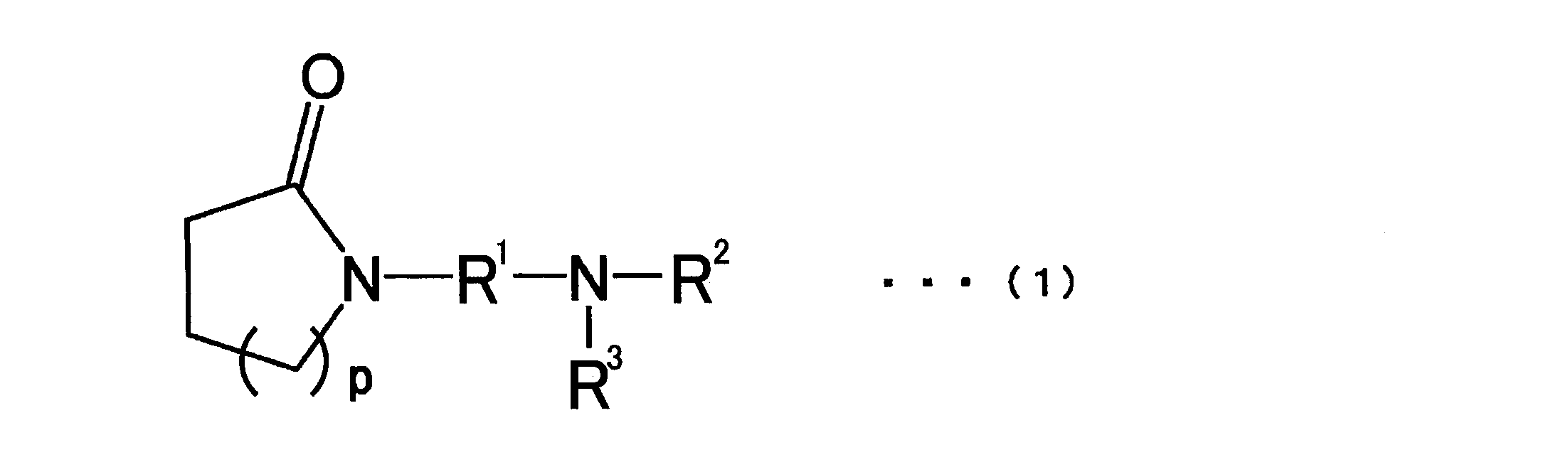
- R 1 represents a linear or branched alkylene group having 1 to 10 carbon atoms
- R 2 and R 3 each independently represents a hydrogen atom or a linear or branched chain having 1 to 4 carbon atoms.
- p represents an integer of 1 to 4.
- the conductive composition according to [6] The conductive composition according to any one of [1] to [5], further comprising a water-soluble polymer (D) (excluding the conductive polymer (A)).
- a laminate comprising a substrate, an electron beam resist layer formed on at least one surface of the substrate, and a conductive film according to [7] formed on the electron beam resist layer. .
- a conductive layer excellent in surface smoothness and conductivity can be formed with little film loss of the resist layer.
- conductive means having a surface resistance value of 1 ⁇ 10 11 ⁇ / ⁇ or less.
- the surface resistance value is obtained from the potential difference between the electrodes when a constant current is passed.
- solubility means 10 g (liquid temperature 25) of simple water, water containing at least one of a base and a basic salt, water containing an acid, or a mixture of water and a water-soluble organic solvent. °C) means that 0.1 g or more is uniformly dissolved.
- water-soluble means solubility in water with respect to the above-mentioned solubility.
- the “terminal” of the “terminal hydrophobic group” means a site other than the repeating unit constituting the polymer.
- “mass average molecular weight” is a mass average molecular weight (as converted into sodium polystyrene sulfonate or converted into polyethylene glycol) as measured by gel permeation chromatography (GPC).
- the conductive composition of the first aspect of the present invention contains the following conductive polymer (A) and basic compound (B).
- the conductive composition preferably further contains at least one of the following compound (C), water-soluble polymer (D) (excluding the conductive polymer (A)) and solvent (E).
- the electroconductive composition may contain at least 1 of the high molecular compound (F) shown below and arbitrary components as needed.
- the conductive polymer (A) has an acidic group. If the conductive polymer (A) has an acidic group, water solubility will increase.
- the conductive polymer having an acidic group is not particularly limited as long as it has at least one group selected from the group consisting of a sulfonic acid group and a carboxy group in the molecule, as long as it has the effect of the present invention. For example, JP-A 61-197633, JP-A 63-39916, JP-A-1-301714, JP-A-5-504153, JP-A-5-503953, JP-A-4-32848.
- the conductive polymer having an acidic group examples include phenylene vinylene, vinylene, and thienylene in which the ⁇ -position or ⁇ -position is substituted with at least one group selected from the group consisting of a sulfonic acid group and a carboxy group.
- the ⁇ -conjugated conductive polymer includes at least one repeating unit selected from the group consisting of iminophenylene and galazolylene, on the nitrogen atom of the repeating unit, from a sulfonic acid group and a carboxy group
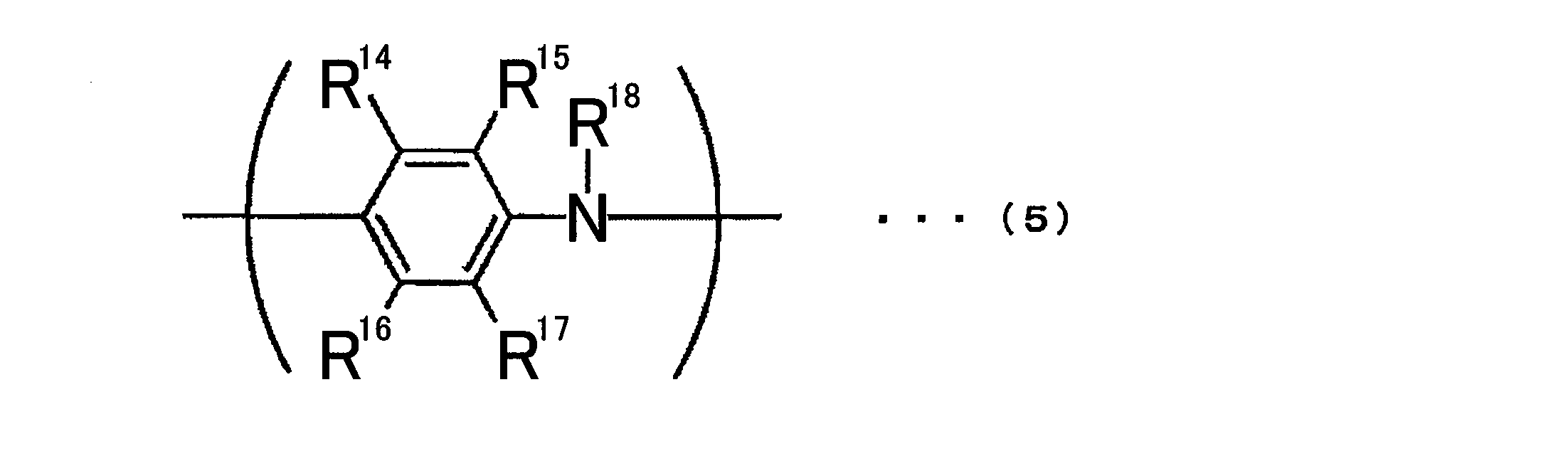
- the conductive polymer (A) preferably has at least one monomer unit selected from the group consisting of units represented by the following general formulas (2) to (5) from the viewpoint of conductivity and solubility.
- X represents a sulfur atom or a nitrogen atom
- R 4 to R 18 each independently represents a hydrogen atom, a linear or branched alkyl group having 1 to 24 carbon atoms, carbon A linear or branched alkoxy group of 1 to 24, an acidic group, a hydroxy group, a nitro group, a halogen atom (—F, —Cl, —Br or I), —N (R 19 ) 2 , —NHCOR 19 , —SR 19 , —OCOR 19 , —COOR 19 , —COR 19 , —CHO, or —CN is represented.
- R 19 represents an alkyl group having 1 to 24 carbon atoms, an aryl group having 1 to 24 carbon atoms, or an aralkyl group having 1 to 24 carbon atoms.
- at least one of R 4 and R 5 in the general formula (2), at least one of R 6 to R 9 in the general formula (3), and R 10 to R 13 in the general formula (4) At least one of them, at least one of R 14 to R 18 in the general formula (5), is an acidic group or a salt thereof, respectively.
- the “acidic group” means a sulfonic acid group (sulfo group) or a carboxylic acid group (carboxy group).
- the sulfonic acid group may be contained in an acid state (—SO 3 H) or may be contained in an ionic state (—SO 3 ⁇ ).
- the sulfonic acid group also includes a substituent having a sulfonic acid group (—R 20 SO 3 H).
- the carboxylic acid group may be contained in an acid state (—COOH) or an ionic state (—COO ⁇ ).
- the carboxylic acid group includes a substituent having a carboxylic acid group (—R 20 COOH).
- R 20 represents a linear or branched alkylene group having 1 to 24 carbon atoms, a linear or branched arylene group having 1 to 24 carbon atoms, or a linear or branched aralkylene group having 1 to 24 carbon atoms.
- Examples of the acid group salt include alkali metal salts, alkaline earth metal salts, ammonium salts, and substituted ammonium salts of sulfonic acid groups or carboxylic acid groups.
- Examples of the alkali metal salt include lithium sulfate, lithium carbonate, lithium hydroxide, sodium sulfate, sodium carbonate, sodium hydroxide, potassium sulfate, potassium carbonate, potassium hydroxide, and derivatives having these skeletons.
- Examples of alkaline earth metal salts include magnesium salts and calcium salts.
- Examples of substituted ammonium salts include aliphatic ammonium salts, saturated alicyclic ammonium salts, and unsaturated alicyclic ammonium salts.
- aliphatic ammonium salts include methylammonium, dimethylammonium, trimethylammonium, ethylammonium, diethylammonium, triethylammonium, methylethylammonium, diethylmethylammonium, dimethylethylammonium, propylammonium, dipropylammonium, isopropylammonium, diisopropyl.
- Examples of the saturated alicyclic ammonium salt include piperidinium, pyrrolidinium, morpholinium, piperazinium, and derivatives having these skeletons.
- Examples of the unsaturated alicyclic ammonium salt include pyridinium, ⁇ -picolinium, ⁇ -picolinium, ⁇ -picolinium, quinolinium, isoquinolinium, pyrrolinium, and derivatives having these skeletons.
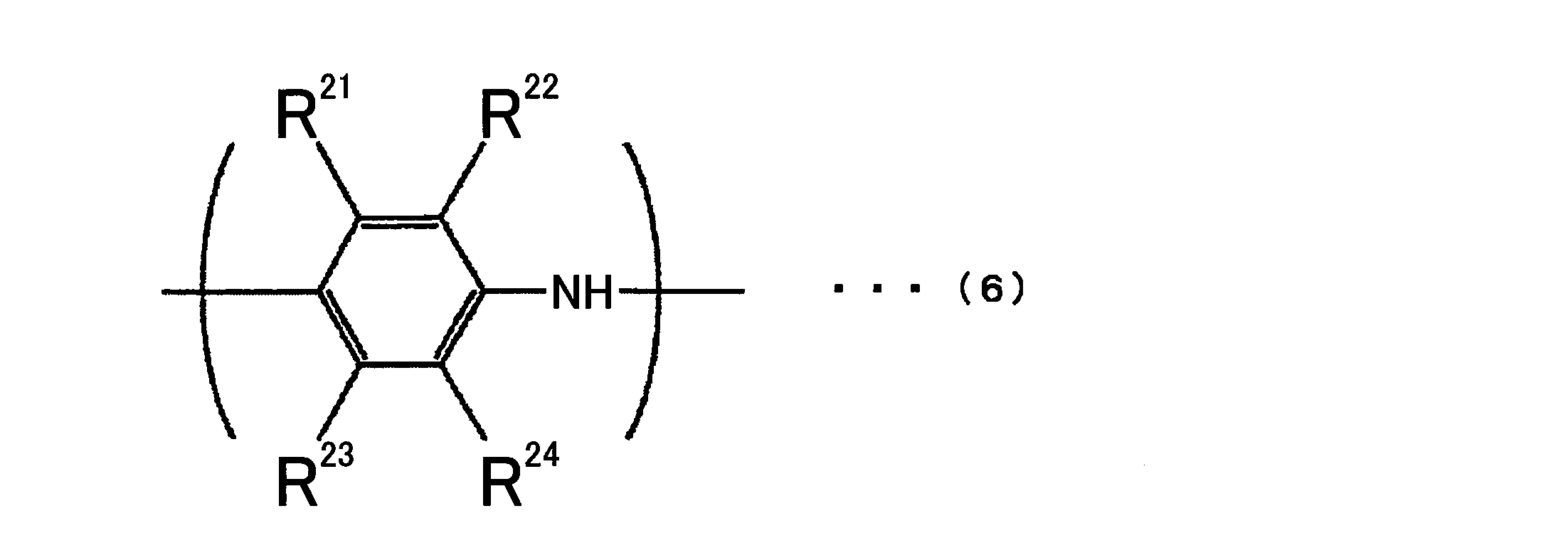
- the conductive polymer (A) preferably has a unit represented by the general formula (5) from the viewpoint of expressing high conductivity, and among them, the following general formula is particularly preferable from the viewpoint of excellent solubility. It is more preferable to have a monomer unit represented by (6).
- R 21 to R 24 each independently represent a hydrogen atom, a linear or branched alkyl group having 1 to 24 carbon atoms, a linear or branched alkoxy group having 1 to 24 carbon atoms, An acidic group, a hydroxy group, a nitro group, or a halogen atom (—F, —Cl, —Br or I) is represented. At least one of R 21 to R 24 is an acidic group or a salt thereof.
- one of R 21 to R 24 is a linear or branched alkoxy group having 1 to 4 carbon atoms in terms of easy production, It is preferable that any other one is a sulfonic acid group and the rest is hydrogen.
- the number of aromatic rings to which acidic groups are bonded to the total number of aromatic rings in the polymer is preferably 50% or more, and 70% The above is more preferable, 90% or more is further preferable, and 100% is most preferable.
- the number of aromatic rings to which acidic groups are bonded relative to the total number of aromatic rings in the polymer refers to a value calculated from the monomer charge ratio at the time of producing the conductive polymer (A).
- the substituent other than the acidic group on the aromatic ring of the monomer unit is preferably an electron-donating group from the viewpoint of imparting reactivity to the monomer.
- 24 alkyl groups, alkoxy groups having 1 to 24 carbon atoms, halogen groups (—F, —Cl, —Br or I) and the like are preferable. Among these, alkoxy groups having 1 to 24 carbon atoms are preferred from the viewpoint of electron donating properties. Most preferably.
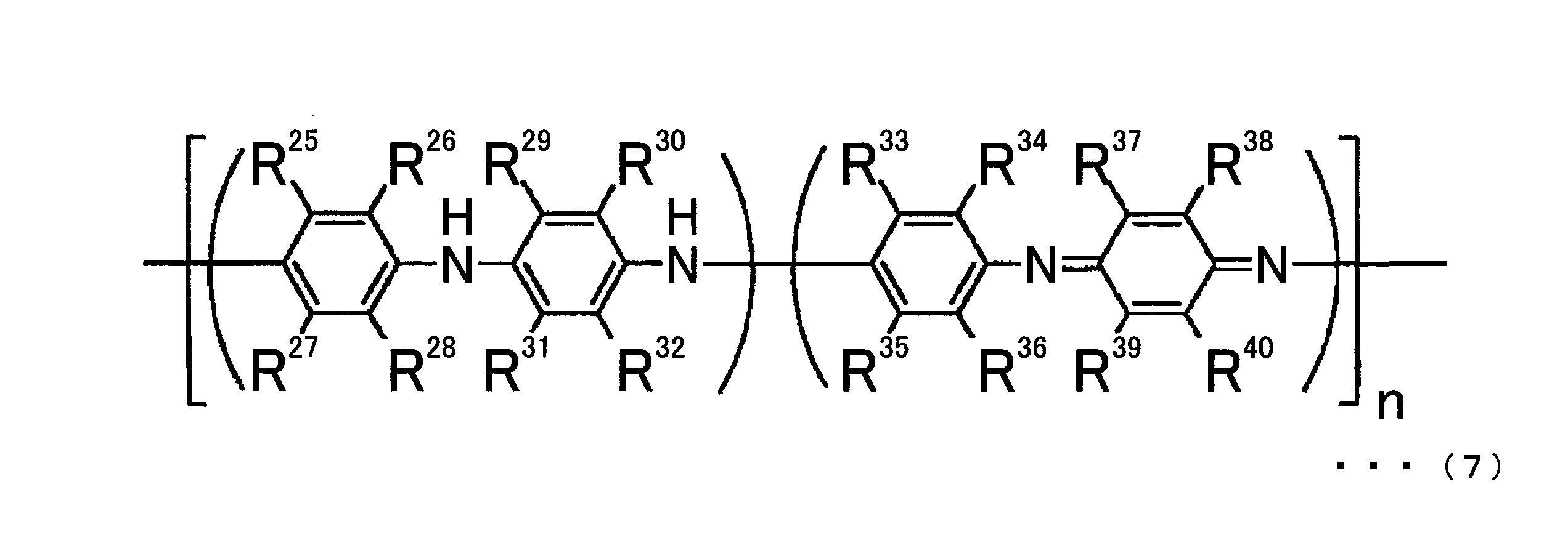
- the conductive polymer (A) is preferably a compound having a structure represented by the following general formula (7) from the viewpoint of exhibiting high conductivity and solubility, and represented by the following general formula (7).
- poly (2-sulfo-5-methoxy-1,4-iminophenylene) is particularly preferable.
- R 25 to R 40 each independently represents a hydrogen atom, a linear or branched alkyl group having 1 to 4 carbon atoms, a linear or branched alkoxy group having 1 to 4 carbon atoms, An acidic group, a hydroxy group, a nitro group, or a halogen atom (—F, —Cl, —Br or I) is represented. At least one of R 25 to R 40 is an acidic group or a salt thereof. N represents the degree of polymerization. In the present invention, n is preferably an integer of 5 to 2500.
- At least a part of the acidic group contained in the conductive polymer (A) is a free acid type from the viewpoint of improving conductivity.
- the mass average molecular weight of the conductive polymer (A) is preferably 1,000 to 1,000,000, more preferably 1500 to 800,000, more preferably 2000 to 800,000 in terms of conductivity, solubility and film formability in terms of GPC sodium polystyrenesulfonate. ⁇ 500,000 is more preferred, and 2,000 to 100,000 is particularly preferred.
- mass average molecular weight of the conductive polymer (A) is less than 1000, although the solubility is excellent, the conductivity and film formability may be insufficient.
- the mass average molecular weight exceeds 1,000,000, although the conductivity is excellent, the solubility may be insufficient.
- film formability refers to the property of forming a uniform film without repelling and the like, and can be evaluated by a method such as spin coating on glass.
- a manufacturing method of a conductive polymer (A) As a manufacturing method of a conductive polymer (A), a well-known method can be used and it will not specifically limit as long as it has the effect of this invention. Specific examples include a method of polymerizing a polymerizable monomer (raw material monomer) having any of the above-described monomer units by various synthesis methods such as a chemical oxidation method and an electrolytic oxidation method. As such a method, for example, the synthesis methods described in JP-A-7-196791 and JP-A-7-324132 can be applied. Below, an example of the manufacturing method of a conductive polymer (A) is demonstrated.
- the conductive polymer (A) can be obtained, for example, by polymerizing a raw material monomer using an oxidizing agent in the presence of a basic reaction aid.
- basic reaction aids include inorganic bases (sodium hydroxide, potassium hydroxide, lithium hydroxide, etc.), ammonia, fatty amines, cyclic saturated amines, cyclic unsaturated amines (sodium hydroxide, Potassium hydroxide, lithium hydroxide, etc.).
- oxidizing agent examples include peroxodisulfuric acids (peroxodisulfuric acid, ammonium peroxodisulfate, sodium peroxodisulfate, potassium peroxodisulfate, etc.), hydrogen peroxide, and the like.
- peroxodisulfuric acids peroxodisulfuric acid, ammonium peroxodisulfate, sodium peroxodisulfate, potassium peroxodisulfate, etc.
- hydrogen peroxide and the like.
- a polymerization method for example, a method of dropping a mixed solution of a raw material monomer and a basic reaction aid into an oxidant solution, a method of dropping an oxidant solution into a mixed solution of a raw material monomer and a basic reaction aid, reaction Examples thereof include a method in which a mixed solution of a raw material monomer and a basic reaction aid and an oxidizing agent solution are dropped simultaneously in a container or the like.
- the solvent is usually filtered off with a filter such as a centrifuge. Furthermore, after washing
- the conductive polymer (A) thus obtained contains low molecular weight substances such as raw material monomers (unreacted monomers), oligomers accompanying side reactions, oxidizing agents, basic reaction aids, and the like. There is a case. These low molecular weight substances are factors that inhibit conductivity.
- the method for purifying the conductive polymer (A) is not particularly limited, and any method such as an ion exchange method, acid washing in a protonic acid solution, removal by heat treatment, neutralization precipitation can be used, but the purity is high. From the viewpoint of easily obtaining the conductive polymer (A), the ion exchange method is particularly effective.
- Examples of the ion exchange method include column-type and batch-type treatments using ion exchange resins such as cation exchange resins and anion exchange resins; electrodialysis methods and the like.
- the reaction mixture obtained by the polymerization is dissolved in an aqueous medium so as to have a desired solid content concentration, and the polymer solution is brought into contact with the ion exchange resin. It is preferable to make it.
- the aqueous medium include water, an organic solvent, and a mixed solvent of water and an organic solvent.
- the concentration of the conductive polymer (A) in the polymer solution is preferably from 0.1 to 20% by mass, more preferably from 0.1 to 10% by mass, from the viewpoints of industrial properties and purification efficiency.
- the content of the conductive polymer (A) is 5 to 90 when the total of the conductive polymer (A), the basic compound (B), the compound (C) and the water-soluble polymer (D) is 100 parts by mass. Part by mass is preferred, 10 to 80 parts by mass is more preferred, and 20 to 75 parts by mass is even more preferred.
- a conductive coating film hereinafter referred to as “conductive film” that is superior in conductivity can be formed.
- the basic compound (B) has a cyclic amide and an amino group in the molecule.
- the cyclic amide lactam is preferable.
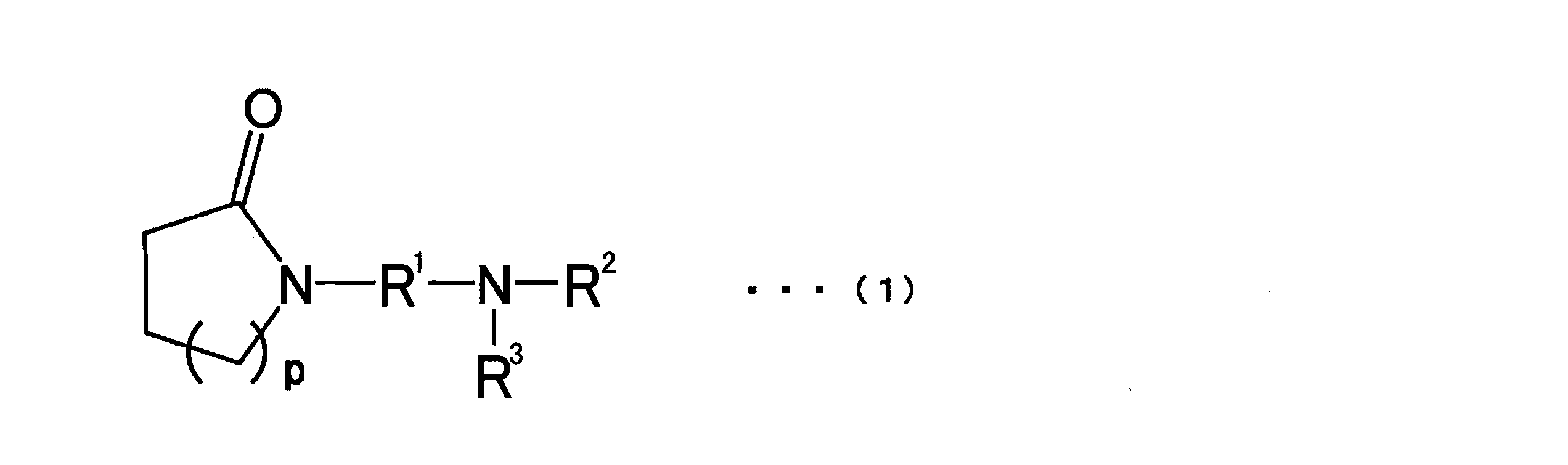
- a compound represented by the following general formula (1) is preferable.
- R 1 represents a linear or branched alkylene group having 1 to 10 carbon atoms
- R 2 and R 3 each independently represents a hydrogen atom or a linear or branched chain having 1 to 4 carbon atoms.
- p represents an integer of 1 to 4.
- R 1 preferably has 1 to 7 carbon atoms, more preferably 2 to 5 carbon atoms.
- Examples of the compound represented by the general formula (1) include 1- (3-aminopropyl) -2-pyrrolidone and N- (3-aminopropyl) - ⁇ -caprolactam. Any one of these compounds may be used alone, or two or more thereof may be mixed and used in an arbitrary ratio.
- the content of the basic compound (B) is 1 to 70 when the total of the conductive polymer (A), the basic compound (B), the compound (C) and the water-soluble polymer (D) is 100 parts by mass. Mass parts are preferred, 5 to 60 parts by mass are more preferred, and 10 to 50 parts by mass are even more preferred. If content of a basic compound (B) is more than the said lower limit, when forming a electrically conductive film on a resist layer using the electrically conductive composition of the 1st aspect of this invention, it will heat from an electrically conductive film by heating. It is possible to sufficiently suppress the acidic substance from diffusing into the resist layer. In addition, the surface smoothness of the conductive film is further improved. On the other hand, if content of a basic compound (B) is below the said upper limit, the performance as an electrically conductive film, ie, electroconductivity, and applicability
- Compound (C) is a nitrogen-containing heterocyclic compound containing two or more nitrogen atoms in the molecule.
- the compound (C) is not particularly limited as long as it has two or more nitrogen atoms in the molecule and has an elementary heterocyclic structure as long as it has the effect of the present invention, but has a boiling point of 120 ° C. or higher. Is preferred.
- Examples of the compound (C) include pyridine derivatives having a tertiary amino group as a substituent such as 4-dimethylaminopyridine, 4-dimethylaminomethylpyridine, and 3,4-bis (dimethylamino) pyridine; And diazabicyclo [4.3.0] -5-nonene (DBN), 1,8-diazabicyclo [5.4.0] -7-undecene (DBU), and derivatives thereof.
- DBN diazabicyclo [4.3.0] -5-nonene
- DBU 1,8-diazabicyclo [5.4.0] -7-undecene
- the content of the compound (C) is 1 to 65 parts by mass when the total of the conductive polymer (A), the basic compound (B), the compound (C) and the water-soluble polymer (D) is 100 parts by mass. It is preferably 1 to 60 parts by mass, more preferably 2 to 50 parts by mass. If content of a compound (C) is more than the said lower limit, it can suppress more effectively that an acidic substance diffuses into a resist layer from an electrically conductive film. On the other hand, if content of a compound (C) is below the said upper limit, the electroconductivity of an electrically conductive film will improve more.
- the mass ratio of the basic compound (B) and the compound (C) is within the above range, the balance between suppression of film loss of the resist layer and improvement of surface smoothness of the conductive film is excellent.
- the water-soluble polymer (D) is a polymer excluding the conductive polymer (A).
- a nitrogen-containing functional group is included in the molecule from the viewpoint of easily exhibiting the surface active ability and also easily suppressing the influence on the resist layer and improving the surface smoothness of the conductive film. And having a terminal hydrophobic group.
- the nitrogen-containing functional group is preferably an amide group from the viewpoint of solubility.
- the terminal hydrophobic group preferably includes an alkyl chain, an aralkyl chain, or an aryl chain in the hydrophobic group. From the viewpoint of solubility and surface activity, an alkyl chain having 4 to 100 carbon atoms, It preferably contains at least one selected from the group consisting of 100 aralkyl chains and aryl chains having 4 to 100 carbon atoms. Each of the alkyl chain, aralkyl chain and aryl chain preferably has 4 to 70 carbon atoms, more preferably 8 to 30 carbon atoms.
- terminal hydrophobic group examples include an alkyl group, an aralkyl group, an aryl group, an alkoxy group, an aralkyloxy group, an aryloxy group, an alkylthio group, an aralkylthio group, an arylthio group, a primary or secondary alkyl group.
- An amino group, an aralkylamino group, an arylamino group, etc. are mentioned.
- an alkylthio group, an aralkylthio group, and an arylthio group are preferable from the viewpoint of solubility and surface activity, and an alkylthio group is particularly preferable.
- the water-soluble polymer (D) has a main chain structure of a vinyl monomer homopolymer having an amide bond, or a copolymer of a vinyl monomer having an amide bond and a vinyl monomer having no amide bond (other vinyl monomers). And the compound which has a hydrophobic group in site
- Examples of the vinyl monomer having an amide bond include acrylamide and its derivatives, N-vinyl lactam and the like. Specifically, acrylamide, N, N-dimethylacrylamide, N-isopropylacrylamide, N, N-diethylacrylamide, N, N-dimethylaminopropylacrylamide, t-butylacrylamide, diacetone acrylamide, N, N′-methylene Bisacrylamide, N-vinyl-N-methylacrylamide, N-vinylpyrrolidone, N-vinylcaprolactam and the like can be mentioned. Among these, acrylamide, N-vinyl pyrrolidone, N-vinyl caprolactam and the like are particularly preferable from the viewpoint of solubility.
- the method for introducing the terminal hydrophobic group of the water-soluble polymer (D) is not particularly limited as long as it has the effect of the present invention, but the method of introducing by selecting a chain transfer agent at the time of vinyl polymerization is simple and preferable.
- a water-soluble polymer (D) having a nitrogen-containing functional group and a terminal hydrophobic group having 4 or more carbon atoms in the molecule is obtained by converting a vinyl monomer having an amide bond and, if necessary, another vinyl monomer into a polymerization initiator. And polymerized in the presence of a chain transfer agent having 4 or more carbon atoms.
- the chain transfer agent is not particularly limited as long as it has the effect of the present invention as long as it can introduce the above-mentioned terminal hydrophobic group, but is preferably a terminal hydrophobic group such as an alkylthio group or an aralkyl.
- a terminal hydrophobic group such as an alkylthio group or an aralkyl.
- Thiols, disulfides, thioethers, and the like that can easily obtain thio groups, arylthio groups, and the like can be preferably used.
- the polymerization degree of the repeating unit of the main chain structure portion of the water-soluble polymer (D), that is, the vinyl monomer having the amide bond is preferably 2 to 100,000. 2-1000 is more preferable, and 3-200 is particularly preferable. Further, from the viewpoint of the surface active ability, the water-soluble polymer (D) has a molecular weight of the main chain structure portion (hereinafter sometimes referred to as “molecular weight of the water-soluble portion”) and a molecular weight of the terminal hydrophobic portion (hereinafter referred to as “water-soluble portion”).
- the ratio of “molecular weight of the hydrophobic part”) is preferably 1 to 1500, preferably 5 to 1000. Is more preferable.
- “molecular weight of water-soluble portion” and “molecular weight of hydrophobic portion” are the weight average molecular weight of the obtained water-soluble polymer (D), the monomer constituting the main chain structure portion, and the terminal hydrophobic portion. It can be calculated from the charge ratio of the chain transfer agent constituting
- the mass average molecular weight of the water-soluble polymer (D) is preferably from 1 to 1,000,000, more preferably from 100 to 100,000, still more preferably from 600 to less than 2000, and particularly preferably from 600 to 1800 in terms of GPC polyethylene glycol.
- the mass average molecular weight of the water-soluble polymer (D) is not less than the above lower limit value, the effect of improving the applicability of the conductive composition is easily exhibited.
- the mass average molecular weight of the water-soluble polymer (D) is not more than the above upper limit, the water-solubility of the conductive composition is increased. In particular, when the weight average molecular weight of the water-soluble polymer (D) is 600 or more and less than 2000, the balance between practical solubility in water and applicability is excellent.
- the water-soluble polymer (D) is preferably a compound represented by the following general formula (8) from the viewpoint of solubility and the like.
- R 41 and R 42 each independently represents an alkylthio group, an aralkylthio group, an arylthio group, or a hydrocarbon group. At least one of R 41 and R 42 is an alkylthio group, an aralkylthio group, or an arylthio group.
- m represents an integer of 2 to 100,000.
- the hydrocarbon group include a linear or branched alkyl group having 1 to 20 carbon atoms, a linear or branched alkenyl group having 1 to 20 carbon atoms, and a linear or branched alkynyl group having 1 to 20 carbon atoms. Is mentioned.
- the content of the water-soluble polymer (D) is 5 to 80 when the total of the conductive polymer (A), the basic compound (B), the compound (C) and the water-soluble polymer (D) is 100 parts by mass. Mass parts are preferred, 10 to 70 parts by mass are more preferred, and 10 to 65 parts by mass are even more preferred. If content of water-soluble polymer (D) is in the said range, the applicability
- the organic solvent examples include alcohols such as methanol, ethanol, isopropyl alcohol, propyl alcohol, and butanol; ketones such as acetone and ethyl isobutyl ketone; ethylene glycols such as ethylene glycol and ethylene glycol methyl ether; propylene glycol and propylene Examples include propylene glycols such as glycol methyl ether, propylene glycol ethyl ether, propylene glycol butyl ether, and propylene glycol propyl ether; amides such as dimethylformamide and dimethylacetamide; and pyrrolidones such as N-methylpyrrolidone and N-ethylpyrrolidone. .
- the mass ratio water / organic solvent
- the mass ratio is preferably 1/100 to 100/1, and 2/100 to 100/2. More preferably.
- the conductive composition of the first aspect of the present invention may contain a polymer compound (F) as necessary for the purpose of further improving the coating film strength and surface smoothness.
- a polymer compound (F) include polyvinyl alcohol derivatives such as polyvinyl formal and polyvinyl butyral, polyacrylamide such as polyacrylamide, poly (Nt-butylacrylamide), and polyacrylamide methylpropane sulfonic acid.
- Acrylamides polyvinylpyrrolidone, polyacrylic acids, water-soluble alkyd resins, water-soluble melamine resins, water-soluble urea resins, water-soluble phenol resins, water-soluble epoxy resins, water-soluble polybutadiene resins, water-soluble acrylic resins, water-soluble urethane resins, Examples thereof include water-soluble acrylic styrene copolymer resins, water-soluble vinyl acetate acrylic copolymer resins, water-soluble polyester resins, water-soluble styrene maleic acid copolymer resins, water-soluble fluororesins, and copolymers thereof.
- the conductive composition according to the first aspect of the present invention includes, as necessary, a pigment, an antifoaming agent, an ultraviolet absorber, an antioxidant, a heat resistance improver, a leveling agent, an anti-sagging agent, and a matting agent.
- a pigment an antifoaming agent, an ultraviolet absorber, an antioxidant, a heat resistance improver, a leveling agent, an anti-sagging agent, and a matting agent.
- Various additives such as preservatives may be included.
- the conductive composition according to the first aspect of the present invention includes, for example, a solution of the conductive polymer (A), a basic compound (B), and, if necessary, a compound (C) and a water-soluble polymer (D). It can be obtained by mixing any one or more of the polymer compound (F) and optional components. Usually, it is preferable to keep the solution of the conductive polymer (A) at room temperature and add the basic compound (B) and the like while stirring. Moreover, you may further dilute with a solvent (E) as needed. In the present invention, “room temperature” means 25 ° C.
- the basic compound (B) is a monomer or sulfate. Acts to form a stable salt. As a result, the transfer of the acidic substance from the conductive film to the resist layer is suppressed.
- the basic compound (B) can efficiently act on the acidic group in the conductive polymer (A), and the stability of the conductive polymer (A) can be improved.
- to act efficiently on the acidic group in the conductive polymer (A) means that stable neutralization is possible due to the high boiling point and strong basicity.
- the generation of an acidic substance due to destabilization of the acidic group contained in the conductive polymer (A) in the conductive film is suppressed, and the transfer of the acidic substance from the conductive film to the resist layer is suppressed. Therefore, in particular, in a pattern formation method using a charged particle beam using a chemically amplified resist, the migration of an acidic substance from the conductive film to the resist layer side is suppressed, and the influence of film loss of the resist layer can be suppressed.
- the electrically conductive film excellent in surface smoothness and electroconductivity can be formed.
- the conductive composition further contains the above-described compound (C)
- the conductivity of the conductive film is further improved.
- the above-mentioned water-soluble polymer (D) does not contain an acid or a base, and by-products generated by hydrolysis hardly occur, so that the coating property of the conductive composition is improved without adversely affecting the resist layer. Can be made. Therefore, if the electroconductive composition further contains the water-soluble polymer (D), the influence of film loss of the resist layer can be further suppressed. In addition, the surface smoothness of the conductive film is further improved.
- the conductive composition according to the first aspect of the present invention can form a conductor having a soluble coating film (conductive film) that is insoluble or peelable by heating after forming the conductor. .
- This has the advantage that it can be applied to both the permanent antistatic film and the process temporary antistatic film.
- the electrically conductive film of the 2nd aspect of this invention is formed from the electrically conductive composition of the 1st aspect of this invention mentioned above.
- an example of a manufacturing method of the conductive film will be described.
- the manufacturing method of the electrically conductive film of this embodiment apply
- a coating-film formation process is a process of apply
- the substrate is not particularly limited as long as it has the effect of the present invention, but is not limited to polyester resins such as polyethylene terephthalate (PET) and polybutylene terephthalate (PBT), polyolefin resins typified by polyethylene and polypropylene, vinyl chloride, nylon and polystyrene.
- the shape of the substrate is not particularly limited, and may be a plate shape or a shape other than the plate shape.
- the conductive composition is preferably applied onto the substrate so that the film thickness after drying becomes 5 to 30 nm.
- the method for applying the conductive composition to the substrate is not particularly limited as long as it has the effects of the present invention, but the spin coating method, spray coating method, dip coating method, roll coating method, gravure coating method, reverse coating method. Examples of the method include a roll brush method, an air knife coating method, and a curtain coating method.
- the step of applying the conductive composition to the substrate may be performed before or during the steps of manufacturing these substrates, for example, a step such as a uniaxial stretching method, a biaxial stretching method, a molding process, or an embossing process. Further, it can be performed on a base material on which these processing steps are completed. Moreover, it is also possible to form a coating film by repeatedly applying the conductive composition on the above-mentioned base material coated with various paints or photosensitive materials.
- a heating process is a process of heat-processing the coating film after drying.
- the heating temperature is preferably in the temperature range of 40 ° C. to 250 ° C., more preferably in the temperature range of 60 ° C. to 200 ° C. from the viewpoint of conductivity.
- the treatment time is preferably within 1 hour, more preferably within 30 minutes, from the viewpoint of stability.
- a treatment for leaving the coating film at room temperature (25 ° C.) for 1 to 60 minutes may be performed.
- the conductor of the third aspect of the present invention includes a base material and a conductive film formed by applying the conductive composition of the first aspect of the present invention to at least a part of the base material. It is a waste. That is, the conductive film contained in the conductor is the conductive film of the second aspect of the present invention.
- a base material the base material illustrated previously in description of the electrically conductive film of the 2nd aspect of this invention is mentioned.
- the conductive film may be provided on the entire surface on one side of the base material, or may be provided on a part on one side of the base material.
- the electrically conductive film may be provided also in at least one part on the other surface of a base material.
- a conductive film may be provided on at least a part of the side surface of the substrate.
- the conductor is obtained by forming a conductive film on a substrate.
- the specific manufacturing method is the same as the method for manufacturing the conductive film of the second aspect of the present invention. That is, the conductor is manufactured through the coating film forming step and the heating step. The standing step may be performed instead of the heating step.
- the laminate of the fourth aspect of the present invention comprises a base material, an electron beam resist layer (hereinafter also simply referred to as “resist layer”) formed on at least one surface of the base material, and the electrons. And a conductive film formed on the line resist layer.
- a base material the base material illustrated previously in description of the electrically conductive film of the 2nd aspect of this invention is mentioned.
- the conductive film is the conductive film according to the second aspect of the present invention.
- the resist layer examples include a layer made of a positive or negative chemically amplified resist.
- the positive chemically amplified resist is not particularly limited as long as it has sensitivity to electron beams, and known resists can be used. Typically, those containing an acid generator that generates an acid upon irradiation with an electron beam and a polymer containing a structural unit having an acid-decomposable group are used.
- the negative chemically amplified resist is not particularly limited as long as it has sensitivity to electron beams, and known resists can be used.
- an acid generator that generates an acid upon irradiation with an electron beam, a polymer soluble in a developer, and a crosslinking agent are used.
- a laminated body is obtained by forming a resist layer and a conductive film in this order on a substrate.
- the resist layer can be formed by a known method.
- a positive-type or negative-type resist layer is formed by applying an organic solvent solution of a positive-type or negative-type chemically amplified resist on one side of the substrate and heating (pre-baking) as necessary.
- the conductive film is formed by applying the conductive composition of the first aspect of the present invention to the surface of the resist layer, drying to form a coating film, and then heat-treating the dried coating film.
- the specific manufacturing method is the same as the method for manufacturing the conductive film of the second aspect of the present invention.
- the standing step may be performed instead of the heat treatment step.
- the electrically conductive composition which contains a formula compound (C) arbitrarily.
- the basic compound (B) is a compound represented by the general formula (1).
- ⁇ 4> The conductivity of ⁇ 3>, wherein the compound represented by the general formula (1) is 1- (3-aminopropyl) -2-pyrrolidone or N- (3-aminopropyl) - ⁇ -caprolactam Composition.
- the water-soluble polymer (D) is contained in the conductive polymer (A), the basic compound (B), the nitrogen-containing heterocyclic compound (C), and the water-soluble polymer (D).
- the conductive composition according to ⁇ 11> or ⁇ 12> which is 5 to 80 parts by mass when the total is 100 parts by mass.
- the water-soluble polymer (D) is contained in the conductive polymer (A), the basic compound (B), the nitrogen-containing heterocyclic compound (C), and the water-soluble polymer (D).
- the conductive composition according to ⁇ 13> which is 10 to 65 parts by mass when the total is 100 parts by mass.
- ⁇ 15> The conductive composition according to any one of ⁇ 1> to ⁇ 14>, wherein the conductive polymer (A) has a monomer unit represented by the general formula (6).
- the conductive polymer (A) is contained in the conductive polymer (A), the basic compound (B), the nitrogen-containing heterocyclic compound (C), and the water-soluble polymer (D).
- the conductive composition according to any one of ⁇ 1> to ⁇ 15> which is 5 to 90 parts by mass when the total is 100 parts by mass.
- the conductive polymer (A) is contained in the conductive polymer (A), the basic compound (B), the nitrogen-containing heterocyclic compound (C), and the water-soluble polymer (D).
- the conductive composition according to ⁇ 16> which is 20 to 75 parts by mass when the total is 100 parts by mass.
- the content of the basic compound (B) is that of the conductive polymer (A), the basic compound (B), the nitrogen-containing heterocyclic compound (C), and the water-soluble polymer (D).
- the content of the basic compound (B) is that of the conductive polymer (A), the basic compound (B), the nitrogen-containing heterocyclic compound (C), and the water-soluble polymer (D).
- the conductive composition according to ⁇ 18> which is 5 to 35 parts by mass when the total is 100 parts by mass.
- the nitrogen-containing heterocyclic compound (C) is 4-dimethylaminopyridine, 4-dimethylaminomethylpyridine, 1,5-diazabicyclo [4.3.0] -5-nonene, 1,8-diazabicyclo.
- the content of the nitrogen-containing heterocyclic compound (C) is such that the conductive polymer (A), the basic compound (B), the nitrogen-containing heterocyclic compound (C), and the water-soluble polymer (
- the nitrogen-containing heterocyclic compound (C) has a content of the conductive polymer (A), the basic compound (B), the nitrogen-containing heterocyclic compound (C), and the water-soluble polymer ( The conductive composition according to ⁇ 21>, which is 1 to 10 parts by mass when the total of D) is 100 parts by mass.
- ⁇ 23> The conductive composition according to any one of ⁇ 1> to ⁇ 22>, further comprising a solvent (E).
- ⁇ 24> The conductive composition according to ⁇ 23>, wherein the solvent (E) is water or a mixed solvent of water and an organic solvent.
- the organic solvent is at least one selected from the group consisting of methanol, ethanol, isopropyl alcohol, propyl alcohol, and butanol.
- ⁇ 28> A conductor comprising a base material and the ⁇ 27> conductive film formed on at least a part of the base material.
- ⁇ 29> A laminate including a substrate, an electron beam resist layer formed on at least one surface of the substrate, and a ⁇ 27> conductive film formed on the electron beam resist layer. .
- a conductor was prepared in the same manner as in the evaluation of conductivity.
- the arithmetic average roughness (Ra) [nm] of the conductive film was measured under the following measurement conditions using a stylus profilometer (Stylus profiler P-16 +, manufactured by KLA-Tencor). (Measurement condition) ⁇ Stylus: 2 ⁇ m R60 ° -Needle pressure: 0.03mg ⁇ Scanning range: 500um ⁇ Scanning speed: 2um / s
- a resist layer using a chemically amplified electron beam resist (for example, a commercially available positive resist “FEP-171” manufactured by FUJIFILM Electronics Materials Co., Ltd., hereinafter abbreviated as “resist”) is used.
- the amount of film loss was measured by the following procedures (1A) to (8A).
- Pre-baking was performed to remove the solvent, and a resist layer was formed on the substrate.
- the resist layer has a film reduction amount (hereinafter referred to as “reference film reduction amount”) d [nm] peculiar to each resist depending on the storage period after the resist layer is formed.
- This reference film reduction amount d not caused by the conductive film was measured by the following procedures (1B) to (6B).
- (1B) Formation of resist layer A resist layer was formed on a substrate in the same manner as in (1A) above.
- (3B) Baking treatment The baking treatment was carried out in the same manner as in the above (4A) except that the base material on which the resist layer was laminated was used.
- the mixture was further stirred at 25 ° C. for 12 hours to obtain a conductive polymer. Thereafter, the obtained reaction mixture containing the conductive polymer was separated by a centrifugal filter. Further, it was washed with methanol and dried to obtain 185 g of a powdered conductive polymer (A-1).
- the residual monomer was removed by 80% by mass, the sulfate ion by 99% by mass, and the basic substance (pyridine) by 99% by mass or more. .
- the solid content concentration of the conductive polymer solution (A1-1) is 2.0% by mass.
- One swedl lap (SV) is defined as 1 ⁇ 10 6 m 3 / s (1GL / s).
- the dropping polymerization was performed while maintaining the temperature of isopropyl alcohol at 80 ° C. After completion of dropping, the mixture was further aged at 80 ° C. for 2 hours, and then allowed to cool. Thereafter, concentration was performed under reduced pressure, and the resulting reaction product was dried. 5.3 parts by mass of the dried polymer was dissolved in 95 parts by mass of water, cooled at 5 ° C. for 24 hours, filtered through a 30 nm polyethylene filter, and 5.0% by mass of a water-soluble polymer solution (D -1) was obtained.
- Example 1 25 parts by weight (0.5 parts by weight in terms of solid content) of the conductive polymer solution (A1-1) and 0.21 parts by weight of 1- (3-aminopropyl) -2-pyrrolidone as the basic compound (B) Then, 70.79 parts by mass of water and 4 parts by mass of isopropyl alcohol (IPA) were mixed to prepare a conductive composition. About the obtained electroconductive composition, electroconductivity and surface smoothness were evaluated and the film
- Example 2 to 8 Each component was mixed so that it might become a compounding composition shown in Table 1, and the electroconductive composition was prepared. About the obtained electroconductive composition, electroconductivity and surface smoothness were evaluated and the film
- Example 2 A conductive composition was prepared in the same manner as in Example 1 except that tetrabutylammonium hydroxide (TBAH) in the amount shown in Table 2 was used as another basic compound instead of the basic compound (B). Various evaluations were made. The results are shown in Table 2.
- TBAH tetrabutylammonium hydroxide
- (A) / ((A) + (B) + (C) + (D)) represents the conductive polymer (A), the basic compound (B), the compound (C), and the water-soluble property. It is content (mass part) of a conductive polymer (A) when the sum total of a polymer (D) is 100 mass parts. The same applies to the contents of the basic compound (B), the compound (C) and the water-soluble polymer (D). “(B) :( C)” is a mass ratio of the basic compound (B) to the compound (C) (basic compound (B): compound (C)).
- the conductive compositions obtained in each Example were able to form a conductive film with little resist layer loss and excellent surface smoothness and conductivity.
- the conductive films formed from the conductive compositions obtained in Comparative Examples 1 and 2 were inferior in surface smoothness and conductivity as compared to the Examples.
- the conductive composition of the present invention is useful as an antistatic agent that can be applied to semiconductor devices of next-generation processes.
Landscapes
- Chemical & Material Sciences (AREA)
- Organic Chemistry (AREA)
- Chemical Kinetics & Catalysis (AREA)
- Polymers & Plastics (AREA)
- Health & Medical Sciences (AREA)
- Medicinal Chemistry (AREA)
- Wood Science & Technology (AREA)
- Life Sciences & Earth Sciences (AREA)
- Materials Engineering (AREA)
- Engineering & Computer Science (AREA)
- Spectroscopy & Molecular Physics (AREA)
- Physics & Mathematics (AREA)
- Dispersion Chemistry (AREA)
- Compositions Of Macromolecular Compounds (AREA)
- Laminated Bodies (AREA)
- Materials For Photolithography (AREA)
- Conductive Materials (AREA)
Abstract
Description
本願は、2018年4月10日に、日本に出願された特願2018-075578号、に基づき優先権を主張し、その内容をここに援用する。
従って、露光部分又は荷電粒子線が照射された部分に酸を発生させ、続いてポストエクスポージャーベーク(PEB)と呼ばれる加熱処理により架橋反応又は分解反応を促進させる、高感度な化学増幅型レジストの使用が主流となっている。
この課題を解決する手段として、導電性ポリマーを含む導電性組成物をレジスト層の表面に塗布して導電性塗膜(以下、「導電膜」という。)を形成し、前記導電膜でレジスト層の表面を被覆する技術が有効であることが既に知られている。
酸性基を有するポリアニリンは、例えば、酸性基を有するアニリンを塩基性反応助剤の存在下で酸化剤により重合することで得られる。
具体的には、レジスト層がポジ型の場合、酸性物質が導電膜からレジスト層へ移行すると、現像時に未露光部のレジスト層が溶解してしまうため、レジスト層の膜減り、パターンの細り、高感度側への感度変動などが起こる。
一方、塩基性物質が導電膜からレジスト層へ移行すると、露光部の酸が失活してしまい、パターン形状の変化や低感度側への感度変動などが起こる。
また、レジスト層がネガ型の場合、上記副生成物の導電膜からレジスト層への移行は、各々逆の現象を引き起こすことになる。
例えば、特許文献1には、酸性基を有する導電性ポリマーと、水酸化テトラブチルアンモニウム等の塩基性化合物とを含む導電性組成物が開示されている。
そのため、半導体デバイスの次世代プロセスにも適用可能な帯電防止剤として、より複雑で、微細なパターン形状にも対応できる表面平滑性、すなわち、表面荒れの少ない導電膜を形成できる導電性組成物が求められている。
しかしながら、特許文献1に記載の導電性組成物より形成される導電膜は、必ずしも表面平滑性を満足するものではなかった。
[1] 酸性基を有する導電性ポリマー(A)と、分子内に環状アミド及びアミノ基を有する塩基性化合物(B)とを含む、導電性組成物。
[2] 前記環状アミドがラクタムである、[1]の導電性組成物。
[3] 前記塩基性化合物(B)が下記一般式(1)で表される化合物である、[1]又は[2]の導電性組成物。
[5] 前記塩基性化合物(B)と前記含窒素複素環式化合物(C)との質量比が、前記塩基性化合物(B):前記含窒素複素環式化合物(C)=0.5:99.5~99.5:0.5である、[4]の導電性組成物。
[6] 水溶性ポリマー(D)(ただし、前記導電性ポリマー(A)を除く。)をさらに含む、[1]~[5]のいずれか1つの導電性組成物。
[7] [1]~[6]のいずれか1つの導電性組成物より形成された、導電膜。
[8] 基材と、前記基材の少なくとも1つの面上に形成された電子線用レジスト層と、前記電子線用レジスト層上に形成された[7]の導電膜とを含む、積層体。
なお、本発明において「導電性」とは、1×10¹¹Ω/□以下の表面抵抗値を有することである。表面抵抗値は、一定の電流を流した場合の電極間の電位差より求められる。
また、本明細書において「溶解性」とは、単なる水、塩基及び塩基性塩の少なくとも一方を含む水、酸を含む水、水と水溶性有機溶媒との混合物のうち、10g(液温25℃)に、0.1g以上均一に溶解することを意味する。また、「水溶性」とは、上記溶解性に関して、水に対する溶解性のことを意味する。
また、本明細書において、「末端疎水性基」の「末端」とは、ポリマーを構成する繰り返し単位以外の部位を意味する。
また、本明細書において「質量平均分子量」とは、ゲルパーミエーションクロマトグラフィ(GPC)によって測定される質量平均分子量(ポリスチレンスルホン酸ナトリウム換算又はポリエチレングリコール換算)である。
本発明の第一の態様の導電性組成物は、以下に示す導電性ポリマー(A)と、塩基性化合物(B)とを含む。導電性組成物は、以下に示す化合物(C)、水溶性ポリマー(D)(ただし、前記導電性ポリマー(A)を除く。)及び溶剤(E)の少なくとも1つをさらに含むことが好ましい。また、導電性組成物は、必要に応じて、以下に示す高分子化合物(F)及び任意成分の少なくとも1つを含んでいてもよい。
導電性ポリマー(A)は、酸性基を有する。導電性ポリマー(A)が酸性基を有していれば、水溶性が高まる。
酸性基を有する導電性ポリマーとしては、分子内にスルホン酸基、及びカルボキシ基からなる群より選択される少なくとも1つの基を有していれば、本発明の効果を有する限り特に限定されないが、例えば、特開昭61-197633号公報、特開昭63-39916号公報、特開平1-301714号公報、特開平5-504153号公報、特開平5-503953号公報、特開平4-32848号公報、特開平4-328181号公報、特開平6-145386号公報、特開平6-56987号公報、特開平5-226238号公報、特開平5-178989号公報、特開平6-293828号公報、特開平7-118524号公報、特開平6-32845号公報、特開平6-87949号公報、特開平6-256516号公報、特開平7-41756号公報、特開平7-48436号公報、特開平4-268331号公報、特開2014-65898号公報等に示された導電性ポリマーなどが、溶解性の観点から好ましい。
また、前記π共役系導電性ポリマーがイミノフェニレン、及びガルバゾリレンからなる群から選ばれた少なくとも1種の繰り返し単位を含む場合は、前記繰り返し単位の窒素原子上に、スルホン酸基、及びカルボキシ基からなる群より選択される少なくとも1つの基を有する、又はスルホン酸基、及びカルボキシ基からなる群より選択される少なくとも1つの基で置換されたアルキル基、若しくはエーテル結合を含むアルキル基を前記窒素原子上に有する導電性ポリマーが挙げられる。
この中でも、導電性や溶解性の観点から、β位がスルホン酸基、及びカルボキシ基からなる群より選択される少なくとも1つの基で置換されたチエニレン、ピロリレン、イミノフェニレン、フェニレンビニレン、カルバゾリレン、及びイソチアナフテンからなる群から選ばれた少なくとも1種をモノマーユニット(単位)として有する導電性ポリマーが好ましく用いられる。
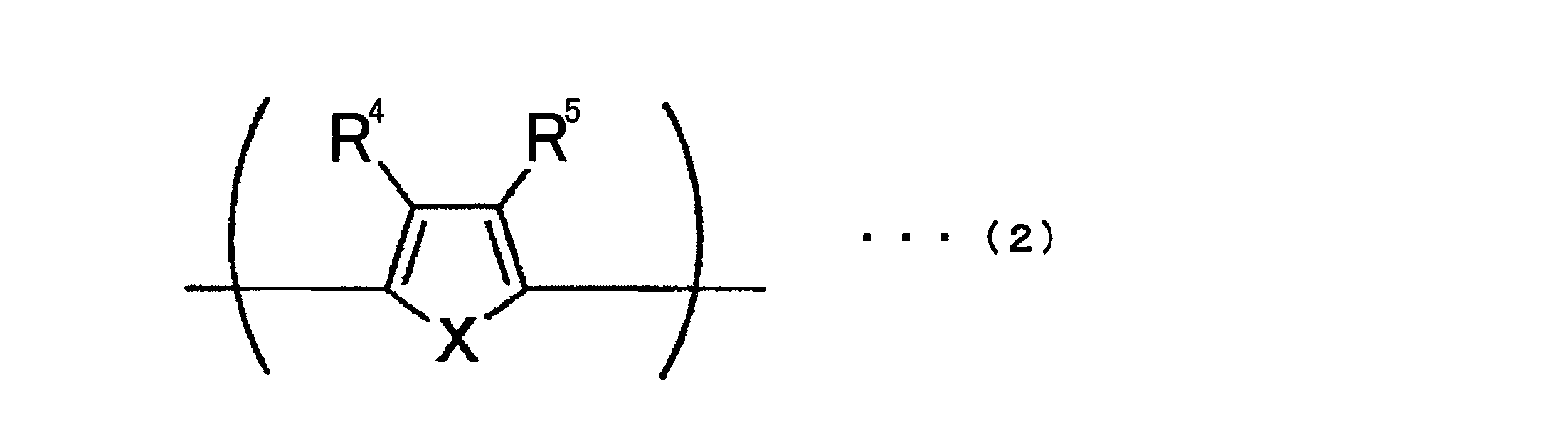
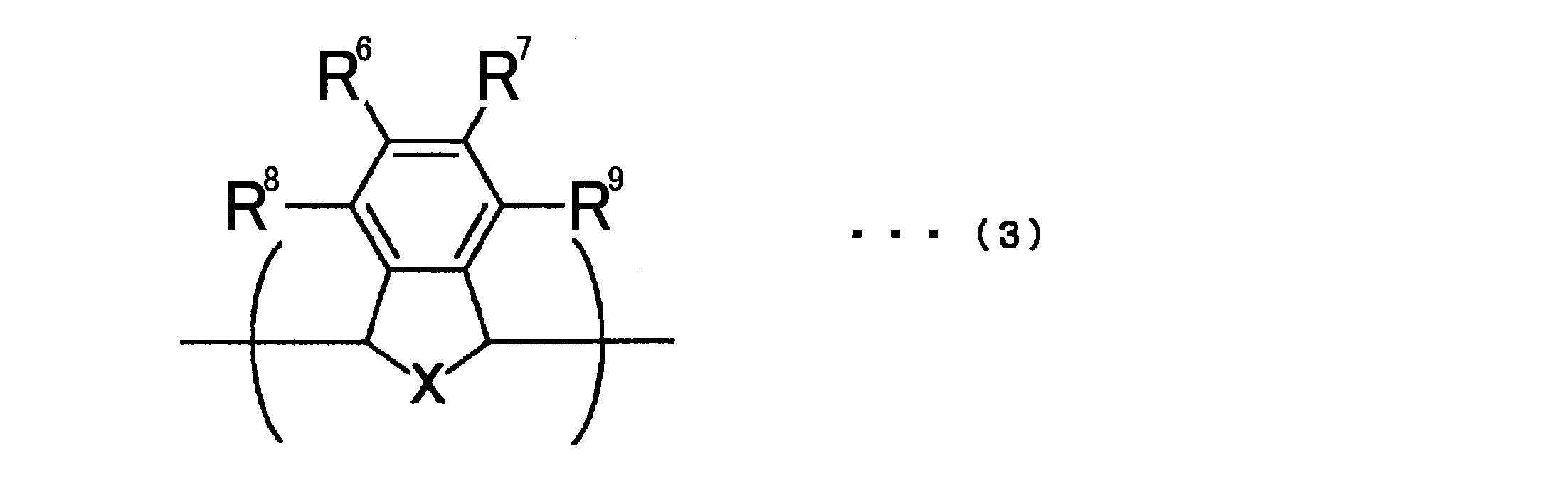
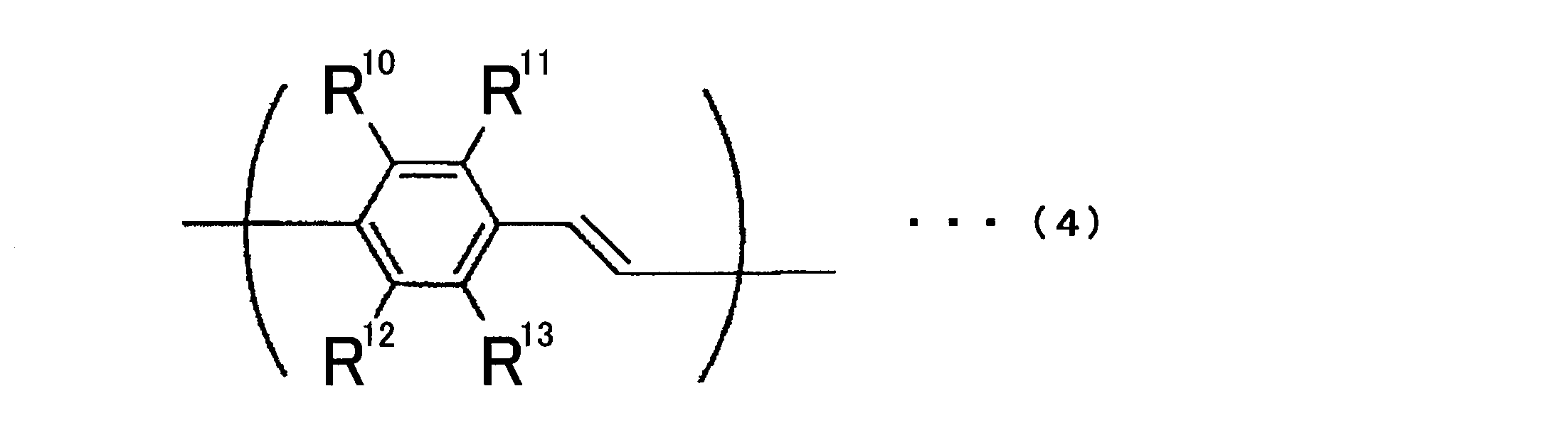
ただし、一般式(2)のR4、R5のうちの少なくとも一つ、一般式(3)のR6~R9のうちの少なくとも一つ、一般式(4)のR10~R13のうちの少なくとも一つ、一般式(5)のR14~R18のうちの少なくとも一つは、それぞれ酸性基又はその塩である。
スルホン酸基は、酸の状態(-SO3H)で含まれていてもよく、イオンの状態(-SO3 -)で含まれていてもよい。さらに、スルホン酸基には、スルホン酸基を有する置換基(-R20SO3H)も含まれる。
一方、カルボン酸基は、酸の状態(-COOH)で含まれていてもよく、イオンの状態(-COO-)で含まれていてもよい。さらに、カルボン酸基には、カルボン酸基を有する置換基(-R20COOH)も含まれる。
前記R20は炭素数1~24の直鎖若しくは分岐鎖のアルキレン基、炭素数1~24の直鎖若しくは分岐鎖のアリーレン基、又は炭素数1~24の直鎖若しくは分岐鎖のアラルキレン基を表す。
アルカリ金属塩としては、例えば、硫酸リチウム、炭酸リチウム、水酸化リチウム、硫酸ナトリウム、炭酸ナトリウム、水酸化ナトリウム、硫酸カリウム、炭酸カリウム、水酸化カリウム及びこれらの骨格を有する誘導体などが挙げられる。
アルカリ土類金属塩としては、例えばマグネシウム塩、カルシウム塩などが挙げられる。
置換アンモニウム塩としては、例えば脂肪族アンモニウム塩、飽和脂環式アンモニウム塩、不飽和脂環式アンモニウム塩などが挙げられる。
脂肪族アンモニウム塩としては、例えば、メチルアンモニウム、ジメチルアンモニウム、トリメチルアンモニウム、エチルアンモニウム、ジエチルアンモニウム、トリエチルアンモニウム、メチルエチルアンモニウム、ジエチルメチルアンモニウム、ジメチルエチルアンモニウム、プロピルアンモニウム、ジプロピルアンモニウム、イソプロピルアンモニウム、ジイソプロピルアンモニウム、ブチルアンモニウム、ジブチルアンモニウム、メチルプロピルアンモニウム、エチルプロピルアンモニウム、メチルイソプロピルアンモニウム、エチルイソプロピルアンモニウム、メチルブチルアンモニウム、エチルブチルアンモニウム、テトラメチルアンモニウム、テトラメチロールアンモニウム、テトラエチルアンモニウム、テトラn-ブチルアンモニウム、テトラsec-ブチルアンモニウム、テトラt-ブチルアンモニウムなどが挙げられる。
飽和脂環式アンモニウム塩としては、例えば、ピペリジニウム、ピロリジニウム、モルホリニウム、ピペラジニウム及びこれらの骨格を有する誘導体などが挙げられる。
不飽和脂環式アンモニウム塩としては、例えば、ピリジニウム、α-ピコリニウム、β-ピコリニウム、γ-ピコリニウム、キノリニウム、イソキノリニウム、ピロリニウム、及びこれらの骨格を有する誘導体などが挙げられる。
ポリマー中の芳香環の総数に対する、酸性基が結合した芳香環の数は、導電性ポリマー(A)製造時の、モノマーの仕込み比から算出した値のことを指す。
ここで、「成膜性」とは、ハジキ等が無い均一な膜となる性質のことを指し、ガラス上へのスピンコート等の方法で評価することができる。
具体的には、前述のいずれかのモノマーユニットを有する重合性単量体(原料モノマー)を化学酸化法、電解酸化法などの各種合成法により重合する方法等が挙げられる。このような方法としては、例えば特開平7-196791号公報、特開平7-324132号公報に記載の合成法などを適用することができる。
以下に、導電性ポリマー(A)の製造方法の一例について説明する。
塩基性反応助剤としては、例えば無機塩基(水酸化ナトリウム、水酸化カリウム、水酸化リチウム等)、アンモニア、脂式アミン類、環式飽和アミン類、環式不飽和アミン類(水酸化ナトリウム、水酸化カリウム、水酸化リチウム等)などが挙げられる。
酸化剤としては、例えばペルオキソ二硫酸類(ペルオキソ二硫酸、ペルオキソ二硫酸アンモニウム、ペルオキソ二硫酸ナトリウム、ペルオキソ二硫酸カリウム等)、過酸化水素などが挙げられる。
導電性ポリマー(A)の精製方法としては特に限定されず、イオン交換法、プロトン酸溶液中での酸洗浄、加熱処理による除去、中和析出などあらゆる方法を用いることができるが、純度の高い導電性ポリマー(A)を容易に得ることができる観点から、イオン交換法が特に有効である。
なお、イオン交換法で導電性ポリマー(A)を精製する場合は、重合で得られた反応混合物を所望の固形分濃度になるように水性媒体に溶解させ、ポリマー溶液としてからイオン交換樹脂に接触させることが好ましい。
水性媒体としては、水、有機溶剤、水と有機溶剤との混合溶剤が挙げられる。有機溶剤としては、後述する溶剤(E)と同様のものが挙げられる。
ポリマー溶液中の導電性ポリマー(A)の濃度としては、工業性や精製効率の観点から、0.1~20質量%が好ましく、0.1~10質量%がより好ましい。
塩基性化合物(B)は、分子内に環状アミド及びアミノ基を有する。
環状アミドとしては、ラクタムが好ましい。
このような塩基性化合物(B)としては、下記一般式(1)で表される化合物が好ましい。
R2、R3のうち、少なくとも一方が水素原子であることが好ましく、R2及びR3の両方が水素原子であることがより好ましい。
これらの化合物は、いずれか1種を単独で用いてもよいし、2種以上を任意の割合で混合して用いてもよい。
化合物(C)は、分子内に2つ以上の窒素原子を含む含窒素複素環式化合物である。
化合物(C)としては、分子内に2つ以上の窒素原子を含み、かつ素複素環式の構造であれば、本発明の効果を有する限り特に限定されないが、120℃以上の沸点を有するものが好ましい。
これらの化合物(C)は、いずれか1種を単独で用いてもよいし、2種以上を任意の割合で混合して用いてもよい。
水溶性ポリマー(D)は、前記導電性ポリマー(A)を除くポリマーである。
水溶性ポリマー(D)としては、界面活性能を発現しやすく、しかもレジスト層への影響を抑制したり、導電膜の表面平滑性を向上させたりしやすい観点から、分子内に含窒素官能基及び末端疎水性基を有することが好ましい。
含窒素官能基としては、溶解性の観点から、アミド基が好ましい。
末端疎水性基としては、疎水性基内にアルキル鎖、アラルキル鎖、又はアリール鎖を含むものが好ましく、溶解性や界面活性能の観点から、炭素数4~100のアルキル鎖、炭素数4~100のアラルキル鎖、及び炭素数4~100のアリール鎖からなる群より選択される少なくとも1種を含むことが好ましい。これらアルキル鎖、アラルキル鎖及びアリール鎖の炭素数は、それぞれ4~70が好ましく、8~30がより好ましい。
このような末端疎水性基としては、具体的に、アルキル基、アラルキル基、アリール基、アルコキシ基、アラルキルオキシ基、アリールオキシ基、アルキルチオ基、アラルキルチオ基、アリールチオ基、一級又は二級のアルキルアミノ基、アラルキルアミノ基、アリールアミノ基等が挙げられる。これらの中でも、溶解性や界面活性能の観点から、アルキルチオ基、アラルキルチオ基、アリールチオ基が好ましく、アルキルチオ基が特に好ましい。
例えば、分子内に含窒素官能基及び炭素数4以上の末端疎水性基を有する水溶性ポリマー(D)は、アミド結合を有するビニルモノマーと必要に応じて他のビニルモノマーとを、重合開始剤及び炭素数4以上の連鎖移動剤の存在下で重合して製造することができる。
この場合、連鎖移動剤としては、上述の末端疎水性基を導入することのできるものであれば、本発明の効果を有する限り特に限定はされないが、好ましい末端疎水性基であるアルキルチオ基、アラルキルチオ基、アリールチオ基等を容易に得ることができる、チオール、ジスルフィド、チオエーテルなどを好ましく用いることができる。
また、界面活性能の観点から、前記水溶性ポリマー(D)の、主鎖構造部分の分子量(以下、「水溶性部分の分子量」と言うこともある)と末端疎水性部分の分子量(以下、「疎水性部分の分子量」と言うこともある)の比、すなわち、(水溶性部分の分子量)/(疎水性部分の分子量)は、1~1500であることが好ましく、5~1000であることがより好ましい。ここで、「水溶性部分の分子量」、及び「疎水性部分の分子量」は、得られた水溶性ポリマー(D)の質量平均分子量と、主鎖構造部分を構成するモノマーと、末端疎水性部分を構成する連鎖移動剤の仕込み比から算出することができる。
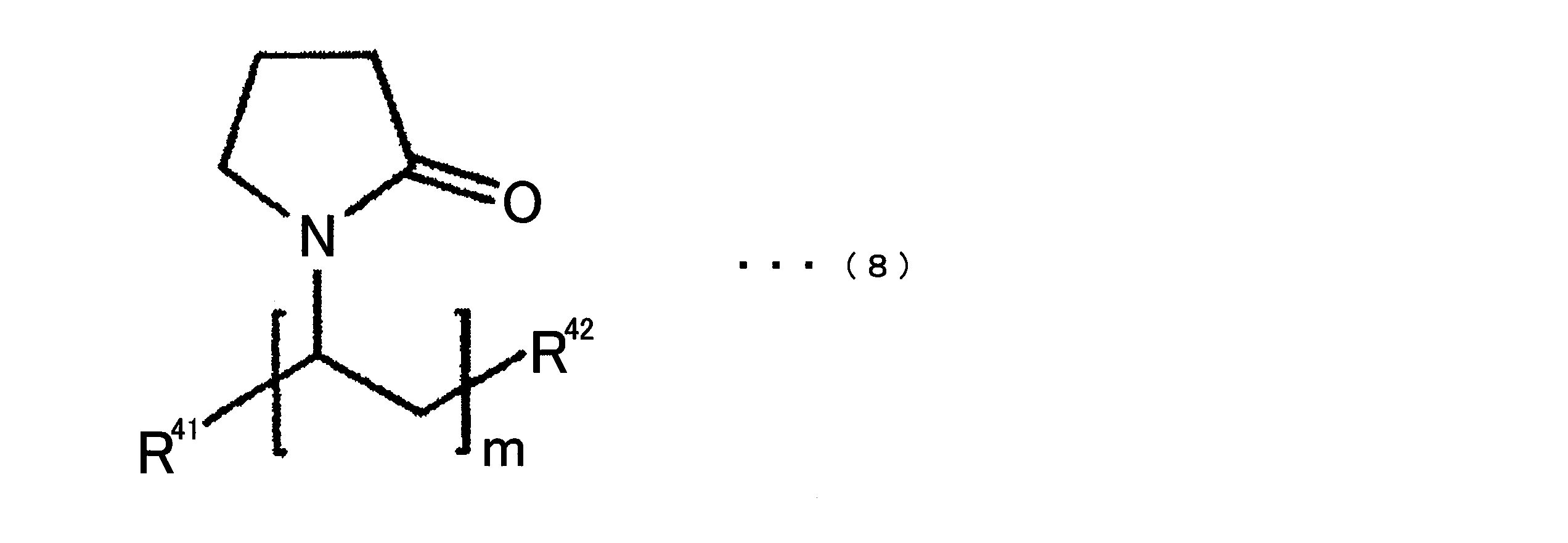
炭化水素基としては、炭素数1~20の直鎖若しくは分岐鎖のアルキル基、炭素数1~20の直鎖若しくは分岐鎖のアルケニル基、炭素数1~20の直鎖若しくは分岐鎖のアルキニル基が挙げられる。
溶剤(E)としては、導電性ポリマー(A)、塩基性化合物(B)、化合物(C)及び水溶性ポリマー(D)を溶解することができる溶剤であれば、本発明の効果を有する限り特に限定はされないが、水、又は水と有機溶剤との混合溶剤が挙げられる。
有機溶剤としては、例えば、メタノール、エタノール、イソプロピルアルコール、プロピルアルコール、ブタノール等のアルコール類、アセトン、エチルイソブチルケトン等のケトン類、エチレングリコール、エチレングリコールメチルエーテル等のエチレングリコール類、プロピレングリコール、プロピレングリコールメチルエーテル、プロピレングリコールエチルエーテル、プロピレングリコールブチルエーテル、プロピレングリコールプロピルエーテル等のプロピレングリコール類、ジメチルホルムアミド、ジメチルアセトアミド等のアミド類、N-メチルピロリドン、N-エチルピロリドン等のピロリドン類などが挙げられる。
溶剤(E)として、水と有機溶剤との混合溶剤を用いる場合、これらの質量比(水/有機溶剤)は1/100~100/1であることが好ましく、2/100~100/2であることがより好ましい。
本発明の第一の態様の導電性組成物は、塗膜強度や表面平滑性をより向上させる目的で、必要に応じて、高分子化合物(F)を含んでもよい。
高分子化合物(F)としては、具体的には、ポリビニールホルマール、ポリビニールブチラール等のポリビニルアルコール誘導体類、ポリアクリルアミド、ポリ(N-t-ブチルアクリルアミド)、ポリアクリルアミドメチルプロパンスルホン酸等のポリアクリルアミド類、ポリビニルピロリドン、ポリアクリル酸類、水溶性アルキド樹脂、水溶性メラミン樹脂、水溶性尿素樹脂、水溶性フェノール樹脂、水溶性エポキシ樹脂、水溶性ポリブタジエン樹脂、水溶性アクリル樹脂、水溶性ウレタン樹脂、水溶性アクリルスチレン共重合体樹脂、水溶性酢酸ビニルアクリル共重合体樹脂、水溶性ポリエステル樹脂、水溶性スチレンマレイン酸共重合樹脂、水溶性フッ素樹脂及びこれらの共重合体が挙げられる。
さらに、本発明の第一の態様の導電性組成物は、必要に応じて、顔料、消泡剤、紫外線吸収剤、酸化防止剤、耐熱性向上剤、レベリング剤、たれ防止剤、艶消し剤、防腐剤等の各種添加剤を含んでもよい。
本発明の第一の態様の導電性組成物は、例えば、導電性ポリマー(A)の溶液に、塩基性化合物(B)と、必要に応じて、化合物(C)、水溶性ポリマー(D)、高分子化合物(F)及び任意成分のいずれか1つ以上とを混合することで得られる。通常は導電性ポリマー(A)の溶液を室温に保持し、攪拌しながら塩基性化合物(B)等を加えるのが好ましい。また、必要に応じて、溶剤(E)でさらに希釈してもよい。
なお、本発明において「室温」とは25℃のことである。
上述したように、レジスト層の上に導電膜を形成した際に、モノマーや酸化剤の分解物である硫酸塩等の酸性物質が導電膜からレジスト層側へ移行すると、レジストがポジ型の場合にはパターンの細り、膜減りや高感度側への感度変動が起こりやすかった。また、レジストがネガ型の場合には逆にパターン形状の変化や低感度側への感度変動が起こりやすかった。
また、導電膜形成時の加熱によって前記導電性ポリマー(A)から脱離した酸性基が、レジスト側へ移行する恐れもある。
加えて、塩基性化合物(B)が導電性ポリマー(A)中の酸性基へ効率良く作用し、導電性ポリマー(A)の安定性を高めることが可能になると考えられる。ここで、導電性ポリマー(A)中の酸性基に効率よく作用するとは、高沸点、強塩基性により安定した中和が可能となることを意味する。その結果、導電膜中で導電性ポリマー(A)に含まれる酸性基が不安定化することによる酸性物質の発生が抑制され、導電膜からレジスト層への酸性物質の移行が抑制される。
よって、特に化学増幅型レジストを用いた荷電粒子線によるパターン形成法においては、酸性物質の導電膜からレジスト層側への移行が抑制され、レジスト層の膜減り等の影響を抑制できる。
特に、導電性組成物が上述した化合物(C)をさらに含んでいれば、導電膜の導電性がより向上する。
また、上述した水溶性ポリマー(D)は、酸、塩基を含まず、加水分解により生じる副生成物も生じにくいことから、レジスト層へ悪影響を与えることなく、導電性組成物の塗布性を向上させることができる。よって、導電性組成物が水溶性ポリマー(D)をさらに含んでいれば、レジスト層の膜減り等の影響をより抑制できる。加えて、導電膜の表面平滑性がより向上する。
これにより、永久帯電防止膜、及びプロセス上の一時的帯電防止膜の両面での適用が可能となるという利点を有する。
本発明の第二の態様の導電膜は、上述した本発明の第一の態様の導電性組成物より形成される。
以下、導電膜の製造方法の一例について説明する。
本実施形態の導電膜の製造方法は、基材上に本発明の第一の態様の導電性組成物を塗布し、乾燥して塗膜を形成する工程(塗膜形成工程)と、乾燥後の塗膜を加熱処理する工程(加熱工程)とを有する。
塗膜形成工程は、基材上に本発明の第一の態様の導電性組成物を塗布し、乾燥して塗膜を形成する工程である。
基材としては、本発明の効果を有する限り特に限定されないが、ポリエチレンテレフタレート(PET)、ポリブチレンテレフタレート(PBT)等のポリエステル樹脂、ポリエチレン、ポリプロピレンに代表されるポリオレフィン樹脂、塩化ビニル、ナイロン、ポリスチレン、ポリカーボネート、エポキシ樹脂、フッ素樹脂、ポリスルホン、ポリイミド、ポリウレタン、フェノール樹脂、シリコン樹脂、合成紙等の各種高分子化合物の成型品、及びフィルム、紙、鉄、ガラス、石英ガラス、各種ウエハ、アルミニウム、銅、亜鉛、ニッケル、ステンレス鋼等、及びこれらの基材表面に各種塗料や感光性樹脂、レジスト等がコーティングされているものなどを例示することができる。
基材の形状は特に限定されず、板状であってもよいし、板状以外の形状であってもよい。
導電性組成物の基材への塗布方法としては、本発明の効果を有する限り特に限定はされないが、スピンコート法、スプレーコート法、ディップコート法、ロールコート法、グラビアコート法、リバースコート法、ロールブラッシュ法、エアーナイフコート法、カーテンコート法等の手法が挙げられる。
また、上記基材上に各種塗料や、感光性材料をコーティングした物に、導電性組成物を重ね塗りして塗膜を形成することも可能である。
加熱工程は、乾燥後の塗膜を加熱処理する工程である。
加熱温度としては、導電性の観点から、40℃~250℃の温度範囲であることが好ましく、60℃~200℃の温度範囲であることがより好ましい。また、処理時間は、安定性の観点から、1時間以内であることが好ましく、30分以内であることがより好ましい。
本発明の第三の態様の導電体は、基材と、前記基材の少なくとも一部に、本発明の第一の態様の導電性組成物を塗布することにより形成された導電膜とを含むものである。すなわち、導電体に含まれる導電膜は、本発明の第二の態様の導電膜である。
基材としては、本発明の第二の態様の導電膜の説明において先に例示した基材が挙げられる。
基材が板状以外の形状の場合、導電膜は基材の表面の全面に設けられていてもよいし、基材の表面の一部に設けられていてもよい。
本発明の第四の態様の積層体は、基材と、前記基材の少なくとも1つの面上に形成された電子線用レジスト層(以下、単に「レジスト層」ともいう。)と、前記電子線用レジスト層上に形成された導電膜とを含む。
基材としては、本発明の第二の態様の導電膜の説明において先に例示した基材が挙げられる。
導電膜は、本発明の第二の態様の導電膜である。
ポジ型の化学増幅型レジストとしては、電子線に感度を有するものであれば特に限定されず、公知のものを使用できる。典型的には、電子線の照射により酸を発生する酸発生剤と、酸分解性基を有する構成単位を含む重合体とを含有するものが用いられる。
レジスト層は、公知の方法により形成できる。例えば基材の片面上にポジ型又はネガ型の化学増幅型レジストの有機溶剤溶液を塗布し、必要に応じて加熱(プリベーク)を行うことにより、ポジ型又はネガ型のレジスト層を形成する。
導電膜は、レジスト層の表面に本発明の第一の態様の導電性組成物を塗布し、乾燥して塗膜を形成した後、乾燥後の塗膜を加熱処理することで形成される。具体的な製造方法は、本発明の第二の態様の導電膜を製造する方法と同様である。加熱処理の工程の代わりに、前記放置工程を行ってもよい。
<1> 酸性基を有する導電性ポリマー(A)と、分子内に環状アミド及びアミノ基を有する塩基性化合物(B)とを含み、分子内に2つ以上の窒素原子を含む含窒素複素環式化合物(C)を任意に含む、導電性組成物。
<2> 前記環状アミドがラクタムである、<1>の導電性組成物。
<3> 前記塩基性化合物(B)が前記一般式(1)で表される化合物である、<1>又は<2>の導電性組成物。
<4> 前記一般式(1)で表される化合物が、1-(3-アミノプロピル)-2-ピロリドン又はN-(3-アミノプロピル)-ε-カプロラクタムである、<3>の導電性組成物。
<5> 前記塩基性化合物(B)と前記含窒素複素環式化合物(C)との質量比が、前記塩基性化合物(B):前記含窒素複素環式化合物(C)=0.5:99.5~100:0である、<1>~<4>のいずれかの導電性組成物。
<6> 前記塩基性化合物(B)と前記含窒素複素環式化合物(C)との質量比が、前記塩基性化合物(B):前記含窒素複素環式化合物(C)=5:95~100:0である、<5>の導電性組成物。
<7> 前記塩基性化合物(B)と前記含窒素複素環式化合物(C)との質量比が、前記塩基性化合物(B):前記含窒素複素環式化合物(C)=60:40~100:0である、<6>の導電性組成物。
<8> 前記塩基性化合物(B)と前記含窒素複素環式化合物(C)との質量比が、前記塩基性化合物(B):前記含窒素複素環式化合物(C)=0.5:99.5~99.5:0.5である、<1>~<4>のいずれかの導電性組成物。
<9> 前記塩基性化合物(B)と前記含窒素複素環式化合物(C)との質量比が、前記塩基性化合物(B):前記含窒素複素環式化合物(C)=5:95~99.5:0.5である、<8>の導電性組成物。
<10> 前記塩基性化合物(B)と前記含窒素複素環式化合物(C)との質量比が、前記塩基性化合物(B):前記含窒素複素環式化合物(C)=60:40~99.5:0.5である、<9>の導電性組成物。
<11> 水溶性ポリマー(D)(ただし、前記導電性ポリマー(A)を除く。)をさらに含む、<1>~<10>のいずれかの導電性組成物。
<12> 前記水溶性ポリマー(D)が前記一般式(8)で表される化合物である、<11>の導電性組成物。
<13> 前記水溶性ポリマー(D)の含有量が、前記導電性ポリマー(A)と前記塩基性化合物(B)と前記含窒素複素環式化合物(C)と前記水溶性ポリマー(D)の合計を100質量部としたときに、5~80質量部である、<11>又は<12>の導電性組成物。
<14> 前記水溶性ポリマー(D)の含有量が、前記導電性ポリマー(A)と前記塩基性化合物(B)と前記含窒素複素環式化合物(C)と前記水溶性ポリマー(D)の合計を100質量部としたときに、10~65質量部である、<13>の導電性組成物。
<15> 前記導電性ポリマー(A)が前記一般式(6)で表されるモノマーユニットを有する、<1>~<14>のいずれかの導電性組成物。
<16> 前記導電性ポリマー(A)の含有量が、前記導電性ポリマー(A)と前記塩基性化合物(B)と前記含窒素複素環式化合物(C)と前記水溶性ポリマー(D)の合計を100質量部としたときに、5~90質量部である、<1>~<15>のいずれかの導電性組成物。
<17> 前記導電性ポリマー(A)の含有量が、前記導電性ポリマー(A)と前記塩基性化合物(B)と前記含窒素複素環式化合物(C)と前記水溶性ポリマー(D)の合計を100質量部としたときに、20~75質量部である、<16>の導電性組成物。
<18> 前記塩基性化合物(B)の含有量が、前記導電性ポリマー(A)と前記塩基性化合物(B)と前記含窒素複素環式化合物(C)と前記水溶性ポリマー(D)の合計を100質量部としたときに、1~70質量部である、<1>~<17>のいずれかの導電性組成物。
<19> 前記塩基性化合物(B)の含有量が、前記導電性ポリマー(A)と前記塩基性化合物(B)と前記含窒素複素環式化合物(C)と前記水溶性ポリマー(D)の合計を100質量部としたときに、5~35質量部である、<18>の導電性組成物。
<20> 前記含窒素複素環式化合物(C)が、4-ジメチルアミノピリジン、4-ジメチルアミノメチルピリジン、1,5-ジアザビシクロ[4.3.0]-5-ノネン、1,8-ジアザビシクロ[5.4.0]-7-ウンデセンからなる群より選ばれる1種以上である、<1>~<19>のいずれかの導電性組成物。
<21> 前記含窒素複素環式化合物(C)の含有量が、前記導電性ポリマー(A)と前記塩基性化合物(B)と前記含窒素複素環式化合物(C)と前記水溶性ポリマー(D)の合計を100質量部としたときに、1~65質量部である、<1>~<20>のいずれかの導電性組成物。
<22> 前記含窒素複素環式化合物(C)の含有量が、前記導電性ポリマー(A)と前記塩基性化合物(B)と前記含窒素複素環式化合物(C)と前記水溶性ポリマー(D)の合計を100質量部としたときに、1~10質量部である、<21>の導電性組成物。
<23> 溶剤(E)をさらに含む、<1>~<22>のいずれかの導電性組成物。
<24> 前記溶剤(E)が、水、又は水と有機溶剤との混合溶剤である、<23>の導電性組成物。
<25> 前記有機溶剤が、メタノール、エタノール、イソプロピルアルコール、プロピルアルコール、ブタノールからなる群より選ばれる1種以上である、<24>の導電性組成物。
<26> 荷電粒子線描画時の帯電防止用である、<1>~<25>のいずれかの導電性組成物。
<27> <1>~<26>のいずれかの導電性組成物より形成された、導電膜。
<28> 基材と、前記基材の少なくとも一部に形成された<27>の導電膜とを含む、導電体。
<29> 基材と、前記基材の少なくとも1つの面上に形成された電子線用レジスト層と、前記電子線用レジスト層上に形成された<27>の導電膜とを含む、積層体。
なお、実施例及び比較例における各種測定・評価方法は以下の通りである。
<導電性の評価>
基材として4インチシリコンウエハー上に導電性組成物を1.3mL滴下し、基材表面全体を覆うように、スピンコーターにて2000rpm×60秒間の条件で回転塗布した後、ホットプレートにて80℃で2分間加熱処理を行い、基材上に膜厚約20nmの導電膜を形成して導電体を得た。
ハイレスタUX-MCP-HT800(株式会社三菱ケミカルアナリテック製)を用い2端子法(電極間距離20mm)にて、導電膜の表面抵抗値[Ω/□]を測定した。
導電性の評価と同様にして導電体を作製した。
触針式段差計(Stylus profiler P-16+,KLA-Tencor社製)を用い、下記の測定条件にて、導電膜の算術平均粗さ(Ra)[nm]を測定した。
(測定条件)
・Stylus:2μm R60°
・針圧:0.03mg
・走査範囲:500um
・走査速度:2um/s
(膜減り量の測定)
化学増幅型電子線レジスト(例えば、市販されている富士フイルムエレクトロニクスマテリアルズ株式会社製のポジ型レジスト「FEP-171」等が挙げられる。以下、「レジスト」と略す。)を使用し、レジスト層の膜減り量を以下の手順(1A)~(8A)で測定した。
(1A)レジスト層の形成:基材として4インチシリコンウエハー上に化学増幅型レジスト0.2μmをスピンコーターにて2000rpm×60秒間の条件で回転塗布した後、ホットプレートにて130℃で90秒間プリベークを行い、溶剤を除去し、基材上にレジスト層を形成した。
(2A)レジスト層の膜厚測定1:基材上に形成されたレジスト層の一部を剥離し、基材面を基準位置として、触針式段差計(Stylus profiler P-16+, KLA-Tencor Corporation製)を用い、初期のレジスト層の膜厚a[nm]を測定した。
(3A)導電膜の形成:レジスト層上に導電性組成物2mLを滴下し、レジスト層の表面全体を覆うように、スピンコーターにて2000rpm×60秒間の条件で回転塗布した後、ホットプレートにて80℃で2分間加熱処理を行い、基材上に膜厚約30nmの導電膜を形成した。
(4A)ベーク処理:導電膜とレジスト層が積層した基材を空気雰囲気下、ホットプレ-トにて120℃×20分加熱し、この状態の基材を空気中、常温(25℃)で90秒静置した。
(5A)水洗:導電膜を20mLの水で洗い流した後、スピンコーターにて2000rpm×60秒間で回転させ、レジスト層の表面の水を除去した。
(6A)現像:2.38質量%テトラメチルアンモニウムハドロオキサイド(TMAH)水溶液からなる現像液20mLをレジスト層の表面に滴下した。60秒静置した後、スピンコーターにて2000rpm×60秒間で回転させ、レジスト層の表面の現像液を除去し、引き続き60秒間回転を維持して乾燥した。
(7A)レジスト層の膜厚測定2:前記(2A)においてレジスト層を一部剥離した部分から5mm以内におけるレジスト層の一部を剥離した後、触針式段差計を用いて現像後のレジスト層の膜厚b[nm]を測定した。
(8A)膜減り量の算出:上記膜厚aの値から膜厚bの値を差し引いて、レジスト層の膜減り量c[nm](c=a-b)を算出した。
レジスト層は、レジスト層形成後の保管期間によって個々のレジストに特有の膜減り量(以下、「基準膜減り量」という。)d[nm]が存在する。導電膜に起因しないこの基準膜減り量dを以下の手順(1B)~(6B)で測定した。
(1B)レジスト層の形成:前記(1A)と同様にして、基材上にレジスト層を形成した。
(2B)レジスト層の膜厚測定1:前記(2A)と同様にして、初期のレジスト層の膜厚a[nm]を測定した。
(3B)ベーク処理:レジスト層が積層した基材を用いた以外は、前記(4A)と同様にしてベーク処理した。
(4B)現像:前記(6A)と同様にして、現像を行った。
(5B)レジスト層の膜厚測定2:前記(2B)においてレジスト層を剥離した部分から5mm以内におけるレジスト層の一部を剥離した後、触針式段差計を用いて現像後のレジスト層の膜厚e[nm]を測定した。
(6B)膜減り量の算出:上記膜厚aの値から膜厚eの値を差し引いて、レジスト層の基準膜減り量d(d=a-e)を算出した。
なお、レジスト層の基準膜減り量dは、3nmであった。
上記レジスト層の膜減り量cの値からレジスト層の基準膜減り量dの値を差し引いて、導電膜からレジスト層へ移行した酸性物質が原因となるレジスト層の膜減り量f[nm](f=c-d)を算出した。
(製造例1:導電性ポリマー(A-1)の製造)
3-アミノアニソール-4-スルホン酸1molを、4mol/L濃度のピリジン溶液(溶媒:水/アセトニトリル=3/7(質量比))300mLに0℃で溶解し、モノマー溶液を得た。
別途、ペルオキソ二硫酸アンモニウム1molを、水/アセトニトリル=3/7(質量比)の溶液1Lに溶解し、酸化剤溶液を得た。
ついで、酸化剤溶液を5℃に冷却しながら、モノマー溶液を滴下した。滴下終了後、25℃で12時間さらに攪拌して、導電性ポリマーを得た。その後、得られた導電性ポリマーを含む反応混合物を遠心濾過器にて濾別した。さらに、メタノールにて洗浄した後乾燥させ、粉末状の導電性ポリマー(A-1)を185g得た。
製造例1で得られた導電性ポリマー(A-1)23gを、純水980gに溶解させ、固形分濃度2質量%の導電性ポリマー溶液(A-1-1)を1000g得た。
超純水により洗浄した陽イオン交換樹脂(オルガノ株式会社製、「アンバーライトIR-120B」)500mLをカラムに充填した。
このカラムに、導電性ポリマー溶液(A-1-1)1000gを、50mL/分(SV=6)の速度で通過させて、塩基性物質等が除去された導電性ポリマー溶液(A1-1-1)を900g得た。
次に、超純水により洗浄した陰イオン交換樹脂(オルガノ株式会社製、「アンバーライトIRA410」)500mLをカラムに充填した。
このカラムに、導電性ポリマー溶液(A1-1-1)900gを、50mL/分(SV=6)の速度で通過させて、塩基性物質等が除去された導電性ポリマー溶液(A1-1)を800g得た。
この導電性ポリマー溶液(A1-1)についてイオンクロマトグラフィにより組成分析を行なったところ、残存モノマーは80質量%、硫酸イオンは99質量%、塩基性物質(ピリジン)は99質量%以上除去されていた。また、加熱残分を測定した結果、2.0質量%であった。すなわち、導電性ポリマー溶液(A1-1)の固形分濃度は2.0質量%である。
なお、1スベルドラップ(SV)は1×10⁶m3/s(1GL/s)と定義される。
(製造例3:水溶性ポリマー(D-1)の製造)
含窒素官能基を含むビニルモノマーとして、N-ビニルピロリドン55g、重合開始剤として、アゾビスイソブチロニトリル3g、末端疎水性基導入のための連鎖移動剤として、n-ドデシルメルカプタン1gを、溶剤であるイソプロピルアルコール100mLに攪拌溶解して反応溶液を得た。その後、予め80℃に加熱しておいたイソプロピルアルコール100mL中に、前記反応溶液を1mL/minの滴下速度で滴下し、滴下重合を行った。滴下重合は、イソプロピルアルコールの温度を80℃に保ちながら行われた。滴下終了後、80℃で更に2時間熟成した後、放冷した。その後、減圧濃縮を行い、得られた反応物を乾固させた。乾固した重合物5.3質量部を95質量部の水に溶解し、5℃で24時間冷却した後に、30nmのポリエチレンフィルターにて濾過し、5.0質量%の水溶性ポリマー溶液(D-1)を得た。
導電性ポリマー溶液(A1-1)を25質量部(固形分換算で0.5質量部)と、塩基性化合物(B)として1-(3-アミノプロピル)-2-ピロリドン0.21質量部と、水70.79質量部と、イソプロピルアルコール(IPA)4質量部とを混合し、導電性組成物を調製した。
得られた導電性組成物について、導電性及び表面平滑性を評価し、膜減り試験を行った。これらの結果を表1に示す。
表1に示す配合組成となるように、各成分を混合し、導電性組成物を調製した。
得られた導電性組成物について、導電性及び表面平滑性を評価し、膜減り試験を行った。これらの結果を表1に示す。
塩基性化合物(B)の代わりに、他の塩基性化合物として表2に示す量の水酸化テトラブチルアンモニウム(TBAH)を用いた以外は、実施例1と同様にして導電性組成物を調製し、各種評価を行った。結果を表2に示す。


表2中、「(A)/((A)+(B)+(C)+(D)+TBAH)」は、導電性ポリマー(A)と塩基性化合物(B)と化合物(C)と水溶性ポリマー(D)とTBAHの合計を100質量部としたときの導電性ポリマー(A)の含有量(質量部)である。塩基性化合物(B)、化合物(C)、水溶性ポリマー(D)及びTBAHの含有量についても同様である。「(B):(C)」は、塩基性化合物(B)と化合物(C)の質量比(塩基性化合物(B):化合物(C))である。
・B-1:1-(3-アミノプロピル)-2-ピロリドン
・B-2:N-(3-アミノプロピル)-ε-カプロラクタム
・C-1:1,5-ジアザビシクロ[4.3.0]-5-ノネン(DBN)
・TBAH:水酸化テトラブチルアンモニウム
・IPA:イソプロピルアルコール
一方、表2から明らかなように、比較例1、2で得られた導電性組成物より形成された導電膜は、各実施例に比べて表面平滑性及び導電性に劣っていた。
Claims (8)
- 酸性基を有する導電性ポリマー(A)と、分子内に環状アミド及びアミノ基を有する塩基性化合物(B)とを含む、導電性組成物。
- 前記環状アミドがラクタムである、請求項1に記載の導電性組成物。
- 前記塩基性化合物(B)が下記一般式(1)で表される化合物である、請求項1又は2に記載の導電性組成物。

- 分子内に2つ以上の窒素原子を含む含窒素複素環式化合物(C)をさらに含む、請求項1~3のいずれか一項に記載の導電性組成物。
- 前記塩基性化合物(B)と前記含窒素複素環式化合物(C)との質量比が、前記塩基性化合物(B):前記含窒素複素環式化合物(C)=0.5:99.5~99.5:0.5である、請求項4に記載の導電性組成物。
- 水溶性ポリマー(D)(ただし、前記導電性ポリマー(A)を除く。)をさらに含む、請求項1~5のいずれか一項に記載の導電性組成物。
- 請求項1~6のいずれか一項に記載の導電性組成物より形成された、導電膜。
- 基材と、前記基材の少なくとも1つの面上に形成された電子線用レジスト層と、前記電子線用レジスト層上に形成された請求項7に記載の導電膜とを含む、積層体。
Priority Applications (8)
| Application Number | Priority Date | Filing Date | Title |
|---|---|---|---|
| KR1020227040408A KR102772000B1 (ko) | 2018-04-10 | 2019-04-10 | 도전성 조성물, 도전막 및 적층체 |
| EP19784297.4A EP3780009B1 (en) | 2018-04-10 | 2019-04-10 | Electrically conductive composition, electrically conductive film, and laminate |
| CN202510792772.1A CN120554840A (zh) | 2018-04-10 | 2019-04-10 | 导电性组合物、导电膜及层叠体 |
| JP2020513424A JP7136197B2 (ja) | 2018-04-10 | 2019-04-10 | 導電性組成物、導電膜及び積層体 |
| KR1020207028416A KR20200130360A (ko) | 2018-04-10 | 2019-04-10 | 도전성 조성물, 도전막 및 적층체 |
| CN202510792773.6A CN120554841A (zh) | 2018-04-10 | 2019-04-10 | 导电性组合物、导电膜及层叠体 |
| CN201980020476.2A CN111868843A (zh) | 2018-04-10 | 2019-04-10 | 导电性组合物、导电膜及层叠体 |
| US17/026,444 US11952509B2 (en) | 2018-04-10 | 2020-09-21 | Electrically conductive composition, electrically conductive film, and laminate |
Applications Claiming Priority (2)
| Application Number | Priority Date | Filing Date | Title |
|---|---|---|---|
| JP2018075578 | 2018-04-10 | ||
| JP2018-075578 | 2018-04-10 |
Related Child Applications (1)
| Application Number | Title | Priority Date | Filing Date |
|---|---|---|---|
| US17/026,444 Continuation US11952509B2 (en) | 2018-04-10 | 2020-09-21 | Electrically conductive composition, electrically conductive film, and laminate |
Publications (1)
| Publication Number | Publication Date |
|---|---|
| WO2019198749A1 true WO2019198749A1 (ja) | 2019-10-17 |
Family
ID=68163109
Family Applications (1)
| Application Number | Title | Priority Date | Filing Date |
|---|---|---|---|
| PCT/JP2019/015602 Ceased WO2019198749A1 (ja) | 2018-04-10 | 2019-04-10 | 導電性組成物、導電膜及び積層体 |
Country Status (7)
| Country | Link |
|---|---|
| US (1) | US11952509B2 (ja) |
| EP (1) | EP3780009B1 (ja) |
| JP (1) | JP7136197B2 (ja) |
| KR (2) | KR20200130360A (ja) |
| CN (3) | CN120554840A (ja) |
| TW (1) | TWI802677B (ja) |
| WO (1) | WO2019198749A1 (ja) |
Cited By (1)
| Publication number | Priority date | Publication date | Assignee | Title |
|---|---|---|---|---|
| EP3882314A4 (en) * | 2018-11-15 | 2022-03-16 | Mitsubishi Chemical Corporation | Conductive composition and method for manufacturing same, and conductor and method for manufacturing same |
Families Citing this family (1)
| Publication number | Priority date | Publication date | Assignee | Title |
|---|---|---|---|---|
| JP7552045B2 (ja) * | 2019-04-26 | 2024-09-18 | 三菱ケミカル株式会社 | 導電性組成物、導電体及び積層体 |
Citations (26)
| Publication number | Priority date | Publication date | Assignee | Title |
|---|---|---|---|---|
| JPS61197633A (ja) | 1985-02-26 | 1986-09-01 | Nitto Electric Ind Co Ltd | スルホン化導電性有機重合体 |
| JPS6339916A (ja) | 1986-03-24 | 1988-02-20 | Showa Denko Kk | 自己ド−ピング機能を有する導電体及び新規高分子化合物 |
| JPH01301714A (ja) | 1987-07-23 | 1989-12-05 | Cookson Group Plc | 電導性共重合体及びその製造法 |
| JPH0432848A (ja) | 1990-05-30 | 1992-02-04 | Hitachi Ltd | 荷電粒子線照射方法及び観察方法 |
| JPH04268331A (ja) | 1991-02-25 | 1992-09-24 | Fuji Xerox Co Ltd | 自己ドーピング機能を有する導電性重合体の製造方法 |
| JPH04328181A (ja) | 1991-04-26 | 1992-11-17 | Showa Denko Kk | 導電性高分子複合材料およびその製造方法 |
| JPH05503953A (ja) | 1989-10-24 | 1993-06-24 | ジ オハイオ ステート ユニバーシティ リサーチ ファウンデーション | スルフォン化ポリアニリン塩組成物,製造法および使用法 |
| JPH05504153A (ja) | 1989-10-19 | 1993-07-01 | ジ オハイオ ステート ユニバーシティ リサーチ ファウンデーション | ポリアニリン組成物、それらの製法並びにそれらの利用 |
| JPH05178989A (ja) | 1991-12-27 | 1993-07-20 | Nitto Chem Ind Co Ltd | アニリン系共重合体スルホン化物とその製法 |
| JPH05226238A (ja) | 1991-10-31 | 1993-09-03 | Internatl Business Mach Corp <Ibm> | E−ビームレジスト用の塩基現像可能な放電トップ層 |
| JPH0632845A (ja) | 1992-07-20 | 1994-02-08 | Showa Denko Kk | 導電性高分子複合物の製造方法 |
| JPH0656987A (ja) | 1992-08-11 | 1994-03-01 | Bridgestone Corp | 導電性高分子の製造方法 |
| JPH0687949A (ja) | 1992-07-20 | 1994-03-29 | Showa Denko Kk | 導電性複合物及びその製造法 |
| JPH06145386A (ja) | 1992-11-09 | 1994-05-24 | Showa Denko Kk | 導電性複合材料およびその製造方法 |
| JPH06256516A (ja) | 1993-03-08 | 1994-09-13 | Showa Denko Kk | 導電性重合体の製造方法 |
| JPH06293828A (ja) | 1993-02-15 | 1994-10-21 | Nitto Chem Ind Co Ltd | アニリン系導電性ポリマーとその製造方法 |
| JPH0741756A (ja) | 1993-05-28 | 1995-02-10 | Showa Denko Kk | 帯電防止材料、それを用いる帯電防止方法及び観察または検査方法、及び帯電が防止された物品 |
| JPH0748436A (ja) | 1993-05-31 | 1995-02-21 | Showa Denko Kk | 導電性重合体の製造方法 |
| JPH07118524A (ja) | 1993-09-03 | 1995-05-09 | Nitto Chem Ind Co Ltd | 導電性組成物、導電体及びその形成方法 |
| JPH07196791A (ja) | 1993-12-29 | 1995-08-01 | Nitto Chem Ind Co Ltd | 可溶性アニリン系導電性ポリマーとその製造方法 |
| JPH07324132A (ja) | 1994-04-04 | 1995-12-12 | Nitto Chem Ind Co Ltd | 可溶性アニリン系導電性ポリマーの製造方法 |
| JP2014017540A (ja) | 2012-07-05 | 2014-01-30 | National Institute Of Information & Communication Technology | 通信管理装置、通信管理方法 |
| JP2014065898A (ja) | 2012-09-06 | 2014-04-17 | Tosoh Corp | ポリチオフェン及びその水溶液、並びにそのチオフェンモノマー |
| JP2016080964A (ja) * | 2014-10-21 | 2016-05-16 | 三菱レイヨン株式会社 | レジストパターンの形成方法、パターンが形成された基板の製造方法、パターンが形成された基板 |
| JP2018012815A (ja) * | 2016-07-22 | 2018-01-25 | 信越ポリマー株式会社 | 導電性高分子含有液及び帯電防止フィルムの製造方法 |
| JP2018075578A (ja) | 2016-11-07 | 2018-05-17 | ポップリベット・ファスナー株式会社 | ブラインドリベット締結装置 |
Family Cites Families (5)
| Publication number | Priority date | Publication date | Assignee | Title |
|---|---|---|---|---|
| US5589108A (en) | 1993-12-29 | 1996-12-31 | Nitto Chemical Industry Co., Ltd. | Soluble alkoxy-group substituted aminobenzenesulfonic acid aniline conducting polymers |
| KR20170036820A (ko) * | 2012-07-24 | 2017-04-03 | 미쯔비시 레이온 가부시끼가이샤 | 도전체, 도전성 조성물, 및 적층체 |
| CN105392846B (zh) * | 2013-05-16 | 2018-09-11 | 三菱化学株式会社 | 导电性组合物、导电体、层压体及其制造方法、导电性薄膜、以及固体电解电容器 |
| WO2015056609A1 (ja) * | 2013-10-18 | 2015-04-23 | ナガセケムテックス株式会社 | 透明導電膜形成用組成物、透明導電体及び透明導電体の製造方法 |
| TWI659430B (zh) * | 2014-05-14 | 2019-05-11 | 日商三菱化學股份有限公司 | 導電性組成物、帶電防止膜、積層體及其製造方法、以及光罩的製造方法 |
-
2019
- 2019-04-10 JP JP2020513424A patent/JP7136197B2/ja active Active
- 2019-04-10 WO PCT/JP2019/015602 patent/WO2019198749A1/ja not_active Ceased
- 2019-04-10 TW TW108112482A patent/TWI802677B/zh active
- 2019-04-10 EP EP19784297.4A patent/EP3780009B1/en active Active
- 2019-04-10 CN CN202510792772.1A patent/CN120554840A/zh active Pending
- 2019-04-10 CN CN202510792773.6A patent/CN120554841A/zh active Pending
- 2019-04-10 KR KR1020207028416A patent/KR20200130360A/ko not_active Ceased
- 2019-04-10 KR KR1020227040408A patent/KR102772000B1/ko active Active
- 2019-04-10 CN CN201980020476.2A patent/CN111868843A/zh active Pending
-
2020
- 2020-09-21 US US17/026,444 patent/US11952509B2/en active Active
Patent Citations (26)
| Publication number | Priority date | Publication date | Assignee | Title |
|---|---|---|---|---|
| JPS61197633A (ja) | 1985-02-26 | 1986-09-01 | Nitto Electric Ind Co Ltd | スルホン化導電性有機重合体 |
| JPS6339916A (ja) | 1986-03-24 | 1988-02-20 | Showa Denko Kk | 自己ド−ピング機能を有する導電体及び新規高分子化合物 |
| JPH01301714A (ja) | 1987-07-23 | 1989-12-05 | Cookson Group Plc | 電導性共重合体及びその製造法 |
| JPH05504153A (ja) | 1989-10-19 | 1993-07-01 | ジ オハイオ ステート ユニバーシティ リサーチ ファウンデーション | ポリアニリン組成物、それらの製法並びにそれらの利用 |
| JPH05503953A (ja) | 1989-10-24 | 1993-06-24 | ジ オハイオ ステート ユニバーシティ リサーチ ファウンデーション | スルフォン化ポリアニリン塩組成物,製造法および使用法 |
| JPH0432848A (ja) | 1990-05-30 | 1992-02-04 | Hitachi Ltd | 荷電粒子線照射方法及び観察方法 |
| JPH04268331A (ja) | 1991-02-25 | 1992-09-24 | Fuji Xerox Co Ltd | 自己ドーピング機能を有する導電性重合体の製造方法 |
| JPH04328181A (ja) | 1991-04-26 | 1992-11-17 | Showa Denko Kk | 導電性高分子複合材料およびその製造方法 |
| JPH05226238A (ja) | 1991-10-31 | 1993-09-03 | Internatl Business Mach Corp <Ibm> | E−ビームレジスト用の塩基現像可能な放電トップ層 |
| JPH05178989A (ja) | 1991-12-27 | 1993-07-20 | Nitto Chem Ind Co Ltd | アニリン系共重合体スルホン化物とその製法 |
| JPH0687949A (ja) | 1992-07-20 | 1994-03-29 | Showa Denko Kk | 導電性複合物及びその製造法 |
| JPH0632845A (ja) | 1992-07-20 | 1994-02-08 | Showa Denko Kk | 導電性高分子複合物の製造方法 |
| JPH0656987A (ja) | 1992-08-11 | 1994-03-01 | Bridgestone Corp | 導電性高分子の製造方法 |
| JPH06145386A (ja) | 1992-11-09 | 1994-05-24 | Showa Denko Kk | 導電性複合材料およびその製造方法 |
| JPH06293828A (ja) | 1993-02-15 | 1994-10-21 | Nitto Chem Ind Co Ltd | アニリン系導電性ポリマーとその製造方法 |
| JPH06256516A (ja) | 1993-03-08 | 1994-09-13 | Showa Denko Kk | 導電性重合体の製造方法 |
| JPH0741756A (ja) | 1993-05-28 | 1995-02-10 | Showa Denko Kk | 帯電防止材料、それを用いる帯電防止方法及び観察または検査方法、及び帯電が防止された物品 |
| JPH0748436A (ja) | 1993-05-31 | 1995-02-21 | Showa Denko Kk | 導電性重合体の製造方法 |
| JPH07118524A (ja) | 1993-09-03 | 1995-05-09 | Nitto Chem Ind Co Ltd | 導電性組成物、導電体及びその形成方法 |
| JPH07196791A (ja) | 1993-12-29 | 1995-08-01 | Nitto Chem Ind Co Ltd | 可溶性アニリン系導電性ポリマーとその製造方法 |
| JPH07324132A (ja) | 1994-04-04 | 1995-12-12 | Nitto Chem Ind Co Ltd | 可溶性アニリン系導電性ポリマーの製造方法 |
| JP2014017540A (ja) | 2012-07-05 | 2014-01-30 | National Institute Of Information & Communication Technology | 通信管理装置、通信管理方法 |
| JP2014065898A (ja) | 2012-09-06 | 2014-04-17 | Tosoh Corp | ポリチオフェン及びその水溶液、並びにそのチオフェンモノマー |
| JP2016080964A (ja) * | 2014-10-21 | 2016-05-16 | 三菱レイヨン株式会社 | レジストパターンの形成方法、パターンが形成された基板の製造方法、パターンが形成された基板 |
| JP2018012815A (ja) * | 2016-07-22 | 2018-01-25 | 信越ポリマー株式会社 | 導電性高分子含有液及び帯電防止フィルムの製造方法 |
| JP2018075578A (ja) | 2016-11-07 | 2018-05-17 | ポップリベット・ファスナー株式会社 | ブラインドリベット締結装置 |
Non-Patent Citations (1)
| Title |
|---|
| See also references of EP3780009A4 |
Cited By (2)
| Publication number | Priority date | Publication date | Assignee | Title |
|---|---|---|---|---|
| EP3882314A4 (en) * | 2018-11-15 | 2022-03-16 | Mitsubishi Chemical Corporation | Conductive composition and method for manufacturing same, and conductor and method for manufacturing same |
| US12443103B2 (en) | 2018-11-15 | 2025-10-14 | Mitsubishi Chemical Corporation | Conductive composition and method for manufacturing same, and conductor and method for manufacturing same |
Also Published As
| Publication number | Publication date |
|---|---|
| CN120554840A (zh) | 2025-08-29 |
| JP7136197B2 (ja) | 2022-09-13 |
| EP3780009B1 (en) | 2024-09-25 |
| US20210009818A1 (en) | 2021-01-14 |
| TW201943763A (zh) | 2019-11-16 |
| KR20200130360A (ko) | 2020-11-18 |
| KR20220162807A (ko) | 2022-12-08 |
| CN111868843A (zh) | 2020-10-30 |
| TWI802677B (zh) | 2023-05-21 |
| CN120554841A (zh) | 2025-08-29 |
| JPWO2019198749A1 (ja) | 2021-02-12 |
| EP3780009A4 (en) | 2021-05-19 |
| US11952509B2 (en) | 2024-04-09 |
| KR102772000B1 (ko) | 2025-02-26 |
| EP3780009A1 (en) | 2021-02-17 |
Similar Documents
| Publication | Publication Date | Title |
|---|---|---|
| US20240371542A1 (en) | Conductor, conductive composition and laminate | |
| JP6451203B2 (ja) | レジストパターンの形成方法、パターンが形成された基板の製造方法 | |
| JP2017039927A (ja) | 導電性組成物、導電体及びレジストパターンの形成方法 | |
| JP7136197B2 (ja) | 導電性組成物、導電膜及び積層体 | |
| JP2024127925A (ja) | 導電性組成物、レジスト被覆材料、レジスト、及びレジストパターンの形成方法 | |
| JP7415382B2 (ja) | 導電性組成物 | |
| JP7135570B2 (ja) | 導電性組成物、導電体の製造方法及びレジストパターンの形成方法 | |
| TWI913242B (zh) | 導電性組成物、抗蝕劑被覆材料、抗蝕劑及抗蝕劑圖案的形成方法 | |
| JP2020161269A (ja) | 導電膜の形成方法、導電体の製造方法、レジストパターンの形成方法 |
Legal Events
| Date | Code | Title | Description |
|---|---|---|---|
| 121 | Ep: the epo has been informed by wipo that ep was designated in this application |
Ref document number: 19784297 Country of ref document: EP Kind code of ref document: A1 |
|
| ENP | Entry into the national phase |
Ref document number: 2020513424 Country of ref document: JP Kind code of ref document: A |
|
| ENP | Entry into the national phase |
Ref document number: 20207028416 Country of ref document: KR Kind code of ref document: A |
|
| NENP | Non-entry into the national phase |
Ref country code: DE |
|
| ENP | Entry into the national phase |
Ref document number: 2019784297 Country of ref document: EP Effective date: 20201110 |