WO2020008879A1 - Oligomère de polycarbonate à terminaison (méth)acrylate - Google Patents
Oligomère de polycarbonate à terminaison (méth)acrylate Download PDFInfo
- Publication number
- WO2020008879A1 WO2020008879A1 PCT/JP2019/024236 JP2019024236W WO2020008879A1 WO 2020008879 A1 WO2020008879 A1 WO 2020008879A1 JP 2019024236 W JP2019024236 W JP 2019024236W WO 2020008879 A1 WO2020008879 A1 WO 2020008879A1
- Authority
- WO
- WIPO (PCT)
- Prior art keywords
- meth
- acrylate
- polycarbonate oligomer
- group
- formula
- Prior art date
- Legal status (The legal status is an assumption and is not a legal conclusion. Google has not performed a legal analysis and makes no representation as to the accuracy of the status listed.)
- Ceased
Links
Images

Classifications
-
- C—CHEMISTRY; METALLURGY
- C08—ORGANIC MACROMOLECULAR COMPOUNDS; THEIR PREPARATION OR CHEMICAL WORKING-UP; COMPOSITIONS BASED THEREON
- C08G—MACROMOLECULAR COMPOUNDS OBTAINED OTHERWISE THAN BY REACTIONS ONLY INVOLVING UNSATURATED CARBON-TO-CARBON BONDS
- C08G64/00—Macromolecular compounds obtained by reactions forming a carbonic ester link in the main chain of the macromolecule
- C08G64/16—Aliphatic-aromatic or araliphatic polycarbonates
-
- C—CHEMISTRY; METALLURGY
- C08—ORGANIC MACROMOLECULAR COMPOUNDS; THEIR PREPARATION OR CHEMICAL WORKING-UP; COMPOSITIONS BASED THEREON
- C08G—MACROMOLECULAR COMPOUNDS OBTAINED OTHERWISE THAN BY REACTIONS ONLY INVOLVING UNSATURATED CARBON-TO-CARBON BONDS
- C08G64/00—Macromolecular compounds obtained by reactions forming a carbonic ester link in the main chain of the macromolecule
- C08G64/42—Chemical after-treatment
Definitions
- the present invention relates to a terminal (meth) acrylate polycarbonate oligomer having good solvent solubility.
- Resin materials are widely used as engineering plastics because of their advantages such as light weight, low cost, and excellent workability.However, their surface hardness, scratch resistance, and chemical resistance are inferior to glass and metal. Therefore, it is not used as a substitute material as it is.
- a hard coat treatment is performed to form a resin thin film of a material different from the base resin on the resin surface, protect the base resin from external factors, and modify the surface. Is commonly done.
- a system is used in which a hard coat agent is applied to the resin surface of the base material, dried, and then irradiated with radiation such as an electron beam or ultraviolet rays (UV) as required, and then cured.
- UV-curable hard coat agents using UV-curable resins can be processed at lower temperatures and in a shorter time than conventional hard coat agents. I have.
- a polyfunctional (meth) acrylic monomer such as pentaerythritol (meth) acrylate is used as a main component. What has high compatibility is demanded.
- the present invention has been made in view of the above circumstances, and has been described as a raw material of a UV-curable (meth) acrylic resin used for a UV-curable hard coat agent and the like, which is compatible with a polyfunctional (meth) acrylic monomer.
- Another object of the present invention is to provide a terminal (meth) acrylate polycarbonate oligomer having excellent solvent solubility.
- the present inventors have conducted intensive studies to solve the above-mentioned problems, and as a result, in the terminal (meth) acrylate polycarbonate represented by the following formula (1) and / or (2), the weight average molecular weight (Mw) is specific.
- Mw weight average molecular weight
- the present inventors have found that oligomers within the range have excellent compatibility with polyfunctional (meth) acrylic monomers and good solvent solubility, and have completed the present invention.
- a terminal (meth) acrylate polycarbonate oligomer represented by the following formulas (1) and / or (2) and having a weight average molecular weight (Mw) in a range of 500 or more and 10,000 or less.
- R 1 to R 4 each independently represent a hydrogen atom, an alkyl group having 1 to 8 carbon atoms, a cycloalkyl group having 5 to 12 carbon atoms, 8 represents an alkoxy group or an aromatic hydrocarbon group having 6 to 12 carbon atoms
- R 5 each independently represents a hydrogen atom or a methyl group
- R 6 and R 7 each independently represent hydrogen.
- X represents an atom or an alkyl group having 1 to 14 carbon atoms
- X represents an alkylene group having 2 to 4 carbon atoms
- n is an integer of 1 or more, provided that R 6 and R 7 have the same number of carbon atoms. Is not more than 14, and two oxygen atoms bonded to X do not bond to the same carbon atom of X.
- the terminal (meth) acrylate polycarbonate oligomer according to the present invention has a weight average molecular weight (Mw) in the range of 500 or more and 10,000 or less, so that it can be used with a polyfunctional (meth) acrylic monomer such as pentaerythritol-based (meth) acrylate. Since it has excellent compatibility and good solvent solubility, it is optimal as a raw material for a UV-curable hard coat agent, and exhibits an industrially advantageous effect that a smooth coating film can be formed by UV curing.
- Mw weight average molecular weight
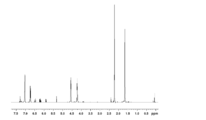
- Example 1 is a 1 H-NMR spectrum chart of a terminal (meth) acrylate polycarbonate oligomer (1c) synthesized in Example 1.
- 5 is a 1 H-NMR spectrum chart of a terminal (meth) acrylate polycarbonate oligomer (1d) synthesized in Example 2.
- the terminal (meth) acrylate polycarbonate oligomer of the present invention is, as illustrated in the following reaction formula, a polycarbonate oligomer represented by the formula (A) and a (meth) acrylate agent such as (meth) acrylic acid chloride.
- Mw weight average molecular weight
- R 1 to R 7 , X, and n in the formula (A) are the same as those in the above formulas (1) and (2).
- the alkyl group is preferably an alkyl group having 1 to 4 carbon atoms. It is a linear or branched alkyl group, and specific examples include a methyl group, an ethyl group, an n-propyl group, an isopropyl group and an isobutyl group.
- Such an alkyl group may have a substituent such as a phenyl group or an alkoxy group having 1 to 4 carbon atoms, as long as the effects of the present invention are not impaired.
- the cycloalkyl group is preferably a cycloalkyl group having 5 to 7 carbon atoms.
- a cyclohexyl group, a cyclopentyl group, a cycloheptyl group and the like can be mentioned.
- Examples of such a cycloalkyl group include linear or branched alkyl groups having 1 to 4 carbon atoms, alkoxy groups having 1 to 4 carbon atoms, and phenyl groups as long as the effects of the present invention are not impaired. And the like.
- the alkoxy group is preferably a linear or branched alkoxy group having 1 to 4 carbon atoms. It is a chain alkoxy group, and specific examples include a methoxy group and an ethoxy group.
- Such an alkoxy group may have a substituent such as a phenyl group or an alkoxy group having 1 to 4 carbon atoms, as long as the effects of the present application are not impaired.
- R 1 , R 2 , R 3 and R 4 is an aromatic hydrocarbon group having 6 to 12 carbon atoms
- the aromatic hydrocarbon group is specifically, for example, phenyl And naphthyl groups.
- an alkyl group having 1 to 4 carbon atoms and / or an alkoxy group having 1 to 4 carbon atoms is in a range of 1 to 3 as long as the effects of the present invention are not impaired. It may be substituted.
- the position where the substituents of R 1 , R 2 , R 3 and R 4 are bonded is preferably ortho to the oxygen atom bonded to the benzene ring.
- R 6 or R 7 is an alkyl group having 1 to 14 carbon atoms
- the alkyl group is preferably a linear or branched chain having 1 to 12 carbon atoms.
- Alkyl group specifically, for example, methyl group, ethyl group, n-propyl group, isopropyl group, n-butyl group, isobutyl group, n-pentyl group, n-hexyl group, n-heptyl group , N-octyl group, n-nonyl group, n-decyl group, n-undecyl group, n-dodecyl group and the like.
- the total number of carbon atoms of R 6 and R 7 must be 14 or less.
- X is, specifically, an ethylene group, an n-propylene group, a propane-1,2-diyl group, an n-butylene group, a butane-1,3-diyl group, a butane-1, A 2-diyl group and a butane-2,3-diyl group, among which an ethylene group, an n-propylene group, a propane-1,2-diyl group and an n-butylene group are preferable, and an ethylene group, a propane-1,2 -Diyl group is more preferable, and ethylene group is particularly preferable.
- polycarbonate oligomer represented by the formula (A) those produced by any conventionally known production method can be used. Specific examples include an interfacial polymerization method, a melt transesterification method, a pyridine method, a ring opening polymerization method of a cyclic carbonate compound, and a solid phase transesterification method of a prepolymer. Among them, it is industrially advantageous to use an interfacial polymerization method, a melt transesterification method, or a solid phase transesterification method of a prepolymer.
- a melt transesterification method using no phosgene and a solid phase transesterification method of a prepolymer by a melt transesterification method are particularly preferable.
- the above-mentioned production method is carried out using a dihydroxy compound represented by the following formula (B) and a carbonate ester-forming agent.
- R 1 to R 4 , R 6 , R 7 and X in the formula (B) are the same as those in the above formulas (1) and (2).
- dihydroxy compound represented by the formula (B) include, for example, bis (4- (2-hydroxyethoxy) phenyl) methane, 2,2-bis (4- (2-hydroxyethoxy) phenyl) Propane, 2,2-bis (4- (2-hydroxyethoxy) -3-methylphenyl) propane, 1,1-bis (4- (2-hydroxyethoxy) phenyl) ethane, 2,2-bis (4- (2-hydroxyethoxy) -4-methylpentane, 2,2-bis (4- (2-hydroxyethoxy) phenyl) butane, 1,1-bis (4- (2-hydroxyethoxy) phenyl) dodecane, etc. Is mentioned. In the polymerization reaction, such a dihydroxy compound may be used alone or as a mixture of two or more kinds at an arbitrary ratio.
- the carbonate-forming agent to be reacted with the dihydroxy compound represented by the formula (B) include, for example, diaryl carbonate such as diphenyl carbonate, ditolyl carbonate, bis (m-cresyl) carbonate, dimethyl carbonate, diethyl
- diaryl carbonate such as diphenyl carbonate, ditolyl carbonate, bis (m-cresyl) carbonate, dimethyl carbonate, diethyl
- dialkyl carbonates such as carbonate and dicyclohexyl carbonate
- alkylaryl carbonates such as methylphenyl carbonate, ethylphenyl carbonate and cyclohexylphenyl carbonate
- diester carbonates such as dialkenyl carbonate such as divinyl carbonate, diisopropenyl carbonate and dipropenyl carbonate.
- a dihalogenated carbonyl compound such as phosgene and the like, and triphosgene are also included.
- diaryl carbonate is preferred
- melt transesterification method As a method for producing the polycarbonate oligomer represented by the formula (A), a melt transesterification method will be described.
- a method of the melt transesterification reaction is performed in the presence of a catalyst in an inert gas atmosphere at normal pressure or reduced pressure. The stirring is carried out while heating, and the formed phenol is distilled off.
- the desired molecular weight and terminal hydroxyl group amount are adjusted by adjusting the mixing ratio of the dihydroxy compound represented by the formula (B) and the carbonate ester forming agent and the degree of reduced pressure during the transesterification reaction.
- the polycarbonate oligomer represented can be obtained.
- the mixing ratio of the dihydroxy compound represented by the formula (B) and the carbonate-forming agent is based on 1 mol of the dihydroxy compound represented by the formula (B).
- the carbonic acid ester-forming agent is usually used in a molar amount of 0.2 to 1.0, preferably 0.25 to 0.95, more preferably 0.3 to 0.90.
- a transesterification catalyst is used as needed in order to increase the reaction rate.
- the transesterification catalyst is not particularly limited, and examples thereof include lithium, sodium, cesium hydroxides, carbonates, inorganic alkali metal compounds such as hydrogen carbonate compounds, alcoholates, and organic alkali metal compounds such as organic carboxylate.
- alkaline earth metal compounds such as tetramethylboron
- Basic boron compounds such as sodium salts, calcium salts, and magnesium salts such as tetraethylboron and butyltriphenylboron
- trivalent phosphorus compounds such as triethylphosphine and tri-n-propylphosphine; or derived from these compounds
- Basic phosphorus compounds such as quaternary phosphonium salts
- Use of a basic ammonium compound such as tramethylammonium hydroxide,
- alkali metal compounds are preferable, and cesium compounds such as cesium carbonate and cesium hydroxide are particularly preferable.
- the amount of the catalyst used is within a range that does not cause a problem in the quality of the produced oligomer due to the catalyst residue, and a suitable addition amount varies depending on the type of the catalyst. ) Is usually 0.05 to 100 ⁇ mol, preferably 0.08 to 50 ⁇ mol, more preferably 0.1 to 20 ⁇ mol, and still more preferably 0.1 to 5 ⁇ mol, per 1 mol of the dihydroxy compound represented by the formula (1). .
- the catalyst may be added as it is, or may be added after being dissolved in a solvent.
- the solvent for example, a solvent that does not affect the reaction such as water and phenol is preferable.
- the temperature is usually in the range of 120 to 360 ° C, preferably in the range of 150 to 280 ° C, and more preferably in the range of 180 to 260 ° C. If the reaction temperature is too low, the transesterification does not proceed, and if the reaction temperature is too high, side reactions such as decomposition proceed, which is not preferable.
- the reaction is preferably performed under reduced pressure.
- the reaction pressure is preferably a pressure at which the carbonate forming agent as a raw material cannot be distilled out of the system at the reaction temperature, and a by-product such as phenol can be distilled off. Under such reaction conditions, the reaction is usually completed in about 0.5 to 10 hours.
- the terminal (meth) acrylate polycarbonate oligomer represented by the formula (1) and / or (2) of the present invention comprises a polycarbonate oligomer represented by the formula (A) and (meth) It is obtained by reaction with a (meth) acrylate agent such as acrylic acid chloride.
- a (meth) acrylate agent such as acrylic acid chloride.
- the (meth) acrylic agent include acrylic acid chloride, methacrylic acid chloride, acrylic acid, methacrylic acid, and the like.
- the amount of the (meth) acrylate agent used is determined based on the total terminal hydroxyl groups of the polycarbonate oligomer represented by the formula (A) when the (meth) acrylate polycarbonate oligomer having both ends is represented by the formula (1).
- the (meth) acrylate is used usually in an amount of 1.0 to 2.5 moles, preferably 1.1 to 2.0 moles, and more preferably 1.15 to 1.5 moles.
- a (meth) acrylate is usually added to all terminal hydroxyl groups of the polycarbonate oligomer represented by the formula (A).
- a hydrogen chloride scavenger in combination.
- any basic substance can be used.
- the inorganic basic substance an alkali metal carbonate or bicarbonate can be used.
- Tertiary amines can be used as the organic basic substance.
- tertiary amines examples include trimethylamine, triethylamine, tri-n-propylamine, triisopropylamine, tributylamine, N-methyl-diethylamine, N-ethyl-dimethylamine, N-ethyl-diamylamine, N, N- Aliphatic amines such as diisopropylethylamine, N, N-dimethyl-cyclohexylamine, N, N-diethyl-cyclohexylamine; aromatic amines such as N, N-dimethylaniline, N, N-diethylaniline; pyridine, picoline, N Heterocyclic amines such as N, N-dimethylaminopyridine; Fats such as 1,8-diazabicyclo [5.4.0] undec-7-ene, 1,5-diazabicyclo [4.3.0] non-5-ene And cyclic amines.
- the amount of the hydrogen chloride scavenger to be used is 0.8 to 10 moles, preferably 0.9 to 8 moles, particularly preferably 0.9 mole, relative to the moles of the (meth) acrylate agent usually used. Is about 1.0 to 7 times mol. If the amount of the hydrogen chloride scavenger is less than 0.8 times the number of moles of the (meth) acrylate, the generated hydrogen chloride cannot be completely captured, and the polycarbonate oligomer represented by the formula (A) as a raw material or the target substance cannot be used. There is a possibility that the terminal (meth) acrylate polycarbonate oligomer represented by the formula (1) or (2) will be decomposed to lower the purity of the target product.
- the solvent used may be any solvent that can uniformly mix the used raw materials and the like, and specifically, halogenated hydrocarbons such as methylene chloride, tetrahydrofuran, dioxane, Chlorobenzene and the like can be mentioned.
- the amount of the solvent used is not particularly limited, but is usually 0.5 to 100 times by weight, preferably 1 to 50 times by weight, particularly preferably 2 to 10 times by weight, based on the polycarbonate oligomer represented by the formula (A). Weight times.
- the (meth) acrylation reaction is carried out at a relatively low temperature, usually at -50 to 100 ° C, preferably at -30 to 80 ° C, particularly preferably at -15 to 60 ° C.
- reaction temperature exceeds 100 ° C., a side reaction occurs, leading to a decrease in the yield of the target product.
- the temperature is lower than -50 ° C., the reaction rate becomes slow and the required time is too long, which is not economical.
- a reaction procedure a method in which a polycarbonate oligomer represented by the formula (A) and a (meth) acrylate are mixed in a solvent in advance and a hydrogen chloride scavenger is added thereto, )) And a hydrogen chloride scavenger in a solvent, and adding a (meth) acrylate to the mixture.
- the hydrogen chloride scavenger or the (meth) acrylic agent to be added later may be used after being diluted with a solvent.
- a solvent for example, hydroquinone, hydroquinone monomethyl ether, phenothiazine, 2,6-di-tert-butyl-4-methylphenol (BHT) and the like may be added as a polymerization inhibitor.
- the acidic substance to be used is not particularly limited, but examples of the inorganic acidic substance include hydrochloric acid, sulfuric acid, and nitric acid, and examples of the organic acidic substance include, for example, formic acid, acetic acid, and propionic acid.
- Carboxylic acids such as butyric acid; and sulfonic acids such as methanesulfonic acid, trifluoromethanesulfonic acid and p-toluenesulfonic acid.
- an organic acidic substance having a low acidity is more preferable. After removing the hydrogen chloride scavenger, it is preferable to subsequently carry out water washing.
- the obtained terminal (meth) acrylate polycarbonate oligomer represented by the formula (1) and / or (2) is obtained as a precipitate by adding a poor solvent to a dissolved solution.
- the poor solvent include an aliphatic alcohol solvent having 1 to 6 carbon atoms such as methanol, ethanol, and propanol, or a mixture of the aliphatic alcohol solvent and water.
- N in the formulas (1a) to (1d) is an integer of 1 or more, and the weight average molecular weight (Mw) is in the range of 500 to 10,000.
- Preferred compounds of the one-terminal (meth) acrylate polycarbonate oligomer represented by the formula (2) are as follows.
- n is an integer of 1 or more, but the weight average molecular weight (Mw) is in the range of 500 or more and 10,000 or less.
- the terminal (meth) acrylate polycarbonate oligomer represented by the formula (1) and / or (2) of the present invention has a weight average molecular weight (Mw) in a range of 500 or more and 10,000 or less, and among them, 1,000 or more.
- the range is preferably 8,000 or less, more preferably 2,000 or more and 6,000 or less. It is preferable that the weight average molecular weight (Mw) is within this range, since good solubility in an organic solvent can be obtained.
- terminal (meth) acrylate polycarbonate oligomer represented by the formula (1) and / or (2) of the present invention is used as a component of a UV-curable hard coat agent, a pentaerythritol-based Since it has excellent compatibility with polyfunctional (meth) acrylic monomers such as (meth) acrylate, it has an industrially advantageous effect that a smooth coating film can be formed by UV curing.
- the terminal (meth) acrylate polycarbonate oligomer represented by the formula (1) and / or (2) of the present invention can be used as a raw material for a 3D printer or a heat source such as an epoxy resin in addition to a raw material for a UV-curable hard coat agent. Useful as a modifier for cured resins.
- the weight average molecular weight (Mw) in the following examples was measured by gel permeation chromatography.
- the analysis method is as follows. ⁇ Analysis method> 1. Gel permeation chromatography (oligomer analysis) Equipment: Tosoh Corporation HLC-8320GPC Flow rate: 0.35 ml / min, mobile phase: tetrahydrofuran, injection volume: 10 ⁇ l Column: TSKgel guardcolumn SuperMP (HZ) -N, TSKgel SuperMultipore HZ-N x 3 detectors: RI, Analysis method: Relative molecular weight in terms of polystyrene.
- Polystyrene standard A-500, A-2500, A-5000, F-1, F-2, F-4 manufactured by Tosoh Corporation (Polymer analysis) Equipment: Tosoh Corporation HLC-8320GPC Flow rate: 1.0 ml / min, mobile phase: tetrahydrofuran, injection volume: 100 ⁇ l
- Analysis method Relative molecular weight in terms of polystyrene.
- Polystyrene standard product PStQuick E, F manufactured by Tosoh Corporation (E: F-40, F-4, A-5000, A-1000, F: F-20, F-2, A-2500, A-500) 2. Measurement of terminal hydroxyl concentration Using 1 H-NMR, using TCE (1,1,1,2-tetrachloroethane) as an internal standard, using bisphenol A and bisphenol C as samples, and preparing a calibration curve of the weight ratio with TCE did. The phenol terminal weight was determined by a method for determining the phenol terminal weight from this calibration curve. Apparatus: Ascend TM 400 manufactured by BRUKER 2. Measurement conditions: room temperature, 120 integrations Identification of Chemical Structure It was carried out by 1 H-NMR measurement using the same apparatus as in “2.” above.
- FIG. 1 shows a 1 H-NMR spectrum chart of the obtained terminal acrylate polycarbonate oligomer (1c).
- a transparent solution was obtained.
- pentaerythritol tetraacrylate which is a polyfunctional acrylate
- Irgacure 0.5 g
- terminal acrylate polycarbonate oligomer (1c) showed good solubility in organic solvents such as cyclohexanone, and was found to be excellent in compatibility with pentaerythritol tetraacrylate which is a polyfunctional acrylate.
- Example 2 Synthesis of terminal methacrylate polycarbonate oligomer (1d) 96 g of the polycarbonate oligomer (Aa) obtained in Reference Example 1 was charged into a four-necked flask equipped with a thermometer, a stirrer, and a cooler, and reacted. After the vessel was replaced with nitrogen, 8.5 g (0.08 mol) of methacrylic acid chloride, 120.4 g of dichloromethane, and 4.6 mg of methquinone were added under a nitrogen stream. At 10 ° C., 10.9 g (0.11 mol) of triethylamine was added over 30 minutes. After stirring was further continued at 10 ° C.
- FIG. 2 shows a 1 H-NMR spectrum chart of the obtained terminal methacrylate polycarbonate oligomer (1d).
- the resulting terminal methacrylate polycarbonate oligomer (1d) showed good solubility in organic solvents such as cyclohexanone, and was found to be excellent in compatibility with pentaerythritol tetraacrylate, which is a polyfunctional acrylate.
- the weight average molecular weight of the obtained polycarbonate was 31,240 (gel permeation chromatography), and the terminal hydroxyl concentration was 0.13 mmol / g.
- 13.6 g of the obtained polycarbonate was placed in a four-necked flask equipped with a thermometer, a stirrer, and a cooler, and the reaction vessel was replaced with nitrogen. Then, 0.3 g (0.003 mol) of acrylic acid chloride was added. After adding 47.6 g of dichloromethane under a nitrogen stream, 0.4 g (0.004 mol) of triethylamine was added at 15 ° C. After stirring for 2 hours, the reaction solution was added to 163 g of methanol to precipitate the desired product.
- the terminal (meth) acrylate polycarbonate oligomer represented by the formula (1) and / or (2) of the present invention has a weight average molecular weight (Mw) within a specific range. It has been found that the compound has good solubility in a solvent and has excellent compatibility with a polyfunctional acrylate or the like.
Landscapes
- Chemical & Material Sciences (AREA)
- Health & Medical Sciences (AREA)
- Chemical Kinetics & Catalysis (AREA)
- Medicinal Chemistry (AREA)
- Polymers & Plastics (AREA)
- Organic Chemistry (AREA)
- General Chemical & Material Sciences (AREA)
- Polyesters Or Polycarbonates (AREA)
Abstract
Priority Applications (3)
| Application Number | Priority Date | Filing Date | Title |
|---|---|---|---|
| KR1020207037565A KR102637355B1 (ko) | 2018-07-05 | 2019-06-19 | 말단 (메타)아크릴레이트 폴리카보네이트 올리고머 |
| CN201980043299.XA CN112424259B (zh) | 2018-07-05 | 2019-06-19 | 末端(甲基)丙烯酸酯聚碳酸酯寡聚物 |
| JP2020528783A JP7253548B2 (ja) | 2018-07-05 | 2019-06-19 | 末端(メタ)アクリレートポリカーボネートオリゴマー |
Applications Claiming Priority (2)
| Application Number | Priority Date | Filing Date | Title |
|---|---|---|---|
| JP2018-128378 | 2018-07-05 | ||
| JP2018128378 | 2018-07-05 |
Publications (1)
| Publication Number | Publication Date |
|---|---|
| WO2020008879A1 true WO2020008879A1 (fr) | 2020-01-09 |
Family
ID=69060300
Family Applications (1)
| Application Number | Title | Priority Date | Filing Date |
|---|---|---|---|
| PCT/JP2019/024236 Ceased WO2020008879A1 (fr) | 2018-07-05 | 2019-06-19 | Oligomère de polycarbonate à terminaison (méth)acrylate |
Country Status (5)
| Country | Link |
|---|---|
| JP (1) | JP7253548B2 (fr) |
| KR (1) | KR102637355B1 (fr) |
| CN (1) | CN112424259B (fr) |
| TW (1) | TWI794523B (fr) |
| WO (1) | WO2020008879A1 (fr) |
Cited By (2)
| Publication number | Priority date | Publication date | Assignee | Title |
|---|---|---|---|---|
| JPWO2020189598A1 (fr) * | 2019-03-19 | 2020-09-24 | ||
| WO2023145108A1 (fr) * | 2022-01-25 | 2023-08-03 | Dic株式会社 | Résine durcissable, composition de résine durcissable et produit durci |
Families Citing this family (1)
| Publication number | Priority date | Publication date | Assignee | Title |
|---|---|---|---|---|
| TWI855676B (zh) * | 2023-05-09 | 2024-09-11 | 上緯創新育成股份有限公司 | 具有不飽和雙鍵的聚碳酸酯寡聚物、其製備方法、可固化組成物與低介電固化物的製備方法 |
Citations (6)
| Publication number | Priority date | Publication date | Assignee | Title |
|---|---|---|---|---|
| JPS6155106A (ja) * | 1984-08-24 | 1986-03-19 | Tokuyama Soda Co Ltd | 液状プレポリマーの製造方法 |
| JPS6183212A (ja) * | 1984-10-01 | 1986-04-26 | Tokuyama Soda Co Ltd | 高屈折率樹脂 |
| JPH03217407A (ja) * | 1990-01-23 | 1991-09-25 | Mitsubishi Petrochem Co Ltd | 高屈折率樹脂の製造法 |
| JPH0841044A (ja) * | 1994-07-22 | 1996-02-13 | Bayer Ag | 環状カーボネート基を有するジ(メタ)アクリレート |
| JPH1081720A (ja) * | 1996-09-05 | 1998-03-31 | Nof Corp | 注型重合用樹脂組成物及び光学材料 |
| JP2006028418A (ja) * | 2004-07-20 | 2006-02-02 | Japan Composite Co Ltd | ラジカル硬化性樹脂組成物 |
Family Cites Families (5)
| Publication number | Priority date | Publication date | Assignee | Title |
|---|---|---|---|---|
| JP2000302829A (ja) * | 1999-04-23 | 2000-10-31 | Jsr Corp | 液状硬化性樹脂組成物およびその硬化物 |
| JP2010024255A (ja) | 2008-07-15 | 2010-02-04 | Nippon Synthetic Chem Ind Co Ltd:The | 活性エネルギー線硬化型樹脂組成物及びコーティング剤組成物 |
| TWI549986B (zh) * | 2011-05-19 | 2016-09-21 | 三菱瓦斯化學股份有限公司 | A high-flow polycarbonate copolymer, a method for producing a high molecular weight aromatic polycarbonate resin, and an aromatic polycarbonate compound |
| JP2016011365A (ja) | 2014-06-30 | 2016-01-21 | アイカ工業株式会社 | 紫外線硬化型ハードコート剤 |
| KR102601255B1 (ko) * | 2015-12-08 | 2023-11-09 | 혼슈우 카가쿠고교 가부시키가이샤 | 방향족 폴리카보네이트 올리고머 고형체 |
-
2019
- 2019-06-19 JP JP2020528783A patent/JP7253548B2/ja active Active
- 2019-06-19 CN CN201980043299.XA patent/CN112424259B/zh active Active
- 2019-06-19 WO PCT/JP2019/024236 patent/WO2020008879A1/fr not_active Ceased
- 2019-06-19 KR KR1020207037565A patent/KR102637355B1/ko active Active
- 2019-06-27 TW TW108122614A patent/TWI794523B/zh active
Patent Citations (6)
| Publication number | Priority date | Publication date | Assignee | Title |
|---|---|---|---|---|
| JPS6155106A (ja) * | 1984-08-24 | 1986-03-19 | Tokuyama Soda Co Ltd | 液状プレポリマーの製造方法 |
| JPS6183212A (ja) * | 1984-10-01 | 1986-04-26 | Tokuyama Soda Co Ltd | 高屈折率樹脂 |
| JPH03217407A (ja) * | 1990-01-23 | 1991-09-25 | Mitsubishi Petrochem Co Ltd | 高屈折率樹脂の製造法 |
| JPH0841044A (ja) * | 1994-07-22 | 1996-02-13 | Bayer Ag | 環状カーボネート基を有するジ(メタ)アクリレート |
| JPH1081720A (ja) * | 1996-09-05 | 1998-03-31 | Nof Corp | 注型重合用樹脂組成物及び光学材料 |
| JP2006028418A (ja) * | 2004-07-20 | 2006-02-02 | Japan Composite Co Ltd | ラジカル硬化性樹脂組成物 |
Cited By (4)
| Publication number | Priority date | Publication date | Assignee | Title |
|---|---|---|---|---|
| JPWO2020189598A1 (fr) * | 2019-03-19 | 2020-09-24 | ||
| JP7387973B2 (ja) | 2019-03-19 | 2023-11-29 | 本州化学工業株式会社 | 末端(メタ)アクリレートポリカーボネートオリゴマー |
| WO2023145108A1 (fr) * | 2022-01-25 | 2023-08-03 | Dic株式会社 | Résine durcissable, composition de résine durcissable et produit durci |
| KR102992628B1 (ko) | 2022-01-25 | 2026-07-21 | 디아이씨 가부시끼가이샤 | 경화성 수지, 경화성 수지 조성물, 및, 경화물 |
Also Published As
| Publication number | Publication date |
|---|---|
| JP7253548B2 (ja) | 2023-04-06 |
| KR102637355B1 (ko) | 2024-02-15 |
| CN112424259A (zh) | 2021-02-26 |
| JPWO2020008879A1 (ja) | 2021-07-08 |
| TW202006010A (zh) | 2020-02-01 |
| KR20210029159A (ko) | 2021-03-15 |
| CN112424259B (zh) | 2022-11-08 |
| TWI794523B (zh) | 2023-03-01 |
Similar Documents
| Publication | Publication Date | Title |
|---|---|---|
| KR102797527B1 (ko) | 말단 (메타)아크릴레이트 폴리카보네이트 올리고머 | |
| JP6820646B2 (ja) | フルオレン骨格を有するビスフェノール類及びその製造方法、並びに該ビスフェノール類から誘導されるポリアリレート樹脂、(メタ)アクリレート化合物及びエポキシ樹脂 | |
| JP7253548B2 (ja) | 末端(メタ)アクリレートポリカーボネートオリゴマー | |
| KR101687831B1 (ko) | 열가소성 수지의 제조 방법, 폴리에스테르 수지 및 폴리카보네이트 수지, 그리고 그들의 용도 | |
| TW201446834A (zh) | 聚碳酸酯之製造方法及聚碳酸酯 | |
| CN1890206A (zh) | 多官能(甲基)丙烯酸酯及其制备方法 | |
| JP6148748B2 (ja) | ポリカーボネートの製造方法 | |
| US20120226011A1 (en) | Method for producing polycarbonate | |
| EP3640278A1 (fr) | Résine de polycarbonate aromatique, procédé pour la production de celle-ci et composé dihydroxy aromatique | |
| CN103403057A (zh) | 聚酯的制造方法和含氟二元羧酸酯化合物 | |
| JP2006502276A (ja) | ポリカーボネート製造方法 | |
| JP4685204B2 (ja) | 芳香族−脂肪族共重合ポリカーボネートの製造方法 | |
| JP2013108074A (ja) | 環状アルキレン基を有するポリアルキレンカーボネートジオール及びその共重合体並びにそれらの製造方法 | |
| JP7267008B2 (ja) | 新規なジヒドロキシ化合物 | |
| US20160023978A1 (en) | 6-hydroxy-2-naphthalenyl fluorene derivatives and lens and camera module using the same | |
| JP2011046623A (ja) | 新規なエポキシ化合物 | |
| TWI770014B (zh) | 新穎之二羥基化合物 | |
| WO2017098945A1 (fr) | Oligomère de type polycarbonate aromatique solide | |
| JP2011225499A (ja) | 含フッ素芳香族(メタ)アクリル酸エステル化合物の製造方法、及び含フッ素芳香族(メタ)アクリル酸エステル化合物 | |
| WO2018216582A1 (fr) | Oligomère solide de polycarbonate aromatique | |
| JP6907883B2 (ja) | 1,1−ビス(4−ヒドロキシフェニル)ドデカンおよびその製造方法 | |
| TW202523714A (zh) | 含二官能(甲基)丙烯酸酯之組成物、以及使用其之硬化性組成物及硬化物 | |
| JP2002256065A (ja) | 新規なフマル酸エステルおよびその製造方法 | |
| KR20160013784A (ko) | 6-히드록시-2-나프탈레닐 플루오렌 유도체 및 이를 이용한 렌즈와 카메라 모듈 | |
| JP2011219426A (ja) | 含フッ素芳香族(メタ)アクリル酸エステル化合物の製造方法、及び含フッ素芳香族(メタ)アクリル酸エステル化合物 |
Legal Events
| Date | Code | Title | Description |
|---|---|---|---|
| 121 | Ep: the epo has been informed by wipo that ep was designated in this application |
Ref document number: 19831243 Country of ref document: EP Kind code of ref document: A1 |
|
| ENP | Entry into the national phase |
Ref document number: 2020528783 Country of ref document: JP Kind code of ref document: A |
|
| ENP | Entry into the national phase |
Ref document number: 20207037565 Country of ref document: KR Kind code of ref document: A |
|
| NENP | Non-entry into the national phase |
Ref country code: DE |
|
| 122 | Ep: pct application non-entry in european phase |
Ref document number: 19831243 Country of ref document: EP Kind code of ref document: A1 |