EP0088581B1 - Photografisches Material das bei Tageslicht behandelt werden kann - Google Patents
Photografisches Material das bei Tageslicht behandelt werden kann Download PDFInfo
- Publication number
- EP0088581B1 EP0088581B1 EP83301090A EP83301090A EP0088581B1 EP 0088581 B1 EP0088581 B1 EP 0088581B1 EP 83301090 A EP83301090 A EP 83301090A EP 83301090 A EP83301090 A EP 83301090A EP 0088581 B1 EP0088581 B1 EP 0088581B1
- Authority
- EP
- European Patent Office
- Prior art keywords
- photographic element
- compound
- carbon atoms
- carbon
- atoms
- Prior art date
- Legal status (The legal status is an assumption and is not a legal conclusion. Google has not performed a legal analysis and makes no representation as to the accuracy of the status listed.)
- Expired
Links
- 239000000463 material Substances 0.000 title description 18
- 150000001875 compounds Chemical class 0.000 claims description 53
- -1 silver halide Chemical class 0.000 claims description 48
- 229910052709 silver Inorganic materials 0.000 claims description 41
- 239000004332 silver Substances 0.000 claims description 41
- 239000000839 emulsion Substances 0.000 claims description 33
- 125000004432 carbon atom Chemical group C* 0.000 claims description 27
- IJGRMHOSHXDMSA-UHFFFAOYSA-N Atomic nitrogen Chemical compound N#N IJGRMHOSHXDMSA-UHFFFAOYSA-N 0.000 claims description 20
- 229910052799 carbon Inorganic materials 0.000 claims description 17
- 229910052757 nitrogen Inorganic materials 0.000 claims description 17
- 125000004429 atom Chemical group 0.000 claims description 16
- 125000001424 substituent group Chemical group 0.000 claims description 14
- 125000003118 aryl group Chemical group 0.000 claims description 13
- NINIDFKCEFEMDL-UHFFFAOYSA-N Sulfur Chemical compound [S] NINIDFKCEFEMDL-UHFFFAOYSA-N 0.000 claims description 11
- 239000000975 dye Substances 0.000 claims description 11
- 238000000034 method Methods 0.000 claims description 11
- OKTJSMMVPCPJKN-UHFFFAOYSA-N Carbon Chemical compound [C] OKTJSMMVPCPJKN-UHFFFAOYSA-N 0.000 claims description 10
- BQCADISMDOOEFD-UHFFFAOYSA-N Silver Chemical compound [Ag] BQCADISMDOOEFD-UHFFFAOYSA-N 0.000 claims description 9
- 125000000217 alkyl group Chemical group 0.000 claims description 9
- 239000005864 Sulphur Substances 0.000 claims description 8
- 239000000654 additive Substances 0.000 claims description 8
- QVGXLLKOCUKJST-UHFFFAOYSA-N atomic oxygen Chemical compound [O] QVGXLLKOCUKJST-UHFFFAOYSA-N 0.000 claims description 8
- 229910052760 oxygen Inorganic materials 0.000 claims description 8
- 239000001301 oxygen Substances 0.000 claims description 8
- 230000005855 radiation Effects 0.000 claims description 8
- 150000001721 carbon Chemical group 0.000 claims description 6
- 125000004435 hydrogen atom Chemical group [H]* 0.000 claims description 6
- 125000004433 nitrogen atom Chemical group N* 0.000 claims description 6
- 125000001997 phenyl group Chemical group [H]C1=C([H])C([H])=C(*)C([H])=C1[H] 0.000 claims description 6
- 229910052736 halogen Inorganic materials 0.000 claims description 5
- 230000000996 additive effect Effects 0.000 claims description 4
- 125000003545 alkoxy group Chemical group 0.000 claims description 4
- 150000001450 anions Chemical class 0.000 claims description 4
- 150000002367 halogens Chemical group 0.000 claims description 4
- 125000000623 heterocyclic group Chemical group 0.000 claims description 4
- 125000002496 methyl group Chemical group [H]C([H])([H])* 0.000 claims description 4
- 150000002894 organic compounds Chemical class 0.000 claims description 4
- 239000002904 solvent Substances 0.000 claims description 4
- 125000001495 ethyl group Chemical group [H]C([H])([H])C([H])([H])* 0.000 claims description 3
- 229910052739 hydrogen Inorganic materials 0.000 claims description 3
- 239000001257 hydrogen Substances 0.000 claims description 3
- 230000002378 acidificating effect Effects 0.000 claims description 2
- 125000002252 acyl group Chemical group 0.000 claims description 2
- 125000003342 alkenyl group Chemical group 0.000 claims description 2
- 125000004453 alkoxycarbonyl group Chemical group 0.000 claims description 2
- 229940075397 calomel Drugs 0.000 claims description 2
- 125000004181 carboxyalkyl group Chemical group 0.000 claims description 2
- 125000000753 cycloalkyl group Chemical group 0.000 claims description 2
- ZOMNIUBKTOKEHS-UHFFFAOYSA-L dimercury dichloride Chemical compound Cl[Hg][Hg]Cl ZOMNIUBKTOKEHS-UHFFFAOYSA-L 0.000 claims description 2
- 150000007857 hydrazones Chemical group 0.000 claims description 2
- DZVCFNFOPIZQKX-LTHRDKTGSA-M merocyanine Chemical compound [Na+].O=C1N(CCCC)C(=O)N(CCCC)C(=O)C1=C\C=C\C=C/1N(CCCS([O-])(=O)=O)C2=CC=CC=C2O\1 DZVCFNFOPIZQKX-LTHRDKTGSA-M 0.000 claims description 2
- 125000004999 nitroaryl group Chemical group 0.000 claims description 2
- QJGQUHMNIGDVPM-UHFFFAOYSA-N nitrogen group Chemical group [N] QJGQUHMNIGDVPM-UHFFFAOYSA-N 0.000 claims description 2
- 150000002923 oximes Chemical group 0.000 claims description 2
- 125000000472 sulfonyl group Chemical group *S(*)(=O)=O 0.000 claims description 2
- 125000005843 halogen group Chemical group 0.000 claims 1
- 125000004964 sulfoalkyl group Chemical group 0.000 claims 1
- 239000000411 inducer Substances 0.000 description 12
- 230000000694 effects Effects 0.000 description 8
- 229940090898 Desensitizer Drugs 0.000 description 7
- 108010010803 Gelatin Proteins 0.000 description 6
- OKKJLVBELUTLKV-UHFFFAOYSA-N Methanol Chemical compound OC OKKJLVBELUTLKV-UHFFFAOYSA-N 0.000 description 6
- ZMXDDKWLCZADIW-UHFFFAOYSA-N N,N-Dimethylformamide Chemical compound CN(C)C=O ZMXDDKWLCZADIW-UHFFFAOYSA-N 0.000 description 6
- 238000000576 coating method Methods 0.000 description 6
- 239000008273 gelatin Substances 0.000 description 6
- 229920000159 gelatin Polymers 0.000 description 6
- 235000019322 gelatine Nutrition 0.000 description 6
- 235000011852 gelatine desserts Nutrition 0.000 description 6
- 238000002360 preparation method Methods 0.000 description 5
- LFQSCWFLJHTTHZ-UHFFFAOYSA-N Ethanol Chemical compound CCO LFQSCWFLJHTTHZ-UHFFFAOYSA-N 0.000 description 4
- 239000011248 coating agent Substances 0.000 description 4
- HEMHJVSKTPXQMS-UHFFFAOYSA-M Sodium hydroxide Chemical compound [OH-].[Na+] HEMHJVSKTPXQMS-UHFFFAOYSA-M 0.000 description 3
- 238000000586 desensitisation Methods 0.000 description 3
- 238000011161 development Methods 0.000 description 3
- XLYOFNOQVPJJNP-UHFFFAOYSA-N water Substances O XLYOFNOQVPJJNP-UHFFFAOYSA-N 0.000 description 3
- CSCPPACGZOOCGX-UHFFFAOYSA-N Acetone Chemical compound CC(C)=O CSCPPACGZOOCGX-UHFFFAOYSA-N 0.000 description 2
- IAZDPXIOMUYVGZ-UHFFFAOYSA-N Dimethylsulphoxide Chemical compound CS(C)=O IAZDPXIOMUYVGZ-UHFFFAOYSA-N 0.000 description 2
- PQBAWAQIRZIWIV-UHFFFAOYSA-N N-methylpyridinium Chemical compound C[N+]1=CC=CC=C1 PQBAWAQIRZIWIV-UHFFFAOYSA-N 0.000 description 2
- JUJWROOIHBZHMG-UHFFFAOYSA-N Pyridine Chemical compound C1=CC=NC=C1 JUJWROOIHBZHMG-UHFFFAOYSA-N 0.000 description 2
- 229910021607 Silver chloride Inorganic materials 0.000 description 2
- 125000003178 carboxy group Chemical group [H]OC(*)=O 0.000 description 2
- 125000002887 hydroxy group Chemical group [H]O* 0.000 description 2
- 238000010348 incorporation Methods 0.000 description 2
- 238000007689 inspection Methods 0.000 description 2
- GWVMLCQWXVFZCN-UHFFFAOYSA-N isoindoline Chemical group C1=CC=C2CNCC2=C1 GWVMLCQWXVFZCN-UHFFFAOYSA-N 0.000 description 2
- 238000011068 loading method Methods 0.000 description 2
- QSHDDOUJBYECFT-UHFFFAOYSA-N mercury Chemical class [Hg] QSHDDOUJBYECFT-UHFFFAOYSA-N 0.000 description 2
- 229910052753 mercury Inorganic materials 0.000 description 2
- 229910001507 metal halide Inorganic materials 0.000 description 2
- 150000005309 metal halides Chemical class 0.000 description 2
- 239000004848 polyfunctional curative Substances 0.000 description 2
- 238000012545 processing Methods 0.000 description 2
- 150000003839 salts Chemical class 0.000 description 2
- 229910052711 selenium Inorganic materials 0.000 description 2
- 239000011669 selenium Substances 0.000 description 2
- 230000035945 sensitivity Effects 0.000 description 2
- ADZWSOLPGZMUMY-UHFFFAOYSA-M silver bromide Chemical compound [Ag]Br ADZWSOLPGZMUMY-UHFFFAOYSA-M 0.000 description 2
- HKZLPVFGJNLROG-UHFFFAOYSA-M silver monochloride Chemical compound [Cl-].[Ag+] HKZLPVFGJNLROG-UHFFFAOYSA-M 0.000 description 2
- 239000000126 substance Substances 0.000 description 2
- 229910052717 sulfur Inorganic materials 0.000 description 2
- DHCDFWKWKRSZHF-UHFFFAOYSA-L thiosulfate(2-) Chemical compound [O-]S([S-])(=O)=O DHCDFWKWKRSZHF-UHFFFAOYSA-L 0.000 description 2
- TXUICONDJPYNPY-UHFFFAOYSA-N (1,10,13-trimethyl-3-oxo-4,5,6,7,8,9,11,12,14,15,16,17-dodecahydrocyclopenta[a]phenanthren-17-yl) heptanoate Chemical compound C1CC2CC(=O)C=C(C)C2(C)C2C1C1CCC(OC(=O)CCCCCC)C1(C)CC2 TXUICONDJPYNPY-UHFFFAOYSA-N 0.000 description 1
- JAAIPIWKKXCNOC-UHFFFAOYSA-N 1h-tetrazol-1-ium-5-thiolate Chemical class SC1=NN=NN1 JAAIPIWKKXCNOC-UHFFFAOYSA-N 0.000 description 1
- FITNPEDFWSPOMU-UHFFFAOYSA-N 2,3-dihydrotriazolo[4,5-b]pyridin-5-one Chemical class OC1=CC=C2NN=NC2=N1 FITNPEDFWSPOMU-UHFFFAOYSA-N 0.000 description 1
- XNWFRZJHXBZDAG-UHFFFAOYSA-N 2-METHOXYETHANOL Chemical compound COCCO XNWFRZJHXBZDAG-UHFFFAOYSA-N 0.000 description 1
- KRTDQDCPEZRVGC-UHFFFAOYSA-N 2-nitro-1h-benzimidazole Chemical class C1=CC=C2NC([N+](=O)[O-])=NC2=C1 KRTDQDCPEZRVGC-UHFFFAOYSA-N 0.000 description 1
- QGSALMLCNHOVOE-UHFFFAOYSA-N 3-ethyl-1,3-benzothiazol-3-ium Chemical compound C1=CC=C2[N+](CC)=CSC2=C1 QGSALMLCNHOVOE-UHFFFAOYSA-N 0.000 description 1
- UPCYEFFISUGBRW-UHFFFAOYSA-N 3-ethyl-2-sulfanylidene-1,3-thiazolidin-4-one Chemical compound CCN1C(=O)CSC1=S UPCYEFFISUGBRW-UHFFFAOYSA-N 0.000 description 1
- RZVCEPSDYHAHLX-UHFFFAOYSA-N 3-iminoisoindol-1-amine Chemical compound C1=CC=C2C(N)=NC(=N)C2=C1 RZVCEPSDYHAHLX-UHFFFAOYSA-N 0.000 description 1
- CGTIMAMGRVQSAD-UHFFFAOYSA-N 3-methyl-1,3-benzoxazol-3-ium Chemical compound C1=CC=C2[N+](C)=COC2=C1 CGTIMAMGRVQSAD-UHFFFAOYSA-N 0.000 description 1
- XGPVKGVJBDQHMZ-UHFFFAOYSA-N 3-methyl-4,5-dihydro-1,3-thiazol-3-ium Chemical compound C[N+]1=CSCC1 XGPVKGVJBDQHMZ-UHFFFAOYSA-N 0.000 description 1
- OWIRCRREDNEXTA-UHFFFAOYSA-N 3-nitro-1h-indazole Chemical class C1=CC=C2C([N+](=O)[O-])=NNC2=C1 OWIRCRREDNEXTA-UHFFFAOYSA-N 0.000 description 1
- MTKKGHVQPVOXIL-UHFFFAOYSA-N 3h-isoindol-1-amine Chemical class C1=CC=C2C(N)=NCC2=C1 MTKKGHVQPVOXIL-UHFFFAOYSA-N 0.000 description 1
- RYYXDZDBXNUPOG-UHFFFAOYSA-N 4,5,6,7-tetrahydro-1,3-benzothiazole-2,6-diamine;dihydrochloride Chemical compound Cl.Cl.C1C(N)CCC2=C1SC(N)=N2 RYYXDZDBXNUPOG-UHFFFAOYSA-N 0.000 description 1
- FFISWZPYNKWIRR-UHFFFAOYSA-N 5-oxidophenazin-5-ium Chemical class C1=CC=C2[N+]([O-])=C(C=CC=C3)C3=NC2=C1 FFISWZPYNKWIRR-UHFFFAOYSA-N 0.000 description 1
- 229920001817 Agar Polymers 0.000 description 1
- 102000009027 Albumins Human genes 0.000 description 1
- 108010088751 Albumins Proteins 0.000 description 1
- QGZKDVFQNNGYKY-UHFFFAOYSA-O Ammonium Chemical compound [NH4+] QGZKDVFQNNGYKY-UHFFFAOYSA-O 0.000 description 1
- 229920002134 Carboxymethyl cellulose Polymers 0.000 description 1
- ZAMOUSCENKQFHK-UHFFFAOYSA-N Chlorine atom Chemical compound [Cl] ZAMOUSCENKQFHK-UHFFFAOYSA-N 0.000 description 1
- QXKAIJAYHKCRRA-JJYYJPOSSA-N D-arabinonic acid Chemical compound OC[C@@H](O)[C@@H](O)[C@H](O)C(O)=O QXKAIJAYHKCRRA-JJYYJPOSSA-N 0.000 description 1
- KZQYIMCESJLPQH-UHFFFAOYSA-N Demethylated antipyrine Chemical compound N1C(C)=CC(=O)N1C1=CC=CC=C1 KZQYIMCESJLPQH-UHFFFAOYSA-N 0.000 description 1
- 241000206672 Gelidium Species 0.000 description 1
- PWHULOQIROXLJO-UHFFFAOYSA-N Manganese Chemical class [Mn] PWHULOQIROXLJO-UHFFFAOYSA-N 0.000 description 1
- CERQOIWHTDAKMF-UHFFFAOYSA-N Methacrylic acid Chemical compound CC(=C)C(O)=O CERQOIWHTDAKMF-UHFFFAOYSA-N 0.000 description 1
- GRYLNZFGIOXLOG-UHFFFAOYSA-N Nitric acid Chemical compound O[N+]([O-])=O GRYLNZFGIOXLOG-UHFFFAOYSA-N 0.000 description 1
- 239000004372 Polyvinyl alcohol Substances 0.000 description 1
- 241001085205 Prenanthella exigua Species 0.000 description 1
- NZALUTUCHKFHKU-UHFFFAOYSA-N S(=S)(=O)O.C1=CC=CC=C1 Chemical class S(=S)(=O)O.C1=CC=CC=C1 NZALUTUCHKFHKU-UHFFFAOYSA-N 0.000 description 1
- BUGBHKTXTAQXES-UHFFFAOYSA-N Selenium Chemical compound [Se] BUGBHKTXTAQXES-UHFFFAOYSA-N 0.000 description 1
- 206010070834 Sensitisation Diseases 0.000 description 1
- PMZURENOXWZQFD-UHFFFAOYSA-L Sodium Sulfate Chemical compound [Na+].[Na+].[O-]S([O-])(=O)=O PMZURENOXWZQFD-UHFFFAOYSA-L 0.000 description 1
- 229920002472 Starch Polymers 0.000 description 1
- 229910021626 Tin(II) chloride Inorganic materials 0.000 description 1
- QYKIQEUNHZKYBP-UHFFFAOYSA-N Vinyl ether Chemical class C=COC=C QYKIQEUNHZKYBP-UHFFFAOYSA-N 0.000 description 1
- HCHKCACWOHOZIP-UHFFFAOYSA-N Zinc Chemical class [Zn] HCHKCACWOHOZIP-UHFFFAOYSA-N 0.000 description 1
- SJOOOZPMQAWAOP-UHFFFAOYSA-N [Ag].BrCl Chemical compound [Ag].BrCl SJOOOZPMQAWAOP-UHFFFAOYSA-N 0.000 description 1
- HOLVRJRSWZOAJU-UHFFFAOYSA-N [Ag].ICl Chemical compound [Ag].ICl HOLVRJRSWZOAJU-UHFFFAOYSA-N 0.000 description 1
- 235000010419 agar Nutrition 0.000 description 1
- 239000000783 alginic acid Substances 0.000 description 1
- 235000010443 alginic acid Nutrition 0.000 description 1
- 229920000615 alginic acid Polymers 0.000 description 1
- 229960001126 alginic acid Drugs 0.000 description 1
- 150000004781 alginic acids Chemical class 0.000 description 1
- 150000001408 amides Chemical class 0.000 description 1
- 150000004056 anthraquinones Chemical class 0.000 description 1
- 239000002216 antistatic agent Substances 0.000 description 1
- 239000000987 azo dye Substances 0.000 description 1
- HNYOPLTXPVRDBG-UHFFFAOYSA-N barbituric acid Chemical compound O=C1CC(=O)NC(=O)N1 HNYOPLTXPVRDBG-UHFFFAOYSA-N 0.000 description 1
- 239000011230 binding agent Substances 0.000 description 1
- 229910000085 borane Inorganic materials 0.000 description 1
- 229910052793 cadmium Inorganic materials 0.000 description 1
- BDOSMKKIYDKNTQ-UHFFFAOYSA-N cadmium atom Chemical class [Cd] BDOSMKKIYDKNTQ-UHFFFAOYSA-N 0.000 description 1
- 125000003917 carbamoyl group Chemical group [H]N([H])C(*)=O 0.000 description 1
- 239000001768 carboxy methyl cellulose Substances 0.000 description 1
- 235000010948 carboxy methyl cellulose Nutrition 0.000 description 1
- 239000008112 carboxymethyl-cellulose Substances 0.000 description 1
- 125000002091 cationic group Chemical group 0.000 description 1
- 239000001913 cellulose Substances 0.000 description 1
- 229920002678 cellulose Polymers 0.000 description 1
- 229920002301 cellulose acetate Polymers 0.000 description 1
- 229920003086 cellulose ether Polymers 0.000 description 1
- 239000003638 chemical reducing agent Substances 0.000 description 1
- 239000000460 chlorine Substances 0.000 description 1
- 229910052801 chlorine Inorganic materials 0.000 description 1
- 229910017052 cobalt Inorganic materials 0.000 description 1
- 239000010941 cobalt Chemical class 0.000 description 1
- GUTLYIVDDKVIGB-UHFFFAOYSA-N cobalt atom Chemical class [Co] GUTLYIVDDKVIGB-UHFFFAOYSA-N 0.000 description 1
- 239000003086 colorant Substances 0.000 description 1
- 238000010276 construction Methods 0.000 description 1
- 239000013078 crystal Substances 0.000 description 1
- 125000004122 cyclic group Chemical group 0.000 description 1
- 125000000113 cyclohexyl group Chemical group [H]C1([H])C([H])([H])C([H])([H])C([H])(*)C([H])([H])C1([H])[H] 0.000 description 1
- 125000006840 diphenylmethane group Chemical class 0.000 description 1
- 150000002148 esters Chemical class 0.000 description 1
- 238000005562 fading Methods 0.000 description 1
- 230000006870 function Effects 0.000 description 1
- 238000010438 heat treatment Methods 0.000 description 1
- 230000006872 improvement Effects 0.000 description 1
- 230000001939 inductive effect Effects 0.000 description 1
- 150000002518 isoindoles Chemical class 0.000 description 1
- 229910052748 manganese Chemical class 0.000 description 1
- 239000011572 manganese Chemical class 0.000 description 1
- 238000004519 manufacturing process Methods 0.000 description 1
- 229910017604 nitric acid Inorganic materials 0.000 description 1
- 150000002825 nitriles Chemical class 0.000 description 1
- 229910000510 noble metal Inorganic materials 0.000 description 1
- 150000002988 phenazines Chemical class 0.000 description 1
- XYFCBTPGUUZFHI-UHFFFAOYSA-O phosphonium Chemical compound [PH4+] XYFCBTPGUUZFHI-UHFFFAOYSA-O 0.000 description 1
- 239000004014 plasticizer Substances 0.000 description 1
- 229920001515 polyalkylene glycol Polymers 0.000 description 1
- 229920000728 polyester Polymers 0.000 description 1
- 229920000642 polymer Polymers 0.000 description 1
- 229920002451 polyvinyl alcohol Polymers 0.000 description 1
- 229920000036 polyvinylpyrrolidone Polymers 0.000 description 1
- 239000001267 polyvinylpyrrolidone Substances 0.000 description 1
- 235000013855 polyvinylpyrrolidone Nutrition 0.000 description 1
- 230000008569 process Effects 0.000 description 1
- UMJSCPRVCHMLSP-UHFFFAOYSA-N pyridine Natural products COC1=CC=CN=C1 UMJSCPRVCHMLSP-UHFFFAOYSA-N 0.000 description 1
- 150000003252 quinoxalines Chemical class 0.000 description 1
- 239000011541 reaction mixture Substances 0.000 description 1
- 230000009467 reduction Effects 0.000 description 1
- 238000011160 research Methods 0.000 description 1
- 150000003283 rhodium Chemical class 0.000 description 1
- 125000006413 ring segment Chemical group 0.000 description 1
- 230000008313 sensitization Effects 0.000 description 1
- 230000001235 sensitizing effect Effects 0.000 description 1
- ZUNKMNLKJXRCDM-UHFFFAOYSA-N silver bromoiodide Chemical compound [Ag].IBr ZUNKMNLKJXRCDM-UHFFFAOYSA-N 0.000 description 1
- 229910052938 sodium sulfate Inorganic materials 0.000 description 1
- 235000011152 sodium sulphate Nutrition 0.000 description 1
- 230000003595 spectral effect Effects 0.000 description 1
- 239000003381 stabilizer Substances 0.000 description 1
- 239000001119 stannous chloride Substances 0.000 description 1
- 235000011150 stannous chloride Nutrition 0.000 description 1
- 239000008107 starch Substances 0.000 description 1
- 235000019698 starch Nutrition 0.000 description 1
- 125000005504 styryl group Chemical group 0.000 description 1
- 125000000547 substituted alkyl group Chemical group 0.000 description 1
- RWSOTUBLDIXVET-UHFFFAOYSA-O sulfonium Chemical compound [SH3+] RWSOTUBLDIXVET-UHFFFAOYSA-O 0.000 description 1
- 239000011593 sulfur Substances 0.000 description 1
- 150000004905 tetrazines Chemical class 0.000 description 1
- 150000003568 thioethers Chemical class 0.000 description 1
- ANRHNWWPFJCPAZ-UHFFFAOYSA-M thionine Chemical compound [Cl-].C1=CC(N)=CC2=[S+]C3=CC(N)=CC=C3N=C21 ANRHNWWPFJCPAZ-UHFFFAOYSA-M 0.000 description 1
- 150000003852 triazoles Chemical class 0.000 description 1
- 150000004961 triphenylmethanes Chemical class 0.000 description 1
- 229920001567 vinyl ester resin Polymers 0.000 description 1
- 125000000391 vinyl group Chemical group [H]C([*])=C([H])[H] 0.000 description 1
- 229920002554 vinyl polymer Polymers 0.000 description 1
- 239000000080 wetting agent Substances 0.000 description 1
- 229910052725 zinc Inorganic materials 0.000 description 1
- 239000011701 zinc Chemical class 0.000 description 1
Classifications
-
- G—PHYSICS
- G03—PHOTOGRAPHY; CINEMATOGRAPHY; ANALOGOUS TECHNIQUES USING WAVES OTHER THAN OPTICAL WAVES; ELECTROGRAPHY; HOLOGRAPHY
- G03C—PHOTOSENSITIVE MATERIALS FOR PHOTOGRAPHIC PURPOSES; PHOTOGRAPHIC PROCESSES, e.g. CINE, X-RAY, COLOUR, STEREO-PHOTOGRAPHIC PROCESSES; AUXILIARY PROCESSES IN PHOTOGRAPHY
- G03C1/00—Photosensitive materials
- G03C1/005—Silver halide emulsions; Preparation thereof; Physical treatment thereof; Incorporation of additives therein
- G03C1/06—Silver halide emulsions; Preparation thereof; Physical treatment thereof; Incorporation of additives therein with non-macromolecular additives
- G03C1/36—Desensitisers
-
- G—PHYSICS
- G03—PHOTOGRAPHY; CINEMATOGRAPHY; ANALOGOUS TECHNIQUES USING WAVES OTHER THAN OPTICAL WAVES; ELECTROGRAPHY; HOLOGRAPHY
- G03C—PHOTOSENSITIVE MATERIALS FOR PHOTOGRAPHIC PURPOSES; PHOTOGRAPHIC PROCESSES, e.g. CINE, X-RAY, COLOUR, STEREO-PHOTOGRAPHIC PROCESSES; AUXILIARY PROCESSES IN PHOTOGRAPHY
- G03C5/00—Photographic processes or agents therefor; Regeneration of such processing agents
- G03C5/16—X-ray, infrared, or ultraviolet ray processes
Definitions
- This invention relates to silver halide photographic materials which may be handled under normal lighting conditions without fogging and which are capable of recording images of high intensity light or other actinic radiation.
- photographic recording materials require specially filtered and subdued light in order to be handled safely without fogging. This applies particularly to silver halide photographic recording materials which are, in general, more light sensitive than non-silver materials.
- Silver halide recording materials which have not been spectrally sensitized by the addition of sensitizing dye are normally only highly sensitive to ultraviolet and blue light. Such materials may be safely handled in subdued yellow or red light. It is very desirable to produce a silver halide photographic recording film which may be safely handled in bright white light. The benefits of this include ease of working and inspection of the material during exposure and processing, and generally more pleasant working conditions for the operators.
- white light used herein is defined as the emission of a typical commercially available “white” or “warm white” fluorescent tube which has relatively little emission shorter than 400 nm wavelength, or longer than 700 nm. Various techniques have been employed in order to achieve some degree of white light handleability.
- Silver halide materials which are intended for exposure to wavelengths outside the above range; e.g., direct X-ray recording materials or ultraviolet recording materials, may be afforded some degree of "white light handleability" by overcoating the radiation sensitive layer with a layer containing a filter dye.
- the dye will absorb visible light, particularly blue light, and prevent exposure of the radiation sensitive layer by this light.
- the filter dye is chosen such that it does not greatly interfere with intentional exposure of the material to U.V. or X-rays. Examples of constructions incorporating such filter layers are disclosed in United States Patent Nos. 4,140,531 and 4,232,116 which employ blue absorbing dyes which are bleached during processing.
- An alternative method for achieving handleability in white light is to add a substance to the radiation sensitive layer which causes desensitization to radiation of all wavelengths. Materials desensitized in this way must then be exposed to a very powerful light source, much brighter than the room light in which they can be handled. Silver halide materials desensitized by the addition of rhodium salts are disclosed, for example, in Japanese Patent Specification No. J5 6125-734. The white light handleability of materials desensitized in this way is not very great unless impractically high levels of desensitization are effected.
- Materials for direct X-ray recording may be rendered handleable by the addition, to the silver halide layer, of compounds which desensitize the silver halide to visible (white) light, but not to X-rays.
- United States Patent Nos. 3,671,254; 3,237,008 and 3,658,547 disclose examples of such components.
- L.I.R.F. low intensity reciprocity failure
- L.I.R.F. inducers Compounds which promote this effect will hereafter be referred to as "L.I.R.F. inducers".
- the application of L.I.R.F. inducers to white light handleable photographic film has been described in Professional Printer, 1981, Vol. 25(2), page 9.
- classes or organic compounds which act as desensitizers towards silver halide emulsions see, for example, P. Glafkides, Photographic Chemistry, Chapter XLII, Fountain Press, 1960.
- Classes of organic compounds which are known to form derivatives which may act as desensitizers include: phenazines, tetrazines, quinoxalines, aromatic nitro compounds, azo dyes, anthraquinones, diphenyl methanes, triphenylmethanes, cyanines, nitrated cyanines, styryl derivatives, styryl vinyl derivatives, benzopyrilium derivatives, furyl vinyl quinolines, methine-anthraquinone derivatives, anils, aza cyanines, triazoles, dipyridine derivatives and phenazine N-oxides.
- United States Patent Specification No. 4030932 discloses spectral sensitizers for silver halide emulsions which are compounds containing an isoindole nucleus having a substituent in the 2-position which is an alkyl or substituted alkyl group.
- the patent also discloses that the compounds: and are desensitizers for negative silver halide emulsions. There is no indication that these two compounds are L.I.R.F. inducers.
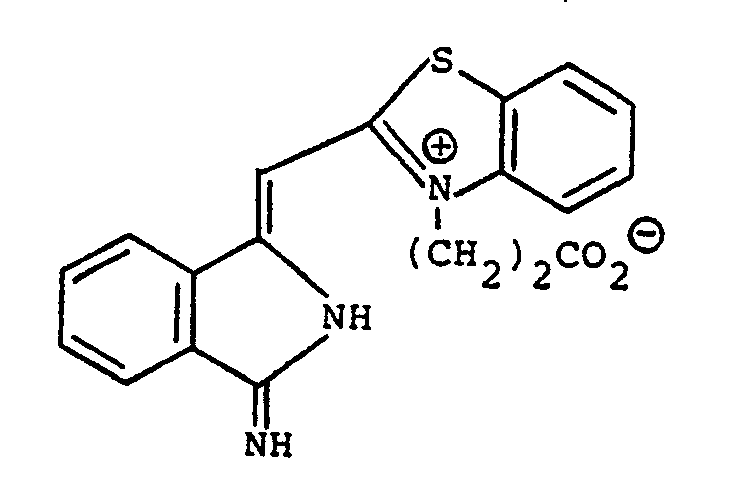
- a photographic element which exhibits safe handling characteristics under white light (as defined herein) and is capable of recording images of higher intensity visible light or other actinic radiations, the element comprising one or more layers of silver halide emulsion at least one or of said layers containing an effective amount in the range 0.01 to 10 g per mol of silver of a compound of the formula: in which:
- the compounds of formula (I) act as L.I.R.F. inducers and do not cause latent image fading in silver halide emulsions and are therefore useful in the production of photographic elements which may be handled without fogging under white light; e.g. normal lighting conditions.
- the compounds may be incorporated into the emulsion before or after imagewise exposure.
- Certain compounds within the scope of formula (I) are known and have been used as dyestuffs and colorants; see, for example, United States Patent Nos. 3,646,033; 3,994,921 and 4,217,309 and British Patent No. 1,219,041.
- compounds of formula (I) possess suitable properties for use in white light handleable films. These properties include the ability to desensitize silver halide to normal lighting conditions while allowing the silver halide to remain sensitive to intense visible or ultraviolet exposing devices or X-ray exposing devices.
- L.I.R.F. inducers for use in our invention must be capable of accepting an electron which has been excited to the conduction band of the silver halide crystal.
- L.I.R.F. inducers of this invention are those having a cathodic half wave potential less negative than -1.0 volts measured versus a normal calomel electrode.
- the nucleus: in formula (I) does not appear to have a significant effect on the desensitizing properties.
- the ring R is preferably an optionally substituted aromatic ring.
- other ring systems are suitable as defined above, an example of which includes dithiacyclohexenylene.
- the substituent(s) R 1 may be selected from a wide range of groups including halogen; e.g., chlorine, hydroxy, alkyl or alkenyl, containing 1 to 8 carbon atoms, cycloalkyl; e.g., cyclohexyl, alkoxy containing 1 to 8 carbon atoms, aryl containing up to 8 carbon atoms; e.g., phenyl, substituted phenyl, acylamine, etc.
- the above aliphatic substituents may themselves be substituted with, for example, phenyl, hydroxyl or halogen, carboxyl, esterified carboxyl, carbamoyl, sulpho or esterified sulpho group.
- the nucleus of formula (2) has the formula: in which each of R 3 to R 6 are independently selected from hydrogen, halogen, alkyl or alkoxy containing up to 8 carbon atoms, aryl containing up to 8 carbon atoms and acylamine, any two adjacent R 3 to R 6 groups optionally forming the necessary atoms selected from carbon, nitrogen, oxygen and sulphur to complete one or more fused rings having up to 12 carbon atoms in the skeletal ring structure.
- substituents X and Y which have a significant effect upon the desensitizing properties of the compound of formula (I) may be selected from a wide range of groups within the above definitions.
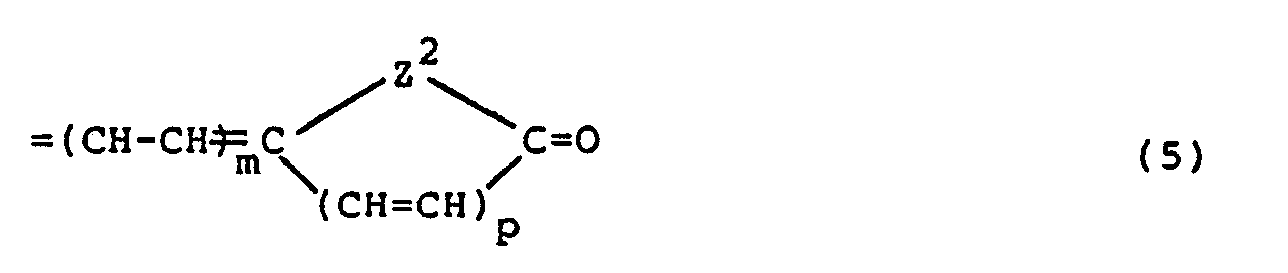
- suitable substituents for X and Y include those of the following formulae (4) to (8): in which:
- Q represents oxime, hydrazone or aryl hydrazone in which the aryl group contains up to 8 carbon atoms.
- An example of a group of formula (8) is para-nitrophenylhydrazone.
- At least one of X and Y represents a divalent group linked via a carbon atom or nitrogen atom, which atom is separated by one carbon atom from a quaternized nitrogen atom.
- 3-imino isoindolines may exist in equilibrium with the tautomeric 3-aminoisoindolenine.
- many of the compounds of formula (I) may be capable of existing in protonated or un- protonated forms depending on the pH of the environment.
- the compounds of formula (I) may be added at any stage during the preparation of the silver halide emulsion. Additionally, it is possible to apply the compounds to the photographic element in the form of a solution, which solution may be applied subsequent to exposure but prior to development in order that development may be carried out in lighting sufficiently bright to permit inspection of the photographic element. Preferably, the compound is incorporated during the emulsion preparation.
- the compounds of the formula (I) preferably have a solubility which is greater than 10- 4 molar in one or more water miscible solvent at 40°C.
- Typical solvents include one or any combination of methanol, ethanol, water, acetone, pyridine, 2-methoxyethanol, dimethylformamide, dimethyl sulfoxide, 0.1 N aqueous sodium hydroxide and 0.1 N aqueous nitric acid.
- the amount of compound employed varies with the degree of desensitization required and the L.I.R.F. inducing properties of the particular compound employed. Generally concentrations within the range 0.01 to 10 g per mole of silver are used and usually within the range 0.1 to 5 g per mole of silver.
- Suitable silver halide emulsions for use in the invention include silver chloride, silver bromide, silver chlorobromide, silver iodobromide, silver iodochlorobromide and silver iodochloride emulsions.
- the emulsions preferably employ gelatin as a binder.
- the gelatin may be wholly or partly replaced by other polymers including chemically modified gelatin, albumin, agar-agar, arabic acid, alginic acid and derivatives thereof, starch and derivatives thereof, cellulose derivatives; e.g., cellulose ethers, partially hydrolyzed cellulose acetate, carboxymethyl cellulose, etc., polyvinyl alcohol, polyvinylpyrrolidone, methacrylic acid, or derivatives thereof; e.g., esters, amides and nitriles, vinyl polymers; e.g., vinyl ethers and vinyl esters.
- the silver halide emulsion employed in this invention may be chemically sensitized. Chemical sensitization may be carried out by heating the emulsion in the presence of active gelatin or sulfur sensitizers such as dodium thiosulphate or selenium, and noble metal sensitizers. Alternatively, or in addition, the emulsion may be reduction sensitized, for example, by treating at low pAg (less than 5) and high pH (greater than 8) or through the use of reducing agents such as stannous chloride, thiourea dioxide and amine boranes.
- the silver halide elements may contain any of the conventional emulsion additives which are known in the art including: development accelerating compounds; e.g., polyalkylene glycols, cationic surfactive compounds of the ammonium, sulfonium and phosphonium types and thioethers; antifoggants and stabilizers; e.g., thiazolium salts, azaindenes; e.g., hydroxytetraazaindenes, nitroindazoles, nitro- benzimidazoles, mercaptotetrazoles, divalent salts of cadmium, cobalt, mercury, zinc or manganese and benzene thiosulfonates.
- development accelerating compounds e.g., polyalkylene glycols, cationic surfactive compounds of the ammonium, sulfonium and phosphonium types and thioethers
- antifoggants and stabilizers e.g.,
- the silver halide elements may also contain conventional additives such as coating aids, hardeners, plasticizers and antistatic agents.
- the silver halide elements of this invention may additionally contain any of the conventional desensitizers known in the art.
- a fine-grained silver halide emulsion consisting of 98% silver chloride and 2% silver bromide was prepared by a conventional double jetting technique.
- the emulsion was coagulated with sodium sulfate and washed normally.
- the coagulum was reconstituted with gelatin solution to give a final gelatin content of 80 g per mole of silver.
- the emulsion was divided into 0.1 mole portions and each additive, as indicated in Table 2, was added to a respective portion of the emulsion in methanol solution prior to addition of wetting agent and hardener.
- the pH of the emulsions was adjusted to pH 5 and the emulsions were coated on polyester base.
- the coatings were exposed under two conditions:
- the compounds which are most useful for imparting white light handleability to a silver halide material are those which have a small effect on the sensitivity towards high intensity exposure and a large effect in reducing the sensitivity of the emulsion to low intensity (room light exposure).
- the most effective L.I.R.F. inducers should have a low value in both Columns A and C in Table 2. It will be noted from Table 2 that the compounds used in accordance with the invention compare favorably with those of the prior art and in many cases are significantly superior as L.I.R.F. inducers.
Landscapes
- Physics & Mathematics (AREA)
- General Physics & Mathematics (AREA)
- Chemical & Material Sciences (AREA)
- Spectroscopy & Molecular Physics (AREA)
- Chemical Kinetics & Catalysis (AREA)
- Engineering & Computer Science (AREA)
- Materials Engineering (AREA)
- Silver Salt Photography Or Processing Solution Therefor (AREA)
- Plural Heterocyclic Compounds (AREA)
- Indole Compounds (AREA)
Claims (21)






Applications Claiming Priority (2)
| Application Number | Priority Date | Filing Date | Title |
|---|---|---|---|
| GB8206716 | 1982-03-08 | ||
| GB8206716 | 1982-03-08 |
Publications (2)
| Publication Number | Publication Date |
|---|---|
| EP0088581A1 EP0088581A1 (de) | 1983-09-14 |
| EP0088581B1 true EP0088581B1 (de) | 1987-05-13 |
Family
ID=10528855
Family Applications (1)
| Application Number | Title | Priority Date | Filing Date |
|---|---|---|---|
| EP83301090A Expired EP0088581B1 (de) | 1982-03-08 | 1983-03-01 | Photografisches Material das bei Tageslicht behandelt werden kann |
Country Status (10)
| Country | Link |
|---|---|
| EP (1) | EP0088581B1 (de) |
| JP (1) | JPH0629944B2 (de) |
| AR (1) | AR244893A1 (de) |
| AU (1) | AU561406B2 (de) |
| BR (1) | BR8301100A (de) |
| CA (1) | CA1246377A (de) |
| DE (1) | DE3371572D1 (de) |
| ES (1) | ES520324A0 (de) |
| GR (1) | GR78071B (de) |
| MX (1) | MX161970A (de) |
Families Citing this family (3)
| Publication number | Priority date | Publication date | Assignee | Title |
|---|---|---|---|---|
| JPH0536434Y2 (de) * | 1990-08-01 | 1993-09-14 | ||
| DE4119505A1 (de) * | 1991-06-13 | 1992-12-17 | Du Pont Deutschland | Verfahren zur herstellung eines radiographischen aufzeichnungsmaterials mit geringer lichtempfindlichkeit |
| DE69528640D1 (de) * | 1995-07-18 | 2002-11-28 | Agfa Gevaert Nv | Photographisches Silberhalogenidröntgenmaterial das zur Verwendung in hellem Dunkelkammerlicht geeignet ist |
Family Cites Families (1)
| Publication number | Priority date | Publication date | Assignee | Title |
|---|---|---|---|---|
| US4030932A (en) * | 1975-05-28 | 1977-06-21 | Eastman Kodak Company | Silver halide sensitized with dyes containing an isoindole nucleus |
-
1983
- 1983-02-22 CA CA000422109A patent/CA1246377A/en not_active Expired
- 1983-03-01 DE DE8383301090T patent/DE3371572D1/de not_active Expired
- 1983-03-01 EP EP83301090A patent/EP0088581B1/de not_active Expired
- 1983-03-04 ES ES520324A patent/ES520324A0/es active Granted
- 1983-03-07 JP JP3722283A patent/JPH0629944B2/ja not_active Expired - Lifetime
- 1983-03-07 BR BR8301100A patent/BR8301100A/pt not_active IP Right Cessation
- 1983-03-07 AU AU12096/83A patent/AU561406B2/en not_active Ceased
- 1983-03-07 GR GR70706A patent/GR78071B/el unknown
- 1983-03-07 AR AR29230983A patent/AR244893A1/es active
- 1983-03-08 MX MX19651583A patent/MX161970A/es unknown
Non-Patent Citations (1)
| Title |
|---|
| T.H. JAMES: "The theory of the photographic process", 4th edition 1977, Macmillan, page 265 * |
Also Published As
| Publication number | Publication date |
|---|---|
| EP0088581A1 (de) | 1983-09-14 |
| BR8301100A (pt) | 1983-11-22 |
| GR78071B (de) | 1984-09-26 |
| ES8407214A1 (es) | 1984-08-16 |
| CA1246377A (en) | 1988-12-13 |
| AU1209683A (en) | 1983-09-15 |
| ES520324A0 (es) | 1984-08-16 |
| JPH0629944B2 (ja) | 1994-04-20 |
| AU561406B2 (en) | 1987-05-07 |
| JPS58166342A (ja) | 1983-10-01 |
| AR244893A1 (es) | 1993-11-30 |
| MX161970A (es) | 1991-03-13 |
| DE3371572D1 (en) | 1987-06-19 |
Similar Documents
| Publication | Publication Date | Title |
|---|---|---|
| JPS59212828A (ja) | 放射線感応性ハロゲン化銀乳剤 | |
| JPS59212829A (ja) | アリ−ルヒドラジド | |
| US3753721A (en) | Photographic materials | |
| US4472497A (en) | White light handleable photographic materials | |
| JPS599892B2 (ja) | 放射線写真を得る方法 | |
| EP0088581B1 (de) | Photografisches Material das bei Tageslicht behandelt werden kann | |
| US4780404A (en) | Supersensitization of silver halide emulsion | |
| EP0121326B1 (de) | Benzimidazol-Monomethin-Cyanin-Farbstoffe mit Alkandiylbrücke, Verfahren zu ihrer Herstellung und fotographische Emulsionen und Materialien welche diese Farbstoffe enthalten | |
| US3782957A (en) | Fogged,direct-positive silver halide emulsion layer containing a cyanine dye and a compound containing a metal of group viii of the periodic table | |
| JPH0731386B2 (ja) | 直接ポジ型ハロゲン化銀写真感光材料 | |
| EP0095899B1 (de) | Farbbildende Carboxamidonaphthalen-Farbstoffvorläufer, photographische Elemente,die diese enthalten und entsprechende Carboximidefarbstoffe | |
| US3726684A (en) | Spectrally sensitizing quick-processing photographic material | |
| US3730723A (en) | Direct positive processes utilizing silver halide surface image emulsions containing desensitizers | |
| JPS6258240A (ja) | ハロゲン化銀写真感光材料 | |
| JPH035729B2 (de) | ||
| EP0376500B1 (de) | Verfahren zur spektralen Sensibilisierung einer Silberhalogenidemulsion | |
| JPS6169063A (ja) | ハロゲン化銀乳剤の強色増感 | |
| US3545975A (en) | Optically sensitized light-sensitive material | |
| JPS59157630A (ja) | ハロゲン化銀写真乳剤 | |
| JP3372423B2 (ja) | ハロゲン化銀白黒印画紙の現像処理方法 | |
| JPS60173546A (ja) | ハロゲン化銀写真感光材料の現像処理方法 | |
| JPS6126040A (ja) | ハロゲン化銀写真乳剤 | |
| JPS61279849A (ja) | 写真要素 | |
| JPS5880634A (ja) | ハロゲン化銀写真乳剤 | |
| JPH021835A (ja) | ハロゲン化銀写真感光材料 |
Legal Events
| Date | Code | Title | Description |
|---|---|---|---|
| PUAI | Public reference made under article 153(3) epc to a published international application that has entered the european phase |
Free format text: ORIGINAL CODE: 0009012 |
|
| AK | Designated contracting states |
Designated state(s): BE CH DE FR GB IT LI NL |
|
| 17P | Request for examination filed |
Effective date: 19840224 |
|
| ITF | It: translation for a ep patent filed | ||
| GRAA | (expected) grant |
Free format text: ORIGINAL CODE: 0009210 |
|
| AK | Designated contracting states |
Kind code of ref document: B1 Designated state(s): BE CH DE FR GB IT LI NL |
|
| REF | Corresponds to: |
Ref document number: 3371572 Country of ref document: DE Date of ref document: 19870619 |
|
| ET | Fr: translation filed | ||
| PLBE | No opposition filed within time limit |
Free format text: ORIGINAL CODE: 0009261 |
|
| STAA | Information on the status of an ep patent application or granted ep patent |
Free format text: STATUS: NO OPPOSITION FILED WITHIN TIME LIMIT |
|
| 26N | No opposition filed | ||
| REG | Reference to a national code |
Ref country code: GB Ref legal event code: 732 |
|
| ITTA | It: last paid annual fee | ||
| PGFP | Annual fee paid to national office [announced via postgrant information from national office to epo] |
Ref country code: CH Payment date: 19950210 Year of fee payment: 13 |
|
| PGFP | Annual fee paid to national office [announced via postgrant information from national office to epo] |
Ref country code: NL Payment date: 19950331 Year of fee payment: 13 |
|
| PG25 | Lapsed in a contracting state [announced via postgrant information from national office to epo] |
Ref country code: LI Effective date: 19960331 Ref country code: CH Effective date: 19960331 |
|
| PG25 | Lapsed in a contracting state [announced via postgrant information from national office to epo] |
Ref country code: NL Effective date: 19961001 |
|
| REG | Reference to a national code |
Ref country code: CH Ref legal event code: PL |
|
| NLV4 | Nl: lapsed or anulled due to non-payment of the annual fee |
Effective date: 19961001 |
|
| PGFP | Annual fee paid to national office [announced via postgrant information from national office to epo] |
Ref country code: GB Payment date: 19970226 Year of fee payment: 15 |
|
| PG25 | Lapsed in a contracting state [announced via postgrant information from national office to epo] |
Ref country code: GB Free format text: LAPSE BECAUSE OF NON-PAYMENT OF DUE FEES Effective date: 19980301 |
|
| PGFP | Annual fee paid to national office [announced via postgrant information from national office to epo] |
Ref country code: FR Payment date: 19980303 Year of fee payment: 16 |
|
| PGFP | Annual fee paid to national office [announced via postgrant information from national office to epo] |
Ref country code: DE Payment date: 19980330 Year of fee payment: 16 |
|
| PGFP | Annual fee paid to national office [announced via postgrant information from national office to epo] |
Ref country code: BE Payment date: 19980416 Year of fee payment: 16 |
|
| GBPC | Gb: european patent ceased through non-payment of renewal fee |
Effective date: 19980301 |
|
| PG25 | Lapsed in a contracting state [announced via postgrant information from national office to epo] |
Ref country code: BE Free format text: LAPSE BECAUSE OF NON-PAYMENT OF DUE FEES Effective date: 19990331 |
|
| BERE | Be: lapsed |
Owner name: MINNESOTA MINING AND MFG CY Effective date: 19990331 |
|
| PG25 | Lapsed in a contracting state [announced via postgrant information from national office to epo] |
Ref country code: FR Free format text: LAPSE BECAUSE OF NON-PAYMENT OF DUE FEES Effective date: 19991130 |
|
| REG | Reference to a national code |
Ref country code: FR Ref legal event code: ST |
|
| PG25 | Lapsed in a contracting state [announced via postgrant information from national office to epo] |
Ref country code: DE Free format text: LAPSE BECAUSE OF NON-PAYMENT OF DUE FEES Effective date: 20000101 |