EP0234672A2 - Procédé de préparation de copolymères bloc à partir de propylène - Google Patents
Procédé de préparation de copolymères bloc à partir de propylène Download PDFInfo
- Publication number
- EP0234672A2 EP0234672A2 EP87300041A EP87300041A EP0234672A2 EP 0234672 A2 EP0234672 A2 EP 0234672A2 EP 87300041 A EP87300041 A EP 87300041A EP 87300041 A EP87300041 A EP 87300041A EP 0234672 A2 EP0234672 A2 EP 0234672A2
- Authority
- EP
- European Patent Office
- Prior art keywords
- polymerization
- batchwise
- ethylene
- tank
- polymer slurry
- Prior art date
- Legal status (The legal status is an assumption and is not a legal conclusion. Google has not performed a legal analysis and makes no representation as to the accuracy of the status listed.)
- Granted
Links
Images
Classifications
-
- C—CHEMISTRY; METALLURGY
- C08—ORGANIC MACROMOLECULAR COMPOUNDS; THEIR PREPARATION OR CHEMICAL WORKING-UP; COMPOSITIONS BASED THEREON
- C08F—MACROMOLECULAR COMPOUNDS OBTAINED BY REACTIONS ONLY INVOLVING CARBON-TO-CARBON UNSATURATED BONDS
- C08F293/00—Macromolecular compounds obtained by polymerisation on to a macromolecule having groups capable of inducing the formation of new polymer chains bound exclusively at one or both ends of the starting macromolecule
-
- B—PERFORMING OPERATIONS; TRANSPORTING
- B01—PHYSICAL OR CHEMICAL PROCESSES OR APPARATUS IN GENERAL
- B01J—CHEMICAL OR PHYSICAL PROCESSES, e.g. CATALYSIS OR COLLOID CHEMISTRY; THEIR RELEVANT APPARATUS
- B01J19/00—Chemical, physical or physico-chemical processes in general; Their relevant apparatus
- B01J19/18—Stationary reactors having moving elements inside
- B01J19/1862—Stationary reactors having moving elements inside placed in series
-
- C—CHEMISTRY; METALLURGY
- C08—ORGANIC MACROMOLECULAR COMPOUNDS; THEIR PREPARATION OR CHEMICAL WORKING-UP; COMPOSITIONS BASED THEREON
- C08F—MACROMOLECULAR COMPOUNDS OBTAINED BY REACTIONS ONLY INVOLVING CARBON-TO-CARBON UNSATURATED BONDS
- C08F2/00—Processes of polymerisation
- C08F2/01—Processes of polymerisation characterised by special features of the polymerisation apparatus used
-
- C—CHEMISTRY; METALLURGY
- C08—ORGANIC MACROMOLECULAR COMPOUNDS; THEIR PREPARATION OR CHEMICAL WORKING-UP; COMPOSITIONS BASED THEREON
- C08F—MACROMOLECULAR COMPOUNDS OBTAINED BY REACTIONS ONLY INVOLVING CARBON-TO-CARBON UNSATURATED BONDS
- C08F297/00—Macromolecular compounds obtained by successively polymerising different monomer systems using a catalyst of the ionic or coordination type without deactivating the intermediate polymer
- C08F297/06—Macromolecular compounds obtained by successively polymerising different monomer systems using a catalyst of the ionic or coordination type without deactivating the intermediate polymer using a catalyst of the coordination type
- C08F297/08—Macromolecular compounds obtained by successively polymerising different monomer systems using a catalyst of the ionic or coordination type without deactivating the intermediate polymer using a catalyst of the coordination type polymerising mono-olefins
- C08F297/083—Macromolecular compounds obtained by successively polymerising different monomer systems using a catalyst of the ionic or coordination type without deactivating the intermediate polymer using a catalyst of the coordination type polymerising mono-olefins the monomers being ethylene or propylene
-
- B—PERFORMING OPERATIONS; TRANSPORTING
- B01—PHYSICAL OR CHEMICAL PROCESSES OR APPARATUS IN GENERAL
- B01J—CHEMICAL OR PHYSICAL PROCESSES, e.g. CATALYSIS OR COLLOID CHEMISTRY; THEIR RELEVANT APPARATUS
- B01J2208/00—Processes carried out in the presence of solid particles; Reactors therefor
- B01J2208/00008—Controlling the process
- B01J2208/00539—Pressure
-
- B—PERFORMING OPERATIONS; TRANSPORTING
- B01—PHYSICAL OR CHEMICAL PROCESSES OR APPARATUS IN GENERAL
- B01J—CHEMICAL OR PHYSICAL PROCESSES, e.g. CATALYSIS OR COLLOID CHEMISTRY; THEIR RELEVANT APPARATUS
- B01J2208/00—Processes carried out in the presence of solid particles; Reactors therefor
- B01J2208/00008—Controlling the process
- B01J2208/00548—Flow
-
- B—PERFORMING OPERATIONS; TRANSPORTING
- B01—PHYSICAL OR CHEMICAL PROCESSES OR APPARATUS IN GENERAL
- B01J—CHEMICAL OR PHYSICAL PROCESSES, e.g. CATALYSIS OR COLLOID CHEMISTRY; THEIR RELEVANT APPARATUS
- B01J2219/00—Chemical, physical or physico-chemical processes in general; Their relevant apparatus
- B01J2219/00049—Controlling or regulating processes
- B01J2219/00162—Controlling or regulating processes controlling the pressure
-
- B—PERFORMING OPERATIONS; TRANSPORTING
- B01—PHYSICAL OR CHEMICAL PROCESSES OR APPARATUS IN GENERAL
- B01J—CHEMICAL OR PHYSICAL PROCESSES, e.g. CATALYSIS OR COLLOID CHEMISTRY; THEIR RELEVANT APPARATUS
- B01J2219/00—Chemical, physical or physico-chemical processes in general; Their relevant apparatus
- B01J2219/00049—Controlling or regulating processes
- B01J2219/00164—Controlling or regulating processes controlling the flow
Definitions
- This invention relates to a process for the production of a block copolymer of propylene. More specifically, it concerns a method involving controlling polymerization conditions constant in a batchwise polymerization system upon producing a block copoplymer of propylene, by conducting at first continuous polymerization of substantially propylene alone and then batchwise copolymerization of propylene and ethylene in a batchwise polymerization system.
- the present inventors have carried out an extensive research with a view toward providing a solution to the above-described problems.
- An object of this invention is therefore to provide a process for obtaining a propylene block copolymer with its quality kept uniform by first conducting continuous polymerization of substantially propylene alone and then batchwise copolymerization of ethylene and propylene.
- a process for the production of a block copolymer of propylene by first conducting continuous polymerization of substantially propylene alone in a continuous polymerization system, receiving for a predetermined period of time a first polymer slurry, which has been discharged continuously from the polymerization system, in either one of two or more batchwise polymerization tanks provided in parallel to each other and upon the lapse of the predetermined period of time, changing the delivery of the first polymer slurry to the other batchwise polymerization tank or either one of the remaining batchwise polymerization tanks, feeding at least ethylene to each of the batchwise polymerization tanks after completion of the reception of the first polymer slurry therein so as to conduct batchwise polymerization of ethylene and propylene successively in the polymerization tanks, and then discharging a second polymer slurry to a deactivation tank from each of the batchwise polymerization tanks upon completion of the batchwise polymerization therein while allowing a predetermined amount of unreacted ethylene
- the process incorporates the improvement wherein the supply of fresh ethylene to each of the batchwise polymerization tanks is halted until completion of reception of the first polymer slurry from the continuous polymerization system, and a deactivator is charged into each of the batchwise polymerization tanks at the same time as the reception of the first polymer slurry therein while controlling the charging rate of the deactivator in such a way that the partial pressure of ethylene in the vapor phase of each of the batchwise polymerization tanks reaches a predetermined value at the same time as the completion of reception of the first polymer slurry therein.
- catalyst systems can be used as catalysts to be employed upon continuous polymerization of substantially propylene alone and batchwise polymerization of ethylene and propylene and no particular limitation is hence imposed thereon. Any catalyst system may be used so long as it can produce polypropylene of high stereoregularity.
- solid catalysts for example, may be mentioned titanium trichloride obtained by reducing titanium tetrachloride with metallic aluminum, hydrogen or an organic aluminum, those obtained by modifying the titanium trichloride with electron-donative compounds, as well as those prepared by modifying carriers such as magnesium halides or substances, which have been obtained by treating such carriers with electron-donative compounds, with titanium halides.
- Either one of the above-described solid catalysts can be used for both continuous polymerization of substantially propylene alone and batchwise polymerization of ethylene and propylene, provided that it is used in combination with an organoaluminum compound and if necessary, an electron-donative compound.
- the organoaluminum compound it is possible to use a trialkylaluminum, dialkylaluminum halide, alkylaluminum sesquihalide or alkylaluminum dihalide.
- alkyl group may include methyl, ethyl, propyl butyl and hexyl groups.
- exemplary halides may be mentioned chloride, bromide and iodide.
- a preferred solid catalyst system is that obtained by modifying, with a titanium halide, a carrier such as magnesium halide or a substance formed by treating such a carrier with an electron-donative compound.
- a carrier such as magnesium halide or a substance formed by treating such a carrier with an electron-donative compound.
- Specific examples include one obtained by grinding magnesium chloride together with an organic compound and then treating the resultant mixture with titanium tetrachloride, and one prepared by dissolving a reaction product of magnesium chloride and an alcohol in a hydrocarbon solvent and then treating the resultant solution with a precipitant such as titanium tetrachloride so as to insolubilize the reaction product in the hydrocarbon solvent, and if necessary, modifying the thus-insolubilized reaction product with an electron-donative compound such as an ester or ether, and then treating the resulting substance with titanium tetrachloride.
- Illustrative organoaluminum compounds to to be used in combination preferably include trimethyl aluminum, triethyl aluminum, tripropyl aluminum, tributyl aluminum, dimethylaluminum chloride, deithyl aluminum chloride, dipropylaluminum chloride, and dibutylaluminum chloride. If necessary, an ester, ether, orthoester or alkoxysilane may also be used in combination as a stereoregularity improver.
- the above-described stereoregularity improver can be used as the deactivator to be introduced into a polymerization tank in which batchwise polymerization is conducted.
- an alcohol, water, or a halide such as aluminum halide or silane halide may also be used in some instances as the deactivator.
- the organic aluminum and stereoregularity improver may be used in amounts of 0.1 - 1000 and 0.01 - 300 parts by weight, preferably, 0.5 - 100 and 0.01 - 30 parts by weight respectively per part by weight of the solid catalyst.
- the proportion of the deactivator varies depending on the type of the deactivator and the proportion of the organic aluminum relative to the solid catalyst and is not specified accordingly.
- the deactivator may generally be used in an amount of 0.01 - 100 parts by weight per part by weight of the solid catalyst.
- the present invention may be practiced by using a bulk polymerization process in which propylene itself is preferably used as a polymerization solvent.
- Another inert medium such as hexane, heptane, benzene or toluene may also be used up to about 20 wt.% as needed.
- the term "continuous polymerization of substantially propylene alone", which is conducted at first, usually means homopolymerization of propylene or copolymerization of propylene and another a-olefin in such a small amount that the content of the a-olefin does not exceed 6 wt.% of the whole monomers. It is preferable to conduct the continuous polymerization of substantially propylene alone, which is conducted at first, up to 50 - 95 wt.% of the entire polymerization. Any degrees smaller than 50 wt.% are not preferable because the block copolymers obtained after the batchwise polymerization lack of the excellent stiffness inherent to polypropylene.
- the continuous polymerization may be effected at 50 - 90°C.
- the polymerization pressure may vary depending on the partial pressure of the monomer employed, the amount of an inert solvent employed as desired and the amount of hydrogen used optionally for the control of the molecular weight.
- the continuous polymerization of substantially propylene alone is conducted in a polymerization reactor constructed as a single tank or as two or more tanks connected in series.
- the continuous polymerization of substantially propylene alone is effected while controlling operational conditions.
- any conventionally-known methods may be employed.
- the slurry obtained as a result of the above-described continuous polymerization is received in polymerization tanks, in which batchwise polymerization is conducted.
- polymerization tanks in which batchwise polymerization is conducted.
- specific examples are disclosed, for example, in Japanese Patent Laid-Open Nos. 149320/1982 and 11519/1983.
- the batchwise polymerization can be practised by connecting two or more batchwise polymerization tanks in parallel to each other to a polymerization tank, in which the continuous polymerization is conducted, and changing over the delivery of the polymer slurry successively to the batch tanks.
- the above-mentioned deactivator is charged to decrease uncontrolled polymerization which takes place during the reception of the slurry into the polymerization tanks. If deactivation takes place to an unduly large degree by the charging of the deactivator, it becomes necessary to increase the amount of a catalytic activity improver, which is optionally introduced upon conducting the intended copolymerization, to a considerable extent. Such excessive deactivation is hence not preferable.
- the term "catalytic activity improver" as used herein means any desired component or components of the aforementioned catalytic systems with an organoaluminum compound being especially suited.
- the preferable reaction ratio of ethylene/ propylene in the polymerization of ethylene and propylene may range from 20/80 to 95/5 by weight.
- the batchwise polymerization of ethylene and propylene may be effected to such an extent that the resulting ethylene-propylene copolymer amounts to 5 - 50 wt.% of the whole polymer.
- a portion of the ethylene may be replaced by another a-olefin.
- the batchwise polymerization is conducted, usually, at room temperature - 70°C, preferably, 30 - 60°C in the presence of hydrogen as a molecular weight modifier.
- the polymerization pressure should be determined in accordance with desired ethylene and hydrogen concentrations in the vapor phase and the amount of an inert hydrocarbon which may be used as desired.
- the deactivator is charged while controlling its charging rate in such a way that the partial pressure of ethylene reaches a predetermined value at the time of completion of the reception of the slurry.
- the discharge of the slurry after the batchwise polymerization is effected until practically no liquid medium remains, in other words, in such a manner that at least a predetermined amount of unreacted ethylene is always left over in each tank, ethylene is not additionally fed during reception of the slurry, and the internal temperature of each polymerization tank adapted to conduct the batchwise polymerization therein is controlled at a predetermined constant level upon completion of reception of the slurry.
- the internal temperature it is however possible to make the predetermined value of the partial pressure of ethylene adjusted by detecting the internal temperature.
- the partial pressure may be determined as a simple method by sampling the vapor-phase gas and analyzing its composition by gas chromatography.
- the process of this invention can be applied not only to a production process of a block copolymer, in which a catalytic activity improver is added to each polymerization tank for batchwise polymerization, but also to a polymerization process in which such a catalytic activity improver is not added.
- a desired amount of a deactivator is charged into the polymerization tank if desired. Thereafter, the contents of the polymerization tank, namely, the resultant slurry is discharged to a deactivation tank in which the polymerization activity of the slurry is deactivated.
- the polymerization tank is now ready for reception of anew supply of the polymer slurry from the continuous polymerization system. Upon this discharge, the slurry is discharged until practically no liquid medium remains in the polymerization tank as described above.
- the interior of the polymerization tank is washed with a small amount of liquid polypropylene and the washing is also discharged to the deactivation tank. It is however important for the polymerization tank to be ready for reception of a new supply of the polymer slurry in such a state that at least a predetermined amount of unreacted ethylene remains in the polymerization tank.
- the predetermined amount of unreacted ethylene is left over in order to allow the partial pressure of ethylene in the vapor phase of the tank to reach a predetermined level at the time of completion of reception of the slurry by charging the deactivator under control simultaneously with the reception of anew supply of the polymer slurry from the continuous polymerization system.
- the predetermined amount of unreacted ethylene to be left over is therefore determined by the above-mentioned predetermined level.
- each batchwise polymerization tank at a level higher than the deactivation tank so that the transfer of the slurry or the washing is effected by the difference in head and during the transfer of the slurry, the vapor phase of the batchwise polymerization tank and that of the deactivator are connected together by way of a pressure equalizing pipe so as to prevent components of the vapor phases from flowing out of the system.
- melt flow indexes hereinafter abbreviated as "MI"
- flexural stiffnesses Izod impact strengths (notched)
- Du Pont impact strengths were measured in accordance with ASTM D1238, ASTM D747-63, ASTM D256-56 and JIS K6718 respectively.
- the MIs were measured at 230°C and under a load of 2.16 kg.
- the flexural stiffnesses were measured at 20°C.
- the Izod and Du Pont impact strengths were measured at 20°C and -10°C respectively.
- Intrinsic viscosities hereinafter abbreviated as "n" were measured at 135°C in tetralin solutions.
- Isotactic indexes hereinafter abbreviated as "II" were calculated as
- each of the pots was filled with 300 g of magnesium chloride, 60 ml of tetraethoxysilane and 45 ml of a,a,a-trichlorotoluene, followed by grinding of the contents for 40 hours.
- Three kilograms of the thus-ground mixture and 20 l of titanium tetrachloride were added to an autoclave having an internal volume of 50 l. After stirring the contents at 80°C for 2 hours, the supernatant was removed by decantation.
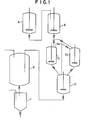
- Polymerization was conducted by using the polymerization apparatus depicted in FIGURE 1.
- Autoclaves A and B (reaction tanks for continuous polymerization), each of which had an internal volume of 300 l and had been fully dried and purged with nitrogen and then with propylene gas, were connected in series, while autoclaves C 1 and C 2 (reaction tanks for batchwise polymerization) each of which had an internal volume of 200 l were connected in parallel to each other after the autoclave B.
- An autoclave D (deactivation tank) having an internal volume of 300t was connected in series to the autoclaves C 1 and C 2 .
- Autoclaves A and B were charged with 60 kg of propylene.
- the above-prepared catalyst slurry mixture was charged at a velocity of 1 g/hr in terms of the solid catalyst, the other organoaluminum catalyst component, i.e., triethylaluminum at 1.5 ml/hr, and liquid propylene at 30 kg/hr.
- the other organoaluminum catalyst component i.e., triethylaluminum at 1.5 ml/hr
- liquid propylene at 30 kg/hr.
- Charged automatically into the autoclave B were triethylaluminum at a velocity of 3.0 l/hr and a propylene slurry, which had been drawn out of the autoclave A, at 30 kg/hr.
- the slurry which was continuously being drawn out from a lower part of the autoclave B, was then charged into the autoclave C 1 1 At the same time, methyl p-toluylate was also charged at a velocity of 0.8 ml/30 min into the autoclave C 1 . As a result, the activity was reduced to about 2/5. After receiving the slurry for 30 minutes in the autoclave C 1 , the destination of transfer of the slurry and methyl p-toluylate was changed to the autoclave C 2 .
- the thus-deactivated slurry was then transferred to the autoclave D in which 10 kg of liquid propylene and 50 ml of isopropanol had been charged in advance.
- the interior of the autoclave C1 was washed with liquid propylene and the propylene washing was also delivered to the autoclave D.
- the vapor phase of the autoclave C 1 (or C 2 ) and that of the autoclave D were connected to each other.
- the transfer of the slurry was effected by a difference in head, which was obtained by locating the autoclave C 1 (or C 2 ) above the autoclave D.
- the internal pressure of each batchwise polymerization tank was therefore maintained constant at 22 kg/cm2-Gauge.
- a slurry was transferred from a lower part of the autoclave D to a flash tank E while charging isopropanol at 1 ml/hr into the autoclave D.
- a hopper F the resultant block copolymer was obtained as powder.
- the discharge of the slurry from the autoclave D was effected continuously at a rate of about 40 kg/hr, so that about 10 kg of the slurry was left over in the autoclave D when the autoclave D received a next supply of the slurry from the autoclave C 2 .
- a copolymerizing operation was conducted in the same manner as in the autoclave C 1 . Namely, the slurry was transferred from the autoclave B to the autoclave C 1 for the first 30 minutes (0 ⁇ 30th minute). During the next 30 minutes (30th minute ⁇ 1st hour), the transfer of the slurry was changed from the autoclave B to the autoclave C 2 .
- the 1-hour period from the reception of the slurry in the autoclave C 1 to the reception of a next supply of the slurry in the same autoclave C 1 was counted as one operation of polymerization (this also applies to the autoclave c 2 ).
- the operation of the polymerization apparatus was conducted until the batchwise polymerization operations in the autoclaves C l ,C 2 were conducted 5 times each, namely, 10 times in total, thereby obtaining about 50 kg of a block copolymer.
- a block copolymer was produced under the same conditions as in Referential Example 1 except that the batchwise polymerization was conducted by changing the charging rate of methyl p-toluylate to 1.4 mt during the reception of the slurry in the batchwise polymerization tank and then charging ethylene and hydrogen in predetermined amounts and then introducing 3 mt of triethylaluminum under pressure.
- block copolymers were prepared by using Lot Nos. 4 and 5 of the solid catalyst respectively. Similar to Example 1, the charging rate of triethylaluminum was changed in the continuous polymerization system so as to maintain the catalytic activity constant. During the batchwise polymerization, the addition of methyl toluylate was controlled to allow the partial pressure of ethylene to reach 7 volt in the vapor phase upon completion of the reception of the slurry.
- block copolymers were prepared by using Lot Nos. 2 and 3 of the solid catalyst respectively.
- the charging rate of methyl p-toluylate was controlled constant at 1.4 ml for each of the lots in the same manner as in Referential Example 2.
Landscapes
- Chemical & Material Sciences (AREA)
- Chemical Kinetics & Catalysis (AREA)
- Organic Chemistry (AREA)
- Inorganic Chemistry (AREA)
- Health & Medical Sciences (AREA)
- Medicinal Chemistry (AREA)
- Polymers & Plastics (AREA)
- Graft Or Block Polymers (AREA)
- Addition Polymer Or Copolymer, Post-Treatments, Or Chemical Modifications (AREA)
Applications Claiming Priority (2)
| Application Number | Priority Date | Filing Date | Title |
|---|---|---|---|
| JP14722/86 | 1986-01-28 | ||
| JP61014722A JPH0618841B2 (ja) | 1986-01-28 | 1986-01-28 | プロピレンのブロツク共重合体の製造方法 |
Publications (3)
| Publication Number | Publication Date |
|---|---|
| EP0234672A2 true EP0234672A2 (fr) | 1987-09-02 |
| EP0234672A3 EP0234672A3 (en) | 1988-07-13 |
| EP0234672B1 EP0234672B1 (fr) | 1990-11-14 |
Family
ID=11869020
Family Applications (1)
| Application Number | Title | Priority Date | Filing Date |
|---|---|---|---|
| EP87300041A Expired - Lifetime EP0234672B1 (fr) | 1986-01-28 | 1987-01-06 | Procédé de préparation de copolymères bloc à partir de propylène |
Country Status (11)
| Country | Link |
|---|---|
| US (1) | US4921905A (fr) |
| EP (1) | EP0234672B1 (fr) |
| JP (1) | JPH0618841B2 (fr) |
| KR (1) | KR890004332B1 (fr) |
| CN (1) | CN1010411B (fr) |
| AU (1) | AU565457B2 (fr) |
| CA (1) | CA1293833C (fr) |
| DE (1) | DE3766127D1 (fr) |
| FI (1) | FI865277A7 (fr) |
| IN (1) | IN166130B (fr) |
| PT (1) | PT84209B (fr) |
Cited By (2)
| Publication number | Priority date | Publication date | Assignee | Title |
|---|---|---|---|---|
| EP0889064A3 (fr) * | 1997-07-02 | 1999-01-27 | Basf Aktiengesellschaft | Procédé de préparation d'alcènes C2-C8 utilisant un système catalytique de type Ziegler-Natta |
| EP1639019A4 (fr) * | 2003-07-02 | 2008-11-12 | Du Pont | Processus de polymerisation haute temperature sous pression |
Families Citing this family (3)
| Publication number | Priority date | Publication date | Assignee | Title |
|---|---|---|---|---|
| US6284857B1 (en) | 1993-07-22 | 2001-09-04 | Mitsui Chemical, Inc. | Propylene polymer, propylene block copolymer, process for preparing said polymer and said block copolymer, and propylene polymer composition |
| WO2004081252A1 (fr) * | 2003-03-10 | 2004-09-23 | Kabushiki Kaisha Riken | Poussoir de soupape nitrure et son procede de fabrication |
| CN116272673A (zh) * | 2023-04-07 | 2023-06-23 | 聊城氟尔新材料科技有限公司 | 一种聚全氟乙丙烯连续聚合系统及方法 |
Family Cites Families (2)
| Publication number | Priority date | Publication date | Assignee | Title |
|---|---|---|---|---|
| JPS5516048A (en) * | 1978-07-20 | 1980-02-04 | Sumitomo Chem Co Ltd | Preparation of propylene-ethylene block copolymer |
| GB2094319B (en) * | 1981-03-05 | 1984-09-26 | Mitsui Toatsu Chemicals | Production of propylene block copolymer |
-
1986
- 1986-01-28 JP JP61014722A patent/JPH0618841B2/ja not_active Expired - Lifetime
- 1986-12-22 IN IN934/CAL/86A patent/IN166130B/en unknown
- 1986-12-22 FI FI865277A patent/FI865277A7/fi not_active Application Discontinuation
- 1986-12-31 AU AU67074/86A patent/AU565457B2/en not_active Ceased
-
1987
- 1987-01-06 EP EP87300041A patent/EP0234672B1/fr not_active Expired - Lifetime
- 1987-01-06 DE DE8787300041T patent/DE3766127D1/de not_active Expired - Lifetime
- 1987-01-13 CA CA000527223A patent/CA1293833C/fr not_active Expired - Lifetime
- 1987-01-28 CN CN87100458A patent/CN1010411B/zh not_active Expired
- 1987-01-28 PT PT84209A patent/PT84209B/pt not_active IP Right Cessation
- 1987-01-28 KR KR1019870000660A patent/KR890004332B1/ko not_active Expired
-
1988
- 1988-06-01 US US07/205,484 patent/US4921905A/en not_active Expired - Fee Related
Cited By (3)
| Publication number | Priority date | Publication date | Assignee | Title |
|---|---|---|---|---|
| EP0889064A3 (fr) * | 1997-07-02 | 1999-01-27 | Basf Aktiengesellschaft | Procédé de préparation d'alcènes C2-C8 utilisant un système catalytique de type Ziegler-Natta |
| US6174969B1 (en) | 1997-07-02 | 2001-01-16 | Basf Aktiengesellschaft | Polymerization of C2-C8-alk-1-enes by means of a Ziegler-Natta |
| EP1639019A4 (fr) * | 2003-07-02 | 2008-11-12 | Du Pont | Processus de polymerisation haute temperature sous pression |
Also Published As
| Publication number | Publication date |
|---|---|
| DE3766127D1 (de) | 1990-12-20 |
| JPS62174217A (ja) | 1987-07-31 |
| JPH0618841B2 (ja) | 1994-03-16 |
| AU6707486A (en) | 1987-08-06 |
| AU565457B2 (en) | 1987-09-17 |
| PT84209B (pt) | 1989-03-30 |
| CN87100458A (zh) | 1987-08-12 |
| KR870007219A (ko) | 1987-08-17 |
| EP0234672B1 (fr) | 1990-11-14 |
| FI865277A7 (fi) | 1987-07-29 |
| EP0234672A3 (en) | 1988-07-13 |
| FI865277A0 (fi) | 1986-12-22 |
| CN1010411B (zh) | 1990-11-14 |
| PT84209A (en) | 1987-02-01 |
| US4921905A (en) | 1990-05-01 |
| CA1293833C (fr) | 1991-12-31 |
| KR890004332B1 (ko) | 1989-10-31 |
| IN166130B (fr) | 1990-03-17 |
Similar Documents
| Publication | Publication Date | Title |
|---|---|---|
| EP0027386B1 (fr) | Procédé de préparation d'une composition de résine de propylène et articles moulés à partir de cette composition | |
| EP0279153B1 (fr) | Procédé pour modifier l'efficacité d'un catalyseur prépolymérisé | |
| US4576994A (en) | Process for the preparation of a polypropylene molding composition | |
| EP0163916A1 (fr) | Procédé de préparation de polymères oléfiniques | |
| CA1276334C (fr) | Procede pour la production de copolymere sequence de propylene | |
| US4603184A (en) | Process for producing alpha-olefin polymers | |
| EP0234672B1 (fr) | Procédé de préparation de copolymères bloc à partir de propylène | |
| CA2422598A1 (fr) | Copolymeres sequences de propylene hautement coulants | |
| KR910005661B1 (ko) | 난백화, 고용융점탄성 에틸렌·프로필렌 공중합체의 제조방법 | |
| JP2516199B2 (ja) | プロピレンの連続重合方法 | |
| EP0093494A1 (fr) | Composant de catalyseur pour la polymérisation des alpha oléfines | |
| EP0111902A2 (fr) | Catalyseurs et procédé de préparation de polymères d'oléfines au moyen de ce catalyseur | |
| CA1305281C (fr) | Methode de controle du poids moleculaire de polypropylene | |
| JPH0772210B2 (ja) | プロピレンの連続重合方法 | |
| JPS6337104A (ja) | プロピレンの連続重合方法 | |
| EP0284287B1 (fr) | Procédé de préparation de polymères alpha-oléfiniques | |
| EP0351781A2 (fr) | Méthode de préparation de copolymères séquencés de propylène | |
| KR920006449B1 (ko) | 프로필렌의 블록공중합체의 제조방법 | |
| JPS60217210A (ja) | プロピレンの重合方法 | |
| EP0132848A2 (fr) | Procédé pour produire des polymères d'alpha-oléfines utilisant un nouveau système catalytique | |
| JPS6036206B2 (ja) | プロピレンのブロツク共重合体の製造法 | |
| JPS62135509A (ja) | プロピレンのブロツク共重合体の製造方法 | |
| JPH0559926B2 (fr) | ||
| JPS6185424A (ja) | プロピレンのブロツク共重合体の製造方法 | |
| JPH0522725B2 (fr) |
Legal Events
| Date | Code | Title | Description |
|---|---|---|---|
| PUAI | Public reference made under article 153(3) epc to a published international application that has entered the european phase |
Free format text: ORIGINAL CODE: 0009012 |
|
| AK | Designated contracting states |
Kind code of ref document: A2 Designated state(s): BE DE FR GB IT NL |
|
| PUAL | Search report despatched |
Free format text: ORIGINAL CODE: 0009013 |
|
| AK | Designated contracting states |
Kind code of ref document: A3 Designated state(s): BE DE FR GB IT NL |
|
| 17P | Request for examination filed |
Effective date: 19881213 |
|
| 17Q | First examination report despatched |
Effective date: 19891115 |
|
| GRAA | (expected) grant |
Free format text: ORIGINAL CODE: 0009210 |
|
| ITF | It: translation for a ep patent filed | ||
| AK | Designated contracting states |
Kind code of ref document: B1 Designated state(s): BE DE FR GB IT NL |
|
| ET | Fr: translation filed | ||
| REF | Corresponds to: |
Ref document number: 3766127 Country of ref document: DE Date of ref document: 19901220 |
|
| ITTA | It: last paid annual fee | ||
| PLBE | No opposition filed within time limit |
Free format text: ORIGINAL CODE: 0009261 |
|
| STAA | Information on the status of an ep patent application or granted ep patent |
Free format text: STATUS: NO OPPOSITION FILED WITHIN TIME LIMIT |
|
| 26N | No opposition filed | ||
| PGFP | Annual fee paid to national office [announced via postgrant information from national office to epo] |
Ref country code: BE Payment date: 19911223 Year of fee payment: 6 |
|
| PG25 | Lapsed in a contracting state [announced via postgrant information from national office to epo] |
Ref country code: BE Effective date: 19930131 |
|
| BERE | Be: lapsed |
Owner name: MITSUI TOATSU CHEMICALS INC. Effective date: 19930131 |
|
| PGFP | Annual fee paid to national office [announced via postgrant information from national office to epo] |
Ref country code: GB Payment date: 19951228 Year of fee payment: 10 |
|
| PGFP | Annual fee paid to national office [announced via postgrant information from national office to epo] |
Ref country code: FR Payment date: 19960109 Year of fee payment: 10 |
|
| PGFP | Annual fee paid to national office [announced via postgrant information from national office to epo] |
Ref country code: DE Payment date: 19960115 Year of fee payment: 10 |
|
| PGFP | Annual fee paid to national office [announced via postgrant information from national office to epo] |
Ref country code: NL Payment date: 19960130 Year of fee payment: 10 |
|
| PG25 | Lapsed in a contracting state [announced via postgrant information from national office to epo] |
Ref country code: GB Effective date: 19970106 |
|
| PG25 | Lapsed in a contracting state [announced via postgrant information from national office to epo] |
Ref country code: NL Effective date: 19970801 |
|
| GBPC | Gb: european patent ceased through non-payment of renewal fee |
Effective date: 19970106 |
|
| PG25 | Lapsed in a contracting state [announced via postgrant information from national office to epo] |
Ref country code: FR Effective date: 19970930 |
|
| NLV4 | Nl: lapsed or anulled due to non-payment of the annual fee |
Effective date: 19970801 |
|
| PG25 | Lapsed in a contracting state [announced via postgrant information from national office to epo] |
Ref country code: DE Effective date: 19971001 |
|
| REG | Reference to a national code |
Ref country code: FR Ref legal event code: ST |
|
| PG25 | Lapsed in a contracting state [announced via postgrant information from national office to epo] |
Ref country code: IT Free format text: LAPSE BECAUSE OF NON-PAYMENT OF DUE FEES;WARNING: LAPSES OF ITALIAN PATENTS WITH EFFECTIVE DATE BEFORE 2007 MAY HAVE OCCURRED AT ANY TIME BEFORE 2007. THE CORRECT EFFECTIVE DATE MAY BE DIFFERENT FROM THE ONE RECORDED. Effective date: 20050106 |