EP0256302B1 - Procédé de production d'antithrombine III (ATIII) humaine et les vecteurs appropriés - Google Patents
Procédé de production d'antithrombine III (ATIII) humaine et les vecteurs appropriés Download PDFInfo
- Publication number
- EP0256302B1 EP0256302B1 EP87110027A EP87110027A EP0256302B1 EP 0256302 B1 EP0256302 B1 EP 0256302B1 EP 87110027 A EP87110027 A EP 87110027A EP 87110027 A EP87110027 A EP 87110027A EP 0256302 B1 EP0256302 B1 EP 0256302B1
- Authority
- EP
- European Patent Office
- Prior art keywords
- atiii
- gene
- dhfr
- vector
- cells
- Prior art date
- Legal status (The legal status is an assumption and is not a legal conclusion. Google has not performed a legal analysis and makes no representation as to the accuracy of the status listed.)
- Expired - Lifetime
Links
Images


Classifications
-
- C—CHEMISTRY; METALLURGY
- C12—BIOCHEMISTRY; BEER; SPIRITS; WINE; VINEGAR; MICROBIOLOGY; ENZYMOLOGY; MUTATION OR GENETIC ENGINEERING
- C12N—MICROORGANISMS OR ENZYMES; COMPOSITIONS THEREOF; PROPAGATING, PRESERVING, OR MAINTAINING MICROORGANISMS; MUTATION OR GENETIC ENGINEERING; CULTURE MEDIA
- C12N15/00—Mutation or genetic engineering; DNA or RNA concerning genetic engineering, vectors, e.g. plasmids, or their isolation, preparation or purification; Use of hosts therefor
- C12N15/09—Recombinant DNA-technology
- C12N15/63—Introduction of foreign genetic material using vectors; Vectors; Use of hosts therefor; Regulation of expression
- C12N15/79—Vectors or expression systems specially adapted for eukaryotic hosts
- C12N15/85—Vectors or expression systems specially adapted for eukaryotic hosts for animal cells
-
- C—CHEMISTRY; METALLURGY
- C07—ORGANIC CHEMISTRY
- C07K—PEPTIDES
- C07K14/00—Peptides having more than 20 amino acids; Gastrins; Somatostatins; Melanotropins; Derivatives thereof
- C07K14/81—Protease inhibitors
- C07K14/8107—Endopeptidase (E.C. 3.4.21-99) inhibitors
- C07K14/811—Serine protease (E.C. 3.4.21) inhibitors
- C07K14/8121—Serpins
- C07K14/8128—Antithrombin III
-
- C—CHEMISTRY; METALLURGY
- C12—BIOCHEMISTRY; BEER; SPIRITS; WINE; VINEGAR; MICROBIOLOGY; ENZYMOLOGY; MUTATION OR GENETIC ENGINEERING
- C12N—MICROORGANISMS OR ENZYMES; COMPOSITIONS THEREOF; PROPAGATING, PRESERVING, OR MAINTAINING MICROORGANISMS; MUTATION OR GENETIC ENGINEERING; CULTURE MEDIA
- C12N2800/00—Nucleic acids vectors
- C12N2800/10—Plasmid DNA
- C12N2800/108—Plasmid DNA episomal vectors
Definitions
- a suitable vector is a pBR322 derivative which contains a marker for selection in E. coli and an E. coli origin of replication.
- the vector is also said to contain the SV40 origin of replication (derived from a 342bp PvuII-HindIII fragment).
- the present invention relates to a particularly advantageous method in which the host cell is a mammalian cell which cannot or cannot produce enough dihydrofolate reductase, and which host cell is co-transfected with two expression vectors, one of which carries the ATIII gene and the other others effect the production of dihydrofolate reductase.
- the invention thus relates to a method for producing ATIII in mammalian cell culture with the aid of an expression vector which contains the ATIII cDNA, which is characterized in that a dhfr ⁇ cell serves as the mammalian cell, which is co-transfected with another vector in addition to the vector mentioned that carries a DHFR gene that is controlled by a weak promoter. Further aspects of the invention and its preferred embodiments are explained in more detail below or defined in the patent claims.
- the cotransfection system according to the invention thus uses two expression vectors, the first being any vector, for example a pBR322 derivative, in which the ATIII gene is under the control of a promoter active in eukaryotic cells in a manner known per se, while the second vector is the encoded for the dihydrofolate reductase and thus also allows a possibility for gene amplification, the expression of the DHFR gene is controlled by a DNA sequence of the pBR322-ori region.
- the first being any vector, for example a pBR322 derivative, in which the ATIII gene is under the control of a promoter active in eukaryotic cells in a manner known per se
- the second vector is the encoded for the dihydrofolate reductase and thus also allows a possibility for gene amplification
- the expression of the DHFR gene is controlled by a DNA sequence of the pBR322-ori region.
- the first vector containing the ATIII gene useful, but also the second vector with the DHFR gene designed as a pBR322 derivative.
- Such vectors have the advantage that they can be amplified in E. coli and simultaneously used as "pendulum vectors" in eukaryotic cells.
- the ampicillin resistance gene which is contained in the EcoRI-PvuII-pBR322 fragment advantageously serves as a selection marker.
- other or further markers can be incorporated in a manner known per se and non-essential regions can be varied or eliminated.
- Another preferred embodiment of the vectors consists in that the structural stop genes are followed by the translation stop sequence from pUC12 STOP (M. Broker and E. Amann, Appl. Microbiol. Biotechnol. 23 (1986) 294-296).
- This DNA segment contains translation stop codons in all three reading frames, which allows the expression of modified genes that do not have their own translation stop signal.
- Mammalian cells that do not produce dihydrofolate reductase (or do not produce enough) (dhfr ⁇ ) and suitable vectors that can compensate for this defect are generally known (Ernst-L. Winnacker, genes and clones, an introduction to genetic engineering, VCH Verlagsgesellschaft Weinheim, 1984, pp. 267/268, 282, 289).
- dhfr ⁇ dihydrofolate reductase
- suitable vectors that can compensate for this defect are generally known (Ernst-L. Winnacker, genes and clones, an introduction to genetic engineering, VCH Verlagsgesellschaft Weinheim, 1984, pp. 267/268, 282, 289).
- the isolation of CHO cell mutants that are deficient in their dihydrofolate reductase activity is described by G. Urlaub and L.A. Chasin, Proc. Natl. Acad. Sci. USA 77: 4216-4220 (1980). Cell lines of the dhfr ⁇ type are
- mutants are auxotrophic in three ways and require glycine, a purine nucleotide such as hypoxanthine and thymidine, for growth.
- Vectors which can introduce the dihydrofolate reductase gene into animal cells are, for example, by F. Lee et al., Nature 294 (1981) 288.
- other genes for dihydrofolate reductase that are functional in mammalian cells can be used.
- the system of the CHO-dhfr ⁇ cell and the mouse DHFR gene is preferred.
- Preferred expression vectors for ATIII use the early promoter from the DNA region of the SV40 origin of replication, the human metallothionein II promoter (M. Karin and RI Richards, Nature 299 (1982) 797-802), the enhancer-promoter region one "immediate early" gene from HCMV (human cytomegalovirus, M. Boshart et al., Cell 41 (1985) 521-530), or the Drosophila heat shock protein 70 (hsp 70) promoter (Holmgren et al., Cell 18 (1979) 1359-1370).
- the human metallothionein II promoter M. Karin and RI Richards, Nature 299 (1982) 797-802
- the enhancer-promoter region one "immediate early" gene from HCMV human cytomegalovirus, M. Boshart et al., Cell 41 (1985) 521-530
- hsp 70 Drosophila heat shock protein 70
- the expression of the dihydrofolate reductase can be controlled by a promoter which is weakly effective in the mammalian cell line, such as the MMTV-LTR (mouse mammary tumor virus-long terminal repeat, F. Lee et al., Loc. Cit.) Or - according to a particular embodiment of the invention - also without eukaryotic promoter.
- the DHFR gene is immediately preceded by a DNA sequence from pBR322 which is apparently recognized as a weak promoter in mammalian cells (K.-D. Langner et al., Proc. Natl. Acad. Sci. USA 83 (1986) 1598-1602).
- Another embodiment of the invention is that vectors are used that do not have introns or "splice sites" included. It was surprising that such vectors are so effective because EP-A2 090 505 requires RNA "splice sites" for vectors for the expression of ATIII in cell cultures.
- methotrexate It is known that the dihydrofolate reductase is inhibited by methotrexate.
- Cells that grow in media without glycine, hypoxanthine and thymidine are therefore inhibited or killed in their growth by methotrexate.
- methotrexate concentration in the medium and the cell density By varying the methotrexate concentration in the medium and the cell density, cells that grow in the presence of methotrexate can be selected. These cells are resistant to the selected methotrexate concentration due to an amplification of the DHFR genes and an associated increased production of the enzyme DHFR. Surviving cells can again be exposed to increased methotrexate concentrations, which then leads to cell lines with an even larger number of DHFR genes.
- the recombinant ATIII obtained according to the invention shows full biological activity. Like natural product isolated from human plasma, it is stimulated by heparin. Therefore, like the natural product, it is suitable for the manufacture of medicinal products.
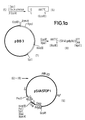
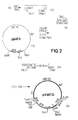
- FIGS. 1 to 3 the drawings generally not being to scale.
- small fragments and polylinker sequences are usually shown "stretched".
- the plasmid pSV2dhfr (Fig. 1) (Lee et al., Loc. Cit.) was cut with HindIII and EcoRI and the 2.65 kb vector fragment carrying the SV40 "early" promoter was isolated.
- a 67 bp HindIII-EcoRI fragment from pUC12 STOP (Bröker and Amann, loc. Cit.) was ligated into the vector pretreated in this way, which leads to the plasmid pSV2 STOP.
- Translation stop codons in all three are located on the 67 bp fragment from pUC12 STOP Reading frames.
- pSV2 STOP was linearized with SacI and the resulting 3 'overhang was removed using the 3' ⁇ 5 'exonuclease activity of DNA polymerase I. It was then digested with EcoRI. After ligation with a 133 bp EcoRI-HpaI fragment from pBB3 (Fig. 1a) (B. Bourachot et al., EMBO J. l (1982) 895-900), which carries the SV40 polyadenylation signal for early transcripts the expression vector pSVA STOP1 can be obtained.
- the polyadenylation site can also be isolated from the vector pIG6 (Bourachot et al., Op. Cit.). In the same way, the 133 bp BamHI-HpaI fragment can be isolated from the SV40 genome, the BamHI site filled up and an EcoRI linker attached.
- pSVA STOP1 thus carries a cloning polylinker with three unique restriction sites (HindIII-SalI-XbaI) and a sequence with translation stops in all three reading frames between the SV40 "early" promoter and the SV40 polyadenylation signal for early transcripts.
- the ATIII cDNA is known from EP-A2 0 090 505 and can be prepared as described there or synthesized by conventional methods.
- the German patent application P 36 18 638.4 proposes the plasmid pßAT6 (FIG. 1) which contains the ATIII cDNA in the SmaI site of the plasmid pUC13.
- the subcloning plasmid for ATIII cDNA, pßAT6 (Fig. 2), was linearized by cutting at the unique EcoRI site. The resulting 5 'overhang was made blunt-ended by filling in the counter strand with DNA polymerase I (Klenow fragment) and then with the SalI linker 5'd (pGGTCGACC) 3 ' ligated. Subsequent XbaI digestion failed DNA fragment of approximately 1400 bp which codes for the complete Prae-ATIII can be isolated. pSVATIII was obtained by ligating this fragment into the expression vector pSVASTOP1 cut with SalI and XbaI. The ATIII transcription unit on pSVATIII has no m-RNA "splice sites".
- the starting point for the DHFR vectors used for cotransfection was the plasmid pMTVdhfr (Lee et al., Op. Cit.).
- pMTVdhfr (FIG. 3) was cut with BglII and the protruding 5 'ends of the DNA were filled in using DNA polymerase I (Klenow fragment). After digestion with EcoRI, a 4.47 kb fragment was isolated and ligated with a 133 bp EcoRI-HpaI fragment from pBB3 (Bourachot et al., Op. Cit.).
- the new plasmid pMTVAdhfr carries the mouse DHFR cDNA, flanked by the MMTV-LTR and the SV40 polyadenylation site for early transcripts.
- pSVOAdhfr was obtained from pMTVAdhfr by deleting a 1450 bp HindIII fragment carrying the MMTV-LTR.
- pMTVAdhfr nor pSVOAdhfr have m-RNA "splice sites”.
- the plasmids pSVATIII and pMTVAdhfr and pSVOAdhfr were co-transfected into CHO-dhfr ⁇ cells using the calcium phosphate precipitation method (Graham and von der Eb, Virology 52 (1973) 456-467).
- 20 ⁇ g of the plasmid pSVATIII were mixed with 5 ⁇ g of the DHFR expression plasmids pMTVAdhfr or pSVOAdhfr and coprecipitated.
- the coprecipitate of the plasmid mixture was, as described above (0.5 x 10⁶ cells in 25 cm2 culture bottle), transfected in CHO-dhfr cells.
- the cells were trypsinized, transferred to several 60 mm petri dishes and selection medium (without glycine, hypoxanthine and thymidine) was added. Only those cells that have been stably transfected with the DHFR gene survive under these conditions.
- CHO SVAT III-MTVAdhfr (clones 1 and 2) and CHO SVAT-III-SVOAdhfr (clones 1 and 2) were successively converted into increasing methotrexate (Mtx) concentrations.
- Mtx methotrexate
- the following expression rates ( ⁇ g / 106 cells / 24 h) were determined using the standard method described above: Mtx CHO SVAT III-pMTVAdhfr CHO SVAT III-SVOAdhfr Clone 1 Clone 2 Clone 1 Clone 2 0 0.14 0.11 0.08 0.14 0.05 0.34 0.54 - - 0.15 - 0.60 0.64 2.7 0.3 0.55 1.15 - 3.3 0.6 1.18 2.00 0.86 - 1 - - 1.5 - 5 ⁇ M - 4.00 - 8.5
- 0.1 ⁇ M and 1 ⁇ M were used as Mtx concentration levels.
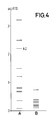
- 8 (“B” in FIG. 4) and starting from CHO SVAT III-SVOAdhfr (clone 1) 11 (“A” in FIG. 4) were compared to 0.1 ⁇ M Mtx resistant clones isolated and characterized in terms of their expression rates (FIG. 4); the ordinate shows the yield of ATIII in ⁇ g / 106 cells / 24 h. All of these clones produce a larger amount of ATIII than the corresponding starting clone (see above).
- the expression rates of the clones growing at 0.1 ⁇ M Mtx are based on CHO SVAT III-MTVAdhfr (clone 2) between 0.15 and 0.8 ⁇ g / 106 cells / 24 h (corresponding to an increase by a factor of 1.4 - 7) and based on CHO SVAT III-SVOAdhfr (clone 1) between 0.35 and 3.2 ⁇ g / 106 cells / 24 h (corresponding to an increase by a factor of 4 - 40).
- “Southern blots” (Southern, J. Mol. Biol. 98 (1975) 503) it could be shown that in all clones analyzed growing at 0.1 ⁇ M Mtx a specific 1400 bp BamHI-HindIII fragment from the transfected ATIII -cDNA is amplified.
- the CHO SVAT III-SVOAdhfr clone 1A27 (1 ⁇ M Mtx) was grown in 175 cm2 culture bottles in HamF12 selection medium (without glycine, thymidine and hypoxanthine) in the presence of 10% (v / v) fetal calf serum to about 80% confluency Cells were then washed with serum-free Iskoves medium and then held in this medium for 48 hours to produce ATIII. After this period, ATIII was present in the medium at a concentration of 5-6 ⁇ g / ml. The cells were then kept in serum-containing medium for 24-48 h until a further 48 h production round in serum-free medium began. The described production cycle could be repeated several times without a drop in the ATIII expression rates.
- ATIII was enriched from both serum-containing and serum-free media by means of affinity chromatography on heparin-SEPHAROSE (R) (Miller-Anderssen et al., Thromb. Res. 5 (1974) 439-452).
- the enriched material showed in the immunodiffusion test according to Ouchterlony (Prog. Allergy 5, (1958) 1) immunological identity with ATIII obtained from human serum. Also in the "Western blot" with ATIII-specific antibodies, there was identity between the recombinant ATIII obtained from human plasma and that obtained from CHO cells.
- AT III secreted by CHO cells had both heparin cofactor (Hensen and Loeliger, Thromb. Diath. Haemah. 9 (1963) Suppl. 1, 18-29) and progressive inhibitor activity (Schrader et al., Physician's Lab. 29 (1983) 35-39) in full.
Landscapes
- Health & Medical Sciences (AREA)
- Genetics & Genomics (AREA)
- Chemical & Material Sciences (AREA)
- Organic Chemistry (AREA)
- Life Sciences & Earth Sciences (AREA)
- Engineering & Computer Science (AREA)
- Zoology (AREA)
- Biochemistry (AREA)
- General Engineering & Computer Science (AREA)
- Molecular Biology (AREA)
- General Health & Medical Sciences (AREA)
- Bioinformatics & Cheminformatics (AREA)
- Biotechnology (AREA)
- Wood Science & Technology (AREA)
- Biophysics (AREA)
- Biomedical Technology (AREA)
- Microbiology (AREA)
- Plant Pathology (AREA)
- Physics & Mathematics (AREA)
- Gastroenterology & Hepatology (AREA)
- Medicinal Chemistry (AREA)
- Proteomics, Peptides & Aminoacids (AREA)
- Preparation Of Compounds By Using Micro-Organisms (AREA)
- Medicines That Contain Protein Lipid Enzymes And Other Medicines (AREA)
- Micro-Organisms Or Cultivation Processes Thereof (AREA)
- Pharmaceuticals Containing Other Organic And Inorganic Compounds (AREA)
- Medicines Containing Material From Animals Or Micro-Organisms (AREA)
- Peptides Or Proteins (AREA)
Claims (20)
- Procédé pour la production d'antithrombine III (ATIII) humaine en culture de cellules mammaliennes, à l'aide d'un vecteur d'expression qui contient l'ADNc d'ATIII, caractérisé en ce que, en tant que cellule mammalienne, on utilise une cellule dhfr⁻ qui est co-transfectée avec un autre vecteur qui porte un gène DHFR qui est contrôlé par un promoteur faible.
- Procédé selon la revendication 1, caractérisé en ce qu'aucun promoteur viral ou d'eucaryote n'est disposé avant le gène DHFR.
- Procédé selon la revendication 1 ou 2, caractérisé en ce que le gène DHFR fait suite en aval à la région ori de pBR322.
- Procédé selon la revendication 1, 2 ou 3, caractérisé en ce que le gène DHFR fait suite en aval à la région ori d'un segment de pBR322 qui contient un marqueur de sélection.
- Procédé selon la revendication 4, caractérisé en ce que le marqueur de sélection est le gène de résistance à l'ampicilline.
- Procédé selon la revendication 4 ou 5, caractérisé en ce que, comme segment de pBR322, on utilise le fragment EcoRI-PvuII.
- Procédé selon une ou plusieurs des revendications précédentes, caractérisé en ce que le gène ATIII est sous le contrôle d'un promoteur viral.
- Procédé selon une ou plusieurs des revendications précédentes, caractérisé en ce que les vecteurs ne contiennent pas de "site d'épissage".
- Procédé selon une ou plusieurs des revendications précédentes, caractérisé en ce que le gène DHFR est amplifié, conjointement avec le gène ATIII, à l'aide de méthotrexate.
- Procédé selon une ou plusieurs des revendications précédentes, caractérisé en ce que la production d'ATIII s'effectue en milieu exempt de sérum.
- Vecteur d'expression comportant des séquences de pBR322 et l'ADNc d'ATIII, caractérisé par une séquence de promoteur de SV40, un site de polyadénylation de SV40 et l'absence de "sites d'épissage".
- Vecteur selon la revendication 11, caractérisé en ce que le site de polyadénylation est essentiellement le fragment BamHI-HpaI de 133 pb.
- Vecteur selon la revendication 11 ou 12, caractérisé par la séquence d'arrêt de traduction provenant de pUC12 STOP.
- Plasmides pSV2 STOP (figure 1) et pSVA STOP1 (figure la).
- Plasmide pSVATIII (figure 2).
- Vecteur comportant le gène DHFR murin, caractérisé en ce que le gène DHFR est contrôlé par un promoteur faible et le vecteur ne contient pas de "site d'épissage".
- Vecteur selon la revendication 16, caractérisé par un site de polyadénylation de SV40.
- Plasmides pMTVAdhfr et pSVOAdhfr (figure 3).
- Cellule mammalienne co-transfectée, d'une part, par un vecteur selon les revendications 11 à 15 et, d'autre part, par un vecteur selon les revendications 16 à 18.
- Cellule selon la revendication 19, sélectionnée à l'aide de méthotrexate.
Priority Applications (1)
| Application Number | Priority Date | Filing Date | Title |
|---|---|---|---|
| AT87110027T ATE85348T1 (de) | 1986-07-19 | 1987-07-11 | Verfahren zur herstellung von humanem antithrombin-iii (atiii) und dafuer geeignete vektoren. |
Applications Claiming Priority (2)
| Application Number | Priority Date | Filing Date | Title |
|---|---|---|---|
| DE19863624453 DE3624453A1 (de) | 1986-07-19 | 1986-07-19 | Verfahren zur herstellung von humanem antithrombin iii (atiii), dafuer geeignete vektoren und wirtszellen, so erhaltenes, biologisch aktives atiii und dieses enthaltende arzneimittel |
| DE3624453 | 1986-07-19 |
Publications (3)
| Publication Number | Publication Date |
|---|---|
| EP0256302A2 EP0256302A2 (fr) | 1988-02-24 |
| EP0256302A3 EP0256302A3 (en) | 1989-11-02 |
| EP0256302B1 true EP0256302B1 (fr) | 1993-02-03 |
Family
ID=6305549
Family Applications (1)
| Application Number | Title | Priority Date | Filing Date |
|---|---|---|---|
| EP87110027A Expired - Lifetime EP0256302B1 (fr) | 1986-07-19 | 1987-07-11 | Procédé de production d'antithrombine III (ATIII) humaine et les vecteurs appropriés |
Country Status (11)
| Country | Link |
|---|---|
| EP (1) | EP0256302B1 (fr) |
| JP (2) | JP2721158B2 (fr) |
| AT (1) | ATE85348T1 (fr) |
| AU (1) | AU610830B2 (fr) |
| CA (1) | CA1305932C (fr) |
| DE (2) | DE3624453A1 (fr) |
| DK (1) | DK174993B1 (fr) |
| ES (1) | ES2053476T3 (fr) |
| FI (1) | FI94425C (fr) |
| GR (1) | GR3007700T3 (fr) |
| PT (1) | PT85346B (fr) |
Families Citing this family (3)
| Publication number | Priority date | Publication date | Assignee | Title |
|---|---|---|---|---|
| JPH03215430A (ja) * | 1990-01-19 | 1991-09-20 | Kita Kiyoshi | 関節腔抗凝固剤 |
| DE3901917A1 (de) * | 1989-01-24 | 1990-07-26 | Behringwerke Ag | Mutanten von humanem antithrombin iii |
| CN1596310A (zh) * | 2001-11-28 | 2005-03-16 | 桑多斯有限公司 | 产生重组多肽的方法 |
Family Cites Families (7)
| Publication number | Priority date | Publication date | Assignee | Title |
|---|---|---|---|---|
| JPS597693B2 (ja) * | 1978-01-07 | 1984-02-20 | 株式会社ミドリ十字 | 抗トロンビン製剤及びその製法 |
| JPS5846100A (ja) * | 1981-09-11 | 1983-03-17 | Agency Of Ind Science & Technol | 3種の遺伝標識を有するプラスミドベクタ−及びその製造方法 |
| EP0090505B1 (fr) * | 1982-03-03 | 1990-08-08 | Genentech, Inc. | Antithrombine III humaine, séquences d'ADN pour celli-ci, vecteurs de clonage et d'expression contenant ces sequences et cultures de cellules transformées par ceux-ci, procédé pour exprimer l'antithrombine III humaine et compositions pharmaceutiques la contenant |
| EP0103632B1 (fr) * | 1982-03-15 | 1990-12-19 | The Trustees Of Columbia University In The City Of New York | Procede d'introduction de genes clones, amplifiables, dans des cellules eucaryotes et de production de produits proteiniques |
| IL73854A0 (en) * | 1983-12-27 | 1985-03-31 | Genetics Inst | Vectors containing accessory dna for transformation of eucaryotic cells |
| IL71691A (en) * | 1984-04-27 | 1991-04-15 | Yeda Res & Dev | Production of interferon-ypsilon |
| US4656254A (en) * | 1985-12-02 | 1987-04-07 | Miles Laboratories, Inc. | Method of preparing alpha-1-proteinase inhibitor and antithrombin III |
-
1986
- 1986-07-19 DE DE19863624453 patent/DE3624453A1/de not_active Withdrawn
-
1987
- 1987-07-11 DE DE8787110027T patent/DE3783968D1/de not_active Expired - Lifetime
- 1987-07-11 EP EP87110027A patent/EP0256302B1/fr not_active Expired - Lifetime
- 1987-07-11 ES ES87110027T patent/ES2053476T3/es not_active Expired - Lifetime
- 1987-07-11 AT AT87110027T patent/ATE85348T1/de not_active IP Right Cessation
- 1987-07-16 PT PT85346A patent/PT85346B/pt unknown
- 1987-07-16 FI FI873153A patent/FI94425C/fi not_active IP Right Cessation
- 1987-07-17 DK DK198703751A patent/DK174993B1/da not_active IP Right Cessation
- 1987-07-17 CA CA000542428A patent/CA1305932C/fr not_active Expired - Lifetime
- 1987-07-17 AU AU75773/87A patent/AU610830B2/en not_active Expired
- 1987-07-18 JP JP62179879A patent/JP2721158B2/ja not_active Expired - Lifetime
-
1993
- 1993-04-27 GR GR930400430T patent/GR3007700T3/el unknown
-
1996
- 1996-10-16 JP JP8273823A patent/JP2798659B2/ja not_active Expired - Lifetime
Also Published As
| Publication number | Publication date |
|---|---|
| GR3007700T3 (fr) | 1993-08-31 |
| AU7577387A (en) | 1988-03-03 |
| DK174993B1 (da) | 2004-04-13 |
| EP0256302A2 (fr) | 1988-02-24 |
| EP0256302A3 (en) | 1989-11-02 |
| DK375187A (da) | 1988-01-20 |
| FI873153L (fi) | 1988-01-20 |
| ATE85348T1 (de) | 1993-02-15 |
| ES2053476T3 (es) | 1994-08-01 |
| JP2798659B2 (ja) | 1998-09-17 |
| AU610830B2 (en) | 1991-05-30 |
| JPS6344898A (ja) | 1988-02-25 |
| PT85346A (de) | 1987-08-01 |
| FI94425B (fi) | 1995-05-31 |
| DK375187D0 (da) | 1987-07-17 |
| FI94425C (fi) | 1995-09-11 |
| JPH09117293A (ja) | 1997-05-06 |
| PT85346B (pt) | 1990-06-29 |
| CA1305932C (fr) | 1992-08-04 |
| JP2721158B2 (ja) | 1998-03-04 |
| DE3624453A1 (de) | 1988-01-28 |
| FI873153A0 (fi) | 1987-07-16 |
| DE3783968D1 (de) | 1993-03-18 |
Similar Documents
| Publication | Publication Date | Title |
|---|---|---|
| DE3880468T2 (de) | Rekombinante dns-expressionsvektoren. | |
| DE3788289T2 (de) | Rekombinanter Proteinkomplex mit Humanfaktor-VIII:C-Aktivität, seine Herstellung und Anwendung. | |
| DE3880922T2 (de) | Faktor viii-analog, verfahren zu dessen herstellung und dieses enthaltende zusammensetzung. | |
| DE3586304T3 (de) | Verfahren zur Herstellung von Proteinen und transformierten Zellen und DNA-Konstruktionen zur Korrektur von Mankos und Wirtszellen sowie deren Herstellung und Verwendung. | |
| EP0409113B1 (fr) | Mutéines de l'érythropoiétine humaine, leur fabrication et leur utilisation | |
| DE3851289T2 (de) | Verfahren zur Züchtung rekombinanter Zellen. | |
| DE69033301T2 (de) | Erythropoietin- Analoge | |
| DE69032609T2 (de) | Metalloproteinase-Inhibitoren | |
| EP0986644B1 (fr) | Production d'erythropoietine par activation genique endogene avec des promoteurs viraux | |
| DE69004966T2 (de) | Antikoagulierendes protein. | |
| DE69027526T2 (de) | Herstellung von proteinen mittels homologer rekombination | |
| DE3884610T2 (de) | Durch sterole regulierbare promoterelemente. | |
| DE69034040T2 (de) | Rekombinanter Abkömmling des menschlichen Faktors VIII | |
| DE69030740T2 (de) | Rekombinantes DNS-Verfahren und Wirtszellen | |
| DE3720246A1 (de) | Faktor viii:c-aehnliches molekuel mit koagulationsaktivitaet | |
| DE69634819T2 (de) | Reguliertes autokrines wachstum von säugerzellen | |
| DE69032043T2 (de) | Proteinkomplexe mit faktor viii:c-aktivität und deren herstellung | |
| DE69101634T2 (de) | Rekombinant hergestellte blutfaktoren, verfahren zur exprimierung besagter blutfaktoren sowie in besagtem prozess verwendeter rekombinanter vaccina-virus. | |
| DE69331551T2 (de) | Rinder-"hitzeschock"-promoter und dessen verwendung | |
| EP0256302B1 (fr) | Procédé de production d'antithrombine III (ATIII) humaine et les vecteurs appropriés | |
| DE3787044T2 (de) | Transformant einer tierischen Zelle, Verfahren zur Herstellung des Transformanten und dessen Verwendung zur Präparation eines gewünschten Fremdgenproduktes. | |
| DE3750348T2 (de) | Verfahren zur Herstellung von Peptiden, dazu zu verwendendes rekombinantes Plasmid und mit diesem Plasmid transformierte Myelomzellen. | |
| DE3887635T2 (de) | Verfahren zur Herstellung von Produkten von Fremdgenen. | |
| DE69034104T2 (de) | Herstellung von heteropolymeren Proteinen | |
| DE3806617A1 (de) | Erzeugung hochexprimierender, rekombinanter, eukaryotischer zellen |
Legal Events
| Date | Code | Title | Description |
|---|---|---|---|
| PUAI | Public reference made under article 153(3) epc to a published international application that has entered the european phase |
Free format text: ORIGINAL CODE: 0009012 |
|
| AK | Designated contracting states |
Kind code of ref document: A2 Designated state(s): AT BE CH DE ES FR GB GR IT LI LU NL SE |
|
| PUAL | Search report despatched |
Free format text: ORIGINAL CODE: 0009013 |
|
| AK | Designated contracting states |
Kind code of ref document: A3 Designated state(s): AT BE CH DE ES FR GB GR IT LI LU NL SE |
|
| 17P | Request for examination filed |
Effective date: 19900329 |
|
| 17Q | First examination report despatched |
Effective date: 19910425 |
|
| GRAA | (expected) grant |
Free format text: ORIGINAL CODE: 0009210 |
|
| AK | Designated contracting states |
Kind code of ref document: B1 Designated state(s): AT BE CH DE ES FR GB GR IT LI LU NL SE |
|
| REF | Corresponds to: |
Ref document number: 85348 Country of ref document: AT Date of ref document: 19930215 Kind code of ref document: T |
|
| ITF | It: translation for a ep patent filed | ||
| REF | Corresponds to: |
Ref document number: 3783968 Country of ref document: DE Date of ref document: 19930318 |
|
| ET | Fr: translation filed | ||
| GBT | Gb: translation of ep patent filed (gb section 77(6)(a)/1977) |
Effective date: 19930416 |
|
| REG | Reference to a national code |
Ref country code: GR Ref legal event code: FG4A Free format text: 3007700 |
|
| PLBE | No opposition filed within time limit |
Free format text: ORIGINAL CODE: 0009261 |
|
| STAA | Information on the status of an ep patent application or granted ep patent |
Free format text: STATUS: NO OPPOSITION FILED WITHIN TIME LIMIT |
|
| 26N | No opposition filed | ||
| REG | Reference to a national code |
Ref country code: ES Ref legal event code: FG2A Ref document number: 2053476 Country of ref document: ES Kind code of ref document: T3 |
|
| EPTA | Lu: last paid annual fee | ||
| EAL | Se: european patent in force in sweden |
Ref document number: 87110027.7 |
|
| REG | Reference to a national code |
Ref country code: GB Ref legal event code: IF02 |
|
| PGFP | Annual fee paid to national office [announced via postgrant information from national office to epo] |
Ref country code: AT Payment date: 20060614 Year of fee payment: 20 |
|
| PGFP | Annual fee paid to national office [announced via postgrant information from national office to epo] |
Ref country code: NL Payment date: 20060615 Year of fee payment: 20 |
|
| PGFP | Annual fee paid to national office [announced via postgrant information from national office to epo] |
Ref country code: FR Payment date: 20060619 Year of fee payment: 20 |
|
| PGFP | Annual fee paid to national office [announced via postgrant information from national office to epo] |
Ref country code: SE Payment date: 20060621 Year of fee payment: 20 Ref country code: GB Payment date: 20060621 Year of fee payment: 20 Ref country code: CH Payment date: 20060621 Year of fee payment: 20 |
|
| PGFP | Annual fee paid to national office [announced via postgrant information from national office to epo] |
Ref country code: BE Payment date: 20060711 Year of fee payment: 20 |
|
| PGFP | Annual fee paid to national office [announced via postgrant information from national office to epo] |
Ref country code: GR Payment date: 20060719 Year of fee payment: 20 |
|
| PGFP | Annual fee paid to national office [announced via postgrant information from national office to epo] |
Ref country code: IT Payment date: 20060731 Year of fee payment: 20 Ref country code: DE Payment date: 20060731 Year of fee payment: 20 |
|
| PGFP | Annual fee paid to national office [announced via postgrant information from national office to epo] |
Ref country code: ES Payment date: 20060823 Year of fee payment: 20 |
|
| PGFP | Annual fee paid to national office [announced via postgrant information from national office to epo] |
Ref country code: LU Payment date: 20060829 Year of fee payment: 20 |
|
| PG25 | Lapsed in a contracting state [announced via postgrant information from national office to epo] |
Ref country code: NL Free format text: LAPSE BECAUSE OF EXPIRATION OF PROTECTION Effective date: 20070711 |
|
| REG | Reference to a national code |
Ref country code: GB Ref legal event code: PE20 |
|
| REG | Reference to a national code |
Ref country code: CH Ref legal event code: PL |
|
| NLV7 | Nl: ceased due to reaching the maximum lifetime of a patent |
Effective date: 20070711 |
|
| EUG | Se: european patent has lapsed | ||
| REG | Reference to a national code |
Ref country code: ES Ref legal event code: FD2A Effective date: 20070712 |
|
| PG25 | Lapsed in a contracting state [announced via postgrant information from national office to epo] |
Ref country code: GB Free format text: LAPSE BECAUSE OF EXPIRATION OF PROTECTION Effective date: 20070710 |
|
| BE20 | Be: patent expired |
Owner name: *BEHRINGWERKE A.G. Effective date: 20070711 |
|
| PG25 | Lapsed in a contracting state [announced via postgrant information from national office to epo] |
Ref country code: ES Free format text: LAPSE BECAUSE OF EXPIRATION OF PROTECTION Effective date: 20070712 |