EP0260833A2 - Verfahren zur Herstellung von Polyamidsäure mit Siloxanbindungen und von Polyimid mit Siloxanbindungen und Isoindolochinazolindion-Ringen - Google Patents
Verfahren zur Herstellung von Polyamidsäure mit Siloxanbindungen und von Polyimid mit Siloxanbindungen und Isoindolochinazolindion-Ringen Download PDFInfo
- Publication number
- EP0260833A2 EP0260833A2 EP87307571A EP87307571A EP0260833A2 EP 0260833 A2 EP0260833 A2 EP 0260833A2 EP 87307571 A EP87307571 A EP 87307571A EP 87307571 A EP87307571 A EP 87307571A EP 0260833 A2 EP0260833 A2 EP 0260833A2
- Authority
- EP
- European Patent Office
- Prior art keywords
- dianhydride
- producing
- polyamide acid
- formula
- diamine
- Prior art date
- Legal status (The legal status is an assumption and is not a legal conclusion. Google has not performed a legal analysis and makes no representation as to the accuracy of the status listed.)
- Granted
Links
- 239000004952 Polyamide Substances 0.000 title claims abstract description 53
- 239000002253 acid Substances 0.000 title claims abstract description 52
- 229920002647 polyamide Polymers 0.000 title claims abstract description 52
- 239000004642 Polyimide Substances 0.000 title claims abstract description 31
- 229920001721 polyimide Polymers 0.000 title claims abstract description 28
- 238000000034 method Methods 0.000 title claims abstract description 21
- XUAIYERAFHFMGZ-UHFFFAOYSA-N isoindolo[4,5-h]quinazoline-6,8-dione Chemical group C1=C2C=NC=C2C2=CC=C3C(=O)NC(=O)N=C3C2=C1 XUAIYERAFHFMGZ-UHFFFAOYSA-N 0.000 title claims abstract description 8
- GTDPSWPPOUPBNX-UHFFFAOYSA-N ac1mqpva Chemical compound CC12C(=O)OC(=O)C1(C)C1(C)C2(C)C(=O)OC1=O GTDPSWPPOUPBNX-UHFFFAOYSA-N 0.000 claims abstract description 59
- 125000006158 tetracarboxylic acid group Chemical group 0.000 claims abstract description 24
- -1 diaminoamide compound Chemical class 0.000 claims abstract description 22
- 125000003118 aryl group Chemical group 0.000 claims abstract description 19
- 150000004985 diamines Chemical class 0.000 claims abstract description 17
- 238000010438 heat treatment Methods 0.000 claims abstract description 14
- 230000018044 dehydration Effects 0.000 claims abstract description 11
- 238000006297 dehydration reaction Methods 0.000 claims abstract description 11
- 238000006243 chemical reaction Methods 0.000 claims abstract description 9
- 238000006798 ring closing metathesis reaction Methods 0.000 claims abstract description 8
- 125000001183 hydrocarbyl group Chemical group 0.000 claims abstract description 7
- 125000003277 amino group Chemical group 0.000 claims abstract description 5
- 229940124530 sulfonamide Drugs 0.000 claims description 18
- VHRGRCVQAFMJIZ-UHFFFAOYSA-N cadaverine Chemical compound NCCCCCN VHRGRCVQAFMJIZ-UHFFFAOYSA-N 0.000 claims description 6
- NAQMVNRVTILPCV-UHFFFAOYSA-N hexane-1,6-diamine Chemical compound NCCCCCCN NAQMVNRVTILPCV-UHFFFAOYSA-N 0.000 claims description 6
- KIDHWZJUCRJVML-UHFFFAOYSA-N putrescine Chemical compound NCCCCN KIDHWZJUCRJVML-UHFFFAOYSA-N 0.000 claims description 6
- XFNJVJPLKCPIBV-UHFFFAOYSA-N trimethylenediamine Chemical compound NCCCN XFNJVJPLKCPIBV-UHFFFAOYSA-N 0.000 claims description 6
- CBCKQZAAMUWICA-UHFFFAOYSA-N 1,4-phenylenediamine Chemical compound NC1=CC=C(N)C=C1 CBCKQZAAMUWICA-UHFFFAOYSA-N 0.000 claims description 5
- VLDPXPPHXDGHEW-UHFFFAOYSA-N 1-chloro-2-dichlorophosphoryloxybenzene Chemical compound ClC1=CC=CC=C1OP(Cl)(Cl)=O VLDPXPPHXDGHEW-UHFFFAOYSA-N 0.000 claims description 5
- WZCQRUWWHSTZEM-UHFFFAOYSA-N 1,3-phenylenediamine Chemical compound NC1=CC=CC(N)=C1 WZCQRUWWHSTZEM-UHFFFAOYSA-N 0.000 claims description 3
- PWGJDPKCLMLPJW-UHFFFAOYSA-N 1,8-diaminooctane Chemical compound NCCCCCCCCN PWGJDPKCLMLPJW-UHFFFAOYSA-N 0.000 claims description 3
- HLBLWEWZXPIGSM-UHFFFAOYSA-N 4-Aminophenyl ether Chemical compound C1=CC(N)=CC=C1OC1=CC=C(N)C=C1 HLBLWEWZXPIGSM-UHFFFAOYSA-N 0.000 claims description 3
- AJYDKROUZBIMLE-UHFFFAOYSA-N 4-[2-[2-[2-(4-aminophenoxy)phenyl]propan-2-yl]phenoxy]aniline Chemical compound C=1C=CC=C(OC=2C=CC(N)=CC=2)C=1C(C)(C)C1=CC=CC=C1OC1=CC=C(N)C=C1 AJYDKROUZBIMLE-UHFFFAOYSA-N 0.000 claims description 3
- UHOVQNZJYSORNB-UHFFFAOYSA-N Benzene Chemical compound C1=CC=CC=C1 UHOVQNZJYSORNB-UHFFFAOYSA-N 0.000 claims description 3
- PIICEJLVQHRZGT-UHFFFAOYSA-N Ethylenediamine Chemical compound NCCN PIICEJLVQHRZGT-UHFFFAOYSA-N 0.000 claims description 3
- 125000000217 alkyl group Chemical group 0.000 claims description 3
- 125000004432 carbon atom Chemical group C* 0.000 claims description 3
- VKIRRGRTJUUZHS-UHFFFAOYSA-N cyclohexane-1,4-diamine Chemical compound NC1CCC(N)CC1 VKIRRGRTJUUZHS-UHFFFAOYSA-N 0.000 claims description 3
- PWSKHLMYTZNYKO-UHFFFAOYSA-N heptane-1,7-diamine Chemical compound NCCCCCCCN PWSKHLMYTZNYKO-UHFFFAOYSA-N 0.000 claims description 3
- OBKARQMATMRWQZ-UHFFFAOYSA-N naphthalene-1,2,5,6-tetracarboxylic acid Chemical compound OC(=O)C1=C(C(O)=O)C=CC2=C(C(O)=O)C(C(=O)O)=CC=C21 OBKARQMATMRWQZ-UHFFFAOYSA-N 0.000 claims description 3
- KQSABULTKYLFEV-UHFFFAOYSA-N naphthalene-1,5-diamine Chemical compound C1=CC=C2C(N)=CC=CC2=C1N KQSABULTKYLFEV-UHFFFAOYSA-N 0.000 claims description 3
- DOBFTMLCEYUAQC-UHFFFAOYSA-N naphthalene-2,3,6,7-tetracarboxylic acid Chemical compound OC(=O)C1=C(C(O)=O)C=C2C=C(C(O)=O)C(C(=O)O)=CC2=C1 DOBFTMLCEYUAQC-UHFFFAOYSA-N 0.000 claims description 3
- GOGZBMRXLADNEV-UHFFFAOYSA-N naphthalene-2,6-diamine Chemical compound C1=C(N)C=CC2=CC(N)=CC=C21 GOGZBMRXLADNEV-UHFFFAOYSA-N 0.000 claims description 3
- YTVNOVQHSGMMOV-UHFFFAOYSA-N naphthalenetetracarboxylic dianhydride Chemical compound C1=CC(C(=O)OC2=O)=C3C2=CC=C2C(=O)OC(=O)C1=C32 YTVNOVQHSGMMOV-UHFFFAOYSA-N 0.000 claims description 3
- JRDBISOHUUQXHE-UHFFFAOYSA-N pyridine-2,3,5,6-tetracarboxylic acid Chemical compound OC(=O)C1=CC(C(O)=O)=C(C(O)=O)N=C1C(O)=O JRDBISOHUUQXHE-UHFFFAOYSA-N 0.000 claims description 3
- MQJKPEGWNLWLTK-UHFFFAOYSA-N Dapsone Chemical compound C1=CC(N)=CC=C1S(=O)(=O)C1=CC=C(N)C=C1 MQJKPEGWNLWLTK-UHFFFAOYSA-N 0.000 claims 2
- 125000005521 carbonamide group Chemical group 0.000 claims 2
- ZZTCPWRAHWXWCH-UHFFFAOYSA-N diphenylmethanediamine Chemical compound C=1C=CC=CC=1C(N)(N)C1=CC=CC=C1 ZZTCPWRAHWXWCH-UHFFFAOYSA-N 0.000 claims 2
- 150000003456 sulfonamides Chemical class 0.000 claims 1
- 150000000000 tetracarboxylic acids Chemical class 0.000 claims 1
- FXHOOIRPVKKKFG-UHFFFAOYSA-N N,N-Dimethylacetamide Chemical compound CN(C)C(C)=O FXHOOIRPVKKKFG-UHFFFAOYSA-N 0.000 description 8
- 238000001723 curing Methods 0.000 description 8
- 239000011521 glass Substances 0.000 description 7
- 238000003756 stirring Methods 0.000 description 7
- 239000003039 volatile agent Substances 0.000 description 7
- 239000013585 weight reducing agent Substances 0.000 description 6
- 239000002904 solvent Substances 0.000 description 5
- XZOQPRNOAGCWNT-UHFFFAOYSA-N 4-[[(3,4-dicarboxyphenyl)-dimethylsilyl]oxy-dimethylsilyl]phthalic acid Chemical compound C=1C=C(C(O)=O)C(C(O)=O)=CC=1[Si](C)(C)O[Si](C)(C)C1=CC=C(C(O)=O)C(C(O)=O)=C1 XZOQPRNOAGCWNT-UHFFFAOYSA-N 0.000 description 4
- 239000000203 mixture Substances 0.000 description 4
- 239000000758 substrate Substances 0.000 description 4
- ZMXDDKWLCZADIW-UHFFFAOYSA-N N,N-Dimethylformamide Chemical compound CN(C)C=O ZMXDDKWLCZADIW-UHFFFAOYSA-N 0.000 description 3
- 230000000052 comparative effect Effects 0.000 description 3
- 150000001875 compounds Chemical class 0.000 description 3
- 238000011156 evaluation Methods 0.000 description 3
- 239000012442 inert solvent Substances 0.000 description 3
- 230000000977 initiatory effect Effects 0.000 description 3
- GPXCORHXFPYJEH-UHFFFAOYSA-N 3-[[3-aminopropyl(dimethyl)silyl]oxy-dimethylsilyl]propan-1-amine Chemical compound NCCC[Si](C)(C)O[Si](C)(C)CCCN GPXCORHXFPYJEH-UHFFFAOYSA-N 0.000 description 2
- YEJRWHAVMIAJKC-UHFFFAOYSA-N 4-Butyrolactone Chemical compound O=C1CCCO1 YEJRWHAVMIAJKC-UHFFFAOYSA-N 0.000 description 2
- UXVMQQNJUSDDNG-UHFFFAOYSA-L Calcium chloride Chemical compound [Cl-].[Cl-].[Ca+2] UXVMQQNJUSDDNG-UHFFFAOYSA-L 0.000 description 2
- SECXISVLQFMRJM-UHFFFAOYSA-N N-Methylpyrrolidone Chemical compound CN1CCCC1=O SECXISVLQFMRJM-UHFFFAOYSA-N 0.000 description 2
- 229910001628 calcium chloride Inorganic materials 0.000 description 2
- 239000001110 calcium chloride Substances 0.000 description 2
- 238000013007 heat curing Methods 0.000 description 2
- 238000007363 ring formation reaction Methods 0.000 description 2
- 238000010998 test method Methods 0.000 description 2
- PYHOFAHZHOBVGV-UHFFFAOYSA-N triazane Chemical class NNN PYHOFAHZHOBVGV-UHFFFAOYSA-N 0.000 description 2
- IAZDPXIOMUYVGZ-UHFFFAOYSA-N Dimethylsulphoxide Chemical compound CS(C)=O IAZDPXIOMUYVGZ-UHFFFAOYSA-N 0.000 description 1
- OAKJQQAXSVQMHS-UHFFFAOYSA-N Hydrazine Chemical compound NN OAKJQQAXSVQMHS-UHFFFAOYSA-N 0.000 description 1
- SUAKHGWARZSWIH-UHFFFAOYSA-N N,N‐diethylformamide Chemical compound CCN(CC)C=O SUAKHGWARZSWIH-UHFFFAOYSA-N 0.000 description 1
- WHNWPMSKXPGLAX-UHFFFAOYSA-N N-Vinyl-2-pyrrolidone Chemical compound C=CN1CCCC1=O WHNWPMSKXPGLAX-UHFFFAOYSA-N 0.000 description 1
- XUIMIQQOPSSXEZ-UHFFFAOYSA-N Silicon Chemical compound [Si] XUIMIQQOPSSXEZ-UHFFFAOYSA-N 0.000 description 1
- 150000004984 aromatic diamines Chemical class 0.000 description 1
- 239000011230 binding agent Substances 0.000 description 1
- 239000003795 chemical substances by application Substances 0.000 description 1
- 239000011248 coating agent Substances 0.000 description 1
- 238000000576 coating method Methods 0.000 description 1
- 239000013065 commercial product Substances 0.000 description 1
- 238000001035 drying Methods 0.000 description 1
- ANSXAPJVJOKRDJ-UHFFFAOYSA-N furo[3,4-f][2]benzofuran-1,3,5,7-tetrone Chemical compound C1=C2C(=O)OC(=O)C2=CC2=C1C(=O)OC2=O ANSXAPJVJOKRDJ-UHFFFAOYSA-N 0.000 description 1
- GNOIPBMMFNIUFM-UHFFFAOYSA-N hexamethylphosphoric triamide Chemical compound CN(C)P(=O)(N(C)C)N(C)C GNOIPBMMFNIUFM-UHFFFAOYSA-N 0.000 description 1
- 239000011229 interlayer Substances 0.000 description 1
- 230000007774 longterm Effects 0.000 description 1
- 238000004519 manufacturing process Methods 0.000 description 1
- 229910052751 metal Inorganic materials 0.000 description 1
- 239000002184 metal Substances 0.000 description 1
- GJVYUQSNFGJLQM-UHFFFAOYSA-N n,n'-dicyclohexylmethanediimine;phosphoric acid Chemical compound OP(O)(O)=O.C1CCCCC1N=C=NC1CCCCC1 GJVYUQSNFGJLQM-UHFFFAOYSA-N 0.000 description 1
- 239000003960 organic solvent Substances 0.000 description 1
- 229920000642 polymer Polymers 0.000 description 1
- 239000002243 precursor Substances 0.000 description 1
- 230000001681 protective effect Effects 0.000 description 1
- 239000011541 reaction mixture Substances 0.000 description 1
- 239000004065 semiconductor Substances 0.000 description 1
- 229910052710 silicon Inorganic materials 0.000 description 1
- 239000010703 silicon Substances 0.000 description 1
- 238000004528 spin coating Methods 0.000 description 1
- HXJUTPCZVOIRIF-UHFFFAOYSA-N sulfolane Chemical compound O=S1(=O)CCCC1 HXJUTPCZVOIRIF-UHFFFAOYSA-N 0.000 description 1
- 150000003512 tertiary amines Chemical class 0.000 description 1
- 238000005979 thermal decomposition reaction Methods 0.000 description 1
- 239000002966 varnish Substances 0.000 description 1
Images

Classifications
-
- C—CHEMISTRY; METALLURGY
- C08—ORGANIC MACROMOLECULAR COMPOUNDS; THEIR PREPARATION OR CHEMICAL WORKING-UP; COMPOSITIONS BASED THEREON
- C08G—MACROMOLECULAR COMPOUNDS OBTAINED OTHERWISE THAN BY REACTIONS ONLY INVOLVING UNSATURATED CARBON-TO-CARBON BONDS
- C08G73/00—Macromolecular compounds obtained by reactions forming a linkage containing nitrogen with or without oxygen or carbon in the main chain of the macromolecule, not provided for in groups C08G12/00 - C08G71/00
- C08G73/06—Polycondensates having nitrogen-containing heterocyclic rings in the main chain of the macromolecule
- C08G73/10—Polyimides; Polyester-imides; Polyamide-imides; Polyamide acids or similar polyimide precursors
-
- C—CHEMISTRY; METALLURGY
- C08—ORGANIC MACROMOLECULAR COMPOUNDS; THEIR PREPARATION OR CHEMICAL WORKING-UP; COMPOSITIONS BASED THEREON
- C08G—MACROMOLECULAR COMPOUNDS OBTAINED OTHERWISE THAN BY REACTIONS ONLY INVOLVING UNSATURATED CARBON-TO-CARBON BONDS
- C08G73/00—Macromolecular compounds obtained by reactions forming a linkage containing nitrogen with or without oxygen or carbon in the main chain of the macromolecule, not provided for in groups C08G12/00 - C08G71/00
- C08G73/06—Polycondensates having nitrogen-containing heterocyclic rings in the main chain of the macromolecule
- C08G73/10—Polyimides; Polyester-imides; Polyamide-imides; Polyamide acids or similar polyimide precursors
- C08G73/1057—Polyimides containing other atoms than carbon, hydrogen, nitrogen or oxygen in the main chain
- C08G73/106—Polyimides containing other atoms than carbon, hydrogen, nitrogen or oxygen in the main chain containing silicon
Definitions
- This invention relates to a process for producing polyamide acid having siloxane bonds and polyimide having siloxane bonds and isoindoloquinazolinedione rings.
- Polyimide can be generally obtained by reacting a diamide with a tetracarboxylic dianhydride in an organic solvent to form a polyamide acid which is the precursor of a polyimide, and subjecting this to heating dehydration ring closure.
- a typical example known in the art is a polyamide acid represented by the following formula (III): obtained from pyromellitic dianhydride and diaminodiphenyl ether, which can be subjected to dehydration ring closure by heating to give a polyimide represented by the formula (IV) shown below:
- the polyamide acid having this structural unit is low in solubility in solvents, and therefore, it is difficult to prepare a solution of low viscosity at high concentration and, even if temporarily be made, there has been involved the problem of markedly poor viscosity stability.
- the present invention is intended to provide a process for producing a polyamide acid having siloxane bonds having a low viscosity at high temperature and yet excellent viscosity stability which can be formed into a polyimide at a relatively low temperature of 250 °C, and also a process for producing a polyimide having at least one siloxane bond and at least one isoindoloquinazolinedione ring excellent in heat resistance and adhesiveness obtained therefrom.
- the present invention concerns a process for producing a polyamide acid having at least one siloxane bond, which comprises carrying out the reaction of:
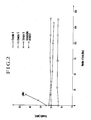
- Fig. 1 and Fig. 2 are graphs showing the tracing results of viscosity stabilities carried out in Examples and Comparative example, respectively.
- R represents an alkyl group having 1 to 13 carbon atoms or an aryl group.
- the tetracarboxylic dianhydride having a siloxane bond or bonds represented by the above formula (I) to be used in the present invention may include, for example, and the like.
- tetracarboxylic dianhydrides having a siloxane bond or bonds can be also used in a combination of two or more kinds.
- examples of the aromatic tetracarboxylic dianhydride to be used in the present invention may include pyromellitic dianhydride, 3,3 ⁇ ,4,4 ⁇ -benzophenonetetracarboxylic dianhydride, 3,3 ⁇ ,4,4 ⁇ -biphenyltetracarboxylic dianhydride, 3,3 ⁇ ,4,4 ⁇ -biphenylethertetracarboxylic dianhydride, 1,2,5,6-naphthalenetetracarboxylic dianhydride, 2,3,6,7-naphthalenetetracarboxylic dianhydride, 2,3,5,6-pyridinetetracarboxylic dianhydride, 1,4,5,8-naphthalenetetracarboxylic dianhydride, 3,4,9,10-perilenet
- diamine to be used in the present invention there may be employed ethylenediamine, 1,3-propanediamine, tetramethylenediamine, pentamethylenediamine, hexamethylenediamine, heptamethylenediamine, octamethylenediamine, 4,4 ⁇ -diaminodiphenylether, 1,4-diaminocyclohexane, 4,4 ⁇ -diaminodiphenylmethane, 4,4 ⁇ -diaminodiphenylsulfone, 4,4 ⁇ -diaminodiphenylsulfide, benzine, meta-phenylenediamine, para-phenylenediamine, 2,2-bis(4-aminophenoxyphenyl)propane, 1,5-naphthalenediamine, 2,6-naphthalenediamine and the like.
- an aromatic diamine amy be preferably used.
- diaminoamide compound represented by the above formula (II) to be used in the present invention there may be included, for example, 4,4 ⁇ -diaminodiphenylether-3-sulfonamide, 3,4 ⁇ -diaminodiphenylether-4-sulfonamide, 3,4 ⁇ -diaminodiphenylether-3 ⁇ -sulfonamide, 3,3 ⁇ -diaminodiphenylether-4-sulfonamide, 4,4 ⁇ -diaminodiphenylmethane-3-sulfonamide, 3,4 ⁇ -diaminodiphenylmethane-4-sulfonamide, 3,4 ⁇ -diaminodiphenylmethane-3 ⁇ -sulfonamide, 3,3 ⁇ -diaminodiphenylmethane-4-sulfonamide, 4,4 ⁇ -diaminodiphenylsulfone-3-sulfonamide, 3,4 ⁇ -d
- the total amount of the diamine and the diaminoamide compound in the case of using the diaminosiloxane as described above, this is included) and the total amount of the tetracarboxylic dianhydride having siloxane bond represented by the above formula (I) and the aromatic tetracarboxylic dianhydride are made substantially equal moles.
- a diaminosiloxane represented by the formula (V): wherein R1 represents a divalent hydrocarbon group, R2 represents a monovalent hydrocarbon group, R1, R2 being either the same or different, and m is an integer of 1 or more, can be used, and examples of the compound may include the following compounds: and the like.
- the diaminosiloxane may be preferably used in an amount of 0.1 to 10 mole % based on the total amount of the diamine and the diaminoamide compound in aspect of heat resistance of the polyimide obtained.
- an inert solvent is used.
- the solvent is not required to dissolve all of the monomeric compounds as mentionedd above, but particularly preferable solvent has the action of dissolving the polyamide acid formed.
- the inert solvent there may be employed on or more of such solvents as N-methyl-2-pyrrolidone, N,N-dimethylacetamide, N,N-dimethylformamide, N,N-diethylformamide, dimethyl sulfoxide, hexamethylphosphoramide, tetramethylenesulfone, ⁇ -butyrolactone, N-vinylpyrrolidone, etc.
- the above tetracarboxylic dianhydride having at lease one siloxane bond, aromatic tetracarboxylic dianhydride, diamine and diaminoamide compounds are dissolved as well as possible in the above inert solvent, and the reaction mixture is stirred while being maintained at a temperature of about 80 °C or lower, particular
- the reaction proceeds rapidly, and the viscosity of the reaction system is gradually elevated to form a polyamide acid.
- the polyamide acid thus obtained is stable as a varnish and useful as a commercial product, and can be used for obtaining a polyimide having at least one siloxane bond and at least one isoindoloquinazolinedione ring.
- dehydration ring closure is effected to give a polyimide having at least one siloxane bond and at least one isoindoloquinazolinedione ring.
- the dehydration ring closure reaction may be conducted by use of an acetic anhdyride, a tertiary amine, dicyclohexylcarbodiimide phosphate, etc. as the dehydration agent.
- the above polyamide acid may be casted onto a glass plate, etc. and dried to form a film, which may be then subjected to heating dehydration ring closure reaction.
- the solution of the polyamide acid had a concentration of non-volatiles of 25 % by weight and a viscosity of 1100 poise (25°C).
- the solution of the polyamide acid was heated at a temperature around 80 °C for control of viscosity, whereby the viscosity was lowered to 20 poise in 5 hours.
- the solution was applied on a glass plate and dried at 100 °C for 30 minutes, followed by heat curing in the range from 200°C to 350 °C to give a film of a polyimide with good flexibility.
- the film was evaluated according to the test methods shown below, and the results are shown in Table 1.
- the above solution controlled in viscosity was applied by spin coating, the coating after drying at 100 °C for 30 minutes was thermally cured in the range from 200 to 350 °C, and evaluation was performed according to the cross-cut test.
- Example 1 Similarly as in Example 1, 19.44 g (0.09 mole) of 4,4 ⁇ -diaminodiphenylsulfide, 1.2 g (0.005 mole) of 4,4 ⁇ -diaminodiphenylether-3-carbonamide and 1.2 g (0.005 mole) of 1,3-bis-(aminopropyl)-tetramethyldisiloxane were dissolved in 216 g of N,N-dimethylacetamide, and to the resultant solution were gradually added 50 g (0.1 mole) of 1,5-bis(3,4-dicarboxyphenyl)-1,1,3,3,5,5-hexamethyltrisiloxane dianhydride.
- the solution of the polyamide acid obtained had a concentration of non-volatiles of 25 % by weight and a viscosity of 1600 poise (25 °C).
- the viscosity control was performed by heating the solution of the polyamide acid to a temperature around 70 °C, the viscosity was lowered to 15 poise in 7 hours.
- Example 1 Similarly as in Example 1, 15.39 g (0.14 mole) of paraphenylenediamine and 1.82 g (0.007 mole) of 4,4 ⁇ -diaminodiphenylether-3-carbonamide were dissolved in 239.7 g of N,N-dimethylacetamide, and to the resultant solution were gradually added 62.7 g (0.147 mole) of 1,3-bis(3,4-dicarboxyphenyl)-1,1,3,3-tetramethyldisiloxane dianhydride. After completion of the addition, stirring was continued as such for 5 hours to obtain a solution of a polyamide acid having siloxane bonds.
- the solution of the polyamide acid obtained had a concentration of non-volatiles of 25 % by weight and a viscosity of 2000 poise (25 °C).
- the viscosity control was performed by heating the solution of the polyamide acid to a temperature around 80 °C, the viscosity was lowered to 17 poise in 5 hours.
- 4,4 ⁇ -Diaminodiphenylether (20 g, 0.1 mole) was dissolved in 167.2 g of N,N-dimethylacetamide, and to the resultant solution were gradually added 21.8 g (0.1 mole) of pyromellitic acid dianhydride. After completion of the addition, stirring was continued as such at room temperature for 8 hours.
- the solution of the polyamide acid obtained had a concentration of non-volatiles of 20 % by weight and a viscosity of 2000 poise (25 °C). Next, when the viscosity control was performed by heating the solution of the polyamide acid to a temperature around 80 °C, the viscosity was lowered to 25 poise in 20 hours.
- Example 1 the same evaluation was carried out as in Example 1 and the results are shown in Table 1. Also, the viscosity stability of the solution controlled in viscosity under storage at 5 °C was monitored to obtain the results shown in Fig. 1.
- weight reduction initiation temperature and weight reduction percentage are both constant at curing temperature in the range from 200 to 350°C. This fact shows that the polyamide acid produced according to the present invention can undergo dehydration ring closure by curing at 200 °C to become a thermally stable polyimide.
- a one liter three-necked flask equipped with a thermometer, a stirrer and a calcium chloride pipe was charged with 76.1 g (0.38 mole) of 4,4 ⁇ -diaminodiphenyl ether and 4.9 g (0.02 mole) of 4,4 ⁇ -diaminodiphenylether-3-carbonamide in 692 g of N,N-dimethylacetamide, and the mixture was well stirred.
- the solution of the polyamide acid had a concentration of non-volatiles of 25 % by weight and a viscosity of 1700 poise (25 °C).
- the solution of the polyamide acid was heated at a temperature around 80 °C for control of viscosity, whereby the viscosity was lowered to 22 poise in 7 hours.
- Example 4 77.8 g (0.36 mole) of 4,4 ⁇ -diaminodiphenylsulfide, 4.9 g (0.02 mole) of 4,4 ⁇ -diaminodiphenylether-3-carbonamide and 5.0 g (0.02 mole) of 1,3-bis-(aminopropyl)-tetramethyldisiloxane were dissolved in 750 g of N,N-dimethylacetamide, and to the resultant solution were gradually added 153.6 g (0.36 mole) of 1,3-bis(3,4-dicarboxyphenyl)-1,1,3,3-tetramethyldisiloxane dianhydride and 8.7 g (0.04 mole) of pyromellitic dianhydride.
- the solution of the polyamide acid obtained had a concentration of non-volatiles of 25 % by weight and a viscosity of 2000 poise (25 °C).
- the viscosity control was performed by heating the solution of the polyamide acid to a temperature around 80 °C, the viscosity was lowered to 13 poise in 8 hours.
- the solution was applied on a glass substrate and dried at 100 °C for 30 minutes, followed by curing in the range from 200 to 350 °C to give a film of a polyimide, which was evaluated similarly as in Example 1 to obtain the results shown in Table 2. Also, the viscosity stability of the solution controlled in viscosity under storage at 5 °C was monitored to obtain the results shown in Fig. 2.
- Example 4 Similarly as in Example 4, 41.0 g (0.38 mole) of para phenylenediamine and 4.9 g (0.02 mole) of 4,4 ⁇ -diaminodiphenylether-3-carbonamide were dissolved in 716.5 g of N,N-dimethylacetamide, and to the resultant solution were gradually added 180 g (0.36 mole) of 1,5-bis(3,4-dicarboxyphenyl)-1,1,3,3,5,5-hexamethyltrisiloxane dianhydride and 12.9 g (0.04 mole) of 3,3 ⁇ ,4,4 ⁇ -benzophenonetetracarboxylic acid dianhydride.
- the solution of the polyamide acid obtained had a concentration of non-volatiles of 25 % by weight and a viscosity of 1300 poise (25 °C).
- the viscosity control was performed by heating the solution of the polyamide acid to a temperature around 80 °C, the viscosity was lowered to 20 poise in 7 hours.
- the same polyamide acid in Comparative example 1 was prepared.
- the viscosity control was performed by heating the solution of the polyamide acid to a temperature around 80 °C, the viscosity was lowered to 25 poise in 20 hours.
- Example 2 the same evaluation was carried out as in Example 1 and the results are shown in Table 1. Also, the viscosity stability of the solution controlled in viscosity under storage at 5 °C was monitored to obtain the results shown in Fig. 2.
- weight reduction initiation temperature and weight reduction percentage are both constant at curing temperature in the range from 200 to 350 °C. This fact shows that the polyamide acid produced according to the present invention can undergo dehydration ring closure by curing at 200 °C to become a thermally stable polyimide.
- the polyamide acid obtained by the production process of the present invention has lower viscosity at higher concentration than the polyamide acid known in the prior art, and yet is excellent in viscosity stability over a long term and can be formed into a polyimide at a relatively lower temperature of 250 °C or lower.
- the polymer thus obtained has excellent heat resistance and adhesiveness.
- the polyamide acid and the polyamide obtained by the present invention are applicable for interlayer insulating films, surface protective films of various electronic parts, binders of metal paste, etc.
Landscapes
- Chemical & Material Sciences (AREA)
- Health & Medical Sciences (AREA)
- Chemical Kinetics & Catalysis (AREA)
- Medicinal Chemistry (AREA)
- Polymers & Plastics (AREA)
- Organic Chemistry (AREA)
- Macromolecular Compounds Obtained By Forming Nitrogen-Containing Linkages In General (AREA)
- Polymers With Sulfur, Phosphorus Or Metals In The Main Chain (AREA)
Applications Claiming Priority (4)
| Application Number | Priority Date | Filing Date | Title |
|---|---|---|---|
| JP221188/86 | 1986-09-19 | ||
| JP61221188A JPS6377937A (ja) | 1986-09-19 | 1986-09-19 | シロキサン結合を有するポリアミド酸ならびにシロキサン結合およびイソインドロキナゾリンジオン環を有するポリイミドの製造方法 |
| JP221187/86 | 1986-09-19 | ||
| JP61221187A JP2515306B2 (ja) | 1986-09-19 | 1986-09-19 | シロキサン結合を有するポリアミド酸ならびにシロキサン結合およびイソインドロキナゾリンジオン環を有するポリイミドの製造法 |
Publications (3)
| Publication Number | Publication Date |
|---|---|
| EP0260833A2 true EP0260833A2 (de) | 1988-03-23 |
| EP0260833A3 EP0260833A3 (en) | 1989-02-08 |
| EP0260833B1 EP0260833B1 (de) | 1993-06-09 |
Family
ID=26524137
Family Applications (1)
| Application Number | Title | Priority Date | Filing Date |
|---|---|---|---|
| EP87307571A Expired - Lifetime EP0260833B1 (de) | 1986-09-19 | 1987-08-26 | Verfahren zur Herstellung von Polyamidsäure mit Siloxanbindungen und von Polyimid mit Siloxanbindungen und Isoindolochinazolindion-Ringen |
Country Status (4)
| Country | Link |
|---|---|
| US (1) | US4847358A (de) |
| EP (1) | EP0260833B1 (de) |
| KR (1) | KR920007760B1 (de) |
| DE (1) | DE3786134T2 (de) |
Families Citing this family (6)
| Publication number | Priority date | Publication date | Assignee | Title |
|---|---|---|---|---|
| US5115089A (en) * | 1987-09-17 | 1992-05-19 | Hitachi Chemical Co., Ltd. | Processes for preparation of polyimide-isoindroquinazolinedione and precursor thereof |
| JP2706998B2 (ja) * | 1990-08-03 | 1998-01-28 | 信越化学工業株式会社 | ポリアミド酸共重合体及びその製造方法 |
| EP0816091B1 (de) * | 1996-06-28 | 2005-04-20 | Canon Kabushiki Kaisha | Verfahren zum Antreiben eines Aufzeichnungskopfes mit mehreren Heizelementen pro Düse |
| US6451955B1 (en) * | 2000-09-28 | 2002-09-17 | Sumitomo Bakelite Company Limited | Method of making a polyimide in a low-boiling solvent |
| JP6810677B2 (ja) * | 2017-12-05 | 2021-01-06 | 信越化学工業株式会社 | 新規テトラカルボン酸二無水物、ポリイミド樹脂及びその製造方法、感光性樹脂組成物、パターン形成方法及び硬化被膜形成方法、層間絶縁膜、表面保護膜、電子部品 |
| CN110588022B (zh) * | 2019-10-15 | 2021-07-16 | 中国航发北京航空材料研究院 | 一种提高rtm成型聚酰亚胺复合材料热氧化稳定性的方法 |
Family Cites Families (6)
| Publication number | Priority date | Publication date | Assignee | Title |
|---|---|---|---|---|
| US4065345A (en) * | 1974-12-16 | 1977-12-27 | The United States Of America As Represented By The United States National Aeronautics And Space Administration | Polyimide adhesives |
| DE3131613A1 (de) * | 1980-08-11 | 1982-05-19 | Hitachi Chemical Co., Ltd., Tokyo | Polyimid/silicon-copolymerharz |
| JPS581685B2 (ja) * | 1980-08-27 | 1983-01-12 | 日立化成工業株式会社 | シロキサン結合を含むポリアミド酸及びシロキサン結合とイソインドロキナゾリンジオン環を有するポリイミドの製造法 |
| JPS58218127A (ja) * | 1982-06-11 | 1983-12-19 | Hitachi Chem Co Ltd | 半導体装置の保護被膜材料用組成物 |
| US4404350A (en) * | 1982-07-07 | 1983-09-13 | General Electric Company | Silicone-imide copolymers and method for making |
| US4588804A (en) * | 1984-05-04 | 1986-05-13 | E. I. Du Pont De Nemours And Company | Polyimide compositions |
-
1987
- 1987-08-18 US US07/086,892 patent/US4847358A/en not_active Expired - Lifetime
- 1987-08-26 EP EP87307571A patent/EP0260833B1/de not_active Expired - Lifetime
- 1987-08-26 DE DE87307571T patent/DE3786134T2/de not_active Expired - Fee Related
- 1987-09-16 KR KR1019870010291A patent/KR920007760B1/ko not_active Expired
Also Published As
| Publication number | Publication date |
|---|---|
| KR880003999A (ko) | 1988-05-31 |
| DE3786134T2 (de) | 1994-01-13 |
| EP0260833A3 (en) | 1989-02-08 |
| US4847358A (en) | 1989-07-11 |
| EP0260833B1 (de) | 1993-06-09 |
| KR920007760B1 (ko) | 1992-09-17 |
| DE3786134D1 (de) | 1993-07-15 |
Similar Documents
| Publication | Publication Date | Title |
|---|---|---|
| US4963635A (en) | Processes for the production of silicon-containing polyimides precursors, and their cured polyimides low in hygroscopicity | |
| JPH0617474B2 (ja) | 高接着性シリコン含有ポリアミド酸の製造法 | |
| EP0216007A2 (de) | Verfahren zur Herstellung von mit Organosilicium beendeten Polyimidvorläufern und von Polyimid | |
| JPH0117455B2 (de) | ||
| JPH03275722A (ja) | 硬化性樹脂及びその製造方法 | |
| KR840000807B1 (ko) | 폴리이미드-이소인드로퀴나졸린디온-실리콘 공중합체 수지의 제조방법 | |
| JPH0377228B2 (de) | ||
| US5258487A (en) | Polyamido-acid copolymer and its manufacture | |
| JP3395269B2 (ja) | 低熱伝導率ポリイミドシロキサンフィルム | |
| US5346979A (en) | Curable resin, process for making and electronic part protective coating | |
| EP0260833B1 (de) | Verfahren zur Herstellung von Polyamidsäure mit Siloxanbindungen und von Polyimid mit Siloxanbindungen und Isoindolochinazolindion-Ringen | |
| JP2624724B2 (ja) | ポリイミドシロキサン組成物 | |
| EP0304022A2 (de) | Polyimid-Beschichtungsmaterial | |
| US3303157A (en) | Silylated polyamide-acids and compositions thereof | |
| JP2631878B2 (ja) | ポリイミドシロキサン組成物および膜 | |
| JP2515306B2 (ja) | シロキサン結合を有するポリアミド酸ならびにシロキサン結合およびイソインドロキナゾリンジオン環を有するポリイミドの製造法 | |
| JPH0610260B2 (ja) | シリコ−ンポリイミド前駆体の製法 | |
| US4861854A (en) | Photosensitive polyimide precursor | |
| JPH05194846A (ja) | 硬化性樹脂組成物及び電子部品用保護膜 | |
| JPH0562893B2 (de) | ||
| JPH09132710A (ja) | ポリイミド樹脂組成物およびその用途 | |
| JPH0565342A (ja) | ポリイミド前駆体及びポリイミド硬化物 | |
| JPH08120040A (ja) | 耐熱性電気絶縁材料およびそれを用いた耐熱性電気絶縁膜の製造方法 | |
| JPH0737528B2 (ja) | ポリイソイミドの製造法 | |
| JPH0441530A (ja) | 高耐熱性シロキサン系ポリイミドとその製造方法 |
Legal Events
| Date | Code | Title | Description |
|---|---|---|---|
| PUAI | Public reference made under article 153(3) epc to a published international application that has entered the european phase |
Free format text: ORIGINAL CODE: 0009012 |
|
| AK | Designated contracting states |
Kind code of ref document: A2 Designated state(s): DE GB NL |
|
| PUAL | Search report despatched |
Free format text: ORIGINAL CODE: 0009013 |
|
| AK | Designated contracting states |
Kind code of ref document: A3 Designated state(s): DE GB NL |
|
| 17P | Request for examination filed |
Effective date: 19890726 |
|
| 17Q | First examination report despatched |
Effective date: 19910607 |
|
| GRAA | (expected) grant |
Free format text: ORIGINAL CODE: 0009210 |
|
| AK | Designated contracting states |
Kind code of ref document: B1 Designated state(s): DE GB NL |
|
| REF | Corresponds to: |
Ref document number: 3786134 Country of ref document: DE Date of ref document: 19930715 |
|
| PLBE | No opposition filed within time limit |
Free format text: ORIGINAL CODE: 0009261 |
|
| STAA | Information on the status of an ep patent application or granted ep patent |
Free format text: STATUS: NO OPPOSITION FILED WITHIN TIME LIMIT |
|
| 26N | No opposition filed | ||
| REG | Reference to a national code |
Ref country code: GB Ref legal event code: IF02 |
|
| PGFP | Annual fee paid to national office [announced via postgrant information from national office to epo] |
Ref country code: NL Payment date: 20050815 Year of fee payment: 19 |
|
| PGFP | Annual fee paid to national office [announced via postgrant information from national office to epo] |
Ref country code: DE Payment date: 20050818 Year of fee payment: 19 |
|
| PGFP | Annual fee paid to national office [announced via postgrant information from national office to epo] |
Ref country code: GB Payment date: 20050824 Year of fee payment: 19 |
|
| PG25 | Lapsed in a contracting state [announced via postgrant information from national office to epo] |
Ref country code: NL Free format text: LAPSE BECAUSE OF NON-PAYMENT OF DUE FEES Effective date: 20070301 Ref country code: DE Free format text: LAPSE BECAUSE OF NON-PAYMENT OF DUE FEES Effective date: 20070301 |
|
| GBPC | Gb: european patent ceased through non-payment of renewal fee |
Effective date: 20060826 |
|
| NLV4 | Nl: lapsed or anulled due to non-payment of the annual fee |
Effective date: 20070301 |
|
| PG25 | Lapsed in a contracting state [announced via postgrant information from national office to epo] |
Ref country code: GB Free format text: LAPSE BECAUSE OF NON-PAYMENT OF DUE FEES Effective date: 20060826 |