EP0269436A2 - Matériau photographique couleur à l'halogénure d'argent sensible à la lumière contenant un coupleur cyan de type pyrazoloazole - Google Patents
Matériau photographique couleur à l'halogénure d'argent sensible à la lumière contenant un coupleur cyan de type pyrazoloazole Download PDFInfo
- Publication number
- EP0269436A2 EP0269436A2 EP87310417A EP87310417A EP0269436A2 EP 0269436 A2 EP0269436 A2 EP 0269436A2 EP 87310417 A EP87310417 A EP 87310417A EP 87310417 A EP87310417 A EP 87310417A EP 0269436 A2 EP0269436 A2 EP 0269436A2
- Authority
- EP
- European Patent Office
- Prior art keywords
- group
- forth
- light
- silver halide
- groups
- Prior art date
- Legal status (The legal status is an assumption and is not a legal conclusion. Google has not performed a legal analysis and makes no representation as to the accuracy of the status listed.)
- Granted
Links
- 0 C*1*=C(C)C2C1C2* Chemical compound C*1*=C(C)C2C1C2* 0.000 description 2
- QZYHIOPPLUPUJF-UHFFFAOYSA-N Cc1cccc([N+]([O-])=O)c1 Chemical compound Cc1cccc([N+]([O-])=O)c1 QZYHIOPPLUPUJF-UHFFFAOYSA-N 0.000 description 1
Images


Classifications
-
- C—CHEMISTRY; METALLURGY
- C07—ORGANIC CHEMISTRY
- C07D—HETEROCYCLIC COMPOUNDS
- C07D487/00—Heterocyclic compounds containing nitrogen atoms as the only ring hetero atoms in the condensed system, not provided for by groups C07D451/00 - C07D477/00
- C07D487/02—Heterocyclic compounds containing nitrogen atoms as the only ring hetero atoms in the condensed system, not provided for by groups C07D451/00 - C07D477/00 in which the condensed system contains two hetero rings
- C07D487/04—Ortho-condensed systems
-
- G—PHYSICS
- G03—PHOTOGRAPHY; CINEMATOGRAPHY; ANALOGOUS TECHNIQUES USING WAVES OTHER THAN OPTICAL WAVES; ELECTROGRAPHY; HOLOGRAPHY
- G03C—PHOTOSENSITIVE MATERIALS FOR PHOTOGRAPHIC PURPOSES; PHOTOGRAPHIC PROCESSES, e.g. CINE, X-RAY, COLOUR, STEREO-PHOTOGRAPHIC PROCESSES; AUXILIARY PROCESSES IN PHOTOGRAPHY
- G03C7/00—Multicolour photographic processes or agents therefor; Regeneration of such processing agents; Photosensitive materials for multicolour processes
- G03C7/30—Colour processes using colour-coupling substances; Materials therefor; Preparing or processing such materials
- G03C7/32—Colour coupling substances
- G03C7/36—Couplers containing compounds with active methylene groups
- G03C7/38—Couplers containing compounds with active methylene groups in rings
- G03C7/381—Heterocyclic compounds
- G03C7/382—Heterocyclic compounds with two heterocyclic rings
- G03C7/3825—Heterocyclic compounds with two heterocyclic rings the nuclei containing only nitrogen as hetero atoms
Definitions
- This invention relates to a silver halide color photographic light-sensitive material containing a novel cyan dye-forming coupler and more particularly to a silver halide color photographic light-sensitive material containing a cyan dye-forming coupler excellent in spectral absorption characteristics.
- a color image is formed by exposing a silver halide photographic light-sensitive material to light and then treating the light-sensitive material in a color development process in which an oxidized aromatic primary amine color developing agent is reacted with a dye-forming coupler(this term will sometimes be referred to simply as coupler ) so as to form a dye.
- a color reproduction method using a color subtraction technique is applied, so that color images in yellow, magenta and cyan may be formed, respectively.
- phenols or naphthols have popularly been used so far.
- the dye images obtained from 2-acylaminophenol cyan coupler described in U.S. Patent Nos. 2,367,531 and 2,423,730 are generally poor in fastness against heat;
- the dye images obtained from 2,5-diacylaminophenol cyan coupler described in U.S. Patent Nos. 2,369,929 and 2,772,162 are generally poor in fastness against light;
- dye images obtained from 1-hydroxy-2-naphthamide cyan coupler are generally poor in fastness against both light and heat. They have therefore been unsatisfactory.
- Another object of the invention is to provide a silver halide color photographic light-sensitive material in which the above-mentioned defects of the cyan couplers having been used so far are improved, namely, the spectral absorption thereof is sharp and the absorption in the green spectral region is reduced, so that a clear cyan image excellent in spectral absorption characteristics can be formed.
- a further object of the invention is to provide a silver halide color photographic light-sensitive material capable of forming a cyan image without causing any change in hue against heat and moisture.
- a still further object of the present invention is to provide a light-sensitive silver halide photographic material containing a novel cyan dye-forming coupler which has an improved dispersion stability especially in the storage in the cooled condition.
- a silver halide color photographic light-sensitive material comprising a support bearing thereon at least one red-light-sensitive silver halide emulsion layer containing a pyrazoloazole type cyan dye-forming coupler having at least one electron withdrawing (or attracting) group in a substitutable position excluding the active site of the coupler.
- the cyan dye-forming coupler of the present invention is represented by following Formula [!]-1: wherein at least one group, selected from the group consisting of R 1 and at least one of a plurality of R 2 , is an electron withdrawing group; Z represents a group of non-metal atoms required for completing a nitrogen-containing heterocyclic ring; each of R 2 s is bonded to the carbon atom of the heterocyclic ring; X represents a hydrogen atom or a substituent capable of splitting off upon reaction with the oxidized product of a color developing agent; and n is an integer of 1 or 2.
- the spectral absorption maximum of the cyan dye-forming coupler of the present invention in the visible wavelength region is between 580 to 710nm, and more preferably within the range between 600 to 700nm. Now, the invention will be described in detail.
- the cyan dye-forming coupler is represented by the above-given Formula [t]-1.
- the electron withdrawing groups which are represented by at least one group selected from the group consisting of R 1 and at least one R 2 , are preferably the substituents having a substituent constant ⁇ (defined by Hammett) of not less than +0.20. They include, typically, each group of carbamoyl, acyl, acyloxy, oxycarbonyl, halogenated alkyl, halogenated aryl, carboxyl, cyano and so forth.
- the carbamoyl groups may be substituted by an alkyl group, an aryl group (preferably, a phenyl group), or the like.
- the acyl groups include, for example, an alkylcarbonyl group, an arylcarbonyl group and so forth.
- the acyloxy groups include, prefrably, an alkylcarbonyloxy group and so forth.
- the oxycarbonyl groups include, for example, an alkoxycarbonyl group, an aryloxycarbonyl group, and so forth.
- the halogenated alkoxy groups include, preferably, a 1-halogenated alkoxy group.
- the halogenated aryloxy groups include, preferably, a tetrafluoroaryloxy group, a pentafluoroaryloxy group, and so forth.
- halogenated alkyl groups preferably used include, for example, a trifluoromethyl group, a heptafluoroisopropyl group, a nonylfluoro(t)butyl group and so forth.
- halogenated aryl groups preferably used include, for example, a tetrafluorophenyl group, a pentafluorophenyl group and so forth.
- an alkylsulfonylmethyl group, an arylsulfonylmethyl group and so forth may also preferably be used.
- substituents are allowed to have a further substituent including ballast groups such as a long-chained hydrocarbon group, a polymer residual group and so forth; substituents such as an electron withdrawing group; and so forth.
- R or R 2 may be either a hydrogen atom or any of substituents including, typically, each group of alkyl, aryl, anilino, acylamino, sulfonamido, alkylthio, arylthio, alkenyl, cycloalkyl and so forth and, in addition to the above, each group of cycloalkenyl, alkinyl, heterocyclic ring, alkoxy, aryloxy, heterocyclic-oxy, siloxy, carbamoyloxy, amino, alkylamino, imido, ureido, sulfamoylamino, carbonylamino and heterocyclic-thio; a spiro compound residual group; a cross-linked hydrocarbon compound residual group; and so forth.
- substituents including, typically, each group of alkyl, aryl, anilino, acylamino, sulfonamido, alkylthio, arylthio,
- the alkyl groups represented by R may preferably be those having 1 to 32 carbon atoms and may be either straight chained or branched.
- the aryl groups represented by R 1 include, preferably, a phenyl group.
- the acylamino groups represented by R 1 include, for example, an alkylcarbonylamino group, an arylcarbonylamino group and so forth.
- the sulfonamido groups represented by R 1 include, for example, an alkylsulfonylamino group, an arylsulfonylamino group and so forth.
- the alkyl component and aryl component thereof include, for example, the alkyl groups and aryl groups each represented by the above R 1 , respectively.
- the alkenyl groups represented by R i may preferably be those having 2 to 32 carbon atoms, and the cycloalkyl groups may be those having 3 to 12 carbon atoms preferably and those having 5 to 7 carbon atoms more preferably.
- the alkenyl groups may be either straight chained or branched.
- the cycloalkenyl groups represented by R 1 may be those having 3 to 12 carbon atoms preferably and those having 5 to 7 carbon atoms more preferably.
- the carbamoyloxy groups include, for example, an alkylcarbamoyloxy group, an arylcarbamoyloxy group and so forth;
- ballast groups are allowed to have such a ballast group as a long-chained hydrocarbon group, a polymer residual group and so forth, to serve as a substituent.
- the substituents represented by X which are capable of splitting off upon reaction with the oxidized product of a color developing agent, include, for example, a halogen atom such as a chlorine atom, a bromine atom, a fluorine atom and so forth and each of the groups including alkoxy, aryloxy, heterocyclic-oxy, acyloxy, sulfonyloxy, alkoxycarbonyloxy, aryloxycarbonyl, alkyloxalyloxy, alkoxyoxalyloxy, alkylthio, arylthio, heterocyclic-thio, alkyloxythiocarbonylthio, acylamino, sulfonamido, nitrogen-containing heterocyclic ring bonded to an N atom, alkyloxycarbonylamino, aryloxycarbonylamino, carboyxl, wherein R 1 ' and Z' are synonymous with the aforegiven R 1 and Z, respectively; and Ra and Rb each represent
- the nitrogen-containing heterocyclic rings completed by either Z or Z' include, for example, a pyrazole ring, an imidazole ring, a triazole ring or the like.
- the cyan dye-forming coupler is one represented by the following Formula [1]-2: wherein Z represents a group of non-metal atoms required for completing a nitrogen-containing heterocyclic ring; X represents a hydrogen atom or a substituent capable of splitting off upon reaction with the oxidized product of a color developing agent; R 21 represents an electron withdrawing group; R 22 represents a hydrogen atom or a substituent; and n is an integer of 1 or 2.
- the couplers represented by the above-given Formula [1]-2 relating to the invention are characterized by having the electron withdrawing group in the pyrazolo portion of the pyrazoloazole nucleus of the coupler.
- the electron withdrawing groups, which are represented by R 21 are preferably the substituents having a 8p value of +0.20 in quantitative structural active relation defined in Hansch method.
- halogen atoms include, typically, a halogen atom and each group of nitro, cyano, acyloxy, halogenated alkyl, halogenated alkoxy, sulfonyl, carboxyl, sulfonyloxy, sulfinyl, sulfamoyl, phosphonyl, pyrrole, tetrazolyl, acyl, carbamoyl, oxycarbonyl and so forth.
- the halogen atoms represente by R 21 -include, a fluorine atom, a chlorine atom, a bromine atom and so forth.
- the acyloxy groups represented by R 21 include each group of acetyloxy, 2-chloroacetyloxy, benzoyloxy and so forth.
- the halogenated alkyl groups represented by R 21 include, each group od trifluoromethyl, 2-chloroethyl and so forth.
- the sulfonyl groups represented by R 21 include each group of methyl sulfonyl, trifluoromethyl sulfonyl, benzene sulfonyl, p-toluene sulfonyl and so forth.
- the sulfonyloxy groups include each group of methyl sulfonyloxy, trufluoromethyl sulfonyloxy, benzene sulfonyloxy and so forth.
- the sulfinyl groups include methyl sulfinyl, octyl sulfinyl, 3-phenoxybutyl sulfinyl, m-pentadecylphenyl sulfinyl and so forth.
- the sulfamoyl groups include each group of N,N-dipropyl sulfamoyl, N-phenyl-N-methyl sulfamoyl, N,N-diethyl sulfamoyl, N-ethyl-N-dodecyl sulfamoyl and so forth.
- the phoshonyl groups include each group of ethoxy phosphonyl, butoxy phosphonyl, phenoxy phosphonyl and so forth.
- the tetrazolyl groups include each group of 1-tetrazolyl, 5-chloro-1-tetrazolyl and so forth.
- the halogenated alkoxy groups include each group of trifluoromethoxy and so forth.
- the acy groups include each group of acetyl, dodecanoyl, benzoyl, p-chlorobenzoyl and so forth.
- the carbamoyl groups include each group of N,N-dibutyl carbamoyl, N-ethyl-N-dodecyl carbamoyl and so forth.
- the oxycarbonyl groups include each group of alkoxycarbonyl such as ethoxycarbonyl, aryloxycarbonyl such as phenoxycarbonyl, and so forth.
- each group of fluoroalkylamido, trifluoropropynyl, carboxyethenyl, dicyanoethenyl, trifluoromethane sulfenyl, thiocyanate, isothiocyanate and so forth ma also be included.
- the above-given groups are also allowed to have a substituent such as a ballast group or an electron withdrawing group.
- the substituents represented by R 22 include, typically, each of group of alkyl, aryl, anilino, acylamino, sulfonamido, alkylthio, arylthio, alkenyl, cycloalkyl and so forth.
- cycloalkenyl alkinyl, heterocyclic, alkoxy, aryloxy, heterocyclic-oxy, siloxy, carbamoyloxy, amino, alkylamino, imido, ureido, sulfamoylamino, alkoxycarbonylamino, aryloxycarbonylamino, alkoxycarbonyl, aryloxycarbonyl and heterocyclic-thio, as well as a spiro-compound residual group, a cross-linked hydrocarbon compound residual group and so forth.
- the alkyl groups represented by R 22 preferably include those having 1 to 32 carbon atoms and they may be straight-chained or branched.
- the aryl groups represented preferably by R 22 include a phenyl group.
- the acylamino groups represented by R 1 include each group of alkylcarbonylamino, arylcarbonylamino and so forth.
- the sulfonamido groups represented by R 22 include each group of alkylsulfonylamino, arylsulfonylamino and so forth.
- the alkyl components and aryl components of the alkylthio groups and arylthio groups each represented by R 22 include the alkyl groups and aryl groups each represented by the above-denoted R 21 , respectively.
- the alkenyl groups represented by R 22 include, preferably, those having 2 to 32 carbon atoms.
- the cycloalkyl groups represented thereby include preferably those having 3 to 12 carbon atoms and, more preferably, those having 5 to 7 carbon atoms.
- the above-mentioned alkenyl groups may be straight-chained or branched.
- the cycloalkenyl groups represented by R 22 include, preferably, those having 3 to 12 carbon atoms and, more preferably, those having 5 to 7 carbon atoms.
- the carbamoyloxy groups include, for example, an alkylcarbamoyloxy group, an arylcarbamoyloxy group and so forth;
- the cyan dye-forming coupler is represented by the following Formula [1]-3: wherein at least R 1 represented a group slected from the group consisting of each group of sulfonyl, sulfinyl, sulfonyloxy, sulfonylmethyl, sulfamoyl, phosphoryl, tetrazolyl, pyrrolyl, halogenated alkoxy, halogenated aryloxy, acyl, halogen, nitro and carboxy;
- X represents a hydrogen atom or a substituent capable of splitting off upon reaction with the oxidized product of a color developing agent;
- Z represents a group of non-metal atoms required for completing a nitrogen-containing heterocyclic ring;
- R 2 represents a hydrogen atom or a substituent and is bonded to the carbon atom of the above-mentioned nitrogen-containing heterocyclic ring;
- n is an integer of 1 or 2, provided that R
- At least R represents a substituent selected from the group consisting of each group of sulfonyl, sulfinyl, sulfonyloxy, sulfonylmethyl, sulfamoyl, phosphoryl, halogenated alkoxy, halogenated aryloxy, acyl, halogen, nitro, tetrazolyl, pyrrolyl, carboxyl and so forth.
- the sulfonyl groups include each group of alkylsulfonyl, arylsulfonyl, halogenated alkylsulfonyl, halogenated arylsulfonyl and so forth.
- the sulfinyl groups include each group of alkylsulfinyl, arylsulfinyl, halogenated alkylsufinyl, halogenated arylsulfinyl and so forth.
- the sulfonyloxy groups include each group of alkylsulfonyloxy, arylsulfonyloxy and so forth.
- the sulfamoyl groups may be substituted with each group of alkyl, aryl or the like.
- the phosphoryl groups include each group of alkoxyphosphoryl, alkylphosphoryl, arylphosphoryl and so forth.
- the halogenated alkoxy groups include, preferably, a 1-halogenated alkoxy group such as a trifluoromethoxy group and so forth.
- the halogenated aryloxy groups include, preferably, a tetrafluoroaryloxy group, a pentafluoroaryloxy group and so forth.
- the halogen atoms include a bromine atom, chlorine atom and so forth.
- the tetrazolyl groups include such a 1-tetrazolyl group and so forth.
- the pyrrolyl groups include a 1-pyrrolyl group and so forth.
- the acyl groups include each group of alkylcarbonyl, arylcarbonyl and so forth.
- the sulfonylmethyl groups include each group of alkylsulfonylmethyl, arylsulfonylmethyl and so forth;
- the particularly preferable substituents of the above-given ones include each group of sulfonyl, sulfinyl, sulfonyloxy, sulfamoyl, phosphoryl, tetrazolyl, pyrrolyl, halogenated alkoxy, halogenated aryloxy and acyl.
- at least R 1 having the above-given substituent is capable of providing particularly desirable spectral absorption characteristics.
- the further preferable ones include each group of sulfonyl, sulfinyl, sulfonyloxy, sulfamoyl and acyl. These having the above-given substituents is capable of displaying more desirable spectral absorption characteristics.
- the above-given groups are also allowed to have a substituent including a ballast group such as a long-chained hydrocarbon group and a polymer residual group, an elecron withdrawing group, and so forth.
- R 2 may be introduced thereinto with the above-given substituents, any other substituents or a hydrogen atom.
- the substituents represented by R 2 include, typically, each group of alkyl, aryl, anilino, acylamino, sulfonamido, alkylthio, arylthio, alkenyl, cycloalkyl and so forth and, besides the above, each group of cycloalkenyl, alkinyl, heterocyclic, alkoxy, aryloxy, heterocyclic-oxy, siloxy, carbamoyloxy, amino, alkylamino, imido, ureido, sulfamoylamino, carbonylamino and heterocyclic-thio, as well as a spiro-compound residual group, a cross-linked hydrocarbon compound residual group and so forth.
- the alkyl groups represented by R 2 include, preferably, those having 1 to 32 carbon atoms and they may be straight-chained or branched.
- the aryl groups represented by R 2 include, preferably, a phenyl group.
- the acylamino groups represented by R 2 include each group of alkylcarbonylamino, arylcarbonylamino and so forth.
- the sulfonamido groups represented by R 2 include each group of alkylsulfonylamino, arylsulfonylamino and so forth.
- the alkyl components and aryl components of the alkylthio groups and arylthio groups each represented by R 2 include the alkyl groups and aryl groups each represented by the above-denoted R 2 , respectively.
- the alkenyl groups represented by R 2 include, preferably, those having 2 to 32 carbon atoms.
- the cycloalkyl groups represented thereby include preferably those having 3 to 12 carbon atoms and, more preferably, those having 5 to 7 carbon atoms.
- the above-mentioned alkenyl groups may be straight-chained or branched.
- the cycloalkenyl groups represented by R 2 include, preferably, those having 3 to 12 carbon atoms and, more preferably, those having 5 to 7 carbon atoms.
- the carbamoyloxy groups include, for example, an alkylcarbamoyloxy group, an arylcarbamoyloxy group and so forth;
- the ureido groups include, for example, an alkylureido group, an arylureido group and so forth;
- the sulfamoylamino groups include, for example, an alkylsulfamoylamino group, an arylsulfamoylamino group and so forth;
- heterocyclic groups may preferably be the 5- to 7-membered and they include typcially a 2-furyl group, a 2-thienyl group, a 2-pyrimidinyl group, a 2-benzothiazolyl group and so forth;
- the heterocyclic-oxy groups may preferably be those having a 5- to 7-membered heterocyclic ring and they include, for example, a 3,4,5,6-tetrahydropyranyl-2-oxy group, a 1-phenyltetrazole-5-oxy group and so forth;
- the heterocyclic-thio groups may preferably be a 5- to 7-membered heterocyclic-thio group and they include, for example, a 2-pyridylthio grop, a 2-benzothiazolylthio group, a 2,4-diphenoxy-1,3,5-triazole-6-thio group and so forth;
- the siloxy groups include, for example, a trimethylsiloxy group, a triethylsiloxy group, a dimethylbutylsiloxy group and so forth;
- the imido groups include each group of succinimido, 3-heptadecyl succinimido, phthalimido, glutarimido and so forth;
- the spiro-compound residual groups include a spiro [3.3] heptane-1-yl and so forth;
- the cross-linked hydrocarbon compound residual groups include each group of bicyclo [2.2.1] heptane-1-yl, tricyclo [3.3.1.1 37 ] decane-1-yl, 7,7-dimethyl-bicyclo [2.2.1] heptane-1-yl and so forth;
- the carbonylamino groups include each group of alkoxycarbonylamino, aryloxycarbonylamino and so forth;
- the above-given groups may also have a substituent including a ballast group such as a long-chained hydrocarbon group, a polymer residual group and so forth, or an electron withdrawing group and so forth.
- a ballast group such as a long-chained hydrocarbon group, a polymer residual group and so forth, or an electron withdrawing group and so forth.
- the cyan dye-forming coupler is represented by the following Formula [1]-4: wherein R represents a cyano group, an acyloxy group, an oxycarbonyl group or a carbamoyl group; R 2 and Y represent a hydrogen atom or a substituent; and X represents a hydrogen atom or a group capable of splitting off upon reaction with the oxidized product of a color developing agent.
- the cyan dye-forming couplers represented by the above-given Formula [I]-4 relating to the invention are pyrazoloazole type compounds having an electron withdrawing group.
- the electron withdrawing groups are preferably the substituents having a substituent constant op (defined by Hammett) of not less than +0.20.
- R 1 represents, typically, each group of cyano, acyloxy, oxycarbonyl or carbamoyl.
- the acyloxy groups include, prefrably, an alkylcarbonyloxy group and so forth.
- the oxycarbonyl groups include, for example, an alkoxycarbonyl group, an aryloxycarbonyl group, and so forth.
- the carbamoyl groups may be substituted with an alkyl group, an aryl group and preferably a phenyl group, and so forth.
- R 2 in Formula [I]-4 there shall be no special limitation to the substituents represented by R 2 in Formula [I]-4, however, they include each group of alkyl, aryl, anilino, acylamino, sulfonamido, alkyl- thio, arylthio, alkenyl, cycloalkenyl and so forth and, besides the above, they include a halogen atom and each group of cycloalkenyl, alkinyl, heterocyclic, sulfonyl, sulfinyl, phosphonyl, acyl, sulfamoyl, sulfonyloxy, alkoxy, aryloxy, heterocyclic-oxy, siloxy, carbamoyloxy, amino, alkylamino, imido, ureido, sulfamoylamino, alkoxycarbonylamino, aryloxycarbonylamino, heterocyclic-thi
- the aryl groups include, preferably, a phenyl group.
- the acylamino groups include, for example, an alkylcarbonylamino group, an arylcarbonylamino group and so forth.
- the sulfonamido groups include, for example, an alkylsulfonylamino group, an arylsulfonylamino group and so forth;
- the alkyl component and aryl component thereof include the alkyl groups and aryl groups each represented by the above R 2 , respectively;
- the alkenyl groups may preferably be those having 2 to 32 carbon atoms, and the cycloalkyl groups may be those having 3 to 12 carbon atoms preferably and those having 5 to 7 carbon atoms more preferably.
- the alkenyl groups may be either straight chained or branched;
- the cycloalkenyl groups may be those having 3 to 12 carbon atoms preferably and those having 5 go 7 carbon atoms more preferably;
- the sulfonyl groups include each group of alkylsulfonyl, arylsulfonyl and so forth;
- the sulfinyl groups include each group of alkylsulfinyl, arylsulfinyl and so forth;
- the phosphonyl groups include each group of alkylphosphonyl, alkoxyphosphonyl, aryloxyphosphonyl, arylphosphonyl and so forth;
- acyl groups include each group of alkylcarbonyl, arylcarbonyl and so forth;
- the sulfamoyl groups include each group of alkylsulfamoyl, arylsulfamoyl and so forth;
- the carbamoyloxy groups include each group of alkylcarbamoyloxy, arylcarbamoyloxy and so forth;
- the ureido groups include each group of alkylureido, arylureido and so forth;
- the sulfamoylamino groups include each of alkylsulfamoylamino, arylsulfamoylamino and so forth;
- the heterocyclic groups may preferably be the 5- to 7-membered and they include typically a 2-furyl group, a 2-thienyl group, a 2-pyrimidinyl group, a 2-benzothiazolyl group, a 1-pyrrolyl group, a 1-tetrazolyl group and so forth;
- the heterocyclic-oxy groups may preferably be those having a 5- to 7-membered heterocyclic ring and they include, for example, a 3,4,5,6-tetrahydropyranyl-2-oxy group, a _1-phenyltetrazole-5-oxy group and so forth;
- the heterocyclic-thio groups may preferably be a 5- to 7-membered heterocyclic-thio group and they include, for example, a 2-pyridylthio grop, a 2-benzothiazolylthio group, a 2,4-diphenoxy-1,3,5-triazole-6-thio group and so forth;
- the siloxy groups include, for example, a trimethylsiloxy group, a triethylsiloxy group, a dimethylbutylsiloxy group and so forth;
- the imido groups include, for example, a succinimido group, a 3-heptadecylsuccinimido group, a phthalimido group, a glutarimido group and so forth;
- the spiro compound residual groups include, for example, a spiro [3,3] heptane-1-yl and so forth;
- the cross-linked hydrocarbon compound residual groups include, for example, a bicyclo [2.2.1] heptane-1-yl, a tricyclo [3.3.1.1 37 ] decane-1-yl, a 7,7-dimethyl-bicyclo [2.2.1] heptane-1-yl and so forth; and
- the aforementioned substituents represented by R 1 and R 2 each are also allowed to have a substituent including a ballast group such as a long-chained hydrocarbon group, a polymer residual group and so forth.
- a ballast group such as a long-chained hydrocarbon group, a polymer residual group and so forth.
- X the same definition as given in formula [1]-1 is applied.
- the substituent advantageous for Y includes those which are splitt off from the resulting compound after the reaction of the cyan dye-forming coupler of the formula with the oxidation product of a color developing agent.
- those which can be split off under alkaline condition as disclosed in Japanese Patent O.P.I. publication No. 228444/1986 or those which are coupling-off upon reaction with the oxydation product of the coloe developing agent as disclosed in Japanese Patent O.P.I. Publication No. 133734/1981 can be mentioned.
- Hydrogen atom is most Preferable for Y.
- the cyan dye-forming coupler is one represented by the following Formula [1]-5: wherein Z represents a group of non-metal atoms required for completing a nitrogen-containing heterocyclic ring; X represents a hydrogen atom or a substituent capable of splitting off upon reaction with the oxidized product of a color developing agent; R 1 represents a hydrogen atom or a substituent; R 2 represents an electron withdrawing group; and n is an integer of 1 or 2.
- the cyan dye-forming couplers represented by the above-given Formula [1]-5 relating to the invention are characterized by having at least one electron withdrawing group R 2 in the azole portion of the pyrazoloazole nucleus of the coupler.
- the substituents represented by R 2 include, typically, each of group of alkyl, aryl, anilino, acylamino, sulfonamido, alkylthio, arylthio, alkenyl, cycloalkyl and so forth.
- halogen atom and each group of cycloalkenyl, alkinyl, heterocyclic, alkoxy, aryloxy, heterocyclic-oxy, siloxy, carbamoyloxy, amino, alkylamino, imido, ureido, sulfamoylamino, alkoxycarbonylamino, aryloxycarbonylamino, alkoxycarbonyl, aryloxycarbonyl and heterocyclic-thio, as well as a spiro-compound residual group, a cross-linked hydrocarbon compound residual group and so forth.
- the alkyl groups represented by R 1 preferably include those having 1 to 32 carbon atoms and they may be straight-chained or branched.
- the aryl groups represented preferably by R 1 include a phenyl group.
- the acylamino groups represented by R 1 include each group of alkylcarbonylamino, arylcarbonylamino and so forth.
- the sulfonamido groups represented by R 1 include each group of alkylsulfonylamino, arylsulfonylamino and so forth.
- the alkyl components and aryl components of the alkylthio groups and arylthio groups each represented by R 1 include the alkyl groups and aryl groups each represented by the above-denoted R 1 , respectively.
- the alkenyl groups represented by R 1 include, preferably, those having 2 to 32 carbon atoms.
- the cycloalkyl groups represented thereby include preferably those having 3 to 12 carbon atoms and, more preferably, those having 5 to 7 carbon atoms.
- the above-mentioned alkenyl groups may be straight-chained or branched.
- the cycloalkenyl groups represented by R 22 include, preferably, those having 3 to 12 carbon atoms and, more preferably, those having 5 to 7 carbon atoms.
- the sulfonyl groups represented by R include each group of alkylsulfonyl, arylsulfonyl and so forth;
- the sulfinyl groups include each group of alkylsulfinyl, arylsulfinyl and so forth;
- the phosphonyl groups include each group of alkylphosphonyl, alkoxyphosphonyl, aryloxyphosphonyl, arylphosphonyl and so forth;
- acyl groups include each group of alkylcarbonyl, arylcarbonyl and so forth;
- the carbamoyl groups include each group of alkylcarbamoyl, arylcarbamoyl and so forth;
- the sulfamoyl groups include each group of alkylsulfamoyl, arylsulfamoyl and so forth;
- acyloxy groups include each group of alkylcarbonyloxy, arylcarbonyloxy and so forth;
- the carbamoyloxy groups include each group of alkylcarbamoyloxy, arylcarbamoyloxy and so forth;
- the ureido groups include each group of alkylureido, arylureido and so forth;
- the sulfamoylamino groups include each group of alkylsulfamoylamino, arylsulfamoylamino and so forth;
- the heterocyclic groups may preferably be the 5- to 7-membered and they include typically a 2-furyl group, a 2-thienyl group, a 2-pyrimidinyl group, a 2-benzothiazolyl group, and so forth;
- the heterocyclic-oxy groups may preferably be those having a 5- to 7-membered heterocyclic ring and they include, for example, a 3,4,5,6-tetrahydropyranyl-2-oxy group, a 1-phenyltetrazole-5-oxy group and so forth;
- the heterocyclic-thio groups may preferably be a 5- to 7-membered heterocyclic-thio group and they include, for example, a 2-pyridylthio grop, a 2-benzothiazolylthio group, a 2,4-diphenoxy-1,3,5-triazole-6-thio group and so forth;
- the siloxy groups include, for example, a trimethylsiloxy group, a triethylsiloxy group, a dimethylbutylsiloxy group and so forth;
- the imido groups include, for example, a succinimido group, a 3-heptadecylsuccinimido group, a phthalimido group, a glutarimido group and so forth;
- the spiro compound residual groups include, for example, a spiro [3.3] heptane-1-yl and so forth;
- the cross-linked hydrocarbon compound residual groups include, for example, a bicyclo [2.2.1] heptane-1-yl, a tricyclo [3.3.1.1 37 ] decane-1-yl, a 7,7-dimethyl-bicyclo [2.2.1] heptane-1-yl and so forth;
- the electron withdrawing groups represented by R 2 are the substituents having an F value of not less than +0.30 in quantitative structural active relation according to Hansch Method. They include, typically, a halogen atom and each group of nitro, cyano, acylamino, acyloxy, halogenated alkyl, sulfonyl, carboxyl, sulfonyloxy, sulfinyl, sulfamoyl, phosphonyl, pyrrole, tetrazolyl, and so forth;
- the halogen atoms represente by R 2 include, a fluorine atom, a chlorine atom, a bromine atom and so forth.
- the acylamino groups represented by R 2 include ech group of acetylamino, trifluoroacetylamino, benzoylamino and so forth;
- the acyloxy groups represented by R 2 include each group of acetyloxy, 2-chloroacetyloxy, benzoyloxy and so forth.
- the halogenated alkyl groups represented by R 2 include, each group od trifluoromethyl, 2-chloroethyl and so forth.
- the sulfonyl groups represented by R 2 include each group of methyl sulfonyl, trifluoromethyl sulfonyl, benzene sulfonyl, p-toluene sulfonyl and so forth.
- the sulfonyloxy groups include each group of methyl sulfonyloxy, trufluoromethyl sulfonyloxy, benzene sulfonyloxy and so forth.
- the sulfinyl groups include methyl sulfinyl, octyl sulfinyl, 3-phenoxybutyl sulfinyl, m-pentadecylphenyl sulfinyl and so forth.
- the sulfamoyl groups include each group of N-propyl sulfamoyl, N-phenyl sulfamoyl, N,N-diethyl sulfamoyl, N-ethyl-N-dodecyl sulfamoyl and so forth.
- the phoshonyl groups include each group of ethoxy phosphonyl, butoxy phosphonyl, phenoxy phosphonyl and so forth.
- the tetrazolyl groups include each group of 1-tetraazolyl, 5-chloro-1-tetrazolyl and so forth.
- the preferable ones are each grop of cyano, acyloxy, sulfonyl, sulfinyl, sulfamoyl, phosphonyl, and tetrazolyl.
- the above-given groups are also allowed to have a substituent such as a ballast group, an electron withdrawing group and so forth.
- R 1 electron withdrawing groups are preferable, and more preferably, those having F-value of not less than +0.30 can be mentioned.
- a halogen atom such as chlorine, bromine or fluorine atom, an alkylchloride group such as trifluoromethyl group, an acyloxy group such as acetyloxy group or y-chloroacetyloxy group, a sulfonyl group, such as methyl sulfonyl group, dodecyl sulfonyl group, benzene sulfonyl group or p-chlorobenzene sulfonyl group, a sulfinyl group such as methylsulfinyl group, 3-phenoxybutyl sulfinyl group, phenyl sulfinyl group or m-pentadecylphenyl sulfinyl group, a sulf
- the cyan dye-forming coupler coupler is represented by the following Formula [1]-6: wherein at least R 2 represents a substituent selected from the group consisting of sulfonyl, sulfonyloxy, sulfinyl, sulfamoyl, phosphoryl, tetrazolyl, pyrrolyl, halogenated alkoxy, halogenated aryloxy, halogen, cyano, nitro, acyl and carbamoyl groups; R 1 and R 3 represent a hydrogen atom or a substituent; and X represents a hydrogen atom or a group capable of splitting off upon reaction with the oxidized product of a color developing agent.
- the couplers represented by the above-given Formula [I]-6 relating to the invention are characterized in that the pyrazoloazole nucleus of the coupler has an electron with-drawing group.
- the substituents represented by at least R 2 include each group of sulfonyl, sulfinyl, sulfonyloxy, sulfamoyl, cyano, acyl, phosphoryl, tetrazolyl, pyrrolyl, carbamoyl, halogenated alkoxy, halogenated aryloxy and nitro, and a halogen atom.
- the sulfonyl groups include each group of alkylsulfonyl, arylsulfonyl, halogenated alkylsulfonyl, halogenated arylsulfonyl and so forth.
- the sulfinyl groups include each group of alkylsulfinyl, arylsulfinyl, halogenated alkylsulfinyl, halogenated arylsulfinyl and so forth.
- the sulfonyloxy groups include each group of alkylsulfonyloxy, arylsulfonyloxy and so forth.
- the sulfamoyl groups may be substituted with each group of alkyl, aryl or the like.
- acyl groups include each group of alkylcarbonyl, arylcarbonyl, and so forth;
- the phosphoryl groups include each group of alkoxyphosphoryl, alkylphosphoryl and so forth.
- the tetrazolyl groups include each group of 1-tetrazolyl and so forth;
- the pyrrolyl groups include each group of 1-pyrrolyl and so forth;
- the carbamoyl groups may be substituted by a group of alkyl, aryl and so forth;
- the halogenated alkoxy groups include, preferably, a 1-halogenated alkoxy group such as a trifluoromethoxy group and so forth.
- the halogenated aryloxy groups include, preferably, a tetrafluoroaryloxy group, a pentafluoroaryloxy group and so forth.
- the halogen atoms include a bromine atom, chlorine atom and so forth.
- the particularly preferable substituents of the above-given ones include each group of sulfonyl, sulfinyl, sulfonyloxy, sulfamoyl, acyl, cyano, phosphoryl, tetrazolyl and pyrrolyl.
- at least R 1 having the above-given substituent is capable of displaying particularly desirable spectral absorption characteristics.
- the further preferable ones include each group of sulfonyl, sulfinyl, sulfonyloxy, sulfamoyl acyl and cyano. These having the above- given substituents is capable of displaying more particularly desirable spectral absorption characteristics.
- the above-given groups are allowed to have a substituent including a ballast group such as a long-chained hydrocarbon group and a polymer residual group, an elecron withdrawing group, and so forth.
- R 1 may be introduced thereinto with the above-given substituents, any other substituents or a hydrogen atom.
- the substituents represented by R 1 include, typically, each group of alkyl, aryl, anilino, acylamino, sulfonamido, alkylthio, arylthio, alkenyl, cycloalkyl and so forth and, besides the above, each group of cycloalkenyl, alkinyl, heterocyclic, alkoxy, aryloxy, heterocyclic-oxy, siloxy, carbamoyloxy, amino, alkylamino, imido, ureido, sulfamoylamino, carbonylamino and heterocyclic-thio, as well as a spiro-compound residual group, a cross-linked hydrocarbon compound residual group and so forth.
- the alkyl groups represented by R 1 include, preferably, those having 1 to 32 carbon atoms and they may be straight-chained or branched.
- the aryl groups represented by R 1 include, preferably, a phenyl group.
- the acylamino groups represented by R 1 include each group of alkylcarbonylamino, arylcarbonylamino and so forth.
- the sulfonamido groups represented by R 1 include each group of alkylsulfonylamino, arylsulfonylamino and so forth.
- the alkyl components and aryl components of the alkylthio groups and arylthio groups each represented by R i include the alkyl groups and aryl groups each represented by the above-denoted R 1 , respectively.
- the alkenyl groups represented by R include, preferably, those having 2 to 32 carbon atoms.
- the cycloalkyl groups represented thereby include preferably those having 3 to 12 carbon atoms and, more preferably, those having 5 to 7 carbon atoms.
- the above-mentioned alkenyl groups may be straight-chained or branched.
- the cycloalkenyl groups represented by R 1 include, preferably, those having 3 to 12 carbon atoms and, more preferably, those having 5 to 7 carbon atoms.
- the carbamoyloxy groups include, for example, an alkylcarbamoyloxy group, an arylcarbamoyloxy group and so forth;
- the ureido groups include, for example, an alkylureido group, an arylureldo group and so forth;
- the sulfamoylamino groups include, for example, an alkylsulfamoylamino group, an arylsulfamoylamino group and so forth;
- heterocyclic groups may preferably be the 5- to 7-membered and they include typically a 2-furyl group, a 2-thienyl group, a 2-pyrimidinyl group, a 2-benzothiazolyl group and so forth;
- the heterocyclic-oxy groups may preferably be those having a 5- to 7-membered heterocyclic ring and they include, for example, a 3,4,5,6-tetrahydropyranyl-2-oxy group, a 1-phenyltetrazole-5-oxy group and so forth;
- the heterocyclic-thio groups may preferably be a 5- to 7-membered heterocyclic-thio group and they include, for example, a 2-pyridylthio grop, a 2-benzothiazolylthio group, a 2,4-diphenoxy-1,3,5-triazole-6-thio group and so forth;
- the siloxy groups include, for example, a trimethyl siloxy group, a triethylsiloxy group, a dimethylbutylsiloxy group and so forth;
- the imido groups include each group of succinimido, 3-heptadecyl succinimido, phthalimido, glutarimido and so forth;
- the sprio-compound residual groups include a spiro [3.3] heptane-1-yl and so forth;
- the cross-linked hydrocarbon compound residual groups include each group of bicyclo [2.2.1] heptane-1-yl, tricyclo [3.3.1.1 37 ] decane-1-yl, 7,7-dimethyl-bicyclo [2.2.1] heptane-1-yl and so forth;
- the carbonylamino groups include each group of alkoxycarbonylamino, aryloxycarbonylamino and so forth;
- the above-given groups may also have a substituent including a ballast group such as a long-chained hydrocarbon group, a polymer residual group and so forth, or an electron withdrawing group and so forth.
- a ballast group such as a long-chained hydrocarbon group, a polymer residual group and so forth, or an electron withdrawing group and so forth.
- R 3 those substituents as mentioned in formula [1]-4 can be mentioned. Among them hydrogen atom is most preferable.
- the cyan dye-forming coupler is one represented by the following Formula [1]-7: wherein at least two group, selected from the group consisting of R and R 2 , is an electron withdrawing group; Z represents a group of non-metal atoms required for completing a nitrogen-containing hetero- cyclic ring; each of R 2 s is bonded to the carbon atom of the heterocyclic ring; X represents a hydrogen atom or a substituent capable of splitting off upon reaction with the oxidized product of a color developing agent; and n is an integer of 1 or 2.
- R 2 represents an electron withdrawing group
- R 2 represents either electron withdrawing groups or substituents which may be the same with or the different from each other and at least one thereof is an electron withdrawing group.
- R 2 is bonded to the carbon atom of the above-mentioned nitrogen-containing heterocyclic ring.
- the couplers represented by Formula [1]-7 relating to the invention are characterized in that the pyrazoloazole nucreus thereof has an electron withdrawing group. At least two of the electron withdrawing groups selected from the group consisting of R and R 2 are preferably the substituents having a substituent constant ap (defined by Hammett) of not less than +0.20.
- sulfonyl typically, each group of sulfonyl, sulfonyloxy, sulfinyl, sulfamoyl, phosphoryl, halogen, halogenated alkoxy, halogenated aryloxy, nitro, pyrrolyl, tetrazolyl, cyano, carbamoyl, acyl, acyloxy, carboxyl, oxycarbonyl and so forth;
- the sulfonyl groups include each group of alkylsulfonyl, arylsulfonyl, halogenated alkylsulfonyl, halogenated arylsulfonyl and so forth.
- the sulfonyloxy groups include each group of alkylsulfonyloxy, arylsulfonyloxy and so forth.
- the sulfinyl groups include each group of alkylsulfinyl, arylsulfinyl, halogenated alkylsulfinyl, halogenated arylsulfinyl and so forth.
- the sulfamoyl groups may be substituted with each group of alkyl, aryl or the like.
- the phosphoryl groups include each group of alkoxyphosphoryl, alkylphosphoryl, arylphosphoryl and so forth.
- halogen atoms inlcude each atom of bromine, chlorine and so forth;
- the halogenated alkoxy groups include, preferably, a 1-halogenated alkoxy group.
- the halogenated aryloxy groups include, preferably, a tetra- or pentafluoroaryloxy group and so forth.
- the pyrrolyl groups include a 1-pyrrolyl group and so forth.
- the tetrazolyl groups include such a 1-tetrazolyl group and so forth.
- the acyl groups include each group of alkylcarbonyl, arylcarbonyl and so forth.
- the acyloxy groups include each group of alkylcarbonyloxy and so forth;
- the oxycarbonyl groups include each group of alkoxy- carbonyl, aryloxycarbonyl and so forth;
- halogenated alkyl groups a 1-haiogenated alkyl groups such as a trifluoromethyl group and so forth may preferably be used.
- halogenated aryl groups a tetra- or penta-fluoroaryl group may preferably be used.
- an arylsulfonylmethyl group, an alkylsulfonylmethyl group and so forth may preferably be used.
- the above-given groups are also allowed to have a substituent including a ballast group such as a long-chained hydrocarbon group and a polymer residual group, an elecron withdrawing group, and so forth.
- a substituent including a ballast group such as a long-chained hydrocarbon group and a polymer residual group, an elecron withdrawing group, and so forth.
- the substituent is preferably a hydrogen atom or may be any substituent.
- the substituents include, typically, each group of alkyl, aryl, anilino, acylamino, sulfonamido, alkylthio, arylthio, alkenyl, cycloalkyl and so forth and, besides the above, each group of cycloalkenyl, alkinyl, heterocyclic, alkoxy, aryloxy, heterocyclic-oxy, siloxy, carbamoyloxy, amino, alkylamino, imido, ureido, sulfamoylamino, alkoxycarbonylamino, alkoxycarbonyl, aryloxycarbonyl, and heterocyclic-thio, as well as a spiro-compound residual group, a cross-linked hydrocarbon compound residual group and so forth.
- the alkyl groups represented by R 1 or R 2 include, preferably, those having 1 to 32 carbon atoms and they may be straight-chained or branched.
- the aryl groups include, preferably, a phenyl group.
- the sulfonamido groups include each group of alkylsulfonylamino, arylsulfonylamino and so forth.
- alkyl components and aryl components of the alkylthio groups and arylthio groups include the alkyl groups and aryl groups, respectively.
- the alkenyl groups include, preferably, those having 2 to 32 carbon atoms.
- the cycloalkyl groups represented thereby include preferably those having 3 to 12 carbon atoms and, more preferably, those having 5 to 7 carbon atoms.
- the above-mentioned alkenyl groups may be straight-chained or branched.
- the cycloalkenyl groups include, preferably, those having 3 to 12 carbon atoms and, more preferably, those having 5 to 7 carbon atoms.
- the carbamoyloxy groups include an alkyl carbamoyloxy group, an arylcarbamoyloxy group and so forth;
- the ureido groups include an alkylureido group, an arylureido group and so forth;
- the sulfamoylamino groups include an alkylsulfamoylamino group, an arylsulfamoylamino group and so forth;
- the heterocyclic groups may preferably be the 5- to 7-membered and they include typically a 2-furyl group, a 2-thienyl group, a 2-pyrimidinyl group, a 2-benzothiazolyl group and so forth;
- the heterocyclic-oxy groups may preferably be those having a 5- to 7-membered heterocyclic ring and they include, for example, a 3,4,5,6-tetrahydropyranyl-2-oxy group, a 1-phenyltetrazole-5-oxy group and so forth;
- the heterocyclic-thio groups may preferably be a 5- to 7-membered heterocyclic-thio group and they include, for example, a 2-pyridylthio grop, a 2-benzothiazolylthio group, a 2,4-diphenoxy-1 ,3,5-triazole-6-thio group and so forth;
- the siloxy groups include, for example, a trimethylsiloxy group, a triethylsiloxy group, a dimethylbutylsiloxy group and so forth.
- cyan dye-forming couplers which are advantageously used in the present invention are further represented by the following Formulas [II] through [VI]:
- R 1 is synonymous with R 1 denoted in Formula [I]-1; and R 3 through R 9 and X are synonymous with the aforegiven R 2 and X, respectively.
- cyan couplers of the invention may readily be synthesized by anybody who is skilled in the art, with reference to, for example, Journal of the Chemical Society, Perkin I, 1977, pp. 2047-2052; J. Heterocycl. Chem., 11, p.423, 1974; Chem. Ber., 32 p.797, 1899 and 95, p.2861 and p.2881, 1962; U.S. Patent Nos. 3,705,896 and 3,725,067; Japanese Patent Publication Open to Public Inspection (hereinafter called Japanese Patent O.P.I. Publication) Nos.
- 3-1-a of 0.01 mole was dissolved in 50 ml of acetonitrile and 0.012 moles of m-nitrobenzoyl chloride were then added thereto. An amount of 0.1 mole of triethylamine was dropped into the resulted solution. After stirring for 3 hours at room temperature, the resulted crystals were filtrated. Thus, 0.0072 moles of 3-1-b were obtained.
- 3-1-b of 0.0072 moles and 0.0095 moles of phosphorus oxychloride were added to 70 ml of toluene and the resulted solution was heated refluxed for 3.5 hours. After the toluene was distilled off, 0.1 mole of pyridine and 50 ml of acetonitrile were added and further the resulted solution was heatedly refluxed for 2.5 hours. After filtrating while it was still warm, 0.0041 moles of 3-1-c were obtained.
- 3-1-d of 0.0030 moles were dissolved in 50 ml of THF and the resulted solution was hydrogenated by making use of Pd/c. After Pd/c was filtrated and the solvent was then distilled off. The resulting deposited matter 3-1-d was dissolved in 100 ml of acetonitrile and 0.0052 moles of 3-1-f were added and, further, 0.004 moles of triethyleamine were dropped into the resulting solution. After stirring for 2 hours at room temperature, the deposited crystals were filtrated and recrystallized with ethyl acetate, so that 0.0024 moles of 3-1-g were obtained.
- 3-carboxy-4-chloro-5-aminopyrazole was used as the raw material and 3-2-a was synthesized in an ordinary method via a hydrorazine substance through a reaction with an acid chloride.
- 3-3-d of 0.0039 moles were hydrogenated and reduced in the same manner as in [3-1-d ⁇ 3-1-e - 3-1-g] of Synthesis Example 3-1 and were further reacted with an appropriate acid chloride, so that 0.0031 moles of the coarse crystals of 3-3-e were obtained.
- 3-4-a of 0.01 mole and 0.022 moles of sodium diethylamino sulfinate were dissolved in 50 ml of methanol and the resulted solution was heatedly refluxed for 3 hours.
- the solvents were distilled off and the insoluble matters were filtrated after adding acetic acid to the residues and the filtrates were condensed, so that 0.0061 moles of 3-4-b were obtained.
- 3-4-b of 0.0061 moles were added to 100 ml of ethanol and 0.0080 moles of 1000/0 hydrazine hydrate were dropped thereinto. After heatedly refluxing for 7 hours, the solvents were distilled off and the residues were recrystallized out of the ethanol, so that 0.0031 moles of 3-4-c were obtained.
- 3-5-a of 0.010 mole and 3-5-b of 0.010 mole were heatedly refluxed for 17 hours in 50 ml of anhydrous ethanol and the solvents were distilled off. After then, the resulted matter was distilled under reduced pressure, so that 0.0060 moles of 3-5-c were obtained.
- a peracetic acid oxidation was carried out by making use of 0.0032 moles of 3-5-e in the same amnner as in [3-1-g ⁇ 11-3-1] of Synthesis Example 3-1.
- White needle crystals of IV-3-1 of 0.0020 moles were obtained through the recrystallization thereof with acetonitrile.
- 3-carboxy-4-chloro-5-aminopyrazole of 0.25 moles were added to 1.5 liters of 6N-chloric acid and after the resulted solution was completely dissolved once, it was cooled down to 5°C or lower and thereto 60 ml of an aqueous solution containing 19 g of sodium nitrite were added at a temperature of from 5 to 10° C. The resulted solution was stirred for 30 minuted at 0°C.
- the solution was made to be 4 liters by adding water and was then introduced with hydrogen-sulfide gas for one hour.
- the deposited solids were filtrated and the filtrates were concentrated.
- 400 ml of ethanol were added to the concentration and the deposited white crystals were filtrated.
- the filtrates were dossolved in water and neutralized in an aqueous sodium hydrogencarbonate solution, so that 0.15 moles of 4-1-a were obtained.
- 4-1-d of Synthesis Example 4-1 was used as the raw material.
- a mixture of 0.025 moles of 4-1-d of Synthesis Example 4-1, 3.05 ml of methanol and 50 mi of dichloroethane was added with 0.125 ml of sulfuric acid and the solution was refluxed for 7 hours.
- 100 ml of water was added and an extraction was made with ethyl acetate.
- the extracted matter was washed with an aqueous sodium hydrogencarbonate solution and the solvents were dilstilled off. After then, the residues were recrystallized with acetonitrile, so that 0.015 moles of 4-2-a were obtained.
- 6-1-a of 0.012 moles and 0.01 mole of 6-1-b i.e., a hydroiodide
- 6-1-b i.e., a hydroiodide
- 6-1-c of 0.0061 moles was dissolved in 100 ml ofTHF and the resulted solution was hydrogenated by making use of Pd/C. After Pd/C was filtrated, the solvents were distilled off. Thus, the coarse crystals, 6-1-d, were obtained. 6-1-d thus obtained was dissolved in 200 ml of acetonitrile and added with 0.0092 moles of p-dodecaoxyphenylsulfonyl chloride. Triethylamine of 0.0081 moles were dropped into the resulted solution and stirred for 2 hours at room temperature. After then, the deposited crystals were filtrated and was recrystallized with ethyl acetate, so that 0.0042 moles of 6-1-e were obtained.
- 6-1-e of 0.0042 moles were dissolved in 30 ml of acetic acid and, thereto 10 ml of a 350/o hydrogen peroxide solution were gradually dropped and stirred for 3 hours at 50° C. After then, 100 ml of water were added and gradually neutralized with an aqueous sodium hydroxide solution and an extraction was made with ethyl acetate. The deposited matters obtained by distillating the solvents off were recrystallized with acetonitrile, so that 0.0030 moles of Compaound 6-1-1 in the form of white needle crystals were obtained.
- the filtrates were dissolved in 50 cc of THF and 0.004 moles of triethylamine were added and stirred. While stirring, a THF solution containing 0.7 g of p-toluene-sulfonic chloride was added. After further stirring, the resulted insoluble matters were filtrated and the filtrate was heatedly refluxed for 7 hours in the nitrogen atmosphere. After then, THF was distilled off and the residues were dissolved in a small amount of methanol. When the resulted solution was poured into 50 ml of water, 0.0014 moles of 7-6-14 were obtained.
- III-7-2 was synthesized by making use of 7-6-9 and 7-6-13 each synthesized in Synthesizing Process 7-6-1 of Synthesis Example 7-6, III-7-6 by 7-6-10 and 7-6-12 and III-7-7 by 7-6-11 and 7-6-13; and Their yields were 29%, 47% and 300/0, respectively.
- the couplers of the invention are ordinarily used in an amount within the range'of from 1x10- 3 moles to 1 mole and more preferably from 1x10- 2 moles to 8x10- moles per mole of silver halide used.
- the couplers of the invention may be applied similarly with the methods and techniques applied to ordinary cyan dye forming couplers. It is typical to prepare a color light-sensitive material of the invention in such a manner that the cyan couplers of the invention are compounded into a silver halide emulsion and the resulting emulsion is coated over to a support.
- Z 1 through Zg each represent a group of atoms necessary for completing a benzene ring or a naphthalene ring condensed with a pyridine ring, an imidazole ring, a thiazole ring, a selenazole ring, an oxazole ring or a tetrazole ring;
- Z 10 represents a group of atoms necessary for completing a benzothiazole ring, a benzoselenazole ring, a ⁇ -naphthothiazole ring, a ⁇ -naphthoselenazole ring, a benzimidazole ring or a 2-quinoline ring;
- Q 1 and Q 2 each represent a group of atoms necessary for associatively completing a nucleus of 4-thiazolidinone, 5-thiazolidinone or 4-imidazolidinone;
- R 1 and R 15 each represent a hydrogen atom
- l is an integer of 1 or 2; Y represents a sulfur atom or selenium atom; Li through L 6 each represent a substituted or nonsubstituted methine group; and K represents an acid anion.
- the spectral sensitizing dyes which are represented by the aboeve-given Formulas [A], [B], [C], [D], [E] and [F] respectively and may preferably be used in the invention, are well-known ones. They may readily be synthesized in such a method as described in, for example, F.M. Hamer, 'The Chemistry of Heterocyclic Compounds', Vol. 18; and A. Weissberger, 'The Cyanine Dyes and Related Compounds', Edited by Interscience, New York, 1964.
- spectral sensitizing dyes may be added into an emulsion in any method well-known in the art.
- these spectral sensitizing dyes may be dispersed directly into an emulsion; or, they are dissolved in such a water-soluble solvent as pyridine, methyl alcohol, ethyl alcohol, methyl cellosolve, acetone or the mixture thereof, they are diluted with water, or they are dissolved in water, so that they may be added in the form of a solution into the emulsion. It is also allowed to use a supersonic wave oscillation in the course of the dissolution.
- a spetral sensitizing dyes may be added in the form of a dispersion prepared in an acid dissolution-dispersion method, into an emulsion.
- a point of time when adding the spectral sensitizing dyes of the invention into an emulsion may be any point of time in the course of preparing the emulsion. It is, however, preferable to add such a dye during or after a chemical sensitization. It is also allowed to add the dyes in parts during or after the chemical senstization.
- the spectral sensitizing dyes represented by Formulas [A] through [F] may be used together with other spectral sensitizing dyes in combination, in the form of the so-called supersensitizing combination.
- the respective spectral sensitizing dyes are dissolved in solvents which are the same with or the different from each other, respectively, and the resulting solutions are mixed together before adding the solutions into an emulsion and the mixed solution is then added into the emulsion, or each of the solutions may be added separately into the emulsion.
- the order and intervals of the addition may be determined according to the purposes.
- An amount of the spectral sensitizing dyes used in the invention is within the range of from 1.20x10- 4 to 0.15x10- 4 moles, preferably from 1.0 ⁇ 10 -4 to 0.3 X JO- 4 moles and more preferably from 0.8x10- 4 to 0.4x10- 4 moles per mole of a silver halide used.
- the color light-sensitive materials of the invention are available in the form of, for example, a color negative or positive film, a color print paper and so forth.
- the light-sensitive materials may be those for either monochromatic or multicolor use.
- the cyan couplers of the invention are contained in a red light-sensitive silver halide emulsion layer thereof.
- the multicolor light-sensitive materials each have dye image forming constitution units which are sensitive to the three primary color spectral regions, respectively.
- Each consitution unit may be made of a single-layered or multi-layered emulsion layer sensitive to a certain spectral region.
- the component layers of a light-sensitive material, including an image forming constitution unit layer may be arranged in various order as known in the art.
- the typical multicolor light-sensitive materials are comprised of a support carrying thereon a cyan dye image forming constitution unit, (in which at least one of cyan couplers is a cyan coupler of the invention), comprising at least one red light-sensitive silver halide emulsion layer containing at least one cyan coupler; a magenta dye image forming constitution unit comprising at least one green light-sensitive silver halide emulsion layer containing at least one magenta coupler; and a yellow dye image forming constitution unit comprising at least one blue light-sensitive silver halide emulsion layer containing at least one yellow coupler.
- the light-sensitive materials may be provided with supplementary layers such as a filter layer, an interlayer, a protective layer, a subbing layer and so forth.
- a silver halide emulsion applicable to the invention may be prepared in the following manner. Namely, the cyan couplers of the invention are dissolved independently or in combination into a single solution of either a high boiling solvent such as tricresyl phosphate, dibutyl phthalate and so forth each having a boiling point of not lower than 175°C or a low boiling solvent-such as-butyl acetate, butyl propionate and so forth, or the mixed solution thereof if required and, then, the resulting solution is mixed in an aqueous gelatin solution containing a surface active agent. Next, the mixed solution is homogenized by a high-speed rotary mixer or a colloid-mill and a silver halide is then added to the resulting emulsion.
- a high boiling solvent such as tricresyl phosphate, dibutyl phthalate and so forth each having a boiling point of not lower than 175°C or a low boiling solvent-such as-butyl acetate
- compositions of silver halides preferably used in the invention include that of silver chloride, silver chlorobromide or silver chloroiodobromide. Further, the mixture such as that of silver chlorobromide and silver bromide and so forth may also be used. Namely, when a silver halide emulsion relating to the invention is used in a color print paper, a high-speed developability in particular is demanded. It is, therefore, preferred that chlorine atom is added into the halogen composition of a silver halide and it is particularly preferred that silver chloride, silver chlorobromide or silver chloroiodobromide has at least 1 0 / 0 silver chloride content. Silver halide emulsions may be chemically sensitized in an ordinary method and may also be optically sensitized to a desired spectral wavelength region.
- Color light-sensitive materials of the invention may be applied with an anti-color-foggant, a dye-image stabilizer, a UV absorbent, an antistatic agent, a matting agent, a surface active agent, and so forth, each of which are ordinarily used in light-sensitive materials.
- An image may be formed by processing a color light-sensitive material of the invention in a color development process which is well-known in the art.
- Color light-sensitive materials relating to the invention may be treated in an alkaline active bath, if the hydrophilic colloidal layer of the sensitive material contains a color developing agent to serve as a color developing agent by itself or in the form of the precursor of the developing agent.
- color light-sensitive materials of the invention may be bleached and fixed, provided that both of the bleaching and the fixing steps may be carried out at the same time.
- washing step is ordinarily carried out, but the washing step may be either substituted by a stabilizing step or carried out with the stabilizing step in combination.
- Sample 1-1 of red-sensitive color light-sensitive material was prepared by coating the following layers over to a paper support laminated with polyethylene on the both sides thereof in order from the support side, respectively.
- the amounts of the compounds added are expressed in terms of those added per sq. meter, unless otherwise particularly stated. (Amounts of silver halides are expressed in terms of the contents of silver.)
- Layer 1 An emulsion layer
- a red-sensitive emulsion layer comprising 1.2 g of gelatin, 0.30 g of red-sensitive silver chlorobromide emulsion (containing silver chloride of 96 mol%) and 0.45 g of comparative cyan coupler a dissolved in 1.35 g of dioctyl phthalate.
- Layer 2 A protective layer
- Samples No. 1-2 through No. 1-13 each of the invention were prepared in quite the same manner as in Example 1-1, except that the comparative coupler a was replaced by the couplers indicated in Table 1-1 (provided that the amounts added were the same molar amounts as in the comparative coupler a).
- the resulted Samples No. 1-1 through No. 1-13 were exposed to light through a wedge in an ordinary method and were then processed in the following processing steps.
- the processing liquids used in each of the steps were as follows.
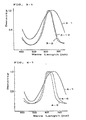
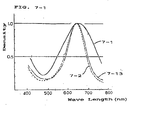
- Fig. 1-1 shows the absorption spectra of Sample Nos. 1-1, 1-2 and 1-6.
- 1 represents Comparative Coupler a (of Sample 1-1)
- 2 and 6 represent Coupler 11-1-1 (of Sample 1-2) and Coupler III-1-1 (of Sample 1-6) each of the invention, respectively.
- each of the processed samples was allowed to stand for 14 days under the circumstances of a high temperature and humidity (at 60'C and 80%RH), and the heat and moisture resisting properties of the resulted dye-images were checked up.
- the results thereof are also shown in Table 1-1, wherein the heat and moisture resisting properties of the dye-images are indicated by the percentage of the residual dyes which still remained after the heat and moisture resistance tests were tried, to the initial density of 1.0.
- every sample having the couplers of the invention has excellent spectral absorption characteristics, because their half band widths are extremely narrower than those of the sample having the comparative coupler and the irregular absorptions are relatively less, as compared with the sample used the comparative coupler. It is further found that every sample having the couplers of the invention is relatively solid, because of the high percentage of residual dyes and the relatively excellent moisture resisting property.
- Fig. 1-1 shows the fact that the couplers of the invention are relatively less in undesirable irregular absorption caused in green region and relatively sharp in absorption in the regions around ⁇ max, as compared with the conventional phenol type couplers.
- Samples No. 1-14 through No. 1-19 of red-sensitive color reversal photographic light-sensitive materials were prepared by coating the following layers over to a triacetyl cellulose film support, in order from the support side.
- the amounts of the compounds added are expressed by the amounts thereof per sq.meter unless otherwise specially stated. (Amounts of silver halides are expressed in terms of the contents of silver.)
- Layer 1 An emulsion layer
- a red-sensitive emulsion layer comprising 1.4 g of gelatin, 0.5 g of red-sensitive silver chlorobromide emulsion (containing silver chloride of 96 mol O /o) and the couplers shown in Table 1-2 dissolved in 1.50 g of dibutyl phthalate.
- Layer 2 A protective layer
- compositions of the processing liquids were as follows.
- a silver chlorobromide emulsion containing silver chloride of 96 mol% was added with sodium thiosulfate in an amount of 1x10- 5 moles per mole of the silver chlorobromide emulsion and was then chemically sensitized.
- the resulted chemically sensitized emulsion was added with the following spectral sensitizing dye a, which is to be used in red light-sensitive emulsion layers and was in the form of a 0.1% solution, in an amount of 5.0 ⁇ 10 -5 moles per mole of a silver halide used.
- the resulted emulsion was added, at the point of time when the chemical sensitization was completed, with an aqueous 0.5% solution of 4-hydroxy-6-methy!-1,3,3a,7-tetrazaindene and, thereafter, with an aqueous 10% gelatin solution.
- the resulted mixture was stirred and cooled, so that a red light-sensitive silver halide emulsion was prepared.
- Sample 2-1 of red-sensitive color light-sensitive material was prepared by coating the following layers over to a paper support laminated with polyethylene on the both sides thereof in order from the support side. respectively.
- the amounts of the compounds added are expressed in terms of those added per sq. meter, unless otherwise particularly stated. (Amounts of silver halides are expressed in terms of the contents of silver.)
- Layer 1 An emulsion layer
- a red-sensitive emulsion layer comprising 1.2 g of gelatin, 0.30 g of red-sensitive silver chlorobromide emulsion and 0.45 g of comparative cyan coupler a dissolved in 0.24 g of dioctyl phthalate.
- Layer 2 A protective layer
- Samples No.2-2 through No. 2-21 each of the invention were prepared in quite the same manner as in Example 2-1, except that the comparative coupler a and the spectral senstizing dye a were replaced by the couplers of the invention shown in Table 2-1 and the spectral sensitizing dyes shown in Table 2-1, respectively.
- the amounts of the couplers and spectral sensitizing dyes were in the amounts of the same moles as in
- the processing liquids used in each of the steps were as follows.
- reflection density of Xmax was 1.0, and the half band width (i.e., the difference between the wavelength of the reflection density of 0.5 on the side of the wavelength longer than ⁇ max and the wavelength of the reflection density of 0.5 on the side of the wavelength shorter than ⁇ max).
- the facts mean that a color reproducibility is excellent.
- Fig. 2-1 shows the absorption spectra of Sample Nos. 2-2, 2-5 and 2-14.
- each of the processed samples was allowed to stand for 14 days under the circumstances of a high temperature and humidity (at 60°C and 800/oRH), and the heat and moisture resisting properties of the resulted dye-images were checked up.
- the results thereof are also shown in Table 2-1, wherein the heat and moisture resisting properties of the dye-images are indicated by the percentage of the residual dyes which still remained after the heat and moisture resistance tests were tried, to the initial density of 1.0.
- the densities thereof were measured with a densitometer to check up the sensitivities and fogs thereof.
- the standard optical density point for determining the sensitivities of the samples was set to be a point of fog plus 0.20.
- Fig. 2-1 shows the fact that the couplers of the invention are relatively less in undesirable irregular absorption caused in green region (of 550 nm) and relatively sharp in absorption in the regions around ⁇ max' as compared with the conventional phenol type couplers.
- a red light-sensitive silver halide emulsion was prepared in the same amnner as in Example 2-1, except that the couplers and spectral sensitizing dyes used in Example 2-1 were replaced by those shown in Table 2-2 when preparing.
- Samples No. 2-22 through No. 2-29 of red-sensitive color reversal photographic light-sensitive materials were prepared by coating the following layers over to a triacetyl cellulose film support, in order from the support side.
- the amounts of the compounds added are expressed by the amounts thereof per sq.meter unless otherwise specially stated. (Amounts of silver halides are expressed in terms of the contents of silver.)
- Layer 1 An emulsion layer
- a red-sensitive emulsion layer comprising 1.4 g of gelatin, 0.5 g of red-sensitive silver chlorobromide emulsion and the couplers shown in Table 2-2 dissolved in 0.24 g of dibutyl phthalate.
- Layer 2 A protective layer
- compositions of the processing liquids were as follows.
- the results thereof are shown in Table 2-2.
- the couplers of the invention are high in sensitivity and exellent in aging stability of coating liquids, provided that the couplers are used together with the spectral sensitizing dyes which may preferably be used in the invention.
- Sample 3-1 of red-sensitive color light-sensitive material was prepared by coating the following layers over to a paper support laminated with polyethylene on the both sides thereof in order from the support side, respectively.
- the amounts of the compounds added are expressed in terms of those added per sq. meter, unless otherwise particularly stated. (Amounts of silver halides are expressed in terms of the contents of silver.)
- Layer 1 An emulsion layer
- a red-sensitive emulsion layer comprising 1.2 g of gelatin, 0.30 g of red-sensitive silver chlorobromide emulsion (containing silver chloride of 96 mol%) and 0.45 g of comparative cyan coupler a dissolved in 0.20 g of dioctyl phthalate.
- Layer 2 A protective layer
- Samples No. 3-2 through No. 3-24 each of the invention were prepared in quite the same manner as in Example 3-1, except that the comparative coupler a was replaced by the couplers indicated in Table 3-1 (provided that the amounts added were the same molar amounts as in the comparative coupler a).
- the resulted Samples No. 3-12 through No. 3-24 were exposed to light through a wedge in an ordinary method and were then processed in the following processing steps.
- the processing liquids used in each of the steps were as follows.
- Fig. 3-1 shows the absorption spectra of Sample Nos. 3-1, 3-2 and 3-12.
- each of the processed samples was allowed to stand for 14 days under the circumstances of a high temperature and humidity (at 60°C and 80%RH), and the heat and moisture resisting properties of the resulted dye-images were checked up.
- the results thereof are also shown in Table 3-1, wherein the heat and moisture resisting properties of the dye-images are indicated by the percentage of the residual dyes which still remained after the heat and moisture resistance tests were tried, to the initial density of 1.0.
- every sample having the couplers of the invention has excellent spectral absorption characteristics, because their half band widths are extremely narrower and the irregular absorptions are relatively less, as compared with the sample used the comparative coupler. It is further found that every sample having the couplers of the invention is relatively solid, because of the high percentage of residual dyes and the relatively excellent moisture resisting property.
- Fig. 3-1 shows the fact that the couplers of the invention are relatively less in undesirable irregular absorption caused in green region and relatively sharp in absorption in the regions around ⁇ max, as compared with the conventional phenol type couplers.
- Samples No. 3-25 through No. 3-32 of red-sensitive color reversal photographic light-sensitive materials were prepared by coating the following layers in order from a triacetyl cellulose film support side over to the support.
- amounds of the compounds added are expressed by the amounts thereof per sq.meter unless otherwise specially stated. (Amounts of silver halides are expressed in terms of the contents of silver.)
- Layer 1 An emulsion layer
- a red-sensitive emulsion layer comprising 1.4 g of gelatin, 0.5 g of red-sensitive silver chlorobromide emulsion (containing silver chloride of 96 mol%) and the couplers shown in Table 3-2 dissolved in 0.24 g of dibutyl phthalate.
- Layer 2 A protective layer
- compositions of the processing liquids were as follows.
- Sample 4-1 of red-sensitive color light-sensitive material was prepared by coating the following layers over to a paper support laminated with polyethylene on the both sides thereof in order from the support side, respectively.
- the amounts of the compounds are expressed in terms of those added per sq. meter, unless otherwise particularly sated. (Amounts of silver halides are expressed in terms of the contents of silver.)
- Layer 1 An emulsion layer
- a red-sensitive emulsion layer comprising 1.2 g of gelatin, 0.30 g of red-sensitive silver chlorobromide emulsion (containing silver chloride of 96 mol%) and 0.45 g of comparative cyan coupler a dissolved in 1.50 g of trioctyl phosphate.
- Layer 2 A protective layer
- Samples No. 4-2 through No. 4-9 each of the invention were prepared in quite the same manner as in Example 4-1, except that the comparative coupler a was replaced by the couplers indicated in Table 4-1 (provided that the amounts added were the same molar amounts as in the comparative coupler a).
- the resulted Samples No. 4-1 through No. 4-9 were exposed to light through a wedge in an ordinary method and were then processed in the following processing steps.
- the processing liquids used in each of the steps were as follows.
- the measurements were made respectively each of the maximum spectral absorption wavelengths (Xmax), the reflexion densities of 420 nm (DM20) when the reflection densities of Xmax were 1.0, and the half band widths (W1/2) which are the difference between the reflection density 0.5 on the side of the wavelength longer than ⁇ max and the reflection density of 0.5 on the side of the wavelength shorter than ⁇ max).
- Xmax maximum spectral absorption wavelengths
- DM20 reflexion densities of 420 nm
- W1/2 half band widths
- Fig. 4-1 shows the absorption spectra of Sample Nos. 4-1, 4-2 and 4-6.
- each of the processed samples was allowed to stand for 14 days under the circumstances of a high temperature and humidity (at 60°C and 800/oRH), and the heat and moisture resisting properties of the resulted dye-images were checked up.
- the results thereof are also shown in Table 4-1, wherein the heat and moisture resisting properties of the dye-images are indicated by the percentage of the residual dyes which still remained after the heat and moisture resistance tests were tried, to the initial density of 1.0.
- every sample having the couplers of the invention can provide solid cyan images. because of their high percentage of residual dyes and excellent moisture resisting property.
- Fig. 4-1 shows the fact that the couplers of the invention (e.g., Sample No. 4-2 and No. 4-6) are relatively less in undesirable irregular absorption caused in green region and relatively sharp in absorption in the regions around ⁇ max, as compared with the conventional phenol type couplers.
- the couplers of the invention e.g., Sample No. 4-2 and No. 4-6
- Samples No. 4-10 through No. 4-16 of red-sensitive color reversal photographic light-sensitive materials were prepared by coating the following layers in order from the support side over to a triacetyl cellulose film support.
- the amounts of the compounds added are expressed by the amounts thereof per sq.meter unless otherwise specially stated. (Amounts of silver halides are expressed in terms of the contents of silver.)
- Layer 1 An emulsion layer
- a red-sensitive emulsion layer comprising 1.4 g of gelatin, 0.5 g of red-sensitive silver chlorobromide emulsion (containing silver chloride of 96 mol%) and the couplers (9.1x10- 4 moles) shown in Table 4-2 dissolved in 1.65 g of dioctyl phosphate.
- Layer 2 A protective layer
- compositions of the processing liquids were as follows.
- a dispersion was prepared in the following manner.
- Comparative cyan coupler b of 2x10- 3 moles, 3.0 g of dioctyl phthalate and 3 g of ethyle acetate were mixed and heated up to 60°C.
- the resulted solution was mixed with 17 ml of an aqueous 5% gelatin solution containing 1.7 ml of an aqueous solution of Alkanol B (i.e., alkylnaphthalene sulfonate, manufactured by DuPont).
- Alkanol B i.e., alkylnaphthalene sulfonate, manufactured by DuPont.
- the resulted mixture solution was emulsified and dispersed by means of a supersonic homogenizer. From the resulted dispersion, ethyl acetate was distilled off under reduced pressure, so that dispersion sample 4-1 was prepared.
- the dispersion was stored in a refrigerator (at 5°C) for six days and was then put in a warm water bath at 40° C to keep temperature.
- the conditions of each crystal deposition were observed by an optical microscope, immediately after, 6 hours after and 12 hours after keeping temperature, respectively.
- dispersion samples No. 4-2 through No. 4-5 were prepared by making use of the couplers shown in Table 4-3 in the same manner as in Sample 4-1, and the dispersion stability of the couplers were also checked up. The results thereof are shown in Table 4-3.
- Sample 5-1 of red-sensitive color light-sensitive material was prepared by coating the following layers over to a paper support laminated with polyethylene on the both sides thereof in order from the support side, respectively.
- the amounts of the compounds added are expressed in terms of those added per sq. meter, unless otherwise particularly stated. (Amounts of silver halides are expressed in terms of the contents of silver.)
- Layer 1 An emulsion layer
- a red-sensitive emulsion layer comprising 1.2 g of gelatin, 0.30 g of red-sensitive silver chlorobromide emulsion (containing silver chloride of 96 mol%) and 0.45 g of comparative cyan coupler a dissolved in 0.20 g of dioctyl phthalate.
- Layer 2 A protective layer
- Samples No. 5-2 through No. 5-9 each of the invention were prepared in quite the same manner as in Example 5-1 except that comparative coupler a was replaced by the couplers of the invention (5-2), (5-9), 5-21). (5-25), (5-26). (5-39), (5-42) and (5-45), respectively, (provided that the amounts added are as shown in Table 5-1).
- Fig. 5-1 shows the absorption spectra of Sample Nos. 5-1, 5-2, 5-3 and 5-5.
- each of the processed samples was allowed to stand for 14 days under the circumstances of a high temperature and humidity (at 60°C and 80 0 /oRH), and the heat and moisture resisting properties of the resulted dye-images were checked up.
- the results thereof are also shown in Table 5-1, wherein the heat and moisture resisting properties of the dye-images are indicated by the percentage of the residual dyes which still remained after the heat and moisture resistance tests were tried, to the initial density of 1.0.
- Fig. 5-1 indicates that the couplers of the invention are relatively less in undesirable absorption in green spectral region and sharp in absorption caused around Xmax.
- Sample 6-1 of red-sensitive color light-sensitive material was prepared by coating the following layers over to a paper support laminated with polyethylene on the both sides thereof in order from the support side. respectively.
- the amounts of the compounds added are expressed in terms of those added per sq. meter. unless otherwise particularly stated. (Amounts of silver halides are expressed in terms of the contents of silver.)
- Layer 1 An emulsion layer
- a red-sensitive emulsion layer comprising 1.2 g of gelatin, 0.30 g of red-sensitive silver chlorobromide emulsion (containing silver chloride of 96 mol o /o) and 0.45 g of comparative cyan coupler a dissolved in 1.05 g of dioctyl phthalate.
- Layer 2 A protective layer
- Samples No. 6-2 through No. 6-11 each of the invention were prepared in quite the same manner as in Example 6-1, except that comparative coupler a was replaced by the couplers shown in Table 6-1 (provided that the amounts added were the same molar amounts as in comparative coupler a).
- the processing liquids used in each of the steps were as follows.
- Fig. 6-1 shows the absorption spectra of Sample Nos. 6-1, 6-2 and 6-8.
- each of the processed samples was allowed to stand for 14 days under the circumstances of a high temperature and humidity (at 60°C and 80 0 /oRH), and the heat and moisture resisting properties of the resulted dye-images were checked up.
- the results thereof are also shown in Table 6-1, wherein the heat and moisture resisting properties of the dye-images are indicated by the percentage of the residual dyes which still remained after the heat and moisture resistance tests were tried, to the initial density of 1.0.
- Fig. 6-1 shows the fact that the couplers (11-6-2, 11-6-8) of the invention are relatively less in undesirable irregular absorption caused in green region and relatively sharp in absorption in the regions around ⁇ max. as compared with the conventional phenol type coupler (1).
- a red-sensitive color reversal potographic light-sensitive materials No. 6-12 through No. 6-16 were prepared by coating the following layers in order from a triacetyl cellulose film support over to the support.
- Layer 1 An emulsion layer
- a red-sensitive emulsion layer comprising 1.4 g of gelatin, 0.5 g of red-sensitive silver chlorobromide emulsion and the couplers (9.1 ⁇ 10 -4 moles) shown in Table 6-2 dissolved in 1.25 g of dibutyl phthalate.
- Layer 2 A protective layer
- compositions of the processing liquids were as follows.
- Sample 7-1 of red-sensitive color light-sensitive material was prepared by coating the following layers over to a paper support laminated with polyethylene on the both sides thereof in order from the support side, respectively.
- the amounts of the compounds added are expressed in terms of those added per sq. meter, unless otherwise particularly stated. (Amounts of silver halides are expressed in terms of the contents of silver.)
- Layer 1 An emulsion layer
- a red-sensitive emulsion layer comprising 1.2 g of gelatin, 0.30 g of red-sensitive silver chlorobromide emulsion (containing silver chloride of 96 mol%) and 0.45 g of comparative cyan coupler a dissolved in 1.50 g of trioctyl phosphate.
- Layer 2 A protective layer
- Samples No. 7-2 through No. 7-20 each of the invention were prepared in quite the same manner as in Example 7-1, except that the comparative coupler a was replaced by the couplers of the invention indicated in Table 7-1 (provided that the amounts added were the same molar amounts as in Sample 7-1
- the processing liquids used in each of the steps were as follows.
- the measurements were made respectively each of the maximum spectral absorption wavelengths ( ⁇ max) when the reflection densities of ⁇ max were 1.0, and the reflection densities of 420 nm and the half band widths of spetral absorption (i.e., W1/2) which are the difference between the wavelength of reflection density 0.5 on the side of a wavelength longer that that of ⁇ max and the wavelength of reflection density 0.5 on the side of a wavelength shorter than that of ⁇ max.)
- W1/2 the half band widths of spetral absorption
- Fig. 7-1 shows the absorption spectra of Sample Nos. 7-1, 7-2 and 7-13.
- each of the processed samples was allowed to stand for 14 days under the circumstances of a high temperature and humidity (at 60 C and 80%RH), and the heat and moisture resisting properties of the resulted dye-images were checked up.
- the results thereof are also shown in Table 7-1, wherein the heat and moisture resisting properties of the dye-images are indicated by the percentage of the residual dyes to the initial density of 1.0 after testing the heat and moisture resistance.
- the samples having the couplers of the invention are also high in dye-residual percentage and excellent in heat- and moisture-resistance, as compared with the comparative samples.
- Fig. 7-1 shows the fact that the couplers of the invention are relatively less in undesirable irregular absorption caused in green region e.g., 550 nm) and relatively sharp in absorption in the regions around Xmax, as compared with the convention phenol type couplers.
- Samples No. 7-21 through No. 7-29 of red-sensitive color reversal photographic light-sensitive materials were prepared by coating the following layers over to a triacetyl cellulose film support, in order from the support side.
- the amounts of the compounds added are expressed by the amounts thereof per sq.meter unless otherwise specially stated. (Amounts of silver halides are expressed in terms of the contents of silver.)
- Layer 1 An emulsion layer
- a red-sensitive emulsion layer comprising 1.4 g of gelatin, 0.5 g of red-sensitive silver chlorobromide emulsion (containing silver chloride of 96 mol%) and the couplers (9.1x10- 4 moles) shown in Table 7-2 dissolved in 1.65 g of dioctylphenyl phosphate.
- Layer 2 A protective layer
- compositions of the processing liquids were as follows.
Landscapes
- Chemical & Material Sciences (AREA)
- Organic Chemistry (AREA)
- Physics & Mathematics (AREA)
- General Physics & Mathematics (AREA)
- Silver Salt Photography Or Processing Solution Therefor (AREA)
Applications Claiming Priority (14)
| Application Number | Priority Date | Filing Date | Title |
|---|---|---|---|
| JP28016486 | 1986-11-25 | ||
| JP280164/86 | 1986-11-25 | ||
| JP313455/86 | 1986-12-27 | ||
| JP31345586 | 1986-12-27 | ||
| JP4732387 | 1987-03-02 | ||
| JP47323/87 | 1987-03-02 | ||
| JP5341787 | 1987-03-09 | ||
| JP53417/87 | 1987-03-09 | ||
| JP62163/87 | 1987-03-17 | ||
| JP62162/87 | 1987-03-17 | ||
| JP6216387 | 1987-03-17 | ||
| JP6216287 | 1987-03-17 | ||
| JP18455287 | 1987-07-23 | ||
| JP184552/87 | 1987-07-23 |
Publications (4)
| Publication Number | Publication Date |
|---|---|
| EP0269436A2 true EP0269436A2 (fr) | 1988-06-01 |
| EP0269436A3 EP0269436A3 (en) | 1988-09-14 |
| EP0269436B1 EP0269436B1 (fr) | 1991-03-06 |
| EP0269436B2 EP0269436B2 (fr) | 1994-11-02 |
Family
ID=27564666
Family Applications (1)
| Application Number | Title | Priority Date | Filing Date |
|---|---|---|---|
| EP19870310417 Expired - Lifetime EP0269436B2 (fr) | 1986-11-25 | 1987-11-25 | Matériau photographique couleur à l'halogénure d'argent sensible à la lumière contenant un coupleur cyan de type pyrazoloazole |
Country Status (2)
| Country | Link |
|---|---|
| EP (1) | EP0269436B2 (fr) |
| DE (1) | DE3768436D1 (fr) |
Cited By (8)
| Publication number | Priority date | Publication date | Assignee | Title |
|---|---|---|---|---|
| EP0484909A1 (fr) * | 1990-11-07 | 1992-05-13 | Fuji Photo Film Co., Ltd. | Procédé de formation d'une image cyan avec copulant formant colorant cyan, et matériau photographique couleur à l'halogénure d'argent contenant le copulant formant colorant cyan |
| EP0487111A1 (fr) * | 1990-11-22 | 1992-05-27 | Fuji Photo Film Co., Ltd. | Un nouveau copulant formateur de couleur et un matériau photographique couleur à l'halogénure d'argent le contenant |
| EP0491197A1 (fr) * | 1990-11-30 | 1992-06-24 | Fuji Photo Film Co., Ltd. | Procédé de formation d'image cyan et matériau photographique couleur à l'halogénure d'argent comprenant copulant cyan |
| JPH04190347A (ja) * | 1990-11-26 | 1992-07-08 | Fuji Photo Film Co Ltd | 新規な色素形成カプラーおよび該カプラーを含有するハロゲン化銀カラー写真感光材料 |
| EP0602749A1 (fr) * | 1992-12-18 | 1994-06-22 | Eastman Kodak Company | Matériau photographique et procédé comprenant un coupleur de type pyrazolo bicyclique |
| EP0672945A3 (fr) * | 1994-03-17 | 1995-11-15 | Konishiroku Photo Ind | Produit photographique couleur à l'halogénure d'argent sensible à la lumière. |
| EP0704758A1 (fr) * | 1994-09-12 | 1996-04-03 | Fuji Photo Film Co., Ltd. | Matériau photographique couleur à l'halogénure d'argent |
| EP0678519B1 (fr) * | 1994-04-22 | 2002-08-28 | Eastman Kodak Company | Produits intermédiaires pour la préparation de pyrazolo-azoles comme copulants photographiques, procédé pour leur préparation et leur application |
Family Cites Families (1)
| Publication number | Priority date | Publication date | Assignee | Title |
|---|---|---|---|---|
| US4639415A (en) * | 1984-09-17 | 1987-01-27 | Konishiroku Photo Industry Co., Ltd. | Silver halide color photographic material containing a magenta color image-forming coupler |
-
1987
- 1987-11-25 EP EP19870310417 patent/EP0269436B2/fr not_active Expired - Lifetime
- 1987-11-25 DE DE8787310417T patent/DE3768436D1/de not_active Expired - Fee Related
Cited By (12)
| Publication number | Priority date | Publication date | Assignee | Title |
|---|---|---|---|---|
| EP0484909A1 (fr) * | 1990-11-07 | 1992-05-13 | Fuji Photo Film Co., Ltd. | Procédé de formation d'une image cyan avec copulant formant colorant cyan, et matériau photographique couleur à l'halogénure d'argent contenant le copulant formant colorant cyan |
| EP0487111A1 (fr) * | 1990-11-22 | 1992-05-27 | Fuji Photo Film Co., Ltd. | Un nouveau copulant formateur de couleur et un matériau photographique couleur à l'halogénure d'argent le contenant |
| JPH04188137A (ja) * | 1990-11-22 | 1992-07-06 | Fuji Photo Film Co Ltd | 新規な色素形成カプラーおよび該カプラーを含有するハロゲン化銀カラー写真感光材料 |
| US5260181A (en) * | 1990-11-22 | 1993-11-09 | Fuji Photo Film Co., Ltd. | Color-forming coupler and a silver halide color photographic material containing the same |
| JPH04190347A (ja) * | 1990-11-26 | 1992-07-08 | Fuji Photo Film Co Ltd | 新規な色素形成カプラーおよび該カプラーを含有するハロゲン化銀カラー写真感光材料 |
| EP0491197A1 (fr) * | 1990-11-30 | 1992-06-24 | Fuji Photo Film Co., Ltd. | Procédé de formation d'image cyan et matériau photographique couleur à l'halogénure d'argent comprenant copulant cyan |
| US5256526A (en) * | 1990-11-30 | 1993-10-26 | Fuji Photo Film Co., Ltd. | Cyan image forming method and silver halide color photographic material containing cyan coupler |
| EP0602749A1 (fr) * | 1992-12-18 | 1994-06-22 | Eastman Kodak Company | Matériau photographique et procédé comprenant un coupleur de type pyrazolo bicyclique |
| US5811230A (en) * | 1992-12-18 | 1998-09-22 | Eastman Kodak Company | Photographic material comprising a bicyclic pyrazolo coupler |
| EP0672945A3 (fr) * | 1994-03-17 | 1995-11-15 | Konishiroku Photo Ind | Produit photographique couleur à l'halogénure d'argent sensible à la lumière. |
| EP0678519B1 (fr) * | 1994-04-22 | 2002-08-28 | Eastman Kodak Company | Produits intermédiaires pour la préparation de pyrazolo-azoles comme copulants photographiques, procédé pour leur préparation et leur application |
| EP0704758A1 (fr) * | 1994-09-12 | 1996-04-03 | Fuji Photo Film Co., Ltd. | Matériau photographique couleur à l'halogénure d'argent |
Also Published As
| Publication number | Publication date |
|---|---|
| EP0269436B2 (fr) | 1994-11-02 |
| EP0269436A3 (en) | 1988-09-14 |
| EP0269436B1 (fr) | 1991-03-06 |
| DE3768436D1 (de) | 1991-04-11 |
Similar Documents
| Publication | Publication Date | Title |
|---|---|---|
| US4950585A (en) | Coupler for photographic use | |
| EP0287265B1 (fr) | Matériau photographique couleur à l'halogénure d'argent sensible à la lumière | |
| JP2797212B2 (ja) | 新規な写真用カプラー | |
| EP0269436A2 (fr) | Matériau photographique couleur à l'halogénure d'argent sensible à la lumière contenant un coupleur cyan de type pyrazoloazole | |
| JP2673824B2 (ja) | 新規な写真用カプラー | |
| JPH07244361A (ja) | 新規な写真用カプラー及びハロゲン化銀写真感光材料 | |
| JPH07325375A (ja) | 写真用カプラー | |
| JPS63199352A (ja) | 新規な写真用シアンカプラ− | |
| JP2673809B2 (ja) | 新規な写真用カプラー | |
| EP0383589A2 (fr) | Matériau photographique à l'halogénure d'argent sensible à la lumière contenant un coupleur | |
| JPH0798489A (ja) | 新規な写真用カプラー | |
| JPH05107705A (ja) | 新規な写真用カプラー | |
| JPS63281161A (ja) | 新規なシアンカプラ−を含有するハロゲン化銀カラ−写真感光材料 | |
| JPH06301171A (ja) | 写真用シアンカプラー | |
| JPH02304437A (ja) | 新規な写真用カプラー | |
| JP2711877B2 (ja) | 新規な写真用カプラー | |
| JP3014153B2 (ja) | 新規な写真用カプラー | |
| JPH07128824A (ja) | 写真用カプラー | |
| JP2909669B2 (ja) | 新規な写真用カプラー | |
| JPH04147135A (ja) | 新規な写真用カプラー | |
| JPH02188747A (ja) | 写真用カプラー | |
| JPH0683001A (ja) | 新規な写真用カプラー | |
| JPH07261345A (ja) | 新規な写真用カプラー | |
| JPH08262661A (ja) | 写真用カプラー | |
| JPH03160440A (ja) | 新規な写真用カプラーを含有するハロゲン化銀カラー写真感光材料 |
Legal Events
| Date | Code | Title | Description |
|---|---|---|---|
| PUAI | Public reference made under article 153(3) epc to a published international application that has entered the european phase |
Free format text: ORIGINAL CODE: 0009012 |
|
| AK | Designated contracting states |
Kind code of ref document: A2 Designated state(s): DE FR GB IT NL |
|
| PUAL | Search report despatched |
Free format text: ORIGINAL CODE: 0009013 |
|
| AK | Designated contracting states |
Kind code of ref document: A3 Designated state(s): DE FR GB IT NL |
|
| 17P | Request for examination filed |
Effective date: 19890314 |
|
| 17Q | First examination report despatched |
Effective date: 19890920 |
|
| GRAA | (expected) grant |
Free format text: ORIGINAL CODE: 0009210 |
|
| AK | Designated contracting states |
Kind code of ref document: B1 Designated state(s): DE FR GB IT NL |
|
| PG25 | Lapsed in a contracting state [announced via postgrant information from national office to epo] |
Ref country code: IT Free format text: LAPSE BECAUSE OF FAILURE TO SUBMIT A TRANSLATION OF THE DESCRIPTION OR TO PAY THE FEE WITHIN THE PRE;WARNING: LAPSES OF ITALIAN PATENTS WITH EFFECTIVE DATE BEFORE 2007 MAY HAVE OCCURRED AT ANY TIME BEFORE 2007. THE CORRECT EFFECTIVE DATE MAY BE DIFFERENT FROM THE ONE RECORDED.SCRIBED TIME-LIMIT Effective date: 19910306 Ref country code: NL Effective date: 19910306 |
|
| REF | Corresponds to: |
Ref document number: 3768436 Country of ref document: DE Date of ref document: 19910411 |
|
| EN | Fr: translation not filed | ||
| PG25 | Lapsed in a contracting state [announced via postgrant information from national office to epo] |
Ref country code: FR Effective date: 19910726 |
|
| NLV1 | Nl: lapsed or annulled due to failure to fulfill the requirements of art. 29p and 29m of the patents act | ||
| PLBI | Opposition filed |
Free format text: ORIGINAL CODE: 0009260 |
|
| 26 | Opposition filed |
Opponent name: FUJI PHOTO FILM CO., LTD. Effective date: 19911206 |
|
| REG | Reference to a national code |
Ref country code: FR Ref legal event code: ST |
|
| PUAH | Patent maintained in amended form |
Free format text: ORIGINAL CODE: 0009272 |
|
| STAA | Information on the status of an ep patent application or granted ep patent |
Free format text: STATUS: PATENT MAINTAINED AS AMENDED |
|
| 27A | Patent maintained in amended form |
Effective date: 19941102 |
|
| AK | Designated contracting states |
Kind code of ref document: B2 Designated state(s): DE FR GB IT NL |
|
| EN3 | Fr: translation not filed ** decision concerning opposition | ||
| PGFP | Annual fee paid to national office [announced via postgrant information from national office to epo] |
Ref country code: GB Payment date: 19981127 Year of fee payment: 12 |
|
| PG25 | Lapsed in a contracting state [announced via postgrant information from national office to epo] |
Ref country code: GB Free format text: LAPSE BECAUSE OF NON-PAYMENT OF DUE FEES Effective date: 19991125 |
|
| GBPC | Gb: european patent ceased through non-payment of renewal fee |
Effective date: 19991125 |
|
| PGFP | Annual fee paid to national office [announced via postgrant information from national office to epo] |
Ref country code: DE Payment date: 20051117 Year of fee payment: 19 |
|
| PG25 | Lapsed in a contracting state [announced via postgrant information from national office to epo] |
Ref country code: DE Free format text: LAPSE BECAUSE OF NON-PAYMENT OF DUE FEES Effective date: 20070601 |