EP0302122B1 - Procede de preparation de sels d'ammonium quaternaire non satures - Google Patents
Procede de preparation de sels d'ammonium quaternaire non satures Download PDFInfo
- Publication number
- EP0302122B1 EP0302122B1 EP88901916A EP88901916A EP0302122B1 EP 0302122 B1 EP0302122 B1 EP 0302122B1 EP 88901916 A EP88901916 A EP 88901916A EP 88901916 A EP88901916 A EP 88901916A EP 0302122 B1 EP0302122 B1 EP 0302122B1
- Authority
- EP
- European Patent Office
- Prior art keywords
- quaternary ammonium
- reaction
- ammonium salts
- ppm
- unsaturated quaternary
- Prior art date
- Legal status (The legal status is an assumption and is not a legal conclusion. Google has not performed a legal analysis and makes no representation as to the accuracy of the status listed.)
- Expired - Lifetime
Links
- 150000003242 quaternary ammonium salts Chemical class 0.000 title claims abstract description 46
- 238000004519 manufacturing process Methods 0.000 title abstract description 6
- 238000006243 chemical reaction Methods 0.000 claims abstract description 58
- XLYOFNOQVPJJNP-UHFFFAOYSA-N water Substances O XLYOFNOQVPJJNP-UHFFFAOYSA-N 0.000 claims abstract description 39
- 238000000034 method Methods 0.000 claims abstract description 27
- QVGXLLKOCUKJST-UHFFFAOYSA-N atomic oxygen Chemical compound [O] QVGXLLKOCUKJST-UHFFFAOYSA-N 0.000 claims abstract description 23
- 239000001301 oxygen Substances 0.000 claims abstract description 23
- 229910052760 oxygen Inorganic materials 0.000 claims abstract description 23
- 239000003960 organic solvent Substances 0.000 claims abstract description 17
- 239000000178 monomer Substances 0.000 claims abstract description 14
- -1 aralkyl halide Chemical class 0.000 claims abstract description 10
- 125000000217 alkyl group Chemical group 0.000 claims abstract description 7
- 125000004430 oxygen atom Chemical group O* 0.000 claims abstract description 5
- 229920002554 vinyl polymer Polymers 0.000 claims abstract description 5
- 125000002947 alkylene group Chemical group 0.000 claims abstract description 4
- 150000003863 ammonium salts Chemical class 0.000 claims abstract description 4
- 125000001797 benzyl group Chemical group [H]C1=C([H])C([H])=C(C([H])=C1[H])C([H])([H])* 0.000 claims abstract description 4
- 125000004435 hydrogen atom Chemical group [H]* 0.000 claims abstract description 4
- 125000002496 methyl group Chemical group [H]C([H])([H])* 0.000 claims abstract description 4
- 125000004432 carbon atom Chemical group C* 0.000 claims description 10
- 150000001350 alkyl halides Chemical class 0.000 claims description 8
- 239000011541 reaction mixture Substances 0.000 claims description 8
- 125000005843 halogen group Chemical group 0.000 claims description 2
- 238000006116 polymerization reaction Methods 0.000 abstract description 42
- 150000003839 salts Chemical class 0.000 abstract description 18
- 239000007864 aqueous solution Substances 0.000 abstract description 14
- 239000000203 mixture Substances 0.000 abstract description 7
- 239000000126 substance Substances 0.000 abstract description 7
- 229920006317 cationic polymer Polymers 0.000 abstract description 5
- 238000003756 stirring Methods 0.000 abstract description 3
- 230000015572 biosynthetic process Effects 0.000 abstract description 2
- 238000001879 gelation Methods 0.000 abstract description 2
- 238000013021 overheating Methods 0.000 abstract description 2
- 239000007858 starting material Substances 0.000 abstract description 2
- 125000004178 (C1-C4) alkyl group Chemical group 0.000 abstract 2
- 239000007810 chemical reaction solvent Substances 0.000 abstract 1
- 230000002401 inhibitory effect Effects 0.000 abstract 1
- 239000000047 product Substances 0.000 description 29
- CSCPPACGZOOCGX-UHFFFAOYSA-N Acetone Chemical compound CC(C)=O CSCPPACGZOOCGX-UHFFFAOYSA-N 0.000 description 28
- 150000003512 tertiary amines Chemical class 0.000 description 17
- 239000003795 chemical substances by application Substances 0.000 description 15
- 230000007062 hydrolysis Effects 0.000 description 12
- 238000006460 hydrolysis reaction Methods 0.000 description 12
- 239000003112 inhibitor Substances 0.000 description 9
- IJGRMHOSHXDMSA-UHFFFAOYSA-N Atomic nitrogen Chemical compound N#N IJGRMHOSHXDMSA-UHFFFAOYSA-N 0.000 description 8
- KAKZBPTYRLMSJV-UHFFFAOYSA-N Butadiene Chemical group C=CC=C KAKZBPTYRLMSJV-UHFFFAOYSA-N 0.000 description 8
- 150000001412 amines Chemical class 0.000 description 8
- 241001550224 Apha Species 0.000 description 7
- 230000000052 comparative effect Effects 0.000 description 7
- WVDDGKGOMKODPV-UHFFFAOYSA-N Benzyl alcohol Chemical compound OCC1=CC=CC=C1 WVDDGKGOMKODPV-UHFFFAOYSA-N 0.000 description 6
- KCXMKQUNVWSEMD-UHFFFAOYSA-N benzyl chloride Chemical compound ClCC1=CC=CC=C1 KCXMKQUNVWSEMD-UHFFFAOYSA-N 0.000 description 6
- 229940073608 benzyl chloride Drugs 0.000 description 6
- 125000002091 cationic group Chemical group 0.000 description 5
- 239000007795 chemical reaction product Substances 0.000 description 5
- 230000006698 induction Effects 0.000 description 5
- 239000002609 medium Substances 0.000 description 5
- 229920000642 polymer Polymers 0.000 description 5
- 239000002904 solvent Substances 0.000 description 5
- CERQOIWHTDAKMF-UHFFFAOYSA-N Methacrylic acid Chemical compound CC(=C)C(O)=O CERQOIWHTDAKMF-UHFFFAOYSA-N 0.000 description 4
- 239000006227 byproduct Substances 0.000 description 4
- 239000002801 charged material Substances 0.000 description 4
- NEHMKBQYUWJMIP-UHFFFAOYSA-N chloromethane Chemical compound ClC NEHMKBQYUWJMIP-UHFFFAOYSA-N 0.000 description 4
- 229910001873 dinitrogen Inorganic materials 0.000 description 4
- DFENKTCEEGOWLB-UHFFFAOYSA-N n,n-bis(methylamino)-2-methylidenepentanamide Chemical compound CCCC(=C)C(=O)N(NC)NC DFENKTCEEGOWLB-UHFFFAOYSA-N 0.000 description 4
- DPBJAVGHACCNRL-UHFFFAOYSA-N 2-(dimethylamino)ethyl prop-2-enoate Chemical compound CN(C)CCOC(=O)C=C DPBJAVGHACCNRL-UHFFFAOYSA-N 0.000 description 3
- ZWEHNKRNPOVVGH-UHFFFAOYSA-N 2-Butanone Chemical compound CCC(C)=O ZWEHNKRNPOVVGH-UHFFFAOYSA-N 0.000 description 3
- UHOVQNZJYSORNB-UHFFFAOYSA-N Benzene Chemical compound C1=CC=CC=C1 UHOVQNZJYSORNB-UHFFFAOYSA-N 0.000 description 3
- YMWUJEATGCHHMB-UHFFFAOYSA-N Dichloromethane Chemical group ClCCl YMWUJEATGCHHMB-UHFFFAOYSA-N 0.000 description 3
- XEKOWRVHYACXOJ-UHFFFAOYSA-N Ethyl acetate Chemical compound CCOC(C)=O XEKOWRVHYACXOJ-UHFFFAOYSA-N 0.000 description 3
- 239000012736 aqueous medium Substances 0.000 description 3
- 230000000694 effects Effects 0.000 description 3
- 239000000499 gel Substances 0.000 description 3
- 238000005259 measurement Methods 0.000 description 3
- 229910052757 nitrogen Inorganic materials 0.000 description 3
- NWVVVBRKAWDGAB-UHFFFAOYSA-N p-methoxyphenol Chemical compound COC1=CC=C(O)C=C1 NWVVVBRKAWDGAB-UHFFFAOYSA-N 0.000 description 3
- 230000002265 prevention Effects 0.000 description 3
- WJFKNYWRSNBZNX-UHFFFAOYSA-N 10H-phenothiazine Chemical compound C1=CC=C2NC3=CC=CC=C3SC2=C1 WJFKNYWRSNBZNX-UHFFFAOYSA-N 0.000 description 2
- OKTJSMMVPCPJKN-UHFFFAOYSA-N Carbon Chemical compound [C] OKTJSMMVPCPJKN-UHFFFAOYSA-N 0.000 description 2
- QAOWNCQODCNURD-UHFFFAOYSA-N Sulfuric acid Chemical compound OS(O)(=O)=O QAOWNCQODCNURD-UHFFFAOYSA-N 0.000 description 2
- 239000000654 additive Substances 0.000 description 2
- ROOXNKNUYICQNP-UHFFFAOYSA-N ammonium persulfate Chemical compound [NH4+].[NH4+].[O-]S(=O)(=O)OOS([O-])(=O)=O ROOXNKNUYICQNP-UHFFFAOYSA-N 0.000 description 2
- 235000019445 benzyl alcohol Nutrition 0.000 description 2
- 229920003118 cationic copolymer Polymers 0.000 description 2
- 229920001577 copolymer Polymers 0.000 description 2
- 230000003247 decreasing effect Effects 0.000 description 2
- 238000000605 extraction Methods 0.000 description 2
- 238000001914 filtration Methods 0.000 description 2
- 239000007789 gas Substances 0.000 description 2
- 238000004817 gas chromatography Methods 0.000 description 2
- 239000012535 impurity Substances 0.000 description 2
- 238000004811 liquid chromatography Methods 0.000 description 2
- 229940050176 methyl chloride Drugs 0.000 description 2
- VLKZOEOYAKHREP-UHFFFAOYSA-N n-Hexane Chemical compound CCCCCC VLKZOEOYAKHREP-UHFFFAOYSA-N 0.000 description 2
- LQNUZADURLCDLV-UHFFFAOYSA-N nitrobenzene Chemical compound [O-][N+](=O)C1=CC=CC=C1 LQNUZADURLCDLV-UHFFFAOYSA-N 0.000 description 2
- QJGQUHMNIGDVPM-UHFFFAOYSA-N nitrogen group Chemical group [N] QJGQUHMNIGDVPM-UHFFFAOYSA-N 0.000 description 2
- 229950000688 phenothiazine Drugs 0.000 description 2
- 125000001453 quaternary ammonium group Chemical group 0.000 description 2
- 239000012429 reaction media Substances 0.000 description 2
- 238000012360 testing method Methods 0.000 description 2
- NWUYHJFMYQTDRP-UHFFFAOYSA-N 1,2-bis(ethenyl)benzene;1-ethenyl-2-ethylbenzene;styrene Chemical compound C=CC1=CC=CC=C1.CCC1=CC=CC=C1C=C.C=CC1=CC=CC=C1C=C NWUYHJFMYQTDRP-UHFFFAOYSA-N 0.000 description 1
- SMZOUWXMTYCWNB-UHFFFAOYSA-N 2-(2-methoxy-5-methylphenyl)ethanamine Chemical compound COC1=CC=C(C)C=C1CCN SMZOUWXMTYCWNB-UHFFFAOYSA-N 0.000 description 1
- NIXOWILDQLNWCW-UHFFFAOYSA-N 2-Propenoic acid Natural products OC(=O)C=C NIXOWILDQLNWCW-UHFFFAOYSA-N 0.000 description 1
- IXPWKHNDQICVPZ-UHFFFAOYSA-N 2-methylhex-1-en-3-yne Chemical compound CCC#CC(C)=C IXPWKHNDQICVPZ-UHFFFAOYSA-N 0.000 description 1
- XUYDVDHTTIQNMB-UHFFFAOYSA-N 3-(diethylamino)propyl prop-2-enoate Chemical compound CCN(CC)CCCOC(=O)C=C XUYDVDHTTIQNMB-UHFFFAOYSA-N 0.000 description 1
- UFQHFMGRRVQFNA-UHFFFAOYSA-N 3-(dimethylamino)propyl prop-2-enoate Chemical compound CN(C)CCCOC(=O)C=C UFQHFMGRRVQFNA-UHFFFAOYSA-N 0.000 description 1
- ZWAPMFBHEQZLGK-UHFFFAOYSA-N 5-(dimethylamino)-2-methylidenepentanamide Chemical compound CN(C)CCCC(=C)C(N)=O ZWAPMFBHEQZLGK-UHFFFAOYSA-N 0.000 description 1
- RBUWQEHTCBTJBF-UHFFFAOYSA-N CCCC(=C)C(=O)N(NCC)NCC Chemical compound CCCC(=C)C(=O)N(NCC)NCC RBUWQEHTCBTJBF-UHFFFAOYSA-N 0.000 description 1
- XCMOXIRPSBLTEL-UHFFFAOYSA-N CCNN(NCC)C(=O)C(=C)CC Chemical compound CCNN(NCC)C(=O)C(=C)CC XCMOXIRPSBLTEL-UHFFFAOYSA-N 0.000 description 1
- KCXVZYZYPLLWCC-UHFFFAOYSA-N EDTA Chemical compound OC(=O)CN(CC(O)=O)CCN(CC(O)=O)CC(O)=O KCXVZYZYPLLWCC-UHFFFAOYSA-N 0.000 description 1
- OAKJQQAXSVQMHS-UHFFFAOYSA-N Hydrazine Chemical class NN OAKJQQAXSVQMHS-UHFFFAOYSA-N 0.000 description 1
- DWAQJAXMDSEUJJ-UHFFFAOYSA-M Sodium bisulfite Chemical compound [Na+].OS([O-])=O DWAQJAXMDSEUJJ-UHFFFAOYSA-M 0.000 description 1
- XSTXAVWGXDQKEL-UHFFFAOYSA-N Trichloroethylene Chemical group ClC=C(Cl)Cl XSTXAVWGXDQKEL-UHFFFAOYSA-N 0.000 description 1
- LXEKPEMOWBOYRF-UHFFFAOYSA-N [2-[(1-azaniumyl-1-imino-2-methylpropan-2-yl)diazenyl]-2-methylpropanimidoyl]azanium;dichloride Chemical compound Cl.Cl.NC(=N)C(C)(C)N=NC(C)(C)C(N)=N LXEKPEMOWBOYRF-UHFFFAOYSA-N 0.000 description 1
- 150000001252 acrylic acid derivatives Chemical class 0.000 description 1
- 150000001348 alkyl chlorides Chemical class 0.000 description 1
- 229910001870 ammonium persulfate Inorganic materials 0.000 description 1
- 125000000129 anionic group Chemical group 0.000 description 1
- 239000003125 aqueous solvent Substances 0.000 description 1
- 150000001491 aromatic compounds Chemical class 0.000 description 1
- 238000009835 boiling Methods 0.000 description 1
- 229910052799 carbon Inorganic materials 0.000 description 1
- 239000002738 chelating agent Substances 0.000 description 1
- 238000004587 chromatography analysis Methods 0.000 description 1
- 238000007334 copolymerization reaction Methods 0.000 description 1
- 230000008021 deposition Effects 0.000 description 1
- 125000004985 dialkyl amino alkyl group Chemical class 0.000 description 1
- 239000012153 distilled water Substances 0.000 description 1
- 239000003792 electrolyte Substances 0.000 description 1
- 150000002148 esters Chemical class 0.000 description 1
- 239000011521 glass Substances 0.000 description 1
- 150000004820 halides Chemical class 0.000 description 1
- 229910052736 halogen Inorganic materials 0.000 description 1
- 239000001307 helium Substances 0.000 description 1
- 229910052734 helium Inorganic materials 0.000 description 1
- SWQJXJOGLNCZEY-UHFFFAOYSA-N helium atom Chemical compound [He] SWQJXJOGLNCZEY-UHFFFAOYSA-N 0.000 description 1
- 229920001519 homopolymer Polymers 0.000 description 1
- 229930195733 hydrocarbon Natural products 0.000 description 1
- 150000002430 hydrocarbons Chemical class 0.000 description 1
- 238000011835 investigation Methods 0.000 description 1
- 239000003456 ion exchange resin Substances 0.000 description 1
- 229920003303 ion-exchange polymer Polymers 0.000 description 1
- 150000002500 ions Chemical class 0.000 description 1
- 150000002576 ketones Chemical class 0.000 description 1
- 150000002734 metacrylic acid derivatives Chemical class 0.000 description 1
- FQPSGWSUVKBHSU-UHFFFAOYSA-N methacrylamide Chemical class CC(=C)C(N)=O FQPSGWSUVKBHSU-UHFFFAOYSA-N 0.000 description 1
- WDQKICIMIPUDBL-UHFFFAOYSA-N n-[2-(dimethylamino)ethyl]prop-2-enamide Chemical compound CN(C)CCNC(=O)C=C WDQKICIMIPUDBL-UHFFFAOYSA-N 0.000 description 1
- 239000012299 nitrogen atmosphere Substances 0.000 description 1
- 238000012545 processing Methods 0.000 description 1
- 239000002994 raw material Substances 0.000 description 1
- 230000035484 reaction time Effects 0.000 description 1
- 238000005070 sampling Methods 0.000 description 1
- 238000000926 separation method Methods 0.000 description 1
- 238000007086 side reaction Methods 0.000 description 1
- 239000010802 sludge Substances 0.000 description 1
- 235000010267 sodium hydrogen sulphite Nutrition 0.000 description 1
- 239000007787 solid Substances 0.000 description 1
- 239000000243 solution Substances 0.000 description 1
- 238000000638 solvent extraction Methods 0.000 description 1
- 238000012546 transfer Methods 0.000 description 1
- UBOXGVDOUJQMTN-UHFFFAOYSA-N trichloroethylene Natural products ClCC(Cl)Cl UBOXGVDOUJQMTN-UHFFFAOYSA-N 0.000 description 1
- 239000011240 wet gel Substances 0.000 description 1
Classifications
-
- C—CHEMISTRY; METALLURGY
- C07—ORGANIC CHEMISTRY
- C07C—ACYCLIC OR CARBOCYCLIC COMPOUNDS
- C07C219/00—Compounds containing amino and esterified hydroxy groups bound to the same carbon skeleton
- C07C219/02—Compounds containing amino and esterified hydroxy groups bound to the same carbon skeleton having esterified hydroxy groups and amino groups bound to acyclic carbon atoms of the same carbon skeleton
- C07C219/04—Compounds containing amino and esterified hydroxy groups bound to the same carbon skeleton having esterified hydroxy groups and amino groups bound to acyclic carbon atoms of the same carbon skeleton the carbon skeleton being acyclic and saturated
- C07C219/08—Compounds containing amino and esterified hydroxy groups bound to the same carbon skeleton having esterified hydroxy groups and amino groups bound to acyclic carbon atoms of the same carbon skeleton the carbon skeleton being acyclic and saturated having at least one of the hydroxy groups esterified by a carboxylic acid having the esterifying carboxyl group bound to an acyclic carbon atom of an acyclic unsaturated carbon skeleton
-
- C—CHEMISTRY; METALLURGY
- C07—ORGANIC CHEMISTRY
- C07C—ACYCLIC OR CARBOCYCLIC COMPOUNDS
- C07C233/00—Carboxylic acid amides
- C07C233/89—Carboxylic acid amides having nitrogen atoms of carboxamide groups quaternised
Definitions
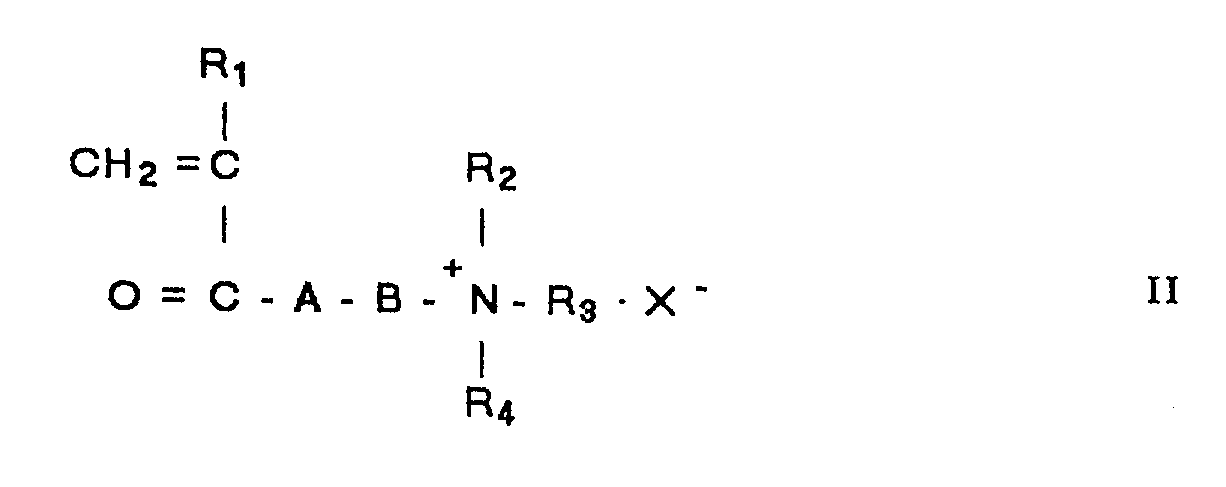
- the present invnetion relates to a process for producing unsaturated quaternary ammonium salts represented by General Formula II: (in which R1 represents a hydrogen atom or a methyl group; R2 and R3 each represents an alkyl group containing 1 to 4 carbon atoms; A represents an oxygen atom or an -NH- group; B represents an alkylene group containing 1 to 4 carbon atoms; R4 represents an alkyl group containing 1 to 4 carbon atoms or a benzyl group; and X ⁇ represents a halogen anion) which comprises treating cationic vinyl monomers represented by General Formula I: (in which R1, R2, R3, A and B have the same meanings as defined above) with an alkyl halide or an aralkyl halide. More particularly, it relates to a process for producing unsaturated quaternary ammonium salts of very high quality which contain impurities in only small quantities.
- Homopolymers or water-soluble copolymers of the unsaturated quaternary ammonium salts represented by general formula II are highly useful water soluble cationic polymers utilizable as an agent for improving the yield of various additives upon paper making; as an agent for improving filtration of water upon paper making; as an agent for recovering white water; as an agent for processing fibrous pulp; as an filtration aid for sludge; or as a polymeric flocculant.
- unsaturated quaternary ammonium salts are converted into corresponding quaternary salts by being allowed to react with an alkyl halide or an aralkyl halide in an organic medium.
- a similar process is described in Japanese Patent Publication 60.54343 wherein the alkyl halide is methylene chloride. It is however not preferable to produce the quaternary ammonium salts of General Formula II in an organic solvent system which exhibits a chain transfer effect. This is because polymerization of the quaternary ammonium salts or copolymerization thereof with other monomers is generally carried out in an aqueous medium since polymers of the salts are employed in an aqueous solution. In view of the above, there have been proposed in recent years various processes for producing the unsaturated quaternary salts in an aqueous medium.
- the cationic monomers represented by General Formula I or II are monomers having an extremely high polymerizability.
- various proposals have been made for the prevention of their polymeirzation during production or storage.
- Japanese Patent Publication No. 10,340/84 discloses that the polymerization of the quaternary ammonium salts of dialkylaminoalkyl (meth)acrylates occurs when the amount of oxygen dissolved in the aqueous solution thereof is small and that the polymerization of the salts dissolved in an aqueous solvent can be prevented by incorporating 50 to 1,000 ppm (based on the quaternary salts) of polymerization inhibitors and 1.8 ppm or more (based on the aqueous solution) of oxygen into the aqueous solution.
- cationic polymers from cationic monomers, such as those shown by General Formuyla II
- it has been more strongly desired in recent years to obtain cationic polymers having further improved properties for example, highly cationic copolymers containing more than 30% by weight of the cationic monomers, or high molecular weight cationic copolymers having an average molecular weight of 107 or more
- the concentration of oxygen dissolved in the reaction system must be increased in order to inhibit the polymerization of the reaction products. This causes the problem that the generation of substances that causes gelation (e.g., divinyl compounds), as well as the generation of polymerization inhibitors, could not be suppressed to a sufficient degree.
- the inventors have conducted intensive investigations on a process for producing unsaturated quaternary ammonium salts where hydrolyzed products are produced in only small quantities and the generation of gelation-causing substance and the polymerization inhibitors can be suppressed.
- a medium consisting of a particular mixture of water and an aprotic organic solvent
- the concentration of oxygen dissolved in the reaction system is lower than 1.8 ppm but not less than 0.3 ppm, the polymerization of the reaction products does not proceed and the by-products are generated in only very limited amounts.
- unsaturated tertiary amines of General Formula I to be used in the invention mention may be made of N,N-dimethylaminoethyl acrylate, N,N-diethylaminoethyl acrylate, N,N-dimethylaminopropyl acrylate, N,N-diethylaminopropyl acrylate and corresponding methacrylates, N,N-dimethylaminoethylacrylamide, N,N-diethylaminoethylacrylamide, N,N-dimethylaminopropylacrylamide, N,N-diethylaminopropylacrylamide and corresponding methacrylamides.
- quaternary ammonium producing agent or an agent for converting the tertiary amines into the quaternary ammonium salts
- alkyl halides containing 1 to 4 carbon atoms or aralyl halides there can be used. It can be particularly preferable from the practical viewpoint to use a corresponding alkyl chloride or benzyl chloride.
- a reaction medium a mixture consisting of water and an aprotic organic solvent.
- a ratio of charged materials is an important factor.
- water and an aprotic organic solvent in a ratio of (120 to 5) : (10 to 60) [based on weight], per 100 parts by weight of the unsaturated tertiary amines.
- the unsaturated tertiary amines represented by General Formula I are aminoesters or in cases where the quaternary ammonium salt producing agent is relatively liable to hydrolysis (e.g., in the case of benzyl chloride), it can be preferable to use water in a relatively small amount within the range descirbed hereinabove and to add, after the completion of the reaction, additional water to the reaction product up to a desired concentration.
- the unsaturated tertiary amines are aminoamides or in cases where the quaternary salt producing agent is relatively resistant to hydrolysis (e.g., in the case of alkyl halides), it can be advantageous from the economic point of view to use water in a relatively large amount within the range described hereinabove.
- aprotic organic solvents include ketones, such as acetone and methyl ethyl ketone; halogenated solvents, such as trichloroethylene; aromatic compounds, such as benzene; fatty hydrocarbons, such as n-hexane; esters, such as ethyl acetate; and the like.
- ketones such as acetone and methyl ethyl ketone
- halogenated solvents such as trichloroethylene
- aromatic compounds such as benzene
- fatty hydrocarbons such as n-hexane
- esters such as ethyl acetate
- an unsaturated tertiary amine, water and an aprotic organic solvent in the ratio as mentioned above. It is however possible to add, after the completion of the reaction, an additional water to the reaction product so as to adjust the concentration of the quaternary ammonium salts. Such an addition of water is by no means contrary to the gist of the present invention.
- the concentration of dissolved oxygen is lower than 1.8 ppm but not less than 0.3 ppm. If the concentration is not less than 1.8 ppm, polymerization inhibitors and gelation-causing substances are generated in large quantities and hence the object of the invention could not be achieved. When it is less than 0.3 ppm, it is not possible to prevent the polymerization of the tertiary amines and the produced quaternary ammonium salts even if the specific medium according to the invention is employed.
- the quaternary salt producing agent can be added to the reaction vessel prior to the start of the reaction. It is also possible to add the agent to the reaction vessel along with the progress of the reaction. The latter can be advantageous in order to prevent the reaction from proceeding beyond control. There is no particular limitation on the method how to add the agent to the reaction system. For example, it can be dropped at ordinary pressure or can be pressed into the reaction vessel.
- the temperature for producing the quaternary salts can be from 10 to 60 °C, in particular, from 20 to 40 °C.
- the quaternary salt producing agent is preferably used in an amount of from 1 to 1.2 mol, per mol of the tertiary amines.
- the agent could not be readily removed off after the reaction (for example, in the case where benzyl chloride is employed), it is possible to use the agent in an amount of from 0.95 to 1.0.
- the reaction mixture may be allowed to separate into two layers (if necessary, water can be added thereto before or after the separation into two layers).
- the desired aqueous solution of the unsaturated quaternary ammonium salts can be obtained by treating the quaternary salt-containing layer under reduced pressure until the remaining organic solvent is removed off to a concentration where the polymerization of the ammonium salts would not be substantially inhibited by the solvent.
- Additives such as a polymerization inhibitor (for example, hydroquinone monomethyl ether, phenothiazine, and nitrobenzene), a chelating agent (for example EDTA) and a pH regulator, can be added thereto before or after the reaction for producing the quaternary salts.
- a polymerization inhibitor for example, hydroquinone monomethyl ether, phenothiazine, and nitrobenzene
- a chelating agent for example EDTA
- pH regulator a pH regulator
- the thus obtained aqueous solution of the quaternary ammonium salts may be purified by using an ion exchange resin or activated carbon, or by means of solvent extraction.
- the polymerization induction time of the thus obtained quaternary ammonium salt was 11 minutes, and the time required for the polymerization was 46 minutes.
- Aqueous solutions of unsaturated quaternary ammonium salts were obtained in the same manner as in Example 1, except that starting materials shown in Table 1 were used in quantities shown therein.
- the quality and the polymerization behavior of the products obtained are also shown in the table for the purpose of comparison.
- Comparative Example 1 in which the concentration of dissolved oxygen exceeded the prescribed range according to the invention impurities were generated in large quantities as indicated by the value of hue (APHA), which exceeded 200.
- APHA value of hue
- the product obtained in the comparative example had a very poor polymerization characteristic.
- Comparative Example 2 in which a non-aprotic organic solvent was used, the product started to polymerize during the reaction, and hence it was impossible to obtain any polymerized product usable in a practical use. It would therefore be apparent that the process of the invention is highly useful.
- the unsaturated quaternary ammonium salt-containing layer was treated under reduced pressure at a temperature of 20 to 30 °C to remove off the acetone contained therein. There was obtained 586 g of product.
- the concentration of the unsaturated quaternary ammonium salt contained in the product and its hue (APHA) were 78.8% and 15, respectively. Divinyl compounds were not detected by gas chromatographic analysis.
- the polymerization induction time of the thus obtained quaternary ammonium salt was 12 minutes, and the time required for its polymerization was 42 minutes.
- the polymerized product exhibited a good solubility to water, and no water insoluble gel was observed.
- the polymerization induction time of the thus obtained quaternary ammonium salt was 15 minutes, and the time required for the polymerization was 49 minutes.
- the polymerized product exhibited a good solubility to water, and no water insoluble gel was observed.
- An aqueous solution of the same quaternary ammonium salt was prepared by repeating the procedure of Example 4 in the same manner, except that the reaction system was not replaced with nitrogen. During the reaction, the reaction system contained dissolved oxygen at a concentration of 8.9 ppm. The concentration of the quaternary ammonium salt contained in the thus obtained product and its hue (APHA) were 78.8% and 250, respectively.
- the product contained 38 ppm of divinyl compounds.
- Example 4 The procedure of Example 4 was repeated, except that the air was replaced until the concentration of dissolved oxygen decreased to 0.1 ppm. However, polymerization started during the reaction of producing the quaternary salt and it became unable to conduct the subsequent procedure.
- Example 6 The procedure of Example 6 was repeated, except that acetone was not charged at all. With the progress of the reaction, the viscosity of the reaction system increased markedly, and the stirring and the removal of heat became quite difficult. The required reaction time was three times as long as that in Example 6. After the completion of the reaction, the product contained 5.6% of free amines and had a hue (APHA) of 50. According to liquid chromatography, the concentration of benzyl alcohol (formed by the hydrolysis of benzyl chloride) was 1.92%, and the concentration of divinyl compounds was 25 ppm. The product is therefore of very poor quality in comparison with the product obtained in Example 6.
- APHA hue
- unsaturated quaternary ammonium salts represented by general formula II are produced by treating cationic monomers represented by General Formula I with an alkyl halide or an aralkyl halide in an aqueous medium according to the prior art, ammonium salts produced tend to polymerize when the concentration of dissolved oxygen is less than 1.8 ppm, whereas the production of by-products, such as gelation-causing substances (e.g., divinyl compounds) and trace amounts of polymerization inhibitors, could hardly be avoided when the concentration of the dissolved oxygen exceeds 1.8 ppm.
- gelation-causing substances e.g., divinyl compounds
Landscapes
- Chemical & Material Sciences (AREA)
- Organic Chemistry (AREA)
- Organic Low-Molecular-Weight Compounds And Preparation Thereof (AREA)
- Addition Polymer Or Copolymer, Post-Treatments, Or Chemical Modifications (AREA)
Abstract
Claims (3)
- Procédé de préparation de sels d'ammonium quaternaire non saturés représentés par la formule générale II suivante :

- Procédé de préparation de sels d'ammonium quaternaire non saturés tel qu'il est défini par la revendication 1 dans lequel le rapport (de poids) du monomère de vinyle cationique, de l'eau et du solvant organique aprotique mentionnés chargés est de (100) : (5 à 120) : (10 à 60).
- Procédé de préparation de sels d'ammonium quaternaire non saturés tel qu'il est défini par la revendication 1 dans lequel ledit solvant organique aprotique utilisé pour la réaction est, après achèvement de la réaction, enlevé de celle-ci, si on le désire après que le mélange de la réaction ait pu se séparer en deux couches, en traitant la couche contenant les sels d'ammonium quaternaire sous pression réduite.
Applications Claiming Priority (3)
| Application Number | Priority Date | Filing Date | Title |
|---|---|---|---|
| JP62033192A JPH07100683B2 (ja) | 1987-02-18 | 1987-02-18 | 不飽和第4級アンモニウム塩の製造方法 |
| JP33192/87 | 1987-02-18 | ||
| CA000566720A CA1309107C (fr) | 1987-02-18 | 1988-05-13 | Procede de fabrication de sels d'ammonium quaternaires non satures |
Publications (3)
| Publication Number | Publication Date |
|---|---|
| EP0302122A1 EP0302122A1 (fr) | 1989-02-08 |
| EP0302122A4 EP0302122A4 (fr) | 1989-08-29 |
| EP0302122B1 true EP0302122B1 (fr) | 1993-05-12 |
Family
ID=25671896
Family Applications (1)
| Application Number | Title | Priority Date | Filing Date |
|---|---|---|---|
| EP88901916A Expired - Lifetime EP0302122B1 (fr) | 1987-02-18 | 1988-02-18 | Procede de preparation de sels d'ammonium quaternaire non satures |
Country Status (8)
| Country | Link |
|---|---|
| US (1) | US4891440A (fr) |
| EP (1) | EP0302122B1 (fr) |
| JP (1) | JPH07100683B2 (fr) |
| KR (1) | KR940011900B1 (fr) |
| AU (1) | AU608575B2 (fr) |
| CA (1) | CA1309107C (fr) |
| DE (1) | DE3880914T2 (fr) |
| WO (1) | WO1988006152A1 (fr) |
Cited By (1)
| Publication number | Priority date | Publication date | Assignee | Title |
|---|---|---|---|---|
| US12065367B2 (en) | 2021-04-23 | 2024-08-20 | Ecolab Usa Inc. | Volatile fatty acid control |
Families Citing this family (6)
| Publication number | Priority date | Publication date | Assignee | Title |
|---|---|---|---|---|
| DE3810953C1 (fr) * | 1988-03-31 | 1989-03-23 | Degussa Ag, 6000 Frankfurt, De | |
| FR2642424B1 (fr) * | 1989-01-27 | 1991-09-27 | Norsolor Sa | Procede de preparation de solutions aqueuses de sels insatures d'ammonium quaternaire |
| KR100367906B1 (ko) * | 1995-10-20 | 2003-03-04 | 삼성정밀화학 주식회사 | 알킬아크릴레이트4급암모늄염의제조방법 |
| JPH09227470A (ja) * | 1996-02-16 | 1997-09-02 | Nippon Paint Co Ltd | 4級アンモニウム塩の合成法 |
| FR2750696B1 (fr) * | 1996-07-08 | 1998-10-30 | Atochem Elf Sa | Solutions aqueuses stabilisees de sels d'ammoniums quaternaires insatures |
| JP5669373B2 (ja) * | 2009-06-05 | 2015-02-12 | Kjケミカルズ株式会社 | 4級カチオン性帯電防止剤及びそれを含有した帯電防止組成物と成形品 |
Family Cites Families (6)
| Publication number | Priority date | Publication date | Assignee | Title |
|---|---|---|---|---|
| JPS5910340B2 (ja) * | 1975-04-25 | 1984-03-08 | 三菱化学株式会社 | 安定化方法 |
| DE3244274A1 (de) * | 1982-11-30 | 1984-05-30 | Basf Ag, 6700 Ludwigshafen | Verfahren zur herstellung konzentrierter waessriger loesungen von quaternisierungsprodukten von tertiaeren aminoalkylestern oder tertiaeren aminoalkylamiden der acryl- oder methacrylsaeure |
| JPS6054343A (ja) * | 1983-09-02 | 1985-03-28 | Kohjin Co Ltd | 不飽和第4級アンモニウム塩の製造方法 |
| US4745214A (en) * | 1986-06-20 | 1988-05-17 | Norsolor | Process for the preparation of an aqueous solution of unsaturated quaternary ammonium salts |
| FR2627181B1 (fr) * | 1988-02-11 | 1990-06-08 | Norsolor Sa | Procede de preparation de solutions aqueuses de sels insatures d'ammonium quaternaire |
| JPH0654343A (ja) * | 1992-07-28 | 1994-02-25 | Sharp Corp | 映像信号処理装置 |
-
1987
- 1987-02-18 JP JP62033192A patent/JPH07100683B2/ja not_active Expired - Fee Related
-
1988
- 1988-02-18 WO PCT/JP1988/000165 patent/WO1988006152A1/fr not_active Ceased
- 1988-02-18 US US07/290,045 patent/US4891440A/en not_active Expired - Fee Related
- 1988-02-18 DE DE8888901916T patent/DE3880914T2/de not_active Expired - Fee Related
- 1988-02-18 KR KR1019880701301A patent/KR940011900B1/ko not_active Expired - Fee Related
- 1988-02-18 EP EP88901916A patent/EP0302122B1/fr not_active Expired - Lifetime
- 1988-02-18 AU AU12980/88A patent/AU608575B2/en not_active Ceased
- 1988-05-13 CA CA000566720A patent/CA1309107C/fr not_active Expired - Fee Related
Non-Patent Citations (1)
| Title |
|---|
| CHEMICAL ABSTRACTS, vol. 88, no. 19, 8th May 1978, page 492, abstract nos. 136125u and 136126v, Columbus, Ohio, US; & JP-A-52 148 018, & JP-A-52 148 017 * |
Cited By (1)
| Publication number | Priority date | Publication date | Assignee | Title |
|---|---|---|---|---|
| US12065367B2 (en) | 2021-04-23 | 2024-08-20 | Ecolab Usa Inc. | Volatile fatty acid control |
Also Published As
| Publication number | Publication date |
|---|---|
| EP0302122A1 (fr) | 1989-02-08 |
| DE3880914D1 (de) | 1993-06-17 |
| AU1298088A (en) | 1988-09-14 |
| DE3880914T2 (de) | 1993-08-26 |
| KR890700570A (ko) | 1989-04-25 |
| CA1309107C (fr) | 1992-10-20 |
| KR940011900B1 (ko) | 1994-12-27 |
| AU608575B2 (en) | 1991-04-11 |
| WO1988006152A1 (fr) | 1988-08-25 |
| US4891440A (en) | 1990-01-02 |
| EP0302122A4 (fr) | 1989-08-29 |
| JPS63201151A (ja) | 1988-08-19 |
| JPH07100683B2 (ja) | 1995-11-01 |
Similar Documents
| Publication | Publication Date | Title |
|---|---|---|
| JP4050338B2 (ja) | フッ素化カルボン酸の回収方法 | |
| EP0419654A1 (fr) | Polymere cationique soluble dans l'eau | |
| US4151202A (en) | Preparation of diallyl dimethyl ammonium chloride and polydiallyl dimethyl ammonium chloride | |
| CA1183290A (fr) | Floculant pour boues | |
| US4891440A (en) | Process for producing unsaturated quaternary ammonium slats | |
| EP0140309A2 (fr) | Procédé de préparation de copolymères de monoallylamines et de derivés de diallylamine | |
| WO1992002561A1 (fr) | Polymerisation de monomeres vinyliques avec un nouveau systeme catalytique | |
| EP0371822A1 (fr) | Copolymères de chlorure de 3-méthacryloyloxy-2-hydroxypropyl-triméthylammonium monomère et d'un monomère vinylique | |
| EP1069140A1 (fr) | Polymere soluble dans l'eau, production et application comme coagulant polymerique | |
| US5519102A (en) | Aqueous polymerization method for poly(isopropenylphosphonic acid) | |
| US4444971A (en) | Acrylic and methacrylic quaternary chloromethyl ammonium chloride cationic monomers and polymers thereof | |
| AU670014B2 (en) | Process for preparing acrylamide | |
| US4081587A (en) | Process for the manufacture of ethylene-acrylic acid copolymers | |
| JPS606351B2 (ja) | カチオン性ビニルモノマ−水溶液の製法 | |
| JP2705827B2 (ja) | 不飽和第四級アンモニウム塩の製造方法 | |
| JP2001009208A (ja) | 高分子凝集剤 | |
| JPS6318936B2 (fr) | ||
| US3980800A (en) | Polymers of N-(chloroalkoxymethyl)acrylamides, quaternary ammonium derivates | |
| JP2007504264A (ja) | (メタ)アクリレートジアンモニウム塩の製造方法及びポリマー合成用モノマーとしての使用 | |
| JP2697093B2 (ja) | ジアルキルアミノアルキルアクリレートの中和塩の製造法 | |
| JP2001011124A (ja) | 高分子凝集剤 | |
| JPH0410465B2 (fr) | ||
| EP0065078B1 (fr) | Procédé de perfectionnement de l'aptitude de la polymérisation de l'acrylonitrile, de l'acryloamide, de l'acide acrylique et de mélanges les contenants | |
| JPH0794502B2 (ja) | 水溶性高分子量重合体粉末の製造方法 | |
| JPH03135945A (ja) | 第四級アンモニウム塩の製造方法 |
Legal Events
| Date | Code | Title | Description |
|---|---|---|---|
| PUAI | Public reference made under article 153(3) epc to a published international application that has entered the european phase |
Free format text: ORIGINAL CODE: 0009012 |
|
| AK | Designated contracting states |
Kind code of ref document: A1 Designated state(s): BE CH DE FR GB LI |
|
| 17P | Request for examination filed |
Effective date: 19890222 |
|
| A4 | Supplementary search report drawn up and despatched |
Effective date: 19890829 |
|
| 17Q | First examination report despatched |
Effective date: 19910524 |
|
| GRAA | (expected) grant |
Free format text: ORIGINAL CODE: 0009210 |
|
| AK | Designated contracting states |
Kind code of ref document: B1 Designated state(s): BE CH DE FR GB LI |
|
| REF | Corresponds to: |
Ref document number: 3880914 Country of ref document: DE Date of ref document: 19930617 |
|
| ET | Fr: translation filed | ||
| PGFP | Annual fee paid to national office [announced via postgrant information from national office to epo] |
Ref country code: GB Payment date: 19950130 Year of fee payment: 8 |
|
| PGFP | Annual fee paid to national office [announced via postgrant information from national office to epo] |
Ref country code: FR Payment date: 19950215 Year of fee payment: 8 |
|
| PGFP | Annual fee paid to national office [announced via postgrant information from national office to epo] |
Ref country code: DE Payment date: 19950225 Year of fee payment: 8 |
|
| PGFP | Annual fee paid to national office [announced via postgrant information from national office to epo] |
Ref country code: BE Payment date: 19950306 Year of fee payment: 8 |
|
| PGFP | Annual fee paid to national office [announced via postgrant information from national office to epo] |
Ref country code: CH Payment date: 19950320 Year of fee payment: 8 |
|
| PG25 | Lapsed in a contracting state [announced via postgrant information from national office to epo] |
Ref country code: GB Effective date: 19960218 |
|
| PG25 | Lapsed in a contracting state [announced via postgrant information from national office to epo] |
Ref country code: BE Effective date: 19960228 |
|
| PG25 | Lapsed in a contracting state [announced via postgrant information from national office to epo] |
Ref country code: LI Effective date: 19960229 Ref country code: CH Effective date: 19960229 |
|
| BERE | Be: lapsed |
Owner name: KOHJIN CO. LTD Effective date: 19960228 |
|
| GBPC | Gb: european patent ceased through non-payment of renewal fee |
Effective date: 19960218 |
|
| REG | Reference to a national code |
Ref country code: CH Ref legal event code: PL |
|
| PG25 | Lapsed in a contracting state [announced via postgrant information from national office to epo] |
Ref country code: FR Effective date: 19961031 |
|
| PG25 | Lapsed in a contracting state [announced via postgrant information from national office to epo] |
Ref country code: DE Effective date: 19961101 |
|
| REG | Reference to a national code |
Ref country code: FR Ref legal event code: ST |
|
| PLBE | No opposition filed within time limit |
Free format text: ORIGINAL CODE: 0009261 |
|
| STAA | Information on the status of an ep patent application or granted ep patent |
Free format text: STATUS: NO OPPOSITION FILED WITHIN TIME LIMIT |