EP0323179A2 - Polyarylensulfidfolie und Verfahren zur Herstellung derselben - Google Patents
Polyarylensulfidfolie und Verfahren zur Herstellung derselben Download PDFInfo
- Publication number
- EP0323179A2 EP0323179A2 EP88312279A EP88312279A EP0323179A2 EP 0323179 A2 EP0323179 A2 EP 0323179A2 EP 88312279 A EP88312279 A EP 88312279A EP 88312279 A EP88312279 A EP 88312279A EP 0323179 A2 EP0323179 A2 EP 0323179A2
- Authority
- EP
- European Patent Office
- Prior art keywords
- sheet
- temperature
- pas
- heat treatment
- poly
- Prior art date
- Legal status (The legal status is an assumption and is not a legal conclusion. Google has not performed a legal analysis and makes no representation as to the accuracy of the status listed.)
- Granted
Links
Images

Classifications
-
- C—CHEMISTRY; METALLURGY
- C08—ORGANIC MACROMOLECULAR COMPOUNDS; THEIR PREPARATION OR CHEMICAL WORKING-UP; COMPOSITIONS BASED THEREON
- C08J—WORKING-UP; GENERAL PROCESSES OF COMPOUNDING; AFTER-TREATMENT NOT COVERED BY SUBCLASSES C08B, C08C, C08F, C08G or C08H
- C08J5/00—Manufacture of articles or shaped materials containing macromolecular substances
- C08J5/18—Manufacture of films or sheets
-
- B—PERFORMING OPERATIONS; TRANSPORTING
- B29—WORKING OF PLASTICS; WORKING OF SUBSTANCES IN A PLASTIC STATE IN GENERAL
- B29C—SHAPING OR JOINING OF PLASTICS; SHAPING OF MATERIAL IN A PLASTIC STATE, NOT OTHERWISE PROVIDED FOR; AFTER-TREATMENT OF THE SHAPED PRODUCTS, e.g. REPAIRING
- B29C55/00—Shaping by stretching, e.g. drawing through a die; Apparatus therefor
- B29C55/02—Shaping by stretching, e.g. drawing through a die; Apparatus therefor of plates or sheets
- B29C55/18—Shaping by stretching, e.g. drawing through a die; Apparatus therefor of plates or sheets by squeezing between surfaces, e.g. rollers
-
- B—PERFORMING OPERATIONS; TRANSPORTING
- B29—WORKING OF PLASTICS; WORKING OF SUBSTANCES IN A PLASTIC STATE IN GENERAL
- B29C—SHAPING OR JOINING OF PLASTICS; SHAPING OF MATERIAL IN A PLASTIC STATE, NOT OTHERWISE PROVIDED FOR; AFTER-TREATMENT OF THE SHAPED PRODUCTS, e.g. REPAIRING
- B29C59/00—Surface shaping of articles, e.g. embossing; Apparatus therefor
- B29C59/02—Surface shaping of articles, e.g. embossing; Apparatus therefor by mechanical means, e.g. pressing
- B29C59/04—Surface shaping of articles, e.g. embossing; Apparatus therefor by mechanical means, e.g. pressing using rollers or endless belts
-
- B—PERFORMING OPERATIONS; TRANSPORTING
- B29—WORKING OF PLASTICS; WORKING OF SUBSTANCES IN A PLASTIC STATE IN GENERAL
- B29C—SHAPING OR JOINING OF PLASTICS; SHAPING OF MATERIAL IN A PLASTIC STATE, NOT OTHERWISE PROVIDED FOR; AFTER-TREATMENT OF THE SHAPED PRODUCTS, e.g. REPAIRING
- B29C71/00—After-treatment of articles without altering their shape; Apparatus therefor
- B29C71/0063—After-treatment of articles without altering their shape; Apparatus therefor for changing crystallisation
-
- B—PERFORMING OPERATIONS; TRANSPORTING
- B29—WORKING OF PLASTICS; WORKING OF SUBSTANCES IN A PLASTIC STATE IN GENERAL
- B29C—SHAPING OR JOINING OF PLASTICS; SHAPING OF MATERIAL IN A PLASTIC STATE, NOT OTHERWISE PROVIDED FOR; AFTER-TREATMENT OF THE SHAPED PRODUCTS, e.g. REPAIRING
- B29C48/00—Extrusion moulding, i.e. expressing the moulding material through a die or nozzle which imparts the desired form; Apparatus therefor
-
- B—PERFORMING OPERATIONS; TRANSPORTING
- B29—WORKING OF PLASTICS; WORKING OF SUBSTANCES IN A PLASTIC STATE IN GENERAL
- B29C—SHAPING OR JOINING OF PLASTICS; SHAPING OF MATERIAL IN A PLASTIC STATE, NOT OTHERWISE PROVIDED FOR; AFTER-TREATMENT OF THE SHAPED PRODUCTS, e.g. REPAIRING
- B29C48/00—Extrusion moulding, i.e. expressing the moulding material through a die or nozzle which imparts the desired form; Apparatus therefor
- B29C48/03—Extrusion moulding, i.e. expressing the moulding material through a die or nozzle which imparts the desired form; Apparatus therefor characterised by the shape of the extruded material at extrusion
- B29C48/07—Flat, e.g. panels
- B29C48/08—Flat, e.g. panels flexible, e.g. films
-
- B—PERFORMING OPERATIONS; TRANSPORTING
- B29—WORKING OF PLASTICS; WORKING OF SUBSTANCES IN A PLASTIC STATE IN GENERAL
- B29C—SHAPING OR JOINING OF PLASTICS; SHAPING OF MATERIAL IN A PLASTIC STATE, NOT OTHERWISE PROVIDED FOR; AFTER-TREATMENT OF THE SHAPED PRODUCTS, e.g. REPAIRING
- B29C71/00—After-treatment of articles without altering their shape; Apparatus therefor
- B29C71/02—Thermal after-treatment
-
- B—PERFORMING OPERATIONS; TRANSPORTING
- B29—WORKING OF PLASTICS; WORKING OF SUBSTANCES IN A PLASTIC STATE IN GENERAL
- B29K—INDEXING SCHEME ASSOCIATED WITH SUBCLASSES B29B, B29C OR B29D, RELATING TO MOULDING MATERIALS OR TO MATERIALS FOR MOULDS, REINFORCEMENTS, FILLERS OR PREFORMED PARTS, e.g. INSERTS
- B29K2081/00—Use of polymers having sulfur, with or without nitrogen, oxygen or carbon only, in the main chain, as moulding material
-
- B—PERFORMING OPERATIONS; TRANSPORTING
- B29—WORKING OF PLASTICS; WORKING OF SUBSTANCES IN A PLASTIC STATE IN GENERAL
- B29K—INDEXING SCHEME ASSOCIATED WITH SUBCLASSES B29B, B29C OR B29D, RELATING TO MOULDING MATERIALS OR TO MATERIALS FOR MOULDS, REINFORCEMENTS, FILLERS OR PREFORMED PARTS, e.g. INSERTS
- B29K2995/00—Properties of moulding materials, reinforcements, fillers, preformed parts or moulds
- B29K2995/0037—Other properties
- B29K2995/0041—Crystalline
-
- B—PERFORMING OPERATIONS; TRANSPORTING
- B29—WORKING OF PLASTICS; WORKING OF SUBSTANCES IN A PLASTIC STATE IN GENERAL
- B29K—INDEXING SCHEME ASSOCIATED WITH SUBCLASSES B29B, B29C OR B29D, RELATING TO MOULDING MATERIALS OR TO MATERIALS FOR MOULDS, REINFORCEMENTS, FILLERS OR PREFORMED PARTS, e.g. INSERTS
- B29K2995/00—Properties of moulding materials, reinforcements, fillers, preformed parts or moulds
- B29K2995/0037—Other properties
- B29K2995/0072—Roughness, e.g. anti-slip
- B29K2995/0073—Roughness, e.g. anti-slip smooth
-
- B—PERFORMING OPERATIONS; TRANSPORTING
- B29—WORKING OF PLASTICS; WORKING OF SUBSTANCES IN A PLASTIC STATE IN GENERAL
- B29K—INDEXING SCHEME ASSOCIATED WITH SUBCLASSES B29B, B29C OR B29D, RELATING TO MOULDING MATERIALS OR TO MATERIALS FOR MOULDS, REINFORCEMENTS, FILLERS OR PREFORMED PARTS, e.g. INSERTS
- B29K2995/00—Properties of moulding materials, reinforcements, fillers, preformed parts or moulds
- B29K2995/0037—Other properties
- B29K2995/0094—Geometrical properties
- B29K2995/0096—Dimensional stability
-
- C—CHEMISTRY; METALLURGY
- C08—ORGANIC MACROMOLECULAR COMPOUNDS; THEIR PREPARATION OR CHEMICAL WORKING-UP; COMPOSITIONS BASED THEREON
- C08J—WORKING-UP; GENERAL PROCESSES OF COMPOUNDING; AFTER-TREATMENT NOT COVERED BY SUBCLASSES C08B, C08C, C08F, C08G or C08H
- C08J2381/00—Characterised by the use of macromolecular compounds obtained by reactions forming in the main chain of the macromolecule a linkage containing sulfur with or without nitrogen, oxygen, or carbon only; Polysulfones; Derivatives of such polymers
- C08J2381/02—Polythioethers; Polythioether-ethers
Definitions
- This invention relates to a sheet of a poly(arylene sulfide) which may hereinafter be called "PAS”, and more specifically to an unstretched sheet composed at least principally of a poly(arylene sulfide) and having excellent planarity and smoothness and also to a production process thereof.
- PAS poly(arylene sulfide)
- PAS poly(phenylene sulfide) which may hereinafter be called "PPS”
- PPS poly(phenylene sulfide)
- Their unstretched films cannot however avoid deformations such as heat shrinkage in a high temperature range.
- Unstretched PAS sheets of smaller orientation are hence used for applications where high-temperature dimensional stability is required.
- PAS has a lower glass transition temperature and its crystallization is indispensable in order to impart heat resistance to them.
- uncrystallized ones cannot however show sufficient strength when the temperature increases to 200°C or so, while crystallized ones have a low elongation and are very brittle at that temperature.
- Crystallization of an unstretched PAS film is effected by a heat treatment.
- a sheet-like (or film-like) formed product composed principally of a PAS such as PPS has heretofore been produced by melting the starting resin, extruding the melt through a slit die, cooling and solidifying the extrudate into a sheet, and then subjecting the sheet to a heat treatment.
- the heat treatment may be conducted after application of stretching if necessary.
- This conventional heat treatment is conducted by bringing a sheet, which is to be treated, into contact with a heated liquid or gas stream or a surface of a heated solid such as a roll (Japanese Patent Publication No. 42611/1984).
- the behavior of a PAS sheet upon its heat treatment includes that a sheet cooled and solidified in an amorphous state is exposed to a temperature above the glass transition point owing to its heating and upon a lapse of a predetermined time, is crystallized and hardened.
- a PAS sheet is subjected to a heat treatment in a heated liquid or gas stream by way of example, the sheet expands and becomes sticky as the temperature increases.
- the temperature increases beyond the glass transition point of the PAS and the sheet becomes soft, the sheet is distorted or locally elongated, sticks to another material or object which is in contact with the sheet, or forms a roughened surface due to eruption of low boiling materials contained inside the PAS. Crystallization thereafter proceeds, thereby hardening the sheet.
- the resultant sheet is however poor in smooth ness and its surface conditions are inferior.
- the sheet expands and moreover becomes sticky as the temperature increases. Accordingly, the sheet may locally and slightly float from the surface of the solid. Subsequent crystallization results in hardening of the sheet. In this case, height differences arise in the surface of the sheet between areas maintained in contact with the solid and those floated from the solid. It is hence only possible to obtain a sheet inferior in planarity and smoothness.
- the clipped parts become useless and moreover, the resultant sheet is susceptible to breakage from the clipped parts.
- An object of this invention is to overcome the above-mentioned drawbacks of the conventional heat treatment methods and hence to provide a PAS sheet excellent in planarity and smoothness.
- Another object of this invention is to provide a PAS sheet excellent in planarity and smoothness, high in elongation and good in dimensional stability through a simple heat treatment step.
- a PAS sheet excellent in planarity and smoothness can be obtained without need for an application of stretching by melting a composition composed at least principally of a substantially linear, high molecular PAS, extruding the melt through a slit die, cooling and solidifying the extrudate into a sheet, preheating the sheet, and then causing the thus-preheated sheet to pass between a heating roll and a pinch roll to press the sheet continuously under linear pressure, thereby to heat-treat the sheet to crystallize same.
- the present invention has been completed on the basis of this finding.
- a PAS sheet having high tensile strength at break, elongation at break and Young's modulus and also excellent planarity and smoothness such that per area of 1 cm x 2 cm on a surface of the sheet, the sheet contains not more than 1 convex or concave whose angle of elevation or depression is at least 2° and whose height or depth is at least 10 ⁇ m.
- a poly(arylene sulfide) sheet excellent in planarity and smoothness is formed of a composition composed at least principally of a substantially linear, high molecular poly(arylene sulfide) having a melt viscosity of at least 1,000 poises.
- the sheet has an elongation at break of at least 10% at 23°C and a Young's modulus of at least 5 kg/mm2 at 200°C, and per area of 1 cm x 2 cm on at least one of the surfaces of the sheet, the sheet contains not more than 1 convex or concave whose angle of elevation or depression is at least 2° and whose height or depth is at least 10 ⁇ m.
- a process for the production of a poly(arylene sulfide) film excellent in planarity and smoothness comprises melting a composition composed at least principally of a substantially linear, high molecular poly(arylene sulfide) having a melt viscosity of at least 1,000 poises, extruding the melt through a slit die, cooling and solidifying the extrudate into a sheet, preheating the sheet for 3-100 seconds in a temperature range of from a temperature 20°C lower than the glass transition temperature of the polymer to a temperature 25°C higher than the glass transition temperature of the polymer, and causing the thus-preheated sheet to pass between a heating roll heated at a temperature in a range of 120-200°C and a pinch roll under a pinch pressure of 0.05-10 kg/cm, whereby the sheet is continuously pressed under linear pressure, is subjected to a heat treatment for 3-100 seconds and is crystallized.
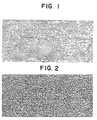
- FIGURES 1 through 3 illustrate the three-dimensional roughness of a PAS sheet according to this invention and that of a sheet of a Comparative Example.
- the horizontal direction corresponds to the machine direction of the corresponding sheet (magnification: x 10) while the vertical direction corresponds to the transverse direction of the same sheet (magnification: x 10).
- the direction vertical to the plane of the sheet indicates the direction of height or depth of each concave or convex in the surface of the sheet (magnification: x 500).
- the PAS useful in the practice of this invention is a substantially linear poly(arylene sulfide) having a melt viscosity of at least 1,000 poises but at most 50,000 poises.
- Such a PAS can be obtained, for example, by the process described in Japanese Patent Laid-Open No. 7332/1986.
- the PAS employed in this invention should be a substantially linear, high molecular PAS whose melt viscosity is at least 1,000 poises, preferably, 2,500-30,000 poises as measured at 310°C and at a shear rate of 200 sec ⁇ 1.
- substantially linear, high molecular PAS does not mean such a polymer as obtained through curing by oxidative crosslinking but does mean a polymer obtained from a monomer composed principally of a substantially bifunctional monomer.
- melt viscosity of the PAS is lower than 1,000 poises, the PAS is inferior in film-forming property and is unable to provide a sheet stably.
- Such a substantially linear, high molecular PAS can be obtained suitably by subjecting an alkali metal sulfide and a dihalogenated aromatic compound to specific two-stage heat-up polymerization in the presence of water in an organic amide solvent such as N-methylpyrrolidone as disclosed in Japanese Patent Laid-Open No. 7332/1986 referred to above.
- alkali metal sulfide may include lithium sulfide, sodium sulfide, potassium sulfide, rubidium sulfide, cesium sulfide, and mixtures thereof.
- dihalogenated aromatic compounds may be mentioned p-dichlorobenzene, m-dichlorobenzene, 2,5-dichlorotoluene, p-dibromobenzene, 2,6-dichloronaphthalene, 1-methoxy-2,5-dichlorobenzene, 4,4′-dichlorobiphenyl, 3,5-dichlorobenzoic acid, p,p′-dichlorodiphenyl ether, 4,4′-dichlorodiphenyl sulfone, 4,4′-dichlrodiphenyl sulfoxide, 4,4′-dichlorodiphenyl ketone, and mixtures thereof.
- PAS useful in the practice of this invention are substantially linear. Of these, poly(p-phenylene sulfide) (PPS) and poly(p-phenylene sulfide) copolymers containing m-phenylene sulfide units as a minor component are preferred.
- PAS poly(arylene sulfide)
- a PAS alone may be used, it is also feasible to add a small amount of a polyolefin such as polyethylene, polypropylene or poly-4-methyl-pentene-1, a rubber such as polyisoprene, or a thermoplastic resin such as polyethylene terephthalate, polycarbonate, tetrafluorinated ethylene resin, polyether ether ketone or poly(ketone sulfide).
- a polyolefin such as polyethylene, polypropylene or poly-4-methyl-pentene-1
- a rubber such as polyisoprene
- a thermoplastic resin such as polyethylene terephthalate, polycarbonate, tetrafluorinated ethylene resin, polyether ether ketone or poly(ketone sulfide).
- organic and inorganic fillers such as glass fibers, carbon black, talc, clay, titanium oxide, molybdenum disulfide and carbon fibers.
- additives such as antioxidant, heat stabilizer and lubricant may also be incorporated.
- These optional components may be mixed by a conventional mixing method, or may be mixed in a molten state and pelletized and thereafter fed to a melt extruder.
- a PAS or a composition composed principally of the PAS is generally fed to a melt extruder and then heated to a temperature of the melting point of the PAS or higher, so that the polymer or composition is molten.
- the thus-molten PAS is continuously extruded in the form of a sheet through a slit die such as a T-die, followed by its quenching to a temperature of the glass transition temperature of the PAS or lower so that the sheet is cooled and solidified.
- the sheet cooled and solidified in an amorphous state is then subjected to a heat treatment step.
- the characteristic feature of this invention resides in the heat treatment step.
- the heat treatment method in this invention may be called a “linearly-pressurized heat treatment method” or “linearly-pressurized crystallization method”.
- a sheet cooled and crystallized in an amorphous state is first of all preheated to make it soft.
- the sheet is thereafter caused to pass between a heating roll and pinch roll so that the sheet is continuously and linearly pressed to conduct its heat treatment and hence crystallization.
- the conventional heat treatment method a sheet (or film) was immediately brought into contact, for example, with a heating roll to perform its heat treatment so that preheating was not applied (Japanese Patent Publication No. 42611/1984).
- this preheating treatment is however an essential step for obtaining a sheet with planarity and smoothness.
- the preheating temperature ranges from a temperature 20°C lower than the glass transition temperature of the PAS to a temperature 25°C higher than the glass transition temperature.
- glass transition temperature means a value corresponding to the point of inflection toward the endothermic side when measured at a heating rate of 10°C per minute by a differential scanning calorimeter (DSC).
- the preheating time may range from 3 seconds to 100 seconds. If it is shorter than 3 seconds, the effects of the preheating that both planarity and smoothness are imparted cannot be brought about fully. In contrast, any preheating time longer than 100 seconds results in localized crystallization at the time of the preheating. Outside the above range, it is hence difficult to achieve the purpose of the preheating.
- Preheating can be conducted by bringing a sheet into contact with hot air or heating roll.
- a heating means it may be mentioned to perform preheating by heat pinch rolls, which will be described subsequently, within the above temperature range and then causing a sheet to pass between the pinch rolls so as to have the sheet travel along and in contact with the surfaces of the pinch rolls for a predetermined period of time before the sheet is caused to pass between a heating roll and a pinch roll.
- the heat treatment of this invention is conducted using a heating roll.
- a heat treatment apparatus is constructed of this heating roll and a pinch roll.
- the pinch roll is maintained in linear contact under a predetermined pressure (pinch pressure) with the surface of the heating roll.
- Adjustment of the pinch pressure is generally effected by controlling an air cylinder attached to the pinch roll and hence controlling the contact pressure between the pinch roll and heating roll. Further, by reading the indication of an accessory pressure gauge, the pinch pressure (linear pressure) can be calculated from the diameter of the air cylinder and the length of the roll surface and/or regulated.
- the pinch roll may be either a metal roll or a rubber roll.
- the rubber roll is however preferred for the suitable control of the pinch pressure.
- the pinch roll must not give any damages to the matching heating roll and must be able to apply a uniform pressure along the length thereof.
- a heat treatment of an amorphous PAS sheet is conducted by causing the sheet to pass continuously between the heating roll and pinch roll and hence pressing the sheet therebetween.
- the pressing of the sheet is effected continuously under linear pressure between both the rolls.
- the pinch pressure may be 0.05-10 kg/cm, preferably, 0.1-5 kg/cm. If the pinch pressure is too low, it is difficult to impart planarity and smoothness to a sheet. On the other hand, any unduly high pinch pressure results in excess stretching and orientation so that the dimensional stability at high temperatures is deteriorated and the planarity and smoothness are also deteriorated. Pinch pressures outside the above range are therefore not preferred.
- the temperature of the heating roll may be controlled between 120°C and 200°C with a range of 140-160°C being preferred. Any temperatures lower than 120°C lead to unduly slow crystallization and are therefore inefficient. Any temperatures higher than 200°C however cause a sheet to undergo unduly large thermal expansion thereby making it difficult to obtain a sheet having good planarity and smoothness.
- the heating roll may be either a metal roll or a ceramic roll. For PAS sheets, a ceramic roll can be used preferably because it has low stickiness to the sheets.
- an amorphous PAS sheet can be preheated by causing the sheet to travel along and in contact with the surface of the pinch roll.
- the PAS sheet according to this invention is an unstretched and unoriented sheet, and is a thin film-like formed product whose thickness is generally 5 mm or smaller with 10 ⁇ m - 2 mm being preferred.
- the PAS sheet of this invention is markedly superior in planarity and smoothness to conventional PAS sheets.
- a PAS sheet obtained, for example, by a conventional heat treatment method featuring simple contact to a solid surface such as a heating roll contains different spots corresponding respectively to areas contacted or stuck to the solid and those floated from the solid and further, on the side not brought into contact with the solid, a granular surface structure is formed due to eruption of low boiling materials or lip streaks are observed all over that surface.
- the PAS sheet according to this invention is free of such a granular surface structure at both surfaces thereof, contains no distortion, warpage or lip streaks over the entire surfaces thereof, and has good planarity and smoothness.
- the PAS sheet of this invention has suitable surface roughness and small coefficient of dynamic friction and has excellent utility.
- PAS sheets obtained by the conventional heat treatment method include some sheets which show a good value when measured locally. When however observed over a wide area, many minute concaves and convexes of at least a certain size are observed. When concaves and convexes having an elevation or depression angle of at least 2° and a height or depth of at least 10 ⁇ m are observed in a surface area of 1 cm x 2 cm of each sheet by a surface roughness meter ("SURFCOM 550A", trade name; manufactured by Tokyo Seimitsu Co., Ltd.), sheets by the conventional heat treatment method contain many concaves and convexes whereas the PAS sheet of this invention contains only 0-1 concave or convex.
- the PAS sheet of this invention has good mechanical properties as demonstrated by its elongation at break of at least 10% at 23°C and its Young's modulus of at least 5 kg/mm2 at 20°C. Even when the sheet is bent for its processing or is set under tension or is subjected to drawing as in vacuum forming or pressure forming, the sheet is resistant to breakage and can be used with ease.
- PAS sheets according to this invention can be used in a wide variety of application fields in which heat resistance, planarity, smoothness and the like are required, for example, in the field of electronic and electrical engineering as capacitor films, flexible printed circuit boards, base films for magnetic films, chip carriers and TAB (tapes for automated bonding) and in the field of mechanical engineering as sliding members like bushings which are each formed of an iron plate and a filler-added film bonded to the iron plate.
- the process of this invention has made it possible to obtain a PAS sheet excellent in planarity and smoothness by melting a composition composed at least principally of a substantially linear, high molecular PAS, extruding the melt through a slit die, cooling and solidifying the extrudate into a sheet, preheating the sheet, and then causing the thus-preheated sheet to pass between a heating roll and a pinch roll, whereby the sheet is continuously pressed under linear pressure, is subjected to a heat treatment and is crystallized.
- PAS sheets according to this invention are extremely superior in planarity and smoothness to conventional PAS sheets and moreover have good dimensional stability at high temperatures. They can therefore be used in a wide variety of fields, typified by the field of electronic and electrical engineering and the field of mechanical engineering.
- the melt viscosity of each PAS was measured at 310°C and a shear rate of 200 sec ⁇ 1.
- Each surface roughness Ra ( ⁇ m) was measured in accordance with JIS B-0601, using the surface roughness meter ("SURFCOM 550A", trade name; manufactured by Tokyo Seimitsu Co., Ltd.).
- a density gradient tube was formed using a zinc chloride-water system. From specific gravity ( ⁇ ) measured at 23°C, crystalline density ( ⁇ c) and amorphous density ( ⁇ a), the weight-average degree of crystallization (Xc) was determined in accordance with the following equation.
- X c ( ⁇ c/ ⁇ ) ⁇ ( ⁇ - ⁇ a)/( ⁇ c- ⁇ a) ⁇
- ⁇ c and ⁇ a of the poly(phenylene sulfide) used in the present Examples were 1.43 and 1.32 respectively.
- TENSILON (trade mark) manufactured by Toyo-Baldwin Company
- sample sheets punched out by a No. 5 dumbbell were measured at 23°C and 200°C respectively in accordance with ASTM D-638.
- the sample length, width and stretching rate were set at 33 mm, 6 mm and 50 mm/min respectively.
- the tensile strength at break and elongation at break were determined from a strain-stress curve, while the Young's modulus was determined from the initial strain zone.
- Evaluation of the planarity and smoothness of each PAS sheet was conducted by the evaluation of its smoothness, which relied upon its surface roughness and its coefficient of dynamic friction. Moreover, as evaluation which takes the planarity into account, concaves and convexes having a depression or elevation angle of at least 2° and a depth of height of at least 10 ⁇ m were counted by the surface roughness meter. Their numbers were also adopted as a standard for the evaluation in this invention. Described specifically, the three-dimensional roughness of each PAS sheet according to this invention was diagrammatically shown by an instrument which was composed of the above-described surface roughness meter and a three-dimensional roughness measuring plotter. From the three-dimensional diagram obtained by the instrument, the shapes and numbers of concaves and convexes in a surface area of 1 cm x 2 cm of the sheet were determined.
- the melt temperature of the polymer was 310°C, and the delivery rate was 3.5 kg/hour.
- the thus- extruded sheet was quenched on a metal roll which had a diameter of 300 mm and was controlled at 85°C, and was then wound into a roll.
- the distance between the die lip and the metal roll was about 10 mm.
- the winding speed was controlled so that the sheet thus wound had a thickness of 400 ⁇ m.
- the winding speed was about 0.6 m/min at that time.
- the sheet had a density of 1.32 and was amorphous.
- a heat treatment apparatus constructed of a ceramic roll having a diameter of 150 mm and a surface roughness of 0.063 ⁇ m, a rubber-made pinch roll, etc. was provided.
- the gauge pressure was controlled at 3.0 kg/cm2 so that the pinch pressure of the line pressure was 1.2 kg/cm.
- the temperature of the ceramic roll was controlled at 155°C.
- the surface temperature of the rubber roll was about 100°C.
- the residence time of the sheet on the ceramic roll was about 30 seconds.
- the peripheral speed of the surface of the ceramic roll was about 0.3 m/min.
- the sheet was wound up to about 25 m on a take-up roll. This sheet will be designated as the "heat-treated sheet (A)". Physical properties of the sheet (A) were measured. Results are given in Table 1.
- the resultant heat-treated sheet will be designated as the "heat-treated sheet (B)".
- thermotreated sheet H-1 a sheet obtained by subjecting the amorphous sheet to a heat treatment for 10 minutes on a ferro plate, which was a metal plate having a mirror-finished chromium-plated surface, in a Geer oven of 260°C are also given in Table 1.
- the heat-treated sheets of this invention were excellent in both planarity and smoothness and were also high in elongation at break and Young's modulus and good in mechanical strength.
- the sheet of Example 2 which was subjected to the additional heat treatment at the elevated temperature, was improved further in Young's modulus.
- the untreated sheet and heat-treated sheet (H-1) of the Comparative Examples had smaller surface roughness locally but when observed over a wide area, had lip streaks, spots and/or a granular surface structure, whereby their planarity and smoothness were inferior.
- the heat-treated sheet of Comparative Example 2 contained concaves and convexes, which had an angle of elevation or depression of at least 2° and a depth or height of at least 10 ⁇ m, as many as 20 in total per surface area of 1 cm x 2 cm of the sheet, whereby it was inferior in planarity and smoothness.
- the untreated sheet of Comparative Example 1 was inferior in both heat resistance and mechanical strength.
- Planarity "Extremely good” indicates planarity of such a degree that when judged visually, the sheet was extremely smooth and no irregularity was observed, neither distortion nor warpage or the like was contained over the entire surfaces of the sheet, and the sheet was hence flat.
- Example 2 Using the poly(phenylene sulfide) produced by Kureha Chemical Industry Co., Ltd. and having a melt viscosity of 8,200 poises at 310°C and 200 sec ⁇ 1 and a similar T-die as in Example 1, a substantially-unoriented amorphous sheet having a thickness of 47 ⁇ m was obtained by controlling the delivery rate and winding speed. The resultant sheet was subjected to a linearly-pressurized heat treatment under substantially the same conditions as in Example 1. Evaluation results of physical properties of the heat-treated sheet are given in Table 2.
- Example 3 The heat-treated sheet obtained in Example 3 was subjected to an additional heat treatment for about 10 minutes in a Geer oven of 260°C. Evaluation results of physical properties of the resulting sheet are given in Table 2.
- the substantially-unoriented amorphous sheet which was subjected to extrusion-casting in Example 3 and had a thickness of 47 ⁇ m, is used as a sheet of Comparative Example 3.
- this amorphous sheet was placed on a ferro plate and was then heat-treated for 10 minutes in a Geer oven of 260°C.
- the resultant sheet will be designated as the heat-treated sheet (H-2) of Comparative Example 4. Evaluation results of physical properties of those films are given in Table 2.
- the heat-treated sheets of this invention were excellent in both planarity and smoothness and were also good in mechanical strength.
- the sheet of Example 4 which was subjected to the additional heat treatment at the elevated temperature, was improved further in tensile strength at break and Young's modulus and had a sufficiently high modulus of elasticity.
- the sheets of the Comparative Examples were inferior in planarity and smoothness.
- the heat-treated sheet of the Comparative Example 4 contained concaves and convexes, which had an angle of elevation or depression of at least 2° and a depth or height of at least 10 ⁇ m, as many as 35 in total per surface area of 1 cm x 2 cm of the sheet, whereby it was inferior in planarity and smoothness even when judged visually.
- the untreated sheet was not suited for use at elevated temperatures.
- Pellets were obtained by adding 0.3 part of calcium carbonate and 0.2 parts of calcium stearate, both of which had an average particle size of 0.7 ⁇ m, to the poly(phenylene sulfide) produced by Kureha Chemical Industry Co., Ltd. and having a melt viscosity of 5,900 poises at 310°C and 200 sec ⁇ 1.
- the pellets were melt-extruded into a sheet-like form through a T-die in the same manner as in Example 1, whereby a substantially-unoriented, amorphous sheet having a thickness of 64 ⁇ m was obtained.
- Example 2 In a similar manner as in Example 1, the sheet was preheated and then pressed linearly to conduct its heat treatment.
- the planarity of the heat-treated sheet thus obtained was extremely good. Its surface roughness (Ra), which was an indication of smoothness, was 0.160 ⁇ m on the side of the ceramic roll and 0.510 ⁇ m on the side of the rubber roll. The surface on the side of the ceramic roll was glossy, while the surface on the side of the rubber roll was somewhat matted.
- Ra surface roughness
- the degree of crystallization of the sheet was 22 wt.%, its tensile strength at break was 6.3 kg/mm2 at room temperature (23°C) and 5.1 kg/mm2 at 200°C respectively, its elongation at break was 25% at room temperature and 340% at 200°C respectively, and its Young's modulus was 308 kg/mm2 at room temperature and 32 kg/mm2 at 200°C.
- the substantially-oriented, amorphous sheet of 400 ⁇ m thick produced in Example 1 was sandwiched between two ferro plates whose inner surfaces had been sprayed with a polyfluoroethylene parting agent, and was then subjected to a pressurized heat treatment for 10 minutes under a pressing force of 10 kg/cm2 on a press controlled at 260°C.
- the sheet thus heat-treated was taken out and cooled. Melt-adhesion or the like was not observed between the ferro plates and PPS sheet.
- the resultant heat-treated sheet contained, in the pattern of spots, areas crystallized in intimate contact with the ferro plates and those crystallized afloat from the ferro plates and was poor in planarity.
- the degree of crystallization of the heat-treated sheet was 24 wt.%.
- Example 5 Per area of 1 cm x 2 cm of sheet surface, the total number of concaves and convexes having an angle of elevation or depression of at least 2° and a height or depth of at least 10 ⁇ m was 0 in Example 5 but was 8 in Comparative Example 5. The sheet of Comparative Example 5 was therefore inferior in planarity.
- Example 2 Using the same PPS as that employed in Example 3, which had a melt viscosity of 8,200 poises, and a T-die similar to that used in Example 1, a substantially-unoriented, amorphous sheet having a different thickness was produced by changing the delivery rate of the polymer and the winding speed.
- the amorphous sheet thus obtained was preheated and then subjected to a linearly-pressurized heat treatment under similar conditions as in Example 1.
- the heat-treated sheet obtained in Example 6 was subjected to an additional heat treatment for about 10 minutes in a Geer oven of 260°C.
- Example 2 Using the PPS having a melt viscosity was 8,200 poises which was the same PPS as that employed in Example 3, a substantially-unoriented amorphous sheet of 400 ⁇ m thick was obtained in substantially the same manner as in Example 1. The sheet was thereafter heat-treated in exactly the same manner as in Example 1, and the resultant heat-treated sheet was subjected to a heat treatment for varied time periods in a Geer oven controlled at 260°C, thereby producing heat-treated sheets.
- the temperature of the heating roll was controlled at 155°C.
- the amorphous sheet produced in Example 1 was continuously allowed to run on the heating roll by way of a guide roll which was not in contact with the heating roll, and was then taken up.
- the residence time of the sheet on the heating roll was about 30 seconds.
- the resultant sheet had significant distortion and waving and its planarity was extremely bad. Further, many spots corresponding to areas maintained in intimate contact with the roll and those afloat therefrom were observed on a surface. A granular surface structure, which was believed to be traces of eruption of low boiling materials, was observed in the other surface.
- FIGURE 1 shows conditions of the surface of the sheet obtained in Example 3, which was on the side brought into contact with the ceramic roll
- FIGURE 2 depicts surface conditions of the other surface which was on the side brought into contact with the rubber roll
- FIGURE 3 illustrates conditions of the surface of the sheet obtained in Comparative Example 4, which was on the side brought into contact with the ferro plate.
- the horizontal direction corresponds to the machine direction of the corresponding sheet (magnification: x 10) while the vertical direction corresponds to the direction vertical to the machine (magnification: x 10).
- the direction vertical to the plane of the sheet indicates the direction of height or depth of each concave or convex in the surface of the sheet (magnification: x 500).
- the sheets of this invention are superior in planarity but those of the Comparative Examples contained many and large surface concaves and convexes at their surfaces. From each three-dimensional diagram obtained by the instrument, the shape and number of concave(s) and/or convex(es) per surface area of 1 cm x 2 cm of the corresponding sheet were determined. Since the magnification of each drawing is greater in the direction vertical to the sheet, an actual angle of elevation or depression of 2° is substantially equivalent to 60° in the drawing.
Landscapes
- Engineering & Computer Science (AREA)
- Chemical & Material Sciences (AREA)
- Mechanical Engineering (AREA)
- Manufacturing & Machinery (AREA)
- Polymers & Plastics (AREA)
- Health & Medical Sciences (AREA)
- Chemical Kinetics & Catalysis (AREA)
- Medicinal Chemistry (AREA)
- Materials Engineering (AREA)
- Organic Chemistry (AREA)
- Crystallography & Structural Chemistry (AREA)
- Manufacture Of Macromolecular Shaped Articles (AREA)
- Processing And Handling Of Plastics And Other Materials For Molding In General (AREA)
- Extrusion Moulding Of Plastics Or The Like (AREA)
- Casting Or Compression Moulding Of Plastics Or The Like (AREA)
- Polymers With Sulfur, Phosphorus Or Metals In The Main Chain (AREA)
Priority Applications (1)
| Application Number | Priority Date | Filing Date | Title |
|---|---|---|---|
| AT88312279T ATE89784T1 (de) | 1987-12-28 | 1988-12-23 | Polyarylensulfidfolie und verfahren zur herstellung derselben. |
Applications Claiming Priority (2)
| Application Number | Priority Date | Filing Date | Title |
|---|---|---|---|
| JP62329542A JP2522683B2 (ja) | 1987-12-28 | 1987-12-28 | ポリアリ―レンスルフィド樹脂シ―トおよびその製造方法 |
| JP329542/87 | 1987-12-28 |
Publications (3)
| Publication Number | Publication Date |
|---|---|
| EP0323179A2 true EP0323179A2 (de) | 1989-07-05 |
| EP0323179A3 EP0323179A3 (en) | 1990-05-02 |
| EP0323179B1 EP0323179B1 (de) | 1993-05-26 |
Family
ID=18222524
Family Applications (1)
| Application Number | Title | Priority Date | Filing Date |
|---|---|---|---|
| EP88312279A Expired - Lifetime EP0323179B1 (de) | 1987-12-28 | 1988-12-23 | Polyarylensulfidfolie und Verfahren zur Herstellung derselben |
Country Status (7)
| Country | Link |
|---|---|
| US (2) | US4976908A (de) |
| EP (1) | EP0323179B1 (de) |
| JP (1) | JP2522683B2 (de) |
| AT (1) | ATE89784T1 (de) |
| CA (1) | CA1321051C (de) |
| DE (1) | DE3881369T2 (de) |
| ES (1) | ES2041324T3 (de) |
Cited By (1)
| Publication number | Priority date | Publication date | Assignee | Title |
|---|---|---|---|---|
| EP0355708A3 (de) * | 1988-08-18 | 1992-01-02 | Chisso Corporation | Verfahren zum Herstellen von gewalzten, thermisch behandelten Folien oder Schichten |
Families Citing this family (6)
| Publication number | Priority date | Publication date | Assignee | Title |
|---|---|---|---|---|
| CA2038615C (en) * | 1990-03-23 | 1995-12-12 | Masamichi Akatsu | Poly (phenylene sulfide) fibers and production process thereof |
| DE19508597A1 (de) * | 1995-03-10 | 1996-09-12 | Hoechst Ag | Verfahren zum Herstellen biaxial verstreckter Folien sowie Vorrichtung zur Durchführung des Verfahrens |
| JP4564420B2 (ja) * | 2005-08-02 | 2010-10-20 | 大日本プラスチックス株式会社 | 薄肉成形品の連続成形方法 |
| EP2588287A4 (de) * | 2010-07-01 | 2018-01-17 | Inmold Biosystems A/S | Verfahren und vorrichtung zur herstellung eines nanostrukturierten oder glatten polymerartikels |
| US20140210302A1 (en) * | 2013-01-28 | 2014-07-31 | Regal Beloit America, Inc. | Motor for use in refrigerant environment |
| CN115027079B (zh) * | 2022-06-27 | 2023-09-05 | 江苏君华特种工程塑料制品有限公司 | 一种特种工程塑料型材去应力减少氧化层厚度的方法 |
Family Cites Families (21)
| Publication number | Priority date | Publication date | Assignee | Title |
|---|---|---|---|---|
| US3637592A (en) * | 1970-06-10 | 1972-01-25 | Du Pont | Crystalline copolyketone film structures |
| JPS5662128A (en) * | 1979-10-26 | 1981-05-27 | Toray Ind Inc | Preparation of poly-p-phenylene sulfide film |
| JPS5662126A (en) * | 1979-10-26 | 1981-05-27 | Toray Ind Inc | Manufacture of polyphenylene sulfide film |
| US4310435A (en) * | 1979-12-06 | 1982-01-12 | The Dow Chemical Co. | Method and composition for removing sulfide-containing scale from metal surfaces |
| US4310485A (en) * | 1980-09-26 | 1982-01-12 | Crown Zellerbach Corporation | Method of improving the flatness of compression-rolled plastic film |
| US4370469A (en) * | 1981-03-10 | 1983-01-25 | Toray Industries, Inc. | Polyphenylenesulfide sheet-like material |
| JPS57205119A (en) * | 1981-06-12 | 1982-12-16 | Toray Ind Inc | Biaxially stretched poly-p-phenylenesulfide film |
| US4629778A (en) * | 1982-05-20 | 1986-12-16 | Dainippon Ink And Chemicals, Inc. | Poly(p-phenylene sulfide) film and process for production thereof |
| JPS5942611A (ja) * | 1982-08-31 | 1984-03-09 | Matsushita Electric Ind Co Ltd | ビデオテ−プレコ−ダ |
| JPS59184619A (ja) * | 1983-04-04 | 1984-10-20 | Toray Ind Inc | ポリフエニレンスルフイド樹脂からなるシ−ト状物およびその製造方法 |
| JPS6096439A (ja) * | 1983-10-31 | 1985-05-30 | Sumitomo Chem Co Ltd | 垂直磁化用ポリp−フエニレンスルフイドフイルム |
| US4645826A (en) * | 1984-06-20 | 1987-02-24 | Kureha Kagaku Kogyo Kabushiki Kaisha | Process for production of high to ultra-high molecular weight linear polyarylenesulfides |
| JPS617332A (ja) * | 1984-06-20 | 1986-01-14 | Kureha Chem Ind Co Ltd | 高分子量ポリアリ−レンスルフイドの製造法 |
| US4774298A (en) * | 1984-06-29 | 1988-09-27 | Kureha Kagaku Kogyo Kabushiki Kaisha | Process for producing biaxially oriented paraphenylene sulfide block copolymer film |
| US4777228A (en) * | 1984-06-29 | 1988-10-11 | Kureha Kagaku Kogyo Kabushiki Kaisha | Biaxially oriented paraphenylene sulfide block copolymer film and process for producing the same |
| EP0233494A3 (de) * | 1986-01-23 | 1988-12-07 | Kureha Kagaku Kogyo Kabushiki Kaisha | Verfahren zur Fertigung von geformten Polyarylenthioäthergegenständen mit hoher Kristallinität |
| JPH0618900B2 (ja) * | 1986-04-02 | 1994-03-16 | 呉羽化学工業株式会社 | ポリパラフエニレンスルフイド2軸延伸フイルム |
| JPS62242517A (ja) * | 1986-04-14 | 1987-10-23 | Kureha Chem Ind Co Ltd | ポリパラフェニレンスルフィド2軸延伸フィルム及びその製造方法 |
| JPS62251121A (ja) * | 1986-04-25 | 1987-10-31 | Diafoil Co Ltd | ポリフエニレンスルフイド未延伸フイルムの製造法 |
| US4731890A (en) * | 1986-12-22 | 1988-03-22 | Bio-Support Industries Ltd. | Pillow |
| JPH0822930B2 (ja) * | 1987-05-15 | 1996-03-06 | 呉羽化学工業株式会社 | 二軸延伸ポリアリーレンスルフィド系樹脂組成物フィルムおよびその製造法 |
-
1987
- 1987-12-28 JP JP62329542A patent/JP2522683B2/ja not_active Expired - Lifetime
-
1988
- 1988-12-20 CA CA000586480A patent/CA1321051C/en not_active Expired - Fee Related
- 1988-12-23 AT AT88312279T patent/ATE89784T1/de active
- 1988-12-23 DE DE8888312279T patent/DE3881369T2/de not_active Expired - Fee Related
- 1988-12-23 ES ES198888312279T patent/ES2041324T3/es not_active Expired - Lifetime
- 1988-12-23 EP EP88312279A patent/EP0323179B1/de not_active Expired - Lifetime
- 1988-12-28 US US07/291,201 patent/US4976908A/en not_active Expired - Fee Related
-
1990
- 1990-04-19 US US07/511,133 patent/US5115092A/en not_active Expired - Fee Related
Cited By (1)
| Publication number | Priority date | Publication date | Assignee | Title |
|---|---|---|---|---|
| EP0355708A3 (de) * | 1988-08-18 | 1992-01-02 | Chisso Corporation | Verfahren zum Herstellen von gewalzten, thermisch behandelten Folien oder Schichten |
Also Published As
| Publication number | Publication date |
|---|---|
| ES2041324T3 (es) | 1993-11-16 |
| ATE89784T1 (de) | 1993-06-15 |
| US5115092A (en) | 1992-05-19 |
| JPH01171832A (ja) | 1989-07-06 |
| EP0323179B1 (de) | 1993-05-26 |
| CA1321051C (en) | 1993-08-10 |
| US4976908A (en) | 1990-12-11 |
| DE3881369T2 (de) | 1993-09-09 |
| DE3881369D1 (de) | 1993-07-01 |
| EP0323179A3 (en) | 1990-05-02 |
| JP2522683B2 (ja) | 1996-08-07 |
Similar Documents
| Publication | Publication Date | Title |
|---|---|---|
| US4286018A (en) | Biaxially oriented poly-p-phenylene sulfide films | |
| US4894419A (en) | Biaxially-stretched film made of poly(arylene sulfide) resin composition and production process thereof | |
| EP0409466B1 (de) | Verfahren zur Herstellung eines Polyimidfilms | |
| US4839129A (en) | Process for producing biaxially stretched polyparaphenylene sulfide film | |
| EP0323179B1 (de) | Polyarylensulfidfolie und Verfahren zur Herstellung derselben | |
| US4897238A (en) | Stretched poly(arylene thioether-ketone) films and production process thereof | |
| KR910003720B1 (ko) | 폴리아릴렌 티오에테르의 고 결정화 성형물 | |
| EP0321215B1 (de) | Wärmebeständige Folie und Verfahren zu ihrer Herstellung | |
| EP0372829B1 (de) | Polyarylensulfid-Folie und Verfahren zu deren Herstellung | |
| US4895912A (en) | Stretched poly(arylene thioether-ketone) films and production process thereof | |
| US5223585A (en) | Heat-resistant film and production process thereof | |
| US4777228A (en) | Biaxially oriented paraphenylene sulfide block copolymer film and process for producing the same | |
| US5008370A (en) | Poly(arylene thioether-ketones) improved in melt stability and preparation process thereof | |
| JPH04101827A (ja) | 二軸延伸ポリエーテルエーテルケトンフィルムの製造方法 | |
| JP2855351B2 (ja) | ポリアリーレンスルフィドシートおよびその製造方法 | |
| US4774298A (en) | Process for producing biaxially oriented paraphenylene sulfide block copolymer film | |
| US5286814A (en) | Heat-resistant stretched film and production process thereof | |
| JPS59184619A (ja) | ポリフエニレンスルフイド樹脂からなるシ−ト状物およびその製造方法 | |
| JP2775635B2 (ja) | 低オリゴマー性シートおよびその製造方法 | |
| JPS63260426A (ja) | ポリフエニレンスルフイドフイルムの製造方法 | |
| KR20260047574A (ko) | 반방향족 폴리아미드 필름 및 그 제조 방법 | |
| KR20000067585A (ko) | 이축배향 폴리에스테르 필름의 제조방법 | |
| JPS63245444A (ja) | 2軸配向ポリフェニレンスルフィドフィルム |
Legal Events
| Date | Code | Title | Description |
|---|---|---|---|
| PUAI | Public reference made under article 153(3) epc to a published international application that has entered the european phase |
Free format text: ORIGINAL CODE: 0009012 |
|
| 17P | Request for examination filed |
Effective date: 19890112 |
|
| AK | Designated contracting states |
Kind code of ref document: A2 Designated state(s): AT BE CH DE ES FR GB GR IT LI LU NL SE |
|
| PUAL | Search report despatched |
Free format text: ORIGINAL CODE: 0009013 |
|
| AK | Designated contracting states |
Kind code of ref document: A3 Designated state(s): AT BE CH DE ES FR GB GR IT LI LU NL SE |
|
| RHK1 | Main classification (correction) |
Ipc: B29C 71/00 |
|
| 17Q | First examination report despatched |
Effective date: 19920409 |
|
| GRAA | (expected) grant |
Free format text: ORIGINAL CODE: 0009210 |
|
| AK | Designated contracting states |
Kind code of ref document: B1 Designated state(s): AT BE CH DE ES FR GB GR IT LI LU NL SE |
|
| REF | Corresponds to: |
Ref document number: 89784 Country of ref document: AT Date of ref document: 19930615 Kind code of ref document: T |
|
| REF | Corresponds to: |
Ref document number: 3881369 Country of ref document: DE Date of ref document: 19930701 |
|
| ET | Fr: translation filed | ||
| ITF | It: translation for a ep patent filed | ||
| REG | Reference to a national code |
Ref country code: GR Ref legal event code: FG4A Free format text: 3008865 |
|
| REG | Reference to a national code |
Ref country code: ES Ref legal event code: FG2A Ref document number: 2041324 Country of ref document: ES Kind code of ref document: T3 |
|
| EPTA | Lu: last paid annual fee | ||
| PLBE | No opposition filed within time limit |
Free format text: ORIGINAL CODE: 0009261 |
|
| STAA | Information on the status of an ep patent application or granted ep patent |
Free format text: STATUS: NO OPPOSITION FILED WITHIN TIME LIMIT |
|
| 26N | No opposition filed | ||
| EAL | Se: european patent in force in sweden |
Ref document number: 88312279.8 |
|
| PGFP | Annual fee paid to national office [announced via postgrant information from national office to epo] |
Ref country code: SE Payment date: 19981207 Year of fee payment: 11 |
|
| PGFP | Annual fee paid to national office [announced via postgrant information from national office to epo] |
Ref country code: FR Payment date: 19981209 Year of fee payment: 11 |
|
| PGFP | Annual fee paid to national office [announced via postgrant information from national office to epo] |
Ref country code: AT Payment date: 19981214 Year of fee payment: 11 |
|
| PGFP | Annual fee paid to national office [announced via postgrant information from national office to epo] |
Ref country code: ES Payment date: 19981218 Year of fee payment: 11 |
|
| PGFP | Annual fee paid to national office [announced via postgrant information from national office to epo] |
Ref country code: LU Payment date: 19981221 Year of fee payment: 11 |
|
| PGFP | Annual fee paid to national office [announced via postgrant information from national office to epo] |
Ref country code: GR Payment date: 19981223 Year of fee payment: 11 |
|
| PGFP | Annual fee paid to national office [announced via postgrant information from national office to epo] |
Ref country code: GB Payment date: 19981224 Year of fee payment: 11 |
|
| PGFP | Annual fee paid to national office [announced via postgrant information from national office to epo] |
Ref country code: NL Payment date: 19981229 Year of fee payment: 11 |
|
| PGFP | Annual fee paid to national office [announced via postgrant information from national office to epo] |
Ref country code: DE Payment date: 19990107 Year of fee payment: 11 |
|
| PGFP | Annual fee paid to national office [announced via postgrant information from national office to epo] |
Ref country code: CH Payment date: 19990115 Year of fee payment: 11 |
|
| PGFP | Annual fee paid to national office [announced via postgrant information from national office to epo] |
Ref country code: BE Payment date: 19990215 Year of fee payment: 11 |
|
| PG25 | Lapsed in a contracting state [announced via postgrant information from national office to epo] |
Ref country code: LU Free format text: LAPSE BECAUSE OF NON-PAYMENT OF DUE FEES Effective date: 19991223 Ref country code: GB Free format text: LAPSE BECAUSE OF NON-PAYMENT OF DUE FEES Effective date: 19991223 Ref country code: AT Free format text: LAPSE BECAUSE OF NON-PAYMENT OF DUE FEES Effective date: 19991223 |
|
| PG25 | Lapsed in a contracting state [announced via postgrant information from national office to epo] |
Ref country code: SE Free format text: LAPSE BECAUSE OF NON-PAYMENT OF DUE FEES Effective date: 19991224 |
|
| PG25 | Lapsed in a contracting state [announced via postgrant information from national office to epo] |
Ref country code: LI Free format text: LAPSE BECAUSE OF NON-PAYMENT OF DUE FEES Effective date: 19991231 Ref country code: GR Free format text: LAPSE BECAUSE OF NON-PAYMENT OF DUE FEES Effective date: 19991231 Ref country code: CH Free format text: LAPSE BECAUSE OF NON-PAYMENT OF DUE FEES Effective date: 19991231 Ref country code: BE Free format text: LAPSE BECAUSE OF NON-PAYMENT OF DUE FEES Effective date: 19991231 |
|
| BERE | Be: lapsed |
Owner name: KUREHA KAGAKU KOGYO K.K. Effective date: 19991231 |
|
| PG25 | Lapsed in a contracting state [announced via postgrant information from national office to epo] |
Ref country code: NL Free format text: LAPSE BECAUSE OF NON-PAYMENT OF DUE FEES Effective date: 20000701 |
|
| EUG | Se: european patent has lapsed |
Ref document number: 88312279.8 |
|
| GBPC | Gb: european patent ceased through non-payment of renewal fee |
Effective date: 19991223 |
|
| PG25 | Lapsed in a contracting state [announced via postgrant information from national office to epo] |
Ref country code: FR Free format text: LAPSE BECAUSE OF NON-PAYMENT OF DUE FEES Effective date: 20000831 |
|
| NLV4 | Nl: lapsed or anulled due to non-payment of the annual fee |
Effective date: 20000701 |
|
| PG25 | Lapsed in a contracting state [announced via postgrant information from national office to epo] |
Ref country code: DE Free format text: LAPSE BECAUSE OF NON-PAYMENT OF DUE FEES Effective date: 20001003 |
|
| REG | Reference to a national code |
Ref country code: FR Ref legal event code: ST |
|
| PG25 | Lapsed in a contracting state [announced via postgrant information from national office to epo] |
Ref country code: ES Free format text: LAPSE BECAUSE OF NON-PAYMENT OF DUE FEES Effective date: 20001224 |
|
| REG | Reference to a national code |
Ref country code: ES Ref legal event code: FD2A Effective date: 20010113 |
|
| PG25 | Lapsed in a contracting state [announced via postgrant information from national office to epo] |
Ref country code: IT Free format text: LAPSE BECAUSE OF NON-PAYMENT OF DUE FEES;WARNING: LAPSES OF ITALIAN PATENTS WITH EFFECTIVE DATE BEFORE 2007 MAY HAVE OCCURRED AT ANY TIME BEFORE 2007. THE CORRECT EFFECTIVE DATE MAY BE DIFFERENT FROM THE ONE RECORDED. Effective date: 20051223 |