EP0362714B1 - Composés liquides cristallins et polymères liquides cristallins - Google Patents
Composés liquides cristallins et polymères liquides cristallins Download PDFInfo
- Publication number
- EP0362714B1 EP0362714B1 EP89118103A EP89118103A EP0362714B1 EP 0362714 B1 EP0362714 B1 EP 0362714B1 EP 89118103 A EP89118103 A EP 89118103A EP 89118103 A EP89118103 A EP 89118103A EP 0362714 B1 EP0362714 B1 EP 0362714B1
- Authority
- EP
- European Patent Office
- Prior art keywords
- mmol
- liquid
- compound
- crystalline
- acid
- Prior art date
- Legal status (The legal status is an assumption and is not a legal conclusion. Google has not performed a legal analysis and makes no representation as to the accuracy of the status listed.)
- Expired - Lifetime
Links
- 0 *C1CCC(*)CC1 Chemical compound *C1CCC(*)CC1 0.000 description 13
- ISWSIDIOOBJBQZ-UHFFFAOYSA-N Oc1ccccc1 Chemical compound Oc1ccccc1 ISWSIDIOOBJBQZ-UHFFFAOYSA-N 0.000 description 1
Images


Classifications
-
- C—CHEMISTRY; METALLURGY
- C07—ORGANIC CHEMISTRY
- C07D—HETEROCYCLIC COMPOUNDS
- C07D303/00—Compounds containing three-membered rings having one oxygen atom as the only ring hetero atom
- C07D303/02—Compounds containing oxirane rings
- C07D303/12—Compounds containing oxirane rings with hydrocarbon radicals, substituted by singly or doubly bound oxygen atoms
- C07D303/18—Compounds containing oxirane rings with hydrocarbon radicals, substituted by singly or doubly bound oxygen atoms by etherified hydroxyl radicals
- C07D303/20—Ethers with hydroxy compounds containing no oxirane rings
- C07D303/22—Ethers with hydroxy compounds containing no oxirane rings with monohydroxy compounds
-
- C—CHEMISTRY; METALLURGY
- C08—ORGANIC MACROMOLECULAR COMPOUNDS; THEIR PREPARATION OR CHEMICAL WORKING-UP; COMPOSITIONS BASED THEREON
- C08G—MACROMOLECULAR COMPOUNDS OBTAINED OTHERWISE THAN BY REACTIONS ONLY INVOLVING UNSATURATED CARBON-TO-CARBON BONDS
- C08G65/00—Macromolecular compounds obtained by reactions forming an ether link in the main chain of the macromolecule
- C08G65/02—Macromolecular compounds obtained by reactions forming an ether link in the main chain of the macromolecule from cyclic ethers by opening of the heterocyclic ring
- C08G65/04—Macromolecular compounds obtained by reactions forming an ether link in the main chain of the macromolecule from cyclic ethers by opening of the heterocyclic ring from cyclic ethers only
- C08G65/22—Cyclic ethers having at least one atom other than carbon and hydrogen outside the ring
-
- C—CHEMISTRY; METALLURGY
- C09—DYES; PAINTS; POLISHES; NATURAL RESINS; ADHESIVES; COMPOSITIONS NOT OTHERWISE PROVIDED FOR; APPLICATIONS OF MATERIALS NOT OTHERWISE PROVIDED FOR
- C09K—MATERIALS FOR MISCELLANEOUS APPLICATIONS, NOT PROVIDED FOR ELSEWHERE
- C09K19/00—Liquid crystal materials
- C09K19/04—Liquid crystal materials characterised by the chemical structure of the liquid crystal components, e.g. by a specific unit
- C09K19/06—Non-steroidal liquid crystal compounds
- C09K19/08—Non-steroidal liquid crystal compounds containing at least two non-condensed rings
- C09K19/10—Non-steroidal liquid crystal compounds containing at least two non-condensed rings containing at least two benzene rings
- C09K19/12—Non-steroidal liquid crystal compounds containing at least two non-condensed rings containing at least two benzene rings at least two benzene rings directly linked, e.g. biphenyls
- C09K19/126—Compounds containing at least one asymmetric carbon atom
-
- C—CHEMISTRY; METALLURGY
- C09—DYES; PAINTS; POLISHES; NATURAL RESINS; ADHESIVES; COMPOSITIONS NOT OTHERWISE PROVIDED FOR; APPLICATIONS OF MATERIALS NOT OTHERWISE PROVIDED FOR
- C09K—MATERIALS FOR MISCELLANEOUS APPLICATIONS, NOT PROVIDED FOR ELSEWHERE
- C09K19/00—Liquid crystal materials
- C09K19/04—Liquid crystal materials characterised by the chemical structure of the liquid crystal components, e.g. by a specific unit
- C09K19/06—Non-steroidal liquid crystal compounds
- C09K19/08—Non-steroidal liquid crystal compounds containing at least two non-condensed rings
- C09K19/10—Non-steroidal liquid crystal compounds containing at least two non-condensed rings containing at least two benzene rings
- C09K19/20—Non-steroidal liquid crystal compounds containing at least two non-condensed rings containing at least two benzene rings linked by a chain containing carbon and oxygen atoms as chain links, e.g. esters or ethers
- C09K19/2007—Non-steroidal liquid crystal compounds containing at least two non-condensed rings containing at least two benzene rings linked by a chain containing carbon and oxygen atoms as chain links, e.g. esters or ethers the chain containing -COO- or -OCO- groups
- C09K19/2021—Compounds containing at least one asymmetric carbon atom
-
- C—CHEMISTRY; METALLURGY
- C09—DYES; PAINTS; POLISHES; NATURAL RESINS; ADHESIVES; COMPOSITIONS NOT OTHERWISE PROVIDED FOR; APPLICATIONS OF MATERIALS NOT OTHERWISE PROVIDED FOR
- C09K—MATERIALS FOR MISCELLANEOUS APPLICATIONS, NOT PROVIDED FOR ELSEWHERE
- C09K19/00—Liquid crystal materials
- C09K19/04—Liquid crystal materials characterised by the chemical structure of the liquid crystal components, e.g. by a specific unit
- C09K19/38—Polymers
- C09K19/3833—Polymers with mesogenic groups in the side chain
- C09K19/3876—Polyoxyalkylene polymers
- C09K19/388—Polyepoxides
Definitions
- the present invention relates to liquid-crystalline polymers and to liquid-crystalline compounds to be used for preparation of the liquid-crystalline polymers.
- the present invention relates to liquid-crystalline polymers and liquid-crystalline compounds to be used for preparation of the liquid-crystalline polymers, which liquid-crystalline polymers exhibit ferroelectricity even at temperatures around room temperature, have such high speeds of response to external factors as to enable display of motion pictures.
- Such liquid-crystalline polymers are useful in optoelectronics fields as various kinds of optical elements, particularly, as those for display devices for desk calculators, clocks and watches, etc., and as those for various electronic optical devices for electronic optical shutters, electronic optical diaphragms, optical modulators, optical-path transfer switches in optical communication systems, memories, liquid crystal printer heads, varifocal lenses, etc.
- the liquid-crystalline polymers of the present invention have also high practicality in their use as the display elements for large display screens or curved display screens.
- EP-0184482 are various kinds of polyacrylate-type ferroelectric, polymeric liquid crystals disclosed. Nevertheless, these conventional polymeric liquid crystals have hardly been satisfactory for practical use because of the high temperature ranges where ferroelectricity is exhibited. Further, these polymeric liquid crystals have deficiencies in that their speed of response in the changes of their transmission intensity to the changes of external factors such as electric field are generally slow.
- polymers having a two-cyclic skeleton in their mesogenic groups generally have low temperature ranges of the SmC* phase (ferroelectric, chiral smectic C phase), and those polymers having a three-cyclic skeleton in their mesogenic radicals generally exhibit the SmC* phase at high temperatures, and therefore, they are difficult to use at temperatures around room temperature.
- An object of the present invention is to provide a liquid-crystalline polymer which exhibits ferroelectricity in a wide temperature range including temperatures around room temperature, has such a high speed of response to external factors as to enable display of motion pictures, and can be advantageously used as display elements for large display screens or curved display screens.
- Another object of the present invention is to provide a liquid-crystalline compound which can be suitably used for synthesis of the above-described liquid-crystalline polymer.
- Still another object of the present invention is to improve the SmC* temperature range and helical pitches of ferroelectric liquid-crystalline homopolymers having high response speed, by copolymerizing liquid-crystalline monomers to be used for the liquid-crystalline homopolymers or by copolymerizing the liquid-crystalline monomers with non-liquid-crystalline monomers, thereby providing liquid-crystalline copolymers which exhibit high speeds of response to electric fields around room temperature and have longer helical pitches (i.e., by which bistable state can be easily attained,).
- polyether-type polymers having specified repeating units exhibit SmC* phase in a wide temperature range including temperatures around room temperature and have high response speeds to electric fields.
- copolymers obtainable by copolymerizing the above-described polyether-type polymers with specified monomers have ferroelectricity temperature ranges closer to room temperature than those of the homopolymers and have longer helical pitches than those of the homopolymers.
- the present invention provides a liquid-crystalline compound having the structure represented by the following general formula (I): wherein a is an integer having a value of 1 to 10, b is an integer having a value of 0 or 1, c is an integer having a value of 1 to 30, X1 is -COO-, -O- or a single bond, M1 is and d is an integer having a value of 1 to 5.
- general formula (I) wherein a is an integer having a value of 1 to 10, b is an integer having a value of 0 or 1, c is an integer having a value of 1 to 30, X1 is -COO-, -O- or a single bond, M1 is and d is an integer having a value of 1 to 5.
- the present invention provides a liquid-crystalline polymer obtainable by polymerizing a monomer whose precursor is the above-described liquid-crystalline compounds, i.e. a liquid-crystalline polymer having the repeating units represented by the following general formula (II): wherein R1 is wherein a is an integer having a value of 1 to 10, b is an integer having a value of 0 or 1, c is an integer having a value of 1 to 30, X1 is -COO, -O- or a single bond, M1 is and d is an integer having a value of 1 to 5.
- R1 is wherein a is an integer having a value of 1 to 10
- b is an integer having a value of 0 or 1
- c is an integer having a value of 1 to 30
- X1 is -COO, -O- or a single bond
- M1 is and d is an integer having a value of 1 to 5.
- the present invention provides a liquid-crystalline copolymer comprising the repeating units (II) of the above-described liquid-crystalline homopolymer as an essential constituent unit, i.e., a liquid-crystalline copolymer having the repeating units represented by the following general formula (II) and the repeating units represented by the following general formula (III), the molar ratio between the repeating units (II) and the repeating units (III), m:n, is from 99:1 to 1:99, wherein R1 is R2 is wherein X1 is -COO, -O- or a single bond, X2 and Y1 are each independently -COO-, -OCO-, -O- or a single bond, M1 and M2 are each independently Z1 is -COO-, -OCO- or -O-, R3 and R4 are each independently -CH3, -CF3, -CN or a halogen, a and e are each independently an integer having a value of
- the present invention provides a terpolymer having the repeating units (II) of the above-described liquid-crystalline homopolymer as an essential constituent unit, i.e., a liquid-crystalline copolymer having the repeating units represented by the following general formula (II), the repeating units represented by the following general formula (IV), and the repeating units represented by the following general formula (V), the molar ratio between the repeating units (II) and the repeating units (IV) is from 98:1 to 1:98, the molar ratio between the repeating units (II) to (V) is from 98:1 to 1:98 and the molar ratio between the repeating units (IV) to (V) is from 98:1 to 1:98, wherein R1 is R5 is R6 is wherein X1 is -COO, -O- or a single bond, X2,X3, Y1, and Y2 are each independently -COO-, -OCO-, -O- or a
- Figures 1 to 3 are charts showing 1H-NMR spectrum of the liquid-crystalline compounds obtained in Examples 1 to 3, respectively.
- FIGS 4 to 8 are charts showing 1H-NMR spectrum of the liquid-crystalline compounds obtained in Examples 5 to 9, respectively.
- FIGS 9 to 11 are charts showing 1H-NMR spectrum of the liquid-crystalline polymers obtained in Examples 10 to 12, respectively.
- Figures 12 to 25 are charts showing 1H-NMR spectrum of the liquid-crystalline polymers obtained in Examples 14 to 27, respectively.
- the preferred number average molecular weight of the liquid-crystalline polymers of the present invention is from 1,000 to 500,000. If the number average molecular weight is less than 1,000, the moldability of the liquid-crystalline polymers into films or coated films may be occasionally deteriorated. If it is more than 500,000, there may occasionally appear undesirable effects such as a lowered response speed.
- the particularly preferred range of the number average molecular weight is generally from 1,000 to 100,000.
- a, e, and r are each independently an integer having a value of 1 to 10, preferably 1 to 5.
- c, g, and w are each independently an integer having a value of 1 to 30, preferably 6 to 12.
- the copolymerization ratio of the repeating units (II) to the repeating units (III), i.e., the molar ratio m:n, is from 99:1 to 1:99, preferably from 90:10 to 10:90.
- liquid-crystalline polymer of the present invention having the repeating units represented by the formula (II) may be obtained by polymerizing an epoxide represented by the following general formula (II′ ): wherein R1 is as defined above.
- liquid-crystalline copolymer of the present invention having the repeating units represented by the formula (II) and (III) may be obtained by copolymerizing the epoxides each represented by the following general formulas (II′ ) and (III′ ) respectively: wherein R1 and R2 are as defined above.
- liquid-crystalline copolymer of the present invention having the repeating units represented by the formula (II), (IV), and (V) may be obtained by copolymerizing the epoxides each represented by the following general formulas (II′ ), (IV′ ), and (V′ ) respectively: wherein R1, R5, and R6 are as defined above.
- the above-described copolymers and terpolymers may be prepared by copolymerizing two epoxides both of which are monomers of the homopolymers of the present invention having the repeating units represented by the formula (II), or by copolymerizing the epoxides with epoxides which are monomers of non-liquid-crystalline polymers and/or epoxides which are monomers of known liquid-crystalline polymers having high response speeds, etc., whereby adjustment of the SmC* phase temperature ranges of the resulting liquid-crystalline copolymers to temperatures around room temperature and elongating helical pitches to facilitate attainment of bistable state is achieved.
- copolymerization of a two-cyclic skeleton-type epoxide and a three-cyclic skeleton-type epoxide produces a copolymer having a wide SmC* phase temperature including room temperature.
- Copolymerization of two epoxides whose structure molecules are opposite in twisting direction of the helix to each other makes the helical properties of the epoxides compensate each other in the produced copolymer, resulting in an extended helical pitch of the copolymer. Also, copolymerization of an epoxide having a helical structure with an epoxide without helical structure provides a copolymer wherein the helical property of the epoxide unit having a helical structure is weakened by the dilution effect of the epoxide unit without helical structure, resulting in an extended helical pitch of the obtained copolymer.
- the epoxide (II′ ) to be used for the preparation of the liquid-crystalline polymers of the present invention is polymerized to form the liquid-crystalline homopolymers of the present invention or is copolymerized with other epoxides to construct the basic structure of the liquid-crystalline copolymers of the present invention, and the epoxides (II′ ) have a substituent R1 which comprises a spacer and a mesogenic group having at its end a specified optically active group.
- the epoxide (III′ ) is an epoxide different from the epoxide (II′ ), and its substituent R2 may, in common with the substituent R1 of the epoxide (II′ ), consist of a spacer and a mesogenic group having at its end an optically active group so far as R2 is different from R1, or may have a mesogenic group having no optically active end group, and further, may have no spacer nor mesogenic group, i.e., may be hydrogen or an alkyl group such as methyl group.
- the epoxide (IV′ ) is an epoxide different from the epoxide (II′ ), and the substituent R5 may consist of a spacer and a mesogenic group having no optically active group at its end, or may consist of a spacer and a mesogenic group having at its end an optically active group so far as the R5 is different from the R1.
- the epoxide (V′ ) is an epoxide different from both the epoxides (II′ ) and (IV′ ), and the substituent R6 may, in common with the substituents R1 and R5 of the epoxides (II′ ) and (IV′ ), consist of a spacer and a mesogenic group, and the mesogenic group may have at its end an optically active group, and further, the R6 may also be a group having no spacer nor mesogenic group, i.e., hydrogen or an alkyl group such as methyl group.
- liquid-crystalline compound (I) of the present invention may be synthesized by the following method.
- acetoxy(aromatic carboxylic acid)(1)(F is 1 or 2.) is halogenized with a halogenizing agent, such as thionyl chloride, to form an acid chloride, and the acid chloride is allowed to react with an alkyl lactate to obtain an ester compound (2).
- the ester compound (2) is allowed to reacted with benzylamine or the like to form a hydroxy compound (3).
- an alkenol (6) is halogenized with a halogenizing agent, such as thionyl chloride, in the presence of pyridine, to obtain an alkene halide (7).
- the alkene halide (7) is allowed to react with a compound (8) in an appropriate solvent, such as 2-butanone, in the presence of an alkali, such as potassium carbonate, to obtain an ether compound (9).
- the ether compound (9) is then epoxidized with a peracid, such as m-chloroperbenzoic acid, in an appropriate solvent, such as dichloromethane, to obtain the objective epoxide (10).
- a peracid such as m-chloroperbenzoic acid
- the preferred alkenol (6) to be used includes, for example, 9-decene-1-ol, 11-dodecene-1-ol, 7-octene-1-ol, and 5-hexene-1-ol.
- the above-mentioned compound (8) may be synthesized as follows.
- 4′ -hydroxybiphenyl-4-carboxylic acid is allowed to react with an alcohol (11) in an appropriate solvent, such as benzene, in the presence of an esterification catalyst, such as concentrated sulfuric acid or p-toluenesulfonic acid, at a desired temperature, to obtain the ester compound (12).
- an esterification catalyst such as concentrated sulfuric acid or p-toluenesulfonic acid
- an optically active alcohol is used as the alcohol (11).
- the optically active alcohol to be used include, for example, (+)-2-methylbutanol, (-)-2-methylbutanol, (+)-2-chlorobutanol, (-)-2-chlorobutanol, (+)-2-chloropentanol, (-)-2-chloropentanol, (+)-2-methylpentanol, (-)-2-methylpentanol, (+)-3-methylpentanol, (-)-3-methylpentanol, (+)-4-methylhexanol, (-)-4-methylhexanol, (+)-2-chloropropanol, (-)-2-chloropropanol, (+)-1-methylheptanol, (-)-1-methylheptanol, (+)-6-methyloctanol, (-)-6-methyloc
- alkyl-2-hydroxypropionates alkyl lactate
- alkyl-2-chloro-3-hydroxybutanoates alkyl-3-hydroxy-2-methyl-4,
- an alcohol having no optically active group is used in place of an optically active alcohols.
- Some examples of such alcohols which may be used include, for example, n-butyl alcohol, n-pentyl alcohol, n-hexyl alcohol, cyclohexyl alcohol, n-heptyl alcohol, n-octyl alcohol, n-nonyl alcohol, sec-butyl alcohol, and t-butyl alcohol.
- biphenyl-4,4′ -diol is allowed to react with a carboxylic acid (13), to obtain the ester compound (14).
- an optically active carboxylic acid is used as the carboxylic acid (14).
- optically active carboxylic acid examples include, for example, (+)-2-methylbutanoic acid, (-)-2-methylbutanoic acid, (+)-2-chlorobutanoic acid, (-)-2-chlorobutanoic acid, (+)-2-methylpentanoic acid, (-)-2-methylpentanoic acid, (+)-3-methylpentanoic acid, (-)-3-methylpentanoic acid, (+)-4-methylhexanoic acid, (-)-4-methylhexanoic acid, (+)-2-chloropropanoic acid, (-)-2-chloropropanoic acid, (+)-6-methyloctanoic acid, (-)-6-methyloctanoic acid, (+)-2-cyanobutanoic acid, (-)-2-cyanobutanoic acid, (+)-2-fluorooctanoic acid, (-)-2-fluorooctanoic acid
- a carboxylic acid having no optically active group is used in place of an optically active carboxylic acids.
- carboxylic acids include, for example, n-butanoic acid, n-pentanoic acid, and n-hexanoic acid.
- an alkene halide (7) is allowed to react with ethyl p-hydroxybenzoate in a proper solvent, such as acetone, in the presence of an alkali, such as potassium carbonate, to obtain an ether compound.
- a proper solvent such as acetone
- an alkali such as potassium carbonate
- the group protecting the carboxylic group of the ether compound is eliminated from the ether compound by using an aqueous potassium hydroxide solution, hydrochloric acid or the like, to form a carboxylic acid compound.
- a halogenizing agent, such as thionyl chloride is then added to the carboxylic acid compound, and the mixture is heated in a solvent, such as toluene, to form an acid halide.
- the acid halide is then allowed to react with the above-described compound (8) in a solvent, such as toluene, in the presence of pyridine, to obtain an ester compound (16).
- the ester compound (16) is epoxidized with a peracid, such as m-chloroperbenzoic acid, in a proper solvent, such as dichloromethane, to obtain the objective epoxide (17) ⁇ 3>
- a peracid such as m-chloroperbenzoic acid
- an alkene halide (7) is allowed to react with hydroquinone in the presence of an alkali, such as potassium carbonate, to obtain an ether compound (18).
- the following compound (19) is converted into an acid chloride by using thionyl chloride or the like.
- the obtained acid chloride is allowed to react with the ether compound (18) in the presence of pyridine, to obtain an ester compound (20).
- epoxidation is carried out in the same manner as in ⁇ 1>, to obtain the objective epoxide (21).
- the above-described compound (19), may be prepared as follows.
- An alcohol (11) is allowed to react with biphenyl-4,4′ -dicarboxylic acid in a solvent, such as toluene, in the presence of an esterification catalyst, to obtain the objective ester compound (22).
- a carboxylic acid (13) is converted into an acid chloride by using thionyl chloride or the like, and the acid chloride is then allowed to react with 4′ -hydroxybiphenyl-4-carboxylic acid in the presence of pyridine, to obtain the objective ester compound (23).
- Ethyl 4′ -hydroxybiphenyl-4-carboxylate is allowed to react with an ester of p-toluenesulfonic acid prepared by tosylating an alcohol (11), in the presence of potassium carbonate or the like, to obtain an ether compound.
- the ether compound is allowed to react with an aqueous alkali solution to hydrolyze the ester portion of the protecting group, to obtain the objective compound (24).
- the objective epoxide (26) may be prepared by employing the method ⁇ 2> for preparing the epoxide where R5 is with the proviso that a compound (25), is used in place of the compound (8),
- the above-described compound (25) may be prepared as follows.
- the objective ester compound (27) may be prepared by using the method for synthesis of the compound (12)in ⁇ 1>, with the proviso that p-hydroxybenzoic acid is used in place of 4′ -hydroxybiphenyl-4-carboxylic acid.
- the objective ester compound (28) may be prepared by using the method for synthesis of the compound (14) in ⁇ 1>, with the proviso that hydroquinone is used in place of biphenyl-4,4′ -diol.
- the objective ether compound (29) may be prepared by using the method for synthesis of the compound (15) in ⁇ 1>, with the proviso that hydroquinone is used in place of biphenyl-4,4′ -diol. ⁇ 5> In cases where R5 is
- the objective epoxide represented by the following general formula (31) may be prepared by using the method ⁇ 3> for synthesis of the epoxide wherein R5 is with the proviso that a compound (30), is used in place of the compound (19),
- the above compound (30) may be prepared as follows.
- the objective ester compound (32) may be prepared by the method for synthesis of the compound (22) in the above ⁇ 3>, with the proviso that terephthalic acid is used in place of biphenyl-4,4′ -dicarboxylic acid.
- the objective ester compound (33) may be prepared by the method for synthesis of the compound (23) in the above ⁇ 3>, with the proviso that p-hydroxybenzoic acid is used in place of 4′ -hydroxybiphenyl-4-carboxylic acid.
- the objective ether compound (34) may be prepared by the method for synthesis of the compound (24) in the above ⁇ 3>, with the proviso that ethyl-4-hydroxybenzoate is used in place of ethyl-4′ -hydroxybiphenyl-4-carboxylate.
- ⁇ 6> In cases where R5 is
- the objective epoxide (35) may be prepared by the method ⁇ 2> for synthesis of the epoxide wherein R5 is with the proviso that ethyl-4′ -hydroxybiphenyl-4-carboxylate is used in place of ethyl-4-hydroxybenzoate, and the above-described compound (25), is used in place of the compound (8), ⁇ 7> In cases where R5 is
- the objective epoxide (36) may be prepared by the method ⁇ 3> for synthesis of the epoxide wherein R5 is with the proviso that biphenyl-4,4′ -diol is used in place of hydroquinone, and the above-described compound (30), is used in place of the compound (19),
- the liquid-crystalline polymer of the present invention may be prepared by polymerizing thus obtained one, two or three monomers, and the polymerization can be performed by using known cationic polymerization methods, or the like.
- the catalysts that may be used for cationic polymerization in the present invention are known ones including protonic acids, such as sulfuric acid, phosphoric acid or perchloric acid, lewis acids, such as boron trifluoride, aluminum chloride, titanium tetrachloride or stannic chloride, boron trifluoride etherate, etc.
- protonic acids such as sulfuric acid, phosphoric acid or perchloric acid
- lewis acids such as boron trifluoride, aluminum chloride, titanium tetrachloride or stannic chloride, boron trifluoride etherate, etc.
- stannic chloride may be suitably used.
- polymers of the present invention by coordination polymerization by using organic aluminum complexes, etc. as a catalyst.
- organic aluminum complexes etc.
- polymers having number average molecular weights of not less than 30,000 can be obtained.
- the polymerization techniques that may be employed in the present invention are bulk polymerization technique, slurry polymerization technique, solution polymerization technique, etc., preferably solution polymerization technique.
- the suitable polymerization temperature can be usually from 0 to 30 °C , although it is not uniformly specified since it varies depending on the kind of the catalyst.
- the suitable polymerization time can be usually from several hours to six days, although it varies depending on the other polymerization conditions including polymerization temperature, etc.
- Control of the molecular weight of the copolymers may be conducted by adding a known molecular weight regulator and/or controlling the concentration of catalyst to monomers.
- the resulting polymers may be directly fixed between a couple of substrates in a state adhering to the substrates by sufficiently mixing the monomers with an initiator, sufficiently de-aerating the mixture, introducing the mixture between two substrates such as glass substrates, and heating the mixture.
- the solvents to be used in slurry polymerization and solution polymerization may be any known inert solvent.
- the illustrative examples of the solvents to be suitably used include hexane, dichloromethane or aromatic solvents, such as benzene, toluene, and xylene.
- liquid-crystalline polymers of the present invention may be blended with other optically active compounds, and may be used in a form of film by forming them into film by using a known film forming technique, such as casting technique, T-die technique, inflation technique, calender technique, stretching technique or the like.
- films of the liquid-crystalline polymers of the present invention may be utilized in various optoelectronics fields, including liquid crystal displays, electronic optical shutters, electronic optical diaphragms, and the like, by disposing them between a couple of large glass substrates, curved glass substrates, polyester films, etc., not to mention two usual glass substrates.
- liquid-crystalline polymers may also be directly formed into film adhering to a substrate by dissolving the liquid-crystalline polymer in a suitable solvant, applying the resulting polymer solution to the surface of a substrate, such as glass substrate, and then evaporating the solvent.
- liquid-crystalline polymers of the present invention exhibit ferroelectricity over a wide temperature range including temperatures around room temperature. It was also confirmed that they perform high speed response to electric field at temperatures around room temperature.
- the liquid-crystalline polymers of the present invention excel in moldability, they can be widely used in the fields of integrated optics, optoelectronics, and information memory.
- the liquid-crystalline polymers of the present invention may be used for various electronic optical devices, for example, for liquid crystal displays, such as digital displays of various forms, electronic optical shutters, optical-path transfer switches in optical communication systems, electronic optical diaphragms, memory devices, optical modulators, liquid crystal optical printer heads, and varifocal lenses.
- liquid-crystalline polymers of the present invention may be further improved by various treatments well known in this industry, for example, by mixing two or more liquid-crystalline polymers of the present invention, by mixing them with other polymers or other liquid-crystalline compounds, or by addition of additives such as various inorganic or organic compounds or metals, including adhesives, stabilizers, plasticizers, etc.
- the structures of the liquid-crystalline compounds obtained in the following Examples were identified by NMR spectrum and elementary analysis, and the structures of the liquid-crystalline polymers obtained in the following Examples were identified by NMR spectrum. Since the composition ratio of ethylene oxide unit in copolymers cannot be determined accurately by NMR spectrum, the composition ratio of the ethylene oxide unit in Example 18 was substituted by charging ratio. The average molecular weights Mn of the polymers are shown in polystyrene-conversion values as measured by GPC. Measurement of phase transition temperature and confirmation of phases were conducted by using a DSC and a polarizing microscope, respectively.
- phase transition behaviors and electric field response time of the liquid-crystalline compounds obtained in Examples 1 to 9 are shown in Table 2, and the phase transition behaviors, the helical pitches, and the electric field response time of the liquid-crystalline polymers obtained in Examples 10 to 27 are shown in Table 3.
- g glass state, Cry: crystal state
- SmC* chiral smectic C phase
- SmA smectic A phase
- N* chiral nematic phase
- Iso isotropic phase.
- the numerals in the phase transition behavior schemes represent phase transition temperatures in °C unit.
- a liquid crystal sample was supported between two ITO substrates of 20 x 10 mm, and the thickness of the sample was adjusted to 25 ⁇ m by spacers.
- An alternative current of E 2 x 10⁶ V/m was applied on the obtained liquid crystal cell, and the response time required of the light transmittance to change from 0 % to 90 % was measured.
- reaction solution was acidified with hydrochloric acid, and the acidified solution was concentrated under reduced pressure. Water was added to the residue to form a suspension, and the insoluble matter was collected and dried, to obtain 9.5 g of 4-(9-decenyloxy)benzoic acid. (Yield: 60 %)
- 4-(13-tetradecenyloxy)benzoic acid was synthesized in the same manner as in the synthesis of 4-(9-decenyloxy)benzoic acid in 1.(3) of Example 1. Then, a solution of 6 mmol (2.0 g) of the obtained 4-(13-tetradecenyloxy)benzoic acid and 18 mmol (2.2 g) of thionyl chloride dissolved in 30 ml of toluene was stirred at 80 °C for 3 hours, and the resulting reaction solution was concentrated under reduced pressure, to obtain an acid chloride compound.
- An epoxide monomer B represented by the following formula was prepared in the same manner as in 10.(1) of Example 10, with the proviso 1.0 mmol (570 mg) of the liquid-crystalline compound obtained in 2.(3) of Example 2 was used. (Yield: 94 %, twisting direction of helix: L configuration)
- a epoxide monomer K represented by the following formula was prepared in the same manner as in 20.(1) of Example 20, with the proviso that 1.0 mmol (640 mg) of the liquid-crystalline compound obtained in 8.(3) of Example (8) was used. (Yield: 93 %)
Landscapes
- Chemical & Material Sciences (AREA)
- Organic Chemistry (AREA)
- Crystallography & Structural Chemistry (AREA)
- Engineering & Computer Science (AREA)
- Materials Engineering (AREA)
- Chemical Kinetics & Catalysis (AREA)
- Health & Medical Sciences (AREA)
- Medicinal Chemistry (AREA)
- Polymers & Plastics (AREA)
- Organic Low-Molecular-Weight Compounds And Preparation Thereof (AREA)
- Liquid Crystal Substances (AREA)
- Epoxy Compounds (AREA)
- Polyethers (AREA)
Claims (10)
- Composé cristallin liquide présentant la structure représentée par la formule générale suivante (I) :
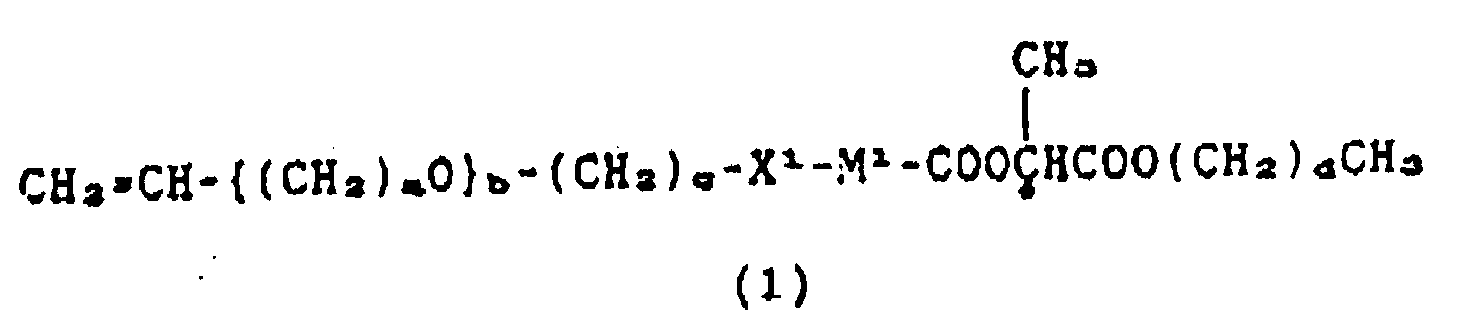
a est un entier valant de 1 à 10,
b est un entier valant 0 ou 1,
c est un entier valant de 1 à 30,
X¹ est -COO-, -O-, ou une liaison simple,
M¹ est


d est un entier valant de 1 à 5. - Composé cristallin liquide selon la revendication 1, où a est un entier valant de 1 à 5 et c est un entier valant de 6 à 12.
- Composé cristallin liquide selon la revendication 2, où X′ est -O- et M¹ est
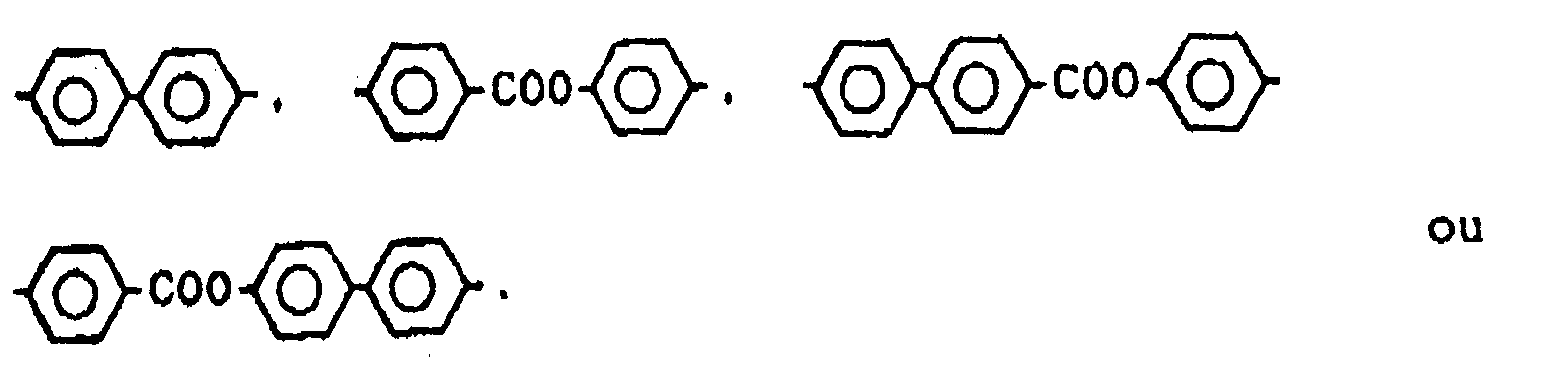
- Composé cristallin liquide selon la revendication 3, où d est un entier valant de 1 à 3.
- Polymère cristallin liquide dont des unités répétitives sont représentées par la formule générale suivante (II) :

R¹ est
a est un entier valant de 1 à 10,
b est un entier valant 0 ou 1,
c est un entier valant de 1 à 30,
X¹ est -COO-, -O-, ou une liaison simple,
M¹ est


d est un entier valant de 1 à 5. - Polymère cristallin liquide selon la revendication 5, où a est un entier valant de 1 à 5 et c est un entier valant de 6 à 12.
- Polymère cristallin liquide selon la revendication 6, où X′ est -O- et M¹ est

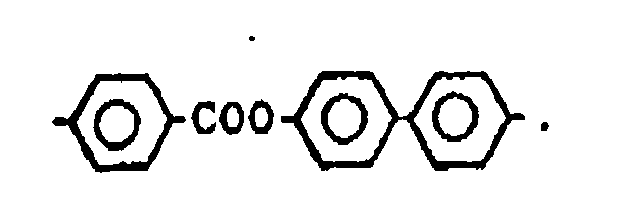
- Polymère cristallin liquide selon la revendication 7, où d est un entier valant de 1 à 3.
- Copolymère cristallin liquide ayant les unités répétitives représentées par la formule générale suivante (II) et les unités répétitives représentées par la formule générale (III), le rapport molaire entre les unités répétitives (II) et les unités répétitives (III), m:n allant de 99:1 à 1:99,


R¹ est

X¹ est -COO, -O-, ou une liaison simple,
M¹ et M² sont indépendamment l'un de l'autre


R³ et R⁴ sont indépendamment l'un de l'autre -CH₃, -CF₃, -CN ou un halogène,
a et e sont indépendamment l'un de l'autre un entier valant de 1 à 10,
q est un entier valant de 0 à 10,
c et g sont indépendamment l'un de l'autre un entier valant de 1 à 30,
d est un entier valant de 1 à 5,
h est un entier valant de 0 à 5,
b, f, i, j, k et p sont indépendamment les uns des autres un entier valant 0 ou 1, étant entendu que M¹ ≠ M² quand a = e et b = f et k = p = 1 et Z¹ = -COO-. - Copolymère cristallin liquide ayant les unités répétitives représentées par la formule générale suivante (II), les unités répétitives représentées par la formule générale suivante (IV), et les unités répétitives représentées par la formule générale suivante (V), le rapport molaire entre les unités répétitives (11) et les unités répétitives (IV) va de 98:1 à 1:98, le rapport molaire entre les unités répétitives (II) à (V) va de 98:1 à 1:98 et le rapport molaire entre les unités répétitives (IV) à (V) va de 98:1 à 1:98.


R¹ est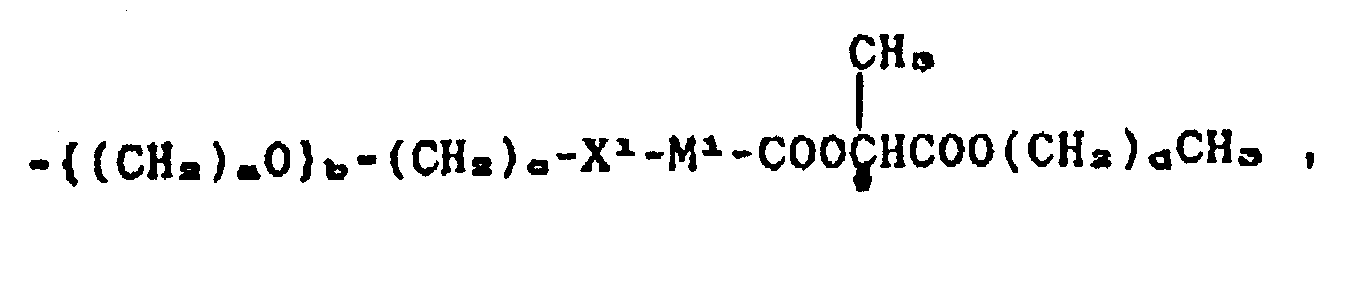
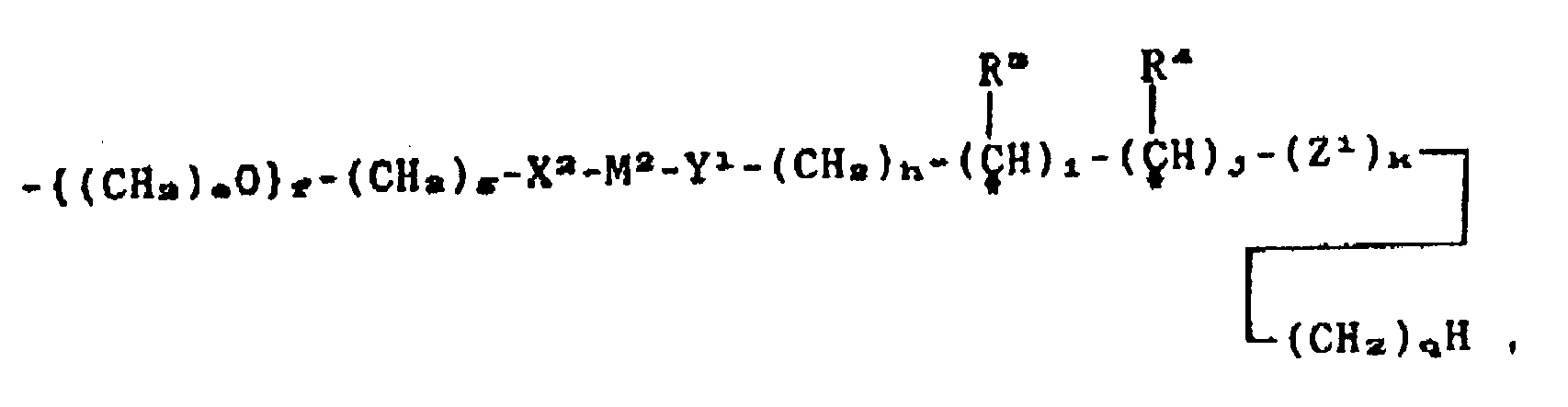

X¹ est -COO, -O-, ou une liaison simple,
X², X³, Y¹ et Y² sont indépendamment l'un de l'autre -COO-, -OCO-, -O- ou une liaison simple,
M¹, M² et M³ sont indépendamment l'un de l'autre


Z¹ est -COO, -OCO-, ou -O-,
R³, RR4 et R⁷ sont indépendamment l'un de l'autre -CH₃, -CF₃, -CN ou halogène,
a, e et r sont indépendamment l'un de l'autre un entier valant de 1 à 10,
q et A sont indépendamment l'un de l'autre un entier valant de 0 à 10,
c, g et w sont indépendamment les uns des autres un entier valant de 1 à 30,
d est un entier valant de 1 à 5,
h et x sont indépendamment l'un de l'autre un entier valant de 0 à 5,
b, f, v, i, j, k, y et z sont indépendamment les uns des autres un entier valant 0 ou 1,
étant prévu que M¹ ≠ M² quand a = e et b = f et k = 1 et Z¹ = -COO-, et que (h + q) ≠ (X + A) quand e = r, f = v et k = 0 et z = 1.
Applications Claiming Priority (2)
| Application Number | Priority Date | Filing Date | Title |
|---|---|---|---|
| JP63249966A JPH02101049A (ja) | 1988-10-05 | 1988-10-05 | 液晶化合物及び液晶ポリマー |
| JP249966/88 | 1988-10-05 |
Publications (3)
| Publication Number | Publication Date |
|---|---|
| EP0362714A2 EP0362714A2 (fr) | 1990-04-11 |
| EP0362714A3 EP0362714A3 (en) | 1990-10-24 |
| EP0362714B1 true EP0362714B1 (fr) | 1993-03-24 |
Family
ID=17200841
Family Applications (1)
| Application Number | Title | Priority Date | Filing Date |
|---|---|---|---|
| EP89118103A Expired - Lifetime EP0362714B1 (fr) | 1988-10-05 | 1989-09-29 | Composés liquides cristallins et polymères liquides cristallins |
Country Status (4)
| Country | Link |
|---|---|
| US (1) | US5190687A (fr) |
| EP (1) | EP0362714B1 (fr) |
| JP (1) | JPH02101049A (fr) |
| DE (1) | DE68905563T2 (fr) |
Families Citing this family (7)
| Publication number | Priority date | Publication date | Assignee | Title |
|---|---|---|---|---|
| WO1992015631A1 (fr) * | 1991-03-05 | 1992-09-17 | Sumitomo Electric Industries, Ltd. | Cristal liquide polymere de type a chaine laterale |
| JPH05107530A (ja) * | 1991-06-03 | 1993-04-30 | Sumitomo Electric Ind Ltd | 液晶表示素子およびその製造方法 |
| EP0571276A1 (fr) * | 1992-05-20 | 1993-11-24 | Showa Shell Sekiyu Kabushiki Kaisha | Composé monomère liquide cristallin et composé polymère liquide cristallin modifié avec celui-ci |
| US5252695A (en) * | 1992-06-03 | 1993-10-12 | The United States Of America As Represented By The Secretary Of The Navy | Fast switching ferroelectric liquid crystalline polymers |
| DE59408097D1 (de) * | 1993-02-17 | 1999-05-20 | Rolic Ag | Orientierungsschicht für Flüssigkristalle |
| ATE201514T1 (de) * | 1995-12-22 | 2001-06-15 | Dejima Tech Bv | Temperatur-angepasste verzögerungsschicht |
| JPH09208527A (ja) * | 1996-02-01 | 1997-08-12 | Mitsubishi Gas Chem Co Inc | 液晶中間体の製造法 |
Family Cites Families (3)
| Publication number | Priority date | Publication date | Assignee | Title |
|---|---|---|---|---|
| GB8602168D0 (en) * | 1986-01-29 | 1986-03-05 | Secr Defence | Liquid crystal compounds |
| EP0274128B1 (fr) * | 1986-12-29 | 1999-03-31 | Idemitsu Kosan Company Limited | Polymère de cristal liquide |
| JPH0778218B2 (ja) * | 1987-06-29 | 1995-08-23 | 出光興産株式会社 | 液晶ポリマ−組成物 |
-
1988
- 1988-10-05 JP JP63249966A patent/JPH02101049A/ja active Pending
-
1989
- 1989-09-28 US US07/413,625 patent/US5190687A/en not_active Expired - Fee Related
- 1989-09-29 DE DE89118103T patent/DE68905563T2/de not_active Expired - Fee Related
- 1989-09-29 EP EP89118103A patent/EP0362714B1/fr not_active Expired - Lifetime
Also Published As
| Publication number | Publication date |
|---|---|
| JPH02101049A (ja) | 1990-04-12 |
| DE68905563T2 (de) | 1993-11-04 |
| EP0362714A2 (fr) | 1990-04-11 |
| EP0362714A3 (en) | 1990-10-24 |
| DE68905563D1 (de) | 1993-04-29 |
| US5190687A (en) | 1993-03-02 |
Similar Documents
| Publication | Publication Date | Title |
|---|---|---|
| EP0274128B1 (fr) | Polymère de cristal liquide | |
| EP0258898B1 (fr) | Polymères liquides cristallins | |
| EP0228703B1 (fr) | Polymère cristal liquide ferro-électrique | |
| EP0348873B1 (fr) | Polymère liquide cristallin ferro-électrique, et époxyde utilisable pour la préparation de celui-ci | |
| EP0297554B1 (fr) | Composition liquide cristalline polymère | |
| EP0362714B1 (fr) | Composés liquides cristallins et polymères liquides cristallins | |
| EP0355772B1 (fr) | Polymère liquide cristallin | |
| JPH0457694B2 (fr) | ||
| EP0493601B1 (fr) | Copolymere a cristaux liquides, son procede de production, compose de diene utilise dans ladite production et production dudit compose | |
| Akiyama et al. | Side‐chain type liquid‐crystalline polyethers, 2 Effects of mesogenic moieties on the thermal properties and their self‐assembly behaviour | |
| JP2765942B2 (ja) | 液晶性ポリマー及びその製造に用いられるエポキシ化合物 | |
| Cooray et al. | Novel fluorine-containing ferroelectric side chain liquid-crystalline polysiloxanes showing bistable fast switching | |
| US5243065A (en) | Liquid-crystalline compounds and liquid-crystalline polymers | |
| JP3246938B2 (ja) | 液晶共重合体の製造方法 | |
| JPH0699555B2 (ja) | 液晶性高分子及びその中間体 | |
| JPH01156971A (ja) | 新規化合物 | |
| JP2726532B2 (ja) | 側鎖型高分子液晶及びその製造法、並びにその製造に用いられるエポキシ化合物及びその製造法 | |
| JPH01131234A (ja) | 液晶重合体 | |
| US4812548A (en) | Liquid crystalline polymer | |
| JPH01234414A (ja) | 液晶性架橋ポリマー | |
| JPH0381391A (ja) | 液晶共重合体 | |
| JPH0260924A (ja) | 液晶共重合体 | |
| JPH0386846A (ja) | 液晶化合物及び液晶ポリマー | |
| JPH0269522A (ja) | 液晶共重合体 | |
| JPH05194542A (ja) | 珪素化合物及びそれを含む組成物 |
Legal Events
| Date | Code | Title | Description |
|---|---|---|---|
| PUAI | Public reference made under article 153(3) epc to a published international application that has entered the european phase |
Free format text: ORIGINAL CODE: 0009012 |
|
| AK | Designated contracting states |
Kind code of ref document: A2 Designated state(s): BE CH DE FR GB IT LI NL SE |
|
| PUAL | Search report despatched |
Free format text: ORIGINAL CODE: 0009013 |
|
| AK | Designated contracting states |
Kind code of ref document: A3 Designated state(s): BE CH DE FR GB IT LI NL SE |
|
| 17P | Request for examination filed |
Effective date: 19901219 |
|
| 17Q | First examination report despatched |
Effective date: 19920130 |
|
| GRAA | (expected) grant |
Free format text: ORIGINAL CODE: 0009210 |
|
| AK | Designated contracting states |
Kind code of ref document: B1 Designated state(s): BE CH DE FR GB IT LI NL SE |
|
| PG25 | Lapsed in a contracting state [announced via postgrant information from national office to epo] |
Ref country code: SE Effective date: 19930324 Ref country code: LI Effective date: 19930324 Ref country code: CH Effective date: 19930324 Ref country code: BE Effective date: 19930324 |
|
| ITF | It: translation for a ep patent filed | ||
| REF | Corresponds to: |
Ref document number: 68905563 Country of ref document: DE Date of ref document: 19930429 |
|
| ET | Fr: translation filed | ||
| REG | Reference to a national code |
Ref country code: CH Ref legal event code: PL |
|
| PLBE | No opposition filed within time limit |
Free format text: ORIGINAL CODE: 0009261 |
|
| STAA | Information on the status of an ep patent application or granted ep patent |
Free format text: STATUS: NO OPPOSITION FILED WITHIN TIME LIMIT |
|
| 26N | No opposition filed | ||
| PGFP | Annual fee paid to national office [announced via postgrant information from national office to epo] |
Ref country code: NL Payment date: 19950922 Year of fee payment: 7 |
|
| PG25 | Lapsed in a contracting state [announced via postgrant information from national office to epo] |
Ref country code: NL Effective date: 19970401 |
|
| NLV4 | Nl: lapsed or anulled due to non-payment of the annual fee |
Effective date: 19970401 |
|
| PGFP | Annual fee paid to national office [announced via postgrant information from national office to epo] |
Ref country code: FR Payment date: 19970909 Year of fee payment: 9 |
|
| PGFP | Annual fee paid to national office [announced via postgrant information from national office to epo] |
Ref country code: GB Payment date: 19970922 Year of fee payment: 9 |
|
| PGFP | Annual fee paid to national office [announced via postgrant information from national office to epo] |
Ref country code: DE Payment date: 19971010 Year of fee payment: 9 |
|
| PG25 | Lapsed in a contracting state [announced via postgrant information from national office to epo] |
Ref country code: GB Free format text: LAPSE BECAUSE OF NON-PAYMENT OF DUE FEES Effective date: 19980929 |
|
| GBPC | Gb: european patent ceased through non-payment of renewal fee |
Effective date: 19980929 |
|
| PG25 | Lapsed in a contracting state [announced via postgrant information from national office to epo] |
Ref country code: FR Free format text: LAPSE BECAUSE OF NON-PAYMENT OF DUE FEES Effective date: 19990531 |
|
| PG25 | Lapsed in a contracting state [announced via postgrant information from national office to epo] |
Ref country code: DE Free format text: LAPSE BECAUSE OF NON-PAYMENT OF DUE FEES Effective date: 19990701 |
|
| REG | Reference to a national code |
Ref country code: FR Ref legal event code: ST |
|
| PG25 | Lapsed in a contracting state [announced via postgrant information from national office to epo] |
Ref country code: IT Free format text: LAPSE BECAUSE OF NON-PAYMENT OF DUE FEES;WARNING: LAPSES OF ITALIAN PATENTS WITH EFFECTIVE DATE BEFORE 2007 MAY HAVE OCCURRED AT ANY TIME BEFORE 2007. THE CORRECT EFFECTIVE DATE MAY BE DIFFERENT FROM THE ONE RECORDED. Effective date: 20050929 |