EP0375471B1 - Utilisation de 1,2,3,4-tétrahydro-acridines pour le traitement du SIDA, et composés - Google Patents
Utilisation de 1,2,3,4-tétrahydro-acridines pour le traitement du SIDA, et composés Download PDFInfo
- Publication number
- EP0375471B1 EP0375471B1 EP89402687A EP89402687A EP0375471B1 EP 0375471 B1 EP0375471 B1 EP 0375471B1 EP 89402687 A EP89402687 A EP 89402687A EP 89402687 A EP89402687 A EP 89402687A EP 0375471 B1 EP0375471 B1 EP 0375471B1
- Authority
- EP
- European Patent Office
- Prior art keywords
- amino
- pharmaceutical compositions
- lymphocytes
- producing pharmaceutical
- compositions according
- Prior art date
- Legal status (The legal status is an assumption and is not a legal conclusion. Google has not performed a legal analysis and makes no representation as to the accuracy of the status listed.)
- Expired - Lifetime
Links
- 150000001875 compounds Chemical class 0.000 title description 5
- 208000030507 AIDS Diseases 0.000 title description 2
- RXBYRTSOWREATF-UHFFFAOYSA-N 1,2,3,4-tetrahydroacridine Chemical class C1=CC=C2C=C(CCCC3)C3=NC2=C1 RXBYRTSOWREATF-UHFFFAOYSA-N 0.000 title 1
- YLJREFDVOIBQDA-UHFFFAOYSA-N tacrine Chemical compound C1=CC=C2C(N)=C(CCCC3)C3=NC2=C1 YLJREFDVOIBQDA-UHFFFAOYSA-N 0.000 claims description 31
- 210000004366 CD4-positive T-lymphocyte Anatomy 0.000 claims description 13
- 239000002243 precursor Substances 0.000 claims description 11
- 239000008194 pharmaceutical composition Substances 0.000 claims description 9
- 239000004480 active ingredient Substances 0.000 claims description 7
- 239000003814 drug Substances 0.000 claims description 7
- 238000000034 method Methods 0.000 claims description 7
- 229940079593 drug Drugs 0.000 claims description 5
- ISAKRJDGNUQOIC-UHFFFAOYSA-N Uracil Chemical compound O=C1C=CNC(=O)N1 ISAKRJDGNUQOIC-UHFFFAOYSA-N 0.000 claims description 4
- IQFYYKKMVGJFEH-XLPZGREQSA-N Thymidine Chemical compound O=C1NC(=O)C(C)=CN1[C@@H]1O[C@H](CO)[C@@H](O)C1 IQFYYKKMVGJFEH-XLPZGREQSA-N 0.000 claims description 3
- DRTQHJPVMGBUCF-XVFCMESISA-N Uridine Chemical compound O[C@@H]1[C@H](O)[C@@H](CO)O[C@H]1N1C(=O)NC(=O)C=C1 DRTQHJPVMGBUCF-XVFCMESISA-N 0.000 claims description 3
- 239000003795 chemical substances by application Substances 0.000 claims description 3
- 229910052500 inorganic mineral Inorganic materials 0.000 claims description 3
- 238000004519 manufacturing process Methods 0.000 claims description 3
- 239000011707 mineral Substances 0.000 claims description 3
- 239000000203 mixture Substances 0.000 claims description 3
- 230000008929 regeneration Effects 0.000 claims description 3
- 238000011069 regeneration method Methods 0.000 claims description 3
- 239000002253 acid Substances 0.000 claims description 2
- 231100000252 nontoxic Toxicity 0.000 claims description 2
- 230000003000 nontoxic effect Effects 0.000 claims description 2
- 229940035893 uracil Drugs 0.000 claims description 2
- HWOLQKJPMRZMEX-PJKMHFRUSA-N diazonio-[(2r,4s,5r)-4-hydroxy-5-(hydroxymethyl)-2-(5-methyl-2,4-dioxopyrimidin-1-yl)oxolan-2-yl]azanide Chemical compound O=C1NC(=O)C(C)=CN1[C@]1(N=[N+]=[N-])O[C@H](CO)[C@@H](O)C1 HWOLQKJPMRZMEX-PJKMHFRUSA-N 0.000 claims 1
- DRTQHJPVMGBUCF-UHFFFAOYSA-N uracil arabinoside Natural products OC1C(O)C(CO)OC1N1C(=O)NC(=O)C=C1 DRTQHJPVMGBUCF-UHFFFAOYSA-N 0.000 claims 1
- -1 camphosulfonate Chemical compound 0.000 description 16
- LXHOFEUVCQUXRZ-RRKCRQDMSA-N 6-azathymidine Chemical compound O=C1NC(=O)C(C)=NN1[C@@H]1O[C@H](CO)[C@@H](O)C1 LXHOFEUVCQUXRZ-RRKCRQDMSA-N 0.000 description 6
- 239000003443 antiviral agent Substances 0.000 description 6
- 150000003839 salts Chemical class 0.000 description 6
- 208000033065 inborn errors of immunity Diseases 0.000 description 5
- 208000028529 primary immunodeficiency disease Diseases 0.000 description 5
- PZNPLUBHRSSFHT-RRHRGVEJSA-N 1-hexadecanoyl-2-octadecanoyl-sn-glycero-3-phosphocholine Chemical compound CCCCCCCCCCCCCCCCCC(=O)O[C@@H](COP([O-])(=O)OCC[N+](C)(C)C)COC(=O)CCCCCCCCCCCCCCC PZNPLUBHRSSFHT-RRHRGVEJSA-N 0.000 description 4
- 206010019851 Hepatotoxicity Diseases 0.000 description 4
- 230000009471 action Effects 0.000 description 4
- 125000000217 alkyl group Chemical group 0.000 description 4
- 230000007423 decrease Effects 0.000 description 4
- 231100000304 hepatotoxicity Toxicity 0.000 description 4
- 230000007686 hepatotoxicity Effects 0.000 description 4
- 210000004698 lymphocyte Anatomy 0.000 description 4
- 239000008347 soybean phospholipid Substances 0.000 description 4
- 229960001685 tacrine Drugs 0.000 description 4
- 125000004169 (C1-C6) alkyl group Chemical group 0.000 description 3
- CSCPPACGZOOCGX-UHFFFAOYSA-N Acetone Chemical compound CC(C)=O CSCPPACGZOOCGX-UHFFFAOYSA-N 0.000 description 3
- 102000004163 DNA-directed RNA polymerases Human genes 0.000 description 3
- 108090000626 DNA-directed RNA polymerases Proteins 0.000 description 3
- 241000725303 Human immunodeficiency virus Species 0.000 description 3
- 125000003545 alkoxy group Chemical group 0.000 description 3
- HUMNYLRZRPPJDN-UHFFFAOYSA-N benzaldehyde Chemical compound O=CC1=CC=CC=C1 HUMNYLRZRPPJDN-UHFFFAOYSA-N 0.000 description 3
- 150000001732 carboxylic acid derivatives Chemical class 0.000 description 3
- 230000008034 disappearance Effects 0.000 description 3
- 229910052736 halogen Inorganic materials 0.000 description 3
- 150000002367 halogens Chemical class 0.000 description 3
- 125000001424 substituent group Chemical group 0.000 description 3
- 230000004083 survival effect Effects 0.000 description 3
- 125000000876 trifluoromethoxy group Chemical group FC(F)(F)O* 0.000 description 3
- 125000002023 trifluoromethyl group Chemical group FC(F)(F)* 0.000 description 3
- IIZPXYDJLKNOIY-JXPKJXOSSA-N 1-palmitoyl-2-arachidonoyl-sn-glycero-3-phosphocholine Chemical compound CCCCCCCCCCCCCCCC(=O)OC[C@H](COP([O-])(=O)OCC[N+](C)(C)C)OC(=O)CCC\C=C/C\C=C/C\C=C/C\C=C/CCCCC IIZPXYDJLKNOIY-JXPKJXOSSA-N 0.000 description 2
- WXTMDXOMEHJXQO-UHFFFAOYSA-N 2,5-dihydroxybenzoic acid Chemical compound OC(=O)C1=CC(O)=CC=C1O WXTMDXOMEHJXQO-UHFFFAOYSA-N 0.000 description 2
- 208000024827 Alzheimer disease Diseases 0.000 description 2
- WSFSSNUMVMOOMR-UHFFFAOYSA-N Formaldehyde Chemical compound O=C WSFSSNUMVMOOMR-UHFFFAOYSA-N 0.000 description 2
- YNAVUWVOSKDBBP-UHFFFAOYSA-N Morpholine Chemical compound C1COCCN1 YNAVUWVOSKDBBP-UHFFFAOYSA-N 0.000 description 2
- 208000001388 Opportunistic Infections Diseases 0.000 description 2
- NQRYJNQNLNOLGT-UHFFFAOYSA-N Piperidine Chemical compound C1CCNCC1 NQRYJNQNLNOLGT-UHFFFAOYSA-N 0.000 description 2
- 210000001744 T-lymphocyte Anatomy 0.000 description 2
- 125000004429 atom Chemical group 0.000 description 2
- 230000015572 biosynthetic process Effects 0.000 description 2
- 239000002775 capsule Substances 0.000 description 2
- 125000004432 carbon atom Chemical group C* 0.000 description 2
- 125000005518 carboxamido group Chemical group 0.000 description 2
- JHIVVAPYMSGYDF-UHFFFAOYSA-N cyclohexanone Chemical compound O=C1CCCCC1 JHIVVAPYMSGYDF-UHFFFAOYSA-N 0.000 description 2
- 239000003085 diluting agent Substances 0.000 description 2
- 125000002485 formyl group Chemical class [H]C(*)=O 0.000 description 2
- 229910052739 hydrogen Inorganic materials 0.000 description 2
- 239000001257 hydrogen Substances 0.000 description 2
- 125000004435 hydrogen atom Chemical group [H]* 0.000 description 2
- 208000015181 infectious disease Diseases 0.000 description 2
- 230000005764 inhibitory process Effects 0.000 description 2
- 150000002576 ketones Chemical class 0.000 description 2
- 239000000787 lecithin Substances 0.000 description 2
- 229940067606 lecithin Drugs 0.000 description 2
- 235000010445 lecithin Nutrition 0.000 description 2
- ZCSHNCUQKCANBX-UHFFFAOYSA-N lithium diisopropylamide Chemical compound [Li+].CC(C)[N-]C(C)C ZCSHNCUQKCANBX-UHFFFAOYSA-N 0.000 description 2
- BDAGIHXWWSANSR-UHFFFAOYSA-N methanoic acid Natural products OC=O BDAGIHXWWSANSR-UHFFFAOYSA-N 0.000 description 2
- 150000007522 mineralic acids Chemical class 0.000 description 2
- 150000007524 organic acids Chemical class 0.000 description 2
- 239000000546 pharmaceutical excipient Substances 0.000 description 2
- 125000001997 phenyl group Chemical group [H]C1=C([H])C([H])=C(*)C([H])=C1[H] 0.000 description 2
- 125000002924 primary amino group Chemical group [H]N([H])* 0.000 description 2
- 150000003254 radicals Chemical class 0.000 description 2
- PXQLVRUNWNTZOS-UHFFFAOYSA-N sulfanyl Chemical class [SH] PXQLVRUNWNTZOS-UHFFFAOYSA-N 0.000 description 2
- 239000000725 suspension Substances 0.000 description 2
- JSPNNZKWADNWHI-PNANGNLXSA-N (2r)-2-hydroxy-n-[(2s,3r,4e,8e)-3-hydroxy-9-methyl-1-[(2r,3r,4s,5s,6r)-3,4,5-trihydroxy-6-(hydroxymethyl)oxan-2-yl]oxyoctadeca-4,8-dien-2-yl]heptadecanamide Chemical compound CCCCCCCCCCCCCCC[C@@H](O)C(=O)N[C@H]([C@H](O)\C=C\CC\C=C(/C)CCCCCCCCC)CO[C@@H]1O[C@H](CO)[C@@H](O)[C@H](O)[C@H]1O JSPNNZKWADNWHI-PNANGNLXSA-N 0.000 description 1
- 125000004191 (C1-C6) alkoxy group Chemical group 0.000 description 1
- ZEIYLROOZCYYKO-UHFFFAOYSA-N 1-benzylidene-2,3,4,9a-tetrahydroacridin-9-imine Chemical compound C(C1=CC=CC=C1)=C1CCCC2=NC3=CC=CC=C3C(C12)=N ZEIYLROOZCYYKO-UHFFFAOYSA-N 0.000 description 1
- FGBRUIVBHMUQPM-UHFFFAOYSA-N 1-methylidene-2,3,4,9a-tetrahydroacridin-9-imine Chemical compound C=C1CCCC2=NC3=CC=CC=C3C(C12)=N FGBRUIVBHMUQPM-UHFFFAOYSA-N 0.000 description 1
- LNETULKMXZVUST-UHFFFAOYSA-N 1-naphthoic acid Chemical compound C1=CC=C2C(C(=O)O)=CC=CC2=C1 LNETULKMXZVUST-UHFFFAOYSA-N 0.000 description 1
- RTHHTTRUEGUKEF-UHFFFAOYSA-N 1-propan-2-ylidene-2,3,4,9a-tetrahydroacridin-9-imine Chemical compound N=C1C2=CC=CC=C2N=C2CCCC(C12)=C(C)C RTHHTTRUEGUKEF-UHFFFAOYSA-N 0.000 description 1
- HZNQSWJZTWOTKM-UHFFFAOYSA-N 2,3,4-trimethoxybenzoic acid Chemical compound COC1=CC=C(C(O)=O)C(OC)=C1OC HZNQSWJZTWOTKM-UHFFFAOYSA-N 0.000 description 1
- 125000004098 2,6-dichlorobenzoyl group Chemical group O=C([*])C1=C(Cl)C([H])=C([H])C([H])=C1Cl 0.000 description 1
- LBLYYCQCTBFVLH-UHFFFAOYSA-N 2-Methylbenzenesulfonic acid Chemical compound CC1=CC=CC=C1S(O)(=O)=O LBLYYCQCTBFVLH-UHFFFAOYSA-N 0.000 description 1
- LBLYYCQCTBFVLH-UHFFFAOYSA-M 2-methylbenzenesulfonate Chemical compound CC1=CC=CC=C1S([O-])(=O)=O LBLYYCQCTBFVLH-UHFFFAOYSA-M 0.000 description 1
- OSWFIVFLDKOXQC-UHFFFAOYSA-N 4-(3-methoxyphenyl)aniline Chemical compound COC1=CC=CC(C=2C=CC(N)=CC=2)=C1 OSWFIVFLDKOXQC-UHFFFAOYSA-N 0.000 description 1
- QTBSBXVTEAMEQO-UHFFFAOYSA-M Acetate Chemical compound CC([O-])=O QTBSBXVTEAMEQO-UHFFFAOYSA-M 0.000 description 1
- DWRXFEITVBNRMK-UHFFFAOYSA-N Beta-D-1-Arabinofuranosylthymine Natural products O=C1NC(=O)C(C)=CN1C1C(O)C(O)C(CO)O1 DWRXFEITVBNRMK-UHFFFAOYSA-N 0.000 description 1
- FERIUCNNQQJTOY-UHFFFAOYSA-M Butyrate Chemical compound CCCC([O-])=O FERIUCNNQQJTOY-UHFFFAOYSA-M 0.000 description 1
- FERIUCNNQQJTOY-UHFFFAOYSA-N Butyric acid Natural products CCCC(O)=O FERIUCNNQQJTOY-UHFFFAOYSA-N 0.000 description 1
- 102000003914 Cholinesterases Human genes 0.000 description 1
- 108090000322 Cholinesterases Proteins 0.000 description 1
- KRKNYBCHXYNGOX-UHFFFAOYSA-K Citrate Chemical compound [O-]C(=O)CC(O)(CC([O-])=O)C([O-])=O KRKNYBCHXYNGOX-UHFFFAOYSA-K 0.000 description 1
- FEWJPZIEWOKRBE-JCYAYHJZSA-N Dextrotartaric acid Chemical compound OC(=O)[C@H](O)[C@@H](O)C(O)=O FEWJPZIEWOKRBE-JCYAYHJZSA-N 0.000 description 1
- 235000010469 Glycine max Nutrition 0.000 description 1
- 244000068988 Glycine max Species 0.000 description 1
- VPNYRYCIDCJBOM-UHFFFAOYSA-M Glycopyrronium bromide Chemical compound [Br-].C1[N+](C)(C)CCC1OC(=O)C(O)(C=1C=CC=CC=1)C1CCCC1 VPNYRYCIDCJBOM-UHFFFAOYSA-M 0.000 description 1
- VEXZGXHMUGYJMC-UHFFFAOYSA-N Hydrochloric acid Chemical compound Cl VEXZGXHMUGYJMC-UHFFFAOYSA-N 0.000 description 1
- CPELXLSAUQHCOX-UHFFFAOYSA-N Hydrogen bromide Chemical compound Br CPELXLSAUQHCOX-UHFFFAOYSA-N 0.000 description 1
- 206010021460 Immunodeficiency syndromes Diseases 0.000 description 1
- CKLJMWTZIZZHCS-REOHCLBHSA-N L-aspartic acid Chemical compound OC(=O)[C@@H](N)CC(O)=O CKLJMWTZIZZHCS-REOHCLBHSA-N 0.000 description 1
- WHUUTDBJXJRKMK-VKHMYHEASA-N L-glutamic acid Chemical compound OC(=O)[C@@H](N)CCC(O)=O WHUUTDBJXJRKMK-VKHMYHEASA-N 0.000 description 1
- AFVFQIVMOAPDHO-UHFFFAOYSA-N Methanesulfonic acid Chemical compound CS(O)(=O)=O AFVFQIVMOAPDHO-UHFFFAOYSA-N 0.000 description 1
- HSHXDCVZWHOWCS-UHFFFAOYSA-N N'-hexadecylthiophene-2-carbohydrazide Chemical compound CCCCCCCCCCCCCCCCNNC(=O)c1cccs1 HSHXDCVZWHOWCS-UHFFFAOYSA-N 0.000 description 1
- 229910002651 NO3 Inorganic materials 0.000 description 1
- PVNIIMVLHYAWGP-UHFFFAOYSA-N Niacin Chemical compound OC(=O)C1=CC=CN=C1 PVNIIMVLHYAWGP-UHFFFAOYSA-N 0.000 description 1
- NHNBFGGVMKEFGY-UHFFFAOYSA-N Nitrate Chemical compound [O-][N+]([O-])=O NHNBFGGVMKEFGY-UHFFFAOYSA-N 0.000 description 1
- 229910019142 PO4 Inorganic materials 0.000 description 1
- 239000002262 Schiff base Substances 0.000 description 1
- 150000004753 Schiff bases Chemical class 0.000 description 1
- QAOWNCQODCNURD-UHFFFAOYSA-L Sulfate Chemical compound [O-]S([O-])(=O)=O QAOWNCQODCNURD-UHFFFAOYSA-L 0.000 description 1
- LSNNMFCWUKXFEE-UHFFFAOYSA-N Sulfurous acid Chemical compound OS(O)=O LSNNMFCWUKXFEE-UHFFFAOYSA-N 0.000 description 1
- 241000700605 Viruses Species 0.000 description 1
- CIUQDSCDWFSTQR-UHFFFAOYSA-N [C]1=CC=CC=C1 Chemical group [C]1=CC=CC=C1 CIUQDSCDWFSTQR-UHFFFAOYSA-N 0.000 description 1
- 230000002159 abnormal effect Effects 0.000 description 1
- 125000002777 acetyl group Chemical group [H]C([H])([H])C(*)=O 0.000 description 1
- 150000008065 acid anhydrides Chemical class 0.000 description 1
- 125000002252 acyl group Chemical group 0.000 description 1
- 230000029936 alkylation Effects 0.000 description 1
- 238000005804 alkylation reaction Methods 0.000 description 1
- RWHOZGRAXYWRNX-VFUOTHLCSA-N alpha-D-glucose 1,6-bisphosphate Chemical compound O[C@H]1[C@H](O)[C@@H](COP(O)(O)=O)O[C@H](OP(O)(O)=O)[C@@H]1O RWHOZGRAXYWRNX-VFUOTHLCSA-N 0.000 description 1
- HXXFSFRBOHSIMQ-VFUOTHLCSA-N alpha-D-glucose 1-phosphate Chemical compound OC[C@H]1O[C@H](OP(O)(O)=O)[C@H](O)[C@@H](O)[C@@H]1O HXXFSFRBOHSIMQ-VFUOTHLCSA-N 0.000 description 1
- 150000001412 amines Chemical group 0.000 description 1
- 239000002269 analeptic agent Substances 0.000 description 1
- 150000008064 anhydrides Chemical class 0.000 description 1
- 230000000840 anti-viral effect Effects 0.000 description 1
- 239000000729 antidote Substances 0.000 description 1
- 229940009098 aspartate Drugs 0.000 description 1
- SRSXLGNVWSONIS-UHFFFAOYSA-M benzenesulfonate Chemical compound [O-]S(=O)(=O)C1=CC=CC=C1 SRSXLGNVWSONIS-UHFFFAOYSA-M 0.000 description 1
- 229940077388 benzenesulfonate Drugs 0.000 description 1
- 229940050390 benzoate Drugs 0.000 description 1
- WPYMKLBDIGXBTP-UHFFFAOYSA-N benzoic acid Chemical compound OC(=O)C1=CC=CC=C1 WPYMKLBDIGXBTP-UHFFFAOYSA-N 0.000 description 1
- 125000003236 benzoyl group Chemical group [H]C1=C([H])C([H])=C(C([H])=C1[H])C(*)=O 0.000 description 1
- IQFYYKKMVGJFEH-UHFFFAOYSA-N beta-L-thymidine Natural products O=C1NC(=O)C(C)=CN1C1OC(CO)C(O)C1 IQFYYKKMVGJFEH-UHFFFAOYSA-N 0.000 description 1
- 210000004369 blood Anatomy 0.000 description 1
- 239000008280 blood Substances 0.000 description 1
- 125000001589 carboacyl group Chemical group 0.000 description 1
- 150000001718 carbodiimides Chemical class 0.000 description 1
- 239000001913 cellulose Substances 0.000 description 1
- 229920002678 cellulose Polymers 0.000 description 1
- 229930183167 cerebroside Natural products 0.000 description 1
- RIZIAUKTHDLMQX-UHFFFAOYSA-N cerebroside D Natural products CCCCCCCCCCCCCCCCC(O)C(=O)NC(C(O)C=CCCC=C(C)CCCCCCCCC)COC1OC(CO)C(O)C(O)C1O RIZIAUKTHDLMQX-UHFFFAOYSA-N 0.000 description 1
- 229940048961 cholinesterase Drugs 0.000 description 1
- 239000000544 cholinesterase inhibitor Substances 0.000 description 1
- 229940001468 citrate Drugs 0.000 description 1
- 230000003247 decreasing effect Effects 0.000 description 1
- 230000007812 deficiency Effects 0.000 description 1
- 230000001079 digestive effect Effects 0.000 description 1
- 239000008298 dragée Substances 0.000 description 1
- 239000000839 emulsion Substances 0.000 description 1
- 230000002708 enhancing effect Effects 0.000 description 1
- CCIVGXIOQKPBKL-UHFFFAOYSA-M ethanesulfonate Chemical compound CCS([O-])(=O)=O CCIVGXIOQKPBKL-UHFFFAOYSA-M 0.000 description 1
- 235000019253 formic acid Nutrition 0.000 description 1
- 150000002270 gangliosides Chemical class 0.000 description 1
- 210000004051 gastric juice Anatomy 0.000 description 1
- 239000000499 gel Substances 0.000 description 1
- 230000008570 general process Effects 0.000 description 1
- 229940114119 gentisate Drugs 0.000 description 1
- 229950010772 glucose-1-phosphate Drugs 0.000 description 1
- 229930195712 glutamate Natural products 0.000 description 1
- 229940049906 glutamate Drugs 0.000 description 1
- 229940015042 glycopyrrolate Drugs 0.000 description 1
- 201000007192 granulomatous hepatitis Diseases 0.000 description 1
- 150000004820 halides Chemical class 0.000 description 1
- 239000007902 hard capsule Substances 0.000 description 1
- FUZZWVXGSFPDMH-UHFFFAOYSA-M hexanoate Chemical compound CCCCCC([O-])=O FUZZWVXGSFPDMH-UHFFFAOYSA-M 0.000 description 1
- 125000002887 hydroxy group Chemical group [H]O* 0.000 description 1
- 239000001866 hydroxypropyl methyl cellulose Substances 0.000 description 1
- 235000010979 hydroxypropyl methyl cellulose Nutrition 0.000 description 1
- 229920003088 hydroxypropyl methyl cellulose Polymers 0.000 description 1
- 230000001900 immune effect Effects 0.000 description 1
- 230000006872 improvement Effects 0.000 description 1
- 238000000338 in vitro Methods 0.000 description 1
- 239000003112 inhibitor Substances 0.000 description 1
- 230000002401 inhibitory effect Effects 0.000 description 1
- SUMDYPCJJOFFON-UHFFFAOYSA-N isethionic acid Chemical compound OCCS(O)(=O)=O SUMDYPCJJOFFON-UHFFFAOYSA-N 0.000 description 1
- PBMIETCUUSQZCG-UHFFFAOYSA-N n'-cyclohexylmethanediimine Chemical compound N=C=NC1CCCCC1 PBMIETCUUSQZCG-UHFFFAOYSA-N 0.000 description 1
- PSZYNBSKGUBXEH-UHFFFAOYSA-M naphthalene-1-sulfonate Chemical compound C1=CC=C2C(S(=O)(=O)[O-])=CC=CC2=C1 PSZYNBSKGUBXEH-UHFFFAOYSA-M 0.000 description 1
- 125000001038 naphthoyl group Chemical group C1(=CC=CC2=CC=CC=C12)C(=O)* 0.000 description 1
- 235000001968 nicotinic acid Nutrition 0.000 description 1
- 239000011664 nicotinic acid Substances 0.000 description 1
- 150000002825 nitriles Chemical class 0.000 description 1
- 125000000449 nitro group Chemical group [O-][N+](*)=O 0.000 description 1
- 150000007530 organic bases Chemical class 0.000 description 1
- 101150093826 par1 gene Proteins 0.000 description 1
- 230000000144 pharmacologic effect Effects 0.000 description 1
- 125000003884 phenylalkyl group Chemical group 0.000 description 1
- NBIIXXVUZAFLBC-UHFFFAOYSA-K phosphate Chemical compound [O-]P([O-])([O-])=O NBIIXXVUZAFLBC-UHFFFAOYSA-K 0.000 description 1
- 239000010452 phosphate Substances 0.000 description 1
- 150000003904 phospholipids Chemical class 0.000 description 1
- 229940002612 prodrug Drugs 0.000 description 1
- 239000000651 prodrug Substances 0.000 description 1
- 125000001501 propionyl group Chemical group O=C([*])C([H])([H])C([H])([H])[H] 0.000 description 1
- 238000000746 purification Methods 0.000 description 1
- 230000009467 reduction Effects 0.000 description 1
- 230000002787 reinforcement Effects 0.000 description 1
- 238000007363 ring formation reaction Methods 0.000 description 1
- 230000000630 rising effect Effects 0.000 description 1
- YGSDEFSMJLZEOE-UHFFFAOYSA-M salicylate Chemical compound OC1=CC=CC=C1C([O-])=O YGSDEFSMJLZEOE-UHFFFAOYSA-M 0.000 description 1
- 229960001860 salicylate Drugs 0.000 description 1
- 239000007901 soft capsule Substances 0.000 description 1
- 239000000243 solution Substances 0.000 description 1
- 239000002904 solvent Substances 0.000 description 1
- 210000002784 stomach Anatomy 0.000 description 1
- TYFQFVWCELRYAO-UHFFFAOYSA-L suberate(2-) Chemical compound [O-]C(=O)CCCCCCC([O-])=O TYFQFVWCELRYAO-UHFFFAOYSA-L 0.000 description 1
- 229940086735 succinate Drugs 0.000 description 1
- KDYFGRWQOYBRFD-UHFFFAOYSA-L succinate(2-) Chemical compound [O-]C(=O)CCC([O-])=O KDYFGRWQOYBRFD-UHFFFAOYSA-L 0.000 description 1
- DHCDFWKWKRSZHF-UHFFFAOYSA-N sulfurothioic S-acid Chemical compound OS(O)(=O)=S DHCDFWKWKRSZHF-UHFFFAOYSA-N 0.000 description 1
- 239000000829 suppository Substances 0.000 description 1
- 208000024891 symptom Diseases 0.000 description 1
- 208000011580 syndromic disease Diseases 0.000 description 1
- 230000002195 synergetic effect Effects 0.000 description 1
- 238000003786 synthesis reaction Methods 0.000 description 1
- 239000003826 tablet Substances 0.000 description 1
- 229940095064 tartrate Drugs 0.000 description 1
- 230000001225 therapeutic effect Effects 0.000 description 1
- 238000002560 therapeutic procedure Methods 0.000 description 1
- 238000011285 therapeutic regimen Methods 0.000 description 1
- 229940104230 thymidine Drugs 0.000 description 1
- 231100000419 toxicity Toxicity 0.000 description 1
- 230000001988 toxicity Effects 0.000 description 1
Classifications
-
- A—HUMAN NECESSITIES
- A61—MEDICAL OR VETERINARY SCIENCE; HYGIENE
- A61K—PREPARATIONS FOR MEDICAL, DENTAL OR TOILETRY PURPOSES
- A61K31/00—Medicinal preparations containing organic active ingredients
- A61K31/33—Heterocyclic compounds
- A61K31/395—Heterocyclic compounds having nitrogen as a ring hetero atom, e.g. guanethidine or rifamycins
- A61K31/435—Heterocyclic compounds having nitrogen as a ring hetero atom, e.g. guanethidine or rifamycins having six-membered rings with one nitrogen as the only ring hetero atom
-
- A—HUMAN NECESSITIES
- A61—MEDICAL OR VETERINARY SCIENCE; HYGIENE
- A61K—PREPARATIONS FOR MEDICAL, DENTAL OR TOILETRY PURPOSES
- A61K31/00—Medicinal preparations containing organic active ingredients
-
- A—HUMAN NECESSITIES
- A61—MEDICAL OR VETERINARY SCIENCE; HYGIENE
- A61P—SPECIFIC THERAPEUTIC ACTIVITY OF CHEMICAL COMPOUNDS OR MEDICINAL PREPARATIONS
- A61P31/00—Antiinfectives, i.e. antibiotics, antiseptics, chemotherapeutics
- A61P31/12—Antivirals
-
- A—HUMAN NECESSITIES
- A61—MEDICAL OR VETERINARY SCIENCE; HYGIENE
- A61P—SPECIFIC THERAPEUTIC ACTIVITY OF CHEMICAL COMPOUNDS OR MEDICINAL PREPARATIONS
- A61P37/00—Drugs for immunological or allergic disorders
-
- C—CHEMISTRY; METALLURGY
- C07—ORGANIC CHEMISTRY
- C07D—HETEROCYCLIC COMPOUNDS
- C07D219/00—Heterocyclic compounds containing acridine or hydrogenated acridine ring systems
- C07D219/04—Heterocyclic compounds containing acridine or hydrogenated acridine ring systems with hetero atoms or with carbon atoms having three bonds to hetero atoms with at the most one bond to halogen, e.g. ester or nitrile radicals, directly attached to carbon atoms of the ring system
- C07D219/08—Nitrogen atoms
- C07D219/10—Nitrogen atoms attached in position 9
Definitions
- the present invention relates to the field of therapeutic chemistry and more particularly to that of immunological therapy.
- compositions for the manufacture of a medicament ensuring the regeneration of T4 lymphocytes or the increase in the number of T4 lymphocytes in subjects having an immunodeficiency syndrome, characterized in that they contain , as active ingredient, 9-amino 1,2,3,4-Tetrahydroacridine of formula: in free or salified form or one of its biological precursors in combination or in admixture with a non-toxic, pharmaceutically acceptable inert vehicle or excipient.
- the salts of 9-amino tetrahydroacridine or of its derivatives are those obtained by addition with a therapeutically compatible mineral or organic acid, such as the hydrochloride, hydrobromide, sulfate, nitrate, phosphate, sulfite, thiosulfate, acetate, butyrate, caproate, suberate, succinate, tartrate, citrate, glutamate, aspartate, benzoate, gentisate, salicylate, trimethoxybenzoate, vanillinate, eugenate, nicotinate, naphthoate, benzenesulfonate, methanesulfonate, isethionate, ethanesulfonate, p.toluene sulfonate, camphosulfonate, naphthalene sulfonate, glucose 1-phosphate and glucose 1,6-diphosphate.
- a therapeutically compatible mineral or organic acid such
- 9-amino 1,2,3,4-tetrahydroacridine and its structural analogs are prepared according to a general process which consists in subjecting a suitably substituted anthranilic nitrile to the action of a cyclohexanone in the presence of p.toluene sulfonic acid then cyclization in the presence of lithium diisopropylamide according to the following scheme:
- the 8-fluorinated or 7-chlorinated analogs are among those currently preferred.
- Schiff bases are conveniently obtained by reacting 9-amino 1,2,3,4-tetrahydroacridine with an aldehyde or ketone such as formalin, benzoic aldehyde, 2,6-dichloro benzoic aldehyde or acetone in the presence of an organic base such as morpholine, or piperidine.
- an aldehyde or ketone such as formalin, benzoic aldehyde, 2,6-dichloro benzoic aldehyde or acetone in the presence of an organic base such as morpholine, or piperidine.
- 9-amino tetrahydro acridine and its analogs can also be acylated using a functional derivative of organic carboxylic acid such as for example an acid halide, an acid anhydride, a mixed anhydride or even by a carboxylic acid in the presence of a carbodiimide such as cyclohexyl carbodiimide.
- a functional derivative of organic carboxylic acid such as for example an acid halide, an acid anhydride, a mixed anhydride or even by a carboxylic acid in the presence of a carbodiimide such as cyclohexyl carbodiimide.
- 9-amino 1,2,3,4-tetrahydro acridine is a known drug already used under the name of TACRINE as an antidote for curarisants and cholinesterase products. Its use has also been recommended in the treatment of Alzheimer's disease as an anticholinesterase product and brain stimulant without its effectiveness being able to be determined with the necessary hindsight. The mode of action of this drug is not yet established with certainty, judging by the very large number of pharmacological articles describing it.
- 9-amino 1,2,3,4-Tetrahydro acridine and its addition salts with a mineral or organic acid as well as its biological precursors (pro-drugs) constitute an effective drug for the regeneration of T lymphocytes and in particular T4 lymphocytes, the number of which decreases considerably and dangerously in cases of immunodeficiency syndrome.
- 9-amino tetrahydro acridine appears to act mainly as an inhibitor of RNA polymerase of viruses and, in particular, of HIV viruses to which the origin of the immunodeficiency syndrome is attributed.
- the biological precursors of 9-amino tetrahydro acridine behave in the same way and lead to the formation of 9-amino tetrahydro acridine, especially in the stomach. It was found that in an artificial gastric juice at pH 1, methylene 9-imino tetrahydro acridine, isopropylidene 9-imino tetrahydro acridine, or benzylidene 9-imino tetrahydro acridine were cleaved into 9-amino derivative in a practically complete manner in less than 15 min.
- 9-amino tetrahydro acridine and its biological precursors also have the property of enhancing the action of antiviral agents such as thymidine, uracil or uridine derivatives and thus allowing a very significant reduction in the doses of effective antiviral.
- antiviral agents such as AZT and HPAZI
- AZT and HPAZI there is a synergistic effect which makes it possible to reduce the doses of the antiviral agent by a factor of 10 and nevertheless maintain the effectiveness of the antiviral agent.
- compositions according to the invention contain from 40 to 300 mg of 9-amino tetrahydro acridine or one of its addition salts or one of its biological precursors in combination or in mixture with a diluent or an inert non-excipient -toxic, pharmaceutically-acceptable and preferably from 50 to 200 mg of active principle.
- a lecithin such as that of soybeans
- a phospholipid such as a ganglioside or a cerebroside
- a modified cellulose such as hydroxypropyl methylcellulose
- compositions of the invention containing as active ingredient either 9-amino tetrahydro acridine or a salt thereof, or a biological precursor of 9-amino tetrahydro acridine, mention may be made of those which are suitable for for digestive use such as naked or coated tablets, microgranules with programmed release, dragees, capsules, soft or hard capsules, tablets, oral solutions or suspensions, gels and emulsions.
- compositions according to the invention are prepared according to the usual methods of pharmacotechnology.
- HAT inhibits the RNA polymerase of the HIV virus with a narrow window of efficacy. 0.1 ⁇ mol / l ⁇ 0% inhibition 1 ⁇ mole / l ⁇ 100% inhibition
- Treatment can be started at 10 to 25 mg / day Patient 1 was treated for 15 months at the end of which his T4 was zero. 9-amino 1,2,3,4-tetrahydro acridine (up to 100 mg / day) is administered. After 5 months of treatment, the T4 lymphocytes came back up and the patient was still alive while on AZT alone, his chances of survival were minimal.
Landscapes
- Health & Medical Sciences (AREA)
- Chemical & Material Sciences (AREA)
- Organic Chemistry (AREA)
- Life Sciences & Earth Sciences (AREA)
- Medicinal Chemistry (AREA)
- Veterinary Medicine (AREA)
- Public Health (AREA)
- Pharmacology & Pharmacy (AREA)
- Animal Behavior & Ethology (AREA)
- General Health & Medical Sciences (AREA)
- Epidemiology (AREA)
- Chemical Kinetics & Catalysis (AREA)
- General Chemical & Material Sciences (AREA)
- Nuclear Medicine, Radiotherapy & Molecular Imaging (AREA)
- Oncology (AREA)
- Communicable Diseases (AREA)
- Engineering & Computer Science (AREA)
- Bioinformatics & Cheminformatics (AREA)
- Immunology (AREA)
- Virology (AREA)
- Pharmaceuticals Containing Other Organic And Inorganic Compounds (AREA)
- Medicines Containing Material From Animals Or Micro-Organisms (AREA)
- Medicines That Contain Protein Lipid Enzymes And Other Medicines (AREA)
- Other In-Based Heterocyclic Compounds (AREA)
- Acyclic And Carbocyclic Compounds In Medicinal Compositions (AREA)
Description
- La présente invention se rapporte au domaine de la chimie thérapeutique et plus particulièrement à celui de la thérapeutique immunologique.
- Elle a plus particulièrement pour objet l'utilisation de produits ou de compositions qui permettent d'assurer seuls ou en association avec un autre principe actif la manufacture d'un médicament destiné au traitement des syndromes immuno-déficitaire acquis ou non.
- Elle a spécifiquement pour objet l'utilisation de compositions pharmaceutiques pour la manufacture d'un médicament assurant la régénération des lymphocytes T4 ou l'augmentation du nombre des lymphocytes T4 chez des sujets présentant un syndrome immuno-déficitaire, caractérisées en ce qu'elles renferment, à titre de principe actif, la 9-amino 1,2,3,4-Tetrahydroacridine de formule :

sous forme libre ou salifiée
ou un de ses précurseurs biologiques
en association ou en mélange avec un véhicule ou un excipient inerte non-toxique, pharmaceutiquement-acceptable. - Dans ce qui suit, les sels de 9-amino tétrahydroacridine ou de ses dérivés sont ceux obtenus par addition avec un acide minéral ou organique thérapeutiquement compatible, comme les chlorhydrate, bromhydrate, sulfate, nitrate, phosphate, sulfite, thiosulfate, acétate, butyrate, caproate, subérate, succinate, tartrate, citrate, glutamate, aspartate, benzoate, gentisate, salicylate, triméthoxybenzoate, vanillinate, eugenate, nicotinate, naphtoate, benzenesulfonate, méthanesulfonate, isethionate, ethanesulfonate, p.toluène sulfonate, camphosulfonate, naphtalène sulfonate, glucose 1-phosphate et le glucose 1,6-diphosphate.
- Les précurseurs biologiques de la 9-amino 1,2,3,4-Tétrahydro acridine sont notamment les mono- et diacylamines comme par exemple :
- les composés de formule

et X est choisi dans le groupe formé par l'hydrogène, un alcoyle en C₁-C₆, un alcoxy en C₁-C₆, un alcanoyle en C₁-C₆, un dialcoyl en C₁-C₆ amino alcoyle en C₁-C₆, un alcoxy en C₁-C₆ alcoyle en C₁-C₆, un halogène, un hydroxy, un nitro, un phényl, un phénylalcoyle en C₁-C₆, un phénoxy, un amino de la forme
- les composés de formule

- les composés de formule

et X conserve les significations antérieures - les composés de formule

- La 9-amino 1,2,3,4-tétrahydroacridine et ses analogues structuraux sont préparés selon un procédé général qui consiste à soumettre un nitrile anthranilique convenablement substitué, à l'action d'une cyclohexanone en présence d'acide p.toluène sulfonique puis cyclisation en présence de diisopropylamidure de lithium selon le schéma suivant :

A cet égard, les analogues 8-fluoré ou 7-chloré sont parmi ceux actuellement préférés. - Au départ de la 9-amino 1,2,3,4-tétrahydroacridine, il est possible de procéder à l'alcoylation ou à l'aralcoylation de la fonction amine par action d'un aldehyde ou d'une cétone en présence d'un agent d'hydrogénation ou en présence d'acide formique.
- Les bases de Schiff sont obtenues commodément par réaction de la 9-amino 1,2,3,4-tétrahydroacridine avec un aldehyde ou une cétone comme le formol, l'aldehyde benzoïque, l'aldehyde 2,6-dichloro benzoïque ou l'acétone en présence d'une base organique comme la morpholine, ou la pipéridine.
- De nombreux exemples de tels dérivés sont décrits dans la demande de brevet européen 0.306.825.
- La 9-amino tétrahydro acridine et ses analogues peut également être acylée à l'aide d'un dérivé fonctionnel d'acide organique carboxylique comme par exemple un halogénure d'acide, un anhydride d'acide, un anhydride mixte ou bien encore par un acide carboxylique en présence d'une carbodiimide comme la cyclohexyl carbodiimide.
- Selon les concentrations d'agent acylant et la nature de solvant, il est possible de former un dérivé monoacylé ou un dérivé diacylé.
- La 9-amino 1,2,3,4-tétrahydro acridine est un médicament connu déjà utilisé sous le nom de TACRINE comme antidote des agents curarisants et des produits cholinestérasiques. Son emploi a également été préconisé dans le traitement de la maladie d'Alzheimer en tant que produit anticholinestérasique et stimulant cérébral sans que son efficacité puisse être déterminée avec le recul nécessaire. Le mode d'action de ce médicament n'est pas encore établi avec certitude à en juger par le très grand nombre d'articles pharmacologiques le décrivant.
- Plus récemment, J.BYRNE et T.ARIE - BMJ 298 (1989) 845 ont expliqué pourquoi la 9-amino tétrahydro acridine ne pouvait pas être utilisée en raison de son hépato nocivité qui atteint 1/5 à 1/3 des sujets traités.
- Il a été trouvé maintenant que la 9-amino 1,2,3,4-Tétrahydro acridine et ses sels d'addition avec un acide minéral ou organique ainsi que ses précurseurs biologiques (pro-drugs) constituaient un médicament efficace de la régénération des lymphocytes T et en particulier des lymphocytes T4 dont le nombre décroît considérablement et dangereusement dans les cas de syndrôme immunodéficitaire.
- Il apparaît donc important pour diminuer la survenue de phénomènes de toxicité, d'utiliser soit la 9-amino 1,2,3,4-tétrahydro acridine ou bien d'utiliser un de ses précurseurs dont la purification apparaît plus facile.
- Il a été constaté que chez des patients dont le nombre de lymphocytes T4 avait considérablement diminué, on obtenait après quelques semaines de traitement une augmentation très importante des concentrations sanguines de lymphocytes et que chez des patients dont le nombre de lymphocytes T4 était tombé à un niveau voisin de la disparition, on obtenait dans les mêmes conditions, un retour spectaculaire à des niveaux de lymphocytes T4 subnormaux.
- Cette élévation du nombre de lymphocytes T4 paraît surprenante au vue de l'art antérieur. En effet, la publication de D.J ANES et al - The Lancet (16 Avril 1988) p.887 expose le cas d'une malade de 61 ans atteinte d'une maladie d'Alzheimer et traitée pendant quatorze semaines par la tétrahydroaminoacridine associée à des doses très élevées de lécithine et à du glycopyrrolate. Chez cette malade d'un certain âge, la tétrahydroamino acridine a entraîné des phénomènes d'hépato-toxicité attestés par une hépatite granulomateuse. Chez cette malade, l'analyse des lymphocyte T a montré une diminution des sous-groupes de CD₂, CD₄ et de CD₈. On peut raisonnablement établir un parallèle entre les phénomènes d'hépato-toxicité et la diminution des populations de lymphocytes.
- Au contraire, chez des sujets jeunes, la tétrahydroamino acridine n'entraîne pas de phénomènes d'hépato-nocivité et le phénomène de remontée du taux des lymphocytes n'est pas occulté ou contrecarré par une diminution anormale liée à l'arrêt de la synthèse des précurseurs sanguins des lymphocytes.
- Parallèlement, les observations cliniques font état d'une régression des signes d'infection opportuniste et/ou une disparition de la séro-posivité.
- La 9-amino tétrahydro acridine paraît agir principalement comme un inhibiteur de la RNA-polymérase des virus et, en particulier, des virus HIV auxquels on attribue l'origine du syndrome immuno-déficitaire.
- Les précurseurs biologiques de la 9-amino tétrahydro acridine se comportent de la même façon et conduisent à la formation de 9-amino tétrahydro acridine, notamment dans l'estomac. On a constaté que dans un suc gastrique artificiel à pH 1, la méthylène 9-imino tétrahydro acridine, l'isopropylidène 9-imino tétrahydro acridine, ou la benzylidène 9-imino tétrahydro acridine étaient clivées en dérivé 9-aminé d'une façon pratiquement complète en moins de 15 mn.
- La 9-amino tétrahydro acridine et ses précurseurs biologiques jouissent également de la propriété de renforcer l'action des agents antiviraux comme les dérivés de la thymidine, de l'uracile ou de l'uridine et de parmettre ainsi une diminution très importante des doses d'antiviral efficace.
- C'est ainsi que l'on sait maintenant que le traitement de syndrome immuno-déficitaire par l'Azathymidine (AZT) perd progressivement son efficacité et laisse une chance de survie aux malades atteints du SIDA, seulement très limitée. Le traitement conjoint du syndrome immuno-déficitaire par un agent antiviral (AZT) et par la 9-amino tétrahydro acridine ou un de ses sels ou un de ses précurseurs biologiques a montré une possibilité de survie importante. Il est très significatif de noter à cet égard, le cas d'un malade traité pendant 15 mois par AZT avec peu de résultat chez qui le nombre des lymphocytes T4 était tombé à zéro et qui traité pendant 5 mois ensuite par la 9-amino 1,2,3,4-tétrahydro acridine était toujours en vie. Il existe de ce fait, deux possibilités de schéma thérapeutique : administration de 9-amino tétrahydro acridine seule ou administration de 9-amino tétrahydro acridine en association ou en renfort avec un agent antiviral.
- Dans le cas d'agents antiviraux comme l'AZT et le HPAZI, il existe un effet synergique qui permet de réduire les doses de l'agent antiviral d'un facteur de 10 et de maintenir néanmoins l'efficacité de l'agent antiviral.
- Les compositions pharmaceutiques selon l'invention renferment de 40 à 300 mg de 9-amino tétrahydro acridine ou d'un de ses sels d'addition ou d'un de ses précurseurs biologiques en association ou en mélange avec un diluant ou un excipient inerte non-toxique, pharmaceutiquement-acceptable et de préférence de 50 à 200 mg de principe actif. Comme diluant préféré, on utilise une lécithine comme celle du soja, un phospholipide comme un ganglioside ou un cérébroside ou bien une cellulose modifiée comme l'hydroxypropyl méthylcellulose.
- Parmi les compositions pharmaceutiques de l'invention, renfermant à titre de principe actif soit de la 9-amino tétrahydro acridine ou un de ses sels, soit un précurseur biologique de la 9-amino tétrahydro acridine, on pourra citer celles qui sont appropriées pour l'usage par voie digestive comme les comprimés nus ou enrobés, les microgranules à libération programmée, les dragées, les gélules, les capsules molles ou dures, les tablettes, les solutions ou suspensions buvables, les gels et les émulsions.
- Pour l'usage parentéral, on utilisera de préférence une solution ou une suspension de principe actif conditionnée en ampoules, en flacons multi-doses ou en seringues auto-injectables, de préférence sous forme de sels.
- Pour l'usage par voie rectale, on utilisera de préférence des suppositoires ou des capsules rectales.
Les compositions pharmaceutiques selon l'invention sont préparées selon les méthodes usuelles de la pharmacotechnie. - Les exemples suivants illustrent l'invention sans toutefois la limiter :

- Expérimentation clinique de la 9-amino 1,2,3,4-tétrahydro acridine chez des malades atteints du syndrome immuno-déficitaire.
Patient Dose concentration des lymphocytes T4 avant par mm³ concentration en lymphocytes T4 après par mm³ symptomes d'amélioration clinique 1 100 mg/j 5 mois 0 600 Devient séro-négatif 2 100 mg/j 3 mois 80 250 Disparition des signes d'infection 3 100 mg/j 2 mois 80 210 Sans signe important d'infection 4 100 mg/j 2 mois 100 270 5 200 mg/j 2 mois 80 200 Régression des signes d'infection opportuniste La norme de T4 est de 600-800 par mm3 - Détermination de l'activité inhibitrice de la 9-amino 1,2,3,4-tétrahydro acridine vis-à-vis de la RNA polymérase du virus HIV
In vitro la THA inhibe la RNA polymérase du virus HIV avec une fenêtre d'efficacité étroite.
0,1 µmole/l → 0 % inhibition
1 µmole/l → 100 % inhibition -
1ère semaine : 50 mg/j + 1200 mg de lécithine de soja 2ème semaine : 100 mg/j + 1200 mg de lécithine de soja 3ème semaine : 150 mg/j (si nécessaire) de lécithine de soja 4ème semaine : 200 mg/j (si nécessaire) de lécithine de soja - Le traitement peut être débuté à raison de 10 à 25 mg/jour Le patient 1 a été traité pendant 15 mois au terme desquels, ses T4 étaients nuls.
On administre la 9-amino 1,2,3,4-tétrahydro acridine (jusqu'a 100 mg/jour). Après 5 mois de traitement, les lymphocytes T4 sont remontés et le patient était toujours en vie alors que sous AZT seul, ses chances de survie étaient minimes.
Claims (8)
- Un procédé d'obtention de compositions pharmaceutiques caractérisé en ce que le principe actif la 9 amino 1,2,3,4-tétrahydro acridine de formule
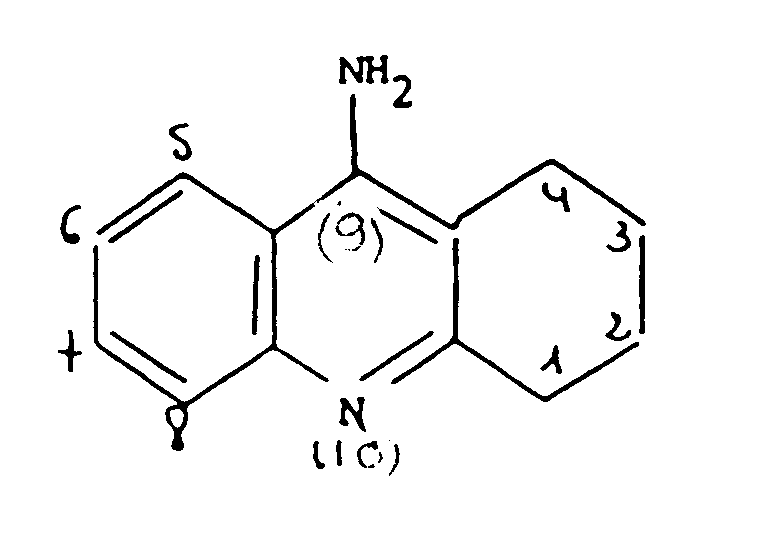
ou un de ses précurseurs biologiques
est mis en association ou en mélange avec un véhicule ou un excipient inerte, non-toxique, pharmaceutiquement-acceptable en vue de la réalisation d'un médicament assurant la régénération des lymphocytes T4 ou l'augmentation du nombre des lymphocytes T4. - Procédé d'obtention selon la revendication 1, dans lequel le principe actif est la 9 amino 1,2,3,4-tétrahydroacridine sous forme libre ou salifiée par un acide minéral ou organique.
- Un procédé d'obtention de compositions pharmaceutiques selon la revendication 1 ou la revendication 2, dans lequel la teneur en principe actif s'échelonne de 10 à 300 mg par prise unitaire.
- Un procédé d'obtention d'une composition pharmaceutique selon l'une des revendications 1 à 3, caractérisé en ce que l'on ajoute, en outre, un agent antiviral du type Thymidine, Uracile ou Uridine.
- Un procédé d'obtention des compositions pharmaceutiques selon l'une des revendications 1 à 4, caractérisé en ce que l'excipient inerte est un de ceux qui conviennent pour l'administration parentérale, orale, rectale, percutanée ou permuqueuse.
- Un procédé d'obtention des compositions pharmaceutiques selon l'une des revendications 1 à 5, caractérisé en ce que le médicament contient également de l'azidothymidine
Applications Claiming Priority (2)
| Application Number | Priority Date | Filing Date | Title |
|---|---|---|---|
| FR888816749A FR2640508B1 (fr) | 1988-12-19 | 1988-12-19 | Nouvelles compositions et nouveaux produits pharmaceutiques assurant la regeneration de leucocytes et leur emploi pour le traitement du syndrome immuno-deficitaire |
| FR8816749 | 1988-12-19 |
Publications (3)
| Publication Number | Publication Date |
|---|---|
| EP0375471A2 EP0375471A2 (fr) | 1990-06-27 |
| EP0375471A3 EP0375471A3 (fr) | 1992-07-08 |
| EP0375471B1 true EP0375471B1 (fr) | 1996-04-10 |
Family
ID=9373109
Family Applications (1)
| Application Number | Title | Priority Date | Filing Date |
|---|---|---|---|
| EP89402687A Expired - Lifetime EP0375471B1 (fr) | 1988-12-19 | 1989-09-29 | Utilisation de 1,2,3,4-tétrahydro-acridines pour le traitement du SIDA, et composés |
Country Status (19)
| Country | Link |
|---|---|
| EP (1) | EP0375471B1 (fr) |
| JP (1) | JPH02258722A (fr) |
| KR (1) | KR900009075A (fr) |
| AP (1) | AP125A (fr) |
| AT (1) | ATE136463T1 (fr) |
| AU (2) | AU4686189A (fr) |
| CA (1) | CA2005925C (fr) |
| DE (1) | DE68926222D1 (fr) |
| DK (1) | DK646489A (fr) |
| FR (1) | FR2640508B1 (fr) |
| HU (1) | HU213510B (fr) |
| IL (1) | IL92759A (fr) |
| MA (1) | MA21964A1 (fr) |
| MY (1) | MY106032A (fr) |
| NZ (1) | NZ231854A (fr) |
| OA (1) | OA09250A (fr) |
| PT (1) | PT92620B (fr) |
| TN (1) | TNSN89135A1 (fr) |
| ZA (1) | ZA899733B (fr) |
Families Citing this family (3)
| Publication number | Priority date | Publication date | Assignee | Title |
|---|---|---|---|---|
| US5155226A (en) * | 1991-02-19 | 1992-10-13 | Hoechst-Roussel Pharmaceuticals Incorporated | Method for the preparation of 9-amino-1,2,3,4-tetrahydroacridine |
| EP0509401A1 (fr) * | 1991-04-19 | 1992-10-21 | Hoechst-Roussel Pharmaceuticals Incorporated | Utilisation de 9-amino-1,2,3,4-tetrahydroacridine-1-ol et des composés apparentés pour le traitement du SIDA |
| RU2036198C1 (ru) * | 1993-04-01 | 1995-05-27 | Товарищество с ограниченной ответственностью "Полисан" | N-МЕТИЛ-N-( α,D -ГЛЮКОПИРАНОЗИЛ) АММОНИЯ-2-(АКРИДОН-9-ОН-10-ИЛ)АЦЕТАТ(ЦИКЛОФЕРОН), ОБЛАДАЮЩИЙ ИНТЕРФЕРОНОГЕННОЙ, ПРОТИВОВИРУСНОЙ, В ТОМ ЧИСЛЕ АНТИВИЧ, АНТИПАРАЗИТАРНОЙ, АНТИПРОМОТОРНОЙ И РАДИОПРОТЕКТИВНОЙ АКТИВНОСТЬЮ |
Family Cites Families (8)
| Publication number | Priority date | Publication date | Assignee | Title |
|---|---|---|---|---|
| US4916122A (en) * | 1987-01-28 | 1990-04-10 | University Of Georgia Research Foundation, Inc. | 3'-Azido-2',3'-dideoxyuridine anti-retroviral composition |
| JPH02500364A (ja) * | 1986-11-21 | 1990-02-08 | マツクス‐プランク‐ゲゼルシヤフト ツール フエルデルング デル ヴイツセンシヤフテン エー フアウ | ヒトにおけるウイルス感染の治療法およびそのための組成物 |
| IL86009A (en) * | 1987-04-10 | 1991-09-16 | Us Health | Liposome-encapsulated phosphorylated nucleosides for treatment of retroviral diseases |
| US5013741A (en) * | 1987-09-08 | 1991-05-07 | Hoechst-Roussel Pharmaceuticals Incorporated | N-[substituted alkylidene]-1,2,3,4-tetrahydro-9-acridinamines useful for enhancing the cholinergic function in a mammal |
| US4985430A (en) * | 1987-12-03 | 1991-01-15 | Mitsubishi Kasei Corporation | 9-acylamino-tetrahydroacridine derivatives and memory enhancing agent containing said derivative as active ingredient |
| CH678275A5 (fr) * | 1989-05-25 | 1991-08-30 | Debiopharm Sa | |
| US4999358A (en) * | 1989-06-26 | 1991-03-12 | Hoechst-Roussel Pharmaceuticals Inc. | (1,2,3,4-tetrahydro-9-acridinimino)cyclohexane carboxylic acid and related compounds |
| US4999430A (en) * | 1989-07-31 | 1991-03-12 | Warner-Lambert Company | Derivatives of 1,2,3,4-tetrahydro-9-acrisinamine |
-
1988
- 1988-12-19 FR FR888816749A patent/FR2640508B1/fr not_active Expired - Fee Related
-
1989
- 1989-09-29 EP EP89402687A patent/EP0375471B1/fr not_active Expired - Lifetime
- 1989-09-29 DE DE68926222T patent/DE68926222D1/de not_active Expired - Lifetime
- 1989-09-29 AT AT89402687T patent/ATE136463T1/de not_active IP Right Cessation
- 1989-12-18 AP APAP/P/1990/000157A patent/AP125A/en active
- 1989-12-18 MY MYPI89001798A patent/MY106032A/en unknown
- 1989-12-18 MA MA21958A patent/MA21964A1/fr unknown
- 1989-12-18 IL IL9275989A patent/IL92759A/en not_active IP Right Cessation
- 1989-12-19 ZA ZA899733A patent/ZA899733B/xx unknown
- 1989-12-19 AU AU46861/89A patent/AU4686189A/en not_active Abandoned
- 1989-12-19 NZ NZ231854A patent/NZ231854A/xx unknown
- 1989-12-19 PT PT92620A patent/PT92620B/pt not_active IP Right Cessation
- 1989-12-19 HU HU896683A patent/HU213510B/hu not_active IP Right Cessation
- 1989-12-19 TN TNTNSN89135A patent/TNSN89135A1/fr unknown
- 1989-12-19 JP JP1329377A patent/JPH02258722A/ja active Pending
- 1989-12-19 DK DK646489A patent/DK646489A/da not_active Application Discontinuation
- 1989-12-19 OA OA59701A patent/OA09250A/fr unknown
- 1989-12-19 KR KR1019890019125A patent/KR900009075A/ko not_active Ceased
- 1989-12-19 CA CA002005925A patent/CA2005925C/fr not_active Expired - Fee Related
-
1993
- 1993-05-25 AU AU39806/93A patent/AU666725B2/en not_active Expired - Fee Related
Also Published As
| Publication number | Publication date |
|---|---|
| OA09250A (fr) | 1992-06-30 |
| PT92620B (pt) | 1995-09-12 |
| TNSN89135A1 (fr) | 1991-02-04 |
| AP125A (en) | 1991-03-19 |
| EP0375471A3 (fr) | 1992-07-08 |
| AU3980693A (en) | 1993-08-19 |
| KR900009075A (ko) | 1990-07-02 |
| MY106032A (en) | 1995-02-28 |
| DK646489D0 (da) | 1989-12-19 |
| CA2005925C (fr) | 2002-03-26 |
| FR2640508B1 (fr) | 1994-07-01 |
| AU666725B2 (en) | 1996-02-22 |
| MA21964A1 (fr) | 1991-07-01 |
| FR2640508A1 (fr) | 1990-06-22 |
| AU4686189A (en) | 1990-06-21 |
| JPH02258722A (ja) | 1990-10-19 |
| DE68926222D1 (de) | 1996-05-15 |
| ZA899733B (en) | 1991-04-24 |
| NZ231854A (en) | 1993-01-27 |
| IL92759A0 (en) | 1990-09-17 |
| HU896683D0 (en) | 1990-02-28 |
| CA2005925A1 (fr) | 1990-06-19 |
| PT92620A (pt) | 1990-06-29 |
| DK646489A (da) | 1990-06-20 |
| ATE136463T1 (de) | 1996-04-15 |
| EP0375471A2 (fr) | 1990-06-27 |
| IL92759A (en) | 1994-06-24 |
| HU213510B (en) | 1997-07-28 |
| AP8900157A0 (en) | 1990-01-31 |
Similar Documents
| Publication | Publication Date | Title |
|---|---|---|
| EP0278821B1 (fr) | Utilisation d'antagonistes de la morphine dans la préparation de médicaments à effet immunomodulateur et anti-viral, destinés notamment à traiter les états immuno-déficitaires acquis | |
| FR2468602A1 (fr) | Nouveaux derives de quinazolinone | |
| JPH10506371A (ja) | 酵素阻害剤 | |
| FR2468367A1 (fr) | Compositions therapeutiques a base de quinolones | |
| JPH0720966B2 (ja) | 製薬学的に活性な化合物を含有する病気治療剤 | |
| DE69327153T2 (de) | Anti-hiv-medikament | |
| JPH02243666A (ja) | ニューモシスティス・カリニ肺炎などの疾病の治療法および予防法そしてこれらの方法に用いる化合物および処方物 | |
| TW442291B (en) | A pharmaceutical combination for use in treating HIV infection or AIDS | |
| JPH11500130A (ja) | 抗ウイルス性トリアザ化合物 | |
| EP0375471A2 (fr) | Utilisation de 1,2,3,4-tétrahydro-acridines pour le traitement du SIDA, et composés | |
| EP0448583A1 (fr) | Composes organometalliques, leurs modes de preparation et compositions pharmaceutiques les contenant | |
| US4818767A (en) | Quinate salts of antimalarial phenanthrenemethanol compounds | |
| FR2553663A1 (fr) | Derives du 1,2-dithiolanne, leur preparation et leur utilisation comme medicaments | |
| EP1268470B1 (fr) | Molecules duales contenant un derive peroxydique, leur synthese et leurs applications therapeutiques | |
| CA2147762A1 (fr) | Agent soulageant les troubles circulatoires | |
| FR2470110A1 (fr) | Derives de la decrapenylamine, leurs sels acides d'addition et composition pharmaceutique renfermant ces produits | |
| EP0223890B1 (fr) | Nouveaux dérivés aroylés du pyrrole, leur obtention et leur emploi en thérapeutique immunologique | |
| EP0555302A1 (fr) | Procede de traitement des maladies demyelinisantes | |
| CH678275A5 (fr) | ||
| HU193699B (en) | Process for producing phenantrene-methanol derivatves of antimalarial activity | |
| Bader et al. | Discovery of a Novel Potent Inhibitor of HIV Infection | |
| FR2758324A1 (fr) | Nouveaux piperazinylbutyramides : les procedes de preparation, les compositions pharmaceutiques, l'utilisation therapeutique et biologique | |
| CS210383B1 (cs) | Léčivo virových infekcí | |
| FR2715302A1 (fr) | Association pharmaceutique antivirale appropriée pour le traitement des infections par le virus HIV et du sida. | |
| BE658259A (fr) |
Legal Events
| Date | Code | Title | Description |
|---|---|---|---|
| PUAI | Public reference made under article 153(3) epc to a published international application that has entered the european phase |
Free format text: ORIGINAL CODE: 0009012 |
|
| AK | Designated contracting states |
Kind code of ref document: A2 Designated state(s): AT BE CH DE ES FR GB GR IT LI LU NL SE |
|
| PUAL | Search report despatched |
Free format text: ORIGINAL CODE: 0009013 |
|
| AK | Designated contracting states |
Kind code of ref document: A3 Designated state(s): AT BE CH DE ES FR GB GR IT LI LU NL SE |
|
| 17P | Request for examination filed |
Effective date: 19921231 |
|
| 17Q | First examination report despatched |
Effective date: 19941114 |
|
| GRAH | Despatch of communication of intention to grant a patent |
Free format text: ORIGINAL CODE: EPIDOS IGRA |
|
| GRAA | (expected) grant |
Free format text: ORIGINAL CODE: 0009210 |
|
| AK | Designated contracting states |
Kind code of ref document: B1 Designated state(s): AT BE CH DE ES FR GB GR IT LI LU NL SE |
|
| PG25 | Lapsed in a contracting state [announced via postgrant information from national office to epo] |
Ref country code: IT Free format text: LAPSE BECAUSE OF FAILURE TO SUBMIT A TRANSLATION OF THE DESCRIPTION OR TO PAY THE FEE WITHIN THE PRE;WARNING: LAPSES OF ITALIAN PATENTS WITH EFFECTIVE DATE BEFORE 2007 MAY HAVE OCCURRED AT ANY TIME BEFORE 2007. THE CORRECT EFFECTIVE DATE MAY BE DIFFERENT FROM THE ONE RECORDED.SCRIBED TIME-LIMIT Effective date: 19960410 Ref country code: GB Effective date: 19960410 Ref country code: AT Effective date: 19960410 Ref country code: ES Free format text: THE PATENT HAS BEEN ANNULLED BY A DECISION OF A NATIONAL AUTHORITY Effective date: 19960410 Ref country code: GR Free format text: LAPSE BECAUSE OF FAILURE TO SUBMIT A TRANSLATION OF THE DESCRIPTION OR TO PAY THE FEE WITHIN THE PRESCRIBED TIME-LIMIT Effective date: 19960410 Ref country code: NL Free format text: LAPSE BECAUSE OF FAILURE TO SUBMIT A TRANSLATION OF THE DESCRIPTION OR TO PAY THE FEE WITHIN THE PRESCRIBED TIME-LIMIT Effective date: 19960410 |
|
| REF | Corresponds to: |
Ref document number: 136463 Country of ref document: AT Date of ref document: 19960415 Kind code of ref document: T |
|
| REF | Corresponds to: |
Ref document number: 68926222 Country of ref document: DE Date of ref document: 19960515 |
|
| PG25 | Lapsed in a contracting state [announced via postgrant information from national office to epo] |
Ref country code: SE Effective date: 19960710 |
|
| PG25 | Lapsed in a contracting state [announced via postgrant information from national office to epo] |
Ref country code: DE Effective date: 19960711 |
|
| PGFP | Annual fee paid to national office [announced via postgrant information from national office to epo] |
Ref country code: LU Payment date: 19960901 Year of fee payment: 8 |
|
| NLV1 | Nl: lapsed or annulled due to failure to fulfill the requirements of art. 29p and 29m of the patents act | ||
| GBV | Gb: ep patent (uk) treated as always having been void in accordance with gb section 77(7)/1977 [no translation filed] |
Effective date: 19960410 |
|
| PGFP | Annual fee paid to national office [announced via postgrant information from national office to epo] |
Ref country code: CH Payment date: 19961029 Year of fee payment: 8 |
|
| PLBE | No opposition filed within time limit |
Free format text: ORIGINAL CODE: 0009261 |
|
| STAA | Information on the status of an ep patent application or granted ep patent |
Free format text: STATUS: NO OPPOSITION FILED WITHIN TIME LIMIT |
|
| 26N | No opposition filed | ||
| PG25 | Lapsed in a contracting state [announced via postgrant information from national office to epo] |
Ref country code: LU Free format text: LAPSE BECAUSE OF NON-PAYMENT OF DUE FEES Effective date: 19970929 |
|
| PG25 | Lapsed in a contracting state [announced via postgrant information from national office to epo] |
Ref country code: LI Free format text: LAPSE BECAUSE OF NON-PAYMENT OF DUE FEES Effective date: 19970930 Ref country code: CH Free format text: LAPSE BECAUSE OF NON-PAYMENT OF DUE FEES Effective date: 19970930 |
|
| PGFP | Annual fee paid to national office [announced via postgrant information from national office to epo] |
Ref country code: BE Payment date: 19971104 Year of fee payment: 9 |
|
| REG | Reference to a national code |
Ref country code: CH Ref legal event code: PL |
|
| PG25 | Lapsed in a contracting state [announced via postgrant information from national office to epo] |
Ref country code: BE Free format text: LAPSE BECAUSE OF NON-PAYMENT OF DUE FEES Effective date: 19980930 |
|
| BERE | Be: lapsed |
Owner name: STE CIVILE DE RECHERCHE NEWPHARM Effective date: 19980930 |
|
| PGFP | Annual fee paid to national office [announced via postgrant information from national office to epo] |
Ref country code: FR Payment date: 20040929 Year of fee payment: 16 |
|
| PG25 | Lapsed in a contracting state [announced via postgrant information from national office to epo] |
Ref country code: FR Free format text: LAPSE BECAUSE OF NON-PAYMENT OF DUE FEES Effective date: 20060531 |
|
| REG | Reference to a national code |
Ref country code: FR Ref legal event code: ST Effective date: 20060531 |