EP0399207A2 - Testauswahlsystem - Google Patents
Testauswahlsystem Download PDFInfo
- Publication number
- EP0399207A2 EP0399207A2 EP90107291A EP90107291A EP0399207A2 EP 0399207 A2 EP0399207 A2 EP 0399207A2 EP 90107291 A EP90107291 A EP 90107291A EP 90107291 A EP90107291 A EP 90107291A EP 0399207 A2 EP0399207 A2 EP 0399207A2
- Authority
- EP
- European Patent Office
- Prior art keywords
- circuit
- output
- voltage
- selection system
- latch
- Prior art date
- Legal status (The legal status is an assumption and is not a legal conclusion. Google has not performed a legal analysis and makes no representation as to the accuracy of the status listed.)
- Withdrawn
Links
Images

Classifications
-
- G—PHYSICS
- G01—MEASURING; TESTING
- G01R—MEASURING ELECTRIC VARIABLES; MEASURING MAGNETIC VARIABLES
- G01R31/00—Arrangements for testing electric properties; Arrangements for locating electric faults; Arrangements for electrical testing characterised by what is being tested not provided for elsewhere
- G01R31/28—Testing of electronic circuits, e.g. by signal tracer
- G01R31/317—Testing of digital circuits
- G01R31/31701—Arrangements for setting the Unit Under Test [UUT] in a test mode
Definitions
- This invention relates to test selection techniques and, more particularly, to techniques for testing circuits formed on a semiconductor substrate or integrated circuit chip without providing an additional pin or pad on the substrate or chip for accessing test circuits formed on the substrate or chip.
- CMOS complementary metal oxide semiconductor
- U.S. patent 4,697,140 filed February 11, 1986, discloses a system wherein a switching circuit is responsive to a predetermined level of an input signal externally applied to a reset terminal for supplying a testing clock signal.
- U.S. patent 4,583,179, filed December 29, 1982, discloses a circuit wherein during an inspection period of an internal node to determine the condition of a fuse element a high voltage is supplied via an external input/output pin.
- a test selection system which includes a semiconductor substrate or integrated circuit chip having a pin or pad connected thereto and an integrated circuit formed on the substrate or chip and connected to the pin or pad and having an operating voltage within a given voltage range.
- a latch conditioning circuit has an input responsive to a voltage of a given magnitude and an output connected to an input of a latch. Means operable at a voltage without the given voltage range for producing a control voltage of the given magnitude is connected to the input of the latch conditioning circuit.
- a test enabling terminal is coupled to the output of the latch and to the integrated circuit.
- a voltage without the given voltage range is applied to the pin or pad during a first interval of time to establish a test mode at the test enabling terminal and a voltage within the given voltage range is applied to the pin or pad during a second interval of time to establish a normal operating mode for the integrated circuit.
- CMOS circuits in the drawings have P-channel field effect transistors indicated by a rectangle with a diagonal line formed within the rectangle and a gate or control electrode arranged as a line adjacent and parallel to one side of the rectangle, and N-channel field effect transistors indicated simply by a rectangle without the diagonal line and a gate or control electrode arranged adjacent to one side of the rectangle.
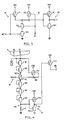
- the test selection system of Fig. 1 of the drawings includes a pin or pad AX connected or attached to the semiconductor substrate or chip S.
- a control voltage or enabling circuit 10 is connected between the pin or pad AX and a point of reference potential such as ground.
- the circuit 10 includes a series of diodes N1, N2, N3, N4 and N5, sometimes referred to as a diode tree, connected to a resistor R with a P-channel field effect transistor P1, arranged as an isolating device, interposed between the diodes N2 and N3 and a P-channel field effect transistor P12 connected to the N-wells of P1 and P12.
- the diodes N1, N2, N3, N4 and N5 are formed by N-channel field effect transistors having their gate or control electrodes connected to their drains.
- the P-channel transistor P1 has its gate or control electrode connected to a voltage supply source having a voltage terminal or voltage terminals VDD, preferably at 3.4 volts.
- the resistor R is connected between the series of diodes N1, N2, N3, N4 and N5 and ground, with a node NA being formed between the resistor R and diode N5.
- the P-channel transistor P12 has its gate or control electrode connected to pad AX and its source connected to supply terminal VDD.
- the drain of P12 is connected to its own N-well, NH, and also to that of P1.
- An integrated circuit designated as M in Fig. 1 is also connected to the pin or pad AX, which is one of the normal address pins or pads of the integrated circuit M that is used, e.g., during normal writing and reading cycles in the operation of a memory.
- the integrated circuit M may be any known memory or logic circuit, but the test selection system of the present invention is particularly useful when employed with asynchronous static random access memory circuits since, due to the high flexibility of signals on all pins or pads of this type of memory, there are no unused input signal timings or periods that can be used for applying test control pulses as can generally be done with dynamic random access memory circuits.
- a latch conditioning circuit 12 includes a P-channel field effect transistor P2 serially connected with an N-channel field effect transistor N6 between the voltage supply source terminal VDD and ground.
- the control electrode of the P-channel transistor P2 is connected to its drain to form a diode and the control electrode of th N-channel transistor N6 is connected to the node NA of the control voltage circuit 10, with the common point between the transistors P2 and N6 being an output node NB.
- a latch 14, sometimes referred to as a keeper latch includes a first CMOS inverter having a P-channel field effect transistor P3 and an N-channel field effect transistor N7 and a second CMOS inverter having a P-channel field effect transistor P4 and an N-channel field effect transistor N8.
- the common point between the transistors P3 and N7 of the first CMOS inverter and the control electrodes of the transistors P4 and N8 of the second CMOS are connected to the node NB of the latch conditioning circuit 12, and the control electrodes of the transistors P3 and N7 of the first CMOS inverter are connected to the common point, node NC, between the transistors P4 and N8 of the second CMOS inverter.
- a capacitor C is also connected to to node NC.
- a buffer circuit 16 includes a third CMOS inverter having a P-channel field effect transistor P5 and an N-channel field effect transistor N9 and an output node ND, and a fourth CMOS inverter having a P-channel field effect transistor P6 and an N-channel field effect transistor N10 and an output node NE which may be used to provide an enable signal for test purposes.
- Control electrodes of the transistors P5 and N9 of the third CMOS inverter are connected to the output node or terminal NC of the latch 14 and control electrodes of the transistors P6 and N10 of the fourth CMOS inverter are connected to the output node ND of the third CMOS inverter.
- FIG. 2 the graphs shown in Fig. 2 of the drawings which indicate the voltages applied to the pin or pad AX on the semiconductor substrate or integrated chip S and to the voltage supply source terminals VDD as a function of time.
- the test selection system is formed on the substrate or chip S along with the integrated circuit or memory M and uses the pin or pad AX and the voltage supply source terminals VDD as input or voltage terminals. Under normal operating conditions of the integrated circuit or memory M, the pin or pad AX is used as a normal address pin for the integrated circuit or memory M.
- the circuits of Fig. 2 the circuits of Fig.
- Fig. 1 are designed for a nominal voltage of 3.4 volts on terminals VDD, as shown in curve A. Also, the circuits of Fig. 1 are designed at a most positive up level of 5.5 volts with an overshoot of 0.5 volts applied to the address pin or pad AX during normal operation, as indicated in Fig. 2 by address pulse curves AP. Accordingly, it can be seen that with the voltage on pin AX at even the most positive up level during power-up for normal operation of the integrated circuit or memory M, the voltage dropping diodes N1, N2, N3, N4 and N5 prevent the voltage at node NA from rising significantly above ground level, since each diode has a voltage drop of about 1.1 to 1.2 volts.
- the voltages indicated by curves A and B of Fig. 2 are applied to the voltage supply source terminal VDD and the pin or pad AX, respectively.
- the voltage on terminals VDD and on pin AX is at 0 volts.
- the voltage on pin AX, as represented by curve B begins to increase until it reaches 7.5 volts at time T2.
- the voltage on terminals VDD begins to increase until at time T4 it reaches 3.4 volts.
- a voltage of about 1.5 volts or higher is established at node NA of the control voltage or enabling circuit 10 which is above the threshold voltage of the N-channel transistors and, therefore, sufficiently high to turn on the N-channel transistor N6 of the latch conditioning circuit 12.
- P-channel transisotr P12 in the control voltage or enabling circuit 10 is to allow the N-wells of P-channel transistor P1 to float during test mode but to be charged to VDD during normal operation.
- P12 is off allowing the N-well, NH to float.
- pad or terminal AX rises to 7.5V between T1 and T2
- NG rises forward biasing the PN diode consisting of the source of P1 and it's N-well.
- the N-well, NH thus charges to NG - .7V and P-channel transistor P1 turns on allowing NA to rise as described above.
- N-channel transistor N6 of the latch conditioning circuit 12 is turned on by the voltage from node NA of the control voltage or enabling circuit 10 at time T2 due to AX pad potential of 7.5V.
- supply voltage VDD rises between T3 and T4 node NB is held near ground turning off the N-channel transistor N8 and turning on the P-channel transistor P4 of the latch 14 which causes the voltage at node NC to increase.
- the increase in voltage at node NC becomes sufficiently high to turn on N-channel transistor N7 and to turn off P-channel transistor P3 of the latch resulting in the latch flipping its output voltage to a high or logical 1 voltage.
- the voltage at the output of the buffer circuit 16, i.e., at node NE is also high or at a logical 1 voltage.
- the high voltage at node NE can now be used as an enabling signal to activate a test circuit formed on the substrate or chip S.
- the voltage at the terminals VDD as shown in curve A has reached the full voltage source value of 3.4 volts. Since this voltage is applied to the control electrode of the P-channel transistor P1 of the control voltage or enabling circuit 10, the P-channel transistor P1 will turn off when pad AX falls back into normal operating voltage range at time T7. This causes the voltage at node NA to again drop to 0 volts, turning off the N-channel transistor N6 of the latch conditioning circuit 12. However, by the time T4 the latch 14 has already been set. The turning off of the isolator transistor P1 serves to minimize or eliminate current leakage or power loss through the control voltage circuit 10 and to minimize any increase in capacitance that may be produced as a result of a circuit addition.
- time T4 one or more microseconds of time are required to permit the voltage on terminals VDD to stabilize at the final value of 3.4 volts and the voltage at the output, or node NE, of the buffer circuit 16 to reach a full logic 1 value, enabling any circuitry which is to be used for special test purposes.
- the time required to stabilize the voltages depends on the slew rate of the voltage supply source and the speed of the circuit.
- the test selection system is in the test mode and, thereafter, at time T6, the high voltage of 7.5 volts on the pin AX may be removed, as indicated by curve B in Fig. 2, and the address pulses AP applied thereto at about time T7, as also indicated in Fig. 2 of the drawings.
- the capacitor C is preferably connected to the output, or node NC, of the latch 14 as a latch load slowing down the response of the latch 14 in order to minimize or eliminate undesirable flipping or switching of the latch 14 by spurious signals or extraneous noise spikes or glitches.
- recovery from the test mode is achieved by simply powering down the circuit, i.e., removing the voltage from the terminals VDD.
- the powering down operation frees the latch 14 and, upon powering up, with normal operating voltages on the pin AX, node NB becomes charged to again turn on the N-channel transistor N8 and turn off the P-channel transistor P4 of the latch 14 to reset the latch with its input, or node NB, high and its output, or node NC, low, and, thus, the voltage at the output node NE is also low.
- the voltage on node NE from the buffer circuit 16 can be used in a simple scheme for conducting circuit tests, if more complex testing is desired, logical combinations with a number of address input signals to allow programming of a large number of special on-chip or on board test enabling signals may be used.
- This more complex testing can be provided by the test selection system of the present invention by incorporating into the system of this invention a logical circuit, e.g. a CMOS AND circuit 18 as illustrated in Fig. 3 of the drawings.
- the AND circuit 18 includes a NAND circuit 20 having an output connected to an input of an inverter 22 which has an output terminal T1 that may be connected to any circuits, not shown, to be tested on the substrate or chip S.
- the NAND circuit 20 includes P-channel field effect transistors P7 and P8 and N-channel field effect transistors N11 and N12, and the inverter 22 includes a P-channel field effect transistor P9 and an N-channel field effect transistor N13.
- the inputs to the AND circuit 18 include the terminal NE from the output of the buffer circuit 16 of Fig. 1 connected to control electrodes of the P-channel transistor P7 and the N-channel transistor N11 and a terminal A1 for applying any desired address input signals to control electrodes of the P-channel transistor P8 and the N-channel transistor N12 of the NAND circuit 20 for test purposes.
- the AND circuit 18 has been illustrated in the drawings as being connected to the output node NE of the buffer circuit 16, it should be understood that more than one logic circuit can be AND'ed with node NE to provide additional tests.
- the test selection system may be modified by adding the circuit illu strated in Fig. 4 of the drawings to the circuit illustrated in Fig. 1.
- the semiconductor substrate or integrated circuit chip S includes another pin or pad AY connected thereto from which is connected a test mode disabling or release circuit 10′ having a diode tree somewhat similar to that of the control voltage or engaging circuit 10 shown in Fig. 1.
- the disabling circuit 10′ includes serially arranged diodes N1′, N2′, N3′, N4′ and N5′ and a P-channel field effect transistor P1′connected to a resistor R′, with the resistor R′ and the diode N5′ forming an output node NA′ at the common point therebetween.
- a CMOS inverter 24 includes a P-channel field effect transistor P10 and an N-channel field effect transistor N14 having an output node NF and an input connected to the output node NA′.
- a P-channel field effect transistor P11 is connected between a voltage source terminal VDD and the output node NB in parallel with the P-channel transistor P2 of the latch conditioning circuit 12 of the system of Fig. 1 of the drawings, with a control electrode of the P-channel transistor P11 being connected to the output node NF of the inverter 24.
- the pin or pad AY like pin or pad AX, is also connected to the integrated circuit or memory M.
- the number of dropping diodes N1 to N5 of the control voltage or enabling circuit 10 of Fig. 1 and of the dropping diodes N1′ to N5′ of the disabling circuit 10′ of Fig. 4 are adjusted to accommodate the particular conditions.
- the diodes N1 to N5 and N1′ to N5′ may be made with P-channel field effect transistors and the P-channel transistors P1 and P1′ may be replaced with N-channel field effect transistors, along with appropriate voltage polarities and magnitudes applied thereto.
- the CMOS circuits illustrated in FIGs. 1, 3 and 4 of the drawings were designed in the N-well technology with all wells connected to the terminal VDD except for those wells associated with P-channel transistors P1, P1′, P12, and P12′ and with appropriate guard rings provided for the transistors forming the serial arrangements in the control or enabling circuit 10 and in the disabling or releasing circuit 10′to prevent latch-up in the CMOS circuits.
- test procedure and circuit which allow for the selection of special test modes or functions at the module or package level without requiring additional test pins on the semiconductor substrate or chip, such as used for static random access memory, with industry standard pin-outs, and, thus, without increasing the size of the semiconductor circuit package.
- the scheme and circuit as taught by the present invention allow for the use of existing pins on, e.g., asynchronous static random access memories, to enter special test modes from a package level by using on the address pins voltages outside of the normal operating range of the memories, which voltages may be either higher or lower than the normal voltage operating range of the integrated circuit.
- the circuit of this invention does not produce an undesirable increase in input leakage or input capacitance, and there is no decrease in reliability resulting from an overvoltage on the address pins due to the application of this high voltage for only a very short period of time.
Landscapes
- Engineering & Computer Science (AREA)
- General Engineering & Computer Science (AREA)
- Physics & Mathematics (AREA)
- General Physics & Mathematics (AREA)
- Tests Of Electronic Circuits (AREA)
- Testing Or Measuring Of Semiconductors Or The Like (AREA)
Applications Claiming Priority (2)
| Application Number | Priority Date | Filing Date | Title |
|---|---|---|---|
| US355589 | 1989-05-23 | ||
| US07/355,589 US5019772A (en) | 1989-05-23 | 1989-05-23 | Test selection techniques |
Publications (2)
| Publication Number | Publication Date |
|---|---|
| EP0399207A2 true EP0399207A2 (de) | 1990-11-28 |
| EP0399207A3 EP0399207A3 (de) | 1992-03-11 |
Family
ID=23398011
Family Applications (1)
| Application Number | Title | Priority Date | Filing Date |
|---|---|---|---|
| EP19900107291 Withdrawn EP0399207A3 (de) | 1989-05-23 | 1990-04-18 | Testauswahlsystem |
Country Status (3)
| Country | Link |
|---|---|
| US (1) | US5019772A (de) |
| EP (1) | EP0399207A3 (de) |
| JP (1) | JPH0312571A (de) |
Cited By (3)
| Publication number | Priority date | Publication date | Assignee | Title |
|---|---|---|---|---|
| EP0488612A1 (de) * | 1990-11-29 | 1992-06-03 | STMicroelectronics, Inc. | Halbleiter-Speicher mit invertierter Rückschreibe-Fähigkeit und Testmethode unter Verwendung invertierter Rückschreibung |
| EP0788116A1 (de) * | 1996-01-30 | 1997-08-06 | Oki Electric Industry Co., Ltd. | Überspannungsdetektionsschaltung zur Auswahl der Betriebsart |
| EP4628701A1 (de) | 2024-04-05 | 2025-10-08 | Akademia Gorniczo-Hutnicza im. Stanislawa Staszica w Krakowie | Bergbaubett und verfahren zur montage davon |
Families Citing this family (18)
| Publication number | Priority date | Publication date | Assignee | Title |
|---|---|---|---|---|
| US5132614A (en) * | 1989-08-03 | 1992-07-21 | Kabushiki Kaisha Toshiba | Semiconductor device and method and apparatus for testing the same |
| JPH0743399B2 (ja) * | 1990-08-15 | 1995-05-15 | 富士通株式会社 | 半導体回路 |
| DE69120483T2 (de) * | 1990-08-17 | 1996-11-14 | Sgs Thomson Microelectronics | Halbleiter-Speicher mit unterdrücktem Testmodus-Eingang während des Strom-Einschaltens |
| US5161159A (en) * | 1990-08-17 | 1992-11-03 | Sgs-Thomson Microelectronics, Inc. | Semiconductor memory with multiple clocking for test mode entry |
| JP3313172B2 (ja) * | 1992-06-17 | 2002-08-12 | 株式会社東芝 | 半導体集積回路 |
| US5294882A (en) * | 1992-07-28 | 1994-03-15 | Sharp Kabushiki Kaisha | Integrated circuit capable of testing reliability |
| US5294883A (en) * | 1992-08-04 | 1994-03-15 | International Business Machines Corporation | Test detector/shutoff and method for BiCMOS integrated circuit |
| JP3217498B2 (ja) * | 1992-10-29 | 2001-10-09 | 富士通株式会社 | 半導体集積回路装置 |
| US5383194A (en) * | 1992-11-06 | 1995-01-17 | University Of Texas System Board Of Regents | Integrated logic circuit including impedance fault detection |
| US5982188A (en) * | 1994-07-29 | 1999-11-09 | Stmicroelectronics, Inc. | Test mode control circuit of an integrated circuit device |
| US5787096A (en) * | 1996-04-23 | 1998-07-28 | Micron Technology, Inc. | Circuit and method for testing an integrated circuit |
| DE19624858A1 (de) * | 1996-06-21 | 1998-01-02 | Nokia Mobile Phones Ltd | Integrierte Schaltung mit Testfunktion |
| US5982815A (en) * | 1996-07-01 | 1999-11-09 | Advanced Micro Devices Inc. | Circuit for setting a device into a test mode by changing a first port to a fixed clock and a second port to a non-fixed clock |
| US5727001A (en) | 1996-08-14 | 1998-03-10 | Micron Technology, Inc. | Circuit and method for testing an integrated circuit |
| US5754559A (en) * | 1996-08-26 | 1998-05-19 | Micron Technology, Inc. | Method and apparatus for testing integrated circuits |
| US5841714A (en) * | 1996-10-21 | 1998-11-24 | Micron Technology, Inc. | Supervoltage circuit |
| KR100688480B1 (ko) * | 2000-09-19 | 2007-03-08 | 삼성전자주식회사 | 패키지 상태에서의 반도체 소자의 전기적 특성 측정 수단및 그 방법 |
| US7196958B2 (en) * | 2004-08-31 | 2007-03-27 | Micron Technology, Inc. | Power efficient memory and cards |
Family Cites Families (17)
| Publication number | Priority date | Publication date | Assignee | Title |
|---|---|---|---|---|
| DE2905294A1 (de) * | 1979-02-12 | 1980-08-21 | Philips Patentverwaltung | Integrierte schaltungsanordnung in mos-technik mit feldeffekttransistoren |
| DE2944149C2 (de) * | 1979-11-02 | 1985-02-21 | Philips Patentverwaltung Gmbh, 2000 Hamburg | Integrierte Schaltungsanordnung in MOS-Technik |
| US4334307A (en) * | 1979-12-28 | 1982-06-08 | Honeywell Information Systems Inc. | Data processing system with self testing and configuration mapping capability |
| JPS58115828A (ja) * | 1981-12-29 | 1983-07-09 | Fujitsu Ltd | 半導体集積回路 |
| JPS6025462A (ja) * | 1983-07-22 | 1985-02-08 | Sharp Corp | 集積回路 |
| US4612499A (en) * | 1983-11-07 | 1986-09-16 | Texas Instruments Incorporated | Test input demultiplexing circuit |
| JPH0627786B2 (ja) * | 1985-01-10 | 1994-04-13 | 日本電装株式会社 | 半導体集積回路装置 |
| JPS61179615A (ja) * | 1985-02-05 | 1986-08-12 | Nec Corp | テスト入力回路 |
| JPS61191973A (ja) * | 1985-02-20 | 1986-08-26 | Fujitsu Ltd | 試験回路をそなえた半導体集積回路 |
| US4691161A (en) * | 1985-06-13 | 1987-09-01 | Raytheon Company | Configurable logic gate array |
| JPS62217714A (ja) * | 1986-03-19 | 1987-09-25 | Fujitsu Ltd | 高電圧検出回路 |
| US4714876A (en) * | 1986-04-14 | 1987-12-22 | Ncr Corporation | Circuit for initiating test modes |
| JPS6337270A (ja) * | 1986-07-31 | 1988-02-17 | Fujitsu Ltd | 半導体装置 |
| JPS6337269A (ja) * | 1986-08-01 | 1988-02-17 | Fujitsu Ltd | モ−ド選定回路 |
| JPH0668541B2 (ja) * | 1987-03-19 | 1994-08-31 | 日本電気株式会社 | 相補型mosトランジスタよりなるテスト回路 |
| US4912709A (en) * | 1987-10-23 | 1990-03-27 | Control Data Corporation | Flexible VLSI on-chip maintenance and test system with unit I/O cell design |
| JPH01270683A (ja) * | 1988-04-22 | 1989-10-27 | Mitsubishi Electric Corp | 半導体集積回路 |
-
1989
- 1989-05-23 US US07/355,589 patent/US5019772A/en not_active Expired - Fee Related
-
1990
- 1990-04-18 EP EP19900107291 patent/EP0399207A3/de not_active Withdrawn
- 1990-05-23 JP JP2131485A patent/JPH0312571A/ja active Pending
Cited By (6)
| Publication number | Priority date | Publication date | Assignee | Title |
|---|---|---|---|---|
| EP0488612A1 (de) * | 1990-11-29 | 1992-06-03 | STMicroelectronics, Inc. | Halbleiter-Speicher mit invertierter Rückschreibe-Fähigkeit und Testmethode unter Verwendung invertierter Rückschreibung |
| US5289475A (en) * | 1990-11-29 | 1994-02-22 | Sgs-Thomson Microelectronics, Inc. | Semiconductor memory with inverted write-back capability and method of testing a memory using inverted write-back |
| US5396464A (en) * | 1990-11-29 | 1995-03-07 | Sgs-Thomson Microelectronics, Inc. | Semiconductor memory with inverted write-back capability and method of testing a memory using inverted write-back |
| EP0788116A1 (de) * | 1996-01-30 | 1997-08-06 | Oki Electric Industry Co., Ltd. | Überspannungsdetektionsschaltung zur Auswahl der Betriebsart |
| US5786716A (en) * | 1996-01-30 | 1998-07-28 | Oki Electric Industry Co., Ltd. | Signal generator for generating test mode signals |
| EP4628701A1 (de) | 2024-04-05 | 2025-10-08 | Akademia Gorniczo-Hutnicza im. Stanislawa Staszica w Krakowie | Bergbaubett und verfahren zur montage davon |
Also Published As
| Publication number | Publication date |
|---|---|
| US5019772A (en) | 1991-05-28 |
| JPH0312571A (ja) | 1991-01-21 |
| EP0399207A3 (de) | 1992-03-11 |
Similar Documents
| Publication | Publication Date | Title |
|---|---|---|
| US5019772A (en) | Test selection techniques | |
| US4983857A (en) | Power-up reset circuit | |
| JP3571729B2 (ja) | パワーオンリセット回路及び方法 | |
| US20040012419A1 (en) | Power-on reset circuit and method | |
| EP0905605B1 (de) | Schaltung als Einschaltdetektor mit schneller Abschaltfeststellung | |
| JP2536871B2 (ja) | オフ・チップ駆動回路 | |
| CN101208646A (zh) | 监视电源电平的系统和方法 | |
| US8476951B2 (en) | Latch circuit with single node single-event-upset immunity | |
| US6081460A (en) | Integrated circuit devices having voltage level responsive mode-selection circuits therein and methods of operating same | |
| CN101208645A (zh) | 监视电源完整性的电路和方法 | |
| US5821787A (en) | Power-on reset circuit with well-defined reassertion voltage | |
| US6388479B1 (en) | Oscillator based power-on-reset circuit | |
| CN109416923B (zh) | 具有动态上拉削弱写入辅助电路的存储器元件 | |
| US5198709A (en) | Address transition detector circuit | |
| US4980792A (en) | BiCMOS power transition circuit | |
| EP0311102B1 (de) | Halbleiter-IC mit einer Schaltung zur Vermeidung fehlerhafter Arbeitsweise, verursacht durch Speisespannungsströrungen | |
| IE50517B1 (en) | A decoder circuit | |
| US7262646B2 (en) | Power-on reset circuit | |
| KR100265046B1 (ko) | 반도체 메모리 소자의 데이터 출력버퍼 | |
| US5856941A (en) | One-time programmable latch which allows volatile writes prior to permanent programming | |
| KR19980032772A (ko) | 논리 하이브리드 메모리용 반도체 메모리 | |
| US6067597A (en) | Word configuration programmable semiconductor memory with multiple word configuration programming mode | |
| JP3279955B2 (ja) | 半導体回路 | |
| KR100567526B1 (ko) | 메모리 칩의 파워업 리세트 회로 | |
| KR100596864B1 (ko) | 전원공급 제어장치 |
Legal Events
| Date | Code | Title | Description |
|---|---|---|---|
| PUAI | Public reference made under article 153(3) epc to a published international application that has entered the european phase |
Free format text: ORIGINAL CODE: 0009012 |
|
| AK | Designated contracting states |
Kind code of ref document: A2 Designated state(s): DE FR GB |
|
| 17P | Request for examination filed |
Effective date: 19901213 |
|
| PUAL | Search report despatched |
Free format text: ORIGINAL CODE: 0009013 |
|
| AK | Designated contracting states |
Kind code of ref document: A3 Designated state(s): DE FR GB |
|
| 17Q | First examination report despatched |
Effective date: 19950213 |
|
| STAA | Information on the status of an ep patent application or granted ep patent |
Free format text: STATUS: THE APPLICATION IS DEEMED TO BE WITHDRAWN |
|
| 18D | Application deemed to be withdrawn |
Effective date: 19950824 |