EP0404741B1 - Verschlussglas mit geringem Verschleiss für Magnetbandköpfe - Google Patents
Verschlussglas mit geringem Verschleiss für Magnetbandköpfe Download PDFInfo
- Publication number
- EP0404741B1 EP0404741B1 EP19900850196 EP90850196A EP0404741B1 EP 0404741 B1 EP0404741 B1 EP 0404741B1 EP 19900850196 EP19900850196 EP 19900850196 EP 90850196 A EP90850196 A EP 90850196A EP 0404741 B1 EP0404741 B1 EP 0404741B1
- Authority
- EP
- European Patent Office
- Prior art keywords
- glass
- slab
- percent
- ferrite slab
- ferrite
- Prior art date
- Legal status (The legal status is an assumption and is not a legal conclusion. Google has not performed a legal analysis and makes no representation as to the accuracy of the status listed.)
- Expired - Lifetime
Links
- 239000011521 glass Substances 0.000 title claims description 98
- 239000005388 borosilicate glass Substances 0.000 claims description 66
- 229910000859 α-Fe Inorganic materials 0.000 claims description 47
- 239000000203 mixture Substances 0.000 claims description 22
- 238000000137 annealing Methods 0.000 claims description 12
- 238000000034 method Methods 0.000 claims description 11
- 238000001513 hot isostatic pressing Methods 0.000 claims description 10
- VYPSYNLAJGMNEJ-UHFFFAOYSA-N Silicium dioxide Chemical compound O=[Si]=O VYPSYNLAJGMNEJ-UHFFFAOYSA-N 0.000 claims description 8
- 238000010438 heat treatment Methods 0.000 claims description 6
- PNEYBMLMFCGWSK-UHFFFAOYSA-N aluminium oxide Inorganic materials [O-2].[O-2].[O-2].[Al+3].[Al+3] PNEYBMLMFCGWSK-UHFFFAOYSA-N 0.000 claims description 4
- 229910052681 coesite Inorganic materials 0.000 claims description 4
- 229910052593 corundum Inorganic materials 0.000 claims description 4
- 229910052906 cristobalite Inorganic materials 0.000 claims description 4
- 239000000377 silicon dioxide Substances 0.000 claims description 4
- 235000012239 silicon dioxide Nutrition 0.000 claims description 4
- 229910052682 stishovite Inorganic materials 0.000 claims description 4
- 229910052905 tridymite Inorganic materials 0.000 claims description 4
- 229910001845 yogo sapphire Inorganic materials 0.000 claims description 4
- QELJHCBNGDEXLD-UHFFFAOYSA-N nickel zinc Chemical compound [Ni].[Zn] QELJHCBNGDEXLD-UHFFFAOYSA-N 0.000 description 11
- 238000012360 testing method Methods 0.000 description 8
- 239000000758 substrate Substances 0.000 description 5
- 238000002844 melting Methods 0.000 description 4
- 230000008018 melting Effects 0.000 description 4
- 239000000843 powder Substances 0.000 description 4
- 238000002474 experimental method Methods 0.000 description 3
- KKCBUQHMOMHUOY-UHFFFAOYSA-N Na2O Inorganic materials [O-2].[Na+].[Na+] KKCBUQHMOMHUOY-UHFFFAOYSA-N 0.000 description 2
- 230000003247 decreasing effect Effects 0.000 description 2
- 229910000464 lead oxide Inorganic materials 0.000 description 2
- 238000005259 measurement Methods 0.000 description 2
- YEXPOXQUZXUXJW-UHFFFAOYSA-N oxolead Chemical compound [Pb]=O YEXPOXQUZXUXJW-UHFFFAOYSA-N 0.000 description 2
- 230000002463 transducing effect Effects 0.000 description 2
- 239000000020 Nitrocellulose Substances 0.000 description 1
- 241001133911 Sonoita Species 0.000 description 1
- 229940072049 amyl acetate Drugs 0.000 description 1
- PGMYKACGEOXYJE-UHFFFAOYSA-N anhydrous amyl acetate Natural products CCCCCOC(C)=O PGMYKACGEOXYJE-UHFFFAOYSA-N 0.000 description 1
- 238000001816 cooling Methods 0.000 description 1
- 238000005260 corrosion Methods 0.000 description 1
- 230000007797 corrosion Effects 0.000 description 1
- 238000005336 cracking Methods 0.000 description 1
- 238000007598 dipping method Methods 0.000 description 1
- 238000009472 formulation Methods 0.000 description 1
- 238000000227 grinding Methods 0.000 description 1
- MNWFXJYAOYHMED-UHFFFAOYSA-M heptanoate Chemical compound CCCCCCC([O-])=O MNWFXJYAOYHMED-UHFFFAOYSA-M 0.000 description 1
- 239000005355 lead glass Substances 0.000 description 1
- 239000000314 lubricant Substances 0.000 description 1
- 238000004519 manufacturing process Methods 0.000 description 1
- 239000000463 material Substances 0.000 description 1
- 229920001220 nitrocellulos Polymers 0.000 description 1
- 238000012545 processing Methods 0.000 description 1
- 230000001105 regulatory effect Effects 0.000 description 1
- 238000012216 screening Methods 0.000 description 1
- 238000000926 separation method Methods 0.000 description 1
- 238000010583 slow cooling Methods 0.000 description 1
- 239000002002 slurry Substances 0.000 description 1
- 238000010998 test method Methods 0.000 description 1
Images


Classifications
-
- C—CHEMISTRY; METALLURGY
- C03—GLASS; MINERAL OR SLAG WOOL
- C03C—CHEMICAL COMPOSITION OF GLASSES, GLAZES OR VITREOUS ENAMELS; SURFACE TREATMENT OF GLASS; SURFACE TREATMENT OF FIBRES OR FILAMENTS MADE FROM GLASS, MINERALS OR SLAGS; JOINING GLASS TO GLASS OR OTHER MATERIALS
- C03C8/00—Enamels; Glazes; Fusion seal compositions being frit compositions having non-frit additions
- C03C8/24—Fusion seal compositions being frit compositions having non-frit additions, i.e. for use as seals between dissimilar materials, e.g. glass and metal; Glass solders
-
- C—CHEMISTRY; METALLURGY
- C03—GLASS; MINERAL OR SLAG WOOL
- C03C—CHEMICAL COMPOSITION OF GLASSES, GLAZES OR VITREOUS ENAMELS; SURFACE TREATMENT OF GLASS; SURFACE TREATMENT OF FIBRES OR FILAMENTS MADE FROM GLASS, MINERALS OR SLAGS; JOINING GLASS TO GLASS OR OTHER MATERIALS
- C03C3/00—Glass compositions
- C03C3/04—Glass compositions containing silica
- C03C3/062—Glass compositions containing silica with less than 40% silica by weight
- C03C3/07—Glass compositions containing silica with less than 40% silica by weight containing lead
- C03C3/072—Glass compositions containing silica with less than 40% silica by weight containing lead containing boron
-
- G—PHYSICS
- G11—INFORMATION STORAGE
- G11B—INFORMATION STORAGE BASED ON RELATIVE MOVEMENT BETWEEN RECORD CARRIER AND TRANSDUCER
- G11B5/00—Recording by magnetisation or demagnetisation of a record carrier; Reproducing by magnetic means; Record carriers therefor
- G11B5/127—Structure or manufacture of heads, e.g. inductive
- G11B5/187—Structure or manufacture of the surface of the head in physical contact with, or immediately adjacent to the recording medium; Pole pieces; Gap features
- G11B5/255—Structure or manufacture of the surface of the head in physical contact with, or immediately adjacent to the recording medium; Pole pieces; Gap features comprising means for protection against wear
-
- G—PHYSICS
- G11—INFORMATION STORAGE
- G11B—INFORMATION STORAGE BASED ON RELATIVE MOVEMENT BETWEEN RECORD CARRIER AND TRANSDUCER
- G11B5/00—Recording by magnetisation or demagnetisation of a record carrier; Reproducing by magnetic means; Record carriers therefor
- G11B5/127—Structure or manufacture of heads, e.g. inductive
- G11B5/29—Structure or manufacture of unitary devices formed of plural heads for more than one track
-
- G—PHYSICS
- G11—INFORMATION STORAGE
- G11B—INFORMATION STORAGE BASED ON RELATIVE MOVEMENT BETWEEN RECORD CARRIER AND TRANSDUCER
- G11B5/00—Recording by magnetisation or demagnetisation of a record carrier; Reproducing by magnetic means; Record carriers therefor
- G11B5/127—Structure or manufacture of heads, e.g. inductive
- G11B5/29—Structure or manufacture of unitary devices formed of plural heads for more than one track
- G11B5/295—Manufacture
Definitions
- the subject invention generally relates to the closure glass used in multitrack magnetic tape heads and, more particularly, to a new glass formulation with improved wear properties for use as the closure glass.
- Lead oxide based glasses are commonly used for the closure glass in multitrack tape heads because of their compatibility with Nickel-Zinc (NiZn) ferrite.
- a typical example of a lead oxide based glass in common use for multitrack tape heads is IBM 400 glass.
- Table 1 details the composition IBM 400 glass.
- IBM 400 glass has superior properties in terms of its compatibility with NiZn ferrite; however, the glass has a high wear rate compared to that of the ferrite in the magnetic tape head.
- Borosilicate based glasses have higher hardness and better wear attributes compared to lead oxide glasses.
- Borosilicate glass having Corning® glass code 7740 has an annealing point of 565°C, a softening point of 821°C, a working point of 1252°C, and a coefficient of thermal expansion equal to 32.5*10 ⁇ 7/°C.
- Lead borosilicate glass having Corning® glass code 7570 has an annealing point of 363°C, a softening point of 440°C, a working point of 560°C, and a coefficient of thermal expansion equal to 84*10 ⁇ 7/°C.
- neither borosilicate glass having Corning® glass code 7740 nor lead borosilicate glass having Corning® glass code 7570 are acceptable for bonding with NiZn ferrite.
- U.S. Patent 4,638,387 to Mukasa et al. discloses the use of borosilicate glass as an impregnating material for filling fine voids in a sliding contact member used in conjunction with a magnetic tape head.
- U.S. Patent 4,069,360 to Yanagisawa et al. discloses the use of a polysilicate layer, which may be borosilicate glass, coated with a lubricant to protect and reduce frictional wearing of the recording disc on which it is coated and the surface of the magnetic recording head.
- U.S. Patent 4,170,032 to Yokoyama et al. discloses a magnetic head wherein borosilicate glass is sputter deposited in the gap area.
- Patent 4,110,804 to Castrodale et al. discloses the use of lead borosilicate glass for bonding parts of the transducer in a read/write and tunnel erase magnetic head assembly. None of the above-patents show or discuss the use of borosilicate based glass as a closure glass in a multitrack tape head.
- Prior art multitrack tape heads suffer from excessive wear of the closure glass. When the closure glass wears down at a faster rate than the ferrite, the tape head becomes unreliable.
- the superior wear characteristics of borosilicate based glasses have not been applied in multitrack tape heads because of their incompatibility with NiZn ferrite.
- lead borosilicate glass having Corning® glass code 7570 (3% wt SiO2, 11% wt Al2O3, 12% wt B2O3, 0% wt Na2O, 74% wt Pbo) has been combined with borosilicate glass having Corning® glass code 7740 (81% wt SiO2, 2% wt Al2O3, 13% wt B2O3, 4% wt Na2O, 0% wt Pbo) to form a new glass which has improved attributes for use as a closure glass.
- an optimum weight percentage ratio of lead borosilicate glass to borosilicate glass was a 60/40 ratio.
- the 60/40 ratio of lead borosilicate glass to borosilicate glass produced the best results in terms of melting temperature, ferrite compatibility, stress and wear.
- a powdered mixture of 60% by weight lead borosilicate glass and 40% by weight borosilicate glass was put on the surface of a slotted write closure slab (a ferrite slab with slots cut therein). The slab was then placed in an oven and the glass was melted in a procedure called "glassing". Glass bubbles were then removed using a "hipping" procedure. Finally, the glass was annealed. Experiments were performed in which it was determined that 510°C was the optimum anneal temperature. It was determined that the residual stress in the glass, which is a function of the anneal cycle, can affect the wear characteristics of the glass produced. Wear bar samples were prepared from the slabs and were tested using a media abrasivity test procedure.
- FIG. 1 there is shown a closure section 10 for a multitrack tape head.
- a row of magnetic ferrite blocks 12 are supported by a substrate 14.
- the ferrite blocks 12 and substrate 14 are joined together by the closure glass 16.
- the width of the ferrite blocks 12 determine the width of the data tracks and the width of the closure glass 16 between the ferrite blocks 12 establishes the separation distance between the data tracks.
- FIG. 2 shows a multitrack tape head 11 where a ferrite wafer 18 having the same length and width as closure section 10 is spaced from the closure section 10 by a transducing gap 20.
- the transducing gap 20 co-acts with a magnetic medium such as a tape or disc which is being written on.
- Fabrication of the multitrack head 11 is not specifically important to this invention and may be done according to well known techniques of which U.S. Patent 4,366,518 to Chow et al., 4,396,967 to Argumendo et al., and IBM TDB Vol. 18, No. 6, pp. 1981-1984, 1975 by Franklin et al. are but a few examples.
- This invention is primarily concerned with the wear characteristics of the closure glass 16 used in the multitrack tape head 11.
- Lead borosilicate glass is available from the Corning glass company of New York and is sold under Corning® glass code 7570.
- the lead borosilicate glass is finely powdered and may be applied by dipping, extruding, silk screening, or by other suitable techniques.
- a slurry of the glass can be prepared by adding a suitable vehicle to the glass such as amyl acetate and 1.2% by weight nitrocellulose.
- Lead borosilicate glass has a working point equal to 560°C, where the working point is defined by a glass viscosity equal to 104 poise.
- the coefficient of thermal expansion for lead borosilicate glass is equal to 84*10 ⁇ 7 in/in/°C.
- Borosilicate glass is available from the Corning glass company of New York and is sold under Corning® glass code 7740 (which is a low expansion borosilicate glass). Like lead borosilicate glass, the borosilicate glass is available in powder form and can be applied by the techniques discussed above. Borosilicate glass has a working point equal to 1252°C and a coefficient of thermal expansion equal to 33*10 ⁇ 7in/in/°C. Both lead borosilicate glass and borosilicate glass have high corrosion resistance.
- the inventors have determined experimentally that a combination of lead borosilicate glass and borosilicate glass will produce a new glass which is suitable for use in multitrack magnetic tape heads.
- a 70/30 weight percent mixture of lead borosilicate glass to borosilicate glass was compatible with NiZn ferrite and had a melting temperature equal to 870°C.
- the 70/30 glass had good properties generally but was subject to excessive wear.
- a 50/50 weight percent mixture of lead borosilicate glass to borosilicate glass had a melting temperature equal to 980°C, too high for NiZn ferrite compatibility.
- the 50/50 glass had a tendency to crack because of its highly stressed state when incorporated within the slots of the write closure pieces (i.e., closure glass 16 in Figure 1).
- a 60/40 weight percent mixture of lead borosilicate glass to borosilicate glass had the optimum characteristics for use as the closure glass 16 in a multitrack tape head.
- the 60/40 glass had a melting temperature of 920°C and a coefficient of thermal expansion which was suitable for use with NiZn ferrite.
- Acceptable composition limits are a 55/45 weight percent mixture of lead borosilicate glass to borosilicate glass to a 65/35 weight percent mixture of lead borosilicate glass to borosilicate glass. If the lead borosilicate component exceeds 65%, stress is too great and wear is too high. If the borosilicate component exceeds 45%, stress again is too great and the glassing temperature required for processing causes unacceptable ferrite grain boundary attack.
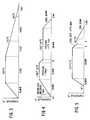
- Figures 3 through 5 show the time, temperature, and pressure conditions used for glassing, hipping, annealing the 60/40 glass combination.
- Figure 3 shows the temperature profile for the step of glassing.
- the lead borosilicate glass and the borosilicate glass were combined in powder form in a 60/40 weight percent mixture. After being thoroughly mixed, approximately three to four grams of the powder combination was placed on the surface of a slab of NiZn ferrite which had multiple slots cut in the top surface. The slab with the glass powder was placed into an infra-red heating furnace.
- the glass was melted on the slab, thereby filling in the slots, by heating the slab to 920°C during a forty five minute ramp interval, then holding the temperature at 920°C for two hours, then decreasing the temperature to 710°C during a two hour interval, then decreasing the temperature to 345°C during a four hour interval, and finally returning the oven to room temperature.
- FIG. 4 shows the process of "hipping" was performed under both controlled temperature and pressure conditions. Hipping is a procedure designed to remove any glass bubbles present in the glass.
- the glassed, ferrite slabs were placed in an isostatic furnace. During a thirty minute interval the furnace temperature was increased from room temperature to 740°C.
- the gas pressure for the furnace during the thirty minute ramp was initially 1000 pounds per square inch (psi). The pressure increases as a function of temperature and was approximately 2000 psi at 740°C. This temperature and pressure were maintained for thirty minutes at which time the temperature was reduced to 510°C and the pressure reduced to 1750 psi over a ten minute interval, and the temperature and pressure were held constant for an hour before the isostatic furnace was cooled down.
- Figure 5 shows the anneal heating cycle which is performed in the infra-red furnace.
- Annealing is a heating and slow cooling process used to toughen the glass and reduce brittleness.
- the glassed and hipped, ferrite slabs are placed in the infra-red furnace and the temperature of the furnace is ramped to 510°C from room temperature over a thirty minute interval, then the furnace temperature is held constant for one hour, then the furnace is cooled to 405°C at a cooling rate equal to 14°C ⁇ 2°C/minute over an eight minute time interval and the furnace is held constant at 405°C for three minutes before it is finally cooled down.
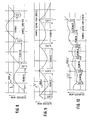
- Figure 6 shows experimental bow stress results for the 60/40 glass combination where various anneal temperatures were used. All samples used in the experiment were crack free.
- the bow stress test is performed by taking the glassed, hipped, and annealed substrate and removing the excess glass from the top of the slots by grinding. In addition, a large slot is ground into the back side of the substrate. If a profile trace is now taken from edge to edge of the substrate across the glass slots, a measure of stress is obtained. The magnitude of the bow being proportional to the resultant stress of the ferrite/glass laminated structure.
- Bow measurements were taken on ferrite samples of 11 and 22 mm in length. Data shown in Figure 6 has been normalized to the 11 mm sample.
- Figure 7 shows experimental bow stress results for 65/35 and 55/45 glass combinations where various anneal temperatures were used. The bow stress test was performed as discussed above. Bow measurements were taken on ferrite samples 11 mm in length. Figure 7 indicates some cracking occurs with these combinations under higher stress conditions. These combinations of lead borosilicate and borosilicate glass should be considered the outer limits for an acceptable closure glass.
- Wear bar samples were prepared from the glassed, hipped, and annealed ferrite slabs which resulted from the procedures shown in Figures 3 through 5. Wear bar samples are sections of the slab which are cut and milled to have a surface which has alternating ferrite and glass portions. A sample under test was then worn with PDM Sonoita recording media by passing the tape over the corner of the test sample. This test produces a flat where the tape wears the corner away. A profile trace taken along the worn flat will show the relative height of both the ferrite and glass. From this information, the relative wear rates of both ferrite and glass can be determined.
- Figures 8 through 10 show wear bar profile results obtained using the abrasivity test discussed above for wear bars having IBM 400 glass, wear bars having high stress 60/40 lead borosilicate to borosilicate glass (i.e., glass annealed at 480°C), and wear bars having low stress 60/40 lead borosilicate to borosilicate glass (i.e., glass annealed at 510°C), respectively.
- the results for the IBM 400 glass wear bar shown in Figure 8 is used as a reference and its scale is 5 ⁇ '' along the ordinate by 1000 ⁇ '' along the abscissa.
- the scale in both Figures 9 and 10 are 2 ⁇ '' by 1000 ⁇ ''.
- the 60/40 lead borosilicate to borosilicate glass wore much less.
Landscapes
- Engineering & Computer Science (AREA)
- Manufacturing & Machinery (AREA)
- Chemical & Material Sciences (AREA)
- Life Sciences & Earth Sciences (AREA)
- Chemical Kinetics & Catalysis (AREA)
- General Chemical & Material Sciences (AREA)
- Geochemistry & Mineralogy (AREA)
- Materials Engineering (AREA)
- Organic Chemistry (AREA)
- Glass Compositions (AREA)
Claims (7)
- Ein Niedrigverschleißverschlußglas für die Verwendung bei Magnetbandköpfen, das aus einer Verbindung von Bleiborosilikat- und Borosilikatglas besteht,
dadurch gekennzeichnet, daß
sich Bleiborosilikatglas folgendermaßen zusammensetzt (in Gewichtsprozent):SiO₂ 3%Al₂O 11%B₂O₃ 12%NaO 0%PbO 74%,und sich Borosilikatglas folgendermaßen zusammensetzt (in Gewichtsprozent):SiO₂ 81%Al₂O₃ 2%B₂O₃ 13%NaO 4%PbO 0%,wobei der Anteil an Bleiborosilikatglas innerhalb von 65 bis 55 Gewichtsprozent und der Anteil an Borosilikatglas innerhalb von 35 bis 45 Gewichtsprozent liegt. - Ein Niedrigverschleißverschlußglas gemäß Anspruch 1,
dadurch gekennzeichnet, daß
der Gewichtsprozentanteil von Bleiborosilikatglas etwa 60% und der Gewichtsprozentanteil von Borosilikatglas etwa 40% beträgt. - Ein Mehrspurbandkopf besitzt ein Verschlußglas, das in folgendem Verfahren ensteht:
Mischen von Bleiborosilikatglas gemäß Anspruch 1 in einem Gewichtsanteil zwischen 65% und 55% mit Borosilikatglas gemäß Anspruch 2 in einem Gewichtsanteil zwischen 35% und 45%, wobei durch diesen Mischvorgang eine Glasmischung entsteht;
Auftragen dieser Glasmischung auf eine geschlitzte Ferritplatte;
Glasieren der Ferrit-Platte durch Erhitzen der geschlitzten Ferrit-Platte mit der Glasmischung auf eine zum Schmelzen dieser Glasmischung ausreichenden Temperatur, wobei durch diese Glasierung eine glasierte Ferrit-Platte ensteht;
Entfernen von Blasen auf der glasierten FerritPlatte, indem die glasierte Ferrit-Platte ausreichender Temperatur- und ausreichendem Druck ausgesetzt ist, um alle auf der Glas-Ferrit-Platte vorhandenen Blasen zu entfernen, wobei durch die Blasenentfernung eine glasierte, blasenfreie Ferrit-Platte ensteht; sowie
Abkühlen der glasierten, blasenfreien Ferrit-Platte bei einer ausgewählten Temperatur, wodurch das Glas auf der genannten Platte gehärtet wird. - Ein Mehrspurbandkopf gemäß Anspruch 3, bei dem das im Mischvorgang verwendete Bleiborosilikatglas etwa sechzig Gewichtsprozent und das im Mischvorgang verwendete Borosilikatglas etwa vierzig Gewichtsprozent umfaßt.
- Ein Mehrspurbandkopf gemäß Anspruch 3, bei dem die ausgewählte Temperatur bei der Abkühlung entsprechend der gewünschten Belastungsstufe für das genannte Glas auf der Platte ausgewählt wird.
- Ein Mehrspurbandkopf gemäß Anspruch 3, bei dem die ausgewählte Temperatur bei der Abkühlung zwischen 500 und 520°C beträgt.
- Eine Methode zur Herstellung von Verschlußglas für einen Magnetbandkopf, die die folgenden Schritte umfaßt:
Mischen von Bleiborosilikatglas gemäß Anspruch 1 in einem Gewichtsanteil zwischen 65 und 55 Prozent mit Borosilikatglas gemäß Anspruch 2 in einem Gewichtsanteil zwischen 35 und 45 Prozent, wobei durch diesen Mischvorgang eine Glasmischung entsteht;
Auftragen dieser Glasmischung auf eine geschlitzte Ferrit-Platte;
Glasieren der Ferrit-Platte durch Erhitzen der geschlitzten Ferrit-Platte mit der Glasmischung auf eine zum Schmelzen dieser Glasmischung ausreichende Temperatur, wobei durch diese Glasierung eine glasierte FerritPlatte ensteht;
Entfernen von Blasen auf der glasierten FerritPlatte, indem die glasierte Ferrit-Platte ausreichender Temperatur und ausreichendem Druck ausgesetzt ist, um alle auf der Glas-Ferrit-Platte vorhandenen Blasen zu entfernen, wobei durch die Blasenentfernung eine glasierte, blasenfreie Ferrit-Platte ensteht; sowie
Abkühlen der glasierten, blasenfreien Ferrit-Platte bei einer ausgewählten Temperatur, wodurch das Glas auf der Platte gehärtet wird.
Applications Claiming Priority (2)
| Application Number | Priority Date | Filing Date | Title |
|---|---|---|---|
| US36773389A | 1989-06-19 | 1989-06-19 | |
| US367733 | 1989-06-19 |
Publications (2)
| Publication Number | Publication Date |
|---|---|
| EP0404741A1 EP0404741A1 (de) | 1990-12-27 |
| EP0404741B1 true EP0404741B1 (de) | 1994-03-09 |
Family
ID=23448386
Family Applications (1)
| Application Number | Title | Priority Date | Filing Date |
|---|---|---|---|
| EP19900850196 Expired - Lifetime EP0404741B1 (de) | 1989-06-19 | 1990-05-21 | Verschlussglas mit geringem Verschleiss für Magnetbandköpfe |
Country Status (3)
| Country | Link |
|---|---|
| EP (1) | EP0404741B1 (de) |
| JP (1) | JPH06103523B2 (de) |
| DE (1) | DE69007180T2 (de) |
Families Citing this family (2)
| Publication number | Priority date | Publication date | Assignee | Title |
|---|---|---|---|---|
| WO2014062153A1 (en) | 2012-10-15 | 2014-04-24 | Hewlett-Packard Development Company, L.P. | Charge roller for electrographic printer |
| CN108225403B (zh) * | 2017-12-28 | 2024-01-30 | 重庆日联科技有限公司 | 带托盘的异形件通用检测机 |
Family Cites Families (7)
| Publication number | Priority date | Publication date | Assignee | Title |
|---|---|---|---|---|
| US2316742A (en) * | 1941-06-05 | 1943-04-13 | E I Du Pont De Neumours & Comp | Ceramic coating composition |
| US3493405A (en) * | 1967-08-07 | 1970-02-03 | Gen Electric | Semiconductor encapsulation glass |
| DE1596995A1 (de) * | 1967-12-28 | 1971-04-01 | Siemens Ag | Glaslot |
| US4435511A (en) * | 1982-09-13 | 1984-03-06 | Owens-Illinois, Inc. | Glasses suitable for sealing ferrites |
| JPS60186437A (ja) * | 1984-03-02 | 1985-09-21 | Fuji Elelctrochem Co Ltd | フエライト接着用ガラス組成物 |
| JPS63170240A (ja) * | 1987-01-09 | 1988-07-14 | Toshiba Glass Co Ltd | 低融点ガラス組成物 |
| JPH01138151A (ja) * | 1987-11-24 | 1989-05-31 | Matsushita Electric Ind Co Ltd | 磁気ヘッド |
-
1990
- 1990-05-21 EP EP19900850196 patent/EP0404741B1/de not_active Expired - Lifetime
- 1990-05-21 DE DE1990607180 patent/DE69007180T2/de not_active Expired - Fee Related
- 1990-06-19 JP JP2158896A patent/JPH06103523B2/ja not_active Expired - Lifetime
Also Published As
| Publication number | Publication date |
|---|---|
| JPH06103523B2 (ja) | 1994-12-14 |
| JPH0333028A (ja) | 1991-02-13 |
| DE69007180T2 (de) | 1994-09-22 |
| EP0404741A1 (de) | 1990-12-27 |
| DE69007180D1 (de) | 1994-04-14 |
Similar Documents
| Publication | Publication Date | Title |
|---|---|---|
| EP1577275B1 (de) | Kristallisiertes Glas für Informationsaufzeichnungsmedium, kristallisiertes Glas-Substrat, und Informationsaufzeichnungsmedium unter Verwendung des kristallisierten Glas-Substrats | |
| US4430440A (en) | Magnetic head slider material | |
| KR100188901B1 (ko) | 자기디스크용 결정화 유리기판 | |
| KR100329004B1 (ko) | 정보기억매체용 글라스세라믹 기판 | |
| EP2263979A1 (de) | Kristallglassubstrat für Informationsaufzeichnungsmedium und Verfahren zu dessen Herstellung | |
| EP0626353A1 (de) | Glaskeramik für Magnetplatten-Substrate und Verfahren zu ihrer Herstellung | |
| US6942934B2 (en) | Glass material for a substrate, glass substrate, and information recording medium employing the same | |
| EP0325300A2 (de) | Zusammengesetzter Fliegender Magnetkopf | |
| US4816949A (en) | Magnetic head containing amorphous alloy and crystallizable glass | |
| EP0221697A2 (de) | Magnetkopf aus einer amorphen magnetischen Legierung und Verfahren zu dessen Herstellung | |
| US5055957A (en) | Method of making low wear glass for magnetic heads | |
| US5519555A (en) | Magnetic head including PbO-V2 O5 -P2 O5 system glass bonding | |
| US3954434A (en) | Method of manufacturing a ferrite magnetic transducer head | |
| EP0404741A1 (de) | Verschlussglas mit geringem Verschleiss für Magnetbandköpfe | |
| EP0634374A1 (de) | Feinkörnige Canasit Glaskeramik zur Herstellung von Speichervorrichtungen | |
| US4636420A (en) | Grooved magnetic substrates and method for producing the same | |
| JP3912575B2 (ja) | 磁気記録媒体用ガラス基板の製造方法、及び磁気記録媒体の製造方法 | |
| US5224001A (en) | Magnetic head | |
| JPH06101090B2 (ja) | 浮上型複合磁気ヘッド | |
| WO2023100893A1 (ja) | 磁気記録媒体用ガラス基板、磁気記録媒体用ガラスディスク、磁気記録媒体及びガラスディスクの製造方法 | |
| KR100390281B1 (ko) | 자기헤드 고정용 접합유리 | |
| JP2577128B2 (ja) | 溶着用ガラス組成物 | |
| KR100399555B1 (ko) | 자기헤드용 접합유리 | |
| KR100389688B1 (ko) | 자기헤드 고정용 접합유리 | |
| JPH0761836A (ja) | フェライト接着用ガラス |
Legal Events
| Date | Code | Title | Description |
|---|---|---|---|
| PUAI | Public reference made under article 153(3) epc to a published international application that has entered the european phase |
Free format text: ORIGINAL CODE: 0009012 |
|
| AK | Designated contracting states |
Kind code of ref document: A1 Designated state(s): DE FR GB |
|
| 17P | Request for examination filed |
Effective date: 19901213 |
|
| 17Q | First examination report despatched |
Effective date: 19921201 |
|
| GRAA | (expected) grant |
Free format text: ORIGINAL CODE: 0009210 |
|
| AK | Designated contracting states |
Kind code of ref document: B1 Designated state(s): DE FR GB |
|
| REF | Corresponds to: |
Ref document number: 69007180 Country of ref document: DE Date of ref document: 19940414 |
|
| ET | Fr: translation filed | ||
| PLBE | No opposition filed within time limit |
Free format text: ORIGINAL CODE: 0009261 |
|
| STAA | Information on the status of an ep patent application or granted ep patent |
Free format text: STATUS: NO OPPOSITION FILED WITHIN TIME LIMIT |
|
| 26N | No opposition filed | ||
| PGFP | Annual fee paid to national office [announced via postgrant information from national office to epo] |
Ref country code: GB Payment date: 19950413 Year of fee payment: 6 |
|
| PGFP | Annual fee paid to national office [announced via postgrant information from national office to epo] |
Ref country code: FR Payment date: 19950427 Year of fee payment: 6 |
|
| PGFP | Annual fee paid to national office [announced via postgrant information from national office to epo] |
Ref country code: DE Payment date: 19950524 Year of fee payment: 6 |
|
| PG25 | Lapsed in a contracting state [announced via postgrant information from national office to epo] |
Ref country code: GB Effective date: 19960521 |
|
| GBPC | Gb: european patent ceased through non-payment of renewal fee |
Effective date: 19960521 |
|
| PG25 | Lapsed in a contracting state [announced via postgrant information from national office to epo] |
Ref country code: FR Effective date: 19970131 |
|
| PG25 | Lapsed in a contracting state [announced via postgrant information from national office to epo] |
Ref country code: DE Effective date: 19970201 |
|
| REG | Reference to a national code |
Ref country code: FR Ref legal event code: ST |