EP0411571B1 - Seltenerdpulver für Dauermagnet, Herstellungsverfahren und Verbundmagnet - Google Patents
Seltenerdpulver für Dauermagnet, Herstellungsverfahren und Verbundmagnet Download PDFInfo
- Publication number
- EP0411571B1 EP0411571B1 EP90114691A EP90114691A EP0411571B1 EP 0411571 B1 EP0411571 B1 EP 0411571B1 EP 90114691 A EP90114691 A EP 90114691A EP 90114691 A EP90114691 A EP 90114691A EP 0411571 B1 EP0411571 B1 EP 0411571B1
- Authority
- EP
- European Patent Office
- Prior art keywords
- magnet powder
- permanent magnet
- rare earth
- alloy
- temperature
- Prior art date
- Legal status (The legal status is an assumption and is not a legal conclusion. Google has not performed a legal analysis and makes no representation as to the accuracy of the status listed.)
- Expired - Lifetime
Links
- 239000000843 powder Substances 0.000 title claims description 170
- 229910052761 rare earth metal Inorganic materials 0.000 title claims description 24
- 238000004519 manufacturing process Methods 0.000 title claims description 21
- 150000002910 rare earth metals Chemical class 0.000 title claims description 21
- 230000005291 magnetic effect Effects 0.000 claims description 83
- 239000000956 alloy Substances 0.000 claims description 74
- 229910045601 alloy Inorganic materials 0.000 claims description 47
- 239000000463 material Substances 0.000 claims description 44
- 239000012298 atmosphere Substances 0.000 claims description 42
- 230000001172 regenerating effect Effects 0.000 claims description 36
- UFHFLCQGNIYNRP-UHFFFAOYSA-N Hydrogen Chemical compound [H][H] UFHFLCQGNIYNRP-UHFFFAOYSA-N 0.000 claims description 30
- 239000001257 hydrogen Substances 0.000 claims description 26
- 229910052739 hydrogen Inorganic materials 0.000 claims description 26
- 229910052733 gallium Inorganic materials 0.000 claims description 23
- 229910052735 hafnium Inorganic materials 0.000 claims description 23
- 229910052726 zirconium Inorganic materials 0.000 claims description 22
- 238000005260 corrosion Methods 0.000 claims description 21
- 230000007797 corrosion Effects 0.000 claims description 20
- 239000002245 particle Substances 0.000 claims description 19
- 229910052782 aluminium Inorganic materials 0.000 claims description 14
- 229910052710 silicon Inorganic materials 0.000 claims description 14
- 229910052720 vanadium Inorganic materials 0.000 claims description 13
- 239000013078 crystal Substances 0.000 claims description 12
- 238000003825 pressing Methods 0.000 claims description 10
- 238000010438 heat treatment Methods 0.000 claims description 8
- 239000012535 impurity Substances 0.000 claims description 7
- 229910000765 intermetallic Inorganic materials 0.000 claims description 7
- 238000002844 melting Methods 0.000 claims description 7
- 229920005989 resin Polymers 0.000 claims description 6
- 239000011347 resin Substances 0.000 claims description 6
- RKTYLMNFRDHKIL-UHFFFAOYSA-N copper;5,10,15,20-tetraphenylporphyrin-22,24-diide Chemical compound [Cu+2].C1=CC(C(=C2C=CC([N-]2)=C(C=2C=CC=CC=2)C=2C=CC(N=2)=C(C=2C=CC=CC=2)C2=CC=C3[N-]2)C=2C=CC=CC=2)=NC1=C3C1=CC=CC=C1 RKTYLMNFRDHKIL-UHFFFAOYSA-N 0.000 claims description 5
- 238000000265 homogenisation Methods 0.000 claims description 4
- 239000013590 bulk material Substances 0.000 claims description 3
- 239000000919 ceramic Substances 0.000 claims description 3
- 238000001816 cooling Methods 0.000 claims description 3
- 230000008018 melting Effects 0.000 claims description 3
- 230000003028 elevating effect Effects 0.000 claims description 2
- 229910052751 metal Inorganic materials 0.000 claims description 2
- 239000002184 metal Substances 0.000 claims description 2
- 238000002156 mixing Methods 0.000 claims 1
- XEEYBQQBJWHFJM-UHFFFAOYSA-N Iron Chemical compound [Fe] XEEYBQQBJWHFJM-UHFFFAOYSA-N 0.000 description 29
- XKRFYHLGVUSROY-UHFFFAOYSA-N Argon Chemical compound [Ar] XKRFYHLGVUSROY-UHFFFAOYSA-N 0.000 description 22
- 229910000521 B alloy Inorganic materials 0.000 description 21
- 238000000034 method Methods 0.000 description 18
- 230000000052 comparative effect Effects 0.000 description 16
- 238000006356 dehydrogenation reaction Methods 0.000 description 14
- 229910020674 Co—B Inorganic materials 0.000 description 12
- 238000006243 chemical reaction Methods 0.000 description 12
- 239000007789 gas Substances 0.000 description 12
- 229910052786 argon Inorganic materials 0.000 description 11
- 239000004033 plastic Substances 0.000 description 11
- 238000012360 testing method Methods 0.000 description 10
- 239000000203 mixture Substances 0.000 description 9
- CPLXHLVBOLITMK-UHFFFAOYSA-N Magnesium oxide Chemical compound [Mg]=O CPLXHLVBOLITMK-UHFFFAOYSA-N 0.000 description 8
- 238000000465 moulding Methods 0.000 description 8
- 230000000694 effects Effects 0.000 description 7
- 238000011156 evaluation Methods 0.000 description 7
- 238000005984 hydrogenation reaction Methods 0.000 description 7
- 230000008569 process Effects 0.000 description 7
- 229910052796 boron Inorganic materials 0.000 description 6
- 230000008859 change Effects 0.000 description 6
- 230000009466 transformation Effects 0.000 description 6
- 239000003822 epoxy resin Substances 0.000 description 5
- 230000005415 magnetization Effects 0.000 description 5
- 229920000647 polyepoxide Polymers 0.000 description 5
- 229910001220 stainless steel Inorganic materials 0.000 description 5
- 239000010935 stainless steel Substances 0.000 description 5
- PNEYBMLMFCGWSK-UHFFFAOYSA-N aluminium oxide Inorganic materials [O-2].[O-2].[O-2].[Al+3].[Al+3] PNEYBMLMFCGWSK-UHFFFAOYSA-N 0.000 description 4
- 238000005266 casting Methods 0.000 description 4
- 230000004907 flux Effects 0.000 description 4
- 229910052742 iron Inorganic materials 0.000 description 4
- 239000000395 magnesium oxide Substances 0.000 description 4
- 150000001875 compounds Chemical class 0.000 description 3
- 230000005347 demagnetization Effects 0.000 description 3
- 238000007873 sieving Methods 0.000 description 3
- 229910052692 Dysprosium Inorganic materials 0.000 description 2
- 229910052777 Praseodymium Inorganic materials 0.000 description 2
- 229910052771 Terbium Inorganic materials 0.000 description 2
- MCMNRKCIXSYSNV-UHFFFAOYSA-N Zirconium dioxide Chemical compound O=[Zr]=O MCMNRKCIXSYSNV-UHFFFAOYSA-N 0.000 description 2
- 239000011230 binding agent Substances 0.000 description 2
- 230000005540 biological transmission Effects 0.000 description 2
- 230000003247 decreasing effect Effects 0.000 description 2
- 238000007731 hot pressing Methods 0.000 description 2
- 238000005098 hot rolling Methods 0.000 description 2
- 239000011261 inert gas Substances 0.000 description 2
- 229910052750 molybdenum Inorganic materials 0.000 description 2
- 239000004570 mortar (masonry) Substances 0.000 description 2
- 230000003647 oxidation Effects 0.000 description 2
- 238000007254 oxidation reaction Methods 0.000 description 2
- 238000010791 quenching Methods 0.000 description 2
- 230000000171 quenching effect Effects 0.000 description 2
- 229910052721 tungsten Inorganic materials 0.000 description 2
- 229910000967 As alloy Inorganic materials 0.000 description 1
- ZOXJGFHDIHLPTG-UHFFFAOYSA-N Boron Chemical compound [B] ZOXJGFHDIHLPTG-UHFFFAOYSA-N 0.000 description 1
- 229910052684 Cerium Inorganic materials 0.000 description 1
- 229910052691 Erbium Inorganic materials 0.000 description 1
- 229910052693 Europium Inorganic materials 0.000 description 1
- 229910052688 Gadolinium Inorganic materials 0.000 description 1
- GYHNNYVSQQEPJS-UHFFFAOYSA-N Gallium Chemical compound [Ga] GYHNNYVSQQEPJS-UHFFFAOYSA-N 0.000 description 1
- 229910052689 Holmium Inorganic materials 0.000 description 1
- 229910052765 Lutetium Inorganic materials 0.000 description 1
- ZOKXTWBITQBERF-UHFFFAOYSA-N Molybdenum Chemical compound [Mo] ZOKXTWBITQBERF-UHFFFAOYSA-N 0.000 description 1
- 229910052779 Neodymium Inorganic materials 0.000 description 1
- 229910052772 Samarium Inorganic materials 0.000 description 1
- XUIMIQQOPSSXEZ-UHFFFAOYSA-N Silicon Chemical compound [Si] XUIMIQQOPSSXEZ-UHFFFAOYSA-N 0.000 description 1
- 229910052775 Thulium Inorganic materials 0.000 description 1
- 229910052769 Ytterbium Inorganic materials 0.000 description 1
- XAGFODPZIPBFFR-UHFFFAOYSA-N aluminium Chemical compound [Al] XAGFODPZIPBFFR-UHFFFAOYSA-N 0.000 description 1
- 239000012300 argon atmosphere Substances 0.000 description 1
- GWXLDORMOJMVQZ-UHFFFAOYSA-N cerium Chemical compound [Ce] GWXLDORMOJMVQZ-UHFFFAOYSA-N 0.000 description 1
- 239000010941 cobalt Substances 0.000 description 1
- 229910017052 cobalt Inorganic materials 0.000 description 1
- GUTLYIVDDKVIGB-UHFFFAOYSA-N cobalt atom Chemical group [Co] GUTLYIVDDKVIGB-UHFFFAOYSA-N 0.000 description 1
- 238000012733 comparative method Methods 0.000 description 1
- 230000006866 deterioration Effects 0.000 description 1
- 238000011161 development Methods 0.000 description 1
- KBQHZAAAGSGFKK-UHFFFAOYSA-N dysprosium atom Chemical compound [Dy] KBQHZAAAGSGFKK-UHFFFAOYSA-N 0.000 description 1
- UYAHIZSMUZPPFV-UHFFFAOYSA-N erbium Chemical compound [Er] UYAHIZSMUZPPFV-UHFFFAOYSA-N 0.000 description 1
- OGPBJKLSAFTDLK-UHFFFAOYSA-N europium atom Chemical compound [Eu] OGPBJKLSAFTDLK-UHFFFAOYSA-N 0.000 description 1
- 230000005294 ferromagnetic effect Effects 0.000 description 1
- UIWYJDYFSGRHKR-UHFFFAOYSA-N gadolinium atom Chemical compound [Gd] UIWYJDYFSGRHKR-UHFFFAOYSA-N 0.000 description 1
- VBJZVLUMGGDVMO-UHFFFAOYSA-N hafnium atom Chemical compound [Hf] VBJZVLUMGGDVMO-UHFFFAOYSA-N 0.000 description 1
- KJZYNXUDTRRSPN-UHFFFAOYSA-N holmium atom Chemical compound [Ho] KJZYNXUDTRRSPN-UHFFFAOYSA-N 0.000 description 1
- 238000001192 hot extrusion Methods 0.000 description 1
- 230000006872 improvement Effects 0.000 description 1
- 229910052746 lanthanum Inorganic materials 0.000 description 1
- FZLIPJUXYLNCLC-UHFFFAOYSA-N lanthanum atom Chemical compound [La] FZLIPJUXYLNCLC-UHFFFAOYSA-N 0.000 description 1
- OHSVLFRHMCKCQY-UHFFFAOYSA-N lutetium atom Chemical compound [Lu] OHSVLFRHMCKCQY-UHFFFAOYSA-N 0.000 description 1
- 230000005381 magnetic domain Effects 0.000 description 1
- 239000007769 metal material Substances 0.000 description 1
- 239000011733 molybdenum Substances 0.000 description 1
- QEFYFXOXNSNQGX-UHFFFAOYSA-N neodymium atom Chemical compound [Nd] QEFYFXOXNSNQGX-UHFFFAOYSA-N 0.000 description 1
- 229910052758 niobium Inorganic materials 0.000 description 1
- 229910052755 nonmetal Inorganic materials 0.000 description 1
- PUDIUYLPXJFUGB-UHFFFAOYSA-N praseodymium atom Chemical compound [Pr] PUDIUYLPXJFUGB-UHFFFAOYSA-N 0.000 description 1
- 230000002035 prolonged effect Effects 0.000 description 1
- 230000009467 reduction Effects 0.000 description 1
- KZUNJOHGWZRPMI-UHFFFAOYSA-N samarium atom Chemical compound [Sm] KZUNJOHGWZRPMI-UHFFFAOYSA-N 0.000 description 1
- VSZWPYCFIRKVQL-UHFFFAOYSA-N selanylidenegallium;selenium Chemical compound [Se].[Se]=[Ga].[Se]=[Ga] VSZWPYCFIRKVQL-UHFFFAOYSA-N 0.000 description 1
- 239000010703 silicon Substances 0.000 description 1
- 229910052715 tantalum Inorganic materials 0.000 description 1
- GZCRRIHWUXGPOV-UHFFFAOYSA-N terbium atom Chemical compound [Tb] GZCRRIHWUXGPOV-UHFFFAOYSA-N 0.000 description 1
- FRNOGLGSGLTDKL-UHFFFAOYSA-N thulium atom Chemical compound [Tm] FRNOGLGSGLTDKL-UHFFFAOYSA-N 0.000 description 1
- 229910052719 titanium Inorganic materials 0.000 description 1
- 238000000844 transformation Methods 0.000 description 1
- WFKWXMTUELFFGS-UHFFFAOYSA-N tungsten Chemical compound [W] WFKWXMTUELFFGS-UHFFFAOYSA-N 0.000 description 1
- 239000010937 tungsten Substances 0.000 description 1
- LEONUFNNVUYDNQ-UHFFFAOYSA-N vanadium atom Chemical compound [V] LEONUFNNVUYDNQ-UHFFFAOYSA-N 0.000 description 1
- NAWDYIZEMPQZHO-UHFFFAOYSA-N ytterbium Chemical compound [Yb] NAWDYIZEMPQZHO-UHFFFAOYSA-N 0.000 description 1
- 229910052727 yttrium Inorganic materials 0.000 description 1
- VWQVUPCCIRVNHF-UHFFFAOYSA-N yttrium atom Chemical compound [Y] VWQVUPCCIRVNHF-UHFFFAOYSA-N 0.000 description 1
Images


Classifications
-
- B—PERFORMING OPERATIONS; TRANSPORTING
- B22—CASTING; POWDER METALLURGY
- B22F—WORKING METALLIC POWDER; MANUFACTURE OF ARTICLES FROM METALLIC POWDER; MAKING METALLIC POWDER; APPARATUS OR DEVICES SPECIALLY ADAPTED FOR METALLIC POWDER
- B22F9/00—Making metallic powder or suspensions thereof
- B22F9/02—Making metallic powder or suspensions thereof using physical processes
- B22F9/023—Hydrogen absorption
-
- H—ELECTRICITY
- H01—ELECTRIC ELEMENTS
- H01F—MAGNETS; INDUCTANCES; TRANSFORMERS; SELECTION OF MATERIALS FOR THEIR MAGNETIC PROPERTIES
- H01F1/00—Magnets or magnetic bodies characterised by the magnetic materials therefor; Selection of materials for their magnetic properties
- H01F1/01—Magnets or magnetic bodies characterised by the magnetic materials therefor; Selection of materials for their magnetic properties of inorganic materials
- H01F1/03—Magnets or magnetic bodies characterised by the magnetic materials therefor; Selection of materials for their magnetic properties of inorganic materials characterised by their coercivity
- H01F1/032—Magnets or magnetic bodies characterised by the magnetic materials therefor; Selection of materials for their magnetic properties of inorganic materials characterised by their coercivity of hard-magnetic materials
- H01F1/04—Magnets or magnetic bodies characterised by the magnetic materials therefor; Selection of materials for their magnetic properties of inorganic materials characterised by their coercivity of hard-magnetic materials metals or alloys
- H01F1/047—Alloys characterised by their composition
- H01F1/053—Alloys characterised by their composition containing rare earth metals
- H01F1/055—Alloys characterised by their composition containing rare earth metals and magnetic transition metals, e.g. SmCo5
- H01F1/057—Alloys characterised by their composition containing rare earth metals and magnetic transition metals, e.g. SmCo5 and IIIa elements, e.g. Nd2Fe14B
- H01F1/0571—Alloys characterised by their composition containing rare earth metals and magnetic transition metals, e.g. SmCo5 and IIIa elements, e.g. Nd2Fe14B in the form of particles, e.g. rapid quenched powders or ribbon flakes
-
- H—ELECTRICITY
- H01—ELECTRIC ELEMENTS
- H01F—MAGNETS; INDUCTANCES; TRANSFORMERS; SELECTION OF MATERIALS FOR THEIR MAGNETIC PROPERTIES
- H01F1/00—Magnets or magnetic bodies characterised by the magnetic materials therefor; Selection of materials for their magnetic properties
- H01F1/01—Magnets or magnetic bodies characterised by the magnetic materials therefor; Selection of materials for their magnetic properties of inorganic materials
- H01F1/03—Magnets or magnetic bodies characterised by the magnetic materials therefor; Selection of materials for their magnetic properties of inorganic materials characterised by their coercivity
- H01F1/032—Magnets or magnetic bodies characterised by the magnetic materials therefor; Selection of materials for their magnetic properties of inorganic materials characterised by their coercivity of hard-magnetic materials
- H01F1/04—Magnets or magnetic bodies characterised by the magnetic materials therefor; Selection of materials for their magnetic properties of inorganic materials characterised by their coercivity of hard-magnetic materials metals or alloys
- H01F1/047—Alloys characterised by their composition
- H01F1/053—Alloys characterised by their composition containing rare earth metals
- H01F1/055—Alloys characterised by their composition containing rare earth metals and magnetic transition metals, e.g. SmCo5
- H01F1/057—Alloys characterised by their composition containing rare earth metals and magnetic transition metals, e.g. SmCo5 and IIIa elements, e.g. Nd2Fe14B
- H01F1/0571—Alloys characterised by their composition containing rare earth metals and magnetic transition metals, e.g. SmCo5 and IIIa elements, e.g. Nd2Fe14B in the form of particles, e.g. rapid quenched powders or ribbon flakes
- H01F1/0573—Alloys characterised by their composition containing rare earth metals and magnetic transition metals, e.g. SmCo5 and IIIa elements, e.g. Nd2Fe14B in the form of particles, e.g. rapid quenched powders or ribbon flakes obtained by reduction or by hydrogen decrepitation or embrittlement
Definitions
- the present invention relates to a rare earth permanent magnet powder which exhibits superior magnetic properties, particularly anisotropy and corrosion resistance, a method for producing the same, and bonded magnets produced using the above rare earth permanent magnet powder.
- the rare earth-iron-boron alloy permanent magnet powder comprising iron (Fe), boron (B) and a rare earth element (which is now defined to include yttrium (Y) and will be hereinafter represented by R when appropriate), has drawn general attention as a permanent magnet material which exhibits superior magnetic properties, and it has since been in the development stage as a magnet powder for bonded magnets.
- a bonded magnet is inferior in magnetic property when compared to sintered magnets of the same magnet powder, its field of application has grown and continues to grow rapidly in recent years because of its superior physical strength and higher flexibility in shape.
- These bonded magnets are composed by binding magnet powder with organic binders and/or metallic binders, or the like; and magnetic properties of these bonded magnets depend on the magnetic properties of such magnet powders.
- Japanese Patent Application A-Publication No. 1-132106 describes one prior art R-Fe-B permanent magnet powder used to manufacture a bonded magnet.
- the R-Fe-B permanent magnet powder is manufactured by preparing a R-Fe-B alloy having a ferromagnetic R 2 Fe 14 B intermettalic compound phase as its principal phase, subsequently heat-treating the alloy in a prescribed temperature range in a hydrogen atmosphere to cause phase transformation in RH X phase, Fe2 B phase and the remaining Fe phase, and subsequently subjecting the alloy to dehydrogenation to reproduce the R 2 Fe 14 B phase.
- the resulting magnet powder has an aggregated structure of recrystallized grains of R 2 Fe 14 B phase having a minuscule average grain size of 0.05tim to 3 ⁇ m.
- Japanese Patent Application A-Publication No. 1-132106 further describes a R-Fe-Co-B permanent magnet powder, i.e., a R-Fe-B magnet powder in which a part of Fe is substituted by cobalt (Co).
- This magnet powder has also an aggregated structure of recrystallized grains of R 2 (Fe,Co) 14 .B phase having an average grain size of 0.05tim to 3 ⁇ m.
- the aforesaid prior art magnet powders exhibit magnetic anisotropy, but anisotropy is often reduced due to small fluctuations in alloy composition or manufacturing conditions, and hence it is difficult to obtain stable and superior magnetic anisotropy.
- Known methods for imparting magnetic anisotropy to a magnet powder involve subjecting the permanent magnet powder to hot plastic working, such as hot rolling and hot extrusion, to thereby form the crystal grains of the magnet powder into a flat shape.
- hot plastic working such as hot rolling and hot extrusion
- the degree of working varies depending upon the locations, and hence a magnet powder having a stable and uniform magnetic anisotropy cannot be obtained.
- the manufacturing process is intricate, and hence the manufacturing costs are unduly high.
- the flat recrystallized grains formed by means of hot plastic working are more susceptible to corrosion than the magnet powder comprising recrystallized grains which are not hot-worked.
- the magnet powder is kept in a high-temperature and high-humidity atmosphere, such as in a factory, for a prolonged period of time, the surface of the magnet powder is corroded, and its magnetic property is unduly reduced.
- Another object of the invention is to provide an improved method which can produce the above permanent magnet powder without conducting any hot plastic working such as hot rolling.
- Yet another object of the invention is to provide a bonded magnet produced using the above permanent magnet powder.
- a rare earth permanent magnet powder comprising particles each containing 10 to 20 atomic percent of R, 3 to 20 atomic percent of B, 0.001 to 5.0 atomic percent of at least one element selected from the group consisting of Ga, Zr and Hf, balance Fe, or Fe and Co, and unavoidable impurities, the individual particle comprising an aggregated structure of recrystallized grains containing a R 2 Fe 14 B intermetallic compound phase as a principal phase, the intermetallic compound phase consisting of recrystallized grains of a tetragonal crystal structure having an average crystal grain size of 0.05 to 20 ⁇ rn, wherein at least 50% by volume of the recrystallized grains of the aggregated structure includes recrystallized grains formed so that a ratio of the greatest dimension to the smallest dimension is less than 2 for each recrystallized grain.
- the composition of the alloy may be modified to further improve the magnetic properties and high resistance to corrosion of the magnet powder.
- a method for producing a rare earth permanent magnet powder comprising the steps of:
- a bonded magnet produced using the permanent magnet powder as described above.
- the inventors have made an extensive study in regard to the improvement of the prior art magnet powders, and have come to the understanding that among permanent magnet powders comprising a recrystallized grain structure of R 2 Fe 14 B principal phase, the magnet powder containing 0.001 to 5.0 atomic percent of at least one of gallium (Ga), zirconium (Zr) and hafnium (Hf), can be produced so as to have superior magnetic anisotropy without subjecting the powder to hot plastic working.
- the R-Fe-B permanent magnet powder comprising a structure of recrystallized grains for which (greatest dimension b)/(smallest dimension a) ⁇ 2 for each recrystallized grain indicates substantially improved corrosion resistance.
- the permanent magnet powder in accordance with the present invention is produced based on the aforesaid facts, and is characterized in that each particle contains 10 to 20 atomic percent of R; 3 to 20 atomic percent of B; 0.001 to 5.0 atomic percent of at least one of Ga, Zr and Hf or further added 0.01 to 2.0 atomic percent of at least one of Al, V and Si; balance Fe; and unavoidable impurities; that an individual particle thereof comprises a structure of recrystallized grains containing a R 2 Fe 14 B intermetallic compound phase as a principal phase, the intermetallic compound phase consisting of recrystallized grains of a tetragonal crystal structure having an average crystal grain size of 0.05 to 20 ⁇ rn, and that the ratio of the greatest dimension to the smallest dimension a is less than 2 for each recrystallized grain.
- the permanent magnet powder as described above is produced as follows:
- the R-Fe-B alloy is homogenized at a temperature of 600°C to 1200°C, or if the dehydrogenated alloy is heat-treated at a temperature of 300°C to 1000°C, the magnetic anisotropy and corrosion resistance are further improved.
- the R-Fe-B permanent magnet powder thus produced comprises an aggregate structure of recrystallized grains of the R 2 Fe 1 4 Bphase which contains neither impurities nor strain in the grains or at the grain boundaries.
- the recrystallized grain structure of each particle is formed so as to have an average grain size ranging from 0.05tim to 20 ⁇ m. If it is less than 0.05tim, it is difficult to magnetize the powder. On the other hand, if it is greater than 20 ⁇ m, the coercivity and squareness of the magnetization curve will be reduced, resulting in inferior magnetic properties. It is however more preferable that the average grain size ranges from 0.05 to 3 ⁇ m, which is close to about 0.3tim, wherein the recrystallized grains become particles of a single magnetic domain.
- each recrystallized grain should preferably have such a shape that the ratio of the greatest dimension to the smallest dimension a is less than 2, and the amount of the recrystallized grains of such a shape should be at least 50% by volume of the total amount of recrystallized grains. Due to the recrystallized grains of the above shape, the coercivity and corrosion resistance of the R-Fe-B permanent magnet powder can be improved. When compared with the magnet powder produced by means of hot plastic working, the resulting magnet powder is superior in corrosion resistance and exhibits stable and excellent magnetic properties. In addition, the yield in manufacture is improved.
- the recrystallized grain structure of the R-Fe-B magnet powder thus obtained is an aggregated one that consists essentially of recrystallized grains of R 2 Fe 14 B phase and has almost no R-rich phase on the grain boundary. Therefore, the value of the magnetization of the magnet powder can be further enhanced, and the corrosion which may develop through the R-rich phase on the grain boundary is prevented. In addition, since there exist no strains due to hot plastic working, stress corrosion can be avoided. Thus, the corrosion resistance of the magnet powder is improved.
- the resulting magnets when bonded magnets are produced using the above permanent magnet powder, the resulting magnets also exhibit superior magnetic anisotropy and corrosion resistance.
- R represents at least one element selected from the group consisting of neodymium (Nd), praseodymium (Pr), terbium (Tb), dysprosium (Dy), lanthanum (La), cerium (Ce), holmium (Ho), erbium (Er), europium (Eu), samarium (Sm), gadolinium (Gd), thulium (Tm), ytterbium (Yb), lutetium (Lu) and Y.
- Nd is mainly used, and other rare earth elements are added to it. Among those elements, Tb, Dy and Pr enhance coercivity (iHc).
- the R content should be determined so as to be within the range of 10 atomic percent and 20 atomic percent.
- the B content is determined to the range of between 3 to 20 atomic percent.
- Ga, Zr or Hf contained in the permanent magnet powder enhances coercivities and imparts superior magnetic anisotropy and corrosion resistance. If the content is less than 0.001 atomic percent, desired effects cannot be obtained. On the other hand, if the content exceeds 5.0 atomic percent, the magnetic properties are deteriorated. Therefore, the content of one or more of these elements is determined so as to range from 0.001 atomic percent to 5.0 atomic percent.
- 0.01 to 2.0 atomic percent of at least one of aluminum (Al), vanadium (V) and silicon (Si) may further be added in the R-Fe-B permanent magnet powder as necessary.
- Al aluminum
- V vanadium
- Si silicon
- R-Fe-B permanent magnet powders of various kinds may be substituted by Co.
- This modified permanent magnet powder is characterized in that it contains 10 to 20 atomic percent of R, 0.1 to 50 atomic percent of Co, 3 to 20 atomic percent of B, 0.001 to 5.0 atomic percent of at least one of Ga, Zr and Hf, balance Fe and unavoidable impurities, and that the individual particle thereof comprises a structure of recrystallized grains containing a R2(Fe,Co)14.Bintermetallic compound phase as a principal phase, the intermetallic compound phase consisting of recrystallized grains of a tetragonal crystal structure having an average crystal grain size of 0.05 to 20 ⁇ rn, the ratio of the greatest dimension to the smallest dimension a being less than 2 for each recrystallized grain.
- Co existing in the permanent magnet powder enhances coercivities and magnetic temperature characteristics, e.g., Curie point, and further improves the corrosion resistance.
- the Co content is determined so as to range between 0.1 and 50 atomic percent.
- it is more preferable that the Co content ranges from 0.1 to 20 atomic percent since the coercivities reach the maximum within this range.
- Al, V or Si may be further added as is the case with the previous R-Fe-B alloy magnet powder.
- the inventors have clarified the causes of the variations in the manufacturing process. More specifically, in a hydrogen atmosphere at 750°C to 950°C, the R2 Fe14 B phase of the R-Fe-B alloy ingot or powder is transformed into three phases as follows:
- the reaction (2) is endothermic, and the temperature fluctuates while being lowered during the reaction.
- the temperature also varies depending upon location in the vessel into which the R-Fe-B alloy ingot or powder is filled. Due to these temperature variations, the magnetic anisotropy of the recrystallized grain structure of the resulted R-Fe-B permanent magnet powder is variable.
- the temperature elevation step from room temperature to the temperature of 750°C to 950°C, should be carried out in a hydrogen atmosphere, and have also found that the use of regenerative material is very effective. Namely, when the R-Fe-B alloy ingot or powder is heated to a prescribed temperature together with a regenerative material in a hydrogen atmosphere and is then kept in a vacuum at the same temperature, the temperature variation during the endothermic reaction (2) is prevented by the heat conserving effect of the regenerative material, so that the temperature is uniformly maintained at a prescribed high temperature. Therefore, the lowering and fluctuation of the magnetic anisotropy for the resulting R-Fe-B permanent magnet powder can be eliminated.
- the inventors have also found that when a R-Fe-(Co)-B alloy ingot or powder containing 8 to 30 atomic percent of R; 3 to 15 atomic percent of B; 0.01 to 5.0 atomic percent of at least one of Al, Si and V; balance Fe or Fe and Co and unavoidable impurities, the powder becomes less sensitive to the temperature fluctuation during the dehydrogenation, so that the obtained magnet powder becomes excellent in magnetic properties, particularly in coercivity and squareness of the magnetization curve.
- the method in accordance with the present invention is hence characterized by the steps of (a) preparing a rare earth alloy material and a regenerative material; (b) subsequently carrying out the temperature elevation step in a hydrogen atmosphere and holding the alloy material and the regenerative material together in the same atmosphere at a temperature of 750°C to 950°C; (c) subsequently holding them at the same temperature in a vacuum; and (d) subsequently cooling and crushing the alloy.
- the alloy material may be homogenized at a temperature of 600°C to 1200°C prior to the above step (b).
- the resulted magnet powder may be further heat-treated at a temperature of 300°C to 1000°C to further improve the magnetic properties.
- the R-Fe-B alloy material to be used may be usually in the form of ingots or in bulk, but may be in other forms such as flakes or powders.
- the alloy material should have a composition of 8 to 30 atomic percent of R; 3 to 15 atomic percent of B; 0.01 to 5.0 atomic percent of at least one of Al, Si and V; balance Fe and unavoidable impurities.
- a part of Fe may be substituted by 0.01 atomic percent to 40 atomic percent of Co as described previously.
- at least one element of Ti, Nb, Ta, Mo and W may be added such that the total content of the element and Al, Si or V amounts to 5.0 atomic percent at the most.
- the magnet alloy material may contain:
- the homogenizing temperature is within the range of between 600°C to 1200°C, preferably from 1050°C to 1200°C. If the homogenizing temperature is less than 600°C, the homogenization process becomes time-consuming, so that the industrial productivity deteriorates. On the other hand, if the temperature exceeds 1200°C, the alloy will melt.
- the temperature elevation step from room temperature to the temperature of 750°C to 950°C should be carried out in a hydrogen atmosphere. If the step is carried out in the above atmosphere, the reaction (1) occurs uniformly without causing fluctuations in phase transformation when compared with a vacuum or an argon atmosphere.
- the phase transformation as indicated in the reaction (1) occurs, and when the alloy is then held in a vacuum at the same temperature, the phase transformation as indicated in the reaction (2) occurs.
- an aggregated structure of recrystallized grains is obtained.
- the phase transformations of the reactions (1) and (2) occur particularly at 750°C to 950°C, and the aggregated structure of recrystallized grains thus obtained exhibits superior magnetic properties. Therefore, the treating temperature in a hydrogen atmosphere and in a vacuum is set to 750°C to 950°C.
- the temperature fluctuates during its lowering even though the temperature is maintained at a constant temperature ranging between 750°C to 950°C.
- the furnace temperature may be controlled during the phase transformation indicated by the reaction (2), but such a control is very difficult to attain on an industrial scale since special control equipment is required, and manufacturing costs are therefore increased unduly.
- the R-Fe-B alloy material is heated together with the regenerative material and held at a constant temperature of between 750°C and 950°C. With this procedure, even though the endothermic reaction (2) occurs, the holding temperature of the R-Fe-B alloy material does not decrease due to the heat-conserving effect of the regenerative material.
- the regenerative material should be a material which has a great heat content and a high melting point, and does not react with the R-fe-B alloy material in a hydrogen atmosphere or in a vacuum.
- ceramics such as alumina, magnesia and zirconia, or a metal having a high melting point such as tungsten, molybdenum or stainless steel can be preferably employed.
- the regenerative material should be in a form separable from the R-Fe-B magnet powder, and may be in the form of plates, blocks, lumps and balls.
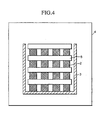
- R-Fe-B alloy ingots 2 in the form of blocks and regenerative materials in the form of balls 1 or plates 5 are both held in a vessel 3 arranged in a heating furnace 4, and the atmosphere in the heating furnace 4 is converted to a hydrogen atmosphere. Then, the R-Fe-B alloy ingot is subjected to hydrogenation while maintaining the furnace at a constant temperature of between 750°C and 950°C. Subsequently, the furnace 4 is evacuated to carry out dehydrogenation.
- the regenerative materials 1 or 5, having high heat contents, are great are held in the vessel, and hence even though the endothermic reaction occurs in the dehydrogenation process, the holding temperature can be maintained constant without causing any fluctuation. Therefore, the reduction and variation of the magnetic properties can positively be prevented.
- alloy ingots containing at least one of Ga, Zr and Hf as well as alloy ingots containing no Ga, Zr and Hf were prepared by means of plasma-melting and casting, and were then homogenized in an argon gas atmosphere at a temperature of 1120°C for 40 hours.
- the ingots thus homogenized were crushed into alloy materials of about 20mm in size.
- the alloy materials were heated in a hydrogen atmosphere of 1 atm to elevate their temperatures from the room temperature to 850°C, and were heat-treated by keeping them in the hydrogen atmosphere at 850°C for four hours.
- the alloy materials were subjected to dehydrogenation at 830°C until the pressure reached a vacuum of 1 x 10- 1 torr, and argon gas was then introduced to effect a rapid quenching.
- the materials were heat-treated in an argon gas atmosphere at 650°C after the hydrogen treatment was completed.
- the obtained alloy materials were crushed in mortars to produce magnet powders 1 to 28 of the invention, comparative magnet powders 1 to 11 and a prior art magnet powder 1.
- the magnet powders 1 to 28 of the invention, the comparative magnet powders 1 to 11 and the prior art magnet powders 1 and 2 were then subjected to the following evaluation test.
- the average size of the recrystallized grains and the amount (percent by volume) of the recrystallized grains for which a ratio of the greatest dimension to the smallest dimension is less than 2 was measured.
- these magnet powders were subjected to sieving to obtain magnet powders having particle sizes of 50 ⁇ m to 420tim.
- 100g of each magnet powder thus obtained was subjected to an anticorrosion test by leaving it in an atmosphere of humidity of 95% and temperature of 80°C, and the percent change in weight due to oxidation of magnet powder after 1000 hours of the anticorrosion test was measured.
- the results are set forth in Tables 1-1 to 1-5.
- Fig. 1 is a photomicrograph of the powder. As will be seen from Fig. 1, it is found that recrystallized grains of R 2 Fe 14 B phase having an average recrystallized grain size of 0.3 ⁇ rn exists uniformly, that about 90% by volume of the recrystallized grains are the ones for which the ratio of the greatest dimension (b) to the smallest dimension (a) is less than 2, and that the magnet powder has an aggregated structure of recrystallized grains consisting essentially of recrystallized grains of R 2 Fe 14 B phase.
- each of the magnet powders 1 to 28 of the invention, the comparative magnet powders 1 to 11 and the prior art magnet powders 1 and 2 was blended with 3.0% by weight of epoxy resin, and was subsequently subjected to pressing under a molding pressure of 6 ton/cm 2 in a magnetic field of 25 KOe or in the absence of the magnetic field.
- the resulting compacts were held at 120°Cfor 2 hours to solidify the resin, and bonded magnets 1 to 28 of the invention, comparative bonded magnets 1 to 11 and prior art bonded magnets 1 and 2 were thus produced.
- the magnetic properties of the obtained bonded magnets were measured for evaluation.
- the bonded magnets 1 to 28 which were obtained by molding in a magnetic field the permanent magnet powders containing at least one of Ga, Zr and Hf, are superior in magnetic properties, particularly in maximum energy product (BH) max and residual magnetic flux density Br, to the bonded magnets molded in the absence of a magnetic field, and have a superior magnetic anisotropy.
- BH maximum energy product
- Br residual magnetic flux density
- the prior art magnet powder 1 which contained no Ga, Zr and Hf, does not exhibit a sufficient magnetic anisotropy or corrosion resistance in the case where the manufacturing conditions are the same.
- the prior art magnet powder 2 in which the recrystallized grains were formed flat by means of hot plastic working and the amount of the recrystallized grains which had the ratio of the greatest dimension to the smallest dimension of less than 2 were about 40% by volume, is not so inferior in magnetic anisotropy to the magnet powders 1 to 28 of the invention, but the percent change in weight due to anticorrosion test is increased unduly, resulting in deterioration in corrosion resistance.
- R-Fe-B alloy ingots which contained at least one of Ga, Zr and Hf and further contained at least one of Al, V and Si as shown in Tables 2-1 and 2-2, were prepared, and the same procedures as in EXAMPLE 1 were repeated to produce permanent magnet powders 29 to 38 of the invention and comparative magnet powders 12 to 14. With respect to each magnet powder thus obtained, the percent by volume of the recrystallized grains for which the ratio of the greatest dimension to the smallest dimension was less than 2 were measured, and then the percent change in weight due to the anticorrosion test was similarly measured. Subsequently, the permanent magnet powders were subjected to pressing in a magnetic field or in the absence of the magnetic field to produce bonded magnets, and their magnetic properties were measured. The results are set forth in Tables 2-1 and 2-2.
- R-Fe-Co-B alloy ingots containing at least one of Ga, Zr and Hf as well as R-Fe-Co-B alloy ingots containing no Ga, Zr and Hf and were prepared by means of plasma-melting and casting, and were then homogenized in an argon gas atmosphere at a temperature of 1120°C for 40 hours.
- the ingots thus homogenized were crushed into alloy materials of about 20mm in size.
- the alloy materials were heated in a hydrogen atmosphere of 1 atm to elevate their temperatures from room temperature to 850°C, and were heat-treated by keeping them in the hydrogen atmosphere at 850°C for four hours. Thereafter, the alloy materials were subjected to dehydrogenation at 830°Cuntil the pressure reached a vacuum of 1 x 10- 1 torr, and argon gas was then introduced to effect a rapid quenching.
- the materials thus obtained were crushed in mortars to produce magnet powders 39 to 74 of the invention, comparative magnet powders 15 to 24 and a prior art magnet powder 3.
- Each magnet powder had an average particle size of 30 ⁇ m.
- a part of the material alloy which was used to produce the prior art magnet powder 3 was subjected to hot pressing in a vacuum of 1 x 10- 3 torr at 660°C until the ratio of density was decreased to 98%, and was further subjected to plastic working at 750°C until the height was reduced to 1/4 thereof. This bulk material was then crushed so as to have an average particle size of 30 ⁇ m, and a prior art magnet powder 4 was thus obtained.
- the R-Fe-Co-B magnet powders 39 to 74 of the invention, the comparative magnet powders 15 to 24 and the prior art magnet powders 1 and 2 were then subjected to the following evaluation test. With respect to each magnet powder, the average size of the recrystallized grains and the amount (percent by volume) of the recrystallized grains for which a ratio of the greatest dimension to the smallest dimension is less than 2 were measured. In addition, these magnet powders were subjected to sieving to obtain magnet powders of 50 ⁇ m to 420tim.
- Fig. 2 is a photomicrograph of the powder.
- recrystallized grains of R 2 (Fe,Co) 14 .B intermettalic compound phase having an average recrystallized grain size of 0.3 ⁇ m exists uniformly, that about 90% by volume of the recrystallized grains are the ones for which the ratio of the greatest dimension (b) to the smallest dimension (a) is less than 2, and that the magnet powder has an aggregated structure of recrystallized grains consisting essentialy of recrystallized grains of the R 2 (Fe,Co) 14 .B phase.
- each of the magnet powders 39 to 74 of the invention, the comparative magnet powders 15 to 24 and the prior art magnet powders 3 and 4 was blended with 3.0% by weight of epoxy resin, and was subsequently subjected to pressing under a molding pressure of 6 ton/cm 2 in a magnetic field of 25 KOe or in the absence of the magnetic field.
- the resulting compacts were held at 120°Cfor 2 hours to solidify the resin, and bonded magnets 39 to 74 of the invention, comparative bonded magnets 15 to 24 and prior art bonded magnets 3 and 4 were thus produced.
- the magnetic properties of the obtained bonded magnets were then measured for evaluation.
- the bonded magnets 39 to 74 obtained by molding in a magnetic field the permanent magnet powders are superior in magnetic properties, particularly in maximum energy product (BH) max and residual magnetic flux density Br, to the bonded magnets obtained by molding in the absence of a magnetic field, and hence the R-Fe-Co-B magnet powders 39 to 74 of the invention have a superior magnetic anisotropy.
- the comparative bonded magnets 15 to 24 have a reduced magnetic anisotropy and are inferior in magnetic properties.
- the prior art magnet powder 3 which contained no Ga, Zr and Hf, fails to exhibit a sufficient magnetic anisotropy or corrosion resistance although the manufacturing conditions are the same.
- the prior art magnet powder 4 in which the recrystallized grains were formed flat by means of hot plastic working, and the amount of the recrystallized grains which had the ratio of the greatest dimension to the smallest dimension of less than 2, were about 40% by volume, is not so inferior in magnetic anisotropy to the magnet powders 39 to 74 of the invention, but the resistance to the corrosion is substantially lowered since the percent of change in weight in the anticorrosion test is great.
- R-Fe-Co-B alloy ingots which contained at least one of Ga, Zr and Hf and further contained at least one of Al, V and Si, as shown in Tables 4-1 and 4-2, were prepared, and the same procedures as in EXAMPLE 3 were repeated to produce permanent magnet powders 75 to 84 of the invention and comparative magnet powders 25 to 27 each having an average particle size of 30 ⁇ rn.
- the percent by volume of the recrystallized grains for which the ratio of the greatest dimension to the smallest dimension was less than 2 were measured, and then the percent change in weight due to the anti-corrosion test was similarly measured.
- the permanent magnet powders were subjected to pressing in a magnetic field or in the absence of the magnetic field to produce bonded magnets, and their magnetic properties were measured. The results are set forth in Tables 4-1 and 4-2.
- R-Fe-B or R-Fe-Co-B alloy ingots 85 to 106 having various compositions as shown in Table 5 were first prepared by means of plasma-melting and casting, and were homogenized in an argon gas atmosphere at a temperature of 1100°C for 40 hours.
- the ingots 85 to 106 thus homogenized were formed into cubic blocks of 10 to 30 mm in size to provide alloy block ingots.
- alumina balls of 5 mm in diameter having a purity of 99.9% by weight were prepared as regenerative materials, and, as schematically shown in Fig. 3, the block ingots 2 and the alumina balls 1 were introduced in an alumina vessel 3 such that the ratio of the weight of the alloy block ingots to the regenerative materials was 1.0.
- the vessel was introduced in a heating furnace 4 and hydrogen was introduced into the furnace until the hydrogen pressure reached 760 torr, and the temperature in the furnace was elevated.
- the furnace was evacuated while keeping the temperature at 850°C for 1 hour until the pressure reached 1 x 10- 5 torr, and was then cooled.
- alloy ingots and the regenerative materials were separated from each other by sieving, and the alloy ingots were crushed in a Brown mill in an argon gas atmosphere until the average particle size was reduced to no greater than 500tim. Thus, alloy magnet powders were obtained.
- Each of the magnet powders thus obtained was blended with 3.0% by weight of epoxy resin, and was subsequently subjected to pressing under a molding pressure of 6 ton/cm 2 in a magnetic field of 20 KOe or in the absence of the magnetic field.
- the resulting compacts were held at 120°C for 60 minutes to solidify the resin, and bonded magnets 85 to 106 were thus produced.
- the R-Fe-B or R-Fe-Co-B alloy ingots 85 to 106 shown in Table 5 were homogenized and crushed into cubic blocks of 10 to 30 mm in size to provide alloy block ingots. Thereafter, without using the regenerative materials, only the block ingots were treated by the same procedures as that used to prepare the magnet powders 85 to 106 of the invention, and were crushed to provide alloy magnet powders. Then, the same procedures as that used to prepare the magnet powders 85 to 106 was repeated to produce bonded magnets, and their magnetic properties such as magnetic flux density Br, coercivities iHc, maximum energy product BHmax and squareness of the demagnetization curve Hk/iHc were measured for evaluation. The results are shown in Tables 7-1 to 7-3.
- An alloy ingot having a composition of Nd 12.4 Pr 0.2 C0 15.5 Al 0.5 Fe balance was cut into cubes of 15mm in size to provide alloy block ingots, and these ingots were homogenized in an argon gas atmosphere at 1150°C for 20 hours.
- stainless steel plates 5 mm thick having a purity of 99.9% by weight were prepared as regenerative materials, and, as schematically shown in Fig. 4, the block ingots 2 and the stainless steel plates 5 were introduced in a vessel 3 such that the ratio of the weight of the regenerative materials to the alloy block ingots was 3.0.
- the vessel was introduced in a heating furnace 4, and was heat-treated for 3 hours under the hydrogenation conditions as shown in Table 8. Then, the dehydrogenation was carried out under the conditions as shown in Table 8 for 1 hour to cool them. Thereafter, the stainless steel regenerative materials were removed, and the resulting alloy black ingots were crushed in a disk mill in an argon gas atmosphere until the average particle size was reduced to no more than 500tim. Thus, alloy magnet powders were obtained.
- Each of the magnet powders thus obtained was blended with 2.0% by weight of epoxy resin, and was subsequently subjected to pressing under a molding pressure of 6 ton/cm 2.
- the resulting compacts were held at 120°C for 60 minutes to solidify the resin, and isotropic bonded magnets were thus produced.
- the magnetic properties of the resulted bonded magnets are set forth in Table 8.
- the isotropic bonded magnet manufactured using the magnet powder which was produced by keeping the temperature of hydrogenation and dehydrogenation at 750°Cto 950°C, is superior in both the coercivity iHc and squareness Hk/iHc of the demagnetization curve, but if the temperature for the hydrogenation and dehydrogenation is less than 750°C, sufficient coercivities iHc cannot be obtained. On the other hand, if the temperature exceeds 950°C, the magnetic properties are reduced unduly. Furthermore, it is found that not only the non-metal material such as ceramics but also heat- resistant alloys such as stainless steel can be employed as the regenerative material.
- R-Fe-B or R-Fe-Co-B alloy ingots 113 to 128 having various compositions as shown in Table 9 were first prepared by means of plasma-melting and casting, and the same procedures as in EXAMPLE 5 were repeated to alloy magnet powders and bonded magnets 113 to 128.
- the magnetic properties of the resulting bonded magnets are shown in Tables 10-1 and 10-2.
- the bonded magnets obtained from the magnet powder containing Ga, Zr or Hf are superior in magnetic-anisotropy to the bonded magnets obtained from the magnet powder without such elements. Therefore, the addition of Ga, Zr or Hf improves the magnetic anisotropy of the magnet powder.
- Powders 129 to 134 of the Invention & Comparative Powders 129 & 130 :
- An alloy ingot having a composition of Nd 12.4 Pr 0.2 Fe balance C0 10.1 B 6.0 Ga 0.5 was cut into cubes of 15mm in size to provide alloy block ingots, and these ingots were homogenized in an argon gas atmosphere at 1150°C for 20 hours.
- magnesia plates of 5 mm in thickness having a purity of 99.9% by weight were prepared as regenerative materials, and, as schematically shown in Fig. 4, the block ingots 2 and the magnesia plates 5 were introduced in a vessel 3 such that the ratio of the weight of the regenerative materials to the alloy block ingots was 2.0.
- the vessel was introduced in a heating furnace 4, and hydrogen was introduced into the furnace until the hydrogen pressure reached 1 atm.
- the temperature in the furnace was elevated and heat-treatment was carried out for 3 hours under the hydrogenation conditions as shown in Table 5.
- the dehydrogenation was carried out for 1 hour until the pressure reached 1 x 10- 5 torr to cool them.
- the magnesia plate regenerative materials were removed, and the resulting alloy block ingots were crushed in a disk mill in an argon gas atmosphere until the average particle size was reduced to no greater than 500tim.
- alloy magnet powders were obtained.
- Each of the magnet powders thus obtained was blended with 2.0% by weight of epoxy resin, and was subsequently subjected to pressing under a molding pressure of 6 ton/cm 2 in a magnetic field of 20 KOe.
- the resulting compacts were held at 120°C for 60 minutes to solidify the resin, and isotropic bonded magnets were thus produced.
- the magnetic properties of the resulting bonded magnets are set forth in Table 12.
- the anisotropic bonded magnet manufactured using the magnet powder which was produced by keeping the temperature of hydrogenation and dehydrogenation at 750°Cto 950°C, is superior in magnetic properties, particularly in maximum energy product (BH)max, and the magnet exhibits a better magnetic anisotropy.
Landscapes
- Chemical & Material Sciences (AREA)
- Crystallography & Structural Chemistry (AREA)
- Inorganic Chemistry (AREA)
- Engineering & Computer Science (AREA)
- Power Engineering (AREA)
- Hard Magnetic Materials (AREA)
Claims (13)
daß besagtes R, besagtes B und das wenigstens eine Element jeweils in Mengen von 10 bis 20 Atomprozent, 3 bis 20 Atomprozent und 0,001 bis 5 Atomprozent vorhanden ist, daß besagte mittlere Kristallkorngröße im Bereich von 0,05 bis 20 um liegt, und daß wenigstens 50 Volumprozent besagter rekristallisierter Körner so gebildet sind, daß besagtes Verhältnis für jedes rekristallisierte Korn kleiner als 2 ist.
Applications Claiming Priority (12)
| Application Number | Priority Date | Filing Date | Title |
|---|---|---|---|
| JP198837/89 | 1989-07-31 | ||
| JP19883789 | 1989-07-31 | ||
| JP19883689 | 1989-07-31 | ||
| JP198836/89 | 1989-07-31 | ||
| JP284293/89 | 1989-10-31 | ||
| JP1284293A JPH03146608A (ja) | 1989-10-31 | 1989-10-31 | 磁気的異方性に優れた希土類磁石合金粉末の製造法 |
| JP2122651A JPH0417604A (ja) | 1990-05-11 | 1990-05-11 | 磁気特性に優れた希土類磁石合金粉末の製造法 |
| JP122651/90 | 1990-05-11 | ||
| JP2184779A JP2576671B2 (ja) | 1989-07-31 | 1990-07-12 | 磁気的異方性および耐食性に優れた希土類ーFeーB系永久磁石粉末およびボンド磁石 |
| JP184779/90 | 1990-07-12 | ||
| JP2185951A JP2576672B2 (ja) | 1989-07-31 | 1990-07-13 | 磁気的異方性および耐食性に優れた希土類ーFeーCoーB系永久磁石粉末およびボンド磁石 |
| JP185951/90 | 1990-07-13 |
Publications (3)
| Publication Number | Publication Date |
|---|---|
| EP0411571A2 EP0411571A2 (de) | 1991-02-06 |
| EP0411571A3 EP0411571A3 (en) | 1991-04-24 |
| EP0411571B1 true EP0411571B1 (de) | 1994-06-01 |
Family
ID=27552618
Family Applications (1)
| Application Number | Title | Priority Date | Filing Date |
|---|---|---|---|
| EP90114691A Expired - Lifetime EP0411571B1 (de) | 1989-07-31 | 1990-07-31 | Seltenerdpulver für Dauermagnet, Herstellungsverfahren und Verbundmagnet |
Country Status (3)
| Country | Link |
|---|---|
| US (2) | US5228930A (de) |
| EP (1) | EP0411571B1 (de) |
| DE (1) | DE69009335T2 (de) |
Families Citing this family (29)
| Publication number | Priority date | Publication date | Assignee | Title |
|---|---|---|---|---|
| US5250206A (en) * | 1990-09-26 | 1993-10-05 | Mitsubishi Materials Corporation | Rare earth element-Fe-B or rare earth element-Fe-Co-B permanent magnet powder excellent in magnetic anisotropy and corrosion resistivity and bonded magnet manufactured therefrom |
| US5395462A (en) * | 1991-01-28 | 1995-03-07 | Mitsubishi Materials Corporation | Anisotropic rare earth-Fe-B system and rare earth-Fe-Co-B system magnet |
| JPH05163510A (ja) * | 1991-12-10 | 1993-06-29 | Mitsubishi Materials Corp | 希土類磁石合金粉末の製造法 |
| JPH06151137A (ja) * | 1992-11-13 | 1994-05-31 | Mitsubishi Materials Corp | 異方性に優れた希土類磁石材料粉末 |
| EP0633582B1 (de) * | 1992-12-28 | 1998-02-25 | Aichi Steel Works, Ltd. | Seltenerd magnetpulver und herstellungsverfahren |
| US5454998A (en) * | 1994-02-04 | 1995-10-03 | Ybm Technologies, Inc. | Method for producing permanent magnet |
| US5851312A (en) * | 1996-02-26 | 1998-12-22 | Aichi Steel Works, Ltd. | Production method, production apparatus and heat treatment apparatus for anisotropic magnet powder |
| JP2881409B2 (ja) * | 1996-10-28 | 1999-04-12 | 愛知製鋼株式会社 | 異方性磁石粉末の製造方法 |
| US6864250B1 (en) * | 1997-08-22 | 2005-03-08 | Kaken Pharmaceutical Co., Ltd. | N-acylated lipophilic amino acid derivatives |
| US6332933B1 (en) | 1997-10-22 | 2001-12-25 | Santoku Corporation | Iron-rare earth-boron-refractory metal magnetic nanocomposites |
| JP3120172B2 (ja) * | 1997-12-22 | 2000-12-25 | 愛知製鋼株式会社 | 希土類系磁石粉末の製造装置 |
| TW493185B (en) | 1998-07-13 | 2002-07-01 | Santoku Inc | High performance iron-rare earth-boron-refractory-cobalt nanocomposites |
| US6261515B1 (en) | 1999-03-01 | 2001-07-17 | Guangzhi Ren | Method for producing rare earth magnet having high magnetic properties |
| CN1198897C (zh) * | 2000-07-18 | 2005-04-27 | 东芝株式会社 | 蓄冷材料、蓄冷材料制造方法及使用该蓄冷材料的制冷机 |
| CN1263569C (zh) * | 2000-08-31 | 2006-07-12 | 昭和电工株式会社 | 离心铸造方法、离心铸造设备以及利用该方法所生产的铸造合金 |
| CN1191903C (zh) * | 2001-06-29 | 2005-03-09 | 株式会社新王磁材 | 对稀土合金进行氢化处理的装置和利用该装置制造稀土烧结磁体的方法 |
| US6955729B2 (en) * | 2002-04-09 | 2005-10-18 | Aichi Steel Corporation | Alloy for bonded magnets, isotropic magnet powder and anisotropic magnet powder and their production method, and bonded magnet |
| DE10255604B4 (de) * | 2002-11-28 | 2006-06-14 | Vacuumschmelze Gmbh & Co. Kg | Verfahren zum Herstellen eines anisotropen Magnetpulvers und eines gebundenen anisotropen Magneten daraus |
| WO2005015580A1 (ja) * | 2003-08-12 | 2005-02-17 | Neomax Co., Ltd. | R-t-b系焼結磁石および希土類合金 |
| WO2005023462A1 (ja) | 2003-08-27 | 2005-03-17 | Mitsubishi Materials Corporation | 希土類磁石粉末およびその製造方法 |
| EP1744328B1 (de) * | 2005-06-10 | 2012-07-25 | Nissan Motor Co., Ltd. | Seltenerdmagnet mit hoher Festigkeit und mit grossem elektrischem Widerstand |
| WO2007135981A1 (ja) * | 2006-05-18 | 2007-11-29 | Hitachi Metals, Ltd. | R-Fe-B系多孔質磁石およびその製造方法 |
| CN101379574B (zh) | 2006-11-30 | 2012-05-23 | 日立金属株式会社 | R-Fe-B系微晶高密度磁铁及其制造方法 |
| WO2009119754A1 (ja) | 2008-03-28 | 2009-10-01 | 株式会社日本触媒 | 吸水性樹脂の製造方法 |
| US8821650B2 (en) * | 2009-08-04 | 2014-09-02 | The Boeing Company | Mechanical improvement of rare earth permanent magnets |
| CN102110507B (zh) * | 2010-12-16 | 2012-10-17 | 麦格昆磁(天津)有限公司 | 一种超细颗粒的钕铁硼磁粉 |
| CN103805825B (zh) * | 2012-11-08 | 2016-04-06 | 沈阳中北真空科技有限公司 | 稀土永磁合金真空感应熔炼速凝设备 |
| WO2014205002A2 (en) | 2013-06-17 | 2014-12-24 | Miha Zakotnik | Magnet recycling to create nd-fe-b magnets with improved or restored magnetic performance |
| US9336932B1 (en) | 2014-08-15 | 2016-05-10 | Urban Mining Company | Grain boundary engineering |
Family Cites Families (7)
| Publication number | Priority date | Publication date | Assignee | Title |
|---|---|---|---|---|
| DE2303697C2 (de) * | 1973-01-26 | 1974-07-18 | Th. Goldschmidt Ag, 4300 Essen | Verfahren zur Herstellung von Legierungspulvern aus Seltenen Erden und Kobalt |
| GB1554384A (en) * | 1977-04-15 | 1979-10-17 | Magnetic Polymers Ltd | Rare earth metal alloy magnets |
| JPH0732092B2 (ja) * | 1985-12-05 | 1995-04-10 | 三菱マテリアル株式会社 | 酸素および炭素含有量の低い磁気特性にすぐれたNd―Fe―B系焼結合金磁石の製造法 |
| EP0248981B1 (de) * | 1986-06-12 | 1993-07-07 | Kabushiki Kaisha Toshiba | Dauermagnet und Dauermagnetlegierung |
| US4983232A (en) * | 1987-01-06 | 1991-01-08 | Hitachi Metals, Ltd. | Anisotropic magnetic powder and magnet thereof and method of producing same |
| EP0304054B1 (de) * | 1987-08-19 | 1994-06-08 | Mitsubishi Materials Corporation | Magnetisches Seltenerd-Eisen-Bor-Puder und sein Herstellungsverfahren |
| JP2564492B2 (ja) * | 1987-10-13 | 1996-12-18 | 三菱マテリアル株式会社 | 希土類−Fe−B系鋳造体永久磁石の製造法 |
-
1990
- 1990-07-31 DE DE69009335T patent/DE69009335T2/de not_active Expired - Fee Related
- 1990-07-31 EP EP90114691A patent/EP0411571B1/de not_active Expired - Lifetime
- 1990-07-31 US US07/560,594 patent/US5228930A/en not_active Expired - Lifetime
-
1992
- 1992-11-19 US US07/978,911 patent/US5338371A/en not_active Expired - Lifetime
Also Published As
| Publication number | Publication date |
|---|---|
| US5338371A (en) | 1994-08-16 |
| DE69009335T2 (de) | 1994-11-03 |
| EP0411571A3 (en) | 1991-04-24 |
| DE69009335D1 (de) | 1994-07-07 |
| EP0411571A2 (de) | 1991-02-06 |
| US5228930A (en) | 1993-07-20 |
Similar Documents
| Publication | Publication Date | Title |
|---|---|---|
| US5228930A (en) | Rare earth permanent magnet power, method for producing same and bonded magnet | |
| JP7556038B2 (ja) | ネオジム鉄ボロン磁石の製造方法 | |
| CN102640238B (zh) | 稀土类各向异性磁铁及其制造方法 | |
| EP0304054B1 (de) | Magnetisches Seltenerd-Eisen-Bor-Puder und sein Herstellungsverfahren | |
| US5597425A (en) | Rare earth cast alloy permanent magnets and methods of preparation | |
| CA1269029A (en) | Permanent magnet manufacture from very low coercivity crystalline rare earth-transition metal-boron alloy | |
| EP0302947B1 (de) | Seltene-erden-eisen-typ-dauermagnet und sein herstellungsverfahren | |
| EP0633582B1 (de) | Seltenerd magnetpulver und herstellungsverfahren | |
| JP4076178B2 (ja) | R−t−b系希土類永久磁石 | |
| JPH04245403A (ja) | 希土類−Fe−Co−B系異方性磁石 | |
| EP0362805B1 (de) | Dauermagnet und Herstellungsverfahren | |
| US6136099A (en) | Rare earth-iron series permanent magnets and method of preparation | |
| JP3368295B2 (ja) | 永久磁石用異方性希土類合金粉末の製造方法 | |
| JP3368294B2 (ja) | 永久磁石用異方性希土類合金粉末の製造方法 | |
| JP2576672B2 (ja) | 磁気的異方性および耐食性に優れた希土類ーFeーCoーB系永久磁石粉末およびボンド磁石 | |
| JPH09148163A (ja) | R−t−b系異方性ボンド磁石の製造方法 | |
| EP1684314B1 (de) | Ausgangsmaterial für R-T-B-Sintermagnet, R-T-B-Sintermagnet und zugehöriges Herstellungsverfahren | |
| EP0288637B1 (de) | Dauermagnet und sein Herstellungsverfahren | |
| JP3423965B2 (ja) | 永久磁石用異方性希土類合金粉末の製造方法 | |
| JP3860372B2 (ja) | 希土類磁石の製造方法 | |
| JPH04247604A (ja) | 希土類−Fe−Co−B系異方性磁石 | |
| JPH0845718A (ja) | 磁性材料と製造法 | |
| JP3481653B2 (ja) | 永久磁石用異方性希土類合金粉末の製造方法 | |
| JPH04246803A (ja) | 希土類−Fe−B系異方性磁石 | |
| JP3427765B2 (ja) | 希土類−Fe−Co−B系磁石粉末およびその製造方法並びにこの粉末を用いたボンド磁石 |
Legal Events
| Date | Code | Title | Description |
|---|---|---|---|
| PUAI | Public reference made under article 153(3) epc to a published international application that has entered the european phase |
Free format text: ORIGINAL CODE: 0009012 |
|
| AK | Designated contracting states |
Kind code of ref document: A2 Designated state(s): DE FR GB |
|
| PUAL | Search report despatched |
Free format text: ORIGINAL CODE: 0009013 |
|
| AK | Designated contracting states |
Kind code of ref document: A3 Designated state(s): DE FR GB |
|
| RAP1 | Party data changed (applicant data changed or rights of an application transferred) |
Owner name: MITSUBISHI MATERIALS CORPORATION |
|
| 17P | Request for examination filed |
Effective date: 19910725 |
|
| 17Q | First examination report despatched |
Effective date: 19930120 |
|
| GRAA | (expected) grant |
Free format text: ORIGINAL CODE: 0009210 |
|
| AK | Designated contracting states |
Kind code of ref document: B1 Designated state(s): DE FR GB |
|
| REF | Corresponds to: |
Ref document number: 69009335 Country of ref document: DE Date of ref document: 19940707 |
|
| ET | Fr: translation filed | ||
| PLBE | No opposition filed within time limit |
Free format text: ORIGINAL CODE: 0009261 |
|
| STAA | Information on the status of an ep patent application or granted ep patent |
Free format text: STATUS: NO OPPOSITION FILED WITHIN TIME LIMIT |
|
| 26N | No opposition filed | ||
| REG | Reference to a national code |
Ref country code: GB Ref legal event code: IF02 |
|
| REG | Reference to a national code |
Ref country code: GB Ref legal event code: 732E |
|
| REG | Reference to a national code |
Ref country code: FR Ref legal event code: TP |
|
| PGFP | Annual fee paid to national office [announced via postgrant information from national office to epo] |
Ref country code: DE Payment date: 20070719 Year of fee payment: 18 |
|
| PGFP | Annual fee paid to national office [announced via postgrant information from national office to epo] |
Ref country code: GB Payment date: 20070720 Year of fee payment: 18 |
|
| PGFP | Annual fee paid to national office [announced via postgrant information from national office to epo] |
Ref country code: FR Payment date: 20070710 Year of fee payment: 18 |
|
| GBPC | Gb: european patent ceased through non-payment of renewal fee |
Effective date: 20080731 |
|
| PG25 | Lapsed in a contracting state [announced via postgrant information from national office to epo] |
Ref country code: DE Free format text: LAPSE BECAUSE OF NON-PAYMENT OF DUE FEES Effective date: 20090203 |
|
| REG | Reference to a national code |
Ref country code: FR Ref legal event code: ST Effective date: 20090331 |
|
| PG25 | Lapsed in a contracting state [announced via postgrant information from national office to epo] |
Ref country code: GB Free format text: LAPSE BECAUSE OF NON-PAYMENT OF DUE FEES Effective date: 20080731 |
|
| PG25 | Lapsed in a contracting state [announced via postgrant information from national office to epo] |
Ref country code: FR Free format text: LAPSE BECAUSE OF NON-PAYMENT OF DUE FEES Effective date: 20080731 |
|
| REG | Reference to a national code |
Ref country code: FR Ref legal event code: CD Ref country code: FR Ref legal event code: CA |