EP0433947B1 - Elément pour photographie en couleurs et procédé - Google Patents
Elément pour photographie en couleurs et procédé Download PDFInfo
- Publication number
- EP0433947B1 EP0433947B1 EP90124454A EP90124454A EP0433947B1 EP 0433947 B1 EP0433947 B1 EP 0433947B1 EP 90124454 A EP90124454 A EP 90124454A EP 90124454 A EP90124454 A EP 90124454A EP 0433947 B1 EP0433947 B1 EP 0433947B1
- Authority
- EP
- European Patent Office
- Prior art keywords
- dye
- silver halide
- forming coupler
- group
- coupler
- Prior art date
- Legal status (The legal status is an assumption and is not a legal conclusion. Google has not performed a legal analysis and makes no representation as to the accuracy of the status listed.)
- Expired - Lifetime
Links
- 238000000034 method Methods 0.000 title claims description 26
- 230000008569 process Effects 0.000 title claims description 20
- -1 silver halide Chemical class 0.000 claims description 43
- 239000000839 emulsion Substances 0.000 claims description 35
- 229910052709 silver Inorganic materials 0.000 claims description 34
- 239000004332 silver Substances 0.000 claims description 34
- 125000000217 alkyl group Chemical group 0.000 claims description 19
- 125000004432 carbon atom Chemical group C* 0.000 claims description 18
- 229910052739 hydrogen Inorganic materials 0.000 claims description 14
- 239000001257 hydrogen Substances 0.000 claims description 14
- 125000003118 aryl group Chemical group 0.000 claims description 12
- 125000000951 phenoxy group Chemical group [H]C1=C([H])C([H])=C(O*)C([H])=C1[H] 0.000 claims description 12
- 239000003795 chemical substances by application Substances 0.000 claims description 11
- 125000003545 alkoxy group Chemical group 0.000 claims description 9
- UFHFLCQGNIYNRP-UHFFFAOYSA-N Hydrogen Chemical compound [H][H] UFHFLCQGNIYNRP-UHFFFAOYSA-N 0.000 claims description 8
- 238000011161 development Methods 0.000 claims description 8
- 125000000547 substituted alkyl group Chemical group 0.000 claims description 6
- ZAMOUSCENKQFHK-UHFFFAOYSA-N Chlorine atom Chemical compound [Cl] ZAMOUSCENKQFHK-UHFFFAOYSA-N 0.000 claims description 5
- 229910052801 chlorine Inorganic materials 0.000 claims description 5
- 239000000460 chlorine Substances 0.000 claims description 5
- 125000001997 phenyl group Chemical group [H]C1=C([H])C([H])=C(*)C([H])=C1[H] 0.000 claims description 5
- 125000003368 amide group Chemical group 0.000 claims description 4
- 150000003931 anilides Chemical group 0.000 claims description 2
- 125000001797 benzyl group Chemical group [H]C1=C([H])C([H])=C(C([H])=C1[H])C([H])([H])* 0.000 claims description 2
- 229940091173 hydantoin Drugs 0.000 claims description 2
- 150000001469 hydantoins Chemical class 0.000 claims description 2
- 239000010410 layer Substances 0.000 description 21
- 238000011160 research Methods 0.000 description 21
- 239000000975 dye Substances 0.000 description 19
- 230000002411 adverse Effects 0.000 description 7
- 239000000463 material Substances 0.000 description 7
- 238000012545 processing Methods 0.000 description 7
- 238000010521 absorption reaction Methods 0.000 description 6
- 150000001875 compounds Chemical class 0.000 description 6
- 125000001495 ethyl group Chemical group [H]C([H])([H])C([H])([H])* 0.000 description 6
- 125000002496 methyl group Chemical group [H]C([H])([H])* 0.000 description 6
- 125000001436 propyl group Chemical group [H]C([*])([H])C([H])([H])C([H])([H])[H] 0.000 description 6
- 230000003595 spectral effect Effects 0.000 description 6
- 125000001424 substituent group Chemical group 0.000 description 6
- 125000004108 n-butyl group Chemical group [H]C([H])([H])C([H])([H])C([H])([H])C([H])([H])* 0.000 description 5
- 125000000999 tert-butyl group Chemical group [H]C([H])([H])C(*)(C([H])([H])[H])C([H])([H])[H] 0.000 description 5
- 150000002431 hydrogen Chemical class 0.000 description 4
- WSFSSNUMVMOOMR-UHFFFAOYSA-N Formaldehyde Chemical compound O=C WSFSSNUMVMOOMR-UHFFFAOYSA-N 0.000 description 3
- 108010010803 Gelatin Proteins 0.000 description 3
- 125000004397 aminosulfonyl group Chemical group NS(=O)(=O)* 0.000 description 3
- 125000004104 aryloxy group Chemical group 0.000 description 3
- 125000003917 carbamoyl group Chemical group [H]N([H])C(*)=O 0.000 description 3
- 229920000159 gelatin Polymers 0.000 description 3
- 239000008273 gelatin Substances 0.000 description 3
- 235000019322 gelatine Nutrition 0.000 description 3
- 235000011852 gelatine desserts Nutrition 0.000 description 3
- 238000005259 measurement Methods 0.000 description 3
- 239000000203 mixture Substances 0.000 description 3
- ZUNKMNLKJXRCDM-UHFFFAOYSA-N silver bromoiodide Chemical compound [Ag].IBr ZUNKMNLKJXRCDM-UHFFFAOYSA-N 0.000 description 3
- 125000005420 sulfonamido group Chemical group S(=O)(=O)(N*)* 0.000 description 3
- 238000012360 testing method Methods 0.000 description 3
- BQCADISMDOOEFD-UHFFFAOYSA-N Silver Chemical compound [Ag] BQCADISMDOOEFD-UHFFFAOYSA-N 0.000 description 2
- 125000004453 alkoxycarbonyl group Chemical group 0.000 description 2
- 125000004390 alkyl sulfonyl group Chemical group 0.000 description 2
- 125000005161 aryl oxy carbonyl group Chemical group 0.000 description 2
- 125000004391 aryl sulfonyl group Chemical group 0.000 description 2
- 230000015572 biosynthetic process Effects 0.000 description 2
- 125000004106 butoxy group Chemical group [*]OC([H])([H])C([H])([H])C(C([H])([H])[H])([H])[H] 0.000 description 2
- 125000002915 carbonyl group Chemical group [*:2]C([*:1])=O 0.000 description 2
- 239000011248 coating agent Substances 0.000 description 2
- 238000000576 coating method Methods 0.000 description 2
- DOIRQSBPFJWKBE-UHFFFAOYSA-N dibutyl phthalate Chemical compound CCCCOC(=O)C1=CC=CC=C1C(=O)OCCCC DOIRQSBPFJWKBE-UHFFFAOYSA-N 0.000 description 2
- 125000004435 hydrogen atom Chemical group [H]* 0.000 description 2
- 125000000449 nitro group Chemical group [O-][N+](*)=O 0.000 description 2
- 229910000510 noble metal Inorganic materials 0.000 description 2
- 125000005328 phosphinyl group Chemical group [PH2](=O)* 0.000 description 2
- 229920000642 polymer Polymers 0.000 description 2
- 230000001235 sensitizing effect Effects 0.000 description 2
- 239000010944 silver (metal) Substances 0.000 description 2
- 239000003381 stabilizer Substances 0.000 description 2
- 125000005415 substituted alkoxy group Chemical group 0.000 description 2
- 125000000472 sulfonyl group Chemical group *S(*)(=O)=O 0.000 description 2
- GVEYRUKUJCHJSR-UHFFFAOYSA-N (4-azaniumyl-3-methylphenyl)-ethyl-(2-hydroxyethyl)azanium;sulfate Chemical compound OS(O)(=O)=O.OCCN(CC)C1=CC=C(N)C(C)=C1 GVEYRUKUJCHJSR-UHFFFAOYSA-N 0.000 description 1
- ILKZXYARHQNMEF-UHFFFAOYSA-N (4-azaniumyl-3-methylphenyl)-ethyl-(2-methoxyethyl)azanium;4-methylbenzenesulfonate Chemical compound CC1=CC=C(S(O)(=O)=O)C=C1.CC1=CC=C(S(O)(=O)=O)C=C1.COCCN(CC)C1=CC=C(N)C(C)=C1 ILKZXYARHQNMEF-UHFFFAOYSA-N 0.000 description 1
- SAVMNSHHXUMFRQ-UHFFFAOYSA-N 1-[bis(ethenylsulfonyl)methoxy-ethenylsulfonylmethyl]sulfonylethene Chemical compound C=CS(=O)(=O)C(S(=O)(=O)C=C)OC(S(=O)(=O)C=C)S(=O)(=O)C=C SAVMNSHHXUMFRQ-UHFFFAOYSA-N 0.000 description 1
- JKFYKCYQEWQPTM-UHFFFAOYSA-N 2-azaniumyl-2-(4-fluorophenyl)acetate Chemical compound OC(=O)C(N)C1=CC=C(F)C=C1 JKFYKCYQEWQPTM-UHFFFAOYSA-N 0.000 description 1
- WKBOTKDWSSQWDR-UHFFFAOYSA-N Bromine atom Chemical compound [Br] WKBOTKDWSSQWDR-UHFFFAOYSA-N 0.000 description 1
- RYGMFSIKBFXOCR-UHFFFAOYSA-N Copper Chemical compound [Cu] RYGMFSIKBFXOCR-UHFFFAOYSA-N 0.000 description 1
- PXGOKWXKJXAPGV-UHFFFAOYSA-N Fluorine Chemical compound FF PXGOKWXKJXAPGV-UHFFFAOYSA-N 0.000 description 1
- BUGBHKTXTAQXES-UHFFFAOYSA-N Selenium Chemical compound [Se] BUGBHKTXTAQXES-UHFFFAOYSA-N 0.000 description 1
- 229910021607 Silver chloride Inorganic materials 0.000 description 1
- 229910021612 Silver iodide Inorganic materials 0.000 description 1
- NINIDFKCEFEMDL-UHFFFAOYSA-N Sulfur Chemical compound [S] NINIDFKCEFEMDL-UHFFFAOYSA-N 0.000 description 1
- YSMRWXYRXBRSND-UHFFFAOYSA-N TOTP Chemical compound CC1=CC=CC=C1OP(=O)(OC=1C(=CC=CC=1)C)OC1=CC=CC=C1C YSMRWXYRXBRSND-UHFFFAOYSA-N 0.000 description 1
- MPLZNPZPPXERDA-UHFFFAOYSA-N [4-(diethylamino)-2-methylphenyl]azanium;chloride Chemical compound [Cl-].CC[NH+](CC)C1=CC=C(N)C(C)=C1 MPLZNPZPPXERDA-UHFFFAOYSA-N 0.000 description 1
- SJOOOZPMQAWAOP-UHFFFAOYSA-N [Ag].BrCl Chemical compound [Ag].BrCl SJOOOZPMQAWAOP-UHFFFAOYSA-N 0.000 description 1
- HOLVRJRSWZOAJU-UHFFFAOYSA-N [Ag].ICl Chemical compound [Ag].ICl HOLVRJRSWZOAJU-UHFFFAOYSA-N 0.000 description 1
- 230000004075 alteration Effects 0.000 description 1
- 239000002216 antistatic agent Substances 0.000 description 1
- 238000013459 approach Methods 0.000 description 1
- 125000001204 arachidyl group Chemical group [H]C([*])([H])C([H])([H])C([H])([H])C([H])([H])C([H])([H])C([H])([H])C([H])([H])C([H])([H])C([H])([H])C([H])([H])C([H])([H])C([H])([H])C([H])([H])C([H])([H])C([H])([H])C([H])([H])C([H])([H])C([H])([H])C([H])([H])C([H])([H])[H] 0.000 description 1
- 229910052797 bismuth Inorganic materials 0.000 description 1
- JCXGWMGPZLAOME-UHFFFAOYSA-N bismuth atom Chemical compound [Bi] JCXGWMGPZLAOME-UHFFFAOYSA-N 0.000 description 1
- 238000004061 bleaching Methods 0.000 description 1
- GDTBXPJZTBHREO-UHFFFAOYSA-N bromine Substances BrBr GDTBXPJZTBHREO-UHFFFAOYSA-N 0.000 description 1
- 229910052794 bromium Inorganic materials 0.000 description 1
- 229910052793 cadmium Inorganic materials 0.000 description 1
- BDOSMKKIYDKNTQ-UHFFFAOYSA-N cadmium atom Chemical compound [Cd] BDOSMKKIYDKNTQ-UHFFFAOYSA-N 0.000 description 1
- 125000003178 carboxy group Chemical group [H]OC(*)=O 0.000 description 1
- 150000001733 carboxylic acid esters Chemical class 0.000 description 1
- 229920006265 cellulose acetate-butyrate film Polymers 0.000 description 1
- 229910052798 chalcogen Inorganic materials 0.000 description 1
- 150000001787 chalcogens Chemical class 0.000 description 1
- 229910052802 copper Inorganic materials 0.000 description 1
- 239000010949 copper Substances 0.000 description 1
- RFMQOHXWHFHOJF-UHFFFAOYSA-N cyano thiocyanate Chemical compound N#CSC#N RFMQOHXWHFHOJF-UHFFFAOYSA-N 0.000 description 1
- 238000001035 drying Methods 0.000 description 1
- 150000002148 esters Chemical class 0.000 description 1
- 239000010946 fine silver Substances 0.000 description 1
- 229910052731 fluorine Inorganic materials 0.000 description 1
- 239000011737 fluorine Substances 0.000 description 1
- PCHJSUWPFVWCPO-UHFFFAOYSA-N gold Chemical compound [Au] PCHJSUWPFVWCPO-UHFFFAOYSA-N 0.000 description 1
- 229910052737 gold Inorganic materials 0.000 description 1
- 239000010931 gold Substances 0.000 description 1
- 150000004820 halides Chemical class 0.000 description 1
- 125000001188 haloalkyl group Chemical group 0.000 description 1
- 229910052736 halogen Inorganic materials 0.000 description 1
- 150000002367 halogens Chemical class 0.000 description 1
- XMBWDFGMSWQBCA-UHFFFAOYSA-N hydrogen iodide Chemical compound I XMBWDFGMSWQBCA-UHFFFAOYSA-N 0.000 description 1
- 238000005286 illumination Methods 0.000 description 1
- 239000011229 interlayer Substances 0.000 description 1
- 239000000314 lubricant Substances 0.000 description 1
- 239000006224 matting agent Substances 0.000 description 1
- 238000002156 mixing Methods 0.000 description 1
- 239000003607 modifier Substances 0.000 description 1
- FECCTLUIZPFIRN-UHFFFAOYSA-N n-[2-[2-amino-5-(diethylamino)phenyl]ethyl]methanesulfonamide;hydrochloride Chemical compound Cl.CCN(CC)C1=CC=C(N)C(CCNS(C)(=O)=O)=C1 FECCTLUIZPFIRN-UHFFFAOYSA-N 0.000 description 1
- 239000002667 nucleating agent Substances 0.000 description 1
- FWFGVMYFCODZRD-UHFFFAOYSA-N oxidanium;hydrogen sulfate Chemical compound O.OS(O)(=O)=O FWFGVMYFCODZRD-UHFFFAOYSA-N 0.000 description 1
- 125000004430 oxygen atom Chemical group O* 0.000 description 1
- 150000004989 p-phenylenediamines Chemical class 0.000 description 1
- 239000004014 plasticizer Substances 0.000 description 1
- 239000004848 polyfunctional curative Substances 0.000 description 1
- 238000001556 precipitation Methods 0.000 description 1
- 230000005855 radiation Effects 0.000 description 1
- 230000009257 reactivity Effects 0.000 description 1
- 230000009467 reduction Effects 0.000 description 1
- 229910052711 selenium Inorganic materials 0.000 description 1
- 239000011669 selenium Substances 0.000 description 1
- 238000000926 separation method Methods 0.000 description 1
- ADZWSOLPGZMUMY-UHFFFAOYSA-M silver bromide Chemical compound [Ag]Br ADZWSOLPGZMUMY-UHFFFAOYSA-M 0.000 description 1
- 229940045105 silver iodide Drugs 0.000 description 1
- HKZLPVFGJNLROG-UHFFFAOYSA-M silver monochloride Chemical compound [Cl-].[Ag+] HKZLPVFGJNLROG-UHFFFAOYSA-M 0.000 description 1
- 238000002798 spectrophotometry method Methods 0.000 description 1
- 238000001228 spectrum Methods 0.000 description 1
- 125000005504 styryl group Chemical group 0.000 description 1
- 239000000126 substance Substances 0.000 description 1
- 229910052717 sulfur Inorganic materials 0.000 description 1
- 239000011593 sulfur Substances 0.000 description 1
- 238000003786 synthesis reaction Methods 0.000 description 1
- 229910052714 tellurium Inorganic materials 0.000 description 1
- PORWMNRCUJJQNO-UHFFFAOYSA-N tellurium atom Chemical compound [Te] PORWMNRCUJJQNO-UHFFFAOYSA-N 0.000 description 1
- 229910052716 thallium Inorganic materials 0.000 description 1
- BKVIYDNLLOSFOA-UHFFFAOYSA-N thallium Chemical compound [Tl] BKVIYDNLLOSFOA-UHFFFAOYSA-N 0.000 description 1
- WFKWXMTUELFFGS-UHFFFAOYSA-N tungsten Chemical compound [W] WFKWXMTUELFFGS-UHFFFAOYSA-N 0.000 description 1
- 229910052721 tungsten Inorganic materials 0.000 description 1
- 239000010937 tungsten Substances 0.000 description 1
- 238000001429 visible spectrum Methods 0.000 description 1
- 238000005406 washing Methods 0.000 description 1
Classifications
-
- G—PHYSICS
- G03—PHOTOGRAPHY; CINEMATOGRAPHY; ANALOGOUS TECHNIQUES USING WAVES OTHER THAN OPTICAL WAVES; ELECTROGRAPHY; HOLOGRAPHY
- G03C—PHOTOSENSITIVE MATERIALS FOR PHOTOGRAPHIC PURPOSES; PHOTOGRAPHIC PROCESSES, e.g. CINE, X-RAY, COLOUR, STEREO-PHOTOGRAPHIC PROCESSES; AUXILIARY PROCESSES IN PHOTOGRAPHY
- G03C7/00—Multicolour photographic processes or agents therefor; Regeneration of such processing agents; Photosensitive materials for multicolour processes
- G03C7/30—Colour processes using colour-coupling substances; Materials therefor; Preparing or processing such materials
- G03C7/32—Colour coupling substances
- G03C7/3225—Combination of couplers of different kinds, e.g. yellow and magenta couplers in a same layer or in different layers of the photographic material
Definitions
- This invention relates to a particular combination of (A) at least one red-sensitive silver halide emulsion layer comprising a particular naphtholic cyan dye-forming coupler with (B) at least one green-sensitive silver halide emulsion layer comprising a particular pyrazolo[3,2-c]-s-triazole coupler, and (C) at least one blue-sensitive silver halide emulsion layer comprising a particular pivaloylacetanilide yellow dye-forming coupler in a color photographic element and process that enables formation of dye images having improved color saturation, better speed to grain characteristics and reduced unwanted spectral absorption.
- the invention relates particularly to such photographic elements and processes designed to form improved reversal dye images.
- Color photographic recording materials typically contain silver halide emulsion layers sensitized to each of the red, green and blue regions of the visible spectrum with each layer having associated therewith a color-forming compound, typically a dye-forming coupler, that respectively yields a cyan, magenta or yellow image dye upon exposure and processing of the materials.
- a color-forming compound typically a dye-forming coupler
- the quality of the resulting color image is based primarily on the dye hues obtained from the respective color-forming compounds.
- a color photographic element comprising a support bearing at least one red-sensitive silver halide emulsion layer comprising at least one cyan dye-forming coupler, at least one green-sensitive silver halide emulsion layer comprising at least one magenta dye-forming coupler, and at least one blue-sensitive silver halide emulsion layer comprising at least one yellow dye-forming coupler wherein
- a preferred photographic element is such an element designed for use in a reversal photographic process, such as the E-6 process of Eastman Kodak Company, U.S.A. as described in, for example, the British Journal of Photography, 1982 Annual, pages 201-203. (KODAK is a trademark of Eastman Kodak Company, U.S.A.)
- the cyan dye-forming coupler (A) is preferably a naphtholic coupler represented by the formula: wherein Q is a substituted phenoxy coupling-off group; n is 1 to 4, preferably 2,; and R is unsubstituted or substituted alkyl, such as alkyl containing 1 to 30 carbon atoms, for example, methyl, ethyl, propyl, n -butyl, t -butyl, or eicosyl; or aryl, such as aryl containing 6 to 30 carbon atoms, for example phenyl or.
- the described naphtholic coupler can also contain substituents that do not adversely affect the described properties of the coupler and color photographic element, such as alkyl groups.
- the naphtholic coupler as described can be a monomeric compound or be part of an oligomeric or polymeric compound.
- the phenoxy coupling-off group can be part of a backbone of a polymer.
- the substituted phenoxy coupling-off group (Q) is preferably represented by the formula: wherein R3 is hydrogen or a group that does not adversely affect the properties of the coupler, such as an ortho-substituent as described in U.S. Patent 4,401,752, the disclosures of which are incorporated herein by reference; R4 is hydrogen or a substituent that does not adversely affect the properties of the coupler, such as halogen alkyl, alkoxy, nitro, cyano, thioether, carboxy, alkoxycarbonyl, aryloxycarbonyl, alkylsulfonyl, arylsulfonyl, amido (-NR5COR6), carbamoyl (-CONR7R8), sulfonamido (-NR9SO2R10), and sulfamyl (-SO2NR11R1).
- R3 is hydrogen or a group that does not adversely affect the properties of the coupler, such as an ortho-substitu
- R3 is preferably a group represented by the formula wherein R13 and R14 individually are hydrogen, alkyl or aryl; and, R15 is a moiety containing a polarizable carbonyl, sulfonyl or phosphinyl group, such as selected from -SO2R8; -SO2NR9R30, -NR31SO2R3; wherein R5, R6, R7, R8, R9, R10, R11, R1, R16, R17, R18, R19, R0, R1, R, R3, R4, R5, R6, R7, R8, R9, R30, R31, R3, R33 and R36 individually are hydrogen, alkyl, such as alkyl containing 1 to 20 carbon atoms, or aryl, such as aryl containing 6 to 20 carbon atoms.
- Coupler (A) are:
- the magenta dye-forming coupler (B) is preferably represented by the formula: or wherein Z1 is hydrogen or a coupling-off group known in the photographic art, preferably chlorine; and, R37, and R40 individually are unsubstituted or substituted alkyl containing 1 to 4 carbon atoms, such as methyl, ethyl, propyl, n-butyl and t-butyl or alkoxy, particularly unsubstituted or substituted alkoxy containing 1 to 30 carbon atoms, such as methoxy, ethoxy, hexyloxy and dodecyloxy; and R38 and R39 individually are alkyl, such as methyl, ethyl, propyl, n-butyl and t-butyl; x and y individually are 0, 1, 2, 3, 4 or 5.
- the phenyl groups containing R37 and R38 preferably also comprise a ballast group (BALL) known in the photographic art.
- BALL ballast group
- Typical couplers within (B) are described in, for example, European Patent Applications 200,354; 284,239; 367,498 and U.S. Patent 4,892,805.
- a particularly preferred magenta dye-forming coupler (B) is represented by the formula: wherein Z is hydrogen or a coupling-off group known in the photographic art, preferably chlorine; R41, R4, R43 and R44 individually are alkyl containing 1 to 4 carbon atoms, such as methyl, ethyl, propyl, n-butyl and t-butyl; and BALL is a ballast group known in the photographic art. Typical couplers within this formula are described in U.S. Patent 4,942,117.
- Coupler (B) Preferred examples of coupler (B) are:
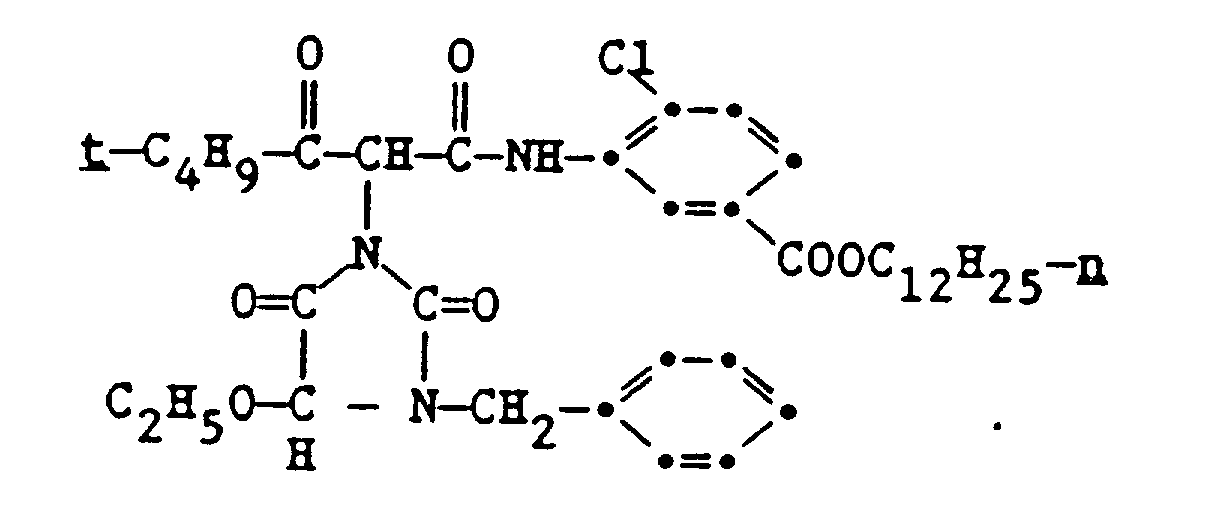
- the yellow dye-forming coupler (C) is preferably represented by the formulas: wherein R45 is chlorine or alkyl containing 1 to 4 carbon atoms, such as methyl, ethyl, propyl, n-butyl, and t-butyl; R46 is -COOR50 wherein R50 is a ballast group known in the photographic art; R47 is a benzyl group; R48 is hydrogen or alkyl, such as alkyl containing 1 to 4 carbon atoms, such as methyl, ethyl, propyl, or n-alkyl; and, R49is alkoxy, such as alkoxy containing 1 to 4 carbon atoms, for example, methoxy, ethoxy, propoxy and butoxy; or wherein R51 is unsubstituted or substituted alkoxy, such as alkoxy containing 1 to 20 carbon atoms, for example, methoxy, ethoxy, propoxy, or butoxy; or unsubstituted or
- R 53a , R 54a , R55, R56, R57 and R58 individually are substituents that do not adversely affect the described coupler, such as unsubstituted or substituted alkyl or aryl.
- At least one of R51 and R5 comprises a ballast group known in the photographic art.
- R53 is preferably hydrogen or a group having ortho to the oxygen atom of the phenoxy group, a polarizable carbonyl, sulfonyl or phosphinyl substituent group, such as described in U.S. Patent 4,401,752.
- R54 is, for example, hydrogen or halogen, preferably chlorine, bromine or fluorine, alkyl, alkoxy, nitro, cyano, carboxy, alkoxycarbonyl, aryloxycarbonyl, alkylsulfonyl, arylsulfonyl, amido, carbamyl, sulfonamido or sulfamyl.
- R53 is, for example, a group represented by the formula: wherein A is a group, as described in U.S.
- Patent 4,401,752 preferably -NHCOR61, -CONR6R63, -SO2R64, -NHSO2R65, or -SO2NR66R67; m is 0 to 4; R59 and R60 individually are hydrogen, alkyl, or aryl; R61, R6, R63, R64, R65, R66 and R67 individually are hydrogen, alkyl or aryl, preferably unsubstituted or substituted alkyl of 1 to 20 carbon atoms.
- Coupler (C) Preferred examples of coupler (C) are:
- a preferred process of forming a photographic image comprises developing an exposed color photographic silver halide element as described with a color photographic developing agent, preferably a process for forming a positive (reversal) image comprising development of the exposed element as described first with a non-chromogenic developing agent to develop exposed silver halide, but not form dye, and then uniformly fogging the element to render the unexposed silver halide developable, followed by forming a color photographic image by development of the element with a color developing agent. Development is followed by the conventional steps of bleaching, fixing, or bleach-fixing, to remove silver or silver halide, washing and drying.
- couplers can be used in the layers of the color photographic silver halide element in ways that couplers have been used in the photographic art.
- the couplers should be of such molecular size and configuration that they will not significantly diffuse or wander from the layer in which they are coated.
- the color photographic silver halide element as described can be processed by techniques known in the photographic art for forming dye images.
- the color photographic silver halide element can be processed in a reversal process available in the photographic art, such as the E-6 process of Eastman Kodak Co., U.S.A.
- the layers of the color photographic element as described, including the layers of the image-forming units, can be arranged in various orders known in the photographic art.
- the element can contain added layers, such as filter layers, interlayers, overcoat layers, subbing layers, and the like.
- the coupling-off groups, as described, can be any coupling-off groups known in the photographic art, such as described in European Patent Application 284,239, that do not adversely affect the described photographic element and process.
- ballast group BALL can also be any ballast group known in the photographic art, such as described in European Patent Application 284,239, that does not adversely affect the described photographic element and process.
- Preferred ballast groups are those that enable a narrower half-band width (HBW) of absorption of the dye formed from the coupler.
- the silver halide emulsions employed in the elements can be comprised of silver bromide, silver chloride, silver iodide, silver chlorobromide, silver chloroiodide, silver bromoiodide, silver chlorobromoiodide or mixtures thereof.
- the emulsions can include coarse, medium or fine silver halide grains.
- High aspect ratio tabular grain emulsions are specifically contemplated, such as those described by Wilgus U.S Patent 4,434,226, Daubendiek et al U.S. Patent 4,414,310, Wey U.S. Patent 4,399,215, Solberg et al U.S. Patent 4,433,048, Mignot U.S.
- Patent 4,386,156 Evans et al U.S. Patent 4,504,570, Maskasky U.S. Patent 4,400,463, Wey et al U.S. Patent 4,414,306, Maskasky U.S. Patents 4,435,501 and 4,643,966 and Daubendiek et al U.S. Patents 4,672,027 and 4,693,964.
- silver bromoiodide grains with a higher molar proportion of iodide in the core of the grain than in the periphery of the grain such as those described in GB 1,027,146; JA 54/48,521; US 4,379,837; US 4,444,877; US 4,665,012; US 4,686,178; US 4,565,778; US 4,728,602; US 4,668,614; US 4,636,461; EP 264,954.
- the silver halide emulsions can be either monodisperse or polydisperse as precipitated.
- the grain size distribution of the emulsions can be controlled by silver halide grain separation techniques or by blending silver halide emulsions of differing grain sizes.
- Sensitizing compounds such as compounds of copper, thallium, lead, bismuth, cadmium and Group VIII noble metals, can be present during precipitation of the silver halide emulsion.
- the emulsions can be surface-sensitive emulsions, that is, emulsions that form latent images primarily on the surfaces of the silver halide grains, or internal latent image-forming emulsions, that is, emulsions that form latent images predominantly in the interior of the silver halide grains.
- the emulsions can be negative-working emulsions, such as surface-sensitive emulsions or unfogged internal latent image-forming emulsions, or direct-positive emulsions of the unfogged, internal latent image-forming type, which are positive-working when development is conducted with uniform light exposure or in the presence of a nucleating agent.
- the silver halide emulsions can be surface sensitized.
- Noble metal e.g., gold
- middle chalcogen e.g., sulfur, selenium, or tellurium
- reduction sensitizers employed individually or in combination, are specifically contemplated.
- Typical chemical sensitizers are listed in Research Disclosure , Item 17643, cited above, Section III.
- the silver halide emulsions can be spectrally sensitized with dyes from a variety of classes, including the polymethine dye class, which includes the cyanines, merocyanines, complex cyanines and merocyanines (i.e., tri-, tetra-, and polynuclear cyanines and merocyanines), oxonols, hemioxonols, styryls, merostyryls, and streptocyanines.
- Illustrative spectral sensitizing dyes are disclosed in Research Disclosure , Item 17643, cited above, Section IV.
- Suitable vehicles for the emulsion layers and other layers of the element are described in Research Disclosure Item 17643, Section IX and the publications cited therein.
- the elements can include additional couplers as described in Research Disclosure Section VII, paragraphs D, E, F and G and the publications cited therein. These additional couplers can be incorporated as described in Research Disclosure Section VII, paragraph C and the publications cited therein.
- the photographic elements can contain brighteners (Research Disclosure Section V), antifoggants and stabilizers (Research Disclosure Section VI), antistain agents and image dye stabilizers (Research Disclosure Section VII, paragraphs I and J), light absorbing and scattering materials (Research Disclosure Section VIII), hardeners (Research Disclosure Section X), coating aids (Research Disclosure Section XI), plasticizers and lubricants (Research Disclosure Section XII), antistatic agents (Research Disclosure Section XIII), matting agents (Research Disclosure Section XVI) and development modifiers (Research Disclosure Section XXI).
- the photographic elements can be coated on a variety of supports as described in Research Disclosure Section XVII and the references described therein.
- Photographic elements can be exposed to actinic radiation, typically in the visible region of the spectrum, to form a latent image as described in Research Disclosure Section XVIII and then processed to form a visible dye image as described in Research Disclosure Section XIX.
- Processing to form a visible dye image includes the step of contacting the element with a color developing agent to reduce developable silver halide and oxidize the color developing agent. Oxidized color developing agent in turn reacts with the coupler to yield a dye.
- Preferred color developing agents are p-phenylene diamines.
- 4-amino-3-methyl-N,N-diethylaniline hydrochloride 4-amino-3-methyl-N-ethyl-N- ⁇ -(methanesulfonamido)-ethylaniline sulfate hydrate, 4-amino-3-methyl-N-ethyl-N- ⁇ -hydroxyethylaniline sulfate, 4-amino-3- ⁇ -(methanesulfonamido)ethyl-N,N-diethylaniline hydrochloride and 4-amino-N-ethyl-N-(2-methoxy-ethyl)-m-toluidine di-p-toluene sulfonic acid.
- the couplers as described can be prepared by methods and steps known in the organic synthesis art.
- a typical method of preparing a coupler (C) is described in U.S. 4,022,620.
- a typical method of preparing a coupler (B) is described in European Patent Application 284,239.
- Typical methods known in the photographic art for preparing naphtholic couplers with aryloxy coupling-off groups, such as described in British Patent 1,084,480, can be used for preparing a coupler (A) as described.
- Photographic elements were prepared by coating a cellulose acetate-butyrate film support with a photosensitive layer containing a silver bromoiodide emulsion and 3.77 gm/m gelatin.
- the cyan and magenta dye-forming couplers were coated with 0.91 gm Ag/m at a level of 1.62 mmole/m of the coupler.
- the yellow dye-forming couplers were coated with 0.76 gm Ag/m at a level of 2.7 mmole/m of the coupler.
- the magenta dye-forming couplers were dispersed in half their weight of tricresyl phosphate, while the yellow and cyan dye-forming couplers were dispersed in half their weight of di-n-butyl phthalate.
- the photosensitive layer was overcoated with a layer containing gelatin at 1.08 gm/m and bis-vinylsulfonylmethyl ether at 1.75 weight percent based on total gelatin.
- Combinations of the invention allow increases in color saturation, particularly in the reproduction of green objects.
Landscapes
- Physics & Mathematics (AREA)
- General Physics & Mathematics (AREA)
- Silver Salt Photography Or Processing Solution Therefor (AREA)
Claims (5)
- Elément photographique couleur comprenant un support portant au moins une couche d'émulsion aux halogénures d'argent sensible au rouge comprenant au moins un coupleur pour colorant cyan, au moins une couche d'émulsion aux halogénures d'argent sensible au vert comprenant au moins un coupleur pour colorant magenta et au moins une couche d'émulsion aux halogénures d'argent sensible au bleu contenant au moins un coupleur pour colorant jaune, dans lequel :A)le coupleur pour colorant cyan est un coupleur naphtolique comprenant en position 2 un groupe amide représenté par la formule :
 B) le coupleur pour colorant magenta est un pyrazolo[3,2-c]-s-triazole comprenant un groupe phényle substitué ou non en position 3 ou 6 ; etC)le coupleur pour colorant jaune est un coupleur du type pivaloylacétanilide à deux équivalents comprenant un groupe hydantoïne substitué ou phénoxy qui se sépare au couplage ; lorsque le groupe qui se sépare au couplage est un groupe phénoxy, le reste anilide contient un groupe ortho-alcoxy ou ortho-aryloxy.
 - Elément photographique selon la revendication 1 dans lequel le coupleur pour colorant cyan est représenté par la formule :
 Q est un groupe phénoxy substitué qui se sépare au couplage ; n est un nombre de 1 à 4; et R est un groupe alkyle ou aryle substitué ou non ;le coupleur pour colorant magenta est représenté par la formule :
 Z¹ est l'hydrogène ou un groupe qui se sépare au couplage ;R³⁷ et R⁴⁰ sont individuellement des groupes alkyles en C₁-C₄ substitués ou non, alcoxy ou un groupe ballast; x et y sont individuellement des nombres de 1 à 5; et R³⁸ et R³⁹ sont individuellement des groupes alkyles ; etle coupleur pour colorant jaune est présenté par la formule :
 R⁴⁵ est le chlore ou un groupe alkyle en C₁-C₄ ou alcoxy en C₁-C₄ ;R⁴⁶ est un groupe de formule -COOR⁵⁰ dans laquelle R⁵⁰ est un groupe ballast;R⁴⁷ est un groupe benzyle ;R⁴⁸ est l'hydrogène ou un groupe alkyle ; etR⁴⁹ est un groupe alcoxy.
 - Elément photographique couleur selon la revendication 1 ou 2, comprenant un support portant au moins une couche d'émulsion aux halogénures d'argent sensible au rouge contenant un coupleur pour colorant cyan représenté par la formule :


- Procédé de formation d'une image de colorant dans un élément photographique exposé tel que défini dans l'une quelconque des revendications 1 - 3, ledit procédé comprenant une étape de réaction d'au moins un des coupleurs avec un agent développateur chromogène oxydé pour former un colorant.
- Procédé de formation d'une image inversée de colorants dans un élément photographique aux halogénures d'argent exposé tel que défini dans l'une quelconque des revendications 1-3, ledit procédé comprenant les étapes de développement noir et blanc avec au moins un agent développateur noir et blanc des halogénures d'argent, suivi d'un développement chromogène unique de l'élément avec au moins un agent développateur chromogène pour former une image inversée de colorants.
Applications Claiming Priority (2)
| Application Number | Priority Date | Filing Date | Title |
|---|---|---|---|
| US453523 | 1989-12-20 | ||
| US07/453,523 US4960685A (en) | 1989-12-20 | 1989-12-20 | Color photographic element and process |
Publications (2)
| Publication Number | Publication Date |
|---|---|
| EP0433947A1 EP0433947A1 (fr) | 1991-06-26 |
| EP0433947B1 true EP0433947B1 (fr) | 1996-02-21 |
Family
ID=23800892
Family Applications (1)
| Application Number | Title | Priority Date | Filing Date |
|---|---|---|---|
| EP90124454A Expired - Lifetime EP0433947B1 (fr) | 1989-12-20 | 1990-12-17 | Elément pour photographie en couleurs et procédé |
Country Status (4)
| Country | Link |
|---|---|
| US (1) | US4960685A (fr) |
| EP (1) | EP0433947B1 (fr) |
| JP (1) | JP2796438B2 (fr) |
| DE (1) | DE69025463T2 (fr) |
Families Citing this family (11)
| Publication number | Priority date | Publication date | Assignee | Title |
|---|---|---|---|---|
| EP0476949A1 (fr) * | 1990-09-19 | 1992-03-25 | Konica Corporation | Matériau photographique couleur à l'halogénure d'argent sensible à la lumière |
| JP2597227B2 (ja) * | 1990-10-01 | 1997-04-02 | 富士写真フイルム株式会社 | 磁気記録媒体 |
| US5258270A (en) * | 1990-10-04 | 1993-11-02 | Fuji Photo Film Co., Ltd. | Silver halide color photographic material |
| JPH07175179A (ja) * | 1991-01-28 | 1995-07-14 | Fuji Photo Film Co Ltd | ハロゲン化銀カラー反転画像形成方法 |
| JPH05100374A (ja) * | 1991-10-08 | 1993-04-23 | Fuji Photo Film Co Ltd | シアン色素形成カプラー及びこれを含むハロゲン化銀カラー写真感光材料 |
| DE69320248T2 (de) * | 1992-05-20 | 1999-03-25 | Eastman Kodak Co., Rochester, N.Y. | Photographisches Material mit aneinander grenzenden rotempfindlichen Schichten |
| US5654132A (en) * | 1995-10-24 | 1997-08-05 | Eastman Kodak Company | Photographic materials and process comprising ureido naphtholic cyan couplers |
| FR2765355A1 (fr) * | 1997-06-25 | 1999-01-01 | Eastman Kodak Co | Nouveau film photographique inversible pour caisson lumineux |
| JPH11119393A (ja) * | 1997-10-14 | 1999-04-30 | Fuji Photo Film Co Ltd | ハロゲン化銀カラー写真感光材料 |
| US6391533B1 (en) | 1998-10-14 | 2002-05-21 | Fuji Photo Film Co., Ltd. | Silver halide color photosensitive material and color image forming method using the same |
| CN1320403C (zh) * | 2003-08-14 | 2007-06-06 | 中国乐凯胶片集团公司 | 一种新型黄成色剂 |
Family Cites Families (14)
| Publication number | Priority date | Publication date | Assignee | Title |
|---|---|---|---|---|
| JPS5448237A (en) * | 1977-09-22 | 1979-04-16 | Fuji Photo Film Co Ltd | Cyan coupler for photography |
| JPS5933903B2 (ja) * | 1979-02-13 | 1984-08-18 | 富士写真フイルム株式会社 | 新規なシアンカプラ− |
| JPS5930264B2 (ja) * | 1979-08-13 | 1984-07-26 | 富士写真フイルム株式会社 | ハロゲン化銀写真感光材料 |
| US4401752A (en) * | 1981-11-23 | 1983-08-30 | Eastman Kodak Company | Aryloxy substituted photographic couplers and photographic elements and processes employing same |
| GB2137372B (en) * | 1983-03-31 | 1986-08-28 | Konishiroku Photo Ind | Light-sensitive silver halide color photographic material |
| JPS60222852A (ja) * | 1984-04-20 | 1985-11-07 | Fuji Photo Film Co Ltd | 多層ハロゲン化銀カラ−写真感光材料 |
| JPS60229029A (ja) * | 1984-04-26 | 1985-11-14 | Fuji Photo Film Co Ltd | ハロゲン化銀カラ−写真感光材料 |
| JPS60232550A (ja) * | 1984-05-02 | 1985-11-19 | Fuji Photo Film Co Ltd | ハロゲン化銀カラ−写真感光材料 |
| GB8508756D0 (en) * | 1985-04-03 | 1985-05-09 | Kodak Ltd | Synthesis of photographic couplers |
| JPH0627933B2 (ja) * | 1985-04-09 | 1994-04-13 | 富士写真フイルム株式会社 | カラ−写真感光材料 |
| JPS62153953A (ja) * | 1985-12-27 | 1987-07-08 | Fuji Photo Film Co Ltd | カラ−写真感光材料 |
| JPH0715568B2 (ja) * | 1986-01-20 | 1995-02-22 | コニカ株式会社 | ハロゲン化銀カラ−写真感光材料 |
| JPH0621949B2 (ja) * | 1986-01-23 | 1994-03-23 | 富士写真フイルム株式会社 | カラ−画像形成法 |
| DE3871835T2 (de) * | 1987-03-09 | 1993-02-04 | Eastman Kodak Co | Photographische silberhalogenidmaterialien und verfahren, das einen pyrazoloazolkuppler enthaelt. |
-
1989
- 1989-12-20 US US07/453,523 patent/US4960685A/en not_active Expired - Fee Related
-
1990
- 1990-12-17 EP EP90124454A patent/EP0433947B1/fr not_active Expired - Lifetime
- 1990-12-17 DE DE69025463T patent/DE69025463T2/de not_active Expired - Fee Related
- 1990-12-20 JP JP2404035A patent/JP2796438B2/ja not_active Expired - Lifetime
Also Published As
| Publication number | Publication date |
|---|---|
| JP2796438B2 (ja) | 1998-09-10 |
| EP0433947A1 (fr) | 1991-06-26 |
| JPH0437747A (ja) | 1992-02-07 |
| DE69025463T2 (de) | 1996-09-12 |
| DE69025463D1 (de) | 1996-03-28 |
| US4960685A (en) | 1990-10-02 |
Similar Documents
| Publication | Publication Date | Title |
|---|---|---|
| EP0433947B1 (fr) | Elément pour photographie en couleurs et procédé | |
| EP0356925B1 (fr) | Elément et procédé photographique comprenant un coupleur libérant un inhibiteur de développement et un coupleur formateur de colorant jaune | |
| EP0529736B1 (fr) | Matériaux photographiques couleur contenant un coupleur magenta, un coupleur DIR et un composé carbonamide | |
| EP0631181B1 (fr) | Eléments photographiques couleur comprenant une combinaison de coupleurs pyrazolone et pyrazoloazole | |
| EP0529727B1 (fr) | Matériaux photographique couleur contenant un coupleur magenta, un composé carbonamide et un composé aniline ou amine | |
| US4914013A (en) | Silver halide light-sensitive color photographic material | |
| EP0631182B1 (fr) | Eléments photographiques couleur comprenant une combinaison de coupleurs pyrazoloazole | |
| EP0410754B1 (fr) | Elément photographique couleur et procédé | |
| JP3464543B2 (ja) | スルホン基又はスルホキシド基を含有するバラストを有する写真カプラー | |
| EP0518101B1 (fr) | Elément photographique et procédé comprenant un coupleur inhibiteur de développement et un coupleur formateur de colorant jaune | |
| EP0651288B1 (fr) | Eléments photographiques comprenant des coupleurs 2-phenylcarbaoyl-1-naphthol modifiant l'image, qui libèrent des colorants non susceptibles d'être cristallisés ou réduits | |
| EP0636934B1 (fr) | Eléments photographiques comprenant des coupleurs 2-phenylcarbamoyl-1-naphthol modifiant l'image, qui libèrent des colorants difficilement cristallisables et réductibles | |
| EP0443159B1 (fr) | Coupleurs formateurs de cyan et produits photographiques de reproduction les contenant | |
| US4892805A (en) | Photographic element and process | |
| EP0250201A2 (fr) | Elément photographique à l'halogénure d'argent et procédé | |
| JPS63106657A (ja) | 色再現性にすぐれたハロゲン化銀写真感光材料 | |
| EP0636936A1 (fr) | Eléments photographiques à couplers de 2-phénylcarbamoyl-l-naphthol modifiant l'image livrant des colorants résistant à la cristallisation et réduction |
Legal Events
| Date | Code | Title | Description |
|---|---|---|---|
| PUAI | Public reference made under article 153(3) epc to a published international application that has entered the european phase |
Free format text: ORIGINAL CODE: 0009012 |
|
| AK | Designated contracting states |
Kind code of ref document: A1 Designated state(s): AT BE CH DE DK ES FR GB GR IT LI LU NL SE |
|
| 17P | Request for examination filed |
Effective date: 19911205 |
|
| 17Q | First examination report despatched |
Effective date: 19950315 |
|
| RBV | Designated contracting states (corrected) |
Designated state(s): DE FR GB |
|
| GRAA | (expected) grant |
Free format text: ORIGINAL CODE: 0009210 |
|
| AK | Designated contracting states |
Kind code of ref document: B1 Designated state(s): DE FR GB |
|
| REF | Corresponds to: |
Ref document number: 69025463 Country of ref document: DE Date of ref document: 19960328 |
|
| ET | Fr: translation filed | ||
| PLBE | No opposition filed within time limit |
Free format text: ORIGINAL CODE: 0009261 |
|
| STAA | Information on the status of an ep patent application or granted ep patent |
Free format text: STATUS: NO OPPOSITION FILED WITHIN TIME LIMIT |
|
| 26N | No opposition filed | ||
| PGFP | Annual fee paid to national office [announced via postgrant information from national office to epo] |
Ref country code: GB Payment date: 19981110 Year of fee payment: 9 |
|
| PGFP | Annual fee paid to national office [announced via postgrant information from national office to epo] |
Ref country code: FR Payment date: 19981203 Year of fee payment: 9 |
|
| PGFP | Annual fee paid to national office [announced via postgrant information from national office to epo] |
Ref country code: DE Payment date: 19981230 Year of fee payment: 9 |
|
| PG25 | Lapsed in a contracting state [announced via postgrant information from national office to epo] |
Ref country code: GB Free format text: LAPSE BECAUSE OF NON-PAYMENT OF DUE FEES Effective date: 19991217 |
|
| GBPC | Gb: european patent ceased through non-payment of renewal fee |
Effective date: 19991217 |
|
| PG25 | Lapsed in a contracting state [announced via postgrant information from national office to epo] |
Ref country code: FR Free format text: LAPSE BECAUSE OF NON-PAYMENT OF DUE FEES Effective date: 20000831 |
|
| PG25 | Lapsed in a contracting state [announced via postgrant information from national office to epo] |
Ref country code: DE Free format text: LAPSE BECAUSE OF NON-PAYMENT OF DUE FEES Effective date: 20001003 |
|
| REG | Reference to a national code |
Ref country code: FR Ref legal event code: ST |