EP0436332B1 - Polyamine verwendbar als Antagonisten von anregbaren Aminosäuren-Neurotransmittern - Google Patents
Polyamine verwendbar als Antagonisten von anregbaren Aminosäuren-Neurotransmittern Download PDFInfo
- Publication number
- EP0436332B1 EP0436332B1 EP90313663A EP90313663A EP0436332B1 EP 0436332 B1 EP0436332 B1 EP 0436332B1 EP 90313663 A EP90313663 A EP 90313663A EP 90313663 A EP90313663 A EP 90313663A EP 0436332 B1 EP0436332 B1 EP 0436332B1
- Authority
- EP
- European Patent Office
- Prior art keywords
- compound
- fraction
- formula
- eluted
- pharmaceutically
- Prior art date
- Legal status (The legal status is an assumption and is not a legal conclusion. Google has not performed a legal analysis and makes no representation as to the accuracy of the status listed.)
- Expired - Lifetime
Links
- HQFDHCDRICRFGE-UHFFFAOYSA-N CC(CCC(NOC(Cc1c[nH]c2ccccc12)=O)=O)=O Chemical compound CC(CCC(NOC(Cc1c[nH]c2ccccc12)=O)=O)=O HQFDHCDRICRFGE-UHFFFAOYSA-N 0.000 description 1
- DCWGHPQLEUPJKO-UHFFFAOYSA-N O=C(CC1c(cccc2)c2NC1)ON(C(CC1)=O)C1=O Chemical compound O=C(CC1c(cccc2)c2NC1)ON(C(CC1)=O)C1=O DCWGHPQLEUPJKO-UHFFFAOYSA-N 0.000 description 1
- ACWBSFVNLCKHNM-UHFFFAOYSA-O O=C(CCC1=O)N1OC(Cc1c[nH]c2ccccc12)=[OH+] Chemical compound O=C(CCC1=O)N1OC(Cc1c[nH]c2ccccc12)=[OH+] ACWBSFVNLCKHNM-UHFFFAOYSA-O 0.000 description 1
- ACWBSFVNLCKHNM-UHFFFAOYSA-N O=C(Cc1c[nH]c2c1cccc2)ON(C(CC1)=O)C1=O Chemical compound O=C(Cc1c[nH]c2c1cccc2)ON(C(CC1)=O)C1=O ACWBSFVNLCKHNM-UHFFFAOYSA-N 0.000 description 1
Classifications
-
- A—HUMAN NECESSITIES
- A61—MEDICAL OR VETERINARY SCIENCE; HYGIENE
- A61K—PREPARATIONS FOR MEDICAL, DENTAL OR TOILETRY PURPOSES
- A61K31/00—Medicinal preparations containing organic active ingredients
- A61K31/74—Synthetic polymeric materials
- A61K31/785—Polymers containing nitrogen
-
- C—CHEMISTRY; METALLURGY
- C07—ORGANIC CHEMISTRY
- C07D—HETEROCYCLIC COMPOUNDS
- C07D209/00—Heterocyclic compounds containing five-membered rings, condensed with other rings, with one nitrogen atom as the only ring hetero atom
- C07D209/02—Heterocyclic compounds containing five-membered rings, condensed with other rings, with one nitrogen atom as the only ring hetero atom condensed with one carbocyclic ring
- C07D209/04—Indoles; Hydrogenated indoles
- C07D209/10—Indoles; Hydrogenated indoles with substituted hydrocarbon radicals attached to carbon atoms of the hetero ring
- C07D209/18—Radicals substituted by carbon atoms having three bonds to hetero atoms with at the most one bond to halogen, e.g. ester or nitrile radicals
-
- A—HUMAN NECESSITIES
- A61—MEDICAL OR VETERINARY SCIENCE; HYGIENE
- A61K—PREPARATIONS FOR MEDICAL, DENTAL OR TOILETRY PURPOSES
- A61K31/00—Medicinal preparations containing organic active ingredients
- A61K31/33—Heterocyclic compounds
- A61K31/395—Heterocyclic compounds having nitrogen as a ring hetero atom, e.g. guanethidine or rifamycins
- A61K31/40—Heterocyclic compounds having nitrogen as a ring hetero atom, e.g. guanethidine or rifamycins having five-membered rings with one nitrogen as the only ring hetero atom, e.g. sulpiride, succinimide, tolmetin, buflomedil
- A61K31/403—Heterocyclic compounds having nitrogen as a ring hetero atom, e.g. guanethidine or rifamycins having five-membered rings with one nitrogen as the only ring hetero atom, e.g. sulpiride, succinimide, tolmetin, buflomedil condensed with carbocyclic rings, e.g. carbazole
- A61K31/404—Indoles, e.g. pindolol
- A61K31/405—Indole-alkanecarboxylic acids; Derivatives thereof, e.g. tryptophan, indomethacin
-
- A—HUMAN NECESSITIES
- A61—MEDICAL OR VETERINARY SCIENCE; HYGIENE
- A61P—SPECIFIC THERAPEUTIC ACTIVITY OF CHEMICAL COMPOUNDS OR MEDICINAL PREPARATIONS
- A61P25/00—Drugs for disorders of the nervous system
-
- A—HUMAN NECESSITIES
- A61—MEDICAL OR VETERINARY SCIENCE; HYGIENE
- A61P—SPECIFIC THERAPEUTIC ACTIVITY OF CHEMICAL COMPOUNDS OR MEDICINAL PREPARATIONS
- A61P25/00—Drugs for disorders of the nervous system
- A61P25/08—Antiepileptics; Anticonvulsants
-
- A—HUMAN NECESSITIES
- A61—MEDICAL OR VETERINARY SCIENCE; HYGIENE
- A61P—SPECIFIC THERAPEUTIC ACTIVITY OF CHEMICAL COMPOUNDS OR MEDICINAL PREPARATIONS
- A61P25/00—Drugs for disorders of the nervous system
- A61P25/28—Drugs for disorders of the nervous system for treating neurodegenerative disorders of the central nervous system, e.g. nootropic agents, cognition enhancers, drugs for treating Alzheimer's disease or other forms of dementia
Definitions
- This invention relates to certain polyamines found to be present in the venom of the Agelenopsis aperta spider.
- the polyamines and the pharmaceutically-acceptable salts thereof are antagonists of excitatory amino acid neurotransmitters which neurotransmitters affect cells including neuronal cells of a variety of organisms including invertebrates and vertebrates.
- This invention also relates to the use of such polyamines and their salts in antagonizing excitatory amino acid neurotransmitters which neurotransmitters affect cells such as cells in the nervous system of an organism, per se, in the treatment of excitatory amino acid neurotransmitter mediated diseases and conditions in a mammal and control of invertebrate pests, and to compositions comprising said polyamines and salts thereof.
- polyamines found to be present in the venom of the Agelenopsis aperta spider are disclosed in EP-A-0395357 published on 31st October, 1990.
- Those polyamines and the pharmaceutically-acceptable salts thereof are disclosed therein as blockers of excitatory amino acid receptors in cells and one such polyamine, B1 therein, is also disclosed as a blocker of calcium channels in cells.
- Those polyamines are described therein as follows:
- Excitatory amino acid neurotransmitter antagonists have a variety of utilities.
- Excitatory amino acid neurotransmitter antagonists can find clinical application in the treatment of such conditions as stroke, cerebral ischemia, neuronal degeneration disorders such as Alzheimer's disease and epilepsy and as psychotherapeutants, among others. See Excitatory Amino Acids in Health and Disease , D. Lodge, Ed., John Wiley and Sons Ltd., New York, NY 1988, the teachings of which are incorporated herein by reference. Further, such compounds are useful in the study of the physiology of cells such as neuronal cells and in the control of invertebrate pests.
- This invention concerns certain polyamines found to be present in the venom of the Agelenopsis aperta spider.
- the polyamines of this invention are as follows:
- the polyamines of this invention and the pharmaceutically-acceptable salts thereof are antagonists of excitatory amino acid neurotransmitters which neurotransmitters affect cells.
- said polyamines are useful in antagonizing such excitatory amino acid neurotransmitters, per se.
- the polyamines of this invention are also useful in the control of invertebrate pests and in the treatment of diseases and conditions in a mammal mediated by excitatory amino acid neurotransmitters.
- Said polyamines are useful, also, as psychotherapeutants for a mammal.
- This invention also concerns pharmaceutical compositions comprising said polyamines and methods of administering said polyamines.
- Venom is obtained from the Agelenopsis aperta spider through the process of milking by electrical stimulation according to standard methods well known to those skilled in the art. It is preferred that the method employed is one which safeguards against contamination of the whole venom by abdominal regurgitant or hemolymph. Such methods are well known to those skilled in the art.
- the whole venom so obtained is stored in a frozen state at about -78° C. until used for purification as described below.
- Purification of the constituents from the whole venom is accomplished by reverse phase high performance liquid chromatography (HPLC) on a variety of preparative and semi-preparative columns such as C-4 and C-18 Vydac® columns (Rainin Instrument Co. Inc., Mack Road, Woburn Massachusetts 01801), C-18 Baker columns (J. T. Baker Inc., 22 Red School Lane, Phillipsburg, NJ 08865) and Dynamax Phenyl columns (Rainin Instrument Co. Inc., Mack Road, Woburn Massachusetts 01801). Peak detection is carried out monochromatically at 220-230 nm.
- fractions can be accomplished with, for example, polychrome UV data collected with a Waters 990 diode array detector (Millipore Corporation, Waters Chromatography Division, 34 Maple Street, Milford, Massachusetts 01757).
- the fractions from the columns are collected by known methods such as through the use of an ISCO/"FOXY" fraction collector and an ISCO 2159 peak detector (ISCO, 4700 Superior, Lincoln, Iowa 68504).
- the fractions are collected in appropriately sized vessels such as sterile polyethylene laboratory-ware.
- Concentration of the fractions is then accomplished by lyophilization from the eluant followed by lyophilization from water. Purity of the resulting constituent fractions then can be determined by chromatographic analysis using an analytical column with a gradient system which is more isocratic than the system used in the final purification of the fractions.
- the structures comprised by the respective fractions are determined according to known analytical methods such as by mass spectrometry and nuclear magnetic resonance.
- a suitable column for initial fractionation of the venom is a C-18 Vydac® 22 mm x 250 mm, 300 ⁇ pore size, 10 ⁇ particle size column. That column is eluted at a flow rate of 15 ml/min. using a linear gradient program of 100% ⁇ 80% A, 0% ⁇ 20% B [0 ⁇ 30 min.] where A is 0.1% aqueous trifluoroacetic acid (TFA) and B is acetonitrile. The fractions are collected as described above. Six fractions so obtained, labeled 1, 2, 3, 4, 5, and 6 herein, were chosen for further analysis and/or purification.
- TFA trifluoroacetic acid
- Another method for fractionation of whole venom comprises a C-18 Baker (4.6 mm x 250 mm, 100 ⁇ pore size, 5 ⁇ particle size) column which is eluted using a flow rate of 1 ml/min. and isocratic conditions of 8% B, 92% A where A and B are as described above.
- C-18 Baker 4 mm x 250 mm, 100 ⁇ pore size, 5 ⁇ particle size
- isocratic conditions of 8% B, 92% A where A and B are as described above.
- use of the C-18 Vydac® column and procedure described above is preferred for initial fractionation of whole venom.
- Fractions 1, 2 and 3 were found to comprise polyamines which are described in U.S. application Serial No. 07/346,181 and form no part of this invention.
- Fractions 4, 5 and 6 are subjected to further purification using various columns and conditions. The specifics for each subfractionation and the results thereof are given in Examples 2, 3 and 4 below.
- polyamine compounds which are comprised by fractions AGEL 416, AGEL 464, AGEL 489(A) and AGEL 521 are as follows:
- Reaction Schemes A to C A synthetic scheme for production of the polyamine of this invention of the formula is shown in Reaction Schemes A to C, below.
- Reaction Scheme A the polyamine intermediate compound of formula IV is prepared through a sequence of steps beginning with diaminobutane.
- Reaction conditions suitable to prepare the intermediate compound of formula VIII according to Reaction Scheme A are given in Example 5, parts A to G.
- Reaction Scheme B illustrates a method for the preparation of the intermediate compound of formula IX.
- Reaction conditions suitable to prepare that intermediate according to Reaction Scheme B are given in Example 5, part H.
- Preparation of the polyamine compound of this invention of the formula XII is shown in Reaction Scheme C.
- Reaction conditions suitable for the coupling of the intermediate compounds of formulae VIII and IX and the subsequent preparation of the compound of formula XII are given in Example 5, parts I to K.
- the polyamines of this invention reversibly antagonize excitatory amino acid neurotransmitters, which neurotransmitters affect cells such as cells in the nervous system of a variety of organisms including invertebrates and vertebrates.
- vertebrates as used throughout is meant to include mammals.
- invertebrates as used throughout is meant to include, for example, insects, ectoparasites and endoparasites.
- NMDA N-methyl-D-aspartic acid-induced
- the pieces of cerebellum are incubated in such a manner for ninety minutes with three changes of the buffer.
- the buffer then is decanted, the tissue centrifuged (1 min., 3200 r.p.m.) and the tissue resuspended in 20 ml of the Krebs/bicarbonate buffer. Then, 250 ⁇ l aliquots (approximately 2 mg) are removed and placed in 1.5 ml microfuge tubes. To those tubes are added 10 ⁇ l of the compound under study from a stock solution followed by 10 ⁇ l of a 2.5 mM solution of NMDA to start the reaction. The final NMDA concentration is 100 ⁇ M.
- Controls do not have NMDA added.
- the tubes are incubated for one minute at 37° C. in a shaking water bath and then 750 ⁇ l of a 50 mM Tris-Cl, 5mM EDTA solution is added to stop the reaction.
- the tubes are placed immediately in a boiling water bath for five minutes.
- the contents of each tube then are sonicated for 15 seconds using a probe sonicator set at power level three. Ten microliters are removed and the protein determined by the method of Lowry, Anal. Biochem. 100 :201-220 (1979).
- cGMP cyclic GMP
- Cerebellar granule cells are prepared from the cerebellum of 8 day old rats (Wilkin, G. P. et al., Brain Res:115: 181-199, 1976). Squares (1 cm2) of Aclar (Proplastics Inc., 5033 Industrial Ave., Wall, N.J., 07719) are coated with poly-L-lysine and placed in 12-well dishes that contain 1 ml of Eagles Basal Medium.
- the cells are dissociated and aliquots containing 6.25 x 10⁶ cells are added to each well containing the squares of Aclar. Cytosine-beta-D-arabino furanoside (final concentration 10 ⁇ M) is added 24 hours post plating. The cells are used for fura2 analysis at 6, 7 and 8 days of culture. The cells (attached to the Aclar squares) are transferred to 12-well dishes containing 1 ml of 2 ⁇ M fura2/AM (Molecular Probes Inc., Eugene, OR, 97402) in HEPES buffer (containing 0.1% bovine serum albumin, 0.1% dextrose, pH 7.4, magnesium-free).
- HEPES buffer containing 0.1% bovine serum albumin, 0.1% dextrose, pH 7.4, magnesium-free
- the cells are incubated for 40 minutes at 37°C; the fura2/AM containing buffer is removed and replaced with 1 ml of the same buffer without fura2/AM.
- To a quartz cuvette is added 2.0 ml of prewarmed (37°C) buffer.
- the cells on the Aclar are placed in the cuvette and the cuvette is inserted in a thermostated (37°C) holder equipped with a magnetic stirrer and the fluorescence is measured with a fluorescence spectrophotometer (Biomedical Instrument Group, University of Pennsylvania). The fluorescence signal is allowed to stabilize for about two minutes.
- cytosolic free calcium represented by an increase in fluorescence
- An increase in cytosolic free calcium is produced by the addition of 50 ⁇ M NMDA and 1 ⁇ M glycine. Then 5-20 ⁇ l of a stock solution of the compound under study in phosphate-buffered saline (PBS, pH 7.4) at appropriate concentrations are added to the cuvette. Calibration of the fluorescent signals and fura2/AM leakage correction are performed using the established procedures of Grynkiewicz, G. et al., J. Biol. Chem. 260 :3440 (1985).
- the maximum fluorescence value (Fmax) is determined by addition of ionomycin (35 ⁇ M) and the minimum fluorescence value (Fmin) is determined by the subsequent addition of EGTA (12 mM) to chelate calcium.
- Fmax the maximum fluorescence value
- Fmin the minimum fluorescence value
- the polyamines of this invention are useful in antagonizing excitatory amino acid neurotransmitters, per se.
- the polyamines are also useful in the control of invertebrate pests and in the treatment of excitatory amino acid neurotransmitter-mediated diseases and conditions in a mammal such as stroke, cerebral ischemia, neuronal degenerative disorders such as Alzheimer's disease and epilepsy.
- Said polyamines also are useful as psychotherapeutants in a mammal.
- the polyamines are useful in the study of the physiology of cells including, but not limited to, cells of the nervous system.
- salts of the polyamines of this invention are formed by methods well known to those skilled in the art.
- acid addition salts of the polyamines can be prepared according to conventional methods.
- Acid addition salts of the polyamines such as hydrochloric and trifluoroacetic acid addition salts thereof are preferred.
- Hydrochloric acid addition salts of the polyamines are particularly preferred.
- a polyamine or a pharmaceutically-acceptable salt thereof of this invention When a polyamine or a pharmaceutically-acceptable salt thereof of this invention is to be administered to a mammal, it can be administered alone or in combination with pharmaceutically-acceptable carriers or diluents in a pharmaceutical composition according to standard pharmaceutical practice.
- the polyamines or pharmaceutically-acceptable salts thereof can be adminstered orally or parenterally.
- Parenteral administration includes intravenous, intramuscular, intraperitoneal, subcutaneous and topical administration.
- the compound can be administered, for example, in the form of tablets or capsules, or as an aqueous solution or suspension.
- carriers which are commonly used include lactose and corn starch, and lubricating agents, such as magnesium stearate, are commonly added.
- useful diluents are lactose and dried corn starch.
- aqueous suspensions are required for oral use, the active ingredient is combined with emulsifying and suspending agents. If desired, certain sweetening and/or flavoring agents can be added.
- sterile solutions of the active ingredient are usually prepared, and the pH of the solutions should be suitably adjusted and buffered.
- the total concentration of solutes should be controlled to render the preparation isotonic.
- the daily dosage will normally be determined by the prescribing physician.
- suitable dosages for the polyamines of this invention are from about 3 to 30 mg/kg/day.
- the dosage will vary according to the age, weight and response of the individual patient, as well as the severity of the patient's symptoms and the potency of the particular compound being administered. Therefore, dosages outside the range given above are possible and are within the scope of this invention.
- a polyamine or salt thereof of this invention When a polyamine or salt thereof of this invention is used in control of invertebrate pests, said compound is administered to said invertebrate directly or provided to the environment of said invertebrate.
- a compound of this invention can be sprayed as a solution onto said invertebrate. The amount of compound necessary for control of said invertebrate will vary according to the invertebrate and environmental conditions and will be determined by the person applying the compound.
- a polyamine or salt thereof of this invention is used in the physiological study of cells
- said compound is administered to the cells according to methods well known to those skilled in the art.
- said compound can be administered to cells in an appropriate physiological buffer.
- An appropriate concentration of the compounds of this invention for use in such studies is 100 ⁇ M.
- the concentration of said compounds in such studies may be greater than or much less than 100 ⁇ M.
- the amount of the compound administered will be determined by the person skilled in the art according to well known methods.
- Fraction 1 was subfractionated using the same column and conditions as described above but with a Waters 990 diode array detector and it was found that Fraction 1 comprised the polyamine AGEL 452. That polyamine is described in pending U.S. application Serial No. 07/346,181 and forms no part of this invention.
- Fraction 2 was as described for subfractionation of Fraction 1 and it was found that Fraction 2 comprised the polyamines AGEL 448 and AGEL 468, both of which are also described in said U.S. application Serial No. 07/346,181. Neither of those polyamines form any part of this invention.
- fraction 3 was subfractionated using a C-4 Vydac® (22 mm x 250 mm, 300 ⁇ pore size, 10 ⁇ particle size) column using a linear gradient of 5% ⁇ 10% B, 95% ⁇ 90% A [0 ⁇ 30 min.] where A and B are as described above and a Waters 990 diode array detector. It was found that Fraction 2 comprised the polyamines 504 and 505 which are also described in U.S. application Serial No. 07/346,181 and which form no part of the instant application.
- the structure of the compound which is comprised by fraction AGEL 489 was determined by the use of FAB MS and found to be the compound AGEL 489 described in U.S. application Serial No. 07/346,181. AGEL 489 forms no part of the instant invention.
Landscapes
- Health & Medical Sciences (AREA)
- Chemical & Material Sciences (AREA)
- Organic Chemistry (AREA)
- General Health & Medical Sciences (AREA)
- Animal Behavior & Ethology (AREA)
- Life Sciences & Earth Sciences (AREA)
- Medicinal Chemistry (AREA)
- Veterinary Medicine (AREA)
- Public Health (AREA)
- Pharmacology & Pharmacy (AREA)
- Neurosurgery (AREA)
- Bioinformatics & Cheminformatics (AREA)
- Neurology (AREA)
- Engineering & Computer Science (AREA)
- Biomedical Technology (AREA)
- Chemical Kinetics & Catalysis (AREA)
- Nuclear Medicine, Radiotherapy & Molecular Imaging (AREA)
- General Chemical & Material Sciences (AREA)
- Epidemiology (AREA)
- Psychiatry (AREA)
- Pain & Pain Management (AREA)
- Hospice & Palliative Care (AREA)
- Organic Low-Molecular-Weight Compounds And Preparation Thereof (AREA)
- Pharmaceuticals Containing Other Organic And Inorganic Compounds (AREA)
- Macromolecular Compounds Obtained By Forming Nitrogen-Containing Linkages In General (AREA)
- Acyclic And Carbocyclic Compounds In Medicinal Compositions (AREA)
- Polyamides (AREA)
- Indole Compounds (AREA)
- Agricultural Chemicals And Associated Chemicals (AREA)
Claims (10)
- Verbindung der Formel

- Verbindung der Formel

- Verbindung oder ein pharmazeutisch verträgliches Salz davon, nach Anspruch 2, wobei R H ist.
- Verbindung oder ein pharmazeutisch verträgliches Salz davon nach Anspruch 2, wobei R OH ist.
- Verfahren zur Herstellung einer Verbindung, dadurch gekennzeichnet, daßa) das gesamte tierische Gift von Agelenopsis aperta von einer C-18 VydacR-Säule (22 mm x 250 mm, 300 Å Porengröße, 10 µm Teilchengröße) unter Anwendung einer Fließgeschwindigkeit von 15 ml/min eluiert wird mit einem Lösungsmittelsystem unter Verwendung eines linearen Gradientenprogramms von 0 % → 20 % Acetonitril, 100 % → 80 % 0,1 % wässeriger Trifluoressigsäure und monochromatischer Peakdetektion bei 220 nm; die Fraktion, die bei etwa 26,0 Minuten eluiert wird, gesammelt wird, und von einer Dynamax Phenyl-Säule (4,6 mm x 250 mm, 60 Å Porengröße, 8 µm Teilchengröße) eluiert wird unter Anwendung einer Fließgeschwindigkeit von 1 ml/min, isokratischen Bedingungen von 10 % Acetonitril und 90 % 0,1 % wässeriger Trifluoressigsäure und Peakdetektion bei 220 nm, wobei die bei etwa 55,27 Minuten eluierte Fraktion gesammelt wird und gegebenenfalls gefriergetrocknet wird, in Wasser resuspendiert wird und aus Wasser gefriergetrocknet wird; oder(b) wenn eine Verbindung der Formel
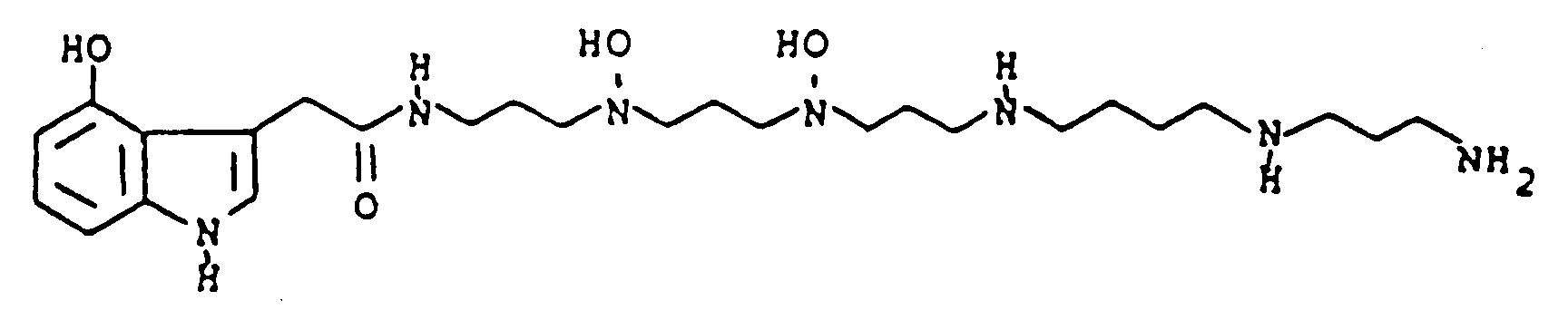 (c) wenn eine Verbindung der Formel
 (d) wenn eine Verbindung der Formel


- Verbindung, herstellbar durch ein Verfahren nach Anspruch 5.
- Arzneimittel, umfassend eine Verbindung nach einem der Ansprüche 1 bis 4 oder 6 oder ein pharmazeutisch verträgliches Salz davon und ein pharmazeutisch verträgliches Verdünnungs- oder Trägermittel.
- Verbindung nach einem der Ansprüche 1 bis 4 oder 6 oder ein pharmazeutisch verträgliches Salz davon zur Verwendung als Arzneimittel.
- Verwendung einer Verbindung oder eines Salzes davon nach einem der Ansprüche 1 bis 4 oder 6, zur Herstellung eines Arzneimittels zur Gegenwirkung für einen exzitatorischen Aminosäureneurotransmitter, wobei der Neurotransmitter eine Zelle im Nervensystem eines Lebewesens beeinflußt.
- Verbindung der Formel (VIII) nach Anspruch 5.
Applications Claiming Priority (4)
| Application Number | Priority Date | Filing Date | Title |
|---|---|---|---|
| US46020790A | 1990-01-02 | 1990-01-02 | |
| US460207 | 1990-01-02 | ||
| US560699 | 1990-07-31 | ||
| US07/560,699 US5037846A (en) | 1990-01-02 | 1990-07-31 | Indolyl-3 polyamines and their use as antagonists of excitatory amino acid neurotransmitters |
Publications (3)
| Publication Number | Publication Date |
|---|---|
| EP0436332A2 EP0436332A2 (de) | 1991-07-10 |
| EP0436332A3 EP0436332A3 (en) | 1991-09-25 |
| EP0436332B1 true EP0436332B1 (de) | 1996-02-07 |
Family
ID=27039601
Family Applications (1)
| Application Number | Title | Priority Date | Filing Date |
|---|---|---|---|
| EP90313663A Expired - Lifetime EP0436332B1 (de) | 1990-01-02 | 1990-12-14 | Polyamine verwendbar als Antagonisten von anregbaren Aminosäuren-Neurotransmittern |
Country Status (23)
| Country | Link |
|---|---|
| US (1) | US5037846A (de) |
| EP (1) | EP0436332B1 (de) |
| JP (1) | JPH0714913B2 (de) |
| KR (1) | KR930007250B1 (de) |
| CN (1) | CN1053059A (de) |
| AT (1) | ATE133941T1 (de) |
| AU (2) | AU619700B2 (de) |
| CA (1) | CA2033480C (de) |
| DE (1) | DE69025305T2 (de) |
| DK (1) | DK0436332T3 (de) |
| ES (1) | ES2083439T3 (de) |
| FI (1) | FI93644C (de) |
| GR (1) | GR3019487T3 (de) |
| HU (1) | HUT56063A (de) |
| IE (1) | IE70757B1 (de) |
| IL (1) | IL96793A0 (de) |
| MY (1) | MY104588A (de) |
| NO (1) | NO173733C (de) |
| NZ (1) | NZ236550A (de) |
| PH (1) | PH27608A (de) |
| PL (1) | PL165647B1 (de) |
| PT (1) | PT96389A (de) |
| YU (1) | YU247590A (de) |
Cited By (1)
| Publication number | Priority date | Publication date | Assignee | Title |
|---|---|---|---|---|
| US7087648B1 (en) | 1997-10-27 | 2006-08-08 | The Regents Of The University Of California | Methods for modulating macrophage proliferation using polyamine analogs |
Families Citing this family (24)
| Publication number | Priority date | Publication date | Assignee | Title |
|---|---|---|---|---|
| US5227397A (en) * | 1989-04-28 | 1993-07-13 | Pfizer Inc. | Polyamines and polypeptides useful as antagonists of excitatory amino acid neuro-transmitters and/or as blockers of calcium channels |
| US5037846A (en) * | 1990-01-02 | 1991-08-06 | Pfizer Inc. | Indolyl-3 polyamines and their use as antagonists of excitatory amino acid neurotransmitters |
| US5312928A (en) * | 1991-02-11 | 1994-05-17 | Cambridge Neuroscience | Calcium channel antagonists and methodology for their identification |
| US5677288A (en) * | 1991-05-15 | 1997-10-14 | Cypros Pharmaceutical Corporation | Use of aminoglycosides to protect against excitotoxic neuron damage |
| BR9206403A (pt) * | 1991-08-23 | 1994-12-27 | Pfizer | Aril-poliaminas sintéticas como antagonistas de neurotransmissores aminoácidos excitadores |
| US5185369A (en) * | 1991-08-23 | 1993-02-09 | Pfizer Inc. | Synthetic heteroaryl polyamines as excitatory amino acid neurotransmitter antagonists |
| US5763568A (en) * | 1992-01-31 | 1998-06-09 | Zeneca Limited | Insecticidal toxins derived from funnel web (atrax or hadronyche) spiders |
| US6750244B2 (en) | 1993-02-08 | 2004-06-15 | Nps Pharmaceuticals, Inc. | Compounds active at a novel site on receptor-operated calcium channels useful for treatment of neurological disorders and diseases |
| US6017965A (en) * | 1993-02-08 | 2000-01-25 | Nps Pharmaceuticals, Inc. | Compounds active at a novel site on receptor-operated calcium channels useful for treatment of neurological disorders and diseases |
| US6071970A (en) * | 1993-02-08 | 2000-06-06 | Nps Pharmaceuticals, Inc. | Compounds active at a novel site on receptor-operated calcium channels useful for treatment of neurological disorders and diseases |
| US7087765B2 (en) | 1995-06-07 | 2006-08-08 | Nps Pharmaceuticals, Inc. | Compounds active at a novel site on receptor-operated calcium channels useful for treatment of neurological disorders and diseases |
| US6211245B1 (en) | 1993-02-08 | 2001-04-03 | Nps Pharmaceuticals, Inc. | Compounds active at a novel site on receptor-operated calcium channels useful for treatment of neurological disorders and diseases |
| DE69434889D1 (de) | 1994-02-08 | 2007-01-11 | Nps Pharma Inc | An einer neuen Stelle von Rezeptorabhängigen Kalziumkanälen wirkende Verbindungen zur Behandlung von neurologischen Erkrankungen |
| US5688764A (en) * | 1995-02-17 | 1997-11-18 | Nps Pharmaceuticals, Inc. | Insecticidal peptides from spider venom |
| US5874298A (en) * | 1995-02-17 | 1999-02-23 | Nps Pharmaceuticals, Inc. | Insecticidal toxins from Bracon hebetor nucleic acid encoding said toxin and methods of use |
| US5674846A (en) * | 1996-09-04 | 1997-10-07 | Nps Pharmaceuticals, Inc. | Insecticidal peptides from Segestria sp. spider venom |
| WO1998036743A1 (en) * | 1997-02-21 | 1998-08-27 | Cypros Pharmaceutical Corporation | Neuroprotective poly-guanidino compounds which block presynaptic n and p/q calcium channels |
| AU2003231670B2 (en) * | 1997-10-27 | 2006-06-08 | Slil Biomedical Corporation | Methods for modulating macrophage proliferation using polyamine analogs |
| US8198334B2 (en) * | 1997-10-27 | 2012-06-12 | Pathologica Llc | Methods for modulating macrophage proliferation in ocular disease using polyamine analogs |
| WO2002053519A2 (en) * | 2001-01-08 | 2002-07-11 | Mediquest Therapeutics, Inc. | Hydrophobic polyamine analogs and methods for their use |
| JP2005510524A (ja) | 2001-11-16 | 2005-04-21 | アルス・セラピー・デベロツプメント・フアンデーシヨン・インコーポレーテツド | ポリアミン経路の調節による神経変性障害の治療 |
| EP1448183A2 (de) * | 2001-11-16 | 2004-08-25 | ALS Therapy Development Foundation, Inc. | Behandlung von neurodegenerativen erkrankungen durch modulieren des polyaminenbiosynthesewegs |
| BRPI0517551A (pt) * | 2004-10-04 | 2008-10-14 | Cellgate Inc | análogos de poliamina como agentes terapêuticos para doenças oculares |
| CN101300004B (zh) * | 2005-09-23 | 2013-08-21 | 帕瑟洛吉卡有限公司 | 使用多胺类似物治疗病毒感染的方法 |
Family Cites Families (5)
| Publication number | Priority date | Publication date | Assignee | Title |
|---|---|---|---|---|
| US4925664A (en) * | 1986-10-20 | 1990-05-15 | University Of Utah | Spider toxins and methods for their use as blockers of calcium channels and amino acid receptor function |
| IT1206078B (it) * | 1987-06-03 | 1989-04-14 | Polifarma Spa | Procedimento per la produzione di acido 3-indolpiruvico e suoi derivati loro uso farmaceutico |
| US4950739A (en) * | 1988-02-10 | 1990-08-21 | New York University | Membrane calcium channels and factors and methods for blocking, isolating and purifying calcium channels |
| DD298412A5 (de) * | 1989-04-28 | 1992-02-20 | ������@���Kk�� | Verfahren zur herstellung von polypeptiden, die geeignet sind als antagonisten exzitatorischer aminosaeure-neurotransmitter und/oder blocker der calciumkanaele |
| US5037846A (en) * | 1990-01-02 | 1991-08-06 | Pfizer Inc. | Indolyl-3 polyamines and their use as antagonists of excitatory amino acid neurotransmitters |
-
1990
- 1990-07-31 US US07/560,699 patent/US5037846A/en not_active Expired - Lifetime
- 1990-12-14 AT AT90313663T patent/ATE133941T1/de not_active IP Right Cessation
- 1990-12-14 DE DE69025305T patent/DE69025305T2/de not_active Expired - Lifetime
- 1990-12-14 ES ES90313663T patent/ES2083439T3/es not_active Expired - Lifetime
- 1990-12-14 EP EP90313663A patent/EP0436332B1/de not_active Expired - Lifetime
- 1990-12-14 DK DK90313663.8T patent/DK0436332T3/da active
- 1990-12-19 NZ NZ236550A patent/NZ236550A/en unknown
- 1990-12-19 PH PH41752A patent/PH27608A/en unknown
- 1990-12-26 IL IL96793A patent/IL96793A0/xx unknown
- 1990-12-27 PL PL90288490A patent/PL165647B1/pl unknown
- 1990-12-28 JP JP2418815A patent/JPH0714913B2/ja not_active Expired - Lifetime
- 1990-12-28 NO NO905616A patent/NO173733C/no unknown
- 1990-12-28 YU YU247590A patent/YU247590A/sh unknown
- 1990-12-28 PT PT96389A patent/PT96389A/pt not_active Application Discontinuation
- 1990-12-28 AU AU68561/90A patent/AU619700B2/en not_active Ceased
- 1990-12-29 HU HU908509A patent/HUT56063A/hu unknown
- 1990-12-29 MY MYPI90002301A patent/MY104588A/en unknown
- 1990-12-31 FI FI906466A patent/FI93644C/fi active IP Right Grant
- 1990-12-31 CN CN90110248A patent/CN1053059A/zh active Pending
- 1990-12-31 KR KR1019900022585A patent/KR930007250B1/ko not_active Expired - Fee Related
- 1990-12-31 IE IE473490A patent/IE70757B1/en not_active IP Right Cessation
- 1990-12-31 CA CA002033480A patent/CA2033480C/en not_active Expired - Lifetime
-
1992
- 1992-04-30 AU AU15926/92A patent/AU640565B2/en not_active Ceased
-
1996
- 1996-04-02 GR GR960400875T patent/GR3019487T3/el unknown
Cited By (1)
| Publication number | Priority date | Publication date | Assignee | Title |
|---|---|---|---|---|
| US7087648B1 (en) | 1997-10-27 | 2006-08-08 | The Regents Of The University Of California | Methods for modulating macrophage proliferation using polyamine analogs |
Also Published As
Similar Documents
| Publication | Publication Date | Title |
|---|---|---|
| EP0436332B1 (de) | Polyamine verwendbar als Antagonisten von anregbaren Aminosäuren-Neurotransmittern | |
| EP0395357B1 (de) | Polyamine, verwendbar als Antagonisten von durch Aminosäuren anregbaren Neurotransmittern und/oder als Blocker von Calciumkanälen | |
| US4668797A (en) | Bicyclic aminoacids as intermediates and processes for their preparation | |
| US5122596A (en) | Polypeptides useful as blockers of calcium channels | |
| US5227397A (en) | Polyamines and polypeptides useful as antagonists of excitatory amino acid neuro-transmitters and/or as blockers of calcium channels | |
| US5185369A (en) | Synthetic heteroaryl polyamines as excitatory amino acid neurotransmitter antagonists | |
| WO1993004036A1 (en) | Synthetic aryl polyamines as excitatory amino acid neurotransmitter antagonists | |
| RU2014324C1 (ru) | Способ получения полиаминов или их фармацевтически приемлемых солей | |
| FI102171B (fi) | Menetelmä terapeuttisesti käyttökelpoisen olennaisen puhtaan polyamiin in ja sen farmaseuttisesti hyväksyttävien suolojen valmistamiseksi | |
| NO315372B1 (no) | Vesentlig ren polyaminforbindelse, anvendelse derav og farmasöytiske sammensetninger | |
| CZ282990B6 (cs) | Čištěná polypeptidová sloučenina, postup její přípravy a farmaceutický prostředek obsahující tuto sloučeninu |
Legal Events
| Date | Code | Title | Description |
|---|---|---|---|
| PUAI | Public reference made under article 153(3) epc to a published international application that has entered the european phase |
Free format text: ORIGINAL CODE: 0009012 |
|
| 17P | Request for examination filed |
Effective date: 19901222 |
|
| AK | Designated contracting states |
Kind code of ref document: A2 Designated state(s): AT BE CH DE DK ES FR GB GR IT LI LU NL SE |
|
| PUAL | Search report despatched |
Free format text: ORIGINAL CODE: 0009013 |
|
| AK | Designated contracting states |
Kind code of ref document: A3 Designated state(s): AT BE CH DE DK ES FR GB GR IT LI LU NL SE |
|
| 17Q | First examination report despatched |
Effective date: 19930803 |
|
| RAP1 | Party data changed (applicant data changed or rights of an application transferred) |
Owner name: PFIZER INC. Owner name: NPS PHARMACEUTICALS, INC. |
|
| GRAA | (expected) grant |
Free format text: ORIGINAL CODE: 0009210 |
|
| AK | Designated contracting states |
Kind code of ref document: B1 Designated state(s): AT BE CH DE DK ES FR GB GR IT LI LU NL SE |
|
| REF | Corresponds to: |
Ref document number: 133941 Country of ref document: AT Date of ref document: 19960215 Kind code of ref document: T |
|
| REG | Reference to a national code |
Ref country code: DK Ref legal event code: T3 |
|
| REF | Corresponds to: |
Ref document number: 69025305 Country of ref document: DE Date of ref document: 19960321 |
|
| REG | Reference to a national code |
Ref country code: CH Ref legal event code: NV Representative=s name: E. BLUM & CO. PATENTANWAELTE |
|
| ITF | It: translation for a ep patent filed | ||
| REG | Reference to a national code |
Ref country code: ES Ref legal event code: FG2A Ref document number: 2083439 Country of ref document: ES Kind code of ref document: T3 |
|
| ET | Fr: translation filed | ||
| REG | Reference to a national code |
Ref country code: GR Ref legal event code: FG4A Free format text: 3019487 |
|
| PLBE | No opposition filed within time limit |
Free format text: ORIGINAL CODE: 0009261 |
|
| STAA | Information on the status of an ep patent application or granted ep patent |
Free format text: STATUS: NO OPPOSITION FILED WITHIN TIME LIMIT |
|
| 26N | No opposition filed | ||
| REG | Reference to a national code |
Ref country code: GB Ref legal event code: IF02 |
|
| REG | Reference to a national code |
Ref country code: CH Ref legal event code: PFA Owner name: PFIZER INC. Free format text: PFIZER INC.#235 EAST 42ND STREET#NEW YORK, N.Y. 10017 (US) $ NPS PHARMACEUTICALS, INC.#420 CHIPETA WAY#SALT LAKE CITY UTAH 84108 (US) -TRANSFER TO- PFIZER INC.#235 EAST 42ND STREET#NEW YORK, N.Y. 10017 (US) $ NPS PHARMACEUTICALS, INC.#420 CHIPETA WAY#SALT LAKE CITY UTAH 84108 (US) |
|
| PGFP | Annual fee paid to national office [announced via postgrant information from national office to epo] |
Ref country code: LU Payment date: 20091020 Year of fee payment: 20 Ref country code: ES Payment date: 20091221 Year of fee payment: 20 Ref country code: DK Payment date: 20091111 Year of fee payment: 20 Ref country code: CH Payment date: 20091026 Year of fee payment: 20 Ref country code: SE Payment date: 20091204 Year of fee payment: 20 Ref country code: AT Payment date: 20091106 Year of fee payment: 20 |
|
| PGFP | Annual fee paid to national office [announced via postgrant information from national office to epo] |
Ref country code: NL Payment date: 20091222 Year of fee payment: 20 |
|
| PGFP | Annual fee paid to national office [announced via postgrant information from national office to epo] |
Ref country code: FR Payment date: 20091215 Year of fee payment: 20 Ref country code: IT Payment date: 20091216 Year of fee payment: 20 Ref country code: GB Payment date: 20091106 Year of fee payment: 20 |
|
| PGFP | Annual fee paid to national office [announced via postgrant information from national office to epo] |
Ref country code: DE Payment date: 20091230 Year of fee payment: 20 Ref country code: BE Payment date: 20091208 Year of fee payment: 20 Ref country code: GR Payment date: 20091009 Year of fee payment: 20 |
|
| REG | Reference to a national code |
Ref country code: NL Ref legal event code: V4 Effective date: 20101214 |
|
| BE20 | Be: patent expired |
Owner name: *PFIZER INC. Effective date: 20101214 Owner name: *NPS PHARMACEUTICALS INC. Effective date: 20101214 |
|
| REG | Reference to a national code |
Ref country code: CH Ref legal event code: PL |
|
| REG | Reference to a national code |
Ref country code: GB Ref legal event code: PE20 Expiry date: 20101213 |
|
| REG | Reference to a national code |
Ref country code: DK Ref legal event code: EUP |
|
| EUG | Se: european patent has lapsed | ||
| PG25 | Lapsed in a contracting state [announced via postgrant information from national office to epo] |
Ref country code: GB Free format text: LAPSE BECAUSE OF EXPIRATION OF PROTECTION Effective date: 20101213 Ref country code: NL Free format text: LAPSE BECAUSE OF EXPIRATION OF PROTECTION Effective date: 20101214 |
|
| REG | Reference to a national code |
Ref country code: ES Ref legal event code: FD2A Effective date: 20110615 |
|
| PG25 | Lapsed in a contracting state [announced via postgrant information from national office to epo] |
Ref country code: ES Free format text: LAPSE BECAUSE OF EXPIRATION OF PROTECTION Effective date: 20101215 |
|
| PG25 | Lapsed in a contracting state [announced via postgrant information from national office to epo] |
Ref country code: DE Free format text: LAPSE BECAUSE OF EXPIRATION OF PROTECTION Effective date: 20101214 |
|
| REG | Reference to a national code |
Ref country code: GR Ref legal event code: MA Ref document number: 960400875 Country of ref document: GR Effective date: 20101215 |