EP0442504A2 - Ferroelektrische Flüssigkristallvorrichtung - Google Patents
Ferroelektrische Flüssigkristallvorrichtung Download PDFInfo
- Publication number
- EP0442504A2 EP0442504A2 EP91102112A EP91102112A EP0442504A2 EP 0442504 A2 EP0442504 A2 EP 0442504A2 EP 91102112 A EP91102112 A EP 91102112A EP 91102112 A EP91102112 A EP 91102112A EP 0442504 A2 EP0442504 A2 EP 0442504A2
- Authority
- EP
- European Patent Office
- Prior art keywords
- liquid crystal
- compound
- ferroelectric liquid
- phase
- crystal composition
- Prior art date
- Legal status (The legal status is an assumption and is not a legal conclusion. Google has not performed a legal analysis and makes no representation as to the accuracy of the status listed.)
- Granted
Links
- 239000005262 ferroelectric liquid crystals (FLCs) Substances 0.000 title claims abstract description 46
- 150000001875 compounds Chemical class 0.000 claims abstract description 87
- 239000000203 mixture Substances 0.000 claims abstract description 73
- 239000004973 liquid crystal related substance Substances 0.000 claims abstract description 57
- 239000004990 Smectic liquid crystal Substances 0.000 claims abstract description 24
- 239000000758 substrate Substances 0.000 claims abstract description 23
- 230000001747 exhibiting effect Effects 0.000 claims abstract description 10
- 125000000217 alkyl group Chemical group 0.000 claims description 17
- 125000003545 alkoxy group Chemical group 0.000 claims description 14
- 125000004432 carbon atom Chemical group C* 0.000 claims description 11
- 125000001424 substituent group Chemical group 0.000 claims description 4
- WYURNTSHIVDZCO-UHFFFAOYSA-N Tetrahydrofuran Chemical compound C1CCOC1 WYURNTSHIVDZCO-UHFFFAOYSA-N 0.000 description 70
- UHOVQNZJYSORNB-UHFFFAOYSA-N Benzene Chemical compound C1=CC=CC=C1 UHOVQNZJYSORNB-UHFFFAOYSA-N 0.000 description 54
- 239000000243 solution Substances 0.000 description 46
- 239000011541 reaction mixture Substances 0.000 description 44
- YMWUJEATGCHHMB-UHFFFAOYSA-N Dichloromethane Chemical compound ClCCl YMWUJEATGCHHMB-UHFFFAOYSA-N 0.000 description 35
- YLQBMQCUIZJEEH-UHFFFAOYSA-N tetrahydrofuran Natural products C=1C=COC=1 YLQBMQCUIZJEEH-UHFFFAOYSA-N 0.000 description 35
- VLKZOEOYAKHREP-UHFFFAOYSA-N n-Hexane Chemical compound CCCCCC VLKZOEOYAKHREP-UHFFFAOYSA-N 0.000 description 31
- UAOMVDZJSHZZME-UHFFFAOYSA-N diisopropylamine Chemical compound CC(C)NC(C)C UAOMVDZJSHZZME-UHFFFAOYSA-N 0.000 description 30
- VEXZGXHMUGYJMC-UHFFFAOYSA-N Hydrochloric acid Chemical compound Cl VEXZGXHMUGYJMC-UHFFFAOYSA-N 0.000 description 28
- 238000004519 manufacturing process Methods 0.000 description 26
- OKKJLVBELUTLKV-UHFFFAOYSA-N Methanol Chemical compound OC OKKJLVBELUTLKV-UHFFFAOYSA-N 0.000 description 24
- MZRVEZGGRBJDDB-UHFFFAOYSA-N N-Butyllithium Chemical compound [Li]CCCC MZRVEZGGRBJDDB-UHFFFAOYSA-N 0.000 description 24
- 238000000034 method Methods 0.000 description 23
- HEDRZPFGACZZDS-UHFFFAOYSA-N Chloroform Chemical compound ClC(Cl)Cl HEDRZPFGACZZDS-UHFFFAOYSA-N 0.000 description 22
- RTZKZFJDLAIYFH-UHFFFAOYSA-N Diethyl ether Chemical compound CCOCC RTZKZFJDLAIYFH-UHFFFAOYSA-N 0.000 description 22
- HEMHJVSKTPXQMS-UHFFFAOYSA-M Sodium hydroxide Chemical compound [OH-].[Na+] HEMHJVSKTPXQMS-UHFFFAOYSA-M 0.000 description 21
- QAOWNCQODCNURD-UHFFFAOYSA-N Sulfuric acid Chemical compound OS(O)(=O)=O QAOWNCQODCNURD-UHFFFAOYSA-N 0.000 description 19
- 238000006243 chemical reaction Methods 0.000 description 19
- 230000015572 biosynthetic process Effects 0.000 description 18
- XLYOFNOQVPJJNP-UHFFFAOYSA-N water Substances O XLYOFNOQVPJJNP-UHFFFAOYSA-N 0.000 description 18
- 239000010410 layer Substances 0.000 description 17
- 238000003786 synthesis reaction Methods 0.000 description 17
- -1 4-methylhexyl Chemical group 0.000 description 16
- 238000010898 silica gel chromatography Methods 0.000 description 16
- DKGAVHZHDRPRBM-UHFFFAOYSA-N Tert-Butanol Chemical compound CC(C)(C)O DKGAVHZHDRPRBM-UHFFFAOYSA-N 0.000 description 15
- 239000010408 film Substances 0.000 description 15
- HEDRZPFGACZZDS-MICDWDOJSA-N Trichloro(2H)methane Chemical compound [2H]C(Cl)(Cl)Cl HEDRZPFGACZZDS-MICDWDOJSA-N 0.000 description 14
- 239000002585 base Substances 0.000 description 13
- 230000008569 process Effects 0.000 description 13
- ZMXDDKWLCZADIW-UHFFFAOYSA-N N,N-Dimethylformamide Chemical compound CN(C)C=O ZMXDDKWLCZADIW-UHFFFAOYSA-N 0.000 description 12
- ZCSHNCUQKCANBX-UHFFFAOYSA-N lithium diisopropylamide Chemical compound [Li+].CC(C)[N-]C(C)C ZCSHNCUQKCANBX-UHFFFAOYSA-N 0.000 description 12
- 239000000047 product Substances 0.000 description 12
- LFQSCWFLJHTTHZ-UHFFFAOYSA-N Ethanol Chemical compound CCO LFQSCWFLJHTTHZ-UHFFFAOYSA-N 0.000 description 11
- 239000002904 solvent Substances 0.000 description 11
- 238000003756 stirring Methods 0.000 description 11
- 229940043279 diisopropylamine Drugs 0.000 description 10
- 230000004044 response Effects 0.000 description 10
- 238000005292 vacuum distillation Methods 0.000 description 10
- KWYUFKZDYYNOTN-UHFFFAOYSA-M Potassium hydroxide Chemical compound [OH-].[K+] KWYUFKZDYYNOTN-UHFFFAOYSA-M 0.000 description 9
- 238000010438 heat treatment Methods 0.000 description 9
- 230000020477 pH reduction Effects 0.000 description 9
- QTBSBXVTEAMEQO-UHFFFAOYSA-M Acetate Chemical compound CC([O-])=O QTBSBXVTEAMEQO-UHFFFAOYSA-M 0.000 description 8
- 239000004305 biphenyl Substances 0.000 description 8
- 230000003197 catalytic effect Effects 0.000 description 8
- 239000011295 pitch Substances 0.000 description 8
- LPNYRYFBWFDTMA-UHFFFAOYSA-N potassium tert-butoxide Chemical compound [K+].CC(C)(C)[O-] LPNYRYFBWFDTMA-UHFFFAOYSA-N 0.000 description 8
- 239000010409 thin film Substances 0.000 description 8
- BRLQWZUYTZBJKN-UHFFFAOYSA-N Epichlorohydrin Chemical compound ClCC1CO1 BRLQWZUYTZBJKN-UHFFFAOYSA-N 0.000 description 7
- 238000000605 extraction Methods 0.000 description 7
- 230000003287 optical effect Effects 0.000 description 7
- IAZDPXIOMUYVGZ-UHFFFAOYSA-N Dimethylsulphoxide Chemical compound CS(C)=O IAZDPXIOMUYVGZ-UHFFFAOYSA-N 0.000 description 6
- YNAVUWVOSKDBBP-UHFFFAOYSA-N Morpholine Chemical compound C1COCCN1 YNAVUWVOSKDBBP-UHFFFAOYSA-N 0.000 description 6
- GYZLOYUZLJXAJU-UHFFFAOYSA-N diglycidyl ether Chemical compound C1OC1COCC1CO1 GYZLOYUZLJXAJU-UHFFFAOYSA-N 0.000 description 6
- 238000001704 evaporation Methods 0.000 description 6
- 239000004593 Epoxy Substances 0.000 description 5
- 229910052799 carbon Inorganic materials 0.000 description 5
- 230000002269 spontaneous effect Effects 0.000 description 5
- BRLQWZUYTZBJKN-VKHMYHEASA-N (-)-Epichlorohydrin Chemical compound ClC[C@H]1CO1 BRLQWZUYTZBJKN-VKHMYHEASA-N 0.000 description 4
- GXOYTMXAKFMIRK-SECBINFHSA-N (2r)-2-heptyloxirane Chemical compound CCCCCCC[C@@H]1CO1 GXOYTMXAKFMIRK-SECBINFHSA-N 0.000 description 4
- NLXLAEXVIDQMFP-UHFFFAOYSA-N Ammonia chloride Chemical compound [NH4+].[Cl-] NLXLAEXVIDQMFP-UHFFFAOYSA-N 0.000 description 4
- WKBOTKDWSSQWDR-UHFFFAOYSA-N Bromine atom Chemical group [Br] WKBOTKDWSSQWDR-UHFFFAOYSA-N 0.000 description 4
- FYYHWMGAXLPEAU-UHFFFAOYSA-N Magnesium Chemical compound [Mg] FYYHWMGAXLPEAU-UHFFFAOYSA-N 0.000 description 4
- XXROGKLTLUQVRX-UHFFFAOYSA-N allyl alcohol Chemical compound OCC=C XXROGKLTLUQVRX-UHFFFAOYSA-N 0.000 description 4
- 239000003054 catalyst Substances 0.000 description 4
- 210000004027 cell Anatomy 0.000 description 4
- 238000005229 chemical vapour deposition Methods 0.000 description 4
- 229910052801 chlorine Inorganic materials 0.000 description 4
- 239000012043 crude product Substances 0.000 description 4
- XBDQKXXYIPTUBI-UHFFFAOYSA-N dimethylselenoniopropionate Natural products CCC(O)=O XBDQKXXYIPTUBI-UHFFFAOYSA-N 0.000 description 4
- 229910052731 fluorine Inorganic materials 0.000 description 4
- 125000001153 fluoro group Chemical group F* 0.000 description 4
- GNOIPBMMFNIUFM-UHFFFAOYSA-N hexamethylphosphoric triamide Chemical compound CN(C)P(=O)(N(C)C)N(C)C GNOIPBMMFNIUFM-UHFFFAOYSA-N 0.000 description 4
- 125000004435 hydrogen atom Chemical group [H]* 0.000 description 4
- INQOMBQAUSQDDS-UHFFFAOYSA-N iodomethane Chemical compound IC INQOMBQAUSQDDS-UHFFFAOYSA-N 0.000 description 4
- 239000011777 magnesium Substances 0.000 description 4
- 229910052749 magnesium Inorganic materials 0.000 description 4
- 125000000956 methoxy group Chemical group [H]C([H])([H])O* 0.000 description 4
- 239000003960 organic solvent Substances 0.000 description 4
- 230000010287 polarization Effects 0.000 description 4
- HPALAKNZSZLMCH-UHFFFAOYSA-M sodium;chloride;hydrate Chemical class O.[Na+].[Cl-] HPALAKNZSZLMCH-UHFFFAOYSA-M 0.000 description 4
- 239000000126 substance Substances 0.000 description 4
- JPEGUDKOYOIOOP-VIFPVBQESA-N (2r)-2-(hexoxymethyl)oxirane Chemical compound CCCCCCOC[C@H]1CO1 JPEGUDKOYOIOOP-VIFPVBQESA-N 0.000 description 3
- LKMJVFRMDSNFRT-BYPYZUCNSA-N (2r)-2-(methoxymethyl)oxirane Chemical compound COC[C@H]1CO1 LKMJVFRMDSNFRT-BYPYZUCNSA-N 0.000 description 3
- WEVYAHXRMPXWCK-UHFFFAOYSA-N Acetonitrile Chemical compound CC#N WEVYAHXRMPXWCK-UHFFFAOYSA-N 0.000 description 3
- OKTJSMMVPCPJKN-UHFFFAOYSA-N Carbon Chemical compound [C] OKTJSMMVPCPJKN-UHFFFAOYSA-N 0.000 description 3
- FXHOOIRPVKKKFG-UHFFFAOYSA-N N,N-Dimethylacetamide Chemical compound CN(C)C(C)=O FXHOOIRPVKKKFG-UHFFFAOYSA-N 0.000 description 3
- NINIDFKCEFEMDL-UHFFFAOYSA-N Sulfur Chemical compound [S] NINIDFKCEFEMDL-UHFFFAOYSA-N 0.000 description 3
- YXFVVABEGXRONW-UHFFFAOYSA-N Toluene Chemical compound CC1=CC=CC=C1 YXFVVABEGXRONW-UHFFFAOYSA-N 0.000 description 3
- 150000001721 carbon Chemical group 0.000 description 3
- 229910052681 coesite Inorganic materials 0.000 description 3
- 229910052906 cristobalite Inorganic materials 0.000 description 3
- 125000004093 cyano group Chemical group *C#N 0.000 description 3
- 239000011521 glass Substances 0.000 description 3
- 150000002440 hydroxy compounds Chemical class 0.000 description 3
- 239000000463 material Substances 0.000 description 3
- 239000011159 matrix material Substances 0.000 description 3
- 125000000449 nitro group Chemical group [O-][N+](*)=O 0.000 description 3
- 238000000819 phase cycle Methods 0.000 description 3
- VYPSYNLAJGMNEJ-UHFFFAOYSA-N silicon dioxide Inorganic materials O=[Si]=O VYPSYNLAJGMNEJ-UHFFFAOYSA-N 0.000 description 3
- 239000007787 solid Substances 0.000 description 3
- 238000004544 sputter deposition Methods 0.000 description 3
- 229910052682 stishovite Inorganic materials 0.000 description 3
- 239000011593 sulfur Substances 0.000 description 3
- 229910052717 sulfur Inorganic materials 0.000 description 3
- 239000000725 suspension Substances 0.000 description 3
- 229910052905 tridymite Inorganic materials 0.000 description 3
- 125000002023 trifluoromethyl group Chemical group FC(F)(F)* 0.000 description 3
- RYHBNJHYFVUHQT-UHFFFAOYSA-N 1,4-Dioxane Chemical compound C1COCCO1 RYHBNJHYFVUHQT-UHFFFAOYSA-N 0.000 description 2
- OTFJYLVXMMIQCA-WKILWMFISA-N C(C)(=O)OC1=CC=C(C=C1)[C@@H]1CC[C@H](CC1)CCCC Chemical compound C(C)(=O)OC1=CC=C(C=C1)[C@@H]1CC[C@H](CC1)CCCC OTFJYLVXMMIQCA-WKILWMFISA-N 0.000 description 2
- ZAMOUSCENKQFHK-UHFFFAOYSA-N Chlorine atom Chemical group [Cl] ZAMOUSCENKQFHK-UHFFFAOYSA-N 0.000 description 2
- XTHFKEDIFFGKHM-UHFFFAOYSA-N Dimethoxyethane Chemical compound COCCOC XTHFKEDIFFGKHM-UHFFFAOYSA-N 0.000 description 2
- 239000005264 High molar mass liquid crystal Substances 0.000 description 2
- 239000004642 Polyimide Substances 0.000 description 2
- 239000004372 Polyvinyl alcohol Substances 0.000 description 2
- JUJWROOIHBZHMG-UHFFFAOYSA-N Pyridine Chemical group C1=CC=NC=C1 JUJWROOIHBZHMG-UHFFFAOYSA-N 0.000 description 2
- 229910004205 SiNX Inorganic materials 0.000 description 2
- WQDUMFSSJAZKTM-UHFFFAOYSA-N Sodium methoxide Chemical compound [Na+].[O-]C WQDUMFSSJAZKTM-UHFFFAOYSA-N 0.000 description 2
- 150000008062 acetophenones Chemical class 0.000 description 2
- 235000019270 ammonium chloride Nutrition 0.000 description 2
- 239000007864 aqueous solution Substances 0.000 description 2
- HTZCNXWZYVXIMZ-UHFFFAOYSA-M benzyl(triethyl)azanium;chloride Chemical compound [Cl-].CC[N+](CC)(CC)CC1=CC=CC=C1 HTZCNXWZYVXIMZ-UHFFFAOYSA-M 0.000 description 2
- GPRLTFBKWDERLU-UHFFFAOYSA-N bicyclo[2.2.2]octane Chemical group C1CC2CCC1CC2 GPRLTFBKWDERLU-UHFFFAOYSA-N 0.000 description 2
- GDTBXPJZTBHREO-UHFFFAOYSA-N bromine Chemical group BrBr GDTBXPJZTBHREO-UHFFFAOYSA-N 0.000 description 2
- 229910052794 bromium Inorganic materials 0.000 description 2
- 239000003153 chemical reaction reagent Substances 0.000 description 2
- 239000000460 chlorine Chemical group 0.000 description 2
- 125000001309 chloro group Chemical group Cl* 0.000 description 2
- 239000013078 crystal Substances 0.000 description 2
- 125000000113 cyclohexyl group Chemical group [H]C1([H])C([H])([H])C([H])([H])C([H])(*)C([H])([H])C1([H])[H] 0.000 description 2
- 230000007423 decrease Effects 0.000 description 2
- 238000000151 deposition Methods 0.000 description 2
- 230000008021 deposition Effects 0.000 description 2
- 238000005137 deposition process Methods 0.000 description 2
- SBZXBUIDTXKZTM-UHFFFAOYSA-N diglyme Chemical compound COCCOCCOC SBZXBUIDTXKZTM-UHFFFAOYSA-N 0.000 description 2
- 238000001035 drying Methods 0.000 description 2
- 230000000694 effects Effects 0.000 description 2
- 150000002170 ethers Chemical class 0.000 description 2
- 230000008020 evaporation Effects 0.000 description 2
- 239000011737 fluorine Substances 0.000 description 2
- ZSIAUFGUXNUGDI-UHFFFAOYSA-N hexan-1-ol Chemical compound CCCCCCO ZSIAUFGUXNUGDI-UHFFFAOYSA-N 0.000 description 2
- SHFJWMWCIHQNCP-UHFFFAOYSA-M hydron;tetrabutylazanium;sulfate Chemical compound OS([O-])(=O)=O.CCCC[N+](CCCC)(CCCC)CCCC SHFJWMWCIHQNCP-UHFFFAOYSA-M 0.000 description 2
- 125000002496 methyl group Chemical group [H]C([H])([H])* 0.000 description 2
- 125000001624 naphthyl group Chemical group 0.000 description 2
- 239000012044 organic layer Substances 0.000 description 2
- 150000002989 phenols Chemical class 0.000 description 2
- WLJVXDMOQOGPHL-UHFFFAOYSA-N phenylacetic acid Chemical class OC(=O)CC1=CC=CC=C1 WLJVXDMOQOGPHL-UHFFFAOYSA-N 0.000 description 2
- 229920001721 polyimide Polymers 0.000 description 2
- 235000019422 polyvinyl alcohol Nutrition 0.000 description 2
- 229920002451 polyvinyl alcohol Polymers 0.000 description 2
- 235000019260 propionic acid Nutrition 0.000 description 2
- 150000003242 quaternary ammonium salts Chemical class 0.000 description 2
- IUVKMZGDUIUOCP-BTNSXGMBSA-N quinbolone Chemical compound O([C@H]1CC[C@H]2[C@H]3[C@@H]([C@]4(C=CC(=O)C=C4CC3)C)CC[C@@]21C)C1=CCCC1 IUVKMZGDUIUOCP-BTNSXGMBSA-N 0.000 description 2
- 229920006395 saturated elastomer Polymers 0.000 description 2
- AKEJUJNQAAGONA-UHFFFAOYSA-N sulfur trioxide Inorganic materials O=S(=O)=O AKEJUJNQAAGONA-UHFFFAOYSA-N 0.000 description 2
- JOXIMZWYDAKGHI-UHFFFAOYSA-N toluene-4-sulfonic acid Chemical compound CC1=CC=C(S(O)(=O)=O)C=C1 JOXIMZWYDAKGHI-UHFFFAOYSA-N 0.000 description 2
- BRLQWZUYTZBJKN-GSVOUGTGSA-N (+)-Epichlorohydrin Chemical compound ClC[C@@H]1CO1 BRLQWZUYTZBJKN-GSVOUGTGSA-N 0.000 description 1
- NMOFYYYCFRVWBK-SSDOTTSWSA-N (2r)-2-pentyloxirane Chemical compound CCCCC[C@@H]1CO1 NMOFYYYCFRVWBK-SSDOTTSWSA-N 0.000 description 1
- ZKAPVLMBPUYKKP-CYBMUJFWSA-N (2r)-2-undecyloxirane Chemical compound CCCCCCCCCCC[C@@H]1CO1 ZKAPVLMBPUYKKP-CYBMUJFWSA-N 0.000 description 1
- JPEGUDKOYOIOOP-SECBINFHSA-N (2s)-2-(hexoxymethyl)oxirane Chemical compound CCCCCCOC[C@@H]1CO1 JPEGUDKOYOIOOP-SECBINFHSA-N 0.000 description 1
- QQQSUVSRXPLWAH-UHFFFAOYSA-N 1-[4-(4-heptylphenyl)phenyl]ethanone Chemical group C1=CC(CCCCCCC)=CC=C1C1=CC=C(C(C)=O)C=C1 QQQSUVSRXPLWAH-UHFFFAOYSA-N 0.000 description 1
- OUYMHQWTYQDKRA-UHFFFAOYSA-N 1-[4-(4-nonoxyphenyl)phenyl]ethanone Chemical group C1=CC(OCCCCCCCCC)=CC=C1C1=CC=C(C(C)=O)C=C1 OUYMHQWTYQDKRA-UHFFFAOYSA-N 0.000 description 1
- MNDIARAMWBIKFW-UHFFFAOYSA-N 1-bromohexane Chemical compound CCCCCCBr MNDIARAMWBIKFW-UHFFFAOYSA-N 0.000 description 1
- 125000006219 1-ethylpentyl group Chemical group [H]C([H])([H])C([H])([H])C([H])([H])C([H])([H])C([H])(*)C([H])([H])C([H])([H])[H] 0.000 description 1
- 125000004493 2-methylbut-1-yl group Chemical group CC(C*)CC 0.000 description 1
- 125000005917 3-methylpentyl group Chemical group 0.000 description 1
- XMIIGOLPHOKFCH-UHFFFAOYSA-N 3-phenylpropionic acid Chemical class OC(=O)CCC1=CC=CC=C1 XMIIGOLPHOKFCH-UHFFFAOYSA-N 0.000 description 1
- OHFXUPDPPRJZES-UHFFFAOYSA-N C1C=NCNC1 Chemical compound C1C=NCNC1 OHFXUPDPPRJZES-UHFFFAOYSA-N 0.000 description 1
- KMATZYTWOQAIQM-MPGHIAIKSA-N CCC[C@H]1CC[C@@H](CC1)c1ccc(OC[C@H]2CO2)cc1 Chemical compound CCC[C@H]1CC[C@@H](CC1)c1ccc(OC[C@H]2CO2)cc1 KMATZYTWOQAIQM-MPGHIAIKSA-N 0.000 description 1
- 0 C[C@](*)C[C@@](C)(COc(cc1)ccc1-c1ccc(*)cc1)OC(C)=O Chemical compound C[C@](*)C[C@@](C)(COc(cc1)ccc1-c1ccc(*)cc1)OC(C)=O 0.000 description 1
- 229910021595 Copper(I) iodide Inorganic materials 0.000 description 1
- SNRUBQQJIBEYMU-UHFFFAOYSA-N Dodecane Natural products CCCCCCCCCCCC SNRUBQQJIBEYMU-UHFFFAOYSA-N 0.000 description 1
- OFOBLEOULBTSOW-UHFFFAOYSA-L Malonate Chemical compound [O-]C(=O)CC([O-])=O OFOBLEOULBTSOW-UHFFFAOYSA-L 0.000 description 1
- 239000004677 Nylon Substances 0.000 description 1
- KEAYESYHFKHZAL-UHFFFAOYSA-N Sodium Chemical compound [Na] KEAYESYHFKHZAL-UHFFFAOYSA-N 0.000 description 1
- 238000005672 Willgerodt-Kindler rearrangement reaction Methods 0.000 description 1
- ZVQOOHYFBIDMTQ-UHFFFAOYSA-N [methyl(oxido){1-[6-(trifluoromethyl)pyridin-3-yl]ethyl}-lambda(6)-sulfanylidene]cyanamide Chemical compound N#CN=S(C)(=O)C(C)C1=CC=C(C(F)(F)F)N=C1 ZVQOOHYFBIDMTQ-UHFFFAOYSA-N 0.000 description 1
- IPBVNPXQWQGGJP-UHFFFAOYSA-N acetic acid phenyl ester Natural products CC(=O)OC1=CC=CC=C1 IPBVNPXQWQGGJP-UHFFFAOYSA-N 0.000 description 1
- 239000002253 acid Substances 0.000 description 1
- 239000003377 acid catalyst Substances 0.000 description 1
- 230000002378 acidificating effect Effects 0.000 description 1
- 150000001298 alcohols Chemical class 0.000 description 1
- 239000003513 alkali Substances 0.000 description 1
- 150000001336 alkenes Chemical class 0.000 description 1
- 125000003342 alkenyl group Chemical group 0.000 description 1
- 150000001350 alkyl halides Chemical class 0.000 description 1
- 150000001450 anions Chemical class 0.000 description 1
- VBQDSLGFSUGBBE-UHFFFAOYSA-N benzyl(triethyl)azanium Chemical compound CC[N+](CC)(CC)CC1=CC=CC=C1 VBQDSLGFSUGBBE-UHFFFAOYSA-N 0.000 description 1
- CHQVQXZFZHACQQ-UHFFFAOYSA-M benzyl(triethyl)azanium;bromide Chemical compound [Br-].CC[N+](CC)(CC)CC1=CC=CC=C1 CHQVQXZFZHACQQ-UHFFFAOYSA-M 0.000 description 1
- UUZYBYIOAZTMGC-UHFFFAOYSA-M benzyl(trimethyl)azanium;bromide Chemical compound [Br-].C[N+](C)(C)CC1=CC=CC=C1 UUZYBYIOAZTMGC-UHFFFAOYSA-M 0.000 description 1
- KXHPPCXNWTUNSB-UHFFFAOYSA-M benzyl(trimethyl)azanium;chloride Chemical compound [Cl-].C[N+](C)(C)CC1=CC=CC=C1 KXHPPCXNWTUNSB-UHFFFAOYSA-M 0.000 description 1
- 230000005540 biological transmission Effects 0.000 description 1
- 125000000484 butyl group Chemical group [H]C([*])([H])C([H])([H])C([H])([H])C([H])([H])[H] 0.000 description 1
- 230000008859 change Effects 0.000 description 1
- 239000007795 chemical reaction product Substances 0.000 description 1
- 238000000576 coating method Methods 0.000 description 1
- 238000001816 cooling Methods 0.000 description 1
- 229910052802 copper Inorganic materials 0.000 description 1
- 239000010949 copper Substances 0.000 description 1
- LSXDOTMGLUJQCM-UHFFFAOYSA-M copper(i) iodide Chemical compound I[Cu] LSXDOTMGLUJQCM-UHFFFAOYSA-M 0.000 description 1
- 210000002858 crystal cell Anatomy 0.000 description 1
- 125000004122 cyclic group Chemical group 0.000 description 1
- 125000002704 decyl group Chemical group [H]C([H])([H])C([H])([H])C([H])([H])C([H])([H])C([H])([H])C([H])([H])C([H])([H])C([H])([H])C([H])([H])C([H])([H])* 0.000 description 1
- 238000006356 dehydrogenation reaction Methods 0.000 description 1
- GRRSDGHTSMJICM-UHFFFAOYSA-N diethyl 2-propylpropanedioate Chemical compound CCOC(=O)C(CCC)C(=O)OCC GRRSDGHTSMJICM-UHFFFAOYSA-N 0.000 description 1
- UNYPJOQXQWCISC-UHFFFAOYSA-N dimethyl 2-nonylpropanedioate Chemical compound CCCCCCCCCC(C(=O)OC)C(=O)OC UNYPJOQXQWCISC-UHFFFAOYSA-N 0.000 description 1
- 125000003438 dodecyl group Chemical group [H]C([H])([H])C([H])([H])C([H])([H])C([H])([H])C([H])([H])C([H])([H])C([H])([H])C([H])([H])C([H])([H])C([H])([H])C([H])([H])C([H])([H])* 0.000 description 1
- 125000001495 ethyl group Chemical group [H]C([H])([H])C([H])([H])* 0.000 description 1
- 230000006870 function Effects 0.000 description 1
- 125000000457 gamma-lactone group Chemical group 0.000 description 1
- 239000007789 gas Substances 0.000 description 1
- 125000005843 halogen group Chemical group 0.000 description 1
- 125000003187 heptyl group Chemical group [H]C([*])([H])C([H])([H])C([H])([H])C([H])([H])C([H])([H])C([H])([H])C([H])([H])[H] 0.000 description 1
- 125000005446 heptyloxy group Chemical group [H]C([H])([H])C([H])([H])C([H])([H])C([H])([H])C([H])([H])C([H])([H])C([H])([H])O* 0.000 description 1
- 125000004051 hexyl group Chemical group [H]C([H])([H])C([H])([H])C([H])([H])C([H])([H])C([H])([H])C([H])([H])* 0.000 description 1
- 238000007654 immersion Methods 0.000 description 1
- 230000006872 improvement Effects 0.000 description 1
- AMGQUBHHOARCQH-UHFFFAOYSA-N indium;oxotin Chemical compound [In].[Sn]=O AMGQUBHHOARCQH-UHFFFAOYSA-N 0.000 description 1
- 238000002347 injection Methods 0.000 description 1
- 239000007924 injection Substances 0.000 description 1
- 239000013067 intermediate product Substances 0.000 description 1
- 125000000959 isobutyl group Chemical group [H]C([H])([H])C([H])(C([H])([H])[H])C([H])([H])* 0.000 description 1
- 125000001449 isopropyl group Chemical group [H]C([H])([H])C([H])(*)C([H])([H])[H] 0.000 description 1
- 150000002596 lactones Chemical class 0.000 description 1
- 239000007788 liquid Substances 0.000 description 1
- SIAPCJWMELPYOE-UHFFFAOYSA-N lithium hydride Chemical compound [LiH] SIAPCJWMELPYOE-UHFFFAOYSA-N 0.000 description 1
- 229910000103 lithium hydride Inorganic materials 0.000 description 1
- BIGAHUFDRKJXDV-UHFFFAOYSA-N lithium;bis(triethylsilyl)azanide Chemical compound [Li+].CC[Si](CC)(CC)[N-][Si](CC)(CC)CC BIGAHUFDRKJXDV-UHFFFAOYSA-N 0.000 description 1
- KUHBZEJEQICJTF-UHFFFAOYSA-N lithium;sodium;bis(trimethylsilyl)azanide Chemical compound [Li+].[Na+].C[Si](C)(C)[N-][Si](C)(C)C.C[Si](C)(C)[N-][Si](C)(C)C KUHBZEJEQICJTF-UHFFFAOYSA-N 0.000 description 1
- 239000012528 membrane Substances 0.000 description 1
- 125000001570 methylene group Chemical group [H]C([H])([*:1])[*:2] 0.000 description 1
- 244000005700 microbiome Species 0.000 description 1
- 150000004767 nitrides Chemical class 0.000 description 1
- 125000001400 nonyl group Chemical group [H]C([*])([H])C([H])([H])C([H])([H])C([H])([H])C([H])([H])C([H])([H])C([H])([H])C([H])([H])C([H])([H])[H] 0.000 description 1
- 229920001778 nylon Polymers 0.000 description 1
- 125000002347 octyl group Chemical group [H]C([*])([H])C([H])([H])C([H])([H])C([H])([H])C([H])([H])C([H])([H])C([H])([H])C([H])([H])[H] 0.000 description 1
- JRZJOMJEPLMPRA-UHFFFAOYSA-N olefin Natural products CCCCCCCC=C JRZJOMJEPLMPRA-UHFFFAOYSA-N 0.000 description 1
- 125000001147 pentyl group Chemical group C(CCCC)* 0.000 description 1
- 125000001997 phenyl group Chemical group [H]C1=C([H])C([H])=C(*)C([H])=C1[H] 0.000 description 1
- 229940049953 phenylacetate Drugs 0.000 description 1
- 229920002120 photoresistant polymer Polymers 0.000 description 1
- 125000004193 piperazinyl group Chemical group 0.000 description 1
- 239000003495 polar organic solvent Substances 0.000 description 1
- 229920001296 polysiloxane Polymers 0.000 description 1
- IUBQJLUDMLPAGT-UHFFFAOYSA-N potassium bis(trimethylsilyl)amide Chemical compound C[Si](C)(C)N([K])[Si](C)(C)C IUBQJLUDMLPAGT-UHFFFAOYSA-N 0.000 description 1
- TZRWBAHONIKWTL-UHFFFAOYSA-N potassium;bis(triethylsilyl)azanide Chemical compound [K+].CC[Si](CC)(CC)[N-][Si](CC)(CC)CC TZRWBAHONIKWTL-UHFFFAOYSA-N 0.000 description 1
- ZMJJCODMIXQWCQ-UHFFFAOYSA-N potassium;di(propan-2-yl)azanide Chemical compound [K+].CC(C)[N-]C(C)C ZMJJCODMIXQWCQ-UHFFFAOYSA-N 0.000 description 1
- 239000002244 precipitate Substances 0.000 description 1
- 239000002243 precursor Substances 0.000 description 1
- 125000001436 propyl group Chemical group [H]C([*])([H])C([H])([H])C([H])([H])[H] 0.000 description 1
- 125000003373 pyrazinyl group Chemical group 0.000 description 1
- 125000000714 pyrimidinyl group Chemical group 0.000 description 1
- 239000002994 raw material Substances 0.000 description 1
- 230000011514 reflex Effects 0.000 description 1
- 229920005989 resin Polymers 0.000 description 1
- 239000011347 resin Substances 0.000 description 1
- 238000007363 ring formation reaction Methods 0.000 description 1
- 238000007650 screen-printing Methods 0.000 description 1
- 239000000565 sealant Substances 0.000 description 1
- 125000003548 sec-pentyl group Chemical group [H]C([H])([H])C([H])([H])C([H])([H])C([H])(*)C([H])([H])[H] 0.000 description 1
- QDRKDTQENPPHOJ-UHFFFAOYSA-N sodium ethoxide Chemical compound [Na+].CC[O-] QDRKDTQENPPHOJ-UHFFFAOYSA-N 0.000 description 1
- 239000012312 sodium hydride Substances 0.000 description 1
- 229910000104 sodium hydride Inorganic materials 0.000 description 1
- WNQRNJDWRMNXCZ-UHFFFAOYSA-N sodium;bis(triethylsilyl)azanide Chemical compound [Na+].CC[Si](CC)(CC)[N-][Si](CC)(CC)CC WNQRNJDWRMNXCZ-UHFFFAOYSA-N 0.000 description 1
- YHOBGCSGTGDMLF-UHFFFAOYSA-N sodium;di(propan-2-yl)azanide Chemical compound [Na+].CC(C)[N-]C(C)C YHOBGCSGTGDMLF-UHFFFAOYSA-N 0.000 description 1
- 125000006850 spacer group Chemical group 0.000 description 1
- 238000004528 spin coating Methods 0.000 description 1
- 230000007704 transition Effects 0.000 description 1
- 125000002948 undecyl group Chemical group [H]C([*])([H])C([H])([H])C([H])([H])C([H])([H])C([H])([H])C([H])([H])C([H])([H])C([H])([H])C([H])([H])C([H])([H])C([H])([H])[H] 0.000 description 1
- 238000001771 vacuum deposition Methods 0.000 description 1
Images
Classifications
-
- C—CHEMISTRY; METALLURGY
- C09—DYES; PAINTS; POLISHES; NATURAL RESINS; ADHESIVES; COMPOSITIONS NOT OTHERWISE PROVIDED FOR; APPLICATIONS OF MATERIALS NOT OTHERWISE PROVIDED FOR
- C09K—MATERIALS FOR MISCELLANEOUS APPLICATIONS, NOT PROVIDED FOR ELSEWHERE
- C09K19/00—Liquid crystal materials
- C09K19/04—Liquid crystal materials characterised by the chemical structure of the liquid crystal components, e.g. by a specific unit
- C09K19/42—Mixtures of liquid crystal compounds covered by two or more of the preceding groups C09K19/06 - C09K19/40
-
- C—CHEMISTRY; METALLURGY
- C09—DYES; PAINTS; POLISHES; NATURAL RESINS; ADHESIVES; COMPOSITIONS NOT OTHERWISE PROVIDED FOR; APPLICATIONS OF MATERIALS NOT OTHERWISE PROVIDED FOR
- C09K—MATERIALS FOR MISCELLANEOUS APPLICATIONS, NOT PROVIDED FOR ELSEWHERE
- C09K19/00—Liquid crystal materials
- C09K19/04—Liquid crystal materials characterised by the chemical structure of the liquid crystal components, e.g. by a specific unit
- C09K19/06—Non-steroidal liquid crystal compounds
- C09K19/34—Non-steroidal liquid crystal compounds containing at least one heterocyclic ring
-
- C—CHEMISTRY; METALLURGY
- C09—DYES; PAINTS; POLISHES; NATURAL RESINS; ADHESIVES; COMPOSITIONS NOT OTHERWISE PROVIDED FOR; APPLICATIONS OF MATERIALS NOT OTHERWISE PROVIDED FOR
- C09K—MATERIALS FOR MISCELLANEOUS APPLICATIONS, NOT PROVIDED FOR ELSEWHERE
- C09K19/00—Liquid crystal materials
- C09K19/02—Liquid crystal materials characterised by optical, electrical or physical properties of the components, in general
- C09K19/0225—Ferroelectric
-
- C—CHEMISTRY; METALLURGY
- C09—DYES; PAINTS; POLISHES; NATURAL RESINS; ADHESIVES; COMPOSITIONS NOT OTHERWISE PROVIDED FOR; APPLICATIONS OF MATERIALS NOT OTHERWISE PROVIDED FOR
- C09K—MATERIALS FOR MISCELLANEOUS APPLICATIONS, NOT PROVIDED FOR ELSEWHERE
- C09K19/00—Liquid crystal materials
- C09K19/04—Liquid crystal materials characterised by the chemical structure of the liquid crystal components, e.g. by a specific unit
- C09K19/42—Mixtures of liquid crystal compounds covered by two or more of the preceding groups C09K19/06 - C09K19/40
- C09K19/46—Mixtures of liquid crystal compounds covered by two or more of the preceding groups C09K19/06 - C09K19/40 containing esters
-
- C—CHEMISTRY; METALLURGY
- C09—DYES; PAINTS; POLISHES; NATURAL RESINS; ADHESIVES; COMPOSITIONS NOT OTHERWISE PROVIDED FOR; APPLICATIONS OF MATERIALS NOT OTHERWISE PROVIDED FOR
- C09K—MATERIALS FOR MISCELLANEOUS APPLICATIONS, NOT PROVIDED FOR ELSEWHERE
- C09K19/00—Liquid crystal materials
- C09K19/04—Liquid crystal materials characterised by the chemical structure of the liquid crystal components, e.g. by a specific unit
- C09K19/06—Non-steroidal liquid crystal compounds
- C09K19/34—Non-steroidal liquid crystal compounds containing at least one heterocyclic ring
- C09K19/3402—Non-steroidal liquid crystal compounds containing at least one heterocyclic ring having oxygen as hetero atom
- C09K19/3405—Non-steroidal liquid crystal compounds containing at least one heterocyclic ring having oxygen as hetero atom the heterocyclic ring being a five-membered ring
Definitions
- This invention relates to a ferroelectric liquid crystal device and more particularly to a ferroelectric liquid crystal device which comprises substrates, voltage applying means, an orientation control layer and a ferroelectric liquid crystal composition layer and is usable as a liquid crystal shutter, a liquid crystal display device or the like.
- Liquid crystal display those utilizing nematic phase, but they have a drawback such that a display of large capacity such as of 2,000 x 2,000 lines is hard to realize.
- a display of large capacity such as of 2,000 x 2,000 lines
- contrast decreases as the number of lines increases, so that it is nearly impossible in practice to produce a display device of large capacity such as of 2,000 x 2,000 lines, with a good appearance.
- liquid crystal display devices of super twisted nematic (STN) type and double super twisted nematic (DSTN) type have been developed.
- STN super twisted nematic
- DSTN double super twisted nematic
- liquid crystal display device of active matrix type where thin film transistors (TFT) are arranged on a substrate, whereby a large capacity display of 1,000 x 1,000 lines and the like can be realized technically.
- TFT thin film transistors
- the device has a drawback such that its production process takes a longer time with poor yield, leading to a very high production cost.
- a ferroelectric liquid crystal display device which is proposed as a liquid crystal display based on a principle different from that for the TN type display device, has been expected to be promising (N.A. Clark, et al, Appl. Phys, Lett., 36, 899 (1980)).
- a ferroelectric liquid crystal capable of exhibiting chiral smectic C phase, chiral smetic I phase, etc. is utilized for operation. Because the principle of the device is classified in a type utilizing memory characteristics of the liquid crystal, a larger display capacity may potentially be realized if response speed improves. Because the process does not require an active element such as thin film transistor, the cost for producing the liquid crystal device may not rise.
- the ferroelectric liquid crystal device has also a merit of a wide view angle, so that it is considered promising as a device for a display of a larger capacity of 2,000 x 2,000 lines.
- Liquid crystal materials used in a ferroelectric liquid crystal display device utilizing the smectic C phase abovesaid is required to exhibit smectic C phase within a wide temperature range of which center is around room temperature.
- the liquid crystal materials is also required to satisfy various conditions such as high speed response as a device property for realizing a larger capacity display at the first. In this regard, liquid crystal materials are to show large spontaneous polarization and lower viscosity.
- phase sequence such as IAC (Isotropic-Smectic A-Smectic C) or INAC (Isotropic-Nematic-Smectic A-Smectic C) is required in order to obtain good orientation and bistability when the ferroelectric liquid crystal is applied to a liquid crystal cell, the good orientation and bistability also requiring a spiral pitch of nematic phase and smectic C phase to be sufficiently longer than the thickness of cell. Also, possessing a large tilt angle is needed in order to improve contract and brightness in liquid crystal display.
- IAC Isotropic-Smectic A-Smectic C
- INAC Isotropic-Nematic-Smectic A-Smectic C
- the present invention has been accomplished under the foregoing situations and is to provide a ferroelectric liquid crystal device comprising such a ferroelectric liquid crystal composition as having a wider operable temperature range, a good orientation and memory characteristic, a larger tilt angle, and a high-speed response at room temperature.
- a ferroelectric liquid crystal device having a pair of substrates each provided with voltage applying means, an orientation control layer formed on at least one of the substrates, and a layer of ferroelectric liquid crystal composition disposed between the pair of substrates, the ferroelectric liquid crystal composition comprising at least one compound (a) having an optically active group of the formula (I): , at least one compound (b) which is reverse to the compound (a) in the direction of a helical pitch induced in a nematic phase, and at least one liquid crystal compound (c) exhibiting a smectic C phase, the liquid crystal composition exhibiting at least a smectic C phase, smectic A phase and nematic phase.
- the ferroelectric liquid crystal device of the present invention has a good orientation characterisitic of the liquid crystal layer, shows a higher contrast developing a bright display and permits a wider operable temperature range with larger tilt angle, so that it is quite useful as a liquid crystal device of large capacity for display and photoswitching.
- the compound (a) having an optically active group of the formula (I) defined above, which is used in the ferroelectric liquid crystal device of the present invention, has not been disclosed in any literature.
- optically active group (I) may be cis-form or trans-form. Either form may be applicable to the present invention. Groups of two forms may be used in mixture.
- R 1 , R 2 , R 3 and R 4 in the formulae (II) and (III) each represents an alkyl or alkoxy group having 1 to 15 carbon atoms.
- the alkyl group include methyl, ethyl, propyl, i-propyl, butyl, i-butyl, pentyl, 1- or 2-methylbutyl, hexyl, 1- or 3-methylpentyl, heptyl, 1- or 4-methylhexyl, octyl, 1-methylheptyl, nonyl, 1- or 6-methyloctyl, decyl, 1-methynonyl, undecyl, 1-methyldecyl, dodecyl, 1-methylundecyl and the like.
- alkoxy group examples include methoxy, ethoxy, propoxy, i-propoxy, butoxy, i-butoxy, pentoxy, 1- or 2-methylbutoxy, hexyloxy, 1- or 3-methypentoxy, heptyloxy, 1- or 4-methylhexyloxy, octyloxy, 1-methylheptyloxy, nonyloxy, 1- or 6-methyloctyloxy, decyloxy, 1-methylnonyloxy, undecyloxy, 1-methyldexyloxy, dedocyloxy, 1-methylundecyloxy and the like.
- the alkyl or alkoxy group may contain asymmetric carbon(s) in the carbon chains thereof.
- One or more hydrogen atoms in the alkyl or alkoxy group may be substituted with fluorine, chlorine, bromine, cyano, nitro, trifluoromethyl, methoxy or the like.
- Examples of the group containing a 6-membered ring for A l , A 2 , A3, A4, AS and A 6 in the formulae (II) and (III) include benzene ring, pyridine ring, piperazine ring, cyclohexane ring, dioxacyclohexane ring, bicyclo[2.2.2]octane ring, naphthalene ring and the like.
- One or more hydrogen atoms in this ring may be substituted with fluorine, chlorine, bromine, cyano, nitro, methyl, methoxy or the like.
- the compound represented by the formula (II) may be prepared by reacting an optically active y-lactone compound represented by the formula (Ila): wherein the definitions R' and R 2 are the same as above, with CH 3 1 under the presence of a base.
- the compound (Ila) is converted by the base (preferably of 1 to 1.5 equivalent amounts) to the corresponding enolate anion which is then reacted with CH 3 1 (preferably of 1 to 5 equivalent amounts) to produce the compound (II).
- the base include lithium diisopropylamide, sodium diisopropylamide, potassium diisopropylamide, lithium 1,1,1,3,3,3-hexamethyldisilazanide sodium 1,1,1,3,3,3-hexamethyldisilazanide, potassium 1,1,1,3,3,3-hexamethyldisilazanide, lithium 1,1,1,3,3,3-hexaethyldisilazanide, sodium 1,1,1,3,3,3-hexaethyldisilazanide, potassium 1,1,1,3,3,3-hexaethyldisilazanide, potassium t-butoxide and the like.
- the reaction is conducted in an organic solvent.
- organic solvent In the case where potassium t-butoxide is used as the base, t-butyl alcohol is preferable as the organic solvent.
- ethers such as tetrahydrofuran, ethyl ether, dimethoxyethane, diethylene glycol dimethyl ether, dioxane or the like; non-protonic solvents such as dimethylformamide, dimethylsulfoxide, dimethylacetamide, hexamethyl phosphoric triamide; or the mixture thereof, may be used as the solvent.
- the reaction is suitably effected at a temperature of 30 to 90° C for 0.25 to 5 hours.
- the reaction is completed promptly or within 2 hours at a temperature of -80 to 30 ° C, depending upon the kind of the base.
- the compound (IIa) used as a raw material may be prepared by reacting, in an organic solvent and under the presence of a base, an optically active glycidyl ether represented by the formula (lib): with a malonate derivertive represented by the formula (IIc): wherein R 5 denotes a hydrogen atom or an alkyl group having 1 to 15 carbon atoms and R 6 denotes a lower (carbon number of 5 or less) alkyl group.
- the above reaction may be completed under reflex for 1.5 to 24 hours using 1 to 5 equivalent amount of the compound (lib) with 1 to 5 equivalent amount of the compound (IIc).
- the base used for this reaction include sodium methoxide, sodium ethoxide, potassium t-butoxide, sodium hydride, lithium hydride, n-butyl lithium and the like.
- the organic solvent include alcohols such as methanol, ethanol, t-butyl alcohol and the like; ethers such as tetrahydrofuran, ethyl ether, dimethoxyethane, diethylene glycol dimethyl ether, dioxane or the like; non-protonic solvents such as dimethylformamide, dimethylsulfoxide, dimethylacetamide, hexamethyl phosphoric triamide and the like; or the mixture thereof.
- alcohols such as methanol, ethanol, t-butyl alcohol and the like
- ethers such as tetrahydrofuran, ethyl ether, dimethoxyethane, diethylene glycol dimethyl ether, dioxane or the like
- non-protonic solvents such as dimethylformamide, dimethylsulfoxide, dimethylacetamide, hexamethyl phosphoric triamide and the like; or the mixture thereof.
- the glycidyl ether (lib) may be prepared by reacting an hydroxy compound R'OH with optically active epichlorohydrin under the presence of a base.
- Optically active epichlorohydrin is preferably used at 1 to 10 equivalent amounts to the hydroxy compound in this reaction.
- the base is preferably used at 1 to 5 equivalent amounts.
- Examples of the base include sodium hydroxide, potassium hydroxide, potassium t-butoxide and the like.
- This reaction may be conducted without using any catalyst, but a catalyst of quaternary ammonium salt such as benzyltriethylammonium chloride, benzyltriethylammonium bromide, benzyltrimethylammonium chloride, benzyltrimethylammonium bromide or the like may be used at 0.01 to 0.1 equvalent amounts to the hydroxy compound.
- the reaction may be effected by using epichlorohydrin as a solvent as it is, but may be effected in an polar organic solvent such as dimethylformamide, dimethylsulfoxide, dimethylacetamide, acetonitrile, t-butyl alcohol, water or the like.
- the reaction may be completed within 0.5 to 3 hours at a temperature of 50 to 80 'C.
- the compound represented by the formula (III) may be prepared such a method as illustrated by the following scheme.
- an acetophenone derivative (IVa) synthsised by a customary manner is subjected to Willgerodt reaction to produce a phenylacetic acid derivative (Vlb) which is then subjected to the reaction with lithium diisopropylamide (LDA) followed by the raction with methyl iodide (Mel) to produce a phenylmethylacetic acid derivative (IVc).
- LDA lithium diisopropylamide
- Mel methyl iodide
- the derivative (lVc) is then reacted with lithium diisopropylamide (LDA) of double molar ratio at - 30 to + 10 °C followed by an optically active epoxy compound (Vld) of 0.3 to 3 molar ratio at -78 ° C to room temperature, so that an addition compound (Vie) is produced.
- LDA lithium diisopropylamide
- Vld optically active epoxy compound
- the compound (Vie) is then subjected to intramolecular dehydrogenation in solvent such as benzene or toluene under the presence of acid catalyst such as sulfuric acid, hydrochloric acid or p-toluenesulfonic acid to obtain the compound represented by the formula, (III) which is an optically active y-lactone derivative.
- the compound (VId)-(1) in which R 1 in the optically active epoxy compound (Vld) is an alkyl group may be obtained by the following reaction. wherein R' represents an alkyl group, * represents an asymmetric carbon atom and X represents a halogen atom.
- the compounds (Vld) - (2) wherein R' is an alkyloxy group may be obtained by the following reaction. wherein R' represents an alkoxy group, and * represents an asymmetric carbon atom.
- the reaction may be effected by two steps or a single step method.
- the two step method is conducted by such a manner that an alcohol (R'-H) is caused to react with optically active epichlorohydrine under the presence of an acidic catalyst to synthesize chlorohydrine ether (Vlf) which is then subjected to cyclization with alkali.
- the single step method is carried out in such a manner that the alcohol is reacted with optically active epichlorohydrine and a base under the presence of quaternary ammonium salt catalyst.
- the abovesaid optically active epoxy compound (Vld) may also be produced by a method of utilizing the reaction of olefin with air by the use of microorganism.
- optical active epichlorohydrine may be employed of high purity as obtained by the method disclosed in Japanese Unexamined Patent Publication Nos.SHO 61-132196 and 62-6697.
- the liquid crystal layer is required not only to show a higher response in operation but also to exhibit a mono-domain of ferroelectric liquid crystal phase such as smectic C phase.
- a mono-domain can be developed by using a liquid crystal having a phase sequence of INAC and a longer helical pitch in nematic phase.
- the compounds represented by the formulae (II) and (III) may include those not exhibiting any liquid crystal phase. Even when exhibiting liquid crystal phase, the compounds are not necessarily pratical alone in a view point of the temperature range in which the liquid crystal phase sequence or smectic C phase is exhibited, so that the compound (II) or (III) may be preferably used with other liquid crystal compounds in comparison with being solely used.
- the compound (II) or (III) may suitably be added at a proper amount into a smectic liquid crystal compound or composition (host liquid crystal) which consists of at least one liquid crystal compound (c) exhibiting a smectic C phase, to thereby provide a ferroelectric liquid crystal composition having a larger spontaneous polarization and showing a high-speed response.
- the addition amount of the compound (II) or (III) is preferably 0.1 to 30 wt% and more preferably 0.5 to 10 wt%.
- the addition amount is more than 30 wt%, it may often lead to practical problems that the compound added is crystalized in the ferroelectric liquid crystal composition or upper limit temperature of smectic C phase is lowered, while when the addition is less than 0.1 wt%, a sufficient effect cannot be developed in response speed.
- the combination use of the compounds (II) and (III) in the host liquid crystal is preferable embodiment of the present invention.
- either the compound (II) or the compound (III) function as a compound (b) of the present invention.
- liquid crystal compound (c) such known compound may be applied as represented by the following general formulae (VII) to (IX): wherein B 1 , B 2 and B 3 independently represent a six membered cyclic ring such as benzen ring, cyclohexane ring, bicyclo[2.2.2] octane ring, pyridine ring, pyrimidine ring, pyrazine ring, dioxacyclohexane ring, and naphthalene ring, provided that hydrogen atoms in the ring may be substituted with fluorine atom, chlorine atom, bromine atom, cyano group, nitro group, methyl group, methoxy group, trifluoromethyl group or the like.
- B 1 , B 2 and B 3 independently represent a six membered cyclic ring such as benzen ring, cyclohexane ring, bicyclo[2.2.2] octane ring, pyridine ring,
- Z 1 and Z 2 each represents a single bond or a group of -COO-, -OCO-, -0-, -S-, -OCOO- or -CO-.
- R 7 and R 8 each represents an alkyl group with straight or branched chain having 1 to 15 carbon atoms which may contain an asymmetic carbon atom and may be substituted with fluorine atom, chlorine atom, bromine atom, cyano group, nitro group, methoxy group, trifluoromethyl group or the like. s represents an interger of 1 or 2.
- m and n each denotes an integer of 0 or 1, provided that the total of I, m and n is 1, 2 or 3, are liable to stably exhibit a smectic C phase and therefore may preferably be used in combination with the compounds (II) and/or (III) to produce a ferroelectric liquid crystal composition of good property.
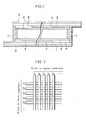
- Fig. 1 is a sectional view illustrating an example of a ferroelectric liquid crystal device of the present invention using a ferroelectric liquid crystal composition.
- Fig. 1 shows an example of transmission type display device, where indicated at 1 and 2 are insulating substrates; at 3 and 4 are conductive films, at 5 is an insulating film; at 6 is an orientation control layer; at 7 is a sealant; at 8 is a ferroelecric liquid crystal composition layer; and at 9 is a polarizer.
- Photo-transmission substrates are used for the insulating substrates 1 and 2, and generally glass substrates are employed therefor.
- the conductive films 3 and 4 which are usualy composed of a conductive thin films of ln 2 0 3 , Sn0 2 or ITO (Indium-Tin Oxide), are used as transparent electrodes and are each formed with a predetermined pattern on the insulating substrates 1 and 2.
- the film 5 On the substrates are each formed an insulating film 5, but the film 5 may be omitted in some cases.
- the insulating film 5 there may be used, for example, an inorganic thin film such as of Si0 2 , SiN x , A1 2 0 3 . etc., and an organic thin film such as of polyimide, photoresist resin, polymer liquid crystal, etc.
- the film 5 may be formed by vacuum deposition process, sputtering process, CVD (Chemical Vapor Deposition) process or solution coating process.
- the film 5 may be formed by using a solution dissolving an organic substance or a solution of its precursor according to spin- coating process, immersion application process, screen printing process or roller application process and curing it at suitable conditions (heating, photoirradiation, etc.); the thin film may also be formed by LB (Langumuir-Blodgett) process as well as deposition process, sputtering process, CVD process.
- LB Liuir-Blodgett
- an orientation control layer 6 On the insulating film 5 is formed an orientation control layer 6.
- the orientation control layer 6 may be formed directly on the conductive films 3 and 4.
- inorganic layer may be used in some cases, while organic layer may be also used in other cases.
- an inorganic orientation control layer In the case where an inorganic orientation control layer is used, oblique deposition of silicone oxide is commonly employed for the formation thereof. Rotating deposition may be also conducted.
- nylon, polyvinylalcohol, polyimide and the like may be used. In this case, rubbing treatment is usually effected on the layer.
- the orientation control layer can also be formed by using a polymer liquid crystal or LB membrane with an intended orientation, by using magnetic field orientating technique or by using spacer edge method. Further, Si0 2 , SiN x and the like may be formed by deposition process, sputtering process, CVD process and the like, on which rubbing treatment is effected for providing the orientation control layer.
- the two insulating substrates are laminated together through a predetermined clearance, and then the liquid crystal composition is injected therebetween to produce a ferroelectric liquid crystal device.
- the ferroelectric liquid crystal device of the present invention may be also applied to a display device with a large capacity matrix wherein the wirings (electrodes) on the upper substrate together with the wirings (electrodes) on the lower substrate are inter-sectionally placed as to provide a matrix type device structure, as is shown in a plane schematic view of Fig. 2.
- a matrix-type liquid crystal device may be driven by various driving methods which have been proposed currently [See for example, Wakita, Kamimura, Onishi, Oba, Kobayashi, Ota,National Technical Report, 33, 44 (1987)].
- the resultant was stirred for 40 minutes at the same temperature before adding dropwise 185mg of methyl iodide and then further stirred for 2 hours.
- the reaction mixture was added with a saturated aqueous solution of ammonium chloride, cooled to room temperature and subjected to extraction twice with ether followed by drying on magnesium sulfuric anhydride and evaporating the solvent.
- the residue was purified by a silica gel column chromatography to obtain ⁇ -lactone derivatives, i.e, a (2S, 4S)-isomer of the following formula (253mg) and the corresponding (2R, 4S)-isomer (37mg).
- Example 2 The same operation as the Example 1 was made except using 70mg of diisoprypylamine, 0.30ml of n-butyl lithium (1.5mol/l in n-hexane), 1ml of tetrahydrofuran, 100mg of hexamethyl phosphoric triamide, 130mg of methyl iodide and a tetrahydrofuran solution (2ml) containing 163mg of a mixture of a (2R,4R)-isomer and a (2S, 4R)-isomer of y-lactone derivative obtained in Production Intermediate 3, to obtain y-lactone derivatives, a (2R, 4R)-isomer of the following formula (130mg) and the corresponding (2S, 4R)-isomer (22mg).
- Liquid crystal compositions were prepared by using the compounds produced in accordance with the aforesaid Synthetic Examples and represented by Nos. 1 to 3 and 14 and 15 of the formula (I), and by Nos. 4 to 13 in Tables 2 and 3.
- liquid crystal composition No. 16 To the liquid crystal composition No. 16 was added 2 wt% of each of the compounds Nos. 1 to 15 shown in Tables 2 and 3 to form 15 kinds of ferroelectric liquid crystal compositions.
- the two glass substrates were laminated with each other as having 2 ⁇ m of cell thickness and the same rubbing direction, and the 15 kinds of ferroelectric liquid crystal compositions corresponding to the compounds Nos. 1 to 15 were each injected between the substrates.
- the cell was first heated to the temperature enabling to the liquid crystal composition to change to isotropic liquid, and then cooled to room temperature at 1 C/min to obtain a ferroelectric liquid crystal device of good orientation. Properties of the ferroelectric liquid crystal device are as shown in Table 5.
- the compounds Nos. 1 to 15 shown in Tables 2 and 3 and those Nos. 17 to 34 shown in Tables 6 to 8 were used in combination to prepare the ferroelectric compositions Nos. 35 and 36 shown in Table 9 as having a sufficiently longer sprical pitch of nematic phase in comparison with cell thickness.
- Ferroelectric liquid crystal devices were fabricated similarly with the Example 1 and evaluated in their properties.
- Table 10 shows phase transition temperature and properties of the ferroelectric liquid crystal compositions.
- the ferroelectric liquid crystal devices has a longer spiral pitch of nematic phase to thereby achieve good orientation and high speed response, so that they are applicable to a ferroelectric liquid crystal device of a large capacity.
Landscapes
- Chemical & Material Sciences (AREA)
- Crystallography & Structural Chemistry (AREA)
- Engineering & Computer Science (AREA)
- Materials Engineering (AREA)
- Organic Chemistry (AREA)
- Liquid Crystal Substances (AREA)
- Liquid Crystal (AREA)
- Organic Low-Molecular-Weight Compounds And Preparation Thereof (AREA)
Applications Claiming Priority (2)
| Application Number | Priority Date | Filing Date | Title |
|---|---|---|---|
| JP2037053A JP2510314B2 (ja) | 1990-02-15 | 1990-02-15 | 強誘電性液晶素子 |
| JP37053/90 | 1990-02-15 |
Publications (3)
| Publication Number | Publication Date |
|---|---|
| EP0442504A2 true EP0442504A2 (de) | 1991-08-21 |
| EP0442504A3 EP0442504A3 (en) | 1992-05-06 |
| EP0442504B1 EP0442504B1 (de) | 1995-05-03 |
Family
ID=12486834
Family Applications (1)
| Application Number | Title | Priority Date | Filing Date |
|---|---|---|---|
| EP91102112A Expired - Lifetime EP0442504B1 (de) | 1990-02-15 | 1991-02-14 | Ferroelektrische Flüssigkristallvorrichtung |
Country Status (4)
| Country | Link |
|---|---|
| EP (1) | EP0442504B1 (de) |
| JP (1) | JP2510314B2 (de) |
| KR (1) | KR100187806B1 (de) |
| DE (1) | DE69109331T2 (de) |
Cited By (2)
| Publication number | Priority date | Publication date | Assignee | Title |
|---|---|---|---|---|
| EP0499482A1 (de) * | 1991-02-15 | 1992-08-19 | Sharp Kabushiki Kaisha | Ferroelektrische Flüssigkristallzusammensetzung sowie deren Verwendung |
| EP0495686A3 (en) * | 1991-01-18 | 1992-09-23 | Sharp Kabushiki Kaisha | Ferroelectric liquid crystal composition and liquid crystal device using the same |
Families Citing this family (3)
| Publication number | Priority date | Publication date | Assignee | Title |
|---|---|---|---|---|
| JP4506098B2 (ja) * | 2003-04-28 | 2010-07-21 | Dic株式会社 | 5員環ラクトン骨格を有する化合物を含有する液晶組成物 |
| US9977294B2 (en) | 2012-06-25 | 2018-05-22 | Industry-University Cooperation Foundation Hanyang University | Liquid crystal display device |
| KR20140001071A (ko) | 2012-06-25 | 2014-01-06 | 한양대학교 산학협력단 | 액정 조성물 |
Family Cites Families (5)
| Publication number | Priority date | Publication date | Assignee | Title |
|---|---|---|---|---|
| GB2216540B (en) * | 1988-03-04 | 1991-08-07 | Sharp Kk | Chiral smectic liquid crystal composition |
| EP0384432B1 (de) * | 1989-02-22 | 1993-12-08 | Daiso Co., Ltd. | Flüssigkristalline Verbindung und ihre Verwendung |
| DE69017483T2 (de) * | 1989-03-14 | 1995-09-14 | Daisow Co Ltd | Vorrichtung mit ferroelektrischen Flüssigkristallen. |
| JPH0717628B2 (ja) * | 1989-07-27 | 1995-03-01 | ダイソー株式会社 | 液晶性化合物およびその用途 |
| JP2505291B2 (ja) * | 1989-10-06 | 1996-06-05 | シャープ株式会社 | 強誘電性液晶素子 |
-
1990
- 1990-02-15 JP JP2037053A patent/JP2510314B2/ja not_active Expired - Lifetime
-
1991
- 1991-02-13 KR KR1019910002383A patent/KR100187806B1/ko not_active Expired - Lifetime
- 1991-02-14 DE DE69109331T patent/DE69109331T2/de not_active Expired - Lifetime
- 1991-02-14 EP EP91102112A patent/EP0442504B1/de not_active Expired - Lifetime
Cited By (3)
| Publication number | Priority date | Publication date | Assignee | Title |
|---|---|---|---|---|
| EP0495686A3 (en) * | 1991-01-18 | 1992-09-23 | Sharp Kabushiki Kaisha | Ferroelectric liquid crystal composition and liquid crystal device using the same |
| US5308539A (en) * | 1991-01-18 | 1994-05-03 | Sharp Kabushiki Kaisha | Ferroelectric liquid crystal composition and liquid crystal device using the same |
| EP0499482A1 (de) * | 1991-02-15 | 1992-08-19 | Sharp Kabushiki Kaisha | Ferroelektrische Flüssigkristallzusammensetzung sowie deren Verwendung |
Also Published As
| Publication number | Publication date |
|---|---|
| KR100187806B1 (ko) | 1999-06-01 |
| DE69109331D1 (de) | 1995-06-08 |
| JPH03238420A (ja) | 1991-10-24 |
| JP2510314B2 (ja) | 1996-06-26 |
| DE69109331T2 (de) | 1996-01-04 |
| KR910015687A (ko) | 1991-09-30 |
| EP0442504B1 (de) | 1995-05-03 |
| EP0442504A3 (en) | 1992-05-06 |
Similar Documents
| Publication | Publication Date | Title |
|---|---|---|
| JPH09508401A (ja) | フェナントリジン誘導体およびそれらの液晶混合物における使用 | |
| JPH0291065A (ja) | 光学活性テトラヒドロフラン‐2‐カルボン酸エステルを液晶混合物においてドーパントとして用いる方法、該エステルを合有する液晶混合物および新規の光学活性テトラヒドロフラン‐2‐カルボン酸エステル | |
| KR960006076B1 (ko) | 광학 활성 옥시란-2-카복실산 에스테르, 이를 함유하는 액정 혼합물 및 액정 혼합물에서 도핑제로서의 광학 활성 옥시란 2-카복실산 에스테르의 용도 | |
| US5547605A (en) | 2-Aryloxytetrafluoropropionic esters, process for their preparation, and their use in liquid-crystalline mixtures | |
| JPH04236295A (ja) | 強誘電性液晶組成物及び液晶素子 | |
| JPH1072386A (ja) | シクロペンチル誘導体 | |
| KR100283163B1 (ko) | 시클로헥센일 코아를 갖는 강유전성 액정 화합물 및 이들을 함유하는 조성물 | |
| JPH06206841A (ja) | 液晶混合物に使用するための、メタ置換された6員環芳香族化合物 | |
| JPH0288573A (ja) | 4―位に液晶性残基を持つ光学活性1,3―ジオキソラン―誘導体、その製造方法および液晶組成物においてのドーパントとしてのそれの用途 | |
| KR940002639B1 (ko) | 강유전성 액정장치 | |
| KR19990008461A (ko) | 1-플루오로-5,6,7,8-테트라하이드로이소퀴놀린 유도체및 액정 혼합물에서의 이의 용도 | |
| EP0442504B1 (de) | Ferroelektrische Flüssigkristallvorrichtung | |
| EP0421438B1 (de) | Ferroelektrische Flüssigkristallvorrichtung | |
| US5707545A (en) | Chiral oxiranylmethyl ethers, and their use as dopants in liquid-crystal mixtures | |
| US4880561A (en) | Optically active compound and liquid crystalline composition | |
| JP3062988B2 (ja) | 光学活性化合物、これを含有する液晶組成物、これを用いた液晶素子、表示方法、液晶装置 | |
| US5525258A (en) | Trifluorophenylene compounds, process for their preparation, and their use in liquid-crystalline mixtures | |
| JPH0717628B2 (ja) | 液晶性化合物およびその用途 | |
| US5507975A (en) | Ferroelectric liquid crystal display | |
| US5702638A (en) | Phenanthridine derivatives, and their use in liquid-crystalline mixtures | |
| US5776363A (en) | Compounds having side chains with multiple methyl branches and their use in liquid-crystal mixtures | |
| JPH02261892A (ja) | 強誘電性液晶組成物及びそれを用いた液晶素子 | |
| JP2819038B2 (ja) | 光学活性化合物、その中間体、液晶組成物及び液晶表示素子 | |
| JPH0931459A (ja) | 新規な強誘電性液晶組成物 | |
| JPH01290664A (ja) | ピリミジン誘導体 |
Legal Events
| Date | Code | Title | Description |
|---|---|---|---|
| PUAI | Public reference made under article 153(3) epc to a published international application that has entered the european phase |
Free format text: ORIGINAL CODE: 0009012 |
|
| AK | Designated contracting states |
Kind code of ref document: A2 Designated state(s): DE FR GB NL |
|
| PUAL | Search report despatched |
Free format text: ORIGINAL CODE: 0009013 |
|
| AK | Designated contracting states |
Kind code of ref document: A3 Designated state(s): DE FR GB NL |
|
| 17P | Request for examination filed |
Effective date: 19920806 |
|
| 17Q | First examination report despatched |
Effective date: 19931220 |
|
| GRAA | (expected) grant |
Free format text: ORIGINAL CODE: 0009210 |
|
| AK | Designated contracting states |
Kind code of ref document: B1 Designated state(s): DE FR GB NL |
|
| PG25 | Lapsed in a contracting state [announced via postgrant information from national office to epo] |
Ref country code: NL Free format text: LAPSE BECAUSE OF FAILURE TO SUBMIT A TRANSLATION OF THE DESCRIPTION OR TO PAY THE FEE WITHIN THE PRESCRIBED TIME-LIMIT Effective date: 19950503 Ref country code: FR Effective date: 19950503 |
|
| REF | Corresponds to: |
Ref document number: 69109331 Country of ref document: DE Date of ref document: 19950608 |
|
| EN | Fr: translation not filed | ||
| NLV1 | Nl: lapsed or annulled due to failure to fulfill the requirements of art. 29p and 29m of the patents act | ||
| PLBE | No opposition filed within time limit |
Free format text: ORIGINAL CODE: 0009261 |
|
| STAA | Information on the status of an ep patent application or granted ep patent |
Free format text: STATUS: NO OPPOSITION FILED WITHIN TIME LIMIT |
|
| 26N | No opposition filed | ||
| REG | Reference to a national code |
Ref country code: GB Ref legal event code: IF02 |
|
| PGFP | Annual fee paid to national office [announced via postgrant information from national office to epo] |
Ref country code: GB Payment date: 20100219 Year of fee payment: 20 Ref country code: DE Payment date: 20100224 Year of fee payment: 20 |
|
| REG | Reference to a national code |
Ref country code: DE Ref legal event code: R071 Ref document number: 69109331 Country of ref document: DE |
|
| REG | Reference to a national code |
Ref country code: GB Ref legal event code: PE20 Expiry date: 20110213 |
|
| PG25 | Lapsed in a contracting state [announced via postgrant information from national office to epo] |
Ref country code: GB Free format text: LAPSE BECAUSE OF EXPIRATION OF PROTECTION Effective date: 20110213 |
|
| PG25 | Lapsed in a contracting state [announced via postgrant information from national office to epo] |
Ref country code: DE Free format text: LAPSE BECAUSE OF EXPIRATION OF PROTECTION Effective date: 20110214 |