EP0470260A1 - Materiau de moulage en resine methacrylique pour support optique d'enregistrement d'informations - Google Patents
Materiau de moulage en resine methacrylique pour support optique d'enregistrement d'informations Download PDFInfo
- Publication number
- EP0470260A1 EP0470260A1 EP91904333A EP91904333A EP0470260A1 EP 0470260 A1 EP0470260 A1 EP 0470260A1 EP 91904333 A EP91904333 A EP 91904333A EP 91904333 A EP91904333 A EP 91904333A EP 0470260 A1 EP0470260 A1 EP 0470260A1
- Authority
- EP
- European Patent Office
- Prior art keywords
- acrylate
- molding material
- copolymer
- methyl methacrylate
- optical information
- Prior art date
- Legal status (The legal status is an assumption and is not a legal conclusion. Google has not performed a legal analysis and makes no representation as to the accuracy of the status listed.)
- Withdrawn
Links
Images
Classifications
-
- G—PHYSICS
- G11—INFORMATION STORAGE
- G11B—INFORMATION STORAGE BASED ON RELATIVE MOVEMENT BETWEEN RECORD CARRIER AND TRANSDUCER
- G11B7/00—Recording or reproducing by optical means, e.g. recording using a thermal beam of optical radiation by modifying optical properties or the physical structure, reproducing using an optical beam at lower power by sensing optical properties; Record carriers therefor
- G11B7/24—Record carriers characterised by shape, structure or physical properties, or by the selection of the material
- G11B7/241—Record carriers characterised by shape, structure or physical properties, or by the selection of the material characterised by the selection of the material
- G11B7/252—Record carriers characterised by shape, structure or physical properties, or by the selection of the material characterised by the selection of the material of layers other than recording layers
- G11B7/253—Record carriers characterised by shape, structure or physical properties, or by the selection of the material characterised by the selection of the material of layers other than recording layers of substrates
- G11B7/2533—Record carriers characterised by shape, structure or physical properties, or by the selection of the material characterised by the selection of the material of layers other than recording layers of substrates comprising resins
-
- C—CHEMISTRY; METALLURGY
- C08—ORGANIC MACROMOLECULAR COMPOUNDS; THEIR PREPARATION OR CHEMICAL WORKING-UP; COMPOSITIONS BASED THEREON
- C08F—MACROMOLECULAR COMPOUNDS OBTAINED BY REACTIONS ONLY INVOLVING CARBON-TO-CARBON UNSATURATED BONDS
- C08F220/00—Copolymers of compounds having one or more unsaturated aliphatic radicals, each having only one carbon-to-carbon double bond, and only one being terminated by only one carboxyl radical or a salt, anhydride ester, amide, imide or nitrile thereof
- C08F220/02—Monocarboxylic acids having less than ten carbon atoms; Derivatives thereof
- C08F220/10—Esters
- C08F220/12—Esters of monohydric alcohols or phenols
- C08F220/14—Methyl esters, e.g. methyl (meth)acrylate
Definitions
- the present invention relates to a methacrylic resin molding material for an optical information-recording media such as a video disc.
- Methacrylic resins have a good moldability and give molded articles having an excellent transparency and valuable optical characteristics, and accordingly, methacrylic resins are used for various optical equipment.
- methacrylic resins are used for substrates of optical information-recording media such as video discs by taking advantage of their excellent characteristics.
- a resin material optical strain of which is small, and having a practically satisfactory mechanical strength, an excellent heat resistance, and an excellent moldability is required for a substrate of an optical information-recording medium, and because of the recent increased demand for video discs, an increase of the productivity of discs at the injection molding, i.e., a shortening of the molding cycle, is sought in the art. Accordingly, as the performances required for the resin material, there can be mentioned a good flowability and a high heat resistance. When the flowability is at the same level, a material having a higher heat resistance can be removed from the mold at a higher temperature, and thus the molding cycle can be shortened.
- a methyl methacrylate/ethyl acrylate copolymer Japanese Unexamined Patent Publication No. 57-123208.
- methyl methacrylate and ethyl acrylate are used, however, if the flowability is improved, the optical strain is lowered, but disadvantages such as a reduction of the heat resistance and reduction of the mechanical strength appear, and accordingly, it was difficult to improve the productivity at the molding. Namely, if the copolymerization ratio of ethyl acrylate is increased to improve the flowability, the heat resistance is drastically reduced. This is undesirable from the view point of its practical use. If a method of reducing the molecular weight without changing the copolymerization ratio of ethyl acrylate is adopted to increase the flowability while maintaining a good heat resistance, the mechanical strength becomes practically unsatisfactory.
- substrates of optical information-recording media are mainly produced by injection molding, and the molding cycle is determined by the heat resistance and flowability of the resin taking the productivity into consideration.
- the flowability of the resin must be improved without sacrificing characteristics such as a small optical strain, a high transparency and a high mechanical strength; and the heat resistance must be improved to shorten the cooling time at the injection molding.
- the heat resistance is improved, a reduction of the flowability or reduction of the mechanical strength occurs.
- the present invention is to provide a methacrylic resin molding material for an optical information-recording medium, which comprises a copolymer comprising 80 to 99.5% by weight of methyl methacrylate units and 20 to 0.5% by weight of units of at least one acrylate monomer selected from the group consisting of 2,2,2-trifluoroethyl acrylate, cyclohexyl acrylate, phenyl acrylate, benzyl acrylate, isobornyl acrylate and tricyclo[5,2,1 ,02.6]decanyl acrylate.
- a copolymer comprising 80 to 99.5% by weight of methyl methacrylate units and 20 to 0.5% by weight of units of at least one acrylate monomer selected from the group consisting of 2,2,2-trifluoroethyl acrylate, cyclohexyl acrylate, phenyl acrylate, benzyl acrylate, isobornyl acrylate and tricyclo[5,2,1
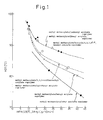
- Fig. 1 is a graph showing the relationship between the heat distortion temperature and the melt flow rate, which illustrates the excellent heat resistance and flowability of the methacrylic resin molding material of the present invention.
- the copolymerization ratio in the copolymer constituting the methacrylic resin molding material of the present invention is outside the above-mentioned range, it is impossible to improve the heat resistance to increase the productivity at mass-production while maintaining a high mechanical strength of the molded article. More specifically, if the amount of methyl methacrylate units exceeds 99.5% by weight, the molecular weight must be reduced to maintain a good molding flowability of the resin,with the result that the mechanical strength is lowered. On the other hand, if the amount of acrylate units exceeds 20% by weight, the mechanical strength is drastically lowered or the heat resistance is reduced.
- the melt flow rate of the copolymer is preferably 0.5 to 50 g/10 minutes, most preferably 5 to 50 g/10 minutes, as determined under a load of 3.8 kg according to ASTM D-1238. If the melt flow rate is lower than 0.5 g/10 minutes, the transferability of an information from the mold is poor and the optical strain of the molded article tend to be increased. On the other hand, if the melt flow rate is higher than 50 g/10 minutes, the mechanical strength tend to be lowered. In view of the use of the molding material as an information-recording medium, preferably the mechanical strength is such that the tensile strength is at least 300 kg/cm 2 , particularly at least 400 kg/cm 2 , as determined according to ASTM D-638.
- the heat distortion temperature of the copolymer is preferably at least 70 C, most preferably at least 80 C, as determined under a load of 18.56 kg according to ASTM D-648. If the heat distortion temperature is lower than 70 C, the heat resistance of the molded article is poor, and the heat distortion is large upon molding or during use.
- the productivity at the molding can be improved compared with the productivity in the conventional procedure, and a molded article having a small optical strain, an excellent transparency and a high mechanical strength can be obtained. From Fig. 1 of the accompanying drawing, it is obvious that the methacrylic resin molding material of the present invention has an excellent balance between the flowability and the heat resistance.
- Methods customarily adopted for the production of acrylic resins such as suspension polymerization, bulk polymerization and solution polymerization, can be used for the production of the molding material of the present invention, and additives such as a stabilizer, a mold release agent, a lubricant, a plasticizer and a dye can be added to the acrylic resin molding material of the present invention according to need.
- the molding material of the present invention prepared in the above-mentioned manner can be processed by any injection molding and compression molding method.
- the methacrylic resin molding material of the present invention has a high heat resistance and flowability while maintaining the excellent optical and mechanical characteristics inherently possessed by a methacrylic resin, and the productivity at the molding is also improved. Accordingly, the methacrylic resin molding material of the present invention can be advantageously used for the manufacture of optical information-recording media.
- the heat distortion temperature was measured under a load of 18.56 kg according to ASTM D-648.
- the melt flow rate was measured under a load of 3.8 kg according to ASTM D-1238.
- a dumbbell A specimen was injection-molded by PS-60E supplied by Nissei Jushi Co., Ltd., and the measurement was carried out according to ASTM D-638.
- a disc (1.2 mm in thickness) having a diameter of 300 mm was formed by injection molding by Dia-Melter M-200 supplied by Meiki Seisakusho (cylinder temperature was 260 C), and the light transmission at a point 7 cm apart from the center was measured over a region of 500 to 900 nm by UV-160A supplied by Shimazu Seisakusho.
- Polymerization was carried out at 80 C, and after the inner temperature reached a highest level, the reaction product was maintained at 95 C for 30 minutes, cooled, filtered, washed with water and dried to obtain a bead polymer.
- the obtained polymer was kneaded at 240 C and pelletized by a 40 mm-extruder supplied by Tanabe Plastic Kikai.
- Example 2 The procedures of Example 1 were repeated in the same manner as described in Example 1 except that each 100 parts of monomer mixtures having the composition shown in Table 2 were used. The results are shown in Table 2.
- the polymer obtained by copolymerizing 30 parts of 2,2,2-trifluoroethyl acrylate and 70 parts of methyl methacrylate (Comparative Example 1) and the polymer obtained by copolymerizing 30 parts of cyclohexyl acrylate and 70 parts of methyl methacrylate (Comparative Example 2) could not be pelletized at the extrusion molding because the heat resistance was very poor, and thus these polymers had no practical utility.
- a copolymer obtained by copolymerizing 30 parts of phenyl acrylate and 70 parts of methyl methacrylate (Comparative Example 3), a copolymer obtained by copolymerizing 30 parts of benzyl acrylate and 70 parts of methyl methacrylate (Comparative Example 4), a copolymer obtained by polymerizing 30 parts of isobornyl acrylate and 70 parts of methyl methacrylate (Comparative Example 5) and a copolymer obtained by copolymerizing 20 parts of tricyclo[5,2,1 02.6]decanyl acrylate and 80 parts of methyl methacrylate (Comparative Example 6) had a low mechanical strength, and therefore, these copolymers could not be practically used.
- a polymer obtained by polymerizing 100 parts of methyl methacrylate (Comparative Example 9) had MFR of 22.5 g/10 minutes and the flowability of this polymer was comparable to that attained in Comparative Example 7, but the tensile strength of this polymer was lower than 1/2 of the tensile strength attained in Comparative Example 7. Accordingly, the polymer had no practical utility.
- the methacrylic resin molding material of the present invention can be advantageously used for the production of optical information-recording media.
Landscapes
- Chemical & Material Sciences (AREA)
- Health & Medical Sciences (AREA)
- Chemical Kinetics & Catalysis (AREA)
- Medicinal Chemistry (AREA)
- Polymers & Plastics (AREA)
- Organic Chemistry (AREA)
- Addition Polymer Or Copolymer, Post-Treatments, Or Chemical Modifications (AREA)
- Optical Record Carriers And Manufacture Thereof (AREA)
Abstract
Applications Claiming Priority (6)
| Application Number | Priority Date | Filing Date | Title |
|---|---|---|---|
| JP43996/90 | 1990-02-23 | ||
| JP2043996A JPH03247611A (ja) | 1990-02-23 | 1990-02-23 | 光学式情報記録体用メタクリル樹脂 |
| JP96857/90 | 1990-04-12 | ||
| JP2096857A JPH03294314A (ja) | 1990-04-12 | 1990-04-12 | 光学式情報記録体用メタクリル樹脂 |
| JP2308164A JPH04180906A (ja) | 1990-11-14 | 1990-11-14 | 光学式情報記録体用メタクリル樹脂 |
| JP308164/90 | 1990-11-14 |
Publications (2)
| Publication Number | Publication Date |
|---|---|
| EP0470260A1 true EP0470260A1 (fr) | 1992-02-12 |
| EP0470260A4 EP0470260A4 (en) | 1992-04-08 |
Family
ID=27291749
Family Applications (1)
| Application Number | Title | Priority Date | Filing Date |
|---|---|---|---|
| EP19910904333 Withdrawn EP0470260A4 (en) | 1990-02-23 | 1991-02-22 | Methacrylic resin molding material for optical information recording medium |
Country Status (3)
| Country | Link |
|---|---|
| EP (1) | EP0470260A4 (fr) |
| KR (1) | KR920702857A (fr) |
| WO (1) | WO1991013105A1 (fr) |
Cited By (3)
| Publication number | Priority date | Publication date | Assignee | Title |
|---|---|---|---|---|
| US20110130535A1 (en) * | 2008-07-31 | 2011-06-02 | Masami Yonemura | Thermoplastic Acrylic Resin, and Molded Product Thereof |
| TWI383999B (zh) * | 2007-12-27 | 2013-02-01 | 旭化成化學股份有限公司 | 丙烯酸系熱塑性樹脂及光學材料用成形體 |
| JPWO2014050136A1 (ja) * | 2012-09-28 | 2016-08-22 | 株式会社クラレ | 複層板 |
Family Cites Families (6)
| Publication number | Priority date | Publication date | Assignee | Title |
|---|---|---|---|---|
| JPS585318A (ja) * | 1981-07-02 | 1983-01-12 | Mitsubishi Rayon Co Ltd | 低吸湿性メタクリル系樹脂 |
| JPS59159807A (ja) * | 1983-03-02 | 1984-09-10 | Konishiroku Photo Ind Co Ltd | 光学式情報記録盤用樹脂組成物 |
| JPS59197412A (ja) * | 1983-04-25 | 1984-11-09 | Showa Denko Kk | 光学材料 |
| JPH064689B2 (ja) * | 1983-11-01 | 1994-01-19 | 日立化成工業株式会社 | 重合体 |
| JPS60115605A (ja) * | 1983-11-28 | 1985-06-22 | Mitsubishi Rayon Co Ltd | 低吸湿性メタクリル樹脂 |
| JPH0585318A (ja) * | 1991-09-27 | 1993-04-06 | Mazda Motor Corp | 車両のブレーキ装置 |
-
1991
- 1991-02-22 WO PCT/JP1991/000225 patent/WO1991013105A1/fr not_active Ceased
- 1991-02-22 KR KR1019910701419A patent/KR920702857A/ko not_active Withdrawn
- 1991-02-22 EP EP19910904333 patent/EP0470260A4/en not_active Withdrawn
Non-Patent Citations (2)
| Title |
|---|
| CHEMICAL ABSTRACTS, vol. 107, no. 12, September 1987, Columbus, Ohio, US; abstract no. 97654, 'METHACRYLATE COPYMERS WITH LOW MOISTURE ABSORPTION' page 37 ;column 2 ; &JP-A-6207709(NIPPON SHOKUBAI K.K.) * |
| See also references of WO9113105A1 * |
Cited By (6)
| Publication number | Priority date | Publication date | Assignee | Title |
|---|---|---|---|---|
| TWI383999B (zh) * | 2007-12-27 | 2013-02-01 | 旭化成化學股份有限公司 | 丙烯酸系熱塑性樹脂及光學材料用成形體 |
| US8779076B2 (en) * | 2007-12-27 | 2014-07-15 | Asahi Kasei Chemicals Corporation | Thermoplastic acrylic resin and molded body for optical member |
| US20110130535A1 (en) * | 2008-07-31 | 2011-06-02 | Masami Yonemura | Thermoplastic Acrylic Resin, and Molded Product Thereof |
| US8895682B2 (en) | 2008-07-31 | 2014-11-25 | Asahi Kasei Chemicals Corporation | Thermoplastic acrylic resin, and molded product thereof |
| JPWO2014050136A1 (ja) * | 2012-09-28 | 2016-08-22 | 株式会社クラレ | 複層板 |
| US9827748B2 (en) * | 2012-09-28 | 2017-11-28 | Kuraray Co., Ltd. | Multilayer plate |
Also Published As
| Publication number | Publication date |
|---|---|
| KR920702857A (ko) | 1992-10-28 |
| EP0470260A4 (en) | 1992-04-08 |
| WO1991013105A1 (fr) | 1991-09-05 |
Similar Documents
| Publication | Publication Date | Title |
|---|---|---|
| JPS633011A (ja) | 低吸水透明共重合体 | |
| EP0470260A1 (fr) | Materiau de moulage en resine methacrylique pour support optique d'enregistrement d'informations | |
| JP3053239B2 (ja) | 低吸湿性メタクリル系樹脂組成物 | |
| EP0218256B1 (fr) | Composition de résine méthacrylique pour disques optiques | |
| JPS62112612A (ja) | アクリル系樹脂 | |
| JP3048183B2 (ja) | 低複屈折性メタクリル系樹脂組成物 | |
| JPH04254928A (ja) | 光学式情報記録体用メタクリル樹脂 | |
| JP2889882B2 (ja) | ピックアップレンズ | |
| JPS63248812A (ja) | 光学素子用共重合体の製造法 | |
| JPH0625359A (ja) | 低複屈折性成形材料 | |
| JPH03294314A (ja) | 光学式情報記録体用メタクリル樹脂 | |
| JPH03170515A (ja) | 光学用メタクリル樹脂 | |
| JP3623891B2 (ja) | 重合体の製造方法 | |
| US4812345A (en) | Optical disk substrate | |
| JP2000239325A (ja) | 透明樹脂組成物 | |
| JPH04236209A (ja) | 光学式情報記録体用メタクリル樹脂 | |
| JPH056161B2 (fr) | ||
| JPS60231716A (ja) | 耐熱変形性に優れたアクリル系樹脂の製造方法 | |
| JP3657113B2 (ja) | 低複屈折共重合体、その製法およびピックアップレンズ | |
| JPH0192209A (ja) | 光学用樹脂成形体 | |
| JPS62246914A (ja) | メタアクリル系樹脂 | |
| US5252440A (en) | Methacrylic resin composition for optical discs | |
| JPS59122509A (ja) | 低吸湿性メタクリル系樹脂 | |
| JPS63234009A (ja) | メタクリル系樹脂組成物 | |
| JPS6346254A (ja) | メタクリル樹脂組成物 |
Legal Events
| Date | Code | Title | Description |
|---|---|---|---|
| PUAI | Public reference made under article 153(3) epc to a published international application that has entered the european phase |
Free format text: ORIGINAL CODE: 0009012 |
|
| AK | Designated contracting states |
Kind code of ref document: A1 Designated state(s): DE FR GB |
|
| 17P | Request for examination filed |
Effective date: 19920122 |
|
| A4 | Supplementary search report drawn up and despatched |
Effective date: 19920219 |
|
| AK | Designated contracting states |
Kind code of ref document: A4 Designated state(s): DE FR GB |
|
| 17Q | First examination report despatched |
Effective date: 19941206 |
|
| STAA | Information on the status of an ep patent application or granted ep patent |
Free format text: STATUS: THE APPLICATION IS DEEMED TO BE WITHDRAWN |
|
| 18D | Application deemed to be withdrawn |
Effective date: 19950419 |
|
| PLBQ | Unpublished change to opponent data |
Free format text: ORIGINAL CODE: EPIDOS OPPO |
|
| PLBI | Opposition filed |
Free format text: ORIGINAL CODE: 0009260 |
|
| PLBQ | Unpublished change to opponent data |
Free format text: ORIGINAL CODE: EPIDOS OPPO |
|
| PLAB | Opposition data, opponent's data or that of the opponent's representative modified |
Free format text: ORIGINAL CODE: 0009299OPPO |
|
| 26 | Opposition filed |
Opponent name: SALZENBRODT GMBH & CO. KG Effective date: 19980206 |
|
| D26 | Opposition filed (deleted) |