EP0497678A1 - Diaryl-2,5, oxadiazoles-1,3,4, hydroxyesters, hydroxyacide et acétoxyacide, leur procédé de synthèse - Google Patents
Diaryl-2,5, oxadiazoles-1,3,4, hydroxyesters, hydroxyacide et acétoxyacide, leur procédé de synthèse Download PDFInfo
- Publication number
- EP0497678A1 EP0497678A1 EP92400204A EP92400204A EP0497678A1 EP 0497678 A1 EP0497678 A1 EP 0497678A1 EP 92400204 A EP92400204 A EP 92400204A EP 92400204 A EP92400204 A EP 92400204A EP 0497678 A1 EP0497678 A1 EP 0497678A1
- Authority
- EP
- European Patent Office
- Prior art keywords
- diaryl
- oxadiazole
- synthesis
- hydroxyesters
- acetoxyacids
- Prior art date
- Legal status (The legal status is an assumption and is not a legal conclusion. Google has not performed a legal analysis and makes no representation as to the accuracy of the status listed.)
- Withdrawn
Links
- 0 C*c(cc1)ccc1-c1nnc(-c(cc2)ccc2C(O)=O)[o]1 Chemical compound C*c(cc1)ccc1-c1nnc(-c(cc2)ccc2C(O)=O)[o]1 0.000 description 1
- QQHOVIVQEADFKV-UHFFFAOYSA-N CC1(C=CC(C(NNC(C(C=C2)=CC=CC2(C)O)=O)O)=CC=C1)C(OC)=O Chemical compound CC1(C=CC(C(NNC(C(C=C2)=CC=CC2(C)O)=O)O)=CC=C1)C(OC)=O QQHOVIVQEADFKV-UHFFFAOYSA-N 0.000 description 1
Classifications
-
- C—CHEMISTRY; METALLURGY
- C07—ORGANIC CHEMISTRY
- C07D—HETEROCYCLIC COMPOUNDS
- C07D271/00—Heterocyclic compounds containing five-membered rings having two nitrogen atoms and one oxygen atom as the only ring hetero atoms
- C07D271/02—Heterocyclic compounds containing five-membered rings having two nitrogen atoms and one oxygen atom as the only ring hetero atoms not condensed with other rings
- C07D271/10—1,3,4-Oxadiazoles; Hydrogenated 1,3,4-oxadiazoles
- C07D271/107—1,3,4-Oxadiazoles; Hydrogenated 1,3,4-oxadiazoles with two aryl or substituted aryl radicals attached in positions 2 and 5
-
- C—CHEMISTRY; METALLURGY
- C07—ORGANIC CHEMISTRY
- C07C—ACYCLIC OR CARBOCYCLIC COMPOUNDS
- C07C243/00—Compounds containing chains of nitrogen atoms singly-bound to each other, e.g. hydrazines, triazanes
- C07C243/24—Hydrazines having nitrogen atoms of hydrazine groups acylated by carboxylic acids
- C07C243/38—Hydrazines having nitrogen atoms of hydrazine groups acylated by carboxylic acids with acylating carboxyl groups bound to carbon atoms of six-membered aromatic rings
Definitions
- the present invention relates to diaryl-2,5 oxadiazoles-1,3,4 hydroxyester, hydroxyacid and acetoxyacid of formula: in which R1 represents a hydroxyl or acetyl radical and R2 represents a carboxyl radical and where R1 and R2 preferably occupy simultaneously the positions 3 and 3 ′ or 4 and 4 ′ as well as the diaromatic dihydrazide of formula:
- the hydroxyesters are prepared by cyclization of the corresponding diaromatic dihydrazide and the hydroxyacids are obtained by saponification of the preceding hydroxyesters.
- hydroxyesters according to the invention are prepared by cyclization of the corresponding dihydrazide of formula: in oxadiazole using SOCl2 in the presence of traces of pyridine.
- Said dihydrazide can be obtained by condensation of the hydrazide of p, o or m-hydroxybenzoic acid: on the acid chloride of formula: for example, according to the procedure of DL BRYDON, JS FISHER, Polymer, vol 30 page 619 (1989).
- the hydroxybenzoic acid hydrazide can be obtained in known manner by reaction of the hydrazine hydrate with an ester of hydroxybenzoic acid such as methyl hydroxybenzoate.
- the acid chloride can be prepared in a conventional manner by reaction of thionyl chloride with a monoester of benzene dicarboxylic acid, at room temperature, the monoester can itself be synthesized by monosaponification of the corresponding diester according to the procedure of BW HOTTEN , Industrial and Engineering Chemistry, Vol. 49, No. 10, page 1691 (1957).
- the hydroxy acids can be prepared by saponification of the hydroxyesters previously synthesized.
- the acetylation of the hydroxy acids can be carried out in an acetic anhydride medium.
- the 2,5-diaryl-oxadiazoles-1,3,4 hydroxy acids and their acetylated derivatives according to the invention can be used as monomers and in particular, they are monomers particularly advantageous for the synthesis of thermotropic polymers.
Landscapes
- Chemical & Material Sciences (AREA)
- Organic Chemistry (AREA)
- Heterocyclic Carbon Compounds Containing A Hetero Ring Having Nitrogen And Oxygen As The Only Ring Hetero Atoms (AREA)
- Organic Low-Molecular-Weight Compounds And Preparation Thereof (AREA)
- Low-Molecular Organic Synthesis Reactions Using Catalysts (AREA)
- Macromolecular Compounds Obtained By Forming Nitrogen-Containing Linkages In General (AREA)
Abstract
L'invention concerne les diaryl-2,5 oxadiazoles-1,3,4 à terminaisons hydroxyester, hydroxyacide et acétoxyacide de formule : <IMAGE> dans laquelle R1 représente un radical hydroxyle ou acétyle et R2 représente un radical carboxyle et où R1 et R2 occupent de préférence simultanément les positions 3 et 3' ou 4 et 4'. Les hydroxyesters sont préparés par cyclisation du dihydrazide diaromatique correspondant et les hydroxyacides sont obtenus par saponification des hydroxyesters précédents.
Description
- La présente invention a pour objet des diaryl-2,5 oxadiazoles-1,3,4 hydroxyester, hydroxyacide et acétoxyacide de formule :

dans laquelle R₁ représente un radical hydroxyle ou acétyle et R₂ représente un radical carboxyle et où R₁ et R₂ occupent de préférence simultanément les positions 3 et 3′ ou 4 et 4′ ainsi que le dihydrazide diaromatique de formule :
- Les hydroxyesters sont préparés par cyclisation du dihydrazide diaromatique correspondant et les hydroxyacides sont obtenus par saponification des hydroxyesters précédents.
- Dans la littérature, on a décrit la synthèse des diaryl-2,5 oxadiazoles-1,3,4 dihydroxy et diacides (R₁ = R₂ = OH ou COOH) et leur utilisation comme monomères de polymères thermotropes (D.BRYDON et al., Polymer, 1989, vol 30, April, pages 619 - 627).
- La synthèse du bis(hydroxy-2 phényl)-2,5 oxadiazole-1,3,4 est décrite dans le brevet US 2 838 520.
- Dans la demande de brevet GB 746.047, on a décrit la préparation de bis (carboxy-3 phényl)-2,5 oxadiazole-1,3,4.
- Les hydroxyesters selon l'invention sont préparés par cyclisation du dihydrazide correspondant de formule :
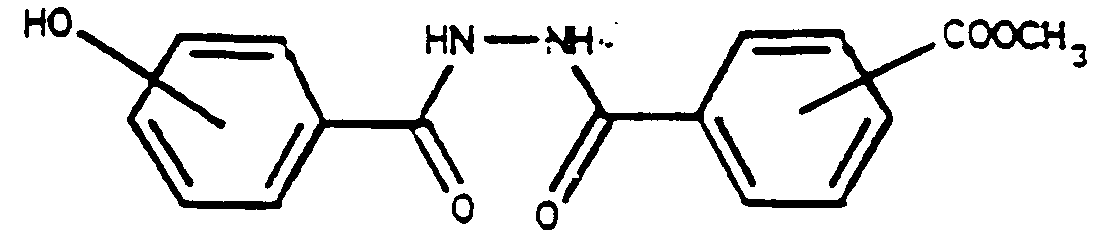
en oxadiazole à l'aide de SOCl₂ en présence de traces de pyridine. - Le dit dihydrazide peut être obtenu par condensation de l'hydrazide de l'acide p, o ou m-hydroxybenzoïque :

sur le chlorure d'acide de formule :
par exemple, selon le mode opératoire de D.L. BRYDON, J.S. FISHER, Polymer, vol 30 page 619 (1989). - L'hydrazide d'acide hydroxybenzoïque peut être obtenu de façon connue par réaction de l'hydrate d'hydrazine sur un ester de l'acide hydroxybenzoïque tel que l'hydroxybenzoate de méthyle.
- Le chlorure d'acide peut être préparé de manière classique par réaction du chlorure de thionyle sur un monoester d'acide benzène dicarboxylique, à température ambiante, le monoester pouvant être lui-même synthétisé par monosaponification du diester correspondant selon le mode opératoire de B.W. HOTTEN, Industrial and Engineering Chemistry, Vol. 49, n°10, page 1691 (1957).
- Les hydroxyacides peuvent être préparés par saponification des hydroxyesters précédemment synthétisés. L'acétylation des hydroxyacides peut être effectuée en milieu anhydride acétique.
- Les diaryl-2,5 oxadiazoles-1,3,4 hydroxyacides et leurs dérivés acétylés selon l'invention peuvent être utilisés comme monomères et notamment, ce sont des monomères particulièrement intéressants pour la synthèse de polymères thermotropes.
- Les exemples suivants illustrent l'invention sans toutefois la limiter.
- Dans tout ce qui suit, la signification des abréviations utilisées est la suivante :
F° = Température de fusion
Eb° = Température d'ébullition
litt = de la littérature
exp = expérimental. EXEMPLE 1 - SYNTHESE DE L'HYDRAZIDE DE L'ACIDE P-HYDROXYBENZOIQUE - Dans un réacteur de 0,5 l agité et équipé pour le reflux, on charge 1 M (152 g) de p-hydroxybenzoate de méthyle dans 100 cm³ d'éthanol. Puis on coule sous agitation 1,5 M (75 g) d'hydrate d'hydrazine 100 % à température ambiante. En fin de coulée, on porte le milieu à reflux (≈ 90°C) pendant 7 h jusqu'à disparition complète de l'ester. En fin de réaction on refroidit et on filtre le solide qui a cristallisé. Le produit est lavé à l'eau froide et séché. On obtient 123 g d'hydrazide pur à 99 % soit un rendement de 81%.
-

F°litt : 265°C
F°exp : 258°C - décomposition - D'après B.W. HOTTEN, Industrial and Engineering Chemistry, vol. 49, n°10, p. 1691 (1957).
- Dans un réacteur agité de 2 l, on place 0,75 M (145,5 g) de diméthyltéréphtalate avec 1125 cm³ de toluène. La suspension est portée à 60°C jusqu'à dissolution totale du téréphtalate. Puis on coule une solution de potasse méthanolique (0,75 M (49,4 g) KOH 85% dans 240 cm³ de méthanol). La coulée a lieu en 20 mn puis on porte à reflux 1 heure supplémentaire. En fin de réaction, on filtre le sel formé et on le lave par des fractions de toluène chaud (50°C) pour éliminer les traces de diester. Le sel est séché et acidifié par 65 cm³ de HCl 12 N. L'ester acide obtenu est lavé à l'eau et séché. On obtient 129,5 g de produit, soit un rendement de 95 % à partir du diester.
-

F°litt : 221°C - 223°C
F°exp : 221°C - 223°C - Dans un réacteur de 250 cm³ équipé pour le reflux, on place 0,2 M (36 g) de monométhyltéréphtalate, puis on coule 45 cm³ de SOCl₂ à température ambiante. Le milieu est ensuite porté à reflux jusqu'à ce que le dégagement de SO₂ et d'HCl cesse (soit environ 4 h). En fin de réaction, on distille l'excès de SOCl₂ et on récupère le chlorure d'acide (39,5 g) soit un rendement de 99 %.
-

F°litt : 38°C - 40°C
F°exp : 53°C - 54°C
Eb : 135-137°C/12 mm Hg - D'après D.L. BRYDON, J.S. FISHER; Polymer, vol. 30, p.619 (1989).
- Dans un réacteur de 2 l équipé pour le reflux, on place 108 g (0,71 M) d'hydrazide de l'acide p-hydroxybenzoïque en suspension dans 790 cm³ de dioxanne avec 37,6 g (0,355 M) de Na₂CO₃. Puis on coule à température ambiante 141,9 g (0,71 M) du chlorure d'acide précité en solution dans 350 cm³ de dioxanne. La coulée se fait en 45′ puis on porte à reflux à 70°C pendant 9 heures jusqu'à disparition du chlorure d'acide. Le milieu est refroidi à l'ambiante. Le précipité est filtré, lavé par une solution aqueuse d'HCl 4% pour éliminer éventuellement l'hydrazide restant puis rincé 2 fois à l'eau. On obtient ainsi 184 g d'un produit de pureté > 95% (1°jet). Par concentration du filtrat, on obtient un rendement total de 87% en produit pur.(99%)
-

F°exp : 238°C - 240°C
RMN : conforme à la structure en RMN H¹ et C¹³ - Dans un réacteur de 1 l équipé pour le reflux, on place 451,5 g de SOCl₂ et 9 g de pyridine puis on ajoute par portion à température ambiante 89,8 g (0,286 M) de dihydrazide. L'introduction dure 20 mn. Puis on porte à reflux à 80°C pendant 5 h 55. On piège l'HCl et le SO₂ qui se dégagent et distille le SOCl₂ qui n'a pas réagi. Le produit solide est essoré et lavé à l'eau. On obtient ainsi 77 g de produit sec de pureté > 98 % en RMN, soit un rendement de 90 %.
-
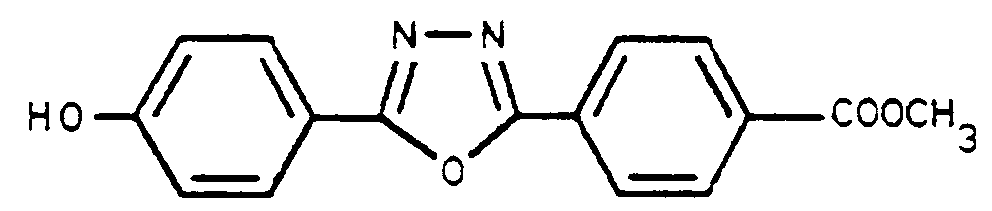
F°exp : 243°C - 244°C
RMN : conforme en RMN H¹ et C¹³ -

- Dans un réacteur équipé pour le reflux, on place 65 g (0,22 M) d'hydroxyester en suspension dans 650 g de propanol 1. On porte à reflux et on coule une solution aqueuse de potasse (31 g dans 100 g H₂O) en 1 h 30, puis on maintient à reflux 3 h 20.
- On vérifie par potentiométrie que la saponification est terminée, puis on ajoute à chaud 43,5 cm³ d'HCl 12 N. Le produit est filtré et lavé. On obtient 2 jets de 53,9 g et 5,21 g, ce qui donne un rendement de 80% en produit pur.
-

F°exp : 305°C - 308°C
RMN : conforme en RMN H¹ et C¹³ -

- Dans un réacteur équipé pour le reflux, on place 15 g (0,053 M) d'hydroxyacide dans 94 g d'anhydride acétique. On porte à reflux pendant 30 mn (110°C). On laisse refroidir et on précipite à l'eau. On obtient ainsi 15,27 g de produit sec, soit un rendement poids de 89%
-

F° : 276°C - 277°C - Ce composé est obtenu selon le mode opératoire de l'exemple 4 avec un rendement de 90 % en remplaçant l'acide p-hydroxybenzoïque par l'acide m-hydroxybenzoïque.

F° exp : 226 ° - 228 °C
RMN : conforme à la structure en RMN H¹ et C¹³ . - Ce composé est obtenu suivant l'exemple 5 avec un rendement de 84 % à partir du dihydrazide de l'exemple 8.

F° exp : 225° - 229°C
RMN : conforme à la structure en RMN H¹ et C¹³ - Ce produit est obtenu suivant l'exemple 6 avec un rendement de 81% à partir de l'hydroxyester de l'exemple 9
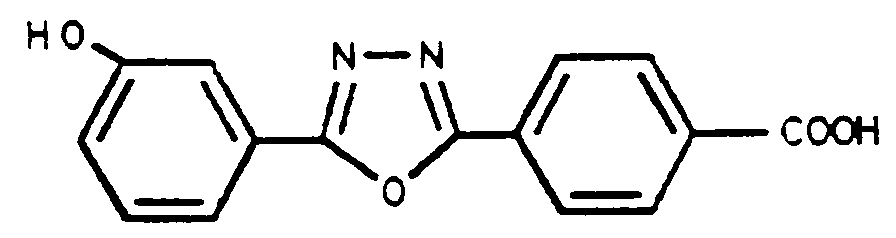
F° exp : 312° - 316°C
RMN : conforme à la structure en RMN H¹ et C¹³
Claims (7)
- Dihydrazides diaromatiques caractérisés en ce qu'ils répondent à la formule :

- Diaryl-2,5 oxadiazoles-1,3,4 hydroxyesters, hydroxyacides et acétoxyacides caractérisés en ce qu'ils répondent à la formule :

- Procédé de préparation des dihydrazides aromatiques de la revendication 1 par condensation de l'acide p, o ou m-hydroxybenzoïque sur le chlorure d'acide de formule :

- Procédé de préparation des diaryl oxadiazoles hydroxyesters de la revendication 2 par cyclisation des dihydrazides diaromatiques de la revendication 1 à l'aide de chlorure de thionyle et de préférence en présence de pyridine.
- Procédé de préparation des diaryl oxadiazoles hydroxyacides de la revendication 2 par saponification des hydroxyesters de la revendication 2.
- Procédé de préparation des diaryl oxadiazoles acétoxyacides de la revendication 2 par acétylation des hydroxyacides de la revendication 2, de préférence en milieu anhydride acétique.
- Utilisation des hydroxyacides et des acétoxyacides de la revendication 2 comme monomères de (co)polymères, de préférence thermotropes.
Applications Claiming Priority (2)
| Application Number | Priority Date | Filing Date | Title |
|---|---|---|---|
| FR9101030A FR2672050A1 (fr) | 1991-01-30 | 1991-01-30 | Diaryl-2,5 oxadiazoles-1,3,4 hydroxyester, hydroxyacide et acetoxyacide, leur procede de synthese. |
| FR9101030 | 1991-01-30 |
Publications (1)
| Publication Number | Publication Date |
|---|---|
| EP0497678A1 true EP0497678A1 (fr) | 1992-08-05 |
Family
ID=9409192
Family Applications (1)
| Application Number | Title | Priority Date | Filing Date |
|---|---|---|---|
| EP92400204A Withdrawn EP0497678A1 (fr) | 1991-01-30 | 1992-01-27 | Diaryl-2,5, oxadiazoles-1,3,4, hydroxyesters, hydroxyacide et acétoxyacide, leur procédé de synthèse |
Country Status (7)
| Country | Link |
|---|---|
| EP (1) | EP0497678A1 (fr) |
| JP (1) | JPH06107615A (fr) |
| CA (1) | CA2060268A1 (fr) |
| FI (1) | FI920400L (fr) |
| FR (1) | FR2672050A1 (fr) |
| IE (1) | IE920319A1 (fr) |
| NO (1) | NO920355L (fr) |
Cited By (4)
| Publication number | Priority date | Publication date | Assignee | Title |
|---|---|---|---|---|
| US6613942B1 (en) | 1997-07-01 | 2003-09-02 | Novo Nordisk A/S | Glucagon antagonists/inverse agonists |
| US7084279B1 (en) * | 1999-02-11 | 2006-08-01 | Emisphere Technologies Inc. | Oxadiazole compounds and compositions for delivering active agents |
| CN100467462C (zh) * | 2006-03-31 | 2009-03-11 | 北京大学 | 一种含噁二唑的三齿配体及其铕配合物和电致发光器件 |
| US20090253699A1 (en) * | 2004-10-13 | 2009-10-08 | Pct Therapeutics, Inc. | Compounds for Nonsense Suppression, and Methods for Their Use |
Families Citing this family (4)
| Publication number | Priority date | Publication date | Assignee | Title |
|---|---|---|---|---|
| DE60024414T2 (de) * | 1999-02-11 | 2006-06-14 | Emisphere Tech Inc | Oxadiazolverbindungen und -zusammensetzungen zur abgabe von wirkstoffen |
| WO2006025219A1 (fr) * | 2004-09-01 | 2006-03-09 | Hirose Engineering Co., Ltd. | Nouveau polymère, nouveau composé, leur procédé de production et dispositif émetteur de lumière bleue |
| EP1932833B1 (fr) * | 2005-10-07 | 2012-08-01 | Kissei Pharmaceutical Co., Ltd. | Compose heterocyclique azote et composition pharmaceutique le contenant |
| HUE036519T2 (hu) | 2007-08-13 | 2018-07-30 | Monsanto Technology Llc | Készítmények és eljárások nematódák irtására |
-
1991
- 1991-01-30 FR FR9101030A patent/FR2672050A1/fr active Pending
-
1992
- 1992-01-27 NO NO92920355A patent/NO920355L/no unknown
- 1992-01-27 EP EP92400204A patent/EP0497678A1/fr not_active Withdrawn
- 1992-01-29 CA CA002060268A patent/CA2060268A1/fr not_active Abandoned
- 1992-01-29 FI FI920400A patent/FI920400L/fi not_active Application Discontinuation
- 1992-01-30 JP JP4015477A patent/JPH06107615A/ja active Pending
- 1992-01-30 IE IE031992A patent/IE920319A1/en unknown
Non-Patent Citations (2)
| Title |
|---|
| CHEMICAL ABSTRACTS, vol. 71, no. 7, 18 Août 1969, Columbus, Ohio, US; TKACH, V. P. ET AL.: 'Synthesis of hydroxy derivatives of 2,5-diaryl-1,3,4-oxadiazoles' page 291 ; * |
| CHEMICAL ABSTRACTS, vol. 88, no. 24, 12 Juin 1978, Columbus, Ohio, US; 'Heat stabilizers for polyolefins in contact with copper' page 44 ; * |
Cited By (6)
| Publication number | Priority date | Publication date | Assignee | Title |
|---|---|---|---|---|
| US6613942B1 (en) | 1997-07-01 | 2003-09-02 | Novo Nordisk A/S | Glucagon antagonists/inverse agonists |
| US7084279B1 (en) * | 1999-02-11 | 2006-08-01 | Emisphere Technologies Inc. | Oxadiazole compounds and compositions for delivering active agents |
| US20090253699A1 (en) * | 2004-10-13 | 2009-10-08 | Pct Therapeutics, Inc. | Compounds for Nonsense Suppression, and Methods for Their Use |
| EP2939674A1 (fr) * | 2004-10-13 | 2015-11-04 | PTC Therapeutics, Inc. | Composes de suppression de non-sens et procedes de leur utilisation |
| US9611230B2 (en) | 2004-10-13 | 2017-04-04 | Ptc Therapeutics, Inc. | 1,3,4-oxadiazole benzoic acid compounds and their use for nonsense suppression and the treatment of disease |
| CN100467462C (zh) * | 2006-03-31 | 2009-03-11 | 北京大学 | 一种含噁二唑的三齿配体及其铕配合物和电致发光器件 |
Also Published As
| Publication number | Publication date |
|---|---|
| IE920319A1 (en) | 1992-07-29 |
| FR2672050A1 (fr) | 1992-07-31 |
| NO920355L (no) | 1992-07-31 |
| FI920400A7 (fi) | 1992-07-31 |
| FI920400L (fi) | 1992-07-31 |
| NO920355D0 (no) | 1992-01-27 |
| CA2060268A1 (fr) | 1992-07-31 |
| FI920400A0 (fi) | 1992-01-29 |
| JPH06107615A (ja) | 1994-04-19 |
Similar Documents
| Publication | Publication Date | Title |
|---|---|---|
| JPS58174363A (ja) | 4−フエニルピペリジン化合物の製法 | |
| FR2658513A1 (fr) | Procede de preparation de l'acide cis-beta-phenylglycidique-(2r,3r). | |
| JP2004534063A (ja) | ミコフェノール酸モフェチルの調製法 | |
| FR2672050A1 (fr) | Diaryl-2,5 oxadiazoles-1,3,4 hydroxyester, hydroxyacide et acetoxyacide, leur procede de synthese. | |
| JPH0278656A (ja) | 2―ヒドロキシ―3―(2―アミノフェニルチオ)―3―(4―メトキシフェニル)―プロピオン酸ラセミ混合物からの(2s,3s)―トレオ型光学的対象体の分割方法 | |
| EP0598765B1 (fr) | Derive de l'amino-2 naphtyridine, sa preparation et son emploi | |
| JP4302974B2 (ja) | オキサゾール化合物の製造方法 | |
| WO1992021665A1 (fr) | Nouveaux derives de l'oxazole et leur preparation | |
| PL93823B1 (fr) | ||
| JPS61263950A (ja) | 2−(4−イソブチルフエニル)−プロピオヒドロキサム酸の製造方法 | |
| US4375543A (en) | N-[3-(1'-3"-Oxapentamethylene-amino-ethylideneamino)-2,4,6-triiodobenzoyl]-β-amino-α- methylpropionitrile in process to make corresponding acid | |
| FR2547726A1 (fr) | Acide 2-(4-biphenylyl)-4-hexenoique et ses derives ayant une activite anti-inflammatoire | |
| JPH09241227A (ja) | 新規光学分割剤 | |
| CH338197A (fr) | Procédé d'obtention de peptides | |
| CH639085A5 (en) | Process for the preparation of xanthone derivatives | |
| CH393364A (fr) | Procédé de préparation de nouveaux dérivés de l'acétanilide | |
| FR2653765A1 (fr) | Procede pour la preparation enantioselective de 2-aminotetralines. | |
| JPH04230344A (ja) | 3−置換−2,4,5−トリフルオロ安息香酸及びその 製造方法 | |
| WO1993001187A1 (fr) | Procede de preparaton de l'isomere dextrogyre d'un derive de l'isoindolinone | |
| BE684910A (fr) | ||
| CH334469A (fr) | Procédé de préparation de nouvelles sulfonamides | |
| JPS60204772A (ja) | イソオキサゾール誘導体の調製方法 | |
| CH385812A (fr) | Procédé de préparation de dérivation de dérivés N-acylés de la N-désulfo-héparine | |
| BE575831A (fr) | ||
| BE553109A (fr) |
Legal Events
| Date | Code | Title | Description |
|---|---|---|---|
| PUAI | Public reference made under article 153(3) epc to a published international application that has entered the european phase |
Free format text: ORIGINAL CODE: 0009012 |
|
| 17P | Request for examination filed |
Effective date: 19920130 |
|
| AK | Designated contracting states |
Kind code of ref document: A1 Designated state(s): AT BE CH DE DK ES FR GB GR IT LI LU MC NL PT SE |
|
| STAA | Information on the status of an ep patent application or granted ep patent |
Free format text: STATUS: THE APPLICATION HAS BEEN WITHDRAWN |
|
| 18W | Application withdrawn |
Withdrawal date: 19930111 |
|
| R18W | Application withdrawn (corrected) |
Effective date: 19930111 |