EP0501394A2 - Jonction entre fils utilisant des superconducteurs oxydés et méthode de jonction associée - Google Patents
Jonction entre fils utilisant des superconducteurs oxydés et méthode de jonction associée Download PDFInfo
- Publication number
- EP0501394A2 EP0501394A2 EP92103099A EP92103099A EP0501394A2 EP 0501394 A2 EP0501394 A2 EP 0501394A2 EP 92103099 A EP92103099 A EP 92103099A EP 92103099 A EP92103099 A EP 92103099A EP 0501394 A2 EP0501394 A2 EP 0501394A2
- Authority
- EP
- European Patent Office
- Prior art keywords
- superconductors
- tape
- joined
- superconducting wires
- portions
- Prior art date
- Legal status (The legal status is an assumption and is not a legal conclusion. Google has not performed a legal analysis and makes no representation as to the accuracy of the status listed.)
- Granted
Links
- 239000002887 superconductor Substances 0.000 title claims abstract description 184
- 238000000034 method Methods 0.000 title claims abstract description 30
- 238000005304 joining Methods 0.000 title claims abstract description 26
- 229910052751 metal Inorganic materials 0.000 claims abstract description 118
- 239000002184 metal Substances 0.000 claims abstract description 118
- 238000000576 coating method Methods 0.000 claims abstract description 108
- BQCADISMDOOEFD-UHFFFAOYSA-N Silver Chemical compound [Ag] BQCADISMDOOEFD-UHFFFAOYSA-N 0.000 claims description 29
- 229910052709 silver Inorganic materials 0.000 claims description 27
- 239000004332 silver Substances 0.000 claims description 27
- 229910052797 bismuth Inorganic materials 0.000 claims description 23
- 238000000926 separation method Methods 0.000 claims description 11
- JCXGWMGPZLAOME-UHFFFAOYSA-N bismuth atom Chemical compound [Bi] JCXGWMGPZLAOME-UHFFFAOYSA-N 0.000 claims description 8
- 229910001316 Ag alloy Inorganic materials 0.000 claims description 7
- 229910052716 thallium Inorganic materials 0.000 claims description 5
- BKVIYDNLLOSFOA-UHFFFAOYSA-N thallium Chemical compound [Tl] BKVIYDNLLOSFOA-UHFFFAOYSA-N 0.000 claims description 5
- 229910052727 yttrium Inorganic materials 0.000 claims description 5
- VWQVUPCCIRVNHF-UHFFFAOYSA-N yttrium atom Chemical compound [Y] VWQVUPCCIRVNHF-UHFFFAOYSA-N 0.000 claims description 5
- 238000002360 preparation method Methods 0.000 claims description 3
- 239000011248 coating agent Substances 0.000 description 76
- IJGRMHOSHXDMSA-UHFFFAOYSA-N Atomic nitrogen Chemical compound N#N IJGRMHOSHXDMSA-UHFFFAOYSA-N 0.000 description 60
- 239000000843 powder Substances 0.000 description 42
- 239000007788 liquid Substances 0.000 description 30
- 239000000203 mixture Substances 0.000 description 30
- 229910052757 nitrogen Inorganic materials 0.000 description 30
- 239000000463 material Substances 0.000 description 20
- 229910052802 copper Inorganic materials 0.000 description 17
- 239000010949 copper Substances 0.000 description 17
- 229910052791 calcium Inorganic materials 0.000 description 15
- 150000004649 carbonic acid derivatives Chemical class 0.000 description 15
- 229910052745 lead Inorganic materials 0.000 description 15
- 229910052712 strontium Inorganic materials 0.000 description 15
- 239000004020 conductor Substances 0.000 description 6
- PXHVJJICTQNCMI-UHFFFAOYSA-N Nickel Chemical compound [Ni] PXHVJJICTQNCMI-UHFFFAOYSA-N 0.000 description 4
- RYGMFSIKBFXOCR-UHFFFAOYSA-N Copper Chemical compound [Cu] RYGMFSIKBFXOCR-UHFFFAOYSA-N 0.000 description 2
- 229910045601 alloy Inorganic materials 0.000 description 2
- 239000000956 alloy Substances 0.000 description 2
- 229910052782 aluminium Inorganic materials 0.000 description 2
- XAGFODPZIPBFFR-UHFFFAOYSA-N aluminium Chemical compound [Al] XAGFODPZIPBFFR-UHFFFAOYSA-N 0.000 description 2
- 238000005452 bending Methods 0.000 description 2
- 239000002826 coolant Substances 0.000 description 2
- 230000006866 deterioration Effects 0.000 description 2
- 238000006073 displacement reaction Methods 0.000 description 2
- 239000011521 glass Substances 0.000 description 2
- 231100000053 low toxicity Toxicity 0.000 description 2
- 239000007769 metal material Substances 0.000 description 2
- 229910052759 nickel Inorganic materials 0.000 description 2
- 229910052761 rare earth metal Inorganic materials 0.000 description 2
- 239000003381 stabilizer Substances 0.000 description 2
- 229910001220 stainless steel Inorganic materials 0.000 description 2
- 239000010935 stainless steel Substances 0.000 description 2
- 239000000919 ceramic Substances 0.000 description 1
- 239000002131 composite material Substances 0.000 description 1
- 230000000694 effects Effects 0.000 description 1
- 238000010438 heat treatment Methods 0.000 description 1
- 238000004519 manufacturing process Methods 0.000 description 1
- 238000003825 pressing Methods 0.000 description 1
- 238000005096 rolling process Methods 0.000 description 1
- 238000005245 sintering Methods 0.000 description 1
Images






Classifications
-
- C—CHEMISTRY; METALLURGY
- C04—CEMENTS; CONCRETE; ARTIFICIAL STONE; CERAMICS; REFRACTORIES
- C04B—LIME, MAGNESIA; SLAG; CEMENTS; COMPOSITIONS THEREOF, e.g. MORTARS, CONCRETE OR LIKE BUILDING MATERIALS; ARTIFICIAL STONE; CERAMICS; REFRACTORIES; TREATMENT OF NATURAL STONE
- C04B37/00—Joining burned ceramic articles with other burned ceramic articles or other articles by heating
- C04B37/001—Joining burned ceramic articles with other burned ceramic articles or other articles by heating directly with other burned ceramic articles
-
- C—CHEMISTRY; METALLURGY
- C04—CEMENTS; CONCRETE; ARTIFICIAL STONE; CERAMICS; REFRACTORIES
- C04B—LIME, MAGNESIA; SLAG; CEMENTS; COMPOSITIONS THEREOF, e.g. MORTARS, CONCRETE OR LIKE BUILDING MATERIALS; ARTIFICIAL STONE; CERAMICS; REFRACTORIES; TREATMENT OF NATURAL STONE
- C04B35/00—Shaped ceramic products characterised by their composition; Ceramics compositions; Processing powders of inorganic compounds preparatory to the manufacturing of ceramic products
- C04B35/622—Forming processes; Processing powders of inorganic compounds preparatory to the manufacturing of ceramic products
- C04B35/64—Burning or sintering processes
- C04B35/645—Pressure sintering
-
- H—ELECTRICITY
- H01—ELECTRIC ELEMENTS
- H01R—ELECTRICALLY-CONDUCTIVE CONNECTIONS; STRUCTURAL ASSOCIATIONS OF A PLURALITY OF MUTUALLY-INSULATED ELECTRICAL CONNECTING ELEMENTS; COUPLING DEVICES; CURRENT COLLECTORS
- H01R4/00—Electrically-conductive connections between two or more conductive members in direct contact, i.e. touching one another; Means for effecting or maintaining such contact; Electrically-conductive connections having two or more spaced connecting locations for conductors and using contact members penetrating insulation
- H01R4/58—Electrically-conductive connections between two or more conductive members in direct contact, i.e. touching one another; Means for effecting or maintaining such contact; Electrically-conductive connections having two or more spaced connecting locations for conductors and using contact members penetrating insulation characterised by the form or material of the contacting members
- H01R4/68—Connections to or between superconductive connectors
-
- H—ELECTRICITY
- H10—SEMICONDUCTOR DEVICES; ELECTRIC SOLID-STATE DEVICES NOT OTHERWISE PROVIDED FOR
- H10N—ELECTRIC SOLID-STATE DEVICES NOT OTHERWISE PROVIDED FOR
- H10N60/00—Superconducting devices
- H10N60/80—Constructional details
-
- C—CHEMISTRY; METALLURGY
- C04—CEMENTS; CONCRETE; ARTIFICIAL STONE; CERAMICS; REFRACTORIES
- C04B—LIME, MAGNESIA; SLAG; CEMENTS; COMPOSITIONS THEREOF, e.g. MORTARS, CONCRETE OR LIKE BUILDING MATERIALS; ARTIFICIAL STONE; CERAMICS; REFRACTORIES; TREATMENT OF NATURAL STONE
- C04B2235/00—Aspects relating to ceramic starting mixtures or sintered ceramic products
- C04B2235/65—Aspects relating to heat treatments of ceramic bodies such as green ceramics or pre-sintered ceramics, e.g. burning, sintering or melting processes
- C04B2235/656—Aspects relating to heat treatments of ceramic bodies such as green ceramics or pre-sintered ceramics, e.g. burning, sintering or melting processes characterised by specific heating conditions during heat treatment
- C04B2235/6567—Treatment time
-
- C—CHEMISTRY; METALLURGY
- C04—CEMENTS; CONCRETE; ARTIFICIAL STONE; CERAMICS; REFRACTORIES
- C04B—LIME, MAGNESIA; SLAG; CEMENTS; COMPOSITIONS THEREOF, e.g. MORTARS, CONCRETE OR LIKE BUILDING MATERIALS; ARTIFICIAL STONE; CERAMICS; REFRACTORIES; TREATMENT OF NATURAL STONE
- C04B2237/00—Aspects relating to ceramic laminates or to joining of ceramic articles with other articles by heating
- C04B2237/30—Composition of layers of ceramic laminates or of ceramic or metallic articles to be joined by heating, e.g. Si substrates
- C04B2237/32—Ceramic
- C04B2237/34—Oxidic
-
- C—CHEMISTRY; METALLURGY
- C04—CEMENTS; CONCRETE; ARTIFICIAL STONE; CERAMICS; REFRACTORIES
- C04B—LIME, MAGNESIA; SLAG; CEMENTS; COMPOSITIONS THEREOF, e.g. MORTARS, CONCRETE OR LIKE BUILDING MATERIALS; ARTIFICIAL STONE; CERAMICS; REFRACTORIES; TREATMENT OF NATURAL STONE
- C04B2237/00—Aspects relating to ceramic laminates or to joining of ceramic articles with other articles by heating
- C04B2237/30—Composition of layers of ceramic laminates or of ceramic or metallic articles to be joined by heating, e.g. Si substrates
- C04B2237/40—Metallic
- C04B2237/408—Noble metals, e.g. palladium, platina or silver
-
- C—CHEMISTRY; METALLURGY
- C04—CEMENTS; CONCRETE; ARTIFICIAL STONE; CERAMICS; REFRACTORIES
- C04B—LIME, MAGNESIA; SLAG; CEMENTS; COMPOSITIONS THEREOF, e.g. MORTARS, CONCRETE OR LIKE BUILDING MATERIALS; ARTIFICIAL STONE; CERAMICS; REFRACTORIES; TREATMENT OF NATURAL STONE
- C04B2237/00—Aspects relating to ceramic laminates or to joining of ceramic articles with other articles by heating
- C04B2237/50—Processing aspects relating to ceramic laminates or to the joining of ceramic articles with other articles by heating
- C04B2237/66—Forming laminates or joined articles showing high dimensional accuracy, e.g. indicated by the warpage
-
- C—CHEMISTRY; METALLURGY
- C04—CEMENTS; CONCRETE; ARTIFICIAL STONE; CERAMICS; REFRACTORIES
- C04B—LIME, MAGNESIA; SLAG; CEMENTS; COMPOSITIONS THEREOF, e.g. MORTARS, CONCRETE OR LIKE BUILDING MATERIALS; ARTIFICIAL STONE; CERAMICS; REFRACTORIES; TREATMENT OF NATURAL STONE
- C04B2237/00—Aspects relating to ceramic laminates or to joining of ceramic articles with other articles by heating
- C04B2237/50—Processing aspects relating to ceramic laminates or to the joining of ceramic articles with other articles by heating
- C04B2237/70—Forming laminates or joined articles comprising layers of a specific, unusual thickness
- C04B2237/704—Forming laminates or joined articles comprising layers of a specific, unusual thickness of one or more of the ceramic layers or articles
-
- C—CHEMISTRY; METALLURGY
- C04—CEMENTS; CONCRETE; ARTIFICIAL STONE; CERAMICS; REFRACTORIES
- C04B—LIME, MAGNESIA; SLAG; CEMENTS; COMPOSITIONS THEREOF, e.g. MORTARS, CONCRETE OR LIKE BUILDING MATERIALS; ARTIFICIAL STONE; CERAMICS; REFRACTORIES; TREATMENT OF NATURAL STONE
- C04B2237/00—Aspects relating to ceramic laminates or to joining of ceramic articles with other articles by heating
- C04B2237/50—Processing aspects relating to ceramic laminates or to the joining of ceramic articles with other articles by heating
- C04B2237/76—Forming laminates or joined articles comprising at least one member in the form other than a sheet or disc, e.g. two tubes or a tube and a sheet or disc
-
- C—CHEMISTRY; METALLURGY
- C04—CEMENTS; CONCRETE; ARTIFICIAL STONE; CERAMICS; REFRACTORIES
- C04B—LIME, MAGNESIA; SLAG; CEMENTS; COMPOSITIONS THEREOF, e.g. MORTARS, CONCRETE OR LIKE BUILDING MATERIALS; ARTIFICIAL STONE; CERAMICS; REFRACTORIES; TREATMENT OF NATURAL STONE
- C04B2237/00—Aspects relating to ceramic laminates or to joining of ceramic articles with other articles by heating
- C04B2237/50—Processing aspects relating to ceramic laminates or to the joining of ceramic articles with other articles by heating
- C04B2237/80—Joining the largest surface of one substrate with a smaller surface of the other substrate, e.g. butt joining or forming a T-joint
-
- C—CHEMISTRY; METALLURGY
- C04—CEMENTS; CONCRETE; ARTIFICIAL STONE; CERAMICS; REFRACTORIES
- C04B—LIME, MAGNESIA; SLAG; CEMENTS; COMPOSITIONS THEREOF, e.g. MORTARS, CONCRETE OR LIKE BUILDING MATERIALS; ARTIFICIAL STONE; CERAMICS; REFRACTORIES; TREATMENT OF NATURAL STONE
- C04B2237/00—Aspects relating to ceramic laminates or to joining of ceramic articles with other articles by heating
- C04B2237/50—Processing aspects relating to ceramic laminates or to the joining of ceramic articles with other articles by heating
- C04B2237/82—Two substrates not completely covering each other, e.g. two plates in a staggered position
-
- Y—GENERAL TAGGING OF NEW TECHNOLOGICAL DEVELOPMENTS; GENERAL TAGGING OF CROSS-SECTIONAL TECHNOLOGIES SPANNING OVER SEVERAL SECTIONS OF THE IPC; TECHNICAL SUBJECTS COVERED BY FORMER USPC CROSS-REFERENCE ART COLLECTIONS [XRACs] AND DIGESTS
- Y10—TECHNICAL SUBJECTS COVERED BY FORMER USPC
- Y10S—TECHNICAL SUBJECTS COVERED BY FORMER USPC CROSS-REFERENCE ART COLLECTIONS [XRACs] AND DIGESTS
- Y10S505/00—Superconductor technology: apparatus, material, process
- Y10S505/70—High TC, above 30 k, superconducting device, article, or structured stock
- Y10S505/704—Wire, fiber, or cable
Definitions
- the present invention relates to a junction between superconducting wires which are prepared from oxide high-temperature superconductive materials.
- superconductive materials of ceramics i.e., oxide superconductors
- oxide superconductors are watched with interest as those which can exhibit higher critical temperatures.
- materials particularly expected for practical application are yttrium, bismuth and thallium based superconductors, which exhibit high critical temperatures of about 90 K, 110 K and 120 K respectively.
- Such high-temperature superconductive materials may be applied to a cable, a bus bar, a current lead, a coil and the like, and technique for elongation of superconducting wires has been developed.
- An object of the present invention is to provide a stable junction with respect to superconducting wires which are prepared from oxide high-temperature superconductive materials.
- Another object of the present invention is to provide a method of manufacturing a stable junction which can carry a superconducting current.
- the superconductors forming the superconducting wires must indispensably be joined to each other through no other material.
- the superconductors are overlapped with each other preferably over a length of at least about 5 mm, in order to obtain a stable junction.
- tape-type wires which are formed by covering oxide superconductors with metal coatings are employed as wires of high-temperature superconductors.
- the material for the metal coatings is preferably unreactive with the high-temperature superconductors, and easily workable. Further, this material preferably has small specific resistance, for serving as a stabilizer.
- Such a metal material can be preferably prepared from silver or a silver alloy. Such a material of silver or a silver alloy can be employed as a coating material itself or an intermediate layer for coating. When such a material is applied to an intermediate layer, another metal such as copper, aluminum, nickel, stainless steel or an alloy thereof is further employed as a coating material.
- Each oxide superconductor is prepared from a yttrium, bismuth or thallium based superconductor, for example.
- a bismuth based superconductor is particularly preferable in view of its critical temperature, a high current density, low toxicity and unnecessity for rare earth elements.
- junction according to the present invention it is possible to carry a superconducting current since superconductors are overlapped with each other. Such a junction is so stably formed that the same is usefully applied to a permanent current junction of a coil as well as to a junction of a heavy-current conductor.
- the junction according to the present invention may be formed through superconducting wires which are so structured that portions of superconductors to be joined are larger in sectional area than other portions.
- Such structure of superconducting wires can be implemented by increasing the portions to be joined at least in width or thickness as compared with the remaining portions, for example.
- the junction area as well as the sectional areas of the superconductors are increased at the junction. Even if the amount of the critical current per unit area is slightly reduced at the junction between the superconductors, therefore, the overall amount of the current flowing through the junction is not reduced. Thus, it is possible to prevent the junction from restricting the overall critical current of the as-formed superconducting wire, thereby maintaining a high critical current over the entire wire.
- the overlapped portions of the superconductors may be covered with a metal.
- a metal may be prepared from the same material as the metal coatings for the superconducting wires, silver or the like, for example.
- Such a metal cover protects the superconductors against influence by external environment, such as the atmosphere, a cooling medium and the like, for example, and prevents the same from deterioration.
- end surfaces of the joined superconductors may be inclined at prescribed angles with respect to the cross direction of the superconducting wires, while end surfaces of the metal coatings at the joined portions may be substantially in parallel with the end surfaces of the superconductors or inclined at symmetrical angles thereto.
- end surfaces of the joined superconductors may be inclined at prescribed angles with respect to the cross direction of the superconducting wires, while end surfaces of the metal coatings at the joined portions may be substantially in parallel with the end surfaces of the superconductors or inclined at symmetrical angles thereto.
- a plurality of superconducting wires may be overlapped in layers to be joined to another set of a plurality of superconducting wires.
- joined portions of the superconducting wires in the respective layers are successively displaced from each other along the longitudinal direction of the superconducting wires.
- the superconductors of the tape-type superconducting wires are overlapped with the still other superconductor preferably over a length of at least about 5 mm.
- Such a junction is applied when it is difficult to directly join the superconducting wires to each other. At the junction, it is possible to carry a superconducting current since the superconductors are joined to each other. This junction is particularly usefully applied to a permanent current junction of a coil and a junction of a heavy-current conductor.
- a method of joining tape-type superconducting wires formed of metal-coated oxide superconductors which comprises a step of preparing tape-type superconducting wires having portions to be joined, a step of separating metal coatings from first sides of the superconductors for exposing the superconductors of the superconducting wires in the portions to be joined, a step of overlapping the exposed superconductors with each other, and a step of joining the overlapped superconductors to each other.
- the method according to the present invention employs tape-type wires formed by covering oxide superconductors with metal coatings as wires of high-temperature superconductors.
- the material for the metal coatings is preferably unreactive with the high-temperature superconductors, and easily workable. Further, this material preferably has small specific resistance for serving as a stabilizer.
- Such a metal material can be preferably prepared from silver or a silver alloy. Such a material of silver or a silver alloy can be employed as the coating material itself or an intermediate layer for coating. When the material is applied to an intermediate layer, another metal such as copper, aluminum, nickel, stainless steel or an alloy thereof is further employed as a coating material.
- Each oxide superconductor is prepared from a yttrium, bismuth or thallium based superconductor, for example.
- a bismuth based superconductor is particularly preferable in view of its critical temperature, a high current density, low toxicity and unnecessity for rare earth elements.
- the metal coatings covering the portions to be joined are partially separated and removed from the superconductors, or partially turned up.
- Such metal coatings are preferably removed or turned up after unnecessary portions of the metal coatings are removed from both sides of end portions of the superconducting wires to be joined. Before such separation of the metal coatings, it is preferable to remove portions formed by only the metal coatings from end portions of the superconducting wires.
- the superconductors are overlapped with each other preferably over a length of about 5 mm, in order to attain a stable junction.
- the overlapped portions of the superconductors may be deformation-processed or press-worked. After such processing, at least the processed portions may be heat treated.
- the joining step may include a step of heat treating the overlapped portions of the superconductors with application of a pressure.
- a pressure may be applied with a glass tape, a hot press or the like. This ensures the junction of the superconductors.
- the method according to the present invention may further include a step of covering the overlapped portions of the superconductors with a metal, following the overlapping step.
- a metal In order to cover the overlapped portions of the superconductors, it is possible to employ the same metal as the metal coatings for the superconducting wires, silver, a silver alloy, or the like. Such a metal cover can protect the superconductors against influence by external environment.
- an atmosphere for sintering by heat treatment can bring the same effect to the junction and the remaining portions.
- the junction and the remaining portions are prevented from difference of superconducting properties, whereby it is possible to obtain a joined member having homogeneous properties as a whole. Further, no atmosphere nor cooling medium comes into contact with the superconductors at the as-formed junction, whereby it is possible to prevent deterioration of superconducting properties.
- the present invention it is possible to form a pair of end surfaces which are inclined at prescribed angles with respect to the cross direction of the superconducting wires in the preparation step.
- the subsequent separation step it is possible to expose the superconductors so that end surfaces of the metal coatings formed by separation thereof are in parallel with the end surfaces of the superconductors or inclined at symmetrical angles thereto.
- the subsequent overlapping step it is possible to overlap the exposed superconductors with each other while butting the inclined end surfaces of the superconductors with the inclined end surfaces of the metal coatings on first sides of the counter superconductors.
- the end surfaces of the pair of superconductors to be joined to each other and the inclined end surfaces of the metal coatings to be butted therewith are inclined with respect to the cross direction of the superconducting wires.
- Such a joining method further improves reliability of the junction. This method is useful for a permanent current junction of a coil and a junction of a heavy-current conductor.
- a method of joining a set of a plurality of tape-type superconducting wires overlapped in layers to another set of a plurality of similar tape-type superconducting wires which comprises a step of separating metal coatings from first sides in joined portions of the plurality of tape-type superconducting wires for exposing superconductors, a step of arranging the superconducting wires of the respective layers so that the joined portions thereof are successively displaced from each other along the longitudinal direction, a step of overlapping the exposed superconductors with each other in the respective layers, and a step of joining the plurality of overlapped superconducting wires to each other.
- the tape-type superconducting wires are formed of metal-coated oxide superconductors, similarly to the above.
- the joining step it is possible to heat-treat the overlapped portions of the superconductors after deformation processing or press working, in order to join the superconductors to each other.
- the tape-type superconducting wires overlapped in layers are so arranged that joined portions of the superconducting layers are successively displaced from each other in the longitudinal direction.
- the joined portions which are slightly larger in thickness than the remaining portions, are longitudinally dispersed with respect to the respective superconducting wires.
- a method of joining tape-type superconducting wires formed of metal-coated oxide superconductors which comprises a step of preparing tape-type superconducting wires having portions to be joined, a step of separating metal coatings from first sides in the portions to be joined for exposing the superconductors of the tape-type superconducting wires, and a step of joining the exposed superconductors to each other while interposing still another superconductor therebetween.
- this method it is possible to expose the superconductors by removing the metal coatings from the portions to be joined.
- Such a separation step is preferably carried out after removal of cross-directional portions formed by only the metal coatings.
- the exposed superconductors to be joined are overlapped with a separately prepared oxide superconductor respectively.
- the superconductors are overlapped with each other preferably over a length of at least about 5 mm, to attain a stable junction. It is possible to join the overlapped portions of the superconductors to each other by heat treating the same after deformation processing or press working. According to this method, the superconducting wires are joined to each other through a separately prepared oxide superconductor. This method is effectively applied when it is difficult to directly join superconducting wires. Interposition of the superconductor at the junction is suitably applied to a permanent current junction of a coil and a junction of a heavy-current conductor.
- Oxides or carbonates were mixed so that Bi, Pb, Sr, Ca and Cu were in composition ratios of 1.80:0.41:2.01:2.18:3.02, and this mixture was heat treated to prepare powder mainly consisting of 2212 phases and non-superconducting phases, which in turn was degassed in a decompressed atmosphere of 6 Torr at 760°C for 3 hours.
- the powder was covered with a silver pipe of 12 mm in outer diameter and 8 mm in inner diameter, drawn into 1 mm in diameter, and rolled into 0.18 mm in thickness.
- the as-formed wire was heat treated and sintered at 845°C for 50 hours.
- Fig. 1 shows the as-obtained wire. Referring to Fig. 1, an oxide high-temperature superconductor 1 is covered with a metal coating 2.
- This wire was processed as shown in Fig. 2, to expose the oxide high-temperature superconductor 1.
- a pair of such wires were so superposed that the exposed portions of the oxide high-temperature superconductors 1 processed as shown in Fig. 2 were overlapped with each other over a length of 8 mm, and pressed with a load of 20 tons to attain a thickness of 0.15 mm as a whole.
- the as-formed wire was heat treated at 840°C for 50 hours. At the liquid nitrogen temperature, the junction of this wire exhibited a critical current of 30 to 40 A, which was proved to be equivalent to that of this wire at the liquid nitrogen temperature.
- Oxides or carbonates were mixed so that Bi, Pb, Sr, Ca and Cu were in composition ratios of 1.82:0.43:2.00:2.07:3.00, and this mixture was heat treated to prepare powder mainly consisting of 2212 phases and non-superconducting phases, which in turn was degassed in a decompressed atmosphere of 8 Torr at 760°C for 2 hours.
- the powder was covered with a silver pipe of 12 mm in outer diameter and 8 mm in inner diameter, drawn into 1 mm in diameter and rolled into 0.18 mm in thickness.
- the as-formed wire was heat treated at 850°C for 50 hours. Two such wires were prepared and the silver coatings were separated from first sides thereof over lengths of 10 mm to expose superconductor portions, and a thin tape of 3 ⁇ m in thickness, which was extracted from a bismuth superconductor in a central portion of a superconducting tape wire, was interposed between the exposed superconductors. This structure was pressed with a load of 30 tons, and heat treated at 840°C for 50 hours. At the liquid nitrogen temperature, the junction of the as-formed wire exhibited a critical current of 30 to 40 A, which was proved to be equivalent to that of this wire at the liquid nitrogen temperature.
- Oxides or carbonates were so mixed that Bi, Pb, Sr, Ca and Cu were in composition ratios of 1.80:0.41:2.01:2.18:3.02, and this mixture was heat treated to prepare powder mainly consisting of 2212 phases and non-superconducting phases.
- This powder was covered with a silver pipe of 12 mm in outer diameter and 8 mm in inner diameter, and drawn into 1 mm in diameter. Then, the as-formed wire was rolled into 0.17 mm in thickness. This wire was heat treated and sintered at 845°C for 50 hours.
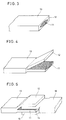
- Fig. 3 shows the as-obtained wire.
- an oxide superconductor 11 is covered with a metal coating 12, to form a tape-type superconducting wire 13.
- the metal coating 12 was separated from one side of an end portion of this tape-type superconducting wire 13, as shown in Fig. 4.
- Fig. 5 shows the tape-type superconducting wire 13, which was joined to another tape-type superconducting wire 16 of a similar state.
- the oxide superconductor 11 of the former was overlapped with an oxide superconductor 14 of the latter.
- a portion of the metal coating 12 separated from the end of the tape-type superconducting wire 13 was placed on the other tape-type superconducting wire 16, while a portion of a metal coating 15 separated from an end of the latter was placed on the former.
- the oxide superconductors 11 and 14 were overlapped with each other over a length of 10 mm.
- Such tape-type superconducting wires 13 and 16 were pressed with a load of 20 tons, and rolled into 0.15 mm in thickness as a whole.
- the as-formed wire was heat treated at 840°C for 50 hours.
- the junction of this wire exhibited a critical current of 30 to 40 A, which was proved to be substantially equivalent to that of this wire at the liquid nitrogen temperature.
- Oxides or carbonates were mixed so that Bi, Pb, Sr, Ca and Cu were in composition ratios of 1.82:0.43:2.00:2.07:3.00, and this mixture was heat treated to prepare powder mainly consisting of 2212 phases and non-superconducting phases.
- This powder was degassed in the atmosphere at 800°C for 2 hours.
- the powder was covered with a silver pipe of 12 mm in outer diameter and 8 mm in inner diameter, drawn into 1 mm in diameter, and rolled into 0.17 mm in thickness.
- the as-formed wire was heat treated at 850°C for 50 hours.
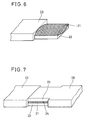
- Fig. 6 shows the as-obtained tape-type superconducting wire 23, which is covered with a silver coating 22. A portion of the silver coating 22 was separated from one side in an end of the tape-type superconducting wire 23 over a length of 10 mm, to expose a superconductor 21.
- Fig. 7 shows such a tape-type superconducting wire 23, which was combined with another tape-type superconducting wire 26 of a similar state so that the oxide superconductor 21 of the former was overlapped with an oxide superconductor 24 of the latter.
- Such a structure was pressed with a load of 30 tons, and thereafter heat treated at 840°C for 50 hours. At the liquid nitrogen temperature, the as-formed wire exhibited a critical current of 30 to 40 A, which was proved to be substantially equivalent to that of this wire at the liquid nitrogen temperature.
- Oxides or carbonates were mixed so that Bi, Pb, Sr, Ca and Cu were in composition ratios of 1.80:0.41:2.01:2.18:3.02, and this mixture was heat treated to prepare powder mainly consisting of 2212 phases and non-superconducting phases.
- This powder was degassed in the atmosphere at 800°C for 2 hours.
- This powder was covered with a silver pipe of 12 mm in outer diameter and 8 mm in inner diameter, drawn into 1 mm in diameter, and thereafter rolled into 0.17 mm in thickness.
- the asformed wire was heat treated and sintered at 845°C for 50 hours.
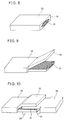
- Fig. 8 is a perspective view showing the as-obtained superconducting wire 33.
- the tape-type superconducting wire 33 comprises an oxide superconductor 31 which is covered with a metal coating 32. As shown in Fig. 9, a part of the metal coating 32 was separated from an end of the tape-type superconducting wire 33, to expose the superconductor 31.
- Fig. 10 is a perspective view showing the tape-type superconducting wire 33 which was overlapped with and joined to another tape-type superconducting wire 36 of a similar state.
- the superconductor 31 of the former was overlapped with a superconductor 34 of the latter over a length of 10 mm, while the separated portion of the metal coating 32 of the former was placed on the latter and a separated portion of a metal coating 35 of the latter was placed on the former.
- Such a structure was heat treated at 840°C for 50 hours with application of a load of 5 tons.
- the junction of the as-formed wire exhibited a critical current of 20 to 30 A, which was equivalent to that of this wire at the liquid nitrogen temperature.
- Oxides or carbonates were mixed so that Bi, Pb, Sr, Ca and Cu were in composition ratios of 1.82:0.43:2.00:2.07:3.00, and this mixture was heat treated to prepare powder mainly consisting of 2212 phases and non-superconducting phases.
- This powder was degassed in the atmosphere at 800°C for 2 hours. Then, this powder was covered with a silver pipe of 12 mm in outer diameter and 8 mm in inner diameter, drawn into 1 mm in diameter and rolled into 0.17 mm in thickness. The as-formed wire was heat treated at 850°C for 50 hours.
- Fig. 11 shows the as-obtained tape-type superconducting wire 43. Portions of its metal coating 42 were separated from one end and cross-directional both sides of the tape-type superconducting wire 43 to expose a superconductor, as shown in Fig. 11.
- Fig. 12 is a perspective view showing the tape-type superconducting wire 43, which was overlapped with and joined to another tape-type superconducting wire 46 of a similar state.
- Such tape-type superconducting wires 43 and 46 were so arranged that the superconductor 41 of the former was overlapped with a superconductor 44 of the latter and the overlapped portions were covered with the metal coating 42 of the former and a metal coating 45 of the latter.
- the structure was wrapped in a glass tape to be supplied with a load, and heat treated at 840°C for 50 hours.
- the junction of the as-formed wire exhibited a critical current of 20 to 30 A, which was equivalent to that of this wire at the liquid nitrogen temperature.
- Oxides or carbonates were mixed so that Bi, Pb, Sr, Ca and Cu were in composition ratios of 1.80:0.41:2.01:2.18:3.20, and this mixture was heat treated to prepare powder mainly consisting of 2212 phases and non-superconducting phases.
- This powder was degassed in the atmosphere at 800°C for 2 hours.
- the powder was covered with a silver pipe of 12 mm in outer diameter and 8 mm in inner diameter, drawn into 1 mm in diameter, and thereafter rolled into 0.17 mm in thickness. At this time, the roll gap was so controlled that only a portion to be joined was 0.37 mm in thickness.
- the as-formed wire was heat treated and sintered at 845°C for 50 hours.
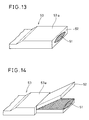
- Fig. 13 is a perspective view showing an end of the as-obtained tape-type superconducting wire 53.
- the tape-type superconducting wire 53 comprises a superconductor 51 which is covered with a metal coating 52.
- a portion 53a to be joined is larger in thickness than other portions.
- Fig. 14 is a perspective view showing the end of the tape-type superconducting wire 53, from which the metal coating 52 was separated to expose the superconductor 51.
- Fig. 15 shows such a superconducting wire 53, which was joined with another superconducting wire 56 of a similar state.
- the joined portion 53a of the superconducting wire 53 was butted with a joined portion 56a of the superconducting wire 56 to overlap the superconductor 51 of the former with a superconductor 54 of the latter over a length of 15 mm, so that the metal coating 52 of the former was located on the portion 56a of the latter and a metal coating 55 of the latter was located on the joined portion 53a of the former.
- this structure was pressed with a load of 30 tons, so that the as-formed junction was 0.25 mm in thickness.
- the as-formed wire was then heat treated at 840°C for 50 hours.
- the junction of the as-obtained wire exhibited a critical current of 35 to 45 A, while the wire itself exhibited a critical current of 25 to 30 A at the liquid nitrogen temperature.
- the wire itself exhibited a critical current of 25 to 30 A at the liquid nitrogen temperature.
- Oxides or carbonates were mixed so that Bi, Pb, Sr, Ca and Cu were in composition ratios of 1.82:0.43:2.00:2.07:3.00, and this mixture was heat treated to prepare powder mainly consisting of 2212 phases and non-superconducting phases.
- This powder was degassed in the atmosphere at 800°C for 2 hours.
- This powder was covered with a silver pipe of 12 mm in outer diameter and 8 mm in inner diameter, drawn into 1 mm in diameter, and then rolled into 0.17 mm in thickness.
- the as-formed superconducting wire was 5 mm in width. A portion to be joined was first worked into 0.35 mm in thickness by controlling a roll gap, and thereafter pressed into 10 mm in width with a load of 60 tons. This wire was heat treated at 850°C for 50 hours.
- Fig. 16 shows a portion 63a of the as-formed tape-type superconducting wire 63 to be joined, from which a metal coating 62 was separated to expose a superconductor 61.
- Fig. 17 is a perspective view showing the tape-type superconducting wire 63, which was joined to another tape-type superconducting wire 66 of a similar state.
- the superconductor 61 of the former was overlapped with a superconductor 64 of the latter over a length of 15 mm in forward ends of the joined portion 63a of the former and a joined portion 66a of the latter.
- the overlapped portions of the superconductors 61 and 64 were covered with the metal coating 62 of the former and a metal coating 65 of the latter.
- Such tape-type superconducting wires 63 and 66 were pressed with a load of 40 tons and heat treated at 840°C for 50 hours, to be completely joined to each other.
- the junction of the as-obtained wire exhibited a critical current of 40 to 47 A, while the wire exhibited a critical current of 25 to 30 A at the liquid nitrogen temperature.
- the wire exhibited a critical current of 25 to 30 A at the liquid nitrogen temperature.
- Oxides or carbonates were mixed so that Bi, Pb, Sr, Ca and Cu were in composition ratios of 1.80:0.41:2.01:2.18:3.02, and this mixture was heat treated to prepare powder mainly consisting of 2212 phases and non-superconducting phases.
- This powder was degassed in the atmosphere at 800°C for 2 hours.
- This powder was covered with a silver pipe of 12 mm in outer diameter and 8 mm in inner diameter, drawn into 1 mm in wire diameter and rolled into 0.17 mm in thickness.
- the as-formed wire was heat treated and sintered at 845°C for 50 hours.
- Fig. 18 shows an end of the as-obtained tape-type superconducting wire 73, which comprises a superconductor 71 covered with a metal coating 72.
- Fig. 19 shows an end of the tape-type superconducting wire 73, from which the metal coating 72 was separated to expose the superconductor 71.
- Fig. 20 shows the tape-type superconducting wire 73, which was joined to another tape-type superconducting wire 76 of a similar state to overlap the superconductor 71 of the former with a superconductor 74 of the latter.
- a metal coating 75 of the superconducting wire 76 was placed on the tape-type superconductor 73, whose metal coating 72 was placed on the tape-type superconducting wire 76.
- a silver foil member 77 of 30 ⁇ m in thickness, 10 mm in width and 20 mm in length was wound on such overlapped portions, as shown by one-dot chain lines in Fig. 20.
- the superconductors 71 and 74 were overlapped with each other over a length of 10 mm.
- Such a structure shown in Fig. 20 was pressed with a load of 30 tons and press-worked into 0.35 mm in thickness as a whole.
- the as-formed wire was heat treated at 840°C for 50 hours.
- the junction of this wire exhibited a critical current of 20 to 30 A, which was equivalent to that of the wire at the liquid nitrogen temperature.
- Oxides or carbonates were mixed so that Bi, Pb, Sr, Ca and Cu were in composition ratios of 1.82:0.43:2.00:2.07:3.00, and this mixture was heat treated to prepare powder mainly consisting of 2212 phases and non-superconducting phases.
- This powder was degassed in the atmosphere at 800°C for 2 hours.
- This powder was covered with a silver pipe of 12 mm in outer diameter and 8 mm in inner diameter, drawn into 1 mm in diameter, and thereafter rolled into 0.17 mm in thickness.
- the as-formed wire was heat treated at 850°C for 50 hours.
- Fig. 21 shows an end of the as-formed tape-type superconducting wire 83, in which a silver coating 82 was separated from one side over a length of 10 mm to expose a superconductor 81.
- Fig. 22 is a perspective view showing the tape-type superconducting wire 83, which was joined to another tape-type superconducting wire 86 of a similar state so that the superconductor 81 of the former was overlapped with a superconductor 84 of the latter, and covered with the metal coating 82 of the former and a metal coating 85 of the latter. Further, the overlapped portions were covered with a silver foil member 87 of 30 ⁇ m in thickness, 10 mm in width and 20 mm in length. In this state, the structure was pressed into 0.20 mm in thickness with a load of 40 tons, and heat treated at 840°C for 50 hours, so that the superconductors 81 and 84 were joined to each other. At the liquid nitrogen temperature, the junction of the as-obtained wire exhibited a critical current of 20 to 30 A, which was equivalent to that of the wire at the liquid nitrogen temperature.
- Fig. 23 shows the as-obtained tape-type superconducting wire 93.
- the tape-type superconducting wire 93 comprises a superconductor 91 which is covered with a metal coating 92.
- Fig. 24 is a plan view showing an end of the tape-type superconducting wire 93, from which the metal coating 92 was separated.
- an end surface 93a of the forward end of the tape-type superconducting wire 93 was cut to be inclined at a prescribed angle with respect to the cross direction. Portions of the metal coating 92 were removed from both side portions of the superconducting wire 93 along the cross direction, to expose the superconductor 91.
- an end surface 93b of the metal coating 92 defined by separation thereof was inclined to be in parallel with the end surface 93a of the forward end of the tape-type superconducting wire 93.
- Fig. 25 is a plan view showing the tape-type superconducting wire 93 which was overlapped with and joined to another tape-type superconducting wire 96 of a similar state.
- An end surface 96a of the forward end of the latter was butted with the end surface 93b of the metal coating 93 of the former.
- the end surface 93a of the forward end of the tape-type superconducting wire 93 was butted with an end surface 96b of a metal coating of the tape-type superconducting wire 96.
- the superconductor 91 of the former was overlapped with that of the latter over a length of 10 mm in the longitudinal direction. Such a structure was pressed with a load of 50 tons into 0.15 mm in thickness as a whole.
- the as-formed wire was heat treated at 840°C for 50 hours. At the liquid nitrogen temperature, the junction of this wire exhibited a critical current of 25 to 35 A, which was equivalent to that of the wire at the liquid nitrogen temperature. Thus, it has been proved possible to obtain a highly reliable junction.
- Oxides or carbonates were mixed so that Bi, Pb, Sr, Ca and Cu were in composition ratios of 1.82:0.43:2.00:2.07:3.00, and this mixture was heat treated to prepare powder mainly consisting of 2212 phases and non-superconducting phases.
- This powder was degassed in the atmosphere at 800°C for 2 hours.
- This powder was covered with a silver pipe of 12 mm in outer diameter and 8 mm in inner diameter, drawn into 1 mm in diameter and further rolled into 0.17 mm in thickness. After the rolling, the as-formed wire was heat treated at 850°C for 50 hours.
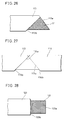
- FIG. 26 An end of the as-obtained tape-type superconducting wire 113, which was similar to that shown in Fig. 23, was processed as shown in Fig. 26.
- the forward end of the tape-type superconducting wire 113 was so cut that its end surface 113a was inclined at a prescribed angle with respect to the cross direction, and then a metal coating was separated to expose a superconductor 111.
- the metal coating was so separated that the as-defined end surface 113b thereof was inclined at a symmetrical angle with respect to the end surface 113a of the forward end.
- the superconductor 111 was exposed in a triangular form, as shown in Fig. 26.
- Fig. 27 is a plan view showing the tape-type superconducting wire 113, which was joined to another tape-type superconducting wire 116 of a similar state.
- An end surface 116a of the forward end of the latter was butted with the end surface 113b of the metal coating of the former, while the end surface 113a of the forward end of the former was butted with an end surface 116b of a metal coating of the latter, to overlap the superconductors with each other.
- This structure was pressed with a load of 30 tons, and heat treated at 840°C for 50 hours.
- the junction of the as-formed wire exhibited a critical current of 30 to 40 A, which was equivalent to that of the wire at the liquid nitrogen temperature. Thus, it has been proved possible to obtain a highly reliable junction.
- Examples 11 and 12 are superior to that obtained by forming an end portion of a tape-type superconducting wire and an end surface defined by separation of a metal coating in parallel with the cross direction of the superconducting wire. This is now described with reference to the drawings.
- Fig. 28 shows an end of a tape-type superconducting wire 123 and an end surface of a metal coating, which are in parallel with the cross direction.
- the metal coating is separated from this side along the cross direction of a joined portion at the end of the tape-type superconducting wire 123, to expose a superconductor 121.
- the metal coating is left on the other side (not shown) of the superconductor 121.
- the left portion of the metal coating and an end surface 123a of the superconductor 121 are in parallel with the cross direction.
- an end surface 123b of the metal coating defined by separation thereof is also in parallel with the cross direction.
- Fig. 29 is a sectional view showing the tape-type superconducting wire 123, which is overlapped with and joined to another tape-type superconducting wire 126 of a similar state, so that the end surface 123a of the forward end of the former is butted with an end surface 126b of a metal coating 125 of the latter. Further, the end surface 123b of the metal coating 122 of the former is butted with an end surface 126a of the forward end of the latter.
- a layer of the joined portion of the superconductor 121 may be displaced from that of a superconductor 124 of the superconducting wire 126, as shown in Fig. 29.
- Such displacement may reduce the critical current.
- it is possible to prevent such displacement by processing the ends of the superconducting wires to be inclined with respect to the cross direction, as shown in Example 11 or 12. This is because the boundary surface between the joined superconductors is elongated along the longitudinal direction of the as-formed wire. Thus, it is possible to prevent bending at the joined portions, thereby preventing reduction of the critical current.
- Oxides or carbonates were mixed so that Bi, Pb, Sr, Ca and Cu were in composition ratios of 1.80:0.41:2.01:2.18:3.02, and this mixture was heat treated to prepare powder mainly consisting of 2212 phases and non-superconducting phases.
- This powder was degassed in the atmosphere at 800°C for 2 hours.
- the powder was covered with a silver pipe of 12 mm in outer diameter and 8 mm in inner diameter, drawn into 1 mm in diameter, and rolled into 0.17 mm in thickness.
- the as-formed wire was heat treated and sintered at 845°C for 50 hours.
- Fig. 30 is a perspective view showing the as-obtained tape-type superconducting wire 110a which comprises a superconductor 131 covered with a metal coating 132.
- Fig. 31 is a perspective view showing an end of the tape-type superconducting wire 110a, from which the metal coating 132 was separated to expose the superconductor 131, with four similar tape-type superconducting wires 120a, 130a, 140a and 150a which were stacked on the tape-type superconducting wire 110a so that portions to be joined were successively displaced along the longitudinal direction.
- FIG. 32 another structure of such tape-type superconducting wires was prepared to be overlapped with the structure shown in Fig. 31.
- the tape-type superconducting wires 110a, 120a, 130a, 140a and 150a were overlapped with tape-type superconducting wires 110b, 120b, 130b, 140b and 150b of the other structure respectively.
- superconductors were overlapped with each other at the joined portions of the respective tape-type superconducting wires.
- the composite of such structures was pressed with a load of 20 tons into 0.75 mm in thickness as a whole.
- the as-obtained wire which was formed by a plurality of layers of tape-type superconducting wires, was heat treated at 840°C for 50 hours. At the liquid nitrogen temperature, the junction of this wire exhibited a critical current of 90 to 100 A, which was substantially equivalent to that of the wire at the liquid nitrogen temperature, and no reduction of the critical current was recognized at the junction.
- Fig. 33 is a perspective view showing the as-obtained tape-type superconducting wire 143, which comprises a superconductor 141 covered with a metal coating 142.
- the metal coating 142 was separated from one side of this wire 143 to expose the superconductor 141 over a length of 20 mm along the longitudinal direction.
- Fig. 35 is a perspective view showing the tape-type superconducting wire 143, which was cross-directionally joined to another tape-type superconducting wire 146 of a similar state.
- still another superconducting wire 147 was placed on these tape-type superconducting wires 143 and 146, so that a superconductor 148 of the former was overlapped on the exposed superconductors 141 and 144.
- the superconductor 148 was covered with a metal coating 149.
- the structure was pressed with a load of 20 tons into 0.15 mm in thickness as a whole.
- the as-formed wire was heat treated at 840°C for 50 hours.
- the junction of the as-obtained wire exhibited a critical current of 20 to 30 A, which was substantially equivalent to that of the wire at the liquid nitrogen temperature.
- Oxides or carbonates were mixed so that Bi, Pb, Sr, Ca and Cu were in composition ratios of 1.82:0.43:2.00:2.07:3.00, and this mixture was heat treated to prepare powder mainly consisting of 2212 phases and non-superconducting phases.
- This powder was degassed in the atmosphere at 800°C for 2 hours.
- the powder was covered with a silver pipe of 12 mm in outer diameter and 8 mm in inner diameter, drawn into 1 mm in diameter, and thereafter rolled into 0.17 mm in thickness.
- the as-formed wire was heat treated at 850°C for 50 hours.
- Fig. 36 is a perspective view showing two such tape-type superconducting wires 153 and 156 which were joined to each other.
- a superconductor 151 was exposed from a metal coating 152, while a superconductor was similarly exposed from a metal coating at an end of the tape-type superconducting wire 156.
- Other two superconducting wires 157 and 160 were placed between these tape-type superconducting wires 153 and 156, so that a superconductor 158 was downwardly exposed from a metal coating 159 in the former while a superconductor 161 was downwardly exposed from a metal coating 162 in the latter.
- the superconductor 151 of the tape-type superconducting wire 153 was overlapped with that of the tape-type superconducting wire 156, while the superconductors 158 and 161 of the superconducting wires 157 and 160 were overlapped with each other.
- the metal coating was separated over a length of 10 mm from its end.
- Fig. 36 The structure shown in Fig. 36 was pressed with a load of 30 tons, and heat treated at 840°C for 50 hours. At the liquid nitrogen temperature, the junction of the as-obtained wire exhibited a critical current of 20 to 25 A, which was equivalent to that of the wire at the liquid nitrogen temperature.
- the present invention as hereinabove described, it is possible to provide a junction which can stably carry a superconducting current.
- the present invention is particularly usefully applied to a permanent current junction of a coil and a junction of a heavy-current conductor.
- the junction and the joining method according to the present invention are effectively applied to a cable, a bus bar, a power lead, a magnet, and the like.
Landscapes
- Chemical & Material Sciences (AREA)
- Engineering & Computer Science (AREA)
- Ceramic Engineering (AREA)
- Manufacturing & Machinery (AREA)
- Materials Engineering (AREA)
- Structural Engineering (AREA)
- Organic Chemistry (AREA)
- Inorganic Chemistry (AREA)
- Physics & Mathematics (AREA)
- Condensed Matter Physics & Semiconductors (AREA)
- General Physics & Mathematics (AREA)
- Superconductors And Manufacturing Methods Therefor (AREA)
Applications Claiming Priority (16)
| Application Number | Priority Date | Filing Date | Title |
|---|---|---|---|
| JP30398/91 | 1991-02-25 | ||
| JP03030398A JP3143932B2 (ja) | 1991-02-25 | 1991-02-25 | 超電導線の製造方法 |
| JP3056683A JPH04292879A (ja) | 1991-03-20 | 1991-03-20 | 超電導線の接合方法 |
| JP56678/91 | 1991-03-20 | ||
| JP3056680A JPH04292876A (ja) | 1991-03-20 | 1991-03-20 | 超電導線の接合方法 |
| JP56681/91 | 1991-03-20 | ||
| JP3056681A JPH04292877A (ja) | 1991-03-20 | 1991-03-20 | 超電導線の接合方法 |
| JP3056677A JPH04292873A (ja) | 1991-03-20 | 1991-03-20 | 超電導線の接合方法 |
| JP56677/91 | 1991-03-20 | ||
| JP56679/91 | 1991-03-20 | ||
| JP56683/91 | 1991-03-20 | ||
| JP56680/91 | 1991-03-20 | ||
| JP3056679A JPH04292875A (ja) | 1991-03-20 | 1991-03-20 | 超電導線の接合部 |
| JP3056678A JPH04292874A (ja) | 1991-03-20 | 1991-03-20 | 超電導線の接合方法 |
| JP3056682A JPH04292878A (ja) | 1991-03-20 | 1991-03-20 | 超電導線の接合方法 |
| JP56682/91 | 1991-03-20 |
Publications (4)
| Publication Number | Publication Date |
|---|---|
| EP0501394A2 true EP0501394A2 (fr) | 1992-09-02 |
| EP0501394A3 EP0501394A3 (en) | 1992-10-21 |
| EP0501394B1 EP0501394B1 (fr) | 1995-05-03 |
| EP0501394B2 EP0501394B2 (fr) | 1999-04-07 |
Family
ID=27572107
Family Applications (1)
| Application Number | Title | Priority Date | Filing Date |
|---|---|---|---|
| EP92103099A Expired - Lifetime EP0501394B2 (fr) | 1991-02-25 | 1992-02-24 | Jonction entre fils utilisant des superconducteurs oxydés et méthode de jonction associée |
Country Status (5)
| Country | Link |
|---|---|
| US (2) | US5949131A (fr) |
| EP (1) | EP0501394B2 (fr) |
| AU (1) | AU653983B2 (fr) |
| DE (1) | DE69202275T3 (fr) |
| FI (1) | FI920803A7 (fr) |
Cited By (6)
| Publication number | Priority date | Publication date | Assignee | Title |
|---|---|---|---|---|
| EP0545608A3 (en) * | 1991-12-02 | 1993-07-14 | General Electric Company | Superconducting joint for oxide superconductor tape |
| EP0807939A1 (fr) * | 1996-05-13 | 1997-11-19 | Sumitomo Electric Industries, Ltd. | Bobine supraconductrice |
| EP0807994A3 (fr) * | 1996-05-13 | 1998-05-13 | Sumitomo Electric Industries, Ltd. | Structure pour la connexion de supraconducteurs |
| CN103855586A (zh) * | 2014-03-21 | 2014-06-11 | 西北有色金属研究院 | 一种Bi-2212线材超导接头的制备方法 |
| EP3157070A1 (fr) * | 2015-10-14 | 2017-04-19 | Bruker HTS GmbH | Structure supraconductrice destinée à relier des rubans conducteurs, en particulier à l'aide d'une soudure ondulée ou dentelée |
| GB2565839A (en) * | 2017-08-25 | 2019-02-27 | Tokamak Energy Ltd | Superconducting joint using exfoliated ReBCO |
Families Citing this family (14)
| Publication number | Priority date | Publication date | Assignee | Title |
|---|---|---|---|---|
| US6133814A (en) * | 1996-08-30 | 2000-10-17 | Hitachi, Ltd. | Oxide superconductor wire material and method for jointing the same together |
| DE60041512D1 (de) * | 1999-11-04 | 2009-03-19 | Sumitomo Electric Industries | Herstellungsverfahren für oxyd-supraleiterdraht und oxyd-supraleiterdraht |
| DE10225531B4 (de) * | 2002-06-10 | 2005-05-12 | Bruker Biospin Gmbh | Supraleitende Hochfeld-Magnetspule mit supraleitenden Übergangsstellen |
| US7394024B2 (en) * | 2003-02-06 | 2008-07-01 | Dowa Mining Co., Ltd. | Oxide superconductor current lead and method of manufacturing the same, and superconducting system |
| US8304372B2 (en) * | 2007-01-31 | 2012-11-06 | Council Of Scientific And Industrial Research | Process for joining oxide superconducting tubes with a superconducting joint |
| US20080236869A1 (en) * | 2007-03-30 | 2008-10-02 | General Electric Company | Low resistivity joints for joining wires and methods for making the same |
| CN101075496B (zh) * | 2007-04-20 | 2010-12-08 | 中国科学院电工研究所 | 一种高温超导磁体双饼线圈间的接头及其焊接方法 |
| US8594756B2 (en) * | 2007-06-22 | 2013-11-26 | Nkt Cables Ultera A/S | Superconducting element joint, a process for providing a superconducting element joint and a superconducting cable system |
| EP2168179B1 (fr) * | 2007-06-22 | 2014-08-13 | NKT Cables Ultera A/S | Jonction d'éléments supraconducteurs |
| KR20110105679A (ko) * | 2010-03-19 | 2011-09-27 | 고려대학교 산학협력단 | 제 1세대 고온 초전도 선재의 초전도 접합 방법 |
| WO2012176074A1 (fr) | 2011-06-21 | 2012-12-27 | Council Of Scientific & Industrial Research | Procédé pour relier des tubes de supraconducteurs à haute température en oxyde de (bi,pb)-2223 utilisant une pâte supraconductrice modifiée |
| JP6210537B2 (ja) * | 2013-08-06 | 2017-10-11 | 古河電気工業株式会社 | 超電導ケーブルの接続構造、超電導ケーブル、超電導ケーブルの終端部の電流端子構造 |
| EP3172035A1 (fr) * | 2014-07-25 | 2017-05-31 | Tyco Electronics Raychem GmbH | Épissure de câbles électriques et procédé pour la connexion de câbles de transport d'énergie |
| EP4672951A1 (fr) | 2024-06-28 | 2025-12-31 | Bruker Switzerland AG | Procédé de fabrication d'un joint supraconducteur à scellement hermétique |
Family Cites Families (32)
| Publication number | Priority date | Publication date | Assignee | Title |
|---|---|---|---|---|
| US3473217A (en) * | 1964-02-25 | 1969-10-21 | Nat Res Dev | Manufacture of superconductors |
| FR2029789A1 (fr) * | 1969-01-31 | 1970-10-23 | Oerlikon Ateliers Constr | |
| FR2054506B1 (fr) * | 1969-07-18 | 1975-08-22 | Thomson Csf | |
| WO1980002084A1 (fr) * | 1979-03-27 | 1980-10-02 | Varian Associates | Jonction superconductrice |
| JPS5774983A (en) | 1980-10-25 | 1982-05-11 | Sumitomo Electric Industries | Method of connecting superconductive wire |
| JPS603796B2 (ja) * | 1982-03-12 | 1985-01-30 | 工業技術院長 | 超電導回路用コンタクト |
| US4584547A (en) * | 1983-12-30 | 1986-04-22 | General Electric Company | Superconducting joint for superconducting wires and coils |
| JPS61110976A (ja) * | 1984-11-06 | 1986-05-29 | 三菱電機株式会社 | 超電導導体の接続方法 |
| JPS61179584A (ja) * | 1985-02-04 | 1986-08-12 | Oki Electric Ind Co Ltd | ジヨセフソン接合素子 |
| JPS61188277A (ja) | 1985-02-14 | 1986-08-21 | Honda Motor Co Ltd | 乗用トラクタの車体フレ−ム |
| JPS6254236A (ja) | 1985-09-02 | 1987-03-09 | Minolta Camera Co Ltd | 絞り値情報切換可能なレンズ鏡胴 |
| JPS62123669A (ja) | 1985-11-25 | 1987-06-04 | 株式会社東芝 | 超電導線の接続方法 |
| JPS63284767A (ja) | 1987-05-14 | 1988-11-22 | Fujikura Ltd | 超電導線の接続構造 |
| JPH07118360B2 (ja) | 1987-06-16 | 1995-12-18 | 株式会社フジクラ | 超電導線の接続方法 |
| JP2554659B2 (ja) * | 1987-06-30 | 1996-11-13 | 株式会社東芝 | 複合酸化物超電導体線材の接続部 |
| JP2549705B2 (ja) | 1988-05-30 | 1996-10-30 | 株式会社フジクラ | 酸化物超電導導体の接続方法 |
| US5051397A (en) * | 1988-11-25 | 1991-09-24 | Hitachi, Ltd. | Joined body of high-temperature oxide superconductor and method of joining oxide superconductors |
| JP2550188B2 (ja) | 1988-11-25 | 1996-11-06 | 株式会社日立製作所 | 酸化物系高温超電導体と接合方法及びろう材 |
| JPH02186575A (ja) | 1989-01-12 | 1990-07-20 | Sanyo Electric Co Ltd | 酸化物超電導体の接合方法 |
| JPH02227248A (ja) * | 1989-02-28 | 1990-09-10 | Osaka Prefecture | 酸化物超伝導体の接続方法 |
| JP2922914B2 (ja) | 1989-03-15 | 1999-07-26 | 三菱電機株式会社 | 酸化物超電導体端子 |
| JPH0330265A (ja) | 1989-06-27 | 1991-02-08 | Agency Of Ind Science & Technol | 超電導セラミックスの異方性接合の方法 |
| JPH0330264A (ja) | 1989-06-27 | 1991-02-08 | Agency Of Ind Science & Technol | 超電導セラミックスの接合方法 |
| US5082826A (en) * | 1989-08-02 | 1992-01-21 | The United States Of America As Represented By The Secretary Of The Navy | Silver coated superconducting ceramic powder |
| JP2923988B2 (ja) * | 1989-08-09 | 1999-07-26 | 住友電気工業株式会社 | 超電導導体 |
| US5116810A (en) * | 1989-10-16 | 1992-05-26 | American Superconductor Corporation | Process for making electrical connections to high temperature superconductors using a metallic precursor and the product made thereby |
| US5104028A (en) * | 1989-12-28 | 1992-04-14 | Electric Power Research Institute, Inc. | Method for joining transformer coil conductors |
| US5109593A (en) * | 1990-08-01 | 1992-05-05 | General Electric Company | Method of melt forming a superconducting joint between superconducting tapes |
| US5134040A (en) * | 1990-08-01 | 1992-07-28 | General Electric Company | Melt formed superconducting joint between superconducting tapes |
| US5082164A (en) * | 1990-08-01 | 1992-01-21 | General Electric Company | Method of forming superconducting joint between superconducting tapes |
| US5180707A (en) * | 1991-02-08 | 1993-01-19 | Massachusetts Institute Of Technology | Method for synthesis of high tc superconducting materials by oxidation and press coating of metallic precursor alloys |
| DE69313891T2 (de) * | 1992-02-20 | 1998-05-07 | Sumitomo Electric Industries | Verfahren für die Verbindung von supraleitenden Drähte aus Oxyd-Hochtemperatur-Supraleiter |
-
1992
- 1992-02-18 AU AU11018/92A patent/AU653983B2/en not_active Expired
- 1992-02-24 DE DE69202275T patent/DE69202275T3/de not_active Expired - Lifetime
- 1992-02-24 EP EP92103099A patent/EP0501394B2/fr not_active Expired - Lifetime
- 1992-02-24 FI FI920803A patent/FI920803A7/fi unknown
-
1995
- 1995-05-22 US US08/446,349 patent/US5949131A/en not_active Expired - Lifetime
-
1998
- 1998-07-09 US US09/112,970 patent/US6194226B1/en not_active Expired - Fee Related
Cited By (11)
| Publication number | Priority date | Publication date | Assignee | Title |
|---|---|---|---|---|
| EP0545608A3 (en) * | 1991-12-02 | 1993-07-14 | General Electric Company | Superconducting joint for oxide superconductor tape |
| EP0807939A1 (fr) * | 1996-05-13 | 1997-11-19 | Sumitomo Electric Industries, Ltd. | Bobine supraconductrice |
| EP0807994A3 (fr) * | 1996-05-13 | 1998-05-13 | Sumitomo Electric Industries, Ltd. | Structure pour la connexion de supraconducteurs |
| US5861788A (en) * | 1996-05-13 | 1999-01-19 | Sumitomo Electric Industries, Ltd. | Superconducting coil |
| US6414244B1 (en) | 1996-05-13 | 2002-07-02 | Sumitomo Electric Industries, Ltd. | Connection structure for superconducting conductors including stacked conductors |
| CN103855586A (zh) * | 2014-03-21 | 2014-06-11 | 西北有色金属研究院 | 一种Bi-2212线材超导接头的制备方法 |
| CN103855586B (zh) * | 2014-03-21 | 2015-12-09 | 西北有色金属研究院 | 一种Bi-2212线材超导接头的制备方法 |
| EP3157070A1 (fr) * | 2015-10-14 | 2017-04-19 | Bruker HTS GmbH | Structure supraconductrice destinée à relier des rubans conducteurs, en particulier à l'aide d'une soudure ondulée ou dentelée |
| US10418154B2 (en) | 2015-10-14 | 2019-09-17 | Bruker Hts Gmbh | Superconducting structure for connecting tape conductors, in particular having a corrugated or serrated seam |
| GB2565839A (en) * | 2017-08-25 | 2019-02-27 | Tokamak Energy Ltd | Superconducting joint using exfoliated ReBCO |
| US10840616B2 (en) | 2017-08-25 | 2020-11-17 | Tokamak Energy Ltd. | Superconducting joint using exfoliated ReBCO |
Also Published As
| Publication number | Publication date |
|---|---|
| EP0501394B2 (fr) | 1999-04-07 |
| AU1101892A (en) | 1992-08-27 |
| FI920803A7 (fi) | 1992-08-26 |
| EP0501394B1 (fr) | 1995-05-03 |
| DE69202275D1 (de) | 1995-06-08 |
| FI920803A0 (fi) | 1992-02-24 |
| EP0501394A3 (en) | 1992-10-21 |
| DE69202275T3 (de) | 1999-10-28 |
| US6194226B1 (en) | 2001-02-27 |
| US5949131A (en) | 1999-09-07 |
| DE69202275T2 (de) | 1995-09-14 |
| AU653983B2 (en) | 1994-10-20 |
Similar Documents
| Publication | Publication Date | Title |
|---|---|---|
| US5949131A (en) | Junction between wires employing oxide superconductors and joining method therefor | |
| CA2089951C (fr) | Methode utilisee pour reunir des fils supraconducteurs a l'aide d'un supraconducteur pour temperatures elevees a base d'oxydes | |
| US5801124A (en) | Laminated superconducting ceramic composite conductors | |
| EP0451864B1 (fr) | Conducteur supraconducteur | |
| CN106663503B (zh) | 氧化物超导电线材的连接结构体及其制造方法 | |
| EP0467237B1 (fr) | Procédé pour la fabrication d'un câble supraconducteur | |
| EP0807994B2 (fr) | Structure pour la connexion de supraconducteurs | |
| EP0769819A1 (fr) | Fil supraconducteur d'oxyde et procédé de fabrication | |
| JP2685751B2 (ja) | 化合物超伝導線及び化合物超伝導線の製造方法 | |
| AU744501B2 (en) | Superconducting tapes | |
| EP0545608A2 (fr) | Jonction supraconductrice pour une bande supraconductrice en oxyde | |
| US5719106A (en) | Method of heat treating oxide superconducting wire | |
| US6819948B2 (en) | Superconducting tapes | |
| JP2998398B2 (ja) | 超電導線の接合方法 | |
| JPH065342A (ja) | 超電導線の接合方法 | |
| JP2735534B2 (ja) | 化合物超伝導線及び化合物超伝導線の製造方法 | |
| JP3078765B2 (ja) | 化合物超伝導線及び化合物超伝導線の製造方法 | |
| JPS63225410A (ja) | 化合物超電導線及びその製造方法 | |
| JPH04292879A (ja) | 超電導線の接合方法 | |
| JP2685751C (fr) | ||
| JPH04292874A (ja) | 超電導線の接合方法 | |
| JPH04292877A (ja) | 超電導線の接合方法 | |
| JPH09500351A (ja) | 非偏析酸化物超伝導体銀複合体 | |
| JPH04292875A (ja) | 超電導線の接合部 | |
| JPH1050151A (ja) | 化合物超伝導線 |
Legal Events
| Date | Code | Title | Description |
|---|---|---|---|
| PUAI | Public reference made under article 153(3) epc to a published international application that has entered the european phase |
Free format text: ORIGINAL CODE: 0009012 |
|
| PUAL | Search report despatched |
Free format text: ORIGINAL CODE: 0009013 |
|
| AK | Designated contracting states |
Kind code of ref document: A2 Designated state(s): CH DE FR GB IT LI SE |
|
| AK | Designated contracting states |
Kind code of ref document: A3 Designated state(s): CH DE FR GB IT LI SE |
|
| 17P | Request for examination filed |
Effective date: 19930112 |
|
| 17Q | First examination report despatched |
Effective date: 19940126 |
|
| GRAA | (expected) grant |
Free format text: ORIGINAL CODE: 0009210 |
|
| AK | Designated contracting states |
Kind code of ref document: B1 Designated state(s): CH DE FR GB IT LI SE |
|
| ITF | It: translation for a ep patent filed | ||
| REF | Corresponds to: |
Ref document number: 69202275 Country of ref document: DE Date of ref document: 19950608 |
|
| ET | Fr: translation filed | ||
| PLBI | Opposition filed |
Free format text: ORIGINAL CODE: 0009260 |
|
| PLBF | Reply of patent proprietor to notice(s) of opposition |
Free format text: ORIGINAL CODE: EPIDOS OBSO |
|
| 26 | Opposition filed |
Opponent name: SIEMENS AG ZFE GR PA Z Effective date: 19960112 |
|
| PLBF | Reply of patent proprietor to notice(s) of opposition |
Free format text: ORIGINAL CODE: EPIDOS OBSO |
|
| PLAW | Interlocutory decision in opposition |
Free format text: ORIGINAL CODE: EPIDOS IDOP |
|
| PLAW | Interlocutory decision in opposition |
Free format text: ORIGINAL CODE: EPIDOS IDOP |
|
| PUAH | Patent maintained in amended form |
Free format text: ORIGINAL CODE: 0009272 |
|
| STAA | Information on the status of an ep patent application or granted ep patent |
Free format text: STATUS: PATENT MAINTAINED AS AMENDED |
|
| 27A | Patent maintained in amended form |
Effective date: 19990407 |
|
| AK | Designated contracting states |
Kind code of ref document: B2 Designated state(s): CH DE FR GB IT LI SE |
|
| ET3 | Fr: translation filed ** decision concerning opposition | ||
| REG | Reference to a national code |
Ref country code: CH Ref legal event code: AEN Free format text: MAINTIEN DU BREVET DONT L'ETENDUE A ETE MODIFIEE |
|
| PGFP | Annual fee paid to national office [announced via postgrant information from national office to epo] |
Ref country code: SE Payment date: 20000207 Year of fee payment: 9 |
|
| PGFP | Annual fee paid to national office [announced via postgrant information from national office to epo] |
Ref country code: CH Payment date: 20000228 Year of fee payment: 9 |
|
| PG25 | Lapsed in a contracting state [announced via postgrant information from national office to epo] |
Ref country code: SE Free format text: LAPSE BECAUSE OF NON-PAYMENT OF DUE FEES Effective date: 20010225 |
|
| PG25 | Lapsed in a contracting state [announced via postgrant information from national office to epo] |
Ref country code: CH Free format text: LAPSE BECAUSE OF NON-PAYMENT OF DUE FEES Effective date: 20010228 Ref country code: LI Free format text: LAPSE BECAUSE OF NON-PAYMENT OF DUE FEES Effective date: 20010228 |
|
| REG | Reference to a national code |
Ref country code: CH Ref legal event code: PL |
|
| EUG | Se: european patent has lapsed |
Ref document number: 92103099.5 |
|
| REG | Reference to a national code |
Ref country code: GB Ref legal event code: IF02 |
|
| PGFP | Annual fee paid to national office [announced via postgrant information from national office to epo] |
Ref country code: IT Payment date: 20110216 Year of fee payment: 20 Ref country code: FR Payment date: 20110218 Year of fee payment: 20 Ref country code: DE Payment date: 20110216 Year of fee payment: 20 |
|
| PGFP | Annual fee paid to national office [announced via postgrant information from national office to epo] |
Ref country code: GB Payment date: 20110223 Year of fee payment: 20 |
|
| REG | Reference to a national code |
Ref country code: DE Ref legal event code: R071 Ref document number: 69202275 Country of ref document: DE |
|
| REG | Reference to a national code |
Ref country code: DE Ref legal event code: R071 Ref document number: 69202275 Country of ref document: DE |
|
| REG | Reference to a national code |
Ref country code: GB Ref legal event code: PE20 Expiry date: 20120223 |
|
| PG25 | Lapsed in a contracting state [announced via postgrant information from national office to epo] |
Ref country code: DE Free format text: LAPSE BECAUSE OF EXPIRATION OF PROTECTION Effective date: 20120225 |
|
| PG25 | Lapsed in a contracting state [announced via postgrant information from national office to epo] |
Ref country code: GB Free format text: LAPSE BECAUSE OF EXPIRATION OF PROTECTION Effective date: 20120223 |