EP0517200B1 - Procédé pour la préparation enzymatique de dérivés de céphalosporine - Google Patents
Procédé pour la préparation enzymatique de dérivés de céphalosporine Download PDFInfo
- Publication number
- EP0517200B1 EP0517200B1 EP92109410A EP92109410A EP0517200B1 EP 0517200 B1 EP0517200 B1 EP 0517200B1 EP 92109410 A EP92109410 A EP 92109410A EP 92109410 A EP92109410 A EP 92109410A EP 0517200 B1 EP0517200 B1 EP 0517200B1
- Authority
- EP
- European Patent Office
- Prior art keywords
- reaction
- carried out
- process according
- derivatives
- amino acid
- Prior art date
- Legal status (The legal status is an assumption and is not a legal conclusion. Google has not performed a legal analysis and makes no representation as to the accuracy of the status listed.)
- Expired - Lifetime
Links
- 0 CCC(NCN=C)=*=*(CC)C(C(CO)**)N Chemical compound CCC(NCN=C)=*=*(CC)C(C(CO)**)N 0.000 description 1
Classifications
-
- C—CHEMISTRY; METALLURGY
- C12—BIOCHEMISTRY; BEER; SPIRITS; WINE; VINEGAR; MICROBIOLOGY; ENZYMOLOGY; MUTATION OR GENETIC ENGINEERING
- C12N—MICROORGANISMS OR ENZYMES; COMPOSITIONS THEREOF; PROPAGATING, PRESERVING, OR MAINTAINING MICROORGANISMS; MUTATION OR GENETIC ENGINEERING; CULTURE MEDIA
- C12N9/00—Enzymes; Proenzymes; Compositions thereof; Processes for preparing, activating, inhibiting, separating or purifying enzymes
- C12N9/0004—Oxidoreductases (1.)
- C12N9/0012—Oxidoreductases (1.) acting on nitrogen containing compounds as donors (1.4, 1.5, 1.6, 1.7)
- C12N9/0014—Oxidoreductases (1.) acting on nitrogen containing compounds as donors (1.4, 1.5, 1.6, 1.7) acting on the CH-NH2 group of donors (1.4)
- C12N9/0022—Oxidoreductases (1.) acting on nitrogen containing compounds as donors (1.4, 1.5, 1.6, 1.7) acting on the CH-NH2 group of donors (1.4) with oxygen as acceptor (1.4.3)
- C12N9/0024—D-Amino acid oxidase (1.4.3.3)
-
- C—CHEMISTRY; METALLURGY
- C12—BIOCHEMISTRY; BEER; SPIRITS; WINE; VINEGAR; MICROBIOLOGY; ENZYMOLOGY; MUTATION OR GENETIC ENGINEERING
- C12N—MICROORGANISMS OR ENZYMES; COMPOSITIONS THEREOF; PROPAGATING, PRESERVING, OR MAINTAINING MICROORGANISMS; MUTATION OR GENETIC ENGINEERING; CULTURE MEDIA
- C12N1/00—Microorganisms; Compositions thereof; Processes of propagating, maintaining or preserving microorganisms or compositions thereof; Processes of preparing or isolating a composition containing a microorganism; Culture media therefor
- C12N1/14—Fungi; Culture media therefor
- C12N1/145—Fungi isolates
-
- C—CHEMISTRY; METALLURGY
- C12—BIOCHEMISTRY; BEER; SPIRITS; WINE; VINEGAR; MICROBIOLOGY; ENZYMOLOGY; MUTATION OR GENETIC ENGINEERING
- C12P—FERMENTATION OR ENZYME-USING PROCESSES TO SYNTHESISE A DESIRED CHEMICAL COMPOUND OR COMPOSITION OR TO SEPARATE OPTICAL ISOMERS FROM A RACEMIC MIXTURE
- C12P35/00—Preparation of compounds having a 5-thia-1-azabicyclo [4.2.0] octane ring system, e.g. cephalosporin
- C12P35/06—Cephalosporin C; Derivatives thereof
-
- C—CHEMISTRY; METALLURGY
- C12—BIOCHEMISTRY; BEER; SPIRITS; WINE; VINEGAR; MICROBIOLOGY; ENZYMOLOGY; MUTATION OR GENETIC ENGINEERING
- C12R—INDEXING SCHEME ASSOCIATED WITH SUBCLASSES C12C - C12Q, RELATING TO MICROORGANISMS
- C12R2001/00—Microorganisms ; Processes using microorganisms
- C12R2001/645—Fungi ; Processes using fungi
-
- Y—GENERAL TAGGING OF NEW TECHNOLOGICAL DEVELOPMENTS; GENERAL TAGGING OF CROSS-SECTIONAL TECHNOLOGIES SPANNING OVER SEVERAL SECTIONS OF THE IPC; TECHNICAL SUBJECTS COVERED BY FORMER USPC CROSS-REFERENCE ART COLLECTIONS [XRACs] AND DIGESTS
- Y10—TECHNICAL SUBJECTS COVERED BY FORMER USPC
- Y10S—TECHNICAL SUBJECTS COVERED BY FORMER USPC CROSS-REFERENCE ART COLLECTIONS [XRACs] AND DIGESTS
- Y10S435/00—Chemistry: molecular biology and microbiology
- Y10S435/8215—Microorganisms
- Y10S435/911—Microorganisms using fungi
Definitions
- the present invention relates to a process for the enzymatic preparation of cephalosporane derivatives of general formula (I): and their salts, wherein R represents a -CO-COOH or -COOH group and R' is H, OH or -O-CO-R", R" representing a C 1 -C 4 alkyl group (e.g. methyl, ethyl, n- or i-propyl).
- the invention relates to an enzymatic process for the conversion of derivatives of cephalosporine C corresponding to general formula (II): wherein R' has the above meaning, to compounds of formula (I), using an enzyme, in either free or immobilized form, which is capable of selectively oxidizing the amine group of the aminoadipic side chain of compounds of formula (II).
- Cephalosporine C i.e., 3-acetoxymethyl-7-(D-5-amino-5-carboxypentamide)ceph-3-em-4-carboxylic acid
- 7-ACA 3-acetoxymethyl-7-aminoceph-3-em-4-carboxylic acid
- the deacylation of cephalosporine C i.e., the elimination of the D-5-amino-5-carboxypentanoyl side chain, can be carried out chemically, for example, by using nitrosyl chloride in formic acid in the presence of acetonitrile (US-A-3,367,933).
- Another deacylation method involves the protection of the carboxyl group of the aminopentenoic side chain, reaction with phosphorus pentachloride at -55°C amd subsequent hydrolysis at low temperature with a mixture of water and methanol (BE-A-718,824).
- Enzymatic methods for removing the aminoadipic side chain in position 7 of the ⁇ -lactame ring of cephalosporine C are also known.
- specific acylases FR-A-2,241,557, US-A-4,774,179, EP-A-283,2178 for selectively removing the D-aminoadipic side chain of cephalosporine C.
- the first stage consists of using a D-amino acid oxidase, such as one derived from a microorganism of the Triagnopsis type (GB-A-1,272,769), which oxidizes the D-5-aminocarboxypentanoyl side chain in compounds of formula (I).
- a D-amino acid oxidase such as one derived from a microorganism of the Triagnopsis type (GB-A-1,272,769), which oxidizes the D-5-aminocarboxypentanoyl side chain in compounds of formula (I).
- an acylase is used, for example one of a Pseudomonas -type microorganism (US-A-3,960,662), which deacylates the compounds of formula (I) to the corresponding derivatives of 7-ACA.
- the enzymes used in the first stage of these processes are, however, characterized by a catalytic activity which is not very stable under operating conditions and a sensitive lability of the bond between the prostetic part (cofactor) and the proteic part of the enzymatic molecule; see, e.g., Kubicek-Pranz, E.M. et al. (1985) J. Appl. Bioch. 7.104; and Szwajcer-Dey, E. et al. (1990) Biochemistry International 20, 1169.
- the present invention consequently provides a process for the preparation of compounds of formula (I) which comprises the treatment of compounds of formula (II), preferably in an aqueous buffer solution, with the enzyme D-amino acid oxidase produced by a microorganism of the species Rhodotorula glutinis , one of its mutants or genetic material derived thereform which is capable of selectively oxidizing the D-amino acid of the side chain of the cephalosporine C in the 7-position to the corresponding acid or keto acid.
- the process of the present invention is particularly effective in the preparation of the following derivatives encompassed by formula (I): 3-acetoxymethyl-7- ⁇ -(5-carboxy-5-oxopentanamide)-ceph-3-em-4-carboxylic acid and 3-acetoxymethyl-7- ⁇ -(4-carboxybutanamide)-ceph-3-em-4-carboxylic acid (glutaryl 7-ACA).
- the microorganism also subject of the present invention, has the following characteristics: - Morphological characteristics: on agarized culture medium the colonies are pink/red in colour, have a mucoid consistency, shiny on the surface, with regular contours. The vegetative reproduction occurs by budding; the microscope does not reveal the presence of filaments. There is no sexual reproduction.
- the micro-organism grows in 24-36 hours on YMG culture having the following composition: Yeast extract 4 g/l Malt extract 8 g/l Peptone 5 g/l Agar 20 g/l Glucose 10 g/l Growth temperature 28-30°C - Biochemical characteristics: biochemical growth tests were carried out on different organic substrates, which are shown below together with the results obtained: Sorbitol + Galactose + D-Xylose + Actidione* - Ribose + Sucrose + Glycerol + N-acetyl-Glucosamine - Rhamnose - DL-lactate - Palatinose + L-Arabinose + Erythritol - Celbiose + Melbiose - Raffinoise + Glucuronate - Maltose + Melezitose + Trealose + Gluconate - 2-Keto-Gluconate - Levulinate - -Methylm-D-
- Rhodotorula glutinis On the basis of the physiological data the microorganism is to be considered a Rhodotorula glutinis , in accordance with the classification and characterization of this yeast given by Barnett et al. in "Yeasts: Characteristics and Identification", Cambridge University Press, 1990.
- the microorganism preferably used in the process of the present invention may be grown on a standard culture medium using, for example, glucose as carbon source and peptone and yeast extract as nitrogen and vitamin source, at pH of 5 to 6. Under these conditions, the R. glutinis produces the enzyme D-amino acid oxidase, even though in low quantities. It has been found, however, that it is possible to increase the expression level of the enzyme of the microorganism by adding inducers to the culture medium.
- D-amino acids such as D-alanine or D-methionine, may be used as sole nitrogen source, or, alternatively, the racemic mixtures thereof.
- These compounds may be added to the culture medium in concentrations ranging from 0.1 to 1.5%, preferably from 0.4 to 1% (w/v).
- carbon source glucose may be used in a concentration of 0.1 to 2%, preferably 0.8 to 1.5% (w/v).
- the cellular wall and/or membrane can suitably be permeabilized, for example by using a solution of toluene and ethanol (2.5% v/v)at low temperature.
- lysates or cellular extracts or enzymatic products with varying degrees of purification.
- the cellular lysates may be prepared by suspending the cells in an aqueous buffer solution and breaking them both by means of vigorous stirring in the presence of glass pellets and by sonication with ultrasonic waves.
- the sample may subsequently be centrifuged to remove cellular deposits, whereas the D-amino acid oxidase activity remains in solution in the supernatant.
- a further concentration and purification of the cellular extract may be obtained, for example, by means of fractionation by precipitation with ammonium sulphate or by treatment with polyfunctional resins such as Whatman® CDR.
- a higher degree of purification may be obtained by weak ion-exchange resin column chromatography, hydrophobic interaction chromatography and by gel filtration.
- the enzymatic activity of D-amino acid oxidase can conveniently be determined by measuring the consumption rate of the oxygen dissolved in water. This test can be carried out by polarography, using a specific electrode for the oxygen [Pilone-Simonetta, M. et al., Biochim. Biophys. Acta 914, 136-142 (1987)].
- a D-amino acid, or its racemic mixture, such as alanine is added to the enzyme sample at a constant temperature of 37°C. More specifically, the reaction is carried out in a 100 mM pyrophosphate buffer, pH 8.5, and with 0.5% D-alanine as substrate, at 37°C.
- the D-amino acid oxidase enzymatic activity can be determined by measuring the formation rate of hydrogen peroxide by spectrophotometry.
- the oxidative deamination reaction takes place with an accompanying formation of hydrogen peroxide which in turn can be titrated by reaction with 4-aminophenazone in the presence of dichlorophenyl sulphonate and peroxidase [P. Trinder et al., Ann. Clin. Biochem. 21, 430-433 (1984)].
- the hydrogen peroxide which is formed during the reaction reacts with the peroxidase with the subsequent formation of a red-coloured quinonimine.
- the reagent is prepared by dissolving dichlorophenyl sulphonate (1 g/l), 4-aminophenazone (0.4 g/l) and peroxidase (40 mg/l) in a 100 mM pyrophosphate buffer, pH 8.5. D-Alanine is added to the reagent as a substrate and also to the enzymatic sample.
- U/ml (DO x Vt) / (19 x Vc) wherein DO is the change of the optical density at 510 nm per minute, Vt is the total volume of the test mixture, 19 is the extinction coefficient of the quinonimine and Vc is the volume of the enzymatic sample.
- the oxidation of the substrate of formula (II) is usually carried out in an aqueous buffer solution at pH 5 to 10, preferably 7 to 9, and at a temperature of 5 to 50°C, preferably 20 to 40°C.
- the substrate of formular (II) can generally be used up to a concentration of 20% (w/v), preferably 1 to 10%.
- the ratio substrate/enzyme usually ranges from 1 to 40, preferably from 10 to 30 mg/unit of enzyme. During the reaction air or oxygen is bubbled into the reaction mixture.
- catalase to be added usually ranges from 0.01 to 0.5% (w/v).
- the catalase activity may be measured by means of spectrophotometry in accordance with the method described by Aebi, H. in “Methods in Enzymatic Analysis", Vol.2, 673-684, Bergmeyer, H.U., ed., Academic Press, N.Y. (1974). More specifically, hydrogen peroxide (concentration 30 mM) is added to the enzymatic test sample and the disappearance of the absorbance due to the presence of the peroxide, is observed, at 240 nm as a function of time, at 25°C.
- Compounds of formula (I) wherein R is the -COOH group may be produced by treating compounds of formula (II) with D-amino acid oxidase as described above, without catalase activity, using sufficiently purified enzymatic preparations and carrying out the reaction in the presence of catalyse inhibitors.
- suitable inhibitors are ascorbic acid and sodium azide, which are generally used in concentrations of 1 to 100 mM.
- the complete oxidation process may be carried out by vigorously stirring the mixture of the substrate of formula (II), the biocatalyst and the catalase (when ketoacids having formula (I) wherein R is CO-COOH are to be produced) in an aqueous buffer solution, by bubbling in air or oxygen.
- the aeration of the mixture is important for obtaining an effective conversion. Generally aeration by bubbling in 1 volume of gas/system volume/minute is sufficient for obtaining a good yield.
- the D-amino acid oxidase may be used in either free or immobilized form.
- the enzyme can appropriately be immobilized on either synthetic or natural polymer supports which are suitably functionalized to allow the covalent linkage of the proteic molecule.
- synthetic or natural polymer supports which are suitably functionalized to allow the covalent linkage of the proteic molecule.
- agarose Pharmacia
- aminoalkylated glass with controlled porosity EPC, 500 ⁇ , Pierce
- aminoalkylated silica Fluka, 375 ⁇
- Duolite® polystyrene polymer, Rohm and Haas
- the compound of formula (I) can be extracted from the solution, after acidification, with a suitable organic solvent such as n-butanol or ethyl acetate.
- a suitable organic solvent such as n-butanol or ethyl acetate.
- the reaction product may be more conveniently extracted by using anion exchange resins, such as Amberlite® IRA 400 I, or absorbent resins, such as Amberlite® XAD-2.
- the product can be recovered by eluting the resin with a saline solution (for example carbonate) or with a suitable organic solvent (for example acetone or methanol).
- the reaction mixture may be directly used in the deacylation reaction for the production of 7-ACA.
- Cultures in liquid were prepared, in 500 ml flasks containing 100 ml of organic medium, in the presence of 0.2% of yeast extract, 0.5% of malt extract and 0.9% of D-alanine, pH 6. After 30 hours of fermentation (optical density at 660 nm of about 5), the cells where centrifuged and resuspended in a 100 mM phosphate buffer, pH 7.5, 5 mM mercaptoethanol and 2 mM EDTA, and collected for centrifugation after two washings.
- a cellular extract was prepared by subjecting the cells, suspended in the above buffer with the addition of 0.3% cetylpyridinium bromide, to mechanical breakage using glass beads (0.5 mm in diameter) under vigorous stirring, in the following proportion: 1 gram of cells/10 grams of beads/7 ml of buffer. Five breaking cycles (60 " ) were carried out. The homogenizate was filtered on a buchner, adding a few drops of 2-octanol to reduce the formation of foam, and was then centrifuged for 1 hour at 18,000 rpm. The supernatant was used for the reaction with cephalosporine C.
- the solution was cooled to 0°C, saturated with ammonium sulphate, centrifuged, acidified to pH 3 with hydrochloric acid and extracted with ethyl acetate (4x100 ml).
- the reaction was carried out under the same conditions as described in example 1, without addition of catalase, but in the presence of one of its inhibitors, i.e., sodium azide in a concentration of 50 mM.
- the reaction mixture was kept under aeration by bubbling in air and at a thermostated temperature of 37°C. After about 60 minutes the cephalosporine C had almost completely reacted and the reaction product, i.e., 3-acetoxy-methyl-7- ⁇ -(4-carboxybutanamide)-ceph-3-em-4-carboxylic acid (glutaryl-7-ACA), had formed.
- the conversion to glutaryl-7-ACA was 91%, determined by means of HPLC, as described above.
- Ammonium sulphate (30% saturation at 4°C) was added to the cellular lysate (200 ml) prepared as described in example 1 (2 U/ml, 0.3 U/mg protein). The solution was left to stand for 1 hour and was then centrifuged at 10,000 rpm for 30 minutes. Ammonium sulphate (60% saturation) was added to the supernatant. The suspension was left to stand for 1 hour and was then centrifuged at 15,000 rpm for 30 minutes. The sediment, resuspended in 5 ml of 10 mM potassium pyrophosphate buffer, pH 7.5, EDTA (2 mM), glycerol (15%) and 5 mM mercaptoethanol, was dialyzed against the same buffer.
- the temperature of the mixture was controlled at 37°C for about 90 minutes, and air was bubbled in. Thereby an almost total conversion of cephalosporine C into 3-acetoxymethyl-7- ⁇ -(4-carboxybutanamide) -ceph-3-em-4-carboxylic acid (glutaryl-7-ACA) was obtained.
- the conversion was equal to 91% in glutaryl-7-ACA, determined by HPLC under the conditions described above.
Landscapes
- Life Sciences & Earth Sciences (AREA)
- Chemical & Material Sciences (AREA)
- Organic Chemistry (AREA)
- Health & Medical Sciences (AREA)
- Engineering & Computer Science (AREA)
- Zoology (AREA)
- Wood Science & Technology (AREA)
- Genetics & Genomics (AREA)
- Bioinformatics & Cheminformatics (AREA)
- Biotechnology (AREA)
- Biochemistry (AREA)
- General Health & Medical Sciences (AREA)
- Microbiology (AREA)
- General Engineering & Computer Science (AREA)
- Biomedical Technology (AREA)
- Medicinal Chemistry (AREA)
- General Chemical & Material Sciences (AREA)
- Proteomics, Peptides & Aminoacids (AREA)
- Chemical Kinetics & Catalysis (AREA)
- Molecular Biology (AREA)
- Botany (AREA)
- Mycology (AREA)
- Tropical Medicine & Parasitology (AREA)
- Virology (AREA)
- Cephalosporin Compounds (AREA)
- Preparation Of Compounds By Using Micro-Organisms (AREA)
- Enzymes And Modification Thereof (AREA)
- Micro-Organisms Or Cultivation Processes Thereof (AREA)
Claims (10)
- Procédé de préparation par voie enzymatique de dérivés de la céphalosporine de formule générale (I)
 dans laquelle R représente un groupe -CO-COOH ou -COOH et R' est un atome d'hydrogène, un groupe OH ou -O-CO-R", R" représentant un groupe alkyle en C1-4,ou de sels de tels composés,ledit procédé comprenant la désamination par voie oxydante de dérivés de la céphalosporine C correspondant à la formule générale (II)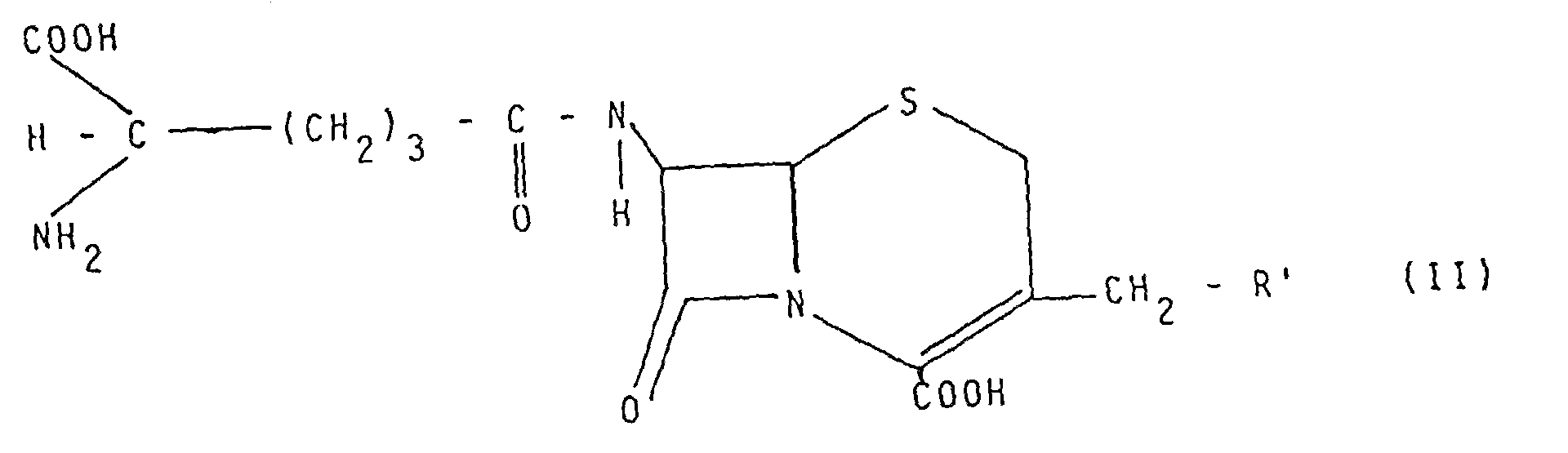
- Procédé conforme à la revendication 1 dans lequel le microorganisme est Rhodotorula glutinis NCIMB n° 40412 et/ou un mutant de ce microorganisme, capable de produire ladite D-amino-acide oxydase.
- Procédé conforme à une quelconque des revendication 1 et 2, dans lequel la réaction est effectuée dans une solution tampon aqueuse en particulier dans une solution tampon ayant un pH compris entre 5 et 10, de préférence entre 7 et 9.
- Procédé conforme à une quelconque des revendications 1 à 3, dans lequel la réaction est effectuée à une température comprise entre 5 et 50 °C, de préférence entre 20 et 40 °C.
- Procédé conforme à une quelconque des revendications 1 à 4, dans lequel la réaction est effectuée à une concentration en substrat de formule (II) allant jusqu'à 20 % en poids/volume, de préférence comprise entre 1 et 10 % en poids/volume.
- Procédé conforme à une quelconque des revendications 1 à 5, dans lequel la réaction est réalisée avec un rapport substrat/enzyme compris entre 1 et 40, de préférence entre 10 et 30 mg/unité d'enzyme.
- Procédé conforme à une quelconque des revendications 1 à 6, dans lequel la réaction est réalisée en présence d'une catalase ajoutée au mélange, de préférence à raison de 0,01 à 0,5 % (poids/volume).
- Procédé conforme à une quelconque des revendications 1 à 6, dans lequel la réaction est effectuée en présence d'un inhibiteur de la catalase, en particulier un inhibiteur de la catalase choisi parmi l'acide ascorbique et l'azide de sodium, de préférence à une concentration comprise entre 1 et 100 nM.
- Microorganisme Rhodotorula glutinis NCIMB n° 40412.
- D-amino-acide oxydase capable d'effectuer la désamination de dérivés de la céphalosporine C de formule générale (II) et que l'on peut obtenir à partir du microorganisme Rhodotorula glutinis NCIMB n° 40412 ou de mutants de ce microorganisme.
Applications Claiming Priority (2)
| Application Number | Priority Date | Filing Date | Title |
|---|---|---|---|
| ITMI911509A IT1247964B (it) | 1991-06-03 | 1991-06-03 | Processo per la preparazione enzimatica di derivati cefalosporanici |
| ITMI911509 | 1991-06-03 |
Publications (3)
| Publication Number | Publication Date |
|---|---|
| EP0517200A2 EP0517200A2 (fr) | 1992-12-09 |
| EP0517200A3 EP0517200A3 (en) | 1993-03-03 |
| EP0517200B1 true EP0517200B1 (fr) | 1996-08-14 |
Family
ID=11360034
Family Applications (1)
| Application Number | Title | Priority Date | Filing Date |
|---|---|---|---|
| EP92109410A Expired - Lifetime EP0517200B1 (fr) | 1991-06-03 | 1992-06-03 | Procédé pour la préparation enzymatique de dérivés de céphalosporine |
Country Status (9)
| Country | Link |
|---|---|
| US (1) | US5296358A (fr) |
| EP (1) | EP0517200B1 (fr) |
| JP (1) | JP3131024B2 (fr) |
| AT (1) | ATE141333T1 (fr) |
| CA (1) | CA2070083A1 (fr) |
| DE (1) | DE69212713T2 (fr) |
| DK (1) | DK0517200T3 (fr) |
| ES (1) | ES2090411T3 (fr) |
| IT (1) | IT1247964B (fr) |
Cited By (1)
| Publication number | Priority date | Publication date | Assignee | Title |
|---|---|---|---|---|
| US6730497B2 (en) | 2001-04-19 | 2004-05-04 | Bioferma Murcia S.A. | Process for preparing cephalosporanic acid derivatives using β-ketoacid derivatives |
Families Citing this family (6)
| Publication number | Priority date | Publication date | Assignee | Title |
|---|---|---|---|---|
| US5597704A (en) * | 1995-05-01 | 1997-01-28 | Food Industry Research And Development Institute | Bioconversion of cephalosporin C to glutaryl-7-aminocephalosporanic acid |
| ES2109194B1 (es) | 1996-04-22 | 1998-07-16 | Antibioticos Sa | Un procedimiento para producir la enzima d-aminoacido oxidasa de rhodotorula gracilis en celulas hospedantes. |
| JPH10295392A (ja) * | 1997-04-22 | 1998-11-10 | Kanegafuchi Chem Ind Co Ltd | L−アルリジンアセタールの製造方法 |
| US5877013A (en) * | 1997-07-31 | 1999-03-02 | Food Industry Research And Development Institute | Rhodosporidium D-amino acid oxidase |
| DE19937187A1 (de) * | 1999-08-06 | 2001-03-01 | Qiagen Gmbh | Automatisierte Proteinreinigung im Multiwellformat durch Vakuumfiltration |
| KR100512774B1 (ko) * | 2001-10-06 | 2005-09-07 | 종근당바이오 주식회사 | 7-아미노세팔로스포란산의 제조를 위한 세팔로스포린c배양액의 전처리방법 |
Family Cites Families (5)
| Publication number | Priority date | Publication date | Assignee | Title |
|---|---|---|---|---|
| GB1121308A (en) * | 1964-10-30 | 1968-07-24 | Glaxo Lab Ltd | Cephalosporins |
| GB1272769A (en) * | 1968-08-02 | 1972-05-03 | Glaxo Lab Ltd | Improvements in or relating to cephalosporin derivatives |
| GB1385685A (en) * | 1971-04-21 | 1975-02-26 | Glaxo Lab Ltd | Cephalosporin derivatives |
| GB1474519A (fr) * | 1973-05-14 | 1977-05-25 | ||
| DE4028119C1 (fr) * | 1990-09-05 | 1991-12-05 | Hoechst Ag, 6230 Frankfurt, De |
-
1991
- 1991-06-03 IT ITMI911509A patent/IT1247964B/it active IP Right Grant
-
1992
- 1992-05-29 CA CA002070083A patent/CA2070083A1/fr not_active Abandoned
- 1992-06-02 JP JP04140842A patent/JP3131024B2/ja not_active Expired - Fee Related
- 1992-06-03 ES ES92109410T patent/ES2090411T3/es not_active Expired - Lifetime
- 1992-06-03 DK DK92109410.8T patent/DK0517200T3/da active
- 1992-06-03 US US07/893,048 patent/US5296358A/en not_active Expired - Fee Related
- 1992-06-03 EP EP92109410A patent/EP0517200B1/fr not_active Expired - Lifetime
- 1992-06-03 AT AT92109410T patent/ATE141333T1/de not_active IP Right Cessation
- 1992-06-03 DE DE69212713T patent/DE69212713T2/de not_active Expired - Fee Related
Cited By (1)
| Publication number | Priority date | Publication date | Assignee | Title |
|---|---|---|---|---|
| US6730497B2 (en) | 2001-04-19 | 2004-05-04 | Bioferma Murcia S.A. | Process for preparing cephalosporanic acid derivatives using β-ketoacid derivatives |
Also Published As
| Publication number | Publication date |
|---|---|
| ATE141333T1 (de) | 1996-08-15 |
| ITMI911509A0 (it) | 1991-06-03 |
| EP0517200A2 (fr) | 1992-12-09 |
| ITMI911509A1 (it) | 1992-12-03 |
| US5296358A (en) | 1994-03-22 |
| DK0517200T3 (da) | 1996-09-02 |
| IT1247964B (it) | 1995-01-05 |
| EP0517200A3 (en) | 1993-03-03 |
| DE69212713D1 (de) | 1996-09-19 |
| CA2070083A1 (fr) | 1992-12-04 |
| JP3131024B2 (ja) | 2001-01-31 |
| DE69212713T2 (de) | 1997-03-06 |
| JPH05244991A (ja) | 1993-09-24 |
| ES2090411T3 (es) | 1996-10-16 |
Similar Documents
| Publication | Publication Date | Title |
|---|---|---|
| CA1337718C (fr) | Methode de preparation d'urease acide et utilisation de cette urease | |
| US4774179A (en) | Process for preparing a 7-aminocephalosporanic acid compound | |
| JPH022396A (ja) | セファロスポリンc及び類似体の一段階酵素反応による7‐アミノセファロスポラン酸及びその類似体への変換 | |
| US5296358A (en) | Process for the enzymatic preparation of cephalosporanic derivatives using a D-amino acid oxidase from Rhodotorula glutinis NCIMB 40412 | |
| HU202916B (en) | Process for microbiological producing gamma-glutamyl-transpeptidase | |
| US4753882A (en) | Urease and process for preparation thereof | |
| US5451520A (en) | Creatine amidinohydrolase from alkaligenes sp. ks-85 ferm bp-4487 | |
| JP3041840B2 (ja) | 新規なグリセロールデヒドロゲナーゼ、その製法及びその用途 | |
| EP0911415B1 (fr) | Production microbiologique d'acide L-ascorbique | |
| KR0149656B1 (ko) | 알파-아미노아디피닐-모노아미노 화합물의 효소적 가수분해 방법 | |
| Lowe et al. | Enzymatic hydrolysis of penicillin V to 6-aminopenicillanic acid by Fusarium oxysporum | |
| US5332663A (en) | Process for the enzymatic preparation of 7-amino-cephalosporanic acids | |
| GB1566830A (en) | Process for the preparation of 7-amino-cephem compounds | |
| EP0667396A1 (fr) | Acylation enzymatique de 3-hydroxyméthylcephalosporines | |
| US4335213A (en) | Process for the preparation of galactose oxidase | |
| CA1159783A (fr) | Procede d'obtention d'acide 6-aminopenicillanique et de s-oxyde l'acide aminopenicillanique | |
| JP3152855B2 (ja) | 新規なソルビトールデヒドロゲナーゼ、その製造方法並びに該酵素を用いたソルビトールの定量のための試薬及び方法 | |
| JP3040228B2 (ja) | L−フコースデヒドロゲナーゼ、その製造方法及びl−フコースの定量法 | |
| JPH0898683A (ja) | 7−アミノセファロスポラン酸エステラーゼ | |
| JP2936552B2 (ja) | 光学活性(s)−(+)−3−ハロ−1,2−プロパンジオールの製造法 | |
| GB2275925A (en) | Converting cephalosporin C to glutaryl-7-aminocephalosporanic acid | |
| JPH0614772A (ja) | 新規エステル分解酵素aおよびその製造方法 | |
| JPS6248380A (ja) | セフアロスポリンcアシラ−ゼの製造法 | |
| JP3601846B2 (ja) | グルタリル−7−アミノセファロスポラン酸の製造方法 | |
| KR960007741B1 (ko) | 신규 α-1, 6-글루코시다제 및 그의 제조방법 |
Legal Events
| Date | Code | Title | Description |
|---|---|---|---|
| PUAI | Public reference made under article 153(3) epc to a published international application that has entered the european phase |
Free format text: ORIGINAL CODE: 0009012 |
|
| AK | Designated contracting states |
Kind code of ref document: A2 Designated state(s): AT BE CH DE DK ES FR GB GR IT LI LU MC NL PT SE |
|
| PUAL | Search report despatched |
Free format text: ORIGINAL CODE: 0009013 |
|
| AK | Designated contracting states |
Kind code of ref document: A3 Designated state(s): AT BE CH DE DK ES FR GB GR IT LI LU MC NL PT SE |
|
| 17P | Request for examination filed |
Effective date: 19930609 |
|
| 17Q | First examination report despatched |
Effective date: 19950608 |
|
| GRAH | Despatch of communication of intention to grant a patent |
Free format text: ORIGINAL CODE: EPIDOS IGRA |
|
| GRAH | Despatch of communication of intention to grant a patent |
Free format text: ORIGINAL CODE: EPIDOS IGRA |
|
| GRAA | (expected) grant |
Free format text: ORIGINAL CODE: 0009210 |
|
| AK | Designated contracting states |
Kind code of ref document: B1 Designated state(s): AT BE CH DE DK ES FR GB GR IT LI LU MC NL PT SE |
|
| PG25 | Lapsed in a contracting state [announced via postgrant information from national office to epo] |
Ref country code: IT Free format text: LAPSE BECAUSE OF FAILURE TO SUBMIT A TRANSLATION OF THE DESCRIPTION OR TO PAY THE FEE WITHIN THE PRE;WARNING: LAPSES OF ITALIAN PATENTS WITH EFFECTIVE DATE BEFORE 2007 MAY HAVE OCCURRED AT ANY TIME BEFORE 2007. THE CORRECT EFFECTIVE DATE MAY BE DIFFERENT FROM THE ONE RECORDED.SCRIBED TIME-LIMIT Effective date: 19960814 Ref country code: GR Free format text: LAPSE BECAUSE OF FAILURE TO SUBMIT A TRANSLATION OF THE DESCRIPTION OR TO PAY THE FEE WITHIN THE PRESCRIBED TIME-LIMIT Effective date: 19960814 Ref country code: BE Effective date: 19960814 |
|
| REF | Corresponds to: |
Ref document number: 141333 Country of ref document: AT Date of ref document: 19960815 Kind code of ref document: T |
|
| REG | Reference to a national code |
Ref country code: DK Ref legal event code: T3 |
|
| ET | Fr: translation filed | ||
| REF | Corresponds to: |
Ref document number: 69212713 Country of ref document: DE Date of ref document: 19960919 |
|
| REG | Reference to a national code |
Ref country code: ES Ref legal event code: FG2A Ref document number: 2090411 Country of ref document: ES Kind code of ref document: T3 |
|
| REG | Reference to a national code |
Ref country code: CH Ref legal event code: NV Representative=s name: KIRKER & CIE SA |
|
| REG | Reference to a national code |
Ref country code: ES Ref legal event code: FG2A Ref document number: 2090411 Country of ref document: ES Kind code of ref document: T3 |
|
| SC4A | Pt: translation is available |
Free format text: 960814 AVAILABILITY OF NATIONAL TRANSLATION |
|
| PLBE | No opposition filed within time limit |
Free format text: ORIGINAL CODE: 0009261 |
|
| STAA | Information on the status of an ep patent application or granted ep patent |
Free format text: STATUS: NO OPPOSITION FILED WITHIN TIME LIMIT |
|
| PG25 | Lapsed in a contracting state [announced via postgrant information from national office to epo] |
Ref country code: LU Free format text: LAPSE BECAUSE OF NON-PAYMENT OF DUE FEES Effective date: 19970630 |
|
| 26N | No opposition filed | ||
| PG25 | Lapsed in a contracting state [announced via postgrant information from national office to epo] |
Ref country code: MC Effective date: 19971231 |
|
| PGFP | Annual fee paid to national office [announced via postgrant information from national office to epo] |
Ref country code: SE Payment date: 20010417 Year of fee payment: 10 |
|
| PGFP | Annual fee paid to national office [announced via postgrant information from national office to epo] |
Ref country code: PT Payment date: 20010515 Year of fee payment: 10 |
|
| PGFP | Annual fee paid to national office [announced via postgrant information from national office to epo] |
Ref country code: DE Payment date: 20010528 Year of fee payment: 10 |
|
| PGFP | Annual fee paid to national office [announced via postgrant information from national office to epo] |
Ref country code: CH Payment date: 20010529 Year of fee payment: 10 |
|
| PGFP | Annual fee paid to national office [announced via postgrant information from national office to epo] |
Ref country code: GB Payment date: 20010530 Year of fee payment: 10 |
|
| PGFP | Annual fee paid to national office [announced via postgrant information from national office to epo] |
Ref country code: FR Payment date: 20010611 Year of fee payment: 10 |
|
| PGFP | Annual fee paid to national office [announced via postgrant information from national office to epo] |
Ref country code: AT Payment date: 20010613 Year of fee payment: 10 Ref country code: DK Payment date: 20010613 Year of fee payment: 10 |
|
| PGFP | Annual fee paid to national office [announced via postgrant information from national office to epo] |
Ref country code: NL Payment date: 20010628 Year of fee payment: 10 |
|
| PGFP | Annual fee paid to national office [announced via postgrant information from national office to epo] |
Ref country code: ES Payment date: 20010629 Year of fee payment: 10 |
|
| REG | Reference to a national code |
Ref country code: GB Ref legal event code: IF02 |
|
| PG25 | Lapsed in a contracting state [announced via postgrant information from national office to epo] |
Ref country code: AT Free format text: LAPSE BECAUSE OF NON-PAYMENT OF DUE FEES Effective date: 20020603 Ref country code: GB Free format text: LAPSE BECAUSE OF NON-PAYMENT OF DUE FEES Effective date: 20020603 |
|
| PG25 | Lapsed in a contracting state [announced via postgrant information from national office to epo] |
Ref country code: SE Free format text: LAPSE BECAUSE OF NON-PAYMENT OF DUE FEES Effective date: 20020604 Ref country code: ES Free format text: LAPSE BECAUSE OF NON-PAYMENT OF DUE FEES Effective date: 20020604 |
|
| PG25 | Lapsed in a contracting state [announced via postgrant information from national office to epo] |
Ref country code: CH Free format text: LAPSE BECAUSE OF NON-PAYMENT OF DUE FEES Effective date: 20020630 Ref country code: LI Free format text: LAPSE BECAUSE OF NON-PAYMENT OF DUE FEES Effective date: 20020630 |
|
| PG25 | Lapsed in a contracting state [announced via postgrant information from national office to epo] |
Ref country code: DK Free format text: LAPSE BECAUSE OF NON-PAYMENT OF DUE FEES Effective date: 20020731 |
|
| PG25 | Lapsed in a contracting state [announced via postgrant information from national office to epo] |
Ref country code: PT Free format text: LAPSE BECAUSE OF NON-PAYMENT OF DUE FEES Effective date: 20021231 |
|
| PG25 | Lapsed in a contracting state [announced via postgrant information from national office to epo] |
Ref country code: DE Free format text: LAPSE BECAUSE OF NON-PAYMENT OF DUE FEES Effective date: 20030101 Ref country code: NL Free format text: LAPSE BECAUSE OF NON-PAYMENT OF DUE FEES Effective date: 20030101 |
|
| GBPC | Gb: european patent ceased through non-payment of renewal fee |
Effective date: 20020603 |
|
| REG | Reference to a national code |
Ref country code: DK Ref legal event code: EBP |
|
| EUG | Se: european patent has lapsed | ||
| REG | Reference to a national code |
Ref country code: CH Ref legal event code: PL |
|
| PG25 | Lapsed in a contracting state [announced via postgrant information from national office to epo] |
Ref country code: FR Free format text: LAPSE BECAUSE OF NON-PAYMENT OF DUE FEES Effective date: 20030228 |
|
| NLV4 | Nl: lapsed or anulled due to non-payment of the annual fee |
Effective date: 20030101 |
|
| REG | Reference to a national code |
Ref country code: PT Ref legal event code: MM4A Free format text: LAPSE DUE TO NON-PAYMENT OF FEES Effective date: 20021231 |
|
| REG | Reference to a national code |
Ref country code: FR Ref legal event code: ST |
|
| REG | Reference to a national code |
Ref country code: ES Ref legal event code: FD2A Effective date: 20030711 |