EP0525207A1 - Procede de synthese du diamant - Google Patents
Procede de synthese du diamant Download PDFInfo
- Publication number
- EP0525207A1 EP0525207A1 EP92905002A EP92905002A EP0525207A1 EP 0525207 A1 EP0525207 A1 EP 0525207A1 EP 92905002 A EP92905002 A EP 92905002A EP 92905002 A EP92905002 A EP 92905002A EP 0525207 A1 EP0525207 A1 EP 0525207A1
- Authority
- EP
- European Patent Office
- Prior art keywords
- diamond
- crystal
- solvent
- synthesis
- metal
- Prior art date
- Legal status (The legal status is an assumption and is not a legal conclusion. Google has not performed a legal analysis and makes no representation as to the accuracy of the status listed.)
- Granted
Links
Images





Classifications
-
- B—PERFORMING OPERATIONS; TRANSPORTING
- B01—PHYSICAL OR CHEMICAL PROCESSES OR APPARATUS IN GENERAL
- B01J—CHEMICAL OR PHYSICAL PROCESSES, e.g. CATALYSIS OR COLLOID CHEMISTRY; THEIR RELEVANT APPARATUS
- B01J3/00—Processes of utilising sub-atmospheric or super-atmospheric pressure to effect chemical or physical change of matter; Apparatus therefor
- B01J3/06—Processes using ultra-high pressure, e.g. for the formation of diamonds; Apparatus therefor, e.g. moulds or dies
- B01J3/062—Processes using ultra-high pressure, e.g. for the formation of diamonds; Apparatus therefor, e.g. moulds or dies characterised by the composition of the materials to be processed
-
- B—PERFORMING OPERATIONS; TRANSPORTING
- B01—PHYSICAL OR CHEMICAL PROCESSES OR APPARATUS IN GENERAL
- B01J—CHEMICAL OR PHYSICAL PROCESSES, e.g. CATALYSIS OR COLLOID CHEMISTRY; THEIR RELEVANT APPARATUS
- B01J2203/00—Processes utilising sub- or super atmospheric pressure
- B01J2203/06—High pressure synthesis
- B01J2203/0605—Composition of the material to be processed
- B01J2203/061—Graphite
-
- B—PERFORMING OPERATIONS; TRANSPORTING
- B01—PHYSICAL OR CHEMICAL PROCESSES OR APPARATUS IN GENERAL
- B01J—CHEMICAL OR PHYSICAL PROCESSES, e.g. CATALYSIS OR COLLOID CHEMISTRY; THEIR RELEVANT APPARATUS
- B01J2203/00—Processes utilising sub- or super atmospheric pressure
- B01J2203/06—High pressure synthesis
- B01J2203/065—Composition of the material produced
- B01J2203/0655—Diamond
-
- B—PERFORMING OPERATIONS; TRANSPORTING
- B01—PHYSICAL OR CHEMICAL PROCESSES OR APPARATUS IN GENERAL
- B01J—CHEMICAL OR PHYSICAL PROCESSES, e.g. CATALYSIS OR COLLOID CHEMISTRY; THEIR RELEVANT APPARATUS
- B01J2203/00—Processes utilising sub- or super atmospheric pressure
- B01J2203/06—High pressure synthesis
- B01J2203/065—Composition of the material produced
- B01J2203/067—Aluminium nitrides
-
- B—PERFORMING OPERATIONS; TRANSPORTING
- B01—PHYSICAL OR CHEMICAL PROCESSES OR APPARATUS IN GENERAL
- B01J—CHEMICAL OR PHYSICAL PROCESSES, e.g. CATALYSIS OR COLLOID CHEMISTRY; THEIR RELEVANT APPARATUS
- B01J2203/00—Processes utilising sub- or super atmospheric pressure
- B01J2203/06—High pressure synthesis
- B01J2203/0675—Structural or physico-chemical features of the materials processed
- B01J2203/068—Crystal growth
Definitions
- This invention relates to a process for the synthesis of transparent diamond single crystal suitable for use as a material for decoration and optical parts, and more particularly, it is concerned with a process for the synthesis of diamond at a static high pressure and high temperature, specifically high purity, nitrogen- free, colorless and transparent diamond of Ila type.
- natural diamond has the disadvantage that a transparent and colorless rough stone is mined in a small amount and is thus expensive.
- the output of a rough stone having no absorption of nitrogen in the infrared range is so little as represented by, for example, an output of the above described Ila type of 1-2 % based on the whole rough stones, thue resulting in a problem on supply thereof.
- a large-sized window material of 8 mm in diameter is hardly available.
- Transparent and colorless diamond has first been synthesized in artificial manner in the 1970s. This synthesis was carried out by the temperature gradient method using a Fe-3 - 5 wt % AI alloy as a solvent metal, thus obtaining several diamond crystals with 0.7 - 1.0 carat in the form of brilliant. The resulting diamond was estimated as G to H by the color scale of natural gem (GIA Standard: standard of gem provided by the American Gem Institute)(US Patent No. 4073380). However, such synthetic diamond has not been marketed because the synthesizing cost is higher than the price of diamond as natural gem.
- Artificial diamond is ordinarily colord yellow because during synthesis at an ultra-high pressure and high temperature, nitrogen in a solvent is taken in the crystal lattice, but colorless and transparent diamond can be obtained by adding a nitrogen getter to the solvent.
- AI is well known as disclosed in, for example, "The Journal of Physical Chemistry", Vol. 75, No. 12 (1971), p 1838.
- US Patent No. 40343066 discloses that colorless and transparent diamond single crystal of gem grade can be obtained by adding 3 to 5 % by weight of AI to a Fe solvent.
- combinations capable of producing colorless diamond are only 10 Fe-Zr, 02 (Fe-Ni) alloy-Zr and @ (Ni-Mn) alloy-Zr and no such colorless diamond can be formed with other combinations.
- the combination 10 of Fe-Zr is capable of giving one having no absdorption in a wavelength range of at most 500 nm.
- the presence of the absorption in the wavelength range of at most 500 nm means that nitrogen atoms are not completely removed.
- the nitrogen getter in a proportion of at least 4 % by weight (about 12 % by volume) to the solvent and in this case, the growth rate should be at least 1 mg/hr so as to effect the crystal growth without inclusion thereof.
- a synthesis time of 200 hours or more is required, for example, for obtaining a crystal of 1 carat (200 mg), resulting in a large production cost.
- the present invention provides a process for the synthesis of diamond, which comprises, in the synthesis of diamond crystal by the temperature gradient method, using, as a solvent for the growth of the crystal, at least one metal selected from the group consisting of Fe, Co, Ni, Mn and Cr (nevertheless, at least two metals are selected in the case of containing Fe) and as a nitrogen getter for the removal of nitrogen in the solvent, at least one metal selected from the group consisting of Al, Ti, Zr, Hf, V, Nb and Ta in a proportion of 0.5 to 7 % by weight (nevertheless, at most 2 % by weight in the case of using only Al) to the solvent metal.
- At least one metal selected from the group consisting of Fe, Co, Ni, Mn and Cr is used as a solvent for the synthesis of diamond.
- At least one metal selected from the group consisting of Al, Ti, Zr, Hf, V, Nb and Ta, capable of forming nitrides in a solvent, is added in the specified amount so as to remove nitrogen causing coloration of a crystal in yellow.
- Contamination of a crystal with carbides, oxides and nitrides is prevented by floating or precipitating according to the following two methods:
- the present invention aims at further making colorless the crystal by the following two methods:
- the diffusion rate and saturated concentration of carbon are lowered and carbon required for the growth of the crystal, to be supplied, is lacking.
- non- grown areas on the surface of the crystal are enlarged and the solvent metal tends to be included in the crystal.
- at least one of Sn, P and S capable of increasing the activity of carbon, is added, preferably in a proportion of 0.1 to 10 % by weight.
- the first embodiment of the present invention consists in obtaining diamond having no absorption of nitrogen in the infrared range by a process for the synthesis of diamond, which comprises, in the synthesis of diamond by the tem-temperature gradient method, using as a solvent an alloy of xFe-yCo-zAI system in which x, y and z are in the range of 20 ⁇ y 90 and z 2 2 by weight %.
- diamond with a higher transparency can be obtained by the use of the above described alloy of xFe-yCo-zAI to which at least one of B, Ga, Be, In and Li is added in a very small amount. More preferably, the amount of at least one of B, Ga, Be, In and Li to be added is in the range of 0.2 ppm to 2 % by weight.
- Fe-Al type alloys having an AI content of 3 % by weight or more such as Fe-3 wt % AI and Fe-5 wt % Al, are used as a solvent.
- This method meets with the problem that the growth rate is so low as represented by, for example, 206 mg in 160 hours and 140 mg in 190 hours and a considerably larger cost is required for this synthesis because of using an expensive ultra-high pressure apparatus.
- diamond synthesized at an ultra-high pressure colors yellow. This is probaly due to that nitrogen atoms supplied from a solvent, raw materials and compressible media are taken in the crystal during growth thereof to give an single dispersion type (Ib type) and form an impurity donor energy level.
- Ib type single dispersion type
- Removal of the nitrogen atoms is preferably carried out by adding a metal such as AI and allowing it to function as a nitrogen getter. That is, the addition of AI results in formation of AIN and removal of the nitrogen atoms as the nitride.
- the addition of AI increases inclusion of the metallic solvent in the crystal.
- the use of a solvent of Fe-Co-AI type is effective for solving this problem, since as compared with the solvent of Fe-Al type of the prior art, the diffusion rate of raw material carbon in the solvent is higher and the raw material carbon sufficiently extends to round the crystal during growth, so that inclusion of the solvent metal is hard to take palce.
- the composition ratio by weight of Fe-Co-AI is respectively represented by x, y and z, y is in the range of 20 ⁇ y ⁇ 90, since if y is less than 20 weight %, the synthetic temperature is high and inclusion of the solvent is increased, while if more than 90 weight %, the synthetic temperature is high and the grade of color is degraded. It is also found desirable that the ratio of x/(x + y + z) is in the range of 0.1 to 0.8, since if the ratio is less than 0.1, the synthetic temperature is high and the grade of color is degraded, while if more than 0.8, the synthetic temperature is high and inclusion of the solvent is increased.
- the amount of metallic impurities contained in the crystal is increased with the increase of that of Al.
- the amount of AI added is less than 2 % by weight, preferably 0.5 to 2 % by weight, there can be obtained a crystal with less inclusion at a growth rate substantially same as in the case of not adding Al, but if more than 2 % by weight, the incluion is increased.
- the single crystal synthesized in the solvent of according to the present invention has no absorption of nitrogen in the infrared range and is most suitable for use as a material for infrared optics.
- decorative diamond of J to K grade can be obtained.
- the diamond of the present invention When using the diamond of the present invention as a decorative one, this corresponds to a diamond of J to G grade, being somewhat yellowish. It is found that in order to obtain a colorless and transparent crystal of F or higher grade, having less inclusion, at a growth rate substantially same as in the case of not adding Al, i.e. as in the method of the present invention, it is most effective to add to the crystal a micro amount of at least one metallic element selected from the group consisting of B, Ga, In, Li, Be and the like, which are considered to give p-type semiconductive property upon incorporation in the crystal, thereby electrically neutralizing.
- the amount of the metallic element is within 0.2 ppm to 2 % by weight, preferably 25 ppm to 2 % by weight, since if less than 0.2 ppm, the effect of rendering colorless and transparent is decreased, while if more than 2 %, other coloration or inclusion appears in the crystal.
- a single crystal for an infrared optical part and a good quality diamond single crystal for decoration, of J to K class, having no absorption of nitrogen, can be supplied in economical manner.
- a micro amount of a metal such as B, Ga, Be, Li, In, etc. is added to the above described solvent, whereby a good quality diamond single crystal for decoration, with a high transparency of F to G class, can economically be produced.
- the second embodiment of the present invention is a process for the synthesis of diamond of Ila type, comprising adding a material to be a nitrogen getter to a sample in a synthesis chamber and subjecting the sample to growth of diamond crystal at a static high pressure and high temperature, characterized in that a material capable of increasing the activity of the nitrogen getter is added in a required quantity.
- the amount of AI to be added to a solvent is decreased to such an extent that the problem does not arise that the solvent metal itself tends to be included in a crystal and a required amount of a material capable of increasing the acitvity of AI is added so as to make up for the decreased effect of removing nitrogen and to give an effect more than the decreased one to AI in the decreased amount.
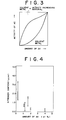
- Fig. 3 is a chart showing increase of the activity of AI in the case of only a solvent metal and in the case of adding an activity-increasing material to the solvent metal.
- a nitrogen getter such as Al
- Pb, In, Bi, Cd and the like there are used Pb, In, Bi, Cd and the like and the required amount thereof is generally in the range of 0.3 to 4 weight %, since if it is less than 0.3 weight %, the addition effect is little, while if more than 4 weight %, inclusion of the solvent metal is increased.
- Fig. 4 is a graph showing the relationship between the amount of AI added to a solvent metal and the amount of nitrogen contained in diamond crystal.
- the amount of nitrogen contained in diamond crystal is estimated by a wave form of ESR (Electron Spin Resonance). From Fig. 4, it is apparent that the amount of nitrogen contained in diamond crystal is decreased with the increase of Al.
- ESR Electro Spin Resonance
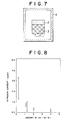
- Fig. 5 is a graph showing the relationship between the amount of AI added to a solvent metal and the amount of a solvent metal included in diamond crystal (content of solvent metal). The content of the solvent metal in the crystal is estimated by the use of a magnetic balance.
- the content of a solvent metal is increased with the increase of Al.
- the content of the solvent metal is 0.25 to 0.50 % by weight, which is less than when adding Al.
- the metal content should preferably be reduced to at most 0.5 % by weight and to this end, addition of AI to a solvent metal should be suppressed to at most 1 % by weight.
- the inventors have made studies on the mechanism of removing nitrogen by AI so as to find a method for effectively removing nitrogen from a crystal by AI in a decreased quantity, e.g. about 1 % by weight. Consequently, it is found that an equilibrium relationship exists between the amount of AI added and the amount of nitrogen in the crystal and N is removed as AIN, that is, according to the reaction of AI + N - AIN with high possibility. If nitrogen is removed by the reaction as described above, it is considered effective to increase the activity of AI as a method of forwarding this reaction to the right without changing the absolute quantity of Al. That is, this method is a trial of raising only the activity without changing the absolute quanity by adding a material capable of increasing the activity of AI to the solvent.
- the relationship between the activity of AI and the concentration (weight %) of AI in a solvent having a composition of Fe-40 % Co-1 % AI is shown in Fig. 6. It is apparent from Fig. 6 that when 4 % by weight of AI is added, the activity is 0.005, the crystal being substantially colorless but having large contents of impurities. Since the activity of AI is about 0.001 when 1 % by weight of AI is added (the crystal having less impurities but being colored light yellow), it is only necessary to add such a material that the same activity (0.005) is given as when 4 % by weight of AI is added. There are a number of materials capable of raising the activity of Al, but above all, Pb, In, Bi and Cd are preferably used. In Table 1 are shown, for example, activities of AI when about 5 % by weight of AI is added to various elements, which are calculated from the data of "Selected Values of the Thermodynamic Properties of Binary Alloys; American Society For Metals".
- the diamond of Ila type synthesized by this method of the present invention is suitable for decorative uses, infrared optical parts, ultraviolet to visible optical parts and diamond semiconductor substrates.
- diamond of Ila type in the synthesis of diamond at a static high pressure, in particular, in the synthesis of high purity diamond of Ila type, which is substantially free from nitrogen and colorless and transparent, a material capable of increasing the activity of Al, as a nitrogen getter, is added and thus, nitrogen is effectively removed by such a small amount of AI that bad influences due to the addition of Al, e.g. inclusion of the metal do not appear. Therefore, according to the process of the present invention, diamond of Ila type can be synthesized at a growth rate of about 2 times as higher as in the prior art.
- a process for the synthesis of diamond of Ila type which comprises floating upward or precipitating downward nitrides, carbides or oxides formed by addition of a nitrogen getter to remove nitrogen.
- a small amount of boron (e.g. several ppm) is ordinarily contained in the above described solvent metal and about 1/10 of the solvent concentration is taken in the crystal to give a concentration of 0.1 to 0.6 ppm. If the nitrogen-removing effect of a nitrogen getter is excessiveljy large, the nitrogen electrically compensated with boron in the solvent is not contained in the crystal and conversion of from transparent to blueish takes place.
- Ti, Zr, Hf, V, Nb and Ta tend to form borides and thus function as a boron getter to reduce blue color.
- Ti, Zr, Hf, V, Nb and Ta form stable nitrides and thus function as an effective getter for removing nitrogen in the solvent.
- these metals simultaneously react with carbon and oxygen dissolved in the solvent to form carbides and oxides in large amounts.
- the carbides, nitrides and oxides are included in the crystal to degrade the quality of the crystal.
- the carbides, nitrides and oxides act as nuclei so that the solvent metal tends to be included in the crystal. Accordingly, it is an important problem to remove the carbides, nitrides and oxides before growth of the crystal. Since the getter element, carbon, nitrogen and oxygen are uniformly dispersed in the solvent, the resulting carbides, nitrides and oxides are in the form of fine grains. These fine carbides, nitrides and oxides are not floated nor precipitated in a short time even if there is a density difference from that of the solvent.
- the settling (floating) rate of colloidal and spherical fine grains are represented by the following formula:
- the settling (or floating) rate of the solvent is theoretically lowered in inverse proportion to the viscosity of the solvent so in order to increase the settling (floating) rate, it is effective to lower the viscosity of the solvent.
- the amount of the metal added to lower the viscosity is generally 0.5 to 3 % by weight, since if less than 0.5 % by weight, its effect is little, while if more than 3 % by weight, inclusion of the solvent metal is increased and the rate of crystal growth is lowered.
- Addition of a low viscosity metal is preferably carried out by the use of an intermetallic compound of the low viscosity metal with a nitrogen getter metal, whereby no carbide is formed and a good quality crystal can be obtained.
- intermetallic compound for example, there are used Sn-Ti type intermetallic compounds such as SnsTis, Sn 3 Ti 5 , SnTi 2 SnTis and the like, Sn-Zr type intermetallic compounds such as SnZr, Sn 2 Zr, SnZr 3 and the like, Sn-V type intermetallic compounds such as SnV 3 and the like, Sn-Nb type intermetallic compounds such as SnNb and the like, Sn-Hf type intermetallic compounds and Sn-Ta type intermetallic compounds.
- SnTis or Sn 5 Ti 6 is more effective.
- TiC does not exist isolated and formation itself of TiC hardly takes place. Even if a Sn-Ti intermetallic compound is decomposed to form TiC, Sn exists near Ti and accordingly, TiC is readily diffused in a solvent. Consequently, a good quality crystal can be obtained in considerably easy manner.
- Another method of adding a low viscosity compound comprises stacking a nitrogen getter metal sheet and a low viscosity metal sheet, as shown in Fig. 11.
- a nitrogen getter is added or disposed to a solvent in the vicinity of a seed crystal, so that the nitrogen removal efficiency is increased, nitrogen is sufficiently removed even by addition of a small amount of a nitrogen getter and inclusion of impurities hardly takes place. Since the low viscosity metal is disposed on the seed crystal, moreover, the concentration of carbon just before incorporated in the crystal is increased, inclusion of the solvent can be prevented and in addition, remaining of TiC or ZrC in the crystal can also be prevented. Thus, it is possible to synthesize a colorless, transparent and inclusion-free diamond crystal at a high growth rate.
- the grain diameter of a nitrogen getter metal is increased and uniformly dispersed.
- the floating rate is proportional to the square of the grain diameter. If the grain diameter is smaller than 10 ⁇ m in this case, the floating rate of the carbides, etc. is so small that the carbides, etc. are included in the crystal, while if larger than 1 mm, the reaction of the nitrogen getter with nitrogen is decreased so that functioning as the nitrogen getter is lowered.
- Al, In, Ga, etc. are elements tending to simultaneously form nitrides. Accordingly, nitrogen can be removed by adding these elements. In this case, further addition of Ti, Zr, Hf, etc. results in less inclusion of the solvent than when adding only the metals of Al, In, Ga, etc.
- AI alone is added as a nitrogen getter, for example, a good quality crystal can be obtained in an additive amount of upto 2 weight %, which gives an estimation of VS or SI grade for the clarity of brilliant cut of this crystal.
- AI and Ti are simultaneously added, the same result as described above can be obtained even when adding 3 weight % of Al. This is probably due to that a nitride consisting of Ti, AI and N is formed.
- a graphite tube heater 2 within which there are disposed a pyrophillite 1 and a diamond seed 5.
- a solvent metal 6 and further a carbon source 7 On the diamond seed 5 are located a solvent metal 6 and further a carbon source 7, the lower part and upper part of which are filled with plugs 4 and 8.
- the plugs 4 aknd 8 and the pyrophillite cylinder 3 are pressure media made according to a same standard.
- Diamond is synthesized by compressing the above described reaction vessel arranged in a hollow of a die consisting of cemented carbide at a predetermined pressure using the die consisting of cemented carbide and a pair of punches located above and below the reaction vessel, so as to be adapted to the hollow of the die, although not shown, passing electric current through the heater 2 to heat the reaction vessel and applying a pressure by the punches.
- the carbon source is dissolved in the metal solvent and crystal growth takes place on the seed crystal through a temperature gradient (20 to 30 ° C).
- the commonly used pressure and temperature are 5.3 to 5.6 GPa and 1250 to 1410 °C.
- a process for the synthesis of diamond single crystal by the temperature gradient method which comprises using a solvent metal to which an AI-X type intermetallic compound wherein X is an element selected from the group consisting of Ti, Zr, Hf, V, Nb and Ta is added as a nitrogen getter.
- the solvent metal preferably consists of at least one member selected from the group consisting of Fe, Co, Ni, Mn and Cr, more preferably containing 0.1 to 6.0 weight % of carbon.
- the amount of the AI-X type intermetallic compound wherein X is an element selected from the group consisting of Ti, Zr, Hf, V, Nb and Ta, added as a nitrogen getter, is preferably 0.1 to 5 weight % based on the solvent metal.
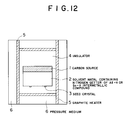
- Fig. 12 is a schematic view of a construction of a sample chamber for the synthesis of a crystal in an embodiment of the present invention, in which a carbon source 1, solvent metal 2, seed crystal 3, insulator 4, graphite heater 5 and pressure medium 6 are arranged, the solvent metal 2 containing a previously added powder of an AI-X type intermetallic compound wherein X is an element selected from the group consisting of Ti, Zr, Hf, V, Nb and Ta.
- intermetallic comound examples include Al-Ti intermetallic comounds such as AlTi, AL 3 Ti, A1 2 Ti, AlTi 3 and the like; AI-Zr intermetallic comounds such as AlZr, AL 3 Zr, A1 2 Zr, Al 3 Zr 2 , AL 3 Zrs, Al 2 Zr 3 , AIZr 2 , AlZr 3 and the like; Al-Hf intermetallic comounds such as AlHf, AL 3 Hf, AI2 Hf, Al 3 Hf 2 , AL 3 Hf 4 ,Al 2 Hf 3 and the like.
- various intermetallic comounds of Al-V, Al-Nb and Al-Ta types can be used.
- intermetallic comounds are preferably used in an amount of as small as possible, but generally in an amount of 0.1 to 5 weight %, since if less than 0.1 weight %, removal of nitrogen cannot sufficiently be carried out and the resultant crystal considerably colors yellowish, while if more than 5 weight %, more inclusions are taken in the crystal.
- the solvent metal 2 shown in Fig. 12 is a metal consisting of at least one member selected from the group consisting of Fe, Co, Ni, Mn and Cr and in order to prevent the seed crystal from dissolution, 0.1 to 6.0 weight % of carbon is previously added.
- a solvent having a carbon content of less than 0.1 weight % or containing no carbon it is required to dispose a seed crystal dissolution preventing agent such as Pt on the seed crystal, but the arrangement of the seed crystal dissolution preventing agent causes polycrystallization or inclusion. This is not preferable. If the carbon content exceeds 6 weight %, spontaneous nucleation tends to occur and crystal growth takes place at other sites than the seed crystal, whereby crystals interferes with each other and no good quality crystal can be obtained.
- the seed crystal and carbon source there can be used any of known materials in the art.
- the synthesis conditions by the temperature gradient method can suitably be chosen. Specific examples are given in the following Examples.
- an AI-X type intermetallic compound wherein X is an element selected from the group consisting of Ti, Zr, Hf, V, Nb and Ta is added as a nitrogen getter to a solvent metal. Consequently, a good quality diamond crystal of Ila type can be obtained even at a considerably larger growth rate than in the prior art.
- Al-Ti intermetallic comounds The reasons therefor will specifically be explained as to Al-Ti intermetallic comounds:
- an intermetallic comound consisting of AI and Ti e.g. AlTi, Al 3 Ti, AlTi 3 , etc.
- formation of TiC is decreased since there is no isolated Ti and even if it is decomposed to form TiC, TiC is readily diffused in the solvent because of the presence of AI in the vicinity of TiC. Consequently, a good quality, inclusion-free crystal can readily be obtained and moreover, the removal efficiency of nitrogen is substantially similar to in the case of Ti, reaching such an extent that nitrogen is substantially removed even by addition of a very small amount, e.g. about 1 weight %.
- a process for the synthesis of diamond single crystal by the temperature gradient method which comprises using a solvent metal to which an Sn-X type intermetallic compound wherein X is an element selected from the group consisting of Ti, Zr, Hf, V, Nb and Ta is added as a nitrogen getter.
- the solvent metal preferably consists of at least one memeber selected from the group consisting of Fe, Co, Ni, Mn and Cr, more preferably containing 0.1 to 6.0 weight % of carbon.
- the amount of the Sn-X type intermetallic compound wherein X is an element selected from the group consisting of Ti, Zr, Hf, V, Nb and Ta, added as a nitrogen getter, is preferably 0.1 to 10 weight % based on the solvent metal.
- Fig. 12 is a schematic view of a construction of a sample chamber for the synthesis of a crystal in an embodiment of the present invention, in which a carbon source 1, solvent metal 2, seed crystal 3, insulator 4, graphite heater 5 and pressure medium 6 are arranged, the solvent metal 2 containing a previously added powder of an Sn-X type intermetallic compound wherein X is an element selected from the group consisting of Ti, Zr, Hf, V, Nb and Ta.
- intermetallic comound examples include Sn-Ti intermetallic comounds such as SnsTis, Sn 3 Ti 5 , SnTi 2 , SnTi s and the like; Sn-Zr intermetallic comounds such as SnZr, Sn 2 Zr, SnZr 3 and the like; Sn-V intermetallic comounds such as SnV 3 and the like; and Sn-Nb intermetallic comound such as SnNb 3 and the like.
- various intermetallic comounds of Sn-Hf and Sn-Ta types can be used.
- intermetallic comounds are preferably used in an amount of as small as possible, but generally in an amount of 0.1 to 10 weight %, since if less than 0.1 weight %, removal of nitrogen cannot sufficiently be carried out and the resultant crystal considerably colors yellowish, while if more than 10 weight %, more inclusions are taken in the crystal.
- the solvent metal 2 shown in Fig. 12 is a metal consisting of at least one member selected from the group consisting of Fe, Co, Ni, Mn and Cr and in order to prevent the seed crystal from dissolution, 0.1 to 6.0 weight % of carbon is previously added.
- a solvent having a carbon content of less than 0.1 weight % or containing no carbon it is required to dispose a seed crystal dissolution preventing agent such as Pt on the seed crystal, but the arrangement of the seed crystal dissolution preventing agent causes polycrystallization or inclusion. This is not preferable. If the carbon content exceeds 6 weight %, spontaneous nucleation tends to occur and crystal growth takes place at other sites than the seed crystal, whereby crystals interferes with each other and no good quality crystal can be obtained.
- the seed crystal and carbon source there can be used any of known materials in the art.
- the synthesis conditions by the temperature gradient method can suitably be chosen. Specific examples are given in the following Examples.
- an Sn-X type intermetallic compound wherein X is an element selected from the group consisting of Ti, Zr, Hf, V, Nb and Ta is added as a nitrogen getter and as an inclusion inhibitor to a solvent metal. Consequently, a good quality diamond crystal of Ila type can be obtained even at a considerably larger growth rate than in the prior art.
- Sn-Ti intermetallic comounds Sn-Ti intermetallic comounds:
- inclusion can be suppressed to some extent by adding Ti as a nitrogen getter and simultaneously adding Sn of low viscosity, forming no carbide, to diffuse the formed TiC throughout the solvent metal.
- Sn is added to a solvent, the carbon potential in the solvent is increased and non-embeded materials on the surface of a growing crystal are decreased so that inclusion in the crystal is somewhat suppressed.
- an intermetallic comound consisting of Sn and Ti e.g. SnTi 3 , Sn s Ti s , etc.
- formation of TiC is decreased since there is no isolated Ti and even if the Sn-Ti intermetallic compound is decomposed to form TiC, TiC is readily diffused in the solvent because of the presence of Sn in the vicinity of TiC. Consequently, a good quality crystal can readily be obtained and moreover, the removal efficiency of nitrogen is substantially similar to in the case of Ti, reaching such an extent that nitrogen is substantially removed even by addition of a very small amount, e.g. about 1 weight %.
- a process for the synthesis of diamond crystal by the temperature gradient method which comprises arranging a solvent metal to be contacted with a carbon source, arranging at least one metal slelected from the group consisting of Ti, Zr and Hf as a nitrogen getter at the solvent metal side between the solvent metal and a seed crystal disposed below the solvent metal and arranging AI at the seed crystal side between them in such a manner that the seed crystal is not contacted with the nitrogen getter, and then starting synthesis of diamond using the thus arranged assembly.
- the solvent metal preferably consists of at least one memeber selected from the group consisting of Fe, Co, Ni, Mn and Cr, more preferably containing 0.1 to 6.0 weight % of carbon.
- the amount of at least one metal selected from the group consisting of Ti, Zr and Hf, added as a nitrogen getter, is preferably 0.2 to 5 volume % based on the solvent metal and the amount of AI added is preferably 0.1 to 2 volume % based on the solvent metal.
- the inclusion tends to be readily taken in the crystal with increase of the amount of the nitrogen getter and accordingly, it is desired to adjust the amount of the nitrogen getter to as smaller as possible.
- Ti, Zr or Hf having a higher reactivity with nitrogen is used as a main nitrogen getter and arranged only near the seed crystal.
- low viscosity AI forming no carbide is disposed between the above described nitrogen getter and seed crystal for the purpose of suppressing growth of the carbide and diffusing the carbide in a solvent before taken in the crystal.
- Fig. 11 is a schematic view of a construction of a sample chamber for the synthesis of a crystal in one embodiment of the present invention, in which a sheet 3 consisting of Ti, Zr or Hf as a main nitrogen getter is disposed at the solvent side between a solvent metal 2 and a seed crystal 5 and an AI sheet 4 is disposed at the seed crystal side between them.
- the nitrogen getter sheet 3 can be composed of Ti, Zr and Hf sheets, individually or in combination, for example, laminated sheets of a Ti sheet and Zr sheet or alloy sheet of Ti-Zr.
- the solvent metal 2 there is used at least one member selected from the group consisting of Fe, Co, Ni, Mn and Cr and in order to prevent the seed crystal 5 from dissolution, 0.1 to 0.6 % by weight of carbon is previously added.
- a solvent metal having a carbon content of less than 0.1 % by weight or containing no carbon it is required to dispose a seed crystal dissolution preventing agent such as Pt on the seed crystal and the effect of AI according to the construction of the present invention is not sufficient. If the carbon content exceeds 6 weight %, spontaneous nucleation tends to occur and crystal growth takes place at other sites than the seed crystal, whereby crystals interfere with each other and good quality crystal cannot be obtained.
- the amount of AI to be added is adjusted to as small as possible, but it is generally in the range of 0.1 to 2.0 volume % to the solvent, since if less than 0.1 volume %, a layer of carbide of Ti, etc. arranged as a nitrogen getter is formed on the seed crystal to hinder growth of the crystal and the carbide remains more in the crystal, while if more than 2.0 volume %, more inclusions are taken in the crystal.
- the amount of Ti, Zr or Hf to be added as a nitrogen getter is preferably 0.2 to 5 volume % to the solvent, since if less than 0.2 volume %, nitrogen is not sufficiently removed and the crystal colors yellowish, while if more than 5 volume %, inclusions are increased in the crystal.
- the seed crystal and carbon source there can be used any of known materials in the art.
- the synthesis conditions by the temperature gradient method can suitably be chosen. Specific examples are given in the following Examples.
- Ti, Zr or Hf with high reactivity with nitrogen is used as a main nitrogen getter and disposed only in the vicinity of the seed crystal, so that the nitrogen removal efficiency is high, and nitrogen is sufficiently removed even by addition of a considerably small amount thereof, whereby inclusions are decreased.
- AI is arranged on the seed crystal so that Ti, Zr or Hf is not contacted with the seed crystal and accordingly, the carbide such as TiC or ZrC is prevented from remaining in the crystal.
- carbide such as TiC or ZrC
- a process for the synthesis of diamond crystal by the temperature gradient method which comprises arranging a solvent metal to be contacted with a carbon source, arranging at least one metal slelected from the group consisting of Al, Ti, Zr and Hf as a nitrogen getter at the solvent metal side between the solvent metal and a seed crystal disposed below the solvent metal and arranging Sn at the seed crystal side between them in such a manner that the seed crystal is not contacted with the nitrogen getter, and then starting synthesis of diamond using the thus arranged assembly.
- the solvent metal preferably consists of at least one memeber selected from the group consisting of Fe, Co, Ni, Mn and Cr, more preferably containing 0.1 to 6.0 weight % of carbon.
- the amount of at least one metal selected from the group consisting of Al, Ti, Zr and Hf, added as a nitrogen getter, is preferably 0.2 to 10 volume % based on the solvent metal and the amount of Sn added is preferably 0.1 to 5 volume % based on the solvent metal.
- the inclusion tends to be readily taken in the crystal with increase of the amount of the nitrogen getter and accordingly, it is desired to adjust the amount of the nitrogen getter to as smaller as possible.
- a nitrogen getter is arranged only near the seed crystal.
- the inclusion is taken therein.
- Sn having a function of increasing the carbon potential is disposed between the above described nitrogen getter and seed crystal.
- the formed carbide causes to hinder growth of the crystal and to be taken in as the inclusion.
- Sn is capable of suppressing growth of the carbide or diffusing the formed carbide in the solvent before being taken in the crystal.
- Fig. 11 is a schematic view of a construction of a sample chamber for the synthesis of a crystal in one embodiment of the present invention, in which a nitrogen getter 3 (sheet-shaped in Fig. 11) consisting of Al, Ti, Zr or Hf is disposed at the solvent side between a solvent metal 2 and a seed crystal 5 and Sn 4 (sheet-shaped in Fig. 11) is disposed at the seed crystal side between them.
- the nitrogen getter 3 can be composed of Al, Ti, Zr and Hf, individually or in combination, for example, laminated sheets of an AI sheet and Ti sheet or a Ti sheet and Zr sheet, and alloy sheets of Al-Ti slloy or Ti-Zr alloy. 1 designates a carbon source.
- the solvent metal 2 there is used at least one member selected from the group consisting of Fe, Co, Ni, Mn and Cr and in order to prevent the seed crystal 5 from dissolution, 0.1 to 0.6 % by weight of carbon is previously added.
- a solvent metal having a carbon content of less than 0.1 % by weight or containing no carbon it is required to dispose a seed crystal dissolution preventing agent such as Pt on the seed crystal and the effect of Sn according to the construction of the present invention is not sufficient. If the carbon content exceeds 6 weight %, spontaneous nucleation tends to occur and crystal growth takes place at other sites than the seed crystal, whereby crystals interfere with each other and good quality crystal cannot be obtained.
- the amount of Sn to be added is generally in the range of 0.1 to 5 volume % to the solvent, since if less than 0.1 volume %, there is little effect of preventing inclusions and when using Ti or Zr as a nitrogen getter, a layer of carbide such as TiC, etc. is formed on the seed crystal to hinder growth of the crystal and the carbide remains more in the crystal, while if more than 5 volume %, polycrystallization or spontaneous nucleation tends to occur.
- the amount of Al, Ti, Zr or Hf to be added as a nitrogen getter is preferably 0.2 to 10 volume % to the solvent, since if less than 0.2 volume %, nitrogen is not sufficiently removed and the crystal colors yellowish, while if more than 10 volume %, inclusions are increased in the crystal.
- the seed crystal and carbon source there can be used any of known materials in the art.
- the synthesis conditions by the temperature gradient method can suitably be chosen. Specific examples are given in the following Examples.
- the nitrogen getter is disposed only in the vicinity of the seed crystal, so that the nitrogen removal efficiency is high, and nitrogen is sufficiently removed even by addition of a considerably small amount thereof, whereby inclusions are decreased.
- Sn is arranged on the seed crystal so that the carbon potential is increased just before taken in the crystal, whereby embedding or inclusion can be prevented and TiC or ZrC is prevented from remaining in the crystal.
- colorless and transparent, inclusion-free diamond crystal can be synthesized at a high growth rate.
- a heating cell as shown in Fig. 2.
- a cell 10 surrounded by cemented carbide dies 12 was compressed by pistons 11 faced each other to generate an inner pressure.
- Electric current was supplied to a current ring 14 and a graphite heater 18 to generate heat through the heater 18 and to maintain uniform the temperatrue inside the heater 18.
- pyrophillite 13 was arranged for insulation and a carbon source 15 and a solvent metal 17 were faced each other and held at a temperature of 20 ° C higher than the eutectic temperature of the solvent 17 with carbon for 90 minutes, after which the diffusion coefficient was calculated by measuring the length H of a zone 16, in which carbon was diffused and liquid phase appeared.
- the distance I was changed to obtain the constants, ao, ⁇ 1 and a 2 by changing heating time t.
- the diffusion coefficient D was estimated by those constants.
- a cell shown in Fig. 1 was arranged in cemented carbide dies 2 and a pressure was produced between upper and lower pistons 1 faced each other using pyrophillite 3 as a compressible medium. Electric current was passed through a current ring 7 and a graphite heater 8 to generate heat through the heater 8 and to obtain such a temperature gradient that the central part of the cell was at the highest temperature and the upper and lower end parts were at the lowest temperature.
- a carbon source 4, solvent 5 and seed crystal 6 were arranged as shown in Fig. 1 and a crystal 9 was epitaxially grown on the seed crystal 6 by a temperature difference T occurred on the carbon source 4 and seed crystal 6, thus obtaining results as shown in Table 3.
- the synthesis period of time was overall 70 hours.
- Synthesis of a diamond single crystal was carried out using solvents of Fe-60Co-AI alloys to examine the relationship between the amount of AI and the color of a crystal, the absorption of nitrogen in the infrared region and the inclusion of the solvent metal in the crystal, in the similar manner to Example 1 using the apparatus shown in Fig. 1.
- the infrared absorption was measured by means of a Fourier transfer infrared absorption spectrometer (FTIR) and the amount of the solvent impurities was measured by a precision graphic magnetic balance, through the relationship between the magnetic susceptibility and the weight of the solvent previously was sought.
- the synthesis period of time was overall 60 hours. The results are shown in Table 4.
- the diamonds synthesized with the solvents containing 20 to 90 % by weight of Co had a color of J and K grade, exhibited no detection of infrared absorption and gave less solvent content in the crystal.
- a standard sample construction consisting of a seed crystal 1, a solvent metal 3 and a carbon source 2, and an AI-activity increasing material in suitable manner, as shown in Fig. 7, to examine and confirm the advanatges given thereby.
- the solvent metal had a composition of Fe- 40 % Co- 1 % AI (weight ratio) and Pb was used as the Al- activity increasing material and arranged in the form of a thin sheet of 0.1 mm in thickness between the carbon source 2 and the solvent metal 3.
- the amount of Pb was 0.5 weight % based on the solvent so as to give 1.25 times as much as the activity of AI when 4 weight % of AI was added. This value was determined assuming that the activity of AI depends on the weight ratio of the solvent to Al.
- the sample-arranged synthesis chamber was set in an apparatus for generating an ultra-high pressure and high temperature and maintained at a pressure of 5.8 GPa and a temperature of 1350 °C . After the synthesis, the resulting single crystal was subjected to observation or measurement of the color, nitrogen concentration and metal content.
- Example 19 was repeated except changing only the amount of the activity increasing material, thus obtaining results as shown in Table 8:
- the color grade was at least H in an amount of 0.5 weight % and the including amount of the solvent was increased, thus deteriorating the worth as decorative use.
- the including amount of the solvent was largely decreased by increasing AI to obtain a good quality crystal.
- the including amount of the solvent was increased.
- addition of 10 weight % of Ti results in increase of the including amount of the solvent and a good quality crystal was not obtained.
- the additive range of AI and Ti whereby a good color and quality crystal can be obtained are repectively 0.5 ⁇ Al ⁇ 3 (weight %) and 0.5 ⁇ Ti ⁇ 7 (weight %). Furthermore, when Sn, In, Ag, Cu, Cs, Pb, Sb or Zn was used instead of Al, similar results were obtained.
- diamond of Ila type of 8 to 10 carat was grown on a seed crystal for 140 hours.
- As the seed crystal a single crystal of 3 mm was used.
- the solvent was prepared by previously preparing an ingot of an alloy, pulvering the ingot and mixing the resulting powder with carbon powder.
- the alloy had a composition of Fe-Co-Ni to which Zr, Hf, V or Ti had been added as a nitrogen getter and Sn, In, Ga or Zn had been added as a viscosity lowering material.
- the synthesized crystal was worked in a disk and subjected to spectroscopic analysis of UV, visible and infrared wave ranges and to examination of carbides and nitrides in the crystal by means of a transmission electron microscope. Adaptability of the crystal whether it can be used as a window material or not was judged by spectroscopic analysis and a microscope to obtain results shown in Table 10:
- Carbon powder and Zr powder with varied grain diameters were added to an Fe-60 Co alloy powder and calcined to prepare a solvent to examine the addition effect depending on the grain diameter of the nitrogen getter.
- the Zr powder was used in a proportion of 1.5 weight %.
- Zr powder had a grain diameter of 10 ⁇ m to 1 mm. Similar results were obtained as to Ti, Hf, V, Ta and Nb.
- an AITi intermetallic compound with an average grain diameter of 50 ⁇ m containing about 5 weight % AITi 3 was added in an amount of 1 weight % to the solvent and adequately mixed.
- the mixed powder was molded, degassed and calcined to obtain a solvent with a diameter of 20 mm and a thickness of 10 mm.
- As a carbon source there was used diamond powder and as a seed crystal, there were used three diamond crystals of about 500 ⁇ m in diameter.
- the assembly was set within a heater 5 in such a manner that a temperature gradient of about 30 ° C was provided between the carbon source 1 and seed crystals 3 and maintained at a pressure of 5.5 GPa and a temperature of 1300 ° C for 70 hours in an ultra-high pressure producing apparatus, thereby synthesizing diamond.
- the crystal When the amount of nitrogen is less than 0.2 ppm, the crystal is substantially colorless and transparent and there is no problem on use of the diamond for decoration and optical parts.
- the amount of inclusion is less than 0.5 weight %, the inclusion is distributed only in the vicinity of the seed crystal, that is, in such a limited part of the lower part of the crystal that the inclusion can readily be removed by some polishing and there arises no problem. Therefore, the crystals have such quality that they can be applied to decorative use and optical parts.
- the growth rate is 2 to 2.5 mg/hr, which corresponds to at least 2 times of the critical rate for synthesizing a similar crystal in the prior art.
- Synthesis of diamond crystal was carried out in an analogous manner to Example 50 except using an AITi 3 intermetallic compound powder containing about 20 % of AITi instead of the AITi intermetallic compound powder, thus obtaining a good quality diamond of Ila type substantially similar to that of Example 50.
- Synthesis of diamond crystal was carried out in an analogous manner to Example 50 except using an AI 3 Ti intermetallic compound powder containing about 10 % of AITi instead of the AITi intermetallic compound powder, thus obtaining a good quality diamond of Ila type substantially similar to that of Example 50.
- Synthesis of diamond crystal was carried out in an analogous manner to Example 50 except adding 0.5 weight % of an AITi intermetallic compound powder and 0.5 weight % of an AIZr intermetallic compound powder instead of adding 1 weight % of the AITi intermetallic compound powder to the metal solvent, thus obtaining a good quality diamond of Ila type substantially similar to that of Example 50.
- Synthesis of diamond crystal was carried out in an analogous manner to Example 50 except adding a Ti powder with an average grain diameter of 50 ⁇ m or AI powder with an average grain diameter of 50 ⁇ m with changing the addition amount thereof instead of adding the AITi intermetallic compound powder to the metal solvent.
- the measured results of the nitrogen concentration and the inclusion concentration of the resulting diamonds are shown in Table 14.
- This example was carried out so as to examine the effect obtained by adding a low viscosity metal and a nitrogen getter metal in the form of an intermetallic compound thereof.
- an intermetallic compound Sn 5 Ti 6 was used.
- a carbon source there was used diamond powder and as a seed crystal, there were used three diamond crystals of about 500 ⁇ m in diameter.
- the assembly was set within a heater 5 in such a manner that a temperature gradient of about 30 ° C was provided between the carbon source 1 and seed crystals 3 and maintained at a pressure of 5.5 GPa and a temperature of 13000 C for 70 hours in an ultra-high pressure producing apparatus, thereby synthesizing diamond.
- Synthesis of diamond was carried out in an analogous manner to Example 74 except varying the amount of the Sn 5 Ti 6 intermetallic compound powder in 0.5, 2.0, 4.0 and 8.0 weight % based on the amount of the solvent metal (except graphite), thus obtaining good quality Ila type diamond crystals of 0.8 carat in any case, whose nitrogen concentrations and inclusion concentrations, measured similarly, were respectively at most 0.2 ppm and at most 0.3 weight %.
- Synthesis of diamond crystal was carried out in an analogous manner to Example 74 except using an SnZr 4 intermetallic compound powder, as an additive, instead of the SnsTi 6 intermetallic compound powder, thus obtaining a good quality diamond of Ila type substantially similar to that of Example 74.
- Synthesis of diamond crystal was carried out in an analogous manner to Example 74 except using an SnV 3 intermetallic compound powder, as an additive, instead of the Sns Ti6 intermetallic compound powder, thus obtaining a good quality diamond of Ila type substantially similar to that of Example 74.
- Synthesis of diamond crystal was carried out in an analogous manner to Example 74 except using an SnNb 3 intermetallic compound powder, as an additive, instead of the Sn 5 Ti 6 intermetallic compound powder, thus obtaining a good quality diamond of Ila type substantially similar to that of Example 74.
- Synthesis of diamond crystal was carried out in an analogous manner to Example 74 except adding 1 weight % of Ti powder having an average grain diameter of 50 ⁇ m and not adding the Sn 5 Ti 6 intermetallic compound, thus obtaining a crystal having a small amount of nitrogen, i.e. 0.2 ppm.
- the growth quantity was about 0.3 carat per one crystal.
- a large amount of TiC was found in the crystal and inclusion of the solvent reached about 1.3 weight % to give no good crystal.
- Example 74 When the procedure of Example 74 was repeated except using 15 weight % of the Sns Ti6 intermetallic compound to synthesize diamond crystal, the crystal grown from the seed crystal was polycrystalline to give no good single crystal.
- Synthesis of diamond crystal was carried out in an analogous manner to Example 74 except adding 0.5 weight % of Sn powder and 0.5 weight % of Ti powder each having an average grain diameter of 50 ⁇ m and not adding the SnsTi 6 intermetallic compound, thus obtaining a crystal of about 0.8 carat having a small amount of nitrogen, i.e. 0.2 ppm but having somewhat a large amount of inclusion, i.e. 0.7 weight %.
- a nitrogen getter 3 at the solvent metal side there was disposed a Ti sheet having a diameter of 20 mm and a thickness of 0.1 mm and as a low viscosity metal 4 at the seed crystall side, there was disposed an AI sheet having a diameter of 20 mm and a thickness of 0.1 mm.
- the amount of Ti was 1 volume % to the solvent and that of AI was 1 volume % to the solvent.
- a seed crystal 5 three diamond crystals each having about a diameter of 500 ⁇ m were used.
- the sample chamber was set in a heater in such a manner that a temperature gradient of about 30 ° C was provided between the carbon source and seed crystal and maintained at a pressure of 5.5 GPa and a temperature of 13000 C for 70 hours in an ultra-high pressure producing apparatus, thereby synthesizing diamond.
- Diamond was synthesized in an analogous manner to Example 92 except changing the thickness of Ti and AI sheets as shown in Table 15. A good quality Ila type diamond crystal of about 0.8 carat was obtained having a nitrogen concentration and inclusion concentration measured as shown in Table 15. The results of Example 92 are also shown in Table 15.
- the crystal When the amount of nitrogen is less than 0.2 ppm in the diamond crystal, the crystal is substantially colorless and transparent and there is no problem on use of the diamond for decoration and optical parts.
- the amount of inclusion is less than 0.5 weight %, the inclusion is distributed only in the vicinity of the seed crystal, that is, in such a limited part of the lower part of the crystal that the inclusion can readily be removed by some polishing and there arises no problem. Therefore, the crystals in Examples 92 to 96 have such quality that they can be applied to decorative use and optical parts.
- the growth rate is 2 to 2.5 mg/hr, which corresponds to at least 2 times of the critical rate for synthesizing a similar crystal in the prior art.
- Synthesis of diamond crystal was carried out in an analogous manner to Example 92 except using a Ti sheet with a thickness of 0.05 mm and a Zr sheet with a thickness of 0.05 mm, which were stacked, instead of the Ti sheet with a thickness of 0.1 mm, thus obtaining a good quality diamond of Ila type substantially similar to that of Example 92.
- a nitrogen getter 3 at the solvent metal side there was used a Ti sheet having a diameter of 20 mm and a thickness of 0.1 mm and as a low viscosity metal 4 at the seed crystall side, there was used an Sn sheet having a diameter of 20 mm and a thickness of 0.1 mm.
- the amount of Ti was 1 volume % to the solvent and that of Sn was 1 volume % to the solvent.
- the sample chamber was set in a heater in such a manner that a temperature gradient of about 30 ° C was provided between the carbon source and seed crystal and maintained at a pressure of 5.5 GPa and a temperature of 1300 ° C for 70 hours in an ultra-high pressure producing apparatus, thereby synthesizing diamond.
- Synthesis of diamond crystal was carried out in an analogous manner to Example 109 except using a Zr sheet with a diameter of 20 mm and a thickness of 0.1 mm (corresponding to 1 volume % to the solvent metal) as a nitrogen getter 3, thus obtaining a good quality diamond of Ila type substantially similar to that of Example 109.
- Synthesis of diamond crystal was carried out in an analogous manner to Example 109 except using an AI sheet with a diameter of 20 mm and a thickness of 0.8 mm (corresponding to 1 volume % to the solvent metal) as a nitrogen getter 3, thus obtaining a good quality diamond of Ila type substantially similar to that of Example 109.
- Synthesis of diamond crystal was carried out in an analogous manner to Example 109 except using, as a nitrogen getter 3, a Ti sheet with a diameter of 20 mm and a thickness of 0.1 mm (corresponding to 1 volume % to the solvent metal) and an AI sheet with a diameter of 20 mm and a thickness of 0.1 mm (corresponding to 1 volume % to the solvent metal), which were stacked in such a manner that the Ti sheet was contacted with the solvent side, thus obtaining a good quality diamond of Ila type subtantially similar to that of Example 109.
- Synthesis of diamond crystal was carried out in an analogous manner to Example 109 except using, as a nitrogen getter 3, a Zr sheet with a diameter of 20 mm and a thickness of 0.1 mm (corresponding to 1 volume % to the solvent metal) and an AI sheet with a diameter of 20 mm and a thickness of 0.1 mm (corresponding to 1 volume % to the solvent metal), which were stacked in such a manner that the Zr sheet was contacted with the solvent side, thus obtaining a good quality diamond of Ila type subtantially similar to that of Example 109.
- a colorless and transparent, substantially inclusion-free crystal can be synthesized in stable and economical manner.
- the diamond single crystal synthesized by the present invention can be applied to decorative uses and optical parts, in particular, as infrared optical parts, to diamond anvils for infrared spectrometer, ultra-high pressure diamond anvils, prisms for ATR, window materials for infrared spectrometer, window materials for laser beam, etc.
Landscapes
- Chemical & Material Sciences (AREA)
- Organic Chemistry (AREA)
- Chemical Kinetics & Catalysis (AREA)
- Carbon And Carbon Compounds (AREA)
- Crystals, And After-Treatments Of Crystals (AREA)
Abstract
Applications Claiming Priority (15)
| Application Number | Priority Date | Filing Date | Title |
|---|---|---|---|
| JP3022240A JPH04260435A (ja) | 1991-02-15 | 1991-02-15 | ダイヤモンドの合成方法 |
| JP22240/91 | 1991-02-15 | ||
| JP75622/91 | 1991-03-14 | ||
| JP3075622A JPH04284841A (ja) | 1991-03-14 | 1991-03-14 | IIa 型ダイヤモンドの合成方法 |
| JP24492491A JP3205970B2 (ja) | 1991-08-29 | 1991-08-29 | ダイヤモンドの合成方法 |
| JP244924/91 | 1991-08-29 | ||
| JP3243135A JPH0576747A (ja) | 1991-09-24 | 1991-09-24 | ダイヤモンド単結晶の合成方法 |
| JP243135/91 | 1991-09-24 | ||
| JP301813/91 | 1991-11-18 | ||
| JP30181391A JP3206050B2 (ja) | 1991-11-18 | 1991-11-18 | ダイヤモンド単結晶の合成方法 |
| JP30319791A JPH05137999A (ja) | 1991-11-19 | 1991-11-19 | ダイヤモンド単結晶の合成方法 |
| JP303197/91 | 1991-11-19 | ||
| JP3310618A JPH0686927A (ja) | 1991-11-26 | 1991-11-26 | ダイヤモンド単結晶の合成方法 |
| JP310618/91 | 1991-11-26 | ||
| PCT/JP1992/000149 WO1992014542A1 (fr) | 1991-02-15 | 1992-02-14 | Procede de synthese du diamant |
Publications (3)
| Publication Number | Publication Date |
|---|---|
| EP0525207A1 true EP0525207A1 (fr) | 1993-02-03 |
| EP0525207A4 EP0525207A4 (en) | 1993-07-21 |
| EP0525207B1 EP0525207B1 (fr) | 1996-11-06 |
Family
ID=27563969
Family Applications (1)
| Application Number | Title | Priority Date | Filing Date |
|---|---|---|---|
| EP92905002A Expired - Lifetime EP0525207B1 (fr) | 1991-02-15 | 1992-02-14 | Procede de synthese du diamant |
Country Status (4)
| Country | Link |
|---|---|
| US (1) | US6129900A (fr) |
| EP (1) | EP0525207B1 (fr) |
| DE (1) | DE69215021T2 (fr) |
| WO (1) | WO1992014542A1 (fr) |
Cited By (8)
| Publication number | Priority date | Publication date | Assignee | Title |
|---|---|---|---|---|
| EP0603995A1 (fr) * | 1992-12-22 | 1994-06-29 | Sumitomo Electric Industries, Limited | Procédé pour la préparation de monocristaux de diamant |
| EP0624785A4 (fr) * | 1992-10-07 | 1995-02-22 | Sumitomo Electric Industries | Element optique a infrarouge et appareil de mesure. |
| EP0647590A3 (fr) * | 1993-10-08 | 1995-07-26 | Sumitomo Electric Industries | Diamant synthétique, son procédé de production et méthode de mesure de la tension du diamant. |
| EP0529999B2 (fr) † | 1991-08-27 | 2000-08-02 | Donald W. Sting | Système de spectroscopie d'énergie de rayonnement |
| EP2148551A1 (fr) | 2008-07-21 | 2010-01-27 | GH Electrotermia, S.A. | Dispositif de chauffage par induction avec un seul onduleur a base de carbure de silicium et un circuit résonant superposant des courants de sortie de différente fréquence |
| EP2147983A1 (fr) | 2008-07-21 | 2010-01-27 | GH Electrotermia, S.A. | Dispositif de chauffage par induction avec un seul redresseur, au moins deux onduleurs et un circuit résonant superposant des courants de sortie de différente fréquence |
| EP2468392A3 (fr) * | 2003-10-10 | 2016-11-16 | Sumitomo Electric Industries, Ltd. | Outil diamanté, diamant monocristallin synthétique, procédé de synthèse de diamant monocristallin, bijoux aux diamants |
| JP2017007887A (ja) * | 2015-06-19 | 2017-01-12 | 住友電気工業株式会社 | ダイヤモンド単結晶、工具およびダイヤモンド単結晶の製造方法 |
Families Citing this family (68)
| Publication number | Priority date | Publication date | Assignee | Title |
|---|---|---|---|---|
| CN1066417C (zh) * | 1997-11-05 | 2001-05-30 | 中国科学技术大学 | 一种金属溶剂热还原合成金刚石及其类似材料的方法 |
| US6370168B1 (en) | 1999-10-20 | 2002-04-09 | Coherent, Inc. | Intracavity frequency-converted optically-pumped semiconductor laser |
| KR20030019645A (ko) * | 2000-08-03 | 2003-03-06 | 토소우 에스엠디, 인크 | 코발트 스퍼터링 타깃을 생성하기 위해 코발트 중의 산소및 산화물 함량을 감소시키는 방법 |
| RU2188703C1 (ru) * | 2001-01-16 | 2002-09-10 | Государственное унитарное предприятие Всероссийский научно-исследовательский и проектный институт тугоплавких металлов и твердых сплавов | Устройство для создания сверхвысокого давления |
| US6827759B2 (en) | 2001-08-03 | 2004-12-07 | Tosoh Smd, Inc. | Method for reducing the oxygen and oxide content in cobalt to produce cobalt sputtering targets |
| RU2192511C1 (ru) * | 2001-12-05 | 2002-11-10 | Общество с ограниченной ответственностью "Базис-Интеллект" | Способ получения монокристаллов алмаза |
| RU2328563C2 (ru) * | 2002-09-06 | 2008-07-10 | Элемент Сикс Лимитед | Цветные алмазы |
| RU2254910C2 (ru) * | 2003-01-27 | 2005-06-27 | ООО "Новогема" | Реакционная ячейка многопуансонного аппарата высокого давления для выращивания малоазотных монокристаллов алмаза |
| AU2005335208B2 (en) * | 2004-09-10 | 2010-06-24 | Carnegie Institution Of Washington | Ultratough CVD single crystal diamond and three dimensional growth thereof |
| ES2258921B2 (es) * | 2005-02-21 | 2007-04-01 | Instituto De Monocristales, S.L. | Diamante sintetico de distintos colores personalizado a partir de queratina humana o animal (vivo o muerto). procedimiento para su fabricacion. |
| RU2320404C2 (ru) * | 2005-11-28 | 2008-03-27 | Федеральное государственное учреждение "Технологический институт сверхтвердых и новых углеродных материалов" (ФГУ ТИСНУМ) | Способ выращивания монокристаллов алмаза |
| US7754179B2 (en) | 2005-12-21 | 2010-07-13 | The Penn State Research Foundation | Lower pressure synthesis of diamond material |
| US9157167B1 (en) | 2008-06-05 | 2015-10-13 | Soraa, Inc. | High pressure apparatus and method for nitride crystal growth |
| US8097081B2 (en) * | 2008-06-05 | 2012-01-17 | Soraa, Inc. | High pressure apparatus and method for nitride crystal growth |
| US8871024B2 (en) | 2008-06-05 | 2014-10-28 | Soraa, Inc. | High pressure apparatus and method for nitride crystal growth |
| US8303710B2 (en) | 2008-06-18 | 2012-11-06 | Soraa, Inc. | High pressure apparatus and method for nitride crystal growth |
| WO2011044554A1 (fr) | 2009-10-09 | 2011-04-14 | Soraa, Inc. | Procédé pour la synthèse de cristaux en vrac, à base de gallium, de grande qualité et de grande superficie |
| US9404197B2 (en) | 2008-07-07 | 2016-08-02 | Soraa, Inc. | Large area, low-defect gallium-containing nitride crystals, method of making, and method of use |
| US8124996B2 (en) | 2008-08-04 | 2012-02-28 | Soraa, Inc. | White light devices using non-polar or semipolar gallium containing materials and phosphors |
| US8284810B1 (en) | 2008-08-04 | 2012-10-09 | Soraa, Inc. | Solid state laser device using a selected crystal orientation in non-polar or semi-polar GaN containing materials and methods |
| US8430958B2 (en) | 2008-08-07 | 2013-04-30 | Soraa, Inc. | Apparatus and method for seed crystal utilization in large-scale manufacturing of gallium nitride |
| US8323405B2 (en) | 2008-08-07 | 2012-12-04 | Soraa, Inc. | Process and apparatus for growing a crystalline gallium-containing nitride using an azide mineralizer |
| US10036099B2 (en) | 2008-08-07 | 2018-07-31 | Slt Technologies, Inc. | Process for large-scale ammonothermal manufacturing of gallium nitride boules |
| US8021481B2 (en) | 2008-08-07 | 2011-09-20 | Soraa, Inc. | Process and apparatus for large-scale manufacturing of bulk monocrystalline gallium-containing nitride |
| US8979999B2 (en) | 2008-08-07 | 2015-03-17 | Soraa, Inc. | Process for large-scale ammonothermal manufacturing of gallium nitride boules |
| US8148801B2 (en) | 2008-08-25 | 2012-04-03 | Soraa, Inc. | Nitride crystal with removable surface layer and methods of manufacture |
| US8354679B1 (en) | 2008-10-02 | 2013-01-15 | Soraa, Inc. | Microcavity light emitting diode method of manufacture |
| US8455894B1 (en) | 2008-10-17 | 2013-06-04 | Soraa, Inc. | Photonic-crystal light emitting diode and method of manufacture |
| USRE47114E1 (en) * | 2008-12-12 | 2018-11-06 | Slt Technologies, Inc. | Polycrystalline group III metal nitride with getter and method of making |
| US9543392B1 (en) | 2008-12-12 | 2017-01-10 | Soraa, Inc. | Transparent group III metal nitride and method of manufacture |
| US8461071B2 (en) * | 2008-12-12 | 2013-06-11 | Soraa, Inc. | Polycrystalline group III metal nitride with getter and method of making |
| US8878230B2 (en) | 2010-03-11 | 2014-11-04 | Soraa, Inc. | Semi-insulating group III metal nitride and method of manufacture |
| US8987156B2 (en) * | 2008-12-12 | 2015-03-24 | Soraa, Inc. | Polycrystalline group III metal nitride with getter and method of making |
| US9589792B2 (en) | 2012-11-26 | 2017-03-07 | Soraa, Inc. | High quality group-III metal nitride crystals, methods of making, and methods of use |
| US8299473B1 (en) | 2009-04-07 | 2012-10-30 | Soraa, Inc. | Polarized white light devices using non-polar or semipolar gallium containing materials and transparent phosphors |
| US8306081B1 (en) | 2009-05-27 | 2012-11-06 | Soraa, Inc. | High indium containing InGaN substrates for long wavelength optical devices |
| US8509275B1 (en) | 2009-05-29 | 2013-08-13 | Soraa, Inc. | Gallium nitride based laser dazzling device and method |
| US9800017B1 (en) | 2009-05-29 | 2017-10-24 | Soraa Laser Diode, Inc. | Laser device and method for a vehicle |
| US9250044B1 (en) | 2009-05-29 | 2016-02-02 | Soraa Laser Diode, Inc. | Gallium and nitrogen containing laser diode dazzling devices and methods of use |
| US8435347B2 (en) | 2009-09-29 | 2013-05-07 | Soraa, Inc. | High pressure apparatus with stackable rings |
| CN101829587B (zh) * | 2010-05-28 | 2011-08-10 | 山东聊城昌润超硬材料有限公司 | 一种合成八面体金刚石用粉末触媒 |
| US9564320B2 (en) | 2010-06-18 | 2017-02-07 | Soraa, Inc. | Large area nitride crystal and method for making it |
| US8729559B2 (en) | 2010-10-13 | 2014-05-20 | Soraa, Inc. | Method of making bulk InGaN substrates and devices thereon |
| US8786053B2 (en) | 2011-01-24 | 2014-07-22 | Soraa, Inc. | Gallium-nitride-on-handle substrate materials and devices and method of manufacture |
| US9238875B2 (en) | 2011-02-01 | 2016-01-19 | Sunset Peak International Limited | Multilayer structure for a diamond growth and a method of providing the same |
| US9694158B2 (en) | 2011-10-21 | 2017-07-04 | Ahmad Mohamad Slim | Torque for incrementally advancing a catheter during right heart catheterization |
| US10029955B1 (en) | 2011-10-24 | 2018-07-24 | Slt Technologies, Inc. | Capsule for high pressure, high temperature processing of materials and methods of use |
| US8482104B2 (en) | 2012-01-09 | 2013-07-09 | Soraa, Inc. | Method for growth of indium-containing nitride films |
| US10145026B2 (en) | 2012-06-04 | 2018-12-04 | Slt Technologies, Inc. | Process for large-scale ammonothermal manufacturing of semipolar gallium nitride boules |
| US9275912B1 (en) | 2012-08-30 | 2016-03-01 | Soraa, Inc. | Method for quantification of extended defects in gallium-containing nitride crystals |
| US9299555B1 (en) | 2012-09-28 | 2016-03-29 | Soraa, Inc. | Ultrapure mineralizers and methods for nitride crystal growth |
| CN103103609B (zh) * | 2013-03-05 | 2015-08-19 | 三门峡纵横超硬材料有限公司 | N型金刚石半导体单晶及其生产方法 |
| US9650723B1 (en) | 2013-04-11 | 2017-05-16 | Soraa, Inc. | Large area seed crystal for ammonothermal crystal growth and method of making |
| US11437774B2 (en) | 2015-08-19 | 2022-09-06 | Kyocera Sld Laser, Inc. | High-luminous flux laser-based white light source |
| CN105776156A (zh) * | 2016-02-03 | 2016-07-20 | 吉林大学 | 钽氮化合物β-Ta2N的合成方法 |
| CN105752949B (zh) * | 2016-02-03 | 2017-08-01 | 吉林大学 | 一种层状铼氮化合物ReN2的合成方法 |
| US10174438B2 (en) | 2017-03-30 | 2019-01-08 | Slt Technologies, Inc. | Apparatus for high pressure reaction |
| US11421843B2 (en) | 2018-12-21 | 2022-08-23 | Kyocera Sld Laser, Inc. | Fiber-delivered laser-induced dynamic light system |
| US11239637B2 (en) | 2018-12-21 | 2022-02-01 | Kyocera Sld Laser, Inc. | Fiber delivered laser induced white light system |
| US11466384B2 (en) | 2019-01-08 | 2022-10-11 | Slt Technologies, Inc. | Method of forming a high quality group-III metal nitride boule or wafer using a patterned substrate |
| US11884202B2 (en) | 2019-01-18 | 2024-01-30 | Kyocera Sld Laser, Inc. | Laser-based fiber-coupled white light system |
| US12152742B2 (en) | 2019-01-18 | 2024-11-26 | Kyocera Sld Laser, Inc. | Laser-based light guide-coupled wide-spectrum light system |
| US12000552B2 (en) | 2019-01-18 | 2024-06-04 | Kyocera Sld Laser, Inc. | Laser-based fiber-coupled white light system for a vehicle |
| EP4104201A1 (fr) | 2020-02-11 | 2022-12-21 | SLT Technologies, Inc. | Substrat de nitrure du groupe iii amélioré, son procédé de fabrication et procédé d'utilisation |
| US11721549B2 (en) | 2020-02-11 | 2023-08-08 | Slt Technologies, Inc. | Large area group III nitride crystals and substrates, methods of making, and methods of use |
| US12091771B2 (en) | 2020-02-11 | 2024-09-17 | Slt Technologies, Inc. | Large area group III nitride crystals and substrates, methods of making, and methods of use |
| JP7483669B2 (ja) | 2020-11-02 | 2024-05-15 | エスエルティー テクノロジーズ インコーポレイテッド | 窒化物結晶成長のための超高純度鉱化剤及び改良された方法 |
| CN115253907B (zh) * | 2022-07-25 | 2024-03-29 | 湖南良诚新材料科技有限公司 | 一种金刚石晶体的合成方法 |
Family Cites Families (16)
| Publication number | Priority date | Publication date | Assignee | Title |
|---|---|---|---|---|
| NL266073A (fr) * | 1960-06-16 | |||
| JPS517639B1 (fr) * | 1963-11-30 | 1976-03-09 | ||
| JPS4830555B1 (fr) * | 1970-02-05 | 1973-09-21 | ||
| US4287168A (en) * | 1975-01-27 | 1981-09-01 | General Electric Company | Apparatus and method for isolation of diamond seeds for growing diamonds |
| NL182899C (nl) * | 1976-01-12 | 1988-06-01 | Gen Electric | Werkwijze ter bereiding van diamantmateriaal. |
| JPS5350086A (en) * | 1976-10-18 | 1978-05-08 | Ishizuka Kenkyusho | Synthesis of diamond |
| JPS6015564B2 (ja) * | 1976-10-18 | 1985-04-20 | 博 石塚 | ダイヤモンドの合成方法 |
| JPS5370095A (en) * | 1976-12-03 | 1978-06-22 | Ishizuka Kenkyusho | Method of making diamond |
| JPS55136114A (en) * | 1979-02-08 | 1980-10-23 | De Beers Ind Diamond | Diamond grain to which metal is combined and its preparation |
| US4333986A (en) * | 1979-06-11 | 1982-06-08 | Sumitomo Electric Industries, Ltd. | Diamond sintered compact wherein crystal particles are uniformly orientated in a particular direction and a method for producing the same |
| JPS5669212A (en) * | 1979-11-01 | 1981-06-10 | Sumitomo Electric Ind Ltd | Synthesis of diamond |
| JPS5879899A (ja) * | 1981-11-09 | 1983-05-13 | Sumitomo Electric Ind Ltd | ダイヤモンドの合成方法 |
| US4518659A (en) * | 1982-04-02 | 1985-05-21 | General Electric Company | Sweep through process for making polycrystalline compacts |
| JPS59164606A (ja) * | 1983-03-10 | 1984-09-17 | Showa Denko Kk | ダイヤモンド合成法 |
| JPS63278545A (ja) * | 1987-05-11 | 1988-11-16 | Sumitomo Electric Ind Ltd | ダイヤモンドの合成方法 |
| JPH02233511A (ja) * | 1989-03-08 | 1990-09-17 | Honda Motor Co Ltd | ダイヤモンドの製造方法 |
-
1992
- 1992-02-14 US US08/307,493 patent/US6129900A/en not_active Expired - Fee Related
- 1992-02-14 EP EP92905002A patent/EP0525207B1/fr not_active Expired - Lifetime
- 1992-02-14 WO PCT/JP1992/000149 patent/WO1992014542A1/fr not_active Ceased
- 1992-02-14 DE DE69215021T patent/DE69215021T2/de not_active Expired - Fee Related
Cited By (13)
| Publication number | Priority date | Publication date | Assignee | Title |
|---|---|---|---|---|
| EP0529999B2 (fr) † | 1991-08-27 | 2000-08-02 | Donald W. Sting | Système de spectroscopie d'énergie de rayonnement |
| EP0624785A4 (fr) * | 1992-10-07 | 1995-02-22 | Sumitomo Electric Industries | Element optique a infrarouge et appareil de mesure. |
| EP0603995A1 (fr) * | 1992-12-22 | 1994-06-29 | Sumitomo Electric Industries, Limited | Procédé pour la préparation de monocristaux de diamant |
| EP0647590A3 (fr) * | 1993-10-08 | 1995-07-26 | Sumitomo Electric Industries | Diamant synthétique, son procédé de production et méthode de mesure de la tension du diamant. |
| US6030595A (en) * | 1993-10-08 | 2000-02-29 | Sumitomo Electric Industries, Ltd. | Process for the production of synthetic diamond |
| EP2468392A3 (fr) * | 2003-10-10 | 2016-11-16 | Sumitomo Electric Industries, Ltd. | Outil diamanté, diamant monocristallin synthétique, procédé de synthèse de diamant monocristallin, bijoux aux diamants |
| EP2147983A1 (fr) | 2008-07-21 | 2010-01-27 | GH Electrotermia, S.A. | Dispositif de chauffage par induction avec un seul redresseur, au moins deux onduleurs et un circuit résonant superposant des courants de sortie de différente fréquence |
| EP2148551A1 (fr) | 2008-07-21 | 2010-01-27 | GH Electrotermia, S.A. | Dispositif de chauffage par induction avec un seul onduleur a base de carbure de silicium et un circuit résonant superposant des courants de sortie de différente fréquence |
| JP2017007887A (ja) * | 2015-06-19 | 2017-01-12 | 住友電気工業株式会社 | ダイヤモンド単結晶、工具およびダイヤモンド単結晶の製造方法 |
| CN107614761A (zh) * | 2015-06-19 | 2018-01-19 | 住友电气工业株式会社 | 金刚石单晶、工具以及金刚石单晶的制造方法 |
| EP3312311A4 (fr) * | 2015-06-19 | 2018-11-21 | Sumitomo Electric Industries, Ltd. | Monocristal de diamant, outil et procédé de fabrication de monocristal de diamant |
| US10562776B2 (en) | 2015-06-19 | 2020-02-18 | Sumitomo Electric Industries, Ltd. | Diamond single crystal, tool, and method for producing diamond single crystal |
| CN107614761B (zh) * | 2015-06-19 | 2021-02-09 | 住友电气工业株式会社 | 金刚石单晶、工具以及金刚石单晶的制造方法 |
Also Published As
| Publication number | Publication date |
|---|---|
| DE69215021T2 (de) | 1997-04-03 |
| WO1992014542A1 (fr) | 1992-09-03 |
| DE69215021D1 (de) | 1996-12-12 |
| EP0525207B1 (fr) | 1996-11-06 |
| EP0525207A4 (en) | 1993-07-21 |
| US6129900A (en) | 2000-10-10 |
Similar Documents
| Publication | Publication Date | Title |
|---|---|---|
| EP0525207A1 (fr) | Procede de synthese du diamant | |
| EP0647590B1 (fr) | Diamant synthétique et son procédé de production | |
| EP0715885B1 (fr) | Monocristal de diamant ayant une faible densité de défauts et son procédé de fabrication | |
| EP2253746B1 (fr) | Diamant coloré | |
| EP1664394B1 (fr) | Diamants ultra durs et procede de fabrication associe | |
| Sittas et al. | Growth and characterization of Si-doped diamond single crystals grown by the HTHP method | |
| EP3312311B1 (fr) | Monocristal de diamant, outil et procédé de fabrication de monocristal de diamant | |
| US4220677A (en) | Polycrystalline superhard material and method of producing thereof | |
| JP3259384B2 (ja) | ダイヤモンド単結晶の合成方法 | |
| Kolesnikov et al. | Growth and characterization of p-type Cd1− xZnxTe (x= 0.2, 0, 3, 0.4) | |
| Kanda | Large diamonds grown at high pressure conditions | |
| Bovenkerk | Some observations on the morphology and physical characteristics of synthetic diamond | |
| JP3339137B2 (ja) | 合成ダイヤモンド単結晶およびその製造方法 | |
| JP3456263B2 (ja) | 歪みの少ない合成ダイヤモンドおよびその製造方法並びに合成ダイヤモンドの歪み測定方法 | |
| US4148964A (en) | Polycrystalline superhard material and method of producing thereof | |
| EP0603995A1 (fr) | Procédé pour la préparation de monocristaux de diamant | |
| DE69725294T2 (de) | Diamant mit einer angereicherten Oberfläche | |
| JP3205970B2 (ja) | ダイヤモンドの合成方法 | |
| JP3291804B2 (ja) | ダイヤモンド単結晶の合成方法 | |
| EP1890799B1 (fr) | Procede de croissance de diamants de synthese | |
| Robins et al. | Defect mapping of a synthetic diamond single crystal by cathodoluminescence spectroscopy | |
| JP3282249B2 (ja) | ダイヤモンド単結晶の合成方法 | |
| JP3206050B2 (ja) | ダイヤモンド単結晶の合成方法 | |
| Gottschalch et al. | Etch‐and Transmission Electron Microscope Investigations of Microdefects in (001) LEC‐GaP Substrates | |
| JPH06165929A (ja) | ダイヤモンド単結晶の合成方法 |
Legal Events
| Date | Code | Title | Description |
|---|---|---|---|
| PUAI | Public reference made under article 153(3) epc to a published international application that has entered the european phase |
Free format text: ORIGINAL CODE: 0009012 |
|
| 17P | Request for examination filed |
Effective date: 19921016 |
|
| AK | Designated contracting states |
Kind code of ref document: A1 Designated state(s): BE DE FR GB |
|
| A4 | Supplementary search report drawn up and despatched |
Effective date: 19930604 |
|
| AK | Designated contracting states |
Kind code of ref document: A4 Designated state(s): BE DE FR GB |
|
| 17Q | First examination report despatched |
Effective date: 19950310 |
|
| GRAG | Despatch of communication of intention to grant |
Free format text: ORIGINAL CODE: EPIDOS AGRA |
|
| GRAH | Despatch of communication of intention to grant a patent |
Free format text: ORIGINAL CODE: EPIDOS IGRA |
|
| GRAH | Despatch of communication of intention to grant a patent |
Free format text: ORIGINAL CODE: EPIDOS IGRA |
|
| GRAA | (expected) grant |
Free format text: ORIGINAL CODE: 0009210 |
|
| AK | Designated contracting states |
Kind code of ref document: B1 Designated state(s): BE DE FR GB |
|
| ET | Fr: translation filed | ||
| REF | Corresponds to: |
Ref document number: 69215021 Country of ref document: DE Date of ref document: 19961212 |
|
| PLBE | No opposition filed within time limit |
Free format text: ORIGINAL CODE: 0009261 |
|
| STAA | Information on the status of an ep patent application or granted ep patent |
Free format text: STATUS: NO OPPOSITION FILED WITHIN TIME LIMIT |
|
| 26N | No opposition filed | ||
| REG | Reference to a national code |
Ref country code: GB Ref legal event code: IF02 |
|
| PGFP | Annual fee paid to national office [announced via postgrant information from national office to epo] |
Ref country code: FR Payment date: 20040210 Year of fee payment: 13 |
|
| PGFP | Annual fee paid to national office [announced via postgrant information from national office to epo] |
Ref country code: GB Payment date: 20040211 Year of fee payment: 13 |
|
| PGFP | Annual fee paid to national office [announced via postgrant information from national office to epo] |
Ref country code: DE Payment date: 20040226 Year of fee payment: 13 |
|
| PGFP | Annual fee paid to national office [announced via postgrant information from national office to epo] |
Ref country code: BE Payment date: 20040506 Year of fee payment: 13 |
|
| PG25 | Lapsed in a contracting state [announced via postgrant information from national office to epo] |
Ref country code: GB Free format text: LAPSE BECAUSE OF NON-PAYMENT OF DUE FEES Effective date: 20050214 |
|
| PG25 | Lapsed in a contracting state [announced via postgrant information from national office to epo] |
Ref country code: BE Free format text: LAPSE BECAUSE OF NON-PAYMENT OF DUE FEES Effective date: 20050228 |
|
| BERE | Be: lapsed |
Owner name: *SUMITOMO ELECTRIC INDUSTRIES LTD Effective date: 20050228 |
|
| PG25 | Lapsed in a contracting state [announced via postgrant information from national office to epo] |
Ref country code: DE Free format text: LAPSE BECAUSE OF NON-PAYMENT OF DUE FEES Effective date: 20050901 |
|
| GBPC | Gb: european patent ceased through non-payment of renewal fee |
Effective date: 20050213 |
|
| PG25 | Lapsed in a contracting state [announced via postgrant information from national office to epo] |
Ref country code: FR Free format text: LAPSE BECAUSE OF NON-PAYMENT OF DUE FEES Effective date: 20051031 |
|
| REG | Reference to a national code |
Ref country code: FR Ref legal event code: ST Effective date: 20051031 |
|
| BERE | Be: lapsed |
Owner name: *SUMITOMO ELECTRIC INDUSTRIES LTD Effective date: 20050228 |