EP0545263A2 - Verfahren zur Herstellung einer Isolationsprobe mittels einer Polierschritt - Google Patents
Verfahren zur Herstellung einer Isolationsprobe mittels einer Polierschritt Download PDFInfo
- Publication number
- EP0545263A2 EP0545263A2 EP92120116A EP92120116A EP0545263A2 EP 0545263 A2 EP0545263 A2 EP 0545263A2 EP 92120116 A EP92120116 A EP 92120116A EP 92120116 A EP92120116 A EP 92120116A EP 0545263 A2 EP0545263 A2 EP 0545263A2
- Authority
- EP
- European Patent Office
- Prior art keywords
- polishing
- burying
- etching
- burying material
- forming
- Prior art date
- Legal status (The legal status is an assumption and is not a legal conclusion. Google has not performed a legal analysis and makes no representation as to the accuracy of the status listed.)
- Granted
Links
Images









Classifications
-
- H—ELECTRICITY
- H10—SEMICONDUCTOR DEVICES; ELECTRIC SOLID-STATE DEVICES NOT OTHERWISE PROVIDED FOR
- H10P—GENERIC PROCESSES OR APPARATUS FOR THE MANUFACTURE OR TREATMENT OF DEVICES COVERED BY CLASS H10
- H10P14/00—Formation of materials, e.g. in the shape of layers or pillars
- H10P14/60—Formation of materials, e.g. in the shape of layers or pillars of insulating materials
- H10P14/69—Inorganic materials
- H10P14/692—Inorganic materials composed of oxides, glassy oxides or oxide-based glasses
- H10P14/6921—Inorganic materials composed of oxides, glassy oxides or oxide-based glasses containing silicon
- H10P14/69215—Inorganic materials composed of oxides, glassy oxides or oxide-based glasses containing silicon the material being a silicon oxide, e.g. SiO2
-
- H—ELECTRICITY
- H10—SEMICONDUCTOR DEVICES; ELECTRIC SOLID-STATE DEVICES NOT OTHERWISE PROVIDED FOR
- H10P—GENERIC PROCESSES OR APPARATUS FOR THE MANUFACTURE OR TREATMENT OF DEVICES COVERED BY CLASS H10
- H10P14/00—Formation of materials, e.g. in the shape of layers or pillars
- H10P14/60—Formation of materials, e.g. in the shape of layers or pillars of insulating materials
- H10P14/63—Formation of materials, e.g. in the shape of layers or pillars of insulating materials characterised by the formation processes
- H10P14/6326—Deposition processes
- H10P14/6328—Deposition from the gas or vapour phase
- H10P14/6334—Deposition from the gas or vapour phase using decomposition or reaction of gaseous or vapour phase compounds, i.e. chemical vapour deposition
-
- H—ELECTRICITY
- H10—SEMICONDUCTOR DEVICES; ELECTRIC SOLID-STATE DEVICES NOT OTHERWISE PROVIDED FOR
- H10P—GENERIC PROCESSES OR APPARATUS FOR THE MANUFACTURE OR TREATMENT OF DEVICES COVERED BY CLASS H10
- H10P14/00—Formation of materials, e.g. in the shape of layers or pillars
- H10P14/60—Formation of materials, e.g. in the shape of layers or pillars of insulating materials
- H10P14/66—Formation of materials, e.g. in the shape of layers or pillars of insulating materials characterised by the type of materials
- H10P14/668—Formation of materials, e.g. in the shape of layers or pillars of insulating materials characterised by the type of materials the materials being characterised by the deposition precursor materials
- H10P14/6681—Formation of materials, e.g. in the shape of layers or pillars of insulating materials characterised by the type of materials the materials being characterised by the deposition precursor materials the precursor containing a compound comprising Si
- H10P14/6684—Formation of materials, e.g. in the shape of layers or pillars of insulating materials characterised by the type of materials the materials being characterised by the deposition precursor materials the precursor containing a compound comprising Si the compound comprising silicon and oxygen
- H10P14/6686—Formation of materials, e.g. in the shape of layers or pillars of insulating materials characterised by the type of materials the materials being characterised by the deposition precursor materials the precursor containing a compound comprising Si the compound comprising silicon and oxygen the compound being a molecule comprising at least one silicon-oxygen bond and the compound having hydrogen or an organic group attached to the silicon or oxygen, e.g. a siloxane
-
- H—ELECTRICITY
- H10—SEMICONDUCTOR DEVICES; ELECTRIC SOLID-STATE DEVICES NOT OTHERWISE PROVIDED FOR
- H10P—GENERIC PROCESSES OR APPARATUS FOR THE MANUFACTURE OR TREATMENT OF DEVICES COVERED BY CLASS H10
- H10P50/00—Etching of wafers, substrates or parts of devices
- H10P50/20—Dry etching; Plasma etching; Reactive-ion etching
- H10P50/24—Dry etching; Plasma etching; Reactive-ion etching of semiconductor materials
- H10P50/242—Dry etching; Plasma etching; Reactive-ion etching of semiconductor materials of Group IV materials
-
- H—ELECTRICITY
- H10—SEMICONDUCTOR DEVICES; ELECTRIC SOLID-STATE DEVICES NOT OTHERWISE PROVIDED FOR
- H10P—GENERIC PROCESSES OR APPARATUS FOR THE MANUFACTURE OR TREATMENT OF DEVICES COVERED BY CLASS H10
- H10P50/00—Etching of wafers, substrates or parts of devices
- H10P50/20—Dry etching; Plasma etching; Reactive-ion etching
- H10P50/28—Dry etching; Plasma etching; Reactive-ion etching of insulating materials
- H10P50/282—Dry etching; Plasma etching; Reactive-ion etching of insulating materials of inorganic materials
- H10P50/283—Dry etching; Plasma etching; Reactive-ion etching of insulating materials of inorganic materials by chemical means
-
- H—ELECTRICITY
- H10—SEMICONDUCTOR DEVICES; ELECTRIC SOLID-STATE DEVICES NOT OTHERWISE PROVIDED FOR
- H10P—GENERIC PROCESSES OR APPARATUS FOR THE MANUFACTURE OR TREATMENT OF DEVICES COVERED BY CLASS H10
- H10P95/00—Generic processes or apparatus for manufacture or treatments not covered by the other groups of this subclass
- H10P95/06—Planarisation of inorganic insulating materials
- H10P95/062—Planarisation of inorganic insulating materials involving a dielectric removal step
-
- H—ELECTRICITY
- H10—SEMICONDUCTOR DEVICES; ELECTRIC SOLID-STATE DEVICES NOT OTHERWISE PROVIDED FOR
- H10P—GENERIC PROCESSES OR APPARATUS FOR THE MANUFACTURE OR TREATMENT OF DEVICES COVERED BY CLASS H10
- H10P95/00—Generic processes or apparatus for manufacture or treatments not covered by the other groups of this subclass
- H10P95/06—Planarisation of inorganic insulating materials
- H10P95/062—Planarisation of inorganic insulating materials involving a dielectric removal step
- H10P95/064—Planarisation of inorganic insulating materials involving a dielectric removal step the removal being chemical etching
-
- H—ELECTRICITY
- H10—SEMICONDUCTOR DEVICES; ELECTRIC SOLID-STATE DEVICES NOT OTHERWISE PROVIDED FOR
- H10W—GENERIC PACKAGES, INTERCONNECTIONS, CONNECTORS OR OTHER CONSTRUCTIONAL DETAILS OF DEVICES COVERED BY CLASS H10
- H10W10/00—Isolation regions in semiconductor bodies between components of integrated devices
- H10W10/01—Manufacture or treatment
- H10W10/011—Manufacture or treatment of isolation regions comprising dielectric materials
- H10W10/014—Manufacture or treatment of isolation regions comprising dielectric materials using trench refilling with dielectric materials, e.g. shallow trench isolations
- H10W10/0143—Manufacture or treatment of isolation regions comprising dielectric materials using trench refilling with dielectric materials, e.g. shallow trench isolations comprising concurrently refilling multiple trenches having different shapes or dimensions
-
- H—ELECTRICITY
- H10—SEMICONDUCTOR DEVICES; ELECTRIC SOLID-STATE DEVICES NOT OTHERWISE PROVIDED FOR
- H10W—GENERIC PACKAGES, INTERCONNECTIONS, CONNECTORS OR OTHER CONSTRUCTIONAL DETAILS OF DEVICES COVERED BY CLASS H10
- H10W10/00—Isolation regions in semiconductor bodies between components of integrated devices
- H10W10/10—Isolation regions comprising dielectric materials
- H10W10/17—Isolation regions comprising dielectric materials formed using trench refilling with dielectric materials, e.g. shallow trench isolations
-
- H—ELECTRICITY
- H10—SEMICONDUCTOR DEVICES; ELECTRIC SOLID-STATE DEVICES NOT OTHERWISE PROVIDED FOR
- H10P—GENERIC PROCESSES OR APPARATUS FOR THE MANUFACTURE OR TREATMENT OF DEVICES COVERED BY CLASS H10
- H10P14/00—Formation of materials, e.g. in the shape of layers or pillars
- H10P14/60—Formation of materials, e.g. in the shape of layers or pillars of insulating materials
- H10P14/69—Inorganic materials
- H10P14/694—Inorganic materials composed of nitrides
- H10P14/6943—Inorganic materials composed of nitrides containing silicon
- H10P14/69433—Inorganic materials composed of nitrides containing silicon the material being a silicon nitride not containing oxygen, e.g. SixNy or SixByNz
-
- Y—GENERAL TAGGING OF NEW TECHNOLOGICAL DEVELOPMENTS; GENERAL TAGGING OF CROSS-SECTIONAL TECHNOLOGIES SPANNING OVER SEVERAL SECTIONS OF THE IPC; TECHNICAL SUBJECTS COVERED BY FORMER USPC CROSS-REFERENCE ART COLLECTIONS [XRACs] AND DIGESTS
- Y10—TECHNICAL SUBJECTS COVERED BY FORMER USPC
- Y10S—TECHNICAL SUBJECTS COVERED BY FORMER USPC CROSS-REFERENCE ART COLLECTIONS [XRACs] AND DIGESTS
- Y10S438/00—Semiconductor device manufacturing: process
- Y10S438/97—Specified etch stop material
Definitions
- the present invention concerns a method of forming trench isolation having a polishing step and a method of manufacturing a semiconductor device having a polishing step.
- the present invention can be applied to the formation of trench isolation (trench type inter-device separation) in various kinds of electronic materials, a method of manufacturing various kinds of semiconductor devices having trench isolation, as well as a method of manufacturing various kinds of semiconductor devices having a recess burying step and a subsequent flattening and polishing step.
- a polishing step including a step of burying recesses defined with a plurality of protrusion patterns (that is, defined between each of protrusion patterns) by a burying material and a step of flattening the burying material formed on the protrusion patterns by polishing.
- the polishing technique has a wide application use and it can be utilized, for example, for flattening unevenness resulting in a substrate such as a semiconductor substrate upon manufacturing a semiconductor device (refer, for example, to Japanese Patent Laid Open sho 63-39835).
- the capacitance of a device has been increased in the field of semiconductor devices and various kinds of techniques have been developed in order to increase the capacitance while minimizing a chip area as small as possible and, for example, a multi-layered wiring technique is indispensable therefor.
- a multi-layered wiring technique it is extremely important to flatten the underlying substrate in order to prevent disconnection of the multi-layred wiring. This is because unevenness on the underlying substrate, if any, will lead to occurrence of wire disconnection on a step caused by the unevenness (so-called step disconnection). In order to flatten the underlying substrate satisfactorily, flattening from the initial stage is important.
- Trench isolation is a technique for inter-device isolation by burying an insulator to trenches formed on a semiconductor substrate and it is advantageous for higher degree integration since fine trenches can be formed.
- it is necessary to remove protrusions composed of a burying material deposited to the portions other than the trenches for attaining a flattened surface.
- the trench can be formed as a recess between two protrusion patterns but, when a burying material is buried in the recess (trench), since the burying material is also deposited on the protrusion patterns other than the trench to form a protruding portion, it has to be flattened.
- a method as shown in Fig. 11 has been known as a method of forming a flat trench isolation.
- a thin silicon oxide film 2 and a thin silicone nitride film 3 are formed on a semiconductor substrate 1, then trenches 41, 42 and 43 are formed by etching using a photolithographic step and, subsequently, an inner wall oxide film, that is, the silicon oxide layer 2 is formed by oxidation to provide a semiconductor substrate.
- a burying material 5 is deposited in the trenches 41-43 by a deposition means, for example, CVD to obtain a structure as shown in the figure.
- the burying material 5 is deposited to a large thickness also to the portions other than the trenches 42 - 43 to result in protrusions 51.
- the protrusions 51 are removed to flatten by polishing.
- a silicon nitride film 3 having a polishing speed lower than that may be used for instance as a stopper layer for polishing.
- Such a method is applied, in addition to the trench isolation process, also to other processes for forming flat interlayer insulation films such as formation of a trench capacitor accompanying trench burying, formation of trench contact (trench plug) or formation of a layer by a blanket W-CVD process.
- a block resist 31 is formed in the recess of CVD-SiO2 as the burying material 5, on which a resist coating film 3 is formed which are then etched back.
- a structure as shown in Fig. 13(b) is obtained.
- it is flattened by polishing to obtain a flattened structure as shown in Fig. 13(c).
- a patterning for the block resist is displaced to form a resist out of the recess as shown by reference numeral 31' in Fig.
- trenches 41 - 43 are formed as recesses between each of protrusion patterns 61 - 64.
- the protrusion patterns 61 - 64 function as a stopper upon polishing.
- the density of the protrusion pattern 61 is small or course in the portion A of the figure in which the protrusion pattern 61 is present.
- a ratio of the protrusion patterns in a unit area is great and, accordingly, the density of the protrusion pattern is large or dense.
- the area of the stopper layer 3 in the unit area is small and, accordingly, the density thereof is coarse in the illustrated portion A.
- the area of the stopper layer 3 in the unit area is large, the density of the polishing stopper 3 is dense in the illustrated portion B shown in the figure. If there is unevenness of the ratio of the polishing stopper layer 3 (which exists each for the protrusion patterns 61 - 64), polishing tends to become uneven.
- a polishing stopper layer For instance, in a peripheral circuit, if the area ratio per unit area of a protrusion pattern present there that function as a polishing stopper layer is low (for example, in a case of the region A in Fig. 14), since a polishing pressure is concentrated upon polishing to the protrusion pattern (stopper layer), the polishing rate is increased, so that mere selection ratio of the protrusion pattern (stopper layer) is insufficient and an isolation pattern 61 is scraped off as shown in Fig. 14(b) which no more provides an intended effect as the stopper layer. As a result, the region A is concaved and uniform and satisfactory flattening can not be attained as shown in Fig. 14(b).
- Another object of the present invention is to provide a method of manufacturing a semiconductor device having a polishing step of applying flattening after burying, wherein a satisfactory flattened shape can be formed even in a case where a distribution of a portion exhibiting the function of a polishing stopper on a portion to be polished has unevenness, also in a portion in which an area ratio of the stopper layer per unit area is low.
- the foregoing object can be attained by the present invention of claim 1, concerning a method of forming trench isolation including a burying step of burying trenches by a deposition means for conducting etching and deposition simultaneously and a polishing step of flattening a burying material by polishing, wherein the method comprises at least an isotropic etching step for isotropically etching the burying material before the polishing step.
- the present invention of claim 2 concerning a method of forming trench isolation as defined in claim 1, wherein trenches are formed in a structure which has an etching stopper layer comprising a three-layered structure, and in which the upper layer of the etching stopper layer comprises a film having a polishing rate smaller than that of the burying material and an etching rate also smaller than that of the burying material, an intermediate layer of the etching stopper layer comprises a film having an etching rate smaller than that of the upper layer and a lower layer of the etching stopper layer comprises a film having an etching rate smaller than that of the intermediate layer and greater than that of the substrate.
- the foregoing object can be attained by the present invention of claim 5, concerning a method of manufacturing a semiconductor device for forming trench isolation, which comprises a burying step of burying trenches by a bias ECR-CVD process, an isotropic etching step of isotropically etching a burying material thereby etching the burying material on a wide protrusion region and a polishing step of flattening the burying material by polishing.
- the foregoing object can be attained by the present invention of claim 6, concerning a method of manufacturing a semiconductor device for forming trench isolation by forming trenches in a structure, in which a substrate to form trench isolation has an etching stopper layer compri sing a three-layered structure, in which the upper layer of the etching stopper layer comprises silicon nitride, an intermediate layer of the etching stopper layer comprises polysilicon and a lower layer of the etching stopper layer comprises a silicon dioxide film.
- the foregoing object can be attained by the present invention of claim 7, concerning a method of manufacturing a semiconductor device having a polishing step including a step of burying recesses defined with a plurality of protrusion patterns by a burying material and a polishing step of flattening the burying material formed on the protrusion patterns by polishing, which comprises previously forming a pattern that constitutes a stopper layer for polishing and that is not intended directly for the function as a wiring or insulation portion, to a portion in which the density of the stopper layer for polishing is coarse.
- the foregoing object can be attained by the present invention of claim 8, concerning a method of manufacturing a semiconductor device having a polishing step as defined in claim 7, wherein the patterns by polishing, which comprises previously forming a pattern that constitutes a stopper layer for polishing and that is not intended directly for the function as a wiring or insulation portion is finally removed.
- the foregoing object can be attained by the present invention of claim 9, concerning a method of manufacturing a semiconductor device having a polishing step including a step of burying recesses defined with a plurality of protrusion patterns with a burying material on a semiconductor substrate having the plurality of protrusion patterns comprising a wide protrusion regions and narrow protrusion regions, and a step of flattening the burying material formed on the protrusion patterns by polishing, wherein the method comprises a step of previously forming a pattern that constitutes a stopper layer for polishing and that is finally removed to a portion in which the density of the stopper layer for polishing is coarse, and a step of at least partially etching the burying material on the wide protrusion regions prior to the flattening step by polishing.
- the foregoing object can be attained by the present invention of claim 10, concerning a method of manufacturing a semiconductor device in which a plurality of protrusion patterns are formed on a substrate and trenches comprising recesses defined therebetween are buried, wherein a pattern as a stopper layer for polishing is previously formed to a portion in which the density of the protrusion patterns formed with the stopper layer for polishing is coarse to obtain a structure having the protrusions being uniformly distributed, thereby making the area ratio of the stopper layer uniform, subsequently, burying material is deposited and then the burying material on the protrusion patterns and the previously formed patterns are removed by polishing to obtain a flattened structure.
- the present invention of claim 15 concerning a method of manufacturing a semiconductor device as defined in claim 9, wherein the layer constituting the polishing stopper comprises silicon nitride and a step of at least partially removing the burying material on the wide protrusion region prior to the flattening step by polishing utilizes a means of applying isotropic etching while masking other positions than the etched portion with a resist.
- the foregoing object can be attained by the present invention of claim 16, concerning a method of manufacturing a semiconductor device including a burying step for forming a recess burying material by a deposition means on a substrate formed with a plurality of recesses and a polishing step of flattening the burying material by polishing, wherein the method comprises a resist forming step of forming a resist on the substrate after the polishing step, a resist pattern forming step of forming a resist pattern while exposing the burying material remaining in the portions other than the recesses to be buried, and a removing step of removing the burying material remaining in the portions other than the recesses to be buried by using the resist pattern as a mask.
- the foregoing object can be attained by the present invention of claim 17, concerning a method of manufacturing a semiconductor device including a burying step for forming recess burying material by a deposition means on a substrate formed with a plurality of recesses and a polishing step of flattening the burying material by polishing, wherein the method comprises a flattened layer forming step of forming a flattened layer on the substrate, and an etching back step for etching back under the condition in which an etching rate is equal between the flattened layer and the burying material.
- the foregoing object can be attained by the present invention of claim 18, concerning a method of manufacturing a semiconductor device which comprises burying silicon dioxide as a burying material into a plurality of recesses on a substrate having a silicon nitride film as a stopper layer for polishing by a base CR-CVD process and then conducting a polishing step of flattening the burying material by polishing, conducting a resist forming step of forming a resist on a substrate after the polishing step and a resist pattern forming step of forming a resist pattern while exposing the burying material remaining in the portion other than recesses to be buried as the burying material not removed completely and, subsequently, conducting a removing step of removing the burying material remaining in the portion other than the recesses to be buried by using the resist pattern as a mask, thereby conducting burying and flattening with no residue of the burying material not removed completely.
- the foregoing object can be attained by the present invention of claim 19, concerning a method of manufacturing a semiconductor device which comprises a burying step of forming a recess burying material by depositing silicon dioxide by a bias ECR-CVD process on a substrate in which a plurality of recesses are formed and a silicon nitride film is formed as a stopper layer for polishing stopper, a polishing step of flattening the burying material by polishing, a flattened layer forming step of forming a flattened layer on a substrate by a resist or SOG and an etching back step of applying etching back in a condition in which an etching rate is made equal between the flattened layer and the burying material.
- the foregoing object can be attained by the present invention of claim 20, concerning a method of manufacturing a semiconductor device having a polishing step including a step of forming a plurality of protrusion patterns each having a stopper layer for polishing in the upper portion, a step of burying recesses defined with a plurality of protrusion patterns by a burying material and a step of flattening the burying material formed on the protrusion patterns by polishing, wherein the method comprises forming a second polishing stopper layer at least on the recess burying material after burying the recesses.
- the foregoing object can be attained by the present invention of claim 21, concerning a method of manufacturing a semiconductor device including a step of forming a plurality of protrusion patterns each having a stopper layer for polishing in the upper portion, a step of burying a plurality of recesses comprising wide recesses and narrow recesses defined with a plurality of protrusion patterns by a burying material and a step of flattening the burying material formed on the protrusion patterns by polishing, wherein the method comprises forming a second stopper layer for polishing at least on the entire surface of the recess burying material after burying the recesses.
- the foregoing object can be attained by the present invention of claim 22, concerning a method of manufacturing a semiconductor device which comprises forming a plurality of protrusion patterns on a substrate having a silicon nitride layer as a stopper layer for polishing and a poly-Si layer as an etching stopper layer of the silicon nitride layer in the upper portion, forming silicon dioxide as a burying material in recesses defined with a plurality of protrusion patterns by a CVD process, burying the recesses, subsequently, forming a second stopper layer for polishing over the entire surface, leaving a second stopper layer for polishing only on the burying material in a wide recess in a portion in which the density of the stopper layer for polishing is coarse by an etching step using a resist, and, thereafter, flattening the burying material formed on the recesses by polishing.
- the foregoing object can be attained by the present invention of claim 23, concerning a method of manufacturing a semiconductor device as defined in claim 22, wherein silicon dioxide as the burying material is formed by a O3-TEOS CVD process.
- the foregoing object can be attained by the present invention of claim 26, concerning a method of manufacturing a semiconductor device as defined in claim 25, wherein the deposition means for applying etching and deposition simultaneously is a bias ECR-CVD process.
- the polishing rate therefor is faster than that for the flattened surface to facilitate flattening. This enables flattened formation of isolation.
- the upper layer of the etching stopper layer functions as an etching stopper upon etching the burying material and, further, the intermediate layer 22 functions as a stopper for the upper layer 23 (refer to Fig. 2) and the lower layer functions as an etching stopper to the intermediate layer 22 and, accordingly, etching for the burying material can be applied till the surface of the stopper layer is exposed and, further, the burying material remaining on the protrusion region can be removed completely without requiring etching back.
- a pattern that functions as a stopper layer for polishing and that is not intended directly for a function as a wiring or insulation portion (which hereinafter sometimes referred to as a dummy pattern) is formed, for example, to a portion in which the density of a protrusion pattern functioning as a polishing stopper is coarse, previously before polishing, for example, before deposition of the burying material by CVD or the like, so that the function of the stopper layer can be made nearly uniform over the entire surface of the portion to be polished
- the dummy pattern is preferably formed such that the area ratio of the stopper layer is greater than a predetermined ratio and then the polishing is applied. Accordingly, satisfactory flattened shape can be formed.
- the material to be polished on the wide (long) protrusion region if it remains after polishing, can easily be removed by a removed step using a resist pattern as a mask to conduct flattening, by which it is possible to manufacture a semiconductor device in which flat burying is attained.
- the material to be polished on the wide (long) protrusion region if it remains after polishing, can be easily removed by the etching back step to conduct flattening. This enables to manufacture a semiconductor device capable of attaining flat burying.
- the second polishing stopper layer is formed at least on the recess burying material, for example, on the recess burying material in a portion where the density of the polishing stopper layer is coarse, by which the stopper function can be made nearly uniform over the entire surface of the portion to be polished, the area ratio of the stopper layer can be increased preferably to greater than a predetermined ratio and, thereafter, polishing is applied. Consequently, a uniform and satisfactory flattened shape can be obtained.
- a second polishing stopper layer is formed at least over the entire surface of the recess burying material, so that the stopper function can be made nearly uniform over the entire surface of the polished portion and the area ratio of the stopper can be increased, preferably, to greater than a predetermined ratio and, subsequently, polishing is applied. Accordingly, a uniform and satisfactory flattened shape can be obtained.
- a satisfactory flattened shape can be formed even in a case where the area ratio of the polishing stopper layer per unit area of the polished portion is low.
- each of inventions in claims 1 to 3 of the present application are embodied. That is, the present invention is applied to the formation of fine and integrated a semiconductor device which is made and, more in particular, to the formation of trench isolation thereof.
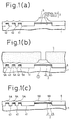
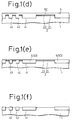
- a structure as shown in Fig. 1(a) is obtained by burying trenches 41 - 43 by a deposition means that conducts etching and deposition simultaneously (bias ECR-CVD process is used in this example). Then, an isotropic etching step for isotropically etching burying material 5 as shown by a broken line in Fig. 1(b) is applied before a polishing step to obtain a structure as shown in Fig. 1(c). Subsequently, a flat structure as shown in Fig. 1(d) is obtained by the polishing step.
- the burying material 5 on a wide protrusion region is etched by the isotropic etching step in Fig. 1(b) into a shape substantially uniform with other portions as shown in Fig. 1(c). Accordingly, a satisfactory flattening is attained by polishing remaining protruding portions.
- this example is put to the following steps (1) - (6).
- Example 2 each of the inventions in Claim 1, 3 is embodied to form trench isolation and manufacture a semiconductor device.
- the invention of claim 2 is applied particularly and it is embodied as a method of manufacturing a semiconductor device as defined in claim 4.
- Example 1 when the burying material is etched back as far as the upper portion of the trench opening in the state shown in Fig. 2(d), that is, when it is to be etched back by the thickness of the burying material on the protrusion region shown by 5C in Fig. 2(d), since the and point can not be judged, it is difficult to control the etching film thickness as the burying material 5 for the isolation portion shown in Fig. 2(e).
- Example 2 undertakes to overcome the problem.
- Example 2 since SiO2 which is the burying material after resist patterning can be etched as far as the surface of the stopper layer is exposed and the burying material (SiO2) on the protrusion region can be removed completely by polishing in the next step, etching back which is necessary in Example 1 is no more required.
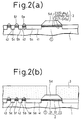
- a substrate 1 to be formed with trench isolation has an etching stopper layer 2 comprising a three-layered structure as shown in Fig. 2(a), (b), (c), (d), trench isolation is formed in a structure in which the upper layer 23 (silicon nitride film in this example) of an etching stopper layer 2 is formed with a film having a polishing rate smaller than that of the burying material 5 and an etching rate also smaller than that of a burying material 5, an intermediate layer 22 (polysilicon film in this example) is formed with a film having an etching rate smaller than that of the upper layer 23, and a lower layer 21 (thermally oxidized silicon dioxide in this example) is formed with a film having an etching rate smaller than that of the intermediate layer 22 and an etching rate greater than that of the substrate.
- the upper layer 23 silicon nitride film in this example
- an etching stopper layer 2 is formed with a film having a polishing rate smaller than that of the burying material
- this example is put to the following steps (1) - (6).
- poly-Si as the intermediate layer 22 is removed, for example, with KOH, and T-SiO2 as the underlying layer 21 is removed by means of hydrofluoric acid.
- the poly-Si of the intermediate layer functions as a stopper to Si3N4 constituting the upper layer 23, while T-SiO2 constituting the lower layer 21 has a functions of an etching stopper to poly-Si of the intermediate layer 22.
- Examples 1 - 2 The examples are modified from Examples 1 - 2 described above. While isotropic etching is applied by wet etching using an etching solution before the polishing of the burying material in Examples 1, 2, isotropic etching was conducted by means of dry etching in these examples.
- the present invention is applied to a method of manufacturing a fine and integrated semiconductor device to be formed with trench isolation.
- Fig. 3 shows steps of this example.
- a plurality of protrusion patterns 61 - 63 were formed on a substrate 1 and trenches formed between each of the protrusions was buried.
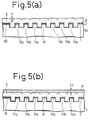
- dummy patterns 71a - 71c and 72a - 72c constituting the polishing stopper layer were previously formed to provide a structure as shown in Fig. 3(a) in which protrusions were uniformly distributed, i.e., the ratio of the surface of the stopper layer 3 present was made uniform.
- a burying material 5 was deposited to obtain a structure as shown in Fig.
- flattened trench isolation was formed by the following steps (1) - (3).
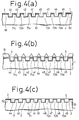
- the present invention was applied to the formation of trench isolation as shown in Fig. 4. While the bias ECR-CVD process was used in Example 1 for forming the burying oxide film, an atmospheric CVD process capable of forming an insulator film was used in this example. Description will be made in the order of steps.
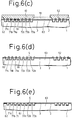
- the present invention was applied to the formation of trench isolation as shown in Fig. 6. Further, as a method of removing an excess burying material 5 (silicon oxide film), a silicon oxide film 51 present in a wide protrusion region was at least partially removed previously by etching using a resist process and, subsequently, a silicon oxide film 52 in a wide burying region including dummy patterns was removed by polishing. More specifically, it was practiced as shown below.
- silicon oxide film 51 present in a wide protrusion region was at least partially removed previously by etching using a resist process and, subsequently, a silicon oxide film 52 in a wide burying region including dummy patterns was removed by polishing. More specifically, it was practiced as shown below.
- the present invention was applied to the formation of a fine and integrated semiconductor device and, in particular, to the formation of trench isolation thereof.
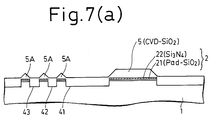
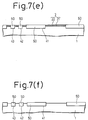
- a structure as shown in Fig. 7(a) was obtained by a burying step of burying a plurality of recesses 41 - 43 on a substrate 1 by a bias ECR-CVD process as a deposition means for simultaneously conducting etching and deposition. Then, a structure as shown in Fig. 7(c) was obtained by conducting a polishing step of flattening a burying material by polishing (Fig. 7(b)), a resist forming step of forming a resist on the substrate after the polishing step and a resist pattern forming step of exposing the burying material remaining in the portions other than the recesses to be buried (the burying material 52 not removed completely).
- a removing step of removing the burying material 52 remaining in the portions other than the recesses to be buried was conducted using a resist pattern 6 as a mask thereby attaining a satisfactory burying and flattening with no residue of the burying material not removed completely, as shown in Fig. 7(d).
- this example was put to the following steps (1) - (6).
- Example 9 the present invention was embodied to the formation of trench isolation for manufacturing a semiconductor device.
- the resist was patterned, the lithographic step therefor took much time but the patterning could be saved in this Example 9.
- This example was put to the following steps (1) - (4).
- Fig. 9(a) - (f) shows the steps in this example.
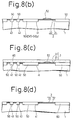
- a plurality of protrusion patterns 61 - 63 each having a polishing stopper layer 3 in the upper portion were formed as shown in Fig. 9(a) and recesses 41 - 47 defined by the plurality of protrusion patterns were buried by a burying material 5 as shown in Fig. 9(b).
- a second polishing stopper layer 7 was formed at least on the burying material 5 in the recess of the portion in which the density of the polishing stopper layer 3 was coarse (wide recess) 41 as shown in Fig. 9(c) and Fig. 9(d) (in this example, after forming the second polishing stopper layer 7 over the entire surface as in Fig.
- flattened trench isolation was formed by the following steps (1) - (6).
- the present invention was applied to trench isolation.
- atmospheric CVD and vacuum CVD were used for forming a burying oxide film and a polishing stopper layer.
- a bias ECR-CVD process (this method is suitable as burying and flattening technique since etching and deposition are conducted simultaneously) was applied to the formation of the buried and flattened film and the second polishing stopper layer, thereby forming a polishing stopper layer 7 over the entire surface of a recess 41 as a trench.
- the following steps (1) - (7) were conducted.
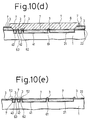
- a poly-Si layer 22 as an etching stopper layer for a Si3N4 layer as a stopper layer 3 for polishing and the Si3N4 layer as the polishing stopper layer 3 on a semiconductor substrate 1 such as made of silicon trenches were formed by a RIE (reactive ion etching) step using a resist process. Then, a structure as shown in Fig. 10(a) was obtained.
- RIE reactive ion etching
- the polishing stopper layer may take various modes such that the material, processing conditions, etc. can be appropriately varied so long as the polishing stopper layer has a polishing rate lower than that of the burying material layer.
- flattening can be attained without leaving the burying material on a wide (long) protrusion region, whereby it is possible to provide a means capable of forming trench isolation of satisfactory flatness, as well as a means for manufacturing a semiconductor device formed with such trench isolation.
- the present invention it is possible to provide a method of manufacturing a semiconductor device having a polishing step for conducting flattening after burying, wherein satisfactory flattened shape can be formed even in a portion in which the area ratio of a stopper layer per unit area is low in a case where there is unevenness in the distribution of a portion showing a function of a polishing stopper on the portion to be polished.
Landscapes
- Element Separation (AREA)
Applications Claiming Priority (15)
| Application Number | Priority Date | Filing Date | Title |
|---|---|---|---|
| JP34026991 | 1991-11-29 | ||
| JP34026091 | 1991-11-29 | ||
| JP340260/91 | 1991-11-29 | ||
| JP34026991 | 1991-11-29 | ||
| JP34026091 | 1991-11-29 | ||
| JP340269/91 | 1991-11-29 | ||
| JP36053091 | 1991-12-30 | ||
| JP360530/91 | 1991-12-30 | ||
| JP36053091 | 1991-12-30 | ||
| JP3567692 | 1992-01-27 | ||
| JP35676/92 | 1992-01-27 | ||
| JP3567692 | 1992-01-27 | ||
| JP285052/92 | 1992-05-30 | ||
| JP28505292 | 1992-05-30 | ||
| JP4285052A JP2874486B2 (ja) | 1991-11-29 | 1992-09-30 | ポリッシュ工程を備えたトレンチアイソレーションの形成方法及び半導体装置の製造方法 |
Publications (3)
| Publication Number | Publication Date |
|---|---|
| EP0545263A2 true EP0545263A2 (de) | 1993-06-09 |
| EP0545263A3 EP0545263A3 (en) | 1996-01-10 |
| EP0545263B1 EP0545263B1 (de) | 2002-06-19 |
Family
ID=27521717
Family Applications (1)
| Application Number | Title | Priority Date | Filing Date |
|---|---|---|---|
| EP92120116A Expired - Lifetime EP0545263B1 (de) | 1991-11-29 | 1992-11-25 | Verfahren zur Herstellung einer Grabenisolation mittels eines Polierschritts und Herstellungsverfahren für eine Halbleitervorrichtung |
Country Status (3)
| Country | Link |
|---|---|
| US (1) | US5498565A (de) |
| EP (1) | EP0545263B1 (de) |
| DE (1) | DE69232648T2 (de) |
Cited By (19)
| Publication number | Priority date | Publication date | Assignee | Title |
|---|---|---|---|---|
| EP0664559A3 (de) * | 1994-01-17 | 1995-11-22 | Sony Corp | Verfahren zur oberflächen Planarisierung von Halbleiter-Anordnungen. |
| WO1996027206A3 (en) * | 1995-02-24 | 1997-03-13 | Intel Corp | Polysilicon polish for patterning improvement |
| GB2306050A (en) * | 1995-10-05 | 1997-04-23 | Nec Corp | Planarizing filled trench isolation semiconductor devices |
| US5629242A (en) * | 1994-01-07 | 1997-05-13 | Sony Corporation | Process for planarizing surface of a semiconductor device |
| EP0813239A1 (de) * | 1996-02-21 | 1997-12-17 | Texas Instruments Incorporated | Verbesserungen bezüglich Halbleitervorrichtungen |
| WO1998003992A1 (de) * | 1996-07-23 | 1998-01-29 | Siemens Aktiengesellschaft | Verfahren zum auffüllen von gräben in einem substrat |
| WO1998007189A1 (en) * | 1996-08-13 | 1998-02-19 | Advanced Micro Devices, Inc. | Semiconductor trench isolation structure having improved upper surface planarity |
| EP0825645A1 (de) * | 1996-08-08 | 1998-02-25 | Siemens Aktiengesellschaft | Lückenfüllungs- und Planarisierungsverfahren für flache Grabenisolation |
| EP0825644A1 (de) * | 1996-08-21 | 1998-02-25 | Motorola, Inc. | Integrierter Schaltkreis mit einer Dummy-Struktur und dessen Herstellungsverfahren |
| EP0791227A4 (de) * | 1994-11-10 | 1998-04-01 | Intel Corp | Formen einer ebenen oberfläche über einem substrat durch modifizierung der topographie des substrats |
| US5792707A (en) * | 1997-01-27 | 1998-08-11 | Chartered Semiconductor Manufacturing Ltd. | Global planarization method for inter level dielectric layers of integrated circuits |
| WO1999016124A3 (de) * | 1997-09-22 | 1999-05-20 | Siemens Ag | Verfahren zur erzeugung von isolationsgräben in einem substrat |
| US5949125A (en) * | 1995-04-06 | 1999-09-07 | Motorola, Inc. | Semiconductor device having field isolation with a mesa or mesas |
| EP0926715A3 (de) * | 1997-12-23 | 1999-12-08 | Texas Instruments Incorporated | Chemisch-mechanishes Polieren für die Planarisierung isolierender Dielektrika |
| US6107187A (en) * | 1999-06-17 | 2000-08-22 | Motorola, Inc. | Method for forming a semiconductor device |
| WO2002021581A3 (en) * | 2000-09-05 | 2002-08-15 | Motorola Inc | Method for uniform polish microelectronic device |
| EP1271631A1 (de) * | 2001-06-29 | 2003-01-02 | Interuniversitair Micro-Elektronica Centrum Vzw | Herstellungsverfahren von Halbleiteranordnungen unter Verwendung eines chemisch-mechanischen Polierens |
| US6555476B1 (en) | 1997-12-23 | 2003-04-29 | Texas Instruments Incorporated | Silicon carbide as a stop layer in chemical mechanical polishing for isolation dielectric |
| EP0905756A3 (de) * | 1997-09-30 | 2003-05-21 | Siemens Aktiengesellschaft | Planarisierung von einer nicht-konformen Vorrichtungsschicht in Halbleiterherstellung |
Families Citing this family (60)
| Publication number | Priority date | Publication date | Assignee | Title |
|---|---|---|---|---|
| JP3060714B2 (ja) * | 1992-04-15 | 2000-07-10 | 日本電気株式会社 | 半導体集積回路の製造方法 |
| KR0151051B1 (ko) * | 1995-05-30 | 1998-12-01 | 김광호 | 반도체장치의 절연막 형성방법 |
| US5763325A (en) * | 1995-07-04 | 1998-06-09 | Fujitsu Limited | Fabrication process of a semiconductor device using a slurry containing manganese oxide |
| EP0870327B1 (de) * | 1995-12-27 | 2002-09-11 | Lam Research Corporation | Verfahren zur füllung von gräben auf einer halbleiterscheibe |
| US5863828A (en) * | 1996-09-25 | 1999-01-26 | National Semiconductor Corporation | Trench planarization technique |
| US5923991A (en) * | 1996-11-05 | 1999-07-13 | International Business Machines Corporation | Methods to prevent divot formation in shallow trench isolation areas |
| KR100226736B1 (ko) * | 1996-11-07 | 1999-10-15 | 구본준 | 격리영역 형성방법 |
| US5721172A (en) * | 1996-12-02 | 1998-02-24 | Taiwan Semiconductor Manufacturing Company, Ltd. | Self-aligned polish stop layer hard masking method for forming planarized aperture fill layers |
| US6171896B1 (en) * | 1997-02-03 | 2001-01-09 | Taiwan Semiconductor Manufacturing Company | Method of forming shallow trench isolation by HDPCVD oxide |
| US6025270A (en) * | 1997-02-03 | 2000-02-15 | Taiwan Semiconductor Manufacturing Company, Ltd. | Planarization process using tailored etchback and CMP |
| US5721173A (en) * | 1997-02-25 | 1998-02-24 | Kabushiki Kaisha Toshiba | Method of forming a shallow trench isolation structure |
| KR100230815B1 (ko) * | 1997-03-18 | 1999-11-15 | 김영환 | 반도체 메모리 소자 격리 방법 |
| JP3638778B2 (ja) * | 1997-03-31 | 2005-04-13 | 株式会社ルネサステクノロジ | 半導体集積回路装置およびその製造方法 |
| US5786262A (en) * | 1997-04-09 | 1998-07-28 | Taiwan Semiconductor Manufacturing Co., Ltd. | Self-planarized gapfilling for shallow trench isolation |
| US5728621A (en) * | 1997-04-28 | 1998-03-17 | Chartered Semiconductor Manufacturing Pte Ltd | Method for shallow trench isolation |
| US5731241A (en) * | 1997-05-15 | 1998-03-24 | Taiwan Semiconductor Manufacturing Company, Ltd. | Self-aligned sacrificial oxide for shallow trench isolation |
| US5811345A (en) * | 1997-09-18 | 1998-09-22 | Taiwan Semiconductor Manufacturing Co., Ltd. | Planarization of shallow- trench- isolation without chemical mechanical polishing |
| US6309947B1 (en) * | 1997-10-06 | 2001-10-30 | Advanced Micro Devices, Inc. | Method of manufacturing a semiconductor device with improved isolation region to active region topography |
| KR100239453B1 (ko) * | 1997-11-06 | 2000-01-15 | 김영환 | 반도체 소자의 소자 격리층 형성 방법 |
| KR100237222B1 (ko) * | 1997-11-24 | 2000-01-15 | 김규현 | 반도체 소자 분리 방법 |
| US6395619B2 (en) * | 1997-12-05 | 2002-05-28 | Sharp Kabushiki Kaisha | Process for fabricating a semiconductor device |
| US5923993A (en) * | 1997-12-17 | 1999-07-13 | Advanced Micro Devices | Method for fabricating dishing free shallow isolation trenches |
| JPH11214499A (ja) * | 1998-01-27 | 1999-08-06 | Mitsubishi Electric Corp | 半導体装置の製造方法 |
| JPH11220017A (ja) * | 1998-01-30 | 1999-08-10 | Mitsubishi Electric Corp | 半導体装置とその製造方法 |
| JPH11233609A (ja) * | 1998-02-13 | 1999-08-27 | Mitsubishi Electric Corp | 半導体装置及びその製造方法 |
| US6093656A (en) * | 1998-02-26 | 2000-07-25 | Vlsi Technology, Inc. | Method of minimizing dishing during chemical mechanical polishing of semiconductor metals for making a semiconductor device |
| US7001713B2 (en) * | 1998-04-18 | 2006-02-21 | United Microelectronics, Corp. | Method of forming partial reverse active mask |
| US6004863A (en) * | 1998-05-06 | 1999-12-21 | Taiwan Semiconductor Manufacturing Company | Non-polishing sacrificial layer etchback planarizing method for forming a planarized aperture fill layer |
| US5880006A (en) * | 1998-05-22 | 1999-03-09 | Vlsi Technology, Inc. | Method for fabrication of a semiconductor device |
| TW396510B (en) | 1998-06-03 | 2000-07-01 | United Microelectronics Corp | Shallow trench isolation formed by chemical mechanical polishing |
| US6790742B2 (en) | 1998-06-03 | 2004-09-14 | United Microelectronics Corporation | Chemical mechanical polishing in forming semiconductor device |
| JPH11354629A (ja) * | 1998-06-10 | 1999-12-24 | Mitsubishi Electric Corp | 半導体装置の製造方法及び半導体装置 |
| US6180525B1 (en) * | 1998-08-19 | 2001-01-30 | Micron Technology, Inc. | Method of minimizing repetitive chemical-mechanical polishing scratch marks and of processing a semiconductor wafer outer surface |
| US6365523B1 (en) * | 1998-10-22 | 2002-04-02 | Taiwan Semiconductor Maufacturing Company | Integrated high density plasma chemical vapor deposition (HDP-CVD) method and chemical mechanical polish (CMP) planarizing method for forming patterned planarized aperture fill layers |
| US7045435B1 (en) * | 1998-11-03 | 2006-05-16 | Mosel Vitelic Inc | Shallow trench isolation method for a semiconductor wafer |
| US6461932B1 (en) * | 1998-12-14 | 2002-10-08 | National Semiconductor Corporation | Semiconductor trench isolation process that utilizes smoothening layer |
| JP2000190207A (ja) * | 1998-12-28 | 2000-07-11 | Tdk Corp | 研磨方法及び薄膜磁気ヘッドの製造方法 |
| US6869858B2 (en) * | 1999-01-25 | 2005-03-22 | Taiwan Semiconductor Manufacturing Company, Ltd. | Shallow trench isolation planarized by wet etchback and chemical mechanical polishing |
| KR100343136B1 (ko) * | 1999-03-18 | 2002-07-05 | 윤종용 | 이중 연마저지층을 이용한 화학기계적 연마방법 |
| US6197660B1 (en) * | 1999-04-29 | 2001-03-06 | Taiwan Semiconductor Manufacturing Company | Integration of CMP and wet or dry etching for STI |
| JP3566885B2 (ja) * | 1999-06-02 | 2004-09-15 | シャープ株式会社 | トレンチアイソレーションの形成方法及び半導体装置の製造方法 |
| US7253047B2 (en) | 1999-09-01 | 2007-08-07 | Micron Technology, Inc. | Semiconductor processing methods of forming transistors, semiconductor processing methods of forming dynamic random access memory circuitry, and related integrated circuitry |
| US6197677B1 (en) * | 1999-11-01 | 2001-03-06 | United Microelectronics Corp. | Method of depositing a silicon oxide layer on a semiconductor wafer |
| US6197691B1 (en) | 1999-11-15 | 2001-03-06 | Chartered Semiconductor Manufacturing Ltd. | Shallow trench isolation process |
| JP4307664B2 (ja) * | 1999-12-03 | 2009-08-05 | 株式会社ルネサステクノロジ | 半導体装置 |
| JP3506645B2 (ja) * | 1999-12-13 | 2004-03-15 | Necエレクトロニクス株式会社 | 半導体装置及びその製造方法 |
| EP1272580A2 (de) * | 2000-04-11 | 2003-01-08 | Cabot Microelectronics Corporation | System zur vorzugsweisenden abtrennung von siliziumoxid |
| US6423612B1 (en) | 2000-06-26 | 2002-07-23 | Advanced Micro Devices, Inc. | Method of fabricating a shallow trench isolation structure with reduced topography |
| US6403484B1 (en) | 2001-03-12 | 2002-06-11 | Chartered Semiconductor Manufacturing Ltd. | Method to achieve STI planarization |
| US6734080B1 (en) * | 2002-05-31 | 2004-05-11 | Advanced Micro Devices, Inc. | Semiconductor isolation material deposition system and method |
| US6916713B2 (en) * | 2002-11-05 | 2005-07-12 | Macronix International Co., Ltd. | Code implantation process |
| US7427361B2 (en) * | 2003-10-10 | 2008-09-23 | Dupont Air Products Nanomaterials Llc | Particulate or particle-bound chelating agents |
| US20050126588A1 (en) * | 2003-11-04 | 2005-06-16 | Carter Melvin K. | Chemical mechanical polishing slurries and cleaners containing salicylic acid as a corrosion inhibitor |
| US7419911B2 (en) * | 2003-11-10 | 2008-09-02 | Ekc Technology, Inc. | Compositions and methods for rapidly removing overfilled substrates |
| TW201222778A (en) * | 2010-11-18 | 2012-06-01 | Ind Tech Res Inst | Trench capacitor structures and method of manufacturing the same |
| CN103854965B (zh) * | 2012-11-30 | 2017-03-01 | 中国科学院微电子研究所 | 平坦化处理方法 |
| US9859494B1 (en) * | 2016-06-29 | 2018-01-02 | International Business Machines Corporation | Nanoparticle with plural functionalities, and method of forming the nanoparticle |
| US10074721B2 (en) | 2016-09-22 | 2018-09-11 | Infineon Technologies Ag | Method of fabricating a semiconductor wafer that includes producing a planarised surface having both a mesa surface and an insulating layer surface |
| US10134603B2 (en) * | 2016-09-22 | 2018-11-20 | Infineon Technologies Ag | Method of planarising a surface |
| US10636673B2 (en) | 2017-09-28 | 2020-04-28 | Taiwan Semiconductor Manufacturing Co., Ltd. | Method for forming semiconductor device structure |
Family Cites Families (12)
| Publication number | Priority date | Publication date | Assignee | Title |
|---|---|---|---|---|
| JPS59163817A (ja) * | 1983-03-08 | 1984-09-14 | Nec Corp | 半導体装置用基板 |
| US4571819A (en) * | 1984-11-01 | 1986-02-25 | Ncr Corporation | Method for forming trench isolation structures |
| SE8603126L (sv) * | 1985-08-05 | 1987-02-06 | Rca Corp | Cmos-integrerad krets och metod att tillverka en sadan |
| JPS6484634A (en) * | 1987-09-28 | 1989-03-29 | Fujitsu Ltd | Manufacture of semiconductor device |
| US4962064A (en) * | 1988-05-12 | 1990-10-09 | Advanced Micro Devices, Inc. | Method of planarization of topologies in integrated circuit structures |
| US4954459A (en) * | 1988-05-12 | 1990-09-04 | Advanced Micro Devices, Inc. | Method of planarization of topologies in integrated circuit structures |
| JP2517751B2 (ja) * | 1988-12-13 | 1996-07-24 | 松下電器産業株式会社 | 半導体装置の製造方法 |
| JPH02294050A (ja) * | 1989-05-09 | 1990-12-05 | Sony Corp | トレンチ埋め込み方法 |
| JP2870054B2 (ja) * | 1989-10-25 | 1999-03-10 | ソニー株式会社 | 半導体装置の製造方法 |
| JP3231754B2 (ja) * | 1989-10-25 | 2001-11-26 | ソニー株式会社 | 半導体装置の製造方法 |
| DE69004932T2 (de) * | 1989-10-25 | 1994-05-19 | Ibm | Verfahren zur Herstellung breiter mit Dielektrikum gefüllter Isolationsgraben für Halbleiteranordnungen. |
| JP3123061B2 (ja) * | 1990-06-13 | 2001-01-09 | ソニー株式会社 | バイアスecr―cvd法による埋め込み平坦化方法 |
-
1992
- 1992-11-25 DE DE69232648T patent/DE69232648T2/de not_active Expired - Fee Related
- 1992-11-25 EP EP92120116A patent/EP0545263B1/de not_active Expired - Lifetime
- 1992-11-25 US US07/981,831 patent/US5498565A/en not_active Expired - Lifetime
Cited By (31)
| Publication number | Priority date | Publication date | Assignee | Title |
|---|---|---|---|---|
| US5629242A (en) * | 1994-01-07 | 1997-05-13 | Sony Corporation | Process for planarizing surface of a semiconductor device |
| KR100371252B1 (ko) * | 1994-01-17 | 2003-04-07 | 소니 가부시끼 가이샤 | 반도체장치에있어서의막평탄화방법 |
| EP0664559A3 (de) * | 1994-01-17 | 1995-11-22 | Sony Corp | Verfahren zur oberflächen Planarisierung von Halbleiter-Anordnungen. |
| US6048800A (en) * | 1994-01-17 | 2000-04-11 | Sony Corporation | Process for planarizing surface of a semiconductor device |
| EP0977248A1 (de) * | 1994-01-17 | 2000-02-02 | Sony Corporation | Verfahren zum Einebnen der Oberfläche einer Halbleiteranordnung |
| EP0791227A4 (de) * | 1994-11-10 | 1998-04-01 | Intel Corp | Formen einer ebenen oberfläche über einem substrat durch modifizierung der topographie des substrats |
| WO1996027206A3 (en) * | 1995-02-24 | 1997-03-13 | Intel Corp | Polysilicon polish for patterning improvement |
| US5911111A (en) * | 1995-02-24 | 1999-06-08 | Intel Corporation | Polysilicon polish for patterning improvement |
| US6285066B1 (en) | 1995-04-06 | 2001-09-04 | Motorola, Inc. | Semiconductor device having field isolation |
| US5949125A (en) * | 1995-04-06 | 1999-09-07 | Motorola, Inc. | Semiconductor device having field isolation with a mesa or mesas |
| GB2306050B (en) * | 1995-10-05 | 2000-05-10 | Nec Corp | A method of manufacturing semiconductor devices |
| US5961794A (en) * | 1995-10-05 | 1999-10-05 | Nec Corporation | Method of manufacturing semiconductor devices |
| GB2306050A (en) * | 1995-10-05 | 1997-04-23 | Nec Corp | Planarizing filled trench isolation semiconductor devices |
| EP0813239A1 (de) * | 1996-02-21 | 1997-12-17 | Texas Instruments Incorporated | Verbesserungen bezüglich Halbleitervorrichtungen |
| WO1998003992A1 (de) * | 1996-07-23 | 1998-01-29 | Siemens Aktiengesellschaft | Verfahren zum auffüllen von gräben in einem substrat |
| EP0825645A1 (de) * | 1996-08-08 | 1998-02-25 | Siemens Aktiengesellschaft | Lückenfüllungs- und Planarisierungsverfahren für flache Grabenisolation |
| WO1998007189A1 (en) * | 1996-08-13 | 1998-02-19 | Advanced Micro Devices, Inc. | Semiconductor trench isolation structure having improved upper surface planarity |
| EP0825644A1 (de) * | 1996-08-21 | 1998-02-25 | Motorola, Inc. | Integrierter Schaltkreis mit einer Dummy-Struktur und dessen Herstellungsverfahren |
| US5885856A (en) * | 1996-08-21 | 1999-03-23 | Motorola, Inc. | Integrated circuit having a dummy structure and method of making |
| US5792707A (en) * | 1997-01-27 | 1998-08-11 | Chartered Semiconductor Manufacturing Ltd. | Global planarization method for inter level dielectric layers of integrated circuits |
| WO1999016124A3 (de) * | 1997-09-22 | 1999-05-20 | Siemens Ag | Verfahren zur erzeugung von isolationsgräben in einem substrat |
| EP0905756A3 (de) * | 1997-09-30 | 2003-05-21 | Siemens Aktiengesellschaft | Planarisierung von einer nicht-konformen Vorrichtungsschicht in Halbleiterherstellung |
| EP0926715A3 (de) * | 1997-12-23 | 1999-12-08 | Texas Instruments Incorporated | Chemisch-mechanishes Polieren für die Planarisierung isolierender Dielektrika |
| US6555476B1 (en) | 1997-12-23 | 2003-04-29 | Texas Instruments Incorporated | Silicon carbide as a stop layer in chemical mechanical polishing for isolation dielectric |
| US6107187A (en) * | 1999-06-17 | 2000-08-22 | Motorola, Inc. | Method for forming a semiconductor device |
| WO2002021581A3 (en) * | 2000-09-05 | 2002-08-15 | Motorola Inc | Method for uniform polish microelectronic device |
| US6770929B2 (en) | 2000-09-05 | 2004-08-03 | Freescale Semiconductor, Inc. | Method for uniform polish in microelectronic device |
| KR100823464B1 (ko) * | 2000-09-05 | 2008-04-21 | 프리스케일 세미컨덕터, 인크. | 마이크로 전자 장치의 균일 연마 방법 |
| KR100857407B1 (ko) * | 2000-09-05 | 2008-09-08 | 프리스케일 세미컨덕터, 인크. | 반도체 구조 |
| EP1271631A1 (de) * | 2001-06-29 | 2003-01-02 | Interuniversitair Micro-Elektronica Centrum Vzw | Herstellungsverfahren von Halbleiteranordnungen unter Verwendung eines chemisch-mechanischen Polierens |
| US7033941B2 (en) | 2001-06-29 | 2006-04-25 | Interuniversitair Microelektronica Centrum (Imec) | Method of producing semiconductor devices using chemical mechanical polishing |
Also Published As
| Publication number | Publication date |
|---|---|
| EP0545263A3 (en) | 1996-01-10 |
| US5498565A (en) | 1996-03-12 |
| EP0545263B1 (de) | 2002-06-19 |
| DE69232648D1 (de) | 2002-07-25 |
| DE69232648T2 (de) | 2003-02-06 |
Similar Documents
| Publication | Publication Date | Title |
|---|---|---|
| EP0545263A2 (de) | Verfahren zur Herstellung einer Isolationsprobe mittels einer Polierschritt | |
| USRE38363E1 (en) | Method of forming trench isolation having polishing step and method of manufacturing semiconductor device | |
| US5668052A (en) | Method of manufacturing semiconductor device | |
| JPH01290236A (ja) | 幅の広いトレンチを平坦化する方法 | |
| US5961794A (en) | Method of manufacturing semiconductor devices | |
| US6159822A (en) | Self-planarized shallow trench isolation | |
| US4708770A (en) | Planarized process for forming vias in silicon wafers | |
| EP0369953B1 (de) | Flankenabschrägen von Löchern durch dielektrische Schichten zur Erzeugung von Kontakten in integrierten Schaltkreisen | |
| KR100190010B1 (ko) | 반도체 소자의 소자분리막 형성방법 | |
| EP0954022B1 (de) | Verfahren zur Bereitstellung einer flachen Grabenisolation von Transistoren | |
| US6214695B1 (en) | Method of manufacturing semiconductor device | |
| US7045434B2 (en) | Semiconductor device and method for manufacturing the same | |
| US6627551B2 (en) | Method for avoiding microscratch in interlevel dielectric layer chemical mechanical polishing process | |
| US7405165B2 (en) | Dual-tank etch method for oxide thickness control | |
| JP3317279B2 (ja) | 半導体装置の製造方法 | |
| US20050148191A1 (en) | Method of manufacturing semiconductor device | |
| US6284645B1 (en) | Controlling improvement of critical dimension of dual damasceue process using spin-on-glass process | |
| KR100524928B1 (ko) | 다마신 공정을 이용한 금속배선 형성방법 | |
| JPH11145285A (ja) | 配線形成方法 | |
| KR100281147B1 (ko) | 콘택홀 형성방법 | |
| KR100604587B1 (ko) | 반도체 소자의 제조방법 | |
| US20030087526A1 (en) | Method of etching a mask layer and a protecting layer for metal contact windows | |
| JPH07147225A (ja) | 半導体装置およびその製造方法 | |
| KR19980030769A (ko) | 반도체 소자의 평탄화 방법 | |
| KR980012266A (ko) | 반도체장치의 소자분리방법 |
Legal Events
| Date | Code | Title | Description |
|---|---|---|---|
| PUAI | Public reference made under article 153(3) epc to a published international application that has entered the european phase |
Free format text: ORIGINAL CODE: 0009012 |
|
| AK | Designated contracting states |
Kind code of ref document: A2 Designated state(s): DE FR |
|
| PUAL | Search report despatched |
Free format text: ORIGINAL CODE: 0009013 |
|
| AK | Designated contracting states |
Kind code of ref document: A3 Designated state(s): DE FR |
|
| 17P | Request for examination filed |
Effective date: 19960610 |
|
| 17Q | First examination report despatched |
Effective date: 19960705 |
|
| GRAG | Despatch of communication of intention to grant |
Free format text: ORIGINAL CODE: EPIDOS AGRA |
|
| GRAG | Despatch of communication of intention to grant |
Free format text: ORIGINAL CODE: EPIDOS AGRA |
|
| GRAG | Despatch of communication of intention to grant |
Free format text: ORIGINAL CODE: EPIDOS AGRA |
|
| GRAH | Despatch of communication of intention to grant a patent |
Free format text: ORIGINAL CODE: EPIDOS IGRA |
|
| GRAH | Despatch of communication of intention to grant a patent |
Free format text: ORIGINAL CODE: EPIDOS IGRA |
|
| GRAA | (expected) grant |
Free format text: ORIGINAL CODE: 0009210 |
|
| AK | Designated contracting states |
Kind code of ref document: B1 Designated state(s): DE FR |
|
| REF | Corresponds to: |
Ref document number: 69232648 Country of ref document: DE Date of ref document: 20020725 |
|
| ET | Fr: translation filed | ||
| PLBE | No opposition filed within time limit |
Free format text: ORIGINAL CODE: 0009261 |
|
| STAA | Information on the status of an ep patent application or granted ep patent |
Free format text: STATUS: NO OPPOSITION FILED WITHIN TIME LIMIT |
|
| PG25 | Lapsed in a contracting state [announced via postgrant information from national office to epo] |
Ref country code: DE Free format text: LAPSE BECAUSE OF NON-PAYMENT OF DUE FEES Effective date: 20030603 |
|
| 26N | No opposition filed |
Effective date: 20030320 |
|
| PG25 | Lapsed in a contracting state [announced via postgrant information from national office to epo] |
Ref country code: FR Free format text: LAPSE BECAUSE OF NON-PAYMENT OF DUE FEES Effective date: 20030731 |
|
| REG | Reference to a national code |
Ref country code: FR Ref legal event code: ST |