EP0549340A1 - Stabilisateur pour résines - Google Patents
Stabilisateur pour résines Download PDFInfo
- Publication number
- EP0549340A1 EP0549340A1 EP92311754A EP92311754A EP0549340A1 EP 0549340 A1 EP0549340 A1 EP 0549340A1 EP 92311754 A EP92311754 A EP 92311754A EP 92311754 A EP92311754 A EP 92311754A EP 0549340 A1 EP0549340 A1 EP 0549340A1
- Authority
- EP
- European Patent Office
- Prior art keywords
- weight
- parts
- chlorine
- acid
- anion
- Prior art date
- Legal status (The legal status is an assumption and is not a legal conclusion. Google has not performed a legal analysis and makes no representation as to the accuracy of the status listed.)
- Granted
Links
Images


Classifications
-
- C—CHEMISTRY; METALLURGY
- C08—ORGANIC MACROMOLECULAR COMPOUNDS; THEIR PREPARATION OR CHEMICAL WORKING-UP; COMPOSITIONS BASED THEREON
- C08K—Use of inorganic or non-macromolecular organic substances as compounding ingredients
- C08K3/00—Use of inorganic substances as compounding ingredients
- C08K3/10—Metal compounds
- C08K3/12—Hydrides
-
- C—CHEMISTRY; METALLURGY
- C08—ORGANIC MACROMOLECULAR COMPOUNDS; THEIR PREPARATION OR CHEMICAL WORKING-UP; COMPOSITIONS BASED THEREON
- C08K—Use of inorganic or non-macromolecular organic substances as compounding ingredients
- C08K3/00—Use of inorganic substances as compounding ingredients
- C08K3/01—Use of inorganic substances as compounding ingredients characterized by their specific function
- C08K3/014—Stabilisers against oxidation, heat, light or ozone
-
- B—PERFORMING OPERATIONS; TRANSPORTING
- B82—NANOTECHNOLOGY
- B82Y—SPECIFIC USES OR APPLICATIONS OF NANOSTRUCTURES; MEASUREMENT OR ANALYSIS OF NANOSTRUCTURES; MANUFACTURE OR TREATMENT OF NANOSTRUCTURES
- B82Y30/00—Nanotechnology for materials or surface science, e.g. nanocomposites
-
- C—CHEMISTRY; METALLURGY
- C08—ORGANIC MACROMOLECULAR COMPOUNDS; THEIR PREPARATION OR CHEMICAL WORKING-UP; COMPOSITIONS BASED THEREON
- C08K—Use of inorganic or non-macromolecular organic substances as compounding ingredients
- C08K3/00—Use of inorganic substances as compounding ingredients
- C08K3/18—Oxygen-containing compounds, e.g. metal carbonyls
- C08K3/24—Acids; Salts thereof
- C08K3/26—Carbonates; Bicarbonates
-
- C—CHEMISTRY; METALLURGY
- C08—ORGANIC MACROMOLECULAR COMPOUNDS; THEIR PREPARATION OR CHEMICAL WORKING-UP; COMPOSITIONS BASED THEREON
- C08K—Use of inorganic or non-macromolecular organic substances as compounding ingredients
- C08K3/00—Use of inorganic substances as compounding ingredients
- C08K3/30—Sulfur-, selenium- or tellurium-containing compounds
-
- C—CHEMISTRY; METALLURGY
- C08—ORGANIC MACROMOLECULAR COMPOUNDS; THEIR PREPARATION OR CHEMICAL WORKING-UP; COMPOSITIONS BASED THEREON
- C08K—Use of inorganic or non-macromolecular organic substances as compounding ingredients
- C08K5/00—Use of organic ingredients
- C08K5/0008—Organic ingredients according to more than one of the "one dot" groups of C08K5/01 - C08K5/59
- C08K5/005—Stabilisers against oxidation, heat, light, ozone
-
- C—CHEMISTRY; METALLURGY
- C08—ORGANIC MACROMOLECULAR COMPOUNDS; THEIR PREPARATION OR CHEMICAL WORKING-UP; COMPOSITIONS BASED THEREON
- C08K—Use of inorganic or non-macromolecular organic substances as compounding ingredients
- C08K9/00—Use of pretreated ingredients
- C08K9/04—Ingredients treated with organic substances
-
- C—CHEMISTRY; METALLURGY
- C01—INORGANIC CHEMISTRY
- C01P—INDEXING SCHEME RELATING TO STRUCTURAL AND PHYSICAL ASPECTS OF SOLID INORGANIC COMPOUNDS
- C01P2002/00—Crystal-structural characteristics
- C01P2002/70—Crystal-structural characteristics defined by measured X-ray, neutron or electron diffraction data
- C01P2002/72—Crystal-structural characteristics defined by measured X-ray, neutron or electron diffraction data by d-values or two theta-values, e.g. as X-ray diagram
-
- C—CHEMISTRY; METALLURGY
- C01—INORGANIC CHEMISTRY
- C01P—INDEXING SCHEME RELATING TO STRUCTURAL AND PHYSICAL ASPECTS OF SOLID INORGANIC COMPOUNDS
- C01P2002/00—Crystal-structural characteristics
- C01P2002/70—Crystal-structural characteristics defined by measured X-ray, neutron or electron diffraction data
- C01P2002/74—Crystal-structural characteristics defined by measured X-ray, neutron or electron diffraction data by peak-intensities or a ratio thereof only
-
- C—CHEMISTRY; METALLURGY
- C01—INORGANIC CHEMISTRY
- C01P—INDEXING SCHEME RELATING TO STRUCTURAL AND PHYSICAL ASPECTS OF SOLID INORGANIC COMPOUNDS
- C01P2002/00—Crystal-structural characteristics
- C01P2002/70—Crystal-structural characteristics defined by measured X-ray, neutron or electron diffraction data
- C01P2002/78—Crystal-structural characteristics defined by measured X-ray, neutron or electron diffraction data by stacking-plane distances or stacking sequences
-
- C—CHEMISTRY; METALLURGY
- C01—INORGANIC CHEMISTRY
- C01P—INDEXING SCHEME RELATING TO STRUCTURAL AND PHYSICAL ASPECTS OF SOLID INORGANIC COMPOUNDS
- C01P2002/00—Crystal-structural characteristics
- C01P2002/80—Crystal-structural characteristics defined by measured data other than those specified in group C01P2002/70
- C01P2002/82—Crystal-structural characteristics defined by measured data other than those specified in group C01P2002/70 by IR- or Raman-data
-
- C—CHEMISTRY; METALLURGY
- C01—INORGANIC CHEMISTRY
- C01P—INDEXING SCHEME RELATING TO STRUCTURAL AND PHYSICAL ASPECTS OF SOLID INORGANIC COMPOUNDS
- C01P2002/00—Crystal-structural characteristics
- C01P2002/80—Crystal-structural characteristics defined by measured data other than those specified in group C01P2002/70
- C01P2002/88—Crystal-structural characteristics defined by measured data other than those specified in group C01P2002/70 by thermal analysis data, e.g. TGA, DTA, DSC
-
- C—CHEMISTRY; METALLURGY
- C01—INORGANIC CHEMISTRY
- C01P—INDEXING SCHEME RELATING TO STRUCTURAL AND PHYSICAL ASPECTS OF SOLID INORGANIC COMPOUNDS
- C01P2004/00—Particle morphology
- C01P2004/01—Particle morphology depicted by an image
- C01P2004/03—Particle morphology depicted by an image obtained by SEM
-
- C—CHEMISTRY; METALLURGY
- C01—INORGANIC CHEMISTRY
- C01P—INDEXING SCHEME RELATING TO STRUCTURAL AND PHYSICAL ASPECTS OF SOLID INORGANIC COMPOUNDS
- C01P2004/00—Particle morphology
- C01P2004/20—Particle morphology extending in two dimensions, e.g. plate-like
-
- C—CHEMISTRY; METALLURGY
- C01—INORGANIC CHEMISTRY
- C01P—INDEXING SCHEME RELATING TO STRUCTURAL AND PHYSICAL ASPECTS OF SOLID INORGANIC COMPOUNDS
- C01P2004/00—Particle morphology
- C01P2004/60—Particles characterised by their size
- C01P2004/61—Micrometer sized, i.e. from 1-100 micrometer
-
- C—CHEMISTRY; METALLURGY
- C01—INORGANIC CHEMISTRY
- C01P—INDEXING SCHEME RELATING TO STRUCTURAL AND PHYSICAL ASPECTS OF SOLID INORGANIC COMPOUNDS
- C01P2004/00—Particle morphology
- C01P2004/60—Particles characterised by their size
- C01P2004/62—Submicrometer sized, i.e. from 0.1-1 micrometer
-
- C—CHEMISTRY; METALLURGY
- C01—INORGANIC CHEMISTRY
- C01P—INDEXING SCHEME RELATING TO STRUCTURAL AND PHYSICAL ASPECTS OF SOLID INORGANIC COMPOUNDS
- C01P2004/00—Particle morphology
- C01P2004/60—Particles characterised by their size
- C01P2004/64—Nanometer sized, i.e. from 1-100 nanometer
-
- C—CHEMISTRY; METALLURGY
- C01—INORGANIC CHEMISTRY
- C01P—INDEXING SCHEME RELATING TO STRUCTURAL AND PHYSICAL ASPECTS OF SOLID INORGANIC COMPOUNDS
- C01P2006/00—Physical properties of inorganic compounds
- C01P2006/10—Solid density
-
- C—CHEMISTRY; METALLURGY
- C01—INORGANIC CHEMISTRY
- C01P—INDEXING SCHEME RELATING TO STRUCTURAL AND PHYSICAL ASPECTS OF SOLID INORGANIC COMPOUNDS
- C01P2006/00—Physical properties of inorganic compounds
- C01P2006/12—Surface area
-
- C—CHEMISTRY; METALLURGY
- C01—INORGANIC CHEMISTRY
- C01P—INDEXING SCHEME RELATING TO STRUCTURAL AND PHYSICAL ASPECTS OF SOLID INORGANIC COMPOUNDS
- C01P2006/00—Physical properties of inorganic compounds
- C01P2006/22—Rheological behaviour as dispersion, e.g. viscosity, sedimentation stability
-
- C—CHEMISTRY; METALLURGY
- C01—INORGANIC CHEMISTRY
- C01P—INDEXING SCHEME RELATING TO STRUCTURAL AND PHYSICAL ASPECTS OF SOLID INORGANIC COMPOUNDS
- C01P2006/00—Physical properties of inorganic compounds
- C01P2006/60—Optical properties, e.g. expressed in CIELAB-values
Definitions
- This invention relates to a stabilizer for resins composed of a lithium aluminum complex hydroxide salt, and more specifically, to a stabilizer having an excellent heat stabilizing action for chlorine-containing polymers or olefin-type resins containing halogen-containing catalyst residues, and compositions using the above stabilizer.
- Chlorine-containing polymers such as a vinyl chloride polymer are colored by a heat decomposition reaction such as dehydrochlorination or are liable to decrease in mechanical properties in a heat molding processing and heat histories subjected thereafter, and to prevent these defects, the compounding of stabilizers is generally necessary.
- Olefin resins produced by using Ziegler-type catalysts contain halogen-containing catalyst residues, and these residues generate hydrogen chloride during a heat molding processing to form rusts in a molding machine, or cause deterioration of resins such as yellowing. To remedy these defects, it is widely practiced to incorporate stabilizers for capturing hydrogen chloride.
- hydrotalcite As such a stabilizer, the use of hydrotalcite has been known from old.
- Japanese Laid-Open Patent Publication No. 80445/1980 describes the use of hydrotalcite as a stabilizer for halogen-containing resins.
- Japanese Patent Publication No. 36012/1983 describes the compounding of a ⁇ -diketone compound and a hydrotalcite represented by the following formula Mg 1-x .Al x (OH)2.A x/2 .mH2O wherein x is a number of 0 ⁇ x ⁇ 0.5, A is CO32 ⁇ or SO42 ⁇ , and m is a positive number, in a halogen-containing resin.
- Japanese Patent Publication No. 30737/1984 describes the compounding of at least 0.01% by weight of a complex compound having the general formula M x Al y (OH) 2x+3y-2z (A) z ⁇ aH2O wherein M is Mg, Ca or Zn, A is Co3 or HPO4, x, y and z are positive numbers, and a is zero or a positive number, in a polyolefin containing halogen-containing catalyst residues produced by using Ziegler-type catalysts.
- Hydrotalcites are complex hydroxide carbonate salts of magnesium and aluminum and non-toxic, have excellent thermal stability, and are characteristic in that they are transparent when incorporated in polymers.
- Hydrotalcites ideally have a chemical composition represented by the following formula Mg6Al2(OH)16.CO3.mH2O wherein m is zero or a positive number, but Mg and Al within a broad range tend to form a solid solution as shown in the formula shown in the above prior arts cited above. It is difficult to produce a product having a fixed composition.
- the present inventors have found that a lithium aluminum complex hydroxide salt can be obtained as a certain fixed composition despite some variations in synthesizing conditions, and when it is added to chloride-containing polymers or olefin-type resins containing halogen-containing catalyst residues, an excellent heat stabilizing action can be obtained.
- this lithium aluminum complex hydroxide salt has better heat stability than hydrotalcite having a Mg/Al mole ratio of 2-2.5 having the best heat stabilizing action, and has better dispersibility in resins or better electrical insulation resistance to compounded products.
- a stabilizer for resins comprising a lithium aluminum complex hydroxide salt represented by the following formula (1) [Al2Li(OH)6] n X.mH2O wherein X is an inorganic or organic anion, n is the value number of anion X, and m is a number of not more than 3.
- a stabilized chlorine-containing polymer composition comprising a chlorine-containing polymer and 0.01 to 10 parts by weight, per 100 parts by weight of the chlorine-containing polymer, of a lithium aluminum complex hydroxide salt of formula (1).
- an olefin-type resin composition comprising an olefin-type resin containing halogen-containing catalyst residues and 0.01 to 10 parts by weight, per 100 parts by weight of the said olefin-type resin, a lithium aluminum complex hydroxide salt of formula (1).
- the lithium aluminum complex hydroxide salt used in this invention has a chemical composition shown by formula (1).
- the process for producing this substance itself and its chemical structure are known from Clays and Clay Minerals, Vol. 25, pages 384 to 391 (1977) and Vol. 30, pages 180 to 184 (1982).
- This lithium aluminum complex hydroxide salt (to be abbreviated as LAHS) is formed by getting a lithium ion into a vacant site of an aluminum hydroxide octahedron layer of the gibbosity structure and combining an anion to fill up the electric charge.
- the lithium ion has the smallest ion radius among cations. Since as a monovalent ion, the lithium ion is exceptionally a hexa-coordinate ion, it enters the above vacant site and is considered to take the above structure.
- LAHS has a layer structure and shows ion exchangeability with respect to an anion. Thus, since it shows structure and properties similar to hydrotalcite, LAHS is called a hydrotalcite-like compound or lithium hydrotalcite. Since hydrotalcite is obtained by isomorphous-substituting a part of magnesium of the brucite structure with aluminum, LAHS and hydrotalcite are quite different in chemical composition and structure.
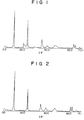
- Fig. 1 of the accompanying drawings is an X-ray diffraction pattern of the lithium aluminum complex hydroxide salt (to be referred to as LAHS).
- Fig. 2 is an X-ray diffraction pattern of hydrotalcite.
- LAHS a diffraction peak with an index of a plane (110) appears at a spacing (d) of 4.3 ⁇ to 4.5 ⁇ . But this diffraction peak does not appear in hydrotalcite.
- diffraction peaks appear at multiples of 2 such as indices of planes (002), (004), (006), (008), etc.
- hydrotalcite shows diffraction peaks at multiples of 3, for example, indices of planes (003), (006), (009), etc. Hence, they have different crystal structures.
- a 5% aqueous suspension of LAHS used in this invention shows a pH of about 8.
- Hydrotalcite under the same condition shows a pH of 9 to 9.5.
- the pH of LAHS is rather low, and shows a less tendency of damaging resins. The reason may be that hydrotalcite is composed of a brucite skeleton, whereas LAHS is composed of a gibbosity skeleton.
- the LAHS of this invention is characterized in that when it is added to a chlorine-containing polymer, it has a longer thermal stability time than hydrotalcite. This fact suggests that LAHS used in this invention tends to have a high activity of capturing hydrogen chloride.
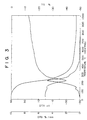
- Fig. 3 is a curve of differential thermal analysis (DTA) of LAHS of the invention.
- Fig. 4 is a DTA curve of hydrotalcite.
- hydrotalcite an endothermic peak based on the elimination of an interlayer water at 180 to 270°C, an endothermic peak based on the elimination of water of crystallization at 280 to 370°C and an endothermic peak based on the elimination of a carbonic acid radical (anion) at 380 to 480°C are observed.
- anion carbonic acid radical
- LAHS has an endothermic peak based on the elimination of an interlayer water and water of crystallization at 160 to 270°C, but a peak considered to be due to the elimination of a carbonic acid radical (anion) is at a lower temperature of 280 to 350°C.
- LAHS used in the present invention shows that in LAHS used in the present invention, the elimination of the carbonic acid radical is carried out at a lower energy, and LAHS is easily activatable. That the LAHS used in the present invention has excellent thermally stabilizing action is considered to relate to the above action and it simultaneously contains the hydroxy group of the gibbosity structure in a higher concentration.
- LAHS used in the present invention has a stoichiometrically almost constant composition.
- Preferred examples of inorganic or organic anions include one or a combination of at least two of carbonic acid, sulfuric acid, oxy acids of chlorine (for example, perchloric acid), and oxy acids of phosphorus (such as phosphoric acid, phosphorous acid and metaphosphoric acid).
- carbonic acid sulfuric acid
- oxy acids of chlorine for example, perchloric acid
- phosphorus such as phosphoric acid, phosphorous acid and metaphosphoric acid
- acetic acid, propionic acid, adipic acid, benzoic acid, phthalic acid, terephthalic acid, maleic acid, fumaric acid, succinic acid, p-oxybenzoic acid, salicylic acid, salycylic acid and picric acid may also be cited.
- LAHS used in this invention is generally a hexagonal plate-like crystal, and the particles show a clear fixed particle shape. The degree of flocculation among particles is very small. LAHS has excellent dispersibility in the resin.
- Fig. 5 is a scanning electron micrograph showing a particle structure of one example of LAHS. Its particle diameter is not particularly limited, but generally not more than 5 ⁇ m, especially 0.1 to 3 ⁇ m.
- LAHS used in the invention generally has an oil absorption amount (JIS K-5101) in a range of 30 to 70 ml/100 g, a BET specific surface area of 1 to 50 m2/g and an apparent specific gravity (iron cylinder method) of 0.2 to 0.5 g/cm3.
- JIS K-5101 oil absorption amount
- BET specific surface area 1 to 50 m2/g
- apparent specific gravity iron cylinder method
- LAHS of the carbonic acid salt type can be obtained by reacting a water-soluble lithium salt or lithium hydroxide and a water-soluble aluminum salt in the copresence of a water-soluble carbonic acid salt and an alkali.
- the water-soluble lithium salt may include lithium chloride, lithium nitrate, lithium sulfate, and lithium carbonate.
- the water-soluble aluminum salt include aluminum chloride, aluminum nitrate and aluminum sulfate.
- Sodium carbonate is generally used as the water-soluble carbonate.
- Sodium hydroxide is generally used as he alkali. When lithium hydroxide is used, the addition of sodium hydroxide may be omitted.
- the alkaline agent may be added that the pH of the solution after adding all components becomes 9.5 to 12, especially 10 to 11.5.
- the suitable reaction temperature may be from room temperature to 130°C.
- the reaction temperature is low, the degree of crystallization is low.
- the reaction is desirably carried out at a temperature of at least 60°C, especially at least 80°C.
- the product may be produced by a hydrothermal reaction.
- a reaction at a high temperature crystallization proceeds to a high degree to decrease the oil absorption amount and the specific surface area and tend to increase the apparent specific gravity.
- the sufficient reaction time is about 5 to 20 hours.
- the reaction may be carried out in two-steps consisting of a reaction at a low temperature of not more than 40°C and a reaction at a high temperature of at least 80°C.
- the crystals as formed contain about 0.5 to 3 moles (m) of water, but can be partly or completely dehydrated by heating and drying them at a temperature of not more than 300°C.
- the resulting LAHS can be directly used as a thermal stabilizer, but can be used as a stabilizer by surface-treating with various coating agents such as fatty acids including stearic acid, palmitic acid and lauric acid, metal soaps including a calcium salt, a zinc salt, a magnesium salt, or barium salt of the fatty acid, silane-type coupling agents, aluminium-type coupling agents, titanium-type coupling agents, zirconium-type coupling agents, various waxes, and unmodified or modified various resins (such as rosin and petroleum resins).
- These coating agents may be used in an amount of 0.5 to 10% by wieght, especially 1 to 5 % by weight, based on LAHS.
- the term "coupling agents" refers to materials used conventionally for surface treatments in order to facilitate water dispersion and compatibility.
- inorganic adjuvants fixedly shaped particles composed of finely divided silica such as Aerosil and Aerosil subjected to a hydrophobic treatment, silicic acid salts such as calcium silicate and magnesium silicate, metal oxides such as calcia, magnesia and titania, metal hydroxides such as magnesium hydroxide and aluminium hydroxide, metal carbonates such as calcium carbonate, A-type or P-type synthetic zeolites, their acid-treated products and their metal ion-exchanged products may be blended with or powdered over LAHS.
- silica such as Aerosil and Aerosil subjected to a hydrophobic treatment
- silicic acid salts such as calcium silicate and magnesium silicate
- metal oxides such as calcia, magnesia and titania
- metal hydroxides such as magnesium hydroxide and aluminium hydroxide
- metal carbonates such as calcium carbonate
- LAHS LAHS
- the compounding amount is properly selected from the above range according to the type of the resin.
- 0.1 to 10 parts by weight, especially 0.5 to 1.0 part by weight, of LAHS may be compounded in the chlorine-containing polymer per 100 parts by weight of the polymer.
- chlorine-containing polymers examples include polymers such as polyvinyl chloride, polyvinylidene chloride, chlorinated polyethylene, chlorinated polypropylene, chlorinated rubber, vinyl chloride-vinyl acetate copolymer, vinyl chloride-ethylene copolymer, vinyl chloride-propylene copolymer, vinyl chloride-styrene copolymer, vinyl chloride-vinylidene chloride copolymer, vinyl chloride-styrene-maleic anhydride terpolymer, vinyl chloride-styrene-acrylonitrile copolymer, vinyl chloride-butadiene copolymer, vinyl chloride-propylene chloride copolymer, vinyl chloride-vinylidene chloride-vinyl acetate terpolymer, vinyl chloride-acrylate copolymers, vinyl chloride-maleate copolymers, vinyl chloride-methacrylate copolymers, vinyl chloride-acrylonitrile copolymer and internally
- 0.01 to 10 parts by weight of a zinc salt of a fatty acid and 0.01 to 10 parts by weight of a ⁇ -diketone or a ⁇ -keto-acid ester are desirably used conjointly per 100 parts by weight of the chlorine-containing polymer.
- Examples of the zinc salt of the fatty acid are zinc stearate, zinc palmitate, and zinc laurate.
- the ⁇ -diketone and the ⁇ -keto-acid ester may be those known in the art, and may include 1,3-cyclohexadione, methylene-bis-1,3-cyclohexadione, 2-benxyl-1, 3-cyclohexadione, acetyltetralone, palmitoyltetralone, stearoyltetralone, benzoyltetralone, 2-acetylcyclohexanone, 2-benzoyl-cyclohexanone, 2-acetyl-1,3-cyclohexanediol, benzoyl-p-chlorobenzoylmethane, bis(4-methylbenzoyl)methane, bis(2-hydroxybenzoyl)methane, benzoylacetone, tribenzoylmethane, diacety
- the chlorine-containing polymer stabilizer in accordance with this invention may be used conjointly with known various additives, such as other stabilizers or stabilizer adjuvants, for example, non-metallic stabilizers, organic tin stabilizers, and basic inorganic acid salts, plasticizers, anti-oxidants, light stabilizers, nucleus-forming agents, fillers and epoxy stabilizers.
- additives such as other stabilizers or stabilizer adjuvants, for example, non-metallic stabilizers, organic tin stabilizers, and basic inorganic acid salts, plasticizers, anti-oxidants, light stabilizers, nucleus-forming agents, fillers and epoxy stabilizers.
- the stabilizer may be incorporated in order to prevent a deterioration of the olefin-type resin by the halogen-containing catalyst residues.
- the stabilizer used in this invention is desirably incorporated in an amount of 0.01 to 10 parts by weight per 100 parts by weight of the olefin-type resin.
- the olefin-type resin include polypropylene, low-, medium- or high density or linear low density polyethylene, crystalline propylene-ethylene copolymer, ionically cross-linked olefin copolymers, ethylene-vinyl acetate copolymer, and ethylene-acrylate copolymers.
- the compounding agent of this invention may be incorporated in thermoplastic polyesters such as polyethylene terephthalate and polybutylene terephthalate, polyamides such as 6-nylon, 6,6-nylon and 6,8-nylon, and other thermoplastic resins such as polycarbonates, polysulfones and polyacetal to increase its stabilizing action, especially heat stability.
- thermoplastic polyesters such as polyethylene terephthalate and polybutylene terephthalate
- polyamides such as 6-nylon, 6,6-nylon and 6,8-nylon
- other thermoplastic resins such as polycarbonates, polysulfones and polyacetal to increase its stabilizing action, especially heat stability.
- Fig. 1 is an X-ray diffraction spectrum of LAHS obtained in Example 1 in accordance with Cu-K ⁇ rays.
- Fig. 2 is an X-ray diffraction spectrum of hydrotalcite obtained in Comparative Example 1 in accordance with Cu-K ⁇ rays.
- Fig. 3 is a differential thermal analysis curve of LAHS obtained in Example 1 of this invention.
- Fig. 4 is a differential thermal analysis curve of hydrotalcite obtained in Comparative Example 1.
- Fig. 5 is a scanning electron micrograph showing the particle structure of LAHS obtained in Example 3 of the invention (magnification: 20,000x).
- aqueous solution prepared by adding 4.33 g of lithium chloride (52.90 % as Li2O) and 49.78 g of aluminum chloride (20.48% as Al2O3) to 500 ml of distilled water was poured to the first aqueous solution so that the CO3/Li mole ratio became 2.0.
- the pH after pouring was 10.7.
- the solution was reacted at a temperature of 90°C for 20 hours.
- 1.1 g of stearic acid was added, and with stirring, a surface-treatment reaction was performed.
- the resulting reaction suspension was filter, washed with water, dried at 70°C, and pulverized with a small-sized sample mill to form lithium aluminum complex hydroxide salt (sample No. LAHS-1).
- lithium aluminum complex hydroxide salt (sample No. LAHS-2) in accordance with this invention. Its properties are shown in Table 1.
- Lithium aluminum complex hydroxide salt in accordance with this invention (sample No. LAHS-2) was prepared and its properties are shown in Table 1.
- Example 1 was repeated except that the reaction temperature was changed to 130°C to prepare lithium aluminum complex hydroxide salt (sample No. LAHS-3 of the invention). Its properties are shown in Table 1.
- Example 1 After the end of the reaction, 1.2 g of stearic acid was added, and as in Example 1 the surface-treatment was carried out to form lithium aluminum complex hydroxide salt in accordance with this invention sample No. LAHS-4), and its properties are shown in Table 1.
- Comparative Example 1 was carried out in the same way as above except that the reaction temperature was changed to 160°C. Sample No. HT-2 was obtained, and its properties are shown in Table 1.
- the thermal stability effect will be described when a resin stabilizer composed of a fine powder of lithium aluminum complex hydroxide salt in accordance with this invention was added to a chlorine-containing resin.
- a soft vinyl chloride resin sheet was prepared in accordance with the following compounding and molding and tested.
- the above compounded composition was kneaded by a roll mill at 150°C for 7 minutes to prepare a uniform mixture having a thickness of 0.5 mm. Then, it was heated under pressure at 160°C and 130 kg/cm2 for 5 minutes to prepare a soft vinyl chloride resin sheet having a thickness of 1 mm.
- the above compounded composition was kneaded by a roll mill at 160°C for 7 minutes to prepare a uniform mixture having a thickness of 0.4 mm. Then, it was heated under pressure at 180°C and 150 kg/cm2 for 5 minutes to form a hard vinyl chloride resin sheet having a thickness of 1 mm.
- the sample sheet was suspended in a Geer's heat aging tester adjusted to a temperature of 190°C. It was taken out every 10 minutes, and the degree of coloration was determined visually. The time which elapsed until it was decomposed to a dark brown color was measured.
- a polypropylene sheet was prepared by the following compounding and molding processes, and tested by the following methods. (Compounding) Parts by weight Polypropylene resin containing halogen-containing catalyst residues 100 Sample 0.2 to 0.5 Bisphenol A 0.1
- the above compounded composition was pelletized at 260°C by an extruder.
- the sample pellets were placed in a stainless steel metal frame having a size of 1 mm in thickness and 100 mm x 100 mm in length and width. They were interposed with a photographic thick ferrotype plate and an aluminum plate having a thickness of 2 mm, and pressed at 230 ⁇ 3 °C for 30 minutes. Then, they were transferred to a cooling press at 30 ⁇ 5 °C and cooled under a pressure of about 50 kg/cm2 per molding plane of projection. After the mold became less than 40 °C, a polypropylene sheet having a thickness of 1 mm was taken out and subjected to the following tests.
- lithium aluminum complex hydroxide salt in chlorine-containing polymers or polyolefin-type resins, an excellent ability to capture hydrogen chloride is obtained, and the thermal stability can be markedly increased in chlorine-containing polymers or polyolefin-type resins.
- This complex hydroxide salt has a lower basicity than hydrotalcite, has a low damage to be done to the resins, and also has an advantage of showing excellent dispersibility in the resins.
Landscapes
- Chemical & Material Sciences (AREA)
- Health & Medical Sciences (AREA)
- Chemical Kinetics & Catalysis (AREA)
- Medicinal Chemistry (AREA)
- Polymers & Plastics (AREA)
- Organic Chemistry (AREA)
- Engineering & Computer Science (AREA)
- Nanotechnology (AREA)
- Composite Materials (AREA)
- Condensed Matter Physics & Semiconductors (AREA)
- General Physics & Mathematics (AREA)
- Materials Engineering (AREA)
- Crystallography & Structural Chemistry (AREA)
- Physics & Mathematics (AREA)
- Compositions Of Macromolecular Compounds (AREA)
- Compounds Of Alkaline-Earth Elements, Aluminum Or Rare-Earth Metals (AREA)
Applications Claiming Priority (2)
| Application Number | Priority Date | Filing Date | Title |
|---|---|---|---|
| JP358208/91 | 1991-12-27 | ||
| JP3358208A JPH072858B2 (ja) | 1991-12-27 | 1991-12-27 | 樹脂用安定剤 |
Publications (2)
| Publication Number | Publication Date |
|---|---|
| EP0549340A1 true EP0549340A1 (fr) | 1993-06-30 |
| EP0549340B1 EP0549340B1 (fr) | 1997-03-12 |
Family
ID=18458091
Family Applications (1)
| Application Number | Title | Priority Date | Filing Date |
|---|---|---|---|
| EP92311754A Expired - Lifetime EP0549340B1 (fr) | 1991-12-27 | 1992-12-23 | Stabilisateur pour résines |
Country Status (6)
| Country | Link |
|---|---|
| US (2) | US5356567A (fr) |
| EP (1) | EP0549340B1 (fr) |
| JP (1) | JPH072858B2 (fr) |
| KR (1) | KR100193317B1 (fr) |
| CA (1) | CA2086196C (fr) |
| DE (1) | DE69218160T2 (fr) |
Cited By (14)
| Publication number | Priority date | Publication date | Assignee | Title |
|---|---|---|---|---|
| EP0672619A1 (fr) * | 1994-03-15 | 1995-09-20 | Mizusawa Industrial Chemicals, Ltd. | Sel complexe d'hydroxyde de lithium aluminium, agent de mélange de résine et composition de résine |
| EP0705880A4 (fr) * | 1994-02-28 | 1996-08-07 | Sumitomo Chemical Co | Composition pour resine polyolefinique et pellicule de resine |
| EP0781800A1 (fr) * | 1995-12-25 | 1997-07-02 | Sumitomo Chemical Company, Limited | Composition à base de résine de polyoléfine |
| EP0844214A1 (fr) * | 1996-11-26 | 1998-05-27 | Kyowa Chemical Industry Co., Ltd. | Composés de chalcoalumite synthétiques et procédé pour leur préparation |
| EP0761756A4 (fr) * | 1995-03-10 | 1998-10-14 | Fuji Chem Ind Co Ltd | Stabilisateur pour resines contenant de l'halogene et son procede de preparation, composition de resine contenant de l'halogene et sel d'hydroxyde composite |
| EP0790214A4 (fr) * | 1995-09-01 | 1998-11-18 | Mizusawa Industrial Chem | Composite forme d'un carbonate d'hydroxyde d'aluminium alcalin, son procede d'elaboration et son utilisation |
| US5889094A (en) * | 1995-08-23 | 1999-03-30 | Tonen Chemical Corporation | Resin composition of propylene-ethylene random copolymer |
| WO2004087801A1 (fr) * | 2003-04-03 | 2004-10-14 | Reagens Deutschland Gmbh | Utilisation de compositions contenant des oxydes et/ou des hydroxydes metalliques basiques pour stabiliser des matieres plastiques organiques contenant un halogene |
| WO2006013040A2 (fr) | 2004-07-30 | 2006-02-09 | Artemis Research Gmbh & Co. Kg | Systeme de stabilisateur destine a des polymeres halogenes |
| DE102008018872A1 (de) | 2008-04-14 | 2009-10-15 | Ika Innovative Kunststoffaufbereitung Gmbh & Co. Kg | Stabilisatorsystem für halogenhaltige Polymere |
| DE102008020203A1 (de) | 2008-04-22 | 2009-10-29 | Catena Additives Gmbh & Co. Kg | Lösemittelfreie High Solids (One-Pack)-Stabilisatoren für halogenhaltige Polymere |
| WO2011101274A1 (fr) | 2010-02-22 | 2011-08-25 | Ika Innovative Kunststoffaufbereitung Gmbh & Co. Kg | Système stabilisateur pour polymères halogénés expansibles |
| DE102010020486A1 (de) | 2010-05-14 | 2011-11-17 | Catena Additives Gmbh & Co. Kg | Flammgeschützte halogenhaltige Polymere mit verbesserter Thermostabilität |
| WO2017068415A1 (fr) | 2015-10-23 | 2017-04-27 | Chemson Polymer-Additive Ag | Polymères de chlorure de vinyle et compositions pour la fabrication additive |
Families Citing this family (26)
| Publication number | Priority date | Publication date | Assignee | Title |
|---|---|---|---|---|
| DE4238567A1 (de) * | 1992-11-16 | 1994-05-19 | Henkel Kgaa | Stabilisatormischungen für Polymerisate mit Granaten |
| JPH06271744A (ja) * | 1993-03-22 | 1994-09-27 | Mizusawa Ind Chem Ltd | ポリアセタール系樹脂用帯電防止剤 |
| JPH07216157A (ja) * | 1994-01-28 | 1995-08-15 | Chisso Corp | 結晶性ポリオレフィン組成物 |
| JPH07242776A (ja) * | 1994-03-08 | 1995-09-19 | Tonen Chem Corp | ポリプロピレン樹脂組成物 |
| TW342404B (en) * | 1994-04-15 | 1998-10-11 | Ciba Sc Holding Ag | Stabilized polyvinyl chloride |
| JPH0959453A (ja) * | 1995-08-23 | 1997-03-04 | Tonen Chem Corp | ポリプロピレン樹脂組成物 |
| JPH09313928A (ja) * | 1996-05-31 | 1997-12-09 | Kaisui Kagaku Kenkyusho:Kk | 酸化防止剤 |
| JPH10139941A (ja) * | 1996-11-08 | 1998-05-26 | Tokuyama Corp | ハロゲン低溶出性軟質ポリオレフィン樹脂組成物 |
| US6448322B1 (en) * | 1997-03-06 | 2002-09-10 | Exxon Mobil Chemical Patents Inc. | Stabilization of halogenated rubber |
| JP4054144B2 (ja) * | 1998-12-01 | 2008-02-27 | 協和化学工業株式会社 | 層間のアニオンとしてその一部または全部が珪素系、燐系及び硼素系多量体酸素酸イオンの少なくとも一種のアニオンとそれ以外のアニオンとを保持したハイドロタルサイト系化合物、その製法、農業用フィルム用赤外線吸収剤及び該赤外線吸収剤を含有する農業用フィルム |
| DE10235571A1 (de) * | 2002-08-03 | 2004-02-12 | Clariant Gmbh | Verwendung von Salzen schichtartiger Doppelhydroxide als Ladungssteuermittel |
| DE10235570A1 (de) * | 2002-08-03 | 2004-02-19 | Clariant Gmbh | Verwendung von Salzen schichtartiger Doppelhydroxide |
| EP1548068B1 (fr) * | 2002-09-13 | 2014-12-31 | Kaneka Corporation | Composition polymerique contenant un sel double dont les composants metalliques sont le magnesium et l'aluminium |
| JP2007106620A (ja) * | 2005-10-12 | 2007-04-26 | Sakai Chem Ind Co Ltd | 流動性ハイドロタルサイト粉体及びその製造方法 |
| CN101821201A (zh) * | 2007-09-17 | 2010-09-01 | 阿海珐联合服务有限责任公司 | 从含水介质中去除铝氧化物的方法 |
| CN104379612B (zh) | 2012-06-14 | 2016-05-25 | 株式会社Adeka | 成核剂母料的制造方法 |
| BR112015000600B1 (pt) | 2012-07-10 | 2021-03-02 | Adeka Corporation | pellet misto |
| JP6177672B2 (ja) | 2013-11-26 | 2017-08-09 | 株式会社Adeka | マスターバッチの製造方法 |
| WO2015079896A1 (fr) | 2013-11-26 | 2015-06-04 | 株式会社Adeka | Composition de stabilisant optique et composition de résine la contenant |
| WO2017150662A1 (fr) | 2016-03-02 | 2017-09-08 | 株式会社Adeka | Composition d'additif de résine, composition de résine thermoplastique et article moulé associé |
| EP4079802A4 (fr) | 2019-12-18 | 2024-01-03 | Adeka Corporation | Composition de résine, article moulé correspondant et procédé de production de ladite composition de résine |
| JP7671277B2 (ja) | 2020-03-31 | 2025-05-01 | 株式会社Adeka | 難燃剤組成物、難燃性合成樹脂組成物および成形体 |
| JP7802002B2 (ja) | 2020-07-31 | 2026-01-19 | 株式会社Adeka | 添加剤組成物、樹脂組成物、樹脂組成物の製造方法および成形品 |
| EP4227360A1 (fr) | 2020-10-08 | 2023-08-16 | Adeka Corporation | Mélange-maître de photostabilisant ainsi que procédé de production de composition de résine de polypropylène mettant en oeuvre ledit mélange-maître |
| CN116323782A (zh) | 2020-10-08 | 2023-06-23 | 株式会社艾迪科 | 聚烯烃系树脂组合物、使用其的成型品、及聚烯烃系树脂组合物的制造方法 |
| US20240308109A1 (en) | 2021-06-16 | 2024-09-19 | Adeka Corporation | Nucleating agent composition, resin composition, molded article thereof, and method for manufacturing resin composition |
Family Cites Families (5)
| Publication number | Priority date | Publication date | Assignee | Title |
|---|---|---|---|---|
| JPS55115488A (en) * | 1979-02-08 | 1980-09-05 | Nippon Steel Chem Co Ltd | Flame-resistant composition |
| US4348297A (en) * | 1979-11-19 | 1982-09-07 | The Dow Chemical Company | Crystalline lithium aluminates |
| US4348296A (en) * | 1980-12-18 | 1982-09-07 | The Dow Chemical Company | Crystalline lithium aluminates |
| JPS6215243A (ja) * | 1985-07-12 | 1987-01-23 | Nippon Synthetic Chem Ind Co Ltd:The | 成形物の製造方法 |
| JP2895108B2 (ja) * | 1989-10-04 | 1999-05-24 | 水澤化学工業株式会社 | 塩素含有重合体用複合安定剤及びその製法 |
-
1991
- 1991-12-27 JP JP3358208A patent/JPH072858B2/ja not_active Expired - Fee Related
-
1992
- 1992-12-22 US US07/994,955 patent/US5356567A/en not_active Expired - Lifetime
- 1992-12-23 CA CA002086196A patent/CA2086196C/fr not_active Expired - Fee Related
- 1992-12-23 EP EP92311754A patent/EP0549340B1/fr not_active Expired - Lifetime
- 1992-12-23 DE DE69218160T patent/DE69218160T2/de not_active Expired - Lifetime
- 1992-12-24 KR KR1019920025509A patent/KR100193317B1/ko not_active Expired - Fee Related
-
1994
- 1994-01-27 US US08/186,913 patent/US5360859A/en not_active Expired - Lifetime
Non-Patent Citations (1)
| Title |
|---|
| CLAYS AND CLAY MINERALS vol. 25, 1977, LONDON pages 384 - 391 C.J.SERNA, J.L. WHITE, S.L.HEM 'Hydolysis of Aluminium-tri-(sec-Butoxide) in ionic and nonionic media' * |
Cited By (23)
| Publication number | Priority date | Publication date | Assignee | Title |
|---|---|---|---|---|
| EP0705880A4 (fr) * | 1994-02-28 | 1996-08-07 | Sumitomo Chemical Co | Composition pour resine polyolefinique et pellicule de resine |
| US5851682A (en) * | 1994-02-28 | 1998-12-22 | Sumitomo Chemical Company, Limited | Polyolefin resin composition and resin film |
| EP0672619A1 (fr) * | 1994-03-15 | 1995-09-20 | Mizusawa Industrial Chemicals, Ltd. | Sel complexe d'hydroxyde de lithium aluminium, agent de mélange de résine et composition de résine |
| EP0761756A4 (fr) * | 1995-03-10 | 1998-10-14 | Fuji Chem Ind Co Ltd | Stabilisateur pour resines contenant de l'halogene et son procede de preparation, composition de resine contenant de l'halogene et sel d'hydroxyde composite |
| US5889094A (en) * | 1995-08-23 | 1999-03-30 | Tonen Chemical Corporation | Resin composition of propylene-ethylene random copolymer |
| EP1454884A3 (fr) * | 1995-09-01 | 2007-06-06 | Mizusawa Industrial Chemicals Ltd. | Procédé de préparation d'un sel complexe d'hydroxycarbonate d'aluminium et d'un métal alcalin |
| EP0790214A4 (fr) * | 1995-09-01 | 1998-11-18 | Mizusawa Industrial Chem | Composite forme d'un carbonate d'hydroxyde d'aluminium alcalin, son procede d'elaboration et son utilisation |
| US5997836A (en) * | 1995-09-01 | 1999-12-07 | Mizusawa Industrial Chemicals, Ltd. | Alkali aluminum complex hydroxide carbonate salt, and a process for producing said salt and its uses |
| EP1454883A3 (fr) * | 1995-09-01 | 2007-06-06 | Mizusawa Industrial Chemicals Ltd. | Sel complexe d'hydroxycarbonate d'aluminium et d'un métal alcalin, son procédé de préparation et ses utilisations |
| EP0781800A1 (fr) * | 1995-12-25 | 1997-07-02 | Sumitomo Chemical Company, Limited | Composition à base de résine de polyoléfine |
| EP0844214A1 (fr) * | 1996-11-26 | 1998-05-27 | Kyowa Chemical Industry Co., Ltd. | Composés de chalcoalumite synthétiques et procédé pour leur préparation |
| US5980856A (en) * | 1996-11-26 | 1999-11-09 | Kyowa Chemical Industry Co., Ltd. | Synthetic chalcoalumite-type compounds and processes for producing the same |
| WO2004087801A1 (fr) * | 2003-04-03 | 2004-10-14 | Reagens Deutschland Gmbh | Utilisation de compositions contenant des oxydes et/ou des hydroxydes metalliques basiques pour stabiliser des matieres plastiques organiques contenant un halogene |
| WO2006013040A2 (fr) | 2004-07-30 | 2006-02-09 | Artemis Research Gmbh & Co. Kg | Systeme de stabilisateur destine a des polymeres halogenes |
| DE102008018872A1 (de) | 2008-04-14 | 2009-10-15 | Ika Innovative Kunststoffaufbereitung Gmbh & Co. Kg | Stabilisatorsystem für halogenhaltige Polymere |
| EP2110405A1 (fr) | 2008-04-14 | 2009-10-21 | IKA Innovative Kunststoffaufbereitung Gmbh & Co.Kg | Systèmes de stabilisateur pour polymères contenant de l'halogène |
| EP2792707A2 (fr) | 2008-04-14 | 2014-10-22 | IKA Innovative Kunststoffaufbereitung Gmbh & Co.Kg | Systèmes de stabilisateur pour polymères contenant de l'halogène |
| DE102008020203A1 (de) | 2008-04-22 | 2009-10-29 | Catena Additives Gmbh & Co. Kg | Lösemittelfreie High Solids (One-Pack)-Stabilisatoren für halogenhaltige Polymere |
| WO2011101274A1 (fr) | 2010-02-22 | 2011-08-25 | Ika Innovative Kunststoffaufbereitung Gmbh & Co. Kg | Système stabilisateur pour polymères halogénés expansibles |
| DE102010008854A1 (de) | 2010-02-22 | 2011-08-25 | IKA Innovative Kunststoffaufbereitung GmbH & Co. KG, 06766 | Stabilisatorsystem für verschäumbare halogenhaltige Polymere |
| DE102010020486A1 (de) | 2010-05-14 | 2011-11-17 | Catena Additives Gmbh & Co. Kg | Flammgeschützte halogenhaltige Polymere mit verbesserter Thermostabilität |
| EP2392612A1 (fr) | 2010-05-14 | 2011-12-07 | CATENA Additives GmbH & Co. KG | Polymères contenant un halogène ignifuge ayant une stabilité thermique améliorée |
| WO2017068415A1 (fr) | 2015-10-23 | 2017-04-27 | Chemson Polymer-Additive Ag | Polymères de chlorure de vinyle et compositions pour la fabrication additive |
Also Published As
| Publication number | Publication date |
|---|---|
| US5356567A (en) | 1994-10-18 |
| US5360859A (en) | 1994-11-01 |
| CA2086196C (fr) | 1998-09-22 |
| DE69218160T2 (de) | 1997-10-02 |
| DE69218160D1 (de) | 1997-04-17 |
| CA2086196A1 (fr) | 1993-06-28 |
| JPH05179052A (ja) | 1993-07-20 |
| KR930012924A (ko) | 1993-07-21 |
| JPH072858B2 (ja) | 1995-01-18 |
| EP0549340B1 (fr) | 1997-03-12 |
| KR100193317B1 (ko) | 1999-06-15 |
Similar Documents
| Publication | Publication Date | Title |
|---|---|---|
| EP0549340B1 (fr) | Stabilisateur pour résines | |
| EP0790214A1 (fr) | Composite forme d'un carbonate d'hydroxyde d'aluminium alcalin, son procede d'elaboration et son utilisation | |
| SK11502000A3 (sk) | Hydrotalcitová zlúčenina, spôsob jej výroby a poľnohospodárska fólia s jej obsahom | |
| US5419883A (en) | Lithium aluminum complex hydroxide salt and process for preparation thereof | |
| US20080145296A1 (en) | Mg-Al-based hydrotalcite-type particles, chlorine-containing resin composition and process for producing the particles | |
| EP2366666A1 (fr) | Procédé pour la préparation d'un composé d'hydroxyde de calcium | |
| JP4248922B2 (ja) | 電気絶縁性向上剤及び電気絶縁性が向上した樹脂組成物 | |
| JP3827773B2 (ja) | アルカリ・アルミニウム複合水酸化物炭酸塩、その製法及び用途 | |
| JP4106508B2 (ja) | 塩素含有樹脂組成物 | |
| US6803401B2 (en) | Halogen scavenger for olefin formulations | |
| JP3434634B2 (ja) | 樹脂用配合剤及び樹脂組成物 | |
| US6362261B1 (en) | Methods of preparing cationic layer compounds, cationic layer compounds prepared thereby, and methods of use therefor | |
| AU707027B2 (en) | Halogen scavenger for polymers and copolymers | |
| JPH10158449A (ja) | 複合安定剤及び塩素含有重合体組成物 | |
| JP3650231B2 (ja) | リチウムアルミニウム複合水酸化物炭酸塩、その製法及び用途 | |
| JP2609783B2 (ja) | 新規なカルシウムシリカ複合有機錯体 | |
| JP2911404B2 (ja) | 保温剤及び保温性樹脂組成物 | |
| JP2001329110A (ja) | 塩素含有重合体用安定剤及び塩素含有重合体組成物 | |
| AU2004201812A1 (en) | Hydrotalcite compound, process for producing the same and agricultural film containing the same |
Legal Events
| Date | Code | Title | Description |
|---|---|---|---|
| PUAI | Public reference made under article 153(3) epc to a published international application that has entered the european phase |
Free format text: ORIGINAL CODE: 0009012 |
|
| AK | Designated contracting states |
Kind code of ref document: A1 Designated state(s): BE CH DE FR GB IT LI NL |
|
| 17P | Request for examination filed |
Effective date: 19931201 |
|
| 17Q | First examination report despatched |
Effective date: 19950728 |
|
| GRAG | Despatch of communication of intention to grant |
Free format text: ORIGINAL CODE: EPIDOS AGRA |
|
| GRAH | Despatch of communication of intention to grant a patent |
Free format text: ORIGINAL CODE: EPIDOS IGRA |
|
| GRAH | Despatch of communication of intention to grant a patent |
Free format text: ORIGINAL CODE: EPIDOS IGRA |
|
| GRAA | (expected) grant |
Free format text: ORIGINAL CODE: 0009210 |
|
| AK | Designated contracting states |
Kind code of ref document: B1 Designated state(s): BE CH DE FR GB IT LI NL |
|
| REG | Reference to a national code |
Ref country code: CH Ref legal event code: NV Representative=s name: PATENTANWAELTE SCHAAD, BALASS, MENZL & PARTNER AG Ref country code: CH Ref legal event code: EP |
|
| ITF | It: translation for a ep patent filed | ||
| REF | Corresponds to: |
Ref document number: 69218160 Country of ref document: DE Date of ref document: 19970417 |
|
| ET | Fr: translation filed | ||
| PLBE | No opposition filed within time limit |
Free format text: ORIGINAL CODE: 0009261 |
|
| STAA | Information on the status of an ep patent application or granted ep patent |
Free format text: STATUS: NO OPPOSITION FILED WITHIN TIME LIMIT |
|
| 26N | No opposition filed | ||
| REG | Reference to a national code |
Ref country code: GB Ref legal event code: IF02 |
|
| PGFP | Annual fee paid to national office [announced via postgrant information from national office to epo] |
Ref country code: CH Payment date: 20091215 Year of fee payment: 18 |
|
| PGFP | Annual fee paid to national office [announced via postgrant information from national office to epo] |
Ref country code: NL Payment date: 20091204 Year of fee payment: 18 |
|
| PGFP | Annual fee paid to national office [announced via postgrant information from national office to epo] |
Ref country code: IT Payment date: 20091215 Year of fee payment: 18 Ref country code: GB Payment date: 20091223 Year of fee payment: 18 Ref country code: FR Payment date: 20091221 Year of fee payment: 18 |
|
| PGFP | Annual fee paid to national office [announced via postgrant information from national office to epo] |
Ref country code: DE Payment date: 20091217 Year of fee payment: 18 Ref country code: BE Payment date: 20091224 Year of fee payment: 18 |
|
| BERE | Be: lapsed |
Owner name: *MIZUSAWA INDUSTRIAL CHEMICALS LTD Effective date: 20101231 |
|
| REG | Reference to a national code |
Ref country code: NL Ref legal event code: V1 Effective date: 20110701 |
|
| REG | Reference to a national code |
Ref country code: CH Ref legal event code: PL |
|
| GBPC | Gb: european patent ceased through non-payment of renewal fee |
Effective date: 20101223 |
|
| REG | Reference to a national code |
Ref country code: FR Ref legal event code: ST Effective date: 20110831 |
|
| PG25 | Lapsed in a contracting state [announced via postgrant information from national office to epo] |
Ref country code: BE Free format text: LAPSE BECAUSE OF NON-PAYMENT OF DUE FEES Effective date: 20101231 |
|
| PG25 | Lapsed in a contracting state [announced via postgrant information from national office to epo] |
Ref country code: LI Free format text: LAPSE BECAUSE OF NON-PAYMENT OF DUE FEES Effective date: 20101231 Ref country code: CH Free format text: LAPSE BECAUSE OF NON-PAYMENT OF DUE FEES Effective date: 20101231 Ref country code: FR Free format text: LAPSE BECAUSE OF NON-PAYMENT OF DUE FEES Effective date: 20110103 |
|
| REG | Reference to a national code |
Ref country code: DE Ref legal event code: R119 Ref document number: 69218160 Country of ref document: DE Effective date: 20110701 |
|
| PG25 | Lapsed in a contracting state [announced via postgrant information from national office to epo] |
Ref country code: GB Free format text: LAPSE BECAUSE OF NON-PAYMENT OF DUE FEES Effective date: 20101223 Ref country code: DE Free format text: LAPSE BECAUSE OF NON-PAYMENT OF DUE FEES Effective date: 20110701 |
|
| PG25 | Lapsed in a contracting state [announced via postgrant information from national office to epo] |
Ref country code: IT Free format text: LAPSE BECAUSE OF NON-PAYMENT OF DUE FEES Effective date: 20101223 Ref country code: NL Free format text: LAPSE BECAUSE OF NON-PAYMENT OF DUE FEES Effective date: 20110701 |