EP0592364A1 - Verfahren zur Stabilisierung dreiwertiger Phosphorverbindungen mit Aminen - Google Patents
Verfahren zur Stabilisierung dreiwertiger Phosphorverbindungen mit Aminen Download PDFInfo
- Publication number
- EP0592364A1 EP0592364A1 EP93810684A EP93810684A EP0592364A1 EP 0592364 A1 EP0592364 A1 EP 0592364A1 EP 93810684 A EP93810684 A EP 93810684A EP 93810684 A EP93810684 A EP 93810684A EP 0592364 A1 EP0592364 A1 EP 0592364A1
- Authority
- EP
- European Patent Office
- Prior art keywords
- phosphite
- phosphonite
- amine
- alkyl
- melt
- Prior art date
- Legal status (The legal status is an assumption and is not a legal conclusion. Google has not performed a legal analysis and makes no representation as to the accuracy of the status listed.)
- Granted
Links
- 150000001412 amines Chemical class 0.000 title claims abstract description 67
- 238000000034 method Methods 0.000 title claims abstract description 50
- 230000006641 stabilisation Effects 0.000 title abstract description 5
- 238000011105 stabilization Methods 0.000 title description 4
- 150000003018 phosphorus compounds Chemical class 0.000 title 1
- XRBCRPZXSCBRTK-UHFFFAOYSA-N phosphonous acid Chemical compound OPO XRBCRPZXSCBRTK-UHFFFAOYSA-N 0.000 claims abstract description 67
- OJMIONKXNSYLSR-UHFFFAOYSA-N phosphorous acid Chemical compound OP(O)O OJMIONKXNSYLSR-UHFFFAOYSA-N 0.000 claims abstract description 55
- 239000000155 melt Substances 0.000 claims abstract description 32
- 238000002425 crystallisation Methods 0.000 claims abstract description 29
- 239000000203 mixture Substances 0.000 claims abstract description 28
- 239000002904 solvent Substances 0.000 claims abstract description 25
- 230000007062 hydrolysis Effects 0.000 claims abstract description 22
- 238000006460 hydrolysis reaction Methods 0.000 claims abstract description 22
- 239000007788 liquid Substances 0.000 claims abstract description 8
- 239000011877 solvent mixture Substances 0.000 claims abstract description 3
- 229910052739 hydrogen Inorganic materials 0.000 claims description 51
- 239000001257 hydrogen Substances 0.000 claims description 51
- UFHFLCQGNIYNRP-UHFFFAOYSA-N Hydrogen Chemical compound [H][H] UFHFLCQGNIYNRP-UHFFFAOYSA-N 0.000 claims description 30
- 230000008025 crystallization Effects 0.000 claims description 28
- 125000002496 methyl group Chemical group [H]C([H])([H])* 0.000 claims description 25
- 150000002431 hydrogen Chemical class 0.000 claims description 20
- 125000001424 substituent group Chemical group 0.000 claims description 19
- 229930195733 hydrocarbon Natural products 0.000 claims description 10
- 150000002430 hydrocarbons Chemical class 0.000 claims description 9
- 125000002887 hydroxy group Chemical group [H]O* 0.000 claims description 7
- 239000004215 Carbon black (E152) Substances 0.000 claims description 6
- 125000003837 (C1-C20) alkyl group Chemical group 0.000 claims description 4
- 230000000087 stabilizing effect Effects 0.000 claims description 4
- 239000000725 suspension Substances 0.000 claims description 4
- 125000004122 cyclic group Chemical group 0.000 claims description 3
- 150000003512 tertiary amines Chemical class 0.000 claims description 3
- 125000003158 alcohol group Chemical group 0.000 claims description 2
- 229920006395 saturated elastomer Polymers 0.000 claims description 2
- AQSJGOWTSHOLKH-UHFFFAOYSA-N phosphite(3-) Chemical class [O-]P([O-])[O-] AQSJGOWTSHOLKH-UHFFFAOYSA-N 0.000 abstract description 27
- 239000003381 stabilizer Substances 0.000 abstract description 6
- 229910052760 oxygen Inorganic materials 0.000 abstract description 4
- QVGXLLKOCUKJST-UHFFFAOYSA-N atomic oxygen Chemical compound [O] QVGXLLKOCUKJST-UHFFFAOYSA-N 0.000 abstract description 2
- 239000011368 organic material Substances 0.000 abstract description 2
- 239000001301 oxygen Substances 0.000 abstract description 2
- 230000009931 harmful effect Effects 0.000 abstract 1
- -1 C1-C5 alkanols Chemical class 0.000 description 88
- 150000001875 compounds Chemical class 0.000 description 60
- 125000004432 carbon atom Chemical group C* 0.000 description 35
- 150000003254 radicals Chemical class 0.000 description 31
- OKKJLVBELUTLKV-UHFFFAOYSA-N Methanol Chemical compound OC OKKJLVBELUTLKV-UHFFFAOYSA-N 0.000 description 21
- 229910052757 nitrogen Inorganic materials 0.000 description 17
- KFZMGEQAYNKOFK-UHFFFAOYSA-N Isopropanol Chemical compound CC(C)O KFZMGEQAYNKOFK-UHFFFAOYSA-N 0.000 description 16
- 238000003860 storage Methods 0.000 description 15
- 125000004400 (C1-C12) alkyl group Chemical group 0.000 description 14
- YXFVVABEGXRONW-UHFFFAOYSA-N Toluene Chemical compound CC1=CC=CC=C1 YXFVVABEGXRONW-UHFFFAOYSA-N 0.000 description 14
- 125000001931 aliphatic group Chemical group 0.000 description 14
- 125000006702 (C1-C18) alkyl group Chemical group 0.000 description 12
- 125000000217 alkyl group Chemical group 0.000 description 12
- 125000002947 alkylene group Chemical group 0.000 description 12
- 125000001997 phenyl group Chemical group [H]C1=C([H])C([H])=C(*)C([H])=C1[H] 0.000 description 12
- 125000001797 benzyl group Chemical group [H]C1=C([H])C([H])=C(C([H])=C1[H])C([H])([H])* 0.000 description 11
- 239000002253 acid Substances 0.000 description 10
- 239000000047 product Substances 0.000 description 10
- 125000004178 (C1-C4) alkyl group Chemical group 0.000 description 9
- 0 CC1(C*)N(C)C(C)(C*)C(*)(*)N(C)C1 Chemical compound CC1(C*)N(C)C(C)(C*)C(*)(*)N(C)C1 0.000 description 9
- 125000003118 aryl group Chemical group 0.000 description 9
- 125000000113 cyclohexyl group Chemical group [H]C1([H])C([H])([H])C([H])([H])C([H])(*)C([H])([H])C1([H])[H] 0.000 description 9
- 125000001495 ethyl group Chemical group [H]C([H])([H])C([H])([H])* 0.000 description 9
- LFQSCWFLJHTTHZ-UHFFFAOYSA-N Ethanol Chemical compound CCO LFQSCWFLJHTTHZ-UHFFFAOYSA-N 0.000 description 8
- OFOBLEOULBTSOW-UHFFFAOYSA-N Malonic acid Chemical compound OC(=O)CC(O)=O OFOBLEOULBTSOW-UHFFFAOYSA-N 0.000 description 8
- 239000000523 sample Substances 0.000 description 8
- VDVUCLWJZJHFAV-UHFFFAOYSA-N 2,2,6,6-tetramethylpiperidin-4-ol Chemical compound CC1(C)CC(O)CC(C)(C)N1 VDVUCLWJZJHFAV-UHFFFAOYSA-N 0.000 description 7
- GGAUUQHSCNMCAU-UHFFFAOYSA-N butane-1,2,3,4-tetracarboxylic acid Chemical compound OC(=O)CC(C(O)=O)C(C(O)=O)CC(O)=O GGAUUQHSCNMCAU-UHFFFAOYSA-N 0.000 description 7
- 125000000753 cycloalkyl group Chemical group 0.000 description 7
- 125000003903 2-propenyl group Chemical group [H]C([*])([H])C([H])=C([H])[H] 0.000 description 6
- 150000001298 alcohols Chemical class 0.000 description 6
- 229910052736 halogen Inorganic materials 0.000 description 6
- 150000002367 halogens Chemical class 0.000 description 6
- 229920000728 polyester Polymers 0.000 description 6
- BRLQWZUYTZBJKN-UHFFFAOYSA-N Epichlorohydrin Chemical compound ClCC1CO1 BRLQWZUYTZBJKN-UHFFFAOYSA-N 0.000 description 5
- JWUXJYZVKZKLTJ-UHFFFAOYSA-N Triacetonamine Chemical compound CC1(C)CC(=O)CC(C)(C)N1 JWUXJYZVKZKLTJ-UHFFFAOYSA-N 0.000 description 5
- SLINHMUFWFWBMU-UHFFFAOYSA-N Triisopropanolamine Chemical compound CC(O)CN(CC(C)O)CC(C)O SLINHMUFWFWBMU-UHFFFAOYSA-N 0.000 description 5
- 239000000463 material Substances 0.000 description 5
- 229910052698 phosphorus Inorganic materials 0.000 description 5
- 239000007787 solid Substances 0.000 description 5
- 125000000954 2-hydroxyethyl group Chemical group [H]C([*])([H])C([H])([H])O[H] 0.000 description 4
- 125000002853 C1-C4 hydroxyalkyl group Chemical group 0.000 description 4
- 125000002777 acetyl group Chemical group [H]C([H])([H])C(*)=O 0.000 description 4
- 150000002148 esters Chemical class 0.000 description 4
- 125000003055 glycidyl group Chemical group C(C1CO1)* 0.000 description 4
- OLRJXMHANKMLTD-UHFFFAOYSA-N silyl Chemical compound [SiH3] OLRJXMHANKMLTD-UHFFFAOYSA-N 0.000 description 4
- 239000000243 solution Substances 0.000 description 4
- 125000000999 tert-butyl group Chemical group [H]C([H])([H])C(*)(C([H])([H])[H])C([H])([H])[H] 0.000 description 4
- ARCGXLSVLAOJQL-UHFFFAOYSA-N trimellitic acid Chemical compound OC(=O)C1=CC=C(C(O)=O)C(C(O)=O)=C1 ARCGXLSVLAOJQL-UHFFFAOYSA-N 0.000 description 4
- NWHNXXMYEICZAT-UHFFFAOYSA-N 1,2,2,6,6-pentamethylpiperidin-4-ol Chemical compound CN1C(C)(C)CC(O)CC1(C)C NWHNXXMYEICZAT-UHFFFAOYSA-N 0.000 description 3
- 125000001140 1,4-phenylene group Chemical group [H]C1=C([H])C([*:2])=C([H])C([H])=C1[*:1] 0.000 description 3
- RKMGAJGJIURJSJ-UHFFFAOYSA-N 2,2,6,6-tetramethylpiperidine Chemical class CC1(C)CCCC(C)(C)N1 RKMGAJGJIURJSJ-UHFFFAOYSA-N 0.000 description 3
- 125000004825 2,2-dimethylpropylene group Chemical group [H]C([H])([H])C(C([H])([H])[H])(C([H])([H])[*:1])C([H])([H])[*:2] 0.000 description 3
- 125000004974 2-butenyl group Chemical group C(C=CC)* 0.000 description 3
- 125000006024 2-pentenyl group Chemical group 0.000 description 3
- UHOVQNZJYSORNB-UHFFFAOYSA-N Benzene Chemical compound C1=CC=CC=C1 UHOVQNZJYSORNB-UHFFFAOYSA-N 0.000 description 3
- 125000000041 C6-C10 aryl group Chemical group 0.000 description 3
- OAICVXFJPJFONN-UHFFFAOYSA-N Phosphorus Chemical compound [P] OAICVXFJPJFONN-UHFFFAOYSA-N 0.000 description 3
- ZMANZCXQSJIPKH-UHFFFAOYSA-N Triethylamine Chemical compound CCN(CC)CC ZMANZCXQSJIPKH-UHFFFAOYSA-N 0.000 description 3
- 125000003647 acryloyl group Chemical group O=C([*])C([H])=C([H])[H] 0.000 description 3
- 125000000732 arylene group Chemical group 0.000 description 3
- WPYMKLBDIGXBTP-UHFFFAOYSA-N benzoic acid Chemical compound OC(=O)C1=CC=CC=C1 WPYMKLBDIGXBTP-UHFFFAOYSA-N 0.000 description 3
- 125000003236 benzoyl group Chemical group [H]C1=C([H])C([H])=C(C([H])=C1[H])C(*)=O 0.000 description 3
- 125000004063 butyryl group Chemical group O=C([*])C([H])([H])C([H])([H])C([H])([H])[H] 0.000 description 3
- 229910052799 carbon Inorganic materials 0.000 description 3
- 150000001732 carboxylic acid derivatives Chemical class 0.000 description 3
- 239000007795 chemical reaction product Substances 0.000 description 3
- KRKNYBCHXYNGOX-UHFFFAOYSA-N citric acid Chemical compound OC(=O)CC(O)(C(O)=O)CC(O)=O KRKNYBCHXYNGOX-UHFFFAOYSA-N 0.000 description 3
- 238000001816 cooling Methods 0.000 description 3
- 229920001577 copolymer Polymers 0.000 description 3
- 239000013078 crystal Substances 0.000 description 3
- 125000004093 cyano group Chemical group *C#N 0.000 description 3
- 125000005394 methallyl group Chemical group 0.000 description 3
- 125000004108 n-butyl group Chemical group [H]C([H])([H])C([H])([H])C([H])([H])C([H])([H])* 0.000 description 3
- 125000001280 n-hexyl group Chemical group C(CCCCC)* 0.000 description 3
- 125000004123 n-propyl group Chemical group [H]C([H])([H])C([H])([H])C([H])([H])* 0.000 description 3
- 125000002801 octanoyl group Chemical group C(CCCCCCC)(=O)* 0.000 description 3
- 239000011574 phosphorus Substances 0.000 description 3
- 239000000843 powder Substances 0.000 description 3
- 125000001501 propionyl group Chemical group O=C([*])C([H])([H])C([H])([H])[H] 0.000 description 3
- 125000002914 sec-butyl group Chemical group [H]C([H])([H])C([H])([H])C([H])(*)C([H])([H])[H] 0.000 description 3
- NWPIOULNZLJZHU-UHFFFAOYSA-N (1,2,2,6,6-pentamethylpiperidin-4-yl) 2-methylprop-2-enoate Chemical compound CN1C(C)(C)CC(OC(=O)C(C)=C)CC1(C)C NWPIOULNZLJZHU-UHFFFAOYSA-N 0.000 description 2
- RSGJNCQIUIMQNW-UHFFFAOYSA-N (1-ethyl-2,2,6,6-tetramethylpiperidin-4-yl) 2-hydroxybenzoate Chemical compound C1C(C)(C)N(CC)C(C)(C)CC1OC(=O)C1=CC=CC=C1O RSGJNCQIUIMQNW-UHFFFAOYSA-N 0.000 description 2
- JMUOXOJMXILBTE-UHFFFAOYSA-N (2,2,6,6-tetramethylpiperidin-4-yl) octadecanoate Chemical compound CCCCCCCCCCCCCCCCCC(=O)OC1CC(C)(C)NC(C)(C)C1 JMUOXOJMXILBTE-UHFFFAOYSA-N 0.000 description 2
- QGWZSQSEJMBWAF-UHFFFAOYSA-N (9-acetyl-3-ethyl-8,8,10,10-tetramethyl-1,5-dioxa-9-azaspiro[5.5]undecan-3-yl)methyl acetate Chemical compound O1CC(CC)(COC(C)=O)COC11CC(C)(C)N(C(C)=O)C(C)(C)C1 QGWZSQSEJMBWAF-UHFFFAOYSA-N 0.000 description 2
- 125000000229 (C1-C4)alkoxy group Chemical group 0.000 description 2
- GHJUORCGZFHNKG-UHFFFAOYSA-N 1,2,2,6,6-pentamethylpiperidin-4-one Chemical compound CN1C(C)(C)CC(=O)CC1(C)C GHJUORCGZFHNKG-UHFFFAOYSA-N 0.000 description 2
- 125000002030 1,2-phenylene group Chemical group [H]C1=C([H])C([*:1])=C([*:2])C([H])=C1[H] 0.000 description 2
- STQGDAATELZKHO-UHFFFAOYSA-N 1,3,7,7,8,9,9-heptamethyl-1,3,8-triazaspiro[4.5]decane-2,4-dione Chemical compound O=C1N(C)C(=O)N(C)C11CC(C)(C)N(C)C(C)(C)C1 STQGDAATELZKHO-UHFFFAOYSA-N 0.000 description 2
- 125000001989 1,3-phenylene group Chemical group [H]C1=C([H])C([*:1])=C([H])C([*:2])=C1[H] 0.000 description 2
- 125000004958 1,4-naphthylene group Chemical group 0.000 description 2
- YLNHMDBXZAIRGL-UHFFFAOYSA-N 1-(2,2,6,6-tetramethyl-4-phenylmethoxypiperidin-1-yl)prop-2-en-1-one Chemical compound C1C(C)(C)N(C(=O)C=C)C(C)(C)CC1OCC1=CC=CC=C1 YLNHMDBXZAIRGL-UHFFFAOYSA-N 0.000 description 2
- PLFCYRVZTAZAES-UHFFFAOYSA-N 1-(2-hydroxypropyl)-2,2,6,6-tetramethylpiperidin-4-ol Chemical compound CC(O)CN1C(C)(C)CC(O)CC1(C)C PLFCYRVZTAZAES-UHFFFAOYSA-N 0.000 description 2
- VLTHAKKFNPUWSB-UHFFFAOYSA-N 1-benzyl-2,2,6,6-tetramethylpiperidin-4-ol Chemical compound CC1(C)CC(O)CC(C)(C)N1CC1=CC=CC=C1 VLTHAKKFNPUWSB-UHFFFAOYSA-N 0.000 description 2
- 125000006017 1-propenyl group Chemical group 0.000 description 2
- GOWWQRAEWBATLK-UHFFFAOYSA-N 2,2,6,6-tetramethyl-1-(oxiran-2-ylmethyl)piperidin-4-ol Chemical compound CC1(C)CC(O)CC(C)(C)N1CC1OC1 GOWWQRAEWBATLK-UHFFFAOYSA-N 0.000 description 2
- IOCLFIGHHOKNTE-UHFFFAOYSA-N 2,2,6,6-tetramethyl-n-(2,2,6,6-tetramethylpiperidin-4-yl)piperidin-4-amine Chemical compound C1C(C)(C)NC(C)(C)CC1NC1CC(C)(C)NC(C)(C)C1 IOCLFIGHHOKNTE-UHFFFAOYSA-N 0.000 description 2
- LZNCZMSWGKUJRV-UHFFFAOYSA-N 2,2-dibutyl-7,7,9,9-tetramethyl-1-oxa-3,8-diazaspiro[4.5]decan-4-one Chemical compound O1C(CCCC)(CCCC)NC(=O)C11CC(C)(C)NC(C)(C)C1 LZNCZMSWGKUJRV-UHFFFAOYSA-N 0.000 description 2
- TUOLXKNMFCOMGN-UHFFFAOYSA-N 2,6-diethyl-2,3,6-trimethylpiperidin-4-one Chemical compound CCC1(C)CC(=O)C(C)C(C)(CC)N1 TUOLXKNMFCOMGN-UHFFFAOYSA-N 0.000 description 2
- XNYKZVIOOQMZGY-UHFFFAOYSA-N 2-butyl-7,7,9,9-tetramethyl-1-oxa-4,8-diazaspiro[4.5]decan-3-one Chemical compound N1C(=O)C(CCCC)OC11CC(C)(C)NC(C)(C)C1 XNYKZVIOOQMZGY-UHFFFAOYSA-N 0.000 description 2
- 125000001731 2-cyanoethyl group Chemical group [H]C([H])(*)C([H])([H])C#N 0.000 description 2
- 125000006040 2-hexenyl group Chemical group 0.000 description 2
- QNZKGCJBPSSIGR-UHFFFAOYSA-N 2-methyl-n-(1,2,2,6,6-pentamethylpiperidin-4-yl)prop-2-enamide Chemical compound CN1C(C)(C)CC(NC(=O)C(C)=C)CC1(C)C QNZKGCJBPSSIGR-UHFFFAOYSA-N 0.000 description 2
- XCAXKZJNJCKTQH-UHFFFAOYSA-N 2-phenyl-1h-imidazole-4-carboxylic acid Chemical compound OC(=O)C1=CNC(C=2C=CC=CC=2)=N1 XCAXKZJNJCKTQH-UHFFFAOYSA-N 0.000 description 2
- 125000000094 2-phenylethyl group Chemical group [H]C1=C([H])C([H])=C(C([H])=C1[H])C([H])([H])C([H])([H])* 0.000 description 2
- OWTCCRCIUNUOOM-UHFFFAOYSA-N 3,7,7,8,9,9-hexamethyl-1,4-dioxa-8-azaspiro[4.5]decane Chemical compound O1C(C)COC11CC(C)(C)N(C)C(C)(C)C1 OWTCCRCIUNUOOM-UHFFFAOYSA-N 0.000 description 2
- HTQOIDQIAPZYNA-UHFFFAOYSA-N 3-(1-hydroxy-2,2,6,6-tetramethylpiperidin-4-yl)oxypropanenitrile Chemical compound CC1(C)CC(OCCC#N)CC(C)(C)N1O HTQOIDQIAPZYNA-UHFFFAOYSA-N 0.000 description 2
- AOJLKJXCHAOGTQ-UHFFFAOYSA-N 3-benzyl-7,7,9,9-tetramethyl-1,3,8-triazaspiro[4.5]decane-2,4-dione Chemical compound C1C(C)(C)NC(C)(C)CC21C(=O)N(CC=1C=CC=CC=1)C(=O)N2 AOJLKJXCHAOGTQ-UHFFFAOYSA-N 0.000 description 2
- IZXWGXJYQKWVOU-UHFFFAOYSA-N 3-ethyl-8,8,10,10-tetramethyl-1,5-dioxa-9-azaspiro[5.5]undecane Chemical compound O1CC(CC)COC11CC(C)(C)NC(C)(C)C1 IZXWGXJYQKWVOU-UHFFFAOYSA-N 0.000 description 2
- STEYNUVPFMIUOY-UHFFFAOYSA-N 4-Hydroxy-1-(2-hydroxyethyl)-2,2,6,6-tetramethylpiperidine Chemical compound CC1(C)CC(O)CC(C)(C)N1CCO STEYNUVPFMIUOY-UHFFFAOYSA-N 0.000 description 2
- SXIFAEWFOJETOA-UHFFFAOYSA-N 4-hydroxy-butyl Chemical group [CH2]CCCO SXIFAEWFOJETOA-UHFFFAOYSA-N 0.000 description 2
- KWQYIBSYWGQURG-UHFFFAOYSA-N 7,7,8,9,9-pentamethyl-3-(oxiran-2-ylmethyl)-1,3,8-triazaspiro[4.5]decane-2,4-dione Chemical compound C1C(C)(C)N(C)C(C)(C)CC21C(=O)N(CC1OC1)C(=O)N2 KWQYIBSYWGQURG-UHFFFAOYSA-N 0.000 description 2
- LHSUFCAKCIVPND-UHFFFAOYSA-N 7,7,9,9-tetramethyl-2-propan-2-yl-1-oxa-3,8-diazaspiro[4.5]decan-4-one Chemical compound O1C(C(C)C)NC(=O)C11CC(C)(C)NC(C)(C)C1 LHSUFCAKCIVPND-UHFFFAOYSA-N 0.000 description 2
- VPOKLVDHXARWQB-UHFFFAOYSA-N 7,7,9,9-tetramethyl-3-octyl-1,3,8-triazaspiro[4.5]decane-2,4-dione Chemical compound O=C1N(CCCCCCCC)C(=O)NC11CC(C)(C)NC(C)(C)C1 VPOKLVDHXARWQB-UHFFFAOYSA-N 0.000 description 2
- YQJVAPGBVMMAJF-UHFFFAOYSA-N 8,8,10,10-tetramethyl-1,5-dioxa-9-azaspiro[5.5]undecane Chemical compound C1C(C)(C)NC(C)(C)CC21OCCCO2 YQJVAPGBVMMAJF-UHFFFAOYSA-N 0.000 description 2
- RAZWNFJQEZAVOT-UHFFFAOYSA-N 8-acetyl-3-dodecyl-7,7,9,9-tetramethyl-1,3,8-triazaspiro[4.5]decane-2,4-dione Chemical compound O=C1N(CCCCCCCCCCCC)C(=O)NC11CC(C)(C)N(C(C)=O)C(C)(C)C1 RAZWNFJQEZAVOT-UHFFFAOYSA-N 0.000 description 2
- PAYRUJLWNCNPSJ-UHFFFAOYSA-N Aniline Chemical compound NC1=CC=CC=C1 PAYRUJLWNCNPSJ-UHFFFAOYSA-N 0.000 description 2
- UTFFEWOZEQOCNP-UHFFFAOYSA-N CCC(C)(N1)OC2(CC(C)(C)NC(C)(C)C2)C1=O Chemical compound CCC(C)(N1)OC2(CC(C)(C)NC(C)(C)C2)C1=O UTFFEWOZEQOCNP-UHFFFAOYSA-N 0.000 description 2
- RGSFGYAAUTVSQA-UHFFFAOYSA-N Cyclopentane Chemical compound C1CCCC1 RGSFGYAAUTVSQA-UHFFFAOYSA-N 0.000 description 2
- RTZKZFJDLAIYFH-UHFFFAOYSA-N Diethyl ether Chemical compound CCOCC RTZKZFJDLAIYFH-UHFFFAOYSA-N 0.000 description 2
- WMNPPTFIWBUUQT-NAWIUCTOSA-N G12 Chemical compound C1=NC(C(NC(N)=N2)=O)=C2N1[C@@H]([C@@H]1O)O[C@H](COP(O)(=O)O[C@H]2[C@H]([C@@H](O[C@@H]2COP(O)(=O)O[C@H]2[C@H]([C@@H](O[C@@H]2COP(O)(=O)O[C@H]2[C@H]([C@@H](O[C@@H]2COP(O)(=O)O[C@H]2[C@H]([C@@H](O[C@@H]2COP(O)(=O)O[C@H]2[C@H]([C@@H](O[C@@H]2COP(O)(=O)O[C@H]2[C@H]([C@@H](O[C@@H]2COP(O)(=O)O[C@H]2[C@H]([C@@H](O[C@@H]2COP(O)(=O)O[C@H]2[C@H]([C@@H](O[C@@H]2COP(O)(=O)O[C@H]2[C@H]([C@@H](O[C@@H]2COP(O)(=O)O[C@H]2[C@H]([C@@H](O[C@@H]2CO)N2C3=C(C(NC(N)=N3)=O)N=C2)O)N2C3=C(C(NC(N)=N3)=O)N=C2)O)N2C3=C(C(NC(N)=N3)=O)N=C2)O)N2C3=C(C(NC(N)=N3)=O)N=C2)O)N2C3=C(C(NC(N)=N3)=O)N=C2)O)N2C3=C(C(NC(N)=N3)=O)N=C2)O)N2C3=C(C(NC(N)=N3)=O)N=C2)O)N2C3=C(C(NC(N)=N3)=O)N=C2)O)N2C3=C(C(NC(N)=N3)=O)N=C2)O)N2C3=C(C(NC(N)=N3)=O)N=C2)O)[C@H]1OP(O)(=O)OC[C@H]([C@@H](O)[C@H]1O)O[C@H]1N1C(N=C(NC2=O)N)=C2N=C1 WMNPPTFIWBUUQT-NAWIUCTOSA-N 0.000 description 2
- ISWSIDIOOBJBQZ-UHFFFAOYSA-N Phenol Chemical class OC1=CC=CC=C1 ISWSIDIOOBJBQZ-UHFFFAOYSA-N 0.000 description 2
- 125000003342 alkenyl group Chemical group 0.000 description 2
- 125000003545 alkoxy group Chemical group 0.000 description 2
- 125000004453 alkoxycarbonyl group Chemical group 0.000 description 2
- 150000003973 alkyl amines Chemical class 0.000 description 2
- 125000003710 aryl alkyl group Chemical group 0.000 description 2
- 125000004429 atom Chemical group 0.000 description 2
- RSOILICUEWXSLA-UHFFFAOYSA-N bis(1,2,2,6,6-pentamethylpiperidin-4-yl) decanedioate Chemical compound C1C(C)(C)N(C)C(C)(C)CC1OC(=O)CCCCCCCCC(=O)OC1CC(C)(C)N(C)C(C)(C)C1 RSOILICUEWXSLA-UHFFFAOYSA-N 0.000 description 2
- DLHNOZQXRABONJ-UHFFFAOYSA-N bis(1-cyclohexyloxy-2,2,6,6-tetramethylpiperidin-4-yl) decanedioate Chemical compound CC1(C)CC(OC(=O)CCCCCCCCC(=O)OC2CC(C)(C)N(OC3CCCCC3)C(C)(C)C2)CC(C)(C)N1OC1CCCCC1 DLHNOZQXRABONJ-UHFFFAOYSA-N 0.000 description 2
- OSIVCXJNIBEGCL-UHFFFAOYSA-N bis(2,2,6,6-tetramethyl-1-octoxypiperidin-4-yl) decanedioate Chemical compound C1C(C)(C)N(OCCCCCCCC)C(C)(C)CC1OC(=O)CCCCCCCCC(=O)OC1CC(C)(C)N(OCCCCCCCC)C(C)(C)C1 OSIVCXJNIBEGCL-UHFFFAOYSA-N 0.000 description 2
- GOJOVSYIGHASEI-UHFFFAOYSA-N bis(2,2,6,6-tetramethylpiperidin-4-yl) butanedioate Chemical compound C1C(C)(C)NC(C)(C)CC1OC(=O)CCC(=O)OC1CC(C)(C)NC(C)(C)C1 GOJOVSYIGHASEI-UHFFFAOYSA-N 0.000 description 2
- XITRBUPOXXBIJN-UHFFFAOYSA-N bis(2,2,6,6-tetramethylpiperidin-4-yl) decanedioate Chemical compound C1C(C)(C)NC(C)(C)CC1OC(=O)CCCCCCCCC(=O)OC1CC(C)(C)NC(C)(C)C1 XITRBUPOXXBIJN-UHFFFAOYSA-N 0.000 description 2
- UROGBLCMTWAODF-UHFFFAOYSA-N bis(2,2,6,6-tetramethylpiperidin-4-yl) hexanedioate Chemical compound C1C(C)(C)NC(C)(C)CC1OC(=O)CCCCC(=O)OC1CC(C)(C)NC(C)(C)C1 UROGBLCMTWAODF-UHFFFAOYSA-N 0.000 description 2
- YTCAGGVGRNNAHU-UHFFFAOYSA-N bis(2,2,6,6-tetramethylpiperidin-4-yl) pentanedioate Chemical compound C1C(C)(C)NC(C)(C)CC1OC(=O)CCCC(=O)OC1CC(C)(C)NC(C)(C)C1 YTCAGGVGRNNAHU-UHFFFAOYSA-N 0.000 description 2
- WRMAIUJBSHAUIB-UHFFFAOYSA-N bis(2,6-diethyl-1,2,3,6-tetramethylpiperidin-4-yl) decanedioate Chemical compound CC1C(C)(CC)N(C)C(CC)(C)CC1OC(=O)CCCCCCCCC(=O)OC1C(C)C(C)(CC)N(C)C(C)(CC)C1 WRMAIUJBSHAUIB-UHFFFAOYSA-N 0.000 description 2
- 125000001589 carboacyl group Chemical group 0.000 description 2
- 125000003178 carboxy group Chemical group [H]OC(*)=O 0.000 description 2
- 150000001924 cycloalkanes Chemical class 0.000 description 2
- 150000005690 diesters Chemical class 0.000 description 2
- BOBNOXCLPCOMIK-UHFFFAOYSA-N dimethyl-bis[(2,2,6,6-tetramethylpiperidin-4-yl)oxy]silane Chemical compound C1C(C)(C)NC(C)(C)CC1O[Si](C)(C)OC1CC(C)(C)NC(C)(C)C1 BOBNOXCLPCOMIK-UHFFFAOYSA-N 0.000 description 2
- 229910052731 fluorine Inorganic materials 0.000 description 2
- FNAZRRHPUDJQCJ-UHFFFAOYSA-N henicosane Chemical compound CCCCCCCCCCCCCCCCCCCCC FNAZRRHPUDJQCJ-UHFFFAOYSA-N 0.000 description 2
- 125000005842 heteroatom Chemical group 0.000 description 2
- VKYKSIONXSXAKP-UHFFFAOYSA-N hexamethylenetetramine Chemical compound C1N(C2)CN3CN1CN2C3 VKYKSIONXSXAKP-UHFFFAOYSA-N 0.000 description 2
- 125000000400 lauroyl group Chemical group O=C([*])C([H])([H])C([H])([H])C([H])([H])C([H])([H])C([H])([H])C([H])([H])C([H])([H])C([H])([H])C([H])([H])C([H])([H])C([H])([H])[H] 0.000 description 2
- 239000004611 light stabiliser Substances 0.000 description 2
- 238000004519 manufacturing process Methods 0.000 description 2
- 238000002156 mixing Methods 0.000 description 2
- JEIQZRRXJHEGJN-UHFFFAOYSA-N n-(2,2,6,6-tetramethylpiperidin-4-yl)benzamide Chemical compound C1C(C)(C)NC(C)(C)CC1NC(=O)C1=CC=CC=C1 JEIQZRRXJHEGJN-UHFFFAOYSA-N 0.000 description 2
- FTXKVJPIFDKIID-YBAXTEPTSA-N n-[(3ar,6s,6as)-1-[(2s)-3,3-dimethyl-2-[[(2s)-2-(methylamino)propanoyl]amino]butanoyl]-3,3a,4,5,6,6a-hexahydro-2h-cyclopenta[b]pyrrol-6-yl]naphthalene-1-carboxamide Chemical compound C1=CC=C2C(C(=O)N[C@H]3CC[C@@H]4CCN([C@H]34)C(=O)[C@@H](NC(=O)[C@H](C)NC)C(C)(C)C)=CC=CC2=C1 FTXKVJPIFDKIID-YBAXTEPTSA-N 0.000 description 2
- 125000001624 naphthyl group Chemical group 0.000 description 2
- NPLSRXKOUBVHTB-UHFFFAOYSA-N phenyl-tris[(2,2,6,6-tetramethylpiperidin-4-yl)oxy]silane Chemical compound C1C(C)(C)NC(C)(C)CC1O[Si](C=1C=CC=CC=1)(OC1CC(C)(C)NC(C)(C)C1)OC1CC(C)(C)NC(C)(C)C1 NPLSRXKOUBVHTB-UHFFFAOYSA-N 0.000 description 2
- 229920000642 polymer Polymers 0.000 description 2
- BDERNNFJNOPAEC-UHFFFAOYSA-N propan-1-ol Chemical compound CCCO BDERNNFJNOPAEC-UHFFFAOYSA-N 0.000 description 2
- CYIDZMCFTVVTJO-UHFFFAOYSA-N pyromellitic acid Chemical compound OC(=O)C1=CC(C(O)=O)=C(C(O)=O)C=C1C(O)=O CYIDZMCFTVVTJO-UHFFFAOYSA-N 0.000 description 2
- 238000003756 stirring Methods 0.000 description 2
- 229920001059 synthetic polymer Polymers 0.000 description 2
- 150000000000 tetracarboxylic acids Chemical class 0.000 description 2
- 230000007704 transition Effects 0.000 description 2
- TZCXWPBSZLCVFR-UHFFFAOYSA-N tris(2,2,6,6-tetramethyl-1-propylpiperidin-4-yl) phosphate Chemical compound C1C(C)(C)N(CCC)C(C)(C)CC1OP(=O)(OC1CC(C)(C)N(CCC)C(C)(C)C1)OC1CC(C)(C)N(CCC)C(C)(C)C1 TZCXWPBSZLCVFR-UHFFFAOYSA-N 0.000 description 2
- GPRWRDWHHCQROU-UHFFFAOYSA-N tris(2,2,6,6-tetramethyl-1-propylpiperidin-4-yl) phosphite Chemical compound C1C(C)(C)N(CCC)C(C)(C)CC1OP(OC1CC(C)(C)N(CCC)C(C)(C)C1)OC1CC(C)(C)N(CCC)C(C)(C)C1 GPRWRDWHHCQROU-UHFFFAOYSA-N 0.000 description 2
- RSJKGSCJYJTIGS-UHFFFAOYSA-N undecane Chemical compound CCCCCCCCCCC RSJKGSCJYJTIGS-UHFFFAOYSA-N 0.000 description 2
- 150000003672 ureas Chemical group 0.000 description 2
- XLYOFNOQVPJJNP-UHFFFAOYSA-N water Substances O XLYOFNOQVPJJNP-UHFFFAOYSA-N 0.000 description 2
- 230000004584 weight gain Effects 0.000 description 2
- 235000019786 weight gain Nutrition 0.000 description 2
- 125000006839 xylylene group Chemical group 0.000 description 2
- JQGBDRJGBHLNFA-UHFFFAOYSA-N (1-acetyl-2,2,6,6-tetramethylpiperidin-4-yl) acetate Chemical compound CC(=O)OC1CC(C)(C)N(C(C)=O)C(C)(C)C1 JQGBDRJGBHLNFA-UHFFFAOYSA-N 0.000 description 1
- VNELDJOPKWLCJV-UHFFFAOYSA-N (1-butyl-2,2,6,6-tetramethylpiperidin-4-yl) carbamate Chemical compound CCCCN1C(C)(C)CC(OC(N)=O)CC1(C)C VNELDJOPKWLCJV-UHFFFAOYSA-N 0.000 description 1
- NWGGWLUOMBGXFI-UHFFFAOYSA-N (2,2,6,6-tetramethyl-1-propylpiperidin-4-yl) carbamate Chemical compound CCCN1C(C)(C)CC(OC(N)=O)CC1(C)C NWGGWLUOMBGXFI-UHFFFAOYSA-N 0.000 description 1
- 125000004209 (C1-C8) alkyl group Chemical group 0.000 description 1
- 125000006755 (C2-C20) alkyl group Chemical group 0.000 description 1
- QGMHWTYLWNSJKO-UHFFFAOYSA-N 1-(5,5-dimethylhex-2-enyl)-2,2,6,6-tetramethylpiperidin-4-ol Chemical compound CC(C)(C)CC=CCN1C(C)(C)CC(O)CC1(C)C QGMHWTYLWNSJKO-UHFFFAOYSA-N 0.000 description 1
- KMEUSKGEUADGET-UHFFFAOYSA-N 1-hydroxy-2,2,6,6-tetramethylpiperidin-4-one Chemical group CC1(C)CC(=O)CC(C)(C)N1O KMEUSKGEUADGET-UHFFFAOYSA-N 0.000 description 1
- IVVLFHBYPHTMJU-UHFFFAOYSA-N 2,2,4,4-tetramethyl-7-oxa-3,20-diazadispiro[5.1.11^{8}.2^{6}]henicosan-21-one Chemical compound C1C(C)(C)NC(C)(C)CC21C(=O)NC1(CCCCCCCCCCC1)O2 IVVLFHBYPHTMJU-UHFFFAOYSA-N 0.000 description 1
- RYRJTUANWYZSIH-UHFFFAOYSA-N 2,2,6,6-tetramethyl-n-[[4-[[(2,2,6,6-tetramethylpiperidin-4-yl)amino]methyl]phenyl]methyl]piperidin-4-amine Chemical compound C1C(C)(C)NC(C)(C)CC1NCC(C=C1)=CC=C1CNC1CC(C)(C)NC(C)(C)C1 RYRJTUANWYZSIH-UHFFFAOYSA-N 0.000 description 1
- FHRDYDZUCYOCRJ-UHFFFAOYSA-N 2-(1-acetyl-2,2,6,6-tetramethylpiperidin-4-yl)acetic acid Chemical compound CC(=O)N1C(C)(C)CC(CC(O)=O)CC1(C)C FHRDYDZUCYOCRJ-UHFFFAOYSA-N 0.000 description 1
- DOTYDHBOKPPXRB-UHFFFAOYSA-N 2-butyl-2-[(3,5-ditert-butyl-4-hydroxyphenyl)methyl]propanedioic acid Chemical compound CCCCC(C(O)=O)(C(O)=O)CC1=CC(C(C)(C)C)=C(O)C(C(C)(C)C)=C1 DOTYDHBOKPPXRB-UHFFFAOYSA-N 0.000 description 1
- QOXOZONBQWIKDA-UHFFFAOYSA-N 3-hydroxypropyl Chemical group [CH2]CCO QOXOZONBQWIKDA-UHFFFAOYSA-N 0.000 description 1
- APKFLZGRWMXNNV-UHFFFAOYSA-N 6-(carboxyamino)hexylcarbamic acid Chemical compound OC(=O)NCCCCCCNC(O)=O APKFLZGRWMXNNV-UHFFFAOYSA-N 0.000 description 1
- WDYVUKGVKRZQNM-UHFFFAOYSA-N 6-phosphonohexylphosphonic acid Chemical compound OP(O)(=O)CCCCCCP(O)(O)=O WDYVUKGVKRZQNM-UHFFFAOYSA-N 0.000 description 1
- CFCOFNZXDNUEJF-FLWNBWAVSA-N CC1(C)CC(C(\C(O)=O)=C(/C2CC(C)(C)N(CC=3C=CC=CC=3)C(C)(C)C2)C(O)=O)CC(C)(C)N1CC1=CC=CC=C1 Chemical compound CC1(C)CC(C(\C(O)=O)=C(/C2CC(C)(C)N(CC=3C=CC=CC=3)C(C)(C)C2)C(O)=O)CC(C)(C)N1CC1=CC=CC=C1 CFCOFNZXDNUEJF-FLWNBWAVSA-N 0.000 description 1
- BIZSJKULZKHUPS-UHFFFAOYSA-N CC1CC(C)(C)NC(C)(C)C1 Chemical compound CC1CC(C)(C)NC(C)(C)C1 BIZSJKULZKHUPS-UHFFFAOYSA-N 0.000 description 1
- KCZQGEKKRZDZNO-UHFFFAOYSA-N CC[N](CC)(CN)NC Chemical compound CC[N](CC)(CN)NC KCZQGEKKRZDZNO-UHFFFAOYSA-N 0.000 description 1
- GAWIXWVDTYZWAW-UHFFFAOYSA-N C[CH]O Chemical group C[CH]O GAWIXWVDTYZWAW-UHFFFAOYSA-N 0.000 description 1
- OKTJSMMVPCPJKN-UHFFFAOYSA-N Carbon Chemical compound [C] OKTJSMMVPCPJKN-UHFFFAOYSA-N 0.000 description 1
- XDTMQSROBMDMFD-UHFFFAOYSA-N Cyclohexane Chemical compound C1CCCCC1 XDTMQSROBMDMFD-UHFFFAOYSA-N 0.000 description 1
- PXGOKWXKJXAPGV-UHFFFAOYSA-N Fluorine Chemical compound FF PXGOKWXKJXAPGV-UHFFFAOYSA-N 0.000 description 1
- DJIVFMFINBXBJO-HBASGXJGSA-N G20 Chemical compound C1=NC(C(NC(N)=N2)=O)=C2N1[C@@H]([C@@H]1O)O[C@H](COP(O)(=O)O[C@H]2[C@H]([C@@H](O[C@@H]2COP(O)(=O)O[C@H]2[C@H]([C@@H](O[C@@H]2COP(O)(=O)O[C@H]2[C@H]([C@@H](O[C@@H]2COP(O)(=O)O[C@H]2[C@H]([C@@H](O[C@@H]2COP(O)(=O)O[C@H]2[C@H]([C@@H](O[C@@H]2COP(O)(=O)O[C@H]2[C@H]([C@@H](O[C@@H]2COP(O)(=O)O[C@H]2[C@H]([C@@H](O[C@@H]2COP(O)(=O)O[C@H]2[C@H]([C@@H](O[C@@H]2COP(O)(=O)O[C@H]2[C@H]([C@@H](O[C@@H]2COP(O)(=O)O[C@H]2[C@H]([C@@H](O[C@@H]2COP(O)(=O)O[C@H]2[C@H]([C@@H](O[C@@H]2COP(O)(=O)O[C@H]2[C@H]([C@@H](O[C@@H]2COP(O)(=O)O[C@H]2[C@H]([C@@H](O[C@@H]2COP(O)(=O)O[C@H]2[C@H]([C@@H](O[C@@H]2COP(O)(=O)O[C@H]2[C@H]([C@@H](O[C@@H]2COP(O)(=O)O[C@H]2[C@H]([C@@H](O[C@@H]2COP(O)(=O)O[C@H]2[C@H]([C@@H](O[C@@H]2COP(O)(=O)O[C@H]2[C@H]([C@@H](O[C@@H]2CO)N2C3=C(C(NC(N)=N3)=O)N=C2)O)N2C3=C(C(NC(N)=N3)=O)N=C2)O)N2C3=C(C(NC(N)=N3)=O)N=C2)O)N2C3=C(C(NC(N)=N3)=O)N=C2)O)N2C3=C(C(NC(N)=N3)=O)N=C2)O)N2C3=C(C(NC(N)=N3)=O)N=C2)O)N2C3=C(C(NC(N)=N3)=O)N=C2)O)N2C3=C(C(NC(N)=N3)=O)N=C2)O)N2C3=C(C(NC(N)=N3)=O)N=C2)O)N2C3=C(C(NC(N)=N3)=O)N=C2)O)N2C3=C(C(NC(N)=N3)=O)N=C2)O)N2C3=C(C(NC(N)=N3)=O)N=C2)O)N2C3=C(C(NC(N)=N3)=O)N=C2)O)N2C3=C(C(NC(N)=N3)=O)N=C2)O)N2C3=C(C(NC(N)=N3)=O)N=C2)O)N2C3=C(C(NC(N)=N3)=O)N=C2)O)N2C3=C(C(NC(N)=N3)=O)N=C2)O)N2C3=C(C(NC(N)=N3)=O)N=C2)O)[C@H]1OP(O)(=O)OC[C@H]([C@@H](O)[C@H]1O)O[C@H]1N1C(N=C(NC2=O)N)=C2N=C1 DJIVFMFINBXBJO-HBASGXJGSA-N 0.000 description 1
- CTQNGGLPUBDAKN-UHFFFAOYSA-N O-Xylene Chemical compound CC1=CC=CC=C1C CTQNGGLPUBDAKN-UHFFFAOYSA-N 0.000 description 1
- 239000004952 Polyamide Substances 0.000 description 1
- 229920002396 Polyurea Polymers 0.000 description 1
- GSEJCLTVZPLZKY-UHFFFAOYSA-N Triethanolamine Chemical compound OCCN(CCO)CCO GSEJCLTVZPLZKY-UHFFFAOYSA-N 0.000 description 1
- 238000010521 absorption reaction Methods 0.000 description 1
- 150000003926 acrylamides Chemical class 0.000 description 1
- NIXOWILDQLNWCW-UHFFFAOYSA-N acrylic acid group Chemical group C(C=C)(=O)O NIXOWILDQLNWCW-UHFFFAOYSA-N 0.000 description 1
- 239000000654 additive Substances 0.000 description 1
- 230000001476 alcoholic effect Effects 0.000 description 1
- 150000001335 aliphatic alkanes Chemical class 0.000 description 1
- 150000007933 aliphatic carboxylic acids Chemical class 0.000 description 1
- 125000004183 alkoxy alkyl group Chemical group 0.000 description 1
- 125000000304 alkynyl group Chemical group 0.000 description 1
- 238000004458 analytical method Methods 0.000 description 1
- 150000008064 anhydrides Chemical class 0.000 description 1
- 150000001448 anilines Chemical class 0.000 description 1
- 230000001588 bifunctional effect Effects 0.000 description 1
- NEWLGVSEDBKVNS-UHFFFAOYSA-N bis(1,2,2,6,6-pentamethylpiperidin-4-yl) 2,2-dibutylpropanedioate Chemical compound C1C(C)(C)N(C)C(C)(C)CC1OC(=O)C(CCCC)(CCCC)C(=O)OC1CC(C)(C)N(C)C(C)(C)C1 NEWLGVSEDBKVNS-UHFFFAOYSA-N 0.000 description 1
- FLPKSBDJMLUTEX-UHFFFAOYSA-N bis(1,2,2,6,6-pentamethylpiperidin-4-yl) 2-butyl-2-[(3,5-ditert-butyl-4-hydroxyphenyl)methyl]propanedioate Chemical compound C1C(C)(C)N(C)C(C)(C)CC1OC(=O)C(C(=O)OC1CC(C)(C)N(C)C(C)(C)C1)(CCCC)CC1=CC(C(C)(C)C)=C(O)C(C(C)(C)C)=C1 FLPKSBDJMLUTEX-UHFFFAOYSA-N 0.000 description 1
- CYDGPOYMFXUKLB-VXPUYCOJSA-N bis(1-benzyl-2,2,6,6-tetramethylpiperidin-4-yl) (z)-but-2-enedioate Chemical compound CC1(C)CC(OC(=O)\C=C/C(=O)OC2CC(C)(C)N(CC=3C=CC=CC=3)C(C)(C)C2)CC(C)(C)N1CC1=CC=CC=C1 CYDGPOYMFXUKLB-VXPUYCOJSA-N 0.000 description 1
- KYCZMGBGMMBQAH-UHFFFAOYSA-N bis(2,2,6,6-tetramethylpiperidin-4-yl) 2,2-diethylpropanedioate Chemical compound C1C(C)(C)NC(C)(C)CC1OC(=O)C(CC)(CC)C(=O)OC1CC(C)(C)NC(C)(C)C1 KYCZMGBGMMBQAH-UHFFFAOYSA-N 0.000 description 1
- 229910052794 bromium Inorganic materials 0.000 description 1
- 125000000484 butyl group Chemical group [H]C([*])([H])C([H])([H])C([H])([H])C([H])([H])[H] 0.000 description 1
- KXDHJXZQYSOELW-UHFFFAOYSA-N carbonic acid monoamide Natural products NC(O)=O KXDHJXZQYSOELW-UHFFFAOYSA-N 0.000 description 1
- 238000006243 chemical reaction Methods 0.000 description 1
- 229910052801 chlorine Inorganic materials 0.000 description 1
- 238000004140 cleaning Methods 0.000 description 1
- DDTBPAQBQHZRDW-UHFFFAOYSA-N cyclododecane Chemical group C1CCCCCCCCCCC1 DDTBPAQBQHZRDW-UHFFFAOYSA-N 0.000 description 1
- 125000004956 cyclohexylene group Chemical group 0.000 description 1
- FNIATMYXUPOJRW-UHFFFAOYSA-N cyclohexylidene Chemical group [C]1CCCCC1 FNIATMYXUPOJRW-UHFFFAOYSA-N 0.000 description 1
- WJTCGQSWYFHTAC-UHFFFAOYSA-N cyclooctane Chemical compound C1CCCCCCC1 WJTCGQSWYFHTAC-UHFFFAOYSA-N 0.000 description 1
- 239000004914 cyclooctane Substances 0.000 description 1
- WTVNFKVGGUWHQC-UHFFFAOYSA-N decane-2,4-dione Chemical compound CCCCCCC(=O)CC(C)=O WTVNFKVGGUWHQC-UHFFFAOYSA-N 0.000 description 1
- 238000000354 decomposition reaction Methods 0.000 description 1
- 125000002704 decyl group Chemical group [H]C([H])([H])C([H])([H])C([H])([H])C([H])([H])C([H])([H])C([H])([H])C([H])([H])C([H])([H])C([H])([H])C([H])([H])* 0.000 description 1
- 150000004985 diamines Chemical class 0.000 description 1
- ZBCBWPMODOFKDW-UHFFFAOYSA-N diethanolamine Chemical compound OCCNCCO ZBCBWPMODOFKDW-UHFFFAOYSA-N 0.000 description 1
- LVTYICIALWPMFW-UHFFFAOYSA-N diisopropanolamine Chemical compound CC(O)CNCC(C)O LVTYICIALWPMFW-UHFFFAOYSA-N 0.000 description 1
- 238000009837 dry grinding Methods 0.000 description 1
- 230000000694 effects Effects 0.000 description 1
- 230000032050 esterification Effects 0.000 description 1
- 238000005886 esterification reaction Methods 0.000 description 1
- 125000006232 ethoxy propyl group Chemical group [H]C([H])([H])C([H])([H])OC([H])([H])C([H])([H])C([H])([H])* 0.000 description 1
- 125000005448 ethoxyethyl group Chemical group [H]C([H])([H])C([H])([H])OC([H])([H])C([H])([H])* 0.000 description 1
- 125000005745 ethoxymethyl group Chemical group [H]C([H])([H])C([H])([H])OC([H])([H])* 0.000 description 1
- 239000011737 fluorine Substances 0.000 description 1
- 125000002485 formyl group Chemical group [H]C(*)=O 0.000 description 1
- 239000012760 heat stabilizer Substances 0.000 description 1
- DMEGYFMYUHOHGS-UHFFFAOYSA-N heptamethylene Natural products C1CCCCCC1 DMEGYFMYUHOHGS-UHFFFAOYSA-N 0.000 description 1
- 125000003187 heptyl group Chemical group [H]C([*])([H])C([H])([H])C([H])([H])C([H])([H])C([H])([H])C([H])([H])C([H])([H])[H] 0.000 description 1
- 125000004836 hexamethylene group Chemical group [H]C([H])([*:2])C([H])([H])C([H])([H])C([H])([H])C([H])([H])C([H])([H])[*:1] 0.000 description 1
- 239000004312 hexamethylene tetramine Substances 0.000 description 1
- 235000010299 hexamethylene tetramine Nutrition 0.000 description 1
- 125000004051 hexyl group Chemical group [H]C([H])([H])C([H])([H])C([H])([H])C([H])([H])C([H])([H])C([H])([H])* 0.000 description 1
- 125000004435 hydrogen atom Chemical group [H]* 0.000 description 1
- 229910052740 iodine Inorganic materials 0.000 description 1
- 125000006229 isopropoxyethyl group Chemical group [H]C([H])([H])C([H])(OC([H])([H])C([H])([H])*)C([H])([H])[H] 0.000 description 1
- 238000004811 liquid chromatography Methods 0.000 description 1
- 239000007791 liquid phase Substances 0.000 description 1
- 125000005395 methacrylic acid group Chemical group 0.000 description 1
- 229960004011 methenamine Drugs 0.000 description 1
- 125000004184 methoxymethyl group Chemical group [H]C([H])([H])OC([H])([H])* 0.000 description 1
- KVGKANWUAULXNI-UHFFFAOYSA-N n,n'-bis(2,2,6,6-tetramethylpiperidin-4-yl)butanediamide Chemical compound C1C(C)(C)NC(C)(C)CC1NC(=O)CCC(=O)NC1CC(C)(C)NC(C)(C)C1 KVGKANWUAULXNI-UHFFFAOYSA-N 0.000 description 1
- DVYIFKCHSJSIDE-UHFFFAOYSA-N n,n'-dibutyl-n,n'-bis(2,2,6,6-tetramethylpiperidin-4-yl)hexanediamide Chemical compound C1C(C)(C)NC(C)(C)CC1N(CCCC)C(=O)CCCCC(=O)N(CCCC)C1CC(C)(C)NC(C)(C)C1 DVYIFKCHSJSIDE-UHFFFAOYSA-N 0.000 description 1
- MGFYIUFZLHCRTH-UHFFFAOYSA-N nitrilotriacetic acid Chemical group OC(=O)CN(CC(O)=O)CC(O)=O MGFYIUFZLHCRTH-UHFFFAOYSA-N 0.000 description 1
- 125000001400 nonyl group Chemical group [H]C([*])([H])C([H])([H])C([H])([H])C([H])([H])C([H])([H])C([H])([H])C([H])([H])C([H])([H])C([H])([H])[H] 0.000 description 1
- 125000002347 octyl group Chemical group [H]C([*])([H])C([H])([H])C([H])([H])C([H])([H])C([H])([H])C([H])([H])C([H])([H])C([H])([H])[H] 0.000 description 1
- 230000003287 optical effect Effects 0.000 description 1
- 150000002894 organic compounds Chemical class 0.000 description 1
- 229920000620 organic polymer Polymers 0.000 description 1
- 239000003960 organic solvent Substances 0.000 description 1
- 125000001312 palmitoyl group Chemical group O=C([*])C([H])([H])C([H])([H])C([H])([H])C([H])([H])C([H])([H])C([H])([H])C([H])([H])C([H])([H])C([H])([H])C([H])([H])C([H])([H])C([H])([H])C([H])([H])C([H])([H])C([H])([H])[H] 0.000 description 1
- 125000001147 pentyl group Chemical group C(CCCC)* 0.000 description 1
- 239000003208 petroleum Substances 0.000 description 1
- 239000012071 phase Substances 0.000 description 1
- 239000002530 phenolic antioxidant Substances 0.000 description 1
- 125000003884 phenylalkyl group Chemical group 0.000 description 1
- 125000000843 phenylene group Chemical group C1(=C(C=CC=C1)*)* 0.000 description 1
- 150000004986 phenylenediamines Chemical class 0.000 description 1
- 125000000286 phenylethyl group Chemical group [H]C1=C([H])C([H])=C(C([H])=C1[H])C([H])([H])C([H])([H])* 0.000 description 1
- 125000004437 phosphorous atom Chemical group 0.000 description 1
- XNGIFLGASWRNHJ-UHFFFAOYSA-L phthalate(2-) Chemical compound [O-]C(=O)C1=CC=CC=C1C([O-])=O XNGIFLGASWRNHJ-UHFFFAOYSA-L 0.000 description 1
- 150000004885 piperazines Chemical class 0.000 description 1
- 229920002647 polyamide Polymers 0.000 description 1
- 229920000768 polyamine Polymers 0.000 description 1
- 229920000570 polyether Polymers 0.000 description 1
- 229920000193 polymethacrylate Polymers 0.000 description 1
- 229920002635 polyurethane Polymers 0.000 description 1
- 239000004814 polyurethane Substances 0.000 description 1
- 238000002360 preparation method Methods 0.000 description 1
- 125000006233 propoxy propyl group Chemical group [H]C([H])([H])C([H])([H])C([H])([H])OC([H])([H])C([H])([H])C([H])([H])* 0.000 description 1
- 125000005767 propoxymethyl group Chemical group [H]C([H])([H])C([H])([H])C([H])([H])[#8]C([H])([H])* 0.000 description 1
- 125000001436 propyl group Chemical group [H]C([*])([H])C([H])([H])C([H])([H])[H] 0.000 description 1
- 150000003222 pyridines Chemical class 0.000 description 1
- IUVKMZGDUIUOCP-BTNSXGMBSA-N quinbolone Chemical group O([C@H]1CC[C@H]2[C@H]3[C@@H]([C@]4(C=CC(=O)C=C4CC3)C)CC[C@@]21C)C1=CCCC1 IUVKMZGDUIUOCP-BTNSXGMBSA-N 0.000 description 1
- 238000000926 separation method Methods 0.000 description 1
- 229910052710 silicon Inorganic materials 0.000 description 1
- 238000003797 solvolysis reaction Methods 0.000 description 1
- 125000003696 stearoyl group Chemical group O=C([*])C([H])([H])C([H])([H])C([H])([H])C([H])([H])C([H])([H])C([H])([H])C([H])([H])C([H])([H])C([H])([H])C([H])([H])C([H])([H])C([H])([H])C([H])([H])C([H])([H])C([H])([H])C([H])([H])C([H])([H])[H] 0.000 description 1
- 229910052717 sulfur Inorganic materials 0.000 description 1
- 125000000383 tetramethylene group Chemical group [H]C([H])([*:1])C([H])([H])C([H])([H])C([H])([H])[*:2] 0.000 description 1
- 229910052718 tin Inorganic materials 0.000 description 1
- KJAMZCVTJDTESW-UHFFFAOYSA-N tiracizine Chemical compound C1CC2=CC=CC=C2N(C(=O)CN(C)C)C2=CC(NC(=O)OCC)=CC=C21 KJAMZCVTJDTESW-UHFFFAOYSA-N 0.000 description 1
- 150000003628 tricarboxylic acids Chemical class 0.000 description 1
- 229960005486 vaccine Drugs 0.000 description 1
- 238000010626 work up procedure Methods 0.000 description 1
- 239000008096 xylene Substances 0.000 description 1
- 150000007934 α,β-unsaturated carboxylic acids Chemical class 0.000 description 1
Classifications
-
- C—CHEMISTRY; METALLURGY
- C08—ORGANIC MACROMOLECULAR COMPOUNDS; THEIR PREPARATION OR CHEMICAL WORKING-UP; COMPOSITIONS BASED THEREON
- C08K—Use of inorganic or non-macromolecular organic substances as compounding ingredients
- C08K5/00—Use of organic ingredients
- C08K5/16—Nitrogen-containing compounds
- C08K5/34—Heterocyclic compounds having nitrogen in the ring
- C08K5/3412—Heterocyclic compounds having nitrogen in the ring having one nitrogen atom in the ring
- C08K5/3432—Six-membered rings
- C08K5/3435—Piperidines
-
- C—CHEMISTRY; METALLURGY
- C07—ORGANIC CHEMISTRY
- C07F—ACYCLIC, CARBOCYCLIC OR HETEROCYCLIC COMPOUNDS CONTAINING ELEMENTS OTHER THAN CARBON, HYDROGEN, HALOGEN, OXYGEN, NITROGEN, SULFUR, SELENIUM OR TELLURIUM
- C07F9/00—Compounds containing elements of Groups 5 or 15 of the Periodic Table
- C07F9/02—Phosphorus compounds
- C07F9/025—Purification; Separation; Stabilisation; Desodorisation of organo-phosphorus compounds
-
- C—CHEMISTRY; METALLURGY
- C08—ORGANIC MACROMOLECULAR COMPOUNDS; THEIR PREPARATION OR CHEMICAL WORKING-UP; COMPOSITIONS BASED THEREON
- C08K—Use of inorganic or non-macromolecular organic substances as compounding ingredients
- C08K5/00—Use of organic ingredients
- C08K5/16—Nitrogen-containing compounds
- C08K5/17—Amines; Quaternary ammonium compounds
-
- C—CHEMISTRY; METALLURGY
- C08—ORGANIC MACROMOLECULAR COMPOUNDS; THEIR PREPARATION OR CHEMICAL WORKING-UP; COMPOSITIONS BASED THEREON
- C08K—Use of inorganic or non-macromolecular organic substances as compounding ingredients
- C08K5/00—Use of organic ingredients
- C08K5/16—Nitrogen-containing compounds
- C08K5/34—Heterocyclic compounds having nitrogen in the ring
- C08K5/3442—Heterocyclic compounds having nitrogen in the ring having two nitrogen atoms in the ring
- C08K5/3462—Six-membered rings
-
- C—CHEMISTRY; METALLURGY
- C08—ORGANIC MACROMOLECULAR COMPOUNDS; THEIR PREPARATION OR CHEMICAL WORKING-UP; COMPOSITIONS BASED THEREON
- C08K—Use of inorganic or non-macromolecular organic substances as compounding ingredients
- C08K5/00—Use of organic ingredients
- C08K5/49—Phosphorus-containing compounds
- C08K5/51—Phosphorus bound to oxygen
- C08K5/52—Phosphorus bound to oxygen only
- C08K5/524—Esters of phosphorous acids, e.g. of H3PO3
-
- C—CHEMISTRY; METALLURGY
- C08—ORGANIC MACROMOLECULAR COMPOUNDS; THEIR PREPARATION OR CHEMICAL WORKING-UP; COMPOSITIONS BASED THEREON
- C08K—Use of inorganic or non-macromolecular organic substances as compounding ingredients
- C08K5/00—Use of organic ingredients
- C08K5/49—Phosphorus-containing compounds
- C08K5/51—Phosphorus bound to oxygen
- C08K5/53—Phosphorus bound to oxygen bound to oxygen and to carbon only
- C08K5/5393—Phosphonous compounds, e.g. R—P(OR')2
Definitions
- the invention relates to a method for increasing the storage stability of organic phosphites and phosphonites, and to an organic phosphite or phosphonite stabilized against hydrolysis.
- Organic phosphites and phosphonites are widely used as heat stabilizers for synthetic polymers.
- the production, storage and use of phosphites and phosphonites is complicated by the fact that these compounds hydrolyze very easily. Storage of the material in high humidity is a particular problem.
- EP-A-278 579 proposes the use of a hydrolysis-stable stabilizer mixture in which the crystalline phosphite is embedded in an amorphous phenolic antioxidant.
- This stabilizer mixture can be obtained by rapidly cooling a melt of both compounds or a suspension of crystalline phosphite and liquid phenol derivative.
- the amines are generally used in amounts of up to about 5% by weight (based on the phosphite to be stabilized) used; the amine is incorporated by dry grinding or by dissolving in or mixing with the phosphite melt and subsequent crystallization.
- the invention therefore relates to a process for stabilizing a crystalline organic phosphite or phosphonite against hydrolysis, characterized in that a mixture heated to 50-100 ° C, which phosphite or. Contains phosphonite, a solvent or solvent mixture and 0.1 to 100 wt .-% (based on phosphite or phosphonite) of an amine, as a homogeneous melt in a liquid crystallization medium, the temperature during the addition by 10-70 ° C below the temperature of the melt is maintained.
- the melt is the liquid mixture containing amine, solvent and the phosphite to be stabilized. Phosphonite.
- the melt can contain little or a lot of solvent, for example 20 or 500% by weight (based on phosphite or phosphonite), and can therefore also have the character of a solution. It is important that the melt is homogeneous, i.e. none of the components mentioned is more crystalline and there is no separation into 2 or more liquid phases. A single compound or a mixture of compounds can be used as the amine.
- Phosphonite are sufficiently miscible. Sufficient solubility or Miscibility exists, for example, when the homogeneous liquid mixture up to 15, especially up to 50% by weight of phosphite. May contain phosphonite.
- Suitable solvents are, for example, alcohols or hydrocarbons or mixtures thereof.
- a compound or a mixture of two compounds is expediently used as the solvent in the melt.
- the main solvent is in an amount of 20 to 500 wt .-% based on phosphite or. Phosphonite, and the further solvent used in an amount of 0-50 wt .-% based on the main solvent.
- the melt preferably contains, as the main solvent, an alcohol or a hydrocarbon in an amount of 20 to 500% by weight, based on phosphite. Phosphonite, and another solvent in an amount of 0-50, especially 0-20 wt .-%, based on the main solvent. It is also possible to use a mixture of alcohols or a mixture of hydrocarbons.
- Suitable alcohols are, for example, lower alcohols such as C1-C5 alkanols, especially C1-C3 alkanols such as methanol, ethanol, propanol or isopropanol. Isopropanol and methanol are particularly suitable.
- Suitable hydrocarbons are, for example, C6-C13 alkanes, cycloalkanes or alkylated cycloalkanes with 6 to 12 carbon atoms, benzene, or alkyl aromatics with 6 to 10 carbon atoms; toluene, ligroin, petroleum ether, xylene are particularly suitable; especially toluene.
- a hydrocarbon or a hydrocarbon mixture is frequently used as a further solvent if the main solvent is an alcohol, or an alcohol if the main solvent is a hydrocarbon.
- the alcohols and hydrocarbons listed above are suitable.
- organic phosphites or phosphonites which can be used according to the invention are solids at 20 ° C .; generally they are crystalline solids.
- organic phosphites are to be understood according to the formula P (OR) 3, in which the radicals R are hydrocarbon radicals which may contain heteroatoms, and moreover a maximum of two of the three radicals R can represent hydrogen atoms. Heteroatoms are all atoms with the exception of carbon and hydrogen, especially the atoms N, O, F, Si, P, S, Cl, Br, Sn and I.
- Phosphonites are esters of phosphonous acid with the formula P (OR) 2R, in which R has the meanings given above or can mean halogen.
- crude phosphite or crude phosphonite solutions can be used, as are obtained in the preparation before crystallization.
- the product of the process according to the invention is a mixture of solid phosphite or. Phosphonite and amine.
- the temperature of the melt is preferably 55-90 ° C., especially 60-80 ° C.
- the temperature difference between the melt and the crystallization medium is advantageously at least 20 ° C., for example 30-70 ° C., especially 40-60 ° C.
- the crystallization medium is preferably kept at a temperature which is at least 10 ° C., for example 10-60 ° C., below the resulting liquidus temperature.
- the temperature of the crystallization medium is preferably 20-60 ° C. below the resulting liquidus temperature.
- the resulting liquidus temperature is the temperature at which a homogeneous phase formed from the melt and crystallization medium is in thermodynamic equilibrium with phosphite crystals; Crystallization begins below this temperature, above this the mixture forms a homogeneous melt.
- this temperature is expediently determined by mixing tests, for example using calorimetric (for example the DSC) and / or optical methods.
- Phosphonite in the melt 80-800 wt .-%, especially 100-500 wt .-%, organic solvent used.
- Alcohols can advantageously be used as the crystallization medium; for example, a C1-C5 alkanol or a mixture of different C1-C5 alkanols are used.
- C1-C3 alkanols such as methanol, ethanol, propanol or isopropanol are preferably used as the crystallization medium.
- the crystallization medium therefore preferably consists of a suspension of 2 to 20% by weight of crystalline phosphite or. Phosphonite, based on phosphite resp. Phosphonite in the melt.
- the crystallization medium is 50-100% is saturated with the amine, 100% saturation corresponding to an amine concentration at which dissolved and solid amine can coexist.
- the melt contains 0.1 to 50 wt .-% amine based on phosphite or.
- Phosphonite preferably 0.2 to 25% by weight, especially 0.5 to 20% by weight, in particular 1 to 10% by weight (based on phosphite or phosphonite in the melt) are used.
- the crystallization medium is expediently stirred while the melt is being metered in. After the two mixtures have been combined, the further work-up can be carried out in a manner known per se, e.g. by cooling to 10-15 ° C and isolating the crystalline product.
- the stabilized phosphite or Phosphonite is generally obtained as a powder in which the amine is homogeneously distributed. It typically contains 0.01 to 20, particularly 0.05 to 10, especially 0.1 to 5% by weight of amine (based on phosphite or phosphonite).
- a sterically hindered amine or one of the formula I preferably comes as the amine in the process for use, wherein X1 and X2 independently of one another H, C1-C20-alkyl, interrupted by one or more -O- and optionally substituted by one or more hydroxy groups, C4-C20-alkyl, or C2-C20-hydroxyalkyl, and X3 C2-C20-alkyl, interrupted by one or more -O- and optionally substituted by one or more hydroxy groups, C4-C20-alkyl, - (CH2) m -NX1X2, or C2-C20-hydroxyalkyl, or wherein X2 and X3 together represent - (CH2) m -, -C2H4-O-C2H4- or -C2H4-NX1-C2H4-, where m is an integer from the range 4 to 6 and X1 and X2 have the meanings given above.
- X1, X2 and X3 mean, for example, independently of one another, ethyl, propyl, butyl, pentyl, hexyl, heptyl, octyl, nonyl, decyl, hydroxyethyl, hydroxypropyl, hydroxybutyl, hydroxypentyl, hydroxyhexyl, hydroxyheptyl, hydroxyoctyl, hydroxynonyl or hydroxydecyl.
- X1, X2 and X3 are the same.
- n is a number from 1 to 4
- G and G 1 independently of one another are hydrogen or methyl
- G11 is hydrogen, oxyl, hydroxyl, C1-C18 alkyl, C3-C8 alkenyl, C3-C8 alkynyl, C7-C12 aralkyl, C1-C11 alkoxy, C5-C8-cycloalkoxy, C7-C9-phenylalkoxy, C1 -C8-alkanoyl, C3-C5-alkenoyl, C1-C18-alkanoyloxy, benzyloxy, glycidyl or a group -CH2CH (OH) -Z, where Z is hydrogen, methyl or phenyl, where G11 is preferably H, C1-C4 -Alkyl, allyl, benzyl, acetyl or acryloyl and G12 when n is 1, hydrogen, optionally interrupted by one or more oxygen atom
- carboxylic acid radicals are radicals of the formula (-CO) n R, where the meaning of n is given above and the meaning of R results from the definition given.
- substituents are C1-C12-alkyl, they represent e.g. Methyl, ethyl, n-propyl, n-butyl, sec-butyl, tert-butyl, n-hexyl, n-octyl, 2-ethyl-hexyl, n-nonyl, n-decyl, n-undecyl or n- Dodecyl.
- G11 or G12 can e.g. represent the groups listed above and, for example, n-tridecyl, n-tetradecyl, n-hexadecyl or n-octadecyl.
- G11 is C3-C8-alkenyl, it can e.g. are 1-propenyl, allyl, methallyl, 2-butenyl, 2-pentenyl, 2-hexenyl, 2-octenyl, 4-tert-butyl-2-butenyl.
- G11 is preferred as C3-C8 alkynyl propargyl.
- C7-C12 aralkyl G11 is especially phenethyl and especially benzyl.
- G11 is as C1-C8-alkanoyl for example formyl, propionyl, butyryl, octanoyl, but preferably acetyl and as C3-C5-alkenoyl in particular acryloyl.
- G12 is a monovalent radical of a carboxylic acid, it is, for example, acetic, caproic, stearic, acrylic, methacrylic, benzoic or ⁇ - (3,5-di-tert-butyl-4-hydroxy) - phenyl) propionic acid residue.
- G12 is a monovalent silyl radical, it represents, for example, a radical of the formula - (C j H 2j ) -Si (Z ') 2Z'', in which j is an integer from the range from 2 to 5, and Z' and Z '' independently of one another are C1-C4-alkyl or C1-C4-alkoxy.
- G12 is a divalent radical of a dicarboxylic acid, it represents, for example, malonic, succinic, glutaric, adipic, suberic, sebacic, maleic, itaconic, phthalic, dibutylmalonic, dibenzylmalonic, Butyl- (3,5-di-tert-butyl-4-hydroxybenzyl) -malonic acid or bicycloheptenedicarboxylic acid residue.
- G12 represents a trivalent radical of a tricarboxylic acid, it means e.g. a trimellitic acid, citric acid or nitrilotriacetic acid residue.
- G12 represents a tetravalent radical of a tetracarboxylic acid, it means e.g. the tetravalent residue of butane-1,2,3,4-tetracarboxylic acid or of pyromellitic acid.
- G12 represents a divalent radical of a dicarbamic acid, it represents, for example, a hexamethylene dicarbamic acid or a 2,4-tolylene dicarbamic acid radical.
- Preferred compounds of the formula IV are those in which G is hydrogen, G 11 is hydrogen or methyl, n is 2 and G 12 is the diacyl radical of an aliphatic dicarboxylic acid having 4-12 C atoms.
- G, G1 and G11 have the meaning given under (a), G13 hydrogen, C1-C12-alkyl, C2-C5-hydroxyalkyl, C5-C7-cycloalkyl, C7-C8-aralkyl, C2-C18-alkanoyl, C3-C5-alkenoyl, benzoyl or a group of the formula is and G14 when n is 1, hydrogen, C1-C18-alkyl, C3-C8-alkenyl, C5-C7-cycloalkyl, C1-C4-alkyl, glycidyl, substituted by a hydroxy, cyano, alkoxycarbonyl or carbamide group the formula -CH2-CH (OH) -Z or the formula -CONH-Z, wherein Z is hydrogen, methyl or phenyl; when n is 2, C2-C12-alkylene, C6-C12-arylene, xyly
- any substituents are C5-C7-cycloalkyl, they represent in particular cyclohexyl.
- C7-C8 aralkyl G13 is especially phenylethyl or especially benzyl.
- C2-C5-hydroxyalkyl G13 is especially 2-hydroxyethyl or 2-hydroxypropyl.
- G13 is as C2-C18 alkanoyl, for example propionyl, butyryl, octanoyl, dodecanoyl, hexadecanoyl, octadecanoyl, but preferably acetyl and as C3-C5-alkenoyl, in particular acryloyl.
- G14 C2-C8-alkenyl is, for example, allyl, methallyl, 2-butenyl, 2-pentenyl, 2-hexenyl or 2-octenyl.
- G14 as a C1-C4 alkyl substituted with a hydroxy, cyano, alkoxycarbonyl or carbamide group can e.g. 2-Hydroxyethyl, 2-hydroxypropyl, 2-cyanoethyl, methoxycarbonylmethyl, 2-ethoxycarbonylethyl, 2-aminocarbonylpropyl or 2- (dimethylaminocarbonyl) ethyl.
- any substituents are C2-C12 alkylene, it is e.g. around ethylene, propylene, 2,2-dimethylpropylene, tetramethylene, hexamethylene, octamethylene, decamethylene or dodecamethylene.
- substituents are C6-C15 arylene, they represent e.g. o-, m- or p-phenylene, 1,4-naphthylene or 4,4'-diphenylene.
- cyclohexylene should be mentioned in particular.
- n denotes the number 1 or 2
- G, G1 and G11 have the meaning given under (a) and G15, if n is 1, C2-C8-alkylene or -hydroxyalkylene or C4-C22-acyloxyalkylene if n is 2, the group (-CH2) 2C (CH2-) 2 means.
- G15 C2-C8 alkylene or hydroxyalkylene it represents, for example, ethylene, 1-methyl-ethylene, propylene, 2-ethyl-propylene or 2-ethyl-2-hydroxymethylpropylene.
- G15 means e.g. 2-ethyl-2-acetoxymethylpropylene.
- G16 is hydrogen, C1-C12 alkyl, allyl, benzyl, glycidyl or C2-C6 alkoxyalkyl and G17, when n is 1, is hydrogen, C1-C12 alkyl, C3-C5 alkenyl, C7-C9 aralkyl, C5 -C7 cycloalkyl, C2-C4-hydroxyalkyl, C2-C6-alkoxyalkyl, C6-C10-aryl, glycidyl or a group of the formula - (CH2) p-COO-Q or the formula - (CH2) pO-CO-Q , wherein p is 1 or 2 and Q are C1-C4 alkyl or phenyl, if n is 2, C2-C12 alkylene, C4-C12 alkenylene, C6-C12 arylene, a
- substituents are C1-C12-alkyl, they represent e.g. Methyl, ethyl, n-propyl, n-butyl, sec-butyl, tert-butyl, n-hexyl, n-octyl, 2-ethyl-hexyl, n-nonyl, n-decyl, n-undecyl or n- Dodecyl.
- C1-C18 alkyl can e.g. represent the groups listed above and, for example, n-tridecyl, n-tetradecyl, n-hexadecyl or n-octadecyl.
- substituents are C2-C6alkoxyalkyl, they are e.g. Methoxymethyl, ethoxymethyl, propoxymethyl, tert-butoxymethyl, ethoxyethyl, ethoxypropyl, n-butoxyethyl, tert-butoxyethyl, isopropoxyethyl or propoxypropyl.
- G17 represents C3-C5-alkenyl, it means e.g. 1-propenyl, allyl, methallyl, 2-butenyl or 2-pentenyl.
- T1 and T2 are especially phenethyl or especially benzyl. If T1 and T2 form a cycloalkane ring together with the C atom, this can e.g. be a cyclopentane, cyclohexane, cyclooctane or cyclododecane ring.
- G17 is C2-C4-hydroxyalkyl, it represents e.g. 2-hydroxyethyl, 2-hydroxypropyl, 2-hydroxybutyl or 4-hydroxybutyl.
- T1 and T2 are especially phenyl, ⁇ - or ⁇ -naphthyl, which are optionally substituted with halogen or C1-C4-alkyl.
- G17 represents C2-C12 alkylene, it is e.g. around ethylene, propylene, 2,2-dimethylpropylene, tetramethylene, hexamethylene, octamethylene, decamethylene or dodecamethylene.
- G17 means in particular 2-butenylene, 2-pentenylene or 3-hexenylene.
- G17 C6-C12 arylene it represents for example o-, m- or p-phenylene, 1,4-naphthylene or 4,4'-diphenylene.
- Z ' is C2-C12 alkanoyl, it is, for example, propionyl, butyryl, octanoyl, dodecanoyl, but preferably acetyl.
- C2-C10 alkylene, C6-C15 arylene or C6-C12 cycloalkylene has the meaning given under (b).
- substituents are C1-C12-alkyl, they are, for example, methyl, ethyl, n-propyl, n-butyl, sec-butyl, tert-butyl, n-hexyl, n-octyl, 2-ethylhexyl, n-nonyl , n-decyl, n-undecyl or n-dodecyl.
- substituents are C1-C4-hydroxyalkyl, they represent e.g. 2-hydroxyethyl, 2-hydroxypropyl, 3-hydroxypropyl, 2-hydroxybutyl or 4-hydroxybutyl.
- G21 and G22 together represent C4-C5-alkylene or oxaalkylene, this means e.g. Tetramethylene, pentamethylene or 3-oxapentamethylene.
- polyalkylpiperidine compounds of this class are the compounds of following formulas: (f) Oligomers or polymeric compounds whose recurring structural unit contains a 2,2,6,6-tetraalkylpiperidine radical of the formula III, in particular polyesters, polyethers, polyamides, polyamines, polyurethanes, polyureas, polyaminotriazines, poly (meth) acrylates, poly (meth ) acrylamides and their copolymers which contain such radicals.
- polymeric light stabilizers are reaction products of compounds of the formula with epichlorohydrin; Polyester from butane-1,2,3,4-tetracarboxylic acid with a bifunctional alcohol of the formula whose carboxyl side chains originating from the tetracarboxylic acid are esterified with 2,2,6,6-tetramethyl-4-hydroxy-piperidine; Compounds of the formula where about a third of the residues R have the meaning -C2H5 and the others and m is a number ranging from 2 to 200; or copolymers whose recurring unit consists of 2 units and 1 unit each and is constructed.
- G, G1 and G11 have the meaning given under (a).
- n denotes the number 1 or 2 and in which G and G11 have the meaning given under (a), and G14 have the meaning given under (b), where for G14 the meanings -CONH-Z and -CH2-CH (OH) -CH2- ODO- are excluded.
- n is an integer from the range 1 to 4
- the oligomeric amines are often mixtures of compounds which differ from each other in terms of their chain length.
- those amines whose molecular weight or average molecular weight M ⁇ n is in the range from 300 to 10,000, especially in the range from 1,000 to 10,000.
- those amines whose molecular weight or average molecular weight M ⁇ n is in the range from 1500 to 10000, for example in the range from 2000 to 7500.
- the higher molecular weight amines are primarily sterically hindered amines.
- the amines mentioned are known compounds; many of them are commercially available.
- Phosphites or phosphonites which correspond to one of the formulas (1) to (7) are preferably stabilized in the process according to the invention, where the indices are integers and n 'for 2, 3 or 4; p for 1 or 2; q for 2 or 3; r for 4 to 12; y for 1, 2 or 3; and z represents 1 to 6;
- a ' when n' is 2, alkylene of 2 to 18 carbon atoms; alkylene with 2 to 12 carbon atoms interrupted by -S-, -O- or -NR'4; a remainder of one of the formulas or is phenylene;
- a ', when n' is 3, is a radical of the formula -C r H 2r-1 -;
- a '' has the meaning of A 'when n' is 2;
- B ' is a radical of the formula -CH2-; -CHR'4-;-CR
- R'5 and R'6 are independently hydrogen; Are alkyl of 1 to 8 carbon atoms or cycloalkyl of 5 or 6 carbon atoms;
- R'7 and R'8, in the case q 2, independently of one another are C1-C4alkyl or together represent a 2,3-dehydropentamethylene radical; and
- R'7 and R'8, in the case q 3, are methyl;
- the substituents R'14 independently of one another are hydrogen;
- the substituents R'15 independently of one another are hydrogen or methyl;
- R'16 represents hydrogen or C1-C4-alkyl and, in the event that several R
- the phosphite or phosphonite is one of the formulas (1), (2), (5) or (6), in which n 'represents the number 2 and y represents the number 1 or 2;
- a 'alkylene of 2 to 18 carbon atoms; is p-phenylene or p-biphenylene;
- R'1, R'2 and R'3 are independently alkyl of 1 to 18 carbon atoms; Phenyl-C1-C4-alkyl; Cyclohexyl; Phenyl; phenyl substituted with 1 to 3 alkyl radicals with a total of 1 to 18 carbon atoms;
- the substituents R'14 are independently hydrogen or alkyl of 1 to 9 carbon atoms;
- R'15 is hydrogen or methyl;
- R'1, R'2 and R'3 independently represent phenyl substituted with 2 or 3 alkyl radicals with a total of 2 to 12 carbon atoms; the substituents R'14 are independently methyl or tert-butyl;
- R'15 is hydrogen; X 'a direct bond; Y '-O-; and Z 'is a direct bond, -CH2- or -CH (CH3) -, is of special technical interest.
- Phosphites are particularly preferred, in particular those of the formulas (1) and (5).
- phosphites and phosphonites mentioned are known compounds; some of them are commercially available.
- an amine for example a lower alkylamine or triisopropanolamine, is usually added to these compounds in a concentration of about 1% in a conventional manner.
- the hydrolysis stability of such products can also be significantly improved with the aid of the method according to the invention.
- the products from the process according to the invention can advantageously be used as stabilizers for organic material, especially organic polymers, for example synthetic polymers, against the damaging influence of heat, oxygen and / or light.
- organic polymers for example synthetic polymers
- Examples of such polymers can be found, for example, in US Pat. No. 4,855,345, column 4, line 63, to column 7, line 54.
- the phosphites and phosphonites stabilized according to the invention are notable for their excellent resistance to hydrolysis and have good storage stability even at high atmospheric humidity.
- the resulting homogeneous melt is added with stirring to a suspension of 20 g of Ph-1 in 450 g of isopropanol and 20 g of amine A, the temperature of which is maintained by cooling to 20-30 ° C. during this process.
- the mixture is then cooled to 10-15 ° C and stirred in this temperature range for a further 3 hours.
- the crystalline product is then filtered off and dried at 60 ° C. under reduced pressure.
- the elementary analysis shows a content of 1.2% by weight of amine A (based on phosphite) for the dry product.
- a sample used for comparison is crystallized without the addition of an amine.
- Examples 2-13 The compound Ph-1 is stabilized with the amines A, C, E, H, J, K, P, Q and U according to the method described in Example 1; in contrast to Example 1, however, no phosphite and no amine are introduced into the crystallization medium. The product obtained is tested for resistance to hydrolysis as described in Example 1.
- the test conditions in Test a Storage at 50 ° C and 75% humidity.
- Examples 14-17 A commercial phosphonite mixture with Ph-3 as the main component is stabilized according to the method described in Examples 2-13; Batch composition: other connections: 09%.
- Test conditions Storage at 50 ° C and 75% humidity. Process conditions and test results are summarized in Table 2.
- Examples 18-23 The compounds Ph-5 and Ph-6 are stabilized according to the method described in Examples 2-13 and tested for hydrolysis resistance using test a).
- Test conditions Storage at 50 ° C and 75% humidity. Process conditions and test results are summarized in Tables 3 and 4.
- Examples 24-29 The compound Ph-2 is stabilized according to the method described in Examples 2-13 and tested for hydrolysis resistance with the aid of test a); Test conditions: Storage at 70 ° C and 100% humidity. Process conditions and test results are summarized in Table 5.
- Test conditions Storage at 50 ° C and 75% humidity. Process conditions and test results are summarized in Table 6.
Landscapes
- Chemical & Material Sciences (AREA)
- Organic Chemistry (AREA)
- Health & Medical Sciences (AREA)
- Chemical Kinetics & Catalysis (AREA)
- Medicinal Chemistry (AREA)
- Polymers & Plastics (AREA)
- Life Sciences & Earth Sciences (AREA)
- Biochemistry (AREA)
- General Health & Medical Sciences (AREA)
- Molecular Biology (AREA)
- Compositions Of Macromolecular Compounds (AREA)
- Hydrogenated Pyridines (AREA)
- Anti-Oxidant Or Stabilizer Compositions (AREA)
Abstract
Description
- Die Erfindung betrifft ein Verfahren zur Erhöhung der Lagerstabilität von organischen Phosphiten und Phosphoniten, sowie ein gegen Hydrolyse stabilisiertes organisches Phosphit oder Phosphonit.
- Organische Phosphite und Phosphonite finden vielfach Verwendung als Hitzestabilisatoren für synthetische Polymere. Herstellung, Lagerung und Einsatz von Phosphiten und Phosphoniten ist jedoch dadurch erschwert, daß diese Verbindungen sehr leicht hydrolisieren. Ein besonderes Problem stellt die Lagerung des Materials bei hoher Luftfeuchtigkeit dar.
- Verschiedene Methoden wurden vorgeschlagen, um zu Produkten mit verbesserter Stabilität gegenüber Hydrolyse zu gelangen; dies sind neben Herstellungsverfahren, die zu reineren Produkten führen, und Methoden zur Reinigung der fertigen Verbindungen vor allem der Zusatz spezieller Stabilisatoren, die einerseits die Hydrolyseneigung verringern und andererseits keine negativen Wirkungen bei dem späteren Einsatz der Verbindungen hervorrufen.
- EP-A-278 579 schlägt den Einsatz eines hydrolysestabilen Stabilisatorgemisches vor, worin das kristalline Phosphit in einem amorphen phenolischen Antioxidans eingebettet ist. Dieses Stabilisatorgemisch ist durch schnelles Abkühlen einer Schmelze beider Verbindungen oder einer Suspension aus kristallinem Phosphit und flüssigem Phenolderivat erhältlich.
- Der Zusatz von Aminen als Hydrolysestabilisatoren ist beispielsweise in US-A-3 553 298 beschrieben. Weitere Publikationen zur Stabilisierung von Phosphiten mit Aminen sind US-A-3 787 537, EP-A-168 721 und EP-A-167 969. Empfohlen werden vor allem tertiäre Alkanol- und Alkylamine, Pyridine und Aniline; typische Beispiele sind Triethylamin, Diethanolamin, Triethanolamin, Di- und Triisopropanolamin (TIPA), Tetraisopropanolethylendiamin, Anilin, Phenylendiamin und Hexamethylentetramin. Die Amine werden im allgemeinen in Mengen bis zu ca. 5 Gew.-% (bezogen auf das zu stabilisierende Phosphit) eingesetzt; die Einarbeitung des Amins geschieht durch trockenes Vermahlen oder durch Lösen in oder Vermischen mit der Phosphit-Schmelze und anschließender Kristallisation.
- Trotz der hier aufgeführten, bekannten Stabilisierungsmethoden besteht Bedarf an einer weiteren Verbesserung der Hydrolysestabilität von organischen Phosphiten und Phosphoniten.
- Es wurde nun gefunden, daß die stabilisierende Wirkung von Aminen sich überraschend steigern läßt, wenn das Amin in einem speziellen Verfahren appliziert wird.
- Gegenstand der Erfindung ist daher ein Verfahren zur Stabilisierung eines kristallinen organischen Phosphits oder Phosphonits gegen Hydrolyse, dadurch gekennzeichnet, daß ein auf 50-100°C temperiertes Gemisch, welches Phosphit bezw. Phosphonit, ein Lösungsmittel oder Lösungsmittelgemisch und 0,1 bis 100 Gew.-% (bezogen auf Phosphit bezw. Phosphonit) eines Amins enthält, als homogene Schmelze in ein flüssiges Kristallisationsmedium gegeben wird, dessen Temperatur während der Zugabe um 10-70°C unter der Temperatur der Schmelze gehalten wird.
- Die Schmelze ist das flüssige Gemisch enthaltend Amin, Lösungsmittel und das zu stabilisierende Phosphit bezw. Phosphonit. Die Schmelze kann wenig oder viel Lösungsmittel enthalten, beispielsweise 20 oder 500 Gew.-% (bezogen auf Phosphit bezw. Phosphonit), und kann daher auch den Charakter einer Lösung haben. Wichtig dabei ist, daß die Schmelze homogen ist, d.h. keine der genannten Komponenten mehr kristallin ist und auch keine Trennung in 2 oder mehr flüssige Phasen erfolgt. Als Amin kann eine Einzelverbindung oder ein Gemisch von Verbindungen verwendet werden.
- Als Lösungsmittel können grundsätzlich alle organischen Verbindungen oder Verbindungsgemische eingesetzt werden, welche im Temperaturbereich von 10 bis 60°C unter Normaldruck flüssig sind, keine Solvolyse bewirken und oberhalb von 50°C, gegebenenfalls bis 100°C, eine ausreichende Menge an festem Phosphit bezw. Phosphonit zu lösen vermögen oder mit dem geschmolzenen Phosphit bezw. Phosphonit ausreichend mischbar sind. Ausreichende Löslichkeit bezw. Mischbarkeit liegt beispielsweise dann vor, wenn das homogene flüssige Gemisch bis 15, vor allem bis 50 Gew.-% Phosphit bezw. Phosphonit enthalten kann. Als Lösungsmittel geeignet sind beispielsweise Alkohole oder Kohlenwasserstoffe oder deren Gemische.
- Zweckmäßig wird als Lösungsmittel in der Schmelze eine Verbindung oder ein Gemisch zweier Verbindungen verwendet. Dabei wird das Hauptlösungsmittel in einer Menge von 20 bis 500 Gew.-% bezogen auf Phosphit bezw. Phosphonit, und das weitere Lösungsmittel in einer Menge von 0-50 Gew.-% bezogen auf das Hauptlösungsmittel eingesetzt. Vorzugsweise enthält die Schmelze als Hauptlösungsmittel einen Alkohol oder einen Kohlenwasserstoff in einer Menge von 20 bis 500 Gew.-% bezogen auf Phosphit bezw. Phosphonit, und ein weiteres Losungsmittel in einer Menge von 0-50, vor allem 0-20 Gew.-%, bezogen auf das Hauptlösungsmittel.
Möglich ist auch der Einsatz eines Gemisches von Alkoholen oder eines Gemisches von Kohlenwasserstoffen. - Geeignete Alkohole sind beispielsweise niedere Alkohole wie C₁-C₅-Alkanole, vor allem C₁-C₃-Alkanole wie Methanol, Ethanol, Propanol oder Isopropanol. Besonders geeignet sind Isopropanol und Methanol.
Geeignete Kohlenwasserstoffe sind beispielsweise C₆-C₁₃-Alkane, Cycloalkane oder alkylierte Cycloalkane mit 6 bis 12 Kohlenstoffatomen, Benzol, oder Alkylaromaten mit 6 bis 10 Kohlenstoffatomen; besonders geeignet sind Toluol, Ligroin, Petrolether, Xylol; vor allem Toluol. - Als weiteres Lösungsmittel wird häufig ein Kohlenwasserstoff oder ein Kohlenwasserstoffgemisch eingesetzt, wenn das Hauptlösungsmittel ein Alkohol, oder ein Alkohol eingesetzt, wenn das Hauptlösungsmittel ein Kohlenwasserstoff ist. Geeignet sind dabei die oben aufgeführten Alkohole und Kohlenwasserstoffe.
- Die erfindungsgemäß einsetzbaren organischen Phosphite oder Phosphonite sind bei 20°C Feststoffe; im Allgemeinen sind es kristalline Feststoffe.
- Unter Phosphiten sind hier organische Phosphite entsprechend der Formel P(OR)₃ zu verstehen, worin die Reste R Kohlenwasserstoffreste sind, welche Heteroatome enthalten können, und darüberhinaus maximal zwei der drei Reste R Wasserstoffatome darstellen können. Heteroatome sind alle Atome mit Ausnahme von Kohlenstoff und Wasserstoff, insbesondere die Atome N, O, F, Si, P, S, Cl, Br, Sn und I.
- Phosphonite sind Ester der Phosphonigen Säure mit der Formel P(OR)₂R, worin R die oben angegebenen Bedeutungen hat oder Halogen bedeuten kann.
- Im erfindungsgemäßen Verfahren können Rohphosphit- oder Rohphosphonitlösungen eingesetzt werden, wie sie bei der Herstellung vor der Kristallisation anfallen.
- Das Produkt des erfindungsgemäßen Verfahrens ist ein Stoffgemisch enthaltend festes Phosphit bezw. Phosphonit und Amin.
- Vorzugsweise beträgt die Temperatur der Schmelze 55-90°C, vor allem 60-80°C.
- Im erfindungsgemäßen Verfahren beträgt der Temperaturunterschied zwischen Schmelze und Kristallisationsmedium zweckmäßig mindestens 20°C, beispielsweise 30-70°C, vor allem 40-60°C.
- Vorzugsweise wird das Kristallisationsmedium auf einer Temperatur gehalten, die mindestens 10°C, beispielsweise 10-60°C, unterhalb der resultierenden Liquidustemperatur liegt. Vorzugsweise liegt die Temperatur des Kristallisationsmediums 20-60°C unterhalb der resultierenden Liquidustemperatur.
Die resultierende Liquidustemperatur ist die Temperatur, bei der sich eine aus Schmelze und Kristallisationsmedium gebildete homogene Phase im thermodynamischen Gleichgewicht mit Phosphitkristallen befindet; unterhalb dieser Temperatur beginnt die Kristallisation, oberhalb bildet die Mischung eine homogene Schmelze. Diese Temperatur wird in der Praxis zweckmäßig durch Mischversuche ermittelt, beispielsweise mit Hilfe kalorimetrischer (z.B. der DSC) und/oder optischer Methoden. - Zweckmäßig werden als Kristallisationsmedium bezogen auf Phosphit bezw. Phosphonit in der Schmelze 80-800 Gew.-%, besonders 100-500 Gew.-%, organisches Lösungsmittel eingesetzt.
- Als Kristallisationsmedium lassen sich vorteilhaft Alkohole verwenden; so werden beispielsweise ein C₁-C₅-Alkanol oder ein Gemisch verschiedener C₁-C₅-Alkanole eingesetzt. Vorzugsweise werden als Kristallisationsmedium C₁-C₃-Alkanole verwendet wie Methanol, Ethanol, Propanol oder Isopropanol.
- Dem Kristallisationsmedium werden vorteilhaft Impfkristalle zugesetzt. Vorzugsweise besteht das Kristallisationsmedium daher aus einer Suspension von 2 bis 20 Gew.-% kristallinem Phosphit bezw. Phosphonit, bezogen auf Phosphit bezw. Phosphonit in der Schmelze. Darüberhinaus ist es vorteilhaft, wenn das Kristallisationsmedium zu 50-100 % mit dem Amin gesättigt ist, wobei 100 % Sättigung einer Aminkonzentration entsprechen, bei der gelöstes und festes Amin nebeneinander vorliegen können.
- Im Allgemeinen enthält die Schmelze 0,1 bis 50 Gew.-% Amin bezogen auf Phosphit bezw. Phosphonit; vorzugsweise werden 0,2 bis 25 Gew.-%, vor allem 0,5 bis 20 Gew.-%, insbesondere 1 bis 10 Gew.-% eingesetzt (bezogen auf Phosphit bezw. Phosphonit in der Schmelze).
- Während des Zudosierens der Schmelze wird das Kristallisationsmedium zweckmäßig gerührt. Nach der Vereinigung der beiden Mischungen kann die weitere Aufarbeitung in an sich bekannter Weise vorgenommen werden, z.B. durch Kühlen auf 10-15°C und Isolierung des kristallinen Produktes.
- Das stabilisierte Phosphit bezw. Phosphonit wird im Allgemeinen als Pulver erhalten, worin das Amin homogen verteilt ist. Es enthält typischerweise 0,01 bis 20, besonders 0,05 bis 10, vor allem 0,1 bis 5 Gew.-% Amin (bezogen auf Phosphit bezw. Phosphonit).
- Im erfindungsgemäßen Verfahren kommt als Amin vorzugsweise ein sterisch gehindertes Amin oder eines der Formel I

zum Einsatz, worin X¹ und X² unabhängig voneinander H, C₁-C₂₀-Alkyl, durch eine oder mehrere -O- unterbrochenes und optional durch ein oder mehrere Hydroxy-Gruppen substituiertes C₄-C₂₀-Alkyl, oder C₂-C₂₀-Hydroxyalkyl, und X³ C₂-C₂₀-Alkyl, durch eine oder mehrere -O- unterbrochenes und optional durch ein oder mehrere Hydroxy-Gruppen substituiertes C₄-C₂₀-Alkyl, -(CH₂)m-NX¹X², oder C₂-C₂₀-Hydroxyalkyl darstellen, oder worin X² und X³ gemeinsam -(CH₂)m-, -C₂H₄-O-C₂H₄- oder -C₂H₄-NX¹-C₂H₄- darstellen, wobei m eine ganze Zahl aus dem Bereich 4 bis 6 ist und X¹ und X² die oben angegebenen Bedeutungen haben. - Bei dem sterisch gehinderten Amin handelt es sich allgemein um ein cyclisches sterisch gehindertes Amin, insbesondere eine Verbindung aus der Reihe der Derivate von Polyalkylpiperidinen oder -piperazinen, die mindestens eine Gruppe der Formeln II oder III


enthalten, worin G Wasserstoff oder Methyl ist und G₁ und G₂ Wasserstoff, Methyl oder gemeinsam =O bedeuten; vorzugsweise sind die Polyalkylpiperidingruppen der Formel II oder III in 4-Stellung mit einem oder zwei polaren Substituenten oder einen polaren Spiro-Ringsystem substituiert. - X¹, X² und X³ bedeuten beispielsweise, unabhängig voneinander, Ethyl, Propyl, Butyl, Pentyl, Hexyl, Heptyl, Octyl, Nonyl, Decyl, Hydroxyethyl, Hydroxypropyl, Hydroxybutyl, Hydroxypentyl, Hydroxyhexyl, Hydroxyheptyl, Hydroxyoctyl, Hydroxynonyl oder Hydroxydecyl.
- Vorzugsweise sind X¹, X² und X³ gleich.
- Vorzugsweise ist das Amin der Formel I ein tertiäres Amin, besonders bevorzugt ein Tri-C₂-C₄-alkanolamin, vor allem Triisopropanolamin (= Amin A).
- Von Bedeutung ist ein Verfahren, worin als Amin ein tertiäres Amin der Formel I oder ein cyclisches sterisch gehindertes Amin eingesetzt wird, das mindestens eine Gruppe der Formeln II oder III enthält, worin G Wasserstoff ist und G¹ und G² Wasserstoff oder gemeinsam einen Substituenten =O bedeuten.
- Besonders zweckmäßig werden im erfindungsgemäßen Verfahren Derivate des 2,2,6,6-Tetramethylpiperidins eingesetzt.
- Von Bedeutung ist insbesondere die Verwendung der im folgenden unter (a) bis (h) beschriebenen Klassen von Polyalkylpiperidinen, die mindestens eine Gruppe der Formel II oder III, wie oben angegeben, tragen:
-

worin n eine Zahl von 1 bis 4 bedeutet, G und G¹ unabhängig voneinander Wasserstoff oder Methyl bedeuten,
G¹¹ Wasserstoff, Oxyl, Hydroxyl, C₁-C₁₈-Alkyl, C₃-C₈-Alkenyl, C₃-C₈-Alkinyl, C₇-C₁₂-Aralkyl, C₁-C₁₈-Alkoxy, C₅-C₈-Cycloalkoxy, C₇-C₉-Phenylalkoxy, C₁-C₈-Alkanoyl, C₃-C₅-Alkenoyl, C₁-C₁₈-Alkanoyloxy, Benzyloxy, Glycidyl oder eine Gruppe -CH₂CH(OH)-Z, worin Z Wasserstoff, Methyl oder Phenyl ist, bedeutet, wobei G¹¹ vorzugsweise H, C₁-C₄-Alkyl, Allyl, Benzyl, Acetyl oder Acryloyl ist und
G¹², wenn n 1 ist, Wasserstoff, gegebenenfalls durch ein oder mehrere Sauerstoffatome unterbrochenes C₁-C₁₈-Alkyl, Cyanethyl, Benzyl, Glycidyl, einen einwertigen Rest einer aliphatischen, cycloaliphatischen, araliphatischen, ungesättigten oder aromatischen Carbonsäure, Carbaminsäure oder Phosphor enthaltenden Säure oder einen einwertigen Silylrest, vorzugsweise einen Rest einer aliphatischen Carbonsäure mit 2 bis 18 C-Atomen, einer cycloaliphatischen Carbonsäure mit 7 bis 15 C-Atomen, einer α,β-ungesättigten Carbonsäure mit 3 bis 5 C-Atomen oder einer aromatischen Carbonsäure mit 7 bis 15 C-Atomen bedeutet, wobei die Carbonsäure jeweils im aliphatischen, cycloaliphatischen oder aromatischen Teil mit 1 bis 3 Gruppen -COOZ¹² substituiert sein kann, worin Z¹² H, C₁-C₂₀-Alkyl, C₃-C₁₂-Alkenyl, C₅-C₇-Cycloalkyl, Phenyl oder Benzyl ist,
wenn n 2 ist, C₂-C₁₂-Alkylen, C₄-C₁₂-Alkenylen, Xylylen, einen zweiwertigen Rest einer aliphatischen, cycloaliphatischen, araliphatischen oder aromatischen Dicarbonsäure, Dicarbaminsäure oder Phosphor enthaltenden Säure oder einen zweiwertigen Silylrest, vorzugsweise einen Rest einer aliphatischen Dicarbonsäure mit 2 bis 36 C-Atomen, einer cycloaliphatischen oder aromatischen Dicarbonsäure mit 8 - 14 C-Atomen oder einer aliphatischen, cycloaliphatischen oder aromatischen Dicarbaminsäure mit 8 - 14 C-Atomen bedeutet, wobei die Dicarbonsäure jeweils im aliphatischen, cycloaliphatischen oder aromatischen Teil mit 1 oder 2 Gruppen -COOZ¹² substituiert sein kann, wenn n 3 ist, einen dreiwertigen Rest einer aliphatischen, cycloaliphatischen oder aromatischen Tricarbonsäure, der im aliphatischen, cycloaliphatischen oder aromatischen Teil mit -COOZ¹² substituiert sein kann, einer aromatischen Tricarbaminsäure oder einer Phosphor enthaltenden Säure oder einen dreiwertigen Silylrest bedeutet und wenn n 4 ist, einen vierwertigen Rest einer aliphatischen, cycloaliphatischen oder aromatischen Tetracarbonsäure bedeutet. - Unter den angegebenen Carbonsäureresten sind dabei jeweils Reste der Formel (-CO)nR, wobei die Bedeutung von n oben angegeben ist, und sich die Bedeutung von R aus der angegebenenen Definition ergibt.
- Bedeuten etwaige Substituenten C₁-C₁₂-Alkyl, so stellen sie z.B. Methyl, Ethyl, n-Propyl, n-Butyl, sek.-Butyl, tert.-Butyl, n-Hexyl, n-Octyl, 2-Ethyl-hexyl, n-Nonyl, n-Decyl, n-Undecyl oder n-Dodecyl dar.
- In der Bedeutung von C₁-C₁₈ -Alkyl kann G¹¹ oder G¹² z.B. die oben angeführten Gruppen und dazu noch beispielsweise n-Tridecyl, n-Tetradecyl, n-Hexadecyl oder n-Octadecyl darstellen.
- Wenn G¹¹ C₃-C₈-Alkenyl bedeutet, so kann es sich z.B. um 1-Propenyl, Allyl, Methallyl, 2-Butenyl, 2-Pentenyl, 2-Hexenyl, 2-Octenyl, 4-tert.-Butyl-2-butenyl handeln.
- G¹¹ ist als C₃-C₈-Alkinyl bevorzugt Propargyl.
- Als C₇-C₁₂-Aralkyl ist G¹¹ insbesondere Phenethyl und vor allem Benzyl.
- G¹¹ ist als C₁-C₈-Alkanoyl beispielsweise Formyl, Propionyl, Butyryl, Octanoyl, aber bevorzugt Acetyl und als C₃-C₅-Alkenoyl insbesondere Acryloyl.
- Bedeutet G¹² einen einwertigen Rest einer Carbonsäure, so stellt es beispielsweise einen Essigsäure-, Capronsäure-, Stearinsäure-, Acryl-säure-, Methacrylsäure-, Benzoe- oder β-(3,5-Di-tert.-butyl-4-hydroxy- phenyl)-propionsäurerest dar.
- Bedeutet G¹² einen einwertigen Silylrest, so stellt es beispielsweise einen Rest der Formel -(CjH2j)-Si(Z')₂Z'' dar, worin j eine ganze Zahl aus dem Bereich von 2 bis 5, und Z' und Z'' unabhängig voneinander C₁-C₄-Alkyl oder C₁-C₄-Alkoxy bedeuten.
- Bedeutet G¹² einen zweiwertigen Rest einer Dicarbonsäure, so stellt es beispielsweise einen Malonsäure-, Bernsteinsäure-, Glutarsäure-, Adipin- säure-, Korksäure-, Sebacinsäure-, Maleinsäure-, Itaconsäure-, Phthal-säure-, Dibutylmalonsäure-, Dibenzylmalonsäure-, Butyl-(3,5-di-tert.-butyl-4-hydroxybenzyl)-malonsäure- oder Bicycloheptendicarbonsäurerest dar.
- Stellt G¹² einen dreiwertigen Rest einer Tricarbonsäure dar, so bedeutet es z.B. einen Trimellitsäure-, Citronensäure- oder Nitrilotriessigsäurerest.
- Stellt G¹² einen vierwertigen Rest einer Tetracarbonsäure dar, so bedeutet es z.B. den vierwertigen Rest von Butan-1,2,3,4-tetracarbonsäure oder von Pyromellitsäure.
- Bedeutet G¹² einen zweiwertigen Rest einer Dicarbaminsäure, so stellt es beispielsweise einen Hexamethylendicarbaminsäure- oder einen 2,4-Toluylen-dicarbaminsäurerest dar.
- Bevorzugt sind Verbindungen der Formel IV, worin G Wasserstoff ist, G¹¹ Wasserstoff oder Methyl ist, n 2 ist und G¹² der Diacylrest einer aliphatischen Dicarbonsäure mit 4-12 C-Atomen ist.
- Beispiele für Polyalkylpiperidin-Verbindungen dieser Klasse sind folgende Verbindungen:
- 1) 4-Hydroxy-2,2,6,6-tetramethylpiperidin
- 2) 1-Allyl-4-hydroxy-2,2,6,6-tetramethylpiperidin
- 3) 1-Benzyl-4-hydroxy-2,2,6,6-tetramethylpiperidin
- 4) 1-(4-tert.-Butyl-2-butenyl)-4-hydroxy-2,2,6,6-tetramethylpiperidin
- 5) 4-Stearoyloxy-2,2,6,6-tetramethylpiperidin
- 6) 1-Ethyl-4-salicyloyloxy-2,2,6,6-tetramethylpiperidin
- 7) 4-Methacryloyloxy-1,2,2,6,6-pentamethylpiperidin
- 8) 1,2,2,6,6-Pentamethylpiperidin-4-yl-β-(3,5-di-tert.-butyl-4-hydroxyphenyl)-propionat
- 9) Di-(1-benzyl-2,2,6,6-tetramethylpiperidin-4-yl)-maleinat
- 10) Di-(2,2,6,6-tetramethylpiperidin-4-yl)-succinat
- 11) Di-(2,2,6,6-tetramethylpiperidin-4-yl)-glutarat
- 12) Di-(2,2,6,6-tetramethylpiperidin-4-yl)-adipat
- 13) Di-(2,2,6,6-tetramethylpiperidin-4-yl)-sebacat
- 14) Di-(1,2,2,6,6-pentamethylpiperidin-4-yl)-sebacat
- 15) Di-(1,2,3,6-tetramethyl-2,6-diethyl-piperidin-4-yl)-sebacat
- 16) Di-(1-allyl-2,2,6,6-tetramethylpiperidin-4-yl)-phthalat
- 17) 1-Hydroxy-4-β-cyanoethyloxy-2,2,6,6-tetramethylpiperidin
- 18) 1-Acetyl-2,2,6,6-tetramethylpiperidin-4-yl-acetat
- 19) Trimellithsäure-tri-(2,2,6,6-tetramethylpiperidin-4-yl)-ester
- 20) 1-Acryloyl-4-benzyloxy-2,2,6,6-tetramethylpiperidin
- 21) Diethylmalonsäure-di(2,2,6,6-tetramethylpiperidin-4-yl)-ester
- 22) Dibutyl-malonsäure-di-(1,2,2,6,6-pentamethylpiperidin-4-yl)-ester
- 23) Butyl-(3,5-di-tert.-butyl-4-hydroxybenzyl)-malonsäure-di-(1,2,2,6,6-pentamethyl-piperidin-4-yl)-ester
- 24) Di-(1-octyloxy-2,2,6,6-tetramethylpiperidin-4-yl)-sebacat
- 25) Di-(1-cyclohexyloxy-2,2,6,6-tetramethylpiperidin-4-yl)-sebacat
- 26) Hexan-1',6'-bis-(4-carbamoyloxy-1-n-butyl-2,2,6,6-tetramethyl-piperidin)
- 27) Toluol-2',4'-bis-(4-carbamoyloxy-1-n-propyl-2,2,6,6-tetramethyl-piperidin)
- 28) Dimethyl-bis-(2,2,6,6-tetramethylpiperidin-4-oxy)-silan
- 29) Phenyl-tris-(2,2,6,6-tetramethylpiperidin-4-oxy)-silan
- 30) Tris-(1-propyl-2,2,6,6-tetramethylpiperidin-4-yl)-phosphit
- 31) Tris-(1-propyl-2,2,6,6-tetramethylpiperidin-4-yl)phosphat
- 32) Phenyl-[bis-(1,2,2,6,6-pentamethylpiperidin4-yl)]-phosphonat
- 33) 4-Hydroxy-1,2,2,6,6-pentamethylpiperidin
- 34) 4-Hydroxy-N-hydroxyethyl-2,2,6,6-tetramethylpiperidin
- 35) 4-Hydroxy-N-(2-hydroxypropyl)-2,2,6,6-tetramethylpiperidin
- 36) 1-Glycidyl-4-hydroxy-2,2,6,6-tetramethylpiperidin
-

worin n die Zahl 1 oder 2 bedeutet, G, G¹ und G¹¹ die unter (a) angegebene Bedeutung haben,
G¹³ Wasserstoff, C₁-C₁₂-Alkyl, C₂-C₅-Hydroxyalkyl, C₅-C₇-Cycloalkyl, C₇-C₈-Aralkyl, C₂-C₁₈-Alkanoyl, C₃-C₅-Alkenoyl, Benzoyl oder eine Gruppe der Formel
ist und
G¹⁴, wenn n 1 ist, Wasserstoff, C₁-C₁₈-Alkyl, C₃-C₈-Alkenyl, C₅-C₇-Cycloalkyl, mit einer Hydroxy-, Cyano-, Alkoxycarbonyl- oder Carbamidgruppe substituiertes C₁-C₄-Alkyl, Glycidyl, eine Gruppe der Formel -CH₂-CH(OH)-Z oder der Formel -CONH-Z ist, worin Z Wasserstoff, Methyl oder Phenyl bedeutet;
wenn n 2 ist, C₂-C₁₂-Alkylen, C₆-C₁₂-Arylen, Xylylen, eine -CH₂-CH(OH)-CH₂-Gruppe oder eine Gruppe -CH₂-CH(OH)-CH₂-O-D-O- bedeutet, worin D C₂-C₁₀-Alkylen, C₆-C₁₅-Arylen, C₆-C₁₂-Cycloalkylen ist, oder vorausgesetzt, daß G¹³ nicht Alkanoyl, Alkenoyl oder Benzoyl bedeutet, G¹⁴ auch 1-Oxo-C₂-C₁₂-alkylen, einen zweiwertigen Rest einer aliphatischen, cycloaliphatischen oder aromatischen Dicarbonsäure oder Dicarbaminsäure oder auch die Gruppe -CO- bedeuten kann, oder,
wenn n 1 ist, G¹³ und G¹⁴ zusammen den zweiwertigen Rest einer aliphatischen, cycloaliphatischen oder aromatischen 1,2- oder 1,3-Dicarbonsäure bedeuten können. - Stellen etwaige Substituenten C₁-C₁₂- oder C₁-C₁₈-Alkyl dar, so haben sie die bereits unter (a) angegebene Bedeutung.
- Bedeuten etwaige Substituenten C₅-C₇-Cycloalkyl, so stellen sie insbesondere Cyclohexyl dar.
- Als C₇-C₈-Aralkyl ist G¹³ insbesondere Phenylethyl oder vor allem Benzyl. Als C₂-C₅-Hydroxyalkyl ist G¹³ insbesondere 2-Hydroxyethyl oder 2-Hydroxypropyl.
- G¹³ ist als C₂-C₁₈-Alkanoyl beispielsweise Propionyl, Butyryl, Octanoyl, Dodecanoyl, Hexadecanoyl, Octadecanoyl, aber bevorzugt Acetyl und als C₃-C₅-Alkenoyl insbesondere Acryloyl.
- Bedeutet G¹⁴ C₂-C₈-Alkenyl, dann handelt es sich z.B. um Allyl, Methallyl, 2-Butenyl, 2-Pentenyl, 2-Hexenyl oder 2-Octenyl.
- G¹⁴ als mit einer Hydroxy-, Cyano-, Alkoxycarbonyl- oder Carbamidgruppe substituiertes C₁-C₄-Alkyl kann z.B. 2-Hydroxyethyl, 2-Hydroxypropyl, 2-Cyanethyl, Methoxycarbonylmethyl, 2-Ethoxycarbonylethyl, 2-Aminocarbonylpropyl oder 2-(Dimethylaminocarbonyl)-ethyl sein.
- Stellen etwaige Substituenten C₂-C₁₂-Alkylen dar, so handelt es sich z.B. um Ethylen, Propylen, 2,2-Dimethylpropylen, Tetramethylen, Hexamethylen, Octamethylen, Decamethylen oder Dodecamethylen.
- Bedeuten etwaige Substituenten C₆-C₁₅-Arylen, so stellen sie z.B. o-, m- oder p-Phenylen, 1,4-Naphthylen oder 4,4'-Diphenylen dar.
- Als C₆-C₁₂-Cycloalkylen ist insbesondere Cyclohexylen zu nennen.
- Bevorzugt sind Verbindungen der Formel V, worin n 1 oder 2 ist, G Wasserstoff ist, G¹¹ Wasserstoff oder Methyl ist, G¹³ Wasserstoff, C₁-C₁₂-Alkyl oder eine Gruppe der Formel

ist und G¹⁴ im Fall von n=1 Wasserstoff oder C₁-C₁₂-Alkyl ist, und im Fall von n=2 C₂-C₈-Alkylen oder 1-Oxo-C₂-C₈-alkylen ist. - Beispiele für Polyalkylpiperidin-Verbindungen dieser Klasse sind folgende Verbindungen:
- 37) N,N'-Bis-(2,2,6,6-tetramethylpiperidin-4-yl)-hexamethylen-1,6-diamin
- 38) N,N'-Bis-(2,2,6,6-tetramethylpiperidin-4-yl)-hexamethylen-1,6-di-acetamid
- 39) Bis-(2,2,6,6-tetramethylpiperidin-4-yl)-amin
- 40) 4-Benzoylamino-2,2,6,6-tetramethylpiperidin
- 41) N,N'-Bis-(2,2,6,6-tetramethylpiperidin-4-yl)-N,N'-dibutyl-adipamid
- 42) N,N'-Bis-(2,2,6,6-tetramethylpiperidin-4-yl)-N,N'-dicyclohexyl-2-hydroxypropylen-1,3-diamin
- 43) N,N'-Bis-(2,2,6,6-tetramethylpiperidin-4-yl)-p-xylylen-diamin
- 44) N,N'-Bis-(2,2,6,6-tetramethylpiperidin-4-yl)-succindiamid
- 45) N-(2,2,6,6-Tetramethylpiperidin-4-yl)-β-aminodipropionsäure-di-(2,2,6,6-tetramethyl-piperidin-4-yl)-ester
- 46) Die Verbindung der Formel

- 47) 4-(Bis-2-hydroxyethyl-amino)-1,2,2,6,6-pentamethylpiperidin
- 48) 4-(3-Methyl-4-hydroxy-5-tert.-butyl-benzoesäureamido)-2,2,6,6-tetra-methylpiperidin
- 49) 4-Methacrylamido-1,2,2,6,6-pentamethylpiperidin
-

worin n die Zahl 1 oder 2 bedeutet, G, G¹ und G¹¹ die unter (a) angegebene Bedeutung haben und G¹⁵, wenn n 1 ist, C₂-C₈-Alkylen oder -Hydroxyalkylen oder C₄-C₂₂-Acyloxyalkylen, wenn n 2 ist, die Gruppe (-CH₂)₂C(CH₂-)₂ bedeutet. - Bedeutet G¹⁵ C₂-C₈-Alkylen oder -Hydroxyalkylen, so stellt es beispielsweise Ethylen, 1-Methyl-ethylen, Propylen, 2-Ethyl-propylen oder 2-Ethyl-2-hydroxymethylpropylen dar.
- Als C₄-C₂₂-Acyloxyalkylen bedeutet G¹⁵ z.B. 2-Ethyl-2-acetoxymethylpropylen.
- Beispiele für Polyalkylpiperidin-Verbindungen dieser Klasse sind folgende Verbindungen:
- 50) 9-Aza-8,8,10,10-tetramethyl-1,5-dioxaspiro[5.5]undecan
- 51) 9-Aza-8,8,10,10-tetramethyl-3-ethyl-1,5-dioxaspiro[5.5]undecan
- 52) 8-Aza-2,7,7,8,9,9-hexamethyl-1,4-dioxaspiro[4.5]decan
- 53) 9-Aza-3-hydroxymethyl-3-ethyl-8,8,9,10,10-pentamethyl-1,5-dioxaspiro[5.5]undecan
- 54) 9-Aza-3-ethyl-3-acetoxymethyl-9-acetyl-8,8,10,10-tetramethyl-1,5-dioxaspiro[5.5]-undecan
- 55) 2,2,6,6-Tetramethylpiperidin-4-spiro-2'-(1',3'-dioxan)-5'-spiro-5''-(1'',3''-dioxan)-2''-spiro-4'''-(2''',2''',6''',6'''-tetramethylpiperidin).
-


worin n die Zahl 1 oder 2 bedeutet, G, G¹ und G¹¹ die unter (a) angegebene Bedeutung haben, G¹⁶ Wasserstoff, C₁-C₁₂-Alkyl, Allyl, Benzyl, Glycidyl oder C₂-C₆-Alkoxyalkyl ist und G¹⁷, wenn n 1 ist, Wasserstoff, C₁-C₁₂-Alkyl, C₃-C₅-Alkenyl, C₇-C₉-Aralkyl, C₅-C₇ Cycloalkyl, C₂-C₄-Hydroxyalkyl, C₂-C₆-Alkoxyalkyl, C₆-C₁₀-Aryl, Glycidyl oder eine Gruppe der Formel -(CH₂)p-COO-Q oder der Formel -(CH₂)p-O-CO-Q ist, worin p 1 oder 2 und Q C₁-C₄ Alkyl oder Phenyl sind, wenn n 2 ist, C₂-C₁₂ Alkylen, C₄-C₁₂-Alkenylen, C₆-C₁₂ Arylen, eine Gruppe -CH₂-CH(OH)-CH₂-O-D-O-CH₂-CH(OH)-CH₂-, worin D C₂-C₁₀ Alkylen, C₆-C₁₅-Arylen, C₆-C₁₂ Cycloalkylen ist, oder eine Gruppe -CH₂CH(OZ')CH₂-(OCH₂-CH(OZ')CH₂)₂- bedeutet, worin Z' Wasserstoff, C₁-C₁₈-Alkyl, Allyl, Benzyl, C₂-C₁₂-Alkanoyl oder Benzoyl ist,
T₁ und T₂ unabhängig voneinander Wasserstoff, C₁-C₁₈-Alkyl oder gegebenenfalls durch Halogen oder C₁-C₄-Alkyl substituiertes C₆-C₁₀-Aryl oder C₇-C₉-Aralkyl bedeuten oder T₁ und T2 zusammen mit dem sie bindenden C-Atom einen C₅-C₁₄-Cycloalkanring bilden. - Bedeuten etwaige Substituenten C₁-C₁₂-Alkyl, so stellen sie z.B. Methyl, Ethyl, n-Propyl, n-Butyl, sek.-Butyl, tert.-Butyl, n-Hexyl, n-Octyl, 2-Ethyl-hexyl, n-Nonyl, n-Decyl, n-Undecyl oder n-Dodecyl dar.
- Etwaige Substituenten in der Bedeutung von C₁-C₁₈-Alkyl können z.B. die oben angeführten Gruppen und dazu noch beispielsweise n-Tridecyl, n-Tetradecyl, n-Hexadecyl oder n-Octadecyl darstellen.
- Bedeuten etwaige Substituenten C₂-C₆-Alkoxyalkyl, so stellen sie z.B. Methoxymethyl, Ethoxymethyl, Propoxymethyl, tert.-Butoxymethyl, Ethoxyethyl, Ethoxypropyl, n-Butoxyethyl, tert.-Butoxyethyl, Isopropoxyethyl oder Propoxypropyl dar.
- Stellt G¹⁷ C₃-C₅-Alkenyl dar, so bedeutet es z.B. 1-Propenyl, Allyl, Methallyl, 2-Butenyl oder 2-Pentenyl.
- Als C₇-C₉-Aralkyl sind G¹⁷, T₁ und T₂ insbesondere Phenethyl oder vor allem Benzyl. Bilden T₁ und T₂ zusammen mit dem C-Atom einen Cycloalkanring, so kann dies z.B. ein Cyclopentan-, Cyclohexan-, Cyclooctan- oder Cyclododecanring sein.
- Bedeutet G¹⁷ C₂-C₄-Hydroxyalkyl, so stellt es z.B. 2-Hydroxyethyl, 2-Hydroxypropyl, 2-Hydroxybutyl oder 4-Hydroxybutyl dar.
- Als C₆-C₁₀-Aryl bedeuten G¹⁷, T₁ und T₂ insbesondere Phenyl, α- oder β-Naphthyl, die gegebenenfalls mit Halogen oder C₁-C₄-Alkyl substituiert sind.
- Stellt G¹⁷ C₂-C₁₂-Alkylen dar, so handelt es sich z.B. um Ethylen, Propylen, 2,2-Dimethylpropylen, Tetramethylen, Hexamethylen, Octamethylen, Decamethylen oder Dodecamethylen.
- Als C₄-C₁₂-Alkenylen bedeutet G¹⁷ insbesondere 2-Butenylen, 2-Pentenylen oder 3-Hexenylen.
- Bedeutet G¹⁷ C₆-C₁₂ Arylen, so stellt es beispielsweise o-, m- oder p-Phenylen, 1,4-Naphthylen oder 4,4'-Diphenylen dar.
- Bedeutet Z' C₂-C₁₂ Alkanoyl, so stellt es beispielsweise Propionyl, Butyryl, Octanoyl, Dodecanoyl, aber bevorzugt Acetyl dar.
- D hat als C₂-C₁₀ Alkylen, C₆-C₁₅ Arylen oder C₆-C₁₂ Cycloalkylen die unter (b) angegebene Bedeutung.
- Beispiele für Polyalkylpiperidin-Verbindungen dieser Klasse sind folgende Verbindungen:
- 56) 3-Benzyl-1,3,8-triaza-7,7,9,9-tetramethylspiro[4.5]decan-2,4-dion
- 57) 3-n-Octyl-1,3,8-triaza-7,7,9,9-tetramethylspiro[4.5]decan-2,4-dion
- 58) 3-Allyl-1,3,8-triaza- 1,7,7,9,9-pentamethylspiro[4.5]decan-2,4-dion
- 59) 3-Glycidyl-1,3,8-triaza-7,7,8,9,9-pentamethylspiro[4.5]decan-2,4-dion
- 60) 1,3,7,7,8,9,9-Heptamethyl-1,3,8-triazaspiro[4.5]decan-2,4-dion
- 61) 2-Iso-propyl-7,7,9,9-tetramethyl-1-oxa-3,8-diaza-4-oxo-spiro- [4.5]decan
- 62) 2,2-Dibutyl-7,7,9,9-tetramethyl-1-oxa-3,8-diaza-4-oxo-spiro-[4.5]-decan
- 63) 2,2,4,4-Tetramethyl-7-oxa-3,20-diaza-21-oxo-dispiro[5.1.11.2]-heneicosan
- 64) 2-Butyl-7,7,9,9-tetramethyl-1-oxa-4,8-diaza-3-oxo-spiro-[4,5]decan
und bevorzugt: - 65) 8-Acetyl-3-dodecyl-1,3,8-triaza-7,7,9,9-tetramethylspiro[4,5]-decan-2,4-dion oder die Verbindungen der folgenden Formeln:

-

worin n die Zahl 1 oder 2 ist und G¹⁸ eine Gruppe einer der Formeln
bedeutet, worin G und G¹¹ die unter (a) angegebene Bedeutung haben und G¹ und G² Wasserstoff, Methyl oder gemeinsam einen Substituenten =O bedeuten,
E -O- oder -NG¹³- ist, A C₂-C₆-Alkylen oder -(CH₂)₃-O- und x eine der Zahlen O oder 1 bedeuten,
G¹³ Wasserstoff, C₁-C₁₂-Alkyl, C₂-C₅-Hydroxyalkyl oder C₅-C₇-Cycloalkyl darstellt,
G¹⁹ gleich G¹⁸ oder eine der Gruppen -NG²¹G²², -OG²³, -NHCH₂OG²³ oder -N(CH₂OG²³)₂ ist,
G²⁰, wenn n = 1 ist, gleich G¹⁸ oder G¹⁹, und wenn n = 2 ist, eine Gruppe -E-B-E- ist, worin B C₂-C₈-Alkylen oder durch 1 oder 2 Gruppen -N(G²¹)- unterbrochenes C₂-C₈-Alkylen bedeutet,
G²¹ C₁-C₁₂-Alkyl, Cyclohexyl, Benzyl oder C₁-C₄-Hydroxyalkyl oder eine Gruppe der Formel
ist, G²² C₁-C₁₂ Alkyl, Cyclohexyl, Benzyl, C₁-C₄ Hydroxyalkyl und G²³ Wasserstoff, C₁-C₁₂ Alkyl oder Phenyl bedeuten oder G²¹ und G²² zusammen C₄-C₅-Alkylen oder -Oxaalkylen, beispielsweise
oder eine Gruppe der Formel
sind, oder G²¹ eine Gruppe der Formel
bedeutet. - Bedeuten etwaige Substituenten C₁-C₁₂-Alkyl, so stellen sie beispielsweise Methyl, Ethyl, n-Propyl, n-Butyl, sek.-Butyl, tert.-Butyl, n-Hexyl, n-Octyl, 2-Ethylhexyl, n-Nonyl, n-Decyl, n-Undecyl oder n-Dodecyl dar.
- Bedeuten etwaige Substituenten C₁-C₄-Hydroxyalkyl, so stellen sie z.B. 2-Hydroxyethyl, 2-Hydroxypropyl, 3-Hydroxypropyl, 2-Hydroxybutyl oder 4-Hydroxybutyl dar.
- Bedeutet A C₂-C₆ Alkylen, so stellt es beispielsweise Ethylen, Propylen, 2,2-Dimethylpropylen, Tetramethylen oder Hexamethylen dar.
- Stellen G²¹ und G²² zusammen C₄-C₅-Alkylen oder Oxaalkylen dar, so bedeutet dies z.B. Tetramethylen, Pentamethylen oder 3-Oxapentamethylen.
- Beispiele für Polyalkylpiperidin-Verbindungen dieser Klasse sind die Verbindungen der folgenden Formeln:


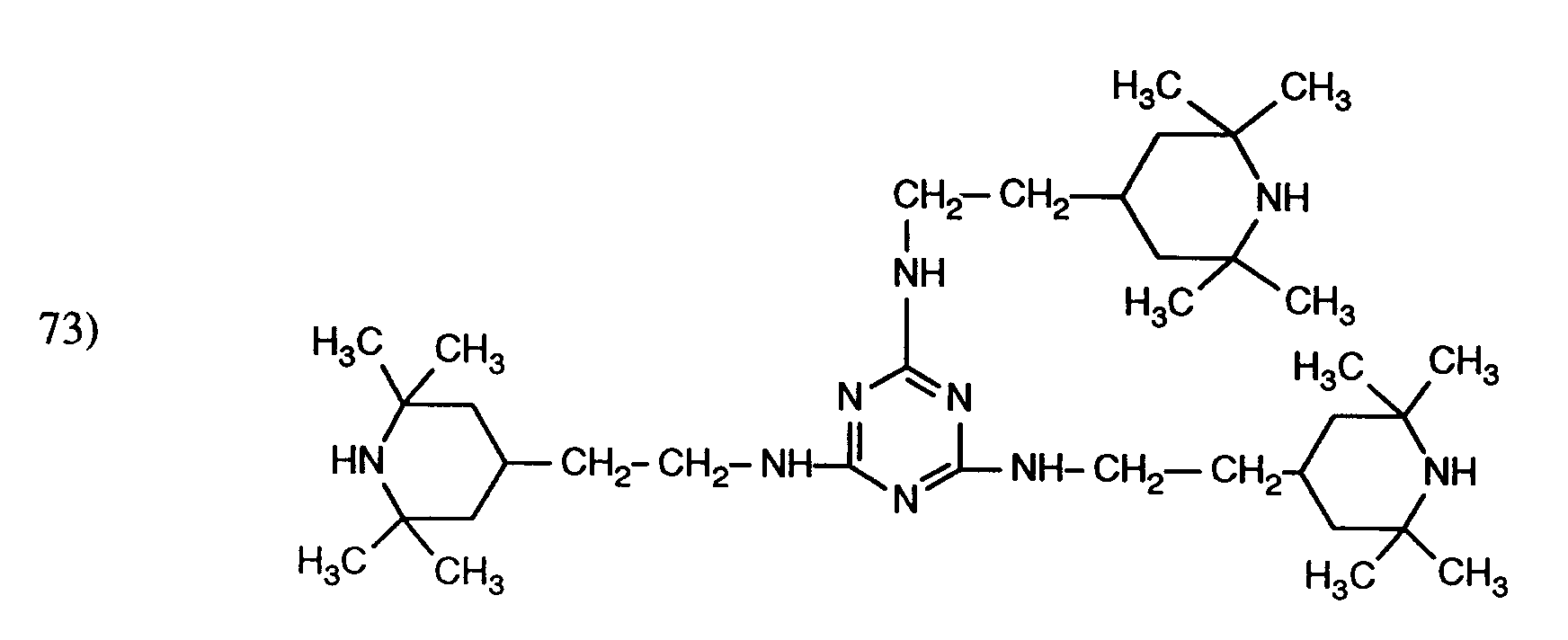


(f) Oligomere oder polymere Verbindungen, deren wiederkehrende Struktureinheit einen 2,2,6,6-Tetraalkylpiperidinrest der Formel III enthält, insbesondere Polyester, Polyäther, Polyamide, Polyamine, Polyurethane, Polyharnstoffe, Polyaminotriazine, Poly(meth)acrylate, Poly(meth)acrylamide und deren Copolymere, die solche Reste enthalten. - Beispiele für 2,2,6,6-Polyalkylpiperidin-Lichtschutzmittel dieser Klasse sind die Verbindungen der folgenden Formeln, wobei m eine Zahl von 2 bis etwa 200 bedeutet.


wobei
ist oder für eine Verzweigung der Kette
steht, m' und m'' jeweils eine ganze Zahl aus dem Bereich 0-200 bedeuten mit der Bedingung m' +m'' = m. - Weitere Beispiele für polymere Lichtschutzmittel sind Umsetzungsprodukte von Verbindungen der Formel

mit Epichlorhydrin;
Polyester aus Butan-1,2,3,4-tetracarbonsäure mit einem bifunktionellen Alkohol der Formel
dessen von der Tetracarbonsäure stammenden Carboxyl-Seitenketten mit 2,2,6,6-Tetramethyl-4-hydroxy-piperidin verestert sind; Verbindungen der Formel
wobei ca. ein Drittel der Reste R die Bedeutung -C₂H₅ haben und die anderen
bedeuten und m eine Zahl aus dem Bereich von 2 bis 200 ist; oder Copolymerisate, deren Wiederkehrende Einheit aus 2 Einheiten
und jeweils 1 Einheit
und
aufgebaut ist. -

worin G, G¹ und G¹¹ die unter (a) angegebene Bedeutung haben. - Bevorzugt sind Verbindungen der Formel IX, worin G Wasserstoff oder Methyl ist und G¹¹ Wasserstoff oder Methyl ist.
- Beispiele für solche Verbindungen sind:
- 96) 2,2,6,6-Tetramethyl-4-piperidon (Triacetonamin)
- 97) 1,2,2,6,6-Pentamethyl-4-piperidon
- 98) 2,2,6,6-Tetramethyl-4-piperidon-1-oxyl
- 99) 2,3,6-Trimethyl-2,6-diethyl-4-piperidon
-

worin n die Zahl 1 oder 2 bedeutet und worin G und G¹¹ die unter (a), und G¹⁴ die unter (b) angegebene Bedeutung haben, wobei für G¹⁴ die Bedeutungen -CONH-Z und -CH₂-CH(OH)-CH₂-O-D-O- ausgeschlossen sind. - Beispiele für solche Verbindungen sind:



- Besonders bevorzugt zur Verwendung im erfindungsgemäßen Verfahren sind die folgenden Amine:
- Verbindungen der Formel IV, worin n eine ganze Zahl aus dem Bereich von 1 bis 4 bedeutet, G und G¹ Wasserstoff sind und
G¹¹ Wasserstoff oder C₁-C₁₈-Alkyl und
G¹², wenn n = 1 ist, einen Rest der Formel -(CjH2j)-Si(Z')₂Z'', worin j eine ganze Zahl aus dem Bereich von 2 bis 5, und Z' und Z'' unabhängig voneinander C₁-C₄-Alkyl oder
C₁-C₄-Alkoxy bedeuten, darstellt und
G¹², wenn n = 2 ist, einen Rest einer aliphatischen Dicarbonsäure mit 2 bis 12 C-Atomen, der durch -COOZ¹² substituiert sein kann, wobei Z¹² C₁-C₂₀-Alkyl ist,
G¹², wenn n = 3 ist, einen Rest einer aromatischen Tricarbonsäure mit 9 bis 15 C-Atomen,
G¹², wenn n = 4 ist, einen Rest einer aliphatischen Tetracarbonsäure mit 8 bis 12
C-Atomen darstellt; Amine von besonderem technischem Interesse aus dieser Klasse sind solche der Formeln


sowie Ester der Butan-1,2,3,4-tetracarbonsäure mit je 2 Einheiten 1,2,2,6,6-Pentamethyl-4-hydroxy-piperidin und C₁₃H₂₇-OH (Amin F); - Verbindungen der Formel V, worin n 2 ist, G und G¹ Wasserstoff sind,
G¹¹ Wasserstoff oder Methyl und
G¹³ Wasserstoff oder C₁-C₈-Alkyl bedeuten, und
G¹⁴ C₂-C₈-Alkylen oder 1-Oxo-C₂-C₈-alkylen ist; ein Amin von besonderem technischem - Interesse aus dieser Klasse ist die Verbindung der Formel

- Verbindungen der Formel VIIC, worin n 1 ist, G,G¹ und G¹⁷ Wasserstoff sind,
G¹¹ Wasserstoff oder Methyl bedeutet, und
T₁ und T₂ zusammen mit dem sie bindenden C-Atom einen C₅-C₁₄-Cycloalkanring bilden;
ein Amin von besonderem technischem Interesse aus dieser Klasse ist die Verbindung der - Formel

- Verbindungen der Formel VIII, worin n 1 oder 2 ist,
G¹⁸ und G¹⁹ eine Gruppe einer der Formeln
bedeuten,
G¹¹ Wasserstoff oder Methyl ist,
G¹ und G² Wasserstoff oder gemeinsam einen Substituenten =O bedeuten,
E -O- oder -NG¹³- ist, A C₂-C₆-Alkylen und x eine der Zahlen O oder 1 bedeuten,
G¹³ Wasserstoff, C₁-C₁₂-Alkyl oder Cyclohexyl darstellt,
G²⁰, wenn n = 1 ist, gleich G¹⁸, und wenn n = 2 ist, eine Gruppe -E-B-E- ist, worin B C₂-C₈-Alkylen oder durch 1 oder 2 Gruppen -N(G²¹)- unterbrochenes C₂-C₈-Alkylen bedeutet,
G²¹ C₁-C₁₂-Alkyl, Cyclohexyl, Benzyl oder C₁-C₄-Hydroxyalkyl oder eine Gruppe der Formel
ist, oder G²¹ eine Gruppe der Formel
bedeutet;
- Amine von besonderem technischem Interesse aus dieser Klasse sind die oben beschriebene Verbindung (76)[ = Amin J] sowie die Verbindungen der Formeln

Verbindungen der Formel X, worin n 2 ist, G¹¹ Wasserstoff oder Methyl und G¹⁴ C₂-C₁₂-Alkylen bedeutet;
ein Amin von besonderem technischem Interesse aus dieser Klasse ist die oben beschriebene Verbindung (100) [= Amin M]; sowie
oligomere Verbindungen mit 2 bis 10 wiederkehrenden Einheiten, wie sie durch Reaktion - (i) von

- (j) von einem linearen oligomeren Polyester aus einem Dialkohol und Butan-1,2,3,4-tetra-carbonsäure mit 2,2,6,6-Tetramethyl-4-hydroxy-piperidin;
- (k) von

- (l) von H₂N-A-NH-A-NH₂ mit

- (m) von Verbindungen der Formel

- (n) von

- (o)


- Bei den oligomeren Aminen handelt es sich häufig um Gemische von Verbindungen, die sich bezüglich ihrer Kettenlänge voneinander unterscheiden.
- Von hervorgehobener Bedeutung ist die Verwendung der oben spezifizierten Amine A, B, C, D, E, F, G, H, J, K, L, M, N, O, P, Q, R, S, T, U, V und W.
- Im erfindungsgemäßen Verfahren ist insbesondere der Zusatz solcher Amine bevorzugt, deren Molekulargewicht bezw. mittleres Molekulargewicht


Bei den Aminen höheren Molekulargewichtes handelt es sich vor allem um sterisch gehinderte Amine. - Die genannten Amine sind bekannte Verbindungen; viele davon sind kommerziell erhältlich.
- Im erfindungsgemäßen Verfahren werden vorzugsweise Phosphite oder Phosphonite stabilisiert, welche einer der Formeln (1) bis (7) entsprechen,


worin die Indices ganzzahlig sind und
n' für 2, 3 oder 4; p für 1 oder 2; q für 2 oder 3; r für 4 bis 12; y für 1, 2 oder 3; und z für 1 bis 6 steht;
A', wenn n' 2 ist, Alkylen mit 2 bis 18 Kohlenstoffatomen; durch -S-, -O- oder -NR'₄-unterbrochenes Alkylen mit 2 bis 12 Kohlenstoffatomen; ein Rest einer der Formeln
oder Phenylen ist;
A', wenn n' 3 ist, ein Rest der Formel -CrH2r-1- ist;
A', wenn n' 4 ist, den Rest der Formel
bedeutet;
A'' die Bedeutung von A', wenn n' 2 ist, hat;
B' einen Rest der Formel -CH₂-; -CHR'₄-; -CR'₁R'₄-; -S- oder eine direkte Bindung darstellt; oder C₅-C₇-Cycloalkyliden; oder mit 1 bis 4 C₁-C₄-Alkylresten in Position 3, 4 und/oder 5 substituiertes Cyclohexyliden bedeutet;
D', wenn p 1 ist, Methyl und, wenn p 2 ist, -CH₂OCH₂- bedeutet;
E', wenn y 1 ist, Alkyl mit 1 bis 18 Kohlenstoffatomen, Phenyl, ein Rest der Formel -OR'₁ oder Halogen ist;
E', wenn y 2 ist, ein Rest der Formel -O-A''-O- ist;
E', wenn y 3 ist, ein Rest der Formel
ist;
Q' für den Rest eines mindestens z-wertigen Alkohols oder Phenols steht, wobei dieser über das (die) alkoholische(n) bzw. phenolische(n) O-Atom(e) an das (die) P-Atom(e) gebunden ist;
R'₁, R'₂ und R'₃ unabhängig voneinander Alkyl mit 1 bis 30 Kohlenstoffatomen; mit Halogen, -COOR₄', -CN oder -CONR₄'R₄' substituiertes Alkyl mit 1 bis 18 Kohlenstoffatomen; durch -S-, -O- oder -NR'₄- unterbrochenes Alkyl mit 2 bis 18 Kohlenstoffatomen; Phenyl-C₁-C₄-alkyl; Cycloalkyl mit 5 bis 12 Kohlenstoffatomen; Phenyl oder Naphthyl; mit Halogen, 1 bis 3 Alkylresten oder Alkoxyresten mit insgesamt 1 bis 18 Kohlenstoffatomen oder mit Phenyl-C₁-C₄-alkyl substituiertes Phenyl oder Naphthyl; oder ein Rest der Formel
sind, worin m eine ganze Zahl aus dem - Bereich 3 bis 6 bedeutet;
R'₄ beziehungsweise die Reste R₄' unabhängig voneinander Wasserstoff; Alkyl mit 1 bis 18 Kohlenstoffatomen; Cycloalkyl mit 5 bis 12 Kohlenstoffatomen; oder Phenylalkyl mit 1 bis 4 Kohlenstoffatomen im Alkylteil;
R'5 und R'₆ unabhängig voneinander Wasserstoff; Alkyl mit 1 bis 8 Kohlenstoffatomen oder Cycloalkyl mit 5 oder 6 Kohlenstoffatomen sind;
R'₇ und R'₈, im Fall q = 2, unabhängig voneinander C₁-C₄-Alkyl oder zusammen einen 2,3-Dehydro-pentamethylenrest darstellen; und
R'₇ und R'₈, im Fall q = 3, Methyl bedeuten;
die Substituenten R'₁₄ unabhängig voneinander Wasserstoff; Alkyl mit 1 bis 9 Kohlenstoffatomen oder Cyclohexyl sind;
die Substituenten R'₁₅ unabhängig voneinander Wasserstoff oder Methyl; und
R'₁₆ Wasserstoff oder C₁-C₄-Alkyl darstellt und im Fall, daß mehrere Reste R'₁₆ vorhanden sind, die Reste R'₁₆ gleich oder verschieden sind;
X' und Y' jeweils eine direkte Bindung oder -O- darstellen; und
Z' eine direkte Bindung; -CH₂-; -C(R'₁₆)₂- oder -S- ist. - Besonders bevorzugt ist ein Verfahren, worin das Phosphit oder Phosphonit eines der Formeln (1), (2), (5) oder (6) ist, worin
n' für die Zahl 2 und y für die Zahl 1 oder 2 steht;
A' Alkylen mit 2 bis 18 Kohlenstoffatomen; p-Phenylen oder p-Biphenylen ist;
E' im Fall y = 1 C₁-C₁₈-Alkyl, -OR₁ oder Fluor; und im Fall y = 2 p-Biphenylen ist;
R'₁, R'₂ und R'₃ unabhängig voneinander Alkyl mit 1 bis 18 Kohlenstoffatomen;
Phenyl-C₁-C₄-alkyl; Cyclohexyl; Phenyl; mit 1 bis 3 Alkylresten mit insgesamt 1 bis 18 Kohlenstoffatomen substituiertes Phenyl bedeutet;
die Substituenten R'₁₄ unabhängig voneinander Wasserstoff oder Alkyl mit 1 bis 9 Kohlenstoffatomen sind;
R'₁₅ Wasserstoff oder Methyl ist;
X' eine direkte Bindung;
Y'-O-; und
Z' eine direkte Bindung oder-CH(R'₁₆)- ist. - Ein Verfahren zum Stabilisieren eines Phosphits oder Phosphonits einer der Formeln (1), (2), (5) oder (6), worin
n' für die Zahl 2 und y für die Zahl 1 steht;
A' p-Biphenylen ist;
E' C₁-C₁₈-Alkoxy ist;
R'₁, R'₂ und R'₃ unabhängig voneinander mit 2 oder 3 Alkylresten mit insgesamt 2 bis 12 Kohlenstoffatomen substituiertes Phenyl bedeutet;
die Substituenten R'₁₄ unabhängig voneinander Methyl oder tert.-Butyl sind;
R'₁₅ Wasserstoff ist;
X' eine direkte Bindung;
Y' -O-; und
Z' eine direkte Bindung, -CH₂- oder -CH(CH₃)- ist,
ist von besonderem technischem Interesse. - Besonders bevorzugt sind Phosphite, insbesondere solche der Formeln (1) und (5).
- Die folgenden Verbindungen sind Beispiele für Phosphite und Phosphonite, deren Stabilität gegenüber Hydrolyse sich durch das erfindungsgemäße Verfahren besonders vorteilhaft verbessern läßt:


- Die genannten Phosphite und Phosphonite sind bekannte Verbindungen; sie sind zum Teil kommerziell erhältlich.
- Einige kommerzielle Phosphite und Phosphonite liegen als Verbindungsgemische oder in vorstabilisierter Form vor. Als Vorstabilisierung ist diesen Verbindungen meist ein Amin, beispielsweise ein Niederalkylamin oder Triisopropanolamin, in einer Konzentration von ca. 1 % auf konventionelle Weise beigemischt. Auch die Hydrolysestabilität derartiger Produkte läßt sich mit Hilfe des erfindungsgemäßen Verfahrens deutlich verbessern.
- Die Produkte aus dem erfindungsgemäßen Verfahren lassen sich vorteilhaft als Stabilisatoren für organisches Material, besonders organische Polymere, beispielsweise synthetische Polymere, gegen den schädigenden Einfluß von Wärme, Sauerstoff und/oder Licht verwenden. Beispiele für solche Polymere sind etwa der US-A-4 855 345, Spalte 4, Zeile 63, bis Spalte 7, Zeile 54, zu entnehmen.
- Die erfindungsgemäß stabilisierten Phosphite und Phosphonite zeichnen sich durch ihre hervorragende Beständigkeit gegen Hydrolyse aus und weisen eine gute Lagerstabilität auch bei hoher Luftfeuchtigkeit auf. Ein gegen Hydrolyse stabilisiertes organisches Phosphit oder Phosphonit, wie es durch das oben beschriebene Verfahren erhältlich ist, bildet daher ebenfalls einen Gegenstand dieser Erfindung.
- Die nachfolgenden Beispiele illustrieren das erfindungsgemäße Verfahren weiter. Alle Angaben in Teilen oder Prozenten beziehen sich, ebenso wie in der übrigen Beschreibung und in den Ansprüchen, auf das Gewicht, sofern nichts anderes angegeben ist. Soweit Prozentangaben auf Phosphit oder Phosphonit bezogen sind, ist damit Phosphit oder Phosphonit in der Schmelze gemeint, wenn nicht ausdrücklich eine andere Bezugsmenge genannt ist. Die Strukturformeln der in den Beispielen verwendeten Phosphite, Phosphonite und Amine sind, wo nicht direkt angegeben, weiter oben im Text aufgeführt. In den Tabellen wird bei Zahlenangaben durchweg die Schreibweise mit Dezimalpunkt anstatt mit Dezimalkomma verwendet.
- Beispiel 1: 300 g des Phosphits Ph-1 werden zusammen mit 225 g Isopropanol, 2,25 g Toluol und 30 g Amin A (= Triisopropanolamin) unter Rühren auf 70-75°C gebracht. Die resultierende homogene Schmelze wird innerhalb ca. 1 Stunde unter Rühren zu einer Suspension von 20 g Ph-1 in 450 g Isopropanol und 20 g Amin A gegeben, deren Temperatur während dieses Vorganges durch Kühlen auf 20-30°C gehalten wird. Die Mischung wird anschließend auf 10-15°C gekühlt und in diesem Temperaturbereich für weitere 3 Stunden gerührt. Daraufhin wird das kristalline Produkt abfiltriert und bei 60°C unter reduziertem Druck getrocknet.
- Die Elementaranalyse ergibt für das trockene Produkt einen Gehalt von 1,2 Gew.-% Amin A (bezogen auf Phosphit).
- Eine als Vergleich dienende Probe wird ohne Zugabe eines Amins kristallisiert.
- Gleiche Anteile des Produktes werden anschließend folgenden Tests auf Hydrolysebeständigkeit unterworfen:
- a) Bei der Lagerung wird die Zeit gemessen, zu der visuell ein beginnendes Zerfließen des anfänglichen Pulvers (Übergang p-k) festzustellen ist, sowie die Zeitdauer, bis zu der das Material flüssig ist (Übergang k-f). Zum letztgenannten Zeitpunkt wird die Gewichtszunahme während der Dauer der Lagerung festgestellt; die Gewichtszunahme gibt einen Hinweis auf die Wasseraufnahme des Materials. Die Testbedingungen (Temperatur und Luftfeuchtigkeit während der Lagerung) sind bei den jeweiligen Beispielen angegeben.
- b) Nach 8 Stunden Lagerung bei 70°C und 100 % Luftfeuchtigkeit wird mit Hilfe der Flüssigchromatographie der Gehalt an Phosphit Ph-1 ermittelt.
- Die Ergebnisse sind der nachfolgenden Tabelle 1 zu entnehmen.
- Beispiele 2-13: Die Verbindung Ph-1 wird mit den Aminen A, C, E, H, J, K, P, Q und U entsprechend der in Beispiel 1 beschriebenen Methode stabilisiert; im Unterschied zu Beispiel 1 werden jedoch im Kristallisationsmedium kein Phosphit und kein Amin vorgelegt. Das erhaltene Produkt wird auf Hydrolysebeständigkeit getestet, wie in Beispiel 1 beschrieben. Die Testbedingungen in Test a: Lagerung bei 50°C und 75 % Luftfeuchtigkeit.
- Weitere Bedingungen und Testergebnisse sind in Tabelle 1 zusammengestellt.
- In Tabelle 1 und den nachfolgenden Tabellen bedeuten die Spaltenüberschriften:
- % eing.:
- Menge Amin in der Schmelze, %-Angabe bezogen auf Phosphit bezw. Phosphonit in der Schmelze;
- % Geh.:
- Amingehalt im Phosphit bezw. Phosphonit nach Kristallisation;
- Solv1, %:
- Hauptlösungsmittel für Schmelze, %-Angabe bezogen auf Phosphit bezw. Phosphonit in der Schmelze;
- Solv2, %:
- weiteres Lösungsmittel für Schmelze, %-Angabe bezogen auf Phosphit bezw. Phosphonit in der Schmelze;
- T/°C:
- Temperaturbereich von Schmelze bezw. Kristallisationsmedium;
- Solvens, %:
- Lösungsmittel für Kristallisationsmedium, %-Angabe bezogen auf Phosphit bezw. Phosphonit in der Schmelze;
- IPA:
- Isopropanol;
- TOL:
- Toluol;
- MeOH:
- Methanol;
- % Impfkr.:
- vorgelegte Menge an Phosphit als Impfkristalle, %-Angabe bezogen auf Phosphit bezw. Phosphonit in der Schmelze;
- % Amin:
- vorgelegte Menge an Amin im Kristallisationsmedium, %-Angabe bezogen auf Phosphit bezw. Phosphonit in der Schmelze;
- %Zers.(8h):
- Prozentuale Zersetzung der Probe nach 8 h (100 % = Phosphitgehalt zu Testbeginn) [Test b)];
- p-k /h:
- Zeit in Stunden bis zum beginnenden Zefließen [Test a)];
- k-f /h(%W):
- Zeit in Stunden bis Probe flüssig ist (klare Lösung). Angabe in Klammern: Gewichtszunahme der Probe gegenüber Testbeginn (Gew.-% bezogen auf Beginn der Lagerung = Wassergehalt) [Test a)].
- Beispiele 14-17: Eine kommerzielle Phosphonitmischung mit Ph-3 als der Hauptkomponente wird nach der in den Beispielen 2-13 beschriebenen Methode stabilisiert; Zusammensetzung der Charge:


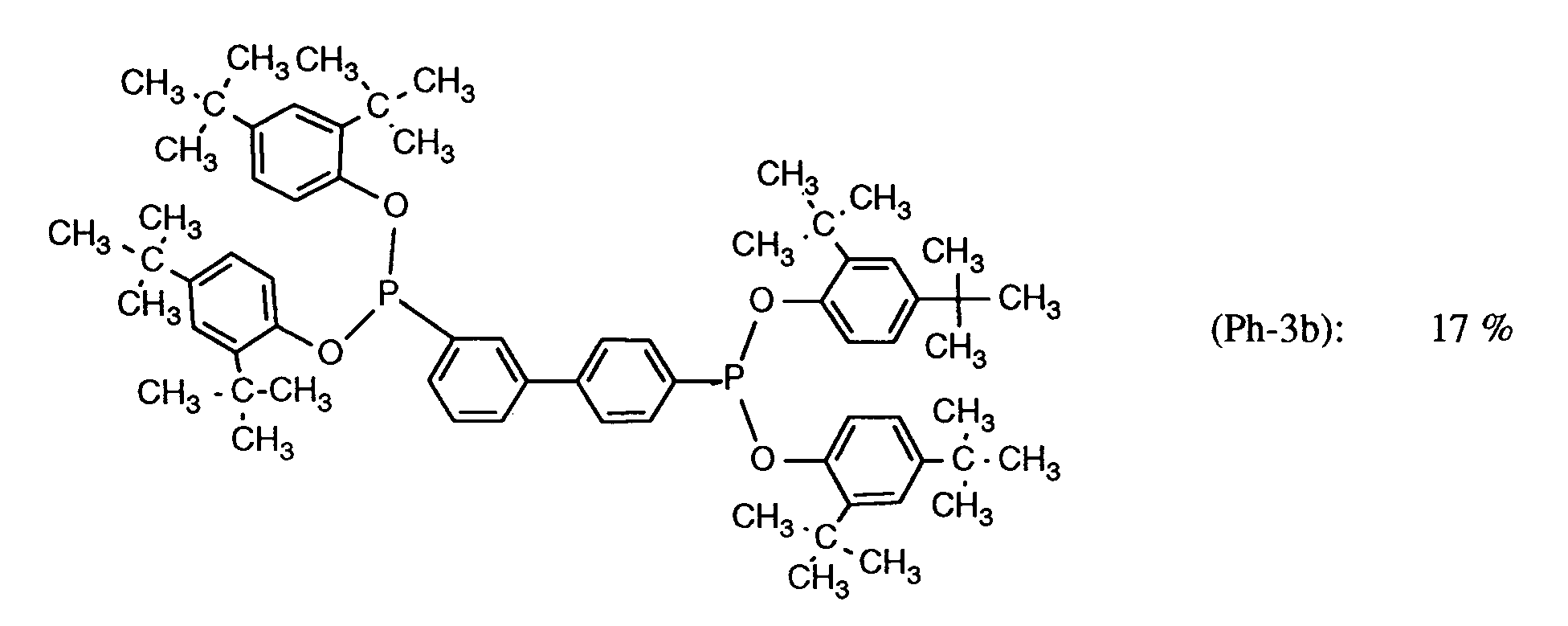


weitere Verbindungen: 09 %. - Die stabilisierte Mischung wird mit Hilfe von Test a) auf Hydrolysebestandigkeit geprüft; Testbedingungen: Lagerung bei 50°C und 75 % Luftfeuchtigkeit.
Verfahrensbedingungen und Testergebnisse sind in Tabelle 2 zusammengestellt. - Beispiele 18-23: Die Verbindungen Ph-5 und Ph-6 werden nach der in den Beispielen 2-13 beschriebenen Methode stabilisiert und mit Hilfe von Test a) auf Hydrolysebeständigkeit geprüft. Testbedingungen: Lagerung bei 50°C und 75 % Luftfeuchtigkeit.
Verfahrensbedingungen und Testergebnisse sind in den Tabellen 3 und 4 zusammengestellt. - Beispiele 24-29: Die Verbindung Ph-2 wird nach der in den Beispielen 2-13 beschriebenen Methode stabilisiert und mit Hilfe von Test a) auf Hydrolysebeständigkeit geprüft; Testbedingungen: Lagerung bei 70°C und 100 % Luftfeuchtigkeit.
Verfahrensbedingungen und Testergebnisse sind in Tabelle 5 zusammengestellt. - Beispiele 30-33: Eine kommerzielle Phosphonitmischung mit Ph-3 als der Hauptkomponente wird nach der in den Beispielen 2-13 beschriebenen Methode stabilisiert; Zusammensetzung der Charge (Formeln s. Beispiele 14-17):
- Ph-3:
- 35 %
- Ph-2:
- 09 %
- Ph-3b:
- 20 %
- Ph-3c:
- 04 %
- Ph-3d:
- 15 %
- weitere:
- 17 %.
- Die stabilisierte Mischung wird mit Hilfe von Test a) auf Hydrolysebeständigkeit geprüft; Testbedingungen: Lagerung bei 50°C und 75 % Luftfeuchtigkeit.
Verfahrensbedingungen und Testergebnisse sind in Tabelle 6 zusammengestellt.


- Beispiele 34-35: Die Verbindung Ph-5 wird nach der in den Beispielen 2-13 beschriebenen Methode stabilisiert; als Kristallisationsmedium wird Isopropanol ohne weitere Zusätze eingesetzt. Die unstabilisierte und die stabilisierte Verbindung werden mit Hilfe von Test a) auf Hydrolysebeständigkeit geprüft. Testbedingungen: Lagerung bei 50°C und 75 % Luftfeuchtigkeit.
Weitere Verfahrensbedingungen und Testergebnis (k-f/h = Zeit bis zur Verflüssigung der Probe in Stunden) sind in Tabelle 7 zusammengestellt.
- Die Beispiele zeigen, daß die erfindungsgemäß hergestellten und stabilisierten Phosphite eine deutlich bessere Beständigkeit gegen Hydrolyse an feuchter Luft aufweisen als unstabilisierte Phosphite.
oligomere Amine von besonderem technischem Interesse sind darunter solche der Formeln (m bezeichnet wiederum eine Zahl aus dem Bereich von 2 bis 10)


(Amin R), worin ca. ein Drittel der Reste R die Bedeutung -C₂H₅ haben und die anderen
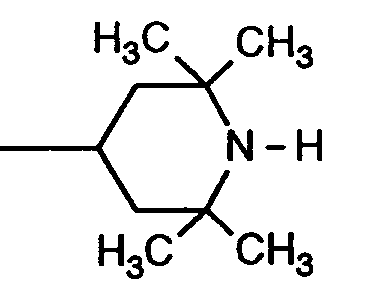
bedeuten; ein linearer Polyester mit 2 bis 10 wiederkehrenden Einheiten aus Butan-1,2,3,4-tetracarbonsäure und einem Dialkohol der Formel
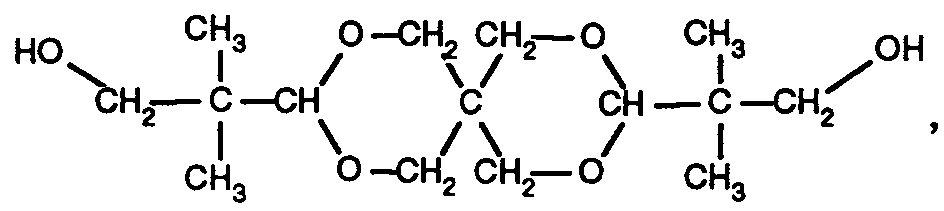
worin die Endgruppen und Seitenketten durch Veresterung der freien Carboxylgruppen mit 2,2,6,6-Tetramethyl-4-hydroxy-piperidin gebildet werden (Amin S); ein Copolymerisat, dessen wiederkehrende Einheit aus 2 Einheiten

und jeweils 1 Einheit

aufgebaut ist (Amin T); das Umsetzungsprodukt von H₂N-(CH₂)₂-NH-(CH₂)₂-NH₂ mit

und Br-(CH₂)₂-Br (Amin U); sowie das Umsetzungsprodukt der Verbindung der Formel

mit Epichlorhydrin (Amin W).

Claims (13)
- Verfahren zur Stabilisierung eines kristallinen organischen Phosphits oder Phosphonits gegen Hydrolyse, dadurch gekennzeichnet, daß ein auf 50-100°C temperiertes Gemisch, welches Phosphit bezw. Phosphonit, ein Lösungsmittel oder Lösungsmittelgemisch und 0,1 bis 100 Gew.-% (bezogen auf Phosphit bezw. Phosphonit) eines Amins enthält, als homogene Schmelze in ein flüssiges Kristallisationsmedium gegeben wird, dessen Temperatur während der Zugabe um 10-70°C unter der Temperatur der Schmelze gehalten wird.
- Verfahren gemäß Anspruch 1, worin die Schmelze als Hauptlösungsmittel einen Alkohol oder einen Kohlenwasserstoff in einer Menge von 20 bis 500 Gew.-% bezogen auf Phosphit bezw. Phosphonit, und ein weiteres Lösungsmittel in einer Menge von 0-50 Gew.-% bezogen auf das Hauptlösungsmittel enthält.
- Verfahren gemäß Anspruch 1, worin die Temperatur der Schmelze 55-90°C beträgt.
- Verfahren gemäß Anspruch 1, worin der Temperaturunterschied zwischen Schmelze und Kristallisationsmedium 30-70°C beträgt.
- Verfahren gemäß Anspruch 1, worin das Kristallisationsmedium auf einer Temperatur gehalten wird, die mindestens 10°C unterhalb der resultierenden Liquidustemperatur liegt.
- Verfahren gemäß Anspruch 1, worin als Kristallisationsmedium 80-800 Gew.-% (bezogen auf Phosphit bezw. Phosphonit) eines Lösungsmittels eingesetzt werden.
- Verfahren gemäß Anspruch 6, worin als Kristallisationsmedium ein C₁-C₅-Alkanol oder ein Gemisch verschiedener C₁-C₅-Alkanole eingesetzt wird.
- Verfahren gemäß Anspruch 6, worin das Kristallisationsmedium aus einer Suspension von 2 bis 20 Gew.-% kristallinem Phosphit bezw. Phosphonit besteht, bezogen auf Phosphit bezw. Phosphonit in der Schmelze.
- Verfahren gemäß Anspruch 1, worin das Kristallisationsmedium zu 50-100 % mit dem Amin gesättigt ist.
- Verfahren gemäß Anspruch 1, worin die Schmelze 0,1 bis 50 Gew.-% an Amin (bezogen auf Phosphit bezw. Phosphonit) enthält.
- Verfahren gemäß Anspruch 1, worin als Amin eines der Formel I

oder ein cyclisches sterisch gehindertes Amin eingesetzt wird, das mindestens eine Gruppe der Formeln II oder III

- Verfahren gemäß Anspruch 10, worin als Amin ein tertiäres Amin der Formel I oder ein cyclisches sterisch gehindertes Amin eingesetzt wird, das mindestens eine Gruppe der Formeln II oder III enthält, worin G Wasserstoff ist und G¹ und G² Wasserstoff oder gemeinsam einen Substituenten =O bedeuten.
- Ein gegen Hydrolyse stabilisiertes organisches Phosphit oder Phosphonit erhältlich durch ein Verfahren gemäß Anspruch 1.
Applications Claiming Priority (6)
| Application Number | Priority Date | Filing Date | Title |
|---|---|---|---|
| CH310492 | 1992-10-05 | ||
| CH3104/92 | 1992-10-05 | ||
| CH310492 | 1992-10-05 | ||
| CH364792 | 1992-11-27 | ||
| CH364792 | 1992-11-27 | ||
| CH3647/92 | 1992-11-27 |
Publications (2)
| Publication Number | Publication Date |
|---|---|
| EP0592364A1 true EP0592364A1 (de) | 1994-04-13 |
| EP0592364B1 EP0592364B1 (de) | 2001-07-11 |
Family
ID=25692198
Family Applications (1)
| Application Number | Title | Priority Date | Filing Date |
|---|---|---|---|
| EP93810684A Expired - Lifetime EP0592364B1 (de) | 1992-10-05 | 1993-09-27 | Verfahren zur Stabilisierung dreiwertiger Phosphorverbindungen mit Aminen |
Country Status (12)
| Country | Link |
|---|---|
| US (2) | US5371263A (de) |
| EP (1) | EP0592364B1 (de) |
| JP (1) | JPH06200247A (de) |
| KR (1) | KR940009200A (de) |
| CN (1) | CN1044814C (de) |
| AT (1) | ATE203044T1 (de) |
| BR (1) | BR9304126A (de) |
| CA (1) | CA2107526A1 (de) |
| CZ (1) | CZ286842B6 (de) |
| DE (1) | DE59310187D1 (de) |
| MX (1) | MX9306058A (de) |
| SK (1) | SK282127B6 (de) |
Cited By (3)
| Publication number | Priority date | Publication date | Assignee | Title |
|---|---|---|---|---|
| FR2705679A1 (fr) * | 1993-05-24 | 1994-12-02 | Sandoz Sa | Nouvelles compositions stabilisantes des matières polymères, à base de phosphonites ou phosphites et d'un stabilisant contre l'hydrolyse. |
| US5856550A (en) * | 1994-04-05 | 1999-01-05 | Ciba Specialty Chemicals Corporation | Enhancement of the storage stability of organic phosphites and phosphonites |
| EP2797939B1 (de) | 2011-12-30 | 2018-10-31 | Basf Se | Verfahren zur reinigung von organischen diphosphitverbindungen |
Families Citing this family (18)
| Publication number | Priority date | Publication date | Assignee | Title |
|---|---|---|---|---|
| TW251307B (de) * | 1992-10-05 | 1995-07-11 | Ciba Geigy | |
| US6593485B1 (en) | 1994-10-06 | 2003-07-15 | Clariant Finance (Bvi) Limited | Stabilizer composition |
| US5468895A (en) * | 1994-10-19 | 1995-11-21 | General Electric Company | Amine stabilized amorphous phosphite |
| US5514742A (en) * | 1995-02-03 | 1996-05-07 | General Electric Company | Suppression of UV-yellowing of phosphites through the use of polyamines |
| DE19820157B4 (de) | 1997-05-13 | 2010-04-08 | Clariant Produkte (Deutschland) Gmbh | Neue Verbindungen auf Basis von Polyalkyl-1-oxa-diazaspirodecan-Verbindungen |
| US5786497A (en) * | 1997-08-29 | 1998-07-28 | General Electric Company | Process for the preparation of phosphites |
| US5919966A (en) * | 1998-03-26 | 1999-07-06 | General Electric Company | Process for the preparation of spiro bis-phosphites |
| US5917076A (en) * | 1998-04-16 | 1999-06-29 | General Electric Company | Process for the preparation of spiro bis-phosphites using finely ground pentaerythritol |
| DE19917070A1 (de) * | 1999-04-15 | 2000-10-19 | Basf Ag | Stabilisierte Phosphorverbindungen beinhaltende Zusammensetzung |
| DE19948117A1 (de) * | 1999-10-06 | 2001-04-12 | Basf Ag | Stabilisatorzusammensetzung |
| JP2008143873A (ja) * | 2006-12-13 | 2008-06-26 | Konica Minolta Opto Inc | ホスホナイト化合物、その精製方法、それを用いたセルロースエステルフィルム、偏光板及び液晶表示装置 |
| US8632961B2 (en) | 2010-01-28 | 2014-01-21 | Eastman Kodak Company | Flexographic processing solution and use |
| US9751904B2 (en) * | 2014-05-20 | 2017-09-05 | Evonik Degussa Gmbh | Method for reducing the chlorine content of organomonophosphites using dimethylaminobutane, triethylamine or triethanolamine |
| US9534107B2 (en) | 2014-07-30 | 2017-01-03 | The Goodyear Tire & Rubber Company | Elastomer containing combination of tris(nonyl phenyl) phosphite and tetramethylethylenediamine, preparation and compositions and articles of manufacture thereof |
| KR20160138877A (ko) | 2015-05-26 | 2016-12-06 | (주)펠리테크 | 마이크로파를 이용한 세라믹 발열 하이브리드 건조기 |
| EP3328818B1 (de) * | 2015-07-28 | 2020-06-03 | Dow Technology Investments LLC | Verfahren zur herstellung einer stabilisierten organophosphorverbindungslösung |
| CN109535197B (zh) * | 2018-12-19 | 2020-04-21 | 山东新和成维生素有限公司 | 一种稳定亚磷酸盐配体的方法及其应用 |
| PL249844B1 (pl) * | 2024-10-10 | 2026-07-06 | Blachotrapez Spolka Z Ograniczona Odpowiedzialnoscia | Uchwyt uniwersalny do mocowania na połaciach dachowych z rąbkiem płaskich elementów o dużych powierzchniach, zwłaszcza paneli fotowoltaicznych |
Citations (2)
| Publication number | Priority date | Publication date | Assignee | Title |
|---|---|---|---|---|
| EP0143464A2 (de) * | 1983-11-28 | 1985-06-05 | Argus Chemical Corporation | Pentaerythrit-spiro-bis-phosphit-Zusammensetzungen mit Hydrolysebeständigkeit |
| EP0167969A2 (de) * | 1984-07-05 | 1986-01-15 | Argus Chemical Corporation | Trisorganophosphitzusammensetzungen mit hydrolytischer Stabilität |
Family Cites Families (9)
| Publication number | Priority date | Publication date | Assignee | Title |
|---|---|---|---|---|
| US3553298A (en) * | 1967-10-20 | 1971-01-05 | Hooker Chemical Corp | Hydrolytic stabilized phosphite esters |
| FR2101275A5 (de) * | 1970-07-17 | 1972-03-31 | Ugine Kuhlmann | |
| JPS5930173B2 (ja) * | 1979-05-01 | 1984-07-25 | ボルグ−ワ−ナ−・ケミカルス・インコ−ポレ−テッド | 重合体のための安定剤 |
| JPS5826917B2 (ja) * | 1980-02-13 | 1983-06-06 | アデカ・ア−ガス化学株式会社 | 改良された有機ホスフアイト組成物 |
| JPH0613539B2 (ja) * | 1984-07-04 | 1994-02-23 | 旭電化工業株式会社 | 有機ホスファイト組成物 |
| JPS61140589A (ja) * | 1984-12-10 | 1986-06-27 | ア−ガス・ケミカル・コ−ポレ−シヨン | 耐加水分解性の改良されたペンタエリトリト−ル−スピロ−ビス−ホスフアイト組成物及び該組成物を含む組成物 |
| JPH0637507B2 (ja) * | 1986-03-26 | 1994-05-18 | 旭電化工業株式会社 | 有機ホスフアイト組成物 |
| DE3876110T2 (de) * | 1987-02-13 | 1993-05-27 | Enichem Sintesi | Feste stabilisatormischung fuer organische polymere und verfahren zu ihrer herstellung. |
| US5342978A (en) * | 1993-05-24 | 1994-08-30 | General Electric Company | Organic phosphite ester compositions containing hindered piperdinyl light stabilizers |
-
1993
- 1993-09-27 AT AT93810684T patent/ATE203044T1/de not_active IP Right Cessation
- 1993-09-27 EP EP93810684A patent/EP0592364B1/de not_active Expired - Lifetime
- 1993-09-27 DE DE59310187T patent/DE59310187D1/de not_active Expired - Fee Related
- 1993-09-30 MX MX9306058A patent/MX9306058A/es not_active IP Right Cessation
- 1993-09-30 US US08/129,705 patent/US5371263A/en not_active Expired - Fee Related
- 1993-10-01 CA CA002107526A patent/CA2107526A1/en not_active Abandoned
- 1993-10-04 BR BR9304126A patent/BR9304126A/pt not_active IP Right Cessation
- 1993-10-04 CZ CZ19932066A patent/CZ286842B6/cs not_active IP Right Cessation
- 1993-10-04 CN CN93118256A patent/CN1044814C/zh not_active Expired - Fee Related
- 1993-10-04 SK SK1065-93A patent/SK282127B6/sk unknown
- 1993-10-04 KR KR1019930020598A patent/KR940009200A/ko not_active Withdrawn
- 1993-10-05 JP JP5274954A patent/JPH06200247A/ja active Pending
-
1994
- 1994-08-31 US US08/298,894 patent/US5534645A/en not_active Expired - Lifetime
Patent Citations (2)
| Publication number | Priority date | Publication date | Assignee | Title |
|---|---|---|---|---|
| EP0143464A2 (de) * | 1983-11-28 | 1985-06-05 | Argus Chemical Corporation | Pentaerythrit-spiro-bis-phosphit-Zusammensetzungen mit Hydrolysebeständigkeit |
| EP0167969A2 (de) * | 1984-07-05 | 1986-01-15 | Argus Chemical Corporation | Trisorganophosphitzusammensetzungen mit hydrolytischer Stabilität |
Cited By (4)
| Publication number | Priority date | Publication date | Assignee | Title |
|---|---|---|---|---|
| FR2705679A1 (fr) * | 1993-05-24 | 1994-12-02 | Sandoz Sa | Nouvelles compositions stabilisantes des matières polymères, à base de phosphonites ou phosphites et d'un stabilisant contre l'hydrolyse. |
| GB2278362B (en) * | 1993-05-24 | 1997-08-13 | Sandoz Ltd | Processing stabiliser composition for polymers |
| US5856550A (en) * | 1994-04-05 | 1999-01-05 | Ciba Specialty Chemicals Corporation | Enhancement of the storage stability of organic phosphites and phosphonites |
| EP2797939B1 (de) | 2011-12-30 | 2018-10-31 | Basf Se | Verfahren zur reinigung von organischen diphosphitverbindungen |
Also Published As
| Publication number | Publication date |
|---|---|
| CZ286842B6 (en) | 2000-07-12 |
| MX9306058A (es) | 1994-04-29 |
| BR9304126A (pt) | 1994-08-09 |
| SK106593A3 (en) | 1994-05-11 |
| US5534645A (en) | 1996-07-09 |
| DE59310187D1 (de) | 2001-08-16 |
| CN1092075A (zh) | 1994-09-14 |
| KR940009200A (ko) | 1994-05-20 |
| CN1044814C (zh) | 1999-08-25 |
| EP0592364B1 (de) | 2001-07-11 |
| CA2107526A1 (en) | 1994-04-06 |
| JPH06200247A (ja) | 1994-07-19 |
| US5371263A (en) | 1994-12-06 |
| ATE203044T1 (de) | 2001-07-15 |
| CZ206693A3 (en) | 1994-04-13 |
| SK282127B6 (sk) | 2001-11-06 |
Similar Documents
| Publication | Publication Date | Title |
|---|---|---|
| EP0592364B1 (de) | Verfahren zur Stabilisierung dreiwertiger Phosphorverbindungen mit Aminen | |
| EP0016723B1 (de) | Lichtstabilisierung von Zweischicht-Unilackierungen | |
| EP0453396B1 (de) | Lackzusammensetzungen | |
| EP0352221B1 (de) | Verfahren zum fotochemischen Stabilisieren von ungefärbten und gefärbten Polypropylenfasern | |
| EP0006213B1 (de) | Lichtstabilisierung von sauerkatalysierten Einbrennlacken | |
| EP0290391A2 (de) | Gegen Lichtschädigung stabilisierte Polyolefine | |
| EP0592363B1 (de) | Erhöhung der Lagerstabilität von organischen Phosphiten und Phosphoniten | |
| EP0296391B1 (de) | Lichtstabilisierte, epoxygruppenhaltige Polymermikropartikel | |
| EP0676405B1 (de) | Erhöhung der Lagerstabilität von organischen Phosphiten und Phosphoniten | |
| DE3027223A1 (de) | Triazinylaminotriazine, ihre herstellung und verwendung | |
| DE4000551A1 (de) | Verfahren zum fotochemischen stabilisieren von gefaerbter wolle | |
| EP0002753B1 (de) | Stabilisierung von Metalleffekteinbrennlacken gegen die Einwirkung von Licht, Feuchtigkeit und Sauerstoff durch den Zusatz von Polyalkylpiperidinderivaten | |
| EP0006564B1 (de) | 2-(2-Hydroxy-3.5-disubstituiertes-phenyl)-2H-benzotriazol und damit stabilisierte Mischungen | |
| RU2126011C1 (ru) | Способ стабилизации кристаллического органического фосфита или фосфонита от воздействия гидролиза и стабилизированный от воздействия гидролиза органический фосфит или фосфонит | |
| EP0015230B1 (de) | Stabilisiertes organisches Polymer enthaltend als Lichtstabilisator ein 2-(2-Hydroxy-3,5-di-tert-octylphenyl)-2H-benzotriazol | |
| CH688878GA3 (de) | Handelsformen von sterisch gehindertem Amin und deren Verwendung. | |
| DE3345376A1 (de) | Furan-3-carbonsaeurederivate | |
| DE2120954A1 (de) | Bis-oxalsäurediamide | |
| DE69228670T2 (de) | Cyclohexylaminderivate | |
| DE3503136A1 (de) | Verfahren zur erhoehung des weissgrades bei optisch aufgehellten polyolefinen und polystyrol | |
| DE3706793A1 (de) | Polymere acetylendiharnstoffderivate und deren verwendung |
Legal Events
| Date | Code | Title | Description |
|---|---|---|---|
| PUAI | Public reference made under article 153(3) epc to a published international application that has entered the european phase |
Free format text: ORIGINAL CODE: 0009012 |
|
| AK | Designated contracting states |
Kind code of ref document: A1 Designated state(s): AT BE CH DE ES FR GB IT LI NL SE |
|
| 17P | Request for examination filed |
Effective date: 19940909 |
|
| 17Q | First examination report despatched |
Effective date: 19961010 |
|
| RAP1 | Party data changed (applicant data changed or rights of an application transferred) |
Owner name: CIBA SC HOLDING AG |
|
| RAP3 | Party data changed (applicant data changed or rights of an application transferred) |
Owner name: CIBA SPECIALTY CHEMICALS HOLDING INC. |
|
| GRAG | Despatch of communication of intention to grant |
Free format text: ORIGINAL CODE: EPIDOS AGRA |
|
| GRAG | Despatch of communication of intention to grant |
Free format text: ORIGINAL CODE: EPIDOS AGRA |
|
| GRAH | Despatch of communication of intention to grant a patent |
Free format text: ORIGINAL CODE: EPIDOS IGRA |
|
| GRAH | Despatch of communication of intention to grant a patent |
Free format text: ORIGINAL CODE: EPIDOS IGRA |
|
| GRAA | (expected) grant |
Free format text: ORIGINAL CODE: 0009210 |
|
| AK | Designated contracting states |
Kind code of ref document: B1 Designated state(s): AT BE CH DE ES FR GB IT LI NL SE |
|
| PG25 | Lapsed in a contracting state [announced via postgrant information from national office to epo] |
Ref country code: NL Free format text: LAPSE BECAUSE OF FAILURE TO SUBMIT A TRANSLATION OF THE DESCRIPTION OR TO PAY THE FEE WITHIN THE PRESCRIBED TIME-LIMIT Effective date: 20010711 |
|
| REF | Corresponds to: |
Ref document number: 203044 Country of ref document: AT Date of ref document: 20010715 Kind code of ref document: T |
|
| REG | Reference to a national code |
Ref country code: CH Ref legal event code: EP |
|
| REF | Corresponds to: |
Ref document number: 59310187 Country of ref document: DE Date of ref document: 20010816 |
|
| ITF | It: translation for a ep patent filed | ||
| PG25 | Lapsed in a contracting state [announced via postgrant information from national office to epo] |
Ref country code: AT Free format text: LAPSE BECAUSE OF NON-PAYMENT OF DUE FEES Effective date: 20010927 |
|
| PG25 | Lapsed in a contracting state [announced via postgrant information from national office to epo] |
Ref country code: BE Free format text: LAPSE BECAUSE OF NON-PAYMENT OF DUE FEES Effective date: 20010930 |
|
| GBT | Gb: translation of ep patent filed (gb section 77(6)(a)/1977) |
Effective date: 20010906 |
|
| PG25 | Lapsed in a contracting state [announced via postgrant information from national office to epo] |
Ref country code: SE Free format text: LAPSE BECAUSE OF FAILURE TO SUBMIT A TRANSLATION OF THE DESCRIPTION OR TO PAY THE FEE WITHIN THE PRESCRIBED TIME-LIMIT Effective date: 20011011 |
|
| NLV1 | Nl: lapsed or annulled due to failure to fulfill the requirements of art. 29p and 29m of the patents act | ||
| ET | Fr: translation filed | ||
| REG | Reference to a national code |
Ref country code: GB Ref legal event code: IF02 |
|
| PG25 | Lapsed in a contracting state [announced via postgrant information from national office to epo] |
Ref country code: ES Free format text: LAPSE BECAUSE OF FAILURE TO SUBMIT A TRANSLATION OF THE DESCRIPTION OR TO PAY THE FEE WITHIN THE PRESCRIBED TIME-LIMIT Effective date: 20020131 |
|
| BERE | Be: lapsed |
Owner name: CIBA SPECIALTY CHEMICALS HOLDING INC. Effective date: 20010930 |
|
| PLBE | No opposition filed within time limit |
Free format text: ORIGINAL CODE: 0009261 |
|
| STAA | Information on the status of an ep patent application or granted ep patent |
Free format text: STATUS: NO OPPOSITION FILED WITHIN TIME LIMIT |
|
| 26N | No opposition filed | ||
| PGFP | Annual fee paid to national office [announced via postgrant information from national office to epo] |
Ref country code: FR Payment date: 20020820 Year of fee payment: 10 Ref country code: CH Payment date: 20020820 Year of fee payment: 10 |
|
| PGFP | Annual fee paid to national office [announced via postgrant information from national office to epo] |
Ref country code: DE Payment date: 20020826 Year of fee payment: 10 |
|
| PGFP | Annual fee paid to national office [announced via postgrant information from national office to epo] |
Ref country code: GB Payment date: 20020903 Year of fee payment: 10 |
|
| PG25 | Lapsed in a contracting state [announced via postgrant information from national office to epo] |
Ref country code: GB Free format text: LAPSE BECAUSE OF NON-PAYMENT OF DUE FEES Effective date: 20030927 |
|
| PG25 | Lapsed in a contracting state [announced via postgrant information from national office to epo] |
Ref country code: LI Free format text: LAPSE BECAUSE OF NON-PAYMENT OF DUE FEES Effective date: 20030930 Ref country code: CH Free format text: LAPSE BECAUSE OF NON-PAYMENT OF DUE FEES Effective date: 20030930 |
|
| PG25 | Lapsed in a contracting state [announced via postgrant information from national office to epo] |
Ref country code: DE Free format text: LAPSE BECAUSE OF NON-PAYMENT OF DUE FEES Effective date: 20040401 |
|
| REG | Reference to a national code |
Ref country code: CH Ref legal event code: PL |
|
| GBPC | Gb: european patent ceased through non-payment of renewal fee |
Effective date: 20030927 |
|
| PG25 | Lapsed in a contracting state [announced via postgrant information from national office to epo] |
Ref country code: FR Free format text: LAPSE BECAUSE OF NON-PAYMENT OF DUE FEES Effective date: 20040528 |
|
| REG | Reference to a national code |
Ref country code: FR Ref legal event code: ST |
|
| PG25 | Lapsed in a contracting state [announced via postgrant information from national office to epo] |
Ref country code: IT Free format text: LAPSE BECAUSE OF NON-PAYMENT OF DUE FEES Effective date: 20050927 |