EP0637623B1 - Zyclisches Kohlenwasserstoffderivat sowie eine dieses enthaltende Flüssigkristallzusammensetzung - Google Patents
Zyclisches Kohlenwasserstoffderivat sowie eine dieses enthaltende Flüssigkristallzusammensetzung Download PDFInfo
- Publication number
- EP0637623B1 EP0637623B1 EP94111448A EP94111448A EP0637623B1 EP 0637623 B1 EP0637623 B1 EP 0637623B1 EP 94111448 A EP94111448 A EP 94111448A EP 94111448 A EP94111448 A EP 94111448A EP 0637623 B1 EP0637623 B1 EP 0637623B1
- Authority
- EP
- European Patent Office
- Prior art keywords
- compound
- group
- formula
- liquid crystal
- ring
- Prior art date
- Legal status (The legal status is an assumption and is not a legal conclusion. Google has not performed a legal analysis and makes no representation as to the accuracy of the status listed.)
- Expired - Lifetime
Links
- 0 *C1CCC(CCc(cc2)cc(F)c2F)CC1 Chemical compound *C1CCC(CCc(cc2)cc(F)c2F)CC1 0.000 description 143
- XDTMQSROBMDMFD-UHFFFAOYSA-N C1CCCCC1 Chemical compound C1CCCCC1 XDTMQSROBMDMFD-UHFFFAOYSA-N 0.000 description 2
- WNOIABIPQKODBY-UHFFFAOYSA-N CC1CCC(CCC2CCC(C)CC2)CC1 Chemical compound CC1CCC(CCC2CCC(C)CC2)CC1 WNOIABIPQKODBY-UHFFFAOYSA-N 0.000 description 2
- AVNLHQWEVFZGJI-UHFFFAOYSA-N C=CC(CC(C1CCc(cc2)ccc2N)(O)O)CC1(O)O Chemical compound C=CC(CC(C1CCc(cc2)ccc2N)(O)O)CC1(O)O AVNLHQWEVFZGJI-UHFFFAOYSA-N 0.000 description 1
- DQHIXOVISSTKDO-UHFFFAOYSA-N C=CC(CC1)CCC1C(CC1)CCC1C(CC1=[F])=CC=C1F Chemical compound C=CC(CC1)CCC1C(CC1)CCC1C(CC1=[F])=CC=C1F DQHIXOVISSTKDO-UHFFFAOYSA-N 0.000 description 1
- KUXBRRSMOWQZOT-UHFFFAOYSA-N C=CCCC(C(CC(C1)C(CC2)CCC2c(cc2)ccc2O)(O)O)C1(O)O Chemical compound C=CCCC(C(CC(C1)C(CC2)CCC2c(cc2)ccc2O)(O)O)C1(O)O KUXBRRSMOWQZOT-UHFFFAOYSA-N 0.000 description 1
- VVGSEAVGUJEZHX-UHFFFAOYSA-N CC(C(CC(C1)C(CC2)CCC2C2CCC(CCc3ccc(C)c(N)c3)CC2)(O)O)C1(O)O Chemical compound CC(C(CC(C1)C(CC2)CCC2C2CCC(CCc3ccc(C)c(N)c3)CC2)(O)O)C1(O)O VVGSEAVGUJEZHX-UHFFFAOYSA-N 0.000 description 1
- JYOIGMJBGRFSII-UHFFFAOYSA-N CC(C(CC(C1)C(CC2)CCC2c(cc2)ccc2-c2cc(C(C)=C)c(C)c(N)c2)(O)O)C1(O)O Chemical compound CC(C(CC(C1)C(CC2)CCC2c(cc2)ccc2-c2cc(C(C)=C)c(C)c(N)c2)(O)O)C1(O)O JYOIGMJBGRFSII-UHFFFAOYSA-N 0.000 description 1
- RRVAAUDATXJSSN-UHFFFAOYSA-N CC(C(CC(C1)c(cc2)ccc2-c2ccc(C(CC3)CCC3[I]=[Mn])cc2)O)C1(O)O Chemical compound CC(C(CC(C1)c(cc2)ccc2-c2ccc(C(CC3)CCC3[I]=[Mn])cc2)O)C1(O)O RRVAAUDATXJSSN-UHFFFAOYSA-N 0.000 description 1
- WESGYRGWOVDUII-UHFFFAOYSA-N CC(C(CC(C1)c(cc2)ccc2[Zn])(O)O)C1(O)O Chemical compound CC(C(CC(C1)c(cc2)ccc2[Zn])(O)O)C1(O)O WESGYRGWOVDUII-UHFFFAOYSA-N 0.000 description 1
- ZDDMTRYYUSQUCM-UHFFFAOYSA-N CC(CC(C1C(CC2)CCC2[IH](N)=C)O)CC1(O)O Chemical compound CC(CC(C1C(CC2)CCC2[IH](N)=C)O)CC1(O)O ZDDMTRYYUSQUCM-UHFFFAOYSA-N 0.000 description 1
- GMVJQUXKAIYFPB-UHFFFAOYSA-N CC(CC(C1C)O)C[C@H]1[U] Chemical compound CC(CC(C1C)O)C[C@H]1[U] GMVJQUXKAIYFPB-UHFFFAOYSA-N 0.000 description 1
- MIZRAMYQUXSKEQ-UHFFFAOYSA-N CC(CC(C1CCC(CC2)CCC2C(CC2)CCC2c2ccc(C)c(N)c2)(O)O)CC1(O)O Chemical compound CC(CC(C1CCC(CC2)CCC2C(CC2)CCC2c2ccc(C)c(N)c2)(O)O)CC1(O)O MIZRAMYQUXSKEQ-UHFFFAOYSA-N 0.000 description 1
- WOBRGNZDYJTMDV-UHFFFAOYSA-N CC(CC1)CCC1C(CC(C1c(cc2)ccc2-c(cc2N)ccc2N)O)CC1(O)O Chemical compound CC(CC1)CCC1C(CC(C1c(cc2)ccc2-c(cc2N)ccc2N)O)CC1(O)O WOBRGNZDYJTMDV-UHFFFAOYSA-N 0.000 description 1
- NIYDMSHQAAGPKL-UHFFFAOYSA-N CC(CC1)CCC1C(CC(C1c2ccc(CCc(cc3N)ccc3N)cc2)O)CC1(O)O Chemical compound CC(CC1)CCC1C(CC(C1c2ccc(CCc(cc3N)ccc3N)cc2)O)CC1(O)O NIYDMSHQAAGPKL-UHFFFAOYSA-N 0.000 description 1
- VSAINLYWBZEWKB-UHFFFAOYSA-N CC(CC1)CCC1C(CC1)CCC1c(cc1)ccc1-c(cc1F)cc(F)c1F Chemical compound CC(CC1)CCC1C(CC1)CCC1c(cc1)ccc1-c(cc1F)cc(F)c1F VSAINLYWBZEWKB-UHFFFAOYSA-N 0.000 description 1
- NOANBWAPYWZIEH-UHFFFAOYSA-N CC(CC1)CCC1C(CC1)CCC1c(cc1[I]=C)ccc1F Chemical compound CC(CC1)CCC1C(CC1)CCC1c(cc1[I]=C)ccc1F NOANBWAPYWZIEH-UHFFFAOYSA-N 0.000 description 1
- CGJFYDPGFFFGHA-UHFFFAOYSA-N CC(CC1)CCC1C1CCC(C)CC1 Chemical compound CC(CC1)CCC1C1CCC(C)CC1 CGJFYDPGFFFGHA-UHFFFAOYSA-N 0.000 description 1
- MJUMDGRKXZPTTP-UHFFFAOYSA-N CC1=CCC(CCC(C(CC(C2)C(CC3)CCC3c3ccc(C)c(N)c3)(O)O)C2(O)O)CC1 Chemical compound CC1=CCC(CCC(C(CC(C2)C(CC3)CCC3c3ccc(C)c(N)c3)(O)O)C2(O)O)CC1 MJUMDGRKXZPTTP-UHFFFAOYSA-N 0.000 description 1
- VCJPCEVERINRSG-UHFFFAOYSA-N CC1CC(C)C(C)CC1 Chemical compound CC1CC(C)C(C)CC1 VCJPCEVERINRSG-UHFFFAOYSA-N 0.000 description 1
- RWWZDOOVFAIUEM-UHFFFAOYSA-N CC1CCC(CCC(C(CC(C2)C(C=C3N)=CCC3=N)(O)O)C2(O)O)CC1 Chemical compound CC1CCC(CCC(C(CC(C2)C(C=C3N)=CCC3=N)(O)O)C2(O)O)CC1 RWWZDOOVFAIUEM-UHFFFAOYSA-N 0.000 description 1
- NOCVLKFCYFBGQY-UHFFFAOYSA-N CC1CCC(CCC(C(CC(C2)c(cc3)ccc3-c(cc3CC=C)cc(C)c3N)(O)O)C2(O)O)CC1 Chemical compound CC1CCC(CCC(C(CC(C2)c(cc3)ccc3-c(cc3CC=C)cc(C)c3N)(O)O)C2(O)O)CC1 NOCVLKFCYFBGQY-UHFFFAOYSA-N 0.000 description 1
- XGXGHDREJGDSMO-UHFFFAOYSA-N CC1CCC(CCC(CCC2CCC(CC3)CCC3F)CC2F)CC1 Chemical compound CC1CCC(CCC(CCC2CCC(CC3)CCC3F)CC2F)CC1 XGXGHDREJGDSMO-UHFFFAOYSA-N 0.000 description 1
- PUIKYRHXRLCETK-UHFFFAOYSA-N Cc(cc1)ccc1-c(cc1)cc(F)c1-c(cc1)ccc1F Chemical compound Cc(cc1)ccc1-c(cc1)cc(F)c1-c(cc1)ccc1F PUIKYRHXRLCETK-UHFFFAOYSA-N 0.000 description 1
- QFZBUKWNILVWEX-UHFFFAOYSA-N Cc(cc1)ccc1-c(cc1)ccc1C#Cc1cc(F)cc(F)c1 Chemical compound Cc(cc1)ccc1-c(cc1)ccc1C#Cc1cc(F)cc(F)c1 QFZBUKWNILVWEX-UHFFFAOYSA-N 0.000 description 1
- OQCWBXRKWVCLCW-UHFFFAOYSA-N Cc(cc1)ccc1C(C=C1)=CC(F)=CC1N Chemical compound Cc(cc1)ccc1C(C=C1)=CC(F)=CC1N OQCWBXRKWVCLCW-UHFFFAOYSA-N 0.000 description 1
- VHPZCMKWBDZWET-UHFFFAOYSA-N Cc(cc1)ccc1C1=NC1 Chemical compound Cc(cc1)ccc1C1=NC1 VHPZCMKWBDZWET-UHFFFAOYSA-N 0.000 description 1
- UCKCSAYHMHURBP-UHFFFAOYSA-N Cc(ccc(C(C(CC(C1)C(CC2)CCC2C=C)O)C1(O)O)c1)c1N Chemical compound Cc(ccc(C(C(CC(C1)C(CC2)CCC2C=C)O)C1(O)O)c1)c1N UCKCSAYHMHURBP-UHFFFAOYSA-N 0.000 description 1
- URLKBWYHVLBVBO-UHFFFAOYSA-N Cc1ccc(C)cc1 Chemical compound Cc1ccc(C)cc1 URLKBWYHVLBVBO-UHFFFAOYSA-N 0.000 description 1
- SJRMWTOTURXZKY-UHFFFAOYSA-N Nc(ccc(-c1ccc(CCC(C(CC(C2)C(CC3)CCC3I)(O)O)C2(O)O)cc1)c1)c1N Chemical compound Nc(ccc(-c1ccc(CCC(C(CC(C2)C(CC3)CCC3I)(O)O)C2(O)O)cc1)c1)c1N SJRMWTOTURXZKY-UHFFFAOYSA-N 0.000 description 1
Classifications
-
- C—CHEMISTRY; METALLURGY
- C09—DYES; PAINTS; POLISHES; NATURAL RESINS; ADHESIVES; COMPOSITIONS NOT OTHERWISE PROVIDED FOR; APPLICATIONS OF MATERIALS NOT OTHERWISE PROVIDED FOR
- C09K—MATERIALS FOR MISCELLANEOUS APPLICATIONS, NOT PROVIDED FOR ELSEWHERE
- C09K19/00—Liquid crystal materials
- C09K19/04—Liquid crystal materials characterised by the chemical structure of the liquid crystal components, e.g. by a specific unit
- C09K19/40—Liquid crystal materials characterised by the chemical structure of the liquid crystal components, e.g. by a specific unit containing elements other than carbon, hydrogen, halogen, oxygen, nitrogen or sulfur, e.g. silicon, metals
- C09K19/402—Liquid crystal materials characterised by the chemical structure of the liquid crystal components, e.g. by a specific unit containing elements other than carbon, hydrogen, halogen, oxygen, nitrogen or sulfur, e.g. silicon, metals containing deuterium
-
- C—CHEMISTRY; METALLURGY
- C07—ORGANIC CHEMISTRY
- C07B—GENERAL METHODS OF ORGANIC CHEMISTRY; APPARATUS THEREFOR
- C07B59/00—Introduction of isotopes of elements into organic compounds ; Labelled organic compounds per se
- C07B59/001—Acyclic or carbocyclic compounds
-
- C—CHEMISTRY; METALLURGY
- C07—ORGANIC CHEMISTRY
- C07C—ACYCLIC OR CARBOCYCLIC COMPOUNDS
- C07C255/00—Carboxylic acid nitriles
- C07C255/49—Carboxylic acid nitriles having cyano groups bound to carbon atoms of six-membered aromatic rings of a carbon skeleton
- C07C255/50—Carboxylic acid nitriles having cyano groups bound to carbon atoms of six-membered aromatic rings of a carbon skeleton to carbon atoms of non-condensed six-membered aromatic rings
-
- C—CHEMISTRY; METALLURGY
- C07—ORGANIC CHEMISTRY
- C07C—ACYCLIC OR CARBOCYCLIC COMPOUNDS
- C07C255/00—Carboxylic acid nitriles
- C07C255/49—Carboxylic acid nitriles having cyano groups bound to carbon atoms of six-membered aromatic rings of a carbon skeleton
- C07C255/55—Carboxylic acid nitriles having cyano groups bound to carbon atoms of six-membered aromatic rings of a carbon skeleton containing cyano groups and esterified hydroxy groups bound to the carbon skeleton
-
- C—CHEMISTRY; METALLURGY
- C09—DYES; PAINTS; POLISHES; NATURAL RESINS; ADHESIVES; COMPOSITIONS NOT OTHERWISE PROVIDED FOR; APPLICATIONS OF MATERIALS NOT OTHERWISE PROVIDED FOR
- C09K—MATERIALS FOR MISCELLANEOUS APPLICATIONS, NOT PROVIDED FOR ELSEWHERE
- C09K19/00—Liquid crystal materials
- C09K19/04—Liquid crystal materials characterised by the chemical structure of the liquid crystal components, e.g. by a specific unit
- C09K19/06—Non-steroidal liquid crystal compounds
- C09K19/08—Non-steroidal liquid crystal compounds containing at least two non-condensed rings
- C09K19/30—Non-steroidal liquid crystal compounds containing at least two non-condensed rings containing saturated or unsaturated non-aromatic rings, e.g. cyclohexane rings
- C09K19/3001—Cyclohexane rings
-
- C—CHEMISTRY; METALLURGY
- C09—DYES; PAINTS; POLISHES; NATURAL RESINS; ADHESIVES; COMPOSITIONS NOT OTHERWISE PROVIDED FOR; APPLICATIONS OF MATERIALS NOT OTHERWISE PROVIDED FOR
- C09K—MATERIALS FOR MISCELLANEOUS APPLICATIONS, NOT PROVIDED FOR ELSEWHERE
- C09K19/00—Liquid crystal materials
- C09K19/04—Liquid crystal materials characterised by the chemical structure of the liquid crystal components, e.g. by a specific unit
- C09K19/06—Non-steroidal liquid crystal compounds
- C09K19/08—Non-steroidal liquid crystal compounds containing at least two non-condensed rings
- C09K19/30—Non-steroidal liquid crystal compounds containing at least two non-condensed rings containing saturated or unsaturated non-aromatic rings, e.g. cyclohexane rings
- C09K19/3001—Cyclohexane rings
- C09K19/3003—Compounds containing at least two rings in which the different rings are directly linked (covalent bond)
-
- C—CHEMISTRY; METALLURGY
- C09—DYES; PAINTS; POLISHES; NATURAL RESINS; ADHESIVES; COMPOSITIONS NOT OTHERWISE PROVIDED FOR; APPLICATIONS OF MATERIALS NOT OTHERWISE PROVIDED FOR
- C09K—MATERIALS FOR MISCELLANEOUS APPLICATIONS, NOT PROVIDED FOR ELSEWHERE
- C09K19/00—Liquid crystal materials
- C09K19/04—Liquid crystal materials characterised by the chemical structure of the liquid crystal components, e.g. by a specific unit
- C09K19/06—Non-steroidal liquid crystal compounds
- C09K19/08—Non-steroidal liquid crystal compounds containing at least two non-condensed rings
- C09K19/30—Non-steroidal liquid crystal compounds containing at least two non-condensed rings containing saturated or unsaturated non-aromatic rings, e.g. cyclohexane rings
- C09K19/3001—Cyclohexane rings
- C09K19/3028—Cyclohexane rings in which at least two rings are linked by a carbon chain containing carbon to carbon single bonds
-
- C—CHEMISTRY; METALLURGY
- C09—DYES; PAINTS; POLISHES; NATURAL RESINS; ADHESIVES; COMPOSITIONS NOT OTHERWISE PROVIDED FOR; APPLICATIONS OF MATERIALS NOT OTHERWISE PROVIDED FOR
- C09K—MATERIALS FOR MISCELLANEOUS APPLICATIONS, NOT PROVIDED FOR ELSEWHERE
- C09K19/00—Liquid crystal materials
- C09K19/04—Liquid crystal materials characterised by the chemical structure of the liquid crystal components, e.g. by a specific unit
- C09K19/06—Non-steroidal liquid crystal compounds
- C09K19/08—Non-steroidal liquid crystal compounds containing at least two non-condensed rings
- C09K19/30—Non-steroidal liquid crystal compounds containing at least two non-condensed rings containing saturated or unsaturated non-aromatic rings, e.g. cyclohexane rings
- C09K19/3001—Cyclohexane rings
- C09K19/3059—Cyclohexane rings in which at least two rings are linked by a carbon chain containing carbon to carbon triple bonds
-
- C—CHEMISTRY; METALLURGY
- C07—ORGANIC CHEMISTRY
- C07C—ACYCLIC OR CARBOCYCLIC COMPOUNDS
- C07C2601/00—Systems containing only non-condensed rings
- C07C2601/12—Systems containing only non-condensed rings with a six-membered ring
- C07C2601/14—The ring being saturated
-
- C—CHEMISTRY; METALLURGY
- C09—DYES; PAINTS; POLISHES; NATURAL RESINS; ADHESIVES; COMPOSITIONS NOT OTHERWISE PROVIDED FOR; APPLICATIONS OF MATERIALS NOT OTHERWISE PROVIDED FOR
- C09K—MATERIALS FOR MISCELLANEOUS APPLICATIONS, NOT PROVIDED FOR ELSEWHERE
- C09K19/00—Liquid crystal materials
- C09K19/04—Liquid crystal materials characterised by the chemical structure of the liquid crystal components, e.g. by a specific unit
- C09K2019/0444—Liquid crystal materials characterised by the chemical structure of the liquid crystal components, e.g. by a specific unit characterized by a linking chain between rings or ring systems, a bridging chain between extensive mesogenic moieties or an end chain group
Definitions
- This invention relates to a deuterated cyclohexane derivative which is a novel liquid crystal compound useful as an electro-optic liquid crystal display material and to a liquid crystal composition containing the same. More particularly, it relates to a liquid crystal composition which is not crystallized in low temperatures and yet are not inferior to generally used liquid crystal compositions in electro-optic characteristics, such as nematic-isotropic phase transition temperature, threshold voltage, refractive index anisotropy, dielectric constant anisotropy, a response time, and voltage holding ratio. This invention also relates to a liquid crystal display using the liquid crystal composition, which is capable of making a display in a stable manner without suffering from crystallization and exhibits excellent electro-optical characteristics.
- Liquid crystal displays have found broad applications to watches, calculators, measuring instruments, automobile control panels, word processors, pocket computers, printers, computers, and TV sets.
- Liquid crystal display systems include a twisted nematic (TN) mode, a supertwisted nematic (STN) mode, a dynamic scattering (DS) mode, a guest-host (GH) mode, and a ferroelectric liquid crystal (FLC) mode.
- the liquid crystal display driving system has started with a static driving system, developed into a multiplex driving system, and recently further developed from a simple matrix system into an active matrix system.
- Liquid crystal materials to be used in these displays are required to satisfy various characteristics in accordance with the display system or driving system.
- the display system or driving system are required to satisfy various characteristics in accordance with the display system or driving system.
- liquid crystal compound satisfying all the requirements (1) to (3) by itself is not available, and a plurality of liquid crystal compounds must be mixed to provide a liquid crystal composition which will exhibit desired characteristics.
- Liquid crystal compounds having a cyclohexane skeleton are characterized by their low viscosity as compared with those having other cyclic structures. However, they are not deemed to be pronouncedly superior to those having other structures as for low-temperature characteristics.
- liquid crystal compounds having different liquid crystal phase temperature ranges have been mixed in order to obtain a liquid crystal material satisfying the requirement (1).
- T N-I point a liquid crystal compound having a high T N-I point could be added in an increased proportion.
- T C-N point a high lower limit for the nematic phase
- the resulting liquid crystal composition necessarily has an increased T C-N point.
- the liquid crystal composition often suffers from crystallization, resulting in a failure of practical use.
- a practically useful liquid crystal composition showing a nematic phase over a low-to-high broad temperature range has generally been prepared by mixing 10 to 20 kinds of liquid crystal compounds selected by experience so as to contain a compound having a low melting point, a compound showing a nematic phase at about room temperature, and a compound having a high T N-I point.
- liquid crystal compositions for active matrix driving system such as TFT or MIM, which are now getting predominant among various liquid crystal displays, are demanded to satisfy not only the above-described requirements (1) to (3) but a fourth requirement for a high voltage halding ratio.
- a so-called flicker phenomenon would take place, in which the luminance of pixels that should have been driven flickers.
- a liquid crystal composition in order that a liquid crystal composition may have a high voltage holding ratio, it must be chemically stable against heat or light applied in a device and have a high specific resistivity.
- known compounds having an ester group, a cyano group, a pyrimidine ring or a dioxane ring which have been employed for TN and STN displays, turned out to be unsuitable for an active matrix driving system because they reduce the voltage holding ratio.
- the liquid crystal composition to be used since the display system is the same as a conventional TN mode, the liquid crystal composition to be used must have positive dielectric anisotropy ( ⁇ ) as a whole.
- ⁇ positive dielectric anisotropy
- p-type liquid crystal compounds liquid crystal compounds having positive dielectric anisotropy
- p-type liquid crystal compounds having a fluorine atom or a chlorine atom as a functional group have been used for the present time. Examples of such compounds are shown below. wherein R and R' each independently represent an alkyl group, an alkenyl group or an alkoxylalkyl group.
- the liquid crystal compositions used in STN liquid crystal displays are demanded to meet the requirements (1) to (3) and, in addition, (5) to have a high elastic constant ratio (K 33 /K 11 ) for achieving high contrast.
- the characteristic (2) (to have a low threshold voltage) is also important for the liquid crystal compositions for STN displays widespread in general-purpose equipment, such as laptop computers.
- Vth k K / ⁇ wherein V th represents a threshold voltage; k represents a proportionality factor; K represents an elastic constant; and ⁇ ⁇ represents a dielectric anisotropy.
- Liquid crystal compounds having a very large ⁇ ⁇ include, for example, those represented by formula: wherein R represents an alkyl group. Use of a large quantity of such a compound with too large a ⁇ is liable to raise such problems as an increase in electrical current. This deteriorates reliability on actual use as a liquid crystal display.
- a liquid crystal composition having a small elastic constant can be prepared by mixing a mother liquid crystal material comprising a p-type liquid crystal compound, a tricyclic liquid crystal compound of three ring system having a high T N-I point, a relatively small elastic constant, and a negative ⁇ (hereinafter referred to as an n-type liquid crystal compound) or a tricyclic p-type liquid crystal compound.
- p-Type liquid crystal compounds having a high elastic constant ratio K 33 /K 11 include, for example, compounds represented by formula: wherein R' represents an alkyl group, an alkenyl group or an alkoxylalkyl group; and X represents a hydrogen atom or a fluorine atom.
- the elastic constant ratio K 33 /K 11 of such analogous compounds largely differs with a difference in the carbon atom number or a difference in the double bond position.
- cases are often met with, in which the resulting liquid crystal composition has a reduced elastic constant ratio K 33 /K 11 and thereby reduced contrast.
- T C-N point there is a limit of possible reduction of T C-N point, the viscosity increases, and the response time is slow. It would be very difficult to design the composition of a liquid crystal composition while taking these problems into consideration.
- liquid crystal compositions for an STN mode which have a low threshold voltage of about 1.2 V have been prepared.
- these compositions have failed to provide STN liquid crystal displays having low-voltage driving properties and high contrast.
- a liquid crystal composition satisfying the requirement (1) should have a low T C-N point. Since not a few materials actually undergo crystallization even at a temperature higher than their T C-N point, a highly reliable liquid crystal display should use a liquid crystal composition which is not crystallized even in a low temperature region so as to eliminate display defects due to changes in environmental temperature all over the display area.
- a liquid crystal composition consisting of a plurality of liquid crystal single substances often shows a supercooling phenomenon. Therefore, a T C-N point of a liquid crystal composition is measured by once cooling to a low temperature sufficient for solidification or transition into a glassy state with liquid nitrogen, etc. (for example, to -70°C) thereby to crystallize, then gradually increasing the temperature, and, during the temperature rise, measuring a transition temperature from the solid to a nematic phase.
- liquid crystal displays installed on automobiles or aircraft are demanded to stably exhibit a nematic phase in a temperature widely ranging from -40° to 110°C
- a liquid crystal composition which is not crystallized even in storage at -55°C has not yet been developed.
- Some of the liquid crystal compositions practically used in displays installed on automobiles is crystallized in about 1 week in storage at, e.g., -25°C.
- a liquid crystal composition is prepared by mixing various liquid crystal compounds selected so as to agree with a particular display system or a particular driving system, but there are limits of improvements of characteristics that can be achieved only with the liquid crystal compounds currently employed.
- many of general-purpose liquid crystal compositions are designed with weight on satisfaction of electro-optic characteristics.
- these general-purpose liquid crystal compositions particularly those for an active matrix driving system, such as TFT or MIM, and those for STN liquid crystal displays, there are few materials that have a broad temperature range for the liquid crystal phase, are not crystallized in lower temperatures, and are thereby highly reliable.
- the general-purpose liquid crystals substantially satisfying the requirements (2) to (5) are regarded as highly reliable and practical liquid crystal materials provided that they are not crystallized for a period of about 1 month even in storage in a relatively low temperature, which varies depending on the end use, though.
- Liquid Crystals Vol. 5, No. 3, 1989, pp. 1019-1031 discloses the orientational order and dynamics of molecules in the nematic phase of 4-trans-(4-trans-n-propylcyclohexyl)cyclohexanenitrile.
- An object of the present invention is to provide a novel liquid crystal compound having a cyclohexane skeleton, which, when mixed with other liquid crystal compounds to prepare a liquid crystal composition, reduces the viscosity of the liquid crystal composition, does not narrow the temperature range for the liquid crystal phase of the composition, and undergoes-neither crystallization nor phase separation even in a low temperature region.
- Another object of the present invention is to provide a liquid crystal composition comprising the above-mentioned liquid crystal compound, which does not suffer from crystallization in a low temperature region while exhibiting excellent electro-optic characteristics, i.e., a threshold voltage, a contrast, and response properties.
- a further object of the present invention is to provide a liquid crystal display using the above-mentioned liquid crystal composition, particularly a liquid crystal display for an active matrix driving system or for a TN or STN display system which does not suffer from display defects all over the display area even in a low temperature region.
- the present invention provides a compound having a deuterated cyclohexane ring, represented by formula (I): wherein Y 1 and Y 2 each independently represent a fluorine atom, a chlorine atom, a cyano group, a cyanato group (OCN), a thiocyanato group (SCN), a trifluoromethoxy group (OCF 3 ), a difluoromethoxy group (OCF 2 H), a 2,2,2-trifluoroethoxy group (OCH 2 CF 3 ), a trifluoromethyl group (CF 3 ), R, -OR, -COOR or -OCOR, wherein R represents an alkyl group having from 1 to 20 carbon atoms, an alkenyl group having from 2 to 20 carbon atoms or an alkoxylalkyl group having from 2 to 20 carbon atoms, provided that at least one of Y 1 and Y 2 represents R, -OR, -COOR or
- the substituents as X 2 to X 9 or X 12 to X 19 in the deuterated cyclohexane ring represented by formula (II) or (III) each independently represent a hydrogen atom (H) or a deuterium atom (D), with at least one of X 2 to X 9 and at least one of X 12 to X 19 being a deuterium atom (D). Therefore, even with the cyclic structures other than ring A, the linking groups, and the terminal groups being fixed, formula (I) includes a great number of compounds with variations in position of the deuterium atom (D) and number of the substituents on ring A.
- Literature (1) reports substitution of the hydrogen atom (H) of the carboxyl group of a 4-alkoxylbenzoic acid with a deuterium atom (D). All the literature other than (1) relates to substitution of the hydrogen atom (H) in the terminal group or the hydrogen atom (H) bonded to a benzene ring with a deuterium atom (D). No cases has been reported in which a hydrogen atom (H) bonded to a cyclohexane ring is substituted with a deuterium atom (D) as in the compound of formula (I) of the present invention.
- Preferred of the compounds represented by formula (I) are bicyclic compounds, tricyclic compounds, and tetracyclic compounds represented by formulae (I-1) to (I-6) hereinafter shown.
- the preferred bicyclic compounds are represented by formula (I-1) : wherein Y 1 , Y 2 , Z and rings A and J are as defined above in formula (I).
- bicyclic compounds represented by formula (I-1') are preferred: wherein ring A, Y 1 , and Y 2 are as defined above; ring J 1 represents a trans-1,4-cyclohexylene group, a 1,4-cyclohexenylene group, a 1,4-phenylene group, a 1,4-phenylene group substituted with one or two fluorine atoms, or the group represented by formula (III) described above; and Z 5 represents a single bond, -CH 2 CH 2 -, -(CH 2 ) 4 - or -COO-.
- More preferred of the compounds (I-1') are those represented by the following formulae (I-1'a), (I-1'b) and (I-1'c) : wherein ring A, Y 1 , Y 2 , and Z 5 are as defined above; and W 1 , W 2 , and W 3 each independently represent a hydrogen atom or a fluorine atom.
- ring A, Y 1 , and Y 2 are as defined above;
- ring C represents and Z 6 represents a single bond or -CH 2 CH 2 -.
- ring A, Y 1 , Y 2 , and Z 6 are as defined above; and
- ring D represents a trans-1,4-cyclohexylene group or the group of formula (III) described above.
- ring A, Z 5 , W 1 , and W 2 are as defined above;
- Y 3 represents an alkyl group having from 1 to 20 carbon atoms or an alkenyl group having from 2 to 20 carbon atoms;
- Y 4 represents a fluorine atom, a cyano group, a cyanato group (OCN), a trifluoromethoxy group (OCF 3 ), an alkyl group having from 1 to 20 carbon atoms, an alkenyl group having from 2 to 20 carbon atoms, an alkoxyl group having from 1 to 20 carbon atoms, an alkenyloxy group having from 3 to 20 carbon atoms, or an alkoxylalkyl group having from 2 to 20 carbon atoms.
- ring A and ring C are as defined above; and the two Y 5 'S each independently represent an alkyl group having from 1 to 20 carbon atoms.
- ring A and ring D are as defined above; and the two Y 6 's each independently represent an alkyl group having from 1 to 20 carbon atoms, an alkenyl group having from 2 to 20 carbon atoms, an alkoxyl group having from 1 to 20 carbon atoms, or an alkoxylalkyl group having from 2 to 20 carbon atoms.
- the numerical values in the brackets shown by [ ] are the phase transition temperatures of the compounds, in which C represents a crystal phase, Sm a smectic phase, S A a smectic A phase, S B a smectic B phase, N a nematic phase, and I an isotropic liquid phase, the parentheses shown by ( ) represent the monotropic phases, and # indicates that the melting point is not clear due to non-crystallization.
- C 44 N means that the phase transition temperature from the crystal phase to the nematic phase is 44°C.
- the preferred tricyclic compounds include those represented by formulae (I-2) and (I-3) : wherein Y 1 , Y 2 , Z, Z 3 , and rings A, J and M are as defined above in formula (I). wherein Y 1 , Y 2 , Z, Z 1 , and rings A, K and J are as defined above in formula (I).
- tricyclic compounds represented by formulae (I-2') and (I-3') are preferred: wherein ring A, Z 6 , Y 1 , and Y 2 are as defined above; ring J 2 represents a trans-1,4-cyclohexylene group, a 1,4-cyclohexenylene group, a 1,4-phenylene group, a 1,4-phenylene group substituted with one or two substituents selected from a fluorine atom and a methyl group, or the group of formula (III); ring M 1 represents a 1,4-phenylene group or a 1,4-phenylene group substituted with a fluorine atom or a methyl group; and Z 7 represents a single bond, -CH 2 CH 2 -, -C ⁇ C- or -(CH 2 ) 4 .
- ring A, Y 1 , and Y 2 are as defined above;
- ring K 1 represents a trans-1,4-cyclohexylene group or a 1,4-cyclohexenylene group; the two Z 8 's each independently represent a single bond, -CH 2 CH 2 - or -(CH 2 ) 4 -; and
- J 3 represents a 1,4-phenylene group or a 1,4-phenylene group substituted with one or two fluorine atoms.
- tricyclic compounds are those represented by formulae (I-2'a) to (I-2'f), (I-3'a), and (I-3'b): wherein ring A, ring D, Z 6 , W 1 , W 2 , W 3 , Y 1 , and Y 2 are as defined above, and Z 8 represents a single bond, -CH 2 CH 2 - or -(CH 2 ) 4 -. wherein ring A, W 1 , W 2 , W 3 , Y 1 , and Y 2 are as defined above.
- ring A, Z 6 , W 1 , W 2 , W 3 , Y 1 , and Y 2 are as defined above; and W 4 and W 5 each independently represent a hydrogen atom or a fluorine atom.
- ring A, Z 6 , W 1 , W 2 , W 4 , W 5 , Y 1 , and Y 2 are as defined above.
- ring A, Z 6 , W 1 , W 2 , Y 1 , and Y 2 are as defined above.
- ring A, Z 6 , W 1 , W 2 , Y 1 , and Y 2 are as defined above.
- tricyclic compounds are those represented by formulae (I-2'a') and (I-2'b') : wherein ring A, ring D, Z 6 , Y 6 , W 1 , and W 2 are as defined above; and Y 7 represents a fluorine atom, a chlorine atom, a cyano group, a difluoromethoxy group (OCF 2 H), a 2,2,2-trifluoroethoxy group (OCH 2 CF 3 ), a trifluoromethoxy group (OCF 3 ), an alkyl group having from 1 to 20 carbon atoms, an alkenyl group having from 2 to 20 carbon atoms, an alkoxyl group having from 1 to 20 carbon atoms or an alkoxylalkyl group having from 2 to 20 carbon atoms.
- formulae (I-2'a') and (I-2'b') wherein ring A, ring D, Z 6 , Y 6 , W 1 , and W 2 are as defined above; and
- ring A, Y 5 , W 1 , and W 2 are as defined above; and Y 8 represents a fluorine atom, an alkyl group having from 1 to 20 carbon atoms or an alkoxyl group having from 1 to 20 carbon atoms.
- the numerical values in the brackets shown by [ ] are the phase transition temperatures of the compounds, in which C represents a crystal phase, Sm a smectic phase, S A a smectic A phase, S B a smectic B phase, N a nematic phase, and I an isotropic liquid phase, the parentheses shown by ( ) represent the monotropic phases, and # indicates that the melting point is not clear due to non-crystallization.
- C 44 N means that the phase transition temperature from the crystal phase to the nematic phase is 44°C.
- the preferred tetracyclic compounds of formula (I) include those represented by formulae (I-4), (I-5), and (I-6): wherein Y 1 , Y 2 , Z, Z 3 , Z 4 , and rings A, J, M and N are as defined above in formula (I). wherein Y 1 , Y 2 , Z, Z 1 , Z 2 , and rings A, K, L and J are as defined above in formula (I). wherein Y 1 , Y 2 , Z, Z 1 , Z 3 , and rings A, K, J and M are as defined above in formula (I).
- the preferred tetracyclic compounds include those represented by formulae (I-4'), (I-5'), and (I-6'): wherein ring A, ring J 1 , Z 6 , Y 1 , and Y 2 are as defined above, in which the two Z 6 's are independent to each other; ring M 2 and ring N 1 each independently represent a trans-1,4-cyclohexylene group, a 1,4-phenylene group, a 1,4-phenylene group substituted with a fluorine atom, or the group of formula (III); and Z 9 represents a single bond, -CH 2 CH 2 - or -C ⁇ C-.
- ring A, ring J 3 , Z 6 , Y 1 , and Y 2 are as defined above, in which the three Z 6 's are independent to each other.
- ring A, ring K 1 , ring J 3 , Z 6 , Z 9 , Y 1 , and Y 2 are as defined above, in which the two Z 6 's are independent to each other; and
- ring M 3 represents a 1,4-phenylene group or a 1,4-phenylene group substituted with a fluorine atom.
- these tetracyclic compounds are those represented by formulae (I-4'a) to (I-4'f), (I-5'a), and (I-6'a) to (I-6'c): wherein ring A, ring D, Z 6 , W 1 , W 2 , W 3 , W 4 , Y 1 , and Y 2 are as defined above, in which the two Z 6 's are independent to each other. wherein ring A, ring D, Z 6 , W 1 , W 2 , Y 1 , and Y 2 are as defined above, in which the two D rings are independent to each other, and the three Z 6 's are independent to each other.
- ring A, ring D, Z 6 , Z 8 , W 1 , W 2 , Y 1 , and Y 2 are as defined above, in which the two Z 6 's are independent to each other.
- ring A, ring D, Z 6 , W 1 , W 2 , W 4 , W 5 , Y 1 , and Y 2 are as defined above, in which the two Z 6 's are independent to each other.
- ring A, ring D, Z 6 , W 1 , W 2 , W 4 , W 5 , Y 1 , and Y 2 are as defined above, in which the two Z 6 's are independent to each other.
- ring A, W 1 , W 2 , Y 1 , and Y 2 are as defined above. wherein ring A, Z 6 , W 1 , W 2 , Y 1 , and Y 2 are as defined above. wherein ring A, Z 6 , W 1 , W 2 , W 4 , W 5 Y 1 , and Y 2 are as defined above, in which the three Z 6 's are independent to each other. wherein ring A, Z 6 , W 1 , W 2 , W 4 , W 5 , Y 1 , and Y 2 are as defined above, in which the two Z 6 's are independent to each other. wherein ring A, W 1 , W 2 , Y 1 , and Y 2 are as defined above.
- the numerical values in the brackets shown by [ ] are the phase transition temperatures of the compounds, in which C represents a crystal phase, Sm a smectic phase, S A a smectic A phase, S B a smectic B phase, N a nematic phase, and I an isotropic liquid phase, the parentheses shown by ( ) represent the monotropic phases, and # indicates that the melting point is not clear due to non-crystallization.
- C 44 N means that the phase transition temperature from the crystal phase to the nematic phase is 44°C.
- ring A is represented by formula (II) wherein 1 to 8 of X 2 , X 3 , X 4 , X 5 , X 6 , X 7 , X 8 , and X 9 are deuterium atoms (D).
- deuterated cyclohexane rings preferred are those represented by formulae (II-a), (III-a), (II-b), (III-b), (II-c), and (III-c): wherein at least one of X 2 , X 3 , X 4 , and X 5 and at least one of X 12 , X 13 , X 14 , and X 15 each represent a deuterium atom (D). wherein at least one of X 6 , X 7 , X 8 , and X 9 and at least one of X 16 , X 17 , X 18 , and X 19 each represent a deuterium atom (D).
- X 2 , X 3 , X 4 , and X 5 at least one of X 6 , X 7 , X 8 , and X 9 , at least three of X 12 , X 13 , X 14 , and X 15 , and at least one of R 16 , R 17 , R 18 , and R 19 each represent a deuterium atom (D).
- the compounds of formula (I) according to the present invention can be prepared in the same manner as for corresponding compounds of formula (I) wherein the group of formula (II) and the group of formula (III) are each a 1,4-cyclohexylene group having no deuterium, with the exception that deuterated cyclohexanone derivatives, etc. are used as starting materials or a deuteration step is introduced in the stage of intermediates, while depending on the central skeleton composed of rings and linking groups and the position and the number the deuterium atoms (D) bonded to the ring(s).
- a bicyclic liquid crystal compound represented by formula (R-1) wherein ring A is a cyclohexane ring having one or more deuterium atoms (D), within the scope of the above definition of A, which is deuterated 1-(trans-4-propylcyclohexyl)-4-ethoxybenzene, can be prepared through processes A to J hereinafter illustrated.
- d n - attached to a chemical name or a structural formula indicates that the hydrogen atoms (H) bonded to the cyclohexane ring are substituted by n deuterium atom or atoms (D).
- 4-Propylcyclohexanone is dissolved in a solvent, e.g., dichloromethane, and heated with heavy water (D 2 O) in the presence of a base to obtain 4-propylcyclohexanone-2,2,6,6-d 4 , which is then reacted with a Grignard reagent prepared from 1-ethoxy-4-bromobenzene.
- a Grignard reagent prepared from 1-ethoxy-4-bromobenzene.
- the resulting d 4 -phenylcyclohexanol derivative is dehydrated to obtain a d 3 -phenylcyclohexene derivative.
- the d 3 -phenylcyclohexene derivative is catalytically reduced, and the cis-compound is removed to obtain 1-(trans-4-propylcyclohexyl-2,2,6-d 3 )-4-ethoxybenzene.
- Cyclohexane-1,4-dione monoethyleneacetal is reacted with a Grignard reagent prepared from 1-ethoxy-4-bromobenzene, and the product is dehydrated and then hydrogenated in the same manner as in process A (if desired, ethyleneacetal is re-introduced).
- the acetal moiety is removed to obtain 4-(4-ethoxyphenyl)cyclohexanone, which is then deuterated in the same manner as in process A to obtain 4-(4-ethoxyphenyl)cyclohexanone-2,2,6,6-d 4 .
- the deuterated compound is reacted with a Grignard reagent prepared from propyl bromide, and the product is dehydrated and hydrogenated.
- the cis-compound is separated to obtain 1-(trans-4-propylcyclohexyl-3,3,5-d 3 )-4-ethoxybenzene.
- the product is then treated with an acid to obtain 4-(4-ethoxyphenyl)cyclohexane-2,2,6,6-d 4 -carbaldehyde, which is isomerized to a trans-form and reacted with a Wittig reagent prepared from ethyltriphenylphosphonium salt, followed by hydrogenation to obtain 1-(trans-4-propylcyclohexyl-3,3,5,5-d 4 )-4-ethoxybenzene.
- Cyclohexane-1,4-dione is deuterated in the same manner as in process A to obtain d 8 -cyclohexane-1,4-dione.
- the product is converted to a monoethyleneacetal, which is then reacted in the same manner as in process C to obtain 1-(trans-4-propylcyclohexyl-2,2,3,3,5,5,6-d 7 )-4-ethoxybenzene.
- Cyclohexane-1,4-dione monoethyleneacetal is deuterated, and the product is treated in the same manner as in process B to obtain 4-(4-ethoxyphenyl)cyclohexanone-3,3,5-d 3 . From the product is obtained 1-(trans-4-propylcyclohexyl-2,2,4,6-d 4 )-4-ethoxybenzene in the same manner as in process E.
- 1-(4-Ethoxyphenyl)-4-propylcyclohexene which is used as an intermediate for a compound having a non-deuterated cyclohexane ring as ring A of formula (R-1), is subjected to hydroboration and then oxidized with chromic acid, etc. to obtain 2-(4-ethoxyphenyl)-5-propylcyclohexanone.
- This compound is then subjected to deuteration and isomerization to a trans-form in the same manner as in process D, and the carbonyl group is removed by reduction to obtain 1-(trans-4-propylcyclohexyl-1,3,3-d 3 )-4-ethoxybenzene.
- 2-(4-Ethoxyphenyl)-5-propylcyclohexanone which is the intermediate in process H, is reduced with lithium aluminum hydride-d 4 , dehydrated, hydrogenated, and then isomerized to a trans-form to obtain 1-(trans-4-propylcyclohexyl-2-d)-4-ethoxybenzene.
- Phenol is reacted in heavy water and low-concentration deuterium chloride (DCl) at a high temperature (230 to 250°C) under pressure to obtain d 6 -phenol.
- d 6 -Phenol is refluxed in hydrochloric acid to obtain 3,5-d 2 -phenol.
- 3,5-d 2 -Phenol is reacted with propionyl chloride in the presence of aluminum chloride, and the product is subjected to Wolff-Kishner reduction to obtain 4-propyl-(3,5-d 2 )-phenol, which is then hydrogenated using rhodium-on-carbon as a catalyst.
- the resulting cyclohexanol derivative is oxidized with chromic anhydride, etc.
- Bicyclic deuterated liquid crystal compounds other than the compound of formula (R-1) can also be obtained with ease in accordance with processes A to J or an appropriate combination thereof.
- the product is subjected to deuteration and isomerization to a trans-form in the same manner as in process D, and the carbonyl group is removed by reduction to obtain 1-[4-(trans-4-propylcyclohexyl)cyclohexyl-1,2,2,5,5-d 5 ]-3,4-difluorobenzene.
- the deuterated cyclohexane-1,4-dione monoethyleneacetal obtained in process G is reacted with a Grignard reagent prepared from 4-propylcyclohexyl bromide, and the product is dehydrated and then hydrogenated in the same manner as in process G to obtain 4-(trans-4-propylcyclohexyl)cyclohexanone-3,3,5-d 3 , from which is obtained 1-[4-(trans-4-propylcyclohexyl)cyclohexyl-3,3,5-d 3 ]-3,4-difluorobenzene in the same manner as in process K.
- the 4-(trans-4-propylcyclohexyl)cyclohexanone-3,3,5-d 3 obtained in process N is further deuterated to obtain 4-(trans-4-propylcyclohexyl)cyclohexanone-2,2,3,3,5,6,6-d 7 . From this compound are obtained 1-[4-(trans-4-propylcyclohexyl)cyclohexyl-2,2,3,3,5,6-d 6 ]-3,4-difluorobenzene and 1-[4-(trans-4-propylcyclohexyl)cyclohexyl-2,2,3,5,5,6-d 6 ]-3,4-difluorobenzene in the same manner as in process K.
- Tricyclic deuterated liquid crystal compounds other than the compound of formula (R-2) can also be obtained with ease in accordance with processes K to O or an appropriate combination thereof.
- tetracyclic deuterated liquid crystal compounds are also prepared easily in accordance with processes A to O or an appropriate combination thereof.
- deuterated liquid crystal compounds hereinabove described are those in which the saturated hydrocarbon ring is a cyclohexane ring, compounds having a saturated hydrocarbon ring having 3 to 5 carbon atoms are also preferred.
- deuterated liquid crystal compounds which can be used in the present invention can be prepared by applying the syntheses described in the above-mentioned literature. Therefore, the positions of deuterium atoms (D) are not limited to those specifically described in processes A to 0 and may be at any of the positions on the saturated hydrocarbon ring. While it will suffice if at least one deuterium atom (D) should be bonded, all the hydrogen atoms (H) on the saturated hydrocarbon ring may be substituted with deuterium atoms (D).
- the intermediate of formula may be replaced with any of compounds of the following formulae to obtain a large variety of deuterated liquid crystal compounds.
- R 1 represents an alkyl, alkoxylalkyl or alkenyl group having from 1 to 20 carbon atoms
- R 2 represents an alkyl group or an alkoxyl group
- R 3 and R 4 each represent an alkyl group having from 1 to 20 carbon atoms
- R 5 represents an alkyl or alkenyl group having from 1 to 20 carbon atoms.
- Compound (1) can be prepared by processes A, B or F, except for replacing 4-ethoxyphenylmagnesium bromide with a 4-alkyl(or alkoxyl)cyclohexylmagnesium bromide or by processes C, D, E or G, except for replacing 4-(4-ethoxyphenyl)cyclohexanone with a 4-(4-alkyl or alkoxylcyclohexyl)cyclohexanone.
- Compound (2) can be prepared in the same manner as in Preparation Example 1, except for replacing the 4-alkyl(or alkoxyl)cyclohexylmagnesium bromide with a 2-[4-alkyl(or alkoxyl)cyclohexyl]ethylmagnesium bromide or replacing the 4-(4-alkyl or alkoxylcyclohexyl)cyclohexanone with a 4-[2-(4-alkyl or alkoxylcyclohexyl)ethyl]cyclohexanone.
- Compound (3) can be prepared in accordance with processes A to J.
- Compound (4) can be prepared in the same manner as in Preparation Example 3, except for replacing the 4-alkyl(or alkoxyl)phenylmagnesium bromide as a Grignard reagent with 4-fluorophenylmagnesium bromide.
- a compound of formula (P1) is prepared in the same manner as in Preparation Example 3, except for replacing the 4-alkyl(or alkoxyl)phenylmagnesium bromide as a Grignard reagent with phenylmagnesium bromide.
- Compound (P1) is directly chlorinated with sulfuryl chloride, etc. in the presence of a catalyst to obtain compound (5).
- compound (P1) is once nitrated and then reduced to obtain an aniline derivative represented by formula (P2): which is then diazotized and decomposed to obtain compound (5).
- Compound (6) is prepared in the same manner as in Preparation Example 3, except for using a Grignard reagent prepared from 4-bromo-1-trifluoromethoxybenzene.
- Compound (3) wherein R 2 is OCH 3 which is prepared in Preparation Example 3, is demethylated using hydrobromic acid, trimethylsilyl iodide, aluminum chloride or boron tribromide, or aluminum chloride and dimethyl sulfide (or ethanethiol) to obtain a phenol derivative represented by formula (P3):
- the phenol derivative (P3) is reacted with chlorodifluoromethane in the presence of a base to obtain compound (7).
- the phenol derivative (P3) is converted to a formic ester and then reacted with dimethylaminosulfur trifluoride (hereinafter abbreviated as DAST), etc. to obtain compound (7).
- DAST dimethylaminosulfur trifluoride
- the intermediate compound (P1) is reacted with oxalyl dichloride in the presence of a Lewis acid, e.g., aluminum chloride, to obtain a benzoyl chloride derivative represented by formula (P4):
- a Lewis acid e.g., aluminum chloride
- Compound (P4) is esterified with an alcohol R 3 OH to obtain compound (8).
- the intermediate compound (P3) is esterified with a carboxylic acid R 3 COOH or R 3 COCl in a usual manner to obtain compound (9).
- Compound (10) can be prepared in the same manner as in Preparation Example 3, except for replacing the 4-alkyl(or alkoxyl)phenylmagnesium bromide with a Grignard reagent prepared from 1-bromo-3,4-difluorobenzene.
- Compound (11) can be prepared in the same manner as in Preparation Example 10, except for using a Grignard reagent prepared from 1-bromo-4-chloro-3-fluorobenzene.
- an intermediate compound represented by formula (P5): is prepared by using 1-bromo-3-fluorobenzene, and compound (P5) is chlorinated in the same manner as in Preparation Example 5.
- Compound (12) can be prepared in the same manner as in Preparation Example 3, except for replacing the 4-alkyl(or alkoxyl)phenylmagnesium bromide with a Grignard reagent prepared from 4-bromo-2-fluoro-1-trifluoromethoxybenzene.
- a phenol derivative represented by formula (P6): is obtained in the same manner as in Preparation Example 7, except for replacing the 4-methoxyphenylmagnesium bromide with a Grignard reagent prepared from 4-bromo-2-fluoroanisole. Compound (P6) is then led to compound (13) in the same manner as in Preparation Example 7.
- Compound (15) can be prepared in the same manner as in Preparation Example 3, except for replacing the 4-alkyl(or alkoxyl)phenylmagnesium bromide with a Grignard reagent prepared from 1-bromo-3,4,5-trifluorobenzene.
- Compound (16) can be prepared in the same manner as in Preparation Example 3, except for replacing the 4-alkyl(or alkoxyl)phenylmagnesium bromide with a Grignard reagent prepared from 1-bromo-4-chloro-3,5-difluorobenzene.
- a compound represented by formula (P8): is obtained by using a Grignard reagent prepared from 1-bromo-3,5-difluorobenzene, and compound (P8) is chlorinated in the same manner as in Preparation Example 5.
- 2,6-Difluorophenol is brominated and then reacted with methyl iodide, etc. to obtain 4-bromo-2,6-difluoroanisole, which is led to compound (17) in the same manner as in Preparation Example 13.
- the intermediate compound (P4) is reacted with aqueous ammonia to obtain an amide derivative represented by formula (P9):
- the amide derivative (P9) is dehydrated with thionyl chloride, etc. for cyanogenation to obtain compound (18).
- the intermediate compound (P1) is iodinated with iodine-periodic acid to obtain a compound of formula (P10) : which is then reacted with cuprous cyanide to obtain compound (18).
- Compound (19) can be prepared from the intermediate compound (P7) or (P5) according to Preparation Example 18.
- Compound (20) can be prepared in the same manner as in Preparation Example 18, except for replacing compound (P1) with compound (P8).
- compound (P8) is reacted with an alkyl lithium to obtain a phenyllithium derivative, which is then reacted with-carbon dioxide to obtain a benzoic acid derivative of formula (P11) :
- Compound (P11) is converted to an acid chloride by using thionyl chloride, etc., which is further reacted in the same manner as in Preparation Example 18 to obtain compound (20).
- a monoethyleneacetal of cyclohexane-1,4-dione is reacted with a Wittig reagent of formula (IV) to obtain a cyclohexanecarbaldehyde derivative represented by formula (P12): which is again reacted with the compound of formula (IV) to obtain a cyclohexaneethanal derivative of formula (P13):
- Compound (P13) is reacted with a 4-alkyl(or alkoxyl)phenylmagnesium bromide, and the product is dehydrated with an acid. Where the acetal moiety has been removed, an acetal moiety is again introduced into the product.
- the acetal compound is hydrogenated, followed by decomposition of the acetal moiety to obtain a cyclohexanone derivative represented by formula (P15) : From compound (P15) is obtained compound (21) in accordance with process B, C, D or E.
- the above-described process may be carried out by starting with a compound prepared by previously deuterating cyclohexane-1,4-dione monoethyleneacetal as in process G or a compound prepared by deuterating cyclohexane-1,4-dione and then introducing a monoacetal moiety thereinto as in process F.
- compound (21) wherein R 1 is an alkyl group or an alkoxylalkyl group can also be prepared by deuterating a 4-substituted cyclohexanone according to process A, reacting the resulting deuterated cyclohexanone derivative with a Wittig reagent of formula (VI) twice to obtain a 4-substituted cyclohexaneethanal, and using this compound in place of compound (P13) in the above-described process.
- Compound (22) can be prepared in the same manner as in Preparation Example 21, except for replacing the 4-alkyl(or alkoxyl)phenylmagnesium bromide with 4-fluorophenylmagnesium bromide.
- Compound (23) can be prepared in the same manner as in Preparation Example 21, except for using a Grignard reagent prepared from 1-bromo-4-chlorobenzene. Alternatively, it is also prepared by once obtaining a compound of formula (P16): by using phenylmagnesium bromide in Preparation Example 21, and then treating compound (P16) in the same manner as in Preparation Example 5.
- Compound (24) can be prepared in the same manner as in Preparation Example 21, except for using a Grignard reagent prepared from 4-bromo-1-trifluoromethoxybenzene.
- Compound (26) can be prepared from compound (P16) in the same manner as in Preparation Example 8.
- Compound (27) can be prepared from compound (P17) in the same manner as in Preparation Example 9.
- Compound (28) can be prepared in the same manner as in Preparation Example 21, except for using a Grignard reagent prepared from 4-bromo-1,2-difluorobenzene.
- Compound (29) can be prepared in the same manner as in Preparation Example 21, except for using a Grignard reagent prepared from 1-bromo-4-chloro-3-fluorobenzene.
- Compound (30) can be prepared in the same manner as in Preparation Example 21, except for replacing the 4-alkyl(or alkoxyl)phenylmagnesium with a Grignard reagent prepared from 4-bromo-2-fluoro-1-trifluoromethoxybenzene.
- a phenol derivative represented by formula (P19): is obtained in the same manner as in Preparation Example 25, except for replacing 4-methoxyphenylmagnesium bromide with a Grignard reagent prepared from 4-bromo-2-fluoroanisole.
- Compound (31) can be prepared from compound (P19) in the same manner as in Preparation Example 7.
- An acid chloride represented by formula (P20): is obtained from compound (P18), and compound (P20) is treated in the same manner as in Preparation Example 8 to obtain compound (32).
- Compound (33) can be prepared in the same manner as in Preparation Example 21, except for using a Grignard reagent prepared from 1-bromo-3,4,5-trifluorobenzene.
- Compound (34) can be prepared in the same manner as in Preparation Example 21, except for using a Grignard reagent prepared from 1-bromo-4-chloro-3,5-difluorobenzene.
- a compound of formula (P21): is once prepared by using a Grignard reagent prepared from 1-bromo-3,5-difluorobenzene, which is then chlorinated in the same manner as in Preparation Example 5 to obtain compound (34).
- 2,6-Difluorophenol is brominated and then methylated with methyl iodide, etc. to obtain 4-bromo-2,6-difluoroanisole.
- a phenol derivative of formula (P22): is obtained using the resulting 4-bromo-2,6-difluoroanisole, which is then led to compound (35) in the same manner as in Preparation Example 31.
- an amide derivative of formula (P23) is obtained.
- Compound (P23) is dehydrated with thionyl chloride, etc. for cyanogenation to obtain compound (36).
- the intermediate compound (P16) is iodinated with iodine-periodic acid to obtain an iodobenzene derivative of formula (P24): which is then reacted with cuprous cyanide to obtain compound (36).
- Compound (37) can be prepared from compound (P18) or compound (P20) in the same manner as in Preparation Example 36.
- Compound (38) can be prepared in the same manner as in Preparation Example 36, except for replacing compound (P16) with compound (P21).
- compound (P21) is reacted with an alkyl lithium to obtain a phenyllithium derivative, which is then reacted with carbon dioxide to obtain a benzoic acid derivative of formula (P25):
- Compound (P25) is converted to an acid chloride by using thionyl chloride, etc., which is further reacted in the same manner as in Preparation Example 36 to obtain compound (38).
- the mixture as obtained is usually usable as such. If desired, the mixture can be separated into each compound.
- a compound of formula (P27) is prepared by using a Grignard reagent prepared from a 2-bromo-5-alkylanisole. Compound (P27) is demethylated and then hydrogenated to obtain a cyanohexanone derivative of formula (P28): Compound (P28) is reduced with lithium aluminum hydride or sodium borohydride and then dehydrated to obtain compound (39).
- compound (40) is desired, it can be prepared in the same manner as for compound (39), except for using a Grignard reagent prepared from a 5-bromo-2-alkylanisole.
- the mixture as produced is usually usable as such. If desired, the mixture can be separated into each compound.
- compound (41) is prepared as follows.
- a compound of formula (P30) is obtained by using a Grignard reagent prepared from a 2-bromo-5-alkylanisole.
- Compound (P30) is demethylated and then hydrogenated to obtain a cyanohexanone derivative of formula (P31):
- Compound (P31) is reduced with lithium aluminum hydride or sodium borohydride and then dehydrated to obtain compound (41).
- compound (42) is desired, it can be prepared in the same manner as for compound (41), except for using a Grignard reagent prepared from a 5-bromo-2-alkylanisole.
- Compound (43) can be prepared by reacting the compound of formula (P3) with a compound of formula X-R 5 , wherein X represents a chlorine atom, a bromine atom, an iodine atom, or a leaving group, such as a p-toluenesulfonyl group; and R 5 represents an alkenyl group, in the presence of a base.
- X represents a chlorine atom, a bromine atom, an iodine atom, or a leaving group, such as a p-toluenesulfonyl group
- R 5 represents an alkenyl group
- Compound (44) can be prepared in the same manner as in Preparation Example 43, except for using the intermediate compound of formula (P17).
- Compound (45) can be prepared in accordance with process B, C, D or E, except for replacing the monoacetal of cyclohexane-1,4-dione with a monoacetal of bicyclohexane-4,4'-dione.
- compound (45) wherein R 1 is an alkyl or alkoxylalkyl group can be prepared by hydrogenating compound (P3) to obtain a cyclohexanone derivative of formula (P32): reacting compound (P32) with a Grignard reagent, and subjecting the product to dehydration and hydrogenation in accordance with process A. If desired, the cis-cyclohexane ring is isomerized to a trans-form.
- Compound (46) can be prepared in the same manner as in Preparation Example 45, except for using 4-fluorophenylmagnesium bromide as a Grignard reagent.
- Compound (47) can be prepared in the same manner as in Preparation Example 45, except for using a Grignard reagent prepared from 1-bromo-4-chlorobenzene.
- a compound of formula (33) is obtained in the same manner but using phenylmagnesium bromide as a Grignard reagent, and compound (P33) is led to compound (47) in the same manner as in Preparation Example 5.
- Compound (48) can be prepared in the same manner as in Preparation Example 45, except for using a Grignard reagent prepared from 4-bromo-1-trifluoromethoxybenzene.
- Compound (50) can be prepared in the same manner as in Preparation Example 45, except for replacing the 4-alkyl(or alkoxyl)phenylmagnesium bromide with a Grignard reagent prepared from 1-bromo-3,4-difluorobenzene.
- Compound (51) is prepared in the same manner as in Preparation Example 45, except for using a Grignard reagent prepared from 1-bromo-4-chloro-3-fluorobenzene.
- an intermediate compound of formula (P35): is once prepared in the same manner but using a Grignard reagent prepared from 1-bromo-3-fluorobenzene, and compound (P35) is chlorinated in the same manner as in Preparation Example 5 to obtain compound (51).
- Compound (52) can be obtained in the same manner as in Preparation Example 45, except for replacing the 4-alkyl(or alkoxyl)phenylmagnesium bromide with a Grignard reagent prepared from 4-bromo-2-fluoro-1-trifluoromethoxybenzene.
- a phenol derivative represented by formula (P36): is prepared in the same manner as in Preparation Example 49, except for replacing 4-methoxyphenylmagnesium bromide with a Grignard reagent prepared from 4-bromo-3-fluoroanisole.
- Compound (53) can be prepared from compound (P36) in the same manner as in Preparation Example 7.
- Compound (54) can be prepared in the same manner as in Preparation Example 45, except for replacing the 4-alkyl(or alkoxyl)phenylmagnesium bromide with a Grignard reagent prepared from 1-bromo-3,4,5-trifluorobenzene.
- Compound (55) can be prepared in the same manner as in Preparation Example 45, except for using a Grignard reagent prepared from 1-bromo-4-chloro-3,5-diflucrobenzene.
- compound (55) can also be obtained by chlorinating a compound of formula (P37): which is similarly obtained by using a Grignard reagent prepared from 1-bromo-3,5-difluorobenzene, in the same manner as in Preparation Example 5.
- Compound (56) can be obtained in the same manner as in Preparation Example 53, except for using a Grignard reagent prepared from 4-bromo-2,6-difluoroanisole, the intermediate prepared in Preparation Example 17.
- An acid chloride of formula (P38): is obtained from compound (P33) in the same manner as in Preparation Example 8.
- the acid chloride (P38) is reacted with aqueous ammonia to obtain an amide derivative of formula (P39):
- the amide derivative (P39) is dehydrated with thionyl chloride, etc. for cyanogenation to obtain compound (57).
- the intermediate of formula (P33) is iodinated with iodine-periodic acid to obtain a compound of formula (P40): which is then reacted with cuprous cyanide to obtain compound (57).
- Compound (58) can be obtained from the intermediate compound (P35) in the same manner as in Preparation Example 57.
- Compound (59) can be prepared in the same manner as in Preparation Example 57, except for replacing compound (P33) with compound (P37).
- compound (37) is reacted with an alkyl lithium to obtain a phenyllithium derivative, which is then reacted with carbon dioxide to obtain a benzoic acid derivative of formula (P41):
- Compound (P41) is converted to an acid chloride by using thionyl chloride, etc., which is further reacted in the same manner as in Preparation Example 57 to obtain compound (59).
- Compound (60) can be prepared in accordance with process K, L, M, N or O, except for replacing 3,4-difluorophenylmagnesium bromide as a Grignard reagent with a 4-alkyl(or alkoxyl)magnesium bromide.
- Compound (61) can be prepared in the same manner as in Preparation Example 60, except for using 4-fluorophenylmagnesium bromide as a Grignard reagent.
- Compound (62) can be prepared in the same manner as in Preparation Example 60, except for using a Grignard reagent prepared from 1-bromo-4-chlorobenzene.
- a compound of formula (P42): is obtained in the same manner but using phenylmagnesium bromide as a Grignard reagent, and compound (62) is prepared therefrom in the same manner as in Preparation Example 5.
- Compound (63) can be prepared in the same manner as in Preparation Example 60, except for using a Grignard reagent prepared from 4-bromo-1-trifluoromethoxybenzene.
- Compound (65) is obtained in accordance with process K, L, M, N or O.
- Compound (66) can be prepared in the same manner as in Preparation Example 60, except for using a Grignard reagent prepared from 1-bromo-4-chloro-3-fluorobenzene.
- compound (66) can be obtained by once preparing a compound of formula (P44): in the same manner but using 1-bromo-3-fluorobenzene and chlorinating compound (P44) in the same manner as in Preparation Example 5.
- Compound (67) can be prepared in the same manner as in Preparation Example 60, except for replacing the 4-alkyl(or alkoxyl)phenylmagnesium bromide with a Grignard reagent prepared from 4-bromo-2-fluoro-1-trifluoromethoxybenzene.
- a phenol derivative represented by formula (P45): is prepared in the same manner as in Preparation Example 64, except for replacing 4-methoxyphenylmagnesium bromide with a Grignard reagent prepared from 4-bromo-2-fluoroanisole.
- Compound (64) can be obtained from compound (P45) in the same manner as in Preparation Example 7.
- Compound (69) can be obtained in the same manner as in Preparation Example 60, except for replacing the 4-alkyl(or alkoxyl)phenylmagnesium with a Grignard reagent prepared from 1-bromo-3,4,5-trifluorobenzene.
- Compound (70) can be prepared in the same manner as in Preparation Example 60, except for using a Grignard reagent prepared from 1-bromo-4-chloro-3,5-difluorobenzene.
- Compound (71) can be prepared in the same manner as in Preparation Example 68, except for using 4-bromo-2,6-difluoroanisole, the intermediate compound obtained in Preparation Example 17.
- An acid chloride of formula (P47) is obtained from the intermediate compound of formula (P42) in the same manner as in Preparation Example 8, and the acid chloride (P47) is reacted with aqueous ammonia to obtain an amide derivative of formula (P48):
- the amide derivative (P48) is dehydrated with thionyl chloride, etc. for cyanogenation to obtain compound (72).
- the intermediate of formula (P42) is iodinated with iodine-periodic acid to obtain a compound of formula (P49) : which is then reacted with cuprous cyanide to obtain compound (72).
- Compound (73) can be prepared from the compound of formula (P44) in the same manner as in Preparation Example 72.
- Compound (74) can be prepared in the same manner as in Preparation Example 72, except for replacing compound (P42) with compound (P44). Alternatively, it can be prepared from compound (P46) via a benzoic acid derivative of formula (P50) : in the same manner as in Preparation Example 59.
- Compound (75) can be prepared in accordance with processes K to O, except for using a deuterated compound of formula (P51): in place of the 4-(4-substituted cyclohexyl)cyclohexanone and replacing 3,4-difluorophenylmagnesium bromide as a Grignard reagent with a 4-alkyl(or alkoxyl)phenylmagnesium bromide. It can also be prepared by using compound (P32) in place of compound (P51) in accordance with processes H to L.
- Compound (P51) can be obtained by deuteration of compound (P32).
- Compound (P52) can be obtained by deuteration of bicyclohexane-4,4'-dione followed by introduction of a monoacetal moiety.
- Compound (P53) can be obtained by deuteration of bicyclohexane-4,4-dione monoethyleneacetal.
- Ring A' and ring B' mean cyclohexane-4-yl-1-ylidene group samely deuterated as ring A and ring B, respectively.
- Compound (76) can be prepared in the same manner as in Preparation Example 75, except for using 4-fluorophenylmagnesium bromide as a Grignard reagent.
- Compound (77) can be prepared in the same manner as in Preparation Example 75, except for using a Grignard reagent prepared from 1-bromo-4-chlorobenzene.
- a compound of formula (P55): is once obtained in the same manner but using phenylmagnesium bromide as a Grignard reagent, from which compound (77) can be prepared in the same manner as in Preparation Example 5.
- Compound (78) can be obtained in the same manner as in Preparation Example 75, except for using a Grignard reagent prepared from 4-bromo-1-trifluoromethoxybenzene.
- Compound (80) can be prepared in the same manner as in Preparation Example 75, except for replacing the 4-alkyl(or alkoxyl)phenylmagnesium bromide with a Grignard reagent prepared from 1-bromo-3,4-difluorobenzene.
- Compound (81) can be prepared in the same manner as in Preparation Example 75, except for replacing the 4-alkyl(or alkoxyl)phenylmagnesium bromide with a Grignard reagent prepared from 1-bromo-4-chloro-3-fluorobenzene.
- a Grignard reagent prepared from 1-bromo-3-fluorobenzene may be used to obtain an intermediate compound of formula (P57): which is then chlorinated in the same manner as in Preparation Example 5 to obtain compound (81).
- Compound (82) can be prepared in the same manner as in Preparation Example 75, except for replacing the 4-alkyl(or alkoxyl)phenylmagnesium bromide with a Grignard reagent prepared from 4-bromo-2-fluoro-1-trifluoromethoxybenzene.
- a phenol derivative of formula (P58): is prepared in the same manner as in Preparation Example 79, except for replacing 4-methoxyphenylmagnesium bromide with a Grignard reagent prepared from 4-bromo-2-fluoroanisole.
- Compound (P58) can be led to compound (83) in the same manner as in Preparation Example 7.
- Compound (84) can be prepared in the same manner as in Preparation Example 75, except for replacing the 4-alkyl(or alkoxyl)phenylmagnesium bromide with a Grignard reagent prepared from l-bromo-3,4,5-trifluorobenzene.
- Compound (85) can be prepared in the same manner as in Preparation Example 75, except for replacing the 4-alkyl(or alkoxyl)phenylmagnesium bromide with a Grignard reagent prepared from 1-bromo-4-chloro-3,5-difluorobenzene.
- a Grignard reagent prepared from 1-bromo-3,5-difluorobenzene may be used to obtain an intermediate compound of formula (P59): which is then chlorinated in the same manner as in Preparation Example 5 to obtain compound (85).
- Compound (86) can be prepared in the same manner as in Preparation Example 83, except for using 4-bromo-2,6-difluoroanisole, which is an intermediate product of Preparation Example 17.
- Compound (P55) is treated in the same manner as in Preparation Example 8 to obtain an acid chloride of formula (P60) :
- the acid chloride (P60) is reacted with aqueous ammonia to obtain an amide derivative of formula (P61) : which is then dehydrated with thionyl chloride, etc. for cyanogenation to obtain compound (87).
- compound (P55) is iodinated with iodine-periodic acid to obtain a compound of formula (P62): which is then reacted with cuprous cyanide to obtain compound (87).
- Compound (88) can be prepared from compound (P57) in the same manner as in Preparation Example 87.
- Compound (89) can be prepared in the same manner as in Preparation Example 87, except for replacing compound (P55) with compound (P59).
- compound (59) is reacted with an alkyl lithium to obtain a phenyllithium derivative, which is then reacted with carbon dioxide to obtain a benzoic acid derivative of formula (P64):
- Compound (P64) is converted to an acid chloride by using thionyl chloride, etc., which is further reacted in the same manner as in Preparation Example 87 to obtain compound (89).
- Compound (90) can be prepared by reacting a deuterated bicyclohexaneethanal derivative of formula (P65): with a 4-alkyl(or alkoxyl)phenylmagnesium bromide, and subjecting the product to dehydration and then hydrogenation.
- Compound (P65) can be obtained by deuterating a 4-(4-substituted cyclohexyl)cyclohexanone, reacting the deuterated compound with a Wittig reagent of formula (IV), if desired again deuterating the product, and again reacting the product with the Wittig reagent of formula (IV).
- Compound (91) can be prepared in the same manner as in Preparation Example 90, except for using 4-fluorophenylmagnesium bromide as a Grignard reagent.
- Compound (92) can be prepared in the same manner as in Preparation Example 90, except for using a Grignard reagent prepared from 1-bromo-4-chlorobenzene.
- a Grignard reagent prepared from 1-bromo-4-chlorobenzene.
- phenylmagnesium bromide may be used as a Grignard reagent to obtain a compound of formula (P66): which can then be led to compound (92) in the same manner as in Preparation Example 5.
- Compound (93) can be prepared in the same manner as in Preparation Example 90, except for using a Grignard reagent prepared from 4-bromo-1-trifluoromethoxybenzene.
- Compound (95) can be prepared in the same manner as in Preparation Example 90, except for using a Grignard reagent prepared from 1-bromo-3,4-difluorobenzene.
- Compound (96) can be prepared in the same manner as in Preparation Example 90, except for using a Grignard reagent prepared from 1-bromo-4-chloro-3-fluorobenzene. Alternatively, a Grignard reagent prepared from 1-bromo-3-fluorobenzene may be used to obtain a compound of formula (P68): which can then be led to compound (96) in the same manner as in Preparation Example 5.
- Compound (97) can be prepared in the same manner as in Preparation Example 90, except for replacing the 4-alkyl(or alkoxyl)phenylmagnesium bromide with a Grignard reagent prepared from 4-bromo-3-fluoro-1-trifluoromethoxybenzene.
- a phenol derivative of formula (P69): is prepared in the same manner as in Preparation Example 94, except for replacing 4-methoxyphenylmagnesium bromide with a Grignard reagent prepared from 4-bromo-2-fluoroanisole.
- Compound (P69) is led to compound (98) in the same manner as in Preparation Example 7.
- Compound (99) can be prepared in the same manner as in Preparation Example 90, except for replacing the 4-alkyl(or alkoxyl)phenylmagnesium bromide with a Grignard reagent prepared from 1-bromo-3,4,5-trifluorobenzene.
- Compound (100) can be prepared in the same manner as in Preparation Example 90, except for using a Grignard reagent prepared from 1-bromo-4-chloro-3,5-difluorobenzene.
- a Grignard reagent prepared from 1-bromo-3,5-difluorobenzene may be used to obtain a compound of formula (P70): which is then chlorinated in the same manner as in Preparation Example 5 to obtain compound (100).
- Compound (101) can be prepared in the same manner as in Preparation Example 98, except for using 4-bromo-2,6-difluoroanisole, which is an intermediate product of Preparation Example 17.
- Compound (P66) is treated in the same manner as in Preparation Example 8 to obtain an acid chloride of formula (P71):
- the acid chloride (P71) is reacted with aqueous ammonia to obtain an amide derivative of formula (P72): which is then dehydrated with thionyl chloride, etc. for cyanogenation to obtain compound (102).
- the intermediate of formula (P66) is iodinated with iodine-periodic acid to obtain a compound of formula (P73): which is then reacted with cuprous cyanide to obtain compound (102).
- Compound (103) can be prepared from compound (P68) in the same manner as in Preparation Example 102.
- Compound (104) can be prepared in the same manner as in Preparation Example 102, except for replacing compound (P66) with compound (P70).
- compound (P70) is treated in the same manner as in Preparation Example 56 to obtain a benzoic acid derivative of formula (P74): which is then converted to an acid chloride with thionyl chloride, etc., and the acid chloride is treated in the same manner as in Preparation Example 102 to obtain compound (104).
- Compound (121) can be prepared in the same manner as in Preparation Example 120, except for using 4-fluorophenylmagnesium bromide as a Grignard reagent.
- Compound (122) can be prepared in the same manner as in Preparation Example 120, except for using a Grignard reagent prepared from 1-bromo-4-chlorobenzene.
- a Grignard reagent prepared from 1-bromo-4-chlorobenzene.
- phenylmagnesium bromide may be used as a Grignard reagent to obtain a compound of formula (P77):
- Compound (P77) is nitrated and reduced to obtain an aniline derivative, which is then diazotized and decomposed in the same manner as in Preparation Example 5 to obtain compound (122).
- Compound (123) can be prepared in the same manner as in Preparation Example 120, except for using a Grignard reagent prepared from 4-bromo-1-trifluoromethoxybenzene.
- Compound (125) can be prepared in the same manner as in Preparation Example 120, except for using a Grignard reagent prepared from 1-bromo-3,4-difluorobenzene.
- Compound (126) can be prepared in the same manner as in Preparation Example 120, except for using a Grignard reagent prepared from 1-bromo-4-chloro-3-fluorobenzene.
- a Grignard reagent prepared from 1-bromo-3-fluorobenzene may be used to obtain a compound of formula (P79): which is then chlorinated in the same manner as in Preparation Example 5 to obtain compound (126).
- Compound (127) can be prepared in the same manner as in Preparation Example 120, except for replacing the 4-alkyl(or alkoxyl)phenylmagnesium bromide with a Grignard reagent prepared from 4-bromo-2-fluoro-1-trifluoromethoxybenzene.
- a phenol derivative of formula (P80): is prepared in the same manner as in Preparation Example 124, except for replacing 4-methoxyphenylmagnesium bromide with a Grignard reagent prepared from 4-bromo-2-fluoroanisole.
- Compound (P80) can be led to compound (128) in the same manner as in Preparation Example 7.
- Compound (129) can be prepared in the same manner as in Preparation Example 120, except for replacing the 4-alkyl(or alkoxyl)phenylmagnesium bromide with a Grignard reagent prepared from 1-bromo-3,4,5-trifluorobenzene.
- Compound (130) can be prepared in the same manner as in Preparation Example 120, except for using a Grignard reagent prepared from 1-bromo-4-chloro-3,5-difluorobenzene.
- a Grignard reagent prepared from 1-bromo-3,5-difluorobenzene may be used to obtain a compound of formula (P81) : which is then chlorinated in the same manner as in Preparation Example 5 to obtain compound (130).
- Compound (131) can be prepared in the same manner as in Preparation Example 128, except for using a Grignard reagent prepared from 4-bromo-2,6-difluoroanisole.
- Compound (133) can be prepared from compound (P79) in the same manner as in Preparation Example 132.
- Compound (134) can be prepared in the same manner as in Preparation Example 132, except for replacing compound (P77) with compound (P81). Alternatively, compound (P81) is treated in the same manner as in Preparation Example 57 to obtain a benzoic acid derivative of formula (P84): which is then led to compound (134) in the same manner as in Preparation Example 57.
- Compound (P86) used here can be obtained by direct bromination of a 4-alkyl(or alkoxyl)biphenyl or by reacting a 4-alkyl(or alkoxyl)phenylmagnesium bromide with 4-bromo-1-iodobenzene in the presence of a palladium or nickel catalyst.
- Compound (136) can be prepared in the same manner as in Preparation Example 135-(a) or (b), except for using 4-fluorophenylmagnesium bromide as a Grignard reagent. It can also be prepared in the same manner as in Preparation Example 135-(c), except for using the above Grignard reagent and 4-bromo-4'-fluorobiphenyl prepared from 4-bromo-1-iodobenzene.
- Compound (137) can be prepared in the same manner as in Preparation Example 135-(a) or (b), except for using a Grignard reagent prepared from 1-bromo-4-chlorobenzene.
- a compound of formula (P87): is once prepared in the same manner as in Preparation Example 135-(a) or (b) except for using phenylmagnesium bromide, or in the same manner as in Preparation Example 135-(c) except for starting with 4-bromobiphenyl.
- Compound (P87) is nitrated and reduced to obtain an aniline derivative, which is then diazotized and decomposed to obtain compound (137) in the same manner as in Preparation Example 5.
- Compound (138) can be prepared in the same manner as in Preparation Example 135-(a) or (b), except for using a Grignard reagent prepared from 4-bromo-1-trifluoromethoxybenzene. It can also be prepared in the same manner as in Preparation Example 135-(c), except for using the above Grignard reagent and 4'-bromo-4-trifluoromethoxybiphenyl prepared from 4-bromo-1-iodobenzene.
- Compound (140) can be prepared in the same manner as in Preparation Example 135-(a) or (b), except for using a Grignard reagent prepared from 1-bromo-3,4-difluorobenzene. It can also be prepared in the same manner as in Preparation Example 135-(c), except for using the above Grignard reagent and 4-bromo-3',4'-difluorobiphenyl prepared from 4-bromo-1-iodobenzene.
- Compound (141) can be prepared in the same manner as in Preparation Example 135-(a) or (b), except for using a Grignard reagent prepared from 1-bromo-4-chloro-3-fluorobenzene.
- a compound of formula (P89): is once prepared in the same manner as in Preparation Example 135-(a) or (b) except for using 1-bromo-3-fluorobenzene, and compound (P89) is then chlorinated in the same manner as in Preparation Example 5 to obtain compound (141).
- Compound (P89) can also be obtained from 4-bromo-3'-fluorobiphenyl according to Preparation Example 135-(c).
- Compound (142) can be prepared in the same manner as in Preparation Example 135-(a) or (b), except for replacing the 4-alkyl(or alkoxyl)phenylmagnesium bromide with a Grignard reagent prepared from 4-bromo-2-fluoro-1-trifluoromethoxybenzene. It can also be prepared in the same manner as in Preparation Example 135-(c), except for using the above Grignard reagent and 4'-bromo-3-fluoro-4-trifluoromethoxybiphenyl prepared from 4-bromo-1-iodobenzene.
- An intermediate compound of formula (P90): is prepared in the same manner as in Preparation Example 139-(a) or (b), except for replacing 4-methoxyphenylmagnesium bromide with a Grignard reagent prepared from 4-bromo-2-fluoroanisole, and compound (P90) is then led to compound (143) in the same manner as in Preparation Example 7.
- Compound (90) may also be obtained by reacting the above Grignard reagent with 4'-bromo-3-fluoro-4-methoxybiphenyl prepared from 4-bromo-1-iodobenzene, followed by demethylation in accordance with Preparation Example 135-(c).
- Compound (144) can be prepared in the same manner as in Preparation Example 135-(a) or (b), except for replacing the 4-alkyl(or alkoxyl)phenylmagnesium with a Grignard reagent prepared from 1-bromo-3,4,5-trifluorobenzene. It can also be prepared in the same manner as in Preparation Example 135-(c), except for using the above Grignard reagent and 4'-bromo-3,4,5-trifluorobiphenyl prepared from 4-bromo-1-iodobenzene.
- Compound (145) can be prepared in the same manner as in Preparation Example 135-(a) or (b), except for using a Grignard reagent prepared from 1-bromo-4-chloro-3,5-difluorobenzene. It can also be prepared in the same manner as in Preparation Example 135-(c), except for using the above Grignard reagent and 4'-bromo-4-chloro-3,5-difluorobiphenyl prepared from 4-bromo-1-iodobenzene.
- compound (145) can be prepared by obtaining a compound of formula (P91): in the same manner as in (a) or (b) except for using a Grignard reagent prepared from 1-bromo-3,5-difluorobenzene, and then chlorinating compound (P91) in the same manner as in Preparation Example 5.
- Compound (P91) may be prepared by using the above Grignard reagent and 4-bromo-3',5'-difluorobiphenyl prepared from 4-bromo-1-iodobenzene in accordance with (c).
- Compound (146) can be prepared in the same manner as in Preparation Example 143-(a) or (b), except for using a Grignard reagent prepared from 4-bromo-2,6-difluoroanisole, the intermediate compound of Preparation Example 17.
- Compound (148) can be prepared in the same manner as in Preparation Example 147, except for starting with compound (P89).
- Compound (149) can be prepared in the same manner as in Preparation Example 147, except for replacing compound (P87) with compound (P91). Alternatively, compound (P91) is treated in the same manner as in Preparation Example 57 to obtain a benzoic acid derivative of formula (P94): which is then led to compound (149) in the same manner as in Preparation Example 57.
- Compound (150) can be prepared in the same manner as in Preparation Example 120, except for replacing compound (P10) with compound (P24).
- Compound (165) can be prepared in the same manner as in Preparation Example 135-(a), except for replacing compound (P10) with compound (P24). It can also be prepared in the same manner as in Preparation Example 135-(b), except for replacing compound (P32) with a compound of formula (P95): which is obtained by hydrogenation of compound (P17).
- Compounds (166) to (179) can be prepared in the same manner as in Preparation Examples 136 to 149, respectively, except for replacing compound (P10) with corresponding compound (P24) or replacing compound (P32) with corresponding compound (P95).
- Compound (180) can be prepared in the same manner as in Preparation Example 120, except for replacing compound (P10) with a compound of formula (P96):
- Compound (P96) is obtained either by direct iodination of compound (P5) with iodine-periodic acid or by nitrating compound (P5) followed by reduction to prepare an aniline derivative of formula (P97): and decomposing its diazonium salt with pottasium iodide, etc.
- Compound (195) can be prepared in the same manner as in Preparation Example 135, except for replacing compound (P10) with compound (P96).
- Compound (210) can be prepared in the same manner as in Preparation Example 120, except for replacing compound (P10) with a compound of formula (P98):
- Compound (P98) is obtained either by direct iodination of compound (P18) with iodine-periodic acid or by nitrating compound (P18) followed by reduction to prepare an aniline derivative of formula (P99): and decomposing its diazonium salt with copper iodide, etc.
- Compound (225) can be prepared in the same manner as in Example 135-(a), except for replacing compound (P10) with compound (P98).
- Compound (241) can be prepared in the same manner as in Preparation Example 240, except for replacing compound (P102) with 4-fluorophenol.
- Compound (242) can be prepared in the same manner as in Preparation Example 240, except for replacing compound (P102) with 4-chlorophenol.
- Compound (243) can be prepared in the same manner as in Preparation Example 240, except for replacing compound (P102) with 4-trifluoromethoxyphenol.
- the 4-trifluoromethoxyphenol can be obtained by acetylating 4-trifluoromethoxybenzene with acetyl chloride in the presence of a Lewis acid, e.g., aluminum chloride, oxidizing the acetylated compound with hydrogen peroxide in formic acid, followed by hydrolysis.
- a Lewis acid e.g., aluminum chloride
- 4-Trifluoromethoxyphenol may be prepared by reacting a Grignard reagent prepared from 4-bromo-1-trifluoromethoxybenzene with t-butyl hydroperoxide or reacting the Grignard reagent with boric acid and oxidizing the ester with hydrogen peroxide in a basic condition. It is also obtainable by nitrating (trifluoromethoxy)benzene, reducing the product to 4-trifluoromethoxyaniline, converting it to a diazonium salt, and decomposing the diazonium salt in sulfuric acid.
- Compound (244) can be prepared in the same manner as in Preparation Example 240, except for replacing compound (P102) with 4-difluoromethoxyphenol.
- the 4-difluoromethoxyphenol can be obtained by converting hydroquinone monobenzyl ether to a formic ester, fluorinating the ester with DAST, and reductively debenzylating the product. It may also be obtained by nitrating (difluoromethoxy)benzene, reducing the nitro-compound to 4-difluoromethoxyaniline, converting it to a diazonium salt, and decomposing the diazonium salt in sulfuric acid.
- Compound (245) can be prepared in the same manner as in Preparation Example 240, except for replacing compound (P102) with 3,4-difluorophenol.
- Compound (246) can be prepared in the same manner as in Preparation Example 240, except for replacing compound (P102) with 3-fluoro-4-chlorophenol.
- Compound (247) can be prepared in the same manner as in Preparation Example 243, except for replacing 4-trifluoromethoxyphenol with 3-fluoro-4-trifluoromethoxyphenol.
- the 3-fluoro-4-trifluoromethoxyphenol can be obtained by acetylating 3-fluoro-4-trifluoromethoxybenzene with acetyl chloride in the presence of a Lewis acid, e.g., aluminum chloride, oxidizing the acetylated compound with hydrogen peroxide in formic acid, followed by hydrolysis.
- a Lewis acid e.g., aluminum chloride
- Grignard reagent prepared from 4-bromo-1-trifluoromethoxybenzene with t-butyl hydroperoxide or reacting the Grignard reagent with boric acid, and oxidizing the boric ester with hydrogen peroxide in a basic condition. It is also obtainable by nitrating 3-fluoro-4-trifluoromethoxyphenol or 3-fluoro-4-trifluoromethoxybenzene, reducing the nitro-compound to 4-trifluoromethoxyaniline, converting it to a diazonium salt, and decomposing the diazonium salt in sulfuric acid.
- Compound (248) can be prepared in the same manner as in Preparation Example 244, except for replacing 4-difluoromethoxyphenol with 3-fluoro-4-difluoromethoxyphenol.
- the 3-fluoro-4-difluoromethoxyphenol can be prepared by converting 2-fluoro-4-benzyloxyphenol to a formic ester, fluorinating the ester with DAST, and reductively debenzylating the product. It may also be obtained by nitrating 3-fluoro-4-difluoromethoxybenzene, reducing the product to 3-fluoro-4-trifluoromethoxyaniline, converting it to a diazonium salt, and decomposing the diazonium salt in sulfuric acid.
- Compound (249) can be prepared in the same manner as in Preparation Example 240, except for replacing compound (P102) with 3,4,5-trifluorophenol.
- the 3,4,5-trifluorophenol can be prepared by decomposition of a diazonium salt of 3,4,5-trifluoroaniline in sulfuric acid. It is also obtained by reacting a Grignard reagent prepared from 1-bromo-3,4,5-trifluorobenzene with t-butyl peroxide or converting the same Grignard reagent to a boric ester, and oxidizing the ester with hydrogen peroxide under a basic condition.
- Compound (250) can be prepared in the same manner as in Preparation Example 240, except for replacing compound (P102) with 4-chloro-3,5-difluorophenol.
- the 4-chloro-3,5-difluorophenol can be prepared by reacting a Grignard reagent prepared from 1-bromo-4-chloro-3,5-difluorobenzene with t-butyl hydroperoxide or converting the same Grignard reagent to a boric ester, and oxidizing the product with hydrogen peroxide under a basic condition.
- Compound (251) can be prepared in the same manner as in Preparation Example 248, except for replacing 3-fluoro-4-difluoromethoxyphenol with 3,5-difluoro-4-difluoromethoxyphenol.
- the 3,5-difluoro-4-difluoromethoxyphenol can be obtained by converting 2,6-difluorophenol to a formic ester, fluorinating the ester with DAST, brominating the resulting 2,6-difluoro-1-difluoromethoxybenzene, preparing a Grignard reagent from the resulting 4-bromo-2,6-difluoro-1-difluoromethoxybenzene, and reacting the Grignard reagent with t-butyl hydroperoxide or converting the Grignard reagent to a boric ester, and oxidizing the ester with hydrogen peroxide under a basic condition.
- 3,5-difluoro-4-difluoromethoxyphenol can also be obtained by nitrating 3,5-difluoro-4-difluoromethoxybenzene, reducing the product to 3-fluoro-4-trifluoromethoxyaniline, and decomposing a diazonium salt of the 3-fluoro-4-trifluoromethoxyaniline in sulfuric acid.
- Compound (252) can be prepared in the same manner as in Preparation Example 240, except for replacing compound (P102) with 4-cyanophenol.
- Compound (253) can be prepared in the same manner as in Preparation Example 240, except for replacing compound (P102) with 3-fluoro-4-cyanophenol.
- Compound (254) can be prepared in the same manner as in Preparation Example 240, except for replacing compound (P102) with 3,5-difluoro-4-cyanophenol.
- the 3,5-difluoro-4-cyanophenol can be obtained by nitrating 2,6-difluoroaniline, diazotizing the resulting 4-nitro-2,6-difluoroaniline, decomposing the diazonium salt in the presence of a cuprous cyanide to obtain 4-nitro-2,6-difluoro-1-cyanobenzene, reducing the product to obtain 4-cyano-3,5-difluoroaniline, and decomposing its diazonium salt in sulfuric acid.
- Compound (255) can be prepared in the same manner as in Preparation Example 240, except by using an acid chloride of formula (P103): Compound (P103) can be obtained by reacting compound (P51) with a Wittig reagent of formula (IV), isomerizing the product to a trans-form, and, if desired, further deuterating the product.
- Compounds (256) to (269) can be prepared in the same manner as in Preparation Examples 241 to 254, respectively, except for using a corresponding compound (P103) as an acid chloride.
- Compound (270) can be prepared in the same manner as in Preparation Example 240, except for using an acid chloride of formula (P104):
- Compound (P104) is obtained from a deuterated 4-(4-substituted cyclohexyl)cyclohexanone (obtainable by processes K, N or O) in the same manner as in Preparation Example 255.
- Compounds (271) to (284) can be prepared in the same manner as in Preparation Examples 241 to 254, respectively, except for using a corresponding compound (P104) as an acid chloride.
- Compound (285) can be prepared in the same manner as in Preparation Example 240, except for using an acid chloride of formula (P105):
- Compound (P105) is obtained from a deuterated cyclohexanone derivative of formula (P106): in accordance with Preparation Example 255.
- Compound (P106) is obtained by deuterating compound (P75).
- Compound (P106) is also obtainable by reacting a Grignard reagent of formula (P107): which is prepared from a 4-substituted cyclohexaneethanal by reduction and bromination, with a monoethyleneacetal of deuterated cyclohexane-1,4-dione, followed by dehydration and hydrogenation.
- Compound (300) can be prepared by reacting a 4-substituted cyclohexanecarboxylic acid chloride of formula (P108): with a 4'-substituted-bicyclohexan-4-ol of formula (P109): in the presence of a basic catalyst.
- Compound (P109) is obtainable by reducing a deuterated 4-(4-substituted cyclohexyl)cyclohexanone (obtainable by process K, N or O) using lithium aluminum hydride (or a deuterated compound thereof), sodium borohydride, etc.
- Compound (301) can be prepared in the same manner as in Preparation Example 300, except for replacing compound (P108) with a deuterated 4-substituted-cyclohexanecarboxylic acid chloride of formula (P110):
- Compound (P110) can be prepared by deuteration of compound (P108). It can also be prepared from a compound of formula (P111): which is obtained by deuteration of a 4-substituted cyclohexanone, in the same manner as in Preparation Example 255.
- Compound (Pill) can be obtained by deuterating cyclohexane-1,4-dione monoethyleneacetal and reacting the deuterated product with a Wittig reagent, followed by hydrogenation and decomposition of the acetal moiety. Alternatively, the deuterated product may be reacted with a Grignard reagent, followed by dehydration, hydrogenation, and decomposition of the acetal moiety. Compound (Pill) can also be obtained by deuterating cyclohexane-1,4-dione and then introducing a monoethyleneacetal moiety, which is then treated in the same manner as described above.
- Compound (302) can be prepared in the same manner as in Preparation Example 300, except for replacing compound (P109) with a compound of formula (P112): Compound (P112) can be obtained by reducing compound (Pill) wherein R 1 is an alkyl or alkoxyl group with lithium aluminum hydride (or a deuterated compound thereof), sodium borohydride, etc.
- Compound (303) can be prepared in the same manner as in Preparation Example 300, except for using compound (P110) and compound (P112).
- Compound (304) can also be prepared by reacting a Grignard reagent prepared from a compound of formula (P114): with a 4-substituted cyclohexanone, followed by dehydration and hydrogenation.
- Compound (305) can be prepared in the same manner as in Preparation Example 60, except for replacing the deuterated 4-(4-substituted cyclohexyl)cyclohexanone with a deuterated 4"-substituted-tercyclohexan-4-one of formula (P115) : Compound (P115) is obtained by hydrogenating a phenol derivative of formula (P116): and deuterating the resulting 4"-substituted tercyclohexan-4-one.
- Compound (320) can be prepared in the same manner as in Preparation Example 135, except for replacing compound (P10) with compound (P49).
- Compound (335) can be prepared in the same manner as in Preparation Example 135, except for replacing compound (P10) with compound (P40).
- Compound (350) can be prepared in the same manner as in Preparation Example 135, except for replacing compound (P10) with compound (P62).
- Compounds (351) to (364) can be prepared in the same manner as in Preparation Examples 136 to 149, respectively, except for using a corresponding compound (P62).
- deuterated liquid crystal compounds which can be used in the present invention take on an infinite variety of skeleton structure and substituents, those having one or two saturated hydrocarbon groups substituted with a deuterium atom (D) and, as a whole, having 2 to 4 cyclic structures, inclusive of the deuterated saturated hydrocarbon rings, are preferred.
- D deuterium atom
- compounds represented by formulae (I-A) to (I-L) shown below are preferred.
- Z 1' represents a straight-chain alkyl group having from 1 to 20 carbon atoms
- X 1 ', X 2 ', and X 3 ' each represent a hydrogen atom (H) or a deuterium atom (D), provided that at least one of them is a deuterium atom (D);
- Y 1 represents a hydrogen atom or a fluorine atom.
- Z 2' represents a straight-chain alkyl group having from 1 to 20 carbon atoms
- X 4' , X 5' , X 6' , and X 7' each represent a hydrogen atom (H) or a deuterium atom (D), provided that at least one of them is a deuterium atom (D); and
- Y 2' represents a hydrogen atom or a fluorine atom.
- Z 3' represents an alkyl or alkenyl group having from 1 to 20 carbon atoms
- X 8' , X 9' , X 10' , and X 11' each represent a hydrogen atom (H) or a deuterium atom (D), provided that at least one of them is a deuterium atom (D).
- Z 4' represents a straight-chain alkyl group having from 1 to 20 carbon atoms
- X 12' , X 13' , and X 14' each represent a hydrogen atom (H) or a deuterium atom (D), provided that at least one of them is a deuterium atom (D).
- Z 5' represents an alkyl group having from 1 to 20 carbon atoms
- X 15' , X 16' , X 17' , and X 18' each represent a hydrogen atom (H) or a deuterium atom (D), provided that at least one of them is a deuterium atom (D).
- Z 6' represents a straight-chain alkyl or alkenyl group having from 1 to 20 carbon atoms
- X 19' , X 20' , X 21' , and X 22' each represent a hydrogen atom (H) or a deuterium atom (D), provided that at least one of them is a deuterium atom (D).
- Z 7' represents an alkyl or alkenyl group having from 1 to 20 carbon atoms
- Z 8' represents an alkyl group having from 1 to 20 carbon atoms
- X 23' , X 24' , X 25' , and X 26' each represent a hydrogen atom (H) or a deuterium atom (D), provided that at least one of them is a deuterium atom (D).
- Z 9' represents an alkyl group having from 1 to 20 carbon atoms
- Z 10' represents an alkyl group having from 1 to 20 carbon atoms
- X 27' , X 28' , and X 29' each represent a hydrogen atom (H) or a deuterium atom (D), provided that at least one of them is a deuterium atom (D).
- Z 11' represents an alkyl group having from 1 to 20 carbon atoms or Z 12' -O-(CH 2 ) n -, wherein Z 12' represents an alkyl group having from 1 to 10 carbon atoms, and n represents an integer of from 2 to 7; and X 30' , X 31' , and X 32' each represent a hydrogen atom (H) or a deuterium atom (D), provided that at least one of them is a deuterium atom (D).
- Z 13' represents an alkyl group having from 1 to 20 carbon atoms
- X 33' , X 34' , X 35' , and X 36' each represent a hydrogen atom (H) or a deuterium atom (D), provided that at least one of them is a deuterium atom (D).
- Z 14' represents an alkenyl group having from 2 to 18 carbon atoms
- X 37' , X 38' , X 39' , and X 40' each represent a hydrogen atom (H) or a deuterium atom (D), provided that at least one of them is a deuterium atom (D).
- Z 15' represents an alkyl group having from 1 to 15 carbon atoms; and X 41' , X 42' , and X 43' each represent a hydrogen atom (H) or a deuterium atom (D), provided that at least one of them is a deuterium atom (D).
- deuterated liquid crystal compounds of formula (I) are shown in Tables 1 to 3 together with their phase transition temperatures.
- Cr, Sm, N, and I represent a crystal phase, a smectic phase, a nematic phase, and an isotropic liquid phase, respectively.
- Phase Transition Temperature the parentheses indicate that the phase is monotropic, and the numeral between two phases is the transition temperature from the left phase to the right one.
- C 42 N 46 I means that the transition temperature from a crystal phase to a nematic phase is 42°C and that from a nematic phase to an isotropic liquid phase is 46°C.
- the deuterated liquid crystal compounds of formula (I) according to the present invention have approximately equal or slightly lower phase transition temperatures, and they appear to produce no considerable difference.
- the compounds of formula (I) are extremely superior to the corresponding non-deuterated compounds in compatibility with general-purpose liquid crystal materials, particularly in a low temperature range, they produce such an excellent effect that crystals are hardly crystallized in liquid crystal materials.
- the following typical example of liquid crystal compositions is to demonstrate the above-described effect.
- a liquid crystal composition was prepared from 85% by weight of a currently employed, general-purpose mother liquid crystal material having the following composition and 15% by weight of Compound No. 13 in Table 2.
- This liquid crystal composition was not crystallized even after storage at -20°C for 1 month.
- a liquid crystal composition was prepared from 85% by weight of the same general-purpose liquid crystal material as used above and 15% by weight of a compound represented by formula: which has the same skeleton as Compound No. 13 but is not deuterated.
- this comparative liquid crystal composition was similarly preserved at -20°C, crystallization was observed after 5 days.
- the compounds of formula (I) having a deuterated cyclohexane ring exhibit excellent compatibility with a general-purpose liquid crystal material to provide a practically useful liquid crystal material which is hardly crystallized even at a low temperature.
- liquid crystal composition which is not crystallized in a low temperature region and also exhibits improved electro-optical characteristics.
- a liquid crystal display composed of a pair of electrode-backed substrates, at least one of the substrates being transparent, at a cell gap of 6 ⁇ m, and a liquid crystal composition sealed therebetween is prepared for characteristic measurement.
- a threshold voltage and a response time are measured at 25°C.
- a response time is the time where the rise time and the decay time become equal, the rise time being the time required from voltage application to occurrence of a change in light transmittance, and the decay time being the time required from power cut-off to restoration of the initial state.
- ⁇ n is a refractive index anisotropy. All the percents of the compositions are by weight.
- a liquid crystal mixture (a-1) comprising 50% by weight of a compound of formula: and 50% by weight of a compound of formula: has the following characteristics: T N-I Point 117°C T C-N Point 11°C Threshold Voltage 2.14 V ⁇ 4.8 ⁇ n 0.090 Response Time 25 msec
- liquid crystal mixture (a-1) Since the above compounds constituting liquid crystal mixture (a-1) have a relatively high voltage holding ratio, they are widely used as liquid crystal material particularly for active matrix driving.
- a liquid crystal composition (b) for active matrix driving having the following composition was prepared from 70% of liquid crystal mixture (a-1) and 30% of a non-deuterated liquid crystal compound for active matrix driving.
- Liquid crystal composition (b) had the following characteristics. T N-I Point 111°C Threshold Voltage 1.83 V ⁇ 7.0 ⁇ n 0.087 Response Time 30 msec
- a liquid crystal composition (B) was also prepared from 70% of liquid crystal mixture (a-1) and 30% of Compound No. 18 in Table 2.
- Liquid crystal composition (B) had the following characteristics. T N-I Point 110°C Threshold Voltage 1.81 V ⁇ 7.0 ⁇ n 0.087 Response Time 28 msec
- liquid crystal composition (B) has a lower threshold voltage and a shorter response time. Further, when each of liquid crystal mixture (a-1), liquid crystal composition (b), and liquid crystal composition (B) was preserved at +10°C, the former two compositions are crystallized after 3 days, while composition (B) showed no crystallization even after 1 month's storage. It is now understood that the liquid crystal composition according to the present invention has improved electro-optical characteristics and is not crystallized even in a low temperature region.
- liquid crystal composition (p) having the following composition was prepared using compounds generally used for an STN mode.
- Liquid crystal composition (p) had the following characteristics. T N-I Point 84°C Threshold Voltage 1.60 V ⁇ 9.9 ⁇ n 0.099 K 33 /K 11 2.3
- a liquid crystal composition (P) was also prepared in the same manner, except for replacing the three bicyclic compounds having a cyano group with those which have the same structure but have their cyclohexane ring deuterated.
- Liquid crystal composition (P) had the following characteristics. T N-I Point 84°C Threshold Voltage 1.59 V ⁇ 9.9 ⁇ n 0.099 K 33 /K 11 2.4
- liquid crystal composition (P) has a lower threshold voltage and a higher K 33 /K 11 value.
- composition (p) was crystallized after 1 day's storage, while it was after 14 days' storage that composition (P) showed crystallization. It is now understood that the liquid crystal composition according to the present invention has improved electro-optical characteristics and is hardly crystallized even in a low temperature region.
- the compounds of the present invention take on an infinite variety in the number or position of deuterium atoms (D) or steric configuration, while the skeleton being equal.
- liquid crystal composition containing two or more analogues prepared through the above-described various processes is particularly preferred because the effect of preventing crystallization in a low temperature region is pronouncedly manifested.
- An increase in number of analogues combined shows no tendency to deterioration of electro-optical characteristics. Therefore, liquid crystal displays using the liquid crystal composition of the present invention exhibit satisfactory driving characteristics even at an extremely low temperature at which conventional displays could not serve.
- composition containing two or more analogues of the deuterated liquid crystal compounds will be demonstrated below.
- a comparative liquid crystal composition (a-2) containing conventional compounds for active matrix driving and a liquid crystal composition (A) containing several analogues of the deuterated compounds having the similar structures to the conventional compounds were prepared.
- liquid crystal compositions (A) and (a-2) were as follows.
- composition (A) according to the present invention has a lower threshold voltage and a shorter response time.
- composition (A) of the present invention was not crystallized even after 1 month's storage, whereas composition (a-2) did after only 1 day.
- the present invention provides such a liquid crystal composition that is not crystallized even in storage for 3 months or longer at -55°C, at which it has been said any known liquid crystal composition for active matrix driving necessarily is crystallized.
- a liquid crystal composition (M) having the following composition and characteristics affords a typical example. T N-I Point 112°C T C-N Point -70°C Threshold Voltage 1.9 V ⁇ 5.5 ⁇ n 0.086 Response Time 24 msec Voltage Holding Ratio 99% (/100°C)
- a liquid crystal display prepared by using liquid crystal composition (M) exhibits satisfactory driving characteristics even in a low temperature region. Therefore, the liquid crystal composition of the present invention provides an epoch-making liquid crystal display that serves in a low temperature region in which conventional liquid crystal displays for active matrix driving could never be used. Such a liquid crystal display is extremely useful as a component of equipment which is demanded to be stably operated even in low temperatures, such as equipment installed in the automobile console box or the cockpit of aircraft.
- liquid crystal composition to be used should have a threshold voltage of not more than 1.2 V.
- a liquid crystal composition designed to meet this demand involves a tendency toward crystallization.
- a liquid crystal composition which is not crystallized at -25°C for at least 1 month is generally regarded to be practical, but such a composition that has a threshold voltage of not more than 1.2 V and a T N-I point of not lower than 85°C and yet is not crystallized at -25°C for 1 month or longer has not yet been developed.
- liquid crystal composition (n) having the following composition affords an example of a conventional composition having a low threshold voltage.
- liquid crystal composition (n) were as follows. The measurement was made using a liquid crystal cell with a cell gap of 4.5 ⁇ m. T N-I Point 87°C Threshold Voltage 1.15 V ⁇ 9.1 ⁇ n 0.080 Response Time 38 msec
- Composition (n) while having a low threshold voltage and a high T N-I point, was crystallized in storage at 0°C for 1 day or longer and therefore proved impractical.
- liquid crystal composition (N) containing the deuterated liquid crystal compounds was prepared.
- composition (N) The electro-optical characteristics of composition (N) as measured in the same manner as for composition (n) were as follows.
- T N-I Point 86°C
- T C-N Point -30°C
- composition (N) has a high T N-I point and a threshold voltage of 1.2 V or lower, and a short response time.
- composition (N) was preserved at -25°C for 1 months or longer, it was not crystallized.
- a liquid crystal display for TFT driving prepared by using composition (N) shows satisfactory driving characteristics even in a low temperature region.
- liquid crystal compositions of the present invention exhibit improved electro-optical characteristics and also are not crystallized in a low temperature region.
- a liquid crystal composition (t) having the following composition is offered as an example of a liquid crystal composition containing the above-mentioned bicyclic compounds having a cyano group which are useful in STN liquid crystal displays.
- Composition (t) is an excellent liquid crystal composition for STN mode with which low power driving and high contrast display can be achieved as seen from its low threshold voltage and large K 33 /K 11 value. Composition (t) is also excellent in scarcely involving such problems as an increase of electric current value. Nevertheless, this composition is crystallized in storage at -25°C for 5 days.
- T liquid crystal composition
- composition (T) has a lower threshold voltage-than composition (t).
- An STN display having a twisted angle of 260° which is prepared by using composition (T) exhibits satisfactory driving characteristics even in a low temperature region. Further, composition (T) is not crystallized even in storage at -40°C for 3 months or longer, which is a great advantage for practical use.
- liquid crystal compositions according to the present invention bring about the happiest solution to the problem of crystallization in low temperatures and are expected to be useful in a low-temperature environment where a conventional display has been of no practical use.
- the liquid crystal display of the present invention is useful for an ordinary TN mode as well as for an active matrix driving system and an STN mode.
- the liquid crystal compositions according to the present invention comprises at least one deuterated liquid crystal compound having, as a partial structure, a saturated hydrocarbon ring with its one or more hydrogen atoms (H) substituted with deuterium atoms (D).
- the liquid crystal compositions of the present invention preferably contains a liquid crystal compound having one or more deuterated cyclohexane rings. More preferred are those containing a deuterated liquid crystal compound having 2 to 4 cyclic structures per molecule, one or two of which are deuterated cyclohexane rings.
- a total content of the deuterated liquid crystal compounds in the liquid crystal composition of the present invention is preferably from 5 to 100% by weight, still preferably from 30 to 90% by weight.
- the liquid crystal composition for active matrix driving preferably has a dielectric anisotropy ( ⁇ ⁇ ) of from +3 to +12 as a whole, and that for TN and STN modes preferably comprises the deuterated liquid crystal compound having a ⁇ ⁇ of not less than +8.
- deuterated compounds were confirmed by comparing with known non-deuterated compounds having the same retention time or the same Rf value in capillary gas chromatography and thin layer chromatography, taking the nuclear magnetic resonance spectrum (NMR), mass spectrum (MS), and infrared absorption spectrum (IR) as factors for comparison.
- the degree of deuteration was determined with JNM-GSX400 (400 MHz; 1 H), manufactured by JEOL Ltd.
- the extract and the above separated organic layer were combined and added to 50 ml of heavy water (degree of deuteration: 99.96%) having dissolved therein 4.0 g of sodium methoxide.
- the mixture was stirred at the refluxing temperature of the solvent for 10 hours.
- the organic layer was separated, and the aqueous layer was extracted with dichloromethane.
- the extract and the organic layer were combined, washed with water, and dried over anhydrous sodium sulfate.
- the solvent was removed by distillation to obtain 88.6 g of 4-propylcyclohexanone-2,2,6,6-d 4 .
- the isomeric mixture was dissolved in 200 ml of N,N-dimethylformamide (DMF), and 17.0 g of potassium t-butoxide was added thereto, followed by stirring at 110°C for 3 hours. After completion of the reaction, 100 ml of water was added thereto, the mixture was neutralized with dilute hydrochloric acid, and the product was extracted twice with hexane. The hexane layer was washed with water and dried over anhydrous sodium sulfate.
- DMF N,N-dimethylformamide
- non-deuterated 1-cyano-4-(trans-4-propylcyclohexyl)benzene has the following phase transition temperatures according to literature (Koji Okano and Shunsuke Kobayashi (ed.), EKISHO KISOHEN, Baihukan (1985)). 42°C (m.p.) (Cr ⁇ N), 45°C (N-I)
- the product was dissolved in 50 ml of ethanol, and 1 ml of a 20% sodium hydroxide aqueous solution was added thereto, followed by stirring at room temperature for 3 hours. Water was added thereto, the mixture neutralized with IN hydrochloric acid, the reaction product extracted with ethyl acetate, and the extract washed with water and dried over anhydrous sodium sulfate. The solvent was distilled off, and the resulting crude product was purified by silica gel column chromatography using a 5:1 mixed solvent of hexane and ethyl acetate. Recrystallization from hexane yielded 3.1 g of trans-4-phenylcyclohexane-2,2,6,6-d 4 carbaldehyde as white crystals.
- trans-1-phenyl-4-(1-propenyl)cyclohexane-3,3,5,5-d 4 obtained in (2-c) was hydrogenated in the same manner as in Example 1-(1-c), except for replacing the palladium-on-carbon with Raney nickel, to obtain 0.55 g of trans-1-phenyl-4-propylcyclohexane-3,3,5,5-d 4 .
- the title compound was prepared in the same manner as in Example 1, except for replacing bromobenzene with 4-fluoro-1-bromobenzene and replacing 4-propylcyclohexanone with 4-pentylcyclohexanone.
- the phase transition temperatures of this compound are shown in Table 1.
- the title compound was prepared in the same manner as in Example 1, except for replacing bromobenzene with 4-bromoanisole and replacing 4-propylcyclohexanone with 4-pentylcyclohexanone.
- the phase transition temperatures of this compound are shown in Table 1.
- the title compound was prepared in the same manner as in Example 1, except for replacing bromobenzene with 1-bromo-3,4-difluorobenzene and replacing 4-propylcyclohexanone with 4-pentylcyclohexanone.
- the phase transition temperatures of this compound are shown in Table 1.
- the title compound was prepared in the same manner as in Example 1, except for replacing bromobenzene with 4-bromo-1-trifluoromethoxybenzene and replacing 4-propylcyclohexanone with 4-pentylcyclohexanone.
- the phase transition temperatures of this compound are shown in Table 1.
- the title compound was prepared in the same manner as in Example 1, except for replacing bromobenzene with 4-bromotoluene and replacing 4-propylcyclohexanone with 4-pentylcyclohexanone.
- the phase transition temperatures of this compound are shown in Table 1.
- Trans-4-phenylcyclohexane-2,2,6,6-d 4 carbaldehyde prepared in (2-b) was reacted with a Wittig reagent prepared from methyltriphenylphosphonium iodide in the same manner as in (2-c) to obtain trans-1-ethenyl-4-phenylcyclohexane-2,2,6,6-d 4 .
- This compound was further reacted in the same manner as in (1-d) and (1-e) to obtain the title compound.
- the phase transition temperatures of this compound are shown in Table 2.
- Example 11 The same procedure as in Example 11 was repeated, except for replacing the Wittig reagent prepared from methyltriphenylphosphonium iodide with that prepared from ethyltriphenylphosphonium bromide, to obtain trans-1-(cis-1-propenyl)-4-phenylcyclohexane-2,2,6,6-d 4 .
- This compound (1.0 g) was dissolved in 5 ml of toluene, and 10 ml of 10% hydrochloric acid was added to the solution. To the mixture was further added 0.25 g of sodium benzenesulfinate, followed by heating under reflux for 10 hours.
- the title compound was prepared in the same manner as in Example 13, except for replacing 4-(trans-4-propylcyclohexyl)cyclohexanone with 4-(trans-4-butylcyclohexyl)cyclohexanone.
- the phase transition temperatures of this compound are shown in Table 2.
- a Grignard reagent was prepared from 1-bromo-3,4-difluorobenzene. 4-(Trans-4-propylcyclohexyl)cyclohexane-2,2,6,6-d 4 ethanal prepared in (15-a) and the resulting Grignard reagent were reacted in the same manner as in Example 6 to obtain the title compound.
- the phase transition temperatures of this compound are shown in Table 2.
- a Grignard reagent was prepared from 1-bromo-3,4-difluorobenzene and magnesium in THF, and a THF solution of bicyclohexane-4,4'-dione monoethyleneacetal was added thereto dropwise while cooling with ice. After allowing the mixture to react at room temperature for 1 hour, the reaction mixture was worked-up in a conventional manner to obtain crude crystals of 4-[4-hydroxy-4-(3,4-difluorophenyl)cyclohexyl]cyclohexanone ethyleneacetal. The crude crystals were dissolved in toluene, and a small amount of potassium bisulfate was added thereto, followed by refluxing for 10 hours while removing water.
- a Grignard reagent was prepared from 15 g of 4-bromoethylbenzene and 2.4 g of magnesium in 100 ml of THF, and to the reaction system was added dropwise a solution of 19.5 g of 1-(trans-4-pentylcyclohexyl-2,2,6-d 3 )-4-iodobenzene and 1.25 g of tetrakis(triphenylphosphine)palladium (0) in 100 ml of THF at 30°C. After stirring for 1 hour, 1% hydrochloric acid was added thereto, and the product was extracted with ethyl acetate. The extract was washed with water and dried.
- a Grignard reagent was prepared from 2.4 g of 1-bromo-4-(trans-4-pentylcyclohexyl)benzene prepared in (29-a) in the same manner as in (24-c). The resulting Grignard reagent was reacted with 2.2 g of 1-(trans-4-pentylcyclohexyl-2,2,6-d 3 )-4-iodobenzene prepared in Example 25 in the same manner as in (24-c) to obtain 2.6 g of 4-(trans-4-pentylcyclohexyl)-4'-(trans-4-propylcyclohexyl-2,2,6-d 3 )biphenyl. The phase transition temperatures of this compound are shown in Table 3.
- a Grignard reagent was prepared from commercially available 2-fluoro-4-bromobiphenyl, and the resulting Grignard reagent was reacted with 4-pentylcyclohexanone in the same manner as in (1-b) and (1-c) to obtain 2-fluoro-4-(trans-4-pentylcyclohexyl)biphenyl.
- the product was brominated in the same manner as in (29-a) to obtain 2-fluoro-4-(trans-4-pentylcyclohexyl)-4'-bromobiphenyl.
- a Grignard reagent was prepared therefrom and reacted with 4-pentylcyclohexanone-2,2,6,6-d 4 in the same manner as in Example 4 to obtain 2-fluoro-4-(trans-4-pentylcyclohexyl)-4'-(trans-4-pentylcyclohexyl-2,2,6-d 3 )biphenyl.
- the phase transition temperatures of this compound are shown in Table 3.
- a mother liquid crystal composition (A) having the following composition was prepared.
- Composition (A) showed a nematic (N) phase at 54.5°C or lower.
- a liquid crystal composition (B) was prepared from 85% of liquid crystal composition (A) and 15% of 3,4-difluoro-1-[trans-4-(trans-4-propylcyclohexyl)cyclohexyl-2,2,6-d 3 ]benzene obtained in Example 13 shown in Table 2 (Compound No. 13).
- the upper temperature limit for the N phase of composition (B) was 62.2°C. When composition (B) was preserved at -20°C, no crystallization was observed even after 1 month.
- a liquid crystal composition (C) was prepared from 85% of composition (A) and 15% of non-deuterated 3,4-difluoro-1-[trans-4-(trans-4-propylcyclohexyl)cyclohexyl]benzene of formula:
- the upper temperature limit for the N phase of composition (C) was 62.3°C.
- composition (C) was preserved at -20°C, crystallization was observed after 5 days.
- Example 31 From the results of Example 31 compared with Comparative Example 1, it is seen that the deuterated compound of formula (I) has excellent compatibility with a general-purpose liquid crystal material to provide a practical liquid crystal composition which is hardly crystallized even in a low temperature region.
- Liquid crystal composition (B) having the following composition and characteristics was prepared.
- composition (B) When composition (B) was preserved at 10°C, no crystallization was observed after 1 month.
- Liquid crystal composition (B') having the following composition and characteristics was prepared.
- composition (B') When composition (B') was preserved at 10°C, no crystallization was observed after 1 month.
- Liquid crystal composition (a-1) having the following composition and characteristics was prepared.
- composition (a-1) When composition (a-1) was preserved at 10°C, crystallization was observed after 3 days.
- Liquid crystal composition (b) having the following composition and characteristics was prepared.
- composition (b) When composition (b) was preserved at 10°C, crystallization was observed after 3 days.
- Liquid crystal composition (C) having the following composition and characteristics was prepared.
- composition (C) was preserved at 0°C, no crystallization was observed after 1 month.
- Liquid crystal composition (c) having the following composition and characteristics was prepared.
- composition (c) was preserved at 0°C, crystallization was observed after 4 days.
- Liquid crystal composition (D) having the following composition was prepared.
- composition (D) was preserved at 0°C, no crystallization was observed after 1 month.
- Liquid crystal composition (d) having the following composition and characteristics was prepared.
- composition (d) was preserved at 0°C, crystallization was observed after 3 days.
- Liquid crystal composition (E) having the following composition and characteristics was prepared.
- composition (E) When composition (E) was preserved at 10°C, no crystallization was observed even after 1 month.
- Liquid crystal composition (E') having the following composition and characteristics was prepared.
- T N-I Point 95°C Threshold Voltage 1.69 V ⁇ 6.1 ⁇ n 0.082 Response Time 33 msec
- composition (E') When composition (E') was preserved at 5°C, crystallization was not observed even after 1 month.
- Liquid crystal composition (e) having the following composition and characteristics was prepared.
- T N-I Point 95°C Threshold Voltage 1.74 V ⁇ 6.1 ⁇ n 0.082 Response Time 35 msec
- composition (e) When composition (e) was preserved at 10°C, crystallization was observed after 3 days.
- Liquid crystal composition (F) having the following composition and characteristics was prepared.
- composition (F) When composition (F) was preserved at 10°C, no crystallization was observed after 1 month.
- Liquid crystal composition (f) having the following composition and characteristics was prepared.
- composition (f) When composition (f) was preserved at 10°C, crystallization was observed after 10 days.
- Liquid crystal composition (G) having the following composition and characteristics was prepared.
- composition (G) was preserved at 0°C, no crystallization was observed after 1 month.
- Liquid crystal composition (g) having the following composition and characteristics was prepared.
- composition (g) was preserved at 0°C, crystallization was observed after 3 days.
- Liquid crystal composition (H) having the following composition and characteristics was prepared.
- composition (H) was preserved at -10°C, no crystallization was observed after 1 month.
- Liquid crystal composition (h) having the following composition and characteristics was prepared.
- composition (h) was preserved at -10°C, crystallization was observed after 4 days.
- Liquid crystal composition (I) having the following composition and characteristics was prepared.
- T N-I Point 120°C Threshold Voltage 2.10 V ⁇ 4.8 ⁇ n 0.090 Response Time 17 msec
- composition (I) When composition (I) was preserved at 0°C, no crystallization was observed even after 1 month.
- Liquid crystal composition (i) having the following composition and characteristics was prepared.
- composition (i) was preserved at 0°C, crystallization was observed after 3 days.
- Liquid crystal composition (J) having the following composition and characteristics was prepared.
- composition (J) was preserved at 0°C, no crystallization was observed after 1 month.
- Liquid crystal composition (j) having the following composition and characteristics was prepared.
- composition (j) was preserved at 0°C, crystallization was observed after 2 days.
- Liquid crystal composition (K) having the following composition and characteristics was prepared.
- composition (K) was preserved at -10°C, no crystallization was observed after 1 month.
- Liquid crystal composition (k-1) having the following composition and characteristics was prepared.
- composition (k-1) was preserved at -10°C, crystallization was observed after 5 days.
- Liquid crystal composition (k-2) having the following composition and characteristics was prepared.
- composition (k-2) was preserved at -10°C, crystallization was observed after 9 days.
- Liquid crystal composition (L) having the following composition and characteristics was prepared.
- composition (L) was preserved at -10°C, no crystallization was observed after 1 month.
- Liquid crystal composition (1) having the following composition and characteristics was prepared. T N-I Point 94°C Threshold Voltage 1.54 V ⁇ 7.2 ⁇ n 0.080 Response Time 38 msec
- composition (1) was preserved at -10°C, crystallization was observed after 7 days.
- Liquid crystal composition (M) having the following composition and characteristics was prepared.
- T C-N Point -70°C Threshold Voltage 1.9 V ⁇ 5.5 ⁇ n 0.086 Response Time 24 msec Voltage Holding Ratio 99% (/100°C)
- composition (M) When composition (M) was preserved at -55°C, no crystallization was observed even after 3 months.
- a liquid crystal display for TFT driving prepared by using composition (M) exhibited satisfactory driving characteristics even in a low temperature region.
- Liquid crystal composition (N) having the following composition was prepared.
- composition (N) When composition (N) was preserved at -25°C, no crystallization was observed even after 3 months.
- Liquid crystal composition (n) having the following composition and characteristics was prepared.
- composition (n) When composition (n) was preserved at 0°C, crystallization was observed after 1 day.
- the above measurement was made using a liquid crystal cell having a cell thickness of 4.5 ⁇ m.
- Liquid crystal composition (P) having the following composition and characteristics was prepared.
- composition (P) was preserved at 0°C, crystallization of crystals was observed after 14 days.
- Liquid crystal composition (P') having the following composition and characteristics was prepared.
- composition (P') was preserved at 0°C, no crystallization was observed after 1 month.
- Liquid crystal composition (o) having the following composition and characteristics was prepared.
- composition (o) When composition (o) was preserved at 10°C, crystallization was observed after 1 day.
- Liquid crystal composition (p) having the following composition and characteristics was prepared.
- composition (p) When composition (p) was preserved at 0°C, crystallization was observed after 1 day.
- Liquid crystal composition (Q) having the following composition was prepared.
- composition (Q) was preserved at 0°C, no crystallization of crystals was observed after 1 month.
- Liquid crystal composition (q) having the following composition and characteristics was prepared.
- composition (q) was preserved at 0°C, crystallization of crystals was observed after 1 day.
- Liquid crystal composition (S) having the following composition and characteristics was prepared.
- composition (S) was preserved at -10°C, no crystallization of crystals was observed even after 1 month.
- Liquid crystal composition (r) having the following composition and characteristics was prepared.
- composition (r) was preserved at room temperature (20°C), crystallization was observed on the next day.
- Liquid crystal composition (s) having the following composition and characteristics was prepared.
- composition (s) was preserved at -10°C, crystallization was observed after 3 days.
- Liquid crystal composition (T) having the following composition and characteristics was prepared.
- composition (T) When composition (T) was preserved at -40°C, no crystallization of crystals was observed even after 1 month.
- An STN liquid crystal display having a twisted angle of 260° prepared by using composition (T) showed satisfactory driving characteristics even in a low temperature region.
- Liquid crystal composition (t) having the following composition and characteristics was prepared.
- composition (t) was preserved at -25°C, crystallization of crystals was observed after 5 days.
- Liquid crystal composition (U) having the following composition and characteristics was prepared.
- composition (U) When composition (U) was preserved at 10°C, no crystallization of crystals was observed even after 1 month.
- Liquid crystal composition (u) having the following composition and characteristics was prepared.
- composition (u) When composition (u) was preserved at 10°C, crystallization was observed after 3 days.
- Liquid crystal composition (V) having the following composition and characteristics was prepared.
- T N-I Point 127°C Threshold Voltage 2.71 V ⁇ 3.8 ⁇ n 0.109 Response Time 37 msec
- composition (V) When composition (V) was preserved at 10°C, no crystallization of crystals was observed even after 1 month.
- Liquid crystal composition (v) having the following composition and characteristics was prepared.
- T N-I Point 127°C Threshold Voltage 2.73 V ⁇ 3.8 ⁇ n 0.109 Response Time 40 msec
- composition (v) When composition (v) was preserved at 10°C, crystallization was observed after 5 days.
- Liquid crystal composition (W) having the following composition and characteristics was prepared.
- composition (W) was preserved at 10°C, no crystallization of crystals was observed even after 1 month.
- Liquid crystal composition (w) having the following composition and characteristics was prepared.
- composition (w) When composition (w) was preserved at 10°C, crystallization of crystals was observed after 3 days.
Landscapes
- Chemical & Material Sciences (AREA)
- Organic Chemistry (AREA)
- Crystallography & Structural Chemistry (AREA)
- Engineering & Computer Science (AREA)
- Materials Engineering (AREA)
- Liquid Crystal Substances (AREA)
- Organic Low-Molecular-Weight Compounds And Preparation Thereof (AREA)
Claims (80)
- Verbindung, dargestellt durch die Formel (I):wobei Y1 und Y2 je unabhängig ein Fluoratom, ein Chloratom, eine Cyanogruppe, eine Cyanatogruppe (OCN), eine Thiocyanatogruppe (SCN), eine Trifluormethoxygruppe (OCF3), eine Difluormethoxygruppe (OCF2H), eine 2,2,2-Trifluorethoxygruppe (OCH2CF3), eine Trifluormethylgruppe (CF3), R, -OR, -COOR oder -OCOR bedeuten, wobei R eine Alkylgruppe mit 1 bis 20 Kohlenstoffatomen, eine Alkenylgruppe mit 2 bis 20 Kohlenstoffatomen oder eine Alkoxyalkylgruppe mit 2 bis 20 Kohlenstoffatomen bedeutet, vorausgesetzt, dass mindestens einer der Substituenten Y1 und Y2 R, -OR, COOR oder OCOR bedeutet, Z, Z1, Z2, Z3 und Z4 je unabhängig eine Einfachbindung, -CH2CH2-, -CH=CH-, -C≡C-, -COO-, -OCO, -CH2O-, -OCH2-, -(CH2)4-, -(CH2)3-O- oder -O-(CH2)3- bedeuten, der Ring A eine Gruppe der Formel (II) :
 bedeutet, wobei X2, X3, X4, X5, X6, X7, X8 und X9 je unabhängig ein Wasserstoffatom (H) oder ein Deuteriumatom (D) bedeuten, mit der Maßgabe, dass mindestens einer von ihnen ein Deuteriumatom (D) bedeutet, und X1 und X10 je ein Wasserstoffatom (H) bedeuten, die Ringe K, L, J, M und N je unabhängig eine trans-1,4-Cyclohexylengruppe, eine 1,4-Cyclohexenylengruppe, eine trans-1,4-Cyclohexylengruppe, substituiert mit 1 bis 4 Substituenten, ausgewählt aus einem Fluoratom und einer Cyanogruppe, eine 1,4-Phenylengruppe, eine 1,4-Phenylengruppe, substituiert mit 1 bis 4 Substituenten, ausgewählt aus einem Fluoratom, einem Chloratom, einer Cyanogruppe und einer Methylgruppe, eine 1,3-Dioxan-2,6-diylgruppe, eine Pyrimidin-2,5-diylgruppe, eine Pyridin-2,5-diylgruppe, eine Pyrazin-2,5-diylgruppe oder eine Gruppe der Formel (III):
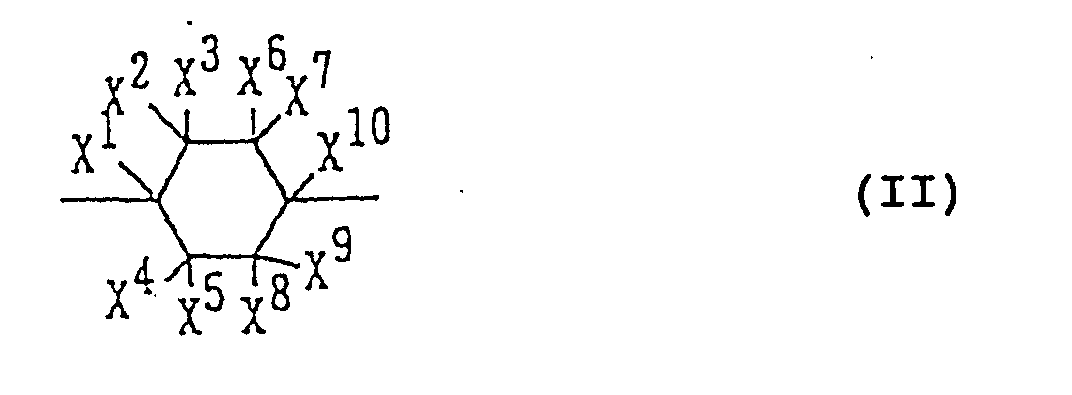 bedeuten, wobei X12, X13, X14, X15, X16, X17, X18 und X19 je unabhängig ein Wasserstoffatom (H) oder ein Deuteriumatom (D) bedeuten, mit der Maßgabe, dass mindestens einer von ihnen ein Deuteriumatom (D) bedeutet, und X11 und X20 je ein Wasserstoffatom (H) bedeuten, wobei der Ring der Formel (III) zu dem Ring A gleich oder unterschiedlich sein kann, und k, l, m und n je unabhängig 0 oder 1 bedeuten, mit der Maßgabe, dass die Summe von k, l, m und n 0, 1 oder 2 beträgt.
- Verbindung nach Anspruch 1, wobei die Verbindung die Formel (I-1)besitzt, wobei Y1, Y2, Z und die Ringe A und J die in Anspruch 1 gegebenen Bedeutungen besitzen.
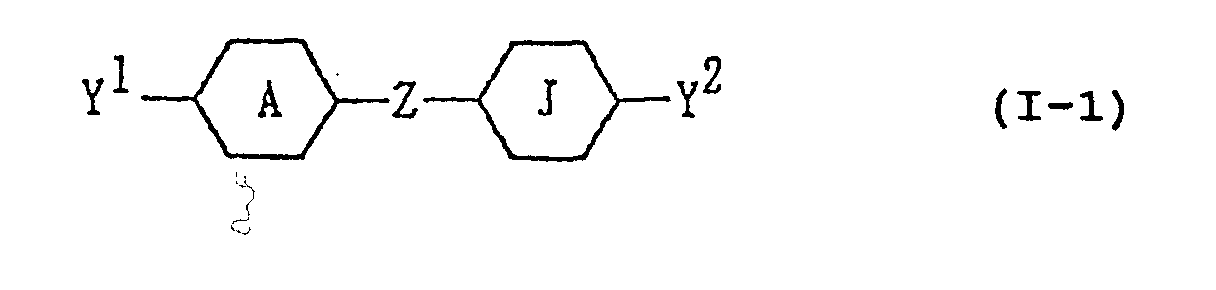
- Verbindung nach Anspruch 2, wobei die Verbindung dargestellt wird durch die Formel (I-1'):wobei die Ringe A, Y1 und Y2 die in Anspruch 1 gegebenen Bedeutungen besitzen, der Ring J1 eine trans-1,4-Cyclohexylengruppe, eine 1,4-Cyclohexenylengruppe, eine 1,4-Phenylengruppe, eine 1,4-Phenylengruppe, substituiert mit einem oder zwei Fluoratomen, oder die Gruppe, die durch die Formel (III), wie in Anspruch 1 beschrieben, dargestellt wird, bedeutet, und Z5 eine Einfachbindung, -CH2CH2-, -(CH2)4- oder -COO- bedeutet.

- Verbindung nach Anspruch 3, wobei die Verbindung dargestellt wird durch die Formel (I-1'a):wobei der Ring A, Y1 und Y2 die in Anspruch 1 gegebene Bedeutung besitzen, Z5 die in Anspruch 3 gegebenen Bedeutungen besitzt, und W1, W2 und W3 je unabhängig ein Wasserstoffatom oder ein Fluoratom bedeuten.
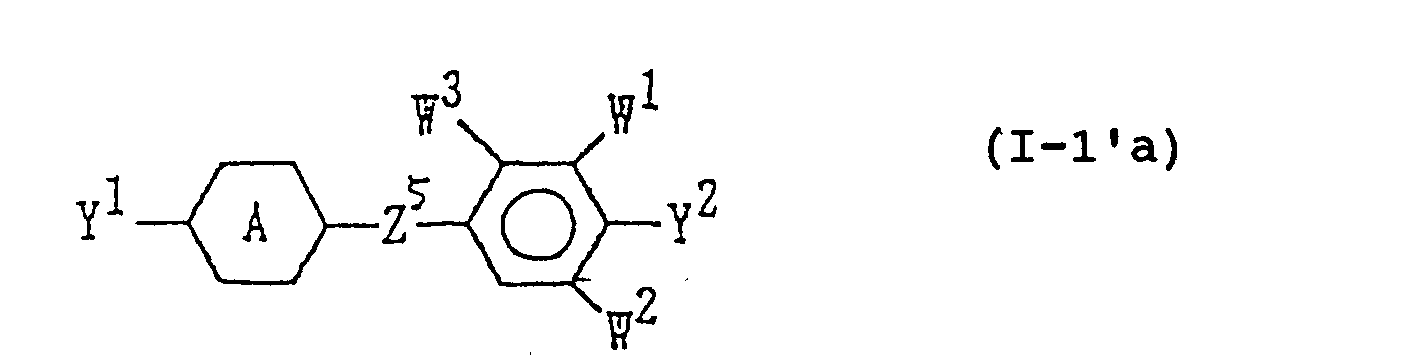
- Verbindung nach Anspruch 4, wobei die Verbindung dargestellt wird durch die Formel (I-1'a'):wobei der Ring A die in Anspruch 1 gegebene Bedeutung besitzt, Z5 die in Anspruch 3 gegebene Bedeutung besitzt, W1 und W2 die in Anspruch 4 gegebenen Bedeutungen besitzen, Y3 eine Alkylgruppe mit 1 bis 20 Kohlenstoffatomen oder eine Alkenylgruppe mit 2 bis 20 Kohlenstoffatomen bedeutet und Y4 ein Fluoratom, eine Cyanogruppe, eine Cyanatogruppe (OCN), eine Trifluormethoxygruppe (OCF3), eine Alkylgruppe mit 1 bis 20 Kohlenstoffatomen, eine Alkenylgruppe mit 2 bis 20 Kohlenstoffatomen, eine Alkoxylgruppe mit 1 bis 20 Kohlenstoffatomen, eine Alkenyloxygruppe mit 3 bis 20 Kohlenstoffatomen oder eine Alkoxylalkylgruppe mit 2 bis 20 Kohlenstoffatomen bedeutet.
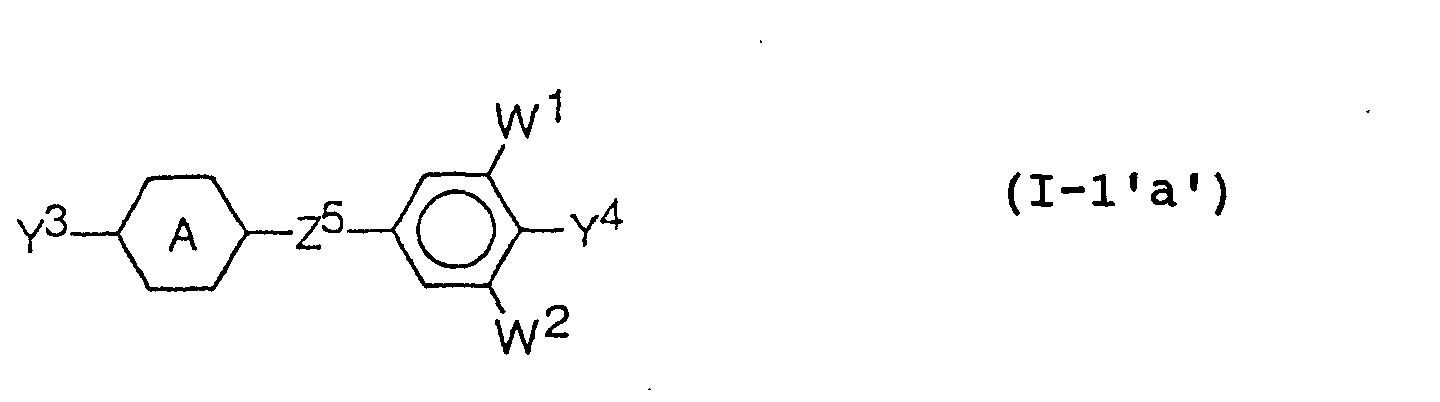
- Verbindung nach Anspruch 3, wobei die Verbindung durch die Formel (I-1'b) :dargestellt wird, wobei der Ring A, Y1 und Y2 die in Anspruch 1 gegebenen Bedeutungen besitzen, und der Ring C
 bedeutet und Z6 eine Einfachbindung oder -CH2CH2- bedeutet.
- Verbindung nach Anspruch 6, wobei die Verbindung dargestellt wird durch die Formel (I-1'b'):wobei der Ring A die in Anspruch 1 gegebene Bedeutung besitzt, der Ring C die in Anspruch 6 gegebene Bedeutung besitzt, und die beiden Y5 je unabhängig eine Alkylgruppe mit 1 bis 20 Kohlenstoffatomen bedeuten.

- Verbindung nach Anspruch 3, wobei die Verbindung dargestellt wird durch die Formel (I-1'c):wobei der Ring A, Y1 und Y2 die in Anspruch 1 gegebenen Bedeutungen besitzen, Z6 eine Einfachbindung oder -CH2CH2- bedeutet, und der Ring D eine trans-1,4-Cyclohexylengruppe oder die Gruppe der Formel (III), wie in Anspruch 1 beschrieben, bedeutet.
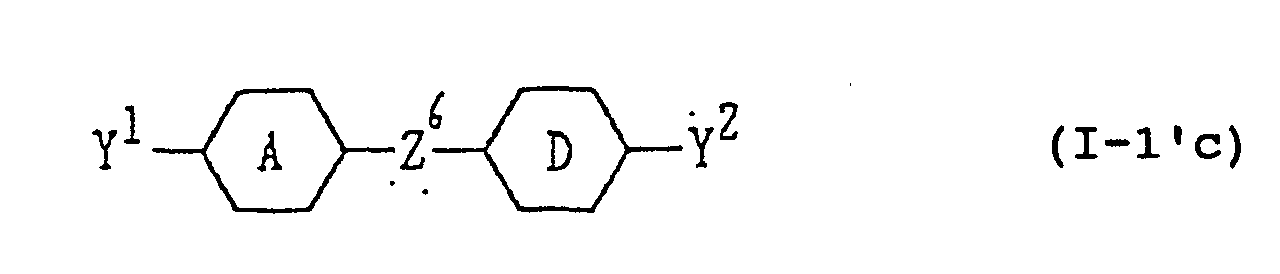
- Verbindung nach Anspruch 8, wobei die Verbindung dargestellt wird durch die Formel (I-1'c'):wobei der Ring A die in Anspruch 1 gegebene Bedeutung besitzt, der Ring D die in Anspruch 8 gegebene Bedeutung besitzt und die beiden Y6-Substituenten je unabhängig eine Alkylgruppe mit 1 bis 20 Kohlenstoffatomen, eine Alkenylgruppe mit 2 bis 20 Kohlenstoffatomen, eine Alkoxylgruppe mit 1 bis 20 Kohlenstoffatomen oder eine Alkoxylalkylgruppe mit 2 bis 20 Kohlenstoffatomen bedeuten.

- Verbindung nach Anspruch 1, wobei die Verbindung dargestellt wird durch die Formel (I-2):wobei Y1, Y2, Z, Z3 und die Ringe A, J und M die in Anspruch 1 gegebenen Bedeutungen besitzen.

- Verbindung nach Anspruch 10, wobei die Verbindung dargestellt wird durch die Formel (I-2'):wobei der Ring A, Y1 und Y2 die in Anspruch 1 gegebenen Bedeutungen besitzen, Z6 eine Einfachbindung oder -CH2CH2- bedeutet, der Ring J2 eine trans-1,4-Cyclohexylengruppe, eine 1,4-Cyclohexenylengruppe, eine 1,4-Phenylengruppe, eine 1,4-Phenylengruppe, substituiert mit einem oder mehreren Substituenten, ausgewählt aus einem Fluoratom und einer Methylgruppe, oder die Gruppe der Formel (III), wie in Anspruch 1 beschrieben, bedeutet, der Ring M1 eine 1,4-Phenylengruppe oder eine 1,4-Phenylengruppe, substituiert mit einem Fluoratom oder einer Methylgruppe, bedeutet, und Z7 eine Einfachbindung, -CH2CH2-, -C≡C- oder -(CH2)4- bedeutet.

- Verbindung nach Anspruch 11, wobei die Verbindung dargestellt wird durch die Formel (I-2'a):wobei der Ring A, Y1 und Y2 die in Anspruch 1 gegebenen Bedeutungen besitzen, der Ring D eine trans-1,4-Cyclohexylengruppe oder die Gruppe der Formel (III), wie in Anspruch 1 beschrieben, bedeutet, Z6 die in Anspruch 11 gegebene Bedeutung besitzt, W1, W2 und W3 je unabhängig ein Wasserstoffatom oder ein Fluoratom bedeuten, und Z8 eine Einfachbindung, -CH2CH2- oder -(CH2)4- bedeutet.
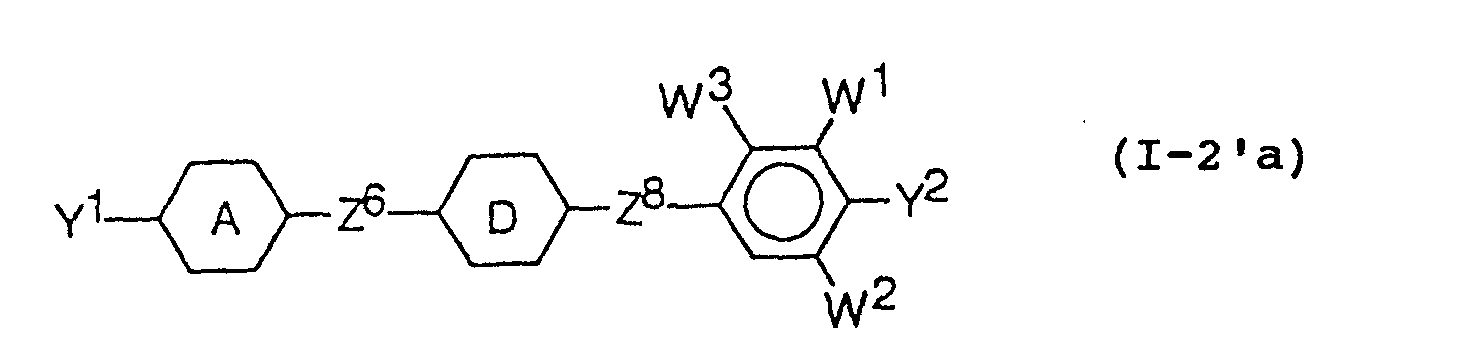
- Verbindung nach Anspruch 12, wobei die Verbindung dargestellt wird durch die Formel (I-2'a'):wobei der Ring A die in Anspruch 1 gegebene Bedeutung besitzt, der Ring D die in Anspruch 12 gegebene Bedeutung besitzt, die beiden Substituenten Z6 je unabhängig eine Einfachbindung oder -CH2CH2- bedeuten, Y6 eine Alkylgruppe mit 1 bis 20 Kohlenstoffatomen, eine Alkenylgruppe mit 2 bis 20 Kohlenstoffatomen, eine Alkoxylgruppe mit 1 bis 20 Kohlenstoffatomen oder eine Alkoxylalkylgruppe mit 2 bis 20 Kohlenstoffatomen bedeutet, W1 und W2 die in Anspruch 12 gegebenen Bedeutungen besitzen und Y7 ein Fluoratom, ein Chloratom, eine Cyanogruppe, eine Difluormethoxygruppe (OCF2H), eine 2,2,2-Trifluorethoxygruppe (OCH2CF3), eine Trifluormethoxygruppe (OCF3), eine Alkylgruppe mit 1 bis 20 Kohlenstoffatomen, eine Alkenylgruppe mit 2 bis 20 Kohlenstoffatomen, eine Alkoxylgruppe mit 1 bis 20 Kohlenstoffatomen oder eine Alkoxylalkylgruppe mit 2 bis 20 Kohlenstoffatomen bedeutet.
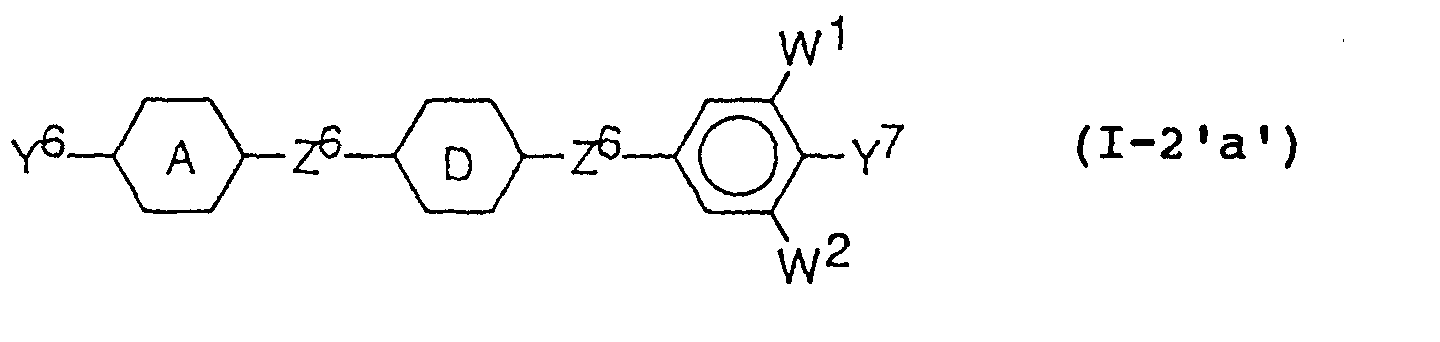
- Verbindung nach Anspruch 11, wobei die Verbindung dargestellt wird durch die Formel (I-2'b):wobei der Ring A, Y1 und Y2 die in Anspruch 1 gegebenen Bedeutungen besitzen, und W1, W2 und W3 je unabhängig ein Wasserstoffatom oder ein Fluoratom bedeuten.
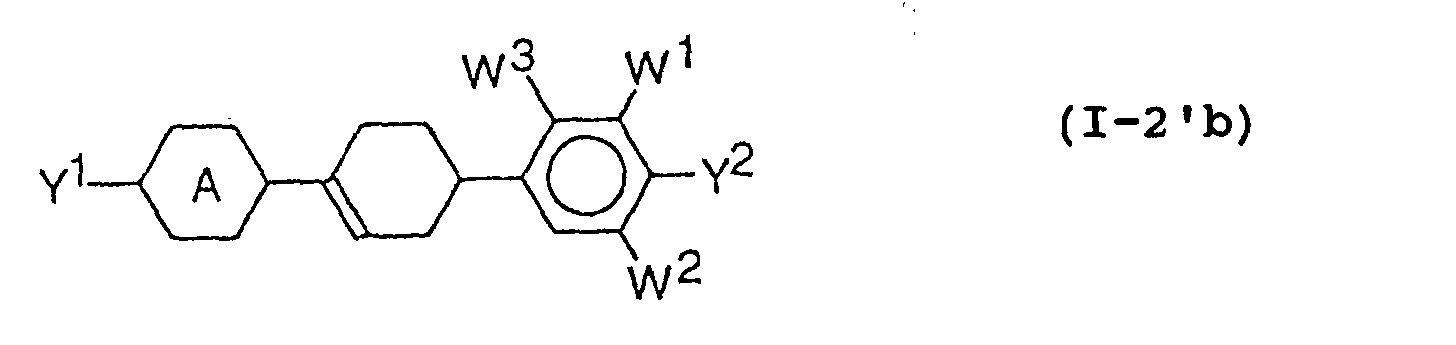
- Verbindung nach Anspruch 14, wobei die Verbindung dargestellt wird durch die Formel (I-2'b'):wobei der Ring A die in Anspruch 1 gegebene Bedeutung besitzt, Y5 eine Alkylgruppe mit 1 bis 20 Kohlenstoffatomen bedeutet, W1 und W2 die in Anspruch 14 gegebenen Bedeutungen besitzen und Y8 ein Fluoratom, eine Alkylgruppe mit 1 bis 20 Kohlenstoffatomen oder eine Alkoxylgruppe mit 1 bis 20 Kohlenstoffatomen bedeutet.
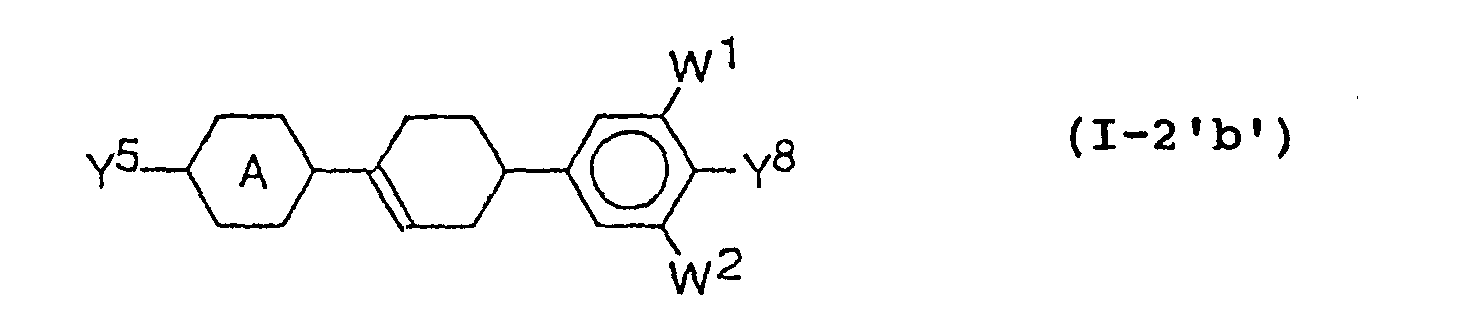
- Verbindung nach Anspruch 11, wobei die Verbindung dargestellt wird durch die Formel (I-2'c) :worin der Ring A, Y1 und Y2 die in Anspruch 1 gegebenen Bedeutungen besitzen, Z6 die in Anspruch 11 gegebene Bedeutung besitzt, W1, W2 und W3 je unabhängig ein Wasserstoffatom oder ein Fluoratom bedeuten und W4 und W5 je unabhängig ein Wasserstoffatom oder ein Fluoratom bedeuten.
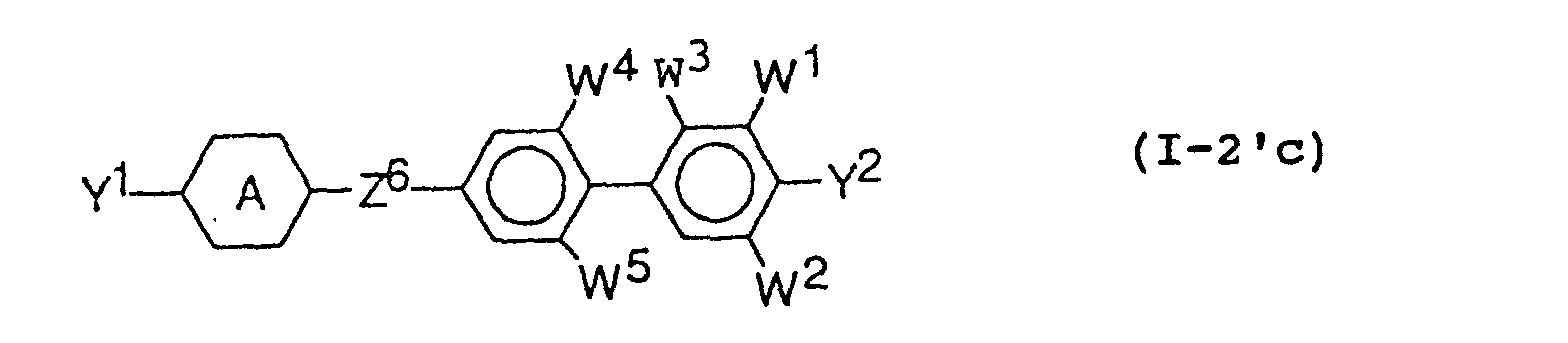
- Verbindung nach Anspruch 11, wobei die Verbindung dargestellt wird durch die Formel (I-2'd).wobei der Ring A, Y1 und Y2 die in Anspruch 1 gegebenen Bedeutungen besitzen, Z6 die in Anspruch 11 gegebene Bedeutung besitzt, W1 und W2 je unabhängig ein Wasserstoffatom oder ein Fluoratom bedeuten und W4 und W5 je unabhängig ein Wasserstoffatom oder ein Fluoratom bedeuten.
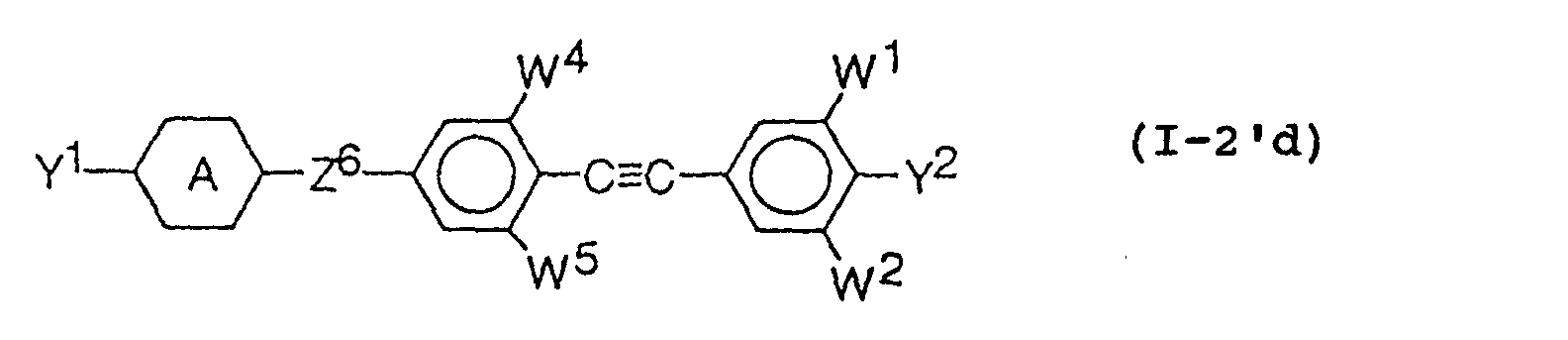
- Verbindung nach Anspruch 11, wobei die Verbindung dargestellt wird durch die Formel (I-2'e) :wobei der Ring A, Y1 und Y2 die in Anspruch 1 gegebenen Bedeutungen besitzen, Z6 die in Anspruch 11 gegebene Bedeutung besitzt und W1 und W2 je unabhängig ein Wasserstoffatom oder ein Fluoratom bedeuten.

- Verbindung nach Anspruch 11, wobei die Verbindung dargestellt wird durch die Formel (I-2'f):worin der Ring A, Y1 und Y2 die in Anspruch 1 gegebenen Bedeutungen besitzen, Z6 die in Anspruch 11 gegebene Bedeutung besitzt und W1 und W2 je unabhängig ein Wasserstoffatom oder ein Fluoratom bedeuten.

- Verbindung nach Anspruch 1, wobei die Verbindung dargestellt wird durch die Formel (I-3) :wobei Y1, Y2, Z, Z1 und die Ringe A, K und J die in Anspruch 1 gegebenen Bedeutungen besitzen.

- Verbindung nach Anspruch 20, wobei die Verbindung dargestellt wird durch die Formel (I-3'):wobei der Ring A, Y1 und Y2 die in Anspruch 1 gegebenen Bedeutungen besitzen, der Ring K1 eine trans-1,4-Cyclohexylengruppe oder eine 1,4-Cyclohexenylengruppe bedeutet, der Ring J3 eine 1,4-Phenylengruppe oder eine 1,4-Phenylengruppe, substituiert mit einem oder zwei Fluoratomen, bedeutet und die beiden Substituenten Z8 je unabhängig eine Einfachbindung, -CH2CH2- oder -(CH2)4- bedeuten.

- Verbindung nach Anspruch 21, wobei die Verbindung dargestellt wird durch die Formel (I-3'a):wobei der Ring A, Y1 und Y2 die in Anspruch 1 gegebenen Bedeutungen besitzen, Z6 eine Einfachbindung oder -CH2CH2- bedeutet, Z8 die in Anspruch 21 gegebene Bedeutung besitzt und W1, W2 und W3 je unabhängig ein Wasserstoffatom oder ein Fluoratom bedeuten.

- Verbindung nach Anspruch 21, wobei die Verbindung dargestellt wird durch die Formel (I-3'b):wobei der Ring A, Y1 und Y2 die in Anspruch 1 gegebenen Bedeutungen besitzen und W1, W2 und W3 je unabhängig ein Wasserstoffatom oder ein Fluoratom bedeuten.
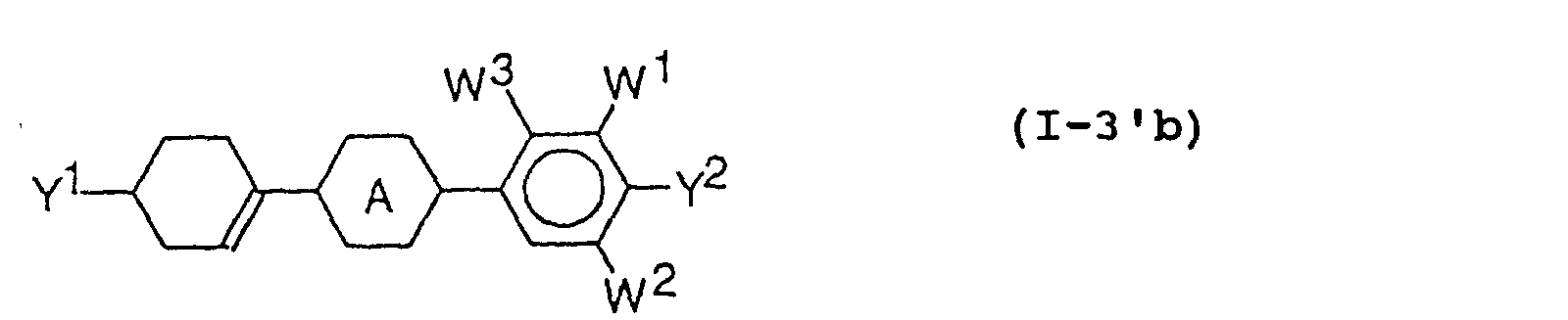
- Verbindung nach Anspruch 1, wobei die Verbindung dargestellt wird durch die Formel (I-4) :wobei Y1, Y2, Z, Z3, Z4 und die Ring A, J, M und N die in Anspruch 1 gegebenen Bedeutungen besitzen.

- Verbindung nach Anspruch 24, wobei die Verbindung dargestellt wird durch die Formel (I-4'):wobei der Ring A, Y1 und Y2 die in Anspruch 1 gegebenen Bedeutungen besitzen, der Ring J1 eine trans-1,4-Cyclohexylengruppe, eine 1,4-Cyclohexenylengruppe, eine 1,4-Phenylengruppe, eine 1,4-Phenylengruppe, substituiert mit einem oder zwei Fluoratomn, oder die Gruppe, dargestellt durch die Formel (III), wie in Anspruch 1 beschrieben, bedeutet, die beiden Substituenten Z6 je unabhängig eine Einfachbindung oder -CH2CH2- bedeuten, der Ring M2 und der Ring N1 je unabhängig eine trans-1,4-Cyclohexylengruppe, eine 1,4-Phenylengruppe, eine 1,4-Phenylengruppe, substituiert mit einem Fluoratom, oder die Gruppe der Formel (III), wie in Anspruch 1 beschrieben, bedeuten und Z9 eine Einfachbindung, -CH2CH2- oder -C≡C- bedeutet.

- Verbindung nach Anspruch 25, wobei die Verbindung dargestellt wird durch die Formel (I-4'a):wobei der Ring A, Y1 und Y2 die in Anspruch 1 gegebenen Bedeutungen besitzen, die beiden Substituenten, Z6 die in Anspruch 25 gegebenen Bedeutungen besitzen, der Ring D eine trans-1,4-Cyclohexylengruppe oder die Gruppe der Formel (III), wie in Anspruch 1 beschrieben, bedeutet, und W1, W2, W3 und W4 je unabhängig ein Wasserstoffatom oder ein Fluoratom bedeuten.
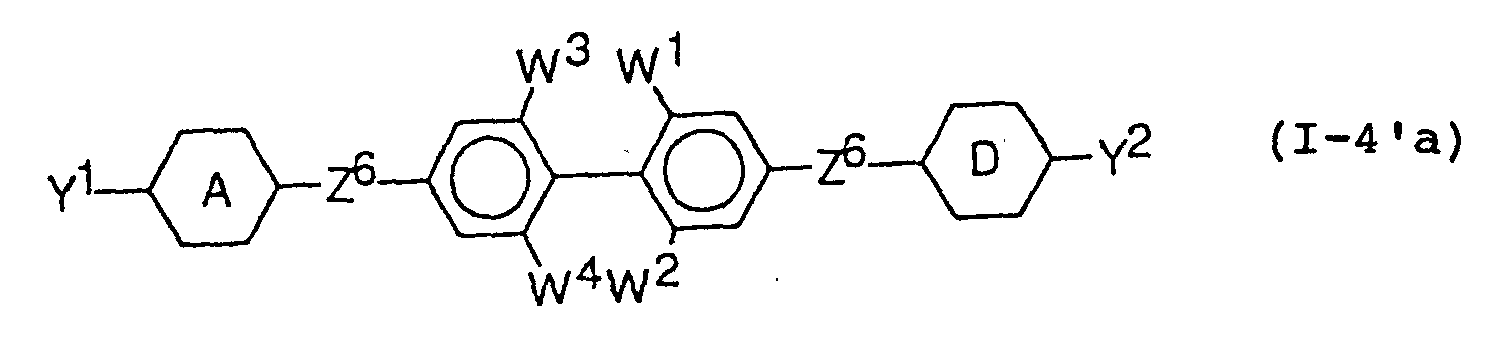
- Verbindung nach Anspruch 25, wobei die Verbindung dargestellt wird durch die Formel (I-4'b):worin der Ring A, Y1 und Y2 die in Anspruch 1 gegebenen Bedeutungen besitzen, zwei Ringe D je unabhängig eine trans-1,4-Cyclohexylengruppe oder die Gruppe der Formel (III), wie in Anspruch 1 beschrieben, bedeuten, die drei Substituenten Z6 je unabhängig eine Einfachbindung oder -CH2CH2- bedeuten und W1 und W2 je unabhängig ein Wasserstoffatom oder ein Fluoratom bedeuten.
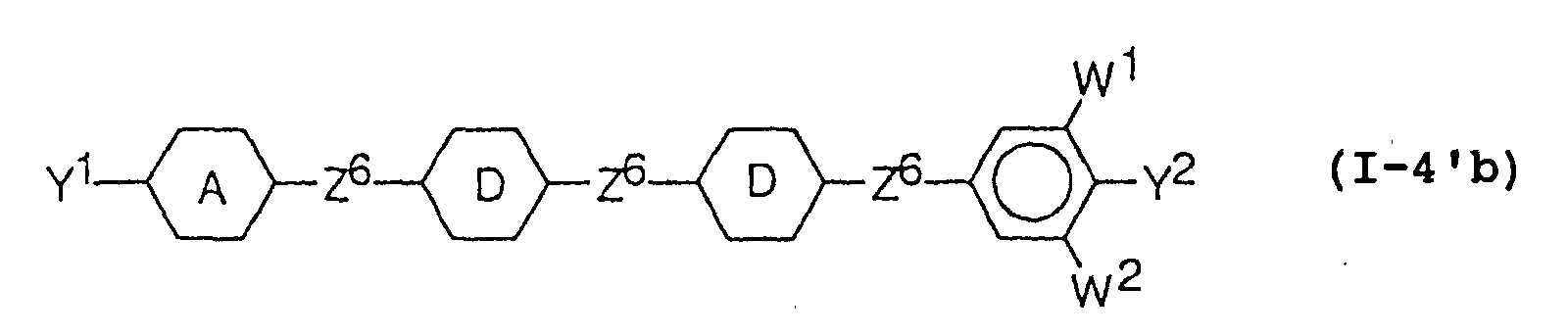
- Verbindung nach Anspruch 25, wobei die Verbindung dargestellt wird durch die Formel (I-4'c) :wobei der Ring A, Y1 und Y2 die in Anspruch 1 gegebenen Bedeutungen besitzen, der Ring D eine trans-1,4-Cyclohexylengruppe oder die Gruppe der Formel (III), wie in Anspruch 1 beschrieben, bedeutet, W1 und W2 je unabhängig ein Wasserstoffatom oder ein Fluoratom bedeuten, und die beiden Substituenten Z6 je unabhängig eine Einfachbindung oder -CH2CH2- bedeuten.
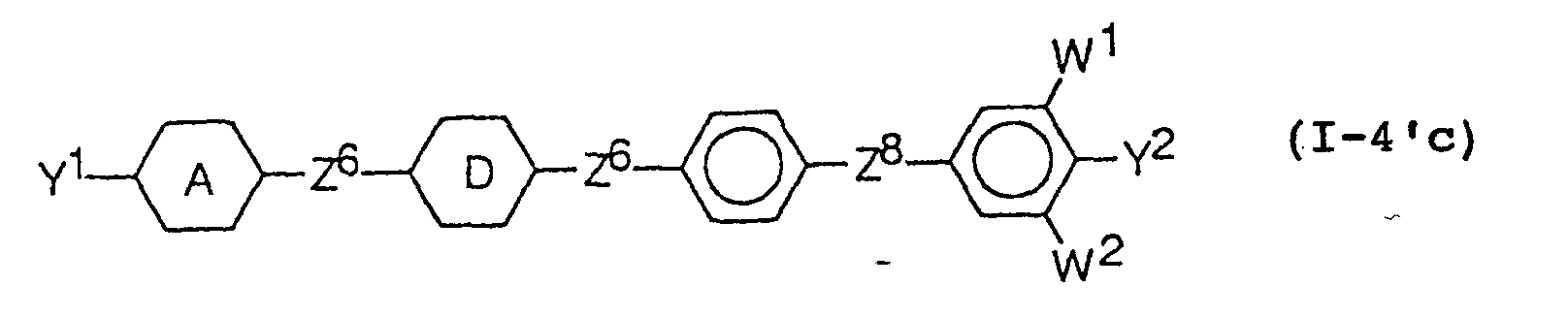
- Verbindung nach Anspruch 25, wobei die Verbindung dargestellt wird durch die Formel (I-4'd):wobei der Ring A, Y1 und Y2 die in Anspruch gegebenen Bedeutungen besitzen, der Ring D eine trans-1,4-Cyclohexylengruppe oder die Gruppe der Formel (III), wie in Anspruch 1 beschrieben, bedeutet, W1, W2, W4 und W5 je unabhängig ein Wasserstoffatom oder ein Fluoratom bedeuten und die beiden Substituenten Z6 je unabhängig eine Einfachbindung oder -CH2CH2- bedeuten.
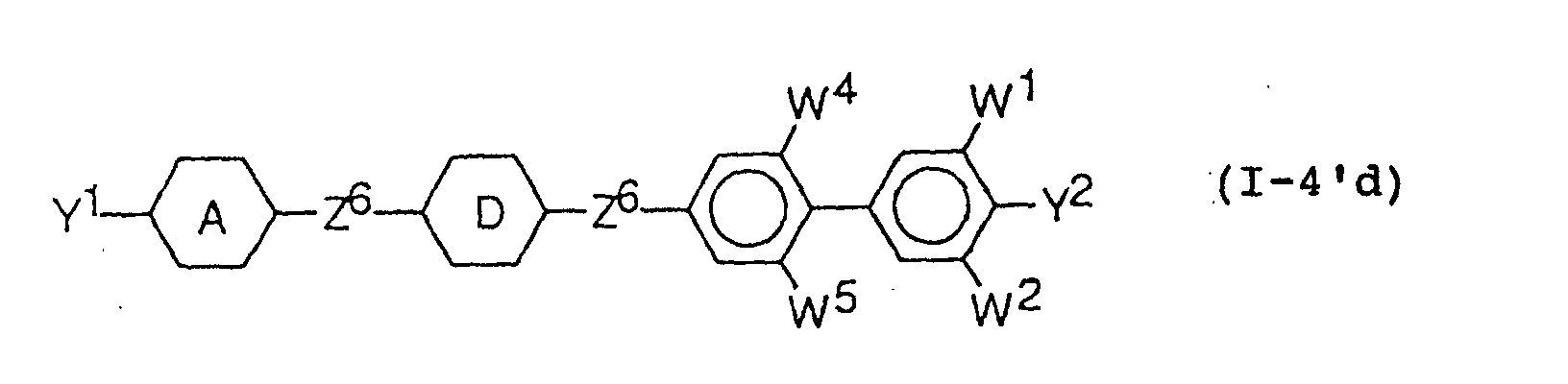
- Verbindung nach Anspruch 25, wobei die Verbindung dargestellt wird durch die Formel (I-4'e):wobei der Ring A, Y1 und Y2 die in Anspruch 1 gegebenen Bedeutungen besitzen, der Ring D eine trans-1,4-Cyclohexylengruppe oder die Gruppe der Formel (III), wie in Anspruch 1 beschrieben, bedeutet, W1, W2, W4 und W5 je unabhängig ein Wasserstoffatom oder ein Fluoratom bedeuten und die beiden Substituenten Z6 je unabhängig eine Einfachbindung oder -CH2CH2- bedeuten.

- Verbindung nach Anspruch 25, wobei die Verbindung dargestellt wird durch die Formel (I-4'f) :worin der Ring A, Y1 und Y2 die in Anspruch 1 gegebenen Bedeutungen besitzen und W1 und W2 je unabhängig ein Wasserstoffatom oder ein Fluoratom bedeuten.

- Verbindung nach Anspruch 1, wobei die Verbindung dargestellt wird durch die Formel (I-5):worin Y1, Y2, Z, Z1, Z2 und die Ringe A, K, L und J die in Anspruch 1 gegebenen Bedeutungen besitzen.

- Verbindung nach Anspruch 32, wobei die Verbindung dargestellt wird durch die Formel (I-5'):worin der Ring A, Y1 und Y2 die in Anspruch 1 gegebenen Bedeutungen besitzen, der Ring J3 eine 1,4-Phenylengruppe oder eine 1,4-Phenylengruppe, substituiert mit einem oder zwei Fluoratomen, bedeutet und die drei Substituenten Z6 je unabhängig eine Einfachbindung oder -CH2CH2- bedeuten.

- Verbindung nach Anspruch 33, wobei die Verbindung dargestellt wird durch die Formel (I-5'a):wobei der Ring A, Y1 und Y2 die in Anspruch 1 gegebenen Bedeutungen besitzen, Z6 eine Einfachbindung oder -CH2CH2- bedeutet und W1 und W2 je unabhängig ein Wasserstoffatom oder ein Fluoratom bedeuten.
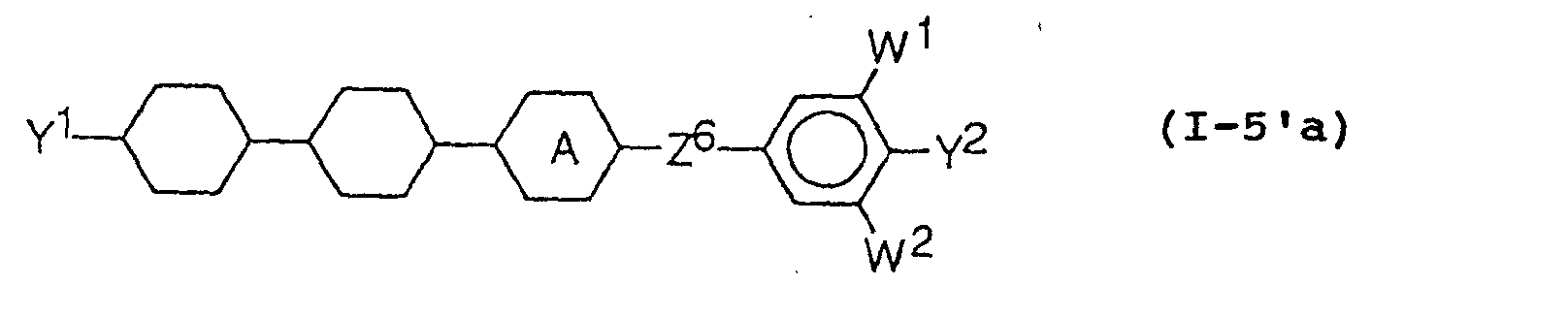
- Verbindung nach Anspruch 1, wobei die Verbindung dargestellt wird durch die Formel (I-6):wobei Y1, Y2, Z, Z1, Z3 und die Ringe A, K, J und M die in Anspruch 1 gegebenen Bedeutungen besitzen.

- Verbindung nach Anspruch 35, wobei die Verbindung dargestellt wird durch die Formel (I-6'):wobei der Ring A, Y1 und Y2 die in Anspruch 1 gegebenen Bedeutungen besitzen, der Ring K1 eine trans-1,4-Cyclohexylengruppe oder eine 1,4-Cyclohexenylengruppe bedeutet, der Ring J3 eine 1,4-Phenylengruppe oder eine 1,4-Phenylengruppe, substituiert mit einem oder zwei Fluoratomen, bedeutet, die beiden Substituenten Z6 je unabhängig eine Einfachbindung oder -CH2CH2- bedeuten und der Ring M3 eine 1,4-Phenylengruppe oder eine 1,4-Phenylengruppe, substituiert mit einem Fluoratom, bedeutet.

- Verbindung nach Anspruch 36, wobei die Verbindung dargestellt wird durch die Formel (I-6'a) :wobei der Ring A, Y1 und Y2 die in Anspruch 1 gegebenen Bedeutungen besitzen, die drei Substituenten Z6 je unabhängig eine Einfachbindung oder -CH2CH2- bedeuten und W1, W2, W4 und W5 je unabhängig ein Wasserstoffatom oder ein Fluoratom bedeuten.

- Verbindung nach Anspruch 36, wobei die Verbindung dargestellt wird durch die Formel (I-6'b).wobei der Ring A, Y1 und Y2 die in Anspruch 1 gegebenen Bedeutungen besitzen, die beiden Substituenten Z6 je unabhängig eine Einfachbindung oder -CH2CH2- bedeuten und W1, W2, W4 und W5 je unabhängig ein Wasserstoffatom oder ein Fluoratom bedeuten.

- Verbindung nach Anspruch 36, wobei die Verbindung dargestellt wird durch die Formel (I-6'c) :wobei der Ring A, Y1 und Y2 die in Anspruch 1 gegebenen Bedeutungen besitzen und W1 und W2 je unabhängig ein Wasserstoffatom oder ein Fluoratom bedeuten.

- Verbindung nach einem der Ansprüche 4 bis 9, 11 bis 19, 21 bis 23, 25 bis 31, 33, 34 und 36 bis 38, wobei 1 bis 8 der Substituenten X2, X3, X4, X5, X6, X7, X8 und X9 in der Formel (II) und 1 bis 8 der Substituenten X12, X13, X14, X15, X16, X17, X18 und X19 in der Formel (III) ein Deuteriumatom (D) bedeuten.
- Verbindung nach Anspruch 40, wobei 1 bis 4 der Substituenten X12, X13, X14, X15, X16, X17, X18 und X19 in der Formel (III) ein Deuteriumatom (D) bedeuten.
- Verbindung nach Anspruch 40 oder 41, wobei Y1 und Y2 je unabhängig eine Alkyl- oder Alkoxylgruppe mit 1 bis 12 Kohlenstoffatomen, eine Alkenylgruppe mit 2 bis 12 Kohlenstoffatomen, ein Fluoratom, eine Cyanogruppe oder eine Trifluormethylgruppe bedeuten, mit der Maßgabe, dass mindestens einer von ihnen eine Alkylgruppe mit 1 bis 12 Kohlenstoffatomen oder eine Alkenylgruppe mit 2 bis 12 Kohlenstoffatomen bedeutet.
- Flüssigkristallzusammensetzung, umfassend eine deuterierte Flüssigkristallverbindung mit, als Partialstruktur, einem deuterierten gesättigten Kohlenwasserstoffring, bei dem ein oder mehrere Wasserstoffatome durch ein oder mehrere Deuteriumatome substituiert ist bzw. sind, und mindestens eine andere deuterierte oder nicht-deuterierte Flüssigkristallverbindung.
- Flüssigkristallzusammensetzung nach Anspruch 43, wobei der deuterierte gesättigte Kohlenwasserstoffring ein deuterierter Cyclohexanring ist.
- Flüssigkristallzusammensetzung nach Anspruch 44, wobei die deuterierte Flüssigkristallverbindung einen oder zwei deuterierte Cyclohexanringe pro Molekül enthält.
- Flüssigkristallzusammensetzung nach Anspruch 45, wobei die deuterierte Flüssigkristallverbindung 2 bis 4 cyclische Strukturen pro Molekül enthält.
- Flüssigkristallzusammensetzung nach Anspruch 46, wobei die Zusammensetzung insgesamt eine dielektrische Anisotropie (Δε) von +3 bis +12 besitzt und die Zusammensetzung für die Flüssigkristallanzeige eines Ansteuerungssystems mit aktiver Matrix bestimmt ist.
- Flüssigkristallzusammensetzung nach Anspruch 46, wobei die Zusammensetzung insgesamt eine dielektrische Anisotropie (▵ε) von nicht weniger als +8 besitzt und die Zusammensetzung für eine Flüssigkristallanzeige des TN- oder STN-Modus bestimmt ist.
- Flüssigkristallzusammensetzung, enthaltend eine Verbindung wie in Anspruch 1 beschrieben.
- Flüssigkristallzusammensetzung nach Anspruch 47 oder 48, wobei die Zusammensetzung eine Verbindung, wie in den Ansprüchen 2 oder 3 beschrieben, enthält.
- Flüssigkristallzusammensetzung nach Anspruch 47 oder 48, wobei die Zusammensetzung eine Verbindung, wie in den Ansprüchen 4 bis 9 beschrieben, enthält.
- Flüssigkristallzusammensetzung nach Anspruch 47 oder 48, wobei die Zusammensetzung eine Verbindung, wie in Anspruch 10 beschrieben, enthält.
- Flüssigkristallzusammensetzung nach Anspruch 47 oder 48, wobei die Zusammensetzung eine Verbindung, wie in den Ansprüchen 11 bis 19 beschrieben, enthält.
- Flüssigkristallzusammensetzung nach Anspruch 47 oder 48, wobei die Zusammensetzung eine Verbindung, wie in Anspruch 20 beschrieben, enthält.
- Flüssigkristallzusammensetzung nach Anspruch 47 oder 48, wobei die Zusammensetzung eine Verbindung, wie in den Ansprüchen 21 bis 23 beschrieben, enthält.
- Flüssigkristallzusammensetzung nach Anspruch 47 oder 48, wobei die Zusammensetzung eine Verbindung, wie in Anspruch 24 beschrieben, enthält.
- Flüssigkristallzusammensetzung nach Anspruch 47 oder 48, wobei die Zusammensetzung eine Verbindung, wie in den Ansprüchen 25 bis 31 beschrieben, enthält.
- Flüssigkristallzusammensetzung nach Anspruch 47 oder 48, wobei die Zusammensetzung eine Verbindung, wie in Anspruch 32 beschrieben, enthält.
- Flüssigkristallzusammensetzung nach einem der Ansprüche 47 oder 48, wobei die Zusammensetzung eine Verbindung wie in den Ansprüchen 33 oder 34 beschrieben enthält.
- Flüssigkristallzusammensetzung nach Anspruch 47 oder 48, wobei die Zusammensetzung eine Verbindung, wie in Anspruch 35 beschrieben, enthält.
- Flüssigkristallzusammensetzung nach Anspruch 47 oder 48, wobei die Zusammensetzung eine Verbindung, wie in einem der Ansprüche 36 bis 39 beschrieben, enthält.
- Flüssigkristallzusammensetzung nach Anspruch 47 oder 48, wobei die Zusammensetzung eine Verbindung, dargestellt durch die Formel (I-1'a'-I):enthält, wobei der Ring A eine Gruppe der Formel (II) :
 bedeutet, wobei X2, X3, X4, X5, X6, X7, X8 und X9 je unabhängig ein Wasserstoffatom (H) oder ein Deuteriumatom (D) bedeuten, mit der Maßgabe, dass mindestens einer von ihnen ein Deuteriumatom (D) bedeutet, und X1 und X10 je ein Wasserstoffatom (H) bedeuten, Y3a eine Alkylgruppe mit 1 bis 7 Kohlenstoffatomen oder eine Alkenylgruppe mit 2 bis 7 Kohlenstoffatomen bedeutet, W1 und W2 je unabhängig ein Wasserstoffatom oder ein Fluoratom bedeuten, Y4 ein Fluoratom, eine Cyanogruppe, eine Cyanatogruppe (OCN), eine Trifluormethoxygruppe (OCF3), eine Alkylgruppe mit 1 bis 20 Kohlenstoffatomen, eine Alkenylgruppe mit 2 bis 20 Kohlenstoffatomen, eine Alkoxylgruppe mit 1 bis 20 Kohlenstoffatomen, eine Alkenyloxylgruppe mit 3 bis 20 Kohlenstoffatomen oder eine Alkoxylalkylgruppe mit 2 bis 20 Kohlenstoffatomen bedeutet.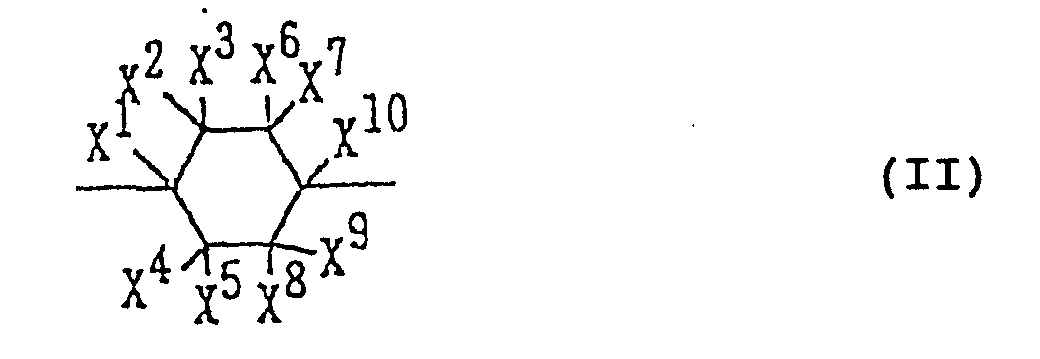
- Flüssigkristallzusammensetzung nach Anspruch 47 oder 48, wobei die Zusammensetzung eine Verbindung, dargestellt durch die Formel (I-2'a'-I):enthält, wobei der Ring A eine Gruppe der Formel (II) bedeutet:
 worin X2, X3, X4, X5, X6, X7, X8 und X9 je unabhängig ein Wasserstoffatom (H) oder ein Deuteriumatom (D) bedeuten, mit der Maßgabe, dass mindestens einer von ihnen ein Deuteriumatom (D) bedeutet, und X1 und X10 je ein Wasserstoffatom (H) bedeuten, Y6a eine Alkylgruppe mit 1 bis 7 Kohlenstoffatomen, eine Alkenylgruppe mit 2 bis 7 Kohlenstoffatomen oder eine Alkoxylalkylgruppe mit 2 bis 7 Kohlenstoffatomen bedeutet, Y11 ein Fluoratom, ein Chloratom, eine Cyanogruppe, eine Trifluormethoxygruppe (OCF3), eine Difluormethoxygruppe (OCF2H), eine 2,2,2-Trifluorethoxygruppe, eine Alkylgruppe mit 1 bis 7 Kohlenstoffatomen, eine Alkenylgruppe mit 2 bis 7 Kohlenstoffatomen, eine Alkoxylgruppe mit 1 bis 7 Kohlenstoffatomen oder eine Alkenyloxygruppe mit 3 bis 7 Kohlenstoffatomen bedeutet und W1 und W2 je unabhängig ein Wasserstoffatom oder ein Fluoratom bedeuten.
- Flüssigkristallzusammensetzung nach Anspruch 47 oder 48, wobei die Zusammensetzung eine Verbindung, dargestellt durch die Formel (I-2'c-I):enthält, wobei der Ring A eine Gruppe der Formel (II):
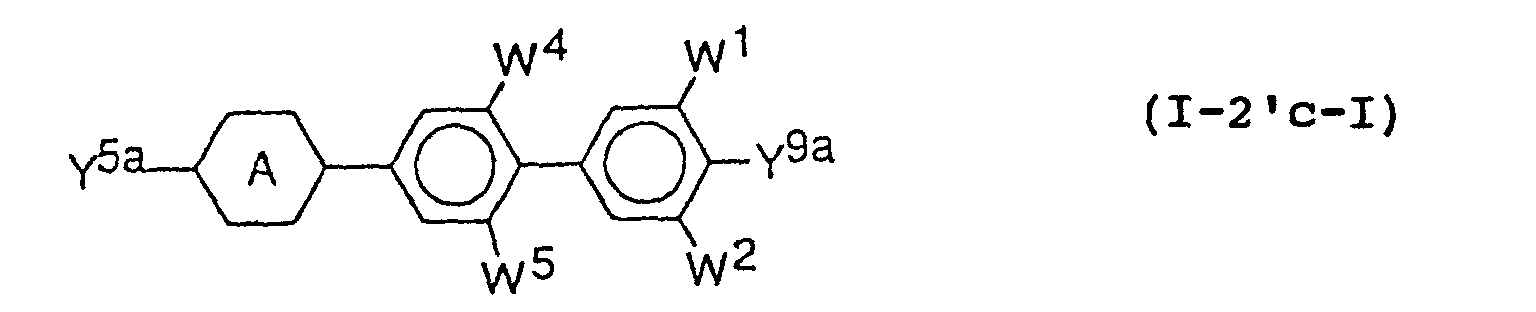 bedeutet, wobei X2, X3, X4, X5, X6, X7, X8 und X9 je unabhängig ein Wasserstoffatom (H) oder ein Deuteriumatom (D) bedeuten, mit der Maßgabe, dass mindestens einer von ihnen ein Deuteriumatom (D) bedeutet, und X1 und X10 je ein Wasserstoffatom (H) bedeuten, Y9a ein Fluoratom, eine Cyanogruppe, eine Trifluormethoxygruppe (OCF3), eine Alkylgruppe mit 1 bis 7 Kohlenstoffatomen oder eine Alkenylgruppe mit 2 bis 7 Kohlenstoffatomen bedeutet, Y5a eine Alkylgruppe mit 1 bis 7 Kohlenstoffatomen bedeutet und W1, W2, W4 und W5 je unabhängig ein Wasserstoffatom oder ein Fluoratom bedeuten.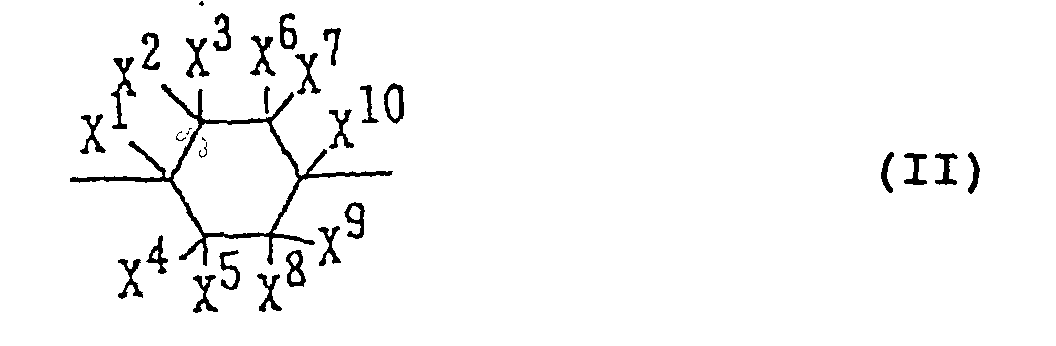
- Flüssigkristallzusammensetzung nach Anspruch 47 oder 48, wobei die Zusammensetzung eine Verbindung, dargestellt durch Formel (I-3'a-I):enthält, worin der Ring A eine Gruppe der Formel (II) :
 bedeutet, worin X2, X3, X4, X5, X6, X7, X8 und X9 je unabhängig ein Wasserstoffatom (H) oder ein Deuteriumatom (D) bedeuten, mit der Maßgabe, dass mindestens einer von ihnen ein Deuteriumatom (D) bedeutet, und X1 und X10 je ein Wasserstoffatom (H) bedeuten, Y5a eine Alkylgruppe mit 1 bis 7 Kohlenstoffatomen bedeutet, Y18 ein Fluoratom, eine Cyanogruppe, eine Trifluormethoxygruppe (OCF3), oder eine Alkoxylgruppe mit 1 bis 7 Kohlenstoffatomen bedeutet, und W1 und W2 je unabhängig ein Wasserstoffatom oder ein Fluoratom bedeuten.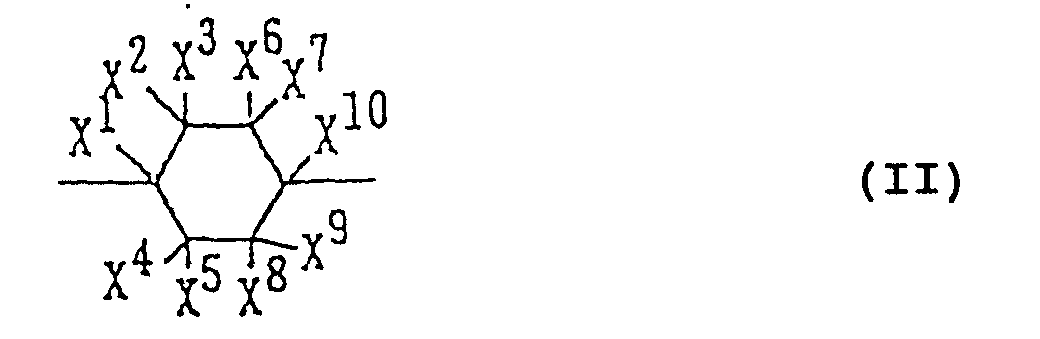
- Flüssigkristallzusammensetzung nach Anspruch 47 oder 48, wobei die Zusammensetzung eine Verbindung, dargestellt durch die Formel (I-3'a-II):enthält, worin der Ring A eine Gruppe der Formel (II):
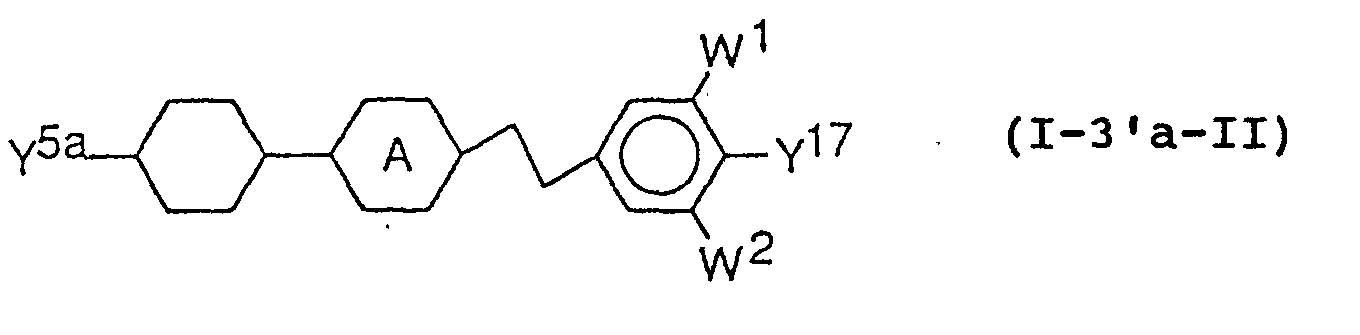 bedeutet, worin X2, X3, X4, X5, X6, X7, X8 und X9 je unabhängig ein Wasserstoffatom (H) oder ein Deuteriumatom (D) bedeuten, mit der Maßgabe, dass mindestens einer von ihnen ein Deuteriumatom (D) bedeutet, und X1 und X10 je ein Wasserstoffatom (H) bedeuten, Y5a eine Alkylgruppe mit 1 bis 7 Kohlenstoffatomen bedeutet, Y17 ein Fluoratom, eine Cyanogruppe, eine Alkoxylgruppe mit 1 bis 7 Kohlenstoffatomen, eine Alkenyloxygruppe mit 3 bis 7 Kohlenstoffatomen oder eine Trifluormethoxygruppe (OCF3) bedeutet, und W1 und W2 je unabhängig ein Wasserstoffatom oder ein Fluoratom bedeuten.
- Flüssigkristallzusammensetzung nach Anspruch 47 oder 48, wobei die Zusammensetzung eine Verbindung, dargestellt durch die Formel (I-5'a-I) :enthält, wobei der Ring A eine Gruppe der Formel (II):
 bedeutet, wobei X2, X3, X4, X5, X6, X7, X8 und X9 je unabhängig ein Wasserstoffatom (H) oder ein Deuteriumatom (D) bedeuten, mit der Maßgabe, dass mindestens einer von ihnen ein Deuteriumatom (D) bedeutet, und X1 und X10 je ein Wasserstoffatom (H) bedeuten, Y5a eine Alkylgruppe mit 1 bis 7 Kohlenstoffatomen bedeutet, Y9 ein Fluoratom, eine Cyanogruppe, eine Trifluormethoxygruppe (OCF3), eine Alkylgruppe mit 1 bis 7 Kohlenstoffatomen, eine Alkoxylgruppe mit 1 bis 7 Kohlenstoffatomen oder eine Alkenyloxygruppe mit 3 bis 7 Kohlenstoffatomen bedeutet, und W1 und W2 je unabhängig ein Wasserstoffatom oder ein Fluoratom bedeuten.
- Flüssigkristallanzeige, bei- der eine Flüssigkristallzusammensetzung verwendet wird, umfassend eine deuterierte Flüssigkristallverbindung mit, als Partialstruktur, einem deuterierten gesättigten Kohlenwasserstoffring, bei dem eines oder mehrere Kohlenwasserstoffatome durch eines oder mehrere Deuteriumatome ersetzt ist bzw. sind, und mindestens eine andere deuterierte oder nicht-deuterierte Flüssigkristallverbindung.
- Flüssigkristallanzeige nach Anspruch 68, wobei der deuterierte gesättigte Kohlenwasserstoffring ein deuterierter Cyclohexanring ist.
- Flüssigkristallanzeige nach Anspruch 69, wobei die deuterierte Flüssigkristallverbindung einen oder zwei deuterierte Cyclohexanringe pro Molekül enthält.
- Flüssigkristallanzeige nach Anspruch 70, worin die deuterierte Flüssigkristallverbindung 2 bis 4 cyclische Strukturen pro Molekül enthält.
- Flüssigkristallanzeige nach Anspruch 71, wobei die Zusammensetzung insgesamt eine dielektrische Anisotropie (Δε) von +3 bis +12 besitzt und die Zusammensetzung für eine Flüssigkristallanzeige eines Ansteuerungssystems mit aktiver Matrix bestimmt ist.
- Flüssigkristallanzeige nach Anspruch 71, wobei die Zusammensetzung insgesamt eine dielektrische Anisotropie (▵ε) von nicht weniger als +8 besitzt und die Zusammensetzung für eine Flüssigkristallanzeige des TN- oder STN-Modus bestimmt ist.
- Flüssigkristallanzeige unter Verwendung einer Flüssigkristallzusammensetzung, enthaltend eine Verbindung, dargestellt durch die Formel (I):wobei Y1 und Y2 je unabhängig ein Fluoratom, ein Chloratom, eine Cyanogruppe, eine Cyanatogruppe (OCN), eine Thiocyanatogruppe (SCN), eine Trifluormethoxygruppe (OCF3), eine Difluormethoxygruppe (OCF2H), eine 2,2,2-Trifluorethoxygruppe (OCH2CF3), eine Trifluormethylgruppe (CF3), R, -OR, -COOR oder -OCOR bedeuten, wobei R eine Alkylgruppe mit 1 bis 20 Kohlenstoffatomen, eine Alkenylgruppe mit 2 bis 20 Kohlenstoffatomen oder eine Alkoxylalkylgruppe mit 2 bis 20 Kohlenstoffatomen bedeutet, mit der Maßgabe, dass mindestens einer der Substituenten Y1 und Y2 R, -OR, -COOR oder -OCOR bedeutet, Z, Z1, Z2, Z3 und Z4 je unabhängig eine Einfachbindung, -CH2CH2-, -CH=CH-, -C≡C-, -COO-, -OCO-, -CH2O-, -OCH2-, -(CH2)4-, -(CH2)3-O- oder -O-(CH2)3- bedeuten, der Ring A eine Gruppe der Formel (II):
 bedeutet, wobei X2, X3, X4, X5, X6, X7, X8 und X9 je unabhängig ein Wasserstoffatom (H) oder ein Deuteriumatom (D) bedeuten, mit der Maßgabe, dass mindestens einer von ihnen ein Deuteriumatom (D) bedeutet, und X1 und X10 je ein Wasserstoffatom (H) bedeuten, die Ringe K, L, J, M und N je unabhängig eine trans-1,4-Cyclohexylengruppe, eine 1,4-Cyclohexenylengruppe, eine trans-1,4-Cyclohexylengruppe, substituiert mit 1 bis 4 Substituenten, ausgewählt aus einem Fluoratom und einer Cyanogruppe, eine 1,4-Phenylengruppe, eine 1,4-Phenylengruppe, substituiert mit 1 bis 4 Substituenten, ausgewählt aus einem Fluoratom, einem Chloratom, einer Cyanogruppe und einer Methylgruppe, eine 1,3-Dioxan-2,6-diylgruppe, eine Pyrimidin-2,5-diylgruppe, eine Pyridin-2,5-diylgruppe, eine Pyrazin-2,5-diylgruppe oder eine Gruppe der Formel (III) :
 bedeuten, worin X12, X13, X14, X15, X16, X17, X18 und X19 je unabhängig ein Wasserstoffatom (H) oder ein Deuteriumatom (D) bedeuten, und X11 und X20 je unabhängig ein Wasserstoffatom (H) bedeuten, mit der Maßgabe, dass mindestens einer von ihnen ein Deuteriumatom (D) bedeutet, wobei die Ringe der Formel (III) gleich oder unterschiedlich zu dem Ring A sein können, und k, l, m und n je unabhängig 0 oder 1 bedeuten, mit der Maßgabe, dass die Summe von k, l, m und n 0, 1 oder 2 beträgt.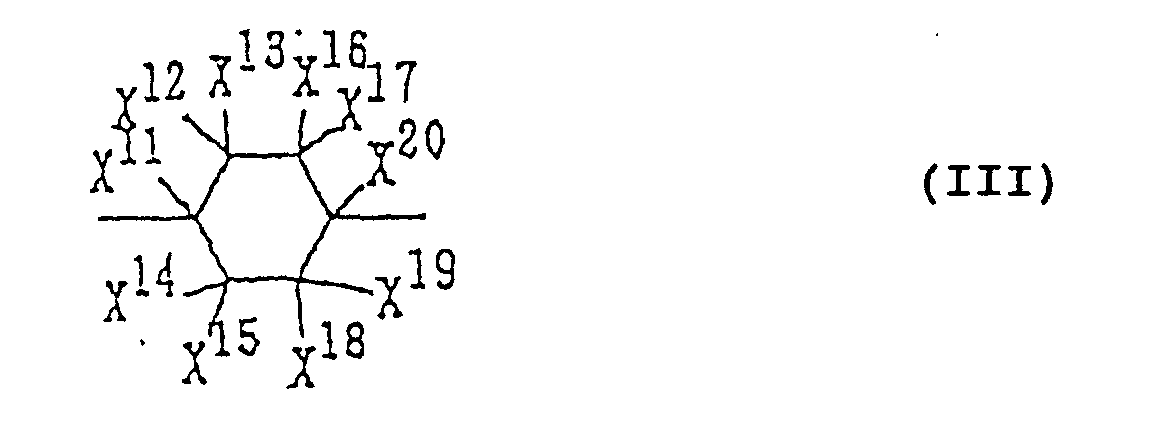
- Flüssigkristallanzeige nach Anspruch 74, wobei in der Verbindung, die durch die Formel (I) dargestellt wird, k, l, m und n je 0 bedeuten.
- Flüssigkristallanzeige nach Anspruch 74, wobei in der Verbindung, die durch die Formel (I) dargestellt wird, k, l und n je 0 bedeuten und m 1 bedeutet.
- Flüssigkristallanzeige nach Anspruch 74, wobei in der Verbindung, die durch die Formel (I) dargestellt wird, l, m und n je 0 bedeuten und k 1 bedeutet.
- Flüssigkristallanzeige nach Anspruch 74, wobei in der Verbindung, die durch die Formel (I) dargestellt wird, k und l je 0 bedeuten und m und n je 1 bedeuten.
- Flüssigkristallanzeige nach Anspruch 74, wobei in der Verbindung, die durch die Formel (I) dargestellt wird, k und l je 1 bedeuten und m und n je 0 bedeuten.
- Flüssigkristallanzeige nach Anspruch 74, wobei in der Verbindung, die durch die Formel (I) dargestellt wird, k und m je 1 bedeuten und l und n je 0 bedeuten.
Applications Claiming Priority (3)
| Application Number | Priority Date | Filing Date | Title |
|---|---|---|---|
| JP18273493 | 1993-07-23 | ||
| JP182734/93 | 1993-07-23 | ||
| JP5182734A JP2605249B2 (ja) | 1993-07-23 | 1993-07-23 | 液晶組成物及び液晶表示装置 |
Publications (2)
| Publication Number | Publication Date |
|---|---|
| EP0637623A1 EP0637623A1 (de) | 1995-02-08 |
| EP0637623B1 true EP0637623B1 (de) | 2001-10-04 |
Family
ID=16123509
Family Applications (1)
| Application Number | Title | Priority Date | Filing Date |
|---|---|---|---|
| EP94111448A Expired - Lifetime EP0637623B1 (de) | 1993-07-23 | 1994-07-22 | Zyclisches Kohlenwasserstoffderivat sowie eine dieses enthaltende Flüssigkristallzusammensetzung |
Country Status (5)
| Country | Link |
|---|---|
| US (2) | US5474707A (de) |
| EP (1) | EP0637623B1 (de) |
| JP (1) | JP2605249B2 (de) |
| KR (1) | KR100294287B1 (de) |
| DE (1) | DE69428486T2 (de) |
Families Citing this family (13)
| Publication number | Priority date | Publication date | Assignee | Title |
|---|---|---|---|---|
| EP0735015A3 (de) * | 1995-03-31 | 1997-06-11 | Chisso Corp | Deuterium enthaltende flüssigkristalline Verbindung und diese Verbindung enthaltende flüssigkristalline Zusammensetzung |
| JP3145938B2 (ja) * | 1996-11-28 | 2001-03-12 | 日本電気株式会社 | 液晶表示装置 |
| JP4586218B2 (ja) * | 1999-07-27 | 2010-11-24 | Dic株式会社 | ネマチック液晶組成物及びこれを用いた液晶表示装置 |
| KR100710150B1 (ko) * | 2000-12-30 | 2007-04-20 | 엘지.필립스 엘시디 주식회사 | 액정 디스플레이 장치 |
| KR101077606B1 (ko) * | 2003-08-01 | 2011-10-27 | 삼성전자주식회사 | 높은 이방성 전이 온도 및 빠른 응답 속도를 갖는 va용액정 화합물, 이를 포함하는 액정 조성물 및 이를 채용한va 액정 디스플레이 |
| EP1626079B1 (de) * | 2004-08-10 | 2008-04-02 | MERCK PATENT GmbH | Polymerisierbare mesogene Cyclohexylphenylderivate |
| KR20070099287A (ko) * | 2006-04-04 | 2007-10-09 | 삼성전자주식회사 | 액정 조성물 및 이를 포함하는 액정 표시 장치 |
| US8444877B2 (en) * | 2008-01-16 | 2013-05-21 | Vvi Bright China Ltd. | High dielectric constant liquid crystal |
| CN103194242A (zh) * | 2013-04-16 | 2013-07-10 | 石家庄诚志永华显示材料有限公司 | 含有氘的液晶化合物及其制备方法与应用 |
| CN103242858B (zh) * | 2013-04-16 | 2014-10-29 | 西安彩晶光电科技股份有限公司 | 一种具有低阈值快响应速度的液晶组合物 |
| CN103224798B (zh) * | 2013-04-16 | 2014-09-10 | 西安彩晶光电科技股份有限公司 | 一种具有宽向列相低折光的液晶组合物 |
| CN103772138A (zh) * | 2014-01-21 | 2014-05-07 | 石家庄诚志永华显示材料有限公司 | 含有氘取代的液晶单体 |
| CN115785970A (zh) * | 2022-11-24 | 2023-03-14 | Tcl华星光电技术有限公司 | 液晶组合物和液晶显示面板 |
Family Cites Families (18)
| Publication number | Priority date | Publication date | Assignee | Title |
|---|---|---|---|---|
| DE2636684C3 (de) * | 1976-08-14 | 1980-06-19 | Merck Patent Gmbh, 6100 Darmstadt | Phenylcyclohexanderivate und ihre Verwendung in flüssigkristallinen Dielektrika |
| DE2702598C2 (de) * | 1977-01-22 | 1984-10-25 | Merck Patent Gmbh, 6100 Darmstadt | Cyclohexylcyclohexane und diese enthaltende Dielektrika |
| DE2927277A1 (de) * | 1979-07-06 | 1981-01-08 | Merck Patent Gmbh | Cyclohexylbiphenyle, verfahren zu ihrer herstellung, diese enthaltende dielektrika und elektrooptisches anzeigeelement |
| JPS5746952A (en) * | 1980-09-04 | 1982-03-17 | Chisso Corp | 4'-(beta-alkyloxyethoxy)-4-cyanobiphenyl |
| US4405488A (en) * | 1980-10-09 | 1983-09-20 | Chisso Corporation | Liquid-crystalline halogenobenzene derivatives |
| US4422951A (en) * | 1981-04-02 | 1983-12-27 | Chisso Corporation | Liquid crystal benzene derivatives |
| DE3370818D1 (en) * | 1982-07-16 | 1987-05-14 | Chisso Corp | High temperature liquid crystal substances having four rings and liquid crystal compositions containing the same |
| US4536321A (en) * | 1983-02-18 | 1985-08-20 | Chisso Corporation | Fluorobenzene derivatives and liquid crystal compositions containing the same |
| EP0122389B1 (de) * | 1983-03-16 | 1987-08-05 | F. HOFFMANN-LA ROCHE & CO. Aktiengesellschaft | Flüssigkristallkomponenten mit einer Alkenylseitenkette |
| DE3317597A1 (de) * | 1983-05-14 | 1984-11-15 | Merck Patent Gmbh, 6100 Darmstadt | Bicyclohexylethane |
| JPS61282328A (ja) * | 1985-06-10 | 1986-12-12 | Chisso Corp | シクロヘキサン誘導体 |
| US5324449A (en) * | 1987-09-25 | 1994-06-28 | Merck Patent Gesellschaft Mit Beschrankter Haftung | Substituted phenyl trifluoromethyl ethers |
| EP0365962B1 (de) * | 1988-10-20 | 1994-09-21 | MERCK PATENT GmbH | Matrix-Flüssigkristallanzeige |
| JP2696557B2 (ja) * | 1989-03-07 | 1998-01-14 | チッソ株式会社 | トリフルオロベンゼン誘導体 |
| ATE119871T1 (de) * | 1989-09-06 | 1995-04-15 | Merck Patent Gmbh | Fluorbenzolderivate und flüssigkristallines medium. |
| EP0477329B1 (de) * | 1990-04-13 | 1996-03-20 | MERCK PATENT GmbH | Flüssigkristallines medium |
| DE4107119A1 (de) * | 1990-08-03 | 1992-02-06 | Merck Patent Gmbh | Fluessigkristallines medium |
| DE59109091D1 (de) * | 1990-12-07 | 1999-03-04 | Merck Patent Gmbh | Supertwist-Flüssigkristallanzeige |
-
1993
- 1993-07-23 JP JP5182734A patent/JP2605249B2/ja not_active Expired - Fee Related
-
1994
- 1994-07-21 US US08/278,260 patent/US5474707A/en not_active Expired - Lifetime
- 1994-07-22 DE DE69428486T patent/DE69428486T2/de not_active Expired - Fee Related
- 1994-07-22 EP EP94111448A patent/EP0637623B1/de not_active Expired - Lifetime
- 1994-07-23 KR KR1019940017832A patent/KR100294287B1/ko not_active Expired - Fee Related
-
1995
- 1995-04-25 US US08/429,485 patent/US5536443A/en not_active Expired - Lifetime
Also Published As
| Publication number | Publication date |
|---|---|
| US5474707A (en) | 1995-12-12 |
| JPH0734066A (ja) | 1995-02-03 |
| KR100294287B1 (ko) | 2001-10-24 |
| US5536443A (en) | 1996-07-16 |
| HK1009604A1 (en) | 1999-06-04 |
| JP2605249B2 (ja) | 1997-04-30 |
| DE69428486T2 (de) | 2002-05-08 |
| EP0637623A1 (de) | 1995-02-08 |
| DE69428486D1 (de) | 2001-11-08 |
| KR950003418A (ko) | 1995-02-16 |
Similar Documents
| Publication | Publication Date | Title |
|---|---|---|
| US4490305A (en) | Liquid-crystalline halogen compounds, process for their preparation, dielectrics containing these, and electro-optical display element | |
| KR100333020B1 (ko) | 액정화합물,이러한화합물을함유하는액정조성물및이러한조성물을사용하여제조된액정표시소자 | |
| US4545922A (en) | Liquid crystalline fluorine-containing cyclohexylbiphenyls and dielectrics and electro-optical display elements based thereon | |
| JP2582031B2 (ja) | ヒドロターフェニル化合物および液晶組成物 | |
| US4331552A (en) | Liquid crystalline, partially hydrogenated oligo-1,4-phenylenes and dielectrics and electro-optical display elements containing them | |
| US4419264A (en) | Fluorine-containing 4,4'-bis-(cyclohexyl)-biphenyl derivatives, and dielectrics and electro-optical display elements containing them | |
| EP0637623B1 (de) | Zyclisches Kohlenwasserstoffderivat sowie eine dieses enthaltende Flüssigkristallzusammensetzung | |
| EP0733692B1 (de) | Flüssigkristallverbindung, Flüssigkristallzusammensetzung und Anzeigevorrichtung | |
| HK1009604B (en) | Cyclic hydrocarbon derivative and liquid crystal composition containing the same | |
| JP2005048007A (ja) | トリフルオロナフタレン誘導体を含有する液晶組成物と表示素子及び液晶性化合物。 | |
| JP3487356B2 (ja) | シクロヘキサン誘導体 | |
| JPH06313170A (ja) | フェニルビシクロヘキサン誘導体 | |
| JP4239242B2 (ja) | フェニルナフタレン誘導体 | |
| JPH07278548A (ja) | シクロヘキシルビフェニル誘導体 | |
| JP3613806B2 (ja) | フェニルビシクロヘキサン誘導体 | |
| JPH08157396A (ja) | (2−シクロヘキシル)プロピルベンゼン誘導体 | |
| JP2005075850A (ja) | トリフルオロナフタレン誘導体を含有する液晶組成物と表示素子及び液晶性化合物 | |
| JPH07216356A (ja) | フェニルシクロヘキサン誘導体及びその中間体 | |
| JPH10139694A (ja) | (2−シクロヘキシルエチル)ベンゼン誘導体 | |
| JPH07138567A (ja) | フェニルビシクロヘキサン誘導体 | |
| JP2605249C (de) | ||
| JPH09221435A (ja) | 分岐アルキル基を側鎖に持つ液晶性化合物およびそれを含む液晶組成物 | |
| JPH08113779A (ja) | (4−シクロヘキシルエチル)ベンゼン誘導体 | |
| JPH0710784A (ja) | フェニルシクロヘキサン誘導体 | |
| JPH0873854A (ja) | 4−(2−シクロヘキシルエチル)シクロヘキシルベンゼン誘導体 |
Legal Events
| Date | Code | Title | Description |
|---|---|---|---|
| PUAI | Public reference made under article 153(3) epc to a published international application that has entered the european phase |
Free format text: ORIGINAL CODE: 0009012 |
|
| AK | Designated contracting states |
Kind code of ref document: A1 Designated state(s): DE GB |
|
| 17P | Request for examination filed |
Effective date: 19950726 |
|
| 17Q | First examination report despatched |
Effective date: 19971211 |
|
| GRAG | Despatch of communication of intention to grant |
Free format text: ORIGINAL CODE: EPIDOS AGRA |
|
| GRAG | Despatch of communication of intention to grant |
Free format text: ORIGINAL CODE: EPIDOS AGRA |
|
| GRAH | Despatch of communication of intention to grant a patent |
Free format text: ORIGINAL CODE: EPIDOS IGRA |
|
| GRAH | Despatch of communication of intention to grant a patent |
Free format text: ORIGINAL CODE: EPIDOS IGRA |
|
| GRAA | (expected) grant |
Free format text: ORIGINAL CODE: 0009210 |
|
| AK | Designated contracting states |
Kind code of ref document: B1 Designated state(s): DE GB |
|
| REF | Corresponds to: |
Ref document number: 69428486 Country of ref document: DE Date of ref document: 20011108 |
|
| REG | Reference to a national code |
Ref country code: GB Ref legal event code: IF02 |
|
| PLBE | No opposition filed within time limit |
Free format text: ORIGINAL CODE: 0009261 |
|
| STAA | Information on the status of an ep patent application or granted ep patent |
Free format text: STATUS: NO OPPOSITION FILED WITHIN TIME LIMIT |
|
| 26N | No opposition filed | ||
| PGFP | Annual fee paid to national office [announced via postgrant information from national office to epo] |
Ref country code: GB Payment date: 20050630 Year of fee payment: 12 |
|
| PG25 | Lapsed in a contracting state [announced via postgrant information from national office to epo] |
Ref country code: GB Free format text: LAPSE BECAUSE OF NON-PAYMENT OF DUE FEES Effective date: 20060722 |
|
| GBPC | Gb: european patent ceased through non-payment of renewal fee |
Effective date: 20060722 |
|
| PGFP | Annual fee paid to national office [announced via postgrant information from national office to epo] |
Ref country code: DE Payment date: 20090716 Year of fee payment: 16 |
|
| PG25 | Lapsed in a contracting state [announced via postgrant information from national office to epo] |
Ref country code: DE Free format text: LAPSE BECAUSE OF NON-PAYMENT OF DUE FEES Effective date: 20110201 |
|
| REG | Reference to a national code |
Ref country code: DE Ref legal event code: R119 Ref document number: 69428486 Country of ref document: DE Effective date: 20110201 |