EP0695324B1 - Verfahren zur herstellung cellulosischer formkörper - Google Patents
Verfahren zur herstellung cellulosischer formkörper Download PDFInfo
- Publication number
- EP0695324B1 EP0695324B1 EP95906834A EP95906834A EP0695324B1 EP 0695324 B1 EP0695324 B1 EP 0695324B1 EP 95906834 A EP95906834 A EP 95906834A EP 95906834 A EP95906834 A EP 95906834A EP 0695324 B1 EP0695324 B1 EP 0695324B1
- Authority
- EP
- European Patent Office
- Prior art keywords
- solution
- cellulose
- amine oxide
- precipitation bath
- aqueous
- Prior art date
- Legal status (The legal status is an assumption and is not a legal conclusion. Google has not performed a legal analysis and makes no representation as to the accuracy of the status listed.)
- Expired - Lifetime
Links
Images
Classifications
-
- C—CHEMISTRY; METALLURGY
- C07—ORGANIC CHEMISTRY
- C07C—ACYCLIC OR CARBOCYCLIC COMPOUNDS
- C07C291/00—Compounds containing carbon and nitrogen and having functional groups not covered by groups C07C201/00 - C07C281/00
- C07C291/02—Compounds containing carbon and nitrogen and having functional groups not covered by groups C07C201/00 - C07C281/00 containing nitrogen-oxide bonds
- C07C291/04—Compounds containing carbon and nitrogen and having functional groups not covered by groups C07C201/00 - C07C281/00 containing nitrogen-oxide bonds containing amino-oxide bonds
-
- C—CHEMISTRY; METALLURGY
- C08—ORGANIC MACROMOLECULAR COMPOUNDS; THEIR PREPARATION OR CHEMICAL WORKING-UP; COMPOSITIONS BASED THEREON
- C08B—POLYSACCHARIDES; DERIVATIVES THEREOF
- C08B1/00—Preparatory treatment of cellulose for making derivatives thereof, e.g. pre-treatment, pre-soaking, activation
- C08B1/003—Preparation of cellulose solutions, i.e. dopes, with different possible solvents, e.g. ionic liquids
-
- C—CHEMISTRY; METALLURGY
- C08—ORGANIC MACROMOLECULAR COMPOUNDS; THEIR PREPARATION OR CHEMICAL WORKING-UP; COMPOSITIONS BASED THEREON
- C08J—WORKING-UP; GENERAL PROCESSES OF COMPOUNDING; AFTER-TREATMENT NOT COVERED BY SUBCLASSES C08B, C08C, C08F, C08G or C08H
- C08J3/00—Processes of treating or compounding macromolecular substances
- C08J3/02—Making solutions, dispersions, lattices or gels by other methods than by solution, emulsion or suspension polymerisation techniques
- C08J3/09—Making solutions, dispersions, lattices or gels by other methods than by solution, emulsion or suspension polymerisation techniques in organic liquids
- C08J3/091—Making solutions, dispersions, lattices or gels by other methods than by solution, emulsion or suspension polymerisation techniques in organic liquids characterised by the chemical constitution of the organic liquid
- C08J3/096—Nitrogen containing compounds
-
- C—CHEMISTRY; METALLURGY
- C08—ORGANIC MACROMOLECULAR COMPOUNDS; THEIR PREPARATION OR CHEMICAL WORKING-UP; COMPOSITIONS BASED THEREON
- C08L—COMPOSITIONS OF MACROMOLECULAR COMPOUNDS
- C08L1/00—Compositions of cellulose, modified cellulose or cellulose derivatives
- C08L1/02—Cellulose; Modified cellulose
-
- D—TEXTILES; PAPER
- D01—NATURAL OR MAN-MADE THREADS OR FIBRES; SPINNING
- D01F—CHEMICAL FEATURES IN THE MANUFACTURE OF ARTIFICIAL FILAMENTS, THREADS, FIBRES, BRISTLES OR RIBBONS; APPARATUS SPECIALLY ADAPTED FOR THE MANUFACTURE OF CARBON FILAMENTS
- D01F2/00—Monocomponent artificial filaments or the like of cellulose or cellulose derivatives; Manufacture thereof
-
- C—CHEMISTRY; METALLURGY
- C08—ORGANIC MACROMOLECULAR COMPOUNDS; THEIR PREPARATION OR CHEMICAL WORKING-UP; COMPOSITIONS BASED THEREON
- C08J—WORKING-UP; GENERAL PROCESSES OF COMPOUNDING; AFTER-TREATMENT NOT COVERED BY SUBCLASSES C08B, C08C, C08F, C08G or C08H
- C08J2301/00—Characterised by the use of cellulose, modified cellulose or cellulose derivatives
Definitions
- the invention relates to a method for producing cellulosic shaped articles.
- N-Methylmorpholine-N-oxide is primarily used as the amine oxide.
- Other amine oxides are e.g. in EP-A - 0 533 070.
- a method of making moldable cellulose solutions is e.g. known from EP-A - 0 365 419.
- regeneration is understood to mean any measures which serve to prepare the precipitation bath into an aqueous amine oxide solution which can be used again in step (A). Such measures are e.g. Cleaning, treating with ion exchangers, concentrating etc.
- DD-A 254 199 describes a process for the purification of aqueous solutions of NMMO, according to which the solution passes through anion exchangers, in a first stage of the anion exchanger an exchange resin of a styrene / filled with -CH 2 N (CH 3 ) 2 type tertiary amino groups. Contains divinylbenzene copolymers and in one second stage contains quaternary ammonium groups of the type -CH 2 N (CH 3 ) 3 OH as functional groups. It is described that the NMMO solution to be cleaned is dark at the beginning of the cleaning, brown to yellow after the first step and light yellow to water-clear after the second step.
- a disadvantage of this method is that the solutions treated in this way have a high pH, which subsequently leads to an increased cleaning effort.
- alkali and alkaline earth metal cations, as well as partially basic degradation products (morpholine, N-methylmorpholine and other compounds) are not removed from the solution.
- the metal ions or alkali and alkaline earth metal ions lead to undesirable deposits and incrustations, to undissolved interfering substances in the solution and to a reduction in process reliability. Although it is possible to remove these substances by adding a precipitant followed by filtration or other separating agents, these operations in turn add additional chemicals or mean additional technical effort.
- EP-A-0 427 701 describes a process for the purification of aqueous amine oxide solutions, according to which the purification is carried out in a one-step process with an anion exchanger whose functional groups are exclusively quaternary tetraalkylammonium groups of the formulas -CH 2 N + (CH 3 ) 3 X - or -CH 2 N + (CH 3 ) 2 (CH 2 OH)] X - , where X - is the anion of an inorganic or organic acid, whereupon the anion exchanger is regenerated with an aqueous acidic solution.
- the anion X - preferably comes from a volatile acid, in particular carbonic acid, formic acid or acetic acid. These acids are also suggested for regeneration of the anion exchanger.
- a disadvantage of the amine oxide process compared to the viscose process is the low thermal stability of the amine oxides and in particular of the cellulose solutions. This means that uncontrollable, highly exothermic decomposition processes can be triggered in the cellulose solutions at the elevated processing temperature (approx. 110-120 ° C), which can lead to violent deflagrations or explosions and subsequently to fires when gases develop can.
- GPE stabilizer gallic acid propyl ester
- a method for producing a moldable solution which contains cellulose which is dissolved in a solvent.
- the solvent contains a tertiary amine oxide and a compound that increases the dissolution rate of the cellulose.
- Primary, secondary, tertiary amines, aqueous ammonia and alkali metal hydroxides are mentioned as such compounds, of which tertiary amines are preferred.
- the authors of the patent suspect that the accelerating action of these compounds is primarily due to the fact that they raise the pH of the solution. However, no proof of the correctness of this presumption is provided, nor is it stated which pH the solution should have.
- the accelerating compound should have a pH greater than 7, and in Examples XIV and XV the pH is a mixture consisting of solid tertiary amine oxide, cellulose and water with sodium hydroxide or aqueous ammonia to a pH of 14 or 12.3.
- DD-A-0 218 104 To prevent the degradation of NMMO and cellulose, it is known from DD-A-0 218 104 to add one or more basic substances to the amine oxide in amounts between 0.1 and 10 mol%, based on the cellulose solution.
- Alkaline hydroxides for example NaOH
- alkaline salts for example Na 2 CO 3
- organic nitrogen bases are recommended as the basic substance.
- the aim of the present invention is to further develop the amine oxide process in such a way that it is possible in a simple manner both to increase the thermal stability of the cellulose solution and to keep the breakdown of cellulose as low as possible. It is a particular object of the invention to remove the above-mentioned degradation products and impurities that accumulate in the precipitation bath from the process.
- the invention is based on the knowledge that the stability of the cellulose solution depends to a large extent on the pH value of the regenerated aqueous amine oxide solution used for the preparation of the suspension.
- a cellulose solution is considered to be all the more stable if its thermal stability determined by means of DSC (differential scanning calorimetry) is as high as possible and at the same time as little cellulose is degraded, which results in a high degree of polymerization of the cellulose and in a high viscosity of the Cellulose solution expresses.
- thermodynamically stable are cellulose solutions which are prepared from an aqueous amine oxide solution whose pH is in the range from 11.5 to 12.5, the maximum thermal stability being given at pH 12.0.
- the invention is further based on the finding that from a pH of at least 10.5 the degree of polymerization of the cellulose decreases significantly less, i.e. significantly less cellulose is broken down.
- the maximum of this beneficial effect is also in the pH range from 11.5 to 12.5, which means that the highest thermal stability of the cellulose solution and the highest stability of the cellulose against degradation are given in the same pH range and thus coincide.
- the viscosity measurements which were carried out on cellulose solutions also show that the cellulose is apparently least degraded when the amine oxide solution used has a pH of at least 10.5. The viscosity drops sharply below 10.5.
- the process according to the invention is preferably carried out such that the regenerated aqueous amine oxide solution used in step (A) has a pH in the range from 10.5 to 13.5, more preferably in the range from 11.5 to 13 , 5 and most preferably in the range of 11.5 and 12.5.
- the pH of the regenerated, aqueous amine oxide solution can be adjusted in a simple manner by contacting the used precipitation bath with an alkaline anion exchanger and, if appropriate, subsequently with an acidic cation exchanger.
- the entire precipitation bath or only a partial stream can be brought into contact with the modified adsorber resin or the ion exchangers, which naturally depends on the extent of the discoloration, the content of cations and anions and the desired final pH of the regenerated solution.
- the embodiment with the adsorber resin ensures that the regeneration of the subsequent anion exchanger essentially without additional chemicals, such as e.g. strongly irritating acids, is possible.
- the adsorber resin used according to the invention differs from the weakly basic anion exchanger used in DD-A 254 199 in the first stage in that it is not a weakly basic anion exchanger in the actual sense, but a resin whose task is not the exchange but is the adsorption of substances. For this reason, an adsorber resin also has a special macroporous pore structure.
- the resin is modified to a lesser extent than is usual with an anion exchanger with weakly basic groups.
- a further preferred embodiment of the process according to the invention therefore uses an anion exchanger which has been regenerated exclusively with alkali metal hydroxide solution and / or volatile organic acids.
- the adsorber resin modified with basic groups advantageously has tertiary amino groups as functional groups.
- Tertiary amino groups such as groups of the type -CH 2 N (R) 2 , where R is alkyl, hydroxyalkyl, etc., are known as weakly alkaline groups with an ion-exchanging action and, in combination with the adsorptive action of the adsorber resin, enhance the decolorizing action.
- the anion exchanger advantageously has quaternary ammonium groups as functional groups.
- These groups for example of the type -CH 2 N + (CH 3 ) 3 or -CH 2 N + [(CH 3 ) 2 (CH 2 OH)], are known as strongly basic functional groups with an ion-exchanging action and fulfill in the process according to the invention the task of removing disruptive anions from the solution in a particularly efficient manner.
- the cation exchanger advantageously has sulfonic acid groups as functional groups.
- Sulfonic acid groups are known in cation exchangers.
- the stability of the cellulose solution can furthermore be increased if an antioxidant substance, ie an antioxidant, is introduced in addition to the alkaline substance before, during or after the regeneration of the precipitation bath.
- an antioxidant substance ie an antioxidant
- antioxidant is understood to include all substances and mixtures which counteract an oxidative and radical breakdown of the cellulose. Radical scavengers and reducing agents naturally also fall under this term. Such substances are, for example, the polyvalent phenols, polyvalent oxycarboxylic acids, trioxybenzenes known from DE-A-2 000 082, etc. Preferred antioxidants are tannins and those substances mentioned in EP-B - 0 047 929, ie glyceraldehyde and / or one or more organic compounds which have at least four carbon atoms and at least two conjugated double bonds and at least two hydroxyl and / or amino groups with at least one hydrogen atom.
- Catechol, pyrogallol, gallic acid, methyl gallate, ethyl ester, propyl ester and isopropyl ester are particularly preferred.
- Hydroquinone and anthraquinone or structurally analogous compounds and derivatives can also be used as antioxidants.
- the pH values were measured with a pH electrode in the form of a combination electrode (Metrohm 6.0210.100) at 50 ° C with a response time of 90 seconds.
- the kneading spinning masses were produced by the following general procedure:
- the beaker was dried out with 25.5 g of fibrous ground air-dried pulp (approx. 94%), and then the pulp was also added to the kneader.
- the mixture was suspended at room temperature and 250 mbar for 15 minutes and then heated (thermostat setting: 130 ° C.).
- the first drop of water distilled off at approx. 90 ° C, which indicates the actual beginning of the solution. 5 minutes later, the vacuum was increased by 25 mbar to 50 mbar at appropriate time intervals. The end of the dissolving process was reached after about 1 hour.
- the thermal stability of the spinning masses was determined both for freshly produced spinning masses and for spinning masses which had previously been heated to 110 ° C. for 20 hours.
- Configuration of the pressure DSC For control and evaluation: TA processor TC11; Evaluation software: TA72AT.2; Measurement: pressure DDK measuring cell DSC27HP; Printer used: Epson FX 850.
- the spinning mass to be examined (5.8 mg ⁇ 0.3 mg) is weighed in the solid, cooled state in a multi-perforated aluminum crucible (open system) and then superficially with a homogeneous mixture of 9 parts by weight Fe 2 O 3 ( Manufacturer Aldrich, Item No. 3924) and 1 part by weight of metallic copper (Manufacturer Merck, Item No. 2715), brought into intimate contact in a ratio of 2: 1 (2 parts of spinning material: 1 part of mixture).
- the measuring chamber was pressurized with 20 bar nitrogen after the aluminum crucible had been introduced.
- the mixture was then heated to a temperature of 112 ° C. (starting point 40 ° C.) at a rate of 10 ° C./min.
- the sample was then held at 112 ° C. for a maximum of 120 min and the DSC curve was recorded during this time.
- the two program parts, heating to 112 ° C and holding at this temperature, were stored in the processor of the DSC device and always linked by the same under the same conditions.
- the time value was determined in the DSC curve which indicates a first increase in the exothermic region.
- the time at which the resulting straight line of extrapolation of the baseline before the effect intersects with the tangent to the curve caused by the effect was defined as the "onset".
- Table 1 shows the pH of the NMMO solution used to prepare the kneader's spin mass respective initialization points (IP, in minutes) and onset points (OP, in minutes), whereby IP (th.) and OP (th.) refer to the values of spinning masses which are subjected to the thermal treatment mentioned before the examination had been.
- Table 1 PH value IP OP IP (th.) OP (th.) 9.5 7 11 0 0 10.5 16 19th 0 0 11.0 41 61 20th 31 11.5 56 72 29 38 12.0 57 77 38 50 12.5 60 77 30th 41 13.5 60 80 26 36
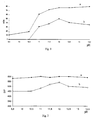
- FIG. 1 shows the relationship found graphically, the pH of the NMMO solution used being plotted as the abscissa and the onset point (in minutes) plotted as the ordinate.
- Curve “a” shows the DSC behavior of spinning masses which have not been subjected to thermal pretreatment
- curve “b” shows the DSC behavior of thermally pretreated spinning masses.
- Table 2 shows the degree of polymerization of the dissolved cellulose before and after a thermal treatment the kneader spinning mass (20 hours at 110 ° C.) compared to the pH of the NMMO solution used to produce the kneader spinning mass.
- Table 2 PH value DP DP (th.) 9.5 580 450 10.5 590 450 11.0 600 480 11.5 590 520 12.0 600 540 12.5 600 500 13.5 590 490
- NMMO-containing, aqueous liquid which consisted of a used precipitation bath and other process waters of the NMMO process and contained about 15% NMMO, was first over an adsorber resin of the type XUS 40285.00 (DOWEX), which was modified with tertiary amino groups as functional groups , guided.
- This adsorber resin was regenerated cyclically with dilute sodium hydroxide solution and washed neutral with water.
- the liquid passed through the adsorber resin was then passed through a LEWATIT MP 500 (BAYER) anion exchanger.
- This anion exchanger contains quaternary ammonium groups as functional groups.
- the anion exchanger was regenerated with dilute sodium hydroxide solution and washed neutral with water. It was found that, even after several cycles, there was no reduction in the capacity of the anion exchanger beyond the manufacturer's specifications.
Landscapes
- Chemical & Material Sciences (AREA)
- Organic Chemistry (AREA)
- Chemical Kinetics & Catalysis (AREA)
- Medicinal Chemistry (AREA)
- Polymers & Plastics (AREA)
- Health & Medical Sciences (AREA)
- General Chemical & Material Sciences (AREA)
- Engineering & Computer Science (AREA)
- Materials Engineering (AREA)
- Life Sciences & Earth Sciences (AREA)
- Dispersion Chemistry (AREA)
- Textile Engineering (AREA)
- Biochemistry (AREA)
- Polysaccharides And Polysaccharide Derivatives (AREA)
- Manufacture Of Macromolecular Shaped Articles (AREA)
- Organic Low-Molecular-Weight Compounds And Preparation Thereof (AREA)
- Artificial Filaments (AREA)
- Paper (AREA)
- Solid-Sorbent Or Filter-Aiding Compositions (AREA)
- Treatment Of Water By Ion Exchange (AREA)
- Confectionery (AREA)
- Processes Of Treating Macromolecular Substances (AREA)
- Moulding By Coating Moulds (AREA)
Description
- Die Erfindung betrifft ein Verfahren zur Herstellung cellulosischer Formkörper.
- Seit einigen Jahrzehnten wird nach Verfahren zur Herstellung cellulosischer Formkörper gesucht, welche das heute in großem Maßstab angewendete Viskoseverfahren ersetzen sollen. Als eine nicht zuletzt wegen einer besseren Umweltverträglichkeit interessante Alternative hat sich dabei herauskristallisiert, Cellulose ohne Derivatisierung in einem organischen Lösungsmittel aufzulösen und aus dieser Lösung Formkörper, z.B. Fasern und Folien, zu extrudieren. Solcherart extrudierte Fasern erhielten von der BISFA (The International Bureau for the Standardization of man made fibers) den Gattungsnamen Lyocell. Unter einem organischen Lösungsmittel wird von der BISFA ein Gemisch aus einer organischen Chemikalie und Wasser verstanden.
- Es hat sich herausgestellt, daß sich als organisches Lösungsmittel insbesondere ein Gemisch aus einem tertiären Aminoxid und Wasser sehr gut zur Herstellung von cellulosischen Formkörpern eignet. Als Aminoxid wird dabei in erster Linie N-Methylmorpholin-N-oxid (NMMO) verwendet. Andere Aminoxide sind z.B. in der EP-A - 0 533 070 beschrieben. Ein Verfahren zur Herstellung formbarer Celluloselösungen ist z.B. aus der EP-A - 0 365 419 bekannt.
- Die Cellulose wird aus der Celluloselösung in einem wäßrigen Fällbad gefällt. Dabei reichert sich das Fällbad mit Aminoxid an. Für die Wirtschaftlichkeit des Verfahrens ist es von entscheidender Bedeutung, daß das Aminoxid nahezu vollständig zurückgewonnen und wiederverwendet wird. Das Aminoxidverfahren weist somit die folgenden 3 Hauptschritte auf:
- (A) Auflösen von Cellulose in einer wäßrigen Lösung eines tertiären Aminoxids, insbesondere N-Methylmorpholin-N-oxid (NMMO) um eine formbare Celluloselösung zu bilden,
- (B) Formen der Celluloselösung und Führen der geformten Celluloselösung in ein wäßriges Fällbad, in welchem die Cellulose gefällt wird, wodurch ein Formkörper und ein gebrauchtes Fällbad gebildet werden,
- (C) Regenerieren, d.h. Reinigen und Konzentrieren, des gebrauchten Fällbades, wobei eine regenierte, wäßrige Aminoxidlösung gebildet wird, die im Schritt (A) erneut zur Auflösung von Cellulose eingesetzt wird.
- Unter dem Begriff "Regenerieren" werden jegliche Maßnahmen verstanden, die dazu dienen, das Fällbad zu einer wäßrigen Aminoxidlösung aufzubereiten, die wieder im Schritt (A) eingesetzt werden kann. Solche Maßnahmen sind z.B. Reinigen, Behandeln mit Ionenaustauschern, Konzentrieren etc.
- Im Fällbad reichert sich nicht nur Aminoxid sondern auch Abbauprodukte der Cellulose und des Aminoxids an. Diese können stark gefärbt sein und die Qualität der hergestellten Formkörper beeinträchtigen, wenn sie nicht aus dem Fällbad entfernt werden. Zusätzlich können sich im Fällbad auch Metallspuren anreichern, die zu einer Verminderung der Prozeßsicherheit führen.
- Für das Entfernen dieser Abbauprodukte sind aus der Literatur einige Vorschläge bekannt:
- Die DD-A 254 199 beschreibt ein Verfahren zur Reinigung wäßriger Lösungen von NMMO, gemäß welchem die Lösung Anionenaustauscher passiert, wobei in einer ersten Stufe der Anionenaustauscher ein mit tertiären Aminogruppen vom Typ -CH2N(CH3)2 besetztes Austauscherharz eines Styrol/Divinylbenzol-Copolymerisates enthält und in einer zweiten Stufe als funktionelle Gruppen quaternäre Ammoniumgruppen vom Typ -CH2N(CH3)3OH enthält. Es wird beschrieben, daß die zu reinigende NMMO-Lösung zu Beginn der Reinigung dunkel, nach der ersten Stufe braun bis gelb und nach der zweiten Stufe hellgelb bis wasserklar ist.
- Ein Nachteil dieses Verfahrens besteht darin, daß die solcherart behandelten Lösungen einen hohen pH-Wert aufweisen, der in weiterer Folge zu einem erhöhten Reinigungsaufwand führt. Dazu kommt noch, daß bei diesem vorbekannten Verfahren Alkali- und Erdalkalikationen, sowie teilweise basische Abbauprodukte (Morpholin, N-Methylmorpholin und andere Verbindungen) nicht aus der Lösung entfernt werden. Die Metallionen bzw. Alkali- und Erdalkalimetallionen führen zu unerwünschten Ablagerungen und Verkrustungen, zu ungelösten störenden Stoffen in der Lösung sowie zu einer Verringerung der Prozeßsicherheit. Es ist zwar möglich, diese Stoffe durch Zugabe eines Fällungsmittels mit anschließender Filtration oder anderen Trennmitteln zu entfernen, diese Arbeitsgänge tragen jedoch wiederum zusätzliche Chemikalien ein bzw. bedeuten einen zusätzlichen technischen Aufwand.
- In der EP-A - 0 427 701 ist ein Verfahren zur Reinigung von wäßrigen Aminoxidlösungen beschrieben, gemäß welchem die Reinigung in einem einstufigen Verfahren mit einem Anionenaustauscher durchgeführt wird, der als funktionelle Gruppen ausschließlich quarternäre Tetraalkylammoniumgruppen der Formeln -CH2N+(CH3)3X- oder -CH2N+(CH3)2(CH2OH)]X- aufweist, wobei X- das Anion einer anorganischen oder organischen Säure darstellt, worauf der Anionenaustauscher mit einer wäßrigen sauren Lösung regeneriert wird. Das Anion X- stammt vorzugsweise von einer flüchtigen Säure, insbesondere Kohlensäure, Ameisensäure oder Essigsäure. Diese Säuren werden auch zur Regenerierung des Anionenaustauschers vorgeschlagen.
- In der Internationalen Patentanmeldung W093/11287 wird vorgeschlagen, die Regenerierung des Anionenaustauschers mit einer wäßrigen Lösung einer starken anorganischen Säure und anschließend mit Natronlauge durchzuführen. Es wird ferner vorgeschlagen, die Lösung vor, oder bevorzugt nach, dem Passieren des Anionenaustauschers über einen Kationenaustauscher zu führen. Es wird beschrieben, daß bei Verwendung eines stark basischen Anionenaustauschers die durch das Überleiten der zu reinigenden Lösung entstehende Färbung des Austauscherharzes so stark sei, daß eine bloße Regenerierung mit Natronlauge nicht ausreichend ist, um das Harz wieder zu entfärben. Um die Kapazität des Harzes aufrechtzuerhalten, muß es daher zusätzlich mit einer starken anorganischen Säure behandelt werden.
- Die in der W093/11287 beschriebene Verfahrensweise führt zu einem gesteigerten Chemikalieneinsatz und zwingt zum Verwenden stark reizender Substanzen, wie z.B. Salzsäure. Zusätzlich ist Beispiel 5 der WO93/11287 zu entnehmen, daß selbst bei Anwendung dieses Verfahrens die Entfärbungskapazität des Anionenaustauschers nach 10 Durchläufen auf beinahe die Hälfte des ursprünglichen Wertes gesunken ist.
- Ein Nachteil des Aminoxidverfahrens gegenüber dem Viskoseverfahren ist die geringe thermische Stabilität der Aminoxide und insbesondere der Celluloselösungen. Darunter ist zu verstehen, daß in den Celluloselösungen bei den erhöhten Temperatur der Verarbeitung (etwa 110-120°C) unkontrollierbare, stark exotherme Zersetzungsprozesse ausgelöst werden können, die unter Entwicklung von Gasen zu heftigen Verpuffungen oder Explosionen und in weiterer Folge auch zu Bränden führen können.
- Über die geringe thermische Stabilität der Celluloselösung ist in der Literatur nur wenig bekannt. Auf das Phänomen ist von Buijtenhuijs et al. 1986 erstmals deutlich hingewiesen worden. Insbesondere bei Anwesenheit von Metallionen können in bestimmten Fällen die Zersetzungsreaktionen in der Spinnmasse durchgehen. Metallionen sind aber in der Lösung aufgrund des metallischen Aufbaues der Anlagenteile nie auszuschließen.
- Das Durchgehen kann selbst durch Zugabe des heute vielfach verwendeten Stabilisators Gallussäurepropylester (GPE) nicht verhindert werden (Buijtenhuijs et al., 1986). Im Gegenteil: wie Untersuchungen ergeben haben, erhöhen GPE und auch andere aromatische Hydroxyverbindungen mit guten Komplexierungseigenschaften unter besonderen Voraussetzungen die thermische Instabilität der NMMO-Celluloselösung bei Anwesenheit von Metallen sogar noch; d.h., daß GPE das gefährliche Durchgehen bzw. die Explosionen (mit)initiieren kann. Dies ist in der österreichischen Patentanmeldung A 1857/93, die am 15. Oktober 1994 veröffentlicht wurde, beschrieben.
- Aus der US-A - 4,324,593 ist ein Verfahren zur Herstellung einer formbaren Lösung bekannt, welche Cellulose enthält, die in einem Lösungsmittel gelöst ist. Das Lösungsmittel enthält ein tertiäres Aminoxid und eine Verbindung, welche die Lösungsgeschwindigkeit der Cellulose erhöht. Als derartige Verbindungen werden insbesondere primäre, sekundäre, tertiäre Amine, wäßriger Ammoniak und Alkalihydroxide genannt, von denen tertiäre Amine bevorzugt sind. Die Autoren des Patentes vermuten, daß die beschleunigende Wirkung dieser Verbindungen primär darauf zurückzuführen sind, daß sie den pH der Lösung erhöhen. Ein Nachweis für die Richtigkeit dieser Vermutung wird jedoch nicht erbracht, und es wird auch nicht angegeben, welchen pH die Lösung aufweisen sollte. Lediglich im Anspruch 27 der US-A - 4,324,593 ist ganz allgemein erwähnt, daß die beschleunigende Verbindung einen pH von größer als 7 haben sollte, und in den Beispielen XIV und XV wird der pH einer Mischung bestehend aus festem tertiären Aminoxid, Cellulose und Wasser mit Natriumhydroxid bzw. wäßrigem Ammoniak auf einen pH von 14 bzw. 12,3 eingestellt.
- In der US-A - 4,324,593 wird vorgeschlagen, die beschleunigende Verbindung dem Lösungsmittel in einer solchen Menge zuzugeben, daß sie bis zu 20% der Masse der fertigen Lösung ausmacht, wobei die Menge im Einzelfall vom verwendeten Aminoxid abhängen soll.
- Zur Verhinderung des Abbaues von NMMO und Cellulose ist es aus der DD-A - 0 218 104 bekannt, dem Aminoxid eine oder mehrere basische Substanzen in Mengen zwischen 0,1 und 10 Mol%, bezogen auf die Celluloselösung, zuzusetzen. Als basische Substanz werden Alkalihydroxide, z.B. NaOH, basisch reagierende Salze, z.B. Na2CO3, sowie organische Stickstoffbasen empfohlen.
- Die vorliegende Erfindung setzt sich zum Ziel, das Aminoxidverfahren derart weiterzuentwickeln, daß es auf einfach Weise möglich ist, sowohl die thermische Stabilität der Celluloselösung zu erhöhen als auch den Abbau an Cellulose möglichst gering zu halten. Es ist insbesondere ein Ziel der Erfindung, die oben genannten Abbauprodukte und Verunreinigungen, die sich im Fällbad anreichern, aus dem Verfahren zu entfernen.
- Das erfindungsgemäße Verfahren zur Herstellung cellulosischer Formkörper weist die folgenden Schritte auf:
- (A) Auflösen von Cellulose in einer wäßrigen Lösung eines tertiären Aminoxids, insbesondere N-Methylmorpholin-N-oxid (NMMO), um eine formbare Celluloselösung zu bilden,
- (B) Formen der Celluloselösung und Führen der geformten Celluloselösung in ein wäßriges Fällbad, in welchem die Cellulose gefällt wird, wodurch ein Formköper und ein gebrauchtes Fällbad gebildet werden,
- (C) Regenerieren des gebrauchten Fällbades, wobei eine regenierte, wäßrige Aminoxidlösung gebildet wird, die im Schritt (A) erneut zur Auflösung von Cellulose eingesetzt wird,
- Die Erfindung beruht auf der Erkenntnis, daß die Stabilität der Celluloselösung in hohem Ausmaß davon abhängt, welchen pH-Wert die zur Suspensionsbereitung verwendete, regenerierte, wäßrige Aminoxidlösung aufweist. Im Sinne der vorliegenden Patentanmeldung wird eine Celluloselösung als umso stabiler angesehen, wenn ihre mittels DSC (Differential Scanning Calorimetry) bestimmte thermische Stabilität möglichst hoch ist und gleichzeitig möglichst wenig Cellulose abgebaut wird, was sich in einem hohen Polymerisationsgrad der Cellulose und in einer hohen Viskosität der Celluloselösung äußert.
- Es hat sich erfindungsgemäß gezeigt, daß sich die thermische Stabilität von Celluloselösungen sprunghaft verbessert, wenn zu ihrer Herstellung eine wäßrige Aminoxidlösung eingesetzt wird, deren pH 10,5 oder größer ist. Am thermodynamisch stabilsten erweisen sich Celluloselösungen, die aus einer wäßrigen Aminoxidlösung hergestellt werden, deren pH im Bereich von 11,5 bis 12,5 liegt, wobei bei pH 12,0 die maximale thermische Stabilität gegeben ist.
- Die Erfindung beruht ferner auf der Erkenntnis, daß ab einem pH von mindestens 10,5 der Polymerisationsgrad der Cellulose deutlich weniger abnimmt, d.h. deutlich weniger Cellulose abgebaut wird. Das Maximum dieser günstigen Wirkung liegt ebenfalls im pH-Bereich von 11,5 bis 12,5, was bedeutet, daß die höchste thermische Stabilität der Celluloselösung und die höchste Stabilität der Cellulose gegen Abbau im gleichen pH-Bereich gegeben sind und somit zusammenfallen. Auch die Viskositätsmessungen, die an Celluloselösungen durchgeführt wurden, zeigen, daß die Cellulose offenbar dann am wenigsten abgebaut wird, wenn die eingesetzte Aminoxidlösung einen pH von mindestens 10,5 aufweist. Unterhalb von 10,5 fällt die Viskosität stark ab.
- Das erfindungsgemäße Verfahren wird demgemäß bevorzugt so ausgeführt, daß die regenerierte, wäßrige Aminoxidlösung, die im Schritt (A) eingesetzt wird, einen pH-Wert im Bereich von 10,5 und 13,5, mehr bevorzugt im Bereich von 11,5 und 13,5 und am meisten bevorzugt im Bereich von 11,5 und 12,5, aufweist.
- Der pH-Wert der regenerierten, wäßrigen Aminoxidlösung kann auf einfache Weise eingestellt werden, indem das gebrauchte Fällbad mit einem alkalischen Anionenaustauscher und gegebenenfalls anschließend mit einem sauren Kationenaustauscher in Kontakt gebracht wird.
- Es hat sich ferner als vorteilhaft erwiesen, den pH-Wert der regenerierten, wäßrigen Aminoxidlösung einzustellen, indem das gebrauchte Fällbad mit einem mit alkalischen Gruppen modifizierten Adsorberharz, anschließend mit einem alkalischen Anionenaustauscher und zumindest teilweise mit einem sauren Kationenaustauscher in Kontakt gebracht wird.
- Es kann das gesamte Fällbad oder nur ein Teilstrom mit dem modifizierten Adsorberharz bzw. den Ionenaustauschern in Kontakt gebracht werden, was naturgemäß vom Ausmaß der Verfärbung, dem Gehalt an Kationen und Anionen und dem gewünschten End-pH der regenerierten Lösung abhängt.
- Es hat sich gezeigt, daß durch die Verwendung von Adsorberharzen und Ionenaustauschern nicht nur der pH-Wert der NMMO-Lösung auf einfache Weise eingestellt werden kann, sondern daß auch die im Fällbad angereicherten Abbauprodukte, die zu Verfärbungen führen, besonders wirkungsvoll entfernt werden können. Zusätzlich ist durch die Ausführungsform mit dem Adsorberharz gewährleistet, daß die Regenerierung des nachfolgenden Anionenaustauschers im wesentlichen ohne zusätzliche Chemikalien, wie z.B. stark reizende Säuren, möglich ist. Das erfindungsgemäß verwendete Adsorberharz unterscheidet sich von dem in der DD-A 254 199 in der ersten Stufe eingesetzten, schwach basischen Anionenaustauscher dadurch, daß es sich nicht um einen schwach basischen Anionenaustauscher im eigentlichen Sinn handelt, sondern um ein Harz, dessen Aufgabe nicht der Austausch, sondern die Adsorption von Substanzen ist. Ein Adsorberharz weist aus diesem Grund auch eine besondere makroporöse Porenstruktur auf. Zusätzlich ist das Harz in geringerem Ausmaß, als dies bei einem Anionenaustauscher üblich ist, mit schwach basischen Gruppen modifiziert.
- Es hat sich nun gezeigt, daß der Einsatz eines solcherart modifizierten Adsorberharzes zur Regenerierung des Fällbades nicht nur zur effizienteren Entfernung von gefärbten Stoffen aus der Lösung führt, sondern auch die Regenerierbarkeit des Harzes deutlich besser ist, als jene der in der Literatur beschriebenen Anionenaustauscher.
- Es hat sich ferner herausgestellt, daß durch den Einsatz eines Adsorberharzes irreversible Verfärbungen des nachgeschalteten Anionenaustauschers vermieden werden und dadurch kein über die Angaben des Herstellers hinausgehender wesentlicher Kapazitätsverlust im Anionenaustauscher auftritt. Dies ermöglicht eine ausreichende Regenerierung des Anionenaustauschers mit Alkalilauge, z.B. mit Natronlauge. Der zusätzliche Einsatz von starken Säuren kann demgemäß vermieden werden. Eine weitere bevorzugte Ausführungsform des erfindungsgemäßen Verfahrens verwendet daher einen Anionenaustauscher, der ausschließlich mit Alkalilauge und/oder flüchtigen organischen Säuren regeneriert wurde.
- Durch das Nachschalten des Kationenaustauschers nach dem Anionenaustauscher kann auf einfache Weise und ohne zusätzliche chemische oder mechanische Hilfsmittel erreicht werden, daß der aufgrund des Kontaktes mit dem Anionenaustauscher entstandene und den pH-Wert stark erhöhende Hydroxidüberschuß kompensiert wird. Zusätzlich werden Kationen aus der Lösung entfernt.
- Vorteilhafterweise weist das mit basischen Gruppen modifizierte Adsorberharz tertiäre Aminogruppen als funktionelle Gruppen auf. Tertiäre Aminogruppen, wie z.B. Gruppen des Typs -CH2N(R)2, wobei R Alkyl, Hydroxyalkyl etc. ist, sind als schwach alkalische Gruppen mit ionenaustauschender Wirkung bekannt und verstärken in Kombination mit der adsorptiven Wirkung des Adsorberharzes die entfärbende Wirkung.
- Weiters weist der Anionenaustauscher vorteilhafterweise als funktionelle Gruppen quarternäre Ammoniumgruppen auf. Diese Gruppen, z.B. vom Typus -CH2N+(CH3)3 oder -CH2N+[(CH3)2(CH2OH)], sind als stark basische funktionelle Gruppen mit ionenaustauschender Wirkung bekannt und erfüllen im erfindungsgemäßen Verfahren in besonders effizienter Weise die Aufgabe, störende Anionen aus der Lösung zu entfernen.
- Der Kationenaustauscher weist vorteilhaft Sulfonsäuregruppen als funktionelle Gruppen auf. Sulfonsäuregruppen sind in Kationenaustauschern bekannt.
- Die Stabilität der Celluloselösung kann ferner zusätzlich erhöht werden, wenn vor, während oder nach dem Regenerieren des Fällbades neben der alkalischen Substanz auch eine antioxidativ wirkende Substanz, also ein Antioxidans, eingebracht wird.
- Der Begriff "Antioxidans" wird so verstanden, daß damit alle Stoffe und Stoffgemische umfaßt werden, die einem oxidativen und radikalischen Abbau der Cellulose entgegenwirken. Auch Radikalfänger und Reduktionsmittel fallen naturgemäß unter diesen Begriff. Derartige Stoffe sind z.B. die aus der DE-A-2 000 082 bekannten mehrwertigen Phenole, mehrwertigen Oxycarbonsäuren, Trioxybenzole etc. Bevorzugte Antioxidantien sind Tannine und jene Stoffe, die in der EP-B - 0 047 929 genannt sind, d.h. Glycerinaldehyd und/oder ein oder mehrere organische Verbindungen, die wenigstens vier Kohlenstoffatome und wenigstens zwei konjugierte Doppelbindungen und wenigstens zwei Hydroxyl- und/oder Aminogruppen mit wenigstens einem Wasserstoffatom besitzen. Insbesondere bevorzugt sind Brenzkatechin, Pyrogallol, Gallussäure, Gallussäuremethylester, -ethylester, -propylester und -isopropylester. Auch Hydrochinon und Anthrachinon bzw. strukturanaloge Verbindungen sowie Derivate können als Antioxidans eingesetzt werden.
- Die Erfindung wird mit den folgenden Beispielen noch näher erläutert, wobei als Celluloselösungen jeweils Kneterspinnmassen dienten, zu deren Herstellung wäßrige NMMO-Lösungen mit pH-Werten im Bereich von 9,5 bis 13,5 verwendet wurden. Sämtliche Prozentangaben sind auf die Masse bezogen.
- Die Messungen des pH-Wertes erfolgten jeweils mit einer pH-Elektrode in Form einer Einstabmeßkette (Metrohm 6.0210.100) bei 50°C mit einer Einstellzeit von 90 Sekunden.
- Die Kneterspinnmassen wurden nach dem folgenden allgemeinen Verfahren hergestellt:
- In ein 250ml Becherglas wurden Gallussäurepropylester und Hydroxylamin als Stabilisatoren in Mengen eingewogen, die 0,03% bzw. 0,05% des eingesetzten Zellstoffs entsprach. Danach wurden 221 g einer wäßrigen 72,46%igen NMMO-Lösung mit einem pH im Bereich von 9,5 und 13,5 (der pH wurde mit NaOH und/oder H2SO4 eingestellt) zugegeben, 5 Minuten lang bei Raumtemperatur gerührt, und anschließend wurde die erhaltene Lösung in einen Laborkneter gegeben.
- Das Becherglas wurde mit 25,5 g faserig gemahlenem, luftgetrockneten Zellstoff (ca. 94%) ausgetrocknet, und danach wurde der Zellstoff ebenfalls in den Kneter gegeben.
- Das Gemenge wurde 15 Minuten bei Raumtemperatur und 250 mbar suspendiert und anschließend aufgeheizt (Thermostateinstellung: 130°C). Bei ca. 90°C destillierte der erste Tropfen Wasser ab, was den eigentlichen Lösungsbeginn anzeigt. 5 Minuten später wurde der Unterdruck in entsprechenden Zeitintervallen um jeweils um 25 mbar bis auf 50 mbar vergrößert. Das Ende des Lösungsvorganges war nach ca. 1 Stunde erreicht.
- Nach diesem allgemeinen Verfahren wurden 7 Spinnmassen aus 7 wäßrigen NMMO-Lösungen hergestellt, wobei die einzelnen NMMO-Lösungen folgende pH-Werte aufwiesen: 9,5, 10,5, 11,0, 11,5, 12,0, 12,5, und 13,5.
- Die thermische Stabilität der Spinnmassen wurde sowohl für frisch hergestellte Spinnmassen bestimmt, als auch für Spinnmassen, welche vorher 20 Stunden auf 110°C erhitzt worden waren.
- Die Untersuchungen zur thermischen Stabilität wurden gemäß Buijtenhuijs et al. (The Degradation and Stabilization of Cellulose Dissolved in N-Methylmorpholin-N-Oxide (NMM), in "Das Papier", 40. Jahrgang, Heft 12, Seiten 615-619, 1986) mittels der DSC-(differential scanning calorimetry)-Technik (Gerät: Mettler Druck DSC Thermosystem 4000) durchgeführt, wobei das in der östereichischen Patentanmeldung A1857/93 beschriebene Verfahren angewendet wurde.
- Konfiguration des Druck-DSC: Für Steuerung und Auswertung: TA-Processor TC11; Auswertungssoftware: TA72AT.2; Messung: Druck DDK Meßzelle DSC27HP; eingesetzter Drucker: Epson FX 850.
- Die zu untersuchende Spinnmasse (5,8 mg ± 0,3 mg) wird im festen, ausgekühlten Zustand in einen mehrfach gelochten Alu-Tiegel (offenes System) eingewogen und in der Folge oberflächlich mit einem homogenen Gemisch aus 9 Gewichtsteilen Fe2O3 (Hersteller Aldrich, Art.Nr. 3924) und 1 Gewichtsteil metallischem Kupfer (Hersteller Merck, Art.Nr. 2715), im Verhältnis 2:1 (2 Teile Spinnmasse : 1 Teil Gemisch) in innigen Kontakt gebracht.
- Zur Vornahme der DSC-Messung wurde die Meßkammer nach Einbringen des Alu-Tiegels mit einem Druck von 20 bar Stickstoff beaufschlagt. Danach wurde mit einer Geschwindigkeit von 10°C/min auf eine Temperatur von 112°C (Startpunkt 40°C) aufgeheizt. Im Anschluß daran wurde die Probe über einen Zeitraum von maximal 120 min auf 112°C gehalten und während dieser Zeit die DSC-Kurve aufgenommen. Die beiden Programmteile Aufheizen auf 112°C und Halten bei dieser Temperatur wurden im Prozessor des DSC-Gerätes abgespeichert und von diesem stets unter gleichen Bedingungen verknüpft.
- Als Initialisierungspunkt wurde in der DSC-Kurve jener Zeitwert bestimmt, der ein erstes Ansteigen in den exothermen Bereich anzeigt. Als "Onset" wurde jene Zeit festgelegt, bei welcher sich die resultierende Gerade der Extrapolation der Basislinie vor dem Effekt mit der Tangente an die durch den Effekt verursachte Kurve schneidet.
- Die nachfolgende Tabelle 1 stellt den pH-Wert der zur Herstellung der Kneterspinnmasse verwendeten NMMO-Lösung den jeweiligen Initialisierungspunkten (IP, in Minuten) und Onset-Punkten (OP, in Minuten) gegenüber, wobei sich IP(th.) und OP(th.) auf die Werte von Spinnmassen beziehen, die vor der Untersuchung der oben erwähnten thermischen Behandlung unterworfen worden waren.
Tabelle 1 pH-Wert IP OP IP(th.) OP(th.) 9,5 7 11 0 0 10,5 16 19 0 0 11,0 41 61 20 31 11,5 56 72 29 38 12,0 57 77 38 50 12,5 60 77 30 41 13,5 60 80 26 36 - Figur 1 zeigt den gefundenen Zusammenhang graphisch, wobei als Abszisse der pH-Wert der eingesetzten NMMO-Lösung und als Ordinate der Onsetpunkt (in Minuten) aufgetragen sind. Die Kurve "a" zeigt das DSC-Verhalten von Spinnmassen, die keiner thermischen Vorbehandlung unterzogen wurden, und die Kurve "b" zeigt das DSC-Verhalten von thermisch vorbehandelten Spinnmassen.
- Den in der Tabelle 1 aufgelisteten Daten bzw. der Figur 1 ist zu entnehmen, daß ab dem pH-Wert von 10,5 der verwendeten NMMO-Lösung die thermische Stabilität der erhaltenen Spinnmasse sprunghaft ansteigt, und daß bei pH 11,5, insbesondere bei thermisch vorbehandelten Spinnmassen, die Stabilität neuerlich zunimmt. Die größte Stabilität ist bei einem pH von etwa 12,0 zu erkennen.
- Die nachfolgende Tabelle 2 stellt den Polymerisationsgrad der gelösten Cellulose vor und nach einer thermischen Behandlung der Kneterspinnmasse (20 Stunden bei 110 °C) dem pH-Wert der zur Herstellung der Kneterspinnmasse verwendeten NMMO-Lösung gegenüber.
Tabelle 2 pH-Wert DP DP(th.) 9,5 580 450 10,5 590 450 11,0 600 480 11,5 590 520 12,0 600 540 12,5 600 500 13,5 590 490 - Die in der Tabelle 2 aufgelisteten Ergebnisse sind in der Figur 2 graphisch dargestellt, wobei die Kurve "a" den DP der Cellulose in den frisch hergestellten Spinnmassen zeigt und die Kurve "b" den DP der Cellulose in Spinnmassen, die der thermischen Behandlung unterzogen wurden. An der Kurve "a" ist zu erkennen, daß der Polymerisationsgrad der Cellulose in frischer Spinnmasse vom pH-Wert des verwendeten NMMO praktisch nicht abhängt. Nach der thermischen Behandlung (Kurve "b") zeigt sich aber, daß der Polymerisationsgrad dann weniger abnimmt, wenn der pH der verwendeten NMMO-Lösung zwischen 10,5 und 13,5 liegt, wobei die geringste Abnahme wiederum bei pH 12,0 zu beobachten ist.
- Eine NMMO-hältige, wäßrige Flüssigkeit, die aus einem gebrauchten Fällbad und anderen Prozeßwässern des NMMO-Verfahrens bestand und etwa 15% NMMO enthielt, wurde zunächst über ein Adsorberharz des Typus XUS 40285.00 (DOWEX), welches mit tertiären Aminogruppen als funktionelle Gruppen modifiziert war, geführt. Dieses Adsorberharz wurde zyklenweise mit verdünnter Natronlauge regeniert und mit Wasser neutral gewaschen.
- Die durch das Adsorberharz geführte Flüssigkeit wurde anschließend über einen Anionenaustauscher vom Typ LEWATIT MP 500 (BAYER) geführt. Dieser Anionenaustauscher enthält quaternäre Ammoniumgruppen als funktionelle Gruppen. Der Anionenaustauscher wurde mit verdünnter Natronlauge regeneriert und mit Wasser neutral gewaschen. Es zeigte sich, daß auch nach mehreren Zyklen keine über die Angaben des Herstellers hinausgehende Kapazitätsverminderung am Anionenaustauscher auftrat.
- Anschließend wurde ein Teil der Lösung über einen Kationenaustauscher des Typus LEWATIT SM (BAYER), welcher Sulfonsäuregruppen als funktionelle Gruppen enthielt, geführt. Nach dieser Behandlung wurde dieser Teil mit dem restlichen Teil der Lösung, der nicht über den Kationenaustauscher geführt worden war, vereinigt. Nach Aufkonzentrierung auf einen NMMO-Gehalt von 72% wies die regenerierte NMMO-Lösung einen pH von ca. 12,0 auf. In dieser NMMO-Lösung konnten störende Substanzen praktisch nicht mehr nachgewiesen werden bzw. waren lediglich in Mengen vorhanden, die nicht störend sind.
daß eine regenerierte, wäßrige Aminoxidlösung im Schritt (A) eingesetzt wird, die einen pH-Wert in einem Bereich aufweist, dessen obere und dessen untere Grenze, in Abhängigkeit von der Konzentration an tertiärem Aminoxid, durch die Gleichung


Claims (10)
- Verfahren zur Herstellung cellulosischer Formkörper, welches Verfahren folgende Schritte aufweist:(A) Auflösen von Cellulose in einer wäßrigen Lösung eines tertiären Aminoxids, insbesondere N-Methylmorpholin-N-oxid (NMMO), um eine formbare Celluloselösung zu bilden,(B) Formen der Celluloselösung und Führen der geformten Celluloselösung in ein wäßriges Fällbad, in welchem die Cellulose gefällt wird, wodurch ein Formköper und ein gebrauchtes Fällbad gebildet werden,(C) Regenerieren des gebrauchten Fällbades, wobei eine regenierte, wäßrige Aminoxidlösung gebildet wird, die im Schritt (A) erneut zur Auflösung von Cellulose eingesetzt wird,dadurch gekennzeichnet,
daß eine regenerierte, wäßrige Aminoxidlösung im Schritt (A) eingesetzt wird, die einen pH-Wert in einem Bereich aufweist, dessen obere und dessen untere Grenze, in Abhängigkeit von der Konzentration an tertiärem Aminoxid, durch die Gleichung


- Verfahren zur Herstellung cellulosischer Formkörper, welches Verfahren folgende Schritte aufweist:(A) Auflösen von Cellulose in einer wäßrigen Lösung eines tertiären Aminoxids, insbesondere N-Methylmorpholin-N-oxid (NMMO), um eine formbare Celluloselösung zu bilden,(B) Formen der Celluloselösung und Führen der geformten Celluloselösung in ein wäßriges Fällbad, in welchem die Cellulose gefällt wird, wodurch ein Formköper und ein gebrauchtes Fällbad gebildet werden,(C) Regenerieren des gebrauchten Fällbades, wobei eine regenierte, wäßrige Aminoxidlösung gebildet wird, die im Schritt (A) erneut zur Auflösung von Cellulose eingesetzt wird,dadurch gekennzeichnet,
daß eine regenerierte, wäßrige Aminoxidlösung im Schritt (A) eingesetzt wird, die einen pH-Wert in einem Bereich zwischen 10,5 und 13,5 aufweist. - Verfahren nach Anspruch 1, dadurch gekennzeichnet, daß die regenerierte, wäßrige Aminoxidlösung, die im Schritt (A) eingesetzt wird, ein pH-Wert im Bereich von 10,5 und 13,5 aufweist.
- Verfahren nach einem der Ansprüche 1 bis 2, dadurch gekennzeichnet, daß daß die regenerierte, wäßrige Aminoxidlösung, die im Schritt (A) eingesetzt wird, ein pH-Wert im Bereich von 11,5 und 13,5 aufweist.
- Verfahren nach einem der Ansprüche 1 bis 2, dadurch gekennzeichnet, daß die regenerierte, wäßrige Aminoxidlösung, die im Schritt (A) eingesetzt wird, ein pH-Wert im Bereich von 11,5 und 12,5 aufweist.
- Verfahren nach einem der Ansprüche 1 bis 5, dadurch gekennzeichnet, daß der pH-Wert der wäßrigen Aminoxidlösung eingestellt wird, indem vor, während oder nach dem Regenerieren des gebrauchten Fällbades eine den pH-Wert beeinflussende Substanz eingebracht wird.
- Verfahren nach einem der Ansprüche 1 bis 5, dadurch gekennzeichnet, daß der pH-Wert der regenerierten, wäßrigen Aminoxidlösung eingestellt wird, indem das gebrauchte Fällbad mit einem alkalischen Anionenaustauscher, welcher eine alkalische Substanz in das Fällbad einbringt, und gegebenenfalls anschließend mit einem sauren Kationenaustauscher in Kontakt gebracht wird.
- Verfahren nach einem der Ansprüche 1 bis 5, dadurch gekennzeichnet, daß der pH-Wert der regenerierten, wäßrigen Aminoxidlösung eingestellt wird, indem das gebrauchte Fällbad mit einem mit alkalischen Gruppen modifizierten Adsorberharz, anschließend mit einem alkalischen Anionenaustauscher, welcher eine alkalische Substanz in das Fällbad einbringt, und zumindest teilweise mit einem sauren Kationenaustauscher in Kontakt gebracht wird.
- Verfahren nach Anspruch 8, dadurch gekennzeichnet, daß ein Anionenaustauscher eingesetzt wird, der ausschließlich mit Alkalilauge und/oder flüchtigen organischen Säuren regeneriert wurde.
- Verfahren nach einem der Ansprüche 7 oder 8, dadurch gekennzeichnet, daß vor, während oder nach dem Regenerieren des Fällbades eine antioxidativ wirkende Substanz eingebracht wird.
Applications Claiming Priority (4)
| Application Number | Priority Date | Filing Date | Title |
|---|---|---|---|
| AT430/94 | 1994-03-01 | ||
| AT43094 | 1994-03-01 | ||
| AT0043094A ATA43094A (de) | 1994-03-01 | 1994-03-01 | Verfahren zur herstellung cellulosischer formkörper, lösung eines tert. aminoxids und ihre aufarbeitung |
| PCT/AT1995/000021 WO1995023827A1 (de) | 1994-03-01 | 1995-02-01 | Verfahren zur herstellung cellulosischer formkörper |
Publications (3)
| Publication Number | Publication Date |
|---|---|
| EP0695324A1 EP0695324A1 (de) | 1996-02-07 |
| EP0695324B1 true EP0695324B1 (de) | 1997-10-29 |
| EP0695324B2 EP0695324B2 (de) | 2005-11-16 |
Family
ID=3490408
Family Applications (2)
| Application Number | Title | Priority Date | Filing Date |
|---|---|---|---|
| EP95906834A Expired - Lifetime EP0695324B2 (de) | 1994-03-01 | 1995-02-01 | Verfahren zur herstellung cellulosischer formkörper |
| EP95906835A Expired - Lifetime EP0696330B1 (de) | 1994-03-01 | 1995-02-01 | Verfahren zur reinigung wässriger lösungen tertiärer aminoxide |
Family Applications After (1)
| Application Number | Title | Priority Date | Filing Date |
|---|---|---|---|
| EP95906835A Expired - Lifetime EP0696330B1 (de) | 1994-03-01 | 1995-02-01 | Verfahren zur reinigung wässriger lösungen tertiärer aminoxide |
Country Status (37)
| Country | Link |
|---|---|
| US (2) | US5628941A (de) |
| EP (2) | EP0695324B2 (de) |
| JP (2) | JP2703117B2 (de) |
| KR (1) | KR0173006B1 (de) |
| CN (2) | CN1124044A (de) |
| AT (3) | ATA43094A (de) |
| AU (2) | AU690202B2 (de) |
| BG (1) | BG62409B1 (de) |
| BR (2) | BR9505780A (de) |
| CA (1) | CA2160785C (de) |
| CZ (1) | CZ290928B6 (de) |
| DE (5) | DE19580078D2 (de) |
| EE (1) | EE9500061A (de) |
| ES (1) | ES2109089T5 (de) |
| FI (2) | FI955205L (de) |
| GB (2) | GB2291833B (de) |
| GR (1) | GR3025123T3 (de) |
| HK (1) | HK1004778A1 (de) |
| HR (1) | HRP950076B1 (de) |
| HU (1) | HU214289B (de) |
| ID (1) | ID917B (de) |
| IL (1) | IL112678A (de) |
| LV (1) | LV11331B (de) |
| MA (1) | MA23460A1 (de) |
| MY (1) | MY115340A (de) |
| NO (2) | NO954351L (de) |
| NZ (1) | NZ278816A (de) |
| PE (1) | PE46295A1 (de) |
| PL (1) | PL181246B1 (de) |
| RO (1) | RO113353B1 (de) |
| RU (1) | RU2142523C1 (de) |
| SI (1) | SI0695324T2 (de) |
| SK (1) | SK281026B6 (de) |
| TW (1) | TW460479B (de) |
| WO (2) | WO1995023885A1 (de) |
| YU (1) | YU48932B (de) |
| ZA (1) | ZA951333B (de) |
Families Citing this family (26)
| Publication number | Priority date | Publication date | Assignee | Title |
|---|---|---|---|---|
| HK1004778A1 (en) * | 1994-03-01 | 1998-12-04 | Lenzing Aktiengesellschaft | Process for producing cellulose shaped bodies |
| AT402643B (de) * | 1995-08-18 | 1997-07-25 | Chemiefaser Lenzing Ag | Verfahren zur reinigung einer wässrigen lösung verfahren zur reinigung einer wässrigen lösung eines tertiären aminoxids eines tertiären aminoxids |
| US5858285A (en) * | 1995-08-18 | 1999-01-12 | Lenzing Aktiengesellschaft | Process for the production of an aqueous solution of a tertiary amine-oxide |
| AT408547B (de) * | 1995-09-26 | 2001-12-27 | Chemiefaser Lenzing Ag | Verfahren zum transportieren einer lösung von cellulose in einem wässrigen tertiären aminoxid |
| US6210801B1 (en) | 1996-08-23 | 2001-04-03 | Weyerhaeuser Company | Lyocell fibers, and compositions for making same |
| US6471727B2 (en) | 1996-08-23 | 2002-10-29 | Weyerhaeuser Company | Lyocell fibers, and compositions for making the same |
| US6331354B1 (en) | 1996-08-23 | 2001-12-18 | Weyerhaeuser Company | Alkaline pulp having low average degree of polymerization values and method of producing the same |
| US6306334B1 (en) | 1996-08-23 | 2001-10-23 | The Weyerhaeuser Company | Process for melt blowing continuous lyocell fibers |
| AT404846B (de) * | 1997-06-16 | 1999-03-25 | Chemiefaser Lenzing Ag | Zusammensetzung enthaltend feine feststoffteilchen |
| US5942167A (en) * | 1997-08-12 | 1999-08-24 | Viskase Corporation | Method of making a cellulose food casing including solvent recovery |
| CN1061106C (zh) * | 1997-12-09 | 2001-01-24 | 宜宾丝丽雅集团有限公司 | 溶剂法纤维素纤维制造方法 |
| US6096258A (en) * | 1998-01-20 | 2000-08-01 | Viskase Corporation | Method and apparatus for forming a cellulose article including solvent recovery means |
| US6773648B2 (en) | 1998-11-03 | 2004-08-10 | Weyerhaeuser Company | Meltblown process with mechanical attenuation |
| AT407997B (de) * | 1999-08-10 | 2001-07-25 | Chemiefaser Lenzing Ag | Gefärbte cellulosische formkörper |
| DE10009471B4 (de) | 2000-02-28 | 2006-07-27 | Thüringisches Institut für Textil- und Kunststoff-Forschung e.V. | Verfahren zur Herstellung einer Lösung erhöhter thermischer Stabilität von Cellulose in wässrigem Aminoxid |
| AT410319B (de) * | 2001-07-25 | 2003-03-25 | Chemiefaser Lenzing Ag | Celluloseschwamm und verfahren zu dessen herstellung |
| AT411769B (de) * | 2002-07-12 | 2004-05-25 | Chemiefaser Lenzing Ag | Verfahren zur herstellung cellulosischer formkörper |
| FR2880619B1 (fr) * | 2005-01-10 | 2010-03-12 | Cebal Sas | Emballages plastiques, en particulier tubes souples, contenant des substances reactives associees a un temoin de presence |
| CA2856978C (en) | 2006-03-29 | 2017-07-18 | Virginia Tech Intellectual Properties, Inc. | Cellulose-solvent-based lignocellulose fractionation with modest reaction conditions and reagent recycling |
| JP5551091B2 (ja) | 2008-03-14 | 2014-07-16 | バージニア テック インテレクチュアル プロパティース インコーポレイテッド | スーパーセルロース溶媒および高揮発性溶媒を使用するリグノセルロース前処理のための方法および装置 |
| EP2565303A1 (de) * | 2011-09-02 | 2013-03-06 | Aurotec GmbH | Extrusionsverfahren |
| US10809718B2 (en) | 2017-07-28 | 2020-10-20 | Loon Llc | Systems and methods for controlling aerial vehicles |
| KR101904771B1 (ko) * | 2017-09-22 | 2018-10-05 | 오영세 | 라이오셀 섬유 및 그 제조방법 |
| US10890885B2 (en) | 2017-12-21 | 2021-01-12 | Loon Llc | Managing power of aerial vehicles |
| CN110357972A (zh) * | 2018-04-09 | 2019-10-22 | 株式会社大赛璐 | 乙酸纤维素的制造方法 |
| CN109468688B (zh) * | 2018-11-22 | 2021-06-08 | 绍兴美标纺织品检验有限公司 | 纤维素纤维的纺丝方法 |
Citations (5)
| Publication number | Priority date | Publication date | Assignee | Title |
|---|---|---|---|---|
| AT185793B (de) * | 1952-12-02 | 1956-06-11 | Erwin Otto Haberfeld | Lohnbeutel (-zettel) für die Lohnbuchhaltung |
| DD254199A1 (de) * | 1986-12-04 | 1988-02-17 | Schwarza Chemiefaser | Verfahren zur reinigung waessriger n-methylmorpholin-n-oxyd-loesungen |
| EP0427701A1 (de) * | 1989-10-16 | 1991-05-15 | Lenzing Aktiengesellschaft | Verfahren zur Reinigung wässeriger Lösungen von N-Methylmorpholin-N-oxid |
| EP0488988A1 (de) * | 1990-11-26 | 1992-06-03 | Lenzing Aktiengesellschaft | Verfahren zur Reinigung von wässerigen N-Methylmorpholin-N-oxid-Lösungen |
| WO1995008010A1 (de) * | 1993-09-14 | 1995-03-23 | Lenzing Aktiengesellschaft | Form-bzw. spinnmasse enthaltend cellulose |
Family Cites Families (15)
| Publication number | Priority date | Publication date | Assignee | Title |
|---|---|---|---|---|
| DE2000082A1 (de) * | 1970-01-02 | 1971-07-15 | Wolff Walsrode Ag | Verfahren zur Verhinderung des Abbaus von Alkalicellulose |
| US4416698A (en) * | 1977-07-26 | 1983-11-22 | Akzona Incorporated | Shaped cellulose article prepared from a solution containing cellulose dissolved in a tertiary amine N-oxide solvent and a process for making the article |
| US4324593A (en) * | 1978-09-01 | 1982-04-13 | Akzona Incorporated | Shapeable tertiary amine N-oxide solution of cellulose, shaped cellulose product made therefrom and process for preparing the shapeable solution and cellulose products |
| DE3034685C2 (de) * | 1980-09-13 | 1984-07-05 | Akzo Gmbh, 5600 Wuppertal | Cellulose-Form- und Spinnmasse mit geringen Anteilen an niedermolekularen Abbauprodukten |
| DD218104B5 (de) * | 1983-10-17 | 1996-06-13 | Thueringisches Inst Textil | Verfahren zur Herstellung thermisch stabiler Cellulose-Aminoxidloesungen |
| US4577013A (en) * | 1983-12-22 | 1986-03-18 | Ciba-Geigy Corporation | Ionically modified cellulose material, its preparation and its use |
| US4724207A (en) * | 1984-02-02 | 1988-02-09 | Cuno Incorporated | Modified siliceous chromatographic supports |
| DD229708A1 (de) * | 1984-12-13 | 1985-11-13 | Schwarza Chemiefaser | Verfahren zur herstellung von stabilen polymerloesungen |
| SU1427011A1 (ru) * | 1985-08-19 | 1988-09-30 | Предприятие П/Я А-3844 | Способ регенерации N-метилморфолин-N-оксида из технологических растворов при производстве гидратцеллюлозных волокон |
| DE3872799T2 (de) * | 1987-08-31 | 1993-03-04 | Sharp Kk | Verwendung eines polyimidkationenaustauscherharzes. |
| WO1989009643A1 (en) * | 1988-04-12 | 1989-10-19 | Peter Grandics | Novel crosslinked cellulose chromatography media |
| AT392972B (de) * | 1988-08-16 | 1991-07-25 | Chemiefaser Lenzing Ag | Verfahren zur herstellung von loesungen von cellulose sowie einrichtung zur durchfuehrung des verfahrens |
| GB9125594D0 (en) * | 1991-12-02 | 1992-01-29 | Courtaulds Plc | Purifying solutions |
| AT396930B (de) * | 1992-01-23 | 1993-12-27 | Chemiefaser Lenzing Ag | Aminoxide |
| HK1004778A1 (en) * | 1994-03-01 | 1998-12-04 | Lenzing Aktiengesellschaft | Process for producing cellulose shaped bodies |
-
1994
- 1994-03-01 HK HK98103364A patent/HK1004778A1/xx not_active IP Right Cessation
- 1994-03-01 AT AT0043094A patent/ATA43094A/de not_active Application Discontinuation
-
1995
- 1995-02-01 SK SK1340-95A patent/SK281026B6/sk unknown
- 1995-02-01 CA CA002160785A patent/CA2160785C/en not_active Expired - Fee Related
- 1995-02-01 WO PCT/AT1995/000022 patent/WO1995023885A1/de not_active Ceased
- 1995-02-01 EE EE9500061A patent/EE9500061A/xx unknown
- 1995-02-01 DE DE19580078T patent/DE19580078D2/de not_active Ceased
- 1995-02-01 HU HU9503112A patent/HU214289B/hu not_active IP Right Cessation
- 1995-02-01 FI FI955205A patent/FI955205L/fi unknown
- 1995-02-01 CZ CZ19952950A patent/CZ290928B6/cs not_active IP Right Cessation
- 1995-02-01 CN CN95190150A patent/CN1124044A/zh active Pending
- 1995-02-01 EP EP95906834A patent/EP0695324B2/de not_active Expired - Lifetime
- 1995-02-01 GB GB9521213A patent/GB2291833B/en not_active Expired - Fee Related
- 1995-02-01 AT AT95906834T patent/ATE159746T1/de not_active IP Right Cessation
- 1995-02-01 BR BR9505780A patent/BR9505780A/pt not_active Application Discontinuation
- 1995-02-01 NZ NZ278816A patent/NZ278816A/en not_active IP Right Cessation
- 1995-02-01 SI SI9530039T patent/SI0695324T2/sl not_active IP Right Cessation
- 1995-02-01 KR KR1019950704798A patent/KR0173006B1/ko not_active Expired - Lifetime
- 1995-02-01 US US08/454,320 patent/US5628941A/en not_active Expired - Lifetime
- 1995-02-01 AT AT95906835T patent/ATE160182T1/de not_active IP Right Cessation
- 1995-02-01 AU AU15274/95A patent/AU690202B2/en not_active Ceased
- 1995-02-01 CN CN95190142A patent/CN1085994C/zh not_active Expired - Lifetime
- 1995-02-01 DE DE59500899T patent/DE59500899D1/de not_active Expired - Lifetime
- 1995-02-01 DE DE59500974T patent/DE59500974D1/de not_active Expired - Fee Related
- 1995-02-01 BR BR9505855A patent/BR9505855A/pt not_active IP Right Cessation
- 1995-02-01 JP JP7522558A patent/JP2703117B2/ja not_active Expired - Fee Related
- 1995-02-01 RO RO95-01894A patent/RO113353B1/ro unknown
- 1995-02-01 WO PCT/AT1995/000021 patent/WO1995023827A1/de not_active Ceased
- 1995-02-01 EP EP95906835A patent/EP0696330B1/de not_active Expired - Lifetime
- 1995-02-01 US US08/454,315 patent/US5602247A/en not_active Expired - Fee Related
- 1995-02-01 DE DE19580076T patent/DE19580076D2/de not_active Expired - Fee Related
- 1995-02-01 GB GB9521214A patent/GB2291834B/en not_active Revoked
- 1995-02-01 AU AU15275/95A patent/AU680337B2/en not_active Ceased
- 1995-02-01 JP JP7522559A patent/JP2758991B2/ja not_active Expired - Lifetime
- 1995-02-01 PL PL95311309A patent/PL181246B1/pl not_active IP Right Cessation
- 1995-02-01 RU RU95122169A patent/RU2142523C1/ru not_active IP Right Cessation
- 1995-02-01 ES ES95906834T patent/ES2109089T5/es not_active Expired - Lifetime
- 1995-02-08 TW TW084101059A patent/TW460479B/zh not_active IP Right Cessation
- 1995-02-16 IL IL11267895A patent/IL112678A/xx not_active IP Right Cessation
- 1995-02-17 MY MYPI95000405A patent/MY115340A/en unknown
- 1995-02-17 ZA ZA951333A patent/ZA951333B/xx unknown
- 1995-02-20 HR HRA430/94A patent/HRP950076B1/xx not_active IP Right Cessation
- 1995-02-23 MA MA23788A patent/MA23460A1/fr unknown
- 1995-02-27 YU YU12695A patent/YU48932B/sh unknown
- 1995-02-28 PE PE1995262903A patent/PE46295A1/es not_active Application Discontinuation
- 1995-02-28 ID IDP950328A patent/ID917B/id unknown
- 1995-05-17 DE DE29508167U patent/DE29508167U1/de not_active Expired - Lifetime
- 1995-10-12 LV LVP-95-308A patent/LV11331B/lv unknown
- 1995-10-30 BG BG100106A patent/BG62409B1/bg unknown
- 1995-10-30 NO NO954351A patent/NO954351L/no unknown
- 1995-10-30 NO NO954350A patent/NO308370B1/no unknown
- 1995-10-31 FI FI955204A patent/FI114220B/fi not_active IP Right Cessation
-
1997
- 1997-10-30 GR GR970402739T patent/GR3025123T3/el unknown
Patent Citations (5)
| Publication number | Priority date | Publication date | Assignee | Title |
|---|---|---|---|---|
| AT185793B (de) * | 1952-12-02 | 1956-06-11 | Erwin Otto Haberfeld | Lohnbeutel (-zettel) für die Lohnbuchhaltung |
| DD254199A1 (de) * | 1986-12-04 | 1988-02-17 | Schwarza Chemiefaser | Verfahren zur reinigung waessriger n-methylmorpholin-n-oxyd-loesungen |
| EP0427701A1 (de) * | 1989-10-16 | 1991-05-15 | Lenzing Aktiengesellschaft | Verfahren zur Reinigung wässeriger Lösungen von N-Methylmorpholin-N-oxid |
| EP0488988A1 (de) * | 1990-11-26 | 1992-06-03 | Lenzing Aktiengesellschaft | Verfahren zur Reinigung von wässerigen N-Methylmorpholin-N-oxid-Lösungen |
| WO1995008010A1 (de) * | 1993-09-14 | 1995-03-23 | Lenzing Aktiengesellschaft | Form-bzw. spinnmasse enthaltend cellulose |
Also Published As
Similar Documents
| Publication | Publication Date | Title |
|---|---|---|
| EP0695324B2 (de) | Verfahren zur herstellung cellulosischer formkörper | |
| EP0553070B1 (de) | Aminoxide | |
| DE3027033C2 (de) | ||
| EP0467008B1 (de) | Lösung von Cellulose in Wasser und N-Methyl-morpholin-N-oxid | |
| DE2433235A1 (de) | Verfahren zum entfernen von hemizellulose aus in prozesszirkulation befindlichen hemizellulosehaltigen alkalischen loesungen | |
| EP0783606B1 (de) | Verfahren zur reinigung einer wässrigen lösung eines tertiären aminoxids | |
| EP0649436B1 (de) | Stabile form- bzw. spinnmasse enthaltend cellulose | |
| DE69912773T2 (de) | Nicht hydratisiertes gabapentin polymorph, herstellungsprozess und verwendung zur herstellung von gabapentin pharmazeutischer reinheit. | |
| AT401779B (de) | Verfahren zur herstellung cellulosischer formkörper und regenerierte lösung | |
| DE69503826T2 (de) | Verfahren zur Reinigung von zurückgewonnenen N-Methylmorpholin-N-oxid-Lösungen | |
| DE3888618T2 (de) | Verfahren zur Herstellung von Zelluloseazetat-Formmasse. | |
| EP0963378B1 (de) | Verfahren zur herstellung von viskose | |
| AT393841B (de) | Stabile form- bzw. spinnmasse | |
| DE60206487T2 (de) | Verfahren zur entsalzung einer zuckerlösung und anionenaustauscher | |
| EP0783497A1 (de) | Verfahren zur selektiven abtrennung von morpholin | |
| AT401184B (de) | Verfahren zur reinigung wässriger lösungen tertiärer aminoxide | |
| DE69406541T2 (de) | Farbkontrolle und stabilitätsverbesserungen in acetaminophen | |
| AT145811B (de) | Verfahren zur Herstellung homogener Lösungen von Zellulose in Schwefelsäure oder in anderen Säuren bzw. Gemischen von Säuren und von Kunstseidenfäden, Filmen, Bändchen und ähnlichen künstlichen Produkten aus diesen Lösungen. | |
| DE19932196A1 (de) | Cellulosenitratacetat und Verfahren für dessen Herstellung | |
| EP1698717A1 (de) | Thermische Stabilisierung von Lyocell- Spinnlösungen | |
| DE1592101B2 (de) | Verfahren zur herstellung konzentrierter waessriger bariumhydroxydloesungen mit geringem eisengehalt |
Legal Events
| Date | Code | Title | Description |
|---|---|---|---|
| PUAI | Public reference made under article 153(3) epc to a published international application that has entered the european phase |
Free format text: ORIGINAL CODE: 0009012 |
|
| 17P | Request for examination filed |
Effective date: 19950623 |
|
| AK | Designated contracting states |
Kind code of ref document: A1 Designated state(s): AT BE CH DE DK ES FR GB GR IE IT LI LU MC NL PT SE |
|
| AX | Request for extension of the european patent |
Free format text: LT PAYMENT 950623;SI PAYMENT 950623 |
|
| RAX | Requested extension states of the european patent have changed |
Free format text: LT PAYMENT 950623;SI PAYMENT 950623 |
|
| 17Q | First examination report despatched |
Effective date: 19960226 |
|
| GRAG | Despatch of communication of intention to grant |
Free format text: ORIGINAL CODE: EPIDOS AGRA |
|
| GRAH | Despatch of communication of intention to grant a patent |
Free format text: ORIGINAL CODE: EPIDOS IGRA |
|
| GRAH | Despatch of communication of intention to grant a patent |
Free format text: ORIGINAL CODE: EPIDOS IGRA |
|
| GRAA | (expected) grant |
Free format text: ORIGINAL CODE: 0009210 |
|
| AK | Designated contracting states |
Kind code of ref document: B1 Designated state(s): AT BE CH DE DK ES FR GB GR IE IT LI LU MC NL PT SE |
|
| AX | Request for extension of the european patent |
Free format text: LT PAYMENT 950623;SI PAYMENT 950623 |
|
| PG25 | Lapsed in a contracting state [announced via postgrant information from national office to epo] |
Ref country code: DK Free format text: LAPSE BECAUSE OF NON-PAYMENT OF DUE FEES Effective date: 19971029 |
|
| REF | Corresponds to: |
Ref document number: 159746 Country of ref document: AT Date of ref document: 19971115 Kind code of ref document: T |
|
| REG | Reference to a national code |
Ref country code: CH Ref legal event code: NV Representative=s name: ZIMMERLI, WAGNER & PARTNER AG Ref country code: CH Ref legal event code: EP |
|
| REF | Corresponds to: |
Ref document number: 59500899 Country of ref document: DE Date of ref document: 19971204 |
|
| ITF | It: translation for a ep patent filed | ||
| REG | Reference to a national code |
Ref country code: GR Ref legal event code: FG4A Free format text: 3025123 |
|
| REG | Reference to a national code |
Ref country code: ES Ref legal event code: FG2A Ref document number: 2109089 Country of ref document: ES Kind code of ref document: T3 |
|
| PG25 | Lapsed in a contracting state [announced via postgrant information from national office to epo] |
Ref country code: LU Free format text: LAPSE BECAUSE OF NON-PAYMENT OF DUE FEES Effective date: 19980201 |
|
| ET | Fr: translation filed | ||
| GBT | Gb: translation of ep patent filed (gb section 77(6)(a)/1977) |
Effective date: 19980202 |
|
| REG | Reference to a national code |
Ref country code: PT Ref legal event code: SC4A Free format text: AVAILABILITY OF NATIONAL TRANSLATION Effective date: 19980108 |
|
| PLBQ | Unpublished change to opponent data |
Free format text: ORIGINAL CODE: EPIDOS OPPO |
|
| PLBI | Opposition filed |
Free format text: ORIGINAL CODE: 0009260 |
|
| PG25 | Lapsed in a contracting state [announced via postgrant information from national office to epo] |
Ref country code: MC Free format text: LAPSE BECAUSE OF NON-PAYMENT OF DUE FEES Effective date: 19980831 |
|
| PLBF | Reply of patent proprietor to notice(s) of opposition |
Free format text: ORIGINAL CODE: EPIDOS OBSO |
|
| 26 | Opposition filed |
Opponent name: ZIMMER A.G. Effective date: 19980723 |
|
| NLR1 | Nl: opposition has been filed with the epo |
Opponent name: ZIMMER A.G. |
|
| PLBF | Reply of patent proprietor to notice(s) of opposition |
Free format text: ORIGINAL CODE: EPIDOS OBSO |
|
| PLBF | Reply of patent proprietor to notice(s) of opposition |
Free format text: ORIGINAL CODE: EPIDOS OBSO |
|
| PLAB | Opposition data, opponent's data or that of the opponent's representative modified |
Free format text: ORIGINAL CODE: 0009299OPPO |
|
| R26 | Opposition filed (corrected) |
Opponent name: LURGI ZIMMER AKTIENGESELLSCHAFT Effective date: 19980723 |
|
| PLBQ | Unpublished change to opponent data |
Free format text: ORIGINAL CODE: EPIDOS OPPO |
|
| PLAB | Opposition data, opponent's data or that of the opponent's representative modified |
Free format text: ORIGINAL CODE: 0009299OPPO |
|
| R26 | Opposition filed (corrected) |
Opponent name: LURGI ZIMMER AKTIENGESELLSCHAFT Effective date: 19980723 |
|
| NLR1 | Nl: opposition has been filed with the epo |
Opponent name: LURGI ZIMMER AKTIENGESELLSCHAFT |
|
| PLAB | Opposition data, opponent's data or that of the opponent's representative modified |
Free format text: ORIGINAL CODE: 0009299OPPO |
|
| PLAW | Interlocutory decision in opposition |
Free format text: ORIGINAL CODE: EPIDOS IDOP |
|
| PLAW | Interlocutory decision in opposition |
Free format text: ORIGINAL CODE: EPIDOS IDOP |
|
| R26 | Opposition filed (corrected) |
Opponent name: ZIMMER AKTIENGESELLSCHAFT Effective date: 19980723 |
|
| APAC | Appeal dossier modified |
Free format text: ORIGINAL CODE: EPIDOS NOAPO |
|
| APAE | Appeal reference modified |
Free format text: ORIGINAL CODE: EPIDOS REFNO |
|
| NLR1 | Nl: opposition has been filed with the epo |
Opponent name: ZIMMER AKTIENGESELLSCHAFT |
|
| APAC | Appeal dossier modified |
Free format text: ORIGINAL CODE: EPIDOS NOAPO |
|
| REG | Reference to a national code |
Ref country code: GB Ref legal event code: IF02 |
|
| APBU | Appeal procedure closed |
Free format text: ORIGINAL CODE: EPIDOSNNOA9O |
|
| PLAY | Examination report in opposition despatched + time limit |
Free format text: ORIGINAL CODE: EPIDOSNORE2 |
|
| PLBC | Reply to examination report in opposition received |
Free format text: ORIGINAL CODE: EPIDOSNORE3 |
|
| PLAY | Examination report in opposition despatched + time limit |
Free format text: ORIGINAL CODE: EPIDOSNORE2 |
|
| PLBQ | Unpublished change to opponent data |
Free format text: ORIGINAL CODE: EPIDOS OPPO |
|
| PLAB | Opposition data, opponent's data or that of the opponent's representative modified |
Free format text: ORIGINAL CODE: 0009299OPPO |
|
| REG | Reference to a national code |
Ref country code: SI Ref legal event code: IF |
|
| R26 | Opposition filed (corrected) |
Opponent name: ZIMMER AKTIENGESELLSCHAFTSTOCKMAIR & SCHWANHAEU Effective date: 19980723 |
|
| PGFP | Annual fee paid to national office [announced via postgrant information from national office to epo] |
Ref country code: CH Payment date: 20050210 Year of fee payment: 11 |
|
| PGFP | Annual fee paid to national office [announced via postgrant information from national office to epo] |
Ref country code: NL Payment date: 20050211 Year of fee payment: 11 |
|
| PGFP | Annual fee paid to national office [announced via postgrant information from national office to epo] |
Ref country code: IE Payment date: 20050215 Year of fee payment: 11 |
|
| PGFP | Annual fee paid to national office [announced via postgrant information from national office to epo] |
Ref country code: GR Payment date: 20050222 Year of fee payment: 11 |
|
| NLR1 | Nl: opposition has been filed with the epo |
Opponent name: ZIMMER AKTIENGESELLSCHAFT |
|
| PUAH | Patent maintained in amended form |
Free format text: ORIGINAL CODE: 0009272 |
|
| STAA | Information on the status of an ep patent application or granted ep patent |
Free format text: STATUS: PATENT MAINTAINED AS AMENDED |
|
| APAH | Appeal reference modified |
Free format text: ORIGINAL CODE: EPIDOSCREFNO |
|
| LTLA | Lt: lapse of european patent or patent extension |
Effective date: 20050201 |
|
| 27A | Patent maintained in amended form |
Effective date: 20051116 |
|
| AK | Designated contracting states |
Kind code of ref document: B2 Designated state(s): AT BE CH DE DK ES FR GB GR IE IT LI LU MC NL PT SE |
|
| AX | Request for extension of the european patent |
Extension state: LT SI |
|
| REG | Reference to a national code |
Ref country code: CH Ref legal event code: AEN Free format text: AUFRECHTERHALTUNG DES PATENTES IN GEAENDERTER FORM |
|
| PGFP | Annual fee paid to national office [announced via postgrant information from national office to epo] |
Ref country code: AT Payment date: 20051228 Year of fee payment: 12 |
|
| NLR2 | Nl: decision of opposition |
Effective date: 20051116 |
|
| REG | Reference to a national code |
Ref country code: SE Ref legal event code: RPEO |
|
| PG25 | Lapsed in a contracting state [announced via postgrant information from national office to epo] |
Ref country code: IE Free format text: LAPSE BECAUSE OF NON-PAYMENT OF DUE FEES Effective date: 20060201 |
|
| PG25 | Lapsed in a contracting state [announced via postgrant information from national office to epo] |
Ref country code: LI Free format text: LAPSE BECAUSE OF NON-PAYMENT OF DUE FEES Effective date: 20060228 Ref country code: CH Free format text: LAPSE BECAUSE OF NON-PAYMENT OF DUE FEES Effective date: 20060228 |
|
| NLR3 | Nl: receipt of modified translations in the netherlands language after an opposition procedure | ||
| REG | Reference to a national code |
Ref country code: GR Ref legal event code: EP Ref document number: 20060400183 Country of ref document: GR |
|
| GBTA | Gb: translation of amended ep patent filed (gb section 77(6)(b)/1977) | ||
| REG | Reference to a national code |
Ref country code: ES Ref legal event code: DC2A Date of ref document: 20060206 Kind code of ref document: T5 |
|
| ET3 | Fr: translation filed ** decision concerning opposition | ||
| PG25 | Lapsed in a contracting state [announced via postgrant information from national office to epo] |
Ref country code: NL Free format text: LAPSE BECAUSE OF NON-PAYMENT OF DUE FEES Effective date: 20060901 |
|
| REG | Reference to a national code |
Ref country code: CH Ref legal event code: PL |
|
| NLV4 | Nl: lapsed or anulled due to non-payment of the annual fee |
Effective date: 20060901 |
|
| REG | Reference to a national code |
Ref country code: IE Ref legal event code: MM4A |
|
| PG25 | Lapsed in a contracting state [announced via postgrant information from national office to epo] |
Ref country code: AT Free format text: LAPSE BECAUSE OF NON-PAYMENT OF DUE FEES Effective date: 20070201 |
|
| PG25 | Lapsed in a contracting state [announced via postgrant information from national office to epo] |
Ref country code: GR Free format text: LAPSE BECAUSE OF NON-PAYMENT OF DUE FEES Effective date: 20060217 |
|
| PGFP | Annual fee paid to national office [announced via postgrant information from national office to epo] |
Ref country code: GB Payment date: 20100218 Year of fee payment: 16 |
|
| GBPC | Gb: european patent ceased through non-payment of renewal fee |
Effective date: 20110201 |
|
| PG25 | Lapsed in a contracting state [announced via postgrant information from national office to epo] |
Ref country code: GB Free format text: LAPSE BECAUSE OF NON-PAYMENT OF DUE FEES Effective date: 20110201 |
|
| PGFP | Annual fee paid to national office [announced via postgrant information from national office to epo] |
Ref country code: IT Payment date: 20120224 Year of fee payment: 18 |
|
| PGFP | Annual fee paid to national office [announced via postgrant information from national office to epo] |
Ref country code: SE Payment date: 20130219 Year of fee payment: 19 Ref country code: DE Payment date: 20130219 Year of fee payment: 19 Ref country code: ES Payment date: 20130227 Year of fee payment: 19 Ref country code: FR Payment date: 20130301 Year of fee payment: 19 |
|
| PGFP | Annual fee paid to national office [announced via postgrant information from national office to epo] |
Ref country code: BE Payment date: 20130220 Year of fee payment: 19 |
|
| PGFP | Annual fee paid to national office [announced via postgrant information from national office to epo] |
Ref country code: PT Payment date: 20130128 Year of fee payment: 19 |
|
| REG | Reference to a national code |
Ref country code: PT Ref legal event code: MM4A Free format text: LAPSE DUE TO NON-PAYMENT OF FEES Effective date: 20140801 |
|
| BERE | Be: lapsed |
Owner name: *LENZING A.G. Effective date: 20140228 |
|
| REG | Reference to a national code |
Ref country code: DE Ref legal event code: R119 Ref document number: 59500899 Country of ref document: DE |
|
| REG | Reference to a national code |
Ref country code: SE Ref legal event code: EUG |
|
| REG | Reference to a national code |
Ref country code: FR Ref legal event code: ST Effective date: 20141031 |
|
| REG | Reference to a national code |
Ref country code: DE Ref legal event code: R119 Ref document number: 59500899 Country of ref document: DE Effective date: 20140902 |
|
| PG25 | Lapsed in a contracting state [announced via postgrant information from national office to epo] |
Ref country code: SE Free format text: LAPSE BECAUSE OF NON-PAYMENT OF DUE FEES Effective date: 20140202 |
|
| PG25 | Lapsed in a contracting state [announced via postgrant information from national office to epo] |
Ref country code: PT Free format text: LAPSE BECAUSE OF NON-PAYMENT OF DUE FEES Effective date: 20140801 |
|
| PG25 | Lapsed in a contracting state [announced via postgrant information from national office to epo] |
Ref country code: BE Free format text: LAPSE BECAUSE OF NON-PAYMENT OF DUE FEES Effective date: 20140228 Ref country code: DE Free format text: LAPSE BECAUSE OF NON-PAYMENT OF DUE FEES Effective date: 20140902 Ref country code: FR Free format text: LAPSE BECAUSE OF NON-PAYMENT OF DUE FEES Effective date: 20140228 |
|
| REG | Reference to a national code |
Ref country code: PT Ref legal event code: MM4A Free format text: MAXIMUM VALIDITY LIMIT REACHED Effective date: 20150201 |
|
| REG | Reference to a national code |
Ref country code: ES Ref legal event code: FD2A Effective date: 20150327 |
|
| PG25 | Lapsed in a contracting state [announced via postgrant information from national office to epo] |
Ref country code: PT Free format text: LAPSE BECAUSE OF EXPIRATION OF PROTECTION Effective date: 20150209 Ref country code: ES Free format text: LAPSE BECAUSE OF NON-PAYMENT OF DUE FEES Effective date: 20140202 |
|
| PG25 | Lapsed in a contracting state [announced via postgrant information from national office to epo] |
Ref country code: IT Free format text: LAPSE BECAUSE OF NON-PAYMENT OF DUE FEES Effective date: 20140201 |
|
| PG25 | Lapsed in a contracting state [announced via postgrant information from national office to epo] |
Ref country code: PT Free format text: LAPSE BECAUSE OF EXPIRATION OF PROTECTION Effective date: 20140201 |