EP0709220A1 - Matériau pour l'enregistrement et méthode pour former des images l'utilisant - Google Patents
Matériau pour l'enregistrement et méthode pour former des images l'utilisant Download PDFInfo
- Publication number
- EP0709220A1 EP0709220A1 EP95116881A EP95116881A EP0709220A1 EP 0709220 A1 EP0709220 A1 EP 0709220A1 EP 95116881 A EP95116881 A EP 95116881A EP 95116881 A EP95116881 A EP 95116881A EP 0709220 A1 EP0709220 A1 EP 0709220A1
- Authority
- EP
- European Patent Office
- Prior art keywords
- ink
- recording medium
- recording
- cationic substance
- image
- Prior art date
- Legal status (The legal status is an assumption and is not a legal conclusion. Google has not performed a legal analysis and makes no representation as to the accuracy of the status listed.)
- Granted
Links
Images


Classifications
-
- D—TEXTILES; PAPER
- D21—PAPER-MAKING; PRODUCTION OF CELLULOSE
- D21H—PULP COMPOSITIONS; PREPARATION THEREOF NOT COVERED BY SUBCLASSES D21C OR D21D; IMPREGNATING OR COATING OF PAPER; TREATMENT OF FINISHED PAPER NOT COVERED BY CLASS B31 OR SUBCLASS D21G; PAPER NOT OTHERWISE PROVIDED FOR
- D21H19/00—Coated paper; Coating material
- D21H19/80—Paper comprising more than one coating
- D21H19/84—Paper comprising more than one coating on both sides of the substrate
-
- B—PERFORMING OPERATIONS; TRANSPORTING
- B41—PRINTING; LINING MACHINES; TYPEWRITERS; STAMPS
- B41M—PRINTING, DUPLICATING, MARKING, OR COPYING PROCESSES; COLOUR PRINTING
- B41M5/00—Duplicating or marking methods; Sheet materials for use therein
- B41M5/50—Recording sheets characterised by the coating used to improve ink, dye or pigment receptivity, e.g. for ink-jet or thermal dye transfer recording
- B41M5/502—Recording sheets characterised by the coating used to improve ink, dye or pigment receptivity, e.g. for ink-jet or thermal dye transfer recording characterised by structural details, e.g. multilayer materials
- B41M5/504—Backcoats
-
- B—PERFORMING OPERATIONS; TRANSPORTING
- B41—PRINTING; LINING MACHINES; TYPEWRITERS; STAMPS
- B41M—PRINTING, DUPLICATING, MARKING, OR COPYING PROCESSES; COLOUR PRINTING
- B41M5/00—Duplicating or marking methods; Sheet materials for use therein
- B41M5/50—Recording sheets characterised by the coating used to improve ink, dye or pigment receptivity, e.g. for ink-jet or thermal dye transfer recording
- B41M5/52—Macromolecular coatings
-
- B—PERFORMING OPERATIONS; TRANSPORTING
- B41—PRINTING; LINING MACHINES; TYPEWRITERS; STAMPS
- B41M—PRINTING, DUPLICATING, MARKING, OR COPYING PROCESSES; COLOUR PRINTING
- B41M5/00—Duplicating or marking methods; Sheet materials for use therein
- B41M5/50—Recording sheets characterised by the coating used to improve ink, dye or pigment receptivity, e.g. for ink-jet or thermal dye transfer recording
- B41M5/52—Macromolecular coatings
- B41M5/5218—Macromolecular coatings characterised by inorganic additives, e.g. pigments, clays
-
- B—PERFORMING OPERATIONS; TRANSPORTING
- B41—PRINTING; LINING MACHINES; TYPEWRITERS; STAMPS
- B41M—PRINTING, DUPLICATING, MARKING, OR COPYING PROCESSES; COLOUR PRINTING
- B41M5/00—Duplicating or marking methods; Sheet materials for use therein
- B41M5/50—Recording sheets characterised by the coating used to improve ink, dye or pigment receptivity, e.g. for ink-jet or thermal dye transfer recording
- B41M5/52—Macromolecular coatings
- B41M5/5227—Macromolecular coatings characterised by organic non-macromolecular additives, e.g. UV-absorbers, plasticisers, surfactants
-
- B—PERFORMING OPERATIONS; TRANSPORTING
- B41—PRINTING; LINING MACHINES; TYPEWRITERS; STAMPS
- B41M—PRINTING, DUPLICATING, MARKING, OR COPYING PROCESSES; COLOUR PRINTING
- B41M5/00—Duplicating or marking methods; Sheet materials for use therein
- B41M5/50—Recording sheets characterised by the coating used to improve ink, dye or pigment receptivity, e.g. for ink-jet or thermal dye transfer recording
- B41M5/52—Macromolecular coatings
- B41M5/5245—Macromolecular coatings characterised by the use of polymers containing cationic or anionic groups, e.g. mordants
-
- B—PERFORMING OPERATIONS; TRANSPORTING
- B41—PRINTING; LINING MACHINES; TYPEWRITERS; STAMPS
- B41M—PRINTING, DUPLICATING, MARKING, OR COPYING PROCESSES; COLOUR PRINTING
- B41M5/00—Duplicating or marking methods; Sheet materials for use therein
- B41M5/50—Recording sheets characterised by the coating used to improve ink, dye or pigment receptivity, e.g. for ink-jet or thermal dye transfer recording
- B41M5/52—Macromolecular coatings
- B41M5/5254—Macromolecular coatings characterised by the use of polymers obtained by reactions only involving carbon-to-carbon unsaturated bonds, e.g. vinyl polymers
Definitions
- the present invention relates to a recording medium for color recording, particularly ink-jet color recording, and to an image-forming method employing the recording medium.
- the present invention also relates to a recording medium suitable for post cards, and other cards.
- the ink-jet recording method is attracting attention because of suitableness for high speed recording, color printing, and high density recording. Therefore, ink-jet recording apparatuses are widely used.
- the recording sheets for ink-jet recording are exemplified by those which are disclosed in Japanese Patent Applications Laid-Open Nos. 59-35977, 1-135682 and so forth.
- the card as the recording medium is required to have following properties: (1) recording characteristics suitable for ink-jet recording with sharpness and density of image comparable with conventional printing, and preferably surface gloss at least on one face, (2) capability of forming a sharp image by ink-jet recording, and also suitability for writing with a conventional aqueous pen, ball point pen, pencil, or fountain pen, (3) no penetration of ink being caused to the reverse face when an image is recorded on either one face of the recording medium, (4) no feathering being caused even when a drop of water like rain water is brought into contact for hours with the recording medium, and (5) no percolation of re-dissolved recording agent to the reverse face being caused even when a drop of water is brought into contact with the recording medium for hours.
- An object of the present invention is to provide a recording medium useful as post cards and other cards, having the aforementioned required properties.
- Another object of the present invention is to provide an image-forming method which enables easy formation of original color images on a post card or other kinds of card at a low cost by ink-jet recording.
- a recording medium having an ink-receiving layer mainly composed of an inorganic pigment and a binder on one face of an ink-absorbent base sheet, and a cationic substance applied or impregnated onto or into the other face of the base sheet.
- an image-forming method comprising applying an ink containing at least a water-soluble dye having an anionic group onto the aforementioned recording medium.
- Fig. 1 is a vertical sectional view of a head portion of an ink-jet recording apparatus employed in the present invention.
- Fig. 2 is a lateral sectional view of a head portion of an ink-jet recording apparatus employed in the present invention.
- Fig. 3 is a perspective external view of a head portion constructed by multiplication of the heads shown in Figs. 1 and 2.
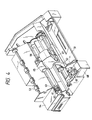
- Fig. 4 is a perspective external view of an ink-jet recording apparatus.
- Fig. 5 is a plan view of a post card employing the recording medium of the present invention.
- Fig. 6 is a sectional view of the post cards shown in Fig. 5.
- the recording medium of the present invention is composed of a base sheet, an ink-receiving layer formed on one face of the base sheet, and a cationic substance applied onto the other face reverse to the ink-receiving layer.
- the ink for the image-forming method of the present invention contains essentially a water-soluble dye having at least an anionic group.
- the base sheet employed in the present invention is mainly composed of chemical pulp such as LBKP and NBKP, a size, and a filler, and is formed into a sheet, by using a paper-making auxiliary agent if necessary, in a conventional paper-making process.
- the pulp employed may additionally contain, or mainly composed of mechanical pulp, or waste paper-regenerated pulp.
- the size includes rosin sizes, alkylketene dimers, alkenylsuccinic acid anhydrides, petroleum resin type sizes, epichlorohydrin, acrylamide, and the like.
- the filler includes calcium carbonate, kaolin, talc, titanium dioxide, and the like. Surface sizing treatment may be conducted, if necessary.
- the base sheet employed in the present invention is required to have appropriate ink absorbency, having preferably a Stöckigt sizing degree ranging from 0 to 15 seconds.
- a base sheet of less ink-absorbency requires a larger amount of coating on the both faces thereof in order to obtain sufficient ink absorbency in ink-jet recording.
- the larger amount of coating would undesirably cause difficulty and high cost in production, low suitability for writing with usual writing tools, low handleableness for use for post cards or other kinds of cards, impairment of recorded image caused by falling-off of the coat layer by folding or surface scratching, generation of paper dust, and so forth.
- the basis weight of the base sheet ranges preferably from 100 g/m to 200 g/m.
- the basis weight of the recording medium may preferably be in the range of from 120 g/m to 200 g/m. Since the base sheet itself is ink-absorbent, the recording medium of a basis weight of less than 120 g/m is liable to cause undesired phenomena such as waving or cockling of the printed portion having received the ink, penetration of ink to the reverse face, namely strike-through, and percolation of re-dissolved recording agent by deposited water drops to the reverse face.
- the recording medium having a basis weight of more than 200 g/m is too stiff, tending to exhibit low deliverability in a recording apparatus.
- the ink-receiving layer formed on the base sheet contains a binder.
- the binder includes casein, starch; a cellulose derivative such as carboxymethylcellulose, and hydroxymethylcellulose; a hydrophilic resin capable of being swelled by ink such as polyvinyl alcohol, polyvinylpyrrolidone, sodium polyacrylate, and polyacrylamide; a resin having hydrophilic portions and hydrophobic portions in the molecule such as SBR latexes, acrylic emulsions, and styrene-acrylate copolymers.
- the recording medium of the present invention essentially contains an inorganic pigment in the ink-receiving layer.
- An organic pigment may be used in combination with the inorganic pigment.
- the inorganic pigment includes silica, alumina, aluminum silicate, magnesium silicate, hydrotalcite, calcium carbonate, titanium oxide, clay, talc, and magnesium (basic) carbonate, but is not limited thereto.
- the organic pigment includes plastic pigments such as urea resins, urea-formalin resins, polyethylene resins, and polystyrene resins, but is not limited thereto.
- a water-repellent substance such as silicone oil, paraffin, wax, and fluorine compounds, or the aforementioned size may additionally be used.
- the ink-receiving layer may further contain, if necessary, an additive such as a dye-fixing agent, a fluorescent whitener, a surfactant, an antifoaming agent, a pH adjusting agent, an antiseptic agent, a UV absorber, an antioxidant, a dispersant, and a viscosity-reducing agent.
- an additive such as a dye-fixing agent, a fluorescent whitener, a surfactant, an antifoaming agent, a pH adjusting agent, an antiseptic agent, a UV absorber, an antioxidant, a dispersant, and a viscosity-reducing agent.
- an additive such as a dye-fixing agent, a fluorescent whitener, a surfactant, an antifoaming agent, a pH adjusting agent, an antiseptic agent, a UV absorber, an antioxidant, a dispersant, and a viscosity-reducing agent.
- the total amount of the applied pigment in the ink-receiving layer ranges preferably from 0.1 g/m to 50 g/m, more preferably from 0.1 g/m to 20 g/m. With a less amount of the pigment, the surface of the base sheet may incompletely be covered. At the amount of pigment of less than 0.1 g/m, the ink-receiving layer is not effective in color development of the dye in comparison with the case of no ink-receiving layer. At the amount of the pigment of more than 50 g/m, the coat layer is liable to cause powder falling-off.
- the recording medium of the present invention has essentially a cationic substance applied or impregnated onto or into the face of the base sheet reverse to the ink-receiving layer.
- the cationic substance on the reverse face of the base sheet improves the water-fastness and the image density of the recorded image.
- the cationic substance may be either a low-molecular cationic substance or a high-molecular cationic substance as shown below.
- Complete water-fastness is obtained by combination of a low-molecular cationic substance having a weight-average molecular weight of not higher than 1000, preferably from 100 to 700, and a high-molecular cationic substance of weight-average molecular weight of not lower than 2000, preferably from 2000 to 10000.
- the low-molecular cationic substance when ink is brought into contact with the combination of the low-molecular cationic substance of molecular weight of not higher than 1000 and the high-molecular cationic substance mentioned above on the recording medium or at the site of penetration, the low-molecular cationic substance is re-dissolved in the ink.
- the low-molecular cationic substance will associate with dye in the ink by ionic interaction, and be separated from the solution phase instantaneously as the first step of reaction of the recording medium with the ink.
- the association product of the low-molecular cationic substance with the dye is adsorbed by the high-molecular cationic substance of molecular weight of not lower than 2000, resulting in increase in dimension of the dye agglomerate formed by the association. Therefore, the dye does not readily penetrate into interstices between fibers of the recording medium, and only the liquid portion after the solid-liquid separation penetrates into the recording medium. Thereby, image quality and ink fixability are both improved.
- the agglomerate formed from the low-molecular cationic substance, the anionic dye and the high-molecular substance of molecular weight of not lower than 2000 as mentioned above has an extremely high viscosity, the agglomerate will not migrate with the liquid medium. Consequently, color mixing, or bleeding, will not occur between the adjacent dots of different colors in color printing like the aforementioned full color image formation.
- the agglomerate is inherently water-insoluble, rendering the water-fastness of the formed image perfect.
- the low-molecular cationic substance having a molecular weight of not higher than 1000 specifically includes hydrochlorides and acetates of primary, secondary, and tertiary amines such as laurylamine, coconut-amine, stearylamine, and rosin-amine; quaternary ammonium compounds such as lauryltrimethylammonium chloride, lauryldimethylbenzylammonium chloride, benzyltributylammnouim chloride, and benzalkonium chloride; pyridinium type compounds such as cetylpyridinium chloride, and cetylpyridinium bromide; imidazoline type cationic compounds such as 2-heptadecenyl-hydroxyethylimidazoline; and ethylene oxide adducts of higher alkylamines such as dihydroxyethylstearylamine.
- hydrochlorides and acetates of primary, secondary, and tertiary amines such as laurylamine, coconut
- an amphoteric surfactant may be used which is cationic in a certain pH region. More specifically, the amphoteric surfactant includes carboxylate salt type amphoteric surfactants such as amino acid type amphoteric surfactants, compounds of R-NH-CH2-CH2-COOH type, and betaine type compounds like stearyldimethyl-betaine and lauryldihydroxyethylbetaine; sulfate ester type amphoteric surfactants, sulfonate salt type amphoteric surfactant, and phosphate ester type amphoteric surfactants.
- carboxylate salt type amphoteric surfactants such as amino acid type amphoteric surfactants, compounds of R-NH-CH2-CH2-COOH type, and betaine type compounds like stearyldimethyl-betaine and lauryldihydroxyethylbetaine
- sulfate ester type amphoteric surfactants sulfonate salt type amphoteric surfactant,
- amphoteric surfactant should be used with a recording medium having a pH of lower than the isoelectric point thereof or with an ink adjusted to have a pH of lower than the isoelectric point on mixing with the amphoteric surfactant.
- a metallic compound may be used therefor, such as aluminum lactate, basic polyaluminum hydroxide, aluminum chloride, sodium aluminate, and aluminum acrylate.
- metallic compounds particularly preferred are benzalkonium chloride, benzyltributylammonium chloride, basic aluminum salts, and low-molecular polyallylamines.
- the low-molecular cationic compound useful in the present invention is not limited to those mentioned above.
- the association product of the low-molecular cationic substance with the dye is adsorbed by the high-molecular cationic substance of molecular weight of not lower than 2000, resulting in increase in dimension of the dye agglomerate formed by the association. Therefore, the dye cannot readily penetrate into interstices between fibers of the recording medium, and only the liquid portion resulting from the solid-liquid separation penetrates into the recording medium. Thereby, image quality and ink fixability are both improved.
- the high-molecular cationic substance which has a molecular weight of not lower than 2000, is sufficiently effective in practicing the present invention.
- the molecular weight is preferably in the range of from 2000 to 10000 for obtaining high image density. Without the low-molecular cationic substance of molecular weight of not higher than 1000, the effect of the association is low. Without the high-molecular cationic substance of molecular weight of not lower than 2000, the effect of the agglomeration is insufficient.
- the high-molecular cationic substance having a molecular weight of not lower than 2000 specifically includes polyallylamine and salts thereof, e.g., hydrochloride; polyaminesulfonic acid and salts thereof, e.g., hydrochloride; polyvinylamine and salts thereof, e.g., hydrochloride; chitosan and salts thereof, e.g., acetate, but is not limited thereto.
- the type of salt thereof is not limited to hydrochloride and acetate.
- the high-molecular cationic substance may be prepared by partially cationizing a nonionic high-molecular substance.
- a nonionic high-molecular substance include a copolymer of vinylpyrrolidone and a quaternary salt of an aminomethylalkyl acrylate, a copolymer of acrylamide and a quaternary salt of aminomethylacrylamide, and the like, but are not limited thereto.
- particularly preferred are polyallylamine salts, chitosan salts, and cationic acrylamides.
- the aforementioned high-molecular substance or the cationic high-molecular substance is preferably water-soluble, but may be dispersible in a state of a latex or an emulsion.
- the ratio of the low-molecular cationic substance to the high-molecular cationic substance is preferably in the range of from 20/1 to 1/20 by weight. Within this range, the recorded image has higher water-fastness as well as higher image quality and higher image density.
- the cationic components is contained in the recording medium preferably in an amount of from 0.05 g/m to 7 g/m. At the amount of lower than 0,05 g/m, the effect of the cationic substance is not achieved, whereas at the amount of higher than 7 g/m, the ink absorbency is lower and bleeding is liable to occur. More preferably the applied amount is in the range of from 0.3 to 3 g/m. At the amount of less than 0.3 g/m, the bleeding and the water-fastness are not improved sufficiently, whereas at the amount of more than 3 g/m, the light-fastness and the image density are tends to be lower.
- An inorganic pigment or an organic pigment may be used in combination with the cationic substance.
- the recording medium of the present invention is prepared from the above materials.
- the recording medium may be prepared by firstly applying a cationic substance and then forming an ink-receiving layer on a base sheet, or in another way, by firstly forming an ink-receiving layer on a face of a base sheet and then applying a cationic substance on the other face thereof.
- the cationic substance may be applied onto a base sheet in a mixture with the aforementioned surface-sizing aqueous coating liquid. Otherwise, the cationic substance contained in a liquid may be applied or impregnated onto or into a base sheet after application and drying of the aqueous coating liquid on a substrate.
- an aqueous coating liquid containing a pigment, a binder, and other additives as mentioned above is applied on the surface of a base sheet by a conventional method such as a roll coater method, a blade coater method, an air knife coater method, a gate roll coater method, a size press method, and a shim size method, and subsequently the coated matter is dried by an air drier, a heating drum, or the like. Further the resulting recording medium may be supercalendered for smoothening or strengthening of the surface.
- casting treatment of the outermost layer is preferred to the supercalender treatment.
- the casting treatment includes a wet casting method in which an undried wet coated layer is pressed against a mirror-polished heated finishing face; a rewetting casting method in which a dried coated layer is again wetted to plasticize it and is pressed against a mirror-polished heated finishing face; and a gel casting method in which a wet coated layer is brought into a gelled state and is pressed against a mirror-polished heated finishing face.
- the casting methods are most suitable for gloss finish, but other methods may be employed.
- Fig. 5 shows an example of a post card employing the recording medium thus prepared of the present invention.
- Fig. 6 shows the cross-section of the post card.
- the recording medium is constituted of an ink-receiving layer A, a base paper B, and a layer C containing a cationic substance.
- an image is formed on the face of the layer A by color ink-jet recording, and an address is written on the face of the layer C.
- the border lines for the post code and the postage stamp may be printed by ink-jet recording or offset printing.
- the ink comprises a water-soluble dye having an anionic group, water, and a water-soluble organic solvent, and, if necessary, an additive such as a viscosity controlling agent, a pH-controlling agent, an antiseptic agent, a surfactant, an antioxidant, or the like.
- an additive such as a viscosity controlling agent, a pH-controlling agent, an antiseptic agent, a surfactant, an antioxidant, or the like.
- the water-soluble dye having an anionic group used in the present invention may be selected from the water-soluble dyes of acid dyes, direct dyes, and reactive dyes listed in Color Index without any limitation. Further, any dye having an anionic group such as a sulfonic group and a carboxylic group may be used without limitation even though it is not listed in Color Index.
- the water-soluble dye herein includes naturally those having a pH-dependent solubility.
- the water-soluble organic solvent for the ink includes amides such as dimethyl formamide and dimethylacetamide; ketones such as acetone; ethers such as tetrahydrofuran and dioxane; polyalkylene glycols such as polyethylene glycol and polypropylene glycol; glycols such as ethylene glycol, propylene glycol, butylene glycol, triethylene glycol, 1,2,6-hexanetriol, thiodiglycol, hexylene glycol, and diethylene glycol; lower alkyl ethers of polyhydric alcohols such as ethylene glycol monomethyl ether, diethylene glycol monomethyl ether, and triethylene glycol monomethyl ether, monohydric alcohols such as ethanol, isopropyl alcohol, n-butyl alcohol, and isobutyl alcohol; and glycerin, N-methyl-2-pyrrolidone, 1,3-dimethylimidazolidinone, triethanolamine, sulfolane, dimethyl
- the ink may contain, if necessary, other additives such as a viscosity-adjusting agent, a pH-controlling agent, an antiseptic agent, a surfactant, an antioxidant, an evaporation accelerator, and the like.
- a viscosity-adjusting agent such as a viscosity-adjusting agent, a pH-controlling agent, an antiseptic agent, a surfactant, an antioxidant, an evaporation accelerator, and the like.
- the ink has preferably the following properties at around 25°C: a pH of from 3 to 12, a surface tension of from 10 to 60 dyn/cm, and a viscosity of from 1 to 30 cp. More preferably, the surface tension of the respective color inks of yellow, magenta, and cyan is in the range of from 25 to 40 dyn/cm in view of rapid ink absorption and of clear image formation without ink running.
- the ink may contain, in addition to the above mentioned components, an anionic surfactant, or an anionic high-molecular substance, or the aforementioned amphoteric surfactant adjusted to a pH above the isoelectric point.
- an anionic surfactant including carboxylate salt type surfactants, sulfate ester type surfactants, sulfonate acid type surfactants, and phosphate ester type surfactant may be used without disadvantages.
- the useful anionic high-molecular substance includes alkali-soluble resins such as sodium polyacrylate, and copolymers of acrylic acid with another monomer, but is not limited thereto.
- the ink-jet recording system is explained below.
- the image forming method of the present invention is applicable to any known ink-jet recording system which ejects droplets of an ink through a nozzle to apply ink onto the recording medium.
- a typical example of the effective ink-jet recording system is disclosed in Japanese Patent Application Laid-Open No. 54-59936, in which thermal energy is given to the ink to cause abrupt change of the volume of the ink and to eject ink from a nozzle by the phase change energy.
- FIG. 1, 2, and 3 illustrate examples of the construction of a head which is the essential part of the apparatus.
- a head 13 is constructed by bonding a plate of glass, ceramics, plastics, or the like having grooves 14 for ink flow with a heat-generating head 15 for thermal recording.
- the heat-generating head is not limited to the one shown in the drawings.
- the heat-generating head 15 is constituted of a protection layer 16 formed from silicon oxide or the like; aluminum electrodes 17-1, 17-2; a heat-generating resistance layer 18 made of nichrome or the like; a heat-accumulating layer 19; and a heat-radiating substrate plate 20 made of alumina or the like.
- the ink 21 fills an ejection orifice (fine nozzle) 22, and has a meniscus 23 formed by a pressure P.
- the region denoted by a symbol "n" on the heat-generating head 15 On application of an electric signal information to the electrodes 17-1, 17-2 of the head, the region denoted by a symbol "n" on the heat-generating head 15 generates heat abruptly to form bubbles in the ink 21 on that region, the pressure of the bubble pushes out the meniscus 23 to eject the ink 21 from the orifice 22 in a shape of droplets 24. The ejected ink droplets travel toward a recording sheet 25.
- Fig. 3 shows an external appearance of a multiple head integrating a plurality of heads shown in Fig. 1.
- the multiple head is formed by bonding a glass plate 27 having multiple grooves 26 with the heat-generating head 28 like the one shown in Fig. 1.
- Fig. 1 is a sectional view of the head 13 along the ink flow path
- Fig. 2 is a sectional view taken at the line 2-2 in Fig. 1.
- Fig. 4 shows an example of the entire of the ink-jet recording apparatus equipped with the above-described head.
- a blade 61 as a wiping member is held at one end of the blade by a blade-holding member, forming a fixed end in a shape of a cantilever.
- the blade 61 is placed at a position adjacent to the recording region of the recording head, and, in this example, is held so as to protrude into the moving path of the recording head.
- the cap 62 is placed at a home position adjacent to the blade 61, and is constituted such that it moves in the direction perpendicular to the moving direction of the recording head to come into contact with the ejection nozzle face to cap the nozzle.
- An ink absorbent 63 is placed at a position adjacent to the blade 61, and is held so as to protrude into the moving path of the recording head in a manner similar to that of the blade 61.
- the blade 61, the cap 62, and the absorbent 63 constitute an ejection recovery device 64.
- the blade 61, and the absorbent 63 serve to remove off water, dust, and the like from the face of the ink ejection nozzle.
- a recording head 65 has an energy-generating means for the ejection, and conducts recording by ejecting the ink onto a recording medium opposing to the ejection nozzle face.
- a carriage 66 is provided for supporting and moving the recording head 65. The carriage 66 is engaged slidably with a guide rod 67. A portion of the carriage 66 is connected (not shown in the drawing) to a belt 69 driven by a motor 68, so that the carriage 66 is movable along the guide rod 67 to the recording region of the recording head 65 and the adjacent region thereto.
- a paper sheet delivery device 51 for delivery of a recording medium and a paper sheet delivery roller 52 driven by a motor (not shown in the drawing) delivers a recording medium to the position opposing to the ejection nozzle face of the recording head, and the recording medium is delivered with the progress of the recording to a paper discharge device provided with paper sheet-discharging rollers 53.
- the cap 62 of the ejection-recovery device 64 is positioned out of the moving path of the recording head 65, and the blade 61 is allowed to protrude to the moving path. Thereby, the ejecting nozzle face of the recording head 65 is wiped. To cap the ejection face of the recording head 65, the cap 62 protrudes toward the moving path of the recording head to come into contact with the ejection nozzle face.
- the cap 62 and the blade 61 are at the same position as in the above-mentioned wiping step, so that the ejection nozzle face of the recording head 65 is wiped also in this movement.
- the recording head is moved to the home position not only at the completion of the recording and at the time of ejection recovery, but is also moved at a predetermined intervals during recording from the recording region.
- the nozzle is wiped by such movement.
- ink-jet recording For color printing by ink-jet recording, four recording heads holding respectively inks of black, cyan, magenta, and yellow are juxtaposed horizontally or vertically on the carriage 66.
- the inks may be three colors of cyan, magenta, and yellow in place of the four colors.
- a mixture of 80 parts of LBKP and 20 parts of NBKP was beaten to C.S.F of 430 mL for use as the starting pulp.
- Coating Liquid X for the ink-receiving layer was prepared which had the composition below. This coating liquid was applied on the other face of Base Paper Sheet A to obtain Recording Paper Sheet 1 of the present invention. The dry coating amount was adjusted to 8.0 g/m.
- Fine powdery silica 10 parts (Mizuka Sil P-78D, Mizusawa Kagaku K.K.) Polyvinyl alcohol 4 parts (PVA 117, Kuraray Co., Ltd.) Polyallylamine hydrochloride 0.6 part (PAA-HCl-3L, molecular weight: 10,000, Nitto Boseki Co., Ltd.) Water 85.4 parts
- the inks of yellow, magenta, cyan, and black: (1) -Y, (1) -M, (1) -C, and (1) - K were prepared by mixing the components below and filtering them through a membrane filter of a pore size of 0.22 ⁇ m (Fluoropore Filter, trade name, Sumitomo Electric Industries, Ltd.) under pressure.
- a color image was formed with the above-mentioned inks by means of a recording apparatus which was equipped with a bubble jet type recording head having 14 recording nozzles per mm and ejecting ink droplets by action of thermal energy.
- the recorded image was evaluated as below.
- the tint of magenta-, and cyan-color printed areas were examined visually.
- the recording paper on which the color saturation is high and the colors are clear was evaluated as "Good” in color development.
- the one on which the color saturation is low and the colors are dusky was evaluated as "Fair”.
- the one on which the color saturation is low and the colors are significantly dusky was evaluated as "Poor”.
- Impregnation Liquids B and C having the compositions below were prepared. and the respective liquids were impregnated into the aforementioned Recording Paper Base Sheet L in the same manner as in Example 1 to obtain Base Paper Sheets B and C. The amount of impregnation after drying was adjusted to 2.0 g/m. Thereon, the aforementioned Coating Liquid X was applied in the same manner as in Example 1 to obtain Recording Paper Sheet 2 and Comparative Recording Paper Sheet 1.
- Benzalkonium chloride 0.2 part (G-50, Sanyo Chemical Industries Ltd.) Polyallylamine 0.8 part (PAA-10C, Nitto Boseki Co., Ltd.) Water 99.0 parts
- Recording Paper Base Sheet N of a basis weight of 140 g/m was prepared in the same manner as Recording Paper Base Sheet L. Impregnation Liquid D of the composition below was prepared, and Base Paper Sheet D was prepared in the same manner as in Example 1. The amount of impregnation after drying was adjusted to 2.0 g/m.
- Benzyltributylammonium chloride 0.4 part (BTBAC, Sanyo Chemical Industries, Ltd.)
- Polyallylamine 0.6 part (PPA-10C, Nitto Boseki Co., Ltd.) Water 99.0 parts
- Coating Liquid Y for an ink-receiving layer having the composition below was applied on Base Paper Sheet D by an applicator in a dry solid amount of 10 g/m, and the applied matter was treated with aqueous 10% calcium formate.
- Fine powdery silica 6 parts (Mizuka Sil P-78D, Mizusawa Kagaku K.K.) Polyvinyl alcohol 1 parts (PVA 117, Kuraray Co., Ltd.) Styrene-butadiene latex 1 part (Sumitomo Naugatuck K.K.) Polyallylamine hydrochloride 0.6 part (PAA-HCl-3L, molecular weight: 10,000, Nitto Boseki Co., Ltd.) Water 91.4 parts
- Impregnation Liquid E having the composition below was prepared, and was impregnated into Recording Base Paper Sheet L to obtain Base Paper Sheet E. The amount of impregnation after drying was adjusted to 0.5 g/m.
- Aluminium basic lactate 0.1 part (Takiseram G-17P, Taki Chemical Co., Ltd.) Polyallylamine hydrochloride 0.9 part (PAA-HCl-3L, molecular weight: 10,000, Nitto Boseki Co., Ltd.) Water 99.0 parts
- Impregnation Liquid F having the composition below was prepared, and was impregnated into Recording Base Paper Sheet L in the same manner as in Example 1 to obtain Base Paper Sheet F.
- the amount of impregnation after drying was adjusted to 0.5 g/m.
- Coating Liquid Z for an ink receiving layer having the composition below was prepared, and was applied in the same manner as in Example 1 to obtain Recording Paper Sheet 5 of the present invention.
- the amount of dry coating was adjusted to 8.0 g/m.
- fine powdery silica in Coating Liquid X for ink-receiving layer was replaced by fine powdery alumina (trade name: AKP-G015, Sumitomo Chemical Co., Ltd.).
- Recording Paper Sheet 6 of the present invention was prepared in the same manner as in Example 3 except that Impregnation Liquid G having the composition below was impregnated into the aforementioned Recording Paper Base Sheet N in an amount of dry solid coating of 0.5 g/m.
- Aluminium acrylate 0.2 part P-3, Asada Kagaku K.K.
- Polyallylamine hydrochloride 0.8 part PAA-HCl-3L, molecular weight: 10,000, Nitto Boseki Co., Ltd.
- Recording Paper Base Sheet M having a basis weight of 60 g/m was prepared in the same manner as Recording Paper Base Sheet L. Impregnation Liquid H shown below was impregnated thereto in the same manner as in Example 1 to obtain Base Paper Sheet H. The dry coating amount was adjusted to 0.5 g/m. Thereon Coating Liquid X for an ink-receiving layer was applied in the same manner as in Example 1 to obtain Recording Paper Sheet 7 of the present invention.
- the aforementioned Coating Liquid X for an ink-receiving layer was applied on the aforementioned Recording Paper Base Sheet M in a dry coating amount of 8.0 g/m. Then the aforementioned Impregnation Liquid H was impregnated into the face of the recording paper base sheet reverse to the ink-receiving layer in a dry coating amount of 0.5 g/m to obtain Recording Paper Sheet 8 of the present invention.
- Recording Paper Sheet 9 was prepared in the same manner as in Example 7 except that the dry coating amount of Impregnation Liquid H was changed to 2.0 g/m.
- the recording medium of the present invention is capable of forming sharp color images on the one face thereof with high density and high resolution by ink-jet recording, and is also capable of forming images on the reverse face, on which no ink-receiving layer is provided, by ink-jet recording with high quality and water-fastness of the recorded images.
- the recording medium of the present invention is suitable for post cards and other cards.
- the recording mediums of Examples 1 to 9 with a cationic substance applied on the reverse face gave high water fastness of the recorded image, whereas the recording medium of Comparative Example 1 without a cationic substance gave low water fastness of the recorded image.
- the recording paper sheets having a larger basis weight of Examples 1 to 6 did not cause percolation of re-dissolved ink to the reverse face even when water drops were deposited for hours.
- the recording medium of the present invention makes possible formation of original color images on a post cards or the like cards easily at a low cost.
- a recording medium which has an ink-receiving layer mainly composed of an inorganic pigment and a binder on one face of an ink-absorbent base sheet, and a cationic substance applied on, or impregnated into, the reverse face of the base sheet.
Landscapes
- Chemical & Material Sciences (AREA)
- Chemical Kinetics & Catalysis (AREA)
- Inorganic Chemistry (AREA)
- Ink Jet Recording Methods And Recording Media Thereof (AREA)
- Paper (AREA)
Applications Claiming Priority (4)
| Application Number | Priority Date | Filing Date | Title |
|---|---|---|---|
| JP263721/94 | 1994-10-27 | ||
| JP26372194 | 1994-10-27 | ||
| JP268638/95 | 1995-10-17 | ||
| JP26863895A JP3591938B2 (ja) | 1994-10-27 | 1995-10-17 | インクジェット用記録媒体及びこれを用いた画像形成方法 |
Publications (2)
| Publication Number | Publication Date |
|---|---|
| EP0709220A1 true EP0709220A1 (fr) | 1996-05-01 |
| EP0709220B1 EP0709220B1 (fr) | 1999-02-10 |
Family
ID=26546162
Family Applications (1)
| Application Number | Title | Priority Date | Filing Date |
|---|---|---|---|
| EP95116881A Expired - Lifetime EP0709220B1 (fr) | 1994-10-27 | 1995-10-26 | Matériau pour l'enregistrement et méthode pour former des images l'utilisant |
Country Status (4)
| Country | Link |
|---|---|
| US (1) | US6500523B1 (fr) |
| EP (1) | EP0709220B1 (fr) |
| JP (1) | JP3591938B2 (fr) |
| DE (1) | DE69507764T2 (fr) |
Cited By (4)
| Publication number | Priority date | Publication date | Assignee | Title |
|---|---|---|---|---|
| US7838541B2 (en) | 2002-02-11 | 2010-11-23 | Bayer Healthcare, Llc | Aryl ureas with angiogenesis inhibiting activity |
| US7897623B2 (en) | 1999-01-13 | 2011-03-01 | Bayer Healthcare Llc | ω-carboxyl aryl substituted diphenyl ureas as p38 kinase inhibitors |
| US8124630B2 (en) | 1999-01-13 | 2012-02-28 | Bayer Healthcare Llc | ω-carboxyaryl substituted diphenyl ureas as raf kinase inhibitors |
| US8796250B2 (en) | 2003-05-20 | 2014-08-05 | Bayer Healthcare Llc | Diaryl ureas for diseases mediated by PDGFR |
Families Citing this family (17)
| Publication number | Priority date | Publication date | Assignee | Title |
|---|---|---|---|---|
| JP3958417B2 (ja) * | 1997-10-08 | 2007-08-15 | 日本製紙株式会社 | インクジェット記録用紙及びその製造方法 |
| CN1268923A (zh) * | 1998-03-12 | 2000-10-04 | 坂东化学株式会社 | 用粉末涂料组合物涂布的片材及其制造方法和用途 |
| JP4282136B2 (ja) * | 1999-03-09 | 2009-06-17 | 株式会社きもと | インクジェット記録方法 |
| DE19916546C2 (de) * | 1999-04-13 | 2001-05-03 | Technocell Dekor Gmbh & Co Kg | Tintenstrahl-Aufnahmeschicht |
| JP4567916B2 (ja) * | 2001-06-20 | 2010-10-27 | 日清紡ホールディングス株式会社 | インクジェット記録用シート |
| US7086726B2 (en) * | 2002-04-09 | 2006-08-08 | Fuji Photo Film Co., Ltd. | Inkjet recording method |
| US20040031167A1 (en) * | 2002-06-13 | 2004-02-19 | Stein Nathan D. | Single wafer method and apparatus for drying semiconductor substrates using an inert gas air-knife |
| US7557129B2 (en) | 2003-02-28 | 2009-07-07 | Bayer Healthcare Llc | Cyanopyridine derivatives useful in the treatment of cancer and other disorders |
| JP4229771B2 (ja) * | 2003-07-04 | 2009-02-25 | 理想科学工業株式会社 | ポストカード調製機 |
| JP4064909B2 (ja) * | 2003-11-19 | 2008-03-19 | 富士フイルム株式会社 | インクジェット記録方法及びインクジェット画像 |
| JP5451556B2 (ja) * | 2009-09-18 | 2014-03-26 | キヤノン株式会社 | 色素化合物 |
| JP5569036B2 (ja) * | 2010-02-26 | 2014-08-13 | セイコーエプソン株式会社 | インクジェット捺染方法 |
| JP5569035B2 (ja) * | 2010-02-26 | 2014-08-13 | セイコーエプソン株式会社 | インクジェット捺染方法 |
| JP6602055B2 (ja) | 2014-06-30 | 2019-11-06 | キヤノン株式会社 | 自己分散顔料の製造方法、インクの製造方法、及びインクジェット記録方法 |
| JP2017007149A (ja) * | 2015-06-18 | 2017-01-12 | 株式会社Screenホールディングス | インク受容層用組成物、インクジェット用記録媒体及びインクジェット用インク組成物 |
| JP2017061113A (ja) * | 2015-09-25 | 2017-03-30 | 北越紀州製紙株式会社 | インクジェットプリンタ対応葉書の原紙 |
| JP6592383B2 (ja) * | 2016-03-04 | 2019-10-16 | 北越コーポレーション株式会社 | インクジェットプリンタ対応葉書の原紙の製造方法 |
Citations (8)
| Publication number | Priority date | Publication date | Assignee | Title |
|---|---|---|---|---|
| FR2257738A1 (fr) * | 1974-01-16 | 1975-08-08 | Schoeller Reflex Papier | |
| JPS5459936A (en) | 1977-10-03 | 1979-05-15 | Canon Inc | Recording method and device therefor |
| JPS5935977A (ja) | 1982-08-23 | 1984-02-27 | Canon Inc | 被記録材 |
| JPH01135682A (ja) | 1987-11-20 | 1989-05-29 | Canon Inc | 記録紙及びこれを用いたインクジエツト記録方法 |
| EP0387893A1 (fr) * | 1989-03-17 | 1990-09-19 | Nippon Paper Industries Co., Ltd. | Papier d'enregistrement par jet d'encre |
| EP0495430A1 (fr) * | 1991-01-14 | 1992-07-22 | Canon Kabushiki Kaisha | Milieu d'enregistrement et méthode d'enregistrement par jet d'encre l'utilisant |
| EP0600245A1 (fr) * | 1992-11-09 | 1994-06-08 | Mitsubishi Paper Mills, Ltd. | Feuille pour l'enregistrement à jet d'encre et procédé pour sa préparation |
| DE4307241A1 (de) * | 1993-03-08 | 1994-09-15 | Steinbeis Temming Papier Gmbh | Holzhaltiges Aufzeichnungspapier für Tintenspritzaufzeichnungsverfahren |
Family Cites Families (33)
| Publication number | Priority date | Publication date | Assignee | Title |
|---|---|---|---|---|
| JPS5113244A (ja) | 1974-07-23 | 1976-02-02 | Canon Kk | Tenshashi |
| CA1127227A (fr) | 1977-10-03 | 1982-07-06 | Ichiro Endo | Procede d'enregistrement a jet liquide et appareil d'enregistrement |
| JPS5699693A (en) | 1980-01-14 | 1981-08-11 | Ricoh Co Ltd | Ink jet recording method |
| US4542059A (en) | 1982-08-23 | 1985-09-17 | Canon Kabushiki Kaisha | Recording medium |
| JPS59162561A (ja) | 1983-03-08 | 1984-09-13 | Fuji Xerox Co Ltd | 電子写真用転写紙 |
| JPS59191068A (ja) | 1983-04-14 | 1984-10-30 | Fuji Xerox Co Ltd | 転写用紙 |
| US4636805A (en) | 1984-03-23 | 1987-01-13 | Canon Kabushiki Kaisha | Record-bearing member and ink-jet recording method by use thereof |
| JPS60220750A (ja) | 1984-04-18 | 1985-11-05 | キヤノン株式会社 | 被記録材 |
| US4554181A (en) | 1984-05-07 | 1985-11-19 | The Mead Corporation | Ink jet recording sheet having a bicomponent cationic recording surface |
| JPH0630951B2 (ja) | 1984-08-31 | 1994-04-27 | キヤノン株式会社 | 被記録材 |
| US4664952A (en) | 1984-10-23 | 1987-05-12 | Canon Kabushiki Kaisha | Recording medium and recording method utilizing the same |
| JPS61100490A (ja) | 1984-10-23 | 1986-05-19 | Canon Inc | 被記録材及びこれを用いたカラー画像の形成方法 |
| JPH0662001B2 (ja) | 1985-01-28 | 1994-08-17 | キヤノン株式会社 | インクジェット用被記録材 |
| EP0199874A1 (fr) | 1985-02-25 | 1986-11-05 | The Mead Corporation | Feuille pour l'enregistrement à jet d'encre comportant une couche réceptive d'encre contenant de l'oxyde de polyéthylène |
| JPS62124976A (ja) | 1985-11-26 | 1987-06-06 | Canon Inc | 被記録材 |
| US4785313A (en) | 1985-12-16 | 1988-11-15 | Canon Kabushiki Kaisha | Recording medium and image formation process using the same |
| DE3780181T2 (de) | 1986-02-07 | 1993-02-25 | Canon Kk | Bildaufzeichnungsverfahren. |
| US4758461A (en) * | 1986-12-05 | 1988-07-19 | Canon Kabushiki Kaisha | Recording paper and ink jet recording method by use thereof |
| US5041328A (en) | 1986-12-29 | 1991-08-20 | Canon Kabushiki Kaisha | Recording medium and ink jet recording method by use thereof |
| ATE77307T1 (de) * | 1987-01-16 | 1992-07-15 | Kuraray Co | Aufzeichnungsmittel fuer tinte. |
| US4910084A (en) | 1987-05-01 | 1990-03-20 | Mitsubishi Paper Mills, Ltd. | Ink jet recording medium |
| GB2211866B (en) | 1987-11-05 | 1992-04-15 | Oji Paper Co | Ink-jet recording sheet |
| JP2633671B2 (ja) | 1989-01-18 | 1997-07-23 | 日本製紙 株式会社 | インクジェット記録用シート |
| JP2604189B2 (ja) | 1988-01-27 | 1997-04-30 | キヤノン株式会社 | 被記録材 |
| US5266383A (en) | 1988-03-04 | 1993-11-30 | Canon Kabushiki Kaisha | Recording medium and ink jet recording method by use thereof |
| US4965612A (en) | 1988-11-02 | 1990-10-23 | Canon Kabushiki Kaisha | Ink-jet recording system and ink-jet recording method |
| JP2670454B2 (ja) | 1989-04-03 | 1997-10-29 | キヤノン株式会社 | 被記録材及びこれを用いた記録方法 |
| JP2622173B2 (ja) | 1989-06-26 | 1997-06-18 | キヤノン株式会社 | 被記録材及びこれを用いた記録方法 |
| US5246774A (en) | 1989-12-29 | 1993-09-21 | Canon Kabushiki Kaisha | Ink-jet medium and ink-jet recording method making use of it |
| US5137778A (en) | 1990-06-09 | 1992-08-11 | Canon Kabushiki Kaisha | Ink-jet recording medium, and ink-jet recording method employing the same |
| JPH0475140A (ja) | 1990-07-17 | 1992-03-10 | Gijutsu Kenkyu Kumiai Kokusai Fuajii Kogaku Kenkyusho | 記号処理及び数値処理を並列的に行う情報処理装置 |
| JP2521896B2 (ja) * | 1991-01-18 | 1996-08-07 | 日本製紙株式会社 | インクジェット記録シ―ト |
| JPH06239014A (ja) | 1993-02-16 | 1994-08-30 | Canon Inc | 記録媒体 |
-
1995
- 1995-10-17 JP JP26863895A patent/JP3591938B2/ja not_active Expired - Fee Related
- 1995-10-25 US US08/547,797 patent/US6500523B1/en not_active Expired - Fee Related
- 1995-10-26 DE DE69507764T patent/DE69507764T2/de not_active Expired - Lifetime
- 1995-10-26 EP EP95116881A patent/EP0709220B1/fr not_active Expired - Lifetime
Patent Citations (8)
| Publication number | Priority date | Publication date | Assignee | Title |
|---|---|---|---|---|
| FR2257738A1 (fr) * | 1974-01-16 | 1975-08-08 | Schoeller Reflex Papier | |
| JPS5459936A (en) | 1977-10-03 | 1979-05-15 | Canon Inc | Recording method and device therefor |
| JPS5935977A (ja) | 1982-08-23 | 1984-02-27 | Canon Inc | 被記録材 |
| JPH01135682A (ja) | 1987-11-20 | 1989-05-29 | Canon Inc | 記録紙及びこれを用いたインクジエツト記録方法 |
| EP0387893A1 (fr) * | 1989-03-17 | 1990-09-19 | Nippon Paper Industries Co., Ltd. | Papier d'enregistrement par jet d'encre |
| EP0495430A1 (fr) * | 1991-01-14 | 1992-07-22 | Canon Kabushiki Kaisha | Milieu d'enregistrement et méthode d'enregistrement par jet d'encre l'utilisant |
| EP0600245A1 (fr) * | 1992-11-09 | 1994-06-08 | Mitsubishi Paper Mills, Ltd. | Feuille pour l'enregistrement à jet d'encre et procédé pour sa préparation |
| DE4307241A1 (de) * | 1993-03-08 | 1994-09-15 | Steinbeis Temming Papier Gmbh | Holzhaltiges Aufzeichnungspapier für Tintenspritzaufzeichnungsverfahren |
Cited By (7)
| Publication number | Priority date | Publication date | Assignee | Title |
|---|---|---|---|---|
| US7897623B2 (en) | 1999-01-13 | 2011-03-01 | Bayer Healthcare Llc | ω-carboxyl aryl substituted diphenyl ureas as p38 kinase inhibitors |
| US8124630B2 (en) | 1999-01-13 | 2012-02-28 | Bayer Healthcare Llc | ω-carboxyaryl substituted diphenyl ureas as raf kinase inhibitors |
| US8841330B2 (en) | 1999-01-13 | 2014-09-23 | Bayer Healthcare Llc | Omega-carboxyaryl substituted diphenyl ureas as raf kinase inhibitors |
| US7838541B2 (en) | 2002-02-11 | 2010-11-23 | Bayer Healthcare, Llc | Aryl ureas with angiogenesis inhibiting activity |
| US8242147B2 (en) | 2002-02-11 | 2012-08-14 | Bayer Healthcare Llc | Aryl ureas with angiogenisis inhibiting activity |
| US8618141B2 (en) | 2002-02-11 | 2013-12-31 | Bayer Healthcare Llc | Aryl ureas with angiogenesis inhibiting activity |
| US8796250B2 (en) | 2003-05-20 | 2014-08-05 | Bayer Healthcare Llc | Diaryl ureas for diseases mediated by PDGFR |
Also Published As
| Publication number | Publication date |
|---|---|
| US6500523B1 (en) | 2002-12-31 |
| EP0709220B1 (fr) | 1999-02-10 |
| DE69507764T2 (de) | 1999-08-05 |
| DE69507764D1 (de) | 1999-03-25 |
| JPH08174996A (ja) | 1996-07-09 |
| JP3591938B2 (ja) | 2004-11-24 |
Similar Documents
| Publication | Publication Date | Title |
|---|---|---|
| EP0709220B1 (fr) | Matériau pour l'enregistrement et méthode pour former des images l'utilisant | |
| EP0661168B1 (fr) | Matériel pour l'enregistrement et méthode pour la formation d'images d'utilisant | |
| JP3591969B2 (ja) | インクジェット用記録媒体及びこれを用いたカラーインクジェット記録方法 | |
| CA2173691C (fr) | Papier d'impression et procede d'impression a jet d'encre utilisant ledit papier | |
| AU2891100A (en) | Ink-jet recording material comprising pigment layers | |
| JPH0999628A (ja) | 画像形成方法 | |
| EP1112856B1 (fr) | Matériau d'enregistrement, son procédé de fabrication et procédé de formation d'image | |
| CA2161401C (fr) | Papier enregistreur et methode d'impression connexe | |
| JPH0585033A (ja) | 被記録材 | |
| JP3072824B2 (ja) | インクジェット用記録媒体及びこれを用いた画像形成方法 | |
| JPH08230311A (ja) | 記録媒体および画像形成方法 | |
| JP2003034072A (ja) | インクジェット記録用記録紙およびそれを用いたインクジェット記録方法 | |
| JPH1120304A (ja) | インク受容層用塗工液、インクジェット用被記録媒体及びインクジェット用被記録媒体の製造方法 | |
| JPH07266689A (ja) | 記録媒体及びこれを用いた画像形成方法 | |
| JP3368101B2 (ja) | 記録媒体及びこれを用いたインクジェット記録方法 | |
| JPH08118787A (ja) | 記録媒体及び画像形成方法 | |
| GB2380695A (en) | Recording material | |
| JP2000238414A (ja) | インクジェット記録媒体及び記録方法 | |
| JPH09143406A (ja) | 塗工液、該塗工液を用いた記録媒体、該記録媒体の製造方法及び該記録媒体を用いたインクジェット記録方法 | |
| JPS61125878A (ja) | インクジエツト記録用シ−ト | |
| JPH08295076A (ja) | 記録紙およびこれを用いたインクジェット記録方法 | |
| JPH06183132A (ja) | インクジェット記録シート及びその製造方法 | |
| JPH10226152A (ja) | インクジェット用記録媒体及びインクジェット記録方法 | |
| JPH08118788A (ja) | 記録媒体及びこれを用いた画像形成方法 | |
| JPH10119425A (ja) | 記録紙及びこれを用いたインクジェット記録方法 |
Legal Events
| Date | Code | Title | Description |
|---|---|---|---|
| PUAI | Public reference made under article 153(3) epc to a published international application that has entered the european phase |
Free format text: ORIGINAL CODE: 0009012 |
|
| AK | Designated contracting states |
Kind code of ref document: A1 Designated state(s): DE FR GB IT |
|
| 17P | Request for examination filed |
Effective date: 19960917 |
|
| 17Q | First examination report despatched |
Effective date: 19961113 |
|
| GRAG | Despatch of communication of intention to grant |
Free format text: ORIGINAL CODE: EPIDOS AGRA |
|
| GRAG | Despatch of communication of intention to grant |
Free format text: ORIGINAL CODE: EPIDOS AGRA |
|
| GRAH | Despatch of communication of intention to grant a patent |
Free format text: ORIGINAL CODE: EPIDOS IGRA |
|
| GRAH | Despatch of communication of intention to grant a patent |
Free format text: ORIGINAL CODE: EPIDOS IGRA |
|
| GRAA | (expected) grant |
Free format text: ORIGINAL CODE: 0009210 |
|
| AK | Designated contracting states |
Kind code of ref document: B1 Designated state(s): DE FR GB IT |
|
| ITF | It: translation for a ep patent filed | ||
| ET | Fr: translation filed | ||
| REF | Corresponds to: |
Ref document number: 69507764 Country of ref document: DE Date of ref document: 19990325 |
|
| PLBE | No opposition filed within time limit |
Free format text: ORIGINAL CODE: 0009261 |
|
| STAA | Information on the status of an ep patent application or granted ep patent |
Free format text: STATUS: NO OPPOSITION FILED WITHIN TIME LIMIT |
|
| 26N | No opposition filed | ||
| REG | Reference to a national code |
Ref country code: GB Ref legal event code: IF02 |
|
| PGFP | Annual fee paid to national office [announced via postgrant information from national office to epo] |
Ref country code: IT Payment date: 20071026 Year of fee payment: 13 |
|
| PGFP | Annual fee paid to national office [announced via postgrant information from national office to epo] |
Ref country code: FR Payment date: 20071009 Year of fee payment: 13 |
|
| REG | Reference to a national code |
Ref country code: FR Ref legal event code: ST Effective date: 20090630 |
|
| PG25 | Lapsed in a contracting state [announced via postgrant information from national office to epo] |
Ref country code: IT Free format text: LAPSE BECAUSE OF NON-PAYMENT OF DUE FEES Effective date: 20081026 |
|
| PG25 | Lapsed in a contracting state [announced via postgrant information from national office to epo] |
Ref country code: FR Free format text: LAPSE BECAUSE OF NON-PAYMENT OF DUE FEES Effective date: 20081031 |
|
| PGFP | Annual fee paid to national office [announced via postgrant information from national office to epo] |
Ref country code: DE Payment date: 20131031 Year of fee payment: 19 Ref country code: GB Payment date: 20131018 Year of fee payment: 19 |
|
| REG | Reference to a national code |
Ref country code: DE Ref legal event code: R119 Ref document number: 69507764 Country of ref document: DE |
|
| GBPC | Gb: european patent ceased through non-payment of renewal fee |
Effective date: 20141026 |
|
| PG25 | Lapsed in a contracting state [announced via postgrant information from national office to epo] |
Ref country code: GB Free format text: LAPSE BECAUSE OF NON-PAYMENT OF DUE FEES Effective date: 20141026 Ref country code: DE Free format text: LAPSE BECAUSE OF NON-PAYMENT OF DUE FEES Effective date: 20150501 |