EP0717129A2 - Reinigungsverfahren - Google Patents
Reinigungsverfahren Download PDFInfo
- Publication number
- EP0717129A2 EP0717129A2 EP95117431A EP95117431A EP0717129A2 EP 0717129 A2 EP0717129 A2 EP 0717129A2 EP 95117431 A EP95117431 A EP 95117431A EP 95117431 A EP95117431 A EP 95117431A EP 0717129 A2 EP0717129 A2 EP 0717129A2
- Authority
- EP
- European Patent Office
- Prior art keywords
- cleaning
- cleaning agent
- agent
- drying
- vapor drying
- Prior art date
- Legal status (The legal status is an assumption and is not a legal conclusion. Google has not performed a legal analysis and makes no representation as to the accuracy of the status listed.)
- Granted
Links
Images
Classifications
-
- C—CHEMISTRY; METALLURGY
- C11—ANIMAL OR VEGETABLE OILS, FATS, FATTY SUBSTANCES OR WAXES; FATTY ACIDS THEREFROM; DETERGENTS; CANDLES
- C11D—DETERGENT COMPOSITIONS; USE OF SINGLE SUBSTANCES AS DETERGENTS; SOAP OR SOAP-MAKING; RESIN SOAPS; RECOVERY OF GLYCEROL
- C11D7/00—Compositions of detergents based essentially on non-surface-active compounds
- C11D7/50—Solvents
-
- C—CHEMISTRY; METALLURGY
- C11—ANIMAL OR VEGETABLE OILS, FATS, FATTY SUBSTANCES OR WAXES; FATTY ACIDS THEREFROM; DETERGENTS; CANDLES
- C11D—DETERGENT COMPOSITIONS; USE OF SINGLE SUBSTANCES AS DETERGENTS; SOAP OR SOAP-MAKING; RESIN SOAPS; RECOVERY OF GLYCEROL
- C11D3/00—Other compounding ingredients of detergent compositions covered in group C11D1/00
- C11D3/16—Organic compounds
- C11D3/37—Polymers
- C11D3/3703—Macromolecular compounds obtained otherwise than by reactions only involving carbon-to-carbon unsaturated bonds
- C11D3/373—Macromolecular compounds obtained otherwise than by reactions only involving carbon-to-carbon unsaturated bonds containing silicones
- C11D3/3734—Cyclic silicones
-
- B—PERFORMING OPERATIONS; TRANSPORTING
- B01—PHYSICAL OR CHEMICAL PROCESSES OR APPARATUS IN GENERAL
- B01D—SEPARATION
- B01D12/00—Displacing liquid, e.g. from wet solids or from dispersions of liquids or from solids in liquids, by means of another liquid
-
- C—CHEMISTRY; METALLURGY
- C08—ORGANIC MACROMOLECULAR COMPOUNDS; THEIR PREPARATION OR CHEMICAL WORKING-UP; COMPOSITIONS BASED THEREON
- C08G—MACROMOLECULAR COMPOUNDS OBTAINED OTHERWISE THAN BY REACTIONS ONLY INVOLVING UNSATURATED CARBON-TO-CARBON BONDS
- C08G65/00—Macromolecular compounds obtained by reactions forming an ether link in the main chain of the macromolecule
- C08G65/002—Macromolecular compounds obtained by reactions forming an ether link in the main chain of the macromolecule from unsaturated compounds
- C08G65/005—Macromolecular compounds obtained by reactions forming an ether link in the main chain of the macromolecule from unsaturated compounds containing halogens
- C08G65/007—Macromolecular compounds obtained by reactions forming an ether link in the main chain of the macromolecule from unsaturated compounds containing halogens containing fluorine
-
- C—CHEMISTRY; METALLURGY
- C08—ORGANIC MACROMOLECULAR COMPOUNDS; THEIR PREPARATION OR CHEMICAL WORKING-UP; COMPOSITIONS BASED THEREON
- C08L—COMPOSITIONS OF MACROMOLECULAR COMPOUNDS
- C08L71/00—Compositions of polyethers obtained by reactions forming an ether link in the main chain; Compositions of derivatives of such polymers
- C08L71/02—Polyalkylene oxides
-
- C—CHEMISTRY; METALLURGY
- C11—ANIMAL OR VEGETABLE OILS, FATS, FATTY SUBSTANCES OR WAXES; FATTY ACIDS THEREFROM; DETERGENTS; CANDLES
- C11D—DETERGENT COMPOSITIONS; USE OF SINGLE SUBSTANCES AS DETERGENTS; SOAP OR SOAP-MAKING; RESIN SOAPS; RECOVERY OF GLYCEROL
- C11D3/00—Other compounding ingredients of detergent compositions covered in group C11D1/00
- C11D3/0005—Other compounding ingredients characterised by their effect
- C11D3/0078—Compositions for cleaning contact lenses, spectacles or lenses
-
- C—CHEMISTRY; METALLURGY
- C11—ANIMAL OR VEGETABLE OILS, FATS, FATTY SUBSTANCES OR WAXES; FATTY ACIDS THEREFROM; DETERGENTS; CANDLES
- C11D—DETERGENT COMPOSITIONS; USE OF SINGLE SUBSTANCES AS DETERGENTS; SOAP OR SOAP-MAKING; RESIN SOAPS; RECOVERY OF GLYCEROL
- C11D3/00—Other compounding ingredients of detergent compositions covered in group C11D1/00
- C11D3/16—Organic compounds
- C11D3/162—Organic compounds containing Si
-
- C—CHEMISTRY; METALLURGY
- C11—ANIMAL OR VEGETABLE OILS, FATS, FATTY SUBSTANCES OR WAXES; FATTY ACIDS THEREFROM; DETERGENTS; CANDLES
- C11D—DETERGENT COMPOSITIONS; USE OF SINGLE SUBSTANCES AS DETERGENTS; SOAP OR SOAP-MAKING; RESIN SOAPS; RECOVERY OF GLYCEROL
- C11D3/00—Other compounding ingredients of detergent compositions covered in group C11D1/00
- C11D3/16—Organic compounds
- C11D3/18—Hydrocarbons
-
- C—CHEMISTRY; METALLURGY
- C11—ANIMAL OR VEGETABLE OILS, FATS, FATTY SUBSTANCES OR WAXES; FATTY ACIDS THEREFROM; DETERGENTS; CANDLES
- C11D—DETERGENT COMPOSITIONS; USE OF SINGLE SUBSTANCES AS DETERGENTS; SOAP OR SOAP-MAKING; RESIN SOAPS; RECOVERY OF GLYCEROL
- C11D3/00—Other compounding ingredients of detergent compositions covered in group C11D1/00
- C11D3/16—Organic compounds
- C11D3/37—Polymers
- C11D3/3703—Macromolecular compounds obtained otherwise than by reactions only involving carbon-to-carbon unsaturated bonds
- C11D3/373—Macromolecular compounds obtained otherwise than by reactions only involving carbon-to-carbon unsaturated bonds containing silicones
-
- C—CHEMISTRY; METALLURGY
- C11—ANIMAL OR VEGETABLE OILS, FATS, FATTY SUBSTANCES OR WAXES; FATTY ACIDS THEREFROM; DETERGENTS; CANDLES
- C11D—DETERGENT COMPOSITIONS; USE OF SINGLE SUBSTANCES AS DETERGENTS; SOAP OR SOAP-MAKING; RESIN SOAPS; RECOVERY OF GLYCEROL
- C11D3/00—Other compounding ingredients of detergent compositions covered in group C11D1/00
- C11D3/43—Solvents
-
- C—CHEMISTRY; METALLURGY
- C11—ANIMAL OR VEGETABLE OILS, FATS, FATTY SUBSTANCES OR WAXES; FATTY ACIDS THEREFROM; DETERGENTS; CANDLES
- C11D—DETERGENT COMPOSITIONS; USE OF SINGLE SUBSTANCES AS DETERGENTS; SOAP OR SOAP-MAKING; RESIN SOAPS; RECOVERY OF GLYCEROL
- C11D7/00—Compositions of detergents based essentially on non-surface-active compounds
- C11D7/50—Solvents
- C11D7/5004—Organic solvents
- C11D7/5009—Organic solvents containing phosphorus, sulfur or silicon, e.g. dimethylsulfoxide
-
- C—CHEMISTRY; METALLURGY
- C11—ANIMAL OR VEGETABLE OILS, FATS, FATTY SUBSTANCES OR WAXES; FATTY ACIDS THEREFROM; DETERGENTS; CANDLES
- C11D—DETERGENT COMPOSITIONS; USE OF SINGLE SUBSTANCES AS DETERGENTS; SOAP OR SOAP-MAKING; RESIN SOAPS; RECOVERY OF GLYCEROL
- C11D7/00—Compositions of detergents based essentially on non-surface-active compounds
- C11D7/50—Solvents
- C11D7/5004—Organic solvents
- C11D7/5018—Halogenated solvents
-
- C—CHEMISTRY; METALLURGY
- C23—COATING METALLIC MATERIAL; COATING MATERIAL WITH METALLIC MATERIAL; CHEMICAL SURFACE TREATMENT; DIFFUSION TREATMENT OF METALLIC MATERIAL; COATING BY VACUUM EVAPORATION, BY SPUTTERING, BY ION IMPLANTATION OR BY CHEMICAL VAPOUR DEPOSITION, IN GENERAL; INHIBITING CORROSION OF METALLIC MATERIAL OR INCRUSTATION IN GENERAL
- C23G—CLEANING OR DE-GREASING OF METALLIC MATERIAL BY CHEMICAL METHODS OTHER THAN ELECTROLYSIS
- C23G5/00—Cleaning or de-greasing metallic material by other methods; Apparatus for cleaning or de-greasing metallic material with organic solvents
- C23G5/02—Cleaning or de-greasing metallic material by other methods; Apparatus for cleaning or de-greasing metallic material with organic solvents using organic solvents
-
- C—CHEMISTRY; METALLURGY
- C23—COATING METALLIC MATERIAL; COATING MATERIAL WITH METALLIC MATERIAL; CHEMICAL SURFACE TREATMENT; DIFFUSION TREATMENT OF METALLIC MATERIAL; COATING BY VACUUM EVAPORATION, BY SPUTTERING, BY ION IMPLANTATION OR BY CHEMICAL VAPOUR DEPOSITION, IN GENERAL; INHIBITING CORROSION OF METALLIC MATERIAL OR INCRUSTATION IN GENERAL
- C23G—CLEANING OR DE-GREASING OF METALLIC MATERIAL BY CHEMICAL METHODS OTHER THAN ELECTROLYSIS
- C23G5/00—Cleaning or de-greasing metallic material by other methods; Apparatus for cleaning or de-greasing metallic material with organic solvents
- C23G5/02—Cleaning or de-greasing metallic material by other methods; Apparatus for cleaning or de-greasing metallic material with organic solvents using organic solvents
- C23G5/024—Cleaning or de-greasing metallic material by other methods; Apparatus for cleaning or de-greasing metallic material with organic solvents using organic solvents containing hydrocarbons
-
- C—CHEMISTRY; METALLURGY
- C23—COATING METALLIC MATERIAL; COATING MATERIAL WITH METALLIC MATERIAL; CHEMICAL SURFACE TREATMENT; DIFFUSION TREATMENT OF METALLIC MATERIAL; COATING BY VACUUM EVAPORATION, BY SPUTTERING, BY ION IMPLANTATION OR BY CHEMICAL VAPOUR DEPOSITION, IN GENERAL; INHIBITING CORROSION OF METALLIC MATERIAL OR INCRUSTATION IN GENERAL
- C23G—CLEANING OR DE-GREASING OF METALLIC MATERIAL BY CHEMICAL METHODS OTHER THAN ELECTROLYSIS
- C23G5/00—Cleaning or de-greasing metallic material by other methods; Apparatus for cleaning or de-greasing metallic material with organic solvents
- C23G5/02—Cleaning or de-greasing metallic material by other methods; Apparatus for cleaning or de-greasing metallic material with organic solvents using organic solvents
- C23G5/032—Cleaning or de-greasing metallic material by other methods; Apparatus for cleaning or de-greasing metallic material with organic solvents using organic solvents containing oxygen-containing compounds
-
- C—CHEMISTRY; METALLURGY
- C23—COATING METALLIC MATERIAL; COATING MATERIAL WITH METALLIC MATERIAL; CHEMICAL SURFACE TREATMENT; DIFFUSION TREATMENT OF METALLIC MATERIAL; COATING BY VACUUM EVAPORATION, BY SPUTTERING, BY ION IMPLANTATION OR BY CHEMICAL VAPOUR DEPOSITION, IN GENERAL; INHIBITING CORROSION OF METALLIC MATERIAL OR INCRUSTATION IN GENERAL
- C23G—CLEANING OR DE-GREASING OF METALLIC MATERIAL BY CHEMICAL METHODS OTHER THAN ELECTROLYSIS
- C23G5/00—Cleaning or de-greasing metallic material by other methods; Apparatus for cleaning or de-greasing metallic material with organic solvents
- C23G5/02—Cleaning or de-greasing metallic material by other methods; Apparatus for cleaning or de-greasing metallic material with organic solvents using organic solvents
- C23G5/04—Apparatus
-
- C—CHEMISTRY; METALLURGY
- C11—ANIMAL OR VEGETABLE OILS, FATS, FATTY SUBSTANCES OR WAXES; FATTY ACIDS THEREFROM; DETERGENTS; CANDLES
- C11D—DETERGENT COMPOSITIONS; USE OF SINGLE SUBSTANCES AS DETERGENTS; SOAP OR SOAP-MAKING; RESIN SOAPS; RECOVERY OF GLYCEROL
- C11D1/00—Detergent compositions based essentially on surface-active compounds; Use of these compounds as a detergent
- C11D1/02—Anionic compounds
- C11D1/12—Sulfonic acids or sulfuric acid esters; Salts thereof
- C11D1/29—Sulfates of polyoxyalkylene ethers
-
- C—CHEMISTRY; METALLURGY
- C11—ANIMAL OR VEGETABLE OILS, FATS, FATTY SUBSTANCES OR WAXES; FATTY ACIDS THEREFROM; DETERGENTS; CANDLES
- C11D—DETERGENT COMPOSITIONS; USE OF SINGLE SUBSTANCES AS DETERGENTS; SOAP OR SOAP-MAKING; RESIN SOAPS; RECOVERY OF GLYCEROL
- C11D1/00—Detergent compositions based essentially on surface-active compounds; Use of these compounds as a detergent
- C11D1/02—Anionic compounds
- C11D1/34—Derivatives of acids of phosphorus
- C11D1/345—Phosphates or phosphites
-
- C—CHEMISTRY; METALLURGY
- C11—ANIMAL OR VEGETABLE OILS, FATS, FATTY SUBSTANCES OR WAXES; FATTY ACIDS THEREFROM; DETERGENTS; CANDLES
- C11D—DETERGENT COMPOSITIONS; USE OF SINGLE SUBSTANCES AS DETERGENTS; SOAP OR SOAP-MAKING; RESIN SOAPS; RECOVERY OF GLYCEROL
- C11D1/00—Detergent compositions based essentially on surface-active compounds; Use of these compounds as a detergent
- C11D1/38—Cationic compounds
- C11D1/40—Monoamines or polyamines; Salts thereof
-
- C—CHEMISTRY; METALLURGY
- C11—ANIMAL OR VEGETABLE OILS, FATS, FATTY SUBSTANCES OR WAXES; FATTY ACIDS THEREFROM; DETERGENTS; CANDLES
- C11D—DETERGENT COMPOSITIONS; USE OF SINGLE SUBSTANCES AS DETERGENTS; SOAP OR SOAP-MAKING; RESIN SOAPS; RECOVERY OF GLYCEROL
- C11D1/00—Detergent compositions based essentially on surface-active compounds; Use of these compounds as a detergent
- C11D1/38—Cationic compounds
- C11D1/62—Quaternary ammonium compounds
-
- C—CHEMISTRY; METALLURGY
- C11—ANIMAL OR VEGETABLE OILS, FATS, FATTY SUBSTANCES OR WAXES; FATTY ACIDS THEREFROM; DETERGENTS; CANDLES
- C11D—DETERGENT COMPOSITIONS; USE OF SINGLE SUBSTANCES AS DETERGENTS; SOAP OR SOAP-MAKING; RESIN SOAPS; RECOVERY OF GLYCEROL
- C11D1/00—Detergent compositions based essentially on surface-active compounds; Use of these compounds as a detergent
- C11D1/66—Non-ionic compounds
- C11D1/74—Carboxylates or sulfonates esters of polyoxyalkylene glycols
-
- C—CHEMISTRY; METALLURGY
- C11—ANIMAL OR VEGETABLE OILS, FATS, FATTY SUBSTANCES OR WAXES; FATTY ACIDS THEREFROM; DETERGENTS; CANDLES
- C11D—DETERGENT COMPOSITIONS; USE OF SINGLE SUBSTANCES AS DETERGENTS; SOAP OR SOAP-MAKING; RESIN SOAPS; RECOVERY OF GLYCEROL
- C11D2111/00—Cleaning compositions characterised by the objects to be cleaned; Cleaning compositions characterised by non-standard cleaning or washing processes
- C11D2111/10—Objects to be cleaned
-
- C—CHEMISTRY; METALLURGY
- C11—ANIMAL OR VEGETABLE OILS, FATS, FATTY SUBSTANCES OR WAXES; FATTY ACIDS THEREFROM; DETERGENTS; CANDLES
- C11D—DETERGENT COMPOSITIONS; USE OF SINGLE SUBSTANCES AS DETERGENTS; SOAP OR SOAP-MAKING; RESIN SOAPS; RECOVERY OF GLYCEROL
- C11D2111/00—Cleaning compositions characterised by the objects to be cleaned; Cleaning compositions characterised by non-standard cleaning or washing processes
- C11D2111/10—Objects to be cleaned
- C11D2111/14—Hard surfaces
- C11D2111/16—Metals
-
- C—CHEMISTRY; METALLURGY
- C11—ANIMAL OR VEGETABLE OILS, FATS, FATTY SUBSTANCES OR WAXES; FATTY ACIDS THEREFROM; DETERGENTS; CANDLES
- C11D—DETERGENT COMPOSITIONS; USE OF SINGLE SUBSTANCES AS DETERGENTS; SOAP OR SOAP-MAKING; RESIN SOAPS; RECOVERY OF GLYCEROL
- C11D2111/00—Cleaning compositions characterised by the objects to be cleaned; Cleaning compositions characterised by non-standard cleaning or washing processes
- C11D2111/10—Objects to be cleaned
- C11D2111/14—Hard surfaces
- C11D2111/22—Electronic devices, e.g. PCBs or semiconductors
-
- C—CHEMISTRY; METALLURGY
- C11—ANIMAL OR VEGETABLE OILS, FATS, FATTY SUBSTANCES OR WAXES; FATTY ACIDS THEREFROM; DETERGENTS; CANDLES
- C11D—DETERGENT COMPOSITIONS; USE OF SINGLE SUBSTANCES AS DETERGENTS; SOAP OR SOAP-MAKING; RESIN SOAPS; RECOVERY OF GLYCEROL
- C11D2111/00—Cleaning compositions characterised by the objects to be cleaned; Cleaning compositions characterised by non-standard cleaning or washing processes
- C11D2111/40—Specific cleaning or washing processes
- C11D2111/44—Multi-step processes
-
- C—CHEMISTRY; METALLURGY
- C11—ANIMAL OR VEGETABLE OILS, FATS, FATTY SUBSTANCES OR WAXES; FATTY ACIDS THEREFROM; DETERGENTS; CANDLES
- C11D—DETERGENT COMPOSITIONS; USE OF SINGLE SUBSTANCES AS DETERGENTS; SOAP OR SOAP-MAKING; RESIN SOAPS; RECOVERY OF GLYCEROL
- C11D3/00—Other compounding ingredients of detergent compositions covered in group C11D1/00
- C11D3/16—Organic compounds
- C11D3/20—Organic compounds containing oxygen
- C11D3/2003—Alcohols; Phenols
- C11D3/2006—Monohydric alcohols
- C11D3/2037—Terpenes
-
- C—CHEMISTRY; METALLURGY
- C11—ANIMAL OR VEGETABLE OILS, FATS, FATTY SUBSTANCES OR WAXES; FATTY ACIDS THEREFROM; DETERGENTS; CANDLES
- C11D—DETERGENT COMPOSITIONS; USE OF SINGLE SUBSTANCES AS DETERGENTS; SOAP OR SOAP-MAKING; RESIN SOAPS; RECOVERY OF GLYCEROL
- C11D7/00—Compositions of detergents based essentially on non-surface-active compounds
- C11D7/22—Organic compounds
- C11D7/24—Hydrocarbons
-
- C—CHEMISTRY; METALLURGY
- C11—ANIMAL OR VEGETABLE OILS, FATS, FATTY SUBSTANCES OR WAXES; FATTY ACIDS THEREFROM; DETERGENTS; CANDLES
- C11D—DETERGENT COMPOSITIONS; USE OF SINGLE SUBSTANCES AS DETERGENTS; SOAP OR SOAP-MAKING; RESIN SOAPS; RECOVERY OF GLYCEROL
- C11D7/00—Compositions of detergents based essentially on non-surface-active compounds
- C11D7/22—Organic compounds
- C11D7/28—Organic compounds containing halogen
-
- H—ELECTRICITY
- H05—ELECTRIC TECHNIQUES NOT OTHERWISE PROVIDED FOR
- H05K—PRINTED CIRCUITS; CASINGS OR CONSTRUCTIONAL DETAILS OF ELECTRIC APPARATUS; MANUFACTURE OF ASSEMBLAGES OF ELECTRICAL COMPONENTS
- H05K3/00—Apparatus or processes for manufacturing printed circuits
- H05K3/22—Secondary treatment of printed circuits
- H05K3/26—Cleaning or polishing of the conductive pattern
Definitions
- the present invention relates to a cleaning method and a cleaning apparatus using non-water system cleaning agents in place of flon-containing solvents such as flon 113, chlorine-containing solvents and lower alcohols.
- Flon-containing solvents such as flon 113 have been in general use as a dewatering cleaning agent to dry metal parts, plated and coated parts, electronic parts, semiconductor parts and the like after they are washed with water. Meanwhile, these flon-containing solvents and also such organic solvents as trichloroethane, trichloroethylene, tetrachloroethylene and carbon tetrachloride have been widely used as a cleaning agent to remove oil stains and the like.
- a cleaning apparatus using conventional type cleaning agents usually comprises a mechanism solely controlling all of various processes of immersing cleaning, vaporizing cleaning, showering cleaning and the like for the purpose of better cleaning efficiency and it is pre-conditioned that only one single cleaning agent but not others is permitted to circulate in the system. This is because the recovery and recycling of cleaning agent are hard to implement when two or more of it are used in combination.
- the system should be a stumbling block against any attempts, for example to achieve by two or more cleaning agents the cleaning effects that would not be achieved by one of them alone.
- the present invention has been accomplished for the purpose of finding a solution to the above-mentioned problems incidental to the conventional type cleaning methods and cleaning apparatuss and the object of the present invention is to provide a new cleaning method and a new cleaning apparatus which make it possible to use more than one cleaning agents in combination and at the same time to recycle them.
- Another object of the present invention is to provide a new cleaning method and a new cleaning apparatus which make it possible to efficiently dispose of waters and stain substances that are removed from objects to be cleaned.
- Still another object of the present invention is to provide a new cleaning method and a new cleaning apparatus which should bring forth the cleaning power, water substitutability and the drying power which are as good as those achieved when cleaned with flon-containing solvents.
- the cleaning method of the present invention is characterized by comprising the first cleaning step wherein an object to be cleaned is cleaned with a mixture of base cleaning agent with cleaning power promoting agent and the second cleaning step wherein the object is cleaned with the base cleaning agent alone after it goes through the first cleaning step.
- cleaning agent for use in the first cleaning step of the present invention include dewatering cleaning agent capable of separating waters and degreasing cleaning agent intended for use in removing oil stains.
- base cleaning agent as used herein include non-water system cleaning agent such as silicon-containing cleaning agent and isoparaffin-containing cleaning agent. But a variety of cleaning agents other than these can also be used herein as the need arises.
- cleaning power promoting agent include surfactant and hydrophilic solvent which provide or improve the cleaning or dewatering power in combination with the non-water system cleaning agents.
- the second cleaning step of the present invention fundamentally is a step of rinsing by the use of the base cleaning agent.
- a silicon-containing cleaning agent enumerated as a non-water system cleaning agent above is, for example a composition substantially comprising at least one low molecular weight polyorganosiloxane selected from the group consisting of straight chain polydiorganosiloxane represented by the general formula: (wherein R is a hydrocarbon group of single valence substituted by the same or different group or unsubstituted and l is an integer of from 0 to 5) and cyclic polydiorganosiloxane represented by the general formula: (wherein R is a hydrocarbon group of single valence substituted by the same or different group or unsubstituted and m is an integer of from 3 to 7).
- the above-mentioned low molecular weight polyorganosiloxane singly exhibits the excellent penetrating or volatilizing power in narrow spaces of objects to be cleaned such as metal parts, electronic parts, semiconductor parts, coated parts and the like, providing the rust-preventive properties, substituting waters well and vaporizing and drying with a hot air at 60°C or lower.
- the straight chain polydiorganosiloxane represented by the general formula (I) and the cyclic polydiorganosiloxane represented by the general formula (II) may be used in combination.
- R in the above-mentioned general formulae (I) and (II) is a substituted or unsubstituted hydrocarbon group of single valence, including alkyl group such as methyl group, ethyl group, propyl group and butyl group, unsubstituted hydrocarbon group of single valence such as phenyl group and substituted hydrocarbon group of single valence such as trifluoromethyl group, but a methyl group is most preferable in order to keep the system stable and volatility continuing for a certain period of time.
- low molecular weight polyorganosiloxane those having the cyclic structure are preferable, and octamethylcyclotrisiloxane, decamethylcyclopentasiloxane and mixture thereof are especially well suited.
- its cleaning agent can be made to have specific gravity Ddg satisfying the following formula (A) or (B): (A) Wdg > Ddg (B) Wdg > Ddg > Odg (wherein Ddg is specific gravity of the base cleaning agent, Wdg is specific gravity of water and Odg is specific gravity of oil stains to be cleaned.)
- compositions substantially comprising volatile isoparaffins having from 1 to 30 carbon atoms can be mentioned and particularly isoparaffins chiefly comprising C3-C15 cut are preferable from the viewpoint of the cleaning power.
- An isoparaffin containing cleaning agent usually comprises one or two or more of the above-mentioned volatile isoparaffins. These isoparaffins are volatile, harmless and odorless, achieving substantially as good effects as the above-mentioned low molecular weight polyorganosiloxane.
- silicon-containing and isoparaffin-containing cleaning agents which are mentioned as the base cleaning agent respectively are used singly but their mixture can also be used as a base cleaning agent.
- a silicon-containing cleaning agent mixed with an isoparaffin-containing cleaning agent exhibits the effect of providing a very low freezing point, is well suited for use in cold areas and improves the cleaning power as well.
- cleaning power improving agent to be mixed with base cleaning agents include surfactant and hydrophilic solvent.
- Surfactants are divided into cationic, anionic, nonionic, amphoteric and mixture types, depending upon their activating chemical structure. Every one of them can be used in connection with the present invention, contributing to the increase of the cleaning power.
- anionic surfactants such as polyoxyalkylene alkylether sulfonate and phosphoric ester
- nonionic surfactants such as polyhydroxy alcohol fatty acid ester, polyoxyalkylene fatty acid ester and polyoxyalkylene alkylether
- amphoteric surfactants such as imidazoline derivative
- cationic surfactants such as alkylamine salt and alkyl quaternary ammonium salt.
- Terpene compounds extracted from the natural sources where their distribution as single substance is rare and higher fatty acid esters can also be mentioned.
- synthetic compounds which are derived from the abovementioned compounds by substituting a part of their chemical structure with a fluorine or silicon atom.
- hydrophilic solvent those compatible with above-mentioned base cleaning agents and especially having the flash point of 40°C or higher are well suited for the practical use.
- hydrophilic solvents include polyhydroxy alcohol and its derivatives such as ethylene glycol monomethyl ether, ethylene glycol monoethyl ether, ethylene glycol monopropyl ether, ethylene glycol monobutyl ether, ethylene glycol monobutyl ether acetate and diethylene glycol monobutyl ether, and of them diethylene glycol monobutyl ether is particularly preferable on account of its compatibility with base cleaning agents and safety in the human.
- base cleaning agents and cleaning power improving agents are used in the following ways: fundamentally, a mixture of base cleaning agent with cleaning power improving agent is used in the first cleaning step and a base cleaning agent alone in the second cleaning step, but different ways are possible as well depending upon the use of agents and the purpose of the subsequent step.
- Base cleaning agents and cleaning power promoting agents can be combined in various ways according to their use. For example, a mixture of base cleaning agent with surfactant or hydrophilic solvent or a mixture of these three is well suited as a degreasing cleaning agent. When an isoparaffin-containing cleaning agent is intended for use as the base cleaning agent, it may be put to use singly.
- a mixture of silicon-containing and isoparaffin-containing cleaning agents is a base cleaning agent and this base cleaning agent further is mixed with one of above-mentioned cleaning power promoting agents.
- a base cleaning agent can be used singly, but preferably a surfactant or hydrophilic solvent is added to it. Especially the addition of a hydrophilic solvent is more preferable.
- a base cleaning agent is used singly in principle, but the addition of a hydrophilic solvent is acceptable as so is the addition of a trace amount of a surfactant if required by the subsequent stepes.
- the base cleaning agent in the first cleaning step need not be necessarily identical to its counterpart of the second step and for example it is quite probable that a silicon-containing cleaning agent is used as the base cleaning agent in the first cleaning step and an isoparaffin-containing cleaning agent in the second cleaning step.
- Base cleaning agents and cleaning power promoting agents can be used in various combinations as mentioned above and it is preferable to mix them with due consideration given to solubility of each of them. For example, it is preferable to assort them in a way the resulting mixture has a difference of solubility parameter by 4 or less (hereinafter referred to as "SP value" for short).
- SP value solubility parameter
- the mixing ratio of the above-mentioned surfactants is not particularly limited but it is preferable to mix 50 parts by weight or less, or more preferably, 20 parts by weight or less of them with 100 parts by weight of a base cleaning agent when the resulting mixture is intended for use as a degreasing cleaning agent. If the mixture should be used as a dewatering cleaning agent, preferably 20 parts or less, or more preferably, 3 parts by weight or less of a surfactant are mixed with 100 parts by weight of a base cleaning agent.
- the mixing ratio of hydrophilic solvents is not particularly limited as well, but it is preferable to mix 50000 parts by weight or less, more preferably 10000 parts by weight or less of them with 100 parts of a base cleaning agent, when the resulting mixture is intended for use as a degreasing cleaning agent. If as a dewatering cleaning agent, preferably 100 parts by weight or less, more preferably 50 parts by weight or less of a hydrophilic solvent are mixed with 100 parts by weight of a base cleaning agent.
- the above-mentioned cleaning stepes are over with the drying treatment thereafter.
- this drying treatment the sufficient drying effects can be obtained with a hot air of comparatively low temperature such as 60°C or lower.
- Said drying by means of the hot air can be replaced by that of steam with a steaming cleaning agent such as isopropyl alcohol (hereinafter referred to as "IPA" for short). Drying by steam gives a better finishing touch and is well suited for fine cleaning.
- IPA isopropyl alcohol
- the present invention may be applied to metals, ceramics, plastics and the like; more specifically, metal parts, surface-treated parts, electronic and semiconductor parts, electric and precision machinery parts, optical parts, glass and ceramic parts and the like.
- the cleaning method of the present invention is combined with steam cleaning (drying)
- the latter step can be carried out immediately after the cleaning stepes with above-mentioned dewatering or degreasing cleaning agents, dispensing with rinsing cleaning of the base cleaning agent.
- an entire cleaning method may be made complete by comprising the step of cleaning an object to be cleaned with a mixture of base cleaning agent and cleaning powder promoting agent and the step of steam drying the object after it goes through the earlier cleaning processes.
- all cleaning operations may as well be done with a base cleaning agent singly, depending upon stains to be eliminated. Mixtures of base cleaning agent with cleaning power promoting agent and how to use base cleaning agent have been discussed earlier.
- the first cleaning apparatus of the present invention is characterized by comprising first means for cleaning, for example with a mixture of base cleaning agent of non-water system with cleaning power promoting agent and second means for cleaning with the base cleaning agent alone.
- the second means for cleaning is followed by means for drying such as hot air drying or steam drying.
- still another means is prepared to separate and recover the base cleaning agent alone from the mixture of base cleaning agent and cleaning power promoting agent which is reclaimed from the above-mentioned first and second cleaning means and therefore recovery and recycling of cleaning agents while two or more of them are permitted to circulate are feasible.
- the so recovered base cleaning agent is resupplied by recycling means to the first and second means for cleaning.
- the second cleaning apparatus wherein waters and oil stains are cleaned off objects to be cleaned is characterized by comprising means for cleaning with a cleaning agent of non-water system having specific gravity smaller than that of waters but larger than that of oil stains as mentioned above, means for removing waters which are incorporated into the cleaning agent and precipitated and separated in the lowermost part thereof and means for removing oil stains which are incorporated into the cleaning agent and surfaced and separated at the uppermost part thereof.
- Non-water system cleaning agents to be used in these means have been described earlier and, because of the means for removing the precipitated waters and another means for removing the surfaced oil stains, waters and oil stains separated from the objects to be cleaned can be disposed of efficiently and each independently.
- Specific examples of these cleaning steps include immersion vessel, spray vessel and the like which may be operated in combination with ultrasonic wave, oscillation, mechanized stirring and the like.
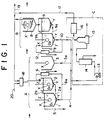
- Fig. 1 is a diagram showing the construction of an cleaning apparatus used in an example of the present invention
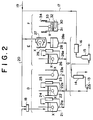
- Fig. 2 is a diagram showing the construction of the other cleaning apparatus of the present invention.
- the first vessel 1 and the second vessel 2 take care of two types of separation but either or both of them can be chosen, depending upon stains of the object to be cleaned. For example, even either separation by precipitation alone or separation by overflowing alone can function completely if so required by the object to be cleaned.
- each of the cleaning vessels in the process A may be designed to consist of one single vessel or a set of two or more depending upon the required operating time and the quality standards to go by. The question of how many vessels there should be per set can find a solution in substantially the same way.
- sets of 2 vessels each are used, and the first and second cleaning vessels 1 and 2 communicate with each other via the drain line 2a and the overflow line 2b.
- These cleaning vessels are operated in combination with ultrasonic wave, oscillation, mechanized stirring, heating of cleaning agent, brushing process and the like in order to increase the cleaning power, as need arises.
- the above-mentioned first and second cleaning vessels 1 and 2 respectively contain a dewatering cleaning agent D1 which mixes a base cleaning agent such as silicon-containing cleaning agent, isoparaffin-containing cleaning agent or mixture thereof with a surfactant.
- the cleaning agent D1 containing the surfactant is pre-designed to have specific gravity which is smaller than that of water but larger than that of oil stain and thus the waters Y separated from the object to be cleaned are precipitated toward the lowermost part of the cleaning agent D1 in the first and second cleaning vessels 1 and 2. Meanwhile, the oil stains Z likewise separated rise to the surface of the same cleaning agent D1 of the same cleaning vessels 1 and 2 respectively.
- the waters Y precipitated in the second cleaning vessel 2 are discharged to the side of the first cleaning vessel 1 via the drain line 2a at regular intervals. Again, the waters Y precipitated in the first cleaning vessel 1 are discharged at regular intervals into the cleaning agent recycling mechanism C which will be described later via the drain line 4. Meanwhile, the drain line 3a installed in the dewatering vessel 3 is connected to the cleaning agent recycling mechanism C.
- the oil stains Z surfaced in the first and second cleaning vessels 1 and 2 are allowed to overflow gradually and go out of the cleaning system via the overflow line 5 installed in the first cleaning vessel 1.
- the dewatering cleaning agent D1 in the first and second cleaning vessels 1 and 2 is extracted from the first cleaning vessel 1 by the circulation line 6a, the filter 6 removes solids, water particles and insoluble substances from the cleaning agent D1 and then the cleaning agent D1 returns to the second cleaning vessel 2.
- the cleaning agent D1 is thus purified at all times by its circulation via the filter 6, keeping the cleaning vessel 2 replete of the pure cleaning agent D1 though it is located at a downstream side of the cleaning process.
- filter 6 Humidity or water drops incorporated into the cleaning agent D1 can be eliminated with ease by means of above-mentioned filter 6.
- Various types of filter can be chosen for the filter 6 depending upon stains to be eliminated and/or liquids to be dewatered, but preferably it is a microporous filter of ceramic, glass, high molecular weight organic substance or complex material thereof, having a pore diameter of 0.1 to 20 ⁇ m.
- a third cleaning vessel 7 In the second process B for rinsing and dewatering, there are a third cleaning vessel 7 and a showering-rinsing vessel 8. Below the showering-rinsing vessel 8, there is a buffer tank 9 which is interlinked with the third cleaning vessel 7 via the drain line 9a and the overflow line 9b.
- This third cleaning vessel 7 is operated in combination with ultrasonic wave, oscillation, mechanized stirring, heating of cleaning agent, brushing process and the like as well, if need be.
- the abovementioned third cleaning vessel 7 contains the cleaning agent D2 compromising the base cleaning agent only which is same as used in above-mentioned first process A.
- This cleaning agent D2 is designed to have specific gravity smaller than that of water but larger than that of oil stains.
- the cleaning agent D2 in third cleaning vessel 7 always circulates via the filter 12, so that solids, water particles and insoluble substances are eliminated from the cleaning agent D2 by the filter 12.
- the drain lines 4, 3a and 10 laid in the first, second and third cleaning vessels 1, 2 and 7 and the dewatering vessel 3 are interlinked with the cleaning agent recycling mechanism C respectively.
- the cleaning agent D1 and D2 in each vessel respectively is kept purified at all times by the filters 6 and 12 and when it is heavily soiled, the cleaning agent is subjected to fractional distillation in the cleaning agent recycling mechanism C after it is sent there by the water pump 13 through the drain lines 4 and 10.
- the cleaning agent D1 collected in the dewatering vessel 3 is also sent to the cleaning agent recycling mechanism C at regular intervals.
- the soiled cleaning agent is fed to the filter 14 first to separate solids from liquid, the solids are disposed of and the liquids alone are sent to the distiller 15.
- the distiller 15 separates each ingredient of the cleaning agent, the waters and the oil stains using the difference of their boiling point.
- the waters and the like left at distiller 15 are sent to the decanter 16 for further separation.
- the waters and the like may be separated and removed by a coalescer as preparatory step before they are sent to the distiller 15.
- the dewatering cleaning agent D1 is a mixture of the cleaning agent D2 which is the base cleaning agent by itself with a surfactant and a repurified base cleaning agent or a repurified cleaning agent D2 can be obtained by the extraction of both soiled cleaning agents D1 and D2. Except for the so repurified cleaning agent D2, all extracted ingredients such as surfactant and water are discarded.
- the repurified cleaning agent D2 is forwarded through the line 17 into the showering-rinsing vessel 8, the third cleaning vessel 7 or the mixer 18 which is the supplier of the cleaning agent D1 to the second cleaning vessel 2.
- showering cleaning is conducted only with the impurity-free cleaning agent D2, with the supply of above-mentioned repurified cleaning agent D2 or a completely new cleaning agent D2 sent from the cleaning agent supply line 19.
- the repurified or a brand new cleaning agent D2 is mixed with a new surfactant supplied from the surfactant supply line 20 or an cleaning agent previously combined with a high concentration of surfactant to produce a new batch of cleaning agent D1.
- the so produced cleaning agent D1 is supplied to the second cleaning vessel 2 as need arises.
- the object X to be cleaned When the object X to be cleaned is found carrying with it the waters Y and the oil stains Z, it is immersed at first in the order of the first and second cleaning vessels 1 and 2 of the first process A in order to remove the oil stains Z and substitute the waters Y with the dewatering cleaning agent. Then, the cleaning agent D1 is removed from the surface of the object X over the dewatering vessel 13.
- the object X then is brought into the second process B, goes through the third cleaning vessel 7 where it gets rid of the surfactant remaining on its surface and simultaneously is dewatered, arriving at the showering-rinsing vessel 8 in order to finalize its surface purification and dewatering by undergoing showering and rinsing with the impurity-free cleaning agent D2 alone.
- the hot air drying may be replaced by steam drying (cleaning) with IPA and the like.
- a steam cleaning agent can be a particularly effective factor if its SP value has a difference of 4 or less with that of the liquid carried forward from the earlier process, except for some instances where hydrogen bond of molecules and interaction of polar groups must be given further consideration.
- Steam cleaning is to condense the steam cleaning agent to form dews on the surface of the object to be cleaned so that these dews dissolve and wash away the liquids attached to the object. If there is a SP value difference of more than 4 between the steam cleaning agent and the liquid carried forward from the earlier process, sufficient substitutability is not obtained.
- the difference of SP value is 3 or less and more preferably 2 or less.
- a steam cleaning agent having an evaporation latent heat which is differed from that of the liquid carried forward from the earlier process by 5 folds or less.
- the difference of evaporation latent heat is larger than 5 folds, one evaporates much faster than another, leaving the liquid having a larger evaporation latent heat behind on the object to be cleaned and keeping it remain as a blotch and the like there.
- the difference of evaporation latent heat is 3 folds or less and more preferably 2 folds or less.
- a steam cleaning agent has as small an evaporation latent heat as possible even when the above-mentioned difference is satisfied.
- the value of evaporation latent heat is 200 cal/g or less, more preferably 100 cal/g or less and most preferably 50 cal/g or less. It is especially important to satisfy the abovementioned points (1) and (2) with respect to the system of the present invention.
- the boiling point of a steam cleaning agent must be higher than the surface temperature of the object to be cleaned when it is subjected to steam cleaning.
- the boiling point is higher than the surface temperature of the object by 20°C or more, more preferably by 30°C or more and most preferably by 50°C or more; provided, however, that the difference between the boiling point and the surface temperature of the object to be cleaned can be regulated by manipulating the surface temperature of the object and thus that the desired difference can also be obtained by lowering the surface temperature of the object prior to the steam cleaning treatment. Still better results can be obtained, if satisfying the point (3) as well.
- silicon-containing cleaning agents and isoparaffin-containing cleaning agents are used in the process for rinsing cleaning of the present invention.
- Silicon-containing cleaning agents have the SP value of approximately 7 and evaporation latent heat of almost 35 cal/g, while isoparaffin-containing cleaning agents have the SP value of approximately 6 to 8 and the evaporation latent heat of almost 50 to 90 cal/g.
- steam cleaning agents to be used in the present invention preferably satisfy the abovementioned points (1) and (2) and more preferably the point (3) as well. Even whatever substances other than IPA as described above may be used as a steam cleaning agent of the present invention, if they satisfy all of these 3 conditions.
- a perfluoro compound represented by the general formula: C n F 2n+2 (wherein n is an integer of from 4 to 12); and a perfluoro compound represented by the structural formula: (C5 F11)3N, (C4 F9)3N, (wherein q and s are any integers) can be used therefor.
- perfluoro compounds have the SP value of 5 to 6, the evaporation latent heat of almost 20 cal/g and the boiling point ranging from 50°C to 200°C, satisfying all of the above-mentioned conditions (1) to (3).
- a perfluoro compound having the boiling point of 50°C to 150°C is preferable for practical use in cleaning.
- perfluoro compounds do not exhibit compatibility with almost all organic solvents and have not found their place as a steam cleaning agent in the past except for in the case with the removal of particles.
- silicon-containing cleaning agents and isoparaffin-containing cleaning agents are used to rinse, and the perfluoro compounds have the compatibility with them (the SP value difference of 4 or less), capable of serving as a steam cleaning agent herein.
- Steam cleaning agents such as IPA and perfluoro compound are not necessarily used singly but, for example their mixture is acceptable as well as their composition with the addition of silicon-containing cleaning agent, isoparaffin-containing cleaning agent or other organic solvents such as acetone. Further, flon or chlorine-containing solvents are not necessarily ineligible as the organic solvent for use in a mixture with IPA or perfluoro compound. It is desirable to stay away from their use from the viewpoint of environmental contamination but it does not seem entirely unlikely that even flons or chlorines can find their usefulness at any time while they are subject to halfway step by step restraints but are far away from the total ban.
- each component of the mixture should have the SP value and the evaporation latent heat satisfying the abovementioned conditions (1) and (2).
- the values of each such component should meet those mentioned as the example above. It also is acceptable that an organic solvent having a mean value for SP and evaporation latent heat is interposed as a mixing medium.
- a very useful, one liquid for all type composition a liquid which is good all the way from degreasing cleaning to drying, can be obtained by mixing abovementioned perfluoro compounds with silicon-containing cleaning agents and/or isoparaffin-containing cleaning agents and also organic solvents such as IPA, ethanol, methanol acetone and dioxane.
- organic solvents such as IPA, ethanol, methanol acetone and dioxane.
- the more preferable range of the mixing ratio with the perfluoro is 0.1 to 100 parts by weight of other components.
- This one liquid for all type composition exhibits the properties of degreasing, dewatering and steam cleaning without the need for work-oriented changes of the composition and is good for all including operations from degreas
- drying is completed with blowing of a hot air at approximately 50 to 60°C for approximately 5 minutes.
- the drying time is almost as long as 15 minutes even at the temperature as high as 120°C to 150°C.
- the object to be cleaned is not exposed to a high temperature and can be forwarded to a next process as it is after hot air drying, does not require the space and time for cooling and contributes to the improvement of productivity to a great extend.
- the finished products are free of irregularities in dewatering and have the much improved quality, as far as the batch they belong to is concerned. There also is no possibility of faulty finished products with cracks which are attributable to irregularities in cleaning and the level of product quality can be brought up very high.
- the cleaning agents have specific gravity smaller than that of waters but lager than that of oil stains, so a layer of cleaning agent intervenes between those of waters and oil stains, separating waters from oils completely and enabling the cleaning system to discard them efficiently and each independently.
- Their separation complete, waters and oils are respectively disposed of by means of cleaning agents, but it is likely that a trace amount of cleaning agents are incorporated into the discarded waters and oils.
- the cleaning agents incorporated into oils are consumed when the waste oils are incinerated. There is no problem in connection with cleaning agents incorporated into waters as well, because they are separated from waters with ease by means of filter or distiller.
- the cleaning apparatus of the present invention may be allowed to operate as preparatory step for steam drying with IPA, preventing waters from being mixed with repurified IPA. Because of a large difference of boiling points existent between IPA and the above-mentioned dewatering cleaning agent as used in the present invention, it is made possible to implement steam drying with IPA alone. Incidentally, waste waters once mixed with IPA have been regarded as hard to remove because their boiling point is close to that of IPA, and they are often blamed for watermarks.
- Fig. 2 is a diagram showing the construction of a cleaning apparatus used in the other example.
- the cleaning apparatus as shown in the diagram is comprised of a cleaning process D, a rinsing process E, a drying process F and a cleaning agent recycling mechanism G.
- Each cleaning vessel in the cleaning process D may be pre-designed to consist of one single vessel or a set of two or more, depending upon the required operating time and the quality standard to go by and the question how many vessels there should be per set finds a solution in substantially the same way.
- the first and second cleaning vessels 21 and 22 are operated in combination with ultrasonic wave, oscillation, mechanized stirring, heating of cleaning agent, brushing process and the like in order to promote the cleaning power, if need be.
- the above-mentioned first and second cleaning vessels 21 and 22 respectively contain the degreasing cleaning agent D3 which comprises a base cleaning agent such as silicon-containing cleaning agent, isoparaffin-containing cleaning agent or mixture thereof and a hydrophilic solvent.
- the cleaning agent D3 containing the hydrophilic solvent dissolves the oil stains of the object to be cleaned with the cleaning power provided by the hydrophilic solvent. In the case where stains attached to the object to be cleaned are not completely dissolved and removed in the first cleaning vessel 21 alone, they may be taken over by the second cleaning vessel 22 continuingly.
- the filters 24 and 25 are respectively connected to the first and second cleaning vessels 21 and 22, removing solids and insoluble substances from the cleaning agent D3 and then returning it to each cleaning vessel.
- Various types of filter may be chosen for the filters 24 and 25, depending upon what stains to be cleaned up, but preferably they are a microporous filter having a pore size of 0.1 to 20 ⁇ m, made of ceramic, glass, high molecule organic material or complex material thereof.
- the third cleaning vessel 26 contains the cleaning agent D4 comprising only the same base cleaning agent as it is used in the first process D described above.
- This third cleaning vessel 26 also is operated in combination with ultrasonic wave, oscillation, mechanized stirring, heating of cleaning agent, brushing process and the like if need be.
- the cleaning agent D4 contained in the third cleaning vessel 26 always continue circulating through the filter 29 which removes solids, insoluble substances and the like from the cleaning agent D4.
- This steam cleaning vessel 30 contains the steam cleaning agent 31 which is a liquid of, for example IPA, perfluoro compound or mixture thereof as above described and the steam cleaning agent 31 is heated by the heater 32, transforming into the steam 33.
- the steam 33 is condensed to form dews on the surface of the object X to be cleaned and the cleaning agent D4 carried forward from the rinsing process E is dissolved into the so liquidized steam cleaning agent 31 and washed away.
- the object X to be cleaned is detained as long as necessary in the vicinity of the cooling chiller 34 located at the uppermost part to evaporate the steam cleaning agent 31 remaining on its surface and thus complete the drying of the object X.
- the cleaning agents in this cleaning system are recovered and recycled in substantially the same mechanism as in the example described earlier.
- degreasing cleaning will be described first.
- An octamethylcyclotetrasiloxane was used as the rinsing cleaning agent in the second cleaning process.
- the various compounds listed in Table 1 were used as the steam cleaning agent.
- the following charts shows the SP value, the evaporation latent heat and the boiling point of the steam cleaning agents listed in Table 1.
- the steam cleaning agents used in these examples were selected with the SP value and the evaporation latent heat of octamethylcyclotetrasiloxane as standard reference.
- the ultrasonic wave cleaning was implemented at 45°C for 3 minutes and then the rinsing cleaning for 2 minutes in the first cleaning process.
- the so cleaned printed boards were subjected to steam drying with each of the steam cleaning agents and the time span required for drying was measured. Likewise, hot air drying at 50°C was conducted and the time span required for this type of drying was measured.
- the ion residue ( ⁇ g NaCl/inch2) on the surface of the printed boards was measured by an omegameter (Nippon Alpha Metals Co., Ltd.) in accordance with the procedures provided for in MIL-P-55110C and MIL-P-28809A. Further, the flux residue was measured with the naked eye and microscopically, making an examination for the presence of stains having the major axis of 0.05 mm or more. The practical usefulness was analyzed according to global judgement, marking excellent as o, good as ⁇ , fairly good as ⁇ and poor as x and the results are shown in Table 1.
- Miniature ball bearings made of stainless steel were subjected to dewatering cleaning with these agents. 2 pieces of miniature ball bearings were immersed in water, then immersed in a dewatering cleaning agent at ordinary temperature for one minute (with oscillation) and subjected to steam drying. Thereafter, the ball bearings were placed in the predetermined amount of anhydrous ethanol, the remaining waters were absorbed thereto and the quantitative analysis with the waters was conducted according to the Karl Fischer method.
- finishing cleaning (removal of particles)
- An octamethylcyclotetrasiloxane and a volatile isoparaffin were used as the finishing cleaning agent.
- various compounds listed in Table 3 were used as the steam cleaning agent.
- the cover glass for charge coupled device was subjected to finishing cleaning with these agents.
- the cover glass for CCD was cleaned with the finishing cleaning agent at 45°C in combination with the ultrasonic wave and then subjected to steam cleaning for the sake of finishing drying.
- After drying the appearance was analyzed and the amount of dusts on the surface measured.
- the after drying appearance was analyzed in substantially the same way as in Example 9 above.
- the amount of surface dusts(0.5 ⁇ m or more) was measured by a particle checker WM-1000 (Tokyo Optical Co., Ltd.) according to the laser method.
- the certain degreasing cleaning agents were prepared by mixing a volatile isoparaffin with various organic solvents. Further, a volatile isoparaffin was used as the rinsing cleaning agent.
- Printed boards with flux were cleaned with these agents in accordance with substantially the same procedures as in Example 1 and the result of subsequent hot air drying at 50°C was analyzed in substantially the same way as in Example 1. Further, a testing sample was prepared by applying a spindle oil to a steel plate and baking the plate in a furnace at 150°C for 48 hours. The oil baked on this testing sample was subjected to cleaning (ultrasonic wave cleaning) and the time span required for such cleaning was measured. The smaller the value is, the higher the cleaning power is and these results are shown in Table 4.
- Example 13 the cover glass for CCD was subjected to finishing cleaning with volatile isoparaffin used as the finishing cleaning agent and the cleaning and drying properties were evaluated in substantially the same way as in Example 13. Drying was conducted with a hot air at 50°C. The results are shown in Table 5.
- the volatile isoparaffin in terms of finishing cleaning achieved the sufficient cleaning power which is equal to or better than that of flon 113, without causing post-cleaning dried blobs or dusts.
- the agent had low dryness, with a high incidence of dried blobs, while a large amount of dusts were found attached to object to be cleaned during the drying process.
- the printed boards with flux on were cleaned by the degreasing, rinsing and steam cleaning agents listed in Table 6 in accordance with substantially the same procedures as in Example 1 and the cleaning and drying properties were evaluated in substantially the same way as in Example 1.
- the degreasing and rinsing cleaning were done at 45°C for 5 minutes in combination with ultrasonic wave. The results are shown in Table 6.
- Example 7 Using the dewatering and steam cleaning agents listed in Table 7, miniature ball bearings were subjected to dewatering cleaning according to substantially the same procedures as in Example 9 and the cleaning and drying properties were evaluated in substantially the same way as in Example 9. The dewatering cleaning was implemented with the ball bearings immersed in the agents while stirring at 45°C for one minute. The results are shown in Table 7.
- Example 8 Using the finishing and steam cleaning agents listed in Table 8, the cover glass for CCD was subjected to cleaning in accordance with substantially the same procedures as in Example 13 and the cleaning and drying properties were evaluated in substantially the same way as in Example 13. The results are shown in Table 8.
- a one liquid for all type cleaning agent was prepared by mixing 100 parts by weight of C6F14 as a perfluoro compound, 25 parts by weight of hexamethyldisiloxane as a silicon-containing cleaning agent and 3 parts by weight of acetone as an organic solvent. Meanwhile, the testing sample was prepared by applying to a steel plate YF33, a brand of silicon-containing press oil (supplied by Thoshiba Silicon Co., Ltd.) and baking the plate at 100°C. The testing sample was cleaned using the above-mentioned one liquid for all type cleaning agent. Cleaning was conducted at 40°C for 3 minutes in combination with ultrasonic wave, followed by steam cleaning with the same agent.
- the excellent properties of degreasing cleaning, water substituting and drying, comparable to those of conventional flon-containing cleaning agents, are obtained by the cleaning method of the present invention, unaccompanied by the possibility of environmental destruction and contamination and, therefore, the cleaning method is useful as a replacement of the other one by the use of highly controversial flon-containing solvents.
- the cleaning agents are recycled while two or more of them circulate simultaneously and the waters and stains which are removed from objects to be cleaned are disposed of efficiently, both contributing much to the saving of materials relating to cleaning.
Landscapes
- Chemical & Material Sciences (AREA)
- Chemical Kinetics & Catalysis (AREA)
- Organic Chemistry (AREA)
- Engineering & Computer Science (AREA)
- Life Sciences & Earth Sciences (AREA)
- Oil, Petroleum & Natural Gas (AREA)
- Wood Science & Technology (AREA)
- Metallurgy (AREA)
- Materials Engineering (AREA)
- Mechanical Engineering (AREA)
- General Chemical & Material Sciences (AREA)
- Health & Medical Sciences (AREA)
- Medicinal Chemistry (AREA)
- Polymers & Plastics (AREA)
- Dispersion Chemistry (AREA)
- Cleaning By Liquid Or Steam (AREA)
- Detergent Compositions (AREA)
- Cleaning And De-Greasing Of Metallic Materials By Chemical Methods (AREA)
- Cleaning Or Drying Semiconductors (AREA)
- Extraction Or Liquid Replacement (AREA)
Applications Claiming Priority (4)
| Application Number | Priority Date | Filing Date | Title |
|---|---|---|---|
| JP6583790 | 1990-03-16 | ||
| JP6583790 | 1990-03-16 | ||
| JP65837/90 | 1990-03-16 | ||
| EP91906198A EP0473795B1 (de) | 1990-03-16 | 1991-03-15 | Verfahren zum Reinigen |
Related Parent Applications (2)
| Application Number | Title | Priority Date | Filing Date |
|---|---|---|---|
| EP91906198A Division EP0473795B1 (de) | 1990-03-16 | 1991-03-15 | Verfahren zum Reinigen |
| EP91906198.6 Division | 1991-03-15 |
Publications (3)
| Publication Number | Publication Date |
|---|---|
| EP0717129A2 true EP0717129A2 (de) | 1996-06-19 |
| EP0717129A3 EP0717129A3 (de) | 1996-09-11 |
| EP0717129B1 EP0717129B1 (de) | 1999-12-15 |
Family
ID=13298530
Family Applications (4)
| Application Number | Title | Priority Date | Filing Date |
|---|---|---|---|
| EP95117430A Withdrawn EP0717128A3 (de) | 1990-03-16 | 1991-03-15 | Verfahren und Einrichtung zum Reinigen |
| EP95117431A Expired - Lifetime EP0717129B1 (de) | 1990-03-16 | 1991-03-15 | Reinigungsverfahren |
| EP96116201A Withdrawn EP0757119A3 (de) | 1990-03-16 | 1991-03-15 | Reinigungsverfahren |
| EP91906198A Expired - Lifetime EP0473795B1 (de) | 1990-03-16 | 1991-03-15 | Verfahren zum Reinigen |
Family Applications Before (1)
| Application Number | Title | Priority Date | Filing Date |
|---|---|---|---|
| EP95117430A Withdrawn EP0717128A3 (de) | 1990-03-16 | 1991-03-15 | Verfahren und Einrichtung zum Reinigen |
Family Applications After (2)
| Application Number | Title | Priority Date | Filing Date |
|---|---|---|---|
| EP96116201A Withdrawn EP0757119A3 (de) | 1990-03-16 | 1991-03-15 | Reinigungsverfahren |
| EP91906198A Expired - Lifetime EP0473795B1 (de) | 1990-03-16 | 1991-03-15 | Verfahren zum Reinigen |
Country Status (8)
| Country | Link |
|---|---|
| EP (4) | EP0717128A3 (de) |
| JP (3) | JP2723359B2 (de) |
| KR (5) | KR980700133A (de) |
| AU (2) | AU646246B2 (de) |
| CA (1) | CA2050333A1 (de) |
| DE (2) | DE69131853T2 (de) |
| SG (3) | SG50628A1 (de) |
| WO (1) | WO1991013697A1 (de) |
Cited By (1)
| Publication number | Priority date | Publication date | Assignee | Title |
|---|---|---|---|---|
| WO1998006815A1 (en) * | 1996-08-13 | 1998-02-19 | E.I. Du Pont De Nemours And Company | Alkylsiloxane compositions |
Families Citing this family (29)
| Publication number | Priority date | Publication date | Assignee | Title |
|---|---|---|---|---|
| US5503681A (en) * | 1990-03-16 | 1996-04-02 | Kabushiki Kaisha Toshiba | Method of cleaning an object |
| JP2723359B2 (ja) * | 1990-03-16 | 1998-03-09 | 株式会社東芝 | 洗浄方法および洗浄装置 |
| US5593507A (en) * | 1990-08-22 | 1997-01-14 | Kabushiki Kaisha Toshiba | Cleaning method and cleaning apparatus |
| WO1993004755A1 (fr) * | 1991-08-30 | 1993-03-18 | Kabushiki Kaisha Toshiba | Procede et dispositif de vidange-lavage, et filtre du type a concentration utilisee a cet effet |
| WO1993014184A1 (fr) * | 1992-01-21 | 1993-07-22 | Olympus Optical Co., Ltd. | Solvant de nettoyage et de sechage |
| JP3280451B2 (ja) | 1992-04-09 | 2002-05-13 | オリンパス光学工業株式会社 | 洗浄剤および洗浄方法 |
| DE69418645T2 (de) * | 1993-04-29 | 2000-02-10 | Olympus Optical Co., Ltd. | Reinigungsverfahren |
| JP3272479B2 (ja) | 1993-04-29 | 2002-04-08 | オリンパス光学工業株式会社 | 仕上げ乾燥方法 |
| JP3339941B2 (ja) | 1993-11-18 | 2002-10-28 | オリンパス光学工業株式会社 | 洗浄組成物による洗浄方法 |
| CN1150397A (zh) * | 1994-04-14 | 1997-05-21 | 株式会社东芝 | 清洗方法以及清洗装置 |
| US5478493A (en) * | 1994-06-15 | 1995-12-26 | Dow Corning Corporation | Hexamethyldisiloxane containing azeotropes |
| US5454970A (en) * | 1994-08-11 | 1995-10-03 | Dow Corning Corporation | Octamethyltrisiloxane containing azeotropes |
| US5454972A (en) * | 1994-09-15 | 1995-10-03 | Dow Corning Corporation | Azeotropes of octamethyltrisiloxane and n-propoxypropanol |
| US5628833A (en) * | 1994-10-13 | 1997-05-13 | Dow Corning Corporation | Two-step cleaning or dewatering with siloxane azeotropes |
| US5456856A (en) * | 1995-01-18 | 1995-10-10 | Dow Corning Corporation | Azeotrope and azeotrope-like compositions of octamethyltrisiloxane |
| JP2951862B2 (ja) | 1995-01-26 | 1999-09-20 | ジーイー東芝シリコーン株式会社 | 洗浄方法 |
| US5501811A (en) * | 1995-04-24 | 1996-03-26 | Dow Corning Corporation | Azeotropes of octamethyltrisiloxane and aliphatic or alicyclic alcohols |
| US5492647A (en) * | 1995-05-08 | 1996-02-20 | Dow Corning Corporation | Octamethylcyclotetrasiloxane azeotropes |
| EP1425457A1 (de) | 2001-09-10 | 2004-06-09 | The Procter & Gamble Company | Silikonpolymere für lipophile fluidsysteme |
| JP3672902B2 (ja) | 2002-10-11 | 2005-07-20 | 沖電気工業株式会社 | 半導体基板の表面保護方法 |
| KR100715474B1 (ko) * | 2005-10-05 | 2007-05-09 | 박찬형 | 세정액 조성물 및 그의 제조방법 |
| JP2010526918A (ja) * | 2007-05-11 | 2010-08-05 | エクスプローラー プレスルーム ソリューションズ | 印刷機洗浄組成物 |
| JP2009074717A (ja) * | 2007-09-19 | 2009-04-09 | Shin Ootsuka Kk | 被処理物乾燥装置 |
| JP5600404B2 (ja) * | 2009-07-13 | 2014-10-01 | 化研テック株式会社 | 水置換剤およびそれを用いた洗浄方法 |
| JP6350080B2 (ja) * | 2014-07-31 | 2018-07-04 | Jsr株式会社 | 半導体基板洗浄用組成物 |
| JP7056952B2 (ja) * | 2019-06-03 | 2022-04-19 | アクア化学株式会社 | 洗浄方法 |
| CN113453439B (zh) * | 2021-07-15 | 2022-11-11 | 吉安满坤科技股份有限公司 | 一种传感控制Touch技术印制电路板及其制备方法 |
| CN114210676A (zh) * | 2021-12-14 | 2022-03-22 | 张家港中远海运金港化工物流有限公司 | 一种用于运输润滑油类罐箱的清洗方法 |
| KR102676178B1 (ko) * | 2023-12-07 | 2024-06-18 | 주식회사 파인에코 | 고순도 칩 폴리 제조를 위한 폴리실리콘 세정 및 건조 장치 |
Family Cites Families (39)
| Publication number | Priority date | Publication date | Assignee | Title |
|---|---|---|---|---|
| GB1053780A (de) * | 1900-01-01 | |||
| US3193499A (en) * | 1961-10-03 | 1965-07-06 | Phillips Petroleum Co | Solvent and method for removing waxy deposits |
| US3120853A (en) * | 1963-04-02 | 1964-02-11 | Detrex Chem Ind | Apparatus for detergent-solvent degreasing |
| US3498923A (en) * | 1966-10-18 | 1970-03-03 | Us Navy | Surface-active compositions and method for displacing liquid organic films from solid surfaces |
| US3511708A (en) * | 1966-10-18 | 1970-05-12 | Us Navy | Method for displacing liquid organic films from solid surfaces |
| US3498922A (en) * | 1966-10-18 | 1970-03-03 | Us Navy | Method of displacing liquid organic films from solid surfaces |
| GB1440438A (en) * | 1972-09-07 | 1976-06-23 | Ici Ltd | Cleaning process |
| US3991481A (en) * | 1975-05-28 | 1976-11-16 | E. I. Du Pont De Nemours And Company | Process for recovering volatile organic liquids |
| US3998588A (en) * | 1975-05-28 | 1976-12-21 | E. I. Du Pont De Nemours And Company | Process for continuously transferring heat to a moving band |
| FR2418034A1 (fr) * | 1978-02-28 | 1979-09-21 | Sagem | Perfectionnements apportes aux appareils pour le traitement de surfaces impliquant l'utilisation d'au moins un solvant |
| JPS54152355A (en) * | 1978-05-23 | 1979-11-30 | Canon Kk | Washing method |
| JPS5917160B2 (ja) * | 1979-05-19 | 1984-04-19 | ライオン株式会社 | レコ−ド盤用清浄化剤 |
| JPS6028880B2 (ja) * | 1979-05-28 | 1985-07-06 | ライオン株式会社 | レコ−ド盤用清浄化剤 |
| JPS57101676A (en) * | 1980-12-17 | 1982-06-24 | Kazumasa Uryu | Defatting and washing treatment |
| JPS57168218A (en) * | 1981-04-09 | 1982-10-16 | Duskin Franchise Co Ltd | Liquid lens cleaner |
| JPS6022459B2 (ja) * | 1981-08-26 | 1985-06-01 | 株式会社徳力本店 | 接点材料を台材に固着する裏張り材 |
| JPS594481A (ja) * | 1982-06-29 | 1984-01-11 | 飯田 耕作 | 洗浄装置 |
| US4689168A (en) | 1984-06-08 | 1987-08-25 | The Drackett Company | Hard surface cleaning composition |
| US4711256A (en) * | 1985-04-19 | 1987-12-08 | Robert Kaiser | Method and apparatus for removal of small particles from a surface |
| DE3609426C2 (de) * | 1986-03-20 | 1997-04-24 | Kali Chemie Ag | Lösungsmittelgemische |
| JPH0798931B2 (ja) * | 1986-05-08 | 1995-10-25 | 三菱化学株式会社 | 撥水剤組成物 |
| JPS62286583A (ja) * | 1986-06-06 | 1987-12-12 | 古河電気工業株式会社 | アルミデイスク洗浄装置 |
| JP2556311B2 (ja) * | 1986-07-04 | 1996-11-20 | 日本石油化学株式会社 | 炭化水素混合物溶剤の製造方法 |
| JPS63315183A (ja) * | 1987-06-18 | 1988-12-22 | 三菱化学株式会社 | 超音波洗浄法 |
| JPS6470047A (en) * | 1987-09-11 | 1989-03-15 | Nitto Denko Corp | Polarizing goggles |
| US4934391A (en) * | 1988-02-08 | 1990-06-19 | 501 Petroleum Fermentations N.V. | Dibasic esters for cleaning electronic circuits |
| EP0334384A1 (de) * | 1988-03-25 | 1989-09-27 | Daikin Industries, Limited | Unbrennbare azeotrop-ähnliche Lösungsmittelgemische |
| JPH03502902A (ja) * | 1988-03-29 | 1991-07-04 | インスティテュト ヒミイ ネフティ シビルスコゴ オトデレニア アカデミイ ナウク エスエスエスエル | 部品洗滌方法及びその方法を実施する装置 |
| AU3460189A (en) * | 1988-05-11 | 1989-11-16 | W.L. Gore & Associates, Inc. | Process for cleaning filter membranes |
| JPH01311198A (ja) * | 1988-06-07 | 1989-12-15 | Idemitsu Petrochem Co Ltd | ドライクリーニング用組成物 |
| GB2220951B (en) * | 1988-07-08 | 1992-09-16 | Isc Chemicals Ltd | Cleaning and drying of electronic assemblies |
| DE3825678A1 (de) * | 1988-07-28 | 1990-02-01 | Wacker Chemie Gmbh | Reinigungs- und/oder konditioniermittel fuer glaskeramikoberflaechen, enthaltend organopolysiloxane |
| JPH02184302A (ja) * | 1989-01-09 | 1990-07-18 | Taisei Shokai:Kk | 物品の水切り方法 |
| JP2723359B2 (ja) * | 1990-03-16 | 1998-03-09 | 株式会社東芝 | 洗浄方法および洗浄装置 |
| JP5834515B2 (ja) | 2011-06-14 | 2015-12-24 | マツダ株式会社 | 部品製造ラインの設計支援方法及び設計支援システム |
| JP5917160B2 (ja) | 2012-01-17 | 2016-05-11 | キヤノン株式会社 | 撮像装置、画像処理装置、画像処理方法およびプログラム |
| JP5747960B2 (ja) | 2012-09-20 | 2015-07-15 | 有限会社田村製作所 | 丸材クランプ装置 |
| US9969283B2 (en) | 2013-09-10 | 2018-05-15 | General Electric Company | Battery changing system and method |
| JP6363884B2 (ja) | 2014-06-19 | 2018-07-25 | 株式会社フジクラ | 圧着端子 |
-
1991
- 1991-03-15 JP JP3505855A patent/JP2723359B2/ja not_active Expired - Lifetime
- 1991-03-15 DE DE69131853T patent/DE69131853T2/de not_active Expired - Fee Related
- 1991-03-15 KR KR1019970704108A patent/KR980700133A/ko not_active Ceased
- 1991-03-15 SG SG1996007196A patent/SG50628A1/en unknown
- 1991-03-15 EP EP95117430A patent/EP0717128A3/de not_active Withdrawn
- 1991-03-15 KR KR1019960700738A patent/KR970001233B1/ko not_active Expired - Fee Related
- 1991-03-15 KR KR1019950702831A patent/KR950010446B1/ko not_active Expired - Fee Related
- 1991-03-15 EP EP95117431A patent/EP0717129B1/de not_active Expired - Lifetime
- 1991-03-15 KR KR1019910701186A patent/KR0145061B1/ko not_active Expired - Fee Related
- 1991-03-15 CA CA002050333A patent/CA2050333A1/en not_active Abandoned
- 1991-03-15 EP EP96116201A patent/EP0757119A3/de not_active Withdrawn
- 1991-03-15 AU AU74751/91A patent/AU646246B2/en not_active Ceased
- 1991-03-15 DE DE69126648T patent/DE69126648T2/de not_active Expired - Fee Related
- 1991-03-15 KR KR1019960700737A patent/KR0121454B1/ko not_active Expired - Fee Related
- 1991-03-15 WO PCT/JP1991/000359 patent/WO1991013697A1/ja not_active Ceased
- 1991-03-15 EP EP91906198A patent/EP0473795B1/de not_active Expired - Lifetime
- 1991-03-15 SG SG1996008647A patent/SG44844A1/en unknown
- 1991-03-15 SG SG1996008667A patent/SG48276A1/en unknown
-
1994
- 1994-05-17 AU AU63145/94A patent/AU673062B2/en not_active Ceased
-
1995
- 1995-02-13 JP JP7023951A patent/JP2763270B2/ja not_active Expired - Lifetime
- 1995-02-13 JP JP07023963A patent/JP3115781B2/ja not_active Expired - Lifetime
Non-Patent Citations (1)
| Title |
|---|
| None |
Cited By (1)
| Publication number | Priority date | Publication date | Assignee | Title |
|---|---|---|---|---|
| WO1998006815A1 (en) * | 1996-08-13 | 1998-02-19 | E.I. Du Pont De Nemours And Company | Alkylsiloxane compositions |
Also Published As
| Publication number | Publication date |
|---|---|
| AU6314594A (en) | 1994-07-07 |
| JPH07275813A (ja) | 1995-10-24 |
| KR950010446B1 (ko) | 1995-09-18 |
| DE69131853D1 (de) | 2000-01-20 |
| JPH07275812A (ja) | 1995-10-24 |
| KR0145061B1 (ko) | 1998-08-17 |
| KR980700133A (ko) | 1998-03-30 |
| JP3115781B2 (ja) | 2000-12-11 |
| EP0717128A3 (de) | 1996-09-11 |
| DE69126648D1 (de) | 1997-07-31 |
| EP0757119A2 (de) | 1997-02-05 |
| KR920701412A (ko) | 1992-08-11 |
| JP2763270B2 (ja) | 1998-06-11 |
| JP2723359B2 (ja) | 1998-03-09 |
| EP0717128A2 (de) | 1996-06-19 |
| EP0757119A3 (de) | 1997-07-30 |
| CA2050333A1 (en) | 1991-09-17 |
| EP0473795A4 (en) | 1992-10-14 |
| KR0121454B1 (ko) | 1997-11-15 |
| WO1991013697A1 (en) | 1991-09-19 |
| AU673062B2 (en) | 1996-10-24 |
| EP0473795B1 (de) | 1997-06-25 |
| EP0473795A1 (de) | 1992-03-11 |
| SG50628A1 (en) | 1998-07-20 |
| EP0717129A3 (de) | 1996-09-11 |
| EP0717129B1 (de) | 1999-12-15 |
| DE69126648T2 (de) | 1997-12-11 |
| SG44844A1 (en) | 1997-12-19 |
| KR970001233B1 (ko) | 1997-02-04 |
| AU646246B2 (en) | 1994-02-17 |
| SG48276A1 (en) | 1998-04-17 |
| AU7475191A (en) | 1991-10-10 |
| DE69131853T2 (de) | 2000-06-29 |
Similar Documents
| Publication | Publication Date | Title |
|---|---|---|
| EP0473795B1 (de) | Verfahren zum Reinigen | |
| US5888312A (en) | Cleaning method | |
| EP0458969B1 (de) | Polyorganosiloxan enthaltendes wasserfreies reinigungsmittel | |
| JPWO1991013697A1 (ja) | 洗浄方法および洗浄装置 | |
| KR100210135B1 (ko) | 테르펜 및 일염기성 에스테르를 사용한 불순물의 세정공정 및 그를 위한 조성물 | |
| HK1001094B (en) | Non-aqueous cleaning composition comprising a polyorganosiloxane | |
| JPH03243698A (ja) | 清浄剤として有用なフルフリルアルコール混合物 | |
| JP3375104B2 (ja) | 物品の洗浄方法 | |
| JP4063346B2 (ja) | 洗浄剤 | |
| JP2651453B2 (ja) | 洗浄組成物 | |
| JPH06232106A (ja) | 水切り洗浄剤と洗浄方法 | |
| JPH0874081A (ja) | 物品の洗浄方法 | |
| JP2001335979A (ja) | 水切り溶剤組成物および水切り方法 | |
| JP2656450C (de) |
Legal Events
| Date | Code | Title | Description |
|---|---|---|---|
| PUAI | Public reference made under article 153(3) epc to a published international application that has entered the european phase |
Free format text: ORIGINAL CODE: 0009012 |
|
| 17P | Request for examination filed |
Effective date: 19951129 |
|
| AC | Divisional application: reference to earlier application |
Ref document number: 473795 Country of ref document: EP |
|
| AK | Designated contracting states |
Kind code of ref document: A2 Designated state(s): CH DE DK ES FR GB IT LI NL SE |
|
| PUAL | Search report despatched |
Free format text: ORIGINAL CODE: 0009013 |
|
| AK | Designated contracting states |
Kind code of ref document: A3 Designated state(s): CH DE DK ES FR GB IT LI NL SE |
|
| 17Q | First examination report despatched |
Effective date: 19971008 |
|
| RAP1 | Party data changed (applicant data changed or rights of an application transferred) |
Owner name: JAPAN FIELD COMPANY, LTD. Owner name: TOSHIBA SILICONE CO., LTD. |
|
| GRAG | Despatch of communication of intention to grant |
Free format text: ORIGINAL CODE: EPIDOS AGRA |
|
| GRAG | Despatch of communication of intention to grant |
Free format text: ORIGINAL CODE: EPIDOS AGRA |
|
| GRAH | Despatch of communication of intention to grant a patent |
Free format text: ORIGINAL CODE: EPIDOS IGRA |
|
| GRAH | Despatch of communication of intention to grant a patent |
Free format text: ORIGINAL CODE: EPIDOS IGRA |
|
| GRAA | (expected) grant |
Free format text: ORIGINAL CODE: 0009210 |
|
| AC | Divisional application: reference to earlier application |
Ref document number: 473795 Country of ref document: EP |
|
| AK | Designated contracting states |
Kind code of ref document: B1 Designated state(s): CH DE DK ES FR GB IT LI NL SE |
|
| PG25 | Lapsed in a contracting state [announced via postgrant information from national office to epo] |
Ref country code: SE Free format text: THE PATENT HAS BEEN ANNULLED BY A DECISION OF A NATIONAL AUTHORITY Effective date: 19991215 Ref country code: NL Free format text: LAPSE BECAUSE OF FAILURE TO SUBMIT A TRANSLATION OF THE DESCRIPTION OR TO PAY THE FEE WITHIN THE PRESCRIBED TIME-LIMIT Effective date: 19991215 Ref country code: IT Free format text: LAPSE BECAUSE OF FAILURE TO SUBMIT A TRANSLATION OF THE DESCRIPTION OR TO PAY THE FEE WITHIN THE PRE;WARNING: LAPSES OF ITALIAN PATENTS WITH EFFECTIVE DATE BEFORE 2007 MAY HAVE OCCURRED AT ANY TIME BEFORE 2007. THE CORRECT EFFECTIVE DATE MAY BE DIFFERENT FROM THE ONE RECORDED.SCRIBED TIME-LIMIT Effective date: 19991215 Ref country code: FR Free format text: LAPSE BECAUSE OF FAILURE TO SUBMIT A TRANSLATION OF THE DESCRIPTION OR TO PAY THE FEE WITHIN THE PRESCRIBED TIME-LIMIT Effective date: 19991215 Ref country code: ES Free format text: THE PATENT HAS BEEN ANNULLED BY A DECISION OF A NATIONAL AUTHORITY Effective date: 19991215 |
|
| REG | Reference to a national code |
Ref country code: CH Ref legal event code: EP |
|
| REF | Corresponds to: |
Ref document number: 69131853 Country of ref document: DE Date of ref document: 20000120 |
|
| REG | Reference to a national code |
Ref country code: CH Ref legal event code: NV Representative=s name: RITSCHER & SEIFERT |
|
| PG25 | Lapsed in a contracting state [announced via postgrant information from national office to epo] |
Ref country code: DK Free format text: LAPSE BECAUSE OF FAILURE TO SUBMIT A TRANSLATION OF THE DESCRIPTION OR TO PAY THE FEE WITHIN THE PRESCRIBED TIME-LIMIT Effective date: 20000315 |
|
| EN | Fr: translation not filed | ||
| NLV1 | Nl: lapsed or annulled due to failure to fulfill the requirements of art. 29p and 29m of the patents act | ||
| PLBE | No opposition filed within time limit |
Free format text: ORIGINAL CODE: 0009261 |
|
| STAA | Information on the status of an ep patent application or granted ep patent |
Free format text: STATUS: NO OPPOSITION FILED WITHIN TIME LIMIT |
|
| 26N | No opposition filed | ||
| PGFP | Annual fee paid to national office [announced via postgrant information from national office to epo] |
Ref country code: DE Payment date: 20010306 Year of fee payment: 11 |
|
| PGFP | Annual fee paid to national office [announced via postgrant information from national office to epo] |
Ref country code: GB Payment date: 20010314 Year of fee payment: 11 |
|
| PGFP | Annual fee paid to national office [announced via postgrant information from national office to epo] |
Ref country code: CH Payment date: 20010315 Year of fee payment: 11 |
|
| REG | Reference to a national code |
Ref country code: GB Ref legal event code: IF02 |
|
| PG25 | Lapsed in a contracting state [announced via postgrant information from national office to epo] |
Ref country code: GB Free format text: LAPSE BECAUSE OF NON-PAYMENT OF DUE FEES Effective date: 20020315 |
|
| PG25 | Lapsed in a contracting state [announced via postgrant information from national office to epo] |
Ref country code: LI Free format text: LAPSE BECAUSE OF NON-PAYMENT OF DUE FEES Effective date: 20020331 Ref country code: CH Free format text: LAPSE BECAUSE OF NON-PAYMENT OF DUE FEES Effective date: 20020331 |
|
| PG25 | Lapsed in a contracting state [announced via postgrant information from national office to epo] |
Ref country code: DE Free format text: LAPSE BECAUSE OF NON-PAYMENT OF DUE FEES Effective date: 20021001 |
|
| GBPC | Gb: european patent ceased through non-payment of renewal fee |
Effective date: 20020315 |
|
| REG | Reference to a national code |
Ref country code: CH Ref legal event code: PL |