EP0718311B1 - Verfahren zur Herstellung von Xanthangummi, löslich in einer Salzlösung - Google Patents
Verfahren zur Herstellung von Xanthangummi, löslich in einer Salzlösung Download PDFInfo
- Publication number
- EP0718311B1 EP0718311B1 EP96300847A EP96300847A EP0718311B1 EP 0718311 B1 EP0718311 B1 EP 0718311B1 EP 96300847 A EP96300847 A EP 96300847A EP 96300847 A EP96300847 A EP 96300847A EP 0718311 B1 EP0718311 B1 EP 0718311B1
- Authority
- EP
- European Patent Office
- Prior art keywords
- xanthan gum
- cake
- precipitated
- diameter
- liquid
- Prior art date
- Legal status (The legal status is an assumption and is not a legal conclusion. Google has not performed a legal analysis and makes no representation as to the accuracy of the status listed.)
- Expired - Lifetime
Links
- 229920001285 xanthan gum Polymers 0.000 title claims abstract description 127
- 239000000230 xanthan gum Substances 0.000 title claims abstract description 127
- 229940082509 xanthan gum Drugs 0.000 title claims abstract description 127
- 235000010493 xanthan gum Nutrition 0.000 title claims abstract description 127
- 238000000034 method Methods 0.000 title claims abstract description 38
- FAPWRFPIFSIZLT-UHFFFAOYSA-M Sodium chloride Chemical compound [Na+].[Cl-] FAPWRFPIFSIZLT-UHFFFAOYSA-M 0.000 title claims abstract description 33
- 238000004519 manufacturing process Methods 0.000 title claims description 3
- 239000007788 liquid Substances 0.000 claims abstract description 32
- 238000001035 drying Methods 0.000 claims abstract description 27
- 239000007864 aqueous solution Substances 0.000 claims abstract description 14
- 239000003960 organic solvent Substances 0.000 claims abstract description 13
- 238000002156 mixing Methods 0.000 claims abstract description 11
- 238000003756 stirring Methods 0.000 claims abstract description 7
- 239000000243 solution Substances 0.000 claims description 22
- 239000011780 sodium chloride Substances 0.000 claims description 16
- XLYOFNOQVPJJNP-UHFFFAOYSA-N water Chemical compound O XLYOFNOQVPJJNP-UHFFFAOYSA-N 0.000 claims description 16
- 239000002245 particle Substances 0.000 claims description 11
- KFZMGEQAYNKOFK-UHFFFAOYSA-N Isopropanol Chemical compound CC(C)O KFZMGEQAYNKOFK-UHFFFAOYSA-N 0.000 claims description 10
- LFQSCWFLJHTTHZ-UHFFFAOYSA-N Ethanol Chemical compound CCO LFQSCWFLJHTTHZ-UHFFFAOYSA-N 0.000 claims description 9
- OKKJLVBELUTLKV-UHFFFAOYSA-N Methanol Chemical compound OC OKKJLVBELUTLKV-UHFFFAOYSA-N 0.000 claims description 6
- 230000001105 regulatory effect Effects 0.000 claims description 5
- CSCPPACGZOOCGX-UHFFFAOYSA-N Acetone Chemical compound CC(C)=O CSCPPACGZOOCGX-UHFFFAOYSA-N 0.000 claims description 4
- WYURNTSHIVDZCO-UHFFFAOYSA-N Tetrahydrofuran Chemical compound C1CCOC1 WYURNTSHIVDZCO-UHFFFAOYSA-N 0.000 claims description 4
- 239000012153 distilled water Substances 0.000 claims description 4
- 238000003825 pressing Methods 0.000 claims description 4
- 238000005520 cutting process Methods 0.000 claims description 3
- RYHBNJHYFVUHQT-UHFFFAOYSA-N 1,4-Dioxane Chemical compound C1COCCO1 RYHBNJHYFVUHQT-UHFFFAOYSA-N 0.000 claims description 2
- YLQBMQCUIZJEEH-UHFFFAOYSA-N tetrahydrofuran Natural products C=1C=COC=1 YLQBMQCUIZJEEH-UHFFFAOYSA-N 0.000 claims description 2
- 239000002904 solvent Substances 0.000 abstract description 5
- 230000001376 precipitating effect Effects 0.000 abstract description 4
- 238000013019 agitation Methods 0.000 description 12
- 239000006185 dispersion Substances 0.000 description 9
- 238000000855 fermentation Methods 0.000 description 9
- 230000004151 fermentation Effects 0.000 description 9
- 239000000047 product Substances 0.000 description 9
- 230000007246 mechanism Effects 0.000 description 8
- 238000001556 precipitation Methods 0.000 description 8
- 238000000227 grinding Methods 0.000 description 6
- 239000000203 mixture Substances 0.000 description 6
- 239000002244 precipitate Substances 0.000 description 6
- 241000589636 Xanthomonas campestris Species 0.000 description 5
- 238000010276 construction Methods 0.000 description 5
- 230000033001 locomotion Effects 0.000 description 4
- 150000003839 salts Chemical class 0.000 description 4
- 241000894006 Bacteria Species 0.000 description 3
- 230000005540 biological transmission Effects 0.000 description 3
- 235000010633 broth Nutrition 0.000 description 3
- 230000000052 comparative effect Effects 0.000 description 3
- 230000006835 compression Effects 0.000 description 3
- 238000007906 compression Methods 0.000 description 3
- 239000001963 growth medium Substances 0.000 description 3
- 239000000843 powder Substances 0.000 description 3
- 238000011282 treatment Methods 0.000 description 3
- CSNNHWWHGAXBCP-UHFFFAOYSA-L Magnesium sulfate Chemical compound [Mg+2].[O-][S+2]([O-])([O-])[O-] CSNNHWWHGAXBCP-UHFFFAOYSA-L 0.000 description 2
- 241000589634 Xanthomonas Species 0.000 description 2
- 230000002411 adverse Effects 0.000 description 2
- -1 and in particular Chemical compound 0.000 description 2
- 230000003247 decreasing effect Effects 0.000 description 2
- 238000004090 dissolution Methods 0.000 description 2
- 230000000694 effects Effects 0.000 description 2
- 239000000835 fiber Substances 0.000 description 2
- 238000005259 measurement Methods 0.000 description 2
- 229910052751 metal Inorganic materials 0.000 description 2
- 239000002184 metal Substances 0.000 description 2
- 239000002994 raw material Substances 0.000 description 2
- 238000011084 recovery Methods 0.000 description 2
- 230000003014 reinforcing effect Effects 0.000 description 2
- GJCOSYZMQJWQCA-UHFFFAOYSA-N 9H-xanthene Chemical class C1=CC=C2CC3=CC=CC=C3OC2=C1 GJCOSYZMQJWQCA-UHFFFAOYSA-N 0.000 description 1
- WQZGKKKJIJFFOK-GASJEMHNSA-N Glucose Natural products OC[C@H]1OC(O)[C@H](O)[C@@H](O)[C@@H]1O WQZGKKKJIJFFOK-GASJEMHNSA-N 0.000 description 1
- 239000007836 KH2PO4 Substances 0.000 description 1
- 241001517672 Xanthomonas axonopodis pv. begoniae Species 0.000 description 1
- 241001677365 Xanthomonas axonopodis pv. vasculorum Species 0.000 description 1
- 241000063699 Xanthomonas campestris pv. hederae Species 0.000 description 1
- 241000321050 Xanthomonas campestris pv. incanae Species 0.000 description 1
- 241000589643 Xanthomonas translucens Species 0.000 description 1
- 239000000654 additive Substances 0.000 description 1
- 238000005273 aeration Methods 0.000 description 1
- 239000012736 aqueous medium Substances 0.000 description 1
- 229920003086 cellulose ether Polymers 0.000 description 1
- 239000003795 chemical substances by application Substances 0.000 description 1
- 238000005352 clarification Methods 0.000 description 1
- 238000004140 cleaning Methods 0.000 description 1
- 150000001875 compounds Chemical class 0.000 description 1
- 239000002537 cosmetic Substances 0.000 description 1
- 230000007423 decrease Effects 0.000 description 1
- 230000001747 exhibiting effect Effects 0.000 description 1
- 238000001914 filtration Methods 0.000 description 1
- 235000013305 food Nutrition 0.000 description 1
- 239000008103 glucose Substances 0.000 description 1
- 150000004676 glycans Chemical class 0.000 description 1
- 230000005484 gravity Effects 0.000 description 1
- 238000009630 liquid culture Methods 0.000 description 1
- 229910052943 magnesium sulfate Inorganic materials 0.000 description 1
- 239000000463 material Substances 0.000 description 1
- 244000005700 microbiome Species 0.000 description 1
- 229910000402 monopotassium phosphate Inorganic materials 0.000 description 1
- 229920001282 polysaccharide Polymers 0.000 description 1
- 239000005017 polysaccharide Substances 0.000 description 1
- GNSKLFRGEWLPPA-UHFFFAOYSA-M potassium dihydrogen phosphate Chemical compound [K+].OP(O)([O-])=O GNSKLFRGEWLPPA-UHFFFAOYSA-M 0.000 description 1
- 239000012266 salt solution Substances 0.000 description 1
- 239000000126 substance Substances 0.000 description 1
- 239000002562 thickening agent Substances 0.000 description 1
- 239000004034 viscosity adjusting agent Substances 0.000 description 1
Images



Classifications
-
- C—CHEMISTRY; METALLURGY
- C08—ORGANIC MACROMOLECULAR COMPOUNDS; THEIR PREPARATION OR CHEMICAL WORKING-UP; COMPOSITIONS BASED THEREON
- C08B—POLYSACCHARIDES; DERIVATIVES THEREOF
- C08B37/00—Preparation of polysaccharides not provided for in groups C08B1/00 - C08B35/00; Derivatives thereof
- C08B37/0006—Homoglycans, i.e. polysaccharides having a main chain consisting of one single sugar, e.g. colominic acid
- C08B37/0024—Homoglycans, i.e. polysaccharides having a main chain consisting of one single sugar, e.g. colominic acid beta-D-Glucans; (beta-1,3)-D-Glucans, e.g. paramylon, coriolan, sclerotan, pachyman, callose, scleroglucan, schizophyllan, laminaran, lentinan or curdlan; (beta-1,6)-D-Glucans, e.g. pustulan; (beta-1,4)-D-Glucans; (beta-1,3)(beta-1,4)-D-Glucans, e.g. lichenan; Derivatives thereof
- C08B37/0033—Xanthan, i.e. D-glucose, D-mannose and D-glucuronic acid units, saubstituted with acetate and pyruvate, with a main chain of (beta-1,4)-D-glucose units; Derivatives thereof
Definitions
- the present invention relates to a process for modifying xanthan gum to obtain a xanthan gum having enhanced solubility in saline solution.
- Xanthan gum is a naturally occurring high molecular weight polysaccharide and has found a wide scope of uses, particularly as a thickener or viscosity modifier for aqueous based compositions. For example, it has found extensive use in the food, cosmetic and oil industries. The ability of xanthan gum to effectively modify an aqueous solution is directly related to its solubility in the aqueous medium. Since in such uses, the aqueous compositions generally contain sodium chloride or other salts, it is desired that the xanthan gum have as high a solubility in such salt solutions as possible. However, xanthan gum which is conventionally obtained from the fermentation of Xanthomonas campestris does not exhibit a particularly high solubility in saline solution, and in particular, saline solutions having relatively high salt concentrations.
- enhanced solubility means that the xanthan gum exhibits a viscosity of not less than 800 mPa as determined on a 0.5% by weight solution thereof in a 12% by weight aqueous sodium chloride solution at 20°C at 30 rpm using a Brookfield BL viscometer and having a ratio of this viscosity to that determined on a 0.5% by weight solution thereof in distilled water of not less than 1.5.
- Japanese Patent Application JP-A-5 345 801 relates to a method for removing water from cellulose ether.
- the above object of the present invention can be accomplished by providing a process for saline-solution soluble xanthan gum which comprises the steps of precipitating xanthan gum by mixing, with stirring, an aqueous solution of xanthan gum with an organic solvent which is a non-solvent to xanthan gum but is hydrophilic, removing liquid from the precipitated xanthan gum to produce a xanthan gum cake having a liquid content of at most 50%, disintegrating the cake of xanthan gum after the liquid removal into particles having an average size of from 0.3 to 2 cm, and preferably, from about 0.6 to 1.5 cm in diameter, and drying the particles of xanthan gum at a temperature not exceeding 80°C.
- the cake of precipitated xanthan gum is broken into particles by conventional means so that specially designed equipment is not required.
- the drying can be concluded within a short time period while the xanthan gum is maintained substantially in the particulate state, whereby a xanthan gum exhibiting excellent solubility in saline is obtained.
- the present invention in its practice may use an aqueous solution of xanthan gum, e. g., a fermentation broth containing dissolved xanthan gum as produced by the fermentation of, for example, Xanthomonas campestris , and a solution obtained by dissolving xanthan gum which has been previously precipitated and separated and/or processed, e.g., subjected to clarification treatments, and the like, in an aqueous solution.
- xanthan gum e. g., a fermentation broth containing dissolved xanthan gum as produced by the fermentation of, for example, Xanthomonas campestris
- a solution obtained by dissolving xanthan gum which has been previously precipitated and separated and/or processed e.g., subjected to clarification treatments, and the like, in an aqueous solution.
- Xanthan gum is prepared by well-known fermentation processes. For instance, it is produced by placing a bacterium belonging to the genus Xanthomonas , i.e., X. campestris , under appropriate fermentation conditions. (This compound and the process for producing the same are described in U.S. Patent 3,659,026, the contents of which are incorporated herein by reference.)
- Xanthomonas campestris as a xanthan gum-producing microorganism may be replaced by any other known Xanthomonas species. Examples are X. carotate , X. incanae , X. begoniae , X. papavericola , X. translucens , X. vasculorum , and X. hederae .
- the xanthan gum to which the present invention applies is prepared conventionally by preliminary fermentation and main fermentation of a xanthan gum-producing bacterium on a suitable culture medium. It is usually obtained as a xanthan gum fermentation broth.
- the fermented solution is sterilized (heat treated), and the resulting aqueous xanthan gum solution is mixed with an organic solvent which is a non-solvent to xanthan gum but is hydrophilic by feeding them together to a tank equipped with agitating blades capable of high-speed agitation and mixing.
- the agitation-mixing in the tank causes precipitation of xanthan gum.
- the blade diameter/tank diameter ratio is desirably 0.5 or more. If the ratio is less than 0.5, stagnant regions develop along the inner walls of the tank, where the aqueous solution of xanthan gum and the hydrophilic organic solvent become immiscible.
- the xanthan gum to be handled under the present invention is not specially limited.
- the invention can be used for any fermented solutions or broths of xanthan gum with or without subsequent filtration or treatment with chemicals or the like, and aqueous solutions in which previously recovered xanthan gum has been redissolved.
- the composition of the aqueous solution, as well as its xanthan gum concentration, ph, temperature, and concentrations of other additives are not limited.
- the hydrophilic organic solvent incapable of dissolving xanthan gum that is used in precipitating xanthan gum may be an alcohol such as methanol, ethanol or isopropanol, or dioxane, acetone, tetrahydrofuran or the like.
- the xanthan gum precipitated by the process, at this stage contains at least about 80% by weight liquid. Drying the precipitate in this state adds substantially to the energy cost and requires high temperature and much time. Moreover, it is prone to overdrying, which undesirably affects the solubility of the xanthan gum in saline solutions. To avoid these, it is important to remove liquid from the xanthan gum to reduce its liquid content to 50% or less.
- a dispersion containing precipitated xanthan gum is fed to a V-type disk press having a pair of revolving disk-shaped screens, the space between which decreases as the screens revolve.
- the xanthan gum dispersion is thus squeezed by the pair of disk-shaped screens, and its liquid content pressed out through the screens and recovered, while the xanthan gum is compressed into a cake which revolves with the screens until it is discharged for recovery.
- the xanthan gum cake after the liquid removal takes the form of small lumps or long cords. This precipitate can retain interior regions of high-liquid-content regions. To completely dry the xanthan gum in this form would require elevated temperatures and long drying times, which, in turn, adversely affects the saline-solution solubility of the product.
- the xanthan gum cake obtained is broken or disintegrated into small grains or particles, which allows for the drying to be carried out at a sufficiently low temperature so as not to adversely affect the saline solubility of the product.
- the disintegration method is not specially limited, but in the practice of the invention the use of a cutter provided with a screen is desirable.
- the average grain diameter of the xanthan gum thus broken out is preferably between 0.3 and 2 cm, and more preferably between 0.6 and 1.5 cm. A diameter larger than 2 cm is not recommended because it necessitates a high temperature treatment to dry up the interior of the xanthan gum grains. On the other hand, breaking down the cake into finer pieces of less than 0.3 cm in diameter is also undesirable since it can cause screen clogging or other problems which lead to reduced productivity.
- the xanthan gum disintegrated by the afore-described method is dried at a temperature not higher than 80°C.
- the drying method is not specially restricted but a system of the type that fluidizes the xanthan gum grains during the process of drying is desirable.
- the drying temperature should not exceed 80°C. Otherwise, the saline- solution solubility of the product will be undesirably decreased.
- the dried xanthan gum it is possible to grind the dried xanthan gum to a sufficiently fine size to facilitate the dispersion in saline solutions.
- the grinding method may be any of the methods in common use, e.g., impact grinding.
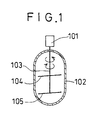
- FIG. 1 illustrates a preferred form of tank for use in the precipitation step according to this invention.
- numeral 101 indicates drives including a motor for driving an agitator shaft
- 102 indicates a stirred tank
- 103 indicates the agitator shaft 103.
- Agitator shaft 103 is provided with upper and lower agitating blades 104 and 105, which, in opposing pairs, extend from agitator shaft 103 in the left and right directions as viewed in this figure.
- each pair of agitating blades 104 or 105 has longitudinal axes on the same plane.
- Agitating blades 104 and 105 are triangular in cross section and are each tapered.
- agitating blades 104 and 105 are not limited to those embodied here but any other number and/or contour may be adopted unless it departs from the purposes of the invention.
- Agitating blades 104 and 105 are capable of stirring and mixing at high speeds, turning back and forth at every quarter of a revolution. Ordinary agitation that involves one-way blade revolution often causes the precipitated xanthan gum to stick so fast to the blades that it can hardly be recovered.
- the above-mentioned reciprocating motion can be produced by a known mechanism for the transmission of rotation from the drive motor to the agitator shaft 103. It is, of course, possible to control the drives with the provision of microprocessor-based controls so as to effect such reciprocating motion.
- the blade diameter/tank diameter ratio is desirably 0.5 or upwards.
- a ratio of less than 0.5 is undesirable because it forms a stagnant region close to the inner wall of tank 102, where an aqueous solution of xanthan gum and a hydrophilic organic solvent cannot be mixed.
- the tank is supplied with an organic solvent (isopropanol) which is a non-solvent to xanthan gum but is hydrophilic and an aqueous solution of xanthan gum. Mixing them with stirring in the tank permits the precipitation of xanthan gum. After the precipitation procedure, a dispersion containing the precipitated xanthan gum is fed to a V-type disk press shown in FIGS. 2 and 3.
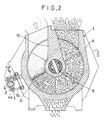
- FIGS. 2 and 3 illustrate a preferred form of the V-type disk press for use in the liquid removal step (referred to herein as a "V-type disk press").
- reference numeral 1 indicates the main body of the V-type disk press
- 2a and 2b are screens
- 3a and 3b are spindles
- 4a and 4b are supporting arms
- 5 is a hydraulic cylinder (or spring-loaded cylinder).
- the pair of screens 2a and 2b are disk-shaped (or conical) and fixed to rotating supports 11a and 11b.
- the space between screens 2a and 2b is the widest on the raw material inlet side A and the narrowest on the opposite side B that is 180 degrees apart.
- Screens 2a and 2b are divided into 6 segments each when viewed from the front as in Fig. 4. Each segment consists of a punched metal plate 20 in which a large number of small openings 21 are made evenly throughout. Its relative open area is governed by the size (of the screen mesh) and number of the small openings 21.
- the punched metal plate 20 is suitably strengthened on the rear side by a reinforcing plate 22 to withstand the pressures during pressing (FIG. 5).
- the reinforcing plate 22 has larger, uniformly spaced openings 23.
- the size of the individual small openings (of the screen mesh) is desirably not greater than 1 mm 2 , and screens having circular or slit-like openings are used. Meshes greater than 1 mm 2 are not desired because of large loss of xanthan gum through the screens upon pressing.
- the spindles 3a and 3b are disposed in a pair, on the left and right, fixedly supported by supporting arms 4a and 4b, respectively, and connected rockably relative to each other by a center pin 6 at the center of main body 1. Center pin 6 is fixed at both ends to main body 1.
- Supporting arms 4a and 4b are L-shaped and fixedly support spindles 3a and 3b at one end in the manner described above and are connected to each other at the other end through hydraulic cylinder 5 or a spring-loaded cylinder.
- supporting arms 4a and 4b are displaceably connected to the main body with links 7a and 7b, respectively.
- Numeral 8 designates a pivot for link 7a and supporting arm 4a
- 9 designates a pivot for links 7a and 7b.
- this mechanism includes a pivot for link 7b and supporting arm 4b but it cannot be seen in FIG. 3.
- Pivot 9 can slide up and down within a recess 10 (thus constituting a slider).
- a combination of main body 1, center pin 6, supporting arm 4a integral with spindle 3a, pivot 8, link 7a, pivot 9, and recess 10 forms revolving slider crank mechanism.
- main body 1, center pin 6, supporting arm 4b integral with spindle 3b, pivot 8, link 7b, pivot 9, and recess 10 combinedly form a revolving slider crank mechanism. Owing to these mechanisms, it is made possible, by regulating the opening angle of links 7a and 7b through the lateral movement of hydraulic cylinder 5 or spring-loaded cylinder, to adjust the angle between spindles 3a and 3b cooperating with those elements and thereby control the degree of opening of screens 2a and 2b and hence the pressing force.
- rotating supports 11a and 11b are rotatably supported by spindles 3a and 3b, respectively, via bearings and are rotated by driving forces transmitted to sprockets 12a and 12b integral with the supports (through endless chains).
- any of various other mechanisms e.g., V-belt transmission, may be used for power transmission to rotating supports 11a and 11b.
- the material fed to the raw material inlet A is held between screens 2a and 2b and is gradually squeezed as screens 2a and 2b revolve, with its water content flowing out through the screens to their back side.
- the feed is subjected to maximum compression at point B, 180 degrees apart from the inlet, and then the spacing between screens 2a and 2b increases gradually, and a dewatered cake is discharged along a scraper 2013. In this way, a xanthan gum component in the form of a cake can be recovered.
- the rate at which a dispersion of xanthan gum is fed to the V-type disk press is suitably chosen in consideration of the factors including the xanthan gum concentration in the dispersion and the state of precipitation of xanthan gum.
- the V-type disk press of this embodiment depends on compression.
- the degree of liquid removal can be adjusted with the compression pressure and the speed of screen revolution, whereby the xanthan gum is squeezed to a water content of only 40-50% by weight. Consequently, the cleaning and purifying effect of the hydrophilic organic solvent is improved and the energy load on the ensuing drying step is lessened.
- the V-type disk press shown in FIGS. 2 and 3 can squeeze the feed at low speeds of screen revolution, usually in the range of about 1 to 12 rpm (for screens 0.5 to 1.5 m across). Compared with centrifugal separators that run at 500 to 2,000 rpm, it requires far less power for its operation. Another advantage is the higher degree of safety because there is no need of running the press at high speed in the presence of an organic solvent.
- the cake of xanthan gum is transferred to a disintegrator as shown in FIG. 6, where it is broken up into xanthan gum grains from 0.3 to 2 cm in diameter.
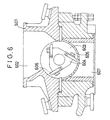
- FIG. 6 illustrates a preferred form of the disintegrator.
- 601 is the main body of the disintegrator
- 602 is a hopper
- 603 is a treating tank
- 604 is a rotary cutter
- 605 is a screen.
- Treating tank 603 is built as a cylinder, in which rotary cutter 604 runs.
- Rotary cutter 604 has three revolving cutter blades 606.
- the cake of xanthan gum fed at the hopper 602 is broken up into pieces by the cutting blades 606 of rotary cutter 604 in treating tank 603.
- the pieces disintegrated to a given size or finer are discharged through screen 605 and then through an outlet 607.
- the size of the resulting xanthan gum grains can be controlled through the adjustment of the mesh size of screen 605. While the embodiment shown uses three revolving cutting blades, the number of blades is not a limitation to this invention.
- the disintegrated xanthan gum is then sent to a dryer as shown in FIG. 7 for drying.
- FIG. 7 illustrates a preferred form of the dryer.
- This dryer 701 is of a type which fluidizes xanthan gum grains during the process of drying, and is set to a drying temperature not exceeding 80°C.
- Dryer 701 includes a drying drum 702 which is rotated as a rotating shaft 703 is driven. Rotating shaft 703, shown at right, is driven with rotational forces transmitted from a drive motor 704. 705 is an inlet and 706 is an outlet.
- Hot water enters the dryer 701 from a pipe 707b on the right and flows through a pipe 711b into jackets 710 so as to adjust the temperature of dryer 701. After circulating through jackets 710, the hot water flows out through a pipe 711a and finally through a pipe 707a.
- the temperature inside the dryer 701 can be regulated by setting the hot water temperature to a desired level.
- Vapor-laden air is released under reduced pressure from a vent pipe 708 at the left end.
- This construction is realized by using a hollow rotating shaft 709 on the left and adopting other means known in the art.
- the dried xanthan gum is discharged from outlet 706, and it may be ground for easier dispersion in a saline solution. Impact grinding is preferred for that purpose.
- a liquid culture medium of the composition I given below was placed in a 2,000-liter fermenter, inoculated with a culture of Xanthomonas campestris that had resulted from 24-hour preliminary cultivation, and incubated under aeration and agitation for 2 days, when a fermented solution containing 30 g/l of xanthan gum was obtained.
- Culture medium composition I Glucose 58 g/l Polypeptone 2 " KH 2 PO 4 2 " MgSO 4 ⁇ 7H 2 O 0.5 " Water 1,300 l
- the fermented solution was heated at 70°C for 30 minutes to kill the xanthan gum-producing bacteria, and 480 l of the xanthan gum fermented solution and 720 l of aqueous isopropanol (water content: 15 wt%) were poured into a 1,600-liter precipitation tank of the construction described above in conjunction with FIG. 1.
- the charge was mixed with stirring by an agitation blade (the blade diameter/inside diameter of the tank: 0.86, triangular blade, "Adzita AG type" manufactured by Shimazaki Seisakusho K.K.) that turns reversely after running each quarter of a revolution at high speed within the tank, and xanthan gum was precipitated.
- the precipitated xanthan gum was in the form of a long cord about 30 to 40 cm in length having a diameter of from about 2 to 3 cm..
- the dispersion containing the xanthan gum was fed at a rate of 1,500 liters per hour to a V-type disk press of the construction already described with reference to FIGS. 2 and 3 ("Asahi Press C-35," mfd. by Asahi Koki K.K., screen mesh size: 0.5 mm) for liquid removal.
- the liquid content in the product after primary liquid removal was 60% by weight.
- To 30 kg of the product after primary liquid removal was added one equivalent weight of isopropanol (water content: 15%) in a 500-liter stirred tank. After stirring, the resulting dispersion was fed again to the V-type disk press under the same conditions as described above for liquid removal.
- the xanthan gum product as a cake after the secondary liquid removal had a liquid content of 45% by weight.
- the cake after the secondary liquid removal was broken into small pieces using a disintegrator of the construction explained above in conjunction with FIG. 6.
- the disintegrated xanthan gum was in the form of grains from 0.6 to 1.5 cm in diameter.
- a 100-liter conical vacuum dryer of the construction illustrated in FIG. 7 15 kg of the xanthan gum grains was dried at a drying temperature of 40 to 65°C and a drying pressure of 40 to 100 torr for 3.5 hours. The dry matter was ground to obtain a saline solution-soluble xanthan gum finely divided to 80 mesh or finer particles.
- xanthan gum thus obtained was placed in a 500 ml-tall beaker, and it was moistened by adding 3 g of 99% ethanol. Next, 196 g of an aqueous solution of 12 wt% sodium chloride kept at 20°C was added, and the mixture was stirred using an anchor agitator at 1,000 rpm for 2 hours. Thorough dissolution of the xanthan gum and an increase in the viscosity of the aqueous sodium chloride solution were confirmed.
- the resulting solution was allowed to stand at 20°C for one hour, and then its viscosity was measured with a Brookfield BL type viscometer.
- the viscometer speed was set to 30 rpm and the viscosity was measured with spindle No. 2, when the viscosity (1) was found to be 900 mPa ⁇ s.
- the xanthan gum was dissolved in distilled water to form a solution at a concentration of 0.5 wt%. Its viscosity was measured using a Brookfield BL type viscometer at a speed of 30 rpm, with spindle No. 2.
- the viscosity (2) was 500 mPa ⁇ s.
- agitation speed 800 rpm or more gives good result.
- the configuration of the agitation blade is not specially limited; any shape is desirable if it permits the blade to fluidize the entire solution. Dissolution under these conditions produces a solution, which attains a stable viscosity after about 60 minutes of agitation. It was also found that further agitation for 2 to 12 hours causes little change in the viscosity.
- Example 2 One kilogram of xanthan gum grains obtained in the same manner as described in Example 1 was dried in an air-blast dryer above 85°C for 3.5 hours. It was then ground to an 80 mesh or finer xanthan gum powder. This finely divided xanthan gum was subjected to viscosity measurement by the same method as used in Example 1 .
- the viscosity in saline solution, referred to as (1) was 350 mPa ⁇ s
- the viscosity in distilled water (none-saline), referred to as (2) was 500 mPa ⁇ s
- (1)/(2) was 0.70.
- In the saline solution many particles remained undissolved even after 2 hours of agitation. Continued agitation up to 12 hours still failed to dissolve the undissolved particles.
- Example 2 The cake of xanthan gum obtained by liquid removal in the manner described in Example 1 was disintegrated using screens with mesh sizes of 2 or 3 cm. Generally in conformity with the procedure of Example 1, the disintegration products were dried until their water contents dropped to 10% or less. Grinding after the drying produced fine xanthan gum powders of 80 mesh or more. These xanthan gum products were subjected to viscosity measurements as in Example 1. The results are shown below. Mesh Size Av.Part. Dia. Drying Time Drying Pressure Drying Temp. Viscosity (1) (1)/(2) Comp. Ex.2 2 cm 1 ⁇ 2 cm 5 hrs 40 ⁇ 100 torr. 40 ⁇ 80°C 800 mPa ⁇ s 1.6 Comp. Ex. 3 3cm 2 ⁇ 3 cm 10 hrs 40 ⁇ 100 torr. (5.332 x 10 -3 MPa ⁇ 1.332 x 10 -2 MPa) 40 ⁇ 80°C 500 mPa ⁇ s 1.0
- Example 2 A xanthan gum precipitate obtained similarly to Example 1 was dried without prior liquid removal or disintegration. The dried precipitate was ground to a fine xanthan gum powder 80 mesh or finer in size. This xanthan gum was measured for its viscosity in the manner described in Example 1. The results are given below. Mesh Size Drying Time Drying Pressure Drying Temp Viscosity (1)/(2) Comp. Ex. 4 - 20 hrs 40 ⁇ 100 torr. 40 ⁇ 90°C 300 mPa ⁇ s 0.6
Landscapes
- Chemical & Material Sciences (AREA)
- Health & Medical Sciences (AREA)
- Life Sciences & Earth Sciences (AREA)
- Materials Engineering (AREA)
- Molecular Biology (AREA)
- General Health & Medical Sciences (AREA)
- Engineering & Computer Science (AREA)
- Biochemistry (AREA)
- Emergency Medicine (AREA)
- Chemical Kinetics & Catalysis (AREA)
- Medicinal Chemistry (AREA)
- Polymers & Plastics (AREA)
- Organic Chemistry (AREA)
- Polysaccharides And Polysaccharide Derivatives (AREA)
- Jellies, Jams, And Syrups (AREA)
- Preparation Of Compounds By Using Micro-Organisms (AREA)
Claims (18)
- Verfahren zur Herstellung von in einer Salzlösung löslichem Xanthangummi durch:(a) Herstellen von gefälltem Xanthangummi durch Vermischen einer wäßrigen Lösung von Xanthangummi mit einem hydrophilen organischen Lösungsmittel, in welchem der Xanthangummi unlöslich ist, unter Rühren;(b) Entfernen von Flüssigkeit aus dem gefällten Xanthangummi zur Bildung eines Kuchens eines Flüssigkeitsgehalts von höchstens 50 Gew.-%;(c) Zerkleinern des Xanthangummikuchens zu Teilchen einer durchschnittlichen Teilchengröße von 0,3 - 2 cm Durchmesser und(d) Trocknen des Xanthangummis bei einer Temperatur nicht über 80 °C.
- Verfahren nach Anspruch 1, wobei die Flüssigkeit durch Ausquetschen des gefällten Xanthangummis entfernt wird.
- Verfahren nach Anspruch 1, wobei das organische Lösungsmittel aus der Gruppe Methanol, Ethanol, Isopropanol, Dioxan, Aceton und Tetrahydrofuran ausgewählt ist
- Verfahren nach Anspruch 1, wobei der durchschnittliche Teilchengrößendurchmesser 0,6 - 1,5 cm beträgt.
- Verfahren nach Anspruch 1, wobei der Flüssigkeitsgehalt des Kuchens 40 - 50 Gew.-% beträgt.
- Verfahren nach Anspruch 1, wobei die Xanthangummiteilchen bei einer Temperatur von 40 - 65 °C und einem Druck von 40 - 100 Torr (5,332 x 10-3 MPa bis 1,332 x 10-2 MPa) getrocknet werden.
- Verfahren nach Anspruch 1, wobei der erhaltene Xanthangummi eine an einer 0,5 gew.-%igen Lösung desselben in einer 12 gew.-%igen wäßrigen Natriumchloridlösung bei 20 °C und 30/min unter Verwendung eines Brookfield-BL-Viskosimeters bestimmte Viskosität von nicht weniger als 650 mPa und ein Verhältnis dieser Viskosität zu derjenigen bei Bestimmung einer 0,5 gew.-%igen Lösung hiervon in destilliertem Wasser von nicht weniger als 1,3 aufweist.
- Verfahren nach Anspruch 1, wobei die Flüssigkeitsentfernung mittels einer Scheibenpresse vom V-Typ bzw. mittels einer V-förmigen Scheibenpresse erfolgt.
- Verfahren nach Anspruch 1, wobei die Flüssigkeitsentfernung in einer Scheibenpresse vom V-Typ bzw. V-förmigen Scheibenpresse mit sich drehenden scheibenförmigen Sieben zum Pressen des gefällten Xanthangummis (zwischen ihnen) durchgeführt wird.
- Verfahren nach Anspruch 9, wobei die Siebe Öffnungen von nicht mehr als 1 mm2 aufweisen.
- Verfahren nach Anspruch 9, wobei die Siebe einen Durchmesser von 0,5 - 1,5 m aufweisen und mit einer Geschwindigkeit von 1 - 12/min gedreht werden.
- Verfahren nach Anspruch 1, wobei das Vermischen mit einem Drehrührer und im Rahmen wiederholter Drehzyklen des Drehrührers, zuerst in eine Richtung und danach in die umgekehrte Richtung, durchgeführt wird.
- Verfahren nach Anspruch 12, wobei der Drehzyklus eine Drehung des Rührers zwischen etwa 90 und 360° in eine Richtung und anschließendes Drehen des Rührers in gleichem Ausmaß in umgekehrte Richtung umfaßt.
- Verfahren nach Anspruch 1, wobei das Vermischen in einem Rührtank, in welchem das Verhältnis Flügeldurchmesser/Tankdurchmesser mindestens 0,5 beträgt, durchgeführt wird.
- Verfahren nach Anspruch 1, wobei der getrocknete Xanthangummi auf eine Maschengröße von 80 mesh oder feiner vermahlen wird.
- Verfahren nach Anspruch 1, wobei der Xanthangummikuchen unter Verwendung einer Zerkleinerungsvorrichtung mit einem Hauptkörper, einem Trichter, einem Behandlungstank, einer Rotations-Schneideinrichtung, einem Sieb und einem Auslaß zerkleinert wird, wobei der Behandlungstank als Zylinder, in welchem eine Rotations-Schneideinrichtung mit drei rotierenden Fräsmessern läuft, ausgebildet ist und wobei der über den Trichter zugeführte Xanthangummikuchen mit Hilfe der Schneid- oder Fräsmesser der Rotations-Schneideinrichtung in dem Behandlungstank zu Stücken zerkleinert wird und die auf eine gegebene Größe oder feiner zerkleinerten Stücke über ein Sieb und danach einen Auslaß ausgetragen werden.
- Verfahren nach Anspruch 1, wobei der zerkleinerte Xanthangummi in einem Luftwirbeltrockner getrocknet wird.
- Verfahren nach Anspruch 1, wobei der gefällte Xanthangummi in einem Trockner mit einer mittels einer Drehachse angetriebenen Trocknungstrommel, einem Einlaß, einem Auslaß und einer Ummantelung mit darin befindlichem Heißwasser getrocknet wird, wobei die Temperatur im Trockner durch Einstellen der Temperatur des Heißwassers in der Ummantelung auf einen gewünschten Wert gesteuert werden kann.
Applications Claiming Priority (3)
| Application Number | Priority Date | Filing Date | Title |
|---|---|---|---|
| JP174713/95 | 1995-07-11 | ||
| JP17471395 | 1995-07-11 | ||
| JP17471395A JP3741751B2 (ja) | 1995-07-11 | 1995-07-11 | キサンタンガムの改質方法 |
Publications (3)
| Publication Number | Publication Date |
|---|---|
| EP0718311A2 EP0718311A2 (de) | 1996-06-26 |
| EP0718311A3 EP0718311A3 (de) | 1997-03-26 |
| EP0718311B1 true EP0718311B1 (de) | 2000-08-16 |
Family
ID=15983354
Family Applications (1)
| Application Number | Title | Priority Date | Filing Date |
|---|---|---|---|
| EP96300847A Expired - Lifetime EP0718311B1 (de) | 1995-07-11 | 1996-02-08 | Verfahren zur Herstellung von Xanthangummi, löslich in einer Salzlösung |
Country Status (6)
| Country | Link |
|---|---|
| EP (1) | EP0718311B1 (de) |
| JP (1) | JP3741751B2 (de) |
| AT (1) | ATE195535T1 (de) |
| CA (1) | CA2169434C (de) |
| DE (1) | DE69609738T2 (de) |
| DK (1) | DK0718311T3 (de) |
Families Citing this family (9)
| Publication number | Priority date | Publication date | Assignee | Title |
|---|---|---|---|---|
| JP4201391B2 (ja) * | 1998-06-19 | 2008-12-24 | 日清オイリオグループ株式会社 | 湿熱処理キサンタンガムおよびその製造方法 |
| US20110027838A1 (en) | 2009-07-31 | 2011-02-03 | Harding Nancy E | Sphingomonas Strains Producing Greatly Increased Yield Of PHB-Deficient Sphingan (Diutan) |
| CA2352414A1 (fr) * | 2001-07-05 | 2003-01-05 | Industries Fournier Inc. | Dispositif de controle et de retenue des gateaux dans un pressoir rotatif |
| US8840299B2 (en) * | 2007-06-04 | 2014-09-23 | Ge Healthcare Bio-Sciences Corp. | Apparatus for mixing the contents of a container |
| CA2804895A1 (en) * | 2010-08-31 | 2012-03-08 | Cp Kelco U.S., Inc. | Xanthan gum with fast hydration and high viscosity |
| US9181659B2 (en) | 2011-10-17 | 2015-11-10 | Cp Kelco Oy | Compositions having increased concentrations of carboxymethylcellulose |
| CN103957929B (zh) | 2011-11-25 | 2017-06-30 | 诺维信公司 | 具有溶菌酶活性的多肽和编码所述多肽的多核苷酸 |
| KR102813958B1 (ko) | 2018-06-15 | 2025-05-29 | 허큘레스 엘엘씨 | 페인트 배합물을 위한 조대 입자 고체 비이온성 합성 회합성 증점제 및 그의 제조 방법 |
| JP7028494B1 (ja) * | 2020-12-03 | 2022-03-02 | 伊那食品工業株式会社 | キサンタンガム、およびそれを用いた食品 |
Family Cites Families (2)
| Publication number | Priority date | Publication date | Assignee | Title |
|---|---|---|---|---|
| JP2686195B2 (ja) * | 1991-12-04 | 1997-12-08 | 信越化学工業株式会社 | 改質キサンタンガムおよびキサンタンガムの改質方法 |
| JPH05345801A (ja) * | 1992-06-16 | 1993-12-27 | Shin Etsu Chem Co Ltd | セルロースエーテルの脱水方法 |
-
1995
- 1995-07-11 JP JP17471395A patent/JP3741751B2/ja not_active Expired - Fee Related
-
1996
- 1996-02-08 DE DE69609738T patent/DE69609738T2/de not_active Expired - Fee Related
- 1996-02-08 AT AT96300847T patent/ATE195535T1/de not_active IP Right Cessation
- 1996-02-08 DK DK96300847T patent/DK0718311T3/da active
- 1996-02-08 EP EP96300847A patent/EP0718311B1/de not_active Expired - Lifetime
- 1996-02-13 CA CA002169434A patent/CA2169434C/en not_active Expired - Fee Related
Also Published As
| Publication number | Publication date |
|---|---|
| ATE195535T1 (de) | 2000-09-15 |
| EP0718311A3 (de) | 1997-03-26 |
| JP3741751B2 (ja) | 2006-02-01 |
| DE69609738T2 (de) | 2001-04-12 |
| EP0718311A2 (de) | 1996-06-26 |
| DK0718311T3 (da) | 2000-09-18 |
| JPH0925301A (ja) | 1997-01-28 |
| DE69609738D1 (de) | 2000-09-21 |
| CA2169434A1 (en) | 1997-01-12 |
| CA2169434C (en) | 2005-08-16 |
Similar Documents
| Publication | Publication Date | Title |
|---|---|---|
| JP2873927B2 (ja) | バクテリアセルロースの乾燥方法および乾燥物 | |
| EP3902870B1 (de) | Bakterielle cellulose-formulierungen, methoden und verwendungen | |
| CA2169434C (en) | Process for production of saline-solution soluble xanthan gum | |
| JPH10502125A (ja) | セルロースサスペンジョン生成プロセス | |
| EP0545674B1 (de) | Modifiziertes Xanthangummi und Verfahren zur Modifizierung von Xanthangummi | |
| EP0761692B1 (de) | Verfahren zur Rückgewinnung von Pullulan | |
| US5864034A (en) | Process for production of saline-solution soluble xanthan gum | |
| EP0133531A1 (de) | Immobilisierung von Biokatalysatoren | |
| KR19990037728A (ko) | 박테리아 셀룰로스의 처리 방법 | |
| KR19990035890A (ko) | 박테리아셀룰로오즈농축물및상기농축물의처리방법 | |
| CA2069289C (en) | Method for purifying polysaccharides | |
| KR20010032094A (ko) | 식품 내의 액상 탄수화물 발효 생성물의 용도 | |
| JP2971024B2 (ja) | バクテリアセルロース離解物 | |
| JP2587680B2 (ja) | ヒアルロン酸もしくはヒアルロン酸ナトリウム微粉末の製造法 | |
| JPH02239911A (ja) | ポリテトラフルオロエチレンの湿潤パウダーの連続製造法 | |
| DE69623068T2 (de) | Verfahren zur Reinigung von Polysaccharid | |
| GB2289052A (en) | Removal of liquid from xanthan gum | |
| CN1176171C (zh) | 一种高粘度纳米级瓜尔胶粉的制造方法 | |
| JPH08276126A (ja) | 乳化安定化剤 | |
| CN1100275A (zh) | 无臭速溶高粘度魔芋粉的加工方法 | |
| JPH09241396A (ja) | 多糖類を含む複合基体の製造方法 | |
| JPH01185301A (ja) | 低分子キトサンの製造方法 | |
| JPH11279202A (ja) | バクテリアセルロース離解物 | |
| CN118477610A (zh) | 一种化工生产装置 | |
| JP2000508018A (ja) | グアー胚乳の利用性および処理性を向上させるための方法およびその方法を用いて得られる製品 |
Legal Events
| Date | Code | Title | Description |
|---|---|---|---|
| PUAI | Public reference made under article 153(3) epc to a published international application that has entered the european phase |
Free format text: ORIGINAL CODE: 0009012 |
|
| AK | Designated contracting states |
Kind code of ref document: A2 Designated state(s): AT DE DK FR GB IE NL |
|
| PUAL | Search report despatched |
Free format text: ORIGINAL CODE: 0009013 |
|
| AK | Designated contracting states |
Kind code of ref document: A3 Designated state(s): AT DE DK FR GB IE NL |
|
| 17P | Request for examination filed |
Effective date: 19970918 |
|
| 17Q | First examination report despatched |
Effective date: 19980728 |
|
| GRAG | Despatch of communication of intention to grant |
Free format text: ORIGINAL CODE: EPIDOS AGRA |
|
| GRAG | Despatch of communication of intention to grant |
Free format text: ORIGINAL CODE: EPIDOS AGRA |
|
| GRAH | Despatch of communication of intention to grant a patent |
Free format text: ORIGINAL CODE: EPIDOS IGRA |
|
| GRAH | Despatch of communication of intention to grant a patent |
Free format text: ORIGINAL CODE: EPIDOS IGRA |
|
| GRAA | (expected) grant |
Free format text: ORIGINAL CODE: 0009210 |
|
| AK | Designated contracting states |
Kind code of ref document: B1 Designated state(s): AT DE DK FR GB IE NL |
|
| REF | Corresponds to: |
Ref document number: 195535 Country of ref document: AT Date of ref document: 20000915 Kind code of ref document: T |
|
| REG | Reference to a national code |
Ref country code: IE Ref legal event code: FG4D |
|
| REG | Reference to a national code |
Ref country code: DK Ref legal event code: T3 |
|
| REF | Corresponds to: |
Ref document number: 69609738 Country of ref document: DE Date of ref document: 20000921 |
|
| ET | Fr: translation filed | ||
| PLBE | No opposition filed within time limit |
Free format text: ORIGINAL CODE: 0009261 |
|
| STAA | Information on the status of an ep patent application or granted ep patent |
Free format text: STATUS: NO OPPOSITION FILED WITHIN TIME LIMIT |
|
| 26N | No opposition filed | ||
| REG | Reference to a national code |
Ref country code: GB Ref legal event code: IF02 |
|
| PGFP | Annual fee paid to national office [announced via postgrant information from national office to epo] |
Ref country code: DK Payment date: 20040123 Year of fee payment: 9 |
|
| PGFP | Annual fee paid to national office [announced via postgrant information from national office to epo] |
Ref country code: GB Payment date: 20040204 Year of fee payment: 9 |
|
| PGFP | Annual fee paid to national office [announced via postgrant information from national office to epo] |
Ref country code: NL Payment date: 20040205 Year of fee payment: 9 |
|
| PGFP | Annual fee paid to national office [announced via postgrant information from national office to epo] |
Ref country code: FR Payment date: 20040210 Year of fee payment: 9 |
|
| PGFP | Annual fee paid to national office [announced via postgrant information from national office to epo] |
Ref country code: AT Payment date: 20040211 Year of fee payment: 9 |
|
| PGFP | Annual fee paid to national office [announced via postgrant information from national office to epo] |
Ref country code: IE Payment date: 20040213 Year of fee payment: 9 |
|
| PGFP | Annual fee paid to national office [announced via postgrant information from national office to epo] |
Ref country code: DE Payment date: 20040219 Year of fee payment: 9 |
|
| PG25 | Lapsed in a contracting state [announced via postgrant information from national office to epo] |
Ref country code: IE Free format text: LAPSE BECAUSE OF NON-PAYMENT OF DUE FEES Effective date: 20050208 Ref country code: GB Free format text: LAPSE BECAUSE OF NON-PAYMENT OF DUE FEES Effective date: 20050208 Ref country code: AT Free format text: LAPSE BECAUSE OF NON-PAYMENT OF DUE FEES Effective date: 20050208 |
|
| PG25 | Lapsed in a contracting state [announced via postgrant information from national office to epo] |
Ref country code: DK Free format text: LAPSE BECAUSE OF NON-PAYMENT OF DUE FEES Effective date: 20050228 |
|
| PG25 | Lapsed in a contracting state [announced via postgrant information from national office to epo] |
Ref country code: NL Free format text: LAPSE BECAUSE OF NON-PAYMENT OF DUE FEES Effective date: 20050901 Ref country code: DE Free format text: LAPSE BECAUSE OF NON-PAYMENT OF DUE FEES Effective date: 20050901 |
|
| GBPC | Gb: european patent ceased through non-payment of renewal fee |
Effective date: 20050208 |
|
| REG | Reference to a national code |
Ref country code: DK Ref legal event code: EBP |
|
| PG25 | Lapsed in a contracting state [announced via postgrant information from national office to epo] |
Ref country code: FR Free format text: LAPSE BECAUSE OF NON-PAYMENT OF DUE FEES Effective date: 20051031 |
|
| NLV4 | Nl: lapsed or anulled due to non-payment of the annual fee |
Effective date: 20050901 |
|
| REG | Reference to a national code |
Ref country code: IE Ref legal event code: MM4A |
|
| REG | Reference to a national code |
Ref country code: FR Ref legal event code: ST Effective date: 20051031 |