EP0762392B1 - Milieux d'enregistrement optique - Google Patents
Milieux d'enregistrement optique Download PDFInfo
- Publication number
- EP0762392B1 EP0762392B1 EP96113474A EP96113474A EP0762392B1 EP 0762392 B1 EP0762392 B1 EP 0762392B1 EP 96113474 A EP96113474 A EP 96113474A EP 96113474 A EP96113474 A EP 96113474A EP 0762392 B1 EP0762392 B1 EP 0762392B1
- Authority
- EP
- European Patent Office
- Prior art keywords
- grooves
- depth
- pits
- less
- area
- Prior art date
- Legal status (The legal status is an assumption and is not a legal conclusion. Google has not performed a legal analysis and makes no representation as to the accuracy of the status listed.)
- Expired - Lifetime
Links
Images

Classifications
-
- G—PHYSICS
- G11—INFORMATION STORAGE
- G11B—INFORMATION STORAGE BASED ON RELATIVE MOVEMENT BETWEEN RECORD CARRIER AND TRANSDUCER
- G11B7/00—Recording or reproducing by optical means, e.g. recording using a thermal beam of optical radiation by modifying optical properties or the physical structure, reproducing using an optical beam at lower power by sensing optical properties; Record carriers therefor
- G11B7/24—Record carriers characterised by shape, structure or physical properties, or by the selection of the material
- G11B7/2407—Tracks or pits; Shape, structure or physical properties thereof
- G11B7/24073—Tracks
- G11B7/24082—Meandering
-
- G—PHYSICS
- G11—INFORMATION STORAGE
- G11B—INFORMATION STORAGE BASED ON RELATIVE MOVEMENT BETWEEN RECORD CARRIER AND TRANSDUCER
- G11B7/00—Recording or reproducing by optical means, e.g. recording using a thermal beam of optical radiation by modifying optical properties or the physical structure, reproducing using an optical beam at lower power by sensing optical properties; Record carriers therefor
- G11B7/007—Arrangement of the information on the record carrier, e.g. form of tracks, actual track shape, e.g. wobbled, or cross-section, e.g. v-shaped; Sequential information structures, e.g. sectoring or header formats within a track
- G11B7/0079—Zoned data area, e.g. having different data structures or formats for the user data within data layer, Zone Constant Linear Velocity [ZCLV], Zone Constant Angular Velocity [ZCAV], carriers with RAM and ROM areas
-
- G—PHYSICS
- G11—INFORMATION STORAGE
- G11B—INFORMATION STORAGE BASED ON RELATIVE MOVEMENT BETWEEN RECORD CARRIER AND TRANSDUCER
- G11B7/00—Recording or reproducing by optical means, e.g. recording using a thermal beam of optical radiation by modifying optical properties or the physical structure, reproducing using an optical beam at lower power by sensing optical properties; Record carriers therefor
- G11B7/24—Record carriers characterised by shape, structure or physical properties, or by the selection of the material
- G11B7/2407—Tracks or pits; Shape, structure or physical properties thereof
- G11B7/24073—Tracks
- G11B7/24079—Width or depth
-
- G—PHYSICS
- G11—INFORMATION STORAGE
- G11B—INFORMATION STORAGE BASED ON RELATIVE MOVEMENT BETWEEN RECORD CARRIER AND TRANSDUCER
- G11B7/00—Recording or reproducing by optical means, e.g. recording using a thermal beam of optical radiation by modifying optical properties or the physical structure, reproducing using an optical beam at lower power by sensing optical properties; Record carriers therefor
- G11B7/24—Record carriers characterised by shape, structure or physical properties, or by the selection of the material
- G11B7/2407—Tracks or pits; Shape, structure or physical properties thereof
- G11B7/24085—Pits
-
- G—PHYSICS
- G11—INFORMATION STORAGE
- G11B—INFORMATION STORAGE BASED ON RELATIVE MOVEMENT BETWEEN RECORD CARRIER AND TRANSDUCER
- G11B7/00—Recording or reproducing by optical means, e.g. recording using a thermal beam of optical radiation by modifying optical properties or the physical structure, reproducing using an optical beam at lower power by sensing optical properties; Record carriers therefor
- G11B7/24—Record carriers characterised by shape, structure or physical properties, or by the selection of the material
- G11B7/241—Record carriers characterised by shape, structure or physical properties, or by the selection of the material characterised by the selection of the material
- G11B7/242—Record carriers characterised by shape, structure or physical properties, or by the selection of the material characterised by the selection of the material of recording layers
- G11B7/244—Record carriers characterised by shape, structure or physical properties, or by the selection of the material characterised by the selection of the material of recording layers comprising organic materials only
- G11B7/246—Record carriers characterised by shape, structure or physical properties, or by the selection of the material characterised by the selection of the material of recording layers comprising organic materials only containing dyes
- G11B7/248—Record carriers characterised by shape, structure or physical properties, or by the selection of the material characterised by the selection of the material of recording layers comprising organic materials only containing dyes porphines; azaporphines, e.g. phthalocyanines
Definitions
- the present invention relates to an optical recording medium capable of recording and reproducing information with laser beams, more specifically to an optical recording medium comprising a read-only (ROM) area in which pre-pits are formed on a substrate and a recordable (RAM) area in which pre-grooves are formed thereon, wherein it is possible for both areas to reproduce information with commercial CD players and CD-ROM players.
- ROM read-only
- RAM recordable
- optical media capable of recording with laser beams and reproducing recorded information with commercial CD players and CD-ROM players are proposed in, for example, Nikkei Electronics, No. 465, p. 107, January 23, 1989 issue and Optical Data Storage 1989, Technical Digest Series Vol.1, Conference Edition P. 45 (1989), Summaries of papers presented at the Optical Data Storage Topical Meeting, Jan. 17-19, 1989; edited by Optical Society of America.
- This optical recording medium comprises a recording layer containing a dye, a reflective layer, and a protective layer which are formed in this order on a substrate.
- CD-R recordable compact disk
- Irradiation of a recording layer on the CD-R with a semiconductor laser beam having a wavelength of 770 to 830 nm at a high power causes a physical or chemical change on the recording layer and allows information to be recorded thereon in the form of pits.
- This recording layer is irradiated with a laser beam at a low power to detect a change in the reflected beam, whereby the information can be reproduced.
- the above CD-R has wobbling pre-grooves, and a wobbling frequency is modulated for the time information (ATIP: Absolute Time In Pre-groove).
- CD-R is designed so that these characteristics are satisfied.
- a recording layer containing a dye is not provided in conventional CDs which are commercially available, that is, read-only CD and CD-ROM media.
- Information are recorded on the surface of a substrate in the form of pre-pits in molding the substrate, and a reflective layer and a protective layer are formed thereon.
- Information for controlling a rotating speed and a time information are obtained from the pits, and the tracks comprising the pre-pits are not provided with wobbling.
- optical recording media prepared by combining a read-only area (hereinafter abbreviated as a ROM area) having pre-pits formed in advance on a substrate as is the case with the CDs and CD-ROMs described above with a recordable area (hereinafter abbreviated as a RAM area) in which pre-grooves are formed as is the case with the CD-Rs described above (for example, USP 5,204,852 and USP 5,274,623).
- a read-only area hereinafter abbreviated as a ROM area
- a RAM area recordable area
- Such optical recording media as described above are called “hybrid disks” in the Orange Book standards, and various characteristics in a ROM area and a RAM area are standardized in the Orange Book.
- a ROM area in such hybrid disk is largely different in the following two points from the preceding commercial CD and CD-ROM media, and thus the problem is involved that the following characteristics in the ROM area are not sufficiently satisfied. That is,
- the constitution in the ROM area is largely different in the points 1 and 2 described above from conventional CDs and CD-ROMs, and therefore it is difficult to secure the modulation and WCNRa in the ROM area. It is required to consider, for example, factors such as a form of tracks comprising pre-pits and a wobble amplitude in said pre-pit tracks.
- Ranges as much broad as 150 to 400 nm in terms of the depth and 0.2 to 1.4 ⁇ m in terms of FWHM (full width at a half maximum depth) of pre-pits for securing the modulation in the ROM area are disclosed in Japanese Patent Application Laid-Open No. Hei 4-146537. It will certainly be possible to only secure the modulation in the ROM area by controlling the film thickness of the recording layer, even if the pre-pit shape falls in the broad range described above. However, it is difficult to satisfy all of various characteristics prescribed in the Orange Book, such as servo signal characteristics and recording characteristics in a RAM area.
- RCb radial contrast
- the depth of the grooves has to be relatively increased.
- the sufficiently satisfactory modulation can not be obtained over the wide range described above depending on the pre-pit form in the ROM area. Further, nothing is described concerning wobbling in the pre-pit tracks in the ROM area in the publication described above.
- Disclosed in an example described in the publication described above is a medium having a width of 0.6 ⁇ m and a depth of 110 nm in the pre-pits and a wobble amplitude of 43 nm in the pre-pit tracks in the ROM area, and a width of 0.6 ⁇ m and a depth of 80 nm in the pre-grooves and a wobble amplitude of 30 nm in the RAM area. It has been found by us that on the above conditions, the problem is caused that the RCb is small because of the small depth of the pre-grooves in the RAM area, and the large modulation can not be obtained because of the small depth of the pre-pits in the ROM area.
- the satisfactory value of the WCNRa can be obtained in the conditions described above, but when more preferred dyes other than the cyanine dyes, for example, phthalocyanine dyes are used in the recording layer, the sufficiently satisfactory WCNRa can not be obtained even if the wobble amplitude of the pre-pit tracks is adjusted to 106 nm.
- pre-grooves having a smaller depth than that of pre-pits are provided between the pre-pits in a ROM area, and a track comprising the pre-pit and the pre-groove is provided with wobbling, whereby the WCNRa is enhanced.
- Design is made in this publication so that controlled are the depth to 80 to 140 nm and the FWHM to 0.2 to 0.6 ⁇ m in the pre-pits and, the small depth to 30 to 100 nm and the FWHM to 0.2 to 0.6 ⁇ m in the pre-groove present between two pre-pits.
- An object of the present invention is to provide an optical recording medium of a hybrid disk comprising a recording layer containing a dye, a reflective layer, and a protective layer each provided in this order on a substrate comprising a ROM area in which pre-pits are formed and RAM area in which pre-grooves are formed, wherein the ATIP information in the ROM area and the RAM area can be well read out, and such good recording and reproducing characteristics as satisfy the Orange Book standards are provided in both the ROM and RAM areas.
- optical recording medium having the following constitutions:
- the present invention makes it possible to provide an excellent hybrid disk in which a WCNRa that is a reproduced signal of wobbling in the ROM area and the RAM area is uniform and sufficiently large, and the Orange Book standards are satisfied in both the ROM are and the RAM area.
- Fig. 1 is a cross-sectional constitutional drawing showing the optical recording medium according to the present invention.
- (a) is a cross-sectional drawing obtained by cutting the ROM area in the radial direction
- (b) is a cross-sectional drawing obtained by cutting the RAM area in the radial direction.
- the respective numerals represent the following; 1: substrate, 2: recording layer, 3: reflective layer, 4: protective layer, 5: pre-groove, 6: pre-pit, 7: pre-pit bottom, 8: land between adjacent tracks, 9: pre-groove bottom, 10: land between two adjacent pre-grooves, d p : depth of the pre-pit, t p : thickness of a dye layer on the pre-pit bottom, t pl : thickness of a dye layer on the land between two adjacent pre-pit tracks, ⁇ p : depth of the pre-pit in an interface between the reflective layer 3 and the dye layer 2, d g : depth of the pre-groove, t g : thickness of a dye layer on the pre-groove bottom, t gl : thickness of a dye layer on the land between two pre-grooves, and ⁇ g : depth of the pre-groove in an interface between the reflective layer 3 and the dye layer 2.
- the optical recording medium of the present invention has a constitution in which a recording layer containing a dye, a reflective layer and a protective layer are formed in this order on a substrate provided thereon with a ROM area and RAM area.
- the ROM area has the pre-pits and pre-grooves connecting each adjacent pre-pit, and said pre-pits and pre-grooves form wobbling tracks.
- the RAM area has pre-grooves forming wobbling tracks.
- the pre-pits and the pre-grooves between each adjacent pre-pit in the ROM area and the pre-grooves in the RAM area have the following specified shapes.
- the depth is preferably 130 nm or more and 250 nm or less. If the depth of the pre-grooves present in the RAM area is less than 130 nm, the RCb becomes smaller to make tracking servo control difficult. On the other hand, if the depth of the pre-grooves is larger than 250 nm, the reflectance is lowered while the RCb becomes larger, and therefore recorded signals can not be well reproduced. In view of the RCb and the reflectance, the depth of the pre-grooves is preferably 150 nm or more and 230 nm or less, more preferably 170 nm or more and 200 nm or less.
- FWHM full width at a half maximum depth
- Said pre-grooves wobble, and the wobble amplitude is preferably 25 nm or more and 36 nm or less. If the wobble amplitude is less than 25 nm, the wobble signal (WCNRb) before recording becomes small, and the ATIP information can not be well reproduced, or in the worst case recording is impossible. Meanwhile, if said wobble amplitude exceeds 36 nm, the WCNRb becomes larger to make tracking servo control difficult in commercial CD-R recorders, or in the worst case recording is sometimes impossible. Further, the jitter in the recorded signals is increased, and error rates are unfavorably increased.
- the depth is preferably 250 nm or more and 350 nm or less, more preferably 270 nm or more and 340 nm or less.
- FWHM thereof is preferably 0.4 ⁇ m or more and 0.6 ⁇ m or less. If the width of the pre-pits is less than 0.4 ⁇ m or the depth thereof is less than 250 nm, the modulation is small, and the error rate is increased. Accordingly, signals can not be reproduced in some cases. When the depth exceeds 350 nm, the modulation tends to be increased, but the replication property of pre-pits in molding a substrate is deteriorated.
- the ROM area has the pre-pits and pre-grooves connecting each adjacent pre-pit, and said pre-pits and pre-grooves form wobbling tracks.
- the depth is preferably 30 nm or more and 170 nm or less, more preferably 35 nm or more and 150 nm or less, and the FWHM is preferably 0.1 ⁇ m or more and 0.4 ⁇ m or less. If the depth is less than 30 nm, the WCNRa is unpreferably decreased, and if the depth exceeds 170 nm, the reflectance and the modulation are unpreferably decreased.
- the wobble amplitude thereof is preferably 25 nm or more and 110 nm or less, and the product D x A of the depth (D) of the pre-grooves formed on the tracks comprising the pre-pits and the wobble amplitude (A) of the pre-pits is preferably 3100 or more.
- the wobble amplitude is more preferably 28 nm to 99 nm, and the product D x A is more preferably 3300 or more. If the wobble amplitude is less than 25 nm and the product D x A described above is less than 3100, the WCNRa is not increased, and the ATIP information can not be well read. Meanwhile, if the wobble amplitude exceeds 110 nm, the jitter in reproduction is deteriorated, and reproduction errors are generated.
- the cross-sectional shape of the pre-pits described above is preferably approximately trapezoidal. This is because the pre-pits are deeper than the pre-grooves as described previously, so that it is possible to set the depth of the pre-pits with a thickness of a photoresist film, which facilitates stamper production.
- the cross-sectional shapes of the pre-grooves present in the ROM area and the RAM area are preferably approximately V shapes in view of the stamper production.
- a stamper is produced preferably in the following manner. That is, a photoresist film is formed on a glass substrate in a thickness corresponding to the depth of the pre-pits.
- the pre-pits or pre-grooves are cut by exposing this photoresist film with a laser beam.
- the photoresist film is exposed at a strong laser power so that the photoresist film is irradiated in the whole thickness direction thereof, and in cutting the pre-grooves between two pits, the photoresist film is exposed at a weak laser power so that a laser beam intensity is attenuated in the middle of a thickness direction of the photoresist film.
- the photoresist film is exposed at a weak laser power so that a laser beam intensity is attenuated in the middle of a thickness direction of the photoresist film corresponding to the depth of the pre-grooves.
- the laser beam is wobbled in the respective amplitudes both in the ROM area and the RAM area.
- Development after exposure causes the glass substrate face in the pre-pits portion to expose and makes the cross-sectional shape approximately trapezoidal.
- development does not proceed to the glass substrate face, and the cross-sectional shape corresponding to the intensity distribution of a laser beam is approximately a V-shape.
- a method of cutting for such stamper has already been technically established and easily employed.
- Materials for the substrate used in the present invention may be any ones as long as they are transparent to recording and reproduction beams and have a small optical anisotropy. Used are, for example, high molecular materials such as polycarbonate resins, vinyl chloride resins, acrylic resins including polymethyl methacrylate, amorphous polyolefin resins and polyester resins, and inorganic materials such as glass. Polycarbonate resins, acrylic resins and amorphous polyolefin resins are the most suited in view of the transparency and the facility in molding a substrate.
- the recording layer containing a dye is formed on the substrate.
- the thickness of the recording layer falls usually in a level of 30 to 300 nm.
- the thickness of the recording layer is very important in terms of various characteristics.
- the film thickness of the recording layer present in the ROM area is varied at a pre-pit portion, a land present between two pre-pit tracks (a land portion in the ROM area) and a land present between two pre-grooves in the RAM area (a land portion in the RAM area).
- Fig. 1 represents the cross-sectional drawings obtained by cutting the ROM area (a) and the RAM area (b) of the medium in the radial direction, respectively.
- the recording layer 2 is formed by spin coating of a dye solution and then drying. In the case of the spin coating, the film thickness t p of the recording layer 2 at the pit bottom 7 of the pre-pit 6 is sufficiently larger than the film thickness t pl of the recording layer 2 in the land portion 8 of the substrate 1.
- ⁇ p d p + t pl - t p
- the modulation is maximized when the difference (L p ) between two optical path lengths at the pit portion and the land potion is ⁇ /4. Even when a dye layer is formed also in the pre-pit portion as is the case with the present invention, the modulation is maximized in the vicinity of ⁇ /4 in the difference (L p ) between the optical path lengths if the depth of the pre-pit is small.
- L p at the pre-pit portion and the land portion is preferably 0.26 ⁇ or more (wherein ⁇ is the wavelength of a laser beam for reproduction) and 0.40 ⁇ or less.
- the dyes used for the recording layer in the present invention include known cyanine dyes, phthalocyanine dyes and azo dyes all of which are used for CD-R.
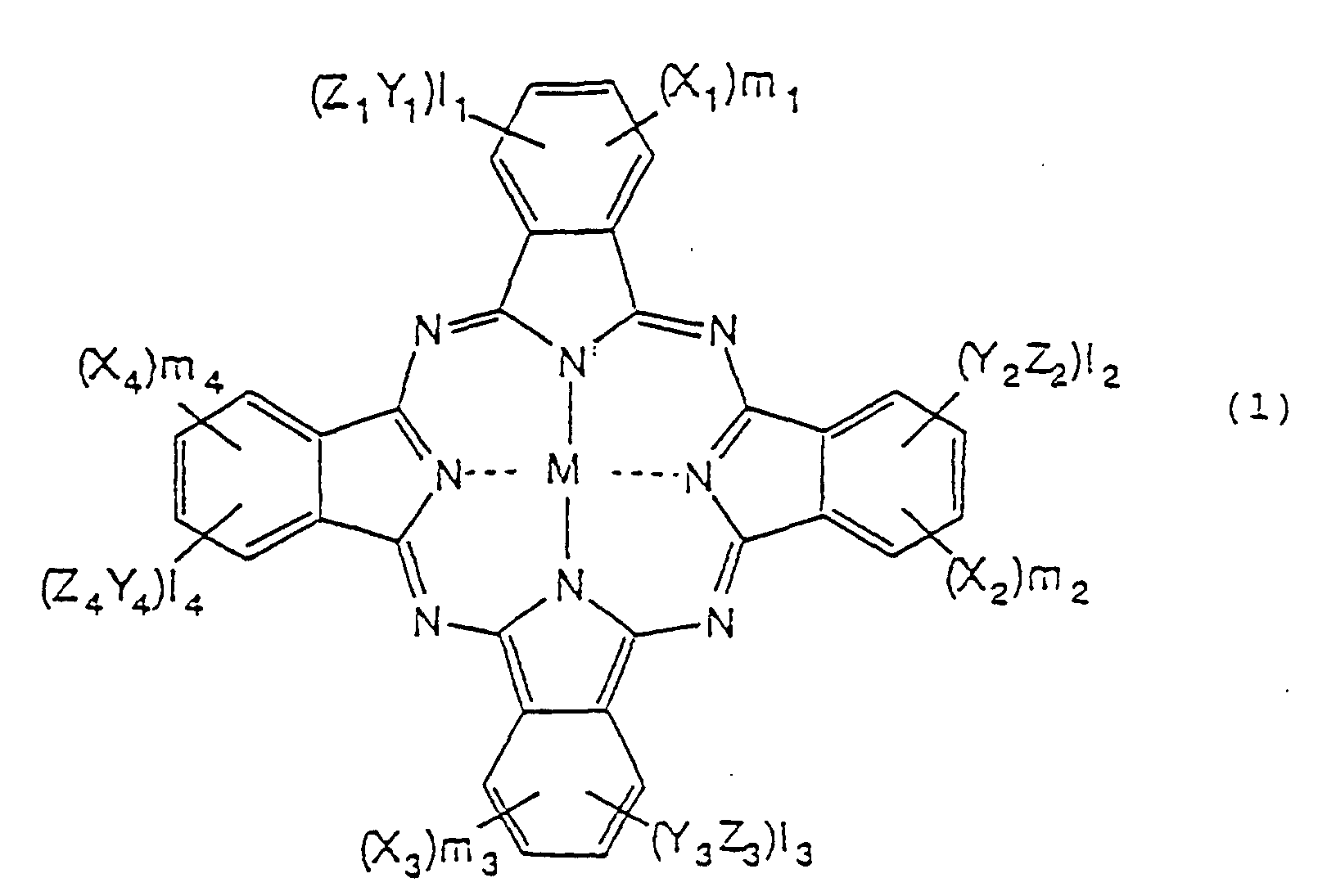
- a phthalocyanine dye represented by Formula (1) is preferred from the viewpoint of the recording characteristics and the durability: wherein M represents two hydrogen atoms, or metal, metal oxide or metal halide; Y 1 , Y 2 , Y 3 and Y 4 each represent an oxygen atom or a sulfur atom; Z 1 , Z 2 , Z 3 and Z 4 each represent an unsubstituted or substituted hydrocarbon group having 4 to 12 carbon atoms; X 1 , X 2 , X 3 and X 4 each represent a halogen atom; l 1 , l 2 , l 3 and l 4 each represent 1 or 2; and m 1 , m 2 , m 3 and m 4 each represent an integer of 0 to 3.
- M in the phthalocyanine dye represented by Formula (1) include divalent metals such as Cu, Fe, Co, Pd, Ru, Pt, Ti, Be, Ca, Ba, Ni, Mg, Zn, Pb and Cd, metal oxides such as VO, and metal halides such as AlCl, AlBr, GaCl, InBr, TiCl, and TiBr.
- Z 1 , Z 2 , Z 3 and Z 4 each represent an unsubstituted or substituted hydrocarbon group having 4 to 12 carbon atoms.
- the examples thereof include saturated hydrocarbon groups such as butyl, pentyl, hexyl, heptyl, octyl, nonyl, decyl, dodecyl, cyclohexyl and dimethylcyclohexyl, and unsaturated hydrocarbon groups such as butenyl, hexenyl, octenyl, dodecenyl, phenyl, methylphenyl, butylphenyl and hexylphenyl.
- These hydrocarbon groups may be either linear or branched. Further, these hydrocarbon groups may be substituted with halogen, an amino group, and an ether group.
- Halogen represented by X 1 , X 2 , X 3 and X 4 include fluorine, chlorine, bromine and iodine.
- substitution positions of the preceding substituents X 1 to X 4 and the substituents Y 1 to Y 4 each bonded to the benzene rings constituting phthalocyanine are not specifically restricted.
- the kind and the number of the substituents may be same or different in the four benzene rings contained in a molecule.
- a phthalocyanine dye in which the substitution positions of Y 1 , Y 2 , Y 3 and Y 4 are the a position in the benzene rings, and l 1 , l 2 , l 3 and l 4 are 1 is preferred from the viewpoint of the reflectance and the recording characteristics.
- the examples of the preferred phthalocyanine dye include the dyes represented by the following Formulas (2) to (10). More specifically, the dyes described in USP 5,124,067 are given and can be synthesized by the processes described therein. That is, they can be synthesized by reacting phthalodinitriles or diaminodiisoindolines having corresponding substituents with corresponding metal derivatives in a solvent having a high boiling point such as alcohol, chloronaphthalene, bromonaphthalene and trichlorobezene in the presence of 1,8-diazabicyclo[5,4,0]-7-undecene (DBU) under heating.
- DBU 1,8-diazabicyclo[5,4,0]-7-undecene
- the phthalocyanine dyes described above may be used in a mixture of two or more kinds thereof, if necessary. Further, there may be mixed other phthalocyanine dyes, other kinds of organic dyes, combustion accelerators, quenchers, UV absorbers, resin binders, and metallocene compounds.
- the recording layer used in the present invention can be formed by spin coating or casting a dye solution.
- solvents giving no damage to the substrate are preferably selected as the solvent for dissolving the dyes.
- aliphatic hydrocarbon solvents such as n-hexane, n-octane, and isooctane
- cyclic hydrocarbon solvents such as cyclohexane, methylcyclohexane, ethylcyclohexane, propylcyclohexane, dimethylcyclohexane and diethylcyclohexane
- halogenated hydrocarbon solvents such as carbon tetrachloride, dichloromethane and 2,2,3,3-tetrafluoro-1-propanol
- alcoholic solvents such as methanol, ethanol, 1-propanol, 2-propanol and diacetone alcohol
- ether solvents such as diethyl ether, dibutyl ether and diisoprop
- the recording layer is formed not only with a single layer but also maltilayers comprising plural dye layers, if necessary.
- a reflective layer having a thickness of 50 to 300 nm, preferably 100 to 150 nm is formed on the recording layer.
- Materials for the reflective layer include those having sufficiently high reflectances against recording and reproduction beams, for example, metals such as Au, Al, Ag, Cu, Ti, Cr, Ni, Pt, Ta, Cr and Pd, or alloys of these metals. Among them, Au, Al and Ag are particularly preferred because of their high reflectivities.
- Methods of forming the reflective layer include, for example, sputtering, chemical deposition and vacuum deposition. Further, an intermediate layer may also be provided between the recording layer and the reflective layer for enhancing the reflection and improving the adhesion.
- the inorganic materials include, for example, Si 3 N 4 , AlN, ZnS, a mixture of ZnS and SiO 2 , SiO 2 , TiO 2 , CeO 2 and Al 2 O 3 . These materials may be used alone or in a mixture thereof.
- the organic materials include known dyes such as cyanine dyes naphthalocyanine dyes, porphyrin dyes and azo dyes, and high molecular compounds such as polystyrenes, polyvinyl acetates, polycarbonates, poly(meth)acrylates, polyvinyl alcohols, polyvinyl butyrals, polyvinyl formals, polyvinylpyrrolidones and polyparahydroxystyrenes.
- dyes such as cyanine dyes naphthalocyanine dyes, porphyrin dyes and azo dyes
- high molecular compounds such as polystyrenes, polyvinyl acetates, polycarbonates, poly(meth)acrylates, polyvinyl alcohols, polyvinyl butyrals, polyvinyl formals, polyvinylpyrrolidones and polyparahydroxystyrenes.
- a protective layer may also be formed on the reflective layer.
- Materials for the protective layer are not specifically restricted as long as they can protect the reflective layer from an external force.
- the organic materials include thermoplastic resins, thermosetting resins, and UV-curing resins. Among them, the UV-curing resins are preferred.
- the inorganic materials include SiO 2 , SiN 4 , MgF 2 and SnO 2 .
- the optical recording medium thus prepared provides signal characteristics satisfying the Orange Book (CD-R) standards and can be well reproduced by CD players and CD-ROM players which have so far been commercially available.
- CD-R Orange Book
- two or more ROM areas and RAM areas may be provided, and it is allowed to provide the RAM area in a peripheral side and the ROM area in an internal side, and vice vasa.
- a dye solution was prepared by dissolving 0.25 g of the phthalocyanine dye represented by Formula (2) (dye (I)) in 10 ml of a coating solvent prepared by adding o-xylene of 3 % to ethylcyclohexane.
- This dye solution was applied on the substrate described above by spin coating at 750 rpm in 5 seconds and then dried for 10 seconds at 3000 rpm to form a recording layer containing the dye. Then, the substrate was dried by heating at 70°C for 2 hours to remove the residual solvent.
- the real part of the complex refractive index (n d ) of the recording layer (dye-containing layer) thus formed was 2.20.
- the average thickness of the dye layer was about 100 nm.
- Au was sputtered on this dye layer by means of a sputtering apparatus (manufactured by Balzers Co., Ltd.) to form a reflective layer having a thickness of 100 nm, wherein argon gas was used as a sputtering gas.
- the sputtering conditions were a sputtering power of 2.5 kW and a sputtering gas pressure of 1.0 x 10 -2 Torr.
- a UV-curing resin SD-17 manufactured by Dainippon Ink Chemical Ind. Co., Ltd. was spin-coated on the reflective layer and then irradiated with UV rays to form a protective layer having a thickness of 6 ⁇ m.
- An EFM signal was recorded in the RAM area of the medium by means of a commercial CD-R writer (CDD 521: manufactured by Philips Co., Ltd.). After recording, signals in the ROM area and the RAM area after recording were reproduced by means of a CD player (CD920JT: manufactured by Philips Co., Ltd.) to determine the reflectance (Rtop), the modulation (I1I/Itop) of 11T which is the longest pit. Further the error rate (BLER) and the jitter were determined by means of a CD decoder and a time interval analyzer, respectively.
- WCNRa in the RAM area by inputting a tracking error signal into a spectrum analyzer by means of DDU-1000 described above, and a reading error rate of absolute time (hereinafter abbreviated as ATER) by means of an ATIP decoder.
- ATER reading error rate of absolute time
- a medium was prepared and evaluated in the same manners as employed in Example 1, except that a solvent prepared by adding o-xylene of 2 % to dimethylcyclohexane was used as the coating solvent for a dye.
- a medium was prepared and evaluated in the same manners as employed in Example 1, except that a solvent prepared by adding propylcyclohexane of 1 % to dimethylcyclohexane was used as the coating solvent for a dye.
- a medium was prepared and evaluated in the same manners as employed in Example 1, except that changed were the width to 0.27 ⁇ m and the depth to 120 nm of the pre-grooves present in the ROM area and that dimethylcyclohexane was used as the coating solvent for a dye.
- a medium was prepared and evaluated in the same manners as employed in Example 6, except that the phthalocyanine dye (II) represented by Formula (3) described above was used.
- a medium was prepared and evaluated in the same manners as employed in Example 6, except that the phthalocyanine dye (III) represented by Formula (4) described above was used.
- a medium was prepared and evaluated in the same manners as employed in Example 6, except that the phthalocyanine dye (IV) represented by Formula (9) described above was used.
- a medium was prepared and evaluated in the same manners as employed in Example 6, except that the phthalocyanine dye (V) represented by Formula (10) described above was used.
- the present invention can provide a hybrid disk having such good signal characteristics as satisfying the Orange Book standards by:
Landscapes
- Engineering & Computer Science (AREA)
- Software Systems (AREA)
- Theoretical Computer Science (AREA)
- Optical Record Carriers And Manufacture Thereof (AREA)
- Optical Recording Or Reproduction (AREA)
Claims (5)
- Un milieu d'enregistrement optique hybride comprenant une couche d'enregistrement (2) renfermant un colorant, une couche réflectrice (3) et une couche protectrice (4), chacune prévue dans cet ordre sur un substrat (1) comprenant une zone de mémoire morte (ROM) dans laquelle des pré-puits (6) sont formés et une zone de mémoire vive (RAM) apte à être enregistrée, dans laquelle des pré-rainures (5) sont formées, caractérisé en ce que :(1) la zone ROM a les pré-puits (6) et les pré-rainures (5) reliant chaque pré-puits contigu, et lesdits pré-puits et lesdites pré-rainures forment des pistes d'oscillation, où lesdits pré-puits ont une profondeur (dp) de 250 nm ou plus et de 350 nm ou moins, lesdites pré-rainures ont une profondeur (dg) de 30 nm ou plus et de 170 nm ou moins, les pistes ont une amplitude d'oscillation de 25 nm ou plus et de 110 nm ou moins, et le produit de la profondeur desdites pré-rainures et de ladite amplitude d'oscillation est de 3100 ou plus, et(2) la zone RAM a les pré-rainures d'une profondeur de 130 nm ou plus et de 250 nm ou moins.
- Un milieu d'enregistrement optique selon la revendication 1, dans lequel le colorant utilisé pour la couche d'enregistrement (2) comprend un colorant de phtalocyanine représenté par la formule suivante (1) :dans laquelle M représente deux atomes d'hydrogène, ou du métal, de l'oxyde de métal ou un halogénure de métal, Y1, Y2 Y3 et Y4 représentent chacun un atome d'oxygène ou un atome de soufre, Z1, Z2 Z3 et Z4 représentent chacun un groupe hydrocarboné substitué ou non-substitué, ayant de 4 à 12 atomes de carbone, X1, X2, X3 et X4 représentent chacun un atome d'halogène, l1, l2 l3 et l4 représentent chacun 1 ou 2, et m1, m2, m3 et m4 représentent chacun un entier de 0 à 3.
- Un milieu d'enregistrement optique selon la revendication 1 ou 2, dans lequel les pré-puits (6) dans ladite zone ROM ont une profondeur (dp) de 270 nm ou plus et de 340 nm ou moins, lesdites pré-rainures (5) ont une profondeur (dg) de 35 nm ou plus et de 150 nm ou moins, les pistes ont une amplitude d'oscillation de 28 nm ou plus et de 99 nm ou moins, et le produit de la profondeur des pré-rainures et de l'amplitude d'oscillation est de 3300 ou plus.
- Un milieu d'enregistrement optique selon l'une quelconque des revendications 1 à 3, dans lequel les pré-rainures (5) dans ladite zone RAM ont une profondeur (dg) de 150 nm ou plus et de 230 nm ou moins.
- Un milieu d'enregistrement optique selon l'une quelconque des revendications 1 à 4, dans lequel une différence entre les longueurs de trajet optique au niveau d'une partie d'un pré-puits et une plage présente entre deux pistes comprenant les pré-puits (6) et les pré-rainures (5) dans ladite zone ROM est de 0,26 λ (où λ est la longueur d'onde d'un faisceau laser pour la reproduction) ou plus et 0,40 λ ou moins.
Applications Claiming Priority (6)
| Application Number | Priority Date | Filing Date | Title |
|---|---|---|---|
| JP21465195 | 1995-08-23 | ||
| JP214651/95 | 1995-08-23 | ||
| JP21465195 | 1995-08-23 | ||
| JP19048796 | 1996-07-19 | ||
| JP19048796A JP3652017B2 (ja) | 1995-08-23 | 1996-07-19 | 光記録媒体 |
| JP190487/96 | 1996-07-19 |
Publications (3)
| Publication Number | Publication Date |
|---|---|
| EP0762392A2 EP0762392A2 (fr) | 1997-03-12 |
| EP0762392A3 EP0762392A3 (fr) | 1999-01-20 |
| EP0762392B1 true EP0762392B1 (fr) | 2001-11-14 |
Family
ID=26506121
Family Applications (1)
| Application Number | Title | Priority Date | Filing Date |
|---|---|---|---|
| EP96113474A Expired - Lifetime EP0762392B1 (fr) | 1995-08-23 | 1996-08-22 | Milieux d'enregistrement optique |
Country Status (4)
| Country | Link |
|---|---|
| US (1) | US5696758A (fr) |
| EP (1) | EP0762392B1 (fr) |
| JP (1) | JP3652017B2 (fr) |
| DE (1) | DE69616919T2 (fr) |
Cited By (3)
| Publication number | Priority date | Publication date | Assignee | Title |
|---|---|---|---|---|
| US7086073B2 (en) | 2003-06-16 | 2006-08-01 | Microsoft Corporation | Optical storage media with embedded security device |
| EP1852858A2 (fr) | 2006-04-28 | 2007-11-07 | Taiyo Yuden Co., Ltd. | Support d'enregistrement d'informations optiques et appareil de moulage pour sa fabrication |
| US7895449B2 (en) | 2003-06-16 | 2011-02-22 | Microsoft Corporation | System and method for securely delivering installation keys to a production facility |
Families Citing this family (42)
| Publication number | Priority date | Publication date | Assignee | Title |
|---|---|---|---|---|
| DE69725810T2 (de) | 1996-08-30 | 2004-08-12 | Sharp K.K. | Plattenförmiges Aufzeichnungsmedium und Vorrichtung zur Aufzeichnung und Wiedergabe einer Platte |
| JPH1092016A (ja) * | 1996-09-12 | 1998-04-10 | Nikon Corp | 光ディスク |
| JPH10106040A (ja) * | 1996-09-26 | 1998-04-24 | Canon Inc | 光学的情報記録媒体および光学的情報記録再生装置 |
| EP0973156B1 (fr) * | 1996-10-25 | 2000-12-20 | Matsushita Electric Industrial Co., Ltd. | Disque optique présentant des arêtes et des sillons oscillants |
| JP4014690B2 (ja) | 1997-05-07 | 2007-11-28 | パイオニア株式会社 | 情報再生装置及び情報再生方法並びに情報記録再生システム |
| FR2768842B1 (fr) * | 1997-09-19 | 2000-01-07 | Maurice Milgram | Protection anti-copie d'un disque optique numerique par adjonction d'une zone ayant des proprietes optiques modifiables lors de la lecture |
| US6264848B1 (en) * | 1998-04-09 | 2001-07-24 | Seagate Technology Llc | Method for providing track position and identification information for data storage devices |
| JP3520203B2 (ja) * | 1998-07-23 | 2004-04-19 | 太陽誘電株式会社 | 光情報媒体 |
| GB9903550D0 (en) * | 1999-02-16 | 1999-04-07 | Plasmon Ltd | Forming optical recording layers |
| US6212158B1 (en) * | 1999-06-01 | 2001-04-03 | Eastman Kodak Company | Hybrid optical disc construction |
| JP2001023237A (ja) * | 1999-07-02 | 2001-01-26 | Pioneer Electronic Corp | 情報記録媒体 |
| JP3865547B2 (ja) * | 1999-11-12 | 2007-01-10 | 株式会社リコー | 光記録媒体および光記録媒体の製造方法 |
| US6826143B1 (en) | 2000-01-14 | 2004-11-30 | Lucent Technologies Inc. | Multi-dimensional optical disk |
| JP2001229576A (ja) * | 2000-02-10 | 2001-08-24 | Sony Corp | 光記録媒体及び光記録媒体製造用原盤 |
| TW575877B (en) * | 2000-02-10 | 2004-02-11 | Sony Corp | Optical recording medium |
| US7016295B2 (en) * | 2000-04-26 | 2006-03-21 | Optical Disc Corporation | Hybrid discs displaying certain dimensional values |
| US7054260B2 (en) * | 2000-04-26 | 2006-05-30 | Optical Disc Corporation | Hybrid discs |
| JP2001344812A (ja) * | 2000-06-02 | 2001-12-14 | Fuji Photo Film Co Ltd | 光情報記録媒体 |
| JP4136293B2 (ja) * | 2000-08-10 | 2008-08-20 | パイオニア株式会社 | 光学式記録媒体並びにその製造方法及び製造装置 |
| US6627288B1 (en) * | 2000-08-10 | 2003-09-30 | Mitsui Chemicals, Inc. | Optical recording medium and porphycene compound |
| US7120097B1 (en) * | 2000-09-15 | 2006-10-10 | Eastman Kodak Company | System for making a photoresist master for a hybrid optical recording disc |
| US6673411B2 (en) * | 2000-10-23 | 2004-01-06 | Mitsui Chemicals, Inc. | Optical recording medium |
| US6724717B2 (en) * | 2000-11-15 | 2004-04-20 | Ricoh Company, Ltd. | Optical recording disc |
| US6733957B2 (en) * | 2000-12-27 | 2004-05-11 | Victor Company Of Japan | Disk substrate and manufacturing method therefor, and disk manufactured by the disk substrate |
| US6908725B2 (en) * | 2001-01-16 | 2005-06-21 | Dphi Acquisitions, Inc. | Double-sided hybrid optical disk with surface topology |
| US6982110B2 (en) * | 2001-05-25 | 2006-01-03 | Ricoh Company, Ltd. | Information recording medium and manufacturing method thereof |
| TW567478B (en) * | 2001-06-15 | 2003-12-21 | Ritek Corp | Hybrid disc recording medium |
| CN1405765A (zh) * | 2001-09-10 | 2003-03-26 | 株式会社理光 | 光信息记录媒体及使用该记录媒体的信息记录方法 |
| CN1220981C (zh) * | 2001-10-15 | 2005-09-28 | 日本胜利株式会社 | 信息记录载体 |
| AU2002340701A1 (en) * | 2001-11-20 | 2003-06-10 | Interaxia Ag | Write-once optical data store, stamper for the production of said data store and method for the production of the stamper |
| US20030117936A1 (en) * | 2001-12-20 | 2003-06-26 | Eastman Kodak Company | Hybrid disc architecture |
| WO2003060889A1 (fr) * | 2002-01-11 | 2003-07-24 | Fujitsu Limited | Support d'enregistrement d'information optique |
| US20070220537A1 (en) * | 2003-06-16 | 2007-09-20 | Microsoft Corporation | Counterfeit-resistant portable storage media with embedded security device |
| JP2005190616A (ja) * | 2003-12-26 | 2005-07-14 | Taiyo Yuden Co Ltd | 光情報記録媒体 |
| EP1726009A2 (fr) * | 2004-02-24 | 2006-11-29 | CIBA SPECIALTY CHEMICALS HOLDING INC. Patent Departement | Matériaux d'affichages optiques inscriptibles avec un laser bleu |
| JP2005293773A (ja) * | 2004-04-02 | 2005-10-20 | Toshiba Corp | 追記型情報記録媒体 |
| JP2008520057A (ja) * | 2004-11-11 | 2008-06-12 | ソフト−アール・リサーチ・エルエルシー | 光記録ディスクおよび光記録ディスク上にデータを記録するための方法 |
| KR100655801B1 (ko) * | 2005-01-18 | 2006-12-08 | 삼성전자주식회사 | 포토레지스트 조성물 및 이를 이용한 포토레지스트 패턴형성 방법 |
| JP4770710B2 (ja) * | 2005-11-17 | 2011-09-14 | ソニー株式会社 | 記録媒体およびその製造方法、並びに記録媒体用原盤およびその製造方法 |
| KR100823262B1 (ko) * | 2006-05-04 | 2008-04-17 | 삼성전자주식회사 | 광 기록 매체, 그 기록/재생 방법 및 장치 |
| JP2009110659A (ja) * | 2009-01-23 | 2009-05-21 | Victor Co Of Japan Ltd | 情報記録媒体、情報記録媒体再生装置、情報記録媒体再生方法、情報記録媒体記録装置、情報記録媒体記録方法 |
| JP2009104785A (ja) * | 2009-02-16 | 2009-05-14 | Victor Co Of Japan Ltd | 情報記録媒体、情報記録媒体再生装置、情報記録媒体再生方法、情報記録媒体記録装置、情報記録媒体記録方法 |
Family Cites Families (9)
| Publication number | Priority date | Publication date | Assignee | Title |
|---|---|---|---|---|
| NL8000122A (nl) * | 1980-01-09 | 1981-08-03 | Philips Nv | Schijfvormige, optisch uitleesbare registratiedrager als opslagmedium voor datainformatie, inrichting voor het vervaardigen van zo'n registratiedrager, inrichting voor het optekenen en/of weergeven van datainformatie in c.q. van zo'n registratiedrager. |
| DE3840291A1 (de) * | 1988-11-30 | 1990-05-31 | Broadcast Television Syst | Verfahren und schaltungsanordnung zur wiedergabe von datensignalen |
| CA2005520A1 (fr) * | 1988-12-15 | 1990-06-15 | Hisato Itoh | Absorbant d'infrarouge proche et materiaux d'affichage ou d'enregistrement fabriques avec cet absorbant |
| US5270623A (en) * | 1989-09-26 | 1993-12-14 | Honda Giken Kogyo Kabushiki Kaisha | Method of controlling speed of rotation of motor |
| US5204852A (en) * | 1990-02-17 | 1993-04-20 | Victor Company Of Japan, Ltd. | Optical disc-like recoding medium and manufacturing method thereof |
| JP2966077B2 (ja) * | 1990-10-05 | 1999-10-25 | 富士写真フイルム株式会社 | 情報記録媒体 |
| JPH04243019A (ja) * | 1991-01-17 | 1992-08-31 | Fuji Photo Film Co Ltd | 情報記録媒体 |
| JPH0536087A (ja) * | 1991-07-27 | 1993-02-12 | Ricoh Co Ltd | 光情報記録媒体 |
| US5343454A (en) * | 1991-11-22 | 1994-08-30 | Matsushita Electric Industrial Co., Ltd. | Tracking control apparatus for correcting tracking error signal according to approximate equation of a function of track address |
-
1996
- 1996-07-19 JP JP19048796A patent/JP3652017B2/ja not_active Expired - Fee Related
- 1996-08-14 US US08/696,463 patent/US5696758A/en not_active Expired - Lifetime
- 1996-08-22 EP EP96113474A patent/EP0762392B1/fr not_active Expired - Lifetime
- 1996-08-22 DE DE69616919T patent/DE69616919T2/de not_active Expired - Lifetime
Cited By (7)
| Publication number | Priority date | Publication date | Assignee | Title |
|---|---|---|---|---|
| US7086073B2 (en) | 2003-06-16 | 2006-08-01 | Microsoft Corporation | Optical storage media with embedded security device |
| US7530083B2 (en) | 2003-06-16 | 2009-05-05 | Microsoft Corporation | Optical storage media with embedded security device |
| US7546616B2 (en) | 2003-06-16 | 2009-06-09 | Microsoft Corporation | Optical storage media with embedded security device |
| US7895449B2 (en) | 2003-06-16 | 2011-02-22 | Microsoft Corporation | System and method for securely delivering installation keys to a production facility |
| EP1852858A2 (fr) | 2006-04-28 | 2007-11-07 | Taiyo Yuden Co., Ltd. | Support d'enregistrement d'informations optiques et appareil de moulage pour sa fabrication |
| EP1852858A3 (fr) * | 2006-04-28 | 2008-01-23 | Taiyo Yuden Co., Ltd. | Support d'enregistrement d'informations optiques et appareil de moulage pour sa fabrication |
| US7859982B2 (en) | 2006-04-28 | 2010-12-28 | Taiyo Yuden, Co., Ltd. | Optical information recording medium and mold apparatus for manufacturing the same |
Also Published As
| Publication number | Publication date |
|---|---|
| JPH09120586A (ja) | 1997-05-06 |
| JP3652017B2 (ja) | 2005-05-25 |
| DE69616919D1 (de) | 2001-12-20 |
| EP0762392A2 (fr) | 1997-03-12 |
| EP0762392A3 (fr) | 1999-01-20 |
| US5696758A (en) | 1997-12-09 |
| DE69616919T2 (de) | 2002-04-04 |
Similar Documents
| Publication | Publication Date | Title |
|---|---|---|
| US5696758A (en) | Optical recording media | |
| KR100455078B1 (ko) | 광기록매체 | |
| EP0837459B1 (fr) | Eléments d'enregistrement optique avec des couches d'enregistrement contenant des mélanges des colorants formazanes métallisées a K-valeur nulle et des colorants cyanines | |
| KR960016142B1 (ko) | 광기록매체 | |
| EP1296318A1 (fr) | Support d'enregistrement optique d'informations et procédé d'enregistrement d'informations utilisant tel support d'enregistrement | |
| JPH08273193A (ja) | 光記録媒体 | |
| EP1189218A2 (fr) | Support d'enregistrement d'optique | |
| JPH05579A (ja) | 光記録媒体 | |
| JPH10330633A (ja) | サブフタロシアニン化合物及びそれを用いた光記録媒体 | |
| EP0837462B1 (fr) | Eléments d'enregistrement optique avec des couches d'enregistrement contenant des mélanges de colorants formazane métallisée ayant une valeur K peu élevée et de colorants cyanines | |
| JPH06199045A (ja) | 光記録媒体 | |
| JPH09138977A (ja) | 光記録媒体 | |
| JPH08273192A (ja) | 光記録媒体 | |
| US7727706B2 (en) | Recording method for dye-based recordable optical recording medium | |
| JPH0512680A (ja) | 光情報記録媒体及び光情報記録媒体用スタンパの原盤製造方法 | |
| JP2897773B2 (ja) | 光記録再生方法 | |
| JPH08339573A (ja) | 光記録媒体 | |
| JPH08129780A (ja) | 光記録媒体 | |
| JP3088510B2 (ja) | 情報記録媒体 | |
| JPH08235637A (ja) | 光記録媒体 | |
| JP3088501B2 (ja) | 情報記録媒体 | |
| JPH097232A (ja) | 光記録媒体 | |
| JP3375432B2 (ja) | 光記録媒体 | |
| JP3480536B2 (ja) | 光記録媒体 | |
| JP2003034078A (ja) | 光記録媒体 |
Legal Events
| Date | Code | Title | Description |
|---|---|---|---|
| PUAI | Public reference made under article 153(3) epc to a published international application that has entered the european phase |
Free format text: ORIGINAL CODE: 0009012 |
|
| 17P | Request for examination filed |
Effective date: 19960822 |
|
| AK | Designated contracting states |
Kind code of ref document: A2 Designated state(s): DE FR GB |
|
| RAP1 | Party data changed (applicant data changed or rights of an application transferred) |
Owner name: MITSUI CHEMICALS, INC. |
|
| PUAL | Search report despatched |
Free format text: ORIGINAL CODE: 0009013 |
|
| AK | Designated contracting states |
Kind code of ref document: A3 Designated state(s): DE FR GB NL |
|
| 17Q | First examination report despatched |
Effective date: 20000224 |
|
| GRAG | Despatch of communication of intention to grant |
Free format text: ORIGINAL CODE: EPIDOS AGRA |
|
| GRAG | Despatch of communication of intention to grant |
Free format text: ORIGINAL CODE: EPIDOS AGRA |
|
| GRAH | Despatch of communication of intention to grant a patent |
Free format text: ORIGINAL CODE: EPIDOS IGRA |
|
| RBV | Designated contracting states (corrected) |
Designated state(s): DE FR GB |
|
| GRAH | Despatch of communication of intention to grant a patent |
Free format text: ORIGINAL CODE: EPIDOS IGRA |
|
| GRAA | (expected) grant |
Free format text: ORIGINAL CODE: 0009210 |
|
| AK | Designated contracting states |
Kind code of ref document: B1 Designated state(s): DE FR GB |
|
| REF | Corresponds to: |
Ref document number: 69616919 Country of ref document: DE Date of ref document: 20011220 |
|
| REG | Reference to a national code |
Ref country code: GB Ref legal event code: IF02 |
|
| PLBE | No opposition filed within time limit |
Free format text: ORIGINAL CODE: 0009261 |
|
| STAA | Information on the status of an ep patent application or granted ep patent |
Free format text: STATUS: NO OPPOSITION FILED WITHIN TIME LIMIT |
|
| 26N | No opposition filed | ||
| PGFP | Annual fee paid to national office [announced via postgrant information from national office to epo] |
Ref country code: FR Payment date: 20090814 Year of fee payment: 14 |
|
| PGFP | Annual fee paid to national office [announced via postgrant information from national office to epo] |
Ref country code: GB Payment date: 20090818 Year of fee payment: 14 Ref country code: DE Payment date: 20090821 Year of fee payment: 14 |
|
| GBPC | Gb: european patent ceased through non-payment of renewal fee |
Effective date: 20100822 |
|
| REG | Reference to a national code |
Ref country code: FR Ref legal event code: ST Effective date: 20110502 |
|
| REG | Reference to a national code |
Ref country code: DE Ref legal event code: R119 Ref document number: 69616919 Country of ref document: DE Effective date: 20110301 |
|
| PG25 | Lapsed in a contracting state [announced via postgrant information from national office to epo] |
Ref country code: DE Free format text: LAPSE BECAUSE OF NON-PAYMENT OF DUE FEES Effective date: 20110301 Ref country code: FR Free format text: LAPSE BECAUSE OF NON-PAYMENT OF DUE FEES Effective date: 20100831 |
|
| PG25 | Lapsed in a contracting state [announced via postgrant information from national office to epo] |
Ref country code: GB Free format text: LAPSE BECAUSE OF NON-PAYMENT OF DUE FEES Effective date: 20100822 |