EP0815261B1 - Diagnostics de l'adn par spectrometrie de masse - Google Patents
Diagnostics de l'adn par spectrometrie de masse Download PDFInfo
- Publication number
- EP0815261B1 EP0815261B1 EP96910464A EP96910464A EP0815261B1 EP 0815261 B1 EP0815261 B1 EP 0815261B1 EP 96910464 A EP96910464 A EP 96910464A EP 96910464 A EP96910464 A EP 96910464A EP 0815261 B1 EP0815261 B1 EP 0815261B1
- Authority
- EP
- European Patent Office
- Prior art keywords
- nucleic acid
- mass
- acid molecule
- dna
- mass spectrometry
- Prior art date
- Legal status (The legal status is an assumption and is not a legal conclusion. Google has not performed a legal analysis and makes no representation as to the accuracy of the status listed.)
- Expired - Lifetime
Links
Images





























Classifications
-
- C—CHEMISTRY; METALLURGY
- C12—BIOCHEMISTRY; BEER; SPIRITS; WINE; VINEGAR; MICROBIOLOGY; ENZYMOLOGY; MUTATION OR GENETIC ENGINEERING
- C12Q—MEASURING OR TESTING PROCESSES INVOLVING ENZYMES, NUCLEIC ACIDS OR MICROORGANISMS; COMPOSITIONS OR TEST PAPERS THEREFOR; PROCESSES OF PREPARING SUCH COMPOSITIONS; CONDITION-RESPONSIVE CONTROL IN MICROBIOLOGICAL OR ENZYMOLOGICAL PROCESSES
- C12Q1/00—Measuring or testing processes involving enzymes, nucleic acids or microorganisms; Compositions therefor; Processes of preparing such compositions
- C12Q1/68—Measuring or testing processes involving enzymes, nucleic acids or microorganisms; Compositions therefor; Processes of preparing such compositions involving nucleic acids
- C12Q1/6869—Methods for sequencing
- C12Q1/6872—Methods for sequencing involving mass spectrometry
-
- C—CHEMISTRY; METALLURGY
- C12—BIOCHEMISTRY; BEER; SPIRITS; WINE; VINEGAR; MICROBIOLOGY; ENZYMOLOGY; MUTATION OR GENETIC ENGINEERING
- C12Q—MEASURING OR TESTING PROCESSES INVOLVING ENZYMES, NUCLEIC ACIDS OR MICROORGANISMS; COMPOSITIONS OR TEST PAPERS THEREFOR; PROCESSES OF PREPARING SUCH COMPOSITIONS; CONDITION-RESPONSIVE CONTROL IN MICROBIOLOGICAL OR ENZYMOLOGICAL PROCESSES
- C12Q1/00—Measuring or testing processes involving enzymes, nucleic acids or microorganisms; Compositions therefor; Processes of preparing such compositions
- C12Q1/68—Measuring or testing processes involving enzymes, nucleic acids or microorganisms; Compositions therefor; Processes of preparing such compositions involving nucleic acids
- C12Q1/6813—Hybridisation assays
- C12Q1/6816—Hybridisation assays characterised by the detection means
-
- C—CHEMISTRY; METALLURGY
- C12—BIOCHEMISTRY; BEER; SPIRITS; WINE; VINEGAR; MICROBIOLOGY; ENZYMOLOGY; MUTATION OR GENETIC ENGINEERING
- C12Q—MEASURING OR TESTING PROCESSES INVOLVING ENZYMES, NUCLEIC ACIDS OR MICROORGANISMS; COMPOSITIONS OR TEST PAPERS THEREFOR; PROCESSES OF PREPARING SUCH COMPOSITIONS; CONDITION-RESPONSIVE CONTROL IN MICROBIOLOGICAL OR ENZYMOLOGICAL PROCESSES
- C12Q1/00—Measuring or testing processes involving enzymes, nucleic acids or microorganisms; Compositions therefor; Processes of preparing such compositions
- C12Q1/68—Measuring or testing processes involving enzymes, nucleic acids or microorganisms; Compositions therefor; Processes of preparing such compositions involving nucleic acids
- C12Q1/6813—Hybridisation assays
- C12Q1/6827—Hybridisation assays for detection of mutation or polymorphism
-
- C—CHEMISTRY; METALLURGY
- C12—BIOCHEMISTRY; BEER; SPIRITS; WINE; VINEGAR; MICROBIOLOGY; ENZYMOLOGY; MUTATION OR GENETIC ENGINEERING
- C12Q—MEASURING OR TESTING PROCESSES INVOLVING ENZYMES, NUCLEIC ACIDS OR MICROORGANISMS; COMPOSITIONS OR TEST PAPERS THEREFOR; PROCESSES OF PREPARING SUCH COMPOSITIONS; CONDITION-RESPONSIVE CONTROL IN MICROBIOLOGICAL OR ENZYMOLOGICAL PROCESSES
- C12Q1/00—Measuring or testing processes involving enzymes, nucleic acids or microorganisms; Compositions therefor; Processes of preparing such compositions
- C12Q1/68—Measuring or testing processes involving enzymes, nucleic acids or microorganisms; Compositions therefor; Processes of preparing such compositions involving nucleic acids
- C12Q1/6813—Hybridisation assays
- C12Q1/6834—Enzymatic or biochemical coupling of nucleic acids to a solid phase
- C12Q1/6837—Enzymatic or biochemical coupling of nucleic acids to a solid phase using probe arrays or probe chips
-
- C—CHEMISTRY; METALLURGY
- C12—BIOCHEMISTRY; BEER; SPIRITS; WINE; VINEGAR; MICROBIOLOGY; ENZYMOLOGY; MUTATION OR GENETIC ENGINEERING
- C12Q—MEASURING OR TESTING PROCESSES INVOLVING ENZYMES, NUCLEIC ACIDS OR MICROORGANISMS; COMPOSITIONS OR TEST PAPERS THEREFOR; PROCESSES OF PREPARING SUCH COMPOSITIONS; CONDITION-RESPONSIVE CONTROL IN MICROBIOLOGICAL OR ENZYMOLOGICAL PROCESSES
- C12Q1/00—Measuring or testing processes involving enzymes, nucleic acids or microorganisms; Compositions therefor; Processes of preparing such compositions
- C12Q1/68—Measuring or testing processes involving enzymes, nucleic acids or microorganisms; Compositions therefor; Processes of preparing such compositions involving nucleic acids
- C12Q1/6844—Nucleic acid amplification reactions
- C12Q1/6858—Allele-specific amplification
-
- C—CHEMISTRY; METALLURGY
- C12—BIOCHEMISTRY; BEER; SPIRITS; WINE; VINEGAR; MICROBIOLOGY; ENZYMOLOGY; MUTATION OR GENETIC ENGINEERING
- C12Q—MEASURING OR TESTING PROCESSES INVOLVING ENZYMES, NUCLEIC ACIDS OR MICROORGANISMS; COMPOSITIONS OR TEST PAPERS THEREFOR; PROCESSES OF PREPARING SUCH COMPOSITIONS; CONDITION-RESPONSIVE CONTROL IN MICROBIOLOGICAL OR ENZYMOLOGICAL PROCESSES
- C12Q1/00—Measuring or testing processes involving enzymes, nucleic acids or microorganisms; Compositions therefor; Processes of preparing such compositions
- C12Q1/68—Measuring or testing processes involving enzymes, nucleic acids or microorganisms; Compositions therefor; Processes of preparing such compositions involving nucleic acids
- C12Q1/6844—Nucleic acid amplification reactions
- C12Q1/686—Polymerase chain reaction [PCR]
-
- C—CHEMISTRY; METALLURGY
- C12—BIOCHEMISTRY; BEER; SPIRITS; WINE; VINEGAR; MICROBIOLOGY; ENZYMOLOGY; MUTATION OR GENETIC ENGINEERING
- C12Q—MEASURING OR TESTING PROCESSES INVOLVING ENZYMES, NUCLEIC ACIDS OR MICROORGANISMS; COMPOSITIONS OR TEST PAPERS THEREFOR; PROCESSES OF PREPARING SUCH COMPOSITIONS; CONDITION-RESPONSIVE CONTROL IN MICROBIOLOGICAL OR ENZYMOLOGICAL PROCESSES
- C12Q1/00—Measuring or testing processes involving enzymes, nucleic acids or microorganisms; Compositions therefor; Processes of preparing such compositions
- C12Q1/68—Measuring or testing processes involving enzymes, nucleic acids or microorganisms; Compositions therefor; Processes of preparing such compositions involving nucleic acids
- C12Q1/6844—Nucleic acid amplification reactions
- C12Q1/6862—Ligase chain reaction [LCR]
-
- C—CHEMISTRY; METALLURGY
- C12—BIOCHEMISTRY; BEER; SPIRITS; WINE; VINEGAR; MICROBIOLOGY; ENZYMOLOGY; MUTATION OR GENETIC ENGINEERING
- C12Q—MEASURING OR TESTING PROCESSES INVOLVING ENZYMES, NUCLEIC ACIDS OR MICROORGANISMS; COMPOSITIONS OR TEST PAPERS THEREFOR; PROCESSES OF PREPARING SUCH COMPOSITIONS; CONDITION-RESPONSIVE CONTROL IN MICROBIOLOGICAL OR ENZYMOLOGICAL PROCESSES
- C12Q1/00—Measuring or testing processes involving enzymes, nucleic acids or microorganisms; Compositions therefor; Processes of preparing such compositions
- C12Q1/68—Measuring or testing processes involving enzymes, nucleic acids or microorganisms; Compositions therefor; Processes of preparing such compositions involving nucleic acids
- C12Q1/6876—Nucleic acid products used in the analysis of nucleic acids, e.g. primers or probes
- C12Q1/6883—Nucleic acid products used in the analysis of nucleic acids, e.g. primers or probes for diseases caused by alterations of genetic material
-
- C—CHEMISTRY; METALLURGY
- C12—BIOCHEMISTRY; BEER; SPIRITS; WINE; VINEGAR; MICROBIOLOGY; ENZYMOLOGY; MUTATION OR GENETIC ENGINEERING
- C12Q—MEASURING OR TESTING PROCESSES INVOLVING ENZYMES, NUCLEIC ACIDS OR MICROORGANISMS; COMPOSITIONS OR TEST PAPERS THEREFOR; PROCESSES OF PREPARING SUCH COMPOSITIONS; CONDITION-RESPONSIVE CONTROL IN MICROBIOLOGICAL OR ENZYMOLOGICAL PROCESSES
- C12Q1/00—Measuring or testing processes involving enzymes, nucleic acids or microorganisms; Compositions therefor; Processes of preparing such compositions
- C12Q1/70—Measuring or testing processes involving enzymes, nucleic acids or microorganisms; Compositions therefor; Processes of preparing such compositions involving virus or bacteriophage
- C12Q1/701—Specific hybridization probes
- C12Q1/706—Specific hybridization probes for hepatitis
-
- G—PHYSICS
- G01—MEASURING; TESTING
- G01N—INVESTIGATING OR ANALYSING MATERIALS BY DETERMINING THEIR CHEMICAL OR PHYSICAL PROPERTIES
- G01N35/00—Automatic analysis not limited to methods or materials provided for in any single one of groups G01N1/00 - G01N33/00; Handling materials therefor
- G01N35/10—Devices for transferring samples or any liquids to, in, or from, the analysis apparatus, e.g. suction devices, injection devices
- G01N35/1065—Multiple transfer devices
- G01N35/1067—Multiple transfer devices for transfer to or from containers having different spacing
-
- H—ELECTRICITY
- H01—ELECTRIC ELEMENTS
- H01J—ELECTRIC DISCHARGE TUBES OR DISCHARGE LAMPS
- H01J49/00—Particle spectrometers or separator tubes
-
- Y—GENERAL TAGGING OF NEW TECHNOLOGICAL DEVELOPMENTS; GENERAL TAGGING OF CROSS-SECTIONAL TECHNOLOGIES SPANNING OVER SEVERAL SECTIONS OF THE IPC; TECHNICAL SUBJECTS COVERED BY FORMER USPC CROSS-REFERENCE ART COLLECTIONS [XRACs] AND DIGESTS
- Y10—TECHNICAL SUBJECTS COVERED BY FORMER USPC
- Y10T—TECHNICAL SUBJECTS COVERED BY FORMER US CLASSIFICATION
- Y10T436/00—Chemistry: analytical and immunological testing
- Y10T436/14—Heterocyclic carbon compound [i.e., O, S, N, Se, Te, as only ring hetero atom]
- Y10T436/142222—Hetero-O [e.g., ascorbic acid, etc.]
- Y10T436/143333—Saccharide [e.g., DNA, etc.]
-
- Y—GENERAL TAGGING OF NEW TECHNOLOGICAL DEVELOPMENTS; GENERAL TAGGING OF CROSS-SECTIONAL TECHNOLOGIES SPANNING OVER SEVERAL SECTIONS OF THE IPC; TECHNICAL SUBJECTS COVERED BY FORMER USPC CROSS-REFERENCE ART COLLECTIONS [XRACs] AND DIGESTS
- Y10—TECHNICAL SUBJECTS COVERED BY FORMER USPC
- Y10T—TECHNICAL SUBJECTS COVERED BY FORMER US CLASSIFICATION
- Y10T436/00—Chemistry: analytical and immunological testing
- Y10T436/24—Nuclear magnetic resonance, electron spin resonance or other spin effects or mass spectrometry
Definitions
- DNA deoxyribonucleic acid
- chromosomes The Human Genome, T. Strachan, BIOS Scientific Publishers, 1992.
- Each gene codes for a specific protein which after its expression via transcription and translation, fulfills a specific biochemical function within a living cell. Changes in a DNA sequence are known as mutations and can result in proteins with altered or in some cases even lost biochemical activities; this in turn can cause genetic disease. Mutations include nucleotide deletions, insertions or alterations (i.e. point mutations). Point mutations can be either "missense", resulting in a change in the amino acid sequence of a protein or "nonsense" coding for a stop codon and thereby leading to a truncated protein.
- Viruses, bacteria, fungi and other infectious organisms contain distinct nucleic acid sequences, which are different from the sequences contained in the host cell. Therefore, infectious organisms can also be detected and identified based on their specific DNA sequences.
- nucleic acid sequences can be used to detect normal and defective genes in higher organisms and to detect infectious microorganisms (e.g. bacteria, fungi, protists and yeast) and viruses. DNA sequences can even serve as a fingerprint for detection of different individuals within the same species. (Thompson, J.S. and M.W. Thompson, eds., Genetics in Medicine, W.B. Saunders Co., Philadelphia, PA (1986).
- nucleic acid sequences can be identified by comparing the mobility of an amplified nucleic acid fragment with a known standard by gel electrophoresis, or by hybridization with a probe, which is complementary to the sequence to be identified. Identification, however, can only be accomplished if the nucleic acid fragment is labeled with a sensitive reporter function (e.g. radioactive ( 32 P, 35 S), fluorescent or chemiluminescent).
- a sensitive reporter function e.g. radioactive ( 32 P, 35 S), fluorescent or chemiluminescent.
- radioactive labels can be hazardous and the signals they produce decay over time.
- Non-isotopic labels e.g. fluorescent
- Electrophoresis is particularly error-prone, since the size or the molecular weight of the nucleic acid cannot be directly correlated to the mobility in the gel matrix. It is known that sequence specific effects, secondary structures and interactions with the gel matrix are causing artefacts.
- mass spectrometry provides a means of "weighing" individual molecules by ionizing the molecules in vacuo and making them “fly” by volatilization. Under the influence of combinations of electric and magnetic fields, the ions follow trajectories depending on their individual mass (m) and charge (z). In the range of molecules with low molecular weight, mass spectrometry has long been pan of the routine physical-organic repertoire for analysis and characterization of organic molecules by the determination of the mass of the parent molecular ion. In addition, by arranging collisions of this parent molecular ion with other particles (e.g., argon atoms), the molecular ion is fragmented forming secondary ions by the so-called collision induced dissociation (CID).
- CID collision induced dissociation
- nucleic acids are very polar biopolymers that are very difficult to volatilize. Consequently, mass spectrometric detection has been limited to low molecular weight synthetic oligonucleotides by determining the mass of the parent molecular ion and through this, confirming the already known oligonucleotide sequence, or alternatively, confirming the known sequence through the generation of secondary ions (fragment ions) via CID in an MS/MS configuration utilizing, in particular, for the ionization and volatilization. the method of fast atomic bombardment (FAB mass spectrometry) or plasma desorption (PD mass spectrometry).
- FAB mass spectrometry fast atomic bombardment
- PD mass spectrometry plasma desorption
- ES mass spectrometry has been introduced by Fenn et al. (J. Phys. Chem. 88 , 4451-59(1984); PCT Application No. WO 90/14148) and current applications are summarized in recent review articles (R.D. Smith et al ., Anal. Chem. 62 , 882-899 (1990) and B. Ardrey, Electrospray Mass Spectrometry, Spectroscopy Europe , 4 , 10-18 (1992)).
- MALDI mass spectrometry in contrast, can be particularly attractive when a time-of-flight (TOF) configuration is used as a mass analyzer.
- TOF time-of-flight
- the MALDI-TOF mass spectrometry has been introduced by Hillenkamp et al. ("Matrix Assisted UV-Laser Desorption/Ionization: A New Approach to Mass Spectrometry of Large Biomolecules," Biological Mass Spectrometry (Burlingame and McCloskey, editors), Elsevier Science Publishers, Amsterdam, pp. 49-60, 1990.) Since, in most cases, no multiple molecular ion peaks are produced with this technique, the mass spectra, in principle, look simpler compared to ES mass spectrometry.
- Japanese Patent No. 59-131909 describes an instrument, which detects nucleic acid fragments separated either by electrophoresis, liquid chromatography or high speed gel filtration. Mass spectrometric detection is achieved by incorporating into the nucleic acids, atoms which normally do not occur in DNA such as S, Br, I or Ag, Au, Pt, Os, Hg.
- the instant invention provides mass spectrometric processes for detecting a particular nucleic acid sequence in a biological sample.
- the processes can be used, for example, to diagnose (e.g. prenatally or postnatally), a genetic disease or chromosomal abnormality; a predisposition to a disease or condition (e.g. obesity, artherosclerosis, cancer), or infection by a pathogenic organism (e.g. virus, bacteria parasite or fungus); or to provide information relating to identity, heredity, or compatibility (e.g. HLA phenotyping).
- diagnose e.g. prenatally or postnatally
- a genetic disease or chromosomal abnormality e.g. obesity, artherosclerosis, cancer
- a pathogenic organism e.g. virus, bacteria parasite or fungus
- HLA phenotyping e.g. HLA phenotyping
- one or more detector nucleic acid molecules e.g. an oligonucleotide or oligonucleotide mimetic
- oligonucleotide or oligonucleotide mimetic which is complementary to the target detection site is hybridized with the target detection site and unhybridized detector oligonucleotide is removed.
- the product is ionized and volatized and then analysed by mass spectrometry wherein detection of the detector oligonucleotide by mass spectrometry indicates the presence of the target nucleic acid in the biological sample.
- a nucleic acid molecule containing the nucleic acid sequence to be detected may be initially immobilized to a solid support. Immobilization can be accomplished, for example, based on hybridization between a portion of the target nucleic acid molecule, which is distinct from the target detection site and a capture nucleic acid molecule, which has been previously immobilized to a solid support. Alternatively, immobilization can be accomplished by direct bonding of the target nucleic acid molecule and the solid support. Preferably, there is a spacer (e.g. a nucleic acid molecule) between the target nucleic acid molecule and the support.
- a spacer e.g. a nucleic acid molecule
- the target detection site is amplified prior to detection and the nucleic acid molecules are conditioned.
- the target detection sequences are arranged in a format that allows multiple simultaneous detections (multiplexing), as well as parallel processing using oligonucleotide arrays ("DNA chips").
- immobilization of the target nucleic acid molecule is an optional step.
- the target detection sequence is amplified and directly detected by mass spectrometry.
- the target detection site and/or the detector oligonucleotides are conditioned prior to mass spectrometric detection.
- the amplified target detection sites are arranged in a format that allows multiple simultaneous detections (multiplexing), as well as parallel processing using oligonucleotide arrays ("DNA chips").
- nucleic acid molecules which have been replicated from a nucleic acid molecule obtained from a biological sample can be specifically digested using one of more nucleases (using deoxyribonucleases for DNA or ribonucleases for RNA).
- the fragments are analysed by mass spectrometry wherein the determination of the molecular weight of the fragments indicates whether the target nucleic acid sequence is present. Hybridization events and the actual molecular weights of the target sequences provide information on whether and where mutations in the gene are present.
- the fragments may be captured on a solid support carrying the corresponding complementary sequences.
- the array can be analysed spot by spot using mass spectrometry.
- DNA can be similarly digested using a cocktail of nucleases including restriction endonucleases.
- the nucleic acid fragments are conditioned prior to mass spectrometric detection.
- At least one primer with 3' terminal base complementary to an allele is hybridized with a target nucieic acid molecule which contains the allele.
- An appropriate polymerase and a complete set of nucleoside triphosphates or only one of the nucleoside triphosphates are used in separate reactions to furnish a distinct extension of the primer. Only if the primer is appropriately annealed (i.e. No. 3' mismatch) and if the correct (i.e. complementary nucleoside is added will the primer be extended. Products can be resolved by molecular weight shifts as determined by mass spectrometry.
- a nucleic acid primer that is complementary to a portion of the target detection site that is adjacent the site of a mutation is hybridized with the target nucleic acid molecule.
- the addition of a complete set of dideoxynucleosides, 3'-deoxynucleoside triphosphates (e.g. pppAdd, pppTdd, pppCdd and pppGdd) or ribonucleotide triphosphates and a polymerase allows only one dideoxynucleoside, 3'deoxynucleoside or ribonucleotide triphosphate that is complementary to the target nucleotide to be extended onto the primer.
- the product is ionized and volatized and then analysed by mass spectrometry wherein detection of the primer by mass spectrometry determines the identity of the target nucleotide.
- the nucleic acid molecule containing the nucleic acid sequence to be detected may be initially immobilized to a solid support. Immobilization can be accomplished, for example, based on hybridization between a portion of the target nucleic acid molecule, which is distance from the target detection site and a capture nucleic acid molecule, which has been previously immobilized to a solid support. Alternatively, immobilization can be accomplished by direct bonding of the target nucleic acid molecule and the solid support. Preferably, there is a spacer (e.g. a nuclei acid molecule) between the target nucleic acid molecule and the support.
- a spacer e.g. a nuclei acid molecule
- a target nucleic acid is hybridized with a complementary oligonucleotide that hybridizes to the target within a region that includes a mutation M.
- the heteroduplex is then contacted with an agent that can specifically cleave at an unhybridized portion (e.g. a single strand specific endonuclease), so that a mismatch, indicating the presence of a mutation, results in the cleavage of the target nucleic acid.
- the two cleavage products can then be detected by mass spectrometry.
- a target nucleic acid is hybridized with a set of ligation educts and a thermostable DNA ligase, so that the ligase educts become covalently linked to each over, forming a ligation product.
- the ligation product can then be detected by mass spectrometry and compared to a known value. If the reaction is performed in a cyclic manner, the ligation product obtained can be amplified to better facilitate detection of small volumes of the target nucleic acid. Selection between wildtype and mutated primers at the ligation point can result in the detection of a point mutation.
- the processes of the invention provide for increased accuracy and reliability of nucleic acid detection by mass spectrometry.
- the processes allow for rigorous controls to prevent false negative or positive results.
- the processes of the invention avoid electrophoretic steps; labeling and subsequent detection of a label.
- the entire procedure, including nucleic acid isolation, amplification, and mass spec analysis requires only about 2-3 hours time. Therefore the instant disclosed processes of the invention are faster and less expensive to perform than existing DNA detection systems.
- the instant disclosed processes allow the nucleic acid fragments to be identified and detected at the same time by their specific molecular weights (an unambiguous physical standard), the disclosed processes are also much more accurate and reliable than currently available procedures.
- the instant invention provides mass spectrometric processes for detecting a particular nucleic acid sequence in a biological sample.
- biological sample refers to any material obtained from any living source (e.g. human, animal, plant, bacteria, fungi, protist, virus).
- the biological sample should contain a nucleic acid molecule.
- appropriate biological samples for use in the instant invention include: solid materials (e.g tissue, cell pellets, biopsies) and biological fluids (e.g. urine, blood, saliva, amniotic fluid, mouth wash).
- Nucleic acid molecules can be isolated from a particular biological sample using any of a number of procedures, which are well-known in the art, the particular isolation procedure chosen being appropriate for the particular biological sample. For example, freeze-thaw and alkaline lysis procedures can be useful for obtaining nucleic acid molecules from solid materials; heat and alkaline lysis procedures can be useful for obtaining nucleic acid molecules from urine; and proteinase K extraction can be used to obtain nucleic acid from blood (Rolff, A et al. PCR: Clinical Diagnostics and Research, Springer (1994)).
- amplification may be necessary.
- appropriate amplification procedures for use in the invention include: cloning (Sambrook et al., Molecular Cloning : A Laboratory Manual, Cold Spring Harbor Laboratory Press, 1989), polymerase chain reaction (PCR) (C.R. Newton and A. Graham, PCR, BIOS Publishers, 1994), ligase chain reaction (LCR) (Wiedmann, M., et. al., (1994) PCR Methods Appl. Vol. 3, Pp. 57-64; F. Barany Proc. Natl. Acad. Sci USA 88, 189-93 (1991), strand displacement amplification (SDA) (G.
- a nucleic acid molecule containing a nucleic acid sequence to be detected can be immobilized to a solid support.
- solid supports include beads (e.g. silica gel, controlled pore glass, magnetic, Sephadex/Sepharose, cellulose), flat surfaces or chips (e.g. glass fiber filters, glass surfaces, metal surfaces (steel, gold, silver, aluminum, copper and silicon), capillaries, plastic (e.g. polyethylene, polypropylene, polyamide, polyvinylidenedifluoride membranes or microtiter plates)); or pins or combs made from similar materials comprising beads or flat surfaces or beads placed into pits in flat surfaces such as wafers (e.g. silicon wafers).
- beads e.g. silica gel, controlled pore glass, magnetic, Sephadex/Sepharose, cellulose
- flat surfaces or chips e.g. glass fiber filters, glass surfaces, metal surfaces (steel, gold, silver, aluminum, copper and silicon), capillaries, plastic (e.
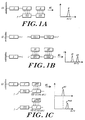
- Immobilization can be accomplished, for example, based on hybridization between a capture nucleic acid sequence, which has already been immobilized to the support and a complementary nucleic acid sequence, which is also contained within the nucleic acid molecule containing the nucleic acid sequence to be detected (FIGURE 1A). So that hybridization between the complementary nucleic acid molecules is not hindered by the support, the capture nucleic acid can include a spacer region of at least about five nucleotides in length between the solid support and the capture nucleic acid sequence. The duplex formed will be cleaved under the influence of the laser pulse and desorption can be initiated.
- the solid support-bound base sequence can be presented through natural oligoribo- or oligodeoxyribonucleotide as well as analogs (e.g. thio-modified phosphodiester or phosphotriester backbone) or employing oligonucleotide mimetics such as PNA analogs (see e.g. Nielsen et al., Science, 254, 1497 (1991)) which render the base sequence less susceptible to enzymatic degradation and hence increases overall stability of the solid support-bound capture base sequence.
- analogs e.g. thio-modified phosphodiester or phosphotriester backbone
- PNA analogs see e.g. Nielsen et al., Science, 254, 1497 (1991)
- a target detection site can be directly linked to a solid support via a reversible or irreversible bond between an appropriate functionality (L') on the target nucleic acid molecule (T) and an appropriate functionality (L) on the capture molecule (FIGURE 1B).
- a reversible linkage can be such that it is cleaved under the conditions of mass spectrometry (i.e., a photocleavable bond such as a charge transfer complex or a labile bond being formed between relatively stable organic radicals).
- the linkage can be formed with L' being a quaternary ammonium group, in which case, preferably, the surface of the solid support carries negative charges which repel the negatively charged nucleic acid backbone and thus facilitate the desorption required for analysis by a mass spectrometer. Desorption can occur either by the heat created by the laser pulse and/or depending on L, by specific absorption of laser energy which is in resonance with the L' chromophore.
- the L-L' chemistry can be of a type of disulfide bond (chemically cleavable, for example, by mercaptoethanol or dithioerythrol), a biotin/streptavidin system, a heterobifunctional derivative of a trityl ether group (Köster et al ., "A Versatile Acid-Labile Linker for Modification of Synthetic Biomolecules," Tetrahedron Letters 31 .
- the functionalities, L and L,' can also form a charge transfer complex and thereby form the temporary L-L' linkage. Since in many cases the "charge-transfer band" can be determined by UV/vis spectrometry (see e.g. Organic Charge Transfer Complexes by R. Foster, Academic Press, 1969), the laser energy can be tuned to the corresponding energy of the charge-transfer wavelength and, thus, a specific desorption off the solid support can be initiated. Those skilled in the art will recognize that several combinations can serve this purpose and that the donor functionality can be either on the solid support or coupled to the nucleic acid molecule to be detected or vice versa.
- a reversible L-L' linkage can be generated by homolytically forming relatively stable radicals. Under the influence of the laser pulse, desorption (as discussed above) as well as ionization will take place at the radical position.
- desorption as discussed above
- ionization will take place at the radical position.
- other organic radicals can be selected and that, in relation to the dissociation energies needed to homolytically cleave the bond between them, a corresponding laser wavelength can be selected (see e.g. Reactive Molecules by C. Wentrup, John Wiley & Sons, 1984).
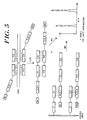
- An anchoring function L' can also be incorporated into a target capturing sequence (TCS) by using appropriate primers during an amplification procedure, such as PCR (FIGURE 4), LCR (FIGURE 5) or transcription amplification (FIGURE 6A).
- TCS target capturing sequence
- nucleic ' acid molecules Prior to mass spectrometric analysis, it may be useful to "condition" nucleic ' acid molecules, for example to decrease the laser energy required for volatization and/or to minimize fragmentation. Conditioning is preferably performed while a target detection site is immobilized.
- An example of conditioning is modification of the phosphodiester backbone of the nucleic acid molecule (e.g. cation exchange), which can be useful for eliminating peak broadening due to a heterogeneity in the cations bound per nucleotide unit.
- the monothio phosphodiester bonds of a nucleic acid molecule can be transformed into a phosphotriester bond.
- phosphodiester bonds may be transformed to uncharged derivatives employing trialkylsilyl chlorides.
- Further conditioning involves incorporating nucleotides which reduce sensitivity for depurination (fragmentation during MS) such as N7- or N9-deazapurine nucleotides, or RNA building blocks or using oligonucleotide triesters or incorporating phosphorothioate functions which are alkylated or employing oligonucleotide mimetics such as PNA.
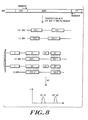
- Multiplexing can be achieved by several different methodologies. For example, several mutations can be simultaneously detected on one target sequence by employing corresponding detector (probe) molecules (e.g. oligonucleotides or oligonucleotide mimetics). However, the molecular weight differences between the detector oligonucleotides D1, D2 and D3 must be large enough so that simultaneous detection (multiplexing) is possible. This can be achieved either by the sequence itself (composition or length) or by the introduction of mass-modifying functionalities M1 - M3 into the detector oligonucleotide.(FIGURE 2)
- Mass modifying moieties can be attached, for instance, to either the 5'-end of the oligonucleotide (M 1 ), to the nucleobase (or bases) (M 2 , M 7 ), to the phosphate backbone (M 3 ), and to the 2'-position of the nucleoside (nucleosides) (M 4 , M 6 ) or/and to the terminal 3'-position (M 5 ).
- mass modifying moieties include , for example, a halogen, an azido, or of the type, XR, wherein X is a linking group and R is a mass-modifying functionality. The mass-modifying functionality can thus be used to introduce defined mass increments into the oligonucleotide molecule.
- the mass-modifying moiety, M can be attached either to the nucleobase, M 2 (in case of the c 7 -deazanucleosides also to C-7, M 7 ), to the triphosphate group at the alpha phosphate, M 3 , or to the 2'-position of the sugar ring of the nucleoside triphosphate, M 4 and M 6 .
- the mass-modifying functionality can be added so as to affect chain termination, such as by attaching it to the 3'-position of the sugar ring in the nucleoside triphosphate, M 5 .
- chain-elongating nucleoside triphosphates can also be mass-modified in a similar fashion with numerous variations and combinations in functionality and attachment positions.
- the mass-modification, M can be introduced for X in XR as well as using oligo-/polyethylene glycol derivatives for R.
- the nucleic acid molecule e.g. detector oligonucleotide (D) or the nucleoside triphosphates (FIGURE 6(C)
- the oligo/polyethylene glycols can also be monoalkylated by a lower alkyl such as methyl, ethyl, propyl, isopropyl, t-butyl and the like.
- a selection of linking functionalities, X are also illustrated.
- Other chemistries can be used in the mass-modified compounds, as for example, those described recently in Oligonucleotides and Analogues. A Practical Approach , F. Eckstein, editor, IRL Press, Oxford, 1991.
- various mass-modifying functionalities, R can be selected and attached via appropriate linking chemistries, X.
- a simple mass-modification can be achieved by substituting H for halogens like F, Cl, Br and/or I, or pseudohalogens such as SCN, NCS, or by using different alkyl, aryl or aralkyl moieties such as methyl, ethyl, propyl, isopropyl, t-butyl, hexyl, phenyl, substituted phenyl, benzyl, or functional groups such as CH 2 F, CHF 2 , CF 3 , Si(CH 3 ) 3 , Si(CH 3 ) 2 (C 2 H 5 ), Si(CH 3 )(C 2 H 5 ) 2 , Si(C 2 H 5 ) 3 .
- Yet another mass-modification can be obtained by attaching homo- or heteropeptides through the nucleic acid molecule (e.g. detector (D)) or nucleoside triphosphates.
- nucleic acid molecule e.g. detector (D)
- nucleoside triphosphates e.g. D
- the superscript 0-i designates i + 1 mass differentiated nucleotides, primers or tags.
- the superscript 0 can designate an unmodified species of a particular reactant
- the superscript i can designate the i-th mass-modified species of that reactant. If, for example, more than one species of nucleic acids are to be concurrently detected, then i + 1 different mass-modified detector oligonucleotides (D 0 , D 1, ...D i ) can be used to distinguish each species of mass modified detector oligonucleotides (D) from the others by mass spectrometry.
- detector oligonucleotides can be used to simultaneously detect all possible variants/mutants simultaneously (FIGURE 6B).
- all four base permutations at the site of a mutation can be detected by designing and positioning a detector oligonucleotide, so that it serves as a primer for a DNA/RNA polymerase (FIGURE 6C).
- mass modifications also can be incorporated during the amplification process.
- FIGURE 3 shows a different multiplex detection format, in which differentiation is accomplished by employing different specific capture sequences which are position-specifically immobilized on a flat surface (e.g, a 'chip array'). If different target sequences T1 - Tn are present, their target capture sites TCS1 - TCSn will specifically interact with complementary immobilized capture sequences C1-Cn. Detection is achieved by employing appropriately mass differentiated detector oligonucleotides D1 - Dn, which are mass differentiated either by their sequences or by mass modifying functionalities M1 - Mn.
- Preferred mass spectrometer formats for use in the invention are matrix assisted laser desorption ionization (MALDI), electrospray (ES), ion cyclotron resonance (ICR) and Fourier Transform.
- MALDI matrix assisted laser desorption ionization
- ES electrospray
- ICR ion cyclotron resonance
- ABI atmospheric pressure ionization interface
- mass analyzers can be used, e.g., magnetic sector/magnetic deflection instruments in single or triple quadrupole mode (MS/MS), Fourier transform and time-of-flight (TOF) configurations as is known in the art of mass spectrometry.
- MS/MS single or triple quadrupole mode
- TOF time-of-flight
- matrix/laser combinations can be used.
- Ion-trap and reflectron configurations can also be employed.
- the mass spectrometric processes described above can be used, for example, to diagnose any of the more than 3000 genetic diseases currently known (e.g hemophilias, thalassemias, Duchenne Muscular Dystrophy (DMD), Huntington's Disease (HD), Alzheimer's Disease and Cystic Fibrosis (CF)) or to be identified.
- a genetic disease e.g hemophilias, thalassemias, Duchenne Muscular Dystrophy (DMD), Huntington's Disease (HD), Alzheimer's Disease and Cystic Fibrosis (CF)
- DMD Duchenne Muscular Dystrophy
- HD Huntington's Disease
- CF Cystic Fibrosis
- Example 3 provides a mass spectrometer method for detecting a mutation ( ⁇ F508) of the cystic fibrosis transmembrane conductance regulator gene (CFTR), which differs by only three base pairs (900 daltons) from the wild type of CFTR gene.
- CFTR cystic fibrosis transmembrane conductance regulator gene
- the detection is based on a single-tube, competitive oligonucleotide single base extension (COSBE) reaction using a pair of primers with the 3'-terminal base complementary to either the normal or mutant allele.
- COSBE competitive oligonucleotide single base extension
- chromosomal abnormalities such as Trisomy 21 (Down's Syndrome), Trisomy 13 (Patau Syndrome), Trisomy 18 (Edward's Syndrome), Monosomy X (Turner's Syndrome) and other sex chromosome aneuploidies such as Klienfelter's Syndrome (XXY).
- DNA sequences may predispose an individual to any of a number of diseases such as diabetes, arteriosclerosis. obesity, various autoimmune diseases and cancer (e.g. colorectal, breast, ovarian, lung); chromosomal abnormality (either prenatally or postnatally); or a predisposition to a disease or condition (e.g. obesity, artherosclerosis, cancer). Also, the detection of "DNA fingerprints”, e.g. polymorphisms, such as "microsatellite sequences", are useful for determining identity or heredity (e.g. paternity or maternity).
- Example 4 provides a mass spectometer method for identifying any of the three different isoforms of human apolipoprotein E, which are coded by the E2, E3 and E4 alleles.
- the molecular weights of DNA fragments obtained after restriction with appropriate restriction endonucleases can be used to detect the presence of a mutation.
- chromosomal aneuploidy or genetic predisposition can be preformed either pre- or post-natally.
- Retroviridae e.g., human immunodeficiency viruses, such as HIV-1 (also referred to as HTLV-III, LAV or HTLV-III/LAV, See Ratner, L. et al., Nature, Vol. 313, Pp. 227-284 (1985); Wain Hobson, S. et al, Cell, Vol. 40: Pp.
- HIV-2 See Guyader et al., Nature, Vol. 328, Pp. 662-669 (1987); European Patent Publication No. 0 269 520; Chakraborti et al., Nature , Vol. 328, Pp. 543-547 (1987); and European Patent Application No. 0 655 501); and other isolates, such as HIV-LP (International Publication No. WO 94/00562 entitled " A Novel Human Immunodeficiency Virus"; Picornaviridae (e.g., polio viruses, hepatitis A virus, (Gust, I.D., et al., Intervirology , Vol. 20, Pp.
- Picornaviridae e.g., polio viruses, hepatitis A virus, (Gust, I.D., et al., Intervirology , Vol. 20, Pp.
- entero viruses human coxsackie viruses, rhinoviruses, echoviruses
- Calciviridae e.g., strains that cause gastroenteritis
- Togaviridae e.g., equine encephalitis viruses, rubella viruses
- Flaviridae e.g., dengue viruses, encephalitis viruses, yellow fever viruses
- Coronaviridae e.g., coronaviruses
- Rhabdoviridae e.g., vesicular stomatitis viruses, rabies viruses
- Filoviridae e.g., ebola viruses
- Paramyxoviridae e.g., parainfluenza viruses, mumps virus, measles virus, respiratory syncytial virus
- Orthomyxoviridae e.g., influenza viruses
- Bungaviridae e.g., Hantaan viruses, bunga viruses, phleboviruse
- infectious bacteria examples include: Helicobacter pyloris, Borelia burgdorferi, Legionella pneumophilia, Mycobacteria sps (e.g. M. tuberculosis, M. avium, M. intracellulare, M . kansaii, M .
- infectious fungi examples include: Cryptococcus neoformans, Histoplasma capsulatum, Coccidioides immitis, Blastomyces dermatitidis,Chlamydia trachomatis, Candida albicans.
- Other infectious organisms i.e., protists
- Plasmodium falciparum and Toxoplasma gondii examples include: Plasmodium falciparum and Toxoplasma gondii.
- Example 5 provides a nested PCR and mass spectrometer based method that was used to detect hepatitis B virus (HBV) DNA in blood samples.
- HBV hepatitis B virus
- other blood-borne viruses e.g., HIV-1, HIV-2, hepatitis C virus (HCV), hepatitis A virus (HAV) and other hepatitis viruses (e.g., non-A-non-B hepatitis, hepatitis G, hepatits E), cytomegalovirus, and herpes simplex virus (HSV)
- HBV herpes simplex virus
- nucleic acid sequences can be used to detect normal and defective genes in higher organisms and to detect infectious microorganisms (e.g. bacteria, fungi, protists and yeast) and viruses. DNA sequences can even serve as a fingerprint for detection of different individuals within the same species. (Thompson, J.S. and M.W. Thompson, eds., Genetics in Medicine, W.B Saunders Co., Philadelphia, PA (1986).
- FIG. 1C One process for detecting a wildtype (D wt ) and/ or a mutant (D mut ) sequence in a target (T) nucleic acid molecule is shown in Figure 1C.
- a specific capture sequence (C) is attached to a solid support (ss) via a spacer (S).
- the capture sequence is chosen to specifically interact with a complementary sequence on the target sequence (T), the target capture site (TCS) to be detected through hybridization.
- TDS target detection site
- TDS target detection site
- X which increases or decreases the molecular weight
- mutated TDS can be distinguished from wildtype by mass spectrometry. For example, in the case of an adenine base (dA) insertion, the difference in molecular weights between D wt and D mut would be about 314 daltons.
- the detector nucleic acid (D) is designed such that the mutation would be in the middle of the molecule and the flanking regions are short enough so that a stable hybrid would not be formed if the wildtype detector oligonucleotide (D wt ) is contacted with the mutated target detector sequence as a control.
- the mutation can also be detected if the mutated detector oligonucleotide (D mut ) with the matching base at the mutated position is used for hybridization. If a nucleic acid obtained from a biological sample is heterozygous for the particular sequence (i.e. contain both D wt and D mut ), both D wt and D mut will be bound to the appropriate strand and the mass difference allows both D wt and D mut to be detected simultaneously.
- the process of this invention makes use of the known sequence information of the target sequence and known mutation sites. Although new mutations can also be detected.
- transcription of a nucleic acid molecule obtained from a biological sample can be specifically digested using one or more nucleases and the fragments captured on a solid support carrying the corresponding complementary nucleic acid sequences. Detection of hybridization and the molecular weights of the captured target sequences provide information on whether and where in a gene a mutation is present.
- DNA can be cleaved by one or more specific endonucleases to form a mixture of fragments. Comparison of the molecular weights between wildtype and mutant fragment mixtures results in mutation detection.
- the present invention is further illustrated by the following examples which should not be construed as limiting in any way.
- the international patent application Publication Number WO 94/16101 is entitled DNA Sequencing by Mass Spectrometry and
- the international patent application Publication Number WO 94/21822 is entitled "DNA Sequencing by Mass Spectrometry Via Exonuclease Degradation”.
- T 5 serves as a spacer. Deprotection with saturated ammonia in methanol at room temperature for 2 hours furnished according to the determination of the DMT group CPG which contained about 10 umol 55mer/g CPG. This 55mer served as a template for hybridizations with a 26mer (with 5'-DMT group) and a 40mer (without DMT group).
- the reaction volume is 100 ul and contains about Inmol CPG bound 55mer as template, an equimolar amount of oligonucleotide in solution (26mer or 40mer) in 20mM Tris-HCI, pH 7.5, 10 mM MgCI 2 and 25mM NaCI. The mixture was heated for 10' at 65°C and cooled to 37°C during 30' (annealing).
- the oligonucleotide which has not been hybridized to the polymer-bound template were removed by centrifugation and three subsequent washing/centrifugation steps with 100 ul each of ice-cold 50mM ammoniumcitrate.
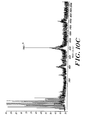
- the beads were air-dried and mixed with matrix solution (3-hydroxypicolinic acid/10mM ammonium citrate in acetonitril/water, 1:1), and analyzed by MALDI-TOF mass spectrometry. The results are presented in Figures 10 and 11
- DNA fragments at a concentration of 50 pmole/ul in 2-propanol/10mM ammoniumcarbonate (1/9, v/v) were analyzed simultaneously by an electrospray mass spectrometer.
- FIGURE 12 The successful desorption and differentiation of an 18-mer and 19-mer by electrospray mass spectrometry is shown in FIGURE 12.
- PCR Amplification and Strand Immobilization were carried out with exon 10 specific primers using standard PCR conditions (30 cycles: 1'@95°C, 1'@55°C, 2'@72°C); the reverse primer was 5' labelled with biotin and column purified (Oligopurification Cartridge, Cruachem). After amplification the PCR products were purified by column separation (Qiagen Quickspin) and immobilized on streptavidin coated magnetic beads (Dynabeads, Dynal, Norway) according to their standard protocol; DNA was denatured using 0.1M NaOH and washed with 0.1M NaOH, 1xB+W buffer and TE buffer to remove the non-biotinylated sense strand.
- the beads containing ligated antisense strand were resuspended in 18 ⁇ l of Reaction mix 1 (2 ⁇ l 10X Taq buffer, 1 ⁇ L (1 unit) Taq Polymerase, 2 ⁇ L of2 mM dGTP, and 13 ⁇ L H 2 O) and incubated at 80°C for 5' before the addition of Reaciton mix 2 (100 ng each of COSBE primers). The temperature was reduced to 60°C and the mixtures incubated for a 5' annealing/extension period; the beads were then washed in 25mM triethylammonium acetate (TEAA) followed by 50mM ammonium citrate.
- Reaction mix 1 2 ⁇ l 10X Taq buffer, 1 ⁇ L (1 unit) Taq Polymerase, 2 ⁇ L of2 mM dGTP, and 13 ⁇ L H 2 O
- Reaciton mix 2 100 ng each of COSBE primers
- Mass Spectrometry After washing, beads were resuspended in 1 ⁇ L 18 Mohm/cm H 2 O. 300 nL each of matrix (Wu et al., 1993) solution (0.7 M 3-hydroxypicolinic acid, 0.7 M dibasic ammonium citrate in 1:1 H 2 O:CH 3 CN) and resuspended beads (Tang et al. (1995) Rapid Commun Mass Spectrom 8 :727-730) were mixed on a sample target and allowed to air dry.
- matrix Wang et al. (1995) Rapid Commun Mass Spectrom 8 :727-730
- M r (calc) Theoretical average molecular weights (M r (calc)) were calculated from atomic compositions. Vendor provided software was used to determine peak centroids using external calibration; 1.08 Da has been subtracted from these to correct for the charge carrying proton mass to yield the text M r (exp) values.
- N and M primers (8508.6 and 9148.0 Da, respectively) are presented with dGTP; only primers with proper Watson-Crick base paring at the variable (V) position are extended by the polymerase.
- V variable
- N 8837.9 Da product
- M is extended to a 9477.3 Da M+1 product.
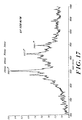
- Figures 14 - 18 show the representative mass spectra of COSBE reaction products. Better results were obtained when PCR products were purified before the biotinylated anti-sense strand was bound
- Apolipoprotein E (Apo E), a protein component of lipoproteins, plays an essential role in lipid metabolism. For example, it is involved with cholesterol transport, metabolism of lipoprotein particles, immunoregulation and activation of a number of lipolytic enzymes.
- E2 has been shown to decrease the cholesterol level in plasma and therefore may have a protective effect against the development of atherosclerosis.
- E4 isoform has been correlated with increased levels of cholesterol, conferring predisposition to atherosclerosis. Therefore, the identity of the apo E allele of a particular individual is an important determinant of risk for the development of cardiovascular disease.
- a sample of DNA encoding apolipoprotein E can be obtained from a subject, amplified (e.g. via PCR); and the PCR product can be digested using an appropriate enzyme (e.g. CfoI). The restriction digest obtained can then be analyzed by a variety of means.
- the three isotypes of apolipoprotein E (E2, E3 and E4 have different nucleic acid sequences and therefore also have distinguishable molecular weight values.
- Example 5 Detection of hepatitis B virus in serum samples.
- Phenol/choloform extraction of viral DNA and the final ethanol precipitation was done according to standard protocols.
- each reaction was performed either with 1 ⁇ l of the first reaction or with a 1:10 dilution of the first PCR as template, respectively.
- PCR For the recording of each spectrum, one PCR, 50 ⁇ l, (performed as described above) was used. Purification was done according to the following procedure: Ultrafiltration was done using Ultrafree-MC filtration units (Millipore, Eschborn, Germany) according to the protocol of the provider with centrifugation at 8000 rpm for 20 minutes. 25 ⁇ l (10 ⁇ g/ ⁇ l) streptavidin Dynabeads (Dynal, Hamburg, Germany) were prepared according to the instructions of the manufacturer and resuspended in 25 ⁇ l of B/W buffer (10 mM Tris-HCl, pH7.5, 1mM EDTA, 2 M NaCl).
- B/W buffer 10 mM Tris-HCl, pH7.5, 1mM EDTA, 2 M NaCl
- This suspension was added to the PCR samples still in the filtration unit and the mixture was incubated with gentle shaking for 15 minutes at ambient temperature.
- the suspension was transferred in a 1.5 ml Eppendorf tube and the supernatant was removed with the aid of a Magnetic Particle Collector, MPC, (Dynal, Hamburg, Germany).
- MPC Magnetic Particle Collector
- the beads were washed twice with 50 ⁇ l of 0.7 M ammonium citrate solution, pH 8.0 (the supernatant was removed each time using the MPC). Cleavage from the beads can be accomplished by using formamide at 90°C.
- the supernatant was dried in a speedvac for about an hour and resuspended in 4 ⁇ l of ultrapure water (MilliQ UF plus Millipore, Eschborn, Germany). This preparation was used for MALDI-TOF MS analysis.
- a nested PCR system was used for the detection of HBV DNA in blood samples employing oligonucleotides complementary to the c region of the HBV genome (primer 1: beginning at map position 1763, primer 2 beginning at map position 2032 of the complementary strand) encoding the HBV core antigen (HBVcAg).
- DNA was isolated from patients serum according to standard protocols.
- a first PCR was performed with the DNA from these preparations using a first set of primers. If HBV DNA was present in the sample a DNA fragment of 269 bp was generated.
- the samples were purified using ultrafiltration to remove the primers prior to immobilization on streptavidin Dynabeads. This purification was done because the shorter primer fragments were immobilized in higher yield on the beads due to steric reasons.
- the immobilization was done directly on the ultrafiltration membrane to avoid substance losses due to unspecific absorption on the membrane.
- the beads were washed with ammonium citrate to perform cation exchange (Pieles, U. et al., (1993) Nucleic Acids Res 21:3191-3196).
- the immobilized DNA was cleaved from the beads using 25% ammonia which allows cleavage of DNA from the beads in a very short time, but does not result in an introduction of sodium cations.
- each sample of the first PCR was used undiluted as template and in a 1:10 dilution, respectively.
- Sample 1 was collected from a patient with chronic active HBV infection who was positive in HBs- and HBe-antigen tests but negative in a dot blot analysis.
- Sample 2 was a serum sample from a patient with an active HBV infection and a massive viremia who was HBV positive in a dot blot analysis.
- Sample 3 was a denatured serum sample therefore no serologicial analysis could be performed but an increased level of transaminases indicating liver disease was detected. In autoradiograph analysis ( Figure 24), the first PCR of this sample was negative. Nevertheless, there was some evidence of HBV infection. This sample is of interest for MALDI-TOF anlaysis, because it demonstrates that even low-level amounts of PCR products can be detected after the purification procedure.
- Sample 4 was from a patient who was cured of HBV infection.
- Samples 5 and 6 were collected from patients with a chronic active HBV infection.
- Figure 24 shows the results of a PAGE analysis of the nested PCR reaction.
- a PCR product is clearly revealed in samples 1, 2, 3, 5 and 6.
- sample 4 no PCR product was generated, it is indeed HBV negative, according to the serological analysis.
- Negative and positive controls are indicated by + and -, respectively.
- Amplification artifacts are visible in lanes 2, 5, 6 and + if non-diluted template was used. These artifacts were not generated if the template was used in a 1:10 dilution.
- sample 3 PCR product was only detectable if the template was not diluted.
- the results of PAGE analysis are in agreement with the data obtained by serological analysis except for sample 3 as discussed above.
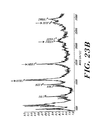
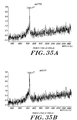
- Figure 25A shows a mass spectrum of a nested PCR product from sample number 1 generated and purified as described above.
- the signal at 20754 Da represents the single stranded PCR product (calculated: 20735 Da, as the average mass of both strands of the PCR product cleaved from the beads).
- the mass difference of calculated and obtained mass is 19 Da (0.09%).
- sample number 1 generated a high amount of PCR product. resulting in an unambiguous detection.
- Fig. 25B shows a spectrum obtained from sample number 3.
- the amount of PCR product generated in this section is significantly lower than that from sample number 1. Nevertheless, the PCR product is clearly revealed with a mass of 20751 Da (calculated 20735). The mass difference is 16 Da (0.08%).
- the spectrum depicted in Fig. 25C was obtained from sample number 4 which is HBV negative (as is also shown in Fig 24). As expected no signals corresponding to the PCR product could be detected. All samples shown in Fig. 25 were analyzed with MALDI-TOF MS, whereby PCR product was detected in all HBV positive samples, but not in the HBV negative samples. These results were reproduced in several independent experiments.
- the LCR was performed with Pfu DNA ligase and a ligase chain reaction kit (Stratagene, Heidelberg, Germany) containing two different pBluescript KII phagemids.
- Pfu DNA ligase and a ligase chain reaction kit (Stratagene, Heidelberg, Germany) containing two different pBluescript KII phagemids.
- a ligase chain reaction kit (Stratagene, Heidelberg, Germany) containing two different pBluescript KII phagemids.
- Ion exchange HPLC (IE HPLC) was performed on the SMART-system (Pharmacia, Freiburg, Germany) using a Pharmacia Mono Q, PC 1.6/5 column. Eluents were buffer A (25 mM Tris-HCI, 1 mM EDTA and 0.3 M NaCI at pH 8.0) and buffer B (same as A, but 1 M NaCl). Starting with 100% A for 5 minutes at a flow rate of 50 ⁇ l/min. a gradient was applied from 0 to 70% B in 30 minutes, then increased to 100% B in 2 minutes and held at 100% B for 5 minutes. Two pooled LCR volumes (40 ⁇ l) performed with either wildtype or mutant template were injected.
- a suspension of streptavidin-coated magnetic beads with the immobilized DNA was pipetted onto the sample holder, then immediately mixed with 0.5 ⁇ l matrix solution (0.7 M 3-hydroxypicolinic acid in 50% acetonitrile, 70 mM ammonium citrate). This mixture was dried at ambient temperature and introduced into the mass spectrometer. All spectra were taken in positive ion mode using a Finnigan MAT Vision 2000 (Finnigan MAT, Bremen, Germany), equipped with a reflectron (5 keV ion source, 20 keV postacceleration) and a nitrogen laser (337 nm).
- the E. coli lac I gene served as a simple model system to investigate the suitability of MALDI-TOF-MS as detection method for products generated in ligase chain reactions.
- This template system consists of an E.coli lac I wildtype gene in a pBluescript KII phagemid and an E. coli lac I gene carrying a single point mutation at bp 191 (C to T transition) in the same phagemid.
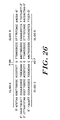
- Four different oligonucleotides were used, which were ligated only if the E. coli lac I wildtype gene was present (Figure 26).
- LCR conditions were optimized using Pfu DNA ligase to obtain at least 1 pmol ligation product in each positive reaction.
- the ligation reactions were analyzed by polyacrylamide gel electrophoresis (PAGE) and HPLC on the SMART system ( Figures 27, 28 and 29).
- Figure 27 shows a PAGE of a positive LCR with wildtype template (lane 1), a negative LCR with mutant template (1 and 2) and a negative control which contains enzyme, oligonucleotides and no template.
- the gel electrophoresis clearly shows that the ligation product (50bp) was produced only in the reaction with wildtype template whereas neither the template carrying the point mutation nor the control reaction with salmon sperm DNA generated amplification products.
- Appropriate control runs were performed to determine retention times of the different compounds involved in the LCR experiments. These include the four oligonucleotides (A, B, C, and D), a synthetic ds 50-mer (with the same sequence as the ligation product), the wildtype template DNA, sonicated salmon sperm DNA and the Pfu DNA ligase in ligation buffer.
- streptavidin-coated magnetic beads were used. As was shown in a recent paper, the direct desorption of DNA immobilized by Watson-Crick base pairing to a complementary DNA fragment covalently bound to the beads is possible and the non-biotinylated strand will be desorbed exclusively (Tang, K et al., (1995) Nucleic Acids Res. 23 :3126-3131). This approach in using immobilized ds DNA ensures that only the non-biotinylated strand will be desorbed. If non-immobilized ds DNA is analyzed both strands are desorbed (Tang, K. et. al., (1994) Rapid Comm. Mass Spectrom.
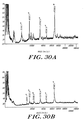
- Figure 31A shows a MALDI-TOF mass spectrum obtained from two pooled LCRs (performed as described above) purified on streptavidin DynaBeads and desorbed directly from the beads showed that the purification method used was efficient (compared with Figure 30).
- a signal which represents the unligated oligo A and a signal which corresponds to the ligation product could be detected.
- the agreement between the calculated and the experimentally found mass values is remarkable and allows an unambiguous peak assignment and accurate detection of the ligation product.
- no ligation product but only oligo A could be detected in the spectrum obtained from two pooled LCRs with mutated template (Figure 31B).
- Figure 32 shows a spectrum obtained from two pooled LCRs in which only salmon sperm DNA was used as a negative control, only oligo A could be detected, as expected.
- the lower intensity of the ligation product signal could be due to different desorption/ionization efficiencies between 24- and a 50-mer. Since the T m value of a duplex with 50 compared to 24 base pairs is significantly higher, more 24-mer could be desorbed. A reduction in signal intensity can also result from a higher degree of fragmentation in case of the longer oligonucleotides.
- Figure 32 reveals traces of Tween20 in the region around 2000 Da. Substances with a viscous consistence, negatively influence the process of crystallization and therefore can be detrimental to mass spectrometer analysis. Tween20 and also glycerol which are part of enzyme storage buffers therefore should be removed entirely prior to mass spectrometer analysis. For this reason an improved purification procedure which includes an additional ultrafiltration step prior to treatment with DynaBeads was investigated. Indeed, this sample purification resulted in a significant improvement of MALDI-TOF mass spectrometric performance.
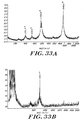
- Figure 33 shows spectra obtained from two pooled positive (33A) and negative (33B) LCRs, respectively.
- the positive reaction was performed with a chemically synthesized, single strand 50mer as template with a sequence equivalent to the ligation product of oligo C and D.
- Oligo C was 5'-biotinylated. Therefore the template was not detected.
- only the ligation product of Oligo A and B (calculated mass 15450 Da) could be desorbed from the immobilized and ligated oligo C and D.
- This newly generated DNA fragment is represented by the mass signal of 15448 Da in Figure 33A.
- this spectrum clearly shows that this method of sample preparation produces signals with improved resolution and intensity.
- the solid-phase oligo base extension method detects point mutations and small deletions as well as small insertions in amplified DNA.
- the method is based on the extension of a detection primer that anneals adjacent to a variable nucleotide position on an affinity-captured amplified template, using a DNA polymerase, a mixture of three dNTPs, and the missing one didesoxy nucleotide.
- the resulting products are evaluate and resolved by MALDI-TOF mass spectrometry without further labeling procedures.
- the aim of the following experiment was to determine mutant and wildtype alleles in a fast and reliable manner.
- the method used a single detection primer followed by a oligonucleotide extension step to give products differing in length by some bases specific for mutant or wildtype alleles which can be easily resolved by MALDI-TOF mass spectrometry.
- the method is described by using an example the exon 10 of the CFTR-gene. Exon 10 of this gene bears the most common mutation in many ethnic groups ( ⁇ F508) that leads in the homozygous state to the clinical phenotype of cystic fibrosis.
- Genomic DNA were obtained from healthy individuals, individuals homozygous or heterozygous for the ⁇ F508 mutation, and one individual heterozygous for the 1506S mutation. The wildtype and mutant alleles were confirmed by standard Sanger sequencing.
- the primers for PCR amplification were CFEx10-F (5-GCAAGTGAATCCTGAGCGTG-3' (SEQ ID No. 13) located in intron 9 and biotinylated) and CFEx10-R (5'-GTGTGAAGGGCGTG-3', (SEQ ID No. 14) located in intron 10). Primers were used in a concentration of 8 pmol.
- Taq-polymerase including 10x buffer were purchased from Boehringer-Mannheim and dTNPs were obtained from Pharmacia. The total reaction volume was 50 ⁇ l. Cycling conditions for PCR were initially 5 min. at 95°C, followed by 1 min. at 94°C, 45 sec at 53°C, and 30 sec at 72°C for 40 cycles with a final extension tim eof 5 min at 72°C.
- Amplification products were purified by using Qiagen's PCR purification kit (No. 28106) according to manufacturer's instructions. The elution of the purified products from the column was done in 50 ⁇ l TE-buffer (10mM Tris, 1 mM EDTA, pH 7,5).
- the annealing of 25 pmol detection primer (CF508: 5'CTATATTCATCATAGGAAACACCA-3' (SEQ ID No. 15) was performed in 50 ⁇ l annealing buffer (20 mM Tris, 10 mM KCl, 10 mM (NH 4 ) 2 SO 4 , 2 mM MgSO, 1% Thton X-100, pH 8, 75) at 50°C for 10 min.
- the wells were washed three times with 200 ⁇ l washing buffer and oncein 200 ⁇ l TE buffer.
- the extension reaction was performed by using some components of the DNA sequencing kit from USB (No. 70770) and dNTPs or ddNTPs from Pharmacia.
- the total reaction volume was 45 ⁇ l, consisting of 21 ⁇ l water, 6 ⁇ l Sequenase-buffer, 3 ⁇ l 10 mM DTT solution, 4,5 ⁇ l, 0,5 mM of three dNTPs, 4,5 ⁇ l, 2 mM the missing one ddNTP, 5,5 ⁇ l glycerol enzyme diluton buffer, 0,25 ⁇ l Sequenase 2.0, and 0,25 pyrophosphatase.
- the reaction was pipetted on ice and then incubated for 15 min at room temperature and for 5 min at 37°C. Hence, the wells were washed three times with 200 ⁇ l washing buffer and once with 60 ⁇ l of a 70 mM NH 4 -Citrate solution.
- the extended primer was denatured in 50 ⁇ l 10%-DMSO (dimethylsufoxide) in water at 80°C for 10 min.
- 10 ⁇ l NH4-Acetat (pH 6,5), 0,5 ⁇ l glycogen (10 mg/ml water, Sigma No. G1765), and 100 ⁇ l absolute ethanol were added to the supernatant and incubated for 1 hour at room temperature. After centrifugation at 13.000 g for 10 min the pellet was washed in 70% ethanol and resuspended in 1 ⁇ l 18 Mohm/cm H 2 O water.
- Sample preparation was performed by mixing 0,3 ⁇ l of each of matrix solution (0.7 M 3-hydroxypicolinic acid, 0.07 M dibasic ammonium citrate in 1:1 H 2 O:CH 3 CN) and of resuspended DNA/glycogen pellet on a sample target and allowed to air dry. Up to 20 samples were spotted on a probe target disk for introduction into the source region of an unmodified Thermo Bioanalysis (formerly Finnigan) Visions 2000 MALDI-TOF operated in reflectron mode with 5 and 20 kV on the target and conversion dynode, respectively.
- Theoretical average molecular mass (M r (calc)) were calculated from atomic compositions; reported experimental Mr (M r (exp)) values are those of the singly-protonated form, determined using external calibration.
- the aim of the experiment was to develop a fast and reliable method independent of exact stringencies for mutation detection that leads to high quality and high throughput in the diagnosis of genetic diseases. Therefore a special kind of DNA sequencing (oligo base extension of one mutation detection primer) was combined with the evaluation of the resulting mini-sequencing products by matrix-assisted laser desorption ionization (MALDI) mass spectrometry (MS).
- MALDI matrix-assisted laser desorption ionization
- MS mass spectrometry
- TOF time-of-flight
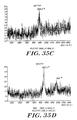
- the schematic presentation as given in Figure 34 shows the expected short sequencing products with the theoretically calculated molecular mass of the wildtype and various mutations of exon 10 of the CFTR-gene.
- the short sequencing products were produced using either ddTTP ( Figure 34A) or ddCTP ( Figure 34B) to introduce a definitive sequence related stop in the nascent DNA strand.
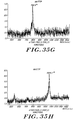
- the MALDI-TOF-MS spectra of healthy, mutation heterozygous, and mutation homozygous individuals are presented in Figure 34. All samples were confirmed by standard Sanger sequencing which showed no discrepancy in comparison to the mass spec analysis. The accuracy of the experimental measurements of the various molecular masses was within a range of minus 21.8 and plus 87.1 dalton (Da) to the range expected.
- the method described is highly suitable for the detection of single point mutations or microlesions of DNA. Careful choice of the mutation detection primers will open the window of multiplexing and lead to a high throughput including high quality in genetic diagnosis without any need for exact stringencies necessary in comparable allele-specific procedures. Because of the uniqueness of the genetic information, the oligo base extension of mutation detection primer is applicable in each disease gene or polymorphic region in the genome like variable number of tandem repeats (VNTR) or other single nucleotide polymorphisms (e.g., apolipoprotein E gene).
- VNTR variable number of tandem repeats
- apolipoprotein E gene e.g., apolipoprotein E gene
- Example 8 Detection of Polymerase Chain Reaction Products Containing 7-Deazapurine Moieties with Matrix-Assisted Laser Desorption/Ionization Time-of-Flight (MALDI-TOF) Mass Spectrometry
- oligodeoxynucleotide primers were either synthesized according to standard phosphoamidite chemistry (Sinha, N.D,. et al., (1983) Tetrahedron Let. Vol. 24, Pp. 5843-5846; Sinha, N.D., et al., (1984) Nucleic Acids Res., Vol. 12, Pp. 4539-4557) on a MilliGen 7500 DNA synthesizer (Millipore, Bedford, MA, USA) in 200 nmol scales or purchased from MWG-Biotech (Ebersberg, Germany, primer 3) and Biometra (Goettingen, Germany, primers 6-7).
- the 103-mer DNA strands (modified and unmodified) were amplified from M13mp18 RFI DNA (100 ng, Pharmacia, Freiburg, Germany) in 100 ⁇ L reaction volume using primers 4 and 5 all other concentrations were unchanged.
- the reaction was performed using the cycle: denaturation at 95°C for 1 min., annealing at 40°C for 1 min. and extension at 72°C for 1 min. After 30 cycles for the unmodified and 40 cycles for the modified 103-mer respectively, the samples were incubated for additional 10 min. at 72°C.
- Primers 1 and 4 were 5'-[ 32 -P]-labeled employing T4-polynucleotidkinase (Epicentre Technologies) and ( ⁇ - 32 P)-ATP. (BLU/NGG/502A, Dupont, Germany) according to the protocols of the manufacturer. The reactions were performed substituting 10% of primer 1 and 4 in PCR with the labeled primers under otherwise unchanged reaction-conditions. The amplified DNAs were separated by gel electrophoresis on a 10% polyacrylamide gel. The appropriate bands were excised and counted on a Packard TRI-CARB 460C liquid scintillation system (Packard, CT, USA).
- the amplified DNA was purified using Ultrafree-MC filter units (30,000 NMWL), it was then redissolved in 100 ⁇ l of 0.2 mol/L NaOH and heated at 95°C for 25 minutes. The solution was then acidified with HCl (1 mol/L) and further purified for MALDI-TOF analysis employing Ultrafree-MC filter units (10,000 NMWL) as described below.
- the vacuum of the system was 3-4•10 -8 hPa in the analyzer region and 1-4• 10 -7 hPa in the source region.
- Spectra of modified and unmodified DNA samples were obtained with the same relative laser power; external calibration was performed with a mixture of synthetic oligodeoxynucleotides (7-to50-mer).
- RNA polymerases such as the SP6 or the T7 RNA polymerase, must be used
- the 99-mer, 103-mer and 200-mer PCR products were analyzed by MALDI-TOF MS. Based on past experience, it was known that the degree of depurination depends on the laser energy used for desorption and ionization of the analyte. Since the influence of 7-deazapurine modification on fragmentation due to depurination was to be investigated, all spectra were measured at the same relative laser energy.
- Figures 40a and 40b show the mass spectra of the modified and unmodified 103-mer nucleic acids.
- fragmentation causes a broad (M+H) + signal.
- the maximum of the peak is shifted to lower masses so that the assigned mass represents a mean value of (M+H) + signal and signals of fragmented ions, rather than the (M+H) + signal itself.
- the modified 103-mer still contains about 20% A and G from the oligonucleotide primers, it shows less fragmentation which is featured by much more narrow and symmetric signals.
- peak tailing on the lower mass side due to depurination is substantially reduced. Hence, the difference between measured and calculated mass is strongly reduced although it is still below the expected mass.
- the 7-deazapurine containing nucleic acids seem to give higher sensitivity despite the fact that they still contain about 20% unmodified purine nucleotides.
- the unmodified 99-mer required 20 laser shots in contrast to 12 for the modified one and the 103-mer required 12 shots for the unmodified sample as opposed to three for the 7-deazapurine nucleoside-containing PCR product.
- a complete 7-deaza purine modification of nucleic acids may be achieved either using modified primers in PCR or cleaving the unmodified primers from the partially modified PCR product. Since disadvantages are associated with modified primers, as described above, a 100-mer was synthesized using primers with a ribo-modification. The primers were cleaved hydrolytically with NaOH according to a method developed earlier in our laboratory (Koester, H. et al., Z. Physiol. Chem., 359, 1570-1589). Figures 10a and 10b display the spectra of the PCR product before and after primer cleavage.
- Figure 10b shows that the hydrolysis was successful: Both hydrolyzed PCR product as well as the two released primers could be detected together with a small signal from residual uncleaved 100-mer. This procedure is especially useful for the MALDI-TOF analysis of very short PCR-products since the share of unmodified purines originating from the primer increases with decreasing length of the amplified sequence.
- the remarkable properties of 7-deazapurine modified nucleic acids can be explained by either more effective desorption and/or ionization, increased ion stability and/or a lower denaturation energy of the double stranded purine modified nucleic acid.
- the exchange of the N-7 for a methine group results in the loss of one acceptor for a hydrogen bond which influences the ability of the nucleic acid to form secondary structures due to non-Watson-Crick base pairing (Seela, F. and A. Kehne (1987) Biochemistry , 26, 2232-2238.), which should be a reason for better desorption during the MALDI process.
- Oligonucleotides were purchased from Operon Technologies (Alameda, CA) in an unpurified form. Sequencing reactions were performed on a solid surface using reagents from the sequencing kit for Sequenase Version 2.0 (Amersham, Arlington Heights, Illinois).
- template strand DNA11683 was 3'-biotinylated by terminal deoxynucleotidyl transferase.
- a 30 ⁇ l reaction containing 60 pmol of DNA11683, 1.3 nmol of biotin 14-dATP (GIBCO BRL, Grand Island, NY), 30 units of terminal transferase (Amersham, Arlington Heights, Illinois), and 1x reaction buffer (supplied with enzyme), was incubated at 37°C for 1 hour. The reaction was stopped by heat inactivation of the terminal transferase at 70°C for 10 min. The resulting product was desalted by passing through a TE-10 spin column (Clonetech).
- Biotin-14-dATP More than one molecules of biotin-14-dATP could be added to the 3'-end of DNA11683.
- the biotinylated DNA11683 was incubated with 0.3 mg of Dynal streptavidin beads in 30 ⁇ l 1x binding and washing buffer at ambient temperature for 30 min. The beads were washed twice with TE and redissolved in 30 ⁇ l TE, 10 ⁇ l aliquot (containing 0.1 mg of beads) was used for sequencing reactions.
- the 0.1 mg beads from previous step were resuspended in a 10 ⁇ l volume containing 2 ⁇ l of 5x Sequenase buffer (200 mM Tris-HCl, pH 7.5, 100 mM MgCl2, and 250 mM NaCl) from the Sequenase kit and 5 pmol of corresponding primer PNA16/DNA.
- the annealing mixture was heated to 70°C and allowed to cool slowly to room temperature over a 20-30 min time period. Then 1 ⁇ l 0.1 M dithiothreitol solution, 1 ⁇ l Mn buffer (0.15 M sodium isocitrate and 0.1 M McC12), and 2 ⁇ l of diluted Sequenase (3.25 units) were added.
- the reaction mixture was divided into four aliquots of 3 ⁇ l each and mixed with termination mixes (each consists of 3 ⁇ l of the appropriate termination mix: 32 ⁇ M c7dATP, 32 ⁇ M dCTP, 32 ⁇ M c7dGTP, 32 ⁇ M dTTP and 3.2 ⁇ M of one of the four ddTNPs, in 50 mM NaCl).
- the reaction mixtures were incubated at 37°C for 2 min. After the completion of extension, the beads were precipitated and the supernatant was removed. The beads were washed twice and resuspended in TE and kept at 4°C.
- the target TNR.PLASM2 was biotinylated and sequenced using procedures similar to those described in previous section (sequencing a 39-mer target).
- CM1B3B was immobilized on Dynabeads M280 with streptavidin (Dynal, Norway) by incubating 60 pmol of CM1B3B with 0.3 magnetic beads in 30 ⁇ l 1M NaCl and TE (1x binding and washing buffer) at room temperature for 30 min. The beads were washed twice with TE and redissolved in 30 ⁇ l TE, 10 or 20 ⁇ l aliquot (containing 0.1 or 0.2 mg of beads respectively) was used for sequencing reactions.
- the duplex was formed by annealing corresponding aliquot of beads from previous step with 10 pmol of DF11a5F (or 20 pmol of DF11a5F for 0.2 mg of beads) in a 9 ⁇ l volume containing 2 ⁇ l of 5x Sequenase buffer (200 mM Tris-HCl, pH 7.5, 100 mM MgCl1, and 250 mM NaCl) from the Sequenase kit.
- the annealing mixture was heated to 65°C and allowed to cool slowly to 37°C over a 20-30 min time period.
- the duplex primer was then mixed with 10 pmol of TS1o (20 pmol of TS10 for 0.2 mg of beads) in 1 ⁇ l volume, and the resulting mixture was further incubated at 37°C for 5 min, room temperature for 5-10 min. Then 1 ⁇ l 0.1 M dithiothreitol solution, 1 ⁇ l Mn buffer (0.15 M sodium isocitrate and 0.1 M MnCl 2 ), and 2 ⁇ l of diluted Sequenase (3.25 units) were added.
- the reaction mixture was divided into four aliquots of 3 ⁇ l each and mixed with termination mixes (each consists of 4 ⁇ l of the appropriate termination mix: 16 ⁇ M dATP, 16 ⁇ M dCTP, 16 ⁇ M dGTP, 16 ⁇ M dTTP and 1.6 ⁇ M of one of the four ddNTPs, in 50 mM NaCI).
- the reaction mixtures were incubated at room temperature for 5 min, and 37°C for 5 min. After the completion of extension, the beads were precipitated and the supernatant was removed. The beads were resuspended in 20 ⁇ l TE and kept at 4°C.
- HPA saturated matrix solution
- the reflectron TOFMS mass spectrometer (Vision 2000, Finnigan MAT, Bremen, Germany) was used for analysis. 5 kV was applied in the ion source and 20 kV was applied for postacceleration. All spectra were taken in the positive ion mode and a nitrogen laser was used. Normally, each spectrum was averaged for more than 100 shots and a standard 25-point smoothing was applied.
- a primer is directly annealed to the template and then extended and terminated in a Sanger dideoxy sequencing.
- a biotinylated primer is used and the sequencing ladders are captured by streptavidin-coated magnetic beads. After washing, the products are eluted from the beads using EDTA and formamide.
- our previous findings indicated that only the annealed strand of a duplex is desorbed and the immobilized strand remains on the beads. Therefore, it is advantageous to immobilize the template and anneal the primer.
- the beads with the immobilized template and annealed sequencing ladder can be loaded directly onto the mass spectrometer target and mix with matrix. In MALDI, only the annealed sequencing ladder will be desorbed and ionized, and the immobilized template will remain on the target.
- a 39-mer template (SEQ. ID. No. 23) was first biotinylated at the 3' end by adding biotin-14-dATP with terminal transferase. More than one biotin-14-dATP molecule could be added by the enzyme. However, since the template was immobilized and remained on the beads during MALDI, the number of biotin-14-dATP would not affect the mass spectra.
- a 14-mer primer (SEQ. ID. No. 29) was used for the solid-state sequencing. MALDI-TOF mass spectra of the four sequencing ladders are shown in Figure 34 and the expected theoretical values are shown in Table II.
- the sequencing reaction produced a relatively homogenous ladder, and the full-length sequence was determined easily.
- a possible explanation is that a small portion of the template formed some kind of secondary structure, such as a loop, which hindered sequenase extension. Mis-incorporation is of minor importance, since the intensity of these peaks were much lower than that of the sequencing ladders.
- 7-deaza purines were used in the sequencing reaction, which could stabilize the N-glycosidic bond and prevent depurination. minor base losses were still observed since the primer was not substituted by 7-deazapurines.
- a 78-mer template containing a CTG repeat (SEQ. ID. No. 25) was 3'-biotinylated by adding biotin-14-dATP with terminal transferase.
- An 18-mer primer (SEQ. ID. No. 26) was annealed right outside the CTG repeat so that the repeat could be sequenced immediately after primer extension.
- the four reactions were washed and analyzed by MALDI-TOFMS as usual.
- An example of the G-reaction is shown in Figure 35 and the expected sequencing ladder is shown in Table III with theoretical mass values for each ladder component. All sequencing peaks were well resolved except the last component (theoretical value 20577.4) was indistinguishable from the background.
- Duplex DNA probes with single-stranded overhang have been demonstrated to be able to capture specific DNA templates and also serve as primers for solid-state sequencing.
- the scheme is shown in Figure 46. Stacking interactions between a duplex probe and a single-stranded template allow only 5-base overhand to be sufficient for capturing. Based on this format, a 5' fluorescent-labeled 23-mer (5'-GAT GAT CCG ACG CAT CAC AGC TC) (SEQ. ID. No. 29) was annealed to a 3'-biotinylated 18-mer (5'-GTG ATG CGT CGG ATC ATC) (SEQ. ID. No. 30), leaving a 5-base overhang.
- a 15-mer template (5'-TCG GTT CCA AGA GCT) (SEQ ID. No. 31) was captured by the duplex and sequencing reactions were performed by extension of the 5-base overhang.
- MALDI-TOF mass spectra of the reactions are shown in Figure 47A-D. All sequencing peaks were resolved although at relatively low intensities. The last peak in each reaction is due to unspecific addition of one nucleotide to the full length extension product by the Sequenase enzyme.
- the same products were run on a conventional DNA sequencer and a stacking fluorogram of the results is shown in Figure 48. As can be seen from the Figure, the mass spectra had the same pattern as the fluorogram with sequencing peaks at much lower intensity compared to the 23-mer primer.
- Sample distribution can be made more homogenous and signal intensity could potentially be increased by implementing the picoliter vial technique.
- the samples can be loaded on small pits with square openings of 100 um size.
- the beads used in the solid-state sequencing is less than 10 um in diameter, so they should fit well in the microliter vials.
- Microcrystals of matrix and DNA containing "sweet spots" will be confined in the vial. Since the laser spot size is about 100 ⁇ m in diameter, it will cover the entire opening of the vial. Therefore, searching for sweet spots will be unnecessary and high repetition-rate laser (e.g. >10Hz) can be used for acquiring spectra.
- high repetition-rate laser e.g. >10Hz
Landscapes
- Chemical & Material Sciences (AREA)
- Life Sciences & Earth Sciences (AREA)
- Organic Chemistry (AREA)
- Proteomics, Peptides & Aminoacids (AREA)
- Health & Medical Sciences (AREA)
- Zoology (AREA)
- Engineering & Computer Science (AREA)
- Wood Science & Technology (AREA)
- Analytical Chemistry (AREA)
- Genetics & Genomics (AREA)
- Immunology (AREA)
- Physics & Mathematics (AREA)
- Bioinformatics & Cheminformatics (AREA)
- Molecular Biology (AREA)
- Microbiology (AREA)
- Biochemistry (AREA)
- Biophysics (AREA)
- General Engineering & Computer Science (AREA)
- General Health & Medical Sciences (AREA)
- Biotechnology (AREA)
- Chemical Kinetics & Catalysis (AREA)
- Spectroscopy & Molecular Physics (AREA)
- Communicable Diseases (AREA)
- Virology (AREA)
- Pathology (AREA)
- Other Investigation Or Analysis Of Materials By Electrical Means (AREA)
- Measuring Or Testing Involving Enzymes Or Micro-Organisms (AREA)
- Investigating Or Analysing Biological Materials (AREA)
- Saccharide Compounds (AREA)
Claims (58)
- Procédé pour la détection d'une ou plusieurs séquences d'acide nucléique cibles présentée dans un échantillon biologique, comprenant les étapes consistant :a) à hybrider un ou plusieurs oligonucléotides détecteurs avec une ou plusieurs molécules d'acide nucléique et à éliminer l'oligonucléotide détecteur non hybridé ;b) à ioniser et volatiliser le produit de l'étape a) ; etc) a analyser l'acide nucléique ionise et volatilisé par spectrométrie de masse, la détection de l'oligo-nucléotide détecteur par spectrométrie de masse indiquant la présence de la séquence d'acide nucléique cible dans l'échantillon biologique.
- Procédé suivant la revendication 1, dans lequel la molécule d'acide nucléique est immobilisée sur un support solide.
- Procédé suivant la revendication 2, dans lequel l'immobilisation est effectuée par hybridation entre une molécule d'acide nucléique de capture complémentaire, qui a été préalablement immobilisée à un support solide et une séquence spécifique complémentaire sur la molécule d'acide nucléique.
- Procédé suivant la revendication 2, dans lequel l'immobilisation est effectuée par liaison directe de la molécule d'acide nucléique au support solide.
- Procédé suivant la revendication 2, dans lequel, avant l'immobilisation, la molécule d'acide nucléique est amplifiée.
- Procédé suivant la revendication 5, dans lequel la molécule d'acide nucléique est amplifiée par un mode opératoire d'amplification choisi dans le groupe consistant en : le clonage, l'amplification basée sur la transcription, la réaction en chaíne avec une polymérase (PCR), la réaction en chaíne avec une ligase (LCR) et l'amplification par déplacement de brin (SDA).
- Procédé suivant la revendication 2, dans lequel le support solide est choisi dans le groupe consistant en : des billes, des surfaces plates, des broches, des peignes et des gaufres.
- Procédé suivant la revendication 7, dans lequel l'immobilisation est effectuée par hybridation entre un arrangement de molécules d'acide nucléique de capture complémentaires, qui a été préalablement immobilisé à un support solide, et une partie de la molécule d'acide nucléique, qui est distincte de la molécule d'acide nucléique cible.
- Procédé suivant la revendication 8, dans lequel les molécules d'acide nucléique de capture complémentaires sont des oligonucléotides ou molécules mimétiques d'oligo-nucléotides.
- Procédé suivant la revendication 2, dans lequel l'immobilisation est réversible.
- Procédé suivant la revendication 1, dans lequel le format de spectrométrie de masse est choisi dans le groupe consistant en : la désorption/ionisation laser assistée par matrice, à temps de vol (MALDI-TOF), l'électro-pulvérisation (ES), la résonance cyclotronique ionique (ICR), la transformée de Fourier et leurs associations.
- Procédé suivant la revendication 1, dans lequel, avant l'étape b), l'une des ou les deux molécules de l'oligonucléotide de détection et de l'acide nucléique sont traitées pour diminuer l'énergie laser requise pour la volatilisation, réduire au minimum la fragmentation ou supprimer l'élargissement des pics.
- Procédé suivant la revendication 1, dans lequel au moins deux oligonucléotides de détection ou molécules mimétiques d'oligonucléotides sont différenciés par leur masse pour détecter et distinguer simultanément au moins deux séquences d'acide nucléique cibles.
- Procédé suivant la revendication 13, dans lequel la différenciation de masse est effectuée par des différences de longueurs ou de séquences desdits au moins deux oligonucléotides.
- Procédé suivant la revendication 13, dans lequel la différenciation de masse est effectuée par introduction de fonctionnalités modificatrices de masse dans le groupement base, sucre ou phosphate des oligonucléotides de détection.
- Procédé suivant la revendication 13, dans lequel la différenciation de masse est effectuée par échange de cations au niveau de la liaison phosphodiester.
- Procédé suivant la revendication 1, dans lequel la molécule d'acide nucléique est soumise à une réplication en utilisant des désoxynucléoside-triphosphates à masse modifiée et une ADN-polymérase dépendant de l'ARN avant la spectrométrie de masse.
- Procédé suivant la revendication 1, dans lequel la molécule d'acide nucléique est soumise à une réplication en utilisant des ribonucléoside-triphosphates à masse modifiée et une ARN-polymérase dépendant de l'ADN avant la spectrométrie de masse.
- Procédé suivant la revendication 1, dans lequel la séquence d'acide nucléique cible est une empreinte d'ADN ou est impliquée dans une maladie ou affection choisie dans le groupe consistant en une maladie génétique, une anomalie chromosomique, une prédisposition génétique, une infection virale, une infection fongique, une infection bactérienne et une infection par un protiste.
- Procédé pour la détection d'une ou plusieurs séquences d'acide nucléique cibles présentes dans un échantillon biologique, comprenant les étapes consistant :a) à amplifier une ou plusieurs molécules d'acide nucléique ;b) à hybrider un ou plusieurs oligonucléotides de détection avec les molécules d'acide nucléique et à éliminer l'oligonucléotide de détection non hybridé ;c) à ioniser et volatiliser le produit de l'étape b) ; etd) à analyser l'acide nucléique ionisé et volatilisé par spectrométrie de masse, la détection de l'oligo-nucléotide de détection par spectrométrie de masse indiquant la présence de la séquence d'acide nucléique cible dans l'échantillon biologique.
- Procédé suivant la revendication 20, dans lequel l'acide nucléique est amplifié par un mode opératoire d'amplification choisi dans le groupe consistant en : le clonage, l'amplification basée sur la transcription, la réaction en chaíne avec une polymérase (PCR), la réaction en chaíne avec une ligase (LCR) et l'amplification par déplacement de brin (SDA).
- Procédé suivant la revendication 20, dans lequel le spectromètre de masse est choisi dans le groupe consistant en : la désorption/ionisation de laser assistée par matrice, à temps de vol (MALDI-TOF), l'électropulvérisation (ES), la résonance cyclotronique ionique (ICR), la transformée de Fourier et leurs associations.
- Procédé suivant la revendication 20, dans lequel, avant l'étape c), l'une des ou les deux molécules de l'oligonucléotide de détection et de l'acide nucléique sont traitées pour diminuer l'énergie laser requise pour la volatilisation, réduire au minimum la fragmentation ou supprimer l'élargissement des pics.
- Procédé suivant la revendication 22, dans lequel au moins deux oligonucléotides de détection ou molécules mimétiques d'oligonucléotides sont soumis à une différenciation de masse pour détecter et distinguer simultanément au moins deux séquences d'acide nucléique cibles.
- Procédé suivant la revendication 24, dans lequel la différenciation de masse est effectuée par des fonctionnalités modificatrices de masse fixées à des amorces utilisées pour l'amplification.
- Procédé suivant la revendication 24, dans lequel la différenciation de masse est effectuée par échange de cations ou élimination de la charge au niveau de la liaison phosphodiester.
- Procédé suivant la revendication 20, dans lequel la molécule d'acide nucléique est une molécule d'ADN.
- Procédé suivant la revendication 20, dans lequel la molécule d'acide nucléique est une molécule d'ARN
- Procédé suivant la revendication 20, dans lequel, avant l'étape c), les molécules d'acide nucléique amplifiées sont immobilisées sur un support solide.
- Procédé suivant la revendication 29, dans lequel l'immobilisation est effectuée par hybridation entre une molécule d'acide nucléique de capture complémentaire, qui est préalablement immobilisée à un support solide, et la molécule d'acide nucléique.
- Procédé suivant la revendication 29, dans lequel le support solide est choisi dans le groupe consistant en : des billes, des surfaces plates, des broches, des peignes et des gaufres.
- Procédé suivant la revendication 29, dans lequel l'immobilisation est réversible.
- Procédé suivant la revendication 20, dans lequel la séquence d'acide nucléique cible est une empreinte d'ADN ou est indicative d'une maladie ou affection choisie dans le groupe consistant en une maladie génétique, une anomalie chromosomique, une prédisposition génétique, une infection virale, une infection fongique, une infection bactérienne et une infection par un protiste.
- Procédé pour la détection d'une séquence d'acide nucléique cible dans un échantillon biologique, comprenant les étapes consistant :a) à provoquer la réplication d'une molécule d'acide nucléique,b) à provoquer la digestion spécifique de la molécule d'acide nucléique répliquée en utilisant au moins une nucléase appropriée, produisant ainsi des fragments de digestion : etc) à analyser les fragments par spectrométrie de masse, la détermination du poids moléculaire des fragments indiquant si la séquence d'acide nucléique cible est présente.
- Procédé suivant la revendication 34, dans lequel les fragments d'acide nucléique sont immobilisés sur un support solide.
- Procédé suivant la revendication 35, dans lequel le support solide contient des molécules d'acide nucléique de capture complémentaires.
- Procédé suivant la revendication 35, dans lequel le support solide est choisi dans le groupe consistant en : des billes, des surfaces plates, des broches, des peignes et des tranches.
- Procédé suivant la revendication 36, dans lequel les molécules d'acide nucléique de capture complémentaires sont des oligonucléotides ou molécules mimétiques d'oligonucléotides.
- Procédé suivant la revendication 35, dans lequel l'immobilisation est réversible.
- Procédé suivant la revendication 34, dans lequel le spectromètre de masse est choisi dans le groupe consistant en : la désorption/ionisation laser assistée par matrice, à temps de vol (MALDI-TOF), l'électropulvérisation (ES), la résonance cyclotronique ionique (ICR), la transformée de Fourier et leurs associations.
- Procédé suivant la revendication 34, dans lequel, avant l'étape c), les fragments d'acide nucléique sont traités pour diminuer l'énergie laser requise pour la volatilisation, réduire au minimum la fragmentation ou supprimer l'élargissement des pics.
- Procédé suivant la revendication 41, dans lequel le traitement est une différenciation de masse.
- Procédé suivant la revendication 42, dans lequel la différenciation de masse est effectuée par introduction de fonctionnalités modificatrices de masse dans le groupement base, sucre ou phosphate des oligonucléotides de détection.
- Procédé suivant la revendication 41, dans lequel le traitement est effectué par échange de cations au niveau de la liaison phosphodiester.
- Procédé suivant la revendication 34, dans lequel la molécule d'acide nucléique est soumise à une réplication en ADN en utilisant des désoxynucléoside- et/ou didésoxynucléoside-triphosphates à masse modifiée et une ADN-polymérase dépendant de l'ARN.
- Procédé suivant la revendication 34, dans lequel la molécule d'acide nucléique est soumise à une réplication en ARN en utilisant des ribonucléoside- et/ou 3'-didésoxy-nucléoside-triphosphates à masse modifiée et une ARN-polymérase dépendant de l'ADN.
- Procédé suivant la revendication 34, dans lequel la molécule d'acide nucléique est soumise à une réplication en ADN en utilisant des désoxynucléoside- et/ou didésoxy-nucléoside-triphosphates à masse modifiée et une ADN-polymérase dépendant de l'ADN.
- Procédé suivant la revendication 34, dans lequel la séquence d'acide nucléique cible est une empreinte d'ADN ou est indicative d'une maladie ou affection choisie dans le groupe consistant en une maladie génétique, une anomalie chromosomique, une prédisposition génétique, une infection virale, une infection fongique, une infection bactérienne et une infection par un protiste.
- Procédé pour identifier un nucléotide cible dans une molécule d'acide nucléique, comprenant les étapes consistant :a) à hybrider la molécule d'acide nucléique avec un oligonucléotide d'amorce qui est complémentaire d'un site adjacent au nucléotide cible dans une molécule d'acide nucléique ;b) à mettre en contact le produit de l'étape a) avec une série complète de didésoxynucléoside-triphosphates, 3'-désoxynucléoside-triphosphates ou ribonucléotide-triphosphates et une polymérase, de telle sorte que seuls les didésoxynucléoside-, 3'-désoxynucléoside- ou ribonucléotide-triphosphates qui sont complémentaires du nucléotide cible soient soumis à une extension sur l'amorce ;c) à ioniser et volatiliser le produit de l'étape b) ; etd) à analyser l'acide nucléique ionisé et volatilisé par spectrométrie de masse, la détection de l'amorce par spectrométrie de masse déterminant l'identité du nucléotide cible.
- Procédé suivant la revendication 49, dans lequel, avant l'étape a), la molécule d'acide nucléique est immobilisée sur un support solide.
- Procédé pour la détection d'une mutation dans une molécule d'acide nucléique, comprenant les étapes consistant :a) à hybrider une molécule d'acide nucléique avec une sonde oligonucléotidique, en formant ainsi un mésappariement au niveau du site d'une mutation ;b) à mettre en contact le produit de l'étape a) avec une endonucléase spécifique d'un brin simple ;c) à ioniser et volatiliser le produit de l'étape b) ; etd) à détecter les produits obtenus par spectrométrie de masse, la présence de plus d'un fragment indiquant que la molécule d'acide nucléique contient une mutation.
- Procédé pour la détection d'une séquence d'acide nucléique cible présente dans un échantillon biologique, comprenant les étapes consistant :a) à obtenir un acide nucléique contenant une séquence d'acide nucléique cible à partir d'un échantillon biologique ;b) à effectuer au moins une hybridation de la séquence d'acide nucléique cible avec une série d'éduits de ligation et une ADN-ligase thermostable, formant ainsi un produit de ligation ;c) à ioniser et volatiliser le produit de l'étape b) ; etd) à détecter le produit de ligation par spectrométrie de masse et comparer la valeur obtenue avec une valeur connue pour déterminer la séquence d'acide nucléique cible.
- Procédé suivant la revendication 34, dans lequel la nucléase est une endonucléase.
- Procédé pour la détection d'une ou plusieurs séquences d'acide nucléique cibles dans un échantillon biologique, comprenant les étapes consistant :a) à amplifier une ou plusieurs molécules d'acide nucléique cibles ;b) à ioniser et volatiliser le produit de l'étape a) ; etc) à analyser l'acide nucléique ionisé et volatilisé par spectrométrie de masse, la détection de la séquence d'acide nucléique cible par spectrométrie de masse indiquant la présence de la séquence d'acide nucléique cible dans l'échantillon biologique.
- Procédé suivant la revendication 1 ou 54, permettant de détecter ou de déterminer l'identité d'une maladie génétique, d'une anomalie chromosomique, d'une prédisposition génétique à une maladie ou affection ou d'une infection par un agent pathogène.
- Procédé suivant la revendication 2, dans lequel une pluralité d'acides nucléiques est placée sur un support solide dans un arrangement et chaque tache sur l'arrangement est soumis à une analyse par spectrométrie de masse.
- Utilisation de l'analyse par spectrométrie de masse pour détecter dans un échantillon biologique une maladie génétique, une anomalie chromosomique, une prédisposition à une maladie ou affection ou une infection par un organisme pathogène en déterminant si ledit échantillon comprend une séquence d'acide nucléique cible ayant un poids moléculaire, déterminé par ladite spectrométrie de masse, qui est caractéristique de ladite maladie, anomalie, affection ou infection.
- Utilisation de l'analyse par spectrométrie de masse pour obtenir à partir d'un échantillon biologique une information concernant l'identité, l'hérédité ou la compatibilité génétique de l'individu à partir duquel l'échantillon est obtenu en déterminant si ledit échantillon comprend un acide nucléique cible ayant un poids moléculaire, déterminé par spectrométrie de masse, qui est représentatif de ladite identité, hérédité ou compatibilité.
Priority Applications (4)
| Application Number | Priority Date | Filing Date | Title |
|---|---|---|---|
| EP08011897A EP2017357A1 (fr) | 1995-03-17 | 1996-03-18 | Diagnostics ADN basés sur une spectrométrie de masse |
| EP08011896A EP2011884A1 (fr) | 1995-03-17 | 1996-03-18 | Diagnostics ADN basés sur une spectrométrie de masse |
| EP08022345A EP2071042A1 (fr) | 1995-03-17 | 1996-03-18 | Diagnostics ADN basés sur une spectrométrie de masse |
| EP03002612.4A EP1352971B1 (fr) | 1995-03-17 | 1996-03-18 | Diagnostics de l'ADN fondés sur la spectrométrie de masse |
Applications Claiming Priority (3)
| Application Number | Priority Date | Filing Date | Title |
|---|---|---|---|
| US406199 | 1995-03-17 | ||
| US08/406,199 US5605798A (en) | 1993-01-07 | 1995-03-17 | DNA diagnostic based on mass spectrometry |
| PCT/US1996/003651 WO1996029431A2 (fr) | 1995-03-17 | 1996-03-18 | Diagnostics de l'adn par spectrometrie de masse |
Related Child Applications (5)
| Application Number | Title | Priority Date | Filing Date |
|---|---|---|---|
| EP08011897A Division-Into EP2017357A1 (fr) | 1995-03-17 | 1996-03-18 | Diagnostics ADN basés sur une spectrométrie de masse |
| EP08022345A Division-Into EP2071042A1 (fr) | 1995-03-17 | 1996-03-18 | Diagnostics ADN basés sur une spectrométrie de masse |
| EP03002612.4A Division EP1352971B1 (fr) | 1995-03-17 | 1996-03-18 | Diagnostics de l'ADN fondés sur la spectrométrie de masse |
| EP03002612.4A Division-Into EP1352971B1 (fr) | 1995-03-17 | 1996-03-18 | Diagnostics de l'ADN fondés sur la spectrométrie de masse |
| EP08011896A Division-Into EP2011884A1 (fr) | 1995-03-17 | 1996-03-18 | Diagnostics ADN basés sur une spectrométrie de masse |
Publications (3)
| Publication Number | Publication Date |
|---|---|
| EP0815261A2 EP0815261A2 (fr) | 1998-01-07 |
| EP0815261B1 true EP0815261B1 (fr) | 2003-02-12 |
| EP0815261B3 EP0815261B3 (fr) | 2010-08-25 |
Family
ID=23606950
Family Applications (5)
| Application Number | Title | Priority Date | Filing Date |
|---|---|---|---|
| EP08011897A Withdrawn EP2017357A1 (fr) | 1995-03-17 | 1996-03-18 | Diagnostics ADN basés sur une spectrométrie de masse |
| EP08011896A Withdrawn EP2011884A1 (fr) | 1995-03-17 | 1996-03-18 | Diagnostics ADN basés sur une spectrométrie de masse |
| EP08022345A Withdrawn EP2071042A1 (fr) | 1995-03-17 | 1996-03-18 | Diagnostics ADN basés sur une spectrométrie de masse |
| EP03002612.4A Expired - Lifetime EP1352971B1 (fr) | 1995-03-17 | 1996-03-18 | Diagnostics de l'ADN fondés sur la spectrométrie de masse |
| EP96910464A Expired - Lifetime EP0815261B3 (fr) | 1995-03-17 | 1996-03-18 | Diagnostics de l'adn par spectrometrie de masse |
Family Applications Before (4)
| Application Number | Title | Priority Date | Filing Date |
|---|---|---|---|
| EP08011897A Withdrawn EP2017357A1 (fr) | 1995-03-17 | 1996-03-18 | Diagnostics ADN basés sur une spectrométrie de masse |
| EP08011896A Withdrawn EP2011884A1 (fr) | 1995-03-17 | 1996-03-18 | Diagnostics ADN basés sur une spectrométrie de masse |
| EP08022345A Withdrawn EP2071042A1 (fr) | 1995-03-17 | 1996-03-18 | Diagnostics ADN basés sur une spectrométrie de masse |
| EP03002612.4A Expired - Lifetime EP1352971B1 (fr) | 1995-03-17 | 1996-03-18 | Diagnostics de l'ADN fondés sur la spectrométrie de masse |
Country Status (12)
| Country | Link |
|---|---|
| US (19) | US5605798A (fr) |
| EP (5) | EP2017357A1 (fr) |
| JP (2) | JP3948746B2 (fr) |
| CN (1) | CN1202204A (fr) |
| AT (1) | ATE232558T1 (fr) |
| AU (1) | AU722218B2 (fr) |
| CA (1) | CA2214359C (fr) |
| DE (1) | DE69626196T3 (fr) |
| DK (1) | DK0815261T3 (fr) |
| ES (1) | ES2194985T7 (fr) |
| PT (1) | PT815261E (fr) |
| WO (1) | WO1996029431A2 (fr) |
Cited By (1)
| Publication number | Priority date | Publication date | Assignee | Title |
|---|---|---|---|---|
| US7074563B2 (en) | 1995-03-17 | 2006-07-11 | Sequenom, Inc. | Mass spectrometric methods for detecting mutations in a target nucleic acid |
Families Citing this family (608)
| Publication number | Priority date | Publication date | Assignee | Title |
|---|---|---|---|---|
| US6436635B1 (en) * | 1992-11-06 | 2002-08-20 | Boston University | Solid phase sequencing of double-stranded nucleic acids |
| US5795714A (en) * | 1992-11-06 | 1998-08-18 | Trustees Of Boston University | Method for replicating an array of nucleic acid probes |
| US6194144B1 (en) | 1993-01-07 | 2001-02-27 | Sequenom, Inc. | DNA sequencing by mass spectrometry |
| DE69433811T2 (de) | 1993-01-07 | 2005-06-23 | Sequenom, Inc., San Diego | Dns - sequenzierung durch massenspektronomie |
| US6074823A (en) * | 1993-03-19 | 2000-06-13 | Sequenom, Inc. | DNA sequencing by mass spectrometry via exonuclease degradation |
| EP0700521B1 (fr) * | 1993-05-28 | 2003-06-04 | Baylor College Of Medicine | Procedes et spectrometre de masse pour la desorption et l'ionisation d'analytes |
| US20020037517A1 (en) * | 1993-05-28 | 2002-03-28 | Hutchens T. William | Methods for sequencing biopolymers |
| US6428955B1 (en) | 1995-03-17 | 2002-08-06 | Sequenom, Inc. | DNA diagnostics based on mass spectrometry |
| US7803529B1 (en) | 1995-04-11 | 2010-09-28 | Sequenom, Inc. | Solid phase sequencing of biopolymers |
| US20060063193A1 (en) * | 1995-04-11 | 2006-03-23 | Dong-Jing Fu | Solid phase sequencing of double-stranded nucleic acids |
| US5830655A (en) | 1995-05-22 | 1998-11-03 | Sri International | Oligonucleotide sizing using cleavable primers |
| US20020164818A1 (en) * | 1995-05-23 | 2002-11-07 | Gruber Karl F. | Mass spectrometric immunoassay analysis of specific proteins and variants present in various biological fluids |
| US20030027216A1 (en) * | 2001-07-02 | 2003-02-06 | Kiernan Urban A. | Analysis of proteins from biological fluids using mass spectrometric immunoassay |
| WO1996037777A1 (fr) * | 1995-05-23 | 1996-11-28 | Nelson Randall W | Immuno-dosage spectrometrique de masse |
| US6316266B1 (en) * | 1995-06-07 | 2001-11-13 | Arizona State University Board Of Regents | Sample presentation apparatus for mass spectrometry |
| US6146854A (en) * | 1995-08-31 | 2000-11-14 | Sequenom, Inc. | Filtration processes, kits and devices for isolating plasmids |
| JP3623025B2 (ja) * | 1995-09-29 | 2005-02-23 | 日機装株式会社 | 混合気体成分分析装置 |
| DE19543065C2 (de) * | 1995-11-09 | 2002-10-31 | Gag Bioscience Gmbh Zentrum Fu | Verfahren zur Genomanalyse und Mittel zur Durchführung des Verfahrens |
| US6613508B1 (en) * | 1996-01-23 | 2003-09-02 | Qiagen Genomics, Inc. | Methods and compositions for analyzing nucleic acid molecules utilizing sizing techniques |
| US6852487B1 (en) | 1996-02-09 | 2005-02-08 | Cornell Research Foundation, Inc. | Detection of nucleic acid sequence differences using the ligase detection reaction with addressable arrays |
| AU2069597A (en) * | 1996-03-04 | 1997-09-22 | Genetrace Systems, Inc. | Methods of screening nucleic acids using mass spectrometry |
| US5945675A (en) * | 1996-03-18 | 1999-08-31 | Pacific Northwest Research Foundation | Methods of screening for a tumor or tumor progression to the metastatic state |
| AU2462497A (en) | 1996-04-17 | 1997-11-19 | Hubert Koster | A combinatorial protecting group strategy for multifunctional molecules |
| US6022688A (en) | 1996-05-13 | 2000-02-08 | Sequenom, Inc. | Method for dissociating biotin complexes |
| EP2369007B1 (fr) | 1996-05-29 | 2015-07-29 | Cornell Research Foundation, Inc. | Détection de différences entre des séquences d'acides nucléiques faisant appel à la réaction de détection par ligation en chaîne couplée à la réaction de polymérisation en chaîne |
| DE19633436A1 (de) * | 1996-08-20 | 1998-02-26 | Boehringer Mannheim Gmbh | Verfahren zum Nachweis von Nukleinsäuren unter Ermittlung der Masse |
| US5965363A (en) * | 1996-09-19 | 1999-10-12 | Genetrace Systems Inc. | Methods of preparing nucleic acids for mass spectrometric analysis |
| US5777324A (en) * | 1996-09-19 | 1998-07-07 | Sequenom, Inc. | Method and apparatus for maldi analysis |
| US5885775A (en) * | 1996-10-04 | 1999-03-23 | Perseptive Biosystems, Inc. | Methods for determining sequences information in polynucleotides using mass spectrometry |
| DE69735112T2 (de) * | 1996-11-06 | 2006-09-07 | Sequenom, Inc., San Diego | Verfahren zur Analyse und Vorrichtung |
| EP1164203B1 (fr) * | 1996-11-06 | 2007-10-10 | Sequenom, Inc. | Diagnostics de l'ADN fondés sur la spectrométrie de masse |
| US7285422B1 (en) | 1997-01-23 | 2007-10-23 | Sequenom, Inc. | Systems and methods for preparing and analyzing low volume analyte array elements |
| US6133436A (en) | 1996-11-06 | 2000-10-17 | Sequenom, Inc. | Beads bound to a solid support and to nucleic acids |
| US6024925A (en) | 1997-01-23 | 2000-02-15 | Sequenom, Inc. | Systems and methods for preparing low volume analyte array elements |
| US6140053A (en) * | 1996-11-06 | 2000-10-31 | Sequenom, Inc. | DNA sequencing by mass spectrometry via exonuclease degradation |
| EP0963443B1 (fr) * | 1996-12-10 | 2006-03-08 | Sequenom, Inc. | Molecules d'etiquetage massique, non volatiles et liberables |
| CA2276462C (fr) * | 1996-12-31 | 2007-06-12 | High Throughput Genomics, Inc. | Procede et dispositif d'analyse moleculaire multiplexee |
| US20050042625A1 (en) * | 1997-01-15 | 2005-02-24 | Xzillion Gmbh & Co. | Mass label linked hybridisation probes |
| AU6553498A (en) * | 1997-03-14 | 1998-09-29 | Hybridon, Inc. | Method for sequencing of modified nucleic acids using electrospray ionization-fourier transform mass spectrometry |
| US6994960B1 (en) * | 1997-05-28 | 2006-02-07 | The Walter And Eliza Hall Institute Of Medical Research | Nucleic acid diagnostics based on mass spectrometry or mass separation and base specific cleavage |
| AU743146B2 (en) * | 1997-05-28 | 2002-01-17 | Walter And Eliza Hall Institute Of Medical Research, The | Nucleic acid diagnostics based on mass spectrometry or mass separation and base specific cleavage |
| NZ516848A (en) * | 1997-06-20 | 2004-03-26 | Ciphergen Biosystems Inc | Retentate chromatography apparatus with applications in biology and medicine |
| CN1265156A (zh) * | 1997-07-22 | 2000-08-30 | 拉普吉恩公司 | 核酸阵列上进行的扩增及其它酶反应 |
| US6207370B1 (en) | 1997-09-02 | 2001-03-27 | Sequenom, Inc. | Diagnostics based on mass spectrometric detection of translated target polypeptides |
| US20110166040A1 (en) * | 1997-09-05 | 2011-07-07 | Ibis Biosciences, Inc. | Compositions for use in identification of strains of e. coli o157:h7 |
| US6764822B1 (en) | 1997-09-19 | 2004-07-20 | Sequenom, Inc. | DNA typing by mass spectrometry with polymorphic DNA repeat markers |
| WO1999014375A2 (fr) * | 1997-09-19 | 1999-03-25 | Genetrace Systems, Inc. | Recherche de type de genes par spectrometrie de masse avec marqueurs de sequences repetees d'adn polymorphes |
| US8236500B2 (en) * | 1997-10-23 | 2012-08-07 | The United States Of America, As Represented By The Department Of Veterans Affairs | Promoter variants of the alpha-7 nicotinic acetylcholine receptor |
| JP2002505071A (ja) | 1997-11-04 | 2002-02-19 | ロシュ ダイアグノスティックス ゲーエムベーハー | 特異的かつ高感度な核酸検出方法 |
| US6268131B1 (en) | 1997-12-15 | 2001-07-31 | Sequenom, Inc. | Mass spectrometric methods for sequencing nucleic acids |
| US6238869B1 (en) | 1997-12-19 | 2001-05-29 | High Throughput Genomics, Inc. | High throughput assay system |
| US20030039967A1 (en) * | 1997-12-19 | 2003-02-27 | Kris Richard M. | High throughput assay system using mass spectrometry |
| US6232066B1 (en) * | 1997-12-19 | 2001-05-15 | Neogen, Inc. | High throughput assay system |
| US20030096232A1 (en) | 1997-12-19 | 2003-05-22 | Kris Richard M. | High throughput assay system |
| US6458533B1 (en) | 1997-12-19 | 2002-10-01 | High Throughput Genomics, Inc. | High throughput assay system for monitoring ESTs |
| US20100105572A1 (en) * | 1997-12-19 | 2010-04-29 | Kris Richard M | High throughput assay system |
| US6407816B1 (en) * | 1998-02-23 | 2002-06-18 | Zygo Corporation | Interferometer and method for measuring the refractive index and optical path length effects of air |
| US20020090639A1 (en) * | 1998-02-26 | 2002-07-11 | Mcginnis Ralph Evan | Two dimensional linkage study methods and related inventions |
| US6428956B1 (en) * | 1998-03-02 | 2002-08-06 | Isis Pharmaceuticals, Inc. | Mass spectrometric methods for biomolecular screening |
| WO1999053102A1 (fr) * | 1998-04-16 | 1999-10-21 | Packard Bioscience Company | Analyse de sequence de polynucleotides |
| US7875440B2 (en) | 1998-05-01 | 2011-01-25 | Arizona Board Of Regents | Method of determining the nucleotide sequence of oligonucleotides and DNA molecules |
| US6780591B2 (en) | 1998-05-01 | 2004-08-24 | Arizona Board Of Regents | Method of determining the nucleotide sequence of oligonucleotides and DNA molecules |
| US6723564B2 (en) | 1998-05-07 | 2004-04-20 | Sequenom, Inc. | IR MALDI mass spectrometry of nucleic acids using liquid matrices |
| ATE256142T1 (de) * | 1998-05-15 | 2003-12-15 | Isis Innovation | Bibliotheken von unterschiedlich markierten oligomeren |
| US6104028A (en) | 1998-05-29 | 2000-08-15 | Genetrace Systems Inc. | Volatile matrices for matrix-assisted laser desorption/ionization mass spectrometry |
| US6218118B1 (en) | 1998-07-09 | 2001-04-17 | Agilent Technologies, Inc. | Method and mixture reagents for analyzing the nucleotide sequence of nucleic acids by mass spectrometry |
| US5965358A (en) * | 1998-08-26 | 1999-10-12 | Genvec, Inc. | Method for assessing the relative purity of viral gene transfer vector stocks |
| US6777188B2 (en) | 1998-10-01 | 2004-08-17 | Variagenics, Inc. | Genotyping by mass spectrometric analysis of allelic fragments |
| US6500650B1 (en) | 1998-10-01 | 2002-12-31 | Variagenics, Inc. | Method for identifying polymorphisms |
| US6994998B1 (en) | 1998-10-01 | 2006-02-07 | Sequenom, Inc. | Base-modified nucleotides and their use for polymorphism detection |
| US6610492B1 (en) | 1998-10-01 | 2003-08-26 | Variagenics, Inc. | Base-modified nucleotides and cleavage of polynucleotides incorporating them |
| US6855500B2 (en) | 1998-10-01 | 2005-02-15 | Sequenom, Inc. | Fluorescence-based genotyping |
| US6458945B1 (en) | 1998-10-01 | 2002-10-01 | Variagenics, Inc. | Method for analyzing polynucleotides |
| US6440705B1 (en) | 1998-10-01 | 2002-08-27 | Vincent P. Stanton, Jr. | Method for analyzing polynucleotides |
| US6566059B1 (en) | 1998-10-01 | 2003-05-20 | Variagenics, Inc. | Method for analyzing polynucleotides |
| EP1121198A1 (fr) * | 1998-10-14 | 2001-08-08 | Arizona Board of Regents | Systeme de dosage immunologique faisant intervenir des ions argent immobilises |
| GB9824444D0 (en) * | 1998-11-06 | 1999-01-06 | Univ Manchester Metropolitan | Micro-Organism identification |
| AUPP702498A0 (en) * | 1998-11-09 | 1998-12-03 | Silverbrook Research Pty Ltd | Image creation method and apparatus (ART77) |
| AU2375600A (en) * | 1998-12-22 | 2000-07-12 | Stephen Felder | High throughput assay system using mass spectrometry |
| DE19905082C1 (de) * | 1999-01-29 | 2000-05-18 | Epigenomics Gmbh | Verfahren zur Identifikation von Cytosin-Methylierungsmustern in genomischen DNA-Proben |
| US6225061B1 (en) | 1999-03-10 | 2001-05-01 | Sequenom, Inc. | Systems and methods for performing reactions in an unsealed environment |
| US6436640B1 (en) * | 1999-03-18 | 2002-08-20 | Exiqon A/S | Use of LNA in mass spectrometry |
| US20020009394A1 (en) | 1999-04-02 | 2002-01-24 | Hubert Koster | Automated process line |
| US6994969B1 (en) | 1999-04-30 | 2006-02-07 | Methexis Genomics, N.V. | Diagnostic sequencing by a combination of specific cleavage and mass spectrometry |
| US6818395B1 (en) | 1999-06-28 | 2004-11-16 | California Institute Of Technology | Methods and apparatus for analyzing polynucleotide sequences |
| EP1072679A3 (fr) * | 1999-07-20 | 2002-07-31 | Agilent Technologies, Inc. (a Delaware corporation) | Procédé de préparation de molécules d'acide nucléique ayant une structure secondaire diminuée |
| DE19938138C2 (de) * | 1999-08-16 | 2003-02-13 | November Ag Molekulare Medizin | Verfahren und Vorrichtung zur Identifikation einer Biopolymersequenz auf Festkörperoberflächen |
| US6306628B1 (en) * | 1999-08-25 | 2001-10-23 | Ambergen, Incorporated | Methods for the detection, analysis and isolation of Nascent proteins |
| US6869572B1 (en) | 1999-09-13 | 2005-03-22 | Millipore Corporation | High density cast-in-place sample preparation card |
| WO2001019520A1 (fr) * | 1999-09-13 | 2001-03-22 | Millipore Corporation | Carte haute densite, de preparation d'echantillons, coulee sur place |
| EP1235932A2 (fr) | 1999-10-08 | 2002-09-04 | Protogene Laboratories, Inc. | Procede et appareil destines a produire un grand nombre de reactions au moyen d'une plaque matrice |
| CA2387035A1 (fr) | 1999-10-13 | 2001-04-19 | Sequenom, Inc. | Methodes de generation de bases de donnees et bases de donnees pour l'identification de marqueurs genetiques polymorphes |
| US20030207297A1 (en) * | 1999-10-13 | 2003-11-06 | Hubert Koster | Methods for generating databases and databases for identifying polymorphic genetic markers |
| US7668658B2 (en) * | 1999-10-13 | 2010-02-23 | Sequenom, Inc. | Methods for generating databases and databases for identifying polymorphic genetic markers |
| US7917301B1 (en) | 2000-09-19 | 2011-03-29 | Sequenom, Inc. | Method and device for identifying a biological sample |
| US6709816B1 (en) * | 1999-10-18 | 2004-03-23 | Affymetrix, Inc. | Identification of alleles |
| AU2277001A (en) * | 1999-12-20 | 2001-07-03 | Penn State Research Foundation, The | Deposited thin films and their use in detection, attachment, and bio-medical applications |
| CA2400379A1 (fr) * | 2000-02-16 | 2001-08-23 | Quantum Dot Corporation | Techniques de jeux ordonnes de microechantillons utilisant des nanocristaux semi-conducteurs |
| US6454924B2 (en) * | 2000-02-23 | 2002-09-24 | Zyomyx, Inc. | Microfluidic devices and methods |
| DE10010280B4 (de) * | 2000-02-25 | 2006-08-10 | Epigenomics Ag | Verfahren zur Detektion von Cytosin-Methylierung in DNA Proben |
| DE10010282B4 (de) * | 2000-02-25 | 2006-11-16 | Epigenomics Ag | Verfahren zur Detektion von Cytosin-Methylierung in DNA Proben |
| DE10032529A1 (de) * | 2000-06-30 | 2002-02-07 | Epigenomics Ag | Diagnose von bedeutenden genetischen Parametern innerhalb des Major Histocompatibility Complex (MHC) |
| US20040048254A1 (en) * | 2000-03-15 | 2004-03-11 | Alexander Olek | Diagnosis of diseases associated with tumor supressor genes and oncogenes |
| JP2003532117A (ja) * | 2000-04-13 | 2003-10-28 | サーモ フィニガン リミテッド ライアビリティ カンパニー | 並列質量分析によるプロテオミクス解析 |
| KR20010097731A (ko) * | 2000-04-25 | 2001-11-08 | 김희태 | 다양한 종류의 특이 핵산 시발자( 이하 프라이머 )를피씨알 튜브안에 함께 부착하여 핵산 중합 반응( 이하피씨알 )을 함께 수행하여 준 뒤 여기에 표지자가 부착된탐침자( 이하 프로브 )를 핵산 결합 반응을 시켜주어유전정보를 알 수 있게 하는 실험기법. |
| DE10021204A1 (de) * | 2000-04-25 | 2001-11-08 | Epigenomics Ag | Verfahren zur hochparallelen Analyse von Polymorphismen |
| DE10027120A1 (de) * | 2000-05-23 | 2001-12-06 | Epigenomics Ag | Probenträger für Massenspektrometer |
| DE60137722D1 (de) * | 2000-06-13 | 2009-04-02 | Univ Boston | Verwendung von mass-matched nukleotide in der analyse von oligonukleotidmischungen sowie in der hoch-multiplexen nukleinsäuresequenzierung |
| EP1170379A1 (fr) * | 2000-06-30 | 2002-01-09 | Centre National de Genotypage | Génération des échantillons pour déterminer le génotype par spectroscopie de masse |
| AU2001278872A1 (en) * | 2000-07-06 | 2002-01-21 | Genvec, Inc. | Method of identifying a binding partner of a gene product |
| DE10033091A1 (de) * | 2000-07-07 | 2002-01-31 | Max Planck Gesellschaft | Polymer-Chip |
| US6958214B2 (en) * | 2000-07-10 | 2005-10-25 | Sequenom, Inc. | Polymorphic kinase anchor proteins and nucleic acids encoding the same |
| ATE399216T1 (de) * | 2000-07-11 | 2008-07-15 | Kirk Hogan | Verfahren und zusammensetzungen zur perioperativen genomischen profilerstellung |
| AU2001283056A1 (en) * | 2000-07-27 | 2002-02-13 | California Institute Of Technology | A rapid, quantitative method for the mass spectrometric analysis of nucleic acids for gene expression and genotyping |
| DE10036743A1 (de) * | 2000-07-27 | 2002-02-07 | Max Planck Gesellschaft | Verfahren zur Bestimmung einer partiellen Nukleotidsequenz eines Nukleinsäuremoleküls |
| GB0021286D0 (en) * | 2000-08-30 | 2000-10-18 | Gemini Genomics Ab | Identification of drug metabolic capacity |
| US20040185464A1 (en) * | 2000-09-15 | 2004-09-23 | Kris Richard M. | High throughput assay system |
| US6479242B1 (en) | 2000-10-26 | 2002-11-12 | Cleveland State University | Method for genotyping of single nucleotide polymorphism |
| US7060442B2 (en) * | 2000-10-30 | 2006-06-13 | Regents Of The University Of Michigan | Modulators on Nod2 signaling |
| US20020142483A1 (en) | 2000-10-30 | 2002-10-03 | Sequenom, Inc. | Method and apparatus for delivery of submicroliter volumes onto a substrate |
| US20030188326A1 (en) | 2000-11-03 | 2003-10-02 | Dana Farber Cancer Institute | Methods and compositions for the diagnosis of cancer susceptibilities and defective DNA repair mechanisms and treatment thereof |
| WO2002036761A2 (fr) | 2000-11-03 | 2002-05-10 | Dana Farber Cancer Institute | Procedes et compositions pour le diagnostic des sensibilites aux cancers et mecanismes de reparation d'adn defectueux et traitement correspondant |
| JPWO2002050307A1 (ja) * | 2000-12-12 | 2004-04-22 | 中外製薬株式会社 | 質量分析を利用してdnaの多型を検出する方法 |
| WO2002050275A2 (fr) * | 2000-12-18 | 2002-06-27 | Curagen Corporation | Nouvelles proteines et acides nucleiques codant ces dernieres |
| FI115139B (fi) * | 2001-01-10 | 2005-03-15 | Valtion Teknillinen | Menetelmä ja testipakkaus solu- tai kudosnäytteissä olevien polynukleotidien määrässä tapahtuvien vaihteluiden kvantitatiiviseen ja/tai vertailevaan arvioimiseen |
| JP2002214196A (ja) * | 2001-01-18 | 2002-07-31 | Hitachi Ltd | Dna解析システム |
| DE10108453B4 (de) | 2001-02-22 | 2005-10-20 | Bruker Daltonik Gmbh | Massenspektrometrische Mutationsanalyse mit photolytisch spaltbaren Primern |
| US20030027135A1 (en) * | 2001-03-02 | 2003-02-06 | Ecker David J. | Method for rapid detection and identification of bioagents |
| WO2004060278A2 (fr) * | 2002-12-06 | 2004-07-22 | Isis Pharmaceuticals, Inc. | Procedes d'identification rapide de pathogenes chez l'homme et les betes |
| AU2003297687B2 (en) * | 2001-03-02 | 2009-11-26 | Ibis Biosciences, Inc. | Methods for rapid identification of pathogens in humans and animals |
| US20040121310A1 (en) * | 2002-12-18 | 2004-06-24 | Ecker David J. | Methods for rapid detection and identification of bioagents in forensic studies |
| US7718354B2 (en) * | 2001-03-02 | 2010-05-18 | Ibis Biosciences, Inc. | Methods for rapid identification of pathogens in humans and animals |
| AU2003298030B2 (en) * | 2001-03-02 | 2009-12-10 | Ibis Biosciences, Inc. | Methods for rapid identification of pathogens in humans and animals |
| US20040121309A1 (en) * | 2002-12-06 | 2004-06-24 | Ecker David J. | Methods for rapid detection and identification of bioagents in blood, bodily fluids, and bodily tissues |
| EP1370867B1 (fr) * | 2001-03-02 | 2010-08-04 | Activx Biosciences, Inc. | Plate-forme d'etablissement de profil de proteine |
| US7226739B2 (en) * | 2001-03-02 | 2007-06-05 | Isis Pharmaceuticals, Inc | Methods for rapid detection and identification of bioagents in epidemiological and forensic investigations |
| US20040121314A1 (en) * | 2002-12-06 | 2004-06-24 | Ecker David J. | Methods for rapid detection and identification of bioagents in containers |
| US7666588B2 (en) | 2001-03-02 | 2010-02-23 | Ibis Biosciences, Inc. | Methods for rapid forensic analysis of mitochondrial DNA and characterization of mitochondrial DNA heteroplasmy |
| US20030036057A1 (en) * | 2001-03-09 | 2003-02-20 | Andreas Braun | Genes and polymorphisms associated with cardiovascular disease and their use |
| JP2004523243A (ja) | 2001-03-12 | 2004-08-05 | カリフォルニア インスティチュート オブ テクノロジー | 非同期性塩基伸長によってポリヌクレオチド配列を分析するための方法および装置 |
| US6428964B1 (en) | 2001-03-15 | 2002-08-06 | Exact Sciences Corporation | Method for alteration detection |
| EP1423400B2 (fr) * | 2001-03-19 | 2013-05-22 | President and Fellows of Harvard College | Evolution d'une nouvelle fonction moleculaire |
| US7524635B2 (en) * | 2003-04-17 | 2009-04-28 | Biosite Incorporated | Methods and compositions for measuring natriuretic peptides and uses thereof |
| US20030219734A1 (en) * | 2001-04-13 | 2003-11-27 | Biosite Incorporated | Polypeptides related to natriuretic peptides and methods of their identification and use |
| KR100436554B1 (ko) * | 2001-04-17 | 2004-06-18 | 삼성전자주식회사 | 혼성화된 핵산의 검출감도를 증가시키는 방법 |
| US20020155587A1 (en) | 2001-04-20 | 2002-10-24 | Sequenom, Inc. | System and method for testing a biological sample |
| WO2002096541A1 (fr) | 2001-05-25 | 2002-12-05 | Waters Investments Limited | Plaque de dessalage pour spectrometrie de masse maldi |
| WO2002097392A2 (fr) * | 2001-05-25 | 2002-12-05 | Waters Investments Limited | Plaques de desorption-ionisation par impact laser assiste par matrice (maldi) de concentration d'echantillons pour la spectrometrie de masse maldi |
| US7217510B2 (en) | 2001-06-26 | 2007-05-15 | Isis Pharmaceuticals, Inc. | Methods for providing bacterial bioagent characterizing information |
| US8073627B2 (en) | 2001-06-26 | 2011-12-06 | Ibis Biosciences, Inc. | System for indentification of pathogens |
| WO2003092581A2 (fr) * | 2001-07-16 | 2003-11-13 | Hk Pharmaceuticals, Inc. | Composes de capture, recueils de ceux-ci et procedes d'analyse du proteome et compositions complexes |
| US6814146B2 (en) * | 2001-07-20 | 2004-11-09 | Shell Oil Company | Annulus for electrically heated pipe-in-pipe subsea pipeline |
| US6686745B2 (en) | 2001-07-20 | 2004-02-03 | Shell Oil Company | Apparatus and method for electrical testing of electrically heated pipe-in-pipe pipeline |
| US6739803B2 (en) | 2001-07-20 | 2004-05-25 | Shell Oil Company | Method of installation of electrically heated pipe-in-pipe subsea pipeline |
| US6714018B2 (en) | 2001-07-20 | 2004-03-30 | Shell Oil Company | Method of commissioning and operating an electrically heated pipe-in-pipe subsea pipeline |
| GB0120131D0 (en) | 2001-08-17 | 2001-10-10 | Micromass Ltd | Maldi target plate |
| US20030040129A1 (en) * | 2001-08-20 | 2003-02-27 | Shah Haresh P. | Binding assays using magnetically immobilized arrays |
| DE10144250A1 (de) | 2001-08-31 | 2003-04-03 | Fraunhofer Ges Forschung | Verbesserte massenspektrometrische Analyse unter Verwendung von Nanopartikeln |
| US20050147984A1 (en) * | 2001-08-31 | 2005-07-07 | Clondiag Chip Technologies Gmbh | Interaction detection on several probe arrays |
| US7108975B2 (en) * | 2001-09-21 | 2006-09-19 | Regents Of The University Of Michigan | Atlastin |
| US7582425B2 (en) * | 2001-09-21 | 2009-09-01 | The Regents Of The University Of Michigan | Atlastin |
| US20040019005A1 (en) * | 2001-10-01 | 2004-01-29 | Jeffrey Van Ness | Methods for parallel measurement of genetic variations |
| KR100442822B1 (ko) * | 2001-10-23 | 2004-08-02 | 삼성전자주식회사 | 전단응력 측정을 이용한 생분자들간의 결합 여부 검출 방법 |
| AU2002364945A1 (en) * | 2001-10-25 | 2003-07-09 | Neurogenetics, Inc. | Genes and polymorphisms on chromosome 10 associated with alzheimer's disease and other neurodegenerative diseases |
| US20030170678A1 (en) * | 2001-10-25 | 2003-09-11 | Neurogenetics, Inc. | Genetic markers for Alzheimer's disease and methods using the same |
| US20030224380A1 (en) * | 2001-10-25 | 2003-12-04 | The General Hospital Corporation | Genes and polymorphisms on chromosome 10 associated with Alzheimer's disease and other neurodegenerative diseases |
| US20030111494A1 (en) * | 2001-10-26 | 2003-06-19 | Sequenom, Inc. | Method and apparatus for high-throughput sample handling process line |
| US7045319B2 (en) * | 2001-10-30 | 2006-05-16 | Ribomed Biotechnologies, Inc. | Molecular detection systems utilizing reiterative oligonucleotide synthesis |
| JP2005507261A (ja) * | 2001-10-31 | 2005-03-17 | ノバルティス アクチエンゲゼルシャフト | Tcf1遺伝子における多型に基づく糖尿病および関連状態の治療方法 |
| US20040067512A1 (en) * | 2001-11-09 | 2004-04-08 | Neurogenetics, Inc. | Single nucleotide polymorphisms and mutations on Alpha-2-Macroglobulin |
| AU2002364894A1 (en) * | 2001-11-09 | 2003-06-30 | Neurogenetics, Inc. | Single nucleotide polymorphisms and mutations on alpha-2-macroglobulin |
| DE60239634D1 (de) * | 2001-12-10 | 2011-05-12 | Novartis Ag | Verfahren zur behandlung von psychosen und schizophrenie auf der basis eines polymorphismus im cntf gen |
| US20030148284A1 (en) * | 2001-12-17 | 2003-08-07 | Vision Todd J. | Solid phase detection of nucleic acid molecules |
| US20050106587A1 (en) * | 2001-12-21 | 2005-05-19 | Micronas Gmbh | Method for determining of nucleic acid analytes |
| AU2002358293A1 (en) * | 2001-12-27 | 2003-07-24 | Myriad Genetics, Inc | Drug response marker in beta-1 adrenergic receptor gene |
| US7877273B2 (en) * | 2002-01-08 | 2011-01-25 | Fredric David Abramson | System and method for evaluating and providing nutrigenomic data, information and advice |
| AU2003201159A1 (en) | 2002-01-08 | 2003-07-24 | Bayer Healthcare Ag | Single nucleotide polymorphisms predicting cardiovascular disease and medication efficacy |
| US7255986B2 (en) * | 2002-01-31 | 2007-08-14 | The Board Of Trustees Operating Michigan State University | Compositions for the diagnosis and treatment of epizootic catarrhal enteritis in ferrets |
| US20030148288A1 (en) * | 2002-02-01 | 2003-08-07 | Yi-Wei Tang | Colorimetric genetic test for clinically significant TNF polymorphism and methods of use thereof |
| EP1333101B1 (fr) * | 2002-02-01 | 2007-03-28 | Bruker Daltonik GmbH | Analyse de mutations par PCR et spectrométrie de masse |
| AU2003215083A1 (en) * | 2002-02-06 | 2003-09-02 | Tethys Bioscience, Inc. | Method and apparatus for validating dna sequences without sequencing |
| US6977162B2 (en) | 2002-03-01 | 2005-12-20 | Ravgen, Inc. | Rapid analysis of variations in a genome |
| BR0200690A (pt) * | 2002-03-04 | 2004-03-23 | Embrapa Pesquisa Agropecuaria | Método para detecção de proteinas de origem em misturas complexas |
| JP3530942B2 (ja) * | 2002-03-05 | 2004-05-24 | 独立行政法人通信総合研究所 | 分子ビーム発生方法及び装置 |
| AU2003224674A1 (en) * | 2002-03-11 | 2003-09-29 | Hk Pharmaceuticals, Inc. | Compounds and methods for analyzing the proteome |
| US6723546B2 (en) * | 2002-03-26 | 2004-04-20 | New England Biolabs, Inc. | Method for cloning and expression of BsaI restriction endonuclease and BsaI methylase in E. coli |
| AU2003222110A1 (en) | 2002-03-28 | 2003-10-13 | The Johns Hopkins University | Detection of malaria parasites by mass spectrometry |
| US20030228571A1 (en) * | 2002-04-01 | 2003-12-11 | Ecker David J. | Method for rapid detection and identification of viral bioagents |
| WO2003093296A2 (fr) * | 2002-05-03 | 2003-11-13 | Sequenom, Inc. | Muteines de proteines d'ancrage de kinase, leurs peptides, et procedes associes |
| US7442506B2 (en) * | 2002-05-08 | 2008-10-28 | Ravgen, Inc. | Methods for detection of genetic disorders |
| US20030220844A1 (en) * | 2002-05-24 | 2003-11-27 | Marnellos Georgios E. | Method and system for purchasing genetic data |
| US20030219755A1 (en) * | 2002-05-24 | 2003-11-27 | Nanibhushan Dattagupta | Compositions and methods for performing hybridization assays using target enhanced signal amplification (TESA) |
| US7291460B2 (en) | 2002-05-31 | 2007-11-06 | Verenium Corporation | Multiplexed systems for nucleic acid sequencing |
| WO2003101177A2 (fr) * | 2002-06-04 | 2003-12-11 | Sequenom, Inc. | Diagnostic de predisposition au depot de graisse et procedes therapeutiques permettant la reduction de depot de graisse et traitement des conditions associees |
| SE0201705D0 (sv) * | 2002-06-05 | 2002-06-05 | Sp Sveriges Provnings Och Fors | Improved analysis |
| US6688900B2 (en) | 2002-06-25 | 2004-02-10 | Shell Oil Company | Insulating joint for electrically heated pipeline |
| JP2006508642A (ja) * | 2002-06-27 | 2006-03-16 | ハークネス ファーマシューティカルズ,インコーポレイティド | 脂肪の蓄積を減少させる方法と、関連疾患を治療するための方法 |
| AU2003248793A1 (en) * | 2002-06-27 | 2004-01-19 | Sequenom, Inc | Diagnosing predisposition to fat deposition and associated condition |
| FI20021325A0 (fi) | 2002-07-05 | 2002-07-05 | Valtion Teknillinen | Menetelmä ja reagenssipakkaus yksittäisten polynukleotidien määrän määrittämiseksi |
| US20040009574A1 (en) * | 2002-07-09 | 2004-01-15 | Nanibhushan Dattagupta | Compositions and methods for detecting streptococcus agalactiae capsular polysaccharide synthesis genes |
| US20040009482A1 (en) * | 2002-07-09 | 2004-01-15 | Nanibhushan Dattagupta | Compositions and methods for detecting streptococcus agalactiae surface immunogenic protein genes |
| US6624409B1 (en) | 2002-07-30 | 2003-09-23 | Agilent Technologies, Inc. | Matrix assisted laser desorption substrates for biological and reactive samples |
| CA2494262A1 (fr) | 2002-07-31 | 2004-02-05 | University Of Southern California | Polymorphismes de prediction de maladies et resultat therapeutique |
| US20060073475A1 (en) * | 2002-08-09 | 2006-04-06 | Nanibhushan Dattagupta | Compositions and methods for detecting pathogenic bacteria expressing chaperonin proteins |
| WO2004016767A2 (fr) * | 2002-08-19 | 2004-02-26 | The President And Fellows Of Harvard College | Developpement d'une nouvelle fonction moleculaire |
| DE10240746A1 (de) * | 2002-09-01 | 2004-03-18 | Epigenomics Ag | Verfahren zum Nachweis von Nukleinsäuresequenzen mittels spaltbarer Sondenmoleküle |
| US20050277118A1 (en) * | 2002-09-11 | 2005-12-15 | Roth Richard B | Methods for identifying subjects at risk of melanoma and treatments thereof |
| US20040050787A1 (en) * | 2002-09-13 | 2004-03-18 | Elena Chernokalskaya | Apparatus and method for sample preparation and direct spotting eluants onto a MALDI-TOF target |
| EP2192193A1 (fr) * | 2002-10-18 | 2010-06-02 | Genematrix Inc. | Procede de detection de mutations |
| US6863731B2 (en) * | 2002-10-18 | 2005-03-08 | Controls Corporation Of America | System for deposition of inert barrier coating to increase corrosion resistance |
| ATE403876T1 (de) * | 2002-10-25 | 2008-08-15 | Sense Proteomic Ltd | Enzymarray und enzymtest |
| WO2004044163A2 (fr) * | 2002-11-06 | 2004-05-27 | Sequenom, Inc. | Procedes pour identifier les risques de melanomes et leurs traitements |
| US6937030B2 (en) * | 2002-11-08 | 2005-08-30 | Shell Oil Company | Testing electrical integrity of electrically heated subsea pipelines |
| AU2003295561A1 (en) * | 2002-11-14 | 2004-06-15 | Genta Salus Llc | Inhibitory oliogonucleotides targeted to bcl-2 |
| WO2004048548A2 (fr) * | 2002-11-25 | 2004-06-10 | Sequenom, Inc. | Methodes d'identification du risque de cancer du sein et traitements de celui-ci |
| WO2004047514A2 (fr) * | 2002-11-25 | 2004-06-10 | Sequenom, Inc. | Procedes pour identifier des risques de cancer du sein, et traitements correspondants |
| EP2112229A3 (fr) | 2002-11-25 | 2009-12-02 | Sequenom, Inc. | Procédés d'identification du risque du cancer du sein et traitements associés |
| US20050064442A1 (en) * | 2002-11-25 | 2005-03-24 | Roth Richard B. | Methods for identifying risk of breast cancer and treatments thereof |
| AU2003298733B2 (en) * | 2002-11-27 | 2009-06-18 | Agena Bioscience, Inc. | Fragmentation-based methods and systems for sequence variation detection and discovery |
| US20040121315A1 (en) * | 2002-12-18 | 2004-06-24 | Ecker David J. | Secondary structure defining database and methods for determining identity and geographic origin of an unknown bioagent in containers thereby |
| US20040121312A1 (en) * | 2002-12-18 | 2004-06-24 | Ecker David J. | Methods for rapid detection and identification of the absence of bioagents |
| US20040122857A1 (en) * | 2002-12-18 | 2004-06-24 | Ecker David J. | Secondary structure defining database and methods for determining identity and geographic origin of an unknown bioagent in forensic studies thereby |
| US7468248B2 (en) | 2002-12-31 | 2008-12-23 | Cargill, Incorporated | Methods and systems for inferring bovine traits |
| WO2004064972A2 (fr) * | 2003-01-16 | 2004-08-05 | Hk Pharmaceuticals, Inc. | Composes de capture, collections associees et methodes d'analyse du proteome et de compositions de complexes |
| JP4750016B2 (ja) * | 2003-02-10 | 2011-08-17 | ウオーターズ・テクノロジーズ・コーポレイシヨン | 質量分析用試料調製プレート |
| US20070141570A1 (en) * | 2003-03-07 | 2007-06-21 | Sequenom, Inc. | Association of polymorphic kinase anchor proteins with cardiac phenotypes and related methods |
| WO2004081191A2 (fr) * | 2003-03-12 | 2004-09-23 | Cleveland State University | Haplotypage moleculaire d'adn genomique |
| US8017323B2 (en) * | 2003-03-26 | 2011-09-13 | President And Fellows Of Harvard College | Free reactant use in nucleic acid-templated synthesis |
| US7341838B2 (en) | 2003-04-17 | 2008-03-11 | Biosite Incorporated | Polypeptides related to natriuretic peptides and methods of their identification and use |
| US8046171B2 (en) | 2003-04-18 | 2011-10-25 | Ibis Biosciences, Inc. | Methods and apparatus for genetic evaluation |
| EP1618216A2 (fr) * | 2003-04-25 | 2006-01-25 | Sequenom, Inc. | Procedes et systemes de fragmentation et systemes de sequencage de novo |
| US8057993B2 (en) | 2003-04-26 | 2011-11-15 | Ibis Biosciences, Inc. | Methods for identification of coronaviruses |
| US20040219532A1 (en) * | 2003-04-30 | 2004-11-04 | Sampson Jeffrey R. | Internal references measurements |
| AU2003229474A1 (en) * | 2003-05-09 | 2004-11-26 | Capital Biochip Company, Ltd. | Methods and compositions for detecting sars virus |
| US8158354B2 (en) * | 2003-05-13 | 2012-04-17 | Ibis Biosciences, Inc. | Methods for rapid purification of nucleic acids for subsequent analysis by mass spectrometry by solution capture |
| US7964343B2 (en) * | 2003-05-13 | 2011-06-21 | Ibis Biosciences, Inc. | Method for rapid purification of nucleic acids for subsequent analysis by mass spectrometry by solution capture |
| US20040248104A1 (en) * | 2003-06-05 | 2004-12-09 | Zohar Yakhini | Methods and reagents for profiling quantities of nucleic acids |
| CN100494399C (zh) * | 2003-06-30 | 2009-06-03 | 清华大学 | 一种基于dna芯片的基因分型方法及其应用 |
| EP1493824A1 (fr) * | 2003-07-02 | 2005-01-05 | Consortium National de Recherche en Genomique (CNRG) | Méthode de détection de mutation dans l'ADN |
| US20050233341A1 (en) * | 2003-07-23 | 2005-10-20 | Roth Richard R | Methods for identifying risk of melanoma and treatments thereof |
| WO2005014846A2 (fr) * | 2003-07-24 | 2005-02-17 | Sequenom, Inc. | Procedes pour reperer le risque de cancer du sein et traitements correspondants |
| EP2107129B1 (fr) | 2003-07-31 | 2012-08-22 | Sequenom, Inc. | Procédé de réactions de polymérase en chaîne multiplexe de haut niveau et réactions d'extension de masse homogène pour le génotypage des polymorphismes |
| JP5576010B2 (ja) | 2003-08-04 | 2014-08-20 | ザ・ホスピタル・フォー・シック・チルドレン | ラフォラ病遺伝子 |
| CN1580283A (zh) * | 2003-08-13 | 2005-02-16 | 清华大学 | 一种检测核酸分子的方法 |
| KR100647277B1 (ko) * | 2003-08-14 | 2006-11-17 | 삼성전자주식회사 | B형 간염 검사용 pcr 프라이머 세트 및 이를 포함하는 b형 간염 검사 키트 |
| US20050123952A1 (en) * | 2003-09-04 | 2005-06-09 | Griffey Richard H. | Methods of rapid detection and identification of bioagents using microRNA |
| WO2005024068A2 (fr) * | 2003-09-05 | 2005-03-17 | Sequenom, Inc. | Analyse de variations de sequences alleles specifiques |
| US6977143B1 (en) * | 2003-09-08 | 2005-12-20 | Quest Diagnostics Investments Incorporated | Determination of testosterone by mass spectrometry |
| US8546082B2 (en) | 2003-09-11 | 2013-10-01 | Ibis Biosciences, Inc. | Methods for identification of sepsis-causing bacteria |
| US20060240412A1 (en) * | 2003-09-11 | 2006-10-26 | Hall Thomas A | Compositions for use in identification of adenoviruses |
| US8097416B2 (en) | 2003-09-11 | 2012-01-17 | Ibis Biosciences, Inc. | Methods for identification of sepsis-causing bacteria |
| US20080138808A1 (en) * | 2003-09-11 | 2008-06-12 | Hall Thomas A | Methods for identification of sepsis-causing bacteria |
| US20100129811A1 (en) * | 2003-09-11 | 2010-05-27 | Ibis Biosciences, Inc. | Compositions for use in identification of pseudomonas aeruginosa |
| US20100035239A1 (en) * | 2003-09-11 | 2010-02-11 | Isis Pharmaceuticals, Inc. | Compositions for use in identification of bacteria |
| US8242254B2 (en) | 2003-09-11 | 2012-08-14 | Ibis Biosciences, Inc. | Compositions for use in identification of bacteria |
| US7964344B2 (en) | 2003-09-17 | 2011-06-21 | Canon Kabushiki Kaisha | Stable hybrid |
| DE602004025157D1 (de) * | 2003-09-23 | 2010-03-04 | Univ North Carolina | Zellen, die Vitamin-K-Reduktase und Vitamin-K-abhängiges Protein coexprimieren und deren Anwendung zur Verbesserung der Produktivität von diesem Vitamin-K-abhängigen Protein |
| US20050142584A1 (en) * | 2003-10-01 | 2005-06-30 | Willson Richard C. | Microbial identification based on the overall composition of characteristic oligonucleotides |
| KR20070012779A (ko) * | 2003-10-29 | 2007-01-29 | 리보메드 바이오테그놀로지스 인코포레이티드 | 반복적 올리고뉴클레오티드 합성을 위한 조성물, 방법 및검출 기법 |
| US7169560B2 (en) | 2003-11-12 | 2007-01-30 | Helicos Biosciences Corporation | Short cycle methods for sequencing polynucleotides |
| US7276338B2 (en) * | 2003-11-17 | 2007-10-02 | Jacobson Joseph M | Nucleotide sequencing via repetitive single molecule hybridization |
| EP1536021A1 (fr) | 2003-11-27 | 2005-06-01 | Consortium National de Recherche en Genomique (CNRG) | Méthode pour le typage de HLA |
| US20090197246A1 (en) * | 2004-01-10 | 2009-08-06 | Udo Stropp | Haplotypes and polymorphisms linked to human thiopurine s-methyltransferase deficiencies |
| US7432057B2 (en) * | 2004-01-30 | 2008-10-07 | Michigan State University | Genetic test for PSE-susceptible turkeys |
| US20050191678A1 (en) * | 2004-02-12 | 2005-09-01 | Geneob Usa Inc. | Genetic predictability for acquiring a disease or condition |
| US7666592B2 (en) * | 2004-02-18 | 2010-02-23 | Ibis Biosciences, Inc. | Methods for concurrent identification and quantification of an unknown bioagent |
| WO2005080605A2 (fr) | 2004-02-19 | 2005-09-01 | Helicos Biosciences Corporation | Procedes et kits pour analyser des sequences de polynucleotides |
| US20050186579A1 (en) * | 2004-02-23 | 2005-08-25 | Dellinger Douglas J. | MALDI-MS analysis of nucleic acids bound to a surface |
| US8119336B2 (en) * | 2004-03-03 | 2012-02-21 | Ibis Biosciences, Inc. | Compositions for use in identification of alphaviruses |
| US7312036B2 (en) * | 2004-03-22 | 2007-12-25 | Isis Pharmaceuticals, Inc. | Compositions for use in identification of viral hemorrhagic fever viruses |
| CA2561381C (fr) | 2004-03-26 | 2015-05-12 | Sequenom, Inc. | Clivage specifique de base de produits d'amplification specifiques de la methylation en combinaison avec une analyse de masse |
| US7608394B2 (en) | 2004-03-26 | 2009-10-27 | Sequenom, Inc. | Methods and compositions for phenotype identification based on nucleic acid methylation |
| CA2567599C (fr) | 2004-05-21 | 2015-07-21 | Mo Bio Laboratories, Inc. | Trousses et procedes permettant d'eliminer des contaminants d'acides nucleiques dans des echantillons environnementaux et biologiques |
| ES2641832T3 (es) | 2004-05-24 | 2017-11-14 | Ibis Biosciences, Inc. | Espectrometría de masas con filtración de iones selectiva por establecimiento de umbrales digitales |
| US20050266411A1 (en) * | 2004-05-25 | 2005-12-01 | Hofstadler Steven A | Methods for rapid forensic analysis of mitochondrial DNA |
| US7635562B2 (en) | 2004-05-25 | 2009-12-22 | Helicos Biosciences Corporation | Methods and devices for nucleic acid sequence determination |
| US7476734B2 (en) | 2005-12-06 | 2009-01-13 | Helicos Biosciences Corporation | Nucleotide analogs |
| WO2005118856A1 (fr) * | 2004-05-27 | 2005-12-15 | Sequenom, Inc. | Procedes pour identifier un risque de cancer du sein et traitements associes |
| US7785843B2 (en) | 2004-06-23 | 2010-08-31 | Sequenom, Inc. | Target-specific compomers and methods of use |
| US7811753B2 (en) | 2004-07-14 | 2010-10-12 | Ibis Biosciences, Inc. | Methods for repairing degraded DNA |
| US20080199480A1 (en) * | 2004-07-22 | 2008-08-21 | Sequenom, Inc. | Methods for Identifying Risk of Type II Diabetes and Treatments Thereof |
| WO2006135400A2 (fr) | 2004-08-24 | 2006-12-21 | Isis Pharmaceuticals, Inc. | Procedes pour l'identification rapide d'organismes recombinants |
| JP2008512129A (ja) * | 2004-09-10 | 2008-04-24 | セクエノム,インコーポレイティド | 核酸の広範囲配列分析法 |
| CA2581086C (fr) | 2004-09-14 | 2023-11-07 | The Regents Of The University Of Colorado, A Body Corporate | Procede de traitement faisant intervenir du bucindolol fonde sur le ciblage genetique |
| WO2006035444A2 (fr) * | 2004-09-29 | 2006-04-06 | Tel Hashomer Medical Research Infrastructure And Services Ltd. | Composition pour l'amelioration de l'efficacite d'administration de medicaments |
| US7445896B2 (en) | 2004-10-18 | 2008-11-04 | University Of Washington | Methods and compositions for detecting VKORC1 single nucleotide polymorphisms |
| GB0423873D0 (en) * | 2004-10-27 | 2004-12-01 | Univ Erasmus | Nucleic acid analysis |
| US7220549B2 (en) | 2004-12-30 | 2007-05-22 | Helicos Biosciences Corporation | Stabilizing a nucleic acid for nucleic acid sequencing |
| US7482120B2 (en) | 2005-01-28 | 2009-01-27 | Helicos Biosciences Corporation | Methods and compositions for improving fidelity in a nucleic acid synthesis reaction |
| US20060205040A1 (en) * | 2005-03-03 | 2006-09-14 | Rangarajan Sampath | Compositions for use in identification of adventitious viruses |
| US8084207B2 (en) * | 2005-03-03 | 2011-12-27 | Ibis Bioscience, Inc. | Compositions for use in identification of papillomavirus |
| CA2601574C (fr) | 2005-03-15 | 2014-12-02 | University Of North Carolina At Chapel Hill | Procedes et compositions pour la production de proteines actives dependantes de la vitamine k |
| US7972867B2 (en) | 2005-04-06 | 2011-07-05 | Quest Diagnostics Investments Incorporated | Methods for detecting vitamin D metabolites by mass spectrometry |
| US7745226B2 (en) | 2005-04-06 | 2010-06-29 | Quest Diagnostics Investments Incorporated | Methods for detecting vitamin D metabolites |
| CA2605021A1 (fr) * | 2005-04-13 | 2007-08-02 | Isis Pharmaceuticals, Inc. | Compositions a utiliser dans l'identification d'adenovirus |
| US8486629B2 (en) * | 2005-06-01 | 2013-07-16 | Bioarray Solutions, Ltd. | Creation of functionalized microparticle libraries by oligonucleotide ligation or elongation |
| WO2007002135A2 (fr) * | 2005-06-21 | 2007-01-04 | Trace Bio Analytics, Llc | Reactifs imidazoles non signales pour analyse par spectrometrie de masse de phosphomonoesters |
| US20110045991A1 (en) * | 2005-06-23 | 2011-02-24 | Sadanand Gite | Methods for the Detection of Colorectal Cancer |
| JP2009502137A (ja) * | 2005-07-21 | 2009-01-29 | アイシス ファーマシューティカルズ インコーポレイティッド | 核酸変種の迅速な同定および定量のための方法 |
| US7666593B2 (en) | 2005-08-26 | 2010-02-23 | Helicos Biosciences Corporation | Single molecule sequencing of captured nucleic acids |
| EP1924708A4 (fr) * | 2005-09-12 | 2010-03-10 | Applera Corp | Procédé de préparation d'échantillons de microarn (miarn) purs |
| EP2311995A1 (fr) | 2005-09-22 | 2011-04-20 | INSERM (Institut National de la Santé et de la Recherche Médicale) | Procédés d'utilisation de l'IL-21 |
| WO2007041067A2 (fr) * | 2005-09-29 | 2007-04-12 | Children's Hospital & Research Center At Oakland | Procedes et compositions utiles pour le genotypage kir |
| JP2009515509A (ja) * | 2005-10-17 | 2009-04-16 | アイシス ファーマシューティカルズ インコーポレイティッド | インフルエンザウイルスの同定に使用する組成物 |
| CN103336129A (zh) | 2005-11-01 | 2013-10-02 | 阿布维生物技术有限公司 | 使用生物标志物诊断强直性脊柱炎的方法和组合物 |
| US20070207455A1 (en) * | 2005-11-17 | 2007-09-06 | Third Wave Technologies, Inc. | Compositions and methods for detecting an HCV-1 subtype |
| US20080318215A1 (en) * | 2005-12-20 | 2008-12-25 | Ming-Sheng Lee | Apparatus, methods and products for detecting genetic mutation |
| GB0601302D0 (en) | 2006-01-23 | 2006-03-01 | Semikhodskii Andrei | Diagnostic methods and apparatus |
| US7397546B2 (en) | 2006-03-08 | 2008-07-08 | Helicos Biosciences Corporation | Systems and methods for reducing detected intensity non-uniformity in a laser beam |
| WO2007112289A2 (fr) * | 2006-03-23 | 2007-10-04 | The Regents Of The University Of California | Procédé permettant d'identifier et de séquencer des protéines |
| EP2010679A2 (fr) | 2006-04-06 | 2009-01-07 | Ibis Biosciences, Inc. | Compositions pour l'identification de champignons |
| US8933209B2 (en) | 2006-04-26 | 2015-01-13 | Abbvie Inc. | Dep2 and its uses in major depressive disorder and other related disorders |
| US20070256148A1 (en) * | 2006-04-26 | 2007-11-01 | Katz David A | DEP2 and its uses in major depressive disorder and other related disorders |
| US8084734B2 (en) * | 2006-05-26 | 2011-12-27 | The George Washington University | Laser desorption ionization and peptide sequencing on laser induced silicon microcolumn arrays |
| US20100285973A1 (en) * | 2006-05-30 | 2010-11-11 | Synergenz Bioscience Limited of Sea Meadow House | Methods and compositions for assessment of pulmonary function and disorders |
| EP3617321B1 (fr) | 2006-05-31 | 2024-10-23 | Sequenom, Inc. | Kit pour l'extraction et l'amplification d'acide nucléique à partir d'un échantillon |
| CA2654165A1 (fr) | 2006-06-05 | 2007-12-13 | Cancer Care Ontario | Evaluation de risque pour cancer colorectal |
| JP2009540802A (ja) * | 2006-06-16 | 2009-11-26 | セクエノム, インコーポレイテッド | サンプルからの核酸を増幅、検出および定量するための方法および組成物 |
| US7972794B2 (en) * | 2006-07-18 | 2011-07-05 | Quest Diagnostics Investments Incorporated | Oxidized apoA-I determination by mass spectrometry |
| US20090173876A1 (en) | 2006-07-21 | 2009-07-09 | Amgen Inc. | Method of detecting and/or measuring hepcidin in a sample |
| WO2008030122A1 (fr) | 2006-09-07 | 2008-03-13 | University Of Otago | Biomarqueurs |
| US9149473B2 (en) * | 2006-09-14 | 2015-10-06 | Ibis Biosciences, Inc. | Targeted whole genome amplification method for identification of pathogens |
| US8053247B2 (en) * | 2006-10-11 | 2011-11-08 | Phynexus, Inc. | Method and device for preparing an analyte for analysis by mass spectrometry |
| US8017015B2 (en) | 2006-10-20 | 2011-09-13 | Quest Diagnostics Investments Incorporated | Monolithic column chromatography |
| JP2010508024A (ja) * | 2006-10-26 | 2010-03-18 | インテグレイテッド ディーエヌエイ テクノロジーズ インコーポレイテッド | 複数のオリゴヌクレオチド用のフィンガープリント分析 |
| US20080117416A1 (en) * | 2006-10-27 | 2008-05-22 | Hunter Ian W | Use of coherent raman techniques for medical diagnostic and therapeutic purposes, and calibration techniques for same |
| US7902345B2 (en) | 2006-12-05 | 2011-03-08 | Sequenom, Inc. | Detection and quantification of biomolecules using mass spectrometry |
| AU2008205457A1 (en) * | 2007-01-18 | 2008-07-24 | University Of Southern California | Gene polymorphisms predictive for dual TKI therapy |
| AU2008213634B2 (en) * | 2007-02-08 | 2013-09-05 | Sequenom, Inc. | Nucleic acid-based tests for RhD typing, gender determination and nucleic acid quantification |
| EP2126132B1 (fr) * | 2007-02-23 | 2013-03-20 | Ibis Biosciences, Inc. | Procédé d'analyse d'adn médico-légale rapide |
| EP2243834A1 (fr) | 2007-03-05 | 2010-10-27 | Cancer Care Ontario | Evaluation du risque de cancer colorectal |
| US20100204266A1 (en) * | 2007-03-23 | 2010-08-12 | Ibis Biosciences, INC | Compositions for use in identification of mixed populations of bioagents |
| US8652780B2 (en) | 2007-03-26 | 2014-02-18 | Sequenom, Inc. | Restriction endonuclease enhanced polymorphic sequence detection |
| US20090006002A1 (en) * | 2007-04-13 | 2009-01-01 | Sequenom, Inc. | Comparative sequence analysis processes and systems |
| DE102007023015A1 (de) * | 2007-05-15 | 2008-11-20 | Dietmar Fassbach | Behälter zum Transport von warmen Speisen, insbesondere Pizza |
| WO2009023358A2 (fr) * | 2007-05-25 | 2009-02-19 | Ibis Biosciences, Inc. | Compositions utilisables pour identifier des souches du virus de l'hépatite c |
| US20120115131A1 (en) | 2007-05-31 | 2012-05-10 | Yale University | Genetic lesion associated with cancer |
| WO2008151023A2 (fr) | 2007-06-01 | 2008-12-11 | Ibis Biosciences, Inc. | Procédés et compositions pour l'amplification par déplacement multiple d'acides nucléiques |
| US8017403B2 (en) * | 2007-06-14 | 2011-09-13 | Quest Diagnostics Investments Incorporated | Mass spectrometry method for measuring vitamin B6 in body fluid |
| WO2009038840A2 (fr) * | 2007-06-14 | 2009-03-26 | Ibis Biosciences, Inc. | Compositions destinées à être utilisées pour l'identification de virus contaminants adventices |
| NZ556506A (en) * | 2007-07-13 | 2010-03-26 | Ovita Ltd | Ovine identification method |
| WO2009032781A2 (fr) | 2007-08-29 | 2009-03-12 | Sequenom, Inc. | Méthodes et compositions s'appliquant à une amplification en chaîne par polymèrase universelle spécifique de la taille |
| WO2009039122A2 (fr) | 2007-09-17 | 2009-03-26 | Sequenom, Inc. | Dispositif de transfert d'échantillon robotique intégré |
| US20090134325A1 (en) | 2007-11-27 | 2009-05-28 | Goldman Mildred M | Methods for detecting estradiol by mass spectrometry |
| US7972868B2 (en) | 2007-11-28 | 2011-07-05 | Quest Diagnostics Investments Incorporated | Methods for detecting dihydroxyvitamin D metabolites by mass spectrometry |
| US8030084B2 (en) | 2007-12-06 | 2011-10-04 | Quest Diagnostics Investments Incorporated | Thyroglobulin quantitation by mass spectrometry |
| US8916385B2 (en) * | 2007-12-13 | 2014-12-23 | Quest Diagnostics Investments, Inc. | Methods for detecting estrone by mass spectrometry |
| WO2009091934A1 (fr) | 2008-01-17 | 2009-07-23 | Sequenom, Inc. | Procédés et compositions d'analyse de séquence d'acide nucléique à simple molécule |
| TW200933195A (en) * | 2008-01-28 | 2009-08-01 | Ind Tech Res Inst | Autostereoscopic display |
| US20110097704A1 (en) * | 2008-01-29 | 2011-04-28 | Ibis Biosciences, Inc. | Compositions for use in identification of picornaviruses |
| WO2011009104A1 (fr) | 2009-07-16 | 2011-01-20 | The General Hospital Corporation | Analyse d'acides nucléiques |
| KR101810799B1 (ko) | 2008-02-01 | 2017-12-19 | 더 제너럴 하스피탈 코포레이션 | 의학적 질환 및 병태의 진단, 예후, 및 치료에 있어서 미세소포체의 용도 |
| EP2271772B1 (fr) | 2008-03-11 | 2014-07-16 | Sequenom, Inc. | Tests adn pour déterminer le sexe d'un bébé avant sa naissance |
| JP2011516038A (ja) | 2008-03-12 | 2011-05-26 | オタゴ イノベーション リミテッド | バイオマーカー |
| AU2009224113B2 (en) * | 2008-03-12 | 2013-02-21 | Otago Innovation Limited | Biomarkers |
| WO2009120808A2 (fr) | 2008-03-26 | 2009-10-01 | Sequenom, Inc. | Détection de séquence polymorphique amplifiée par endonucléase de restriction |
| US20090270601A1 (en) * | 2008-04-21 | 2009-10-29 | Steven Albert Benner | Differential detection of single nucleotide polymorphisms |
| WO2009155103A2 (fr) * | 2008-05-30 | 2009-12-23 | Ibis Biosciences, Inc. | Compositions destinées à être utilisées dans l’identification de pathogènes transmis par les tiques |
| US20110177515A1 (en) * | 2008-05-30 | 2011-07-21 | Ibis Biosciences, Inc. | Compositions for use in identification of francisella |
| WO2009148995A2 (fr) * | 2008-06-02 | 2009-12-10 | Ibis Biosciences, Inc. | Compositions destinées à être utilisées dans l'identification de virus secondaires |
| US20100159506A1 (en) * | 2008-07-25 | 2010-06-24 | Cellscape Corporation | Methods and systems for genetic analysis of fetal nucleated red blood cells |
| EP2149612A1 (fr) | 2008-07-29 | 2010-02-03 | Merck Serono SA | Marqueurs génétiques de réponse à l'efalizumab |
| US7834313B2 (en) * | 2008-08-08 | 2010-11-16 | Quest Diagnostics Investments Incorporated | Mass spectrometry assay for plasma-renin |
| US8106351B2 (en) * | 2008-08-08 | 2012-01-31 | Quest Diagnostics Investments Incorporated | Mass spectrometry assay for plasma-renin |
| US7893399B2 (en) * | 2008-09-09 | 2011-02-22 | Quest Diagnostics Investments Incorporated | Methods for detecting dehydroepiandrosterone by mass spectrometry |
| US9121844B1 (en) * | 2008-09-09 | 2015-09-01 | Sociedad Europea de Analisis Diferencial de Movilidad | Method to analyze and classify persons and organisms based on odor patterns from released vapors |
| US8476013B2 (en) | 2008-09-16 | 2013-07-02 | Sequenom, Inc. | Processes and compositions for methylation-based acid enrichment of fetal nucleic acid from a maternal sample useful for non-invasive prenatal diagnoses |
| US8962247B2 (en) | 2008-09-16 | 2015-02-24 | Sequenom, Inc. | Processes and compositions for methylation-based enrichment of fetal nucleic acid from a maternal sample useful for non invasive prenatal diagnoses |
| US8550694B2 (en) | 2008-09-16 | 2013-10-08 | Ibis Biosciences, Inc. | Mixing cartridges, mixing stations, and related kits, systems, and methods |
| WO2010033625A1 (fr) | 2008-09-16 | 2010-03-25 | Ibis Biosciences, Inc. | Systèmes de manipulation de microplaques et produits-programmes informatiques et procédés connexes |
| EP3103871B1 (fr) | 2008-09-16 | 2020-07-29 | Sequenom, Inc. | Procédés pour l'enrichissiment en acide nucleic fétal d'un échantillon maternel, basé sur la méthylation et utilisation pour la quantification de l'acide nucleique fétal |
| US8148163B2 (en) | 2008-09-16 | 2012-04-03 | Ibis Biosciences, Inc. | Sample processing units, systems, and related methods |
| WO2010039696A1 (fr) * | 2008-10-02 | 2010-04-08 | Ibis Biosciences, Inc. | Compositions destinées à être utilisées dans l'identification des virus de l'herpès |
| US20110189687A1 (en) * | 2008-10-02 | 2011-08-04 | Ibis Bioscience, Inc. | Compositions for use in identification of members of the bacterial genus mycoplasma |
| WO2010039787A1 (fr) * | 2008-10-03 | 2010-04-08 | Ibis Biosciences, Inc. | Compositions destinées à identifier clostridium difficile |
| WO2010039870A1 (fr) * | 2008-10-03 | 2010-04-08 | Ibis Biosciences, Inc. | Compositions destinées à identifier des bactéries neisseria, chlamydia, et/ou chlamydophila |
| WO2010039848A2 (fr) * | 2008-10-03 | 2010-04-08 | Ibis Biosciences, Inc. | Compositions pour utilisation dans l’identification de streptococcus pneumoniae |
| US20110183343A1 (en) * | 2008-10-03 | 2011-07-28 | Rangarajan Sampath | Compositions for use in identification of members of the bacterial class alphaproteobacter |
| US20110190170A1 (en) * | 2008-10-03 | 2011-08-04 | Ibis Biosciences, Inc. | Compositions for use in identification of antibiotic-resistant bacteria |
| US7804063B2 (en) * | 2008-10-06 | 2010-09-28 | Quest Diagnostics Investments Incorporated | Methods for detecting dihydrotestosterone by mass spectrometry |
| US7952067B2 (en) * | 2008-10-06 | 2011-05-31 | Quest Diagnostics Investments Incorporated | Methods for detecting vitamin C by mass spectrometry |
| CA2742074A1 (fr) * | 2008-10-29 | 2010-08-26 | Janssen Pharmaceutica Nv | Procedes de traitement d'une psychose et de la schizophrenie bases sur des polymorphismes du gene erbb4 |
| WO2010077832A1 (fr) | 2008-12-15 | 2010-07-08 | Wisconsin Alumni Research Foundation | Procédés et compositions pour tester et élever du bétail pour une fertilité et une survie embryonnaire améliorées |
| US8039794B2 (en) | 2008-12-16 | 2011-10-18 | Quest Diagnostics Investments Incorporated | Mass spectrometry assay for thiopurine-S-methyl transferase activity and products generated thereby |
| US7952068B2 (en) | 2008-12-16 | 2011-05-31 | Quest Diagnostics Investments Incorporated | Methods for detecting catecholamines by mass spectrometry |
| US8399829B2 (en) | 2008-12-18 | 2013-03-19 | Quest Diagnostics Investments Incorporated | Vitamin B2 detection by mass spectrometry |
| CA2741592A1 (fr) * | 2008-12-19 | 2010-06-24 | Abbott Laboratories | Test de diagnostic pour des mutations dans les codons 12-13 de k-ras humain |
| WO2010080616A1 (fr) | 2008-12-19 | 2010-07-15 | Abbott Laboratories | Dosage moléculaire pour le diagnostic du paludisme |
| EP2381947A4 (fr) * | 2008-12-23 | 2012-08-22 | Quest Diagnostics Invest Inc | Dosage par spectrométrie de masse pour des composés strogéniques |
| EP4718074A2 (fr) | 2008-12-24 | 2026-04-01 | Quest Diagnostics Investments Incorporated | Dosage par spectrométrie de masse pour hyperplasie surrénale congénitale |
| US8110796B2 (en) | 2009-01-17 | 2012-02-07 | The George Washington University | Nanophotonic production, modulation and switching of ions by silicon microcolumn arrays |
| WO2010101696A1 (fr) | 2009-02-06 | 2010-09-10 | Yale University | Marqueur snp de risque du cancer du sein et des ovaires |
| US8268264B2 (en) * | 2009-02-09 | 2012-09-18 | Caprotec Bioanalytics Gmbh | Devices, systems and methods for separating magnetic particles |
| EP3722810A3 (fr) | 2009-02-11 | 2021-01-13 | Caris MPI, Inc. | Profilage moléculaire de tumeurs |
| EP2396803A4 (fr) | 2009-02-12 | 2016-10-26 | Ibis Biosciences Inc | Ensembles sonde d'ionisation |
| US9719083B2 (en) | 2009-03-08 | 2017-08-01 | Ibis Biosciences, Inc. | Bioagent detection methods |
| CA2755615A1 (fr) * | 2009-03-18 | 2010-09-23 | Sequenom, Inc. | Utilisation d'endonucleases thermostables pour generer des molecules rapporteuses |
| WO2010114842A1 (fr) | 2009-03-30 | 2010-10-07 | Ibis Biosciences, Inc. | Systèmes, dispositifs et procédés de détection d'agent biologique |
| EP3514244B1 (fr) | 2009-04-03 | 2021-07-07 | Sequenom, Inc. | Procédés de préparation d'acides nucléiques |
| US9490113B2 (en) * | 2009-04-07 | 2016-11-08 | The George Washington University | Tailored nanopost arrays (NAPA) for laser desorption ionization in mass spectrometry |
| US20110091931A1 (en) * | 2009-04-24 | 2011-04-21 | Colby Pharmaceutical Company | Methods and Kits for Determining Oxygen Free Radical (OFR) Levels in Animal and Human Tissues as a Prognostic Marker for Cancer and Other Pathophysiologies |
| WO2010123626A1 (fr) | 2009-04-24 | 2010-10-28 | University Of Southern California | Utilisation des polymorphismes et de l'expression de cd133 pour prédire l'issue clinique concernant des patients cancéreux |
| CA2766210A1 (fr) | 2009-06-25 | 2010-12-29 | Yale University | Polymorphismes de nucleotide unique du brca1 et risque de cancer |
| EP2454000A4 (fr) | 2009-07-17 | 2016-08-10 | Ibis Biosciences Inc | Systèmes pour l'identification d'un bioagent |
| US8950604B2 (en) * | 2009-07-17 | 2015-02-10 | Ibis Biosciences, Inc. | Lift and mount apparatus |
| WO2011013019A1 (fr) | 2009-07-31 | 2011-02-03 | Centre Hospitalier Universitaire Vaudois | Méthodes pour diagnostiquer ou prédire lévolution de lhépatite c chez des patients infectés par le virus de lhépatite c (hcv) |
| DE102009035587B3 (de) * | 2009-07-31 | 2011-03-24 | Siemens Aktiengesellschaft | Verfahren zur Filterung eines Chromatogramms |
| WO2011014811A1 (fr) * | 2009-07-31 | 2011-02-03 | Ibis Biosciences, Inc. | Amorces de capture et supports solides liés à une séquence de capture pour tests diagnostiques moléculaires |
| EP3098325A1 (fr) | 2009-08-06 | 2016-11-30 | Ibis Biosciences, Inc. | Compositions de base déterminée sans masse pour la détection d'acide nucléique |
| US20110065111A1 (en) * | 2009-08-31 | 2011-03-17 | Ibis Biosciences, Inc. | Compositions For Use In Genotyping Of Klebsiella Pneumoniae |
| US20130029339A1 (en) | 2009-09-09 | 2013-01-31 | The General Hospital Corporation | Use of microvesicles in analyzing kras mutations |
| EP2475988B1 (fr) | 2009-09-09 | 2018-11-14 | The General Hospital Corporation | Utilisation de microvésicules dans l'analyse de profils d'acide nucléique |
| US9512481B2 (en) | 2009-09-11 | 2016-12-06 | The Regents Of The University Of Colorado, A Body Corporate | Polymorphisms in the PDE3A gene |
| US20110091882A1 (en) * | 2009-10-02 | 2011-04-21 | Ibis Biosciences, Inc. | Determination of methylation status of polynucleotides |
| EP2488656B1 (fr) * | 2009-10-15 | 2015-06-03 | Ibis Biosciences, Inc. | Amplification par déplacement multiple |
| EP2494077A4 (fr) | 2009-10-27 | 2013-08-21 | Caris Mpi Inc | Profilage moléculaire pour médecine personnalisée |
| WO2011057021A1 (fr) | 2009-11-05 | 2011-05-12 | Quest Diagnostics Investments Incorporated | Quantitation de facteur de croissance de type insuline i et de facteur de croissance de type insuline ii par spectrometrie de masse a resolution elevee |
| CA2780875A1 (fr) | 2009-11-13 | 2011-05-19 | Pangaea Biotech, S.L. | Biomarqueurs moleculaires pour predire une reponse a des inhibiteurs de tyrosine kinase dans le cancer du poumon |
| WO2011067712A1 (fr) | 2009-12-03 | 2011-06-09 | Basf Plant Science Company Gmbh | Cassette d'expression pour expression spécifique de l'embryon dans des plantes |
| US8034627B2 (en) | 2009-12-03 | 2011-10-11 | Quest Diagnostics Investments Incorporated | Methods for detecting dihydroxyvitamin D metabolites by mass spectrometry |
| US7977117B2 (en) | 2009-12-03 | 2011-07-12 | Quest Diagnostics Investments Incorprated | Vitamin D metabolite determination utilizing mass spectrometry following derivatization |
| CA2783708C (fr) | 2009-12-11 | 2018-09-18 | Quest Diagnostics Investments Incorporated | Spectrometrie de masse de composes steroidiens dans des echantillons multiplexes |
| US20110240840A1 (en) | 2009-12-11 | 2011-10-06 | Quest Diagnostics Investments Incorporated | Mass spectrometric determination of cookson-derivatized, non-metabolized vitamin d |
| WO2011084751A1 (fr) | 2009-12-21 | 2011-07-14 | Quest Diagnostics Investments Incorporated | Détection et quantification de glucagon par spectrométrie de masse |
| US20120288861A1 (en) | 2009-12-21 | 2012-11-15 | Heinz-Josef Lenz | Germline polymorphisms in the sparc gene associated with clinical outcome in gastric cancer |
| GB0922377D0 (en) | 2009-12-22 | 2010-02-03 | Arab Gulf University The | Mutant LDL receptor |
| ES2577017T3 (es) | 2009-12-22 | 2016-07-12 | Sequenom, Inc. | Procedimientos y kits para identificar la aneuploidia |
| ES2587191T3 (es) | 2009-12-23 | 2016-10-21 | Arca Biopharma, Inc. | Métodos y composiciones para enfermedades y afecciones cardiovasculares |
| WO2011085334A1 (fr) | 2010-01-11 | 2011-07-14 | University Of Southern California | Polymorphismes du cd44 prédisant le résultat clinique chez des patients atteints d'un cancer gastrique |
| TWI518325B (zh) | 2010-02-04 | 2016-01-21 | 自治醫科大學 | 對alk抑制劑具有先抗性或後抗性癌症的識別、判斷和治療 |
| US8774488B2 (en) | 2010-03-11 | 2014-07-08 | Cellscape Corporation | Method and device for identification of nucleated red blood cells from a maternal blood sample |
| US9758840B2 (en) * | 2010-03-14 | 2017-09-12 | Ibis Biosciences, Inc. | Parasite detection via endosymbiont detection |
| WO2011156505A1 (fr) | 2010-06-09 | 2011-12-15 | Quest Diagnostics Investments Incorporated | Détermination par spectrométrie de masse de l'acide méthylmalonique dérivé |
| DK2596010T3 (en) | 2010-07-19 | 2017-07-31 | Otago Innovation Ltd | SIGNAL biomarkers |
| WO2012031008A2 (fr) | 2010-08-31 | 2012-03-08 | The General Hospital Corporation | Matières biologiques liées au cancer dans des microvésicules |
| WO2012051301A1 (fr) | 2010-10-12 | 2012-04-19 | President And Fellows Of Harvard College | Procédés pour identifier des modulateurs du métabolisme des triglycérides, pour moduler le métabolisme des triglycérides et pour identifier des sujets à risque pour le métabolisme anormal des triglycérides |
| SG190048A1 (en) * | 2010-10-29 | 2013-06-28 | Atonarp Inc | Analysis apparatus |
| MX343607B (es) | 2010-11-05 | 2016-11-11 | Morphotek Inc | Receptor alfa de folato como marcador de diagnóstico y pronóstico para cánceres que expresan receptor alfa de folato. |
| WO2012087438A1 (fr) | 2010-11-08 | 2012-06-28 | Georgetown University | Procédés de quantification simultanée d'hormones thyroïdiennes et de leurs métabolites par spectrométrie de masse |
| CA2817111C (fr) | 2010-11-10 | 2019-03-05 | Exosome Diagnostics, Inc. | Procedes d'isolement de particules contenant des acides nucleiques et extraction d'acides nucleiques a partir de celles-ci |
| CA2817256A1 (fr) | 2010-11-12 | 2012-05-18 | The General Hospital Corporation | Arn non codants associes a polycomb |
| US9920317B2 (en) | 2010-11-12 | 2018-03-20 | The General Hospital Corporation | Polycomb-associated non-coding RNAs |
| US9631002B2 (en) | 2010-12-21 | 2017-04-25 | The University Of North Carolina At Chapel Hill | Methods and compositions for producing active vitamin K-dependent proteins |
| CN107064330B (zh) | 2010-12-28 | 2022-02-25 | 探索诊断投资公司 | 通过质谱法定量胰岛素 |
| US9177766B2 (en) | 2010-12-30 | 2015-11-03 | Quest Diagnostics Investments Incorporated | Mass spectrometric quantitation assay for metabolites of leflunomide |
| US20140024590A1 (en) | 2011-02-18 | 2014-01-23 | Yale University | KRAS-Variant And Endometriosis |
| EP2492688A1 (fr) | 2011-02-23 | 2012-08-29 | Pangaea Biotech, S.A. | Biomarqueurs moléculaires pour la prédiction de la réponse à un traitement antitumoral dans le cancer du poumon |
| AU2012223136B2 (en) | 2011-03-02 | 2017-05-25 | Berg Llc | Interrogatory cell-based assays and uses thereof |
| WO2012129352A1 (fr) | 2011-03-21 | 2012-09-27 | Yale University | Variant kras et biologie des tumeurs |
| AU2012249531B2 (en) | 2011-04-29 | 2017-06-29 | Sequenom, Inc. | Quantification of a minority nucleic acid species |
| CA2835641C (fr) | 2011-05-11 | 2019-05-28 | Exosome Diagnostics, Inc. | Extraction d'acide nucleiques a partir de materiaux biologiques heterogenes |
| JP6040227B2 (ja) | 2011-05-19 | 2016-12-07 | アジーナ バイオサイエンス, インコーポレイテッド | マルチプレックス核酸同定のための製品およびプロセス |
| US8728824B2 (en) | 2011-06-22 | 2014-05-20 | Quest Diagnostics Investments Inc. | Mass spectrometric determination of fatty acids |
| EP2726632A1 (fr) | 2011-06-30 | 2014-05-07 | Centre Hospitaller Universitaire Vaudois (CHUV) | Polymorphismes associés à une absence de réponse à un traitement de l'hépatite c ou à une prédisposition à une clairance non spontanée de l'hépatite c |
| EP3492606B1 (fr) | 2011-08-22 | 2023-10-04 | Exosome Diagnostics, Inc. | Biomarqueurs urinaires |
| BR112014004213A2 (pt) | 2011-08-23 | 2017-06-20 | Found Medicine Inc | novas moléculas de fusão kif5b-ret e usos das mesmas |
| WO2013030786A1 (fr) | 2011-08-31 | 2013-03-07 | Centre Hospitalier Universitaire Vaudois | Méthode de diagnostic ou de prédiction de l'évolution d'un carcinome hépatocellulaire |
| US20140234903A1 (en) | 2011-09-05 | 2014-08-21 | Eth Zurich | Biosynthetic gene cluster for the production of peptide/protein analogues |
| WO2013045505A1 (fr) | 2011-09-28 | 2013-04-04 | Novartis Ag | Biomarqueurs pour traitement combiné par des agents sraa |
| US20140271542A1 (en) | 2011-10-05 | 2014-09-18 | The United States Of America As Represented By The Secretary, Department Of Health And Human Service | Genetic marker for predicting prognosis in patients infected with hepatitis c virus |
| WO2013056178A2 (fr) | 2011-10-14 | 2013-04-18 | Foundation Medicine, Inc. | Nouvelles mutations de récepteur des estrogènes et leurs utilisations |
| WO2013059740A1 (fr) | 2011-10-21 | 2013-04-25 | Foundation Medicine, Inc. | Nouvelles molécules de fusion alk et ntrk1 et leurs utilisations |
| US10174361B2 (en) | 2011-11-10 | 2019-01-08 | Exosome Diagnostics, Inc. | Cerebrospinal fluid assay |
| US9447458B2 (en) | 2011-11-16 | 2016-09-20 | Canon U.S. Life Sciences, Inc. | Detection of neighboring variants |
| US20140305230A1 (en) * | 2011-11-22 | 2014-10-16 | Purdue Research Foundation | Sample deposition chamber for laser-induced acoustic desorption (liad) foils |
| EP3557605B1 (fr) | 2011-11-23 | 2021-07-14 | Quest Diagnostics Investments Incorporated | Détection de la kisspeptine-54 par spectrométrie de masse en tandem |
| EP2786156A2 (fr) | 2011-11-30 | 2014-10-08 | AbbVie Deutschland GmbH & Co KG | Procédés et compositions pour déterminer la réponse à un traitement par inhibiteur du tnf-alpha |
| US8669519B2 (en) | 2011-12-05 | 2014-03-11 | Quest Diagnostics Investments, Inc. | Methods for detecting reverse triiodothyronine by mass spectrometry |
| US8779355B2 (en) | 2011-12-28 | 2014-07-15 | Quest Diagnostics Investments, Inc. | Methods for detecting lacosamide by mass spectrometry |
| WO2013101741A1 (fr) | 2011-12-30 | 2013-07-04 | Abbott Molecular, Inc. | Canaux fluidiques caractérisés par des gradients thermiques en coupe transversale |
| AU2012367247B2 (en) | 2012-01-24 | 2018-04-05 | Cd Diagnostics, Inc. | System for detecting infection in synovial fluid |
| EP2820129A1 (fr) | 2012-03-02 | 2015-01-07 | Sequenom, Inc. | Méthodes et procédés d'évaluation non effractive de variations génétiques |
| EP3578990A1 (fr) | 2012-03-02 | 2019-12-11 | Berg LLC | Procédés et kits pour la détection de la coenzyme q10 |
| US10114028B2 (en) | 2012-03-20 | 2018-10-30 | Upstream Medical Technologies Limited | Biomarkers for pneumonia and acute decompensated heart failure |
| AU2013241752B2 (en) | 2012-03-29 | 2016-07-07 | Novartis Ag | Pharmaceutical diagnostic |
| MX357392B (es) | 2012-04-02 | 2018-07-06 | Berg Llc | Ensayos basados en interrogatorios celulares y uso de los mismos. |
| EP2836482B1 (fr) | 2012-04-10 | 2019-12-25 | The Regents of The University of California | Compositions et méthodes pour le traitement du cancer |
| US10504613B2 (en) | 2012-12-20 | 2019-12-10 | Sequenom, Inc. | Methods and processes for non-invasive assessment of genetic variations |
| US9920361B2 (en) | 2012-05-21 | 2018-03-20 | Sequenom, Inc. | Methods and compositions for analyzing nucleic acid |
| EP2680005A1 (fr) | 2012-06-28 | 2014-01-01 | Rheinische Friedrich-Wilhelms-Universität Bonn | Dispositif de traitement de la volaille et procédé de traitement de la volaille |
| US20140004105A1 (en) | 2012-06-29 | 2014-01-02 | Sequenom, Inc. | Age-related macular degeneration diagnostics |
| WO2014005038A1 (fr) * | 2012-06-29 | 2014-01-03 | Htg Molecular Diagnostics, Inc. | Procédés de protection d'une nucléase pour la détection de variants nucléotidiques |
| US20140093873A1 (en) | 2012-07-13 | 2014-04-03 | Sequenom, Inc. | Processes and compositions for methylation-based enrichment of fetal nucleic acid from a maternal sample useful for non-invasive prenatal diagnoses |
| WO2014015098A1 (fr) | 2012-07-18 | 2014-01-23 | Siemens Healthcare Diagnostics Inc. | Procédé de normalisation d'échantillons biologiques |
| AU2013296237B2 (en) | 2012-08-03 | 2019-05-16 | Foundation Medicine, Inc. | Human papilloma virus as predictor of cancer prognosis |
| CN104736723B (zh) | 2012-08-06 | 2017-10-31 | 默克专利有限公司 | 用于预测对fgf‑18化合物的响应性的遗传标记 |
| EP2890982B1 (fr) | 2012-08-28 | 2020-12-16 | Puget Sound Blood Center | Marqueurs biochimiques du stockage et de la toxicité d'érythrocytes |
| CN104995311A (zh) | 2012-08-30 | 2015-10-21 | 外来体诊断公司 | 用于核酸测定的对照 |
| JP5902357B2 (ja) | 2012-09-20 | 2016-04-13 | クエスト ダイアグノスティックス インヴェストメンツ インコーポレイテッド | 質量分析によるサイログロブリン定量 |
| WO2014055775A1 (fr) | 2012-10-03 | 2014-04-10 | Exosome Diagnostics, Inc. | Utilisation de microvésicules dans le diagnostic, le pronostic et le traitement de maladies et d'états médicaux |
| CA3120521A1 (fr) | 2012-10-04 | 2014-04-10 | Sequenom, Inc. | Procedes et processus d'evaluation non invasive de variations genetiques |
| CA2889765C (fr) | 2012-10-26 | 2021-06-22 | Minna D. BALBAS | Variants du recepteur des androgenes et leurs procedes de fabrication et d'utilisation |
| EP2914621B1 (fr) | 2012-11-05 | 2023-06-07 | Foundation Medicine, Inc. | Nouvelles molécules de fusion de ntrk1 et leurs utilisations |
| US11230589B2 (en) | 2012-11-05 | 2022-01-25 | Foundation Medicine, Inc. | Fusion molecules and uses thereof |
| WO2014105858A1 (fr) | 2012-12-26 | 2014-07-03 | Quest Diagnostics Investments Incorporated | Détection du peptide c par spectrométrie de masse |
| CA3150658A1 (en) | 2013-01-18 | 2014-07-24 | Foundation Medicine, Inc. | Methods of treating cholangiocarcinoma |
| US9896728B2 (en) | 2013-01-29 | 2018-02-20 | Arcticrx Ltd. | Method for determining a therapeutic approach for the treatment of age-related macular degeneration (AMD) |
| ITUD20130021A1 (it) | 2013-02-20 | 2014-08-21 | Alifax Holding S P A | Procedimento per l'identificazione di classi batteriche tramite gas cromatografia/spettrometria di massa in campioni biologici |
| US11060145B2 (en) | 2013-03-13 | 2021-07-13 | Sequenom, Inc. | Methods and compositions for identifying presence or absence of hypermethylation or hypomethylation locus |
| US9227978B2 (en) | 2013-03-15 | 2016-01-05 | Araxes Pharma Llc | Covalent inhibitors of Kras G12C |
| HK1221053A1 (zh) | 2013-05-23 | 2017-05-19 | 艾弗诺泰普有限责任公司 | 用於保持或改善健康的方法和系统 |
| EP2805769A1 (fr) | 2013-05-24 | 2014-11-26 | European Molecular Biology Laboratory | Procédés d'analyse de cellule unique à l'échelle nanométrique |
| US9670545B2 (en) | 2013-06-11 | 2017-06-06 | Coutagen Life Sciences, Inc. | Methods and kits for treating and classifying individuals at risk of or suffering from TRAP1 change-of-function |
| HK1224331A1 (zh) | 2013-07-17 | 2017-08-18 | Foundation Medicine, Inc. | 治疗尿路上皮癌的方法 |
| CA2920429C (fr) | 2013-08-06 | 2021-11-16 | Exosome Diagnostics, Inc. | Cohortes de biomarqueurs de l'urine, signatures d'expression genique, et procedes d'utilisation correspondants |
| JO3805B1 (ar) | 2013-10-10 | 2021-01-31 | Araxes Pharma Llc | مثبطات كراس جي12سي |
| EP3736344A1 (fr) | 2014-03-13 | 2020-11-11 | Sequenom, Inc. | Méthodes et procédés d'évaluation non invasive de variations génétiques |
| WO2015175561A1 (fr) | 2014-05-12 | 2015-11-19 | Quest Diagnostics Investments Incorporated | Quantification de tamoxifène et de ses métabolites par spectrométrie de masse |
| EP3148662B1 (fr) | 2014-05-30 | 2025-10-15 | Tecan SP, Inc. | Extraction, dérivatisation, et quantification d'analytes |
| ES2753573T3 (es) | 2014-06-27 | 2020-04-13 | Abbott Lab | Composiciones y métodos para detectar pegivirus humano 2 (HPGV-2) |
| JO3556B1 (ar) | 2014-09-18 | 2020-07-05 | Araxes Pharma Llc | علاجات مدمجة لمعالجة السرطان |
| WO2016049568A1 (fr) | 2014-09-25 | 2016-03-31 | Araxes Pharma Llc | Méthodes et compositions permettant l'inhibition de la ras |
| JP2017528498A (ja) | 2014-09-25 | 2017-09-28 | アラクセス ファーマ エルエルシー | Kras g12c変異体タンパク質のインヒビター |
| WO2016070060A1 (fr) | 2014-10-30 | 2016-05-06 | The General Hospital Corporation | Procédés de modulation de la répression génique dépendant d'atrx |
| WO2016115496A1 (fr) | 2015-01-15 | 2016-07-21 | Joslin Diabetes Center | Biomarqueurs de métabolite prédictifs de maladie rénale chez des patients diabétiques |
| JP6813503B2 (ja) | 2015-02-10 | 2021-01-13 | ベー.エル.アー.ハー.エム.エス ゲゼルシャフト ミット ベシュレンクテル ハフツング | バイオマーカーとしての遊離ヒストンタンパク質 |
| US10324082B2 (en) | 2015-03-03 | 2019-06-18 | Quest Diagnostics Investments Llc | Methods for quantitation of insulin levels by mass spectrometry |
| WO2016149455A2 (fr) | 2015-03-17 | 2016-09-22 | The General Hospital Corporation | Interactome arn de complexe répressif polycomb 1 (prc1) |
| ES2898765T3 (es) | 2015-04-10 | 2022-03-08 | Araxes Pharma Llc | Compuestos de quinazolina sustituidos y métodos de uso de los mismos |
| US10428064B2 (en) | 2015-04-15 | 2019-10-01 | Araxes Pharma Llc | Fused-tricyclic inhibitors of KRAS and methods of use thereof |
| AU2016250841A1 (en) | 2015-04-24 | 2017-11-02 | Agena Bioscience, Inc. | Multiplexed method for the identification and quantitation of minor alleles and polymorphisms |
| US10640817B2 (en) | 2015-04-24 | 2020-05-05 | Agena Bioscience, Inc. | Multiplex methods for detection and quantification of minor variants |
| US10144724B2 (en) | 2015-07-22 | 2018-12-04 | Araxes Pharma Llc | Substituted quinazoline compounds and methods of use thereof |
| CA2992987A1 (fr) | 2015-07-23 | 2017-01-26 | Merck Sharp & Dohme Corp. | Marqueurs genetiques associes a la reponse aux antagonistes du recepteur crth2 |
| CN108136051A (zh) | 2015-08-04 | 2018-06-08 | Cd诊断股份有限公司 | 检测不良局部组织反应(altr)坏死的方法 |
| SMT202100712T1 (it) | 2015-08-17 | 2022-01-10 | Kura Oncology Inc | Metodi di trattamento di pazienti di cancro con inibitori di farnesil trasferasi |
| EP3356347A1 (fr) | 2015-09-28 | 2018-08-08 | Araxes Pharma LLC | Inhibiteurs de protéines kras portant la mutation g12c |
| US11360098B2 (en) | 2015-09-28 | 2022-06-14 | Quest Diagnostics Investments Llc | Amyloid beta detection by mass spectrometry |
| WO2017058805A1 (fr) | 2015-09-28 | 2017-04-06 | Araxes Pharma Llc | Inhibiteurs de protéines kras portant la mutation g12c |
| WO2017058902A1 (fr) | 2015-09-28 | 2017-04-06 | Araxes Pharma Llc | Inhibiteurs de protéines mutantes kras g12c |
| EP3356359B1 (fr) | 2015-09-28 | 2021-10-20 | Araxes Pharma LLC | Inhibiteurs de protéines kras portant la mutation g12c |
| WO2017058728A1 (fr) | 2015-09-28 | 2017-04-06 | Araxes Pharma Llc | Inhibiteurs de protéines kras portant la mutation g12c |
| EP3356351A1 (fr) | 2015-09-28 | 2018-08-08 | Araxes Pharma LLC | Inhibiteurs de protéines kras portant la mutation g12c |
| EP3356349A1 (fr) | 2015-09-28 | 2018-08-08 | Araxes Pharma LLC | Inhibiteurs de protéines mutantes kras g12c |
| WO2017070256A2 (fr) | 2015-10-19 | 2017-04-27 | Araxes Pharma Llc | Méthode de criblage d'inhibiteurs de ras |
| KR20180081596A (ko) | 2015-11-16 | 2018-07-16 | 아락세스 파마 엘엘씨 | 치환된 헤테로사이클릭 그룹을 포함하는 2-치환된 퀴나졸린 화합물 및 이의 사용 방법 |
| US9988357B2 (en) | 2015-12-09 | 2018-06-05 | Araxes Pharma Llc | Methods for preparation of quinazoline derivatives |
| WO2017125406A1 (fr) | 2016-01-19 | 2017-07-27 | INSERM (Institut National de la Santé et de la Recherche Médicale) | Méthodes de prédiction de remodelage ventriculaire gauche chez des sujets souffrant d'hypertension |
| US20200200735A9 (en) | 2016-02-22 | 2020-06-25 | Ursure, Inc. | System and method for detecting therapeutic agents to monitor adherence to a treatment regimen |
| JP6821693B2 (ja) | 2016-02-29 | 2021-01-27 | ジェネンテック, インコーポレイテッド | がんのための治療方法及び診断方法 |
| CA3015913A1 (fr) | 2016-02-29 | 2017-09-08 | Foundation Medicine, Inc. | Methodes de traitement du cancer |
| WO2017172979A1 (fr) | 2016-03-30 | 2017-10-05 | Araxes Pharma Llc | Composés quinazoline substitués et procédés d'utilisation |
| US20190093172A1 (en) | 2016-04-15 | 2019-03-28 | Exosome Diagnostics, Inc. | Plasma-based detection of anaplastic lymphoma kinase (alk) nucleic acids and alk fusion transcripts and uses thereof in diagnosis and treatment of cancer |
| WO2017189906A1 (fr) | 2016-04-27 | 2017-11-02 | Mira Dx, Inc. | Traitement à base immunitaire de patients atteints du cancer à variant kras |
| CN109642229A (zh) | 2016-05-13 | 2019-04-16 | 外来体诊断公司 | 从生物液体分离细胞外囊泡和共分离无细胞dna的自动和手动方法 |
| MA45030A (fr) | 2016-05-20 | 2019-03-27 | Basf Agro Bv | Peptides à double transit pour le ciblage de polypeptides |
| EP3481432A4 (fr) | 2016-07-05 | 2020-05-06 | The U.S.A. as represented by the Secretary, Department of Health and Human Services | Diagnostic de maladies associées au gène col6 et procédés de traitement associés |
| US10646488B2 (en) | 2016-07-13 | 2020-05-12 | Araxes Pharma Llc | Conjugates of cereblon binding compounds and G12C mutant KRAS, HRAS or NRAS protein modulating compounds and methods of use thereof |
| WO2018045162A1 (fr) | 2016-09-01 | 2018-03-08 | Biogen Ma Inc. | Biomarqueurs prédictifs de la sclérose en plaques progressive primaire et leurs utilisations |
| CA3036831A1 (fr) | 2016-09-14 | 2018-03-22 | Modernatx, Inc. | Compositions d'arn de haute purete et procedes pour leur preparation |
| WO2018064510A1 (fr) | 2016-09-29 | 2018-04-05 | Araxes Pharma Llc | Inhibiteurs de protéines mutantes kras g12c |
| EP3523289A1 (fr) | 2016-10-07 | 2019-08-14 | Araxes Pharma LLC | Composés hétérocycliques en tant qu'inhibiteurs de ras et leurs procédés d'utilisation |
| US10451544B2 (en) | 2016-10-11 | 2019-10-22 | Genotox Laboratories | Methods of characterizing a urine sample |
| CN110191962A (zh) | 2016-10-21 | 2019-08-30 | 外来体诊断公司 | 外来体相关核酸的测序和分析 |
| JP7280823B2 (ja) | 2016-11-30 | 2023-05-24 | エクソサム ダイアグノスティクス,インコーポレイティド | 非小細胞肺癌患者由来のエクソソームrna及び無細胞dnaを使用して血漿中の変異を検出するための方法と組成物 |
| US12071666B2 (en) | 2016-12-14 | 2024-08-27 | Merck Sharp & Dohme Llc | Human genetic markers associated with response to treatments that target clostridium difficile toxin B |
| KR20190095355A (ko) | 2016-12-15 | 2019-08-14 | 더 리젠츠 오브 더 유니버시티 오브 캘리포니아 | 암의 치료를 위한 조성물 및 방법 |
| EP3562959A2 (fr) | 2017-01-02 | 2019-11-06 | Exosome Diagnostics, Inc. | Procédés de distinction d'arn et d'adn dans une préparation combinée |
| WO2018132639A1 (fr) | 2017-01-13 | 2018-07-19 | Foster Charles Stephen | Procédés et kits pour le diagnostic et/ou le pronostic d'une pemphigoïde cicatricielle oculaire |
| US11136308B2 (en) | 2017-01-26 | 2021-10-05 | Araxes Pharma Llc | Substituted quinazoline and quinazolinone compounds and methods of use thereof |
| JP7327802B2 (ja) | 2017-01-26 | 2023-08-16 | アラクセス ファーマ エルエルシー | 縮合ヘテロ-ヘテロ二環式化合物およびその使用方法 |
| WO2018140599A1 (fr) | 2017-01-26 | 2018-08-02 | Araxes Pharma Llc | Composés à base de benzothiophène et de benzothiazole et leurs procédés d'utilisation |
| EP3573954A1 (fr) | 2017-01-26 | 2019-12-04 | Araxes Pharma LLC | Composés benzohétéroaromatiques bicycliques fusionnés et leurs procédés d'utilisation |
| WO2018140513A1 (fr) | 2017-01-26 | 2018-08-02 | Araxes Pharma Llc | Dérivés de 1-(3-(6-(3-hydroxynaphtalen-1-yl)benzofuran-2-yl)azétidin-1yl)prop-2-en-1-one et composés similaires utilisés en tant que modulateurs de kras g12c pour le traitement du cancer |
| WO2018151930A1 (fr) * | 2017-02-17 | 2018-08-23 | The Methodist Hospital | Compositions et procédés de détermination d'un niveau d'infection chez un sujet |
| JP7337701B2 (ja) | 2017-03-31 | 2023-09-04 | クエスト ダイアグノスティックス インヴェストメンツ エルエルシー | インスリン及びc-ペプチドの定量の方法 |
| US10745385B2 (en) | 2017-05-25 | 2020-08-18 | Araxes Pharma Llc | Covalent inhibitors of KRAS |
| CN110869357A (zh) | 2017-05-25 | 2020-03-06 | 亚瑞克西斯制药公司 | 化合物及其用于治疗癌症的使用方法 |
| WO2018218069A1 (fr) | 2017-05-25 | 2018-11-29 | Araxes Pharma Llc | Dérivés de quinazoline utilisés en tant que modulateurs de kras, hras ou nras mutants |
| CN111133106A (zh) | 2017-07-12 | 2020-05-08 | 外来体诊断公司 | 用于分离和富集生物流体来源的细胞外囊泡的方法及其使用方法 |
| CN107219110A (zh) * | 2017-07-24 | 2017-09-29 | 中国人民解放军第三军医大学第二附属医院 | 适用于maldi‑tof检测的微生物培养液处理方法及快速鉴定方法 |
| JP7146895B2 (ja) | 2017-07-31 | 2022-10-04 | クエスト ダイアグノスティックス インヴェストメンツ エルエルシー | マススペクトロメトリーによるアポリポタンパク質eアイソタイプの検出 |
| US11860141B2 (en) | 2017-08-14 | 2024-01-02 | Quest Diagnostics Investments Llc | Detection and quantitation of guanidinoacetate, creatine, and creatinine by mass spectrometry |
| JP2021501333A (ja) * | 2017-10-27 | 2021-01-14 | フロンティア ダイアグノスティクス リミテッド ライアビリティ カンパニー | がん腫評価のための質量分析方法 |
| GB201802123D0 (en) | 2018-02-09 | 2018-03-28 | Metabolomic Diagnostics Ltd | A method of processomg a biological sample |
| EP4275684A1 (fr) | 2018-05-25 | 2023-11-15 | Arca Biopharma, Inc. | Procédés et compositions impliquant du bucindolol pour le traitement de la fibrillation auriculaire |
| US12188083B2 (en) | 2018-06-01 | 2025-01-07 | Agena Bioscience, Inc. | Products and processes for nucleic acid detection and quantification |
| CN108913685B (zh) * | 2018-07-27 | 2019-07-09 | 迈凯基因科技有限公司 | 去引物二聚体的方法 |
| MX2021000887A (es) | 2018-08-01 | 2021-03-31 | Araxes Pharma Llc | Compuestos espiroheterociclicos y metodos de uso de los mismos para el tratamiento de cancer. |
| CA3107467A1 (fr) | 2018-09-07 | 2020-03-12 | Sequenom, Inc. | Procedes et systemes pour detecter un rejet de greffe |
| US20220050113A1 (en) | 2018-09-14 | 2022-02-17 | INSERM (Institut National de la Santé et de la Recherche Médicale) | Use of amniotic fluid peptides for predicting postnatal renal function in congenital anomalies of the kidney and the urinary tract |
| US20220018852A1 (en) | 2018-11-20 | 2022-01-20 | Inserm (Institute National De Ka Santé Et De La Recherche Médicale) | Methods and kits for detecting liver dysfunction in a subject |
| WO2020106853A1 (fr) | 2018-11-20 | 2020-05-28 | Exosome Diagnostics, Inc. | Compositions et procédés de témoins internes d'isolements de microvésicules |
| EP3888021B1 (fr) | 2018-11-30 | 2024-02-21 | Caris MPI, Inc. | Profilage moléculaire de nouvelle génération |
| WO2020172164A1 (fr) | 2019-02-19 | 2020-08-27 | Sequenom, Inc. | Compositions, procédés et systèmes pour détecter un état de transplantation de cellules souches hématopoïétiques |
| CN110129893A (zh) * | 2019-03-25 | 2019-08-16 | 为康(苏州)基因科技有限公司 | 一种芯片的制备方法及其应用 |
| WO2021000750A1 (fr) | 2019-07-01 | 2021-01-07 | 申翌生物科技(杭州)有限公司 | Nouveau procédé de réalisation d'une réaction pcr à l'aide d'un système de réaction pcr complète |
| CN112176038A (zh) * | 2019-07-01 | 2021-01-05 | 申翌生物科技(杭州)有限公司 | 缓冲液组合物 |
| WO2021055811A1 (fr) | 2019-09-19 | 2021-03-25 | Modernatx, Inc. | Guides de coiffe et leurs procédés d'utilisation pour la cartographie d'arn |
| KR20220078610A (ko) | 2019-10-10 | 2022-06-10 | 리제너론 파마슈티칼스 인코포레이티드 | 양쪽성 전해질 로트 변형 분석을 위한 액체 크로마토그래피-질량 분석(lc-ms) 방법 |
| CA3163319A1 (fr) | 2019-12-02 | 2021-06-10 | Caris Mpi, Inc. | Predicteur de reponse au platine dans une approche pan-cancer |
| AU2021212195A1 (en) | 2020-01-31 | 2022-09-15 | Regeneron Pharmaceuticals, Inc. | Use of liquid chromatography and mass spectrometry to characterize oligonucleotides |
| WO2021174079A2 (fr) | 2020-02-28 | 2021-09-02 | Laboratory Corporation Of America Holdings | Compositions, méthodes et systèmes de détermination de paternité |
| WO2021204948A1 (fr) | 2020-04-09 | 2021-10-14 | INSERM (Institut National de la Santé et de la Recherche Médicale) | Méthodes et compositions de détermination de qualité d'unités de globules rouges |
| JP2020150946A (ja) * | 2020-04-13 | 2020-09-24 | 国立大学法人大阪大学 | マイクロrnaにおけるメチル化修飾部位を計測する方法 |
| US12359243B2 (en) | 2020-05-04 | 2025-07-15 | Northeastern University | DNA adductomics by mass tag prelabeling |
| EP4343004A3 (fr) | 2020-10-19 | 2024-09-11 | Dana-Farber Cancer Institute, Inc. | Biomarqueurs germinaux de réponse clinique et de bénéfice d'une thérapie par inhibiteur de point de contrôle immunitaire |
| WO2022094409A1 (fr) | 2020-11-02 | 2022-05-05 | Trethera Corporation | Formes cristallines d'un inhibiteur de la désoxycytidine kinase et leurs utilisations |
| ES3062185T3 (en) | 2021-03-17 | 2026-04-09 | Nissui Corp | Purification method |
| EP4479080A1 (fr) | 2022-02-16 | 2024-12-25 | Dana-Farber Cancer Institute, Inc. | Procédés de diminution de l'alpha-synucléine pathologique à l'aide d'agents qui modulent fndc5 ou des fragments biologiquement actifs de celui-ci |
| CN114675017B (zh) * | 2022-03-25 | 2025-08-05 | 艾康生物技术(杭州)有限公司 | 一种生物样本提取液及其应用和使用方法 |
| US12105102B2 (en) | 2022-03-30 | 2024-10-01 | University Of Utah Research Foundation | Methods for quantifying insulin-like growth factor-1 and insulin-like growth factor-2 |
| EP4507790A1 (fr) | 2022-04-11 | 2025-02-19 | Regeneron Pharmaceuticals, Inc. | Compositions et méthodes permettant la destruction de cellule tumorale universelle |
| CN115330648B (zh) * | 2022-07-29 | 2025-08-29 | 融智生物科技(青岛)有限公司 | 质谱图的合成方法、系统、装置及介质 |
| WO2024074685A1 (fr) | 2022-10-07 | 2024-04-11 | Institut National de la Santé et de la Recherche Médicale | Utilisation de profils d'isoformes d'albumine pour caractérisation d'étiologie et de gravité des lésions hépatiques |
| CN121100280A (zh) | 2023-03-17 | 2025-12-09 | 奎斯特诊断投资有限公司 | 质谱法对多重化样本中睾酮的改进定量 |
| US20250262169A1 (en) | 2024-02-16 | 2025-08-21 | Bpgbio, Inc. | Methods of treating coenzyme q10 deficiency |
| WO2025240660A1 (fr) | 2024-05-15 | 2025-11-20 | Foresite Labs, Llc | Développement de médicament et détermination d'activité de médicament pour une coronaropathie (cad) |
Citations (1)
| Publication number | Priority date | Publication date | Assignee | Title |
|---|---|---|---|---|
| WO1994028418A1 (fr) * | 1993-05-28 | 1994-12-08 | Baylor College Of Medicine | Procedes et dispositif de desorption et d'ionisation d'analytes |
Family Cites Families (391)
| Publication number | Priority date | Publication date | Assignee | Title |
|---|---|---|---|---|
| US7048A (en) * | 1850-01-29 | Brick-press | ||
| US111494A (en) * | 1871-01-31 | Improvement in chairs | ||
| US119021A (en) * | 1871-09-19 | Improvement in boot and shoe-heels | ||
| US16451A (en) * | 1857-01-20 | Beelector for vaults | ||
| US40130A (en) * | 1863-09-29 | Improvement in grain-driers | ||
| US96426A (en) * | 1869-11-02 | Improved tool-post | ||
| US33091A (en) * | 1861-08-20 | Combined pehholdeb and lettek-balaktce | ||
| US9394A (en) * | 1852-11-09 | Brick-machnsfe | ||
| US54410A (en) * | 1866-05-01 | Improvement in carriages | ||
| US3465A (en) * | 1844-03-09 | Improvement in wheel-plows | ||
| US42112A (en) * | 1864-03-29 | Improvement in grain-drills | ||
| US8615A (en) * | 1851-12-23 | sloan | ||
| US96258A (en) * | 1869-10-26 | Improvement in carpenters planes | ||
| US5478A (en) * | 1848-03-21 | Cooking-stove | ||
| US3568735A (en) | 1968-06-26 | 1971-03-09 | Cooke Eng Co | Laboratory microtitration dispensing apparatus |
| US3553452A (en) | 1969-02-17 | 1971-01-05 | Us Air Force | Time-of-flight mass spectrometer operative at elevated ion source pressures |
| CH543306A (de) | 1971-10-13 | 1973-10-31 | Hoffmann La Roche | Mikropipettiergerät |
| US3776700A (en) | 1971-12-08 | 1973-12-04 | Linbro Chem Co Inc | Serial dilution apparatus |
| US5283342A (en) | 1992-06-09 | 1994-02-01 | Neorx Corporation | Biotinylated small molecules |
| US3931516A (en) | 1974-08-30 | 1976-01-06 | Nasa | Moving particle composition analyzer |
| CH583460A5 (fr) | 1974-09-30 | 1976-12-31 | Balzers Patent Beteilig Ag | |
| DE2548891C3 (de) | 1975-10-31 | 1983-04-28 | Finnigan MAT GmbH, 2800 Bremen | Probenwechsler für Massenspektrometer |
| US3999689A (en) | 1976-01-07 | 1976-12-28 | Ciantro Steven V | Device for simultaneously delivering equal amounts of liquid |
| DE2739829C2 (de) * | 1977-09-03 | 1986-04-10 | Gesellschaft für Strahlen- und Umweltforschung mbH, 8000 München | Anordnung zur Analyse einer Probenschicht durch Beschuß mit elektromagnetischer Strahlung |
| US4139346A (en) | 1977-11-28 | 1979-02-13 | Enzo Bio Chem Incorporated | Nucleic acid and protein binding paper |
| US4218539A (en) | 1978-03-24 | 1980-08-19 | Weltman Joel K | Enzyme conjugates and method of preparation and use |
| US4711955A (en) | 1981-04-17 | 1987-12-08 | Yale University | Modified nucleotides and methods of preparing and using same |
| US4418576A (en) | 1981-07-02 | 1983-12-06 | Rca Corporation | Apparatus and method for automatically replenishing liquid and measuring the rate of evaporation of a liquid |
| US4442354A (en) * | 1982-01-22 | 1984-04-10 | Atom Sciences, Inc. | Sputter initiated resonance ionization spectrometry |
| US4461328A (en) | 1982-06-04 | 1984-07-24 | Drummond Scientific Company | Pipette device |
| DE3221681A1 (de) | 1982-06-08 | 1983-12-08 | Bayer Ag, 5090 Leverkusen | Massenspektrometer mit externer probenhalterung |
| DE3239888A1 (de) | 1982-10-28 | 1984-05-03 | Hubert Prof. Dr. 2000 Hamburg Köster | Verfahren zur herstellung von oligonucleosidphosphonaten |
| DE3239887A1 (de) | 1982-10-28 | 1984-05-03 | Hubert Prof. Dr. 2000 Hamburg Köster | Verfahren zur herstellung von oligonucleotiden |
| US5198540A (en) | 1982-10-28 | 1993-03-30 | Hubert Koster | Process for the preparation of oligonucleotides in solution |
| JPS59131909A (ja) | 1983-01-19 | 1984-07-28 | Nec Corp | 光記録ヘツド |
| DE3301833A1 (de) | 1983-01-20 | 1984-07-26 | Gesellschaft für Biotechnologische Forschung mbH (GBF), 3300 Braunschweig | Verfahren zur simultanen synthese mehrerer oligonocleotide an fester phase |
| US4994373A (en) | 1983-01-27 | 1991-02-19 | Enzo Biochem, Inc. | Method and structures employing chemically-labelled polynucleotide probes |
| US5059654A (en) | 1983-02-14 | 1991-10-22 | Cuno Inc. | Affinity matrices of modified polysaccharide supports |
| US4948882A (en) | 1983-02-22 | 1990-08-14 | Syngene, Inc. | Single-stranded labelled oligonucleotides, reactive monomers and methods of synthesis |
| US4515781A (en) | 1983-02-23 | 1985-05-07 | The United States Of America As Represented By The Secretary Of The Department Of Health And Human Services | 2',5'-Riboadenylate-morpholinoadenylate nucleotides |
| AU587166B2 (en) | 1983-07-21 | 1989-08-10 | Avery International Corporation | Pressure-sensitive adhesive |
| DE3326520A1 (de) | 1983-07-22 | 1985-01-31 | Hubert Prof. Dr. 2000 Hamburg Köster | Verfahren zur definierten verknuepfung doppelhelikaler dna-fragmente mittels einer linker-dna sowie als linker-dna geeignete oligonucletide |
| USRE34069E (en) | 1983-08-18 | 1992-09-15 | Biosyntech Gmbh | Process for the preparation of oligonucleotides |
| DE3329892A1 (de) | 1983-08-18 | 1985-03-07 | Köster, Hubert, Prof. Dr., 2000 Hamburg | Verfahren zur herstellung von oligonucleotiden |
| US4554839A (en) | 1983-10-14 | 1985-11-26 | Cetus Corporation | Multiple trough vessel for automated liquid handling apparatus |
| US4983521A (en) | 1983-10-26 | 1991-01-08 | The Regents Of The University Of California | Transmembrane integrator sequences |
| JPS60119067A (ja) | 1983-11-30 | 1985-06-26 | Shimadzu Corp | 飛行時間型質量分析装置 |
| US4733073A (en) | 1983-12-23 | 1988-03-22 | Sri International | Method and apparatus for surface diagnostics |
| US4582789A (en) | 1984-03-21 | 1986-04-15 | Cetus Corporation | Process for labeling nucleic acids using psoralen derivatives |
| US4729947A (en) | 1984-03-29 | 1988-03-08 | The Board Of Regents Of The University Of Nebraska | DNA sequencing |
| US4957858A (en) | 1986-04-16 | 1990-09-18 | The Salk Instute For Biological Studies | Replicative RNA reporter systems |
| US4683194A (en) | 1984-05-29 | 1987-07-28 | Cetus Corporation | Method for detection of polymorphic restriction sites and nucleic acid sequences |
| US4849077A (en) | 1984-08-06 | 1989-07-18 | Akademie Der Wissenschaften Der Ddr | Process for solid phase-sequencing of nucleic acid fragments |
| US4952518A (en) | 1984-10-01 | 1990-08-28 | Cetus Corporation | Automated assay machine and assay tray |
| US5118605A (en) * | 1984-10-16 | 1992-06-02 | Chiron Corporation | Polynucleotide determination with selectable cleavage sites |
| US5430136A (en) | 1984-10-16 | 1995-07-04 | Chiron Corporation | Oligonucleotides having selectably cleavable and/or abasic sites |
| US4775619A (en) | 1984-10-16 | 1988-10-04 | Chiron Corporation | Polynucleotide determination with selectable cleavage sites |
| US4604363A (en) | 1984-10-18 | 1986-08-05 | Analytical Bio-Chemistry Laboratories Inc. | Automatic evaporator system |
| GB2168478A (en) | 1984-11-26 | 1986-06-18 | Scan Limited M | Analysis of protein etc using mass spectrometry |
| US5221518A (en) | 1984-12-14 | 1993-06-22 | Mills Randell L | DNA sequencing apparatus |
| US5064754A (en) * | 1984-12-14 | 1991-11-12 | Mills Randell L | Genomic sequencing method |
| US4808520A (en) | 1985-03-15 | 1989-02-28 | Molecular Diagnostics, Inc. | Labelling of oligonucleotides |
| US4683202A (en) | 1985-03-28 | 1987-07-28 | Cetus Corporation | Process for amplifying nucleic acid sequences |
| US4683195A (en) * | 1986-01-30 | 1987-07-28 | Cetus Corporation | Process for amplifying, detecting, and/or-cloning nucleic acid sequences |
| GB2177507B (en) | 1985-06-13 | 1989-02-15 | Mitsubishi Electric Corp | Laser mass spectroscopic analyzer |
| US4797355A (en) | 1985-06-13 | 1989-01-10 | Amgen Inc. | Methods for attaching polynucleotides to supports |
| US4948442A (en) | 1985-06-18 | 1990-08-14 | Polyfiltronics, Inc. | Method of making a multiwell test plate |
| US5047215A (en) | 1985-06-18 | 1991-09-10 | Polyfiltronics, Inc. | Multiwell test plate |
| US4663944A (en) | 1985-07-12 | 1987-05-12 | Cornell Research Foundation, Inc. | Cryogenic sample stage for an ion microscope |
| GB8518144D0 (en) | 1985-07-18 | 1985-08-21 | Univ Belfast | Solid phase peptide synthesis |
| US4757141A (en) | 1985-08-26 | 1988-07-12 | Applied Biosystems, Incorporated | Amino-derivatized phosphite and phosphate linking agents, phosphoramidite precursors, and useful conjugates thereof |
| US5023187A (en) | 1985-09-13 | 1991-06-11 | Fisher Scientific Company | Method and device for accelerated treatment of thin sample on surface |
| US4731335A (en) | 1985-09-13 | 1988-03-15 | Fisher Scientific Company | Method for treating thin samples on a surface employing capillary flow |
| US4806546A (en) | 1985-09-30 | 1989-02-21 | Miles Inc. | Immobilization of nucleic acids on derivatized nylon supports |
| US4935357A (en) | 1986-02-05 | 1990-06-19 | New England Biolabs, Inc. | Universal restriction endonuclease |
| US4855225A (en) | 1986-02-07 | 1989-08-08 | Applied Biosystems, Inc. | Method of detecting electrophoretically separated oligonucleotides |
| US4826360A (en) | 1986-03-10 | 1989-05-02 | Shimizu Construction Co., Ltd. | Transfer system in a clean room |
| US5604099A (en) | 1986-03-13 | 1997-02-18 | Hoffmann-La Roche Inc. | Process for detecting specific nucleotide variations and genetic polymorphisms present in nucleic acids |
| US5108703A (en) | 1986-03-26 | 1992-04-28 | Beckman Instruments, Inc. | Automated multi-purpose analytical chemistry processing center and laboratory work station |
| FR2597260B1 (fr) | 1986-04-10 | 1988-07-15 | Univ Pasteur | Procede d'introduction directe automatique d'echantillons dans un spectrometre de masse, et dispositif pour la mise en oeuvre de ce procede |
| EP0260032B1 (fr) | 1986-09-08 | 1994-01-26 | Ajinomoto Co., Inc. | Composés pour cliver l'ARN dans une position spécifique, oligomères utilisés pour la préparation de ces composés et produits de départ pour la synthèse de ces oligomères |
| US5000921A (en) | 1986-10-24 | 1991-03-19 | Hanaway Richard W | Multiple pipette samples |
| GB8626075D0 (en) * | 1986-10-31 | 1986-12-03 | Vg Instr Group | Time-of-flight mass spectrometer |
| US4877745A (en) | 1986-11-17 | 1989-10-31 | Abbott Laboratories | Apparatus and process for reagent fluid dispensing and printing |
| EP0269520A3 (fr) | 1986-11-21 | 1988-08-24 | Institut Pasteur | Rétrovirus du type HIV-2 susceptible de provoquer le sida, et ses constituants antigéniques et nucléiques |
| US5175209A (en) | 1987-01-06 | 1992-12-29 | Baylor College Of Medicine | Porous wafer for segmented synthesis of biopolymers |
| US4779467A (en) | 1987-01-28 | 1988-10-25 | Rainin Instrument Co., Inc. | Liquid-end assembly for multichannel air-displacement pipette |
| EP0285675A1 (fr) | 1987-02-06 | 1988-10-12 | BIOSYNTECH Biochemische Synthesetechnik GmbH | Cassette d'ADN synthétique encodant une protéine artificielle ainsi que son expression |
| US4988879A (en) * | 1987-02-24 | 1991-01-29 | The Board Of Trustees Of The Leland Stanford Junior College | Apparatus and method for laser desorption of molecules for quantitation |
| CA1285536C (fr) | 1987-03-11 | 1991-07-02 | Akihiro Ohoka | Dispositif debiteur |
| US4794150A (en) | 1987-03-11 | 1988-12-27 | Samuel Steel | Synthesis of peptide analogs |
| US5037882A (en) | 1987-03-11 | 1991-08-06 | Steel Samuel L | Synthesis of oligonucleotide analogs |
| JPS63230086A (ja) | 1987-03-17 | 1988-09-26 | Nitto Electric Ind Co Ltd | 生理活性物質固定用担体 |
| US5202231A (en) | 1987-04-01 | 1993-04-13 | Drmanac Radoje T | Method of sequencing of genomes by hybridization of oligonucleotide probes |
| US5149625A (en) * | 1987-08-11 | 1992-09-22 | President And Fellows Of Harvard College | Multiplex analysis of DNA |
| JPS6433070U (fr) | 1987-08-22 | 1989-03-01 | ||
| US4923901A (en) | 1987-09-04 | 1990-05-08 | Millipore Corporation | Membranes with bound oligonucleotides and peptides |
| US4962037A (en) | 1987-10-07 | 1990-10-09 | United States Of America | Method for rapid base sequencing in DNA and RNA |
| US5403711A (en) | 1987-11-30 | 1995-04-04 | University Of Iowa Research Foundation | Nucleic acid hybridization and amplification method for detection of specific sequences in which a complementary labeled nucleic acid probe is cleaved |
| US4902481A (en) | 1987-12-11 | 1990-02-20 | Millipore Corporation | Multi-well filtration test apparatus |
| ATE92538T1 (de) | 1988-01-21 | 1993-08-15 | Genentech Inc | Verstaerkung und nachweis von nukleinsaeuresequenzen. |
| US5670381A (en) | 1988-01-29 | 1997-09-23 | Abbott Laboratories | Devices for performing ion-capture binding assays |
| DE3809504C1 (fr) * | 1988-03-22 | 1989-09-21 | Bruker - Franzen Analytik Gmbh, 2800 Bremen, De | |
| SE8801070D0 (sv) * | 1988-03-23 | 1988-03-23 | Pharmacia Ab | Method for immobilizing a dna sequence on a solid support |
| US4988617A (en) | 1988-03-25 | 1991-01-29 | California Institute Of Technology | Method of detecting a nucleotide change in nucleic acids |
| US5002867A (en) | 1988-04-25 | 1991-03-26 | Macevicz Stephen C | Nucleic acid sequence determination by multiple mixed oligonucleotide probes |
| US5266684A (en) | 1988-05-02 | 1993-11-30 | The Reagents Of The University Of California | Peptide mixtures |
| US5114839A (en) | 1988-05-24 | 1992-05-19 | Gesellschaft Fur Biotechnologische Forsching Mbh | Process for dna sequencing using oligonucleotide bank |
| ATE241014T2 (de) | 1988-06-14 | 2003-06-15 | Qiagen Gmbh | Hiv-2 varianten |
| US5174962A (en) | 1988-06-20 | 1992-12-29 | Genomyx, Inc. | Apparatus for determining DNA sequences by mass spectrometry |
| US5003059A (en) * | 1988-06-20 | 1991-03-26 | Genomyx, Inc. | Determining DNA sequences by mass spectrometry |
| US5011861A (en) | 1988-06-28 | 1991-04-30 | Millipore Corporation | Membranes for solid phase protein sequencing |
| GB8816982D0 (en) | 1988-07-16 | 1988-08-17 | Probus Biomedical Ltd | Bio-fluid assay apparatus |
| US4925629A (en) | 1988-07-28 | 1990-05-15 | Bioquant, Inc. | Diagnostic device |
| US5185243A (en) | 1988-08-25 | 1993-02-09 | Syntex (U.S.A.) Inc. | Method for detection of specific nucleic acid sequences |
| FR2636739B1 (fr) * | 1988-09-20 | 1993-02-12 | Commissariat Energie Atomique | Procede et installation d'identification des bases d'un adn |
| FR2636738B1 (fr) | 1988-09-20 | 1992-12-11 | Commissariat Energie Atomique | Procede et installation de sequencage de l'adn |
| GB8822228D0 (en) * | 1988-09-21 | 1988-10-26 | Southern E M | Support-bound oligonucleotides |
| SE464595B (sv) | 1988-09-29 | 1991-05-13 | Ffv Aerotech Ab | Saett att med ett peltier-element med tvaa ytor bestaemma den ena eller baada ytornas temperatur |
| DE3930312A1 (de) | 1988-10-24 | 1990-04-26 | Max Planck Gesellschaft | Verfahren zur direkten sequenzierung von nukleinsaeureketten |
| US5512439A (en) | 1988-11-21 | 1996-04-30 | Dynal As | Oligonucleotide-linked magnetic particles and uses thereof |
| US5489507A (en) * | 1988-11-30 | 1996-02-06 | Perkin-Elmer Corporation | DNA detection by color complementation |
| US5082935A (en) | 1988-12-15 | 1992-01-21 | Amoco Corporation | Diagnostic reagents made by attaching cytidine containing nucleic acid probes to amino functionalized solid supports by bisulfite mediated transamination |
| US5237016A (en) * | 1989-01-05 | 1993-08-17 | Siska Diagnostics, Inc. | End-attachment of oligonucleotides to polyacrylamide solid supports for capture and detection of nucleic acids |
| US5077210A (en) | 1989-01-13 | 1991-12-31 | Eigler Frances S | Immobilization of active agents on substrates with a silane and heterobifunctional crosslinking agent |
| US4920264A (en) * | 1989-01-17 | 1990-04-24 | Sri International | Method for preparing samples for mass analysis by desorption from a frozen solution |
| ES2083978T3 (es) | 1989-02-01 | 1996-05-01 | Asahi Glass Co Ltd | Mezcla azeotropica o similar a una mezcla azeotropica a base de hidrocarburos hidrogenados, clorados y fluorados. |
| US5856092A (en) | 1989-02-13 | 1999-01-05 | Geneco Pty Ltd | Detection of a nucleic acid sequence or a change therein |
| JP2901004B2 (ja) | 1989-04-12 | 1999-06-02 | 株式会社日立製作所 | Dnaの塩基配列決定法 |
| EP0396116B1 (fr) | 1989-05-02 | 1997-02-05 | Abbott Laboratories | Fixation covalente des membres de liaison spécifiques aux phases solides |
| US5459039A (en) | 1989-05-12 | 1995-10-17 | Duke University | Methods for mapping genetic mutations |
| CA2032490A1 (fr) * | 1989-05-19 | 1990-11-20 | Chin Kai Meng | Spectre de masse avec multiplicite de pics; methode pour determiner la masse moleculaire des grandes molecules |
| US5242974A (en) | 1991-11-22 | 1993-09-07 | Affymax Technologies N.V. | Polymer reversal on solid surfaces |
| US5143854A (en) | 1989-06-07 | 1992-09-01 | Affymax Technologies N.V. | Large scale photolithographic solid phase synthesis of polypeptides and receptor binding screening thereof |
| GB2233654A (en) | 1989-07-07 | 1991-01-16 | Nat Res Dev | Immobilised polynucleotides |
| WO1991001384A1 (fr) | 1989-07-11 | 1991-02-07 | Gen-Probe, Incorporated | Methodes d'amplification de sequences d'acides nucleiques faisant appel a un complexe de transcription |
| FR2650840B1 (fr) * | 1989-08-11 | 1991-11-29 | Bertin & Cie | Procede rapide de detection et/ou d'identification d'une seule base sur une sequence d'acide nucleique, et ses applications |
| US5118937A (en) * | 1989-08-22 | 1992-06-02 | Finnigan Mat Gmbh | Process and device for the laser desorption of an analyte molecular ions, especially of biomolecules |
| US5045694A (en) * | 1989-09-27 | 1991-09-03 | The Rockefeller University | Instrument and method for the laser desorption of ions in mass spectrometry |
| US5410068A (en) | 1989-10-23 | 1995-04-25 | Perseptive Biosystems, Inc. | Succinimidyl trityl compounds and a process for preparing same |
| US5262128A (en) | 1989-10-23 | 1993-11-16 | The United States Of America As Represented By The Department Of Health And Human Services | Array-type multiple cell injector |
| WO1991011533A1 (fr) | 1990-01-26 | 1991-08-08 | E.I. Du Pont De Nemours And Company | Procede d'isolement de produits d'extension a partir de reactions de polymerase d'amorces d'adn orientees a l'aide d'un brin complementaire |
| IL97222A (en) * | 1990-02-16 | 1995-08-31 | Orion Yhtymae Oy | Method and reagent for determining specific nucleotide variations |
| WO1991015600A1 (fr) * | 1990-03-30 | 1991-10-17 | City Of Hope | Detection de maladies residuelles imperceptibles dans des malignites lymphoides |
| US5288644A (en) * | 1990-04-04 | 1994-02-22 | The Rockefeller University | Instrument and method for the sequencing of genome |
| CA2036946C (fr) | 1990-04-06 | 2001-10-16 | Kenneth V. Deugau | Molecules de liaison pour indexation |
| DE69115690T2 (de) | 1990-04-11 | 1996-05-30 | Ludwig Inst Cancer Res | Verfahren und gerät zum folgerichtigen chemischen reaktionsablauf |
| US5583042A (en) | 1990-04-16 | 1996-12-10 | Neose Pharmaceuticals, Inc. | Apparatus for the synthesis of saccharide compositions |
| US5195657A (en) | 1990-04-30 | 1993-03-23 | Source Scientific Systems | Manifold liquid handling device with backsip function |
| HU218095B (hu) | 1990-05-01 | 2000-05-28 | Amgen Inc. | Eljárás átvitt szennyeződések csökkentésére, amplifikációs eljárásokban |
| US5135870A (en) * | 1990-06-01 | 1992-08-04 | Arizona Board Of Regents | Laser ablation/ionizaton and mass spectrometric analysis of massive polymers |
| DE4019005C2 (de) * | 1990-06-13 | 2000-03-09 | Finnigan Mat Gmbh | Vorrichtungen zur Analyse von Ionen hoher Masse |
| US5650489A (en) | 1990-07-02 | 1997-07-22 | The Arizona Board Of Regents | Random bio-oligomer library, a method of synthesis thereof, and a method of use thereof |
| TW221493B (fr) | 1990-07-10 | 1994-03-01 | Cardiovascular Diagnostics Inc | |
| US5623070A (en) | 1990-07-27 | 1997-04-22 | Isis Pharmaceuticals, Inc. | Heteroatomic oligonucleoside linkages |
| DE4024545A1 (de) | 1990-08-02 | 1992-02-06 | Boehringer Mannheim Gmbh | Verfahren und vorrichtung zum dosierten zufuehren einer biochemischen analysefluessigkeit auf ein target |
| SE9002579D0 (sv) | 1990-08-07 | 1990-08-07 | Pharmacia Ab | Method and apparatus for carrying out biochemical reactions |
| AU648842B2 (en) | 1990-09-21 | 1994-05-05 | Amgen, Inc. | Enzymatic synthesis of oligonucleotides |
| US5648462A (en) | 1990-10-09 | 1997-07-15 | Setsuko Funakoshi | Peptide purification method using novel linker and solid-phase ligand |
| GB2250858B (en) | 1990-10-22 | 1994-11-30 | Kratos Analytical Ltd | Charged particle extraction arrangement |
| US5846710A (en) * | 1990-11-02 | 1998-12-08 | St. Louis University | Method for the detection of genetic diseases and gene sequence variations by single nucleotide primer extension |
| US5234824A (en) | 1990-11-13 | 1993-08-10 | Specialty Laboratories, Inc. | Rapid purification of DNA |
| DE4036115C2 (de) | 1990-11-13 | 1997-12-11 | Max Planck Gesellschaft | Verfahren und Einrichtung zur quantitativen nichtresonanten Photoionisation von Neutralteilchen und Verwendung einer solchen Einrichtung |
| JPH06502766A (ja) * | 1990-11-14 | 1994-03-31 | アクゾ・ノベル・ナムローゼ・フェンノートシャップ | ポリスチレン支持体ベース−サンドイッチハイブリダイゼーションアッセイ法を用いる核酸の非同位体検出およびそれに用いる組成物 |
| EP0513332A4 (en) | 1990-11-14 | 1993-03-17 | Cargill, Incorporated | Conjugates of poly(vinylsaccharide) with proteins for the stabilization of proteins |
| WO1992011390A1 (fr) * | 1990-12-17 | 1992-07-09 | Idexx Laboratories, Inc. | Detection de sequences d'acide nucleique par la formation d'une triple helice de l'adn |
| US5210412A (en) * | 1991-01-31 | 1993-05-11 | Wayne State University | Method for analyzing an organic sample |
| WO1992013629A1 (fr) * | 1991-01-31 | 1992-08-20 | Wayne State University | Procede d'analyse d'un echantillon organique |
| US6004744A (en) * | 1991-03-05 | 1999-12-21 | Molecular Tool, Inc. | Method for determining nucleotide identity through extension of immobilized primer |
| US5888819A (en) * | 1991-03-05 | 1999-03-30 | Molecular Tool, Inc. | Method for determining nucleotide identity through primer extension |
| US5300774A (en) | 1991-04-25 | 1994-04-05 | Applied Biosystems, Inc. | Time-of-flight mass spectrometer with an aperture enabling tradeoff of transmission efficiency and resolution |
| US5175430A (en) | 1991-05-17 | 1992-12-29 | Meridian Instruments, Inc. | Time-compressed chromatography in mass spectrometry |
| US5198531A (en) | 1991-06-14 | 1993-03-30 | Research Diagnostic Antibodies | Polymeric resin for peptide synthesis |
| US5853989A (en) | 1991-08-27 | 1998-12-29 | Zeneca Limited | Method of characterisation of genomic DNA |
| US5846717A (en) | 1996-01-24 | 1998-12-08 | Third Wave Technologies, Inc. | Detection of nucleic acid sequences by invader-directed cleavage |
| US5994069A (en) | 1996-01-24 | 1999-11-30 | Third Wave Technologies, Inc. | Detection of nucleic acids by multiple sequential invasive cleavages |
| US5492817A (en) | 1993-11-09 | 1996-02-20 | Promega Corporation | Coupled transcription and translation in eukaryotic cell-free extract |
| GB2260811B (en) | 1991-10-23 | 1995-07-05 | Yorkshire Cancer Research Camp | Detection of malignant tumours |
| CA2121696C (fr) | 1991-10-23 | 2003-07-08 | James R. Lupski | Cartographie de souches bacteriennes par amplification d'une sequence repetitive d'adn |
| US5605662A (en) | 1993-11-01 | 1997-02-25 | Nanogen, Inc. | Active programmable electronic devices for molecular biological analysis and diagnostics |
| IL103674A0 (en) | 1991-11-19 | 1993-04-04 | Houston Advanced Res Center | Method and apparatus for molecule detection |
| CA2124087C (fr) | 1991-11-22 | 2002-10-01 | James L. Winkler | Techniques combinees pour la synthese de polymeres |
| US5171989A (en) | 1992-01-24 | 1992-12-15 | Board Of Trustees Of Leland Stanford Jr. University | Method and apparatus for continuous sample ice matrix production for laser desorption in mass spectrometry |
| DE4202123C2 (de) * | 1992-01-27 | 1995-04-06 | Bruker Franzen Analytik Gmbh | Vorrichtung für die massenspektrometrische Untersuchung schneller organischer Ionen |
| US5312233A (en) | 1992-02-25 | 1994-05-17 | Ivek Corporation | Linear liquid dispensing pump for dispensing liquid in nanoliter volumes |
| US5382793A (en) * | 1992-03-06 | 1995-01-17 | Hewlett-Packard Company | Laser desorption ionization mass monitor (LDIM) |
| CH686955A5 (de) | 1992-03-16 | 1996-08-15 | Der Loepfe Ag Geb | Fadenbremseinrichtung. |
| GB9207381D0 (en) | 1992-04-03 | 1992-05-13 | Ici Plc | Synthesis of oligonucleotides |
| EP0636186B1 (fr) | 1992-04-03 | 1998-11-25 | The Perkin-Elmer Corporation | Procede et composition de sondage |
| US5325021A (en) | 1992-04-09 | 1994-06-28 | Clemson University | Radio-frequency powered glow discharge device and method with high voltage interface |
| US5412083A (en) | 1992-04-16 | 1995-05-02 | Northeastern University | Carbohydrate heterobifunctional cross-linking reagent |
| US5616700A (en) | 1992-04-24 | 1997-04-01 | Beckman Instruments, Inc. | Processes for synthesizing nucleotides and modified nucleotides using N.sub. |
| JPH05308999A (ja) | 1992-05-08 | 1993-11-22 | Sumitomo Metal Ind Ltd | B型肝炎ウイルスpre−C変異の判定法 |
| GB9210177D0 (en) | 1992-05-12 | 1992-06-24 | Cemu Bioteknik Ab | Loop structures |
| US5629154A (en) | 1993-11-12 | 1997-05-13 | Geron Corporation | Telomerase activity assays |
| US5247175A (en) | 1992-05-27 | 1993-09-21 | Finnigan Corporation | Method and apparatus for the deconvolution of unresolved data |
| US5440119A (en) | 1992-06-02 | 1995-08-08 | Labowsky; Michael J. | Method for eliminating noise and artifact peaks in the deconvolution of multiply charged mass spectra |
| WO1994000562A1 (fr) | 1992-06-24 | 1994-01-06 | The Mt. Sinai School Of Medicine Of The City University Of New York | Nouveau virus d'immunodeficience humaine |
| US5650277A (en) | 1992-07-02 | 1997-07-22 | Diagenetics Ltd. | Method of determining the presence and quantifying the number of di- and trinucleotide repeats |
| US5710028A (en) | 1992-07-02 | 1998-01-20 | Eyal; Nurit | Method of quick screening and identification of specific DNA sequences by single nucleotide primer extension and kits therefor |
| US5757392A (en) | 1992-09-11 | 1998-05-26 | Brother Kogyo Kabushiki Kaisha | Piezoelectric type liquid droplet ejecting device which compensates for residual pressure fluctuations |
| US5795714A (en) * | 1992-11-06 | 1998-08-18 | Trustees Of Boston University | Method for replicating an array of nucleic acid probes |
| US5503980A (en) * | 1992-11-06 | 1996-04-02 | Trustees Of Boston University | Positional sequencing by hybridization |
| US6436635B1 (en) | 1992-11-06 | 2002-08-20 | Boston University | Solid phase sequencing of double-stranded nucleic acids |
| EP0599397B1 (fr) | 1992-11-17 | 1996-08-28 | The Research Foundation Of State University Of New York | Tétracyclines comprenant les tétracyclines modifiées chimiquement afin d'être non-antimicrobiennes inhibent la réticulation excessive du collagène lors du diabète |
| US5541311A (en) | 1992-12-07 | 1996-07-30 | Third Wave Technologies, Inc. | Nucleic acid encoding synthesis-deficient thermostable DNA polymerase |
| US5843654A (en) | 1992-12-07 | 1998-12-01 | Third Wave Technologies, Inc. | Rapid detection of mutations in the p53 gene |
| US5719028A (en) | 1992-12-07 | 1998-02-17 | Third Wave Technologies Inc. | Cleavase fragment length polymorphism |
| US5888780A (en) | 1992-12-07 | 1999-03-30 | Third Wave Technologies, Inc. | Rapid detection and identification of nucleic acid variants |
| US5422253A (en) | 1992-12-07 | 1995-06-06 | Wisconsin Alumni Research Foundation | Method of site specific nucleic acid cleavage |
| US5614402A (en) | 1992-12-07 | 1997-03-25 | Third Wave Technologies, Inc. | 5' nucleases derived from thermostable DNA polymerase |
| US5436143A (en) | 1992-12-23 | 1995-07-25 | Hyman; Edward D. | Method for enzymatic synthesis of oligonucleotides |
| US6194144B1 (en) | 1993-01-07 | 2001-02-27 | Sequenom, Inc. | DNA sequencing by mass spectrometry |
| DE69433811T2 (de) * | 1993-01-07 | 2005-06-23 | Sequenom, Inc., San Diego | Dns - sequenzierung durch massenspektronomie |
| US5605798A (en) | 1993-01-07 | 1997-02-25 | Sequenom, Inc. | DNA diagnostic based on mass spectrometry |
| US5482836A (en) | 1993-01-14 | 1996-01-09 | The Regents Of The University Of California | DNA purification by triplex-affinity capture and affinity capture electrophoresis |
| US5571669A (en) | 1993-01-14 | 1996-11-05 | The University Of Pennsylvania | Transcription and nucleic acid sequence determination with short primer DNA/RNA molecules and RNA polymerase |
| US5476925A (en) | 1993-02-01 | 1995-12-19 | Northwestern University | Oligodeoxyribonucleotides including 3'-aminonucleoside-phosphoramidate linkages and terminal 3'-amino groups |
| CA2115811A1 (fr) | 1993-02-17 | 1994-08-18 | Claus Krebber | Methode de selection in vivo de proteines fixatrices de ligands |
| EP0612994A3 (fr) | 1993-02-26 | 1996-03-06 | Ciba Geigy Ag | Matrice pour la spectrométrie de masse avec désorption par laser assistée par matrice. |
| GB9304462D0 (en) | 1993-03-04 | 1993-04-21 | Kore Tech Ltd | Mass spectrometer |
| US6074823A (en) | 1993-03-19 | 2000-06-13 | Sequenom, Inc. | DNA sequencing by mass spectrometry via exonuclease degradation |
| CA2158642A1 (fr) | 1993-03-19 | 1994-09-29 | Hubert Koster | Sequencage de l'adn par spectrometrie de masse, via la degradation de l'exonuclease |
| FR2703052B1 (fr) | 1993-03-26 | 1995-06-02 | Pasteur Institut | Nouvelle méthode de séquençage d'acides nucléiques. |
| JP3201867B2 (ja) * | 1993-04-12 | 2001-08-27 | 株式会社日立製作所 | 核酸分析方法 |
| US5381008A (en) * | 1993-05-11 | 1995-01-10 | Mds Health Group Ltd. | Method of plasma mass analysis with reduced space charge effects |
| US5376788A (en) * | 1993-05-26 | 1994-12-27 | University Of Manitoba | Apparatus and method for matrix-assisted laser desorption mass spectrometry |
| US5399857A (en) | 1993-05-28 | 1995-03-21 | The Johns Hopkins University | Method and apparatus for trapping ions by increasing trapping voltage during ion introduction |
| US5363885A (en) | 1993-06-02 | 1994-11-15 | R. J. Reynolds Tobacco Company | Robotic sample preparation system and method |
| PT1156059E (pt) | 1993-06-21 | 2007-10-19 | Aventis Pharma Inc | Ligantes cliváveis selectivamente com base num grupo de metionina e um grupo éster |
| US5650274A (en) | 1993-06-25 | 1997-07-22 | Hitachi, Ltd. | DNA analyzing method |
| US5576419A (en) | 1993-06-30 | 1996-11-19 | Regents Of The University Of Minnesota | Mild solid-phase synthesis of aligned branched triple-helical peptides |
| WO1995002190A1 (fr) | 1993-07-09 | 1995-01-19 | Baxter Diagnostics Inc. | Dispositif et procede de distribution de fluide |
| US5571902A (en) | 1993-07-29 | 1996-11-05 | Isis Pharmaceuticals, Inc. | Synthesis of oligonucleotides |
| GB9315847D0 (en) * | 1993-07-30 | 1993-09-15 | Isis Innovation | Tag reagent and assay method |
| RU2041263C1 (ru) | 1993-08-11 | 1995-08-09 | Геннадий Моисеевич Ершов | Способ микродозирования водных растворов веществ на носитель и устройство для его осуществления |
| US5527675A (en) | 1993-08-20 | 1996-06-18 | Millipore Corporation | Method for degradation and sequencing of polymers which sequentially eliminate terminal residues |
| US6007987A (en) | 1993-08-23 | 1999-12-28 | The Trustees Of Boston University | Positional sequencing by hybridization |
| US5683869A (en) | 1993-09-03 | 1997-11-04 | Duke University | Method of nucleic acid sequencing |
| DE4329915A1 (de) | 1993-09-04 | 1995-03-09 | Basf Ag | Farbmischungen, enthaltend gleichfarbige Azofarbstoffe mit einer Kupplungskomponente aus der Diaminopyridinreihe |
| FR2709761B1 (fr) * | 1993-09-10 | 1995-11-24 | Pasteur Institut | Procédé de détection de molécules contenant des mésappariements nucléotidiques et de localisation de ces mésappariements, et application à la détection de substitutions ou de délétions de bases . |
| US5439649A (en) | 1993-09-29 | 1995-08-08 | Biogenex Laboratories | Automated staining apparatus |
| WO1995009688A1 (fr) | 1993-10-04 | 1995-04-13 | Hewlett-Packard Company | Systeme et procede de preparation d'echantillons |
| EP0765401B1 (fr) | 1993-11-17 | 2001-02-21 | Amersham Pharmacia Biotech UK Limited | Procede de sequencage d'acide nucleique par spectroscopie de masse a extension d'amorce |
| WO1995015400A1 (fr) | 1993-12-03 | 1995-06-08 | The Johns Hopkins University | Genotypage par analyse simultanee de multiples loci a microsatellites |
| US5622829A (en) | 1993-12-08 | 1997-04-22 | The Regents Of The University Of California | Genetic markers for breast, ovarian, and prostatic cancer |
| DE4343126A1 (de) | 1993-12-17 | 1995-06-22 | Hoechst Ag | Festphasensynthese von Oligoribonucleotiden |
| US5616698A (en) | 1994-01-10 | 1997-04-01 | University Of Toronto Innovations Foundation | Polymer-supported solution synthesis of oligosaccharides |
| US5501969A (en) | 1994-03-08 | 1996-03-26 | Human Genome Sciences, Inc. | Human osteoclast-derived cathepsin |
| US5538897A (en) | 1994-03-14 | 1996-07-23 | University Of Washington | Use of mass spectrometry fragmentation patterns of peptides to identify amino acid sequences in databases |
| JP3385707B2 (ja) | 1994-03-17 | 2003-03-10 | 株式会社日立製作所 | 質量分析装置 |
| US5457041A (en) | 1994-03-25 | 1995-10-10 | Science Applications International Corporation | Needle array and method of introducing biological substances into living cells using the needle array |
| US5976798A (en) | 1994-03-30 | 1999-11-02 | Mitokor | Methods for detecting mitochondrial mutations diagnostic for Alzheimer's disease and methods for determining heteroplasmy of mitochondrial nucleic acid |
| EP0758403B1 (fr) | 1994-05-05 | 1998-06-24 | Beckman Instruments, Inc. | Groupements repetes d'oligonucleotides |
| US5986076A (en) * | 1994-05-11 | 1999-11-16 | Trustees Of Boston University | Photocleavable agents and conjugates for the detection and isolation of biomolecules |
| US5643722A (en) | 1994-05-11 | 1997-07-01 | Trustees Of Boston University | Methods for the detection and isolation of proteins |
| US5807522A (en) | 1994-06-17 | 1998-09-15 | The Board Of Trustees Of The Leland Stanford Junior University | Methods for fabricating microarrays of biological samples |
| US5679773A (en) | 1995-01-17 | 1997-10-21 | Affymax Technologies N.V | Reagants and methods for immobilized polymer synthesis and display |
| US5622821A (en) | 1994-06-29 | 1997-04-22 | The Regents Of The University Of California | Luminescent lanthanide chelates and methods of use |
| US5612474A (en) | 1994-06-30 | 1997-03-18 | Eli Lilly And Company | Acid labile immunoconjugate intermediates |
| US5853979A (en) | 1995-06-30 | 1998-12-29 | Visible Genetics Inc. | Method and system for DNA sequence determination and mutation detection with reference to a standard |
| US5498545A (en) | 1994-07-21 | 1996-03-12 | Vestal; Marvin L. | Mass spectrometer system and method for matrix-assisted laser desorption measurements |
| US5608889A (en) | 1994-08-17 | 1997-03-04 | Ceridian Corporation | DNA controller with wrap-around buffer mode |
| GB9417211D0 (en) * | 1994-08-25 | 1994-10-12 | Solicitor For The Affairs Of H | Nucleotide sequencing method |
| DE4431174A1 (de) | 1994-09-01 | 1996-03-07 | Deutsches Krebsforsch | Nachweisverfahren für tumorspezifische mRNA |
| CA2118048C (fr) | 1994-09-30 | 2003-04-08 | James W. Schumm | Amplification multiplex de locus de sequences courtes repetees en tandem |
| US5545539A (en) | 1994-10-18 | 1996-08-13 | Genzyme Corporation | Method for nucleotide sequence amplification |
| US6121048A (en) | 1994-10-18 | 2000-09-19 | Zaffaroni; Alejandro C. | Method of conducting a plurality of reactions |
| US5985356A (en) | 1994-10-18 | 1999-11-16 | The Regents Of The University Of California | Combinatorial synthesis of novel materials |
| US5453613A (en) | 1994-10-21 | 1995-09-26 | Hewlett Packard Company | Mass spectra interpretation system including spectra extraction |
| US5504326A (en) * | 1994-10-24 | 1996-04-02 | Indiana University Foundation | Spatial-velocity correlation focusing in time-of-flight mass spectrometry |
| DE4438630A1 (de) | 1994-10-28 | 1996-05-02 | Katharina Dr Pachmann | Selfpriming - ein einfaches und schnelles Verfahren zur Amplifikation von nicht charakterisierten DNA-Abschnitten |
| SE9403805D0 (sv) | 1994-11-07 | 1994-11-07 | Ulf Landegren | Method of preparing oligonucleotide probes or primers, vector therefor and use thereof |
| US5512295A (en) | 1994-11-10 | 1996-04-30 | The Board Of Trustees Of The Leland Stanford Junior University | Synthetic liposomes for enhanced uptake and delivery |
| GB9422814D0 (en) | 1994-11-11 | 1995-01-04 | Medinnova Sf | Chemical method |
| GB9423912D0 (en) | 1994-11-26 | 1995-01-11 | Imp Cancer Res Tech | Detecting tumours |
| US5688642A (en) | 1994-12-01 | 1997-11-18 | The United States Of America As Represented By The Secretary Of The Navy | Selective attachment of nucleic acid molecules to patterned self-assembled surfaces |
| WO1996021042A2 (fr) | 1995-01-04 | 1996-07-11 | Trustees Of Boston University | Amorces destinees a l'amplification pcr de sequences metastatiques |
| US5601982A (en) | 1995-02-07 | 1997-02-11 | Sargent; Jeannine P. | Method and apparatus for determining the sequence of polynucleotides |
| US5609907A (en) | 1995-02-09 | 1997-03-11 | The Penn State Research Foundation | Self-assembled metal colloid monolayers |
| JP3592780B2 (ja) | 1995-02-22 | 2004-11-24 | 富士写真フイルム株式会社 | 液体噴射装置 |
| GB9504598D0 (en) | 1995-03-03 | 1995-04-26 | Imp Cancer Res Tech | Method of nucleic acid analysis |
| US6140045A (en) | 1995-03-10 | 2000-10-31 | Meso Scale Technologies | Multi-array, multi-specific electrochemiluminescence testing |
| US6428955B1 (en) | 1995-03-17 | 2002-08-06 | Sequenom, Inc. | DNA diagnostics based on mass spectrometry |
| AU5296496A (en) | 1995-03-24 | 1996-10-16 | Mitokor | Mutation detection by differential primer extension of mutant and wildtype target sequences |
| AU5544696A (en) * | 1995-04-11 | 1996-10-30 | Trustees Of Boston University | Solid phase sequencing of biopolymers |
| US5624711A (en) * | 1995-04-27 | 1997-04-29 | Affymax Technologies, N.V. | Derivatization of solid supports and methods for oligomer synthesis |
| US5770272A (en) | 1995-04-28 | 1998-06-23 | Massachusetts Institute Of Technology | Matrix-bearing targets for maldi mass spectrometry and methods of production thereof |
| US5753439A (en) * | 1995-05-19 | 1998-05-19 | Trustees Of Boston University | Nucleic acid detection methods |
| US5869240A (en) | 1995-05-19 | 1999-02-09 | Perseptive Biosystems, Inc. | Methods and apparatus for sequencing polymers with a statistical certainty using mass spectrometry |
| US5827659A (en) | 1995-05-19 | 1998-10-27 | Perseptive Biosystems, Inc. | Methods and apparatus for sequencing polymers using mass spectrometry |
| US5625184A (en) * | 1995-05-19 | 1997-04-29 | Perseptive Biosystems, Inc. | Time-of-flight mass spectrometry analysis of biomolecules |
| JP2001500606A (ja) * | 1995-05-19 | 2001-01-16 | パーセプティブ バイオシステムズ,インコーポレーテッド | 質量スペクトル分析を用いた統計的に確実性のあるポリマー配列決定のための方法および装置 |
| US5700642A (en) * | 1995-05-22 | 1997-12-23 | Sri International | Oligonucleotide sizing using immobilized cleavable primers |
| US5830655A (en) * | 1995-05-22 | 1998-11-03 | Sri International | Oligonucleotide sizing using cleavable primers |
| GB9510699D0 (en) | 1995-05-26 | 1995-07-19 | Fisons Plc | Apparatus and method for surface analysis |
| US5654150A (en) | 1995-06-07 | 1997-08-05 | President And Fellows Of Harvard College | Method of expression cloning |
| US5589136A (en) | 1995-06-20 | 1996-12-31 | Regents Of The University Of California | Silicon-based sleeve devices for chemical reactions |
| US5872010A (en) | 1995-07-21 | 1999-02-16 | Northeastern University | Microscale fluid handling system |
| AU6456496A (en) | 1995-08-17 | 1997-03-12 | Hybridon, Inc. | Apparatus and process for multi-stage solid-phase synthesis of long-chained organic molecules |
| US6146854A (en) | 1995-08-31 | 2000-11-14 | Sequenom, Inc. | Filtration processes, kits and devices for isolating plasmids |
| GB9518429D0 (en) | 1995-09-08 | 1995-11-08 | Pharmacia Biosensor | A rapid method for providing kinetic and structural data in molecular interaction analysis |
| US5869242A (en) * | 1995-09-18 | 1999-02-09 | Myriad Genetics, Inc. | Mass spectrometry to assess DNA sequence polymorphisms |
| US5654545A (en) * | 1995-09-19 | 1997-08-05 | Bruker-Franzen Analytik Gmbh | Mass resolution in time-of-flight mass spectrometers with reflectors |
| WO1997016699A1 (fr) * | 1995-10-30 | 1997-05-09 | Trustees Of Boston University | Appareil et procedes de detection de force piezoelectrique destines au sequençage de biopolymeres |
| US5716825A (en) | 1995-11-01 | 1998-02-10 | Hewlett Packard Company | Integrated nucleic acid analysis system for MALDI-TOF MS |
| DE69631540T2 (de) | 1995-11-23 | 2005-01-27 | Cancer Research Technology Ltd. | Materialien und methoden mit bezug zur identifizierung und sequenzierung des krebs-suszeptilitaetsgens brca2 und dessen anwendungen |
| US5742049A (en) * | 1995-12-21 | 1998-04-21 | Bruker-Franzen Analytik Gmbh | Method of improving mass resolution in time-of-flight mass spectrometry |
| US5641959A (en) * | 1995-12-21 | 1997-06-24 | Bruker-Franzen Analytik Gmbh | Method for improved mass resolution with a TOF-LD source |
| US5807767A (en) | 1996-01-02 | 1998-09-15 | Micron Technology, Inc. | Technique for attaching die to leads |
| US6027890A (en) | 1996-01-23 | 2000-02-22 | Rapigene, Inc. | Methods and compositions for enhancing sensitivity in the analysis of biological-based assays |
| DE69700902T2 (de) | 1996-01-23 | 2000-07-20 | Rapigene, Inc. | Verfahren zur erkennung von ligandenpaar bindung mit erhöter empfindlichkeit |
| US5985557A (en) | 1996-01-24 | 1999-11-16 | Third Wave Technologies, Inc. | Invasive cleavage of nucleic acids |
| US5736626A (en) | 1996-01-29 | 1998-04-07 | The Perkin-Elmer Corporation | Solid support reagents for the direct synthesis of 3'-labeled polynucleotides |
| US5686656A (en) | 1996-02-27 | 1997-11-11 | Aviv Amirav | Method and device for the introduction of a sample into a gas chromatograph |
| US5580434A (en) | 1996-02-29 | 1996-12-03 | Hewlett-Packard Company | Interface apparatus for capillary electrophoresis to a matrix-assisted-laser-desorption-ionization mass spectrometer |
| AU2069597A (en) | 1996-03-04 | 1997-09-22 | Genetrace Systems, Inc. | Methods of screening nucleic acids using mass spectrometry |
| AU2582197A (en) | 1996-03-15 | 1997-10-01 | Start Technology Partnership | Methods and compositions for diagnosis and treatment of pathological conditions related to abnormal dopamine receptor expression |
| WO1997037041A2 (fr) * | 1996-03-18 | 1997-10-09 | Sequenom, Inc. | Sequençage d'adn par spectrometrie de masse |
| AU2462497A (en) | 1996-04-17 | 1997-11-19 | Hubert Koster | A combinatorial protecting group strategy for multifunctional molecules |
| DE19617011C2 (de) | 1996-04-27 | 2000-11-02 | Bruker Daltonik Gmbh | Matrixkomponentengemisch für die matrixunterstützte Laserdesorption und Ionisierung sowie Verfahren zur Zubereitung eines Matrixkomponentengemisches |
| DE19618032C2 (de) | 1996-05-04 | 2000-04-13 | Bruker Daltonik Gmbh | Lagerfähig vorpräparierte Maldi-Probenträger |
| US5777325A (en) * | 1996-05-06 | 1998-07-07 | Hewlett-Packard Company | Device for time lag focusing time-of-flight mass spectrometry |
| US5928906A (en) | 1996-05-09 | 1999-07-27 | Sequenom, Inc. | Process for direct sequencing during template amplification |
| US6022688A (en) | 1996-05-13 | 2000-02-08 | Sequenom, Inc. | Method for dissociating biotin complexes |
| US6156512A (en) | 1996-05-23 | 2000-12-05 | Promega Corp | Allelic ladders for short tandem repeat loci |
| US6083762A (en) | 1996-05-31 | 2000-07-04 | Packard Instruments Company | Microvolume liquid handling system |
| FR2749662B1 (fr) | 1996-06-11 | 1998-08-28 | Elf Aquitaine | Laboratoire robotise d'analyses d'echantillons |
| EP0909389A2 (fr) | 1996-07-05 | 1999-04-21 | Beckman Coulter, Inc. | Systeme automatise de traitement d'echantillons |
| DE19628178C1 (de) | 1996-07-12 | 1997-09-18 | Bruker Franzen Analytik Gmbh | Verfahren zum Beladen von Probenträgern für Massenspektrometer |
| US5743960A (en) | 1996-07-26 | 1998-04-28 | Bio-Dot, Inc. | Precision metered solenoid valve dispenser |
| US5789395A (en) | 1996-08-30 | 1998-08-04 | The Research Foundation Of State University Of New York | Method of using tetracycline compounds for inhibition of endogenous nitric oxide production |
| US5885841A (en) | 1996-09-11 | 1999-03-23 | Eli Lilly And Company | System and methods for qualitatively and quantitatively comparing complex admixtures using single ion chromatograms derived from spectroscopic analysis of such admixtures |
| US5965363A (en) | 1996-09-19 | 1999-10-12 | Genetrace Systems Inc. | Methods of preparing nucleic acids for mass spectrometric analysis |
| US5777324A (en) * | 1996-09-19 | 1998-07-07 | Sequenom, Inc. | Method and apparatus for maldi analysis |
| US5864137A (en) * | 1996-10-01 | 1999-01-26 | Genetrace Systems, Inc. | Mass spectrometer |
| US5885775A (en) * | 1996-10-04 | 1999-03-23 | Perseptive Biosystems, Inc. | Methods for determining sequences information in polynucleotides using mass spectrometry |
| US6024925A (en) | 1997-01-23 | 2000-02-15 | Sequenom, Inc. | Systems and methods for preparing low volume analyte array elements |
| DE69735112T2 (de) * | 1996-11-06 | 2006-09-07 | Sequenom, Inc., San Diego | Verfahren zur Analyse und Vorrichtung |
| US6140053A (en) | 1996-11-06 | 2000-10-31 | Sequenom, Inc. | DNA sequencing by mass spectrometry via exonuclease degradation |
| WO1998020019A1 (fr) * | 1996-11-06 | 1998-05-14 | Sequenom, Inc. | Compositions et procedes d'immobilisation d'acides nucleiques sur des supports solides |
| EP1164203B1 (fr) * | 1996-11-06 | 2007-10-10 | Sequenom, Inc. | Diagnostics de l'ADN fondés sur la spectrométrie de masse |
| US6133436A (en) | 1996-11-06 | 2000-10-17 | Sequenom, Inc. | Beads bound to a solid support and to nucleic acids |
| US5900481A (en) | 1996-11-06 | 1999-05-04 | Sequenom, Inc. | Bead linkers for immobilizing nucleic acids to solid supports |
| US7285422B1 (en) | 1997-01-23 | 2007-10-23 | Sequenom, Inc. | Systems and methods for preparing and analyzing low volume analyte array elements |
| WO1998023284A1 (fr) | 1996-11-27 | 1998-06-04 | Immunex Corporation | Procede permettant de reguler la production de monoxyde d'azote |
| EP0963443B1 (fr) | 1996-12-10 | 2006-03-08 | Sequenom, Inc. | Molecules d'etiquetage massique, non volatiles et liberables |
| US5854486A (en) | 1996-12-27 | 1998-12-29 | R. T. Hodgson | Method and apparatus for MALDI mass spectrometry |
| FR2758884B1 (fr) | 1997-01-30 | 1999-04-02 | Bio Merieux | Procede pour isoler, notamment detecter ou quantifier un analyte dans un milieu |
| US5812272A (en) | 1997-01-30 | 1998-09-22 | Hewlett-Packard Company | Apparatus and method with tiled light source array for integrated assay sensing |
| CA2284463A1 (fr) | 1997-02-04 | 1998-08-06 | Hubert Koster | Procede stoechiometrique reversible servant a la conjugaison de biomolecules |
| US6994960B1 (en) | 1997-05-28 | 2006-02-07 | The Walter And Eliza Hall Institute Of Medical Research | Nucleic acid diagnostics based on mass spectrometry or mass separation and base specific cleavage |
| US5888778A (en) | 1997-06-16 | 1999-03-30 | Exact Laboratories, Inc. | High-throughput screening method for identification of genetic mutations or disease-causing microorganisms using segmented primers |
| US5975492A (en) | 1997-07-14 | 1999-11-02 | Brenes; Arthur | Bellows driver slot valve |
| US6006171A (en) | 1997-07-28 | 1999-12-21 | Vines; Caroline J. | Dynamic maintenance management system |
| US6207370B1 (en) | 1997-09-02 | 2001-03-27 | Sequenom, Inc. | Diagnostics based on mass spectrometric detection of translated target polypeptides |
| US6764822B1 (en) | 1997-09-19 | 2004-07-20 | Sequenom, Inc. | DNA typing by mass spectrometry with polymorphic DNA repeat markers |
| WO1999014375A2 (fr) | 1997-09-19 | 1999-03-25 | Genetrace Systems, Inc. | Recherche de type de genes par spectrometrie de masse avec marqueurs de sequences repetees d'adn polymorphes |
| US5928952A (en) | 1997-11-05 | 1999-07-27 | Zymark Corporation | Scheduled system and method for processing chemical products |
| DE19754978C2 (de) | 1997-12-11 | 2000-07-13 | Bruker Daltonik Gmbh | Probenträger für die MALDI-Massenspektrometrie nebst Verfahren zur Herstellung der Platten und zum Aufbringen der Proben |
| US6268131B1 (en) | 1997-12-15 | 2001-07-31 | Sequenom, Inc. | Mass spectrometric methods for sequencing nucleic acids |
| DE19803309C1 (de) | 1998-01-29 | 1999-10-07 | Bruker Daltonik Gmbh | Massenspektrometrisches Verfahren zur genauen Massenbestimmung unbekannter Ionen |
| US5969350A (en) | 1998-03-17 | 1999-10-19 | Comstock, Inc. | Maldi/LDI time-of-flight mass spectrometer |
| US7094943B2 (en) | 1998-04-27 | 2006-08-22 | Hubert Köster | Solution phase biopolymer synthesis |
| US6132724A (en) | 1998-04-29 | 2000-10-17 | City Of Hope National Medical Center | Allelic polygene diagnosis of reward deficiency syndrome and treatment |
| US6723564B2 (en) | 1998-05-07 | 2004-04-20 | Sequenom, Inc. | IR MALDI mass spectrometry of nucleic acids using liquid matrices |
| US6104028A (en) | 1998-05-29 | 2000-08-15 | Genetrace Systems Inc. | Volatile matrices for matrix-assisted laser desorption/ionization mass spectrometry |
| US6132685A (en) | 1998-08-10 | 2000-10-17 | Caliper Technologies Corporation | High throughput microfluidic systems and methods |
| US6147344A (en) | 1998-10-15 | 2000-11-14 | Neogenesis, Inc | Method for identifying compounds in a chemical mixture |
| US6270835B1 (en) | 1999-10-07 | 2001-08-07 | Microcoating Technologies, Inc. | Formation of this film capacitors |
| US6225061B1 (en) | 1999-03-10 | 2001-05-01 | Sequenom, Inc. | Systems and methods for performing reactions in an unsealed environment |
| US20020009394A1 (en) | 1999-04-02 | 2002-01-24 | Hubert Koster | Automated process line |
| CA2387035A1 (fr) | 1999-10-13 | 2001-04-19 | Sequenom, Inc. | Methodes de generation de bases de donnees et bases de donnees pour l'identification de marqueurs genetiques polymorphes |
| US7668658B2 (en) | 1999-10-13 | 2010-02-23 | Sequenom, Inc. | Methods for generating databases and databases for identifying polymorphic genetic markers |
| US7917301B1 (en) | 2000-09-19 | 2011-03-29 | Sequenom, Inc. | Method and device for identifying a biological sample |
| US20030207297A1 (en) | 1999-10-13 | 2003-11-06 | Hubert Koster | Methods for generating databases and databases for identifying polymorphic genetic markers |
| US6232076B1 (en) | 2000-02-04 | 2001-05-15 | Genaissance Pharmaceuticals, Inc. | Stabilizer of dye sequencing products |
| US20020018999A1 (en) | 2000-02-24 | 2002-02-14 | Jan Henriksson | Methods for characterizing polymorphisms |
| DE60137722D1 (de) | 2000-06-13 | 2009-04-02 | Univ Boston | Verwendung von mass-matched nukleotide in der analyse von oligonukleotidmischungen sowie in der hoch-multiplexen nukleinsäuresequenzierung |
| US6958214B2 (en) | 2000-07-10 | 2005-10-25 | Sequenom, Inc. | Polymorphic kinase anchor proteins and nucleic acids encoding the same |
| US20020142483A1 (en) | 2000-10-30 | 2002-10-03 | Sequenom, Inc. | Method and apparatus for delivery of submicroliter volumes onto a substrate |
| US7047563B1 (en) | 2000-12-07 | 2006-05-16 | Cisco Technology, Inc. | Command authorization via RADIUS |
| US20020102725A1 (en) | 2000-12-20 | 2002-08-01 | Eugene Zabarovsky | Nucleic acid encoding ion transporter component protein |
| US20030036057A1 (en) | 2001-03-09 | 2003-02-20 | Andreas Braun | Genes and polymorphisms associated with cardiovascular disease and their use |
| US20020155587A1 (en) | 2001-04-20 | 2002-10-24 | Sequenom, Inc. | System and method for testing a biological sample |
| JP4178359B2 (ja) | 2001-05-01 | 2008-11-12 | 株式会社ディーエイチシー | 美白化粧料 |
| WO2003092581A2 (fr) | 2001-07-16 | 2003-11-13 | Hk Pharmaceuticals, Inc. | Composes de capture, recueils de ceux-ci et procedes d'analyse du proteome et compositions complexes |
| US6528268B1 (en) | 2001-08-03 | 2003-03-04 | Sequenom-Gemini Limted | Reagents and methods for detection of heart failure |
| WO2003035260A1 (fr) | 2001-10-26 | 2003-05-01 | Sequenom, Inc. | Procede et appareil a haut rendement pour chaine de traitement de manipulation d'echantillons |
| US20030111494A1 (en) | 2001-10-26 | 2003-06-19 | Sequenom, Inc. | Method and apparatus for high-throughput sample handling process line |
| GB2381526A (en) | 2001-11-03 | 2003-05-07 | Sequenom Inc | Detection of predisposition to osteoporosis |
-
1995
- 1995-03-17 US US08/406,199 patent/US5605798A/en not_active Expired - Lifetime
-
1996
- 1996-03-18 DK DK96910464T patent/DK0815261T3/da active
- 1996-03-18 EP EP08011897A patent/EP2017357A1/fr not_active Withdrawn
- 1996-03-18 AT AT96910464T patent/ATE232558T1/de active
- 1996-03-18 EP EP08011896A patent/EP2011884A1/fr not_active Withdrawn
- 1996-03-18 EP EP08022345A patent/EP2071042A1/fr not_active Withdrawn
- 1996-03-18 EP EP03002612.4A patent/EP1352971B1/fr not_active Expired - Lifetime
- 1996-03-18 US US08/617,256 patent/US6043031A/en not_active Expired - Lifetime
- 1996-03-18 JP JP52853796A patent/JP3948746B2/ja not_active Expired - Fee Related
- 1996-03-18 CA CA002214359A patent/CA2214359C/fr not_active Expired - Fee Related
- 1996-03-18 AU AU53651/96A patent/AU722218B2/en not_active Ceased
- 1996-03-18 EP EP96910464A patent/EP0815261B3/fr not_active Expired - Lifetime
- 1996-03-18 DE DE69626196T patent/DE69626196T3/de not_active Expired - Lifetime
- 1996-03-18 PT PT96910464T patent/PT815261E/pt unknown
- 1996-03-18 ES ES96910464T patent/ES2194985T7/es active Active
- 1996-03-18 CN CN96193883.8A patent/CN1202204A/zh active Pending
- 1996-03-18 WO PCT/US1996/003651 patent/WO1996029431A2/fr not_active Ceased
-
1999
- 1999-04-06 US US09/287,141 patent/US6197498B1/en not_active Expired - Lifetime
- 1999-04-06 US US09/287,679 patent/US6258538B1/en not_active Expired - Lifetime
- 1999-04-06 US US09/287,682 patent/US6235478B1/en not_active Expired - Lifetime
- 1999-04-06 US US09/287,681 patent/US6277573B1/en not_active Expired - Lifetime
- 1999-09-15 US US09/397,766 patent/US6268144B1/en not_active Expired - Lifetime
- 1999-11-02 US US09/431,613 patent/US6221601B1/en not_active Expired - Lifetime
-
2000
- 2000-01-31 US US09/495,444 patent/US6300076B1/en not_active Expired - Lifetime
- 2000-02-15 US US09/504,245 patent/US6221605B1/en not_active Expired - Lifetime
- 2000-11-28 US US09/724,877 patent/US6602662B1/en not_active Expired - Fee Related
-
2001
- 2001-02-28 US US09/796,416 patent/US6500621B2/en not_active Expired - Lifetime
- 2001-06-11 US US09/879,341 patent/US6589485B2/en not_active Expired - Lifetime
-
2003
- 2003-02-24 US US10/375,714 patent/US7074563B2/en not_active Expired - Fee Related
-
2006
- 2006-03-17 JP JP2006074947A patent/JP4231056B2/ja not_active Expired - Fee Related
- 2006-05-11 US US11/432,171 patent/US7419787B2/en not_active Expired - Fee Related
-
2008
- 2008-05-22 US US12/125,857 patent/US7759065B2/en not_active Expired - Fee Related
- 2008-06-27 US US12/163,915 patent/US20090042203A1/en not_active Abandoned
-
2010
- 2010-06-07 US US12/795,155 patent/US20110027773A1/en not_active Abandoned
-
2011
- 2011-05-02 US US13/099,236 patent/US20110269643A1/en not_active Abandoned
Patent Citations (1)
| Publication number | Priority date | Publication date | Assignee | Title |
|---|---|---|---|---|
| WO1994028418A1 (fr) * | 1993-05-28 | 1994-12-08 | Baylor College Of Medicine | Procedes et dispositif de desorption et d'ionisation d'analytes |
Cited By (2)
| Publication number | Priority date | Publication date | Assignee | Title |
|---|---|---|---|---|
| US7074563B2 (en) | 1995-03-17 | 2006-07-11 | Sequenom, Inc. | Mass spectrometric methods for detecting mutations in a target nucleic acid |
| US7419787B2 (en) | 1995-03-17 | 2008-09-02 | Sequenom, Inc. | Mass spectrometric methods for detecting mutations in a target nucleic acid |
Also Published As
Similar Documents
| Publication | Publication Date | Title |
|---|---|---|
| EP0815261B1 (fr) | Diagnostics de l'adn par spectrometrie de masse | |
| US6428955B1 (en) | DNA diagnostics based on mass spectrometry | |
| WO1996029431A9 (fr) | Diagnostics de l'adn par spectrometrie de masse | |
| US7501251B2 (en) | DNA diagnostics based on mass spectrometry | |
| AU769545B2 (en) | DNA diagnostics based on mass spectrometry | |
| HK1126822A (en) | Dna diagnostics based on mass spectrometry | |
| HK1126821A (en) | Dna diagnostics based on mass spectrometry |
Legal Events
| Date | Code | Title | Description |
|---|---|---|---|
| PUAI | Public reference made under article 153(3) epc to a published international application that has entered the european phase |
Free format text: ORIGINAL CODE: 0009012 |
|
| 17P | Request for examination filed |
Effective date: 19970918 |
|
| AK | Designated contracting states |
Kind code of ref document: A2 Designated state(s): AT BE CH DE DK ES FI FR GB GR IE IT LI LU MC NL PT SE |
|
| 17Q | First examination report despatched |
Effective date: 19971229 |
|
| RAP1 | Party data changed (applicant data changed or rights of an application transferred) |
Owner name: SEQUENOM, INC. |
|
| RAP1 | Party data changed (applicant data changed or rights of an application transferred) |
Owner name: SEQUENOM, INC. |
|
| GRAG | Despatch of communication of intention to grant |
Free format text: ORIGINAL CODE: EPIDOS AGRA |
|
| GRAG | Despatch of communication of intention to grant |
Free format text: ORIGINAL CODE: EPIDOS AGRA |
|
| GRAH | Despatch of communication of intention to grant a patent |
Free format text: ORIGINAL CODE: EPIDOS IGRA |
|
| GRAH | Despatch of communication of intention to grant a patent |
Free format text: ORIGINAL CODE: EPIDOS IGRA |
|
| GRAA | (expected) grant |
Free format text: ORIGINAL CODE: 0009210 |
|
| RIN1 | Information on inventor provided before grant (corrected) |
Inventor name: DARNHOFER-DEMAR, BRIGITTE Inventor name: BRAUN, ANDREAS Inventor name: HIGGINGS, G.SCOTT Inventor name: LITTLE, DANIEL P. Inventor name: SIEGIRT, CARSTEN W. Inventor name: FU, DONG-JING Inventor name: TANG, KAI Inventor name: KOESTER, HUBERT |
|
| AK | Designated contracting states |
Designated state(s): AT BE CH DE DK ES FI FR GB GR IE IT LI LU MC NL PT SE |
|
| PG25 | Lapsed in a contracting state [announced via postgrant information from national office to epo] |
Ref country code: GR Free format text: LAPSE BECAUSE OF FAILURE TO SUBMIT A TRANSLATION OF THE DESCRIPTION OR TO PAY THE FEE WITHIN THE PRESCRIBED TIME-LIMIT Effective date: 20030212 |
|
| REG | Reference to a national code |
Ref country code: GB Ref legal event code: FG4D |
|
| REG | Reference to a national code |
Ref country code: CH Ref legal event code: EP |
|
| PG25 | Lapsed in a contracting state [announced via postgrant information from national office to epo] |
Ref country code: LU Free format text: LAPSE BECAUSE OF NON-PAYMENT OF DUE FEES Effective date: 20030318 |
|
| REF | Corresponds to: |
Ref document number: 69626196 Country of ref document: DE Date of ref document: 20030320 Kind code of ref document: P |
|
| REG | Reference to a national code |
Ref country code: CH Ref legal event code: NV Representative=s name: BOVARD AG PATENTANWAELTE |
|
| PG25 | Lapsed in a contracting state [announced via postgrant information from national office to epo] |
Ref country code: MC Free format text: LAPSE BECAUSE OF NON-PAYMENT OF DUE FEES Effective date: 20030331 |
|
| REG | Reference to a national code |
Ref country code: SE Ref legal event code: TRGR |
|
| REG | Reference to a national code |
Ref country code: DK Ref legal event code: T3 |
|
| REG | Reference to a national code |
Ref country code: PT Ref legal event code: SC4A Free format text: AVAILABILITY OF NATIONAL TRANSLATION Effective date: 20030508 |
|
| REG | Reference to a national code |
Ref country code: IE Ref legal event code: FG4D |
|
| ET | Fr: translation filed | ||
| PLBE | No opposition filed within time limit |
Free format text: ORIGINAL CODE: 0009261 |
|
| 26N | No opposition filed |
Effective date: 20031113 |
|
| PLCP | Request for limitation filed |
Free format text: ORIGINAL CODE: EPIDOSNLIM1 |
|
| PLCQ | Request for limitation of patent found admissible |
Free format text: ORIGINAL CODE: 0009231 |
|
| LIM1 | Request for limitation found admissible |
Free format text: SEQUENCE NO: 1; FILED AFTER OPPOSITION PERIOD Filing date: 20081219 |
|
| PLCO | Limitation procedure: reply received to communication from examining division + time limit |
Free format text: ORIGINAL CODE: EPIDOSNLIR3 |
|
| PLCR | Communication despatched that request for limitation of patent was allowed |
Free format text: ORIGINAL CODE: 0009245 |
|
| REG | Reference to a national code |
Ref country code: DE Ref legal event code: 8505 |
|
| PGFP | Annual fee paid to national office [announced via postgrant information from national office to epo] |
Ref country code: FI Payment date: 20100315 Year of fee payment: 15 |
|
| PLCN | Payment of fee for limitation of patent |
Free format text: ORIGINAL CODE: EPIDOSNRAL3 |
|
| PUAM | (expected) publication of b3 document |
Free format text: ORIGINAL CODE: 0009410 |
|
| STAA | Information on the status of an ep patent application or granted ep patent |
Free format text: STATUS: THE PATENT HAS BEEN LIMITED |
|
| REG | Reference to a national code |
Ref country code: CH Ref legal event code: AEN Free format text: REQUETE DE LIMITATION ACCORDEE |
|
| REG | Reference to a national code |
Ref country code: NL Ref legal event code: T3 |
|
| PG25 | Lapsed in a contracting state [announced via postgrant information from national office to epo] |
Ref country code: FI Free format text: LAPSE BECAUSE OF FAILURE TO SUBMIT A TRANSLATION OF THE DESCRIPTION OR TO PAY THE FEE WITHIN THE PRESCRIBED TIME-LIMIT Effective date: 20100825 |
|
| REG | Reference to a national code |
Ref country code: CH Ref legal event code: PFA Owner name: SEQUENOM, INC. Free format text: SEQUENOM, INC.#3595 JOHN HOPKINS COURT#SAN DIEGO, CALIFORNIA 92121 (US) -TRANSFER TO- SEQUENOM, INC.#3595 JOHN HOPKINS COURT#SAN DIEGO, CALIFORNIA 92121 (US) |
|
| PGFP | Annual fee paid to national office [announced via postgrant information from national office to epo] |
Ref country code: IE Payment date: 20140311 Year of fee payment: 19 Ref country code: NL Payment date: 20140308 Year of fee payment: 19 Ref country code: DK Payment date: 20140311 Year of fee payment: 19 Ref country code: CH Payment date: 20140312 Year of fee payment: 19 Ref country code: SE Payment date: 20140311 Year of fee payment: 19 |
|
| PGFP | Annual fee paid to national office [announced via postgrant information from national office to epo] |
Ref country code: FR Payment date: 20140311 Year of fee payment: 19 Ref country code: IT Payment date: 20140319 Year of fee payment: 19 Ref country code: AT Payment date: 20140226 Year of fee payment: 19 Ref country code: ES Payment date: 20140211 Year of fee payment: 19 |
|
| PGFP | Annual fee paid to national office [announced via postgrant information from national office to epo] |
Ref country code: PT Payment date: 20140318 Year of fee payment: 19 Ref country code: GB Payment date: 20140312 Year of fee payment: 19 |
|
| PGFP | Annual fee paid to national office [announced via postgrant information from national office to epo] |
Ref country code: BE Payment date: 20140312 Year of fee payment: 19 |
|
| PGFP | Annual fee paid to national office [announced via postgrant information from national office to epo] |
Ref country code: DE Payment date: 20140417 Year of fee payment: 19 |
|
| REG | Reference to a national code |
Ref country code: PT Ref legal event code: MM4A Free format text: LAPSE DUE TO NON-PAYMENT OF FEES Effective date: 20150918 |
|
| REG | Reference to a national code |
Ref country code: DE Ref legal event code: R119 Ref document number: 69626196 Country of ref document: DE |
|
| REG | Reference to a national code |
Ref country code: DK Ref legal event code: EBP Effective date: 20150331 |
|
| PG25 | Lapsed in a contracting state [announced via postgrant information from national office to epo] |
Ref country code: PT Free format text: LAPSE BECAUSE OF NON-PAYMENT OF DUE FEES Effective date: 20150918 |
|
| REG | Reference to a national code |
Ref country code: CH Ref legal event code: PL |
|
| REG | Reference to a national code |
Ref country code: AT Ref legal event code: MM01 Ref document number: 232558 Country of ref document: AT Kind code of ref document: T Effective date: 20150318 |
|
| GBPC | Gb: european patent ceased through non-payment of renewal fee |
Effective date: 20150318 |
|
| PG25 | Lapsed in a contracting state [announced via postgrant information from national office to epo] |
Ref country code: SE Free format text: LAPSE BECAUSE OF NON-PAYMENT OF DUE FEES Effective date: 20150319 |
|
| REG | Reference to a national code |
Ref country code: SE Ref legal event code: EUG |
|
| REG | Reference to a national code |
Ref country code: NL Ref legal event code: MM Effective date: 20150401 |
|
| PG25 | Lapsed in a contracting state [announced via postgrant information from national office to epo] |
Ref country code: IT Free format text: LAPSE BECAUSE OF NON-PAYMENT OF DUE FEES Effective date: 20150318 |
|
| REG | Reference to a national code |
Ref country code: FR Ref legal event code: ST Effective date: 20151130 |
|
| REG | Reference to a national code |
Ref country code: IE Ref legal event code: MM4A |
|
| PG25 | Lapsed in a contracting state [announced via postgrant information from national office to epo] |
Ref country code: GB Free format text: LAPSE BECAUSE OF NON-PAYMENT OF DUE FEES Effective date: 20150318 Ref country code: IE Free format text: LAPSE BECAUSE OF NON-PAYMENT OF DUE FEES Effective date: 20150318 Ref country code: CH Free format text: LAPSE BECAUSE OF NON-PAYMENT OF DUE FEES Effective date: 20150331 Ref country code: DE Free format text: LAPSE BECAUSE OF NON-PAYMENT OF DUE FEES Effective date: 20151001 Ref country code: LI Free format text: LAPSE BECAUSE OF NON-PAYMENT OF DUE FEES Effective date: 20150331 |
|
| PG25 | Lapsed in a contracting state [announced via postgrant information from national office to epo] |
Ref country code: AT Free format text: LAPSE BECAUSE OF NON-PAYMENT OF DUE FEES Effective date: 20150318 Ref country code: FR Free format text: LAPSE BECAUSE OF NON-PAYMENT OF DUE FEES Effective date: 20150331 |
|
| REG | Reference to a national code |
Ref country code: PT Ref legal event code: MM4A Free format text: MAXIMUM VALIDITY LIMIT REACHED Effective date: 20160318 |
|
| REG | Reference to a national code |
Ref country code: ES Ref legal event code: FD2A Effective date: 20160426 |
|
| PG25 | Lapsed in a contracting state [announced via postgrant information from national office to epo] |
Ref country code: DK Free format text: LAPSE BECAUSE OF NON-PAYMENT OF DUE FEES Effective date: 20150331 |
|
| PG25 | Lapsed in a contracting state [announced via postgrant information from national office to epo] |
Ref country code: PT Free format text: LAPSE BECAUSE OF EXPIRATION OF PROTECTION Effective date: 20160328 |
|
| PG25 | Lapsed in a contracting state [announced via postgrant information from national office to epo] |
Ref country code: ES Free format text: LAPSE BECAUSE OF NON-PAYMENT OF DUE FEES Effective date: 20150319 |
|
| PG25 | Lapsed in a contracting state [announced via postgrant information from national office to epo] |
Ref country code: NL Free format text: LAPSE BECAUSE OF NON-PAYMENT OF DUE FEES Effective date: 20150401 |
|
| PG25 | Lapsed in a contracting state [announced via postgrant information from national office to epo] |
Ref country code: PT Free format text: LAPSE BECAUSE OF EXPIRATION OF PROTECTION Effective date: 20150925 Ref country code: BE Free format text: LAPSE BECAUSE OF NON-PAYMENT OF DUE FEES Effective date: 20150331 |