EP0855392A2 - Fünfgliedrige Heterocyclen mit Biphenylsulfonylsubstitution, Verfahren zu ihrer Herstellung, ihre Verwendung als Medikament oder Diagnostikum sowie sie enthaltendes Medikament - Google Patents
Fünfgliedrige Heterocyclen mit Biphenylsulfonylsubstitution, Verfahren zu ihrer Herstellung, ihre Verwendung als Medikament oder Diagnostikum sowie sie enthaltendes Medikament Download PDFInfo
- Publication number
- EP0855392A2 EP0855392A2 EP98100595A EP98100595A EP0855392A2 EP 0855392 A2 EP0855392 A2 EP 0855392A2 EP 98100595 A EP98100595 A EP 98100595A EP 98100595 A EP98100595 A EP 98100595A EP 0855392 A2 EP0855392 A2 EP 0855392A2
- Authority
- EP
- European Patent Office
- Prior art keywords
- alkyl
- methyl
- substituted
- phenyl
- hydrogen
- Prior art date
- Legal status (The legal status is an assumption and is not a legal conclusion. Google has not performed a legal analysis and makes no representation as to the accuracy of the status listed.)
- Withdrawn
Links
- 0 CCC(*(*C(C)C)I)N(C)C Chemical compound CCC(*(*C(C)C)I)N(C)C 0.000 description 2
- KGGAZCDGMREEHS-UHFFFAOYSA-N CCCCc1nc(OC)c(C#N)[n]1Cc(cc1)ccc1-c(cccc1)c1S(NC)(=O)=O Chemical compound CCCCc1nc(OC)c(C#N)[n]1Cc(cc1)ccc1-c(cccc1)c1S(NC)(=O)=O KGGAZCDGMREEHS-UHFFFAOYSA-N 0.000 description 1
- OEOUXRZPTGPXBR-UHFFFAOYSA-N Cc1cc(-c(cccc2)c2S(NC#N)(=O)=O)ccc1C[n]1c(-c2ccccc2)nc(Cl)c1C=O Chemical compound Cc1cc(-c(cccc2)c2S(NC#N)(=O)=O)ccc1C[n]1c(-c2ccccc2)nc(Cl)c1C=O OEOUXRZPTGPXBR-UHFFFAOYSA-N 0.000 description 1
Classifications
-
- C—CHEMISTRY; METALLURGY
- C07—ORGANIC CHEMISTRY
- C07D—HETEROCYCLIC COMPOUNDS
- C07D233/00—Heterocyclic compounds containing 1,3-diazole or hydrogenated 1,3-diazole rings, not condensed with other rings
- C07D233/54—Heterocyclic compounds containing 1,3-diazole or hydrogenated 1,3-diazole rings, not condensed with other rings having two double bonds between ring members or between ring members and non-ring members
- C07D233/64—Heterocyclic compounds containing 1,3-diazole or hydrogenated 1,3-diazole rings, not condensed with other rings having two double bonds between ring members or between ring members and non-ring members with substituted hydrocarbon radicals attached to ring carbon atoms, e.g. histidine
-
- A—HUMAN NECESSITIES
- A01—AGRICULTURE; FORESTRY; ANIMAL HUSBANDRY; HUNTING; TRAPPING; FISHING
- A01N—PRESERVATION OF BODIES OF HUMANS OR ANIMALS OR PLANTS OR PARTS THEREOF; BIOCIDES, e.g. AS DISINFECTANTS, AS PESTICIDES OR AS HERBICIDES; PEST REPELLANTS OR ATTRACTANTS; PLANT GROWTH REGULATORS
- A01N1/00—Preservation of bodies of humans or animals, or parts thereof
- A01N1/10—Preservation of living parts
-
- A—HUMAN NECESSITIES
- A01—AGRICULTURE; FORESTRY; ANIMAL HUSBANDRY; HUNTING; TRAPPING; FISHING
- A01N—PRESERVATION OF BODIES OF HUMANS OR ANIMALS OR PLANTS OR PARTS THEREOF; BIOCIDES, e.g. AS DISINFECTANTS, AS PESTICIDES OR AS HERBICIDES; PEST REPELLANTS OR ATTRACTANTS; PLANT GROWTH REGULATORS
- A01N1/00—Preservation of bodies of humans or animals, or parts thereof
- A01N1/10—Preservation of living parts
- A01N1/12—Chemical aspects of preservation
-
- A—HUMAN NECESSITIES
- A61—MEDICAL OR VETERINARY SCIENCE; HYGIENE
- A61K—PREPARATIONS FOR MEDICAL, DENTAL OR TOILETRY PURPOSES
- A61K31/00—Medicinal preparations containing organic active ingredients
- A61K31/33—Heterocyclic compounds
- A61K31/395—Heterocyclic compounds having nitrogen as a ring hetero atom, e.g. guanethidine or rifamycins
- A61K31/41—Heterocyclic compounds having nitrogen as a ring hetero atom, e.g. guanethidine or rifamycins having five-membered rings with two or more ring hetero atoms, at least one of which being nitrogen, e.g. tetrazole
- A61K31/4164—1,3-Diazoles
-
- A—HUMAN NECESSITIES
- A61—MEDICAL OR VETERINARY SCIENCE; HYGIENE
- A61P—SPECIFIC THERAPEUTIC ACTIVITY OF CHEMICAL COMPOUNDS OR MEDICINAL PREPARATIONS
- A61P11/00—Drugs for disorders of the respiratory system
-
- A—HUMAN NECESSITIES
- A61—MEDICAL OR VETERINARY SCIENCE; HYGIENE
- A61P—SPECIFIC THERAPEUTIC ACTIVITY OF CHEMICAL COMPOUNDS OR MEDICINAL PREPARATIONS
- A61P43/00—Drugs for specific purposes, not provided for in groups A61P1/00-A61P41/00
-
- A—HUMAN NECESSITIES
- A61—MEDICAL OR VETERINARY SCIENCE; HYGIENE
- A61P—SPECIFIC THERAPEUTIC ACTIVITY OF CHEMICAL COMPOUNDS OR MEDICINAL PREPARATIONS
- A61P9/00—Drugs for disorders of the cardiovascular system
-
- A—HUMAN NECESSITIES
- A61—MEDICAL OR VETERINARY SCIENCE; HYGIENE
- A61P—SPECIFIC THERAPEUTIC ACTIVITY OF CHEMICAL COMPOUNDS OR MEDICINAL PREPARATIONS
- A61P9/00—Drugs for disorders of the cardiovascular system
- A61P9/06—Antiarrhythmics
-
- A—HUMAN NECESSITIES
- A61—MEDICAL OR VETERINARY SCIENCE; HYGIENE
- A61P—SPECIFIC THERAPEUTIC ACTIVITY OF CHEMICAL COMPOUNDS OR MEDICINAL PREPARATIONS
- A61P9/00—Drugs for disorders of the cardiovascular system
- A61P9/08—Vasodilators for multiple indications
-
- A—HUMAN NECESSITIES
- A61—MEDICAL OR VETERINARY SCIENCE; HYGIENE
- A61P—SPECIFIC THERAPEUTIC ACTIVITY OF CHEMICAL COMPOUNDS OR MEDICINAL PREPARATIONS
- A61P9/00—Drugs for disorders of the cardiovascular system
- A61P9/10—Drugs for disorders of the cardiovascular system for treating ischaemic or atherosclerotic diseases, e.g. antianginal drugs, coronary vasodilators, drugs for myocardial infarction, retinopathy, cerebrovascula insufficiency, renal arteriosclerosis
-
- C—CHEMISTRY; METALLURGY
- C07—ORGANIC CHEMISTRY
- C07D—HETEROCYCLIC COMPOUNDS
- C07D233/00—Heterocyclic compounds containing 1,3-diazole or hydrogenated 1,3-diazole rings, not condensed with other rings
- C07D233/54—Heterocyclic compounds containing 1,3-diazole or hydrogenated 1,3-diazole rings, not condensed with other rings having two double bonds between ring members or between ring members and non-ring members
- C07D233/66—Heterocyclic compounds containing 1,3-diazole or hydrogenated 1,3-diazole rings, not condensed with other rings having two double bonds between ring members or between ring members and non-ring members with hetero atoms or with carbon atoms having three bonds to hetero atoms with at the most one bond to halogen, e.g. ester or nitrile radicals, directly attached to ring carbon atoms
- C07D233/68—Halogen atoms
-
- C—CHEMISTRY; METALLURGY
- C07—ORGANIC CHEMISTRY
- C07D—HETEROCYCLIC COMPOUNDS
- C07D233/00—Heterocyclic compounds containing 1,3-diazole or hydrogenated 1,3-diazole rings, not condensed with other rings
- C07D233/54—Heterocyclic compounds containing 1,3-diazole or hydrogenated 1,3-diazole rings, not condensed with other rings having two double bonds between ring members or between ring members and non-ring members
- C07D233/66—Heterocyclic compounds containing 1,3-diazole or hydrogenated 1,3-diazole rings, not condensed with other rings having two double bonds between ring members or between ring members and non-ring members with hetero atoms or with carbon atoms having three bonds to hetero atoms with at the most one bond to halogen, e.g. ester or nitrile radicals, directly attached to ring carbon atoms
- C07D233/70—One oxygen atom
-
- C—CHEMISTRY; METALLURGY
- C07—ORGANIC CHEMISTRY
- C07D—HETEROCYCLIC COMPOUNDS
- C07D233/00—Heterocyclic compounds containing 1,3-diazole or hydrogenated 1,3-diazole rings, not condensed with other rings
- C07D233/54—Heterocyclic compounds containing 1,3-diazole or hydrogenated 1,3-diazole rings, not condensed with other rings having two double bonds between ring members or between ring members and non-ring members
- C07D233/66—Heterocyclic compounds containing 1,3-diazole or hydrogenated 1,3-diazole rings, not condensed with other rings having two double bonds between ring members or between ring members and non-ring members with hetero atoms or with carbon atoms having three bonds to hetero atoms with at the most one bond to halogen, e.g. ester or nitrile radicals, directly attached to ring carbon atoms
- C07D233/84—Sulfur atoms
-
- C—CHEMISTRY; METALLURGY
- C07—ORGANIC CHEMISTRY
- C07D—HETEROCYCLIC COMPOUNDS
- C07D233/00—Heterocyclic compounds containing 1,3-diazole or hydrogenated 1,3-diazole rings, not condensed with other rings
- C07D233/54—Heterocyclic compounds containing 1,3-diazole or hydrogenated 1,3-diazole rings, not condensed with other rings having two double bonds between ring members or between ring members and non-ring members
- C07D233/66—Heterocyclic compounds containing 1,3-diazole or hydrogenated 1,3-diazole rings, not condensed with other rings having two double bonds between ring members or between ring members and non-ring members with hetero atoms or with carbon atoms having three bonds to hetero atoms with at the most one bond to halogen, e.g. ester or nitrile radicals, directly attached to ring carbon atoms
- C07D233/90—Carbon atoms having three bonds to hetero atoms with at the most one bond to halogen, e.g. ester or nitrile radicals
Definitions
- Alkyl can be straight-chain or branched.
- Cycloalkyl is also understood to mean alkyl-substituted rings.
- C 1 -C 9 heteroaryl means in particular residues which are derived from phenyl or naphthyl, in which one or more CH groups have been replaced by N and / or in which at least two adjacent CH groups (to form a five-membered aromatic ring) are replaced by S, NH or O.
- one or both atoms of the condensation site of bicyclic radicals (as in indolizinyl) can also be N atoms.
- Heteroaryl is especially furanyl, thienyl, pyrrolyl, imidazolyl, pyrazolyl, Triazolyl, tetrazolyl, oxazolyl, isoxazolyl, thiazolyl, isothiazolyl, pyridyl, pyrazinyl, Pyrimidinyl, pyridazinyl, indolyl, indazolyl, quinolyl, isoquinolyl, phthalazinyl, Quinoxalinyl, quinazolinyl, cinnolinyl.
- Any stereo centers that are present can be configured both (R) and (S) be.
- Physiologically acceptable salts of compounds of the formula I are understood both their organic and inorganic salts, such as those in Remington's Pharmaceutical Sciences [17th Edition, page 1418 (1985)]. Due to the physical and chemical stability and the solubility are for acidic groups including sodium, potassium, calcium and ammonium salts prefers; for basic groups include salts of hydrochloric acid, Sulfuric acid, phosphoric acid or of carboxylic acids or sulfonic acids, such as e.g. Acetic acid, citric acid, benzoic acid, maleic acid, fumaric acid, Tartaric acid and p-toluenesulfonic acid are preferred.
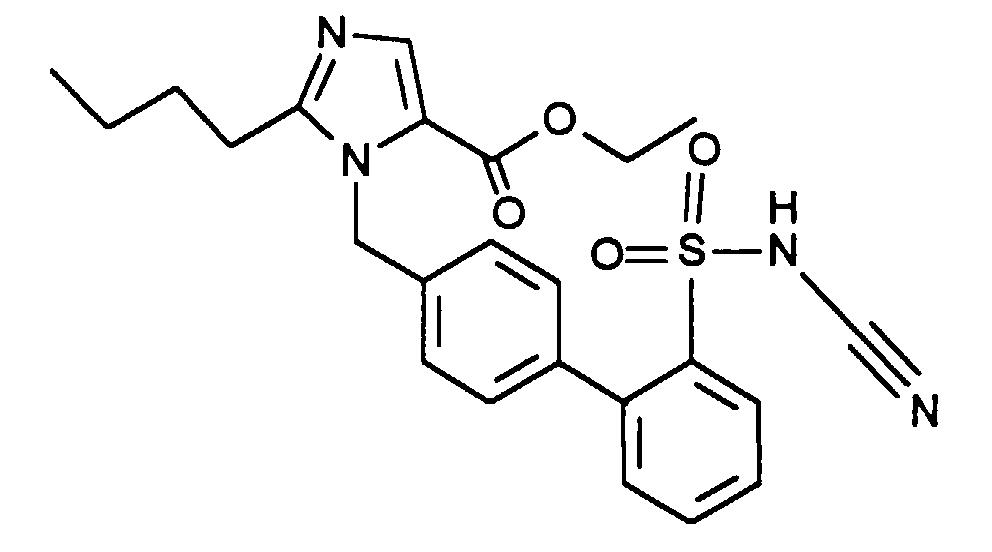
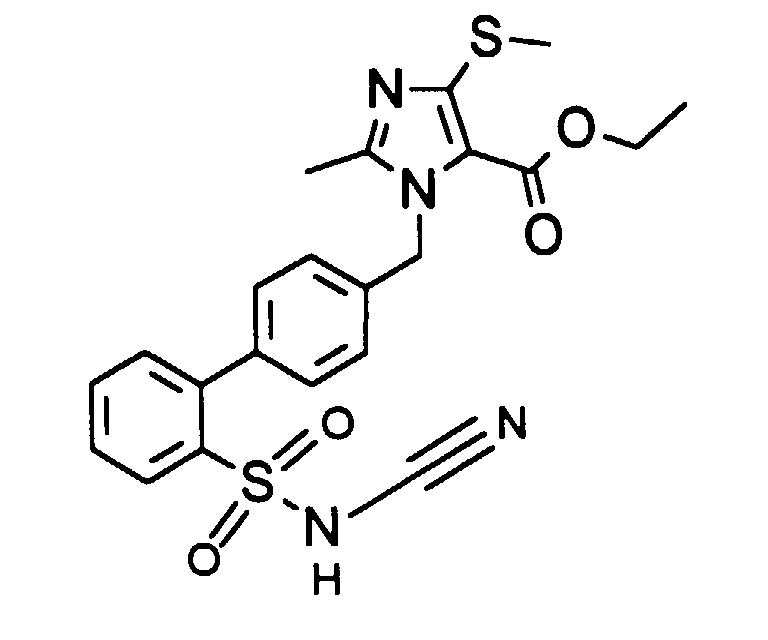
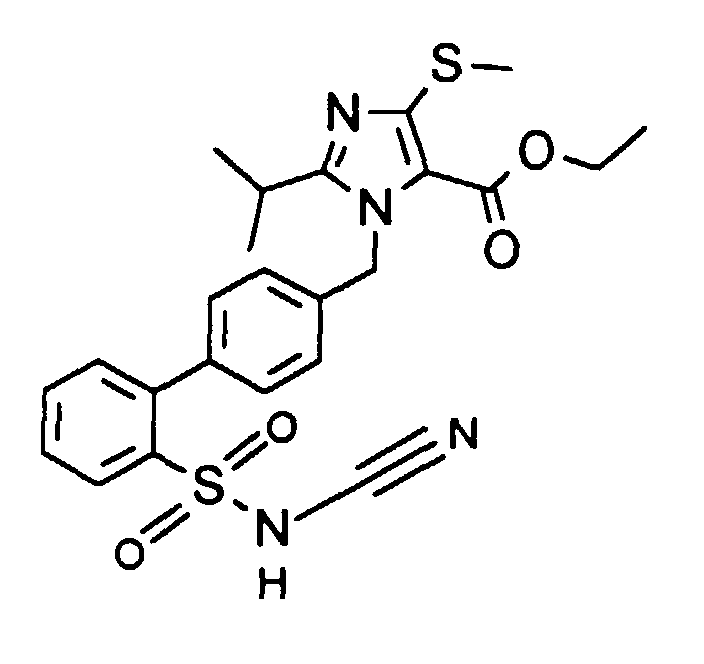
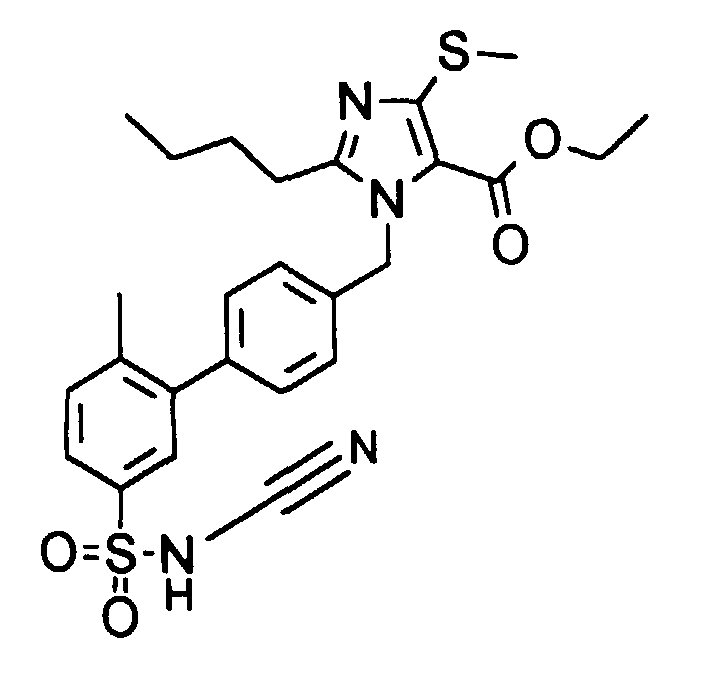
- the invention also relates to a process for the preparation of the compounds of the formula I and their physiologically tolerable salts, which is characterized in that a compound of the formula II wherein the radicals are as defined above and which are either known from J. Med. Chem. 1995, 38 , 2357 or were prepared analogously, with cyanogen bromide.
- the reaction takes place in a dipolar aprotic solvent that is stable against cyanogen bromide, for example acetonitrile, DMA, TMU or NMP with a strong auxiliary base that is not very nucleophilic, such as K 2 CO 3 or Cs 2 CO 3 .
- a temperature of 0 ° C. to the boiling point of the solvent used is suitable as the reaction temperature; a temperature of 60 ° C. to 120 ° C. is preferred.
- the invention further relates to the use of a compound of the formula I for the manufacture of a medicament for the treatment or prophylaxis of diseases caused by ischemic conditions; and the use of a compound of formula I for the manufacture of a medicament for the treatment or prophylaxis of heart attack; and the use of a compound of formula I for the manufacture of a medicament for the treatment or prophylaxis of angina pectoris; and the use of a compound of formula I for the manufacture of a medicament for the treatment or prophylaxis of ischemic conditions of the heart; and the use of a compound of formula I for the manufacture of a medicament for the treatment or prophylaxis of ischemic conditions of the peripheral and central nervous system and stroke; and the use of a compound of formula I for the manufacture of a medicament for the treatment or prophylaxis of ischemic conditions of peripheral organs and limbs; and the use of a compound of formula I for the manufacture of a medicament for the treatment of shock conditions; and the use of a compound of formula I
- Compounds of the formula I according to the invention are similar compounds known from U.S. Patents 5,482,957 and 5,604,251. However, they point not the sulfonylcyanamide side chain always present according to the invention.
- Imidazole derivatives as angiotensin II antagonists are also described in WO9523792, WO9523791, US 5391732, EP-A 648763.
- triazole derivatives, in WO 9220662 and J. Med. Chem. (1994), 37 (17), 2808-2824 triazolinone derivatives as angiotensin II receptor antagonists described.
- the known compounds are angiotensin II receptor antagonists of the subtype AT1, what effect in the inventive Compounds I is not present or only to a small extent.
- the compounds of the formula I according to the invention have very good antiarrhythmic properties, such as are important, for example, for the treatment of diseases which occur in the presence of oxygen deficiency symptoms. Because of their pharmacological properties, the compounds I are outstandingly suitable as antiarrhythmic medicaments with a cardioprotective component for preventing and treating infarction and for treating angina pectoris, and they also preventively prevent the pathophysiological processes in the occurrence of ischemically induced damage, in particular when ischemically induced cardiac arrhythmias are triggered or decrease significantly.
- the compounds of the formula I according to the invention can, as a result of inhibition of the cellular Na + -dependent Cl - / HCO 3 - exchange mechanism or of the sodium / bicarbonate symporter, treat all acute or chronic Damage caused by ischemia or diseases primarily or secondarily induced can be used. They protect acutely or chronically oxygen-deficient organs by reducing or preventing ischemically induced damage and are therefore suitable as medicinal products for thrombosis, vascular spasms, atherosclerosis or during surgical interventions (e.g.
- the compounds of formula I are also valuable, protective pharmaceuticals when performing angioplasty surgery, for example on the heart as well as on peripheral vessels. According to their protective action against ischemically induced damage, the compounds are also suitable as medicaments for the treatment of ischemia of the nervous system, in particular the central nervous system. B. are suitable for the treatment of stroke or brain edema.
- the compounds of formula I according to the invention are also suitable for the treatment of forms of shock, such as allergic, cardiogenic, hypovolemic and bacterial shock.
- the compounds of formula I according to the invention are distinguished by a strong inhibitory effect on the proliferation of cells, for example fibroblast cell proliferation and smooth proliferation Vascular muscle cells, from. Therefore, the compounds of formula I come as valuable therapeutic agents for diseases in question, in which cell proliferation is a represents primary or secondary cause, and can therefore be considered Antiatherosclerotics, remedies for late diabetic complications Cancer, fibrotic diseases such as pulmonary fibrosis, liver fibrosis or Kidney fibrosis, organ hypertrophy and hyperplasia, especially in Prostate hyperplasia or prostate hypertrophy can be used.
- fibrotic diseases such as pulmonary fibrosis, liver fibrosis or Kidney fibrosis, organ hypertrophy and hyperplasia, especially in Prostate hyperplasia or prostate hypertrophy can be used.
- inhibitors of the Na + -dependent Cl - / HCO 3 - exchanger or of the sodium / bicarbonate symporter can stimulate respiration by increasing the chemosensitivity of the respiratory chemoreceptors.
- These chemoreceptors are largely responsible for maintaining orderly breathing. They are activated by hypoxia, a drop in pH and an increase in CO 2 (hypercapnia) in the body and lead to an adjustment of the minute ventilation. Breathing is particularly susceptible to disruption during sleep and is highly dependent on the activity of the chemoreceptors.
- An improvement in respiratory drive through stimulation of the chemoreceptors with substances that inhibit the Na + -dependent Cl - / HCO 3 - exchange leads to an improvement in breathing in the following clinical conditions and diseases: Impaired central respiratory drive (e.g. central sleep apneas , sudden child death, postoperative hypoxia), muscular breathing disorders, breathing disorders after long-term ventilation, breathing disorders when adapting to high mountains, obstructive and mixed form of sleep apneas, acute and chronic lung diseases with hypoxia and hypercapnia.
- Drugs containing a compound of formula I can be taken orally parenterally, intravenously, rectally or by inhalation, the preferred application of the respective appearance of the disease is dependent.
- the compounds of formula I can be used alone or together with galenic auxiliaries, both in the Veterinary as well as human medicine.
- excipients are suitable for the desired pharmaceutical formulation is familiar to the specialist on the basis of his specialist knowledge.
- Active substance carriers can, for example, antioxidants, dispersants, Emulsifiers, defoamers, flavoring agents, preservatives, Solubilizers or dyes are used.
- the active compounds with the for it suitable additives such as carriers, stabilizers or inert Diluent mixed and by the usual methods in the appropriate Dosage forms brought, such as tablets, coated tablets, capsules, aqueous, alcoholic or oily solutions.
- inert carriers such as B. gum arabic, Magnesia, magnesium carbonate, potassium phosphate, milk sugar, glucose or Starch, especially corn starch, can be used. The preparation can done both as dry and as wet granules.
- an oily carrier or vegetable or animal oils come in as solvents Consider how sunflower oil or cod liver oil.
- the active compounds For subcutaneous or intravenous administration, the active compounds, if desired with the usual substances such as solubilizers, Emulsifiers or other auxiliaries in solution, suspension or emulsion brought.
- solvents such. B. in question: water, physiological Saline or alcohols, e.g. As ethanol, propanol, glycerin, in addition Sugar solutions such as glucose or mannitol solutions, or a mixture of the various solvents mentioned.
- compositions for administration in the form of aerosols or sprays are suitable e.g. B. solutions, suspensions or emulsions of Active ingredient of formula I in a pharmaceutically acceptable solvent, such as in particular ethanol or water, or a mixture of such Solvent.
- a pharmaceutically acceptable solvent such as in particular ethanol or water, or a mixture of such Solvent.
- the formulation can also contain other pharmaceutical auxiliaries such as surfactants, emulsifiers and stabilizers and contain a propellant.
- a such preparation usually contains the active ingredient in a concentration of about 0.1 to 10, in particular about 0.3 to 3 wt .-%.
- the dosage of the active ingredient of formula I to be administered and the frequency of administration depend on the potency and duration of action of the compounds used; also on the type and severity of the disease to be treated and on the sex, age, weight and individual responsiveness of the mammal to be treated.
- the daily dose of a compound of the formula I in a patient weighing approximately 75 kg is at least 0.001 mg / kg, preferably 0.01 mg / kg, to at most 10 mg / kg, preferably 1 mg / kg body weight.
- more frequent doses may be necessary, e.g. B. up to 4 single doses per day.
- up to 200 mg per day may be necessary.
- the compounds of the formula I can be used as the only active ingredients or in combination be used with other pharmacologically active compounds.
- the compounds of formula I and / or their physiologically tolerable salts can also be used to achieve a beneficial therapeutic effect with other pharmacologically active compounds for treatment or Prophylaxis of the above-mentioned clinical pictures, in particular for the treatment of Cardiovascular diseases can be used.
- the combination with is preferred Inhibitors of the sodium / hydrogen exchanger (NHE) and / or with active ones Substances from other cardiovascular drug classes.
- the invention further relates generally to the combination of a) NCBE inhibitors and / or their physiologically tolerable salts with NHE inhibitors and / or their physiologically tolerable salts; b) NCBE inhibitors and / or their physiologically compatible salts with active substances from other cardiovascular classes of active substances and / or their physiologically tolerable salts and c) NCBE inhibitors and / or their physiologically tolerable salts with NHE inhibitors and / or their physiologically tolerable salts and with active Substances from other cardiovascular drug classes and / or their physiologically acceptable salts. Combinations are preferred in which NCBE inhibitors of the general formula I and / or their physiological compatible salts can be used.
- NHE inhibitors are guanidine derivatives, preferably acylguanidines, among others as described in Edward J. Cragoe, Jr., "DIURETICS, Chemistry, Pharmacology and Medicine", J. WILEY & Sons (1983), 303-341 or the NHE inhibitors listed in DE19737224.4.
- Suitable NHE inhibitors are, for example, benzoylguanidines, as described in US 5292755, US 5373024, US 5364868, US 5591754, US 5516805, US 5559153, US 5571842, US 5641792, US 5631293, EP-A 577024, EP-A 602522, EP -A 602523, EP-A 603650, EP-A 604852, EP-A 612723, EP-A 627413, EP-A 628543, EP-A 640593, EP-A 640588, EP-A702001, EP-A 713864, EP- A 723956, EP-A 754680, EP-A 765868, EP-A 774459, EP-A 794171, DE 19624178.2, DE 19713427.0; ortho-substituted benzoylguanidines as described in EP-A 556673, EP-A 791577, EP-A 794172, DE 19624178.2
- NHE inhibitors are preferred in the publications mentioned highlighted connections.
- the compounds are very particularly preferred Cariporid (HOE642), HOE 694, EMD 96785, FR 168888, FR 183998, SM-20550, KBR-9032, as well as their physiologically acceptable salts. Most preferred Cariporid or its physiologically acceptable salt.
- cardiovascular active substance classes which can be combined therapeutically advantageously with NCBE inhibitors or can additionally be combined with combinations of NCBE inhibitors and NHE inhibitors are beta-receptor blockers, calcium antagonists, angiotensin conversion enzyme inhibitors, angiotensin receptor blockers, loop diuretics, thiazide diuretics potassium sparing diuretics, aldosterone antagonists, such as are used, for example in the reduction of blood pressure, and cardiac glycosides or other contractile force-enhancing agents in the treatment of cardiac insufficiency and of congestive heart failures, and also antiarrhythmics of the classes I - IV, nitrates, KATP -Openers, K ATP blockers, inhibitors of the veratridine-activatable sodium channel etc.
- the beta blockers propanolol, atenolol, metoprolol; the calcium antagonists diltiazem hydrochloride, verapamil hydrochloride, nifedipine; the ACE inhibitors captopril, enalapril, ramipril; Trandolapril, quinapril, spirapril, preferably ramipril or trandolapril; the angiotensin II receptor antagonists losartan, valsartan, telmisartan, eprosartan, tasosartan, candesartan, irbesartan; the loop directives furosemide, piretanide, torasemide; the thiazide diuretics hydrochlorothiazide, metolazone, indapamide; the potassium-saving diuretics amiloride, triamterene, spironolactone;
- An example of such a particularly advantageous combination partner with NCBE inhibitors are blockers of the non-inactivating sodium channel (veratridine-inactivatable sodium channel).
- the combinations of an NCBE inhibitor with a blocker of the non-inactivating sodium channel (veratridine-activatable sodium channel) are suitable for infarct and re-infarct prophylaxis and infarct treatment as well as for the treatment of angina pectoris and the inhibition of ischemically induced cardiac arrhythmias, tachycardia and Development and maintenance of ventricular fibrillation, whereby the combinations of an NCBE inhibitor with a blocker of the non-inactivating sodium channel also preventively inhibit or greatly reduce the pathophysiological processes in the development of ischemically induced damage.
- the combinations according to the invention of an NCBE inhibitor with a blocker of the non-inactivating sodium channel as a result of increased inhibition of Na + influx into the cell can be used as a medicament for the treatment of all acute or chronic conditions caused by ischemia Damage or diseases primarily or secondarily induced.
- the combinations of an NCBE inhibitor with a blocker of the non-inactivating sodium channel both for the protection of the organs in the donor before and during removal, for the protection of removed organs, for example, also in their storage in physiological bath fluids, as well as in the Transfer into the recipient organism can be used.
- the combinations of an NCBE inhibitor with a blocker of the non-inactivating sodium channel are also valuable, protective drugs when performing angioplasty surgical interventions, for example on the heart and on peripheral vessels.
- the combinations of an NCBE inhibitor with a blocker of the non-inactivating sodium channel are also suitable as medicaments for the treatment of ischemia of the nervous system, in particular the central nervous system, whereby they are suitable for the treatment of stroke or cerebral edema.
- the combinations of an NCBE inhibitor according to the invention with a blocker of the non-inactivating sodium channel are also suitable for the treatment of forms of shock, such as, for example, allergic, cardiogenic, hypovolemic and bacterial shock.
- the invention also relates to simultaneous, separate or staggered use of NCBE inhibitors with NHE inhibitors and / or an additional active substance from one another class of cardiovascular agents for the treatment of the above Diseases.
- the invention further relates to a pharmaceutical preparation containing a) an NCBE inhibitor and an NHE inhibitor and / or their physiological tolerable salts; or b) an NCBE inhibitor and an active one Substance from another cardiovascular agent class and / or their physiologically acceptable salts; or c) an NCBE inhibitor, an NHE inhibitor and in addition an active substance from another cardiovascular class of active substances, and / or their physiologically tolerable salts.
- Preferred pharmaceutical preparations are those which contain a compound of formula I. and / or contain their physiologically acceptable salt as an NCBE inhibitor.
- the combined application can have the effect of a combination partner be potentiated by the respective other partner, i.e. the effect and / or
- the duration of action of a combination or preparation according to the invention is stronger or lasting than the effect and / or duration of action of the individual components (synergistic effect). In the case of a combined application, this leads to a Reduction of the dose of the respective combination partner compared to the Single application.
- the combinations and preparations according to the invention therefore have the advantage that the amounts of active ingredient to be administered significantly reduced and undesirable side effects eliminated or strong can be reduced.
- the invention further relates to a commercial package containing as pharmaceutical active ingredient a) an NCBE inhibitor and an NHE inhibitor and / or their physiologically tolerable salts; or b) an NCBE inhibitor and additionally an active substance from another cardiovascular active substance class and / or its physiologically tolerable salts; or c) an NCBE inhibitor, an NHE inhibitor and additionally an active substance from another cardiovascular active substance class and / or their physiologically tolerable salts, in each case together with instructions for the use of these active substances in combination for simultaneous, separate or graded Use in the treatment or prophylaxis of the above-mentioned clinical pictures, in particular for the treatment of cardiovascular diseases.
- Commercial packs which contain compounds of the formula I as NCBE inhibitors are preferred.
- the pharmaceutical preparations according to the invention can, for example be made by either intensely powdering the individual components mixes, or by placing the individual components in the appropriate solvent such as a lower alcohol and dissolves the solvent then removed.
- the weight ratio of the NCBE inhibitor to the NHE inhibitor or the cardiovascular active Substance in the combinations and Preparations are expediently 1: 0.01 to 1: 100, preferably 1: 0.1 until 1:10.
- the combination and preparations according to the invention contain a total preferably 0.5-99.5 wt .-%, in particular 4-99 wt .-% of these active ingredients.
- the sulfonamide starting material is dissolved in 10 ml / mmol of anhydrous acetonitrile, 3 molar equivalents of K 2 CO 3 and one molar equivalent of a 5 N solution of BrCN in acetonitrile are added dropwise and the mixture is heated under reflux until conversion is complete (typical reaction time 1-6 Hours). The reaction mixture is then chromatographed on silica gel without further working up.
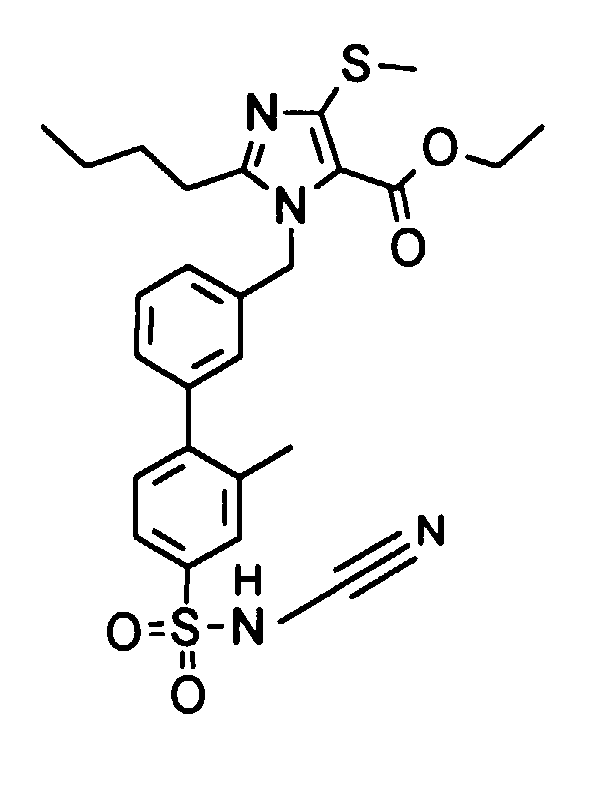
- Example 10 The title compound of Example 10 was prepared analogously to Example 2 from 2-cyclopropyl-5-methylsulfanyl-3- (4'-sulfamoyl-biphenyl-2-ylmethyl) -3H-imidazole-4-carboxylic acid ethyl ester (J. Med. Chem. 1995 , 38, 2357):
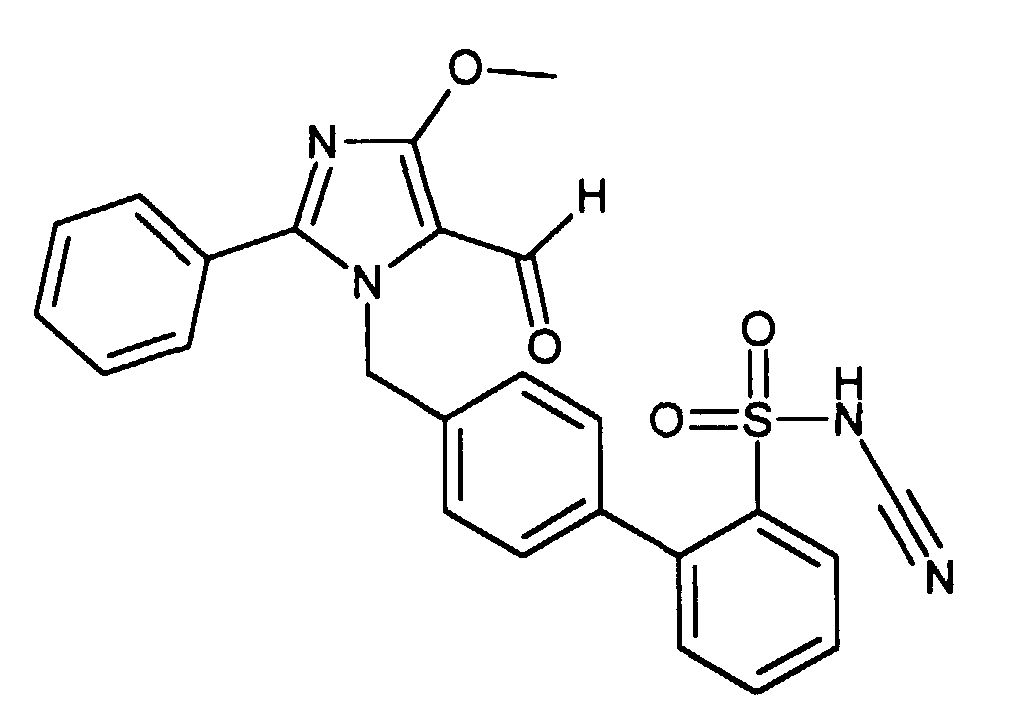
- Example 12 4 '- (4-methoxy-5-formyl-2-phenyl-imidazol-1-ylmethyl) biphenyl-2-sulfonylcyanamide
- Example 29 4 '- (5-Acetyl-4-chloro-2-phenyl-imidazol-1-ylmethyl) biphenyl-2-sulfonylcyanamide
- Example 30 4 '- (5-Acetyl-4-methoxy-2-phenyl-imidazol-1-ylmethyl) biphenyl-2-sulfonylcyanamide
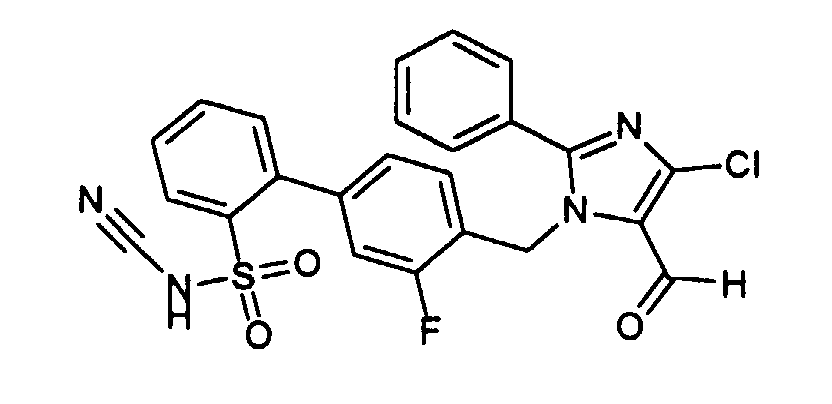
- Example 33 The title compound of Example 33 was synthesized analogously to Example 32:
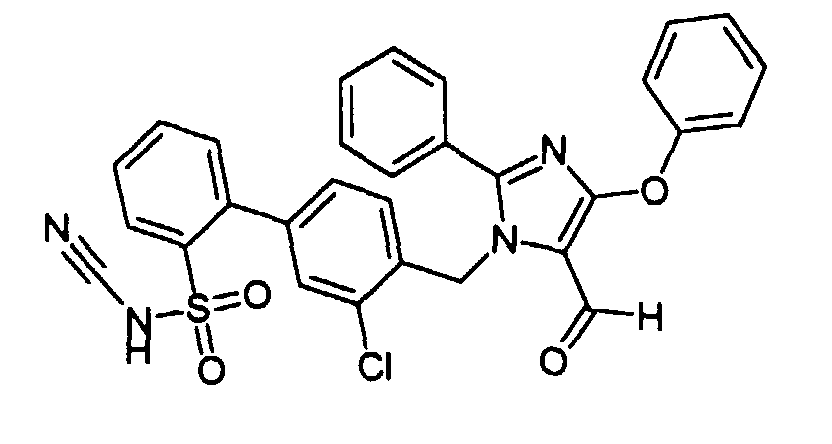
- Example 34 The title compound of Example 34 was analogous to Example 12 from 3'-chloro-4 '- (4-chloro-5-formyl-2-phenyl-imidazol-1-ylmethyl) biphenyl-2-sulfonamide (Example 32 d) synthesized:
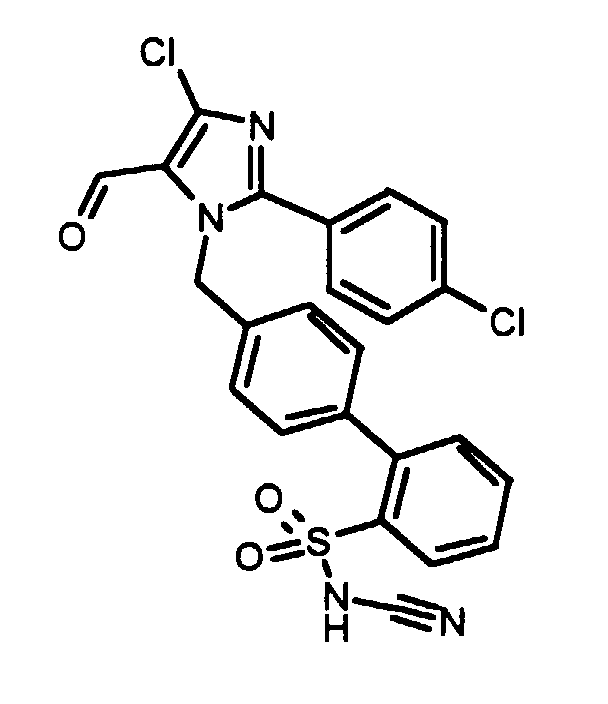
- Example 36 4 '- [4-Chloro-5-formyl-2- (4-chlorophenyl) imidazol-1-ylmethyl] biphenyl-2-sulfonylcyanamide
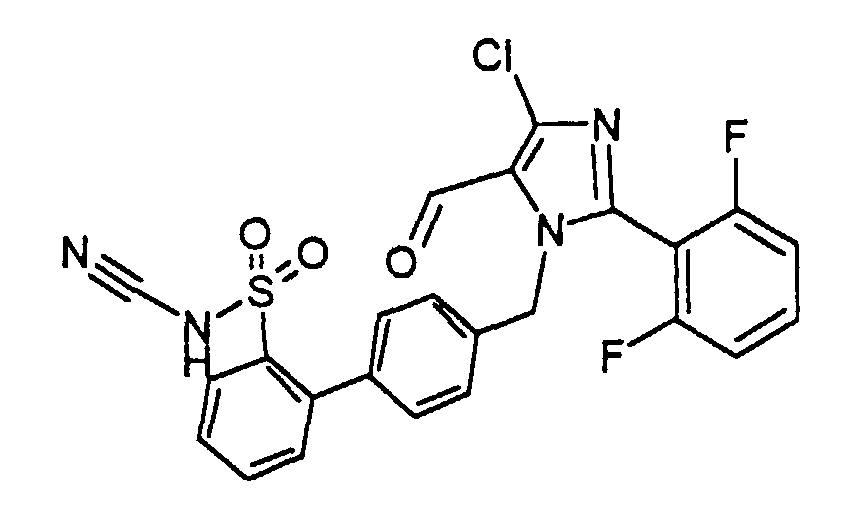
- Example 38 4 '- [4-Chloro-5-formyl-2- (2,6-difluorophenyl) imidazol-1-ylmethyl] biphenyl-2-sulfonylcyanamide
- Human endothelial cells (ECV-304) were detached from culture bottles using trypsin / EDTA buffer (0.05 / 0.02% in phosphate buffer) and after centrifugation (100 g, 5 min) in a buffered saline solution (mmol / l: 115 NaCl, 20 NH 4 Cl, 5 KCl, 1 CaCl 2 , 1 MgSO 4 , 20 N- (2-hydroxyethyl) piperazine-N -2-ethanesulfonic acid (HEPES), 5 glucose and 1 g / l bovine serum albumin; pH 7.4).
- This cell suspension was incubated with 5 ⁇ M BCECF-acetoxymethyl ester for 20 min at 37 ° C.
- the cells were then washed and in a sodium and bicarbonate-free buffer solution (mmol / l: 5 HEPES, 133.8 choline chloride, 4.7 KCl, 1.25 MgCl 2 , 0.97 K 2 HPO 4 , 0.23 KH 2 PO4, 5 glucose; pH 7.4).
- a sodium and bicarbonate-free buffer solution mmol / l: 5 HEPES, 133.8 choline chloride, 4.7 KCl, 1.25 MgCl 2 , 0.97 K 2 HPO 4 , 0.23 KH 2 PO4, 5 glucose; pH 7.4
- FLIPR Fluorescent Imaging Plate Reader
- a bicarbonate-free, sodium-containing buffer solution (mmol / l: 5 HEPES, 133.8 NaCl, 4.7 KCl, 1.25 CaCl 2 , 1.25 MgCl 2 , 0.97 Na 2 HPO 4 , 0.23 NaH 2 PO 4 , 5 glucose; pH 7.4), to which 50 ⁇ M HOE 642 were also added.
- the compounds according to the invention were added in various concentrations to the solution containing sodium and bicarbonate. After the buffer solutions had been added to the acid-loaded cells loaded with dye in the measuring plate, the increase in fluorescence intensity, which corresponded to an increase in pH i , was determined in each well of the microtiter plate. The kinetics were recorded at 35 ° C. over a period of 2 minutes. The increase in the fluorescence intensities for different concentrations of the compounds according to the invention was based on the two controls and the inhibitory effect of the substances was determined therefrom.
- Residual activity of the NCBE at an inhibitor concentration of 10 ⁇ M Residual activity in% 1 17.7 2nd 39.6 3rd 74.1 4th 39.7 5 43.2 6 58.6 7 72.1 8th 60.8 9 31.6 10th 21.6 11 15.0 12th 8/20 13 89.5 14 47.3 15 55.7 16 11.5 17th 39.1 18th 45.8 19th 21.5 20th 19.5 21 42.6 22 34.2 23 31.6 24th 29.2 25th 70.8 26 65.3 27 50.0 28 30.5 29 39.6 30th 48.8 31 36.5 32 7.8 33 7.6 34 5.5 35 3.2 36 7.8 37 16.8 38 8.6
Landscapes
- Chemical & Material Sciences (AREA)
- Organic Chemistry (AREA)
- Health & Medical Sciences (AREA)
- Life Sciences & Earth Sciences (AREA)
- Engineering & Computer Science (AREA)
- General Health & Medical Sciences (AREA)
- Bioinformatics & Cheminformatics (AREA)
- Veterinary Medicine (AREA)
- Public Health (AREA)
- Medicinal Chemistry (AREA)
- Animal Behavior & Ethology (AREA)
- Pharmacology & Pharmacy (AREA)
- General Chemical & Material Sciences (AREA)
- Chemical Kinetics & Catalysis (AREA)
- Nuclear Medicine, Radiotherapy & Molecular Imaging (AREA)
- Wood Science & Technology (AREA)
- Heart & Thoracic Surgery (AREA)
- Cardiology (AREA)
- Environmental Sciences (AREA)
- Zoology (AREA)
- Dentistry (AREA)
- Urology & Nephrology (AREA)
- Pulmonology (AREA)
- Vascular Medicine (AREA)
- Epidemiology (AREA)
- Pharmaceuticals Containing Other Organic And Inorganic Compounds (AREA)
- Acyclic And Carbocyclic Compounds In Medicinal Compositions (AREA)
- Organic Low-Molecular-Weight Compounds And Preparation Thereof (AREA)
- Medicines Containing Antibodies Or Antigens For Use As Internal Diagnostic Agents (AREA)
- Hydrogenated Pyridines (AREA)
Abstract
Description

- R1
- Wasserstoff, Alkyl mit 1, 2, 3, 4, 5, 6, 7 oder 8 C-Atomen oder -CaH2a-Phenyl,
das unsubstituiert oder substituiert ist mit 1 - 3 Substituenten ausgewählt aus der Gruppe bestehend aus F, Cl, Br, I, CF3, Methyl, Methoxy, Hydroxy und NR(8)R(9); - R(8) und R(9)
-
unabhängig voneinander H oder (C1-C4)-Alkyl; - a
- Null, 1 oder 2;
oder - R1
- -CbH2bC1-C9)-Heteroaryl, das unsubstituiert oder substituiert ist mit 1 - 3 Substituenten ausgewählt aus der Gruppe bestehend aus F, Cl, Br, I, CF3, CH3, Methoxy, Hydroxy und NR(10)R(11);
- R(10) und R(11)
-
unabhängig voneinander H oder (C1-C4)-Alkyl; - b
- Null, 1 oder 2;
oder - R1
- -CdH2d-(C3-C7)Cycloalkyl;
- d
- Null, 1 oder 2;
- R2 und R3
- unabhängig voneinander Wasserstoff, F, Cl, Br, I, CF3, -C≡N, -NO2,
CH2OR17, CO-R6 oder O-R7; - R17
- Wasserstoff oder Alkyl mit 1, 2, 3, 4, 5, 6, 7 oder 8 C-Atomen
- R6
- Wasserstoff, Alkyl mit 1, 2, 3, 4, 5, 6, 7 oder 8 C-Atomen, OR30 oder
Phenyl,
das unsubstituiert oder substituiert ist mit 1 - 3 Substituenten ausgewählt aus der Gruppe bestehend aus bestehend aus F, Cl, Br, I, CF3, Methyl, Methoxy, Hydroxy und NR(31)R(32); R(31) und R(32)
unabhängig voneinander H oder (C1-C4)-Alkyl; - R30
- Wasserstoff oder Alkyl mit 1, 2, 3, 4, 5, 6, 7 oder 8 C-Atomen;
- R7
- Wasserstoff, Alkyl mit 1, 2, 3, 4, 5, 6, 7 oder 8 C-Atomen, Phenyl,
das unsubstituiert oder substituiert ist mit 1 - 3 Substituenten ausgewählt aus der Gruppe bestehend aus F, Cl, Br, I, CF3, Methyl, Methoxy, Hydroxy und NR(12)R(13); - R(12) und R(13)
-
unabhängig voneinander H oder (C1-C4)-Alkyl;
oder - R7
- (C1-C9)-Heteroaryl,
das unsubstituiert oder substituiert ist mit 1 - 3 Substituenten ausgewählt aus der Gruppe bestehend aus F, Cl, Br, I, CF3, CH3, Methoxy, Hydroxy und NR(14)R(15); - R(14) und R(15)
-
unabhängig voneinander H oder (C1-C4)-Alkyl;
oder - R2 und R3
-
unabhängig voneinander Alkyl mit 1, 2, 3, 4, 5, 6, 7 oder 8 C-Atomen, Cycloalkyl mit 3, 4, 5, 6 oder 7 C-Atomen oder -CgH2g-Phenyl,
das unsubstituiert oder substituiert ist mit 1 - 3 Substituenten ausgewählt aus der Gruppe bestehend aus F, Cl, Br, I, CF3, Methyl, Methoxy, Hydroxy und NR(18)R(19); - R(18) und R(19)
-
unabhängig voneinander H oder (C1-C4)-Alkyl; - g
- Null, 1 oder 2;
oder - R2 und R3
-
unabhängig voneinander -ClH2l-(C1-C9)-Heteroaryl,
das unsubstituiert oder substituiert ist mit 1 - 3 Substituenten ausgewählt aus der Gruppe bestehend aus F, Cl, Br, I, CF3, CH3, Methoxy, Hydroxy und NR(20)R(21); - R(20) und R(21)
-
unabhängig voneinander H oder (C1-C4)-Alkyl; - l
- Null, 1 oder 2;
oder - R2 und R3
-
unabhängig voneinander SOn-R22; - n
- Null, 1 oder 2;
- R22
- Alkyl mit 1, 2, 3, 4, 5, 6, 7 oder 8 C-Atomen, Cycloalkyl mit 3, 4, 5, 6
oder 7 C-Atomen oder -CsH2s-Phenyl,
das unsubstituiert oder substituiert ist mit 1 - 3 Substituenten ausgewählt aus der Gruppe bestehend Gruppe F, Cl, Br, I, CF3, Methyl, Methoxy, Hydroxy und NR(34)R(35); - R(34) und R(35)
-
unabhängig voneinander H oder (C1-C4)-Alkyl; - s
- Null, 1 oder 2;
- R4 und R5
-
unabhängig voneinander Wasserstoff, Alkyl mit 1, 2, 3, 4, 5, 6, 7 oder 8 C-Atomen, F, Cl, Br, I, CF3, -C≡N, -NO2, SOp-R16, CO-R23 oder O-R24; - p
- Null, 1 oder 2;
- R16
- Alkyl mit 1, 2, 3, 4, 5, 6, 7 oder 8 C-Atomen oder Phenyl, das unsubstituiert oder substituiert ist mit 1 - 3 Substituenten ausgewählt aus der Gruppe bestehend aus F, Cl, Br, I, CF3, Methyl, Methoxy, Hydroxy und NR(26)R(27);
- R(26) und R(27)
-
unabhängig voneinander H oder (C1-C4)-Alkyl; - R23
- Wasserstoff, Alkyl mit 1, 2, 3, 4, 5, 6, 7 oder 8 C-Atomen oder OR25; R25 Wasserstoff, Alkyl mit 1, 2, 3, 4, 5, 6, 7 oder 8 C-Atomen;
- R24
- Wasserstoff, Alkyl mit 1, 2, 3, 4, 5, 6, 7 oder 8 C-Atomen oder Phenyl, das unsubstituiert oder substituiert ist mit 1 - 3 Substituenten ausgewählt aus der Gruppe bestehend aus F, Cl, Br, I, CF3, Methyl, Methoxy, Hydroxy und NR(28)R(29);
- R(28) und R(29)
-
unabhängig voneinander H oder (C1-C4)-Alkyl;
- R1
- Wasserstoff, Alkyl mit 1, 2, 3 oder 4 C-Atomen oder -CaH2a-Phenyl,
das unsubstituiert oder substituiert ist mit 1 - 2 Substituenten ausgewählt aus der Gruppe bestehend aus F, Cl, Br, CF3, Methyl, Methoxy, Hydroxy und NR(8)R(9); - R(8) und R(9)
-
unabhängig voneinander H oder Methyl; - a
- Null oder 1;
oder - R1
- (C1-C9)-Heteroaryl,
das unsubstituiert oder substituiert ist mit einem Substituenten ausgewählt aus der Gruppe bestehend aus F, Cl, Br, CF3, CH3, Methoxy, Hydroxy und NR(10)R(11); - R(10) und R(11)
-
unabhängig voneinander H oder Methyl;
oder - R1
- -CdH2d-(C3-C7)-Cycloalkyl;
- d
- Null oder 1;
- R2 und R3
-
unabhängig voneinander Wasserstoff, F, Cl, Br, CF3, -C≡N, -NO2, CH2OR17, CO-R6 oder O-R7; - R17
- Wasserstoff oder Alkyl mit 1, 2, 3 oder 4 C-Atomen;
- R6
- Wasserstoff, Alkyl mit 1, 2, 3 oder 4 C-Atomen, OR30 oder Phenyl, das unsubstituiert oder substituiert ist mit 1 - 2 Substituenten ausgewählt aus der Gruppe bestehend aus F, Cl, Br, CF3, Methyl, Methoxy, Hydroxy und NR(31)R(32);
- R(31) und R(32)
-
unabhängig voneinander H oder Methyl; - R30
- Wasserstoff oder Alkyl mit 1, 2, 3 oder 4 C-Atomen;
- R7
- Wasserstoff, Alkyl mit 1, 2, 3 oder 4 C-Atomen oder Phenyl, das unsubstituiert oder substituiert ist mit 1 - 2 Substituenten ausgewählt aus der Gruppe bestehend aus F, Cl, Br, CF3, Methyl, Methoxy, Hydroxy und NR(12)R(13);
- R(12) und R(13)
-
unabhängig voneinander H oder Methyl;
oder - R7
- (C1-C9)-Heteroaryl,
das unsubstituiert oder substituiert ist mit einem Substituenten ausgewählt aus der Gruppe bestehend aus F, Cl, Br, CF3, CH3, Methoxy, Hydroxy und NR(14)R(15); - R(14) und R(15)
-
unabhängig voneinander H oder Methyl;
oder - R2 und R3
-
unabhängig voneinander Alkyl mit 1, 2, 3 oder 4 C-Atomen, Cycloalkyl mit 3, 4, 5, 6 oder 7 C-Atomen oder -CgH2g-Phenyl,
das unsubstituiert oder substituiert ist mit 1 - 2 Substituenten ausgewählt aus der Gruppe bestehend aus F, Cl, Br, CF3, Methyl, Methoxy, Hydroxy und NR(18)R(19); - R(18) und R(19)
-
unabhängig voneinander H oder Methyl; - g
- Null oder 1;
oder - R2 und R3
-
unabhängig voneinander (C1-C9)-Heteroaryl,
das unsubstituiert oder substituiert ist mit einem Substituenten ausgewählt aus der Gruppe bestehend aus F, Cl, Br, CF3, CH3, Methoxy, Hydroxy und NR(20)R(21); - R(20) und R(21)
-
unabhängig voneinander H oder Methyl;
oder - R2 und R3
-
unabhängig voneinander SOn-R22, - n
- Null, 1 oder 2;
- R22
- Alkyl mit 1, 2, 3 oder 4 C-Atomen, Cycloalkyl mit 3, 4, 5, 6 oder 7 C-Atomen
oder -CsH2s-Phenyl,
das unsubstituiert oder substituiert ist mit 1 - 2 Substituenten ausgewählt aus der Gruppe bestehend aus F, Cl, Br, CF3, Methyl, Methoxy, Hydroxy und NR(34)R(35); - R(34) und R(35)
-
ausgewählt aus der Gruppe bestehend aus H oder Methyl; - s
- Null oder 1;
- R4 und R5
- unabhängig voneinander Wasserstoff, Alkyl mit 1, 2, 3 oder 4 C-Atomen, F, Cl, Br, CF3, -C≡N, -NO2, SOp-R16, CO-R23 oder O-R24;
- p
- Null, 1 oder 2;
- R16
- Alkyl mit 1, 2, 3 oder 4 C-Atomen oder Phenyl,
das unsubstituiert oder substituiert ist mit 1 - 2 Substituenten ausgewählt aus der Gruppe bestehend aus F, Cl, Br, CF3, Methyl, Methoxy, Hydroxy und NR(26)R(27); - R(26) und R(27)
-
unabhängig voneinander H oder Methyl; - R23
- Wasserstoff, Alkyl mit 1, 2, 3 oder 4 C-Atomen oder OR25;
- R25
- Wasserstoff oder Alkyl mit 1, 2, 3 oder 4 C-Atomen;
- R24
- Wasserstoff, Alkyl mit 1, 2, 3 oder 4 C-Atomen oder Phenyl, das unsubstituiert oder substituiert ist mit 1 - 2 Substituenten ausgewählt aus der Gruppe bestehend aus F, Cl, Br, CF3, Methyl, Methoxy, Hydroxy und NR(28)R(29);
- R(28) und R(29)
-
unabhängig voneinander H oder Methyl;
- R1
- Wasserstoff, Alkyl mit 1, 2, 3 oder 4 C-Atomen oder Phenyl,
das unsubstituiert oder substituiert ist mit einem Substituenten ausgewählt aus der Gruppe bestehend aus F, Cl, Br, CF3, Methyl, Methoxy, Hydroxy und NR(8)R(9); - R(8) und R(9)
-
unabhängig voneinander H oder Methyl;
oder - R1
- (C1-C9)-Heteroaryl,
das unsubstituiert oder substituiert ist mit einem Substituenten ausgewählt aus der Gruppe bestehend aus F, Cl, Br, CF3, CH3, Methoxy, Hydroxy und NR(10)R(11); - R(10) und R(11)
-
unabhängig voneinander H oder Methyl;
oder - R1
- (C3-C7)-Cycloalkyl;
- R2 und R3
-
unabhängig voneinander Wasserstoff, F, Cl, Br, CF3, -C≡N, -NO2, CO-R6 oder O-R7; - R6
- Wasserstoff, Alkyl mit 1, 2, 3 oder 4 C-Atomen, OR30 oder Phenyl, das unsubstituiert oder substituiert ist mit einem Substituenten ausgewählt aus der Gruppe bestehend aus F, Cl, Br, CF3, Methyl, Methoxy, Hydroxy und NR(31)R(32);
- R(31) und R(32)
-
unabhängig voneinander H oder Methyl; - R30
- Wasserstoff oder Alkyl mit 1, 2 oder 3 C-Atomen
- R7
- Wasserstoff, Alkyl mit 1, 2, 3 oder 4 C-Atomen oder Phenyl, das unsubstituiert oder substituiert ist mit einem Substituenten ausgewählt aus der Gruppe bestehend aus F, Cl, Br, CF3, Methyl, Methoxy, Hydroxy und NR(12)R(13);
- R(12) und R(13)
-
unabhängig voneinander H oder Methyl;
oder - R7
-
(C1-C9)-Heteroaryl,
das unsubstituiert oder substituiert ist mit einem Substituenten ausgewählt aus der Gruppe bestehend aus F, Cl, Br, CF3, CH3, Methoxy, Hydroxy und NR(14)R(15); R(14) und R(15)
unabhängig voneinander H oder Methyl;
oder - R2 und R3
-
unabhängig voneinander Alkyl mit 1, 2, 3 oder 4 C-Atomen, Cycloalkyl mit 3, 4, 5, 6 oder 7 C-Atomen oder Phenyl,
das unsubstituiert oder substituiert ist mit einem Substituenten ausgewählt aus der Gruppe bestehend aus F, Cl, Br, CF3, Methyl, Methoxy, Hydroxy und NR(18)R(19); - R(18) und R(19)
-
unabhängig voneinander H oder Methyl;
oder - R2 und R3
-
unabhängig voneinander (C1-C9)-Heteroaryl,
das unsubstituiert oder substituiert ist mit einem Substituenten ausgewählt aus der Gruppe bestehend aus F, Cl, Br, CF3, CH3, Methoxy, Hydroxy und NR(20)R(21); - R(20) und R(21)
-
unabhängig voneinander H oder Methyl;
oder - R2 und R3
-
unabhängig voneinander SOn-R22; - n
- Null oder 2;
- R22
- Alkyl mit 1, 2, 3 oder 4 C-Atomen, Cycloalkyl mit 3, 4, 5, 6 oder 7 C-Atomen
oder Phenyl,
das unsubstituiert oder substituiert ist mit 1 - 2 Substituenten ausgewählt aus der Gruppe bestehend aus F, Cl, Br, CF3, Methyl, Methoxy, Hydroxy und NR(34)R(35); - R(34) und R(35)
-
unabhängig voneinander H oder Methyl; - R4 und R5
- unabhängig voneinander Wasserstoff, Alkyl mit 1, 2, 3 oder 4 C-Atomen, F, Cl, CF3, -C≡N, -NO2, SOp-R16, CO-R23 oder O-R24;
- p
- Null oder 2;
- R23
- Wasserstoff, Alkyl mit 1, 2, 3 oder 4 C-Atomen oder OR25; R25 Wasserstoff oder Alkyl mit 1, 2 oder 3 C-Atomen;
- R24
- Wasserstoff, Alkyl mit 1, 2, 3 oder 4 C-Atomen oder Phenyl, das unsubstituiert oder substituiert ist mit einem Substituenten ausgewählt aus der Gruppe bestehend aus F, Cl, Br, CF3, Methyl, Methoxy, Hydroxy und NR(28)R(29);
- R(28) und R(29)
-
unabhängig voneinander H oder Methyl; - R16
- Alkyl mit 1, 2, 3 oder 4 C-Atomen oder Phenyl, das unsubstituiert oder substituiert ist mit einem Substituenten ausgewählt aus der Gruppe bestehend aus F, Cl, Br, CF3, Methyl, Methoxy, Hydroxy und NR(26)R(27);
- R(26) und R(27)
-
unabhängig voneinander H oder Methyl;
- R1
- Alkyl mit 1, 2, 3 oder 4 C-Atomen oder Phenyl,
das unsubstituiert oder substituiert ist mit einem Substituenten ausgewählt aus der Gruppe bestehend aus F, Cl, CF3, Methyl und Methoxy;
oder - R1
- (C1-C9)-Heteroaryl,
das unsubstituiert oder substituiert ist mit einem Substituenten ausgewählt aus der Gruppe bestehend aus F, Cl, CF3, CH3 und Methoxy;
oder - R1
- (C3-C7)-Cycloalkyl;
- R2 und R3
-
unabhängig voneinander Wasserstoff, F, Cl, CF3, -C≡N, CO-R6 oder O-R7; - R6
- Wasserstoff, Alkyl mit 1, 2, 3 oder 4 C-Atomen, OR30 oder Phenyl,
das unsubstituiert oder substituiert ist mit einem Substituenten ausgewählt aus der Gruppe bestehend aus F, Cl, CF3, Methyl und Methoxy; - R30
- Wasserstoff, Methyl oder Ethyl;
- R7
- Wasserstoff, Alkyl mit 1, 2, 3 oder 4 C-Atomen oder Phenyl,
das unsubstituiert oder substituiert ist mit einem Substituenten ausgewählt aus der Gruppe bestehend aus F, Cl, CF3, Methyl und Methoxy;
oder - R7
- (C1-C9)-Heteroaryl,
das unsubstituiert oder substituiert ist mit einem Substituenten ausgewählt aus der Gruppe bestehend aus F, Cl, Br, CF3, CH3 und Methoxy;
oder - R2 und R3
-
unabhängig voneinander Alkyl mit 1, 2, 3 oder 4 C-Atomen, Cycloalkyl mit 3, 4, 5, 6 oder 7 C-Atomen oder Phenyl,
das unsubstituiert oder substituiert ist mit einem Substituenten ausgewählt aus der Gruppe bestehend aus F, Cl, CF3, Methyl und Methoxy;
oder - R2 und R3
-
unabhängig voneinander (C1-C9)-Heteroaryl,
das unsubstituiert oder substituiert ist mit einem Substituenten ausgewählt aus der Gruppe bestehend aus F, Cl, CF3, CH3 und Methoxy;
oder - R2 und R3
-
unabhängig voneinander SOn-R22; - n
- Null oder 2;
- R22
- Alkyl mit 1, 2, 3 oder 4 C-Atomen oder Phenyl,
das unsubstituiert oder substituiert ist mit 1 - 2 Substituenten ausgewählt aus der Gruppe bestehend aus F, Cl, CF3, Methyl und Methoxy; - R4 und R5
-
unabhängig voneinander Wasserstoff, Methyl, F, Cl, CF3, -C≡N, SO2-R16, CO-R23 oder O-R24; - R16
- Alkyl mit 1, 2, 3 oder 4 C-Atomen oder Phenyl,
das unsubstituiert oder substituiert ist mit einem Substituenten ausgewählt aus der Gruppe bestehend aus F, Cl, CF3, Methyl und Methoxy; - R23
- Wasserstoff, Methyl oder OR25;
- R25
- Wasserstoff, Methyl oder Ethyl;
- R24
- Wasserstoff, Alkyl mit 1, 2, 3 oder 4 C-Atomen oder Phenyl,
das unsubstituiert oder substituiert ist mit einem Substituenten ausgewählt aus der Gruppe bestehend aus F, Cl, CF3, Methyl und Methoxy;

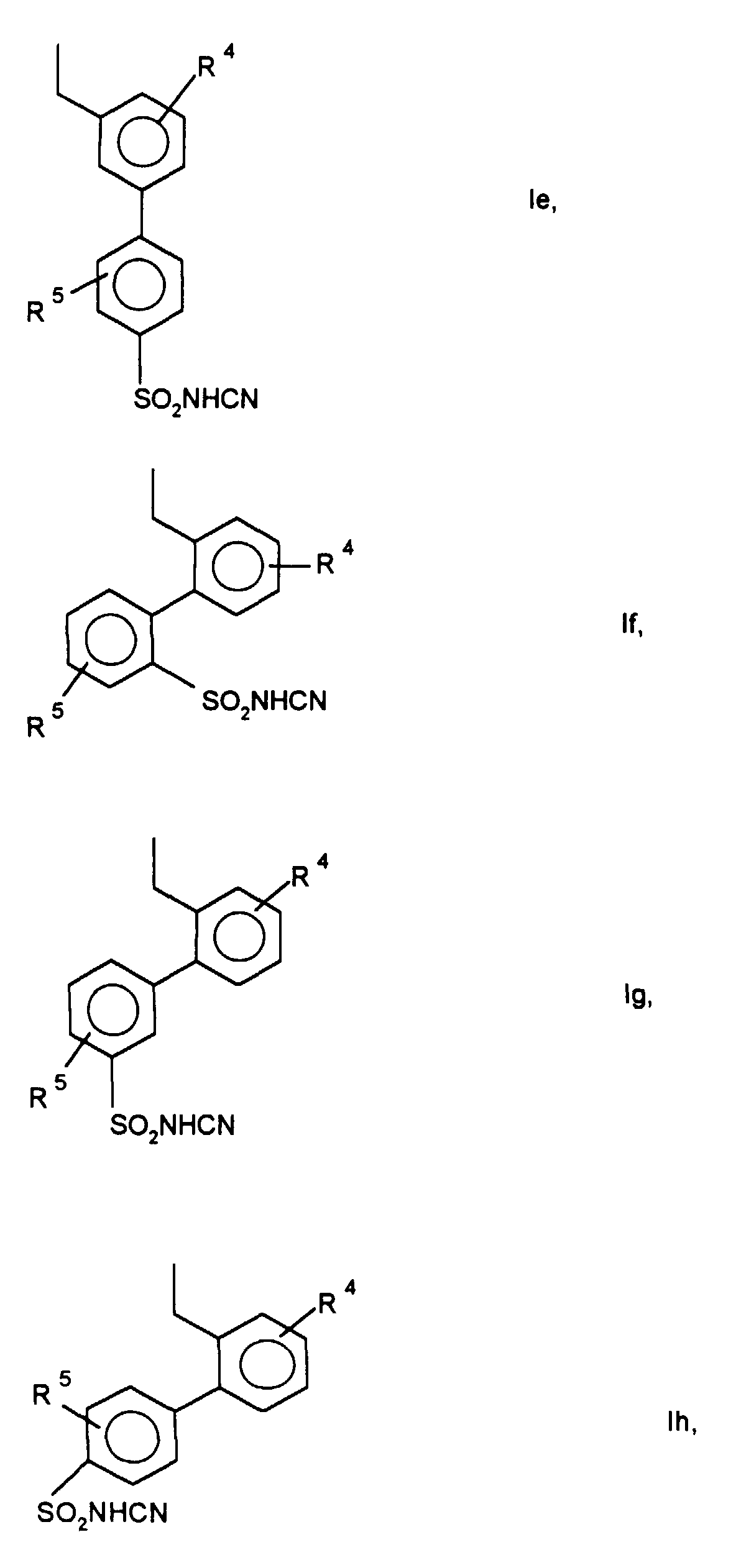


gleich oder verschieden, N oder CR(102)
1. (C1-C10)-Alkyl, 2. (C3-C10)-Alkenyl, 3. (C3-C10)-Alkinyl, 4. -OR(103), 5. (C3-C8)-Cycloalkyl, 6. (C4-C10)-Cycloalkylalkyl, 7. (C5-C10)-Cycloalkylalkenyl, 8. (C5-C10)-Cycloalkylalkinyl, 9. -(CH2)m-B-(CH2)n-R(104), 10. -Benzyl, 11. ein wie unter b) 1., 2., 3. oder 9. definierter Rest, der mit CO2R(103) monosubstituiert ist, 12. ein wie unter b) 1., 2., 3. oder 9. definierter Rest, worin 1 bis alle H-Atome durch Fluor substituiert sind, oder 13. den unter b) 10. definierten Rest, der am Phenyl mit 1 oder 2 gleichen oder verschiedenen Resten aus der Reihe Halogen, (C1-C4)-Alkoxy und Nitro substituiert ist,

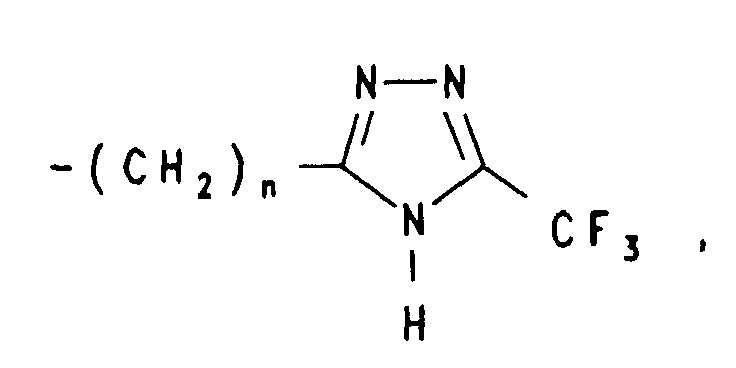

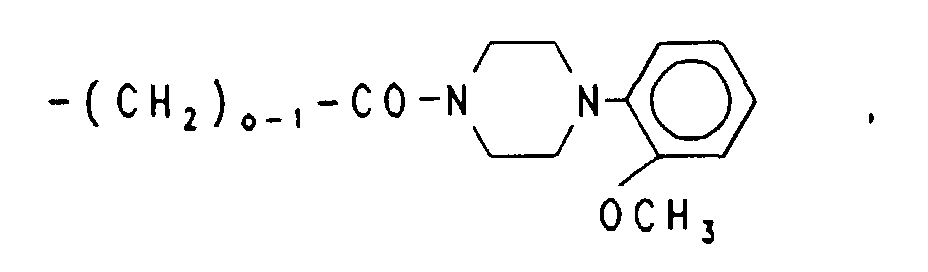

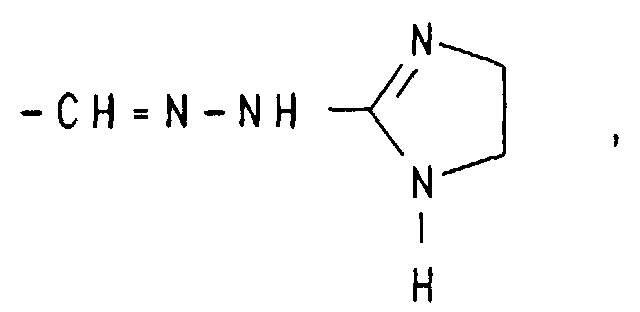
wobei der Cycloalkylteil unsubstituiert ist oder substituiert mit 1 - 3 Substituenten ausgewählt aus der Gruppe bestehend aus (C1-C4)-Alkyl und (C2-C4)-Alkenyl;
welches teilweise oder vollständig hydriert sein kann,

wobei der Heteroarylteil teilweise oder vollständig hydriert sein kann,
das noch mit 1 - 3 (C1-C4)-Alkylresten substituiert sein kann;
das auch teilweise oder vollständig hydriert sein kann;

Cyano, Nitro oder CO2R(107);
gleich oder verschieden, 1. Wasserstoff, 2. (C1-C4)-Alkyl, 3. Phenyl, 4. Benzyl, oder 5. α-Methylbenzyl;
Wasserstoff, (C1-C4)-Alkyl oder Phenyl;
das unsubstituiert ist oder substituiert mit 1 - 4, vorzugsweise 1 bis 2 gleichen oder verschiedenen Substituenten R(114) oder R(115);
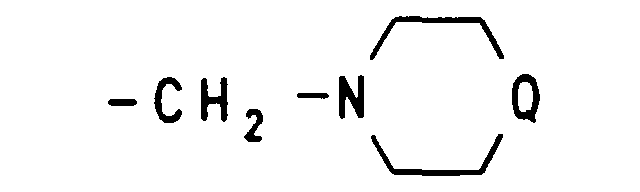
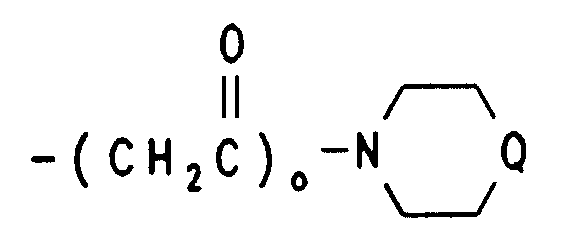


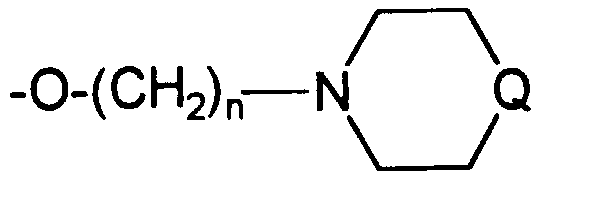
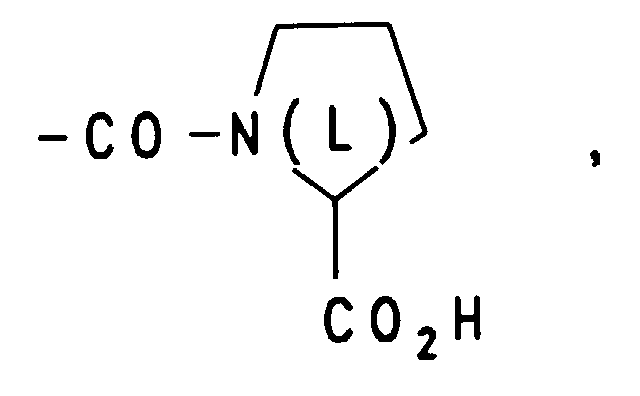
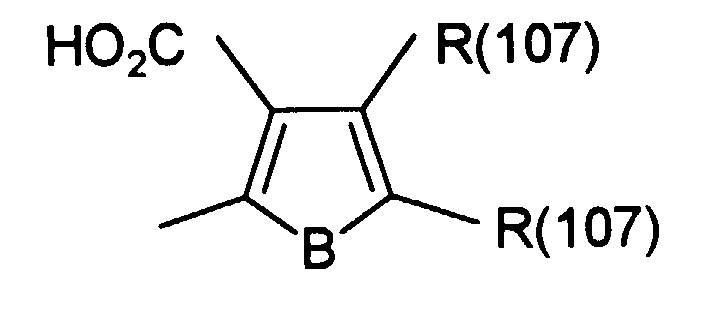
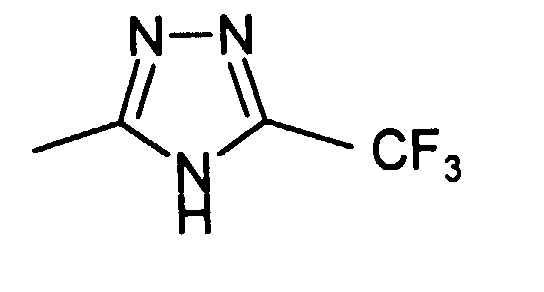


CO2R(103) oder CH2CO2R(103);
Wasserstoff, Halogen, (C1-C4)-Alkyl oder (C1-C4)-Alkoxy;
Wasserstoff, (C1-C4)-Alkyl oder Phenyl;
gleich oder verschieden, Wasserstoff, (C1-C5)-Alkyl, Phenyl, Allyl oder Benzyl;
Wasserstoff, (C1-C6)-Alkyl, Benzyl oder Allyl;
gleich oder verschieden, (C1-C4)-Alkyl oder gemeinsam -(CH2)q-;
sowie die Verwendung einer Verbindung der Formel I zur Herstellung eines Medikaments zur Behandlung oder Prophylaxe des Herzinfarkts;
sowie die Verwendung einer Verbindung der Formel I zur Herstellung eines Medikaments zur Behandlung oder Prophylaxe der Angina Pectoris;
sowie die Verwendung einer Verbindung der Formel I zur Herstellung eines Medikaments zur Behandlung oder Prophylaxe von ischämischen Zuständen des Herzens;
sowie die Verwendung einer Verbindung der Formel I zur Herstellung eines Medikaments zur Behandlung oder Prophylaxe von ischämischen Zuständen des peripheren und zentralen Nervensystems und des Schlaganfalls;
sowie die Verwendung einer Verbindung der Formel I zur Herstellung eines Medikaments zur Behandlung oder Prophylaxe von ischämischen Zuständen peripherer Organe und Gliedmaßen;
sowie die Verwendung einer Verbindung der Formel I zur Herstellung eines Medikaments zur Behandlung von Schockzuständen;
sowie die Verwendung einer Verbindung der Formel I zur Herstellung eines Medikaments zum Einsatz bei chirurgischen Operationen und Organtransplantationen;
sowie die Verwendung einer Verbindung der Formel I zur Herstellung eines Medikaments zur Konservierung und Lagerung von Transplantaten für chirurgische Maßnahmen;
sowie die Verwendung einer Verbindung der Formel I zur Herstellung eines Medikaments zur Behandlung von Krankheiten, bei denen die Zellproliferation eine primäre oder sekundäre Ursache darstellt; und somit ihre Verwendung zur Herstellung eines Antiatherosklerotikums, eines Mittels gegen diabetische Spätkomplikationen, Krebserkrankungen, fibrotische Erkrankungen wie Lungenfibrose, Leberfibrose oder Nierenfibrose, Prostatahyperplasie;
sowie die Verwendung einer Verbindung der Formel I zur Herstellung eines Medikaments zur Behandlung von gestörtem Atemantrieb;
sowie ein Arzneimittel, gekennzeichnet durch einen wirksamen Gehalt einer Verbindung der Formel I.
Wegen ihrer schützenden Wirkungen gegen pathologische hypoxische und ischämische Situationen können die erfindungsgemäßen Verbindungen der Formel I infolge Inhibition des zellulären Na+-abhängigen Cl-/HCO3 --Austauschmechanismus bzw. des Natrium/Bicarbonat-Symporters als Arzneimittel zur Behandlung aller akuten oder chronischen durch Ischämie ausgelösten Schäden oder dadurch primär oder sekundär induzierten Krankheiten verwendet werden. Sie schützen akut oder chronisch sauerstoffmangelversorgte Organe durch Verringerung oder Verhinderung ischämisch induzierter Schäden und eignen sich somit als Arzneimittel beispielsweise bei Thrombosen, Gefäßspasmen, Atherosklerose oder bei operativen Eingriffen (z.B. bei Organ-Transplantationen von Niere und Leber, wobei die Verbindungen sowohl für den Schutz der Organe im Spender vor und während der Entnahme, zum Schutz entnommener Organe beispielsweise bei Behandlung mit oder deren Lagerung in physiologischen Badflüssigkeiten, wie auch bei der Überführung in den Empfängerorganismus verwendet werden können) oder chronischem oder akutem Nierenversagen. Die Verbindungen der Formel I sind ebenfalls wertvolle, protektiv wirkende Arzneimittel bei der Durchführung angioplastischer operativer Eingriffe beispielsweise am Herzen wie auch an peripheren Gefäßen. Entsprechend ihrer protektiven Wirkung gegen ischämisch induzierte Schäden sind die Verbindungen auch als Arzneimittel zur Behandlung von Ischämien des Nervensystems, insbesondere des Zentralnervensystems, geeignet, wobei sie z. B. zur Behandlung des Schlaganfalls oder des Hirnödems geeignet sind. Darüber hinaus eignen sich die erfindungsgemäßen Verbindungen der Formel I ebenfalls zur Behandlung von Formen des Schocks, wie beispielsweise des allergischen, cardiogenen, hypovolämischen und des bakteriellen Schocks.
Im Durchschnitt beträgt die tägliche Dosis einer Verbindung der Formel I bei einem etwa 75 kg schweren Patienten mindestens 0,001 mg/kg, vorzugsweise 0,01 mg/kg, bis höchstens 10 mg/kg, vorzugsweise 1 mg/kg Körpergewicht. Bei akuten Ausbrüchen der Krankheit, etwa unmittelbar nach Erleiden eines Herzinfarkts, können auch noch höhere und vor allem häufigere Dosierungen notwendig sein, z. B. bis zu 4 Einzeldosen pro Tag. Insbesondere bei i.v. Anwendung, etwa bei einem Infarktpatienten auf der Intensivstation können bis zu 200 mg pro Tag notwendig werden.
Geeignete NHE-Inhibitoren sind beispielsweise auch Benzoylguanidine, wie sie in US 5292755, US 5373024, US 5364868, US 5591754, US 5516805, US 5559153, US 5571842, US 5641792, US 5631293, EP-A 577024, EP-A 602522, EP-A 602523, EP-A 603650, EP-A 604852, EP-A 612723, EP-A 627413, EP-A 628543, EP-A 640593, EP-A 640588, EP-A702001, EP-A 713864, EP-A 723956, EP-A 754680, EP-A 765868, EP-A 774459, EP-A 794171, DE 19624178.2, DE 19713427.0 beschrieben sind; ortho-substituierte Benzoylguanidine, wie sie in EP-A 556673, EP-A 791577, EP-A 794172, DE 19624178.2 beschrieben sind; ortho-amino-substituierte Benzoyl-guanidine, wie sie in EP-A 690048 beschrieben sind; Isochinoline, wie sie in EP-A 590455 beschrieben sind; Benzokondensierte 5-Ring-Heterocyclen, wie sie in EP-A 639573 beschrieben sind; Diacylsubstituierte Guanidine, wie sie in EP-A 640587 beschrieben sind; Acylguanidine, wie sie in US 5547953 beschrieben sind; Perfluoralkylgruppen tragende Phenylsubstituierte Alkyl- bzw. Alkenyl-carbonsäure- Guanidine, wie sie in US 5567734, EP-A 688766 beschrieben sind; Heteroaroyl-guanidine, wie sie in EP-A 676395 beschrieben sind; Bizyklische Heteroaroyl-guanidine, wie sie in EP-A 682017 beschrieben sind Indenoylguanidine, wie sie in EP-A 738712 beschrieben sind; Benzyloxycarbonyl-guanidine, wie sie in EP-A 748795 beschrieben sind; Fluorphenylgruppen tragende Phenylsubstituierte Alkenylcarbonsäure-Guanidine, wie sie in EP-A 744397 beschrieben sind; substituierte Zimtsäureguanidine, wie sie in EP-A 755919 beschrieben sind; Sulfonimidamide, wie sie in EP-A 771788 beschrieben sind; Benzoldicarbonsäure-diguanidine, wie sie in EP-A 774458, EP-A 774457 beschrieben sind; Diarylcarbonsäure-diguanidine, wie sie in EP-A 787717 beschrieben sind; substituierte Thiophenylalkenylcarbonsäureguanidine, wie sie in EP-A 790245 beschrieben sind; Bis-ortho-substituierte Benzoylguanidine, wie sie in DE 19621319.3 beschrieben sind; Substituierte 1-oder 2-Naphthylguanidine, wie sie in DE 19621482.3 und DE 19621483.1 beschrieben sind; Indanylidin-acetylguanidine, wie sie in EP 96112275.1 beschrieben sind; Phenylsubstituierte Alkenylcarbonsäure-guanidine, wie sie in DE 19633966.9 beschrieben sind; Aminopiperidyl-Benzoylguanidine, wie sie in EP 667341 beschrieben sind; Heterocycloxy-Benzylguanidine, wie sie in EP-A 694537 beschrieben sind; ortho-substituierte Benzoylguanidine, wie sie in EP704431 beschrieben sind; ortho-substituierte Alkyl-Benzylguanidine, wie sie in EP-A 699660 beschrieben sind; ortho-substituierte Heterocyclyl-Benzoylguanidine, wie sie in EP-A 699666 beschrieben sind; ortho-substituierte 5-Methylsulfonyl-benzoylguanidine, wie sie EP-A 708088 beschrieben sind; ortho-substituierte 5-Alkylsulfonyl-benzoylguanidine mit 4-amino Substituenten, wie sie in EP-A 723963 beschrieben sind; ortho-substituierte 5-Alkylsulfonyl-Benzoylguanidine mit 4-Mercapto Substituenten, wie sie in EP-A 743301 beschrieben sind; 4-Sulfonyl- oder 4-Sulphinyl-Benzylguanidine, wie sie in EP-A 758644 beschrieben sind; Alkenylbenzoylguanidine, wie sie in EP-A 760365 beschrieben sind; Benzoylguanidine mit annelierten, cyclischen Sulfonen, wie sie in DE 19548708 beschrieben sind; Benzoyl-, Polycyclische Aroyl- und Heteroaroyl-guanidine, wie sie in WO 9426709 beschrieben sind; 3-Aryl/Heteroaryl-Benzoylguanidine, wie sie in WO 9604241 beschrieben sind; 3-Phenyl-Benzoylguanidine mit einem basischen Amid in der 5-Position, wie sie in WO 9725310 beschrieben sind; 3-Dihalothienyl- oder 3-Dihalophenyl-Benzoylguanidine mit einem basichen Substituenten in der 5-Position, wie sie in WO 9727183 beschrieben sind; 3-Methylsulfonylbenzoylguanidinen mit bestimmten Aminosubstituenten in der 4-Position, wie sie in WO 9512584 beschrieben sind; Amilorid-Derivate, wie sie in WO 9512592 beschrieben sind; 3-Methylsulfonylbenzoylguanidine mit bestimmten Aminosubstituenten in der 4-Position, wie sie in WO 9726253 beschrieben sind; Indoloylguanidine, wie sie in EP-A 622356 und EP-A 708091 beschrieben sind; Indoloylguanidine mit einem annelierten zusätzlichen Ringsystem, wie sie in EP 787728 beschrieben sind; Methylguanidin-Derivate, wie sie in WO 9504052 beschrieben sind; 1,4-Benzoxazinoylguanidine, wie sie in EP-A 719766 beschrieben sind; 5-Brom-2-Naphthoylguanidine, wie sie in JP 8225513 beschrieben sind; Quinolin-4-Carbonylguanidine mit einem Phenylrest in 2-Position, wie sie in EP-A 726254 beschrieben sind; Cinnamoylguanidine, wie sie in JP 09059245 beschrieben sind; Propenoylguanidine mit einem Naphthalin-Substituenten, wie sie JP 9067332 beschrieben sind; Propenoylguanidine mit Indolsubstituenten, wie sie JP 9067340 beschrieben sind; oder Heteroarylsubstituierte Acryloylguanidine, wie sie in WO 9711055 beschrieben sind, sowie deren physiologisch verträglichen Salze.
Bevorzugt sind Handelspackungen, die Verbindungen der Formel I als NCBE-Inhibitoren enthalten.
- Bn
- Benzyl
- CH2Cl2
- Dichlormethan
- DCI
- Desorption-Chemical Ionisation
- DIP
- Diisopropylether
- DMA
- Dimethylacetamid
- DME
- Dimethoxyethan
- DMF
- N,N-Dimethylformamid
- EE
- Ethylacetat (EtOAc)
- EI
- electron impact
- eq
- Äquivalent
- ES
- Elektrospray-Ionisation
- Et
- Ethyl
- FAB
- Fast Atom Bombardment
- HEP
- n-Heptan
- HOAc
- Essigsäure
- Me
- Methyl
- MeOH
- Methanol
- mp
- Schmelzpunkt
- MTB
- Methyltertiärbutylether
- NCBE
- Natriumabhängiger Chlorid/Bicarbonat-Austauscher
- NHE
- Natrium/Wasserstoff-Austauscher
- NMP
- N-Methylpyrrolidon
- RT
- Raumtemperatur
- THF
- Tetrahydrofuran
- TMU
- N,N,N',N'-Tetramethylharnstoff
- Tol
- Toluol
- ZNS
- Zentralnervensystem


20.3 g 3-Brom-benzolsulfonamid wurden in 120 ml DMF gelöst und bei RT 57 ml Dimethylformamid-dimethylacetal zugetropft. 5 h wurde bei RT gerührt und 3 Tage bei RT stehen gelassen. Das Reaktionsgemisch wurde dann auf 1,2 l Wasser gegossen, 90 Minuten nachgerührt und der weiße Niederschlag abfiltriert. Das Produkt wurde im Vakuum bei 50°C getrocknet, und man erhielt 20.5 g weißer Kristalle,
2.9 g 3-Brom-N-dimethylaminomethylen-benzolsulfonamid, 1.5 g p-Tolylboronsäure, 112 mg Pd(II)acetat und 224 mg Triphenylphosphin wurden in 60 ml Toluol sowie 17 ml Ethanol gelöst, 10 ml einer 2 N wäßrigen Na2CO3-Lösung zugegeben und 7 h unter Rückfluß gekocht. Das Reaktionsgemisch wurde in 150 ml einer gesättigten wäßrigen Na2CO3-Lösung und 150 ml Wasser aufgenommen und 3 mal mit je 200 ml EE extrahiert. Über Na2SO4 wurde getrocknet und das Solvens im Vakuum entfernt. Chromatographie an Kieselgel mit MTB lieferte 1.8 g eines farblosen Schaums.
1.7 g 4'-Methyl-biphenyl-3-sulfonsäure-dimethylaminomethylenamid wurden in 30 ml Chlorbenzol gelöst und bei 130 oC 1.0 g N-Bromsuccinimid sowie 10 mg Benzoylperoxid zugegeben und 30 Minuten unter Rückfluß gekocht. Das Reaktionsgemisch wurde mit 150 ml EE aufgenommen und 2 mal mit je 150 ml eines 8:1-Gemisches aus gesättigter wäßriger Na2CO3- und gesättigter wäßriger Na2SO3-Lösung gewaschen. Die wäßrige Phase wurde anschließend noch 2 mal mit je 150 ml EE extrahiert. Die vereinigte organische Phase wurde über Na2SO4 getrocknet und das Solvens im Vakuum entfernt. Chromatographie an Kieselgel mit MTB lieferte 1.6 g eines blaßgelben Öls.
1.6 g 4'-Brommethyl-biphenyl-3-sulfonsäure-dimethylaminomethylenamid, 990 mg 2-Butyl-5-methylsulfanyl-3H-imidazol-4-carbonsäure-ethylester (J. Med. Chem. 1995, 38, 2357) und 570 mg K2CO3 wurden in 12 ml DMF bei RT 4 h gerührt und über Nacht stehen gelassen. Anschließend wurde weitere 6 h bei RT gerührt, dann das Reaktionsgemisch in 125 ml einer gesättigten wäßrigen NaHCO3-Lösung sowie 125 ml Wasser gegossen und 3 mal mit je 200 ml EE extrahiert. Über Na2SO4 wurde getrocknet und das Solvens im Vakuum entfernt. Chromatographie an Kieselgel mit EE/HEP 2:1 lieferte 1.1 g eines farblosen Öls.
1.1 g 2-Butyl-3-[3'-(dimethylaminomethylene-sulfamoyl)-biphenyl-4-ylmethyl]-5-(methylsulfanyl)-3H-imidazol-4-carbonsäure-ethylester wurden in 20 ml Methanol gelöst und 10 ml einer gesättigten wäßrigen HCl-Lösung zugegeben. 4 h wurde unter Rückfluß erhitzt, dann mit einer wäßrigen 6 N NaOH-Lösung auf pH = 5-6 gestellt, mit 50 ml Wasser verdünnt und 3 mal mit je 150 ml EE extrahiert. Über Na2SO4 wurde getrocknet und das Solvens im Vakuum entfernt. Chromatographie an Kieselgel mit EE/HEP 1:1 lieferte 950 mg eines farblosen Schaums.
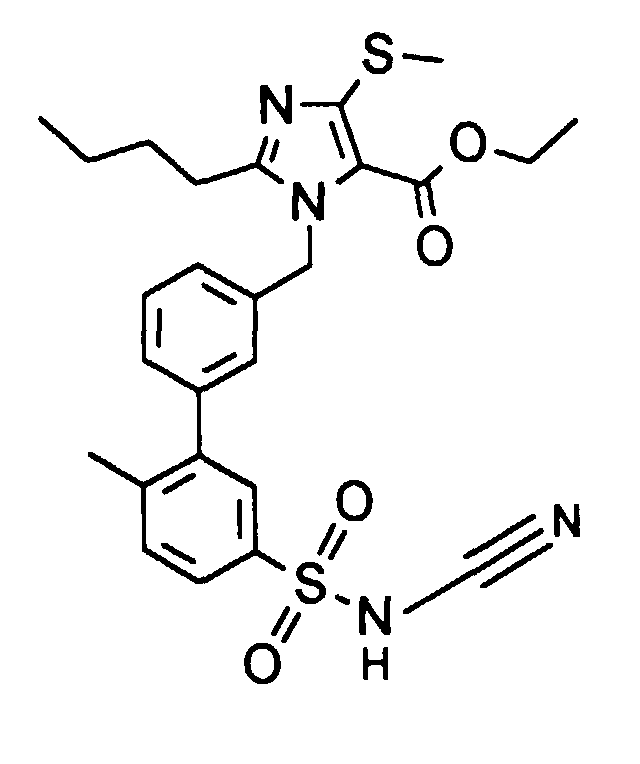
720 mg 2-Butyl-5-methylsulfanyl-3-(3'-sulfamoyl-biphenyl-4-ylmethyl)-3H-imidazol-4-carbonsäure-ethylester wurden nach der allgemeinen Vorschrift zur Herstellung von Sulfonylcyanamiden aus Sulfonamiden umgesetzt, und man erhielt 550 mg eines amorphen Feststoffs.

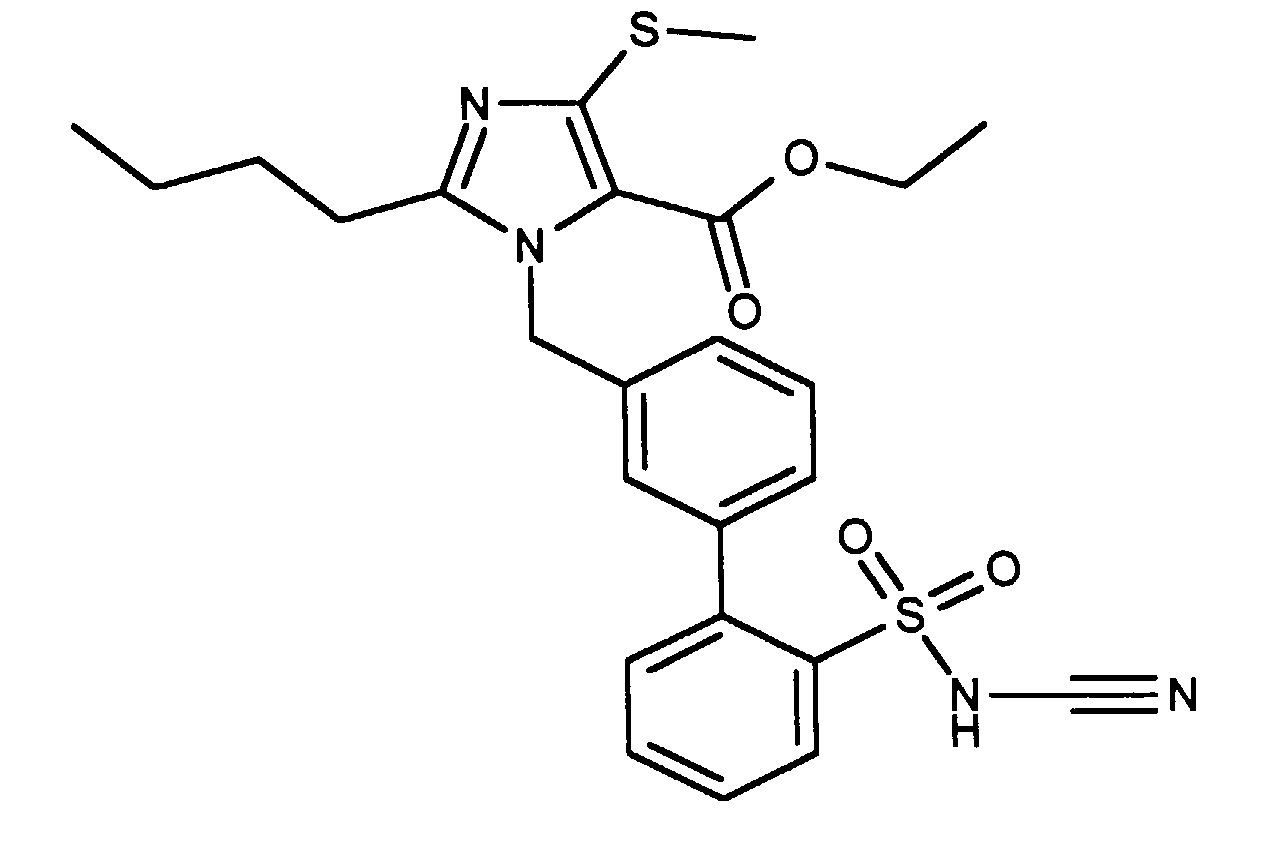


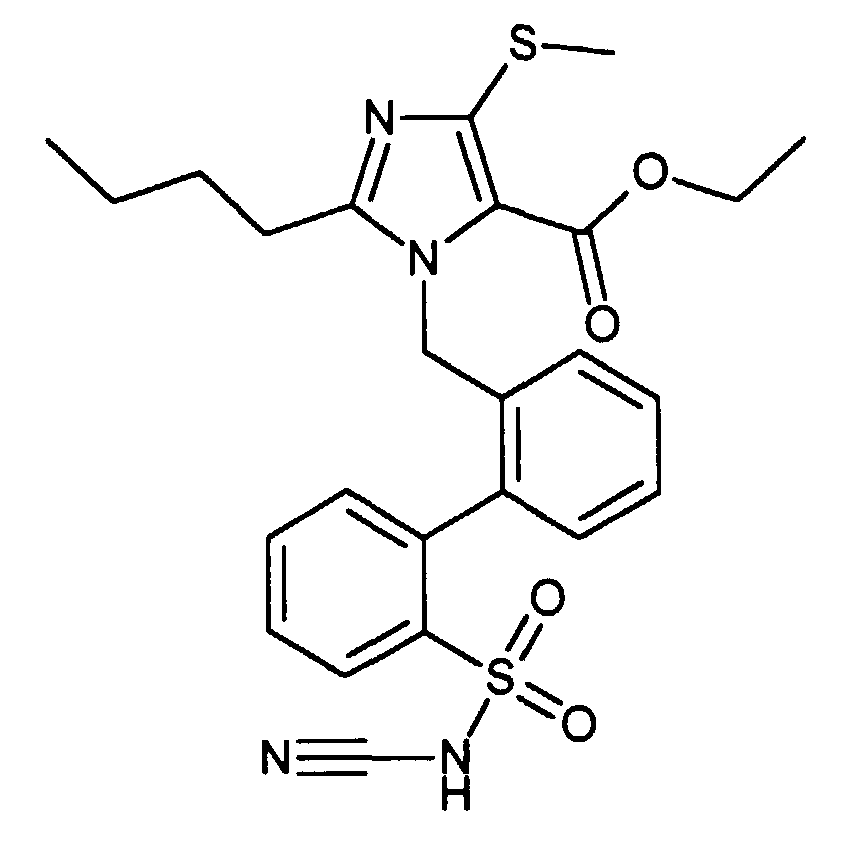
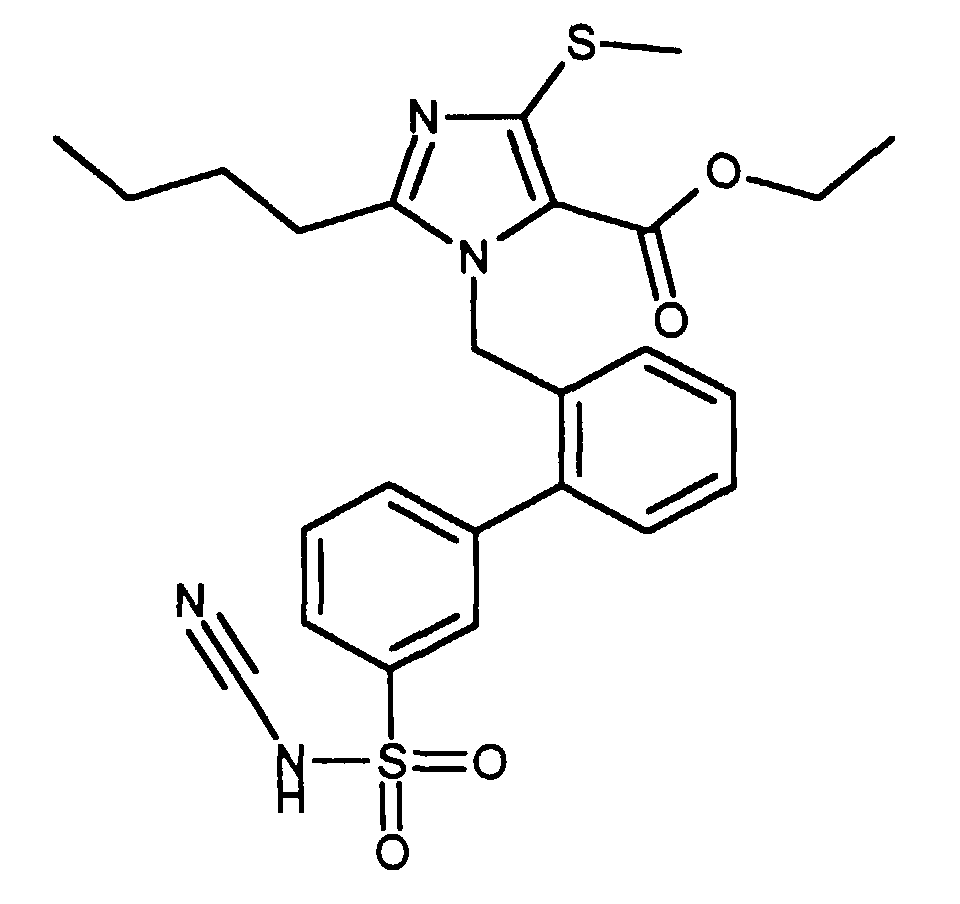
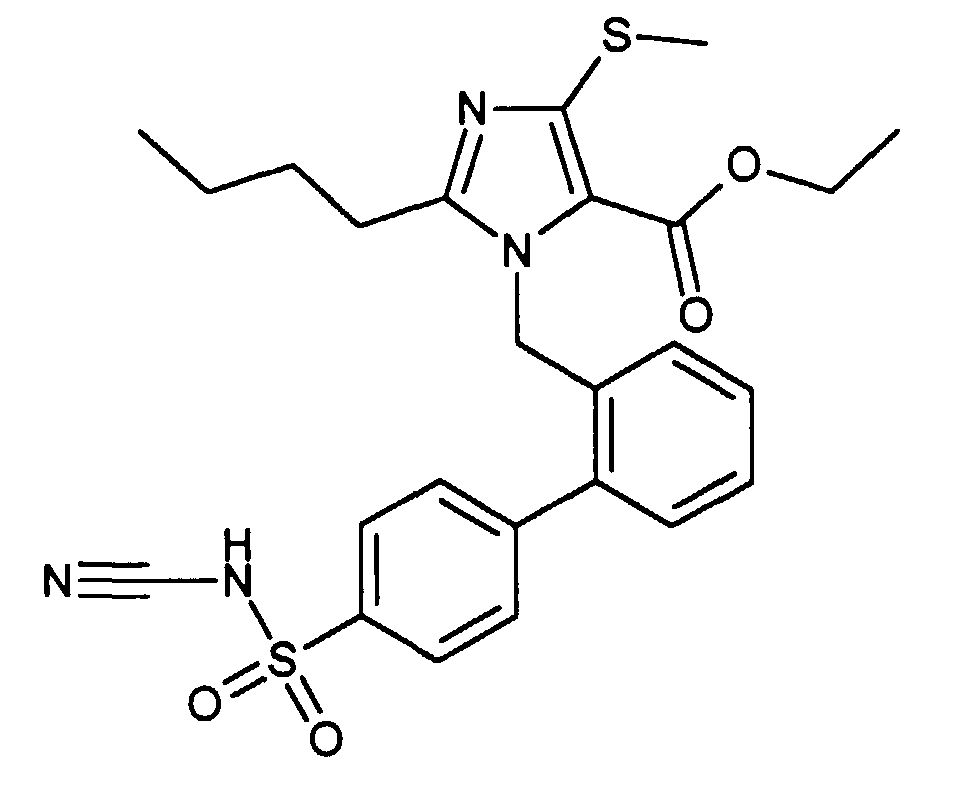

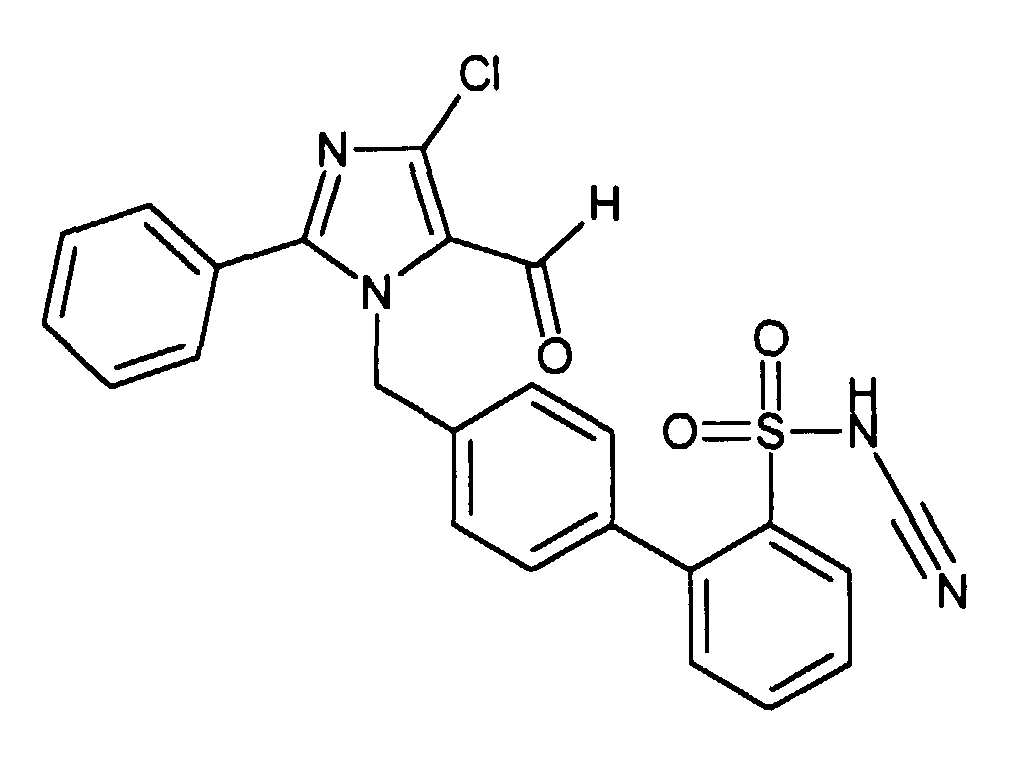
2.1 g 4-Chloro-5-formyl-2-phenyl-imidazol (Chem. Pharm. Bull. 1976, 24(5), 960), 3.8 g 4'-Brommethyl-biphenyl-2-sulfonsäure-dimethylaminomethylenamid (J. Med. Chem. 1995, 38, 2357) und 2.8 g K2CO3 wurden in 50 ml DMF 30 h bei RT gerührt. Das Reaktionsgemisch wurde zu 500 ml Wasser gegossen und 2 mal mit je 250 ml EE extrahiert. Die organische Phase wurde anschließend mit 100 ml Wasser gewaschen, über MgSO4 getrocknet und das Solvens im Vakuum entfernt. Chromatographie an Kieselgel mit MTB lieferte 1.9 g eines weißen, kristallinen Pulvers, mp 193°C.









Anschließend wurden die Zellen gewaschen und in einer Natrium- und Bicarbonatfreien Pufferlösung (mmol/l: 5 HEPES, 133,8 Cholinchlorid, 4,7 KCl, 1,25 MgCl2, 0,97 K2HPO4, 0,23 KH2PO4, 5 Glucose; pH 7,4) resuspendiert.
Für die nachfolgende Fluoreszenzmessung im FLIPR (Fluorescent Imaging Plate Reader) wurden pro well einer 96-well-Mikrotiterplatte 100 µl dieser Zellsuspension mit jeweils 20000 Zellen einpipettiert und diese Mikrotiterplatte zentrifugiert (100g, 5 min).
Im FLIPR wurden nun aus einer weiteren vorbereiteten Mikrotiterplatte jeweils 100 µl Pufferlösung entnommen und in jedes der 96 wells der Meßplatte einpipettiert. Dabei wurde für eine 100% Kontrolle, d.h. eine Erholung des intrazellulären pH (PHi) über den NCBE, eine Bicarbonat-und Natrium-haltige Pufferlösung (mmol/l: 5 HEPES, 93,8 NaCl, 40 NaHCO3, 4,7 KCl, 1,25 CaCl2, 1,25 MgCl2, 0,97 Na2HPO4, 0,23 NaH2PO4, 5 Glucose; pH 7,4) verwendet, die 50 µM HOE 642 enthielt. Für eine 0% Kontrolle, d.h. keinerlei pHi-Erholung, wurde eine Bicarbonat-freie, Natrium-haltige Pufferlösung (mmol/l: 5 HEPES, 133,8 NaCl, 4,7 KCl, 1,25 CaCl2, 1,25 MgCl2, 0,97 Na2HPO4, 0,23 NaH2PO4, 5 Glucose; pH 7,4) eingesetzt, welcher ebenfalls 50 µM HOE 642 zugefügt waren. Die erfindungsgemäßen Verbindungen wurden in verschiedenen Konzentrationen der Natrium-und Bicarbonat-haltigen Lösung zugesetzt.
Nach Zugabe der Pufferlösungen zu den in der Meßplatte befindlichen farbstoffbeladenen, angesäuerten Zellen wurde der Anstieg der Fluoreszenzintensität, welcher einem Anstieg des pHi entsprach, in jedem well der Mikrotiterplatte bestimmt. Die Kinetiken wurden dabei über einen Zeitraum von 2 Minuten bei 35°C aufgenommen.
Die Zunahme der Fluoreszenzintensitäten für unterschiedliche Konzentrationen der erfindungsgemäßen Verbindungen wurde auf die beiden Kontrollen bezogen und daraus die Hemmwirkung der Substanzen ermittelt.
| Restaktivität des NCBE bei einer Inhibitorkonzentration von 10 µM | |
| Beispiel | Restaktivität in % |
| 1 | 17.7 |
| 2 | 39.6 |
| 3 | 74.1 |
| 4 | 39.7 |
| 5 | 43.2 |
| 6 | 58.6 |
| 7 | 72.1 |
| 8 | 60.8 |
| 9 | 31.6 |
| 10 | 21.6 |
| 11 | 15.0 |
| 12 | 20.8 |
| 13 | 89.5 |
| 14 | 47.3 |
| 15 | 55.7 |
| 16 | 11.5 |
| 17 | 39.1 |
| 18 | 45.8 |
| 19 | 21.5 |
| 20 | 19.5 |
| 21 | 42.6 |
| 22 | 34.2 |
| 23 | 31.6 |
| 24 | 29.2 |
| 25 | 70.8 |
| 26 | 65.3 |
| 27 | 50.0 |
| 28 | 30.5 |
| 29 | 39.6 |
| 30 | 48.8 |
| 31 | 36.5 |
| 32 | 7.8 |
| 33 | 7.6 |
| 34 | 5.5 |
| 35 | 3.2 |
| 36 | 7.8 |
| 37 | 16.8 |
| 38 | 8.6 |
Claims (20)
- Verbindungen der Formel I,in welcher die Symbole folgende Bedeutung haben:
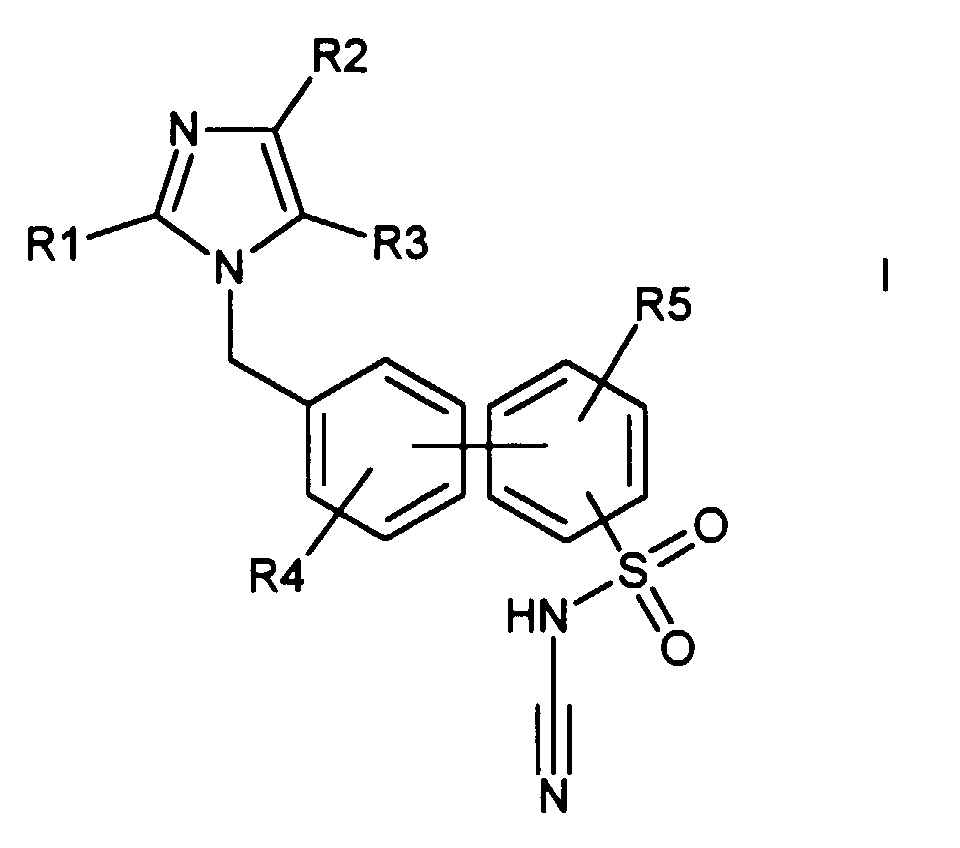
- R1
- Wasserstoff, Alkyl mit 1, 2, 3, 4, 5, 6, 7 oder 8 C-Atomen oder -CaH2a-Phenyl,
das unsubstituiert oder substituiert ist mit 1 - 3 Substituenten ausgewählt aus der Gruppe bestehend aus F, Cl, Br, I, CF3, Methyl, Methoxy, Hydroxy und NR(8)R(9); - R(8) und R(9)
-
unabhängig voneinander H oder (C1-C4)-Alkyl; - a
- Null, 1 oder 2;
oder - R1
- -CbH2b-(C1-C9)-Heteroaryl,
das unsubstituiert oder substituiert ist mit 1 - 3 Substituenten ausgewählt aus der Gruppe bestehend aus F, Cl, Br, I, CF3, CH3, Methoxy, Hydroxy und NR(10)R(11); - R(10) und R(11)
-
unabhängig voneinander H oder (C1-C4)-Alkyl; - b
- Null, 1 oder 2;
oder - R1
- -CdH2d-(C3-C7)-Cycloalkyl;
- d
- Null, 1 oder 2;
- R2 und R3
-
unabhängig voneinander Wasserstoff, F, Cl, Br, I, CF3, -C≡N, -NO2, CH2OR17, CO-R6 oder O-R7; - R17
- Wasserstoff oder Alkyl mit 1, 2, 3, 4, 5, 6, 7 oder 8 C-Atomen
- R6
- Wasserstoff, Alkyl mit 1, 2, 3, 4, 5, 6, 7 oder 8 C-Atomen, OR30 oder
Phenyl,
das unsubstituiert oder substituiert ist mit 1 - 3 Substituenten ausgewählt aus der Gruppe bestehend aus bestehend aus F, Cl, Br, I, CF3, Methyl, Methoxy, Hydroxy und NR(31)R(32); - R(31) und R(32)
-
unabhängig voneinander H oder (C1-C4)-Alkyl; - R30
- Wasserstoff oder Alkyl mit 1, 2, 3, 4, 5, 6, 7 oder 8 C-Atomen;
- R7
- Wasserstoff, Alkyl mit 1, 2, 3, 4, 5, 6, 7 oder 8 C-Atomen, Phenyl,
das unsubstituiert oder substituiert ist mit 1 - 3 Substituenten ausgewählt aus der Gruppe bestehend aus F, Cl, Br, I, CF3, Methyl, Methoxy, Hydroxy und NR(12)R(13); - R(12) und R(13)
-
unabhängig voneinander H oder (C1-C4)-Alkyl;
oder - R7
- (C1-C9)-Heteroaryl,
das unsubstituiert oder substituiert ist mit 1 - 3 Substituenten ausgewählt aus der Gruppe bestehend aus F, Cl, Br, I, CF3, CH3, Methoxy, Hydroxy und NR(14)R(15); - R(14) und R(15)
-
unabhängig voneinander H oder (C1-C4)-Alkyl;
oder - R2 und R3
-
unabhängig voneinander Alkyl mit 1, 2, 3, 4, 5, 6, 7 oder 8 C-Atomen, Cycloalkyl mit 3, 4, 5, 6 oder 7 C-Atomen oder -CgH2g-Phenyl,
das unsubstituiert oder substituiert ist mit 1 - 3 Substituenten ausgewählt aus der Gruppe bestehend aus F, Cl, Br, I, CF3, Methyl, Methoxy, Hydroxy und NR(18)R(19); - R(18) und R(19)
-
unabhängig voneinander H oder (C1-C4)-Alkyl; - g
- Null, 1 oder 2;
oder - R2 und R3
-
unabhängig voneinander -ClH2l-(C1-C9)-Heteroaryl,
das unsubstituiert oder substituiert ist mit 1 - 3 Substituenten ausgewählt aus der Gruppe bestehend aus F, Cl, Br, I, CF3, CH3, Methoxy, Hydroxy und NR(20)R(21); - R(20) und R(21)
-
unabhängig voneinander H oder (C1-C4)-Alkyl; - l
- Null, 1 oder 2;
oder - R2 und R3
-
unabhängig voneinander SOn-R22; - n
- Null, 1 oder 2;
- R22
- Alkyl mit 1, 2, 3, 4, 5, 6, 7 oder 8 C-Atomen, Cycloalkyl mit 3, 4, 5, 6
oder 7 C-Atomen oder -CsH2s-Phenyl,
das unsubstituiert oder substituiert ist mit 1 - 3 Substituenten ausgewählt aus der Gruppe bestehend Gruppe F, Cl, Br, I, CF3, Methyl, Methoxy, Hydroxy und NR(34)R(35); - R(34) und R(35)
-
unabhängig voneinander H oder (C1-C4)-Alkyl; - s
- Null, 1 oder 2;
- R4 und R5
-
unabhängig voneinander Wasserstoff, Alkyl mit 1, 2, 3, 4, 5, 6, 7 oder 8 C-Atomen, F, Cl, Br, I, CF3, -C≡N, -NO2, SOp-R16, CO-R23 oder O-R24; - p
- Null, 1 oder 2;
- R16
- Alkyl mit 1, 2, 3, 4, 5, 6, 7 oder 8 C-Atomen oder Phenyl, das unsubstituiert oder substituiert ist mit 1 - 3 Substituenten ausgewählt aus der Gruppe bestehend aus F, Cl, Br, I, CF3, Methyl, Methoxy, Hydroxy und NR(26)R(27);
- R(26) und R(27)
-
unabhängig voneinander H oder (C1-C4)-Alkyl; - R23
- Wasserstoff, Alkyl mit 1, 2, 3, 4, 5, 6, 7 oder 8 C-Atomen oder OR25;
- R25
- Wasserstoff, Alkyl mit 1, 2, 3, 4, 5, 6, 7 oder 8 C-Atomen;
- R24
- Wasserstoff, Alkyl mit 1, 2, 3, 4, 5, 6, 7 oder 8 C-Atomen oder Phenyl, das unsubstituiert oder substituiert ist mit 1 - 3 Substituenten ausgewählt aus der Gruppe bestehend aus F, Cl, Br, I, CF3, Methyl, Methoxy, Hydroxy und NR(28)R(29);
- R(28) und R(29)
-
unabhängig voneinander H oder (C1-C4)-Alkyl;
- Verbindung der Formel I nach Anspruch 1, in der bedeuten:
- R1
- Wasserstoff, Alkyl mit 1, 2, 3 oder 4 C-Atomen oder -CaH2a-Phenyl,
das unsubstituiert oder substituiert ist mit 1 - 2 Substituenten ausgewählt aus der Gruppe bestehend aus F, Cl, Br, CF3, Methyl, Methoxy, Hydroxy und NR(8)R(9); - R(8) und R(9)
-
unabhängig voneinander H oder Methyl; - a
- Null oder 1;
oder - R1
- (C1-C9)-Heteroaryl,
das unsubstituiert oder substituiert ist mit einem Substituenten ausgewählt aus der Gruppe bestehend aus F, Cl, Br, CF3, CH3, Methoxy, Hydroxy und NR(10)R(11); - R(10) und R(11)
-
unabhängig voneinander H oder Methyl;
oder - R1
- -CdH2d-(C3-C7)-Cycloalkyl;
- d
- Null oder 1;
- R2 und R3
-
unabhängig voneinander Wasserstoff, F, Cl, Br, CF3, -C≡N, -NO2, CH2OR17, CO-R6 oder O-R7; - R17
- Wasserstoff oder Alkyl mit 1, 2, 3 oder 4 C-Atomen;
- R6
- Wasserstoff, Alkyl mit 1, 2, 3 oder 4 C-Atomen, OR30 oder Phenyl,
das unsubstituiert oder substituiert ist mit 1 - 2 Substituenten ausgewählt aus der Gruppe bestehend aus F, Cl, Br, CF3, Methyl, Methoxy, Hydroxy und NR(31)R(32); - R(31) und R(32)
-
unabhängig voneinander H oder Methyl; - R30
- Wasserstoff oder Alkyl mit 1, 2, 3 oder 4 C-Atomen
- R7
- Wasserstoff, Alkyl mit 1, 2, 3 oder 4 C-Atomen oder Phenyl, das unsubstituiert oder substituiert ist mit 1 - 2 Substituenten ausgewählt aus der Gruppe bestehend aus F, Cl, Br, CF3, Methyl, Methoxy, Hydroxy und NR(12)R(13);
- R(12) und R(13)
-
unabhängig voneinander H oder Methyl;
oder - R7
- (C1-C9)-Heteroaryl,
das unsubstituiert oder substituiert ist mit einem Substituenten ausgewählt aus der Gruppe bestehend aus F, Cl, Br, CF3, CH3, Methoxy, Hydroxy und NR(14)R(15); - R(14) und R(15)
-
unabhängig voneinander H oder Methyl;
oder - R2 und R3
-
unabhängig voneinander Alkyl mit 1, 2, 3 oder 4 C-Atomen, Cycloalkyl mit 3, 4, 5, 6 oder 7 C-Atomen oder -CgH2g-Phenyl,
das unsubstituiert oder substituiert ist mit 1 - 2 Substituenten ausgewählt aus der Gruppe bestehend aus F, Cl, Br, CF3, Methyl, Methoxy, Hydroxy und NR(18)R(19); - R(18) und R(19)
-
unabhängig voneinander H oder Methyl; - g
- Null oder 1;
oder - R2 und R3
-
unabhängig voneinander (C1-C9)-Heteroaryl,
das unsubstituiert oder substituiert ist mit einem Substituenten ausgewählt aus der Gruppe bestehend aus F, Cl, Br, CF3, CH3, Methoxy, Hydroxy und NR(20)R(21); - R(20) und R(21)
-
unabhängig voneinander H oder Methyl;
oder - R2 und R3
-
unabhängig voneinander SOn-R22, - n
- Null, 1 oder 2;
- R22
- Alkyl mit 1, 2, 3 oder 4 C-Atomen, Cycloalkyl mit 3, 4, 5, 6 oder 7 C-Atomen
oder -CsH2s-Phenyl,
das unsubstituiert oder substituiert ist mit 1 - 2 Substituenten ausgewählt aus der Gruppe bestehend aus F, Cl, Br, CF3, Methyl, Methoxy, Hydroxy und NR(34)R(35); - R(34) und R(35)
-
ausgewählt aus der Gruppe bestehend aus H oder Methyl; - s
- Null oder 1;
- R4 und R5
-
unabhängig voneinander Wasserstoff, Alkyl mit 1, 2, 3 oder 4 C-Atomen, F, Cl, Br, CF3, -C≡N, -NO2, SOp-R16, CO-R23 oder O-R24; - p
- Null, 1 oder 2;
- R16
- Alkyl mit 1, 2, 3 oder 4 C-Atomen oder Phenyl,
das unsubstituiert oder substituiert ist mit 1 - 2 Substituenten ausgewählt aus der Gruppe bestehend aus F, Cl, Br, CF3, Methyl, Methoxy, Hydroxy und NR(26)R(27); - R(26) und R(27)
-
unabhängig voneinander H oder Methyl; - R23
- Wasserstoff, Alkyl mit 1, 2, 3 oder 4 C-Atomen oder OR25;
- R25
- Wasserstoff oder Alkyl mit 1, 2, 3 oder 4 C-Atomen;
- R24
- Wasserstoff, Alkyl mit 1, 2, 3 oder 4 C-Atomen oder Phenyl,
das unsubstituiert oder substituiert ist mit 1 - 2 Substituenten ausgewählt aus der Gruppe bestehend aus F, Cl, Br, CF3, Methyl, Methoxy, Hydroxy und NR(28)R(29); - R(28) und R(29)
-
unabhängig voneinander H oder Methyl;
- Verbindung der Formel I nach Anspruch 1, in der bedeuten:
- R1
- Wasserstoff, Alkyl mit 1, 2, 3 oder 4 C-Atomen oder Phenyl, das unsubstituiert oder substituiert ist mit einem Substituenten ausgewählt aus der Gruppe bestehend aus F, Cl, Br, CF3, Methyl, Methoxy, Hydroxy und NR(8)R(9);
- R(8) und R(9)
-
unabhängig voneinander H oder Methyl;
oder - R1
- (C1-C9)-Heteroaryl,
das unsubstituiert oder substituiert ist mit einem Substituenten ausgewählt aus der Gruppe bestehend aus F, Cl, Br, CF3, CH3, Methoxy, Hydroxy und NR(10)R(11); - R(10) und R(11)
-
unabhängig voneinander H oder Methyl;
oder - R1
- (C3-C7)-Cycloalkyl;
- R2 und R3
-
unabhängig voneinander Wasserstoff, F, Cl, Br, CF3, -C≡N, -NO2, CO-R6 oder O-R7; - R6
- Wasserstoff, Alkyl mit 1, 2, 3 oder 4 C-Atomen, OR30 oder Phenyl, das unsubstituiert oder substituiert ist mit einem Substituenten ausgewählt aus der Gruppe bestehend aus F, Cl, Br, CF3, Methyl, Methoxy, Hydroxy und NR(31)R(32);
- R(31) und R(32)
-
unabhängig voneinander H oder Methyl; - R30
- Wasserstoff oder Alkyl mit 1, 2 oder 3 C-Atomen
- R7
- Wasserstoff, Alkyl mit 1, 2, 3 oder 4 C-Atomen oder Phenyl,
das unsubstituiert oder substituiert ist mit einem Substituenten ausgewählt aus der Gruppe bestehend aus F, Cl, Br, CF3, Methyl, Methoxy, Hydroxy und NR(12)R(13); - R(12) und R(13)
-
unabhängig voneinander H oder Methyl;
oder - R7
- (C1-C9)-Heteroaryl,
das unsubstituiert oder substituiert ist mit einem Substituenten ausgewählt aus der Gruppe bestehend aus F, Cl, Br, CF3, CH3, Methoxy, Hydroxy und NR(14)R(15); R(14) und R(15)
unabhängig voneinander H oder Methyl;
oder - R2 und R3
-
unabhängig voneinander Alkyl mit 1, 2, 3 oder 4 C-Atomen, Cycloalkyl mit 3, 4, 5, 6 oder 7 C-Atomen oder Phenyl,
das unsubstituiert oder substituiert ist mit einem Substituenten ausgewählt aus der Gruppe bestehend aus F, Cl, Br, CF3, Methyl, Methoxy, Hydroxy und NR(18)R(19); - R(18) und R(19)
-
unabhängig voneinander H oder Methyl;
oder - R2 und R3
-
unabhängig voneinander (C1-C9)-Heteroaryl,
das unsubstituiert oder substituiert ist mit einem Substituenten ausgewählt aus der Gruppe bestehend aus F, Cl, Br, CF3, CH3, Methoxy, Hydroxy und NR(20)R(21); - R(20) und R(21)
-
unabhängig voneinander H oder Methyl;
oder - R2 und R3
-
unabhängig voneinander SOn-R22; - n
- Null oder 2;
- R22
- Alkyl mit 1, 2, 3 oder 4 C-Atomen, Cycloalkyl mit 3, 4, 5, 6 oder 7 C-Atomen
oder Phenyl,
das unsubstituiert oder substituiert ist mit 1 - 2 Substituenten ausgewählt aus der Gruppe bestehend aus F, Cl, Br, CF3, Methyl, Methoxy, Hydroxy und NR(34)R(35); - R(34) und R(35)
-
unabhängig voneinander H oder Methyl;
R4 und R5 unabhängig voneinander
Wasserstoff, Alkyl mit 1, 2, 3 oder 4 C-Atomen, F, Cl, CF3, -C≡N, -NO2, SOp-R16, CO-R23 oder O-R24; - p
- Null oder 2;
- R23
- Wasserstoff, Alkyl mit 1, 2, 3 oder 4 C-Atomen oder OR25;
- R25
- Wasserstoff oder Alkyl mit 1, 2 oder 3 C-Atomen;
- R24
- Wasserstoff, Alkyl mit 1, 2, 3 oder 4 C-Atomen oder Phenyl,
das unsubstituiert oder substituiert ist mit einem Substituenten ausgewählt aus der Gruppe bestehend aus F, Cl, Br, CF3, Methyl, Methoxy, Hydroxy und NR(28)R(29); - R(28) und R(29)
-
unabhängig voneinander H oder Methyl; - R16
- Alkyl mit 1, 2, 3 oder 4 C-Atomen oder Phenyl,
das unsubstituiert oder substituiert ist mit einem Substituenten ausgewählt aus der Gruppe bestehend aus F, Cl, Br, CF3, Methyl, Methoxy, Hydroxy und NR(26)R(27); - R(26) und R(27)
-
unabhängig voneinander H oder Methyl;
- Verbindung der Formel I nach Anspruch 1, in der bedeuten:
- R1
- Alkyl mit 1, 2, 3 oder 4 C-Atomen oder Phenyl,
das unsubstituiert oder substituiert ist mit einem Substituenten ausgewählt aus der Gruppe bestehend aus F, Cl, CF3, Methyl und Methoxy;
oder - R1
- (C1-C9)-Heteroaryl,
das unsubstituiert oder substituiert ist mit einem Substituenten ausgewählt aus der Gruppe bestehend aus F, Cl, CF3, CH3 und Methoxy;
oder - R1
- (C3-C7)-Cycloalkyl;
- R2 und R3
-
unabhängig voneinander Wasserstoff, F, Cl, CF3, -C≡N, CO-R6 oder O-R7; - R6
- Wasserstoff, Alkyl mit 1, 2, 3 oder 4 C-Atomen, OR30 oder Phenyl,
das unsubstituiert oder substituiert ist mit einem Substituenten ausgewählt aus der Gruppe bestehend aus F, Cl, CF3, Methyl und Methoxy; - R30
- Wasserstoff, Methyl oder Ethyl;
- R7
- Wasserstoff, Alkyl mit 1, 2, 3 oder 4 C-Atomen oder Phenyl,
das unsubstituiert oder substituiert ist mit einem Substituenten
ausgewählt aus der Gruppe bestehend aus F, Cl, CF3, Methyl
und Methoxy;
oder - R7
- (C1-C9)-Heteroaryl,
das unsubstituiert oder substituiert ist mit einem Substituenten ausgewählt aus der Gruppe bestehend aus F, Cl, Br, CF3, CH3 und Methoxy;
oder - R2 und R3
-
unabhängig voneinander Alkyl mit 1, 2, 3 oder 4 C-Atomen, Cycloalkyl mit 3, 4, 5, 6 oder 7 C-Atomen oder Phenyl,
das unsubstituiert oder substituiert ist mit einem Substituenten ausgewählt aus der Gruppe bestehend aus F, Cl, CF3, Methyl und Methoxy;
oder - R2 und R3
-
unabhängig voneinander (C1-C9)-Heteroaryl,
das unsubstituiert oder substituiert ist mit einem Substituenten ausgewählt aus der Gruppe bestehend aus F, Cl, CF3, CH3 und Methoxy;
oder - R2 und R3
-
unabhängig voneinander SOn-R22; - n
- Null oder 2;
- R22
- Alkyl mit 1, 2, 3 oder 4 C-Atomen oder Phenyl,
das unsubstituiert oder substituiert ist mit 1 - 2 Substituenten ausgewählt aus der Gruppe bestehend aus F, Cl, CF3, Methyl und Methoxy; - R4 und R5
-
unabhängig voneinander Wasserstoff, Methyl, F, Cl, CF3, -C≡N, SO2-R16, CO-R23 oder O-R24; - R16
- Alkyl mit 1, 2, 3 oder 4 C-Atomen oder Phenyl,
das unsubstituiert oder substituiert ist mit einem Substituenten ausgewählt aus der Gruppe bestehend aus F, Cl, CF3, Methyl und Methoxy; - R23
- Wasserstoff, Methyl oder OR25;
- R25
- Wasserstoff, Methyl oder Ethyl;
- R24
- Wasserstoff, Alkyl mit 1, 2, 3 oder 4 C-Atomen oder Phenyl,
das unsubstituiert oder substituiert ist mit einem Substituenten ausgewählt aus der Gruppe bestehend aus F, Cl, CF3, Methyl und Methoxy;
- Verbindung der Formel I nach einem oder mehreren der Ansprüche 1-4, dadurch gekennzeichnet, daß der Biphenylsubstituent wie in Formel Ia, Ib, Ic, Id, Ie, If, Ig oder Ih verknüpft ist
 wobei R4 und R5 wie in Anspruch 1, 2, 3 oder 4 definiert ist, sowie deren physiologisch verträglichen Salze.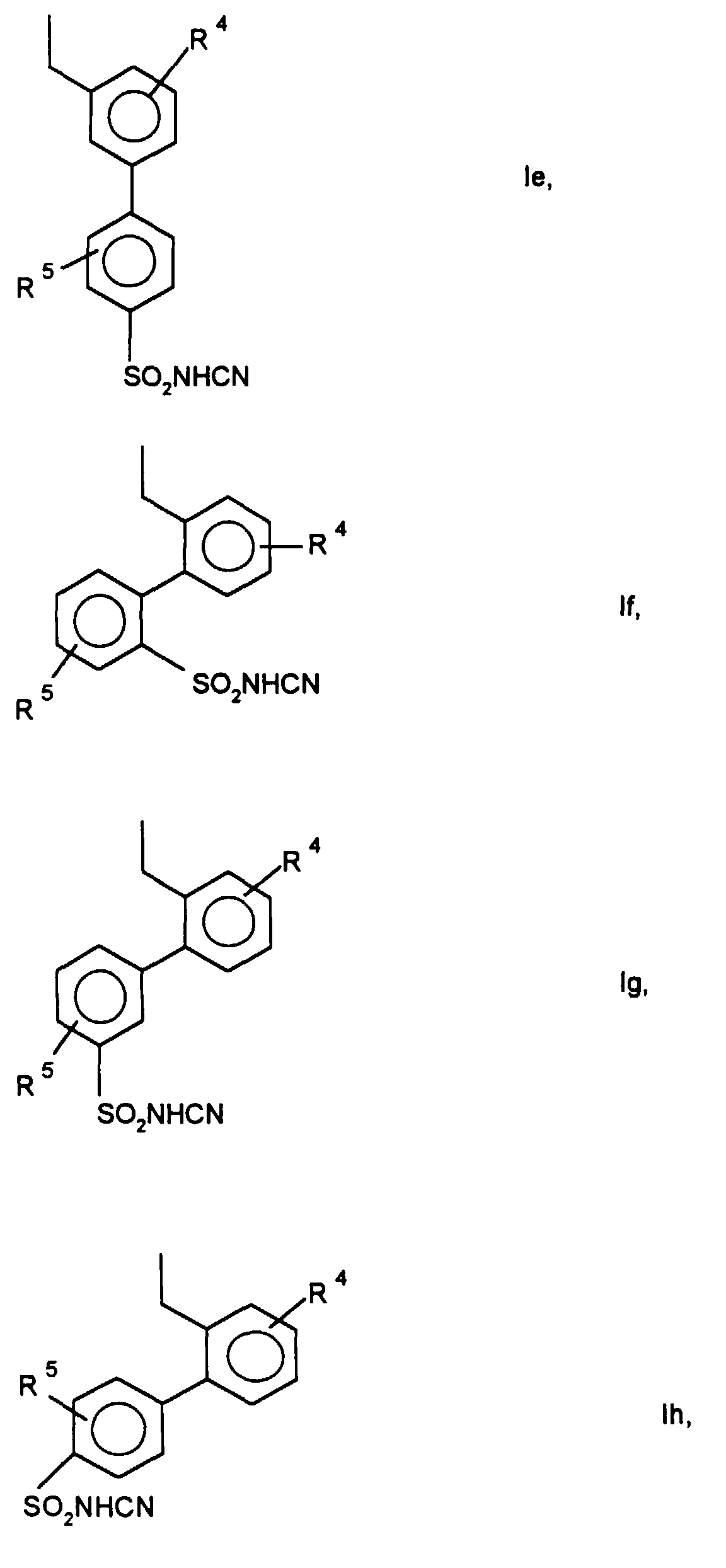
- Verwendung einer Verbindung der Formelin welcher bedeuten:
 sowie deren physiologisch verträgliche Salze zur Herstellung eines Medikaments zur Behandlung oder Prophylaxe von durch ischämische Zustände hervorgerufenen Krankheiten oder zur Herstellung eines Medikaments zur Behandlung von gestörtem Atemantrieb.a) X, Y und Z
gleich oder verschieden, N oder CR(102)b) R(1)1. (C1-C10)-Alkyl, 2. (C3-C10)-Alkenyl, 3. (C3-C10)-Alkinyl, 4. -OR(103), 5. (C3-C8)-Cycloalkyl, 6. (C4-C10)-Cycloalkylalkyl, 7. (C5-C10)-Cycloalkylalkenyl, 8. (C5-C10)-Cycloalkylalkinyl, 9. -(CH2)m-B-(CH2)n-R(104), 10. -Benzyl, 11. ein wie unter b) 1., 2., 3. oder 9. definierter Rest, der mit CO2R(103) monosubstituiert ist, 12. ein wie unter b) 1., 2., 3. oder 9. definierter Rest, worin 1 bis alle H-Atome durch Fluor substituiert sind, oder 13. den unter b) 10. definierten Rest, der am Phenyl mit 1 oder 2 gleichen oder verschiedenen Resten aus der Reihe Halogen, (C1-C4)-Alkoxy und Nitro substituiert ist,c) R(102)1. Wasserstoff, 2. Halogen, 3. Nitro, 4. CvF2v+1, 5. Pentafluorphenyl, 6. Cyano, 7. -O-R(106), 8. Phenyl, 9. Phenyl-(C1-C3)-alkyl, 10. (C1-C10)-Alkyl, 11. (C3-C10)-Alkenyl, 12. Phenyl-(C2-C6)-Alkenyl, 13. 1-Imidazolyl-(CH2)m-, 14. 1,2,3-Triazolyl-(CH2)n-, 15. Tetrazolyl-(CH2)m-, 16. -(CH2)o-1-CHR(107)-OR(105), 17. -(CH2)o-O-CO-R(103), 18. - (CH2)o-S-R(106), 19. -S(O)r-R(119), 20. CH=CH-(CH2)m-CHR(103)-OR(106), 21. -CH=CH(CH2)m-CO-R(108), 22. -CO-R(108), 23. - CH=CH-(CH2)m-O-CO-R(107), 24. -(CH2)m-CH(CH3)-CO-R(108), 25. - (CH2)o-CO-R(108), 26. -(CH2)o-O-[C=W]-NH-R(109), 27. -(CH2)o-NR(107)-[C=W]-OR(109), 28. -(CH2)o-NR(107)-CO-NHR(109), 29. - (CH2)o-NR(107)-SO2R(109), 30. -(CH2)o-NR(107)-[C=W]-R(109), 31. - (CH2)nF, 32. -(CH2)n-O-NO2, 33. -CH2-N3, 34. -(CH2)n-NO2, 35. -CH=N-NR(105)R(107), 36. Phthalimido-(CH2)n-,37.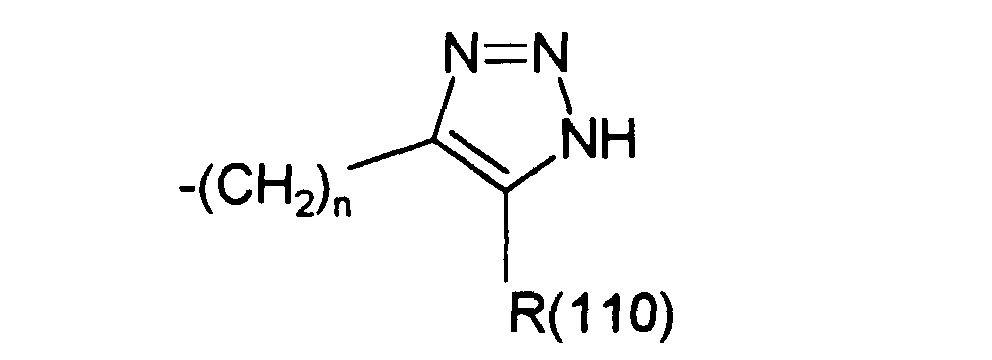 38.
38. 39.
39. 40.
40. 41.
41. 42.
42.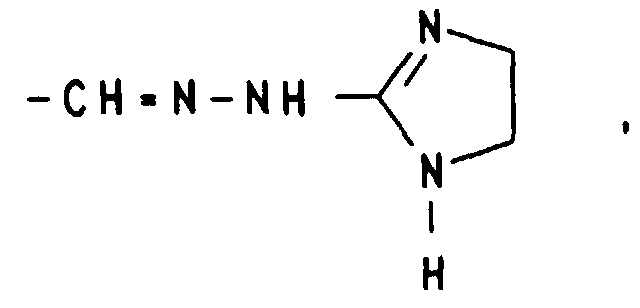 43. -(CH2)n-SO2-NR(107)-CS-NR(106)R(109), 44. -(CH2)nSO2-NR(107)-CO-NR(106)R(109), 45. -(CH2)o-SO2R(109), 46. einen wie unter c) 8. oder 9. definiertem Rest, der am Phenyl mit 1 oder 2 gleichen oder verschiedenen Resten aus der Reihe Halogen, Hydroxy, Methoxy, Trifluormethyl, CO2R(103) und Phenyl substituiert ist, 47. einem wie unter c) 10., 11. oder 19. definierten Rest, worin ein bis alle H-Atome durch Fluor substituiert sind, 48. den unter c) 14. definierten Rest, der mit 1 oder 2 gleichen oder verschiedenen Resten aus der Reihe Methoxycarbonyl und (C1-C4)-Alkyl substituiert ist, 49. -(CH2)n-SO2-NR(107)-CO-R(106), 50. -(CH2)n-SO2-NR(107)CS-R(106),d) R(103)1. Wasserstoff, 2. (C1-C8)-Alkyl, 3. (C3-C8)-Cycloalkyl, 4. Phenyl, 5. Benzyl, 6. den unter d) 2. definiertem Rest, worin 1 bis alle H-Atome durch Fluor substituiert sind;e) R(104)1. Wasserstoff, 2. (C1-C6)-Alkyl, 3. (C3-C8)-Cycloalkyl, 4. (C2-C4)-Alkenyl oder 5. (C2-C4)-Alkinyl;f) R(105)1. Wasserstoff, 2. (C1-C6)-Alkyl, 3. (C3-C8)-Cycloalkyl, 4. Phenyl oder 5. Benzyl;g) R(106) und R(109)gleich oder verschieden 1. Wasserstoff, 2. (C1-C6)-Alkyl, das unsubstituiert ist oder substituiert mit 1 - 3 Substituenten ausgewählt aus der Gruppe bestehend aus (C1-C6)-Alkoxy, das seinerseits mit 1 - 3 Resten aus der Reihe Hydroxy, (C1-C6)-Alkoxy, Amino, Mono-(C1-C6)-Alkylamino, Di-(C1-C6)-Alkylamino substituiert sein kann, (C2-C10)-Alkenyl, Hydroxy, Amino, Mono-(C1-C6)-Alkylamino, Di-(C1-C6)-Alkylamino, (C1-C6)-Alkoxycarbonylamino, (C6-C12)-Aryl-(C1-C4)Alkoxycarbonylamino; (C6-C10)-Aryl, (C6-C10)Aryl-(C1-C3)-Alkyl, (C1-C9)-Heteroaryl, Carboxy und (C1-C4)-Alkoxycarbonyl; 3. (C3-C8)-Cycloalkyl,
wobei der Cycloalkylteil unsubstituiert ist oder substituiert mit 1 - 3 Substituenten ausgewählt aus der Gruppe bestehend aus (C1-C4)-Alkyl und (C2-C4)-Alkenyl;4. (C3-C8)-Cycloalkyl-(C1-C3)-alkyl, 5. (C6-C12)-Aryl, vorzugweise Phenyl, 6. (C6-C10)-Aryl-(C1-C4)-Alkyl, 7. (C1-C9)-Heteroaryl,
welches teilweise oder vollständig hydriert sein kann,8. einen wie unter g) 5., 6., 7., 9., 15., 16., 17., 19., 20. oder 21. definiertem Rest, substituiert mit 1 oder 2 gleichen oder verschiedenen Resten aus der Reihe Halogen, Hydroxy, (C1-C4)-Alkyl, Methoxy, Nitro, Cyano, CO2R(103), Trifluormethyl, NR(111)R(112) und 9. (C1-C9)-Heteroaryl-(C1-C3)-alkyl,
wobei der Heteroarylteil teilweise oder vollständig hydriert sein kann,10. (C1-C6)-Alkyl, worin 1 bis alle H-Atome durch Fluor substituiert sind,11. (C2-C10)-Alkenyl, (C2-C10)-Alkenoyl oder (C2-C10)-Alkadienyl, 12. (C3-C8)-Cycloalkenyl, 13. (C3-C8)-Cycloalkenyl-(C1-C3)-Alkyl, 14. Bi- oder
tricyclisches (C4-C10)-Cycloalkenyl-(C1-C4)-alkyl, das noch mit 1 - 3 (C1-C4)-Alkylresten substituiert sein kann;15. (C6-C10)-Aryl-(C1-C4)-Alkyl, 16. (C6-C10)-Aryl-(C3-C6)-Alkenyl, 17. (C1-C9)-Hetaryl-(C3-C6)-Alkenyl, 18. (C3-C6)-Alkinyl, 19. (C6-C10)-Aryl-(C3-C6)-Alkinyl, 20. (C1-C9)-Hetaryl-(C3-C6)-Alkinyl, 21. R(106) und R(109) gemeinsam mit dem sie tragenden N-Atom ein Hetaryl, das auch teilweise oder vollständig hydriert sein kann;h) R(107)1. Wasserstoff, 2. (C1-C6)-Alkyl, 3. (C3-C8)-Cycloalkyl, 4. (C6-C12)-Aryl-(C1-C6)-alkyl, vorzugsweise Benzyl, 5. Phenyl oder 6. (C1-C9)-Heteroaryl;i) R(108)1. Wasserstoff, 2. (C1-C6)-Alkyl, 3. (C3-C8)-Cycloalkyl, 4. Phenyl-(CH2)q-, 5. OR(106), 6. NR(111)R(112) oder 7.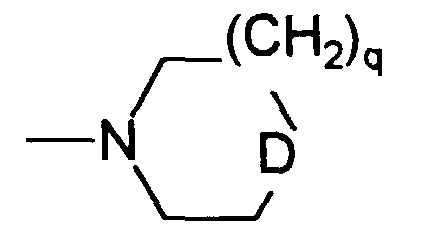 j) R(110)
Cyano, Nitro oder CO2R(107);k) R(111) und R(112)
gleich oder verschieden, 1. Wasserstoff, 2. (C1-C4)-Alkyl, 3. Phenyl, 4. Benzyl, oder 5. α-Methylbenzyl;l) D NR(113), O oder CH2;m) R(113)
Wasserstoff, (C1-C4)-Alkyl oder Phenyl;n) A Biphenylyl,
das unsubstituiert ist oder substituiert mit 1 - 4, vorzugsweise 1 bis 2 gleichen oder verschiedenen Substituenten R(114) oder R(115);o) R(114)1. Halogen, 2. Nitroso, 3. Nitro, 4. Amino, 5. Cyano, 6. Hydroxy, 7. (C1-C6)-Alkyl, 8. (C1-C4)-Alkanoyl, 9. (C1-C4)-Alkanoyloxy, 10. CO2R(103), 11. Methansulfonylamino, 12. Trifluormethansulfonylamino, 13. -CO-NH-OR(109), 14. -SO2-NR(106)R(107), 15. -CH2-OR(107), 16. (C1-C9)-Heteroaryl-(CH2)q-, vorzugsweise 1-Tetrazolyl, 17. (C7-C13)-Aroyl,18. 19.oder
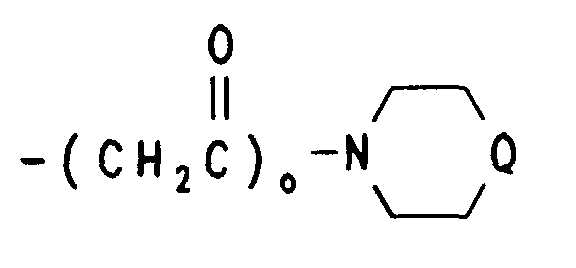 20. (C6-C12)-Aryl;p) R(115)1. Wasserstoff, 2. (C1-C6)-Alkyl, 3. (C3-C8)-Cycloalkyl, 4. (C6-C12)-Aryl, 5. (C7-C13)-Aroyl, 6. (C1-C4)-Alkoxy, 7. (C1-C4)-Alkanoyloxy, 8. (C1-C9)-Heteroaryl, 9. CO2R(103), 10. Halogen, 11. Cyano, 12. Nitro, 13. NR(106)R(107), 14. Hydroxy, 15. -CO-NH-CHR(105)-CO2R(103), 16. Sulfo, 17. -SO3R(103), 18. -SO2-NR(107)-CO-NR(106)R(109) oder -SO2-NR(107)-CS-NR(106)R(109), 19. -NR(107)-CO-NR(106)-SO2-CH2-R(105), 20. -C(CF3)2OH, 21. Phosphonooxy, 22. -PO3H2, 23. -NH-PO(OH)2, 24. -S(O)rR(106), 25. -CO-R(108), 26. -CO-NR(106)R(109), 27. -CR(120)(OH)-PO(OH)2, 28. den unter o) 20. definiertem Rest,29.
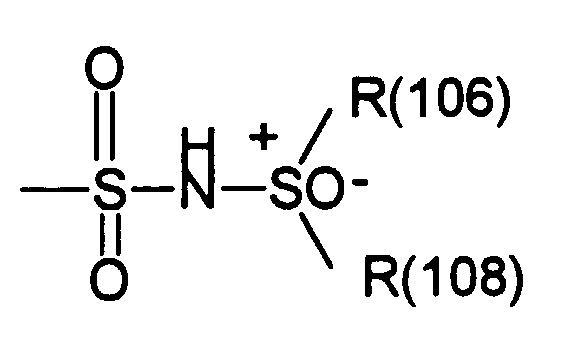 30.
30. 31.
31. 32. 5-Tetrazolyl-NH-CO-, 33. -CO-NH-NH-SO2-CF3,34.
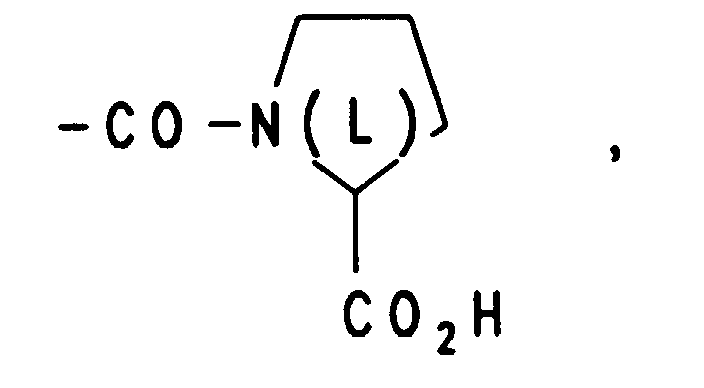 35.
35.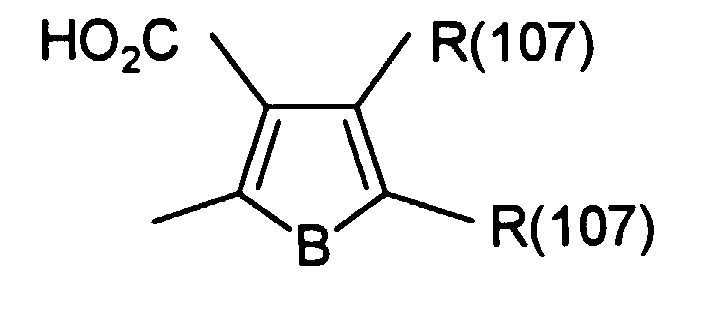 36.
36. 37.
37. 38.
38. 39.
39. 40. -CO-NH-SO2-R(119), 41. -SO2-NH-CO-R(106) oder 42. den unter p) 4. definiertem Rest, substituiert mit 1 oder 2 gleichen oder verschiedenen Resten aus der Reihe Halogen, Cyano, Nitro, NR(106)R(107) und Hydroxy; 43. R(115) zusammen mit R(114) bedeutet -CO-NH-SO2-, 44. -SO2-NH-CO-O-R(106), 45. -SO2-NH-SO2-NR(106)R(109), 46. -SO2-NH-SO2-R(106);q) B O, NR(107) oder S;r) W O oder S;s) L (C1-C3)-Alkandiyl;t) R(116)
CO2R(103) oder CH2CO2R(103);u) R(117)
Wasserstoff, Halogen, (C1-C4)-Alkyl oder (C1-C4)-Alkoxy;v) R(118)
Wasserstoff, (C1-C4)-Alkyl oder Phenyl;w) R(119)1. (C1-C6)-Alkyl, 2. (C3-C8)-Cycloalkyl, 3. Phenyl, 4. Benzyl oder 5. den unter w) 1. definiertem Rest, worin ein bis all H-Atome durch Fluor substituiert sind,x) T1. eine Einfachbindung, 2. -CO-, 3. -CH2-, 4. -O-, 5. -S-, 6. -NR(121)-, 7. -CO-NR(121), 8. -NR(121)-CO-, 9. -O-CH2-, 10. -CH2-O-, 11. -S-CH2-, 12. -CH2-S, 13. -NH-CR(120)R(122), 14. -NR(121)-SO2, 15. SO2-NR(121)-, 16. -CR(120)R(122)-NH, 17. -CH=CH-, 18. -CF=CF-, 19. -CH=CF-, 20. -CF=CH-, 21. -CH2-CH2-, 22. -CF2-CF2-, 23. -CH[OR(103)]-, 24. -CH(OCOR(105))-, 25. -C[N=R(123)]- oder 26. -[R(124)O]-C-[OR(125)]-y) R(120) und R(122)
gleich oder verschieden, Wasserstoff, (C1-C5)-Alkyl, Phenyl, Allyl oder Benzyl;z) R(121)
Wasserstoff, (C1-C6)-Alkyl, Benzyl oder Allyl; a') R(123)1. NR(120)R(121), 2. Ureido, 3. Thioureido, 4. Toluol-4-sulfonyl oder 5. Benzolsulfonylamino;b') R(124) und R(125)
gleich oder verschieden, (C1-C4)-Alkyl oder gemeinsam -(CH2)q-;c') Q CH2, NH, O oder S;d') m 1, 2, 3, 4 oder 5;e') n 1, 2, 3, 4 oder 5;f') o 1, 2, 3, 4, 5, 6, 7, 8, 9 oder 10;g') q Null oder 1;h') r Null, 1 oder 2;i') v 1, 2, 3, 4, 5 oder bis 6; - Verwendung einer Verbindung der Formel I nach einem oder mehreren der Ansprüche 1-5 sowie deren physiologisch verträglichen Salzen zur Herstellung eines Medikaments zur Behandlung oder Prophylaxe von durch ischämische Zustände hervorgerufenen Krankheiten oder zur Herstellung eines Medikaments zur Behandlung von gestörtem Atemantrieb.
- Verwendung einer Verbindung der Formel I nach einem oder mehreren der Ansprüche 1-5 sowie deren physiologisch verträglichen Salzen zur Herstellung eines Medikaments zur Behandlung oder Prophylaxe von durch ischämische Zustände hervorgerufenen Krankheiten.
- Verwendung einer Verbindung der Formel I nach einem oder mehreren der Ansprüche 1-5 sowie deren physiologisch verträglichen Salzen zur Herstellung eines Medikaments zur Behandlung oder Prophylaxe des Herzinfarkts.
- Verwendung einer Verbindung der Formel I nach einem oder mehreren der Ansprüche 1-5 sowie deren physiologisch verträglichen Salzen zur Herstellung eines Medikaments zur Behandlung oder Prophylaxe der Angina Pectoris.
- Verwendung einer Verbindung der Formel I nach einem oder mehreren der Ansprüche 1-5 sowie deren physiologisch verträglichen Salzen zur Herstellung eines Medikaments zur Behandlung oder Prophylaxe von ischämischen Zuständen des Herzens.
- Verwendung einer Verbindung der Formel I nach einem oder mehreren der Ansprüche 1-5 sowie deren physiologisch verträglichen Salzen zur Herstellung eines Medikaments zur Behandlung oder Prophylaxe von ischämischen Zuständen des peripheren und zentralen Nervensystems und des Schlaganfalls.
- Verwendung einer Verbindung der Formel I nach einem oder mehreren der Ansprüche 1-5 sowie deren physiologisch verträglichen Salzen zur Herstellung eines Medikaments zur Behandlung oder Prophylaxe von ischämischen Zuständen peripherer Organe und Gliedmaßen.
- Verwendung einer Verbindung der Formel I nach einem oder mehreren der Ansprüche 1-5 sowie deren physiologisch verträglichen Salzen zur Herstellung eines Medikaments zur Behandlung von Schockzuständen.
- Verwendung einer Verbindung der Formel I nach einem oder mehreren der Ansprüche 1-5 sowie deren physiologisch verträglichen Salzen zur Herstellung eines Medikaments zum Einsatz bei chirurgischen Operationen und Organtransplantationen.
- Verwendung einer Verbindung der Formel I nach einem oder mehreren der Ansprüche 1-5 sowie deren physiologisch verträglichen Salzen zur Herstellung eines Medikaments zur Konservierung und Lagerung von Transplantaten für chirurgische Maßnahmen.
- Verwendung einer Verbindung der Formel I nach einem oder mehreren der Ansprüche 1-5 sowie deren physiologisch verträglichen Salzen zur Herstellung eines Medikaments zur Behandlung von Krankheiten, bei denen die Zellproliferation eine primäre oder sekundäre Ursache darstellt.
- Verwendung einer Verbindung der Formel I nach einem oder mehreren der Ansprüche 1-5 sowie deren physiologisch verträglichen Salzen zur Herstellung eines Medikaments zur Behandlung oder Prophylaxe von gestörtem Atemantrieb.
- Arzneimittel, gekennzeichnet durch einen wirksamen Gehalt einer Verbindung der Formel I sowie deren physiologisch verträglichen Salze gemäß einem oder mehreren der Ansprüche 1 bis 5.
- Arzneimittel gemäß Anspruch 19, dadurch gekennzeichnet, daß es zusätzlich eine wirksame Menge eines NHE-Inhibitors und/oder eine wirksame Substanz aus einer anderen Herz-Kreislauf-Wirkstoffklasse, oder deren physiologisch verträglichen Salze enthält.
Applications Claiming Priority (6)
| Application Number | Priority Date | Filing Date | Title |
|---|---|---|---|
| DE19702045 | 1997-01-22 | ||
| DE19702045A DE19702045A1 (de) | 1997-01-22 | 1997-01-22 | Imidazol-Derivae mit Biphenylsulfonylcyanamid-Seitenkette, Verfahren zu ihrer Herstellung, ihre Verwendung als Medikament oder Diagnostikum sowie sie enthaltendes Medikament |
| DE19731328 | 1997-07-22 | ||
| DE19731328A DE19731328A1 (de) | 1997-07-22 | 1997-07-22 | Imidazol-Derivate mit Biphenylsulfonylcyanamid-Seitenkette, Verfahren zu ihrer Herstellung und ihre Verwendung als Medikament |
| DE1997141636 DE19741636A1 (de) | 1997-09-22 | 1997-09-22 | Fünfgliedrige Heterocyclen mit Biphenylsulfonylsubstitution, Verfahren zu ihrer Herstellung, ihre Verwendung als Medikament oder Diagnostikum sowie sie enthaltendes Medikament |
| DE19741636 | 1997-09-22 |
Publications (2)
| Publication Number | Publication Date |
|---|---|
| EP0855392A2 true EP0855392A2 (de) | 1998-07-29 |
| EP0855392A3 EP0855392A3 (de) | 2000-01-05 |
Family
ID=27217050
Family Applications (1)
| Application Number | Title | Priority Date | Filing Date |
|---|---|---|---|
| EP98100595A Withdrawn EP0855392A3 (de) | 1997-01-22 | 1998-01-15 | Fünfgliedrige Heterocyclen mit Biphenylsulfonylsubstitution, Verfahren zu ihrer Herstellung, ihre Verwendung als Medikament oder Diagnostikum sowie sie enthaltendes Medikament |
Country Status (21)
| Country | Link |
|---|---|
| US (2) | US6335451B1 (de) |
| EP (1) | EP0855392A3 (de) |
| JP (1) | JPH10204064A (de) |
| KR (1) | KR100529479B1 (de) |
| CN (1) | CN1176911C (de) |
| AR (1) | AR011082A1 (de) |
| AU (1) | AU738676B2 (de) |
| BR (1) | BR9800436A (de) |
| CA (1) | CA2227112A1 (de) |
| CZ (1) | CZ18598A3 (de) |
| HR (1) | HRP980025A2 (de) |
| HU (1) | HUP9800112A3 (de) |
| ID (1) | ID19574A (de) |
| IL (1) | IL123013A (de) |
| MY (1) | MY121708A (de) |
| NO (1) | NO311570B1 (de) |
| NZ (1) | NZ329606A (de) |
| PL (1) | PL191575B1 (de) |
| SK (1) | SK284126B6 (de) |
| TR (1) | TR199800084A3 (de) |
| TW (1) | TW593283B (de) |
Cited By (14)
| Publication number | Priority date | Publication date | Assignee | Title |
|---|---|---|---|---|
| US5968978A (en) * | 1997-09-22 | 1999-10-19 | Hoechst Marion Roussel Deutschland | Biphenylsulfonylcyanamides, process for their preparation, and their use as medicament |
| WO1999057102A1 (de) * | 1998-05-06 | 1999-11-11 | Aventis Pharma Deutschland Gmbh | Substituierte sulfonylcyanamide, verfahren zu ihrer herstellung und ihre verwendung als medikament |
| WO2000003996A1 (de) * | 1998-07-18 | 2000-01-27 | Aventis Pharma Deutschland Gmbh | Imidazolderivate mit biphenylsulfonylsubstitution, verfahren zu ihrer herstellung, ihre verwendung als medikament oder diagnostikum |
| WO2000003994A3 (de) * | 1998-07-18 | 2000-04-20 | Aventis Pharma Gmbh | Imidazolderivate mit biphenylsulfonylsubstitution, verfahren zu ihrer herstellung, ihre verwendung als medikament oder diagnostikum sowie sie enthaltendes medikament |
| WO2000066161A1 (en) * | 1999-04-28 | 2000-11-09 | Takeda Chemical Industries, Ltd. | Preventives / remedies / progression inhibitors for simplex retinopathy or preproliferating retinopathy |
| US6369069B1 (en) | 1998-02-04 | 2002-04-09 | Aventis Pharma Deutschland Gmbh | Biphenylsulfonyl cyanamides, method for the production thereof and their utilization as a medicament |
| US6407258B1 (en) | 1998-01-27 | 2002-06-18 | Aventis Pharma Deutschland Gmbh | Method for producing S-alkyl(aryl)-substituted imidazol derivatives |
| EP1226830A3 (de) * | 2001-01-25 | 2003-07-09 | Pfizer Products Inc. | Kombinationstherapie einschliessend einen Typ 1 Natrium-Wasserstoff-Austauscher- oder NHE-1- Hemmer zur Behandlung von Ischemie |
| WO2003066045A1 (de) * | 2002-02-04 | 2003-08-14 | Aventis Pharma Deutschland Gmbh | Kombinationspräparat des natrium-wasserstoff-austauch-inhibitors cariporide mit ace-hemmern zur verhinderung der herzinsuffizienz und anderer altersbedingter organ-dysfunktionen, altersbedingter erkrankungen und zur lebensverlängerung |
| WO2006109058A1 (en) | 2005-04-12 | 2006-10-19 | Vicore Pharma Ab | New bicyclic angiotensin ii agonists |
| JP2008535899A (ja) * | 2005-04-12 | 2008-09-04 | ヴィコール・ファルマ・アーベー | 新規な三環系アンジオテンシンiiアゴニスト |
| US8088799B2 (en) | 2002-02-04 | 2012-01-03 | Sanofi-Aventis Deutschland Gmbh | Pharmaceutical composition comprising a sodium hydrogen exchange inhibitor and an angiotensin converting enzyme inhibitor |
| US8236843B2 (en) | 2008-09-02 | 2012-08-07 | Elder Pharmaceuticals Ltd. | Anti inflammatory compounds |
| WO2024149712A1 (en) * | 2023-01-09 | 2024-07-18 | Vicore Pharma Ab | Selective angiotensin ii compounds |
Families Citing this family (12)
| Publication number | Priority date | Publication date | Assignee | Title |
|---|---|---|---|---|
| EP0855392A3 (de) | 1997-01-22 | 2000-01-05 | Hoechst Aktiengesellschaft | Fünfgliedrige Heterocyclen mit Biphenylsulfonylsubstitution, Verfahren zu ihrer Herstellung, ihre Verwendung als Medikament oder Diagnostikum sowie sie enthaltendes Medikament |
| KR100523112B1 (ko) * | 1997-10-17 | 2005-10-19 | 유로진 리미티드 | 레닌-안지오텐신계 억제제의 사용 |
| CA2426674A1 (en) * | 2000-10-25 | 2002-05-02 | Takeda Chemical Industries, Ltd. | Agent for preventing or treating portal hypertension |
| US6423705B1 (en) | 2001-01-25 | 2002-07-23 | Pfizer Inc. | Combination therapy |
| CN1529697B (zh) * | 2001-05-31 | 2010-09-22 | 维科尔药物公司 | 用作血管紧张素ⅱ激动剂的三环化合物 |
| US20030220383A1 (en) * | 2002-02-14 | 2003-11-27 | Aventis Pharma Deutschland Gmbh | Use of inhibitors of the sodium-dependent chloride/bicarbonate exchanger for the treatment of thrombotic and inflammatory disorders |
| DE602005025755D1 (de) | 2004-06-04 | 2011-02-17 | Teva Pharma | Irbesartan enthaltende pharmazeutische zusammensetzung |
| DK1869023T3 (da) * | 2005-04-12 | 2012-04-10 | Vicore Pharma Ab | Nye tricykliske angiotensin-II-agonister |
| US10517839B2 (en) | 2008-06-09 | 2019-12-31 | Cornell University | Mast cell inhibition in diseases of the retina and vitreous |
| CN103992276B (zh) * | 2014-06-03 | 2016-08-24 | 吉林省药物研究院 | 4’-{[(2,4,5-三取代苯基)-1h-咪唑-1-基]甲基}联苯-2-甲酸衍生物 |
| DK3169405T3 (da) * | 2014-07-17 | 2024-09-23 | Univ Southern California | Fremgangsmåder, forbindelser og sammensætninger til behandling af muskel- og skeletsygdomme |
| WO2018002673A1 (en) | 2016-07-01 | 2018-01-04 | N4 Pharma Uk Limited | Novel formulations of angiotensin ii receptor antagonists |
Family Cites Families (14)
| Publication number | Priority date | Publication date | Assignee | Title |
|---|---|---|---|---|
| JPH0819110B2 (ja) * | 1986-06-04 | 1996-02-28 | 富山化学工業株式会社 | 新規なイミダゾール誘導体もしくはその塩およびそれらを含有する抗炎症剤、解熱鎮痛剤または抗関節炎剤 |
| IL98319A (en) | 1990-07-05 | 1997-04-15 | Roussel Uclaf | Sulphurous derivatives of imidazole, their preparation process, and pharmaceutical compositions containing them |
| US5126342A (en) * | 1990-10-01 | 1992-06-30 | Merck & Co., Inc. | Imidazole angiotensin ii antagonists incorporating acidic functional groups |
| CA2058198A1 (en) | 1991-01-04 | 1992-07-05 | Adalbert Wagner | Azole derivatives, process for their preparation, and their use |
| CA2109524A1 (en) | 1991-05-10 | 1992-11-11 | Prasun K. Chakravarty | Acidic aralkyl triazole derivatives active as angiotensin ii antagonists |
| TW215434B (de) | 1992-03-07 | 1993-11-01 | Hoechst Ag | |
| JPH0625229A (ja) * | 1992-03-09 | 1994-02-01 | Japan Tobacco Inc | 新規なイミダゾール誘導体 |
| FR2711367B1 (fr) | 1993-10-19 | 1995-12-01 | Roussel Uclaf | Nouveau procédé de préparation de dérivés soufrés de l'imidazole et les nouveaux intermédiaires obtenus. |
| FR2711368B1 (fr) | 1993-09-16 | 1996-01-05 | Roussel Uclaf | Nouveau procédé de préparation de dérivés soufrés de l'imidazole et les nouveaux intermédiaires obtenus. |
| FR2716883B1 (fr) * | 1994-03-04 | 1996-04-26 | Roussel Uclaf | Nouveaux dérivés tétrasubstitués de l'imidazole, leur préparation, nouveaux intermédiaires obtenus, leur application à titre de médicaments, compositions pharmaceutiques les renfermant. |
| FR2716882B1 (fr) * | 1994-03-04 | 1996-04-05 | Roussel Uclaf | Utilisation de dérivés de l'imidazole au traitement d'affections impliquant les récepteurs AT1 et AT2 de l'Angiotensine, certains de ces produits, leur préparation, compositions pharmaceutiques. |
| AU7213296A (en) * | 1995-10-06 | 1997-04-30 | Ciba-Geigy Ag | At1-receptor antagonists for preventing and treating postischemic renal failure and for protecting ischemic kidneys |
| EP0868179A4 (de) * | 1995-12-12 | 2002-01-30 | Merck & Co Inc | Neue verwendung von losartan |
| EP0855392A3 (de) | 1997-01-22 | 2000-01-05 | Hoechst Aktiengesellschaft | Fünfgliedrige Heterocyclen mit Biphenylsulfonylsubstitution, Verfahren zu ihrer Herstellung, ihre Verwendung als Medikament oder Diagnostikum sowie sie enthaltendes Medikament |
-
1998
- 1998-01-15 EP EP98100595A patent/EP0855392A3/de not_active Withdrawn
- 1998-01-16 CA CA002227112A patent/CA2227112A1/en not_active Abandoned
- 1998-01-20 AR ARP980100244A patent/AR011082A1/es unknown
- 1998-01-20 CZ CZ98185A patent/CZ18598A3/cs unknown
- 1998-01-20 SK SK77-98A patent/SK284126B6/sk unknown
- 1998-01-20 TR TR1998/00084A patent/TR199800084A3/tr unknown
- 1998-01-20 NZ NZ329606A patent/NZ329606A/en unknown
- 1998-01-20 ID IDP980065A patent/ID19574A/id unknown
- 1998-01-20 HR HR19741636.5A patent/HRP980025A2/hr not_active Application Discontinuation
- 1998-01-21 JP JP10022558A patent/JPH10204064A/ja not_active Abandoned
- 1998-01-21 US US09/010,181 patent/US6335451B1/en not_active Expired - Fee Related
- 1998-01-21 IL IL12301398A patent/IL123013A/xx not_active IP Right Cessation
- 1998-01-21 CN CNB981042988A patent/CN1176911C/zh not_active Expired - Fee Related
- 1998-01-21 AU AU52159/98A patent/AU738676B2/en not_active Ceased
- 1998-01-21 NO NO19980273A patent/NO311570B1/no unknown
- 1998-01-21 MY MYPI98000237A patent/MY121708A/en unknown
- 1998-01-22 KR KR1019980001810A patent/KR100529479B1/ko not_active Expired - Fee Related
- 1998-01-22 BR BR9800436-0A patent/BR9800436A/pt not_active Application Discontinuation
- 1998-01-22 HU HU9800112A patent/HUP9800112A3/hu unknown
- 1998-01-22 PL PL324418A patent/PL191575B1/pl not_active IP Right Cessation
- 1998-02-13 TW TW087100763A patent/TW593283B/zh not_active IP Right Cessation
-
2001
- 2001-10-30 US US09/984,469 patent/US6486189B2/en not_active Expired - Fee Related
Cited By (25)
| Publication number | Priority date | Publication date | Assignee | Title |
|---|---|---|---|---|
| US5968978A (en) * | 1997-09-22 | 1999-10-19 | Hoechst Marion Roussel Deutschland | Biphenylsulfonylcyanamides, process for their preparation, and their use as medicament |
| AU755553B2 (en) * | 1997-09-22 | 2002-12-12 | Aventis Pharma Deutschland Gmbh | Biphenylsulfonylcyanamides, process for their preparation, and their use as medicament |
| US6407258B1 (en) | 1998-01-27 | 2002-06-18 | Aventis Pharma Deutschland Gmbh | Method for producing S-alkyl(aryl)-substituted imidazol derivatives |
| RU2247111C2 (ru) * | 1998-02-04 | 2005-02-27 | Авентис Фарма Дойчланд Гмбх | Бифенилсульфонилцианамиды, способ их получения и их применение в качестве лекарственных средств |
| US6369069B1 (en) | 1998-02-04 | 2002-04-09 | Aventis Pharma Deutschland Gmbh | Biphenylsulfonyl cyanamides, method for the production thereof and their utilization as a medicament |
| WO1999057102A1 (de) * | 1998-05-06 | 1999-11-11 | Aventis Pharma Deutschland Gmbh | Substituierte sulfonylcyanamide, verfahren zu ihrer herstellung und ihre verwendung als medikament |
| US6369236B1 (en) | 1998-07-18 | 2002-04-09 | Aventis Pharma Deutschland Gmbh | Imidazole derivatives with biphenylsulfonyl substitution method for preparing them and their use as a drug or diagnostic agent |
| US6372917B1 (en) | 1998-07-18 | 2002-04-16 | Aventis Pharma Deutschland Gmbh | Biphenylsulfonyl-substituted imidazole derivatives, their preparation process, their use as a drug or diagnostic agent and drug containing them |
| JP2002520397A (ja) * | 1998-07-18 | 2002-07-09 | アベンティス・ファーマ・ドイチユラント・ゲゼルシャフト・ミット・ベシュレンクテル・ハフツング | ビフェニルスルホニル置換を有するイミダゾール誘導体、それらの製造方法、それらの医薬又は診断薬としての使用、及びそれらを含む医薬 |
| JP2002520399A (ja) * | 1998-07-18 | 2002-07-09 | アベンティス・ファーマ・ドイチユラント・ゲゼルシャフト・ミット・ベシュレンクテル・ハフツング | ビフェニルスルホニル置換を有するイミダゾール誘導体、その製造法、医薬または診断薬としてのその使用 |
| WO2000003994A3 (de) * | 1998-07-18 | 2000-04-20 | Aventis Pharma Gmbh | Imidazolderivate mit biphenylsulfonylsubstitution, verfahren zu ihrer herstellung, ihre verwendung als medikament oder diagnostikum sowie sie enthaltendes medikament |
| WO2000003996A1 (de) * | 1998-07-18 | 2000-01-27 | Aventis Pharma Deutschland Gmbh | Imidazolderivate mit biphenylsulfonylsubstitution, verfahren zu ihrer herstellung, ihre verwendung als medikament oder diagnostikum |
| WO2000066161A1 (en) * | 1999-04-28 | 2000-11-09 | Takeda Chemical Industries, Ltd. | Preventives / remedies / progression inhibitors for simplex retinopathy or preproliferating retinopathy |
| US7064141B1 (en) | 1999-04-28 | 2006-06-20 | Takeda Pharmaceutical Company Limited | Method for preventing, treating or inhibiting development of simple retinopathy and preproliferative retinopathy |
| EP1226830A3 (de) * | 2001-01-25 | 2003-07-09 | Pfizer Products Inc. | Kombinationstherapie einschliessend einen Typ 1 Natrium-Wasserstoff-Austauscher- oder NHE-1- Hemmer zur Behandlung von Ischemie |
| WO2003066045A1 (de) * | 2002-02-04 | 2003-08-14 | Aventis Pharma Deutschland Gmbh | Kombinationspräparat des natrium-wasserstoff-austauch-inhibitors cariporide mit ace-hemmern zur verhinderung der herzinsuffizienz und anderer altersbedingter organ-dysfunktionen, altersbedingter erkrankungen und zur lebensverlängerung |
| CN1319528C (zh) * | 2002-02-04 | 2007-06-06 | 塞诺菲-安万特德国有限公司 | 用于预防心力衰竭的Na+-H+交换抑制剂卡立泊来德与ACE抑制剂雷米普利的联合制剂 |
| US8088799B2 (en) | 2002-02-04 | 2012-01-03 | Sanofi-Aventis Deutschland Gmbh | Pharmaceutical composition comprising a sodium hydrogen exchange inhibitor and an angiotensin converting enzyme inhibitor |
| WO2006109058A1 (en) | 2005-04-12 | 2006-10-19 | Vicore Pharma Ab | New bicyclic angiotensin ii agonists |
| JP2008535899A (ja) * | 2005-04-12 | 2008-09-04 | ヴィコール・ファルマ・アーベー | 新規な三環系アンジオテンシンiiアゴニスト |
| JP2008535900A (ja) * | 2005-04-12 | 2008-09-04 | ヴィコール・ファルマ・アーベー | 新規な二環式アンジオテンシンiiアゴニスト |
| US8357710B2 (en) | 2005-04-12 | 2013-01-22 | Vicore Pharma Ab | Bicyclic angiotensin II agonists |
| JP2013067631A (ja) * | 2005-04-12 | 2013-04-18 | Vicore Pharma Ab | 新規な二環式アンジオテンシンiiアゴニスト |
| US8236843B2 (en) | 2008-09-02 | 2012-08-07 | Elder Pharmaceuticals Ltd. | Anti inflammatory compounds |
| WO2024149712A1 (en) * | 2023-01-09 | 2024-07-18 | Vicore Pharma Ab | Selective angiotensin ii compounds |
Also Published As
Similar Documents
| Publication | Publication Date | Title |
|---|---|---|
| EP0855392A2 (de) | Fünfgliedrige Heterocyclen mit Biphenylsulfonylsubstitution, Verfahren zu ihrer Herstellung, ihre Verwendung als Medikament oder Diagnostikum sowie sie enthaltendes Medikament | |
| EP0903339B1 (de) | Biphenylsulfonylcyanamide, Verfahren zu ihrer Herstellung und ihre Verwendung als Medikament | |
| EP0771788B1 (de) | Substituierte Sulfonimidamide, Verfahren zu ihrer Herstellung, ihre Verwendung als Medikament oder Diagnostikum sowie sie enthaltendes Medikament | |
| EP0602523A1 (de) | Substituierte Benzoylguanidine, Verfahren zu ihrer Herstellung, ihre Verwendung als Medikament oder Diagnostikum sowie sie enthaltendes Medikament | |
| EP0723956B1 (de) | Basisch-substituierte Benzoylguanidine, Verfahren zu ihrer Herstellung, ihre Verwendung als Medikament oder Diagnostikum sowie sie enthaltendes Medikament | |
| EP1097140B1 (de) | Imidazolderivate mit biphenylsulfonylsubstitution, verfahren zu ihrer herstellung, ihre verwendung als medikament oder diagnostikum sowie sie enthaltendes medikament | |
| EP1097141B1 (de) | Imidazolderivate mit biphenylsulfonylsubstitution, verfahren zu ihrer herstellung, ihre verwendung als medikament oder diagnostikum | |
| DE19804251A1 (de) | Biphenylsulfonylcyanamide, Verfahren zu ihrer Herstellung und ihre Verwendung als Medikament | |
| EP1076651B1 (de) | Substituierte sulfonylcyanamide, verfahren zu ihrer herstellung und ihre verwendung als medikament | |
| DE19741636A1 (de) | Fünfgliedrige Heterocyclen mit Biphenylsulfonylsubstitution, Verfahren zu ihrer Herstellung, ihre Verwendung als Medikament oder Diagnostikum sowie sie enthaltendes Medikament | |
| RU2242466C2 (ru) | Пятичленные гетероциклы с бифенилсульфонильным замещением, лекарственное средство | |
| DE19702045A1 (de) | Imidazol-Derivae mit Biphenylsulfonylcyanamid-Seitenkette, Verfahren zu ihrer Herstellung, ihre Verwendung als Medikament oder Diagnostikum sowie sie enthaltendes Medikament |
Legal Events
| Date | Code | Title | Description |
|---|---|---|---|
| PUAI | Public reference made under article 153(3) epc to a published international application that has entered the european phase |
Free format text: ORIGINAL CODE: 0009012 |
|
| AK | Designated contracting states |
Kind code of ref document: A2 Designated state(s): AT BE CH DE DK ES FI FR GB GR IE IT LI LU NL PT SE |
|
| AX | Request for extension of the european patent |
Free format text: AL;LT;LV;MK;RO;SI |
|
| PUAL | Search report despatched |
Free format text: ORIGINAL CODE: 0009013 |
|
| RTI1 | Title (correction) |
Free format text: FIVE-MEMBERED HETEROCYCLES HAVING BIPHENYLSULPHONYL SUBSTITUENTS, PROCESSES FOR THE PREPARATION THEREOF, THEIR USE AS MEDICAMENTS OR DIAGNOSTIC AGENT AND MEDICAMENTS CONTAINING THEM |
|
| AK | Designated contracting states |
Kind code of ref document: A3 Designated state(s): AT BE CH DE DK ES FI FR GB GR IE IT LI LU MC NL PT SE |
|
| AX | Request for extension of the european patent |
Free format text: AL;LT;LV;MK;RO;SI |
|
| RTI1 | Title (correction) |
Free format text: FIVE-MEMBERED HETEROCYCLES HAVING BIPHENYLSULPHONYL SUBSTITUENTS, PROCESSES FOR THE PREPARATION THEREOF, THEIR USE AS MEDICAMENTS OR DIAGNOSTIC AGENT AND MEDICAMENTS CONTAINING THEM |
|
| RTI1 | Title (correction) |
Free format text: FIVE-MEMBERED HETEROCYCLES HAVING BIPHENYLSULPHONYL SUBSTITUENTS, PROCESSES FOR THE PREPARATION THEREOF, THEIR USE AS MEDICAMENTS OR DIAGNOSTIC AGENT AND MEDICAMENTS CONTAINING THEM |
|
| 17P | Request for examination filed |
Effective date: 20000705 |
|
| AKX | Designation fees paid |
Free format text: AT BE CH DE DK ES FI FR GB GR IE IT LI LU NL PT SE |
|
| AXX | Extension fees paid |
Free format text: SI PAYMENT 20000705 |
|
| RAP1 | Party data changed (applicant data changed or rights of an application transferred) |
Owner name: AVENTIS PHARMA DEUTSCHLAND GMBH |
|
| RAP1 | Party data changed (applicant data changed or rights of an application transferred) |
Owner name: SANOFI-AVENTIS DEUTSCHLAND GMBH |
|
| 17Q | First examination report despatched |
Effective date: 20061010 |
|
| STAA | Information on the status of an ep patent application or granted ep patent |
Free format text: STATUS: THE APPLICATION HAS BEEN WITHDRAWN |
|
| 18W | Application withdrawn |
Effective date: 20071128 |