EP0882731A2 - Verbrückte Metallocenverbindungen und ihre Verwendung als Olefinpolymerisationskatalysatore - Google Patents
Verbrückte Metallocenverbindungen und ihre Verwendung als Olefinpolymerisationskatalysatore Download PDFInfo
- Publication number
- EP0882731A2 EP0882731A2 EP98116079A EP98116079A EP0882731A2 EP 0882731 A2 EP0882731 A2 EP 0882731A2 EP 98116079 A EP98116079 A EP 98116079A EP 98116079 A EP98116079 A EP 98116079A EP 0882731 A2 EP0882731 A2 EP 0882731A2
- Authority
- EP
- European Patent Office
- Prior art keywords
- meso
- methyl
- rac
- zirconium dichloride
- group
- Prior art date
- Legal status (The legal status is an assumption and is not a legal conclusion. Google has not performed a legal analysis and makes no representation as to the accuracy of the status listed.)
- Withdrawn
Links
Classifications
-
- C—CHEMISTRY; METALLURGY
- C08—ORGANIC MACROMOLECULAR COMPOUNDS; THEIR PREPARATION OR CHEMICAL WORKING-UP; COMPOSITIONS BASED THEREON
- C08F—MACROMOLECULAR COMPOUNDS OBTAINED BY REACTIONS ONLY INVOLVING CARBON-TO-CARBON UNSATURATED BONDS
- C08F297/00—Macromolecular compounds obtained by successively polymerising different monomer systems using a catalyst of the ionic or coordination type without deactivating the intermediate polymer
- C08F297/06—Macromolecular compounds obtained by successively polymerising different monomer systems using a catalyst of the ionic or coordination type without deactivating the intermediate polymer using a catalyst of the coordination type
- C08F297/08—Macromolecular compounds obtained by successively polymerising different monomer systems using a catalyst of the ionic or coordination type without deactivating the intermediate polymer using a catalyst of the coordination type polymerising mono-olefins
- C08F297/083—Macromolecular compounds obtained by successively polymerising different monomer systems using a catalyst of the ionic or coordination type without deactivating the intermediate polymer using a catalyst of the coordination type polymerising mono-olefins the monomers being ethylene or propylene
-
- C—CHEMISTRY; METALLURGY
- C07—ORGANIC CHEMISTRY
- C07F—ACYCLIC, CARBOCYCLIC OR HETEROCYCLIC COMPOUNDS CONTAINING ELEMENTS OTHER THAN CARBON, HYDROGEN, HALOGEN, OXYGEN, NITROGEN, SULFUR, SELENIUM OR TELLURIUM
- C07F17/00—Metallocenes
-
- C—CHEMISTRY; METALLURGY
- C08—ORGANIC MACROMOLECULAR COMPOUNDS; THEIR PREPARATION OR CHEMICAL WORKING-UP; COMPOSITIONS BASED THEREON
- C08F—MACROMOLECULAR COMPOUNDS OBTAINED BY REACTIONS ONLY INVOLVING CARBON-TO-CARBON UNSATURATED BONDS
- C08F10/00—Homopolymers and copolymers of unsaturated aliphatic hydrocarbons having only one carbon-to-carbon double bond
-
- C—CHEMISTRY; METALLURGY
- C08—ORGANIC MACROMOLECULAR COMPOUNDS; THEIR PREPARATION OR CHEMICAL WORKING-UP; COMPOSITIONS BASED THEREON
- C08F—MACROMOLECULAR COMPOUNDS OBTAINED BY REACTIONS ONLY INVOLVING CARBON-TO-CARBON UNSATURATED BONDS
- C08F110/00—Homopolymers of unsaturated aliphatic hydrocarbons having only one carbon-to-carbon double bond
- C08F110/04—Monomers containing three or four carbon atoms
- C08F110/06—Propene
-
- C—CHEMISTRY; METALLURGY
- C08—ORGANIC MACROMOLECULAR COMPOUNDS; THEIR PREPARATION OR CHEMICAL WORKING-UP; COMPOSITIONS BASED THEREON
- C08F—MACROMOLECULAR COMPOUNDS OBTAINED BY REACTIONS ONLY INVOLVING CARBON-TO-CARBON UNSATURATED BONDS
- C08F4/00—Polymerisation catalysts
- C08F4/42—Metals; Metal hydrides; Metallo-organic compounds; Use thereof as catalyst precursors
- C08F4/44—Metals; Metal hydrides; Metallo-organic compounds; Use thereof as catalyst precursors selected from light metals, zinc, cadmium, mercury, copper, silver, gold, boron, gallium, indium, thallium, rare earths or actinides
- C08F4/60—Metals; Metal hydrides; Metallo-organic compounds; Use thereof as catalyst precursors selected from light metals, zinc, cadmium, mercury, copper, silver, gold, boron, gallium, indium, thallium, rare earths or actinides together with refractory metals, iron group metals, platinum group metals, manganese, rhenium technetium or compounds thereof
- C08F4/62—Refractory metals or compounds thereof
- C08F4/639—Component covered by group C08F4/62 containing a transition metal-carbon bond
- C08F4/63912—Component covered by group C08F4/62 containing a transition metal-carbon bond in combination with an organoaluminium compound
-
- C—CHEMISTRY; METALLURGY
- C08—ORGANIC MACROMOLECULAR COMPOUNDS; THEIR PREPARATION OR CHEMICAL WORKING-UP; COMPOSITIONS BASED THEREON
- C08F—MACROMOLECULAR COMPOUNDS OBTAINED BY REACTIONS ONLY INVOLVING CARBON-TO-CARBON UNSATURATED BONDS
- C08F4/00—Polymerisation catalysts
- C08F4/42—Metals; Metal hydrides; Metallo-organic compounds; Use thereof as catalyst precursors
- C08F4/44—Metals; Metal hydrides; Metallo-organic compounds; Use thereof as catalyst precursors selected from light metals, zinc, cadmium, mercury, copper, silver, gold, boron, gallium, indium, thallium, rare earths or actinides
- C08F4/60—Metals; Metal hydrides; Metallo-organic compounds; Use thereof as catalyst precursors selected from light metals, zinc, cadmium, mercury, copper, silver, gold, boron, gallium, indium, thallium, rare earths or actinides together with refractory metals, iron group metals, platinum group metals, manganese, rhenium technetium or compounds thereof
- C08F4/62—Refractory metals or compounds thereof
- C08F4/639—Component covered by group C08F4/62 containing a transition metal-carbon bond
- C08F4/63916—Component covered by group C08F4/62 containing a transition metal-carbon bond supported on a carrier, e.g. silica, MgCl2, polymer
-
- C—CHEMISTRY; METALLURGY
- C08—ORGANIC MACROMOLECULAR COMPOUNDS; THEIR PREPARATION OR CHEMICAL WORKING-UP; COMPOSITIONS BASED THEREON
- C08F—MACROMOLECULAR COMPOUNDS OBTAINED BY REACTIONS ONLY INVOLVING CARBON-TO-CARBON UNSATURATED BONDS
- C08F4/00—Polymerisation catalysts
- C08F4/42—Metals; Metal hydrides; Metallo-organic compounds; Use thereof as catalyst precursors
- C08F4/44—Metals; Metal hydrides; Metallo-organic compounds; Use thereof as catalyst precursors selected from light metals, zinc, cadmium, mercury, copper, silver, gold, boron, gallium, indium, thallium, rare earths or actinides
- C08F4/60—Metals; Metal hydrides; Metallo-organic compounds; Use thereof as catalyst precursors selected from light metals, zinc, cadmium, mercury, copper, silver, gold, boron, gallium, indium, thallium, rare earths or actinides together with refractory metals, iron group metals, platinum group metals, manganese, rhenium technetium or compounds thereof
- C08F4/62—Refractory metals or compounds thereof
- C08F4/639—Component covered by group C08F4/62 containing a transition metal-carbon bond
- C08F4/6392—Component covered by group C08F4/62 containing a transition metal-carbon bond containing at least one cyclopentadienyl ring, condensed or not, e.g. an indenyl or a fluorenyl ring
- C08F4/63922—Component covered by group C08F4/62 containing a transition metal-carbon bond containing at least one cyclopentadienyl ring, condensed or not, e.g. an indenyl or a fluorenyl ring containing at least two cyclopentadienyl rings, fused or not
- C08F4/63927—Component covered by group C08F4/62 containing a transition metal-carbon bond containing at least one cyclopentadienyl ring, condensed or not, e.g. an indenyl or a fluorenyl ring containing at least two cyclopentadienyl rings, fused or not two cyclopentadienyl rings being mutually bridged
-
- Y—GENERAL TAGGING OF NEW TECHNOLOGICAL DEVELOPMENTS; GENERAL TAGGING OF CROSS-SECTIONAL TECHNOLOGIES SPANNING OVER SEVERAL SECTIONS OF THE IPC; TECHNICAL SUBJECTS COVERED BY FORMER USPC CROSS-REFERENCE ART COLLECTIONS [XRACs] AND DIGESTS
- Y10—TECHNICAL SUBJECTS COVERED BY FORMER USPC
- Y10S—TECHNICAL SUBJECTS COVERED BY FORMER USPC CROSS-REFERENCE ART COLLECTIONS [XRACs] AND DIGESTS
- Y10S526/00—Synthetic resins or natural rubbers -- part of the class 520 series
- Y10S526/943—Polymerization with metallocene catalysts
Definitions
- Such admixtures improve the shape of polyolefin bodies Surface gloss, their impact resistance and their transparency. Furthermore is also the processability of such polyolefins by admixing the high molecular atactic polyolefin improved. There is also no stickiness and no fogging up.
- the homogeneous miscibility of the atactic part is so important because only with a homogeneous material a usable form with good Surface and long service life can be produced and only with a homogeneous Distribution the qualities of the atactic part come into their own.
- Polyolefins that meet the description under 2) can either be directly in the Polymerization can be made, or by melt mixing in one Extruder or kneader made.
- Halogen means Fluorine, chlorine, bromine or iodine, preferably fluorine or chlorine.
- the substituents R 3 , R 4 , R 5 and R 6 can be different despite the same indexing.
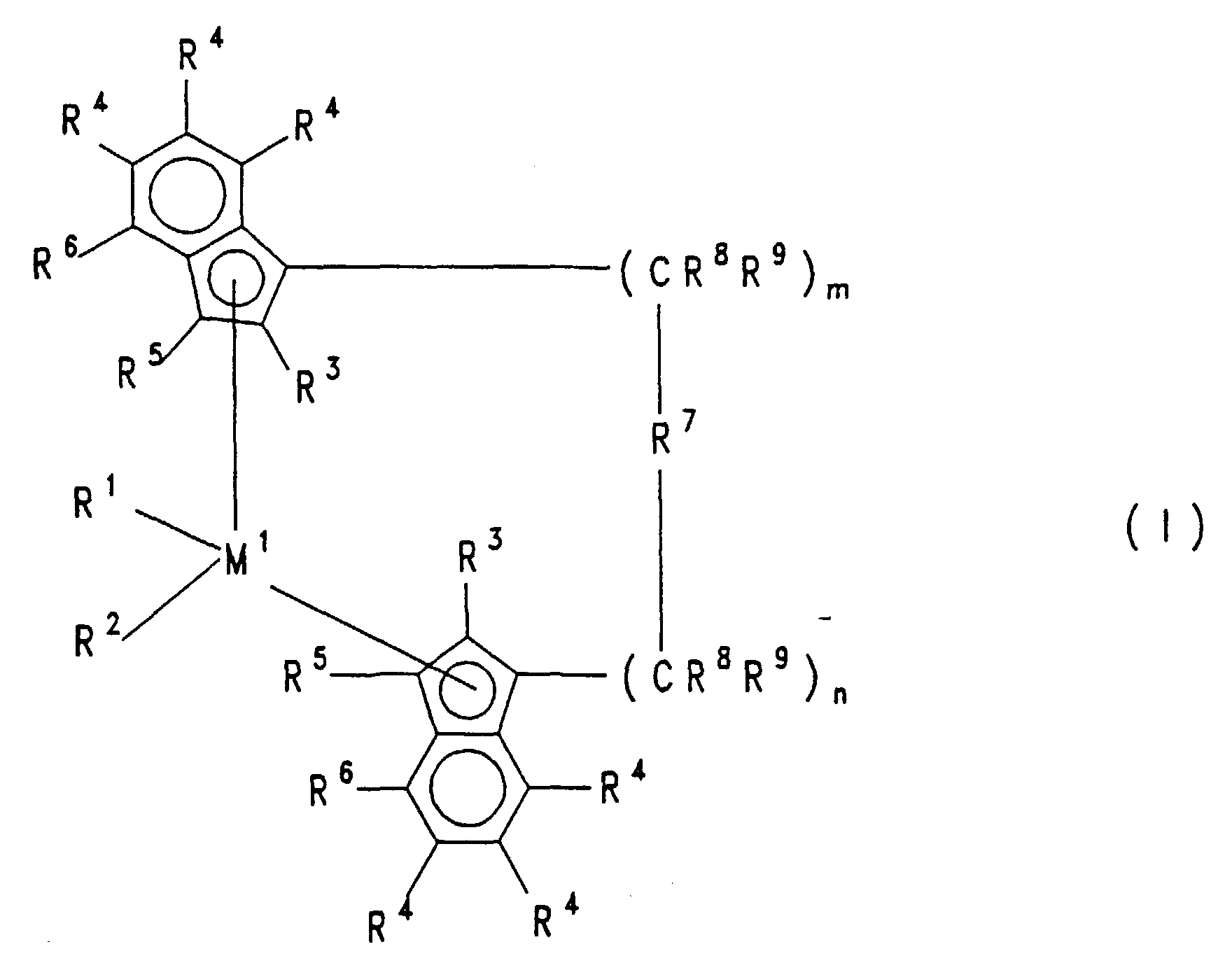
- the catalyst to be used for the process according to the invention consists of a cocatalyst and a metallocene of the formula I.
- M 1 is a metal from group IVb, Vb or VIb of the periodic table, for example titanium, zirconium, hafnium, vanadium, niobium, tantalum, chromium, molybdenum, tungsten, preferably zirconium, hafnium and titanium.
- R 1 and R 2 are the same or different and represent a hydrogen atom, a C 1 -C 10 , preferably C 1 -C 3 alkyl group, a C 1 -C 10 , preferably C 1 -C 3 alkoxy group, a C.
- the radicals R 4 and R 5 are identical or different and represent a hydrogen atom, a halogen atom, preferably a fluorine, chlorine or bromine atom, a C 1 -C 10 -, preferably C 1 -C 4 -alkyl group, which can be halogenated a C 6 -C 10 , preferably C 6 -C 9 aryl group which can be halogenated, an -NR 2 10 , -SR 10 , -OSiR 3 10 , -SiR 3 10 or -PR 2 10 residue, wherein R 10 is a halogen atom, preferably chlorine atom, or a C 1 -C 10 , preferably C 1 -C 3 alkyl group or C 6 -C 10 , preferably C 6 -C 8 aryl group.
- R 4 and R 5 are particularly preferably hydrogen, C 1 -C 4 alkyl or C 6 -C 9 aryl.
- R 3 and R 6 are the same or different and have the meaning described for R 4 , with the proviso that R 3 and R 6 must not be hydrogen.
- Preferred are R 3 and R 6 (C 1 -C 4 ) alkyl or C 6 -C 9 aryl, which can both be halogenated, such as methyl, ethyl, propyl, isopropyl, butyl, isobutyl, trifluoromethyl, phenyl, or tolyl Mesityl, especially methyl, isopropyl or phenyl.
- M 2 is silicon, germanium or tin, preferably silicon and germanium.
- R 8 and R 9 are the same or different and have the meaning given for R 11 .
- n and n are the same or different and are zero, 1 or 2, preferably zero or 1, where m plus n is zero, 1 or 2, preferably zero or 1.
- the particularly preferred metallocenes are thus the compounds of the formulas A and B.
- M 1 Zr, Hf
- R 4 and R 5 hydrogen and the meanings given for R 3 and R 6 , or R 4 can form an aliphatic or aromatic ring with R 6 , the same also applies to neighboring radicals R 4 ; and R 8 , R 9 , R 11 and R 12 with the meanings given above, in particular the compounds I listed in the exemplary embodiments.
- metallocenes described above can be prepared according to the following reaction scheme known from the literature:
- the compounds are obtained ex synthesis as rac: meso mixtures.
- fractional crystallization for example in a hydrocarbon, can be enriched in meso or rac form. This procedure is known and is current of the technique.
- an aluminoxane of the formula (II) is preferably used as the cocatalyst for the linear type and / or the formula (III) used for the cyclic type, where in the formulas (II) and (III) the radicals R 14 can be identical or different and denote a C 1 -C 6 alkyl group, a C 6 -C 18 aryl group, benzyl or hydrogen, and p is an integer from 2 to 50, preferably 10 to 35.
- R 14 radicals are preferably the same and are methyl, isobutyl, phenyl or benzyl, particularly preferably methyl.
- R 14 radicals are different, they are preferably methyl and hydrogen or, alternatively, methyl and isobutyl, hydrogen or isobutyl preferably containing 0.01-40% (number of the R 14 radicals).
- the aluminoxane can be prepared in various ways by known methods.
- One of the methods is, for example, that an aluminum hydrocarbon compound and / or a hydridoaluminum hydrocarbon compound is reacted with water (gaseous, solid, liquid or bound - for example as water of crystallization) in an inert solvent (such as toluene).
- an inert solvent such as toluene
- AlR 3 + AlR ' 3 two different aluminum trialkyls (AlR 3 + AlR ' 3 ) are reacted with water according to the desired composition (see S. Pasynkiewicz, Polyhedron 9 (1990) 429 and EP-A 302 424).
- all aluminoxane solutions are one changing content of unreacted aluminum starting compound, which in free form or as an adduct, together.
- the transition metal compound is preactivated in solution.
- the metallocene is preferably in a solution of the aluminoxane in one inert hydrocarbon dissolved.
- a suitable hydrocarbon is inert aliphatic or aromatic hydrocarbon. Toluene is preferred used.
- the concentration of the aluminoxane in the solution is in the range from about 1% by weight to the saturation limit, preferably from 5 to 30% by weight, based in each case on the total solution.
- the metallocene can be used in the same concentration, but preferably it is used in an amount of 10 -4 - 1 mol per mol of aluminoxane.
- the preactivation time is 5 minutes to 60 hours, preferably 5 to 60 minutes. One works at a temperature of -78 ° C to 100 ° C, preferably 0 to 70 ° C.
- the metallocene can also be prepolymerized or applied to a support will.
- prepolymerization preference is given to (or one of the) in the Polymerization used olefin (s) used.
- Suitable carriers are, for example, silica gels, aluminum oxides, solid aluminoxane or other inorganic carrier materials.
- a suitable carrier material is also a polyolefin powder in finely divided form.
- x denotes a number from 1 to 4, preferably 3, the R radicals are the same or different, preferably the same, and are C 1 -C 10 alkyl, C 6 -C 18 aryl or 2 radicals R form together with the atom connecting them is a ring, and the radicals R 'are the same or different, preferably the same, and are C 6 -C 18 aryl, which can be substituted by alkyl, haloalkyl or fluorine.
- R represents ethyl, propyl, butyl or phenyl and R 'represents phenyl, Pentafluorophenyl, 3,5-bistrifluoromethylphenyl, mesityl, xylyl or tolyl (cf. EP-A 277 003, EP-A 277 004 and EP-A 426 638).
- this reaction product is first preferably outside of the polymerization reactor in a separate step below Made using a suitable solvent.
- any compound is suitable as a cocatalyst according to the invention convert the neutral metallocene into a cation due to its Lewis acidity and this can stabilize ("unstable coordination").
- the Cocatalyst or the anion formed from it no further reactions with the enter formed metallocene cation (see. EP-A 427 697).
- cleaning with an aluminum alkyl for example AlMe 3 or AlEt 3 is advantageous. This cleaning can take place both in the polymerization system itself, or the olefin is brought into contact with the Al compound before it is added to the polymerization system and then separated off again.
- the polymerization or copolymerization is carried out in a known manner in solution, in suspension or in the gas phase, continuously or batchwise, in one or more stages at a temperature of -60 to 200 ° C., preferably 30 to 80 ° C., particularly preferably 50 to 80 ° C.
- R a and R b are the same or different and represent a hydrogen atom or an alkyl radical having 1 to 14 carbon atoms. However, R a and R b can also form a ring with the C atoms connecting them.
- olefins examples include ethylene, propylene, t-butene, 1-hexene, 4-methyl-1-pentene, 1-octene, norbornene or norbonadiene.
- propylene and ethylene are polymerized.
- the total pressure in the polymerization system is 0.5 up to 100 bar. Polymerization is particularly preferred in technical terms interesting pressure range from 5 to 64 bar.
- the metallocene is used in a concentration, based on the transition metal, of 10 -3 to 10 -8 , preferably 10 -4 to 10 -7 mol, transition metal per dm 3 solvent or per dm 3 reactor volume.
- the aluminoxane is used in a concentration of 10 -5 to 10 -1 mol, preferably 10 -4 to 10 -2 mol per dm 3 solvent or per dm 3 reactor volume.
- the other cocatalysts mentioned are used in approximately equimolar amounts to the metallocene. In principle, however, higher concentrations are also possible.
- the polymerization as a suspension or solution polymerization becomes a customary for the Ziegler low pressure process inert solvent used.
- an aliphatic or cycloaliphatic hydrocarbon propane, Butane, pentane, hexane, heptane, isooctane, cyclohexane, methylcyclohexane.
- a gasoline or hydrogenated diesel oil fraction can also be used.
- Toluene can also be used.
- Polymerization is preferably carried out in the liquid monomer.
- the monomers become gaseous or liquid added.
- the duration of the polymerization is arbitrary, since that to be used according to the invention Catalyst system only a small time-dependent drop in the Shows polymerization activity.
- the inventive method is characterized in that the meso-metallocenes described in the technically particularly interesting Temperature range between 50 and 80 ° C with high atactic polymers Generate molar mass. rac / meso mixtures of the metallocenes according to the invention produce particularly easy to process homogeneous polymers. Made from it Moldings are characterized by good surfaces and high transparency. In addition, high surface hardness and good flexural moduli are characteristics such molded parts.
- the high molecular weight atactic portion shows no stickiness and that Shaped bodies are also characterized by very good fogging behavior.
- the polymerization was stopped by adding 20 Ndm 3 CO 2 gas.
- the metallocene activities and the viscosity numbers of the atactic polymers obtained are summarized in Table 1.
- the triad distributions mm: mr: rr were typically approximately 25:50: 25 and the isotaxy index (mm + 1 ⁇ 2 mr) was below 60%. So it was undoubtedly typical atactic polypropylenes. This also confirms the solubility in boiling heptane or in diethyl ether.
- the polymers obtained were extracted with boiling ether or dissolved in a hydrocarbon with a boiling range of 140/170 ° C. and fractionally crystallized.
- the high molecular weight atactic part was separated and could be analyzed independently of the isotactic residue.
- the results are summarized in Table 2.
- the products are not sticky, molded articles made from them show no fogging and have an excellent surface and transparency. E.g.
- Example 5 was repeated, but instead of the pure meso form of the metallocene rac: meso ratios of 98: 2, 95: 5, 90:10, 85:15 and 75:25 were used.
- the results are summarized in Table 3.
- a non-sticky powder is obtained, molded articles made therefrom have a good surface, are not sticky and show no fogging.
- the hardness of the moldings is good, as is the transparency.
- Example 24 was repeated with 12 Ndm 3 hydrogen in the polymerization system.
- the polymerization time was 30 minutes.
- the metallocene activity was 586 kg PP / g metallocene x h.
- the ether-soluble fraction was 1.1% by weight at a VZ of 107 cm 3 / g, the ether-insoluble fraction was 98.9% by weight with a VZ of 151 cm 3 / g.
- Example 25 was repeated, but 70 g of ethylene were metered in continuously during the polymerization.
- the polymerization time was 45 minutes.
- the metallocene activity was 468 kg PP / g metallocene xh, the ethylene content of the copolymer was 3.3% by weight, the incorporation of the ethylene was largely isolated according to 13 C-NMR spectroscopy (statistical copolymer).
- a dry 150 dm 3 reactor was flushed with nitrogen and filled at 20 ° C. with 80 dm 3 of a dearomatized gasoline cut with a boiling range of 100 to 120 ° C.
- the reactor contents were heated to 60 ° C. and the hydrogen content in the reactor gas space was adjusted to 0.1% by metering in hydrogen and later kept constant during the polymerization by subsequent metering during the entire polymerization time (on-line check by gas chromatography).
- the polymer powder was separated off and dried for 48 hours at 80 ° C./200 mbar. 21.4 kg of block copolymer powder were obtained.
- the block copolymer contained 12.2% by weight of ethylene.
- the fractionation gave a content of 31.5% by weight of ethylene / propylene rubber and 3.7% by weight of atactic polypropylene with a VZ of 117 cm 3 / g in the total polymer.
- the isolated atactic part was of rubber-elastic consistency and completely transparent.
- the polymer powder obtained from the polymerization is not sticky, molded articles made from it have a good surface, are very transparent and show no fogging.
- Metallocene Polymer data rac: meso 1: 1 mixture 70 ° C polymerization temperature 30 ° C polymerization temperature VZ ether soluble [cm 3 / g] VZ ether insoluble [cm 3 / g] VZ ether soluble [cm 3 / g] VZ ether insoluble [cm 3 / g] Me 2 Si (indenyl) 2 ZrCl 2 45 42 46 75 Me 2 Si (2-methyl-1-indenyl) 2 ZrCl 2 50 180 56 340 Methylethylene (2-methyl-1-indenyl) 2 ZrCl 2 56 127 59 409 Ph (Me) Si (2-methyl-1-indenyl) 2 ZrCl 2 50 202 57 501 Me 2 Si (2-ethyl-1-indenyl) 2 ZrCl 2 59 187 61 443 Me 2 Si (2,4,5-trimethyl-1-cyclopentadienyl) 2 ZrCl 2 45 50 47 236
- Comparative Examples 1 to 10 were repeated with the pure meso forms of the metallocenes used there. Atactic polypropylene was obtained, but in no case a viscosity number VZ> 70 cm 3 / g was obtained. With these metallocenes not according to the invention, no high molecular weight atactic polypropylene can be produced. The products are liquid or at least soft and very sticky.
Landscapes
- Chemical & Material Sciences (AREA)
- Organic Chemistry (AREA)
- Health & Medical Sciences (AREA)
- Chemical Kinetics & Catalysis (AREA)
- Medicinal Chemistry (AREA)
- Polymers & Plastics (AREA)
- Inorganic Chemistry (AREA)
- Transition And Organic Metals Composition Catalysts For Addition Polymerization (AREA)
- Addition Polymer Or Copolymer, Post-Treatments, Or Chemical Modifications (AREA)
- Polymerization Catalysts (AREA)
- Superconductors And Manufacturing Methods Therefor (AREA)
- Diaphragms And Bellows (AREA)
- Emergency Protection Circuit Devices (AREA)
Abstract
R7 einen Rest
Description

- M1
- ein Metall der Gruppe IVb, Vb oder VIb des Periodensystems ist,
- R1 und R2
- gleich oder verschieden sind und ein Wasserstoffatom, eine C1-C10-Alkylgruppe, eine C1-C10-Alkoxygruppe, eine C6-C10-Arylgruppe, eine C6-C10-Aryloxygruppe, eine C2-C10-Alkenylgruppe, eine C7-C40-Arylalkylgruppe, eine C7-C40-Alkylarylgruppe, eine C8-C40-Arylalkenylgruppe oder ein Halogenatom bedeuten,
- die Reste R4 und R5
- gleich oder verschieden sind und ein Wasserstoffatom, ein Halogenatom, eine C1-C10-Alkylgruppe, die halogeniert sein kann, eine C6-C10-Arylgruppe, die halogeniert sein kann, einen -NR2 10, -SR10, -OSiR3 10, -SiR3 10 oder -PR2 10-Rest bedeuten, worin R10 ein Halogenatom, eine C1-C10-Alkylgruppe oder eine C6-C10-Arylgruppe ist,
- R3 und R6
- gleich oder verschieden sind und die für R4 genannte Bedeutung haben, mit der Maßgabe, daß R3 und R6 nicht Wasserstoff sind,
- R7
-

=PR11 oder =P(O)R11 ist,
wobei
- R11, R12 und R13
- gleich oder verschieden sind und ein Wasserstoffatom, ein Halogenatom, eine C1-C10-Alkylgruppe, C1-C10-Fluoralkylgruppe, eine C6-C10-Arylgruppe, eine C6-C10-Fluorarylgruppe, eine C1-C10-Alkoxygruppe, eine C2-C10-Alkenylgruppe, eine C7-C40-Arylalkylgruppe, eine C8-C40-Arylalkenylgruppe, eine C7-C40-Alkylarylgruppe bedeuten oder R11 und R12 oder R11 und R13 jeweils mit den sie verbindenden Atomen einen Ring bilden,
- M2
- Silizium, Germanium oder Zinn ist,
- R8 und R9
- gleich oder verschieden sind und die für R11 genannte Bedeutung haben und
- m und n
- gleich oder verschieden sind und null, 1 oder 2 sind, wobei m plus n null, 1 oder 2 ist.
- R7
-

=PR11 oder =P(O)R11, wobei R11, R12 und R13 gleich oder verschieden sind und ein Wasserstoffatom, ein Halogenatom, eine C1-C10-, vorzugsweise C1-C4-Alkylgruppe, insbesondere Methylgruppe, eine C1-C10-Fluoralkylgruppe, vorzugsweise CF3-Gruppe, eine C6-C10-, vorzugsweise C6-C8-Arylgruppe, eine C6-C10-Fluorarylgruppe, vorzugsweise Pentafluorphenylgruppe, eine C1-C10-, vorzugsweise C1-C4 -Alkoxygruppe, insbesondere Methoxygruppe, eine C2-C10-, vorzugsweise C2-C4-Alkenylgruppe, eine C7-C40-, vorzugsweise C7-C10-Arylalkylgruppe, eine C8-C40-, vorzugsweise C8-C12-Arylalkenylgruppe oder eine C7-C40-, vorzugsweise C7-C12-Alkylarylgruppe bedeuten, oder R11 und R12 oder R11 und R13 bilden jeweils zusammen mit den sie verbindenden Atomen einen Ring.

M1 = Zr, Hf; R1, R2 = Methyl, Chlor, R3 und R6 = Methyl, Isopropyl, Phenyl, Ethyl, Trifluormethyl; R4 und R5 = Wasserstoff und den für R3 und R6 genannten Bedeutungen, oder R4 kann mit R6 einen aliphatischen oder aromatischen Ring bilden, gleiches gilt auch für benachbarte Reste R4; und R8, R9, R11 und R12 mit den obengenannten Bedeutungen, insbesondere die in den Ausführungsbeispielen aufgeführten Verbindungen I.


- VZ =
- Viskositätszahl in cm3/g

- Schmp. =
- Schmelzpunkt ermittelt mit DSC (20°C/min Aufheiz-/Abkühlgeschwindigkeit)
- II =
- Isotaktischer Index (II = mm+ 1/2 mr) ermittelt durch 13C-NMR-Spektroskopie
- niso =
- Isotaktische Blocklänge (niso = 1 + 2 mm / mr)
- nsyn =
- Syndiotaktische Blocklänge (nsyn = 1 + 2 rr / mr)
Dann wurden 35 cm3 toluolische Methylaluminoxanlösung (entsprechend 52 mmol Al, mittlerer Oligomensierungsgrad p = 18) zugegeben und der Ansatz bei 30°C 15 Minuten geführt. Parallel dazu wurden 7,5 mg des in Tabelle 1 aufgeführten meso-Metallocens in 13,5 cm3 toluolischer Methylaluminoxanlösung (30 mmol Al) gelöst und durch 15 minütiges Stehenlassen voraktiviert.
Die Lösung wurde dann in den Reaktor gegeben und auf 70°C bzw. 50°C (Tabelle 1) aufgeheizt (10°C/min). Die Polymerisationsdauer war 1 h. Gestoppt wurde die Polymerisation durch Zugabe von 20 Ndm3 CO2-Gas. Die Metallocenaktivitäten und die Viskositätszahlen der dabei erhaltenen ataktischen Polymere sind in Tabelle 1 zusammengestellt. Die 13C-NMR-Analysen ergaben in allen Fällen isotaktische Blocklängen niso < 4, typisch war niso = 2, die syndiotaktische Blocklänge lag typisch ebenfalls im Bereich von 2. Die Triadenverteilungen mm : mr: rr waren typisch etwa 25 : 50 : 25 und der Isotaxieindex (mm + ½ mr) lag unter 60 %. Es handelte sich also zweifelsfrei um typische ataktische Polypropylene.
Dies belegt auch die Löslichkeit in siedendem Heptan beziehungsweise in Diethylether.
| meso-Metallocen | Polymarisations temperatur [°C] | Aktivität [kg PP/g Metallocen x h] | VZ [cm3/g] | Bsp. |
| Me2Si(2,4-dimethyl-1-indenyl)2ZrCl2 | 50 | 35,7 | 125 | 1 |
| Me2Si(2-methyl-4-isopropyl-1-indenyl)2ZrCl2 | 70 | 60,4 | 93 | 2 |
| Me2Si(2-ethyl-4-methyl-1-indenyl)2ZrCl2 | 70 | 70,3 | 101 | 3 |
| Ph(Me)Si(2-methyl-4-isopropyl-1-indenyl)2ZrCl2 | 50 | 20,6 | 120 | 4 |
| Me2Si(2-methyl-4,5-benzoindenyl)2ZrCl2 | 70 | 200,0 | 120 | 5 |
| Me2Si(2-methyl-4,5-benzoindenyl)2ZrCl2 | 50 | 60,4 | 150 | 6 |
| Me2Si(2,4,6-trimethyl-1-indenyl)2ZrCl2 | 50 | 30,1 | 163 | 7 |
| Me2Si(2-methyl-4,6-diisopropyl-1-indenyl)2ZrCl2 | 50 | 24,5 | 89 | 8 |
| Me2Si(2-methyl-α-acenaphthindenyl)2ZrCl2 | 50 | 49,3 | 224 | 9 |
| Me2Si(2-methyl-α-acenaphthindenyl)2ZrCl2 | 70 | 189,4 | 140 | 10 |
| Me2Si(2-methyl-4-phenyl-1-indenyl)2ZrCl2 | 70 | 64,5 | 131 | 11 |
| Me2Si(2-methyl-4-phenyl-1-indenyl)2ZrCl2 | 50 | 32,5 | 169 | 12 |
| Ethylen(2,4,6-trimethyl-1-indenyl)2ZrCl2 | 70 | 145,5 | 124 | 13 |
| Ethylen(2-methyl-4,5-benzoindenyl)2ZrCl2 | 50 | 94,9 | 109 | 14 |
| Methylethylen(2-methyl-α-acenaphthindenyl)2ZrCl2 | 50 | 64,3 | 204 | 15 |
| Ph(Me)Si(2-methyl-α-acenaphthindenyl)2ZrCl2 | 50 | 69,8 | 198 | 16 |
| Bsp. | rac:meso = 1:1-Metallocenmischung | Aktivität [kg PP/g Metallocen x h] | Etherlöslicher ataktischer Anteil | Etherunlöslicher isotaktischer Anteil | ||
| Gew.-% | VZ [cm3/g] | Gew.-% | VZ [cm3/g] | |||
| 17 | Me2Si(2,4-dimethyl-1-indenyl)2ZrCl2 | 69,5 | 25,4 | 117 | 74,6 | 216 |
| 18 | Ph(Me)Si(2-methyl-4-isopropyl-1-indenyl)2ZrCl2 | 102,3 | 12,0 | 124 | 88,0 | 280 |
| 19 | Me2Si(2,4,6-trimethyl-1-indenyl)2ZrCl2 | 114,0 | 18,5 | 152 | 71,5 | 245 |
| 20 | Me2Si(2-methyl-α-acenaphthindenyl)2ZrCl2 | 61,4 | 44,9 | 209 | 53,1 | 438 |
| 21 | Me2Si(2-methyl-4-phenyl-1-indenyl)2ZrCl2 (5 mg) | 334,5 | 5,5 | 177 | 94,5 | 887 |
| 22 | Methylethylen(2-methyl-α-acenaphthindenyl)2ZrCl2 | 85,2 | 36,9 | 199 | 63,1 | 365 |
| 23 | Ph(Me)Si(2-methyl-α-acenaphthindenyl)2ZrCl2 | 79,1 | 31,2 | 205 | 68,8 | 465 |
| Bsp. | rac:meso | Aktivität [kg PP/g Metallocen x h] | Etherlöslicher ataktischer Anteil | Etherunlöslicher isotaktischer Anteil | ||
| Gew.-% | VZ [cm3/g] | Gew.-% | VZ [cm3g] | |||
| 24 | 98 : 2 | 436 | 0,95 | 134 | 99,05 | 285 |
| 25 | 95 : 5 | 410 | 2,7 | 119 | 97,3 | 276 |
| 26 | 90 : 10 | 415 | 4,3 | 122 | 95,7 | 296 |
| 27 | 85 : 15 | 370 | 7,3 | 125 | 92,7 | 300 |
| 28 | 75 : 25 | 347 | 15,2 | 130 | 84,8 | 280 |
Der Reaktorinhalt wurde auf 60°C aufgeheizt und durch Zudosierung von Wasserstoff wurde der Wasserstoffgehalt im Reaktorgasraum auf 0,1 % eingestellt und später während der Polymerisation dann durch Nachdosierung während der gesamten Polymerisationszeit konstant gehalten (Überprüfung on-Line durch Gaschromatographie).
10,7 mg rac:meso (95:5) des Metallocens Dimethylsilandiylbis(2-methyl-4,5-benzoindenyl)-zirkondichlorid wurden in 32 cm3 toluolischer Methylaluminoxanlösung (50 mmol) gelöst und in den Reaktor gegeben. Die Polymerisation erfolgte in einer ersten Stufe bei 60°C 8 h lang.
In einer zweiten Stufe wurden dann bei 47°C 2,8 kg Ethylen schnell zugegeben und nach weiteren 5 h Polymerisation bei dieser Temperatur wurde die Polymerisation durch Ablassen des Reaktorinhalts in einem 280 l-Reaktor, der mit 100 l Aceton gefüllt war, beendet. Das Polymerpulver wurde abgetrennt und 48 h bei 80°C/200 mbar getrocknet. Es wurden 21,4 kg Blockcopolymerpulver erhalten. VZ = 359 cm3/g; Mw = 402 000 g/mol, Mw/Mn = 4,0; MFI (230/5) = 9,3 dg/min. Das Blockcopolymer enthielt 12,2 Gew.-% Ethylen. Die Fraktionierung ergab einen Gehalt von 31,5 Gew.-% Ethylen/Propylen-Kautschuk und 3,7 Gew.-% ataktisches Polypropylen mit einer VZ von 117 cm3/g im Gesamtpolymer.
| Polymerisationstemperatur[°C] | Aktivität [kgPP/g Metallocen xh] | VZ [cm3/g] | Mw/Mn | Mw [g/mol] |
| 70 | 58.3 | 205 | 2.0 | 249 500 |
| 50 | 31.7 | 335 | 2.1 | 425 500 |
| Polymerisationstemperatur[°C] | Aktivität [kgPP/g Metallocen xh] | VZ [cm3/g] | Mw/Mn | Mw [g/mol] |
| 70 | 112.5 | 559 | 3.5 | 738 000 |
| 50 | 51.0 | 1084 | 3.6 | 1.35 · 106 |
Das aus der Polymerisation anfallende Polymerpulver ist nicht klebrig, daraus hergestellte Formkörper weisen eine gute Oberfläche auf, sind sehr transparent und zeigen kein Fogging.
Es resultierten 1,57 kg Polypropylen-Pulver.Die Fraktionierung des Polymers mittels Etherextraktion ergab einen Etherlöslichen ataktischen Anteil von 8,9 Gew.-% (VZ = 149 cm3/g) und einen unlöslichen isotaktischen Anteil von 91,1 Gew.-% mit einer VZ von 489 cm3/g.
Das so hergestellte Pulver ist nicht klebrig, daraus hergestellte Formkörper zeigen im Wärmealterungstest kein Fogging, Härte und Transparenz der Formkörper sind sehr gut.
| Metallocen | Polymerdaten | |||
| rac:meso = 1:1 Mischung | 70°C Polymerisationstemperatur | 30°C Polymerisationstemperatur | ||
| VZ etherlöslich [cm3/g] | VZ etherunlöslich [cm3/g] | VZ etherlöslich [cm3/g] | VZ etherunlöslich [cm3/g] | |
| Me2Si(indenyl)2ZrCl2 | 45 | 42 | 46 | 75 |
| Me2Si(2-methyl-1-indenyl)2ZrCl2 | 50 | 180 | 56 | 340 |
| Methylethylen(2-methyl-1-indenyl)2ZrCl2 | 56 | 127 | 59 | 409 |
| Ph(Me)Si(2-methyl-1-indenyl)2ZrCl2 | 50 | 202 | 57 | 501 |
| Me2Si(2-ethyl-1-indenyl)2ZrCl2 | 59 | 187 | 61 | 443 |
| Me2Si(2,4,5-trimethyl-1-cyclopentadienyl)2ZrCl2 | 45 | 50 | 47 | 236 |
| Me2Si(2,4,5-trimethyl-1-cyclopentadienyl)2HfCl2 | 59 | 175 | 69 | 356 |
| Me2Si(indenyl)2HfCl2 | 61 | 237 | 63 | 398 |
| Ethylen(2-methyl-1-indenyl)2ZrCl2 | 47 | 85 | 50 | 135 |
| Me2Si(2-methyl-4-t-butyl-1-cyclopentadenyl)2ZrCl2 | 28 | 31 | 35 | 105 |
Claims (3)
- Verbindung der Formel I in ihrer reinen meso-Form oder als meso:rac 1:99-Mischungworin

- M1
- ein Metall der Gruppe IVb, Vb oder VIb des Periodensystems ist,
- R1 und R2
- gleich oder verschieden sind und ein Wasserstoffatom, eine C1-C10-Alkylgruppe, eine C1-C10-Alkoxygruppe, eine C6-C10-Arylgruppe, eine C6-C10-Aryloxygruppe, eine C2-C10-Alkenylgruppe, eine C7-C40-Arylalkylgruppe, eine C7-C40-Alkylarylgruppe, eine C8-C40-Arylalkenylgruppe oder ein Halogenatom bedeuten,
- die Reste R4 und R5
- gleich oder verschieden sind und ein Wasserstoffatom, ein Halogenatom, eine C1-C10-Alkylgruppe, die halogeniert sein kann, eine C6-C10-Alkylgruppe, die halogeniert sein kann, einen -NR2 10, - SR10, -OSiR3 10,-SiR3 10 oder -PR2 10-Rest bedeuten, worin R10 ein Halogenatom, eine C1-C10-Alkylgruppe oder eine C6-C10-Arylgruppe ist,
- R3 und R6
- gleich oder verschieden sind und die für R4 genannte Bedeutung haben, mit der Maßgabe, daß R3 und R6 nicht Wasserstoff sind,
- R7
=PR11 oder =P(O)R11 ist,
wobei- R11, R12 und R13
- gleich oder verschieden sind und ein Wasserstoffatom, ein Halogenatom, eine C1-C10-Alkylgruppe, C1-C10-Fluoralkylgruppe, eine C6-C10-Arylgruppe, eine C6-C10-Fluorarylgruppe, eine C1-C10-Alkoxygruppe, eine C2-C10-Alkenylgruppe, eine C7-C40-Arylalkylgruppe, eine C8-C40-Arylalkenylgruppe, eine C7-C40-Alkylarylgruppe bedeuten oder R11 und R12 oder R11 und R13 jeweils mit den sie verbindenden Atomen einen Ring bilden,
- M2
- Silizium, Germanium oder Zinn ist,
- R8 und R9
- gleich oder verschieden sind und die für R11 genannte Bedeutung haben und
- m und n
- gleich oder verschieden sind und null, 1 oder 2 sind, wobei m plus n null, 1 oder 2 ist,
meso-Dimethylsilylbis(1-(2-methyl-4-ethylindenyl))zirkondichlorid,meso-Dimethylsilylbis(1-(2-methyl-4-isopropylindenyl))zirkondichlorid,meso-Dimethylsilylbis(1-(2-methyl-4-tert-butylindenyl))zirkondichlorid,meso/meso/rac(1:1:2)-Methylphenylsilylbis(1-(2-methyl-4-isopropylindenyl))zirkondichlorid,meso/rac(5:1)-Dimethylsilylbis(1-(2-ethyl-4-methylindenyl))zirkondichlorid.meso/rac(1:1)-Dimethylsilylbis(1-(2,4-dimethylindenyl))zirkondichlorid,meso/rac(1:3)-Dimethylsilylbis(1-(2-methyl-4,6-disopropylindenyl))zirkondichlorid,meso/rac(1:2)-Methylphenylsilylbis(1-(2-methyl-4,6-diisopropylindenyl))zirkondichlorid,meso/rac-1,2-Butandiylbis(1-(2-methyl-4,6-diisopropylindenyl))zirkondichlorid,meso/rac(1:2)-Dimethylsilylbis(1-(2,4,6-trimethylindenyl))zirkondichlorid,meso/rac(1:2)-1,2-Ethandiylbis(1-(2-methyl-4,6-diisopropylindenyl))zirkondichlorid;meso/rac(1:1)-Dimethylsilylbis(2-methyl-α-acenaphthindenyl)zirkondichlorid,meso/rac-Methylphenylsilylbis(1-(2-methyl-4,5-benzoindenyl))zirkondichlorid,meso/rac-Methylphenylsilylbis(2-methyl-α-acenaphthindenyl)zirkondichlorid,rac-1,2-Butandiylbis(1-(2-methyl-4,5-benzoindenyl))zirkondichlorid,meso/rac(1:3)-Dimethylsilylbis(1-(2-methyl-4,5-benzoindenyl))zirkondichlorid,meso/rac(1:1)-Dimethylsilylbis(1-(2-methyl-4-phenylindenyl))zirkondichlorid,meso/rac(1:1)-Dimethylsilylbis(1-(2-ethyl-4-phenylindenyl))zirkondichlorid,meso/rac(1:1)-Dimethylsilylbis(1-(2-methyl-4-(1-naphthyl)indenyl))zirkondichlorid,meso/rac(1:1)-Dimethylsilylbis(1-(2-methyl-4-(2-naphthyl)indenyl))zirkondichlorid,meso/rac(1:1)-Ethandiylbis(1-(2-methyl-4-phenylindenyl))zirkondichlorid ausgeschlossen sind. - Verbindung gemäß Anspruch 13, dadurch gekennzeichnet, daß in Formel I M1 Zr oder Hf, R1 und R2 gleich oder verschieden sind und Methyl oder Chlor, R3 und R6 gleich oder verschieden sind und Methyl, Isopropyl, Phenyl, Ethyl oder Trifluormethyl, R4 und R5 Wasserstoff und die für R3 und R6 genannte Bedeutung haben oder R4 mit R6 einen aliphatischen oder aromatischen Ring bildet, oder benachbarte Reste R4 einen solchen Ring bilden, und
R7 einen Restund m plus n null oder 1 bedeuten.
- Verwendung eines Metallocens der Formel I gemäß den Ansprüchen 1 bis 2 als Katalysator bei der Olefinpolymerisation.
Applications Claiming Priority (3)
| Application Number | Priority Date | Filing Date | Title |
|---|---|---|---|
| DE4227049 | 1992-08-15 | ||
| DE4227049 | 1992-08-15 | ||
| EP93112580A EP0584609B1 (de) | 1992-08-15 | 1993-08-05 | Verfahren zur Herstellung von Polyolefinen |
Related Parent Applications (2)
| Application Number | Title | Priority Date | Filing Date |
|---|---|---|---|
| EP93112580.1 Division | 1993-08-05 | ||
| EP93112580A Division EP0584609B1 (de) | 1992-08-15 | 1993-08-05 | Verfahren zur Herstellung von Polyolefinen |
Publications (2)
| Publication Number | Publication Date |
|---|---|
| EP0882731A2 true EP0882731A2 (de) | 1998-12-09 |
| EP0882731A3 EP0882731A3 (de) | 2000-05-31 |
Family
ID=6465634
Family Applications (2)
| Application Number | Title | Priority Date | Filing Date |
|---|---|---|---|
| EP98116079A Withdrawn EP0882731A3 (de) | 1992-08-15 | 1993-08-05 | Verbrückte Metallocenverbindungen und ihre Verwendung als Olefinpolymerisationskatalysatore |
| EP93112580A Expired - Lifetime EP0584609B1 (de) | 1992-08-15 | 1993-08-05 | Verfahren zur Herstellung von Polyolefinen |
Family Applications After (1)
| Application Number | Title | Priority Date | Filing Date |
|---|---|---|---|
| EP93112580A Expired - Lifetime EP0584609B1 (de) | 1992-08-15 | 1993-08-05 | Verfahren zur Herstellung von Polyolefinen |
Country Status (12)
| Country | Link |
|---|---|
| US (4) | US5672668A (de) |
| EP (2) | EP0882731A3 (de) |
| JP (1) | JP3548755B2 (de) |
| KR (2) | KR100283825B1 (de) |
| AT (1) | ATE177436T1 (de) |
| AU (1) | AU666565B2 (de) |
| CA (1) | CA2104036A1 (de) |
| DE (1) | DE59309424D1 (de) |
| ES (1) | ES2128371T3 (de) |
| FI (1) | FI110103B (de) |
| TW (1) | TW309524B (de) |
| ZA (1) | ZA935924B (de) |
Cited By (5)
| Publication number | Priority date | Publication date | Assignee | Title |
|---|---|---|---|---|
| WO1999042497A1 (de) * | 1998-02-19 | 1999-08-26 | Targor Gmbh | Katalysatorsystem, verfahren zu seiner herstellung und seine verwendung zur polymerisation von olefinen |
| US7812104B2 (en) | 2008-01-18 | 2010-10-12 | Exxonmobil Chemical Patents Inc. | Production of propylene-based polymers |
| US7868197B2 (en) | 2005-12-14 | 2011-01-11 | Exxonmobil Chemical Patents Inc. | Halogen substituted heteroatom-containing metallocene compounds for olefin polymerization |
| US8058371B2 (en) | 2002-09-20 | 2011-11-15 | Exxonmobil Chemical Patents Inc. | Super-solution homogeneous propylene polymerization |
| US8318875B2 (en) | 2008-01-18 | 2012-11-27 | Exxonmobil Chemical Patents Inc. | Super-solution homogeneous propylene polymerization and polypropylenes made therefrom |
Families Citing this family (97)
| Publication number | Priority date | Publication date | Assignee | Title |
|---|---|---|---|---|
| US5504169A (en) * | 1989-09-13 | 1996-04-02 | Exxon Chemical Patents Inc. | Process for producing amorphous poly-α-olefins with a monocyclopentadienyl transition metal catalyst system |
| TW309523B (de) * | 1991-11-30 | 1997-07-01 | Hoechst Ag | |
| US5830821A (en) * | 1991-11-30 | 1998-11-03 | Targor Gmbh | Process for olefin preparation using metallocenes having benzo-fused indenyl derivatives as ligands |
| TW294669B (de) * | 1992-06-27 | 1997-01-01 | Hoechst Ag | |
| USRE39156E1 (en) | 1992-08-15 | 2006-07-04 | Basell Polyolefine Gmbh | Process for the preparation of polyolefins |
| ES2128371T3 (es) | 1992-08-15 | 1999-05-16 | Targor Gmbh | Procedimiento para la obtencion de poliolefinas. |
| IT1271406B (it) * | 1993-09-13 | 1997-05-28 | Spherilene Srl | Procedimento per la preparazione di polimeri dell'etilene e prodotti ottenuti |
| US5817590A (en) * | 1993-10-14 | 1998-10-06 | Tosoh Corporation | Catalyst for αE --olefin polymerization containing a Lewis base |
| WO1996020225A2 (en) * | 1994-12-20 | 1996-07-04 | Montell Technology Company B.V. | Reactor blend polypropylene, process for the preparation thereof and process for preparing metallocene ligands |
| IT1270253B (it) * | 1994-06-20 | 1997-04-29 | Spherilene Srl | Copolimeri dell'etilene e procedimento per la preparazione di polimeri dell'etilene |
| ES2143636T3 (es) * | 1994-06-24 | 2000-05-16 | Exxon Chemical Patents Inc | Sistemas de catalizadores de polimerizacion, su produccion y uso. |
| KR100348236B1 (ko) * | 1994-12-20 | 2002-11-30 | 미쓰이 가가쿠 가부시키가이샤 | 에틸렌중합체의제조방법및에틸렌중합체 |
| IT1272923B (it) * | 1995-01-23 | 1997-07-01 | Spherilene Srl | Composti metallocenici,procedimento per la loro preparazione,e loro utilizzo in catalizzatori per la polimerizzazione delle olefine |
| IT1272922B (it) * | 1995-01-23 | 1997-07-01 | Spherilene Srl | Procedimento per la preparazione di composti metallocenici |
| US5516848A (en) * | 1995-01-31 | 1996-05-14 | Exxon Chemical Patents Inc. | Process to produce thermoplastic elastomers |
| US5539056A (en) * | 1995-01-31 | 1996-07-23 | Exxon Chemical Patents Inc. | Thermoplastic elastomers |
| TR28706A (tr) * | 1995-02-14 | 1997-01-13 | Royal Mobilya Dekorasyon Ve Ak | Yatak haline dönüsebilen koltuk ya da kanepeler icin hareket mekanizmalari. |
| ATE223929T1 (de) * | 1995-05-16 | 2002-09-15 | Univation Tech Llc | Herstellung von polyethylen unter verwendung eines stereoisomeren metallocens |
| UA47394C2 (uk) * | 1995-05-16 | 2002-07-15 | Юнівейшн Текнолоджіз, Ллс | Етиленовий полімер, який має підвищену придатність до обробки та вирiб, що містить етиленовий полімер |
| US6787618B1 (en) | 1995-12-01 | 2004-09-07 | Basell Polypropylen Gmbh | Metallocene compound and high molecular weight copolymers of propylene and olefins having two or four to thirty-two carbon atoms |
| DE19544828A1 (de) * | 1995-12-01 | 1997-06-05 | Hoechst Ag | Hochmolekulare Copolymere |
| FI104826B (fi) * | 1996-01-30 | 2000-04-14 | Borealis As | Heteroatomilla substituoituja metalloseeniyhdisteitä olefiinipolymerointikatalyytti-systeemejä varten ja menetelmä niiden valmistamiseksi |
| US6211310B1 (en) | 1997-06-05 | 2001-04-03 | Union Carbide Chemicals & Plastics Technology Corporation | Manufacture of stereoregular polymers |
| US5693727A (en) * | 1996-06-06 | 1997-12-02 | Union Carbide Chemicals & Plastics Technology Corporation | Method for feeding a liquid catalyst to a fluidized bed polymerization reactor |
| DE69720609T2 (de) * | 1996-07-16 | 2003-11-13 | Basell Polyolefine Gmbh | Verfahren zur Modifikation von die Rac/Meso-Verhältnis einer Metallocenverbindung |
| DE19637669A1 (de) * | 1996-09-16 | 1998-03-19 | Hoechst Ag | Verfahren zur Herstellung einer methylenverbrückten Biscyclopentadienylverbindung |
| WO1998022477A1 (en) * | 1996-11-22 | 1998-05-28 | Boulder Scientific Company | Preparation of chiral titanocenes |
| US5847176A (en) * | 1997-06-30 | 1998-12-08 | Boulder Scientific Company | Preparation of chiral titanocenes |
| FI971565A7 (fi) * | 1997-04-14 | 1998-10-15 | Borealis As | Olefiinien polymerointiin tarkoitettujen katalysaattorisysteemien substituoituja metalloseeniyhdisteitä, niiden välituotteet ja valmistusmenetelmä |
| US6160072A (en) * | 1997-05-02 | 2000-12-12 | Ewen; John A. | Process for polymerizing tactioselective polyolefins in condensed phase using titanocenes |
| KR20000068602A (ko) * | 1997-07-22 | 2000-11-25 | 나까니시 히로유끼 | 에틸렌/α-올레핀 공중합체, 그 조성물 및, 공중합체 및 조성물 |
| US6265512B1 (en) | 1997-10-23 | 2001-07-24 | 3M Innovative Company | Elastic polypropylenes and catalysts for their manufacture |
| KR100274973B1 (ko) * | 1997-11-24 | 2000-12-15 | 성재갑 | 올레핀계 단량체의 중합 촉매 |
| EP0953582A1 (de) * | 1998-04-27 | 1999-11-03 | Fina Research S.A. | Herstellung von Polyolefin |
| ES2220058T3 (es) | 1998-05-13 | 2004-12-01 | Exxonmobil Chemical Patents Inc. | Homopolimeros de propileno y metodos de fabricarlos. |
| US6784269B2 (en) | 1998-05-13 | 2004-08-31 | Exxonmobil Chemical Patents Inc. | Polypropylene compositions methods of making the same |
| US6306960B1 (en) | 1998-05-13 | 2001-10-23 | Exxonmobil Chemical Patents Inc. | Articles formed from foamable polypropylene polymer |
| EP1017729B1 (de) | 1998-07-02 | 2005-09-14 | Basell Polyolefine GmbH | Verfahren zur herstellung von amorphen alpha-olefinpolymeren, diese enthaltende zusammensetzungen und verfahren zur herstellung von verbrückten liganden |
| US6177527B1 (en) * | 1998-09-08 | 2001-01-23 | Union Carbide Chemical & Plastics Technology Corporation | Process for the preparation of polyethylene or polypropylene |
| US6174930B1 (en) | 1999-04-16 | 2001-01-16 | Exxon Chemical Patents, Inc. | Foamable polypropylene polymer |
| US6750284B1 (en) * | 1999-05-13 | 2004-06-15 | Exxonmobil Chemical Patents Inc. | Thermoplastic filled membranes of propylene copolymers |
| US6500563B1 (en) | 1999-05-13 | 2002-12-31 | Exxonmobil Chemical Patents Inc. | Elastic films including crystalline polymer and crystallizable polymers of propylene |
| DE60017889T2 (de) | 1999-05-13 | 2006-04-06 | Exxonmobil Chemical Patents Inc., Baytown | Elastische fasern und daraus hergestellte artikel, die kristalline und kristallisierbare propylenpolymere enthalten |
| WO2001027169A1 (en) * | 1999-10-08 | 2001-04-19 | The Procter & Gamble Company | Bodies of polymeric material comprising linear, isotactic polymers |
| US6863989B1 (en) | 1999-10-08 | 2005-03-08 | The Procter & Gamble Company | Adhesives comprising linear isotactic polymers |
| US6746780B1 (en) | 1999-10-08 | 2004-06-08 | The Procter & Gamble Company | Bodies of polymeric material comprising linear, isotactic polymers |
| DE60006146T2 (de) | 1999-11-04 | 2004-09-30 | Exxonmobil Chemical Patents Inc., Baytown | Propylencopolymerschäume und deren verwendung |
| US6809168B2 (en) * | 1999-12-10 | 2004-10-26 | Exxonmobil Chemical Patents Inc. | Articles formed from propylene diene copolymers |
| CN1407995A (zh) * | 1999-12-10 | 2003-04-02 | 埃克森化学专利公司 | 丙烯-二烯共聚的聚合物 |
| US6977287B2 (en) * | 1999-12-10 | 2005-12-20 | Exxonmobil Chemical Patents Inc. | Propylene diene copolymers |
| MXPA02006199A (es) * | 1999-12-22 | 2003-10-15 | Exxon Chemical Patents Inc | Composiciones adhesivas a base de polipropileno. |
| US6384142B1 (en) | 2000-02-08 | 2002-05-07 | Exxonmobil Chemical Patents Inc. | Propylene impact copolymers |
| DE60122396T2 (de) * | 2000-02-08 | 2007-09-06 | Exxonmobil Chemical Patents Inc., Baytown | Schlagzähe Propylencopolymerisate |
| US7074863B2 (en) * | 2001-06-22 | 2006-07-11 | Borealis Technology Oy | Metallocene catalysts containing an idenyl moiety substituted at the 4,-5,-6- or 7-position by a siloxy or germyloxy group |
| US6916892B2 (en) * | 2001-12-03 | 2005-07-12 | Fina Technology, Inc. | Method for transitioning between Ziegler-Natta and metallocene catalysts in a bulk loop reactor for the production of polypropylene |
| KR100458600B1 (ko) * | 2002-02-07 | 2004-12-03 | 주식회사 엘지화학 | 메틸렌 브릿지된 메탈로센 촉매를 이용한 올레핀-시클릭올레핀 공중합체의 제조 방법 |
| US6706828B2 (en) * | 2002-06-04 | 2004-03-16 | Crompton Corporation | Process for the oligomerization of α-olefins having low unsaturation |
| US20030236365A1 (en) * | 2002-06-24 | 2003-12-25 | Fina Technology, Inc. | Polyolefin production with a high performance support for a metallocene catalyst system |
| US20080153997A1 (en) * | 2006-12-20 | 2008-06-26 | Exxonmobil Research And Engineering | Polymer production at supercritical conditions |
| US8008412B2 (en) | 2002-09-20 | 2011-08-30 | Exxonmobil Chemical Patents Inc. | Polymer production at supersolution conditions |
| US7550528B2 (en) | 2002-10-15 | 2009-06-23 | Exxonmobil Chemical Patents Inc. | Functionalized olefin polymers |
| WO2004046214A2 (en) | 2002-10-15 | 2004-06-03 | Exxonmobil Chemical Patents Inc. | Multiple catalyst system for olefin polymerization and polymers produced therefrom |
| US7541402B2 (en) | 2002-10-15 | 2009-06-02 | Exxonmobil Chemical Patents Inc. | Blend functionalized polyolefin adhesive |
| US7223822B2 (en) | 2002-10-15 | 2007-05-29 | Exxonmobil Chemical Patents Inc. | Multiple catalyst and reactor system for olefin polymerization and polymers produced therefrom |
| US7700707B2 (en) | 2002-10-15 | 2010-04-20 | Exxonmobil Chemical Patents Inc. | Polyolefin adhesive compositions and articles made therefrom |
| US7195806B2 (en) * | 2003-01-17 | 2007-03-27 | Fina Technology, Inc. | High gloss polyethylene articles |
| DE10303225A1 (de) * | 2003-01-28 | 2004-08-05 | Inventis Technologies Gmbh | Katalysatorkombination, isotaktische Polymere sowie ein Verfahren zur Herstellung von linearen isotaktischen Polymeren und dessen Verwendung |
| JP2005099712A (ja) * | 2003-08-28 | 2005-04-14 | Sharp Corp | 表示装置の駆動回路および表示装置 |
| US20050234198A1 (en) * | 2004-04-20 | 2005-10-20 | Fina Technology, Inc. | Heterophasic copolymer and metallocene catalyst system and method of producing the heterophasic copolymer using the metallocene catalyst system |
| ATE445650T1 (de) * | 2004-05-04 | 2009-10-15 | Basell Polyolefine Gmbh | Verfahren zur herstellung von ataktischen 1- butenpolymeren |
| JP2008506825A (ja) * | 2004-07-22 | 2008-03-06 | バーゼル・ポリオレフィン・ゲーエムベーハー | フラクション化可能な1−ブテンポリマー類の製造法 |
| ATE388994T1 (de) * | 2004-07-22 | 2008-03-15 | Basell Polyolefine Gmbh | 1-butenpolymerzusammensetzung |
| US7169864B2 (en) * | 2004-12-01 | 2007-01-30 | Novolen Technology Holdings, C.V. | Metallocene catalysts, their synthesis and their use for the polymerization of olefins |
| US7232869B2 (en) * | 2005-05-17 | 2007-06-19 | Novolen Technology Holdings, C.V. | Catalyst composition for olefin polymerization |
| US8242237B2 (en) | 2006-12-20 | 2012-08-14 | Exxonmobil Chemical Patents Inc. | Phase separator and monomer recycle for supercritical polymerization process |
| CA2683693C (en) | 2007-04-09 | 2012-12-18 | Exxonmobil Chemical Patents Inc. | Soft heterogeneous isotactic polypropylene compositions |
| US20090053959A1 (en) * | 2007-08-21 | 2009-02-26 | Sudhin Datta | Soft and Elastic Nonwoven Polypropylene Compositions |
| US7906588B2 (en) * | 2007-10-26 | 2011-03-15 | Exxonmobil Chemical Patents Inc. | Soft heterogeneous isotactic polypropylene compositions |
| DE102008005949A1 (de) | 2008-01-24 | 2009-07-30 | Evonik Degussa Gmbh | Polyolefine mit Isotaktischen Strukturelementen, Verfahren zu deren Herstellung und deren Verwendung |
| US8227392B2 (en) * | 2008-01-25 | 2012-07-24 | Exxonmobil Research And Engineering Company | Base stocks and lubricant blends containing poly-alpha olefins |
| DE102009027447A1 (de) | 2009-07-03 | 2011-01-05 | Evonik Degussa Gmbh | Modifizierte Polyolefine mit besonderem Eigenschaftsprofil, Verfahren zu deren Herstellung und deren Verwendung |
| DE102009027446A1 (de) | 2009-07-03 | 2011-01-05 | Evonik Degussa Gmbh | Modifizierte Polyolefine mit besonderem Eigenschaftsprofil, Verfahren zu deren Herstellung und deren Verwendung |
| DE102009027445A1 (de) | 2009-07-03 | 2011-01-05 | Evonik Degussa Gmbh | Modifizierte Polyolefine mit besonderem Eigenschaftsprofil, Verfahren zu deren Herstellung und deren Verwendung |
| GB0918736D0 (en) | 2009-10-26 | 2009-12-09 | Isis Innovation | Catalysts |
| US9469791B2 (en) | 2011-04-28 | 2016-10-18 | Adherent Laboratories, Inc. | Polyolefin based hot melt adhesive composition |
| EP2573091A1 (de) | 2011-09-23 | 2013-03-27 | Lummus Novolen Technology Gmbh | Verfahren zur Wiedergewinnung freier Liganden aus ihren jeweiligen Metallocenkomplexen |
| KR101499819B1 (ko) * | 2011-11-03 | 2015-03-10 | 주식회사 엘지화학 | 비담지 비균일계 폴리올레핀 중합용 촉매 조성물 및 그의 제조 방법 |
| RU2734065C9 (ru) * | 2014-02-11 | 2020-11-26 | ЮНИВЕЙШН ТЕКНОЛОДЖИЗ, ЭлЭлСи | Получение полиолефиновых продуктов |
| GB201407000D0 (en) | 2014-04-17 | 2014-06-04 | Isis Innovation | Catalysts |
| WO2015161241A1 (en) | 2014-04-18 | 2015-10-22 | IFS Industries Inc. | Low density and high performance packaging hot melt |
| KR20170102956A (ko) | 2015-01-06 | 2017-09-12 | 에스씨지 케미컬스 컴퍼니, 리미티드. | SiO2-층상 이중 수산화물 마이크로스피어 및 에틸렌 중합 반응에서의 촉매 지지체로의 이들의 용도 |
| ES2746913T3 (es) | 2015-01-06 | 2020-03-09 | Scg Chemicals Co Ltd | Microesferas de hidróxido doble con capa de SiO2 y métodos para fabricarlas |
| GB201608384D0 (en) | 2016-05-12 | 2016-06-29 | Scg Chemicals Co Ltd | Unsymmetrical metallocene catalysts and uses thereof |
| US11993699B2 (en) | 2018-09-14 | 2024-05-28 | Fina Technology, Inc. | Polyethylene and controlled rheology polypropylene polymer blends and methods of use |
| EP3927765A1 (de) | 2019-02-20 | 2021-12-29 | Fina Technology, Inc. | Polymerzusammensetzungen mit geringem verzug |
| EP4053175A4 (de) | 2019-10-30 | 2023-11-15 | China Petroleum & Chemical Corporation | Metallocenverbindung und herstellungsverfahren dafür und anwendung davon |
| MX2023011768A (es) | 2021-04-26 | 2023-10-10 | Fina Technology | Laminas de polimero delgadas catalizadas en un solo sitio. |
Family Cites Families (12)
| Publication number | Priority date | Publication date | Assignee | Title |
|---|---|---|---|---|
| DE3826075A1 (de) * | 1988-07-30 | 1990-02-01 | Hoechst Ag | 1-olefin-isoblockpolymer und verfahren zu seiner herstellung |
| ES2071888T3 (es) * | 1990-11-12 | 1995-07-01 | Hoechst Ag | Bisindenilmetalocenos sustituidos en posicion 2, procedimiento para su preparacion y su utilizacion como catalizadores en la polimerizacion de olefinas. |
| US5243001A (en) * | 1990-11-12 | 1993-09-07 | Hoechst Aktiengesellschaft | Process for the preparation of a high molecular weight olefin polymer |
| ATE223440T1 (de) | 1991-03-09 | 2002-09-15 | Basell Polyolefine Gmbh | Metallocen und katalysator |
| TW300901B (de) * | 1991-08-26 | 1997-03-21 | Hoechst Ag | |
| EP0537686B1 (de) * | 1991-10-15 | 2005-01-12 | Basell Polyolefine GmbH | Verfahren zur Herstellung eines Olefinpolymers unter Verwendung von Metallocenen mit speziell substituierten Indenylliganden |
| TW318184B (de) * | 1991-11-30 | 1997-10-21 | Hoechst Ag | |
| TW309523B (de) * | 1991-11-30 | 1997-07-01 | Hoechst Ag | |
| DE59206948D1 (de) * | 1991-11-30 | 1996-09-26 | Hoechst Ag | Metallocene mit benzokondensierten Indenylderivaten als Liganden, Verfahren zu ihrer Herstellung und ihre Verwendung als Katalysatoren |
| EP0574597B2 (de) * | 1992-06-13 | 2002-06-26 | Basell Polyolefine GmbH | Verfahren zur Herstellung von verbrückten, chiralen Metallocenkatalysatoren des Types Bisindenyl |
| TW294669B (de) * | 1992-06-27 | 1997-01-01 | Hoechst Ag | |
| ES2128371T3 (es) | 1992-08-15 | 1999-05-16 | Targor Gmbh | Procedimiento para la obtencion de poliolefinas. |
-
1993
- 1993-08-05 ES ES93112580T patent/ES2128371T3/es not_active Expired - Lifetime
- 1993-08-05 EP EP98116079A patent/EP0882731A3/de not_active Withdrawn
- 1993-08-05 EP EP93112580A patent/EP0584609B1/de not_active Expired - Lifetime
- 1993-08-05 DE DE59309424T patent/DE59309424D1/de not_active Expired - Lifetime
- 1993-08-05 AT AT93112580T patent/ATE177436T1/de not_active IP Right Cessation
- 1993-08-12 JP JP20082293A patent/JP3548755B2/ja not_active Expired - Lifetime
- 1993-08-12 FI FI933573A patent/FI110103B/fi not_active IP Right Cessation
- 1993-08-13 ZA ZA935924A patent/ZA935924B/xx unknown
- 1993-08-13 CA CA002104036A patent/CA2104036A1/en not_active Abandoned
- 1993-08-13 AU AU44591/93A patent/AU666565B2/en not_active Expired
- 1993-08-13 KR KR1019930015663A patent/KR100283825B1/ko not_active Expired - Lifetime
- 1993-08-16 US US08/107,187 patent/US5672668A/en not_active Expired - Lifetime
- 1993-09-18 TW TW082107677A patent/TW309524B/zh active
-
1995
- 1995-06-07 US US08/484,457 patent/US5693836A/en not_active Ceased
-
1997
- 1997-08-18 US US08/914,387 patent/US6028152A/en not_active Expired - Lifetime
-
1999
- 1999-10-28 US US09/428,843 patent/US6359095B1/en not_active Expired - Fee Related
-
2000
- 2000-06-22 KR KR1020000034444A patent/KR100301337B1/ko not_active Expired - Lifetime
Cited By (8)
| Publication number | Priority date | Publication date | Assignee | Title |
|---|---|---|---|---|
| WO1999042497A1 (de) * | 1998-02-19 | 1999-08-26 | Targor Gmbh | Katalysatorsystem, verfahren zu seiner herstellung und seine verwendung zur polymerisation von olefinen |
| US6350830B1 (en) * | 1998-02-19 | 2002-02-26 | Tagor Gmbh | Catalyst system, method for the production thereof and its use for the polymerization of olefins |
| US8058371B2 (en) | 2002-09-20 | 2011-11-15 | Exxonmobil Chemical Patents Inc. | Super-solution homogeneous propylene polymerization |
| US7868197B2 (en) | 2005-12-14 | 2011-01-11 | Exxonmobil Chemical Patents Inc. | Halogen substituted heteroatom-containing metallocene compounds for olefin polymerization |
| US8173828B2 (en) | 2005-12-14 | 2012-05-08 | Exxonmobil Chemical Patents Inc. | Halogen substituted heteroatom-containing metallocene compounds for olefin polymerization |
| US8546595B2 (en) | 2005-12-14 | 2013-10-01 | Exxonmobil Chemical Patents Inc. | Halogen substituted heteroatom-containing metallocene compounds for olefin polymerization |
| US7812104B2 (en) | 2008-01-18 | 2010-10-12 | Exxonmobil Chemical Patents Inc. | Production of propylene-based polymers |
| US8318875B2 (en) | 2008-01-18 | 2012-11-27 | Exxonmobil Chemical Patents Inc. | Super-solution homogeneous propylene polymerization and polypropylenes made therefrom |
Also Published As
| Publication number | Publication date |
|---|---|
| FI933573A7 (fi) | 1994-02-16 |
| ZA935924B (en) | 1994-02-11 |
| JP3548755B2 (ja) | 2004-07-28 |
| AU666565B2 (en) | 1996-02-15 |
| EP0584609A3 (en) | 1994-08-24 |
| ES2128371T3 (es) | 1999-05-16 |
| FI933573A0 (fi) | 1993-08-12 |
| EP0882731A3 (de) | 2000-05-31 |
| ATE177436T1 (de) | 1999-03-15 |
| KR100283825B1 (ko) | 2001-03-02 |
| DE59309424D1 (de) | 1999-04-15 |
| JPH06157662A (ja) | 1994-06-07 |
| US6028152A (en) | 2000-02-22 |
| US5693836A (en) | 1997-12-02 |
| US6359095B1 (en) | 2002-03-19 |
| TW309524B (de) | 1997-07-01 |
| AU4459193A (en) | 1994-02-17 |
| KR940003974A (ko) | 1994-03-14 |
| EP0584609B1 (de) | 1999-03-10 |
| KR100301337B1 (ko) | 2001-09-22 |
| FI110103B (fi) | 2002-11-29 |
| US5672668A (en) | 1997-09-30 |
| EP0584609A2 (de) | 1994-03-02 |
| CA2104036A1 (en) | 1994-02-16 |
Similar Documents
| Publication | Publication Date | Title |
|---|---|---|
| EP0584609B1 (de) | Verfahren zur Herstellung von Polyolefinen | |
| EP0659757B1 (de) | Metallocenverbindung | |
| EP0659756B1 (de) | Metallocenverbindung | |
| EP0537686B1 (de) | Verfahren zur Herstellung eines Olefinpolymers unter Verwendung von Metallocenen mit speziell substituierten Indenylliganden | |
| EP0545303B1 (de) | Verfahren zur Herstellung eines hochmolekularen Olefinpolymers | |
| EP0485822B1 (de) | Verfahren zur Herstellung eines hochmolekularen Olefinpolymers | |
| EP0549900B1 (de) | Metallocene mit benzokondensierten Indenylderivaten als Liganden, Verfahren zu ihrer Herstellung und ihre Verwendung als Katalysatoren | |
| EP0582195B1 (de) | Verfahren zur Herstellung eines Olefinpolymers unter Verwendung spezieller Metallocene | |
| EP0516019B1 (de) | Verfahren zur Herstellung von syndiotaktischen Polyolefinen mit breiter Molmassenverteilung | |
| EP0654476B1 (de) | Metallocene, Verfahren zu ihrer Herstellung und ihrer Verwendung als Katalysatoren | |
| EP0485820B1 (de) | Verfahren zur Herstellung eines Olefinpolymers | |
| EP0645401B1 (de) | Verfahren zur Herstellung von Polyolefinen | |
| EP0399347B1 (de) | Verfahren zur Herstellung eines Syndio-Isoblockpolymeren | |
| EP0702030B1 (de) | Verfahren zur Herstellung von Polyolefinen mit breiter Molmassenverteilung | |
| EP0700937B1 (de) | Verfahren zur Herstellung von Ethylenpolymeren | |
| EP0485821B1 (de) | Metallocene mit Liganden aus 2-substituierten Indenylderivaten, Verfahren zu ihrer Herstellung und ihre Verwendung als Katalysatoren | |
| EP0719802B1 (de) | Polyolefinwachs | |
| EP0646604B1 (de) | Verfahren zur Olefinpolymerisation | |
| EP0387690A1 (de) | Verfahren zur Herstellung eines syndiotaktischen Polyolefins | |
| EP0776913A2 (de) | Hochmolekulare Copolymere | |
| EP0553757B1 (de) | Katalysator und Verfahren zur Polymerisation und Copolymerisation von Olefinen | |
| EP0588208A2 (de) | Polyolefin-Formmasse mit breitem Schmelzbereich, Verfahren zu ihrer Herstellung und ihre Verwendung | |
| EP0707010B1 (de) | Metallocenverbindung | |
| EP0523416A2 (de) | Katalysator und Verfahren zur Herstellung von hochmolekularen Polyolefinen |
Legal Events
| Date | Code | Title | Description |
|---|---|---|---|
| PUAI | Public reference made under article 153(3) epc to a published international application that has entered the european phase |
Free format text: ORIGINAL CODE: 0009012 |
|
| 17P | Request for examination filed |
Effective date: 19980826 |
|
| AC | Divisional application: reference to earlier application |
Ref document number: 584609 Country of ref document: EP |
|
| AK | Designated contracting states |
Kind code of ref document: A2 Designated state(s): AT BE CH DE ES FR GB IT LI LU NL SE |
|
| K1C3 | Correction of patent application (complete document) published |
Effective date: 19981209 |
|
| RIN1 | Information on inventor provided before grant (corrected) |
Inventor name: SPALECK, WALTER, DR. Inventor name: ROHRMANN, JUERGEN, DR Inventor name: KUEBER, FRANK, DR. Inventor name: DOLLE, VOLKER, DR. Inventor name: BACHMANN, BERND, DR. Inventor name: ANTBERG, MARTIN, DR. Inventor name: WINTER, ANDREAS, DR. |
|
| PUAL | Search report despatched |
Free format text: ORIGINAL CODE: 0009013 |
|
| RIC1 | Information provided on ipc code assigned before grant |
Free format text: 7C 07F 17/00 A, 7C 08F 4/60 B, 7C 08F 10/00 B |
|
| AK | Designated contracting states |
Kind code of ref document: A3 Designated state(s): AT BE CH DE ES FR GB IT LI LU NL SE |
|
| STAA | Information on the status of an ep patent application or granted ep patent |
Free format text: STATUS: THE APPLICATION IS DEEMED TO BE WITHDRAWN |
|
| 18D | Application deemed to be withdrawn |
Effective date: 20001110 |