EP0584609A2 - Verfahren zur Herstellung von Polyolefinen - Google Patents
Verfahren zur Herstellung von Polyolefinen Download PDFInfo
- Publication number
- EP0584609A2 EP0584609A2 EP93112580A EP93112580A EP0584609A2 EP 0584609 A2 EP0584609 A2 EP 0584609A2 EP 93112580 A EP93112580 A EP 93112580A EP 93112580 A EP93112580 A EP 93112580A EP 0584609 A2 EP0584609 A2 EP 0584609A2
- Authority
- EP
- European Patent Office
- Prior art keywords
- group
- methyl
- zrcl
- different
- indenyl
- Prior art date
- Legal status (The legal status is an assumption and is not a legal conclusion. Google has not performed a legal analysis and makes no representation as to the accuracy of the status listed.)
- Granted
Links
Classifications
-
- C—CHEMISTRY; METALLURGY
- C08—ORGANIC MACROMOLECULAR COMPOUNDS; THEIR PREPARATION OR CHEMICAL WORKING-UP; COMPOSITIONS BASED THEREON
- C08F—MACROMOLECULAR COMPOUNDS OBTAINED BY REACTIONS ONLY INVOLVING CARBON-TO-CARBON UNSATURATED BONDS
- C08F297/00—Macromolecular compounds obtained by successively polymerising different monomer systems using a catalyst of the ionic or coordination type without deactivating the intermediate polymer
- C08F297/06—Macromolecular compounds obtained by successively polymerising different monomer systems using a catalyst of the ionic or coordination type without deactivating the intermediate polymer using a catalyst of the coordination type
- C08F297/08—Macromolecular compounds obtained by successively polymerising different monomer systems using a catalyst of the ionic or coordination type without deactivating the intermediate polymer using a catalyst of the coordination type polymerising mono-olefins
- C08F297/083—Macromolecular compounds obtained by successively polymerising different monomer systems using a catalyst of the ionic or coordination type without deactivating the intermediate polymer using a catalyst of the coordination type polymerising mono-olefins the monomers being ethylene or propylene
-
- C—CHEMISTRY; METALLURGY
- C07—ORGANIC CHEMISTRY
- C07F—ACYCLIC, CARBOCYCLIC OR HETEROCYCLIC COMPOUNDS CONTAINING ELEMENTS OTHER THAN CARBON, HYDROGEN, HALOGEN, OXYGEN, NITROGEN, SULFUR, SELENIUM OR TELLURIUM
- C07F17/00—Metallocenes
-
- C—CHEMISTRY; METALLURGY
- C08—ORGANIC MACROMOLECULAR COMPOUNDS; THEIR PREPARATION OR CHEMICAL WORKING-UP; COMPOSITIONS BASED THEREON
- C08F—MACROMOLECULAR COMPOUNDS OBTAINED BY REACTIONS ONLY INVOLVING CARBON-TO-CARBON UNSATURATED BONDS
- C08F10/00—Homopolymers and copolymers of unsaturated aliphatic hydrocarbons having only one carbon-to-carbon double bond
-
- C—CHEMISTRY; METALLURGY
- C08—ORGANIC MACROMOLECULAR COMPOUNDS; THEIR PREPARATION OR CHEMICAL WORKING-UP; COMPOSITIONS BASED THEREON
- C08F—MACROMOLECULAR COMPOUNDS OBTAINED BY REACTIONS ONLY INVOLVING CARBON-TO-CARBON UNSATURATED BONDS
- C08F110/00—Homopolymers of unsaturated aliphatic hydrocarbons having only one carbon-to-carbon double bond
- C08F110/04—Monomers containing three or four carbon atoms
- C08F110/06—Propene
-
- C—CHEMISTRY; METALLURGY
- C08—ORGANIC MACROMOLECULAR COMPOUNDS; THEIR PREPARATION OR CHEMICAL WORKING-UP; COMPOSITIONS BASED THEREON
- C08F—MACROMOLECULAR COMPOUNDS OBTAINED BY REACTIONS ONLY INVOLVING CARBON-TO-CARBON UNSATURATED BONDS
- C08F4/00—Polymerisation catalysts
- C08F4/42—Metals; Metal hydrides; Metallo-organic compounds; Use thereof as catalyst precursors
- C08F4/44—Metals; Metal hydrides; Metallo-organic compounds; Use thereof as catalyst precursors selected from light metals, zinc, cadmium, mercury, copper, silver, gold, boron, gallium, indium, thallium, rare earths or actinides
- C08F4/60—Metals; Metal hydrides; Metallo-organic compounds; Use thereof as catalyst precursors selected from light metals, zinc, cadmium, mercury, copper, silver, gold, boron, gallium, indium, thallium, rare earths or actinides together with refractory metals, iron group metals, platinum group metals, manganese, rhenium technetium or compounds thereof
- C08F4/62—Refractory metals or compounds thereof
- C08F4/639—Component covered by group C08F4/62 containing a transition metal-carbon bond
- C08F4/63912—Component covered by group C08F4/62 containing a transition metal-carbon bond in combination with an organoaluminium compound
-
- C—CHEMISTRY; METALLURGY
- C08—ORGANIC MACROMOLECULAR COMPOUNDS; THEIR PREPARATION OR CHEMICAL WORKING-UP; COMPOSITIONS BASED THEREON
- C08F—MACROMOLECULAR COMPOUNDS OBTAINED BY REACTIONS ONLY INVOLVING CARBON-TO-CARBON UNSATURATED BONDS
- C08F4/00—Polymerisation catalysts
- C08F4/42—Metals; Metal hydrides; Metallo-organic compounds; Use thereof as catalyst precursors
- C08F4/44—Metals; Metal hydrides; Metallo-organic compounds; Use thereof as catalyst precursors selected from light metals, zinc, cadmium, mercury, copper, silver, gold, boron, gallium, indium, thallium, rare earths or actinides
- C08F4/60—Metals; Metal hydrides; Metallo-organic compounds; Use thereof as catalyst precursors selected from light metals, zinc, cadmium, mercury, copper, silver, gold, boron, gallium, indium, thallium, rare earths or actinides together with refractory metals, iron group metals, platinum group metals, manganese, rhenium technetium or compounds thereof
- C08F4/62—Refractory metals or compounds thereof
- C08F4/639—Component covered by group C08F4/62 containing a transition metal-carbon bond
- C08F4/63916—Component covered by group C08F4/62 containing a transition metal-carbon bond supported on a carrier, e.g. silica, MgCl2, polymer
-
- C—CHEMISTRY; METALLURGY
- C08—ORGANIC MACROMOLECULAR COMPOUNDS; THEIR PREPARATION OR CHEMICAL WORKING-UP; COMPOSITIONS BASED THEREON
- C08F—MACROMOLECULAR COMPOUNDS OBTAINED BY REACTIONS ONLY INVOLVING CARBON-TO-CARBON UNSATURATED BONDS
- C08F4/00—Polymerisation catalysts
- C08F4/42—Metals; Metal hydrides; Metallo-organic compounds; Use thereof as catalyst precursors
- C08F4/44—Metals; Metal hydrides; Metallo-organic compounds; Use thereof as catalyst precursors selected from light metals, zinc, cadmium, mercury, copper, silver, gold, boron, gallium, indium, thallium, rare earths or actinides
- C08F4/60—Metals; Metal hydrides; Metallo-organic compounds; Use thereof as catalyst precursors selected from light metals, zinc, cadmium, mercury, copper, silver, gold, boron, gallium, indium, thallium, rare earths or actinides together with refractory metals, iron group metals, platinum group metals, manganese, rhenium technetium or compounds thereof
- C08F4/62—Refractory metals or compounds thereof
- C08F4/639—Component covered by group C08F4/62 containing a transition metal-carbon bond
- C08F4/6392—Component covered by group C08F4/62 containing a transition metal-carbon bond containing at least one cyclopentadienyl ring, condensed or not, e.g. an indenyl or a fluorenyl ring
- C08F4/63922—Component covered by group C08F4/62 containing a transition metal-carbon bond containing at least one cyclopentadienyl ring, condensed or not, e.g. an indenyl or a fluorenyl ring containing at least two cyclopentadienyl rings, fused or not
- C08F4/63927—Component covered by group C08F4/62 containing a transition metal-carbon bond containing at least one cyclopentadienyl ring, condensed or not, e.g. an indenyl or a fluorenyl ring containing at least two cyclopentadienyl rings, fused or not two cyclopentadienyl rings being mutually bridged
-
- Y—GENERAL TAGGING OF NEW TECHNOLOGICAL DEVELOPMENTS; GENERAL TAGGING OF CROSS-SECTIONAL TECHNOLOGIES SPANNING OVER SEVERAL SECTIONS OF THE IPC; TECHNICAL SUBJECTS COVERED BY FORMER USPC CROSS-REFERENCE ART COLLECTIONS [XRACs] AND DIGESTS
- Y10—TECHNICAL SUBJECTS COVERED BY FORMER USPC
- Y10S—TECHNICAL SUBJECTS COVERED BY FORMER USPC CROSS-REFERENCE ART COLLECTIONS [XRACs] AND DIGESTS
- Y10S526/00—Synthetic resins or natural rubbers -- part of the class 520 series
- Y10S526/943—Polymerization with metallocene catalysts
Definitions
- Such admixtures improve polyolefin moldings with regard to their surface gloss, their impact strength and their transparency.
- the processability of such polyolefins is also improved by admixing the high molecular weight atactic polyolefin. There is also no stickiness and no fogging.
- the homogeneous miscibility of the atactic part is so important because a usable molded part with a good surface and long service life can only be produced with a homogeneous material and the qualities of the atactic part only come into their own with a homogeneous distribution.
- Polyolefins which meet the description under 2) can either be produced directly in the polymerization, or are produced by melt mixing in an extruder or kneader.
- Halogen means fluorine, chlorine, bromine or iodine, preferably fluorine or chlorine.
- the substituents R 3 , R 4 , R 5 and R 6 can be different despite the same indexing.
- the catalyst to be used for the process according to the invention consists of a cocatalyst and a metallocene of the formula I.
- M 1 is a metal from group IVb, Vb or Vlb of the periodic table, for example titanium, zirconium, hafnium, vanadium, niobium, tantalum, chromium, molybdenum, tungsten, preferably zirconium, hafnium and titanium.
- R 1 and R 2 are identical or different and denote a hydrogen atom, a C 1 -C 10 , preferably C 1 -C 3 alkyl] group, a Ci-Cio, preferably C 1 -C 3 alkoxy group, a C.
- the radicals R 4 and R 5 are the same or different and represent a hydrogen atom, a halogen atom, preferably a fluorine, chlorine or bromine atom, a Ci-Cio, preferably C 1 -C 4 alkyl group, which may be halogenated C 6 -Cio, preferably C 6 -C 9 aryl group, which can be halogenated, a -NR 2 10 , -SR 10 , -OSiR 3 10 , -SiR 3 10 or -PR 2 10 radical, in which R 10 is a halogen atom, preferably chlorine atom, or a Ci-Cio, preferably C 1 -C 3 alkyl group or C 6 -C 10 , preferably C 6 -C 8 aryl group.
- R 4 and R 5 are particularly preferably hydrogen, C 1 -C 4 alkyl or C 6 -C 9 aryl.
- R 3 and R 6 are the same or different and have the meaning described for R 4 , with the proviso that R 3 and R 6 must not be hydrogen.
- R 3 and R 6 (C 1 -C 4 ) alkyl or C 6 -Cg aryl are preferred, both of which can be halogenated, such as methyl, ethyl, propyl, isopropyl, butyl, isobutyl, trifluoromethyl, phenyl, tolyl or mesityl , especially methyl, isopropyl or phenyl.
- the indenyl radicals of the compounds I are substituted in particular in the 2,4-position, in the 2,4,6-position, in the 2,4,5-position and in the 2,4,5,6-position, the radicals in the 3- and 7-positions are preferably hydrogen.
- the compounds are obtained ex synthesis as rac: meso mixtures.
- the meso or rac form can be enriched by fractional crystallization, for example into a hydrocarbon. This procedure is known and is state of the art.
- an aluminoxane of the formula (II) is preferably used as the cocatalyst
- radicals R 14 can be identical or different and denote a C 1 -C 6 alkyl group, a C 6 -C 18 aryl group, benzyl or hydrogen, and p is an integer from 2 to 50, preferably 10 to 35.
- R 14 radicals are preferably the same and are methyl, isobutyl, phenyl or benzyl, particularly preferably methyl.
- R 14 radicals are different, they are preferably methyl and hydrogen or, alternatively, methyl and isobutyl, hydrogen or isobutyl preferably containing 0.01-40% (number of the R 14 radicals).
- the aluminoxane can be prepared in various ways by known methods.
- One of the methods is, for example, that an aluminum hydrocarbon compound and / or a hydridoaluminum hydrocarbon compound is reacted with water (gaseous, solid, liquid or bound - for example as water of crystallization) in an inert solvent (such as toluene).
- an inert solvent such as toluene
- two different aluminum trialkyls AIR 3 + AIR ' 3
- AIR 3 + AIR ' 3 two different aluminum trialkyls (AIR 3 + AIR ' 3 ) are reacted with water according to the desired composition (see S. Pasynkiewicz, Polyhedron 9 (1990) 429 and EP-A 302 424).
- the transition metal compound is preactivated in solution.
- the metallocene is preferably dissolved in a solution of the aluminoxane in an inert hydrocarbon.
- An aliphatic or aromatic hydrocarbon is suitable as the inert hydrocarbon.
- Toluene is preferably used.
- the concentration of the aluminoxane in the solution is in the range from about 1% by weight to the saturation limit, preferably from 5 to 30% by weight, based in each case on the total solution.
- the metallocene can be used in the same concentration, but it is preferably used in an amount of 10- 4 mol per 1 mol of aluminoxane.
- the preactivation time is 5 minutes to 60 hours, preferably 5 to 60 minutes. One works at a temperature of -78 ° C to 100 ° C, preferably 0 to 70 ° C.
- the metallocene can also be prepolymerized or applied to a support.
- the (or one of the) olefin (s) used in the polymerization is preferably used.
- Suitable carriers are, for example, silica gels, aluminum oxides, solid aluminoxane or other inorganic carrier materials.
- a suitable carrier material is also a polyolefin powder in finely divided form.
- x denotes a number from 1 to 4, preferably 3, the R radicals are the same or different, preferably the same, and are C 1 -C 10 -alkyl, C6-C18-aryl or 2 radicals R together with which they form connecting atom a ring, and the radicals R 'are the same or different, preferably the same, and are C 6 -C 18 aryl, which may be substituted by alkyl, haloalkyl or fluorine.
- R represents ethyl, propyl, butyl or phenyl and R 'represents phenyl, pentafluorophenyl, 3,5-bistrifluoromethylphenyl, mesityl, xylyl or tolyl (cf. EP-A 277 003, EP-A 277 004 and EP-A 426 638 ).
- the actual (active) polymerization catalyst consists of the reaction product of metallocene and one of the compounds mentioned. Therefore, this reaction product is preferably prepared outside of the polymerization reactor in a separate step using a suitable solvent.
- any compound is suitable as a cocatalyst according to the invention which, because of its Lewis acidity, can convert the neutral metallocene into a cation and stabilize it ("unstable coordination").
- the cocatalyst or the anion formed from it should not undergo any further reactions enter with the metallocene cation formed (see. EP-A 427 697).
- cleaning with an aluminum alkyl for example AlMe 3 or AlEt 3 is advantageous. This cleaning can take place both in the polymerization system itself, or the olefin is brought into contact with the Al compound before the addition into the polymerization system and then separated off again.
- the polymerization or copolymerization is carried out in a known manner in solution, in suspension or in the gas phase, continuously or batchwise, in one or more stages at a temperature of -60 to 200 ° C., preferably 30 to 80 ° C., particularly preferably 50 to 80 ° C.
- R a and R b are the same or different and represent a hydrogen atom or an alkyl radical having 1 to 14 carbon atoms. However, R a and R b can also form a ring with the C atoms connecting them.
- olefins examples include ethylene, propylene, 1-butene, 1-hexene, 4-methyl-1-pentene, 1-octene, norbornene or norbonadiene.
- propylene and ethylene are polymerized.
- hydrogen is added as a molecular weight regulator and / or to increase the activity.
- the total pressure in the polymerization system is 0.5 to 100 bar. Polymerization in the technically particularly interesting pressure range from 5 to 64 bar is preferred.
- the metallocene is used in a concentration, based on the transition metal, of 10- 3 to 10- 8 , preferably 10- 4 to 10- 7 mol transition metal per dm 3 solvent or per dm 3 reactor volume.
- the aluminoxane is used in a concentration of 10- 5 to 10 -1 mol, preferably 10- 4 to 10- 2 mol per dm 3 solvent or per dm 3 reactor volume.
- the other cocatalysts mentioned are used in approximately equimolar amounts to the metallocene. In principle, however, higher concentrations are also possible.
- an inert solvent customary for the Ziegler low-pressure process is used.
- an aliphatic or cycloaliphatic hydrocarbon such as propane, butane, pentane, hexane, heptane, isooctane, cyclohexane, methylcyclohexane.
- a gasoline or hydrogenated diesel oil fraction can also be used.
- Toluene can also be used.
- Polymerization is preferably carried out in the liquid monomer.
- the monomers are added in gaseous or liquid form.
- the duration of the polymerization is arbitrary, since the catalyst system to be used according to the invention shows only a slight time-dependent drop in the polymerization activity.
- the process according to the invention is characterized in that the meso-metallocenes described produce atactic polymers with a high molar mass in the technically particularly interesting temperature range between 50 and 80 ° C. rac / meso mixtures of the metallocenes according to the invention produce homogeneous polymers which are particularly easy to process. Moldings made from them are characterized by good surfaces and high transparency. In addition, high surface hardness and good flexural moduli are characteristics of such molded parts.
- the high molecular weight atactic portion shows no stickiness and the molded articles are also characterized by very good fogging behavior.
- melt index measured according to DIN 53735; in dg / min.
- the solution was then added to the reactor and heated to 70 ° C or 50 ° C (Table 1) (10 ° C / min).
- the polymerization time was 1 hour.
- the polymerization was stopped by adding 20 Ndm 3 CO 2 gas.
- the metallocene activities and the viscosity numbers of the atactic polymers obtained are summarized in Table 1.
- the triad distributions mm: mr: rr were typically approximately 25:50: 25 and the isotaxy index (mm + mr) was below 60%. So it was undoubtedly typical atactic polypropylenes.
- the polymers obtained were extracted with boiling ether or dissolved in a hydrocarbon with a boiling range of 140/170 ° C. and fractionally crystallized.
- the high molecular weight atactic part was separated and could be analyzed independently of the isotactic residue.
- the results are summarized in Table 2.
- the products are not sticky, molded articles made from them show no fogging and have an excellent surface and transparency.
- Example 5 was repeated, but instead of the pure meso form of the metallocene rac: meso ratios of 98: 2, 95: 5, 90:10, 85:15 and 75:25 were used.
- the results are summarized in Table 3.
- a non-sticky powder is obtained, molded articles made therefrom have a good surface, are not sticky and show no fogging.
- the hardness of the moldings is good, as is the transparency.
- Example 24 was repeated with 12 Ndm 3 hydrogen in the polymerization system.
- the polymerization time was 30 minutes.
- the metallocene activity was 586 kg PP / g metallocene x h.
- the ether-soluble fraction was 1.1% by weight at a VZ of 107 cm 3 / g, the ether-insoluble fraction was 98.9% by weight with a VZ of 151 cm 3 / g.
- Example 25 was repeated, but 70 g of ethylene were metered in continuously during the polymerization.
- the polymerization time was 45 minutes.
- the metallocene activity was 468 kg PP / g metallocene xh, the ethylene content of the copolymer was 3.3% by weight, the incorporation of the ethylene was largely isolated according to 13 C-NMR spectroscopy (statistical copolymer).
- the reactor contents were heated to 60 ° C. and the hydrogen content in the reactor gas space was adjusted to 0.1% by metering in hydrogen and later kept constant during the polymerization by subsequent metering during the entire polymerization time (check on-line by gas chromatography).
- the polymerization was carried out in a first stage at 60 ° C. for 8 hours.
- the isolated atactic part was of rubber-elastic consistency and completely transparent.
- the polymer powder obtained from the polymerization is not sticky, molded articles made from it have a good surface, are very transparent and show no fogging.
- a dry 24 dm 3 reactor was first flushed with nitrogen and then with propylene and filled with 12 dm 3 of liquid propylene and 1.5 dm 3 of hydrogen. Then 3 cm 3 of triisobutylaluminum (12 mmol) were diluted with 30 ml of hexane, added to the reactor and the mixture was stirred at 30 ° C. for 15 minutes. The catalyst suspension was then added to the reactor, heated to the polymerization temperature of 70 ° C. (10 ° C./min) and the polymerization system was kept at 70 ° C. for 1 hour by cooling. The polymerization was stopped by adding 20 ml of isopropanol. The excess monomer was vented and the polymer was dried in vacuo.
- the powder produced in this way is not sticky, molded articles made therefrom show no fogging in the heat aging test, hardness and transparency of the molded articles are very good.
- Comparative Examples 1 to 10 were repeated with the pure meso forms of the metallocenes used there. Atactic polypropylene was obtained, but in no case a viscosity number VZ> 70 cm 3 / g was obtained. With these metallocenes not according to the invention, no high molecular weight atactic polypropylene can be produced. The products are liquid or at least soft and very sticky.
Landscapes
- Chemical & Material Sciences (AREA)
- Organic Chemistry (AREA)
- Polymers & Plastics (AREA)
- Health & Medical Sciences (AREA)
- Chemical Kinetics & Catalysis (AREA)
- Medicinal Chemistry (AREA)
- Inorganic Chemistry (AREA)
- Transition And Organic Metals Composition Catalysts For Addition Polymerization (AREA)
- Addition Polymer Or Copolymer, Post-Treatments, Or Chemical Modifications (AREA)
- Polymerization Catalysts (AREA)
- Emergency Protection Circuit Devices (AREA)
- Superconductors And Manufacturing Methods Therefor (AREA)
- Diaphragms And Bellows (AREA)
Abstract

worin M1 Zr oder Hf, R1 und R2 gleich oder verschieden sind und Methyl oder Chlor, R3 und R6 gleich oder verschieden sind und Methyl, Isopropyl, Phenyl, Ethyl oder Trifluormethyl, R4 und R5 Wasserstoff und die für R3 und R6 genannte Bedeutung haben, R4 mit R6 einen aliphatischen oder aromatischen Ring bilden kann, oder benachbarte Reste R4 bilden einen solchen Ring, und
R7 einen Rest
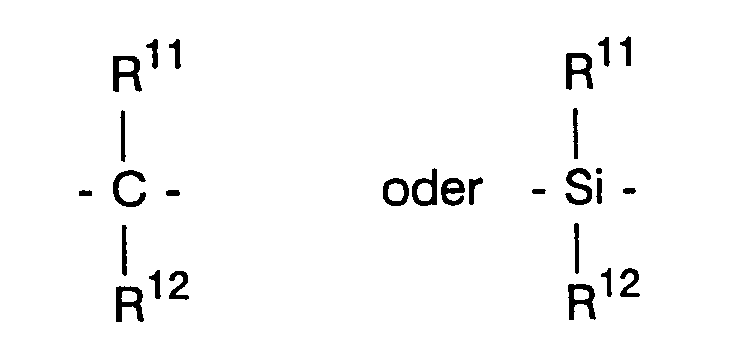
und m plus n null oder 1 bedeuten.
Description
- Zur Herstellung von hochisotaktischen Polyolefinen mit stereospezifischen racemischen Metallocen/Cokatalysator-Systemen wird eine möglichst hohe Isotaktizität angestrebt. Dies bedeutet, daß sehr stereoselektive racemische Metallocentypen eingesetzt werden, die Polymerketten mit sehr wenig Baufehlern aufbauen können. Dies hat zur Folge, daß im gewünschten Sinne Produkte mit hoher Kristallinität, hohem Schmelzpunkt und somit auch hoher Härte und excellentem Biege-E-Modul erhalten werden.
- Von Nachteil ist jedoch, daß solche Polymere schwierig zu verarbeiten sind und insbesondere bei der Extrusion, dem Spritzguß und beim Tiefziehen Probleme auftreten. Die Zumischung von Fließverbesserern und anderen Modifizierungskomponenten könnte hier Abhilfe schaffen, führt jedoch dazu, daß die guten Produkteigenschaften wie beispielsweise die hohe Härte dadurch drastisch reduziert werden. Darüberhinaus treten noch Klebrigkeit und Fogging auf. Es bestand somit die Aufgabe, die Verarbeitbarkeit solcher hochisotaktischer Polyolefine zu verbessern, ohne die guten Eigenschaften der daraus hergestellten Formkörper in solcher Weise zu verschlechtern.
- Überraschend haben wir gefunden, daß bei Verwendung von rac/meso-Mischungen bestimmter Metallocene die Verarbeitungsprobleme eliminiert werden können, ohne daß dabei die oben angeführten guten Produkteigenschaften verlorengehen.
- Darüberhinaus ist es durch Einsatz dieser speziellen Metallocene in ihrer reinen meso-Form möglich, hochmolekulare ataktische Polyolefine zu erzeugen, die als Zuschlagstoffe in andere Polyolefine homogen eingemischt werden können.
- Mit den bisher zugänglichen, niedermolekularen ataktischen Polyolefinen war dies aufgrund der großen Viskositätsunterschiede zwischen Polyolefin-Matrix und dem ataktischen Anteil nicht möglich.
- Solche Zumischungen verbessern Polyolefinformkörper bezüglich ihres Oberflächenglanzes, ihrer Schlagzähigkeit und ihrer Transparenz. Darüberhinaus wird ebenfalls die Verarbeitbarkeit solcher Polyolefine durch die Zumischung des hochmolekularen ataktischen Polyolefins verbessert. Ebenfalls tritt keine Klebrigkeit und kein Fogging auf.
- Die homogene Einmischbarkeit des ataktischen Anteils ist deshalb so wichtig, weil nur mit einem homogenen Material ein gebrauchstüchtiges Formteil mit guter Oberfläche und langer Standzeit hergestellt werden kann und nur bei homogener Verteilung die Qualitäten des ataktischen Anteils voll zur Geltung kommen.
- Gegenstand der Erfindung ist somit die Herstellung von Polyolefinen, die
- 1) ataktisch sind, das heißt, einen isotaktischen Index von 60 % aufweisen und hochmolekular sind, das heißt, eine Viskositätszahl > 80 cm3/g und eine Molmasse Mw > 100 000 g/mol bei einer Polydispersität Mw/Mn 4,0 aufweisen, oder
- 2) aus mindestens zwei Arten von Polyolefinketten bestehen, nämlich
- a) maximal 99 Gew.-%, bevorzugt maximal 98 Gew.-%, der Polymerketten des gesamten Polyolefins bestehen aus hochisotaktisch verknüpften a-Olefin-Einheiten, mit einem Isotaxieindex > 90 %, und einer Polydispersität von 4,0, und
- b) mindestens 1 Gew.-%, bevorzugt mindestens 2 Gew.-%, der Polymerketten des gesamten Polyolefins bestehen aus ataktischen Polyolefinen des Typs, der unter 1) beschrieben wurde.
- Polyolefine die der Beschreibung unter 2) genügen, können entweder direkt in der Polymerisation hergestellt werden, oder werden durch Schmelzmischen in einem Extruder oder Kneter hergestellt.
- Die Erfindung betrifft somit ein Verfahren zur Herstellung eines Olefinpolymers durch Polymerisation oder Copolymerisation eines Olefins der Formel Ra-CH = CH-Rb, worin Ra und Rb gleich oder verschieden sind und ein Wasserstoffatom oder einen Kohlenwasserstoffrest mit 1 bis 14 C-Atomen bedeuten, oder Ra und Rb mit den sie verbindenden Atomen einen Ring bilden können, bei einer Temperatur von -60 bis 200 °C, bei einem Druck von 0,5 bis 100 bar, in Lösung, in Suspension oder in der Gasphase, in Gegenwart eines Katalysators, welcher aus einem Metallocen als Übergangsmetallverbindung und einem Cokatalysator gebildet wird, dadurch gekennzeichnet, daß das Metallocen eine Verbindung der Formel I ist, die zur Herstellung von Polyolefinen des Typs 1 in reiner meso-Form und zur Herstellung der Typ 2-Polyolefine in einem meso:rac-Verhältnis von größer 1:99, bevorzugt größer 2:98 verwendet wird,

worin - M1 ein Metall der Gruppe IVb, Vb oder Vlb des Periodensystems ist,
- R1 und R2 gleich oder verschieden sind und ein Wasserstoffatom, eine C1-C10-Alkylgruppe, eine C1-C10-Alkoxygruppe, eine C6-C10-Arylgruppe, eine C6-C10-Aryloxygruppe, eine C2-C10-Alkenylgruppe, eine C7-C40-Arylalkylgruppe,eine C7-C40-Alkylarylgruppe, eine C8-C40-Arylalkenylgruppe oder ein Halogenatom bedeuten,
- die Reste R4 und R5 gleich oder verschieden sind und ein Wasserstoffatom, ein Halogenatom, eine C1-C10-Alkylgruppe, die halogeniert sein kann, eine C6-C10-Arylgruppe, die halogeniert sein kann, einen -NR2 10, -SR10, -OSiR3 10, -SiR3 10 oder -PR2 10-Rest bedeuten, worin R10 ein Halogenatom, eine C1-C10-Alkylgruppe oder eine C6-C10-Arylgruppe ist,
- R3 und R6 gleich oder verschieden sind und die für R4 genannte Bedeutung haben, mit der Maßgabe, daß R3 und R6 nicht Wasserstoff sind,
- R7


- =BR11, -AIR11, -Ge-, -Sn-, -O-,-S-, =SO, = S02, =NR11, =CO,
- =PR11 oder =P(O)R11 ist,
- R11, R12 und R13 gleich oder verschieden sind und ein Wasserstoffatom, ein Halogenatom, eine C1-C10-Alkylgruppe, C1-C10-Fluoralkylgruppe, eine C6-C10-Arylgruppe, eine C6-Cio-Fluorarylgruppe, eine C1-C10-Alkoxygruppe, eine C2-C10-Alkenylgruppe, eine C7-C4o-Arylalkylgruppe, eine C8-C40-Arylalkenylgruppe, eine C7-C40-Alkylarylgruppe bedeuten oder R11 und R12 oder R11 und R13 jeweils mit den sie verbindenden Atomen einen Ring bilden,
- M2 Silizium, Germanium oder Zinn ist,
- R8 und R9 gleich oder verschieden sind und die für R11 genannte Bedeutung haben und
- m und n gleich oder verschieden sind und null, 1 oder 2 sind, wobei m plus n null, 1 oder 2 ist.
- Alkyl steht für geradkettiges oder verzweigtes Alkyl. Halogen (halogeniert) bedeutet Fluor, Chlor, Brom oder Jod, bevorzugt Fluor oder Chlor.
- Die Substituenten R3, R4, R5 und R6 können trotz gleicher Indizierung verschieden sein.
- Der für das erfindungsgemäße Verfahren zu verwendende Katalysator besteht aus einem Cokatalysator und einem Metallocen der Formel I.
- In Formel I ist M1 ein Metall der Gruppe IVb, Vb oder Vlb des Periodensystems, beispielsweise Titan, Zirkon, Hafnium, Vanadium, Niob, Tantal, Chrom, Molybdän, Wolfram, vorzugsweise Zirkon, Hafnium und Titan.
- R1 und R2 sind gleich oder verschieden und bedeuten ein Wasserstoffatom, eine C1-C10-, vorzugsweise C1-C3-Alkyl]gruppe, eine Ci-Cio-, vorzugsweise C1-C3-Alkoxygruppe, eine C6-Cio-, vorzugsweise C6-C8-Arylgruppe, eine C6-Cio-, vorzugsweise C6-C8-Aryloxygruppe, eine C2-C10-, vorzugsweise C2-C4-Alkenylgruppe, eine C7-C40-, vorzugsweise C7-C10-Arylalkylgruppe, eine C7-C40-, vorzugsweise C7-C12-Alkylarylgruppe, eine C8-C40-, vorzugsweise C8-C12-Arylalkenylgruppe oder ein Halogenatom, vorzugsweise Chlor.
- Die Reste R4 und R5 sind gleich oder verschieden und bedeuten ein Wasserstoffatom, ein Halogenatom, bevorzugt ein Fluor-, Chlor- oder Bromatom, eine Ci-Cio-, vorzugsweise C1-C4-Alkylgruppe, die halogeniert sein kann, eine C6-Cio-, vorzugsweise C6-C9-Arylgruppe, die halogeniert sein kann, einen -NR2 10, -SR10, -OSiR3 10, -SiR3 10 oder -PR2 10-Rest, worin R10 ein Halogenatom, vorzugsweise Chloratom, oder eine Ci-Cio-, vorzugsweise C1-C3-Alkylgruppe oder C6-C10-, vorzugsweise C6-C8-Arylgruppe ist. Besonders bevorzugt sind R4 und R5 Wasserstoff, C1-C4-Alkyl oder C6-C9-Aryl.
- R3 und R6 sind gleich oder verschieden und haben die für R4 beschriebene Bedeutung, mit der Maßgabe, daß R3 und R6 nicht Wasserstoff sein dürfen. Bevorzugt sind R3 und R6 (C1-C4)-Alkyl oder C6-Cg-Aryl, die beide halogeniert sein können, wie Methyl, Ethyl, Propyl, Isopropyl, Butyl, Isobutyl, Trifluormethyl, Phenyl, Tolyl oder Mesityl, insbesondere Methyl, Isopropyl oder Phenyl.
- Zwei oder mehr der Reste R3 bis R6 können auch mit den sie verbindenden Atomen ein aromatisches oder aliphatisches Ringsystem bilden. Bevorzugt bilden dabei benachbarte Reste, insbesondere R4 und R6 zusammen einen Ring.
- R7


- =BR11, =AIR11, -Ge-, -Sn-, -O-, -S-, =SO, =SO2, =NR11, =CO,
- =PR11 oder =P(O)R11, wobei R11, R12 und R13 gleich oder verschieden sind und ein Wasserstoffatom, ein Halogenatom, eine C1-C10-, vorzugsweise C1-C4-Alkylgruppe, insbesondere Methylgruppe, eine Ci-Cio-Fluoralkylgruppe, vorzugsweise CF3-Gruppe, eine C6-Cio-, vorzugsweise C6-C8-Arylgruppe, eine C6-Cio-Fluorarylgruppe, vorzugsweise Pentafluorphenylgruppe, eine Ci-Cio-, vorzugsweise C1-C4-Alkoxygruppe, insbesondere Methoxygruppe, eine C2-C10-, vorzugsweise C2-C4-Alkenylgruppe, eine C7-C40-, vorzugsweise C7-C10-Arylalkylgruppe, eine C8-C40-, vorzugsweise C8-C12-Arylalkenylgruppe oder eine C7-C40-, vorzugsweise C7-C12-Alkylarylgruppe bedeuten, oder R11 und R12 oder R11 und R13 bilden jeweils zusammen mit den sie verbindenden Atomen einen Ring.
- M2 ist Silizium, Germanium oder Zinn, bevorzugt Silizium und Germanium.
- R7 ist vorzugsweise = CR11R12, = SiR11R12, = GeR11R12, -O-, -S-, = SO, = PR11 oder = P(O)R11.
- R8 und R9 sind gleich oder verschieden und haben die für R11 genannte Bedeutung.
- m und n sind gleich oder verschieden und bedeuten null, 1 oder 2, bevorzugt null oder 1, wobei m plus n null, 1 oder 2, bevorzugt null oder 1 ist.
- Somit sind die besonders bevorzugten Metallocene die Verbindungen der Formeln A und B

- M1 = Zr, Hf; R1, R2 = Methyl, Chlor, R3 und R6 = Methyl, Isopropyl, Phenyl, Ethyl, Trifluormethyl; R4 und
- R5 = Wasserstoff und den für R3 und R6 genannten Bedeutungen, oder R4 kann mit R6 einen aliphatischen oder aromatischen Ring bilden, gleiches gilt auch für benachbarte Reste R4; und R8, R9, R11 und R12 mit den obengenannten Bedeutungen, insbesondere die in den Ausführungsbeispielen aufgeführten Verbindungen I.
- Das bedeutet, daß die Indenylreste der Verbindungen I insbesondere in 2,4-Stellung, in 2,4,6-Stellung, in 2,4,5-Stellung und in 2,4,5,6-Stellung substituiert sind, die Reste in 3- und 7-Stellung sind bevorzugt Wasserstoff.
- Nomenklatur:

- Die vorstehend beschriebenen Metallocene können nach folgendem literaturbekannten Reaktionsschema hergestellt werden:


X = Cl, Br, I, O-Tosyl;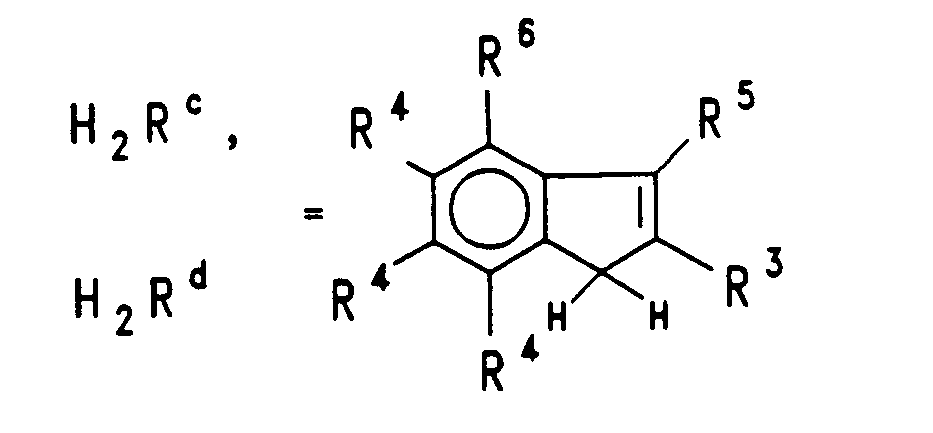
- Die Verbindungen fallen ex Synthese als rac:meso-Mischungen an. Durch fraktionierte Kristallisation, beispielsweise in einen Kohlenwasserstoff, kann die meso bzw. rac-Form angereichert werden. Dieses Vorgehen ist bekannt und Stand der Technik.
- Erfindungsgemäß wird als Cokatalysator bevorzugt ein Aluminoxan der Formel (II)

- für den linearen Typ und/oder der Formel (III)

für den cyclischen Typ verwendet, wobei in den Formeln (11) und (111) die Reste R14 gleich oder verschieden sein können und eine C1-C6-Alkylgruppe, eine C6-C18-Arylgruppe, Benzyl oder Wasserstoff bedeuten, und p eine ganze Zahl von 2 bis 50, bevorzugt 10 bis 35 bedeutet. - Bevorzugt sind die Reste R14 gleich und bedeuten Methyl, Isobutyl, Phenyl oder Benzyl, besonders bevorzugt Methyl.
- Sind die Reste R14 unterschiedlich, so sind sie bevorzugt Methyl und Wasserstoff oder alternativ Methyl und Isobutyl, wobei Wasserstoff bzw. Isobutyl bevorzugt zu 0,01 - 40 % (Zahl der Reste R14) enthalten sind.
- Das Aluminoxan kann auf verschiedene Arten nach bekannten Verfahren hergestellt werden. Eine der Methoden ist beispielsweise, daß eine Aluminiumkohlenwasserstoffverbindung und/oder eine Hydridoaluminiumkohlenwasserstoffverbindung mit Wasser (gasförmig, fest, flüssig oder gebunden - beispielsweise als Kristallwasser) in einem inerten Lösungsmittel (wie z.B. Toluol) umgesetzt wird. Zur Herstellung eines Aluminoxans mit veschiedenen Alkylgruppen R14 werden entsprechend der gewünschten Zusammensetzung zwei verschiedene Aluminiumtrialkyle (AIR3 + AIR'3) mit Wasser umgesetzt (vgl. S. Pasynkiewicz, Polyhedron 9 (1990) 429 und EP-A 302 424).
- Die genaue Struktur der Aluminoxane II und III ist nicht bekannt.
- Unabhängig von der Art der Herstellung ist allen Aluminoxanlösungen ein wechselnder Gehalt an nicht umgesetzter Aluminiumausgangsverbindung, die in freier Form oder als Addukt vorliegt, gemeinsam.
- Es ist möglich, das Metallocen vor dem Einsatz in der Polymerisationsreaktion mit einem Aluminoxan der Formel (11) und/oder (III) vorzuaktivieren. Dadurch wird die Polymerisationsaktivität deutlich erhöht und die Kornmorphologie verbessert.
- Die Voraktivierung der Übergangsmetallverbindung wird in Lösung vorgenommen. Bevorzugt wird dabei das Metallocen in einer Lösung des Aluminoxans in einem inerten Kohlenwasserstoff aufgelöst. Als inerter Kohlenwasserstoff eignet sich ein aliphatischer oder aromatischer Kohlenwasserstoff. Bevorzugt wird Toluol verwendet.
- Die Konzentration des Aluminoxans in der Lösung liegt im Bereich von ca. 1 Gew.-% bis zur Sättigungsgrenze, vorzugsweise von 5 bis 30 Gew.-%, jeweils bezogen auf die Gesamtlösung. Das Metallocen kann in der gleichen Konzentration eingesetzt werden, vorzugsweise wird es jedoch in einer Menge von 10-4- 1 mol pro mol Aluminoxan eingesetzt. Die Voraktivierungszeit beträgt 5 Minuten bis 60 Stunden, vorzugsweise 5 bis 60 Minuten. Man arbeitet bei einer Temperatur von -78°C bis 100°C, vorzugsweise 0 bis 70 ° C.
- Das Metallocen kann auch vorpolymerisiert oder auf einen Träger aufgebracht werden. Zur Vorpolymerisation wird bevorzugt das (oder eines der) in der Polymerisation eingesetzte(n) Olefin(e) verwendet.
- Geeignete Träger sind beispielsweise Silikagele, Aluminiumoxide, festes Aluminoxan oder andere anorganische Trägermaterialien. Ein geeignetes Trägermaterial ist auch ein Polyolefinpulver in feinverteilter Form.
- Erfindungsgemäß können an Stelle oder neben eines Aluminoxans Verbindungen der Formeln RxNH4-xBR'4, RxPH4-xBR'4, R3CBR'4 oder BR'3 als geeignete Cokatalysatoren verwendet werden. In diesen Formeln bedeutet x eine Zahl von 1 bis 4, bevorzugt 3, die Reste R sind gleich oder verschieden, bevorzugt gleich, und bedeuten C1-C10-Alkyl, C6-C18-Aryl oder 2 Reste R bilden zusammen mit dem sie verbindenden Atom einen Ring, und die Reste R' sind gleich oder verschieden, bevorzugt gleich, und stehen für C6-C18-Aryl, das durch Alkyl, Haloalkyl oder Fluor substituiert sein kann.
- Insbesondere steht R für Ethyl, Propyl, Butyl oder Phenyl und R' für Phenyl, Pentafluorphenyl, 3,5-Bistrifluormethylphenyl, Mesityl, Xylyl oder Tolyl (vgl. EP-A 277 003, EP-A 277 004 und EP-A 426 638).
- Bei Verwendung der obengenannten Cokatalysatoren besteht der eigentliche (aktive) Polymerisationskatalysator aus dem Reaktionsprodukt von Metallocen und einer der genannten Verbindungen. Daher wird zunächst dieses Reaktionsprodukt bevorzugt außerhalb des Polymerisationsreaktors in einem separaten Schritt unter Verwendung eines geeigneten Lösungsmittels hergestellt.
- Prinzipiell ist als Cokatalysator erfindungsgemäß jede Verbindung geeignet, die aufgrund ihrer Lewis-Acidität das neutrale Metallocen in ein Kation überführen und dieses stabilisieren kann ("labile Koordination"). Darüberhinaus soll der Cokatalysator bzw. das aus ihm gebildete Anion keine weiteren Reaktionen mit dem gebildeten Metallocenkation eingehen (vgl. EP-A 427 697).
- Zur Entfernung von im Olefin vorhandener Katalystorgifte ist eine Reinigung mit einem Aluminiumalkyl, beispielsweise AlMe3 oder AlEt3 vorteilhaft. Diese Reinigung kann sowohl im Polymerisationssystem selbst erfolgen, oder das Olefin wird vor der Zugabe in das Polymerisationssystem mit der AI-Verbindung in Kontakt gebracht und anschließend wieder abgetrennt.
- Die Polymerisation oder Copolymerisation wird in bekannter Weise in Lösung, in Suspension oder in der Gasphase, kontinuierlich oder diskontinuierlich, ein- oder mehrstufig bei einer Temperatur von -60 bis 200 °C, vorzugsweise 30 bis 80 °C, besonders bevorzugt 50 bis 80 °C, durchgeführt. Polymerisiert oder copolymerisiert werden Olefine der Formel Ra-CH = CH-Rb. In dieser Formel sind Ra und Rb gleich oder verschieden und bedeuten ein Wasserstoffatom oder einen Alkylrest mit 1 bis 14 C-Atomen. Ra und Rb können jedoch auch mit den sie verbindenden C-Atomen einen Ring bilden. Beispiele für solche Olefine sind Ethylen, Propylen, 1-Buten, 1-Hexen, 4-Methyl-1-penten, 1-Octen, Norbornen oder Norbonadien. Insbesondere werden Propylen und Ethylen polymerisiert.
- Als Molmassenregler und/oder zur Aktivitätserhöhung wird, falls erforderlich, Wasserstoff zugegeben. Der Gesamtdruck im Polymerisationssystem beträgt 0,5 bis 100 bar. Bevorzugt ist die Polymerisation in dem technisch besonders interessanten Druckbereich von 5 bis 64 bar.
- Dabei wird das Metallocen in einer Konzentration, bezogen auf das Übergangsmetall, von 10-3 bis 10-8, vorzugsweise 10-4 bis 10-7 mol Übergangsmetall pro dm3 Lösemittel bzw. pro dm3 Reaktorvolumen angewendet. Das Aluminoxan wird in einer Konzentration von 10-5 bis 10-1mol, vorzugsweise 10-4 bis 10-2 mol pro dm3 Lösemittel bzw. pro dm3 Reaktorvolumen verwendet. Die anderen genannten Cokatalysatoren werden in etwa äquimolaren Mengen zum Metallocen verwendet. Prinzipiell sind aber auch höhere Konzentrationen möglich.
- Wenn die Polymerisation als Suspensions- oder Lösungspolymerisation durchgeführt wird, wird ein für das Ziegler- Niederdruckverfahren gebräuchliches inertes Lösemittel verwendet. Beispielsweise arbeitet man in einem aliphatischen oder cycloaliphatischen Kohlenwasserstoff; als solcher sei beispielsweise Propan, Butan, Pentan, Hexan, Heptan, Isooctan, Cyclohexan, Methylcyclohexan, genannt.
- Weiterhin kann eine Benzin- bzw. hydrierte Dieselölfraktion benutzt werden. Brauchbar ist auch Toluol. Bevorzugt wird im flüssigen Monomeren polymerisiert.
- Werden inerte Lösemittel verwendet, werden die Monomeren gasförmig oder flüssig zudosiert.
- Die Dauer der Polymerisation ist beliebig, da das erfindungsgemäß zu verwendende Katalysatorsystem einen nur geringen zeitabhängigen Abfall der Polymerisationsaktivität zeigt.
- Das erfindungsgemäße Verfahren zeichnet sich dadurch aus, daß die beschriebenen meso-Metallocene im technisch besonders interessanten Temperaturbereich zwischen 50 und 80°C ataktische Polymere mit hoher Molmasse erzeugen. rac/meso-Mischungen der erfindungsgemäßen Metallocene erzeugen besonders gut vearbeitbare homogene Polymere. Daraus hergestellte Formkörper zeichnen sich durch gute Oberflächen und hohe Transparenz aus. Daneben sind hohe Oberflächenhärte und gute Biege-E-Module Charakteristika solcher Formteile.
- Der hochmolekulare ataktische Anteil weist keine Klebrigkeit auf und die Formkörper zeichnen sich ferner durch sehr gutes Fogging-Verhalten aus.
- Die nachfolgenden Beispiele sollen die Erfindung näher erläutern.
- Es bedeuten:


- MFI/(230/5) Schmelzindex, gemessen nach DIN 53735; in dg/min.
- Ein trockener 24 dm3-Reaktor wurde mit Propylen gespült und mit 12 dm3 flüssigem Propylen befüllt. Dann wurden 35 cm3 toluolische Methylaluminoxanlösung (entsprechend 52 mmol Al, mittlerer Oligomerisierungsgrad p = 18) zugegeben und der Ansatz bei 30°C 15 Minuten gerührt. Parallel dazu wurden 7,5 mg des in Tabelle 1 aufgeführten meso-Metallocens in 13,5 cm3 toluolischer Methylaluminoxanlösung (30 mmol Al) gelöst und durch 15 minütiges Stehenlassen voraktiviert.
- Die Lösung wurde dann in den Reaktor gegeben und auf 70°C bzw. 50°C (Tabelle 1) aufgeheizt (10°C/min). Die Polymerisationsdauer war 1 h. Gestoppt wurde die Polymerisation durch Zugabe von 20 Ndm3 C02-Gas. Die Metallocenaktivitäten und die Viskositätszahlen der dabei erhaltenen ataktischen Polymere sind in Tabelle 1 zusammengestellt. Die 13C-NMR-Analysen ergaben in allen Fällen isotaktische Blocklängen niso < 4, typisch war niso = 2, die syndiotaktische Blocklänge lag typisch ebenfalls im Bereich von 2. Die Triadenverteilungen mm : mr : rr waren typisch etwa 25 : 50 : 25 und der Isotaxieindex (mm + mr) lag unter 60 %. Es handelte sich also zweifelsfrei um typische ataktische Polypropylene.
- Dies belegt auch die Löslichkeit in siedendem Heptan beziehungsweise in Diethylether.
- Im DSC-Spektrum war kein definierter Schmelzpunkt erkennbar. Tg-Übergänge waren im Bereich 0°C bis -20 °C zu beobachten.


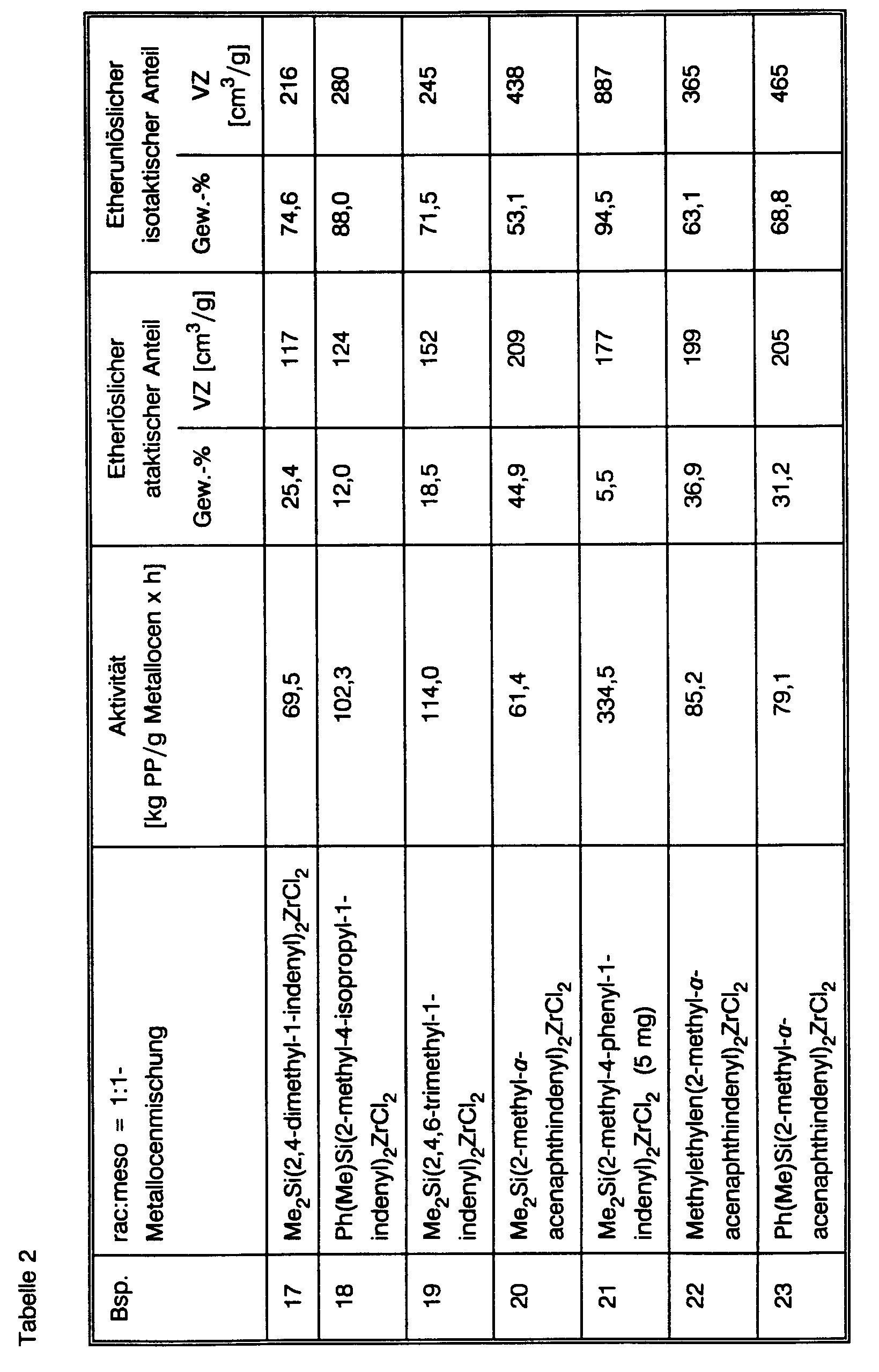
- Die Beispiele 1, 4, 7, 9, 12, 15 und 16 wurden wiederholt, statt des reinen meso-Metallocens wurde jedoch eine rac:meso = 1:1-Mischung eingesetzt.
- Die erhaltenen Polymere wurden mit siedendem Ether extrahiert oder in einem Kohlenwasserstoff mit dem Siedebereich 140/170°C aufgelöst und fraktioniert kristallisiert. Dabei wurde der hochmolekulare ataktische Anteil abgetrennt und war so unabhängig vom isotaktischen Rückstand analysierbar. Die Ergebnisse sind in Tabelle 2 zusammengefaßt. Die Produkte sind nicht klebrig, daraus hergestellte Formkörper zeigen kein Fogging und weisen eine excellente Oberfläche und Transparenz auf.
- Beispiel 5 wurde wiederholt, es wurden jedoch statt der reinen meso-Form des Metallocens rac:meso-Verhältnisse von 98:2, 95:5, 90:10, 85:15 und 75:25 verwendet. Die Ergebnisse sind in Tabelle 3 zusammengefaßt. Es wird ein nichtklebriges Pulver erhalten, daraus hergestellte Formkörper weisen eine gute Oberfläche auf, sind nicht klebrig und zeigen kein Fogging. Die Härte der Formkörper ist gut, ebenfalls die Transparenz.

- Beispiel 24 wurde mit 12 Ndm3 Wasserstoff im Polymerisationssystem wiederholt. Die Polymerisationsdauer war 30 Minuten. Die Metallocenaktivität war 586 kg PP/g Metallocen x h. Der etherlösliche Anteil betrug 1,1 Gew.-% bei einer VZ von 107 cm3/g, der etherunlösliche Anteil war 98,9 Gew.-% mit einer VZ von 151 cm3/g.
- Beispiel 25 wurde wiederholt, während der Polymerisation wurden jedoch 70 g Ethylen kontinuierlich zudosiert. Die Polymerisationsdauer war 45 Minuten. Die Metallocenaktivität betrug 468 kg PP/g Metallocen x h, der Ethylengehalt des Copolymers betrug 3,3 Gew.-%, der Einbau des Ethylens erfolgte laut 13C-NMR-Spektroskopie weitgehend isoliert (statistisches Copolymer).
- Ein trockener 150 dm3-Reaktor wurde mit Stickstoff gespült und bei 20 ° C mit 80 dm3 eines entaromatisierten Benzinschnittes mit dem Siedebereich 100 bis 120°C gefüllt. Dann wurde der Gasraum mit Propylen stickstofffrei gespült und 50 I flüssiges Propylen sowie 64 cm3 toluolische Methylaluminoxanlösung (100 mmol AI, p = 18) zugegeben.
- Der Reaktorinhalt wurde auf 60 °C aufgeheizt und durch Zudosierung von Wasserstoff wurde der Wasserstoffgehalt im Reaktorgasraum auf 0,1 % eingestellt und später während der Polymerisation dann durch Nachdosierung während der gesamten Polymerisationszeit konstant gehalten (Überprüfung on-Line durch Gaschromatographie).
- 10,7 mg rac:meso (95:5) des Metallocens Dimethylsilandiylbis(2-methyl-4,5-benzoindenyl)-zirkondichlorid wurden in 32 cm3 toluolischer Methylaluminoxanlösung (50 mmol) gelöst und in den Reaktor gegeben.
- Die Polymerisation erfolgte in einer ersten Stufe bei 60 °C 8 h lang.
- In einer zweiten Stufe wurden dann bei 47°C 2,8 kg Ethylen schnell zugegeben und nach weiteren 5 h Polymerisation bei dieser Temperatur wurde die Polymerisation durch Ablassen des Reaktorinhalts in einem 280 I-Reaktor, der mit 100 I Aceton gefüllt war, beendet. Das Polymerpulver wurde abgetrennt und 48 h bei 80°C/200 mbar getrocknet. Es wurden 21,4 kg Blockcopolymerpulver erhalten. VZ = 359 cm3/g; Mw = 402 000 g/mol, Mw/Mn = 4,0; MFI (230/5) = 9,3 dg/min. Das Blockcopolymer enthielt 12,2 Gew.-% Ethylen. Die Fraktionierung ergab einen Gehalt von 31,5 Gew.-% Ethylen/Propylen-Kautschuk und 3,7 Gew.-% ataktisches Polypropylen mit einer VZ von 117 cm3/g im Gesamtpolymer.
- Es wurde verfahren wie in den Beispielen 1-16, das Metallocen war jedoch die Verbindung meso-Me2Si(2-methyl-4-(1-naphthyl)-1-indenyl)2ZrCl2. Die Ergebnisse sind in Tabelle 4 zusammengestellt.

- Es wurde verfahren wie in Beispiel 32, das Metallocen war jedoch Ph(Me)Si(2-methyl-4-phenyl-1- indenyl)2ZrCl2 und wurde als 1:1 meso:rac-Mischung eingesetzt. Die Ergebnisse sind in Tabelle 5 zusammengestellt.

- Die Fraktionierung der Polymerproben mittels Etherextraktion ergaben Gehalte an ataktischen Polypropylen von 3,6 Gew.-% (50 ° C Polymerisationstemperatur) beziehungsweise 7,0 Gew.-% (70 ° C Polymerisationstemperatur). Die VZ-Werte betrugen 158 beziehungsweise 106 cm3/g.
- Der isolierte ataktische Anteil war von gummielastischer Konsistenz und völlig transparent.
- Das aus der Polymerisation anfallende Polymerpulver ist nicht klebrig, daraus hergestellte Formkörper weisen eine gute Oberfläche auf, sind sehr transparent und zeigen kein Fogging.
- Es wurde verfahren wie in Beispiel 32, als Metallocen wurde jedoch rac/meso-Me2Si(2-methyl-4-phenyl-1-indenyl)2ZrCl2 in geträgerter Form verwendet, das rac : meso-Verhältnis war 1 : 1. Das geträgerte Metallocen wurde in folgender Weise hergestellt:
- a) Herstellung des geträgerten Cokatalysators Herstellung des geträgerten Cokatalysators erfolgte wie in EP 92 107 331.8 beschrieben in der folgenden Weise in einem Edelstahl-Reaktor in explosionsgeschützter Ausführungen mit einem Umpumpsystem der Druckstufe 60 bar, mit Inertgasversorgung, Temperierung durch Mantelkühlung und zweitem Kühlkreislauf über einem Wärmetauscher am Umpumpsystem. Das Umpumpsystem saugte den Reaktorinhalt über einen Anschluß im Reaktorboden mit einer Pumpe an drückte ihn in einen Mischer und durch eine Steigleitung über einen Wärmetauscher in den Reaktor zurück. Der Mischer war so geschaltet, daß sich in dem Zulauf ein verengter Rohrquerschnitt befand, wo eine erhöhte Strömungsgeschwindigkeit entstand, und in dessen Turbulenzzone axial und entgegen der Strömungsrichtung eine dünne Zuleitung geführt war, durch welche - getaktet- jeweils eine definierte Menge Wasser unter 40 bar Argon eingespeist werden konnte. Die Kontrolle der Reaktion erfolgte über einen Probennehmer am Umpumpkreislauf.
- Im vorstehend beschriebenen Reaktor mit 16 dm3 Volumen wurden 5 dm3 Decan unter Inertbedingungen vorgelegt. 0,3 dm3 (= 3,1 mol) Trimethylaluminium wurden bei 25°C zugefügt. Danach wurden 250 g Kieselgel SD 3216-30 (Grace AG), welche vorher bei 120°C in einem Argonfließbett getrocknet wurden, durch einen Feststofftrichter in den Reaktor eindosiert und mit Hilfe des Rührers und des Umpumpsystems homogen verteilt. Eine Gesamtmenge von 45.9 g Wasser wurde in Portionen von 0,1 cm3 während 2 h jeweils alle 15 s in den Reaktor gegeben. Der Druck, herrührend von Argon und den entwickelten Gasen, wurde durch Druckregelventile konstant bei 10 bar gehalten. Nachdem alles Wasser eingebracht worden war, wurde das Umpumpsystem abgeschaltet und das Rühren noch 5 h bei 25°C fortgesetzt. Über eine Drucknutsche wurde das Lösungsmittel entfernt und der Cokatalysatorfeststoff mit Decan gewaschen. Dann wurde im Vakuum getrocknet. Der isolierte Feststoff enthält 19,5 Gew.-% Aluminium. 15 g dieses Feststoffes (108 mmol Al) wurden in einem rührbaren Gefäß in 100 cm3 Toluol suspendiert und auf -30 °C abgekühlt. Gleichzeitig wurden 200 mg (0,317 mmol) rac/meso 1 : 1 Me2Si(2-methyl-4-phenyl-indenyl)2ZrCl2 in 75 cm3 Toluol gelöst und innerhalb von 30 Minuten zur Suspension zugetropft. Es wurde langsam unter Rühren auf Raumtemperatur erwärmt, wobei die Suspension eine rote Farbe annahm. Anschließend wurde eine Stunde bei 70°C gerührt und nach dem Abkühlen auf Raumtemperatur wurde das Gemisch filtriert und der Feststoff 3 mal mit je 100 cm3 Toluol und 1 mal mit 100 cm3 Hexan gewaschen. Der verbleibende, hexanfeuchte Filterrückstand wurde im Vakuum getrocknet. Man erhält 14,1 g frei fließenden, hellroten, geträgerten Katalysator. Die Analyse ergab einen Gehalt von 11,9 mg Zirkonocen pro Gramm Katalysator.
- 0,7 g des unter a) hergestellten Katalysators wurden in 50 cm3 eines entaromatisierten Benzinschnittes mit dem Siedebereich 100 - 120 °C suspendiert.
- Parallel dazu wurde ein trockener 24 dm3-Reaktor zunächst mit Stickstoff und anschließend mit Propylen gespült und mit 12 dm3 flüssigem Propylen und mit 1,5 dm3 Wasserstoff befüllt. Dann wurden 3 cm3 Triisobutylaluminium (12 mmol) mit 30 ml Hexan verdünnt, in den Reaktor gegeben und der Ansatz bei 30°C 15 Minuten gerührt. Anschließend wurde die Katalysator-Suspension in den Reaktor gegeben, auf die Polymerisationstemperatur von 70 °C aufgeheizt (10 ° C/min) und das Polymerisationssystem 1 h durch Kühlung bei 70 °C gehalten. Gestoppt wurde die Polymerisation durch Zusatz von 20 ml Isopropanol. Das überschüssige Monomer wurde abgegast, das Polymer im Vakuum getrocknet.
- Die Fraktionierung des Polymers mittels Etherextraktion ergab einen Etherlöslichen ataktischen Anteil von 8,9 Gew.-% (VZ = 149 cm3/g) und einen unlöslichen isotaktischen Anteil von 91,1 Gew.-% mit einer VZ von 489 cm3/g.
- Das so hergestellte Pulver ist nicht klebrig, daraus hergestellte Formkörper zeigen im Wärmealterungstest kein Fogging, Härte und Transparenz der Formkörper sind sehr gut.
- In zu den vorstehenden Beispielen vergleichbarer Weise wurden Polymerisationen mit 1:1 rac:meso-Mischungen von nicht erfindungsgemäßen Metallocenen bei 70 °C und 30 °C Polymerisationstemperatur durchgeführt. Die erhaltenen Polymeren wurden ebenfalls einer Ethertrennung zur Charakterisierung der Polymerkomponenten unterworfen. Die Ergebnisse sind in Tabelle 6 zusammengestellt und zeigen, daß in keinem Fall ein erfindungsgemäßes Polymer mit hochmolekularem ataktischem Polymeranteil (etherlöslicher Anteil) hergestellt werden konnte. Die Produkte sind generell klebrig, die daraus hergestellten Formkörper sind weich, weisen eine fleckige Oberfläche auf und zeigen starkes Fogging.

- Vergleichsbeispiele 1 bis 10 wurden mit den reinen meso-Formen der dort verwendeten Metallocene wiederholt. Es wurde ataktisches Polypropylen erhalten, jedoch in keinem Fall wurde eine Viskositätszahl VZ > 70 cm3/g erhalten. Mit diesen nicht erfindungsgemäßen Metallocenen ist somit kein hochmolekulares ataktisches Polypropylen herstellbar. Die Produkte sind flüssig oder zumindest weich und stark klebrig.
oder zwei oder mehr der Reste R3 bis R6 zusammen mit den sie verbindenden Atomen ein Ringsystem bilden,
wobei
Claims (15)

worin
oder zwei oder mehr der Reste R3 bis R6 zusammen mit den sie verbindenden Atomen ein Ringsystem bilden, R7

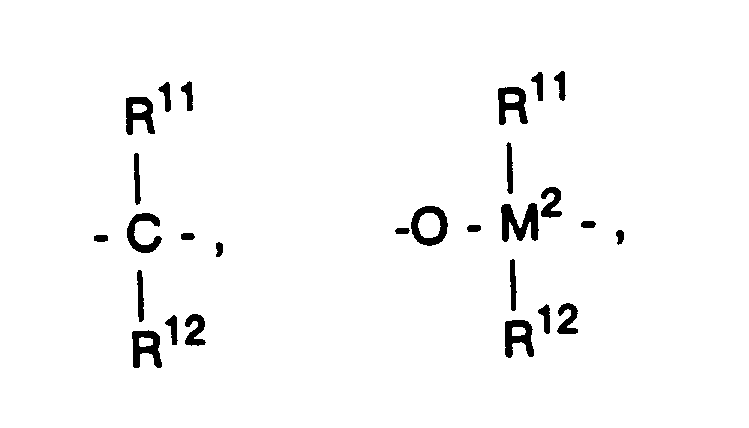

und m plus n null oder 1 bedeuten.

für den linearen Typ und/oder der Formel (III)

für den cyclischen Typ verwendet wird, wobei in den Formeln (II) und (III) die Reste R14 gleich oder verschieden sind und eine Ci-C6-Alkylgruppe, eine C6-C18-Arylgruppe, Benzyl oder Wasserstoff bedeuten und p eine ganze Zahl von 2 bis 50 ist.

worin
oder zwei oder mehr der Reste R3 bis R6 zusammen mit den sie verbindenden Atomen ein Ringsystem bilden, R7


und m plus n null oder 1 bedeuten.
Priority Applications (1)
| Application Number | Priority Date | Filing Date | Title |
|---|---|---|---|
| EP98116079A EP0882731A3 (de) | 1992-08-15 | 1993-08-05 | Verbrückte Metallocenverbindungen und ihre Verwendung als Olefinpolymerisationskatalysatore |
Applications Claiming Priority (2)
| Application Number | Priority Date | Filing Date | Title |
|---|---|---|---|
| DE4227049 | 1992-08-15 | ||
| DE4227049 | 1992-08-15 |
Related Child Applications (1)
| Application Number | Title | Priority Date | Filing Date |
|---|---|---|---|
| EP98116079A Division EP0882731A3 (de) | 1992-08-15 | 1993-08-05 | Verbrückte Metallocenverbindungen und ihre Verwendung als Olefinpolymerisationskatalysatore |
Publications (3)
| Publication Number | Publication Date |
|---|---|
| EP0584609A2 true EP0584609A2 (de) | 1994-03-02 |
| EP0584609A3 EP0584609A3 (en) | 1994-08-24 |
| EP0584609B1 EP0584609B1 (de) | 1999-03-10 |
Family
ID=6465634
Family Applications (2)
| Application Number | Title | Priority Date | Filing Date |
|---|---|---|---|
| EP98116079A Withdrawn EP0882731A3 (de) | 1992-08-15 | 1993-08-05 | Verbrückte Metallocenverbindungen und ihre Verwendung als Olefinpolymerisationskatalysatore |
| EP93112580A Expired - Lifetime EP0584609B1 (de) | 1992-08-15 | 1993-08-05 | Verfahren zur Herstellung von Polyolefinen |
Family Applications Before (1)
| Application Number | Title | Priority Date | Filing Date |
|---|---|---|---|
| EP98116079A Withdrawn EP0882731A3 (de) | 1992-08-15 | 1993-08-05 | Verbrückte Metallocenverbindungen und ihre Verwendung als Olefinpolymerisationskatalysatore |
Country Status (12)
| Country | Link |
|---|---|
| US (4) | US5672668A (de) |
| EP (2) | EP0882731A3 (de) |
| JP (1) | JP3548755B2 (de) |
| KR (2) | KR100283825B1 (de) |
| AT (1) | ATE177436T1 (de) |
| AU (1) | AU666565B2 (de) |
| CA (1) | CA2104036A1 (de) |
| DE (1) | DE59309424D1 (de) |
| ES (1) | ES2128371T3 (de) |
| FI (1) | FI110103B (de) |
| TW (1) | TW309524B (de) |
| ZA (1) | ZA935924B (de) |
Cited By (23)
| Publication number | Priority date | Publication date | Assignee | Title |
|---|---|---|---|---|
| EP0643078A3 (de) * | 1993-09-13 | 1995-04-26 | Spherilene Srl | Verfahren zur Herstellung von Ethylenpolymeren und daraus erhaltene Produkte. |
| US5516848A (en) * | 1995-01-31 | 1996-05-14 | Exxon Chemical Patents Inc. | Process to produce thermoplastic elastomers |
| US5539056A (en) * | 1995-01-31 | 1996-07-23 | Exxon Chemical Patents Inc. | Thermoplastic elastomers |
| TR28706A (tr) * | 1995-02-14 | 1997-01-13 | Royal Mobilya Dekorasyon Ve Ak | Yatak haline dönüsebilen koltuk ya da kanepeler icin hareket mekanizmalari. |
| WO1997028170A1 (en) * | 1996-01-30 | 1997-08-07 | Borealis A/S | Heteroatom substituted metallocene compounds for olefin polymerization catalyst systems and methods for preparing them |
| EP0743324A3 (de) * | 1995-05-16 | 1997-10-22 | Union Carbide Chem Plastic | Herstellung von Polyethylen unter Verwendung eines stereoisomeren Metallocens |
| WO1997046599A1 (en) * | 1996-06-06 | 1997-12-11 | Union Carbide Chemicals & Plastics Technology Corporation | Manufacture of stereoregular polymers |
| US5723560A (en) * | 1989-09-13 | 1998-03-03 | Exxon Chemical Patents Inc. | Higher molecular weight amorphous polypropylene |
| EP0743327A3 (de) * | 1995-05-16 | 1998-04-08 | Union Carbide Chemicals & Plastics Technology Corporation | Besser verarbeitbare Ethylenpolymeren |
| EP0821011A3 (de) * | 1994-06-20 | 1998-05-06 | Montell Technology Company bv | Verfahren zur Herstellung von Äthylenpolymeren und dafür verwendetes Katalysatorsystem |
| EP0745615A4 (de) * | 1994-12-20 | 1998-06-10 | Mitsui Petrochemical Ind | Verfahren zur herstellung von ethylenpolymer und ethylenpolymer |
| WO1999042497A1 (de) * | 1998-02-19 | 1999-08-26 | Targor Gmbh | Katalysatorsystem, verfahren zu seiner herstellung und seine verwendung zur polymerisation von olefinen |
| US6211310B1 (en) | 1997-06-05 | 2001-04-03 | Union Carbide Chemicals & Plastics Technology Corporation | Manufacture of stereoregular polymers |
| WO2001027169A1 (en) * | 1999-10-08 | 2001-04-19 | The Procter & Gamble Company | Bodies of polymeric material comprising linear, isotactic polymers |
| DE10303225A1 (de) * | 2003-01-28 | 2004-08-05 | Inventis Technologies Gmbh | Katalysatorkombination, isotaktische Polymere sowie ein Verfahren zur Herstellung von linearen isotaktischen Polymeren und dessen Verwendung |
| US6844288B2 (en) | 1998-07-02 | 2005-01-18 | Basell Polyolefine Gmbh | Process for the preparation of ligands for metallogene catalysts |
| EP0975644B1 (de) * | 1997-04-14 | 2005-03-16 | Borealis Technology Oy | Substituierte metallocenverbindungen für olefinpolymerisationkatalysatorsystemen, deren zwischenverbindungen und verfahren zu ihrer herstellung |
| DE102008005949A1 (de) | 2008-01-24 | 2009-07-30 | Evonik Degussa Gmbh | Polyolefine mit Isotaktischen Strukturelementen, Verfahren zu deren Herstellung und deren Verwendung |
| US7812104B2 (en) | 2008-01-18 | 2010-10-12 | Exxonmobil Chemical Patents Inc. | Production of propylene-based polymers |
| EP2270111A2 (de) | 2009-07-03 | 2011-01-05 | Evonik Degussa GmbH | Modifizierte Polyolefine mit besonderem Eigenschaftsprofil, Verfahren zu deren Herstellung und deren Verwendung |
| DE102009027446A1 (de) | 2009-07-03 | 2011-01-05 | Evonik Degussa Gmbh | Modifizierte Polyolefine mit besonderem Eigenschaftsprofil, Verfahren zu deren Herstellung und deren Verwendung |
| DE102009027447A1 (de) | 2009-07-03 | 2011-01-05 | Evonik Degussa Gmbh | Modifizierte Polyolefine mit besonderem Eigenschaftsprofil, Verfahren zu deren Herstellung und deren Verwendung |
| CN110540612A (zh) * | 2014-02-11 | 2019-12-06 | 尤尼威蒂恩技术有限责任公司 | 制造聚烯烃产物 |
Families Citing this family (79)
| Publication number | Priority date | Publication date | Assignee | Title |
|---|---|---|---|---|
| US5830821A (en) * | 1991-11-30 | 1998-11-03 | Targor Gmbh | Process for olefin preparation using metallocenes having benzo-fused indenyl derivatives as ligands |
| TW309523B (de) * | 1991-11-30 | 1997-07-01 | Hoechst Ag | |
| TW294669B (de) * | 1992-06-27 | 1997-01-01 | Hoechst Ag | |
| ES2128371T3 (es) | 1992-08-15 | 1999-05-16 | Targor Gmbh | Procedimiento para la obtencion de poliolefinas. |
| USRE39156E1 (en) | 1992-08-15 | 2006-07-04 | Basell Polyolefine Gmbh | Process for the preparation of polyolefins |
| US5817590A (en) * | 1993-10-14 | 1998-10-06 | Tosoh Corporation | Catalyst for αE --olefin polymerization containing a Lewis base |
| CA2193882C (en) * | 1994-06-24 | 2005-07-26 | Anthony Nicholas Speca | Polymerization catalyst systems, their production and use |
| DE69518830T2 (de) * | 1994-12-20 | 2001-03-22 | Montell Technology Co. B.V., Hoofddorp | Polypropylenreaktionsmischung und verfahren zu ihrer herstellung |
| IT1272923B (it) * | 1995-01-23 | 1997-07-01 | Spherilene Srl | Composti metallocenici,procedimento per la loro preparazione,e loro utilizzo in catalizzatori per la polimerizzazione delle olefine |
| IT1272922B (it) * | 1995-01-23 | 1997-07-01 | Spherilene Srl | Procedimento per la preparazione di composti metallocenici |
| DE19544828A1 (de) * | 1995-12-01 | 1997-06-05 | Hoechst Ag | Hochmolekulare Copolymere |
| US6787618B1 (en) | 1995-12-01 | 2004-09-07 | Basell Polypropylen Gmbh | Metallocene compound and high molecular weight copolymers of propylene and olefins having two or four to thirty-two carbon atoms |
| DE69720609T2 (de) * | 1996-07-16 | 2003-11-13 | Basell Polyolefine Gmbh | Verfahren zur Modifikation von die Rac/Meso-Verhältnis einer Metallocenverbindung |
| DE19637669A1 (de) | 1996-09-16 | 1998-03-19 | Hoechst Ag | Verfahren zur Herstellung einer methylenverbrückten Biscyclopentadienylverbindung |
| US5847176A (en) * | 1997-06-30 | 1998-12-08 | Boulder Scientific Company | Preparation of chiral titanocenes |
| EP0883623B1 (de) * | 1996-11-22 | 2003-03-05 | Boulder Scientific Company | Herstellung von chiralen titanocenen |
| US6160072A (en) * | 1997-05-02 | 2000-12-12 | Ewen; John A. | Process for polymerizing tactioselective polyolefins in condensed phase using titanocenes |
| KR20000068602A (ko) * | 1997-07-22 | 2000-11-25 | 나까니시 히로유끼 | 에틸렌/α-올레핀 공중합체, 그 조성물 및, 공중합체 및 조성물 |
| US6265512B1 (en) | 1997-10-23 | 2001-07-24 | 3M Innovative Company | Elastic polypropylenes and catalysts for their manufacture |
| KR100274973B1 (ko) * | 1997-11-24 | 2000-12-15 | 성재갑 | 올레핀계 단량체의 중합 촉매 |
| EP0953582A1 (de) * | 1998-04-27 | 1999-11-03 | Fina Research S.A. | Herstellung von Polyolefin |
| US6784269B2 (en) | 1998-05-13 | 2004-08-31 | Exxonmobil Chemical Patents Inc. | Polypropylene compositions methods of making the same |
| US6306960B1 (en) | 1998-05-13 | 2001-10-23 | Exxonmobil Chemical Patents Inc. | Articles formed from foamable polypropylene polymer |
| EP1078009B1 (de) | 1998-05-13 | 2004-06-16 | ExxonMobil Chemical Patents Inc. | Propylenhomopolymere und herstellungsverfahren |
| US6177527B1 (en) * | 1998-09-08 | 2001-01-23 | Union Carbide Chemical & Plastics Technology Corporation | Process for the preparation of polyethylene or polypropylene |
| US6174930B1 (en) | 1999-04-16 | 2001-01-16 | Exxon Chemical Patents, Inc. | Foamable polypropylene polymer |
| US6500563B1 (en) | 1999-05-13 | 2002-12-31 | Exxonmobil Chemical Patents Inc. | Elastic films including crystalline polymer and crystallizable polymers of propylene |
| US6750284B1 (en) | 1999-05-13 | 2004-06-15 | Exxonmobil Chemical Patents Inc. | Thermoplastic filled membranes of propylene copolymers |
| ATE412793T1 (de) | 1999-05-13 | 2008-11-15 | Exxonmobil Chem Patents Inc | Elastische fasern und daraus hergestellte artikel,die kristalline und kristallisierbare propylenpolymere enthalten |
| US6746780B1 (en) | 1999-10-08 | 2004-06-08 | The Procter & Gamble Company | Bodies of polymeric material comprising linear, isotactic polymers |
| US6863989B1 (en) | 1999-10-08 | 2005-03-08 | The Procter & Gamble Company | Adhesives comprising linear isotactic polymers |
| WO2001032758A1 (en) | 1999-11-04 | 2001-05-10 | Exxon Chemical Patents Inc. | Propylene copolymer foams and their use |
| US6977287B2 (en) * | 1999-12-10 | 2005-12-20 | Exxonmobil Chemical Patents Inc. | Propylene diene copolymers |
| JP2003516440A (ja) * | 1999-12-10 | 2003-05-13 | エクソンモービル・ケミカル・パテンツ・インク | プロピレンジエン共重合ポリマー |
| US6809168B2 (en) * | 1999-12-10 | 2004-10-26 | Exxonmobil Chemical Patents Inc. | Articles formed from propylene diene copolymers |
| EP1263909A2 (de) * | 1999-12-22 | 2002-12-11 | ExxonMobil Chemical Patents Inc. | Polypropylen klebstoffe |
| US6384142B1 (en) | 2000-02-08 | 2002-05-07 | Exxonmobil Chemical Patents Inc. | Propylene impact copolymers |
| CN1406241A (zh) * | 2000-02-08 | 2003-03-26 | 埃克森美孚化学专利公司 | 制备14族桥连双环戊二烯基配体的方法 |
| WO2003000744A1 (en) * | 2001-06-22 | 2003-01-03 | Borealis Technology Oy | Metallocene catalysts containing an idenyl moiety substituted at the 4-, 5-, 6- or 7-position by a siloxy or germyloxy group |
| US6916892B2 (en) * | 2001-12-03 | 2005-07-12 | Fina Technology, Inc. | Method for transitioning between Ziegler-Natta and metallocene catalysts in a bulk loop reactor for the production of polypropylene |
| KR100458600B1 (ko) * | 2002-02-07 | 2004-12-03 | 주식회사 엘지화학 | 메틸렌 브릿지된 메탈로센 촉매를 이용한 올레핀-시클릭올레핀 공중합체의 제조 방법 |
| US6706828B2 (en) * | 2002-06-04 | 2004-03-16 | Crompton Corporation | Process for the oligomerization of α-olefins having low unsaturation |
| US20030236365A1 (en) * | 2002-06-24 | 2003-12-25 | Fina Technology, Inc. | Polyolefin production with a high performance support for a metallocene catalyst system |
| US20080153997A1 (en) * | 2006-12-20 | 2008-06-26 | Exxonmobil Research And Engineering | Polymer production at supercritical conditions |
| US8008412B2 (en) | 2002-09-20 | 2011-08-30 | Exxonmobil Chemical Patents Inc. | Polymer production at supersolution conditions |
| US7700707B2 (en) | 2002-10-15 | 2010-04-20 | Exxonmobil Chemical Patents Inc. | Polyolefin adhesive compositions and articles made therefrom |
| US7550528B2 (en) | 2002-10-15 | 2009-06-23 | Exxonmobil Chemical Patents Inc. | Functionalized olefin polymers |
| US7223822B2 (en) | 2002-10-15 | 2007-05-29 | Exxonmobil Chemical Patents Inc. | Multiple catalyst and reactor system for olefin polymerization and polymers produced therefrom |
| BR0315341B1 (pt) | 2002-10-15 | 2014-02-18 | Adesivos compreendendo poliolefina. | |
| US7541402B2 (en) | 2002-10-15 | 2009-06-02 | Exxonmobil Chemical Patents Inc. | Blend functionalized polyolefin adhesive |
| US7195806B2 (en) * | 2003-01-17 | 2007-03-27 | Fina Technology, Inc. | High gloss polyethylene articles |
| JP2005099712A (ja) * | 2003-08-28 | 2005-04-14 | Sharp Corp | 表示装置の駆動回路および表示装置 |
| US20050234198A1 (en) * | 2004-04-20 | 2005-10-20 | Fina Technology, Inc. | Heterophasic copolymer and metallocene catalyst system and method of producing the heterophasic copolymer using the metallocene catalyst system |
| US8178636B2 (en) * | 2004-05-04 | 2012-05-15 | Basell Polyolefine Gmbh | Process for the preparation of atactic 1-butene polymers |
| CN100567387C (zh) * | 2004-07-22 | 2009-12-09 | 巴塞尔聚烯烃股份有限公司 | 1-丁烯聚合物组合物 |
| AU2005263671A1 (en) * | 2004-07-22 | 2006-01-26 | Basell Polyolefine Gmbh | Process for producing fractionable 1-butene polymers |
| US7169864B2 (en) * | 2004-12-01 | 2007-01-30 | Novolen Technology Holdings, C.V. | Metallocene catalysts, their synthesis and their use for the polymerization of olefins |
| US7232869B2 (en) * | 2005-05-17 | 2007-06-19 | Novolen Technology Holdings, C.V. | Catalyst composition for olefin polymerization |
| US7868197B2 (en) | 2005-12-14 | 2011-01-11 | Exxonmobil Chemical Patents Inc. | Halogen substituted heteroatom-containing metallocene compounds for olefin polymerization |
| US8242237B2 (en) | 2006-12-20 | 2012-08-14 | Exxonmobil Chemical Patents Inc. | Phase separator and monomer recycle for supercritical polymerization process |
| WO2008124040A1 (en) | 2007-04-09 | 2008-10-16 | Exxonmobil Chemical Patents Inc. | Soft heterogeneous isotactic polyroplene compositions |
| JP2010529253A (ja) | 2007-06-04 | 2010-08-26 | エクソンモービル・ケミカル・パテンツ・インク | 非常に均一なプロピレンの溶液重合法 |
| US20090053959A1 (en) * | 2007-08-21 | 2009-02-26 | Sudhin Datta | Soft and Elastic Nonwoven Polypropylene Compositions |
| US7906588B2 (en) * | 2007-10-26 | 2011-03-15 | Exxonmobil Chemical Patents Inc. | Soft heterogeneous isotactic polypropylene compositions |
| US8318875B2 (en) | 2008-01-18 | 2012-11-27 | Exxonmobil Chemical Patents Inc. | Super-solution homogeneous propylene polymerization and polypropylenes made therefrom |
| US8227392B2 (en) * | 2008-01-25 | 2012-07-24 | Exxonmobil Research And Engineering Company | Base stocks and lubricant blends containing poly-alpha olefins |
| GB0918736D0 (en) | 2009-10-26 | 2009-12-09 | Isis Innovation | Catalysts |
| US9469791B2 (en) | 2011-04-28 | 2016-10-18 | Adherent Laboratories, Inc. | Polyolefin based hot melt adhesive composition |
| EP2573091A1 (de) | 2011-09-23 | 2013-03-27 | Lummus Novolen Technology Gmbh | Verfahren zur Wiedergewinnung freier Liganden aus ihren jeweiligen Metallocenkomplexen |
| KR101499819B1 (ko) * | 2011-11-03 | 2015-03-10 | 주식회사 엘지화학 | 비담지 비균일계 폴리올레핀 중합용 촉매 조성물 및 그의 제조 방법 |
| GB201407000D0 (en) | 2014-04-17 | 2014-06-04 | Isis Innovation | Catalysts |
| US20150299525A1 (en) | 2014-04-18 | 2015-10-22 | IFS Industries Inc. | Low density and high performance packaging hot melt |
| KR20170102956A (ko) | 2015-01-06 | 2017-09-12 | 에스씨지 케미컬스 컴퍼니, 리미티드. | SiO2-층상 이중 수산화물 마이크로스피어 및 에틸렌 중합 반응에서의 촉매 지지체로의 이들의 용도 |
| CN107107025A (zh) | 2015-01-06 | 2017-08-29 | Scg化学有限公司 | SiO2层状双氢氧化物微球及它们的制备方法 |
| GB201608384D0 (en) | 2016-05-12 | 2016-06-29 | Scg Chemicals Co Ltd | Unsymmetrical metallocene catalysts and uses thereof |
| WO2020056119A1 (en) | 2018-09-14 | 2020-03-19 | Fina Technology, Inc. | Polyethylene and controlled rheology polypropylene polymer blends and methods of use |
| JP7572961B2 (ja) | 2019-02-20 | 2024-10-24 | フイナ・テクノロジー・インコーポレーテツド | 低い反りを有するポリマー組成物 |
| KR20220094212A (ko) | 2019-10-30 | 2022-07-05 | 차이나 페트로리움 앤드 케미컬 코포레이션 | 메탈로센 화합물, 및 이의 제조 방법 및 적용 |
| US12559599B2 (en) | 2021-04-26 | 2026-02-24 | Fina Technology, Inc. | Thin single-site catalyzed polymer sheets |
Family Cites Families (12)
| Publication number | Priority date | Publication date | Assignee | Title |
|---|---|---|---|---|
| DE3826075A1 (de) * | 1988-07-30 | 1990-02-01 | Hoechst Ag | 1-olefin-isoblockpolymer und verfahren zu seiner herstellung |
| ES2071888T3 (es) * | 1990-11-12 | 1995-07-01 | Hoechst Ag | Bisindenilmetalocenos sustituidos en posicion 2, procedimiento para su preparacion y su utilizacion como catalizadores en la polimerizacion de olefinas. |
| US5243001A (en) * | 1990-11-12 | 1993-09-07 | Hoechst Aktiengesellschaft | Process for the preparation of a high molecular weight olefin polymer |
| EP0503422B1 (de) * | 1991-03-09 | 1998-06-03 | TARGOR GmbH | Verfahren zur Herstellung chemisch einheitlicher Cycloolefincopolymere |
| TW300901B (de) * | 1991-08-26 | 1997-03-21 | Hoechst Ag | |
| EP0537686B1 (de) * | 1991-10-15 | 2005-01-12 | Basell Polyolefine GmbH | Verfahren zur Herstellung eines Olefinpolymers unter Verwendung von Metallocenen mit speziell substituierten Indenylliganden |
| TW318184B (de) * | 1991-11-30 | 1997-10-21 | Hoechst Ag | |
| EP0549900B1 (de) * | 1991-11-30 | 1996-08-21 | Hoechst Aktiengesellschaft | Metallocene mit benzokondensierten Indenylderivaten als Liganden, Verfahren zu ihrer Herstellung und ihre Verwendung als Katalysatoren |
| TW309523B (de) * | 1991-11-30 | 1997-07-01 | Hoechst Ag | |
| EP0574597B2 (de) * | 1992-06-13 | 2002-06-26 | Basell Polyolefine GmbH | Verfahren zur Herstellung von verbrückten, chiralen Metallocenkatalysatoren des Types Bisindenyl |
| TW294669B (de) * | 1992-06-27 | 1997-01-01 | Hoechst Ag | |
| ES2128371T3 (es) | 1992-08-15 | 1999-05-16 | Targor Gmbh | Procedimiento para la obtencion de poliolefinas. |
-
1993
- 1993-08-05 ES ES93112580T patent/ES2128371T3/es not_active Expired - Lifetime
- 1993-08-05 AT AT93112580T patent/ATE177436T1/de not_active IP Right Cessation
- 1993-08-05 DE DE59309424T patent/DE59309424D1/de not_active Expired - Lifetime
- 1993-08-05 EP EP98116079A patent/EP0882731A3/de not_active Withdrawn
- 1993-08-05 EP EP93112580A patent/EP0584609B1/de not_active Expired - Lifetime
- 1993-08-12 JP JP20082293A patent/JP3548755B2/ja not_active Expired - Lifetime
- 1993-08-12 FI FI933573A patent/FI110103B/fi not_active IP Right Cessation
- 1993-08-13 ZA ZA935924A patent/ZA935924B/xx unknown
- 1993-08-13 CA CA002104036A patent/CA2104036A1/en not_active Abandoned
- 1993-08-13 KR KR1019930015663A patent/KR100283825B1/ko not_active Expired - Lifetime
- 1993-08-13 AU AU44591/93A patent/AU666565B2/en not_active Expired
- 1993-08-16 US US08/107,187 patent/US5672668A/en not_active Expired - Lifetime
- 1993-09-18 TW TW082107677A patent/TW309524B/zh active
-
1995
- 1995-06-07 US US08/484,457 patent/US5693836A/en not_active Ceased
-
1997
- 1997-08-18 US US08/914,387 patent/US6028152A/en not_active Expired - Lifetime
-
1999
- 1999-10-28 US US09/428,843 patent/US6359095B1/en not_active Expired - Fee Related
-
2000
- 2000-06-22 KR KR1020000034444A patent/KR100301337B1/ko not_active Expired - Lifetime
Cited By (40)
| Publication number | Priority date | Publication date | Assignee | Title |
|---|---|---|---|---|
| US5723560A (en) * | 1989-09-13 | 1998-03-03 | Exxon Chemical Patents Inc. | Higher molecular weight amorphous polypropylene |
| EP0643078A3 (de) * | 1993-09-13 | 1995-04-26 | Spherilene Srl | Verfahren zur Herstellung von Ethylenpolymeren und daraus erhaltene Produkte. |
| TR27973A (tr) * | 1993-09-13 | 1995-11-07 | Montell Technology Company Bv | Etilen polimerlerinin hazirlanmasi icin islem ve bu polimerlerden elde edilen ürünler. |
| US5886123A (en) * | 1993-09-13 | 1999-03-23 | Montell Technology Company B.V. | Elastomeric copolymers of ethylene with at least one alpha-olefin |
| US5585448A (en) * | 1993-09-13 | 1996-12-17 | Montell Technology Company B.V. | Process for the preparation of ethylene polymers and products obtained therefrom |
| EP0821011A3 (de) * | 1994-06-20 | 1998-05-06 | Montell Technology Company bv | Verfahren zur Herstellung von Äthylenpolymeren und dafür verwendetes Katalysatorsystem |
| US6664351B1 (en) | 1994-06-20 | 2003-12-16 | Basell Technology Company B.V. | Ethylene copolymers, process for the preparation of ethylene-based polymers and catalyst system used therein |
| US6136936A (en) * | 1994-06-20 | 2000-10-24 | Montell Technology Company B.V. | Ethylene copolymers, process for the preparation of ethylene-based polymers and catalyst system used therein |
| EP0742799B1 (de) * | 1994-06-20 | 1998-08-19 | Montell Technology Company bv | Ethylen copolymere |
| KR100379138B1 (ko) * | 1994-06-20 | 2003-08-02 | 바셀 테크놀로지 캄파니 비이브이 | 에틸렌공중합체,에틸렌기재중합체제조방법및그에사용되는촉매계 |
| RU2155776C2 (ru) * | 1994-06-20 | 2000-09-10 | Монтелл Текнолоджи Компани Б.В. | Сополимеры этилена и способ получения полимеров на основе этилена |
| EP0745615A4 (de) * | 1994-12-20 | 1998-06-10 | Mitsui Petrochemical Ind | Verfahren zur herstellung von ethylenpolymer und ethylenpolymer |
| US5539056A (en) * | 1995-01-31 | 1996-07-23 | Exxon Chemical Patents Inc. | Thermoplastic elastomers |
| US5516848A (en) * | 1995-01-31 | 1996-05-14 | Exxon Chemical Patents Inc. | Process to produce thermoplastic elastomers |
| TR28706A (tr) * | 1995-02-14 | 1997-01-13 | Royal Mobilya Dekorasyon Ve Ak | Yatak haline dönüsebilen koltuk ya da kanepeler icin hareket mekanizmalari. |
| EP0743324A3 (de) * | 1995-05-16 | 1997-10-22 | Union Carbide Chem Plastic | Herstellung von Polyethylen unter Verwendung eines stereoisomeren Metallocens |
| EP1217013A3 (de) * | 1995-05-16 | 2004-12-22 | Univation Technologies LLC | Herstellung von Polyethylen unter Verwendung von stereoisomeren Metallocenen |
| EP0743327A3 (de) * | 1995-05-16 | 1998-04-08 | Union Carbide Chemicals & Plastics Technology Corporation | Besser verarbeitbare Ethylenpolymeren |
| CZ297674B6 (cs) * | 1996-01-30 | 2007-02-28 | Borealis Technology Oy | Katalyzátorový prekurzor pro olefinické polymeracní katalytické systémy a zpusoby jejich prípravy |
| WO1997028170A1 (en) * | 1996-01-30 | 1997-08-07 | Borealis A/S | Heteroatom substituted metallocene compounds for olefin polymerization catalyst systems and methods for preparing them |
| US6277778B1 (en) | 1996-01-30 | 2001-08-21 | Borealis A/S | Heteroatom substituted metallocene compounds for olefin polymerization catalyst systems and methods for preparing them |
| WO1997046599A1 (en) * | 1996-06-06 | 1997-12-11 | Union Carbide Chemicals & Plastics Technology Corporation | Manufacture of stereoregular polymers |
| US6500905B2 (en) | 1996-06-06 | 2002-12-31 | Union Carbide Chemicals & Plastics Technology Corporation | Manufacture of stereoregular polymers |
| EP0811637A3 (de) * | 1996-06-06 | 1997-12-29 | Union Carbide Chemicals & Plastics Technology Corporation | Verfahren zur Zugabe eines Katalysators in flüssiger Form zu einen Wirbelschichtpolymerisationsreaktor |
| EP0975644B1 (de) * | 1997-04-14 | 2005-03-16 | Borealis Technology Oy | Substituierte metallocenverbindungen für olefinpolymerisationkatalysatorsystemen, deren zwischenverbindungen und verfahren zu ihrer herstellung |
| US6211310B1 (en) | 1997-06-05 | 2001-04-03 | Union Carbide Chemicals & Plastics Technology Corporation | Manufacture of stereoregular polymers |
| WO1999042497A1 (de) * | 1998-02-19 | 1999-08-26 | Targor Gmbh | Katalysatorsystem, verfahren zu seiner herstellung und seine verwendung zur polymerisation von olefinen |
| US6350830B1 (en) * | 1998-02-19 | 2002-02-26 | Tagor Gmbh | Catalyst system, method for the production thereof and its use for the polymerization of olefins |
| US6844288B2 (en) | 1998-07-02 | 2005-01-18 | Basell Polyolefine Gmbh | Process for the preparation of ligands for metallogene catalysts |
| WO2001027169A1 (en) * | 1999-10-08 | 2001-04-19 | The Procter & Gamble Company | Bodies of polymeric material comprising linear, isotactic polymers |
| DE10303225A1 (de) * | 2003-01-28 | 2004-08-05 | Inventis Technologies Gmbh | Katalysatorkombination, isotaktische Polymere sowie ein Verfahren zur Herstellung von linearen isotaktischen Polymeren und dessen Verwendung |
| US7812104B2 (en) | 2008-01-18 | 2010-10-12 | Exxonmobil Chemical Patents Inc. | Production of propylene-based polymers |
| DE102008005949A1 (de) | 2008-01-24 | 2009-07-30 | Evonik Degussa Gmbh | Polyolefine mit Isotaktischen Strukturelementen, Verfahren zu deren Herstellung und deren Verwendung |
| EP2270111A2 (de) | 2009-07-03 | 2011-01-05 | Evonik Degussa GmbH | Modifizierte Polyolefine mit besonderem Eigenschaftsprofil, Verfahren zu deren Herstellung und deren Verwendung |
| DE102009027446A1 (de) | 2009-07-03 | 2011-01-05 | Evonik Degussa Gmbh | Modifizierte Polyolefine mit besonderem Eigenschaftsprofil, Verfahren zu deren Herstellung und deren Verwendung |
| DE102009027447A1 (de) | 2009-07-03 | 2011-01-05 | Evonik Degussa Gmbh | Modifizierte Polyolefine mit besonderem Eigenschaftsprofil, Verfahren zu deren Herstellung und deren Verwendung |
| DE102009027445A1 (de) | 2009-07-03 | 2011-01-05 | Evonik Degussa Gmbh | Modifizierte Polyolefine mit besonderem Eigenschaftsprofil, Verfahren zu deren Herstellung und deren Verwendung |
| EP2272933A2 (de) | 2009-07-03 | 2011-01-12 | Evonik Degussa GmbH | Modifizierte Polyolefine mit besonderem Eigenschaftsprofil, Verfahren zu deren Herstellung und deren Verwendung |
| EP2277931A1 (de) | 2009-07-03 | 2011-01-26 | Evonik Degussa GmbH | Modifizierte Polyolefine mit besonderem Eigenschaftsprofil, Verfahren zu deren Herstellung und deren Verwendung |
| CN110540612A (zh) * | 2014-02-11 | 2019-12-06 | 尤尼威蒂恩技术有限责任公司 | 制造聚烯烃产物 |
Also Published As
| Publication number | Publication date |
|---|---|
| FI933573A0 (fi) | 1993-08-12 |
| FI110103B (fi) | 2002-11-29 |
| EP0882731A3 (de) | 2000-05-31 |
| US5672668A (en) | 1997-09-30 |
| EP0584609A3 (en) | 1994-08-24 |
| KR100301337B1 (ko) | 2001-09-22 |
| ATE177436T1 (de) | 1999-03-15 |
| ES2128371T3 (es) | 1999-05-16 |
| JPH06157662A (ja) | 1994-06-07 |
| FI933573A7 (fi) | 1994-02-16 |
| EP0584609B1 (de) | 1999-03-10 |
| KR100283825B1 (ko) | 2001-03-02 |
| KR940003974A (ko) | 1994-03-14 |
| ZA935924B (en) | 1994-02-11 |
| EP0882731A2 (de) | 1998-12-09 |
| AU666565B2 (en) | 1996-02-15 |
| US6028152A (en) | 2000-02-22 |
| US6359095B1 (en) | 2002-03-19 |
| DE59309424D1 (de) | 1999-04-15 |
| JP3548755B2 (ja) | 2004-07-28 |
| CA2104036A1 (en) | 1994-02-16 |
| TW309524B (de) | 1997-07-01 |
| US5693836A (en) | 1997-12-02 |
| AU4459193A (en) | 1994-02-17 |
Similar Documents
| Publication | Publication Date | Title |
|---|---|---|
| EP0584609B1 (de) | Verfahren zur Herstellung von Polyolefinen | |
| EP0659757B1 (de) | Metallocenverbindung | |
| EP0659756B1 (de) | Metallocenverbindung | |
| EP0537686B1 (de) | Verfahren zur Herstellung eines Olefinpolymers unter Verwendung von Metallocenen mit speziell substituierten Indenylliganden | |
| EP0485822B1 (de) | Verfahren zur Herstellung eines hochmolekularen Olefinpolymers | |
| EP0582195B1 (de) | Verfahren zur Herstellung eines Olefinpolymers unter Verwendung spezieller Metallocene | |
| EP0549900B1 (de) | Metallocene mit benzokondensierten Indenylderivaten als Liganden, Verfahren zu ihrer Herstellung und ihre Verwendung als Katalysatoren | |
| EP0545303B1 (de) | Verfahren zur Herstellung eines hochmolekularen Olefinpolymers | |
| EP0516019B1 (de) | Verfahren zur Herstellung von syndiotaktischen Polyolefinen mit breiter Molmassenverteilung | |
| EP0485820B1 (de) | Verfahren zur Herstellung eines Olefinpolymers | |
| EP0387690B1 (de) | Verfahren zur Herstellung eines syndiotaktischen Polyolefins | |
| EP0399347B1 (de) | Verfahren zur Herstellung eines Syndio-Isoblockpolymeren | |
| EP0387691B1 (de) | Verfahren zur Herstellung eines syndiotaktischen Polyolefins | |
| EP0654476B1 (de) | Metallocene, Verfahren zu ihrer Herstellung und ihrer Verwendung als Katalysatoren | |
| EP0485823B1 (de) | 2-Substituierte Bisindenylmetallocene, Verfahren zu ihrer Herstellung und ihre Verwendung als Katalysatoren bei der Olefinpolymerisation | |
| EP0700937B1 (de) | Verfahren zur Herstellung von Ethylenpolymeren | |
| EP0433986B1 (de) | Verfahren zur Herstellung einer Polypropylen-Formmasse | |
| EP0646604B1 (de) | Verfahren zur Olefinpolymerisation | |
| EP0719802A2 (de) | Polyolefinwachs | |
| EP0702030A1 (de) | Verfahren zur Herstellung von Polyolefinen mit breiter Molmassenverteilung | |
| EP0459185A2 (de) | Verfahren zur Herstellung eines Polyolefins | |
| EP0480390B1 (de) | Verfahren zur Herstellung eines Polyolefins | |
| EP0553757B1 (de) | Katalysator und Verfahren zur Polymerisation und Copolymerisation von Olefinen | |
| EP0588208A2 (de) | Polyolefin-Formmasse mit breitem Schmelzbereich, Verfahren zu ihrer Herstellung und ihre Verwendung | |
| EP0707010B1 (de) | Metallocenverbindung |
Legal Events
| Date | Code | Title | Description |
|---|---|---|---|
| PUAI | Public reference made under article 153(3) epc to a published international application that has entered the european phase |
Free format text: ORIGINAL CODE: 0009012 |
|
| AK | Designated contracting states |
Kind code of ref document: A2 Designated state(s): AT BE CH DE ES FR GB IT LI LU NL SE |
|
| PUAL | Search report despatched |
Free format text: ORIGINAL CODE: 0009013 |
|
| AK | Designated contracting states |
Kind code of ref document: A3 Designated state(s): AT BE CH DE ES FR GB IT LI LU NL SE |
|
| 17P | Request for examination filed |
Effective date: 19950224 |
|
| 17Q | First examination report despatched |
Effective date: 19950814 |
|
| GRAG | Despatch of communication of intention to grant |
Free format text: ORIGINAL CODE: EPIDOS AGRA |
|
| RAP1 | Party data changed (applicant data changed or rights of an application transferred) |
Owner name: TARGOR GMBH |
|
| GRAG | Despatch of communication of intention to grant |
Free format text: ORIGINAL CODE: EPIDOS AGRA |
|
| GRAG | Despatch of communication of intention to grant |
Free format text: ORIGINAL CODE: EPIDOS AGRA |
|
| GRAH | Despatch of communication of intention to grant a patent |
Free format text: ORIGINAL CODE: EPIDOS IGRA |
|
| GRAH | Despatch of communication of intention to grant a patent |
Free format text: ORIGINAL CODE: EPIDOS IGRA |
|
| GRAA | (expected) grant |
Free format text: ORIGINAL CODE: 0009210 |
|
| AK | Designated contracting states |
Kind code of ref document: B1 Designated state(s): AT BE CH DE ES FR GB IT LI LU NL SE |
|
| REF | Corresponds to: |
Ref document number: 177436 Country of ref document: AT Date of ref document: 19990315 Kind code of ref document: T |
|
| REG | Reference to a national code |
Ref country code: CH Ref legal event code: EP |
|
| REF | Corresponds to: |
Ref document number: 59309424 Country of ref document: DE Date of ref document: 19990415 |
|
| ITF | It: translation for a ep patent filed | ||
| GBT | Gb: translation of ep patent filed (gb section 77(6)(a)/1977) |
Effective date: 19990413 |
|
| REG | Reference to a national code |
Ref country code: ES Ref legal event code: FG2A Ref document number: 2128371 Country of ref document: ES Kind code of ref document: T3 |
|
| ET | Fr: translation filed | ||
| PG25 | Lapsed in a contracting state [announced via postgrant information from national office to epo] |
Ref country code: LU Free format text: LAPSE BECAUSE OF NON-PAYMENT OF DUE FEES Effective date: 19990805 |
|
| PLBE | No opposition filed within time limit |
Free format text: ORIGINAL CODE: 0009261 |
|
| 26N | No opposition filed | ||
| REG | Reference to a national code |
Ref country code: GB Ref legal event code: IF02 |
|
| PGFP | Annual fee paid to national office [announced via postgrant information from national office to epo] |
Ref country code: SE Payment date: 20020718 Year of fee payment: 10 |
|
| PGFP | Annual fee paid to national office [announced via postgrant information from national office to epo] |
Ref country code: AT Payment date: 20020724 Year of fee payment: 10 |
|
| PGFP | Annual fee paid to national office [announced via postgrant information from national office to epo] |
Ref country code: CH Payment date: 20020725 Year of fee payment: 10 |
|
| PG25 | Lapsed in a contracting state [announced via postgrant information from national office to epo] |
Ref country code: AT Free format text: LAPSE BECAUSE OF NON-PAYMENT OF DUE FEES Effective date: 20030805 |
|
| PG25 | Lapsed in a contracting state [announced via postgrant information from national office to epo] |
Ref country code: SE Free format text: LAPSE BECAUSE OF NON-PAYMENT OF DUE FEES Effective date: 20030806 |
|
| PG25 | Lapsed in a contracting state [announced via postgrant information from national office to epo] |
Ref country code: LI Free format text: LAPSE BECAUSE OF NON-PAYMENT OF DUE FEES Effective date: 20030831 Ref country code: CH Free format text: LAPSE BECAUSE OF NON-PAYMENT OF DUE FEES Effective date: 20030831 |
|
| EUG | Se: european patent has lapsed | ||
| REG | Reference to a national code |
Ref country code: CH Ref legal event code: PL |
|
| PGFP | Annual fee paid to national office [announced via postgrant information from national office to epo] |
Ref country code: NL Payment date: 20080824 Year of fee payment: 16 |
|
| PGFP | Annual fee paid to national office [announced via postgrant information from national office to epo] |
Ref country code: BE Payment date: 20080922 Year of fee payment: 16 |
|
| BERE | Be: lapsed |
Owner name: *TARGOR G.M.B.H. Effective date: 20090831 |
|
| REG | Reference to a national code |
Ref country code: NL Ref legal event code: V1 Effective date: 20100301 |
|
| PG25 | Lapsed in a contracting state [announced via postgrant information from national office to epo] |
Ref country code: BE Free format text: LAPSE BECAUSE OF NON-PAYMENT OF DUE FEES Effective date: 20090831 |
|
| PG25 | Lapsed in a contracting state [announced via postgrant information from national office to epo] |
Ref country code: NL Free format text: LAPSE BECAUSE OF NON-PAYMENT OF DUE FEES Effective date: 20100301 |
|
| PGFP | Annual fee paid to national office [announced via postgrant information from national office to epo] |
Ref country code: ES Payment date: 20110915 Year of fee payment: 19 |
|
| PGFP | Annual fee paid to national office [announced via postgrant information from national office to epo] |
Ref country code: GB Payment date: 20120726 Year of fee payment: 20 |
|
| PGFP | Annual fee paid to national office [announced via postgrant information from national office to epo] |
Ref country code: DE Payment date: 20120831 Year of fee payment: 20 Ref country code: FR Payment date: 20120809 Year of fee payment: 20 Ref country code: IT Payment date: 20120810 Year of fee payment: 20 |
|
| REG | Reference to a national code |
Ref country code: DE Ref legal event code: R071 Ref document number: 59309424 Country of ref document: DE |
|
| REG | Reference to a national code |
Ref country code: GB Ref legal event code: PE20 Expiry date: 20130804 |
|
| REG | Reference to a national code |
Ref country code: ES Ref legal event code: FD2A Effective date: 20131021 |
|
| PG25 | Lapsed in a contracting state [announced via postgrant information from national office to epo] |
Ref country code: ES Free format text: LAPSE BECAUSE OF NON-PAYMENT OF DUE FEES Effective date: 20120806 Ref country code: DE Free format text: LAPSE BECAUSE OF EXPIRATION OF PROTECTION Effective date: 20130806 |
|
| PG25 | Lapsed in a contracting state [announced via postgrant information from national office to epo] |
Ref country code: GB Free format text: LAPSE BECAUSE OF EXPIRATION OF PROTECTION Effective date: 20130804 |