EP0896246B1 - Solution photographique pour le développement d'un produit photographique à l'halogéure d'argent - Google Patents
Solution photographique pour le développement d'un produit photographique à l'halogéure d'argent Download PDFInfo
- Publication number
- EP0896246B1 EP0896246B1 EP98420125A EP98420125A EP0896246B1 EP 0896246 B1 EP0896246 B1 EP 0896246B1 EP 98420125 A EP98420125 A EP 98420125A EP 98420125 A EP98420125 A EP 98420125A EP 0896246 B1 EP0896246 B1 EP 0896246B1
- Authority
- EP
- European Patent Office
- Prior art keywords
- developing solution
- developing
- solution
- photographic
- atoms
- Prior art date
- Legal status (The legal status is an assumption and is not a legal conclusion. Google has not performed a legal analysis and makes no representation as to the accuracy of the status listed.)
- Expired - Lifetime
Links
- 229910052709 silver Inorganic materials 0.000 title claims description 29
- 239000004332 silver Substances 0.000 title claims description 29
- -1 silver halide Chemical class 0.000 title claims description 26
- CIWBSHSKHKDKBQ-JLAZNSOCSA-N Ascorbic acid Chemical compound OC[C@H](O)[C@H]1OC(=O)C(O)=C1O CIWBSHSKHKDKBQ-JLAZNSOCSA-N 0.000 claims description 32
- 239000003795 chemical substances by application Substances 0.000 claims description 32
- QIGBRXMKCJKVMJ-UHFFFAOYSA-N 1,4-Benzenediol Natural products OC1=CC=C(O)C=C1 QIGBRXMKCJKVMJ-UHFFFAOYSA-N 0.000 claims description 22
- 229960005070 ascorbic acid Drugs 0.000 claims description 16
- 235000010323 ascorbic acid Nutrition 0.000 claims description 15
- 239000011668 ascorbic acid Substances 0.000 claims description 15
- 239000000203 mixture Substances 0.000 claims description 15
- 238000012545 processing Methods 0.000 claims description 15
- 150000003242 quaternary ammonium salts Chemical class 0.000 claims description 13
- 239000000080 wetting agent Substances 0.000 claims description 11
- 125000004429 atom Chemical group 0.000 claims description 7
- 150000001875 compounds Chemical class 0.000 claims description 7
- 125000004433 nitrogen atom Chemical group N* 0.000 claims description 7
- 125000003118 aryl group Chemical group 0.000 claims description 5
- 150000003839 salts Chemical class 0.000 claims description 5
- 125000004432 carbon atom Chemical group C* 0.000 claims description 4
- 229910052757 nitrogen Inorganic materials 0.000 claims description 4
- 125000000217 alkyl group Chemical group 0.000 claims description 3
- 150000001450 anions Chemical group 0.000 claims description 3
- 229910052739 hydrogen Inorganic materials 0.000 claims description 3
- 239000001257 hydrogen Substances 0.000 claims description 3
- 125000004435 hydrogen atom Chemical class [H]* 0.000 claims description 3
- 125000000687 hydroquinonyl group Chemical group C1(O)=C(C=C(O)C=C1)* 0.000 claims description 3
- HZAXFHJVJLSVMW-UHFFFAOYSA-N 2-Aminoethan-1-ol Chemical group NCCO HZAXFHJVJLSVMW-UHFFFAOYSA-N 0.000 claims description 2
- WKIUYEIFDQWVJW-UHFFFAOYSA-N 2-methyl-1-(1-phenylethyl)pyridin-1-ium Chemical compound C=1C=CC=C(C)[N+]=1C(C)C1=CC=CC=C1 WKIUYEIFDQWVJW-UHFFFAOYSA-N 0.000 claims description 2
- WSGURAYTCUVDQL-UHFFFAOYSA-N 5-nitro-1h-indazole Chemical compound [O-][N+](=O)C1=CC=C2NN=CC2=C1 WSGURAYTCUVDQL-UHFFFAOYSA-N 0.000 claims description 2
- 150000000996 L-ascorbic acids Chemical class 0.000 claims description 2
- FOIXSVOLVBLSDH-UHFFFAOYSA-N Silver ion Chemical compound [Ag+] FOIXSVOLVBLSDH-UHFFFAOYSA-N 0.000 claims description 2
- ZBCBWPMODOFKDW-UHFFFAOYSA-N diethanolamine Chemical compound OCCNCCO ZBCBWPMODOFKDW-UHFFFAOYSA-N 0.000 claims description 2
- JUJWROOIHBZHMG-UHFFFAOYSA-N Pyridine Chemical group C1=CC=NC=C1 JUJWROOIHBZHMG-UHFFFAOYSA-N 0.000 claims 3
- OPKOKAMJFNKNAS-UHFFFAOYSA-N N-methylethanolamine Chemical group CNCCO OPKOKAMJFNKNAS-UHFFFAOYSA-N 0.000 claims 2
- 125000002837 carbocyclic group Chemical group 0.000 claims 2
- 125000000623 heterocyclic group Chemical group 0.000 claims 2
- 239000000243 solution Substances 0.000 description 107
- 238000000034 method Methods 0.000 description 24
- 239000000839 emulsion Substances 0.000 description 21
- 108010010803 Gelatin Proteins 0.000 description 12
- 229920000159 gelatin Polymers 0.000 description 12
- 239000008273 gelatin Substances 0.000 description 12
- 235000019322 gelatine Nutrition 0.000 description 12
- 235000011852 gelatine desserts Nutrition 0.000 description 12
- 238000011161 development Methods 0.000 description 11
- BQCADISMDOOEFD-UHFFFAOYSA-N Silver Chemical compound [Ag] BQCADISMDOOEFD-UHFFFAOYSA-N 0.000 description 7
- VEXZGXHMUGYJMC-UHFFFAOYSA-M Chloride anion Chemical compound [Cl-] VEXZGXHMUGYJMC-UHFFFAOYSA-M 0.000 description 5
- 239000000126 substance Substances 0.000 description 5
- OAKJQQAXSVQMHS-UHFFFAOYSA-N Hydrazine Chemical compound NN OAKJQQAXSVQMHS-UHFFFAOYSA-N 0.000 description 4
- XMBWDFGMSWQBCA-UHFFFAOYSA-N hydrogen iodide Chemical compound I XMBWDFGMSWQBCA-UHFFFAOYSA-N 0.000 description 4
- 239000002667 nucleating agent Substances 0.000 description 4
- 230000008569 process Effects 0.000 description 4
- 150000005208 1,4-dihydroxybenzenes Chemical class 0.000 description 3
- VGGSQFUCUMXWEO-UHFFFAOYSA-N Ethene Chemical compound C=C VGGSQFUCUMXWEO-UHFFFAOYSA-N 0.000 description 3
- 239000005977 Ethylene Substances 0.000 description 3
- HEMHJVSKTPXQMS-UHFFFAOYSA-M Sodium hydroxide Chemical compound [OH-].[Na+] HEMHJVSKTPXQMS-UHFFFAOYSA-M 0.000 description 3
- SJOOOZPMQAWAOP-UHFFFAOYSA-N [Ag].BrCl Chemical compound [Ag].BrCl SJOOOZPMQAWAOP-UHFFFAOYSA-N 0.000 description 3
- 239000007864 aqueous solution Substances 0.000 description 3
- 230000006378 damage Effects 0.000 description 3
- MTHSVFCYNBDYFN-UHFFFAOYSA-N diethylene glycol Chemical compound OCCOCCO MTHSVFCYNBDYFN-UHFFFAOYSA-N 0.000 description 3
- 150000004820 halides Chemical class 0.000 description 3
- CMCWWLVWPDLCRM-UHFFFAOYSA-N phenidone Chemical compound N1C(=O)CCN1C1=CC=CC=C1 CMCWWLVWPDLCRM-UHFFFAOYSA-N 0.000 description 3
- 125000002924 primary amino group Chemical group [H]N([H])* 0.000 description 3
- 230000001681 protective effect Effects 0.000 description 3
- 238000004064 recycling Methods 0.000 description 3
- 230000007480 spreading Effects 0.000 description 3
- 238000005406 washing Methods 0.000 description 3
- CPELXLSAUQHCOX-UHFFFAOYSA-M Bromide Chemical compound [Br-] CPELXLSAUQHCOX-UHFFFAOYSA-M 0.000 description 2
- CIWBSHSKHKDKBQ-DUZGATOHSA-N D-isoascorbic acid Chemical compound OC[C@@H](O)[C@H]1OC(=O)C(O)=C1O CIWBSHSKHKDKBQ-DUZGATOHSA-N 0.000 description 2
- 238000010521 absorption reaction Methods 0.000 description 2
- HTZCNXWZYVXIMZ-UHFFFAOYSA-M benzyl(triethyl)azanium;chloride Chemical compound [Cl-].CC[N+](CC)(CC)CC1=CC=CC=C1 HTZCNXWZYVXIMZ-UHFFFAOYSA-M 0.000 description 2
- 239000000872 buffer Substances 0.000 description 2
- YCIMNLLNPGFGHC-UHFFFAOYSA-N catechol Chemical compound OC1=CC=CC=C1O YCIMNLLNPGFGHC-UHFFFAOYSA-N 0.000 description 2
- 230000000694 effects Effects 0.000 description 2
- NDGRWYRVNANFNB-UHFFFAOYSA-N pyrazolidin-3-one Chemical class O=C1CCNN1 NDGRWYRVNANFNB-UHFFFAOYSA-N 0.000 description 2
- WQGWDDDVZFFDIG-UHFFFAOYSA-N pyrogallol Chemical compound OC1=CC=CC(O)=C1O WQGWDDDVZFFDIG-UHFFFAOYSA-N 0.000 description 2
- 230000009467 reduction Effects 0.000 description 2
- 238000011160 research Methods 0.000 description 2
- 230000035945 sensitivity Effects 0.000 description 2
- JHJLBTNAGRQEKS-UHFFFAOYSA-M sodium bromide Chemical compound [Na+].[Br-] JHJLBTNAGRQEKS-UHFFFAOYSA-M 0.000 description 2
- 230000003595 spectral effect Effects 0.000 description 2
- 239000004094 surface-active agent Substances 0.000 description 2
- CNHDIAIOKMXOLK-UHFFFAOYSA-N toluquinol Chemical compound CC1=CC(O)=CC=C1O CNHDIAIOKMXOLK-UHFFFAOYSA-N 0.000 description 2
- LGBPWIAXPVUTMY-JLAZNSOCSA-N (2r)-3,4-dihydroxy-2-[(1s)-1-hydroxyethyl]-2h-furan-5-one Chemical compound C[C@H](O)[C@H]1OC(=O)C(O)=C1O LGBPWIAXPVUTMY-JLAZNSOCSA-N 0.000 description 1
- ILBBPBRROBHKQL-SAMGZKJBSA-N (2s)-3,4-dihydroxy-2-[(1r,2r)-1,2,3-trihydroxypropyl]-2h-furan-5-one Chemical compound OC[C@@H](O)[C@@H](O)[C@@H]1OC(=O)C(O)=C1O ILBBPBRROBHKQL-SAMGZKJBSA-N 0.000 description 1
- DKEMQXFWHOQUEA-UHFFFAOYSA-M 1,4-dimethylpyridin-1-ium;4-methylbenzenesulfonate Chemical compound CC1=CC=[N+](C)C=C1.CC1=CC=C(S([O-])(=O)=O)C=C1 DKEMQXFWHOQUEA-UHFFFAOYSA-M 0.000 description 1
- XUGUKMIWGIQSJB-UHFFFAOYSA-M 1-(2-phenylethyl)pyridin-1-ium;bromide Chemical compound [Br-].C=1C=CC=CC=1CC[N+]1=CC=CC=C1 XUGUKMIWGIQSJB-UHFFFAOYSA-M 0.000 description 1
- NCXUNZWLEYGQAH-UHFFFAOYSA-N 1-(dimethylamino)propan-2-ol Chemical compound CC(O)CN(C)C NCXUNZWLEYGQAH-UHFFFAOYSA-N 0.000 description 1
- AGHSWDZJKUDALP-UHFFFAOYSA-M 1-[(2,6-dichlorophenyl)methyl]pyridin-1-ium;bromide Chemical compound [Br-].ClC1=CC=CC(Cl)=C1C[N+]1=CC=CC=C1 AGHSWDZJKUDALP-UHFFFAOYSA-M 0.000 description 1
- KODLUXHSIZOKTG-UHFFFAOYSA-N 1-aminobutan-2-ol Chemical compound CCC(O)CN KODLUXHSIZOKTG-UHFFFAOYSA-N 0.000 description 1
- IKQCSJBQLWJEPU-UHFFFAOYSA-N 2,5-dihydroxybenzenesulfonic acid Chemical compound OC1=CC=C(O)C(S(O)(=O)=O)=C1 IKQCSJBQLWJEPU-UHFFFAOYSA-N 0.000 description 1
- OJPDDQSCZGTACX-UHFFFAOYSA-N 2-[n-(2-hydroxyethyl)anilino]ethanol Chemical compound OCCN(CCO)C1=CC=CC=C1 OJPDDQSCZGTACX-UHFFFAOYSA-N 0.000 description 1
- JCBPETKZIGVZRE-UHFFFAOYSA-N 2-aminobutan-1-ol Chemical compound CCC(N)CO JCBPETKZIGVZRE-UHFFFAOYSA-N 0.000 description 1
- CDAWCLOXVUBKRW-UHFFFAOYSA-N 2-aminophenol Chemical class NC1=CC=CC=C1O CDAWCLOXVUBKRW-UHFFFAOYSA-N 0.000 description 1
- BKMMTJMQCTUHRP-UHFFFAOYSA-N 2-aminopropan-1-ol Chemical compound CC(N)CO BKMMTJMQCTUHRP-UHFFFAOYSA-N 0.000 description 1
- SLFAWMBVECDXQW-UHFFFAOYSA-M 2-methyl-1-(1-phenylethyl)pyridin-1-ium;bromide Chemical compound [Br-].C=1C=CC=C(C)[N+]=1C(C)C1=CC=CC=C1 SLFAWMBVECDXQW-UHFFFAOYSA-M 0.000 description 1
- DSVIHYOAKPVFEH-UHFFFAOYSA-N 4-(hydroxymethyl)-4-methyl-1-phenylpyrazolidin-3-one Chemical compound N1C(=O)C(C)(CO)CN1C1=CC=CC=C1 DSVIHYOAKPVFEH-UHFFFAOYSA-N 0.000 description 1
- BLFRQYKZFKYQLO-UHFFFAOYSA-N 4-aminobutan-1-ol Chemical compound NCCCCO BLFRQYKZFKYQLO-UHFFFAOYSA-N 0.000 description 1
- ZZEYCGJAYIHIAZ-UHFFFAOYSA-N 4-methyl-1-phenylpyrazolidin-3-one Chemical compound N1C(=O)C(C)CN1C1=CC=CC=C1 ZZEYCGJAYIHIAZ-UHFFFAOYSA-N 0.000 description 1
- FIARATPVIIDWJT-UHFFFAOYSA-N 5-methyl-1-phenylpyrazolidin-3-one Chemical compound CC1CC(=O)NN1C1=CC=CC=C1 FIARATPVIIDWJT-UHFFFAOYSA-N 0.000 description 1
- NIPMJVLJVGQZRB-UHFFFAOYSA-N Cl[IH]Br Chemical compound Cl[IH]Br NIPMJVLJVGQZRB-UHFFFAOYSA-N 0.000 description 1
- QZRGKCOWNLSUDK-UHFFFAOYSA-N Iodochlorine Chemical compound ICl QZRGKCOWNLSUDK-UHFFFAOYSA-N 0.000 description 1
- 239000002211 L-ascorbic acid Substances 0.000 description 1
- 235000000069 L-ascorbic acid Nutrition 0.000 description 1
- UEEJHVSXFDXPFK-UHFFFAOYSA-N N-dimethylaminoethanol Chemical compound CN(C)CCO UEEJHVSXFDXPFK-UHFFFAOYSA-N 0.000 description 1
- AKNUHUCEWALCOI-UHFFFAOYSA-N N-ethyldiethanolamine Chemical compound OCCN(CC)CCO AKNUHUCEWALCOI-UHFFFAOYSA-N 0.000 description 1
- WUGQZFFCHPXWKQ-UHFFFAOYSA-N Propanolamine Chemical compound NCCCO WUGQZFFCHPXWKQ-UHFFFAOYSA-N 0.000 description 1
- GSEJCLTVZPLZKY-UHFFFAOYSA-N Triethanolamine Chemical compound OCCN(CCO)CCO GSEJCLTVZPLZKY-UHFFFAOYSA-N 0.000 description 1
- 150000003863 ammonium salts Chemical class 0.000 description 1
- 239000002280 amphoteric surfactant Substances 0.000 description 1
- 125000000129 anionic group Chemical group 0.000 description 1
- 239000003945 anionic surfactant Substances 0.000 description 1
- 239000003963 antioxidant agent Substances 0.000 description 1
- 230000003078 antioxidant effect Effects 0.000 description 1
- 235000006708 antioxidants Nutrition 0.000 description 1
- 239000003899 bactericide agent Substances 0.000 description 1
- 238000004061 bleaching Methods 0.000 description 1
- CODNYICXDISAEA-UHFFFAOYSA-N bromine monochloride Chemical compound BrCl CODNYICXDISAEA-UHFFFAOYSA-N 0.000 description 1
- 239000012928 buffer substance Substances 0.000 description 1
- 125000002091 cationic group Chemical group 0.000 description 1
- 239000003093 cationic surfactant Substances 0.000 description 1
- 239000008139 complexing agent Substances 0.000 description 1
- 230000003750 conditioning effect Effects 0.000 description 1
- 238000011109 contamination Methods 0.000 description 1
- 238000007796 conventional method Methods 0.000 description 1
- 230000003247 decreasing effect Effects 0.000 description 1
- 238000009792 diffusion process Methods 0.000 description 1
- 238000007599 discharging Methods 0.000 description 1
- 229920001971 elastomer Polymers 0.000 description 1
- 230000007613 environmental effect Effects 0.000 description 1
- 239000000417 fungicide Substances 0.000 description 1
- 150000002429 hydrazines Chemical class 0.000 description 1
- NWVVVBRKAWDGAB-UHFFFAOYSA-N hydroquinone methyl ether Natural products COC1=CC=C(O)C=C1 NWVVVBRKAWDGAB-UHFFFAOYSA-N 0.000 description 1
- 125000002768 hydroxyalkyl group Chemical group 0.000 description 1
- 239000004816 latex Substances 0.000 description 1
- 229920000126 latex Polymers 0.000 description 1
- 125000004123 n-propyl group Chemical group [H]C([H])([H])C([H])([H])C([H])([H])* 0.000 description 1
- 239000002736 nonionic surfactant Substances 0.000 description 1
- 230000035515 penetration Effects 0.000 description 1
- 239000003755 preservative agent Substances 0.000 description 1
- 238000003672 processing method Methods 0.000 description 1
- 229940079877 pyrogallol Drugs 0.000 description 1
- 238000011084 recovery Methods 0.000 description 1
- 229920006395 saturated elastomer Polymers 0.000 description 1
- 150000003335 secondary amines Chemical class 0.000 description 1
- 239000003352 sequestering agent Substances 0.000 description 1
- 235000010378 sodium ascorbate Nutrition 0.000 description 1
- PPASLZSBLFJQEF-RKJRWTFHSA-M sodium ascorbate Substances [Na+].OC[C@@H](O)[C@H]1OC(=O)C(O)=C1[O-] PPASLZSBLFJQEF-RKJRWTFHSA-M 0.000 description 1
- 229960005055 sodium ascorbate Drugs 0.000 description 1
- HRZFUMHJMZEROT-UHFFFAOYSA-L sodium disulfite Chemical compound [Na+].[Na+].[O-]S(=O)S([O-])(=O)=O HRZFUMHJMZEROT-UHFFFAOYSA-L 0.000 description 1
- 235000010352 sodium erythorbate Nutrition 0.000 description 1
- 239000004320 sodium erythorbate Substances 0.000 description 1
- 229940001584 sodium metabisulfite Drugs 0.000 description 1
- 235000010262 sodium metabisulphite Nutrition 0.000 description 1
- PPASLZSBLFJQEF-RXSVEWSESA-M sodium-L-ascorbate Chemical compound [Na+].OC[C@H](O)[C@H]1OC(=O)C(O)=C1[O-] PPASLZSBLFJQEF-RXSVEWSESA-M 0.000 description 1
- RBWSWDPRDBEWCR-RKJRWTFHSA-N sodium;(2r)-2-[(2r)-3,4-dihydroxy-5-oxo-2h-furan-2-yl]-2-hydroxyethanolate Chemical compound [Na+].[O-]C[C@@H](O)[C@H]1OC(=O)C(O)=C1O RBWSWDPRDBEWCR-RKJRWTFHSA-N 0.000 description 1
- 238000003756 stirring Methods 0.000 description 1
- BDHFUVZGWQCTTF-UHFFFAOYSA-M sulfonate Chemical compound [O-]S(=O)=O BDHFUVZGWQCTTF-UHFFFAOYSA-M 0.000 description 1
- 150000003512 tertiary amines Chemical class 0.000 description 1
- KBLZDCFTQSIIOH-UHFFFAOYSA-M tetrabutylazanium;perchlorate Chemical compound [O-]Cl(=O)(=O)=O.CCCC[N+](CCCC)(CCCC)CCCC KBLZDCFTQSIIOH-UHFFFAOYSA-M 0.000 description 1
- FBEVECUEMUUFKM-UHFFFAOYSA-M tetrapropylazanium;chloride Chemical compound [Cl-].CCC[N+](CCC)(CCC)CCC FBEVECUEMUUFKM-UHFFFAOYSA-M 0.000 description 1
- 239000002562 thickening agent Substances 0.000 description 1
- XLYOFNOQVPJJNP-UHFFFAOYSA-N water Substances O XLYOFNOQVPJJNP-UHFFFAOYSA-N 0.000 description 1
- 229910052724 xenon Inorganic materials 0.000 description 1
- FHNFHKCVQCLJFQ-UHFFFAOYSA-N xenon atom Chemical compound [Xe] FHNFHKCVQCLJFQ-UHFFFAOYSA-N 0.000 description 1
Images
Classifications
-
- G—PHYSICS
- G03—PHOTOGRAPHY; CINEMATOGRAPHY; ANALOGOUS TECHNIQUES USING WAVES OTHER THAN OPTICAL WAVES; ELECTROGRAPHY; HOLOGRAPHY
- G03C—PHOTOSENSITIVE MATERIALS FOR PHOTOGRAPHIC PURPOSES; PHOTOGRAPHIC PROCESSES, e.g. CINE, X-RAY, COLOUR, STEREO-PHOTOGRAPHIC PROCESSES; AUXILIARY PROCESSES IN PHOTOGRAPHY
- G03C5/00—Photographic processes or agents therefor; Regeneration of such processing agents
- G03C5/26—Processes using silver-salt-containing photosensitive materials or agents therefor
- G03C5/261—Non-bath processes, e.g. using pastes, webs, viscous compositions
-
- G—PHYSICS
- G03—PHOTOGRAPHY; CINEMATOGRAPHY; ANALOGOUS TECHNIQUES USING WAVES OTHER THAN OPTICAL WAVES; ELECTROGRAPHY; HOLOGRAPHY
- G03C—PHOTOSENSITIVE MATERIALS FOR PHOTOGRAPHIC PURPOSES; PHOTOGRAPHIC PROCESSES, e.g. CINE, X-RAY, COLOUR, STEREO-PHOTOGRAPHIC PROCESSES; AUXILIARY PROCESSES IN PHOTOGRAPHY
- G03C5/00—Photographic processes or agents therefor; Regeneration of such processing agents
- G03C5/26—Processes using silver-salt-containing photosensitive materials or agents therefor
- G03C5/29—Development processes or agents therefor
- G03C5/305—Additives other than developers
Definitions
- the present invention concerns a novel photographic solution for developing a silver halide photographic product, and a method of photographic processing by surface application.
- processing a black-and-white photographic product comprises a development step, a fixing step and a washing step.
- the processing of color photographic products comprises a color development step, a bleaching step, a fixing step and a washing step. These processing steps are generally implemented in processing tanks in which the photographic product is immersed.
- the processing solutions lose their active principles and become loaded with contaminating compounds coming from the photographic product itself or the adjacent processing solutions.
- the result is a reduction in efficacy of the photographic solutions, that requires the use of replenishing solutions.
- the developers that transform the latent image into a silver image by reducing the silver ions become loaded with halide ions coming from the photographic film.
- the halide ions in a high concentration in the developing solution, greatly slow down the efficacy of the developer.
- One of the objects of the present invention is to provide an effective developing solution which substantially reduces the volume of solution required for developing a photographic product.
- Another object of the invention is to propose a method of developing photographic products that is simple to use, and which avoids the manipulation of large volumes of solution.
- the present invention concerns an aqueous developing solution comprising:
- the present invention also concerns a photographic processing kit comprising:
- the present invention also concerns a method of developing an exposed photographic product that comprises the application of a layer of the developing solution of the invention to the exposed photographic product.
- This method makes it possible to develop photographic products rapidly with a very small volume of developing solution. It makes it possible to process in particular high-contrast photographic products, for example photographic products for graphic art.
- the development method eliminates the sensitometric variations due to the use of used baths. This is because the present invention makes it possible to develop photographic products with a developing solution that is never seasoned since this solution, applied in a layer to the photographic product, is used only once. This method eliminates the need to use replenishing solutions.
- the application of the developing solution in a layer greatly reduces the volumes of solution required for the development of the photographic product. In this way the problems of recycling and destruction of photographic effluents are limited, as well as sensitometric variations related to the stirring of the developing baths.
- This method reduces the ecological impact of the developing baths by virtue of the low volume of developing solution used. It also reduces the quantities of chemical product used.
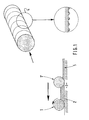
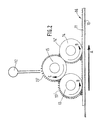
- FIG. 1 and FIG. 2 are schematic depictions of devices allowing surface application of the developing solution.
- the method is a method of developing an exposed photographic product by surface application, that is to say the photographic product is not immersed in a tank filled with developing solution, but its face opposite the support is covered with a layer of the developing solution of the present invention.
- the viscosity of the aqueous developing solution is about the viscosity of water (about 1 cp, 20°C).
- the aqueous developing solution does not contain any thickening agent.
- the application of the developing solution in a layer can be effected by any known means which makes it possible to apply an aqueous solution uniformly to a flat support in order to form a layer.
- This application can be effected manually or automatically.
- the developing solution is applied by means of the device described in FIG. 1, which comprises two rollers 1,1' connected together and forming a reservoir containing the developing solution to be spread 2 , the whole being placed on the surface of the film 3 to be developed.
- the leading roller 1 is covered with a flexible rubber
- the rear roller 1' is a roller with a ribbed surface 4 which controls the spreading of the layer of developing solution.
- the device is equipped with means for automatically moving the device over the film, which makes it possible to deposit a uniform layer of developing solution on the film (not visible in the figure).
- the developing solution is applied by means of the device described in the patent application GB 2 306 017 in the name of Kodak Ltd.
- This device described in FIG. 2, comprises a surface 10 which supports the photographic product to be developed 11 , a means of conveying the photographic product, which does not appear in the figure, a reservoir 12 which delivers a given quantity of developing solution, a means for applying the developing solution which comprises at least two bottom rollers 13, 14 in contact with the photographic product to be developed, and a top roller 15 situated above each of the two bottom rollers 13 , 14 , the top roller 15 being in contact with the bottom rollers 13, 14 .
- the developing solution is deposited on the surface of the roller 15' and then flows over the surface of the bottom rollers 13', 14' .
- the developing agents which can be used are conventional developing agents used alone or in a mixture, soluble in basic medium, for example aminophenols, polyhydroxybenzenes, such as paradihydroxybenzenes, for example hydroquinone or hydroquinone derivatives, 3-pyrazolidinones, pyrogallol, pyrocatechol, ascorbic acid, etc.
- the developing agent amount is of at least 0.02 mol/l, preferably between 0.02 mol/l and 1 mol/l, preferably between 0.03 mol/l and 0.6 mol/l.
- the required amount of developing agent being related to the silver content of the photographic product to be processed, it is possible to envisage the use of a greater amount of developing agent.
- the developing agent is hydroquinone and/or a hydroquinone derivative, for example methylhydroquinone, hydroquinone monosulfonate, etc.
- hydroquinone a hydroquinone derivative
- hydroquinone a hydroquinone derivative
- the developing agent is ascorbic acid and/or one of its derivatives.
- the ascorbic acid derivatives are for example L-ascorbic acid, D-isoascorbic acid, D-glucoascorbic acid, 6-desoxy-L-ascorbic acid, ascorbic acid in the form of a salt such as sodium ascorbate, sodium erythorbate, etc.
- a salt such as sodium ascorbate, sodium erythorbate, etc.
- the developing solution contains a mixture of hydroquinone (or one of its derivatives) and ascorbic acid (or one of its derivatives).
- a mixture makes it possible to reduce the quantity of hydroquinone necessary for obtaining satisfactory sensitometric results.
- the molar ratio between hydroquinone and ascorbic acid can vary to a large extent. According to the ratio used, one particular sensitometric characteristic can surprisingly be favored. In particular, when the hydroquinone is in a majority in the mixture, the speed of the film is increased substantially. For ecological reasons, it is preferable to use a mixture in which the ascorbic acid is in a majority.
- the hydroquinone/ascorbic acid molar ratio lies between 3 and 0.5, preferably equal to 1.
- a co-developer which, in association with the main developing agent, produces a synergy effect on the development.
- the quantity of this co-developer is in general very much less than the quantity of main developing agent.
- the ratio by weight between the developing agent and the co-developer is generally between 3:1 and 500:1, preferably between 50:1 and 250:1.
- the co-developers most often used are 3-pyrazolidinone compounds, for example the alkyl-3-pyrazolidinones, the aryl-3-pyrazolidinones, for example 1-aryl-3-pyrazolidinone, 1-phenyl-3-pyrazolidinone (known as phenidone), substituted phenidones, 4-methyl-4-hydroxymethyl phenidone, 1-phenyl-4-methyl pyrazolidinone or 1-phenyl-5-methyl-3-pyrazolidinone.
- the co-developers most often used are Dimezone S, phenidone and Elon.
- a co-developer When a co-developer is used, it can be introduced into the developing solution and/or into the photographic product to be developed.
- the developing agent is ascorbic acid or one of its derivatives, it is necessary to use a co-developer.
- the alkanolamine of the developing composition is a primary, secondary or tertiary amine comprising a linear or branched hydroxyalkyl group comprising 1 to 10 carbon atoms.
- the alkanolamine can be chosen from amongst monoethanolamine, diethanolamine, 2-alkylethanolamine, 2-methylanolamine, 2-ethylethanolamine, diethyl-N-N-aminoethanol, 3-aminopropanol, 2-amino-1-propanol, 4-amino-1-butanol, 2-amino-1-butanol, 3 -diethyl-1-amino-1-propanol, 1-dimethylamino-2-propanol, 2-dimethylaminoethanol, N-ethyldiethanolamine, N-phenyldiethanolamine, triethanolamine, etc.
- These alkanolamines can be used in a mixture.
- the alkanolamine concentration is between 0.6 and 2.0 mol/l, preferably between 0.8 and 1.5 mol/l.
- the developing solution of the invention is a highly basic homogenous aqueous solution.
- the pH of the developing solution must be greater than 10.
- the alkanolamine being a buffer substance (around 12), a pH higher than 12 requires the use of large quantities of alkanolamine.
- a developing solution with a pH above 13 it is preferably to add a small quantity of strong base (for example KOH) to the developing solution instead of adding a large quantity of alkanolamine.
- KOH strong base
- the developing solution comprises at least one wetting agent which makes it possible to obtain a stable homogenous solution.
- wetting agent refers to a surfactant which facilitates the spreading of the developing solution on the film and which promotes chemical exchanges between the developing solution and the photographic product to be developed. This wetting agent facilitates the penetration and diffusion of the chemical substances of the developing solution towards the silver halide photographic product. It must be photographically inert.
- these wetting agents can be anionic, cationic, non-ionic or amphoteric surfactants, alone or in a mixture.
- These surfactants are for example Zonyl FSN® or Alkanol XCR® manufactured by DuPont, Lodyne S-100® manufactured by Ciba-Geigy or Olin 10G® manufactured by Olin Mathieson.
- the developing solution contains quaternary ammonium salts.
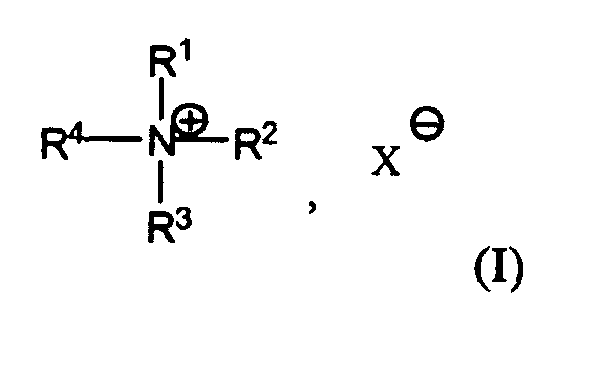
- quaternary salts are illustrated by the following formula: in which R 1 , R 2 , R 3 and R 4 are independently chosen from amongst hydrogen, an alkyl group with 1 to 4 carbon atoms, an aromatic group which may contain one or more nitrogen atoms or the groups R 1 and R 2 together, or R 1 , R 2 and R 3 together can also represent the atoms or bonds necessary for forming a ring, with the nitrogen atom, aromatic or otherwise, with 5 to 6 members.
- X is the anion which balances the charge of the molecule. X can for example be a halide or a sulfonate.
- the quantity of quaternary ammonium salts is between 0.1 and 20 g/l, preferably between 1 and 10 g/l.
- quaternary ammonium salts can be for example 1-phenethyl-2-methyl pyridinium bromide, 2-phenethyl-1-pyridinium bromide, 1-phenethyl-2-pyridinium bromide, 2,6-dichlorobenzyl-l-pyridinium bromide, benzyltriethyl ammonium chloride, tetrabutylammonium perchlorate, 1,4-dimethylpyridinium p-toluene sulphonate, 1-methyl-2-propynyl-2-pyrydinium bromide, or tetrapropyl ammonium chloride.
- the quaternary ammonium salt is a salt of formula (I) in which at least one of the groups R 1 , R 2 and R 3 together is an aryl group.
- the quaternary ammonium salt is a salt of formula (I) in which R 1 , R 2 and R 3 together represent the atoms necessary for forming a pyridinium heterocyclic compound.
- the ammonium salt is 1-phenethyl-2-methyl pyridinium.
- the wetting agent differs from the quaternary ammonium salt.
- the developing solution is in the form of a kit comprising two solutions, a first solution containing the developing agent or agents in aqueous solution, the pH of this solution make it possible to keep the effective quantity of developing agent dissolved, a second solution containing the other components of the developing solution.
- the ready-to-use developing solution of the invention is obtained by mixing the two solutions described previously. It may then be necessary to effect an adjustment of the pH.
- the developing solution comprises an alkanolamine in a quantity greater than or equal to 0.6 mol/l; 0.1 to 20 g/l of a quaternary ammonium salt; 0.1 to 3% by volume of developing solution of, at least one wetting agent which is stable at a high pH and which is miscible in the developing solution, and at least 0.02 mol/l of developing agent.
- the developing solution of the present invention may contain other compounds such as for example anti-fogging agents, preservatives, bacteriocides, fungicides, sequestering agents or buffer compounds. Examples of these compounds are described in Research Disclosure, September 1994, 365, N° 36544 (hereinafter referred to as Research Disclosure ), Section XIX. When nucleated-chemistry photographic products are developed, it is particularly advantageous to use a developing solution which contains 5-nitroindazole as an anti-fogging agent.
- any type of silver halide photographic product can be processed with the developing solution of the present invention. It is for example possible to process positive-working or negative-working photographic products, black-and-white photographic products, reversal photographic products, etc.
- nucleated films are films which contain a nucleating agent and a booster.
- the nucleating agents are generally hydrazines, boosters of amino compounds.
- Such films are known in the field of photography. They were described for example in US-A-4,975,354 and US-A-5,213,944.
- the photographic products which can be developed with the solution of the present invention can contain any type of photographic emulsion.
- these examples can comprise three-dimensional, cubic, tabular, silver halide grains.
- the photographic product which is processed with the solution of the present invention contains silver halide emulsions containing at 50% mol chloride based on silver, whilst the remaining halides can be bromide, iodide or a mixture.
- the emulsions can be pure chloride, chlorobromide, chlorobromoiodide, chloroiodobromide and chloroiodide emulsions.
- the halides are cited in decreasing order of concentration.
- the silver halide grains can be saturated with iodide (around 40% mol), it is preferable to limit the iodide to less than 20% mol, preferably less than 10% mol, based on silver. Very small quantities of iodide are generally sufficient to increase the sensitivity of the emulsion.
- the photographic product used in this example comprises an ESTAR® ethylene polyterephthalate support coated with a layer of silver halide emulsion containing the emulsion described below, a hydrazine nucleating agent of formula (I) (0.0046 g/m 2 ), and an hardening agent (bisvinylmethylsulfone, 3.5% by weight based on the total dry gelatin).
- the layer of silver halide emulsion is covered with an intermediate layer of gelatin (0.65 g/m 2 ) containing an incorporated development booster of formula (II) (0.052 g/m 2 ).
- the intermediate layer is covered with a protective top layer of gelatin (1 g/m 2 ).
- the silver halide emulsion is a cubic grain emulsion (edges 0.18 ⁇ m) of silver chlorobromide (70 mol% chloride).
- the emulsion is chemically sensitized. It is red chromatized with a spectral sensitizer having a maximum absorption around 630 nm.
- the silver content of the layer of emulsion is 2.8 g/m 2 .
- the gelatin content is 1.8 g/m 2 .
- Pr being n-propyl.
- the photographic product described above is exposed through a sensitometric wedge with 18 levels (increments of 0.1) with a xenon flash exposure meter for two microseconds through a Wratten 29 filter.
- the exposed film is developed by applying to this film a layer of developing solution having the following composition at room temperature in a quantity of around 20 ml/m 2 :
- the developing solution is applied by means of the device described in FIG. 1.
- the device is then moved in the opposite direction in order to eliminate the excess developing solution.
- the developing solution remains in contact with the film for 20 seconds.
- the film is then placed in a stop bath (30 seconds), a fixing bath (1 min at 25°C), followed by a washing bath.
- sensitometric curve is obtained from which the following sensitometric parameters are determined:
- the photographic product used in this example comprises an ESTAR® ethylene polyterephthalate support covered with a gelatin underlayer (1.8 g/m 2 ) containing the hydrazine nucleating agent of formula (I) (0.006 g/m 2 ), the incorporated amino booster of formula (II) (0.05 g/m 2 ), a latex (0.4 g/m 2 ) and a bisvinylmethylsulfone agent (3.5% by weight based on the total dry gelatin).
- the underlayer is covered with a layer of silver halide emulsion, itself covered with a protective top layer of gelatin (0.8 g/m 2 ).
- the silver halide emulsion is a cubic grain emulsion (edge 0.1 ⁇ m) of silver chlorobromide (70 mol % chloride) (silver content: 1.8 g/m 2 , gelatin content: 1.3 g/m 2 )
- Example 1 The film is exposed and developed as described in Example 1 with a developing solution having the following composition:
- the photographic product used in this example comprises an ESTAR® ethylene polyterephthalate support covered with a layer of silver halide emulsion containing the emulsion described below and bisvinylmethylsulfone tanning agent (3.5% by weight based on total dry gelatin).
- the layer of silver halide emulsion is covered with an intermediate layer of gelatin (0.65 g/m 2 ), itself covered with a protective top layer of gelatin (0.5 g/m 2 ).
- the silver halide emulsion comprises cubic grains (0.2 ⁇ m edge) of silver chlorobromide (70 mol % chloride).
- the grains are chemically sensitized. They are red chromatized with a spectral sensitizer having a maximum absorption of 630 mm.
- the silver content of the layer of emulsion is 4.0 g/m 2 and the gelatin content is 2.6 g/m 2 .
- the photographic product is then fixed and rinsed conventionally according to the Kodak®RA2000® process.
- Example 2 a photographic product as described in Example 2 is used, but in which a Co-developer (HMMP: 0.1 g/m 2 ) is incorporated in the underlayer.
- HMMP 0.1 g/m 2
- This product is developed and processed as previously described with a developing solution which does not contain any co-developer, having the following composition:
- the product used in this example is a photographic product of Example 1.
- This film is exposed and developed as in Example 1, that is to say by applying, in a thin layer, a conventional developing solution for developing a nucleated-chemistry film (concentrated Kodak RA2000® process), where the pH has been adjusted to 12 by adding KOH, the solution containing: Compounds Concentration Sodium metabisulfite 72.3 g/l NaBr 11.4 g/l Complexing agents 39.75 g/l NaOH 19.05 g/l Anti-fog agents 0.67 g/l Diethylene glycol 110 g/l Hydroquinone 75 g/l HMMP 2.4 g/l Anti-oxidant 105 g/l Buffer agent 54.4 g/l pH 12
- Example 5.2 illustrating the present invention shows that, under the same development conditions, the developing solution of the present invention gives satisfactory sensitometric results with reduced quantities of developing agent and Co-developer.
- the product used in this example is the photographic product of Example 3.
- Example 6.1 the film is developed in a conventional fashion in a tank with the Kodak RA2000® (1+2) developing solution described in Example 5.
- Example 6.2 the film is developed by the application of a layer of developing solution of the invention identical to that of Example 3.
Landscapes
- Physics & Mathematics (AREA)
- General Physics & Mathematics (AREA)
- Silver Salt Photography Or Processing Solution Therefor (AREA)
Claims (13)
- Solution photographique aqueuse de développement d'un produit photographique aux halogénures d'argent comprenant :une quantité d'alcanolamine supérieure ou égale à 0,6 mole/l,au moins un agent mouillant stable à haut pH et miscible dans ladite solution de développement,un développateur capable de réduire les ions argent, et un sel d'ammonium quaternaire représenté par la formule suivantedans laquelle

R1, R2, R3 et R4 représentent indépendamment l'hydrogène, un groupe alkyle de 1 à 4 atomes de carbone, un groupe carbocyclique aromatique ou un groupe hétérocyclique pouvant contenir un ou plusieurs atomes d'azote, ou les groupes R1 et R2 ou R1, R2 et R3 peuvent représenter ensemble les atomes ou les liaisons nécessaires pour former, avec l'atome d'azote, un cycle à 5 ou 6 chaínons, et
X est un anion. - Solution de développement selon la revendication 1 comprenant de 0,1 à 20 g/l dudit sel d'ammonium quaternaire, de 0,1 à 3 % en volume de solution de développement d'au moins un agent mouillant et au moins 0,02 mole/l dudit développateur.
- Solution de développement selon la revendication 1 comprenant de plus un co-développateur.
- Solution de développement selon la revendication 3, dans laquelle le co-développateur est un composé 1-aryl-3-pyrazolidinone.
- Solution de développement selon la revendication 1, dans laquelle ledit sel d'ammonium quaternaire est présent en une quantité comprise entre 1 et 10 g/l.
- Solution de développement selon la revendication 1, dans laquelle R1, R2 et R3 représentent les atomes nécessaires pour former, avec l'atome d'azote, un cycle pyridinium, ce qui permet de former un sel de pyridinium.
- Solution de développement selon la revendication 6, dans laquelle ledit sel de pyridinium est le sel de 1-phénéthyl-2-méthylpyridinium.
- Solution de développement selon la revendication 1, dans laquelle ladite alcanolamine est la monoéthanolamine, la diéthanolamine ou la 2-alkyl-éthanolamine.
- Solution de développement selon la revendication 8, dans laquelle ladite alcanolamine est le 2-méthyl-aminoéthanol.
- Solution de développement selon la revendication 1, dans laquelle ledit développateur est l'hydroquinone, un dérivé de l'hydroquinone, l'acide ascorbique ou un dérivé de l'acide ascorbique ou un mélange de ces derniers.
- Solution de développement selon la revendication 10, dans laquelle ledit développateur est l'acide ascorbique ou l'un de ses dérivés et ladite solution contient en outre une quantité de co-développateur 1-aryl-3-pyrazolidinone telle que le rapport en poids de l'acide ascorbique au co-développateur est compris entre 3:1 et 500:1.
- Solution de développement selon la revendication 1 contenant de plus un composé antivoile 5-nitroindazole.
- Kit de traitement photographique comprenant :une première solution contenant un développateur des ions argent, etune deuxième solution contenant une quantité d'alcanolamine, une fois dans la solution de développement, comprise entre 0,6 et 2,0 moles/l, de 0,1 à 3 % en volume, une fois dans la solution de développement, d'au moins un agent de mouillage stable à haut pH et miscible dans ladite solution de développement, de 0,1 à 20 g/l, une fois dans la solution de développement, d'un sel d'ammonium quaternaire représenté par la formule suivante :dans laquelle
R1, R2, R3 et R4 représentent chacun indépendamment l'hydrogène, un groupe alkyle de 1 à 4 atomes de carbone, un groupe carbocyclique aromatique ou un groupe hétérocyclique pouvant contenir un ou plusieurs atomes d'azote ou les groupes R1 et R2 ou R1, R2 et R3 peuvent représenter ensemble les atomes ou les liaisons nécessaires pour former, avec l'atome d'azote, un cycle à 5 ou 6 chaínons, et
X est un anion.
Applications Claiming Priority (2)
| Application Number | Priority Date | Filing Date | Title |
|---|---|---|---|
| FR9710170 | 1997-08-04 | ||
| FR9710170A FR2766933B1 (fr) | 1997-08-04 | 1997-08-04 | Nouvelle solution photographique pour le developpement d'un produit photographique aux halogenures d'argent |
Publications (2)
| Publication Number | Publication Date |
|---|---|
| EP0896246A1 EP0896246A1 (fr) | 1999-02-10 |
| EP0896246B1 true EP0896246B1 (fr) | 2004-09-15 |
Family
ID=9510157
Family Applications (1)
| Application Number | Title | Priority Date | Filing Date |
|---|---|---|---|
| EP98420125A Expired - Lifetime EP0896246B1 (fr) | 1997-08-04 | 1998-07-21 | Solution photographique pour le développement d'un produit photographique à l'halogéure d'argent |
Country Status (5)
| Country | Link |
|---|---|
| US (1) | US6218093B1 (fr) |
| EP (1) | EP0896246B1 (fr) |
| JP (1) | JPH11109566A (fr) |
| DE (1) | DE69826196T2 (fr) |
| FR (1) | FR2766933B1 (fr) |
Families Citing this family (1)
| Publication number | Priority date | Publication date | Assignee | Title |
|---|---|---|---|---|
| US6413704B1 (en) * | 2000-06-13 | 2002-07-02 | Eastman Kodak Company | Image forming assembly and method using a lamination apparatus |
Family Cites Families (17)
| Publication number | Priority date | Publication date | Assignee | Title |
|---|---|---|---|---|
| NL113525C (fr) * | 1958-10-11 | |||
| US3622330A (en) * | 1969-12-19 | 1971-11-23 | Du Pont | Lithographic developer containing an anionic fatty alcohol sulfate and a nonionic polyethylene oxide surfactant |
| US4022621A (en) * | 1972-09-01 | 1977-05-10 | Fuji Photo Film Co., Ltd. | Photographic developer composition |
| JPS551572B2 (fr) * | 1972-12-21 | 1980-01-16 | ||
| US4269929A (en) * | 1980-01-14 | 1981-05-26 | Eastman Kodak Company | High contrast development of photographic elements |
| JPH0823681B2 (ja) * | 1986-09-18 | 1996-03-06 | 富士写真フイルム株式会社 | 直接ポジカラ−画像形成方法 |
| JPH0363646A (ja) * | 1989-08-01 | 1991-03-19 | Fuji Photo Film Co Ltd | ハロゲン化銀カラー写真感光材料の処理方法 |
| EP0416174A1 (fr) * | 1989-09-04 | 1991-03-13 | Agfa-Gevaert N.V. | Méthode de développement d'un matériau autopositif à l'halogénure d'argent |
| US5215873A (en) * | 1989-11-21 | 1993-06-01 | E. I. Du Pont De Nemours And Company | Process for developing silver halide recording materials |
| EP0518627A1 (fr) * | 1991-06-10 | 1992-12-16 | International Paper Company | Réduction de boues d'argent pendant le traitement photographiques |
| US5384232A (en) * | 1991-12-02 | 1995-01-24 | E. I. Du Pont De Nemours And Company | Process for rapid access development of silver halide films using pyridinium as development accelerators |
| EP0621506A1 (fr) * | 1993-04-13 | 1994-10-26 | Agfa-Gevaert N.V. | Traitement de films radiographiques industriels à l'halogénure d'argent |
| EP0628878B1 (fr) * | 1993-06-09 | 1995-05-24 | Agfa-Gevaert N.V. | Méthode d'obtention d'une plaque d'impression par le procédé de diffusion transfert de sel d'argent |
| US5474879A (en) * | 1995-01-30 | 1995-12-12 | Eastman Kodak Company | Radiographic film developers containing ascorbic acid and thioether development accelerators |
| DE19651349C2 (de) * | 1995-12-12 | 2000-12-07 | Mitsubishi Paper Mills Ltd | Verfahren zur Herstellung einer Lithographie-Druckplatte |
| FR2747806B1 (fr) * | 1996-04-19 | 1998-07-03 | Kodak Pathe | Nouveau procede de developpement d'un produit photographique a developpateur incorpore |
| FR2766934A1 (fr) * | 1997-08-04 | 1999-01-29 | Eastman Kodak Co | Nouveau procede de traitement d'un produit photographique aux halogenures d'argent |
-
1997
- 1997-08-04 FR FR9710170A patent/FR2766933B1/fr not_active Expired - Fee Related
-
1998
- 1998-07-21 EP EP98420125A patent/EP0896246B1/fr not_active Expired - Lifetime
- 1998-07-21 DE DE69826196T patent/DE69826196T2/de not_active Expired - Lifetime
- 1998-08-04 JP JP10220570A patent/JPH11109566A/ja active Pending
-
1999
- 1999-08-13 US US09/374,913 patent/US6218093B1/en not_active Expired - Fee Related
Also Published As
| Publication number | Publication date |
|---|---|
| FR2766933B1 (fr) | 2004-04-09 |
| DE69826196D1 (de) | 2004-10-21 |
| EP0896246A1 (fr) | 1999-02-10 |
| JPH11109566A (ja) | 1999-04-23 |
| FR2766933A1 (fr) | 1999-02-05 |
| US6218093B1 (en) | 2001-04-17 |
| DE69826196T2 (de) | 2005-09-22 |
Similar Documents
| Publication | Publication Date | Title |
|---|---|---|
| US4960683A (en) | Method for processing a black-and-white photosensitive material | |
| JPH0778617B2 (ja) | ハロゲン化銀写真感光材料 | |
| JP2934997B2 (ja) | 黒白ハロゲン化銀写真感光材料の処理方法 | |
| JPH09500221A (ja) | ヒドロキノンを含まない写真現像組成物および処理方法 | |
| EP0802452B1 (fr) | Procédé de développement d'un produit photographique à développateur incorporé | |
| US5284733A (en) | High-contrast image forming process | |
| EP0896246B1 (fr) | Solution photographique pour le développement d'un produit photographique à l'halogéure d'argent | |
| EP0189603A1 (fr) | Procédé pour la production d'une image argentique comprenant un traitement de stabilisation-fixage | |
| US5955246A (en) | Method of processing a silver halide photographic product | |
| US4022621A (en) | Photographic developer composition | |
| US3740221A (en) | Development of photographic material | |
| US5198327A (en) | Method of formation of photographic images | |
| EP0831367B1 (fr) | Procédé de développement d'un produit photographique qui contient un agent développateur par application d'un activateur sur sa surface | |
| JPH0560851B2 (fr) | ||
| US5910397A (en) | Method of processing a photographic product | |
| JP3401693B2 (ja) | ハロゲン化銀写真感光材料の処理方法 | |
| JP3052479B2 (ja) | ネガ型ハロゲン化銀写真感光材料及びそれを用いた画像形成方法 | |
| JP2822130B2 (ja) | 黒白ハロゲン化銀写真感光材料の現像処理方法 | |
| JPH07311433A (ja) | ハロゲン化銀写真感光材料 | |
| JP3177797B2 (ja) | 黒白ハロゲン化銀写真感光材料の現像処理方法 | |
| JP2572225B2 (ja) | 画像形成方法 | |
| JPH01230043A (ja) | ハロゲン化銀感光材料の現像処理方法 | |
| JPH0588308A (ja) | 画像形成方法 | |
| JPH07234472A (ja) | ハロゲン化銀写真感光材料 | |
| JPS61117535A (ja) | ハロゲン化銀写真感光材料 |
Legal Events
| Date | Code | Title | Description |
|---|---|---|---|
| PUAI | Public reference made under article 153(3) epc to a published international application that has entered the european phase |
Free format text: ORIGINAL CODE: 0009012 |
|
| AK | Designated contracting states |
Kind code of ref document: A1 Designated state(s): DE FR GB |
|
| AX | Request for extension of the european patent |
Free format text: AL;LT;LV;MK;RO;SI |
|
| 17P | Request for examination filed |
Effective date: 19990709 |
|
| AKX | Designation fees paid |
Free format text: DE FR GB |
|
| 17Q | First examination report despatched |
Effective date: 20031002 |
|
| GRAP | Despatch of communication of intention to grant a patent |
Free format text: ORIGINAL CODE: EPIDOSNIGR1 |
|
| GRAS | Grant fee paid |
Free format text: ORIGINAL CODE: EPIDOSNIGR3 |
|
| GRAA | (expected) grant |
Free format text: ORIGINAL CODE: 0009210 |
|
| AK | Designated contracting states |
Kind code of ref document: B1 Designated state(s): DE FR GB |
|
| REG | Reference to a national code |
Ref country code: GB Ref legal event code: FG4D |
|
| REF | Corresponds to: |
Ref document number: 69826196 Country of ref document: DE Date of ref document: 20041021 Kind code of ref document: P |
|
| PGFP | Annual fee paid to national office [announced via postgrant information from national office to epo] |
Ref country code: GB Payment date: 20050614 Year of fee payment: 8 |
|
| PGFP | Annual fee paid to national office [announced via postgrant information from national office to epo] |
Ref country code: FR Payment date: 20050706 Year of fee payment: 8 |
|
| ET | Fr: translation filed | ||
| PLBE | No opposition filed within time limit |
Free format text: ORIGINAL CODE: 0009261 |
|
| STAA | Information on the status of an ep patent application or granted ep patent |
Free format text: STATUS: NO OPPOSITION FILED WITHIN TIME LIMIT |
|
| PGFP | Annual fee paid to national office [announced via postgrant information from national office to epo] |
Ref country code: DE Payment date: 20050729 Year of fee payment: 8 |
|
| 26N | No opposition filed |
Effective date: 20050616 |
|
| PG25 | Lapsed in a contracting state [announced via postgrant information from national office to epo] |
Ref country code: DE Free format text: LAPSE BECAUSE OF THE APPLICANT RENOUNCES Effective date: 20060221 |
|
| PG25 | Lapsed in a contracting state [announced via postgrant information from national office to epo] |
Ref country code: GB Free format text: LAPSE BECAUSE OF NON-PAYMENT OF DUE FEES Effective date: 20060721 |
|
| GBPC | Gb: european patent ceased through non-payment of renewal fee |
Effective date: 20060721 |
|
| REG | Reference to a national code |
Ref country code: FR Ref legal event code: ST Effective date: 20070330 |
|
| PG25 | Lapsed in a contracting state [announced via postgrant information from national office to epo] |
Ref country code: FR Free format text: LAPSE BECAUSE OF NON-PAYMENT OF DUE FEES Effective date: 20060731 |