EP0982942B1 - Fernsehübermittlungsanlage mit Speichermöglichkeit - Google Patents
Fernsehübermittlungsanlage mit Speichermöglichkeit Download PDFInfo
- Publication number
- EP0982942B1 EP0982942B1 EP99120872A EP99120872A EP0982942B1 EP 0982942 B1 EP0982942 B1 EP 0982942B1 EP 99120872 A EP99120872 A EP 99120872A EP 99120872 A EP99120872 A EP 99120872A EP 0982942 B1 EP0982942 B1 EP 0982942B1
- Authority
- EP
- European Patent Office
- Prior art keywords
- video
- video data
- coded
- storage
- coded video
- Prior art date
- Legal status (The legal status is an assumption and is not a legal conclusion. Google has not performed a legal analysis and makes no representation as to the accuracy of the status listed.)
- Expired - Lifetime
Links
Images




Classifications
-
- H—ELECTRICITY
- H04—ELECTRIC COMMUNICATION TECHNIQUE
- H04N—PICTORIAL COMMUNICATION, e.g. TELEVISION
- H04N5/00—Details of television systems
- H04N5/76—Television signal recording
- H04N5/78—Television signal recording using magnetic recording
- H04N5/782—Television signal recording using magnetic recording on tape
- H04N5/783—Adaptations for reproducing at a rate different from the recording rate
-
- H—ELECTRICITY
- H04—ELECTRIC COMMUNICATION TECHNIQUE
- H04N—PICTORIAL COMMUNICATION, e.g. TELEVISION
- H04N19/00—Methods or arrangements for coding, decoding, compressing or decompressing digital video signals
- H04N19/10—Methods or arrangements for coding, decoding, compressing or decompressing digital video signals using adaptive coding
- H04N19/102—Methods or arrangements for coding, decoding, compressing or decompressing digital video signals using adaptive coding characterised by the element, parameter or selection affected or controlled by the adaptive coding
- H04N19/132—Sampling, masking or truncation of coding units, e.g. adaptive resampling, frame skipping, frame interpolation or high-frequency transform coefficient masking
-
- H—ELECTRICITY
- H04—ELECTRIC COMMUNICATION TECHNIQUE
- H04N—PICTORIAL COMMUNICATION, e.g. TELEVISION
- H04N19/00—Methods or arrangements for coding, decoding, compressing or decompressing digital video signals
- H04N19/10—Methods or arrangements for coding, decoding, compressing or decompressing digital video signals using adaptive coding
- H04N19/134—Methods or arrangements for coding, decoding, compressing or decompressing digital video signals using adaptive coding characterised by the element, parameter or criterion affecting or controlling the adaptive coding
- H04N19/164—Feedback from the receiver or from the transmission channel
-
- H—ELECTRICITY
- H04—ELECTRIC COMMUNICATION TECHNIQUE
- H04N—PICTORIAL COMMUNICATION, e.g. TELEVISION
- H04N19/00—Methods or arrangements for coding, decoding, compressing or decompressing digital video signals
- H04N19/10—Methods or arrangements for coding, decoding, compressing or decompressing digital video signals using adaptive coding
- H04N19/169—Methods or arrangements for coding, decoding, compressing or decompressing digital video signals using adaptive coding characterised by the coding unit, i.e. the structural portion or semantic portion of the video signal being the object or the subject of the adaptive coding
- H04N19/17—Methods or arrangements for coding, decoding, compressing or decompressing digital video signals using adaptive coding characterised by the coding unit, i.e. the structural portion or semantic portion of the video signal being the object or the subject of the adaptive coding the unit being an image region, e.g. an object
- H04N19/172—Methods or arrangements for coding, decoding, compressing or decompressing digital video signals using adaptive coding characterised by the coding unit, i.e. the structural portion or semantic portion of the video signal being the object or the subject of the adaptive coding the unit being an image region, e.g. an object the region being a picture, frame or field
-
- H—ELECTRICITY
- H04—ELECTRIC COMMUNICATION TECHNIQUE
- H04N—PICTORIAL COMMUNICATION, e.g. TELEVISION
- H04N19/00—Methods or arrangements for coding, decoding, compressing or decompressing digital video signals
- H04N19/40—Methods or arrangements for coding, decoding, compressing or decompressing digital video signals using video transcoding, i.e. partial or full decoding of a coded input stream followed by re-encoding of the decoded output stream
-
- H—ELECTRICITY
- H04—ELECTRIC COMMUNICATION TECHNIQUE
- H04N—PICTORIAL COMMUNICATION, e.g. TELEVISION
- H04N19/00—Methods or arrangements for coding, decoding, compressing or decompressing digital video signals
- H04N19/50—Methods or arrangements for coding, decoding, compressing or decompressing digital video signals using predictive coding
- H04N19/587—Methods or arrangements for coding, decoding, compressing or decompressing digital video signals using predictive coding involving temporal sub-sampling or interpolation, e.g. decimation or subsequent interpolation of pictures in a video sequence
-
- H—ELECTRICITY
- H04—ELECTRIC COMMUNICATION TECHNIQUE
- H04N—PICTORIAL COMMUNICATION, e.g. TELEVISION
- H04N19/00—Methods or arrangements for coding, decoding, compressing or decompressing digital video signals
- H04N19/60—Methods or arrangements for coding, decoding, compressing or decompressing digital video signals using transform coding
- H04N19/61—Methods or arrangements for coding, decoding, compressing or decompressing digital video signals using transform coding in combination with predictive coding
-
- H—ELECTRICITY
- H04—ELECTRIC COMMUNICATION TECHNIQUE
- H04N—PICTORIAL COMMUNICATION, e.g. TELEVISION
- H04N19/00—Methods or arrangements for coding, decoding, compressing or decompressing digital video signals
- H04N19/10—Methods or arrangements for coding, decoding, compressing or decompressing digital video signals using adaptive coding
- H04N19/102—Methods or arrangements for coding, decoding, compressing or decompressing digital video signals using adaptive coding characterised by the element, parameter or selection affected or controlled by the adaptive coding
- H04N19/103—Selection of coding mode or of prediction mode
- H04N19/107—Selection of coding mode or of prediction mode between spatial and temporal predictive coding, e.g. picture refresh
-
- H—ELECTRICITY
- H04—ELECTRIC COMMUNICATION TECHNIQUE
- H04N—PICTORIAL COMMUNICATION, e.g. TELEVISION
- H04N19/00—Methods or arrangements for coding, decoding, compressing or decompressing digital video signals
- H04N19/10—Methods or arrangements for coding, decoding, compressing or decompressing digital video signals using adaptive coding
- H04N19/134—Methods or arrangements for coding, decoding, compressing or decompressing digital video signals using adaptive coding characterised by the element, parameter or criterion affecting or controlling the adaptive coding
- H04N19/146—Data rate or code amount at the encoder output
-
- H—ELECTRICITY
- H04—ELECTRIC COMMUNICATION TECHNIQUE
- H04N—PICTORIAL COMMUNICATION, e.g. TELEVISION
- H04N19/00—Methods or arrangements for coding, decoding, compressing or decompressing digital video signals
- H04N19/10—Methods or arrangements for coding, decoding, compressing or decompressing digital video signals using adaptive coding
- H04N19/134—Methods or arrangements for coding, decoding, compressing or decompressing digital video signals using adaptive coding characterised by the element, parameter or criterion affecting or controlling the adaptive coding
- H04N19/146—Data rate or code amount at the encoder output
- H04N19/152—Data rate or code amount at the encoder output by measuring the fullness of the transmission buffer
-
- H—ELECTRICITY
- H04—ELECTRIC COMMUNICATION TECHNIQUE
- H04N—PICTORIAL COMMUNICATION, e.g. TELEVISION
- H04N19/00—Methods or arrangements for coding, decoding, compressing or decompressing digital video signals
- H04N19/30—Methods or arrangements for coding, decoding, compressing or decompressing digital video signals using hierarchical techniques, e.g. scalability
-
- H—ELECTRICITY
- H04—ELECTRIC COMMUNICATION TECHNIQUE
- H04N—PICTORIAL COMMUNICATION, e.g. TELEVISION
- H04N19/00—Methods or arrangements for coding, decoding, compressing or decompressing digital video signals
- H04N19/60—Methods or arrangements for coding, decoding, compressing or decompressing digital video signals using transform coding
-
- H—ELECTRICITY
- H04—ELECTRIC COMMUNICATION TECHNIQUE
- H04N—PICTORIAL COMMUNICATION, e.g. TELEVISION
- H04N9/00—Details of colour television systems
- H04N9/79—Processing of colour television signals in connection with recording
- H04N9/80—Transformation of the television signal for recording, e.g. modulation, frequency changing; Inverse transformation for playback
- H04N9/804—Transformation of the television signal for recording, e.g. modulation, frequency changing; Inverse transformation for playback involving pulse code modulation of the colour picture signal components
- H04N9/8042—Transformation of the television signal for recording, e.g. modulation, frequency changing; Inverse transformation for playback involving pulse code modulation of the colour picture signal components involving data reduction
-
- H—ELECTRICITY
- H04—ELECTRIC COMMUNICATION TECHNIQUE
- H04N—PICTORIAL COMMUNICATION, e.g. TELEVISION
- H04N9/00—Details of colour television systems
- H04N9/79—Processing of colour television signals in connection with recording
- H04N9/80—Transformation of the television signal for recording, e.g. modulation, frequency changing; Inverse transformation for playback
- H04N9/82—Transformation of the television signal for recording, e.g. modulation, frequency changing; Inverse transformation for playback the individual colour picture signal components being recorded simultaneously only
- H04N9/8205—Transformation of the television signal for recording, e.g. modulation, frequency changing; Inverse transformation for playback the individual colour picture signal components being recorded simultaneously only involving the multiplexing of an additional signal and the colour video signal
- H04N9/8227—Transformation of the television signal for recording, e.g. modulation, frequency changing; Inverse transformation for playback the individual colour picture signal components being recorded simultaneously only involving the multiplexing of an additional signal and the colour video signal the additional signal being at least another television signal
Definitions
- the present invention relates to a video storage type communication system and more particularly to a video storage type communication device which is capable of successively decoding received coded video data by video decoding means, encoding the decoded video frame/field (hereinafter simply referred to as frame) only in intraframe mode by coding means and stored in a center storage device, thereby realizing the possibility of generating pictures specially reproducible, for example, with rapid feeding.
- Video telecommunication services and a video conferencing services are well known as currently available video communication services.
- the most newly emerging services are video information database services which allow each user by using his audiovisual terminal set (referred to as a terminal) to access a database storage (recording device) of a host center and to obtain desired video information therefrom.
- a conventional storage type communication system for providing a video storage-and-delivery service has a video storage type communication device, a video storage portion, a communication control portion, a receiving portion, a transmitting portion and etc., and a video data coded by any one of the terminals is transmitted over the communication network to the receiving portion.
- the receiving portion divides a received coded video-data into frames and transmits the frames to the video storage portion, and the video storage portion stores the received coded video-data (frames) therein according to an instruction given by the communication control portion.
- the video storage type communication device is intended to be connected with an audiovisual terminal (hereinafter abbreviated to AV terminal) which conforms the recommendation ITU-T (International Telecommunications Union) and meets the recommendation H.261 on a video information coding system.
- ITU-T International Telecommunications Union
- video data coded according to the recommendation H.261 is usually coded by interframe coding method and therefore consists of differential information. If a first frame data is interframely coded, each receiving terminal can not restore the frame into an image (i.e., a screenful) but have only confused screen image for a while. Therefore, data of the first frame is not interframely but intraframely coded and stored.
- the recommendation H.261 proposes to periodically refresh a system component for preventing error accumulation due to interframe coding and to periodically conduct an intraframe coding of moving picture data. By using this opportunity, a sequence of the data frames are stored with an intraframely coded frame (data) placed at the head thereof. This makes it possible to reproduce video with a rapid feed by thinning the data units (frames) when reproducing the video data stored.
- a video storage type communication device which realizes rapid-feed reproduction of images by using periodical refreshment is disclosed in Japanese Laid-Open Patent Publication No. 5-91497.
- the disclosed device is featured by that whenever a rapid feed control is carried-out, it can start from intraframely coded data, i.e., data of the heading (intraframely coded) frame of interframely coded frames, assuring the synchronized processing visual data and audio data.
- the above-mentioned structure of stored data is featured by coexistence of the data necessary for usual reproduction and the data necessary for rapid-feed reproduction. Therefore, it is required to control a storage and data for correctly distinguishing the above-mentioned two kinds of data from each other when reproducing them. Furthermore, the rapid-feed reproduction requires such reproduction control that may select and read only data necessary for rapid-feed reproduction. All these facts may require much complicated data control when storing and reproducing the data.
- periodical refreshment depends upon terminals which have different period of intraframe coding, depriving the storage and communication device of the possibility of controlling a speed of rapid-feed reproduction.
- the recommendation H.261 provides that video data coding is conducted on each of blocks into which one frame of video data is divided for encoding, whereas refreshment is conducted on a macroblock consisting of a plurality of the blocks which may not correspond to one frame. Therefore, some terminals may not guarantee that the whole of a frame is intraframely coded.
- EP 0 579 156 A which discloses a recording/reproducing method comprises the steps of helically scanning a first region of a magnetic tape running at a normal speed using a plurality of rotary heads, recording a digital data train on a plurality of sloped tracks and simultaneously recording single-frame data at N-picture intervals on a second region of the magnetic tape through at least one fixed head, and reproducing the data recorded on the first region during a normal reproduction, while the magnetic tape runs at an N-times speed for variable speed reproduction to reproduce the data recorded on the second region.
- the recording data for the normal recording/reproduction and special recording/reproduction is separately recorded and reproduced on mutually different regions of the magnetic tape. Accordingly, since the processing of the normal recording/reproduction signal is independent from that of the special recording/reproduction signal, the normal-processing design is facilitated due to a greater degree of freedom. Also, an apparatus is adapted to perform the method.
- It is another object of the present invention to provide a video storage type communication device which has a storage control portion for selecting video information from a specially reproducible video generating portion and video information from a receiving portion and storing the selected video information in a storage portion, thereby making it possible to insert and store specially reproducible video information in any position among video information received from a terminal.
- the present invention provides a video storage type communication device as specified in claim 1 or 5 and a method as specified in claim 9. Preferred embodiments of the invention are described in the subclaims.
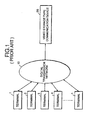
- FIG. 1 is illustrative of a system of conducting a video-information database service, which includes terminals 1 - n, a digital transmission network 10 and a video storage type communication device 20.
- Fig. 2 is a detailed illustration of the video storage type communication device shown in Fig. 1.
- the video storage type communication device 20 comprises a receiving portion 21, a refreshed picture detecting portion 22, a transferring portion 23, a communication control portion 24, a video storage portion 25, a reproduction control portion 26, transmitting portion 27 and so on.
- the receiving portion 21 and the transmitting portion 27 are connected to the digital transmission network 10 for communication with the terminals 1 - n.
- the storage type communication device 20 is intended to be connected with the terminals 1 - n which conform to the video coding method H.261 recommended by International Telecommunications Union (ITU).
- ITU International Telecommunications Union
- video data coded according to the recommendation H.261 is usually coded by interframe differential coding method and, therefore, consists of differential information. If the first frame data is coded by interframe coding method, each receiving terminal can not restore the frame into a picture (i.e., a screenful) but have only confused screen image for a while. Therefore, data of the first frame is not interframely but intraframely coded and stored.
- the recommendation H.261 proposes to periodically refresh the video data for preventing error accumulation due to interframe coding and to periodically conduct an intraframe coding of moving picture data.
- the frames of video data are stored in such a way that a frame of intraframely coded video data is placed at the head of a video data sequence. This makes it possible to reproduce video information by rapidly forwarding or reversing by thinning frames at a specified interval.
- the above-mentioned periodical refreshment depends upon terminals which may have different period of intraframe coding, depriving the storage type communication device of the possibility of controlling a speed of rapidly feeding reproduction.
- Figure 3 shows an example of refreshing process in a conventional storage type communication device.
- intraframely coded video data frames A0, B0, C0 and so on are inserted at indefinite intervals.
- Coded video data is transferred to a terminal in the order of frames A0, B0, C0 and so on when they are reproduced by rapidly forwarding and in the order of frames C0, B0, A0 when they are reproduced by rapidly reversing. Namely, frames are reproduced rapidly but at irregular feeding speed at the terminal. This is undesirable from the view point of the service quality.
- the present invention was made to provide a video storage type communication device which has video storing means being capable of storing coded video data received from terminals and reproducing the video data by an ordinary method as well as by a special method, e.g., by rapidly forwarding and reversing at a speed selectively adjustable independent of terminals used.
- Fig. 4 is a construction view for explaining a video storage type communication device embodying the present invention.
- 1 - n are terminals, 10 is a communication network and 30 is a video storage type communication device according to the present invention.
- the video storage type communication device 30 trough its receiving portion 31 and transmitting portion 38 is connected with the communication network 10, over which it communicates video data to and from a plurality of the terminals 1 - n.
- the first storage portion 32 has storing media for storing therein coded video data received from the receiving portion 31 according to an instruction to be given by the communication control portion 37.
- Data to be stored in the first storage portion 32 is interframely coded data A shown in Fig. 6 consisting mainly of coded interframe differential information which has a decreased data amount but is unsuitable for reproduction by rapid forwarding or reversing.
- the coded video data from the receiving portion 31 is also transferred to the specially reproducible video generating portion 34 wherein it is converted into specially reproducible video information which is then transferred to the second storage portion 33.
- the second storage portion 33 has storing media for storing therein coded video data generated by the specially reproducible video generating portion 34 according to an instruction to be given by the communication control portion 37.
- the video data stored in the first storage portion 32 and the video data stored in the second storage portion 33 are read out by the reproduction control portion 35.
- the video data is read from the first storage portion 32 for ordinary reproduction while the video data is read from the second storage portion 33 for special reproduction.
- the reproduction control portion 35 operates the reproduction selector switch 36 so that it selects the data required to be transferred to the transmitting portion 38.
- the transmitting portion 38 receives the data from the first storage portion 32 or the second storage portion 33 and transmits the data to the terminals 1 - n over the communication network 10.
- FIG. 5 is illustrative of a specially reproducible video generating portion shown in Fig. 4.
- a specially reproducible video generating portion 34 including a video restoring portion 34a, an intraframe coding portion 34b and a specially reproducible video generation control portion 34c.
- the video restoring portion 34a restores video data by successively decoding coded video data received through the receiving portion 31.
- the intraframe coding portion 34b intraframely encodes the video data restored by the video restoring portion 34a.
- the control portion 34c for generation of specially reproducible video data performs control operations for generation of specially reproducible video data, e.g., selection of frames to be intraframely encoded.
- another coding portion having another encoding means e.g., still-picture coding means in addition to the intraframe coding portion 34b, it is possible to adapted to various kinds of coding formats.
- video data to be stored in the second video storage portion 33 is such that the received coded video data is thinned off frames at a specified interval and encoded, in form of, e.g., intraframely coded data B shown in Fig. 6.
- the intraframely coded data B has a larger amount of data per frame but frames are independent and, therefore, can be reproduced with no disturbance despite the order of reading them.
- these video frames are read and transmitted in the order of storing, they can be rapidly reproduced at terminals.
- these video frames are read and transmitted in the reverse order, they can be rapidly reproduced in the reverse direction.
- a heading video data is desired to be intraframely coded frame. Accordingly, even in ordinary reproduction, only a frame to be first reproducible is read from the second storage portion and reproduced and, then, the second and succeeding frames are obtained from the first storage portion and reproduced.
- video information stored in the second storage portion 33 consists of intraframely coded data which is separated per frame, it permits relatively easy processing for edition, addition, deletion and exchange of the data as may be required.
- FIG 7 is a construction view of another example of a specially reproducible video generating portion.
- the specially reproducible video generating portion 34 includes a video restoring portion 34a, an interframe coding portion 34d and a specially reproducible video generation control portion 34c.
- the video restoring portion 34a restores video data by successively decoding coded video data received through the receiving portion 31 of Fig. 4.
- the interframe coding portion 34d interframely encodes the video data restored by the video restoring portion 34a.
- the control portion 34c for generation of specially reproducible video data performs control operations for generation of specially reproducible video data, e.g., selection of frames to be interframely encoded.
- the interframely coded video data may be adapted only for rapid reproduction, but video information to be reproduced is obtained by thinning frames of the received coded video data and, therefore, may be reproduced at a terminal having a low ability of decoding video (moving picture) data.
- the interframe coded data is smaller size per frame in storage, resulting in saving storing media of the storage portion.
- FIG 8 is a construction view of a further example of a specially reproducible video generating portion.
- the specially reproducible video generating portion 34 includes a video restoring portion 34a, a still-picture coding portion 34e and a specially reproducible video generation control portion 34c.
- the video restoring portion 34a restores video data by successively decoding coded video data received through the receiving portion 31 of Fig. 4.
- the still-picture coding portion 34e encodes the video data restored by the video restoring portion 34a into a still picture (frame).
- the control portion 34c for generation of specially reproducible video data performs control operations concerning generation of specially reproducible video data, e.g., selection of frames to be encoded by still-picture coding method.
- An ordinary algorithm of coding a still-picture is defined by the recommendation T.81 of ITU.
- an obtainable coded still-picture frame in comparison with the intraframely or interframely coded video data has a larger amount of data per frame but is reproducible as simply moving pictures at a terminal which can.not decode coded data of moving pictures or at a display directly connected with the video storage and communication device.
- the still coded frames can be reproduced in forwarding and reversing directions because they do not correlate with each other.
- Fig. 9 is a construction view for explaining another embodiment of video storage type communication device according to the present invention.
- the video storage type communication device 40 through its receiving portion 41 and transmitting portion 47 is connected with the communication network 10, over which it communicates video data to and from a plurality of terminals 1 - n.
- the coded video data received by the receiving portion 41 is transferred to the specially reproducible video generating portion 42 and the storage control portion 43 under the control of a communication control portion 45.
- the coded video information is conventional video data encoded by a hybrid coding method that is a combination of motion compensative interframe prediction coding and intraframe orthogonal transformation coding.
- the specially reproducible video generating portion 42 consists of a decoding portion (H.261) 42a and an intraframe coding portion (H.261) 42b and successively decodes coded video data received through the receiving portion 41 to restore video information.
- the decoding portion 42a performs processing operations such as motion compensative interframe prediction decoding and reverse DCT (Discrete Cosine Transform).
- the video data restored by the decoding portion 42a according to the recommendation H. 261 is then encoded only in the intraframe mode defined in the recommendation H. 261 by the intraframe coding portion 42b from which the coded video information is outputted.
- the specially reproducible video generating portion (H. 261) 42 has no need for performing the interframe prediction coding, being relieved of motion compensative prediction processing which is considered as main processing load for an ordinary H.261 type coder. It is also relieved of necessity for having frame memory for that purpose. Namely, the portion 42 has to perform very simple processing operations, just like a still-picture decoder, and, therefore, has a simple hardware.
- Figure 11 illustrates another example of a specially reproducible video generating portion 42 which comprises a decoding portion (H. 261) 42a and a still-picture coding portion 42c.
- the decoding portion (H.261) 42a successively decodes coded video data received through the receiving portion 41 (Fig. 4) to restore video information.
- the decoding portion 42a performs processing operations for motion compensative interframe prediction decoding and reverse DCT (Discrete Cosine Transform).
- the still-picture coding portion 42c encodes the restored video information by applying a still-picture coding algorithm defined in the recommendation T.81 of ITU.
- the application of the coding portion having still picture coding means together with the aforementioned intraframe coding portion makes it possible to comply with various kinds of coded formats.
- the communication control portion 45 provides the storage control portion 43 with control information necessary for starting and finishing the storage operation and distinguishing which kind of video information is stored - received frame video information or coded video information.
- the storage control portion 43 consists of a video information selecting control portion 43a, a selector switch 43b and a transferring portion 43c, According to control information from the communication control portion 45 for starting, ending and storing received frame video information or coded video information, the storage control portion 43 selects the received frame video information from the receiving portion 41 or the coded video information from the specially reproducible video generating portion 42 by operating the selector switch 43b, and transfers the selected video information together with additional information indicating, e.g., intraframe or interframe mode of the storable data to the video storage portion 44 for storing the information therein.
- additional information indicating e.g., intraframe or interframe mode of the storable data
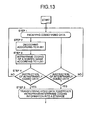
- Figure 13 is a flow chart for explaining the operation of the video storage type communication device embodying the present invention.
- Coded video data from a terminal is received by the receiving portion 41 (Step 1) and then transferred to the specially reproducible video generating portion 42 and the storage control portion 43.
- the coded video data is decoded by the H.261 type decoding portion 42a (Step 2) and stored in a frame memory thereof.
- the video frames (screenfuls) are read from the frame memory of the H.261 type decoding portion 42a and are intraframely coded by the H.261 type intraframe coding portion 42b (Step 3).
- the intraframely coded video data frames outputted from the H.261 type intraframe coding portion 42b are transferred to the storage control portion 44.
- the storage control portion 43 determines which coded video data - intraframely coded video data (output of the specially reproducible video generating portion 42) or interframely coded video data (output of the receiving portion 41) is transferred to the video storage portion 44 according to an instruction given by the communication control portion 45 (Step 4).
- the instruction from the communication control portion 45 indicates storing intraframely coded video data
- the coded video data is complemented with an information indicating the data being intraframely coded data and, then, transferred to the video storage portion through the transferring portion 43c.
- the coded video data with information indicating the data being interframely coded data is transferred to the video storage portion through the transferring portion 43c.
- the communication control portion 45 directs the storage control portion 43 not to store video data when said data is not required; to store video data coded in interframe mode when storing interframely coded data; and to store video data coded in intraframe mode when storing intraframely coded data.
- the communication control portion may request storing video data intraframe mode or interframe mode at desired intervals.
- Figure 14 shows an example of storing coded video data from a terminal into a storage by using the video storage type communication device according to the present invention. For easier understanding, such a case is described that coded data from the terminal can be transmitted at a constant frame rate (the number of frames to be transmitted per second).
- video data coded in the intraframe mode is inserted at a specified interval.
- Frames A0, B0, C0 and D0 are of intraframely coded video data.
- Frames A1 - A2, B1 - B2, C1 - C2 and D1 are of interframely coded video data.
- the frames of intraframely coded video data are inserted among the frames of interframely coded video data at an interval of 1 : 3.
- the communication control portion 45 directs the video storage portion 44 to read-out the stored coded video data therefrom.
- the communication control portion 45 also gives the reproduction control portion 46 a reproduction control information necessary for ordinary reproduction or reproduction by rapidly forwarding or by rapidly reversing (e.g., reproducible stored coded video data, direction relative to time axis, the number of frames per unit time for skipping reproduction).
- the reproduction control portion 46 reads the required coded video data from the storage portion 44 and transferred the data to the transmitting portion 47 which in turn transmits the received coded video data to the terminal.
- the stored coded video data is transmitted to a terminal whereat it is reproduced in an ordinary mode, rapidly forwarding mode or rapidly reversing mode.
- the frames of video data coded by the motion compensative interframe prediction coding method can not be transmitted to the terminal because the latter can not correctly perform predicted compensation. Therefore, only frames of intraframely coded video data are transmitted in the order of A0, B0, C0, D0 or A0, C0 and so on to the terminal.
- Fig. 15 is a construction view for explaining a video storage type communication device embodying the present invention.
- a video storage type communication device 50 is connected at its receiving portion 51 and transmitting portion 57 with a communication network 10 over which it transmits video data to and from a plurality of the terminals 1 - n.
- the video restoring portion 52 restores video (moving picture) data by successively decoding coded video data received through the receiving portion 51.
- the intraframe coding portion 53 intraframely encodes the video data restored by the video restoring portion 52.
- a video storage portion 54 has data storing media and stores the video data transferred from the intraframe coding portion 53 according to an instruction given by a communication control portion 55.
- the video data stored in the video storage portion 54 is read-out therefrom by the video-reproduction control portion 56.
- the video-reproduction control portion 56 According to an instruction of the communication control portion 55, the video-reproduction control portion 56 successively reads coded video frames in the order of their storing in the storage portion 54 when they are to be ordinarily reproduced, whereas it reads the frames at a certain interval in the forward or reverse order when they are to be reproduced by rapidly forwarding or reversing.
- the transmitting portion 57 receives the video data transferred from the video-reproduction control portion 56 and transmits the received video data over the communication network 10 to terminals 1 - n.
- video data stored in the video storage portion 54 is intraframely coded frames B shown in Fig. 16, which, in comparison with received coded video data, i.e., intraframely coded frames A, have a larger amount of data per frame and can be read out in any order and be surely reproduced at any terminal because the frames have no correlation between their contents (data).
- intraframely coded frames A When these frames reads-out in the order of storing at a certain interval and transmitted, they are reproduced in rapid forwarding mode at the terminals. When the frames read-out in the reversed order at a certain interval, they are reproduced in rapid revers mode at the terminals.
- the stored frames are independent from each other and may be processed separately, making it easier to edit, add, delete and exchange components as the need be.
- Figure 17 is a construction view of another embodiment of a video storage type communication device according to the present invention.
- numeral 56 designates a video-reproduction control portion which is composed of a reproduction control portion 56a, a reproduction selector switch 56b, a second video-restoring portion 56c and an interframe coding portion 56d.
- the second video restoring portion 56c restores video (moving picture) by successively decoding coded video data from a video storage portion 51.
- the interframe coding portion 56d interframely encodes the video data restored by the second video-restoring portion 56c.
- the reproduction control portion 56a controls a calling interval of the video frames from the video storage portion 54 and effects the reproduction selector switch 56b to select the necessity or non-necessity of newly encoding the read-out video data.
- the reproduction control portion 56a also executes control operations on the above-mentioned portions for reproduction of the video data.
- all frames except the first frame can be decoded and newly encoded by the second video-restoring portion 56c and the interframe coding portion 56d respectively before transmitting for reproduction in ordinary or rapid forwarding or rapid reversing mode.
- the frames (except the first one) to be transmitted become to have a reduced amount per frame as compared with the embodiment of Fig. 15 whereby the intraframely coded frames B (Fig. 16) obtained from the video storage portion 54 are transmitted.
- the shown embodiment can much effectively use the communication network.
- Figure 18 is a construction view of another embodiment of a video storage type communication device according to the present invention.
- numeral 56 designates a video-reproduction control portion which is composed of a reproduction control portion 56a, a reproduction mode selector switch 56b, a second video-restoring portion 56c and a still-picture coding portion 56e.
- the second video restoring portion 56c restores video (moving picture) by successively decoding coded video data from a video storage portion 54.
- the still-picture coding portion 56e receives the video data restored by the second video-restoring portion 56c and encodes the received video data frame by frame to obtain still-picture frames.
- An ordinary algorithm of coding a still-picture is defined by the recommendation T.81 of ITU (International Telecommunication Union).
- the reproduction control portion 56a controls a calling interval of the video frames from the video storage portion 54 and effects the reproduction selector switch 56b to select the necessity or non-necessity of newly encoding the read-out video data.
- the reproduction control portion 56a also performs control operations on the above-mentioned portions for reproduction of the video data.
- obtainable coded still-picture frames in comparison with the intraframely or interframely coded video frames have a larger amount of data per frame but are reproducible as a simplified moving picture at a terminal having no ability of decoding coded moving pictures or at a video display set directly connected with the video storage type communication device.
- the still-picture coded frames can be reproduced in both (forward and reverse) directions because they do not correlate with each other.
- a video storage type communication device comprises a transmitting portion 38 for transmitting video data and a receiving portion 31 for receiving video data over a communication network 10, a first video storage portion 32 for storing received video data and a communication control portion 37 for carrying-out video-communications by controlling the above-mentioned portions.
- This video storage type communication device is characterized by including a specially reproducible video generating portion 34 for generating, from received coded video data, video information to be specially reproduced, for example, by rapid feeding, and a second storage portion 33 for storing the video information from the specially reproducible video generating portion 34.
- a reproduction control portion 35 is provided for controlling a process of calling for video data from the first video storage portion 32 and the second video storage portion 33 according to an instruction from the communication control portion 37 which makes it possible to selectively switching a reproduction mode from a normal reproduction to rapid forwarding/rapid reversing reproduction and vice versa.
- the specially reproducible video generating portion 34 comprises a video restoring portion 34a for restoring coded video data from the receiving portion 31, an intraframe/intrafield coding portion 34b for selectively coding restored video information in an intraframe or intrafield coding mode and a specially reproducible video generation control portion for controlling the above-mentioned portions which generates video information to be reproduced with rapid forward feeding and rapid reverse feeding.
- the specially reproducible video generating portion 34 comprises a video restoring portion 34a for restoring coded video data from the receiving portion 31, an interframe/interfield coding portion 34d for selectively encoding restored video information in an interframe or interfield coding mode and a specially reproducible video generation control portion 34c for controlling the above-mentioned portions which generates video information to be reproduced by rapidly forwarding and rapidly reversing.
- the specially reproducible video generating portion 34 comprises a video restoring portion 34a for restoring coded video data from the receiving portion 31, a still picture coding portion 34e for encoding restored video information in a still picture coding mode and a specially reproducible video generation control portion 34c for controlling the above-mentioned portions which generates video information to be reproduced by rapidly forwarding and rapidly reversing.
- a video storage type communication device comprises also a transmitting portion 47 for transmitting video data and a receiving portion 41 for receiving video data over a communication network 10, a video storage portion 44 for storing received video data and a communication control portion 45 for carrying-out video-communications by controlling the above-mentioned portions.
- This video storage type communication device is characterized by including a specially reproducible video generating portion 42 for generating, from received coded video data, video information to be specially reproduced, for example, by rapidly feeding, and a storage control portion 43 for selecting video information from the receiving portion 41 or the specially reproducible video generating portion 42 and storing the selected video information into the video storage portion according to an instruction given from the communication control portion.
- the communication control portion 45 gives the storage control portion 43 an instruction for selecting specially reproducible coded video at a constant interval from the specially reproducible video generating portion.
- a reproduction control portion 46 for controlling a call for specially reproducible video information from video storage portion 44 according to an instruction given from the communication control portion 45 is provided for selectively switching video information to ordinarily reproducible or reproducible by rapidly forwarding or reversing.
- the specially reproducible video generating portion 42 comprises a video decoding portion 42a for decoding coded video data from the receiving portion 41 and a still-picture coding portion 42c for encoding the video information restored by the video decoding portion 42a by still-picture coding method and generates video information reproducible by rapidly forwarding and reversing.
- a video storage type communication device comprises also a transmitting portion 57 for transmitting video data and a receiving portion 51 for receiving video data over a communication network 10, a video storage portion 54 for storing received video data and a communication control portion 55 for carrying-out video-communications by controlling the above-mentioned portions.
- This video storage type communication device is characterized by providing with a video restoring portion 52 for restoring coded video data received through the receiving portion 51 and an intraframe coding portion 53 for intraframely encoding the restored video (moving picture) data and storing the video data intraframely encoded by the intraframe coding portion in the video storage portion 54.
- a video-reproduction control portion 56 for controlling a process of calling for video data from the video storage portion 54 according to an instruction from the communication control portion 55 is provided for selectively switching a video-reproduction mode from a normal reproduction to rapid forwarding/rapid reversing reproduction and vice versa.
- the video-reproduction control portion 56 comprises a second video-restoring portion 56c for restoring coded video data from the video-storage portion 54, an interframe coding portion 56d for interframely encoding restored video-information, a reproduction selector switch 56b for switching destinations of transmission of video data from the video storage portion 56c, a reproduction control portion 56a for controlling the above-mentioned portions which conducts encoding video data as the need be and switching from normal video-reproduction to rapid forwarding or reversing video-reproduction and vice versa.
- the video-reproduction control portion 56 comprises the second video-restoring portion 56c for restoring coded video data from the video-storage portion 54, a still-picture coding portion 56e for encoding restored video information into a still-picture coded data, the reproduction selector switch 56b for switching destinations of transmission of video data from the video storage portion, a reproduction control portion 56a for controlling the above-mentioned portions which conducts encoding video data as the need be and switching from normal video reproduction to rapid forwarding or reversing video reproduction and vice versa.
- the present invention provides a device which is capable of storing moving picture data received from each terminal and providing each terminal with video information to be reproducible by rapidly forwarding or reversing at any desired speed independent of usable terminals.
- a video storage type communication device 30 with a receiving portion 35 and a transmitting portion 38 transmits and receives video data over a communication network 10 to and from each terminal 1 - n.
- a coded video data received from terminals 1 - n is stored as it is in a first storage portion 32 and, at the same time, the data converted into specially reproducible video information is stored in the second storage portion 33.
- the reproduction control portion 35 controls the reproduction selector switch 36 to obtain the video data from the first storage portion 32 or the second storage portion 33, changing the reproduction mode from ordinary to the rapid forwarding/reversing and vice versa.
- the specially reproducible video generating portion 34 successively restores coded video data received through the receiving portion 31, encodes again the restored data by intraframe, interframe or still-picture coding method to generate video information to be reproducible in special mode such as reproduction by rapid forwarding or reversing.
Landscapes
- Engineering & Computer Science (AREA)
- Multimedia (AREA)
- Signal Processing (AREA)
- Compression Or Coding Systems Of Tv Signals (AREA)
- Television Signal Processing For Recording (AREA)
- Data Exchanges In Wide-Area Networks (AREA)
Claims (15)
- Kommunikationsvorrichtung mit Videospeicherung, die über ihren Empfangs- und ihren Sendeteil mit einem Kommunikationsnetzwerk verbindbar ist, wobei sie über dieses Videodaten bidirektional an mehrere Terminals und von diesen kommunizieren kann, gekennzeichnet durch:einen Empfangsteil (31) zum Empfangen erster codierter Videodaten;einen ersten Speicherteil (32) zum Speichern der ersten, vom Empfangsteil (31) empfangenen Videodaten;einen Videoerzeugungsteil (34) zum erneuten Codieren der vom Empfangsteil (31) empfangenen ersten codierten Videodaten, um zweite codierte Videodaten zu erzeugen, die von den ersten codierten Videodaten verschieden sind;einen zweiten Speicherteil (33) zum Speichern der durch den Videoerzeugungsteil (34) erzeugten zweiten codierten Videodaten;einen Wiedergabesteuerteil (35, 37) zum Auswählen der im ersten Speicherteil (32) gespeicherten ersten codierten Videodaten oder der im zweiten speicherteil (33) gespeicherten zweiten codierten Videodaten; undeinen Sendeteil (38) zum Senden der ersten codierten Videodaten oder der zweiten codierten Videodaten, wie sie vom Wiedergabesteuerteil ausgewählt werden, über das Kommunikationsnetzwerk.
- Kommunikationsvorrichtung mit Videospeicherung nach Anspruch 1, dadurch gekennzeichnet, dass der Videoerzeugungsteil (34) die zweiten codierten Videodaten mit einer kleineren Anzahl von Videorahmen erzeugt, als sie in den ersten codierten Videodaten enthalten sind.
- Kommunikationsvorrichtung mit Videospeicherung nach Anspruch 2, dadurch gekennzeichnet, dass der Videoerzeugungsteil (34) einen Videowiedergabeteil (34a) zum Wiedergeben der ersten codierten Videodaten und Neucodierteile (34b, 34d) zum intrarahmenmäßigen oder zum interrahmenmäßigen Codieren der durch den Videowiedergabeteil (34a) wiedergegebenen Videodaten aufweist.
- Kommunikationsvorrichtung mit Videospeicherung nach Anspruch 2, dadurch gekennzeichnet, dass der Videoerzeugungsteil (34) einen Videowiedergabeteil (34a) zum Wiedergeben der ersten codierten Videodaten und einen Neucodierteil (34e) für Stehbildcodierung der durch den Videowiedergabeteil wiedergegebenen Videodaten aufweist.
- Kommunikationsvorrichtung mit Videospeicherung, die über ihren Empfangs- und ihren Sendeteil mit einem Kommunikationsnetzwerk verbindbar ist, wobei sie über dieses Videodaten bidirektional an mehrere Terminals und von diesen kommunizieren kann, gekennzeichnet durch:einen Empfangsteil (51) zum Empfangen erster codierter Videodaten;einen Speicherteil (54) zum Speichern der ersten, vom Empfangsteil (51) empfangenen Videodaten;einen Videoerzeugungsteil (56c und 56d/56c und 56e) zum Erzeugen zweiter codierter Videodaten, die von den ersten codierten Videodaten verschieden sind, durch Neucodieren der im Speicherteil (54) gespeicherten ersten codierten Videodaten;einen Wiedergabesteuerteil (56a) zum Auswählen der im Speicherteil gespeicherten ersten codierten Videodaten oder der durch den Videoerzeugungsteil erzeugten zweiten codierten Videodaten; undeinen Sendeteil (57) zum Senden der ersten codierten Videodaten oder der zweiten codierten Videodaten, wie sie vom Wiedergabesteuerteil ausgewählt werden, über das Kommunikationsnetzwerk.
- Kommunikationsvorrichtung mit Videospeicherung nach Anspruch 5, dadurch gekennzeichnet, dass der Videoerzeugungsteil (56c und 56d/56c und 56e) die zweiten codierten Videodaten mit einer kleineren Anzahl von Videorahmen erzeugt, als sie in den ersten codierten Videodaten vorhanden sind.
- Kommunikationsvorrichtung mit Videospeicherung nach Anspruch 6, dadurch gekennzeichnet, dass der Videoerzeugungsteil einen Videowiedergabeteil (56c) zum Wiedergeben der ersten codierten Videodaten und einen Neucodierungsteil (56d) zum intrarahmenmäßigen oder interrahmenmäßigen Codieren der durch den Videowiedergabeteil wiedergegebenen Videodaten aufweist.
- Kommunikationsvorrichtung mit Videospeicherung nach Anspruch 6, dadurch gekennzeichnet, dass der Videoerzeugungsteil einen Videowiedergabeteil (56c) zum Wiedergeben der ersten codierten Videodaten und einen Neucodierteil (5-6e) für Stehbildcodierung der durch den Videowiedergabeteil wiedergegebenen Videodaten aufweist.
- Verfahren zum bidirektionalen Kommunizieren von Videodaten zwischen mehreren Terminals und einer Kommunikationsvorrichtung mit Videospeicherung über ein Kommunikationsnetzwerk, das mit der Kommunikationsvorrichtung mit Videospeicherung über einen Empfangs- und einen Sendeteil derselben verbindbar ist, gekennzeichnet durch die folgenden Schritte:Empfangen, mittels eines Empfangsteils (31), erster codierter Videodaten;Speichern, mittels eines ersten Speicherteils (32), der ersten, vom Empfangsteil (31) empfangenen codierten Videodaten;Neucodieren, mittels eines Videoerzeugungsteils (34), der vom Empfangsteil (31) empfangenen ersten codierten Videodaten, um zweite codierte Videodaten zu erzeugen, die von den ersten codierten Videodaten verschieden sind;Speichern, mittels eines zweiten Speicherteils (33), der durch den Videoerzeugungsteil (34) erzeugten zweiten codierten Videodaten;Auswählen, mittels eines Wiedergabesteuerteils (35, 37), der im ersten Speicherteil (32) gespeicherten ersten codierten Videodaten oder der im zweiten Speicherteil (33) gespeicherten zweiten codierten Videodaten; undSenden, mittels eines Sendeteils (38), der ersten codierten Videodaten oder der zweiten codierten Videodaten, wie sie durch den Wiedergabesteuerteil ausgewählt werden, über das Kommunikationsnetzwerk.
- Verfahren nach Anspruch 9, dadurch gekennzeichnet, dass der Videoerzeugungsteil (34; 56c und 56d/56c und 56e) die zweiten codierten Videodaten mit einer kleineren Anzahl von Videorahmen erzeugt, als sie in den ersten codierten Videodaten vorhanden sind.
- Verfahren nach Anspruch 10, gekennzeichnet durch die folgenden Schritte:Wiedergeben, mittels eines im Videoerzeugungsteil (34; 56c und 56d/56c und 56e) vorhandenen Videowiedergabeteils (34a; 56c), der ersten codierten Videodaten; undintrarahmenmäßiges oder interrahmenmäßiges Codieren, mittels im Videoerzeugungsteil (34; 56c und 56d/56c und 56e) vorhandener Neucodierungsteil (34b, 34d; 56d), der durch den Videowiedergabeteil (34a; 56c) wiedergegebenen Videodaten.
- Verfahren nach Anspruch 10, gekennzeichnet durch die folgenden Schritte:Wiedergeben, mittels eines im Videoerzeugungsteil (34; 56c und 56d/56c und 56e; 42) vorhandenen Videowiedergabeteils (34a; 56c; 42a), der ersten codierten Videodaten; undStehbildcodieren, mittels im Videoerzeugungsteil (34; 56c und 56d/56c und 56e, 42) vorhandener Neucodierungsteil (34e; 56e; 42c), der durch den Videowiedergabeteil wiedergegebenen Videodaten.
- Verfahren nach einem der Ansprüche 9 - 12, dadurch gekennzeichnet, dass der Kommunikationskanal ein digitales Kommunikationsnetzwerk (10) ist.
- Verfahren nach einem der Ansprüche 9 - 13, dadurch gekennzeichnet, dass die ersten codierten Videodaten interrahmenmäßig codierte Videodaten enthalten.
- Verfahren nach einem der Ansprüche 9 - 14, dadurch gekennzeichnet, dass die zweiten codierten Videodaten intrarahmenmäßig codierte Videodaten sind.
Applications Claiming Priority (7)
| Application Number | Priority Date | Filing Date | Title |
|---|---|---|---|
| JP17869094 | 1994-07-29 | ||
| JP17869094A JP3155426B2 (ja) | 1994-07-29 | 1994-07-29 | 画像蓄積通信装置 |
| JP8256995A JP3321332B2 (ja) | 1995-04-07 | 1995-04-07 | 画像蓄積通信装置 |
| JP08260995A JP3418476B2 (ja) | 1995-04-07 | 1995-04-07 | 画像蓄積通信装置及び画像蓄積装置 |
| JP8256995 | 1995-04-07 | ||
| JP8260995 | 1995-04-07 | ||
| EP95111936A EP0695088B1 (de) | 1994-07-29 | 1995-07-28 | Fernsehübermittlungsanlage mit Speichermöglichkeit |
Related Parent Applications (2)
| Application Number | Title | Priority Date | Filing Date |
|---|---|---|---|
| EP95111936A Division EP0695088B1 (de) | 1994-07-29 | 1995-07-28 | Fernsehübermittlungsanlage mit Speichermöglichkeit |
| EP95111936.1 Division | 1995-07-28 |
Publications (3)
| Publication Number | Publication Date |
|---|---|
| EP0982942A2 EP0982942A2 (de) | 2000-03-01 |
| EP0982942A3 EP0982942A3 (de) | 2000-05-10 |
| EP0982942B1 true EP0982942B1 (de) | 2004-06-02 |
Family
ID=27303957
Family Applications (2)
| Application Number | Title | Priority Date | Filing Date |
|---|---|---|---|
| EP95111936A Expired - Lifetime EP0695088B1 (de) | 1994-07-29 | 1995-07-28 | Fernsehübermittlungsanlage mit Speichermöglichkeit |
| EP99120872A Expired - Lifetime EP0982942B1 (de) | 1994-07-29 | 1995-07-28 | Fernsehübermittlungsanlage mit Speichermöglichkeit |
Family Applications Before (1)
| Application Number | Title | Priority Date | Filing Date |
|---|---|---|---|
| EP95111936A Expired - Lifetime EP0695088B1 (de) | 1994-07-29 | 1995-07-28 | Fernsehübermittlungsanlage mit Speichermöglichkeit |
Country Status (3)
| Country | Link |
|---|---|
| US (3) | US6078721A (de) |
| EP (2) | EP0695088B1 (de) |
| DE (2) | DE69533116T2 (de) |
Families Citing this family (26)
| Publication number | Priority date | Publication date | Assignee | Title |
|---|---|---|---|---|
| EP0695088B1 (de) * | 1994-07-29 | 2000-05-10 | Sharp Kabushiki Kaisha | Fernsehübermittlungsanlage mit Speichermöglichkeit |
| JP3321331B2 (ja) * | 1995-04-07 | 2002-09-03 | シャープ株式会社 | 画像蓄積通信装置 |
| DE19531847A1 (de) * | 1995-08-29 | 1997-03-06 | Sel Alcatel Ag | Vorrichtung zur Speicherung von Videobilddaten |
| AR016812A1 (es) * | 1997-08-14 | 2001-08-01 | Samsung Electronics Co Ltd | Metodo para transmitir informacion de video comprimida, disposiciones de compresion y de grabacion de video y aparato de reproduccion de video |
| JPH11220711A (ja) * | 1998-02-03 | 1999-08-10 | Fujitsu Ltd | 多地点会議システム及び会議端末装置 |
| DE19806913A1 (de) * | 1998-02-19 | 1999-08-26 | Cit Alcatel | Verfahren zum Generieren einer Einsprungstelle in einen Bilddatenstrom und Vorrichtung zur Durchführung des Verfahrens |
| US6414725B1 (en) * | 1998-04-16 | 2002-07-02 | Leitch Technology Corporation | Method and apparatus for synchronized multiple format data storage |
| US6542693B2 (en) * | 1998-05-29 | 2003-04-01 | Lucent Technologies Inc. | Digital video playback with trick play features |
| EP1046291A1 (de) * | 1998-09-22 | 2000-10-25 | Koninklijke Philips Electronics N.V. | Aufnahmeanlage zur digitalen aufnahme eines empfangenen analogen bildsignals in datenpaketen eines mpeg datenstromes |
| JP2001028748A (ja) | 1999-07-12 | 2001-01-30 | Sony Corp | データ再生伝送装置及びデータ再生伝送方法 |
| US6587638B1 (en) * | 1999-08-02 | 2003-07-01 | Hitachi, Ltd. | Recording/ reproducing apparatus and input/ output device |
| US7058290B1 (en) | 1999-10-30 | 2006-06-06 | Lg Electronics Inc. | Method for supporting a still picture of data stream recorded in a disk recording medium |
| JP2002158981A (ja) * | 2000-11-17 | 2002-05-31 | Nec Corp | 画像情報付電話帳機能を有する電話機 |
| EP1367827A1 (de) * | 2001-03-09 | 2003-12-03 | Sony Corporation | Datenaufzeichnungsverfahren, aufzeichnungsvorrichtung und datenausgabeverfahren |
| NL1017870C2 (nl) * | 2001-04-18 | 2002-10-25 | Marc Van Oldenborgh | Werkwijze voor invers multiplexen. |
| US7356245B2 (en) | 2001-06-29 | 2008-04-08 | International Business Machines Corporation | Methods to facilitate efficient transmission and playback of digital information |
| NL1018463C2 (nl) * | 2001-07-04 | 2003-01-08 | Marc Van Oldenborgh | Werkwijze, inrichting en programmatuur voor digitaal inverse multiplexen. |
| US7376341B2 (en) * | 2001-07-12 | 2008-05-20 | Thomson Licensing | Modifying video signals by converting non-intra pictures |
| KR100353602B1 (en) * | 2002-04-15 | 2002-09-28 | Id Digital Co Ltd | System and method for reproducing motion picture streams regardless of change in playback speed |
| US20050187960A1 (en) * | 2002-10-30 | 2005-08-25 | Fujitsu Limited | Stream server |
| JP4311188B2 (ja) * | 2003-12-12 | 2009-08-12 | ソニー株式会社 | データ記録装置、データ転送方法、データ転送プログラムおよび記録媒体、ならびに、データ転送システム |
| US20090167947A1 (en) * | 2007-12-27 | 2009-07-02 | Naoko Satoh | Video data processor and data bus management method thereof |
| EP2094014A1 (de) * | 2008-02-21 | 2009-08-26 | British Telecommunications Public Limited Company | Video-Streaming |
| EP2382756B1 (de) * | 2008-12-31 | 2018-08-22 | Lewiner, Jacques | Verfahren zur modellisierung der anzeige eines endgerätes durch macroblocks mittels durch bewegungsvektor und durchsichtigkeitsdaten gekennzeichneten masken |
| FR2943877B1 (fr) * | 2009-03-24 | 2014-04-04 | Streamwide | Procede et dispositif de stockage d'une partie d'un flux video |
| WO2014001381A2 (en) * | 2012-06-28 | 2014-01-03 | Axis Ab | System and method for encoding video content using virtual intra-frames |
Family Cites Families (48)
| Publication number | Priority date | Publication date | Assignee | Title |
|---|---|---|---|---|
| FR2321723A1 (fr) | 1975-07-29 | 1977-03-18 | Thomson Brandt | Systeme de controle d'attitude et engin equipe d'un tel systeme |
| JPS5276479A (en) | 1975-12-17 | 1977-06-27 | Oriental Yeast Co Ltd | Method of producing enzymes capable of decomposing yeast cell walls |
| JPS5276193A (en) | 1975-12-22 | 1977-06-27 | Takuji Shimizu | Method for sealing plastic bags |
| JPS6062399A (ja) | 1983-09-13 | 1985-04-10 | 株式会社富士電機総合研究所 | トンネル掘進機用位置追尾装置 |
| JPS6284414A (ja) | 1985-10-09 | 1987-04-17 | Seiko Epson Corp | 磁気ヘツドの製造方法 |
| CA1307340C (en) * | 1987-04-30 | 1992-09-08 | Toshio Koga | Image processing system for a coded signal sequence subjected to predictive coding in different manners |
| JPH01314080A (ja) * | 1988-06-13 | 1989-12-19 | Hitachi Ltd | 画像データ転送方式 |
| US4963995A (en) * | 1988-12-27 | 1990-10-16 | Explore Technology, Inc. | Audio/video transceiver apparatus including compression means |
| JP2821223B2 (ja) * | 1990-02-20 | 1998-11-05 | キヤノン株式会社 | 再生装置 |
| IT1241184B (it) * | 1990-03-02 | 1993-12-29 | Cselt Centro Studi Lab Telecom | Perfezionamenti ai sistemi ibridi di codifica di segnali video. |
| JPH0493894A (ja) | 1990-08-03 | 1992-03-26 | Canon Inc | 文字処理方法および装置 |
| US5440401A (en) * | 1990-09-14 | 1995-08-08 | Eastman Kodak Company | Image database incorporating low resolution index image data |
| JPH05276479A (ja) | 1991-03-20 | 1993-10-22 | Oki Electric Ind Co Ltd | 画像蓄積装置 |
| US5212742A (en) * | 1991-05-24 | 1993-05-18 | Apple Computer, Inc. | Method and apparatus for encoding/decoding image data |
| US5359365A (en) * | 1991-05-24 | 1994-10-25 | Canon Kabushiki Kaisha | Moving image processing method and apparatus |
| JP3292248B2 (ja) * | 1991-05-29 | 2002-06-17 | 富士通株式会社 | 遠隔会議システム |
| JP2909273B2 (ja) | 1991-06-10 | 1999-06-23 | 淑郎 大塚 | アウトライン・フォントの線幅調整方法および装置 |
| JPH0530463A (ja) | 1991-07-19 | 1993-02-05 | Toshiba Corp | 動画像管理装置 |
| JP3216162B2 (ja) | 1991-09-30 | 2001-10-09 | 日本電信電話株式会社 | 動画用テレビ電話信号転送方法 |
| JPH05216800A (ja) | 1992-02-04 | 1993-08-27 | Mitsubishi Electric Corp | ネットワーク通信方式 |
| JP2644132B2 (ja) | 1992-03-30 | 1997-08-25 | 日本電信電話株式会社 | 動画像蓄積再生処理方法 |
| JP2680777B2 (ja) | 1992-05-08 | 1997-11-19 | 三洋電機株式会社 | テレビ電話装置 |
| US5581360A (en) * | 1992-06-17 | 1996-12-03 | Sony Corporation | Methods and systems for dubbing a variable-length encoded digital video signal on a record medium |
| KR100195071B1 (ko) * | 1992-07-14 | 1999-06-15 | 윤종용 | 디지탈 비디오신호 기록 재생방법 및 그 장치 |
| JPH06105280A (ja) | 1992-09-24 | 1994-04-15 | Victor Co Of Japan Ltd | 放送受信記録再生装置 |
| JP2708683B2 (ja) * | 1992-10-21 | 1998-02-04 | 日本電信電話株式会社 | ディジタル動画ファイルの特殊再生制御処理方法 |
| JPH06150568A (ja) * | 1992-11-06 | 1994-05-31 | Sony Corp | データ記録装置 |
| JP3002348B2 (ja) * | 1992-11-30 | 2000-01-24 | シャープ株式会社 | 画像通信システム |
| US5526476A (en) | 1992-12-07 | 1996-06-11 | Fujitsu Limited | Method and apparatus for generating character patterns expressed by coordinates of a coordinate system |
| DE69423794T2 (de) * | 1993-01-13 | 2000-12-28 | Hitachi, Ltd. | Vorrichtung zur Aufzeichnung von digitalen Videosignalen mit Wiedergabe mit variabler Geschwindigkeit |
| US5377051A (en) * | 1993-01-13 | 1994-12-27 | Hitachi America, Ltd. | Digital video recorder compatible receiver with trick play image enhancement |
| US5805762A (en) * | 1993-01-13 | 1998-09-08 | Hitachi America, Ltd. | Video recording device compatible transmitter |
| US5717816A (en) * | 1993-01-13 | 1998-02-10 | Hitachi America Ltd. | Method and apparatus for the selection of data for use in VTR trick playback operation in a system using intra-coded video frames |
| CA2115976C (en) * | 1993-02-23 | 2002-08-06 | Saiprasad V. Naimpally | Digital high definition television video recorder with trick-play features |
| KR0178819B1 (ko) * | 1993-03-16 | 1999-05-01 | 보조 다꾸로 | 고능률 부호화된 동화상 데이타의 비월재생방법 |
| US5587806A (en) * | 1993-03-26 | 1996-12-24 | Matsushita Electric Industrial Co., Ltd. | Apparatus for separately recording input coded video signal and important data generated therefrom |
| JP3163830B2 (ja) | 1993-03-29 | 2001-05-08 | ソニー株式会社 | 画像信号伝送方法及び装置 |
| JP3014247B2 (ja) | 1993-05-24 | 2000-02-28 | 富士通株式会社 | 文字生成方法及びその装置 |
| EP0627855B1 (de) * | 1993-05-31 | 2001-11-07 | Sony Corporation | Aufzeichnung von digitalen Videosignalen |
| KR950014860B1 (ko) * | 1993-06-04 | 1995-12-16 | 대우전자주식회사 | 영상 기록장치 |
| JP3146771B2 (ja) | 1993-07-19 | 2001-03-19 | 富士ゼロックス株式会社 | フォントラスタライズ装置およびその方法 |
| US5440336A (en) * | 1993-07-23 | 1995-08-08 | Electronic Data Systems Corporation | System and method for storing and forwarding audio and/or visual information on demand |
| KR960005119B1 (ko) * | 1993-09-10 | 1996-04-20 | 엘지전자주식회사 | 디지탈 브이씨알의 기록/재생장치 |
| EP1783981A1 (de) * | 1993-12-24 | 2007-05-09 | Sharp Kabushiki Kaisha | Vorrichtung zur Speicherung und Wiedergewinnung von Bilddaten |
| EP0695088B1 (de) * | 1994-07-29 | 2000-05-10 | Sharp Kabushiki Kaisha | Fernsehübermittlungsanlage mit Speichermöglichkeit |
| US6275532B1 (en) * | 1995-03-18 | 2001-08-14 | Sharp Kabushiki Kaisha | Video coding device and video decoding device with a motion compensated interframe prediction |
| JP3321331B2 (ja) * | 1995-04-07 | 2002-09-03 | シャープ株式会社 | 画像蓄積通信装置 |
| JP3418485B2 (ja) * | 1995-09-14 | 2003-06-23 | シャープ株式会社 | 画像データ蓄積装置 |
-
1995
- 1995-07-28 EP EP95111936A patent/EP0695088B1/de not_active Expired - Lifetime
- 1995-07-28 DE DE69533116T patent/DE69533116T2/de not_active Expired - Lifetime
- 1995-07-28 DE DE69516765T patent/DE69516765T2/de not_active Expired - Lifetime
- 1995-07-28 EP EP99120872A patent/EP0982942B1/de not_active Expired - Lifetime
-
1997
- 1997-10-01 US US08/942,291 patent/US6078721A/en not_active Expired - Lifetime
-
1999
- 1999-12-30 US US09/475,133 patent/US6360054B1/en not_active Expired - Lifetime
-
2002
- 2002-01-09 US US10/040,488 patent/US7181125B2/en not_active Expired - Fee Related
Also Published As
| Publication number | Publication date |
|---|---|
| US20020057899A1 (en) | 2002-05-16 |
| US7181125B2 (en) | 2007-02-20 |
| EP0695088A2 (de) | 1996-01-31 |
| DE69533116D1 (de) | 2004-07-08 |
| DE69533116T2 (de) | 2005-05-25 |
| EP0695088A3 (de) | 1996-11-27 |
| EP0982942A2 (de) | 2000-03-01 |
| DE69516765D1 (de) | 2000-06-15 |
| DE69516765T2 (de) | 2000-11-02 |
| EP0982942A3 (de) | 2000-05-10 |
| US6360054B1 (en) | 2002-03-19 |
| EP0695088B1 (de) | 2000-05-10 |
| US6078721A (en) | 2000-06-20 |
Similar Documents
| Publication | Publication Date | Title |
|---|---|---|
| US6078721A (en) | Video storage type communication device for selectively providing coded frames for selectable reproduction speed and mode according to type of a terminal device | |
| EP0645930B1 (de) | Verfahren und vorrichtung zur bildkodierung | |
| US7333545B2 (en) | Digital video decoding, buffering and frame-rate converting method and apparatus | |
| US5703646A (en) | Picture encoding method, picture encoding apparatus and picture recording medium | |
| US8184690B2 (en) | Image processing apparatus and image processing method | |
| US7558319B2 (en) | Method and apparatus for reproducing images, and image recording apparatus | |
| JP3147792B2 (ja) | 高速再生のためのビデオデータの復号化方法及びその装置 | |
| JP3516450B2 (ja) | ビットストリームの伝送方法及び伝送システム | |
| US5905534A (en) | Picture decoding and encoding method and apparatus for controlling processing speeds | |
| EP0658053B1 (de) | Einrichtung zum dekodieren eines sich zeitlich ändernden bildes | |
| US6128340A (en) | Decoder system with 2.53 frame display buffer | |
| EP0737013B1 (de) | Fernsehübermittlungsanlage mit Speichermöglichkeit | |
| JP3321332B2 (ja) | 画像蓄積通信装置 | |
| JP3418476B2 (ja) | 画像蓄積通信装置及び画像蓄積装置 | |
| JP3480980B2 (ja) | 画像信号伝送方法及び装置、並びに画像信号復号化方法及び装置 | |
| JPH06217251A (ja) | 画像信号記録装置および画像信号記録媒体 | |
| JP3481207B2 (ja) | 画像信号伝送方法及び装置、並びに画像信号復号化方法及び装置 | |
| JP2002027478A (ja) | 画像情報符号化装置及び方法 | |
| JPH09224205A (ja) | 複数映像並列蓄積装置 | |
| JP2002165184A (ja) | データ再生方法 |
Legal Events
| Date | Code | Title | Description |
|---|---|---|---|
| PUAI | Public reference made under article 153(3) epc to a published international application that has entered the european phase |
Free format text: ORIGINAL CODE: 0009012 |
|
| 17P | Request for examination filed |
Effective date: 19991027 |
|
| AC | Divisional application: reference to earlier application |
Ref document number: 695088 Country of ref document: EP |
|
| AK | Designated contracting states |
Kind code of ref document: A2 Designated state(s): DE FR GB |
|
| AX | Request for extension of the european patent |
Free format text: LT;LV;SI |
|
| PUAL | Search report despatched |
Free format text: ORIGINAL CODE: 0009013 |
|
| RIN1 | Information on inventor provided before grant (corrected) |
Inventor name: KANADA, YOUJI Inventor name: NAKAMURA, OSAMU Inventor name: NAKANO, HIROTAKA Inventor name: EMA, NOBOYUKI Inventor name: IWANO, TSUNEAKI Inventor name: NAKABAYASHI, JIRO Inventor name: HIBI, KEIICHI Inventor name: UCHIUMI, TADASHI |
|
| RIN1 | Information on inventor provided before grant (corrected) |
Inventor name: KANADA, YOUJI Inventor name: NAKAMURA, OSAMU Inventor name: NAKANO, HIROTAKA Inventor name: EMA, NOBOYUKI Inventor name: IWANO, TSUNEAKI Inventor name: NAKABAYASHI, JIRO Inventor name: HIBI, KEIICHI Inventor name: UCHIUMI, TADASHI |
|
| AK | Designated contracting states |
Kind code of ref document: A3 Designated state(s): DE FR GB |
|
| AX | Request for extension of the european patent |
Free format text: LT;LV;SI |
|
| RIN1 | Information on inventor provided before grant (corrected) |
Inventor name: KANADA, YOUJI Inventor name: NAKAMURA, OSAMU Inventor name: NAKANO, HIROTAKA Inventor name: EMA, NOBUYUKI LIONS MANSION MINAMI-NAGAREYAMA 309 Inventor name: IWANO, TSUNEAKI Inventor name: NAKABAYASHI, JIRO Inventor name: HIBI, KEIICHI Inventor name: UCHIUMI, TADASHI |
|
| K1C3 | Correction of patent application (complete document) published |
Effective date: 20000510 |
|
| AKX | Designation fees paid |
Free format text: DE FR GB |
|
| 17Q | First examination report despatched |
Effective date: 20030327 |
|
| GRAP | Despatch of communication of intention to grant a patent |
Free format text: ORIGINAL CODE: EPIDOSNIGR1 |
|
| GRAS | Grant fee paid |
Free format text: ORIGINAL CODE: EPIDOSNIGR3 |
|
| GRAA | (expected) grant |
Free format text: ORIGINAL CODE: 0009210 |
|
| AC | Divisional application: reference to earlier application |
Ref document number: 0695088 Country of ref document: EP Kind code of ref document: P |
|
| AK | Designated contracting states |
Kind code of ref document: B1 Designated state(s): DE FR GB |
|
| REG | Reference to a national code |
Ref country code: GB Ref legal event code: FG4D |
|
| REF | Corresponds to: |
Ref document number: 69533116 Country of ref document: DE Date of ref document: 20040708 Kind code of ref document: P |
|
| ET | Fr: translation filed | ||
| PLBE | No opposition filed within time limit |
Free format text: ORIGINAL CODE: 0009261 |
|
| STAA | Information on the status of an ep patent application or granted ep patent |
Free format text: STATUS: NO OPPOSITION FILED WITHIN TIME LIMIT |
|
| 26N | No opposition filed |
Effective date: 20050303 |
|
| PGFP | Annual fee paid to national office [announced via postgrant information from national office to epo] |
Ref country code: DE Payment date: 20140729 Year of fee payment: 20 |
|
| PGFP | Annual fee paid to national office [announced via postgrant information from national office to epo] |
Ref country code: GB Payment date: 20140721 Year of fee payment: 20 Ref country code: FR Payment date: 20140724 Year of fee payment: 20 |
|
| REG | Reference to a national code |
Ref country code: DE Ref legal event code: R071 Ref document number: 69533116 Country of ref document: DE |
|
| REG | Reference to a national code |
Ref country code: GB Ref legal event code: PE20 Expiry date: 20150727 |
|
| PG25 | Lapsed in a contracting state [announced via postgrant information from national office to epo] |
Ref country code: GB Free format text: LAPSE BECAUSE OF EXPIRATION OF PROTECTION Effective date: 20150727 |