EP0987006A2 - Emulgatorfreie feindisperse Systeme vom Typ Wasser-in-Öl - Google Patents
Emulgatorfreie feindisperse Systeme vom Typ Wasser-in-Öl Download PDFInfo
- Publication number
- EP0987006A2 EP0987006A2 EP99116874A EP99116874A EP0987006A2 EP 0987006 A2 EP0987006 A2 EP 0987006A2 EP 99116874 A EP99116874 A EP 99116874A EP 99116874 A EP99116874 A EP 99116874A EP 0987006 A2 EP0987006 A2 EP 0987006A2
- Authority
- EP
- European Patent Office
- Prior art keywords
- oil
- water
- pickering emulsions
- emulsions according
- particles
- Prior art date
- Legal status (The legal status is an assumption and is not a legal conclusion. Google has not performed a legal analysis and makes no representation as to the accuracy of the status listed.)
- Granted
Links
- 0 CN1C(c(ccc(O*)c2)c2O)NC(*)NC1c(ccc(O*)c1)c1O Chemical compound CN1C(c(ccc(O*)c2)c2O)NC(*)NC1c(ccc(O*)c1)c1O 0.000 description 1
Classifications
-
- A—HUMAN NECESSITIES
- A61—MEDICAL OR VETERINARY SCIENCE; HYGIENE
- A61K—PREPARATIONS FOR MEDICAL, DENTAL OR TOILETRY PURPOSES
- A61K8/00—Cosmetics or similar toiletry preparations
- A61K8/18—Cosmetics or similar toiletry preparations characterised by the composition
- A61K8/30—Cosmetics or similar toiletry preparations characterised by the composition containing organic compounds
- A61K8/49—Cosmetics or similar toiletry preparations characterised by the composition containing organic compounds containing heterocyclic compounds
- A61K8/494—Cosmetics or similar toiletry preparations characterised by the composition containing organic compounds containing heterocyclic compounds with more than one nitrogen as the only hetero atom
- A61K8/4966—Triazines or their condensed derivatives
-
- A—HUMAN NECESSITIES
- A61—MEDICAL OR VETERINARY SCIENCE; HYGIENE
- A61K—PREPARATIONS FOR MEDICAL, DENTAL OR TOILETRY PURPOSES
- A61K8/00—Cosmetics or similar toiletry preparations
- A61K8/02—Cosmetics or similar toiletry preparations characterised by special physical form
- A61K8/04—Dispersions; Emulsions
- A61K8/06—Emulsions
-
- A—HUMAN NECESSITIES
- A61—MEDICAL OR VETERINARY SCIENCE; HYGIENE
- A61K—PREPARATIONS FOR MEDICAL, DENTAL OR TOILETRY PURPOSES
- A61K8/00—Cosmetics or similar toiletry preparations
- A61K8/18—Cosmetics or similar toiletry preparations characterised by the composition
- A61K8/19—Cosmetics or similar toiletry preparations characterised by the composition containing inorganic ingredients
- A61K8/27—Zinc; Compounds thereof
-
- A—HUMAN NECESSITIES
- A61—MEDICAL OR VETERINARY SCIENCE; HYGIENE
- A61K—PREPARATIONS FOR MEDICAL, DENTAL OR TOILETRY PURPOSES
- A61K8/00—Cosmetics or similar toiletry preparations
- A61K8/18—Cosmetics or similar toiletry preparations characterised by the composition
- A61K8/19—Cosmetics or similar toiletry preparations characterised by the composition containing inorganic ingredients
- A61K8/29—Titanium; Compounds thereof
-
- A—HUMAN NECESSITIES
- A61—MEDICAL OR VETERINARY SCIENCE; HYGIENE
- A61K—PREPARATIONS FOR MEDICAL, DENTAL OR TOILETRY PURPOSES
- A61K8/00—Cosmetics or similar toiletry preparations
- A61K8/18—Cosmetics or similar toiletry preparations characterised by the composition
- A61K8/30—Cosmetics or similar toiletry preparations characterised by the composition containing organic compounds
- A61K8/33—Cosmetics or similar toiletry preparations characterised by the composition containing organic compounds containing oxygen
- A61K8/35—Ketones, e.g. benzophenone
-
- A—HUMAN NECESSITIES
- A61—MEDICAL OR VETERINARY SCIENCE; HYGIENE
- A61K—PREPARATIONS FOR MEDICAL, DENTAL OR TOILETRY PURPOSES
- A61K8/00—Cosmetics or similar toiletry preparations
- A61K8/18—Cosmetics or similar toiletry preparations characterised by the composition
- A61K8/72—Cosmetics or similar toiletry preparations characterised by the composition containing organic macromolecular compounds
- A61K8/73—Polysaccharides
-
- A—HUMAN NECESSITIES
- A61—MEDICAL OR VETERINARY SCIENCE; HYGIENE
- A61K—PREPARATIONS FOR MEDICAL, DENTAL OR TOILETRY PURPOSES
- A61K8/00—Cosmetics or similar toiletry preparations
- A61K8/18—Cosmetics or similar toiletry preparations characterised by the composition
- A61K8/72—Cosmetics or similar toiletry preparations characterised by the composition containing organic macromolecular compounds
- A61K8/81—Cosmetics or similar toiletry preparations characterised by the composition containing organic macromolecular compounds obtained by reactions involving only carbon-to-carbon unsaturated bonds
- A61K8/8141—Compositions of homopolymers or copolymers of compounds having one or more unsaturated aliphatic radicals, each having only one carbon-to-carbon double bond, and at least one being terminated by only one carboxyl radical, or of salts, anhydrides, esters, amides, imides or nitriles thereof; Compositions of derivatives of such polymers
- A61K8/8152—Homopolymers or copolymers of esters, e.g. (meth)acrylic acid esters; Compositions of derivatives of such polymers
-
- A—HUMAN NECESSITIES
- A61—MEDICAL OR VETERINARY SCIENCE; HYGIENE
- A61Q—SPECIFIC USE OF COSMETICS OR SIMILAR TOILETRY PREPARATIONS
- A61Q1/00—Make-up preparations; Body powders; Preparations for removing make-up
- A61Q1/02—Preparations containing skin colorants, e.g. pigments
-
- A—HUMAN NECESSITIES
- A61—MEDICAL OR VETERINARY SCIENCE; HYGIENE
- A61Q—SPECIFIC USE OF COSMETICS OR SIMILAR TOILETRY PREPARATIONS
- A61Q1/00—Make-up preparations; Body powders; Preparations for removing make-up
- A61Q1/14—Preparations for removing make-up
-
- A—HUMAN NECESSITIES
- A61—MEDICAL OR VETERINARY SCIENCE; HYGIENE
- A61Q—SPECIFIC USE OF COSMETICS OR SIMILAR TOILETRY PREPARATIONS
- A61Q15/00—Anti-perspirants or body deodorants
-
- A—HUMAN NECESSITIES
- A61—MEDICAL OR VETERINARY SCIENCE; HYGIENE
- A61Q—SPECIFIC USE OF COSMETICS OR SIMILAR TOILETRY PREPARATIONS
- A61Q17/00—Barrier preparations; Preparations brought into direct contact with the skin for affording protection against external influences, e.g. sunlight, X-rays or other harmful rays, corrosive materials, bacteria or insect stings
- A61Q17/04—Topical preparations for affording protection against sunlight or other radiation; Topical sun tanning preparations
-
- A—HUMAN NECESSITIES
- A61—MEDICAL OR VETERINARY SCIENCE; HYGIENE
- A61Q—SPECIFIC USE OF COSMETICS OR SIMILAR TOILETRY PREPARATIONS
- A61Q19/00—Preparations for care of the skin
-
- A—HUMAN NECESSITIES
- A61—MEDICAL OR VETERINARY SCIENCE; HYGIENE
- A61K—PREPARATIONS FOR MEDICAL, DENTAL OR TOILETRY PURPOSES
- A61K2800/00—Properties of cosmetic compositions or active ingredients thereof or formulation aids used therein and process related aspects
- A61K2800/20—Chemical, physico-chemical or functional or structural properties of the composition as a whole
- A61K2800/30—Characterized by the absence of a particular group of ingredients
- A61K2800/33—Free of surfactant
Definitions
- the present invention relates to emulsifier-free finely dispersed systems of the water-in-oil type, preferably as cosmetic or dermatological preparations.
- Emulsions are generally understood to be heterogeneous systems consisting of two liquids that are not miscible with each other, or exist only to a limited extent, which are usually are called phases.
- an emulsion is one of the two liquids dispersed in the form of very fine droplets in the other liquid.
- O / W emulsion oil-in-water emulsion
- the basic character of an O / W emulsion is characterized by the water.
- W / O emulsion e.g. butter
- the reverse Principle whereby the basic character is determined by the oil.
- Emulsifiers In order to achieve the permanent dispersion of one liquid in another, at Emulsions in the traditional sense of adding a surfactant (Emulsifier) necessary.
- Emulsifiers have an amphiphilic molecular structure from a polar (hydrophilic) and a non-polar (lipophilic) part of the molecule, that are spatially separated from each other.
- simple emulsions lie in one Phase finely dispersed droplets of the second, enclosed by an emulsifier shell Phase (water droplets in W / O or lipid vesicles in O / W emulsions).
- Emulsifiers reduce the interfacial tension between the phases by the Interface between the two liquids are arranged. They form at the phase boundary Oil / water interface films, causing the irreversible confluence the droplet is counteracted.
- Emulsifier mixtures used to stabilize emulsions.
- emulsifiers The correct choice of emulsifiers is decisive for the stability of an emulsion. The characteristics of all substances contained in the system must be taken into account. Looking at z. B. skin care emulsions, lead polar oil components and, for example UV filter to instabilities. In addition to the emulsifiers, there are also others Stabilizers used, for example, increase the viscosity of the emulsion and / or act as a protective colloid.
- Emulsions represent an important type of product in the field of cosmetic and / or dermatological Preparations.
- Cosmetic preparations are mainly used for skin care.
- Skin care in the cosmetic sense is primarily that the natural function of the skin as Barrier against environmental influences (e.g. dirt, chemicals, microorganisms) and against the loss of the body's own substances (e.g. water, natural fats, electrolytes) is strengthened or restored. If this function is disturbed, it can become more severe Absorption of toxic or allergenic substances or to infest microorganisms and result in toxic or allergic skin reactions.
- the aim of skin care is also to reduce the fat and fat caused by daily washing Compensate for skin water loss. This is especially important when the natural Regeneration capacity is not sufficient.
- skin care products are said to exist Protect environmental influences, especially from the sun and wind, and skin aging delay.
- Cosmetic preparations are also used as deodorants. Such phrases serve to eliminate body odor, which arises when the odorless itself fresh sweat is decomposed by microorganisms.
- Medical topical compositions typically contain one or more Medicines in effective concentration.
- Medicines in effective concentration.
- Differentiation between cosmetic and medical application and corresponding Products on the legal provisions of the Federal Republic of Germany referenced e.g. cosmetics regulation, food and drug law.
- a reduction in the amount of emulsifier required can, for. B. can be achieved when used is that finely divided solid particles have an additional stabilizing effect to have.
- the solid substance accumulates at the phase boundary Oil / water in the form of a layer, causing the disperse to flow together Phases is prevented.
- a relatively new technical development is to base Pickering emulsions on to be used for cosmetic or dermatological preparations.
- the European patent application 0 686 391 also describes Water-in-oil emulsions, which are free of surface-active substances and are only stabilized by solids.
- spherical polyalkylsilsesquioxane particles are used here, which have a diameter of 100 nm to 20 ⁇ m, which are added to the oil phase
- oil gels also: oleogels
- the preparations are significantly less than 0.5% by weight of one or more emulsifiers.
- Very particularly preferred are preparations according to the invention which are completely free of emulsifiers in the conventional Are meaningful.
- the preparations according to the invention are extremely satisfactory in every respect Preparations that are significantly higher than conventional Pickering emulsions Have stability and are therefore particularly suitable as a basis for preparation forms to serve with a variety of applications. W / O Pickering emulsions within the meaning of the present invention are surprisingly extremely stable.
- preparations according to the invention are distinguished by an excellent one Skin tolerance. It was also astonishing that preparations according to the invention which are in the form of a sunscreen, are more effective show as usual sunscreen formulations.
- emulsifier-free, finely dispersed cosmetic or dermatological preparations generally as hydrodispersions are referred to and which dispersions of a liquid, semi-solid or solid inner (discontinuous) lipid phase in an outer aqueous (continuous) Represent phase.
- these preparations represent oil-in-water formulations represents.
- W / O Pickering emulsions for the purposes of the present invention are by dispersing of inventive, suitable for the preparation of W / O Pickering emulsions amphiphilic particles available in the fat phase.
- Hydrocolloid is the technological short name for the more correct name hydrophilic colloid ".
- Hydrocolloids are macromolecules that are largely linear in shape and have intermolecular interaction forces that allow side and main valence bonds between the individual molecules and thus the formation of a new structure. They are partially water-soluble natural or synthetic polymers that are in water Systems form gels or viscous solutions, which increase the viscosity of the water either by binding water molecules (hydration) or by absorbing and enveloping the water in their intertwined macromolecules, while at the same time restricting the mobility of the water.
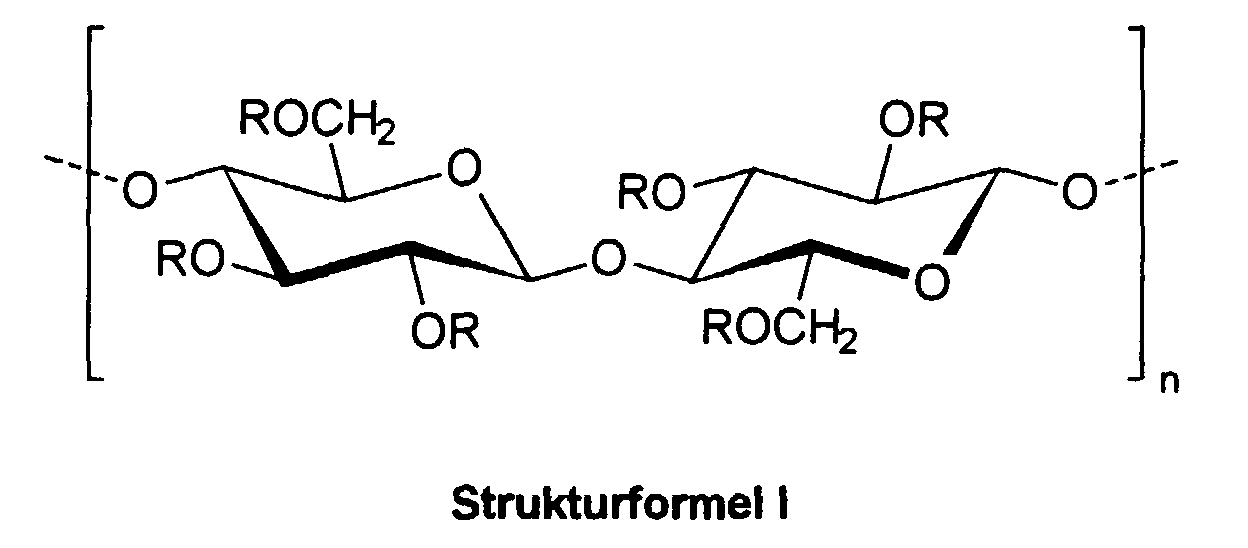
- Hydrocolloids preferred according to the invention are, for example, methyl celluloses, as the methyl ethers of cellulose are referred to. They are characterized by the following structural formula in which R can represent a hydrogen or a methyl group.
- methyl celluloses mixed cellulose ethers which in addition to a dominant Content of methyl additionally 2-hydroxyethyl, 2-hydroxypropyl or 2-hydroxybutyl groups contain.
- (Hydroxypropyl) methyl celluloses are particularly preferred, for example those under the trade name Methocel E4M from Dow Chemical Comp. available.
- sodium carboxymethyl cellulose the sodium salt of the glycolic acid ether of cellulose, for which R in structural formula I can be a hydrogen and / or CH 2 COONa.
- R in structural formula I can be a hydrogen and / or CH 2 COONa.
- Particularly preferred is the sodium carboxymethyl cellulose available under the trade name Natrosol Plus 330 CS from Aqualon, also known as cellulose gum.
- xanthan (CAS No. 11138-66-2), also called xanthan gum, which is an anionic heteropolysaccharide which is generally formed from corn sugar by fermentation and is isolated as the potassium salt. It is produced by Xanthomonas campestris and some other species under aerobic conditions with a molecular weight of 2 ⁇ 10 6 to 24 ⁇ 10 6 .
- Xanthan is formed from a chain with ⁇ -1,4-bound glucose (cellulose) with side chains. The structure of the subgroups ( repeated units ”) consists of glucose, mannose, glucuronic acid, acetate and pyruvate.
- Hydrocolloids which are advantageous according to the invention are also polymers of acrylic acid, in particular those selected from the group of the so-called carbomers or carbopoles (Carbopol® is actually a registered trademark of the BF Goodrich Company). Carbopols are compounds of the general structural formula whose molecular weight can be between approximately 400,000 and more than 4,000,000. The group of carbopols also includes acrylate-alkyl acrylate copolymers, for example those which are distinguished by the following structure:
- R ' represents a long-chain alkyl radical and x and y numbers which correspond to the respective symbolize the stoichiometric proportion of the respective comonomers. This too Carbopols are advantageous for the purposes of the present invention.
- Examples of advantageous carbopoles are types 907, 910, 934, 940, 941, 951, 954, 980, 981, 1342, 1382, 2984 and 5984, these compounds individually or in any Combinations can exist.
- Carbopol are particularly preferred 981, 1382 and 5984 (both individually and in combination with other hydrocolloids).
- the INCI name for such connections is Acrylates / C 10-30 Alkyl Acrylate Crosspolymer ".
- Particularly advantageous are those available under the trade names Pemulen TR1 and Pemulen TR2 from the BF Goodrich Company.
- the total amount of one or more hydrocolloids is in the finished cosmetic or dermatological W / O Pickering emulsions advantageously less than 1.0% by weight, preferably between 0.01 and 0.5% by weight, based on the total weight of the preparations chosen.
- the inventive Pickering emulsions contain other excipients that increase the stability of these preparations can also increase, for example, substances that are selected from the group waxes and / or oil thickeners and electrolytes.
- the Pickering emulsions according to the invention are auxiliaries contain to reduce or prevent a blunt or dry Skin feel after their application can contribute, the main purpose these substances can be different.
- These substances are preferably, for example selected from the group of unsymmetrically substituted s-triazine derivatives, cyclodextrins, the film former and the polymeric moisturizer, these substances both individually as well as in a mixture.
- the cosmetic properties of the Pickering emulsions according to the invention can additionally be improved, for example, in that in the oil phase oils with a viscosity of less than 30 mPas are also used, in particular less than 20 mPa ⁇ s (determined with a rheometer from Contraves (Rheomat 108E) at a shear rate of 500 / s and a temperature of 25 ° C).
- Microfine particles
- the amphiphilic character of the microfine particles according to the invention is evident, for example in that they are dispersible in both water and oil.
- concentration of all amphiphilic particles according to the invention greater than 0.1% by weight, particularly advantageously between 0.1% by weight and 30% by weight on the total weight of the preparations to choose.
- Pickering emulsions in the sense of the present invention are also advantageously stabilized by inorganic pigments which are surface-water-repellent ( are coated "), the amphiphilic character being formed or maintained at the same time.
- This surface treatment can consist in that the pigments are provided with a thin hydrophobic layer by methods known per se.
- n TiO 2 + m (RO) 3 Si-R ' ⁇ n TiO 2 (surface) is produced.
- n and m are stoichiometric parameters to be used at will, R and R 'are the desired organic radicals.
- TiO 2 pigments for example those coated with aluminum stearate and available under the trade name MT 100 T from TAYCA, are particularly advantageous.
- Another advantageous coating of the inorganic pigments consists of dimethylpolysiloxane (also: Dimethicone), a mixture of fully methylated, linear siloxane polymers, which are terminally blocked with trimethylsiloxy units. Particularly advantageous For the purposes of the present invention, zinc oxide pigments are coated in this way become.
- the inorganic pigments with a mixture from dimethylpolysiloxane, in particular dimethylpolysiloxane with an average Chain length from 200 to 350 dimethylsiloxane units, and silica gel, which also as Simethicone is called. It is particularly advantageous if the inorganic Pigments additionally with aluminum hydroxide or aluminum oxide hydrate (also: alumina, CAS No .: 1333-84-2) are coated. Titanium dioxides which are particularly advantageous Simethicone and alumina are coated, the coating also containing water can. An example of this is the one under the trade name Eusolex T2000 titanium dioxide available from Merck.
- a mixture is also advantageous in the sense of the present invention different pigment types both within a crystal, for example as Mixed iron oxide, as well as by combining several pigment types within one Preparation.
- the Pickering emulsions according to the invention are preferably further stabilized by bomitride particles, for example by the boron nitrides listed below: Trade name Available at Boron nitride powder Advanced Ceramics Boron nitride powder Sintec ceramics Ceram Blanche Kawasaki HCST Boron Nitride Strong réelle BN® Carborundum Wacker-Bomitrid BNP Wacker chemistry
- the average particle diameter of the boron nitride particles used is advantageous to be smaller than 20 ⁇ m, particularly advantageously to be smaller than 15 ⁇ m.
- Pickering emulsions in the sense of the present invention are also advantageously stabilized by boron nitride particles, which are surface-water-repellent ( are coated "), the amphiphilic character being formed or retained at the same time.
- boron nitride particles consists of dimethylpolysiloxane (Dimethicone).
- Dimethicone dimethylpolysiloxane
- boron nitride particles with polymethylhydrogensiloxane, a linear polysiloxane, which is also referred to as methicone.
- Boron nitride particles treated with Methicone are, for example, those at the company Carborundum available under the trade name réelle BN® UHP 1107.
- microfine polymer particles are, for example, in the sense of the present invention Polycarbonates, polyethers, polyethylene, polypropylene, polyvinyl chloride, polystyrene, Polyamides, polyacrylates and the like.
- microfine polyamide particles which are available from TORAY under the trade name SP-500.
- polyamide 6 also: nylon 6
- polyamide 12 also: nylon 12 particles.
- Polyamide 6 is made from ⁇ -aminocaproic acid (6-aminohexanoic acid) or ⁇ -caprolactam constructed polyamide [poly ( ⁇ -caprolactam)]
- polyamide 12 is a poly ( ⁇ -laurine lactam) from ⁇ -laurolactam.
- Advantages in the sense of the present invention are, for example Orgasol® 1002 (polyamide 6) and Orgasol® 2002 (polyamide 12) from ELF ATO-CHEM.
- Microfine polymethacrylates are further advantageous polymer particles.
- Such particles are for example under the trade name POLYTRAP® from DOW CHEMICAL available.
- microfine polymer particles used are coated on the surface.
- This surface treatment can consist in that the pigments are provided with a thin hydrophilic layer by methods known per se.
- Advantageous coatings consist, for example, of TiO 2 , ZrO 2 or other polymers, such as polymethyl methacrylate.
- microfine polymer particles in the sense of the present invention are also according to the method described in US Patent 4,898,913 hydrophilic coating of hydrophobic polymer particles available.
- the average particle diameter of the microfine polymer particles used is advantageous in to be smaller than 100 ⁇ m, particularly advantageously to be smaller than 50 ⁇ m. Here it is essentially irrelevant in what form (platelets, chopsticks, beads etc.) the polymer particles used are present.
- modified Pickering emulsions according to the invention Stabilize polysaccharides.
- Modified polysaccharides for the purposes of the present invention are, for example by reacting starch with mono-, bi- or polyfunctional reagents or Oxidizing agents available in largely polymer-analogous reactions.
- Such reactions are essentially based on conversions of the hydroxyl groups of the polyglucans by etherification, esterification or selective oxidation.
- Starch ethers and starch esters are advantageous modified polysaccharides for the purposes of the present invention.
- starch ethers are e.g. B. those caused by etherification of starch are available with tetramethylolacetylenediurea and which as Amylum non mucilaginosum (non-swelling starch).
- Starch esters and their salts for example the sodium and / or aluminum salts of low-substituted half-esters of starch, in particular sodium starch n-octenyl succinate of the structural formula (II), in which R is characterized by the following structure, are also particularly advantageous and which z. B. is available under the trade name Amiogum® 23 from CERE-STAR and aluminum starch Octenylsuccinate, especially those available under the trade names Dry Flo® Elite LL and Dry Flo® PC from CERE-STAR.
- the average particle diameter of the modified polysaccharides used is advantageous to be smaller than 20 ⁇ m, particularly advantageously to be smaller than 15 ⁇ m.
- Magnesium silicates also: talc
- Talc Micron available from Grolmann.
- the water phase portion of the W / O Pickering emulsions according to the invention is preferred selected from the range from 0.5 to 75% by weight, based on the total weight of the wording.
- microfine materials according to the invention Combine particles with other amphiphilic particles, which if necessary also can contribute to the stabilization of Pickering emulsions.
- Such particles are, for example, titanium dioxide pigments coated with octylsilanol are, and / or silicon dioxide particles, which are treated surface water-repellent.
- Suitable silica particles are, for example, spherical polyalkylsilsesquioxane particles, as mentioned in European Patent Application 0 686 391.
- Such polyalkylsilsesquioxane particles are, for example, under the trade names Aerosil R972 and Aerosil 200V available from Degussa.
- Suitable titanium dioxide particles are also with Degussa under the trade name T805 available.
- the oil phase of the O / W emulsions according to the invention is advantageously chosen from the Group of polar oils, for example from the group of lecithins and fatty acid triglycerides, namely the triglycerol esters saturated and / or unsaturated, branched and / or unbranched alkane carboxylic acids with a chain length of 8 to 24, especially 12 to 18 carbon atoms.
- the Group of polar oils for example from the group of lecithins and fatty acid triglycerides, namely the triglycerol esters saturated and / or unsaturated, branched and / or unbranched alkane carboxylic acids with a chain length of 8 to 24, especially 12 to 18 carbon atoms.
- the fatty acid triglycerides can, for example can be advantageously selected from the group of synthetic, semi-synthetic and natural oils, such as Olive oil, sunflower oil, soybean oil, peanut oil, rapeseed oil, almond oil, Palm oil, coconut oil, castor oil, wheat germ oil, grape seed oil, safflower oil, evening primrose oil, Macadamia nut oil and the like.
- synthetic, semi-synthetic and natural oils such as Olive oil, sunflower oil, soybean oil, peanut oil, rapeseed oil, almond oil, Palm oil, coconut oil, castor oil, wheat germ oil, grape seed oil, safflower oil, evening primrose oil, Macadamia nut oil and the like.
- polar oil components can be used for the purposes of the present invention furthermore selected from the group of the esters from saturated and / or unsaturated, branched and / or unbranched alkane carboxylic acids with a chain length of 3 up to 30 carbon atoms and saturated and / or unsaturated, branched and / or unbranched Alcohols with a chain length of 3 to 30 carbon atoms and from the group of Esters of aromatic carboxylic acids and saturated and / or unsaturated, branched and / or unbranched alcohols with a chain length of 3 to 30 carbon atoms.
- ester oils can then advantageously be selected from the group of isopropyl myristate, Isopropyl palmitate, isopropyl stearate, isopropyl oleate, n-butyl stearate, n-hexyl laurate, n-decyl oleate, Isooctyl stearate, isononyl stearate, isononyl isononanoate, 2-ethylhexyl palmitate, 2-ethylhexyl laurate, 2-hexyldecyl stearate, 2-octyldodecyl palmitate, oleyl oleate, olerlerucate, Erucyl oleate, erucylerucate and synthetic, semi-synthetic and natural mixtures such esters, e.g. Jojoba oil.
- the oil phase can advantageously be chosen from the group of dialkyl ethers, the group of saturated or unsaturated, branched or unbranched alcohols. It is particularly advantageous if the oil phase of the O / W emulsions according to the invention has a content of C 12-15 alkyl benzoate or consists entirely of this.
- any mixtures of such oil and wax components are also advantageous To use the sense of the present invention. It can also be advantageous if necessary be waxes, for example cetyl palmitate, as the sole lipid component of the oil phase to use.
- oil phase of the O / W emulsions according to the invention can also be advantageous although not necessarily also contain non-polar oils, for example those which are selected from the group of branched and unbranched hydrocarbons and waxes, in particular petroleum jelly (petrolatum), paraffin oil, squalane and Squalene, polyolefins and hydrogenated polyisobutenes.
- non-polar oils for example those which are selected from the group of branched and unbranched hydrocarbons and waxes, in particular petroleum jelly (petrolatum), paraffin oil, squalane and Squalene, polyolefins and hydrogenated polyisobutenes.
- Polydecenes are among the polyolefins the preferred substances.
- the oil phase can also advantageously contain cyclic or linear silicone oils have or consist entirely of such oils, although it is preferred in addition to the silicone oil or the silicone oils, an additional content of other oil phase components to use.
- Cyclomethicone (octamethylcyclotetrasiloxane) is advantageous as according to the invention using silicone oil. But other silicone oils are also beneficial in the sense to use the present invention, for example hexamethylcyclotrisiloxane, Polydimethylsiloxane, poly (methylphenylsiloxane).
- the Pickering emulsions according to the invention can be used as the basis for cosmetic or serve dermatological formulations. These can be composed as usual be and for example for the treatment and care of the skin, as a lip care product, as a demo product and as a make-up or make-up removal product in the decorative Serve cosmetics or as a sunscreen preparation.
- cosmetic and dermatological preparations in the usual for cosmetics Apply in sufficient quantities to the skin.
- Cosmetic or topical dermatological compositions can accordingly used in the sense of the present invention, depending on its structure, for example are used as skin protection cream, cleansing milk, sun protection lotion, nutrient cream, Day or night cream, etc. It may be possible and advantageous to use the inventive Compositions as the basis for pharmaceutical formulations to use.
- the cosmetic and dermatological preparations according to the invention can Contain cosmetic auxiliaries, as they are usually used in such preparations e.g. Preservatives, bactericides, perfumes, substances for preventing foaming, dyes, pigments that have a coloring effect, others Thickeners, softening, moisturizing and / or moisturizing substances, Fats, oils, waxes or other usual components of a cosmetic or dermatological formulation such as alcohols, polyols, polymers, foam stabilizers, Electrolytes, organic solvents or silicone derivatives.
- cosmetic auxiliaries e.g. Preservatives, bactericides, perfumes, substances for preventing foaming, dyes, pigments that have a coloring effect, others Thickeners, softening, moisturizing and / or moisturizing substances, Fats, oils, waxes or other usual components of a cosmetic or dermatological formulation such as alcohols, polyols, polymers, foam stabilizers, Electrolytes, organic solvents or silicone derivatives.
- the Pickering emulsions according to the invention can also contain antioxidants contain.
- all of the cosmetic antioxidants can be cheap and / or dermatological applications of suitable or customary antioxidants be used.
- the antioxidants are advantageously selected from the group consisting of amino acids (e.g. glycine, histidine, tyrosine, tryptophan) and their derivatives, imidazoles (e.g. urocanic acid) and their derivatives, peptides such as D, L-camosine, D-carnosine, L-carnosine and their derivatives (e.g. anserine), carotenoids, carotenes (e.g. ⁇ -carotene, ⁇ -carotene, lycopene) and their derivatives, chlorogenic acid and their derivatives, lipoic acid and their derivatives (e.g.
- amino acids e.g. glycine, histidine, tyrosine, tryptophan
- imidazoles e.g. urocanic acid
- peptides such as D, L-camosine, D-carnosine, L-carnosine and their derivatives (e.g. anserine)
- thiols e.g. thioredoxin, Glutathione, cysteine, cystine, cystamine and their glycosyl, N-acetyl, methyl, ethyl, propyl, amyl, butyl and lauryl, palmitoyl, oleyl, ⁇ -linoleyl, cholesteryl and glyceryl esters
- salts dilaurylthiodipropionate, distearylthiodipropionate, thiodipropionic acid and their derivatives (esters, ethers, peptides, lipids, nucleotides, nucleosides and salts) as well as sulfoximine compounds (e.g.
- buthioninsulfoximines homocysteine sulfoximine, buthioninsulfones, penta-, hexa-, He ptathioninsulfoximine) in very low tolerable doses (e.g. pmol to ⁇ mol / kg), also (metal) chelators (e.g. ⁇ -hydroxy fatty acids, palmitic acid, phytic acid, lactoferrin), ⁇ -hydroxy acids (e.g. citric acid, lactic acid, malic acid), humic acid, bile acid , Biliary extracts, bilirubin, biliverdin, EDTA, EGTA and their derivatives, unsaturated fatty acids and their derivatives (e.g.
- metal chelators e.g. ⁇ -hydroxy fatty acids, palmitic acid, phytic acid, lactoferrin
- ⁇ -hydroxy acids e.g. citric acid, lactic acid, malic acid
- humic acid
- ⁇ -linolenic acid linoleic acid, oleic acid
- folic acid and their derivatives ubiquinone and ubiquinol and their derivatives
- vitamin C and derivatives e.g. ascorbyl palmitate, Mg ascorbyl phosphate, ascorbyl acetate
- tocopherols and derivatives e.g.
- vitamin E acetate
- vitamin A and derivatives vitamin A palmitate
- stilbenes and their derivatives e.g. stilbene oxide, trans-stilbene oxide
- derivatives suitable according to the invention salts, esters, ethers, sugars, nucleotides, Nucleosides, peptides and lipids
- the amount of the aforementioned antioxidants (one or more compounds) in the Preparations according to the invention are preferably 0.001 to 30% by weight, particularly preferably 0.05 to 20% by weight, in particular 0.1 to 10% by weight, based on the Total weight of the preparation.
- vitamin E and / or its derivatives are the antioxidant (s) advantageous, their respective concentrations in the range from 0.001 to 10% by weight, based on the total weight of the formulation.
- vitamin A or vitamin A derivatives or carotenes or their derivatives are advantageous, their respective concentrations from the Range from 0.001 to 10% by weight, based on the total weight of the formulation, to choose.
- Cosmetic and dermatological preparations in the form are also favorable a sunscreen.
- These preferably contain at least one UV-A filter substance and / or at least one UV-B filter substance and / or at least another inorganic pigment from the group of oxides of iron, zirconium, Silicon, manganese, aluminum, cerium and mixtures thereof as well as modifications, where the oxides are the active agents.
- UV protection substances as well as antioxidants and, if desired, Preservatives, an effective protection of the preparations themselves against spoilage represents.
- Preparations according to the invention advantageously contain substances which contain UV radiation absorb in the UV-A and / or UV-B range, with the total amount of filter substances e.g. B. 0.1 wt .-% to 30 wt .-%, preferably 0.5 to 20 wt .-%, in particular Is 1.0 to 15.0% by weight, based on the total weight of the preparations to provide cosmetic preparations that cover the hair or skin protect the entire range of ultraviolet radiation. You can also use it as a sunscreen serve for hair or skin.
- filter substances e.g. B. 0.1 wt .-% to 30 wt .-%, preferably 0.5 to 20 wt .-%, in particular Is 1.0 to 15.0% by weight, based on the total weight of the preparations to provide cosmetic preparations that cover the hair or skin protect the entire range of ultraviolet radiation.
- UV-A filter substances for the purposes of the present invention are dibenzoylmethane derivatives, especially the 4- (tert-butyl) -4'-methoxydibenzoylmethane (CAS no. 70356-09-1), which is available from Givaudan under the Parsol® 1789 brand and from Merck under the trade name Eusolex® 9020 is sold.
- dibenzoylmethane derivatives especially the 4- (tert-butyl) -4'-methoxydibenzoylmethane (CAS no. 70356-09-1), which is available from Givaudan under the Parsol® 1789 brand and from Merck under the trade name Eusolex® 9020 is sold.
- UV-A filter substances are phenylene-1,4-bis (2-benzimidazyl) -3,3'-5,5'-tetrasulfonic acid: and their salts, especially the corresponding sodium, potassium or triethanolammonium salts, in particular the phenylene-1,4-bis (2-benzimidazyl) -3,3'-5,5'-tetrasulfonic acid bis-sodium salt: as well as the 1,4-di (2-oxo-10-sulfo-3-bornylidenemethyl) benzene and its salts (especially the corresponding 10-sulfato compounds, especially the corresponding sodium, potassium or triethanolammonium salt), the is also called benzene-1,4-di (2-oxo-3-bornylidenemethyl-10-sulfonic acid) and is characterized by the following structure:
- UV filter substances in the sense of the present invention are also so-called Broadband filter, i.e. Filter substances that contain both UV-A and UV-B radiation absorb.
- Advantageous broadband filters and / or UV-B filter substances are, for example, bis-resorcinyltriazine derivatives with the following structure: where R 1 , R 2 and R 3 are independently selected from the group of branched and unbranched alkyl groups having 1 to 10 carbon atoms or a single hydrogen atom.
- the 2,4-bis - ⁇ [4- (2-ethylhexyloxy) -2-hydroxy] phenyl ⁇ -6- (4-methoxyphenyl) -1,3,5-triazine and 4,4 are particularly preferred '4''- (1,3,5-triazine-2,4,6-triyltriimino) -tris-benzoic acid-tris (2-ethylhexyl ester), synonymous: 2,4,6-tris [anilino- (p- carbo-2'-ethyl-1'-hexyloxy)] - 1,3,5-triazine, which is sold by BASF Aktiengesellschaft under the trade name UVINUL® T 150.
- UV filter substances whose incorporation into cosmetic or dermatological light protection formulations have hitherto been problematic are also known.
- European Offenlegungsschrift 775 698 describes bis-resorcinyltriazine derivatives whose chemical structure is represented by the generic formula is reproduced, wherein R 1 , R 2 and A 1 represent a wide variety of organic radicals.
- Another advantageous UV filter for the purposes of the present invention is 2,2'-methylene-bis- (6- (2H-benzotriazol-2-yl) -4- (1,1,3,3-tetramethylbutyl) phenol ), which is characterized by the chemical structural formula is marked.
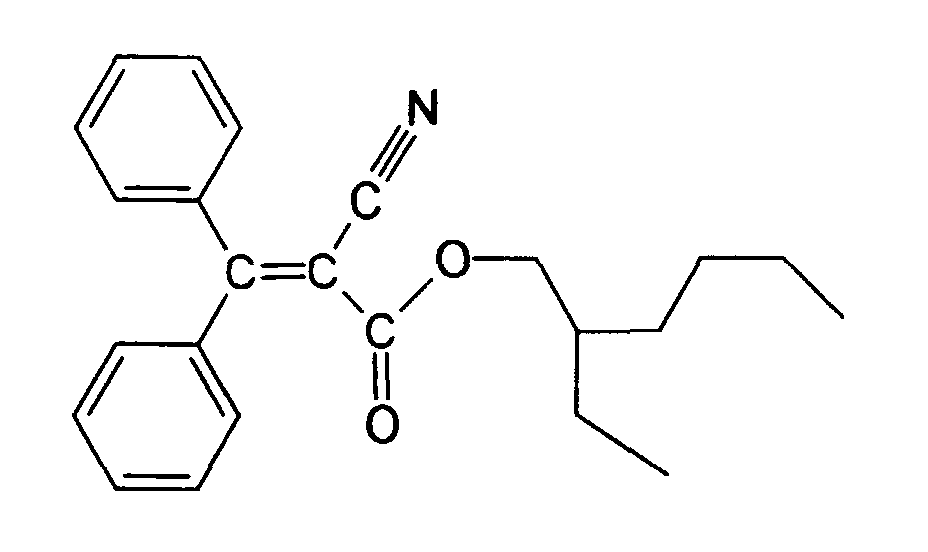
- a further light protection filter substance to be used advantageously according to the invention is ethylhexyl-2-cyano-3,3-diphenylacrylate (octocrylene), which is available from BASF under the name Uvinul® N 539 and is characterized by the following structure:
- UV filters mentioned used in the sense of the present invention of course, should not be limiting.
- Preparations according to the invention can also advantageously be used as the basis for cosmetic Deodorants or antiperspirants are used, so that the present Invention in a special embodiment as Pickering emulsions Basis for cosmetic deodorants concerns.
- Cosmetic deodorants are used to eliminate body odor that arises when the odorless fresh sweat is broken down by microorganisms.
- the usual cosmetic deodorants are based on different active principles.
- astringents primarily aluminum salts like aluminum hydroxychloride (aluminum chloride) - reduces the formation of sweat become.
- the Bacterial flora on the skin can be reduced. Ideally, only the smell causing microorganisms can be effectively reduced. The sweat flow itself is not affected by this, ideally only the microbial decomposition of the Sweat temporarily stopped.
- the amount of antiperspirant active or deodorant (one or more compounds) in the preparations is preferably 0.01 to 30 wt .-%, particularly preferably 0.1-20% by weight, in particular 1-10% by weight, based on the total weight the preparation.
Landscapes
- Health & Medical Sciences (AREA)
- Life Sciences & Earth Sciences (AREA)
- Animal Behavior & Ethology (AREA)
- General Health & Medical Sciences (AREA)
- Public Health (AREA)
- Veterinary Medicine (AREA)
- Birds (AREA)
- Epidemiology (AREA)
- Chemical & Material Sciences (AREA)
- Dermatology (AREA)
- Inorganic Chemistry (AREA)
- Dispersion Chemistry (AREA)
- Emergency Medicine (AREA)
- Cosmetics (AREA)
- Colloid Chemistry (AREA)
- Emulsifying, Dispersing, Foam-Producing Or Wetting Agents (AREA)
Abstract
Description
- Das wohl bekannteste Beispiel eines anionischen Emulgators ist die Seife, als die man gewöhnlich die wasserlöslichen Natrium- oder Kaliumsalze der gesättigten und ungesättigten höheren Fettsäuren bezeichnet.
- Wichtige Vertreter der kationischen Emulgatoren sind die quartären Ammonium-Verbindungen.
- Der hydrophile Molekülteil nichtionischer Emulgatoren besteht häufig aus Glycerin, Polyglycerin, Sorbitanen, Kohlenhydraten bzw. Polyoxyethylenglykolen und ist meistens über Ester- und Etherbindungen mit dem lipophilen Molekülteil verknüpft. Dieser besteht üblicherweise aus Fettalkoholen, Fettsäuren oder Isofettsäuren.

- organische, natürliche Verbindungen, wie beispielsweise Agar-Agar, Carrageen, Tragant, Gummi arabicum, Alginate, Pektine, Polyosen, Guar-Mehl, Johannisbrotbaumkemmehl, Stärke, Dextrine, Gelatine, Casein,
- organische, abgewandelte Naturstoffe, wie z. B. Carboxymethylcellulose und andere Celluloseether, Hydroxyethyl- und -propylcellulose und dergleichen,
- organische, vollsynthetische Verbindungen, wie z. B. Polyacryl- und Polymethacryl-Verbindungen, Vinylpolymere, Polycarbonsäuren, Polyether, Polyimine, Polyamide,
- anorganische Verbindungen, wie z. B. Polykieselsäuren, Tonmineralien wie Montmorillonite, Zeolithe, Kieselsäuren.


| Handelsname | Erhältlich bei |
| Boron Nitride Powder | Advanced Ceramics |
| Boron Nitride Powder | Sintec Keramik |
| Ceram Blanche | Kawasaki |
| HCST Boron Nitride | Stark |
| Très BN® | Carborundum |
| Wacker-Bomitrid BNP | Wacker-Chemie |


- R
- einen verzweigten oder unverzweigten C1-C18-Alkylrest, einen C5-C12-Cycloalkylrest, gegebenenfalls substituiert mit einer oder mehreren C1-C4- Alkylgruppen, darstellt,
- X
- ein Sauerstoffatom oder eine NH-Gruppe darstellt,
- R1
- einen verzweigten oder unverzweigten C1-C18-Alkylrest, einen C5-C12-Cycloalkylrest,
gegebenenfalls substituiert mit einer oder mehreren C1-C4- Alkylgruppen,
oder ein Wasserstoffatom, ein Alkalimetallatom, eine Ammoniumgruppe oder eine
Gruppe der Formel
bedeutet, in welcher
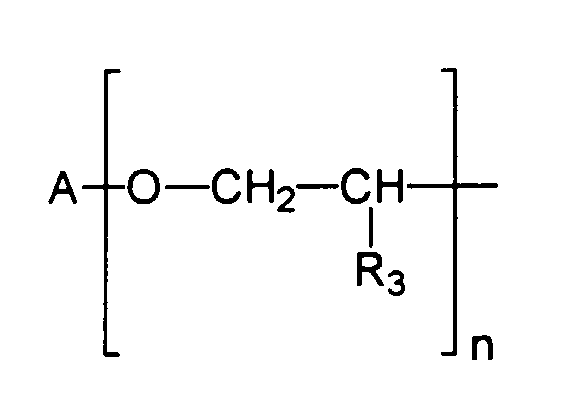
- A
- einen verzweigten oder unverzweigten C1-C18-Alkylrest, einen C5-C12-Cycloalkyl- oder Arylrest darstellt, gegebenenfalls substituiert mit einer oder mehreren C1-C4- Alkylgruppen,
- R3
- ein Wasserstoffatom oder eine Methylgruppe darstellt,
- n
- eine Zahl von 1 bis 10 darstellt,
- R2
- einen verzweigten oder unverzweigten C1-C18-Alkylrest, einen C5-C12-Cycloalkylrest,
gegebenenfalls substituiert mit einer oder mehreren C1-C4- Alkylgruppen, darstellt,
wenn X die NH-Gruppe darstellt, und
einen verzweigten oder unverzweigten C1-C18-Alkylrest, einen C5-C12-Cycloalkylrest,
gegebenenfalls substituiert mit einer oder mehreren C1-C4- Alkylgruppen,
oder ein Wasserstoffatom, ein Alkalimetallatom, eine Ammoniumgruppe oder eine
Gruppe der Formel
bedeutet, in welcher
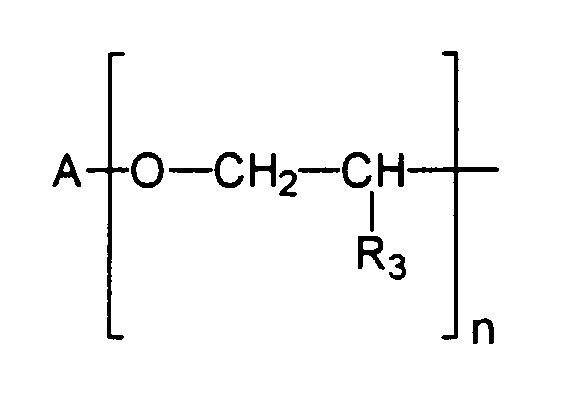
- A
- einen verzweigten oder unverzweigten C1-C18-Alkylrest, einen C5-C12-Cycloalkyl- oder Arylrest darstellt, gegebenenfalls substituiert mit einer oder mehreren C1-C4- Alkylgruppen,
- R3
- ein Wasserstoffatom oder eine Methylgruppe darstellt,
- n
- eine Zahl von 1 bis 10 darstellt
wenn X ein Sauerstoffatom darstellt.


- 3-Benzylidencampher-Derivate, vorzugsweise 3-(4-Methylbenzyliden)campher, 3-Benzylidencampher;
- 4-Aminobenzoesäure-Derivate, vorzugsweise 4-(Dimethylamino)-benzoesäure(2-ethylhexyl)ester, 4-(Dimethylamino)benzoesäureamylester;
- 2,4,6-Trianilino-(p-carbo-2'-ethyl-1'-hexyloxy)-1,3,5-triazin;
- Ester der Benzalmalonsäure, vorzugsweise 4-Methoxybenzalmalonsäuredi(2-ethylhexyl)ester;
- Ester der Zimtsäure, vorzugsweise 4-Methoxyzimtsäure(2-ethylhexyl)ester, 4-Methoxyzimtsäureisopentylester;
- Derivate des Benzophenons, vorzugsweise 2-Hydroxy-4-methoxybenzophenon, 2-Hydroxy-4-methoxy-4'-methylbenzophenon, 2,2'-Dihydroxy-4-methoxybenzophenon
- sowie an Polymere gebundene UV-Filter.
- Salze der 2-Phenylbenzimidazol-5-sulfonsäure, wie ihr Natrium-, Kalium- oder ihr Triethanolammonium-Salz, sowie die Sulfonsäure selbst;
- Sulfonsäure-Derivate des 3-Benzylidencamphers, wie z. B. 4-(2-Oxo-3-bornylidenmethyl)benzolsulfonsäure, 2-Methyl-5-(2-oxo-3-bornylidenmethyl)sulfonsäure und deren Salze.
| Beispiele: | |||
| 1 | 2 | 3 | |
| W/O | W/O | W/O | |
| Titandioxid (Eusolex T2000) | 2 | 4 | 6 |
| Zinkoxid | 5 | 4 | |
| Titandioxid (Titandioxid T805) | 2 | ||
| Silica (Aerosil R972) | 1 | 0,5 | |
| Talkum (Talkum Micron) | 0,5 | ||
| Bornitrid | 2 | ||
| Hydroxystearyl Hydroxystearat (Elfacos C26) | 2 | 2 | |
| C20-40 Alkylstearat (Kesterwachs K82) | 1 | 1 | |
| C16-38 Alkylhydroxystearoylstearat (Kesterwachs K80P) | 2 | ||
| Behenoxy Dimethicon (Abil Wax 2440) | 5 | ||
| Polyisobuten (Rewopal PIB 1000) | 5 | ||
| Caprylic/Capric Triglycerid | 5 | 5 | 5 |
| Octyldodecanol | 5 | 5 | |
| Mineralöl | 10 | ||
| Butylen Glycol Caprylat/Caprat | 10 | 10 | |
| C12-15 Alkyl Benzoat | 10 | 10 | 10 |
| Dimethicon | 2 | 3 | |
| Hydriertes Polyisobuten (Polysynlan) | 2 | ||
| Methylbenzyliden Campher | 3 | ||
| Octyltriazon | 1 | ||
| Dibenzoylmethan | 2 | ||
| Dioctyl Butamido Triazon (UVASORB HEB) | 2 | ||
| Konservierung | 0,5 | 0,5 | 0,5 |
| Glycerin | 5 | 10 | 3 |
| Biosaccharid Gel (Fucogel 1000) | 5 | ||
| NaCl | 1 | 1 | |
| MgSO4 | 0,5 | ||
| Phenylbenzimiazol Sulfonsäure | 1 | ||
| Carbomer (Carbopol 981) | 0,1 | ||
| C10-30 Alkyl Acrylat Crosspolymer (Pemulen TR1) | 0,01 | ||
| Xanthan Gummi | 0,05 | ||
| Natriumcarboxymethylcellulose (Natrosol Plus 330 CS) | 0,05 | 0,01 | |
| NaOH 45%ige Lösung in Wasser | 0,3 | 0,01 | |
| EDTA-Lösung | 1 | ||
| Wasser | ad 100 | ad 100 | ad 100 |
Claims (12)
- Pickering-Emulsionen, welche feindisperse Systeme vom Typ Wasser-in-Öl darstellen, enthaltend(1) eine Ölphase,(2) eine Wasserphase,(3) mindestens einen Typ mikrofeiner Partikel, diea) eine mittlere Partikelgröße von weniger als 200 nm haben, dieb) sowohl hydrophile als auch lipophile Eigenschaften zeigen, welche also amphiphilen Charakter besitzen und sowohl in Wasser als auch in Öl dispergierbar sind und diec) gegebenenfalls oberflächlich beschichtet sind,(4) mindestens ein Hydrokolloid und(5) höchstens 0,5 Gew.-% eines oder mehrerer Emulgatoren.
- Pickering-Emulsionen nach Anspruch 1, dadurch gekennzeichnet, daß sie emulgatorfrei sind.
- Pickering-Emulsionen nach einem der vorhergehenden Ansprüche, dadurch gekennzeichnet, daß der Gehalt der verwendeten Partikel zwischen 0,1 Gew.-% und 30 Gew.-% ist, bezogen auf das Gesamtgewicht der Zubereitungen.
- Pickering-Emulsionen nach einem der vorhergehenden Ansprüche, dadurch gekennzeichnet, daß der Partikeldurchmesser der verwendeten Partikel zwischen 5 nm und 100 nm liegt.
- Pickering-Emulsionen nach einem der vorhergehenden Ansprüche, dadurch gekennzeichnet, daß die verwendeten Partikel gewählt werden aus der Gruppe bestehend aus amphiphilen Metalloxiden, Bornitrid, mikrofeinen Polymerpartikeln und modifizierten Polysacchariden, wobei die Partikel sowohl einzeln als auch im Gemisch vorliegen können.
- Pickering-Emulsionen nach einem der vorhergehenden Ansprüche, dadurch gekennzeichnet, daß die verwendeten Partikel oberflächlich wasserabweisend behandelt sind, wobei der amphiphile Charakter der Partikel gebildet wird bzw. erhalten bleibt.
- W/O-Pickering-Emulsionen nach einem der vorhergehenden Ansprüche, dadurch gekennzeichnet, daß die Gesamtmenge an einem oder mehreren Hydrokolloiden in den fertigen kosmetischen oder dermatologischen Zubereitungen kleiner als 1,0 Gew.-%, bevorzugt zwischen 0,01 und 0,5 Gew.-% gewählt wird, bezogen auf das Gesamtgewicht der Zubereitungen.
- Pickering-Emulsionen nach einem der vorhergehenden Ansprüche, dadurch gekennzeichnet, daß das oder die Hydrokolloide gewählt werden aus der Gruppe der Cellulosederivate, insbesondere aus der Gruppe, die gebildet wird aus (Hydroxypropyl)methylcellulosen, Natriumcarboxymethylcellulose und Xanthan Gummi.
- Pickering-Emulsionen nach einem der vorhergehenden Ansprüche, dadurch gekennzeichnet, daß das oder die Hydrokolloide gewählt werden aus der Gruppe der Acrylat-Alkylacrylat-Copolymere und der Copolymere aus C10-30-Alkylacrylaten und einem oder mehreren Monomeren der Acrylsäure, der Methacrylsäure oder deren Ester.
- Pickering-Emulsionen nach einem der vorhergehenden Ansprüche, dadurch gekennzeichnet, daß sie Hilfsstoffe enthalten, die zur Verminderung oder Verhinderung eines stumpfen oder trockenen Hautgefühls nach deren Auftragen beitragen können.
- Verwendung von mindestens einem Hydrokolloid in einer kosmetischen oder dermatologischen Zubereitung zur Verminderung oder Verhinderung eines stumpfen oder trockenen Hautgefühls nach deren Anwendung.
- Verwendung von mindestens einem Hydrokolloid zur Stabilisierung einer kosmetischen oder dermatologischen Pickering-Emulsion.
Applications Claiming Priority (2)
| Application Number | Priority Date | Filing Date | Title |
|---|---|---|---|
| DE19842788A DE19842788A1 (de) | 1998-09-18 | 1998-09-18 | Emulgatorfreie feindisperse Systeme vom Typ Öl-in-Wasser und Wasser-in-Öl |
| DE19842788 | 1998-09-18 |
Publications (3)
| Publication Number | Publication Date |
|---|---|
| EP0987006A2 true EP0987006A2 (de) | 2000-03-22 |
| EP0987006A3 EP0987006A3 (de) | 2001-10-31 |
| EP0987006B1 EP0987006B1 (de) | 2007-01-03 |
Family
ID=7881397
Family Applications (1)
| Application Number | Title | Priority Date | Filing Date |
|---|---|---|---|
| EP99116874A Expired - Lifetime EP0987006B1 (de) | 1998-09-18 | 1999-09-06 | Emulgatorfreie feindisperse Systeme vom Typ Wasser-in-Öl |
Country Status (6)
| Country | Link |
|---|---|
| US (1) | US6436413B1 (de) |
| EP (1) | EP0987006B1 (de) |
| JP (1) | JP2000095634A (de) |
| AT (1) | ATE350104T1 (de) |
| DE (2) | DE19842788A1 (de) |
| ES (1) | ES2279592T3 (de) |
Cited By (11)
| Publication number | Priority date | Publication date | Assignee | Title |
|---|---|---|---|---|
| EP1055414A1 (de) * | 1999-05-22 | 2000-11-29 | Beiersdorf Aktiengesellschaft | Kosmetische oder dermatologische Lichtschutzzubereitungen mit einem Gehalt an Bornitrid und sulfonierten UV-Filtersubstanzen sowie die Verwendung von Bornitrid zur Stabilisierung von Emulsionen, die einen Gehalt an Elektrolyten, insbesondere einen Gehalt an sulfonierten UV-Filtersubstanzen, aufweisen |
| EP1093798A1 (de) * | 1999-10-21 | 2001-04-25 | L'oreal | Mindestens ein unlösliches organisches UV-Filter enthaltende Emulsionen ohne Emulgatoren |
| EP1093796A1 (de) * | 1999-10-22 | 2001-04-25 | L'oreal | Mindestens ein unlösliches organisches UV-Filter und ein assoziatives Polymer enthaltende Emulsionen |
| EP1077058A3 (de) * | 1999-08-18 | 2002-10-02 | Beiersdorf Aktiengesellschaft | Emulgatorfreie feindisperse Systeme vom Typ Wasser-in-Öl |
| EP1055417A3 (de) * | 1999-05-22 | 2003-10-01 | Beiersdorf Aktiengesellschaft | Kosmetische oder dermatologische Hydrodispersionen mit einem Gehalt an Bornitrid |
| EP1175885A3 (de) * | 2000-07-26 | 2004-01-02 | Beiersdorf Aktiengesellschaft | Kosmetische Puderformulierungen |
| WO2004022019A1 (de) * | 2002-09-05 | 2004-03-18 | Beiersdorf Ag | Emulsionen mit mikrocellulose |
| WO2005004830A1 (en) * | 2003-06-13 | 2005-01-20 | The Procter & Gamble Company | Skin care composition comprising skin lightening agent |
| DE102012200071A1 (de) | 2012-01-04 | 2013-07-04 | Beiersdorf Ag | Duftstabile, wasserfeste kosmetische Zubereitung |
| EP3061500A1 (de) | 2015-02-25 | 2016-08-31 | Symrise AG | Stabile Dispersion |
| CN109843260A (zh) * | 2016-07-12 | 2019-06-04 | 莱雅公司 | 皮克林乳液的组合物 |
Families Citing this family (19)
| Publication number | Priority date | Publication date | Assignee | Title |
|---|---|---|---|---|
| US6991799B2 (en) * | 2000-11-22 | 2006-01-31 | Unilever Home & Personal Care Usa Division Of Conopco, Inc. | Non-sticky cosmetic moisturizer for skin and hair |
| DE10155966A1 (de) * | 2001-11-09 | 2003-05-22 | Beiersdorf Ag | Emulgatorfreie kosmetische und dermatologische Lichtschutzformulierungen mit einem Gehalt an Hydroxybenzophenonen |
| DE10161170A1 (de) * | 2001-12-13 | 2003-06-18 | Beiersdorf Ag | Lippenstift |
| KR100854832B1 (ko) * | 2004-04-05 | 2008-08-27 | 각고우호우진 가나가와 다이가쿠 | 유화 분산제 및 이를 이용한 유화 분산 방법, 유화물, 및에멀젼 연료 |
| US7527859B2 (en) * | 2006-10-08 | 2009-05-05 | Momentive Performance Materials Inc. | Enhanced boron nitride composition and compositions made therewith |
| WO2008126477A1 (ja) * | 2007-03-30 | 2008-10-23 | Powdertech Co., Ltd. | 無機粒子含有エマルション及び無機粒子含有エマルションを用いた粒子の製造方法 |
| JP2008247708A (ja) * | 2007-03-30 | 2008-10-16 | Hiroshima Univ | 無機粒子分散エマルション |
| US8029771B2 (en) | 2007-06-29 | 2011-10-04 | Mary Kay Inc. | Guar gum containing compounds |
| BR112015023340B1 (pt) * | 2013-03-15 | 2020-05-05 | Leading Edge Innovations, LLC | composição substancialmente livre de tensoativo, método para aplicar agentes de modificação estética e método para transmitir uma propriedade tátil, olfativa ou visual à pele, ao cabelo ou à superfície de mucosa |
| US20140322428A1 (en) | 2013-03-15 | 2014-10-30 | Leading Edge Innovations, LLC | Compositions having an oil-in-water dispersion of submicron particles to enhance foods and beverages |
| FR3004931B1 (fr) * | 2013-04-26 | 2015-04-10 | Oreal | Procede de nettoyage des matieres keratiniques |
| CN108690206A (zh) * | 2018-05-09 | 2018-10-23 | 上海应用技术大学 | 一种纳米纤维素稳定的柠檬醛皮克林乳液及其制备方法 |
| JP7237463B2 (ja) * | 2018-05-24 | 2023-03-13 | ポーラ化成工業株式会社 | アクリル系ポリマー含有ピッカリングエマルション |
| JP7673348B2 (ja) * | 2018-09-28 | 2025-05-09 | ポーラ化成工業株式会社 | 可視光透過性を有するピッカリングエマルション |
| CN112273638A (zh) * | 2020-10-22 | 2021-01-29 | 华中农业大学 | 卵黏蛋白-黄原胶复合纳米粒子及其在制备Pickering乳液中的应用 |
| WO2022093924A1 (en) | 2020-10-27 | 2022-05-05 | Leading Edge Innovations, LLC | System, method, and composition for skin improvement and transient flora reduction |
| CN112353727B (zh) * | 2020-11-23 | 2022-08-09 | 黑龙江省科学院自然与生态研究所 | 一种火山冷泉油包水Pickering乳液及其制备方法 |
| WO2024130460A1 (zh) * | 2022-12-18 | 2024-06-27 | 张子勇 | 代森锰锌纳米悬浮液及其制备方法 |
| CN119505279A (zh) * | 2023-08-22 | 2025-02-25 | 中国科学院长春应用化学研究所 | 一种乳液型油气封堵材料及其制备方法与应用 |
Family Cites Families (10)
| Publication number | Priority date | Publication date | Assignee | Title |
|---|---|---|---|---|
| US5035890A (en) | 1989-04-10 | 1991-07-30 | Dow Corning Corporation | Emulsifier-free hand and body lotion |
| DE4127665A1 (de) | 1991-08-22 | 1993-02-25 | Beiersdorf Ag | Galenische matrix |
| JPH06227943A (ja) * | 1993-02-02 | 1994-08-16 | Seven Kagaku:Kk | 皮膚化粧料 |
| DE4303983C2 (de) * | 1993-02-11 | 1998-01-22 | Beiersdorf Ag | Kosmetische und dermatologische Lichtschutzformulierungen mit einem Gehalt an anorganischen Mikropigmenten |
| DE59406277D1 (de) * | 1993-02-11 | 1998-07-23 | Beiersdorf Ag | Wasserfeste kosmetische oder dermatologische lichtschutzzubereitungen |
| DE4425268C2 (de) | 1994-07-16 | 1998-05-28 | Beiersdorf Ag | Emulgatorfreie, feindisperse kosmetische oder dermatologische Zubereitungen vom Typ Öl-in-Wasser |
| DE4429468C2 (de) * | 1994-08-19 | 1998-07-09 | Beiersdorf Ag | Verwendung hydrophobierter anroganischer Pigmente zum Erhalt der Urocaninsäurestatus der Haut beim Baden |
| DE19539428A1 (de) * | 1995-10-24 | 1997-04-30 | Beiersdorf Ag | Emulgatorfreie feindisperse kosmetische oder dermatologische Zubereitungen vom Typ Wasser-in-Öl |
| FR2746302B1 (fr) * | 1996-03-20 | 1998-12-24 | Oreal | Compositions cosmetiques comprenant des nanopigments |
| JP2001518112A (ja) * | 1997-03-25 | 2001-10-09 | バイヤースドルフ・アクチエンゲゼルシヤフト | 乳化剤を含まない油中水型の微細分散系 |
-
1998
- 1998-09-18 DE DE19842788A patent/DE19842788A1/de not_active Withdrawn
-
1999
- 1999-08-30 US US09/385,306 patent/US6436413B1/en not_active Expired - Fee Related
- 1999-09-06 ES ES99116874T patent/ES2279592T3/es not_active Expired - Lifetime
- 1999-09-06 EP EP99116874A patent/EP0987006B1/de not_active Expired - Lifetime
- 1999-09-06 DE DE59914117T patent/DE59914117D1/de not_active Expired - Lifetime
- 1999-09-06 AT AT99116874T patent/ATE350104T1/de not_active IP Right Cessation
- 1999-09-13 JP JP11259084A patent/JP2000095634A/ja active Pending
Cited By (17)
| Publication number | Priority date | Publication date | Assignee | Title |
|---|---|---|---|---|
| EP1055414A1 (de) * | 1999-05-22 | 2000-11-29 | Beiersdorf Aktiengesellschaft | Kosmetische oder dermatologische Lichtschutzzubereitungen mit einem Gehalt an Bornitrid und sulfonierten UV-Filtersubstanzen sowie die Verwendung von Bornitrid zur Stabilisierung von Emulsionen, die einen Gehalt an Elektrolyten, insbesondere einen Gehalt an sulfonierten UV-Filtersubstanzen, aufweisen |
| EP1055417A3 (de) * | 1999-05-22 | 2003-10-01 | Beiersdorf Aktiengesellschaft | Kosmetische oder dermatologische Hydrodispersionen mit einem Gehalt an Bornitrid |
| EP1077058A3 (de) * | 1999-08-18 | 2002-10-02 | Beiersdorf Aktiengesellschaft | Emulgatorfreie feindisperse Systeme vom Typ Wasser-in-Öl |
| EP1093798A1 (de) * | 1999-10-21 | 2001-04-25 | L'oreal | Mindestens ein unlösliches organisches UV-Filter enthaltende Emulsionen ohne Emulgatoren |
| FR2799964A1 (fr) * | 1999-10-22 | 2001-04-27 | Oreal | Emulsions contenant au moins un filtre uv organique insoluble et un polymere associatif |
| US6409998B1 (en) | 1999-10-22 | 2002-06-25 | Societe L'oreal | UV-photoprotecting emulsions comprising micronized insoluble screening agents and associative polymers |
| US6416748B1 (en) | 1999-10-22 | 2002-07-09 | Societe L'oreal | Emulsifier-free UV-photoprotecting emulsions comprising micronized insoluble screening agents |
| FR2799965A1 (fr) * | 1999-10-22 | 2001-04-27 | Oreal | Emulsions sans emulsionnant contenant au moins un filtre uv organique insoluble |
| EP1093796A1 (de) * | 1999-10-22 | 2001-04-25 | L'oreal | Mindestens ein unlösliches organisches UV-Filter und ein assoziatives Polymer enthaltende Emulsionen |
| EP1175885A3 (de) * | 2000-07-26 | 2004-01-02 | Beiersdorf Aktiengesellschaft | Kosmetische Puderformulierungen |
| WO2004022019A1 (de) * | 2002-09-05 | 2004-03-18 | Beiersdorf Ag | Emulsionen mit mikrocellulose |
| WO2005004830A1 (en) * | 2003-06-13 | 2005-01-20 | The Procter & Gamble Company | Skin care composition comprising skin lightening agent |
| CN100525740C (zh) * | 2003-06-13 | 2009-08-12 | 宝洁公司 | 包含亮肤剂的护肤组合物 |
| DE102012200071A1 (de) | 2012-01-04 | 2013-07-04 | Beiersdorf Ag | Duftstabile, wasserfeste kosmetische Zubereitung |
| EP2630947A2 (de) | 2012-01-04 | 2013-08-28 | Beiersdorf AG | Duftstabile, wasserfeste kosmetische Zubereitung |
| EP3061500A1 (de) | 2015-02-25 | 2016-08-31 | Symrise AG | Stabile Dispersion |
| CN109843260A (zh) * | 2016-07-12 | 2019-06-04 | 莱雅公司 | 皮克林乳液的组合物 |
Also Published As
| Publication number | Publication date |
|---|---|
| JP2000095634A (ja) | 2000-04-04 |
| EP0987006B1 (de) | 2007-01-03 |
| ATE350104T1 (de) | 2007-01-15 |
| US6436413B1 (en) | 2002-08-20 |
| DE59914117D1 (de) | 2007-02-15 |
| ES2279592T3 (es) | 2007-08-16 |
| EP0987006A3 (de) | 2001-10-31 |
| DE19842788A1 (de) | 2000-03-23 |
Similar Documents
| Publication | Publication Date | Title |
|---|---|---|
| EP0987006B1 (de) | Emulgatorfreie feindisperse Systeme vom Typ Wasser-in-Öl | |
| EP0987008B1 (de) | Emulgatorfreie feindisperse Systeme vom Typ Öl-in-Wasser und Wasser-in-Öl | |
| EP1100433B1 (de) | Emulgatorfreie und bornitrid enthaltende feindisperse systeme vom typ öl-in-wasser und wasser-in-öl | |
| EP0987001B1 (de) | Emulgatorfreie feindisperse Systeme vom Type Öl-in-Wasser und Wasser-in-Öl | |
| EP0987007A2 (de) | Emulgatorfreie feindisperse Systeme vom Typ Öl-in-Wasser und Wasser-in-Öl | |
| EP0987002B1 (de) | Emulgatorfreie feindisperse Systeme vom Typ Öl-in-Wasser und Wasser-in-Öl | |
| EP0987003A2 (de) | Emulgatorfreie feindisperse Systeme vom Typ Öl-in-Wasser und Wasser-in-Öl | |
| EP0992233A2 (de) | Emulgatorfreie feindisperse Systeme vom Typ Öl-in-Wasser und Wasser-in-Öl | |
| EP0987005A2 (de) | Emulgatorfreie feindisperse Systeme vom Typ Öl-in-Wasser und Wasser-in-Öl | |
| EP1077059A2 (de) | Kosmetische oder dermatologische Zubereitungen von Typ Öl-in-Wasser | |
| WO2000007548A1 (de) | Emulgatorfreie feindisperse systeme vom typ öl-in-wasser und wasser-in-öl | |
| EP1077058A2 (de) | Emulgatorfreie feindisperse Systeme vom Typ Wasser-in-Öl | |
| DE19939835A1 (de) | Wasserhaltige kosmetische oder pharmazeutische Stifte | |
| DE19939836A1 (de) | Wasserhaltige kosmetische oder pharmazeutische Stifte | |
| EP1200039B1 (de) | Emulgatorfreie feindisperse systeme vom typ wasser-in-öl | |
| DE10155966A1 (de) | Emulgatorfreie kosmetische und dermatologische Lichtschutzformulierungen mit einem Gehalt an Hydroxybenzophenonen | |
| WO2000007547A1 (de) | Emulgatorfreie feindisperse systeme vom typ öl-in-wasser und wasser-in-öl | |
| EP1192937A2 (de) | Emulgatorarme feindisperse Systeme vom Typ Wasser-in-Öl mit einem Gehalt an Ethylcellulose | |
| EP0987004B1 (de) | Emulgatorfreie feindisperse Systeme vom Typ Öl-in-Wasser und Wasser-in-Öl | |
| EP1013262A2 (de) | Kosmetische und dermatoligische O/W-Emulsionen mit einem Gehalt an Bornitrid | |
| EP1074241A2 (de) | Ölfreie kosmetische oder dermatologische Zubereitungen mit einem Gehalt an unsymmetrisch substituierten Triazinderivaten und flüssigen UV-Filtersubstanzen | |
| EP1055417A2 (de) | Kosmetische oder dermatologische Hydrodispersionen mit einem Gehalt an Bornitrid | |
| EP1013263A2 (de) | Kosmetische und dermatologische W/O-Emulsionen mit einem Gehalt an Bornitrid | |
| DE19939849A1 (de) | Emulgatorfreie feindisperse Systeme vom Typ Wasser-in-Öl |
Legal Events
| Date | Code | Title | Description |
|---|---|---|---|
| PUAI | Public reference made under article 153(3) epc to a published international application that has entered the european phase |
Free format text: ORIGINAL CODE: 0009012 |
|
| AK | Designated contracting states |
Kind code of ref document: A2 Designated state(s): AT BE CH CY DE DK ES FI FR GB GR IE IT LI LU MC NL PT SE |
|
| AX | Request for extension of the european patent |
Free format text: AL;LT;LV;MK;RO;SI |
|
| PUAL | Search report despatched |
Free format text: ORIGINAL CODE: 0009013 |
|
| AK | Designated contracting states |
Kind code of ref document: A3 Designated state(s): AT BE CH CY DE DK ES FI FR GB GR IE IT LI LU MC NL PT SE |
|
| AX | Request for extension of the european patent |
Free format text: AL;LT;LV;MK;RO;SI |
|
| RIC1 | Information provided on ipc code assigned before grant |
Free format text: 7A 61K 7/00 A, 7A 61K 7/32 B, 7A 61K 7/42 B, 7A 61K 7/48 B, 7A 61K 9/10 B |
|
| 17P | Request for examination filed |
Effective date: 20020215 |
|
| AKX | Designation fees paid |
Free format text: AT BE CH CY DE DK ES FI FR GB GR IE IT LI LU MC NL PT SE |
|
| GRAP | Despatch of communication of intention to grant a patent |
Free format text: ORIGINAL CODE: EPIDOSNIGR1 |
|
| RIC1 | Information provided on ipc code assigned before grant |
Ipc: A61K 8/19 20060101ALI20060410BHEP Ipc: A61K 8/06 20060101ALI20060410BHEP Ipc: A61Q 19/04 20060101ALI20060410BHEP Ipc: A61Q 19/00 20060101ALI20060410BHEP Ipc: A61Q 17/04 20060101AFI20060410BHEP |
|
| RIC1 | Information provided on ipc code assigned before grant |
Ipc: A61K 8/81 20060101ALI20060425BHEP Ipc: A61K 8/73 20060101ALI20060425BHEP Ipc: A61K 8/49 20060101ALI20060425BHEP Ipc: A61K 8/35 20060101ALI20060425BHEP Ipc: A61K 8/29 20060101ALI20060425BHEP Ipc: A61K 8/27 20060101ALI20060425BHEP Ipc: A61K 8/06 20060101ALI20060425BHEP Ipc: A61Q 19/00 20060101ALI20060425BHEP Ipc: A61Q 17/04 20060101ALI20060425BHEP Ipc: A61Q 15/00 20060101ALI20060425BHEP Ipc: A61Q 1/14 20060101ALI20060425BHEP Ipc: A61Q 1/02 20060101AFI20060425BHEP |
|
| GRAS | Grant fee paid |
Free format text: ORIGINAL CODE: EPIDOSNIGR3 |
|
| GRAA | (expected) grant |
Free format text: ORIGINAL CODE: 0009210 |
|
| AK | Designated contracting states |
Kind code of ref document: B1 Designated state(s): AT BE CH CY DE DK ES FI FR GB GR IE IT LI LU MC NL PT SE |
|
| PG25 | Lapsed in a contracting state [announced via postgrant information from national office to epo] |
Ref country code: NL Free format text: LAPSE BECAUSE OF FAILURE TO SUBMIT A TRANSLATION OF THE DESCRIPTION OR TO PAY THE FEE WITHIN THE PRESCRIBED TIME-LIMIT Effective date: 20070103 Ref country code: IE Free format text: LAPSE BECAUSE OF FAILURE TO SUBMIT A TRANSLATION OF THE DESCRIPTION OR TO PAY THE FEE WITHIN THE PRESCRIBED TIME-LIMIT Effective date: 20070103 Ref country code: FI Free format text: LAPSE BECAUSE OF FAILURE TO SUBMIT A TRANSLATION OF THE DESCRIPTION OR TO PAY THE FEE WITHIN THE PRESCRIBED TIME-LIMIT Effective date: 20070103 Ref country code: DK Free format text: LAPSE BECAUSE OF FAILURE TO SUBMIT A TRANSLATION OF THE DESCRIPTION OR TO PAY THE FEE WITHIN THE PRESCRIBED TIME-LIMIT Effective date: 20070103 |
|
| REG | Reference to a national code |
Ref country code: GB Ref legal event code: FG4D Free format text: NOT ENGLISH |
|
| REF | Corresponds to: |
Ref document number: 59914117 Country of ref document: DE Date of ref document: 20070215 Kind code of ref document: P |
|
| REG | Reference to a national code |
Ref country code: CH Ref legal event code: NV Representative=s name: BOVARD AG PATENTANWAELTE |
|
| PG25 | Lapsed in a contracting state [announced via postgrant information from national office to epo] |
Ref country code: SE Free format text: LAPSE BECAUSE OF FAILURE TO SUBMIT A TRANSLATION OF THE DESCRIPTION OR TO PAY THE FEE WITHIN THE PRESCRIBED TIME-LIMIT Effective date: 20070403 |
|
| GBT | Gb: translation of ep patent filed (gb section 77(6)(a)/1977) |
Effective date: 20070314 |
|
| PG25 | Lapsed in a contracting state [announced via postgrant information from national office to epo] |
Ref country code: PT Free format text: LAPSE BECAUSE OF FAILURE TO SUBMIT A TRANSLATION OF THE DESCRIPTION OR TO PAY THE FEE WITHIN THE PRESCRIBED TIME-LIMIT Effective date: 20070604 |
|
| NLV1 | Nl: lapsed or annulled due to failure to fulfill the requirements of art. 29p and 29m of the patents act | ||
| ET | Fr: translation filed | ||
| REG | Reference to a national code |
Ref country code: ES Ref legal event code: FG2A Ref document number: 2279592 Country of ref document: ES Kind code of ref document: T3 |
|
| REG | Reference to a national code |
Ref country code: IE Ref legal event code: FD4D |
|
| PLBE | No opposition filed within time limit |
Free format text: ORIGINAL CODE: 0009261 |
|
| STAA | Information on the status of an ep patent application or granted ep patent |
Free format text: STATUS: NO OPPOSITION FILED WITHIN TIME LIMIT |
|
| 26N | No opposition filed |
Effective date: 20071005 |
|
| BERE | Be: lapsed |
Owner name: BEIERSDORF A.G. Effective date: 20070930 |
|
| PG25 | Lapsed in a contracting state [announced via postgrant information from national office to epo] |
Ref country code: MC Free format text: LAPSE BECAUSE OF NON-PAYMENT OF DUE FEES Effective date: 20070930 Ref country code: IT Free format text: LAPSE BECAUSE OF FAILURE TO SUBMIT A TRANSLATION OF THE DESCRIPTION OR TO PAY THE FEE WITHIN THE PRESCRIBED TIME-LIMIT Effective date: 20070103 Ref country code: GR Free format text: LAPSE BECAUSE OF FAILURE TO SUBMIT A TRANSLATION OF THE DESCRIPTION OR TO PAY THE FEE WITHIN THE PRESCRIBED TIME-LIMIT Effective date: 20070404 |
|
| PG25 | Lapsed in a contracting state [announced via postgrant information from national office to epo] |
Ref country code: BE Free format text: LAPSE BECAUSE OF NON-PAYMENT OF DUE FEES Effective date: 20070930 |
|
| PG25 | Lapsed in a contracting state [announced via postgrant information from national office to epo] |
Ref country code: AT Free format text: LAPSE BECAUSE OF NON-PAYMENT OF DUE FEES Effective date: 20070906 |
|
| PG25 | Lapsed in a contracting state [announced via postgrant information from national office to epo] |
Ref country code: CY Free format text: LAPSE BECAUSE OF FAILURE TO SUBMIT A TRANSLATION OF THE DESCRIPTION OR TO PAY THE FEE WITHIN THE PRESCRIBED TIME-LIMIT Effective date: 20070103 |
|
| PG25 | Lapsed in a contracting state [announced via postgrant information from national office to epo] |
Ref country code: LU Free format text: LAPSE BECAUSE OF NON-PAYMENT OF DUE FEES Effective date: 20070906 |
|
| PGFP | Annual fee paid to national office [announced via postgrant information from national office to epo] |
Ref country code: ES Payment date: 20100924 Year of fee payment: 12 Ref country code: CH Payment date: 20100923 Year of fee payment: 12 |
|
| PGFP | Annual fee paid to national office [announced via postgrant information from national office to epo] |
Ref country code: FR Payment date: 20101005 Year of fee payment: 12 |
|
| PGFP | Annual fee paid to national office [announced via postgrant information from national office to epo] |
Ref country code: GB Payment date: 20100921 Year of fee payment: 12 |
|
| PGFP | Annual fee paid to national office [announced via postgrant information from national office to epo] |
Ref country code: DE Payment date: 20100930 Year of fee payment: 12 |
|
| REG | Reference to a national code |
Ref country code: CH Ref legal event code: PFA Owner name: BEIERSDORF AKTIENGESELLSCHAFT Free format text: BEIERSDORF AKTIENGESELLSCHAFT#UNNASTRASSE 48#20245 HAMBURG (DE) -TRANSFER TO- BEIERSDORF AKTIENGESELLSCHAFT#UNNASTRASSE 48#20245 HAMBURG (DE) |
|
| REG | Reference to a national code |
Ref country code: CH Ref legal event code: PL |
|
| GBPC | Gb: european patent ceased through non-payment of renewal fee |
Effective date: 20110906 |
|
| REG | Reference to a national code |
Ref country code: FR Ref legal event code: ST Effective date: 20120531 |
|
| REG | Reference to a national code |
Ref country code: DE Ref legal event code: R119 Ref document number: 59914117 Country of ref document: DE Effective date: 20120403 |
|
| PG25 | Lapsed in a contracting state [announced via postgrant information from national office to epo] |
Ref country code: CH Free format text: LAPSE BECAUSE OF NON-PAYMENT OF DUE FEES Effective date: 20110930 Ref country code: DE Free format text: LAPSE BECAUSE OF NON-PAYMENT OF DUE FEES Effective date: 20120403 Ref country code: LI Free format text: LAPSE BECAUSE OF NON-PAYMENT OF DUE FEES Effective date: 20110930 |
|
| PG25 | Lapsed in a contracting state [announced via postgrant information from national office to epo] |
Ref country code: GB Free format text: LAPSE BECAUSE OF NON-PAYMENT OF DUE FEES Effective date: 20110906 Ref country code: FR Free format text: LAPSE BECAUSE OF NON-PAYMENT OF DUE FEES Effective date: 20110930 |
|
| REG | Reference to a national code |
Ref country code: ES Ref legal event code: FD2A Effective date: 20130606 |
|
| PG25 | Lapsed in a contracting state [announced via postgrant information from national office to epo] |
Ref country code: ES Free format text: LAPSE BECAUSE OF NON-PAYMENT OF DUE FEES Effective date: 20110907 |