EP1005081A2 - Memoire non volatile à semiconducteur et méthode pour sa fabrication - Google Patents
Memoire non volatile à semiconducteur et méthode pour sa fabrication Download PDFInfo
- Publication number
- EP1005081A2 EP1005081A2 EP99123440A EP99123440A EP1005081A2 EP 1005081 A2 EP1005081 A2 EP 1005081A2 EP 99123440 A EP99123440 A EP 99123440A EP 99123440 A EP99123440 A EP 99123440A EP 1005081 A2 EP1005081 A2 EP 1005081A2
- Authority
- EP
- European Patent Office
- Prior art keywords
- transistor
- polysilicon
- memory
- select
- logic area
- Prior art date
- Legal status (The legal status is an assumption and is not a legal conclusion. Google has not performed a legal analysis and makes no representation as to the accuracy of the status listed.)
- Withdrawn
Links
Images





Classifications
-
- H—ELECTRICITY
- H10—SEMICONDUCTOR DEVICES; ELECTRIC SOLID-STATE DEVICES NOT OTHERWISE PROVIDED FOR
- H10B—ELECTRONIC MEMORY DEVICES
- H10B69/00—Erasable-and-programmable ROM [EPROM] devices not provided for in groups H10B41/00 - H10B63/00, e.g. ultraviolet erasable-and-programmable ROM [UVEPROM] devices
-
- H—ELECTRICITY
- H10—SEMICONDUCTOR DEVICES; ELECTRIC SOLID-STATE DEVICES NOT OTHERWISE PROVIDED FOR
- H10B—ELECTRONIC MEMORY DEVICES
- H10B41/00—Electrically erasable-and-programmable ROM [EEPROM] devices comprising floating gates
- H10B41/40—Electrically erasable-and-programmable ROM [EEPROM] devices comprising floating gates characterised by the peripheral circuit region
-
- H—ELECTRICITY
- H10—SEMICONDUCTOR DEVICES; ELECTRIC SOLID-STATE DEVICES NOT OTHERWISE PROVIDED FOR
- H10B—ELECTRONIC MEMORY DEVICES
- H10B41/00—Electrically erasable-and-programmable ROM [EEPROM] devices comprising floating gates
- H10B41/40—Electrically erasable-and-programmable ROM [EEPROM] devices comprising floating gates characterised by the peripheral circuit region
- H10B41/41—Electrically erasable-and-programmable ROM [EEPROM] devices comprising floating gates characterised by the peripheral circuit region of a memory region comprising a cell select transistor, e.g. NAND
-
- H—ELECTRICITY
- H10—SEMICONDUCTOR DEVICES; ELECTRIC SOLID-STATE DEVICES NOT OTHERWISE PROVIDED FOR
- H10B—ELECTRONIC MEMORY DEVICES
- H10B41/00—Electrically erasable-and-programmable ROM [EEPROM] devices comprising floating gates
- H10B41/40—Electrically erasable-and-programmable ROM [EEPROM] devices comprising floating gates characterised by the peripheral circuit region
- H10B41/42—Simultaneous manufacture of periphery and memory cells
- H10B41/43—Simultaneous manufacture of periphery and memory cells comprising only one type of peripheral transistor
- H10B41/44—Simultaneous manufacture of periphery and memory cells comprising only one type of peripheral transistor with a control gate layer also being used as part of the peripheral transistor
-
- H—ELECTRICITY
- H10—SEMICONDUCTOR DEVICES; ELECTRIC SOLID-STATE DEVICES NOT OTHERWISE PROVIDED FOR
- H10B—ELECTRONIC MEMORY DEVICES
- H10B41/00—Electrically erasable-and-programmable ROM [EEPROM] devices comprising floating gates
- H10B41/40—Electrically erasable-and-programmable ROM [EEPROM] devices comprising floating gates characterised by the peripheral circuit region
- H10B41/42—Simultaneous manufacture of periphery and memory cells
- H10B41/43—Simultaneous manufacture of periphery and memory cells comprising only one type of peripheral transistor
- H10B41/48—Simultaneous manufacture of periphery and memory cells comprising only one type of peripheral transistor with a tunnel dielectric layer also being used as part of the peripheral transistor
Definitions
- the present invention relates to a semiconductor device and a manufacturing method thereof and more particularly to improvements in a gate electrode of a select-transistor in a 2-transistors type flash memory.
- An electrically-erasable nonvolatile semiconductor memory device such as a FLASHEEPROM (Flash Electrically-Erasable Programmable Read Only Memory) comprises two sorts of transistors, the memory-transistor and the select-transistor.
- a plurality of memory-transistors each of which has a floating gate electrode (FGE) and a control gate electrode (CGE) are formed in a memory cell area thereof and are under control as well as selection of a select-transistor.
- FGE floating gate electrode
- CGE control gate electrode
- a transistor in a logic area such as the one in a logical operation circuit is also formed on the same substrate.
- a gate electrode of the logic transistor and a CGE in the memory cell area are formed from the same layer in the manufacturing method generally used. Referring to the drawings, a conventional manufacturing method is described below.
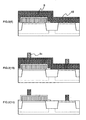
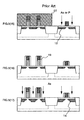
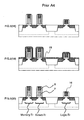
- Figs. 3(1) to 3(20) are a series of schematic cross-sectional views illustrating the steps of a conventional method of manufacturing a FLASHEEPROM.
- a first P-well 2 and a second P-well 3 are formed in a flash memory area and a logic area, respectively.
- a field oxide film 4 that defines areas of elements is formed, and thereafter an oxide film 5 with a thickness of 8 to 10 nm is formed on the surface of the substrate 1 by the thermal oxidation method (Fig. 3(1)).
- a first N - -type polysilicon 7 that is to become a FGE material in the flash memory area is formed thereon to a thickness of 150 nm.
- phosphorus is injected thereinto to a dopant concentration of approximately 1 to 3 ⁇ 10 19 atoms / cm 3 (Fig. 3(2)).
- a photoresist 6a is formed into the pattern (Fig. 3(3)) and, using this as a mask, etching is applied thereto (Fig. 3(4)).
- an ONO (Oxide-Nitride-Oxide) film 8 is grown over the entire surface to a thickness of 12 to 16 nm in terms of oxide film thickness by the CVD (Chemical Vapour Deposition) method (Fig. 3(5)).
- a photoresist 6b is then applied and patterned so as to cover only the flash memory area (Fig. 3(6)), and thereafter etching of said ONO film is performed.
- the oxide film 5 in the logic area is concurrently once removed (Fig. 3(7)), and a gate oxide film with a thickness of 5 nm, for example, is subsequently formed again in the logic area (Fig. 3(8)).
- a second polysilicon 9 that is to become a CGE material as well as a material for a gate electrode in the logic area is grown to a thickness of 200 nm (Fig. 3(9)).
- a photoresist 6c is formed into the pattern of electrodes of a memory-transistor and a select-transistor in the flash memory area, and formed over the entire surface, in the logic area (Fig. 3(10)).
- Etching is then applied to the second polysilicon 9 , the ONO film 8 in the flash memory area and the first polysilicon 7 (Fig. 3(11)).
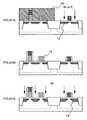
- a first LDD (Lightly-Doped Drain) structure 11 in the flash memory area arsenic (As) or phosphorus (P) is ion-implanted thereinto with a dose of approximately 1 ⁇ 10 13 to 1 ⁇ 10 14 atoms / cm 2 .
- As arsenic
- P phosphorus
- the entire surface of the logic area is masked with a photoresist 6d (Fig. 3(12)).
- a photoresist 6e is formed into the pattern of the entire surface of the flash memory area and of the transistor of the logic area by means of patterning (Fig. 3(13)).
- the subsequent etching applied thereto forms a gate electrode of the transistor in the logic area (Fig. 3(14)).
- a second LDD 12 in the logic area the entire surface of the flash memory area is again covered with a photoresist 6f and, then, As or P is ion-implanted thereinto with a dose of approximately 1 ⁇ 10 13 to 1X10 14 atoms / cm 2 (Fig. 3 (15)).
- a titanium (Ti) film 15 is grown over the entire surface (Fig. 3(19)).
- silicide films 16 are selectively formed on the SD regions of the P-type substrate 1 as well as on the polysilicons of the transistors, and thereby a semiconductor device having a memory-transistor (Tr) and a select-transistor (Tr) in the flash memory area and a logic-transistor (Tr) in the logic area is accomplished (Fig. 3(20)).
- the first polysilicon 7 for the gate electrode of the select-transistor is not N + -type but N - -type so that holding characteristics of the flash memory does not become deteriorated.
- the use of N - -type brings about significant gate depletion, which results in an increase in effective thickness of the oxide film and a lowering of the operational speed.
- the first polysilicon 7 which is the gate electrode of the select-transistor is not turned to silicide and is insulated by the ONO film 8 from the second polysilicon 9 that is turned to silicide, the resistance thereof is considerable. This gives rise to a problem that the voltage applied substantially to the gate of the select-transistor varies from cell to cell and, therefore, the ON-current of the select-transistor varies with the cell.
- a select-transistor has a gate electrode formed in such a way that a silicon film either interposing a metal silicide film therebetween or having a silicide surface thereof is formed into the shape of a sidewall on the lateral face of a gate electrode of a memory-transistor, and an adjacent circuit transistor has a gate electrode formed from the same layer as said gate electrode of the select-transistor.
- JP-A-9-181282 there is disclosed a method of manufacturing a flash memory element, wherein, after a first polysilicon such as described above and an ONO film are formed, the ONO film lying in a select-transistor area and an adjacent circuit transistor area is removed by means of photolithography, and thereafter a second polysilicon is grown and, its surface being turned to silicide, patterning is applied thereto to form the shape of gate electrodes of a memory-transistor, a select-transistor and an adjacent circuit transistor, and then the ion implantation is carried out to form source-drain regions.
- the structure of the select-transistor is formed by patterning that is performed when a floating gate and a control gate of the select-transistor are directly contacted with each other. This produces an effect of lowering the gate resistance and, thus, making formation of a buttering contact as described above unnecessary.
- concentrations of the implanted dopants are different between the floating gate and the control gate, while they are in contact with each other, so that the depletion of the underlying floating gate cannot be eliminated thoroughly.
- the dopant concentration within a polysilicon layer is made uniform through thermal diffusion.
- the surface of the lower layer is exposed to the air during the step of forming the upper layer, which leads to the formation of a thin natural oxidation film. Though 1 to 2 nm thick at the most, this natural oxidation film makes the dopant diffusion still slower by its presence.
- the grain boundaries of polysilicon layers do not usually meet on the composition plane and this further hinders the dopant diffusion.
- the RTA (Rapid Thermal Annealing) treatment performed at 1020 °C for 10 seconds or so is sufficient for a single-layered polysilicon
- the RTA treatment at the same temperature must be carried out for as long as 40 seconds for a double-layered polysilicon such as the one described herein.
- to attain diffusion within the gate polysilicon in this instance while it takes 10 seconds in a single layer, it requires 40 seconds in a double layer. Consequently, in a transistor with a double-layered structure, the diffusion in the transverse direction within the LDD becomes more marked and the effective channel length, shorter. In short, the double layer is not suited for the miniaturization, because of its substantial short channel effect.
- an object of the present invention is to provide a nonvolatile memory semiconductor device having, on one and the same substrate, a flash memory area where a memory-transistor and a select-transistor are formed and a logic area where an adjacent circuit transistor is formed; which has a transistor structure capable to suppress the gate depletion particularly in the select-transistor and to perform high speed operations, all without making the steps of manufacturing method thereof unduly complicated.
- a gate electrode of the adjacent circuit transistor in the logic area is composed of a single layer of a polysilicon film, which is formed from the same layer as the floating gate of the memory-transistor and then doped to have an enhanced dopant concentration by ion implantation performed in the step of forming source-drain regions of the transistors.
- a gate electrode of the adjacent circuit transistor in the logic area is composed of a single layer being formed from the same layer as the control gate electrode of the memory-transistor.
- a method of manufacturing a nonvolatile memory semiconductor device having, on one and the same substrate, a flash memory area where a memory-transistor and a select-transistor are formed and a logic area where an adjacent circuit transistor is formed; which, at least, comprises the steps of:
- step (7) comprises the sub-steps of removing said nitride film as well as resist pattern and then performing the first ion implantation to form an LDD structure in the flash memory area, with another resist masking the entire surface of the logic area; removing the resist in the logic area and then performing the second ion implantation to form an LDD structure in the logic area, with another resist masking the entire surface of the flash memory area; and, in addition, forming sidewalls prior to another ion implantation to form source-drain regions.
- a method of manufacturing a nonvolatile memory semiconductor device having, on one and the same substrate, a flash memory area where a memory-transistor and a select-transistor are formed and a logic area where an adjacent circuit transistor is formed; which, at least, comprises the steps of:
- step (8) comprises the sub-steps of performing the first ion implantation to form an LDD structure in the flash memory area before removing said nitride film and resist pattern; removing said nitride film and resist and then performing the second ion implantation to form an LDD structure in the logic area, with another resist masking the entire surface of the flash memory area; and, in addition, forming sidewalls prior to another ion implantation to form flash memory area; and, in addition, forming sidewalls prior to another ion implantation to form source-drain regions.
- the gate electrode of the select-transistor produced in the flash memory area is composed of a single layer of a polysilicon film, which is formed from the same layer as the floating gate electrode of the memory-transistor and then doped to have an enhanced dopant concentration by ion implantation performed in the step of forming source-drain regions of the transistors, and therefore a select-transistor structure capable of high speed operations is provided. Furthermore, because of silicide formation on the gate surface of the select-transistor, the voltage applied substantially to the gate of the select-transistor becomes almost identical for every cell so that the problem associated with the conventional structure that the ON-current of the select-transistor varies with the cell is also eliminated.
- the present invention also has the effect of simplifying the steps thereof.
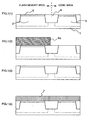
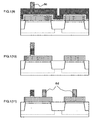
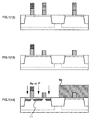
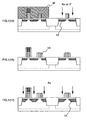
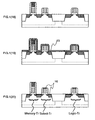
- Figs. 1(1) to 1(20) are a series of schematic cross-sectional views illustrating the steps of a method of manufacturing a FLASHEEPROM that is an embodiment of the present invention.
- a first P-well 2 and a second P-well 3 are formed in a flash memory area and a logic area, respectively.
- a field oxide film 4 that defines areas of elements is formed, and thereafter an oxide film 5 with a thickness of 6 to 8 nm is formed on the surface of the substrate 1 by the thermal oxidation method (Fig. 1(1)).
- the oxide film overlying the first P-well 2 is covered with a photoresist 6a , and then, after the oxide film overlying the second P-well 3 is once removed (Fig. 1(2)), a gate oxide film with a thickness of 5 nm is again formed by the thermal oxidation method (Fig. 1(3)).
- the film thickness of the oxide film in the flash memory area becomes 8 to 10 nm.
- a first N - -type polysilicon 7 that is to become a FGE material in the flash memory area is formed thereon to a thickness of 150 nm.
- phosphorus is injected thereinto to a dopant concentration of approximately 1 ⁇ 10 19 to 3 ⁇ 10 19 atoms / cm 3 (Fig. 1(4)).
- a photoresist 6b is formed into the pattern on the oxide film in the flash memory area and the logic area (Fig. 1(5)) and, using this as a mask, etching is applied thereto (Fig. 1(6)).
- an ONO film 8 is grown over the entire surface to a thickness of 12 to 16 nm in terms of oxide film thickness (Fig. 1(7)) and, over this, a second polysilicon 9 is grown to a thickness of 200 nm and then a nitride film 10 that is to serve as an etching mask for a floating gate in the later step is grown (Fig. 1(8)).
- a photoresist pattern 6 corresponding to the shape of an electrode of a memory-transistor in the flash memory area is formed on said nitride film 10 (Fig. 1(9)), and then the nitride film 10 , the second polysilicon 9 and the ONO film 8 are etched in succession (Fig. 1(10). After removing the photoresist, another resist pattern 6c is formed into the shape of a select-transistor gate and an adjacent circuit transistor gate (Fig. 1(11)).
- the first polysilicon 7 is etched (Fig. 1(12)).
- the nitride film as well as the resist are then removed (Fig. 1(13)), and thereafter, in order to form a first LDD structure 11 in the flash memory area, As or P is ion-implanted thereinto with a dose of approximately 1 ⁇ 10 13 to 1 ⁇ 10 14 atoms / cm 2 .
- the entire surface of the logic area is masked with a photoresist 6d (Fig. 1(14)).
- the resist formed in the logic area is removed and the entire surface of the flash memory area is again covered with a photoresist 6e and, then, As or P is ion-implanted thereinto with a dose of approximately 1 ⁇ 10 13 to 1 ⁇ 10 14 atoms/ cm 2 (Fig.1(15)).
- a photoresist 6e is ion-implanted thereinto with a dose of approximately 1 ⁇ 10 13 to 1 ⁇ 10 14 atoms/ cm 2 (Fig.1(15)).
- an oxide film is formed over the entire surface, and therefrom sidewalls 13 are formed on lateral faces of the electrode materials in the flash memory area and in the logic area (Fig. 1(16)).
- source-drain (SD) regions 14 in the flash memory area and in the logic area As is ion-implanted thereinto with a dose of approximately 1 ⁇ 10 15 to 5 ⁇ 10 15 atoms / cm 2 (Fig. 1 (17)).
- a titanium (Ti) film 15 is grown over the entire surface (Fig. 1(19)).
- silicide films 16 are selectively formed on the SD regions of the P-type substrate 1 as well as on the polysilicons of the transistors, and thereby a semiconductor device having a memory-transistor (Tr) and a select-transistor (Tr) in the flash memory area and a logic-transistor (Tr) in the logic area is accomplished (Fig. 1(20)).
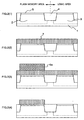
- Figs. 2(1) to 2(20) are a series of schematic cross-sectional views illustrating the steps of a method of manufacturing a FLASHEEPROM that is another embodiment of the present invention.
- a first P-well 2 and a second P-well 3 are formed in a flash memory area and a logic area, respectively.
- a field oxide film 4 tat defines areas of elements is formed, and thereafter an oxide film 5 with a thickness of 8 to 10 nm is formed on the surface of the substrate 1 by the thermal oxidation method (Fig. 2(1)).
- a first N - -type polysilicon 7 that is to become a FGE material in the flash memory area is formed thereon to a thickness of 150 nm (Fig. 2(2)).
- the polysilicon film may be grown to a thickness of 150 nm by performing the CVD method using SiH 4 and PH 3 or AsH 3 , for example, as material gases and controlling the amount of the flow of the doping material so as to make the dopant concentration approximately 1 ⁇ 10 19 to 3 ⁇ 10 19 atoms / cm 3 .
- a photoresist 6a is formed into the pattern on the oxide film in the flash memory area (Fig. 2(3)), and, using this as a mask, etching is applied thereto (Fig. 2(4)).
- an ONO film 8 is grown over the entire surface to a thickness of 12 to 16 nm in terms of oxide film thickness (Fig. 2(5)).
- a photoresist 6b is formed into the pattern over the flash memory area and then etching is applied thereto (Fig. 2(6)).
- the oxide film on the surface of the substrate in the logic area is simultaneously removed (Fig. 2(7)) so that another oxide film (a gate oxide film) is subsequently formed again in the logic area by the thermal oxidation (Fig. 2(8)).
- a second polysilicon 9 is grown to a thickness of 200 nm and then a nitride film 10 that is to serve as an etching mask for the ONO film and a floating gate in the later step is grown (Fig. 2(9)).
- a photoresist pattern 6c corresponding to the shape of an electrode of a memory-transistor in the flash memory area and the shape of an adjacent circuit transistor in the logic area is formed on said nitride film 10 (Fig. 2(10)), and then the nitride film 10 and the second polysilicon 9 are etched in succession (Fig. 2(11).
- a second LDD 12 in the logic area the entire surface of the flash memory area is covered with a photoresist 6 and, then, As or P is ion-implanted thereinto with a dose of approximately 1 ⁇ 10 13 to 1 ⁇ 10 14 atoms / cm 2 (Fig. 2(15)).
- an oxide film is formed over the entire surface, and therefrom sidewalls 13 are formed on lateral faces of the electrode materials in the flash memory area and in the logic area (Fig. 2(16)).
- SD source-drain
- a titanium (Ti) film 15 is grown over the entire surface (Fig. 2(19)).
- silicide films 16 are selectively formed on the SD regions of the P-type substrate 1 as well as on the polysilicons of the transistors, and thereby a semiconductor device having a memory-transistor (Tr) and a select-transistor (Tr) in the flash memory area and a logic-transistor (Tr) in the logic area is accomplished (Fig. 2(20)).
- CMOS Complementary Metal-Oxide-Semiconductor
Landscapes
- Engineering & Computer Science (AREA)
- Manufacturing & Machinery (AREA)
- Semiconductor Memories (AREA)
- Non-Volatile Memory (AREA)
- Metal-Oxide And Bipolar Metal-Oxide Semiconductor Integrated Circuits (AREA)
Applications Claiming Priority (2)
| Application Number | Priority Date | Filing Date | Title |
|---|---|---|---|
| JP33583598 | 1998-11-26 | ||
| JP33583598A JP3314807B2 (ja) | 1998-11-26 | 1998-11-26 | 半導体装置の製造方法 |
Publications (2)
| Publication Number | Publication Date |
|---|---|
| EP1005081A2 true EP1005081A2 (fr) | 2000-05-31 |
| EP1005081A3 EP1005081A3 (fr) | 2001-02-07 |
Family
ID=18292945
Family Applications (1)
| Application Number | Title | Priority Date | Filing Date |
|---|---|---|---|
| EP99123440A Withdrawn EP1005081A3 (fr) | 1998-11-26 | 1999-11-24 | Memoire non volatile à semiconducteur et méthode pour sa fabrication |
Country Status (4)
| Country | Link |
|---|---|
| US (2) | US6287907B1 (fr) |
| EP (1) | EP1005081A3 (fr) |
| JP (1) | JP3314807B2 (fr) |
| KR (1) | KR100392532B1 (fr) |
Cited By (3)
| Publication number | Priority date | Publication date | Assignee | Title |
|---|---|---|---|---|
| EP1962332A2 (fr) | 2007-02-22 | 2008-08-27 | Fujitsu Ltd. | Dispositif semi-conducteur et son procédé de fabrication |
| EP1494276A3 (fr) * | 2003-06-30 | 2009-06-24 | Kabushiki Kaisha Toshiba | Dispositif semi-conducteur ayant mémoire rémanente et procédé pour sa fabrication |
| CN114005832A (zh) * | 2021-10-28 | 2022-02-01 | 上海华力微电子有限公司 | Nand闪存器件及nand闪存的制作方法 |
Families Citing this family (25)
| Publication number | Priority date | Publication date | Assignee | Title |
|---|---|---|---|---|
| JP2003518742A (ja) * | 1999-12-21 | 2003-06-10 | コーニンクレッカ フィリップス エレクトロニクス エヌ ヴィ | 不揮発性のメモリーセルと周辺部 |
| JP4078014B2 (ja) * | 2000-05-26 | 2008-04-23 | 株式会社ルネサステクノロジ | 不揮発性半導体記憶装置及びその製造方法 |
| JP2002064157A (ja) * | 2000-06-09 | 2002-02-28 | Toshiba Corp | 半導体メモリ集積回路及びその製造方法 |
| JP2002050697A (ja) * | 2000-08-07 | 2002-02-15 | Mitsubishi Electric Corp | 半導体装置の製造方法、及び半導体装置 |
| JP2002151686A (ja) * | 2000-11-15 | 2002-05-24 | Nec Corp | 半導体装置およびその製造方法 |
| US6338992B1 (en) * | 2000-11-29 | 2002-01-15 | Lsi Logic Corporation | Programmable read only memory in CMOS process flow |
| US6429067B1 (en) * | 2001-01-17 | 2002-08-06 | International Business Machines Corporation | Dual mask process for semiconductor devices |
| US6940152B2 (en) * | 2002-02-21 | 2005-09-06 | Matsushita Electric Industrial Co., Ltd. | Semiconductor storage device and its manufacturing method |
| KR20030085631A (ko) * | 2002-04-29 | 2003-11-07 | 주식회사 하이닉스반도체 | 반도체 소자의 제조 방법 |
| JP5179692B2 (ja) * | 2002-08-30 | 2013-04-10 | 富士通セミコンダクター株式会社 | 半導体記憶装置及びその製造方法 |
| US7256090B2 (en) * | 2003-12-31 | 2007-08-14 | Dongbu Electronics Co., Ltd. | Method for fabricating semiconductor device |
| KR100655285B1 (ko) | 2004-11-04 | 2006-12-08 | 삼성전자주식회사 | 적층 게이트를 가지는 반도체 소자 및 그 제조방법 |
| CN100361292C (zh) * | 2004-12-30 | 2008-01-09 | 旺宏电子股份有限公司 | 快闪存储单元制造方法 |
| CN100442524C (zh) * | 2005-09-28 | 2008-12-10 | 中芯国际集成电路制造(上海)有限公司 | 用于嵌入式eeprom中的一次可编程存储器器件的结构与方法 |
| JP5118341B2 (ja) * | 2006-12-22 | 2013-01-16 | 株式会社東芝 | 半導体記憶装置及びその製造方法 |
| US7652923B2 (en) * | 2007-02-02 | 2010-01-26 | Macronix International Co., Ltd. | Semiconductor device and memory and method of operating thereof |
| KR101001466B1 (ko) * | 2007-03-06 | 2010-12-14 | 주식회사 하이닉스반도체 | 비휘발성 메모리 소자의 제조 방법 |
| JP5546740B2 (ja) | 2008-05-23 | 2014-07-09 | ローム株式会社 | 半導体装置 |
| US8228726B2 (en) * | 2008-12-14 | 2012-07-24 | Chip Memory Technology, Inc. | N-channel SONOS non-volatile memory for embedded in logic |
| CN101777562B (zh) * | 2010-01-15 | 2015-05-20 | 复旦大学 | 浮栅非挥发半导体存储器及其制造方法 |
| CN101800251B (zh) * | 2010-01-29 | 2015-04-15 | 复旦大学 | 电荷俘获非挥发半导体存储器及其制造方法 |
| JP6065586B2 (ja) * | 2012-12-28 | 2017-01-25 | 日亜化学工業株式会社 | 発光装置及びその製造方法 |
| CN104425366B (zh) * | 2013-08-20 | 2017-12-29 | 中芯国际集成电路制造(北京)有限公司 | 半导体结构的形成方法 |
| TW202118280A (zh) * | 2019-09-10 | 2021-05-01 | 日商索尼半導體解決方案公司 | 攝像裝置、電子機𠾖及製造方法 |
| CN113921528A (zh) * | 2021-09-29 | 2022-01-11 | 上海华力微电子有限公司 | 一种sonos存储器及其制备方法 |
Family Cites Families (22)
| Publication number | Priority date | Publication date | Assignee | Title |
|---|---|---|---|---|
| JPH07114264B2 (ja) * | 1985-08-23 | 1995-12-06 | 株式会社日立製作所 | 半導体集積回路装置の製造方法 |
| JP2509697B2 (ja) | 1989-04-28 | 1996-06-26 | 株式会社東芝 | 半導体装置およびその製造方法 |
| US5066992A (en) | 1989-06-23 | 1991-11-19 | Atmel Corporation | Programmable and erasable MOS memory device |
| JPH03125479A (ja) | 1989-10-11 | 1991-05-28 | Kawasaki Steel Corp | 不揮発性記憶素子を有する半導体集積回路の製造方法 |
| JPH088314B2 (ja) | 1989-10-11 | 1996-01-29 | 株式会社東芝 | 不揮発性半導体記憶装置およびその製造方法 |
| JP2825585B2 (ja) | 1990-01-29 | 1998-11-18 | 株式会社日立製作所 | 半導体集積回路装置及びその製造方法 |
| JPH05121700A (ja) | 1991-08-28 | 1993-05-18 | Fujitsu Ltd | 半導体装置及びその製造方法 |
| US5273923A (en) * | 1991-10-09 | 1993-12-28 | Motorola, Inc. | Process for fabricating an EEPROM cell having a tunnel opening which overlaps field isolation regions |
| JP3548984B2 (ja) | 1991-11-14 | 2004-08-04 | 富士通株式会社 | 半導体装置の製造方法 |
| JPH0855920A (ja) | 1994-08-15 | 1996-02-27 | Toshiba Corp | 半導体装置の製造方法 |
| JP3218303B2 (ja) | 1994-08-30 | 2001-10-15 | マクロニクス インターナショナル カンパニイ リミテッド | 不揮発性半導体記憶装置の製造方法 |
| JPH08139089A (ja) | 1994-11-08 | 1996-05-31 | Sony Corp | 半導体装置 |
| JPH08148586A (ja) * | 1994-11-21 | 1996-06-07 | Toshiba Corp | 半導体装置の製造方法 |
| JPH08167705A (ja) * | 1994-12-15 | 1996-06-25 | Toshiba Corp | 不揮発性半導体記憶装置及びその製造方法 |
| US6475846B1 (en) * | 1995-05-18 | 2002-11-05 | Texas Instruments Incorporated | Method of making floating-gate memory-cell array with digital logic transistors |
| JPH0955441A (ja) | 1995-08-10 | 1997-02-25 | Sony Corp | 半導体装置の製造方法 |
| KR970053947A (ko) | 1995-12-16 | 1997-07-31 | 김광호 | 불휘발성 반도체 메모리장치 및 그 제조방법 |
| JPH09283643A (ja) * | 1996-04-19 | 1997-10-31 | Rohm Co Ltd | 半導体装置および半導体装置の製造法 |
| US5668035A (en) * | 1996-06-10 | 1997-09-16 | Taiwan Semiconductor Manufacturing Company Ltd. | Method for fabricating a dual-gate dielectric module for memory with embedded logic technology |
| JPH10270578A (ja) | 1997-03-27 | 1998-10-09 | Seiko Instr Inc | 半導体装置及びその製造方法 |
| JP3586072B2 (ja) * | 1997-07-10 | 2004-11-10 | 株式会社東芝 | 不揮発性半導体記憶装置 |
| US6037222A (en) * | 1998-05-22 | 2000-03-14 | Taiwan Semiconductor Manufacturing Company | Method for fabricating a dual-gate dielectric module for memory embedded logic using salicide technology and polycide technology |
-
1998
- 1998-11-26 JP JP33583598A patent/JP3314807B2/ja not_active Expired - Fee Related
-
1999
- 1999-11-23 US US09/447,869 patent/US6287907B1/en not_active Expired - Fee Related
- 1999-11-24 EP EP99123440A patent/EP1005081A3/fr not_active Withdrawn
- 1999-11-24 KR KR10-1999-0052429A patent/KR100392532B1/ko not_active Expired - Fee Related
-
2001
- 2001-09-12 US US09/950,870 patent/US6534355B2/en not_active Expired - Fee Related
Cited By (6)
| Publication number | Priority date | Publication date | Assignee | Title |
|---|---|---|---|---|
| EP1494276A3 (fr) * | 2003-06-30 | 2009-06-24 | Kabushiki Kaisha Toshiba | Dispositif semi-conducteur ayant mémoire rémanente et procédé pour sa fabrication |
| EP1962332A2 (fr) | 2007-02-22 | 2008-08-27 | Fujitsu Ltd. | Dispositif semi-conducteur et son procédé de fabrication |
| EP1962332A3 (fr) * | 2007-02-22 | 2009-04-29 | Fujitsu Microelectronics Limited | Dispositif semi-conducteur et son procédé de fabrication |
| US8466509B2 (en) | 2007-02-22 | 2013-06-18 | Fujitsu Semiconductor Limited | Semiconductor device having a contact plug connecting to a silicide film formed on a diffusion region of a flash memory cell |
| US8865546B2 (en) | 2007-02-22 | 2014-10-21 | Fujitsu Semiconductor Limited | Method for manufacturing a non-volatile semiconductor memory device having contact plug formed on silicided source/drain region |
| CN114005832A (zh) * | 2021-10-28 | 2022-02-01 | 上海华力微电子有限公司 | Nand闪存器件及nand闪存的制作方法 |
Also Published As
| Publication number | Publication date |
|---|---|
| US20020052073A1 (en) | 2002-05-02 |
| KR20000035655A (ko) | 2000-06-26 |
| US6534355B2 (en) | 2003-03-18 |
| KR100392532B1 (ko) | 2003-07-22 |
| EP1005081A3 (fr) | 2001-02-07 |
| JP2000164834A (ja) | 2000-06-16 |
| JP3314807B2 (ja) | 2002-08-19 |
| US6287907B1 (en) | 2001-09-11 |
Similar Documents
| Publication | Publication Date | Title |
|---|---|---|
| US6287907B1 (en) | Method of manufacturing a flash memory having a select transistor | |
| KR100474631B1 (ko) | 반도체디바이스의제조방법 | |
| US6297094B1 (en) | Semiconductor device with salicide structure and fabrication method thereof | |
| US6159795A (en) | Low voltage junction and high voltage junction optimization for flash memory | |
| US5381028A (en) | Nonvolatile semiconductor memory with raised source and drain | |
| US6787419B2 (en) | Method of forming an embedded memory including forming three silicon or polysilicon layers | |
| US20020072173A1 (en) | Semiconductor device and fabrication process therefor | |
| US20020053710A1 (en) | Semiconductor device having a high breakdown voltage | |
| US10332875B2 (en) | Semiconductor device and a method of fabricating the same | |
| JP2000133729A (ja) | 非サリサイド処理不揮発性メモリセル、非サリサイド処理高電圧トランジスタ、及びサリサイド処理接合低電圧トランジスタを含む電子デバイスの製法および電子デバイス | |
| KR100327736B1 (ko) | 반도체장치의 제조방법 | |
| US6362062B1 (en) | Disposable sidewall spacer process for integrated circuits | |
| US6069033A (en) | Method of manufacturing a non-volatile memory and a CMOS transistor | |
| US6492234B1 (en) | Process for the selective formation of salicide on active areas of MOS devices | |
| KR20000071414A (ko) | 메모리 셀 영역 및 cmos 논리 영역을 포함하는 반도체장치를 제조하는 방법 | |
| KR20010071624A (ko) | 전계 효과 트랜지스터를 포함하는 반도체 디바이스의 제조방법 | |
| US6933199B1 (en) | Method for integrating non-volatile memory with high-voltage and low-voltage logic in a salicide process | |
| US20030157758A1 (en) | Non-volatile semiconductor memory device and manufacturing method therefor | |
| JP2000208638A (ja) | 半導体素子の二重ゲ―トの形成方法 | |
| KR19980081779A (ko) | Mos 트랜지스터와 그 제조 방법 | |
| US20080014691A1 (en) | Mask rom cell, nor-type mask rom device, and related methods of fabrication | |
| JPH1126609A (ja) | 半導体記憶装置及びその製造方法 | |
| EP0878833B1 (fr) | Procédé de formation sélective de salicide sur les aires actives de dispositifs MOS | |
| US7030448B2 (en) | Mask ROM and the method of forming the same and the scheme of reading the device | |
| KR100216320B1 (ko) | 모스 트랜지스터 제조방법 |
Legal Events
| Date | Code | Title | Description |
|---|---|---|---|
| PUAI | Public reference made under article 153(3) epc to a published international application that has entered the european phase |
Free format text: ORIGINAL CODE: 0009012 |
|
| AK | Designated contracting states |
Kind code of ref document: A2 Designated state(s): DE GB |
|
| AX | Request for extension of the european patent |
Free format text: AL;LT;LV;MK;RO;SI |
|
| PUAL | Search report despatched |
Free format text: ORIGINAL CODE: 0009013 |
|
| AK | Designated contracting states |
Kind code of ref document: A3 Designated state(s): AT BE CH CY DE DK ES FI FR GB GR IE IT LI LU MC NL PT SE |
|
| AX | Request for extension of the european patent |
Free format text: AL;LT;LV;MK;RO;SI |
|
| 17P | Request for examination filed |
Effective date: 20010511 |
|
| AKX | Designation fees paid |
Free format text: DE GB |
|
| RAP1 | Party data changed (applicant data changed or rights of an application transferred) |
Owner name: NEC ELECTRONICS CORPORATION |
|
| STAA | Information on the status of an ep patent application or granted ep patent |
Free format text: STATUS: THE APPLICATION HAS BEEN WITHDRAWN |
|
| 18W | Application withdrawn |
Effective date: 20030930 |